Perfect running weather. Cold, but not too cold, calm, overcast. Clear paths, a dreamy, detached feeling. As I ran, I thought of a goal for this winter: continue working on running with a slower heart rate. I started this during the summer/fall with marathon training, and I think it helped me avoid injuries. This winter I’m thinking I should target 155-160. I wonder what fun experiments I can do while trying to keep my heart rate low?
10 Things
as I ran, I gave attention to my arms — when my form was good, I felt like my arms were blades scissoring the air
the river was half bronze, half pewter
2 walkers who were not together were both
wearing bright RED jackets
3 stones were stacked on the boulder — the one on top was barely balanced
the yellow leaves were thick on the part of the path that descends into the tunnel of trees
a roller skier bombing down the hill
a noisy squirrel rooting through the dry brush
the slabs of stone stacked under the franklin bridge always look like a person to me — they did again today, looking like a sitting person as I passed them on my way down, just stones on my way back up — I imagined someone playing a trick on me, first sitting there, but then after I passed, putting the stones down
some regulars I haven’t named yet, but that I’ve encountered for years: 3 older white men, walking, stretched across the whole walking path — is it the same guys every time, or different ones, all of them man spreading? That’s what I could call them: the man spreaders
rotting sewer smell in the tunnel of trees, close to where the city is doing some work
More work this morning (and afternoon), on my “And” poem. So far, I’ve written about the formation of the gorge (wanting to be somewhere else) and the designing of the Mississippi River Gorge park (to protect from overdevelopment and sell the gorge as a symbol of the water city). Now I’m getting into my love of the view, which is about what I see — softened, elemental forms, like tree line or water or white sand beach — but also what I feel — open, a veil lifted, a little clarity, freer and more able to breathe and move, to the other side (which stands in for many things, including St. Paul where my mom lived until she was 18, the place where people who died dwell, the normal-sighted and real world that I feel distanced from. I think the view is also about how standing above the gorge enables me to witness how it holds all of these things together, that it doesn’t divide but connects. There is not a gap between girl and world, but a space that can hold them together, along with water and stone, mothers and daughters, hear and there, now and then. These are all references to past sections of the poem.
4 miles minnehaha falls 49 degrees wind gusts: 25 mph
Wet. Windy. Slick leaves. Squeaks. A light gray sky. Singing pines. The usual puddles. White foam falls. Gushing sewer pipes. Brisk air. Mud.
Greeted Santa Claus (the regular runner whose long white beard reminds me of Santa Claus). Passed a man walking with one leg up in a boot on a scooter. Gave directions to 2 walkers — which way to the falls? follow the path, it’s over there.
The creek was a steel blue and rushing to reach the limestone ledge. A kid at the main overlook was jumping in a puddle. The green gate at the top of the steps leading down to the falls was still open.
Wore shorts and a pink hooded jacket. My legs were only cold for a few minutes. Too warm for mid-November. Today is the last day of warmer air. Tomorrow, below freezing.
I started working on the section of Haunts poem that I’m titling, And. Came up with a few lines while running north. Recited them in my head until I stopped near the Folwell bench and spoke them into my phone:
Before a Victor- ian’s great love for ventilation, there was water wanting to be something and somewhere else.
The ventilation bit is taken from an article about the origins of the Grand Rounds, and the Victorian is Horace W.S. Cleveland:
The concept of The Grand Rounds was born from Cleveland’s “preference of an extended system of boulevards, or ornamental avenues, rather than a series of detached open areas or public squares.” This was not only an aesthetic consideration: Cleveland had lost many possessions in the 1871 Chicago fire, and saw parkways as an effective firebreak in built-up urban areas. In addition, Cleveland stressed the sanitary benefits derived from parkways. Cholera, typhus, and other diseases plagued cities in the late nineteenth century. Parkways could save land from unhealthy uses and, reflecting the Victorians’ great love for ventilation, carry “winds . . . to the heart of the city, purified by their passage over a long stretch of living water, and through the foliage of miles of forest.”
Moist this morning. Wet sidewalk, wet leaves, wet air. Something was squeaking — my shoes on the leaves or the leaves on my shoes? Only one stone on the boulder, looking lonely and flat. The black stocking cap I mentioned yesterday was still there on the pole. Today I remembered that it was above the old stone steps. Greeted Dave, the Daily Walker with a good morning Dave!, greeted Daddy Long Legs with a wave. He was with his walking partner again. Smiled and gave a head nod to another walker who I think I’ve mentioned before. They always wear a long skirt with tights, and most of the year, a blue puffer jacket. They have gray hair in a long braid. I looked it up, and when I wrote about them before (26 jan 2024), I described them as wearing a dress and tentatively named them, All Dressed Up.
Anything else? I’m pretty sure I looked at the river, but I don’t remember what I saw. No fat tires or roller skiers or geese — where are all the geese? — or turkeys. More YELLOW leaves, falling fast. Some sour sewer smells, puddles, empty benches.
I listened to squeaking leaves and thudding feet as I ran north, then my Color playlist returning south: “Not Easy Bein’ Green,” “Roxanne,” “Mellow Yellow,” and “Let’s Go Crazy.” Speakig of color, I discovered this excellent color poem yesterday afternoon:
There’s a rumor of light that any dark starts off as. Plato speaks here and there of colors, but only once, I think, does he break them down into black and white, red, and a fourth color. By then they’d reached for California high country where, knowing none of the names for all the things that grew there, they
began to make names up. But to have trained an animal to come just a bit closer because here, here’s blood, doesn’t mean you’ve tamed it. Trans- lations vary for what Plato calls his fourth color: what comes closest to a combination of (since they aren’t the same) radiant and bright–what shifting water does,
with light? Violence burnishes the body, sometimes, though we call it damage, not burnishing, more its opposite, a kind of darkness, as if to hide the body, so that what’s been
done to it might, too, stay hidden, the way meaning can, for years, until some pattern by which to trace it at last emerges. There’s a rumor of light.
I need to give more time to this poem; there’s so much I don’t quite get. But I love the discussion of Plato and color and what shifting water does to light.
5.45 miles franklin hill turn around 38 degrees wind: 13 mph / gusts: 27 mph
Sunny, windy, cooler. Wore one of my mild winter combinations: running tights, shorts, long-sleeved shirt, sweatshirt, vest, gloves, headband that covers my ears. I overdressed. Had to take off the sweatshirt near the top of Franklin. A good run. I’m running 30 seconds faster per mile and feeling stronger in the cooler weather than I did when it was warmer.
Yesterday, I woke up feeling not quite right. I slept a lot during the day. Almost a sore throat. Took a covid test: negative. Still feel a little off today. Is it a cold? Should I cancel my annual check-up that’s scheduled for tomorrow?
I deactivated my twitter account and haven’t checked the news since the election. Mostly I’m not thinking about what is coming, and instead focusing on writing, trying to help my kids with their struggles, and living (temporarily?) in the world I’ve built through my practice.
10 Things
the surface of the river was burning white through the bare trees
forest branches creaking and moaning in the wind
one or two trees in the floodplain forest still green
bright pink bubble-letter graffiti under the 1-94 bridge
4 stones stacked on the ancient boulder
Daddy Long Legs walking with someone today — I think every other time I’ve seen him, he’s been alone
a pale blue sky with one or two puffs of cloud
a biker slowing climbing the franklin hill on the road, a car following behind impatiently then hastily passing him
an empty bench facing an open view — so much air and sun and softness
walking up the hill close to the trees on the slope, I noticed a blanket spread out, hidden in the grass — was someone sleeping in it?
For the first half of the run, I listened to the gorge and my feet and the wind. For the second half, I put in my “It’s Windy” playlist.
5.25 miles bottom of franklin hill and back 47 degrees
A great November morning. Most of the trees bare, almost everything light brown and steel blue. A few yellow leaves still on the trees. I felt relaxed and was able to run without stopping — until I needed the port-a-potty. Found a freshly cleaned one at the bottom of the hill, then ran back up it all the way without stopping. For the last 2 miles I felt strong and resilient and ready to resist.
10 Things
roller skiers — at least 3 of them, not together. All of them looked graceful and strong and ready for it to snow
the awkward slapping of oars on the water from a rowing shell far below
the bells of St. Thomas ringing briefly
more awkward slaps from oars, this time from a shell with 3 people. I heard them when I was at the bottom of the hill and watched as they angled across the river. One of them had on a bright yellow — or was it orange? — shirt
a man sitting on a bench, his back to the gorge, reading a book
faint voices getting louder — was it runners or bikers? both
the floodplain forest is open — no more leaves — I glanced down the steep slope to the forest floor
a runner on the other side of the road in black shorts and white tights
4 stones stacked on the ancient boulder
a walker bundled up in a coat with a scarf
I had a thought about my Haunts project near the start of my run. I’m writing a lot about looping and orbiting, but I haven’t written about pacing back and forth — all of my out and back or turn around runs, when I cover the same ground twice, and stay on one side of the river. I’m thinking about the difference between restless pacing and cycles/loops/orbits.
I didn’t see any eagles or hear any geese. No regulars or fat tires or music blasting from car or bike speakers. No one singing or doing something ridiculous. Only one honking car horn. No chainsaws or sirens or leaf blowers.
Today I checked out Carl Phillips’poetry collection, which won the Pulitzer Prize, Then the War. Here’s an early favorite of mine:
The Enchanted Bluff/ Carl Phillips
You can see here, though the marks are faint, how the river must once have coincided with love’s most eastern boundary. But it’s years now since the river shifted, as if done with the same view both over and over and never twice, which is to say done at last with conundrum, when it’s just a river—here’s a river . . . Why not say so, why this need to name things based on what they remind us of—cattail and broom, skunk cabbage—or on what
we wished for: heal-all; forget-me-not. Despite her dyed-too-black hair wildly haloing her soulders, not a witch, caftanned in turquoise, gold, turning men into better men, into men with feelings—instead, just my mother, already gone crazy a bit, watching the yard fill with the feral cats that she fed each night. Who says you can’t die from regret being all you can think about? What’s it matter, now, if she learned the hard way the difference finally between freedom and merely setting a life free? As much as I can, anyway, I try to keep regret far from me,
though like any song built to last, there’s a rhythm to it that, once recognized, can be hard to shake: one of by fear, with its double flower— panic, ambition; two if by what’s the worst thing you’ve ever done?
I love these lines:
But it’s years now since the river shifted, as if done with the same view both over and over and never twice, which is to say done at last with conundrum, when it’s just a river—here’s a river . . .
I’d like to use, as if done with the same/view both over and over/and never twice.
I want to fit it into my 3/2 form and use it my Haunts section about looping and doubling back. Maybe something like this:
Occasionally the girl does not run on the rim, changes her route, as if done with the same view, both over and over and never twice.
I overdressed this morning in a long-sleeved shirt, sweatshirt, tights and gloves. The sun was warmer than I thought. Most of the leaves are off the trees and on the ground. The ravine near Shadow Falls was a beautiful rusty red. The thin creek running through it shimmered in spots.
It helped to get outside and be beside the gorge. It’s an exhausting time. Both of my kids are supposed to be in college this semester, neither of them are. They are each working on their mental health. It’s hard to see them suffer. On top of that, the impending election is terrifying. While I ran, I forgot about all of this.
10 Things
the bells of St. Thomas tolling twelve times as I crested the Summit hill
2 small bowls on a neighbor’s front steps, filled with full-sized reese’s peanut butter cups
a man walking a dog listening to talk radio without headphones — I couldn’t tell if it was about politics or sports
water falling softly from shadow falls
the river from lake street bridge: gray, rippled, a shimmering line of light near the east shore
a graffitied port-a-potty with the door very slightly ajar — was it open, or was the door unable to fully close?
the trees on the west side of the river near locks and dam no. 1 were bare and a fuzzy brown
the sudden start of sirens close by — a fire truck coming up the hill from the locks
the stinky mulch that had been piled on the edge of the path was gone
an opening on the bluff — what a view of the river and the other side!
3.5 miles trestle turn around 38 degrees / drips then drizzle then freezing rain
Happy Halloween. Snow later this morning. Wanted to get in a quick run before that happened. When I started it was only dripping but as I finished, freezing rain. Wore black running tights, a pink hooded jacket, a black winter vest, and black gloves. Running north I had the wind in my face. Running south, to my side. I enjoyed this run. Hardly anyone else out on the trail and cool temperatures. Winter running is coming!
Since I’m trying to finish an audio book that’s due in 2 days, I listened to it instead of the rain — except for in the last minutes of the run. I took out my headphones and heard water falling steadily.
10 Things
the usual puddles on neighborhood sidewalks: just past the alley, a stretch on the next block, a big one covering entire slab on 46th
bright headlights cutting through the trees on the other side of the ravine
a few stones stacked on the big boulder
under the lake street bridge: a red blanket stretched on the uneven limestone with a person under it, an empty wheelchair nearby
a small stretch of the river road between lake street and the trestle was flooded. It almost was cresting the curb
most cars slowed down for the flooding, but one didn’t — splash! — thankfully not on me
only one other runner out there
roaring wind
light gray sky
a steady, strong rhythm of striking feet
That wheelchair broke me open for the rest of the run.
Yesterday, Scott, RJP, and I voted early! Everyone at the polling place was happy and nice and excited to be voting. A great experience, even as it was difficult because of my failing vision. Before voting, we were required to fill out an absentee ballot form. Only the highlighted parts, the person who handed us the form instructed. The problem: I can’t see yellow, and that was the color of the highlighted text. RJP had to point out the sections. Scott was unsettled as he was reminded of how bad my vision is getting. At first, when I looked at the ballot, I couldn’t quite make sense of it, but after a moment, slowly, I could read the different categories and names. I thought I was filling in the entire bubble (Harris/Walz, OF COURSE!), but when I double- then triple-checked it, I had only filled in half of it. Another few times, and I finally filled it all in.
water section of haunts
Wrote this bit about the hidden cut-off wall in downtown Minneapolis that was put in place in 1876 and still holds the river back from breaking through the last bed of limestone:
A century and a half later, the concrete, hidden deep*, still stands and the river, ever restless*, has not stopped trying to move past it. Water will flow where water wants to go, under over through. Near the gorge the girl beholds its quiet refusal to be contained.
*should I cut these extra bits?
I thought about the idea of water going where it wants to go as I ran through the rain, navigating the streams and puddles.
3.1 miles locks and dam no. 1 and back 61 degrees / humidity: 80%
High today of 78. Tomorrow 72. Halloween 49. As Scott says, It’s always cold on Halloween. I felt overheated during the run. Face burning and dripping sweat. I had been planning to do a 10k — the Hidden Falls loop — but it felt too warm. Maybe on Thursday. I wore black shorts and a darkish blue short-sleeved shirt. The same thing I wore for the marathon.
I listened to an audio book, The God of the Woods, so I was distracted as I ran. Can I remember 10 things?
10 Things
an intense, sweet and sour and woody smell as I ran by a pile of wood chips at the edge of the trail
tall piles of wet leaves at the end of the street, waiting for the city workers to return and scoop them up in their truck
beep beep beep — a city truck backing up
3 or 4 stacked stones on the ancient boulder
a group of bikers, all wearing bright yellow long-sleeved shirts
crunch crunch crunch — my feet running through a blanket of leaves on one side of the trail
a faint shadow on the sidewalk, cast from the light of a weak, cloud-covered sun
someone sitting on a bench near the overlook, wearing dark clothing
the water fountain near 36th appears to still be on — the st. paul ones are already turned off, when do they turn off the minneapolis ones?
the clicking and clacking of a roller skier’s poles and the bright blue of their shirt — did I see this today or on my walk yesterday afternoon?
more on the water section of haunts
I’m still gathering ideas and resources for my water section. Here’s another one:
Though the river has always been dynamic, it looks very different than it did just a few centuries ago. In the past 175 years, people began making major engineering changes to the river in attempts to harness it for industry. Before we started building mills, dams and locks, the Mississippi here was a wild and free-flowing river.
Rather than the series of dammed reservoirs we have today, the river was a braided channel with at least a dozen islands between the falls and Bdóte, where the Minnesota River enters the Mississippi. The river had rocky rapids, gravel bars and beaches, fast and slow spots, deep and shallow spots and floodplains.
Possibly to put beside this, a line from a poem I revisited this morning:
And if the world has ceased to hear you, say to the silent earth: I flow. To the rushing water, speak: I am (from Let this darkness be a bell tower/ Rainer Maria Rilke)
I’ll take this weather every day. Sunny and cold enough to not overheat but not cold enough to feel cold. Wore shorts, a short-sleeved shirt, and a sweatshirt. Took the sweatshirt off at mile 3. Ran much faster and for longer without stopping than I have recently. Was greeted by Mr. Holiday near the beginning of the run — good morning! Heard some voices down below — rowers? hikers? My right kneecap shifted a few times as I ran. At first, I was worried and thought, usually that only happens when I walk, but then I remembered that in the fall my kneecap can move around some. Is it the colder weather?
I ran the first 5k without stopping, then walked a little before starting again. I turned on the metronome at 175 and listened to it as I ran up the hill. Then I switched to a Billie Eilish playlist. I was hoping that listening to the metronome would get me inside of the beat and open me up to noticing and feeling more, but I couldn’t quite get there. I could hear that I was in time with the steady click, but I couldn’t feel that moment when we were fully in sync, when the striking of my feet was the beat happening.
10 Things
more leaves off the trees, more open air above the gorge to view — bright and looking almost hazy. Was that the air or just an effect of how bare and un-green the other side was?
the bright, silvery reflection of the sun off a bike’s mirror — the bike was not moving, but was parked by a bench and 2 people
fluttering leaves in front of me, showing me that the wind was at my back
the leaves hovered in the air, one of them long enough for me to touch it
a roller skier in all black
another roller skier in a bright yellow long-sleeved shirt
signs and port-a-potties left over from yesterday’s race
the seep in the flats was seeping enough to have left a big wet spot on the road
vision error: got too close to the edge of the trail and hit my face on a branch, then ran right over another pile of branches and almost tripped
so many leaves on the path, covering holes and cracks and bumps — rolled my ankle on a bump that I couldn’t see
Before the run, I listened to a recording of a draft of a section of the poem I’m working on and had some good ideas for revisions. Very excited about how my Haunts poem is coming together!
Wonderful weather for running! Not too cold, but cold enough to not overheat. The color of the day: yellow. I’m sure there were orange and red leaves, but all I remember were the bright yellow ones. Another color I remember: glitter — on the water, among the fluttering leaves. Seeing the low water in the creek on Monday, I wondered if the falls would even be falling. They were, but no gushing or roaring.
10 Things
laughing kids at Dowling Elementary
the oak savanna is still mostly green
a sidewalk covered in dry, yellowed pine needles
a person taking a selfie with their dog by my favorite overlook at the falls
the man who empties the parking kiosks — I’ve seen him several times before and wondered why he comes in a regular (unmarked) car and how many coins he collects
the creek was higher than in past falls when bare rock was exposed
instead of a rope blocking the steps down to the falls, which is easy to climb over, Minneapolis Parks has added a green metal gate
the shadow of some leaves falling to the ground, looking like the shadows of birds
those same falling leaves looking like brown snow
the swinging shadow of my ponytail
pines and Basho
I ran over yellow pine needles covering the sidewalk at the start of my run and thought about Basho. So I looked up “basho pine” and found this line:
Learn about the pines from the pine, and about bamboo from the bamboo. Don’t follow in the footsteps of the old poets, seek what they sought.
A poem I was working on yesterday (and submitted to a journal for consideration), starts this way:
It begins here: from the ground up, feet first, following.
The following I am referring to is not simple repetition, even as it literally is about following trails already made by past feet, but seeking what past feet sought: connection, contact, familiarity with the ground/land and how it has been shaped.
ghosts and zombies
My plan for this month was to focus on Zombies, but between a kid crisis, the marathon, and a poem that insisted on being reworked, I haven’t given much attention to them. Maybe two other reasons: I don’t really like zombies, and I’m still thinking about ghosts.
from Circle / Dana Knott
human obits in the process of being written ghostly obits in the process of being read
Here’s what I wrote on August 1, 2024 that got me thinking about zombies:
On Ghosts V. Zombies/ Suzanne Buffam
Soul without a body or body without a soul? Like choosing between an empty lake And the same empty lake.
For the past few years, I’ve devoted a lot of attention to ghosts and haunts, but I’ve rarely thought about zombies. This poem is making me want to think about them now. So many directions to go with it — the relationship between the body and the soul or the body and the spirit or the body and the mind; how, because I can’t see people’s faces or make eye contact, they look soulless to me — I’m a ghost among zombies; Alice Oswald and the Homeric mind — our thoughts traveling outside of our bodies; Emily Dickinson and the soul that wanders; the fish in us escaping (Anne Sexton) or the bees released, returned to the hive/heaven (Eliot Weinberger).
I clicked on the ED link and read my entry from march 19, 2024. There’s a lot of good stuff in it, including a reference to Homer, but not the poet, the cartoon character, Homer Simpson. It’s the clip where his brain escapes his body to avoid listening to Ned Flanders talking about the differences between apple juice and cider (if it’s clear and yella, you got juice there fella, if it’s tangy and brown, you’re in cider town). Wow.
taking it slow
Reading the “about this poem” for poets.org’s poem of the day, Dead Reckoning, I encountered this line:
This poem began as a long sequence but arrived at this stripped-down form after fifteen years of off-and-on revision.
15 years of off-and-on revision! I’m only on year 3 of my Haunts revisions. I’m glad to know that other poets sit with some of their poems for a long time.
After finding this, I read an old entry from October 16, 2021, and found this:
“I am slow and need to think about things a long time, need to hold onto the trace on paper. Thinking is adventure. Does adventure need to be speedy? Perhaps revising is a way of refusing closure?…”
Rosemarie Waldrop
This slow time reminds me of Lorine Niedecker and what she writes in a letter to her poet-mentor, Cid Corman, while working on her poem, “Lake Superior”:
Cid, no, I won’t be writing for awhile, and I need time, like an eon of limestone or gneiss, time like I used to have, with no thought of publishing. I’m very slow anyhow . . . . I’m going into a kind of retreat so far as time (going to be geologic time from now on!) is concerned . . . .
The last long run before the marathon next Sunday. Just one more week and then I’ve made it to the start line! Not easy, but not hard either. My first time running this far into downtown — past the Stone Arch Bridge — in years. Already crowded at 9 am on a Sunday morning. Sunny, warm. Lots of sweat.
Listened to an audio book, The Marlow Murder Club, so I was distracted. Can I remember 10 things I noticed?
10 Things
near the seep/spring in the flats, the road was all wet
rowers! heard: coxswain’s voice
some more red leaves higher in the trees
the St. Thomas bells chiming at least 2 different times
roller skiers: a pair + a few individual skiers
running straight into the sun — difficult to see anything
the soft sand on the dirt path near the Hennepin Bridge
a single, brown leaf fluttering to the ground in front of me
thin foam on the surface of the river
blue, cloud-free sky
No music blasting from bikes, no Doppler effect, no sirens, no stinky trash or sewer smells, no geese, no darting squirrels, no turkeys, no Dave the Daily Walker. No chafing (my old running bra was scratchy me up — lots of small cuts and little scars, but no bleeding), no unfinished business, no bathroom or water stops. No thoughts, no lines of poetry popping into my head, no epiphanies, no problems solved. No yelling, no getting irritated, no sliding kneecaps. No goldenrod, no swarming gnats, nobody calling out encouragement. Just me and legs and lungs and hips and river.
*river road, south/minnehaha falls/minnehaha creek path — past lake hiawatha, lade nokomos, the bunny/lake harriet/william berry parkway/bde maka ska and back
20 miles! The first half of it was fine, then I had some unfinished business and no porta potty for miles. I had to wait 3, or was it 4?, miles before I reached one at lake harriet. Then I went to another one at bde maka ska. I should have returned to the lake harriet one again before heading out into the porta potty dead zone, but I didn’t. Soon, it was difficult to run, so I did more walking than running for the rest of the time. Finally at the lake nokomis pickleball courts, another porta potty! As I waited to use it, I appreciated how lively and crowded it was: packed pickleball courts and playground. It’s great to see people using the park so much. In terms of the unfinished business, why is it such a problem? It is the cliff blocks I’m taking every 3 miles?
I listened to a cozy murder mystery — The Marlow Murder Club — which seems like a pale imitation of the Thursday Murder Club, but was a good distraction. I took out my headphones between the bunny and lake harriet and listened to the creek and a wailing kid.
20 Things
sparkling river water through the trees
heard, not seen — laughing kids across the creek — joyful exuberance
minnehaha creek — first calm and flat, then bubbling, then gushing
the path by nokomis, which was closed for the summer, has reopened — no more running on sharp gravel!
early, around 8:30, the pickleball court was already filled
a few barks from a dog, then a strange, terrible whining noise that I think (hope) was a machine and not an animal
a hopping squirrel — so graceful and fast, moving across the shaded grass
2 adults, an upset kid, and a stroller under the bridge
more slashes of red, but not much color anywhere else
heard, not seen — more laughin exuberant kids playing at the creek at the spot where the tall, pedestrian bridge crosses over to the other side of the creek
lake harriet was crowded — difficult to dodge walkers with dogs coming both ways
a beach with no buoys, an empty lifeguard’s chair
a woman adjusting her hiking poles, almost whacking me with them
taking william berry parkway to reach bde make ska, running down a steep hill
a striking contrast: waving blue water with bright green grass
images of butterflies imprinted in the sidewalk
a honking noise, sounding like a big ship — what was that?
a flotilla of sailboats, all with white sails
a real bunny hopping through the grass / a bronze bunny beside the creek path trail
a single, small leaf, floating under the duck bridge as I crossed it
20 miles was difficult and uncomfortable, but not terrible. I can definitely go farther in 2 weeks. During the last mile, I kept smiling, proud of myself for what I was accomplishing and how far I’ve come since getting injured during marathon training in 2017.
5 miles bottom of franklin turn around 70 degrees / dew point: 63
So much sweat! The bill of my cap, the end of my ponytail, the tip of my nose dripping before I finished the first mile. Ran 3 without stopping, then walked until my heart rate was down to 135. Started running again to the metronome at 175 and finished with my winter playlist — time for a new playlist!
I liked running to the metronome (through my headphones, from the metronome/tuner app on my phone). I was able to match my foot strikes with the beat fairly quickly, but it took a few minutes for it to lock in. When that happened, I could feel the transformation from the edge of the beat (just before or after it) to the deep center of it. My foot strike seemed different, more solid and strong. The beat sounded different, less generic and more connected to a physical source (my foot). And I felt different, inside the beat, no longer a body but that steady clicking sound. Very cool.
It’s not quite the same, but I’m thinking of myself as Annie Dillard’s bell being struck. Also, Emily Dickinson and these lines:
As all the Heavens were a Bell, And Being, but an Ear, And I, and Silence, some strange Race, Wrecked, solitary, here –
10 Things
slashes of red in the bushes
a pinkish-orangish clump of leaves
almost all green in the floodplain forest
a shimmering circle of light: the sun on the river through a gap in the trees
a steady stream of commuting cars
mostly overcast, with occasional sun, enough sun for me to see my shadow as I walked home
at the beginning of my run, a for sale sign in a front yard, by the end of my run, it was gone
running down franklin, the trees were a yellowish green
at least one roller skier — maybe 2, unless it was the same skier
the bright, generous smile of a woman walking past me
Yesterday, I came across this cool poetry project, The BardCode Project:
In the BardCode Project Gregory Betts has analysed and mapped the rhyme patterns within Shakespeare’s 154 sonnets. Shakespeare built his famous sonnets by a unique sound pattern of rhymes in the final syllable, the tenth column, of each line. Betts asks, and answers, the question: What was Shakespeare doing in the rest of the sonnet?
The BardCode project maps out the full sound pattern of rhymes in all ten columns across all of Shakespeare’s sonnets. Colour coding these sound-codes results in a visual text rich with the sonic patterns of the poems. Suddenly, for the first time, you can see the BardCode.
18 miles river road / minnehaha creek / lake harriet / lake nokomis / minnehaha falls 56 degrees
18 miles! I’m tired now, but it wasn’t terrible and I felt good for much of it. The last 4 miles were harder, but not impossible. When I finished, I felt like that was all I could do, but I know I’ll be able to do more when I run my 20 miler in a few weeks. My average pace was 75 seconds faster per mile than last week during my 16 miler. Nice!
While I ran, I listened to Death on the Nile. Almost 3 1/2 hours of it and the main character hadn’t even died yet! Well, her body was just about to be discovered when I turned it off at the end of my run. Maybe I’ll listen to the rest of it on my 20 miler?
I think this is the first time I’ve run all the way to Lake Harriet since I was training for the marathon in 2017. As I ran, I thought about how grateful I am to be still running and to have another chance to run the marathon. It’s taken 7 years, and almost 7000 miles, to get here. Wow!
18 Things
a crowded trail, with lots of runners and 2 roller skiers, under the ford bridge and nearing the falls
creak creak creak — the sound of the wood on the duck bridge as I ran over it
several dogs barking frantically on the other side of the creek
the bronze bunny — no scarf or t-shirt or anything on it today
a rushing, high creek at one spot, a calm sparkling creek at another
passing over the creek on a tall bridge, looking down at the rushing water
hearing some kids laughing on the other side of the creek, crossing and bridge and seeing them jumping around
loud cheers at Lake Harriet — a running race — decided to turn around early to avoid it
a person sitting on the wall of the weir near lake nokomis, fishing
2 more people fishing on the shore of the lake nokomis — one in a portable chair, the other on a cement bench
a paddle boarder in the water just off the little beach
giant images of monarch butterflies on the pickleball fence for yesterday’s monarch festival
view from cedar bridge — lake nokomis in a blue shimmer
a young kid on a bike, waiting at the top of the hill near 28th. after I passed by, he called out to his friend, it’s clear now, you can go!
running over gravel near nokomis avenue, my foot striking down on a sharp rock — ouch!
encountering 2 surreys near 38th
an event — maybe sponsored by Friends of the Mississippi River? — at the welcoming oaks. there were tents and people and signs and (maybe) ice cream
after finishing my run I could hear drums playing across the road at the welcoming oaks
added an hour later: I just remembered the sound of the wind in the trees. In certain stretches, it sounded like water falling. Briefly I wondered, is that wind or water, but then I noticed that where I was there wasn’t any water that would make the noise. No falls or ravines or seeps. A beautiful, comforting, calming sound, that wind!
16 miles lake nokomis — 2 loops / minnehaha park / ford bridge 60 degrees
16 miles! My longest run ever, I was slow, it was difficult, I walked a lot, but I did it. Ran over to Lake Nokomis and around it twice, then took minnehaha creek path to the falls park all the way to the fort snelling trail. Turned around, ran over to the Veterans home, through Waibun, over the ford bridge, up to the overlook, then back over ford.
For the first hour, I listened to the gorge, the creek, the lake, and people I encountered. For the rest of it, I listened to an audiobook — Anthony Horowitz’s Close to Death. One of the characters in it is named Andrew Pennington and it took me several miles to pay enough attention to process that and realize that it was a reference to “Uncle Andrew” — Andrew Pennington in Agatha Christie’s Death on the Nile.
16 Things
at one spot, the creek was bubbling, burbling, gurgling
at another spot, it was rushing and gushing
and at a third spot, it was glittering in the sunlight
a small yippy dog across the creek — heard, not seen, so I guess it could have been big but it sounded small (and annoying) — losing its shit for a minute — yip yip yip yip yip
a fishy smell at the lake that was surprisingly pleasant — smelled like summer or vacation
the lake water was blue and flat and empty
encountering another runner with her dog on the creek path — she called it, What are you training for? me: the marathon her: good luck!
the pickle ball court was full — thwack! thwack! thwack!
from the cedar bridge the water was smooth with just one bright spot from the sun
one kayak gliding across
a group with fishing poles, kindly waiting for me to pass before crossing the path
crossing the parkway under the mustache bridge, avoiding where the asphalt had erupted — huge, ankle-twisting craters
the flowers at Longfellow Gardens! Orange, pink, yellow, red, soft green! Wow
Waibun park was full of Labor Day visitors — at picnic tables, the splash pad, on the playground
heading down the short hill between ford and the locks and dam no. 1 — the few patches of light were glowing . . . pink — 14 miles into my run, was I hallucinating? No — the light must have been filtering through some reddening leaves
2 women with dogs, stopping and kindly waiting for me to pass before crossing the narrow duck bridge
It was crowded on the trails, but I only remember how kind people were. Waiting for me to pass, not hogging the path, calling out encouragement.
Like I mentioned above, my pace was slow — over 12 minutes/mile, but that’s fine with me. The marathon is not about time, but pushing through and proving I can keep going when it seems too tough.
Recently read:
I feel like poetry is going on all the time inside, an underground stream.
John Ashbery
I’d like to do something with this idea of the underground stream, especially in relation to daylighting — the process of bringing streams buried in concrete and under city infrastructure back into the light.
added, 3 sept 2024: I forgot until today something else I’d like to remember — seeing steam coming off of my face, looking like my breath, the combination of sun, humidity, a warm body, and cool air (I think)
3.1 miles river road, south/north 77 degrees / dew point: 75
Heat advisory. Today is one of those days that makes me glad that fall is coming, especially since I can’t swim anymore. I’m looking forward to cooler runs — please come soon. I heard a pro runner say once that humidity is a poor man’s altitude. I wonder, since my body doesn’t tolerate humidity well, would it be the same with altitude? Probably.
Today is RJP’s first day of college classes. It has worked out for her to regroup and not stay in the dorms until she’s ready because her dorm doesn’t have air conditioning. Even if she was enjoying the dorm, she probably would have come home until the heat breaks anyway.
10 Things
exposed roots everywhere on the dirt trail, difficult to navigate
one short stretch of the trail had loose, sandy dirt that my feet sunk into
forecast predicted partly cloudy, but the sky was cloudless and burned a bright blue
car after car after car on the river road — this is often the case at 8, which is when I started my run
loud waves of cicada buzz
noisy bullfrogs and crickets in the marshy meadow just past the ford bridge
more bikes than walkers or runners
the dirt path into the small wood by the ford bridge: a deep, cool green
a flushed, sweaty face
a woman in a big straw hat and a pink something — I can’t remember if it was her shoes or pants or a shirt; I just remember pink — sitting on a bench, her back to the gorge
today’s view from my window
On august 26, 2023, I wrote about a big spider outside of my window. She’s back. She’s huge. And she’s just hanging there in mid-air. I know there’s a web, but I can’t see it, so I like imaging she’s levitating. I was going to write that she’s not moving, but then the wind stirred her, and then I noticed a small fly caught in her web. Soon, she crawled to it and now she’s doing whatever spiders do to their prey. If it didn’t hurt my head to stare and try to see what is happening, I could watch her for hours.
I looked for a Mary Oliver poem about spiders, but instead found a blog post talking about spiders and their patience and referencing a poem by MO that I haven’t read before:
My work is loving the world. Here the sunflowers, there the hummingbird— equal seekers of sweetness. Here the quickening yeast; there the blue plums. Here the clam deep in the speckled sand.
Are my boots old? Is my coat torn? Am I no longer young, and still half-perfect? Let me keep my mind on what matters, which is my work,
which is mostly standing still and learning to be astonished. The phoebe, the delphinium. The sheep in the pasture, and the pasture. Which is mostly rejoicing, since all the ingredients are here,
which is gratitude, to be given a mind and a heart and these body-clothes, a mouth with which to give shouts of joy to the moth and the wren, to the sleepy dug-up clam, telling them all, over and over, how it is that we live forever.
12 miles franklin-ford-past hidden falls 66 degrees / showers
12 miles! It took a long time, but I did it. And, other than needing to go to the bathroom, I felt good at the end.
For the first 2 miles, I ran alongside a 1/2 marathon race. Three things I remember: 1. the loud slap of a fast runner’s feet, 2. another fast runner calling out as she passed slower runners, on your left, and 3. near the top of franklin someone from the race was playing music — Sia’s “Cheap Thrills”
Throughout the run, it rained. Not all the time, but in brief bursts. Mostly light and refreshing, but near Hidden Falls the sky unzipped and I got soaked. For the last half hour, my shorts were drenched. Yuck!
Heard the rowers near the beginning of my run, saw Dave the Daily Walker at the end. Also at the beginning I was passed by 2 runners, one was shorter and did most the talking (and mostly about running), the other was tall and agreed a lot. Saw these runners again about an hour in, and then near the end. They must have been doing a long run too!
The view of the river from the ford bridge was beautiful: blue water framed by green trees. The view of the gorge near Hidden Falls was also wonderful. I couldn’t see much, but I could feel the openness.
Between miles 6 and 7, I passed a woman who was breathing heavily as she ran. When I stopped for a minute of walking (I was doing run 9 mins, walk 1 at that point), she passed me. Then I passed her when I started running again. I was worried that this would keep happening and that I’d hear her wheezing and gasping behind me for the rest of the run, but she turned off when we reached ford. Whew!
Aside from getting drenched at mile 8, the weather was good for running. The on and off showers were refreshing. Running near Hidden Falls, the sun came out from behind the clouds for a minute, and it got hot. I worried that the rest of the run would be too warm, but then the clouds rushed in and I got soaked.
For 10 of the miles, I listened to the rain and other runners and the falls. Then I put in my winter playlist for the last 2 miles.
8 miles ford-franklin loop 70 degrees / dew point: 64
Oh that sun! Too bright and warm! Advice for future Sara: get up earlier and pick a route in the shade. The sun sapped my energy and made me sweat even more than usual. Dripping ponytail, wet shirt, damp face. Had a few brief thoughts about cutting the run short and crossing at lake street, but didn’t. I remember reaching that bridge and hearing a voice in my head whisper, there’s no turning back after this. I’m proud of myself for continuing with the run. Did it get easier? I’m not sure, but I didn’t think about stopping again or doubt that I could keep going, and the last mile felt good, like I could have run longer.
On the warm-up walk before starting my run, I walked over dozens of acorns on a neighbor’s sidewalk, under their huge tree. As I walked, I could hear more acorns falling. I wondered if one would land on my head (it didn’t). I’ve been noticing the acorns for the last couple of weeks, hearing them hit garage roofs and the alley asphalt while sitting on my back deck. Usually the acorns begin falling at the end of July, so mid-August is a little later for me to start noticing them.
All I remember about crossing the ford bridge was that I had just started and I was already overheated. So hot in the sun! Running (and walking) across the franklin bridge, I looked for rowers (none) and noticed the sandbars just beneath the surface and the current, moving fast. It reminded me of some lines I read from Gave by Cole Swensen:
from Gave/ Cole Swensen
You walk alongside the river. No; you walk always with. Not down, or along, or beside. And you can’t help but measure–is it moving faster? And does that mean each molecule of water? Or does a body of water form internal bodies, pockets that move in counterpoint, in back-beat, in eddies? And does the surface ever move? Or is it something underneath that does? Of course, yes, the molecules of water that form the surface must certainly go forward, but does that mean that the surface itself moves too? Then what is a standing wave? What stays? I watch a large branch being carried down by the river, and then a kayaker, moving faster, then turn to walk back upstream like I’m walking into the arms of some thing.
I haven’t thought much about the distinction between being with and beside. I like beside as next to, and imagine it as a possible form of being with the thing you are in proximity to — a new way of being in community with others?
Reading through a great article about Lorine Niedecker, Dwelling with Place: Lorine Niedecker’s Ecopoetics, I’m wondering if a focus on with, and not just beside, is partly about seeing the river as another community member, not a thing/landscape/scenery you walk beside, but someone you walk with. And now, reading the CS’s lines again, I’m thinking of the idea that the walking with the river is describing how the water is moving too, so you’re not just walking past something that’s next to you.
I’m also thinking about the Sheldrake quotes I posted at the end of yesterday’s entry, on stability and flux and how we (bodies) are processes, not just things. Some of CS’s questions seem to be getting at this, wondering what part of the river fluctuates, and what part of it is stable.
5.2 miles bottom of franklin hill and back 77 degrees / dew point: 72
I’m ready for this heat to break. That was a hot one! Difficult to keep my heart rate down in this humidity. But, it wasn’t miserable and I’m pleased with the run. I stuck to my plan and didn’t feel terrible at the end. Heard the rowers, smelled some tree that reminded me of the farm, greeted Dave, the daily walker.
Overheard, one biker to another: Their boss is on strike, so they don’t have anyone to lead them. I think he was referring to the park workers painting the fence on the bike path, above the tunnel of trees. Are the park workers still on strike? I thought they reached an agreement. Looked it up and yes, they did reach an agreement and are back at work.
8 miles almost to downtown and back 71 degrees humidity: 90% / dew point: 69
8 miles! I ran first half without stopping, slow and steady. The heat and humidity didn’t bother me too much. I can tell I’m getting mentally stronger. Not too long after the turn around, at the Bohemian Flats parking lot, I stopped for water and the port-a-potty. Stopped at the next port-a-potty too. So glad they were there! I know most runners have at least one terrible poop story, but I didn’t want today to be the day I made mine! Other than gastro issues, the run wasn’t too bad. I was slow, but I kept going and stuck to the heart rate plan: when it hit 168, I walked until it dropped to 135, then I started running again until it hit 168 again.
10 Things
4 or 5 stones stacked on the boulder
the blue graffiti under the lake street bridge is not letters, but shapes of some sort
a park worker on a big, lawn mower/tractor, whipping around trees, cutting the grass
hello friends! — greeting the Welcoming Oaks
a mother yelling at her kid — Carly Jane (or something close to that), put your legs down NOW!
river water moving fast — I could actually hear it flowing south
another park vehicle with bright headlights, trimming trees next to the trail
gushing seeps in the limestone below the U of M campus
a radio blasting out of a car window — didn’t recognize the song
there was a crocheted sweater — orange and lime green, I think — in the port-a-potty at the flats
Cole Swensen and rivering
opening line from Gave/ Cole Swensen
no river rivers
What is to river? I can imagine rivering as the act of being beside and with the river — walking or running — or in it — swimming, rowing — witnessing the river.
Here’s another use of river as verb from swims/ Elizabeth-Jane Burnett
The river is something that happens, like exercise or illness, to the body on any given day I am rivering.
On 16 august 2022, I posted this line from Burnett’s poem, I am rivering, and wondered, could there be such a thing as lake-ing? And how does it differ from rivering?
Rivering and lake-ing and streaming and brooking and creeking made me think of a line from Anne Carson’s “1 = 1”:
Every water has its own rules and offering.
What are rules and offerings of the Mississippi River and Lake Nokomis?
Cole Swensen is particularly interested in walking, both generally and specifically beside the Gave River. Here’s an interview I’d like to read in which she talks about her walks and walking.
Swensen has a section in Gave where she lists different bridges, and “other ways of crossing.” I’d like to archive the information about Mississippi bridges that I’ve gathered — names, interesting histories, etc.
clear water
Skimming through Gave, trying to find the section on bridges, my eyes fell on the phrase, the water is brilliantly clear, and I suddenly remembered watching surfing competition in the Olympics. It’s taking place in Tahiti and the coverage was great. They even had a cameraman in the water. At one point, we got a view underwater of the surfers’ legs sitting on boards. So clear! Such visibility! When I swim in the lake, I can barely see my hand. What would it be like to swim in water that was that clear? Amazing and frightening and a bit overwhelming at the beginning, I think.
7 miles flats and back 67 degrees / humidity: 84% ending in drizzle
7 miles! And I didn’t feel like I was about to die at the end! Big progress. Ran the first 3 miles without stopping, then tried out what Scott did yesterday in his run: zones/heart rate training. Run until my heart rate reaches 170, then walk until it reaches 135. My heart rate is usually between 170 and 175 for all of my runs, so 170 is actually on the low end. I rev high. This worked remarkably well. I felt relaxed and managed to stay around 167 for most of it. And focusing on my heart rate distracted me.
10 Things
started by running north through the neighborhood: the guy who usually sits on his stoop and smokes wasn’t there this morning
smelled breakfast — sausage, toast — as I ran by longfellow grill
between lake street and franklin it was difficult to see the river — too many leaves, only the occasional flash of blue-gray
nearing the trestle, voices — rowers below! heard, but not seen
at least twice I’ve mentioned the orange cat spray-painted on the sidewalk. It’s not a cat, but a turkey. Today I noticed all the feathers
honking geese (I think) under the franklin bridge
the river was brown and half clear, half streaked with foam
a spring below the U of M was gushing — a little waterfall spilling out over the road. Water heard 2 ways: 1. seeping out of the rocks and 2. spraying up from under car wheels
near the bottom of the franklin hill, under the 1-94 bridge, leaves stick out from a leaning branch, looking like a leg to me. Several times I’ve thought there was a person there before I realized it was a tree
cool rain drops on my hot face at the end of the run
Listened to my feet, the rowers, cars, seeping water for the first half. Put in my color playlist for the second half.
swim: 4 loops lake nokomis open swim 77 degrees
Finally, I get to do another open swim! A beautiful evening with no swells and warm water. The first 2 loops were a little intense with a group of triathletes training for an upcoming race swimming in a line. But the third and fourth loops were much more peaceful, quiet. I didn’t stop at the shore between loops, and mostly swam freestyle without stopping, but once or twice I switched to breaststroke and took in the solitude and the smooth-as-glass water and the silence. Wow! Swimming freestyle without stopping, your head barely out of the water, is a much different experience than swimming breaststroke, with your head almost always out of the water. I like it; I feel less like a human and more like a fish, underwater for an hour.
Today’s swim was wonderful but didn’t involve much giving attention to anything other than sighting buoys, looking out for other swimmers, and counting strokes. Did I notice 10 things?
only one or two globs of algae
the water was olive green, or was it lentil green?
the sun was lower in the west and muted because of the clouds
no vine or twig encounters!
no sailboats, either — was that because there wasn’t any wind?
a wet-suited woman swimming a fast freestyle, then stopping to sight, then fast, then power breaststroking
feeling something up ahead disturbing the water, then seeing it, finally: a breaststroker’s powerful kick
at the beach, people with picket signs, park workers on strike and/or park worker supporters — I support the park workers!
leaving the beach overhearing 2 women who just finished swimming: women 1: I think I did more than the race distance women 2: you did double the distance! You can do this! women 1: Yes, I can do this!! I’m assuming they were both training for an upcoming triathlon
no planes or birds or shafts of light or glittering water or sparkle friends
a description of swimming
I cannot imagine a cessation to swimming, to my arms making their endless arcs, my hands gone to paddles, my body propelled forward a pull at a time, my feet feeling more like seal flippers, my shoulders rolling and rolling, and the slow whip of the turn, my head down and the push through the bubbles and blue andthe great intake of air, a breath that keeps a human able to move through water as if we were not gone from our breathable blue past (I will Always Inhabit the Water/ Lidia Yuknavitch).
All ready to swim this morning: suit on, goggles de-fogged, bag packed. It started to drizzle, then rain, then thunder. All morning. No open swim today. Bummer. Instead, I watched the final stage of the Tour de France live. Pogacar! 6 stage wins. Wow. Then, I went out for a run. Today’s progress: I didn’t stop to walk at the turn around spot — a good mental victory. Also, I’m back on track with my weekly mile total by running over 20 miles this week.
10 Things
puddles in the usual spots: one block over, stretching across the sidewalk. No dry spot. A choice: leap over it or step gingerly on the muddy grass. I lept
the big tree that fell last week and blocked the road has finally been removed
a squirrel that looked like it might dart out in front of me — it didn’t
slick, slippery asphalt on the part of the trail that dips below the road just after the double bridge
a runner ahed of me pushing a stroller
a walker walking with two medium-sized dogs on either side of them
dripping ponytail
water gushing out of the sewer at 42nd
dirt and mud covering the sidewalk a few houses down after the rain
at the end, walking back: chirping birds
Earlier this morning, I was reminded of a book I had checked out of the library a few years ago, but returned before I finished: Fen, Bog, and Swamp/ Annie Proloux. I think I checked out the e-book before; today I decided to try the audiobook — partly because I was reminded of it while reading an article about the top audiobooks of 2022.
Finishing this last sentence, RJP just called down the stairs, Mom, Biden dropped out. So many complicated feelings about this news and the election and the future.
Listening to the opening minutes of the book, I heard these lines about the need for a slower form of attention:
To observe gradual change takes years of repetitive passage through specific regions week after week, year after year, season after season. Noticing sprout, bloom, and decay. Observing the local fauna. Absorbing the rise and fall of waters. Looking carefully (Fen, Bog, and Swamp/ Annie Proloux).
Yes! I’ve been running at least 3 times a week, almost always above the gorge, noticing leaves and trees and water and stones (and more) then writing about them for over 7 1/2 years now. I haven’t collecting the detailed data that Proloux describes Thoreau doing, but I have been noticing subtle changes in the seasons.
5.8 miles bottom of franklin hill and back 69 degrees / humidity: 84%
More progress! Running a little longer before stopping to walk, then running a little longer before stopping again. Increased my distance and time on my feet too. Step by small step I’ll get there.
Almost 9 am on Saturday morning. As I warmed up with a walk, it was quiet, calm. No cars or kids or other adults around. Just birds and my footsteps on the sidewalk. Ah, I love summer mornings!
During the run: hot, humid, lots of sweat. Greeted the Welcoming Oaks. Passed a group of runners in the tunnel of trees — good morning! Noticed an orange water station set up at the top of lake street, above the rowing club. Chanted triple berries — strawberry/raspberry/blueberry. Someone running up the hill turn around in front of me and descended again — hill repeats? Some bikers bombed down the franklin hill, others crawled up it. No rowers. The surface of the river seemed to have an oily skin on it. No foam or waves. Two runners passed me, one of them talking about his sister’s upcoming wedding. Waved at a regular runner, the white-bearded Mr. Santa Claus. At the bottom of the hill, two men fished in the river. Did they catch anything?
image: an older man running in BRIGHT blue shorts and matching long socks. As blue as a cloudless sky.
For the first half of the run, I listened to the quiet. Walking up the hill, I put in some music: Beyoncé’s “Cowboy Carter” and then the movie soundtrack to “The Wiz.”
4.5 miles longfellow gardens / minnehaha falls 65 degrees
What a morning! Cooler and less humid. Ran to Longfellow Gardens to check out the flowers. In full bloom, mostly red and purple. People sitting on the benches — I couldn’t see them that well, but I imagine some of them were painting or taking photographs.
image: A portable red lawn chair in the shade under a tree. A person sit in it, facing the field with the statue of Longfellow, their back to the flowers.
Returning to the falls, I noticed a few trucks and heard voices chanting. Was it some religious thing? Or military training? A protest? RJP might know; one of her best friends works at the restaurant at the falls.
Took the steps down to the bottom of the falls, which were roaring. So was the creek. Walked then ran beside the water as it rushed by. Eventually it reaches the mississippi, but I crossed the bridge well before that happens. Admired the water that collects in a pool — sparkle and shimmer. In the afternoon, kids congregate here, wading and splashing, but not this morning. Just me, and a few diggers in the distance. What are they digging up?
Took the steps — more than 100 of them — back up to the park. Wow, what a leg burn! Glad I didn’t try running them!
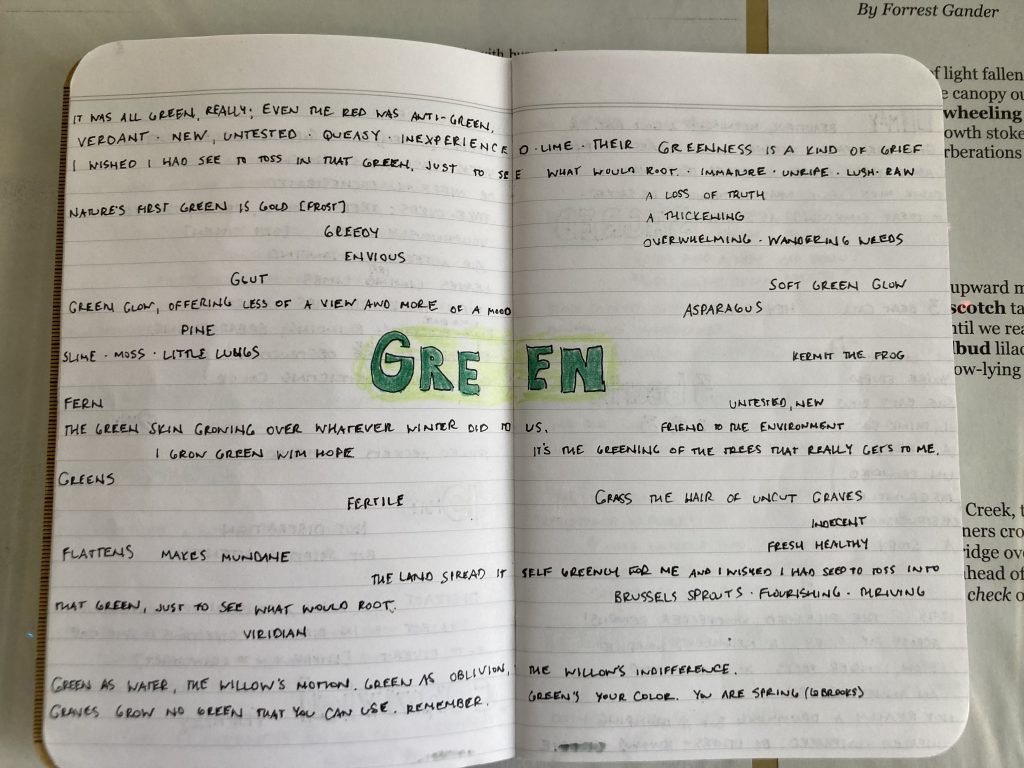
It was not a question of not having the language for it— having two, in fact. The walking towards it, and then the walking away. How that felt, all the green gathering itself to the idea of green, lingering right at the edge of the dark, what we call the dark. And the languages, both of them, noticing that, envying it. From their places at the beginning & at the end.
all the green/gathering itself to the idea of green
I want to think about this green and the two languages and the dark, or what we call the dark, some more.
4 miles river road, north/south 73 degrees humidity: 86% / dew point: 60
A wonderful sunny morning. Not too hot yet, although the humidity took its toll. By the end of the run, I was dripping sweat. Another improved run. Went farther before I stopped for a quick break, then convinced myself to keep going on the way back. Believing again that I can do the marathon in October.
Decided to listen today. Thinking about how delightful it is to move through the neighborhood, passing from sound to sound.
Sounds
a chorus of BIRD — chattering, chirping, cheeping
a little toddler voice trying to repeat binoculars after his mom said it in a neighbor’s backyard
the shshshsh of my feet striking grit on the sidewalk
overheard from one biker to another — and it was so quiet you could hear the water lapping against the shore
a male coxswain below instructing rowers
my house key softly jingling in my pack
a walker’s keys jangling loudly in his pocket
whoosh after whoosh after whoosh of car wheels passing on the road
the buzz on a riding lawn mower — a park working mowing the grass beside the trail
2 sets of tap tap tap tapping from roofers — about a dozen taps each, at slightly different speeds, then a short break, then more taps
the quiet hops of a bunny moving across a neighbor’s grass
a lawn mower hitting a twig or a root — thwack!
the clicking of a roller skier’s poles
I think my favorite sound was the soft footsteps of the bunny hurrying across the lawn. A silvery whisper only possible to hear on a calm summer morning like today. I love the sound of animal feet moving — running or hopping through the grass, thundering over hard dirt, scampering in the soft snow.
Its hot voice sizzles from some cool tree Near-by: It seems to burn its way through the air Like a small, pointed flame of sound Sharpened on the ecstatic edge of sunbeams.
Speyer is describing a locust but as I wrote on the 16 july 2022, her description makes me think of a brood of cicadas. This sound is LOUD and interrupts you, demanding you notice it. The bunny’s soft footsteps were quiet and easily unnoticed. It feels like an accomplishment to have been quiet and aware enough to hear them.
So, I’m thinking about sound today. Another inspiration: Ears don’t lie.
Hearing is our fastest sense. (Who knew?!) Horowitz says that it takes our brain at least one-quarter of a second to process visual recognition. But sound? You can recognize a sound in 0.05 seconds. And our brain is so adept at hearing the differences between sounds, we can sense changes of sound that occur in “less than a millionth of a second,” according to Horowitz’s book [The Universal Sense: How Hearing Shapes the Mind].
This source led me to a Radiolab story that includes Horowitz: Never Quite Now. This story is not just about sound, but our nerves and neurons and how long it takes for us to process the world. Here’s a helpful description of how our body sees and then wants a pen:
JAD: Okay, so the eye takes the light that’s reflected off the pen, turns it into a little electrical signal, and then sends that deep into the middle of the brain.
CARL ZIMMER: Takes a couple hundredths of a second.
JAD: Bounces around for a bit, and then within …
CARL ZIMMER: A few more hundredths of a second …
JAD: The signal has made it …
CARL ZIMMER: All the way back to the rear end of the brain, where you start processing vision.
JAD: But this is just the beginning.
CARL ZIMMER: Right. Now you’ve gotta like figure out what you’re seeing.
JAD: So our jolt is off again, this time toward the middle of the brain and then down toward the bottom.
CARL ZIMMER: To these other regions ..
JAD: That start to decode the signal.
CARL ZIMMER: The first visual region is called V1.
JAD: Next up …
CARL ZIMMER: V2, V4, and so on. And they’re gonna sharpen the image, make out contrasts, edges.
JAD: And then electricity goes back towards the front of the brain.
CARL ZIMMER: After, let’s see, another tenth of a second or so …
JAD: We finally get to a place where we think …
CARL ZIMMER: “Oh, that’s a pen.”
ROBERT: We haven’t gotten yet to “I want it”.
CARL ZIMMER: Exactly.
JAD: For that to happen, the electricity has to jump from one part of the front of the brain to another and another before you can finally say …
CARL ZIMMER: “That’s a nice pen. I could use a pen.”
JAD: [laughs]
ROBERT: [laughs]
CARL ZIMMER: And we are still not done, you know. Then—then—then …
JAD: Little jolt heads northCARL ZIMMER: To sort of the top of your brain. So we—we’ve gone from your eyes to the back of your brain, around up to the front of your brain again. And now we’re up to the top of your head where you set up motor commands, and then you can grab the pen.
ROBERT: Christ!
JAD: So I mean, you add all this up and what are we talking about here
Later in the story, Seth Horowitz describes how hearing is the fastest sense and mentions the startle circuit:
SETH HOROWITZ: A sudden loud noise activates a very specialized circuit from your ear to your spinal neurons.
JAD: You mean it bypasses the brain?
SETH HOROWITZ: Yeah, it’s the startle circuit. If yousuddenly hear a loud noise, within 50 milliseconds, that’s 50 thousandths of a second, so you’re talking20 times faster than cognition, your body jumps, will begin the release of adrenaline. No consciousness involved. It’s five neurons, and it takes 50 milliseconds.
I’ve written about the word startle before — I especially like Emily Dickinson’s startled grass. There’s a poem in here somewhere, involving bodily recognition (or reaction?) versus brain cognition.
swim: 5 loops lake nokomis open swim 79 degrees
5 loops! What a great night for swimming in the lake! Calm, goo-free water, strong shoulders, a willing back, enough time to swim an extra loop. Amazing. Writing this a few hours later, I’m wiped out, but I felt good the whole time I was swimming. I swam for 80 minutes without stopping.
I wanted to give attention to sound as I swam, and I did. Mostly, I heard the sloshing of the water as I moved through it. Once I heard a plane roaring above me and another time I heard a lifeguard calling out. Not much else. In past years, I’ve heard squeaks or strange clanging noises, but not tonight. Just slosh slosh slosh.
The water was a pale green with the idea of pale yellow — I didn’t see yellow as much as feel that it was there. Visibility was limited, but I could see my hand in front of me, bubbles, and the underside of the water’s surface, which was very cool.
There were a few menacing swans and some kayaks.
From the shore I could see that the orange buoys were in a straight line. In the water, swimming past them, it didn’t seem as straight. At least once for each loop, I could see the orange dots of the three buoys. The green buoys were more difficult. I didn’t care; I knew where they should be and swam that way.
4.2 miles minnehaha falls and back 73 degrees / dew point: 69
Woke up early, but thunderstorms were coming so I had to wait until after 10 to go out for my run. Gloomy, dark green, thick, but a slightly better run. Ran longer before I stopped to walk. Felt stronger while I ran. Kept running farther after I walked before stopping again. Progress!
10+ Things
the usual puddles have returned, blocking the sidewalk (one block over) and the trail (near the entrance to the locks and dam no. 1)
more big branches down, or the same big branches from last week’s storm, not yet removed
dripping sewer pipes at 42nd and 44th
mud and dirt washed up onto the asphalt
exuberant kids running around the grass at minnehaha park
roaring falls
passing by 2 surreys biking up from wabun
a soaked backpack in a driveway, half open, clothes slipping out, 2 books next to it, one of them with the pages rolled over
a pile of clothes tucked under the trees next to the path between the locks and dam no. 1 and the ford bridge
2 roller skiers, their poles clicking and clacking on the pavement
a chainsaw in the distance — below in the gorge?
wildlife update: Scott talked with a company who informed him that a wasp nest can’t just be removed because the wasps will build another one; it needs to be treated. One problem: it is illegal in Minnesota to treat fruit trees and the wasp nest is in our crab apple tree. Oh well, I guess our neighbors are staying.
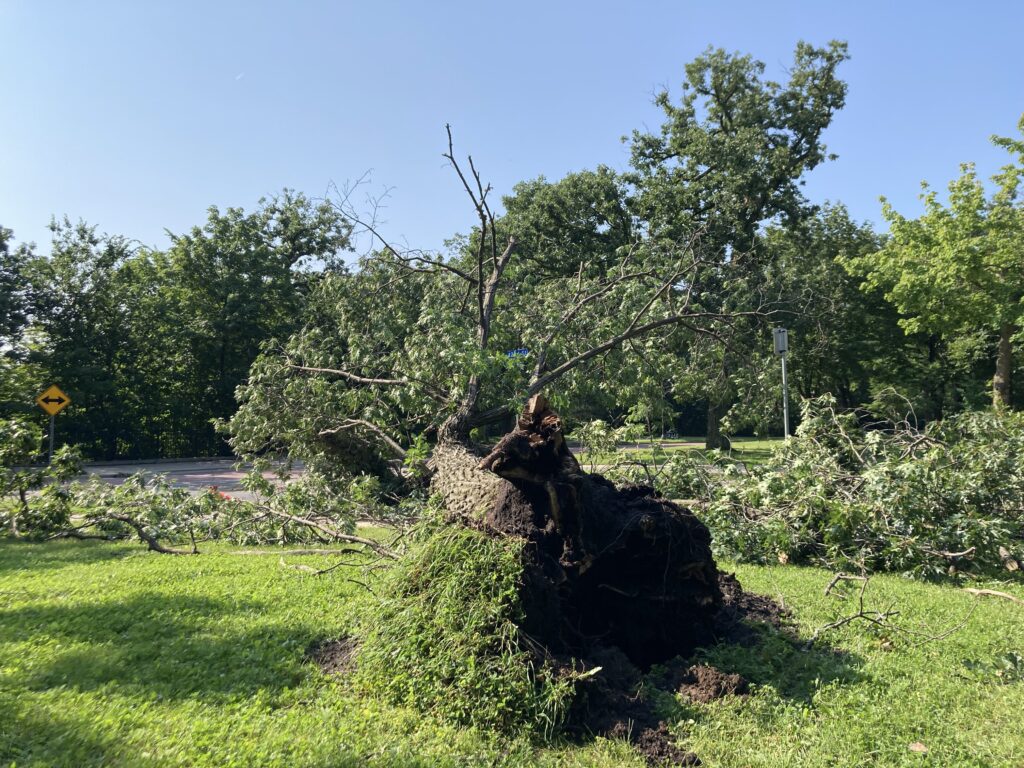
Yesterday afternoon, torrential rain, thunder, wind, and hail whipped through our neighborhood. It lasted only 20 minutes, but it was intense. Not scary — except to Delia-the-dog — but wild. It looked like it was snowing: Christmas in July! And the hail was so loud on the roof and the skylight. Today as I ran, I surveyed the damage by the river. Big branches on the dirt path, leaves scattered, a whole tree at the end of edmund:
big tree, felled
Of course I only took one picture, so I had to use it. Not sure if it effectively conveys the size of the tree?
Decided to take the winchell trail to check out the damage below. Some branches down, but nothing blocking the path. Dirt and mud and muck everywhere. I started chanting in my head,
silt / loam / glacial till silt and / loam and / glacial till
Listened to water gushing out of the sewer pipe and down the slope at 42nd. Also listened to the birds — not one type in particular, but a chorus of BIRD. Noticed the shade on the path and the tiny spots of light. Looked at the river, a hazy heat hovering just above and thought, hot! No relief from that view.
Before I run, I read an excerpt from the novel Elixir. I wanted to think about this quote as I ran:
We were near water. There is a river. If you couldn’t hear it or see it, its ions vibrated in the air and you inhaled water, day and night.
In the summer when the leaves block my view and I can’t see the river, I still know it’s there and it is always part of my run in some way.
the Seine, open water swimming, and water quality
I’ve been seeing lots of headlines about the problems with water quality in the Seine for open water swimming events at the Olympics. I mentioned it to RJP and she said she’d heard (on TikTok, natch) that people were pooping in the Seine in protest. Is that true? While looking it up, I found this helpful video: Can Paris fix it’s poop problem?
Okay, read some more, and the “Paris Poop Protest” is a thing. People were encourage to do it on June 23rd, when the President of France and the mayor of Paris were planning to swim in the Seine to prove it was safe. When Macron and Hidalgo postponed their swim, the poop protest was postponed too. So many interesting things to think/write about with this in terms of city infrastructures, rivers, threats to cities’ waterways, the negative and positive impacts of hosting the Olympics, and more. Swimming in public water, feeling the effects of how it’s managed in my body, has given me a deeper perspective on this issue of water quality and water management. I’m so grateful to have access to safe water here in Minneapolis.Everyone should have access to safe water.
time and water
Reading more of The Folded Clock, I was inspired to think about the relationship between time and water. Here are a few thoughts:
1 — anne carson
. . . the staining together of mind and time so that she is no longer miles and miles apart from her life, watching it differently unfold, but in it, as it, it.
1 = 1 / Anne Carson
2 — heidi julavits
As we stroked past I thought I saw George growing older and older. His grandchildren beside him grew older, too, taking his place before being replaced themselves by their children. It was like a trick of stop-time photography, everyone shading into everyone else. . . . Time passed. I started to doze. The cold water had slowed our pulses but everything else spun at great speed. I worried I would awake to find myself an old woman, my husband dead, my daughter grown and turned into me. But life, when I woke up, was as I’d left it.
The Folded Clock / Heidi Julavits
3 — samantha sanders
[on swimming in Lake Michigan in the winter] The exhilaration is remarkable. I feel like we’ve discovered the fountain of youth.
Swimming Through / Samantha Sanders
4 — alice oswald
it is not me but close to me a kind of cloud or smoke-ring made of nothing and yet it will outlast everything because it is deep it i sa dead field fenceless a thickness with many folds in it promiscuous and mingling which in its patience always wears away the hard thing
or is it only the hours on their rounds thinking of the tides by turns twelve white-collar workers who manage the schedules of water
nobody / alice oswald
In their lunch hour I saw the shop-workers get into water They put their watches on the stones and slithered frightened Into the tight-fitting river And shook out cuffs of splash And swam wide strokes towards the trees And after a while swam back With rigid cormorant smiles Shocked I suppose from taking on Something impossible to think through Something old and obsessive like the centre of a rose And for that reason they quickly turned And struggled out again and retrieved their watches Stooped on the grass-line hurrying now They began to laugh and from their meaty backs A million crackling things Burst into flight which was either water Or the hour itself ascending.
from Evaporations/ Alice Oswald
5 — darby nelson
I posted this quote back on 16 august 2021, but I want to post it again here:
We talk of time as the river flowing. I never questioned the implications of that metaphor until I was struck by the words of Professor Dave Edmunds, Native American, on a display in the Indian-Western Art Museum in Indianapolis. Edmunds wrote, ‘Time as a river is a more Euro-American concept of time, with each event happening and passing on like a river flows downstream. Time as a pond is a more Native American concept of time, with everything happening on the same surface, in the same area—and each even is a ripple on the surface.’
If I think of time as a river, I predispose myself to think linearly, to see events as unconnected, where a tree branch falling into the river at noon is swept away by current to remain eternally separated in time and space from the butterfly that falls in an hour later and thrashes about seeking floating refuge.
But if I think of time as a lake, I see ripples set in motions by one even touching an entire shore and then, when reflected back toward the middle, meeting ripples from other events, each changing the other in their passing. I think of connectedness, or relationships, and interacting events that matter greatly to lakes.
For Love of Lakes/ Darby Nelson
When I think of time and water, I think of erosion and geologic time, and the wearing down of things by the water over years, decades, centuries. I think of generational time, and the family members, the hearty Finns on my dad’s side, who loved and excelled at swimming. I think of Sara-time and one of the key constants in my life and many selves: I love water and swimming in it. I think of losing track of time while swimming, and tracking it on my watch to look at later. I think of time measured by strokes and loops instead of minutes, measured by open swims instead of days.
swim: 4 loops lake nokomis open swim 84 degrees
I swam 4 loops but the buoys were set up in such a way that the distance of 4 loops today was almost the same as 3 loops on other days. Oh well, I’m still counting it as 4. The water was very warm, too warm. Lots of stuff in it, but not as much as on Tuesday. More green slimy stuff, but now that I recognize and know it’s not toxic, it didn’t bother me as much.
I decided I wanted to listen as I swam. I didn’t hear much, just water sloshing over my head. The water was still, flat, sometimes feeling fast, sometimes slow. There was a haze in the air that made it as difficult to see as if my googles were fogged up. I felt strong and smooth and fast and happy.
Before the swim, I asked a few women if they had swum on Tuesday and if they had seen the green goo. Neither of them had. I realized later, as I swam, that I wasn’t asking because I wanted reassurance that whatever it was was not harmful. I just wanted to find someone else to acknowledge that it was strange and gross and something worth reacting to. On Tuesday, no one else seemed to care or be talking about it.
10 Things
2 women laughing and talking as they tread water between the last orange buoy and the shore
impossible to see either of the green buoys with the sun and the haze
at least 2 menacing swans
the ghost vines are multiplying in numbers and size — creepy!
cloudy sky
a few pockets of cold water throughout the lake
crowded swimming area, beach and park — everyone here on a hot day
the surface of the water above was blue and calm and shiny and smooth
the surface of the water below was greenish-brownish-yellowish
I swam high on top of the surface, feeling extra buoyant
3.25 miles trestle turn around 78 degrees / dew point: 66
For the first mile, in the shade it felt almost cool or, at least not HOT! Hardly any bugs, but tons of chirping birds, one black-capped chickadee calling out for a response which never came. A few other runners, walkers, a group of bikers. After turning around at the trestle I passed by 3 women instructing a fourth on how to use an unfamiliar bike. Somewhere I smelled tobacco — from a car? below on the winchell trail? a walker’s clothes? Admired the glowing purple flowers on the edge of the trail and the stretch of the path that was all shade, except for a few splotches of light. One splotch was big enough to see my shadow in before we both disappeared into the shade. The river was calm and pale blue. The green was thick excess. The stretches of trail in the direct sun were warm. At least twice I pushed myself to keep running when I wanted to stop. At the trestle I put in my old “Winter” playlist
immersion
This summer I’m devoting a lot of attention to water and swimming and my experiences during open swim. After reading Lauren Groff’s essay, Swimming, Anne Carson’s story 1=1, and watching Samantha Sanders’ mini doc, Swimming Through, I’m thinking about why I love open water swimming and how to describe the experience of moving in/with/through water. Here are 3 descriptions from Groff, Carson, and Sanders.
1 – Groff
there is a moment in swimming when, after a while, the body’s rhythm grows so comfortable that the swimmer loses awareness of herself. There is a marrow-deep letting go. She isn’t thinking. Her brain is off, her body is on autopilot. She is elevated; happy is not the word for it. To be and not to be, simultaneously: some people call this state ecstasy, others call it zen. They are, perhaps, different names for the same phenomenon. It is difficult to attain, and there are a thousand ways to attain it. Some meditate, others do peyote, others focus so hard on their art that the world itself falls away and they look up, days or hours later, to be staggered by what they have created in the full flare of their own white heat.
Groff’s last bit, “in the full flare of their own white heat” reminds me of Mary Oliver and one of her poems that I posted on 10 july 2022: “The Ponds”:
from The Ponds/ Mary Oliver
Still, what I want in my life is to be willing to be dazzled — to cast aside the weight of facts
and maybe even to float a little above this difficult world. I want to believe I am looking
into the white fire of a great mystery.
The white heat also makes me think of Emily Dickinson. But, the flare of white heat seems like the wrong sort of metaphor for what happens to you in the water. Also, even as we float in the water, we are still fully in it, not above it.
2 — Carson
. . . no interaction with another person ever brought her a bolt of pure aliveness like entering the water on a still morning with the world empty in every direction to the sky. That first entry. Crossing the border of consciousness into, into what?
And then the (she searches for the right word) instruction of balancing along in the water, the ten thousand adjustments of vivid action, the staining together of mind and time so that she is no longer miles and miles apart from her life, watching it differently unfold, but in it, as it, it.
To swim, especially freestyle, with your head mostly underwater, only surfacing to breathe (as opposed to breaststroke, where you always have a frog-eye view), is to be immersed in water, not floating above it. And not burning a white heat, but —? Something I can’t quite name yet. The it you are in, is not just water, but life.
3 — Sanders
There are many wonderful, beautiful moments in this doc about resilience and community and transformation, but I especially love this moment, starting 10 minutes in, in which they describe the shift from tracking the temperature to giving attention to — witnessing — the ice. To me, this might speak to Carson’s idea of crossing the border of consciousness into something/somewhere else.
We became very obsessive about how cold the water was getting. You know, it’s 50, then it’s 40, then it’s 40.2, then it’s 39. I had two thermometers that both busted this year in the cold water, I didn’t get another one. We just figure that it’s cold. So then it’s about I can’t wait to swim in the snow. Then it was like, I can’t wait to swim when there’s ice.
And then we had no idea what did ice mean? You know, this winter it meant so many different kinds of ice because you know, there’s the first ice that was like a very thin, thin layer of ice. Almost like snowflakes on the water. Break them as I stroked and then turn around and they would have reformed behind me. Ice that was so sharp that you actually were getting cut and you needed to be careful.
The feeling of swimming is the feeling of noticing the world, not existing above it, but fully in it, immersed, aware, witnessing the slight changes in temperature, or where waves usually start, or how the weather affects the opacity of the water.
A few minutes before this ice part, one of the women says this about the experience of swimming in very cold water: I feel metallic! I love that — maybe that should be the title of a poem, “To feel metallic”?!
added a few hours later: I almost forgot to include some sources that I’d like to gather then read then archive:
“The Anthropology of Water” / Anne Carson in Plainwater — go to the U library for this one
*several years ago — maybe 10? — I put The Folded Clock on my wishlist and got it for Christmas of that year. Apparently this was before I got into the habit of writing the date on the first page, so I can’t remember exactly what year that was. I also can’t specifically remember why — maybe because I was into memoirs? Anyway, I know I read some of it before but I didn’t realize that she wrote about swimming in lakes!
Julavits is swimming in a Berlin lake, filled with algae. This is the last paragraph:
The best thing about my first Berlin swim was this. When I took off my bathing suit, the crotch was bright green from the algae that had collected there. It was like getting my period for the first time and seeing the shock of color where normally there is only white.
The Folded Clock
When I took my suit off after my green algae filled swim, the muck that usually collects beneath my suit on my stomach and under my breasts included some bright green bits? chunks? traces? I’m glad that it collected there and not in my crotch!
3.35 miles ford bridge and back 68 degrees / dew point: 62
Ran an hour earlier today, but it was still hot and muggy. Quiet, calm, not too many walkers or bikers or runners on the trail. With the thick green, I don’t recall seeing the river once. Chanted triple berries. Heard the faint trickling down in the ravine, then from the sewer pipe. Some rustling in the brush. Construction sounds — big planks of wood being dropped? There were birds, I’m sure, but I don’t remember hearing them. No roller skiers or rowers or shadows. Lots of water in the form of humidity and sweat and post-rain run-off.
Repetition, Routine, and Quotes Taken Out of Context
After my run, scrolling around (reading old RUN! posts from today and poetry people tweets), I came across 2 ideas about repetition/routine. The first was a quote from Karlheinz Stockhausen about repetition and walking and breathing:
Repetition is based on body rhythms, so we identify with the heartbeat, or with walking, or with breathing.
I always want to find the context for these context-less quotes spread online, so I looked it up. Sometimes it can be tedious, finding the source, but today, quick satisfaction! I didn’t know who Karlheinz Stockhausen was, but now I (kind of) do: a big deal — an experimental composer, very influential in 20th century music, including hip-hop and techno (is that the right umbrella term?), according to this cool documentary, Modulations. I also found the unpublished interview from which this quote comes. Here’s some context for the quote:
Q: One of your comments is that a lot of times it’s too repetitive?
A. Yes. I think it’s more interesting to create music which transforms, shapes figures, so that one can follow a process. Repetition is based on body rhythms, so we identify with the heartbeat, or with walking, or with breathing. This has been the tradition for thousands of years of basic musical songs, tunes. But since the middle of the century in particular, the music has become very irregular in rhythm. And the invention of transformations of certain figures has become the most important in musical composition. I think it’s simply more interesting than repetitive technique.
When I read the out-of-context quote (which is shared a lot), I thought it was about the value of repetition and its connection to breathing, but in context, the quote is criticizing repetition as something to move beyond. Context matters (imho)!
This discussion of repetition and disruption of that repetition reminded me of a poem from Carl Phillips (posted on 8 july 2023), Western Edge, that I had just re-read
I need you the way astonishment, which is really just
the disruption of routine, requires routine.
I like need repetition and routine and establishing habits that my brain can visually interpret, but I also need love disruption, interruption, moments of astonishment. My ongoing question — how to balance the routine with the astonishing?
swim: 3 nokomis loops (6 cedar loops) cedar lake open swim 78 degrees
A beautiful night for a swim! Calm water, warm air. Too many vines floating in the water. They kept passing over me, trailing, lingering. I said to Scott that it felt almost like a violation, the way they slowly moved from my shoulder, down my torso, then my leg. Yuck! He joked, it was a vine-olation. The vines were also a problem near shore, growing up from the bottom in a thick tangle. It’s not difficult to imagine someone getting stuck in them and drowning.
The buoy across the lake was fine for the first loop, then partly deflated for the second loop, then completely flat for the rest of the loops. Just an orange blob on the water. I’ve never seen that before! Of course it happened at Cedar lake.
Another Cedar lake moment: A woman to the lifeguard: Excuse me, my son doesn’t have a cap, and he’s not 18 (the minimum required age for open swim), but could he swim across? Lifeguard: As long as he’s a good swimmer, it should be okay.
Maybe I would have been critical of these things in the past, but I’m not now. Deflated buoys and underage swimmers are just part of the cedar lake vibe.
10 Things
blue sky with a few puffy white clouds
something flying through the air — a plane? a big bird? I turned on my back for a minute to check: plane — I could hear the roar of the engines
the orange blob from a distance, not whispering orange, more like a random very quick blip — orng
scratchy vines poking my arm
murky water, difficult to see my hand, yellowish brown
log rolling — a giant red fake log
before the swim, standing by the lifeguard stand — creeaakk — the lifeguard opened a big trunk, looking for something. I wonder how often they open it? Judging my how much it creaked, not too often!
the deflated buoy was far away from hidden beach — no chance to see or hear how many people were swimming there
the water was warm, but near the shore where it was still deep, there were pockets of very cold water
on the last loop, I could feel the muck under my suit, against my skin, scratching me. I almost stopped to pull it out, but when do I ever stop?
The struggle continues. Another difficult run, another beautiful morning. Birds! Flowers! Blue sky! Sweat. Sore legs. Weak will. Chanted triple berries for a few minutes, which helped me keep going longer than I thought I could. Had fun running to “Virtual Insanity” — it helped me pick up my cadence for a few minutes
10 Things
running on the dirt path between edmund and the river road, a sharp pain on the shin — not a muscle but a bug stinging me
flowers: purple orange red yellow pink
walking past the house with a dog named Merry, 2 cars with canoes on top, excited voices — returning from a trip or leaving for one?
one of the people: Shit! I’m already sweating
the meadow just beyond the ford bridge was silent — no buzzing cicadas or croaking frogs today
above on the ford bridge, voices somewhere — no intelligible words just 2 women making noise
traces of mud on the trail — not gloppy, just wet
the trail, busy with zooming bikes
thud thud thud a power walker approaching from behind during my cool-down walk
a big boulder on the side of the trail, a small, hollowed out part of top, filled with water — water and stone
Seeing this stone, I was reminded of Octavio Paz’s poem “Water, Wind, Stone”:
Water hollows stone, wind scatters water, stone stops the wind. Water, wind, stone.
Wind carves stone, stone’s a cup of water, water escapes and is wind. Stone, wind, water.
Before the run, I gave myself the task of trying to think about water and stone as I ran. The only thing I remember is this rock with the small pool of water in it.
4 miles monument and back* 65 degrees / dew point: 62 drizzle**
*a new route? Through the neighborhood, over the lake street bridge, up the summit hill, over to the Civil War Monument and back **or as I’ve been known to say, spittin’ (does that come from the UP? the south? the midwest?)
Even though the dew point was high, the drizzle helped it feel cooler. Everything dark and quiet, calm, green. Passed the guy who is always sitting on his front stoop smoking. Also passed kids arriving at the church daycare. Pushed myself to keep running up the summit hill even though I wanted to stop. Made it!
Chanted triple berries for a mile or two. It helped distract me. raspberry / blueberry / strawberry
10 Things
shadow falls was gushing through the trees
the street lamps were glowing on the st. paul side
rowers on the river! an 8-person shell. The coxswain was advising them on where to place the paddles in the high water (we have a river flood warning)
morning! from a passing runner — good morning!
the river was a beautiful gray blue, the trees a rich green
so windy on the bridge heading east that I had to take my cap off and hold it
the whining of a power saw in the distance
alone at the monument overlook
sometimes it was a drizzle, sometimes just a mist — difficult to tell which while running and sweating
enveloped in dark green in the tunnel of trees — the only light was green light and a small circle of white at the top of the hill
As I looked down at the river from high above on the gorge, I thought about the rowers and their paddles and how different their experience of the water was to mine. Down there in the water, I bet it’s choppy and bumpy, with wind and spray. Up here, it’s almost flat and gray blue. No feeling of motion — no waves or the unsettling sense of being higher on water that’s on the edge of spilling over somewhere.
Yesterday I started thinking again about different bodies of water and how poets write about them: Mary Oliver (ponds), Lorine Niedecker (lakes), Alice Oswald (rivers, the sea). I also remembered Cole Swenson and their writing about the river Gave de Pau in Gave. I think I need to buy this book! Anyway, I looked up a few more of their poems and read one titled, “To Circumferate.” These lines stuck with me:
With a careful adjustment of eye there are no buildings. A city of trees and hedges
As I ran back from the monument, looking left to the ravine and the trees, I thought about that line and imagined the stretches of grass, the trees, the green ravine as a city — the only city — no buildings or houses or roads or cars, only trees and tall grasses and bushes leading down to the river.
All of this thinking about different bodies of water reminded me of something I started to read but had to return to the library before I got very far, Visitation/ Jenny Erpenbeck. Here are the first two pages and an amazing description of water:
Approximately twenty-four thousand years ago, a glacier advanced until it reached a large outcropping of rock that now is nothing more than a gentle hill above where the house stands. The enormous pressure exerted by teh ice snapped and crushed the frozen trunks of the oaks, alders and pines that grew there, sections of rock broke away, splintered and were ground to bits, and lions, cheetahs and saber0toothed cats fled to more southerly climes. But the ice did not advance beyond this rocky crag. Gradually silence set it, and the ice began its labor, a labor of sleep. While over a period of millennia it stretched out or shifted its enormous cold body only a centimeter at a time, it gradually was polishing the rocky surface beneath until it was round and smooth. during warmer years, decades and centuries, the water on the surface of the block of ice melted a little, and it places where the sand beneath the ice was easy to wash away, the water slipped beneath the huge, heavy ice body. And so at the every spot where this rocky elevation had hindered the ice’s forward motion, the ice slid beneath itself in the form of water and thus began to retreat, flowing downhill. In colder years the ice was simply there, it lay where it was, a heavy weight. And where in warmer years it had carved channels in the ground as it melted, during the colder years, decades and centuries it pressed its ice into these channels with all is force to seal them up again.
*
When approximately eighteen thousand years ago the glacier’s tongues began to melt—soon followed, as the earth continued to grow warmer, bu all its southernmost limbs—it left only a few deposits behind in the depths of their channels, islands of ice, orphaned ice; later they were called dead ice.
Cut off from the body it had once belonged to and trapped in these channels, this ice melted only much later. Approximately thirteen thousand years before the start of the Common Era, it turned back into water, seeped into the earth, evaporated in the air and then rained back down again, circulating in the form of water between heaven and earth. When it could not penetrate any deeper because the ground was already saturated, it collected on top of the blue clay and rose up, its surface cutting through the dark earth, and now it became visible again within its channel as a clear lake. The sand that the water itself had ground from teh rock when it was still ice now slid into this lake and sank to the bottom, and so at several points underwater mountains were formed, while in other spots the water remained as deep as the channel itself had originally been. For a time this lake would hold up its mirror to the sky amid the Brandenburg hills, it would lie smooth between the oaks, alders, and pines that were growing once more, and much later, after human beings appeared, it was given a name by them: Mårkisches Meer, the Sea of the Mark Brandenburg but one day it would vanish again, since, like every lake, it too was only temporary—like every hollow shape, this channel existed only to be filled in completely some day. Even in the Sahara there was water once. Only in modern times did something come about there that is described in the language as desertification.
Visitation/ Jenny Erpenbeck
swim: 3 loops lake nokomis open swim 75 degrees / drizzle
A great swim! Now I’m cold and tired and hungry!
10 Things
more ghost vines glowing below
one menacing white swan
the water below was a deep green with some blue
the water near the shore was still clear enough to see the sandy bottom
the sky was pale — no sun, except for a few times when it almost broke through
it’s the free night for open swim so more bobbing buoys — yellow was the most popular color
breathed mostly every five
tangled in a few vines, one leaf didn’t want to go away
stopped once or twice in the middle of the lake — calm, quiet — I should stop more
some little speck got in my eye at the beginning of the swim — I should have stopped to fix my goggles, but I just kept swimming, now it’s still stuck in there
Feeling a little off since yesterday afternoon — the slightest sore throat, a little stuffy, tired. Can’t decide if it’s allergies from swimming in the lake or something else (tested, not COVID). Future Sara, let me know.
This first July run was the same as most of my June runs: difficult, but worth it. The first half was fine, the second half hard. Sore legs, hard to keep going. I think a lot of it is mental, but I’m not sure how to fix it. For now, more swimming, shorter runs.
One thing that helped in the first half was reciting two poems: Still Life with Window and Fish / Jorie Graham and The Social Life of Water / Tony Hoagland. It was a good distraction. I think it might help if I figured out a task or project or activity before each run. That has helped me in the past.
10 Things
greeted the Welcoming Oaks — good morning! good morning!
admired the green view down to the floodplain forest — deep green, scraggly excess
noticed the purple flowers lining the trail
heard the rowers below — not yet on the river, but down below near the boathouse, laughing
encountered a long line of unevenly spaced kids in yellow vests on bikes — lots of stragglers near the back
not a single view of the river that I remember
heading north: wind pushing from behind, heading south: in my face, cooling me off
one bug almost landing in my eye
several stones stacked on the ancient boulder — was it 4 again?
the outline of an orange cat spray-painted on the sidewalk — even though it probably doesn’t look like Garfield, every time I see it I think, Garfield
Why was the cat named Garfield? The other day, when Scott and I were walking, I thought I heard a woman call out to their dog, Neil! Come here Neil! And I thought that that would be an awesome name for a dog, but not as awesome as Bob Barker. Update: In mid-July, running by this orange spray-painted figure, I realized that it looks more like a turkey with feathers than a cat. Of course, I still haven’t stopped to study it more carefully; I only see what my diseased eyes can see as I run by. I should probably stop to check, but I doubt I will.
Alice Oswald and color vision
I’m fascinated by something that I read in Alice Oswald’s interview with Kit Fan:
and this may again be an effect of thinking about the project with an artist, I was just thinking an awful lot about light and vision and the way … well, light as an insect, really, which is not just Homer, it’s also Dante. I always loved this part of Dante where he talks about the spiriti visivi, I think they’re called. And this idea that when you look at things, what’s happening is these kind of, you know, these creatures are sort of moving out from your eye to the world and moving from the world back into your eye. I was trying to sort of slow down my senses while I wrote this poem and imagine even a sort of passage between myself and the world was a creature, living creature of some kind
And here are 2 places where that idea shows up in Nobody:
from Nobody/ Alice Oswald
page19
There are said to be microscopic insects in the eye who speak Greek and these invisible ambassadors of vision never see themselves but fly at flat surfaces and back again with pigment caught in their shivering hair-like receptors and this is how the weather gets taken to and fro and the waves pass each other from one color to the next and sometimes mist a kind of stupefied rain slumps over the water like a teenager and sometimes the sun returns whose gold death mask with its metallic stare seems to be
blinking
page 30
When trees take over an island and say so all at once some in pigeon some in pollen with a coniferous hiss and run to the shore shouting for more light and the sun drops its soft coverlet over their heads and owls and hawks and long-beaked sea-crows flash to and fro like spirits of sight whose work is on the water where the massless mind undulates the intervening air shading it blue and thinking
I wish I was there
or there
I was planning to think about these lines as I swam at the cedar lake open swim, but when we got there it was too windy. No buoys, no lifeguards. People were still swimming, and I might have too, if I didn’t feel so tired and — not stuffed up, but congested in some way, like I’d swallowed too much lake water at the last swim. So many waves, almost 30 mph wind gusts.
A beautiful morning for a birthday run! Green shade, breeze. The run wasn’t easy, but it was wonderful to be outside with everyone else — bikers, runners. walkers, roller skiers, rowers, birds, river, rocks, trees, wind, glittering leaves, stacked stones.
For a little while, I chanted Emily Dickinson:
life is but life death is but death bliss is but bliss breath is but breath
Today I am 50. I’ve decided that I will recite the 50 poems I’ve memorized gradually — possibly spread out over a week or a month — to Scott. Maybe a few to the kids too. No formal thing. How long would it take, I wonder, to recite all 50 poems at one time? Too long!
So far, I’ve recited Sylvia Plath’s “Mushrooms” and Mary Oliver’s “Swimming, One Day in August”
Other fun birthday things: celebrated at the amazing Millie’s Wine Bar last night with Scott, FWA, and RJP. Walked to the library and picked up Mz N. Had a pint of Bee Sting at Arbeiter. Watching the first stage of Le Tour tonight! Tomorrow, open swim. A wonderful birthday!
5 miles bottom of franklin hill and back 69 degrees
Another run that started easy then got hard. My left hip and knee were stiff and sore. Walked several times on the way back.
Listened to feet shuffling on the grit, some keys jangling in a bucket. Smelled something floral and sweet near the franklin bridge. Felt a cool breeze on my warm face, sweat dripping off of my pony tail. Saw blue, red, and orange graffiti under the lake street bridge and a man helping a dog get through a hole in the chain link fence halfway down the franklin hill.
Ran by a break in the trees with an inviting dirt trail and thought again about how I love seeing these trails and wondering where they lead. Then I thought about how I prefer trails that have already been made by others — an invitation from past feet to explore and to step off the paved path.
Saw this poem online this morning and was surprised that I hadn’t already posted it:
may the tide that is entering even now the lip of our understanding carry you out beyond the face of fear may you kiss the wind then turn from it certain that it will love your back may you open your eyes to water water waving forever and may you in your innocence sail through this to that
swim: 3 loops 72 degrees light rain
I like swimming in the rain — when it’s a light rain. Have I ever swam in a hard rain? I’m not sure. When you are already wet, it’s difficult to tell what’s rain and what’s lake. Another great swim. I’m struggling in my runs, but loving the water.
10 things
a steady rain that I couldn’t feel or see as I swam
water, a darker green with some blue
tangled in several thin, loose vines — one on my head, another my shoulders, and another on my legs — most were just slimy, but one was sharp and scratchy
pale vines stretching up from the deepest parts of the lake — how tall are these vines this year? they glowed like the moon behind the clouds
particles in the water, almost looking like glitter — or, was that raindrops breaking the surface?*
mostly breathing every five — a few sixes, some threes, at least one two
pink orange yellow safety buoys tethered to swimmers
rounding the second green buoy, sighting the first orange buoy — so far off and lonely — just it and water — and only appearing in my vision when it wanted to
some sort of disturbance below me — was it a big fish? — nothing seen, only felt, the water moving beneath me
standing up near the beach after I finished, noticing the rain, then hearing some kids in the water excitedly yelling, It’s raining!
*It wasn’t until I wrote this out that I realized I was noticing the rain. It was very cool. The rain drop glitter made the water feel more alive, active — stirred up and swirling
I was surprised by how many people were at the beach. It had been raining all afternoon. People were still having picnics, kids were still in the water, several dozen swimmers were out on the course
Another hot and humid morning. Another difficult run. Is it strange that I don’t mind that it’s hard? Some shade, lots of sun.
10 Things
squish! stepping down in thick, gooey mud on the winchell trail
thwack thwack thwack a runner approaching from behind
pardon me that same runner letting me know he was passing
running down to the south entrance of the winchell trail, looking at the river through the trees — not sparkling in the sun, but flat and brown — somehow this made it look even hotter and less refreshing
rowers down below, heard not seen
the sewer at 42nd, a steady stream of water falling
the sewer at 44th, more of a dribble
honking geese
4 stones stacked on the ancient boulder
a squirrel ahead of me on the winchell trail — running then stopping then running, finally jumping through the fence and off the trail — was it waiting to dart out right in front of me? no
Alice Oswald and Lorine Niedecker and water’s depths
from Paean to Place/Lorine Niedecker
How much less am I in the dark than they?
Effort lay in us before religons at pond bottom all things move toward the light
Except those that freely work down to ocean’s black depths in us an impulse tests the unknown
from Nobody/ Alice Oswald
The sea she said and who could ever drain it dry has so much purple in its caves the wind at dusk incriminates the waves and certain fish conceal it in their shells at ear-pressure depth where the shimmer of headache dwells and the brain goes
dark
purple
from “Interview with Water”/ Alice Oswald
To be purpled is to lose one’s way or name, to be nothing, to grieve without surfacing, to suffer the effects of sea light, to be either sleepless or weightless and cut off by dreams.
swim: 4 loops lake nokomis open swim 82 degrees
4 loops! A beautiful summer night! The water was a bit choppy but it didn’t bother me. Saw some silver flashes below — fish? Also, beautiful shafts of light illuminating the particles swimming with me and a few ghostly vines reaching up from the bottom. In certain stretches it felt like the water wanted to pull me down to the lake floor — difficult to kick and keep high near the surface.
New breathing/sighting pattern I noticed last night at cedar: 1 2 3 breathe right 1 2 look up to sight (no breath) 3 4 5 breathe left
above the surface: A few times I paused in the middle of the lake to give attention to the surface. Once I saw a dragonfly. Another time, a plane. The water was blue but not as intense as on Sunday.
below the surface: bubbles, my hands, could feel the movement before I saw any swimmers, then bubbles and pale legs kicking. The water was green but with less blue and more yellow.
3.15 miles river road south/north 67 degrees 93% humidity / dew point: 65
Very tough on the legs! That dew point — ugh! Another difficult run. Still glad I did it. I heard some chattering birds and water gushing out of the sewer pipe near 42nd. Ran over puddles, slippery leaves, mud, recently re-tarred asphalt, dirt, roots. I remember looking at the river through the trees but I don’t remember what it looked like — probably a very pale blue or white, like the sky.
Inspired by all of my time with Alice Oswald lately, I’m thinking of starting Nobody again this afternoon. Listening to an interview she did with Kit Fan, back in 2020, I’m intrigued by what she said about her approach to writing it:
[The poem] sets out really to drown the reader. I wanted it not to feel like a sort of intellectual exercise where you would emerge kind of clarified and simplified, but literally to be as if you were inhaling water. … I find the people who I think get most out of it are those who don’t expect it to be conveying a thought, but expect it to be more like the experience of being outdoors, where you simply are assaulted by all kinds of different tunes and beings.
Well, I always feel that the Odyssey is a very bright emerald green because it has this incredible sort of vegetative life in it. It’s like a plant that just cannot stop growing. You know, the sentences grow all over the place. So, even though it’s a poem about the sea, I actually feel that kind of bright green of spring leaves in it. But I mean, I did kind of quite terrifying things to my mind when I was writing this poem, because I got quite interested in theories of color and sort of trying to watch what my mind was doing, particularly looking at colors in water and how your mind will tell you that’s green because you know it’s a leaf, but actually when you look at it, it’s not because it’s in a black river. And so, just trying to notice what the mind does and try, as I’m always trying, to get away from my own mind and out into the world. I was trying to see what colors are beyond my mind. And I think they probably don’t exist beyond the mind. So, it was actually an experience of almost unsettling all my perceptions really.
And being stuck, and going nowhere — is this similar to my looping!?
So these stories don’t get anywhere. They’re all stuck. And I like sort of, you know, Celtic patterns that just go on and on doing the same thing. So I didn’t want to make a poem that got anywhere, really. I wanted a poem that was stuck, whose stories couldn’t quite move forward, that had simply been tossed about by the weather, really.
later (5 pm): At the risk of making this entry too long, I’d like to add a few thoughts/notes after reading part of AO’s Nobody again, having read it before in 2022. It was very helpful to listen to AO’s lecture, “Interview with Water” and listen to/read the transcript of her interview with Kit Fan.
Before the poem begins, AO describes the similar (using similar like she does in “Interview with Water” — not the same, but resembling but varied, like water by currents) stories of Agamemnon, whose wife was not faithful and Odysseus, whose wife was.
This poem lives in the murkiness between those stories. Its voice is wind-blown, water-damaged, as if someone set out to sing the Odyssey, but was rowed to a stony island and never discovered the poem’s ending.
Nobody/ Alice Oswald
It helped me to read that beside AO’s words in her interview with Kit Fan:
. . .the poem is very much a kind of strange reading of the Odyssey. The Odyssey I see is a beautifully patterned wedding hymn about Odysseus’s marriage to Penelope and how they are driven apart by the Trojan War, and then they come back together. But embedded in that story, you’ve got the opposite story, which is the wedding of Agamemnon who goes off to the same war and comes back and is murdered by his wife whose taken another. And it’s that reverse Odyssey that I was writing in this poem, partly because the poet who is abandoned on the island is part of Agamemnon’s household. So, from his point of view, the Odyssey is being seen differently, from that other, much darker story.
Her use of darker here, reminds me of something she said in “Interview with Water”: “when you look at water, it allows you to exist twice but more darkly.”
4.15 miles the monument and back 67 degrees humidity: 91% / dew point: 65
Yuck! The air is so thick, everything heavy with moisture. We were supposed to have thunderstorms this morning — 90% chance — so I ruled out open swim, but they haven’t happened yet. Bummer. I bet it would have been a good swim.
I ran through the neighborhood, over the lake street bridge, up the summit hill and to the monument. Then I turned around and ran back, this time running south on the river road path instead of through the neighborhood.
10 Things
3 stones stacked on the ancient boulder
a strange whimpering, soft howling or moaning sound coming from under the bridge on the east side — a non-human animal? a bird?
no rowers on the river
a foul, rotting smell as I ran over the bridge — I thought of the rot* that Alice Oswald mentioned in “Interview with Water” and the scarlet rot that FWA told me about yesterday when he recounted some “Elden Ring lore”
a dark, deep green everywhere
flowers alongside the trail on the east side: green leaves, fanned like ferns, pale white or purple flowers, small, dotting the green
new (or newly noticed) graffiti under the bridge on the east side — brick red, I think
the dark reflections of tree in the water near the shore — so dark that they look like shadows to me
the faintest trace of a sandbar under the bridge
the usual puddles near shadow falls are back, almost covering the entire path
*AO and rot: “anything excessive or out of focus or subliminal — for example: a swimmer seen from underneath, a rotting smell. . .”
Here’s another Alice Oswald water poem that I uncovered in a dissertation about Oswald, Jorie Graham, and water!
Green, grey and yellow, the sea and the weather instantiate each other and the spectrum turns in it like a perishable creature. The sea is old but the blue sea is sudden.
The wind japans the surface. Like a flower, each point of contact biggens and is gone. And when it rains the senses fold in four. No sky, no sea – the whiteness is all one.
So I have made a little moon-like hole with a thumbnail and through a blade of grass I watch the weather make the sea my soul, which is a space performed on by a space;
and when it rains, the very integer and shape of water disappears in water.
Almost forgot: japan is a new word for me. Here are some definitions, both noun and verb:
noun:
any of several varnishes yielding a hard brilliant finish
a hard dark coating containing asphalt and a drier that is used especially on metal and fixed by heating — called also japan black
Overcast this morning. Cool, but humid, sticky. Another run that wasn’t easy or effortless. Keep showing up. It will get easier or you’ll get better or it will (eventually) get cooler. I’m not too worried. Is it the lexapro, or am I just satisfied being able to get outside and move by the gorge?
10 Things
the crater with the tube sock/Florida outline is gone, filled in yesterday
a gnat flew in my eye — a fullness, than a small sharpness, then a watery eye, finally gone!
a motorized scooter on the bike path — hey, you’re supposed to be on the road! (thought, not said)
today’s color palette; green and gray
dark mud, not gooey but slick
laughing kids on a playground
the surreys, all lined up at the falls, one being readied for a family as I ran by
rushing falls, roaring creek, gushing sewer pipe near 42nd
some loud rustling in the bushes
passing a walker, a whiff of subdued perfume — fresh, floral / passing a biker, a sniff of cologne — fresh, earthy
At some point, looking up at the green trees, remembering green water, I thought about Alice Oswald and the connection between water and grief. Then I recalled Tony Hoagland’s poem about swimming and cancer and thought about water and relief.
a few hours later: It’s raining — a soft, light rain — right now (2:30 pm). I’m hoping that open swim will still happen at 5:30. Tomorrow it probably won’t: thunderstorms all day. Anyway, I’m continuing to listen to and think about Alice Oswald’s “Interview with Water.” Very cool! Here’s the next little bit:
Find yourself in the silence underneath an overhanging wave that or thereabouts is the color of a bluish violet ultramarine gown so the great poet sang, “But Odysseus taking his bluish gown in his big hands drew it over his head and hid his face ashamed to let the Phaeacians see his tears.” The gown goes over the head like a wave, the human sits under its sea color with salt water pouring from his eyes. It is one of those places where the form of the poem hurries us forward, the form of the language pulls us back. Porfurion is a word with water inside it like a bucket down in the middle of a line. Already if you look hard at the word you can see the widow’s simile underneath it but Homer is not yet ready to make that gift. With magnificent theatricality, he draws a blue gown across the mind and we, like the Phaeacians, are left looking at it, waiting.
Homer is the foremost poet of the visible. Homer delights in surfaces, but the surface of water is complicated by transparency, and its transparency is complicated by refraction. Water is never the same as itself. Rivers can only exist as similarities, lakes reflect more than their own volume, and what’s more, when you look at water, it allows you to exist twice but more darkly. When you look at it again it evaporates as if moving in and out of existence — it simply requires a bit of sunlight then it reappears as frost. Perfectly symmetrical as if discovering pre-drawn diagrams in thin air. Then it reappears as tears so that any attempt to describe the surface of water tells you to hide your face and inspect your innermost thoughts. All these waverings are part of the word porfurion. The physics or nature of water is metaphysical meaning that its surface expresses more than itself.
Interview with Water
All of AO’s mention of surfaces makes me want to think about surfaces during my swim. I swim on the surface, wanting to stay with my head just below as long as possible. What does the surface look like or feel like when I’m breathing every five (or more) strokes? What if I tried every 2 or 3? What is the color of the surface — from above or below?
swim: 2 loops lake nokomis open swim 68 degrees
Wow, what a perfect swimming night! The water was warmer than the air temperature. The sky was white and heavy. Everything calm, quiet. I felt fast and strong cutting through the water, breathing every 5 strokes with the occasional 3, at least once, after 2. I tried to give attention to the surface. Just under the water, I watched my hands stretch out in front of me, covered in bubbles. The water was a beautiful deep (but not dark) green, with the feeling of deep blue and gray. I could see the sediment swirling. Above the water, the surface was silver, still.
3.1 miles trestle turn around 76 degrees / feels like 82 dew point: 71
Ugh! I knew it was going to be tough when I felt too hot even before I started running. More rain last night — enough to cancel our final community band concert — and more thick, sticky air this morning.
Greeted Mr. Morning! and Mr. Holiday. Saw Dave the Daily Walker but he was too far away to greet. Counted the stacked stones on the ancient boulder: 4. Heard some strange creaks below the trestle — what were people doing down there? Also heard the rowers on the river. Felt the sweat pooling on my face, my shorts sticking to my legs.
When the dew point temperature and air temperature are equal, the air is said to be saturated.
Looking through the trees somewhere near the trestle, I could see the river burning bright white — even the water looked hot!
Oh, this beautiful poem by Tony Hoagland! He died in 2018 (at the age of 64) from pancreatic cancer. My mom died from pancreatic cancer. It’s terrible. This poem was published in 2007.
Oh life, how I loved your cold spring mornings of putting my stuff in the green gym-bag and crossing wet grass to the southeast gate to push my crumpled dollar through the slot.
When I get my allotted case of cancer, let me swim ten more times at Barton Springs, in the outdoor pool at 6AM, in the cold water with the geezers and the jocks.
With my head bald from radiation and my chemotherapeutic weight loss I will be sleek as a cheetah —and I will not complain about life’s
pedestrian hypocrisies, I will not consider death a contractual violation. Let my cancer be the slow-growing kind so I will have all the time I need
to backstroke over the rocks and little fishes, looking upwards through my bronze-tinted goggles into the vaults and rafters of the oaks, as the crows exchange their morning gossip
in the pale mutations of early light. It was worth death to see you through these optic nerves, to feel breeze through the fur on my arms to be chilled and stirred in your mortal martini.
In documents elsewhere I have already recorded my complaints in some painstaking detail. Now, because all things are joyful near water, there just might be time to catch up on praise.
4 miles minnehaha falls and back 65 degrees / dew point: 61
Today’s word: saturated. What Lorine Niedecker aimed for in her water poetry. Not floating or dry but sinking and soaked.
Rain off and on all day. Maybe thunderstorms starting in the afternoon.
No rain as I ran, but everything was wet or dripping. Moist. My face, more moist than a sponge. The falls, gushing over the limestone then rushing down the gorge to the Mississippi.
Evidence of the rain and thunderstorms last night all along the trail. Above the oak savanna it looked like some creature had tore through the green, ripping small limbs and leaves off the trees and throwing them to the ground.
The parking lot at the falls was packed with cars. Not the best day to be at the falls — but maybe it was? A chance to witness the falls in full cry, I guess. Also a chance to get wet or slip in the mud. I thought I might, but didn’t.
Anything else? A black squirrel sighting, which reminded me of the line from “What Would Root”: scolded by squirrels in their priestly black
Discovered the poet, Maureen N. McLane this morning and was delighted by her serial poem about Mz. N. Requested the book from the library. Possibly an inspiration for some writing about Sara, age 8?
The child Mz N sat on her bed and wondered: that tree outside her window shifted when her eye shifted. What to make of that?
§
Mz N and her siblings had a dog for some time. They went on vacation & when they came back no dog. They asked the parents: the dog? who replied: what dog? And some people wonder why others distrust the obvious.
Speaking of the serial poem — LN’s “Paean to Place” is considered one — here’s a helpful definition:
The serial form in contemporary poetry, however, represents a radical alternative to the epic model. The series describes the complicated and often desultory manner in which one thing follows another. Its modular form–in which individual elements are both discontinuous and capable of recombination–distinguishes it from the thematic development or narrative progression that characterize other types of the long poem. The series resists a systematic or determinate ordering of its materials, preferring constant change and even accident, a protean shape and an aleatory method. The epic is capable of creating a world through the gravitational attraction that melds diverse materials into a unified whole. But the series describes an expanding and heterodox universe whose centrifugal force encourages dispersal. The epic goal has always been encompassment, summation; but the series is an ongoing process of accumulation. In contrast to the epic demand for completion, the series remains essentially and deliberately incomplete.
I had to look up a few words from this excerpt that I wasn’t quite sure of:
desultory: marked by lack of definite plan/purpose, not connected to main subject protean:displaying great diversity or variety, versitle aleatory: relating to luck, depending on an uncertain event or contingency
This idea of a serial poem as “an ongoing process of accumulation” is very cool and fits with my approach to Haunts and a story in long form.
5 miles bottom franklin hill and back 72 degrees / dew point: 60
Whew! I was sure the dew point would be even higher. It felt very uncomfortable out there. And difficult. But I kept moving and didn’t push myself too hard. I ran to the bottom of the hill then walked up it. Then ran, walked, ran until I was back to the ancient boulder — no stones stacked on it today.
Last night RJP graduated from high school. I’m very proud of her for surviving it. I’m proud of myself too. It was very hard and I am tired. No more k-12 public school! Hooray! I loved many of the teachers and the music programs, but I won’t miss being subject to this schooling process.
RJP’s graduation was delayed by almost an hour because a fight broke out at the previous school’s graduation and someone was hauled away in an ambulance. FWA said he saw the guy, and he looked like he was probably fine and not in much pain. Other than the delay, the graduation was great. The awesome poet Bao Phi gave the address — so good! He, along with the student speakers, centered the experiences of BIPOC students.
10 Things
white sky
dark green mystery
at least 2 specks in the sky — a plane? a bird?
click clack — roller skiers powering up the franklin hill
foamy water
glowing orange shoes on a runner
voices below near white sands beach
one runner to another: well, that killed about an hour and a half — huh?
a greeting from Mr. Holiday!
a few days ago I mentioned something in orange spray painted on the sidewalk — it’s the outline of a cat (but not Garfield, I think?)
a section from Wintergreen Ridge/ Lorine Niedecker
Reading (again, for the 3rd or 4th time?) LN’s “Wintergreen Ridge,” I was delighted by her connections and associations:
Women saved a pretty thing: Truth:
“a good to the heart” It all comes down to the family
5 miles bottom of franklin hill and back 70 degrees / dew point: 60
Overcast, which helped it feel a little less warm. Sticky, thick air. A lot of sweat, especially on my face. Dripping ponytail. So green even the air was green. Greeted the Welcoming Oaks — hello friends! Descended into the tunnel of trees and was enveloped in green. Chanted triple trees: sycamore/sycamore/sycamore/red oak leaf/silver birch. Heard the rowers through the trees. Admired the barely moving, calm water under the bridge — the surface was dotted with foam and reflected clouds. Saw a speck in the sky out of the corner of my eye. Tried to look at it, gone. Tried again, a plane almost covered in fog. Saw a dark ring around it — my ring scotoma? Appreciated how the outline of the treetops on either side of the river road echoed the shape of the river banks. Walked up the hill — it took me 7 minutes — then ran, walked, ran back. Ended with a dozen roller skiers above me while I climbed out of the tunnel of trees.
For the first mile, in the dark green quiet, everything was dreamy. Thought again about how running puts me in a strange, surreal state. Nothing quite real. Then thought about Lorine Niedecker and the physical act of seeing with messed up eyes and using the poetic form to represent that. I’m not aware of how my eyes move as I see except for when I look to the peripheral as a way for my central vision to see something. I imagine having nystagmus makes you more easily register the movement of your eyes. How conscious was LN of her eye movement and how it was mimicked in her lines? When I think about how I see — the mechanics of it and its physicality — I think more about what happens when the corrupt or limited data travels as electrical impulses through the optic nerve and to the brain. Are the effects of nystagmus primarily physical — strain on eyes, the rapid movement creating dizziness and headaches? I should read more about it. . . . The physical impact of my vision sometimes reads as dizziness and light-headedness, but mostly it’s just a vague sense of unease and fatigue — more naps. I rarely feel the eye strain or get headaches from my effort.
In the article I was reading about LN’s nystagmatic poetics, this poem was discussed:
Tattoo/ Wallace Stevens
The light is like a spider.
It crawls over the water.
It crawls over the edges of the snow.
It crawls under your eyelids
And spreads its webs there—
Its two webs.
The webs of your eyes
Are fastened
To the flesh and bones of you
As to rafters or grass.
There are filaments of your eyes
On the surface of the water
And in the edges of the snow.
note at 11 am: Today is my first day of open swim! After the swim, I’ll return to this entry.
I’m spending the afternoon on the deck, reading Niedecker and thinking about Alice Oswald and Niedecker and my Haunts poems. Here are some jumbled thoughts:
You have been in my mind/between my toes/agate — Lake Superior/LN
You’ve been in my mind
beneath my feet Mom
Look for me under your boot-soles — Walt Whitman
Ars Poetica/ Arcelis Girmay
May the poems be the little snail’s trail.
Everywhere I go, every inch: quiet record
of the foot’s silver prayer. I lived once. Thank you. I was here.
“We a lovely/finite parentage/mineral/vegetable/animal” — Wintergreen/ LN
I’m interested in how many layers you can excavate in personality. At the top it’s all quite named. But you go down through the animal and the vegetable and then you get to the mineral. At that level of concentration you can respond to the non-human by half turning into it.
We can’t float or fly for long, above. We are part of the muck, not stuck but entangled, beholden
to work down/ to ocean’s black depths/us us an impulse tests/the unknown — Paean to Place/ LN
2 loops / 1.5 miles lake nokomis open swim 80 degrees
Open swim! Open swim! I was nervous before the swim, wondering if I would see the buoys. I did! The water felt wonderful — a little cold, but not too cold, and wavy but not choppy. I watched the sun filtering through the water, avoided the vegetation growing up from the bottom and the swan boat stuck right by the orange buoy. That menacing swan was a little too close as I neared the buoy. The last green buoy was so far from the orange buoy — it seemed to take forever to reach the beginning of the loop. Oh, I love open swim and what joy to have had a good first swim!
Still struggling with endurance, still showing up. How much of this is mental, how much physical? The sixty-four thousand dollar question, as my dad used to say. I think it’s both, but probably more mental. Maybe the lexapro is already kicking in, but my struggles aren’t bothering me. After the run I thought, these struggles will make showing up at the marathon start line, then finishing 4-5 hours later, much more meaningful.
It rained this morning, so everything was wet, even the air. Everything was also green. Green green green. Any other colors? Nope, not much to break up the green. Green green green green green.
10 Things
lush green, dark, on the part of the path that goes below the road
puddles
a woman ahead of me, running, wearing only one compression sleeve on her right calf
a group of kids walking to the playground at minnehaha
a much bigger group of kids walking near 42nd — a long line, 3 across, took me 10 or 15 or more? seconds to pass them
gushing water near the ravine by the oak savanna
the bright yellow crosswalk sign — my bee — was muted in the gray sky
crossing the bridge high above the creek, all green, no view of the water below
lush green, dark, on the steep hill descending to the locks and dam no 1
a pile of e-bikes parked near a bench — black with blue accents
paean to place/ lorine niedecker
Before my run, I started writing out, by hand, Niedecker’s poem. It’s so long! My hand started cramping up. I had to write slowly to account for my visual errors, like not seeing the words I’ve already written and writing words almost over them or above them instead of below them. The slow work is good, giving me time with each word and line.
Ah, summer mornings! Beautiful. Cooler. If I would have slept better, I would have tried to go out even earlier. The first half of the run felt good, then I got hot and it got harder. Today I didn’t worry about what that meant for my training. Instead, I enjoyed the brief minutes of walking, taking in the trees at the falls — so green! so full!
10 Things
the falls, flowing, white, undulating — the water not falling straight, but almost falling over itself — was it hitting some limestone on the way down?
a bundle of something on the ground next to the dirt trail — a hammock?
2 women with tall hiking packs on their backs walking on the paved path
some animal — a turkey? — upset, calling out, a human voice saying something — hey?
a flash below the double bridge — a sliver of creek almost covered by green
2 roller skiers near locks and dam no 1
the dirt trail cutting through the small wood near ford bridge looking cool and inviting
happy kids on the minnehaha park playground — happy: green voices, where green = young, outside, tender
(walking back, about to cross 46th ave at 37th street) 2 older women chatting, then greeting me, oh! hello!
(walking back almost to my alley) heard on a radio or from a phone or a computer in neighbor’s backyard, the next one is Scandia — was this talk radio or a zoom meeting or what?
Lorine Niedecker and “Paean to Place”
to dwell with a place:
What is required, however, is sensual, embodied experience—close encounters of awe, wonder, fright, disgust, or even tedium—which remind us both of the real earth with which we dwell, and that we share our home with innumerable cohabitants.
in the leaves and on water My mother and I born in swale and swamp and sworn to water
My father thru marsh fog sculled down from high ground saw her face
at the organ bore the weight of lake water and the cold— he seined for carp to be sold that their daughter
might go high on land to learn
Wow! Reading this opening, I’m thinking about the Objectivists and the Imagists and Ezra Pound’s 3 rules for writing poetry:
Direct treatment of the “thing,” whether subjective or objective
To use absolutely no word that does not contribute to the presentation
As regarding rhythm: to compose in the sequence of the musical phrase, not in sequence of the metronome
What condensery and music in these lines! And what wonderfully effective descriptions of two people dwelling in and with a particular place, especially her mother, born in swale and swamp and bearing the weight of lake water and the cold.
definition of ecopoetics:
The word itself is an amalgam of two Greek words: oikos [household or family] and poïesis [making, creating, or producing], so that ecopoeticsquite literally means the creation of a dwelling place, or home-making. The term came into special prominence after the influential British literary critic Jonathan Bate published The Song of the Earth in 2000. There, Bate defined ecopoetics as a critical practice in which the central tasks are to ask “in what respects a poem may be a making … of the dwelling-place” and to “think about what it might mean to dwell upon the earth.”
LN’s opening lines and her descriptions of her parents, reminds me of Mary Oliver’s The Leaf and the Cloud and her brief mentions of her parents in the first section, “Flare.” LN and MO have different experiences but they rhyme, somehow, or echo?
My mother was the blue wisteria, my mother was the mossy stream out behind the house, my mother, alas, alas, did not always love her life, heavier than iron it was as she carried it in her arms, from room to room, oh, unforgettable!
Like LN, MO was also an amazing poet of place, but she doesn’t extend her ideas of place to her parents — a deliberate severing:
I mention them now, I will not mention them again.
It is not lack of love nor lack of sorrow. But the iron thing they carried, I will not carry.
So much to say about that iron, but I have run out of time right now. Perhaps more later. . .
I’m back. First, the not carrying the iron makes me think of my mom and her desire for displacement from her abusive parents. More than once she said to me that she wanted to break that cycle of abuse — and she did. And I am grateful. But there’s something to explore here for me and my relationship to place, this place 4 miles from where my mom was born and raised, that I can’t quite get at yet.
The iron also reminds me of the wonderful lines from the opening of LN’s “Lake Superior”:
In every part of every living thing is stuff that once was rock
In blood the minerals of the rock
*
Iron the common element of earth
Both MO and LN write about their fathers. First, MO:
My father was a demon of frustrated dreams, was a breaker of trusts, was a poor, thin boy with bad luck. He followed God, there being no one else he could talk to; he swaggered before God, there being no one else who would listen.
and LN:
He could not —like water bugs— stride surface tension He netted loneliness. . .
. . . Anchored here in the rise and sink of life— middle years’ nights he sat
beside his shoes rocking his chair Roped not “looped in the loop of her hair”
The “looped” quote comes from William Butler Yeats and his poem, Brown Penny and it’s about love. I like how she throws in this line from poets or about poets, like this:
Grew riding the river Books at home-pier Shelly would steer as he read
I noticed another line of the poem in quotes, “We live by the urgent wave/of the verse.” Looked it up and found an article about “Paean to Place” and thanks to my college-attending son, I have access to it! Time to read it: Lorine Niedecker’s “Paean to Place” and its Fusion Poetics
Warm and windy. Lots of sweat. Another day of telling myself to keep showing up. A hard run with lots of walking. But, one faster, freer mile, and some scattered thoughts that might lead to something! I’ll take it.
11 Things
under the lake street bridge, the side of the road was packed with parked cars — rowers?!
yes, rowers: heard the coxswain calling out instructions
briefly watched the rowers through a gap in the trestle: a head, an oar, a boat gliding by
ran into a branch while avoiding another runner, just a few inches from my eye, imagined a scenario in my head where the branch had cut my eye
in the tunnel of threes: a sea of swaying green
a woman stretching in the 35th street parking lot, blasting music out of her phone
wind pushing me from behind, making my ponytail swing to one side
a cartoonish figure spray-painted on the sidewalk: bright orange outline
loud rustling in the nearby brush then a hiker emerging from below
whoooosssshhh — the wind rushing through the trees
dragonflies? running near the trestle, an insect with a long, narrow body and wings almost flew into my mouth — no iridescent color, no color. Later, pausing at the top of the steps, I saw half a dozen of them. They opened and closed their wings in the sun
Yesterday, I decided that the theme of color or green wasn’t working for me this month. Instead, I’d like to return (again) to Lorine Niedecker. I’m particularly interested in her form of condensing and how I might apply it to my Haunts poems. Yes, the haunts poems are haunting me again. Before heading out for my run, I found a few lines from LN’s “Paean to Place,” that I especially like:
grew in green slide and slant of shore and shade
Child-time—wade thru weeds
Maples to swing from Pewee-glissando
sublime slime- song
A few times, I recited the first big: I grew in green/slide and slant/of shore and shade. As I thought about those lines I wondered what I grew up in. Green, for sure, but not by water. Then it came to me: I grew up on the edge of green in subdivisions that butted up against farms and woods, creeping, consuming those green spaces. I also grew up in carefully managed and cultivated green — bike paths through small stretches of trees offering the illusion of nature, privately owned by the subdivision. A very different green than the rural green of my dad’s farm in the UP or the urban green of my mom here by the Mississippi River. I thought about the managed green I run by and the difference between it, a public, national park, and the managed green of my suburban childhood, with its private green parks and private (No Trespassing!) acres of farm land, soon to be sold and converted into more “little boxes.”
Yes! The green I grew in was in-between col-de-sacs, and within small ravines and the slight stretches of trees or creeks developers left for aesthetic reasons. This green has deeply influenced my understanding of the wild and “green” spaces and is one reason why I’m fascinated by the management of nature.
Another beautiful morning. Felt drained by the sun, but still managed to push through a few moments when I wanted to stop. Walked a little. My mantra: keep showing up. It might not get easier but I’ll get better at handling it (it = heat and humidity and doubt and the desire to stop). Listened to my Color playlist for the second half, the birds for the first half. Sparrows and woodpeckers and cardinals. The falls and the creek were gushing. I read the other day that, after 2 years, Minnesota is no longer in a drought. Hooray for the farmers! And the flowers! And the trees!
Today, the green was cool, then scraggly. Sprawling, stretching, overstepping. Almost consuming the narrow dirt trail on the grassy boulevard between edmund and the river road.
something for future Sara to remember: On Tuesday, I went to open the lime green umbrella on our deck and noticed something dark in the corner. With my bad vision, I thought it was a leaf at first. Then I saw something that looked like wings — a bat. I dropped the umbrella cord and ran inside. A few minutes later, Scott cautiously opened the umbrella then freaked out when the bat flew out. He staggered back and rammed into the handle of the door — hard. Knocked the wind out of him. Since then, he’s been having intermittent back spasms, which he describes as “charley horses” in his back. I would be freaking out, but he’s handling it fairly well. The worst part: trying to sleep — too painful in the bed, and we don’t have a recliner. Maybe he cracked a rib, maybe it’s a strained muscled. Hopefully it heals soon.
What I remember is seeing the bat wings as it flew away, looking like a Scooby Doo cartoon. Since then, I’ve cautiously opened the umbrella — no bat! Every time I bird flies overhead, their shadow crossing my legs, I wonder — a bird or a bat?A thought: bats as fully fleshed shadows. What if the dark forms we think are shadows are actually bats? That’s both a creepy and delightful thought!
A quick run before taking FWA to buy his biggest purchase ever: an A clarinet. Not an easy run, but a sunny day with fresh air and clear trails. More cool, refreshing green coming from the floodplain forest. Everywhere, mundane, flat green. A green greeting: saying good morning to a runner with headphones on who didn’t me coming. A green sound: a bird’s clicking jaw somewhere below.
A green chant to keep me going:
Sycamore Cottonwood Slippery elm
Spoken in my head over and over. It helped me in the tougher moments when I wanted to stop and walk.
green
Even as green is my favorite color, I do not like when green takes over everything. Green = busy doing things, producing, connecting, crowds/crowded/crowding out.
4.2 miles longfellow garden and back 73 degrees / dew point: 75
Sticky again today, but not as bright. Still hard to run through the thick air. Struggled on the way back — walk run walk run. Trying to remember to keep showing up and believing that it will get easier, or I will get better at handling the difficult moments, or I will finally start getting up early. I tried to think about green.
my favorite green
Running south, just past the ford bridge, nearing the locks and dam no. 1, cool air was coming from the green to my right — a small wood. Refreshing! Often I associate late spring green with thick and stifling, but today it was fresh and generous, making it easier to breathe and to run.
After Charles Willson Peale (1741–1827), “George Washington at Princeton,” 1779
the color of life takes sun yellow and bluest blue sky and water for green ferns chartreuse buds beading above moss dappled shamrocks fragrant healing of sage, laurel, mint, basil, thyme, rosemary, myrtle amid the tall wonders of juniper pine, olive, pear even the meeting of sea and river— the sky, an intermingling of viridian and chetwode horizons, and cerulean clarity— offers its green seafoam, its seaweed pats, the crocodile at the edge of a freshwater marsh its teeth open gritted in green against the backdrop of hunter rainforest dripping in green
heaven is a field of persian green lit by translucent jade and celadon lamps a many-roomed chateau scented by aromatic tea leaves the aperitivo: gin, apple, and bitter lime the time: midnight green the guardian: a mantis in prayer
joy: harlequin, verdun, spring magic: kaitoke forest in its energetic whisper and pulse
green must exist inside brother james would he call it camouflage or nyanza or sap for washington it’s in the colors of flags the fields far off feldgrau or military or empire green or dollar bill or rifle green revolution with chains the result mix the green like a spell in making safe life hush arbor life nurturing abundant life free life bring the background to the fore ease ease ease life
So many greens! How many different greens can I see? Today, mostly, it was just green (or brown or gray).
Offering some advice on being judicious with your use of adjectives, Ted Kooser writes the following lines:
Morning Glories/ Ted Kooser
We share so much. When I write lattice, I count on you seeing the flimsy slats tacked into squares and painted white,
like a French door propped in a garden with a blue condensed from many skies pressed up against the panes. I count on
you knowing that remarkable blue, shaped into the fluted amplifying horns of Edison cylinder record players.
What? Come on, you know exactly what I’m talking about. I didn’t need to describe them like that, but I like to
however a little over my words, dabbling the end of my finger in the white throats of those __. You fill it in.
I could go on, but all I really needed to do was to give you the name in the title. I knew you’d put in the rest, maybe
the smell of a straw hat hot from the sun; that’s just a suggestion. You know exactly what else goes into a picture like this
to make it seem as if you saw it first, how a person can lean on the warm hoe handle of a poem, dreaming,
making a little more out of the world than was there just a moment before. I’m just the guy who gets it started.
Do I know that remarkable blue he’s writing about? Does he see the same blue that I do? Do we need to imagine the same blue to make his poem meaningful?
Reading “Making Life on a Palette” and “Morning Glories,” I’m thinking about the different work they ask of the reader, or, of this reader, me. “Palette” is filled with green words with histories that I don’t know; I had to do a lot of googling to dig into the poem. “Morning Glories” asks me to build an image from the name he offers, to draw upon the shared understanding/image of the flower that I already have.
Lately, I keep coming back to the question, how little data can we have and still “see” what something is? Not much, I think. Yet, to assume that we all see the same thing — the thing as it is — excludes a wide range of experiences and detail and ways of seeing. It leaves out a lot of different shades of green.
Speaking of green, I remembered that I had collected ideas about green in my plague notebook vol 3, June 2020:
13 years of running today. I had been planning to celebrate it with a long run, but even before I went outside I knew it wouldn’t happen. Mostly because it already felt too warm and too crowded (at 8:30 am). A rule I should remember to follow: no long runs on the weekends. Too many bikers and runners out on the trails. I also felt tired. During the first mile I chanted triple berries and tried to convince myself I could run 8 miles. By the time I reached Beckettwood, a mile in, I knew it wouldn’t happen. I ran down to the overlook and admired the river for a few minutes. Wow! A circle of white light in one spot, sparkles in another. I watched the light dance on the water through the trees and breathed.
The green and the sparkling water reminded me of a line in “Bein Green” by Kermit the Frog. Yesterday I started working on a color playlist and that was the first song I added:
It’s not easy bein’ green It seems you blend in With so many other ordinary things And people tend to pass you over ‘Cause you’re not standing out Like flashy sparkles in the water
This blending in and not being flashy makes me think of the line from Wallace Stevens that I posted yesterday:
It must be this rhapsody or none, The rhapsody of things as they are.
rhapsody: a portion of an epic poem adapted for recitation
When green is all there is to be It could make you wonder why But, why wonder? Why wonder? I’m green and it’ll do fine It’s beautiful, and I think it’s what I want to be
An epic poem about green as green as mundane, ordinary, everywhere? These days, green is especially ordinary for me. Often I can’t tell the difference between brown and green or gray and green or blue and green.
green
yesterday while waiting to pick up my lexapro at the pharmacy, I noticed an unusual green in the vitamin aisle. A whole section with white and green bottles. Branding. I asked Scott what color green he thought it was, but he didn’t have any answer. Somewhere between jungle green and olive green? I forgot to check what brand of vitamins was using this color. update 28 june 2024: a few days later, I was back at the pharmacy and I did check — Walgreen store brand
overheard on the winchell trail: (a woman describing her breakfast to her friends) and a shit ton of arugula
(from The Secret Lives of Colors) Scheele’s green: named after Swedish scientist, Carl Wilhelm Scheele in 1773 when he discovered the compound, copper arsenite. Scheele’s green was used to print fabrics and wallpapers; to color artificial flowers, paper; and as an artist’s pigment. By 1863, it was all over England. Then people started dying and it was determined that copper arsensite was very poisonous — one 6 inch square sample of paper containing the compound could kill 2 men.
Mostly overcast, a few moments of sun, no shadows. Sticky, everything damp, difficult. I felt better during the run — distracted by the dew point and the marshall hill — but when I finished, I felt a heaviness: hormones. The NP agrees: perimenopause. The good news: I’m healthy, the new NP I went to is awesome, I don’t feel anxious, I have an order in for an SSRI (lexapro). The bad news: I feel bummed out (depression doesn’t quite fit, I think), there’s some problem with insurance so they can’t fill the prescription so I have no idea when I can actually start taking the medication. But it’s June, I have several cool books to dig into, and I just got a hug from my daughter so I’ll be okay.
intellect mystery history remember remember remember
Then played with remember:
remember try to re
member try to remem
ber try to remember
Then I decided to chant some of my favorite lines from Emily Dickinson:
Life is but Life and Death but Death Bliss is but bliss and Breath but Breath
Life is but life is but life is but life Death is but death is but death is but death Bliss is but bliss is but bliss is but bliss Breath is but breath is but breath is but breath
Life life life life Death death death death Bliss bliss bliss bliss Breath breath breath breath
something important to remember: Donald Trump was convicted on all 34 counts of falsifying business records. He is now a felon and will be sentenced on July 11th. He can still run for office, but most likely won’t be able to vote (for) himself.
I’d like to focus on color this summer: June, July, and August. I’m not sure how I’ll do it, yet. Will I break it down my color? Possibly. Yesterday I picked up 2 color books that I had checked out 4 or 5 years ago. I’m anticipating that I’ll find them more useful now: The Secret Lives of Color and Chroma.
I also checked out Diane Seuss’ latest, Modern Poetry. Here’s one of her poems with some color in it:
Legacy/ Diane Seuss
I think of the old pipes, how everything white in my house is rust-stained, and the gray-snouted raccoon who insists on using my attic as his pee pad, and certain sadnesses losing their edges, their sheen, their fur chalk-colored, look at that mound of laundry, that pile of pelts peeled away from the animal, and poems, skinned free of poets, like the favorite shoes of that dead girl now wandering the streets with someone else’s feet in them.
At the beginning of the book, Diane Seuss offers a quote from Wallace Steven’s poem, Man with Blue Guitar, which I first learned of while reading Maggie Nelson’s Bluets. It is a long poem, so I won’t include all of it, just the part that Seuss quotes, with a few lines before that too: