5.75 miles franklin hill turn around 14 degrees / feels like 3 100% snow-covered
A few hours before I went out, it started snowing, a dusting. Decided to wear my yak trak, which helped a lot. A little harder to breathe this morning with the cold. Everything else about the run was great. All white and quiet and soft. For the first 10 minutes of my run, I was all alone. Gradually, I began to notice others: a walker, a fat tire, a runner wearing a bright yellow shirt.
Today, I devoted a lot of attention to the river. For stretches, it was almost completely covered with snow, then half snow/ice, half open water. Under the bridges, the river opened up — a dark, gaping mouth. The contrast between the open water, which was almost black, and the white, iced-over water was striking.
10 Things I Noticed
The smell of toast and eggs, probably coming from Longfellow Grill
The smell of pot, somewhere below me?
There was a steady stream of cars on the river road
Running under the bridges, the trucks and other big vehicles rumbled above
The snow was flying into my face no matter which direction I turned
Someone had stenciled “Can’t Wait! Hugz” in pink 4 or 5 times on the back of a west river parkway sign
All but one of the sets of stairs leading down into the gorge was blocked off with a heavy chain. The only open one was at the final set of stairs before you reach franklin avenue
A car passed, windows shut, blasting music with a booming, driving beat
Cars were moving slowly, cautiously on the slick streets
The fake flowers stuck in the remnant of a railing at the trestle are gone
It’s the solstice today. Here’s a poem posted on twitter:
No snow. A little fog. The afternoon is a few short hours and evening falls. But look how the sun hangs down its old rope good for one more pull.
Look at the latticework of leaves in the stricken ash, golden in the gray, like coins in a purse or notes from some old hymn. I hope my friends are warm this day.
I hope the ones I love, will always love— the one gone far away, the two sweet souls holding hands near the end, humming through a feverish night,
the one whose needs I cannot guess of have no needs this lucky day on earth—I hope for them, for all of us, a little peace, a touch of hope, another day
come round with steady light. So quiet now. So still. A flake of snow, then two. I hope you hear a bell from far away begin to peal, a bell I pull for you.
4.25 miles river road trail, north/south 17 degrees / feels like 0 100% snow-covered
I think this is my coldest run so far this season. Running north, it was much warmer. Turning around, heading south, the wind whipped straight through me. Brr. Last night, I bought a new winter running hat at REI. It’s a black ball cap, with a visor and ear flaps and it’s lined with fleece. Excellent. So far this year, I’ve been using a free twins cap I got at a game when it was DQ day. At one time, it was black. It’s still black on the inside, but the outside is a brownish gray, bleached by the sun, stained by my salty sweat. Gross, I suppose, although it doesn’t bother me that much. Because I can’t see things that well, faded hats don’t bother me. I still care a little about how I look, but barely. Luckily, I mostly look fine, so who cares?
I had thought about wearing my yak trax, but because the neighborhood sidewalks were mostly bare, I decided not to. My run was fine, but I should have worn the yak trax. The trail was completely covered with about an inch of soft, uneven snow. I ran on the walking path most of the time because the snow plow had come through and pushed all the street snow up onto the biking path. Fun (not fun). I slipped a few times, but no danger of falling. I listened to my feet strike the snow and the crush crush rhythm of both feet. Thought about how the sound is much different when I’m moving slower and walking. Then, the sound of the snow still has the crush but it also has a slow grinding noise — the sound of one foot slowly lifting off the ground. So 2 sounds at once: crush creak crush creak. I wondered if I could fit this idea into one of my two beat poems? Maybe.
Speaking of my beat poems, I was looking for a different word for describing the beat as a discrete unit of time. I had written time’s sharp shutters but I wasn’t quite happy with it. While I was running, I thought of slicing. Then, after I was done: time’s sharp cuts. Now I need to figure out how to describe the space/time between beats. For now, I have a stutter, but I’m not sure if I like that.
There were lots of people out by the gorge. Runners and walkers. No bikers or skiers. One person pulling an empty sled. No Daily Walker, no Santa Clause, no Mr. Morning!. The river was open, with a few ice floes. It was a dark blue, not quite black. The sky was white.
5 miles minnehaha falls and back 14 degrees / feels like 3 10% ice and snow covered
I loved my run this morning. It didn’t feel too cold, and it wasn’t too windy. There was some ice on the path and I did slip a few times, but I never fell or twisted anything. Because of the warm temperatures on Wednesday, a lot of the snow melted, and the walking path was mostly clear. Nice!
Thought about my haunt poem and had an idea that should help me finish it and start (and maybe finish?) another one. Yes! I’ll take off the beginning and the end and make them into another poem. Then I’ll keep the middle and keep it as my beats poem. Thanks, run, for helping me out! Something I’m learning: sometimes when you think you need to add one more line or image, you might just need to get rid of something you already wrote.
10 Things I Noticed
The river was completely open and illuminated by the sun. Sometimes it looked almost bronze or brown. Other times, pewter and then silver in the spots where the sun was shining on it
The ravine just past the double bridge was bare and open and easy to study. As I ran above it, I stared at the slope, trying to judge its steepness and whether or not I could scale it. Assessment: not easily
The sidewalks criss-crossing near the John Stevens House were all clear. I had run this way on Monday, when it was all covered in snow. Looking at the sidewalks now, I’m pretty sure the trail I took on Monday wasn’t following them
Some workers with chainsaws trimming trees near the John Stevens House
Minnehaha Creek, the part the falls drops into, was almost roaring. I briefly stopped to look down at it and listen
The falls were rushing. Some of the ice that had been forming in the cold melted from our almost 60 degree weather on Wednesday
Cawing crows
A greeting from Mr. Morning! and Santa Claus (at least, I think it was Santa Claus!?) Mr. Morning! was dressed for winter — snow pants, a winter park with hood, stocking cap, dark glasses
One bike on the trail — couldn’t tell if it was a fat tire
Someone walking down on the Winchell Trail
The poem of the day on Poetry Foundation was by Lisel Mueller. I always enjoy her poetry. Looked her up, and found 2 more that delight me:
What happened is, we grew lonely living among the things, so we gave the clock a face, the chair a back, the table four stout legs which will never suffer fatigue.
We fitted our shoes with tongues as smooth as our own and hung tongues inside bells so we could listen to their emotional language,
and because we loved graceful profiles the pitcher received a lip, the bottle a long, slender neck.
Even what was beyond us was recast in our image; we gave the country a heart, the storm an eye, the cave a mouth so we could pass into safety.
5.8 miles franklin hill turn around 44 degrees / humidity: 99% 0% snow-covered
Strange outside this morning. Warm, humid, gray. White snow on the grass, white fog in the air. Everything wet, dripping. Too warm for ice or snow on the trail, just puddles. I overdressed and became overheated by the end of the first mile. I was distracted by a runner creeping up behind, (too) slowly passing me then, once she was ahead, going even slower. At least it seemed that way. I decided that whichever way she went when she reached the Franklin bridge, I’d go the other way. She turned to head up and over the bridge, so I went under it and down the hill straight into thick fog. Hard to see anything down in the flats but headlights. Very cool. The river was completely open and waving at me in the slight wind. Heading back up the hill, I ran 3/4 of it, only stopping to walk for the very last part. A warm, humid wind was hitting me in the face, tiring me out. Near the end of the run, I saw Dave the Daily Walker. He called out, “This fog is kind of cool” and I agreed.
Before I left the house, I was reviewing my notes and thinking about my latest haunts poem. This one focuses on rhythm, repetition, and beats (heart, striking feet, chiming clocks, dripping pipes/limestone). Last night, I came up with a few line to fit my 3/2 form:
I come to the gorge to find that soft space between beats before one foot strikes after the other lifts off when I float through time’s crisp borders in a moment so brief it registers only as shimmer.
Not sure I’m satisfied with the ending of this — shimmer? shiver? something else? Anyway, I was thinking about that moment, the soft space between beats, as I ran. There’s a point in the biomechanics of running when both feet are off of the ground. It’s often referred to as the float phase. It happens so quickly that it’s very easy to ignore it. Sometimes I do, but sometimes I try to focus on it. Today, I imagined my run as happening in that space as I tuned out the beat/foot strikes, and focused on the freeing feeling of moving through the air, hovering above the trail. I thought about how this space, while brief, can be big, expansive, opening you up, allowing for possibility and other ways to relate to space and time. One trick: stop noticing the beats — get a steady rhythm going so that you can ignore them. The beats are still there, in fact they’re necessary for making the float happen, but they’re not centered as the most important (or only) thing about running/moving. Another thing I thought about: taken in isolation, each moment is small/brief, but what if you imagined that the moment was continuous, only quickly interrupted by the beat? How might that transform our understanding of time and how it moves/works? I thought about all of this, and will work to condense it into a line or two for this poem.
I’m imagining this poem about repetition, rhythm, chanting as a prayer (or at least including a prayer). For inspiration, I looked up “prayer” on the poetry foundation site. This one came up. I’d like to study these words and how the poet uses the metaphor of making/baking a cake:
In predawn dark, a rat falling from a rafter is a dollop, wind a whir, and suddenly I’m remembering my mother teaching me to bake her hot water sponge cake.
How we whipped the egg whites with the electric mixer until stiff peaks formed. How she warned me not to allow a single thread of yolk to taint the white, or the cake
would fail. To fold white into yolk-sugar-flour was slow, patient. She let me carve a wedge with the rubber spatula, drop it to the batter’s surface, then lift from the bowl’s bottom
up and over the dollop, turning it in. Warned me never to beat or mix or even stir—the cake would fall. Once, dinking around, I stuck a wooden spoon into
the still-whirring beaters, bent the metal, splintered the spoon into the batter. Once I cut her grandmother’s precious lace for a doll’s clothes, and she cried, the savaged pieces
draped across her wrists. So many times I tried to shove my peasant feet into her dainty pumps, hand into her evening gloves. One spoon at a time, that first thin layer drawn across
the airy white forming a little hill. Folding only just enough. The batter growing lighter by increments. It was mostly space we folded in, taming down
the cloy. It was never so good as then, licked off the finer, the cake itself, to me, disappointing, layers smeared with homemade jam, topped with a stiff merengue.
Never so good as then, her instructing, trying to domesticate my impertinence, teach me a little grace, me resisting, the sweet on my tongue dissolving so easily
in that state of matter. Never so good as straight from the Pyrex bowl. Never so gentle as the slide of batter into an angel food pan. The rest up to her, what she
created from the baked version, brown on top and bottom. Here I am, decades later sitting under the halogen of a full moon, and that moment, which was many
folded into one, is so pure and specific, the sugar sharp on my tongue, the spatula pushing as if through an undertow. My mother taught me to fold. Never so
sweet as now. We were incorporating lightness into a deep bowl. As some bird—probably an owl out hunting—chacks its was across the lawn,
sounding like a key chain, and now the garden sprinkler comes on, so I know it’s 6:00 a.m. There’s the first hint of dawn slow-dissolving one more night. This is a fifty-
year-old love. It’s heavy, so I fold in moonlight, the sound of water spattered on leaves. Dim stars, bright moon— our lives. The cake imperfect, but finished.
5.1 miles minnehaha falls and back 29 degrees 65% snow-covered
Ran to the falls and discovered that they were still plowing the trails around the park this morning. Had to stop and walk a few times in the deepest, most uneven parts. Sunny, barely any wind. Soon into the run, I was warm, then hot.
10 Things I Noticed
From a distance and through the tree trunks, the river was burning white
Off to the side and just below, the river was flat and off-white with splotches of light brownish-green or greenish-brown
I could hear the sound of rushing water at the falls, but all I could see was several big ice columns
Near the longfellow fountain (which never has water, not even in the summer, but does have parts of “The Song of Hiawatha” etched on the low wall curving around it), at the edge of the bluff, the view to the falls was as clear as I’ve ever seen it. No leaves or stray branches getting in the way
Childhood having fun at their school playground, yelling and laughing
Several different wedges of geese honking
Packed down snow from feet, skis, sleds criss-crossing the big open part of the park above the fall, near John Stevens House
The elegant, pleased (it looked like it was smiling) curve of the retaining wall on the Winchell Trail near 42nd street
Mr. Morning! and Santa Claus
2 older walkers on the trail, one of them pushing their walker through the snow
I’m still working on my haunting poems. I’m hoping to do one specifically about bells and clocks. As I ran I thought about rhythms and beats: the steady beat of my feet on the trail, the triple counts I was chanting (strawberry/blueberry/raspberry/river road/trestle bridge), and the lone geese honking repeatedly. I tried to match my feet to its honks, which didn’t work. Then I tried to count the beats between each honk. It was not steady. I wondered, why do geese honk when they’re flying? I looked it up: to keep the flock together and coordinated in the V. Visibility is low so the honks let them know where each other are. Are all the honks the same, or does each goose have a slightly different one? Why aren’t they in a steady rhythm — or, are they, and I just don’t hear it?
Here’s some more information about the Canadian Geese and their 13 different vocalizations: Canada Goose Vocalizations
Almost every time I hear a geese honk, I think of Mary Oliver’s geese and their harsh and exciting cries, but there are other wild geese poems. Here’s one I don’t think I’ve encountered before:
Something told the wild geese It was time to go. Though the fields lay golden Something whispered,—‘Snow.’ Leaves were green and stirring, Berries, luster-glossed, But beneath warm feathers Something cautioned,—‘Frost.’ All the sagging orchards Steamed with amber spice, But each wild breast stiffened At remembered ice. Something told the wild geese It was time to fly,— Summer sun was on their wings, Winter in their cry.
My understanding is that geese fly south before it gets too cold and before the snow flies, just like the poem states. So why were there so many geese up in the sky today? Is it a result of the climate crisis, or something else? I found a National Geographic article but it’s behind a paywall. The little bit of it I could read was about how geese migration is complicated; geese are finding suburbs a pleasing place to stay year round. Another article I found mentioned that in the 1950s, fearing their extinction, wildlife agencies in some states introduced new flocks that were raised in captivity and never learned to migrate. They are still flocks of wild migrating geese, but also lots of “not wild” geese. Looks like this question has many different answers.
3.4 miles river road trail, north/south 28 degrees 100% snow-covered*
*At least half of the biking trail was a smooth, thin layer of packed snow. The other half was several inches of loose, uneven snow. In some of the packed down spots it was slick. Occasionally, there was a tall mound of snow where the plow had left the excess from its clearing of the road. The hardest part: running on the sidewalks on the way to the river, especially the ends of blocks when I had to navigate the unplowed parts of the road
On Friday afternoon into Saturday morning, it snowed. Here in southeast Minneapolis, we got about 10 inches of powdery, beautiful snow. Not too hard to shovel, fun to admire. There were more people on the trails than I would have thought. At least 2 groups of runners + lots of walkers. No fat tires or cross-country skiers. Across the way, on the hill from Edmund, a family was sledding. The parents were positioned at the bottom to block their kids from careening into the parkway.
10 Things I Noticed
The loud, resonant knocking of a woodpecker near the old stone steps. Its knock echoed through the gorge
A wedge of honking geese up in the sky. I couldn’t see them because I was too busy looking down at the trail, trying to avoid and/or prepare for slick spots
The river burning white through the trees
In many spots, a short, mid-calf wall of snow separating me from the road
The unpleasantly loud scraping noise of a plow on bare pavement
The smell of the sewer
A kid laughing and calling out, “uh oh”
The uneven arm swing of a runner ahead of me. One arm was high and tight, the other low and loose
3 runners passing me. I heard one of them say “professor” — maybe they said “class” too?
The floodplain forest all white and brown. Some of the tree trunks were painted white on one side
When I got back from my run, Scott asked, “How was it?” I said, “You wouldn’t have liked it. It was slick and snow-covered and crowded, but I loved it!”
A big snowstorm is coming later today. Not sure how much — 7 inches? A foot? Saw Dave the Daily Walker and he called out, “Trying to beat the snow?” I called back, “Yes!” because I was. The snow is supposed to start this afternoon. Also saw Mr. Morning! and Santa Claus. Santa was in a bright yellow jacket, Mr. Morning! in dark sunglasses and a stocking cap. The walking path was almost completely covered with snow and ice, the bike path was clear. The river had a layer of gray ice. All of the “official” entrances to the Winchell Trail are now blocked off with a thick orange chain. Noticed a blanket which may or may not have contained a sleeping person, up against the most sheltered side of the port-a-potty under the lake street bridge. Because I was in motion and my vision is bad, all I could see was the form of a dark blanket. The noise I remember hearing most was traffic: lots of trucks and cars crossing the bridges. Also heard some construction near the Franklin Bridge on the east side of the river.
I ran down Franklin hill and kept going until I reached 3 miles. Then I turned around and ran back up the hill. Ran the entire thing without stopping this morning. Tried to block out my thoughts by chanting triple berries, mostly: “strawberry, blueberry, raspberry.” I was hoping some other triple words would pop into my head, but they didn’t and I didn’t try to force it.
4.1 miles river road, north/south 14 degrees 99% snow-covered
Fully boosted! Scott, FWA, and I got our booster shots 2 weeks ago today. Very relieved. I wish RJP could get hers too.
A little warmer today with lots of sun and hardly any wind. The only part of me that was cold this morning were my fingers and only for the first mile. The path was covered mostly in smooth packed snow. Not slippery but still requiring more effort than on dry pavement to lift my feet off the ground. Was able to greet Dave the Daily Walker and a few other walkers that I might have seen before but I can’t remember. The floodplain forest below the tunnel of trees was quiet and wintery and beautiful. Running north, I was distracted by a runner ahead of me, traveling at my same pace. He was far enough ahead that he probably didn’t notice I was there. He was wearing black running tights, black shorts, and a bright blue jacket with some writing or images on the back that I couldn’t identify. The only time I remember noticing the river was when I was high up on edmund at my favorite viewing spot where the sun, when it’s out, makes the small sliver of river peeking through the trees glow white hot. Today, the river was covered with snow and looked flat and dull. No sparkle or glow.
A few words related to my restless poem popped into my head: unsatisfied/not or never satisfied, unsettled, collecting, gathering, assembling
Ilya Kaminsky is in charge of the poem-a-day at poets.org this month and he’s doing a great job. Here’s the one for today from another poet I admire:
When the big clock at the train station stopped, the leaves kept falling, the trains kept running, my mother’s hair kept growing longer and blacker, and my father’s body kept filling up with time.
I can’t see the year on the station’s calendar. We slept under the stopped hands of the clock until morning, when a man entered carrying a ladder. He climbed up to the clock’s face and opened it with a key. No one but he knew what he saw.
Below him, the mortal faces went on passing toward all compass points. People went on crossing borders, buying tickets in one time zone and setting foot in another. Crossing thresholds: sleep to waking and back, waiting room to moving train and back, war zone to safe zone and back.
Crossing between gain and loss: learning new words for the world and the things in it. Forgetting old words for the heart and the things in it. And collecting words in a different language for those three primary colors: staying, leaving, and returning.
And only the man at the top of the ladder understood what he saw behind the face which was neither smiling nor frowning.
And my father’s body went on filling up with death until it reached the highest etched mark of his eyes and spilled into mine. And my mother’s hair goes on never reaching the earth.
There is so much I love about this poem, for right now I’ll pick: “And collecting words in a different language/for those three primary colors:/staying, leaving, and returning.”
5.1 miles minnehaha falls and back 10 degrees / feels like 1 light snow / 100% snow-covered
Winter! Snow, (almost) empty trails, fresh cold air, not too much wind. What a wonderful run. I ran slow and steady. The trails were completely covered and, if I didn’t know the paths so well, I might have had trouble seeing where to go but, I’ve run here so many times, I was fine. Everything was white, even the river.
10 Things I Noticed
2 types of crunching as my foot touched the ground, then lifted up: a slow creeaakk then a quick snap. Longer when walking, shorter as I ran. Both happening at same time, with the touching foot creaking and the lifting off foot snapping
Snow brushed on one side of the tree trunk, looking like confectioners sugar
the curved retaining wall, above the ravine, was easy to see, no longer hidden behind leaves
Graffitti all over the wall of the biking half of the double bridge
the falls were gushing at the bottom, iced at the top
most of the trail was not slippery, but a few spots of ice or crusty snow hidden under fresh snow, were slick
a few trucks and some workers parked near the John Stevens House, calling out to each other in loud voices
the fake/recorded bell from the light rail train dinging for at least 10 seconds
someone running much faster than me wearing a bright yellow vest
lots of cars on the river road, most had their full lights on, at least one only had their parking lights on, a few had no lights on
Found this series of poems by Victoria Chang this morning, from her upcoming collection, The Trees Witness Everything:
They are not wisdom or freedom or history. They are not what’s lost. They are nothing but wild geese. I can hear them everywhere, wings pushing down metaphor.
Here’s what she writes in her “about the poem” section:
“These are a group of small poems that are a part of my forthcoming book, The Trees Witness Everything (Copper Canyon Press, 2022). They are all written in various syllabic forms and the titles are all W.S. Merwin poem titles.”
This one is almost a tanka (5/7/5/7/7), with one extra 7 syllable line at the end. In Obit Chang wrote a tanka that I really like:
My children, children, there’s applesauce everywhere but it’s not for you. It is strange to help someone grow while helping someone die.
I love how effectively and efficiently she captures the difficulty of being a parent while your parent is dying. The applesauce does so much here, conjuring up little kids and their snacks, and old people at retirement homes eating softer foods. It makes me reflect on the similarities and differences between the very young and the very old, both needing help, but having different futures.
A nice morning for a run. Not too cold. Not too windy. Not too crowded. Ran on the dirt trail between Edmund and the River Road heading north, then on the road, heading back south. The dirt was very hard and made no sound. Not as fun as when it’s warmer and the dirt is softer and makes a pleasing shshshsh sound as I strike it. All I remember from my run is thinking about how running on uneven ground can be good for my muscles, making them work more to find balance and stability. Is that really it? I noticed a few other runners, a lot of cars. Oh, I stopped at the house that post poems on their window. Finally, a new one! I couldn’t read it on the window — too bright, too far away — but I got the author, Layli Long Soldier. She’s great. I’ll have to check back to see the title. I’m pretty sure it was from Whereas, but I have no idea which part. All I glimpsed was “window poem” which I thought was the title, but wasn’t.
Rereading the bit above about the dirt trail being good for muscles, a phrase from Wittgenstein popped into my head: rough ground. The need for rough ground you can feel and dig into, as opposed to smooth ice that you slide across with no traction. I have written about this before on this log — about the ice, that is. What can I do with it?
We have got on to slippery ice where there is no friction and so in a certain sense the conditions are ideal, but also, just because of that, we are unable to walk. We want to walk: so we need friction. Back to the rough ground!
Writing this entry almost an hour after my run, it’s sunny, but when I was out by the gorge it was overcast, with some mist or fog or some kind of moisture hanging in the air. Barely any wind. Calm, quiet, peaceful. I thought about the haunting poems I’m working on, and tried to forget Omicron. Just a few days ago, I wasn’t too concerned about this new variant. Without enough data, it’s too early for that. But, even though intellectually and emotionally (at least, I thought) I wasn’t stressed about it, my body has decided to have a mild sinus flair-up. Some pressure in my face/cheeks, a ticklish, scratchy throat. It’s not debilitating, just uncomfortable and distracting. Is this caused by anxiety over this new variant? Possibly. I’m trying to avoid twitter, facebook, and any online news in the hopes that it will calm me down.
Back to the poems I’m working on. Before heading out the door, I gave myself 2 questions to ponder: Who are the ghosts, the dead or the living? Does it depend on how you see (understand, think about, imagine) it? These questions were partly inspired by some lines from Ed Bok Lee in “Halos” that I’m using as an epigraph:
How else, when blinded by life, would I remember:
to the dead, we’re the ghosts.
When I first read these lines, I was confused by them. I still am, but they seem to fit with how my sequence of poems on haunts/haunting/haunted play around with who is being haunted and who is doing the haunting. I like the idea of not resolving this question and letting both answers be possible at any given time, or at specific times. Sometimes the living are the ghosts, sometimes it’s the dead. I also like the idea of not spelling out what that means, but presenting images that complicate it. Running on the east side of the river, with a gray, mostly sunless sky, I encountered such an image: a pale, still river reflecting a fully formed, clear inverted trestle bridge in the water. Marveling at it, I wondered, which bridge is real, the one that’s right side up or the one upside down? As I continued to look at the water, I noticed fully formed trees, the lake street bridge, and clouds also reflected in the water. Very cool.
This images reminds me of May Swenson’s wonderful poem, Water Picture. Here’s an excerpt:
In the pond in the park all things are doubled: Long buildings hang and wriggle gently. Chimneys are bent legs bouncing on clouds below. A flag wags like a fishhook down there in the sky.
The arched stone bridge is an eye, with underlid in the water. In its lens dip crinkled heads with hats that don’t fall off. Dogs go by, barking on their backs.
10 Things I Noticed
4 stones stacked on the ancient boulder
the clicking and clacking of ski poles as a roller skier approached from somewhere I couldn’t see
running past the old stone steps: a clear, beautiful view of the forest floor and the trail that winds through bare tree trunks to reach the river
the dark brown dirt of the Winchell Trail below me as I neared Franklin
the folding table set up at the White Sands Beach far below me
puddles on the franklin bridge — no ice, only standing water
the ancient boulder on the east side of the river never has any stones stacked on it. Is that because its top isn’t flat enough?
the fence panel that was removed a month or so ago, has been replaced and now, it’s hard to remember (or easy to forget) that it was ever missing
looking down at the the part of the winchell trail that goes under the lake street bridge: the dirt is not a dark brown, but lighter, more yellow, almost like spicy brown mustard
running north on the west side of the river road: car headlights approaching me through the trees
One more thing: I was able to greet both Dave, the Daily Walker and Mr. Morning! — that’s the name I came up with right now for the walker I’ve been seeing lately who likes to greet me with an enthusiastic, “morning!” I think he wears a darker blue coat, a stocking cap, and sunglasses. Mr. Morning! I love it.
I love how poets.org has an “about this poem” for each poem of the day. The one for today’s poem (from “The Book of Absence”) is very fitting for what I’m working on with my haunting poems:
About this Poem:
This is not poetry. This is a reading of the moment. Read it in the moment and pass on. Do not linger. Go. We don’t go to places. We go from places. We are dedicated to going, not staying. In going, we fade away. Consider my poetry as if you are walking down a road. Someone calls your name. You turn your head. There is nobody around. The road is deserted. Empty. You tell yourself somebody must have been there. But there is no one. Consider my poetry like that moment.” —Alireza Roshan, translated by Erfan Mojib and Gary Gach
It might reach the mid 50s today, but I couldn’t wait for that warmer weather to run. 38 is fine with me. I’d prefer less humidity, but I didn’t mind the gray sky and the cool mist on the river that it created. Not too many people out there. I did wave to Santa Claus — the tall, lean, older white male runner with a long-ish white beard — and “good mornied” the exuberant walker who always greets me with great enthusiasm.
Working on another of my haunt poems and started the run looking for a better word for the ending of it. Yes! Within 10 minutes, it came to me: lodged. What a wonderful thing moving and being outside is for my writing!
10 Things I Noticed
Clear views of forest floors, the gorge, the other side
Running up above on the lake street bridge: 2 people walking on the part of the winchell trail that winds under the bridge. Up here they looked like tiny black specks
Below the lake st bridge on the st paul side: a crew in bright yellow jackets in a boat or some sort of floating dock — were they repairing something or looking for someone who fell in the river? Both are possible
The stairs descending to the trail from the bridge: closed
Empty bench after bench, each with a wide and clear view of the river and the west bank of the river
A white dog pooping in the grass. It’s human bending over to pick up the poop
People working on the 3.25 million dollar house being built by the east river road
A leaf blower, the sound of its buzzing undulating as the person holding it squeezed and then released the grip
Sirens and flashing cuts lights: an ambulance turning into Becketwood
Shadow Falls: water trickling + patches of ice everywhere
I’m not sure what December’s theme will be yet. Maybe snow? Or the fragile, fleeting nature of everything? (This would be a contrast to October and November, in which I focused more on ghosts, as that which endure, remains, never fully leaves).
Wow! Warm this afternoon. Ran at 3, about an hour and a half before sunset. The light was very cool. I might want to run again at this time. The best part: running above the gorge, over the river and the Winchell Trail, I was positioned just right so that I cast a shadow onto the water far below. Today my shadow got to swim. At least one of us could. Encountered some high schoolers running with sticks or ski poles or something. I couldn’t tell what they were. After I was done, I took off my visor, forgetting that I also had my bright pink headband on. A few minutes later I remembered and noticed it was gone. I retraced my steps and amazingly, was able to find it in the grass. I can’t believe I realized I had lost it, and I can’t believe I could see it in the grass.
Here’s something I read earlier today, which I love:
SOME TREES ARE compasses, and some are flags. If a flag tells you where you are, a compass can potentially tell you how to get there or how to find someplace else. A flag, in marking a spot, seems more definitive, a form of punctuation; a compass implies movement, navigation. I know a man who, whenever he needs to write, or cry, or think—really think—goes to a willow in his local park and hides beneath its draped branches. He goes there so often, you could almost say he’s become part of the willow; he seems a willow himself; he marks a place in my life where I stopped to rest, once, but I couldn’t stay. Then there’s another man, long ago now. His body a forest when seen from the air in a small plane, so that it’s possible to get close enough to see where the oaks give way to poplar trees, or where, if you follow the pines far enough, they’ll open out to a field across which you can see the ocean. I couldn’t have found my way here without him.
I love the idea of trees as flags and compasses, and I love his description of the man who retreats to the willow. One of my favorite poems by Phillips features a willow, “And Swept All Visible Signs Away.” In it, could Phillips be referencing the willow man?
Here’s something else I read yesterday on twitter. I want to think some more about the differences between an eruption and a scattering:
when most people say their mind has been blown I think they mean like a volcano erupting but when I say it I mean my brain is a plucked dandelion someone’s scattered with their breath
5.6 miles minnehaha regional park and back* 27 degrees / feels like 20
*south on river road trail to the falls/ up the steps and over the bridge past John Stevens House/ turn around at 3 miles and the entrance to the trail that leads to a steep set of many steps down to the mississippi / back by the falls/ north on the river road trail
A cold wind this morning making it harder to breathe. Sunny, uncrowded, clear trails. Another nice run. Still thinking about ghosts. Thought about possessing, dispossessing, repossessing and then this reminder popped into my head: you can’t ever truly own (or possess, as in own, control, take over) something. The river gorge, for example, can be maintained, managed, exploited but it always exceeds that control. It spills over, invades, resists, refuses to be tamed.
10 Things I Noticed
At the start of my run, before the sky had fully cleared, heading south, the sun was illuminating the river. The water was all silvery white with a few dark spots, caused by the reflection of a tree or a building
All the trees are bare, nothing blocking the view to the Winchell Trail and the river below
My shadow was clearly visible in front of me, not the faint hint of a shadow, but a full, almost solid form
The falls: water still rushing over the rocks, but also big columns of ice falling down too
After running under the ford bridge, I noticed — not for the first time — a dirt trail that winds through the small woods between ford parkway above and west river parkway below. For much of the year, this trail is hidden behind leaves
The dinging of the train bells at the 50th street station on the other side of Hiawatha — not real bells, but a recording. A hollow, fake sound
Voices from runners approaching. It took a long time for me to tell if they were coming from in front of or behind me
The sidewalk/walking path that winds above the gorge between the Veteran’s Home and the dog park often undulates — up up doooowwwwnnn
Running parallel to someone below on the Winchell trail, hearing the leaves rustle as they ran through them
At the end of my run: the clicking and clacking of a roller skier’s poles
Finally, after getting this book in July of 2020, I’m reading Victoria Chang’s amazing Obit. Here’s one that mentions a shadow:
Victoria Chang–died unknowingly on June 24, 2009 on the I-405 freeway. Born in the Motor City, it is fitting she died on a freeway. When her mother called about her father’s heart attack, she was living an indented life, a swallow that didn’t dip. This was not her first death. All her deaths had creases except this one. It didn’t matter that her mother was wrong (it was a stroke) but that Victoria Chang had to ask whether she should drive to see the frontal lobe. When her mother said yes, Victoria Chang had the feeling of not wanting to. Someone heard that feeling. Because he did not die but all of his words did. At the hospital, Victoria Change cried when her father no longer made sense. This was before she understood the cruelty of his disease. It would be the last time she cried in front of it. She switched places with her shadow because suffering changes shape and happens secretly.
Ran with Scott on a blustery, dark morning. It was not gloomy, but dark, with a veil over the sun. Strange and beautiful with the bare trees, brown gorge, blue river. Greeted Dave, the Daily Walker and few other runners.
10 Things I Noticed
Extremely windy crossing the franklin bridge, pushing us around, kicking up dirt that got in my eyes
After exiting the bridge, a wind gust from behind pushed us on the path. A wild ride!
The trail below, in the east flats, is finally visible
Last week, or sometime not too long ago, I mentioned a missing fence panel. Today, there was caution tape marking it off
The white line they were painting on the road earlier in the week was straight and bright
Running on the east side, looking over at the west and the bright, glowing white of the white sands beach
Crossing lake street bridge: small waves on the water — straight lines parallel to the shore — making it easy to determine the direction of the wind
A small pack of runners approaching us
The scraping of a ski pole on the asphalt from a roller skier in a bright orange vest
A passing runner, tethered to a dog
Here’s an essay? a prose poem? by Mary Ruefle from her collection, My Private Property:
Observations on the Ground/ Mary Ruefle
The planet seen from extremely close up is called the ground. The ground can be made loose by the human hand, or by using a small tool held in the human hand, such as a spade, or an even larger tool, such as a shovel, or a variety of machines commonly called heavy equipment. We bury our dead in the ground. Roughly half the dead are buried in boxes and half the dead are buried without boxes. A burying box is an emblem of respect for the dead. We are the only species to so envelop our dead. An earlier, more minimal, way to envelop the dead was to wrap them in cloth.
Besides burying the dead in the ground, we bury our garbage, also called trash. Man-made mountains of garbage are pushed together using heavy equipment and then pushed down into the ground. The site of this burial is called a landfill. The site of the dead buried in boxes is called a cemetery. In both cases the ground is being filled. A dead body in a box can be lowered into the ground using heavy equipment, but we do not consider it trash. When the dead are not in boxes and there is a man-made mountain of them we do use heavy equipment to bury them together, like trash. It is estimated that everywhere we walk we are walking on a piece of trash and the hard, insoluble remains of the dead. Whatever the case, the dead and the garbage are together in the ground where we cannot see them, for we do not relish the sight or smell of them. If we did not go about our burying, we would be in danger of being overcome.
Also buried in the ground are seeds, which we want to see when they emerge from the ground in their later form–that is, as plants. Plants rising from the ground are essential to life. To bury a seed it to plant it. When a seed is planted and not seen again, those who buried it are made sad. The anticipated plant of wished-upon seed has not materialized. It is dead, and remains buried. Heavy equipment is used to plant large expanses of ground with seed. When a whole field of shivering grain rises from the earth, there is a growing sense of happiness among those who buried the seeds. Happiness is also present when a tree emerges, or a tree that will bear fruit, or leafy green, edible plants that were formerly planted. When flowers arise from the ground, colorful and shapely in an astonishing variety of ways, the living are made especially happy. Not only are flowers admired for their outward beauty of form, but their scents are capable of overcoming us and therefore prized. Nothing, it seems, makes the living as happy as a flower. Flowers are among the most anticipated things on earth. For this reason, we separate the flower from the ground and present it to another to hold or to look at. After a while, the flower that has been separated from the ground dies, and we throw it in the trash. Flowers are often planted where the dead are buried in boxes, but these flowers are never cut. That would be horrible. Whoever did such a thing would be considered a thief. Those flowers belong to the dead.
6 miles ford loop 29 degrees / feels like 25 wind: 18 mph
No snow yet. Bare pavement. Still time to enjoy running the ford loop before the snow accumulates. Many of the trails on the east side aren’t cleared that well, and neither is the bridge. Usually, I don’t run the ford or franklin loops in the winter. I wasn’t too cold, but the wind was tough. Pushing me around.
10 Things I Noticed
A single black glove on the branch of a bare tree near the side of the trail between the lake street and ford bridges
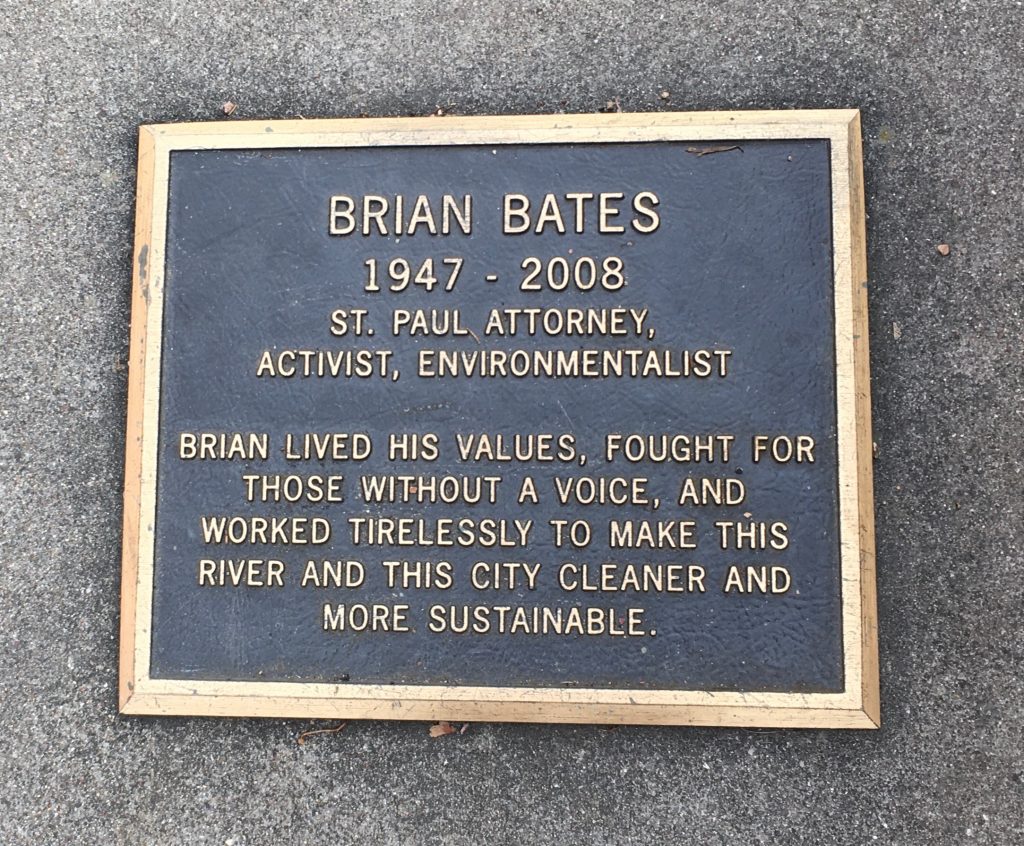
A plaque on the ground near a bench. I didn’t stop to read it. The plaque looked older than the one I stopped to read last week — that one was from 2008
The wind on the lake street bridge was strong, coming from the side
Far below the lake street bridge: one person, dressed in black, walking the winchell trail right next to the water, another person, not dressed in black, running the trail
My shadow, very faint in front of me, overcast today
The ravine between shadow falls and the monument was completely visible. It looked much wider than it was deep
A city truck hugging the side of the road blowing leaves on the trail. They stopped to let me pass
Another runner ahead of me in black running tights and a bright yellow shirt (or was it a jacket?) with a fanny pack or runner’s belt poking out of the back
Reaching the ford bridge: the huge amount of land that was the ford plant and had been fenced off, was now wide open with trucks everywhere. They’re building houses, condos, businesses, new streets, a new park
The big slab of white in the middle of the river that Scott and I have been wondering about for the last week or so is still there. We determined that it might be a sandbar. Looks like it to me
One of my favorite poetry people, Ilya Kaminsky, posted a great question the other day on twitter. What’s the difference between wonder and astonishment? Here’s the thread. And here are a few of my favorite explanations:
I don’t think anyone is ever filled with astonishment, nor does astonishment invite you in. It’s a presence that leaves you reeling. A prolonged buffet that can make you laugh, or gasp, or scrabble to have thoughts again. Perhaps it’s the assertive version of wonder.
While wonder invites, in a way hard to resist. Can you breathe enough breath? Can you travel enough to glimpse a further side? Can you ever be outside of wonder? Or do you just close your eyes?
@MathJonesPoet
I associate wonder with quiet–when an interior reality mingles with exterior reality (whatever reality means) and for me wonder is often a perhaps, a what if… astonishment is a shock, a jolting awake — it can be delightful or violent or terrifying or a mixture of all three
@motleybookshop
“Wonder” feels closer to something constructed for me, like someone looking back at memories and applying emotion through the passing of time, which can result in something disingenuous or forced. “Astonishment” feels closer to something that happens in the moment—present tense.
@jdsctt
in wonder is a mystery unknown that cannot be known is tenderness,a lingering,a touch of an aetherial wing
state of being&a verb veiled&filled with how,a why a when, a could it be .. astonishment is awe&hit by coup de foudre open mouth&open eye
@purpezwaan
wonder is a continuous state, astonishment strikes then disappears
@nataliejedson
Wonder is a slow freight train going slow over a bridge, & between the cars you see peeks of snowy mountains. (Peeks of peaks?) Astonishment is when you’re on the train, & you round the corner & see the ruins of an old old building, & all the ghosts are visible, present.
@AlyssandraTobin
Wonder puts you in the thing and you become a part of it, maybe reciprocal in a way, astonishment is always outside of you.
@vickymharris
For me, I feel wonder in my gut, it has a shock quality. I process astonishment with my eyes, my eyebrows raise, my mouth opens, akin to awe.
@yoursbc
Some general ideas: wonder is a slow glow, astonishment is a quick flash. Wonder is a way of being, an approach that opens us up. Astonishment temporarily shuts us down, stops us; it is unsustainable as a state. We wonder, astonishment happens to us through shock, surprise. Wonder = curiosity, astonishment = surprise, shock, bewilderment. Wonder deepens time, astonishment freezes it. Wonder is warm, astonishment is burning hot. Wonder starts everything, astonishment ends everything.
5.35 miles franklin loop 39 degrees / feels like 32 wind: 15 mph / 28 mph gusts
Blustery but bright with a warming sun. My left knee has been stiff at the end of my runs for the past few weeks (months?) and my left foot hurt at the beginning — the result of my new shoes and the strange redesign that is too tight on my toe. Who cares?! It was a great run. Mid to late November when all the leaves are gone and the sun can reach every corner of the forest is my favorite time to run. My love for it is heightened by the knowledge that soon snow will come and these lower trails will be un-runnable until March or April.
Starting sometime last week, I began a series of poems on haunting and haunted. I’ve been using my runs to help me figure out some of the lines. Today, again, it worked. I went out for my run wanting to work on this unfinished line: what is a ghost but… About a mile and a half in, I came up with some ideas: a part of the past we carry with us visible to anyone who notices. I also came up with an ending, connected to these lines: I am both haunting and haunted. I’m very pleased with how helpful my runs have been for my writing lately.
10 Things I Noticed
Running on the east side, near the U, the knocking of a woodpecker somewhere on a wooden kiosk. Was it on the top of the roof? Inside or outside? I stopped to look, but couldn’t tell
Shadows, 1: running above the floodplain forest, the sun was shining down casting shadows everywhere
Shadows, 2: Following my sharp, defined shadow right in front of me
Crossing the franklin bridge: the river was blue and slightly rough from the wind
A city/park/state truck repainting the white line for the bike lane
A city worker halfway up the bridge steps, painting the railing
2 orange cones and some tape blocking the entrance to the steps
A pile of dead leaves pushed by wind up against the bridge railing
Someone stopped at the overlook on the bridge
Looking down from the lake street bridge at the rowing club: a little cove, dark blue water, a white dock, a line of stone slabs in the river
Here’s a poem that feels very right for today and my thoughts about knees and carrying history with us:
There is something inside each of us that scurries toward the past in our bodies a rooted history perhaps in the balls of our feet a microscopic yearning that floats inside that sphere yearning in a language we’ve forgotten.
History is too in our knees in the ball that pops & twists as we journey.
And for those of us blessed to be old & for those of us blessed to be young it lives inside the tiny ball of skin deep inside the belly button tickles recollections from our tongues stories of stories from then—
4.75 miles Veteran’s Home Loop 32 degrees / feels like 26
Colder today. Traces of snow on the ground. Most of the trees bare. Alone on the trail for much of it. Wonderful. Working on a poem about feeling like a ghost, mostly because of my vision — fuzzy, out of focus, disconnected. Thought about that every so often during the run. Stopped on the grounds of the Veteran’s home to record an idea about not feeling fizzy but flat, or a flat fizz? Not so much light but weighted/heavy with distance and separation and invisible layers. Almost protected, wrapped. But…do I feel heavy or something else? Weightless but not light or heavy because in my untethered state, lightness or heaviness aren’t felt so they can’t be used for reference. I am a hovering ghost who is not heavy or light but hidden, unnoticed, lacking substance, insubstantial. Thinking about this more, it might seem like being unnoticed or disconnected is bad/unfortunate/a bummer. Occasionally it is, but mostly I like the freedom it gives me, the chance to observe without being bothered or judged or distracted. Plus, this feeling of being on but not on the path, insulated, is trippy and cool, strange, surreal.
10 Things I Noticed
Entering Minnehaha Regional Park, nearing the falls: the grass was white with snow, the trail was dry and dark gray, the trees light green. A jarring contrast. Spearmint or peppermint popped into my head
Rushing gushing falls churning white foam
Above the falls on the other side of the creek: Big Feet — what FWA, RJP, and I call the tall statue of Gunner Wennenberg, a Swedish composer, poet, and politician (I looked up on june 27, 2021)
A crow aggressively cawing on someone’s lawn
The oak savanna exposed, no more leaves, the winchell trail below the mesa clearly visible outlined by the light dusting of snow
The river: brown, flat, not looking cold but not warm either
The sidewalk on the high bridge that leads to the Veteran’s Home was snow-covered and slick, icy
Running on the double bridge, around a ravine, the light dusting of white on the deep brown, mulch-covered hill looked like powder sugar
Reaching the 44th street parking lot: yelling laughing kids at the minnehaha academy playground across the road
After my run, walking Delia the dog around the neighborhood, one block over: a huge tree still fully dressed in light green (with a hint of yellow) leaves. Will they turn and fall, or stay all winter?
Still reading Maggie Smith’s Goldenrod. Here’s another poem from it that I really like:
How Dark the Beginning/ Maggie Smith
All we ever talk of is light— let there be light, there was light then, good light—but what I consider dawn is darker than all that. So many hours between the day receding and what we recognize as morning, the sun cresting like a wave that won’t break over us—as if light were protective, as if no hearts were flayed, no bodies broken on a day like today. In any film, the sunrise tells us everything will be all right. Danger wouldn’t dare show up now, dragging its shadow across the screen. We talk so much of light, please let me speak on behalf of the good dark. Let us talk more of how dark the beginning of a day is.
Yes. The dark is not always bad. And, while we’re at it, let’s talk some about the “bad” light: too bright, dazzling, disorienting, burning too hot, deceiving, overwhelming/overstimulating. Can I make this poem fit with the November theme of lifting the veil? Maybe lifting the veil, coming out from the dark and into the light, isn’t always good? Or, maybe a veil can be lifted when we stay in the dark?
Just at freezing, but the feels like temp was in the 20s. I was not cold, but too warm after a few minutes. Next time, I should lose a layer, or maybe the vest? Overcast, not too much wind. Admired the floodplain forest, bare branches with a deep yellowish brown floor. Crossed the river at lake street. Don’t remember the water, but I do remember the 3 people on the shore, near the bridge, with big white garbage bags — volunteers cleaning up? Forgot to look over at shadow falls, or listen for the water that only falls after it’s rained.
Thought about my series of poems on haunting/haunted. The one I’m working on is about all the people who frequent/haunt the trail. I’m calling them, The Regulars. Trying to figure out where and how the Dakota people fit into this idea of the regulars. At first, I thought about using we and thinking very loosely about that “we”– not a community of regulars, but a gathering of people past, present, and future who all frequent/inhabit a space — but this felt wrong, not giving enough room for recognizing who can and can’t inhabit this space and who was forced off of this land. It seems too soon (or ever possible?) to claim a we and it flattens out the differences between how and why the gorge is haunted. I’m not sure how to address this, but I want to devote more time to it and feeling uncomfortable about it—maybe this discomfort and my uncertainty about it is something my poems should circle/orbit around as I struggle to find better words and an understanding?
Here’s a wonderful poem I encountered this morning that connects more broadly to the treatment of indigenous peoples by white settlers and the US government:
I use a trick to teach students how to avoid passive voice.
Circle the verbs. Imagine inserting “by zombies” after each one.
Have the words been claimed by the flesh-hungry undead? If so, passive voice.
I wonder if these sixth graders will recollect, on summer vacation, as they stretch their legs on the way home from Yellowstone or Yosemite and the byway’s historical marker beckons them to the site of an Indian village—
Where trouble was brewing. Where, after further hostilities, the army was directed to enter. Where the village was razed after the skirmish occurred. Where most were women and children.
Riveted bramble of passive verbs etched in wood— stripped hands breaking up from the dry ground to pinch the meat of their young red tongues.
5 miles bottom of franklin hill and back 35 degrees wet snow flurries!
It begins! Cold air, layers, snow. Winter is almost here. Everything was already wet when I started, then, at some point, it started sleeting or snowing or something in-between. I didn’t care; I had a hood and a water resistant vest. Greeted Dave the Daily Walker and a new regular who I don’t have a name for yet. No distinguishing features that my fuzzy eyes can see–an older man, not too tall or short, not too big or small, white. All I remember is his enthusiasm and the joyful ways he waves or greets me with a “morning.” Am I even sure it’s the same person every time?
When I got to the bottom of the franklin hill I stopped to dictate a line for the poem I’m working on. Yesterday I struggled to get through a section on bells and ghosts. Early this morning, I had a breakthrough but still needed to work on the last line. I figured a run would help, and it did. Hooray for running and its ability to get me unstuck!
After that, I put in a playlist and listened to music for the rest of my run, which made me run about 1 minute per mile faster. I felt like I was flying. Free and fast and untethered.
10 Things I Noticed
The color palatte of the day: light gray, dark brown, spicy mustard yellow, slate blue, light green
Running down the franklin hill noticed that half of the tree line was bare, half was a light green
Running through the tunnel of trees, looking down on the floodplain forest: here you can’t see the river, only an endless stretch of forest floor and bare trees
Almost to the the bottom of the hill, a snow/rain drop fell straight into my eye — ouch
Some geese honking, sounding agitated
A chirping whistling bird, sounding like spring, a woman stopped on the path, craning her neck, looking for the source of these sounds (at least, that’s what I imagine she was doing)
Flashing lights from a parks or city vehicle, glowing brighter in the gloom
The vase of flowers still perched on the ledge below the railroad trestle
A bright white paper towel or plastic bag laying on the path, just past the franklin bridge
A very fast runner that I saw twice in shorts and a bright orange long-sleeved shirt
The river rose wildly every seventh spring or so, and down the hatch went the town, just a floating hat box or two, a cradle, a cellar door like an ark to float us back into the story of how we drown but never for good, or long. How the ornate numbers of the bank clock filled with flood, how we scraped minute by minute the mud from the hours and days until the gears of time started to catch and count again. Calamity is how the story goes, how we built the books of the Bible. Not the one for church, but the one the gods of weather inscribed into our shoulder blades and jawbones to grant them grit enough to work the dumb flour of day into bread and breath again. The world has a habit of ending, every grandmother and father knew well enough never to say, so deeply was it stained into the brick and mind. We live in the meantime is how I remember the length of twilight and late summer cicadas grinding the air into what seemed like unholy racket to us, but for them was the world’s only music.
Still lots of yellow in the gorge, but leaves are falling fast. Wind, rain, and the possibility of snow flurries this weekend. Overcast, windy, less humid. I ran north to franklin, over the bridge, south on the east side of the river until reaching another bridge, back over to the west side, then home.
10 Things I Noticed
The view down to the floodplain forest was clear; I could see the forest floor, or at least all the yellow leaves on the floor
The view up to the road from the tunnel of trees was clear too; no hiding below the road until spring
The river from the franklin bridge: cold, dark blue, the railroad trestle in the distance
Running under the railroad trestle, I heard some voices, laughing. Looked down: at least 2 people walking up the limestone slab steps on the Winchell Trail
Running under the railroad trestle, 2: a memorial for someone who died–a biker hit by a car? In addition to the hanging white bike, which is always there, a vase of flowers placed on the ledge
Nearing the old stone steps, hearing the yippy bark of a dog slightly below, the sound moving up slowly — was the dog climbing the steps? Yes. When I reached them, there they were: black, tiny, skittering around
The spray of water that hit me as I started my run–not sure what it was from. It happened as I ran by a neighbor’s house, where a loud machine that looked like a pump, attached to a hose, was set up. Was it an exploding sprinkler? Would I have been able to avoid this if I could see better?
A shorter, older woman with white hair, slightly hunched, walking fast
A taller, younger woman with a pony tail and jutting elbows, also walking fast
After my run was finished, walking the last few blocks: wind chimes!
A great run. I’m working on a long, sequence poem about haunts, haunting, and haunted, and I had a few good thoughts, like the idea of haunting (frequenting, traveling on, slightly floating above) the path/trail as being (happily) out of touch. Disconnected. I thought about the image of a phone being off the hook and eavesdropping, to listen in, overhear, catch bits of someone else’s conversation. Everything an opportunity to be curious and imagine/guess what’s being said without needing to connect that imagination to reality. To fly, float, have freedom, be freed from concerns, worries, the need to be productive.
Yesterday, working on this poem, which is in the form of 3 syllable/2 syllable lines, I thought about Lorine Niedecker and the short, stubby form of her poems. I think she’s an inspiration. Here’s a bit from one of her longer poems, Wintergreen Ridge. (note: in addition to having short lines, this poem travels across the page, broken up into 3 lines, the first with no indentation, the second with one indent, the third with two, on repeat throughout the poem. Mary Oliver does something like this too. Did she take inspiration from Niedecker? Anyway, I’m being lazy or rushed, so I’m not doing the fiddly, extra formatting required (lots of s) for spacing it.
Wintergreen Ridge/Lorine Niedecker
Life is natural in the evolution of matter
Nothing supra-rock about it simply
butterflies
***
(autumn?)
Sometimes it’s a pleasure to grieve or dump
the leaves most brilliant as do trees when they’ve no need
Another nice, late fall run. My cold is almost gone. Sun, not too much wind, lower humidity. I have decided that the ford loop is my favorite fall loop for 2021.
10+ Things I Noticed
Sibilant sounds coming up from the ravine where Shadow Falls is located — possibly wind, but most likely falling water
On the lake street bridge: a trail and some sort of disruption of the water. In my periphery, it always looked like something was there, but when I turned to use my central vision, nothing. Dead cones or faulty peripheral vision?
The memorial plastic flowers leaning on the railing on the st. paul side are slowly falling apart
The view down into the ravine by shadow falls is much clearer than before: a veil lifted. Looking down from the trail above, the gorge isn’t deep but wide and strangely shaped
Also from the view above the ravine: the direction of the sun cast my shadow down in the ravine. As I ran above, she ran below next to the trickling water
A small plaque on a random rock that I didn’t stop to read
The tangy smell of decomposing leaves. Sometimes this smell is sweet, or almost too sweet, but today it was sharp and not quite salty — sour?
At the last parking lot before reaching the ford bridge: an information sign with the history of the forming of the gorge. Some accounts claim the river warren arrived to carve the gorge starting 10,000 years, some 12,000 years, this sign: 13,000 years
My aching toe! The toe box of my new shoe is rubbing against my big toe. It hurt whenever I ran downhill
Crossing the ford bridge: small ripples on the very dark blue water caused by the wind, making a pattern I could see, a texture I could almost feel
The stretch of the sky covered with a ripped veil of clouds
Thinking more about #5, my shadow down in the ravine. As I watched it below me, I thought about ghosts and shadows and faint traces of things not quite here. I imagined the shadow as a different version of me, having the chance to run below in the ravine. And I thought (again, because I’m sure I’ve thought this before) about these quick moments or flashes of something else — shadows, faint trails, breaks in the trees, a disembodied sound coming from somewhere un-locatable — as opportunities, possibilities, evidence of other ways of being or doing. Are these things real? That’s not the point. They’re suggestions or indications, other options.
Before I went out for my run, I skimmed through Mary Oliver’s The Leaf and the Cloud. I was trying to get myself primed for thinking about veils and lifting them. I settled on this bit at the end of a section titled, “Work”:
I will sing for the veil that never lifts. I will sing for the veil that begins, once in a lifetime, maybe, to lift. I will sing for the rent in the veil. I will sing for what is in front of the veil, the floating light. I will sing for what is behind the veil— light, light, and more light.
This is the world, and this is the work of the world.
These are the lines that I read on the window of neighbor’s house that inspired to find this book and to devote a month to Mary Oliver.
Rent: to rend, or tear, split violently, break apart, wrest, pierce
One of the reasons I love late fall, after the leaves have fallen and before the snow comes, is because it is when I have the best view of the river, the gorge, the other side. The veil of leaves and excessive greenery has temporarily lifted. For a few years, I’ve been trying to understand why I like it so much, especially when it seems to be a time of sadness and loss and dread for so many other people. I think this lifting of the veil is a useful way for me to think about it: a better view, more space, a chance to breathe and stretch and connect with things usually hidden, covered, concealed. I like the idea of lifting much better than renting/rending. This lifting is not violent or destructive.
One (boring?) thing I’ve been noticing that I never see when the trees are choked with leaves: cars parked at parking lots on the other side of the river. Today I noticed a white car, glimmering in the sunlight, positioned amongst a line of bare tree trunks. Why do I find this interesting? Maybe because it helps to orient me in relation to the other side or because it’s evidence that more than trees are over there (usually a view of the other side seems the same: tree after tree after tree, and nothing else).
Shorts weather. Overcast, everything a brassy yellow with brown and gray. A nice run in my new shoes. Cold update: almost gone. Just a thin layer of crud lining the throat, lungs, in the nose. Slighter harder to breathe when running.
Went to Gustavus Adolphus College for FWA’s first fall band concert yesterday. Very cool. I love that he’s attending the same school Scott and I did. It’s so great to go back and remember where my life began. Before the concert we walked around the arboretum/prairie, to a big sculpture of a bison on a small hill. As we walked the mowed grass trail, we saw a “river of birds” above our heads (love this phrase, river of birds, which is how a friend from band that we saw at the concert described it). Thousands of birds flying above us, their wings flapping like thunder. I think they might be starlings or swallows? An amazing thing to witness — the whole sky filled, looking like static. A few times, right above our heads, the birds would split up, with a mass of them flying left of us, another mass flying right.
At some point during my run, I began counting in 3s and doing triple berry chants: strawberry/blueberry/raspberry — raspberry/blackberry/gooseberry. I added in mystery and later: ri/ver/road ri/ver/gorge run/ning/path thir/ty/eighth (for 38th street steps) tres/tle/bridge. I stuck mostly with the meter: stressed/unstressed/unstressed. I should remember what meter this is, but I always forget: is it iambic or anapest. I started chanting those two: an/a/pest — i/am/bic Sometimes An/a/pest, sometimes an/a/Pest I/am/bic i/am/Bic
So, it was dactyls, not iambic or anapest. I KNOW I’ve written about this a few years ago, and I’ve reviewed it many times. Will I ever remember? I think I should print it out and put it under the glass on my desk, so I can look at it all the time.
Anyway, as I was thinking about meter and form, I decided that I’d like to use triples — with dactyls and anapests — as the meter (or form?) for another poem about haunting, with the theme of a faint trail, the trace, the worn dirt as path and evidence of others, the residue/remains as offering (poem, an alleluia on the page, Mary Oliver).
Here’s a poem that fits with this idea of what remains (or refuses to die/leave?, that persists, offers up something unexpected or not quite locatable):
Perennials/ Maggie Smith
Let us praise the ghost gardens of Gary, Detroit, Toledo—abandoned lots where perennials wake in competent dirt & frame the absence of a house. You can hear the sound of wind, which isn’t wind at all, but leaves touching. Wind itself can’t speak. It needs another to chime against, knock around. Again & again the wind finds its tongue, but its tongue lives outside of its rusted mouth. Forget the wind. Let us instead praise meadow & ruin, weeds & wildflowers seeding years later. Let us praise the girl who lives in what they call a transitional neighborhood— another way of saying not dead? Or risen from it? Before running full-speed through the sprinkler’s arc, she tells her mother, who kneels in the garden: Pretend I’m racing someone else. Pretend I’m winning.
Ran with Scott up the Marshall hill and around Shadow Falls on the east side of the river. Stopped a little short. Warmer this morning. Still humid. We both greeted Dave the Daily Walker. I felt over-dressed a few minutes in. Tried out my new Saucony’s: black with light pink soles. Very nice. I’ve wanted black shoes for a couple of years now.
10 Things I Noticed
River, 1: Running over the lake street bridge, the water was a few different shades of blue: dark blue near the bridge, then gradually lightening as it moved downstream
River, 2: The white heat of water through a break in the trees. Mostly woods, with one sliver of the river
River, 3: Sparkly, shiny, a cylinder of light traveling from one shore to the other
Passing by a full black garbage bag on the bridge
The clicking and clacking of roller skier approaching from behind
At least 3 different small packs of runners on the east side of the river
No rowers, no geese, no crows
My shadow, off the side, her pony-tail swishing
Passing lots of walkers on the bridge without worrying about covid
Leaving the house, about the start the run, admiring our front tree on full display: brighter than gold
Yesterday, I started working on a poem (or a series of poems?) based on my October focus on ghosts and haunting. I’ve decided to use my rhythmic breathing pattern as the form: couplets with 1 three syllable line and 1 two syllable line (3/2). Here’s a bit that I like about going over the same trail, again and again that doesn’t fit in my current poem (and maybe doesn’t quite work?):
4.75 miles Veteran’s Home Loop* 35 degrees humidity: 84%
*a new loop: south on the river road trail to Minnehaha Regional Park, up the steps and over the falls. Follow the trail along the fence, past the John Stevens House. Take the bridge to the grounds of the Veteran’s Home. Go through a parking lot, up some steps, to the trail near the edge that leads down to Locks and Dam Number One. Rejoin the river road trail heading north until you reach the parking lot with the entrance to the Winchell Trail. Take the Winchell trail north to the Oak Savanna.
A good run. Cold update: It lingers. Still stuffed up, but continuing to feel better. A little harder to run because of the crud in my throat + a few raggedy coughs. Another sunny day with not much wind. So humid. I want my cold, crisp air!
10 Things I Noticed
A haze in the air from the sun illuminating the humidity. Running above the oak savanna, everything was even softer, out of focus than (my) usual, filtered through the damp air
Still above the Oak Savanna: I can see more of the mesa now that more leaves have left
The river was glowing white with sunlight
Not too many people on the trails — hardly any walkers or runner or bikers. Just 2 roller skiers
Stopped at the spot on the Winchell Trail where the man had been using a hacksaw last week to check what he had done. Nothing, as far as I could tell
At its start, just after the slabbed steps, the Winchell Trail, which had been covered in leaves last week, was clear. Minneapolis Parks must have cleared out the leaves sometime this week
The bridge over to the Veteran’s Home, high above the trail below — the trail that follows the creek after it has fallen all the way to the Mississippi River — has a chainlink fence that makes it difficult to see below, especially when the sun is shining directly on it
Running on the edge of the bluff, I heard the roaring of the water as it rushed over the dam at Locks and Dam Number One, then I saw it: a wall of white water
A turkey crossing! Near turkey hollow, I encountered at least 5 turkeys, almost all the way across the road
At the end of my run in the Oak Savanna, I heard a bird crying out. I stopped to locate it: a white-ish bird in a small nest in a nearby tree. I can’t remember the sound it made and have no idea what kind of bird it is — was it the mother, protecting her young? Do any birds nest in the fall?
Just looked it up and yes, some birds do nest in the fall. I didn’t know that. I’m thinking it might have been a mourning dove. They nest in the spring, but can lay eggs as late as October. Wow.
Prints/Tracks/Traces
The poem of the day on poetry foundation reminded me of part of a poem I read last month and then wrote about in a document titled, “October’s Apparitions.” I like the multiple meanings of the title. Prints, as in photographs, but also fingerprints. I thought about prints as tracks too — not yet a trail, but evidence of someone or something else there before you.
until someone else with a stranger’s eye looks close and says that’s you.
Here’s the part of the poem that I posted/wrote about in October:
from Seven Types of Shadow / U A Fanthorpe
We carry our human ghosts around with us. As we grow we face the mirrors, and see The specter of a great-aunt, a vague look Known only from sepia snapshots. The hands we’re used to — Yes, these — their contours came by way of a long retinue Of dust. We are photofits of the past, And the future eyes us sideways as we eye ourselves. We are the ghosts of great-aunts and grand-nephews. We are ghosts of what is dead and not yet born.
And here is what I wrote on oct 15th:
Who, from my family, do I look like? What characteristics of others do I have? Whose nose? I don’t know/remember too many of my relatives, so it’s difficult to imagine who I might look like…[pause to look at pictures of relatives] I couldn’t find much resemblance. I’m not sure who from the past is like me, but my daughter is like me in her posture — she swims like me, she walks like me, she has my shoulders and non-existent eyebrows. I like the idea of the traces of others within us — what we pass on, the gestures and the expressions — there is love in the passing on, even if or when there’s not much connection or love in the relationships. We are ghosts of what is dead and not yet born. I like this idea of all these different times mingling together.
Interesting…reduced to body parts — ghosts as that which we inherited…makes me think of the cone dystrophy — whose bad vision did I inherit? How many others have had it? And which side of the family? My sister has mentioned a grandmother who was blind—did she have cone dystrophy, or was it something else? Thinking about first talking with the doctor and the idea of how it skips generations, jumping around in families so you don’t know where it came from — a ghost not attached to anyone, unknown. So much unknown…
The comfort of a known ghost. To look at someone and see yourself in them or them in you. To know they are the ghost you are passing on. What do you do with not knowing? Is it necessary to know? Do you want to find out? What do you do about you kids?
pages document/ oct 15, 2021
Re-reading this, I’m thinking more about how invisible, or at least very difficult to see, cone dystrophy is. It’s rare and has such a wide range of symptoms, presenting differently even in the same families. And, it skips generations and moves around families: a great-aunt might have it, but not a grandparent or parent. I’m not sure when it was first discovered — even now in 2021, so much is not known about it and the diagnosis of it falls under the vague, blanket term, “cone dystrophy,” which stands in for all sorts of cone-related vision problems. If it existed in families a generation or two ago, it was very likely it was not discovered. No understanding or diagnosis. No treatment. No prints (no evidence revealed in photos or through a doctor’s diagnosis). Instead, only faint tracks or trails: a story about someone having bad vision when they got older, knitting even though they couldn’t see what they were doing. My dad’s family, poor and living in rural upper peninsula Michigan, and before that, rural Finland, most likely had very little or no access to an ophthalmologist that would look for or understand cone dystrophy.
Cone dystrophy is inherited, most likely an autosomal recessive inheritance (AR). If I understand it correctly, I have a 50% chance of passing it on to my kids, but they only carry it if both Scott and I have it, and they only have a 25% chance of being affected by it (and, even if they are affected by it, their symptoms might be very mild or hard to detect). [source: Cone/Cone-rod dystrophy for patients] My experience of it, with most of my cones in my central vision gone and a good chance of becoming legally blind, is rare. So, I’m not too worried about my kids. Instead, I am fascinated by where it came from and the strange, unlikely path it has taken to get to me. What ghosts have passed it on unknowingly? To this I’ll add: I’m not sure if I need to know who it is from, or get an accurate map of how it’s traveled; I am more interested in the idea that it’s hard to track and what it means to live with unknown/unnamed ghosts.
Taking this idea of what our ghosts pass on to us in a different direction, I’m reminded of something I read in Ann Patchett’s Commonwealth a few years ago about the diseases we carry in us unknowingly, maybe from birth, maybe not:
Franny’s father, Fix, says, “People are scared of the wrong things… We go around thinking that what’s going to get us is waiting on the other side of the door: it’s outside, it’s in the closet, but it isn’t like that. . . For the vast majority of the people on this planet, the thing that’s going to kill them is already on the inside.”
Ann Patchett/ Commonwealth
Does this make sense? Will it be useful to future Sara?
I began working on the tracks/prints part of this entry before my run. The last thing I thought about before I left flowed from it: What are the connections between my vision loss and running by the gorge? Some of it is directly related; I’m gathering words, images, metaphors about my vision while I run. Some of it is more a matter of them happening at the same time.
A bright, sunny late fall day. Not gray but golden. I over-dressed; tricked by a feels like temperature that was below freezing. One shirt too many. Ran north on the west river road, over the franklin bridge, south on the east river road, then over the lake street bridge. Breathing was more difficult today, mainly because I have entered a new phase of my cold: the stuffed-up, crudded-up phase. It bothers me, but not too much. I’m happy to be past the last phase, which made me anxious: the feeling of something sitting in my throat, always almost about to turn into cement in my chest. It never did, but throughout the day I imagined a future of not breathing, ventilators, the ICU. Ridiculous, of course. The fear of covid has really messed me up. I used to be an “easy” sick person — at least, I think I was? — but now, I’m a bit of a wimp about it all. Always looking to the future, worrying what my sickness could become.
10 Things I Noticed
4 stones stacked on the ancient boulder
A view of the glowing white river through the bare trees near the floodplain forest
Near Meeker Dam, on the St. Paul side: a mix of bare limbs, with yellow and green leaves
So many views through the trees lining the bluffs: a smear of yellow or red, then open space with trails winding down to the river
A little kid near the trail with an adult. The adult saying something about having a good run. The kid calling out at least 3 times, “Bye” “Bye” “Bye”
An enthusiastic and friendly walker: “Good morning!” or was it just “Morning”? I’ve noticed that usually others say “morning” to me. I always respond, “Good morning.” Is it a regional difference? A east coast or southern thing to say both words, or is it just me?
On the St. Paul side, somewhere up the hill just past Meeker Dam, someone has removed one of the black iron fence panels. The spot where it’s missing doesn’t lead anywhere. It’s been this way for a few weeks. Who did it and why? Will it be replaced sometime soon?
Starting my run, heading north, the air was calm, everything quiet, until a car came by blasting music quickly distorted by the doppler effect. Instead of bothering me, this disruption enabled me to notice and appreciate how quiet it was when the car was no longer there
The faintest trace of my shadow in front of me as I ran north at the beginning of my run
Honking geese — only 2 or 3 honks + 1 chickadee calling out, “chick-a-dee-dee-dee”
Here’s the last bit of a poem that I posted on this log in November of 2019:
This is the month of sunrise skies Intense with molten mist and flame; Out of the purple deeps arrive Colors no painter yet could name: Gold-lilies and the cardinal-flower Were pale against this gorgeous hour.
Still lovelier when athwart the east The level beam of sunset falls: The tints of wild-flowers long deceased Glow then upon the horizon walls; Shades of the rose and violet Close to their dear world lingering yet.
What idleness, to moan and fret For any season fair, gone by! Life’s secret is not guessed at yet; Veil under veil its wonders lie. Through grief and loss made glorious The soul of past joy lives in us.
More welcome than voluptous gales This keen, crisp air, as conscience clear: November breathes no flattering tales;— The plain truth-teller of the year, Who wins her heart, and he alone, Knows she has sweetness all her own.
Love the idea of “veil under veil its wonders lie” with the description of November as “the plain truth-teller of the year”
4.25 miles marshal loop + extra* 36 degrees/ feels like 30
*the extra was running back from st. paul over the other side of the bridge, which dumps out on the west river road at the top of a hill, instead of its bottom
Last week when FWA was home from college, he had a cold. Not covid, but a cold. He gave it to RJP, who had it late last week, who then gave it to me this weekend. The cycle for all of us seems to be the same: 1. a scratchy throat which blooms into a sore throat over night; 2. sore throat, some fatigue, then feeling fine except for the sore throat; 3. a little more fatigue and lots of mucous (sniffing, clearing throat, coughing); and 4. losing your voice. Today, I’m in stage 3. Felt tired and unmotivated this morning, but decided that is was too nice of a morning not to go run. Besides, I always feel better when I’m running, especially when I’m sick. Strange as it seems to me, when I’m sick, which isn’t that often, I always forget about it when I’m running. I’m surprised that having a cold isn’t stressing me out. It feels very different than my usual stuffed up/sinus infections, and makes me wonder how much those are triggered by anxiety. The body is a freaky, strange thing.
I ran north on the river road to the lake street bridge. Then over it and up the marshall hill. Right on Cretin, back over to the river, down the hill above shadow falls, under the lake street bridge, up the stairs on the far side, over the bridge and back to minneapolis. Down the hill, up the other side, beside the old stone steps, through the tunnel of tree, past the ravine.
10 Things I Noticed
The Welcoming Oaks were bare
3 stones stacked on the ancient boulder
More leaves have fallen in the floodplain forest. Almost a view to the river
The river looked cold and slate blue, clear, from the bridge
The sky was overcast and gray, which makes everything even fuzzier with my vision
Between 32nd and lake street, the Winchell Trail, far below the river road trail, was visible. No more leaves concealing it and generating more mystery
Running above shadow falls, I saw a truck on the other side of the ravine now that limbs are bare, which enabled me to see how the trail and road curve sharply around the wide gulch made by the river jutting in
The railroad trestle, from the other side of lake street bridge
A runner in an orange sweatshirt and orange stocking cap, running smoothly with a steady, high cadence, looking relaxed
The wind rushing by my covered ears on the bridge
I love October, and I love November almost as much. I am not sad about the falling leaves and the coming snow. I’m excited about what it brings: winter running, better views, bare branches, mysteries solved, fresher air. Here’s a poem I post almost every year. This year, I want to take 5 minutes to memorize it (finally):
Fall, leaves, fall; die, flowers, away; Lengthen night and shorten day; Every leaf speaks bliss to me Fluttering from the autumn tree. I shall smile when wreaths of snow Blossom where the rose should grow; I shall sing when night’s decay Ushers in a drearier day.
This poem is the first for my November theme: lifting the veil. I plan to explore poems and ideas about this liminal time when the leaves are gone, and the snow has not yet arrived.
run: 3 miles hike: 2 miles franklin loop + extra trails 56 degrees
Scott and I decided to run part of the franklin loop, and hike the rest of it on a few of the extra trails near it. We started by running north on the river road trail, crossing the lake street bridge, then continuing north on the st. paul side. We stopped to walk when we reached the steep road that descends to the paved trail that winds through the flats right beside the east shore of the river. When we reached franklin, we climbed the steps — so many steps! — and crossed the bridge. We stopped to read the plaque for the Winchell Trail then searched for the northern start of the Winchell Trail. We hiked the trail, even the part that extends below the railroad trestle — a first for me — all the way to lake street and the Minneapolis Rowing Club. Very cool!
We talked about all of the vision stuff I’ve been skimming for the past 2 days and the differences between peripheral and central vision. There Plant Eyes (Godin) + Brainscapes (Schwarzlose) + Downcast Eyes (Jay Martin) + The Mind’s Eye (Sacks). And we talked about what Scott has been reading on extroverts and introverts (Quiet, Cain). We talked about the relationship between the senses (like touch and sight), how we navigate using senses other than sight, and “Batman” and echolocation.
10+ Things I Noticed
A downy woodpecker. Heard it’s tap tap tapping first. I wondered if it was a squirrel pounding on a nut, then I saw it at the top of a dead tree. The tapping was rhythmic and persistent, reminding me of morse code or an old-fashioned typewriter
Loud thumping and knocking and slapping — steady and rhythmic — oars from a 8 person rowing shell*
Paths, dirt and asphalt, covered in yellow leaves
Cheering coming from a football game at St. Thomas
The coxswain instructing the rowers
A man and a woman walking in the east river flats. Overhead the man say, “We are experiencing a drought” or something like that
Scooters passing us on the trail, calling out, “on your left”
Dead leaves floating on the surface of the river. From high above on the Franklin bridge, they made a strange mottling pattern on the water
Smell: strong sewer gas coming out of a cluster of vents near the rowing club
Many limestone ledges, exposed. At one of these ledges, the drip drip dripping of water, slowly seeping down
Countless trails leading down to the river, created by seeping/draining water
The white sands beach, just off the winchell trail and far below the paved trail above, is steep and broad and has trash and recycling cans
From the shore at white sands beach: seeing the remains of the long-defunct meeker dam, which you can only see when the water is low
*Although I have written many times over the years about hearing the rowers below on the river, I have NEVER heard the sound of their oars slapping the water or the boat until today. What I was hearing before were their voices. It is very cool to hear the loud, awkward, unromantic, almost clumsy sound they make.
one more thing, added on 31 oct: I just remembered a moment during the hike/run that I don’t want to forget. Walking through the part of Winchell Trail that is wider, between the white sands beach and the minneapolis rowing club, I mentioned to Scott how, when I was a kid growing up in north carolina and virginia, I loved exploring the woods and semi-wilderness that existed at the edges of the many sub-divisions I lived in. I liked walking on trails that had already been made, not wandering through the thick woods, making my own path. I think I said something like, “I wanted to go where someone had already been.” Not sure if that quite captures the appeal of the already traveled path? Whenever I see a break in the trees, and a dirt trail winding somewhere, I long to take it. Or, if I don’t want to take it, I at least enjoy thinking about where it might lead. The path, created by countless feet tamping down the earth, or water descending to the river, is an invitation to imagine other worlds. Maybe also, I like it because it’s evidence that I am not alone, that others have been where I am, wanting to go deeper. To follow the trail they’ve made through their haunting (frequenting), is to connect and contribute to the reinforcing of that invitation. Will this make sense to future Sara? Does it make sense to present Sara? Almost.
4.5 miles John Stevens House loop 46 degrees light rain / humidity: 94%
The forecast predicted light rain all day. Decided I wouldn’t mind running in the rain. Wore my vest, which is waterproof or at least water resistant, a baseball cap, bright pink headband, bright yellow shirt, tights, shorts, gloves, and my older running shoes. Ran south to the falls then around the John Stevens House. Ran north until I reached the entrance to the Winchell Trail then took that the rest of the way. Not much wind, not too cold, not too crowded.
10 Things I Noticed
A glowing tree at the falls that, at first, looked all orange, but slowly seemed almost pink: a mix of some red, yellow, green leaves
A rush of noise — leaves blowing in the wind? No. The falls, rushing in the light rain
Water coming out of the sewer at 42nd street — not rushing or gushing or roaring but some other sound that indicates an abundance of flowing water
Running near the river, noticing how the water closer to me was a blue so pale it looked light gray, the water closer to the st. paul shore was deep and dark, reflecting the evergreens
The spot on the Winchell Trail right climbing up to 42nd no longer concealed by leaves, lined with tall, slender tree trunks and a clear view of river gorge st. paul
A few honks, some kids yelling out, a line-up of cars: the beginning of the day at a local elementary school across the grassy boulevard
A very short person walking around Minnehaha Regional Park. Wearing jeans and a dark sweatshirt with the hood up. Walking with a hunched gait
A runner (or walker?) stopped beside the path, taking off a bright pink jacket and tying it around their waist
A strange scraping metallic sound up ahead of me on the Winchell Trail. Then running by a man hunched over a fence post near the curved retaining wall with a hacksaw, sawing. After I passed, he stopped
Squirrel after squirrel darting across the path and into the woods, never circling back to run in front of me
Earlier this morning, right after I woke up and made my coffee, I memorized the second half of one of my favorite Halloween poems: A Rhyme for Halloween. Here’s the bit I memorized:
Our clock is blind, our clock is dumb. Its hands are broken, its fingers numb. No time for the martyr of our fair town Who wasn’t a witch because she could drown.
Now the dogs of the cemetery are starting to bark At the vision of her bobbing up through the dark. When she opens her mouth to gasp for air, A moth flies out and lands in her hair.
The apples are thumping, winter is coming. The lips of the pumpkin soon will be humming. By the caw of the crow on the first of the year, Something will die, something appear.
I recited it in my head throughout my run. I love this poem and its haunting feel (tone? mood?). As I recited the lines, I struggled with the second verse — was it bobbing or bob? gasping or gasp? Why was it difficult for me? I can’t remember now. I like stumbling with the lines; it gives me the chance to reflect on word choice and rhythm. And it helps me to think about what makes some poetry sing, some fall flat.
Favorite lines/images: the blind, dumb clock; the martyr who wasn’t a witch because she could drown; the vision of her bobbing through the dark and gasping for air; the apples thumping — I imagine them falling on the ground; the lips of the pumpkin humming; something dying and something appearing.
Why is this haunting? One obvious reason: it takes up Halloween (spooky) images. But also: the rhymes. They aren’t sing-song-y. Instead, they echo. The rhyming reminds me of part of Edgar Allen Poe’s The Bells:
monody: a poem lamenting a person’s death paean: a song of praise or triumph rune: letters from an alphabet that was used by people in Northern Europe in former times. They were carved on wood or stone and were believed to have magical powers (source). knell: the sound of a bell, especially when rung solemnly for a death or funeral
IV.
Hear the tolling of the bells— Iron bells! What a world of solemn thought their monody compels! In the silence of the night, How we shiver with affright At the melancholy menace of their tone! For every sound that floats From the rust within their throats Is a groan. And the people—ah, the people— They that dwell up in the steeple, All alone, And who tolling, tolling, tolling, In that muffled monotone, Feel a glory in so rolling On the human heart a stone— They are neither man nor woman— They are neither brute nor human— They are Ghouls: And their king it is who tolls; And he rolls, rolls, rolls, Rolls A pæan from the bells! And his merry bosom swells With the pæan of the bells! And he dances, and he yells; Keeping time, time, time, In a sort of Runic rhyme, To the pæan of the bells— Of the bells: Keeping time, time, time, In a sort of Runic rhyme, To the throbbing of the bells— Of the bells, bells, bells— To the sobbing of the bells; Keeping time, time, time, As he knells, knells, knells, In a happy Runic rhyme, To the rolling of the bells— Of the bells, bells, bells— To the tolling of the bells, Of the bells, bells, bells, bells— Bells, bells, bells— To the moaning and the groaning of the bells.
Reading through this again, I’m thinking about how the bells in this verse are not clock bells, tracking the precise, steady passing of time (which reminds me of the lines about the blind, dumb clocks and no time for the martyr). These bells toll, groan, moan, roll, throb, sob, knell. The sound of the bells floats from rusty throats, is muffled, melancholy. When it is mentioned that they keep time, it is not the time of life, but of death.
Damp. Cool, but not cold. A nice, relaxed run. Overcast, windy. Ran north through the welcoming oaks, the tunnel of trees, past the old stone steps, above the winchell trail that steeply climbs out of the gorge, up to the lake street bridge. Over the bridge, down the steps, up the hill — past one of my favorite, uncluttered views, on the st. paul side; past the bench perched above the river; above shadow falls — to the top. Then down the other side of the deep ravine. Around the World War Monument, beside the river on one side, fancy houses the other. A brief stop at the overview, around another ravine, over to the ford bridge. Through the smaller tunnel of trees above the locks and dam, north on the river road, and then, another brief tunnel of trees just before reaching the double bridge and the start of the Winchell Trail. Through the woods, up and down and up and down the undulating path, then finishing on the upper trail near the 35th st parking lot.
10 Things I Noticed
Almost all of the welcoming oaks are bare limbed, the ground covered in crunchy, crispy leaves
The river a pleasing pale blue, not smooth but slightly rippled, except for at one spot where it’s smooth
The trees along the shore have all changed color
The ravine near Shadow Falls, looking very fall-ish, so many yellow leaves
Running up the long hill, hearing the bell at St. Thomas singing the clock song: ding dong ding dong/ding dong ding dong/ ding dong ding dong — stopping short because it was 9:45, not 10
Running beside the fancy houses on east river parkway, hearing a women’s voice call out to someone else, “what a beautiful day!” Immediate thoughts: It’s windy and cool. Is it a beautiful day? (then thinking: yes, it is. I love this end of fall weather.) Also: actual people who notice and enjoy the weather, really live in this impossibly large and pretentious house?
At the overlook near the entrance to the winchell trail, noticing the river. Farther away, it looked white, almost like snow or ice. Closer, and at a different spot, it sparkled and burned bright and white
2 squirrels crossing my path, managing to not double back and trip me
So many dirt trails and breaks in the trees leading into the woods on the edge of the bluff on the st. paul side
After ascending the steps of the overlook on the st. paul side, stopping at a bench and seeing a plaque embedded in the sidewalk for Brian Bates, who died in 2008, about a year before my mom did
seen on the St. Paul side of the river, near an overlook
I was curious, so I looked him up:
Age 60 Died June 12th of Cancer Brian was born July 14, 1947 in St. Paul and was a graduate of Notre Dame University. He spent his early business career in San Francisco. After returning to St. Paul in the early 1980’s, Brian received his law degree from Hamline University. He was active on the Mac/Groveland City Council, Scenic Minnesota, Scenic St. Paul, Clean Air MN, the DFL and other political and environmental endeavors. Brian’s work on environmental issues led him to become well-known in the St. Paul area. He was instrumental in the fight against billboards calling them “litter on a stick”.
Not too long after hearing the bells of St. Thomas (as I climbed the Summit Hill), I decided to take out my phone and record myself mid-run. At the point of recording, I was probably running a 9 minute pace, with my heart rate at 170 (which seems to be my standard heart rate for running):
9:45
Running up summit hill I heard bells at st. thomas chime. Was it 10 o’clock or sometime in 9? 9:45
reciting 9:45
I’ll have to keep working on these. It’s difficult to overcome my self-consciousness over other people see me do this, and my reluctance to slow down enough to get out my phone.
One more thing I almost forgot: Running north on the west river road through the small tunnel of trees before the double bridge, I suddenly noticed the faintest trace of my shadow ahead of me. At first, I wasn’t sure. Had I really seen my shadow or just imagined it? Then, it appeared again, and I noticed the sun had come out. I glimpsed it a few more times, always faint, casting itself on the thick-littered trail. Writing this paragraph, I suddenly wonder about how many times we think we’ve seen something but then discount it with, “it was just my imagination.” More often than not, we are seeing something and it is not being imagined; we just don’t have the right words to describe it, and we don’t trust how our brains see so much more than we realize (or fully process).
Periodically throughout my run, I recited Emily Dickinson’s We grow accustomed to the Dark –, which I re-memorized and then wrote about this morning. At one point, for a few minutes, I stumbled over the 3rd verse. I had no problem with:
And so of larger – Darkness –
But, I couldn’t quite remember the next line: I knew it wasn’t, The Darkness of the Brain or The dimming of the Brain, but the word wasn’t coming to me. Suddenly, it did: evenings:
Those Evenings of the Brain –
Yes. Such a brilliant line, and so helpful and rewarding to spend time thinking about word choice — the right word, so precise and effective, matters.
Breezier and cooler today but humid, so no cold, fresh air. Sunny. Possibly more leaves on the ground than on the trees. Wore my winter running tights, a bright yellow shirt, black vest, black gloves, a baseball cap that used to be black but is now a dingy gray, a bright pink headband, and a not bright orange and pink and cream buff. No stacked stones. No view through the floodplain forest of the water. No geese in the sky.
10 Things I Noticed (about the river)
Shimmering white heat through the small gap in the trees
Running over the Franklin bridge, the light reflecting on the water was hitting my peripheral vision just right, or just wrong — painfully, irritatingly bright
The surface was a smooth, flat, unmoving blue (above on the franklin bridge)
No rowers
Shadows from the trees on the east side darkened the river at its edges
Reflections of the golden trees on the west side brightened the water, coloring it yellow
A circle of light on the water’s surface followed me as I ran south, mostly staying ahead of me, occasionally beside
Most of the trees along the shore have changed colors, many yellows, a few reds, hardly any oranges
Running above the paved trail below on the east side, I couldn’t see it or the water until I reached the trestle
Looking ahead of me at the path, everything looked fuzzy, barely formed. Looking below me on the bridge, the river looked intense, sharp, clear, solid
As I ran, I thought about echoes and rings, circles and cycles, shadows as evidence of something else t/here. I also thought about how the tracing of a paved trail/loop can’t happen on the surface — unless it’s raining or snowing, the hard asphalt leaves no evidence of my footfalls. Instead the evidence is found in my memory, my familiarity with the path in my mind and body:
Familiarity has begun. One has made a relationship with the landscape, and the form and the symbol and the enactment of the relationship is the path. These paths of mind are seldom worn on the ground. They are habits of mind, directions and turns. They are as personal as old shoes. My feet are comfortable in them.
Ran with Scott in Austin. 40 but sunny, so it didn’t feel too cold. Unless you were in the shade, which we weren’t for most of the run. Started at East Side Lake and ran on a trail that leads to Todd Park. I don’t think we saw anyone else on the trail. No bikers or walkers or runners. Is that right? What I remember most about it was running slightly uphill into the wind at the end and how beautiful the lake looked in the late morning sun. I don’t think it was sparkling, but it was calm and blue and dotted with geese.
5 miles john stevens house and back 36 degrees humidity: 87%
We are at peak, or just past peak, color here at the gorge. Wow! So beautiful that it’s hard to take it all in. How wonderful it is to live here and experience this every day! Running to the river, I heard a loud noise. A bell? No, the horn from a train. Was a train rumbling over the trestle? Ran south on the river road and received at least 2, maybe 3, “good mornings” or “morning” from other runners. Very nice. The sky is gray, but in one small corner of the sky, I could see the sun almost peeking through. Heard and saw some geese flying high in the sky. The falls were gushing a bit more than the last time I ran to the falls. Ran up the steps, over the creek, along the bluff, and around the John Stevens House. Encountered a woman running with 2 dogs. One of the dogs lunged at me, which didn’t bother me, and I could hear her yelling, “No! We don’t do that!” at it after I passed. Anything else? No turkeys. A roller skier. Oh–an older woman who stopped at the edge of the paved path to call out to someone from the city working on the sewer across the road, “thank you!” The worker was confused and called back, “Sorry?” “Thank you!” Don’t think I’ve ever seen (or heard) that before.
As I was running through minnehaha regional park, I thought about the things that have stayed the same, the things that have changed, and what seems to still be present as living and vital, and what only remains in decay, or in the faintest traces of what it had been. I was thinking about this as I ran by the playground, which was redone five or so years ago, but still has some old equipment, like the creaky, rusty swings. Something about that reminded me of a few lines from Poe’s “The Bells,” especially the bit about the rust.
Hear the tolling of the bells— Iron bells! What a world of solemn thought their monody compels! In the silence of the night, How we shiver with affright At the melancholy menace of their tone! For every sound that floats From the rust within their throats Is a groan.
monody: an ode in a greek tragedy; a poem lamenting a person’s death
“the rust within their throats” — love that line and how it speaks to decay and sorrow and, almost, the living dead
Decided to run the ford loop this morning and stop at some of the overlooks. Is today one of the last beautiful fall days? Possibly. So much yellow and red everywhere. Leaves drifting down like fat, fluffy flakes. Sun lighting up the surface of the river. Amazing. Writing this, an hour later, the sky is dark. Rain coming. I’m glad I got outside this morning.
10 Things I Noticed
Running above the river, over the lake street bridge: the water looks a deep, dark blue
From the edge of the bluff, on the east side at one of my favorite spots, the river looks lighter, richer, still blue
Heading north, a strong-ish wind in my face
Running beside Shadow Falls, wondering if what I was hearing was water from the falls or the wind in the trees or both
Passing a group of pedestrians, walking 2 by 2 on the edge of the trail
A barking, lunging dog, barely held back by a human also pushing a stroller
The view, 1: from just below an overlook on the St. Paul side, standing on a rock, close to the edge. The bank on the west side of the river is mostly yellow and red, with a few bits of green still holding on. Looking left or right, all I could see were water, shore, trees, rock
The view, 2: from the ford bridge. Mostly brown tree trunks and green/red/yellow leaves. Then, a break. A gleaming white — is this the limestone cave where the trail ends? The spot where STA and I watched the rowers a few weeks ago?
The view, 3: from the overlook at the southern start of the Winchell Trail. The glittering, white heat of water lit by the sun. One way, the ford bridge. The other, trees
Running on the Winchell Trail, right before 42nd, the trails curves close to the edge. As you climb, it looks like you might just keep going, out into the sky, above the river
Before I ran, I studied a passage from U A Fanthorpe’s “Seven Types of Shadow,” especially the lines:
Ghosts of past, present, future. But the ones the living would like to meet are the echoes Of moments of small dead joys still quick in the streets
In particular, I was thinking a lot about echoes and reverberations. Halfway up the Summit Hill, I started thinking about bells and the reverberations of sound they emit after being struck. These thoughts were partly inspired by a passage I read from Annie Dillard in “Seeing” from Pilgrim at Tinker Creek:
Then one day I was walking along Tinker Creek thinking of nothing at all and I saw the tree with the lights in it. I saw the backyard cedar where the mourning doves roost charged and transfigured, each cell buzzing with flame. I stood on the grass with the lights in it, grass that was wholly fire, utterly focused and utterly dreamed. It was less like seeing than like being for the first time seen, knocked breathless by a powerful glance. The flood of fire abated, but I’m still spending the power. Gradually the lights went out in the cedar, the colors died, the cells unflamed and disappeared. I was still ringing. I had been my whole life a bell, and never knew it until at that moment I was lifted and struck.
Seeing/ Annie Dillard
I didn’t want to forget my thoughts, so I pulled out my phone, mid-run, and recorded myself. It was challenge, speaking while running and trying not to feel self-conscious as I passed other people:
Recording While Running / 20 Oct
Here’s a transcript of what I said. I turned it into a poem, using my breaths to break the lines. I’d like to try doing this some more — experiment with recording my thoughts mid-run, then using my breaths to shape the poem.
I’m thinking about how I’m a bell and how we’re all bells and when we are struck — is it at birth or is it like Annie Dillard: there’s a moment of awareness and clarity that makes our bell ring reverberate continue to echo?
added a few hours later: I forgot about how, just before I started recording my thoughts, I heard the bells of St. Thomas. Was it 10 am? or 9:45? Not sure, but it seemed fitting to hear these bells, which I often hear at my house too, as I was thinking about bells.
I thought about a lot of things on today’s wonderful run. Decided I’d like to make a list of the traces, trails, reverberations I encounter on my runs. Also decided to look up and listen to the Radiolab episode about echolocation. And I decided to think/research more about the presence of the WPA at the gorge. As I thought about this I wondered about my grandfather who lived in St. Paul and worked for the WPA. Was he a part of the gorge work — making benches, walls, steps? Shoring up ravines, minnehaha and hidden falls? He’s been dead for almost 30 years now, so I can’t ask him. A further set of questions I pondered as I ran past the steps leading down from the 44th street parking lot: Do I need to know the exact truth about his involvement with the WPA? Or, is it enough to know he was a part of it, and okay to imagine he might have helped build the old stone walls I run by, the benches I want to stop at but never do?
In between admiring the view and thinking about echoes, I recited the first part of the 7th section of May Swenson’s “October” in my head. Such a great part of a poem! I’m a big fan of May Swenson’s work.
Looked it up and found the echolocation episode. It’s from Invisibilia and not Radiolab: How to Become Batman
Hear the sledges with the bells— Silver bells! What a world of merriment their melody foretells! How they tinkle, tinkle, tinkle, In the icy air of night! While the stars that oversprinkle All the heavens, seem to twinkle With a crystalline delight; Keeping time, time, time, In a sort of Runic rhyme, To the tintinabulation that so musically wells From the bells, bells, bells, bells, Bells, bells, bells— From the jingling and the tinkling of the bells.
II.
Hear the mellow wedding bells, Golden bells! What a world of happiness their harmony foretells! Through the balmy air of night How they ring out their delight! From the molten-golden notes, And all in tune, What a liquid ditty floats To the turtle-dove that listens, while she gloats On the moon! Oh, from out the sounding cells, What a gush of euphony voluminously wells! How it swells! How it dwells On the Future! how it tells Of the rapture that impels To the swinging and the ringing Of the bells, bells, bells, Of the bells, bells, bells, bells, Bells, bells, bells— To the rhyming and the chiming of the bells!
III.
Hear the loud alarum bells— Brazen bells! What tale of terror, now, their turbulency tells! In the startled ear of night How they scream out their affright! Too much horrified to speak, They can only shriek, shriek, Out of tune, In a clamorous appealing to the mercy of the fire, In a mad expostulation with the deaf and frantic fire, Leaping higher, higher, higher, With a desperate desire, And a resolute endeavor Now—now to sit or never, By the side of the pale-faced moon. Oh, the bells, bells, bells! What a tale their terror tells Of Despair! How they clang, and clash, and roar! What a horror they outpour On the bosom of the palpitating air! Yet the ear it fully knows, By the twanging, And the clanging, How the danger ebbs and flows; Yet the ear distinctly tells, In the jangling, And the wrangling. How the danger sinks and swells, By the sinking or the swelling in the anger of the bells— Of the bells— Of the bells, bells, bells, bells, Bells, bells, bells— In the clamor and the clangor of the bells!
IV.
Hear the tolling of the bells— Iron bells! What a world of solemn thought their monody compels! In the silence of the night, How we shiver with affright At the melancholy menace of their tone! For every sound that floats From the rust within their throats Is a groan. And the people—ah, the people— They that dwell up in the steeple, All alone, And who tolling, tolling, tolling, In that muffled monotone, Feel a glory in so rolling On the human heart a stone— They are neither man nor woman— They are neither brute nor human— They are Ghouls: And their king it is who tolls; And he rolls, rolls, rolls, Rolls A pæan from the bells! And his merry bosom swells With the pæan of the bells! And he dances, and he yells; Keeping time, time, time, In a sort of Runic rhyme, To the pæan of the bells— Of the bells: Keeping time, time, time, In a sort of Runic rhyme, To the throbbing of the bells— Of the bells, bells, bells— To the sobbing of the bells; Keeping time, time, time, As he knells, knells, knells, In a happy Runic rhyme, To the rolling of the bells— Of the bells, bells, bells— To the tolling of the bells, Of the bells, bells, bells, bells— Bells, bells, bells— To the moaning and the groaning of the bells.
Another nice run. Another beautiful fall morning. Glowing yellow. Sunny, not too much wind, not too warm. Greeted Dave, the Daily Walker twice. Ran past Daddy long legs. Noticed a roller skier. Encountered a clueless human and a small yippy dog, both taking up the very wide path on the franklin bridge, forcing an impatient biker to ring their bell and swerve around them. Some stones were stacked on the ancient boulder, the river was blue then, later, brown. No rowers (although STA and I saw them last night, rowing fast). The trees below the tunnel of trees were almost all gold. Soon: a view!
(The other day, I found a brochure online for the Winchell Trail. Reading through it again, I thought it was where I read about the plaque on a boulder about Newton Horace Winchell that was near the Franklin Bridge, but it’s not.) Having read about a plaque for Winchell somewhere near Franklin, I decided to look for it. When I couldn’t find it above the gorge, I turned and ran up the hill to the Franklin Bridge. There it was, the plaque! I’d never noticed it before.
Running on the east side of the river, between Franklin and the trestle, I thought I heard footsteps behind me, but when I looked back no one was there. I thought again about how ghosts and haunting involves more than visions and apparitions; it can come in the form of strange sounds, echoes, disembodied voices. Footsteps behind you or the rushing of wind past your ears or rustling leaves, amplified in the dry, deadness of fall. These sounds are both strange — hard to place, easy to confuse with other sounds, like beeping trucks that could be chirping birds, crying kids that sound like shrieking bluejays — and familiar. They conjure up memories, invoke the past.
A few days ago, I discovered Annie Dillard’s chapter in Pilgrim at Tinker Creek: Seeing. I have read some (all?) of this book years ago, but I didn’t remember there was a chapter titled “Seeing”! Excellent. I read it online, from a pdf. Yesterday, I found my copy, which isn’t really my copy but my dead mom’s copy that I inherited or, more likely, borrowed years before she died in 2009, on the bookshelf next to my desk. I opened it up and discovered a wonderful surprise: a sticker in the front that reads, “This book is the treasured possession of Judy Puotinen.” My mom has signed her name so neatly and clearly. I could stare for a long time at the pretty loops of her J and y; the confident backward slant of her P, almost looking like a person puffing out their chest; the t that looms larger than the other letters and stands like a cross (she was not very religious, or as she might have put it, “I’m spiritual, not religious”); and the errant dot of an i, charging ahead to dot the n instead. This signature, too, is a trace, a haunting, more than a memory. It is her, still speaking 12 years after she died. Such a powerful voice in that signature! For a few years after her death, I would encounter her signature on a box in the basement of my first house in Minneapolis. I had a lot of these boxes; they were care packages she sent almost once a month: a new tablecloth, a candle, a cookbook, baby clothes for my kids. It was difficult to see that signature then. It reminded me of how much I had lost: not just her but the care and love she constantly gave me and would have given to my kids. But now, to stumble across her in this way is wonderful. To spend time with her, delighting in remembering how much she loved books and how carefully and beautifully she wrote her name.
It waits now for snows to fall upward, into a summer whose green leaves vanish, but back into branch, into sap, into rain.
It waits for the old to grow young, fed and unfearful, for freighters to carry their hold-held oil back into unfractured ground, for fires to return their shoeboxes of photos and risen homes.
It unbuilds the power line’s towers before the switch can be toggled, puts the child, rock still in hand, back into his bed.
A single gesture of erasure pours back into trucks and then river the concrete wall, unrivets the derrick, replenishes whale stocks and corals.
And why not—it is easy—restore the lost nurse herds of mammoths to grazing, the hatched pterodactyl to flight? Let each drowned and mud-silted ammonite once again swim?
One by one unspoken, greed’s syllables, grievance’s insult. One by one unsewn, each insignia’s dividing stitch. One by one unimagined, unmanufactured: the bullet, the knife, the colors, the concept.
Reversal commands: undo this directional grammar of subject and object. Reversal commands: unlearn the alphabet of bludgeon and blindness. Reversal commands: revise, rephrase, reconsider.
And the ink, malleable, obedient, does what is asked.
3.6 miles minnehaha falls and back 41 degrees humidity: 87%
Another cooler, wonderful morning. Wore running tights + running shorts + bright yellow long-sleeved shirt + bright orange sweatshirt + buff. It was humid, so even with the cool air, I was sweating. Starting my run, heading into the sun, I could see the moisture in the air. Hovering. Ran south on the path and noticed the river burning through the trees. Such a cool sight. The falls were falling, not quite a gush, but more water than the last time I was here. Encountered a roller skier, a few bikes, lots of walkers, a runner or two, dogs. Watched the back end of a squirrel darting back into the bushes as I approached.
As I ran back north, after the falls, I tried looking up higher so that more of peripheral vision was seeing the path. Last night, watching the 4th Harry Potter movie, I started looking at it through my periphery and was amazed at how much more I could see. I aimed my eyes off the side of the television and the images weren’t sharp and clear, but I could see more of them. Colors were more intense too. Strange–and a strange way to watch a movie, looking off at the wall.
Ending my run, crossing over to the grass between the river road and edmund, I watched my shadow ahead of me and thought about shadows and ghosts and how my shadow sometimes leads me, sometimes follows. Then I thought about the dirt trail I was walking on and wondered how long it had been there. And I thought about how it was formed where it was and not somewhere else on the wide expanse of grass. How many feet (or wheels) were needed to establish this trail as the unofficial path to take when walking or running on this grass? I also briefly thought about the Oregon Trail and how, when we were visiting Scott’s Bluff in Nebraska, you could still see and walk that trail, over 150 years later. Earlier this morning, I had also thought about trails, imagining them as a collaborative poem that walkers/runners offer to the gorge with their feet.
At some point on the path, I also thought about Robert Frost’s classic path poem—maybe it was right after I recited his, “Nothing Gold Can Stay”?
Two roads diverged in a yellow wood, And sorry I could not travel both And be one traveler, long I stood And looked down one as far as I could To where it bent in the undergrowth;
Then took the other, as just as fair, And having perhaps the better claim, Because it was grassy and wanted wear; Though as for that the passing there Had worn them really about the same,
And both that morning equally lay In leaves no step had trodden black. Oh, I kept the first for another day! Yet knowing how way leads on to way, I doubted if I should ever come back.
I shall be telling this with a sigh Somewhere ages and ages hence: Two roads diverged in a wood, and I— I took the one less traveled by, And that has made all the difference.
I found an essay about this poem that I’d like to spend more time with, maybe later today or tomorrow?:
Winter running is coming! Today was great. Cool enough to not get (too) overheated, sunny, not much wind. More yellow leaves. Right after I reached the river road, I heard 2 runners behind me. One of them had a booming voice that carried. I couldn’t tell how far behind me they were or if they were slowly approaching me. Instead of getting irritated or changing my pace, going faster or slower, I kept it steady and heard a few fragments of the conversation, mostly the loud guy’s part: they haven’t seen each other since the pandemic hit, so they were catching up, talking about their running and injuries and aging. I recall the quiet guy saying something like, Man, it’s tough getting old. Not too far from lake street, the quiet guy left. The last thing I heard before I turned up to the lake street bridge was the loud guy blowing a snot rocket (so glad he was far behind me!).
10 Things I Noticed
The river, part 1: crossing the lake street bridge. Out of the corner of my right eye, barely below the railing, I kept thinking I was seeing a rower. Not the shell, but the wake or trail of the boat gliding through the water
The river, part 2: crossing back later, I realized it had not been a rower or the trail from a boat but something else — the current, ripples from a something just below the water, scum on the surface?
The floor below the Welcoming Oaks was covered in a dead leaf carpet. No visible grass or dirt, just crunching leaves
Still no stones stacked on the ancient boulder
Near the bottom of the marshall hill looking up at the red stop light at the top, seeming far and close at the same time
Hearing voices as I ran above Shadow Falls on the St. Paul side — were they coming from the falls or The Monument?
The women runners I encountered wearing pants or tights; the male runners shorts
The huge empty lot near Summit on the St. Paul side that I’ve seen on zillow. Asking price: 2.75 million just for the land
Right before greeting Dave, the Daily Walker, I heard a bike that had just passed brake loudly — not a squeal but a loud compression of air, or sneakers rubbing on a gym floor– then turning around and passing me again
The river, part 3: Running south on the west river road, nearing the old stone steps, I glimpsed the river, on fire from the sun, burning bright white through a break in the trees
Something about seeing the river burning white made me think more about ghosts and traces and why I am interested in trails and flashes. Right after I finished my run, I recorded my thoughts. In this recording, I can’t remember what prompted these thoughts and I say lake when I mean river.Also, I keep intending to use notes on my phone when dictating my ideas because it can transcribe them. One day, I’ll remember.
after run / 16 october
Speaking of traces, here’s something I encountered on twitter this morning:
“I am slow and need to think about things a long time, need to hold onto the trace on paper. Thinking is adventure. Does adventure need to be speedy? Perhaps revising is a way of refusing closure?…”
Rosemarie Waldrop
Just got Rita Dove’s latest collection, Playlist for the Apocalypse, from the library. I love Rita Dove! Here’s one that doesn’t necessarily fit with this month’s theme, but I want to post it anyway:
Island/ Rita Dove
A room in one’s head is for thinking outside of the box, though the box is still there—cosmic cage, Barnum’s biggest, proudest Ring. My land: a chair, four sticks with a board laid across: This is the raft I pile my dreams on, set out to sea. Look for me, shore.
3.5 miles trestle turn around + extra 49 degrees 19 mph gusts
Brrrr. Colder and windier today. Wore tights and 2 shirts. The leaves continue to change. Today: bright brassy yellow with hints of green and brown. Not mustard or gold — at least to me. So intense and delightful that I exclaimed “wow!” as I reached the edge of the welcoming oaks. Down in the tunnel of trees more oranges and yellows. Still more leaves in the trees than on the ground, but if the wind keeps blowing like it did yesterday and it is today, that will change. By next week, will all the leaves have fallen? I felt strong and relaxed, running at an easy pace. Then a runner slowly approached from behind, not passing me fast enough, running alongside of me. I sped up to avoid them and knew it was a mistake almost immediately. I was running too fast. Ran for a few more minutes at that pace and then stopped to let the other runner pass. The lesson to learn: always slow down or stop to let another runner go by. Do not speed up to avoid them. This is a reminder of a lesson I should have learned several months ago with the group of kids on bikes under the lake street bridge (see may 28, 2021).
10 Things I Noticed
A bright orange tree on the grass between edmund and the river road. Difficult to quite remember, but I think it wasn’t completely orange, maybe giving the idea of orange or orange-tinted leaves on an otherwise green leafed tree
The man in black who was not in black at all but still has the very long legs. I think I might rename him “daddy long legs” — is that bad?
The trees above the ravine and the slick slats and sewer pipe and concrete ledge were bright yellow and red
The wind was blowing in many different directions, never at my back
The jingling of my house key in the small zippered pocket in the front of my orange running shirt
A roller skier without his poles — no clicking or clacking, lots of awkward arm movements
No stones stacked on the ancient boulder
Hardly any leaves left on the welcoming oaks
An approaching runner avoiding me by running on the other side of a tree and through the grass
3 sets of steps (all inviting me to take them): the old, uneven stone steps after the tunnel of trees; the big stone slabbed steps before the trestle; the recently replaced wooden steps after the trestle. All leading to the Winchell Trail
Ran north listening to the wind, south listening to a playlist with Miley Cyrus and 2 songs by Silk Sonic — nice! At the end, above the ravine, I thought about how I rely less on a watch, and much more on the weather and the trees to keep track of time. Much more enjoyable to think in seasons or the progress of the leaves than minutes, hours, days.
Earlier today I was thinking about pace — and only slightly in relation to running pace, more about pacing and restlessness and ghosts that haunt the path. Pace and pacing, like watches or clocks, impose limits and boundaries: a running pace uses seconds and minutes per mile (or km) and pacing involves walking back and forth in a small or confined space, retracing your steps again and again until you rub the grass away and reach dirt, or wear the carpet bare. What to do with that information? I’m not quite sure…yet.
I found this poem on twitter yesterday. Even though it doesn’t deal with my theme (ghosts, haunting, haunts), I wanted to post it and tag it with water so I would have it for letter. Such a wonderful poem and poet!
Rebuked, she turned and ran uphill to the barn. Anger, the inner arsonist, held a match to her brain. She observed her life: against her will it survived the unwavering flame.
The barn was empty of animals. Only a swallow tilted near the beams, and bats hung from the rafters the roof sagged between.
Her breath became steady where, years past, the farmer cooled the big tin amphoræ of milk. The stone trough was still filled with water: she watched it and received its calm.
So it is when we retreat in anger: we think we burn alone and there is no balm. Then water enters, though it makes no sound.
favorite bits: anger, the inner arsonist; the bats and the rafters the roof sagged between; the line break for “the stone trough was still/filled with water”; and water as the soundless balm for our burning alone.
random sighting/thought: Saw a sign in front of a house that read:
We love our rocks! Please do not take our rocks.
I thought about the importance of line breaks here. Maybe it’s just my faulty vision, but when I read this sign I am just as (or maybe more) likely to read the line “take our rocks” on its own and think they want me to take their rocks. How does the meaning of the sign change with different breaks:
Please do not take our rocks.
Please do not take our rocks.
Please do not take our rocks.
What if you mix up the order?
Our rocks do not take please
Our rocks do please take not
rocks? please. ours do not take
do ours not please? (rock’s take)
take rocks — ours please — (do not)
Too much useless fun!
addendum: I told STA about my fun wordplay, and he offered this one:
Our rocks please. Do not take!
another addendum: The sign actually started: Rocks rock!
4 miles minnehaha falls and back 59 degrees humidity: 78%
Overcast today. No sun. I like how this makes the colors — the reds, golds, greens — glow more. Almost peak color in the trees. When I started my run, I felt awkward, almost like my limbs were working against instead of with each other. By the time I reached the river it was fine. Ran south to the falls on the trail, which I’ve been trying to avoid, and it was crowded. 4 roller skiers, skiing 2 x 2 were causing all sorts of problems for bikers and me as I encountered the bikers. Made it to the falls, stopped to check out the statue of Minnehaha and Hiawatha. Hardly any water in the creek. Ran north, heading home. Took the Winchell Trail and admired the leaves — their intense colors and the fact that many of them had already fallen. My view is coming back!
10 Things I Noticed
The slow approaching clicking and clacking of ski poles. Click clack click clack
A squirrel emerging from the trees then darting back in as I neared
The lights from a bike coming closer, a sharp contrast with the gray gloom
The trickle of the sewer pipe near 42nd. Drip drip drip
Many leaves on the ground. In some spots erasing the trail
2 spindly, bare branches poking out from behind a golden tree, reaching up to the sky
A clicking or rattling noise coming from some animal, probably a squirrel. Sounding a little like the rattle of a rattlesnake
The falls barely falling. Hardly any water
Kids laughing, yelling, talking at playgrounds — Minnehaha Academy and Minnehaha Falls. More kids playing tag around the fountain and the benches with parts of “Song of Hiawatha” etched on them
Winchell Trail in full color — a perfect fall scene (can this perfection last for more than a day?)
As I ran, I was thinking more about the act of haunting (frequenting) a place, returning to it and then about trails and how I might want to write more route/trail/loop poems that play with ideas of haunting. At the end of my run, I recorded some of my thoughts. Here’s a transcript:
I’m thinking about trails and frequenting and haunting. And then I was thinking as I was running over the leaves, how the trails are hidden, can’t see the cracks or the trail at all. But then, when the leaves are gone and the snow starts to fall, when it’s just barely flurrying and there’s just a dusting on the ground, it illuminates the trails. You can only see that when the leaves are off and it’s just a dusting of snow. Thinking about how I want to play with that as part of this tracing. And also thinking about the different ways I can see — the visible and not visible. When is it a matter of seeing and when is it a matter of feeling? And thinking about the type of seeing I can do with the peripheral, which detects movement and gives you a larger sense of the terrain. What does that mean for these well-worn trails and how I experience them?
This is a country of ghosts. Down the eastern shore Lie the drowned villages, drowned luggers, drowned sailors.
After a hot summer, fields grow talkative. Wheat speaks in crop marks, grasses in parch marks.
Wheat or grass, what they tell is the truth Of things that lay underneath five thousand years ago,
The forts, the barrows, the barns, the shrines, the walls. These are the native ghosts. After a hot summer.
No haunting. No rattle of chains. They just lie there In their rigid truthfulness, the ghosts of things.
Part iv
We carry our human ghosts around with us. As we grow we face the mirrors, and see
The spectre of a great-aunt, a vague look Known only from sepia snapshots. The hands we’re used to –
Yes, these – their contours came by way of a long retinue Of dust. We are photofits of the past,
And the future eyes us sideways as we eye ourselves. We are the ghosts of great-aunts and grand-nephews.
We are ghosts of what is dead and not yet born.
Part vi
Ghosts of past, present, future. But the ones the living would like to meet are the echoes Of moments of small dead joys still quick in the streets,
Voices calling I’ve passed / We won / QED / It didn’t hurt much, Mum / They’ve given me the job / I have decided to name this apple Bramley;
And the women convicts singing their Holloway march, While Ethel Smyth conducts from her cell with a toothbrush.
Part vii
These are the ghosts the living would prefer, Ghosts who’d improve our ratings. Ghosts Of the great innocent songs of freedom That shoulder their way round the world like humpback whales,
Ghosts of the singers, the dancers, the liberated, Holding hands and cheering in parks, while the tanks Squat immobilized. Ghosts of the women on the fish quay Hugging each other when at last the boats come in.
Ghosts of the last night of the Proms. And ghosts of lovers, Wandering round London, so happy that they could Have danced danced danced all night.
Like this bit: “And the future eyes us sideways as we eye ourselves. We are the ghosts of great-aunts and grand-nephews./ We are ghosts of what is dead and not yet born.” Love this way of messing with linear time. On a smaller scale, I think about this with past, present, and future Saras.
Still a little warm, but fall is here. Another great morning — sunny and cooler than last week. I wore shorts and a long sleeve shirt (my bright yellow 10 mile race shirt from a few years ago). For the first few minutes, I was chilly, but I warmed up quickly. I wouldn’t mind running in this weather every day. Frequently counted to 4. Sometimes felt strong, sometimes tired.
10 Things I Noticed
The Welcoming Oaks have lost most of their golden leaves
The tunnel of trees and my favorite spot above the floodplain forest is slowly turning yellow. Still lots of green and no view of the river yet
The new asphalt, put down only last year, near the trestle is cracking already. In addition to the long cracks, people have spray-painted a peace sign, an anarchy sign, and something else that looks like squiggly lines to me
Running over the franklin bridge, thought I saw a rower on the river, but the railing blocked my view. Every time I turned back, I could almost see it, believed it was there, but could never fully see it. Finally, almost across the bridge, I looked back and there it was: a single shell
The river was mostly a pale blue with the dark edges — the result of trees on the shore casting their shadows into the water like fishermen
A dog barking below
No stones stacked on the ancient boulder
Another regular: the guy with big headphones on who I used to see on the track at the Y. Last week I saw him near the east side of the trestle, today it was below the lake st bridge on the marshall side
Running back over the lake st bridge, I admired the rowers on the river. 6 rowers. 2 single shells and 2 doubles
An older man running on the other side of the bridge, shirtless
My shadow was running in front of me for part of the time. I thought about her as a ghost, or me as a ghost, then about all of the running or walking feet that have landed on this path. I thought about other people — the ones still alive who frequent the trail, like me, and the ones who are dead. I wondered about the old woman whose death, caused by a speeding bike in the 70s, resulted in separate biking and running trails on the west side of the river. Where was she struck? I looked it up, and the only thing I had correct: a woman was struck and killed by a bike and the outrage over her death led to the creation of separate bike trails. BUT, it was not on the river road, but at Lake Harriet, and she wasn’t old, but 58. (Source) I thought about all of the past Saras that have run this trail too. How many of us are there?
4 miles wabun park + turkey hollow 65 degrees humidity: 86% / dewpoint: 61
A little too sticky, but what a beautiful morning for a run! Sunny, calm, quiet. Before running felt uneasy about something I couldn’t name; running helped. I’m thinking about ghosts and haunting the path (frequenting it, floating above it, flashing through it) and trying to find a way into my next big project — my annual fall project. Something about the periphery and the approximate as not quite (human, able to see or connect, in this world, real). I need a door, or at least a window — anything that might let me enter this project.
10 Things I Noticed
The trail, covered in leaves, a lot of them red — not bright red, but faded, almost pink
A processional of walkers, bikers, big groups of runners on the trail between 36th and 42nd
A clanging collar on the other side of the boulevard, following me as I ran south
Someone playing frisbee golf at Wabun, throwing a frisbee from the path. Were they playing or working, picking up frisbees others had left behind? Why were they throwing from the path? Why did it look — in my quick, unreliable, glance — that they had a golf bag?
For over a year and a half, every time I run up 47th, as part of the turkey hollow loop, there is a dumpster parked on the street, in front of a house. It was still there today. Have they been remodeling their house for that long?
The ford bridge, from the top of the hill at wabun, then from below, at the bottom of the path
My shadow in the grass as I walked across turkey hollow
The too white, newly redone road between 42nd and folwell, one side of it covered in leaves
Feeling someone running at my same pace–me on edmund, them on the river road. Not wanting to look over to check too closely, trying not to race them
The dirt trail between Becketwood and Minneahaha Academy Lower Campus, dry, covered with leaves, much more worn and well-traveled (haunted) than the barely there mostly tamped down grass, partly dirt path in front of Minnehaha Academy Upper Campus
Because there are so few hobbies left to the dead, my father gives himself this: his usual route, the Queens-bound F to Continental, where he walks with the living to work. Every day he finds a new occupation— picks trash off the tracks, changes a dirty lightbulb, makes rounds on the platforms, tries to make some small use of his hands, though no one notices or acknowledges. Yet still he returns every day, in his tan shirt and brown slacks ironed with the impatience of the perpetually late, his keys jingling carelessly in his left front pocket.
Twenty-plus years with the MTA but some other guy’s got the job now, someone younger, maybe someone my father knows, standing in the operating booth at the end of the platform, watching the miniature trains on the board carry lights through a digital New York. And maybe the young man knows nothing of the dead man, has no words for a ghost who builds a home of his absence. And if my father says haunt
he doesn’t mean the way rooms forget him once he’s gone; he’s saying his leather chair now in his coworker’s office, his locker in the back room newly purged of its clutter, or his usual table in the break room where he sits at 10:30 each night eating the same steak club and chips, counting the 10, 20, 30 more years till retirement, cuz he’s close, he’s in the final stretch—any day now and he’ll finally go on that vacation.
5.5 miles ford loop (with winchell trail) 62 degrees
Getting closer to peak fall color. More reds are creeping in, lots of yellow, a few bits of orange. Ran north to the lake street bridge, then up the hill beside shadow falls, past The Monument, down to the ford bridge, back over to Minneapolis, and ended below on the Winchell Trail.
10 Things I Noticed
My favorite spot above the floodplain forest, near the old stone steps, is beginning to lighten–a few of the trees are turning yellow, not golden yellow, but more the color of a lime or a pear
At least 4 stones were stacked on the ancient boulder
The welcoming oaks are becoming a golden grove unleaving
At one point, I noticed part of the river was a pale blue, almost white, while the other part was a darker blue
Running over the lake street bridge looking down at the river, the water looked smooth, flat, stretched, only a few ripples right in the center
Running over the ford ave bridge, I noticed, for the first time, the faint outlines of 2 squares just in from each of the railing posts. What are these? Was the bridge more narrow, with the railings in closer to the road? Would that even be possible?
The Winchell Trail was covered with leaves
All around the trails, the trees were shedding leaves, the leaves floated down like snow flakes or raindrops or butterflies
Running on the Winchell Trail, almost to the steep rise by Folwell, the trees were bare, revealing another dirt trail that winds even closer to the edge
An older runner in a bright yellow shirt, running on the opposite side of the road near St. Thomas
I remember the feeling of having revelations or insights or just interesting thoughts, but I don’t remember what they were. The feeling? Satisfaction, I think. Or comfort? Reassurance? A calming sense of peace?
I counted to 4 in my head for many stretches of the run. It helped me to focus my breath and my effort. I should try this more often.
5 miles bottom of franklin and back 58 degrees humidity: 91%
A good run. I’m looking forward to even cooler temps — I wore my shorts and a tank top, which is the same thing I’d wear on the warmest summer day. I wasn’t cold. When I started out, I felt good. Around 2 miles in, I didn’t feel as great but kept going. I planned to stop at the bottom of the hill and walk all of it, but when I got there I felt good enough to keep going. I made it almost to the very top before I stopped to walk for about a minute. Then I ran the rest of the way back.
10 Things I Noticed
The path covered in leaves, making it difficult to see the edge of the asphalt
Chirping birds — not sure what kind, but not geese or crows
Circles–with minneapolis park logo or something else?–stamped into the trail. I saw at least 2
The buzzing, whirring of a speeding back rushing past me at the top of the franklin hill
The branches with red leaves poking out of the big hole at the edge of the trail heading down the hill
Voice below, somewhere on the Winchell Trail
A group of people — in their 60s, maybe — standing at the top of the old stone steps, contemplating whether or not to descend. One person saying, “It’s pretty rough” or “uneven” or “dicey down there” (I can’t remember their exact words)
Someone on a fat tire, talking on a phone, powering up the steep franklin hill, not even out of breath — maybe they were on an ebike?
A walker either talking to herself or through a (invisible, at least to me) bluetooth headset
At least 2 different people walking with 2 dogs each, letting their dogs stretch out over the entire path
Chanted some berry triples: “strawberry, blueberry, raspberry” and recited Mary Oliver’s “Wild Geese” in my head. Didn’t get very far because I kept getting stuck on the second and third lines: “You do not have to walk on your knees/ for a hundred miles through the desert repenting.” I couldn’t remember the order of the clauses: was it walk for a hundred miles, or walk through the desert, or walk on your knees. Not sure why I struggle with this bit.
a theme for october?
I was just starting to write that I’d decided to devote the rest of October to the peripheral, but then, as I typed those words I suddenly thought about ghosts and monsters and october as a scary month. So now I’m not sure. Because I love Halloween and scary movies — at least ones from the 70s and 80s — I think I will spend some time with ghosts, and then maybe monsters, like Medusa. I could also try to find a poem or two about creepy dolls/mannequins. Maybe think about the uncanny valley some more? All of these things are fascinating to me, and have started appearing in my writing (and my thoughts about my writing). Haunting and haunted places; feeling not quite there, floating; dead people, things, ideas suddenly being remembered or forgotten.
I’ll start with a poem that I found in a special feature on ghosts in poems at poets.org:
Feeling a little cooler and a lot brighter out by the gorge this late morning. Yellows, reds, and oranges. Heard some kids at the school playground, some women talking. Earlier, when I was walking Delia, I heard a white-haired man on a bike loudly tell his friend, “At the end of next summer, I’m going to Maine, and I’m staying until the leaves have finished falling.” Am I remembering that right? Not totally sure. Saw and heard some people from the parks department chain-sawing some trees in the grassy boulevard. Encountered a few squirrels, heard a honk from a goose. Counted to 4, chanted in triples (strawberry blueberry raspberry). Ended my run at the bottom of the 38th st steps and walked on the Winchell Trail to the Oak Savanna. So many crickets and crunching leaves. One other walker who dramatically moved off to the side to give me room to pass.
Found this poem just now. It doesn’t fit with October or any theme I might have for this month, but it’s a wonderful love poem, to add to my month of love poems from August:
The Patience of Ordinary Things/ Pat Schneider
It is a kind of love, is it not? How the cup holds the tea, How the chair stands sturdy and foursquare, How the floor receives the bottoms of shoes Or toes. How soles of feet know Where they’re supposed to be. I’ve been thinking about the patience Of ordinary things, how clothes wait respectfully on closets And soap dries quietly in the dish, And towels drink the wet From the skin of the back. And the lovely repetition of stairs. And what is more generous than a window?
The lovely repetition of stairs! The generosity of a window! I love it.
4 miles minnehaha falls and back 58 degrees dew point: 55
Ran with Scott to the falls before the marathoners raced on the river road. Not too warm, but humid. A mile in, I already felt like a damp sponge. A nice run with lots of fall color. Saw at least 2 turkeys chilling in the parking lot, the same spot they were at last week. Heard a bird calling out as we entered minnehaha park. Might have been a red-breasted nuthatch. The falls were rushing but not quite roaring, the creek was higher but not high. Listened to the leaves crunch as I ran over them. Saw at least one roller skier and lots of volunteers getting ready for the race — the twin cities marathon. Anything else? I’m sure I heard at least one goose, avoided more than one squirrel. I recall looking down at the river through the thinning leaves and hearing some rowers.
random thing for future Sara to remember: “Out of an abundance of caution” (as they like to say at RJP’s high school), we got covid tests last week. The spit test. I have a lot of trouble spitting and filling up the cup. That, combined with my inability to see signs or anything else well at the testing site, makes getting these tests incredibly difficult for me. Spitting into a cup seems like a basic thing that everyone can do without thinking. Not me. I’m actually going to have to practice before we take another test — whenever that will be. I’m trying to see this as funny, because it is, but it’s hard to laugh when it’s so upsetting. Not just because I can’t spit, but because I can’t see — it’s a reminder of how bad my vision is getting.
All afternoon his tractor pulls a flat wagon with bales to the barn, then back to the waiting chopped field. It trails a feather of smoke. Down the block we bend with the season: shoes to polish for a big game, storm windows to batten or patch. And how like a field is the whole sky now that the maples have shed their leaves, too. It makes us believers—stationed in groups, leaning on rakes, looking into space. We rub blisters over billows of leaf smoke. Or stand alone, bagging gold for the cold days to come.
Warm again this morning. More fall colors — mostly golds with a few hints of red. Recited “Spring and Fall” a few times, but didn’t think about it much. I might memorize a few fall poems for October.
10 Things I Noticed
The river glowing through the trees
A kid’s cry coming from somewhere
Several loud rustling sounds in the dry underbrush
Two or three wild turkeys near the start of the Winchell Trail, on the other side of the chain link fence. I’ve never encountered them here before!
The curve of a log, serving as a bench at the frisbee golf course in Wabun Park
A loud chirping sound that might have been a bird or a squirrel
The flailing arms of an approaching runner
High in the sky, the moon, faintly glowing
The new (is it new?) fence surrounding one side of the bottom of the ford bridge near Locks and Dam #1
A few regulars: the older man (mid 60s, white hair) runner whose fast and friendly and the walker with shoulder length blonde hair
A solid run that improved my mood.
Here’s my approximate/almost/not quite poem of the day:
Nice morning for a run, although I wish it had been less humid and a few degrees cooler. Sunny, not too windy, a clear path. Was initially planning to run 8 miles and the double loop route, but felt too tired. Still pleased with 5.5 miles. Recited Gerard Manley Hopkins’ “Spring and Fall.”
10 Things I Noticed
The wind blowing the leaves off of the trees, sometimes looking like snow, sometimes a bird flying through the air
(started at 8:45) Too crowded near my street — 3 runners, 2 different groups of walkers with dogs
The welcoming oaks turning golden
Multiple towers of stones stacked on the ancient boulder
From the spot above the floodplain forest, the trees are not turning yet. Still green and airy and blocking a view of the river
The all-white bike hanging from the trestle, memorializing the death of a biker a decade or so ago, decorated — flowers or something else?
Nearing the franklin bridge, thinking I saw a rower on the river, then not finding it again as I ran across the bridge
Trying to see the paved path down below on the east river side but not being able to — too much green
Hearing big trucks beeping and bull-dozing down in the gorge
My grandfather killed a mule with a hammer, or maybe with a plank, or a stick, maybe it was a horse—the story varied in the telling. If he was planting corn when it happened, it was a mule, and he was plowing the upper slope, west of the house, his overalls stiff to the knees with red dirt, the lines draped behind his neck. He must have been glad to rest when the mule first stopped mid-furrow; looked back at where he’d come, then down to the brush along the creek he meant to clear. No doubt he noticed the hawk’s great leisure over the field, the crows lumped in the biggest elm on the opposite hill. After he’d wiped his hatbrim with his sleeve, he called to the mule as he slapped the line along its rump, clicked and whistled. My grandfather was a slight, quiet man, smaller than most women, smaller than his wife. Had she been in the yard, seen him heading toward the pump now, she’d pump for him a dipper of cold water. Walking back to the field, past the corncrib, he took an ear of corn to start the mule, but the mule was planted. He never cursed or shouted, only whipped it, the mule rippling its backside each time the switch fell, and when that didn’t work whipped it low on its side, where it’s tender, then cross-hatched the welts he’d made already. The mule went down on one knee, and that was when he reached for the blown limb, or walked to the pile of seasoning lumber; or else, unhooked the plow and took his own time to the shed to get the hammer. By the time I was born, he couldn’t even lift a stick. He lived another fifteen years in a chair, but now he’s dead, and so is his son, who never meant to speak a word against him, and whom I never asked what his father was planting and in which field, and whether it happened before he married, before his children came in quick succession, before his wife died of the last one. And only a few of us are left who ever heard that story.
I found this poem today and picked it for my theme of approximate for a few reasons: 1. The “short story” is never quite “true” with details changing slightly, 2. it’s never quite a story with nothing really happening, 3. it’s not really (not exactly) about killing the animal but something else — what? the grandfather, family, the narrator’s father’s relationship with his dad, memory, passing on/remembering stories? I like this poem. At first, it’s strange and unsatisfying and confusing, but slowly it gives me images and makes me think about farming and my grandparents and illness and aging and how we remember and tell stories (and why). I think the vagueness/fuzziness of this poem makes it more powerful to me than another poem would that was sharper, more exact, more direct with details and with conjuring a scene of the grandfather.
Listening to my Daily Mix 4 on Spotify as I write this, and Jackson Browne’s “Doctor, my eyes” just came on. Because of the title I was curious, so I looked up the lyrics and read them as I listened. I liked his rhythms and slant rhymes (would they be called slant?). Thinking more about how vision works here…
Doctor, my eyes/ Jackson Browne
Doctor, my eyes have seen the years And the slow parade of fears without crying Now I want to understand
I have done all that I could To see the evil and the good without hiding You must help me if you can
Doctor, my eyes Tell me what is wrong Was I unwise to leave them open for so long?
‘Cause I have wandered through this world And as each moment has unfurled I’ve been waiting to awaken from these dreams
People go just where they will I never noticed them until I got this feeling That it’s later than it seems
Doctor, my eyes Tell me what you see I hear their cries Just say if it’s too late for me
Doctor, my eyes They cannot see the sky Is this the prize For having learned how not to cry?
A quick run in the afternoon after dropping my wonderful sister off at the airport. Felt like summer — too hot! I struggled in the heat. Ran the first mile without headphones, then turned on a playlist for the second mile. I don’t remember much from the run. Lots of people on the trail.
Yes, a cool morning! Ran to the falls and back. Early enough that it wasn’t too crowded. It feels like fall. Lots of yellow, a little orange, some red. Felt strong. I’m writing this a day later, so I don’t remember much. Heard at least one woodpecker. The falls were falling — not rushing or gushing, but falling. Lots of people in the parking lot already, early on a Saturday morning. Saw 2 turkeys chilling by the side of the bike trail near the double bridge. Anything else? I don’t remember any deep thoughts or ideas for a poem.
I recited Robert Frost’s “Nothing Gold Can Stay” in my head as I ran, then recited it right after stopping. Here’s the recording, with my heavy breathing. I imagine my heart rate was still around 140 or 150.
Fall! Ran the ford loop (north to lake street bridge and across, south to ford ave bridge back across, north on west river road). Sunny, hardly any wind. Calm. Thought about stopping at the overlook on the st. paul side but didn’t. Next time, I hope. It’s hard for me to stop.
10 Things I Noticed
Running down through the short steep hill just before reaching the double bridge, a glowing orange tree
Some more slashes of red on the low-lying leaves–what are these trees? Basswood? Buckthorn? Looked it up and I think these leaves come from an ash tree
No leaves changing in the floodplain forest yet. All green
The river was calm and blue and empty
Water at Shadow Falls gushing
Mostly empty benches, often facing a wall of green — no view yet
The small, wooded path down from the Ford Bridge was thick with leaves, dark with only a small circle of sunshine at the bottom
Most of the shoreline was still green too
My feet, shshshushing on the sand on the side of the path
Two women walking, talking, one of them say sarcastically something like, “it’s just money”
Before I went out for my run, I memorized Robert Frost’s short poem, Nothing Gold Can Stay. Recited it in my head for much of the run. Tried to recite it into my phone at the end of my run and blanked on the fifth line — the word subsides — and gave up. More practice needed.
Nature’s first green is gold, Her hardest hue to gold. Her early leaf’s a flower; But only so an hour. Then leaf subsides to leaf, So Eden sank to grief. So dawn goes down to day. Nothing Gold can stay.
At first I didn’t like the ABABABAB rhyme scheme, but it grew on me. It helped to listen to a recording of Frost reciting it and to repeat to myself over and over again.