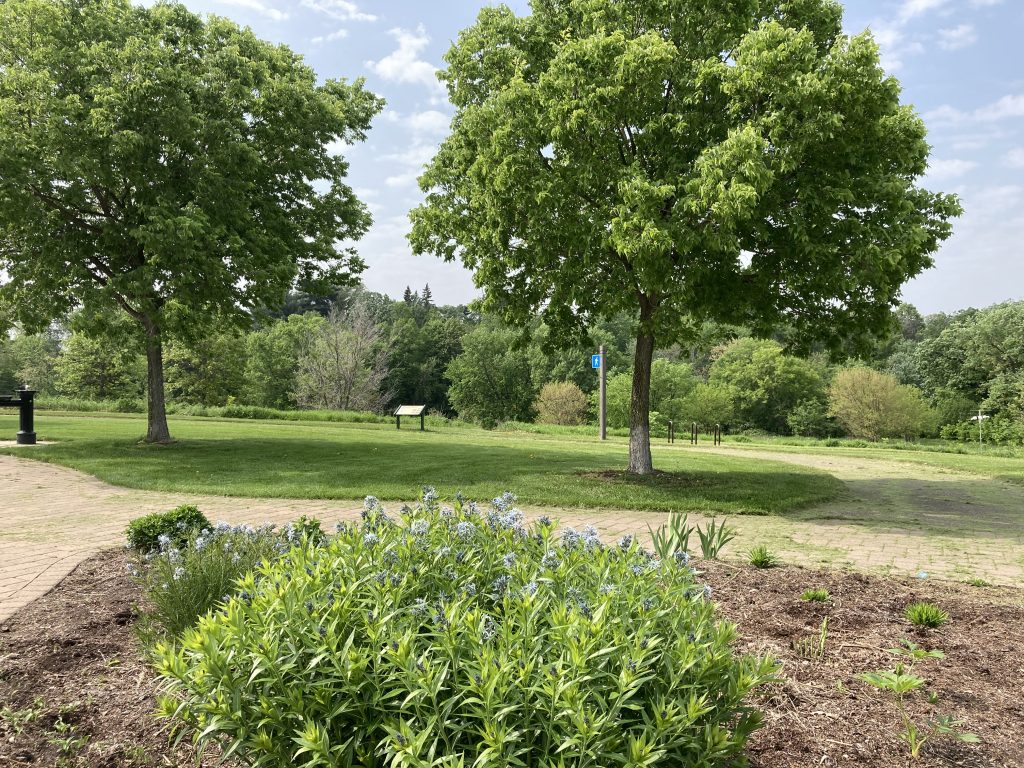
Ran with Scott up the marshall hill to cleveland, then over to St. Thomas and back down to Cretin. We were planning to get some coffee at Black, but it looked very crowded. Instead we walked down the hill to Loons and got it there. We ran most of it, except for the stretch of hill from the bottom to cretin. We walked that section.
10 Things
bad air quality from the canadian wildfires, 1: a strange orangish pinkish light
bad air quality, 2: hazy over the river — the river was sparkling in the sun, but dulled, not sharp
bad air quality, 3: a haze over the St. Thomas campus, like a strange fog, not thick but fuzzy
interesting patterns on the water’s surface — little grids of waves from the wind
crossing over to st. paul, the river was empty of rowers
crossing back over to minneapolis, Scott mentioned there were rowers. At first, I didn’t see them, but a few minutes later, I noticed a bump in the water in my periphery. Rowers! Suddenly I saw them: 2 small shells with 2 people each off in the hazy distance — this is the strange way my vision works
no bells at St. Thomas
a woman, possibly drunk, singing dude looks like a lady and then yelling out (to us?), I paid for my kids to go to this school! I wanted to speculate on what she meant, Scott did not
an irritating crosswalk that kept barking (in a low voice) wait wait wait but then, when the light changed, didn’t reciprocate go go go, but emitted a rapid series of sounds, making me imagine a round of bullets being fired but not think, Oh, I can walk now
a grand house on cleveland being gutted but not torn down and replaced with an ugly, over-sized new house (nice!, we both agreed)
a life update for future Sara to remember
On Thursday and Friday, Scott and I were in Rochester cleaning out and giving away the last bit of stuff from his parent’s apartment: lamps, chairs, a desk, cleaning supplies, a couch. The end of an era, his mom dead, his dad now in assisted living in the twin cities. Strange to say good-bye to all of this and to be reminded of how little much of your stuff matters to others once you die.
I’m writing this several days later. Another nice, low-stress bike ride. Hooray for being able to see enough to bike to the lake when I want!
swim: 1.75 loops main beach buoys, lake nokomis 70 degrees
Clear, smooth, empty water! Not too cold. A great swim. Encountered a few kayaks, but no fish or seagulls standing guard on the buoys. A couple planes passing above me. Near the end of the swim, two other swimmers joined me. I remember my mind wandered a lot and that I breathed every 5, except for the last loops where I breathed every 3 then 4, 5, 6 — each for half a loop. I felt strong and relaxed and pleased with myself for having fired up to bike over here and swim this morning.
When I arrived at the beach, the bike rack was empty. By the time I left, full. A group of kids, I think. Saw some of them on the beach but I’m not sure where the rest of them were.
Swam with FWA. He decided that this would most likely be his last open swim — he finds swimming across the lake to be boring. I would have liked to swim more with him if he had liked it but I could tell he didn’t and it isn’t much fun for me either when he swims so leisurely and for so little — always only 1 loop. It’s difficult for me to swim that slowly; I find it boring too, and cold. Brr.
As we stood in the water, about to start, FWA noticed some fish nibbling at his toes. They weren’t that big, but much bigger than the little minnows I’m used to. After we were done, FWA told me about how a much bigger fish bumped into his side on his way across — the fish left a red mark! In the 10 years I’ve been doing open swim club, I don’t think a fish has ever bumped into me.
Anything else? The water was a little clearer, but I still couldn’t see much. No fish sightings. Passed over the vegetation growing up from the bottom. No planes or big birds or boats crossing my path.
The water was smooth and clear and felt good. I look forward to swimming a lot more loops when I come here next Monday!
4.6 miles bottom of franklin hill and back 63 degrees
What a beautiful morning! The first 3 miles of run felt good. When I stopped to walk up the last quarter of the franklin hill then started running again, my left knee and hip felt tight. I wonder if I need to cut back a lot on my running and focus on swimming and biking for the rest of July?
10 Things
roller skiers! 15-20 of them all in a row — the clack of the skis, the click of the poles
rowers! didn’t see them, but heard the bullhorn and the coxswain instructing the rowers
a glimpse of shimmering water through the trees
someone sleeping under the franklin bridge
the sh sh sh of soft, sandy grit under my feet near the trestle
several bikes flying past me on the way down the franklin hill
greeting one runner as I passed him from behind — good morning!
bright yellow and green shirts on runners I encountered
a woman walker in a bright pink sweatshirt
passing a woman running who was listening to some guy talking — was it Ant? Stage 10 of the tour de france?
That was difficult to come up with 10 things. Was it because the run was difficult? I’m distracted?
Listened to the traffic and my breathing as I ran north, Camelot as I ran south.
bike: 8 miles lake nokomis 74 degrees
Biked with Scott to the lake. Nice! We took the trail on the way there, the streets on the way back. The streets were less fun — too many bumps and holes that I couldn’t see. Just a reminder that I bike so well on the trail because I’ve memorized the path, every curve, crack, bump.
swim: 3 loops lake nokomis open swim 75 degrees
The first loop was smooth, fast, no swells. Excellent. But by the time I started the second loop it started to become choppy. No worries. I happened to notice that they had placed the first green buoy out farther than they usually do. Nice — since I saw it, I didn’t get off course at all. I might have seen a few silver streaks below me in the water — fish?! Saw some swans, lots of yellow buoys tethered to swimmers, a couple planes. No ducks or seagulls or geese.
favorite stretch: after rounding the last green buoy, swimming parallel to the beach, heading towards the first orange buoy and the start of another loop. Such a cool sight, seeing the orange buoy far off.
Glad I only did 3 loops. As I exited the water, I realized it was raining — sprinkling. It’s funny how hard it is to tell that it’s raining when you’re swimming.
Anything else? Only remember feeling/seeing vegetation once: at the start of the swim, heading towards the orange buoy for the first time, I crossed over some milfoil growing up from the bottom.
An easy, not scary, bike ride. Was passed by 2 people — one didn’t say on your left, the other did but passed while another bike was approaching from the other way. Stewed over it for a minute, then let it go, happy to be able to see enough to still bike safely. The bike ride on the way back was good too. My left knee barely even grumbled!
swim: 1.5 loops lake nokomis main beach 80 degrees
A beautiful, uncrowded morning for a swim! If only it had been a little less wavy. No whitecaps, but lots of swells. I was being rocked so much that when I stopped to check my watch after the 6th little loop, I felt dizzy and lightheaded. I swam to shore to stand on solid ground for a minute.
There were a few boats nearby — 2 kayaks + a swan. No other swimmers or paddle boarders or fish. One time, as I swam north, I saw something out of the corner of my eyes, just behind me. I thought it was another swimmer about to pass me, but it was only a wave.
Lots of military planes roaring above my head.
For future Sara to remember: currently reading Less / Andrew Sean Greer (audio book) and The Memory of Animals / Claire Fuller (ebook). Both great in very different ways. Less is strange and fun, tinged with some sadness and regret. The Memory of Animals — about a pandemic much worse than COVID — is scary and unnerving and captivating.
Windy, with lots of swells. Swimming towards the little beach, it was difficult to breathe on my right side. Then rounding the final orange buoy, it was difficult to breathe on my left side. For most of the return trip, all I could see was pale water — light yellow? brown? not blue. I always managed to see other swimmers before I got too close to them — a slash of yellow or red or pink. Didn’t see any silver flashes below, but saw one plane up above. The idea of trees everywhere, on the edges. A few menacing swans.
A good swim. No calf cramps. My left knee locked up a few times, but all I had to do to unlock it was a couple of frog kicks. Near the end of the second loop, my fingers were getting numb from the cold.
most memorable stretch of the swim
Rounding the far green buoy near the big beach, swimming parallel to the shore. Occasionally, the idea of ORANGE off in the distance (the first orange buoy marking the beginning of another loop). Swells from behind were pushing me along when I angled my body in just the right way. When the angle was off, it felt like the water was trying to suck me down — or, maybe it felt like the water fell away and there was no resistance for my hand to push through. So hard to stroke, to move. Flailing, but not in a frantic way. Suspended.
Anything else? No seagulls, no fish, no dragonflies, no sailboats getting too close to the course. No strange squeaks or screams or shouts. Sometimes I breathed every 5 or 3, but mostly I breathed every 4. 1 2 3 4 breathe right 1 2 3 4 breathe right
Carl Phillips
About this Poem
There’s the usual kind of swimming—as in, through water—and then there’s that swimming that the mind always seems to be doing, I find. This poem feels to me a bit like both things, the combination of thrill and fear when there’s finally no land in sight.”
Another beautiful summer morning: cool, quiet, not too humid or crowded. My quads and knees are still a little sore, and I was a bit stuffed up, but mostly I felt fine. Ran up the marshall hill, only stopping briefly for a red light near the bottom. Had a green light that was about to turn at the top so I sprinted across the street, then kept going.
Saw the river today as I ran over the lake street bridge. All I remember is seeing some rowers — 2 small shells. What color was the water? Was it flat? smooth? sparkling? I have no idea.
Anything else I remember? Noisy birds, bikers, pairs of runners, voices drifting across Summit avenue from some building at St. Thomas.
Carl Phillips
This morning while drinking my coffee, I came across a link to a PBS interview with one of my favorite poets, Carl Phillips. Maybe I should study Phillips for the rest of the month? I’d like to revisit his collection of essays about writing (My Trade is Mystery), and spend time with some more of his poems, like this one:
I need you the way astonishment, which is really just
the disruption of routine, requires routine. Isn’t there
a shock, though— a thrill— to having done
what we had to? Unequally, but in earnest, we love
as we can, he used to mumble, not so much his
mouth moving, more the words themselves sort of
staggering around lost inside it . . . Now show me
exactly what you think being brave is.
What is it to be brave? Often, I bristle at anyone describing my ways of adapting to losing my vision as being brave. Resourceful, resilient, creative sure, but brave?
What is it to be brave? For the past few months, Scott and I have been watching Escape to the Chateau. One of the main “characters”/actual people, Angel/Angela, calls the gloves she wears whenever she cleans or sorts through very old things, her “brave gloves.” While sorting through stuff in the 150 year old attic — I’m glad I’m wearing my brave gloves today!
What is it to be brave? Why does Alexi Pappas title her memoir about running and training and depression, Bravey? What is a bravey?
What is it to be brave, and how is that connected to courage — and what type of courage? I’d like to reread a paper I wrote way back in 2001 or 2002 about redefining courage.
COVID DAY TEN
Almost done with masking in the house! I’m feeling mostly normal; just a little too much crap in my trap (snot). Scott has lost a lot of his sense of smell and taste, but I haven’t/didn’t.
Biked with Scott over to lake nokomis for open swim. I knew it would not be crowded and that I wouldn’t have any problems avoiding people. I was right. A (mostly) easy bike ride. I could see the trail, didn’t have to make any dangerous passes. On the way back, my left knee started hurting again. I’m sure it’s related to the strange knot/ball I have on the inside of kneecap and how I have difficult stretching to touch my toes with my left leg bent.
swim: 1 loop lake nokomis open swim 68 degrees
Windy. The water was very active — not rough and choppy, just full of swells. Difficult to breathe to my left. I thought about doing a second loop — I was intending to — but my calf had a little twinge and my legs felt weak, so I decided not to risk getting a leg cramp in the middle of the lake — no thanks! — and stopped at one loop. I’ll swim again on Sunday and do 2 or 3 or more loops then. What do I remember from the swim?
10 Things
the taut rope stretching at a diagonal from the lime green buoy to below the water — swimming a tight turn around the buoy and swimming just above it
the fuzzy flash of the overturned safety boat near the little beach
the view above: water trees sky a few random flashes
the view below: emptiness
a flicker of pink ahead of me — someone’s cap
a slash of orange to the side, a few splashes — another swimmer wearing an orange safety buoy
being gently rocked by the waves
feeling heavy, my hips and legs not wanting to float
2 swimmers standing near shore, taking a break between loops, taking about the course
a tiny twinge in my calf — not a sharp pain, but a gentle reminder: maybe you should only do 1 loop today…remember what happened that time you did too much and your leg knotted up?
walk: 45 minutes around lake nokomis 70 degrees
After my swim, we had a small lunch at the new restaurant at the lake, Painted Turtle. Excellent. Then we took a walk around the lake, stopping to sit at a bench to watch the birds, the water, the boats. We took the dirt trail under the bridge and over to the other side of lake. Here it feels more like a nature trail, with giant dandelions, excessive amounts of lily pads, and even more birds. Favorite sight: a medium-sized dog proudly carrying a huge stick in their mouth.
COVID DAY NINE
Felt a little snotty this morning — not stuffed up, just needing to blow my nose a lot. A little drained. Otherwise, fine. Managed to keep a big distance between myself and anyone else. Plenty of room in the water to avoid others, lots of empty grass right next to the trail when we were walking.
A cool morning. Great for running! Ran a little longer than yesterday. Started on Edmund but crossed over to the river road trail at 42nd. Felt good on the way there, a little tired on the way back.
Encountered walkers with dogs, a roller skier, some bikers, a noisy truck, a few other runners. Thought I heard a little voice at the falls say, she can’t hear me! Imagined she was talking about me. Wondered what she might have said, then imagined responding playfully, yes I can! A few minutes later, walking up the hill, I watched that little girl and at least one adult almost get stuck, trying to pedal a heavy surrey up the steepest part. I considered stopping to give them a push, but I thought it would be better to keep my distance. Gave a woman directions to the pool at Wabun. Avoided tree roots, wiped the sweat from my face, wasn’t able to see the river — too far away.
Listened to cars passing by and the strange rumble, buzz, whirr of a giant machine running south. Listened to “Camelot” heading north again.
COVID DAY EIGHT
Feeling mostly okay, just a lingering cold — not stuffed up, but needing to blow my nose a lot. Ready to be done wearing a mask in the house. Just a few more days! Could I possibly still be contagious?
Today is Scott and my 27th wedding anniversary. Because we’re still both sick, I don’t think we’ll be doing anything fun. Bummer. Oh well, at least we can quarantine together.
A beautiful morning! Birds, sun, breeze! Ran twice as much today as I did yesterday. By the end, my legs felt like rubber, but my breathing was okay and I didn’t feel light-headed. I’m continuing to avoid people by running in the dirt trail between edmund and the river road.
10 Things Heard
cardinals
black-capped chickadees
crows
blue-jays
robins
kids playing at minnehaha academy — laughing, yelling, clapping
blasting from a radio: “HandClap” from Fitz and the Tantrums
the wind in the trees making the leaves shimmer
construction sounds: rumbling, scraping, buzzing, roaring
[put in “Camelot” for the last mile]: “I Wonder What the King is Doing Tonight,” “The Simple Joys of Maidenhood,” and “Camelot”
COVID, DAY 7
Physically, I’m almost feeling normal. Mentally, I’m tired of this strange isolation and nowhere-to-go-ness.
Duh: So, even though he tested at least 4 times and got a negative result each time, Scott has COVID. Last night’s 5th test was positive. We both should have realized that, with his symptoms and contact with me, he had to have it, but my very first test was instantly positive so we assumed that if he had it, his would be too. He wasn’t quarantining, so we’re hoping the kids won’t be getting it next.
In related drama: FWA has his driver’s license behind-the-wheel test in Austin today. For a few dark moments last night, we thought he might have to cancel it, which could mean waiting months for another testing time. update: He passed!
current mood: worried (about an ailing parent and unmotivated (or differently? motivated) kids, being an irritating Mom) + impatient (can this quarantine be over, please, I want to go back to open swim)
Found this poem this morning. Reading this first verse, I already liked it, but when I read the “about this poem” section, I fell in love with it.
Every wood I’ve stepped into has a watchful crone, a witch whose skin resembles the bark of an ancient oak.
She spins her wool by moonlight, she threads her fingers through the moss, and knows exactly which mushrooms to pick.
I don’t need my hearing to feel the changes in the wind when she slips out of the gaps between the rocks and the trees, her voice
I feel in the roots I step on, in the stones I try to avoid with my bare feet that always manage to bruise me, test the calluses I’ve grown
with each stride I’ve taken through these trees. I’ve sung to her beneath the arms of the beeches reaching towards the birches, though she never
listens to me. I imagine she laughs at the tune I cannot keep, before moving on, gathering weeds by the stars, mixing potions to use on people
like me, who would walk into her arms gladly, wishing she were an old aunt I could visit to learn everything about this world she keeps to herself.
About this Poem
“As I slowly lost my hearing from the age of six until twenty-one, I spent more and more time in the woods and wild places where my deafness has never mattered. This poem is a homage to those places that I am still enthralled with and the never-ending magic of the forest I wish I could learn and share with other humans.” —Kris Ringman
Yes! I go to the gorge/the river/the lake because my vision loss doesn’t matter there. I’m not constantly reminded of its loss or my limitations. On the trails I know so well, I can see or, when I can’t, I don’t need to.
Since I’ve been feeling better and restless, I decided to try a little running this morning. The goal was a mile, but I ended up doing a little extra. I was worried that I might have trouble breathing, but I didn’t. It wasn’t easy, but it wasn’t too hard either.
10 Things (5 present, 5 absent)
At the end of my block, a bird shrieking non-stop, like an alarm. It kept circling above me and shrieking, almost like it was calling out, away! away! away! For a few seconds I wondered if it was going to swoop down and attack me
plastic pipes lining the sidewalk — part of the sewer project they’re doing all summer. Each pipe connected to the next with black cable-ties
the hollow sound of my foot stepping on the wooden platforms placed over the pipes
my favorite halloween house, still for sale
one runner slowly approaching to my left, breathing heavily. He was very slow. I crossed over to the other side of the road, hoping that would make it less irritating (nope). I slowed way down, almost walking, so he could finally pass
no bikers
no rowers
no roller skiers
no river (too far to see it + forgot to even glance across the road in its direction)
entire stretches of the route lost, forgotten — no memory of running past cooper field or the half-finished house that was abandoned for years then finished and now for sale for $800,000
COVID update
Feeling much better. A little stuffed up, but otherwise fine. It’s strange to feel almost normal but still have to mask and quarantine. Tedious. Disruptive. I wonder when I’ll stop testing positive?
2 things to remember
1
Found this list of 5 nature memoirs to check: The Best Nature Memoirs. When I’m done with Sharpe’s Ordinary Notes, I’d like to return to one book on the list — Savoy’s Traces, which I’ve tried to read a few times already. It’s on the Libby app.
2
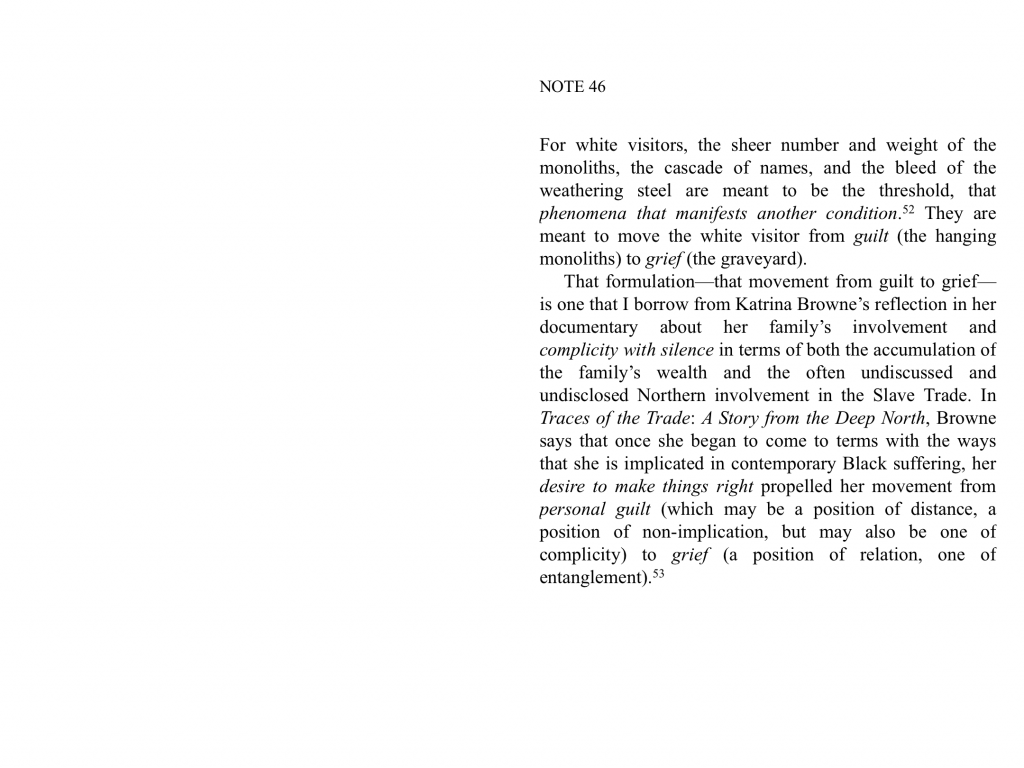
A note from Christina Sharpe’s amazing book, Ordinary Notes, about the need for white people to shift from guilt to grief, complicity to relation, detachment to entanglement:
technically it should be day 4 because the first day of symptoms is day 0, but it makes me more hopeful to imagine today as day 5.
Woke up feeling closer to almost not sick. No fever, only a little congestion, not too achy. As I write this, it’s 5:00 pm and I’ve spent much of the day outside in my red chair under the shade of the crab apple tree. It’s been 92 degrees all day. So hot! Still better than being cooped up inside. I finished listening to The Covenant of Water — loved it — and am continuing my reading of Christina Sharpe’s Ordinary Notes — wow!
An interesting twist: Scott does not have COVID — he’s taken 3 or 4 tests in the past few days — but he’s sick. Had the chills last night, a headache, was stuffed up. What? Very strange and unfortunate. If he had COVID we could quarantine together.
I decided to take another COVID test today, hoping that somehow it might have already passed totally through my system. Nope. Still got it.
This morning after finishing my coffee, I re-memorized Ed Bok Lee’s “Halos.” Such a great poem about vision loss!
Tonight, we set up a tv outside in the backyard and watched stage 3 of the tour together while we ate dinner. Our first dinner together since Thursday night.
current mood: it’s only day five!?; grateful that it didn’t settle in my chest; more restlessness — I told Scott that this might be the longest I’ve gone without a substantial walk/exercise in a decade.
Woke up restless. No more fever, but everything seems fuzzy — that’s probably just my vision. A slight sore throat, a little stuffed up.
Had a little more energy than yesterday so I took Delia on a short 10 minute walk; gathered clothes, brought them down to the basement and started the laundry; made myself some scrambled eggs; closed all the windows and turned on the air. Too much. Suddenly it became harder to breathe. I sat in my chair and focused on deep breaths for several minutes. My fingers and toes felt tingly — anxiety, or not enough oxygen? No fun.
In the past, when I’ve had colds, I’ve always run through them. Usually I feel better when I’m running. Not this time. I think I’ll just sit on the couch in my room or outside on my red chair for the rest of the day.
So far, COVID is manageable, but it’s a drag (or a d-r-a-g drag, which I started saying a few years ago and now can’t stop).
Current moods: acceptance, a willingness to endure and get through Activities: watching Le Tour, finishing up the audiobook, The Covenant of Water, sleeping
For future Sara, I’m documenting my mostly mundane COVID experience.
day one, my birthday: I woke up feeling agitated — unsettled, anxious, uncomfortable. I went for a 2 mile run with Scott without any problems. A few hours later, my throat started to hurt a little, which was concerning and added to my agitation. I swam three loops (2 miles) without any problems at the lake for open swim. Finally checked my temperature: 99.5. Slept on the couch.
day two, june 30: Slept okay. Woke up, got coffee, went back to sleep for several more hours. Took a COVID test mid-morning. I already knew the answer: positive. Slept the entire day, only waking up to take another dose of NYQUIL. Felt feverish, whoozy, not wanting to do anything but sleep, which I did. Low fever (99-100) all day. Ate a little food, drank some water.
day three, today: Woke up with a raw throat. Hurts to swallow, a feeling I despise. Felt less feverish, a little more like myself. Still tired, sleeping off and on, but also restless — thought about walking on the treadmill for a little while to get my restless body moving but didn’t. Sat outside in my red chair twice to get some fresh air and vitamin D. Mid-afternoon, my throat only hurts slightly. Still have a 99+ fever.
It’s surprising to everyone in the house that I’m the one that got COVID. Me too. In the 2-5 day window of infection, I was only in 3 stores and one other public building. Scott was in these buildings too. Why doesn’t he have it? One theory: he didn’t get it, but carried and spread it to me when he played for the musical last Saturday.
One other thing to note: I’m quarantining in our bedroom, only leaving to go to the bathroom, or out in the backyard. When I need something, I text Scott or one of the kids and they leave it outside my door. I mostly communicate with them by text or through masks and closed doors. I’m starting to feel isolated and it’s only day two of my quarantine. Also, I can see how the need to rely on others to get you everything will start to become a drag soon.
49 today. A very nice birthday run to minnehaha falls then to the new coffee place called the falls with Scott. Walked back through the neighborhood with an iced vanilla latte. Fun to see all the new apartments being built on Minnehaha and to walk down some streets that I’ve never walked down before. The air quality is still not very good (140) with smoke in the air, but it wasn’t hard for me to breathe.
Hours later…My throat started to hurt like I was sick and I was feeling run down. I think it might be the smoke/air quality.
days later…No bad air. Somehow, even though I was barely inside anywhere or close to other people for the last five days, I got COVID.
swim: 3 loops lake nokomis open swim 88 degrees
A beautiful night. The air quality is much better, the water is less choppy. What I remember most about this swim was: wearing a new suit that I just got and saying to Scott and the kids, want to see my birthday suit?, like I did when I was a little kid; barely ever being able to see any of the buoys and still staying (mostly) on course except for the first loop when I realized how far to the left the first green buoy was; feeling sore but still happy to be out in the water with the fish and the swan boats, the other swimmers and the planes up in the sky; and noticing a flash of the orange and yellow sail that is often out on the lake in the evenings.
Kept up the “one more loop” habit. Stopped for a break after 2, then did one more loop.
wordle challenge
5 tries:
feast where money lined DINER
I struggled to find inspiration with these words.
Today we feast with Diane Wiest. Where‘d you go Bernadette? (a favorite book) Money makes the world go around. (a song lyric that often gets stuck in my head) You’re telling me the kids are lined up for a slaughterhouse? (a line from my favorite horror movie) Tom’s diner — (one of my favorite songs to sing in order to irritate others)
I am sitting In the morning At the diner On the corner
I am waiting At the counter For the man To pour the coffee
Another day of bad air quality (165). Smoke from the fires in Canada. I felt it a little in my lungs while I was biking.
No worries about seeing as I biked. Relaxed. Just like on Monday, my left kneecap didn’t want to stay in the groove while I pedaled. The tendons around the left knee were aching. Pain, not sharp but dull discomfort.
Nearing the beach it got much windier. The wind! Suddenly I remembered what I had forgotten on my bike ride on Monday — in that entry, I wrote about how I had forgotten the thing I wanted to remember — the wind rushing or roaring or howling in my ears as I biked. So loud! Not quite as loud today, but still vigorous and noisy.
I could only catch a few quick glimpses of the river through the thick thatch of green, but what I did see was strange: a hazy, smoky, barely visible gorge. The smoke was even worse around and in the lake. I wonder what the visibility was there?
As I biked home, happy from my swim, I thought about something I’d mentioned to Scott last night: I’d like to be the poet laureate of lake nokomis. Is this a thing I could do? Maybe I could write a grant to do some sort of public readings/programs around my writing about lake nokomis? Maybe I should start with something less ambitious than poet laureate? Poet-in-residence for open swim?
swim: 1.5 loops (1 mile / 7 mini loops) lake nokomis main beach 78 degrees
Lots of waves. Swimming north around the white buoys was much easier than swimming south with the waves crashing into me. I liked swimming into the waves, partly because it made me feel strong and partly for how the roughness heading north helped me appreciate the smoother water heading south.
I practiced my new habit (first tried out last night at open swim): when I think I’m done or want to be done or feel like I’m too tired to not be done, I’ll take a short break near shore, then swim one more loop. I did this last night by taking a minute break after 2 loops, and then swimming a third loop. Today it was stopping after 6, then doing a 7th. I’d like to swim longer during open swim — I’m sure I’m capable — so I’m hoping this habit can stick and will help me get to my ultimate goal: to stay and swim for the full 2 hours, from 5:30 to 7:30.
10 Things About the Kayakers
When I first arrived to the beach, I noticed 2 (or maybe 3?) kayakers hovering near the white buoys, just past the swimming area. What were they doing?
Also spotted: the silhouette of swimmer by the far orange ball buoys, only their head and shoulders poking out of the water and a dark buoy — a metal detecter guy?
When I got in the water, the kayakers moved farther from the buoys out into the middle of the lake. Later they returned
It was difficult to see them in the choppy water and the smoky air. I’m pretty sure they could see me, with my bright green and pink cap and yellow buoy tethered to my waist
As I swam I tried to keep an eye on them, imagining scenarios where they ran into me. In one, I was knocked out when they accidentally rowed into me. My inert body floated in the water, held up by my swim buoy
Mostly they appeared as hulking, dark shapes — was it color I just wasn’t seeing, or were they mostly dark?
More dark, hulking shapes appeared in a line — 4 or 5? Was it a group? Were they plotting something?
Near the end of my swim, 2 kayakers swam parallel to me, close to the white buoys. I raced them
Another random kayaker, not looking as dark as the others, crossed right in front of me making me have to stop and wait for them to pass
Even though the voiceless, hulking, hovering, strange shapes seemed menacing it was cool to see them appear as dark dots on the water in my peripheral vision
wordle challenge
3 tries:
twist treat TRACT
twist & turn tapioca treat tiresome tract
I can’t remember how often she did it, but my mom made tapioca pudding for dessert when I was a kid. She also made chocolate pudding from scratch and homemade hot fudge sundaes. We had dessert almost every night. Why?
terrible twist traitorous treaty tract take over
The Mississippi River Gorge has a troubled history of stolen land, illegal treaties, and destruction of sacred islands. The Falls Initiative is trying to offer some healing.
The air quality was terrible this morning, but it felt okay during the swim. Very choppy and difficult to breathe on my left side. I didn’t mind; I like the choppy water and the challenge of swimming directly into the small swells. Crash! There was some chaos in the water as one swan boat pedaled right through the course. The water was filled with small particles that almost glowed. A cool visual effect. I felt strong and sore after 2 laps — mostly my back. I took a minute break then headed out again for my third lap. It would have been easy for me to stop after 2 loops — it was choppy, I was sore, I had already swam for 40 minutes — but I’m glad I did the final loop.
Found this beautiful poem on twitter this morning:
When You Learn To Swim/ Souvankham Thammavongsa
It will be different here. You can take a leap off this ledge ten feet and never touch ground. You can hover in what
could be air, lean back further and further a and something that feels like faith will lift, will hold you up. But it isn’t faith, it’s some kind of ophysics, law, a rule of matter put in place, set in place as old and as constant as that sun:
that unsettled speck, that shadowless thing, that thing to have
wordle challenge
3 tries:
craft paint ABOUT
I decided to do nothing with the rhymes treating them as one does the unfortunately frequent appearance of crafts adults require children to fashion from pipe cleaners and plastic beads.
When is it art, when craft?
Gotta dream boy Gotta song Paint your wagon And come along
about: reasonably close to; almost; on the verge of; on all sides; around the outside; in many different directions — here and there; near; concerning
bike: 8.5 miles lake nokomis and back 66 (to lake) / 69 (from lake) degrees
Hooray for new tires! The dappled sunlight was a little disorienting, but otherwise I could mostly see. There was something I wanted to remember about the bike ride but I had to take a few hours break before writing this and now I can’t remember what it was. Oh well. Encountered other bikers, walkers, runners, strollers, and one surrey.
swim: 2 loops (8 mini beach loops) lake nokomis main beach 67 degrees
An excellent swim! Even with the wind and the cooler air temperature it was great. For most of the swim, I had the lake to myself. It was a little choppy and overcast. How wonderful it is to be able to bike to the lake and swim. No having to wait for someone to give me a ride. No worries about finding a free lane or making sure (and not being able to tell if) a lane isn’t occupied or needing to share a lane with two other swimmers. Free open water.
The rain yesterday must have stirred up the water. When I put my head underwater I could see particles suspended in front of me. I didn’t see any fish but after I was done I heard some kids calling out to someone on shore, the fish are chasing us!!
I counted my strokes from the far right buoy to the far right one: 130. I counted by fours. I counted my strokes from the far left buoy to the far right one: 120, counting by 5s. I like swimming every 5 better, but I like counting by every 4 better.
A peels an apple, while B kneels to God, C telephones to D, who has a hand On E’s knee, F coughs, G turns up the sod For H’s grave, I do not understand But J is bringing one clay pigeon down While K brings down a nightstick on L’s head, And M takes mustard, N drives to town, O goes to bed with P, and Q drops dead, R lies to S, but happens to be heard By T, who tells U not to fire V For having to give W the word That X is now deceiving Y with Z, Who happens, just now to remember A Peeling an apple somewhere far away.
In nature, molecules are chiral—they turn in one direction or the other. Naturally then, someone wondered: might sugar, built to mirror itself, be sweet, but pass through the body unnoticed? A dieters’ gold mine. I don’t know why the experiment failed, or how. I think of the loneliness of that man-made substance, like a ghost in a ‘50s movie you could pass your hand through, or some suitor always rejected despite the sparkle of his cubic zirconia ring. Yet this sugar is real, and somewhere exists. It looks for a left-handed tongue.
new word: chiral — mirrors but can’t be super-imposed
This spring as it comes bursts up in bonfires green, Wild puffing of emerald trees, and flame-filled bushes, Thorn-blossom lifting in wreaths of smoke between Where the wood fumes up and the watery, flickering rushes.
Little has been made of the soft, skirting action of magnets reversed, while much has been made of attraction. But is it not this pillowy principle of repulsion that produces the doily edges of oceans or the arabesques of thought? And do these cutout coasts and incurved rhetorical beaches not baffle the onslaught of the sea or objectionable people and give private life what small protection it’s got? Praise then the oiled motions of avoidance, the pearly convolutions of all that slides off or takes a wide berth; praise every eddying vacancy of Earth, all the dimpled depths of pooling space, the whole swirl set up by fending-off— extending far beyond the personal, I’m convinced— immense and good in a cosmological sense: unpressing us against each other, lending the necessary never to never-ending.
Words after all are syllables just and you put them in their place notes sounds a painter using his stroke so the spot where the article an umbrella a knife we could find in its most intricate hiding slashed as it was with color called “being” or even “it”
Expressions
For the moment just when the syllables out of their webs float
We were just beginning to hear like a crane hoisted into the fine thin air that had a little ache (or soft crackle)
golden staffed edge of quick Mercury the scale runner
Envoi
C’est juste your umbrella colorings
dense as telephone voice humming down the line polyphonic
Red plumaged birds not so natural complicated wings French!
Sweet difficult passages on your throats there just there caterpillar edging to moth Midnight
I’d like to think more about Guest’s use of just in this poem. I like the word just. As a teenager, whenever I called my best friend and her mom answered I’d say something like, this is just Sara. I remember her calling me Just Sara.
swim: 1 small loop (1/2 big loop) cedar lake open swim 78 degrees
Swam with FWA at open swim. Cold getting into the water, then cold in every part of the body outside of the water. Brrr.
10 Things
a gentle rocking from the small waves — I liked it, FWA did not
a big bird — a goose? a crane? high up in the sky above the water
lots of pot smells at the far beach — a huge whiff wafted our way when the wind shifted
the far buoy was much farther to the right than it usually is — I think it drifted in the wind
creepy, pale vegetation growing up from the bottom
“swam” through a thick patch of vegetation — very difficult to get in a full stroke or to move
the grating, sharp, piercing noise of 2 rocks being knocked into each other under water — Above water the sound was annoying, but not too bad. Sticking my head below water, it was almost unbearably irritating
splashing and flicking water like I used to as a kid with FWA
the haunting call of the mourning dove as we walked back to the car
something shining through the break in the trees on the other side of the lake — what was it?
3.7 miles marshall loop 70 degrees / dew point: 61
It started raining off and on around 8:30. I don’t mind swimming in the rain, but I wasn’t sure the lifeguards would go out on the lake in this weather. So no open swim. Instead I ran in the early afternoon. Sticky, but not too hot. No sun. Not too many people. Saw some rowers on the river. The surface of the water was a strange texture, roughened by the wind.
memorable moment
Nearing the 3 way intersection at the river road and 36th: a swarm of vespas — 15? One after the other. Not all of them were bright yellow, but at least one was. Wow.
wordle challenge
5 tries: bench / prose / lower / gored / rodeo
In her dream there’s always a bench. Often the benches I run by have small plaques on them, dedicated to some lost loved one. I hope my family does this for me.
They shut me up in Prose/ Emily Dickinson
They shut me up in Prose – As when a little Girl They put me in the Closet – Because they liked me “still” –
Still! Could themself have peeped – And seen my Brain – go round – They might as wise have lodged a Bird For Treason – in the Pound –
Himself has but to will And easy as a Star Look down opon Captivity – And laugh – No more have I –
lowercase
maggie and millie and molly and may / e.e. cummings
maggie and milly and molly and may went down to the beach(to play one day)
and maggie discovered a shell that sang so sweetly she couldn’t remember her troubles,and
milly befriended a stranded star whose rays five languid fingers were;
and molly was chased by a horrible thing which raced sideways while blowing bubbles:and
may came home with a smooth round stone as small as a world and as large as alone.
For whatever we lose(like a you or a me) it’s always ourselves we find in the sea
A few days ago, I read the book in The Odyssey titled, “Bloodshed.” Very gory. So many spears and arrows and swords and bloody, gored bodies.
I had probably heard the phrase before, but my first memory of this isn’t your first rodeo is from my physical therapist describing how my kneecap has probably slid out of its groove many times before without me fully realizing it.
3.1 miles marshall loop 72 degrees / dew point: 59
It seemed warmer than 72 out there this morning. Ran with Scott. First Scott talked about Russia and Wagner, then I talked about the You and I and how we start as one and become the other as we acknowledge each other. This discussion was partly inspired by encountering one walker who called out good morning! and another who instead of offering a greeting ignored us and almost ran into me. What else do I remember? Rowers! Scott counted at least 6 shells on the river. Mostly I only saw them, but for one brief moment I heard the coxswain’s voice.
wordle challenge
4 tries: handy / drain / brand / grand For the third day in the row I had to choose between equally fitting options. This time, brand or grand? I chose incorrectly.
a refreshing shandy the pro cyclist Indurain Rembrandt teeth whitening (brand) Grand Old Days — the start of summer in St. Paul
She defeated him handily.
Yesterday I came across Annie Proloux’s book, Fen, Bog, and Swamp, and I’m certain that she disagrees with the phrase/metaphor, drain the swamp.
Mostly I don’t care, but I have 2 brands that I especially like. For swimming, TYR, and for running, Saucony. I used to mispronounce both of them. It’s tear (cry) not tire, and sock-a-knee not something that rhymes with Marconi.
Before I got into watching pro cycling or running and before my vision made it almost impossible to track the ball, I loved watching Grand Slam tennis. My favorite was always Wimbledon — Jennifer Capriati, Monica Seles, Steffi Graf, Pete Sampras, Andre Agassi, and Roger Federer.
handy dandy notebook down the drain brand spanking new you’re a grand old flag, you’re a high flying flag
Somewhere along the way, what is marketed as handy and convenient is not always user-friendly.
a drain, a sewer, a causeway, a sluice
I hate shopping at Target. Endless aisles, filled with only 1 or 2 brands. The illusion of choice.
In 2008, we almost moved to Grand Rapids, MI. We had already picked out a house to rent, almost signed a lease, told neighbors we were leaving. Then I was told I might be able to have a full-time position at the U. Scott and I walked along Lake Michigan and had a gut-wrenching talk. I decided to turn down a guaranteed job for the possibility of a preferable one.
Crossing Water/ Tony Hoaglund
In late summer I swim across the lake to the stand of reeds that grows calmly in the foot-deep water on the other side.
It is like going to a florist’s shop you have to take your clothes off to get to,
where nothing is for sale and nothing on display
but some tall, vertical green spears,
and the small, already half-shriveled pale-purple blossoms sprouted halfway up the sides of them.
Squatting softly in the cool, tea-colored water, hearing my own breath move in and out,
leaning close to see the tattered, soft-edged purses of the flowers, with their downward hanging cones and coppery antennae.
—This is more tenderness than I had reason to expect from this rude life in which I built
a wall around myself, in which I couldn’t manage to repair my cracked-up little heart.
Each time I make the trip, I get the strange idea that this is what is waiting at the end of life–
long stalks slanting in teh breeze, then straightening— flowers, loose-petaled as memory, gray as the aftertaste of grief.
Tonight, I’ll lie in bed and feel the day exhaling me as part of its long sigh into the dark,
knowing that I have no plan, knowing that I have no chance of getting there.
I will remember how those flowers swayed and then held still for me to look at them.
Oh, I love this poem! And I love Tony Hoaglund. I know that he died several years ago (in 2018), but I didn’t know the cause. Looked it up: pancreatic cancer. Just like my mom.
Another amazing day for swim! Almost perfect. Felt strong and fast and relaxed. No anxiety about not being able to see. Who could, swimming straight into the sun?
Noticed at least one plane, but don’t remember any birds — no ducks or seagulls. No swan boats or sailboats. Saw something below me — either fish or milfoil reaching up from the bottom.
Between loops 2 and 3, another swimmer approached me. I’m sorry but I just have to tell someone about this: for the first loop my watch says 1000 yards, the second loop is 389!
Exiting the water, I walked past a group of young kids busy at work, building sandcastles and observing little fish in the moats they had made. What the — one kid kept repeating.
The lifeguards really have their shit together this year. Buoys always on course, and set up early. I’m impressed and grateful. I must add them to my “people with their shit together” list.
The only other thing I’d like to remember is that today was an ideal summer morning. The kind of morning I’ll remember and long for in late February/early march.
wordle challenge
5 tries: heart / spent / edict / comet / COVET
heart racing limbs spent an edict from body: stop! rest!
Lost in the dream of motion — fuzzy head glowing arms I become comet and glide across the watery sky.
a synonym of covet is crave:
An ear worm from last night — nostalgia for the 80s and childhood.
So warm! Still glad I went out for a run, but it was hard. My knees are sore, my legs sluggish. Heard lots of birds, a roller skier’s clicking poles, talk radio blasting from someone’s car, faint voices from below, water trickling out of a sewer pipe. Encountered bugs — mosquitos? gnats? — near the ravine. Passed by a person on the folwell bench, reading. Was greeted by one walker: good morning! As I ran on the Winchell trail I thought about the importance of giving some gesture — a greeting, eye contact, a stepping over to make room — when nearing another person. Without it, you’re saying to them, to me you don’t exist.
When I finished my run, I pulled out my phone and recited Alice Oswald’s “A Short Story of Falling.” Only two mistakes: I gave it the wrong title and I said “in a seed head” instead of “on a seed head.”
“A Short Story of Falling” / 22 june 2023
wordle challenge
Bad luck with the wordle today. I almost had it in 3, but I had too many choices that could be correct. I had 4 tries but at least 5 options.
At the end of the swim another swimmer called out, these conditions are the best! (or something like that; I can’t quite remember). I agreed. Calm, pleasingly warm water, well-placed buoys. I could barely see the buoys, but I still swam to them without a problem. Lots of swans in the water, a few menacing sailboat — one with a bright orange and red sail.
I swam for a loop and a half then briefly stopped at the little beach for a quick rest. Swam another loop and a half and stopped at the big beach. Got out to go the bathroom, then one more loop. Taking a 5 or so minute break between loops 3 and 4 really helped. I should remember to do that more often.
I’m writing this swim summary the next morning. Can I remember 10 things?
10 Things
at least one plane
half a dozen swan boats lurking at the edges
one swan stuck in the dead zone between buoys
streaks below me — fish?
irritating swimmers: 2 fast women that kept swimming past me, then stopping to get their bearings, then swimming again. With my slower, steadier stroke, I kept getting passed by them, then passing them when they stopped, then getting passed by them again when they restarted their swim
both the orange and green buoys closest to the beaches (orange to the little beach, green to the big) were not that close to the shore
no waves
no ducks
breathed every 5 strokes, sometimes every three, once or twice every six
hardly ever saw one of my landmarks from the past few years: the overturned boat at the little beach
Ran earlier today, at 7:15. A little cooler, quieter. For the first few minutes, I recited Alice Oswald’s “A Short Story of Falling” which I memorized yesterday. Ran south on the grassy boulevard between edmund and the river road. Crossed over at Becketwood, then ran down to the southern entrance of the Winchell Trail.
Listened to the gentle whooshing of car wheels. the clicking and clacking of ski poles, and birds for most of the run. Put in a Bruno Mars playlist for the last mile.
After I finished my run, I recited Alice Oswald’s “A Short Story of Falling” into my phone. Only messed up one line (I think).
10 Things
click clack click clack
the rambling root spread across the dirt trail
the steady dripping — more than a trickle, less than a rush — of the water falling from the sewer pipe
the soft (not mushy) blanket of dead leaves on the winchell trail
the sharp sparkle of the light on the water
shhhhhh — the wind passing through the leaves on the trees
the soft roar of the city underneath everything
the leaning branches have been removed — thanks Minneapolis Parks People!
an almost exchange of the You and I — me: right behind you, excuse me an older woman with a dog: mmhmm
no bugs, no gnats, no geese
wordle challenge
3 tries: front / brine / crane
front runt stunt blunt hunt shunt grunt redundant brine sign fine line shine dine design unwind spine twine crane explain refrain detain rain insane
front
frontispiece:
1
a: the principal front of a building b: a decorated pediment over a portico or window
2
: an illustration preceding and usually facing the title page of a book or magazine
Its back and forth, ad nauseum, ought to make the sea a bore. But walks along the shore cure me. Salt wind’s the best solution for dissolving my ennui in, along with these protean sadnesses that sometimes swim invisibly as comb-jelly a glass or two of wine below my surface. Some regrets won’t untangle. Others loosen as I watch the waves spreading their torn nets of foam along the sand to dry. I walk and walk and walk and walk, letting their haul absorb me. One seal’s hull scuttled to bone staves gulls scream wheeling above. And here… small, diabolical, a skate’s egg case, its horned purse nested on pods of bladderwort that still squirt BRINE by the eyeful. Some oily slabs of whale skin, or —no, just an edge of tire flensed from a commoner leviathan. Everywhere, plastic nurdles gleam like pearls or caviar for the avian gourmand and bits of sponge dab the wounded wrack-line, dried to froths of air smelling of iodine. Hours blow off down the beach like spindrift, leaving me with an immense less-solipsistic sense of ruin, and, as if it’s a gift, assurance of ruin’s recurrence.
crane
“The Crane Wife” parts 1, 2, and 3 from the Decemberists
swim: 1 small loop (1/2 big loop) cedar lake open swim 88 degrees
First open swim with FWA at cedar lake! A great night for it: calm, clear, not too crowded. The buoys were up tonight. Hooray!
Yay for being able to bike without fear! The ride was hot but was fine. The key: don’t bike too fast. I noticed: no progress on the duck bridge that was removed a few months ago for repairs; hot pink tape or paint or something marking the cracks in the trail — the pink was very easy for me to see…nice! and a dude in an e-bike with a kid going way faster than the 10 mph speed limit.
swim: 3 loops (2.25 miles) 88 degrees choppy
3 slightly choppy loops today. Definitely more difficult with the choppy water — how choppy was it? Not really that bad (compared to real chop in the ocean or a big lake), but it still made it harder to breathe. Saw 2 or 3 planes, some random woman floating in an inner tube in the middle of the lake (almost ran into her). Raced a swan boat, dodged flailing kids at the beach and breaststrokers mid-lake. Again this year, breaststrokers are my nemesis. Couldn’t see the green buoys at all; I used the glowing rooftop at the big beach as my guide. I couldn’t even see the green buoys when I was 20 feet away from them because of the bright sun. Didn’t bother me at all. I just kept swimming, only stopping to adjust my goggles and make sure my stiff left knee was okay. For just a flash, I thought about Tony Hoagland’s poem (below) and the way water speaks. I thought about how, because I’m in the water and not standing on the shore, I can listen and understand (at least a little).
wordle challenge
3 tries:
water / inert / frost
a winter morning
water inert frosted glass slicked up streets endless and empty
water inert on morning window: frost
a description by Alice Oswald in her reading of “A Short Story of Falling” that I listened to this morning as I memorized her beautiful poem:
What I love about water is that it spends its whole time falling. It’s always, apparently, trying to find the lowest place possible, and when it finds the lowest place possible, it lies there wide awake.
Alice Oswald
Water is never inert always falling searching for somewhere else to be even in rest as frost on winter’s window it watches waits wants to find the floor
The Social Life of Water/ Tony Hoaglund
All water is a part of other water Cloud talks to lake; mist speaks quietly to creek.
Lake says something back to cloud, and cloud listens. No water is lonely water.
All water is a part of other water. River rushes to reunite with ocean; tree drinks rain and sweats out dew; dew takes elevator into cloud; cloud marries puddle;
puddle
has long conversation with lake about fjord; fog sneaks up and murmurs insinuations to swamp; swamp makes needs known to marshland.
Thunderstorm throws itself on estuary; waterspout laughs at joke of frog pond. All water understands.
All water understands. Reservervoir gathers information for database of watershed. Brook translates lake to waterfall. Tide wrinkles its green forehead and then breaks through. All water understands.
But you, you stand on the shore of blue Lake Kieve in the evening and listen, grieving as something stirs and turns within you.
Not knowing why you linger in the dark. Not able even to guess from what you are excluded.
Warm again this morning. I need to start my run sooner. I heard the coxswain below instructing the rowers, but I forget to look for them as I ran down the franklin hill. I don’t remember looking at the river at all. Did I? I was too distracted by people — bikers, runners, walkers.
Best part of the run: heading down the hill, feeling good, someone else running up the hill called out, looking strong! I called back, you too! Her words made me feel good and even stronger. Such a kind gesture. I started thinking again about these small exchanges and how they give us the chance to be both an I (who recognizes) and a you (who is recognized).
Listened to rowers, birds, and cheering runners as I ran north. Listened to Hamilton on my headphones on the way back south. it’s a blur sir
wordle challenge
6 tries (with a hint from FWA): chirp / doubt / smoke / flank / wagon / KAZOO
In the morning
when the birds chirp doubt goes up in smoke delight outflanks grief and regret hitches a wagon ride out of town. Only the faint buzz of his kazoo lingers then joins in the cardinal chorus.
swim: 2.5 big loops (5 little loops) cedar lake open swim 88 degrees
The first open swim at cedar! Wonderful. The water wasn’t too choppy or cold. Everyone was (mostly) swimming the right way. No leg cramps or worry about swimming off course.
10 Things
the beach was packed with people
the water, which is usually clear here, was opaque
a few silver flashes below me — fish?
stopping near the beach for a minute, I looked down in the water and saw shafts of light
itchy vines, floating into me
I swam over one vine floating horizontally and it felt like I was getting a full body scan
many of the vines were attached — at both beaches I swam through a thick forest of underwater vegetation
no buoys, only lifeguards on kayaks set up in the middle of the lake, which was no problem for sighting (at least for me)
2 different paddleboarders crossed right in front of me
birds flying over the lake above me — I couldn’t tell how big they were
1.5 miles* (2 loops) lake nokomis open swim 69 degrees / light rain
*not quite sure of the distance, but I’m basing it on my strokes (which are very consistent) and comparing them to strokes per mile in the pool
Hooray for another open swim! Had to miss 2 this week because of moving Scott’s dad, so I’m very glad I was able to get to the lake this morning. I LOVE lake swimming. It’s hard, but is so satisfying and freeing. I love the gentle burn I feel in my shoulders for a few hours after I’m done. It was cold(er) and the water was a little choppy. I had to breathe on my right side most of the time. The few times I turned to breathe on my left side, water rushed over my head. I couldn’t really see the buoys but it didn’t matter. I was able to keep swimming and stay on course.
It was 10 years ago that I first swam across the lake for open swim. I was nervous and almost didn’t do it. I loved it instantly. I love it even more now.
10 Things
a slight drizzle that I couldn’t feel in the water
brightest color: the pink safety buoy tethered to a torso
second brightest color: the orange buoy that was rarely visible
dimmest color: the green buoys
opaque water — no visibility underwater
a single swan boat
something flying in the air above me that could have been a plane, a bird, or a bug. I couldn’t tell
a few green-capped heads bobbing near the far orange buoy
the faintest white form of a vertical buoy just off the big beach — as I swam towards it, I could see the form hovering underwater
my fingers going slightly numb, my right shoulder burning near the end of the second loop
wordle challenge
5 tries: wrest / cribs / spank / souls / SHYLY
WREST
For the wrest of the day I will put a w first in words that begin with r. I didn’t have to wrest the answer from her; she told me willingly.
from Lucky Day Still/ David Rivard Lucky day still spent wrestling the private problems and obsessions encountered first in your youth but played out now within the spectacle of public aging (tho, strangely, as you age you feel less & less seen by the young, a citizen active in frequencies of light waves increasingly invisible—not even boring to 15-year-olds).
CRIBS
MTV Cribs — this is where the magic happens…. crib sheet cribbage wars scribble caribous (verb) to confine
Great souls die and our reality, bound to them, takes leave of us. Our souls, dependent upon their nurture, now shrink, wizened. Our minds, formed and informed by their radiance, fall away. We are not so much maddened as reduced to the unutterable ignorance of dark, cold caves.
And when great souls die, after a period peace blooms, slowly and always irregularly. Spaces fill with a kind of soothing electric vibration. Our senses, restored, never to be the same, whisper to us. They existed. They existed. We can be. Be and be better. For they existed.
SHYLY
Slowly shyly the way into the words appears —
the problem of finitude (wrestling with death) constrained in the awareness of impending non-existence (cribbed) the sharp shock of what used to be (spank) but is no more (when great souls die)
Nice to be home and able to run this loop after a few days away, moving a parent out of an apartment in one city and into another in another city. Wasn’t sure how it would feel to run up the marshall hill, but it wasn’t too bad. I remember noticing things as I ran, but now I can’t remember what I noticed, except —
screeching bluejays, leaves on trees shivering in the wind, voices floating up from the gorge, sparkling river water, a sandbar emerging from just below the lake street bridge. Bikers, walkers, runners
almost getting hit by a bike (my fault) — not sure how close it was; my body didn’t tense up in panic, so I’m guessing it wasn’t that close. It happened because my eyes/brain can only see one thing at a time and I was distracted by some stopped bikers who looked like they were going to cross, but weren’t. Why weren’t they crossing, I wondered, thinking maybe there was a car that I couldn’t see (it’s happened before).
a shell with 2 rowers on the river, the bells at St. Thomas chiming nine times, sprinklers, tree roots, hard-packed dirt, almost losing my balance on the edge of the east river trail but managing to stay on the path, looking strange to anyone who might have seen me, I’m sure
Listened to birds, voices, my breath for most of the ran. Put in a Bruno Mars playlist for the last mile.
wordle challenge
4 tries: tough / beach / march / ranch
tough: and the grass was as tough as hemp and no color no more than sand was a color(I Remember/ Anne Sexton)
Did a quick run in Austin with Scott that ended at The Coffee Place in downtown Austin, across from the SPAM museum. Ran past: the cemetery with Scott’s mom’s grave, the mill pond (I think it’s called the mill pond), the Plantar’s Peanut Mobile parked by a chain-link fence, I-90, and a lot of other things I can’t remember. It was smoky from wildfires in the Boundary Waters and cooler than I expected.
The things I remember most about this morning were not the run, but: the reconstituted eggs (yuck!) at the hotel breakfast buffet, watching bits of a few episodes of Living Single, and the phone call from the doctor telling Scott that his dad was being released from the hospital much earlier than expected. Instant decision: instead of going home, which was our plan, we drove over to Rochester and loaded up a car with a mattress and bed frame, then drove to Scott’s dad’s new assisted living apartment in the twin cities to drop it off. Then drove back to Rochester (60 miles) and loaded the car up again. Mayo Hospital had led us to believe he wouldn’t be released until the following week. I am not a fan of Mayo (and never have been) — they may be good at curing unusual diseases but they suck at caring for actual people. Boo to arrogant doctors. Boo to prioritizing fancy buildings over the needs of community members. Boo to insurance companies that pressure hospitals into releasing patients too soon.
Wordle Challenge
note: I didn’t have time to do the wordle challenge this morning, so these words are from the next day when I didn’t run.
4 tries: flash / waxes / apron / STRAP
a flash of white the moon grows and shrinks waxes and wanes all in an instant as an apron of clouds travels across the sky sometimes the clouds appear as soft cover and sometimes they seem to conceal and subdue, each thick layer of vapor a strap securing the moon to the sky
note: I’d like to replace one of the skies with something else — I’ll think about it some more
revision, 18 june 2023
A flash of white grows and shrinks waxes and wanes all in an instant as an apron of dark clouds travels across.
Sometimes the clouds offer soft cover and sometimes they conceal and subdue each thick layer of vapor a strap securing the moon to the sky
Ran on the dirt trail between edmund and the river road heading south, then down to the winchell trail for the way back. A good run where I mostly ran slow with a few stretches of fast.
Listened to the water dripping, the cars gently whooshing, giant mowing machines whirring on the way south and for most of the winchell trail north. Put in Lizzo for the last mile.
9 Things I Noticed
the water was blue when I had a clear view and a blinding, shining white through the gaps in the trees
another friendly exchange and shift from I to You when I thanked a pedestrian for moving over for me: Thank you! You’re welcome!
couldn’t hear the water dripping below 42nd because of the dizz dizz dizz of a giant machine up above
the same almost fallen branches, leaning over the winchell trail
rowers! never saw them, but heard the coxswain prepping them on what to do in a race
lots of cars steadily and gently moving north on the river road
birds birds birds — didn’t see them, only heard them
wet dirt on the trail — was it dew or did it rain last night?
lots of bikers and walkers — less runners, no roller skiers
1 mile / 2 loops lake nokomis open swim 85 degrees
Open swim! Open swim! A perfect night for a swim. Warm, sunny, low wind. The water was smooth and I had no problem seeing the buoys. Hooray! I swam without stopping at the shore, which made the loop much shorter. I guess 6 loops = 3 miles this year.
wordle challenge
4 tries: fiend / grunt / plunk / clunk
a fiend a grunt a loud ker-plunk the clunkity-clunk of feelings sunk
Cool-ish this morning. Sunny, a little wind. Good running weather. If I had gone out when Scott did, at 7, it would have been great running weather. It was in the 50s then.
As I ran north towards the franklin bridge, I suddenly wondered, have I run the franklin loop since the snow melted, when I could run on the walking path? I didn’t think so. [I was right; I looked it up and my last franklin loop run was april 6th.]
Running over franklin bridge, the river was blue with flecks of silver that I could barely see from behind the railing. Not a single rowing shell. No big paddleboats either.
Running over the lake street bridge, I didn’t really look at the river. Instead I watched a worker in his orange and yellow vest standing by the railing. What was he doing? It took me a little time to put the scene together: the worker was standing at the railing on one side of the sidewalk. On the other side of the wall, parked on the road part of the bridge was a truck with an arm that reached above our heads and over the edge of the bridge. I assume someone was in the bucket below. My first thought: are they inspecting the bridge and is it about to collapse? As I got closer to the worker, the truck, and the arm, I saw another guy standing near the truck. He seemed to be letting the first guy know when it was clear (meaning, after I had passed by). Why write this tedious description? Partly to demonstrate how my vision works. I imagine a normally sighted person could take this entire scene in with one or two glances. I have to stare for 20 or 30 seconds at least, slowly putting together what I see. As best as I can remember, here was my thought process:
hmm….that guy up ahead has a bright orange and yellow safety vest on.
Does he work for the city, or is he some random walker being extra careful?
Is he taking a break, admiring the view, or doing something else?
He’s not peeing off the side, is he? No, of course not.
Oh, there’s an arm from a truck reaching over — they’re working on the bridge!
Can I run by, or do I need to turn around?
I’m sure many people have some of these thoughts, but if you can see “normally” they probably come all at once and are answered almost instantly. My thoughts come slowly and sometimes get stuck.
wordle challenge
3 tries: first/ drown/ wrong
the first time she almost drowned, she knew something was wrong. First, drown the mushrooms in white wine. There’s no wrong way to do it.
When you first jump into very cold water it might feel like you’re drowning. A shock, a heaviness, panic. Something seems wrong. It is.
at first, a burst in a gown, you might drown any song with a gong will be wrong
There was an old lady on first whose cheesecake was always the worst she’d bake it so long that the texture was wrong and all of the berries would burst
first burst worst rehearse reverse cursed drown down frown renown found clown town crown wrong song long bong gong along oblong elongate
There was an old lady on first who always believed she was cursed convinced she would drown at the hands of a clown she wandered the streets in a hearse
The lady on first was so cruel she drowned all her cats in the pool her heart, it was wrong it sang a bad song and tasted like boarding school gruel
Like yesterday, I could spend a lot more time with these words, trying to come up with something, but I’ll stop for now.
A very short run with Scott. Didn’t really need to run to reach my weekly goal of 20 miles, but had to get out there to enjoy the cool, almost perfect conditions. Beautiful. At the start of the run I asked Scott about a story he had posted on facebook about a feud over a gravel road in rural northern Minnesota. It was fascinating and distracting. Did I notice anything as we ran? Not really. At the end of the mile we crossed over to the river road and walked down to the Winchell trail. The thing I remember most about the walk was the mulch — soft, soggy, ground up dead leaves — covering half the trail.
wordle challenge
3 tries: wrist/found/guard
The guard found a wrist bone buried in the courtyard of the hospital.
the twist of a wrist a found sound a guard in the yard
a wrist or a fist a found pound cards with the guards
a listless wrist found near town a disregarding guard
through mist, a wrist found in the ground a scarred guard
the wrist of a fish doesn’t exist what’s found in a pound is of no great renown the guard was a bard who only ate lard
cease and desist safe and sound hard to handle
This was fun! I could probably keep going for much longer, but I’ll stop now.
Another run with sore legs. I ran all the way up the marshall hill without stopping to walk. Didn’t stop to walk until I got back to the bridge. Then I put in a playlist.
10 Things I Noticed
2 tiny dogs in a fenced-in yard a few blocks from my house barking tiny, yippy, delightful barks
waveless water — no ripples or sparkles, flat and blue
heading east: no rowers
returning west: at least one rowing shell, far off to the south
equal numbers of runners, bikers, and walkers (last week it was mostly bikers)
the soft trickling of water at shadow falls
voices below in the gorge, voices behind slowly approaching
rounding a corner near minnehaha academy: a refreshing sprinkler/mister!
at the top of the hill, near summit, a graduation party already in full swing at 8:45 am
lots of birds making noise — can’t remember any one bird, just birds
No roller skiers or radios. No brightly colored running shirts (but several runners without a shirt). No honking geese or drumming woodpeckers or floating cottonwood fuzz or gnats.
Yesterday I forgot to mention that I saw someone on a unicycle! At first I thought the biker was just really tall. Nope, he was on a unicycle. Nice.
wordle challenge
5 tries — mouth/ready/blank/gnaws/again
empty, again
your mouth may be ready but your mind is blank. A hunger for words gnaws at your throat.
A good run, but a hard run. Stopped at the overlook near ford bridge, almost 4 miles in to admire the river — blue and still. No rowers or waves or river boats. After my stop, I ran for a few minutes, walked for a few the rest of the way. By the end, my legs were sore — not like I had an injury, but like I should have drank more water or eaten more food before I left.
overheard
was this really what I heard/saw?
a walker talking to another walker: it was because she was so flat! as she said the word flat she gestured with her hands like she was demonstrating a flat chest.
wordle challenge
june 7: 4 tries —
bread orbit grubs crumb
The bread will be on the table The moon will orbit the earth The grubs will become beetles The crumb will be carried away by the ant.
If bread is to butter as orbit is to center and grubs are to beetles to whom does the crumb belong?
Each face in the street is a slice of bread (W.S. Merwin) a previously undiscovered moon orbiting a planet (dear, beloved/ sumita chakraborty) grubs without a voice (millennium, six songs/ marilyn chin) the crumbs of shadow (Sylvia Plath), the crumbling of elemental rust (Emily Dickinson
june 8: 5 tries
reach waist pansy salsa balsa
To reach my waist the pansy will need to grow taller than this salsa bowl made from balsa wood
as I reach the edge of the garden my waist brushes against the tall grass as a yellow pansy stares with its sad purple eyes. Through the kitchen window, I see my sister cutting jalapenos for a salsa my mom improvising popsicle sticks from leftover balsa wood
A few degrees cooler this morning, but still warm.
I’m listening to a very (too?) long audio book right now and I’m trying to finish it before it’s due back at the library in 7 days — The Covenant of Water, 31 hours. I decided to listen to it for the first half of my run. Sometimes I like listening to audio books while I run, not so much today. My mind kept wandering and I had trouble paying attention to the story. Plus, because I had headphones on, I felt disconnected from the gorge and the trail.
Even in my distracted state I still managed to notice a few things:
10 Things I Noticed
Mr. Walker Sitter was perched on his walker just above 42nd street ravine
the falls roaring gushing rushing down the limestone
more bikers than walkers or runners on the trail
the surreys lined up, ready to take over the trails
an older woman, biking, calling back to some other bikers, did I miss the turn-off? Oh, here it is!
a sprinkler watering the flowers near the fountain which no longer works and the low limestone wall with “Song of Hiawatha” etched on its top
the dirt trail leading into the small wood on the hill up to ford parkway, looking both inviting and buggy
approaching a guy who had been running when I saw him far ahead of me, but now was walking. Right before I reached him, he started running again
a big black something on the ground — an oversized glove? a hat? a knee brace? I couldn’t tell
most of the dirt on the trail between edmund and the river road was tightly packed, but a few stretches where loose and sandy
Wordle Challenge
5 tries: tough/wheat/haste/hated/hater
Nap-Hater
Middle-aged, it’s tough to watch wheat gently waving in the wind without haste and not want to slow down yourself but as a kid I hated anything slow — snails, sermons, that quiet time right after lunch when you were supposed to be still on your cot. Wedged between other writhing bodies all of us desperate to be done with this dark room we felt the dripping of each second and despised it.
Today’s Water: Water Sign :: Cancer
In comes and goes in waves, but today I’m not worried that I have cancer. This irrational and rational fear took hold of me a few years ago and it’s been hard to shake, especially as I witness family and friends struggle with and die from it. Yesterday I read about a friend’s ovarian cancer and the terrible life-extending drugs she has to keep taking post-chemo to prevent the cancer from coming back. They cost $24,000 a month. Her insurance covers it, but what if it didn’t? What would she do? Would my shitty insurance cover these costs, if I had cancer?
Ode to Money, or Patient Appealing Health Insurance for Denial of Coverage/ Katie Farris
I don’t know what money is. Moss? The mink’s crescent teeth? Or maybe money is the morning I woke at dawn to wander past the orange blossoms, a smell with four dimensions, touching me through time. Is that
currency?
My uncle, Christopher Marlowe, mad, drank the visions until he died. You bury treasure.
To determine a family’s net value, make a list of assets, then subtract liabilities. Asset: Geraldine Fox’s 1948 degree in chemistry. Liability: William Marlowe’s propensity for hurting his daughter. Am I doing this right? Is this
the gold standard?
Asset: seeing light that isn’t there, like a ship passing through the narrow harbors of my eyes, scraping— is burying treasure a cash transaction?
I once buried a half- decayed skunk I fished from my Uncle Christopher’s garbage can, covered in bees. X marks the spot.
In sum: perhaps the moon’s an insurance adjuster.
America’s optimistic to dye its money green. Leaves are green because of chlorophyll, which is the machine that turns sunlight, water, and carbon dioxide into leaf, stem, and root. All the little blades of grass left behind by the lawn mower like Civil War soldiers. Same as cash.
A heavy-bodied moth
caught between glass and screen casts its shadow down into the palm of my hand: one dark coin.
I’ve been thinking about buying and reading Katie Farris’s collection about her breast cancer, Standing in the Forest of Being Alive, even before it came out in April. Maybe I should get it and read it this summer?
3.1 miles trestle turn around 72 degrees dew point: 61
Ran with Scott this morning. Another warm, thick, still morning. We followed Scott’s getting-back-into-running training plan: run 15 minutes, walk 2, run 15 minutes. Our walk started right by the trestle. My left hip felt a little stiff, my left knee harder to lift at the beginning, but I mostly felt fine. My big right toe isn’t hurting anymore.
10 Things I Noticed
birds, 1: several little birds on the path, reluctant to fly away, forcing a biker to slow down
birds, 2: more of these little birds — sparrows? finches? — stopped right in front of me a few minutes later
the white bike — a memorial for some biker killed by a car years ago — hanging upsdie down under the trestle
green green green
cottonwood fuzz lining the sides of the path, a pale green, looking like corroded copper to me
a few puddles of water near the sidewalk edges — did it rain last night, or had nearby grass been watered?
hi dave! hi sara! hi scott! I was impressed that Dave the Daily Walker remembered Scott’s name, so was he
only 1 or 2 small rocks stacked on the ancient boulder
the cracks in the paved trail that they just redid 2 years ago are spreading and deepening, splitting the trail in two. I made note of a small hole that I’ll need to remember to avoid next time I run this way
a woman in a BRIGHT pink shirt and BRIGHT green pants — wow! I wonder if this is the same woman in the BRIGHT pink pants the other day?
No bugs, no roller skiers, no view of the river. No music, no packs of runners, no irritating encounters. No rowers, no overheard conversations, no drumming woodpeckers.
today’s wordle challenge
3 tries / wrong place SCOUT
Here a few “poems” with these words:
They call her wrong place scout because she always seems to find the place no one was looking for (or wanted).
wrong place scout
I was in the wrong place but it must have been the right time I had found the wrong camp but stumbled on the right line I was near the wrong guy but he must have said the right words He led me through the wrong door but out into the right world.
There is no wrong place to be when you are scouting mystery.
I forgot about the dark bird I saw rooting in the hydrangeas looking like it landed in the wrong place until today when I learned about the purple martin scout and decided that that was what it was.
Even though the finished products of this wordle challenge aren’t the greatest, the experiment was fun to do. I thought about different meanings of scout and listened to/studied the lyrics of Dr. John’s “Right Place, Wrong Time.” I also learned about purple martins and remembered a strange bird I watched in my back yard the other day. Bonus: I became aware of the existence of “Minnesota’s Largest Purple Martin House” in Audubon, Minnesota. Wow.
Here’s a water poem that is by one of my favorite poets and will be etched on NASA’s Europa clipper as it travels to study one of Jupiter’s moons:
Hot, thick, very poor air quality. There’s a warning about the bad air until midnight: “fine particle pollution” from wild fires in Quebec. I don’t think it really bothered me as I ran.
I ran south on the dirt trail in the grass between edmund and the river road, crossed over to the trail, then headed down to the southern entrance of the Winchell Trail. Ran north until 38th, took the steps up, returned to trail past the ravine, through the tunnel of trees, then crossed over the edmund at 33rd.
Listened to cars whooshing by, kids heading to school, water sprinkling out of the sewer pipe for the first 2 miles. Listened to a Bruno Mars playlist for the last mile.
Before the run, I was thinking about water and The Odyssey — I was reading it all weekend — and how much Odysseus and his men ache for home. And I was imagining how restless they’ll be if and when they get home and stay for too long. Restlessness and staying reminded me of a few things:
Mary Oliver’s restless water and her satisfied stones in The Leaf and the Cloud:
It is the nature of stone to be satisfied. It is the nature of water to want to be somewhere else.
Ennui The latest trend among those trapped in a post-pandemic plane is to neigh with horsey impatience softly scream into a skein of restlessness
The Horse Girls trending: on the plane between child and young adult wild neigh and reserved whinny they skein obsessions out of their edgy ennui OR out of their ennui
So, I started the run with all of these thoughts still lingering. Within a mile, I started thinking more about restlessness and water. At the end of the run, I pulled out my smart phone and recorded some of those thoughts:
june 5, 2023
transcript: June 5. Just finished my 2 trails run, a 5K. Today I was thinking about restlessness and water and the idea that usually water is restless, constantly moving. But today, in this thick humid morning with haze and poor air quality, it is everything else that is restless, and the water that refuses to move. The river stills. The sweat hovers on my chin, refusing to fall, to bring relief. We are restless: the cars, impatient, as they move past me on the road. Even my legs, as I try to run down hills, refuse to move with any speed. Contrast between the restless and the still.
I remember looking at the river and seeing haze. The only water that was moving at all was the water steadily dripping out of the sewer pipe.
Another thing I just remembered from before my run: I briefly thought about a vision poem I encountered last week and have wanted to post here. Today’s the day!
Because my husband is going slowly blind, the lights in our house have motion sensors. As I walk through the rooms I am the star of the show, lit one-by-one by spotlights as I go. Desiring the dark, I must sit motionless. One itch, one twitch, and up come the houselights, rendering me suddenly—again—audience of me.
Tonight we are sitting in the dark beside the Christmas tree. Its strands of blinking lights remind my husband of his childhood, when he could see. I find it funny they don’t remind him of the blinking lights that ring the edges of his eye field, proof of his rods and cones one-by-one dying. Not ha-ha funny, the other kind.
There are things ha-ha funny about going blind though. Like that time he walked wearing a three-piece wool suit into the deep end of a swimming pool in a hotel in Italy. I wasn’t there—he told me later. I was at home, turning lights on and off through only my anxious pacing.
Sitting by the Christmas tree, I squeeze my husband’s hand—squeeze and release, squeeze and release—my hand blinking in his. It’s such a tiny motion the sensors don’t detect it. Someday my husband will sit in the dark and wave his arms wildly and still be in the dark. One-by-one every- thing happens, every disappearance appears.
Ran with Scott. Another hot, sunny morning. After a few minutes of warming up, I recited the latest poem I memorized for my list of 100 poems: Tony Hoagland’s “Summer Studies.” Later, near the end of the run, I recited 2 Emily Dickinson poems, “I felt a cleaving in my Mind” and “Hope is a thing with feathers.” Reciting the poems, then talking about them a little, helped distract us from our sweaty effort.
The big event of the run that Scott wanted to make sure I mentioned was the set-to between a small pileated woodpecker and a squirrel. We heard the squeak of a bird, then some rustling of leaves, then I saw a furry darting streak in the tree. Who won, I wonder? And why were they fighting?
Other bird events: A female cardinal flew out in front of Scott just as he was running around a tree ahead of me. I saw him flinch, but not the whirr of the brown bird in flight. A band or scold or screech of blue jays shrieked out across the grass between edmund and the river road, which prompted us to have a conversation about how much better crows are then blue jays. No turkeys in turkey hollow.
We ran past the house on edmund that posts a poem in the front window. A new one about sunflowers! I can’t remember what it’s called, or who wrote it. I’ll just have to run by the house again to figure it out. I don’t have strong opinions about sunflowers. Maybe that’s because I hardly ever see them.
Looking for water poems, I found something else, beside a water poem:
After our run, walking Delia the dog, Scott and I talked about Wordle, which I just recently started playing. I told him about my morning routine: a quick look at Facebook, then re-memorize a few poems, read the poem of the day at 3 poetry sites, then wordle. He suggested I try a new experiment: write a poem every day for a month inspired by the wordle that day:
The number of lines = the number of tries I have to make Each line must include the word that I guessed possible bonus = the theme of the poem is the correct word
Today: 4 tries: farce blame beads beast
What a farce to blame the sun for the beads on your brow you, beast, were born to sweat.
I don’t really like this, but it’s a start. Maybe I’ll add one more rule: a 5 minute time limit?
Hot and sticky. Sprinklers everywhere. Ran through one just before I reached the lake street bridge. Crossing, I glanced down at the rowers on the river. Rowers! I couldn’t hear them, and I could barely see them over the bridge railing, but they were there. Was it a nice day to row, or too hot and windless? The trails were crowded with groups of runners taking over the paths.
Listened to the sprinklers, water falling over the limestone at Shadow Falls, birds for the first 2/3 of the run. Put in my headphones as I walked up the steps of the lake street bridge and listened to Billie Eilish and Dolly Parton and Elton John as I ran (with a few walk breaks) home.
Now, after the run, I’m wiped and can’t think of much to write about the run or water or anything, really.
Just one more thing. Before I ran, I read through this Carl Phillips poem — not a slow, close reading, but a quick one. As I ran, I occasionally thought about rivers and what kind of subjects/selves they are and how loving them is different than loving lakes (which is something I focused on 2 years ago).
6 miles bottom franklin hill and back 76 degrees / dew point: 64
Hot! I much prefer running in the cold to running in the heat. Still, today is my 12 year anniversary — my runniversary — and I had to get out there to celebrate it. 12 years ago today I went out for my first couch to 5K run.
Was able to say good morning to Mr. Morning! Noticed the river. Higher above, it burned white through the trees. Down below in the flats, it looked stagnant and brown and not refreshing at all. Heard some birds and a woman saying to her friend, during times of war they…, as I ran past. Smiled and waved at many walkers and runners. Thought I heard the rowers but I was wrong. Wondered if the roller skier I passed as I ran down the hill and she skated up it was using poles — I couldn’t tell because we were both moving too fast. Watched the red flash flash flash of a bike’s back light disappear into the distance. Felt the sweat dripping and trickling and seeping out of my skin.
Listened to the birds and the cars as I ran north. Recorded some thoughts into my phone as I walked up the hill. Put in a playlist — bday 2018 — as I ran back south.
Be Water My Friend
It’s the beginning of the month; time for a new challenge. For June 2023, more on water. I’d like to read Alice Oswald’s Nobody, but I need to read The Odyssey first. I started yesterday. I love Emily Wilson’s recent translation. Very fun. Anyway, I’ll finish The Odyssey, then read Oswald’s take on it in Nobody. At the same time, I’m thinking of reviewing some water poems I’ve already collected — maybe memorizing a few, then using them for inspiration. Maybe I’ll even do another cento? Today I started with Oswald’s Evaporations, partly because it came up as a poem I posted on june 2, 2021. I also watched a clip of Bruce Lee’s Be Water My Friend.
Empty your mind. Be formless shapeless like water now you put water into a cup it becomes the cup you put water into a bottle it becomes the bottle you put it into a tea pot it becomes the tea pot now water can flow or it can craaaaasshh be water my friend
before the run
As I ran I hoped to think about water subjectivities and what it is to be water . I think this was also inspired by a quote from Oswald that I re-read yesterday:
I sometimes wonder whether I’m a very keen swimmer, and whether for me, poetry is equivalent to swimming. I’ve often noticed when I swim, the strangeness of the way the body literally turns into a fish, but the head remains human and rather cold, and looking around at this strange flat reflective surface. I’m often very piercingly aware of the difference between my head and my body when I’m swimming because I’m not necessarily someone who goes underwater, I love swimming along the surface of rivers. Perhaps, my poems do feel a need to convey that continued separation of the head remaining human and the body becoming animal, or plant, or mineral, or whatever it can be. In some way, I suppose I’m trying to find rhythms that will heal that divide.
*
I think that’s exactly it, that we seem to exist as bodies and minds. That’s always slightly troubled me that I can’t quite make them be the same thing. I always have two narratives going on and it’s extraordinary the way the mind is floating around seemingly quite untethered and yet the body has all these laws like gravity, and limit, and size, and hunger, that it’s obeying. How those two interact and how they come to define what it is to be human is again—I’m wary of using the verb think because I don’t think poetry is necessarily about thinking—but it gets hold of questions, and reveals them as questions, and then reveals what’s underneath them, and then what’s underneath that. I suppose each book tries to peel away a layer of that problem and present it again.
Halfway through the run, I stopped to record my thoughts by speaking into my smart phone: Almost 3.5 miles in, just walking back up the franklin hill on a super hot, humid day. Before I started running, I was thinking about water and I read and then listened to Alice Oswald’s “Evaporations” and Bruce Lee’s “Be Water My Friend.” So I was thinking about how there’s a line in the Alice Oswald about how water prefers to be disorderly and slapdash —
I notice The Water doesn’t like it so orderly What Water admires Is the slapstick rush of things melting
I was thinking of this dog bark I heard across the road on Seabury and my thought was that this bark was slapdash. Then I was thinking of Bruce Lee’s “Be Water” and how I feel even more like water right now because I’m not just damp, I’m dripping sweat in this humidity. And I’m not sure why this happened but I started to think about — oh, I was thinking about how I had locked into this rhythm and I could really feel it in my glutes, which is great because I think that’s what you ideally want, and I was feeling that I was in a steady rhythm, not really thinking, more animal, and then I thought about how it feels more like a machine to me (than an animal). Then I was thinking about how when machines are being designed/engineered, they look to the bio-mechanics of various animals. Machines are really animals with a very strict routine. Animals and machines and Donna Haraway and cyborgs — the idea of us being both machines and animals. What part of us is the I, the animal, the machine, the — ?
[a few minutes later] I almost forgot, when I turned around at the 3 mile point and went on the lower trail right by the river, the river looked very still and un-refreshing. I looked at it, and because it was so still, the clouds were reflected in it, and I thought about Huidobro’s line, 8 glances to turn the sea into sky. I thought what I was doing was turning the river into sky….And now I’m thinking about these different subjectivities we inhabit — the I, the animal, the machine — when you recognize that you’re all of those things, that doesn’t mean you are free from subjectivity and your specific historical, material location; it just means that you’ve eliminated division, you’re immersed in the water where it’s all together. It all is entangled — a better word? [thinking of Ross Gay here]
after my run
A lot of thoughts on water and subjectivity and the I/animal/machine are reoccurring ideas that I’ve been writing about/wrestling with for years. I think it was last year that I started to imagine myself as less of a fish in the water, more of a boat. What does it look like, how might it feel to be all of these things — water, boat, fish, human/brain?
note: I added the second part of Evaporations to my list of poems to memorize.
A few days ago, I found some summer heat poems on the NYTimes Book Review. I thought I saved the link, but now I can’t find it. My favorite was this one:
Summer Studies/ Tony Hoagland
When Ellen told Mary about the secret lake she swore her to silence
but Mary invited Jerome who couldn’t even swim and Luanne
came with him and it was funny that summer the way that scarce resources
collided with the whole system of who was cool, or not
the old rule being that who was cool would get to stay that way
by jumping into the lake and who was not would have to stay
hot and dirty by simple omission of information.
But that dry summer the rumors spread: someone was giving out maps, someone
was giving tutorials in every twist and bobby-pin turn
you had to take in the red dirt road that got you there.
When you got near you could hear through the trees
splashes and cries of people who might not even be friends.
And the clear water, like the social milieu that summer was quite frankly stirred up, confused
thanks to the leaky lips, Ellen said, of certain persons
Warm this morning, but it didn’t feel miserably hot, probably because I was able to be in the shade for most of the run. So much wonderful shade, so many friendly shadows! Ran south above, north below, on the Winchell Trail. Didn’t look at the river much, even when I was closer to it. One glance: between the thickening trees near the southern entrance of the Winchell Trail, I saw a small patch of sparkling water.
today’s color: the blue of the blue jay (I think it was a blue joy) that flashed past me as I rounded the curve at 42nd. Normally I can’t see the color of birds, and I’m not sure if you’d call what I saw seeing, more like the idea of blue or a voice calling out, blue! What kind of blue was it? Not deep or dark but light and intense, almost glowing. But not pale blue — somewhere in-between dark and light.
10 Things I Noticed
the shadow of tree sprawled across the path
the steady flow of water coming out of the sewer pipe near 42
the clicking and clacking of roller skier’s poles up above me near folwell
passing 2 walkers and hearing one of them say walk or should be walking or something like that
the steady stream of cars driving by
a few kids’ voices at the playground
the flash of a white t-shirt up ahead on the trail, then disappearing around the bend
leaning trees creating archways to pass through in several spots on the winchell trail
cottonwood fuzz on the edges of the trail
the metal slats in the ravine were slick and slippery
Mary Ruefle on Eavesdropping, You, and Unhitching in “On Sentimentality”
before the run
Today’s the last day of May and my last day with Mary Ruefle. I just finished reading/skimming her lecture, “On Sentimentality.”
Eavesdropping: In response to a poet who criticizes and laments the too frequent use of a generic You in poetry as too passive, turning us into observers, mere eavesdroppers, Ruefle asks: What’s wrong with eavesdropping? I agree. Today during my run, eavesdrop. Listen in on conversations between birds, the river and the sky, walkers.
YOU: What kind of subject are you (or is You)? And, if you are You, then who is the I? The path, a shadow, that tree? Think about this as you run beside the river.
unhitching: to crudely paraphrase Lévi-Strauss, unhitching happens in brief moments when we can step outside of or beside or just beyond — below the threshold of thought, over and above society — to contemplate/experience/behold the this, the what it is, the essence of everything, Mary Oliver’s eternity. In your run above the gorge, near the river, below the trees, can you unhitch?
during the run
In spite of the warm conditions, I managed to wonder about/wander through or with all 3 of these! A little bit of eavesdropping, some unhitching or at least thinking about how/where unhitching is possible, and becoming a You.
All of these ideas were simmering in my mind the entire time I ran, but I had a breakthrough in the second mile as I passed a walker and a dog on the Winchell Trail. They noticed me before I reached them and moved to the side. I said thank you and the woman replied you’re welcome. As I continued running on the steep-ish trail with no railing I thought about how when I said thank you, I was the I, she was the you. But when she answered you’re welcome, I become the you and she the I. Each of us both. Then I started thinking about the space and time between when we each embodied the pronoun, before my I turned into a you or her you into and I. This is the space of possibility where unhitching can happen, when we can be both a you and an I or something else that doesn’t divide and separate or assign us a fixed role — as active I or passive you. A moment when we can experience or behold the is below the threshold of thought, over and above society and its constructs. Not long after thinking these things, I encountered the blue flash of the bird and it felt magical.
I wanted to hold onto these ideas so I eventually stopped in the ravine, just past the oak savanna, to record my thoughts.
we exchanged the You. First they were the you, then I was, but there was some time in-between before we switched from I to you or you to I that was undetermined or both or nothing and that it’s those moments where we have the opportunity to unhitch.
the immeasurable or barely measurable lag between what we do, what we feel, what we hear, what we see, and our brain and as it travels to the brain then travels back out in whatever form. That is where those moments occur. (I’m thinking about a Radiolab episode I listened to last year)
thoughts recording during my run
And, a few minutes later, after my run was done, I recorded a few more thoughts:
Instead of lamenting the loss of what we once were like in Marie Howe’s “Singularity,” what if we gave more attention to the possibilities that exist in those spaces between the You and the I? Those moments of unhitching …And I was thinking about Robin Wall Kimmerer and the moss again and this idea of enough-ness, being satisfied with the small moments. Not trying to get more, to be more, but to just be, or to not be, or to be passive.
Not an observer or eavesdropper as someone who is spying on, staring at, invading the space of others. Not a lurker, as in lurking troll. Is there another way to understand how to notice the world passively? An absorber? Not a lurker, but a dweller?
thoughts recorded after my run
After my run, I also recorded myself reciting a poem that memorized a few years ago and was trying to keep fresh as one of my 100 poems memorized: Natural Forces/Vincente Huidobro. I almost got every word correct.
after the run
Such a great run, with so many interesting ideas! Arriving home and then trying to put the feeling of the run and the feeling of my thoughts into words, dulled some of the shine. It’s hard to find the right best proper most profound complete words to translate the experience. I didn’t want to lose so many great ideas and the moments of clarity. Then, another thought: what if the goal was not to accurately or exhaustively remember and then record my thoughts and feelings, but to hold onto those feelings and allow them to shift my perspective. I’m not sure that makes sense, but it did to me when I first thought it.
I have enjoyed reading Ruefle all this month. I’ve gotten to know her a little bit better and been able to wander in many different directions. I’ve also experimented with a new way of engaging with ideas/authors/writings. As an academic, I used to spend hours trying to effectively (and comprehensively) summarize the argument of a piece of writing. This summary, what one of my profs called appreciation, was always the first step. With Ruefle, attempting to lay out her entire argument in a neat and logical way doesn’t work. Why try to pin down her wild and wandering thoughts in such a way? Why waste all of my energy trying to summarize something that shouldn’t be summarized? So instead, I’ve been trying to engage with the little bits and bobs (thanks British TV for reminding me of this wonderful phrase!) that resonate for me. For me the point is not to KNOW these poems and lectures and essays by Ruefle but to FEEL them in small and big ways.
Some other ideas in “On Sentimentality” that I want to store away for future Sara:
I You They are invented devices
The words I, and you, and they, are grammatical devices invented simply for arrangement and totally devoid of the intense and exclusive sense usually attributed to them.
“On Life”/ Percy Shelley, quoted in Ruefle’s MRH, page 32
on vague Yous and John Keats’ “This Living Hand”
The poem is nothing but a gigantic, disembodied hand pointing a finger at someone. That finger is a magnet and a conductor: it reaches out to the vague, ill-defined you like God reaching within an inch of Adam, and it charges the reader with all the responsibility in the world: go figure these things out for yourself, while you still have blood in your veins.
page 35
another definition of poetry
a good poem is seldom comfortable; either it vanquishes us with anguish or electrifies us with ecstasy or makes us pause and consider a new sense of the world or unravels us altogether, but never does it make us feel comfortable in the fashing of these ads [part of a discussion about an ad that used the phrase, the poetry of knits].
pages 46-47
unhitching
The possibility, vital for life, of unhitching, which consists … in grasping, during the brief intervals in which our species can bring itself to interrupt its hive-like activity, the essence of what it was and continues to be, below the threshold of thought and over and above society; in the conntemplating of a mineral more beautiful than all our creations; in the scent that can be smelt at the heart of a lily and is more imbued with learning than all our books; or in the brief glance, heavy with patience, serenity and mutual forgiveness, that, through some involuntary understanding, one can sometimes exchange with a cat.
Lévi-Strauss quoted MRH page 52
Returning again to the ideas of You and I and We and Us, I wonder if some of my thoughts were influenced by a poem I read while drinking my coffee:
5 miles franklin hill turn around 65 degrees humidity: 76%
When I woke up this morning, I could smell the rain. Waited until it stopped, around 8 am, to go out for my run. Already hotting up, humid, bright sun. But a cool breeze that felt like air conditioning when it hit my sweaty skin. Ran north through the Welcoming Oaks, past the ancient boulder — no stacked stones, instead a woman standing nearby dressed in the same color combo as me, black on bottom and orange on top. I remember running above the old stone steps, but have absolutely no memory of running on the double bridge. I spent a minute trying to remember anything but couldn’t. I do remember running below the lake street bridge and noticing someone sleeping behind a post. Caught a brief glance of the river, almost sparkling, between the trees but forgot to look at it when I had a clearer and closer view at the bottom of the hill. Heard a drumming woodpecker, saw the brightest, glowiest outfit I’ve seen in a while: pink pants and a red jacket. As I ran by, I could feel the pink yelling excitedly at me, PINK!!!!
Listened to the cars whooshing by as I ran north, then put in “Dear Evan Hansen” as I ran back south.
No bugs, no roller skiers, no chill beats booming out of a scooter’s stereo (heard that yesterday on my walk with Scott and Delia). I did see a scooter zoom by. I think they were on the road, pretending to be a car. No eagles, no squirrels, no big groups of walkers or runners. No rowers, no honking geese. And, hardly any yellow.
Before my run, I found a poem, “Butter,” that made me want to focus on yellow as I ran. I kept returning to the task — look for yellow — but all I could see was blue, green, gray. The only yellow I remember was: the dotted lines on the bike path and the neon crosswalk sign. No yellow shirts or yellow bikes or yellow shorts or yellow cars. No yellow thoughts or yellow voices or yellow light or yellow smells.
The butter poem is the poem of the day on Poetry Foundation. As I read it, I thought about my past love of butter and the story, often told about me, that I liked to melt butter in the microwave and eat it like soup. How many times did I actually do that? It also makes me think of my quote from Audre Lorde about the yellow pellet put in the white butter that spreads, adding the Yes! to our no lives. And it makes me think about Mary Ruefle and her yellow happiness.
Thinking about butter, here are a few images that immediately pop into my head from my childhood:
How uncomfortably scratchy and ticklish my throat felt after drinking the butter soup. Even now 40 years later when I eat butter, I sometimes feel a phantom scratch. Yuck!
Our old popcorn machine had a small metal tray that you put butter in then shoved in a slot so it could melt while the corn popped. I remember pouring the liquid butter over the popcorn, always drenching a few kernels until they were soggy. Even more than using it to melt butter, I remember using the little metal tray to try and catch snowflakes with my sister Marji on a rare snow day in North Carolina.
another butter story about me which I have the thinnest. vaguest memory of: at some restaurants, they would put scoops/balls of butter in a dish on the table. Apparently I ate it like ice cream, either because I thought it was ice cream, or because I liked butter that much.
Butter/ Elizabeth Alexander
My mother loves butter more than I do, more than anyone. She pulls chunks off the stick and eats it plain, explaining cream spun around into butter! Growing up we ate turkey cutlets sauteed in lemon and butter, butter and cheese on green noodles, butter melting in small pools in the hearts of Yorkshire puddings, butter better than gravy staining white rice yellow, butter glazing corn in slipping squares, butter the lava in white volcanoes of hominy grits, butter softening in a white bowl to be creamed with white sugar, butter disappearing into whipped sweet potatoes, with pineapple, butter melted and curdy to pour over pancakes, butter licked off the plate with warm Alaga syrup. When I picture the good old days I am grinning greasy with my brother, having watched the tiger chase his tail and turn to butter. We are Mumbo and Jumbo’s children despite historical revision, despite our parent’s efforts, glowing from the inside out, one hundred megawatts of butter.
Had to look up “tiger Mumbo Jumbo” to find the reference: the story of Little Black Sambo. When we lived in North Carolina, we would often eat at Sambos for breakfast.
Ran a shorter version of the Marshall loop with Scott. We ran for 10 minutes, then walked for 1 minute, 3 times. I liked it as a way to keep everything more relaxed. My heart rate stayed lower too. No rowers on the river, no waffle smells coming out of Black. What else do I remember? Looked for the eagle perched on the dead tree below the lake street bridge. Nothing. Felt the soft salty sand on the edge of the sidewalk on the bridge. Got scratched by some dead branches poking out of a hedge.
A cross-breeze between this life and the imagined one.
I am stuck in an almost life, in an almost time. If I could say,
but I cannot, and so on. Sunlight dizzies through the barren trees,
the skyline, a blue fog against a yellow light, and on the highway
every Westward car blinds me. Every surface reflects
that quiet understanding: decisions have been made, irreversible decisions
to upend beauty for something approximate—the airport hotel,
its Eiffel Tower on the roof, a playground near the public storage.
Beyond, bridges like monuments to fracture, and a sign for Pain Law:
not metaphor, but litigation. Who would not, given acreage
in another’s mind, lie there for a while to watch the sky be sky?
I was drawn to this poem because of its discussion of the almost. I need to spend more time with it to understand, but I feel like Popa thinks of the almost life as a negative, as preventing access to the real (sky as sky). I think of the almost in more positive ways.
Also: Beyond, bridges like monuments to fracture, and a sign for Pain Law:
not metaphor, but litigation.
What does that mean — not metaphor, but litigation?
Another wonderful morning! Maybe a little too warm and sunny for me. I started my run late — almost 10:00 am. Ran through the neighborhood to the lake street bridge. Rowers! 2 or 3 shells with 8 rowers each. I don’t remember what color the water was — probably blue? — but I noticed a few little waves. I hit the lights right and ran all the way up the Marshall hill to Cleveland without stopping. Didn’t stop until I reached the river road a mile later. Walked for a minute and recorded some thoughts about black and darkness into my phone.
Mostly felt strong, but my legs were sore and tired for the last mile. I think I should get my iron levels checked again. Anything else? Didn’t hear the bells at St. Thomas, but heard the roar of a bunch of motorcycles. Encountered 2 kids in a little motorized car on the sidewalk; they were good drivers, giving me lots of space to pass them. I don’t remember hearing birds — I must have? — or seeing roller skiers. Noticed my shadow, sharp and strong next to me at one point.
For the first 3 miles I listened to my breathing or my feet hitting the asphalt or motorcycles. For the last mile and a half, a playlist: “Back in Black,” “Upside Down,” and “I’ll Be There.”
Mary Ruefle and Black Sadness
from My Private Property/ Mary Ruefle
Black sadness is the ashling, its remains are scattered over several provinces, it is the sadness of takes and hypen- ated names, of clouds who think they are grapes, it is the sadness of brooches, which may be worn on the breast or at the neck but how sad none see the sadness of detail there, the woman playing a guitar without strings, the hare leaping from the fox in vain, it is sadness torn and sadness rent, it is the hold in sadness from which no words escape and no soul can spring, it is the calorific sadness of bombs. Many of us used to own a black velvet skirt. It is like Angie Moss on her way to the fair, it is there she will have first adventure.
before the run
Today I will do the Marshall loop which goes by Black, the coffee and waffle place, and I will think about black and the dark and things that don’t echo but absorb, swallow, consume. I’d like to think about the comfort of black/the dark — the shade — in face of too much white/light.
during the run
I did it! I ran past Black and thought about black and darkness a lot. Some of the thoughts are gone, but some managed to stay.
10 Black/Dark Thoughts or Ideas or Images
no Black smells — that is, I don’t recall smelling coffee or the wonderful smells-better-than-it-tastes waffle smell from the coffee and waffle bar
today, with the bright, warm sun, I wanted the cooling darkness of shadows. My run was always felt better out of the bright light. Half the run was in shadows, half in bright light
so many pleasing shadows! Mine, sprawling trees, lamp posts, buildings
I didn’t hear the St. Thomas bells and, as I was nearing campus, I wondered if it was because something — the wind? — was absorbing their sound. Black bells ringing with a black, echo-less sound?
the dark/black mystery of deep trails down into the gorge
I saw a few waves on the river, but no sparkles. Thought about Homer’s wine dark and the idea of water as deep and dark and endless
my running shorts are at least 10 years old and were, at one time, black. Now, faded by the sun, they’re still black but barely, almost a very dark gray
running down the summit hill to the river road trail, thought about light as knowledge, liberated from Plato’s dark cave of shadows, then the dark womb and women’s ways of knowing and how light (and scrutiny and classifying — dissecting) are masculine, patriarchal and privileged over other ways of knowing, which are often read as feminine and less than, or to be overcome
if light = certainty (but does it?) and knowing for sure, what happens when we are finally certain? What ends when the darkness is over?
thought about the idea of black hearts and then what a literal black heart might look like or why someone might have it and then wondered if a literal white heart might not be just as disturbing*
*looking up black heart, I found this interesting discussion of its recent usage:
In the late 20th century, many black scholars, writers, artists, activists, and everyday people began variously using black heart to express pride in and love of their black identity and experience, reclaiming the long, historical racism against blackness. On social media, they may use the black heart emoji, released in 2016, for emphasis.
Much of my thinking about black and darkness during the run was from the perspective of understanding black and dark as good, or not the bad/evil to white’s/light’s good. When I stopped to walk 2.5 miles in, I recorded some of my thoughts:
Thinking about black and dark and how important that (dark) is to poets and to mystery. There’s a difference between pure black that absorbs everything and a dark gray so I’m kind of conflating those, but it’s the idea of dark as essential and how light can be too bright. The idea of certainty, where you can see everything in its sharp lines and finally know it, is a conclusion, an ending to the mystery. To life. So, that’s not to say that light and certainty aren’t important but they are not the good to dark’s bad.
I think these ideas made more sense in my head. I should say that much of my thinking about black and dark was particularly inspired by a quote I encountered yesterday about hope being a language that dark voices cannot understand — it was the title of a student’s musical composition at FWA’s concert. When I first heard the quote, I was bothered by the idea of dark voices, which could (and has — I’ve taken entire grad classes on it) be connected to actual dark voices, that is, the voices of Black people, so it literally means we don’t need the dark voices of Black people. I also thought about how light gets connected with seeing, which then becomes the dominant way to access truth. So, if you can’t see well — you’re blind, or going blind like me — it’s understood that there’s something wrong with you.
note: I feel like I have too much to say about all of this, which is causing me to struggle to say anything coherent. Maybe I’m not ready to express it yet?
Anyway, all of that was happening in my head as I ran. None if it stayed too long, only flaring then flying away. One of the last thoughts I remember having was, dark voices absolutely understand the language of hope and they are my primary resources for finding and holding onto it! This thought is true for me literally and figuratively. In both my master’s thesis and dissertation, I studied the deeply rich and messy and complicated tragic hope of critical race theorists (especially Cornell West) and black feminists and womanists (Audre Lorde, Patricia Hill Collins, Alice Walker). And now, ever since 2016, I’ve been looking to poetry and poets, for their safeguarding of bewilderment and mystery and their understandings of hope that come from a sharing of joy that is both grief and delight.
after the run
At the end of the run, and now almost 2 hours after it, I’ve arrived here, thinking that not only is the belief that darkness is bad or that there’s no room for dark voices in the light of hope is problematic, it is ridiculous. How can you have hope without grappling with the dark thoughts of mystery, uncertainty, unknowingness? And how can you have a hope that’s strong enough to help us build better futures for everyone if dark voices aren’t at the center of it?
Wow, this topic really got me going! In the past, I might have taken all of this out, but I’ll keep it for future Sara.
One more random note about black. Ruefle’s idea of black sadness as the hold from which no words can spring, no soul can escape,” reminded me of a favorite line from Rainer Maria Rilke’s “Black Cat“:
A ghost, though invisible, still is like a place your sight can knock on, echoing; but here within this thick black pelt, your strongest gaze will be absorbed and utterly disappear:
45 minutes with Delia the dog neighborhood + 7 Oaks 78 degrees
Took a walk in the afternoon with Delia the dog through the neighborhood, almost to the river trail, then to 7 Oaks. Felt like summer. RJP told me the other day that the buoys are up at the lake. Next week — maybe on Tuesday? — I’ll test out the water!
10 Things I Noticed
a black capped chickadee
the neighbor on the next block who almost always sits on his front steps smoking was sitting on his front steps smoking
someone at cooper field was dribbling a soccer ball then shooting it into a net set up in the batting area — not sure how old he was, but his bike looked like it was for someone around 12
someone “mocking” in a blue hammock in the grassy area between edmund and the river road. When I walked by, I could hear soft music — not sure what it was
angled solar panels on the roof of a tall and big house — maybe a duplex?
a recently dug up dirt patch in one corner of an otherwise pristine yard — I wondered how upset the woman/gardener who lives there is about this blemish
crossing the street, taking a few steps through someone’s grass to reach the sideway — wow, such thick, soft grass. What did they have to do to have such lush grass?
Delia decided to poop on the edge of another yard in the thickest part of the grass. From a distance, this grass looked like it might be soft too. Nope. Spiky, stiff, sharp
lots of little wrens or sparrows — not sure I can tell the difference
no birdsong coming from the sink hole at 7 Oaks — all the birds were in neighborhood trees
Mary Ruefle and Yellow Sadness
Yellow sadness is the surprise sadness. It is the sadness of naps and eggs, swan’s down, sachet powder and moist tow- elettes. It is the citrus of sadness, and all things round and whole and dying like the sun possess this sadness, which is the sadness of the first place; it is the sadness of explo- sion and expansion, a blast furnace in Duluth that rises over the night skyline to fall reflected in the waters of Lake Superior, it is a superior joy and a superior sadness, that of revolving doors and turnstiles, it is the confusing sadness of the never-ending and the evanescent, it is the sadness of the jester in every pack of cards, the sadness of a poet pointing to a flower and saying what is that when what that it is a violet; yellow sadness is the ceiling fresco painted by Andrea Mantegna in the Castello di San Gio- gio in Mantove, Italy, in the fifteenth century, wherein we look up to see we’re being looked down upon, looked down upon in laughter and mirth, it is the sadness of that.
The citrus of sadness. I like that. I can also see yellow as the sadness of naps or of expansion and explosion. In “Uses of the Erotic: the Erotic as Power,” Audre Lorde writes about yellow:
During World War II, we bought sealed plastic packets of white, uncolored margarine, with a tiny, intense pellet of yellow coloring perched like a topaz just inside the clear skin of the bag. We would leave the margarine out for a while to soften, and then we would pinch the little pellet to break it inside the bag releasing the rich yellowness into the soft pale mass of margarine. Then taking it carefully between our fingers, we would knead it gently back and forth, over and over, until the color had spread throughout the whole pound bag of margarine, thoroughly coloring it. I find the erotc such a kernel within myself. When released from its intense and constrained pellet, it flows through and colors my life with a kind of energy that heightens and sensitizes and strengthens all my experiences.
“Uses of the Erotic: The Erotic as Power” / Audre Lorde
I remember reading this essay in grad school and liking it this image of the spreading joy that colors everything. Energy, intensity, strength. A warm yellow.
As I walked I looked for yellow — a very bright yellow shirt on a biker, dandelions dotting the grass at 7 oaks. I thought about the sun as leaving smears of yellow and yellow as piercing the eye. I also thought about the strange level at the Guthrie Theater where everything looks yellow. And now, writing this, I’m remembering how I discovered some research about Van Gogh and yellow. He only say yellow, or something like that. An image of mustard came into my head — ballpark mustard, not grainy or spicy mustard. Not sure why not spicy mustard — I like its color and taste much more than “regular” mustard.
Breezy and sunny. Felt a little tired during the run; maybe I should have had a snack right before I left? Encountered an adult and a cute little kid on the trail, then another cute kid sitting on the rock that looks like a chair. She called out hello! I waved back. I remember looking at the river but not what it looked like. I remember hearing voices below me, seeing lots of leaning trees, feeling the uneven path below my feet.
Mary Ruefle and Orange Sadness
Orange sadness is the sadness of anxiety and worry, it is the sadness of an orange balloon drifting over snow- capped mountains, the sadness of wild goats, the sadness of counting, as when one worries that another shipment of thoughts is about to enter the house, that a soufflé or Cessna will fall on the one day set aside to be unsad, it is the orange haze of a fox in the distance, it speaks the strange antlered language of phantoms and dead batter- ies, it is the sadness of all things left overnight in the oven and forgotten in the morning, and as such orange sadness becomes lost among us altogether, like its motive.
before the run
Today I’d like to think (even) more about orange. What is orange to me? What sounds orange? Tastes orange? Feels orange? Smells orange?
during the run
I tried to think about orange, testing out whether I thought something I encountered felt orange or not. Would I call those loud voices below me orange voices? No. Ran down the hill to the south entrance of the winchell trail and smelled the vaguest whiff of the past — the sweet, fresh smell at my family’s farm in the UP. Is that an orange smell? Nope. I’d call it a red smell because when I think of the farm, I think of the bright red of the farmhouse. I noticed lots of little orange things on the ground — orange leaves, a piece of orange string, an orange flash. As I neared the gravel hill at the ravine, I started thinking about orange theory and its main principle of working out in the orange heart rate/effort zone for at least 12 minutes of a 60 minute workout. Running up the gravel on my toes, I thought about orange breaths and orange effort and decided that when I got home, I looked up the orange theory and think more about it.
after the run
Here’s how Orange Theory defines the different zones:
Gray Zone (50-60% Maximum Heart Rate) – This is the least strenuous, most comfortable zone, consisting of very light activity.
Blue Zone (61-70% Maximum Heart Rate) – This zone is specifically geared for warm-up and cool-down exercises. You are preparing your body and mind for high-intensity interval training, but you haven’t unleashed the burn just yet.
Green Zone (71-83% Maximum Heart Rate) – In this zone, you have reached a challenging but doable pace. This is what Orangetheory categorizes as “Base Pace,” a pace you can maintain for 20-30 total minutes. Your body starts to burn fat and carbohydrates evenly.
Orange Zone (84-91% Maximum Heart Rate) – This is where the magic happens and where you achieve “EPOC” (Excess Post-Exercise Oxygen Consumption) – what we call the “Orange Effect / Afterburn.” The goal is to accumulate 12 minutes or more in this zone within a 60-minute period to achieve the maximum caloric burn for up to 36 hours AFTER your workout is completed.
Red Zone (92-100% Maximum Heart Rate) – This zone happens organically and may be achieved during ‘All Out’ efforts when you’re emptying the tank and using every ounce of energy left in your body. You don’t need to set an All Out pace for more than 1 minute at a time to experience maximum results.
I haven’t really worked with heart rate zones when I run, partly because I can’t seem to not stay in the upper range on all of my runs no matter how slow I go, but it seems fun to me to think about orange in terms of effort and heart rate and how that could apply to things outside of (or alongside?) fitness. The orange zone involves a hard effort, where you are doing things that elevate your heart rate a lot, but it’s not all out, not something that makes your heart almost jump out of your chest or pound uncontrollably. That’s red, and a red (all out effort) breath might involve being shocked, experiencing such intense awe or surprise that you lose your breath for a minute. Orange breaths involve intense feeling that can be sustained longer, but are still uncomfortable. Orange breaths are anxious breaths. This morning, as I waited to leave for a doctor appointment, I was breathing with orange breaths and orange lungs — wound up, nervous, not totally sure why. Every time, before an open swim, I breathe orange breaths — nervous about whether or not I will be able to see how to swim across, excited about getting to swim in the lake.
For today’s run, I decided to go past the falls to Longfellow Gardens. Since I was reading Mary Ruefle’s prose poem about purple sadness, my plan was to visit my favorite purple flowers. When I reached the gardens I discovered that they haven’t been planted yet. Thanks strange spring with your late snow storms and unending cold weather in April!
Another one of those wonderful spring days with sunshine and birdsong. A week ago I would have added “no bugs,” but they’ve arrived. All this week, mosquitoes have been feasting on my elbows, under my knees, my wrist. Today a gnat died on the side of my nose. I could see it through my peripheral vision. Another flew into my eye. Yuck!
My right big toe hurt again for a few minutes, then it was fine.
Heard the wind, water gushing out of the sewer pipes, the falls roaring, kids laughing at the playground, one little kid in a stroller that was over everything, a giant mower or weed whacker or some other noisy machine near the Longfellow House.
Smelled cigarette smoke as I passed a guy on the trail. Was he smoking or was it just his clothes?
surfaces: tightly packed dirt, half buried tree roots, grass, hay, asphalt, concrete, road, street, sidewalk, brick, dead leaves, crumbling asphalt — some mostly asphalt, some with big chunks of asphalt mixed with leaves and dirt, some rubble, limestone steps
Mary Ruefle, Immortal Cupboards, Windows, Offerings, and a Purple Wood
Today I’m reading Ruefle’s lecture, “My Emily Dickinson” and her purple sadness poem.
immortal cupboards
J. D. Salinger once remarked, “A writer, when he’s asked to discuss his craft, ought to get up and call out in a loud voice just the names of the writers he loves…”
“My Emily Dickinson” / Mary Ruefle, page 150
That lovely little book. I’ve had nothing affect me quite so much since I discovered haiku. But then you come from Japan! You now inhabit a corner of my immortal cupboard with LZ (especially the short poems), Emily Dickinson, Thoreau, Lucretius, Marcus Aurelius, John Muir, bits from Santayana, D.H. Lawrence, Dahlberg, William Carlos Williams, and haiku. These knew “when / to listen / what falls / glistens now / in the ear.”
Emily Dickinson is also in my immortal cupboard, along with Mary Oliver, Lorine Niedecker, Marie Howe, possibly Alice Oswald, definitely Rita Dove.
windows
Emily Dickinson often looked out of her bedroom window, and many of her poems, if not her worldview, seem framed by this fact; so much has been made of this there is little I can add; to argue whether a window is the emblem of complete objectivity (removal and distance) or complete subjectivity (framing and viewpoint) is an argument without end, for every window has two sides, and they are subsumed in the window, the way yearning, a subsidiary of the window, is subsumed in both the object yearned for, and the subject of its own activity.
“My Emily Dickinson”/ Mary Ruefle, page 151
offerings
But she has a common grave, and I like to go there and leave things, and when I did, I see that many other people have done the same.
“My Emily Dickinson” / Mary Ruefle, page 182
list of offerings left (real or imagined) throughout Ruefle’s lecture:
a stone, a penny, a small bronze alien
two plastic champagne glasses, pink and purple larkspur, an ear
a lemon, a dime, a diamond ring, a parachute
a white rose, a fortune-telling passionate fish, ice cream for astronauts
a sheaf of flowers from the florist with a thank-you note attached, a plastic fly, a nickel, an egg
A stick of gum wrapped in foil. A shard of glass.
a plastic watch, a feather, some Kleenex
Nothing.
lilacs, a spool of thread, a book of matches, a mood ring
an envelope, addressed but otherwise empty, a piece of gum in silver paper, a packet of nasturtium seeds, and a button
a thimble, an acorn, a quarter, and many, many daffodils
yellow snapdragons. A robin made of tin. A child’s block with the letter E. A pen. A pinecone. A tiny hat. An Austrailian coin.
a paratrooper, a cork
s piece of coal, a candle stub, a chrysanthemum
a small gargoyle, a rubber heart, an old key, a guitar pick a sequin, a sprig of heather, and a piece of hair
A doorknob.
a purple wood
A lane of yellow led the eye Unto a Purple Wood Whose soft inhabitants to be Surpasses solitude (Emily Dickinson)
from My Private Property/ Mary Ruefle
Purple sadness is the sadness of classical music and eggplant, the stroke of midnight, human organs, ports cut off for a part of every year, words with too many meanings, incense, insomnia, and the crescent moon. It is the sadness of play money, and icebergs seen from a canoe. It is possible to dance to purple sadness, though slowly, as slowly as it takes to dig a pit to hold a sleeping giant. Purple sadness is pervasive, and goes deeper into the interior than the world’s greatest nickel deposits, or any other sadness on earth. It is the sadness of depositories, and heels echoing down a long corridor, it it the sound of your mother closing the door at night, leaving you alone.
Just discovered how the ends of her lines create another poem:
Stroke words it is possible to dig a pit deeper into sadness a long leaving
The last words, leaving you alone, reminds me of Ruefle’s discussion of Emily Bronté, and Emily Dickinson in My Emily Dickinson:
Emily Dickinson never lived alone for a single day in her life. Emily Bronté never lived alone for a single day in her life.
before the run
Today on my run, I want to think about purple, and I plan to run the 2+ miles it takes to get to longfellow gardens where some of my favorite purple flowers dwell (or have dwelled in past springs). What are these flowers called? I have no idea.
other purples to think about: heels echoing, doors creaking closed, deep pits.
during the run
No flowers. well, I did find some flowers that were white, but looked like they could be or would be or should be turning purple. Also, a reddish-purple plant. I took some pictures:
tiny purple flowers (if you really believe)a reddish, purplish plant
I can’t really see any purple in these, or much of anything, but maybe you can?
Other purple things I remember encountering: the gentle, queer curve of a branch towering over the trail — as I ran under it I thought, that’s very purple. Then the face of a child in the midst of bellowing frustration — I didn’t see their face, but I imagined it could be a deep purple. Purple whispers in the trees.
No purple cars or shirts or shoes or bikes or signs or birds or left behind objects in the grass. Mostly just green and blue.
after the run
Apparently the leaving of strange offerings at Emily Dickinson’s grave is a thing. In her play on Susan Howe’s My Emily Dickinson and Ruefle’s My Emily Dickinson, Meg Shevenock writes, in My My Emily Dickinson:
Then, there’s this: after visiting Emily’s house, my friends and I made a small parade to visit her grave, and the objects I knew would be there, were there. Best of all, a white plastic pen with white cap from a hotel. Or best of all, a blue pencil cracked and dried, that had weathered so much snow. We all want her to say more, write more, about who she was; or, we want to say, I get it, I’m a writer too, and we also know it’s impossible, so we leave an object from the world, from a day long beyond her breathing, to get as close to touching as stone.
Another beautiful morning. Sun, birds, clear paths. The big toe on my right foot hurt for the first 5 minutes. Not sure what’s wrong with it, but it started hurting a few weeks ago. A similar thing happened when I was breaking in a new pair of running shoes 2 years ago. Is it because of the new running shoes I started wearing last month? The pain went away by the time I reached lake street and didn’t return.
Ran to franklin then down the hill to annie young meadows. Turned around and took the steps down to the path right next to the retaining wall and the river. The path was covered in soft sand because of the recent flood. Ran to the bottom of the franklin hill, then walked about 1/2 of it. Put in Taylor Swift’s Midnights for the rest of the run.
I encountered 2 roller skiers and one rollerblader! Don’t think I heard any clicking or clacking of ski poles. No rowers. A few bikers, at least one fat tire.
Mary Ruefle and Blue Sadness
before the run
from My Private Property/ Mary Ruefle
Blue sadness is sweetness cut into strips with scissors and then into little pieces by a knife, it is the sadness of reverie and nostalgia: it may be, for example, the memory of a happiness that is now only a memory, it has receded into a niche that cannot be dusted for it is beyond your reach; distinct and dusty, blue sadness lies in your inability to dust it, it is as unreachable as the sky, it is a fact reflecting the sadness of all facts. Blue sadness is that which you wish to forget, but cannot, as when on a bus one suddenly pictures with absolute clarity a ball of dust in a closet, such an odd, unshareable thought that one blushes, a deep rose spreading over the blue fact of sadness, creating a situation that can only be compared to a temple, which exists, but to visit in one would have to travel two thousand miles on snowshoes and by dogsled, five hundred by horseback and another five hundred by boat, with a thousand by rail.
during the run
I wanted to think about blue as I ran. At first flash, lots of things looked blue — cars, t-shirts, the trail. Most of them turned gray or black or anything but blue when I looked at them for longer. It’s funny how when I’m thinking about a color, that’s what my brain sees everywhere. I did see a few blue t-shirts, a bright blue bike parked by the trestle, blue signs, blue sky.
The sky was a pale blue, which made me think of the Ted Kooser line from his poem, “Turkey Vultures” — it is as if they were smoothing one of those tissue paper sewing patterns over the pale blue fabric of the air. I wondered why the sky was a pale blue and not a bright blue and whether it was my vision or something about how the light was (or wasn’t?) scattering.
At one point, I heard a creak somewhere and thought: a blue creak. I think that was the only blue sound I recall hearing.
after the run
Re-reading Ruefle’s blue sadness, I’m thinking about how blue light comes in short, choppy waves that scatter more than red or green waves and how Ruefle’s understanding of blue seems to invoke that: strips and pieces of sweetness, memory — nostalgia, reverie, dust, a temple, scattered and out of reach on a shelf, in a far off land.
I don’t think about blue that often and it doesn’t conjure up powerful images for me. My eyes rarely see blue lights on signs. I suppose I think of water, but the water I see/swim in is rarely blue. Perhaps my favorite blues are: the blue hour early on a winter morning, snow looking blue, cerulean, frozen blueberries (not fresh)
The first outdoor bike of the year! I’m always anxious, not knowing how much I’ll be able to see on my earliest bike rides of the season, but today was fine. Hooray! Not scared at all, nothing popping up unexpectedly. okay, maybe once when I was focusing on a bike that was approaching from far off, I didn’t notice another bike that was much closer to me. I was more concerned with my tires, which NEED to be replaced; they’ve been leaking air for a few years now. They were fine too. Several times during the bike ride I had a big smile on my face as I thought, I can still bike! then, I get to bike to the lake and swim across it all summer!
10 Things I Noticed
the wind was rushing in and past my ears as I biked south
several bikers on fat tires — I wondered why. Do they know something about the road conditions that I don’t?
the port-a-potties at the falls for the race this past weekend were still there, so were the detour signs
the duck bridge is temporarily gone — it’s being repaired until ? As I biked by, I noticed a chainlink fence and an asphalt trail abruptly ending where the bridge should be — now that’s an image for one of my nightmares!
squeak squeak squeak On your left — some squeaking bikes approaching from behind, then passing me just past the duck bridge
the lake — open water, but not empty water — some people already swimming
the safety boat — a silvery white beacon across the lake
the surreys (Scott’s nemesis) were lining the trail, ready to torment him
an older guy, sitting in a lawn chair at the beach, telling someone a story about how his baseball card collection isn’t worth anything — he said, you might as well throw it all away. — even this card? it should be worth something?! Nope
an even older guy stopping a woman in a bikini walking by and talking at (not to) her about how there aren’t any lifeguards. Couldn’t quite tell what he was saying, but I assume he meant, but there should be! If he had asked me, I would have said — the season doesn’t start until next weekend and who will you be able to hire this early in the year?
Mowed the front yard, raked some fallen branches, pulled the irritating garlic mustard that erupts every spring. Least favorite thing about it: it always comes back. Most favorite thing about it: it’s satisfyingly easy to pull; it just pops right out! Listened to an audiobook — the 2nd in a murder mystery series where Agatha Christie’s bff and head housekeeper solves murders. This one’s called, A Trace Poison.
I like mowing the lawn with our reel mower. (I didn’t know that it was called a reel mower. Last summer, when I asked the guy working at the store for help I thought he said real mower, and then I thought, as my daughter would say, he gets it. Yes, the only kind of mower to get is a hand-powered one and not a loud, huge monster mower. But no, he just meant a mower with a reel, a reel mower.) Anyway, it’s fun to be outside, and it’s a chance to move while I listen to my book. Unfortunately, as my vision gets worse (and our yard does too), it’s harder to see where I’ve mowed and where I’ve missed. My aesthetic has always been “almost-chic” or that’s good enough, so I don’t mind, but I think Scott might. So this summer, FWA will have to mow, and I’ll stick to pulling weeds.
Mary Ruefle and not knowing or knowing nothing
Today I finally arrived at the part in Madness, Rack, and Honey in which Mary Ruefle uses one of my favorite quotes of hers, a quote that was an inspiration for my “Bewildered” poem:
The difference between myself and a student is that I am better at not knowing what I am doing.
“Short Lecture on Socrates,” page 250
I am almost positive I did read this exact passage when I checked out this book from the library, but maybe I didn’t? Anyway, reading Ruefle’s book was much later after I had already encountered the quote and fallen in love with the idea of being better at not knowing. I first read it in an article about bewilderment, Less Than Certain. I had no idea (or no memory of it, at least) that the quote is in a lecture about Socrates and the unknowingness/not knowing/knowing nothing as the foundation of Western civilization. Wow. I forgot to take my own advice to always think about the larger context of a quote that I want to use!
Reading this small lecture, recognizing that we know nothing seems to be about humility. Recognizing the limits of what you do or can know. Not believing you can know everything. In another article on this topic that mentions Ruefle’s quote, Jack Underwood echoes this:
What interests me about poetry is that rather than looking up for answers, it tends to lead us back indoors, to the mirror, as if seeing ourselves reflected within its frame, confused, gawping, empty-eyed, and scalded by circumstance, might re-teach us the lesson: that meaning presents itself precisely as a question — therefore, you can’t entertain it by seeking to answer it. Imagine! The old, old universe, arranging itself legibly into a puzzle that our small brains might be qualified to solve with the knowledge we can accrue from our small corner of its tablecloth. Solving the mysteries of the universe: isn’t that just the most arrogant, preposterous thing you ever heard? The idea of there being some sort of Answer to Everything is an admirable feat of imagination but also displays a woeful lack of it.
Even as I appreciate the importance of humility, I like thinking about this not knowing or knowing nothing in other ways.
Not knowing as an action. To actively not know something. This could mean unlearning it, to be engaged in the act of not knowing it or divesting (disinvesting?) from it. Or it could mean willful ignorance — a refusal to know some fact, someone. I choose to not know! It could be Mary Ruefle’s wonder from “On Secrets” — I would rather wonder than know. Or it could my moment or many moments of refusing to conceal my not knowing to others, to admit/embrace/accept that I can’t see that bird, right over there, that you are pointing out to me.
Knowing nothing as knowing the thing, or things, that is/are nothing, where nothing is a space where time is stopped or where productivity doesn’t happen (Ross Gay). Or where nothing is the Void, the absence, the blank space around which we orbit, trying to find meaning or possibility or connection. Or where nothing is Marie Howe’s singularity:
No I, no We, no one. No was No verb no noun only a tiny tiny dot brimming with
Since it was a late Sunday morning on a beautiful day, I decided to avoid the river road path. I ran on Edmund and the grassy boulevard instead. My left hip and knee felt a little sore, and the run didn’t always feel easy, but it was still great to be outside moving. The thing I remember most was the birds at the beginning. So many chirps and tweets and trills. Much louder near my house than by the river.
Greeted Dave, the Daily Walker. Encountered a lot of bikers, runners, a big group of walkers in matching black shirts, 3 kids playing basketball out in the street.
Overheard a conversation and intended to remember what one of the woman said, but I forgot within a few minutes.
Tried to run in the shade, avoid the warm sun. Felt overdressed in shorts and short-sleeved shirt. Next time: tank top.
Looked for turkeys in turkey hollow. Didn’t see even one. Looked at the window of the poem house. Still the same poem from last December.
At the end of the run, as I was walking home, I pulled out my phone, planning to practice reciting the poem I re-memorized the morning — “Writing a Poem”– into it, but there were several people nearby and I felt self-conscious. I was inspired to re-memorize this poem because of the loud weed whacker that was buzzing in my brain late yesterday morning while I was trying to read Mary Ruefle. So loud! It’s dzzzzzzzzzz (not the dizz dizz dizz of the poem) taking over everything.
This morning, during my usual routine or reading poems.org, I discovered this wonderful interview with the poet, Sarah Audsley. There are many things in this interview I’d like to revisit, but especially this:
FWR: You’re also a self-described rural poet. How would you say place and/or the pastoral influence your writing?
Sarah Audsley: “The rural poet” seems like it is in contention with “the city poet.” For me, maybe it is! Because, for me, place and my connection to place is essential. I enjoy visiting cities and being an interloper in city life, but I will always choose to live in a rural place. Walking my dog three times a day, cross country skiing in the winter, and hiking in the mountains in the summer, offsets all the daily computer grind. I like to think, too, that it feeds the work. To put it in another way, I’m a better poet if I’ve spent some time outside noticing and moving in the woods. The natural world offers me a sense of belonging. So, of course, this will appear in the poems. As for the pastoral poetry tradition, two poets and influences come to mind: Vievee Francis and the “anti-pastoral” poems in Forest Primeval, and Jennifer Chang’s Bread Loaf Lecture, “Other Pastorals: Writing Race and Place” (June 2019, available here.)
Mary Ruefle, “On Secrets”
Secret #7
Every word carries a secret inside itself; it’s called etymology.
It is the DNA of a word. To crack or press a word is to use its etymology to reveal its secrets, all still embedded in the direct action of ancient and original metaphor.
page 91
The psychic energy required and used in writing a poem is also a secret. Where did it come from? How did it get here and where is it going?
These are the questions we ask ourselves when we write, and these are the questions an astronomer asks of the stars.
Consider the word consider, which originally meant “to observe the stars.”
Consideration leads to comprehension, which originally meant “to grasp, to seize something with the hands and hold it tight in the arms”: what the mother does with the child. To hold, to put one’s arms around.
As Jung once wittily noted: “When the neurotic complains that the world does not understand him, he is telling us in a word that he want his mother.”
And who among us is not neurotic, and has never complained that they are not understood? Why did you come here, to this place, if not in the hope of being understood, of being in some small way comprehended by your peers, and embraced by them in a fellowship of shared secrets?
I don’t know about you, but I just want to be held.
To say that consideration leads to comprehension is to say that observation leads to action. The tasks of the outside world must be observed and then embraced privately, just as the astronomer looks through his telescope, considers the stars, and embraces the universe in the closed space of his mind.
Enter the cold dark matter.
Enter the anti-secret of every word. There is no comprehension. Our comprehension is limited. Language can only hold for a moment before the embrace disintegrates.
pages 92-94
The two sides of a secret are repression and expression, just as the two sides of poem are the told and the untold. We must be careful not to take the word as the meaning itself; words no not “capture” a moment as much as they “communicate” it—they are a bridge that, paradoxically, breaks isolation and loneliness without eradicating it. It is the first experience you ever had of reading a decent poem: “Ph, somebody else is lonely, too!”
Secret #9
In the end I would rather wonder than know.
* Because I would rather wonder than know, my interests and talents lie in the arts rather than the sciences, although, like the monk who discovered champagne–an accidental event that unexpectedly happened to his wine–I have on occasion come running with open arms toward another with the news, “Look! I am drinking the stars!”
page 101
I would rather wonder than know. Yes!
a few hours later: Scrolling through instagram I found a poem by Laura Gilpin:
The things I know: how the living go on living and how the dead go on living with them So that in a forest even a dead tree casts a shadow and the leaves fall one by one and the branches break in the wind and the bark peels off slowly and the trunk cracks and the rain seeps in through the cracks and the trunk falls to the ground and the moss covers it
and in the spring the rabbits find it and build their nest inside and their young will live safely and have their young inside the dead tree So that nothing is wasted in nature or in love.
I like this poem; I also like the title of the book it’s from — The Hocus-Pocus of the Universe — which made me remember a line from Ruefle’s lecture on secrets:
the sacred word is a secret and cannot be spoken without consequence, be it blessing or curse. There is simply too much power in certain words, and the unnerving force of naming casts a great spell over language and, in one very important sense, created poetry, since to invoke sacred powers, bypass words were employed, incantations without any meaning at all, such as abracadabra, words that of course became imbued with as much power as what they were trying to invoke. And then, as often happens, it worked in reverse, so that very sacred words or phrases bypassed themselves, through a living version of the parlor game Password, where a word is passed or repeated from ear to ear until it changes into gibberish. To my mind, the most paralyzing example of this process is one origin theory of the term hocus-pocus, that it was once hoc est corpus — This is my body ….”