july 30/SWIM

5 loops
lake nokomis open swim
90 degrees

5 loops! An almost perfect night: warm, sunny, calm. I don’t think there were any waves. No green goo, either. They (whoever they are — I’ll have to look it up) tested the water on Monday and lifted the blue-green algae advisory. Hooray! I felt strong and relaxed — except for when I got boxed in between a freestyler and a breaststroker and accelerated for 5 minutes to get clear of them.

I couldn’t see the green buoys at all and got a bit off course in the back stretch on every loop, but I didn’t panic or get upset. In the first loop, the second green buoy was way off course: too close to the other green buoy and too far out to the south. They moved it during my second loop and I had no idea where it was. I ended up swimming behind the lifeguard. I remember not caring and approaching the rest of the swim as a fun challenge: can I manage to do one loop right? My last loop was the closest. I briefly considered doing a 6th loop, but when I thought about my troubles sighting the last green buoy, I decided against it.

10 Things*

  1. blue sky with a few wispy clouds
  2. mostly warm, almost hot, water with a few pockets of cold, which felt great
  3. a few scratchy vines, one forced me to stop stroking to fling it off
  4. menacing swan count: 3
  5. doing a few quick breaststroke strokes and catching a glimpse of something small, but not that small, flying just above the water — hope it was a dragonfly
  6. stopping in the middle of the lake, hearing happy voices at the big beach: crowded
  7. the light! later in the summer, the sun lower in the west, giving everything — water, trees, beach — a warm glow
  8. later, after getting beers at the Painted Turtle, Scott pointed out that a few of the swan boats had lights on them! very cool
  9. real birds — a row of ducks, then a duck and ducklings
  10. menacing kids: 2, tormenting the ducks

from Dart/ Alice Oswald

like a ship the shape of flight
or like the weight that keeps it upright
or like a skyline crossed by breath
or like the planking bent beneath
or like a glint or like a gust
or like the lofting of a mast

such am I who flits and flows
and seeks and serves and swiftly goes —
the ship sets sail, the weight is thrown,
the skyline shifts, the planks groan,

the glint glides, the gust shivers
the mast sways and so does water

then like a wave the flesh of wind
or like the flow-veins on the sand
or like the inkling of a fish
or like the phases of a splash
or like an eye or like a bone
or like a sandflea on a stone

such am I who flits and flows
and seeks and serves and swiftly goes —
the waves slide in, the sand lifts,
the fish fades, the splash drifts,
the eye blinks, the bone shatters,
the sandflea jumps and so does water

the inkling of a fish — mostly, all I get in the middle of the lake are inklings of fish: silver flashes below. I’m glad. Near shore, in the shallow water, minnows seem more like inklings of fish than fully realized fish. I love inkling as a hint or suggestion: the inkling of a buoy, a whisper from a fish, orange or come this way or over there

What are the phases of my stroking splash? What will glint tonight at open swim? I thought briefly about these things as I swam, but I don’t remember what I thought. I’ll have to try again on Thursday.

july 29/RUN

8 miles
almost to downtown and back
71 degrees
humidity: 90% / dew point: 69

8 miles! I ran first half without stopping, slow and steady. The heat and humidity didn’t bother me too much. I can tell I’m getting mentally stronger. Not too long after the turn around, at the Bohemian Flats parking lot, I stopped for water and the port-a-potty. Stopped at the next port-a-potty too. So glad they were there! I know most runners have at least one terrible poop story, but I didn’t want today to be the day I made mine! Other than gastro issues, the run wasn’t too bad. I was slow, but I kept going and stuck to the heart rate plan: when it hit 168, I walked until it dropped to 135, then I started running again until it hit 168 again.

10 Things

  1. 4 or 5 stones stacked on the boulder
  2. the blue graffiti under the lake street bridge is not letters, but shapes of some sort
  3. a park worker on a big, lawn mower/tractor, whipping around trees, cutting the grass
  4. hello friends! — greeting the Welcoming Oaks
  5. a mother yelling at her kid — Carly Jane (or something close to that), put your legs down NOW!
  6. river water moving fast — I could actually hear it flowing south
  7. another park vehicle with bright headlights, trimming trees next to the trail
  8. gushing seeps in the limestone below the U of M campus
  9. a radio blasting out of a car window — didn’t recognize the song
  10. there was a crocheted sweater — orange and lime green, I think — in the port-a-potty at the flats

Cole Swensen and rivering

opening line from Gave/ Cole Swensen

no river rivers

What is to river? I can imagine rivering as the act of being beside and with the river — walking or running — or in it — swimming, rowing — witnessing the river.

Here’s another use of river as verb from swims/ Elizabeth-Jane Burnett

The river is something that happens,
like exercise or illness, to the body
on any given day
I am rivering.

On 16 august 2022, I posted this line from Burnett’s poem, I am rivering, and wondered, could there be such a thing as lake-ing? And how does it differ from rivering?

Rivering and lake-ing and streaming and brooking and creeking made me think of a line from Anne Carson’s “1 = 1”:

Every water has its own rules and offering.

What are rules and offerings of the Mississippi River and Lake Nokomis?

Cole Swensen is particularly interested in walking, both generally and specifically beside the Gave River. Here’s an interview I’d like to read in which she talks about her walks and walking.

Other sources to remember:

Cole Swensen and bridges

Swensen has a section in Gave where she lists different bridges, and “other ways of crossing.” I’d like to archive the information about Mississippi bridges that I’ve gathered — names, interesting histories, etc.

clear water

Skimming through Gave, trying to find the section on bridges, my eyes fell on the phrase, the water is brilliantly clear, and I suddenly remembered watching surfing competition in the Olympics. It’s taking place in Tahiti and the coverage was great. They even had a cameraman in the water. At one point, we got a view underwater of the surfers’ legs sitting on boards. So clear! Such visibility! When I swim in the lake, I can barely see my hand. What would it be like to swim in water that was that clear? Amazing and frightening and a bit overwhelming at the beginning, I think.

july 27/RUN

5 miles
bottom of franklin hill and back
76 degrees
humidity: 80% / dew point: 71

Brutal out there this morning. Beautiful, too. Ran 2 miles without stopping then started relying on my heart rate to determine if I ran or walked. Above 168 = walk / Below 136 = run. Tried to stay slow and relaxed and unbothered by other people passing me. It worked!

10+ Things

  1. a large stack of stones on the boulder — 5 or more?
  2. rowers, down below — a coxswain’s voice
  3. bright blue bubble-letter graffiti under the lake street bridge
  4. smell: hot chocolate — in this heat? deep, rich, feeling like winter
  5. overheard: 1 runner to another and of course, she made all those passive-aggressive comments
  6. a big group of shirtless runners (10 of them?), a smaller group of runners with shirts (5 or 6)
  7. a runner, in all black, including black pants (in this heat!?), steadily running up the franklin hill ahead of me
  8. sparkling water through the gap in the trees
  9. a very tall runner — young, long and gangly legs
  10. roller skiers — 2 or 3 — clicking and clacking with their poles
  11. a big bird, soaring above, a huge wingspan

Thinking about the Mississippi and what it means to me and my practice. Finished a first read-through of Cole Swensen’s Gave — lots of inspiration. And just now, out on the hot deck, I was rereading Alice Oswald’s Dart. I want to remember this passage from the perspective of the naturalist looking for eels:

from Dart/ Alice Oswald

the elver movement of the running sunlight
three foot under the road-judder you hold
and breathe contracted to an eye-quiet world
while an old dandelion unpicks her shawl
and one by one the small spent oak flowers fall
then gently lift a branch brown tag and fur
on every stone and straw and drafting burr
when like a streamer from your own eye’s iris
a kingfisher spurts through the bridge whose axis
is endlessly in motion as each wave
photos its flowing to the bridge’s curve
if you can keep your foothold, snooping down
then suddenly two eels let go get thrown
tumbling away downstream looping and linking
another time we scooped a net through sinking
silt and gold and caught one strong as bike-chain
stared for a while then let it back again
I never pass that place and not make time
to see it there’s an eel come up the stream
I let time go as slow as moss, I stand
and try to get the dragonflies to land
their gypsy-coloured engines on my hand

I love her descriptions throughout this section and the gentle rhymes. Is there a way to translate this eye-quiet, slow attention while running? Is it possible — both in language and as a practice of attention? Something I’d like to think about . . . .

july 19/SWIM

5 loops
lake nokomis open swim
75 degrees

5 loops again! I swam 4 without stopping, then got out of the water to check in with Scott before returning and swimming one more loop. Felt strong and relaxed and happy. I remember thinking, this is it — it = the best, a moment I want to live in and return to when I need it. Steady strokes. Breathing every 5. Not seeing the buoys but swimming straight towards them. Not effortless or easy but satisfying.

The water was choppy, full of swells. From the big beach to the first orange buoy, it was difficult to stroke; I felt like I was flailing. Not being hit with big waves, but feeling like the water just under me didn’t want to cooperate. From the far orange buoy to the far green buoy, it was difficult to see anything, everything kept hiding behind a wave. Mostly I breathed on my right side. The last stretch of the loop, parallel to the big beach, was the best. Pushed from behind by the waves, I felt like I was on a people mover. My strokes were stronger and faster and easier.

The water was yellowish-green, with the occasional glob of algae, one or two prickly vines. My sparkle friends (the sediment/particles) were back! No fish sightings or near misses with other swimmers. No menacing swans. Probably because of the choppy water, the lifeguards kept drifting too close to the buoys, which made for tighter angles around the course.

During the last stretch of the fourth loop, as I looked through the water and saw nothing but bubbles and my hands, I thought about how this opaque water doesn’t represent the void or nothingness or the absence of something but a different way of being, one that is not only possible, but is already being lived. I don’t think this quite makes sense yet. Suddenly I thought about Judith Butler and her idea of making room for other ways of being. The aim is less to create an endless number of new ways of being, and more to acknowledging and support ways that already exist but have been ignored, silenced, reviled, feared. I’m getting somewhere with this, I think, but I’m not quite there yet. Something about how poetry, for me, is about this making room, giving a language to ways of being that already exist but only on the edge, the periphery — not only, but especially my way of being.

Two days ago, I was watching a video about the World Champion triathlete Beth Potter and her pre-Olympics training. Her swim coach was giving instructions to her training group at the lake: Before the buoy, you need to sight it and then do 20 strokes in with your eyes closed. See if you can hit the buoy. Potter’s response: Eyes closed? Coach: Yeah, yeah, a bit of blind swimming. I remember hearing someone during open swim a few years ago say that if your stroke is good/straight, you should be able to swim to the buoys with your eyes closed. I’m guessing that’s what Potter’s group is working on — making sure they have proper form.

One reason open swim club has been so meaningful for me for the last decade is how it has helped me to learn how to be — how to navigate, function — when I can’t see. To trust straight strokes, to get comfortable with other senses.

Random things to remember for future Sara: After possibly breaking a rib in his bat encounter, Scott is healing — he’s running and sleeping in the bed and not waking up each morning in agony. He and FWA are playing 4 instruments each in the pit for Spongebob Square Pants. I saw it last night: great. RJP moves into her dorm for her first year of college in a little over a month. Tadej Pogacar is achieving super-human watts as he bikes his way up the Alps and towards a resounding victory in the Tour de France. The lexapro seems to be working; I have so much less anxiety. The election continues to be shit show that I’m trying to ignore.

july 11/RUNSWIM

3.25 miles
2 trails
75 degrees

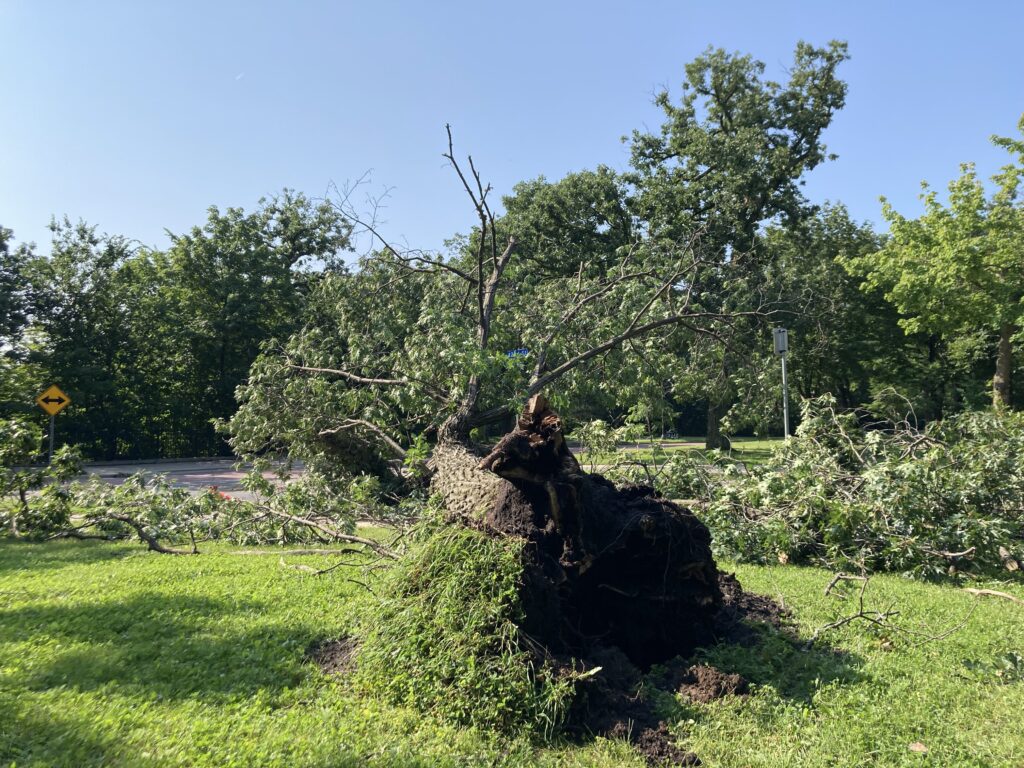
Yesterday afternoon, torrential rain, thunder, wind, and hail whipped through our neighborhood. It lasted only 20 minutes, but it was intense. Not scary — except to Delia-the-dog — but wild. It looked like it was snowing: Christmas in July! And the hail was so loud on the roof and the skylight. Today as I ran, I surveyed the damage by the river. Big branches on the dirt path, leaves scattered, a whole tree at the end of edmund:

big tree, felled

Of course I only took one picture, so I had to use it. Not sure if it effectively conveys the size of the tree?

Decided to take the winchell trail to check out the damage below. Some branches down, but nothing blocking the path. Dirt and mud and muck everywhere. I started chanting in my head,

silt / loam / glacial till
silt and / loam and / glacial till

Listened to water gushing out of the sewer pipe and down the slope at 42nd. Also listened to the birds — not one type in particular, but a chorus of BIRD. Noticed the shade on the path and the tiny spots of light. Looked at the river, a hazy heat hovering just above and thought, hot! No relief from that view.

Before I run, I read an excerpt from the novel Elixir. I wanted to think about this quote as I ran:

We were near water. There is a river. If you couldn’t hear it or see it, its ions vibrated in the air and you inhaled water, day and night.

In the Ladies Pool / KAPKA KASSABOVA

In the summer when the leaves block my view and I can’t see the river, I still know it’s there and it is always part of my run in some way.

the Seine, open water swimming, and water quality

I’ve been seeing lots of headlines about the problems with water quality in the Seine for open water swimming events at the Olympics. I mentioned it to RJP and she said she’d heard (on TikTok, natch) that people were pooping in the Seine in protest. Is that true? While looking it up, I found this helpful video: Can Paris fix it’s poop problem?

Okay, read some more, and the “Paris Poop Protest” is a thing. People were encourage to do it on June 23rd, when the President of France and the mayor of Paris were planning to swim in the Seine to prove it was safe. When Macron and Hidalgo postponed their swim, the poop protest was postponed too. So many interesting things to think/write about with this in terms of city infrastructures, rivers, threats to cities’ waterways, the negative and positive impacts of hosting the Olympics, and more. Swimming in public water, feeling the effects of how it’s managed in my body, has given me a deeper perspective on this issue of water quality and water management. I’m so grateful to have access to safe water here in Minneapolis.Everyone should have access to safe water.

time and water

Reading more of The Folded Clock, I was inspired to think about the relationship between time and water. Here are a few thoughts:

1 — anne carson

. . . the staining together of mind and time so that she is no longer miles and miles apart from her life, watching it differently unfold, but in it, as it, it.

1 = 1 / Anne Carson

2 — heidi julavits

As we stroked past I thought I saw George growing older and older. His grandchildren beside him grew older, too, taking his place before being replaced themselves by their children. It was like a trick of stop-time photography, everyone shading into everyone else. . . . Time passed. I started to doze. The cold water had slowed our pulses but everything else spun at great speed. I worried I would awake to find myself an old woman, my husband dead, my daughter grown and turned into me. But life, when I woke up, was as I’d left it.

The Folded Clock / Heidi Julavits

3 — samantha sanders

[on swimming in Lake Michigan in the winter] The exhilaration is remarkable. I feel like we’ve discovered the fountain of youth.

Swimming Through / Samantha Sanders

4 — alice oswald

it is not me but close to me a kind of cloud or smoke-ring
made of nothing and yet it will outlast everything
because it is deep it i sa dead field fenceless
a thickness with many folds in it promiscuous and mingling
which in its patience always wears away the hard thing

or is it only the hours on their rounds
thinking of the tides by turns
twelve white-collar workers
who manage the schedules of water

nobody / alice oswald

In their lunch hour
I saw the shop-workers get into water
They put their watches on the stones and slithered
frightened
Into the tight-fitting river
And shook out cuffs of splash
And swam wide strokes towards the trees
And after a while swam back
With rigid cormorant smiles
Shocked I suppose from taking on
Something impossible to think through
Something old and obsessive like the centre of a rose
And for that reason they quickly turned
And struggled out again and retrieved their watches
Stooped on the grass-line hurrying now
They began to laugh and from their meaty backs
A million crackling things
Burst into flight which was either water
Or the hour itself ascending.

from Evaporations/ Alice Oswald

5 — darby nelson

I posted this quote back on 16 august 2021, but I want to post it again here:

We talk of time as the river flowing. I never questioned the implications of that metaphor until I was struck by the words of Professor Dave Edmunds, Native American, on a display in the Indian-Western Art Museum in Indianapolis. Edmunds wrote, ‘Time as a river is a more Euro-American concept of time, with each event happening and passing on like a river flows downstream. Time as a pond is a more Native American concept of time, with everything happening on the same surface, in the same area—and each even is a ripple on the surface.’

If I think of time as a river, I predispose myself to think linearly, to see events as unconnected, where a tree branch falling into the river at noon is swept away by current to remain eternally separated in time and space from the butterfly that falls in an hour later and thrashes about seeking floating refuge. 

But if I think of time as a lake, I see ripples set in motions by one even touching an entire shore and then, when reflected back toward the middle, meeting ripples from other events, each changing the other in their passing. I think of connectedness, or relationships, and interacting events that matter greatly to lakes. 

For Love of Lakes/ Darby Nelson

When I think of time and water, I think of erosion and geologic time, and the wearing down of things by the water over years, decades, centuries. I think of generational time, and the family members, the hearty Finns on my dad’s side, who loved and excelled at swimming. I think of Sara-time and one of the key constants in my life and many selves: I love water and swimming in it. I think of losing track of time while swimming, and tracking it on my watch to look at later. I think of time measured by strokes and loops instead of minutes, measured by open swims instead of days.

swim: 4 loops
lake nokomis open swim
84 degrees

I swam 4 loops but the buoys were set up in such a way that the distance of 4 loops today was almost the same as 3 loops on other days. Oh well, I’m still counting it as 4. The water was very warm, too warm. Lots of stuff in it, but not as much as on Tuesday. More green slimy stuff, but now that I recognize and know it’s not toxic, it didn’t bother me as much.

I decided I wanted to listen as I swam. I didn’t hear much, just water sloshing over my head. The water was still, flat, sometimes feeling fast, sometimes slow. There was a haze in the air that made it as difficult to see as if my googles were fogged up. I felt strong and smooth and fast and happy.

Before the swim, I asked a few women if they had swum on Tuesday and if they had seen the green goo. Neither of them had. I realized later, as I swam, that I wasn’t asking because I wanted reassurance that whatever it was was not harmful. I just wanted to find someone else to acknowledge that it was strange and gross and something worth reacting to. On Tuesday, no one else seemed to care or be talking about it.

10 Things

  1. 2 women laughing and talking as they tread water between the last orange buoy and the shore
  2. impossible to see either of the green buoys with the sun and the haze
  3. at least 2 menacing swans
  4. the ghost vines are multiplying in numbers and size — creepy!
  5. cloudy sky
  6. a few pockets of cold water throughout the lake
  7. crowded swimming area, beach and park — everyone here on a hot day
  8. the surface of the water above was blue and calm and shiny and smooth
  9. the surface of the water below was greenish-brownish-yellowish
  10. I swam high on top of the surface, feeling extra buoyant

july 10/RUN

3.25 miles
trestle turn around
78 degrees / dew point: 66

For the first mile, in the shade it felt almost cool or, at least not HOT! Hardly any bugs, but tons of chirping birds, one black-capped chickadee calling out for a response which never came. A few other runners, walkers, a group of bikers. After turning around at the trestle I passed by 3 women instructing a fourth on how to use an unfamiliar bike. Somewhere I smelled tobacco — from a car? below on the winchell trail? a walker’s clothes? Admired the glowing purple flowers on the edge of the trail and the stretch of the path that was all shade, except for a few splotches of light. One splotch was big enough to see my shadow in before we both disappeared into the shade. The river was calm and pale blue. The green was thick excess. The stretches of trail in the direct sun were warm. At least twice I pushed myself to keep running when I wanted to stop. At the trestle I put in my old “Winter” playlist

immersion

This summer I’m devoting a lot of attention to water and swimming and my experiences during open swim. After reading Lauren Groff’s essay, Swimming, Anne Carson’s story 1=1, and watching Samantha Sanders’ mini doc, Swimming Through, I’m thinking about why I love open water swimming and how to describe the experience of moving in/with/through water. Here are 3 descriptions from Groff, Carson, and Sanders.

1 – Groff

there is a moment in swimming when, after a while, the body’s rhythm grows so comfortable that the swimmer loses awareness of herself. There is a marrow-deep letting go. She isn’t thinking. Her brain is off, her body is on autopilot. She is elevated; happy is not the word for it. To be and not to be, simultaneously: some people call this state ecstasy, others call it zen. They are, perhaps, different names for the same phenomenon. It is difficult to attain, and there are a thousand ways to attain it. Some meditate, others do peyote, others focus so hard on their art that the world itself falls away and they look up, days or hours later, to be staggered by what they have created in the full flare of their own white heat.

Swimming/ Lauren Groff

Groff’s last bit, “in the full flare of their own white heat” reminds me of Mary Oliver and one of her poems that I posted on 10 july 2022: “The Ponds”:

from The Ponds/ Mary Oliver

Still, what I want in my life
is to be willing
to be dazzled —
to cast aside the weight of facts

and maybe even
to float a little
above this difficult world.
I want to believe I am looking

into the white fire of a great mystery.

The white heat also makes me think of Emily Dickinson. But, the flare of white heat seems like the wrong sort of metaphor for what happens to you in the water. Also, even as we float in the water, we are still fully in it, not above it.

2 — Carson

. . . no interaction with another person ever brought her a bolt of pure aliveness like entering the water on a still morning with the world empty in every direction to the sky. That first entry. Crossing the border of consciousness into, into what?

And then the (she searches for the right word) instruction of balancing along in the water, the ten thousand adjustments of vivid action, the staining together of mind and time so that she is no longer miles and miles apart from her life, watching it differently unfold, but in it, as it, it.

1=1/ Anne Carson

To swim, especially freestyle, with your head mostly underwater, only surfacing to breathe (as opposed to breaststroke, where you always have a frog-eye view), is to be immersed in water, not floating above it. And not burning a white heat, but —? Something I can’t quite name yet. The it you are in, is not just water, but life.

3 — Sanders


There are many wonderful, beautiful moments in this doc about resilience and community and transformation, but I especially love this moment, starting 10 minutes in, in which they describe the shift from tracking the temperature to giving attention to — witnessing — the ice. To me, this might speak to Carson’s idea of crossing the border of consciousness into something/somewhere else.

 We became very obsessive about how cold the water was getting. You know, it’s 50, then it’s 40, then it’s 40.2, then it’s 39. I had two thermometers that both busted this year in the cold water, I didn’t get another one. We just figure that it’s cold. So then it’s about I can’t wait to swim in the snow. Then it was like, I can’t wait to swim when there’s ice.

And then we had no idea what did ice mean? You know, this winter it meant so many different kinds of ice because you know, there’s the first ice that was like a very thin, thin layer of ice. Almost like snowflakes on the water. Break them as I stroked and then turn around and they would have reformed behind me. Ice that was so sharp that you actually were getting cut and you needed to be careful.

And then, you know, we got real ice.

Swimming Through/ Samantha Sanders

The feeling of swimming is the feeling of noticing the world, not existing above it, but fully in it, immersed, aware, witnessing the slight changes in temperature, or where waves usually start, or how the weather affects the opacity of the water.

A few minutes before this ice part, one of the women says this about the experience of swimming in very cold water: I feel metallic! I love that — maybe that should be the title of a poem, “To feel metallic”?!

added a few hours later: I almost forgot to include some sources that I’d like to gather then read then archive:

  • “The Anthropology of Water” / Anne Carson in Plainwater — go to the U library for this one
  • In Summer, We’re Reborn/ Nina MacLaughlin
  • Excerpt from The Folded Clock* / Heidi Julavits

*several years ago — maybe 10? — I put The Folded Clock on my wishlist and got it for Christmas of that year. Apparently this was before I got into the habit of writing the date on the first page, so I can’t remember exactly what year that was. I also can’t specifically remember why — maybe because I was into memoirs? Anyway, I know I read some of it before but I didn’t realize that she wrote about swimming in lakes!

Julavits is swimming in a Berlin lake, filled with algae. This is the last paragraph:

The best thing about my first Berlin swim was this. When I took off my bathing suit, the crotch was bright green from the algae that had collected there. It was like getting my period for the first time and seeing the shock of color where normally there is only white.

The Folded Clock

When I took my suit off after my green algae filled swim, the muck that usually collects beneath my suit on my stomach and under my breasts included some bright green bits? chunks? traces? I’m glad that it collected there and not in my crotch!

july 9/RUNSWIM

3.25 miles
top of summit hill and back
78 degrees

Warm, sunny. Started in the neighborhood. Ran past the house, a block away, with the guy who is always outside on his front step, usually smoking. No smoking today, thankfully. Have I never not seen him?

Two white mattresses propped up at the end of driveway. Something spray-painted on them that I could read fast enough as I ran by. Graffiti? A message to the garbage guys?

Rowers! At least one 8-person shell on the river below me as I crossed over to the east side.

Shadow falls falling! As I ran up the summit hill, I could hear the water in the small creek slowly making its way to the falls. I tried to see it, but couldn’t.

Other than the rowers, and some sandbars, the water was empty. Brown. Reflections, which looked like dark shadows to me, of trees lining the shore. A small stretch of sparkle. Farther down the river, below the U. the water is foamy, but here it’s just brown.

It was hard, and I walked a few times, but I also pushed myself to run more than I wanted to.

When I reached the bridge again, I put in my “Beaufort Scale” playlist.

look pal, this isn’t the sea

Yesterday, I wrote about looking for a balance between routine and disruption. This morning (7:30 am), I’m thinking about how open swim club offers one model. Swimming across the lake during open swim is a routine with a few set rules: a designated time, lifeguards lining the route, buoys you are supposed to always keep to your right. But, how you choose to follow those rules is up to you. Show up early (often they open the course before it’s officially supposed to start), or halfway through, or even at the last minute. Do just one loop or as many as you can fit into two hours. Swim straight from one buoy to the next in a tight, efficient line or loop wide, taking up as much lake as you can. Swim without stopping, or stop often to catch your breath or orient yourself or feel the openness and solitude of the lake. Round the far buoys or go past them to pause at the shore. Use a kick board or fins, a snorkel. Wear a wetsuit or a tri-suit or a swim suit but always some suit (another rule: no naked swimming).

An open water slogan I’ve seen before: no walls. No lane lines or lanes. But, this isn’t Homer’s sea, Alice Oswald’s unfenced purple. There are shores in sight (well, mostly in sight) and only vines, fish, and swan boats to encounter. No sharks or motorized boats or big waves. Does that mean the lake is all routine? Safe, steady, predictable?

from A Swim in Co. Wicklow/ Derek Mahon

Spirits of lake, river
and woodland pond preside
mildly in water never
troubled by wind or tide;
and the quiet suburban pool
is only for the fearful —

no wind-wave energies
where no sea briar grips
and no freak breaker with
the violence of the ages
comes foaming at the mouth
to drown you in its depths.

Lake Nokomis is affected by wind and watermilfoil reaches out to grip me near shore almost every swim. No, it’s not the sea, but it’s also not a suburban pool.

In the lake, you can’t see much, either above or below. Above: water, vague trees, sky, sand. Below: your hand, ghost vines, silver flashes. No bottom, just void, nothing, or something not-seen.

In an essay about open swimming in the sea, Lauren Groff (love her writing and her awesome Olympic triathlete sister!) writes:

There is danger, a great deal of it. There are sharks that circle her. They wait. Their teeth shine in the murk. Their bodies lazily trail her shadow as it darts over the coral reef.

Lake Nokomis doesn’t have sharks. It has uncertainty, mystery, a floor only 15-20 feet below scattered with things we can’t see because the water is stirred up, murky. I wonder, which is scarier? Swimming above sharks you can see, or above a nothing that could be anything that you can’t?

swim: 3 loops
lake nokomis open swim
75 degrees

A few hours before open swim started, the sky unzipped and it rained hard. I think that might be the reason the water was so full of vegetation: whole vines, chunks of vines, and some green slimy substance. Gross! Before I realized what was happening, I swam through the slime — bright green, soft but not in a pleasant way. I’m glad my mouth was closed and I had a nose plug in. Hopefully it’s not toxic. In the 10 years I’ve been doing open swim, this is the first time I’ve experienced anything like this slime. I almost stopped after one loop, but decided to swim 2 more.

added, 10 july 2024: Reading back through my description, I wanted to add that I didn’t just swim through one random patch of this green slime. It was everywhere, all around the lake. Starting the first loop, before I realized the slime was there, I recall feeling something on the side of my head and wondering if some of my hair had escaped from my cap. No — I think it was some of the slime. The first loop was the worst, but for every loop, I could see it, often below me, but sometimes near the surface.

Okay, against better judgment — mine and Scott’s — I looked it up and it might be blue-green algae, which could be bad and make me sick. Hopefully not. Probably not. If were blue-green algae I think someone would have seen it and they would have cancelled open swim. Future Sara will let us know.

Sara from 24 june 2026: I can’t believe I’m the first future Sara to weigh in on this one. Oh, naive past-Sara, it was blue-green algae and you will write about it, off and on, for the rest of the month. You will learn that blue-green algae is mostly not a problem — other than being gross to swim through — and that when people see it, they won’t complain to anyone about it (or express concern to anyone in charge). You will also learn that when the people running Open Swim do say something about it on Facebook and through email, they will convey the official advisory statement half-heartedly. Reading between the lines (which I am not very good at), you will imagine that when they post “use caution” and “make sure to avoid bloom areas,” what they really want to say is, we think it’s fine for you to swim. just pay attention to where you’re swimming1. we would tell you this if we could, but we are required by our bosses and so we don’t get sued to repeat the official advisory. You will be grateful to understand this in june of 2026, when open swim begins in lake water with blue-green algae blooms present. You won’t worry about swimming through it.

Speaking of blue-green algae blooms, they will be in the national news in june of 2026 because of not-my-president’s debacle in renovating the reflecting pool on the Mall. Sigh.

  1. easier said then done for someone with low vision who can’t see color that well! ↩︎

july 5/SWIM

4+ loops
lake nokomis open swim
64 degrees (air) / 70-72 (water)
clouds then rain then sun then clouds

Hooray for Friday morning open swim! Overcast and calm water. For the first 100 yards, the water felt slow and cold, then faster and invigorating. At the last reading (tues, july 2) the water temp was 72, but it rained a lot, so I’m thinking the temp maybe went down a degree or two? I should start tracking the temp to see how much it fluctuates.

Because the buoys are positioned by lifeguards every swim — they paddle out on kayaks where they are advised by someone on shore where to drop their anchor — and because there’s no exact spot for each of buoys, the loop distance varies. Today it was long, which I like — the more distance, the better! Here’s a comparison on 3 different 4 loop swims by number of strokes I took / distance (which I’m pretty sure my watch doesn’t measures accurately):

25 june 2024: 2094 strokes / 3100 yards
30 june 2024: 2124 strokes / 3600 yards
5 july 2024: 2374 strokes / 4000 yards

I should note that my stroke count is very consistent. It’s kinda amazing to me how steady and even and similar my stroke count per 100 yards is across the summer.

For much of the swim, I felt strong and focused: 1 2 3 4 5 breathe left 1 2 3 breathe right 1 2 sight 3 4 5 breathe left. Not much thinking, some noticing:

10 Things

  1. the particles in the water — just ahead of me, reminding me of confetti or glitter, not so much moving through them as moving with them
  2. at first the water felt cold, invigorating
  3. for 3 loops: a white cloud-covered sky
  4. a car in the parking lot had its headlights on — glaring bright yellow
  5. visibility: very good for lake nokomis — if I had tried, I think I would have read my watch underwater!
  6. watching my hands underwater: stretching slicing, ghostly pale
  7. another swimmer’s legs coming into view, glowing white under the water
  8. loop 4 sun, 1: patches of soft blue sky
  9. loop 4 sun, 2: shafts of light underwater, illuminating the particles and making them sparkle
  10. as I neared the beach, surveying the way the bottom went from deep to shallow — a steep drop-off!

In the middle of the swim, I decided to recite Anne Sexton’s “The Nude Swim.” I had memorized part of it a few years ago, but this morning I memorized all of it. Such a great poem — I really like Anne Sexton’s voice. I should read more of her poems.

still my favorite lines from it:

All the fish in us
had escaped for a minute.
The real fish did not mind.
We did not disturb their personal life.

aquatic plant management

A few days ago, I looked up information about the vegetation/vines that I swim above in lake nokomis. I looked them up a few years ago, and recall learning that they were milfoil, but this summer I started doubting that I was remembering the name right. I was! There are two types of watermilfoil:

Eurasian watermilfoil : invasive, choking out native plants
Northern watermilfoil: native, food for the fish

On the Minneapolis Parks’ site, they describe aquatic plant management, which was fascinating. The most effective way to control Eurasian watermilfoil is to harvest it, either with a mechanical harvester or by scuba divers (!). The mechanical harvester, which from what my bad eyes can see is a boat with a big spinning blade

removes plants that are in the top four to six feet of water. The harvested plant material is removed from the water and stored until the end of summer when it is brought to the Minnesota Landscape Arboretum to be used as organic fill for their operations. 

Aquatic Plant Management

The scuba divers, who only do this on Wirth Lake and Lake Nokomis, hand-pull the watermilfoil in areas that are inaccessible for the mechanical harvester. I wonder what areas are inaccessible and if I’ve ever witnessed the scuba pulling and not realized it. Very cool!

The water was at least 10 degrees colder than the Y pool (82 degrees), but not that cold. Still, by the end of loop 3 (almost an hour in), my hands were getting a little numb. When I got home, I took a long, hot shower. I’d love to be able to swim in very cold water someday — one fantasy: moving to the UK and swimming in the ocean all year round. The other day, I watched this video and thought, I want to be able to do this with other woman, laughing and freezing and loving it:

july 4/RUN

3.2 miles
trestle turn around
71 degrees / humidity: 78%
light rain

Raining all day today. After talking to FWA about how he likes to walk in the rain, I decided to run before the rain got heavy — thunderstorms are predicted in the late afternoon. I never mind running in the rain, but I’m usually reluctant to start in it. I’m glad I went for it today. What a beautiful green: deep, rich, fresh (but not refreshing!), comforting. The rain was light enough that I barely felt it — no soaked, clinging shirt of shorts (that happened a few weeks ago).

I’m not sure if it was raining all the time or it stopped sometimes or it was a combination of light rain with dripping trees. It was fun to run under and beside the trees when the rain-soaked leaves rustled. One time I misjudged how low a branch was and ran through it instead of under it — the cool water on my face was a surprise then a relief.

Under the lake street bridge somebody had parked a lime scooter in the middle of the walking path, forcing walkers/runners to veer out into the bike path. Dangerous — bikes bomb down the hill and cut close to the edge of the path without warning. Also, I can’t always see these scooters, or I can sort of see that they’re there, but can’t properly judge my distance from them. Hard to believe I haven’t already been impaled by the handlebars of one of these scooters (or bikes)!

I was not alone on the trail. Mostly walkers, many with umbrellas — no menacing blue umbrella guy who takes over the entire path and won’t budge an inch. Some runners, one talking on a bluetooth headset. No roller skiers. Any bikers? I can’t remember.

Bright car headlights. The whooshing of wheels through the puddles on the road.

In honor of a run in the rain (more fun to say than a rain-run, or is it?), I decided to look to my friend, Emily Dickinson, for a poem. She did not disappoint!

The Skies can’t keep their secret!/ Emily Dickinson

The Skies can’t keep their secret!

They tell it to the Hills –
The Hills just tell the Orchards –
And they—the Daffodils!


A Bird – by chance – that goes that way –
Soft overhears the whole – 

If I should bribe the little Bird – 

Who knows but she would tell?


I think I won’t – however – 

It’s finer – not to know –
If Summer were an Axiom –

What sorcery had snow?


So keep your secret – Father!
I would not – if I could – 

Know what the Sapphire Fellows, do,

In your new-fashioned world!

I found this poem on a favorite site, The Prowling Bee. I love how the blog author, Susan Kornfield, describes ED’s role as a poet:

 Dickinson again chooses the naturalist’s approach to the world rather than the academic’s or theologian’s. She observes in rich detail but is quite reluctant to draw conclusions. Better, to her, the wonder than to have the Latin names and dry scientific knowledge. I suppose this is a poet’s eye, looking at each event, each bit of the world that catches the eye, afresh. Those of us who name, categorize, and systemetize, inject at least one layer between us and the actual world. This preference for questions over answers is one reason why we love our poets!

the prowling Bee

This poem reminds me of Tony Hogland poem that I memorized as part of my 50 for 50: The Social Life of Water

All water is a part of other water.
Cloud talks to lake; mist
speaks quietly to creek.

Lake says something back to cloud,
and cloud listens.
No water is lonely water.

a few hours later: No thunder storms yet (at 2:40 pm), just a steady rain, a dark sky. I’m writing in this already finished post to add an article that I read on MPR News about Minneapolis Park Workers going on strike. The article offers some powerful descriptions of the difficult labor — physically, emotionally — that many park workers do.

Lane [a park worker] says he’s been with Minneapolis parks for more than a decade, arriving at 5 a.m. daily in the early days of the COVID-19 pandemic, during 2020 riots that followed the murder of George Floyd and regularly, when tasked to clean up homeless encampments.

It can be a grueling job, he said. He’s frequently cleaning up broken glass, needles and feces, ensuring the public spaces are safe to enjoy. On one of his most difficult days, Lane said he watched a woman die from an overdose. But like any other day on the job, he pushed on.

“Just to see the poverty was disheartening,” he said. “It touched me, man. I cried a few times just thinking about how people are living out here.

Hundreds of Minneapolis Park Workers Poised to Strike for a Week

Wow. I often notice and appreciate the park workers, but it’s usually related to tree-trimming or road patching. I don’t think enough about this other, less visible, labor. What a difficult task to clear out encampments, especially if you disagree with the decision that they need to be cleared out. Last month, while running with Scott, I recall pointing out all of the tents and tarps and stuff propped up near a trash can on the trail just above the gorge. I wasn’t sure why it was there, but now I imagine it was the aftermath from an encampment clear out by park workers.

july 2/RUNSWIM

4 miles
monument and back*
65 degrees / dew point: 62
drizzle**

*a new route? Through the neighborhood, over the lake street bridge, up the summit hill, over to the Civil War Monument and back
**or as I’ve been known to say, spittin’ (does that come from the UP? the south? the midwest?)

Even though the dew point was high, the drizzle helped it feel cooler. Everything dark and quiet, calm, green. Passed the guy who is always sitting on his front stoop smoking. Also passed kids arriving at the church daycare. Pushed myself to keep running up the summit hill even though I wanted to stop. Made it!

Chanted triple berries for a mile or two. It helped distract me. raspberry / blueberry / strawberry

10 Things

  1. shadow falls was gushing through the trees
  2. the street lamps were glowing on the st. paul side
  3. rowers on the river! an 8-person shell. The coxswain was advising them on where to place the paddles in the high water (we have a river flood warning)
  4. morning! from a passing runner — good morning!
  5. the river was a beautiful gray blue, the trees a rich green
  6. so windy on the bridge heading east that I had to take my cap off and hold it
  7. the whining of a power saw in the distance
  8. alone at the monument overlook
  9. sometimes it was a drizzle, sometimes just a mist — difficult to tell which while running and sweating
  10. enveloped in dark green in the tunnel of trees — the only light was green light and a small circle of white at the top of the hill

As I looked down at the river from high above on the gorge, I thought about the rowers and their paddles and how different their experience of the water was to mine. Down there in the water, I bet it’s choppy and bumpy, with wind and spray. Up here, it’s almost flat and gray blue. No feeling of motion — no waves or the unsettling sense of being higher on water that’s on the edge of spilling over somewhere.

Yesterday I started thinking again about different bodies of water and how poets write about them: Mary Oliver (ponds), Lorine Niedecker (lakes), Alice Oswald (rivers, the sea). I also remembered Cole Swenson and their writing about the river Gave de Pau in Gave. I think I need to buy this book! Anyway, I looked up a few more of their poems and read one titled, “To Circumferate.” These lines stuck with me:

With a careful
adjustment of eye there are
no buildings. A city of trees
and hedges

As I ran back from the monument, looking left to the ravine and the trees, I thought about that line and imagined the stretches of grass, the trees, the green ravine as a city — the only city — no buildings or houses or roads or cars, only trees and tall grasses and bushes leading down to the river.

All of this thinking about different bodies of water reminded me of something I started to read but had to return to the library before I got very far, Visitation/ Jenny Erpenbeck. Here are the first two pages and an amazing description of water:

Approximately twenty-four thousand years ago, a glacier advanced until it reached a large outcropping of rock that now is nothing more than a gentle hill above where the house stands. The enormous pressure exerted by teh ice snapped and crushed the frozen trunks of the oaks, alders and pines that grew there, sections of rock broke away, splintered and were ground to bits, and lions, cheetahs and saber0toothed cats fled to more southerly climes. But the ice did not advance beyond this rocky crag. Gradually silence set it, and the ice began its labor, a labor of sleep. While over a period of millennia it stretched out or shifted its enormous cold body only a centimeter at a time, it gradually was polishing the rocky surface beneath until it was round and smooth. during warmer years, decades and centuries, the water on the surface of the block of ice melted a little, and it places where the sand beneath the ice was easy to wash away, the water slipped beneath the huge, heavy ice body. And so at the every spot where this rocky elevation had hindered the ice’s forward motion, the ice slid beneath itself in the form of water and thus began to retreat, flowing downhill. In colder years the ice was simply there, it lay where it was, a heavy weight. And where in warmer years it had carved channels in the ground as it melted, during the colder years, decades and centuries it pressed its ice into these channels with all is force to seal them up again.

*

When approximately eighteen thousand years ago the glacier’s tongues began to melt—soon followed, as the earth continued to grow warmer, bu all its southernmost limbs—it left only a few deposits behind in the depths of their channels, islands of ice, orphaned ice; later they were called dead ice.

Cut off from the body it had once belonged to and trapped in these channels, this ice melted only much later. Approximately thirteen thousand years before the start of the Common Era, it turned back into water, seeped into the earth, evaporated in the air and then rained back down again, circulating in the form of water between heaven and earth. When it could not penetrate any deeper because the ground was already saturated, it collected on top of the blue clay and rose up, its surface cutting through the dark earth, and now it became visible again within its channel as a clear lake. The sand that the water itself had ground from teh rock when it was still ice now slid into this lake and sank to the bottom, and so at several points underwater mountains were formed, while in other spots the water remained as deep as the channel itself had originally been. For a time this lake would hold up its mirror to the sky amid the Brandenburg hills, it would lie smooth between the oaks, alders, and pines that were growing once more, and much later, after human beings appeared, it was given a name by them: Mårkisches Meer, the Sea of the Mark Brandenburg but one day it would vanish again, since, like every lake, it too was only temporary—like every hollow shape, this channel existed only to be filled in completely some day. Even in the Sahara there was water once. Only in modern times did something come about there that is described in the language as desertification.

Visitation/ Jenny Erpenbeck

swim: 3 loops
lake nokomis open swim
75 degrees / drizzle

A great swim! Now I’m cold and tired and hungry!

10 Things

  1. more ghost vines glowing below
  2. one menacing white swan
  3. the water below was a deep green with some blue
  4. the water near the shore was still clear enough to see the sandy bottom
  5. the sky was pale — no sun, except for a few times when it almost broke through
  6. it’s the free night for open swim so more bobbing buoys — yellow was the most popular color
  7. breathed mostly every five
  8. tangled in a few vines, one leaf didn’t want to go away
  9. stopped once or twice in the middle of the lake — calm, quiet — I should stop more
  10. some little speck got in my eye at the beginning of the swim — I should have stopped to fix my goggles, but I just kept swimming, now it’s still stuck in there

june 30/SWIM

4 loops
lake nokomis open swim
65 degrees

Wow wow wow! What a wonderful swim for my birthday weekend. The air was cooler, but the water was fine and the sun was warm. Not much wind, so few waves, but the sun reflecting off the water sparked light everywhere. Felt strong and sore, then not sore, then sore again: mostly my neck from sighting and breathing. I didn’t wear my safety buoy and it felt strange, like I was missing something.

1

The water was clearer, lighter. Less greenish-blue and empty, more greenish-yellow and full of living things — particles, vines, sediment — and light. Shafts of light everywhere underwater — not straight down, but at angles and coming up from the bottom not down from the sky. An illusion, but fun to imagine the light source as down below. The opposite of Lorine Niedecker’s “ocean’s black depths” (Paean to Place) and Alice Oswald’s “violet dark” (Nobody). I noticed the shafts of light the most in the stretch of water between the last green buoy and the first orange one.

2

After I finished my 4th loop, swimming just inside the pink buoys, I looked underwater — clear enough to see the sandy, rocky bottom, but not clear enough to see any hairbands. Writing this reminded me of what I witnessed before the swim: minnows! As I waded in the shallow water, dozens of little fish scattered as I approached. None of them nibbled at my toes, or if they did, I didn’t feel it.

3

During the first loop somewhere between the first and second orange buoys an alarming thought appeared: what if I fainted in the middle of the lake? In the past this thought might have caused panic which I would feel in my body — a flushed face, harder to breathe, hot tingling on the top of my head. Not today. No physical effect. Within a few minutes the thought was gone. Is this because of the lexapro? FWA says that sometimes he feels the lexapro working — he’ll start having overwhelming thoughts but instead of spiraling, he feels himself become separated from those thoughts — they become abstract and distant. I wondered about this as I stroked then connected it to Alice Oswald’s Homeric mind and the idea of thoughts not just living in our head but traveling outside of our bodies from there to there.

3

I only saw the orange buoys when I was right next to them. I was almost always swimming straight at them, so some part of me knew they were there, just not my eyes. No panic or fear or negative thoughts as I looked at the nothingness of water and sky and a vague, generic tree line.

june 27/RUNSWIM

5 miles
bottom of franklin hill and back
69 degrees

Another run that started easy then got hard. My left hip and knee were stiff and sore. Walked several times on the way back.

Listened to feet shuffling on the grit, some keys jangling in a bucket. Smelled something floral and sweet near the franklin bridge. Felt a cool breeze on my warm face, sweat dripping off of my pony tail. Saw blue, red, and orange graffiti under the lake street bridge and a man helping a dog get through a hole in the chain link fence halfway down the franklin hill.

Ran by a break in the trees with an inviting dirt trail and thought again about how I love seeing these trails and wondering where they lead. Then I thought about how I prefer trails that have already been made by others — an invitation from past feet to explore and to step off the paved path.

Saw this poem online this morning and was surprised that I hadn’t already posted it:

blessing the boats/ lucille clifton

may the tide
that is entering even now
the lip of our understanding
carry you out
beyond the face of fear
may you kiss
the wind then turn from it
certain that it will
love your back may you
open your eyes to water
water waving forever
and may you in your innocence
sail through this to that

swim: 3 loops
72 degrees
light rain

I like swimming in the rain — when it’s a light rain. Have I ever swam in a hard rain? I’m not sure. When you are already wet, it’s difficult to tell what’s rain and what’s lake. Another great swim. I’m struggling in my runs, but loving the water.

10 things

  1. a steady rain that I couldn’t feel or see as I swam
  2. water, a darker green with some blue
  3. tangled in several thin, loose vines — one on my head, another my shoulders, and another on my legs — most were just slimy, but one was sharp and scratchy
  4. pale vines stretching up from the deepest parts of the lake — how tall are these vines this year? they glowed like the moon behind the clouds
  5. particles in the water, almost looking like glitter — or, was that raindrops breaking the surface?*
  6. mostly breathing every five — a few sixes, some threes, at least one two
  7. pink orange yellow safety buoys tethered to swimmers
  8. rounding the second green buoy, sighting the first orange buoy — so far off and lonely — just it and water — and only appearing in my vision when it wanted to
  9. some sort of disturbance below me — was it a big fish? — nothing seen, only felt, the water moving beneath me
  10. standing up near the beach after I finished, noticing the rain, then hearing some kids in the water excitedly yelling, It’s raining!

*It wasn’t until I wrote this out that I realized I was noticing the rain. It was very cool. The rain drop glitter made the water feel more alive, active — stirred up and swirling

I was surprised by how many people were at the beach. It had been raining all afternoon. People were still having picnics, kids were still in the water, several dozen swimmers were out on the course

june 25/RUNSWIM

3.1 miles
2 trails
73 degrees / dew point: 66

Another hot and humid morning. Another difficult run. Is it strange that I don’t mind that it’s hard? Some shade, lots of sun.

10 Things

  1. squish! stepping down in thick, gooey mud on the winchell trail
  2. thwack thwack thwack a runner approaching from behind
  3. pardon me that same runner letting me know he was passing
  4. running down to the south entrance of the winchell trail, looking at the river through the trees — not sparkling in the sun, but flat and brown — somehow this made it look even hotter and less refreshing
  5. rowers down below, heard not seen
  6. the sewer at 42nd, a steady stream of water falling
  7. the sewer at 44th, more of a dribble
  8. honking geese
  9. 4 stones stacked on the ancient boulder
  10. a squirrel ahead of me on the winchell trail — running then stopping then running, finally jumping through the fence and off the trail — was it waiting to dart out right in front of me? no

Alice Oswald and Lorine Niedecker and water’s depths

from Paean to Place/Lorine Niedecker

How much less am I
in the dark than they?

Effort lay in us
before religons
at pond bottom
all things move toward
the light

Except those
that freely work down
to ocean’s black depths
in us an impulse tests
the unknown

from Nobody/ Alice Oswald

The sea she said and who could ever drain it dry
has so much purple in its caves the wind at dusk
incriminates the waves
and certain fish conceal it in their shells
at ear-pressure depth
where the shimmer of headache dwells
and the brain goes

dark

purple

from “Interview with Water”/ Alice Oswald

To be purpled is to lose one’s way or name, to be nothing, to grieve without surfacing, to suffer the effects of sea light, to be either sleepless or weightless and cut off by dreams.

swim: 4 loops
lake nokomis open swim
82 degrees

4 loops! A beautiful summer night! The water was a bit choppy but it didn’t bother me. Saw some silver flashes below — fish? Also, beautiful shafts of light illuminating the particles swimming with me and a few ghostly vines reaching up from the bottom. In certain stretches it felt like the water wanted to pull me down to the lake floor — difficult to kick and keep high near the surface.

New breathing/sighting pattern I noticed last night at cedar: 1 2 3 breathe right 1 2 look up to sight (no breath) 3 4 5 breathe left

above the surface: A few times I paused in the middle of the lake to give attention to the surface. Once I saw a dragonfly. Another time, a plane. The water was blue but not as intense as on Sunday.

below the surface: bubbles, my hands, could feel the movement before I saw any swimmers, then bubbles and pale legs kicking. The water was green but with less blue and more yellow.

june 23/SWIM

3 loops
lake nokomis open swim
67 degrees

Yes! A wonderful morning swim. As usual, always a mix of excited and nervous before the swim, but once I entered the water, all of it went away. Not always easy — sometimes my back hurts or a shoulder or a foot — but almost always wonderful. I love the dream I enter below the surface and the confidence I feel slicing through the water and the warmth of muscles worked after. Nothing feels as natural as swimming across this lake.

10 Things

  1. the crooked line of orange buoys — the one closest to the big beach much further north
  2. the faint outline of vegetation reaching up from the bottom of the lake, just below me
  3. swimming through a net of green milfoil near the white buoy
  4. only the occasional flash of other swimmers — a bent, bare elbow, a black wetsuit, a yellow safety buoy
  5. the brief flash of “buoy” or “orange” or “triangle” in my head, then nothing — I listened and believed and swam towards it
  6. one menacing sailboat — an orange and red sail
  7. open, empty water with vague trees in the distance
  8. above the surface, vivid blue, below the surface, green with hints of blue and the faintest idea of yellow
  9. my hands stretched out in front of me in the water — pale, glowing, a sharp contrast with the dark water
  10. shafts of light illuminating the particles in the water, everything constantly moving

the best moment: Rounding the final orange buoy for the third and final time, heading back to the big beach, the sun came out from behind the clouds. Suddenly the water was a vivid blue when I looked up to sight or turned my head to breathe. When I went back under, everything a beautiful, rich green: blue, green green green green green, blue, green green green green. At some point a cloud came and the blue grew darker, not quite purple. I thought about Alice Oswald and Odysseus and purple robes and being purpled.

Alice Oswald and Nobody

Was thinking about this before my swim:

Well, as you know, I’m quite fascinated, even obsessed, you might say with Homer. And one of the things that really tantalizes me in Homer is what is the Homeric mind? Because I think it’s very different from a literary mind. And it seems not to be inside the skull, but to be out in the world. So, there is a particular simile in the Iliad, which actually that first bit of the poem is based on, where it talks about two goddesses coming from heaven to the earth. And they’re very physically described. They kind of fall down from heaven to the earth. And then when they land, they take little pigeon steps, steps like doves or pigeons. So you can really picture them. But the way their flight moves from heaven to earth is as a man, you know, as the mind flutters in a man who has traveled widely, so you can turn it the other way around and say the way a man thinks is like this incredibly physical flight of two goddesses coming down to earth a bit like pigeons. And that’s always really interested me, that for Homer, the mind has the limitations of a pigeon, if you like. It is this kind of … this physical thing that moves. So, if you imagine a place over the sea, your mind actually has to get there. So, even though it may be as fast as the light, it is physical movement.

A Conversation with Kit Fan and Alice Oswald

I’m still looking for where in the Iliad these goddesses/pigeons are. And I’m still figuring out what AO might mean here. But it is helpful to read it beside these two parts of Nobody:

1/ page 1

As the mind flutters in a man who has travelled widely
and his quick-winged eyes land everywhere
I wish I was there or there he thinks and his mind

immediately

as if passing its beam through cables

flashes through all that water and lands
less than a second later on the horizon
and someone with a telescope can see his tiny thought-form
floating on the sea-surface wondering what next

2 / page 30

When trees take over an island and say so all at once
some in pigeon some in pollen with a coniferous hiss
and run to the shore shouting for more light
and the sun drops its soft coverlet over their heads
and owls and hawks and long-beaked sea-crows
flash to and fro
like spirits of sight whose work is on the water
shading it blue and thinking

I wish I was there

or there

Is the Homeric mind restless? I wish AO would say more about what she means by the literary mind and its lack of movement. I agree, but I’d like it spelled out. Does my mind work this way when I’m out moving by the gorge, or swimming across the lake? Does it move through or above the water? Maybe it became a fish.

Here’s one more line from the interview that I want to respond to:

. . . feeling of characters who have been eroded by the weather and by the sea is really what I’m feeling in this poem. It’s a poem that just opens itself to the elements and gets kind of washed, it gets its features washed off. . . . I think that’s all part of the erosion, really, it’s like even the forms of visible things have been almost worn down to their abstract shapes.

A Conversation with Kit Fan and Alice Oswald

Visible forms almost worn down to their abstract shapes — that’s how much of the gorge looks to me. Soft forms: trees, trash cans, big boulders.

june 22/RUN

3.15 miles
river road south/north
67 degrees
93% humidity / dew point: 65

Very tough on the legs! That dew point — ugh! Another difficult run. Still glad I did it. I heard some chattering birds and water gushing out of the sewer pipe near 42nd. Ran over puddles, slippery leaves, mud, recently re-tarred asphalt, dirt, roots. I remember looking at the river through the trees but I don’t remember what it looked like — probably a very pale blue or white, like the sky.

Inspired by all of my time with Alice Oswald lately, I’m thinking of starting Nobody again this afternoon. Listening to an interview she did with Kit Fan, back in 2020, I’m intrigued by what she said about her approach to writing it:

[The poem] sets out really to drown the reader. I wanted it not to feel like a sort of intellectual exercise where you would emerge kind of clarified and simplified, but literally to be as if you were inhaling water. … I find the people who I think get most out of it are those who don’t expect it to be conveying a thought, but expect it to be more like the experience of being outdoors, where you simply are assaulted by all kinds of different tunes and beings.

A Conversation with Kit Fan and Alice Oswald

And here, AO talks about color:

Well, I always feel that the Odyssey is a very bright emerald green because it has this incredible sort of vegetative life in it. It’s like a plant that just cannot stop growing. You know, the sentences grow all over the place. So, even though it’s a poem about the sea, I actually feel that kind of bright green of spring leaves in it. But I mean, I did kind of quite terrifying things to my mind when I was writing this poem, because I got quite interested in theories of color and sort of trying to watch what my mind was doing, particularly looking at colors in water and how your mind will tell you that’s green because you know it’s a leaf, but actually when you look at it, it’s not because it’s in a black river. And so, just trying to notice what the mind does and try, as I’m always trying, to get away from my own mind and out into the world. I was trying to see what colors are beyond my mind. And I think they probably don’t exist beyond the mind. So, it was actually an experience of almost unsettling all my perceptions really.

And being stuck, and going nowhere — is this similar to my looping!?

So these stories don’t get anywhere. They’re all stuck. And I like sort of, you know, Celtic patterns that just go on and on doing the same thing. So I didn’t want to make a poem that got anywhere, really. I wanted a poem that was stuck, whose stories couldn’t quite move forward, that had simply been tossed about by the weather, really.

later (5 pm): At the risk of making this entry too long, I’d like to add a few thoughts/notes after reading part of AO’s Nobody again, having read it before in 2022. It was very helpful to listen to AO’s lecture, “Interview with Water” and listen to/read the transcript of her interview with Kit Fan.

Before the poem begins, AO describes the similar (using similar like she does in “Interview with Water” — not the same, but resembling but varied, like water by currents) stories of Agamemnon, whose wife was not faithful and Odysseus, whose wife was.

This poem lives in the murkiness between those stories. Its voice is wind-blown, water-damaged, as if someone set out to sing the Odyssey, but was rowed to a stony island and never discovered the poem’s ending.

Nobody/ Alice Oswald

It helped me to read that beside AO’s words in her interview with Kit Fan:

. . .the poem is very much a kind of strange reading of the Odyssey. The Odyssey I see is a beautifully patterned wedding hymn about Odysseus’s marriage to Penelope and how they are driven apart by the Trojan War, and then they come back together. But embedded in that story, you’ve got the opposite story, which is the wedding of Agamemnon who goes off to the same war and comes back and is murdered by his wife whose taken another. And it’s that reverse Odyssey that I was writing in this poem, partly because the poet who is abandoned on the island is part of Agamemnon’s household. So, from his point of view, the Odyssey is being seen differently, from that other, much darker story. 

A Conversation with Kit Fan and Alice Oswald

Her use of darker here, reminds me of something she said in “Interview with Water”: “when you look at water, it allows you to exist twice but more darkly.”

june 21/RUN

4.15 miles
the monument and back
67 degrees
humidity: 91% / dew point: 65

Yuck! The air is so thick, everything heavy with moisture. We were supposed to have thunderstorms this morning — 90% chance — so I ruled out open swim, but they haven’t happened yet. Bummer. I bet it would have been a good swim.

I ran through the neighborhood, over the lake street bridge, up the summit hill and to the monument. Then I turned around and ran back, this time running south on the river road path instead of through the neighborhood.

10 Things

  1. 3 stones stacked on the ancient boulder
  2. a strange whimpering, soft howling or moaning sound coming from under the bridge on the east side — a non-human animal? a bird?
  3. no rowers on the river
  4. a foul, rotting smell as I ran over the bridge — I thought of the rot* that Alice Oswald mentioned in “Interview with Water” and the scarlet rot that FWA told me about yesterday when he recounted some “Elden Ring lore”
  5. a dark, deep green everywhere
  6. flowers alongside the trail on the east side: green leaves, fanned like ferns, pale white or purple flowers, small, dotting the green
  7. new (or newly noticed) graffiti under the bridge on the east side — brick red, I think
  8. the dark reflections of tree in the water near the shore — so dark that they look like shadows to me
  9. the faintest trace of a sandbar under the bridge
  10. the usual puddles near shadow falls are back, almost covering the entire path

*AO and rot: “anything excessive or out of focus or subliminal — for example: a swimmer seen from underneath, a rotting smell. . .”

Here’s another Alice Oswald water poem that I uncovered in a dissertation about Oswald, Jorie Graham, and water!

Sea Sonnet/ Alice Oswald

Green, grey and yellow, the sea and the weather
instantiate each other and the spectrum
turns in it like a perishable creature.
The sea is old but the blue sea is sudden.

The wind japans the surface. Like a flower,
each point of contact biggens and is gone.
And when it rains the senses fold in four.
No sky, no sea – the whiteness is all one.

So I have made a little moon-like hole
with a thumbnail and through a blade of grass
I watch the weather make the sea my soul,
which is a space performed on by a space;

and when it rains, the very integer
and shape of water disappears in water.

Almost forgot: japan is a new word for me. Here are some definitions, both noun and verb:

noun:

  1. any of several varnishes yielding a hard brilliant finish
  2. a hard dark coating containing asphalt and a drier that is used especially on metal and fixed by heating — called also japan black

verb:

  1. to cover with or as if with a coat of japan
  2. to give a high gloss to

june 20/RUNSWIM

4.1 miles
minnehaha falls
65 degrees

Overcast this morning. Cool, but humid, sticky. Another run that wasn’t easy or effortless. Keep showing up. It will get easier or you’ll get better or it will (eventually) get cooler. I’m not too worried. Is it the lexapro, or am I just satisfied being able to get outside and move by the gorge?

10 Things

  1. the crater with the tube sock/Florida outline is gone, filled in yesterday
  2. a gnat flew in my eye — a fullness, than a small sharpness, then a watery eye, finally gone!
  3. a motorized scooter on the bike path — hey, you’re supposed to be on the road! (thought, not said)
  4. today’s color palette; green and gray
  5. dark mud, not gooey but slick
  6. laughing kids on a playground
  7. the surreys, all lined up at the falls, one being readied for a family as I ran by
  8. rushing falls, roaring creek, gushing sewer pipe near 42nd
  9. some loud rustling in the bushes
  10. passing a walker, a whiff of subdued perfume — fresh, floral / passing a biker, a sniff of cologne — fresh, earthy

At some point, looking up at the green trees, remembering green water, I thought about Alice Oswald and the connection between water and grief. Then I recalled Tony Hoagland’s poem about swimming and cancer and thought about water and relief.

a few hours later: It’s raining — a soft, light rain — right now (2:30 pm). I’m hoping that open swim will still happen at 5:30. Tomorrow it probably won’t: thunderstorms all day. Anyway, I’m continuing to listen to and think about Alice Oswald’s “Interview with Water.” Very cool! Here’s the next little bit:

Find yourself in the silence underneath an overhanging wave that or thereabouts is the color of a bluish violet ultramarine gown so the great poet sang, “But Odysseus taking his bluish gown in his big hands drew it over his head and hid his face ashamed to let the Phaeacians see his tears.” The gown goes over the head like a wave, the human sits under its sea color with salt water pouring from his eyes. It is one of those places where the form of the poem hurries us forward, the form of the language pulls us back. Porfurion is a word with water inside it like a bucket down in the middle of a line. Already if you look hard at the word you can see the widow’s simile underneath it but Homer is not yet ready to make that gift. With magnificent theatricality, he draws a blue gown across the mind and we, like the Phaeacians, are left looking at it, waiting.

Homer is the foremost poet of the visible. Homer delights in surfaces, but the surface of water is complicated by transparency, and its transparency is complicated by refraction. Water is never the same as itself. Rivers can only exist as similarities, lakes reflect more than their own volume, and what’s more, when you look at water, it allows you to exist twice but more darkly. When you look at it again it evaporates as if moving in and out of existence — it simply requires a bit of sunlight then it reappears as frost. Perfectly symmetrical as if discovering pre-drawn diagrams in thin air. Then it reappears as tears so that any attempt to describe the surface of water tells you to hide your face and inspect your innermost thoughts. All these waverings are part of the word porfurion. The physics or nature of water is metaphysical meaning that its surface expresses more than itself.

Interview with Water

All of AO’s mention of surfaces makes me want to think about surfaces during my swim. I swim on the surface, wanting to stay with my head just below as long as possible. What does the surface look like or feel like when I’m breathing every five (or more) strokes? What if I tried every 2 or 3? What is the color of the surface — from above or below?

swim: 2 loops
lake nokomis open swim
68 degrees

Wow, what a perfect swimming night! The water was warmer than the air temperature. The sky was white and heavy. Everything calm, quiet. I felt fast and strong cutting through the water, breathing every 5 strokes with the occasional 3, at least once, after 2. I tried to give attention to the surface. Just under the water, I watched my hands stretch out in front of me, covered in bubbles. The water was a beautiful deep (but not dark) green, with the feeling of deep blue and gray. I could see the sediment swirling. Above the water, the surface was silver, still.


june 19/RUNSWIM

2.5 miles
2 trails
64 degrees

A quick run before meeting my college friends for lunch. Cooler today. Heard the rowers. Spotted: at least 2 bright yellow shirts, one bright pink. City (or county or park?) workers were out re-tarring a few more spots on the trail. Hooray for less craters! Last week, they finally filled in the big crack that had white spray-paint around it, making it look like a tube sock or Florida (I’ve written about it before). I wonder if they’ll finally fill in the hole that’s been getting deeper every year? The one that would definitely twist your ankle if you stepped in it. I hope so.

I don’t remember hearing any birds or roller skiers or laughing kids, but I do remember the squishy mud on the winchell trail and the bug bite I got as I walked home.

color in/on/under water

Listening to Alice Oswald’s lecture, Interview with Water, I came across this great passage about color. First she’s mentions that poets performing The Odyssey always wore blue robes, then she mentions a line from book 8:

Odysseus
with his strong hands picked up his heavy cloak
of purple, and he covered up his face.
He was ashamed to let them see him cry.
Each time the singer paused, Odysseus
wiped tears, drew down the cloak (8:84-89)

Then she references something she said a few minutes earlier —

I keep a bucket of rainwater under my window and it delights me that green leaves reflected in a black bucket are not quite green. I don’t know what color they are. At certain moments, early in the day, they might be called pre-green, but then the clouds change or the wind moves the surface mark and all at once they seem bright dark and blind silvery then foggy emerald.

— and says this:

To go back to that bucket of water — to wave a blue gown above it and ask, What is that color which Homer calls porfurium? It is not blue exactly; it gets translated as purple but purple is a settled color whereas Homer’s word is agitated. It derives from the sea verb porfurion which means to roll without breaking, so it is already a fluid word, a heaped up word, a word with underswell, not a pigment but an emanation from the nature of water. To get a true sense of porphyrion you need to see the sea in it and for Homer the sea is unhuman full of strange creatures missed colored unplowable and this is my favorite word it is a peritone meaning unfenced. If you want to imagine the colour of Odysseus’ gown you will have to swim out into the unfenced place, the place not of definitions but of affirmations. Yes I’m afraid you will have to find your way to the p volume of Johnson’s unwritten dictionary. There you will discover a dark light word an adjective for edgelessness — a sea word used also of death smoke cloth mist blood between bluish purple and cobalt mauve. It appears mid-ocean when the wind perhaps makes a network of backblowing glitters that the underswell moves sideways as when a big sea swells with noiseless waves. It is used of the heart meaning his heart was a heaving not quite broken wave. It indicates a surface but suggests a depth a mutation of flatness or noiseless sheen, a sea creature, a quality of caves, any inlet or iodine or shaded stone, a type of algae or rockfish, anything excessive or out of focus or subliminal — for example: a swimmer seen from underneath, a rotting smell, a list of low sounds, an evening shadow or sea god, a whole catalogue of simmering grudges storms waves and solitudes or deep water including everyone who has drowned in it. To be purpled is to lose one’s way or name, to be nothing, to grieve without surfacing, to suffer the effects of sea light. to be either sleepless or weightless and cut off by dreams — find yourself in the silence underneath an overhanging way that or thereabouts is the color of a bluish violet ultramarine gown so the great poet sang.

Interview with Water

Wow! So many wonderful things to do with this passage! For now, I want to think about how color works underwater. In an hour, I’m heading over to deep (at least, deeper than Lake Nokomis) Cedar Lake to swim across it. How will color work as I swim? Below water? Above? Is this agitated, moving purple similar to how I see all the time? (Yes, I think.)

swim: 4 cedar loops (= 2 nokomis loops)
cedar lake
72 degrees

The first swim at Cedar Lake! As I’ve mentioned here before, Cedar has a very different vibe than Nokomis. Hidden away, at the end of a gravel road. A small beach. No buildings, the only bathroom a port-a-potty. Chill lifeguards. Today the water was cold but (mostly) calm. Not too many swimmers. 2 lifeguards on kayaks, 2 orange buoys, too much vegetation growing up from the bottom of the lake. I overheard another swimmer mentioning the vines too.

color: Inspired by Alice Oswald, I tried to think about the color of the water. Cloudy, not clear. I could see the vines and the bubbles from my breathing and my hands entering the water but not much else. Not purple or blue but green — not dark green but pale green. Maybe some pale blue — yes — and light gray. Occasionally a shaft of light from above, a dark vine below. Textured bubbles. Not much to see, but not nothing there. Instead, everything small, packed, too dense to decipher. No color and too many colors. Impossible to pin down with “green” or “gray” or “blue.” Not grief, but uncertainty.

june 18/RUN

3.1 miles
trestle turn around
76 degrees / feels like 82
dew point: 71

Ugh! I knew it was going to be tough when I felt too hot even before I started running. More rain last night — enough to cancel our final community band concert — and more thick, sticky air this morning.

Greeted Mr. Morning! and Mr. Holiday. Saw Dave the Daily Walker but he was too far away to greet. Counted the stacked stones on the ancient boulder: 4. Heard some strange creaks below the trestle — what were people doing down there? Also heard the rowers on the river. Felt the sweat pooling on my face, my shorts sticking to my legs.

When the dew point temperature and air temperature are equal, the air is said to be saturated.

Observed Dew Point Temperature

Almost saturated — temp = 76, dew point = 71.

Looking through the trees somewhere near the trestle, I could see the river burning bright white — even the water looked hot!

Oh, this beautiful poem by Tony Hoagland! He died in 2018 (at the age of 64) from pancreatic cancer. My mom died from pancreatic cancer. It’s terrible. This poem was published in 2007.

Barton Springs/ Tony Hoagland

Oh life, how I loved your cold spring mornings
of putting my stuff in the green gym-bag
and crossing wet grass to the southeast gate
to push my crumpled dollar through the slot.

When I get my allotted case of cancer,
let me swim ten more times at Barton Springs,
in the outdoor pool at 6AM, in the cold water
with the geezers and the jocks.

With my head bald from radiation
and my chemotherapeutic weight loss
I will be sleek as a cheetah
—and I will not complain about life’s

pedestrian hypocrisies,
I will not consider death a contractual violation.
Let my cancer be the slow-growing kind
so I will have all the time I need

to backstroke over the rocks and little fishes,
looking upwards through my bronze-tinted goggles
into the vaults and rafters of the oaks,
as the crows exchange their morning gossip

in the pale mutations of early light.
It was worth death to see you through these optic nerves,
to feel breeze through the fur on my arms
to be chilled and stirred in your mortal martini.

In documents elsewhere I have already recorded
my complaints in some painstaking detail.
Now, because all things are joyful near water,
there just might be time to catch up on praise.

june 17/RUN

4 miles
minnehaha falls and back
65 degrees / dew point: 61

Today’s word: saturated. What Lorine Niedecker aimed for in her water poetry. Not floating or dry but sinking and soaked.

Rain off and on all day. Maybe thunderstorms starting in the afternoon.

No rain as I ran, but everything was wet or dripping. Moist. My face, more moist than a sponge. The falls, gushing over the limestone then rushing down the gorge to the Mississippi.

Evidence of the rain and thunderstorms last night all along the trail. Above the oak savanna it looked like some creature had tore through the green, ripping small limbs and leaves off the trees and throwing them to the ground.

The parking lot at the falls was packed with cars. Not the best day to be at the falls — but maybe it was? A chance to witness the falls in full cry, I guess. Also a chance to get wet or slip in the mud. I thought I might, but didn’t.

Anything else? A black squirrel sighting, which reminded me of the line from “What Would Root”: scolded by squirrels in their priestly black

Discovered the poet, Maureen N. McLane this morning and was delighted by her serial poem about Mz. N. Requested the book from the library. Possibly an inspiration for some writing about Sara, age 8?

an excerpt from Mz N: the serial/ Maureen N. McLace

The child Mz N sat on her bed
and wondered: that tree
outside her window
shifted
when her eye
shifted. What to make
of that?

                                          §

Mz N and her siblings
had a dog for some time.
They went on vacation &
when they came back
no dog.
They asked the parents:
the dog?
who replied:
what dog?
And some people wonder
why others distrust the obvious.

Speaking of the serial poem — LN’s “Paean to Place” is considered one — here’s a helpful definition:

The serial form in contemporary poetry, however, represents a radical alternative to the epic model. The series describes the complicated and often desultory manner in which one thing follows another. Its modular form–in which individual elements are both discontinuous and capable of recombination–distinguishes it from the thematic development or narrative progression that characterize other types of the long poem. The series resists a systematic or determinate ordering of its materials, preferring constant change and even accident, a protean shape and an aleatory method. The epic is capable of creating a world through the gravitational attraction that melds diverse materials into a unified whole. But the series describes an expanding and heterodox universe whose centrifugal force encourages dispersal. The epic goal has always been encompassment, summation; but the series is an ongoing process of accumulation. In contrast to the epic demand for completion, the series remains essentially and deliberately incomplete.

Seriality and the Contemporary Long Poem/ Joseph Conte

I had to look up a few words from this excerpt that I wasn’t quite sure of:

desultory: marked by lack of definite plan/purpose, not connected to main subject
protean: displaying great diversity or variety, versitle
aleatory: relating to luck, depending on an uncertain event or contingency

This idea of a serial poem as “an ongoing process of accumulation” is very cool and fits with my approach to Haunts and a story in long form.

jan 25/RUN

5.1 miles
bottom of franklin hill
37 degrees / humidity: 91%

Fog. Mist. And is that a very light drizzle or just the over-saturated air? Felt cold in the beginning — that damp, gets-in-your-bones cold — but warmed up by the end of the first mile. Waved at Mr. Morning!, said Hi! to Dave, the Daily Walker. Smiled at many other people I encountered. The fog made everything seem muffled, relaxed.

10 Things, Water

  1. beyond the flood plain forest, the river, glowing a silvery white, iced over
  2. small puddles on the path
  3. my forehead was damp for most of the run — not sweat, but drizzle or the damp
  4. in the flats, the river, almost completely open, only a few chunks of bright white ice floating on the surface
  5. the slick sound of water in car and bike wheels
  6. stepped in some squishy mud where snow had melted on the dirt trail
  7. some people down in longfellow flats, right by the river, laughing
  8. hardly any snow anywhere, almost all melted
  9. low visibility, enveloped in fog
  10. my pink headband at the end of the run: soaked with sweat

Before I ran, I started thinking about a hybrid chapbook idea: combining some of my water poems with the moments in my log where they started. I want to call it Waterlogged. Initially I thought I would just use poems about swimming in Lake Nokomis, but as I ran, I thought about all the different water-related things I’ve written, about the fog (yes, this idea was inspired by today’s weather), the crunching snow, the gorge and erosion, sweat/humidity/dew point. Maybe even a 10 Things list about water?

Running north, I listened to the water and my feet crunching on the sandy debris on the trail. Running south, I listened to Dear Evan Hansen.

august 6/SWIM

3 loops
lake nokomis open swim
68 degrees

First swim back since last Monday. I’ve missed it. Almost thought it wouldn’t happen; it was supposed to rain. Instead, cloudy. Hooray!

I had a rough start. Right before swimming, I couldn’t get my nose plug to stay on my nose. After taking it off and putting it on again several times, I decided it was good enough and headed out to the first orange buoy. A few strokes in, I had to stop. A leaking goggle. Fixed it, started again. A minute or two later, I could tell my nose plug wasn’t on fully. Stopped in the middle of the lake to adjust it. A few minutes after that, my eye began to burn — I hadn’t rinsed out all the baby shampoo I use to de-fog my goggles. I swam with my eyes closed for a few strokes then stopped to rinse my eyes and goggles out while treading water halfway between the shore and the middle green buoy.

I had hoped to recite Mary Oliver’s “Swimming, One Day in August” as I swam, at least the first lines: It is time now, I said,/ for the deepening and the quieting of the spirit/among the flux of happenings. But, it was hard to think about deepening and quieting when my eyes were burning and my nose plug was leaking. After completing 2 loops, I decided to stop and stand and rest at the big beach for a minute and then find a way to get deeper and quieter for my last loop. I think it worked.

10 Things

  1. seagulls! Maybe a dozen, standing in the water near the shore
  2. a gray morning with rain coming
  3. water temperature warmer than the air
  4. opaque water — no silver flashes
  5. a few boats in the water, mostly lifeguards in kayaks
  6. the buoys were off from my line of landmarks — the top of the building, the over-turned boat, so I swam wide and on the edges of the course as I kept the landmarks in sight
  7. smooth water — were there any waves?
  8. no vines or weeds or floating chunks of vegetation
  9. no sun
  10. at least one plane in the sky

A strange sensation. I keep having flashes of memory about the swim that seem like dreams. Was I dreaming as I swam, or did I dream about swimming last night? Maybe a bit of both?

Hard for me to believe, but it looks like I haven’t posted Mary Oliver’s poem, “Swimming, One Day in August” in its entirety. Here it is:

Swimming, One Day in August/ Mary Oliver

It is time now, I said,
for the deepening and quieting of the spirit
among the flux of happenings.

Something had pestered me so much
I thought my heart would break.
I mean, the mechanical part.

I went down in the afternoon
to the sea
which held me, until I grew easy.

About tomorrow, who knows anything.
Except that it will be time, again,
for the deepening and quieting of the spirit.

july 31/RUNSWIM

5 miles
bottom of franklin hill and back
65 degrees

What a wonderful morning to be outside! Cooler, sunny, calm.

My new morning routine is to get up, feed the dog, make my coffee, and then sit outside on my deck. Sitting there, I noticed a few birds swooping down from our new gutters. Uh oh — they’re trying to build a nest.

I felt pretty good on my run. Relaxed for the first few miles. Running down the hill, my left hip felt a little tight. Not too bad. Last night, Scott and I talked about signing up for the Oct 2024 marathon, for our 50 birthdays. Can my knees and hips handle it?

Listened to birds, acorns falling from the trees, kids calling out for Dairy Queen for the first half of the run. Put in headphones and listened to “Camelot” on the way back.

At the bottom of the franklin hill, I turned around. As I walked back up the hill, I recorded a few moments from the run:

moment one

Running through the tunnel of trees
a few minutes ago
a wonderful silence
no cars
I could hear myself breathing
everything still
no wind.
I was mostly in the moment
although
every so often a wonder
about when a car would come
and break the silence
cut into my calm.

moment two

approaching the trestle
I heard some kids
yelling, yeah! dairy queen!
another camp group
a dozen kids in bright yellow vests
as they biked past me
one of them chanted, dairy queen! dairy queen!

moment three

as spoke about moment two into my phone
a runner passed me
looking relaxed graceful
his legs rhythmically bobbing up and down
mesmerizing

10 Things

  1. a still river
  2. a black shirt dropped near the porta potty
  3. one acorn dropping to the ground from a tree, thud
  4. another acorn being crushed by a bike wheel, crunch!
  5. 2 roller skiers, or the same roller skier encountered twice
  6. the Welcoming Oaks wondering where I’ve been
  7. a person asleep under the bridge
  8. a regular — Santa Claus
  9. another regular — Mr. Morning!
  10. a woman ahead of me, a dark shirt strung through the strap of her tank top, flapping as she ran

On this last day of July, a month about water, I want to include this passage from Roger Deakin’s Waterlog:

The following afternoon, under a blue sky fringed white with distant clouds on the horizon, four of us swam in 360 feet of turquoise water in a sheer-sided quarry on Belnahua. The island encricled a huge natural swimming pool, raised above sea level, whose waters were so utterly transparent that when we swam, we saw our shadows far down, swimming ahead of us along the bottom. All around, only yards away, was the deeper blue of the open sea, and the Hebrides: Fladda, Scarba, Jura, Lunga, the Garvellachs (the ‘Islands of the sea’, St. Coumba’s favourite place), Luing, Mull and Colonsay. The light and the skies kept changing all afternoon: from bright blue with distant dazzling clouds to deepening red and gold. Diving from the rocks into the immensely deep, clear, brackish water, intensified the giddy feeling of aquatic flying.

Waterlog / Roger Deakin (237)

I would love to swim here (or near here)– some day in my 50s, I hope. Last week I mentioned possibly seeing my shadow in the water, but barely because the water in the lake is opaque. I remember seeing (and writing about) my shadow in the pool last winter, how it felt like I was flying above the deep end. I love the idea of aquatic flying and the rare times I feel like I’m actually doing it.

swim: 2 loops (4 cedar loops)
cedar lake open swim
83 degrees

Always grateful for another swim. Was able to swim on course, even without the buoys. My calves felt a little strange, my nose was a bit stuffed up, but otherwise, a great swim.

Instead of listing 10 things I noticed, here’s the coolest thing of the night: the vegetation stretching up from the bottom of the lake. How tall is it, I wonder? On the last loop, rounding the far orange buoy at Hidden Beach, I swam parallel to the beach, right above the vegetation — is it milfoile? Whatever it is, it’s wonderfully creepy — a pale green, ghostly, reaching up toward the light or my torso. So much of it! When I have more time, I do a little more research about these plants, and try to describe them more too.

a note from Future Sara, 24 june 2026: the milfoil is very bad this year. There is a big patch covering part of the swimming area and the start of the open swim path that is so thick, I could easily imagine a less confident swimmer becoming entangled and drowning. Even with my strong swimming ability, I can’t easily swim through it, which makes swimming beside the white buoys impossible. As one (among many) ways to deal with this milfoil and the anxiety it causes, I’m gathering entries (like this one) by tagging them “aquatic plants,” collecting research, and writing about and around nets, entanglement, vines, threads, webs, strings.

july 30/SWIM

4 loops
open swim lake nokomis
69 degrees

Another great Sunday swim. Sunny and a calm. A little cooler, but not too bad. Felt very strong on the first loop, not so strong by the fourth one. Somewhere in the middle, I lost track of the number of loops I was doing. I entered the swimming area at the main beach convinced I had done 5, when I had only done 4. Oh well, that was enough for me. For some reason, today’s swim tired me out more than the 4 loops on Friday. I guess it is a lot of swimming. I swam more miles this week (10.5) than I ran (10). I think I swam more miles than ran this entire month. I did a rough check, and they were basically the same. Wow. I really cut back on running this month and increased my swimming!

Started the swim by being routed by someone with an orange safety buoy. No worries. I just stopped for a minute and regrouped.

Saw at least one plane, many minnows, the swimmer with green arms — I still can’t tell if it’s a wetsuit or a sun shirt (or whatever they’re called), pale legs under the water, sparkles on the water’s surface, a clear sky, then a cloud-filled one, shiny bubbles from my fingers.

I recited a few poems — lines from “A Nude Swim,” “Evaporations,” and “The Meadow.” Thought again about my body losing all of its loneliness.

Wow, this poem!

Glacier/ Claire Wahmanholm

It is everywhere. It is the water I am trying to teach my daughters to float in. It is the sky I tell them to keep their eyes on. It is the air I tell them to seal in their mouths should they slip underwater. I am a leaky boat, but I am trying to answer their questions. As deep as thirty Christmas trees. As deep as twenty giraffes standing on each other’s backs. There hasn’t been a sea here for seventy-five million years. I cannot explain that number. My daughters’ ankles are sinking into the beryl water. No one can float forever. On the map, pushpins skewer patches of icy green like rare moths. I am trying to say it’s too late without making them too sad. It’s like how you can’t take the blue out of the white paint, like how you can’t hear your name and not turn around. The calving of glaciers is the loudest underwater sound on Earth. I dip my daughters’ ears beneath the surface to let them listen. It’s like how you can’t put a feather back on a bird, like how the bird won’t fit back into its shell. We step backward into the house. I wring the glacier out of their suits. I wring it out of their hair. I wipe it from their faces, but it is everywhere. It is the storm, it is the drowned harbor, it is the current, it is the bathwater that the baby slurps before we can stop her. The horizon rises. It rains. The glacier hammers the roof, the glacier soaks a corner of the bedroom ceiling, which greens with spores. On the map, the pushpins hover over green air, the green air is a spreading shroud. The storm surges ashore, mercurial and summer-smelling. We are not accustomed to the sea, so we describe it like a sky. The waves are tornado green and loud. In the water, the polar bears look like clouds.

july 28/SWIM

4 loops
lake nokomis open swim
71 degrees

Yesterday, it was very windy and HOT — upper 90s with feels like temp of over 100 — so I decided to skip open swim last night. I’m glad I did. I think I would have been sore and tired, having battled the wind and the waves. Instead today was a great swim. Calm water and not too crowded. I felt strong and fast and confident.

Again, I couldn’t see the orange buoys, but it didn’t matter. I was fine. I’ve been writing for years about how I can’t see those buoys. Slowly, what it means to “not see the buoys” has changed. It used to be, I only see the buoys every few minutes, not all the time, or, I only see the flash of orange or a small orange dot. But today, on the way to the little beach, swimming into the sun, I only saw the buoys out of my peripheral as I swam by them, never when I was trying to sight with them. Looking straight ahead, using my central vision, I only saw glare and water, trees, and sky. This did not worry me at all. The only time I could see an orange buoy with my central vision, and again, just barely, was after I rounded the second green buoy as I swam back to the start of the loop. Mostly I could see the green buoys as the idea of green or a small green dot. One time, as I got closer (but I was still 50+ yards away), I knew I was heading toward the second green buoy but I couldn’t actually see it. I paused, lifted my head high out of the water, then turned to look out of my peripheral. There it was. When I looked through my central vision again, I could see it because now my brain knew where it was. That’s one way my brain compensates for bad cones.

On the back half of loops 3 and 4, I recited A Oswald’s “Evaporations,” A Sexton’s “A Nude Swim,” and T Hoagland’s “The Social Life of Water.” Fun! I like reciting these poems. I thought about Sexton’s line, we let our bodies lose all their loneliness and Hoaglund’s lines, all water is a part of other water and no water is lonely water. Also thought about Ed Bok Lee and his idea of water as wise, ebullient, and generous in “Water in Love.” I tried to love like the lake loves, open and generous to everything and everyone. I gave attention to feeling not lonely — connected, entangled, beholding and beholden by the fish or the lifeguards, the other swimmers, the buoys.

10+ Lake Companions

  1. the woman who, as she neared the safety boat by the lifeguard stand on the beach to drop off her stuff, called out, I forgot my cap in the car! Then later, when I asked, pointed out the far orange buoy to me
  2. the lifeguard on the shore, speaking into her walkie talkie, instructing the lifeguards where to place the buoys
  3. the swan boat, far off to my left
  4. the plane sharply ascending above me
  5. the small piece of debris that I accidentally swallowed then felt as it briefly got stuck in my throat
  6. the small piece of debris that somehow got trapped in my googles, then in my eye until I blinked it out
  7. the swimmers with bright pink buoys tethered to their torsos
  8. one of the few swimmers wearing a wet suit on this warm morning
  9. the breaststrokers
  10. the women giggling and calling out to each other as they approached the first orange buoy
  11. the woman discussing her swim with another swimmer after she was done, I’m slow, very very slow

All of us, together, loving the lake and each other.

Before my swim, I read a great interview between two writers discussing illness and the writing life, Sick and Writing: Two Poets Converse. Here are some passages from it that I’d like to remember and reflect on:

detection, diagnosis, disease

poetry is not so much a means of healing as it is a method of detection, occasionally therapeutic but essentially diagnostic. Which of course implies that poetry is rooted not only in dis-ease but in causes hidden.

Jennifer Sperry Steinorth

to articulate what this singular life is like, in the thick of it

Not that we’re writing to solve the mystery of being; it’s more the need to see clearly. To look at the undersides of leaves, to watch butterflies emerge from their chrysalises. To be amazed. To look at the adventure of our infirmities, even. As Marianne Boruch said, it’s about detection.

*

I’ve wondered if I write them [emotions] to feel in control, to feel in connection with others who suffer, or simply to articulate what this singular life is like, in the thick of it.

Fleda Brown

on erasures

I like the idea of receptivity with regard to erasure. I have often used the metaphor of excavation to speak of that work, though I too balk at the idea that I am digging up something that already exists, something latent in the text. Rather, it is as if I am excavating the dead from a text that buried them—a kind of channeling.

JSS

trying to find the awe in awful

The word awful has awe in it, but when I feel awful it doesn’t feel like awe—maybe it should. Pain alienates us from one another, from ourselves, and from language. It disrupts connectivity. But through writing or other forms of making, we struggle against that disconnect.

jss

on taking walks in order to face the lion

 I sometimes need multiple walks a day; movement outside in the ordinary splendor of the world allows me to enter the tragic spaces of the past and the ongoing darkness in the world and in myself, without being swallowed by it. Jane Hirshfield talks about this in her wonderful essay “Facing the Lion,” inspired in part by Allen Ginsberg’s poem “The Lion for Real,” “The trick then is to let the lion into the house without abandoning one’s allegiance to the world of the living: to live amid the overpowering scent of its knowledge, yet not be dragged entirely into its realm.” Moving my body out in the world—outside the intimate spaces where I write—being in conversation with others—all of these help me hold the dark and light together. That this work demands so much discipline—even when I feel otherwise stable—speaks to the toll our work can take.

jss

the relief of a diagnosis

 Sometimes when I tell people my diagnoses they tell me they are sorry, and I understand they think the diagnoses are awful, and I get that, but I am so thankful for the diagnoses. It’s such a relief to know what’s wrong—even when nothing can be done to fix it.

Maybe knowing what’s wrong—the diagnosis—helps us—if not to fix what’s wrong, then to adjust our mind to new uncertainties—to let something go?

jss

Discovered that Fleda Brown has a wonderful blog, The Wobbly Bicycle. I’ll have to keep checking it out!

Here’s the poem-of-the-day from yesterday. If I had swam last night, I would have posted it then. It’s fitting for my swim this morning, thinking about my love for/of others in the water. Also, it’s a nice nod to the swimmer I heard after I exited the lake who said she was slow, very very slow.

Romance/ Susan Browne

I swim my laps today, slowly, slowly,
reaching my arms out & over, my fleshly oars,
the water silken on my skin, my body still able
to be a body & resting at the pool’s lip,
I watch other bodies slip through the blue,
how fast the young are
& how old they become, floating, floating,
forgetting the weight of years
while palm trees sway above us,
a little wind in the fronds, children playing
in the fountains, one is crying, one is eating
a peanut butter & jelly sandwich, I’m hungry
& wonder, has everything important happened
& what is more important than this,
like a secret adventure, like an affair I’m having
with everyone I see, their soft or washboard bellies,
their flat or rounded butts, their rippling hair
or shiny domes, their fragile ankles,
their beautiful bones, all our atoms swimming, swimming
& making us visible & I shove off the wall,
reaching my arms out, embracing the whole
magic show, with ten more laps to go.

july 11/RUNBIKESWIMBIKE

4.6 miles
bottom of franklin hill and back
63 degrees

What a beautiful morning! The first 3 miles of run felt good. When I stopped to walk up the last quarter of the franklin hill then started running again, my left knee and hip felt tight. I wonder if I need to cut back a lot on my running and focus on swimming and biking for the rest of July?

10 Things

  1. roller skiers! 15-20 of them all in a row — the clack of the skis, the click of the poles
  2. rowers! didn’t see them, but heard the bullhorn and the coxswain instructing the rowers
  3. a glimpse of shimmering water through the trees
  4. someone sleeping under the franklin bridge
  5. the sh sh sh of soft, sandy grit under my feet near the trestle
  6. several bikes flying past me on the way down the franklin hill
  7. greeting one runner as I passed him from behind — good morning!
  8. bright yellow and green shirts on runners I encountered
  9. a woman walker in a bright pink sweatshirt
  10. passing a woman running who was listening to some guy talking — was it Ant? Stage 10 of the tour de france?

That was difficult to come up with 10 things. Was it because the run was difficult? I’m distracted?

Listened to the traffic and my breathing as I ran north, Camelot as I ran south.

bike: 8 miles
lake nokomis
74 degrees

Biked with Scott to the lake. Nice! We took the trail on the way there, the streets on the way back. The streets were less fun — too many bumps and holes that I couldn’t see. Just a reminder that I bike so well on the trail because I’ve memorized the path, every curve, crack, bump.

swim: 3 loops
lake nokomis open swim
75 degrees

The first loop was smooth, fast, no swells. Excellent. But by the time I started the second loop it started to become choppy. No worries. I happened to notice that they had placed the first green buoy out farther than they usually do. Nice — since I saw it, I didn’t get off course at all. I might have seen a few silver streaks below me in the water — fish?! Saw some swans, lots of yellow buoys tethered to swimmers, a couple planes. No ducks or seagulls or geese.

favorite stretch: after rounding the last green buoy, swimming parallel to the beach, heading towards the first orange buoy and the start of another loop. Such a cool sight, seeing the orange buoy far off.

Glad I only did 3 loops. As I exited the water, I realized it was raining — sprinkling. It’s funny how hard it is to tell that it’s raining when you’re swimming.

Anything else? Only remember feeling/seeing vegetation once: at the start of the swim, heading towards the orange buoy for the first time, I crossed over some milfoil growing up from the bottom.

An excerpt from a new book, Elixir, about water: In the Ladies’ Pool

june 27/SWIM

3 loops
lake nokomis open swim
85 degrees

The air quality was terrible this morning, but it felt okay during the swim. Very choppy and difficult to breathe on my left side. I didn’t mind; I like the choppy water and the challenge of swimming directly into the small swells. Crash! There was some chaos in the water as one swan boat pedaled right through the course. The water was filled with small particles that almost glowed. A cool visual effect. I felt strong and sore after 2 laps — mostly my back. I took a minute break then headed out again for my third lap. It would have been easy for me to stop after 2 loops — it was choppy, I was sore, I had already swam for 40 minutes — but I’m glad I did the final loop.

Found this beautiful poem on twitter this morning:

When You Learn To Swim/ Souvankham Thammavongsa

It will be different here. You can take a leap
off this ledge ten feet and never touch
ground. You can hover in what

could be air, lean back further and further a
and something that feels like faith
will lift, will hold you up. But it isn’t faith,
it’s some kind of ophysics, law, a rule of matter
put in place, set in place
as old and as constant as that sun:

that unsettled speck, that shadowless thing,
that thing to have

wordle challenge

3 tries:

craft
paint
ABOUT

I decided to do nothing with the rhymes treating them as one does the unfortunately frequent appearance of crafts adults require children to fashion from pipe cleaners and plastic beads.

When is it art, when craft?

Gotta dream boy
Gotta song
Paint your wagon
And come along

about: reasonably close to; almost; on the verge of; on all sides; around the outside; in many different directions — here and there; near; concerning

june 24/RUN

3.1 miles
marshall loop
72 degrees / dew point: 59

It seemed warmer than 72 out there this morning. Ran with Scott. First Scott talked about Russia and Wagner, then I talked about the You and I and how we start as one and become the other as we acknowledge each other. This discussion was partly inspired by encountering one walker who called out good morning! and another who instead of offering a greeting ignored us and almost ran into me. What else do I remember? Rowers! Scott counted at least 6 shells on the river. Mostly I only saw them, but for one brief moment I heard the coxswain’s voice.

wordle challenge

4 tries: handy / drain / brand / grand
For the third day in the row I had to choose between equally fitting options. This time, brand or grand? I chose incorrectly.

a refreshing shandy
the pro cyclist Indurain
Rembrandt teeth whitening (brand)
Grand Old Days — the start of summer in St. Paul

She defeated him handily.

Yesterday I came across Annie Proloux’s book, Fen, Bog, and Swamp, and I’m certain that she disagrees with the phrase/metaphor, drain the swamp.

Mostly I don’t care, but I have 2 brands that I especially like. For swimming, TYR, and for running, Saucony. I used to mispronounce both of them. It’s tear (cry) not tire, and sock-a-knee not something that rhymes with Marconi.

Before I got into watching pro cycling or running and before my vision made it almost impossible to track the ball, I loved watching Grand Slam tennis. My favorite was always Wimbledon — Jennifer Capriati, Monica Seles, Steffi Graf, Pete Sampras, Andre Agassi, and Roger Federer.

handy dandy notebook
down the drain
brand spanking new
you’re a grand old flag, you’re a high flying flag

Somewhere along the way, what is marketed as handy and convenient is not always user-friendly.

a drain, a sewer, a causeway, a sluice

I hate shopping at Target. Endless aisles, filled with only 1 or 2 brands. The illusion of choice.

In 2008, we almost moved to Grand Rapids, MI. We had already picked out a house to rent, almost signed a lease, told neighbors we were leaving. Then I was told I might be able to have a full-time position at the U. Scott and I walked along Lake Michigan and had a gut-wrenching talk. I decided to turn down a guaranteed job for the possibility of a preferable one.

Crossing Water/ Tony Hoaglund

In late summer I swim across the lake to the stand of reeds
that grows calmly in the foot-deep water on the other side.

It is like going to a florist’s shop
you have to take your clothes off to get to,

where nothing is for sale
and nothing on display

but some tall, vertical green spears,

and the small, already half-shriveled pale-purple blossoms
sprouted halfway up the sides of them.

Squatting softly in the cool, tea-colored water,
hearing my own breath move in and out,

leaning close to see the tattered, soft-edged
purses of the flowers,
with their downward hanging cones and coppery antennae.

—This is more tenderness than I had reason to expect
from this rude life in which I built

a wall around myself, in which I couldn’t manage to repair
my cracked-up little heart.

Each time I make the trip, I get the strange idea that this
is what is waiting at the end of life–

long stalks slanting in teh breeze, then straightening—
flowers, loose-petaled as memory, gray
as the aftertaste of grief.

Tonight, I’ll lie in bed and feel the day exhaling me
as part of its long sigh into the dark,

knowing that I have no plan,
knowing that I have no chance of getting there.

I will remember how those flowers swayed and then held still
for me to look at them.

Oh, I love this poem! And I love Tony Hoaglund. I know that he died several years ago (in 2018), but I didn’t know the cause. Looked it up: pancreatic cancer. Just like my mom.

june 22/RUNSWIM

3.15 miles
2 trails
77 degrees
dew point: 61

So warm! Still glad I went out for a run, but it was hard. My knees are sore, my legs sluggish. Heard lots of birds, a roller skier’s clicking poles, talk radio blasting from someone’s car, faint voices from below, water trickling out of a sewer pipe. Encountered bugs — mosquitos? gnats? — near the ravine. Passed by a person on the folwell bench, reading. Was greeted by one walker: good morning! As I ran on the Winchell trail I thought about the importance of giving some gesture — a greeting, eye contact, a stepping over to make room — when nearing another person. Without it, you’re saying to them, to me you don’t exist.

When I finished my run, I pulled out my phone and recited Alice Oswald’s “A Short Story of Falling.” Only two mistakes: I gave it the wrong title and I said “in a seed head” instead of “on a seed head.”

“A Short Story of Falling” / 22 june 2023

wordle challenge

Bad luck with the wordle today. I almost had it in 3, but I had too many choices that could be correct. I had 4 tries but at least 5 options.

6 failed tries: slant / dates / waste/ haste / paste / baste
TASTE

Even though I failed the challenge, I decided to do something with words: find connections to Emily Dickinson!

slant: Tell all the truth but tell it Slant

dates: I do not know the date of mine/ It feels so old a pain

waste: Just Infinites of Nought/As far as it could see/So looked the face I looked upon/ So looked itself on Me (Like Eyes That Looked on Wastes)

haste: We slowly drove—He knew no haste (Because I could not stop for Death)

paste: We play at Paste/ Till qualified, for pearl (We play at paste)

baste and taste:
Now You Too Can Bake Like Emily Dickinson
Emily Dickinson: A Poet in the Kitchen

swim: 4 loops
lake nokomis open swim
89 degrees

At the end of the swim another swimmer called out, these conditions are the best! (or something like that; I can’t quite remember). I agreed. Calm, pleasingly warm water, well-placed buoys. I could barely see the buoys, but I still swam to them without a problem. Lots of swans in the water, a few menacing sailboat — one with a bright orange and red sail.

I swam for a loop and a half then briefly stopped at the little beach for a quick rest. Swam another loop and a half and stopped at the big beach. Got out to go the bathroom, then one more loop. Taking a 5 or so minute break between loops 3 and 4 really helped. I should remember to do that more often.

I’m writing this swim summary the next morning. Can I remember 10 things?

10 Things

  1. at least one plane
  2. half a dozen swan boats lurking at the edges
  3. one swan stuck in the dead zone between buoys
  4. streaks below me — fish?
  5. irritating swimmers: 2 fast women that kept swimming past me, then stopping to get their bearings, then swimming again. With my slower, steadier stroke, I kept getting passed by them, then passing them when they stopped, then getting passed by them again when they restarted their swim
  6. both the orange and green buoys closest to the beaches (orange to the little beach, green to the big) were not that close to the shore
  7. no waves
  8. no ducks
  9. breathed every 5 strokes, sometimes every three, once or twice every six
  10. hardly ever saw one of my landmarks from the past few years: the overturned boat at the little beach

june 7/RUN

4.3 miles
minnehaha falls and back
68 degrees

A few degrees cooler this morning, but still warm.

I’m listening to a very (too?) long audio book right now and I’m trying to finish it before it’s due back at the library in 7 days — The Covenant of Water, 31 hours. I decided to listen to it for the first half of my run. Sometimes I like listening to audio books while I run, not so much today. My mind kept wandering and I had trouble paying attention to the story. Plus, because I had headphones on, I felt disconnected from the gorge and the trail.

Even in my distracted state I still managed to notice a few things:

10 Things I Noticed

  1. Mr. Walker Sitter was perched on his walker just above 42nd street ravine
  2. the falls roaring gushing rushing down the limestone
  3. more bikers than walkers or runners on the trail
  4. the surreys lined up, ready to take over the trails
  5. an older woman, biking, calling back to some other bikers, did I miss the turn-off? Oh, here it is!
  6. a sprinkler watering the flowers near the fountain which no longer works and the low limestone wall with “Song of Hiawatha” etched on its top
  7. the dirt trail leading into the small wood on the hill up to ford parkway, looking both inviting and buggy
  8. approaching a guy who had been running when I saw him far ahead of me, but now was walking. Right before I reached him, he started running again
  9. a big black something on the ground — an oversized glove? a hat? a knee brace? I couldn’t tell
  10. most of the dirt on the trail between edmund and the river road was tightly packed, but a few stretches where loose and sandy

Wordle Challenge

5 tries: tough/wheat/haste/hated/hater

Nap-Hater

Middle-aged, it’s tough to watch
wheat gently waving in the wind
without haste and not want to slow down yourself
but as a kid I hated anything slow —
snails, sermons, that quiet time right after lunch
when you were supposed to be still on your cot.
Wedged between other writhing bodies
all of us desperate to be done with this dark room
we felt the dripping of each second
and despised it.

Today’s Water: Water Sign :: Cancer

In comes and goes in waves, but today I’m not worried that I have cancer. This irrational and rational fear took hold of me a few years ago and it’s been hard to shake, especially as I witness family and friends struggle with and die from it. Yesterday I read about a friend’s ovarian cancer and the terrible life-extending drugs she has to keep taking post-chemo to prevent the cancer from coming back. They cost $24,000 a month. Her insurance covers it, but what if it didn’t? What would she do? Would my shitty insurance cover these costs, if I had cancer?

Ode to Money, or Patient Appealing Health Insurance for Denial of Coverage/ Katie Farris

I don’t know what money is. Moss? The mink’s crescent
teeth? Or maybe money is
the morning I woke
at dawn to wander
past the orange
blossoms, a smell with four
dimensions, touching me through
time. Is that

                    currency? 

My uncle, Christopher Marlowe,
mad, drank the visions until he died.
You bury
treasure.

To determine a family’s net
value, make a list of assets, then subtract
liabilities. Asset: Geraldine Fox’s 1948 degree in
chemistry. Liability: William Marlowe’s propensity
for hurting his daughter. Am I doing this right? Is this

       the gold standard? 

Asset: seeing light that isn’t there,
like a ship passing through the narrow harbors
of my eyes, scraping—
is burying treasure a cash
transaction?

I once buried a half-
decayed skunk I fished from my Uncle Christopher’s
garbage can, covered in bees. X marks the spot.

In sum: perhaps the moon’s an insurance adjuster.

America’s optimistic to dye its money
green. Leaves are green
because of chlorophyll, which is the machine
that turns sunlight, water, and carbon dioxide into leaf, stem, and root. All
the little blades of grass left behind by the lawn mower like Civil
War soldiers. Same as cash.

                      A heavy-bodied moth

caught between glass and screen casts its shadow down
into the palm of my hand: one dark coin.

I’ve been thinking about buying and reading Katie Farris’s collection about her breast cancer, Standing in the Forest of Being Alive, even before it came out in April. Maybe I should get it and read it this summer?

june 6/RUN

3.1 miles
trestle turn around
72 degrees
dew point: 61

Ran with Scott this morning. Another warm, thick, still morning. We followed Scott’s getting-back-into-running training plan: run 15 minutes, walk 2, run 15 minutes. Our walk started right by the trestle. My left hip felt a little stiff, my left knee harder to lift at the beginning, but I mostly felt fine. My big right toe isn’t hurting anymore.

10 Things I Noticed

  1. birds, 1: several little birds on the path, reluctant to fly away, forcing a biker to slow down
  2. birds, 2: more of these little birds — sparrows? finches? — stopped right in front of me a few minutes later
  3. the white bike — a memorial for some biker killed by a car years ago — hanging upsdie down under the trestle
  4. green green green
  5. cottonwood fuzz lining the sides of the path, a pale green, looking like corroded copper to me
  6. a few puddles of water near the sidewalk edges — did it rain last night, or had nearby grass been watered?
  7. hi dave! hi sara! hi scott! I was impressed that Dave the Daily Walker remembered Scott’s name, so was he
  8. only 1 or 2 small rocks stacked on the ancient boulder
  9. the cracks in the paved trail that they just redid 2 years ago are spreading and deepening, splitting the trail in two. I made note of a small hole that I’ll need to remember to avoid next time I run this way
  10. a woman in a BRIGHT pink shirt and BRIGHT green pants — wow! I wonder if this is the same woman in the BRIGHT pink pants the other day?

No bugs, no roller skiers, no view of the river. No music, no packs of runners, no irritating encounters. No rowers, no overheard conversations, no drumming woodpeckers.

today’s wordle challenge

3 tries / wrong place SCOUT

Here a few “poems” with these words:

They call her wrong place scout
because she always seems to find the place
no one was looking for (or wanted).

wrong place scout

I was in the wrong place
but it must have been the right time
I had found the wrong camp
but stumbled on the right line
I was near the wrong guy
but he must have said the right words
He led me through the wrong door
but out into the right world.

There is no wrong
place to be when
you are scouting mystery.

I forgot about the dark
bird I saw rooting
in the hydrangeas looking
like it landed in the wrong
place until today
when I learned
about the purple martin scout
and decided that that was what it was.

Even though the finished products of this wordle challenge aren’t the greatest, the experiment was fun to do. I thought about different meanings of scout and listened to/studied the lyrics of Dr. John’s “Right Place, Wrong Time.” I also learned about purple martins and remembered a strange bird I watched in my back yard the other day. Bonus: I became aware of the existence of “Minnesota’s Largest Purple Martin House” in Audubon, Minnesota. Wow.

Here’s a water poem that is by one of my favorite poets and will be etched on NASA’s Europa clipper as it travels to study one of Jupiter’s moons:

In Praise of Mystery/ Ada Limón

Arching under the night sky inky
with black expansiveness, we point
to the planets we know, we

pin quick wishes on stars. From earth,
we read the sky as if it is an unerring book
of the universe, expert and evident.

Still, there are mysteries below our sky:
the whale song, the songbird singing
its call in the bough of a wind-shaken tree.

We are creatures of constant awe,
curious at beauty, at leaf and blossom,
at grief and pleasure, sun and shadow.

And it is not darkness that unites us,
not the cold distance of space, but
the offering of water, each drop of rain,

each rivulet, each pulse, each vein.
O second moon, we, too, are made
of water, of vast and beckoning seas.

We, too, are made of wonders, of great
and ordinary loves, of small invisible worlds,
of a need to call out through the dark.

june 5/RUN

3.1 miles
2 trails
79 degrees
dew point: 62

Hot, thick, very poor air quality. There’s a warning about the bad air until midnight: “fine particle pollution” from wild fires in Quebec. I don’t think it really bothered me as I ran.

I ran south on the dirt trail in the grass between edmund and the river road, crossed over to the trail, then headed down to the southern entrance of the Winchell Trail. Ran north until 38th, took the steps up, returned to trail past the ravine, through the tunnel of trees, then crossed over the edmund at 33rd.

Listened to cars whooshing by, kids heading to school, water sprinkling out of the sewer pipe for the first 2 miles. Listened to a Bruno Mars playlist for the last mile.

Before the run, I was thinking about water and The Odyssey — I was reading it all weekend — and how much Odysseus and his men ache for home. And I was imagining how restless they’ll be if and when they get home and stay for too long. Restlessness and staying reminded me of a few things:

Mary Oliver’s restless water and her satisfied stones in The Leaf and the Cloud:

It is the nature of stone
to be satisfied.
It is the nature of water
to want to be somewhere else.

Faith Shearin and the ones who stay, including Penelope:

Odysseus spent years trying to come home
but Penelope never left. He was seduced

by women with islands and sung to by sirens;
he held the wind in a bottle. But Penelope
slept differently in the same bed, weaving

and unweaving the daily details while men
she did not love gathered in her kitchen.
Her face grew thinner, her son grew taller.

And my own thoughts and words about restlessness in the wordle experiment for today:

details: 5 tries, trend/plane/neigh/skein/ENNUI, 2 poems

Ennui
The latest trend
among those trapped in a post-pandemic plane
is to neigh with horsey impatience
softly scream into a skein of restlessness

The Horse Girls
trending:
on the plane between child and young adult
wild neigh and reserved whinny
they skein obsessions
out of their edgy ennui OR out of their ennui

So, I started the run with all of these thoughts still lingering. Within a mile, I started thinking more about restlessness and water. At the end of the run, I pulled out my smart phone and recorded some of those thoughts:

june 5, 2023

transcript: June 5. Just finished my 2 trails run, a 5K. Today I was thinking about restlessness and water and the idea that usually water is restless, constantly moving. But today, in this thick humid morning with haze and poor air quality, it is everything else that is restless, and the water that refuses to move. The river stills. The sweat hovers on my chin, refusing to fall, to bring relief. We are restless: the cars, impatient, as they move past me on the road. Even my legs, as I try to run down hills, refuse to move with any speed. Contrast between the restless and the still.

I remember looking at the river and seeing haze. The only water that was moving at all was the water steadily dripping out of the sewer pipe.

Another thing I just remembered from before my run: I briefly thought about a vision poem I encountered last week and have wanted to post here. Today’s the day!

Motion/ Jessica Goodfellow

Because my husband is going slowly
blind, the lights in our house have motion
sensors. As I walk through the rooms
I am the star of the show, lit one-by-one by
spotlights as I go. Desiring the dark,
I must sit motionless. One itch, one twitch,
and up come the houselights, rendering
me suddenly—again—audience of me.

Tonight we are sitting in the dark
beside the Christmas tree. Its strands
of blinking lights remind my husband
of his childhood, when he could see.
I find it funny they don’t remind him of
the blinking lights that ring the edges of
his eye field, proof of his rods and cones
one-by-one dying. Not ha-ha funny, the other kind.

There are things ha-ha funny about going
blind though. Like that time he walked
wearing a three-piece wool suit into the deep
end of a swimming pool in a hotel in Italy.
I wasn’t there—he told me later.
I was at home, turning lights on and off
through only my anxious pacing.

Sitting by the Christmas tree, I squeeze
my husband’s hand—squeeze and release,
squeeze and release—my hand blinking
in his. It’s such a tiny motion the sensors
don’t detect it. Someday my husband will
sit in the dark and wave his arms wildly
and still be in the dark. One-by-one every-
thing happens, every disappearance appears.

june 3/RUN

3.75 miles
marshall loop
70 degrees
humidity: 78%

Hot and sticky. Sprinklers everywhere. Ran through one just before I reached the lake street bridge. Crossing, I glanced down at the rowers on the river. Rowers! I couldn’t hear them, and I could barely see them over the bridge railing, but they were there. Was it a nice day to row, or too hot and windless? The trails were crowded with groups of runners taking over the paths.

Listened to the sprinklers, water falling over the limestone at Shadow Falls, birds for the first 2/3 of the run. Put in my headphones as I walked up the steps of the lake street bridge and listened to Billie Eilish and Dolly Parton and Elton John as I ran (with a few walk breaks) home.

Now, after the run, I’m wiped and can’t think of much to write about the run or water or anything, really.

Just one more thing. Before I ran, I read through this Carl Phillips poem — not a slow, close reading, but a quick one. As I ran, I occasionally thought about rivers and what kind of subjects/selves they are and how loving them is different than loving lakes (which is something I focused on 2 years ago).

Sunlight in Fog/ Carl Phillips

Maybe what a river loves most

about the banks that hold it—that appear to hold it—

is their willingness or resignation to being

      mere context for the river’s progress

or retreat, depending. And maybe how the cattails

and reeds flourish there means they prefer

      a river-love—how the river, running always away

the way rivers tend to, stands as proof that reliability

doesn’t have to mean steadfast, how the river

itself would say so, if a river could say…I’ve forgotten

entirely what it felt like to enter his body

      or to be entered by his. But not how he’d spend

long afternoons—as if to look away had become

impossible—just watching his face get routinely

      blurred by the river’s motion, like an

inside-out version, psychologically, of a painting

where the model sleeps beneath a portrait

      of himself not sleeping, if that makes

any sense…Not, I mean, that he wasn’t capable

of love, but that—like history already mistaking itself

      for myth again—he loved a river.

june 2/RUN

6 miles
bottom franklin hill and back
76 degrees / dew point: 64

Hot! I much prefer running in the cold to running in the heat. Still, today is my 12 year anniversary — my runniversary — and I had to get out there to celebrate it. 12 years ago today I went out for my first couch to 5K run.

Was able to say good morning to Mr. Morning! Noticed the river. Higher above, it burned white through the trees. Down below in the flats, it looked stagnant and brown and not refreshing at all. Heard some birds and a woman saying to her friend, during times of war they…, as I ran past. Smiled and waved at many walkers and runners. Thought I heard the rowers but I was wrong. Wondered if the roller skier I passed as I ran down the hill and she skated up it was using poles — I couldn’t tell because we were both moving too fast. Watched the red flash flash flash of a bike’s back light disappear into the distance. Felt the sweat dripping and trickling and seeping out of my skin.

Listened to the birds and the cars as I ran north. Recorded some thoughts into my phone as I walked up the hill. Put in a playlist — bday 2018 — as I ran back south.

Be Water My Friend

It’s the beginning of the month; time for a new challenge. For June 2023, more on water. I’d like to read Alice Oswald’s Nobody, but I need to read The Odyssey first. I started yesterday. I love Emily Wilson’s recent translation. Very fun. Anyway, I’ll finish The Odyssey, then read Oswald’s take on it in Nobody. At the same time, I’m thinking of reviewing some water poems I’ve already collected — maybe memorizing a few, then using them for inspiration. Maybe I’ll even do another cento? Today I started with Oswald’s Evaporations, partly because it came up as a poem I posted on june 2, 2021. I also watched a clip of Bruce Lee’s Be Water My Friend.

Empty your mind. Be
formless shapeless like
water now you
put water into a cup
it becomes the cup
you put water into a bottle
it becomes the bottle
you put it into a tea pot
it becomes the tea pot
now water can flow or
it can craaaaasshh
be water my friend

before the run

As I ran I hoped to think about water subjectivities and what it is to be water . I think this was also inspired by a quote from Oswald that I re-read yesterday:

I sometimes wonder whether I’m a very keen swimmer, and whether for me, poetry is equivalent to swimming. I’ve often noticed when I swim, the strangeness of the way the body literally turns into a fish, but the head remains human and rather cold, and looking around at this strange flat reflective surface. I’m often very piercingly aware of the difference between my head and my body when I’m swimming because I’m not necessarily someone who goes underwater, I love swimming along the surface of rivers. Perhaps, my poems do feel a need to convey that continued separation of the head remaining human and the body becoming animal, or plant, or mineral, or whatever it can be. In some way, I suppose I’m trying to find rhythms that will heal that divide.

*

I think that’s exactly it, that we seem to exist as bodies and minds. That’s always slightly troubled me that I can’t quite make them be the same thing. I always have two narratives going on and it’s extraordinary the way the mind is floating around seemingly quite untethered and yet the body has all these laws like gravity, and limit, and size, and hunger, that it’s obeying. How those two interact and how they come to define what it is to be human is again—I’m wary of using the verb think because I don’t think poetry is necessarily about thinking—but it gets hold of questions, and reveals them as questions, and then reveals what’s underneath them, and then what’s underneath that. I suppose each book tries to peel away a layer of that problem and present it again.

Between the Covers interview with Alice Oswald

during the run

Halfway through the run, I stopped to record my thoughts by speaking into my smart phone: Almost 3.5 miles in, just walking back up the franklin hill on a super hot, humid day. Before I started running, I was thinking about water and I read and then listened to Alice Oswald’s “Evaporations” and Bruce Lee’s “Be Water My Friend.” So I was thinking about how there’s a line in the Alice Oswald about how water prefers to be disorderly and slapdash —

 I notice
The Water doesn’t like it so orderly
What Water admires
Is the slapstick rush of things melting

I was thinking of this dog bark I heard across the road on Seabury and my thought was that this bark was slapdash. Then I was thinking of Bruce Lee’s “Be Water” and how I feel even more like water right now because I’m not just damp, I’m dripping sweat in this humidity. And I’m not sure why this happened but I started to think about — oh, I was thinking about how I had locked into this rhythm and I could really feel it in my glutes, which is great because I think that’s what you ideally want, and I was feeling that I was in a steady rhythm, not really thinking, more animal, and then I thought about how it feels more like a machine to me (than an animal). Then I was thinking about how when machines are being designed/engineered, they look to the bio-mechanics of various animals. Machines are really animals with a very strict routine. Animals and machines and Donna Haraway and cyborgs — the idea of us being both machines and animals. What part of us is the I, the animal, the machine, the — ?

[a few minutes later] I almost forgot, when I turned around at the 3 mile point and went on the lower trail right by the river, the river looked very still and un-refreshing. I looked at it, and because it was so still, the clouds were reflected in it, and I thought about Huidobro’s line, 8 glances to turn the sea into sky. I thought what I was doing was turning the river into sky….And now I’m thinking about these different subjectivities we inhabit — the I, the animal, the machine — when you recognize that you’re all of those things, that doesn’t mean you are free from subjectivity and your specific historical, material location; it just means that you’ve eliminated division, you’re immersed in the water where it’s all together. It all is entangled — a better word? [thinking of Ross Gay here]

after my run

A lot of thoughts on water and subjectivity and the I/animal/machine are reoccurring ideas that I’ve been writing about/wrestling with for years. I think it was last year that I started to imagine myself as less of a fish in the water, more of a boat. What does it look like, how might it feel to be all of these things — water, boat, fish, human/brain?

note: I added the second part of Evaporations to my list of poems to memorize.

A few days ago, I found some summer heat poems on the NYTimes Book Review. I thought I saved the link, but now I can’t find it. My favorite was this one:

Summer Studies/ Tony Hoagland

When Ellen told Mary about the secret lake
she swore her to silence

but Mary invited Jerome
who couldn’t even swim and Luanne

came with him and it was funny that summer
the way that scarce resources

collided with the whole system
of who was cool, or not

the old rule being that who was cool
would get to stay that way

by jumping into the lake
and who was not would have to stay

hot and dirty
by simple omission of information.

But that dry summer the rumors spread:
someone was giving out maps, someone

was giving tutorials in every twist and
bobby-pin turn

you had to take in the red dirt road
that got you there.

When you got near you could hear
through the trees

splashes and cries of people who
might not even be friends.

And the clear water, like the social milieu that summer
was quite frankly stirred up, confused

thanks to the leaky lips, Ellen said,
of certain persons

who would let anyone in.

march 8/RUN

5.5 miles
franklin loop
35 degrees
snow flurries

Not completely sure if my body — my knees, left hip, lower back — were quite ready to run today, but the rest of me was, and I’m glad I did. The trail was almost completely clear with hardly any ice. And, there was only one short stretch of puddle-y slush so bad that I stopped to walk in the street to avoid it.

10 Things I Remember

  1. the Minneapolis park crew had spread some dirt/sand on the trail to help make it less slippery. It was especially helpful under the lake street bridge on the marshall side
  2. heard the drumming of a woodpecker somewhere in the gorge — it cut through the thick air. Also heard at least two geese, flying low and honking
  3. the flurries were at an angle and I pulled the bill of my cap way down, almost covering my eyes, so that the snow wouldn’t fly directly into my eyes
  4. the river, part 1: the river was gray and open as I crossed the franklin bridge
  5. smelled the sewer a few times — a result of the recent (slight) thaw. Yuck!
  6. the river road on the east side south of franklin was in terrible condition. So many potholes — dozens. I couldn’t tell if they were deep, just that there were a lot of them!
  7. river, part 2: crossing back over the lake street bridge, the river was almost completely open, only one small chunk of ice
  8. the river, part 3: near the small chunk of ice, I noticed that the river looked blueish green. A strange, delightful color. But what was causing it?
  9. don’t remember hearing all the grit under my feet, but I remember feeling it. I like sliding on it. Why? Maybe because it’s more interesting than flat, hard pavement?
  10. Favorite spot: near Meeker Island Dam, there’s a spot with an open view of the river and the other side. Only a few slender tree trunks in the way

Before heading out for my run, I had started revising my “How to Sink” poem. Thought I might get some inspiration by the gorge. Later, as I ran, I realized that I should wait to finish this poem when it’s spring, or at least warmer, when everything is dripping and oozing and flowing down to the river. I thought of this as the sharp flurried stabbed my face. Was thinking that I should do a “How to” poem related to water through the seasons.

Summer = How to Float

Spring = How to Sink

Winter = How to Settle? — something about snow that’s packed, layer, staying (not melting), compacting — How to be compact? or, How to Shrink?

Fall = I need to think about this one some more. What does water do in the fall? Maybe something related to decomposing — leaves falling, drying up, becoming brittle? water leaving — freezing — frost? fog? or, How to Rust?

Recited from memory my ED poem, “I measure every Grief I meet” before the run, then during it as I walked up the hill between the meeker dam and lake street. Recorded it into my phone. Only missed a few prepositions. Nice! My memorizing and reciting has improved over the years. This skill will come in handy when my ability to read gets worse. I’ll be able to memorize my poems for reciting to others.

I recited some of ED’s poem in my head as I ran. It follows a steady beat, so it’s easy to keep in rhythm, harder to recite without getting sucked into a sing song-y cadence.

This poem popped up on my twitter feed this morning:

Lake of the Isles/ Anni Liu

After my grandfather died 
I waited for him to arrive 
In Minneapolis. Daily 
I walked across the water 
Wearing my black armband 
Sewn from scraps, ears trained for his voice. 
Migration teaches death, deprives us 
Of the language of the body, 
Prepares us for other kinds of crossings, 
The endless innovations of grief. 
Forty-nine days, forty-nine nights— 
I carried his name and a stick 
Of incense to the island in the lake 
And with fellow mourners watched 
As it burned a hole in the ice. 
He did not give a sign, but I imagined him 
Traveling against the grain 
Of the earth, declining time. 
Spirit like wind, roughening 
Whatever of ourselves we leave bare. 
When he was alive, he and I 
Rarely spoke. But his was a great 
And courageous tenderness. 
Now we are beyond the barriers 
Of embodied speech, of nationhood. 
Someday, I will join him there in the country 
Of our collective future, knowing 
That loneliness is just an ongoing 
Relationship with time. 
It is such a strange thing, to be 
Continuous. In the weeks without snow, 
What do the small creatures drink?

About This Poem

My grandfather died during the first winter of the pandemic. His was the first death of someone I loved. That winter, people everywhere experienced the impossibility of being with dying loved ones. No one knew how to mourn in absentia. Having been separated from him and the rest of my family for twenty-two years due to my immigration status, I had had practice. I turned to poetry. Poems can enact impossible journeys. So, even though I wasn’t able to see him or be with my family, I could mourn. Here, in this room I made for us to be together.

A few weeks ago, my daughter walked on the ice at Lake of the Isles with her friend. They didn’t visit the island, but she talked about going back, and she wondered what happened there. I told her about this poem this morning as she made her coffee. Together we wondered if this actually happened, that during the pandemic people visited the island to mourn. Now I wonder, what does it mean to “actually” happen? If it was only conjured for this poem, does that mean it didn’t happen? [No.]

Love these lines:

That loneliness is just an ongoing 
Relationship with time. 

It is such a strange thing, to be 
Continuous.

In the weeks without snow, 
What do the small creatures drink?

Now I’m wondering, how would Emily Dickinson measure Liu’s grief?

sept 11/RUN

3 miles
marshall loop
53 degrees

Perfect running weather! Cooler, calmer, sunny. Ran through the neighborhood, over the lake street bridge, up marshall, across Cretin, then down the east river road. As I entered the river road, a never-ending line of bikes. 50? 100? They weren’t tightly packed, like in a peleton, just stretched out all the way down the hill.

As I ran, I thought about my latest poem. I’m still trying to find the right words to express why I sometimes like punching waves during open swim. At some point during the run, I came up with some lines — something about a wave crashing over my head, being emptied of air, my thoughts shattered then scattered. (emptied of air, the thoughts knocked out of me.) These lines about thoughts being shattered got me thinking about the pure physicality of swimming straight into the waves and how I’m always trying to find ways to stop thinking and theorizing and worrying. When I was done with my run, I recorded some thoughts:

running notes / 11 sept

When I got home, I thought more about the last bit of my recording, when I talked about swimming without thinking, knowing innately how best to stroke, and I wrote in by Plague Notebook: doing, not being. Pure verb or all verb or (just?) Verb. I want to bring in this idea of becoming verb somewhere in the poem.

I think my love of punching water has something to do with reconciling, or navigating, the split between mind and body, which is something I’ve thought about (and lived) throughout my life. How to be both a mind and a body, finding ways to rethink the relationship between them.

Here are 2 related passages from Alice Oswald in her Between the Covers interview that are inspiring me right now:

I sometimes wonder whether I’m a very keen swimmer, and whether for me, poetry is equivalent to swimming. I’ve often noticed when I swim, the strangeness of the way the body literally turns into a fish, but the head remains human and rather cold, and looking around at this strange flat reflective surface. I’m often very piercingly aware of the difference between my head and my body when I’m swimming because I’m not necessarily someone who goes underwater, I love swimming along the surface of rivers. Perhaps, my poems do feel a need to convey that continued separation of the head remaining human and the body becoming animal, or plant, or mineral, or whatever it can be. In some way, I suppose I’m trying to find rhythms that will heal that divide.

I think that’s exactly it, that we seem to exist as bodies and minds. That’s always slightly troubled me that I can’t quite make them be the same thing. I always have two narratives going on and it’s extraordinary the way the mind is floating around seemingly quite untethered and yet the body has all these laws like gravity, and limit, and size, and hunger, that it’s obeying. How those two interact and how they come to define what it is to be human is again—I’m wary of using the verb think because I don’t think poetry is necessarily about thinking—but it gets hold of questions, and reveals them as questions, and then reveals what’s underneath them, and then what’s underneath that. I suppose each book tries to peel away a layer of that problem and present it again.

Between the Covers interview with Alice Oswald

sept 8/RUN

2.5 miles
2 trails
80 degrees / wind gusts, 26 mph
11:00 am

Too windy for a swim at the lake, so I ran instead. Who has seen the wind?/ Neither I nor you:/ But when the leaves hang trembling/the leaves are pasing through. Hot! Heard a few black capped chickadees singing the feebee song and was reminded of the creepy theme from The Shining. Listening to the theme later, I don’t quite hear the connection. What I remember most from the run was feeling warm. I also remember thinking about the latest poem I’m working on and trying to work through where to go next. I stopped at the dirt trail near Folwell, after the short, steep hill and before the paved trail returns below, to record some thoughts. And I remember that when I stopped, I noticed a very small, square plaque at the bottom of the bench.

a small plaque at the bottom of a bench. The inscription reads: "WWDD - contemplation station for the fearless and free"
close-up of plaque on bench near Folwell
a bench facing trees and the river with a small plaque on it, near the ground
Rachel Dow Memorial Bench

I have run by this bench hundreds of times, stopped and sat once or twice, even wrote about it, but I’ve never noticed this small plaque on it. How did I see it today? I love these little surprises, just waiting to be found! I had no idea what this plaque meant — WWDD? I looked it up and found a facebook page for the Rachel Dow Memorial. Wow. She was loved by so many. I read a little about her life — a passionate, social justice minded, free-spirit — and her death — she fell through the ice at the river and died of hypothermia. Maybe I’ll write a poem about her and the others I’ve found through their plaques. All of them share with me a deep love for this river. And maybe one day, I’ll have a plaque there too.

Here’s a draft of the poem I’m working on right now. The inspiration for it: a few entries in which I describe how I love choppy water and punching the waves; the idea that lake swimming differs from sea, river, and pool swimming; and the line about two story rollers in the poem, Wave After Wave.

Untitled Poem About Punching Waves/ Sara Puotinen

Listen pal, this isn’t
the sea. Hell, this isn’t
even a proper
lake. Just a dredged out
cranberry marsh with
an average depth of
fifteen feet. And those
aren’t waves. No big rollers.
No white horses
thundering to shore.
Nothing pulling you
under, dragging you
down. Still, people drown
here and when water
meets a strong wind, which
happens more often
these days, it’s ready
for a fight. Me too.
Neither of us hard
with anger but
restless overfilled
with energy and
the need to spend it
somewhere. I square my
shoulders and head straight
into a small swell

That’s what I have right now.

sept 5/RUN

4.4 miles
bottom of franklin hill and back
60 degrees
9:00 am

Fall is coming. The air, a little cooler. The trees, a little more yellow. I’m still sad about swimming ending, but I’m happy to have more time to run. Ran north on the river road trail all the way to the bottom of the franklin hill and then turned around. Ran up it all the way to the top, then stopped for a few minutes to walk and put it in my headphones (listened to Beyoncé’s Renaissance).

Heading north, I heard the rowers and the mid-range voice of a coxswain — not a low voice, and not a high one either. Not sure if I’ve heard this coxswain before. Also heard the clicking of a roller skier’s poles and the awkward shifting of a bike’s gears.

Passed a runner in black with a white sweatshirt tied around their waist. Something about the sweatshirt transfixed me. It seemed to take forever to pass them as I stared blankly at the white of their sweatshirt.

The river down in the flats was moving in the breeze. The sun was frequently behind the clouds.

Encountered a few lunging dogs, a darting squirrel.

Overheard 2 bikers talking. Tried to listen, but all I could make out was, that must have been 300 minutes! Huh?

Here’s the latest version of my poem about the light and the waves in the lake. I’m happy with it, but as I listened to a recording of myself reciting it I thought, so many of my poems are serious and somber! It made me think that I should try writing about this experience from a more playful perspective. Can I, or am I too serious of a person? Here’s the draft:

Love (tentative title)/ Sara Puotinen

Hands slice through water
ripples catch light
sun surface swimmers
converge into chorus.
Listen, their notes of
shimmer & shine sing
to you. Each point of
contact between lake
and finger and light
an over here, this
way, you’re not alone
.
As your body breaks
surface stroke after
stroke, it sings along.

Walking back, after the run, I started thinking about the little girl, with the same name (and spirit) as my daughter, that I encountered at the end of an open swim one day. The image that lingers: her mischevious look after calling out a made-up Help! I’d like to write about her and a few of the other women I encountered in the water this summer. I wish I could remember more of these women. Maybe I’ll try?

sept 3/RUN

2.8 miles
2 trails
65 degrees
8:30 am

Writing this about 8 hours after my run. I wonder what I remember? 2 trips to the state fair + 2 trips to Rochester (70 minute drive) made it difficult to run a lot this week.

10 Things I Remember

  1. the coxswains, both male and female, calling out to their rowers
  2. a pack of runners taking over the paved path
  3. a dog somewhere down below, near where I was entering the Winchell Trail — I didn’t see them, but heard the pounding of their paws, the jingling of their collar
  4. 2 male voice below me — were they on the water in a boat or by the shore? I never found out
  5. the trickle of the sewer pipe at 44th
  6. the blue river — did it sparkle? I can’t remember
  7. hearing the rower below me and trying to find a spot in between trees to see their boats
  8. a leaning tree before 38th
  9. the dirt trail below the mesa is overgrown…at one point, the sunflowers have reclaimed the path
  10. 2 people standing by the information sign in the oak savanna, both wearing shorts, looking like they were planning to hike or run

Still playing around with a poem about the sparkle a swimmer’s body makes on the water. Here’s a draft that I haven’t broken into lines yet. I feel like I’m getting closer, but I’m not quite there:

Hands slice through water, ripples catch light, sun surface swimmers converge into chorus. See how their notes of shimmer & shine greet and guide you. Every point of contact between shoulder and lake and light, an over here, this way, you are not alone. Can you feel how your body sings this same song to others?

august 22/RUN

5 miles
franklin hill turn around
67 degrees
9:00 am

What a beautiful morning! No bugs, not much wind, shade. Ran to a little past the bottom of the franklin hill, turned around, then ran until I reached the franklin bridge. Stopped to walk for a few minutes. Recorded some thoughts. Put on a playlist.

Noticed the tree that looks like a tuning fork, but forgot to count the stones stacked on the cairn. Also noticed the spot at the bottom of the tunnel of bridges where there’s green air. Heard some rowers and at least one roller skier.

As I ran north on the river road trail, 3 different bikers passed me, a few minutes apart. They all looked the same: white woman in black shorts and black tank top. Were they, and if not, did they look the same to people with better vision? I looked at their shoes, all different. Woman 1: black biking shoes, white socks. Woman 2: running shoes. Woman 3: sandals. For me, looking at feet can be helpful. Why?

Chanted a few triple berries — strawberry/blueberry/blackberry — but then became distracted.

Listened to the birds, including the black-capped chickadee’s feebee song.

At the bottom of the hill, the river was flat and brown and still.

Noticed a bench facing a wall of green, no view of the river. A man was standing behind the bench, looking at the wall? Or maybe finding a way through to the river?

Speaking of a way through, I caught a glimpse of shimmering white light through the trees. The river on fire from the sun!

Lately I’ve been thinking that I feel more like a boat than a fish in the water. Today’s thought: although we often think that a fish is a living thing and a boat is not, is that true? I thought about how boats decay — wood decomposes, metal rusts. What lives on a boat that makes it die? Where am I going with this? Not sure. I am interested in the idea of rust and rot and decay and its relationship to change, transformation, and breathing/air. Also the idea of things like boats, that we might imagine only as objects that are dead, as living things that breathe.

Water and Stone/ Frances Boyle

“When viewed in deep time, things come alive that seemed inert. … Ice breathes. Rock has tides. Mountains ebb and flow. Stone pulses. We live on a restless Earth.”
—Robert Macfarlane in Underlands

Inside your house, the radiator ticks, floors
shift and mutter. The skeleton of struts
and beams is clad with plaster and paint.

You’ve adorned the walls with more paint
—on canvas, on paper. A visiting friend
admires the art, the book-crammed shelves.

Talk turns to what she’s read, what
you haven’t. Excuses for uncracked spines.

Your dog’s steps are halting now, nail-
clack on hardwood more syncopated
than staccato. You hear him sigh.

In the driveway, a crunch as tires compress
the snow. A squirrel traverses wire and bare
branches. The tremble at leafless ends.

You feel the slow flow of tidal rock
how the current supports you, carries you.

august 17/RUNSWIM

run: 5 miles
franklin loop
70 degrees
9:00 am

Such a nice morning for a run! Sunny, with lots of shade. No stiff wind, only a welcoming breeze. Heard the rowers on the river. Yesterday, as Scott and I were driving on the river road, we encountered a truck with a trailer filled with 4 (or more?) big, 8-person rowing boats — they’re called octuple sculls. So long. Wow!

Can I remember 10 things from my run? I’ll try…

10 Things I Noticed

  1. a revving chainsaw in the gorge, near the floodplain forest
  2. a coxswain’s distorted voice, counting off drills
  3. someone cutting across the trail, then disappearing through a hole in the treeline
  4. cracked open acorns underfoot
  5. 4 or 5 stones stacked on the cairn
  6. a slash of orange spray paint marking a tree’s trunk — will it be cut down soon?
  7. crossing the franklin bridge, a sign: roadwork ahead (RJP’s perpetual joke: Road work ahead? I sure hope so!). Then, a few trucks parked on the side of the road
  8. the ravine smelling like a porta potty or a poorly venitilated outhouse
  9. my toe — the one next to the big toe on my left foot. Ouch! After my swim on Monday, I thought I had completely washed the sand from between my toes before I went out for a run. Nope. A few miles in, I got a blister. That blister popped and become a raw sore that ached today, even through the bandaid
  10. no geese, no music, no roller skiers

Last night, Scott and I started watching the second season of Only Murders in the Building. So good! In the second episode, a character played by Shirley MacLaine describes her vision:

I have a bill of sale here somewhere that I… when I first bought it from the artist, and…

Oh God. Here! You find it! ( grunts )

I’ve got macular degeneration. I…

Nothing but a big bubble in my middle vision, and…

But I have very accurate peripheral vision, so you just…

Scott and I agreed that we had never heard vision/macular degeneration described in that way before on television. Very cool, and accurate. Such a great thing to include as a way to educate people on different ways of seeing.

I found a wonderful craft essay this morning by Amorak Huey: The Prose Poem & the Startling Image. I hope to write more about it soon. For now, here’s a prose poem he includes in his discussion of finding images that startle:

poem about water/ sam sax

i get it. your body is blah blah blah percent water. oceans levitate, clouds urinate on the ground that grows our food. this is considered a miracle – this is a problem of language. i could go on for days with facts about the ocean and it will always sound like i’m talking about love. i could say: no man has ever seen its deepest trenches, we know less about its floor than the stars, if you could go deep enough all your softest organs will be forced out of your mouth. you can be swallowed alive and no one will hear a sound. last summer three boys drowned in the sound and no one remembers their names, they came up white and soft as plastic grocery bags. i guess you could call that love. you’d be wrong.

Now I’ve started reading more of sam sax’s work. Water is a big theme in their collection, Bury it. And, how about this wonderful image in their poem, Prayer for the Mutilated World?

after phone lines do nothing
but cut the sky into sheet music
& our phones are just expensive
bricks of metal & glass

Or how water works in this poem:

swim: 1 small loop = .5 loop
cedar lake open swim
76 degrees
6:00 pm

Went to open swim with FWA. Just as we arrived, it started to rain. Then it rained harder. We almost turned back, but we didn’t. By the time we made it to the water, the rain had stopped and the sun was peeking through the clouds. The water wasn’t as clear as it has been, but still much clearer than Lake Nokomis. When we reached the far beach, we stopped for a few minutes. FWA picked up some rocks (with his feet, underwater), and started knocking them together. They made a sharp satisfying clicking noise that we could hear above water. I wonder if other swimmer could hear it below, and from how far away? Did it bother the fish?

august 16/BIKESWIM

bike: 9 miles
halfway to fort snelling
77 degrees
11:00 am

FWA and I decided to take a bike ride this morning. I got to choose where we went. I chose the paved trail to Fort Snelling, which I haven’t biked in 10 years. I chose wrong. It was bumpy 10 years ago, and they haven’t repaired it since then. We made it a few miles, then decided to turn around. Bummer. Glad we turned around because the trail was terrible, but disappointed that that meant the end of the bike ride. Will FWA be willing to take any more bike rides with me before he leaves for college in 3 weeks? Stay tuned.

Found this poem on twitter today. Makes me think about the end of open swim next week, and the end of swimming until next May or June.

Living Here/ Cleopatra Mathis

In the absence of ocean, I have the field,
and I walk there with the dogs
on a chain. One who won’t shut up,
the other large and grave
with his patient look–we all survey
gray sky, gray woods, absence
turning the season. The field
is married to silence, a cloud
lying across it, and when it lifts
no horizon takes my eye. No glory of night
falling at sea, light’s limitless plane.
In the field, containment
is everything, locked as it is by evergreen shade.
The scrimshaw of ice
is water’s only possibility, handiwork
the cold creek make in its secret
turning. Why not accept the bounds,
love the confined self?
In the world of appearances, teach me
to believe in the unseen.
The ground darkens to a threat.
I watch where I put my foot–no sound
in this universe but that reassuring thud.

swim: 4 loops
lake nokomis open swim
75 degrees
5:30 pm

Another wonderful swim! I felt strong and fast. Thought about myself more as a boat then a fish. Not fins but oars, shoulders as a broad bow cutting through the water, only partly submerged and partly above the water. Always moving with intent, trying to get to the other side. There’s something about how serious I am with my swimming, always working hard, rarely stopping. I like to push myself, not to get faster or be more fit, but because I like to work hard? Still trying to figure that one out. Imagining myself as a boat reminds me of a poem I posted a few years ago:

SWIMMER (FEMALE)/ Concha Méndez

My arms:
the oars.

The keel: 
my body.

Helm:
my thought.

I found this poem on the site, Swimming at Dawn. In the entry in which this was posted, Dawn Swimmer describes how they try to return to the “elementals” to center themselves and to clear their mind.

Blue. Green. Tree. Breath. Arm. Hand. Bubbles. Sun. Moon. 

Sometimes when I’m open water swimming, with my mind full of thoughts and I want to clear it, I turn to elementals like primary colors. Single words for single moments. I turn my head to breathe, life giving agent, and there is the Sky. Cloud. Pink. Sun. Sensation. Joy. Cold. Water. 

Simplicity emerges. Each breath, a word. And, yes, Water. Water. Water. Always water, everywhere. Me inside the water. The water inside of me. 

Slicing through the waves, the currents, the liquid aqua. I’m flowing and moving somewhere and nowhere. Rock, Buoy, Colored house. Or perhaps, there’s a long section with nothing to distract me. The mind wanders. I turn my head to breathe. Mountain. Pine. Boat. Moored. 

Swimming My Verses: Poetry & Open Water Swimmming

I really like this idea. I’d like to experiment with some swimming poems made up of these elements. What were the elements of my swim?

Clouds. Sky. Plane. Vine. Wave. Buoy. Kayak. Swan. Strokes. Five. Breath. Roof. Treetops. Elbow. Cap. Blue. Green. White. Yellow. Orange. Pink. Shoulders. Hand. Hips. Foot. Slosh. Duck. Kick. Splash.

As we were waiting at the beach for open swim to start, a woman came up to me and asked, Do you ever think the buoys are staring at you? The handles look like eyes. When I’m rounding the buoy, I always see it watching me. I admitted that I’d never thought about that, but once she mentioned it, I could see it — the handles as eyes, the edge of the triangular buoy a long nose.

Tonight, the green buoy closest to shore seemed to grow farther away as I swam toward (towards?) it. Mid-lake, this green buoy also looked like a tiny glowing dot, more white than green.

A crowded lake with lots of open water swimmers and boats. During the third loop, I noticed a line of giant swans off to my left. Tonight, they didn’t seem menancing, just strange. Out of scale — were they too big, or was the lake too small?

Gave some attention to my stroke, noticing (again) how breathing to my left was a little harder. I don’t get my head out of the water as much on that side. Is it my rotation? I tried stretching out my right arm and rolling over on my right side more. I think it helped.

Here’s another bit of a poem that I’d like to play around with:

from “swims“/ Elizabeth Jane Burnett

The river is something that happens,
like exercise or illness, to the body
on any given day
I am rivering.

Not that the river is like the body
or the river is the body
but both have gone
and what is left is something else.

I wonder, is there such a thing as lake-ing? How does it differ from rivering? Also: what is the something else that is left? I like the idea of the water being a verb and not a noun.

july 25/RUN

5.5 miles
bottom of franklin hill and back
64 degrees
8:30 am

Hooray for a cooler morning and a wonderful run! It (almost) gets me excited for fall and winter running. I’m not ready for that yet, though. Still loving the swimming. Ran north on the river road, down the franklin hill, then stopped to walk up it. I dictated notes into my phone about my final lecture. Then, I turned on a playlist and ran faster on the way back.

moment of the day

I encountered a group of camp kids, in their bright yellow vests, biking up the franklin hill. Near the top, I heard one kid lament, This isn’t fun anymore. Or, did he say funny? I can’t remember. Then about halfway down, a counselor was yelling out encouragement to 2 kids struggling to keep biking. Let’s go! You got this Lily! Let’s go Mya! It made me smile. I hope they both made it up the hill okay.

Greeted Dave, the Daily Walker and Mr. Morning! Heard the rowers, faintly, below me. Lots of birds. Was there sun? I can’t remember now — I’m writing this the next morning. Oh — I remember the river down in the flats. So calm, so still, almost a mirror. And yes, there was sun. It was hot as I ran near the Annie Young Meadows parking lot. No stacked stones on the ancient boulder. No roller skiers. No big groups of runners. Someone on one of those e-bikes with the tiny wheels. Several people running with dogs. A woman sitting on a bench.

Discovered this poem this morning:

Moist/ Anna Myles

Why should it be so hated, the word for soil
as the farmer longs for it, for the fresh loaf,
for the inside of the lips, the indoor pool’s
sweet chlorine air when winter burns your throat?
For the brush against your thigh of a dog’s nose,
for skin vital in its perspiration,
the velvet eyelid petal of the rose,
those other lips below, and the agile tongue?
Maybe only one who has been dry
and cold for years under Saturn’s tutelage
would need to praise the word that all decry—
a word for tears, for the heart, for new ink smudged.
A word for the peach after the knife goes in:
pried deeply, split, its inner gold now shown.

june 8/BIKESWIMBIKE

bike: 8.4 miles
lake nokomis and back

swim: 400 yards
lake nokomis

My first outside bike ride of the year and my first swim! As my vision declines, I never know how hard it will be to bike. Will I be able to see? Will it be too scary? Today was okay. It’s very hard for me to see potholes or react quickly to unexpected things (crowded trails, passing another biker), but as long as I don’t go too fast and I give careful attention (all the time) as I ride, I should be okay. It’s a bit exhausting, but who cares? I can still bike!

Things I Heard While Biking

  1. drumming woodpeckers, twice
  2. the music from the ice cream truck
  3. a biker calling out calmly and quietly as she passed, “on your left”

Biked to the lake with my 19 year-old son, FWA. He’s planning to swim across the lake with me, at least once, although I’m hoping he’ll try it more than once. I’ve been dreaming about one of my kids being old enough to join me in open swim — you have to be 18. They were both on the swim team and are great swimmers. He wasn’t up for the 69 degree water, but I was. It didn’t seem cold to me. I love the cold water on my muscles. Very nice! It didn’t feel as good inside my right ear. Since FWA was with me, and I haven’t swam since last september, I decided to take it easy and only do one loop around the buoys at the big beach.

10 Things I Noticed While Swimming

  1. the season has barely begun and the part of the white buoys under the water was thick with muck…yuck
  2. no clear views below of biggish fish or hairbands or the bottom
  3. near the shore, dozens of minnows parted as I moved through the water
  4. the water was opaque, with shafts of light pushing their way through
  5. I could see the white buoys, mostly the feeling that they were there
  6. the view as I lifted my head to the side and out of the water to breathe was much clearer than my view as I looked straight ahead
  7. I heard some kids laughing as I neared the far end of the beach
  8. when I started, there were a few groups of people swimming, when I stopped, I was one of the few people still in the water
  9. I breathed every five strokes
  10. there was a seagull perched on the white buoy as I neared it. At the last minute, it flew off — was it looking for a big fish?

Here’s Poetry Foundation’s poem of the day. I love how H.D. imagines the trees as water — and how they describe it! Running in the tunnel of trees, past a part that seems surrounded by green, I’ve felt like I was swimming in a sea of trees.

Oread/ H. D.

Whirl up, sea—
whirl your pointed pines,
splash your great pines
on our rocks,
hurl your green over us,
cover us with your pools of fir.

note: Oread = “a nymph believed to inhabit mountains.”

march 27/RUN

4 miles
marshall loop
16 degrees / feels like 6

Brrr. I wore almost all the layers today: 2 pairs of running tights, long-sleeved shirt, black 3/4s pullover, pink jacket, black vest, 2 pairs of gloves, winter cap, buff, 1 pair of socks. The only thing missing: hand warmers, mittens, and an extra pair of socks. Like most cold days, it looked (and sounded) warm. Bright sun and singing birds. Because of the cold, it wasn’t that crowded on the trails. I think I only saw 1 bike, some walkers. Was “morning-ed!” by Mr. Morning! and Santa Claus. Nice. Noticed several planes in the sky. With the clear blue and bright sun, they were white smudges, looking almost like the faint trace of the moon during the day. I saw them out of the corner of my eye, but they kept disappearing in my central vision.

the river!

The best thing I noticed today was the river. It was mostly open, but the banks were crusty again, and there were small chunks of ice everywhere. Slushy. Yesterday the wind was moving with the river, pulling it faster south. Today, the wind and water were at odds. The river was moving, but just barely, and away from the wind. Most of its movement was in the sparkling sun bouncing off the gentle ripples. Beautiful.

Saw my shadow off to the side, then in front. Heard my zipper pull clanging against my vest. I don’t remember smelling anything — no, that’s wrong. As I ran by Black Coffee, I smelled the fresh waffles.

a word to remember in the summer

petrichor (pe TRI cor): a pleasant smell that frequently accompanies the first rain after a long period of warm, dry weather. Found on a twitter thread about favorite words rarely heard.

Love this poem, and the idea of creating a list or lists with “More Of This, Please” as the title!

MORE OF THIS, PLEASE / EMILY SERNAKER

In grad school I had a writing teacher who’d completely cream my essays.
Cross-outs and tracked changes. He took me at my word
when I said I wanted to get better. But when he liked something,
he’d point to what was working: More of this please.
Did I mention he was British? This is important because lately,
whenever something is really working, I tend to think to myself,
in a British accent: More of this, please. A lunch date turned dinner date
with a dreamboat who is slightly embarrassed his eyes water in cold weather.
Him looking like he’s tearing up at Shake Shack. More of this, please.
A toddler turning got me at the park holding her hair tie, asking me
to fix her ponytail. Her grandmother nodding to go right ahead, my hands
collecting wisps of yellow. More of this, please. Any time my family is honest
about mental health, what my grandparents were up against. This.
Cough-drop wrappers that say, Bet on Yourself. Pop-up concerts in the city.
Stevie Wonder playing Songs in the Key of Life at 10 AM on a Monday,
hundreds of people stopping mid commute in button-ups and blazers
belting out every word to “Sir Duke” and “Isn’t She Lovely,” saying, “My boss
is just going to have to understand!” The subway tiles under Carnegie Hall
with names of performers who played there: Lena Horne, September 29,
1947. The Beatles, February 12, 1964. Dance classes with live drummers.
An editor saying, I’ll pass this on,” instead of, “I’ll pass on this.”
A stranger falling asleep on my shoulder for several stops. Staring at dates
in authors’ bios: Ruth Stone, 1915-2011. Larry Levis, 1946-1996.
Recommitting to living as much as I can. Realizing the dash between the year
you’re born and the year you die is smaller than your smaller fingernail.
It’s smaller than a strand of saffron in a bottle the size of a thimble
in the spice shop across the street.

This poem is in The Sun Magazine. I found all these wonderful quotations about water there: Sunbeams

march 15/RUN

5.75 miles
bottom of franklin hill and back
35 degrees
almost invisible streaks of ice

Almost spring! Birds, sun, the smell of fresh earth! The beginning of the run was not as fun; too many invisible slick spots from the barely melted puddles. By the end of the run, the ice was gone. Greeted Dave the Daily Walker twice. Ran down the Franklin hill then back up it, stopping for a few minutes when I encountered some ice. Settled into an easy pace that felt almost effortless. It didn’t feel a little harder until I had to climb up the Franklin hill.

10 Things I Noticed

  1. the drumming of woodpeckers on different types of wood — trees, a utility pole
  2. geese, part 1: one goose, with a painful (extra mournful?) honk, flying with at least one other goose, pretty low in the sky
  3. geese, part 2: 3 geese on the path in the flats. Even though I was looking carefully, and noticed the orange cones that they were standing beside, I didn’t see the geese until I was almost next to them
  4. geese, part 3: running past these 3 geese again, I kept my distance, crossing to other end of the trail. Two of the geese were too busy rooting through the snow to notice, but the third one faced me, as if to say, “back off!”
  5. geese, part 4: as I neared lake street, there was a cacophony of honks trapped below the bridge
  6. in the flats: the fee bee call of a black-capped chickadee, both parts: the call, and the response!
  7. Daddy Long Legs sitting on his favorite bench, above the Winchell Trail, on the stretch after the White Sands Beach and before the Franklin Bridge
  8. the wind of many car wheels, then a whoosh when one passed over a puddle
  9. open water
  10. watching the traffic moving fast over the 1-35 bridge near Franklin as I ran under

Before my run, I spent the morning with Alice Oswald, gathering materials, skimming interviews, reading a few more pages of Dart. So cool to make the time to learn more about Oswald’s work and to read and think about poetry and how it might speak as/with the river. I found a wonderful article in a special issue on Alice Oswald in Interim, When Poetry “Rivers”: Reflections on Cole Swensen’s Gave and Alice Oswald’s Dart / Mary Newell. Newell says this about Oswald’s Dart:

Marginal glosses introduce workers for whom the river is a resource, interspersed with local tales, as of Jan Coo, a swimmer who drowned and “haunts the Dart,” local sayings (“Dart Dart / Every year thou / Claimest a heart”), and ancient legends from times when the local oaks participated in sacred rituals. While each voice is distinct, Oswald writes that the marginal glosses “do not refer to real people or even fixed fictions. All voices should be read as the river’s mutterings.”

I had never heard of Cole Swensen before this article. In the bibliography at the end of the essay, I discovered that she’s written a chapbook about walking and poetry! Very exciting. Here’s something she says in the introduction about walking and place:

Then sitting still, we occupy a place; when moving through it, we displace place, putting it into motion and creating a symbiotic kinetic event in which place moves through us as well.

I’m excited to read the rest of this chapbook. As I was reflecting on the value of walking, my mind wandered, and I started to think about why I prefer running to walking in my practicing of attention. Walking opens me up, enabling me to notice new connections, access new doors, but because it involves wandering, and is fairly slow, it doesn’t offer any limits to that wondering. I get too many ideas, wander too much. With running, the effort it requires forces me to rein in some of my wanderings. I can’t think in long, meandering sentences; I need pithy statements, condensed into a few words I can remember. These limits help keep me from becoming overwhelmed with ideas. Does this make sense? I’ll think about it more when I have a chance to read Swenson’s chapbook and some of her other work.

Back to Oswald. I’m planning to read Dart several times through. This first time I don’t want to stop and think through every word or rhythm or image. Instead, I’m reading through it and noting any passage that I want to remember — that I like or surprise me or make me wonder, etc.

if you can keep your foothold, snooping down
then suddenly two eels let go get thrown
tumbling away downstream looping and linking
another time we scooped a net through sinking
silt and gold and caught one strong as bike-chain

I never pass that place and not make time
to see if there’s an eel come up the stream
I let time go as slow as moss, I stand
and try to get the dragonflies to land
their gypsy-coloured engines on my hand)

Dartmeet — a mob of waters
where East Dart smashes into West Dart

two wills gnarling and recoiling
and finally knuckling into balance

in that brawl of mudwaves
the East Dart speaks Whiteslade and Babeny

the West Dart speaks a wonderful dark fall
from Cut Hill through Whystman’s Wood

put your ear to it, you can hear water

oct 14/RUN

3.5 miles
trestle turn around + extra
49 degrees
19 mph gusts

Brrrr. Colder and windier today. Wore tights and 2 shirts. The leaves continue to change. Today: bright brassy yellow with hints of green and brown. Not mustard or gold — at least to me. So intense and delightful that I exclaimed “wow!” as I reached the edge of the welcoming oaks. Down in the tunnel of trees more oranges and yellows. Still more leaves in the trees than on the ground, but if the wind keeps blowing like it did yesterday and it is today, that will change. By next week, will all the leaves have fallen? I felt strong and relaxed, running at an easy pace. Then a runner slowly approached from behind, not passing me fast enough, running alongside of me. I sped up to avoid them and knew it was a mistake almost immediately. I was running too fast. Ran for a few more minutes at that pace and then stopped to let the other runner pass. The lesson to learn: always slow down or stop to let another runner go by. Do not speed up to avoid them. This is a reminder of a lesson I should have learned several months ago with the group of kids on bikes under the lake street bridge (see may 28, 2021).

10 Things I Noticed

  1. A bright orange tree on the grass between edmund and the river road. Difficult to quite remember, but I think it wasn’t completely orange, maybe giving the idea of orange or orange-tinted leaves on an otherwise green leafed tree
  2. The man in black who was not in black at all but still has the very long legs. I think I might rename him “daddy long legs” — is that bad?
  3. The trees above the ravine and the slick slats and sewer pipe and concrete ledge were bright yellow and red
  4. The wind was blowing in many different directions, never at my back
  5. The jingling of my house key in the small zippered pocket in the front of my orange running shirt
  6. A roller skier without his poles — no clicking or clacking, lots of awkward arm movements
  7. No stones stacked on the ancient boulder
  8. Hardly any leaves left on the welcoming oaks
  9. An approaching runner avoiding me by running on the other side of a tree and through the grass
  10. 3 sets of steps (all inviting me to take them): the old, uneven stone steps after the tunnel of trees; the big stone slabbed steps before the trestle; the recently replaced wooden steps after the trestle. All leading to the Winchell Trail

Ran north listening to the wind, south listening to a playlist with Miley Cyrus and 2 songs by Silk Sonic — nice! At the end, above the ravine, I thought about how I rely less on a watch, and much more on the weather and the trees to keep track of time. Much more enjoyable to think in seasons or the progress of the leaves than minutes, hours, days.

Earlier today I was thinking about pace — and only slightly in relation to running pace, more about pacing and restlessness and ghosts that haunt the path. Pace and pacing, like watches or clocks, impose limits and boundaries: a running pace uses seconds and minutes per mile (or km) and pacing involves walking back and forth in a small or confined space, retracing your steps again and again until you rub the grass away and reach dirt, or wear the carpet bare. What to do with that information? I’m not quite sure…yet.

I found this poem on twitter yesterday. Even though it doesn’t deal with my theme (ghosts, haunting, haunts), I wanted to post it and tag it with water so I would have it for letter. Such a wonderful poem and poet!

Portrait of a Figure Near Water/ Jane Kenyon

Rebuked, she turned and ran
uphill to the barn. Anger, the inner
arsonist, held a match to her brain.
She observed her life: against her will
it survived the unwavering flame.

The barn was empty of animals.
Only a swallow tilted
near the beams, and bats
hung from the rafters
the roof sagged between.

Her breath became steady
where, years past, the farmer cooled
the big tin amphoræ of milk.
The stone trough was still
filled with water: she watched it
and received its calm.

So it is when we retreat in anger:
we think we burn alone
and there is no balm.
Then water enters, though it makes
no sound.

favorite bits: anger, the inner arsonist; the bats and the rafters the roof sagged between; the line break for “the stone trough was still/filled with water”; and water as the soundless balm for our burning alone.

random sighting/thought: Saw a sign in front of a house that read:

We love our rocks!
Please do not
take our rocks.

I thought about the importance of line breaks here. Maybe it’s just my faulty vision, but when I read this sign I am just as (or maybe more) likely to read the line “take our rocks” on its own and think they want me to take their rocks. How does the meaning of the sign change with different breaks:

Please do
not take
our rocks.

Please do not take
our rocks.

Please
do not take
our rocks.

What if you mix up the order?

Our rocks
do not take
please

Our rocks do
please take not

rocks? please.
ours do not take

do ours not please? (rock’s take)

take rocks — ours
please — (do not)

Too much useless fun!

addendum: I told STA about my fun wordplay, and he offered this one:

Our rocks please.
Do not take!

another addendum: The sign actually started: Rocks rock!

august 20/SWIMRUN

swim: 2 miles / 2 loops
lake nokomis open swim
75 degrees

More wind, more chop, more rolling waves and swells. Today was a morning swim so the orange buoys were backlit. For me, and my lack of cone cells, this meant they weren’t orange but invisible and then, at fairly close range, dark hulking shapes. Do most people see their orange-ness? As always, I am amazed at how comfortable I’ve become swimming towards something that I can’t see but I trust to be there, based on past experience + deep knowledge of the lake’s layout + my strong, straight shoulders. But this year, there’s another layer to this swimming into nothingness that amazes me: I trust that I’m going the right way, but I also don’t worry if I’m not. So what if I get off course? Who cares if the lifeguards need to nudge me back a little closer to the buoys? I am much less bothered by not knowing, or–and this is a theme for the summer and will feature heavily in a writing project I can tell I’ll be starting in the fall–not quite knowing or roughly/approximately knowing. Not exactly but mostly, almost but never completely. Part of the picture, but never the whole thing. I’ve been writing a lot about bewilderment and unknowingness. This not quite knowing is not bewilderment but something else. Not wild, not lost, but not found either. Hmm….

For the past four times at lake nokomis (sunday, tuesday, thursday, friday), the water has been choppy/rolling in the same way: Smoothest (but not really smooth) from the big beach to the first orange buoy. Swells picking up between buoy 1 and 2, difficult to breath on right side with waves rolling quickly over my head from right to left. Not too bad between the 3rd orange buoy and the white buoy at the little beach. From the little beach back to the big beach, increasingly rough and choppy–waves crashing into me, water spraying up, sometimes difficult to breath on both sides. A wild ride rounding the final green buoy just off the big beach. Swells lifting me up and pushing me along swimming parallel to the shore and heading towards the orange buoy. I like the challenge of choppy water and the energy that it produces but I’m ready for some smoother water. With so many waves, I have to lift my head higher to sight (and breathe?) and my neck is getting sore.

run: 2.7 miles
2 trails
83 degrees

Decided when I got home from swimming that I’d go out for a run. Hot, but a cooler wind. Listened to a playlist for the first half, then the wind mixed with my breathing for the second half. I was able to run in shade most of the time. Very warm in the sun. Don’t remember much of anything. No irritating or memorable people–as I write this now I remember some bikers stopping and blocking the entire path on the way down to the Winchell Trail. Lots of acorns and walnuts on the ground. Don’t remember hearing any birds or seeing any spazzy squirrels. No roaming dogs. Oh–ran past a garbage truck and the smell was terrible. It (the smell) followed me for a few blocks. And I thought again about how I’d like to work with older students (55+) and teach classes that somehow combine critical thinking, creative writing and experiments, deep awareness of place, and physical activity. Still now sure what that would look like or how to start…

loving like the lake

Yesterday I went through poems I gathered about water and made a list, based on these poems and some of my own ideas, about what water does and how it loves. I’m thinking I might use these various things as titles or first lines for poem. Here’s a line I’d like to turn into a poem:

I think the sea is a useless teacher, pitching and falling
no matter the weather, when our lives are rather like lakes

unlocking in a constant and bewildering spring.

From Nowhere/ Marie Howe

august 18/RUNSWIM

run: 3.15 miles
2 trails
78 degrees / dew point 67
sunny

Started and ended with Queen (Another One Bites the Dust) and a running playlist, in the middle, sounds from the gorge — laughing kids at a playground, scurrying animals in the dry brush, crunching gravel, trickling sewer pipes.

Now, sitting at my desk, I’m hearing the electric buzz of the cicadas. …and now, one or two minutes later, they’ve stopped. Now I hear birds–pretty sure it’s cardinals–and a kid repeatedly saying, “Uh oh uh oh uh oh!” An adult in a cooing voice: “Do you need help?” and “You’re not a baby, you’re a BIG girl!”

When I was running on the Winchell Trail, at the steepest part without a railing, I tried looking quickly at the river. Blue. Decided it was better to absorb it through my peripheral. Safer. I thought about how I like these bodily experiments (tracking my thoughts, what I notice) I’m doing as I run and swim. How they enable me to apply theories I’ve been playing around with for decades about epistemology and ontology and ethics.

I’ve been listening to an interview with Kaveh Akbar on Between the Covers, and I was struck by his definition of work in terms of revolutionary poetics:

One thing that I think about a lot is that a revolution comes in two parts; there’s the overthrow and the rebuild. Without either of those parts, it’s not a revolution. There has to be something being turned over and then there has to be something being set up in its place. It’s very easy to inhabit the carapace of revolutionary rhetoric without advancing something new. That, in and of itself by definition, isn’t revolutionary because there’s no rebuild. There’s no gesture towards a rebuild. I’ve talked to my students and my friends and the people with whom I’ve had this conversation in these discussions. I think a lot about the physics definition of work which is the force applied to an object in order to move it. If there’s force applied to an object and nothing moves, that’s not work. Similarly, if an object moves but you haven’t applied force to it, then you haven’t done work. If I say to a room full of people who agree with me, “F*ck Trump,” and I say that in a room full of poetry people, probably the majority of them will be like, “Yeah, f*ck Trump.” I haven’t really caused anything to move. I’ve inhabited the form of revolutionary rhetoric but I haven’t actually moved anything. By the physics definition of work, probably that’s not doing much or any work. 

Kaveh Akbar Interview

I think I’ll add this definition to my work page on undisciplined.

swim: 2 miles / 2 loops
cedar lake open swim
88 degrees / windy

Another windy day, another wave-filled lake. I’d like to be able to compare this to the sea or ocean. I know cedar lake waves are gentle swells, but how much more gentle, how much less choppy than a normal swim in the sea? Tonight, I did a better job of staying on my side of the lake as I swam towards the far beach. For the first few minutes of the swim, I felt weightless, light, but it didn’t take long for the water to drag my body down into the water. I didn’t want to, but I felt like I was having a fight with the water. Every stroke felt slightly off, not smooth, not easy.

Even struggling, it was a great swim. What a wonderful thing to be able to swim so much this summer! Already this week, 4 days in a row. I enjoyed glancing up at the sky sometimes when I breathed. It was mostly sunny, with some hulking clouds. One big cloud hovered behind me as I swam across. It loomed, almost menacingly, but I didn’t mind. I noticed the soft forms of the tree tops to my left and imagined fall coming (too?) soon. To my right, as I headed back, I could see something, not quite shining–I determined it was a small gap in the trees with the sun barely peeking through. Because of the bright sun and my vision, the orange buoy was completely invisible–was it to everyone else? Probably a little, but not as much as it was to me. I knew it was there, so I kept swimming, but I couldn’t see it until I was almost to it. This not-seeing is happening more this summer. It barely bothers me. It’s tiring, but I know I’m swimming the right way–using other landmarks and my established map of the route–so I don’t worry.

I do not like breaststroke. I recognize its value, especially in choppy water, and how it makes some swimmers feel more comfortable in the water, but I dislike being around breaststrokers. The irritating bobbing, which is hardly ever smooth, but jerky. The wide, strong kick. And the way that as I approach someone swimming breaststroke, it always seems very hard to pass them. They seem to be racing me for a bit, then they disappear. I know this is just how I see them–and perhaps it’s distorted by bad vision–and I know that it is ridiculous to dislike breaststroke for these reasons, but I do.

how could I forget this moment?

Had to revisit this log entry to add something that I almost forgot: after I finished swimming, as I was drying off, there was a young kid–less than 5, I think?–who kept repeating, “nanana boo boo.” At least 50 times. In the best (as in most effectively embodying) version of a bratty voice I’ve ever heard. Wow. STA walked by the kid and said he looked and sounded like a cartoon character of a bratty kid. He was not saying this to us, but to another kid, or to himself. Over and over and over again. It was both annoying and delightful. I’m glad I witnessed it and I’m glad it’s over.

The Swimmer/ Mary Oliver

All winter the water
has crashed over
the cold the cold sand. Now
it breaks over the thin

branch of your body.
You plunge down, you swim
two or three strokes, you dream
of lingering

in the luminous undertow
but can’t; you splash
through the bursting
white blossoms,

the silk sheets—gasping,
you rise and struggle
lightward, finding your way
through the blue ribs back

to the sun, and emerge
as though for the first time.
Poor fish,
poor flesh

you can never forget.
Once every wall was water,
the soft strings filled
with a perfect nourishment,

pumping your body full
of appetite, elaborating
your stubby bones, tucking in,
like stars,

the seeds of restlessness
that made you, finally,
swim toward the world,
kicking and shouting

but trailing a mossy darkness—
a dream that would never breathe air
and was hinged to your wildest joy
like a shadow.

Not sure how I feel about this water-as-womb idea. I like the idea of imaging a time before I/we were so separated from everything else, but not sure about the womb imagery. I like the line, “Poor fish,/ poor flesh./ You can never forget.”

july 31/RUN

4 miles
marshall loop
69 degrees / smoky

Keeping up the Saturday tradition of running the marshall loop. Got a later start so it was sunnier, with less shade. Listened to a iTunes playlist that I created a few years back–The Black Keys, Fall Out Boy, Billy Joel, ACDC, Pat Benatar, Jamirquai, and perfect timing for John Williams’ Theme from Raiders of the Lost Ark: running up the last stretch of the marshall hill, almost at the top.

Running over the lake street bridge to St. Paul, I watched a big bird–I think it was a turkey vulture–soaring high above the river. Running back over the lake street bridge to Minneapolis, I looked down at several shells. Rowers! Right below me, just crossing under the bridge heading south, was a single scull. The rower was wearing a bright orange shirt. Since they were facing me, I thought about waving, but then decided I was too high up and moving too fast.

Reaching the top of marshall, running by Black Coffee and Waffles, I could smell the waffles and their sweet bakery smell. I used to love waffles, piled high with whipped cream and chocolate. Now that much sugar gives me a headache. What a drag it is getting old.

There is still a lot of smoke in the air. It didn’t bother my breathing too much. Crossing the bridge, the smoke made everything hazy and the sky was almost white.

Sea Poem/ Alice Oswald

what is water in the eyes of water
loose inquisitive fragile anxious
a wave, a winged form
splitting up into sharp glances

what is the sound of water
after the rain stops you can hear the sea
washing rid of the world’s increasing complexity,
making it perfect again out of perfect sand

oscillation endlessly shaken
into an entirely new structure
what is the depth of water
from which time has been rooted out

the depth is the strength of water
it can break glass or sink steel
treading drowners inwards down
what does it taste of

water deep in it sown world
steep shafts warm streams
coal salt cod weed
dispersed outflows and flytipping

and the sun and its reflexion
throwing two shadows
what is the beauty of water
sky is its beauty