5k river road trail, north/south 69 degrees 9:00 am
A birthday run with Scott. Beautiful out by the gorge. Greeted Dave, the daily walker as we ran through the Welcoming Oaks. Too busy talking about something to remember to notice running through the tunnel of trees or past the old stone steps or even under the lake street bridge. Running with Scott was great, but it was hard to notice much. Can I remember 10 things I noticed? I’ll try:
10 Things I Noticed
a roller skier and their poles singing, click click click click
a man talking on a bluetooth phone with his arm extended across the path pointing — at what?
some blue jays whispering their screeches
a few narrow streaks of blue river through the thick thatch of green
faint voices of rowers talking below near the boathouse
a runner on the path, accompanied by a young girl on a bike
no memorial flowers at the trestle today
the sweet rot of the sewer near the ravine
the cracks in the asphalt just past the trestle bridge, remembering the peace sign spraypainted at this spot last summer
the satisfying crunch of the sandy gravel under my feet as I ran on the side of the trail up to the greenway
Whew! I did it. The last 3 took some time to remember.
Ran with Scott. North on the river road to the trestle, then left and up to the greenwood trail, through Brackett Park, and over to Dogwood Coffee on lake street for an iced latte. Overcast. It was supposed to rain all day, but something shifted and it’s missing Minneapolis. Nice. Without the sun, everything was a deep, dark green. I remember noticing how green and mysterious and calm it was in the tunnel of trees. I think I heard some rowers down below, or maybe it was a few hikers? I don’t recall ever seeing the river, or much of what Scott and I talked about, other than complaining about some changes to apple pay that make it impossible to transfer money to our 16 year old. Heard some blue jays and thought, again, about how I used to think “crow” everytime I heard their screeching.
Sitting here, trying to remember things that happened, or that I thought about, on the run, I’m…not amazed or suprised…struck by how much I don’t remember, how lost I was for those minutes. I don’t mind getting lost. Sometimes I wish it would happen more.
Things I Don’t Remember
the river
if there were any stones stacked on the ancient boulder
the welcoming oaks
above the rowing club
if anyone was sitting on a bench
Writing the list above, I suddenly remembered something, which might explain why I don’t remember noticing the welcoming oaks because I think it was near them that this happened: a chipmunk darted in front of both of us and we had to jump to avoid stepping on it. Dumb chipmunk! I’m glad that neither of us injured our feet or ankles or knees trying to avoid it. Of course, the chipmunk was fine. I recounted the story to Scott of when RJP and I had been biking to Fort Snelling and a chipmunk darted across the trail and ran right into my wheel. It was stunned or dead, I’m not sure which one.
Thinking about Simone Weil for my class this morning. I like this paraphrasing of her in a lithub article:
To attend means not to seek, but to wait; not to concentrate, but instead to dilate our minds. We do not gain insights, Weil claims, by going in search of them, but instead by waiting for them.
Thinking about being open, patient, willing to wait, letting go, trying to relax.
Last run in Austin before Scott’s parents move. I will miss running through the town, past the SPAM museum, then getting coffee from Kyle at the Coffee Place. Scott was feeling nostalgic and told me stories about many of the places we passed as we walked back home after the run. A good and necessary move for aging parents with health problems. A little sadness, but mostly relief.
3 miles marshall loop in reverse 66! degrees wind: 20 mph
Ran with Scott after the rain stopped on a (finally) warm spring morning. It was so windy I had to hold my hat then take it off while running on the lake street bridge. It was warm and sunny and wonderful. We talked about Debussy (Scott) and mycelium (me) and tried to avoid loud-talking-only-slighter-faster-than-us runners. Didn’t hear any rowers or roller skiers or radios blasting from bikes. Did hear some geese honking and some crows cawing and wind howling.
Spent the morning reviewing my notes and re-reading descriptions of fungi and mushrooms and mycelium. Here are a few notes I took:
a different sort of We, not a me or an I, but a we, an us
a different way of looking/sensing/becoming aware: not seeing straight on, but feeling, looking across and to the side, down, beneath and below
stop looking up to the heavens, start feeling/sensing what’s below
a hope that is not predicated on evidence, when evidence = seeing and Knowing and fully understanding (seeing things as parts or discrete categories or individual things)
entangled is not separate or pure but messy and enmeshed
this is why we are all here — from my haibun and what I heard coming out of the little old lady’s phone
this why we all here
why = curiosity, wonder
The why is not an explanation — this is why/this is THE reason — but an invitation to imagine differently, expansively, wildly.
we all = ecosystems, organisms, networks, asemblages
Organisms are ecosystems. I find myself surrounded by patchiness, that is, a mosaic of open-ended assemblages of entangled ways of life, with each further opening into a mosaic of temporal rhythms and spatial arcs (Tsing, 4) .
here = a place, located in history, a specific place, not transferable or easily translatable, can’t be scaled up or turned into assets
1.5 miles winchell trail, south/42nd st east/edmund, north 41 degrees
Headed to the gorge with Scott this morning — a quick run above the river. I know I looked at the river, but I can’t remember much about it. Most likely, with this gloomy sky, it was a brownish-gray or grayish-brown with no sparkle. We talked a lot about Lizzo and what a great job she did on SNL last night, both as the host and the musical guest. The only other thing I remember right now is running the opposite way on the Winchell Trail (usually I run north on it) and noticing how much longer the Folwell hill was this way. The other way it’s steep but short, this way it’s slightly less steep, but winding (or wind-y?) and long.
before the run
Yesterday I suggested that my next dirt topic should be gardens/gardening. Here are a few ideas:
1 — tune my body and my brain
My exploration of dirt began when I started thinking about the phrase from a kids’ song, or a song often sung to or by kids: “the worms crawl in, the worms crawl out.” Here’s another kids’ song that doesn’t have the word dirt in it, but is about dirt and death and life and gardens. Both my kids sang it in elementary school concerts:
Here are a few verses:
Inch by inch, row by row Gonna make this garden grow All it takes is a rake and a hoe And a piece of fertile ground
Inch by inch, row by row Someone bless these seeds I sow Someone warm them from below Till the rain comes tumblin’ down
Pullin’ weeds and pickin’ stones Man is made of dreams and bones Feel the need to grow my own ‘Cause the time is close at hand
Rainful rain, sun and rain Find my way in nature’s chain Tune my body and my brain To the music from the land
2 — Alice Oswald and “echo-poetics”
It is perhaps this blending of the ecological sensibilities learned through gardening with those of the poet that makes reading Oswald’s editorial and poetic work so compelling, and not only for the many pleasures it brings. It also offers an acoustically informed aesthetic, a way of re-tuning how we think about and make beauty and meaning in verbal forms, especially those inspired by the earth’s processes, things, places. Principled with the desire to bring living things unmediated into text, Oswald’s writings illustrate a heightened and recursive sensitivity to the acoustics of environment, with the ear, of course, in its critical role as converter of signals. They recognize sound as summons, access, and mode. They value gardening (and other physical work) for the ways it creates possibilities for encounter by situating the body in motion and out-of-doors. They invite and invent expressive forms that are organic to these encounters, or that modify existing forms so they are apt and up to the task. They reveal a rootedness in rhythm, syncopation, harmony, or some other musicality within the external world. They practice acute hearing and engage in humble, patient, and empathie listening. They gesture toward the sonic rounding out of envi-ronments and their many natural, social and cultural complexities. And they practice accretion as a writer’s technique inspired by a natural process. Thus Oswald begins to define what I might term an “echo-poetics.”
Voice(s) of the Poet-Gardener: Alice Oswald and the Poetry of Acoustic Encounter/ Mary Pinard
3 — digging work
It’s certainly true that when you’re digging you become bodily implicated in the ground’s world, thought and earth continually passing through each other. You smell it, you feel its strength under your boot, you move alongside it for maybe eight hours and your spade’s language (it speaks in short lines of trochees and dactyls: sscrunch turn slot slot, sscrunch turn slot slot) creeps and changes at the same pace as the soil. You can’t help being critical of any account of mud that is based on mere glimpsing.
“The Universe in time of rain makes the world alive with noise” / Alice Oswald
Between my finger and my thumb The squat pen rests; snug as a gun.
Under my window, a clean rasping sound When the spade sinks into gravelly ground: My father, digging. I look down
Till his straining rump among the flowerbeds Bends low, comes up twenty years away Stooping in rhythm through potato drills Where he was digging.
The coarse boot nestled on the lug, the shaft Against the inside knee was levered firmly. He rooted out tall tops, buried the bright edge deep To scatter new potatoes that we picked, Loving their cool hardness in our hands.
By God, the old man could handle a spade. Just like his old man.
My grandfather cut more turf in a day Than any other man on Toner’s bog. Once I carried him milk in a bottle Corked sloppily with paper. He straightened up To drink it, then fell to right away Nicking and slicing neatly, heaving sods Over his shoulder, going down and down For the good turf. Digging.
The cold smell of potato mould, the squelch and slap Of soggy peat, the curt cuts of an edge Through living roots awaken in my head. But I’ve no spade to follow men like them.
Between my finger and my thumb The squat pen rests. I’ll dig with it.
4 — listening work
People often ask me what I like best about gardening. . . . The truth is it’s the sound. I don’t know anything lovelier than those free shocks of sound happening against the backsound of your heartbeat. Machinery, spade-scrapes, birdsong, gravel, rain on polythene, macks moving, aeroplanes, seeds kept in paper, potatoes coming out of boxes, high small leaves or large head-height leaves being shaken, frost on grass, strimmers, hoses . . .
“The Universe in time of rain makes the world alive with noise”/ Alice Oswald
Poems are written in the sound house of a whole body, not just with the hands. So before writing, I always spend a certain amount of time pre- paring my listening. I might take a day or sometimes as much as a month picking up the rhythms I find, either in other poems or in the world around me. I map them into myself by tapping my feet or punch- ing the air and when my whole being feels like a musical score, I see what glimpses, noises, smells, I see if any creature or feeling comes to live there. Then, before putting pen to paper, I ask myself, “Am I lis- tening? Am I listening with a soft, slow listening that will not obliter- ate the speaker?” And if, for example, I want to write a poem about water, I try to listen so hard that my voice disappears and I speak water.
“Poetry for Beginners” for the BBC’s Get Writing/ Alice Oswald
5 — In Search of our Mother’s Gardens*
*a reference to the powerful essay by Alice Walker, “In Search of Our Mother’s Gardens,” that I often taught in my Fem Theory classes.
things to think about while running:
How can I “tune my body and brain to the music of the land”?
What is digging work? Where can/do we do digging work?
What are the sounds of my backyard garden?
What can I plant in my garden this year?
Why do I love doing physical, outdoor work? How is digging/gardening/weeding work different from listening/noticing/caring/writing work? How is it similar?
during the run
Ran with Scott, and we didn’t talk about gardens or digging until the end, when I mentioned gardening, digging, and the digital story about my mom. He suggested that I look up the lyrics for Peter Gabriel’s “Digging in the Dirt.”
after the run
Here are a few lyrics from Gabriel’s “Digging in the Dirt”:
Digging in the dirt Stay with me, I need support I’m digging in the dirt To find the places I got hurt Open up the places I got hurt
The more I look, the more I find As I close on in, I get so blind I feel it in my head, I feel it in my toes I feel it in my sex, that’s the place it goes
This time you’ve gone too far This time you’ve gone too far This time you’ve gone too far I told you, I told you, I told you, I told you This time you’ve gone too far This time you’ve gone too far This time you’ve gone too far I told you, I told you, I told you, I told you
And the refrain at the end, repeated several times:
Digging in the dirt To find the places we got hurt
And here’s the video, which I can’t embed). Wow, the imagery in this fits with so many things I’ve been discussing! Worms, digging as excavating deeper truths (I think I’ve mentioned this before), death, dust, grass, pebbles, sand, rocks, mushrooms speaking! (in the video they spell out “help”).
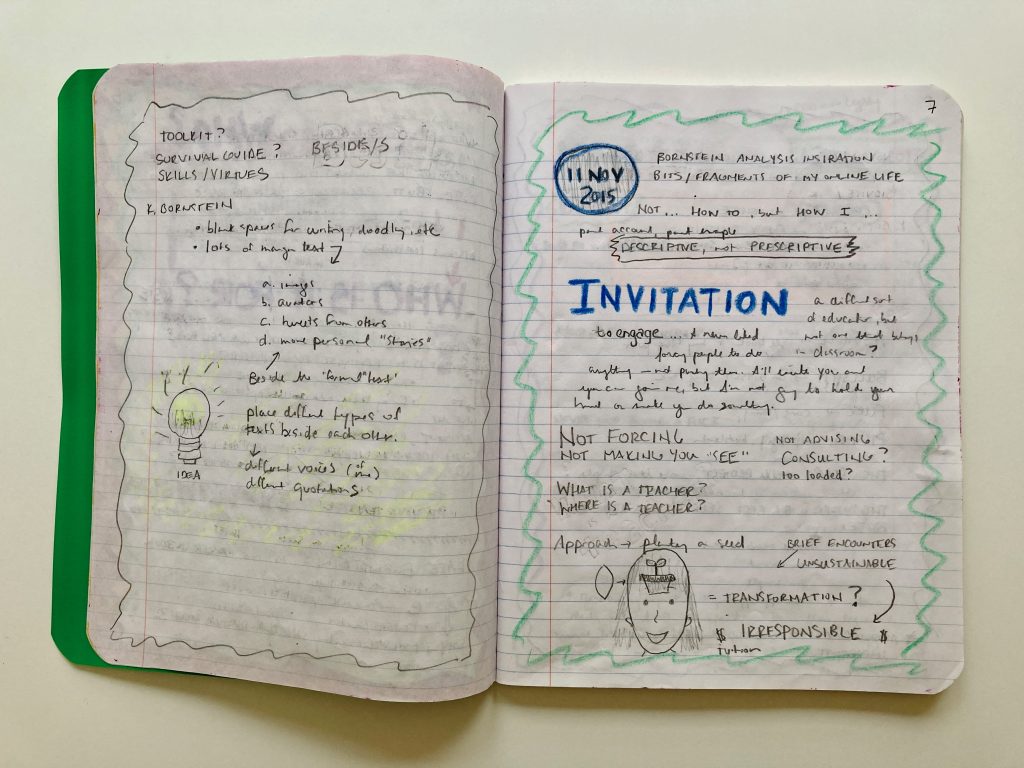
addendum, 18 april 2022: almost forgot to add this image from my notes for my memoir (still in progress) about my student and teaching life”
planting a seed, lower right
Instead of cropping out the key part — the picture of a plant growing inside a head in the lower right with the text, “planting a seed” — I decided to post the entire image. When I taught feminist and queer classes a decade ago, my aim was to plant seeds. Not to force ideas on students or to expect instant results — where they could immediately “get” something or be transformed, but to introduce ideas and offer up invitations that might, in the future, lead to transformation and deeper understandings.
Ran/walked the ford loop with Scott. Sunny and warm with a bright blue sky. Wonderful. Stopped at the 2 overlooks on the St. Paul side. Heard and saw rowers on the river! The first time this spring, I think. Also heard someone playing guitar on a rock below the Monument that juts out over the river. Heard lots of birds, encountered lots of walkers, some runners, a biker or two.
Right after we finished our run, as we walked by Becketwood, I saw something flash in the trees. At first I thought it was a squirrel jumping, but Scott said it was an owl! Excellent. It took me about a minute to see it, but when it flapped its wing, I did. My favorite part: the owl was facing the other way, but they turned their head to check if we were still there. What an awesome head swivel!
before the run
Although Entangled Life never lapses into polemics or preaching, the book has an evangelical message all the same: humanity is neither innately special nor truly dominant; rather, we emerge and are sustained by a web of interspecies interdependence and diverse kinship; and our human notion of individuality is chimeric. The book is a call to engage with fungi on their level. “Is it possible for humans, with our animal brains and bodies and language, to learn to understand such different organisms? How might we find ourselves changed in the process?” Like fungi, “‘[w]e are ecosystems that span boundaries and transgress categories. Our selves emerge from a complex tangle of relationships.”
The underlying questions of Entangled Life, and other mycophilic media today, are: How can we be more like fungi? How are we already like fungi? How can we, as Paul Stamets puts it, ally ourselves with the fungal kingdom? How can we mycologize ourselves and our world? How can we break down our waste for fuel and sustenance, rather than let it accumulate in garbage dumps, oceans, and bloodstreams? How can we organize ourselves flexibly and responsibly so each part of the social web gets what it needs? If we fail and our own species does not survive the next few centuries, we can at least trust that a resilient species of fungi will evolve to consume the copious remains of our civilization and renew the planet again.
The need for new understanding, metaphors for working together (and living together) — and NOT as individuals. Beyond Darwinism and survival of the fittest and competition. Survival of the fittest/dog-eat-dog world are dead metaphors.
Plague Notebook, Vol 11/ Sara Lynne Puotinen
Found this video from the BBC about the “wood wide web”:
Near the end, the voice-over says: “scientists are still debating why plants seem to behave in such an altruistic way.” Why are these collaborations and symbiotic relationships and networks understood as altruism? Looking up altruism, I found these definitions:
1: unselfish regard for or devotion to the welfare of otherscharitable acts motivated purely by altruism 2: behavior by an animal that is not beneficial to or may be harmful to itself but that benefits others of its species
Plants and fungi are not being selfless, if selfless means doing things for others that don’t benefit, or maybe even harm, you. I dislike the term altruism, btw. This is not sacrifice of individuals, or individual groups, for the good of the whole. The idea of altruism is tied up with the old, outdated understanding of us as individuals who either act selfishly or purely selflessly.
during the run
Tried to explain some of this stuff about mycelium to Scott. Also ranted about altruism. Mentioned how the discussion about the wood wide web focuses more on marveling at trees and how they communicate, and much less on the amazing fungi network and the cool stuff fungi do. Trees are the actors, with fungi only the medium. But, fungi are actors too, just in a way that we don’t see or understand as easily. Also ranted against TED talks and how formulaic and forced they seemed. Scott got distracted when I asked him what scientists who study trees are called. He couldn’t think of it. The particular type I was trying to remember was: forest ecologist.
after the run
Mushroom Hunting in the Jemez Mountains/ Arthur Sze
from The Glass Constellation
Walking in a mountain meadow toward the north slope, I see red-cap amanitas with white warts and know they signal cèpes. I see a few colonies of puffballs, red russulas with chalk-white stipes, brown-gilled Poison Pie. In the shade under the spruce are two red-pored boletes: slice them in half and the flesh turns blue in seconds. Under fir is a single amanita with basal cup, flarinannulus, white cap: is it the Rocky Mountain form of Amanita pantherina? I am aware of danger in naming, in misidentification, in imposing the distinctions of a taxonomic language onto the things themselves. I know I have only a few hours to hunt mushrooms before early afternoon rain. I know it is a mistake to think I am moving and that argarics are still: they are more transient than we acknowledge, more susceptible to full moon, to a single rain, to night air, to a moment of sunshine. I know in this meadow my passions are mycorrhizal with nature. I may shout our ecstasies, aches, griefs, and hear them vanish in the white-pored silence.
4.05* miles minnehaha creek path, between lake nokomis and lake harriet 40 degrees
*Scott’s watch said 4 miles, mine 4.1, so I’m splitting the difference here. Also did the .05 because my total miles was at a .45 and needed the .05 to round it out.
Ran with Scott along the Minnehaha Creek trail between lake nokomis and lake harriet. Nice. Not too cold or windy, relaxed. An easy pace with several walk breaks. I haven’t run this route in many years. Crossed over the creek several times, noticing the water: blueish gray, gently flowing, almost whispering its splashes.
before the run
At the end of my post from 2 days ago I decided on my project and, of course, I am already abandoning it, or maybe just wandering with it a little? This wandering is one joy of my undisciplined approach to writing/engaging/being in the world. The project/challenge: do a different B Mayer “Please Add to this List” experiment each day. Yesterday, I picked my first one: “Compose a list of familiar phrases, or phrases that have stayed in your mind for a long time–from songs, from poems, from conversation.”
I began a list:
You’ll get no commercials
There’s a new girl in town
As long as it’s gum and that’s for me
Life is life, and death but death, Bliss but bliss, and breath but breath
I am the wind and the wind is invisible
Think of a sheep knitting a sweater, think of your life getting better and better
Like sands through the hourglass, these are the days of our lives
Wake up in the morning, feeling sad and lonely. Gee, I got to go to school
What a world, what a world!
Heaven, I’m in heaven, and my heart beats so that I can hardly speak
Raindrops on roses and whiskers on kittens
What do you do when your kid is a brat?
Pious glory
The buzz saw snarled and rattled in the yard
I’m a wheel watcher
Remember I love you, I won’t be far away. I’ll just close my eyes and think of yesterday
I’ll be yours in springtime when the flowers are in bloom. We’ll wander through the meadows in all their sweet perfume
Of course you do
Eastbound and down, loaded up and trucking’
Hey y’all
trouble is inevitable, and the task, how best to make it, what best way to be in it
You were not there
All will be revealed
And you never will be
Tell all the truth but tell it slant
Try to remember the days of september
the boobie hatch
the worms crawl in, the worms crawl out, the worms play pinnacle on your snout
Miss Suzy had a steamboat, the steamboat had a bell. Miss Suzy went to heaven, the steamboat went to…
Then I stopped. I started thinking about “the worms crawl in, the worms crawl out” and remembered my sister Marji singing that to me when we were kids, then us gleefully singing it together. Something clicked. I thought about worms and dirt and death and graves and really gross things about bodies and being delighted in singing about those gross things and Diane Seuss’s commencement address and her invoking of these lines by Walt Whitman:
I bequeath myself to the dirt to grow from the grass I love, If you want me again look for me under your boot-soles.
I decided what I really want to do this month is study dirt. It’s fitting for April as I begin to notice dirt again as it emerges from under the snow. It also follows nicely from Oswald and her emphasis on physical labor — working in the dirt and gardening, getting your hands dirty — and minerals all the way down. And, it returns me to my extended exploration of both ghosts and haunting and earth/rock/stone/erosion. So many different ways to wander and wonder with this word!
I’ll start today with a little more on “the worms crawl in” song. Here’s how I remember singing it when I was a kid:
Did you ever think when the hearse went by that you would be the next to die? They wrap you up in thick white sheets bury you down 6 feet deep.
All goes well for about a week then your coffin begins to leak. The worms crawl in, the worms crawl out the worms play pinnacle on your snout.
Your stomach turns a slimy green. Pus runs out like thick whipped cream.
It starts getting fuzzy at this point in the song. It would end with something like, “And that’s where you go when you die.” I can’t quite remember. I decided to look it up. Found some interesting things about it. Here’s a brief summary from Wikipedia:
“The Hearse Song” is a song about burial and human decomposition, of unknown origin. It was popular as a World War I song, and was popular in the 20th century as an American and British children’s song, continuing to the present. It has many variant titles, lyrics, and melodies, but generally features the line “the worms crawl in, the worms crawl out”, and thus is also known as “The Worms Crawl In“.
And here’s a cover that adds many more lyrics than I remember and sounds like the Violent Femmes:
There are LOTS of variations of this song. Check out the comments on this post for some of them. I’m fascinated by this song as part of an oral tradition of poetry — the poem/words aren’t owned by any one poet, they travel and transform. The best (most compelling, memorable) are kept as people recite/sing it, the others discarded. What holds it all together is: “the worms crawl in, the worms crawl out.” If I’m getting it right, those lines are iambic dimeter — 2 feet of unstressed/unstressed.
This focus on the worms reminds me of Cornel West and how, in lectures and the film, The Examined Life, he liked to say:
For me, philosophy is fundamentally about our finite situation. You can define that in terms of being towards death, featherless two legged linguistically conscious creatures born between urine and faeces whose body will one day be the culinary delight of terrestrial worms. That’s us. Beings towards death. At the same time we have desire, why we are organisms in space and time, and so desire in the face of death.
When I was a kid, I loved singing this song, took delight in the grossness. It didn’t scare or haunt me with its reminder that I would die one day. Now, as a middle-aged adult, it doesn’t either, even as I encounter more death and reminders of death. I actually find it comforting (is that the right word?) or helpful to think about the relationship between bodies and dirt and worm food.
during the run
Because Scott and I were talking about many different things (most of which I can’t remember now), we didn’t talk about “the worms crawl in…”. Possibly we didn’t talk about it because he never sang the song as a kid and doesn’t find it fun now. Boo. I do remember remarking on all the brown and noticing the mulched leaves on the ground. Thinking about things that decompose or have decomposed.
after the run
Not much to add here, except this poem I found when searching, “worms and poetry”:
Ever since I found out that earth worms have taste buds all over the delicate pink strings of their bodies, I pause dropping apple peels into the compost bin, imagine the dark, writhing ecstasy, the sweetness of apples permeating their pores. I offer beets and parsley, avocado, and melon, the feathery tops of carrots.
I’d always thought theirs a menial life, eyeless and hidden, almost vulgar—though now, it seems, they bear a pleasure so sublime, so decadent, I want to contribute however I can, forgetting, a moment, my place on the menu.
Ran with Scott in Austin. Forgot to bring my running tights. This might have been the coldest temp I’ve run in with bare legs. It wasn’t too bad. Don’t remember much about my run except for discussing how to help aging parents.
Anything else? Gloomy, windy, some mist. Spring decided not to stay; winter’s back.
Slowly the fog did what fog does, eventually: it lifted, the way veils tend to at some point in epic verse so that the hero can see the divinity at work constantly behind all things mortal, or that’s the idea, anyway, I’m not saying I do or don’t believe that, I’m not even sure that belief can change any of it, at least in terms of the facts of how, moment by moment, any life unfurls, we can call it fate or call it just what happened, what happens, while we’re busy trying to describe or explain what happens, how a mimosa tree caught growing close beside a house gets described as “hugging the house,” for example, as if an impulse to find affection everywhere made us have to put it there, a spell against indifference, as if that were the worst thing— is it? Isn’t it? The fog lifted. It was early spring, still. The dogwood brandished those pollen-laden buds that precede a flowering. History. What survives, or doesn’t. How the healthiest huddled, as much at least as was possible, more closely together, to give the sick more room. How they mostly all died, all the same. I was nowhere I’d ever been before. Nothing mattered. I practiced standing as still as I could, for as long as I could.
The lifting of the veil reminds me of a quote from Alice Oswald that I read the other day on twitter:
“The Greeks thought of language as a veil which protects us from the brightness of things, I think poetry is a tear in that veil.” —Alice Oswald
After picking up FWA from college for spring break, drove back to Minneapolis and ran the Marshall Loop with STA. It feels like spring. Most of the snow has melted. The river was open and rippling in the wind. As we crossed the lake street bridge, I looked for the eagle that used to perch on the dead tree many years ago. I’m not sure I’ve seen eagles anywhere for some time now. Are they gone, or am just not seeing them?
Read some more of Dart, including this great part voiced by “the swimmer”. I love so much about this, but right now, I’ll just point out the third line as a stand alone poem: “into the fish dimension. Everybody swims here”
from Dart / Alice Oswald
(the swimmer)
Menyahari — we scream in mid-air. We jump from a tree into a pool, we change ourselves into the fish dimension. Everybody swims here under Still Pool Copse, on a saturday, slapping the water with bare hands, it’s fine once you’re in.
Is it cold? Is it sharp?
I stood looking down through beech trees. When I threw a stone I could count five before the splash.
Then I jumped in a rush of gold to the head, thought black and cold, red and cold, brown and warm, giving water the weight and size of myself in order to imagine it, water with my bones, water with my mouth and my understanding
when my body was in some way a wave to swim in, one continuous fin from head to tail I steered through rapids like a cone, digging my hands in, keeping just ahead of the pace of the river, thinking God I’m going fast enough already, what am I, spelling the shapes of the letters with legs and arms?
S SSS

    Slooshing the Water open and


MMM

for it Meeting shut behind me
He dives, he shuts himself in a deep soft-bottomed silence which underwater is all nectarine, nacreous. He lifts the lid and shuts and lifts the lid and shuts and the sky jumps in and out of the world he loafs in. Far off and orange in the glow of it he drifts all down the Deer Park, into the dished and dangerous stones of old walls before the weirs were built, when the sea came wallowing wide right over these flooded buttercups.
57 degrees? Wow, was I over-dressed. Shorts + tights + shirt + jacket. Ran with Scott through Austin, ending at the coffee place downtown (as usual). No snow on the ground, hardly any puddles on the sidewalk. Returned to Minneapolis in the afternoon: a mucky mess! Lots of snow and puddles. Still, spring is coming.
What a morning. After talking with one parent about anxiety, and another about the gamma ray that obliterated their small brain tumor, I only read a few pages today of Dart. Here’s some of my favorite lines:
woodman working on your own knocking the long shadows down and all day the river’s eyes peep and pry among the trees
when the lithe water turns and its tongue flatters the ferns do you speak this kind of sound: whirlpool whisking round?
woodman working on the crags alone among increasing twigs notice this, next time you pause to drink a flask and file the saws
Ran with Scott this morning. Sunny, spring-like. Lots of black-capped chickadees. I mentioned to Scott that lately I’ve only heard the fee bee call, but not the response. Notes that ascend, but never descend. Today, we also heard woodpeckers and cardinals. Yesterday, the river was covered with a thin sheet of ice; today it’s open again. We stopped at the falls and leaned over the stone wall. I could hear the creek water moving. Scott said he could see it; I hardly ever rely on my vision for things like that anymore.
As we were heading over the tall bridge, above the creek, that leads to the Veterans’ Home, Scott told me about a Sesame Street video with Luis he watched the other day. Scott watched a lot of Sesame Street as a kid; me, not so much. Was it because I had HBO and sisters older than me? Not sure. Anyway, in this Sesame Street clip Luis is helping Telly deal with his worries about forgetting a friend’s name. In giving advice, Luis is super chill and talks to Telly like he’s an equal person, not a freaked out little kid. Wow, I would love to be that chill.
The friend’s name is Alexander Cheesefloss Hollingsworth Cantaloupe the IV. Wow.
Our run was a combination of running and walking. I like running and walking, sometimes stopping to study things more closely. I should try to do more of these in the spring and summer. It’s especially fun doing them with Scott.
So, a few days ago I was reviewing a thread I had saved about meter and how you learn it. In addition to advice (memorize and speak it, move with it, think of it as swing notes in jazz, spend a lot of time breaking it down, focus on poems with very strong meter), many people discussed their struggle with hearing meter because of dialects and english not being their first language. One person mentioned a great essay by Nate Marshall about this, and I found it: A Code Switch Memoir. Nate Marshall describes how, as a young elementary school student, he would struggle with the set of questions on his vocabulary test that asked for the stressed syllable:
This absolutely stumped me. My grandmother, the librarian, was from Montgomery, Alabama and I often heard her pronounce words in ways unlike many of my white friends at school. Her friend, the Arab dude who ran Fame Food & Liquor a few streets from our house, had his own wild pronunciation. Even my mother, her daughter, would shift her vocal patterning on words and phrases depending on if she was talking to us kids after a long day at work or calling the police to report men drinking and shooting dice in the park across the street. The idea that words had specific patterns to be followed did not make sense to me, though I did not know how to articulate why.
I struggle with meter. Before reading this essay or the tweets on the meter thread, I hadn’t thought about my own experience with accents and dialects. I was born in the remote Upper Peninsula of Michigan, with its thick Yooper accent until I was almost 5. Then I moved to Hickory, North Carolina, a small southern town with thick southern accents until I was 9. Then southern Virginia (more of the south), and norther Virginia (more East Coast), and Des Moines, Iowa for high school (midwest twang). I went to college in southern Minnesota (lots of Canadian long os), and grad school in the LA area and Atlanta, Georgia. My dad grew up in the UP, my mom in St. Paul. Both of them spent a lot of their early adult life in Illinois (Rock Island, then Chicago). All of these locations and their distinctive dialects have crept into how I speak and how I hear words. Could this be one of the reasons meter is difficult for me? Maybe.
Speaking of accents, as Scott and I were running back from the falls, we talked about cycling and the amazing and unstoppable Tadej Pogačar. In one sentence, Scott said Pogačar’s name in 2 different ways: 1. sounds like Po GA cha and 2. sounds like: PO ga char. The tv announcers often use both of these pronunciations interchangeably. When I pointed it out to Scott, we talked about which one might be right. I mentioned my own name, Puotinen and how there’s the “right” way to pronounce it (as in, how it’s supposed to sound in Finnish), and then there’s the way I pronounce it. My version has much more of a puWAtinen sound, as opposed to the “right” way, which is more PUwotinen. Anyway, I thought I’d find a video of Tadej Pogačar saying his own name:
What do you hear?
I’m fairly new to studying poetry (only seriously since 2017), but my sense is that poetry people have lots of different feelings about meter and whether or not it’s still important. Here’s what Nate Marshall writes about it:
I’ve grown to have a great fondness for formal poetry. I still don’t understand metrical prosody very well but I understand its importance in the tradition. I was asked the question recently whether or not meter was still a useful tool in poetry. I think meter, like anything else, is at play when building the small geniuses of a poem. I think form and verse are important ways to give artistic challenges that can lead to great results. With that said, I believe that every poet and generation of poets has to define and redefine their relationship to form and the role it will play. Whether it’s the fourteen-line sonnet, the sixteen-line rap verse, the six-line stanza of a sestina, or the tercet of a blues poem each poet has to figure how to find and employ the weapons that offer each poem its truest voice.
3.5 miles around austin, mn 28 degrees 0% snow-covered
The return of a Christmas tradition: running with Scott around Austin on Christmas day. In past years, there has been snow on the ground, but not this year. Bare, brown, beautiful, at least to me. We ran alongside the cedar river, which was partly frozen in pale blue, and littered with geese or ducks or both. We also walked out on the dock by the old mill pond, which winds behind the library, the new fitness center, and the pool. The ice looked thin and barely frozen, but one person was walking across it, fishing. They didn’t fall in, at least while we were there. In Minneaplis, these docks are unmoored and left to float out into the middle of the lake. Here in Austin, they stay linked to land and accessible. It was very strange walking on the dock, over unmoving ice instead of water.
We started and ended the run at the parking lot by “skinner’s hill” and Scott told me, not for the first time, about sledding there in the winter. Scott: “This hill always seemed steeper when I was kid.” Me: “I bet it was a struggle walking back up that hill to the top!”
It was a nice Christmas. I wasn’t planning to, but I read a few of my poems from my new collection on ghosts to Scott’s parents. They really liked them. While some of their enthusiasm was just because they love me, I think some of it was also out of a genuine appreciation and connection with the words. Very cool.
Ran with Scott on a blustery, dark morning. It was not gloomy, but dark, with a veil over the sun. Strange and beautiful with the bare trees, brown gorge, blue river. Greeted Dave, the Daily Walker and few other runners.
10 Things I Noticed
Extremely windy crossing the franklin bridge, pushing us around, kicking up dirt that got in my eyes
After exiting the bridge, a wind gust from behind pushed us on the path. A wild ride!
The trail below, in the east flats, is finally visible
Last week, or sometime not too long ago, I mentioned a missing fence panel. Today, there was caution tape marking it off
The white line they were painting on the road earlier in the week was straight and bright
Running on the east side, looking over at the west and the bright, glowing white of the white sands beach
Crossing lake street bridge: small waves on the water — straight lines parallel to the shore — making it easy to determine the direction of the wind
A small pack of runners approaching us
The scraping of a ski pole on the asphalt from a roller skier in a bright orange vest
A passing runner, tethered to a dog
Here’s an essay? a prose poem? by Mary Ruefle from her collection, My Private Property:
Observations on the Ground/ Mary Ruefle
The planet seen from extremely close up is called the ground. The ground can be made loose by the human hand, or by using a small tool held in the human hand, such as a spade, or an even larger tool, such as a shovel, or a variety of machines commonly called heavy equipment. We bury our dead in the ground. Roughly half the dead are buried in boxes and half the dead are buried without boxes. A burying box is an emblem of respect for the dead. We are the only species to so envelop our dead. An earlier, more minimal, way to envelop the dead was to wrap them in cloth.
Besides burying the dead in the ground, we bury our garbage, also called trash. Man-made mountains of garbage are pushed together using heavy equipment and then pushed down into the ground. The site of this burial is called a landfill. The site of the dead buried in boxes is called a cemetery. In both cases the ground is being filled. A dead body in a box can be lowered into the ground using heavy equipment, but we do not consider it trash. When the dead are not in boxes and there is a man-made mountain of them we do use heavy equipment to bury them together, like trash. It is estimated that everywhere we walk we are walking on a piece of trash and the hard, insoluble remains of the dead. Whatever the case, the dead and the garbage are together in the ground where we cannot see them, for we do not relish the sight or smell of them. If we did not go about our burying, we would be in danger of being overcome.
Also buried in the ground are seeds, which we want to see when they emerge from the ground in their later form–that is, as plants. Plants rising from the ground are essential to life. To bury a seed it to plant it. When a seed is planted and not seen again, those who buried it are made sad. The anticipated plant of wished-upon seed has not materialized. It is dead, and remains buried. Heavy equipment is used to plant large expanses of ground with seed. When a whole field of shivering grain rises from the earth, there is a growing sense of happiness among those who buried the seeds. Happiness is also present when a tree emerges, or a tree that will bear fruit, or leafy green, edible plants that were formerly planted. When flowers arise from the ground, colorful and shapely in an astonishing variety of ways, the living are made especially happy. Not only are flowers admired for their outward beauty of form, but their scents are capable of overcoming us and therefore prized. Nothing, it seems, makes the living as happy as a flower. Flowers are among the most anticipated things on earth. For this reason, we separate the flower from the ground and present it to another to hold or to look at. After a while, the flower that has been separated from the ground dies, and we throw it in the trash. Flowers are often planted where the dead are buried in boxes, but these flowers are never cut. That would be horrible. Whoever did such a thing would be considered a thief. Those flowers belong to the dead.
Ran with Scott up the Marshall hill and around Shadow Falls on the east side of the river. Stopped a little short. Warmer this morning. Still humid. We both greeted Dave the Daily Walker. I felt over-dressed a few minutes in. Tried out my new Saucony’s: black with light pink soles. Very nice. I’ve wanted black shoes for a couple of years now.
10 Things I Noticed
River, 1: Running over the lake street bridge, the water was a few different shades of blue: dark blue near the bridge, then gradually lightening as it moved downstream
River, 2: The white heat of water through a break in the trees. Mostly woods, with one sliver of the river
River, 3: Sparkly, shiny, a cylinder of light traveling from one shore to the other
Passing by a full black garbage bag on the bridge
The clicking and clacking of roller skier approaching from behind
At least 3 different small packs of runners on the east side of the river
No rowers, no geese, no crows
My shadow, off the side, her pony-tail swishing
Passing lots of walkers on the bridge without worrying about covid
Leaving the house, about the start the run, admiring our front tree on full display: brighter than gold
Yesterday, I started working on a poem (or a series of poems?) based on my October focus on ghosts and haunting. I’ve decided to use my rhythmic breathing pattern as the form: couplets with 1 three syllable line and 1 two syllable line (3/2). Here’s a bit that I like about going over the same trail, again and again that doesn’t fit in my current poem (and maybe doesn’t quite work?):
run: 3 miles hike: 2 miles franklin loop + extra trails 56 degrees
Scott and I decided to run part of the franklin loop, and hike the rest of it on a few of the extra trails near it. We started by running north on the river road trail, crossing the lake street bridge, then continuing north on the st. paul side. We stopped to walk when we reached the steep road that descends to the paved trail that winds through the flats right beside the east shore of the river. When we reached franklin, we climbed the steps — so many steps! — and crossed the bridge. We stopped to read the plaque for the Winchell Trail then searched for the northern start of the Winchell Trail. We hiked the trail, even the part that extends below the railroad trestle — a first for me — all the way to lake street and the Minneapolis Rowing Club. Very cool!
We talked about all of the vision stuff I’ve been skimming for the past 2 days and the differences between peripheral and central vision. There Plant Eyes (Godin) + Brainscapes (Schwarzlose) + Downcast Eyes (Jay Martin) + The Mind’s Eye (Sacks). And we talked about what Scott has been reading on extroverts and introverts (Quiet, Cain). We talked about the relationship between the senses (like touch and sight), how we navigate using senses other than sight, and “Batman” and echolocation.
10+ Things I Noticed
A downy woodpecker. Heard it’s tap tap tapping first. I wondered if it was a squirrel pounding on a nut, then I saw it at the top of a dead tree. The tapping was rhythmic and persistent, reminding me of morse code or an old-fashioned typewriter
Loud thumping and knocking and slapping — steady and rhythmic — oars from a 8 person rowing shell*
Paths, dirt and asphalt, covered in yellow leaves
Cheering coming from a football game at St. Thomas
The coxswain instructing the rowers
A man and a woman walking in the east river flats. Overhead the man say, “We are experiencing a drought” or something like that
Scooters passing us on the trail, calling out, “on your left”
Dead leaves floating on the surface of the river. From high above on the Franklin bridge, they made a strange mottling pattern on the water
Smell: strong sewer gas coming out of a cluster of vents near the rowing club
Many limestone ledges, exposed. At one of these ledges, the drip drip dripping of water, slowly seeping down
Countless trails leading down to the river, created by seeping/draining water
The white sands beach, just off the winchell trail and far below the paved trail above, is steep and broad and has trash and recycling cans
From the shore at white sands beach: seeing the remains of the long-defunct meeker dam, which you can only see when the water is low
*Although I have written many times over the years about hearing the rowers below on the river, I have NEVER heard the sound of their oars slapping the water or the boat until today. What I was hearing before were their voices. It is very cool to hear the loud, awkward, unromantic, almost clumsy sound they make.
one more thing, added on 31 oct: I just remembered a moment during the hike/run that I don’t want to forget. Walking through the part of Winchell Trail that is wider, between the white sands beach and the minneapolis rowing club, I mentioned to Scott how, when I was a kid growing up in north carolina and virginia, I loved exploring the woods and semi-wilderness that existed at the edges of the many sub-divisions I lived in. I liked walking on trails that had already been made, not wandering through the thick woods, making my own path. I think I said something like, “I wanted to go where someone had already been.” Not sure if that quite captures the appeal of the already traveled path? Whenever I see a break in the trees, and a dirt trail winding somewhere, I long to take it. Or, if I don’t want to take it, I at least enjoy thinking about where it might lead. The path, created by countless feet tamping down the earth, or water descending to the river, is an invitation to imagine other worlds. Maybe also, I like it because it’s evidence that I am not alone, that others have been where I am, wanting to go deeper. To follow the trail they’ve made through their haunting (frequenting), is to connect and contribute to the reinforcing of that invitation. Will this make sense to future Sara? Does it make sense to present Sara? Almost.
Ran with Scott in Austin. 40 but sunny, so it didn’t feel too cold. Unless you were in the shade, which we weren’t for most of the run. Started at East Side Lake and ran on a trail that leads to Todd Park. I don’t think we saw anyone else on the trail. No bikers or walkers or runners. Is that right? What I remember most about it was running slightly uphill into the wind at the end and how beautiful the lake looked in the late morning sun. I don’t think it was sparkling, but it was calm and blue and dotted with geese.
4 miles minnehaha falls and back 58 degrees dew point: 55
Ran with Scott to the falls before the marathoners raced on the river road. Not too warm, but humid. A mile in, I already felt like a damp sponge. A nice run with lots of fall color. Saw at least 2 turkeys chilling in the parking lot, the same spot they were at last week. Heard a bird calling out as we entered minnehaha park. Might have been a red-breasted nuthatch. The falls were rushing but not quite roaring, the creek was higher but not high. Listened to the leaves crunch as I ran over them. Saw at least one roller skier and lots of volunteers getting ready for the race — the twin cities marathon. Anything else? I’m sure I heard at least one goose, avoided more than one squirrel. I recall looking down at the river through the thinning leaves and hearing some rowers.
random thing for future Sara to remember: “Out of an abundance of caution” (as they like to say at RJP’s high school), we got covid tests last week. The spit test. I have a lot of trouble spitting and filling up the cup. That, combined with my inability to see signs or anything else well at the testing site, makes getting these tests incredibly difficult for me. Spitting into a cup seems like a basic thing that everyone can do without thinking. Not me. I’m actually going to have to practice before we take another test — whenever that will be. I’m trying to see this as funny, because it is, but it’s hard to laugh when it’s so upsetting. Not just because I can’t spit, but because I can’t see — it’s a reminder of how bad my vision is getting.
All afternoon his tractor pulls a flat wagon with bales to the barn, then back to the waiting chopped field. It trails a feather of smoke. Down the block we bend with the season: shoes to polish for a big game, storm windows to batten or patch. And how like a field is the whole sky now that the maples have shed their leaves, too. It makes us believers—stationed in groups, leaning on rakes, looking into space. We rub blisters over billows of leaf smoke. Or stand alone, bagging gold for the cold days to come.
4 miles most of the franklin loop 68 degrees humidity: 81%
I love October. Today it looked like October but didn’t quite feel like it — almost, with crunchy, earthy-smelling leaves, but too warm. Scott and I walked to the river together then split up — I went north for the franklin loop, he went south for the ford loop. We met in St. Paul at the Marshall bridge and walked the rest of the way.
10 Things I Noticed
The leaves are thinning and more of the river is visible everywhere including the spot above the floodplain forest
2 rowers on the river
A class of kids and their teachers, biking on the trail, all wearing bright yellow vests
The guy that Scott and I used to see at the Y, walking around the track in the winter–this time he was walking near the trestle on the east side of the river
A guy pushing a stroller, walking a dog, taking up most of the path. When he noticed me approaching he moved over and muttered to himself, or to his kid, “I’m taking over the whole path”
Walking over the marshall ave/lake st bridge, looking down at the water: blue with a faint texture of ripples from the wind
The east side of the river has more color than the west side
The steps just past the trestle glowing with orange, red, and yellow leaves
The trail down to the Meeker Dam Dog Park glowing too, looking like THE fall scene, what I might describe to RJP as “so fall” in the same way I say certain trees are “so tree”
The trees at my favorite spot just up from the marshall bridge giving off an intense golden light
1 Thing I Didn’t Notice
Right after I met up with Scott, he called out “bald eagle!” I couldn’t see it before it flew away
I’m not sure what my theme will be for October — or, if I’ll have one. For now, here’s an October poem I want to memorize:
O hushed October morning mild, Thy leaves have ripened to the fall; Tomorrow’s wind, if it be wild, Should waste them all. The crows above the forest call; Tomorrow they may form and go. O hushed October morning mild, Begin the hours of this day slow. Make the day seem to us less brief. Hearts not averse to being beguiled, Beguile us in the way you know. Release one leaf at break of day; At noon release another leaf; One from our trees, one far away. Retard the sun with gentle mist; Enchant the land with amethyst. Slow, slow! For the grapes’ sake, if they were all, Whose leaves already are burnt with frost, Whose clustered fruit must else be lost— For the grapes’ sake along the wall.
Ran with Scott in Austin. It felt much warmer than 67 degrees. Very humid. The gate was open, so we ran through the county fairgrounds. Scott and the kids made it here, but I was on my trip up north, so I missed it. No cheese curds for me this summer. At the far end of the fairgrounds, dozen of geese were congregating in a treeless, empty field. Lots of geese in Austin, lots of geese up here in Minneapolis too. Sometimes, the sky is filled with their honking. Love that sound, and love this time of year.
Found this poem by Rumi on twitter the other day. I think this fits with my theme of approximate:
Out beyond ideas of wrongdoing and rightdoing is a field. I’ll meet you there.
Ran with Scott north on the river road trail to the trestle, through Bracket Park, then over to Dogwood Coffee. Great weather for a run. Not too hot or humid, hardly any wind, overcast. Saw Dave, the Daily Walker and after I called out to him, he greeted both us, remembering Scott’s name. Impressive, considering he’s only met Scott once, and it was when I introduced them while running by quickly about 2 years ago! Noticed a few red leaves. Heard the rowers below us. No geese (yet) or wild turkeys or large groups of runners. Some bikers and walkers and signs for an event by the river yesterday: “free rowing” and “free canoe rides.” It would have been fun to try the rowing. Oh well.
Here’s an updated version of the poem I posted yesterday. I’ve fit it into my five beat form. Not sure if it works yet, and I’d like to add more.
At the lake the fish in me escapes
All winter she waits barely alive iced under skin. By june restless. Together we enter the cold water but before the first stroke she’s gone reborn in endless blue remembering fins forgetting lungs legs january.
Ran by the county fairgrounds, a few schools, a very high creek (or “crick” as Scott’s mom pronounces it), and a few churches. Stopped in downtown Austin, right before reaching the Planter’s peanut mobile. Ended with some iced lattes at the coffee place across from the SPAM museum. Life looks almost normal here–except for the masks we wore when going inside anywhere. Lots of rain. Too much rain. Flash flood warnings. Over-saturated grass. Puddles. I remember that we talked a lot, but I can’t remember what we talked about.
walk: 2 miles run: 2 miles hike: 1.3 miles lake superior, north shore 70 degrees, sunny
Walked north along the Gitche-Gami State Trail, which runs for 28 miles (and eventually 86, all the way from Two Harbors to Grand Marais) beside Lake Superior with my dear friend from college, Michele. Turned around and ran back. Later, on the way to Grand Marais, stopped at Cascade Falls and hiked to a water fall, over a few bridges. Encountered 2 older women who asked us if we were having a reunion. When we said yes, they said they were too–ours was a reunion of 5 college friends who met 29 years ago, theirs was of 2 high school friends who met much longer ago than that–they didn’t say, but they were at least 15-20 years older than us. Very cool.
Ran with STA before I left for my trip up to Lake Superior and the North Shore. Over the lake street bridge, up the marshall hill, down the east river road trail, back over the bridge, through the minnehaha academy parking lot. Don’t remember anything about the run–we stopped very briefly at a light at the bottom of the hill; encountered someone walking into Black Coffee and Waffle Bar; and marveled at half of tree, on the ground, blocking the sidewalk, the remaining half looking completely dead inside.
Cool but humid. Ran through Austin with Scott. We were in town, but parts of it felt like running through the country, especially the parts with narrow, windy roads and no sidewalks. Reminded me of rural North Carolina where I lived from ages 4-9, and where I would, on the rare occasion, “run” with my mom. A fuzzy memory: asking to run with her, becoming separated when I couldn’t keep up, getting trapped for a few minutes by a loose, barking dog (no leash laws in rural early 1980s North Carolina). How much did the Austin landscape really resemble Hickory, NC? Probably not that much, but enough to trigger this memory and make me look around for any loose dogs that might be about to attack.
swim: 2 miles / 5 cedar lake loops cedar lake open swim 85 degrees
Back in Minneapolis in the late afternoon. Went to open swim at Cedar Lake. Wow, the water was warm near the shore. Almost too warm. Wore my new suit, my birthday suit–the one I bought with birthday money from Scott’s parents. The “birthday suit” joke never gets old for me. I remember turning 7 or 8 or 9 and getting a bathing suit for my birthday. I ran around the neighborhood, wrapped in a towel, looking like that was all I was wearing, and calling out to anyone nearby: “Want to see my birthday suit?” I’d open the towel, show them my suit, and laugh at their surprise–and relief, I’m sure, to see that I wasn’t naked. I was one of those irritating kids.
I think my central vision is getting a little worse. It’s harder to sight the orange buoys, even when the water is calm, the sun hidden. It doesn’t matter too much because I don’t really need the buoys to know where I’m going. I love my brain and whatever else in my body that’s allowing me to gradually adjust to this loss so that by the time it gets worse, I’ve already adapted enough that it doesn’t matter. Do most people have this experience when they’re losing something?
The swim was great. Earlier in the season, I was criticizing this lake, writing about how I wasn’t chill enough for it, but now I love it again. It feels more like a lake up north than one at the edge of Minneapolis. Gravel trails, no buildings, canoes and kayaks everywhere. What a great night for a swim! I felt buoyant and fast and confident. No planes flying overhead, circling like sharks. Only water and a clear landmark to sight: the split in the trees at the beach. Couldn’t see below me–at its deepest point, the lake is 51 feet down. I wonder if that’s anywhere near where I swim? Had a few encounters with vegetation. Scratchy.
Here’s a poem by Ellen Bass that I found on twitter. I’m posting it for the water image, but the idea of loving the world, in spite of its awfulness, resonates for me too.
to love life, to love it even when you have no stomach for it and everything you’ve held dear crumbles like burnt paper in your hands, your throat filled with the silt of it. When grief sits with you, its tropical heat thickening the air, heavy as water more fit for gills than lungs; when grief weights you like your own flesh only more of it, an obesity of grief, you think, How can a body withstand this? Then you hold life like a face between your palms, a plain face, no charming smile, no violent eyes, and you say, yes, I will take you I will you love you, again.
Thinking about the image of water as heavy, making the air harder to breathe. When I’m running, and it’s hot, the wet air feels heavy and thick on my skin. Oppressive. But when I’m in the lake, swimming, the water feels light, free. Breathing is much easier for me. Somehow, I don’t need to do it as much, even while I’m wearing a nose plug and can only breathe through my mouth. The more I swim, the less I need to breathe. Every five strokes, then every six or seven. To love life, I don’t want to hold it in my hands and look at it, I want to swim in it. What to do with this image/metaphor?
Ran downtown with STA during FWA’s clarinet lesson. Only 3 more and he’s done. He’s been taking them since 5th grade. 8 years. Wow.
Hot and bright sun, but we ran slow and steady so it was fine. Running over the Plymouth Ave bridge, saw a boat below. 1/2 mile later, saw the same boat just ahead. Anything else? Running on Nicollet Island, right in front of The Nicollet Island Inn, smelled something foul, like horse poop. Do they have carriage rides again at the Inn? Encountered lots of lyft scooters, some bikers, runners, walkers. A nice, easy, sweaty run.
run: 1.5 miles river road trail, north/south 76 degrees humidity: 80%/ dew point: 70
Before it started raining again, STA and I went out for a quick run. Today is our 25th wedding anniversary. Amazing. Everything felt hot and wet and thick, but I enjoyed it, especially running through the tunnel of trees.
swim: 2 miles/ 2 loops lake nokomis open swim 70 degrees overcast, then light rain
I love open swims when it’s overcast and rainy. No one else at the beach. The buoys easy to sight. The rain drops fascinating to watch from underwater. Tonight’s swim was wonderful. I might have done more if my watch hadn’t died and I didn’t have STA and Delia the dog waiting for me in the parking lot. Just like last night at Cedar, I was able to look through the water a few feet in front of me. Tonight I watched my hand as I stretched it out, noticing the bubbles it generated. I felt strong, especially my shoulders, as I plunged my hands into the water. I mostly breathed every 5, but in the first loop I did some every 3, then every 4. And, in the last loop, I did some every 5, then 6. At one point in the middle of the lake I had a scary thought: what if my kneecap displaced mid-lake? How would I push it back in place? Quickly, I realized this was unlikely and returned to happier thoughts about powering through the water and being able to see the buoys and the Indian takeout STA and I were planning to eat after the lake.
How to love like water loves when it’s impossible to even taste all the ghostly sediments each time you take a sip
Impossible to savor the salt in your blood the light and island shorelines in each living cell
When even the plainest mouthful tastes more of you than you of it
Sweetest of absences that frees in wave after wave debris of thought like the dead, the drowned, the vanished, and yet sails your lips on a voyage toward another’s, plying all luck and regret
Worship, splash, guzzle, or forget It clears any difference Stone washer and mountain dissolver that will outlive us, even the memory of all any eyes touched
Wasp and cactus in a desert Comet through outer space Sleep among all the cloud-shepherds’ children
A love so perpetually current it doesn’t care that you love without even knowing you love what you couldn’t survive three days without
How to love like that: wild dream-sparkler and meticulous architect of every snowflake Wise, ebullient, and generous as the rain
Deepest of miracles for a time borrowing and replenishing a self overflowing with fate
5 miles austin, mn Hog Jog 5 mile race route 72 degrees 80% humidity/ dew point: 66
Out the door by 7. Still hot. We ran the route for the 5 mile race they usually have for the 4th here in Austin. Stopped for a few walk breaks. In the shade it was fine, in the sun it was not. Very hot. We started at east side lake and ran, mostly on a trail, to Todd Park.
things I remember
STA talking a lot, which was nice; I’m usually the one having to talk
The sound of the boards on the bridge banging as we ran over them
Trying to quicken my cadence to match STA’s. Not to go faster, just to lift my feet more
A runner greeting us as we passed–“Good morning! It sure is getting hot”
STA telling me a story about a pedestrian bridge that collapsed a few years ago in london
Hearing a few firecrackers (already, at 7 in the morning) and joking that someone was pre-partying before the parade. Then we talked about how rarely we have had a drink before noon
Remembering past years of running in the race on this trail, especially the people–the heavy breather, the girl who stopped to puke near the end, the guy who ran fast, then stopped, then ran fast, then stopped repeatedly, all the women wearing shorts/skirt combos
Ran the downtown loop with STA while FWA was at his first in-person lesson at MacPhail since March of 2020. Downtown loop = stone arch bridge + st anthony main + nicollet island + boom island + plymouth bridge + west river parkway. A great afternoon for running, not too hot. We checked out the new park and the indigenous restaurant opening next month. Nice!
All morning, I was putting together a rough timeline of the history of the area, starting 12000 years ago when the glacial Lake Agassiz spilled over its edge and traveled through the River Warren all the way to St. Paul. For some time, I have been confused about conflicting dates I encountered–was the gorge formed 12000 or 10000 years ago. Today I learned more: 12000 years ago the River Warren eroded the softer sandstone under the limestone near downtown St. Paul which created the massive—apparently bigger than Niagra Falls–Warren Falls. For almost 2000 years the falls slowly traveled up the Mississippi River to the confluence (where the Minnesota and Mississippi Rivers converge, near Ft. Snelling). Then it split into 2 waterfalls, one followed the Minnesota River then fizzled after entering an existing river bed, the other followed the Mississippi River and slowly carved out the gorge, traveling 4 feet every year until things become more precarious and erosion accelerated–about 100 feet a year in the 1860s, right before the falls had to be shored up with a concrete apron in 1870. So, I guess you could say the gorge began forming 12000 years ago when the Warren Falls started it’s slow march from St. Paul, or you could say 10000 years ago when the falls reached Ft. Snelling and moved upstream to Minneapolis.
We ran by some of the entries in my timeline, like the Hennepin Avenue bridge–the first bridge to span the river, built by Franklin Steele in 1855 and replaced 3 times, or the Stone Arch Bridge, built by James J. Hill in 1885, or St. Anthony Main which is older than Minneapolis but became a part of it in 1872.
In Austin for Father’s Day. Ran with STA at the park by his parent’s house, trying to stay close in case the light rain turned heavy. Windy, slightly wet, humid. Noticed the remnants of a Juneteenth party at the park building–just a few bits of trash that missed the trashcan. Also noticed the gentle curves of the trail as it winds through the (almost completely) shade-less, square park. These curves make all the difference–well, I think the giant evergreen trees help too–spruce? pine? I better check with STA about what kind of trees they are. Barely felt the rain drops as we ran. Rain! They needed it in Austin. Yesterday, it was strange and unsettling to walk through the brittle, hard, thirsty grass. Up in Minneapolis, we need it too–and now, writing this in the evening, back home, it’s raining. No more 90s, tomorrow in the 60s. For a day or two, that’s fine with me.
I’ve posted this one before, but it’s worth posting again. A favorite of mine–poet and poem.
Ran with STA to the downtown coffee shop. Saw the “Peanut Mobile” parked outside of the SPAM museum and then was approached by an old guy wanting to talk. At first, it was fine, but then he inched too close and wouldn’t stop talking. Then, after he left, STA mentioned as he talked, the guy spit a lot. I’m vaccinated, so I am confident I’m fine, but I’m not ready for this type of normal. It bothers me how quickly we went from lockdown to completely open. Where is the gradual transition? Where is the space for being uncomfortable, for still wanting to keep distance, for acknowledging and working through the difficulty and fear and anxiety involved in learning to see people as more than covid-carrying weapons (ED’s loaded gun)? I am not ready for normal again. And who wants that old normal, anyway? I want something better, less harmful.*
The repetition of “when things return to normal” as if that normal, was not in contention. Was the violence against women normal? Was the anti-Black and anti-Indigenous racism normal? Was white supremacy normal? Was the homelessness growing on the streets normal? Were homophobia and transphobia normal? Were pervasive surveillance and policing of Black and Indigenous and people of colour normal? Yes, I suppose all of that was normal. But, I and many other people hate that normal. Who would one have to be to sit in that normal restfully, to mourn it, or to desire its continuance?
and
But I hear what they say and many others do as well, “Look we should never live the way we lived before; our lives need not be framed by the purely extractive, based on nothing but capital.” Everything is up in the air, all narratives for the moment have been blown open — the statues are falling — all the metrics are off, if only briefly. To paraphrase Trouillot, we want “a life that no narrative could provide, even the best fiction.” The reckoning might be now.
Searching for poems about “rock,” I found this great one. I like the multiple meanings of rock bottom here:
So this is what it comes down to in the end: earth and sand skimmed, trimmed, filleted from rocky bone, leaving only solid unshakeable bottom, what doesn’t in the end give in to the relentless hammer, whoosh, and haul-away of tides but stands there saying “Here I am here I stay,” protestant to the pin of its absolute collar, refusing to put off the sheen on its clean-scoured surface, no mourning weeds in spite of loss after loss–whole wedges of the continent, particles of the main plummeting from one element to the other and no going back to how things were once, but to go on ending and ending here.
It’s interesting to put this beside my above discussion about the before times and the after times. How does it and doesn’t it fit for me?
I’m also thinking about the literal bedrock of the Mississippi River Gorge: what is the deepest layer of rock? I think it’s St. Peter Sandstone, but I will gather together my research to verify.
STA and I drove over to the lake early to avoid the heat and then ran around it. Hot and sunny, but not too bad for me; STA was having some difficulty with his knee and hip, so not so good for him. Lots of people to dodge, mostly in packs of 2 or 3 or more. We weren’t trying to avoid them as much as just not run into them. The highlight of the run: passing 3 people standing near a pooping dog, hearing one of the people say: Such a big poop and right by a trashcan! Good dog! He said this in a voice that you usually hear when someone is praising a toddler. Okay, maybe I also liked feeling the breeze coming off of the lake and watching it glimmer and feeling almost normal and locking into a steady rhythm with my arms swinging the same amount and in perfect chorus with my legs. Oh–and I also remember stretching at a table near Sandcastle and noticing the light from the overhang reflecting on the pavement, making it glow a pale, pretty blue.
swim: just a quick dip in the drink (100 yards?)
I wanted to test out the water before open swim, which starts on the 15th!, so I decided to try a quick swim. It wasn’t that cold, just lots of waves from all the wind. My first time swimming since August of 2019. It felt like I never stopped, and strange and unknown at the same time. In other Junes the lake water has been clear, but not today. Couldn’t see a thing below me. Also hard to see above water. Time to prepare for vague shapes, and not knowing where I’m going, and trusting straight strokes. Always good practice and it makes every swim more exciting–will I get way off course? will the lifeguard have to come get me? I really hope that I can swim a lot this summer. Could I manage 100 miles? I’ll see. Open swim has expanded; I can swim 6 days a week. Minneapolis Parks is amazing.
Here’s a poem for this month’s theme of water and stone. Wow.
These are your stones, assembled in matchbox and tin, collected from roadside, culvert, and viaduct, battlefield, threshing floor, basilica, abattoir– stones, loosened by tanks in the streets from a city whose earliest map was drawn in ink on linen, schoolyard stones in the hand of a corpse, pebble from Apollinaire’s oui, stone of the mind within us carried from one silence to another, stone of cromlech and cairn, schist and shale, horneblende, agate, marble, millstones, ruins of choirs and shipyards, chalk, marl, mudstone from temples and tombs, stone from the tunnel lined with bones, lava of a city’s entombment, stones chipped from lighthouse, cell wall, scriptorium, paving stones from the hands of those who rose against the army, stones where the bells had fallen, where the bridges were blown, those that had flown through windows, weighted petitions, feldspar, rose quartz, blueschist, gneiss and chert, fragments of an abbey at dusk, sandstone toe of a Buddha mortared at Bamiyan, stone from the hill of three crosses and a crypt, from a chimney where storks cried like human children, stones newly fallen from stars, a stillness of stones, a heart, altar and boundary of stone, marker and vessel, first cast, lode and hail, bridge stones and others to pave and shut up with, stone apple, stone basil, beech, berry, stone brake, stone bramble, stone fern, lichen, liverwort, pippin and root, concretion of the body, as blind as cold as deaf, all earth a quarry, all life a labor, stone-faced, stone-drunk with hope that this assemblage of rubble, taken together, would become a shrine or holy place, an ossuary, immoveable and sacred like the stone that marked the path of the sun as it entered the human dawn.
This poem. Beautiful and powerful and haunting. I need to spend some time with it. So much to think about and reflect on. Here are two other things to put beside it:
Piece of rock; [fig.] thing which has a characteristic of a rock: unbreakable, inanimate, unfeeling, immovable, lack of consciousness, used to throw at things, used to break things, used in building structures.
Jewel; precious gem.
Grave; sepulcher; crypt; mausoleum; burial vault; [fig.] large stone covering the entrance of Jesus Christ’s sepulcher which was removed at the time of his resurrection.
Coffin; casket; solid enclosure holding a dead body.
Headstone; monument marking a grave.
Imaginary substance thought to be able to turn other substances into gold.
Phrase. “[Written / set / stamped] in stone”: unalterable; prescribed by fate; will of God.
gneiss (which has come up in a few different places for me in the last few days):
Gneiss is a foliated metamorphic rock identified by its bands and lenses of varying mineral composition. Some of these bands (or lenses) contain granular minerals that are bound together in an interlocking texture.
4.25 miles minnehaha creek trail + lake nokomis 71 degrees
Today is STA’s 10 year anniversary of running (his runnaversary); mine is tomorrow. We decided to celebrate them together by running part of the path where it all began in 2011: Minnehaha Creek Trail. What a beautiful day! Maybe a little too bright and warm, but it feels like summer, normal summer.
Running on the trail brought back memories of the kids when they were kids. We lived over by this trail, and not as close to the river, for 10 years. I walked and biked it with FWA and RJP countless times, probably mostly in the summer–to camps, to and to the lake. It was strange to be on this path—for the first time in almost a year–and notice all the differences, like how the trail travels under 28th avenue now instead of steeply climbing up to a crosswalk. As we ran on it, STA remarked on how you would never be able to tell there had been a different trail here unless you remembered it. Yes, the importance of remembering. I’m good at that. It’s strange to be visiting these known, yet unfamiliar, places in the same city in which I still live. Growing up, I never lived in a town for more than 5 years: 4 years in UP Michigan; 5 years in Hickory, North Carolina; 1 year in Salem, Virginia; 4 years in a northern Virginia suburb of D.C; 4 years West/Des Moines, Iowa–well, when I was in college in Minnesota, I still lived in West Des Moines for the summer, so I guess you could count that as 8 years. Anyway, after a few years in the LA area, and a few years in Atlanta, we moved to Minneapolis for good. We’ve lived here since the late fall of 2003, when FWA was 6 months old. He’s 18 now. Wow. I love this place, and I love it even more since I started running around it. Tomorrow is my official 10 running anniversary, so I think I’ll write about what running means to me tomorrow.
Remembering Today’s Run
Such a warm, bright sun. Annoyingly (to STA, I’m sure), I had to recite a few lines from the “Rime of the Ancient Mariner”–the part after the Mariner has killed the albatross and the whole ship is paying the price: no breeze, “all in a hot and copper sky/the bloody sun at noon/right up above the mast it stands/no bigger than a moon.” The part I recited was: “Day after day, day after day/we stuck, no breath, no motion/as idle as a painted ship/upon a painted ocean.” We were moving but the air was not. When in the direct sun, I remember feeling hot and stuck
Checking out the menu for Sandcastle and thinking about how we could get some beers and fries after some of my swims this summer
Feeling sad about the big willow tree just past the echo bridge–a tree that I’ve featured in at least 2 poems–was recently cut down. Bummer
Stopping a lot so STA could take pictures (he posted them on instagram). At one spot, we noticed how still the water was and how clear the reflection of the boat was on its surface. I remember mentioning the myth of Adonis and how he looked at his reflection–but, I should have known better; checking my log entries I found the entry where I first mentioned this story and it was Narcissus. Here’s my entry from just over a year ago:
a mirror reflecting the fluffy clouds. I imagined that the water was another world, doubled and reversed, like in May Swenson’s great poem, “Water Picture“: “In the pond in the park/ all things are doubled:/ Long buildings hang and/ wriggle gently. Chimneys/ are bent legs bouncing/ on clouds below.” Love how “In the pond in the park” bounces on my tongue. I kept glancing over at the water and admiring its smooth beauty and how it looked like a mirror. I started thinking about the Greek myth (which I couldn’t really remember) about the hunter who looked at his reflection. I looked it up just now–of course it was Narcissus. Here’s an interesting article I found that discusses him and the idea of mirrors in water–it even has a picture of Salvadore Dali looking into the water.
A new month, a new theme. Last month was birds; this month is water and stone. Today’s poem is one I posted on this log a few years ago (I think), but it’s time to revisit it:
STA and I drove to the Bohemian Flats parking lot then ran to downtown Minneapolis: starting on the steep hill, past the Guthrie, under the Hennepin Avenue bridge, over the Plymouth bridge, through Boom Island Park, over the railroad bridge, over the North line tracks, on the cobblestones in St. Anthony Main, over the Stone Arch Bridge, up past the Guthrie again, and down the steep hill. My IT band was tight afterwards, but it feels okay now. I guess I need to keep taking it easy. A great run. It almost felt normal. A few things I wrote down in my plague notebook to remember: ran up the entire steep hill, noticed the calm water, heard so many birds everywhere–not cardinals or robins or chickadees, maybe finches and warblers and sparrows? Lunging dogs, porta potty stops, and the rush of the light rail crossing the Washington Avenue Bridge as I stretched in the flats parking lot.
Right as we reached the Stone Arch Bridge, I remembered Scott saying that the past tense of glow should be glued not glowed (he said this after I remarked on how someone’s bright yellow vest glowed in my peripheral vision), which made me wonder if “glued” might be an archaic past tense, which then made me think about the archaic words in “The Rime of the Ancient Mariner,” like swound–“The ice was here. The ice was there./The ice was all around./It cracked and growled and roared and howled/like noises of a swound.” Swound is an archaic version of swoon, but I like thinking of it in the context of the poem as a collection or gathering of swoons–noises of a swound would be all the noise you’d hear when a bunch of people fainted, like maybe in a revival tent or at a pentecostal service. A rushing and wailing and whooshing and thudding and gnashing.
Yesterday I finished memorizing the first section of “The Rime of the Ancient Mariner”– all 80 lines. Last night I recited it to STA on the deck while we drank some beer. Then we listened to Iron Maiden’s epic, 13+ minute tribute to it. Very cool. It was hard to make out the words because they were sung so fast, but it was exciting when I heard “wedding guests” or “hermit” or “the albatross” or the dice. Nice! I’m going to try memorizing some (or all) of the next part today. I’m a little reluctant because I don’t want memorizing this epic poem to consume me. I’ll see how I feel after today.
In the midst of memorizing this poem, I came across Robert Frost’s “The Oven Bird,” and wondered, why the hell is it called an oven bird? Looked it up: it’s because the nest of this bird is shaped like an old-fashioned oven. It has a small round hole for an opening.
To celebrate being fully vaccinated, Scott and I ran the Ford loop together. Today marks 2 weeks since our second pfizer shots.
Things I Remember
The river looking blue and calm
Seeing a robin’s red breast as they walked down the path in front of us
Hearing but not seeing some rowers starting out from the rowing club dock
Thinking about the eagle that used to perch on the dead branch right by the lake street bridge as we walked down the steps from the bridge to the trail
Noticing how big some of the houses on the east river road were
Hearing the water at shadow falls gushing down in the ravine as we ran up the big hill towards Summit Avenue
Stopping at the overlook and admiring the view while talking about how having more than a billion dollars was not evidence of success but of unconscionable excess
STA counting the pillars on Ford–according to him there are 101. Today he only counted 98
As we headed down the hill back to the trail hearing geese honking
Waving and greeting lots of people
Seeing the robin and their red breast on the walk in front of us, reminded me of Emily Dickinson and her poem about the bird that came down the walk one day and did not know she saw, but since I already posted that one in March, I looked for another ED robin poem. I like this one:
If I shouldn’t be alive/ Emily Dickinson
If I shouldn’t be alive When the Robins come, Give the one in Red Cravat, A Memorial crumb –
If I couldn’t thank you, Being fast asleep, You will know I’m trying With my Granite lip!
2.1 miles river road trail, south/42nd st, west/44th ave, north 63 degrees
A short run in the afternoon with STA. Lots of bikes, not too many runners or walkers. Talked about being useless and doing useless things as forms of resistance to capitalism (me) and as clever instagram descriptions (STA). Also, I complained about Mother’s Day and how much I dislike “special days” like it or birthdays–partly because my mom is dead, partly because they create unrealistic expectations about what it means to celebrate and be celebrated.
Here’s one of the first poems I read from J. Drew Lanham’s Sparrow Envy last week:
Octoroon Warbler/ J. Drew Lanham
As a taxonomic committee of one, I alone have decided that the past transgressions of long ago dead and rotted bird watchers must be amended. That it is my sole responsibility—and pleasure— to right the wrongs of racist slave-holding artist ornithologists. of genocidal complicit naturalists. of grave-robbing skull-fondling phrenologists. of the lot of white-supremacist men with the self-serving penchant for naming things after themselves. I hereby declare my solo vote singularly unanimous. Everything I decide here and now— passes. So shall it be written. Let it be done. Word is bond. My opinions good as any other treaty signed in the shifting sand of time. I do hereby exchange, alter or replace the names of the birds that follow. Their former identities by patriarchal rule to be expunged. That they should have new identities by my demand. Bachman’s sparrow, denizen of long-leaf pine savannah; of wiregrass, of fire-kissed sandy ground shall be once again be “pine woods.” A true great again recovery worthy of celebration! And whilst I’m releasing species from bondage, consider the likely forever gone warbler of the same Charleston preacher’s human-chattel-possessing label, can we not do better? Yes. “Swamp Cane warbler,” appropriately by design of damp dank place it so chose when still in existence, escaping notice. I would have suggested “Tubman’s warbler,” but then why make it any easier to erase blackness when extinction has already done the job? LeConte’s Sparrow will hence forward be “orange-faced.” The brown-backed secretive skulker of wet weedy rank with tangled overgrown fields, hider in thickety traces, deserves better fate than linkage to a Confederate armorer working to put in place a permanent apartheid nation. Townsend’s Solitaire, thrush-esque thing of western slope migration is now “Up-and-Down Solitaire.” Mobile altitudinal propensity taken into full account. The lemon yellow-headed black and white western jewel of a warbler tagged by that same Indian grave-robbing man, shall now be a “Doug Fir” specifically, knowing for its tied to evergreen boughs. No disarticulated Native heads required. To correct an oversight of Manifest Destiny, (and opening the western door to indigenous genocide not accepted), behold Clarke’s Nutcracker, the capacious resourceful intelligent corvid, given title by the fire-haired Captain of the Corps! Henceforth shall be York’s Crow. Designated the first bird so named for a man of color About damn time the brother got credit for saving the Corps of Discovery’s always imperiled bacon. Even as property his contributions went largely without merit. To even the score a bit more redact the other leader Lewis from the northern Rockies woodpecker. He of Trail of Tears Cherokee removal infamy. Christen the gorgeous picid Sacagawea’s Woodpeecker instead. As for John James Audobon, “JJ,” if I might? He of the posed painted birds, of ego larger than life to go along with his Baby Elephant folio.
What does a slave-owning, man-passing for white might deserve? What might the demigod of birdome merit after all these years? Let his name now be struck. For malfeasance to humanity. For being prickish and a generally abhorrent man, Audubon’s orioles shall be Rio Grande. The sea-going petrel with the artist’s moniker shall now be “Warm-Sea Wanderer.” An identity worthy of its tropic-trotting status. And last but not least, for review the yellow-rumped warbler of occidental “race,” occurring beyond the Mississippi to points beyond that. Since Johnny couldn’t bear the very thought of interracial miscegenation, let’s call the butter-butted bird what it is in hindsight of his own mixed-raced denial. The Octoroon Warbler. Thus, I proclaim on this very day, whenever this ruling shall be read on whatever future date, that we remember the identity of the birds for what they are, and never forget the signs of past imperfections too, to not repeat the hubris of taking good for granted. But letting creatures have their own names. No interference from haters required.
Nearly one-third of the wild birds in the United States and Canada have vanished since 1970, a staggering loss that suggests the very fabric of North America’s ecosystem is unraveling. –The New York Times (September 19, 2019)
As the world’s cities teem with children—flooding our concrete terrains with shouts and signs—as the younglings balance scribbled Earths above their heads, stand in unseasonal rain or blistering sun,
the birds quietly lessen themselves among the grasslands. No longer a chorus but a lonely, indicating trill: Eastern meadowlark, wood thrush, indigo bunting— their voices ghosts in the chemical landscape of crops.
Red-winged blackbirds veer beyond the veil. Orioles and swallows, the horned lark and the jay. Color drains from our common home so gradually, we convince ourselves it has always been gray.
Little hollow-boned dinosaurs, you who survived the last extinction, whose variety has obsessed scientific minds, whose bodies in the air compel our own bodies to spread and yearn— how we have failed you.
The grackles are right to scold us, as they feast on our garbage and genetically-modified corn. Our children flock into the streets with voices raised, their anger a grim substitute for song.
Ran with STA this morning. Very nice. Noticed the river as we crossed Lake Street. It was brown and calm. No rowers this morning. Are we too early or too late to see them? Ran in reverse today and noticed many houses for the first time. Over-sized houses on over-sized lots. STA pointed out three benches in a half circle, facing the sun with no trees, sitting in a triangle of grass just off of Franklin near a bus stop. He said he hadn’t noticed them before. I don’t think I have either. They don’t look like much fun, sitting there facing the sun–except for maybe on bright, warm-ish days in the winter. Crossing the Franklin bridge we noticed how the sky north of us, over downtown, had an ominous purple tint, while the sky south of us, closer to the falls, was a placid blue. Stopped at STA’s favorite spot–a big tree above the river road–and noticed how much the leaves by the gorge have filled in. Goodbye view to the other side. I can’t remember when it happened during the run, but I remember a robin right in front of us on the path and STA jokingly calling out, “Get outta here, you Robin” and then as it scampered or scuttled? off, STA remarking, “I like how it couldn’t be bothered to fly.” As I remember it, the Robin kind of looked like someone crossing the street and doing that strange hurrying but not hurrying walk run.
may’s exercise?
A new month, which means a new monthly exercise. March was Emily Dickinson, April Mary Oliver. At first I was thinking Robert Bly for May because STA and I just watched this awesome documentary about him on the local PBS channel, but Bly seems more fitting for the winter. Tentatively I have decided not to focus on a single poet, but on a theme: birds. I’ve been reading a great collection of bird poems by the ornithologist J. Drew Lanham, and slowly watching/listening/reading a lecture from Marta Werner on her project, Dickinson’s Birds. Both ED and MO feature birds in many of their poems, and so do so many other poets. Will I want to read about birds for the entire month? Not sure yet.
GROUP THINK: NEW NAMES FOR PLURAL BIRDS/ J. Drew Lanham
A Hemorrhage of cardinals red-staining the backyard A Consideration, Council or Congress of crows; call them anything but murderers, please. A Whir of hummingbirds A Riff (or Mood) of any bird that’s blue A Thicket of sparrows A Mine of goldfinches A Skulk of thrashers A Cuddle of chickadees. (Cute is a definite field mark.) A Thuggery of jaegers A Piracy of skuas A Crucifixion of shrikes A Mattering of Black birds— Lives ignored, hated and dissed. How did darkness become so despised? A Melody of thrushes A Palette of painted buntings An Audacity of wrens— finding every crevice ever created and signing loudest about that fact. A Vomitus of vultures. A Swarm of flycatchers— Empidonax “spuh” be damned. A Tide of shorebirds— rising more than falling, wishful thinking on past abundance; knots, whimbrel, peeps, plovers, curlews darkening salt marsh skies. A Privilege of all birds white— though it’s not their fault for almost always being given the benefit of doubt or being mostly respected; usually liked. An Immigration of starlings, loved to tears in distant murmuration but deplored to legalized killing on the street. Deprived of breath without penalty or cause. A Herd of cowbirds. Given the gift of never parenting. Evolutionary brillance. A Flurry of snowbirds; juncos my grandmother claimed she pitied and threw them handfuls of grits. A Wandering of warblers An Envy or swallow-tailed kites A Front of waterfowl —forecasting gray winter days to come. A Cache of nuthatches A Wheeze of gnatcatchers A Throne of kinglets (or court if you please). A Missing of Carolina parakeets, too smart for their own good. An Echo of passenger pigeons —billions dwindled to none. A Memory of ivory-bills in praise of the Great Lord God maybe not all gone. An Inclusion of mixed migratory flocks, hopefully integrated by choice and not forced to co-mingle in whatever gulfs they must cross. Wondering what they would call themselves? if there is disagreement over plumage color, wing bar width, leg hue, call tone or habitat of origin? How would they name us? Would the tables turn? Am I a greater Southern Black-backed two-legged thing? You perhaps a common White-fronted human being? Someone else named after a passerine of respectable fame or raptor of murderous infamy? Here in gratitude of everyone there ever was— Whatever the name. A Love of birds. My collective label.
some terms I looked up after reading this poem:
a thuggery of jaegers/piracy of skuas:
Parasitic Jaegers, known as arctic skuas in Europe, are fast-flying relatives of gulls with a piratical lifestyle. They breed on the Arctic tundra, where they prey mainly on birds and their eggs. They spend the rest of the year on the open ocean, harrying other seabirds and sometimes attacking in groups, until they give up their catch. Jaegers come in several color morphs. Immatures can be extremely difficult to separate from other jaeger species.
The Loggerhead Shrike is a songbird with a raptor’s habits. A denizen of grasslands and other open habitats throughout much of North America, this masked black, white, and gray predator hunts from utility poles, fence posts and other conspicuous perches, preying on insects, birds, lizards, and small mammals. Lacking a raptor’s talons, Loggerhead Shrikes skewer their kills on thorns or barbed wire or wedge them into tight places for easy eating. Their numbers have dropped sharply in the last half-century.
Empidonax “spuh” is twitcher’s jargon (committed birdwatchers who travel far distances to see a new species to add to their “life list” Empid (US): any of the flycatchers of the genus Empidonax, infamous among North American birders for being difficult to identify in the field without the aid of vocalizations. spuh: birds that are only identifiable to genus level
Juncos:
Juncos are neat, even flashy little sparrows that flit about forest floors of the western mountains and Canada, then flood the rest of North America for winter. They’re easy to recognize by their crisp (though extremely variable) markings and the bright white tail feathers they habitually flash in flight.
passerine (def): (adj) relating to or denoting birds of a large order distinguished by feet that are adapted for perching, including all songbirds. (noun) a perching bird
Thinking about collective nouns for animals and insects, partly because of this poem, partly because I love collective nouns, and partly because of the ending to this short essay, “Seeing” from Late Migrations that I read yesterday:
Farther down the trail, my beautiful niece, whose eyes see twenty-twenty even without glasses, paused before a fallen tree covered with shelf fungi. She pointed to a ladybug nearly hidden in the folds. “When I was hiking in Colorado, I saw a whole bunch of ladybugs, so I checked Google to see if there’s a name for a group that gathers in one place,” she said. “It’s called a ‘loveliness.'”
Guilty! Guilty! Guilty. All 3 counts. Thank god. I cried when I heard the judge, from both grief and relief.
Ran through the neighborhood with STA in the afternoon. Cold and windy. I don’t remember much, except for STA’s description of the video project he’s working on. Anything else? A for sale sign at the house on the next block, a cracked sidewalk, a few dogs, a kid outside the daycare at the church on 43rd and 32nd, the warm sun, the brisk wind, a fat tire hauling ass on Edmund, a truck stopped at the stop sign unwilling to move until we passed even though we were still far from the intersection.
Reading an article about Mary Oliver last week, I was struck by this passage:
…it’s tempting to be blinded by the more immediately visible parts of speech: the monolithic nouns, the dynamic verbs, the charismatic adjectives. Mousier ones—pronouns, prepositions, particles—go ignored. In “Cold Poem,” for instance, from her 1983 collection American Primitive, overlooking the “we”s and the “our”s, of which there are many, is almost irresistible. One is tempted instead to luxuriate in the broader strokes and be seduced by the wholesome imagery: “I think of summer with its luminous fruit, / blossoms rounding to berries, leaves, / handfuls of grain.” There’s a mental manipulation to Oliver’s rhapsody, a mesmeric quality, as though by conjuring these organic elements, she leaves her readers vulnerable to hypnotic suggestion. Do you feel relaxed? Are you ready for nature? But you miss a lot by allowing the large language to overshadow the more muted connective tissue.
Tell me about despair, yours, and I will tell you mine. Meanwhile the world goes on. Meanwhile the sun and the clear pebbles of the rain… Meanwhile the wild geese, high in the clean blue air…
Meanwhile is a cousin to my favorite word, besides. Maybe more so than besides, it suggests that there are other lives/worlds/events happening too, that it is not just about you.
Anyway (adverb): as an additional consideration or thought
from “Flare”
Anyway, there was no barn. No child in the barn.
from “Don’t Hesitate” in Swan
It could be anything, but very likely you notice it in the instant when love begins. Anyway, that’s often the case. Anyway, whatever it is, don’t be afraid of its plenty. Joy is not made to be a crumb.
Anyway leaves room for other ideas, maybe even encourages you to get over whatever idea you’re fixated on.
Everyday (adjective): ordinary note: not the same as every day, which means each day and evokes routine, repeated practice
from “Work”
Everyday—a little conversation with God, or his envoy Everyday—I study the difference between water and stone. Everyday—I stare at the world
Everyday—I have work to do:
It took me some time to realize that MO meant everyday, as in ordinary time (which she discusses in Upstream), and not every day as in habit, repeated practice. The distinction seems subtle, but rhetorically more powerful to start each line with Everyday instead of Every day. And, everyday suggests a more distant connection with specific time. It isn’t that you do these things each day on repeat, but that you do them when in the realm of the ordinary–does that make sense?
But, actually, I like to read her use of everyday/every day as both at the same time, or as both being possible meanings: the ordinary world (which is inside the clock, is ordered time, and is disciplined and useful), and the creative work she does every day that is both ordinary and extraordinary–the work of paying attention, being astonished, and telling others about it.
As I’ve been reading MO’s poems, I’ve been sensing this tension over what “work” means and the relationship between her work (poems), the world, and Eternity. I feel like the double-meaning/ambiguity of everyday/every day might be speaking to this tension—maybe it’s not intended to be resolved but to puzzled over and that’s part of the work? Or, maybe the ambiguity of it is about our circling around it, always looping through everyday and every day?
Here’s an example of MO expressing the tension between her work, the poem, and the world:
From The Book of TIme
1. I rose this morning early as usual, and went to my desk. But it’s spring,
and the thrush is in the woods, somewhere in the twirled branches, and he is singing.
And so, now, I am standing by the open door. And now I am stepping down onto the grass.
I am touching a few leaves. I am noticing the way the yellow butterflies move together, in a twinkling cloud, over the field.
And I am thinking: maybe just looking and listening is the real work.
Sometimes 46 feels cold, but not today. Sunny and calm with a symphony of birds calling and trilling and chirping and drumming. Ran with STA through the neighborhood. I don’t remember much of what I saw or what we talked about. Just lots of birds….oh–and bikes. We saw at least 2, maybe 3, pelotons on the parkway or the trail. Yesterday during our morning walk with Delia, we saw a group of 15 or so bikers speeding down the road, their wheels whirring and buzzing. Also yesterday we saw some rowers racing on the river! Excellent. The rowers were so loud, yelling to each other as they tried to win.
Reading more Mary Oliver and thinking about the idea of the flare–a sudden burst of light, or understanding, or ecstasy, or illumination, or lifting out and free of yourself, or experiencing eternity “now, now, now, now.” Found this poem in Dream Work:
Sunrise
You can die for it — an idea, or the world. People have done so, brilliantly, letting their small bodies be bound to the stake, creating an unforgettable fury of light. But this morning, climbing the familiar hills in the familiar fabric of dawn, I thought of China, and India and Europe, and I thought how the sun blazes for everyone just so joyfully as it rises under the lashes of my own eyes, and I thought I am so many! What is my name? What is the name of the deep breath I would take over and over for all of us? Call it happiness, it is another one of the ways to enter fire.
Reading through more of MO’s The Leaf and the Cloud and noticing her reference to circles, which has me thinking about her love of Emerson (who wrote, Circles), and of how her use of circles does or doesn’t fit with ED and her idea of Circumference. More reading and thinking is needed.
2.8 miles river road trail, south/turkey hollow/Winchell Trail, north 58 degrees
Ran with STA in the afternoon. Sunny and warm! We were able to run on both the upper and lower trails. Not too crowded. I remember the river looking pale blue–such a pretty complement to the light green limbs below us. Encountered a few annoying bikers and a roller skier who refused to move over. Boo–normally, I love roller skiers. I can tell that it is going to take some time for me to love the world again–especially the people in it who don’t seem to care about the amount of space they take up or about the effects of their actions on others. But, I believe I can get there. Maybe Mary Oliver can help?
Speaking of MO, here are some useful words for enabling me to think and reflect on what work is for her:
Everything/ Mary Oliver from New and Selected Poems, Vol 2
I want to make poems that say right out, plainly, what I mean, that don’t go looking for the laces of elaboration, puffed sleeves. I want to keep close and use often words like heavy, heart, joy, soon, and to cherish the question mark and her bold sister the dash. I want to write with quiet hands. I want to write while crossing the fields that are fresh with daisies and everlasting and the ordinary grass. I want to make poems while thinking of the bread of heaven and the cup of astonishment; let them be songs in which nothing is neglected, not a hope, not a promise. I want to make poems that look into the earth and the heavens and see the unseeable. I want to honor both the heart of faith, and the light of the world; the gladness that says, without any words, everything
from Mysteries, Four of the Simple Ones
And what else can we do when the mysteries peresent themselves but hope to pluck from the basket the brisk words that will applaud them
What I Have Learned So Far
Meditation is old and honorable, so why sould I not sit, every morning of my life, on the hillside, looking into the shining world? Because, properly attended to, delight, as well as havoc, is suggestion. Can one be passionate about the just, the ideal, the sublime, and the holy and yet commit to no labor in its cause? I don’t think so. All summations have a beginning, all effect has a story, all kind- ness begins with the sown seed. Thought buds toward radiance. The gospel of light is the crossroads of–indolence, or action. Be ignited, or be gone.
from Sometimes/ Red Bird
Instructions for living a life: Pay Attention. Be Astonished. Tell About It.
from “Work” in The Leaf and the Cloud
3.
Would it be better to sit in silence? To think everything, to feel everything, to say nothing? This is the way of the orange gourd. This is the habit of the rock in the river, over which the water pours all night and all day. But the nature of man is not the nature of silence. Words are the thunders of the mind. Words are the refinement of the flesh. Words are the responses to the thousand curvaceous moments— we just manage it— sweet and electric, words flow from the brain and out the gate of the mouth.
We make books of them, out of hesitations and grammar. We are slow, and choosy. This is the world.
7.
So I will write my poem, but I will leave room for the world. I will write my poem tenderly and simply, but I will leave room for the wind combing the grass, for the feather falling out of the grouse’s fan-tail, and fluttering down, like a song.
Ran with Scott this almost afternoon. Windy and bright. I remember hearing some calling–not drumming–woodpeckers and a couple of cardinals, maybe a robin, a few warblers. Noticed some dogwood blossoms, a lot of green grass. Ran by turkey hollow. No turkeys. Didn’t see the river or many other runners. Did see a surrey over on the bike path as we ran up edmund just past turkey hollow. It must be spring. Anything else? Ran on the grass between Becketwood and 42nd in the soft, muddy dirt straight into the wind.
I’m really enjoying my time with Mary Oliver. Yesterday I checked out her collection West Wind from the libby app for my library. Such convenience!
Stars from West Wind/ Mary Oliver
Here in my head, language keeps making its tiny noises. How can I hope to be friends with the hard white stars whose flaring and hissing are not speech but pure radiance? How can I hope to be friends with the yawning spaces between them where nothing, ever is spoken? Tonight, at the edge of the field, I stood very still, and looked up, and tried to be empty of words. What joy was it, that almost found me? What amiable peace?… Once, deep in the woods, I found the white skull of a bear and it was utterly silent- and once a river otter, in a steel trap, and it too was utterly silent. What can we do but keep on breathing in and out, modest and willing, and in our places? Listen, listen, I’m forever saying. Listen to the river, to the hawk, to the hoof, to the mockingbird, to the jack-in-the-pulpit-— then I come up with a few words, like a gift. Even as now Even as the darkness has remained the pure, deep darkness. Even as the stars have twirled a little, while I stood here, looking up, one hot sentence after another.
What can we do but keep on breathing in and out, modest and willing, and in our places?
I like this idea of the breathing in and out, and of the humility, the openness, the recognition of having our place (in the family of things?–Wild Geese).
an excerpt I like from The Osprey/ West Wind:
I came back and stood on the shore, thinking— and if you think thinking is a mild exercise, beware! I mean, I was swimming for my life—
another, from Fox/ West Wind:
I was hot I was cold I was almost dead of delight. Of course the mind keeps cool in its hidden palace—yes, the mind takes a long time, is otherwise occupied than by happiness, and deep breathing. Still, at last, it comes too, running like a wild thing, to be taken with its twin sister, breath. So I stood on the pale, peach-colored sand, watching the fox as it opened like a flower, and I began softly, to pick among the vast assortment of words that it should run again and again across the page that you again and again should shiver with praise.
3.25 miles 43rd ave, north/seabury, north/seabury, south/41st ave, south 63 degrees
Rained in the morning, so STA and I ran in the afternoon. We thought the rain was done, but 2 or 3 times during the run it started up again. A soft, steady, colder than expected rain. A good distraction from the effort of our striking feet and swinging arms. Heard lots of black capped chickadees and cardinals. Avoided many sidewalk puddles. I don’t like how the puddles soak my socks but I do like how they reveal the dips and cracks and holes in the sidewalk that I normally can’t see.
As I dig deeper into the work of Mary Oliver, I’m conflicted. I find myself saying, “Yes!” then “yes?” then “Yes. But…” Her words are seductive and entrancing. Easy to read and understand and share–so many pleasing lines. And easy to consume quickly–to skim once and imagine you fully understand them. But, is that all they are? In reference to a tweet I posted about yesterday, are they candy instead of kale? (And, is that a bad thing?) Well, even as I find myself skimming through her poems quickly, or as quickly as I can with my bad vision, they are still making me think, suggesting associations, raising interesting open-ended questions, inviting me into deeper understandings of my own project and the idea of attention as an ethical/moral/political practice. This last bit is key to me: through her words, Mary Oliver is offering a “door–a thousand opening doors!” (Upstream) into new worlds.
Here are 2 poems from Swan that get me thinking more about the limits and possibilities of naming and language and knowing.
Wind in the Pines
It is true that the wind streaming especially in fall through the pines is saying nothing, nothing at all, or is it just that I don’t know the language?
Bird in the Pepper Tree
Don’t mind my inexplicable delight in knowing your name, little Wilson’s Warbler yellow as a lemon, with a smooth, black cap.
Just do what you do and don’t worry, dipping branch by branch down to the fountain to sip neatly, then flutter away.
A name is not a leash.
I’d like to put these poems beside:
Sometimes, what I try to get people to do is to disconnect for a moment from that absolute need to list and name, and just see the bird. Just see that bird. And you begin to absorb it, in a way, in a part of your brain that I don’t know the name of, but I think it’s a part of your brain that’s also got some heart in it. And then, guess what? The name, when you do learn it, it sticks in a different way.
Mostly ran, with a little bit of walking, the franklin loop with STA. Sunny and over-dressed in shorts and a long-sleeved shirt. Who cares when it feels this wonderful outside! Usually I lament the leaving of winter, but not this year. I’m ready for summer and vaccines and less time inside. We talked for almost the entire time, but I can’t remember what we discussed. Noticed the river, looking calm and blue, glittering in a few spots. No rowers today. Easter, I guess. Heard some pileated woodpeckers, black-capped chickadees, cardinals. Still no geese. Also heard one runner’s deep, booming voice cutting through everything else. So loud, creeping up behind us. We slowed way down, almost to a walk, so he could pass faster, but it still took forever. Someday I’ll be able to block out these irritations–or, will I?
Sitting on the deck an hour after the run, I thought about some differences between Mary Oliver and Emily Dickinson. Here’s one: MO focuses on the moment when we are able to find meaning or understanding or joy or delight or something worthwhile, despite the mess of the world. Yesterday I described it this way: “MO is interested in that moment, albeit fleeting, of clarity that opens you up, or opens to you, inviting you in.” So, MO wants to find a way in. Maybe Emily Dickinson does too, but, with her emphasis on Circumference–the edges, seams, periphery, the perimeter, she also urgently wants to find a way out, an exit.
Mary Oliver is a big fan of Walt Whitman (she has a brief essay in Upstream titled, “My Friend Walt Whitman”). Could this be point where her differences with ED are visible? Here’s what Joyce Carol Oates says about the differences between ED and WW in her introduction to Essential Emily Dickinson:
Between them, our great visionary poets of the American nineteenth centry, Emily Dickinson and Walt Whitman, have come to represent the extreme, idiosyncratic poles of the American psyche: the intensely inward, private, elliptical and “mystical (Dickinson); and the robustly outward-looking, public, rhapsodic and “mystical” (Whitman). One declared: “I’m Nobody! Who are you?” The other declared: “Walt Whitman, an American, one of the roughs, a kosmos…”
Here, ED’s understanding of in is being outside the world, and WW’s out is being fully inside it (at the center?). I think this in/out, private/public, introvert/extrovert is too reductive. Still, it is helpful as a way to start thinking about the differences. In her essay on her friend, Whitman, MO writes this about why she values him:
Whitman’s poems stood before me like a model of delivery when I began to write poems myself: I mean the oceanic power and rumble that travels through a Whitman poem–the incantatory syntax, the boldness affirmation. In those years, truth was elusive–as way my own faith that I could recognize and contain it. Whitman kept me from the swamps of a worse uncertainty, and I lived many hours within the lit circle of his certainty, and his bravado. “Unscrew the locks from the doors! Unscrew the doors themselves from their jambs!” And their was the passion which he invested in the poems. The metaphysical curiosity! The oracular tenderness with which he viewed the world–its roughness, its differences, the stars, the spider–nothing was outside the range of his interest. I reveled in the specificity of his words. And his faith–that kept my spirit buoyant surely, though his faith was without a name that I ever heard of. “Do you guess I have some intricate purpose? Well I have…for the April rain has, and the mica on the side of a rock has.”
Upstream/ Mary Oliver
Such bold, confident, excessive declarations! I wonder if Susan Howe has anything to say about this in My Emily Dickinson when she writes about ED’s new grammar grounded in humility and hesitation? Lots to digest here. Now I want to read more about ED’s faith and her understanding of Circumference and how it’s positioned in relation to inside and outside.
Here are 2 MO poems, originally from Swan, that I found in Devotions:
I Worried/ Mary Oliver
I worried a lot. Will the garden grow, will the rivers flow in the right direction, will the earth turn as it was taught, and if not how shall I correct it?
Was I right, was I wrong, will I be forgiven, can I do better?
Will I ever be able to sing, even the sparrows can do it and I am, well, hopeless.
Is my eyesight fading or am I just imagining it, am I going to get rheumatism, lockjaw, dementia?
Finally I saw that worrying had come to nothing. And gave it up. And took my old body and went out into the morning, and sang.
Don’t Hesitate/ Mary Oliver
If you suddenly and unexpectedly feel joy, don’t hesitate. Give in to it. There are plenty of lives and whole towns destroyed or about to be. We are not wise, and not very often kind. And much can never be redeemed. Still, life has some possibility left. Perhaps this is its way of fighting back, that sometimes something happens better than all the riches or power in the world. It could be anything, but very likely you notice it in the instant when love begins. Anyway, that’s often the case. Anyway, whatever it is, don’t be afraid of its plenty. Joy is not made to be a crumb.
In Austin (mn) for the kids’ birthday—RJP is 15, FWA is 18! Ran with Scott through the neighborhood. So windy and warm. For the first mile, my legs felt like inflexible stumps. They didn’t hurt, just seemed stiff. Scott agreed. I wonder, is the pavement harder here in Austin? Do they use a different material than in Minneapolis? We talked as we ran but I can’t remember the conversation. Maybe something about the start of the Chauvin trial? I can’t wait until it’s over; I hope it ends with justice.
Nearing the end of my Emily Dickinson month. I am deeply grateful that I decided, almost on a whim, to spend a month with her words and her life. Today’s poem comes from “the Essential Emily Dickinson,” selected and with an introduction by Joyce Carol Oates:
I felt a Cleaving in my Mind—/ Emily Dickinson
I felt a Cleaving in my Mind— As if my Brain had Split— I tried to match it—Seam by Seam— But could not make them fit.
The thought behind I strove to bind Unto the thought before— But Sequence ravelled out of Reach Like Balls—upon a Floor.
Wow, this poem. Her descriptions of coming undone, physically and mentally, are incredibly powerful. I want to memorize this one.
note from march 31st: I found a brief analysis of this poem and they suggested that the balls in the last line are balls of yarn. Very helpful. Why didn’t I think of that? Not sure, but it totally works with the ravelled of the previous line. Ravelled can mean frayed or unraveled or pulled apart/undone.
Scott and I ran the franklin loop this morning. First, we talked about The Dukes of Hazard and how Uncle Jessie was related to Beau and Luke, if at all, and how Daisy fit into it (Scott brought it up). Then we talked about realism and truth and postmodernism and academic street fights and the scientific method (my topic). A lot of fun. Not sure how much I remember about the run. Sometimes it’s nice to be completely distracted. I remember noticing the big lion sculptures on the front stoop of a big house by the river. A few trees leaning towards the road. The boat dock over at the rowing club. The row of gloves and one hat perched on the fence posts at the Town and Country club. Running through a lot of sandy grit and potholes on the edge of the river road. Smelling cigarette smoke. Feeling warm and overdressed. Hearing the bells at St. Thomas.
There is no Frigate like a Book (1286)/ EMILY DICKINSON
There is no Frigate like a Book To take us Lands away Nor any Coursers like a Page Of prancing Poetry – This Traverse may the poorest take Without oppress of Toll – How frugal is the Chariot That bears the Human Soul –
I think this would be a fun poem to memorize and always have at the ready when thinking about why I love reading. I remember when I first encountered the word frigate. It was from one of my son’s friends. I think they were both 11 or 12 at the time. They mentioned how fascinated they were by old warships, including frigates. Then they gave me a lecture on the different types of frigates. Strange.
So, reading this, I knew frigate, but I was unfamiliar with courser. According to the OED, it’s a swift horse. Something interesting: a frigate is “a light and swift vessel, originally built for rowing, afterwards for sailing,” which is what I think ED intends here, but it is also a war vessel, which is what FWA’s friend meant. A courser is a swift racing horse, but it is also “a powerful horse, ridden in battle.” Was ED thinking at all about the frigate or courser as images of war? That wouldn’t seem to fit with the overall meaning of the poem, but I just found it interesting that both of these figures have that double meaning. Oh–and the chariot too–that’s a “vehicle used in ancient warfare.”
I agree with ED’s sentiment here: reading is wonderful in its ability to transport us to other worlds, to learn about other places and people, to be moved by others’ stories. Reading does has its limits too, however. Yesterday morning I read a twitter thread about the problems with suggesting that white supremacy can be solved by just reading more widely about non-white experiences, that is, through reading, we can gain empathy and understanding, or reading = empathy = no more racism. As Lisa Ko (the thread starter) suggests, empathy is not enough to counter or correct state violence. I’m not bringing this up to challenge ED’s championing of reading and books; I just wanted to place another idea about reading beside it.
Speaking of reading, I just started Braiding Sweetgrass. Wow! Love it. Only a few pages in, and I already found this great bit about the Original Instructions:
These are not “instructions” like commandments, though, or rules; rather, they are like a compass: they provide an orientation but not a map. The work of living is creating that map for yourself.
Ran with Scott on the Franklin loop! Warm this morning; snowstorm/blizzard this afternoon. The Weather Channel app predicts 5-8 inches and Dark Sky, 10-15. Yikes. It was great out there today. Not much wind, only a little misty rain, bare pavement. We ran slow and stopped many times. The river was a beautiful gray–no sun today. Noticed the lions in front of a house had Santa hats on. And–almost forgot!–we saw 5 big turkeys crossing the road over in St. Paul. Anything else? I recited the poem (Babel/ Kimberly Johnson) I re-memorized yesterday to Scott as I ran and he mentioned how much it sounded like Captain Beefheart lyrics, especially the line, “while the tesla bees whine loudly at the stunned sky.” I love the idea of tesla bees and a stunned sky.
countdowns
only 28 days/ 672 hours left of Trump! just 3.25 miles left to run to reach my goal of 1000 miles!
For our annual Thanksgiving morning run, Scott and I decided to do the Franklin loop. On the way there, we stopped at his favorite spot right above the river road and the Franklin bridge. I was going to embed the photo from instagram but I can’t do that–why can’t I do that anymore? Oh well, here’s the link: Scott and Sara’s 7K
Things I Remember
mostly people who cared and who tried to keep distance, a few who did not–the people in the tunnel at Brackett Park, the runners who took over the narrow lake street bridge and barely moved
the soft, fuzzy (or furry?) browns of the leafless treeline, the pale blue of the river, the white sunless sky
yard signs: Dogs for Biden, Cats for Biden
discovering another street to take instead of the sometimes crowded path on the St. Paul side
easy relaxed run with a conversation–what did we talk about? Do I remember any of it? Not sure but that’s okay
running on the sidewalk by the fancy houses on the east river road
running by a less fancy house, hearing a noise, and playing one of my new favorite games: is it a … or a …? Today’s: is it a heater or a vacuum cleaner? Last week’s: is it a chainsaw or a leaf blower?
(from 27 nov) last night and this morning, I remembered a few more things from yesterday’s run I’d like to add:
running in the road to avoid people on the sidewalk, noticing the terrible condition of the asphalt. So many cracks and craters and dangerous divots!
the trees on the edge of the boulevard leaning precariously towards the street
at least 2 different groups of people thanking us for running in the street and giving them distance
a good omen: standing at Scott’s favorite spot on the hill above the river road near the franklin bridge, hearing the distinctive clicking and clacking of a roller skier’s ski poles
seeing (and counting) so many bright yellow shirts on bikers, one dark gray shirt with a thick horizontal yellow stripe
hearing about Scott’s idea for a meta Christmas song: structured like the 12 days of christmas, about the 12 things that must be in all christmas songs
admiring the majestic lion statues on pedestals–or, on plinths? I love the word plinth–in front of a equally majestic house, right above the public sidewalk
the house that was so big we couldn’t tell right away if it were a house or an apartment and that had a crappy plastic storage shed near one side
4 miles (1 with FWA, 3 by myself) river road trail + turkey hollow 46 degrees
FWA had to run for online gym class this morning, so we went out together. Yes! I always enjoy getting to run with him even if we do more walking than running. As we ran + walked, we smelled a lot of things: meat, soap, almost burnt toast, thawing half-mulched leaves. FWA recounted a childhood memory of tasting blueberry syrup and hating it so much that we never wanted to return to the restaurant where he tried it. I’m not sure I’ve ever tasted blueberry syrup but I imagine it’s gross. After dropping FWA back off at home, I went out for another run. We had run north, to I went south. Such a wonderful time to be running above the river! All the leaves gone, so much view! Hardly any wind, some sun. No ice, not too many people. For most of my run, I listened to the sounds around me but for the last mile I turned on a playlist and tuned everything else out.
For a short stretch of time after the election, I enjoyed checking the news. Now, it’s time to avoid it again. I believe in December when the electoral college meets, this will all be worked out. Until then I can’t get sucked into the daily shit show of contesting results, lawsuits, threats of violence, etc. Instead, I’ll spend more time by the gorge and with poems like this:
The night air is filled with the scent of apples, and the moon is nearly full.
In the next room, Jim is reading; a small cat sleeps in the crook of his arm.
The night singers are loud, proclaiming themselves every evening until they run
out of nights and die in the cold, or burrow down into the mud to dream away the winter.
My office is awash in books and photographs, and the sepia/pink sunset stains all its light touches.
I’ve never been a good traveler, but there are days, like this one, when I’d pay anything to be in
another country, or standing on the cold, grey moon, staring back at the disaster we call our world.
We crave change, but turn away from it. We drown in contradictions.
Tonight, I’ll sleep blanketed in moonlight. In my dreams, I’ll have
nothing to say about anything important. I’ll simply live my life, and let the night singers live theirs,
until all of us are gone. I won’t say a word, and let silence speak in my stead.
I like the simple, graceful form of this poem, how it flows, and how it captures and expresses so many contradictions. I’d like to try out this form in some poem about the gorge.
1.4 miles walk/run with FWA 3 miles river road, south/42nd, west/edmund, north/32nd, west/47th ave, south 51 degrees
Warmer today. Windy. Went out with FWA for another walk/run. I like getting to spend time with him in my favorite place. Also, it’s a nice warm-up before my run.
Starting out after walking back home with FWA, I ran into the wind and chanted to myself, “I am the wind and the wind is invisible, all the leaves tremble but I am invisible” (Richard Siken). I ran on the trail right above the river for a mile. Much more of a view these days! I can see the river through the trees. The surface of the water was glowing silvery-white in many spots. The only bird I heard was a black capped chickadee doing the feebee song. Looking over at the gorge from the river road, it was glowing gold. We must almost be at peak color. Anything else? Yes! I remember, about a mile into my solo run, feeling happy and relaxed. Such a nice feeling, rarely felt these days, especially now during “October Surprise” season, when I have been sucked into the endless cycle of asking, does 45 have the virus or not, is he barely sick or about to die, is this all an attempt to distract/confuse/frighten/enrage/weaken us?
Speaking of October surprise, I’d like to reclaim that phrase–or maybe REFRAME–and make it about something other than orchestrating (or appearing to orchestrate) an event that could influence the outcome of next month’s election. I like October–it’s a great month with all the Halloween decorations and scary horror movies from the 70s and crisp air and falling leaves. And, I like surprises and the unknowing bewilderment and excitement they can cause. Looking up surprise in the dictionary, one definition is astonishment. I also read in Merriam-Webster, “to strike with wonder or amazement, especially because unexpected.” In that spirit, I’d like to offer some of my own October Surprises for the rest of the month. Some of them might be moments of pure astonishment and wonder (I hope), others might be milder. All will be genuine instances of delight and joy.
Today’s October Surprise
I was pleasantly surprised when I heard the black-capped chickadee out by the gorge this morning. I thought that they only did their “feebee” song in the spring and summer. I looked it up and discovered that they continue to sing these two notes throughout the winter. I’ll have to listen in January and February. Will I hear them as I run through the snow? I hope so!
This morning, checking one of my poetry sites, I found another green poem. Such a great description of greedy, gluttonous green and what happens after it leaves (or un-leaves?).
That yellow was a falling off, a fall for once I saw coming — it could in its stillness still be turned from, it was not yet ferocious, its hold drew me, was a shiny switchplate in the otherwise dark, rash, ongoing green, a green so hungry for light and air that part gave up, went alone, chose to leave, and by choosing embellishment got seen.
3.1 miles over lake street bridge and back 64 degrees
I was just about to leave for a run when my son asked if I could run with him for his online gym class. Of course! I wish he could learn to love running; I would worry much less about all the time he spends in front of his computer. We did a combination of running and walking. A beautiful fall morning. As we were walking I said to FWA, “It’s really fall now!” On cue, a swirl of leaves fell between us. (I looked up “collective noun for leaves” and got: pile and Autumn–really? An Autumn of leaves? Ugh. Decided on my own: swirl.)
After walking back home with him, I headed out again for my own run. Decided to run across the lake street bridge to check out the trees on the banks of the Mississippi. Big, bright slashes of red, orange, yellow! Not quite peak, but getting there. When I reached the east side of the river, I ran up the hill just past the steps and stopped at my favorite spot where the path is right on the edge of the bluff, above the tree-line, and you can see the blue water and the glowing trees on the other side. I stopped for a few minutes and admired an orange tree on the west side.
Yesterday I worked some more on my second mood ring poem. Happy to have figured out the story that I’m trying to tell: it wasn’t until my vision failed that I became very curious about how vision works and once I did, I learned all sorts of fascinating, delightful things. Here’s the text of the poem without the formatting:
MOOD // CURIOUS
All I remember from science class is the inscrutable image of an inverted tree, entering upright, then shrinking and flipping around. I don’t remember the retina or that it’s a thin layer of tissue lining the back of your eye or that at its center is the macula where some of the most important cells reside, waiting to convert light into signals that travel through the optic nerve to the visual cortex. I never thought about blind spots or tried to find mine or wondered about how much of what I saw was real or illusion. But when my brain could no longer hide the effects of diminishing cones I started paying attention. Now I’m learning about photoreceptors and the fovea and the number of cone cells in it and why they’re called cone cells and what the types of scotomas are and when the blind spot was first written about and how the brain guesses or makes up images when it lacks visual data and why some people, in the early stages of vision loss, hallucinate dragons and floating heads and little people dressed in costumes.
I have decided that each of these mood ring poems will be a block of text very similar in size and dimensions to the Amsler Grid, which is a grid you can use to check for macular degeneration. Each of the poems will have my blind ring on it in some way–lightly superimposed or darker, blocking the text, or maybe even creating an erasure poem. I’m still trying to figure it out. Here’s one possible version:
Originally, I made the “ring” text even lighter but I’ve been thinking I might want to make the ring become more difficult to see around as the poems continue–so the text would get lighter and lighter?