4.25 miles minnehaha falls and back 19 degrees / feels like 10 5% ice-covered
Sunnier today. Remembered to notice the sky. High above me, a clear, soft blue; nearer, mostly wispy clouds. Not much wind, not too cold. The river continues to open, ripped seams everywhere. I felt good as I ran. Tried chanting in triples (strawberry/blueberry/raspberry), but it didn’t last long. Devoted some attention to feeling my feet strike the ground, my legs lift off.
Before my run, I felt weighed down. Is it because my mom’s 80th birthday would have been this Saturday if she hadn’t died in 2009? Or because winter doesn’t want to leave? Or Russia’s invasion of the Ukraine? Or the University of Wyoming voting to end funding for the Gender and Women’s Studies Department? The climate crisis deniers? Whatever it was (and will continue to be), it lifted as I ran.
10 Things I Noticed
lots of crows
on the way back from the falls, after I put my headphones in, a cardinal’s trill fit very nicely with Cee Lo Green’s singing in “Crazy”
a few walkers done below on the Winchell Trail
primary noise: cars’ whooshing wheels on the river road
a crew was out, in front of Minnehaha Academy, sawing down some tree limbs. The chainsaw started as an irritating whine, then a bzzzz
laughing and yelling kids out on the school playground
the snow on the hill in the oak savanna is melting fast — I saw some bare patches
the falls: still frozen, all the trails and the stairs are covered in crusty, icy snow
conversation overhead: something like, “and that’s what your dad was doing…”
all the puddles from yesterday were solid and slick ice today
Right now, I’m trying to put together a course proposal for a summer class on moving and being outside and noticing wonder. It’s fun and frustrating and very exciting. Just north of the 44th street parking lot, I began thinking about whether I should use the word habit or ritual. I like ritual, but writing rituals seem to have a specific meaning. When I think of rituals, I often think of things done to prepare you for writing/creating — sitting in this chair, drinking this tea, listening to this music, wearing this shawl, etc. While being outside and moving can do that, it does more too. The act of regularly being outside and moving not only prepares you to be more creative, but can be the repeated practice of being creative. Does that make any sense? When I have time, I think I’ll do some more thinking through the differences between habit and ritual, especially how it is understood within poetry.
Yes I prefer the peripheral because it limits the vision.
It does focus my attention. Direct looking just is too
much killing of the moment. Looking oblique littles
the moment into many helpful moments.
Moment moment moment moment keep in the moment.
My first reaction to this poem is resistance: I don’t agree with the idea that the peripheral limits vision. It alters it, changes how we see, but doesn’t limit it. Instead, it expands and softens. Is this reaction fair? I’ll sit with it for a while, then return to this poem. When I finally begin work on my peripheral project, I’ll add it to my list of resources.
5.5 miles bottom of franklin and back 21 degree / feels like 10
At first, I was planning to bike and run in the basement this morning, but I decided outside was better. And it was. The paths were slick in spots, but I was fine. Yesterday when I went running at around this time, late morning, I was hungry. I thought I’d be fine, but halfway through the run, I felt very tired. Again today, I was hungry, but I ate a cookie before I left and it made all the difference. (The cookie was a snickerdoodle from a batch I baked yesterday for Valentine’s Day.) I had energy for the whole run.
More cardinals today, no black-capped chickadees. The sun was out, then not, streaks of blue sky in the cracks of the clouds. I could see my shadow. She was not sharp, but soft, a little more than the idea of her there, a little less than her solid presence. The gorge was still white, and so was the river, except for some cracks in the ice, especially near the bridges — lake and franklin. On the way down to the flats, I cross under the I-94 bridge. Someone painted graffitied letters in lime green a few months ago and now, in the dreary dregs of winter, right above the dark gray water, they look sad and tired.
I don’t remembering noticing any critters, although I do recall hearing some rustling in the brush across the road as I entered the flats. I looked, but couldn’t see anyone or anything. Smelled a strong wave of pot. Encountered several runners and walkers. Near the end of my run, I passed a runner stopped by the side of the trail, waiting while her dog pooped in the snow.
Anything else? I think I devoted a lot of energy to watching the trail, and making sure I was avoiding ice, especially the big, concrete-like chunks that blend into the white background. At least, for me — do they for people with normal vision? One of the bigger chunks could do some serious damage to my foot.
Almost forgot: As I was finishing up, running on the sidewalks, trying to avoid the sheets of ice stretching across parts of the path, I thought about how I can usually see the ice. It’s because my peripheral vision is fine, and that’s where I spot the ice. And, to see ice — that is, “warning! ice ahead, watch out!” — doesn’t require a highly focused, precise image. Ice is often a blob or a discoloration on the path. I don’t need cone cells to see that. And, the way I, and probably a lot of other people, detect ice is by noticing how the light reflects off of it differently than the bare sidewalk. The sun on ice shimmers and sparkles more. Gray-ish light on ice is duller, flatter.
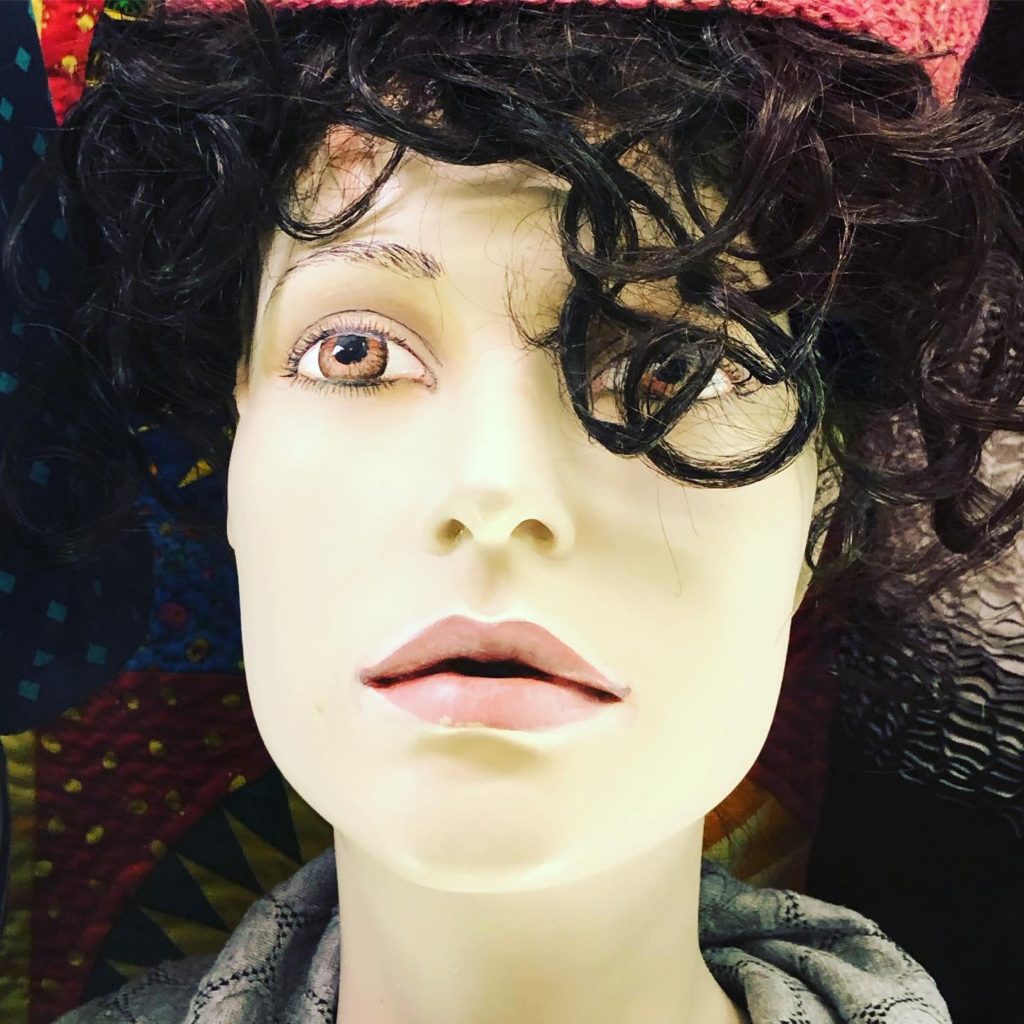
I think I finished my mannequins poem, I’m titling it, “Praise Improbable Things,” after lucille clifton’s poem, Praises, and its refrain, “Praise impossible things.” I’m barely halfway done with the month, so I have time to explore other meanings of WYSIWYG. I’m thinking of sticking with the mannequins, but exploring alt-text for them.
Here are some sources for alt-text that I want to use/refer back to:
bike: 25 minutes bike stand run: 2.2 miles treadmill 7 degrees / feels like -8
Finished the final episode of season 2 of Dickinson and started the first episode of season 3 while I biked. This first episode of season 3 is titled, “Hope is the thing with feathers.” I memorized that poem last March. Didn’t think about it that much while I was finishing up my bike, but it, particularly the idea of hope, returned to me on my run.
I started my run feeling out of sorts, thinking about the possibility of a job I could apply for that sounds like a good/fun opportunity, but might require more vision than I have. As often is the case, I wondered: am I not pushing myself enough, using my vision loss as an excuse, or is this job just something too far beyond my abilities — too demanding, too much, too impractical for someone who can’t see fast enough? It took listening to several songs before I forgot these worries.
As I ran, I stared ahead at the blank tv screen, noticing how that empty black screen filled most of my central vision, while all around it, on the edge and outside of the frame were images — the light above, the wall to the side, parts of the treadmill and the floor below. All the things I can see in my periphery. Even when my central vision is all gone, if/when that happens, I don’t think I will see the world like this, with a black space surrounded by slightly fuzzy, but identifiable shapes. Everything in the center will be more like a smudge, or a fogged up window.
Thinking about my periphery and what I can see with it, I’m reminded of watching ice skating on the olympics last night. I can tell my vision is worse; it is very difficult to follow, or to see the skater — well, I could see the skater, but mostly just flashes of their movement, not as a whole, complete object. To actually see the skater, I tried looking off to my right so I could see them through my periphery. Much better. Not completely clear, but they became a discrete, stable object on the ice.
So, I was thinking all morning about my theme for the month, what you see is what you get. I discovered that it was the catch phrase of Flip Wilson, used by his character, Geraldine. One source I found suggested it meant: this is me, accept me for who (and what and how) I am. I also was reminded that this phrase turns into a computer acronym: WYSIWIG. I mostly use the WYSIWIG editor on wordpress. I forgot it was called that because now they refer to it as the visual editor (as opposed to the code editor). I kept thinking about how this idea that what you see on the screen is what appears on the printed page is an illusion, concealing all the code that is required to make it appear as you want it. About a decade ago, I started learning some of that code (html, css). I don’t know much, just enough to understand that everything about how words or images look online involves a ton of behind-the-scenes brackets and semi-colons and classes and ids (and more). I find a lot of value in understanding, or at least being familiar with, how this works. And, I find a lot of danger in believing that all of what appears on a screen just is the way it is, almost by magic. I’m not suggesting that everyone should learn to code — wasn’t that a trendy slogan a few years ago? — but that they should be aware of how it works, and that it exists.
This ignoring of the process, and the naive belief that “things just happen,” reminds me of how many (most?) people believe vision works: you see what’s there with your eyes. They don’t think about the complex processes of vision, from cornea to retina to visual cortex, and how the brain, to make things easier and/or efficient, or because it has limited data, distorts or alters or guesses. When we see, we are not seeing the world as it is, but how our brains have figured it out.
Human perception is patently imperfect, so even a normal brain must fabricate a fair amount of data to provide a complete sense of our surroundings. We humans are lucky that we have these fancy brains to chew up the fibrous chunks of reality and regurgitate it into a nice, mushy paste which our conscious minds can digest. But whenever one of us notices something that doesn’t exist, or fails to notice something that does exist, our personal version of the world is nudged a little bit further from reality. It makes one wonder how much of reality we all have in common, and how much is all in our minds.
As I was running, I thought again about E Dickinson and her feathered hope, and then the idea of hope and faith, and why we need it, how we envision it. Then, I pulled out my phone and recorded myself, mid-run:
What you see is what you get is an illusion, a type of empty hope, false faith, that some need to survive.
Is this fair? I’m not sure, but it’s something to think about some more, the idea that people invest an uncritical faith (I’m resisting the impulse to write “blind faith” here) and superficial hope in the belief that what we see is what is there, and that what we see is what is real. This belief provides comfort, makes it easier, enables them to not have to question or challenge, just accept.
Also on my run, as I listened to the excellent-for-running song, TNT by AC/DC, I thought about alt-text, and alt-text poetry, and how I might use it for a poem that pushes against the idea that what you see is what you get. Maybe vivid text descriptions of some things I see in my strange, slightly off ways, paired with straight, clear/basic description of those same things? I really like this idea; I’ll keep going with it to see if it could work.
bike: 15 minutes bike stand, basement run: 2.4 miles treadmill 2 degrees / feels like -11
For most of the day, the feels like temp was hovering around -20. I have decided that that is too cold for me. So, I stayed inside. Watched a race while I biked, listened to a playlist and part of the Aack Cast by Jamie Loftus while I ran. It’s about the comic strip Cathy and it’s really good.
Some Things I Noticed*
my shadow, flashing, off to my left side, as I ran
in addition to my shadow, some sort of silvery something flashing or streaking or appearing in my left peripheral
the loud whir of the treadmill when I stepped off it to change my playlist (maybe it’s because of my vision, but I cannot pick new music on spotify when I’m in motion). The whirr almost sounded like a plane revving its engine before take off
my fine hair, falling out of my ponytail, felt like a spider web
before I warmed up, it was very cold in the basement
the soft space between beats felt continuous
sometimes my foot strikes were quiet, sometimes they were loud
*It’s difficult to notice things in a boring, dark, unfinished basement, especially when I’m listening to music. Maybe I should try to use my treadmill time for remembering thoughts or ideas?
Found this poem yesterday. Paige Lewis is wonderful, especially how they find delight in small things, and do such strange things with words!
a seagull—wings swallowing wings—I learned that a miracle is anything that God forgot to forbid. So when you tell me that saints
are splintered into bone bits smaller than the freckles on your wrist and that each speck is sold to the rich, I know to marvel at this
and not the fact that these same saints are still wholly intact and fresh-faced in their Plexiglas tomb displays. We holy our own fragments
when we can—trepanation patients wear their skull spirals as amulets, mothers frame the dried foreskin of their firstborn, and I’ve seen you
swirl my name on your tongue like a thirst pebble. Still, I try to hold on to nothing for fear of being crushed by what can be taken because sometimes
not even our mouths belong to us. Listen, in the early 1920s, women were paid to paint radium onto watch dials so that men wouldn’t have to ask
the time in dark alleys. They were told it was safe, told to lick their brushes into sharp points. These women painted their nails, their faces, and judged
whose skin shined brightest. They coated their teeth so their boyfriends could see their bites with the lights turned down. The miracle here
is not that these women swallowed light. It’s that, when their skin dissolved and their jaws fell off, the Radium Corporation claimed they all died
from syphilis. It’s that you’re telling me about the dull slivers of dead saints, while these women are glowing beneath our feet.
Another nice, late fall run. My cold is almost gone. Sun, not too much wind, lower humidity. I have decided that the ford loop is my favorite fall loop for 2021.
10+ Things I Noticed
Sibilant sounds coming up from the ravine where Shadow Falls is located — possibly wind, but most likely falling water
On the lake street bridge: a trail and some sort of disruption of the water. In my periphery, it always looked like something was there, but when I turned to use my central vision, nothing. Dead cones or faulty peripheral vision?
The memorial plastic flowers leaning on the railing on the st. paul side are slowly falling apart
The view down into the ravine by shadow falls is much clearer than before: a veil lifted. Looking down from the trail above, the gorge isn’t deep but wide and strangely shaped
Also from the view above the ravine: the direction of the sun cast my shadow down in the ravine. As I ran above, she ran below next to the trickling water
A small plaque on a random rock that I didn’t stop to read
The tangy smell of decomposing leaves. Sometimes this smell is sweet, or almost too sweet, but today it was sharp and not quite salty — sour?
At the last parking lot before reaching the ford bridge: an information sign with the history of the forming of the gorge. Some accounts claim the river warren arrived to carve the gorge starting 10,000 years, some 12,000 years, this sign: 13,000 years
My aching toe! The toe box of my new shoe is rubbing against my big toe. It hurt whenever I ran downhill
Crossing the ford bridge: small ripples on the very dark blue water caused by the wind, making a pattern I could see, a texture I could almost feel
The stretch of the sky covered with a ripped veil of clouds
Thinking more about #5, my shadow down in the ravine. As I watched it below me, I thought about ghosts and shadows and faint traces of things not quite here. I imagined the shadow as a different version of me, having the chance to run below in the ravine. And I thought (again, because I’m sure I’ve thought this before) about these quick moments or flashes of something else — shadows, faint trails, breaks in the trees, a disembodied sound coming from somewhere un-locatable — as opportunities, possibilities, evidence of other ways of being or doing. Are these things real? That’s not the point. They’re suggestions or indications, other options.
Before I went out for my run, I skimmed through Mary Oliver’s The Leaf and the Cloud. I was trying to get myself primed for thinking about veils and lifting them. I settled on this bit at the end of a section titled, “Work”:
I will sing for the veil that never lifts. I will sing for the veil that begins, once in a lifetime, maybe, to lift. I will sing for the rent in the veil. I will sing for what is in front of the veil, the floating light. I will sing for what is behind the veil— light, light, and more light.
This is the world, and this is the work of the world.
These are the lines that I read on the window of neighbor’s house that inspired to find this book and to devote a month to Mary Oliver.
Rent: to rend, or tear, split violently, break apart, wrest, pierce
One of the reasons I love late fall, after the leaves have fallen and before the snow comes, is because it is when I have the best view of the river, the gorge, the other side. The veil of leaves and excessive greenery has temporarily lifted. For a few years, I’ve been trying to understand why I like it so much, especially when it seems to be a time of sadness and loss and dread for so many other people. I think this lifting of the veil is a useful way for me to think about it: a better view, more space, a chance to breathe and stretch and connect with things usually hidden, covered, concealed. I like the idea of lifting much better than renting/rending. This lifting is not violent or destructive.
One (boring?) thing I’ve been noticing that I never see when the trees are choked with leaves: cars parked at parking lots on the other side of the river. Today I noticed a white car, glimmering in the sunlight, positioned amongst a line of bare tree trunks. Why do I find this interesting? Maybe because it helps to orient me in relation to the other side or because it’s evidence that more than trees are over there (usually a view of the other side seems the same: tree after tree after tree, and nothing else).
run: 3 miles hike: 2 miles franklin loop + extra trails 56 degrees
Scott and I decided to run part of the franklin loop, and hike the rest of it on a few of the extra trails near it. We started by running north on the river road trail, crossing the lake street bridge, then continuing north on the st. paul side. We stopped to walk when we reached the steep road that descends to the paved trail that winds through the flats right beside the east shore of the river. When we reached franklin, we climbed the steps — so many steps! — and crossed the bridge. We stopped to read the plaque for the Winchell Trail then searched for the northern start of the Winchell Trail. We hiked the trail, even the part that extends below the railroad trestle — a first for me — all the way to lake street and the Minneapolis Rowing Club. Very cool!
We talked about all of the vision stuff I’ve been skimming for the past 2 days and the differences between peripheral and central vision. There Plant Eyes (Godin) + Brainscapes (Schwarzlose) + Downcast Eyes (Jay Martin) + The Mind’s Eye (Sacks). And we talked about what Scott has been reading on extroverts and introverts (Quiet, Cain). We talked about the relationship between the senses (like touch and sight), how we navigate using senses other than sight, and “Batman” and echolocation.
10+ Things I Noticed
A downy woodpecker. Heard it’s tap tap tapping first. I wondered if it was a squirrel pounding on a nut, then I saw it at the top of a dead tree. The tapping was rhythmic and persistent, reminding me of morse code or an old-fashioned typewriter
Loud thumping and knocking and slapping — steady and rhythmic — oars from a 8 person rowing shell*
Paths, dirt and asphalt, covered in yellow leaves
Cheering coming from a football game at St. Thomas
The coxswain instructing the rowers
A man and a woman walking in the east river flats. Overhead the man say, “We are experiencing a drought” or something like that
Scooters passing us on the trail, calling out, “on your left”
Dead leaves floating on the surface of the river. From high above on the Franklin bridge, they made a strange mottling pattern on the water
Smell: strong sewer gas coming out of a cluster of vents near the rowing club
Many limestone ledges, exposed. At one of these ledges, the drip drip dripping of water, slowly seeping down
Countless trails leading down to the river, created by seeping/draining water
The white sands beach, just off the winchell trail and far below the paved trail above, is steep and broad and has trash and recycling cans
From the shore at white sands beach: seeing the remains of the long-defunct meeker dam, which you can only see when the water is low
*Although I have written many times over the years about hearing the rowers below on the river, I have NEVER heard the sound of their oars slapping the water or the boat until today. What I was hearing before were their voices. It is very cool to hear the loud, awkward, unromantic, almost clumsy sound they make.
one more thing, added on 31 oct: I just remembered a moment during the hike/run that I don’t want to forget. Walking through the part of Winchell Trail that is wider, between the white sands beach and the minneapolis rowing club, I mentioned to Scott how, when I was a kid growing up in north carolina and virginia, I loved exploring the woods and semi-wilderness that existed at the edges of the many sub-divisions I lived in. I liked walking on trails that had already been made, not wandering through the thick woods, making my own path. I think I said something like, “I wanted to go where someone had already been.” Not sure if that quite captures the appeal of the already traveled path? Whenever I see a break in the trees, and a dirt trail winding somewhere, I long to take it. Or, if I don’t want to take it, I at least enjoy thinking about where it might lead. The path, created by countless feet tamping down the earth, or water descending to the river, is an invitation to imagine other worlds. Maybe also, I like it because it’s evidence that I am not alone, that others have been where I am, wanting to go deeper. To follow the trail they’ve made through their haunting (frequenting), is to connect and contribute to the reinforcing of that invitation. Will this make sense to future Sara? Does it make sense to present Sara? Almost.
Breezier and cooler today but humid, so no cold, fresh air. Sunny. Possibly more leaves on the ground than on the trees. Wore my winter running tights, a bright yellow shirt, black vest, black gloves, a baseball cap that used to be black but is now a dingy gray, a bright pink headband, and a not bright orange and pink and cream buff. No stacked stones. No view through the floodplain forest of the water. No geese in the sky.
10 Things I Noticed (about the river)
Shimmering white heat through the small gap in the trees
Running over the Franklin bridge, the light reflecting on the water was hitting my peripheral vision just right, or just wrong — painfully, irritatingly bright
The surface was a smooth, flat, unmoving blue (above on the franklin bridge)
No rowers
Shadows from the trees on the east side darkened the river at its edges
Reflections of the golden trees on the west side brightened the water, coloring it yellow
A circle of light on the water’s surface followed me as I ran south, mostly staying ahead of me, occasionally beside
Most of the trees along the shore have changed colors, many yellows, a few reds, hardly any oranges
Running above the paved trail below on the east side, I couldn’t see it or the water until I reached the trestle
Looking ahead of me at the path, everything looked fuzzy, barely formed. Looking below me on the bridge, the river looked intense, sharp, clear, solid
As I ran, I thought about echoes and rings, circles and cycles, shadows as evidence of something else t/here. I also thought about how the tracing of a paved trail/loop can’t happen on the surface — unless it’s raining or snowing, the hard asphalt leaves no evidence of my footfalls. Instead the evidence is found in my memory, my familiarity with the path in my mind and body:
Familiarity has begun. One has made a relationship with the landscape, and the form and the symbol and the enactment of the relationship is the path. These paths of mind are seldom worn on the ground. They are habits of mind, directions and turns. They are as personal as old shoes. My feet are comfortable in them.
3.6 miles minnehaha falls and back 41 degrees humidity: 87%
Another cooler, wonderful morning. Wore running tights + running shorts + bright yellow long-sleeved shirt + bright orange sweatshirt + buff. It was humid, so even with the cool air, I was sweating. Starting my run, heading into the sun, I could see the moisture in the air. Hovering. Ran south on the path and noticed the river burning through the trees. Such a cool sight. The falls were falling, not quite a gush, but more water than the last time I was here. Encountered a roller skier, a few bikes, lots of walkers, a runner or two, dogs. Watched the back end of a squirrel darting back into the bushes as I approached.
As I ran back north, after the falls, I tried looking up higher so that more of peripheral vision was seeing the path. Last night, watching the 4th Harry Potter movie, I started looking at it through my periphery and was amazed at how much more I could see. I aimed my eyes off the side of the television and the images weren’t sharp and clear, but I could see more of them. Colors were more intense too. Strange–and a strange way to watch a movie, looking off at the wall.
Ending my run, crossing over to the grass between the river road and edmund, I watched my shadow ahead of me and thought about shadows and ghosts and how my shadow sometimes leads me, sometimes follows. Then I thought about the dirt trail I was walking on and wondered how long it had been there. And I thought about how it was formed where it was and not somewhere else on the wide expanse of grass. How many feet (or wheels) were needed to establish this trail as the unofficial path to take when walking or running on this grass? I also briefly thought about the Oregon Trail and how, when we were visiting Scott’s Bluff in Nebraska, you could still see and walk that trail, over 150 years later. Earlier this morning, I had also thought about trails, imagining them as a collaborative poem that walkers/runners offer to the gorge with their feet.
At some point on the path, I also thought about Robert Frost’s classic path poem—maybe it was right after I recited his, “Nothing Gold Can Stay”?
Two roads diverged in a yellow wood, And sorry I could not travel both And be one traveler, long I stood And looked down one as far as I could To where it bent in the undergrowth;
Then took the other, as just as fair, And having perhaps the better claim, Because it was grassy and wanted wear; Though as for that the passing there Had worn them really about the same,
And both that morning equally lay In leaves no step had trodden black. Oh, I kept the first for another day! Yet knowing how way leads on to way, I doubted if I should ever come back.
I shall be telling this with a sigh Somewhere ages and ages hence: Two roads diverged in a wood, and I— I took the one less traveled by, And that has made all the difference.
I found an essay about this poem that I’d like to spend more time with, maybe later today or tomorrow?:
4 miles minnehaha falls and back 59 degrees humidity: 78%
Overcast today. No sun. I like how this makes the colors — the reds, golds, greens — glow more. Almost peak color in the trees. When I started my run, I felt awkward, almost like my limbs were working against instead of with each other. By the time I reached the river it was fine. Ran south to the falls on the trail, which I’ve been trying to avoid, and it was crowded. 4 roller skiers, skiing 2 x 2 were causing all sorts of problems for bikers and me as I encountered the bikers. Made it to the falls, stopped to check out the statue of Minnehaha and Hiawatha. Hardly any water in the creek. Ran north, heading home. Took the Winchell Trail and admired the leaves — their intense colors and the fact that many of them had already fallen. My view is coming back!
10 Things I Noticed
The slow approaching clicking and clacking of ski poles. Click clack click clack
A squirrel emerging from the trees then darting back in as I neared
The lights from a bike coming closer, a sharp contrast with the gray gloom
The trickle of the sewer pipe near 42nd. Drip drip drip
Many leaves on the ground. In some spots erasing the trail
2 spindly, bare branches poking out from behind a golden tree, reaching up to the sky
A clicking or rattling noise coming from some animal, probably a squirrel. Sounding a little like the rattle of a rattlesnake
The falls barely falling. Hardly any water
Kids laughing, yelling, talking at playgrounds — Minnehaha Academy and Minnehaha Falls. More kids playing tag around the fountain and the benches with parts of “Song of Hiawatha” etched on them
Winchell Trail in full color — a perfect fall scene (can this perfection last for more than a day?)
As I ran, I was thinking more about the act of haunting (frequenting) a place, returning to it and then about trails and how I might want to write more route/trail/loop poems that play with ideas of haunting. At the end of my run, I recorded some of my thoughts. Here’s a transcript:
I’m thinking about trails and frequenting and haunting. And then I was thinking as I was running over the leaves, how the trails are hidden, can’t see the cracks or the trail at all. But then, when the leaves are gone and the snow starts to fall, when it’s just barely flurrying and there’s just a dusting on the ground, it illuminates the trails. You can only see that when the leaves are off and it’s just a dusting of snow. Thinking about how I want to play with that as part of this tracing. And also thinking about the different ways I can see — the visible and not visible. When is it a matter of seeing and when is it a matter of feeling? And thinking about the type of seeing I can do with the peripheral, which detects movement and gives you a larger sense of the terrain. What does that mean for these well-worn trails and how I experience them?
This is a country of ghosts. Down the eastern shore Lie the drowned villages, drowned luggers, drowned sailors.
After a hot summer, fields grow talkative. Wheat speaks in crop marks, grasses in parch marks.
Wheat or grass, what they tell is the truth Of things that lay underneath five thousand years ago,
The forts, the barrows, the barns, the shrines, the walls. These are the native ghosts. After a hot summer.
No haunting. No rattle of chains. They just lie there In their rigid truthfulness, the ghosts of things.
Part iv
We carry our human ghosts around with us. As we grow we face the mirrors, and see
The spectre of a great-aunt, a vague look Known only from sepia snapshots. The hands we’re used to –
Yes, these – their contours came by way of a long retinue Of dust. We are photofits of the past,
And the future eyes us sideways as we eye ourselves. We are the ghosts of great-aunts and grand-nephews.
We are ghosts of what is dead and not yet born.
Part vi
Ghosts of past, present, future. But the ones the living would like to meet are the echoes Of moments of small dead joys still quick in the streets,
Voices calling I’ve passed / We won / QED / It didn’t hurt much, Mum / They’ve given me the job / I have decided to name this apple Bramley;
And the women convicts singing their Holloway march, While Ethel Smyth conducts from her cell with a toothbrush.
Part vii
These are the ghosts the living would prefer, Ghosts who’d improve our ratings. Ghosts Of the great innocent songs of freedom That shoulder their way round the world like humpback whales,
Ghosts of the singers, the dancers, the liberated, Holding hands and cheering in parks, while the tanks Squat immobilized. Ghosts of the women on the fish quay Hugging each other when at last the boats come in.
Ghosts of the last night of the Proms. And ghosts of lovers, Wandering round London, so happy that they could Have danced danced danced all night.
Like this bit: “And the future eyes us sideways as we eye ourselves. We are the ghosts of great-aunts and grand-nephews./ We are ghosts of what is dead and not yet born.” Love this way of messing with linear time. On a smaller scale, I think about this with past, present, and future Saras.
4 miles wabun park + turkey hollow 65 degrees humidity: 86% / dewpoint: 61
A little too sticky, but what a beautiful morning for a run! Sunny, calm, quiet. Before running felt uneasy about something I couldn’t name; running helped. I’m thinking about ghosts and haunting the path (frequenting it, floating above it, flashing through it) and trying to find a way into my next big project — my annual fall project. Something about the periphery and the approximate as not quite (human, able to see or connect, in this world, real). I need a door, or at least a window — anything that might let me enter this project.
10 Things I Noticed
The trail, covered in leaves, a lot of them red — not bright red, but faded, almost pink
A processional of walkers, bikers, big groups of runners on the trail between 36th and 42nd
A clanging collar on the other side of the boulevard, following me as I ran south
Someone playing frisbee golf at Wabun, throwing a frisbee from the path. Were they playing or working, picking up frisbees others had left behind? Why were they throwing from the path? Why did it look — in my quick, unreliable, glance — that they had a golf bag?
For over a year and a half, every time I run up 47th, as part of the turkey hollow loop, there is a dumpster parked on the street, in front of a house. It was still there today. Have they been remodeling their house for that long?
The ford bridge, from the top of the hill at wabun, then from below, at the bottom of the path
My shadow in the grass as I walked across turkey hollow
The too white, newly redone road between 42nd and folwell, one side of it covered in leaves
Feeling someone running at my same pace–me on edmund, them on the river road. Not wanting to look over to check too closely, trying not to race them
The dirt trail between Becketwood and Minneahaha Academy Lower Campus, dry, covered with leaves, much more worn and well-traveled (haunted) than the barely there mostly tamped down grass, partly dirt path in front of Minnehaha Academy Upper Campus
Because there are so few hobbies left to the dead, my father gives himself this: his usual route, the Queens-bound F to Continental, where he walks with the living to work. Every day he finds a new occupation— picks trash off the tracks, changes a dirty lightbulb, makes rounds on the platforms, tries to make some small use of his hands, though no one notices or acknowledges. Yet still he returns every day, in his tan shirt and brown slacks ironed with the impatience of the perpetually late, his keys jingling carelessly in his left front pocket.
Twenty-plus years with the MTA but some other guy’s got the job now, someone younger, maybe someone my father knows, standing in the operating booth at the end of the platform, watching the miniature trains on the board carry lights through a digital New York. And maybe the young man knows nothing of the dead man, has no words for a ghost who builds a home of his absence. And if my father says haunt
he doesn’t mean the way rooms forget him once he’s gone; he’s saying his leather chair now in his coworker’s office, his locker in the back room newly purged of its clutter, or his usual table in the break room where he sits at 10:30 each night eating the same steak club and chips, counting the 10, 20, 30 more years till retirement, cuz he’s close, he’s in the final stretch—any day now and he’ll finally go on that vacation.
Cooler, but I could feel the humidity. Felt strong. I think all of the swimming this summer strengthened my legs and core, which is very helpful. I’d like to figure out how to keep it up this fall and winter. Heard the rowers as I ran down the east river road, then saw them lined up in the water, receiving instruction from the coxswain. Heard lots of other voices in the gorge, near the Monument and Shadow Falls. People hiking? exploring? checking out the falls, which only appear after it rains (which it did the past few days)? Encountered lots of runners and walkers. No roller skiers. I’m sure there were birds but I don’t remembering hearing them. I do remember looking at the river as I crossed the bridge–mostly, the rowers, but also that the river was calm and a blue gray. Not quite sunny yet, so no sparkling water. Anything else? No deep thoughts stayed with me, no fragments from a poem. I’m sure I thought about my son who Scott and I dropped off at college yesterday. Very excited for him.
As I write this entry a few hours after the run, I’m remembering that I thought briefly about the idea of approximate and a passage I read last night from Blind Man’s Bluff, a memoir by James Tate Hill about becoming legally blind at 16, and trying to hide it.
I can still see out of the corners of my eyes, but here’s the thing about peripheral vision: The quality of what you see isn’t the same as you see head-on. Imagine a movie filmed with only extras, a meal cooked using nothing but herbs and a dash of salt, a sentence constructed only of metaphors. To see something in your peripheral vision with any acuity, it has to be quite large.
Blind Man’s Bluff/ James Tate Hill
I thought about this passage when I was running because I’m bothered by his negative depiction of peripheral vision. Is the quality of vision solely based on clarity and sharpness? What value/quality of vision might we get from our side views and from images that are something less than 100% clear?
I find it helpful to read others’ descriptions of how and what they see. Hill’s vision is much worse than mine–even though the cones in my central vision are almost completely gone, my acuity in both eyes is surprisingly good and nowhere near legally blind. It seems as if the last few cones are doing all the work. Yet, even with my not-too-bad-yet vision, I struggle to see things like faces and eyes, read signs. Here’s an example from yesterday at the buffet lunch at my son’s college orientation: The food was put out on platters–watermelon, deli meat, cheese, bread, pasta salad–and you helped yourself. With my vision, I couldn’t tell what some of the food was–I had to ask Scott. I just couldn’t see it well enough. This often happens now when I’m eating a meal. I can’t quite (almost, but not enough) see what’s on the plate. I used to write about how I can’t tell if there’s mold on food, but now I can’t tell what the food is–unless I’ve prepared it myself. Not that big of a deal, but still frustrating.
Here’s another passage from the memoir that I appreciated:
The most frequent compliment heard by people with a disability is I could never do what you do, but everyone knows how to adapt. When it’s cold outside, we put on a coat. When it rains, we grab an umbrella. A road ends, so we turn left, turn right, turn around. We adapt because it’s all we can do when we cannot change our situation.
The other thing that I’ve already started to hear a lot as I lose my vision is: “you’re so brave!” I am not brave; I am good at adapting and learning to live with uncertainty. I am proud of how I’m handling my vision loss, but not because I’m being brave.
Returning to the theme of approximate, I’ve been trying to collect words, phrases that describe it: roughly, vague, almost, not quite, rough estimation, about, nearly, in the right zip or area code, in the ballpark, and the one that Scott mentioned the other day:
close enough for jazz
Had I ever heard this before Scott used it? He picked up the phrase from his jazz director in college, Dr. Steve Wright. Such a great phrase, one that I don’t see as criticizing jazz as sloppy, but celebrating it for its generosity.
A great day for a bike ride. I haven’t rode my bike since August 3rd (wow), and it took a few minutes for my brain to get used to it again. Much harder to see at the beginning. No panic. Pretty soon, it was a little easier. I’m hoping to bike more during September and October before it gets too cold and I have to bring the bike inside to the basement. I never know if this will be the last season I can see well enough to bike.
swim: 2 miles / 10 loops main beach 73 degrees
Windier and choppier today. Still a wonderful swim. Sunny, sparkling water, some sailboats, blue sky, fuzzy green trees. The first loop was harder than the rest. Difficult to get into a rhythm. Once I did, I was able to stop thinking about sighting or stroking and let my mind wander.
An idea occurred to me: when I think about how much I love swimming in the lake, it’s rarely (if ever) about being fully and completely immersed, deep under the water. It’s about being just below the surface, or at the surface but under the water, with an occasional raising of my eyes to see the air or a boat or the world beyond the water. I was thinking about this partly because I’ve become increasingly interested in surfaces and depths (sinking and floating), but mostly because I’m editing a poem I wrote a few years ago titled, “submerged.” Here’s my latest version of it:
submerged
Every 5 strokes a breath twist left lift up mouth opens twist right lift up air enters quick intake above then 5 full beats below this exhale a chance to dream a little longer a way to forget one thing remember something else a thought: could above be the dream below what’s real? Are hard surfaces the Illusion fluid edges the truth? Is belief in a separate self false? Yes. My body is not mine but ours together — fish water swimmers — all lake all longing to stay submerged 5 strokes at a time I am not I but we joined freed from gravity’s pull hungry lungs’ demands. Home.
After I finished my swim and was sitting on the sand, I recorded a voice memo with some thoughts:
after swim sept 1
According to the dictionary, submerged means under water–not necessarily deep under water or at the bottom, just fully under water. I want to think more about this word and if it is the right title for my poem. Do I want to be submerged, or something else?
Today is the first day of September. Time for a new theme. Approximate. I wrote about it on August 20:
not quite knowing or roughly/approximately knowing. Not exactly but mostly, almost but never completely. Part of the picture, but never the whole thing. I’ve been writing a lot about bewilderment and unknowingness. This not quite knowing is not bewilderment but something else. Not wild, not lost, but not found either.
The things that I habitually say are obvious. Why repeat them? Besides, they are never what I meant to say. The things that I want to say are like the book next to the book that you took from the library shelf. Now you’re disappointed, aren’t you. Now you’re dozing with that book sunk into your chest like a gravemarker, and from now on, that book keeps your place in death, wherever it is. But that has nothing to do with what I want say in this poem. And even if you had picked the right book, what I would like to say would be beneath your thumb as you turn the page, (In the margin, actually, and would that make me a marginal type? marginally human?) What I want to say is always peripheral. What I really have to say limps. What I want to say causes people to dial our number by mistake. Your abruptness with them gags me. The man across the street is idly swinging a golf club. What I would really like to say is disintegrating from wind divots. What I’d like to say loses traction along my larynx and comes out “uh.”
However, clearing my throat accordions what I intend to say into an unintelligible grunt. An important oration that I had in mind was sky written in sparrow farts. I suppose you missed it. I have a sore throat. It is the pass over of intended statements. My dentist says that I eat too much sugar. I say that my cavities are the terrorist bombings of a frustrated authority. Consequently, important clues to what I have always wanted to say are buried under my fillings. Much of what I’d still like to say gets in the way of breathing. I had to quit smoking. What I meant to say was escaping under a smoke screen. What I would like to say is every word that you have ever regretted saying. So the next time you think you’re about to make a fool of yourself, don’t stop. Say it. You can always defend yourself by saying that you didn’t mean to say that. You can even blame it on me. And I will know what I had in mind and everybody will be satisfied. That is to say. . .
run: 3.15 miles 2 trails 78 degrees / dew point 67 sunny
Started and ended with Queen (Another One Bites the Dust) and a running playlist, in the middle, sounds from the gorge — laughing kids at a playground, scurrying animals in the dry brush, crunching gravel, trickling sewer pipes.
Now, sitting at my desk, I’m hearing the electric buzz of the cicadas. …and now, one or two minutes later, they’ve stopped. Now I hear birds–pretty sure it’s cardinals–and a kid repeatedly saying, “Uh oh uh oh uh oh!” An adult in a cooing voice: “Do you need help?” and “You’re not a baby, you’re a BIG girl!”
When I was running on the Winchell Trail, at the steepest part without a railing, I tried looking quickly at the river. Blue. Decided it was better to absorb it through my peripheral. Safer. I thought about how I like these bodily experiments (tracking my thoughts, what I notice) I’m doing as I run and swim. How they enable me to apply theories I’ve been playing around with for decades about epistemology and ontology and ethics.
I’ve been listening to an interview with Kaveh Akbar on Between the Covers, and I was struck by his definition of work in terms of revolutionary poetics:
One thing that I think about a lot is that a revolution comes in two parts; there’s the overthrow and the rebuild. Without either of those parts, it’s not a revolution. There has to be something being turned over and then there has to be something being set up in its place. It’s very easy to inhabit the carapace of revolutionary rhetoric without advancing something new. That, in and of itself by definition, isn’t revolutionary because there’s no rebuild. There’s no gesture towards a rebuild. I’ve talked to my students and my friends and the people with whom I’ve had this conversation in these discussions. I think a lot about the physics definition of work which is the force applied to an object in order to move it. If there’s force applied to an object and nothing moves, that’s not work. Similarly, if an object moves but you haven’t applied force to it, then you haven’t done work. If I say to a room full of people who agree with me, “F*ck Trump,” and I say that in a room full of poetry people, probably the majority of them will be like, “Yeah, f*ck Trump.” I haven’t really caused anything to move. I’ve inhabited the form of revolutionary rhetoric but I haven’t actually moved anything. By the physics definition of work, probably that’s not doing much or any work.
I think I’ll add this definition to my work page on undisciplined.
swim: 2 miles / 2 loops cedar lake open swim 88 degrees / windy
Another windy day, another wave-filled lake. I’d like to be able to compare this to the sea or ocean. I know cedar lake waves are gentle swells, but how much more gentle, how much less choppy than a normal swim in the sea? Tonight, I did a better job of staying on my side of the lake as I swam towards the far beach. For the first few minutes of the swim, I felt weightless, light, but it didn’t take long for the water to drag my body down into the water. I didn’t want to, but I felt like I was having a fight with the water. Every stroke felt slightly off, not smooth, not easy.
Even struggling, it was a great swim. What a wonderful thing to be able to swim so much this summer! Already this week, 4 days in a row. I enjoyed glancing up at the sky sometimes when I breathed. It was mostly sunny, with some hulking clouds. One big cloud hovered behind me as I swam across. It loomed, almost menacingly, but I didn’t mind. I noticed the soft forms of the tree tops to my left and imagined fall coming (too?) soon. To my right, as I headed back, I could see something, not quite shining–I determined it was a small gap in the trees with the sun barely peeking through. Because of the bright sun and my vision, the orange buoy was completely invisible–was it to everyone else? Probably a little, but not as much as it was to me. I knew it was there, so I kept swimming, but I couldn’t see it until I was almost to it. This not-seeing is happening more this summer. It barely bothers me. It’s tiring, but I know I’m swimming the right way–using other landmarks and my established map of the route–so I don’t worry.
I do not like breaststroke. I recognize its value, especially in choppy water, and how it makes some swimmers feel more comfortable in the water, but I dislike being around breaststrokers. The irritating bobbing, which is hardly ever smooth, but jerky. The wide, strong kick. And the way that as I approach someone swimming breaststroke, it always seems very hard to pass them. They seem to be racing me for a bit, then they disappear. I know this is just how I see them–and perhaps it’s distorted by bad vision–and I know that it is ridiculous to dislike breaststroke for these reasons, but I do.
how could I forget this moment?
Had to revisit this log entry to add something that I almost forgot: after I finished swimming, as I was drying off, there was a young kid–less than 5, I think?–who kept repeating, “nanana boo boo.” At least 50 times. In the best (as in most effectively embodying) version of a bratty voice I’ve ever heard. Wow. STA walked by the kid and said he looked and sounded like a cartoon character of a bratty kid. He was not saying this to us, but to another kid, or to himself. Over and over and over again. It was both annoying and delightful. I’m glad I witnessed it and I’m glad it’s over.
All winter the water has crashed over the cold the cold sand. Now it breaks over the thin
branch of your body. You plunge down, you swim two or three strokes, you dream of lingering
in the luminous undertow but can’t; you splash through the bursting white blossoms,
the silk sheets—gasping, you rise and struggle lightward, finding your way through the blue ribs back
to the sun, and emerge as though for the first time. Poor fish, poor flesh
you can never forget. Once every wall was water, the soft strings filled with a perfect nourishment,
pumping your body full of appetite, elaborating your stubby bones, tucking in, like stars,
the seeds of restlessness that made you, finally, swim toward the world, kicking and shouting
but trailing a mossy darkness— a dream that would never breathe air and was hinged to your wildest joy like a shadow.
Not sure how I feel about this water-as-womb idea. I like the idea of imaging a time before I/we were so separated from everything else, but not sure about the womb imagery. I like the line, “Poor fish,/ poor flesh./ You can never forget.”
2.25 miles/ 6 loops cedar lake open swim 80 degrees
It’s hard to believe that I didn’t like cedar lake a month ago. What a great place to swim! Relaxed, easier to sight–and also easier to stay on course when you can’t sight, less crowded, shorter loops for faster, continuous swimming. It was windy tonight, and choppy in the water. My feet felt a little weird the first few loops, but they didn’t cramp up.
2 memorable things about the swim:
The sky: noticed several planes above me, moving in and out of clouds. At Nokomis, the planes look like sharks circling in the sky, here they look like birds. Stopped mid-swim to determine if what I was seeing above me was a plane or a bird then watched it (a bird) soaring high.
The vegetation: So many vines being stirred up by the wind and the choppy water. Sharp and scratchy, hitting my face, wrapping around my arm. At least one or two traveled down my back, which was very unpleasant. Several years ago, I remember getting part of a vine in my mouth. Gross.
Because the loops are shorter and I have a clear landmark to sight heading back from east (hidden) to point beach, I don’t have to be thinking constantly about where I was going. I could let my mind wander. I know it did, but I can’t remember what I thought about. Possibly about the optometrist appointment I had earlier in the day. Confirmation, yet again, that my vision is deteriorating. Difficult news every time I hear it, yet reassuring too. I’m not making this up, I really can’t see well. The doctor said almost all of my cone cells were gone. Just two tiny islands, one in each eye, protected by the rod cells I have in the very center. He said he was surprised that I could see as well as I could. So strange how vision works. I hardly have any cone cells left, but the few that remain are working so hard that the vision in my right eye is still 20/20 and 20/40 in my left. What? A new worry: possible deterioration of some of my periphery. It’s called paving stone deterioration. It is not that big of a deal, just something to monitor. Still, it’s unsettling to imagine losing some or all of my peripheral too.
I don’t have a poem about love to add here, but I’m thinking about care and my hard working cone cells and protecting rods and what they’re doing for me and the amount of love they show me everyday. This love is not the primary goal, but is still a part of what our bodies do for us everyday until, one day, they don’t: in spite of the odds and the difficulties, they find a way to keep working, even if that “working” barely works, or works in different ways. Does that make sense?
Hot. Sweaty. Too many bikes biking in pairs beside each other, taking over the path. Still, a good run. Just before starting, I listened to a recording of myself reciting 2 poems I’m working on. Thoughts about them came and went as I ran above the river. On the Winchell Trail, right before running up the short, steep hill near Folwell, I thought about how I don’t always notice the river when I’m running next to it. Sometimes I’m distracted by other thoughts or an approaching person. Sometimes the river is hidden behind a veil of green. And sometimes I’m too lost in the dream world. Then David Foster Wallace’s commencement speech with the refrain, “This is water” popped into my head. I decided to stop at the top of the hill and record my thoughts:
thoughts while running/ 29 july
Okay, I’m running and I had an idea. Thinking about how when I’m running on the Winchell Trail above the river, sometimes I don’t remember to look at the river, to acknowledge the river, behold it, recognize that it’s there. And I started thinking about David Foster Wallace and “this is water” and how sometimes it’s important to notice and behold and say, “this is water.” To say, “this is water,” is to stand outside of it, to have some sort of distance, to be beside it. Sometimes we want to be immersed in the water. We want to be immersed in a dream world or a now that is not outside, not as distant, not beside. That means we don’t notice that this is water because we’re in it, and that’s a good thing too.
I reread the transcript of Wallace’s speech. I like many of his ideas about the value of a liberal arts education for giving us the tools to think critically, to be aware, to notice a wider range of realities beyond our limited, selfish one, to move past our unconscious “default” settings. Much of it is based on choice and will and our ability, which we must cultivate through education/practice/habits, to be open to understanding situations in new, potentially more generous, ways.
I like these lines:
If you’re automatically sure that you know what reality is, and you are operating on your default setting, then you, like me, probably won’t consider possibilities that aren’t annoying and miserable. But if you really learn how to pay attention, then you will know there are other options. It will actually be within your power to experience a crowded, hot, slow, consumer-hell type situation as not only meaningful, but sacred, on fire with the same force that made the stars: love, fellowship, the mystical oneness of all things deep down.
In his speech, Wallace’s primary default setting is that we are selfish–everything is centered on us–and that we passively and consistently frame the world in this way. His solution: actively and deliberately think about the world in other ways. Seriously consider others’ perspectives, their struggles. Be actively critical, not passively uncritical. But, as I’m learning through poetry and various other things I’m reading about attention, sometimes letting go, being vulnerable and not in control, not trying to see things more generously but just being out in the world, moving and breathing and attending to it, sharing space in it with others (and not claiming it as yours) enables us to transform our experiences of it. I feel like I’m not quite making sense here, but I’m trying to get to the point that there are different forms of caring and giving attention, and some of them don’t involve deliberate, controlled focus on something. I’m thinking of soft fascination and being beside/entangled and the periphery.
bike: 8.6 miles lake nokomis and back 80 degrees wildfire smoke from Canada
No problem biking to the lake even though it was very smoky. They finished the sewer work they were doing by the mustache bridge so the bike trail was finally open again. Hooray! So much easier and safer not having to bike on the road and cross back and forth so many times. Very happy to feel mostly comfortable on my bike, able to see most things and not feel scared all the time.
swim: 2 miles / 2 loops lake nokomis open swim
Dark tonight. Strange, unsettling. Eerie on the lake with the sun covered with smoke. My googles fogged up again, even though I treated them, making it harder to see. I think Johnson’s Baby Shampoo doesn’t work, only Johnson’s baby wash does. Heard lots of sloshing and splashing. Enjoyed the swim, but felt less buoyant. At one point, it almost seemed like my foot was about to cramp up so I briefly stopped to stretch it. I’m getting better at stopping, taking my time. Another military plane flew low above me, roaring in the sky. That, with the waves and the smoke, make it feel almost apocalyptic. Noticed a bird flying in the sky too, near the plane. From my perspective in the lake, looking up from the side as I breathed, they looked the same size and shape. Funny how being the lake makes everything seem the same. Because of the smoke, I tried to take it easier, so I only swam 2 loops.
A few days ago (july 26) I foolishly asked how much choppier it is in Lake Superior than it was at cedar lake while I was swimming. Here’s one answer by the poet laureate of the UP (poet laureate? very cool!):
Dawn, a lit fuse. The radioman says “bombogenesis,” like agates tumbling from a jar—system as meteorite off Whitefish Point. In other words, water
lynx, Mishipeshu, lathered up in red. In a heartbeat, rollers mass two stories trough to insatiate tempest, unquelled by prayer nor cigarette, careless, mean,
a cold-blooded indifference so pure, a strong swimmer won’t last ten wet minutes. At the Keweenaw, surf pummels the stamp sands with ochre fists, ore boats stack up lee
of the stone, and entire beaches stand up to walk away. At Marquette, two lovers walk onto Black Rocks, sacrificial lambs— their bodies will never be recovered.
4 miles trestle turn around + extra 73 degrees humidity: 85% / dew point: 68
Woke up to dark skies. An hour later: thunderstorms. Around 10 it stopped, so I went out for a run. It was warm and humid but not oppressive. How is that possible? Forgot (again) to greet the welcoming oaks, but checked for stacked stones by the sprawling oak tree. Zero. Everything was dripping. Including me, after about a mile. I don’t remember seeing the river. Too much green. Noticed one of the unofficial trails leading down into the gorge just before lake street. Also noticed a tent set up under the lake street bridge, right next to the portapotty. All zipped up. I wondered how hot they were last night, when the low was in the upper 70s. I also wondered if they were in the tent because they’d been evicted (looked it up and the 15 month eviction moratorium is ending but landlords can’t evict until Sept).
delight of the day
As I approached the trestle, I began hearing a loud rumble. At first I tuned it out, but then I realized: a train! It was hard to see with all of the green blocking my view of the bridge, but slowly I saw the cars. The train was still there, rumbling along, as I passed under the trestle a minute later. Very cool. In the hundreds of times I’ve run under this trestle, I have only encountered a train on the bridge 3 or 4 times. These tracks are hardly ever used. Why was the train crossing today? I kept waiting for the beep beep of the horn but it never came. Only booms as the car lumbered over the old tracks.
After the rain, it’s time to walk the field again, near where the river bends. Each year I come to look for what this place will yield – lost things still rising here.
The farmer’s plow turns over, without fail, a crop of arrowheads, but where or why they fall is hard to say. They seem, like hail, dropped from an empty sky,
Yet for an hour or two, after the rain has washed away the dusty afterbirth of their return, a few will show up plain on the reopened earth.
Still, even these are hard to see – at first they look like any other stone. The trick to finding them is not to be too sure about what’s known;
Conviction’s liable to say straight off this one’s a leaf, or that one’s merely clay, and miss the point: after the rain, soft furrows show one way
Across the field, but what is hidden here requires a different view – the glance of one not looking straight ahead, who in the clear light of the morning sun
Simply keeps wandering across the rows, letting his own perspective change. After the rain, perhaps, something will show, glittering and strange.
Wow, I love this poem. I’m very glad I searched “after the rain poetry” and found it. The different view he discusses in the later stanzas is what I’m exploring. It’s ED’s slant truth and my sideways/peripheral. It’s also the practice of soft fascination–what we don’t notice we’re seeing when we’re focused on other things. And it’s learning new ways to see without certainty.
Biked with STA over to open swim. Biking doesn’t seem overwhelming this year. I think it helps that I’m biking on very familiar trails and, that when STA and I are biking together, I go first. You would think it would be best to have the person with better sight first, but I’ve realized that when someone’s ahead of me, I can’t use my peripheral to spot upcoming obstacles/hazards–approaching bikers, potholes, etc. Biking first makes it much easier for me to use my remaining central vision.
swim: 3 miles/ 4 loops* lake nokomis open swim 75 degrees/sunny
*the course was a little shorter today, so 1 loop did not equal a mile
I just realized that this is my first Sunday swim of the season. Wow. They didn’t have enough life guards so they left out the green buoys and shortened the course. Not a problem. It was a shorter course, but almost as wide. I loved being able to swim far from the orange buoys, and far from most other people.
things I noticed in the lake
the little bubbles my hands made as they entered the water in front of me
at least one dragonfly hovering above the water’s surface
the air felt heavy and harder to inhale during this first loop, the water felt thick
I listened to water lapping over my head and the word, “sloshing” came to mind, then the question: what’s another word for sloshing? splishing or splashing or flowing over or overflowing?
at least one plane above me, taking off or coming in for a landing
as is often the case, there is no standard route between a swimmer’s start at a beach and the first buoy. Often this leads to confusion and near misses. I almost ran into a few rogue swimmers. My rule: if the course is on the left, stay as far to the left as you can when heading to the first buoy. I am bothered that this doesn’t seem to make sense or matter to some other swimmers, and I am bothered that this bothers me
Crowded–is Sunday the biggest day for open swim?
As I neared the far right white buoy at the little beach–the one I like to swim around before I head back to the big beach, I could see the muck on it just below the surface. This muck didn’t look that different than what ends up on my skin, under my suit, after a long swim. Gross
I stopped to go to the bathroom between loops 3 and 4. Many swimmers just pee in the lake as they’re swimming, especially if they have a wetsuit on (at least I think they do), but even if I wanted to–and there have been a few desperate times when I’ve really wanted to–I can’t. My body won’t do it. Is it just because I find peeing in the lake gross? Not sure. Anyway, it’s a big hassle to go to the bathroom. You have to get out of the water, walk several hundred yards to the bathrooms, possibly wait in line at the bathroom, pee, wash your hands, then walk all the way back. When I got back in the water and started to swim, everything felt strange. I was sore, but also more buoyant. Floating
The water was smooth and there were no pockets of extra cold or extra warmth
I think my safety buoy is leaking air which would explain why it feels more like I’m being weighed down then lifted up by it
As is more often the case, my apple watch died mid swim. It’s old. I’m thinking of not getting a new one and trying to exercise without a watch. Not sure if this is a good or bad idea
Fog-thick morning/ Lorine Niedecker
Fog-thick morning— I see only where I now walk. I carry my clarity with me.
This poems doesn’t quite fit with the theme of water, but it’s how I feel when I’m swimming–in a fog or dream or daze, nothing clear or easy to see. I sight using my past knowledge of the course or my shoulders and the strong, straight, sure strokes they produce. My shoulders, I think, are my clarity.
3 miles/ 3 loops lake nokomis open swim 83 degrees
The third day in a row of open swim. It was overcast, which I thought would make it easier for me to see all the buoys, but the lack of light drained their color. Hardly any smudges of orange, and only when I twisted my neck so I could see the buoy through my peripheral. Strangely, I saw the green buoys more often, which was not a lot. Will it ever stop being amazing to me that I can swim across the lake without panicking when all I can see is endless water? Heading back from the little beach, where the path between buoys is wider and less direct, I had a moment of feeling like I was swimming off the edge of the earth. Alone, off course. Then I saw an elbow and knew I was fine, heading toward the big beach. As I swam, I remembered a poem I wrote for my chapbook on swimming about my feelings of love and annoyance for other swimmers as we swim in the lake. I tried to love the other swimmers more than be irritated by them as they unintentionally routed me. I really tried; sometimes it worked.
i feel a deep love for these other half fish half humans who seem to love deeply what i love all of us sharing a lake a moment a joy for the generosity of water
and i feel continued annoyance at their cluelessness on how to swim straight and their inability to wrangle jutting elbows and flailing frog-like legs
i try to remember my love and forget my irritation but when the lake water sloshes over my head gently it washes away everything
I like the idea of this poem, and many of the lines, but I think I can make it much better. I’d like to work on it, and some others from the collection, and maybe try to get them published. What if I turned by various verses about the lake and swimming into one long poem? How would that work? How does a long poem work?
Other Things I Remember
Choppy water, none of it washing over my head, but tugging at the safety buoy I have tethered to my waist. Makes swimming more difficult–the buoy around my waist, acting like Coleridge’s albatross around the Ancient Mariner’s neck
Once I mistook a fish for a wave and when I stopped suddenly my buoy bumped into me, which felt like a fish, and for a flash, I freaked out
I noticed several swimmers stopping briefly to try and find the buoy. One guy stopped several times. He was slightly faster than me, but was working much harder, churning up water with his big kicks
I didn’t think a sailboat was the buoy tonight
I was swimming faster than 2 breaststrokers ahead of me, but as I approached they sped up–on purpose or without realizing it, I’m not sure–and wouldn’t let me pass
It is harder to see through my central vision, I think, and I feel even more cut off from the world when I swim than I used to. Mostly, this does not bother me; I like the dream world that lake swimming creates
Right before starting, a woman called out, “Wow, the number on your cap is over 1000!” And I said, “Is that how many swimmers there are in open swim club?” And, she said, “Well, my cap is 13!” If there are over 1000 swimmers signed up for open swim, they are not all in the water with me tonight. Maybe 100 are here
2 miles/ 2 loops lake nokomis open swim 82 degrees
The first open swim! The first open swim! A perfect evening for it. The course was slightly different this year. There were the usual 3 orange buoys in a straight diagonal line from the north end of the big beach to the little beach, but there were also 2 bright green buoys a little further south. Huh? I had to ask another swimmer who looked like she knew what she was doing–actually, I heard her tell someone else that she had swam this course last year. They’ve changed up the course a little to make it safer and longer. Instead of always having the buoys on your left like they’ve done in the past, they are always on your right. The path is a straight shot from the northern end of the big beach to the little beach using the orange buoys. But on the way back, you travel much wider, using the invisible (to me) green buoys, and aim for the southern end of the main beach.
When I started swimming, I thought this new route would be a problem for me and how I’ve learned to swim without seeing that much, but I quickly got used to it, and decided that I liked it better. I like how it’s longer and that it’s wider. I can’t see the color green at all in the water, so the return buoys, if I manage to “see” them are just big, smudged hulks (and sometimes I confuse them with the similar shaped smudge of a sail from a sailboat further south), but I can use the silvery white rooftop at the big beach to guide me back to shore. I’m grateful for such a big landmark.
I didn’t run into any other swimmers, and I didn’t get way off course. At one point, I stopped to try and sight where I was, and a person swimming to my left stopped too. I think they were following me, hoping I would guide them the right way. I did. So strange and amazing and delightful to be able to navigate with such minimal, fleeting signals. How difficult was it for other people to see? When they looked straight ahead, just barely lifting out of the water, could they see the orange buoys clearly, a beacon in the empty blue and green? Or, were they like me, who was only able to see the smear of orange when I turned my head so that I could view what was straight from the side? Most of the time, the orange dot disappeared when I looked at it directly. Only once or twice, when it hit just right, did it appear. I was reminded of how much my sighting and seeing is based on trusting my straight strokes and learning to effectively and efficiently use the scant clues I have from what I do see. Open water swimming is a great confidence boost for me, and a reminder of how much I can still function. When I lose my central vision completely (which will almost surely happen soon), will it get worse, or have I learned to see mostly through my periphery already? I don’t know. For now, I’m happy to be swimming and not panicking, feeling strong and confident and at home in the water.
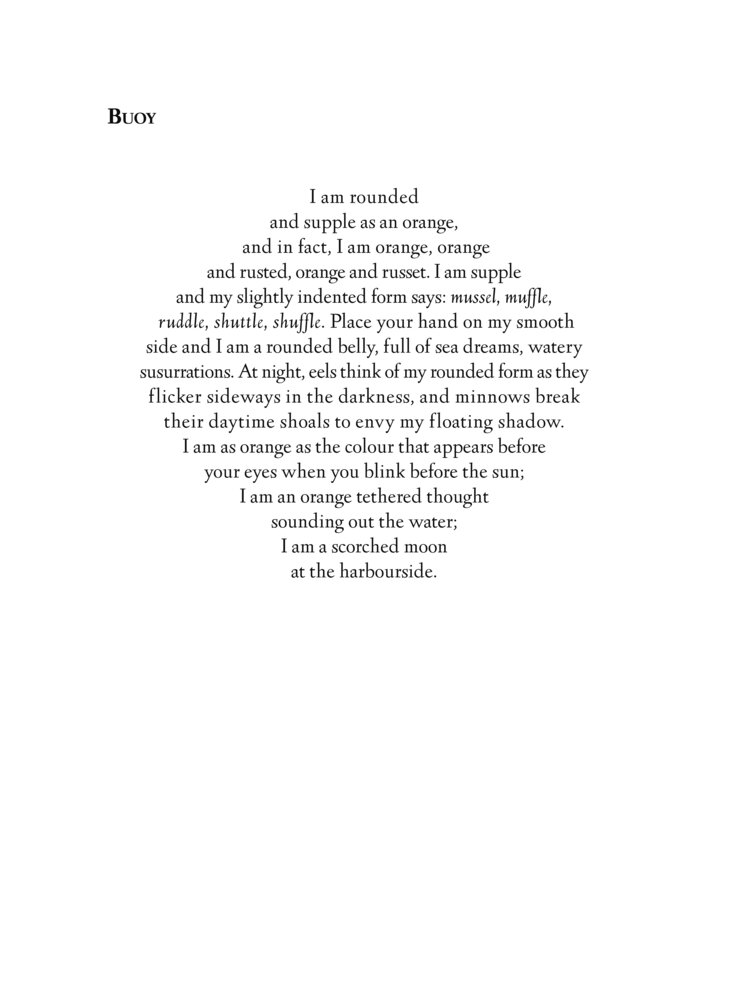
Searching for poetry about buoys, I found this awesome post by a poet-in-residence at a boat yard–Underfall Yard. They’re exploring the area, reading about boats and buoys and swimming and water, leading poetry workshops for visitors, planning poetry readings. I would love to do something like this! Wow. Very cool and inspiring!
Another mile swimming just off the big beach around the white buoys! Another almost perfect weather day–no wind, sun, warm, but not too warm, water! I checked online, the water temp is 75, which is plenty warm for me. Today I used my new safety buoy, not for safety, but to hold my phone and keys so I don’t have to leave them in my yellow backpack on the beach while I swim. It’s an inflatable buoy–bright yellow–with a dry pouch inside that you can store stuff in. You hook it to a belt that you wear around your waist. Pretty slick. For 7 years, when I swim, I leave my yellow backpack on the beach and it always makes me a little nervous, especially because it has my phone and my bike lock key. Now, I won’t worry. And, it’s good to have a buoy so that other people in boats can see me.
Right before my swim on Tuesday, as I put my swim cap on in the shallow water, I watched little minnows quickly swimming away from my approaching feet. Such a sweet and delightful thing to witness! What is the collective noun for minnows? A flash of minnows? A flurry of minnows? Looked it up and found some other answers: a swarm, a stream, a school of minnows. The minnows were still there this morning. I can’t remember if they stay all summer; I’ll have to check from them in July and August.
Since I had my phone with me, my distance was more accurate: today the activity app said I swam 1.08 miles, as compared to Tuesday when it said I swam .67 miles. I have decided that, for my purposes, 6 loops = 1 mile. 2 miles swam, 98 to go!
I didn’t see any flashes below me, or shafts of light, but I did encounter a few ducks right before I started, and a few bits of milfoil floating in the water. I noticed how the white buoys disappeared in my central vision, then reappeared in my periphery. I saw a paddle boarder and another swimmer–mostly I sensed another swimmer, hearing their hands occasionally slap the water, glimpsing a quick flash of foaming water in their wake.
I breathed every 5 strokes or five/six/five or three/four/five/three or every six. As I swam every six I thought about a poem I wrote a few years ago, “Submerged,” and how I like stroking more, breathing less in order to spend more time submerged, pretending I’m a fish. Sometimes I thought about my wonderful son FWA and how he graduated from high school last night. Those thoughts made my swim more relaxed. Other times I thought about something else–I can’t remember what, just that it involved worries–and my swim was harder, less free.
Found these two excerpts from Niedecker’s poem, “For Paul” (1950). The first one is about her failing vision: in 1949, she was diagnosed with nystagma (roving eyes). The second one is about June:
You are far away sweet reason
Since I saw you last, Paul my sight is weaker . . .
I still see– it’s the facts are thick– thru glass:
*
Hi, Hot-and-Humid
That June she’s a lush
She marsh wallows, frog bickering moon pooling, green gripping
Fool Keep cool
In my June 8th log entry, I posted Niedecker’s poem, “Paean to Place.” Love this poem. In an article about Niedecker’s ecopoetics, I found a link to a facsimile of a hand-written version of this poem that she made into a book for a friend. Nice!
Last night at FWA’s graduation, the principal gave an introduction/welcome in which he did a land acknowledgment, recognizing the land/city where the school was built is Dakota land. I wasn’t able to hear exactly what he said because a group of people two rows back wouldn’t shut up–am I the only person who actually wants to listen to (and enjoys) the speeches? Probably. Anyway, I’m not sure of his wording, or if he used the words “stolen” or is versus was Dakota land, but I was glad to hear him say something. Just hours before graduation, I was reading an article about land acknowledgment, its problems and possibilities: WHERE WE STAND: THE UNIVERSITY OF MINNESOTA AND DAKHÓTA TREATY LANDS
I’m thinking about how to incorporate a deeper recognition and acknowledgment of the history of that land I write about in my bio and through my poems.
My first real swim (30 minutes straight) since September of 2019! Very exciting. My apple watch consistently underestimates the distance, so I’m not quite sure, but based on my pace and past loop swimming, I’ve decided I swam a mile. My first mile of many this summer, I hope. It’s ambitious, but I’d love to swim 100 miles this summer. Only 99 left.
The water was about as good as it gets. Not too cold, no chop, no debris. I could see the white buoys out of my periphery. I think I saw a few big fish swimming below me and some beams or streaks of light. Swimming so close to the white buoys, I got a good look at the brown muck on the underside of the buoys at each end. Yuck. I “raced” a paddle boarder paddling in from the middle of the lake, and avoided a few other boats. I mostly breathed every 5 strokes. Sometimes 5, then 6. A few times, 3. A lot of the time I thought about how my right shoulder–the one I injured last spring scraping paint off of the deck–ached a little more than my left, and whether or not the every-so-often sharp pain in my right ear was the start of something, but occasionally I thought about how much I love swimming, and how, even more than running, it gives you a way into another world, where your senses don’t work, or work strangely. Very cool. I like this water world.
For a few hours after I had finished, my body, especially my shoulders, felt slightly and pleasantly sore–not that miserable sore where you can barely move, but the sore you feel when you have worked your muscles and they are grateful to be used in this way finally, after a long 16 months away from the water.
My theme this month is water and stone. As I read through various essays, poems, articles, I’m coming to realize that I’m understanding the theme through the work of one of my new (not new, she’s died 4 years before I was born in 1970, but new to me) favorite poets: Lorine Niedecker. Here’s the opening to a beautiful poem that might serve as an inspiration for me (note: her cool spacing didn’t work when I pasted it into wordpress. Click on the poem to read it with the cool spacing):
And the place was water Fish fowl flood Water lily mud My life
in the leaves and on water My mother and I born in swale and swamp and sworn to water
I was born on water, Lake Superior in Hancock, Michigan, and my mom was too, Mississippi River in West St. Paul, Minnesota. While my mom never learned to swim, or love being in the water, I did. As a digital story I created more than 5 years ago begins: “I have loved water all my life.”
Ran earlier this morning–at 6:30–to beat the heat. High of 99 today. We already turned the air on. 90s for the next 5 days. All this heat should warm up the lake. Less than 2 weeks until open swim begins!
I ran south on the upper trail. I tried to look at the river but it was hard. Too much green. Even at the overlook by the entrance to Winchell Trail was green. Only slashes of silver–or white heat–burning through the trees. Running north again on the Winchell Trail at the steepest spot above the river, I could feel the river through my peripheral vision. Sometimes it was a constant brightness, other times a rhythmic flash, keeping time with my striking feet as I passed one tree after another.
Yesterday I mentioned noticing the large crack in the trail that’s been marked with white spray paint and looks like Florida or a tube sock. Glancing at it today, I think it looks more like a knee-high sock or a compression sock, and not really Florida–although it still reminds me of Florida which, despite all the shit happening there these days, is not a bad thing. I have fond memories of visiting my grandparents in Deltona–the heat, the tropical humidity, the beach, Epcot, even the swampy salty tap water. I miss the ocean; I haven’t been there since FWA was a few months old, he’s 18 now.
Other things I noticed: a tall tree on the Winchell Trail leaning over a little too much–was it about to fall?; the trickle of water from the sewer pipe at 44th and the faster flow at the 42nd street pipe, the noise of water mixing in with the noise of rustling leaves; the river more light than water; my good omen: a lone roller skier; the shuffling, stomping feet of a runner behind me, becoming more distant with each step; a furry, big dog sitting calmly, perched at the top of the 38th street steps next to a bench and a human; some singing birds–robins, I think; a greeting from a runner; my new running shorts irritatingly riding up on the one side–probably due to the heat.
Reading Lorine Niedecker’s “Lake Superior.” I’m thinking about rocks and layers and these two opening lines, one from her poem, “Lake Superior,” and one from her essay, “Lake Superior Country, Vacation Trip ’66”:
from Lake Superior
In every part of every living thing is stuff that once was rock
In blood the minerals of the rock
from Lake Superior Country, Vacation Trip ’66
The journey of the rock is never ended. In every tiny part of any living thing are materials that once were rock that turned to soil. These minerals are drawn out of the soil by plant roots and the plant used them to build leaves, stems, flowers and fruits. Plants are eaten by animals. In our blood is iron from plants that draw out of the soil. Your teeth and bones were once coral. The water you drink has been in clouds over the mountains of Asia and in waterfall of Africa. The air you breathe has swirled thru places of the earth that no one has ever seen. Every bit of you is a bit of earth and has been on many strange and wonderful journeys over countless millions of years.
STA and I drove to the Bohemian Flats parking lot then ran to downtown Minneapolis: starting on the steep hill, past the Guthrie, under the Hennepin Avenue bridge, over the Plymouth bridge, through Boom Island Park, over the railroad bridge, over the North line tracks, on the cobblestones in St. Anthony Main, over the Stone Arch Bridge, up past the Guthrie again, and down the steep hill. My IT band was tight afterwards, but it feels okay now. I guess I need to keep taking it easy. A great run. It almost felt normal. A few things I wrote down in my plague notebook to remember: ran up the entire steep hill, noticed the calm water, heard so many birds everywhere–not cardinals or robins or chickadees, maybe finches and warblers and sparrows? Lunging dogs, porta potty stops, and the rush of the light rail crossing the Washington Avenue Bridge as I stretched in the flats parking lot.
Right as we reached the Stone Arch Bridge, I remembered Scott saying that the past tense of glow should be glued not glowed (he said this after I remarked on how someone’s bright yellow vest glowed in my peripheral vision), which made me wonder if “glued” might be an archaic past tense, which then made me think about the archaic words in “The Rime of the Ancient Mariner,” like swound–“The ice was here. The ice was there./The ice was all around./It cracked and growled and roared and howled/like noises of a swound.” Swound is an archaic version of swoon, but I like thinking of it in the context of the poem as a collection or gathering of swoons–noises of a swound would be all the noise you’d hear when a bunch of people fainted, like maybe in a revival tent or at a pentecostal service. A rushing and wailing and whooshing and thudding and gnashing.
Yesterday I finished memorizing the first section of “The Rime of the Ancient Mariner”– all 80 lines. Last night I recited it to STA on the deck while we drank some beer. Then we listened to Iron Maiden’s epic, 13+ minute tribute to it. Very cool. It was hard to make out the words because they were sung so fast, but it was exciting when I heard “wedding guests” or “hermit” or “the albatross” or the dice. Nice! I’m going to try memorizing some (or all) of the next part today. I’m a little reluctant because I don’t want memorizing this epic poem to consume me. I’ll see how I feel after today.
In the midst of memorizing this poem, I came across Robert Frost’s “The Oven Bird,” and wondered, why the hell is it called an oven bird? Looked it up: it’s because the nest of this bird is shaped like an old-fashioned oven. It has a small round hole for an opening.
4 miles river road trail, south/waban park/turkey hollow/edmund, north 50 degrees
Shorts! Sun! Spring! Yesterday’s cold rain really pushed me over the edge. I’m ready for more sun, more sitting on the deck, more spring-y weather. Today the river was calm and blue, peeking through the green that is already starting to spoil my view. Ran on the river road trail all the way to the turn-off to Wabun park, then ran up and turned right just before reaching the Ford Bridge.
Franny Choi: there’s something different between maybe like, looking versus listening, right? Like, I feel like there’s some, I don’t know, what is that thing.
Taylor Johnson: I think there’s a goal in mind. I think with searching, it’s like, I know I’m gonna come out, let’s say, onto the sidewalk or in the woods, and I’m gonna see a particular X, Y, and Z, you know what I mean? Whereas listening, it’s like, things kind of wash over you and happen with you, rather than you having something in your mind where it’s like, I need to see this particular thing, or I’m listening for this particular thing. It’s kind of a more open, open experience.
I listened as I started my run and I remember taking note of many different sounds, all mixing into each other, none seeming that distinctive. Birds, traffic, laughing kids on the playground, shuffling feet on debris, someone raking a yard, wind chimes, my breathing as I settled into my run, a song blasting from a car radio, the faint jingle of my house key in my running belt, a woman sneezing–or was it coughing?
I also thought about Mary Oliver and a few things I was reading this morning–poems and an article by Rose Lucas about MO: Drifting in the Weeds of Heaven: Mary Oliver and the Poetics of the Immeasurable. And thought about the idea of the self and their relationship to nature as observer and observed, as someone who stares/pays attention to the world and someone who participates in it. Then I had a thought—I remember having it just as I was crossing 42nd from the stretch of grass between 42nd and Becketwood (what STA and I call the gauntlet because it’s narrow and close to the road and difficult to avoid other people if they’re on it too) and the wide boulevard of grass separating Edmund and the River Road—about how Mary Oliver’s ethical poetics of noticing, being astonished, and telling others about it involves a lot of standing back and still, staring, stopping, taking notes, sitting at a desk and writing. Yes, becoming connected or immersed in what you are noticing does happen, but the emphasis is on observing/seeing/staring at the world at some sort of distance and when you have stopped moving or doing anything. You stop to notice, or notice then stop, observe or behold (this makes me want to revisit Ross Gay and the idea of beholding), then sit and write. What if you didn’t stop? What if you observed while moving (while running?) Took notes while moving? Wrote while moving? I wonder how far I can push at the limits of writing about the gorge while running at the gorge–not running and noticing then writing, but running while noticing while writing.
Notes from the run, April 28th
Before I went out for my run, I was thinking about a few poems.
Here are two different versions of the same general idea: being lifted out of the tyranny of your thoughts by the beauty of nature.
It’s a gift, this cloudless November morning warm enough to walk without a jacket along your favorite path. The rhythmic shushing of your feet through fallen leaves should be enough to quiet the mind, so it surprises you when you catch yourself telling off your boss for a decade of accumulated injustices, all the things you’ve never said circling inside you.
The rising wind pulls you out of it, and you look up to see a cloud of leaves wheeling in sunlight, flickering against the blue and lifting above the treetops, as if the whole day were sighing, Let it go, let it go, for this moment at least, let it all go.
Terns/ Mary Oliver
Don’t think just now of the trudging forward of thought, but of the wing-drive of unquestioning affirmation.
It’s summer, you never saw such a blue sky, and here they are, those white birds with quick wings,
sweeping over the waves, chattering and plunging,
their thin beaks snapping, their hard eyes happy as little nails.
The years to come — this is a promise — will grant you ample time
to try the difficult steps in the empire of thought where you seek for the shining proofs you think you must have.
But nothing you ever understand will be sweeter, or more binding, than this deep affinity between your eyes and the world.
The flock thickens over the roiling, salt brightness. Listen,
maybe such devotion, in which one holds the world in the clasp of attention, isn’t the perfect prayer,
but it must be close, for the sorrow, whose name is doubt, is thus subdued, and not through the weaponry of reason,
but of pure submission. Tell me, what else could beauty be for? And now the tide
is at its very crown, the white birds sprinkle down,
gathering up the loose silver, rising as if weightless. It isn’t instruction, or a parable.
It isn’t for any vanity or ambition except for the one allowed, to stay alive.
It’s only a nimble frolic over the waves. And you find, for hours,
you cannot even remember the questions that weigh so in your mind.
For most of my life, up until last year when, during the pandemic, I felt compelled to finally notice them, I haven’t payed attention to birds. So I wasn’t familiar with terns–that might also be because, sadly, I’ve never lived by the sea. Anyway, terns is not a term I’ve known. In fact, my first encounter with it happened just last month, while reading a New Yorker article about the marvelous methods animals have for navigating and not getting lost. Buried deep in the article is this interesting bit of trivia:
Or consider the Arctic tern, which has a taste for the poles that would put even Shackleton to shame; it lays its eggs in the Far North but winters on the Antarctic coast, yielding annual travels that can exceed fifty thousand miles. That makes the four-thousand-mile migration of the rufous hummingbird seem unimpressive by comparison, until you realize that this particular commuter weighs only around a tenth of an ounce. The astonishment isn’t just that a bird that size can complete such a voyage, trade winds and thunderstorms be damned; it’s that so minuscule a physiology can contain a sufficiently powerful G.P.S. to keep it on course.
Very cool. MO’s line about gathering up the loose silver reminds me of a ED poem that I read in March:
A Bird came down the Walk—/ Emily Dickinson
A Bird came down the Walk— He did not know I saw— He bit an Angleworm in halves And ate the fellow, raw,
And then he drank a Dew From a convenient Grass— And then hopped sidewise to the Wall To let a Beetle pass—
He glanced with rapid eyes That hurried all around— They looked like frightened Beads, I thought, He stirred his Velvet Head—
Like one in danger, Cautious, I offered him a Crumb And he unrolled his feathers And rowed him softer Home—
Than Oars divide the Ocean, Too silver for a seam— Or Butterflies, off Banks of Noon Leap, plashless as they swim.
I have many thoughts about these three poems that I can’t quite express. About the narrator and their involvement in the scene they’re describing, about the “You”—who they are, what they’re for, about being didactic, about circling, about silver and seams and when the observed becomes the observer. And, about this line from MO:
But nothing you ever understand will be sweeter, or more binding, than this deep affinity between your eyes and the world.
So I’m thinking about this in relation to my quote about the difference between looking and listening at the beginning of this post, and in terms of my own desire to feel with senses other than sight, or with sight not as Sight (as an objective, unfiltered way of being in and with the world). This idea of sight not as Sight, comes out of my thinking about how I see through my damaged eyes. I can see, but not with sharp focus or precision or mastery–I don’t look and See, as in, capture/own what I see with my eyes. My seeing is softer and involves more fluid waves and forms being felt. Returning to MO’s poem, I could definitely be delighted by the terns as I watched them moving—sweeping and plunging and thickening–because you detect motion in your peripheral vision and my peripheral vision is great. But I probably couldn’t see how many terns there are or how their thin beaks snapped. And I wouldn’t be able to see their hard eyes happy as little nails. But, seriously, can anyone see bird eyes in this way, other than MO?
Thinking about how MO uses seeing as a way to pay attention reminds me of another poem of hers with one of my favorite titles:
The little hawk leaned sideways and, tilted, rode the wind. Its eye at this distance looked like green glass; its feet were the color of butter. Speed, obviously, was joy. But then, so was the sudden, slow circle it carved into the slightly silvery air, and the squaring of its shoulders, and the pulling into itself the sharp-edged wings, and the falling into the grass where it tussled a moment, like a bundle of brown leaves, and then, again, lifted itself into the air, that butter-color clenched in order to hold a small, still body, and it flew off as my mind sang out oh all that loose, blue rink of sky, where does it go to, and why?
I remember reading this a few years ago and thinking how little I might have been able to see of the hawk she describes. I could see the tilting, the riding of the wind, the circling and carving, but not the color of its feet or its green eyes or that it was holding something in its claws. It’s interesting to read these poems and think about them in relation to my vision and the limits of my seeing. I especially like thinking about the ways I can still see and how they might be reflected/communicated in a poem about attention. This idea of describing how I see differently is as important to me as learning how to feel with senses other than sight.
Wow, lots of not quite focused thoughts in this post. Not sure if it makes sense but the act of writing it has been helpful for me in thinking about MO, and attention, and my project of writing while running and running while writing.
Another young black man killed by the police today in a twin cities suburb. Apparently, the cop meant to reach for their taser, but pulled their gun instead and then shot Daunte Wright. Fucked up. This is not simply an unfortunate, “heart breaking” accident. This is not a matter of bad apples or a few incompetent or overly anxious cops. This is a fucked up system that doesn’t value human life, that almost always prioritizes certain (white) lives over others, and that is murdering black people. Abolish the police.
bike: 35 minutes run: 1.5 miles basement outside: rain, wind
Biked in the basement because of the wind and rain. Watched another episode of Emily Dickinson. This one focused on ED’s conflicted feelings about having her poem published and whether or not she wants fame and to be known and seen by others. It features the poem, Split the Lark:
Split the Lark – and You’ll find the Music – Bulb after Bulb, in Silver rolled – Scantily dealt to the Summer Morning Saved for your Ear, when Lutes be old –
Loose the Flood – you shall find it patent – Gush after Gush, reserved for you – Scarlet Experiment! Skeptic Thomas! Now, do you doubt that your Bird was true?
It was helpful to read the words after watching the show; I didn’t get the meaning of them when I heard them sung by Sue:
Wow. That is some intense, violent imagery. “Gush after gush” and “Scarlet experiment.” It makes me think of the article I read about ED and “I’m Nobody! Who are You?” earlier this month, when the author writes about doing Emily Dickinson Madlibs and asking students to fill in the blank for “Grief is a ___”.
Students go ahead and put in the blanks what is expected: Grief is a pain, Grief is a bitch. The ones who want to take imaginative leaps deliver up: Grief is a thunderstorm, Grief is a tidal wave. But I can pretty much guarantee that no matter how many budding poets you have in a class, nobody who hasn’t already read Dickinson’s poem would ever write the phrase the way she wrote it.
The answer: “Grief is a mouse” This poem about splitting the lark also seems very original and imaginative and very ED.
A turkey interruption!
Just as I was writing the above paragraph, I looked out the window and saw…a big turkey walking in my front yard. Nice. I think that’s the first time I’ve ever seen that. That’s definitely the delight of the day. When I first saw it, I yelled out to STA, “Come here, quick. There’s a turkey in the front yard” and he posted about it on instagram.
After I biked, I ran on the treadmill for about 14 minutes. Our treadmill works, but strangely, these days. The speed is off, always too fast. Listened to my playlist.
Right after I got up this morning, I wrote about Mary Oliver and her collection, Evidence:
Yellow from Evidence/ Mary Oliver
There is the heaven we enter through institutional grace and there are the yellow finches bathing and singing in the lowly puddle.
Some keep the Sabbath going to Church — I keep it, staying at Home — With a Bobolink for a Chorister — And an Orchard for a Dome —
Some keep the Sabbath in Surplice – I, just wear my Wings – And instead of tolling the Bell, for Church, Our little Sexton – sings.
God preaches, a noted Clergyman – And the sermon is never long, So instead of getting to Heaven, at last – I’m going, all along.
In my March 26th log entry, I wrote a bit about yellow and how I’ve grown to like the color. It’s funny that I like yellow now because I can’t see it very well, especially on the page and especially when it’s used to highlight text. Sometimes I use my yellow colored pencil in my Plague Notebook, like today, for the title to MO’s poem.
from the Plague Notebooks, Volume 7
When viewed straight on, through my central vision, the yellow disappears. When seen from the side or with my eyes lowered, looking down, the yellow is bright–of course, viewed this way, through my peripheral vision, the words are a blur. Isn’t it strange how that works? Other colors aren’t as bad, like green or blue (although in other situations, those colors disappear too). But, how does this work? I know the retina has 3 types of cone cells: blue/short (B/S), green/medium (G/M), red/long (R/L) and that we have a lot more red (64%) than green (32%) or blue (2%). And that “the color yellow is perceived when the L cones are stimulated slightly more than the M cones (cone cells/wikipedia). But what does that mean about my vision and cone cell loss? How many red versus green versus blue do I have left? Is there a way to test that? And, is it worth testing? I might ask my eye doctor when I’m fully vaccinated and finally have a check-up in the next few months.
I’m looking through MO’s collection, Evidence today, which I was able to immediately check-out from my libby app (very awesome). Something I’ve noticed: the structure/form (I’ve forgotten the difference between these two) is often, first a very detailed and lush description of something or someone (an animal, stone, tree, flower, etc), then a question or a moment of wonder about it/them, then a revelation.
Like, in Swans from Evidence: A long and beautiful description of swans flying overhead and hurrying on to “wherever it is/that swans go.” A moments of curiosity/praise/wonder and a question: “How could I help but wish/that one of them might drop/a white feather/that I should have/soemthing in my hand/to tell me/that they were real?” Finally, a revelation (or a reminder of something always already known but forgotten): “What we love, shapely and pure,/is not to be held,/but to be believed in.” Love that last line. It’s a nice little prayer and seems to work without the details and the moment of praise, but I wonder what happens to its power when it loses those details? Does it become just a easily spreadable soundbite? I’m not sure, and I guess my doubt about this practice of picking out favorite lines, won’t stop me from doing it now:
from Thinking of Swirler
In a week he would be dead, arrowed down by a young man I like, though with some difficulty.
I was planning to pick one part of this poem, but I love the whole thing and I think I might need to memorize some or all of it:
Then Bluebird Sang
Bluebird slipped a little tremble out of the triangle of his mouth and it hung in the air until it reached my ear like a froth or a frill that Schumann might have written in a dream. Dear morning you come with so many angels of mercy so wondrously disguised in feathers, in leaves, in the tongues of stones, in the restless waters, in the creep and the click and the rustle that greet me wherever I go with their joyful cry: I’m still here, alive!
I could also see part of this poem serving as a writing prompt, or an opportunity to create your own moment of wonder/prayer: “Dear morning/you come/with so many angels of mercy/that greet me wherever I go/with their joyful cry: I’m still here, alive!” Prompt: what greets you in the morning? Make a list, then pick one and describe it as much detail as you can. Moment of Wonder: When you’re outside, running beside the gorge, create a chant or greeting to offer back to the welcoming oaks or the floodplain forest or the old stone steps or whatever else you want, letting them know you’re still here too, alive.
Okay, just one more for today:
The Poet Always Carries a Notebook
What is he scribbling on the page? Is there snow in it, or fire? Is it the beginning of a poem? Is it a love note?
This poem makes me think about MO’s discussions of carrying a notebook around with her while she’s walking in the woods, which also makes me think about the different methods writers/thinkers use to remember words when they’re outside, away from their desk: Jonathan Edwards would pin notes to his clothes we traveled on horseback, the writer Jaime Quatro would scratch them into her arm with a stick when, out on a run, she had nothing else to use, I speak a note in my voice memo app or, turn the thought/idea into a chant and repeat it until I return from my run.
Mostly ran, with a little bit of walking, the franklin loop with STA. Sunny and over-dressed in shorts and a long-sleeved shirt. Who cares when it feels this wonderful outside! Usually I lament the leaving of winter, but not this year. I’m ready for summer and vaccines and less time inside. We talked for almost the entire time, but I can’t remember what we discussed. Noticed the river, looking calm and blue, glittering in a few spots. No rowers today. Easter, I guess. Heard some pileated woodpeckers, black-capped chickadees, cardinals. Still no geese. Also heard one runner’s deep, booming voice cutting through everything else. So loud, creeping up behind us. We slowed way down, almost to a walk, so he could pass faster, but it still took forever. Someday I’ll be able to block out these irritations–or, will I?
Sitting on the deck an hour after the run, I thought about some differences between Mary Oliver and Emily Dickinson. Here’s one: MO focuses on the moment when we are able to find meaning or understanding or joy or delight or something worthwhile, despite the mess of the world. Yesterday I described it this way: “MO is interested in that moment, albeit fleeting, of clarity that opens you up, or opens to you, inviting you in.” So, MO wants to find a way in. Maybe Emily Dickinson does too, but, with her emphasis on Circumference–the edges, seams, periphery, the perimeter, she also urgently wants to find a way out, an exit.
Mary Oliver is a big fan of Walt Whitman (she has a brief essay in Upstream titled, “My Friend Walt Whitman”). Could this be point where her differences with ED are visible? Here’s what Joyce Carol Oates says about the differences between ED and WW in her introduction to Essential Emily Dickinson:
Between them, our great visionary poets of the American nineteenth centry, Emily Dickinson and Walt Whitman, have come to represent the extreme, idiosyncratic poles of the American psyche: the intensely inward, private, elliptical and “mystical (Dickinson); and the robustly outward-looking, public, rhapsodic and “mystical” (Whitman). One declared: “I’m Nobody! Who are you?” The other declared: “Walt Whitman, an American, one of the roughs, a kosmos…”
Here, ED’s understanding of in is being outside the world, and WW’s out is being fully inside it (at the center?). I think this in/out, private/public, introvert/extrovert is too reductive. Still, it is helpful as a way to start thinking about the differences. In her essay on her friend, Whitman, MO writes this about why she values him:
Whitman’s poems stood before me like a model of delivery when I began to write poems myself: I mean the oceanic power and rumble that travels through a Whitman poem–the incantatory syntax, the boldness affirmation. In those years, truth was elusive–as way my own faith that I could recognize and contain it. Whitman kept me from the swamps of a worse uncertainty, and I lived many hours within the lit circle of his certainty, and his bravado. “Unscrew the locks from the doors! Unscrew the doors themselves from their jambs!” And their was the passion which he invested in the poems. The metaphysical curiosity! The oracular tenderness with which he viewed the world–its roughness, its differences, the stars, the spider–nothing was outside the range of his interest. I reveled in the specificity of his words. And his faith–that kept my spirit buoyant surely, though his faith was without a name that I ever heard of. “Do you guess I have some intricate purpose? Well I have…for the April rain has, and the mica on the side of a rock has.”
Upstream/ Mary Oliver
Such bold, confident, excessive declarations! I wonder if Susan Howe has anything to say about this in My Emily Dickinson when she writes about ED’s new grammar grounded in humility and hesitation? Lots to digest here. Now I want to read more about ED’s faith and her understanding of Circumference and how it’s positioned in relation to inside and outside.
Here are 2 MO poems, originally from Swan, that I found in Devotions:
I Worried/ Mary Oliver
I worried a lot. Will the garden grow, will the rivers flow in the right direction, will the earth turn as it was taught, and if not how shall I correct it?
Was I right, was I wrong, will I be forgiven, can I do better?
Will I ever be able to sing, even the sparrows can do it and I am, well, hopeless.
Is my eyesight fading or am I just imagining it, am I going to get rheumatism, lockjaw, dementia?
Finally I saw that worrying had come to nothing. And gave it up. And took my old body and went out into the morning, and sang.
Don’t Hesitate/ Mary Oliver
If you suddenly and unexpectedly feel joy, don’t hesitate. Give in to it. There are plenty of lives and whole towns destroyed or about to be. We are not wise, and not very often kind. And much can never be redeemed. Still, life has some possibility left. Perhaps this is its way of fighting back, that sometimes something happens better than all the riches or power in the world. It could be anything, but very likely you notice it in the instant when love begins. Anyway, that’s often the case. Anyway, whatever it is, don’t be afraid of its plenty. Joy is not made to be a crumb.
Much less wind today–5 mph instead of 12-15. So bright, cool, not too crowded. Encountered a few people on the trail but was able to keep at least 6 ft of distance. Is 6 ft still the recommended distance? I know it is probably very low risk to run past another person, only being close to them for a second, but I’m still uneasy when I encounter someone. During the run, I think it was near Becketwood, I imagined how relieved I’ll be when I finally get the vaccine. I will run on the trails with much less anxiety, still keeping a distance (I’ve always done that, even in the before times), but not worrying that every person I met is a loaded gun (loaded with a deadly virus). That day may be coming soon–vaccines are open to everyone as of March 30th. After I write the entry, I’m putting us on all the waiting lists.
Heard lots of birds as I ran, especially cardinals and black-capped chickadees. After reaching turkey hollow and heading up the hill on 47th, I was welcomed with a symphony of bird sounds. Not sure what all the chirps and trills and tweets were, but I loved having their motivating and distracting soundtrack as I climbed. Other things I remember hearing: the sharp, brittle crack of a branch as I ran on it, the shuffling of my feet on the gritty sand, and dog collars clanging below me on the Winchell trail and off to the right, in the grass between the river road and edmund.
I ran on the trail, above the oak savanna, the Winchell trail, and the river. It was sunny so the river was sparkling. Today I remember it looking brown. Is that right? Shouldn’t it be blue? Pretty sure I remember it as brown with a shimmer of light. Also noticed several of the benches, perched on the edge of the bluff, staring out through the bare branches to the other side. And, I took note of shadows, not mine, but the shadows of birds flying over my head. Quick flashes of dark moving past me. I can’t remember if they were big shadows or small shadows; they were just bird shadows.
I’m thinking of spending another month with Emily Dickinson, or at least partially with ED. I want to focus on the peripheral–peripheral vision, ED’s circumference, other ideas about slant/sideways/beside as they are used and expressed in poetry (and maybe lyric essays too?).
Here’s a poem not directly related to that topic, but that I found in The New Yorker and wanted to remember:
On the black wet branches of the linden, still clinging to umber leaves of late fall, two crows land. They say, “Stop,” and still I want to make them into something they are not. Odin’s ravens, the bruja’s eyes. What news are they bringing of our world to the world of the gods? It can’t be good. More suffering all around, more stinging nettles and toxic blades shoved into the scarred parts of us, the minor ones underneath the trees. Rain comes while I’m still standing, a trickle of water from whatever we believe is beyond the sky. The crows seem enormous but only because I am watching them too closely. They do not care to be seen as symbols. A shake of a wing, and both of them are gone. There was no message given, no message I was asked to give, only their great absence and my sad privacy returning like the bracing, empty wind on the black wet branches of the linden.
This reminds me of Ada Limón’s intereview on VS. podcast, where she talks about trying to let birds be birds, and that birds aren’t going to save her (or us) or serve as metaphors she thinks she needs. I love her use of the words still and stand/ing in proximity to each other. It reminds me of my favorite October poem (October/ May Swenson) when she writes: “Stand still, stare hard.” When Limón writes, “I’m still standing,” of course I first thought of Elton John’s song (ha ha), but then I read those words, maybe for the first time, not as “I’m continuing to stand” but as “I’m a still-stander or someone who is engaged in the practice of standing without moving, standing still.” Very cool. I like the idea of being a still-stander. Speaking of the word still, I like how she uses it three times. I imagine it as a hidden message: be still, as in calm, quiet, not expecting or worrying about anything, just being where you are, not moving or doing.
2.1 miles neighborhood 33 degrees wind: 13 mph with gusts, 21 mph
Quick run in the wind and the cold after returning home. A visit with 2 fully vaccinated grandparents! Hopefully soon, we will be too. First time away from Minneapolis since October. Not too far into my run, I heard a pileated woodpecker. Not drumming, but singing. Also heard a black-capped chickadee and their fee-bee song. Can’t remember any other bird calls. Guess the wind was singing louder. Speaking of the wind, heard lots of wind chimes, especially at the house at the corner of 43rd and 32nd. Such a cacophony! Ran down towards the river but stayed on edmund. When I crested the hill, I glanced down but couldn’t see any sparkling river through the trees.
note for me to remember: On the 29th, I memorized ED’s “I felt a cleaving in my Mind–.” That night, I got a headache that came in waves, not feeling like my brain had split but like I wished it would, so I could take the top of it off to relieve the pain and pressure. Ugh! I am a wimp with headaches because I rarely get them. And because I rarely get them, they make me worry more: I never get headaches? Why now? What’s the cause? Is this the start of something worse? I’ve had a few more since then, not quite as bad. I think (am hoping) that they’re caffeine headaches. The grandparents make much weaker coffee (1 scoop of coffee for 6 cups of water), while I make really strong coffee (I scoop of coffee for 1 cup of water).
Here are the final 2 poems in my March with Emily Dickinson. They’re connected to “I felt a cleaving in my Mind–” with the ball and the seam, which speak to ED’s interest in circumference.
I felt a Cleaving in my Mind– As if my Brain had split– I tried to match it–Seam for Seam– But could not make them fit.
The thought behind I strove to bind Unto the thought before– But Sequence ravelled out of Sound– Like Balls upon a floor.
I saw no Way — The Heavens were stitched — I felt the Columns close — The Earth reversed her Hemispheres — I touched the Universe —
And back it slid — and I alone — A Speck upon a Ball — Went out upon Circumference — Beyond the Dip of Bell —
As I just discovered, the Balls in “I felt a Cleaving in my Mind–” could be balls of yarn. The ball in this poem is the Earth. Another connection: instead of seams, we have stitches. ED likes the word and idea of Circumference. Lots of entries in the Emily Dickinson lexicon, which is a super handy resource: periphery, circuit, edge, skull, perspective, view, vista.
I might have a lot of fun with this idea of circumference, especially in relation to a new vision project I’d like to start: on peripheral vision. Very cool.
I found another version of this poem on the amazing blog project, White Heat. It’s in their week of posts about Circumference. It follows ED’s original manuscript and its line breaks.
I saw no Way – The Heavens were stitched – I felt the Columns close – The Earth reversed her Hemispheres – I touched the Universe –
And back it slid — And I alone — A Speck opon a Ball Went out opon Cirum — ference — Beyond the Dip of Bell.
Without this — there is nought — All other Riches be As is the Twitter of a Bird — Heard opposite the Sea —
I could not care — to gain A lesser than the Whole — For did not this include themself — As Seams — include the Ball?
I wished a way might be My Heart to subdivide — ‘Twould magnify — the Gratitude — And not reduce — the Gold —
Here’s something interesting PB has to say about this poem and curcumference and seams and balls:
The second stanza advances our understanding a little, for we learn that the poet wants the “Whole” rather than some lesser quantity or quality that would be subsumed by the whole. Dickinson uses a ball as an example. Made by stitching leather or fabric together, the ball might be considered interior to the seams encompassing it. I am reminded of Dickinson’s poetic project of circumference. She announces this project in a letter to her chosen “Preceptor”, T.W.Higginson:
“Perhaps you smile at me. I could not stop for that – My Business is Circumference –…” (L268, July 1862).
In a later poem she calls “Circumference” the “Bride of Awe.” At least part of Dickinson’s poetic quest is to trace the seams, to see the whole.
A wonderful morning. Sunny and mostly calm. Not too crowded. Started on the river road trail but as I encountered more people, I moved over to Edmund. I heard the black-capped chickadees singing their feebee song. Don’t remember much else. When I reached Hiawatha, I put in my headphones and listened to a spotify playlist. Experienced a slight runner’s high as I picked up the pace, the kind that makes me feel my smile all the way down to my toes. Sprinted the last block. I bet I looked strange.
Yesterday, I listened to a great podcast with the poet Paige Lewis. So much good stuff. I especially liked this:
And that’s what I kind of care about putting into poems. I want to learn things and I want to learn little snippets of facts and then I want to be able to share those facts with people. Or, if I see something, I want someone around so I can be like look at that thing that’s happening right now. It’s still happening, you have to look. Look what that fish is doing. Look what that flower is doing. I just want to be pointing. Like I just want to be, look at this thing. Look at this thing. Look at this thing. Which is why I’m really bad at writing essays because I’m just like look at what this guy is doing. And then look at this. And they’re like, why does it matter? I’m like, I don’t know, but look at it.
Just like look at these beautiful tiny things and what we can take from them is maybe sometimes just enjoyment and I don’t know that I have anything more intelligent to say about that thing and what it’s doing and what it reflects about anything about us as humans. But like just look at it.
I agree with Lewis that the enjoyment of noticing and sharing these beautiful tiny things is enough, but I also think that this practice, when repeated and turned into a habit, has an additional importance: it encourages us to care about and care for the world, to be invested in its continued flourishing and also our own. I was thinking about this earlier today as I worked on my “How to Be” project and gathered ideas for the knowledge section. What is knowing facts for? More than demonstrating how smart we are, knowing facts can connect us and astonish us and encourage us to care about more than ourselves and our individual survival.
random thought I remember: At some point during the run, I noticed the shadow of a bird on the sidewalk in front of me. I love seeing these shadows and knowing a bird is flying overhead without looking up to see it. This shadow is too vague and fuzzy to indicate what kind of bird it is; it’s just a bird. It reminded me of how sometimes when I’m sitting at my desk, which has a glass top (a top I recycled from an old IKEA coffee table), I see the reflection of a bird flying outside the window. It’s a quick flash of motion that I could miss if I wasn’t paying attention and if my peripheral vision had become heightened because of my central vision loss. Such a cool thing to see.
Have you got a Brook in your little heart, Where bashful flowers blow, And blushing birds go down to drink, And shadows tremble so—
And nobody knows, so still it flows, That any brook is there, And yet your little draught of life Is daily drunken there—
Why – look out for the little brook in March, When the rivers overflow, And the snows come hurrying from the hills, And the bridges often go—
And later, in August it may be, When the meadows parching lie, Beware, lest this little brook of life, Some burning noon go dry!
The Prowling Bee doesn’t like this poem with it’s “lazy” rhymes (flipping the sentence order to create the rhyme, ex: “so still it flows”) and the idea of such a “little” brook, as opposed to some more robust form of water like a river. I’m not sure how I feel about it. I think I like the quiet brook that doesn’t announce itself to the world, it’s just there doing its thing–helping the flowers and the birds and the shadows. What if it were a stream instead? Decided to google it. Favorite answer was by a naturalist, responding to the question, what’s the difference between a stream, a creek, and a river?:
So, we enter into the somewhat nebulus topic of stream classification.
Consulting a few sources, the common term for all downhill flowing ribbons of water is stream. They’re all streams. Streams are classified, not by width, depth or length, but by a system known as stream ordering. The common terms are quite subjective depending on region and local history.
First order streams: the smallest streams that have no tributaries. We could call these brooks or rivulets. Little streams that you can hop across and not get wet. (GPD example: Pebble Brook in The West Woods)
Second order streams: result from the merging of two first order streams. Often designated as creeks, these small streams require a bridge, stepping stones or wading to cross. (GPD examples: Big Creek, Swine Creek, Silver Creek)
Third order streams: larger streams formed from the merger of two second order streams or creeks if you will. Streams that would have to be bridged, waded or even swam across. Referred to as branches in the headwater regions of watersheds. (Geauga examples: East Branch and Aurora Branches of the Chagrin River, East and West Branches of the Cuyahoga River)
Fourth order: streams formed by the merging of two third order streams. These streams would qualify as rivers, requiring big bridges, boats or swimming to cross.
I find brooks interesting as a first order stream because they have no connection to other sources of water, no tributaries. They also don’t cause much of a fuss–you don’t need a bridge for them and you should be able to hop across them without getting wet. How do these first order streams come to be? Where does the water come from?
Another interesting thing about brooks: as a verb, the word means to use, tolerate, find agreeable. I don’t like the word tolerate or this understanding of a body of water disconnected from everything else, so I guess I don’t want to have a little brook in my heart. It doesn’t sound as pretty, but I think I’d prefer a creek–but not a crick!
a moment of sound
After my run, I sat on the deck and enjoyed the sun and the quiet. Here’s how that sounded:
bike: 15 minutes run: 1.5 miles treadmill outside: 43 degrees
What a beautiful, feels-like-spring day! Scott and I took Delia the dog on a long walk by the river and around the neighborhood this morning in the bright sun. It felt much warmer than 40 degrees. Lots of runners and walkers and bikers on the river road trail, enjoying the warmth. Heard lots of birds, including the cardinal’s “pew pew pew” song. Some woodpeckers, crows, a few black-capped chickadees, and many others that I can’t identify by song. Maybe there were a charm of finches? (I found a great site for group names for birds) At some point during the walk, we heard some honking geese! Returning for the spring?
When we got back I decided to sit on the back deck, in the bright sun. I am looking forward to late spring and summer when I can do this every day. Sitting there quietly, listening to all of the birds, and not thinking about much of anything, a bright red cardinal flew just past me and landed in a tree at the edge of our deck. Usually I can’t see cardinals, but I noticed this one first as it moved across my peripheral, which helped my brain see it when it landed in my central vision. Very cool–and very strange how the brain helps me to see things.
Because it was getting late, and it was very wet and crowded outside today, I decided to bike and run in the basement. Watched a race while I biked, listened to a playlist while I ran. Didn’t think about much–what did I think about? I can’t remember, which isn’t always a bad thing. Sometimes I like forgetting. This morning I memorized a Sara Teasdale poem that I have been intending to memorize for many months: Let It Be Forgotten. I’m hoping to use it as a spell or a charm or a mantra to chant when I want to stop thinking about something:
Let it be forgotten, as a flower is forgotten, Forgotten as a fire, that once was singing gold, Let it be forgotten, for ever and ever, Time is a kind friend, he will make us old.
If anyone asks, say it was forgotten, Long and long ago, As a flower, as a fire, as a hushed footfall In a long forgotten snow.
a moment of sound
Wow, the water rushing through the drain, and off the eaves, sounds very loud in this recording. You can barely hear the many birds, I recorded this moment while sitting on my deck is the glorious sun.
bike: 25 minutes run: 2.25 miles basement outside: 15 degrees
I started my bike by listening to Dr. Michael Osterholm’s podcast on COVID-19–he’s the infectious diseases expert/director at the University of Minnesota. He often gives worst case scenarios but his latest assessment tracks with another expert I check in with on twitter: Bob Wachter, the chair of the department of medicine at UCSF, who is a little more optimistic generally. Today’s episode of his podcast is titled Hurricane Warning and it’s about the likely category five hurricane of covid destruction that the B.1.1.7 variant (also known as the UK variant) could bring in the next month if we open up and let down our guard. While I don’t like hearing this news, I appreciate the reminder that my concerns about things opening up, including schools, are not unfounded. I’ve heard Osterholm say this several times: “Americans like to pump the brakes after the car is wrapped around the tree.” Meaning, we’re reckless and then try to be cautious after it’s too late. Looks like that’s what’s happening now. Numbers are down, people are tired of sheltering, so it’s time to open back up. This attitude makes me sad and concerned about our (U.S., the world) ability to make hard choices for our survival–not just with COVID but with the climate crisis. Most of the time I am an optimist, able to see past the bad to the good (in people, in situations), but the selfish, short-sighted way that many (at least those with the most power) have responded to crisis is chipping away at that optimism. Slowly, I’m letting the pessimistic “people suck” attitude creep in. I need to focus more on delight and people who are delighted and delightful.
Speaking of which, after biking I listened to a podcast with Ross “Book of Delights” Gay and his new book-length poem, Be Holding. Well, first I tried listening to my audio book Wintering but it was an extra dark chapter about insomnia that was bumming me out too much so I turned it off. Ross Gay is wonderful and his ideas about beholding as attending and looking with love, which reminded me of Maria Lugones’ idea of loving (as opposed to arrogant) perception, are very inspiring and help me restore my optimism. I look forward to when the transcript of the interview comes out–hopefully soon. In the part I listened to today, they were talking about looking and vision. The phrase “eyes of poetry” was used. It made me think about my relationship to vision and what I’m trying to do with my work (and my practices, and my strategies for coping with vision loss). Two things I’m doing:
First, a critical intervention in the privileging of vision/sight—an exploration of other ways of attending and other language for that attention. Not just seeing but listening and feeling. What might be some aural-centric words to counter vision, insight, focus? Thinking about this reminded me of a poem I memorized this summer: And Swept All Visible Signs Swept Away/ Carl Phillips
Easy enough, to say it’s dark now. But what is the willow doing in the darkness? I say it wants less for company than for compassion,
which can come from afar and faceless. What’s a face, to a willow? If a willow had a face, it would be a song. I think. I am stirred, I’m stir-able, I’m a wind-stirred thing.
Here, I’m thinking about listening and the expression of self through song, as opposed to through face and vision. The “visible signs” have been swept away by the wind, yet compassion and recognition (to beholden) are still possible.
Second, an expansion of what vision/seeing is—how do we see, what does it mean to see? what are others ways of seeing are possible? what are the different ways I do/can use my vision (e.g. peripheral instead of central)? This second project is inspired by Georgina Kleege’s book Sight Unseen and the descriptions of her own ways of seeing–even though she is legally blind, she likes to go to movies and art museums. She can still watch the movies and see the paintings, just in different ways.
So, the other thing I’m doing today (besides worrying about variant strains and high schools opening too soon, or loving looks and Ross Gay) is collecting definitions, expressions, descriptions of cure/curing as a method for preserving food. In my mood ring poem, I want to introduce this language subtly throughout the poem in order to create more impact with the final lines–which I’m thinking might be part of the inner blind ring. So much fun!
canned
jarred
jammed, jam-packed
pickled
expired, expiration date
spoiled
shelf-life, stored
shelved, put on the shelf
decay
needed in times of scarcity
embalm
preserve body for medical experiments
dried out, old
hardened, tough exterior, leathered, weathered
drawing moisture out
airtight, removing oxygen, sealing out air
inside, packed, put away
2 Habits formed, one bad, one good
Currently I am very aware of the forming of two habits through repeated practices. The first habit, which I see as good, is my daily moment of sound. I have recorded enough of them that it is a routine practice for me to step outside, no matter how cold, and listen for a moment. The second habit, which I see as mostly bad, is my need to pee every time I am done with biking inside and before I start running. I can feel the practice become entrenched, something I have to do every time. I know I could have tried harder to stop it, but instead I’ve been observing how it has been happening. Is it too late now to stop? I hope not, but I’m not too concerned. It’s fascinating to witness it forming. I just remembered how I had this same habit in high school during swim practice–I always had to pee after warm-up and before the main set.
a moment of sound
Today’s moment of sound happened right after I took the recycling out–around 7:30 in the morning. Birds!
Scott and I took Delia for a longer walk this morning, which was wonderful. Not too cold, hardly any wind, a few fluffy flakes falling from the sky. Lots of other people out too. So I decided to head to the basement again for my workout. While I biked, I continued watching Margaret Livingstone’s fascinating lecture about vision and art. Then, after I finished biking, I listened to a playlist and tried to run faster, which I did but not necessarily because of the playlist. It’s time to make a new one, I think.
I’m enjoying Livingstone’s lecture. I’m not necessarily learning anything new, but it’s reinforcing thoughts I already had or ideas that I had encountered elsewhere. Maybe it’s the academic in me, but I like to have my ideas confirmed by others, especially by those who have devoted themselves to studying vision and the brain. After discussing how “your visual system has higher acuity in the center of gaze” (acuity = sharper, finer detail), she says:
But your peripheral vision isn’t bad, it’s just different. Your peripheral vision is designed to see big blurry things; your central vision is designed to see small detailed things and actually cannot see big blurry things as well as your peripheral vision. So there’s a trade-off.
It’s the forest from the trees again!
a moment of sound
jan 31, 2021
I stuck with it and recorded a moment of sound every day this month–31 moments. Nice. This final one is short and is from my walk with Scott and Delia. I can hear the chapel bells chiming from across the river at St. Thomas University in St. Paul; at least two birds–including a coo or trill or something at 15 seconds in; Delia huffing (at 22 seconds); traffic on the road; Scott and I discussing, mostly in whispers, what kind of bird we heard; snow crunching underfoot; Delia’s collar jangling; and the wind.
Slowly but surely, I am falling in love with birds. A few years ago I wrote a poem in response to Mary Oliver’s goldfinch poem “Invitation, in which I asked, “Anyway, who cares about the birds?” I do, now. I’m hoping to learn more of their calls in the upcoming months.
Speaking of birds, I found this video on Brain Pickings:
While I biked in the basement, I watched this great video lecture by a neuroscientist from Harvard, Margaret Livingston about vision and art. Very fascinating–and something I’ll have to watch a few more times before I get it all. Near the beginning she says,
So if you take anything at all away from this talk tonight, please try to remember: Vision is information processing; it is not image transmission. Your visual system does not just transmit an image of the world up to your brain, because there’s nobody up there to look at an image. There’s nothing up there except nerve cells and all they do is either fire or not fire. So seeing is whether some neurons are firing and some neurons are not and what information those cells are extracting by the firing patterns from the pattern of light that lands on your retina.
Yes! Vision is not just using your eyes to see an image that gets transmitted to your brain. Vision is a complex series of processes involving light entering your eye through your cornea then landing on the retina, traveling through the optic nerve to the brain where it is processed not merely reproduced.
During my run I continued listening to the audio book, The Guest List. Wow, the men in this book are terrible; I was actually getting angry and sad about what assholes they are. Despite this, finally, three-quarters of the way through I am invested in listening to the entire thing and finding out how it ends. Whenever I make it to this point in a book where I’m finally hooked even though I had thought about giving up on it several times, I feel a sense of accomplishment.
a moment of sound
On the deck again. Listening to a crow and my neighbors’ scare rods spinning in the wind, sounding like the scratching noise that Voldemort’s soul makes in one of his horacruxes in the last movie. For the first 20 seconds or so, Delia joined me. You can hear her collar clanging, then the door open as she goes back inside. Too cold or boring for her, I guess.
Jan 30, 2021
Note: Working earlier today on some notes about vision, I think I figured out my new project: peripheral vision. So much to think about literally and metaphorically! I was inspired by a line I came up with:
If central vision represents the trees, peripheral vision is the forest. I will never lose the forest, even as the trees fade further away.
Still waiting for the results of the election. Stressful. Feeling the panic simmering just beneath the surface. Slight tightness in chest, deeper breaths needed. Feeling hopeful and scared and impatient.
A beautiful day for a run. Maybe a little warmer than I’d like but sunny and calm. I wore shorts. I don’t remember looking at my shadow as I ran–was she there?–north on Edmund up to 32nd. Lots of people out walking and running. Did a loop around Cooper School. Heard some kids playing on the playground.
geese!
I don’t remember any geese on my run today but I do remember first hearing then seeing 2 different groups of geese flying fast through the sky. So fast! And pretty low in the sky too. I wonder if they were offering a warning about next week’s colder weather?
look at that bird high in the sky!
Walking home after finishing my run I noticed a speck out of the corner of my eye. Something moving high in the sky. At first I couldn’t see it because it was in my central blind spot. I kept trying to spot it my periphery. Suddenly it appeared. I could even see the wings moving. How was I able to see it? Did my brain finally guess correctly or did the bird move into an undamaged part of my central vision? Vision is so strange and fascinating.
Mood Ring: Bewilderment
I’m working on another mood ring poem. After trying to find the best word to describe it I have decided on bewilderment. Here’s a line that I want to use somehow from Mary Ruefle:
The difference between myself and my student is that I am better at not knowing what I am doing.
Not knowing what I’m doing or seeing is a constant experience for me. Learning how to deal with that disorientation, discomfort, uncertainty is a big goal. It used to be central to my pedagogy in the classroom, now it’s central to my daily life.
2 miles 45th ave, north/32nd st, east/tunnel of trees, south/edmund, south/37th st, west 69 degrees
Warm this morning! We might hit 83 today. No thanks. Still, it was beautiful running through the neighborhood and by the river. Glanced at the water a few times and it was glowing in the sun. The tunnel of trees was glowing too: marigold. I love that color. I didn’t encounter a single runner on the narrow trail winding up to the ancient boulder. No stones stacked on top of it. I forgot to greet the welcoming oaks or check if they were a goldengrove unleaving.
Today’s October Surprise
This surprise comes from our long walk last night, all the way to turkey hollow and back. Walking round the neighborhood, Scott and I encountered bright, beautiful wildflowers still blooming. Light purples, dark purples, oranges, yellows, hot pinks. And halfway up a cedar fence, a trail of flaming red leaves. I noticed them first in my peripheral, the feeling of a bright color. Then, looking at them straight, I could see the red. Scott took a picture, after I asked him to, of some funky purple flowers:
3.15 miles neighborhood/lake street bridge/river road trail 46 degrees
Wonderful fall weather! Sun, crisp air, changing leaves, uncrowded sidewalks/roads/paths! I ran over the lake street bridge again. A bit windy; I could feel one chunk of my hair coming out of my pony tail and flopping around just above my visor. How funny did it look to the drivers passing me? The river was a beautiful blue. No rowers on the water. No canoes or motor boats either. I don’t remember seeing any leaves changing on the tree-line along the river’s edge. Still all green. Soon, red, orange, yellow. Then my view comes back. Coming off the lake street bridge and heading south on the trail, I overheard some bikers talking about today’s stage of the Tour de France. Nice! Heard some geese honking overhead–high in the clean blue air.
I love this idea of yielding to a poem or an idea…or the gorge. I think of it in relation to being open and generous and willing to listen (and to hear and to notice).
mood: wonder
Another day of working on my writing project on vision loss and mood. This morning, while watching the Tour de France, I noticed a sign with an exclamation mark on it quickly flash across the screen and pointed it out to Scott who hadn’t noticed it. I wondered, how is it that I could see this sign (and while Scott couldn’t) but miss so much else when I’m watching tv? How does my vision work and not work?
I bring this up in the current draft of my wonder poem in 2 ways.
To witness the spot of my unseeing usually concealed behind the smoke and mirrors of softened forms and filled-in gaps is astonishing. What impossible magic enables me to see anything with this ring obscuring my view? I like staring at it until my eyes ache, my head hurts. Observing how it moves slightly when I shift my gaze. How it grows bigger when I cover my left eye, smaller when I cover my right. How it begins to pulse, then fade, then flare, a fiery black hoop burning through my thinning retina. What a strange feeling to watch this show and suddenly know it is more real than the illusions my brain offers as sight.
1. impossible magic
How can I still see as well as I can with so many of my cone cells gone? How does my brain make sense of the limited information it’s receiving from the few remaining cells? Most of the time when I am curious about this, it is with awe and astonishment. What an amazing organ the brain is! It’s fascinating to learn about how the brain/mind compensates for lack of information, how it guesses, how it fills in the gaps.
Last week, I learned about Charles Bonnet Syndrome which is a phenomenon that can happen to around 15% of people with macular degeneration. It’s named after the man who first described it, having noticed it in his aging grandfather. When the brain doesn’t receive visual data from the eyes it provides its own images, either making them up or recalling stored ones. This causes visual hallucinations. People with CBS usually experience these hallucinations when they wake up and they don’t last long. The favorite hallucinations I read about in this article were
people dressed in costume from an earlier time
imaginary creatures, like dragons
What? Somewhere else I read about how the hallucinations are smaller, so you see tiny people dressed up in costumes. Nice! Thankfully, when you experience this, you know it’s a hallucination. I don’t have this syndrome. Instead, my brain likes to fill in the gap with a background that matches the area surrounding the missing image. So, while someone with CBS has hallucinations and sees something that isn’t there, I have a different problem: what is there is hidden behind a background (like a blank, blue sky or more green trees or endless waving water–all 3 of these have happened to me) with no indication of its presence or my inability to see it. Is there an antonym for hallucination? It is not that I see things that aren’t there; it is that I don’t see things that are there and I have no idea that I’m not seeing them–until suddenly, without warning, I do, like a bike that wasn’t there appearing beside me in my peripheral vision. I think this happened to me a lot more right after my vision declined in 2016. Has my brain figured out how to compensate for it?
2. optical illusions
Much of the time, even for me with my increasingly bad vision, the brain’s tricks for filling in gaps and working with incomplete visual data are hidden. I might see things a little fuzzier but I still see them. Unless I concentrate, I can’t see the ring scotoma in my central vision. There is no dark black ring on the page when I’m reading. But it’s there and when I found it by staring intently at a blank wall, I was astonished and fascinated. I was also relieved. Here, with this ring, was evidence that my vision is declining, that I’m not making this bad vision thing up. Because my brain is so good at compensating and performing magic tricks, it can be easy for me to think my eyes are better than they are, that I’m seeing more than I am.
2.5 miles river road, south/42nd st, west/around Hiawatha Elementary/43rd ave, north 56 degrees
Another good morning for running. I don’t remember much. Too busy looking out for other people. Started on the trail but it was too crowded so I moved over to Edmund and then ran up 42nd. Didn’t see the river or hear any memorable birds. No dropping acorns or honking geese. No clickity-clacking roller skiers or bikes blasting Jimmy Buffet songs. Saw a runner I’ve seen at least once before on the trail who annoyingly takes over the entire path and doesn’t move over. He has a strange, bouncy stride. Heard some yipping, spazzy dogs at the Hiawatha playground. Smelled some cigarette smoke and wondered if it was coming from the walker ahead of me. Ran by the door that my kids used to come out when they were done with school. All the students would bunch around the teacher trying to point out their parents so they could leave. I remember waiting forever because my kids (like me) weren’t aggressive enough to get the teacher’s attention. I was very happy when they got older and I didn’t have to wait for them near that door anymore.
Blind (r) ing
I haven’t been memorizing poems for a few weeks now. I’ve moved into working on my mood ring project. Yesterday I did some more research and found out a few things I’d like to play around with:
A blind spot in the central vision is also called a scotoma. Here’s a longer definition from Enhanced Vision:
A central scotoma is a blind spot that occurs in the center of one’s vision. It can appear in several different ways. It may look like a black or gray spot for some and for others it may be a blurred smudge or a distorted view in one’s straight ahead vision. Scotomas may start out as a small nuisance and then get larger or there may be several blind spots or scotomas that block one’s field of vision.
Right now, I think my scotoma is somewhere between a blurred smudge and a distorted view. At the end of the brief article, they offer a few tips, including:
Find and use your preferred retinal locus. A person looks slightly to the side so that the blind spot or scotoma is not in their central field of vision. One author describes it as “not looking at what you want to see.”
Not looking at what you want to see.
So much I want to do with this idea of not looking at what you want to see. Thinking about Dickinson and “tell all the truth but tell it slant” and the periphery and soft attention. I’m also thinking about how sometimes when I’m talking to Scott and I can’t see his face, I will look just a little to the side, over his shoulder. Then I can see his features. He says this looks strange. I bet.
Another useful term/idea is filling in: The manner in which the brain deals with inexplicable gaps in the retinal image. When an object enters your blind spot and disappears, instead of seeing a shadow or dark spot, the absence is filled in with the background color. So you can’t see that you’re not seeing. Because my blind spot is larger and in my central vision, I experience this a lot more than “normally” sighted people. Sometimes I wonder how often I’m not seeing without knowing.
At the end of an article about filling in and the various experiments you can do to see it, the authors conclude:
These experiments show how little information the brain actually takes in while you inspect the world and how much is supplied by your brain. The richness of our individual experience is largely illusory; we actually “see” very little and rely on educated guesswork to do the rest.
I love this idea of how limited everyone’s vision is and the incorrect assumptions many have when thinking about what it means to “see.” I’m not sure I would have spent much time thinking about any of this if I hadn’t lost my central vision. The last line about educated guesswork reminds me of Aldous Huxley’s book The Art of Seeing and his writing about Dr. W.H. Bates’ visual education method.
In the preface, Aldous writes:
Ever since ophthalmology became a science, its practitioners have been obsessively preoccupied with only one aspect of the total, complex process of seeing—the physiological. They have paid attention exclusively to eyes, not at all to the mind which makes use of the eyes to see with.
Bates’ method pays attention to the “mental side of seeing.”
What is filling-in? It is the phenomenon in which an empty region of visual space appears to be filled with the color, brightness or texture of its surround. The brain is capable of filling-in the blind spot, borders, surfaces and objects.
3 miles river road, south/north 73 degrees/ light rain humidity: 89%/ dew point: 70
Woke up to darkness. Rain coming and staying all day. Decided to take Delia the dog out for a quick walk before it started. Not soon enough; by 1 block it was drizzling and by 2 blocks raining. We ran back. Delia did a great job–except for the time when she ran right in front of me and almost tripped me. Maybe I should try training her to run?
Running felt good so I decided if there was a break in the rain, I would go out for a run. There was and I did. Hardly anyone out by the gorge. I was able to run on the trail right above the river for most of the time. Hooray! I saw the river, heard some birds, ran by my favorite benches, heard the roar of the water gushing out of the sewer pipes down to the river near both ravines — at 36th and 42nd. And then, at the end, I ran through the Welcoming Oaks and greeted each one, “good morning!” “good morning!” “good morning!” Haven’t been able to do that in a while.
color
There’s something about cloudy, gray light that makes my vision even stranger than usual, especially when it comes to seeing colors. I am amazed that I can still see any color with almost all of my cones damaged. Here are some colors I saw this morning, some stranger than others:
From about 2 blocks away from the river road, I could see an orange sign for a pedestrian detour. So bright and so prominent, a glowing smudge in the midst of fuzzy dark green and gray.
Twice I encountered, from a distance of about 15-20 feet, a woman in blue running tights. As I approached her, seeing her through my central vision, the tights looked dark, almost navy blue. But when I saw her from the side, through my peripheral vision, the rights were a bright, electric blue. Blue is a strange color with my vision. Last winter, I used to walk by a house with lights in the shape of a peace sign. The circle was red, the inner sign blue. Looking at the sign straight on all I could see was a red circle. It wasn’t until I looked at it from the side that I could just barely see the blue lines.
A walker in a pink–or was it coral?–jacket.
The river was a pale blue, almost white in the gray light.
on the dream, forgiveness, and forgetting
Still thinking about Marie Howe and “The Meadow,” especially these lines, “My love, this might be all we know of forgiveness, this small time when you can forget who you are” and “Bedeviled, human, your plight, in waking, is to chose from the words even now asleep on your tongue, and to know that tangled among them and terribly new is the sentence that could change your life.” In yesterday’s entry in my plague notebook, I wrote: “We forget what we are because what we are are creatures attempting to find the right words to feel better — less alone, less suffering, less closer to death.”
I want to think more about the value of forgetting. Here’s a poem I’d like memorize to get me started:
Let it be forgotten, as a flower is forgotten, Forgotten as a fire that once was singing gold, Let it be forgotten for ever and ever, Time is a kind friend, he will make us old.
If anyone asks, say it was forgotten Long and long ago, As a flower, as a fire, as a hushed footfall In a long forgotten snow.
This summer, I’m planning to do more loops. Today I decided to do an easy run: 2 loops, starting at 36th, heading south on the river road, turning right on 42nd, then heading back north on edmund. One loop = 1.5 miles + .25 mile run to the river.
green as mood, feeling
Overcast this morning and warm. Everything was green. Thought about the idea of green as something you feel instead of see. What does it mean to feel green? Today’s green, in the absence of bright sun, felt calm and floating. Not solid or sharp or singular but part of everything else–pavement, grass, dirt, trees, sky, birds, the little kid speeding away from his dad on his bike.
I quickly googled green mood and found an article about it: What Does Green Make You Feel. Popular answers: calm, excited, stimulated, compassionate, optimistic, natural, fertile. Some that weren’t mentioned, but that I think about: energized/over-stimulated, mystery, envy, greed, naiveté, queasiness, growth/abundance/excess.
reciting while running: What Would Root
Recited What Would Root again as I ran. The entire poem took about a mile to speak in my head–with a few stops and starts with the words. I thought a little bit about the refrain “I could see everything; it was all green.” Then I thought about how I, with my damaged cones, sees green. Am I actually seeing green–and, how much? Is some of this seeing the memory of green or the logic of green—my brain knows that in spring and summer, trees are green, so it “tells” my eyes to see green? I don’t know. I feel like I’m actually seeing green but how many functional cones do I have left? Could I be seeing green through my peripheral? Lots of questions.
When I finished my run, I recited the poem into my phone as I walked home. I got it almost totally right–I forgot the line, “I sat down, feeling the hairs on the back of my neck, understanding for the first time that they were not hairs, but roots.” It is fascinating to have the poem in front of me and then listen to my recitation, seeing what I get right, what I don’t, which articles/words I add or omit.
4.25 miles top of the franklin hill and back 35 degrees snow, big fluffy flakes
Feeling a bit better today. Wonderful and strange to be outside, trying to avoid encounters with others while breathing in the beautiful fresh air. Dark and gloomy. It started snowing just after I got outside. At first, very light. Then, big fluffy flakes flying right into my face–I should have worn my baseball cap or visor to block them out. Oh well. The snow didn’t bother me too much although I wondered if it was the best idea to be outside with a cold or sinus infection in this weather. I think it’s fine. It feels important to get out by the gorge as much as I can.
Was able to do all the walking trails, including the one through the tunnel of trees which is not a tunnel right now but a bunch of bare branches and trunks. The floodplain forest was a beautiful, fuzzy brown. I know I glanced at the river but I don’t remember what color it was or how it looked. I think that’s because of all the snow flying in my face. The gorge was a misty, blurry white. Encountered a few walkers, one or two runners, and Dave the Daily Walker, back in uniform! I’m glad he’s feeling better.
I remember admiring the railroad trestle as I ran by it, noticing the river below. Also, glancing at the Winchell Trail, close to Franklin. The trail looked like a muddy mess.
Tell all the truth but tell it slant— Success in Circuit lie Too bright for our infirm Delight The Truth’s superb surprise As Lightening to the Children eased With explanation kind The Truth must dazzle gradually Or every man be blind—
It was fun to recite this over and over again as I ran. I really love Emily Dickinson’s poetry–her phrasing, the rhymes, the rhythm, the ideas. I think (I don’t know that much about Emily Dickinson right now–maybe I should learn?) this is one of her more famous poems, especially the idea of telling the truth slant. I like it because of how it fits with my vision. I read that Dickinson became blind temporarily for a few years and that she wrote about it in her poetry. With my cone dystrophy, I rely much more on my peripheral (sideways, slantways?) vision to see. And, while I need bright light to see and read things, if the light is too bright it makes it almost impossible to see. Also, my unfocused, fuzzy vision is softer and less harsh, which sometimes results in kinder, more gentle visions–things that might look ugly in sharp edges and lines, appear beautiful in the soft, fuzzy, absence of detail (one example: gnarled, bare branches in the winter).
bike: 25 minutes bike stand, basement run: 1.5 miles treadmill, basement
Decided to bike and run in the basement today even though it wasn’t too cold (20 degrees) and the path was clear. Always trying to make sure I’m not running too much. Watched The Ring while I was biking. I think this movie, which is about 17 years old, holds up. Creepy. Extra creepy when you watch it on an iPad with headphones in a dark unfinished basement. Listened to my new (Sara 2020) playlist while I ran: Nur-d, Beck, Prince. Nice combination! At one point, felt like I was in a trance, my feet barely touching the moving floor.
Right now I’m reading Georgina Kleege’s Sight Unseen about macular degeneration and being blind and the over privileging of vision. She has 3 chapters on the phenomenology of blindness, which she describes as “attempts to capture in words the visual experience of someone with severely impaired sight.” So helpful! I don’t have the exact same thing that she does (and not as severe…yet), but it is very similar: damaged macula, loss of central vision, still intact peripheral vision. In the chapter, “the mind’s eye,” she writes about the blind spot her damaged macula creates in the center of her visual field. She describes how she can, with effort, see it when she stares at a blank wall.
I decided to try finding my blind spot. I stood about a foot away from a bare white door and stared into the center of it. After a few minutes, a darkish (dark gray?) circle–or was it an oval?–appeared in front of me. In its center was another circle which was white. This inner circle was a little less than a quarter the size of the darker circle. This darker circle is my blind spot; the much smaller inner circle is what is left of my combined (left and right eyes) central vision. Pretty wild.
5.5 miles franklin hill turn around 39 degrees 5% slick ice covered
Waited a little longer to go out running this morning. Needed to let the thin sheets of ice covering the puddles melt. A nice day for a run! Not too much wind, not too many people. Sun. Clear paths. I got my layers right today: 1 shirt, 1 vest, 1 pair of running tights, 1 headband, 1 pair of gloves, 1 pair of socks. It was warm enough today to smell the earth thawing–why does it smell like dog poop? I think I like the smell of death in the fall–the musty, mulching leaves–over the smell of life in the almost spring.
David Lee Roth is in town with KISS for a concert tonight. Scott read somewhere that he always brings his bike to Minneapolis and loves biking along the river. Today, I kept looking for him, hoping he’d bike by. No luck. Bummer.
Glanced down at the river a few times. Enjoyed hearing the sibilant sounds of my striking feet on the grit covered path. Ran hard up the hill, then stopped to a walk for a few minutes when I reached the bridge. Thought about the body that was found just north of this bridge early yesterday morning. Managed to mostly avoid the secret slippery spots where the water on the path was still frozen. Also managed to avoid getting soaked by cars rushing through big puddles on the road.
With less than a mile left, I had an idea about my current project and decided, even though I was running well, enjoying going faster, to stop and record my thoughts.
Uh oh.
Just tried to find and transcribe my voice memo, but it wasn’t there. I must have hit the wrong button when I was trying to record it. Here’s what I remember. For a few minutes before stopping, I was chanting. How to be/periphery, How to be/periphery. Then I realized: I need a (big) project to focus on, a project that involves structure and daily practice. A concrete project. This is the project I think I’m working on–and in many ways, it is what I’m working on–but, I’m also working on something else, off to the side, at the periphery, which is the real work I need/want to do. What a bummer. I feel like I can’t remember a key to my thought that helped it make sense. It connects with the article I read about how to be a procrastinator a few years ago, and with the idea of not approaching projects/thoughts/goals head on, but slant or sideways or sneakily (tricking your brain). Argh! I wish I hadn’t screwed up the recording.
A cup holds sugar, flour, three large rabbit-breaths of air.
I hold these.
What do I hold? Ever since I encountered the phrase, “inner and outer weather” (from a Frost poem about a tree at the window, via Edward Hirsch), I have been thinking about weather as metaphor for one’s mood/emotions/feelings. Love this poem and how it plays with this idea. And I love imagining how much air is 3 large rabbit-breaths worth. How big is this rabbit? And, in general, how big are rabbit breaths?
3 miles trestle turn around 20 degrees/ feels like 10 100% loose snow
It snowed all day yesterday and even though they plowed it once, there was still a lot of loose powder on the path. Not fun to run in this stuff. Still, I enjoyed it. Watched my shadow as she helpfully showed me how my running form looked. Again, I forgot to look at the river. I did see some other walkers and runners and a kid and adult sledding down a hill on the other side. Also encountered a plow which wasn’t actually plowing but just speeding down the path. Heard my feet crunching sharply on the path as the spikes from my yaktrax met the crusty snow on the edge.
After I lost my peripheral vision I started getting sideswiped by pedestrians cutting in front of me almost randomly like memories I couldn’t see coming as I left the building at twilight or stepped gingerly off the curb or even just crossed the wet pavement to the stairs descending precipitously into the subway station and I apologized to every one of those strangers jostling me in a world that had grown stranger by night
I feel lucky to have stumbled upon this poem by a poet I like very much on a subject that is very important to me. I have the opposite problem with my vision–my central vision is going while my peripheral will always be there. I see people but their edges are fuzzy (and so are their faces). It’s hard sometimes to see where they end and I begin. This becomes especially overwhelming in crowded places, like the Mall of America which I hate going to but often do to please my daughter. I like the gorge because there are more trees and rocks than people and when I can’t see them or bump into them, I don’t have to apologize.
Rereading this poem a few times, I love how it is all one sentence. I also love how he describes his experience with vision. I’d like to try writing a poem like this one about my own vision problems. He seems to have found an effective way to communicate the strange scariness of it without being too heavy-handed with emotion, which seems hard to do. Sometimes I feel angry or overwhelmed by my inability to see and others’ inability to make more room for people like me.
3.4 miles river road, south/north 25 degrees 10% snow-covered, a few ice patches
Ah, winter running! A great morning with a clear path. Only encountered a few runners and walkers.
Observations
The cloud-covered sun, glowing quietly beneath the grayish white
Wide, open white sky blending in with the white gorge, seeming endless and airy and like I was floating
2 walkers/hikers below me on the stretch of the Winchell Trail that hugs the steep slope of the gorge, between 42nd and 44th. Noticing them first when their bright blue jacket entered my peripheral vision
The sudden, unexpected crunch of snow under my foot as I stepped down on a clump of snow that I hadn’t seen
A little old lady with ski poles (the same little old lady? not sure) walking near the double bridge
Tiny clumps of snow littered the path on the side closest to the street–how did that happen? Little pellets of white
A great run! A cooler temp makes all the difference for me. What do I remember? Walking towards the river, listening to the electric hum of the bugs, the cawing of the crows, the rumble of the garbage truck. Seeing so many bright colors today–glowing yellowish green and orange shirts, aquamarine and hot pink shorts. Encountering a few roller skiers, a rollerblader, groups of runners, a water station set-up not too far from the overlook. Hearing the rowers on the river. Admiring the sparkling sun on the water, just barely cutting through the thick curtain of leaves.
Me trying to understand say whence say whither, say what, say me with a pencil walking, say reading the dictionary, say learning medieval Latin, reading Spengler, reading Whitehead, William James I loved him, swimming breaststroke and thinking for an hour, how did I get here? Or thinking in line, say the 69 streetcar or 68 or 67 Swissvale, that would take me elsewhere, me with a textbook reading the pre-Socratics, so badly written, whoever the author was, me on the floor of the lighted stacks sitting cross-legged, walking afterwards through the park or sometimes running across the bridges and up the hills, sitting down in our tiny diningroom, burning in a certain way, still burning.
I love the linking of thinking with moving here–swimming, walking, running.
Mannequin of the day:
I am always fascinated by the eyes in these mannequins–the little bit of white in the corner of the pupil and the curls veiling the one eye. The way her pupils are shifted up and to the side. What is she looking at? Is it my shoulder? One of the first things the ophthalmologist told me when I was diagnosed with cone dystrophy was that I’d need to learn to look just past people’s shoulders if I wanted to see their faces. Once my central vision was gone, I would only be able to see them through my peripheral. How unsettling is it to others to look at them this way? I do not look at people’s shoulders…yet. For now, I either avoid looking or I just stare into their dim, fading, dead-pupil faces and pretend that they don’t look like a lifeless mannequin.
swim: .9 miles (1600 yards) lake nokomis
Guess who got to swim in Lake Nokomis this afternoon? Me! When I got back from my run, I found out that the lake was open again (after being closed due to some kid pooping in the water and spreading e-coli and getting several dozens of other people sick…boo). I didn’t think I’d be able to swim in this lake again this year. Now I get to give a proper good-bye. Hopefully, I’ll be able to swim in it more times this week. With my wetsuit I’ll keep swimming until they won’t let me or there’s ice or I decide I”m over it. Open swimming is the best! The water was calm. Everything was a dull, light gray except for the trees on the other side. Already starting to turn slightly. Light green and yellow. After the swim, headed over to sandcastle with Scott for a beer and some fries. Does it get any better than this?
A wonderful morning for a bike ride! No altercations with assholes! Noticed, as I biked over a bridge, how much the creek was rushing. Sometime soon, I’d like to bike along the creek to Lake Harriet.
swim: 1 mile lake nokomis
Swam a mile this morning off the big beach. It was windier than I expected. And chillier. Just 70 degrees. I had goose bumps as I entered the water. Swam 6 little loops/38 minutes. Swimming into the wind and the waves, I breathed every 6 on my right side. Swimming away from it, every 5. The water was yellowish, greenish, brownish and opaque. Couldn’t see anything below me, no streaks or flashes or shafts of light. Had no problem seeing the vertical white buoys–well, I couldn’t see them through my central vision until I spotted them with my peripheral vision. I think I saw one kayak out there. No other swimmers. Just me. Very relaxing and mechanical, steady. 1 2 3 4 5 breathe right 1 2 3 4 5 breathe left. Metronomic. Maybe a little less than a quarter note = 60? Not sure. I like turning into a machine, gliding through the water. About 30 minutes in, I felt like I could swim for a few more hours. I liked how the wind rocked me.
Last year, I discovered Roger Deakin’s fabulous book, Waterlog. I finally bought it this summer, using a birthday gift card. Here’s a passage I’d like to think/write about:
…swimming is a rite of passage, a crossing of boundaries: the line of the shore, the bank of the river, the edge of the pool, the surface itself. When you enter the water, something like metamorphosis happens. Leaving behind the land, you go through the looking glass surface and enter a new world, in which survival, not ambition or desire, is the dominant aim. …You are in nature, part and parcel of it, in a far more complete and intense way than on dry land, and your sense of the present is overwhelming.
I like the idea of the water world being a reverse, almost an upending. I’ve played around with that in some poems already. I’d like to push it some more. I’m particularly interested in the lack of gravity and weightlessness. Deakin’s also writes:
In water, all possibilities seemed infinitely extended. Free of the tyranny of gravity and the weight of atmosphere…
Just a few degrees cooler and an hour earlier makes a difference. An easier run. No walking. No headphones either. Lots of cars on the road, lots of bikers on the path. Heard the rowers but didn’t see them. Greeted some runners and walkers. Listened to water dripping out of the sewer pipe. Don’t remember thinking about anything except how, even with all the sun, the tunnel of trees seemed dark and thick and beautiful today.
We don’t see the ocean, not ever, but in July and August
when the worst heat seems to rise from the hard clay
of this valley, you could be walking through a fig orchard
when suddenly the wind cools and for a moment
you get a whiff of salt, and in that moment you can almost
believe something is waiting beyond the Pacheco Pass,
something massive, irrational, and so powerful even
the mountains that rise east of here have no word for it.
You probably think I’m nuts saying the mountains
have no word for ocean, but if you live here
you begin to believe they know everything.
They maintain that huge silence we think of as divine,
a silence that grows in autumn when snow falls
slowly between the pines and the wind dies
to less than a whisper and you can barely catch
your breath because you’re thrilled and terrified.
You have to remember this isn’t your land. It belongs to no one, like the sea you once lived beside and thought was yours. Remember the small boats that bobbed out as the waves rode in, and the men who carved a living from it only to find themselves carved down to nothing. Now you say this is home, so go ahead, worship the mountains as they dissolve in dust, wait on the wind, catch a scent of salt, call it our life.
bike: 8 miles lake nokomis and back
swim: 1.7 miles lake nokomis water: 80 degrees
A great night for a swim! Mostly breathed every six to my right, but switched it up a little with some 5s on right and left. I need to write some more poetry inspired by these breathing patterns. The buoys were lined up very oddly–too far off the big beach, angled too sharply near the little beach–which made it difficult to sight, but I didn’t panic and swam without seeing. Well, I could see the first two buoys but not the third one closest to the little beach. Don’t remember hearing any planes or seeing any fish. Noticed a sailboat in my peripheral vision most of the time. Felt strong and a little sore in my right calf. Was really tired at the end of today. So much exercise!
Almost forgot about the water temperature. So strange: pockets of freezing cold water mixed with warmer water. The water was extra cold just off the little beach. I like swimming through this really cold water–a sudden surprise, very brief, then warmish water again. The water is 80 degrees, which is more than warm enough for me. I still hear people complaining about how cold it is. I can’t help myself from thinking, wimps!
Grasping for straws is easier; You can see the straws. “This most excellent canopy, the air, look you,” Presses down upon me At fifteen pounds per square inch, A dense, heavy, blue-glowing ocean, Supporting the weight of condors That swim its churning currents. All I get is a thin stream of it, A finger’s width of the rope that ties me to life As I labor like a stevedore to keep the connection. Water wouldn’t be so circumspect; Water would crash in like a drunken sailor, But air is prissy and genteel, Teasing me with its nearness and pervading immensity. The vast, circumambient atmosphere Allows me but ninety cubic centimeters Of its billions of gallons and miles of sky. I inhale it anyway, Knowing that it will hurt In the weary ends of my crumpled paper bag lungs.
July, 1988
Mark O’Brien, “Breathing” from The Man in the Iron Lung.
I like the connections drawn between air and water here. I often think about that while I’m swimming, imagining worlds reversed, where the air is water, water air. Writing this, I’m wondering: how much oxygen is in the lake? I looked it up and found an article about dissolved oxygen and how fish need it for breathing. Air typically has an oxygen concentration of around 21%, while water has less than 1%.
Writing this log entry several days later so I’m not sure I remember much. Warm. With my lingering cold, it was hard to breathe. Ran with Scott up the river road, over the plymouth bridge, through boom island park–the paved path, recently restored wooden bridge, the dirt trail–on nicollet island. Took a walk break under the third avenue bridge in st. anthony main, started running again through father hennepin park and ended on stone arch bridge. Lots of people, mostly walkers. A few runners and bikers. At least one rollerblader. Everything was green and looked like spring. No bugs yet. The thing I remember most is: running over the plymouth bridge. The railing was just at the right height to be constantly in my peripheral vision. It was a bit disorienting as my right eye noticed each pole (or slat or whatever you want to call it) as it flew by.
Almost an hour long run–my goal amount of time. An hour is not too long to be worn out but long enough to really sink into a run. I’d love to run an hour almost every day. Will my body ever let me?
I don’t really remember what I thought about but I do remember:
small, light purple (lilac?) flowers blooming in some bushes at the side of the path…I noticed them through my peripheral vision
the smell of warming earth, slightly fragrant (not too much or too little, just right)
a bald eagle perched on the branch of a tree in the flats…it stayed motionless the whole time I ran by it, almost as if it was doing it just to make sure I could positively identify it, even with my bad vision…once I had, I lost track of it either because it flew away or because it got lost in the dead zones in my central vision that my chaotic cones create
2 different runners, one near the beginning of my run the other at the end, passing me, running effortlessly, inspiring me to pick up my knees more and try to spend more time flying, less time shuffling
unlayering: removing my orange sweatshirt mid run and tying it around my waist as I ran down the franklin hill
a group of school kids biking south on the river road…encountered them first in the flats, later past franklin, then again under the lake street bridge…one kid called out, “greetings pedestrian!”
so much green in the gorge!
a biker calling out to me as I ran up the steep, long franklin hill, “you’re doing a great job on a tough hill!”
a walker calling out to me as I walked at the top…not sure what he said, something about my legs?
chanting raspberry/strawberry/blueberry/creme brule to steady my tempo
chanting there’s a bridge/there’s a bridge/at the top/at the top/look at it/look at it/never stop/never stop to keep me running up the hill
trickling, gurgling water in the flats near the limestone hill where the mudslide occurred a few years ago
glancing at the beautiful blue river
running with my shadow, first at my side, then leading me
Speaking of chanting, I have a new exercise I want to try. First, I want to think up a bunch of 3 syllable phrases (down the hill, walk to work, eat down town, out the door, sunday best, monday worst, turnip greens, climate change, just say please, in and out…). Then I’ll write these on small slips of paper and put them in a hat or a bowl or a bag. I’ll randomly pick out 8-10 and turn them into a poem (either in the order I select them or in an order of my choosing). Maybe the phrases should be a mixture of things from the run and popular or whimsical expressions? So much fun!
Oh, this poem! “We are engorged, gorging, and gorgeous”
and remote, and useful,
if only to itself. Take the fly, angel
of the ordinary house, laying its bright
eggs on the trash, pressing each jewel out
delicately along a crust of buttered toast.
Bagged, the whole mess travels to the nearest
dump where other flies have gathered, singing
over stained newsprint and reeking
fruit. Rapt on air they execute an intricate
ballet above the clashing pirouettes
of heavy machinery. They hum with life.
While inside rumpled sacks pure white
maggots writhe and spiral from a rip,
a tear-shaped hole that drools and drips
a living froth onto the buried earth.
The warm days pass, gulls scree and pitch,
rats manage the crevices, feral cats abandon
their litters for a morsel of torn fur, stranded
dogs roam open fields, sniff the fragrant edges,
a tossed lacework of bones and shredded flesh.
And the maggots tumble at the center, ripening,
husks membrane-thin, embryos darkening
and shifting within, wings curled and wet,
the open air pungent and ready to receive them
in their fecund iridescence. And so, of our homely hosts,
a bag of jewels is born again into the world. Come, lost
children of the sun-drenched kitchen, your parents
soundly sleep along the windowsill, content,
wings at rest, nestled in against the warm glass.
Everywhere the good life oozes from the useless
waste we make when we create—our streets teem
with human young, rafts of pigeons streaming
over the squirrel-burdened trees. If there is
a purpose, maybe there are too many of us
to see it, though we can, from a distance,
hear the dull thrum of generation’s industry,
feel its fleshly wheel churn the fire inside us, pushing
the world forward toward its ragged edge, rushing
like a swollen river into multitude and rank disorder.
Such abundance. We are gorged, engorging, and gorgeous.
3.2 miles mississippi river road path, south/north 41 degrees feels like spring!
We are more than midway through the Great Melt of ’19 and everything is starting to feel springy. Sunshine. Warm air. Brown ground. Even though it’s only 41 degrees it still felt warm enough to be in short sleeves for the second half of my run. It’s been a long time since my arms have had direct contact with the sun. Slowly, I’m losing layers. The river was completely open. The path, clear. I went to the right instead of the left today so I didn’t see the Daily Walker or the Man in Black. Encountered a few dogs and their humans. Some bikers. A runner in shorts and a tank top. At least, I think he was wearing a tank top–it was the color of his flesh, so it was hard to tell. I don’t remember hearing much as I ran–a few voices, approaching me from behind. I wondered if they were running or biking (they were biking). And some kids having fun at the playground. I don’t remember dripping or airplanes overhead or the hum of traffic on the other side of the river or grit crunching under my feet or my heavy breathing or crows cawing. Forgot to think about anything else but how beautiful it was and how my back was a little sore. Someday soon, I should record myself talking as I run or give myself something to try and think about.
addendum: I almost forgot about the black glove I saw lying on the edge of the path looking forgotten. Why is it always black? How long has it been there–was it buried under the snow or lost today? Is it missed? Was it dropped right on the spot where I saw it or had it traveled from somewhere else, carried by the snow? Did a runner lose it? A walker? At night? In the morning? During a snowstorm? So many questions!
I’ve started checking out Poetry Daily every day. Last week, I discovered the poem, Hearing Loss by Noah Balding. They cannot hear the human voice, but only other, peripheral sounds. This reminds me of my vision problems and my inability to see faces.