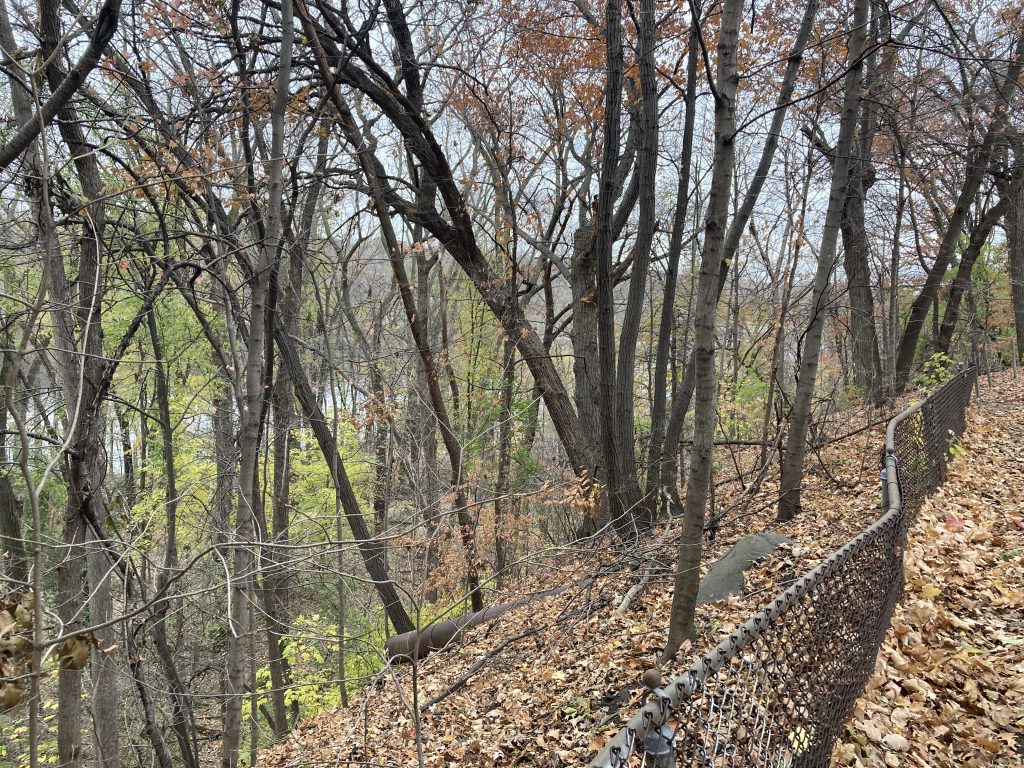
4.5 miles minnehaha falls and back 15 degrees / feels like 3 / flurries
2025, I’m not sure how I feel about you. Not dread, but not exuberant hope either. I guess I’m trying not to think about you and what you might bring that much. Running beside the gorge helps. Very few, what ifs, many more now and now and nows. Today’s run was great. I was surprised to see that the feels like temp was 3. It didn’t feel that cold. I guess I picked the right layers: 2 pairs of black running tights, a black fleece-lined cap with ear flaps, a gray buff, a faded green long-sleeved shirt, a bright orange sweatshirt, a purple jacket, gray long socks, black short socks, black gloves, pink and white striped gloves. At the halfway point, one pair of gloves came off.
While I ran, I thought about remembering and forgetting and decided when I returned home, my 10 things list would be of things remembered and things forgotten.
10 Things Remembered or Forgotten
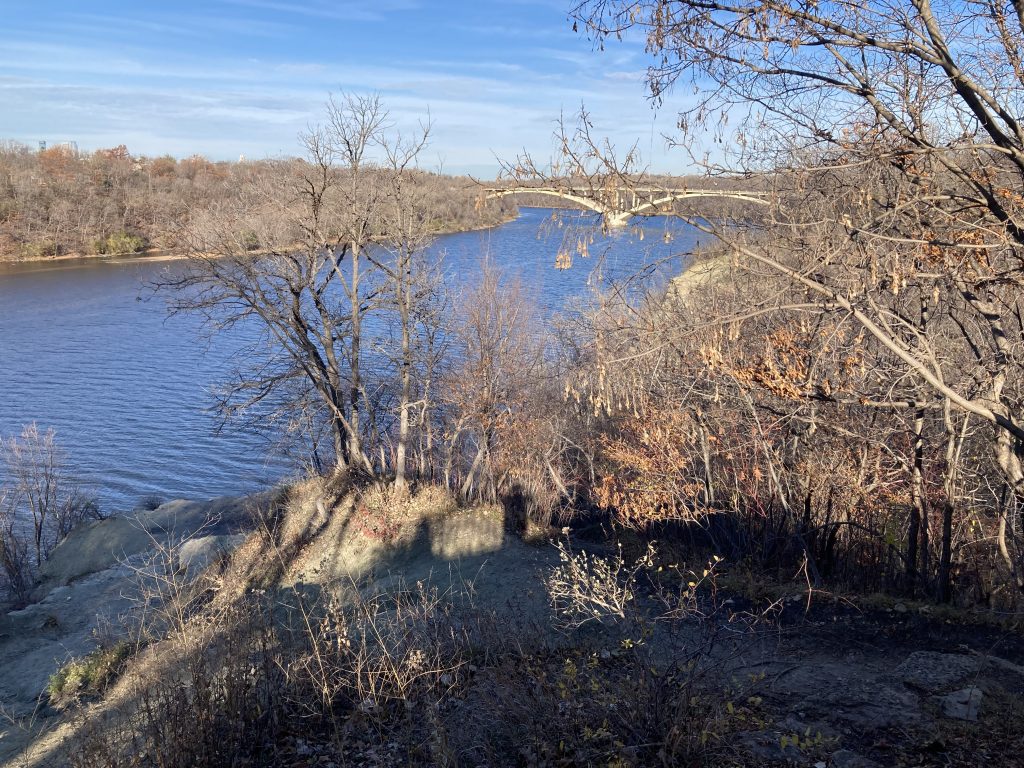
I remembered to look down at the river
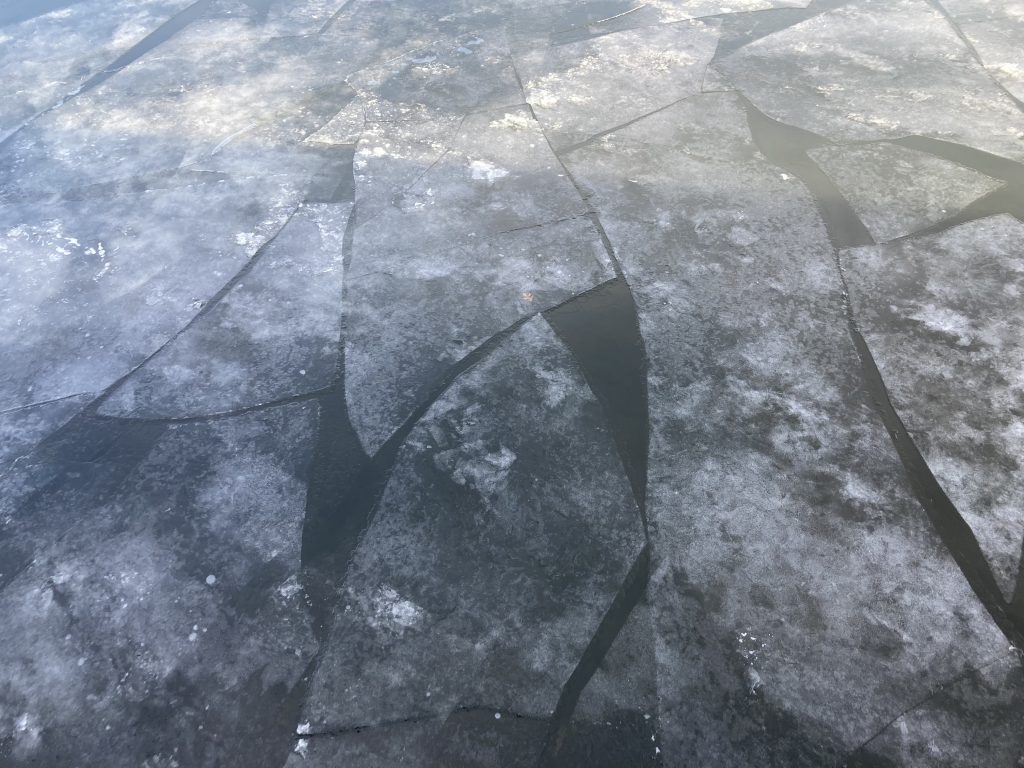
I remembered what it looked like: steel blue, a few thin sheets of ice
I remembered to stop at the bench above the edge of the world to take in the openness — soft, almost still except for a single leaf fluttering and several leaves sizzling, and was the water moving very slowly or was that just the staticky buzz of my glitching cone cells?
I forgot about my headache
I forgot about my IT band
In mile 3, I remembered my IT band and thought about how it’s impossible to fully forget your body, which is good, because why would I want to do that?
I forgot the election
I remembered to look carefully, and more than once, before crossing from the trail to the grassy boulevard
I remembered to stop at my favorite view of the falls — the water was gushing over the side
I remembered what I overheard above the falls: a dad — no hiking today, a mom: we can take a walk instead!
I suppose it’s easier to remember what you remembered, than to remember what you forgot!
Reading through a past entry from 1 jan 2019, I was reminded of how I used to gather favorite lines at the end of the year and turn them into a new poem. I’d like to do that again this year!
The poems that I’ve been writing this fall about the gorge, are mostly about water and stone, but the open space of the gorge is important too. I’d like to devote some time to it as air, as openness, as possibility, as room to breathe, as Nothingness, as mystery, as inexplicable, as . . . . Here are two different fragments that may or may not turn into something:
When water cut through rock, sandstone wore away, limestone broke up, and an abundance of air arrived.
*
When water cut through sandstone and limestone, it made of the rock still standing a frame to loosely hold the newly formed space. And what a space! Such an abundance of air! Such room to breathe and to be! Big enough to hold more than is seen or imagined or witnessed with words.
1.5 mile walk with Delia the gorge, from 36th to 34th 32 degrees / fog
Good job, Sara. You resisted the urge to run. A walk with Delia was wonderful. So quiet and calm and relaxed! Moist, too. I loved breathing in the cool air and almost floating through the fog. All of it, a soft dream. Occasionally I encountered others — some walkers and runners — but mostly it was just us. At one point, descending through the tunnel of trees, which isn’t really a tunnel anymore because they cut it back at some point, the only thing I could hear was a hammer pounding across the road. No cars or voices or striking feet. Wow! Several times, I felt a warm buzz.
10 Things
a white sky
open water
wet asphalt
grass covered in brown leaves
a dark form descending into the ravine — silent, featureless
a brown view of the floodplain forest — all slender trunks and bare branches, no river or sky poking through
a runner in the neighborhood emerging from an alley in a sprint, then returning to the alley, then appearing again, then disappearing around the corner
thump thump thump the striking feet of a runner across the street — the same one? I’m not sure
the silvery sparkle of the sign at the 35th street overlook — is this sign new?
overheard: a woman running alongside a kid on a bike, talking to the kid — you had your pink backpack and your droopy dog stuffed animal — did she say droopy, or some other word?
I wanted to think about my Ars Poetica poem as I walked, and I did, but I’m still stuck. Something about letting things breathe and be exposed to the air to see what happens and erosion and ruins. I’ll give it until the end of the year, and if I’m still stuck, I’ll put it away for a bit.
forget what you are
While reading poet’s Cynthia Cruz’s explanation of how her poem, “Dark Register” is shaped by Hegel’s Philosophy of Spirit, I encountered these lines about habit:
“Habit,” in the third stanza refers to Hegel’s concept of habit: the act of repeating an action that, through this repetition, becomes second nature. For Hegel, habit implies forgetting: we forget what we are doing once the action becomes habit.
we forget what we are . . . . I immediately thought of Marie Howe’s beautiful poem, “The Meadow” and her lines about her dying brother:
I want to add my cry to those who would speak for the sound alone.
But in this world, where something is always listening, even murmuring has meaning, as in the next room you moan
in your sleep, turning into late morning. My love, this might be all we know of forgiveness, this small time when you can forget
what you are.
This forgetting also reminds me of Mary Rueffle’s reference to Levi-Strauss’ “unhitching, which I wrote about on may 31, 2023. First, my rough paraphrasing:
unhitching happens in brief moments when we can step outside of or beside or just beyond — below the threshold of thought, over and above society — to contemplate/experience/behold the this, the what it is, the essence of everything, Mary Oliver’s eternity.
Second, a quote from Levi-Strauss in Mary Ruefle:
The possibility, vital for life, of unhitching, which consists … in grasping, during the brief intervals in which our species can bring itself to interrupt its hive-like activity, the essence of what it was and continues to be, below the threshold of thought and over and above society; in the contemplating of a mineral more beautiful than all our creations; in the scent that can be smelt at the heart of a lily and is more imbued with learning than all our books; or in the brief glance, heavy with patience, serenity and mutual forgiveness, that, through some involuntary understanding, one can sometimes exchange with a cat.
Lévi-Strauss quoted MRH page 52
Wow, all of this is making me think of something I wrote, referencing Mary Oliver, about the gorge. Initially I added it on the end of my geologic time poem, and maybe it should stay there and be extended, or maybe it should be another poem? Here are the lines:
Every day this place erodes the belief that rock will stand still, is here forever, unmoved, unmoving. And yet, with its slow slight shifts on a scale almost beyond her comprehension, these rocks might be as close as the girl can get to eternity.
So many more connections I could make with forgiveness and forgetting and remembering and now and now and now!
5 miles minnehaha park and back 34 degrees / fog / humidity: 94%
Almost all of the snow, which wasn’t much to begin with, is gone. The ice, too. Hardly any wind, but plenty of moisture — the trail, the air, my face. Ran past the falls and John Stevens’ house to the VA bridge, then turned around and ran beside the falls. Stopped at my favorite spot to admire the falls, which were gushing. Put in “Billie Eilish” playlist and ran home.
10 Things
mostly bare grass — the only snow were little mounds where the walking path split off from the biking path
the creek water was fast and steel gray
heard the train bells from across the road, then the horn tapping twice — beep beep
car lights cutting through the mist/fog
an older man pushing an empty wheelchair on the path
glancing down at the Winchell trail north of 38th street, seeing two people walking on a part near the edge, high above the water
I just wrote gray sky, no sun or shadows, but then I remembered there were a few patches of blue sky
overheard: one woman walker to another — ptsd, trump, spend time with family
smiling and waving to people I encountered — one good morning to another runner
a man and a woman stopped at the edge of the walkway down to the bridge over the falls looking at something on a phone — I finally got it! Its back at my apartment
For the past 3 days, Scott, FWA, RJP, and I were up in Duluth. Very mild — no snow, no wind, no waves, some drizzle. Lake Superior was beautiful, especially the first night. While we were gone, I didn’t run. Today was my first day back since Thursday. My left hip is sore after the run. I should take more of a break.
I’m returning to my “Ars Poetica” poem and wanting to use this bit from Kafka for inspiration:
According to the second, Prometheus, goaded by the pain of the tearing beaks, pressed himself deeper and deeper into the rock until he became one with it.
Not becoming one with the gorge, but striving to press deeper and deeper into it, to leave a trace/mark on it, and be marked by it.
It seemed colder than 28 degrees as Scott and I took Delia on a walk this morning. Damp. It looks like snow, but hours later as I write this, it still hasn’t started. The sky is a heavy white. There was some ice on the sidewalk — thin, almost invisible patches. Conscious of my vision, Scott pointed them out. It’s strange how my vision works; I was able to see all of them. I think it’s because of the texture — the icy patches make the concrete just a little bit shinier.
10 Things
good morning! greeted a neighbor on the next block — the one with the cat (matt) who rules the sidewalk and the very cool poetry station. I thought about asking his about it, but didn’t — next time!
most of the ice was in the usual spots — the places where ice always forms because of the slope of the ground or the way a drain pipe is positioned
a dog’s sudden appearance on the other side of a fence startled, then delighted me
the soft tinkling of a collar, almost sounding like a bell
Dave the Daily Walker in the distance
the decorations in the trees of a house on the corner of 28th — over-sized ornaments in soft colors
noticing the contrast colors of a house, wondering to Scott, didn’t that house used to be all one dark color? He couldn’t remember, but I do, now. I’ve written about this house before and its once purple door
I’m not sure what we were talking about but I have no memory of what I saw or smelled or heard for the next couple blocks
oh! one thing I remember now: the beautiful frosty pattern of icy leaves etched on the sidewalk — the leaves were gone, but had let their prints
Delia’s wagging tail as we neared our garage — are we almost home? (wag wag wag)
A few hours ago, before our walk, I did my standard 30 minutes for flexibility yoga. Wow! It felt so good and made me very relaxed. As I stretched, I had a thought about my series of Haunts poems: break up the long 5 syllable sections with some short lines from other writers (mostly poets) that I fit into my 3/2 patter. I call them for fitters. I’m thinking of these kind of like Jane Hirshfield’s pebbles or Mary Oliver’s sand dabs or Victoria Chang’s tankas in Obit. I’m also thinking of them because of the poet Sparrow, who I just learned about in Lydia Davis’ essay on form. Sparrow wrote an entire series of “translated” New Yorker poems.
I thought I had written about the sand dabs and pebbles on here before, but I can’t find anything:
A Year with Mary Oliver posted all 9 of MO’s sand dabs on instagram! Here’s an explanation of the form:
(Sand Dabs 1/9) Over the next nine days, we’ll be sharing each of Mary’s nine “Sand Dabs.”
As Mary wrote in the footnote of Long Life: “The sand dab is a small, bony, not very significant but well-put-together fish.”
The incomparable @mariapopovadescribed “Sand Dabs, One” as “just a few lines, largehearted and limber, each saturated with meaning and illustrating the principle it espouses in a clever meta-manifestation of that principle embedded in the language itself.”
The remaining eight also fit that description.
They read like many of the excerpts from Mary’s notebook (which she shared in the essay “Pen and Paper and a Breath of Air,” found in Blue Pastures)—free form noticing and thoughts, in list form.
All nine Sand Dabs are scattered throughout four of Mary’s less frequently visited books: Blue Pastures, West Wind, Winter Hours, and Long Life. She wrote them over the span of nine years. Just adding more as she went along.
We weren’t able to find any place where all nine lived together. It was fun to collect them from their disparate pages, put them together, and read them all in a row.
No photograph or painting can hold it— the stillness of water just before it starts being ice.
The mention of ice reminded me of a wonderful description I found in the novel I just started reading, A Little Stranger/ Sarah Waters:
I recall most vividly the house itself, which struck me as an absolute mansion. I remember its lovely ageing details: the worn red brick, the cockled window glass, the weathered sandstone edgings. They make it look blurred and slightly uncertain–like an ice, I thought, just beginning to melt in the sun.
30 minutes, with Delia the dog neighborhood 30 degrees
I’m surprised at how good I feel after running the most I ever have in a year, and running a marathon and not taking more than a few days break after it. But, even so, I think I should take a little break from running. At the end of my run yesterday, my left leg and hip felt sore and tight, and I don’t want it to get worse. Also, I think it would be nice to walk a little more for the end of the year. So, I’m hoping to take at least a week without running. Can I do it? I’m not sure.
Today’s walk was great. Warm sun! Half-dry sidewalks. Blue sky. Happy dog. Cold, refreshing air. Walking slowly outside in the cold makes me feel calm and a little euphoric, especially when I breathe in deeply through my nose, out through my mouth.
overheard, 3 things, at different times/places:
(not seen, only heard) a man to someone else — that was an excellent church service
(seen and heard) a man parking and getting out of the car in front of a house, someone from the house calling out jokingly — wrong house!
(seen and third) a man running, wheezing or vigorously coughing, then stopping to walk then sounding like he might be heaving
I though briefly about the section of my poem I’m working on. I’ve tentatively titled it, “Ars Poetica,” which is a type of poem about writing poetry. Right now I’m thinking about entanglements and things growing in the aftermath of ruins and erosion and . . . just as I was typing this up, I had more thoughts — mushrooms as the fruit of fungi bursting through asphalt and cracks and as the words that erupt from my practice, but are only part of the making/writing/living of poetry. Below ground, nets/networks, not as firm as roots but creating deep connections just the same to a place. I’ve already written a little about this — I need to find it . . . Found it! 25 april 2022.
Maybe like mushrooms, we rise. A brief burst from below, a flare, then a return to swim in the dirt
Am I getting too lost with these ideas? I follow them a little further.
3.3 miles trestle turn around 11 degrees 75% snow-covered
Okay winter! Enough layers to keep me warm, a path that wasn’t crowded or icy, Yak trax to help me stay upright. The run wasn’t the easiest, but it might be the slowest. I’m stopped to walk more than I used to. Partly to admire the view, but also because I’m tired after a 1000+ miles of running this year. Time for a break, I think.
10 Things
fee bee fee bee — a black-capped chickadee!
the tight crunch of my feet striking and lifting off of the ground
in several places, big mounds of snow off to the side, pushed their by a parks’ plow
open water
where the path is plowed, only on the bike trail, the snow is packed down or gone. Narrow strips of almost bare pavement have appeared on the edges
where the path is not plowed, on the walking trail. the snow is loose and high enough to be difficult to run through
2 city plows on the street, rumbling down edmund
I stopped slightly short of the trestle because someone was there fiddling with a bike, standing just where I wanted to stop to admire the view
the sky was a bright white, not from sun, but from snow
stopped at my new favorite bench — the view below was all white with thin brown lines and looked cold and alone
I made some progress on my latest section of Haunts this morning! Slowly, it’s turning into something. As I ran, I wanted to think about feral forms and forms that resist complete domestication and nets as forms. Did I? I’m not sure. Now that I’m back home, I plan to read a chapter in Lydia Davis’ collection, Essays One, about the unusual forms she uses in her writing. I happened upon this chapter by accident. Taking a brief break to think through what I was writing, I looked over at my bookshelf and noticed its awesomely green cover. So I picked it up and found “Forms and Influences.” Nice!
The poem of the day at Poetry Foundation was from Jenny Xie’s Eye Level. I’m pretty sure I checked this collection out several years ago, but I don’t remember this poem. One short section from it helped open a door for me into my poem:
If there is a partition between the outer and inner worlds, how is it that some water in me churns between the mountain ranges?
How is it we are absorbed so easily by the ground— (from Long Nights/Jenny Xie)
3.35 miles locks and dam no. 1 12 degrees 99.9% snow-covered
It snowed yesterday. 5.5 inches of soft, powdery stuff. Today it’s colder and the snow has compacted. With my yak-trax it wasn’t too difficult to run on. No slipping. Tiring, though. And beautiful! For the first mile, the river was open and then it was covered — one half had ice and snow, the other sparkles.
10 Things
sharp, dark shadows — mine, behind me for the first half, in front for the second
the only bare stretch of pavement was on the biking side of the bridge, up against the wall, where it is sheltered and covered in dead leaves
encountered at least 3 runners
the loud voices of some construction workers, joking with each other
a deep cough by one of the workers
everywhere, small ledges and wedges of snow
some dirt sprinkled on the path to make it less slippery
the bones of fallen trees, covered with snow in the ravine
a bench on the hill above the edge of the world, at just the right angle to face the sun
a screeching bluejay high in a tree
I’m working on a section of my poem about form. At some point during the run, I thought about searching for forms that can hold my words — but not too tightly — and my messy, layered thoughts and feelings. Earlier this morning, I was thinking about partial forms and illusory forms and unreliable forms — the fuzzy forms my brain creates, the unnatural form of the river. I haven’t quite figured out how to tie them all together.
As part of my focus on forms that seem natural but aren’t, I’ve been thinking about and trying to find an article about the Apostle Islands and re-wilding. This morning I finally found it again! The Riddle of the Apostle Islands
Warmer today! And clear, ice-free paths! Not looking like December at all. I decided to run to the flats so I could see if the water seeping out of the rock wall was still frozen now that it had warmed up. It looked like it was, at least to me, but I could hear some trickling water too. What will it look like this afternoon? I heard a few geese, admired the form of a few other runners after they passed me, noticed my shadow and a few streaks of blue sky when the sun came out from behind the clouds briefly. It wasn’t the easiest run, but it wasn’t the hardest either.
Heading north, I listened to a train — or was it a light rail? — horn honking repeatedly. Not sure what was happening; too many honks, and too insistent, for business as usual. Was there an accident? Returning south, I put in my “It’s Windy” playlist, but then switched to “Slappin’ Shadows.”
Here’s a wonderful poem I discovered this morning. That last line!
What aren’t you willing to believe. A heart graffitied fuchsia on the street, a missive from another life. Remember the stem of lavender you found in a used copy of Bishop’s poems, a verse underlined: The world is a mist. And then the world is minute and vast and clear. Suddenly, across the aisle a woman with your mother’s bracelets, her left wrist all shimmer and gold, you almost winced. Coincidence is the great mystery of the human mind but so is the trans-oceanic reach of Shah Rukh Khan’s slow blink. Each of us wants a hint, a song that dares us to look inside. True, it takes whimsy and ego to believe the universe will tap your shoulder in the middle of a random afternoon. That t-shirt on a stranger’s chest, a bumper sticker on the highway upstate. Truth isn’t going anywhere. It’s your eyes passing by.
Today I’m working on a section of Haunts about forms and shadows and seeing things slant, off to the side, in order to grasp (some of) their truth. I’m thinking I will mention how the mississippi is one of the more trained/shaped/managed rivers — with locks, dams, dredging.
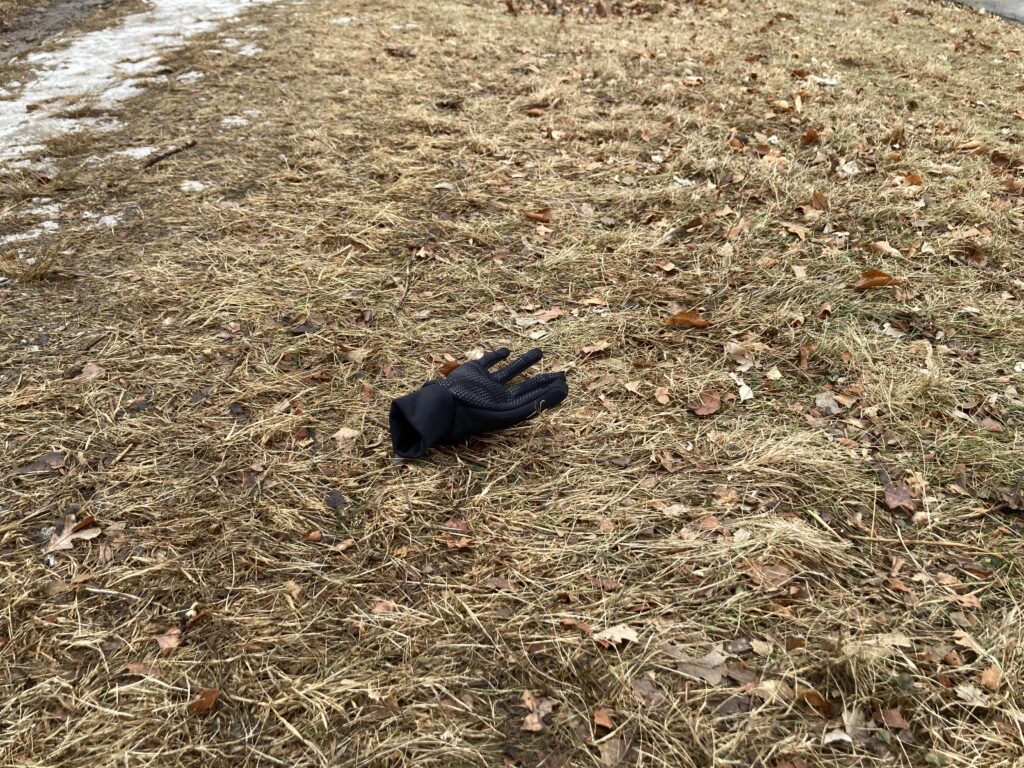
a lone black glove
Almost always, when I see a discarded glove on the ground on my run it is black. Okay, today, I saw a gray one draped on a branch. As I walked home after my run, I encountered a lone black glove on the ground and decided to take a picture of it.
a lone black glove
added, 17 dec 2024: As I was working on a section of Haunts about form, I remembered something else I witnessed yesterday during my run. Somewhere between the trestle and lake street bridge, I noticed a form on the ground, just through the trees. I think it was a sleeping bag with someone (possibly) in it. I’ve seen it here before, but only as a quick flash while I run by. Am I seeing it correctly, or is it like the stacked limestone under the franklin bridge that I always think is a person sitting up against one of the pilings?
4.5 miles minnehaha falls and back 11 degrees / feels like -7 100% snow-covered
The coldest run of the year so far. It didn’t feel like 7 below to me with all of my layers: 2 pairs of running tights, long-sleeved shirt, sweatshirt, my warmest winter jacket, a buff, a hat, a pair of gloves, my thickest pair of mittens. The thing I’d like to remember most about the run was the river, burning white in one spot. Wow! As I ran south, I could see it sparkling through the trees.
10 Other Things to Remember
the banks on the east side of the river were glowing white with snow
crunch! creak! my foot stepping down in the snow — the crunch for the foot striking, the creak for it lifting off
other peoples’ foot prints in the snow, all over the trail
running on stretches of the falls path where no one else had been, looking down at the untouched white, like a blank page ready to be written on
my shadow when the sun was out: sharp, in front of me
my shadow when the sun was behind clouds: soft, faint, only the hint of contrast
the falls were rushing over the limestone edge — all water, no ice today
the sound of a plow on the path somewhere across the park. later, its aftermath: a cleared path
an empty parking lot at the falls
a big tree, felled in the ravine below the double bridge — was it my favorite fall tree — the one that turns a bright orange? no — whew!
Yesterday I finished a draft of another haunts section and I was wondering if I was done (for now) with writing about girls and ghosts and the gorge. Then this morning, re-reading my post from dec 11, 2023, I came across this line:
At one point on my run back, I suddenly felt a beautiful ache of emotion and thought: tender. Yes, I need to include a few lines in my haunts poem about feeling tender as I run — maybe in contrast with tough and the callouses I mentioned last week (6 dec 2023)?
The poem I finished yesterday was about being tender and, although callouses are not in the poem, they inspired it. I started thinking about how time works on this blog, how it took a whole year to take up that suggestion, and how that is often the case here. Things move slower, and not always forward but looping back and returning again and again to ideas. Then I thought about gorge time and Lorine Niedecker’s geologic time. A new section of my poem to write — on my practice and time and looping back to ideas and experiences!
A quick run with Scott. It felt colder than 39 because of the wind. Scott talked about an annoying problem with moving a client to a different server and I talked about my current poem and where to go with it. Then Scott mentioned a small monitor he wants to get and how, of the four options, 3 cost $`100 with $25 shipping and one cost $110 with $15 shipping. I wondered which option people respond to more, and this thinking about how people chose reminded me of the latest If Books Could Kill podcast about the book, What’s the Matter with Kansas?, and why people vote the way the do. Of course this led to a discussion about the current state of politics and how we’re both doing (surprisingly okay and trying to protect our mental health).
10 Things
the river is more open today but still different versions of gray
the wrought iron fence is bent in the middle and at the top — what happened? we noticed a thick tree branch on the other side of the fence
a somewhat subdued din of laughing and yelling at the playground
a man on a bike unwilling to move over and give us runners and walkers the chance to pass each other
a steady line of cars at the 3-way stop suddenly eased up as we approached — clear sailing across!
a dog with their human turning down the steep-ish dirt path on the far end of the 35th street parking lot
at the end of the run, walking home: the sound of woodpecker high in a tree (heard, never seen, although we both tried to find the bird)
knowing that the wind was at our backs when I saw leaves flying towards us
running by the green water fountain in the parking lot and wondering if there was any way that it was still on — not because I wanted any water, but just because I was curious
sometimes the sun was out, and sometimes it was behind the clouds — what did the clouds look like? Did I even check?
where to take my poem
Where it ends now:
Wind, sun, frigid air, the effort it takes to keep moving, a slow wearing down of cone cells, soften her hard shell and cause cracks that start small then spread then split her open and able to feel more of everything and everyone here, now and before.
Talking to Scott while we ran, I wondered if I wanted to end here or write about a section of the trail just north of the trestle that was repaved a few years ago, but cracked open again in less than a year, and then was patched/resealed earlier this year but is now cracked again. I keep thinking about this section. Why? Maybe it’s something about the endless cycle of crack and reseal and the belief that eventually no seal will stop the slope from sliding down into the gorge. Here, at this spot, is evidence of eroding ground and the opportunity to witness time passing on a different scale. Or, maybe it’s a particularly interesting (at least to me) example of how a cracked surface looks and acts. Is there any connection to my small cracks that spread and split? I don’t know.
As I continued talking with Scott, I mentioned Wittgenstein and his need to get off of smooth ice, where it’s difficult to walk, and back on rough ground where friction helps us move. Then I talked about how I don’t like running over cracks and appreciate when they’re repaired, but I don’t often notice smooth pavement. I orient myself on the path by the cracks. The cracks are where the stories are.
And now I’m thinking about how you can’t leave a trace on smooth, sealed asphalt — as opposed to footprints in mud or tamped grass or rutted dirt. Also cracks are where the ground/earth/flowers can poke through. And, I’m reminded of daylighting and how some people/groups are advocating for freeing water from being buried under cement:
the exhumation of streams from underground and reintroduction of them to the surface. There is ample research-based evidence for what seems intuitively true: natural waterways—meaning, those that flow through the topography of a landscape and not through a sewer—support healthier ecosystems than those encased in concrete darkness. Daylighting brings benefits to water quality that include nutrient retention, prevention of algal blooms, and overall more supportive environments for a diversity of species. It also keeps clean water out of the sewer system, where, currently, huge volumes of it unnecessarily go through the sewage treatment process, a waste of resources that can also cause sewers to overflow.
Now I’m thinking about management and maintaining and conservation and how this cracked path and its perpetual repair is where many different elements are entangled: park workers trying to maintain safe paths, a shifting and eroding ground — due to the “natural” instability of the area and chemicals from local lawns in the groundwater and seeping into the soil, overuse or misuse by visitors, the impact of heavy traffic on the parkway from commuters.
Where to go with all of this? Unsure, I returned to the part of my poem that’s inspiring this wander and I was struck by this bit:
able to feel more of everything and everyone here, now and before.
A reminder: the cracked path doesn’t have to be an exact metaphor for my cracking open. It doesn’t have to be a metaphor at all. It can be another layer to this idea of this land as a work of art, as crafted/made/shaped into something beautiful (which does not = pretty) that enable us to feel things deeply. I’d like to bring in 2 things I mentioned in my rambling: 1. smooth asphalt doesn’t leave a trace, doesn’t tell a story but cracked asphalt can/does and 2. the process of cracking and sealing and cracking again enables us to witness time passing on a different scale; it makes visible what was invisible — too slow and slight to notice.
Now, time to try and fit these ideas into a few 5 syllable lines!
Wow, what a great morning for a run! All the snow has melted so the paths were clear and I don’t remember much wind. I felt strong and relaxed and grateful to be outside when everything is bare and brown and open. And that river! Half frozen with a thin layer of ice, half open with shiny, dark water. I stopped at the overlook on the ford bridge and stared down at it, admiring the variations of gray and the feeling of air and nothingness — barren, vast, other-worldly.
10 Things
the sound of a kid either laughing when his voice bounced as he went over something bumpy or crying so hard that his voice was breaking — heard, not seen
several runners in bright yellow shirts
two runners in white jackets
some kids laughing and yelling near the skate park just past the ford bridge, again heard, not seen
the view of the valley between ford and hidden falls — bare tree branches, then endless air, then the other side
a blue port-a-potty with the door ajar
the sound of water rushing over concrete at the locks and dam no. 1
a lone goose honking somewhere near the oak savanna
the contrast of wispy, dark branches against the light gray sky
the river — no color, some shiny, some dulled by ice
an attempt to track my train of thought
I’m working on another section of my Haunts poem (which might need a different name as I stray away from ghosts). Before my run, I was thinking about being tender and erosion and H.W.S Cleveland (Horace William Shaler) as envisioning the grand rounds and the gorge as art. Before I headed out, I gave myself a task for during the run: to think about and look for examples of erosion and how it fits in with my idea that art is about making us feel things deeply (feeling tender). This task was inspired by this section in my poem:
his pitch for parkways was about making space for beauty and for feeling things deeply — he wanted to turn this place into art. Grass and benches and trees to frame open sky and the stone that holds a river and all who seek it. But up here exposed on the bluff, it is not only the view that makes the girl tender. Wind, sun, frigid air, the effort it takes to keep moving, a slow wearing down of cone cells, smooth out her edges, peel away her layers, create cracks that start small then spread.
During my run, I stopped to record three ideas into my phone:
One: I thought about the cracks and the idea of being split open and how this splitting open was not a wound that needed to be patched but something else.
Two: I can’t quite remember how I continued to think about this idea of the wound and breaking open but I do remember suddenly thinking about eroding shorelines and bluffs and how cracks and a wearing away can be harmful. At first I wanted to make a clear distinction between the erosion I was writing about, and the tenderness it allowed for, but then I realized, just before reaching the ford bridge on my way back from hidden falls, that tenderness and feeling things deeply and art as inspiring this is both wound and that something else I can’t quite name. I spoke into my phone:
Beauty as not always pretty, sometimes ugly. Art as wonder and amazement, terror and pain.
I think I was remembering some lines from a podcast episode for Off the Shelf with Dorothy Lasky, as I mentioned terror.
I don’t think beautiful things are innocent, I guess, sadly. I mean, I don’t know what “innocent” means also, but yeah, I think beautiful things are holy, and I think that those things can be awful. I guess it’s like the sublime, and those things which we have awe about is what beauty is. And I don’t think it’s always kind, sadly. You know, I wish it were. It can be, but I don’t think that’s what is really there. It overwhelms. So, it is terrifying by its nature. Like, real beauty should make you terrified.
Three: By the time I had crossed the ford bridge, I had another thought about erosion and my diseased eyes:
My cone cells eroding is this slow softening, but at some point, most likely, there’s going to be a break — an abrupt break [when the few remaining cone cells in my central vision die, when I won’t be able to read or rely on my central vision at all]. And that is how the gorge works. It’s the slow softening of sandstone until limestone breaks off.
Yes! This is a helpful way for me to connect the gorge with my vision. I’m not sure that this third thing fits into this section of the poem, but I will use it somewhere!
posted an hour later: I can’t believe it, but after searching through the archive of this log, I realized that I have never posted this beautiful, tender poem by Mary Oliver:
Lead/ Mary Oliver
Here is a story to break your heart. Are you willing? This winter the loons came to our harbor and died, one by one, of nothing we could see. A friend told me of one on the shore that lifted its head and opened the elegant beak and cried out in the long, sweet savoring of its life which, if you have heard it, you know is a sacred thing., and for which, if you have not heard it, you had better hurry to where they still sing. And, believe me, tell no one just where that is. The next morning this loon, speckled and iridescent and with a plan to fly home to some hidden lake, was dead on the shore. I tell you this to break your heart, by which I mean only that it break open and never close again to the rest of the world.
More great winter running! Sometimes sun and sharp shadows, sometimes clouds. When the sun was behind a cloud everything looked sepia-toned. And when some blue sky peeked through it looked like it had been added in, like a photograph touched-up with color. I felt good and relaxed, except for when my left knee suddenly started to hurt — a quick, sharp pain that went away after a minute.
10 Things
the dull thud of a tool hitting something at a construction site — I can’t decide if is was dull like dead wood or something rusted and metallic
another thud, this one more rhythmic, from across the river
the water pooling below the falls was a faint green, like aged copper — patina?
the walking path was speckled or mottled with thin splotches of snow — where bare pavement peeked through it was brown and reminded me — and probably no one else — of a cow’s hide
there was ice on the river, but not thick — it looked like a slushy without the flavor
birds! I don’t remember hearing them, but I saw them flitting around from tree to tree
ran on the bike side of the double bridge — dead leaves were piled on the edge, and next to that was a strip of bare pavement that seemed to be narrowing near the top
at least one fat tire
a patch of open water, shining like glass, on the river — I stopped to admire it through a net of slender branches
the sharp and menacing shadow of the street lamp on the paved path
Rereading an article on the development of the Grand Rounds, I came across this line:
“I would have the City itself a work of art,” Cleveland explained.
A work of art. Yes! I’ve been thinking about the park space of the gorge as a work of art, created by Minneapolis Parks and the city, for some time. I’m envisioning it as part of a series of ekphrastic poems about how I see the gorge through/with my diseased eyes. Could these poems be part of the Haunts project, or is that too much?
5 miles minnehaha falls and back 15 degrees / feels like 6 light snow
Brrr. I’m pretty sure that this is the coldest run of the season. I wore almost all of the layers: double tights, double gloves, double socks, a buff, a fleece cap, long-sleeved shirt, sweatshirt, jacket. No frozen toes or fingers, only a few frozen eyelashes.
It was snowing lightly. I barely felt the flakes but I could see them collecting in the cracks of the path and on the road. Not slippery. When I reached the park I noticed faint paw prints on the path.
Passing the parking lot, 2 adults were trying unsuccessfully to calm down a kid losing it — did the kid not want to be at the falls, or did they not want to leave it?
By the gorge, the ground is a rich brown carpet of dead leaves and dirt. A few bushes — buckthorn? — seem to have new, bright green leaves. A runner passed me in a bright yellow vest, almost as bright as the crosswalk sign at 38th.
I noticed dark forms moving below me, on the winchell trail. A coyote or turkey or . . . ? Looking longer I finally saw 2 runners.
The river! Mostly white with wide slashes of exposed, dark water. The falls! Still gushing but covered in thick columns of ice. Winter is here.
All the steps at the falls and on the trails are still open. Will they close them this week?
Running south, between 42nd and 44th, I noticed a bench with an open view of the river and the other side. Decided I would stop on my way back north. I did. Beautiful. And right above the edge of the world.
10 Things
a distracted squirrel in the middle of the trail — gathering a nut?
a smoke smell on edmund, probably from a chimney
a gently sloping hill leading down to the river just past the double bridge, filled with tree trunks and dead leaves
mostly the river was white — ice covered with a thin layer of snow, but there were random patches of dark water. Some of them were thick slashes, others looked like geometric shapes — trapezoids, rectangles, triangles, but not a circle in sight
voices below me — who is there? some hikers, deep in and beyond the winchell trail
the small wood between the 44th street parking lot and the winchell trail, usually hidden, was exposed to reveal a short dirt path
birds! not seen, but heard — sweet tweets and chirps, sounding like spring
a fat tire with a faint, flickering headlight
the fake bells from the light rail train, followed by some quick horn taps
a woman reaching the falls overlook and exclaiming in delight and wonder — wow!
the start of another haunts section?
Before I went out for my run, I did a little research on the bike/walking trails along the river. Deeper digging is required. Maybe a trip to the central library, or an email? Anyway, I learned that they created paved trails above the gorge and beside the river parkway in the fall of 1973. The main trail I use is only 6 months older than me! That seems like it would make a good line for a section that features the trails, either just the paved ones above, or the ones below too.
Mostly the girl stays above on a trail as old as she is. Paved in seventy three, when gas prices and an interest in conservation were high.
Here’s a wonderful poem from Carl Phillips:
Speak Low/ Carl Phillips (from Speak Low)
The wind stirred–the water beneath it stirred accordingly … The wind’s pattern was its own, and the water’s also. The water in that sense was the wind’s reflection. The wind was, to the water, what the water was to the light that fell there, or appeared to fall, spilling as if the light were a liquid, or as if the light and the water it spilled across
were now the same
It is true that the light, like the water, assumed the pattern of what acted upon it. But the water assumed also the shape of what contained it, while the light did not. The light seemed fugitive, a restiveness, the less-than-clear distance between everything we know we should do, and all the rest–all the rest that we do stirring, as the wind stirred it, the water was water–was a form of clarity itself, a window we’ve no sooner looked through than we’ve abandoned it for what lies past that: a view, and then what comes
into view, or might,
if we watch patiently enough, steadily–so we believe, wishing for what, by now, even we can’t put a name to, but feel certain we’ll recognize, having done so before. It olled, didn’t it, just like harmlessness. A small wind. Some light on water.
Another wonderful almost winter morning! Sunny, hardly any wind, clear paths. In January, a day like this would feel tropical and offer hope for a coming spring. Ran with Scott to the trestle and back. We talked about the Love Supreme arrangement he’s doing for the jazz combo he’s in and how he’s learning a lot about the form of its 4 movements. I talked about my “And” poem and wondered if there was a 3 syllable word that might convey sudden understanding. Scott answered, Eureka! Nice, but not quite the right feel for my poem. I could use clarity, but I don’t want to — clarity is more the mood of the moment that the reader feels without it being spelled out for them, I think.
A mile later, Scott described how you code and in css (where and means both this and that must exist to make a statement true) and how you code or (where or means either this or that can exist to make a statement true). I was fascinated by how and was restrictive and narrowing in the code while or was expansive. In my poem, I’m understanding and as generous and open and allowing for more possibilities not less. I told Scott that I might need to write an or poem now. And is accumulation, more layers while or is a stripping down.
And = all these things can be true, and more Or = at any give time, any one of these things could be true
Am I getting too far into theory here, trying to be too clever?
Speaking of or in poetry, here’s a great or poem I just found:
Or Oreo, or worse. Or ordinary. Or your choice of category
        or
        Color
or any color other than Colored or Colored Only. Or “Of Color”
        or
        Other
or theory or discourse or oral territory. Oregon or Georgia or Florida Zora
        or
        Opportunity
or born poor or Corporate. Or Moor. Or a Noir Orpheus or Senghor
        or
        Diaspora
or a horrendous and tore-up journey. Or performance. Or allegory’s armor of ignorant comfort
        or
        Worship
or reform or a sore chorus. Or Electoral Corruption or important ports of Yoruba or worry
        or
        Neighbor
or fear of . . . of terror or border. Or all organized minorities.
And here’s what Robyn Creswell writes about the poem:
There is no doubt that Thomas Sayers Ellis’s “Or,” is a poem, but it is one of the few that feels to me like a rap—an especially good one. This is because of the way it establishes a pattern and then continually breaks away from it. The poem is based on the repetition of or, but as we read through it, what seemed like a formal constraint becomes a principle of transformation, a hinge that keeps flexing. The poem begins, as I read it, by riffing on the either/or logic of identity questionnaires (“You could get with this, or you could get with that,” as Black Sheep once put it, in a different context). But it quickly ramifies into geography, history, poetics.
Perfect running weather. Cold, but not too cold, calm, overcast. Clear paths, a dreamy, detached feeling. As I ran, I thought of a goal for this winter: continue working on running with a slower heart rate. I started this during the summer/fall with marathon training, and I think it helped me avoid injuries. This winter I’m thinking I should target 155-160. I wonder what fun experiments I can do while trying to keep my heart rate low?
10 Things
as I ran, I gave attention to my arms — when my form was good, I felt like my arms were blades scissoring the air
the river was half bronze, half pewter
2 walkers who were not together were both
wearing bright RED jackets
3 stones were stacked on the boulder — the one on top was barely balanced
the yellow leaves were thick on the part of the path that descends into the tunnel of trees
a roller skier bombing down the hill
a noisy squirrel rooting through the dry brush
the slabs of stone stacked under the franklin bridge always look like a person to me — they did again today, looking like a sitting person as I passed them on my way down, just stones on my way back up — I imagined someone playing a trick on me, first sitting there, but then after I passed, putting the stones down
some regulars I haven’t named yet, but that I’ve encountered for years: 3 older white men, walking, stretched across the whole walking path — is it the same guys every time, or different ones, all of them man spreading? That’s what I could call them: the man spreaders
rotting sewer smell in the tunnel of trees, close to where the city is doing some work
More work this morning (and afternoon), on my “And” poem. So far, I’ve written about the formation of the gorge (wanting to be somewhere else) and the designing of the Mississippi River Gorge park (to protect from overdevelopment and sell the gorge as a symbol of the water city). Now I’m getting into my love of the view, which is about what I see — softened, elemental forms, like tree line or water or white sand beach — but also what I feel — open, a veil lifted, a little clarity, freer and more able to breathe and move, to the other side (which stands in for many things, including St. Paul where my mom lived until she was 18, the place where people who died dwell, the normal-sighted and real world that I feel distanced from. I think the view is also about how standing above the gorge enables me to witness how it holds all of these things together, that it doesn’t divide but connects. There is not a gap between girl and world, but a space that can hold them together, along with water and stone, mothers and daughters, hear and there, now and then. These are all references to past sections of the poem.
4 miles minnehaha falls 49 degrees wind gusts: 25 mph
Wet. Windy. Slick leaves. Squeaks. A light gray sky. Singing pines. The usual puddles. White foam falls. Gushing sewer pipes. Brisk air. Mud.
Greeted Santa Claus (the regular runner whose long white beard reminds me of Santa Claus). Passed a man walking with one leg up in a boot on a scooter. Gave directions to 2 walkers — which way to the falls? follow the path, it’s over there.
The creek was a steel blue and rushing to reach the limestone ledge. A kid at the main overlook was jumping in a puddle. The green gate at the top of the steps leading down to the falls was still open.
Wore shorts and a pink hooded jacket. My legs were only cold for a few minutes. Too warm for mid-November. Today is the last day of warmer air. Tomorrow, below freezing.
I started working on the section of Haunts poem that I’m titling, And. Came up with a few lines while running north. Recited them in my head until I stopped near the Folwell bench and spoke them into my phone:
Before a Victor- ian’s great love for ventilation, there was water wanting to be something and somewhere else.
The ventilation bit is taken from an article about the origins of the Grand Rounds, and the Victorian is Horace W.S. Cleveland:
The concept of The Grand Rounds was born from Cleveland’s “preference of an extended system of boulevards, or ornamental avenues, rather than a series of detached open areas or public squares.” This was not only an aesthetic consideration: Cleveland had lost many possessions in the 1871 Chicago fire, and saw parkways as an effective firebreak in built-up urban areas. In addition, Cleveland stressed the sanitary benefits derived from parkways. Cholera, typhus, and other diseases plagued cities in the late nineteenth century. Parkways could save land from unhealthy uses and, reflecting the Victorians’ great love for ventilation, carry “winds . . . to the heart of the city, purified by their passage over a long stretch of living water, and through the foliage of miles of forest.”
Another beautiful, late fall morning! Sun, blue skies, hardly a breeze. Running north, my shadow leading me, occasionally drifting to the side and off into the woods. Running south, hiding behind me. I saw her only once when I turned around to check. Everything calm, quiet. Everyone enjoying being alone together. An open view of air and the bare-branched tree line on the other side. Blue river. An inviting bench perched on the edge of the bluff. I saw it as I ran toward the trestle. When I turned around, I stopped at it. Right on the edge, a steep brown slope down to the white sands beach and the river. How many more seasons before this bench, already on the edge, tumbles down? The sour-sweet smell of the sewer — a hint of sharp spice. Pounding hammers–not in a fast, steady rhythm, but in bursts and trading off. A great run.
As I ran, I couldn’t imagine how it could rain this afternoon. So much sun and blue skies! But already, less than an hour later, clouds. Rain is coming.
I’m still working on a section of my poem about progress and time and conservation. The ending turns to a vague reference to conversation of matter, where nothing is lost or gained, just transformed. Somewhere after the tunnel of trees, I suddenly thought, exchanged, and imagined oxygen being traded between lungs and leaves.
Made-up Walking Tours
Here’s an article that I found the other day about the poet, Mathias Svalina’s, surreal walking tours in Richmond: Surrealistic Zillow. Here’s how the tours work:
You show up at the appropriate time and place and look for a man with a bullhorn. “Because I’m a man who owns a bullhorn now,” Svalina says. “[Then] I’ll point to buildings and lie about them for 90 minutes.”
and part of its purpose:
“I’m particularly interested in civic history because of the ways that cities use, rewrite, and often weaponize their histories as promotional agents, or as ways of ignoring populations,” he explains. “So, I like the idea of inventing histories that could not have ever existed.”
Sun! Sharp shadows. Blue sky. The river burning white — wow! Rushing falls. A leaf-littered slope down to the river. A clear view across. Crowded trails, mostly walkers. At least one roller skier. People emerging from the oak savanna near the big rock shaped like an armchair. A little kid on a bike in the parking lot. The usual smell of smoke coming from some house on edmund or from the gorge; every fall/winter I can’t quite tell. My ponytail forcefully swinging in the wind. I don’t remember hearing any birds or dodging any squirrels. Where are the geese?
I also don’t remember what I thought about. I wanted to work through a part of my poem about progress and conservation of matter and the entanglement of decay/rusting/softening of the gorge and my shifting eyesight. But, if I did, I can’t remember.
This Kay Ryan poem was the poem of the day on Poetry Foundation:
Surfaces serve their own purposes, strive to remain constant (all lives want that). There is a skin, not just on peaches but on oceans (note the telltale slough of foam on beaches). Sometimes it’s loose, as in the case of cats: you feel how a second life slides under it. Sometimes it fits. Take glass. Sometimes it outlasts its underside. Take reefs.
The private lives of surfaces are innocent, not devious. Take the one-dimensional belief of enamel in itself, the furious autonomy of luster (crush a pearl— it’s powder), the whole curious seamlessness of how we’re each surrounded and what it doesn’t teach.
3.1 miles trestle turn around 52 degrees wind gusts: 36 mph
Ran with Scott in the afternoon. Windy but warm. Wore shorts and a sweatshirt that I took off a mile in. Sunny. We talked about progressive things: insurance (Scott), glasses and degenerative diseases like progressive cone dystrophy (me).
a twin mattress with a ripped cover next to a trash can
another runner in dark tights (purple?) with a green shirt
in the tunnel of trees the path was covered with leaves
adjusting my cap, worried the wind would knock it off
a navy blue glove propped on a branch
the water-logged black stocking cap still on the post above the steps
I’m working on a section of my Haunts poem that plays with the idea of progress and challenges the belief that progress is always better and that our lives move in strictly linear ways. I’ve written about progress before, on 7 feb 2022.
November! A day for singing a song of gray. A pale, sunless sky, some wind, lots of bare branches. The tree outside my window and a few others by the gorge were YELLOW! Greeted Dave, the Daily Walker — hey Dave! Almost tripped on a few rocks on the dirt path next to the trail on the east side. Admired the waves from the bridges: from ford, little scales and from lake, a slight current down the center — from a sandbar? Heard a chickadee — chick a dee dee dee dee — and the constant grumbling of the city beneath everything.
Thought about different time scales and how time works for me while I’m running — encountering memories of past Saras, echoing their movements. Imagining the gorge before Cleveland created the Grand Rounds, before Longfellow was a neighborhood, before the gorge was a gorge. Having no idea how much time had passed — never hearing the bells of St. Thomas or looking at my watch. Having no memory of small stretches of the trail — being lost in a thought or the motion or my effort.
10 Things
the fast slapping of a runner’s feet passing me from behind
the clear open view from a bluff on the east side of the river, looking over to the west side
3 stacked stones on the boulder
a black stocking cap placed on the top of a pole beside the trail
the frantic bark of a dog, bothered by a nearby leaf blower
the barricades blocking the sidewalk in front of Governor Walz’ house
the ravine near Shadow Falls, mostly yellow from leaves on trees and the ground
voices from below, near Longfellow flats beach
a sour sewer smell near the Monument
a man call out a command — drop it! — to his dog near the south entrance of the winchell trail
While looking for something else, I came across this beautiful poem by Minnesota’s first indigenous poet laureate, Dr. Gwen Westerman:
5.25 miles bottom of franklin hill and back 47 degrees
A great November morning. Most of the trees bare, almost everything light brown and steel blue. A few yellow leaves still on the trees. I felt relaxed and was able to run without stopping — until I needed the port-a-potty. Found a freshly cleaned one at the bottom of the hill, then ran back up it all the way without stopping. For the last 2 miles I felt strong and resilient and ready to resist.
10 Things
roller skiers — at least 3 of them, not together. All of them looked graceful and strong and ready for it to snow
the awkward slapping of oars on the water from a rowing shell far below
the bells of St. Thomas ringing briefly
more awkward slaps from oars, this time from a shell with 3 people. I heard them when I was at the bottom of the hill and watched as they angled across the river. One of them had on a bright yellow — or was it orange? — shirt
a man sitting on a bench, his back to the gorge, reading a book
faint voices getting louder — was it runners or bikers? both
the floodplain forest is open — no more leaves — I glanced down the steep slope to the forest floor
a runner on the other side of the road in black shorts and white tights
4 stones stacked on the ancient boulder
a walker bundled up in a coat with a scarf
I had a thought about my Haunts project near the start of my run. I’m writing a lot about looping and orbiting, but I haven’t written about pacing back and forth — all of my out and back or turn around runs, when I cover the same ground twice, and stay on one side of the river. I’m thinking about the difference between restless pacing and cycles/loops/orbits.
I didn’t see any eagles or hear any geese. No regulars or fat tires or music blasting from car or bike speakers. No one singing or doing something ridiculous. Only one honking car horn. No chainsaws or sirens or leaf blowers.
Today I checked out Carl Phillips’poetry collection, which won the Pulitzer Prize, Then the War. Here’s an early favorite of mine:
The Enchanted Bluff/ Carl Phillips
You can see here, though the marks are faint, how the river must once have coincided with love’s most eastern boundary. But it’s years now since the river shifted, as if done with the same view both over and over and never twice, which is to say done at last with conundrum, when it’s just a river—here’s a river . . . Why not say so, why this need to name things based on what they remind us of—cattail and broom, skunk cabbage—or on what
we wished for: heal-all; forget-me-not. Despite her dyed-too-black hair wildly haloing her soulders, not a witch, caftanned in turquoise, gold, turning men into better men, into men with feelings—instead, just my mother, already gone crazy a bit, watching the yard fill with the feral cats that she fed each night. Who says you can’t die from regret being all you can think about? What’s it matter, now, if she learned the hard way the difference finally between freedom and merely setting a life free? As much as I can, anyway, I try to keep regret far from me,
though like any song built to last, there’s a rhythm to it that, once recognized, can be hard to shake: one of by fear, with its double flower— panic, ambition; two if by what’s the worst thing you’ve ever done?
I love these lines:
But it’s years now since the river shifted, as if done with the same view both over and over and never twice, which is to say done at last with conundrum, when it’s just a river—here’s a river . . .
I’d like to use, as if done with the same/view both over and over/and never twice.
I want to fit it into my 3/2 form and use it my Haunts section about looping and doubling back. Maybe something like this:
Occasionally the girl does not run on the rim, changes her route, as if done with the same view, both over and over and never twice.
2 miles edmund south/river road, north 45 degrees / drizzle
Election day. Read an accurate description of how today feels: like we all are waiting for the results from a biopsy. I’m hopeful.
Did a quick 2 miles with Scott before the rain started. Throughout we felt drizzle but it wasn’t until we reached our alley that it began to rain. Everything gray and heavy. Most of the leaves on the trees have fallen — except for the one in front of our house — full and green. We talked about a color video that Scott had just watched. Texture and wine dark seas and having no names for blue but many for green were discussed.
My favorite view: bare trees means more open air and the other side visible! I admired the tree line on the east side of the river. It gave off the feeling of being a straight line stretching across. Of course, nothing is completely straight for me; it’s all approximation.
10 Things
a cluster of headlights — stuck behind a slow-moving street sweeper
a thick trunk pushing through the bottom of the fence above the ravine
running past Dowling, hearing faint laughter from kids somewhere
the water was a blueish-gray, the sky almost all white with gray smudges
stopping at the overlook, noticing how uneven and slanted the paving blocks have become
a house on the corner, all black or dark green or dark something, no contrasting trim, difficult for me to see anything but a hulking shape or a dark void, absent of color
running past a water fountain and wondering if it was still turned on
the welcoming oaks have lost all of their leaves
passing above the savanna, seeing something white below — was it a hiker in a white shirt or the information sign?
something remembered from yesterday: the sound of chainsaws in the savanna
Working on a section of my haunts poem tentatively titled, And. It’s inspired by a line from the first section: a gap grew/between girl and world. I realized that the and here is the gorge, and it’s more than a gap; it’s the place that be/holds girl ghost here there now then water stone. It’s also the absence around which I orbit. It’s not empty but filled with open air and possibility. Anyway, I was reminded of a Community clip from Troy and Abed:
Here I’m reading Troy’s and as making more space for the story Abed is telling. I love how Donald Glover delivers the ands.
I’m also thinking about this bit from a wonderful Maggie Smith poem:
If I list everything I love
about the world, and if the list is long and heavy enough,
I can lift it over and over— repetitions, they’re called, reps—
to keep my heart on, to keep the dirt off. Let’s begin
with bees, and the hum, and the honey singing
on my tongue, and the child sleeping at last, and, and, and—
5.75 miles franklin loop 59 degrees / mist and drizzle
Wow, wow, wow! What a cool (vibe, not temp) morning beside the gorge. Everything damp and dripping, bright orange leaves, mist. I first noticed the mist in the floodplain forest, then on the river. Looking to the north while crossing the franklin bridge, the river disappeared into it. I greeted Daddy Long Legs — good morning! Saw a rowing shell on the river, gliding. From high above I couldn’t hear their awkward oars slapping the water. Noticed the reflections of trees in the water near the east shore.
10 Things
drips of water tinkling from the trees — or was it wind moving through leaves?
leaves + puddles = muck: yuck!
the bright white boat glowing on the dark river
a broken slat on a freshly painted fence
a group of glowing orange trees near the base of the bridge
walkers with raincoats, their hoods up
no stones stacked on the big boulder
a dirt trail leading down near meeker dam, just past a wrought-iron fence
a sandbar just below the surface, under the lake street bridge overlook
white sands beach, glowing through the bare trees on the other side of the river
As I ran, I was thinking about water and stone and how I feel like both. Water, flowing and carving out new possibilities, and stone, slowly being worn down, transformed, losing layers. I also thought about air and its relationship to water and stone. Octavio Paz has a wonderful poem, Wind, Water, Stone. I also kept returning to the idea of erosion.
Reading through past entries tagged with “water and stone,” I found this bit from march 13, 2024. Some of the same thoughts I was having this morning! Such loops and repeated cycles of thoughts!
restless water satisfied stone erosion movement
not 1 or 2 but 3 things: water and stone and their interactions erosion, making something new — gorge
Then: Water as a poet / stubborn Stone yields, refuses, resists water = poet / stone = words/language erosion = absence, silence, making Nothing me = eroding eyes / stone being shaped / a form of water shaping stone
I wear down the stone with my regular loops
Add a variation of this line, originally in my mood ring, Relentless, somewhere:
I am both limestone and water. As I dissolve my slow steady flow carves out a new geography.
In other rock-related news, FWA is planning to play the epically awesome bass clarinet Concerto for a Aria competition this spring. It’s called Prometheus and the four short-ish movements are based on Kafka’s short story about the myth:
There are four legends concerning Prometheus:
According to the first, he was clamped to a rock in the Caucasus for betraying the secrets of the gods to men, and the gods sent eagles to feed on his liver, which was perpetually renewed. According to the second, Prometheus, goaded by the pain of the tearing beaks, pressed himself deeper and deeper into the rock until he became one with it. According to the third, his treachery was forgotten in the course of thousands of years, the gods forgotten, the eagles, he himself forgotten. According to the fourth, every one grew weary of the meaningless affair. The gods grew weary, the eagles grew weary, the wound closed wearily. There remained the inexplicable mass of rock.—The legend tried to explain the inexplicable. As it came out of a substratum of truth it had in turn to end in the inexplicable.
3.5 miles trestle turn around 38 degrees / drips then drizzle then freezing rain
Happy Halloween. Snow later this morning. Wanted to get in a quick run before that happened. When I started it was only dripping but as I finished, freezing rain. Wore black running tights, a pink hooded jacket, a black winter vest, and black gloves. Running north I had the wind in my face. Running south, to my side. I enjoyed this run. Hardly anyone else out on the trail and cool temperatures. Winter running is coming!
Since I’m trying to finish an audio book that’s due in 2 days, I listened to it instead of the rain — except for in the last minutes of the run. I took out my headphones and heard water falling steadily.
10 Things
the usual puddles on neighborhood sidewalks: just past the alley, a stretch on the next block, a big one covering entire slab on 46th
bright headlights cutting through the trees on the other side of the ravine
a few stones stacked on the big boulder
under the lake street bridge: a red blanket stretched on the uneven limestone with a person under it, an empty wheelchair nearby
a small stretch of the river road between lake street and the trestle was flooded. It almost was cresting the curb
most cars slowed down for the flooding, but one didn’t — splash! — thankfully not on me
only one other runner out there
roaring wind
light gray sky
a steady, strong rhythm of striking feet
That wheelchair broke me open for the rest of the run.
Yesterday, Scott, RJP, and I voted early! Everyone at the polling place was happy and nice and excited to be voting. A great experience, even as it was difficult because of my failing vision. Before voting, we were required to fill out an absentee ballot form. Only the highlighted parts, the person who handed us the form instructed. The problem: I can’t see yellow, and that was the color of the highlighted text. RJP had to point out the sections. Scott was unsettled as he was reminded of how bad my vision is getting. At first, when I looked at the ballot, I couldn’t quite make sense of it, but after a moment, slowly, I could read the different categories and names. I thought I was filling in the entire bubble (Harris/Walz, OF COURSE!), but when I double- then triple-checked it, I had only filled in half of it. Another few times, and I finally filled it all in.
water section of haunts
Wrote this bit about the hidden cut-off wall in downtown Minneapolis that was put in place in 1876 and still holds the river back from breaking through the last bed of limestone:
A century and a half later, the concrete, hidden deep*, still stands and the river, ever restless*, has not stopped trying to move past it. Water will flow where water wants to go, under over through. Near the gorge the girl beholds its quiet refusal to be contained.
*should I cut these extra bits?
I thought about the idea of water going where it wants to go as I ran through the rain, navigating the streams and puddles.
3.1 miles locks and dam no. 1 and back 61 degrees / humidity: 80%
High today of 78. Tomorrow 72. Halloween 49. As Scott says, It’s always cold on Halloween. I felt overheated during the run. Face burning and dripping sweat. I had been planning to do a 10k — the Hidden Falls loop — but it felt too warm. Maybe on Thursday. I wore black shorts and a darkish blue short-sleeved shirt. The same thing I wore for the marathon.
I listened to an audio book, The God of the Woods, so I was distracted as I ran. Can I remember 10 things?
10 Things
an intense, sweet and sour and woody smell as I ran by a pile of wood chips at the edge of the trail
tall piles of wet leaves at the end of the street, waiting for the city workers to return and scoop them up in their truck
beep beep beep — a city truck backing up
3 or 4 stacked stones on the ancient boulder
a group of bikers, all wearing bright yellow long-sleeved shirts
crunch crunch crunch — my feet running through a blanket of leaves on one side of the trail
a faint shadow on the sidewalk, cast from the light of a weak, cloud-covered sun
someone sitting on a bench near the overlook, wearing dark clothing
the water fountain near 36th appears to still be on — the st. paul ones are already turned off, when do they turn off the minneapolis ones?
the clicking and clacking of a roller skier’s poles and the bright blue of their shirt — did I see this today or on my walk yesterday afternoon?
more on the water section of haunts
I’m still gathering ideas and resources for my water section. Here’s another one:
Though the river has always been dynamic, it looks very different than it did just a few centuries ago. In the past 175 years, people began making major engineering changes to the river in attempts to harness it for industry. Before we started building mills, dams and locks, the Mississippi here was a wild and free-flowing river.
Rather than the series of dammed reservoirs we have today, the river was a braided channel with at least a dozen islands between the falls and Bdóte, where the Minnesota River enters the Mississippi. The river had rocky rapids, gravel bars and beaches, fast and slow spots, deep and shallow spots and floodplains.
Possibly to put beside this, a line from a poem I revisited this morning:
And if the world has ceased to hear you, say to the silent earth: I flow. To the rushing water, speak: I am (from Let this darkness be a bell tower/ Rainer Maria Rilke)
1 mile river road, north/32nd/edmund, south 57 degrees
Even though I ran on Saturday and Sunday, it’s beautiful this morning, so I decided to go out for a quick run. Wow! The floodplain forest was almost all golden. And it was warm enough to wear shorts! The mile was easy, relaxed — my average heart rate = 137. I recited my favorite Halloween poem in my head — A Rhyme for Halloween — and tried to think about the latest section of my haunts poem. It’s about restlessness and water and control and the idea of enough and the army corps of engineers and locks and dams and hydroelectric power and energy and constant movement and . . . . Did I have any helpful thoughts? I can’t remember. Did I look at the river? I can’t remember that either. I think my view of it was still blocked. All I saw was open air.
The air over a gorge is different than the air over a field. Why? Sometimes when I’m being driven* on the river road and I can see the air but not the river, I think about this question. If I were seeing this for the first time and didn’t know anything about it, would I still be able to tell the air I could see was over a gorge and not a big open field? What’s different?
*usually I write driving and not being driven, but I don’t drive anymore because of my vision. I haven’t driven in 3 years and only briefly. I haven’t driven regularly in at least 5 years.
I was feeling good as I walked back through the neighborhood, happy to be outside, and then it happened. No warning, out of the blue: my kneecap briefly slid out of its groove. It went back in right away, but not before reminding me that it could do it again whenever it wanted. I recovered and wasn’t too anxious, but was cautious with every step, wondering if it would happen again. Sigh. One reassurance: while these slips and slides are still disruptive, they don’t bother me nearly as much as they used to. I will be fine, my knee will be fine.
water, preliminary thoughts
I mentioned above that I’m working on a new section of my haunts poem. It’s about water and restlessness. Before my run, I was free-writing about it: relentless, obsession, wearing down, transforming, constantly moving, never still.
Then I wrote this: the falls never stopped, just put on hold, all that restless energy built up. This is a reference to the fact that the falls didn’t run out of rock and peter out, but was stopped by a concrete apron under the water, built over 100 years ago. I can’t quite remember the details, so I better review the history.
My notes continue: dammed, locks and dam, hydroelectric power, tamed, removing the dam, letting water flow freely. Then I remembered reading about efforts to restore creeks and streams that have been buried in concrete as cities built up. It’s called daylighting. Yes! I could include something about that, too!
For some time, people and organizations (like Friends of the Mississippi River) have been advocating for removing some of the locks and dams (there are 3) and restoring the river. Here’s a description that I might like to use in my poem:
The Mississippi River, one of the most iconic, important waterways in the world, is also one of the most altered. Dams drown once-vibrant rapids, levees stop the river’s meander, and dredging and river-training structures keep the Mississippi locked into a prescribed path.
I’m particularly interested in the river-training bit and the efforts to lock the river into a prescribed path. To contrast this, I might also want to include my work/thinking around seeps and springs and their ability to leak and find ways through rock and asphalt.
Whew! I’ll need to edit and whittle it down to something manageable, but it’s fun to let the ideas take me wherever I want to go — to flow freely, not be locked in a certain path!
Thinking about all of these ideas, I was reminded of how the poet Wang Ping describes restoring the dam in their poem, And the Old Man Speaks of Paradise:
Do not dam me. To move freely is to evolve is to live Lock feeds fear feeds hate feeds violence to the base of paradise
added a few minutes later: I love Tim Walz and I love this interview he did while running:
When he said, about Minnesotans, “we run in the winter,” I yelled out to the screen and the empty room, Yes!
A quick run after getting my flu and COVID shot and before taking FWA to an eye exam. Another beautiful, warm morning. Everything yellow and crunchy. The Winchell trail was crowded with hikers admiring the leaves and the view. Heard kids on the playground. Smelled the sour sewer. Felt the soft sand. The theme of the morning: leaves. Brittle leaves covering the trail, making it harder to see roots or rocks. Fluttering leaves falling from the trees. Absent leaves giving me a better view of the other side. And that sound! Before starting my run, yellow locust leaves near the curb sizzled after a car drove by. A few blocks later, a cluster of leaves — or was it a plastic bag? — crackled and crunched in the slight wind.
Near Folwell, after climbing the short, steep hill, I stopped to record a few lines for the next section of my poem. The section is called Nobody and it’s about bells and mom-ghosts and dead cone cells.
In the gray morning the few cone cells that remain are starved for light, everything lacks form — no edges, no bodies, just blurs
Here’s a beautiful poem I encountered this morning. I’m adding it to my collection of dirt/dust poems.
We mourn the broken things, chair legs wrenched from their seats, chipped plates, the threadbare clothes. We work the magic of glue, drive the nails, mend the holes. We save what we can, melt small pieces of soap, gather fallen pecans, keep neck bones for soup. Beating rugs against the house, we watch dust, lit like stars, spreading across the yard. Late afternoon, we draw the blinds to cool the rooms, drive the bugs out. My mother irons, singing, lost in reverie. I mark the pages of a mail-order catalog, listen for passing cars. All day we watch for the mail, some news from a distant place.
It’s 14 lines. Is it a sonnet? Is there a volta? Is it the dust, lit like stars?
10.2 miles downtown loop* 61 degrees / humidity: 70%
*river road trail, north — past the trestle, down franklin hill, in the flats, up the I-94 hill, past the Guthrie and Stone Arch, under Hennepin, over Plymouth, through Boom Island, up to the 3rd avenue Bridge, winding down to river road, heading south.
Warm this morning. Sun, sweat. Wore shorts and short-sleeved shirt. Ran with Scott; we’re running the Halloween Half next Saturday. My legs and lungs were fine, my gut not so much. Unfinished business at mile 6, then again at mile 9. Hopefully I can figure out a way to fix it soon. I remember that Scott talked a lot more than I did, but about what? Music — he subbed for a community jazz band and he’s hoping they ask him to join. I talked about shadows and afternoon moons and my admiration for fit runners and good form — so graceful and pleasing to watch!
We greeted Mr. Holiday — good morning! — and encountered a few roller skiers. We also encountered Vikings Fans between Stone Arch and Hennepin. Enjoying the nice weather before the game, I guess. I heard train bells and some biker calling out to the other bikers he was with: we’re going to whip down this hill. I sang to Scott, whip it good! The steps up from St. Anthony Main to the 3rd Avenue bridge were tough, but the view of downtown was amazing. I mentioned Spirit Island to Scott, which is the sacred Dakota Island that was quarried by white settler colonists, then removed by the Army Corps of Engineers, and we wondered where it had been exactly (south of the Locks and Dam).
Looking up where Spirit Island was in relation to Stone Arch and the 3rd avenue bridge, I found a brief article that mentioned how the island had bald eagles and spruce trees, In my poem, I say the trees are oaks — did I remember it wrong, or were there spruce and oaks? To be safe, I’ll change it in the poem:
Among eagled spruce, rock by sacred rock hauled off in horse-drawn carts, few records of where. Not gone, scattered, displaced, their origin as island erased.
11 Things
the shadows of the railing on the Plymouth bridge — straight, sharp
the bright, sparkling water at the edge of Boom Island
the railing shadows at another spot on the bridge — the shadows they cast on the sidewalk made me think the sidewalk was broken
the pattern of the shadows of a chain-link fence — sharp but soft, geometric
2 shirtless runners passing us, running past and fluidly, their feet bouncing up down up down, spending more time in the air than on the ground
rowers, 1: the voice of a coxswain giving instructions
rowers, 2: an 8-person shell on the river
slashes of deep red leaves from the bushes beside the path
the quick suggestion of an afternoon moon: a flash of white in the bright blue sky. Was it the moon or a cloud? I checked with Scott: the moon!
a sour smell rising from below: sewer gas
falling leaves! reds and yellows, fluttering in the wind — sharp, brittle, hitting my cap hard
Earlier this week, RJP and I took an overnight trip to Red Wing and stayed at the old/haunted hotel, the St. James. It was wonderful — the hotel more than the town. As part of it, we hiked up the bluff — He Mni Can-Barn Bluff. A great view of Red Wing and the river, and a good workout! 90 minutes of ascending and descending. We saw a Vikings cruise, 5 stories tall, docked at the river. RJP looked it up: an 18-day cruise from St. Paul to New Orleans, $12,000 per person. Wow. The next day, at a bakery getting doughnuts and coffee, we overheard a woman ask for a Trump cookie. Yes, they were selling cookies that spelled out Trump with icing. They also had Harris cookies. RJP said that there were more Harris cookies left. We were both disturbed by the idea that someone would want to buy a Trump cookie and that a bakery would be selling them.
Wonderful weather for running! Not too cold, but cold enough to not overheat. The color of the day: yellow. I’m sure there were orange and red leaves, but all I remember were the bright yellow ones. Another color I remember: glitter — on the water, among the fluttering leaves. Seeing the low water in the creek on Monday, I wondered if the falls would even be falling. They were, but no gushing or roaring.
10 Things
laughing kids at Dowling Elementary
the oak savanna is still mostly green
a sidewalk covered in dry, yellowed pine needles
a person taking a selfie with their dog by my favorite overlook at the falls
the man who empties the parking kiosks — I’ve seen him several times before and wondered why he comes in a regular (unmarked) car and how many coins he collects
the creek was higher than in past falls when bare rock was exposed
instead of a rope blocking the steps down to the falls, which is easy to climb over, Minneapolis Parks has added a green metal gate
the shadow of some leaves falling to the ground, looking like the shadows of birds
those same falling leaves looking like brown snow
the swinging shadow of my ponytail
pines and Basho
I ran over yellow pine needles covering the sidewalk at the start of my run and thought about Basho. So I looked up “basho pine” and found this line:
Learn about the pines from the pine, and about bamboo from the bamboo. Don’t follow in the footsteps of the old poets, seek what they sought.
A poem I was working on yesterday (and submitted to a journal for consideration), starts this way:
It begins here: from the ground up, feet first, following.
The following I am referring to is not simple repetition, even as it literally is about following trails already made by past feet, but seeking what past feet sought: connection, contact, familiarity with the ground/land and how it has been shaped.
ghosts and zombies
My plan for this month was to focus on Zombies, but between a kid crisis, the marathon, and a poem that insisted on being reworked, I haven’t given much attention to them. Maybe two other reasons: I don’t really like zombies, and I’m still thinking about ghosts.
from Circle / Dana Knott
human obits in the process of being written ghostly obits in the process of being read
Here’s what I wrote on August 1, 2024 that got me thinking about zombies:
On Ghosts V. Zombies/ Suzanne Buffam
Soul without a body or body without a soul? Like choosing between an empty lake And the same empty lake.
For the past few years, I’ve devoted a lot of attention to ghosts and haunts, but I’ve rarely thought about zombies. This poem is making me want to think about them now. So many directions to go with it — the relationship between the body and the soul or the body and the spirit or the body and the mind; how, because I can’t see people’s faces or make eye contact, they look soulless to me — I’m a ghost among zombies; Alice Oswald and the Homeric mind — our thoughts traveling outside of our bodies; Emily Dickinson and the soul that wanders; the fish in us escaping (Anne Sexton) or the bees released, returned to the hive/heaven (Eliot Weinberger).
I clicked on the ED link and read my entry from march 19, 2024. There’s a lot of good stuff in it, including a reference to Homer, but not the poet, the cartoon character, Homer Simpson. It’s the clip where his brain escapes his body to avoid listening to Ned Flanders talking about the differences between apple juice and cider (if it’s clear and yella, you got juice there fella, if it’s tangy and brown, you’re in cider town). Wow.
taking it slow
Reading the “about this poem” for poets.org’s poem of the day, Dead Reckoning, I encountered this line:
This poem began as a long sequence but arrived at this stripped-down form after fifteen years of off-and-on revision.
15 years of off-and-on revision! I’m only on year 3 of my Haunts revisions. I’m glad to know that other poets sit with some of their poems for a long time.
After finding this, I read an old entry from October 16, 2021, and found this:
“I am slow and need to think about things a long time, need to hold onto the trace on paper. Thinking is adventure. Does adventure need to be speedy? Perhaps revising is a way of refusing closure?…”
Rosemarie Waldrop
This slow time reminds me of Lorine Niedecker and what she writes in a letter to her poet-mentor, Cid Corman, while working on her poem, “Lake Superior”:
Cid, no, I won’t be writing for awhile, and I need time, like an eon of limestone or gneiss, time like I used to have, with no thought of publishing. I’m very slow anyhow . . . . I’m going into a kind of retreat so far as time (going to be geologic time from now on!) is concerned . . . .
Peak fall this morning. Orange! Yellow! Red! Made even more vibrant by the gray sky. Wow! I felt strong and relaxed and dreamy. No sharp lines, everything soft and fuzzy and dissolving into the gray. It was dark enough for street lamps and headlights. Heard the rowers and the clicking and clacking of a roller skier in a bright yellow shirt, a squirrel cracking a nut. Smelled the sewer. Felt a few raindrops at the very end. Crossing the ford bridge, the tree line was oranges, yellows, reds on the st. paul side, but still a lot of green on the minneapolis side.
These days I move from room to room looking for a thing to haunt. The filaments inside my teeth glow in the dark, thirty-two beacons no one will see, except the mirror I return to again and again, hoping for it to swallow me, to find anything there but my face. Mirror is another word for hunger. Hunger is another word for dead. Anyone would be tired of hearing from me, the kind of woman — this repulsive word — who’ll never have a garden or greenhouse, only a fridge crisper full of broccoli and kale and lettuce, all rotting to sludge, bananas on the counter blackening like frostbitten skin. I used to quarter an apple with such perfection I could have been autopsying my own heart. The thing is there’s no way out of this house. Memory circles like flies. Even the dead need to eat. Even the dead dream. I left a note in the memory: You deserve so much more than desire.
4.2 miles minnehaha falls and back 43 degrees wind: 31 mph gusts
So windy today! My legs felt heavy. I wonder if part of the problem is that I’m running so late in the morning? I didn’t start until almost 11:30. Still glad I went for a run, but I wish it would have felt a little easier and I would have worn less layers — maybe skipped the buff?
Listened to kids on the playground, birds, random voices, falling water for the first half of the run. Put in headphones and listened to Taylor Swift for the second half.
before the run
Reading through an entry from March 19, 2017 about the new poetry class I was taking, I found this:
In the editor’s note it’s mentioned that Mayer writes hypnogogic poems. I looked up the word and found the definition (a state between waking and sleeping, when drowsy) and an interview with Mayer about how, after suffering a stroke, she experimented with using a tape recorder to record her thoughts in this drowsy/dreamy state. So cool. Currently, I’m writing about running and I’d like to experiment with ways to express the dreamlike state I sometimes enter during long runs.
Reading this bit, I got an idea, which I typed up in my “Notes for Haunts, fall 2023” pages document:
the dream like state of running, when the mind is shut down haunting = possessing or being possessed — what if haunting was not just being taken over by someone/thing else (possessed) or taking over someone/thing else (possessing) but becoming untethered or loosely tetered from your body — floating on the path in-between in that strange empty space between banks between sky and ground between worlds between You and I? this could be another form of haunting — what if I started writing small-ish poems that offered different definitions of haunt?
A few definitions of haunt I’m thinking about right now: feeling disembodied, having an out-of-body experience and being obsessed/preoccupied/consumed by a thought or idea — having a bee in your bonnet.
bee in your bonnet
Here’s an article about the origins of the phrase. According to the article, the phrase is still being used in popular culture. I use it, usually when I notice Scott hell-bent on some task — and usually it seems like a task, or idea, that is fool-hardy but that he needs to work through and figure out for himself.
Sometimes instead of saying, bee in your bonnet, I say that someone (or me) is hellbent. Of course, writing that immediately makes me think of Jackie from the 1979 Death on the Nile:
Jacqueline De Bellefort : One must follow one’s star wherever it leads. Hercule Poirot : Even to disaster? Jacqueline De Bellefort : Even to Hell itself.
When I envision a bee in my bonnet, I see something that is relentless, impossible to ignore, urgently needing to be dealt with. That’s not quite how I imagine my preoccupation with haunts and ghosts and writing about the gorge. Still, I like the idea of bees in bonnets, and bees in general, so maybe I’ll spend more time with them this morning?
Reading through several ED “bee” poems, I suddenly had a thought: could the bee in your bonnet be your soul, trying to escape the confines of the body?
This thought was inspired by a poem I wrote about in an On This Day post: Body and Soul/ Sharon Bryan. I didn’t mention it in the post, but the description of the soul in the poem, as leaving the body at night to roam around, reminded me of an ED poem I read a few weeks ago, when I was thinking about the difference between the brain and the mind:
If ever the lid gets off my head And lets the brain away The fellow will go where he belonged — Without a hint from me,
And the world — if the world be looking on — Will see how far from home It is possible for sense to live The soul there — all the time.
So much to think about on my run (I’m writing this before I headed out). Will I see any bees about by the gorge? Very unlikely, I think.
during the run
Thought about a bee in my bonnet as an obsession that I wanted to release, so I imagined opening the top of my head like the door of a cage and letting the bee fly free. What would/could happen if I did this? Would I find some new ways to think about my experiences?
Also, randomly remembered something about bees in a horror movie, then remembered the movie, Candyman. Looked up, “gothic horror bees” and found this 1978 movie, The Bees.
Not too far into the run I think I forgot about the bee. I was too distracted by my heavy legs and wondering if my calf would do something strange, and the wind. No escape from my body today.
after my run
Now, ED’s poem about the lid of her head coming off makes me think of a favorite Homer Simpson bit:
Homer reluctantly listens to Ned Flanders drone on about the differences between juice and cider. A voice says, You can stay, but I’m leaving, and Homer’s brain exits his head and floats away as we hear a slide whistle. A few seconds later his body collapses on the floor and we hear a thud.
I love the image of the brain floating away. And, instead of a daydream where Homer’s brain gets to wander while his zoned-out body stays and pretends to listen, his body collapses, unable to continue without the brain. This idea brings me back to the Sharon Bryan poem I mentioned earlier:
then they [body and soul] quarrel over which one of them does the dreaming, but the truth is,
they can’t live without each other and they both know it, anima, animosity,
the diaphragm pumps like a bellows and the soul pulls out all the stops—
sings at the top of its lungs, laughs at its little jokes . . .
. . . the soul says, with a smirk, I was at the end
of my tether, and it was, like a diver on the ocean floor or an astronaut
admiring the view from outside the mother ship, and like them
it would be lost without its air supply and protective clothing,
Okay — I’ve been thinking about a few things here: being weighed down/preoccupied with ideas/thoughts/subjects (obsessed); a desire to be released from the body and obsessions; images of bees in bonnets and bees in general. Maybe I’d like to explore some different images of bees, especially in Dickinson? Also, here are 2 other ways to think about obsessions as repetition and habit:
Camille: Some of the obsessions are never going to leave you, and to me, that was part of what I loved. With each page I thought, Oh, I’ve seen this before, but how is she going to manage it differently? It reminded me of the Miles Davis quote about John Coltrane that was a guiding force for me as I was writing my first book, when I was really worried that I was doing the same thing over and over and over again. And I read the liner notes where Davis wrote about Coltrane’s first solo album. He said, “I don’t understand why people don’t get John Coltrane’s music. All he is trying to do is play the same note as many ways as he possibly can.”
FADY JOUDAH: There is no life without repetition, beginning at the molecular, even particle level. There is no art without life. To remain viable, art, inseparable from the circularity of the human condition, also repeats. What is a life without memory? And what is memory if not repetition. But not all repetition guarantees what we call progress, a euphemism for wisdom. Repetition with reproducible results, for example, is a foundational concept of the scientific method. Yet science can be an instrument for the destruction of life as for its preservation. This suggests to me that repetition in art is our unconscious memory at work: art mimics the repetition of the life force within us. All art is a translation of life. Take Jackson Pollock’s so-called action painting. What is it if not a rhythm of a life force in all of us? In those paintings, the pattern is recognizable yet unnamable. It’s like watching electrons bounce off each other. The canvas contains entropy. We understand this at a cellular or quantum level.
A 10k run yesterday on a recovering calf means no running today. Decided to bike in the basement just so I could move a little. I should have watched Dickinson, but I watched an old Ironman instead.
All day, I’ve been reading my old Haunts notes, trying to pick one thing to write about. Am I getting somewhere? Maybe. Maybe not.
Here’s a beautiful poem I just discovered from Terrain. Wow!
Cathartes aura—purifying breeze— is one name for a turkey vulture, and what if prayer is like that— praise song for a scavenger? What if prayer is like this walk, the same one every day, a mantra of footsteps on mesa rock, raptors in the wind? What if it begins as a hint on the piñon stippled hills, unfurls like a scent the dogs sense with raised snouts? I suspect there’s prayer in the primrose come into flower, flake-white blossoms blanketing the path, in the rhythm of my quickened pulse on the climb. And if prayer takes its time on ridgelines, in scant shade, if it lingers by a petroglyph picked into basalt—two figures with hands on hips as if ready to dance— then perhaps I am learning to pray. Today, another friend’s diagnosis, and who am I to scoff at believers? I too like the idea of prayer as a stand-in for clumsy words like hope, wonder and love—for this green green valley slaked on spring runoff, for the whorl of dihedral wings and the uneven heat of rising air.
that turn — another friend’s diagnosis — wow, those 3 words recalibrating the poem! I’d like to do something like that with my poems about the gorge!
2.2 miles neighborhood 39 degrees / feels like 30 wind: 16 mph / 30 mph gusts
Windy! Colder. Winter layers: black running tights, black shorts, black shirt, purple jacket, pink ear band, black gloves, hat. Thought about running more but remembered that Scott and I are doing a 10k tomorrow. So I ran 2 miles through the neighborhood. My restraint was partly due to the wind, which I ran almost straight into heading north.
10 Things
some dull wind chimes — it wasn’t the clunk clank of wood chimes, but also not the tinkle-tingle-shimmer of metal ones — an unpleasant cacophony
right before starting: a crying kid on the next block — by the time I reached then and their entourage (mom, dog, stroller) — they were laughing — oh to be a kid and to shake anger or disappointment or whatever bad feelings they were having off that quickly — my 8 year old self used to be that way
the trail on edmund between 32nd and 33rd started muddy then turned into hard, packed dirt
heavy gray sky — the type of light that makes it hard for me to see anything completely
the sky was dark enough that a house had on their garage light — I felt a flash of light! as I ran by
harder to see the dirt trail and the roots
voices across the road and below, on the trail — next to me, then ahead of me, then gone
smoke from a chimney on edmund — reminder that winter is still here
a loud rush of noise — an approaching car? No, the wind moving through a pine tree
the swishswishswish of my ponytail hitting the collar of my jacket
Thinking about the wind, I reread ED’s poem, “The Wind.” Here are some ways she describes the wind:
High up a plane droned, drone of the cold, and behind us the flag In front of the Bank of Hope’s branch trailer snapped and popped in the wind. It sounded like a boy whipping a wet towel against a thigh
Or like the stiff beating of a swan’s wings as it takes off From the lake, a flat drumming sound, the sound of something Being pounded until it softens, and then—as the wind lowered
And the flag ran out wide—there was a second sound, the sound of running fire. And there was the scraping, too, the sad knife-against-skin scraping Of the acres of field corn strung out in straggling rows
Around the branch trailer that had been, the winter before, our town’s claim to fame When, in the space of two weeks, it was successfully robbed twice. The same man did it both times, in the same manner.
This whole poem is amazing, but too long to post here. What a storyteller BPK is! I should read her collection, Song.
more Lorine Niedecker and “Lake Superior”
On Thursday and Friday I read more of “Lake Superior.” I came to these lines and stopped:
Ruby of corundum lapis lazuli from changing limestone glow-apricot red-brown carnelian sard
Greek named Exodus-antique kicked up in America’s Northwest you have been in my mind between my toes agate
Huh? I am not an agate expert, so I had to look up everything but the last three lines. Without explaining it all (if I even could), I noticed how fascinated she is with language and culture and the history of the agate as it traveled across cultures.
Of course I might have understood more of the references if I had read her journal first, LN opens her travel journal with this:
The agate was first found on the shores of a river in Sicily and named by the Greeks. In the Bible (Exodus) this semi-precious stone was seen on the priest’s breastplate.
A rock is made of minerals constantly on the move and changing from heat, cold, and pressure.
On the next page, she writes: So—here we go. Maybe as rocks and I pass each other I could say how-do-you-do to an agate.
Then, a few pages later:
The North is one vast, massive, glorious corruption of rock and language—granite is underlaid with limestone or sandstone, gneiss is made-over granite, shales, or sandstone and so forth and so on and Thompsonite (or Thomasonite_ is often mistaken for agate and agate is shipped in from Mexico and Uruguay and can even be artifically dyed in the bargain. And look what’s been done to language!–People of all nationalities and color have changed the language like weather and pressure have changed the rocks.
And then:
I didn’t miss the Agate Shop sign. Woman there knew rocks. whole store of all kinds of samples, labelled. Sold them cheaply too, i.e. agates mounted on adjustable rings cost $1.75. I bought one of these, not the most beautiful but a Lake Superior one, I was told. Also bought . . . a brilliant carnelian from Uruguay. There were corundum samples—also from Canada, the stone that is next to diamonds in hardness. (Deep red rubies, which are corundum minerals, are valued more than diamonds.)
and:
The pebble has traveled. Long ago it might have been a drop of magma, molten rock that oured out from deep inside the earth. Perhaps when the magma coooled it formed part of a mountain that was later worn down and carried away by a rushing stream. Of the pebble may have been carried thousands of miles by a slowly moving glacier that finally melted and left it to be washed up for someone to pick up.
I love how LN took all of her notes and ideas about rock and language and culture and commerce and turned them into this small chunk of the poem. So much said, with so little words! And then to end it with: you have been in my mind/between my toes/agate Wow!
The trails above and beside the gorge have not been between my toes but under my feet and in my mind — maybe I could add a variation of this line to the first section of my poem?
Another 50 degree day! The right number of layers: black shorts, blue t-shirt, orange sweatshirt. Some wind, but not too much. Noticed (probably not for the first time) that they removed the porta potty by the 35th street parking lot. Why? There aren’t any porta potties — for runners or bikers or anyone who needs one — on the Minneapolis side between ford and franklin. Did they remove the one near Annie Young Meadow too? I’ll have to check next time I run down into the flats.
A good run. More soft shadows, other runners, one walker in a bright orange sweatshirt — just like me.
Near the beginning thought about the ringing of a bell as the signal of a ceremony starting. Then ED’s lines popped into my head: As all the Heavens were a Bell/And being, but an Ear — In the earlier versions of my Haunts poem, I begin with a bell. I could return to that, or maybe that is the start of another poem?
I ran north without headphones. I can’t remember what I heard. Running south I put in my Windows playlist.
After I finished my run, I listened to a podcast about perimenopause as I walked home. On this log over the past seven years, I’ve mentioned moments of increased anxiety and ongoing constipation. Present Sara (me) really appreciates that past Sara documented these. It’s helping me to understand my body better as I move into perimenopause. Last week, I discovered a great podcast about perimenopause, menopause, and beyond for active women (runners, ultra runners, cyclists, etc) called: Hit Play Not Pause. So far, I’m on my second episode — the first one was about anxiety, this one is about symptoms of perimenopause other than loss of a regular period. So helpful, especially since it seems there’s so little known about perimenopause!
Lorine Niedecker and Lake Superior
I’ve decided I’d like to do a line-by-line read through of Lorine Niedecker’s “Lake Superior.” Such a good poem, one that I appreciate more as I give more attention to poetry and the gorge.
Iron the common element of earth in rocks and freighters
Sault Sainte Marie—big boats coal-black and iron-ore-red topped with what white castlework
The waters working together internationally Gulls playing both sides
This is the second verse? section? fragment? of the poem, with some blank space and an asterisk dividing each short section. I’ll get back to the first section a little later.
coal-black and iron-ore-red — I’d like to put some more color, my versions of color, into my lines — topped with what white castlework — I think I’m being dense, but what does she mean here? Like, (oh) what white castlework!
the waters working together — between Lake Superior, Lake Michigan, and Lake Huron — internationally — Canada and the US
Gulls playing both sides — I love how she phrases this with such brevity, the idea of gulls not being subject to the lines/border humans have created. Reading through her notes for this poem, she writes about having to wait in Sault Ste. Marie, Canada until the banks opened in order to exchange money. Was she envious of the gulls who could freely travel between Canada and the US?
opening lines: Yesterday I posted the opening line of “Lake Superior.” Here’s the whole first section:
In every part of every living thing is stuff that once was rock
In blood the minerals of the rock
Two other sources of inspiration for my place-based poem are Alice Oswald’s Dart and Susan Tichy’s North | Rock| Edge. Here are their opening lines:
Dart/ Alice Oswald
Who’s this moving alive over the moor?
An old man seeking and finding a difficulty.
North | Rock | Edge/ Susan Tichy
If you can, haul-to within
the terms of anguish :
this rough coast a gate
not map, no compass rose
sketched in a notebook
with certain positions
of uncertain objects
marked—
Reviewing the three sets of lines, I’m noticing how they move differently. LN offers brief, ordered chunks — little rocks? — that you travel between, while AO’s words wander and run into each other. Sometimes she has sentences, sometimes fragments — it flows like a river? ST shares similarities with AO, in terms of wandering and not stopping, but each word almost seems to have equal weight — is that the right way to put it?
In terms of distance, LN is far away, abstract; MO is closer, as we observe a man near the Dart; and with ST, we are right there, on the edge of the rock, moving beside the sea.
Is this helpful to me? To read these three poems closely and together? I’m not sure. Perhaps I should return to LN first. For today, just one more “chunk”:
Radisson: “a laborinth of pleasure” this world of the Lake
Long hair, long gun
Fingernails pulled out by Mohawks
I like how LN weaves in some of the “facts” that she discovered in her research — almost like notes, but carefully selected for effect. I think the contrast between Radisson’s pleasure comment and his fingernails being pulled out says a lot. How can I weave in facts? Do I want to?
The poem “Lake Superior” is in two books that I own: Lorine Niedecker Collected Works and Lake Superior. Lake Superior includes a journal with LN’s notes and some critical essays by others. It’s fascinating to read how she transformed her journal notes into these brief lines.
A repeat of yesterday, except I wore another layer — black running tights. I thought it was supposed to be colder. I was wrong. Too warm! Other than overheated, I felt good. It wasn’t easy and I had to push myself to keep going near the end. My legs felt heavy. But I did it, and my calf feels okay.
Listened to birds and kids and water rushing as I ran south. Put in my Winter 2024 playlist as I ran back north.
10 Things
the gentle yells of kids on the playground
overheard, one kid: I had NO idea!
uneven, halting rhythm of one or two people pounding nails on the roof of a house
a loud knocking — bird or machine? I couldn’t tell. Then I guessed: a big bird. No — some construction on the other side of the river. I heard it later as I was running back
lots of birdsong everywhere
soft shadows
smell: spring flowers somewhere — real or perfume?
a dozen people together at the falls. I thought I heard one say the word, birding
minnehaha creek, just before falling over the ledge: brown, low, studded with rocks
dirt trail near edmund: lots of roots, some mud
notes from my plague notebook, vol 19
Read the first lines from Lorine Niedecker’s “Lake Superior”:
In every part of every living thing is stuff that once was rock
Thought about how LN begins her poem by describing the essence of Lake Superior: rock. I started wondering about what I imagine the essence of the Mississippi River Gorge to be — or, at least, the essence (key element) for my Haunts poem.
restless water satisfied stone erosion movement
not 1 or 2 but 3 things: water and stone and their interactions erosion, making something new — gorge
Then: Water as a poet / stubborn Stone yields, refuses, resists water = poet / stone = words/language erosion = absence, silence, making Nothing me = eroding eyes / stone being shaped / a form of water shaping stone
I wear down the stone with my regular loops
Add a variation of this line, originally in my mood ring, Relentless, somewhere:
I am both limestone and water. As I dissolve my slow steady flow carves out a new geography.
An afternoon run with Scott. We talked about a cool rpf (request for proposal) that Scott just completed and whether or not the wires sticking out of the street lamps on the bridge were live and how the clocktower at Disney Land was telling the wrong time for years without them realizing. For most of it, I felt fine. My calf was a little sore after we picked up the pace so we wouldn’t miss the light at Cleveland. A few minutes later, it felt okay again.
10+ Things
the clear, straight, sturdy shadow of the bridge railing
from the top of the summit hill near shadow falls: the river burning white through the trees — I got distracted looking at it and almost fell of the edge of the sidewalk
from the lake street bridge heading west: a bright path of light on the surface of the river, spanning from the bridge to the west bank
the pale brown of a sandbar just below the surface of the river
the underside of the steps leading up to the lake street bridge: peeling paint
a “Tacos” sign where the BBQ sign used to be at Marshall and Cretin
a big, beautiful wrap around porch with white spindles near Summit
overheard: Katie didn’t know
wind chimes!
a tabby cat running across the street, headed straight for us — it seemed to be saying, Keep moving! This is my block!
added 11 march 2024: overheard — one woman to another: After the costume change, I’ll shine and fly
haunted by haunts
In the fall of 2021 I worked on a long poem based on my 3/2 breathing rhythms and centered on the gorge and my repeated runs around it. I revisited the poem this past fall in 2023 and wrote around it, leaving only a few traces of the original — a palimpsest? I stopped at the beginning of 2024 with a message to future Sara: good luck. Well, here I am and I can’t remember what prompted me to open my haunts documents again, but I did and I’m back. Reading through an older version titled, “Haunts late fall 2023.” It’s a mixture of the old poem and my new additions, and I’m wondering why I got rid of so many of the old lines. It might be because I submitted parts of the poem to about a dozen journals with no luck. All rejections. It made me doubt what I was writing. But maybe I should try to keep submitting it instead of losing all of it? Maybe submit different versions, too?
Reading through the poem, I wrote a list of themes in my Plague Notebook, Vol 19!:
girl
ghost
gorge
trails
loops
echoes
bells
traces
remains
stories
bodies
habits repetitions
Bells. In the newer version of my poem, from late 2023, I got rid of almost all of the mentions of bells. But, I keep coming back to them, like in ED’s “I felt a Funeral in my Brain”: As all the Heavens were a Bell, / And being, but an Ear
bells
starting a ritual
the keeping of time — YES! bells as time/clock*
tolling = death, the dead
signalling the final lap in a race
“fake” simulated recorded bells
light rail bells elementary and middle school bells college bells
the gorge world echoing of past bells
echo = repeating, but not exactly the same, reverberation, ripple, eroding of the original sound from the strike
Annie Dillard and each of us walking around as as bells not yet struck
vibrations movement sound
A curious, “fun” fact that I’d learn in my research about the St. Thomas bells and that supported in my own observations: the St. Thomas bells are not always accurate in their time-keeping; they can be off by a few seconds. Someone has to re-sync them periodically.
A bell poem in the latest issue of Poetry (March 2024):
*To be performed with bells on. All “writing” is performance, some performance is “writing.”
I am a product of my time. Time is a body that resembles a sound without a scale. Forever foreclosed fortitude. In heaven, the dinner bell rings as elegy. The porch-light stars turn on their mothering moths. Betrayal takes at least two, and wherever two or more are gathered, I am there in their pulsating timbre. To hear is to hunger for the gendered race of sound. In my midst, loneliness listens. In confidence, I am secreted away. I was today years old when I learned the truth, a browbeat bell is an idiophone. The strike made by an internal clapper or an external hammer, a uvula— that small flesh, conical body projecting downward from the soft palate’s middle. Vocal, vibrating vulva. I am less a writer who reads than a reader who writes. Therein lies the trouble, the treble clef of conviction. Come now to the feast of hearing, where Hortense J. Spillers gives a sermon: We address here the requirements of literacy as the ear takes on the functions of “reading.” Call me bad news bear. Bestial. Becoming. In “Venus in Two Acts,” Saidiya Hartman asks, Must the future of abolition be first performed on the page? Must I write a run-on of runaways? Must you make out my handwriting? Evidence that loss has limbs. The clawed syntax. The muzzled grammar. Don’t be afraid. Kill me with your language. Learn how to mark my words.*
During today’s run, the only bells we heard were not bells but chimes, wind chimes. Strange how close we were to St. Thomas without hearing the bells.
5.15 miles bottom of franklin hill and back 38 degrees / 93% humidity
Misty with drizzle this morning before the run, misty and damp during it. Everything fuzzy and dreamy, muffled by the wet air. Wonderful weather for a run (rereading this bit an hour later, I realize that it might sound sarcastic. It’s not. I love running in the rain and the mist. There was no wind and it wasn’t too cold.) I felt strong and relaxed and glad to be outside moving.
2 Regulars to greet: Daddy Long Legs and Dave, the Daily Walker. Actually, it might have been 3. I’m not positive but I think I exchanged waves with the women I talked to one day who tried to fix me up with another runner — I called her Mrs. Fixer-Upper, or something like that. Anyway, I exchanged good mornings with DDL for the first time. And then Dave wished me a Merry Christmas — you too! Merry Christmas!
Listened to the dripping and the hum of far off traffic as I ran north. Put in an old playlist for the last mile.
a ridiculous performance
Haven’t made note of one of these for some time — just checked and the last time was last December (14th) and I wrote almost the exact same first sentence! Before getting to the performance, here’s something I wrote on 23 june 2020 explaining my use of the phrase:
This idea of a “rather ridiculous performance” is a line from Mary Oliver’s “Invitation”: “I beg of you/do not walk by/without pausing/to attend to/this rather ridiculous performance.” Maybe I’ll try to make a list of the rather ridiculous performances I encounter/witness?
Today’s ridiculous performance was a guy running up the franklin hill backwards. He was part shuffling part skipping part running up it with a hood on. As I ran down, I could see him ahead of me, but I assumed he was running down the hill. I almost ran into him before I realized he didn’t know I was there. Wow — that would feel strange, I think, shuffling backwards up a hill, unable to see anything you were approaching. I’ve heard of people running backwards for training or coming back from an injury. Was that what this person was doing?
10 Things
a thin mist/fog hovering in the air
new graffiti all over one of the franklin bridge support posts
a walker and their dog crossing the river road then taking the steps down to the muddy Winchell Trail
no chain at the top of the old stone steps, blocking the way down to the river — I bet it’s slippery today!
ice on the edges of the river, below, near longfellow flats
no stones stacked on the boulder
all of the benches were empty
halfway down the hill, I noticed some stairs on the other side of the road I’ve never noticed before. Were they leading to the franklin terrace dog park?
June’s white ghost bike was hanging from the trestle
bright car headlights cutting through the foggy mist
seeps
Before the run, I was reading about seeps and springs. Decided to think about them and why I might want to be one as I was running. In particular I was interested in how being a seep is different than becoming a boulder, which I’ve already written about. I recorded my thoughts after running up the franklin hill.
As I ran down the hill, I thought about how gravity pulls water down. A line: no need to navigate. Spilling over, onto, into. Always exceeding. Relentless. Opening up, making room, creating space. Never encased, contained, fully controlled. Slow, steady, drip drip drip. Saturates, permeates, soaks.
The author of article from 1997 I was reading — Along the Great Wall: Mapping the Springs of the Twin Cities — didn’t think too highly of seeps: little, inconsequential, too abundant for mapping. He focused on springs. I like the small, quiet, unassuming nature of seeps. More to think about and push at with that idea.
From a few poems I found after searching for seeps — things that seep: blood, sun, gas, chill, a seeping back in sleep to glorious childhood memories of baseball, water, light, an hour….and this, which made me stop my search so I could post this poem:
The wooden scent of wagons, the sweat of animals—these places keep everything—breath of the cotton gin, black damp floors of the icehouse.
Shadows the color of a mirror’s back break across faces. The luck is always bad. This light is brittle, old pale hair kept in a letter. The wheeze of porch swings and lopped gates seeps from new mortar.
Wind from an axe that struck wood a hundred years ago lifts the thin flags of the town.
I like this idea of the past seeping from/into the present — like the wheezy echo of an old porch swing seeping from a new building.
Ran to Lake Nokomis and back — a December goal achieved! A few weeks ago, I told Scott that I wanted to do that at least once before the end of 2023. Today was a great day to do it. Overcast, mild, hardly any wind. Everything brown and orange and calm. I felt relaxed and strong and only a little sore in my left hip.
Ran above the river, past the falls, over the mustache and duck bridges, by Minnehaha creek and Lake Hiawatha, then to the big beach at Lake Nokomis. I ran down the sidewalk that leads to the lifeguard stand and the water — the sidewalk I often take in the summer just before starting open swim. I thought about summer and swimming, then took this video:
Lake Nokomis / 15 dec 2023 / above the frame, a bird was flying
Ran on Minnehaha Parkway on the way back.
10 Things
several spots in the split rail fence where the railing was bent or leaning or broken
headlights cutting through the pale gray sky
people walking below me on the Winchell Trail
kids laughing on a playground*
the parking lot at the falls had a few more cars in it then earlier in the week
the creek was half frozen — thin sheets of ice everywhere
a woman called out to a dog — liam or sam, I think? — or was she calling out to me, ma’am?
a young girl testing out the thin ice on the edge of the lake — her name was Aubrey — I know this because a woman kept calling out Aubrey! Aubrey! No, don’t! and then, Let’s go Aubrey. I need to eat!
the sidewalk was wet — in some spots, slick
running north on the river road trail, in the groove, an older man on a bike called out, You’re a running machine! I was so surprised I snorted in response
*as I listened to the kids, I thought about how this sound doesn’t really change. Over the years, it comes from different kids, but the sound is the same. Season after season, year after year.
before the run
I’m trying to stop working on my poem about haunting the gorge, but I keep returning to it and just as I believe I have found the way in, another door opens, leading me in a different direction. When do you follow those doors and when do you stop? I worry that I’ll just keep wandering and never settle on/into anything. As I write this, I’m realizing that the question of when to keep moving and when to stop are a central theme of the poem. Here’s a bit of the poem that I wrote the other day that sums it up:
Stone is satisfied water wants to be somewhere else. Sometimes I am water when I want to be stone sometimes I am stone when I need to be water.
What to do with all of this? Maybe a run will help…
during the run
I kept returning to these questions of staying and leaving, moving and standing still. At one point, I started thinking about how nothing really stands still, the movement just happens at different speeds/paces/directions, in different scales of time. I’m interested in slow time, directionless time, time that seems to repeat, drip.
Then I thought about the value of solid (or stable or slow moving) forms in which to put my words. These forms aren’t forever fixed, but are solid enough to hold those words, to shape them into something meaningful.
after the run
Not sure what to do with all of this, but forms I’m thinking about: running form — the running body, breaths, feet; boulders; dripping, seeping, sloping water
Water! Now I thinking about Bruce Lee’s poem, be water my friend:
Empty your mind. Be formless shapeless like water now you put water into a cup it becomes the cup you put water into a bottle it becomes the bottle you put it into a tea pot it becomes the tea pot now water can flow or it can craaaaasshh be water my friend
And all the different types of water I encountered on my run: river, dripping ravine, falls, creek, weir, lake, puddle, ice. Different forms with different properties — some flow, some stay
And also Marie Howe’s lines about learning from the lake in “From Nowhere”:
think the sea is a useless teacher, pitching and falling no matter the weather, when our lives are rather lakes
unlocking in a constant and bewildering spring.
And now I’m remembering some lines from a draft of my poem, “Afterglow”:
No longer wanting to be water — formless fluid — but the land that contains it. Solid defined giving shape to the flow.
And finally, it’s time to post a poem I read from Gary Snyder in his collection, Riprap:
Thin Ice/ Gary Snyder
Walking in February A warm day after a long freeze On an old logging road Below Sumas Mountain Cut a walking stick of alder, Looked down through clouds On wet fields of the Nooksack— And stepped on the ice Of a frozen pool across the road. It creaked The white air under Sprang away, long cracks Shot out in the black, My cleated mountain boots Slipped on the hard slick —like thin ice—the sudden Feel of an old phrase made real— Instant of frozen leaf, Icewater, and staff in hand. “Like walking on thin ice—” I yelled back to a friend, It broke and I dropped Eight inches in
note: I just checked and I might have missed something, but I think the last time I ran over 7 miles was on September 21, 2021. I ran 7.2 miles to the bohemian flats. And here’s something interesting: I posted a draft, just finished, of “Afterglow,” with the lines mentioned above included for the first time. Strange how that works.
Sunny and warmer! Shadows! Clear, dry paths! A great afternoon run, even if my left IT band started hurting…again. I was able to run on all of the walking paths, even when they split off from the bike path.
Listened to kids, cars, chainsaws, and some guy with a DEEP voice as I ran to the Steven’s house and The Wiz on the way back.
10 Things
the light was lower — it felt later than 2:30*
a walker with a big white dog
the falls seemed to be rushing more than on Monday
a sour sewer smell near the John Steven’s house
kids yelling and laughing on the playground
a bird flying low in the sky, off to my side, almost looking like a fluttering leaf
the soft whoosh of the light rail nearing the station
the bells ringing as it left the station
my feet feeling strange, awkward until I warmed up
the buzz of a chainsaw echoing across the gorge
*the light reminded me of the line from ED:
There’s a certain Slant of light, Winter Afternoons –
But this light wasn’t oppressive. It was warm and welcoming.
I’m continuing to plug away at my haunts poem, even though I was feeling burned out yesterday. I decided to read Lorine Niedecker’s “Lake Superior” and the translator’s afterword for Perec’s How to Exhaust a Place. It helped and I think I had a break through this morning. Now I’m looking to Sarah Manguso’s Ongoingness and 300 Arguments for inspiration. My focus: restlessness and stone and water. And, 2 mantras: 1. let it go and 2. condense! condense! condense!
4.5 miles minnehaha falls and back 25 degrees 50% snow and ice covered
Cold air! So wonderful to breathe in, to make me feel a little dazed and disconnected. More gloomy white sky. Flurries on my face. Listened to a few birds, the kids on the playground, and the rushing water at the falls on the way there, then Olivia Rodrigo on the way back.
10 Things
the strong smell of weed from behind me — no one in sight, then an old white van with a ladder on the back drove by
much of the walking path was covered in a thin layer of snow/ice — so thin that the dark pavement was still visible, making the snow look light gray
a leaning split rail fence, bent in the middle — not quite broken but almost
a walker with two dogs walking down the steepish trail just past the double bridge — was it icy?
someone in a bright yellow puffer jacket walking with a dog on the winchell trail — they had just crested the short, steep hill right before folwell
the tinny recording of the train bell echoing from across Hiawatha to the falls
the heavy thud of my feet on the cold cobblestones in the park
a walker with a dog emerging from the steps that lead down to the bottom of the falls. As I watched they crossed the bridge
running up the hill at the edge of the park near the sledding hill, remembering my run here a month ago when I imagined it being covered in snow
missing: a view of the river, turkeys, fat tires, orange, red
Stopped at my favorite falls viewing spot and recorded the bridge and the water falling:
minnehaha falls, still falling / 11 dec 2023
At one point on my run back, I suddenly felt a beautiful ache of emotion and thought: tender. Yes, I need to include a few lines in my haunts poem about feeling tender as I run — maybe in contrast with tough and the callouses I mentioned last week (6 dec 2023)?
update, 11 dec 2024: Yesterday, I wrote a section about being tender for my Haunts poem. In the final (so far) draft, I didn’t mention callouses or tough skin, but it was in an earlier draft. I did not remember that I had had these same thoughts a year ago! It took me an entire year to take up this task, which often happens with my writing — it moves slow, or at least slower than I’m used to (or usually seems acceptable in this fast-paced world). Last night, during Scott’s jazz band rehearsal, I mentioned in my plague notebook, geological time. Yes! I want to write a section about how time passes!
It didn’t feel as warm as it was because of the wind and the clouds. The sky, smudged white. Gloomy. Clear paths with a few chunks of ice still sticking around. How did they not melt yesterday when it was 49 degrees and sunny? A good run, even if my left IT band was sore.
IT doesn’t stand for iliotibial, it stands for:
Itchy Teeth
Irksome Toes
Incandescent Tonsils
Infatuated Trapezoids
Indigo Toenails (from Scott)
Inconceivable Tracheas (from RJP)
10 Things
a noisy car speeding down the river road — don’t remember the color of the type of car or who was driving it, just remember that it was LOUD and FAST
chick a dee dee dee dee
the floodplain forest was roomy and deep brown and open to the river
click click clack — roller skiers hitting their poles on the path
bright headlights cutting through the tree trunks on the other side of the ravine
can’t remember the color of the river — probably pale brown or gray or brown — just that it was soothing (looked at my video: blueish white)
at the start of the run, the pavement was wet — why? melted snow?
a regular — Santa Claus! we raised our hands in greeting
overdressed — took off my orange sweatshirt at the turn around
a mom on roller skis to her kids, also on roller skis — we’re almost there! I’m assuming she meant the big franklin hill
Listened to my breath, my striking feet, the cars driving by as I ran north. Put in a Billie Eilish playlist running back south.
Before turning around, I took some video at a favorite spot: the curved fence on the Winchell Trail before Franklin:
Not yet winter by the gorge. Listen to the sirens on the other side sing with the chickadees and the cars.
After I finished running, I recalled a line I had composed while running for a poem I’m working on about the bells of St. Thomas:
Have others outside forgotten those bells? Or do they hear them ringing still?
I like the double meaning of still here — both: continuing to ring and ringing until they become still/stop. I have to sit with it longer, but I think I’d like ring instead of ringing, but it doesn’t fit the 3/2 form.
As I write this I’m remembering another thought I had: getting rid of all of the longer poems that begin with I — I go to the gorge, I sync up my steps, I want connection, I orbit the gorge, etc. Those are the ghosts that haunt this Haunts poem — they are the traces/residue/palimpsest that is still there, but not fully. I think this makes sense to me, but I’m not sure if I can remove all of those words that I love and have spent so much time with…yet.
Warmer today. Almost all of the snow has melted. Sunny, bright, shadows. Chirping birds, sparkling water, shimmering sidewalks — melted snow illuminated by sun. I went out feeling a bit overwhelmed, needing a run. It worked. By the end of the run I felt so much better.
I listened to the world around me as I ran to the falls: the birds, kids on the playground, cars whooshing by, the gushing falls. When I turned around, I put in a Billie Eilish playlist on the way back.
At the falls, I stopped at the overlook right beside the falls:
minnehaha falls / 6 dec 2023
10 Things
wet path, shimmering — is it just water, or is it super slick ice?
most of the snow gone, only little ridges on the edges of the trail
empty, open, iceless river
more darting squirrels
encountering a woman in pink running shoes twice
the bells from the light rail ringing and dinging from across the road
my shadow — sharp — running beside me
a runner in a bright blue jacket
an empty parking lot at the falls
the potholes on the path were easier to see because they were filled in with snow while the rest of the path was bare
Thinking about the gorge and WPA walls and riprap and Gary Snyder:
Lay down these words Before your mind like rocks. placed solid, by hands In choice of place, set Before the body of the mind in space and time: Solidity of bark, leaf, or wall riprap of things: Cobble of milky way, straying planets, These poems, people, lost ponies with Dragging saddles— and rocky sure-foot trails. The worlds like an endless four-dimensional Game of Go. ants and pebbles In the thin loam, each rock a word a creek-washed stone Granite: ingrained with torment of fire and weight Crystal and sediment linked hot all change, in thoughts, As well as things.
I mention the limestone walls made by the WPA in the 30s and 40s in my poem. I’d like to expand on them just a little more. Each rock a word — something there to build on, I think.
4.5 miles minnehaha falls and back 32 degrees 10% snow-covered
It snowed last night. Less than an inch? Enough to cover everything, making it look like winter, but not enough to cause any problems running on the path. Wonderful! I love winter running. I started out a little cold, with my hood up against the wind, but ended over-heated: lots of sweat and a flushed face. My right IT band hurt a little, but not enough to end the run. I did stop at the halfway point — my favorite spot near “The Song of Hiatwatha,” admiring the falls from a distance. I took some video:
minnehaha falls / 5 dec 2023
video: Minnehaha Creek rushing over the limestone ledge, frozen water on either side of the rushing water, a bridge above, a bridge below.
10 Things
the river: brownish-gray, flat, empty
caw caw caw
the snow is soft and not slick or clumpy, easy to run over
a path winding through the savanna revealed by settled snow
a leaning tree branch, dusted with snow. The snow making visible the trunks texture
rustling in the brush — a squirrel
the voices of kids laughing on the playground
running near the overlook of the falls, not stopping to see the water, just hearing it rushing over the limestone
beep beep beep beep beep beep then a few beats of silence on repeat — a service truck near the roundabout
rabbit footprints all over my driveway — such big footprints!
before the run
This morning, while doing the dishes, I began listening to Chris Dombrowski’s The River You Touch. Here are a few passages I’d like to remember:
What does a mindful, sustainable inhabitance on this small planet look like in the Anthropocene? is no longer an academic question but rather a necessary qualifier to each step we take. For answers, we who have proven ourselves such untrustworthy stewards of our home might look to what Barry Lope called “myriad enduring relationships of the landscape,” to our predecessors, in other words, whose voices are the bells that must sound before any gritty ceremony of community can truly being.
The River We Touch/ Chris Dombrowski
bells — I like this idea of bells as signaling the start of a ceremony. Each loop around the gorge, or run beside the gorge is the start of a ritual, a ceremony, both sacred and mundane. What else do bells signal? I want to review my notes and weave other meanings into my poem.
“listening,” refers to direct contact, engagement, what the forager Jenna Rozelle calls the “primacy of immediate experience.” Callouses on palms formed by friction between human skin and oar handle. Shoulder muscles straining to pull oar blade through current, the oar stroke negotiating with the wave train’s brute liquid force.
The River We Touch/ Chris Dombrowski
The mention of callouses reminds me of Thoreau and his essay on walking:
Living much out of doors, in the sun and wind, will no doubt produce a certain roughness of character—will cause a thicker cuticle to grow over some of the finer qualities of our nature, as on the face and hands, or as severe manual labor robs the hands of some of their delicacy of touch. So staying in the house, on the other hand, may produce a softness and smoothness, not to say thinness of skin, accompanied by an increased sensibility to certain impressions. Perhaps we should be more susceptible to some influences important to our intellectual and moral growth, if the sun had shone and the wind blown on us a little less; and no doubt it is a nice matter to proportion rightly the thick and thin skin. But methinks that is a scurf that will fall off fast enough—that the natural remedy is to be found in the proportion which the night bears to the day, the winter to the summer, thought to experience. There will be so much the more air and sunshine in our thoughts. The callous palms of the laborer are conversant with finer tissues of self-respect and heroism, whose touch thrills the heart, than the languid fingers of idleness. That is mere sentimentality that lies abed by day and thinks itself white, far from the tan and callus of experience.
physical dialogue (contact…encounter between feet and land)…sensorial empathy
The faculty of wonder—which, in this context, is simply the unsentimental ability to identify with astonishment the earth and its inhabitants as relational—is diminishing as quickly as any endangered species. If it vanishes as an inevitable byproduct of decreased direct encounters with the physical world, so, too, may go the instinct to protect the very places that sustain us.
Concluding a story about kayaking with his son, encountering a sea otter, attempting to capture the moment with his phone and then dropping the phone in the ocean, Dombrowski writes:
I scanned our ambit for further sign of the otter, weighing the value of what I’d beamed in on 4G versus the salt drying on the hand Luca had dragged through the water. I sensed the latter would form a more lasting kind of knowing.
The River We Touch/ Chris Dombrowski
Before heading out for my run, I wanted to think about some of these ideas, especially: touch, physical dialogue, and sensorial empathy.
during the run
I recall thinking about my feet and rough ground and how much I enjoy feeling the ground as I move. The snow today was fun to run over/through. It wasn’t hard or crusty or sharp or too soft or thick or soggy or slick. It felt almost like running over a carpet of grass. A nice break from the hard asphalt. I also thought about breath and air and how much they are a part of touching/experiencing the gorge.
Near the end of my run, a song came up on my playlist: Breathe (2 AM)/ Anna Nalick. I’ve had it on a running playlist for over a decade now. As she sang, breathe, just breathe, I breathed. Maybe more than feet, lungs and breathing and breath have been central to my writing on this log.
I also thought about the gorge as an emptiness, a void, mystery, the ineffable/inaccessible, that I return to when I run because I want to encounter this void. I want to face the mystery.
after the run
Sitting at my desk now, I’m hungry. After I eat, I’d like to think more about the Thoreau quote and feet and callouses and the physical impact of running around the gorge as part of this haunting experience.
5.5 miles franklin hill turn around 15 degrees / feels like 2
The coldest day of the season. Brrr. Extra layers: 2 black tights, yellow shirt, pink jacket, purple jacket, 2 pairs of gloves — black and pink/white, buff, hat with ear flaps, hood. Difficult to breathe for the first mile. Sunny, lots of shadows. Greeted Dave, the Daily Walker. He was in his warmest attire, even had a stocking cap. There was ice near the shore of the river and sheets of ice on the surface of the water.
Brr. River surface starting to ice over / 28 nov 2023
For the first 4 miles, I listened to my feet striking the ground, cars driving by, the wind. For the last 1.5 miles, I put in Olivia Rodrigo.
before the run
Still working on my haunts poems, adding more to the ones I wrote 2 years ago. Yesterday I spent a lot of time working on the first section, trails, and thinking about paths and feet and my interest in following, connecting, learning new stories. As part of that work, I started rereading Wendell Berry’s excellent essay, “A Native Hill.” This morning, before my run, I’m still reading and thinking about it. While I run, I’d like to think about this passage:
Looking out over the country, one gets a sense of the whole of it: the ridges and hollows, the clustered buildings of the farms, the open fields, the woods, the stock ponds set like coins into the slopes. But this is a surface sense, such as you get from looking down on the roof of a house. The height is a threshold from which to step down into the wooded folds of the land, the interior, under the trees and along the branching streams.
“A Native Hill” / Wendell Berry
As I run, I’d like to think about these ideas of threshold and surface, and what it means to be above, always, looping around the gorge, rarely entering it. Is this only surface level? What is at the surface, and is the surface always superficial? What does it mean when the gorge is not a thing to enter, but an absence, an emptiness/void that is still present and shaping the land but is inaccessible?
during the run
Did I think about these things at all? Maybe a little as I looked down at the floodplain forest or the water. At one point, I thought about how I’m not completely inside of this place, but I’m still much more in it than if I were riding in a car.
In a related but different direction of thought, I remembered the lines I had just written this morning:
It begins here: from the ground up feet first, following. I want to go where others already have gone.
I thought about this following and how the others include past versions of me, the Saras that have already, day after day, year after year, travelled these same trails.
after the run
Sitting at my desk after my run, looking out at a mysterious pile of dirt left right in front of my sidewalk by workers for some unknown reason, feeling wiped out from the run, I’m not sure what to do with Berry’s passage. Maybe I’ll read some more of the essay?
Beyond the gate the land leans always more steeply towards the branch. I follow it down and then bear left along the crease at the bottom of the slope. I have entered the downflow of the land. The way I am going is the way the water goes. There is something comfortable and fit-feeling in this, something free in this yielding to gravity and taking the shortest way down.
“A Native Hill” / Wendell Berry
I love this line: The way I am going is the way the water goes.
Berry talks next about human-made erosion and how he laments the loss of land “before the white people drove their plows into it.”
It is not possible to know what was the shape of the land here in this hollow when it was first cleared. Too much of it is gone, loosened by the plows and washed away by the rain….The thought of what was here once and is gone forever will not leave me as long as I live. It is as though I walk knee-deep in its absence.
“A Native Hill” / Wendell Berry
The slopes along the hollow steepen still more, and I go in under the trees. I pass beneath the surface. I am enclosed, and my sense, my interior sense, of the country becomes intricate. There is no longer the possibility of seeing very far. The distances are closed off by the trees and the steepening walls of the hollow. One cannot grow familiar here by sitting and looking as one can up in the open on the ridge. Here the eyes become dependent on the feet. To see the woods from the inside one must look and move and look again. It is inexhaustible in its standpoint. A lifetime will not be enough to experience it all.
“A Native Hill” / Wendell Berry
Love it: Here the eyes become dependent on the feet. I’m finding a place for this line in my poem! Even when I am on the edge of the bluff looking down at the gorge, my vision isn’t very good. Everywhere I run, above or below, I’m dependent on my feet, and not just to get me to new places to see; sometimes I see with my feet.
Berry’s last lines about it being inexhaustible and how a lifetime will not be enough to experience it all brings me to another definition of going beyond the surface: to do more than briefly visit, to stay somewhere (to haunt it), to return to it again and again, each time learning something new, or encountering something slightly altered. This returning to the gorge day after day and giving attention is my way of connecting with it and attempting to experience as much of it as I can.
4.1 miles minnehaha falls and back 30 degrees 50% snow-covered
It snowed last night and left less than an inch on the ground. The trail was half clear, half snow-covered. A bit slick. I think my feet might have slipped some, but never enough to be a problem. Ran south to the falls. Beautiful! Gushing.
Ran without headphones and listened to my collar rubbing against my cap, a few voices rising up from the gorge, falling water.
Running just past the double bridge I smiled when I saw 2 turkeys up ahead on the path. I was wrong — no turkeys, only trees with plastic rings around their trunks, standing next to the path.
I’ve been working on my haunts poems and as I ran I thought about the plaques/ghosts bikes/flowers I just wrote about this morning. 3 instances of people dying in very unlikely circumstances: a boy picked at random and then shot in the back while biking; a runner hit by a driver who lost control when he had a seizure (or some sort of incident) because of 4 huge tumors in his brain he didn’t know were there; and a woman pulled over, fixing her bike, hit in a parking lot. Unsettling. The last one didn’t happen by the river, but in Germany; the woman was from this neighborhood and is remembered by friends and family. The other two did, and at spots I regularly run by.
Today’s poem-of-the-day on poets.org, The Mountain, begins with these fitting lines:
There is snow, now— A thing of silent creeping—
…
There is snow, now— A silent creeping . . .
…
Snow, snow, snow— A thing of silent creeping
from The Mountain/ D’Arcy McNickle
I don’t mind the snow — in fact, I like it! — but it does silently creep. From now until March of April, adding inches, covering everything.
Brrr, at least for the first mile. Had to put up my hood and breathe deeply. Ran through the neighborhood on my way to the lake street bridge instead of by the Welcoming Oaks. Such beautiful light this morning, bright warm sun. Saw my shadow several times. She kept wandering down in the ravine or right by the edge. I took a picture of her when I stopped at the Monument, which is a Civil War monument and not a WWI one (which is what Scott thought):
update, 22 nov 2025: I’m not sure why I thought it was a civil war monument; Scott was right, it is a monument to WW1 soldiers. Doing a bit more googlin’, I think I thought it was a civil war monument because I was mistaking it for the “soldiers and sailors monument” in Summit Park.
view of my shadow/river/bridge / 22 nov 2023
10 Things
water dripping at shadow falls — not quite rushing or gushing, but close
little white caps on the water from the wind
a bird calling out repeatedly, sounding like a car alarm — must have been a cardinal, right?
even less leaves on the trees than last week, although there are still stretches of bright green
one runner passing me slowly, gradually
another running zooming past me up the hill
the satisfying feeling of sandy grit crunching under my feet as I ran on the dirt rail next to the paved path
on the St. Paul side most of the benches have plaques embedded in the concrete, none of them do on the Minneapolis side
spotting a parked car, glowing in the sun on the west side of the river as I ran on the east side
noisy, darting squirrels everywhere
before the run
Today I’m revising and expanding my part of the Haunts poem about the Regulars, the people (both alive and dead) that are regularly at the gorge. I’d like to add something about the “in memory of” plaques along the trail, mostly embedded in the concrete near benches. So I’m giving myself a task: take pictures of more of these plaques to write about in my 3/2 form. Will I do it? Will I be willing to stop and take these pictures? How many of them can I get?
Speaking of plaques, I was curious about how to get one and how much they cost. Here’s the link for Minneapolis: Tributes and Memorials
To get a bench plaque, fill out the interest form on the site. It’s $5000 for a new bench for 10 years, $2500 for a refurbished bench for 10 years. Only 10 years.
Here’s St Paul’s information. Same 10 year deal, although you can add 10 year increments for an additional $1500 at any time. Also: It’s $5000 for a new bench/10 years at St. Paul Parks, except along the Mississippi River Parkway. Those are $10000. That seems like a lot — is it?
during the run
I did it! Starting by the monument, I stopped at every bench and took a picture of the plaque next to it. Lots of stopping, but it was fun! 12 images in total. I didn’t read any of the inscriptions, just stopped, took out my phone, clicked, put my phone back in my pocket, then started running again. I would imagine that some of the people I encountered were wondering what I was doing. I kind of wish one of them would have asked so I could say something like, “I’m working on a poem about the gorge and I’m gathering memorials to include in it.”
after the run
Now, back at my desk, I’m looking through the images. Almost all of them are legible! So far, there’s only one I can’t read and that’s because I made it a 4 second video instead of a photo. Oops. Oh–and it’s always because it’s in a cursive font that’s very hard to read.
It’s moving to read these memorials, many of them about people who died too young. I’m particularly struck by one that says, “Just a kid growing up!” — Tony Basta, 12/1/99
Memorial plaque along the Mississippi River Bluff in St. Paul
I had no idea what this meant, so I looked it up. On April 26, 2000, while riding his bike along the Mississippi River (near Randolph) around 10 pm, 17 year old Tony Basta was shot and killed by 3 teenagers who wanted to shoot a random person “just to scare them.” Basta’s parents had the plaque made; the quote is from Tony in his yearbook. Wow. So heartbreaking and haunting — the details in this article (Tony Basta’s Murder 10 Years Ago) about the bystander who heard the shot and thought it was fireworks, his father who owns The Italian Pie Shoppe, the girl who overheard the killers telling the story at a party and reported them, earning a reward that paid for her college, the killer who expresses daily regret.
Will any of this make it into my poem? Possibly? Probably? Who knows? I’m not sure what will come of these accounts, but it feels meaningful to bear witness to the lives of the people on these plaques today.
As I was finishing up my run, my thoughts wandered. I thought about having one of these plaques for when I’m dead and how I’d want poetry on it. Then I thought, why wait until then and why put it on a plaque? What about leaving some poetry around the gorge now? Then I thought, wouldn’t it be cool to leave some lines from my haunts poem — some parts of my repeating refrain that includes, a girl runs and ghost and gorge? And now I’m thinking that I want to do some sort of unofficial public installation of this poem around the gorge. It could be lines left on the path or tied to a tree, or it could be QR codes with links to the text and a recording of me reading it. YES! I should research how others do public installations for inspiration.
*ran the regular franklin loop but when I reached the lake/marshall bridge I kept running up the hill on the east side, all the way to the bench at the bend on the bluff. I took a picture of a plaque, then turned around and ran back to the bridge and then over it.
a plaque in the ground by a bench
I looked up the sentence/title and it’s a lyric from a song by the person remembered on the plaque, Jeff Hanson. It was on his second of three albums. He was found dead in his St. Paul apartment by his parents in 2009. According to Wikipedia the cause of death was “drug toxicity” — a mixture of anti-depressant and anti-anxiety pills with alcohol — and they couldn’t determine if it was accidental or self-inflicted. So sad.
One of the reasons I stopped to take a picture of the plaque was because I’m revising my Haunts poem and I gave myself the task of finding more of the plaques and then putting them into a section of the poem that follows “The Regulars.”
Overcast today, a pale gray. Another nice, relaxed run. Another beautiful morning by the gorge. Greeted Dave, the daily walker just a few minutes in. Admired the Welcoming Oaks and the tuning fork tree. No stones stacked on the ancient boulder. Chanted triple berries for a few miles. Felt good and strong and happy to be running a 10k.
10+ Things
the river is higher — the water has spilled over into the floodplain on the spot below 31st
jingle jingle jingle a dog collar making noise below me on the Winchell Trail
clear open views everywhere to the other side — almost all the leaves are gone!
one tree still full of leaves — the leaves were browned but so light they almost looked silver
a few other trees on the east side still holding onto bright green leaves
encountered several U of M students with backpacks walking over to campus
a sign on the bridge — End the Occupation
every street lamp I passed on the bridge had had their copper wire cut — some of them were also missing the door at the bottom that covers the wires, and one lamp had lost its entire top — it was just a stump
the white sands beach was glowing white from across the river
many of the benches I passed had recently been repaired — the three slats for the back had been replaced — I wondered: did the old boards have “in memory of” plaques, and do those not get replaced?
on the bridge, looked up in the sky and stopped: 3 soaring birds, high in the sky — eagles? hawks? geese? I couldn’t tell
Yes! A near perfect morning for a run. Sunny, still, cool but not cold. Deep blue sky, sharp shadows. Relaxed hips, knees, shoulders. A moment to remember and return to when needed. So calm, happy, not anxious. Walking back after I was done, I heard a knock so I stopped and looked up to the top of a tree — a woodpecker! And I could see it! I watched for a few seconds then listened deeper: another chirping bird, leaves rustling underfoot, a leaf blower.
10 Things
good morning Dave!
the floodplain forest is bare and a beautiful, soothing brown
with everything so bare and exposed because of the lack of leaves, I thought about how it all looks bigger (wider, more open) and smaller (no mystery, all out in the open) at the same time
glancing down at white Minneapolis rowing club building, it looked like it was a shimmering mirage in the sun
almost to the trestle — I could see it through the bare trees, stretching across the water. It looked so far away, even though I was almost there
took the recently redone steps just north of the trestle down for a better view of the water — the river was such a deep, dark blue — but a dark blue that was still clearly blue and not black (which is what navy looks like to me)
on those same steps: my shadow ahead of me — hi friend!
another shadow: a runner approaching me from behind. I could hear her slowly gaining on me, then suddenly her shadow appeared, almost lurking behind me for a moment
running on the sandy, gritty dirt just off the edge of the trail
smelling breakfast — can’t remember what type of breakfast, just breakfast — wafting down from longfellow grill
As I was running on the dirt trail just next to the paved path, I had a thought about my haunts poem and the recent ones I’ve added about the trails. So far I have three — the dirt trail on the grassy boulevard, the official paved trail, and Winchell. I think I should add this one, and maybe more. I could sprinkle them throughout the poem, or just add that one in with the others, near the beginning?
I was planning to run a little longer and listen to a playlist for the second half, but a mile into my run I realized that I had forgotten my phone. That has happened maybe once or twice ever, in all of the years I’ve been running. Today, I didn’t care, but still didn’t want to run too long without it, especially since I hadn’t told Scott which way I was running.
What a day! Sunny and calm and beautiful. I overdressed — didn’t need the gloves or the headband, maybe should’ve worn a lighter sweatshirt? Ran south to the falls, over the creek, behind John Steven’s house, over the creek again, to the grounds of the Veterans’ home, down the hill to the locks and dam no. 1, north on the river road, past the welcoming oaks, down through the tunnel of trees, across to Edmund, then done. Ran 5 miles without stopping. I didn’t even stop while taking off my sweatshirt and wrapping it around my waist. It would have been smart to stop for that, but I wanted to keep moving, so I did, and probably looked ridiculous.
10 Things
chirp chirp chirp
my ponytail swishing and hitting my shoulder
my shadow — sharp and straight and solid
a group of people — was it kids and a teacher, or all adults? I’m not sure — standng silently on the grass between Minnehaha Academy and Becketwood
shimmering scattering glowing river water
rushing gushing falls
the fake bells from the light rail sounding like the beginning of an ABBA song (at least to me) — I thought about listening to an ABBA playlist on my run back, but I forgot
running over the bridge that leads to the Veterans’ home, hearing the creek rushing way below me
encountering a few walkers — a short woman, later a tall man — as I ran down the steep hill to locks and dam no. 1
4 stones stacked on the ancient boulder
As I ran down a hill into Minnehaha Park, I tried to remember the sun and the warmth and the bare ground, and thought about how this same path will be cold and snow-covered within a month.
Before my run, I thought about how before works in my Haunts poem and revisited a wonderful poem, “Transubstantiation,” that plays with befores and afters. I wanted to explore the idea ofafter while I ran — what comes before, what after? But I realized as I moved that I am most interested in playing around with the before, creating layers of befores that don’t follow a linear progression, but circle around unresolved. I held onto as many of my thought as I can, then recorded them into my phone once my run was done.
notes / 13 nov 2023
transcript: November 13, 2023. Just finished a 5 mile run and while I was running I was thinking about girl ghost and gorge and befores and how I’m not interested in doing afters, I’m interested in circling around these befores. Not in a linear way, but a circular way. I’ll do another one that is before there was gorge, there was girl. That one will be about me before I started paying attention, before I started running by the gorge, before this practice. Then there will be one that’s before there was girl, there was ghost. This one will involve more of my mom as a ghost. I’m interested in playing around with the befores and making it disorienting; there’s no real origin point. It’s circular and repeats itself, phrases repeat themselves.
repetition: chiasmus and chanting
Thinking more about the circularity of my befores and the chant-like repetition of girl ghost gorge / ghost girl gorge / gorge ghost girl. Before my run, during my morning ritual of coffee and poetry, I encountered Jane Huffman’s poem, “The Rest” and her discussion/explanation of it in, “Backwashes and Eddies: Jane Huffman on “The Rest”“. She mentions the chiasmus, which I had to look up to remember what it meant:
Repetition of any group of verse elements (including rhyme and grammatical structure) in reverse order, such as the rhyme scheme ABBA. Examples can be found in Biblical scripture (“But many that are first / Shall be last, / And many that are last / Shall be first”; Matthew 19:30). See also John Keats’s “Ode on a Grecian Urn” (“Beauty is truth, truth beauty”).
Here’s how Huffman describes her use of it in “The Rest”:
Cut red / flowers hung in pink water. Cut pink flowers hung in red water. Cut red water hung in pink flowers. Cut pink water hung in red flowers.
The poem operates in reversals, in mirror images, in symmetries: “Cut [pink or red] [flowers or water] hung in [pink or red] [flowers or water].”
About the water and flowers, Huffman also says this:
Indeed, “The Rest” refuses to move on. It cannot. It is obsessive, recalibrating the relationship between “flowers” and “water” until its options are exhausted. Exhaustion is a teleology of sickness. One cough anticipates the next.
“The Rest” is about her frequent bouts with bronchitis and Huffman uses repetion, especially the chiasmus, for several reasons:
the bilateral symmetry of her lungs — inhale/exhale left lung/right lung
stagnation / the stasis of the bedridden body / back and forth / refusing to move on (the backwashes and eddies)
seeks to capture the banality of the body — daily routine
imperfect — not exactly the same, repetition with variation
poetic forms that use repetition in this way: villanelle, ghazal, duplex, pantoum
Huffman argues that her repetition of the flowers and the water give the poem its emotional thrust. I’m not sure what I want to do with these ideas, but I can feel them informing my choices about how to use repetition in this poem. One idea: maybe my 3/2 form could involve inverted repetition at some points?
repetition: for meaning, memory, magic, music to only repeat is boring the best chant poems are expansive repetition is important, but so is chaos/wildness
One key: it’s okay to use some nonsense words
an hour, or so, later: I’m returning to this entry because I want to make note of how Huffman’s poem has influenced/inspired me. In particular, I was thinking about her formula and the variations she created to play with the repetition, unsettling it and giving it movement and an emotional punch:
Cut [pink or red] [flowers or water] hung in [pink or red] [flowers or water].
After a few minutes of playing around with the ideas, my own formula emerged:
Before [girl, ghost, or gorge], [girl, ghost, or gorge]: or . [2 beat word — concise and expansive].
Here’s one that I came up with the I’ll put right before the section of the poem about wanting to run with my mom:
Before girl, ghost. Cancer. Terminal. Before ghost, girl: intact.
Ooo, I like this! I hope it’s an idea that sticks.
More excellent November weather! A solid, relaxed, non-stop (except for walking up the bridge steps) run. Greeted Dave, the Daily Walker and, later, another friendly runner — Hi! Admired the blue river and the occasional flash of red in the trees. Took deep breaths of fresh, cold air. Listened, without headphones, to the traffic and a chirping bird, rustling leaves and an alarm beeping somewhere.
10 Things
a clear view of the forest floor from above
so many green leaves still on the trees on the east side — light, glowing green
somber (or reverent?) wind chimes
smell 1: stinky, sour sewer gas, faint
smell 2: either skunk or weed, probably weed
smell 3: hot chocolate
bright yellow headlights from cars, cutting through the trees
some part of a machine scraping on a sidewalk somewhere in the distance
a tree that I thought might be a person until I saw it in my periphery: a tree with one branch holding a hat at head-height
a woman walker in bright orange pants
At the end of my run, I took a picture from the top of the hill, above the tunnel of trees, across from the ancient boulder:
a view to the river near the 35th street parking lot / 10 november 2023
I love this poem by Donika Kelly, and I love what magic she can do with words!
Nothing today hasn’t happened before: I woke alone, bundled the old dog into his early winter coat, watered him, fed him, left him to his cage for the day closing just now. My eye drifts to the buff belly of a hawk wheeling, as they do, in a late fall light that melts against the turning oak and smelts its leaves bronze. Before you left, I bent to my task, fixed in my mind the slopes and planes of your face; fitted, in some essential geography, your belly’s stretch and collapse against my own, your scent familiar as a thousand evenings. Another time, I might have dismissed as hunger this cataloguing, this fitting, this fixing, but today I crest the hill, secure in the company of my longing. What binds us, stretches: a tautness I’ve missed as a sapling, supple, misses the wind.
I love all the work the title does to set up the poem, how she describes it as watering the dog (and not giving the dog water), and these verbs: cataloging/fitting/fixing. My favorite sentence, and the reason I wanted to post this poem today, is this:
My eye drifts to the buff belly of a hawk wheeling, as they do, in a late fall light that melts against the turning oak and smelts its leaves bronze.
A late fall light that melts against the tree and smelts it leaves bronze? Wow. I want tp remember that line. I’d also like to find an example of it out by the gorge on my run today (I’m writing this bit before my run), but there’s no autumn sunlight today, just gray gray gray. I wonder, what does gray to those leaves?
during the run: I hoped to think about this question of what gray does to the leaves, but I got distracted, or maybe, it didn’t do much, at least not today. Most of the leaves were gold or orangish-brown, no shimmering or sizzling, just soft and flat.
Instead of thinking about what gray does to the leaves, I was thinking about some lines I’d like to add to my Haunts poem:
A girl runs four blocks to the gorge. She’s all muscle bone and breath, foot strikes and arm swings. The river and ghosts wait.
transcript: During the run I was thinking about ghosts and girls and the gorge. And I was thinking that what I’m really trying to convey is that there’s a heaviness and a solidness and a there-ness that is both good and too heavy. So there’s a desire to lighten up. What I want to do is convey the heaviness, so maybe using the word, “heavy,” heavy foot strikes. Then I was thinking of Lizzy McAlpine and her song, “all my ghosts.” And then I was thinking about how all these ghosts aren’t primarily a bad thing, but there are a few ghosts I struggle with more than others. I think the ghost of cancer is haunting me the most right now.
the chorus from McAlpine’s “all my ghosts”:
And all my ghosts were with me I know you felt them too Watchin’ as I started to get dizzy ‘Cause I hate all of my habits But I happen to love you I hope that’s true
another version of my lines:
A girl runs. She’s all muscle bone and breath, heavy foot falls and swinging arms. At the river her ghosts wait.