5.65 miles
hidden falls loop
48 degrees
Wet this morning. Rain a few hours ago. Overcast, dark. The river road was blocked off for the Halloween half marathon. Scott and I wanted to run this race, but when we tried signing up for it, it was full. Bummer. We’re doing a turkey trot in St. Paul next month instead.
Everything was dripping. I listened to the water streaming through the sewer pipes and over the bluff as I ran on the ford bridge, then above Winchell on 44th and 42nd. From high up on the ford bridge, the river surface to the south looked smooth, even as I ran into the wind.
10 Things
- a roller skier’s BRIGHT yellow jacket
- many of the trees blazing orange and red
- the sharp bark of a dog somewhere near hidden falls
- puddles in the cracks on the path
- soggy leaves — yellow, red — lining the edges of the path that descends from the ford bridge to the locks and dam no. 1 parking lot
- the sound of plastic hitting metal at the frisbee golf course in Wabun Park
- a kid doing a trick with his skate board at the skate park, being praised by someone — a parent?
- cracks everywhere: splitting a boulder in two*, buckling the asphalt, making puddles
- a walker wearing full winter gear: a zipped up jacket, a stocking cap — did he have gloves on, too? I can’t remember
- more leaves gone = a wider view
*I stopped to take several pictures of the giant boulder. It was at one of the new playgrounds in Highland Bridge.
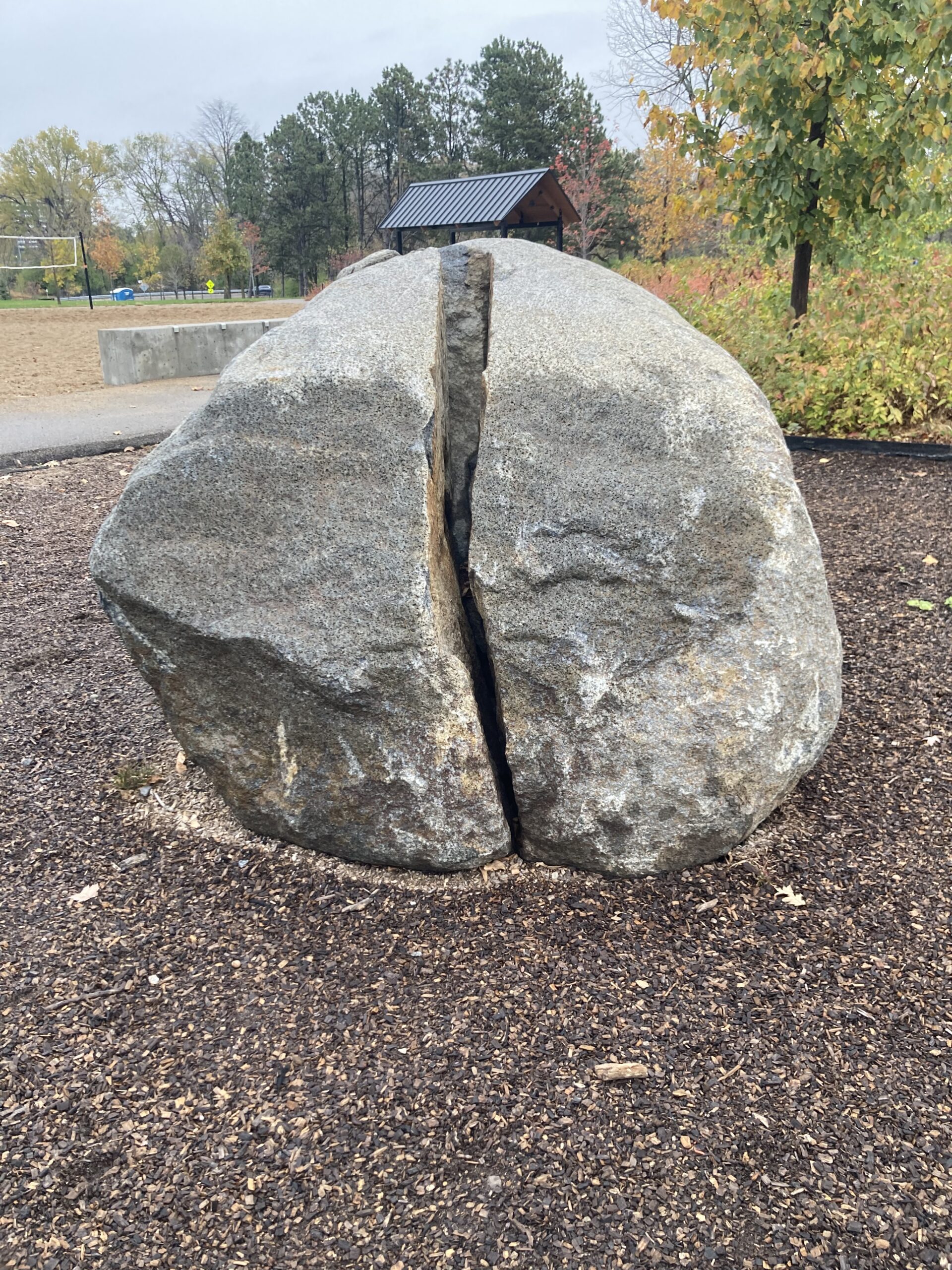
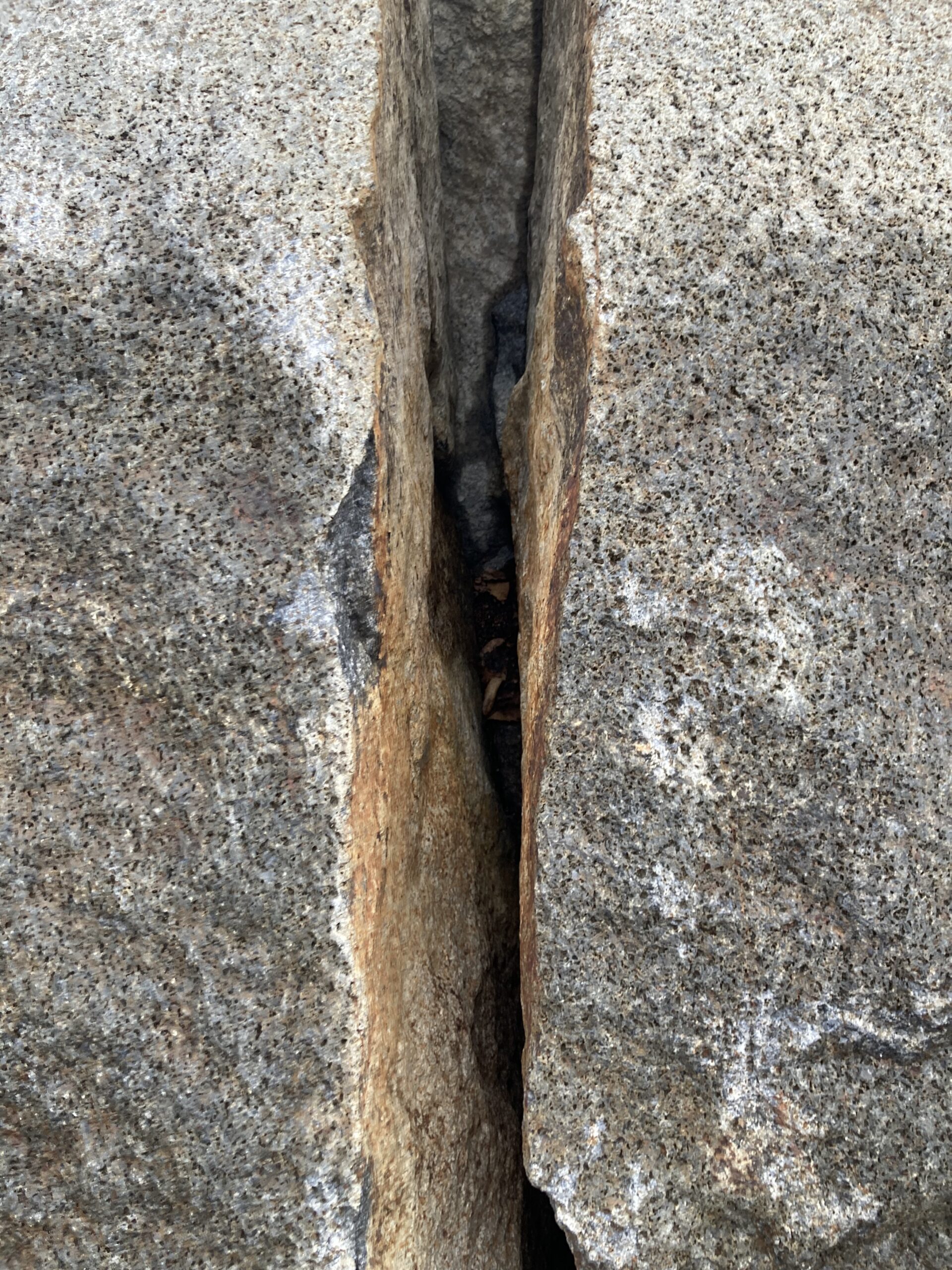
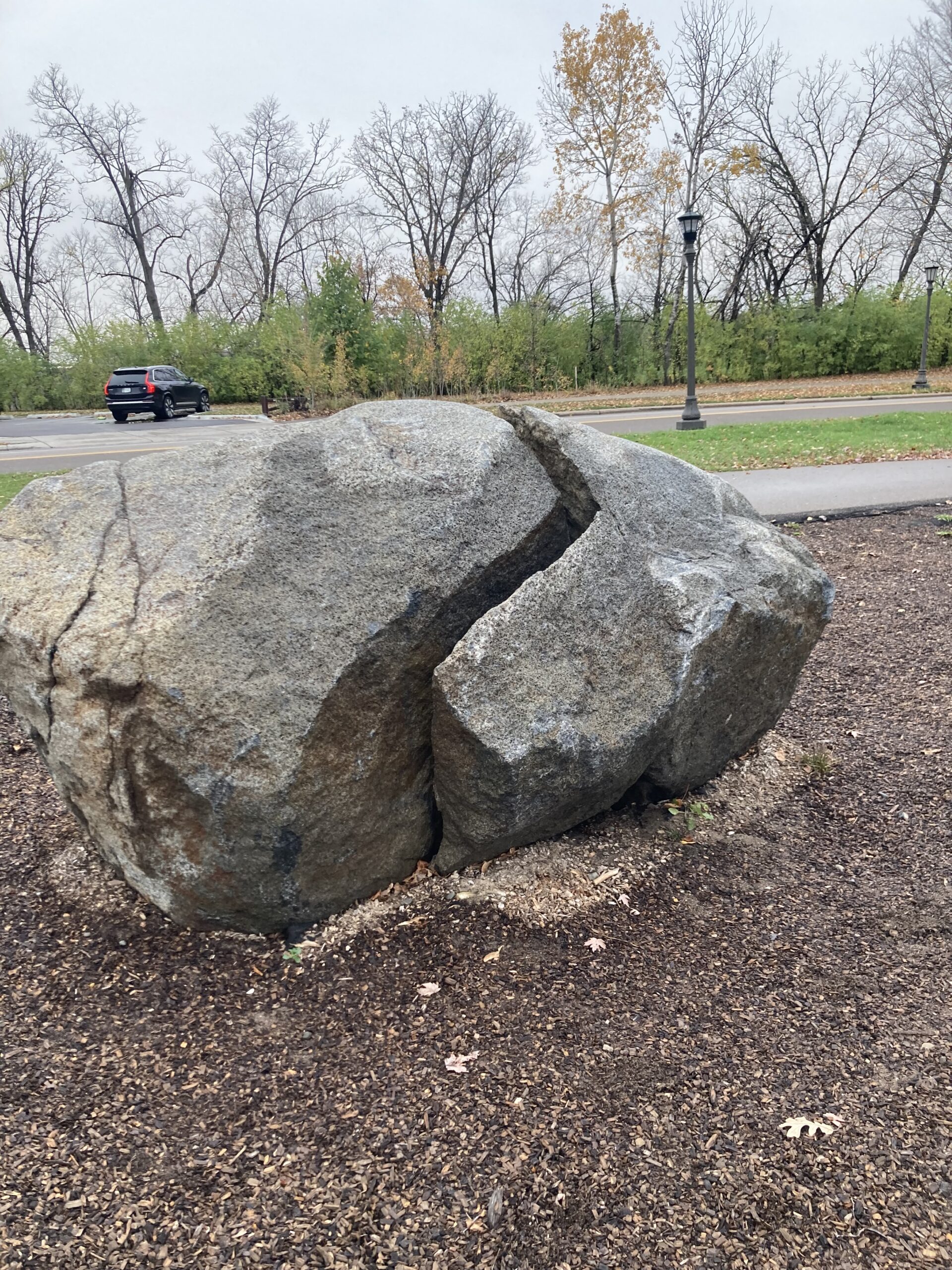
I’ve never noticed the huge crack in this rock before! I wonder when/how it happened? Was this rock on the grounds of the Ford plant or did they move it here a few years ago? Did they find it with the crack in it, or did the crack happen when they moved it? I think it’s part of this park: Uŋčí Makhá Park
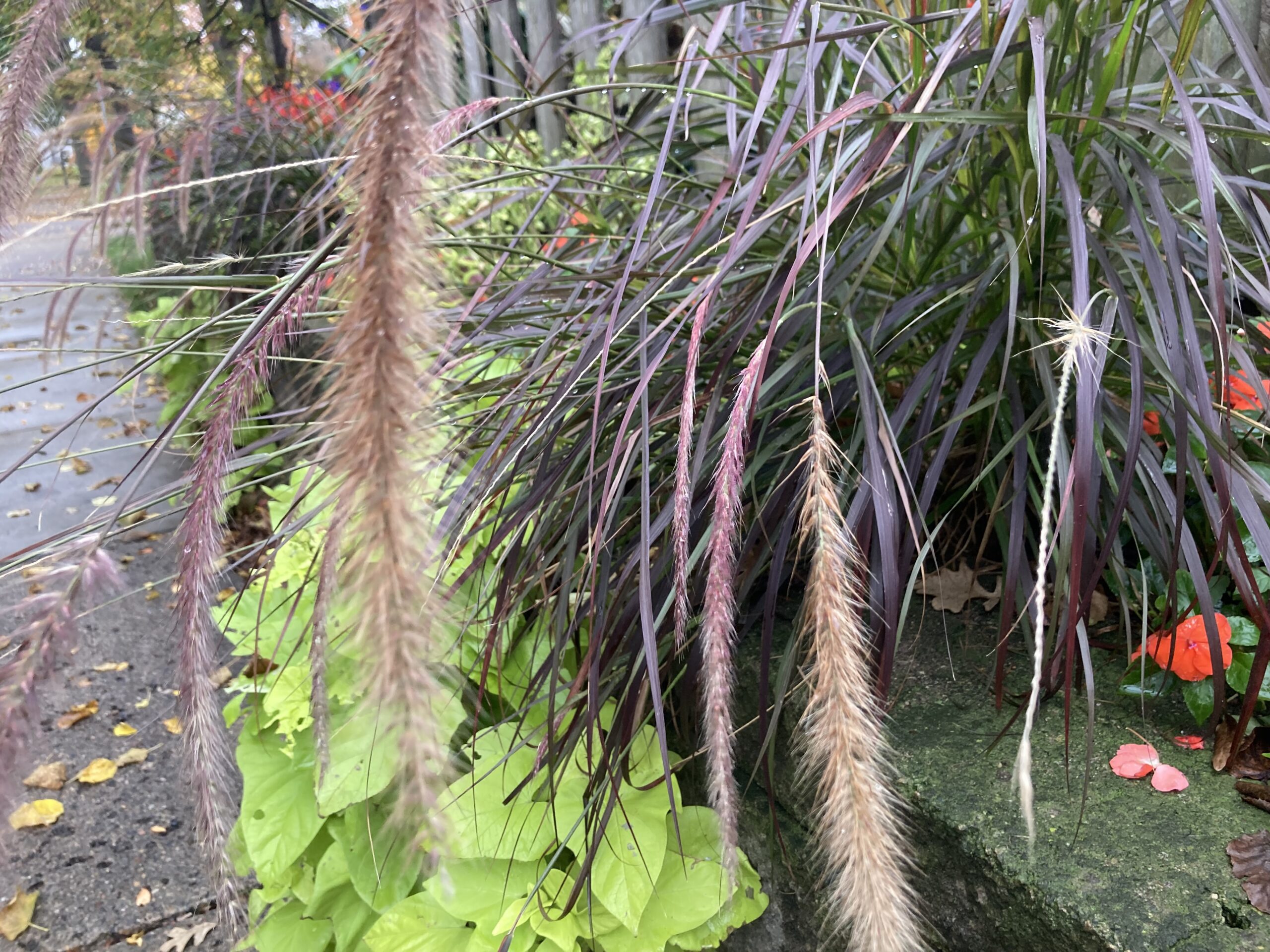
On my walk home, I passed by some favorite ornamental grass in someone’s side yard. I thought about my poem, “Vision Lost [field]” and the grass in it that has been softened by my central vision loss. Currently I describe it as feathering grasses but I’m not sure that’s quite the write words. I studied the grass — touched it, gazed at it, took a few pictures of it. When I looked at it closely, it was all fuzz and out-of-focus like I was holding blur in my hands. How to describe that? The grass looks fuzzy because it is always in motion for me. A flash: I should return to A.R. Ammons and his descriptions of motion in garbage and grass in Grassy Sound.
morning memorizing, a ramble x 2
1– 29 oct
I am writing this bit on Halloween, but I started this entry on the 29th, while refreshing my memory of a poem.
This fall, in the morning, I’ve been refreshing my memory of My 100 (my growing list of poems that will eventually reach 100 that I have memorized and can recite whenever I wish to myself by the gorge, but not to others because no one else wants to hear them). This morning, it’s “Before I got my eye put out.” This line stopped me:
But were it told to me, Today,
That I might have the Sky
For mine, I tell you that my Heart
Would split, for size of me–
my Heart/would split I’m thinking of Mary Oliver’s breaking heart and my poem about the cracked asphalt near the railroad trestle! In “Before”, ED’s heart splitting would be from too much joy at being able to see again. The Meadows–mine–/The Mountains–mine–/All forests, stintless stars/As much of noon as I could take–/Between my finite eyes— To be beside/outside of yourself, in a state of exuberant joy.
And now I’m thinking of more examples of ED’s splitting — the mind, not the heart. I felt a Cleaving in my Mind–/As though my Brain had split and breaking, And then a plank in Reason broke. And I’m thinking of her interest in edges and seams.
I decided to search through my Emily Dickinson entries for “seam.” 18 entries. The one I thought of immediately is, too silver for a seam, from “A bird came down the walk” The next one that came up was near the end of her poem, “Wind”:
On deserts, in the sky,
Had broken rank,
Then knit, and passed
In seamless company.
I started thinking about ED’s love of knitting and stitching and sewing and then an early poem that I had put in my Haunts series about stitches:
Loosen
threads that guide.
Worry
stitches, rip
seams, seek
space unplaced.
A break
in the trees.
Not here —
there. Close to
the rim.
On the edge,
near an
opening,
next to
an exit.
Ever
ready to
ghost it,
to flare and
flicker,
register
only
as shadow,
flashing
as what else
could be
possible.
I feel like the mood of this poem — the I telling You that haunts it — is missing in my latest version. I’d like to bring some of it back in. What if the crack is a way into somewhere else — new understandings? possibilities? ways of noticing, feeling, bearing witness?
I had no idea that the gate I would step through/ to finally enter this world/ would be the space my brother’s body made (“The Gate”/ Marie Howe).
Could I write a poem about the crack that imagined me entering/passing through it and into somewhere else? Here I’m thinking of the fairy-tale feeling in “What Would Root/ Katie Farris.
added on 31 october: I did write a draft of a poem about the crack, then was inspired to write an additional poem about it for my Vision Lost series (a thought: I could turn the vision lost poems into a chapbook — so far, I have three — could I write more? and what if they were almost like fairy-tales? or, ghost stories? — what are some classic “ghost stories”? beyond A Christmas Carol?)
2 — 31 October
Another morning of getting up too early (6:30 on a Saturday!) because my body was too sore or restless of something to get up. Now I’m sitting in the dark with a glowing computer screen, refreshing my memory of past poems memorized. Today’s poem: “Turkey Vultures” by Ted Kooser. I posted it on this log in the thick of the pandemic (April 2020). After reciting it, I started reviewing all of the other poems I’ve re-memorized. I got to W.S. Merwin’s “To the Light of September” and his series of Yous near the end and thought of what I wrote above, about the You that haunts my Haunt manuscript:
you
who fly with them
you who are neither
before nor after
you who arrive
with the blue plums
that have fallen through the night
I was reminded of some other Yous in poems on My 100 list:
I expect you. I thought one night it was you
at the base of the drive, you at the foot of the stairs,
you in a shiver of light,
(Dear One Absent This Long While/ Lisa Olstein)
And, from Mary Oliver’s “Invitation”:
Oh do you have time
to linger
for just a while…
I beg of you,
do not walk by
without pausing
to attend to this
rather ridiculous performance.
It could mean something.
It could mean everything.
It could be what Rilke meant, when he wrote:
You must change your life.
A lot of MO’s poems feature a You. Another MO favorite I’ve memorized, “Wild Geese” has some yous:
You do not have to be good.
You do not have to walk on your knees
for a hundred miles through the desert repenting.
You only have to let the soft animal of your body
love what it loves.
Tell me about despair, yours, and I will tell you mine.
Some others: Perhaps you tire of the birds (Donika Kelly) . . . I’m Nobody, who are You? (Emily Dickinson) . . . Who has seen the wind? Neither I nor You (Christina Rosetti) . . . The webs of your eyes are fastened to the flesh and bone of you (Wallace Stevens).
I’ve written about You before. I’ll have to find where on this log (after breakfast and maybe after running?).
after my run, hours later: Found it! This is from my log entry for 27 feb 2020, which is a few weeks before the world went into lockdown for covid:
Before I ran, I had a great morning. Started by listening to part of an episode with Victoria Change on Commonplace. At one point, they discuss their shifts in writing in first and third person which got me thinking about my own choice, in my latest project, to write in second person. Why am I using you? Who is you? Found some very interesting essays on second person online: Stuck on You: an ode the second person and the intimacy of writing in the second person in a bar. Then I started thinking about how Mary Oliver uses you, like in Wild Geese (You do not have to be good/you do not have to walk on your knees…). Finally I thought about who the I and the You are in my project. One answer: I = Teacher self and You = Student Self.
27 feb 2020
And, a few days earlier, I wrote this:
When I got to the Falls I stopped for a minute to take off my hood and to look at the water. Then I started again. I noticed as I was running that my shadow was right in front of me. So clear and sharp and fully present! Then I had a revelation: my shadow is who is writing my workbook. My shadow is talking to me and giving me advice on what to do. In my exercises, my shadow is the implied I and I am the you she’s talking to. Very exciting to figure this out.
20 feb 2020