june 10/RUN

4 miles
minnehaha falls
60 degrees

Ah, summer mornings! Beautiful. Cooler. If I would have slept better, I would have tried to go out even earlier. The first half of the run felt good, then I got hot and it got harder. Today I didn’t worry about what that meant for my training. Instead, I enjoyed the brief minutes of walking, taking in the trees at the falls — so green! so full!

10 Things

  1. the falls, flowing, white, undulating — the water not falling straight, but almost falling over itself — was it hitting some limestone on the way down?
  2. a bundle of something on the ground next to the dirt trail — a hammock?
  3. 2 women with tall hiking packs on their backs walking on the paved path
  4. some animal — a turkey? — upset, calling out, a human voice saying something — hey?
  5. a flash below the double bridge — a sliver of creek almost covered by green
  6. 2 roller skiers near locks and dam no 1
  7. the dirt trail cutting through the small wood near ford bridge looking cool and inviting
  8. happy kids on the minnehaha park playground — happy: green voices, where green = young, outside, tender
  9. (walking back, about to cross 46th ave at 37th street) 2 older women chatting, then greeting me, oh! hello!
  10. (walking back almost to my alley) heard on a radio or from a phone or a computer in neighbor’s backyard, the next one is Scandia — was this talk radio or a zoom meeting or what?

Lorine Niedecker and “Paean to Place”

to dwell with a place:

What is required, however, is sensual, embodied experience—close encounters of awe, wonder, fright, disgust, or even tedium—which remind us both of the real earth with which we dwell, and that we share our home with innumerable cohabitants.

Dwelling with Place: Lorine Niedecker’s Ecopoetics

opening to “Paean to Place”:

Fish
fowl
flood
Water lily mud
My life

in the leaves and on water
My mother and I
born
in swale and swamp and sworn
to water

My father
thru marsh fog
sculled down
from high ground
saw her face

at the organ
bore the weight of lake water
and the cold—
he seined for carp to be sold
that their daughter

might go high
on land
to learn

Wow! Reading this opening, I’m thinking about the Objectivists and the Imagists and Ezra Pound’s 3 rules for writing poetry:

  1. Direct treatment of the “thing,” whether subjective or objective
  2. To use absolutely no word that does not contribute to the presentation
  3. As regarding rhythm: to compose in the sequence of the musical phrase, not in sequence of the metronome

What condensery and music in these lines! And what wonderfully effective descriptions of two people dwelling in and with a particular place, especially her mother, born in swale and swamp and bearing the weight of lake water and the cold.

definition of ecopoetics:

The word itself is an amalgam of two Greek words: oikos [household or family] and poïesis [making, creating, or producing], so that ecopoeticsquite literally means the creation of a dwelling place, or home-making. The term came into special prominence after the influential British literary critic Jonathan Bate published The Song of the Earth in 2000. There, Bate defined ecopoetics as a critical practice in which the central tasks are to ask “in what respects a poem may be a making … of the dwelling-place” and to “think about what it might mean to dwell upon the earth.”

Dwelling with Place: Lorine Niedecker’s Ecopoetics

LN’s opening lines and her descriptions of her parents, reminds me of Mary Oliver’s The Leaf and the Cloud and her brief mentions of her parents in the first section, “Flare.” LN and MO have different experiences but they rhyme, somehow, or echo?

My mother
was the blue wisteria,
my mother
was the mossy stream out behind the house,
my mother, alas, alas,
did not always love her life,
heavier than iron it was
as she carried it in her arms, from room to room,
oh, unforgettable!

Like LN, MO was also an amazing poet of place, but she doesn’t extend her ideas of place to her parents — a deliberate severing:

I mention them now,
I will not mention them again.

It is not lack of love
nor lack of sorrow.
But the iron thing they carried, I will not carry.

So much to say about that iron, but I have run out of time right now. Perhaps more later. . .

I’m back. First, the not carrying the iron makes me think of my mom and her desire for displacement from her abusive parents. More than once she said to me that she wanted to break that cycle of abuse — and she did. And I am grateful. But there’s something to explore here for me and my relationship to place, this place 4 miles from where my mom was born and raised, that I can’t quite get at yet.

The iron also reminds me of the wonderful lines from the opening of LN’s “Lake Superior”:

In every part of every living thing
is stuff that once was rock

In blood the minerals
of the rock

*

Iron the common element of earth

Both MO and LN write about their fathers. First, MO:

My father
was a demon of frustrated dreams,
was a breaker of trusts,
was a poor, thin boy with bad luck.
He followed God, there being no one else
he could talk to;
he swaggered before God, there being no one else
who would listen.

and LN:

He could not
—like water bugs—
stride surface tension
He netted
loneliness. . .

. . . Anchored here
in the rise and sink
of life—
middle years’ nights
he sat

beside his shoes
rocking his chair
Roped not “looped
in the loop
of her hair”

The “looped” quote comes from William Butler Yeats and his poem, Brown Penny and it’s about love. I like how she throws in this line from poets or about poets, like this:

Grew riding the river
Books
at home-pier
Shelly would steer
as he read

I noticed another line of the poem in quotes, “We live by the urgent wave/of the verse.” Looked it up and found an article about “Paean to Place” and thanks to my college-attending son, I have access to it! Time to read it: Lorine Niedecker’s “Paean to Place” and its Fusion Poetics


june 9/RUN

3.7 miles
trestle turn around
65 degrees

Warm and windy. Lots of sweat. Another day of telling myself to keep showing up. A hard run with lots of walking. But, one faster, freer mile, and some scattered thoughts that might lead to something! I’ll take it.

11 Things

  1. under the lake street bridge, the side of the road was packed with parked cars — rowers?!
  2. yes, rowers: heard the coxswain calling out instructions
  3. briefly watched the rowers through a gap in the trestle: a head, an oar, a boat gliding by
  4. ran into a branch while avoiding another runner, just a few inches from my eye, imagined a scenario in my head where the branch had cut my eye
  5. in the tunnel of threes: a sea of swaying green
  6. a woman stretching in the 35th street parking lot, blasting music out of her phone
  7. wind pushing me from behind, making my ponytail swing to one side
  8. a cartoonish figure spray-painted on the sidewalk: bright orange outline
  9. loud rustling in the nearby brush then a hiker emerging from below
  10. whoooosssshhh — the wind rushing through the trees
  11. dragonflies? running near the trestle, an insect with a long, narrow body and wings almost flew into my mouth — no iridescent color, no color. Later, pausing at the top of the steps, I saw half a dozen of them. They opened and closed their wings in the sun

Yesterday, I decided that the theme of color or green wasn’t working for me this month. Instead, I’d like to return (again) to Lorine Niedecker. I’m particularly interested in her form of condensing and how I might apply it to my Haunts poems. Yes, the haunts poems are haunting me again. Before heading out for my run, I found a few lines from LN’s “Paean to Place,” that I especially like:

 grew in green
slide and slant
of shore and shade

            Child-time—wade
thru weeds

Maples to swing from
Pewee-glissando

      sublime
 slime-
song

A few times, I recited the first big: I grew in green/slide and slant/of shore and shade. As I thought about those lines I wondered what I grew up in. Green, for sure, but not by water. Then it came to me: I grew up on the edge of green in subdivisions that butted up against farms and woods, creeping, consuming those green spaces. I also grew up in carefully managed and cultivated green — bike paths through small stretches of trees offering the illusion of nature, privately owned by the subdivision. A very different green than the rural green of my dad’s farm in the UP or the urban green of my mom here by the Mississippi River. I thought about the managed green I run by and the difference between it, a public, national park, and the managed green of my suburban childhood, with its private green parks and private (No Trespassing!) acres of farm land, soon to be sold and converted into more “little boxes.”

Yes! The green I grew in was in-between col-de-sacs, and within small ravines and the slight stretches of trees or creeks developers left for aesthetic reasons. This green has deeply influenced my understanding of the wild and “green” spaces and is one reason why I’m fascinated by the management of nature.

june 1/RUN

4.15 miles
marshall loop (cleveland)
65 degrees
humidity: 85% / dew point: 60

Mostly overcast, a few moments of sun, no shadows. Sticky, everything damp, difficult. I felt better during the run — distracted by the dew point and the marshall hill — but when I finished, I felt a heaviness: hormones. The NP agrees: perimenopause. The good news: I’m healthy, the new NP I went to is awesome, I don’t feel anxious, I have an order in for an SSRI (lexapro). The bad news: I feel bummed out (depression doesn’t quite fit, I think), there’s some problem with insurance so they can’t fill the prescription so I have no idea when I can actually start taking the medication. But it’s June, I have several cool books to dig into, and I just got a hug from my daughter so I’ll be okay.

10 Things

  1. the red of a cardinal seen as a flash
  2. one small white boat on the river
  3. shadow falls falling, sounding like silver
  4. the smell of breakfast at Black — faint, sweet
  5. pink peonies about to pop
  6. click clack click clack — a roller skier’s poles: orange happiness
  7. the strong smell of fresh green paint on the base of a streetlamp
  8. the next streetlamp base: disemboweled, gray wire guts hanging out
  9. a purple greeting: morning! — good morning!
  10. a group of people in bright yellow vests laughing and walking on the road near the Danish American center — why?

added a few hours later: When writing this entry, I forgot about all the chanting I did. Started with triple berries:

raspberry strawberry blueberry
strawberry blueberry raspberry

Then added in some other 3 beat words:

intellect mystery history
remember remember remember

Then played with remember:

remember
try to re

member try
to remem

ber try to
remember

Then I decided to chant some of my favorite lines from Emily Dickinson:

Life is but Life
and Death but Death
Bliss is but bliss
and Breath but Breath

Life is but life is but life is but life
Death is but death is but death is but death
Bliss is but bliss is but bliss is but bliss
Breath is but breath is but breath is but breath

Life life life life
Death death death death
Bliss bliss bliss bliss
Breath breath breath breath

something important to remember: Donald Trump was convicted on all 34 counts of falsifying business records. He is now a felon and will be sentenced on July 11th. He can still run for office, but most likely won’t be able to vote (for) himself.

I’d like to focus on color this summer: June, July, and August. I’m not sure how I’ll do it, yet. Will I break it down my color? Possibly. Yesterday I picked up 2 color books that I had checked out 4 or 5 years ago. I’m anticipating that I’ll find them more useful now: The Secret Lives of Color and Chroma.

I also checked out Diane Seuss’ latest, Modern Poetry. Here’s one of her poems with some color in it:

Legacy/ Diane Seuss

I think of the old pipes,
how everything white
in my house is rust-stained,
and the gray-snouted
raccoon who insists on using
my attic as his pee pad,
and certain
sadnesses losing their edges,
their sheen, their fur
chalk-colored, look
at that mound of laundry,
that pile of pelts peeled away
from the animal, and poems,
skinned free of poets,
like the favorite shoes of that dead
girl now wandering the streets
with someone else’s feet in them.

At the beginning of the book, Diane Seuss offers a quote from Wallace Steven’s poem, Man with Blue Guitar, which I first learned of while reading Maggie Nelson’s Bluets. It is a long poem, so I won’t include all of it, just the part that Seuss quotes, with a few lines before that too:

from The Man with the Blue Guitar/ Wallace Stevens

Here, for the lark fixed in the mind,
in the museum of the sky. The cock

will claw sleep. Morning is not sun,
it is the posture of the nerves,

It is as if a blunted player clutched
The nuances of the blue guitar.

It must be this rhapsody or none,
The rhapsody of things as they are.

may 28/RUN

4.2 miles
minnehaha falls and back
59 degrees
drizzle, off and on

Didn’t realize it was raining the first time I left for my run. Returned home and waited a few minutes until the sun was shining. A mix of sunny and overcast for the whole run. On my walk back: drizzle again. At least I think it was drizzling; it could have just been dripping trees or ponytails. It’s been raining then not raining then raining again for the past few days.

The run was not great, but better than I thought it would be. Yesterday afternoon, without much warning, I started feeling light-headed, like I might faint. Then strange. I put my head down and breathed deeply for 10? 20? 30? minutes. My pulse wasn’t too low or too high, I could talk normally, and my breathing was fine. But I felt wrong. At one point I wondered, do I need to go to the hospital? I drank a glass of juice in case it was low blood sugar. I asked Scott to look up “symptoms low blood sugar” online. Nope, my symptoms didn’t match that. So then I had him look up panic attack. Yep. As he read the symptoms and I recognized them, I instantly felt something lift, at least a little. Ok, just a panic attack — don’t get me wrong, it was awful and I’m not pleased to be experiencing a panic attack, but it seemed better than the alternatives I had been imagining just a few minutes before. Sigh. The next phase of perimenopause for me, increased anxiety and panic attacks? Time to go to the doctor and figure out better solutions, I think.

For the rest of the day, I was tired and a little shaky. I wanted to run today, because I felt better and if it was a panic attack, it seemed important to get out there and keep doing this thing that I love despite any fear I might have over suffering from another panic attack. I read that one of the biggest dangers with panic attacks is that you will stop doing things because you’re afraid of another panic attack. Mostly the run was fine. My legs felt a little heavy — which was already happening last week — and I was a little anxious a few times — do I feel dizzy? am I pushing myself too much?, but I ran about 2 miles before stopping to walk for a minute, then ran another mile before a 10 second break, then ran the rest. And my heart rate was the same as it always is — 161 average. Panic attacks are no joke. Before it happened, I wasn’t upset or experiencing any anxiety. And when it happened, it was purely physical. I think it was a mild one, because I wasn’t terrified, but it did derail the rest of the day: 30 minutes of my head between my knees breathing, then the rest of the day on the couch.

10 Things

  1. everything wet and slick, the sidewalk slippery
  2. dripping trees
  3. gushing sewers
  4. spraying falls
  5. rushing creek
  6. robins hopping on the wet grass
  7. a walker in a BRIGHT red shirt
  8. puddle and mud on the dirt trail that winds through the small wood by the ford bridge — I saw them out of the corner of my eye as I ran by
  9. kids on the playground, laughing, yelling
  10. maybe there were some shadows, but what I remember was dark/wet pavement with the occasional patch of light

Running south to the falls, I listened to the water dripping. Running back north, I put in my “I’m Shadowing You” playlist.

Before I went out for my run, I was thinking about the silhouettes in the opening credits to the James Bond movie Scott and I watched last night: For Your Eyes Only. One of my favorites, partly because it was on HBO all the time when I was a kid. Click here to watch the opening on YouTube.

My echo, my shadow, and me

Wow, doing a little more research, I found this great article: James Bond: 50 Years of Main Title Design

may 26/RUN

7 miles
to the washington bridge and back
60 degrees
overcast – drizzle – soft steady rain

Overcast at the start, cool. Calm, quiet. The green felt deeper and darker in the gray. A block before I reached the river road, an ambulance sped by, siren blaring. A few minutes later, a police car, silent, but with frantic, flashing lights. I felt relaxed for the first mile. In the second mile my left ankle hurt a little. Started chanting triple berries to lock into a rhythm and to block out creeping doubt. Nothing fancy, just strawberry blueberry raspberry over and over. Once or twice: strawberry blueberry raspberry ice cream caramel strawberry chocolate ice cream

Just before I reached the bridge and the turn around point: drops drizzle rain — soft, steady, soaking. A few reprieves under the leaves, but mostly insistent water. I didn’t care; it cooled me down. The only thing I didn’t like was how my water-logged shorts stuck to my legs. Yuck!

assessment: I had some moments of struggle during the run — my legs were sore, feeling the need for a bathroom — but I also had some moments where I powered through. So much of it is mental. I’d like to come up with some fun distractions. I should return to my St. Paul sidewalk poetry project, find some more poems to run to. I could also do another poem-inspired scavenger hunt. I need a purpose for these runs that isn’t marathon training related.

10+ Things

  1. approaching from behind, rhythmic slapping –the slap slap slap of heavy, striking feet — then a fast runner in a blue shirt ran past me and up the hill near lake street
  2. passed him again when he stopped to study the map at the kiosk — was he lost?
  3. a rower on the river! single shell, their oars skimming the water — not sounding soft like a goose skimming the water, but choppy and hard like ___?
  4. the coxswain, instructing rowers through her bullhorn
  5. slap slap slap the blue-shirted runner passed me again between the trestle and franklin
  6. limestone leaks: even before it started raining, the limestone bluff in the flats was gushing water and leaving puddles on the pavement
  7. whoosh! a car’s wheels driving through the puddles
  8. a strange, intense floral smell — sweet, I think, and not entirely pleasant or unpleasant, just smell and flower and sweet
  9. a honking goose perched on the wall that holds back the river in the flats — were they honking at me? at a biker approaching from the other way?
  10. slap slap slap Mr. Blue Shirt is back! Nearing the end of my run, heading south, he zoomed past
  11. sometimes the rain sounded like footsteps from behind, but when I glanced back, there was no one there
  12. flash flash flash flash lights on the back of two bikes flashed red to let everyone know they were there, which was helpful in this gloom
  13. Good morning! a vigorous greeting from Mr. Morning!
  14. the return of Mr. Blue Umbrella, who walks in the middle of the path and never moves over. I’ve complained about him before — maybe last year? As I ran by him, the smell of stale cigarettes
  15. soft green fuzz on the edge of the trail, above the floodplain forest — was it from one of the cottonwood 3 — 3 giant trees in a yard. Last week, Scott and I walked past them; I have never seen that much cottonwood fuzz: the lawn was almost all not-quite-white!

Because of the rain and the cloud-covered sun, I didn’t see any shadows. I remember wondering if I might be able to see one if I was closer to the streetlamp or a car’s headlight.

may 24/RUN

3.3 miles
minnehaha falls and back
64 degrees

Another hot and hard run with heavy legs. Not enough water or iron or rest? My body adjusting to warmer, heavier air?

Ran with Scott to the falls. Windy, green. We talked about the runner’s high and I mentioned my log post from may 24, 2017 that included an early poem about the runner’s high. I’d like to edit it, or at least revisit the ideas in it. This revisiting will include trying to experience more runner’s highs. I also mentioned Jaime Quatro’s article, Running as Prayer, and the deepest level of the runner’s high. Scott said he preferred the word meditation to prayer: less Christian baggage. That conversation lasted about 15 minutes, I think. I can’t remember what else we talked about — oh, the wind, the value of having designated spots for returning your ride share bikes, side stitches.

10 Things

  1. slick path or slippery shoes or both — mud, worn-down tread
  2. wind in our face, running south. Scott suggested that the wind was like a trainer holding a belt around your waist as you ran, which is something we noticed happening before the twins game last week with a player and his trainer and a belt
  3. flashes of pale blue, almost white, river through the thick trees
  4. plenty of puddles
  5. kids yelling on the playground
  6. spray coming off the rushing falls — water falling down and from the sides of the limestone
  7. a long queue for paying for parking in the minnehaha lot
  8. the surreys are back — bunched together near the falls overlook
  9. a cooling breeze heading north again
  10. minneapolis parks mowed a wide strip of grass near the trail by the ford bridge but left the meadow — good news for the bull frogs! Today I couldn’t hear them because of the wind and the traffic but I bet they’re there

Yesterday I posted part of a poem from Lucie Brock-Broido. Here’s part of another beautiful one:

from Periodic Table for Ethereal Elements/ Lucie Brock-Broido

A girl ago, a girlhood gone like a phial of ether
Thrown on fire-just

A little jump of flame, like grief, or,

Like a penicillin that has lost its will for killing
Off, it then is gone.

And, here’s a recording of her reading the whole poem.

may 23/RUN

5.35 miles
flats and back
61 degrees

10 Things

  1. globs of white foam on the river surface, moving slowly south, flat, brown, opaque water near the shore
  2. a hissing goose
  3. dazed, dreamy, almost disembodied, running fast up the franklin hill
  4. dandelion stalks on the grass, right before the ancient boulder, illuminated by sun, casting ragged shadows
  5. looking down at the green of the grass, seeing it as just a clump of green, wondering if people with better vision than me can see the individual blades
  6. walking along the cracked concrete wall that holds back the river, comparing the actual wall to its shadow, noticing what I see better in each. The shadow, the line/edge of the wall, especially when it is cracked — noticing how the shadow breaks there. The “actual” wall: texture, not in fine detail but roughly — all over, not smooth / specifically, gray depressions where shadows inhabit the spots the wall has broken off
  7. approaching a person standing in the middle of the path under the trestle, realizing at the last minute they were not alone, but hugging another person — were they comforting them (or vice versa)? or were they just expressing affection? They held the hug for a long time, much longer than one would in a greeting
  8. Hi Dave!
  9. (how could I almost forget!?) catkin fuzz! white fuzz from cottonwood trees, looking like a dusting of snow, lining the edges of the path. White fuzz, not looking like snow, floating through the air. I had fun trying to bat it around
  10. Taking a walk break, feeling a strange drop of water on the back of my knee, wondering what happened, realizing it was a drip of sweat from my ponytail

Not an easy run. Somewhat of a grind. The first 3 miles were fine. Then I stopped to walk for a few minutes until I returned to the bottom of the hill. Put in a playlist and picked up speed as I run up the hill. Walked for a minute near the crosswalk, then ran faster up the rest of the hill. Ran then walked then ran again for the rest of the run.

No rowers or shadows from birds or big groups of runners or frantic squirrels or unleashed dogs or menacing turkeys. At least one roller skier. Today my shadow only appeared at the end of the run, looking strong with broad shoulders.

the shadow of death

Yesterday as I was reading more of C.D. Wright’s Casting Deep Shade, I was thinking about how she unexpectedly died before it was published, wondering what “unexpectedly” meant. So I looked it up. Maybe a little out of morbid curiosity, but mostly because concrete details about death help me (us, I think) to engage with death in deeper ways that go beyond fear or discomfort or dismissal. Anyway, I looked it up and discovered that she died at 67 in her sleep from a blood clot she got on an overly long plane ride from Chile. Woah — that is unexpected. Thinking about this unexpected fact while I was running this morning, I thought that, for the person dying at least, this might not be a bad way to go — in your sleep. Then I wondered what experience of dying you might miss out on in your sleep. Would you dream about going into a light? Would your life still flash before your eyes as you slept? Or would all just be suddenly nothing?

A few days ago, someone somewhere (a poetry person on instagram?), posted a poem by Lucie Brock-Broido: After the Grand Perhaps. She died a few years ago. I remember that it was shocking and upsetting to many poetry people. She had been 61 and it was a brain tumor. Reading another poet’s account of her, I know she knew she was dying for at least a few months. I thought about her as I ran today, too.

2 shadow moments from After the Grand Perhaps/ Lucie Brock-Broido

After the pain has become an old known
friend, repeating itself, you can hold on to it.
The power of fright, I think, is as much
as magnetic heat or gravity.
After what is boundless: wind chimes,
fertile patches of the land,
the ochre symmetry of fields in fall,
the end of breath, the beginning
of shadow

*

After what is arbitrary: the hand grazing
something too sharp or fine, the word spoken
out of sleep, the buckling of the knees to cold,
the melting of the parts to want,
the design of the moon to cast
unfriendly light, the dazed shadow
of the self as it follows the self

may 22/RUN

4.2 miles
minnehaha falls and back
57 degrees
wind: 14 mph / gusts: 31 mph

New shoes! The Brooks Ghost, black. I’ve been wearing Saucony shoes for 13 years, but after 3 disappointing pairs, it’s time to move on. I like the Ghost — the name and the feel of them. Even so, this run was hard. I feel drained, like I hit a wall. By the end, it felt harder lifting my left leg.

Listened to the wind and the cars and rushing falls for the first half. Put in “Billie Eilish” Essentials for the second half. At the very end of the run, listening to “Chihiro” off of her album that dropped last Friday, I noticed her rhyming:

[verse] I was waitin’ in the garden
Contemplatin’, beg your pardon
But there’s a part of me that recognizes you
Do you feel it too?

[chorus] Open up the door, can you open up the door?
I know you said before you can’t cope with any more
You told me it was war, said you’d show me what’s in store
I hope it’s not for sure, can you open up the door?

Often, I don’t like a lot of rhyming. It can feel forced. But not here, especially with the interesting music underneath and Eilish’s voice. Still, I noticed the rhymes in a way that took me out of the song a little. But not as much as the overdone, forced rhymes in Taylor Swift’s “Peter,” also from her latest album:

Forgive me Peter
My lost fearless leader
In closets like cedar
Preserved from when we were just kids
Is it something I did
The goddess of timing
Once found us beguiling
She said she was trying
Peter was she lying
My ribs get the feeling she did
And I didn’t want to come down
I thought it was just goodbye for now

In closets like cedar? Ugh. I like Taylor Swift, and I like her new album, but I don’t like this song (which means I probably will after giving it more of a chance) and I think Billie Eilish’s music is more exciting and interesting and rich in complexity and complicated emotions.

10 Things

  1. burning silver sliver of river noticed through a gap in the green
  2. no puddles, but stretches of deep brown mud on the path
  3. repaired split rail fence — such a contrast between the weathered wood and the pale new boards — how long will it take for these boards to blend in?
  4. a glance to my left into the savanna: thick green
  5. lime green scooters everywhere — none on the path but parked on the side, down in the ditches
  6. little robins hopping on the grass
  7. 2 kids biking on the walking side of the double bridge
  8. at my favorite view of the falls: I used to be able to see the little bridge below and part of the trail, now it’s all green with only the white foam of the falls cuting through
  9. I was wrong in #2, there was one big puddle near the locks and dam no 1 parking lot
  10. no bugs . . . yet

currently reading in support of shadows: Casting Deep Shade/ C.D. Wright

shade: shelter from direct light; the cooling effect and darkness that that shelter causes; darkening (with a pencil); when black had been added to a hue to make it darker (as opposed to tint, when white was added to make the hue lighter), and:

Reading came first. Reading is the real art form of insult. You get in a smart crack and everyone laughs and kikis because you found a flaw and exaggerated it then you got a good read going. When you are all of the same thing then you have to go to the fine point. In other words if I’m a black queer and you’re a black queer we can’t call each other black queers because we’re both black queers. That’s not a read, that’s just a fact. So then we talk about your ridiculous shape your saggy face your tacky clothes. Then reading became a developed form where it became shade. Shade is, I don’t tell you you’re ugly. I don’t have to tell you because you know you’re ugly. And that’s shade.

Dorien Corey/ Paris is Burning

I remember teaching Paris is Burning in my Intro to Women’s Studies and Feminist Theory courses, when we talked about gender performativity and Judith Butler. That’s when I first learned about shade, I think: 2001. Anyway, this last version of shade seems to loosely (?) fit with C.D. Wright’s title, at least as one reviewer for the New York Times Book Review reads it:

C.D. Wright, renowned poet and essayist, completed ”Casting Deep Shade” just before her sudden death in January of 2016. This posthumous book might have been read strictly as elegy, yet Wright, as if presciently marking a trail through the woods for future readers, came up with a sly signpost of a title as ”pre-amble” to her work, briskly excluding melancholy even while taking stock of crimes against nature. The title is a trick or a kind of riddle. The gerund points to a ”Macbeth”-like conspiracy of tree and human, each ”throwing shade.” Here, for example, is Wright on privacy in an all-witnessing age: ”For the moment, I can locate you, whosoever you are, or re-imagine you in a keystroke. I can see the tree that cast your lawn in deep shade when you were wearing a linen dress, a string of seed pearls, and no underpants.” You get her drift?

Roots / Carole Muske-Dukes (referenced here)

Here’s another definition of “throwing shade” from Merriam-Webster:

to express contempt or disrespect for someone publicly especially by subtle or indirect insults or criticisms

“throwing shade” / Merriam- Webster

I can’t quite express it yet, but there’s something about throwing shade that involves connection and accountability and being implicated in something. It’s more than “expressing contempt or disrespect for someone publicly”. It’s rooted (rooted!) in communities, and the shade is being thrown by people who are deeply connected to each other.

Speaking of implication, can I fit this paragraph for another reviewer in here?

One of the gifts of her imagination is the insight of implication. In a passage where she acknowledges she had not been able yet to read Elizabeth Kolbert’s The Sixth Extinction, Wright notes “I sit here eating ‘carefully watched over’ cashews grown in India, from one of the 102 billion plastic bags used annually in the US, wearing a linen shirt (albeit secondhand) made in China, jeans fabrique en Haiti, Delta Blues Museum T-shirt made in Honduras . . . a walking, talking profligate.” If she was, as we all are, profligate, she was also prophet. She spoke to and for trees, and the creatures that owe their well being to arboreal health. She refers to “my standing brothers and sisters, the hardwoods.” Her work documents “the buds of tree consciousness.” Like so much of her language, that phrase operates in multiple planes, conjuring both human awareness of trees, and the fact that trees themselves are conscious, as well as the concrete responsibility of a poet: to cast an image, as a tree casts shade through its limbs and buds. Though any book written about trees in our modern era will necessarily be rife with dire predictions and realities, Casting Deep Shade is hardly dour. Subtitled “An Amble Inscribed to Beech Trees & Co.,” it has the charm and healing properties of a walk in the woods.

Some Trees

Fun with Acrostics: Bring Ya Ass

The Timberwolves have made it to the third round of the playoffs for the first time in 20 years. People here are excited. During an interview with Timberwolves star, Anthony Edwards, Charles Barkley said, “I have not been to Minneapois in 20 years.” To which Ant replied: Bring Ya Ass. Bring Ya Ass is now a meme and state officials and organizations are into it. Today, Governor Walz issued a proclamation that has fun with acrostics — the first letter of each Whereas paragraph spells out, Bring Ya Ass:

may 20/RUN

3.1 miles
trestle turn around
66 degrees
dew point: 61

Ugh! Sticky out there this morning. Lots of sweating. A hard run that didn’t feel great. Mostly sore legs. My shoes have worn out and the pair I bought to replace them hurt my feet. What did I notice in this distracted, uncomfortable state?

10 Things

  1. small purple flowers lining the trail
  2. the path near the ravine that winds through the welcoming oaks was wet from last night’s rain
  3. the path leading down through the tunnel of trees was almost all shade with only a few splotches of light
  4. the flash of squirrel on my right side so faint that I thought it be a shadow or a ghost — not really but I like the idea of Ghost Squirrel
  5. a gritty, slippery path
  6. Dave, the Daily Walker — Hi Sara! Hi Dave!
  7. a hiker wearing a loaded back pack — saw them last week too. Are they camping in the gorge?
  8. at least 2 sweaty, shirtless runners
  9. my shadow beside me
  10. a motorized scooter zooming by on the bike path

That was hard!

before the run

When returning to a favorite childhood book (this works with movies too) for the first time in decades, a question arises: Does it hold up? Is it a good book, or did I love it because I didn’t know any better? In my 20s and 30s, I applied a feminist lens to these books and usually they didn’t hold up. Now, a month from 50, I’m more generous; I like to think about the influence something has had with less judgment. I don’t remember the first time (or how many times) I read The Shades. But I remember liking it and finding the idea of shadow people fascinating.

brief synopsis: Young Hollis stays with a random college friend of his mother’s (beautiful, cool, kind painter Emily) in a creepy old house near a beach while his parents travel through Europe. One day, exploring the overrun, a-century-past-its-prime-garden, he discovers a dolphin fountain. After bathing in it, an older boy in strange clothing (those pants that buckle just under the knee — britches? breeches?) appears — Carl Shade. Turns out he’s a shadow that was cast by Emily’s grandfather. And Carl is not the only one. He’s part of a family — the Shades — and they live in the garden. All of their food comes from the shadow’s cast by real food, their house cast from the shadow of the old summer house that “broke Emily’s heart” when it was torn down. Most of the time they do what they want, but when a human enters the garden, whichever of them best fits that human’s form must shadow them around the garden. Sometimes this shadowing is fun, other times it’s tedious, and occasionally it’s dangerous: if a human climbs over the garden wall, the shadow must follow and be lost to the outside world forever. There’s a benevolent dictator/God (the dolphin fountain whose magic makes the shadow world possible) and an evil, jealous enemy (the beautiful greek statue of a woman/siren who sings seductive songs designed to lure the shadows out of the garden). There’s the magic of the fountain — only those who bathe their eyes (the eyes, of course!) under the bubbling fountain can see the Shades. There are the poor, unfortunate souls of the shadows that listened to the Siren and left, and then tried to return only to be enslaved by the siren in the house (which, we learn near the end, is why the house always looks so gloomy). And there’s the biggest threat of all: the loss of the Self — and connection, memory, family, home — on the other side of the garden wall.

I could probably spend all day writing into and around this story. But that would take too much time. First — does this story hold up? Not if you think too hard about the structure — either of the world of shades and shadows within or the plot. But it was still fun to read again and to inhabit the haunting strangeness of the Shades in their weird garb and with their not-quite-tragic position between real and not real — dependent on humans, yet independent of them too, feasting on shadows yet able to “taste” and enjoy/detest the food.

It’s not the plot, but the images that hold up for me. The scene when Hollis gets a tour of the larder and all of the shadow food stored there, including Emily’s birthday cake from when she was a kid and had a party in the garden. Or the red, fluffy, wonderful rug in Hollis’ room that comforts him when he’s afraid. Or the creepy shadows of the children that encircle the evil Siren. Those little kid shadows remind me of a book that I started reading last year, but had to return before I finished. There are creepy shadowy unseen malevolent kids in it — A Good House for Children by Kate Collins.

Regardless of some plot holes and an underdeveloped Shade world (and the faint classism with its nostalgia for old money and grand houses and its disdain for encroaching “hooligans”), I still like this book and think it taps into some larger feelings I have about shades and shadows as things that are both traces of us and their own things too, and how that combination is haunting and strange and magical and delightful. Does that make any sense?

Just had another thought about the Shades and their shadow food. I’m reminded of the line from Sylvia Plath’s “Mushrooms”: We diet of water/on crumbs of Shadow.

during the run

I tried to think about shade and shadows and Hollis and Carl while I ran, but I was mostly too distracted by humidity and aching left calves and a constant voice whispering stop and walk and we’re tired in my head. Maybe that was my Shade?

after the run

Now that I have typed the word “shades” so many times, I’d like to study shades, as a variation of shadows, today. Different definitions, expressions, etc. Looking it up, I found a review for C.D. Wright’s Casting Deep Shade. I bought this book several years ago — I can’t remember why, maybe because I was really into thinking about the trees in the gorge? Anyway, I’ve been wanting to read it, but haven’t had a chance. Today’s the day, I think. Well, I’ll start it, at least.

added an hour later: I’m reading Casting Deep Shadow on my back deck under the shade of a bright green umbrella. Listening to the torpedoed call of a cardinal coming in slow waves of four (like Didi Jackson’s “Listen”), with additional notes at the end. I love this book and C.D. Wright’s wandering (and a little whimsical) approach to writing about beech trees. She describes different varieties, defines beech terms, recounts childhood stories sometimes only peripherally related to the beech, and places the trees geographically. On page 25, she even describes an anxiety dream she had about not practicing the piccolo which she believes must be “tangential to signing on to write about beeches.”

So far, she’s written about Beech Bark Disease (BBD), lingering beech leaves, trees from her childhood yard, roots. Here are a few examples of her writing:

Crowley’s Ridge is coated with a windblown sediment known as loess or rock flour. That’s where your kitty litter comes from. Grasses keep it from flying all over. Beeches don’t mind loess. Nor do peach trees, judging from the seet Elbertas that grew there–where Hemingway penned A Farewell to Arms when he was married to Pauline. It is the only rise in the Alluvial Plain of Old Man River. In the event the river floods, rather, when, head for the Ridge.

Casting Deep Shade/ C.D. Wright, page 14

The other distinctive aspect [of the beech] is that in the winter, most younger, lower branches always hold on to a few of their dead leaves all winter. They have a distinctive parchment color, and when backlit transmit light. I love that about them. However, these leaves are dropped promptly as the spring buds expand . . . .So noted by San Francisco-born Robert Frost:

We stood a moment so, in a strange world.
Myself as one his own pretense deceives;
And then I said the truth (and we moved on).
A young beech clinging to its last years’ leaves.

Casting Deep Shade/ C.D. Wright, page 19-20

As a by-product of the Ozark Mountains, I have long been at least semi-aware of my standing brothers and sisters, the hardwoods. Rocks, rivers, and trees we had in surplus. In our yard were four species of oak–white, post, blackjack, and Arkansas oak There are 29 species in the state); 7 or 9 pink and white dogwoods, a handsome blue spruce, an A1 southern magnolia, and two cedar sentinels beside the front steps. The red maple was lost early on.

Casting Deep Shade/ C.D. Wright, page 25

I love her writing style and the stories and accounts that accumulate, creating the feeling of wandering and wondering about beeches. I also like how she weaves in the I and her personal stories — including them, but not making them the center of this story. There is no center, only stories and information culled from a range of sources. I see this book as an inspiration as I continue to work towards polishing my log writing and turning some of my words here into something more condensed, crafted.

may 12/RUN

3.1 miles
turkey hollow
67 degrees

Too hot this morning! My usual refrain: get up and go out earlier! Lots of shadows, birds — several turkeys in the neighborhood just past turkey hollow! None of them menacing today. I decided to put together another shadow playlist with all my favorites. Called it “Slappin’ Shadows.” I listened to it for the whole run instead of the birds.

I remember these lyrics from “Moonshadow” especially:

Did it take long to find me?
I asked the faithful light
Oh, did it take long to find me?
And are you gonna stay the night?

I’m bein’ followed by a moonshadow
Moonshadow, moonshadow

10 Surfaces I Ran Over

  1. sidewalk
  2. street — smooth
  3. street — cracked, rutted
  4. grass
  5. roots
  6. soft, sandy, slippery dirt
  7. soft dirt that was mud 2 day s ago
  8. curb
  9. paved trail
  10. edge of road, slanted, over a grate

Last week, I checked out Dorianne Laux’s new collection, Life on Earth. I especially love this poem:

Mugged By Poetry/ Dorianne Laux    

—for Tony Hoagland who sent me a handmade chapbook made from old postcards called OMIGOD POETRY with a whale breaching off the coast of New Jersey and seven of his favorite poems by various authors typed up, taped on, and tied together with a broken shoelace.

Reading a good one makes me love the one who wrote it, 
as well as the animal or element or planet or person 
the poet wrote the poem for. I end up like I always do, 
flat on my back like a drunk in the grass, loving the world.  
Like right now, I’m reading a poem called “Summer” 
by John Ashbery whose poems I never much cared for, 
and suddenly, in the dead of winter, “There is that sound 
like the wind/Forgetting in the branches that means 
something/Nobody can translate…” I fall in love 
with that line, can actually hear it (not the line 
but the wind) and it’s summer again and I forget 
I don’t like John Ashbery poems. So I light a cigarette 
and read another by Zbigniew Herbert, a poet 
I’ve always admired but haven’t read enough of, called 
“To Marcus Aurelius” that begins “Good night Marcus
put out the light/and shut the book For overhead/is raised 
a gold alarm of stars…” First of all I suddenly love 
anyone with the name Zbigniew. Second of all I love 
anyone who speaks in all sincerity to the dead
and by doing so brings that personage back to life, 
plunging a hand through the past to flip off the light.  
The astral physics of it just floors me. Third of all 
is that “gold alarm of stars…” By now I’m a goner, 
and even though I have to get up tomorrow at 6 am 
I forge ahead and read “God’s Justice” by Anne Carson, 
another whose poems I’m not overly fond of 
but don’t actively disdain. I keep reading one line 
over and over, hovering above it like a bird on a wire 
spying on the dragonfly with “turquoise dots all down its back 
like Lauren Bacall”. Like Lauren Bacall!! Well hell, 
I could do this all night. I could be in love like this 
for the rest of my life, with everything in the expanding
universe and whatever else might be beyond it 
that we can’t grind a lens big enough to see. I light up 
another smoke, maybe the one that will kill me, 
and go outside to listen to the moon scalding the iced trees.  
What, I ask you, will become of me?

may 7/WALK

30 minute walk
neighborhood, with Delia
65 degrees

Walked around the neighborhood on a beautiful, windy morning. A few hours before, it had been raining. Puddles everywhere. Mud, too. Birds, laughing kids, yellow and orange and red tulips all around. Also: overgrown weeds, dandelions, unruly grass. Oh — and pollen! I know that it could be much worse, but I still felt it: scratchy throat, itchy eyes, fatigue.

This morning I renewed my driver’s license. For me, it was a big deal. I was diagnosed with cone dystrophy in 2016, two months after I had barely renewed my license because I couldn’t initially read the Snellen chart. The woman behind the counter was generous — I remember her looking at me strangely after I said the wrong letters and then asking, Do you want to try that again? Slowly? For years I had been nervous about the vision test without knowing why.

When the ophthalmologist first told me I would probably lose all of my central vision, I felt relief — I just renewed my license so I don’t have to worry about doing the vision test until 2020! — and worry — What’s will happen in four years? As 2020 approached, my anxiety increased. But, because of the pandemic, I was able to renew my license online. No vision test! Another reprieve for four years!

Next month I turn 50 and it’s time to renew my license again. I decided to do it early, partly to get it over with and partly because Scott and FWA had both renewed their license’s two months ago and the person behind the counter didn’t make them take a vision test. Could I be so lucky? I hoped so.

This morning I was anxious. I tried to convince myself that it would be fine if I had to take the test — I told Scott, it’s great material for a poem. But the same guy was there and I didn’t have to take the test and now I have another four year reprieve.

10 Small Things I Remember

  1. the woman at the front desk was wearing blue gloves
  2. before we entered, a group of teenagers were called in — Anyone planning to take the test should follow me!
  3. I heard those same teenagers giggling a few minutes later
  4. my number, ended with a 54
  5. when it was called, I was told to go to A14
  6. the guy who issued my license asked me to meet him around the corner at A17 for my picture
  7. he had two thick textbooks on the counter — did he ever have time to study? I couldn’t read the titles
  8. for the first time, I wore glasses for my picture — before he took it he said, look at the blue dot. I couldn’t see any blue dot, but the picture turned out fine
  9. earlier, nearing the entrance to the building, a man held a door for a woman as she walked out. She apologized when she almost ran into him and said, I’m sorry, I’m in my own head right now
  10. also nearing the building: birds! so much birdsong!

I am not planning to drive. I haven’t for five or six years. It’s too scary and dangerous. Still, it’s nice to have my license, just in case.

My anxiety over the vision test has some layers, I think. It’s not just about failing it, or even primarily about failing it. I think it’s time to do some digging.

the allegory of the cave, part 2

Yesterday Scott and talked about Plato’s Cave and what we remembered from when he first heard/read about it. Then I watched a few more videos about it, all of which connected the cave and the shadows to a hero’s quest and being enlightened by a Philosopher King. Thought about writing against that and decided I didn’t want to. Instead, I attempted to read Jack Collum’s hard-to-understand-poem, Arguing with Something Plato Said. Some of it, I think I understand and some of it, I don’t. Learned a new word: chiaroscuro

This is an Italian term which literally means ‘light-dark’. In paintings the description refers to clear tonal contrasts which are often used to suggest the volume and modelling of the subjects depicted.

Artists who are famed for the use of chiaroscuro include Leonardo da Vinci and Caravaggio. Leonardo employed it to give a vivid impression of the three-dimensionality of his figures, while Caravaggio used such contrasts for the sake of drama. Both artists were also aware of the emotional impact of these effects.

Nice! With my interest in ekphrastic poems, I plan to think about this concept some more.

may 6/RUN

7 miles
st. kates and back
60 degrees

Ran with Scott on a beautiful spring morning. Sun, shadows, a welcome breeze. We ran over to St. Catherine’s University, across the river. RJP has almost decided to go there (hopefully she makes up her mind tonight) and we wanted to check it out. I’m impressed and excited to visit her next year. We talked a lot more in the first half of our run; we were both tired the last 2 miles. Scott talked about some Threads exchange involving Drake, Kanye West, and a diss track. We heard a creaking tree and I said it sounded like the squeaking gate we heard yesterday afternoon while we were walking. The mention of the gate reminded me of Marie Howe’s poem, “The Gate,” which I recited for Scott (of course I did). We talked about many other things but I just remember discussing what a wonderful campus St. Cates is and how great it will be for RJP.

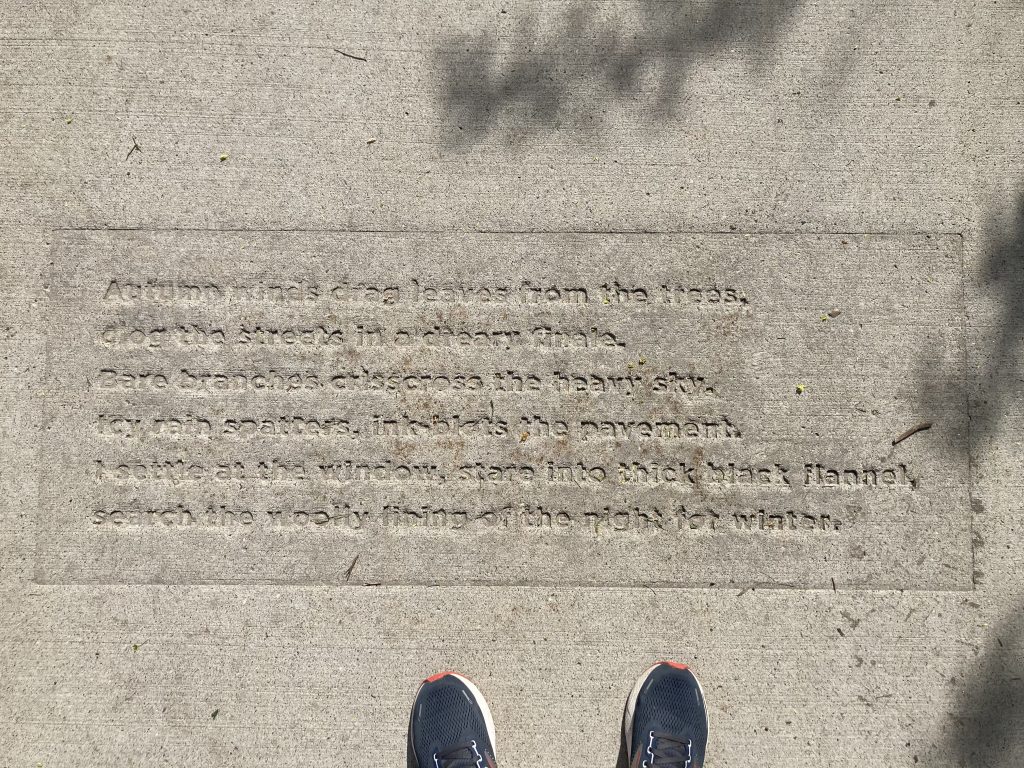
On the sidewalk just outside of campus, we encountered several sidewalk poems that are part of the Public Art Sidewalk Poetry project. Scott took a picture of one:

November/ Marianne McNamara and Scott’s feet

November/ Marianne McNamara (2009)

Autumn winds drag leaves from the trees,
clog the streets in dreary finale.
Bare branches crisscross the heavy sky.
Icy rain spatters, ink-blots the pavement.
I settle at the window, stare into the black flannel, search the woolly lining of the night for winter.

I was unable to read this on the sidewalk, so I’m glad I could find it online. How hard is it for someone with good vision to read? I like the idea of this project, but in practice, it doesn’t quite work. Scott suggested they should use black paint on the letters, to make them stand out.

10 Things

  1. smell: lilac, intense
  2. tree shadows, more filled in than last week
  3. a loud leaf blower
  4. a safety patrol on the corner near Dowling saying I hate you, I hate you — who was he talking to?
  5. the soft trickle of water falling from the sewer pipe near the 44th street parking lot
  6. mud and ruts filled with water at a construction site on the edge of campus
  7. feeling a fine film of dust on my face near the end of the run
  8. more than a dozen signs in the grass outside a liquor store, each one said the same thing: wine sale. Scott: I guess they’re having a wine sale
  9. running down Randolph encountering 3 or 4 sidewalk poems, none of them marked on the map
  10. noticing a faint white thing flying through the air, high above us: a bird? a plane? a trick of the light or corrupted data from my eye to my brain?

the allegory of the cave, part 1

I want to read the cave parable and think about its shadows, but I want to read it in the context of The Republic so I’ve been searching my shelves for my copy. Which class in college did we read this for? Probably The Individual and Morality. Maybe a philosophy class? Anyway, it is very hard for me to find one book among almost a thousand. When we moved in I organized them, but over time, books have moved. Also, it’s dim in our living room and I have a lot of trouble reading book titles with my bad eyes. Yesterday I asked RJP to help, and she found it! Maybe I’ll try reading some of it out on the deck this afternoon. Reading physical books, as opposed to e-books, can be hard; there’s never enough light unless I’m reading it under my special lamp (designed for sewers and cross-stitchers and 80 year-olds with bad eyes and me). Reading outside in natural light helps.

an hour spent outside reading and dozing off and reading again . . .

First, two links that connect Plato and his cave with poetry:

Reading through the allegory, I came accross these lines:

. . . the eyes may be confused in two ways and from two causes, namely when they’ve come from the light into the darkness and when they’ve come from the darkness into the light. . . whether it has come from a brighter life and is dimmed through not having yet become accustomed to the dark or whether it has come from greater ignorance into greater light and is dazzled by the increased brilliance.

518a, The Republic / Plato, trans. G.M.A. Grube

Of course, I immediately thought of two of my favorite vision poems (what I’m calling them) by Emily Dickinson. And of course I have both of them memorized — but not her punctuation.

We grow accustomed to the Dark
When light is put away
As when a neighbor holds the lamp
To witness her goodbye.

A Moment — We uncertain step —
For newness of the Night
(We Grow Accustomed to the Dark/ ED)

Too bright for our infirm Delight
The truth’s superb surprise

. . .

The truth must dazzle gradually
Or every man be blind.
(Tell all the truth but tell it Slant/ ED)

I remember Plato’s cave and the shadows and the inability to access Truth, but I didn’t remember him discussing how both too little light and too much light blind us. The emphasis, as I recall, was always on darkness = bad, ignorance, the problem. Was I just not paying attention in philosophy class?

Searching for “plato cave,” I came across a video about it and decided to watch it:

The School of Life

I’d like to write more about what I find to be missing (also what’s helpful) in this account, but I’ve run out of time. Here’s one more video for comparison that I just started watching. When I have time, I’ll reflect on both:

After Skool

april 29/RUN

4.2 miles
minnehaha falls and back
49 degrees / drizzle
wind: 7 mph / gusts: 14 mph

When I left for my run, I thought the rain had stopped. I was wrong, which was fine, because I don’t mind running in a drizzle, especially when it’s not too cold. Was it a drizzle? Maybe I’d call it a mist — a steady, soft spray that soaked my orange sweatshirt and mixed with the sweat on my face. Mostly I couldn’t see it; I just felt wet or damp or . . . I’ve got it: Moist! That’s how I felt as I ran today, moist. Scott hates this word, but I don’t mind it. What words do I detest? The only one I can think of immediately is nummy. Is that even a word?

So, everything, including me, was moist. Moist sidewalks, moist trails, moist air, moist shorts, running tights, socks. Other words for moist: soaked, damp, dank, saturated, humid

10 Moist Things

  1. the paved path — big puddles everywhere — the biggest puddle was right after the locks and dam no. 1 parking lot heading south
  2. the strip of dirt next to the paved path — muddy ruts
  3. the oak savanna — covered in leaves, light green and dripping
  4. the thick, gray air
  5. the laughing, water-logged voices of kids on the playground
  6. the slick road
  7. my running shoes
  8. my pony tail
  9. my orange sweatshirt
  10. the grass — a sponge . . . squish squish squish

A good run. I felt strong and springy — both because of the weather and my bouncy feet. I listened to the water gushing out of the sewer pipes and over the ledge as I ran to the falls. I put in my “It’s Windy” playlist on the way back. Most memorable song: The Wreck of the Edmund Fitzgerald (11 on the Beaufort Scale for violent storm).

before the run

It’s almost the end of April (wow) and this morning, before my run, I finished my Beaufort Scale in Verse:

Beaufort Scale in Verse

0 — The Moment/Marie Howe

The whir of I should be, I should be, I should be

slows to silence,

the white cotton curtains hanging still.


1 — Long Life/Mary Oliver

We may be touched by the most powerful of suppositions—even to a certainty—as we stand in the rose petals of the sun and hear a murmur from the wind no louder than the sound it makes as it dozes under the bee’s winds. This, too, I suggest, is weather, and worthy of report.

2 — Nature Aria/Yi Lei

Autumn wind chases in
From all directions
And a thousand chaste leaves
Give way.

3 — And All Visible Signs Swept Away/Carl Phillips

I am stirred, I’m stir-able, I’m a wind-stirred thing

3 — When the Fact of Your Gaze Means Nothing, They You Are truly Alongside/Donika Kelly

the dry
sound of applause: leaves chapped/falling, an ending

4 — Enough/Jeffrey Harrison

The rising wind pulls you out of it,/and you look up to see a cloud of leaves
wheeling in sunlight, flickering against the blue
and lifting above the treetops, as if the whole day
were sighing, Let it go, let it go,
for this moment at least, let it all go

5 — Love Song for the Square Root of Negative One/Richard Siken

I am the wind and the wind is invisible, all the leaves tremble and I am invisible

6 — Wind/Emily Dickinson

When winds go round and round in bands,
And thrum upon the door,
And birds take places overhead,
To bear them orchestra

7 — Who Has the Wind?/Christina Rossetti

Who has seen the wind?
Neither You nor I:
But when the trees bow down their heads,
the wind is passing by

8 — Fall/Edward Hirsch

Suddenly feel something invisible and weightless
Touching our shoulders, sweeping down from the air:
It is the autumn wind pressing against our bodies

9 — Plea to the Wind/Alice Oswald

Unglue the fog from the woods from the waist up
And speak disparagingly of leaves

10 — Plea to the Wind/Alice Oswald

Whip the green cloth off the hills

11 — Postscript/Seamus Heaney

So that the ocean on one side is wild
With foam and glitter. . .
As big soft buffetings come at the car sideways
And catch the heart off guard and blow it open.

12 — Wave After Wave/M. Bartley Seigel

In a heartbeat, rollers mass two stories
trough to insatiate tempest, unquelled
by prayer nor cigarette, careless, mean,

a cold-blooded indifference so pure,
a strong swimmer won’t last ten wet minutes.
At the Keweenaw, surf pummels the stamp
sands with ochre fists, ore boats stack up lee

of the stone, and entire beaches stand up
to walk away.
april 27/RACE

10k
Get in Gear
55 degrees
92% humidity

This morning, Scott and I ran the Get in Gear 10k. We haven’t run this race since before the pandemic. It’s right by our house and follows the ford loop route. We didn’t run fast, but it felt good and I felt strong. Strong enough to pick it up at the end. For years I’ve wanted to be able to enjoy the race as I ran it, instead of pushing hard and feeling miserable. This year, I’m doing it! Much more rewarding than a PR.

10 People

  1. Bethany had a loud voice with a strong Minnesota accent that cut through the wind. I know her name is Bethany because she introduced herself to someone about 25 yards ahead of us. I bet she was nice, but that voice! As we tried to figure out where to line up Scott said, not near Bethany! After finishing the race, Scott noticed her and her bright yellow shirt — oh look, there’s Bethany. As we ran, I mentioned how frustrating it might be to have a loud voice like that. Scott said: Bethany’s don’t care how loud they are
  2. a tall man in a bright yellow shirt who kept sprinting then stopping, sprinting then stopping. For almost 4 miles, he would run past us, then stop and walk until we caught up, then start running fast again. We dropped him on some hill — finally
  3. a shorter man taking deep, noisy breaths every few steps — I think he made a noise with the exhale — whoooooooooo whoooooooooo whoooooooooo
  4. a man before the race doing a lot of stretching and warming up — I don’t know the names of the stretches, but I’m sure they have names — he was almost skipping forwards, then sprinting, then skipping backwards. I wonder how fast he ran?
  5. a woman standing at a distance from the porta potties. Another woman asked, are you in line? and even though we thought there was no way she would say yes because she was so far from the line, she said yes, I think so
  6. the enthusiastic, slightly unhinged, volunteer handing out water — you’re so fast! great job! woo hoo!
  7. an older couple standing beside the course, cheering us on. When I said, thank you, one of them said, no, thank you!
  8. a woman just behind us, scuffing her foot on the road with every strike, scrape scrape scrape
  9. a guy cheering, good job! you’re almost there, when we still had 2 miles left
  10. 2 little girls before the race, meeting up, the one squealing in delight at seeing her friend arrive, Irene!
  11. remembered 2 days later: a woman, stopped, either coughing or dry heaving vigorously

april 24/RUN

10k
juno and finn, st. paul
44 degrees

A beautiful morning! Perfect temperature for running. Sun. Shadows. Hooray! Tried my new adventure: running to poems that are part of St. Paul’s Sidewalk Poetry project. Fun! Ran south on the west river road, up the hill to the ford bridge, north on the east river road, east on hartford, north on juno, east on finn. It took me a little while, but I found both poems — my navigating skills were not the greatest before my vision loss, but now they’re pretty bad. Difficult to read signs and hard to keep a map in my head. Made a few bad choices on the way back, and probably added an extra mile because of it. Oops.

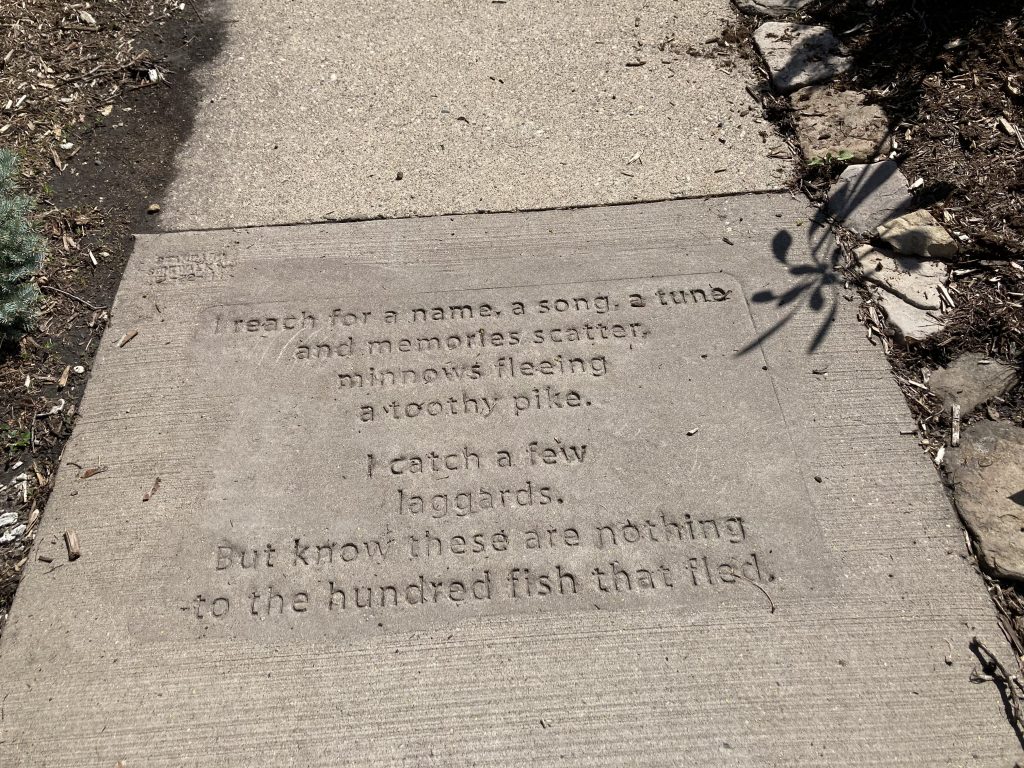
First impressions — wow, these poems are really hidden — a nice surprise as you walk or run along. Also, there’s not enough contrast for my bad eyes. I couldn’t read the poems at all. I’m glad that you can look them up online because otherwise, I’d have no idea what they said.

Overall: great idea, but not that accessible. Also, how soon before these poems wear away? Even with my (small) criticisms, I love this project and am excited to run to some more!

This was a fun way to run a 10k — I was able to get a nice break in the middle and I was distracted from the effort by my task. Also, it’s good for me to practice navigating. I need to build up those skills so I can get out in the world to new places by myself more.

I wasn’t only focused on finding these poems. I also gave attention to the world:

10 Things

  1. kids at Minnehaha Academy, lower campus, were playing Red Light/Green Light. Green light . . . Red light.
  2. one gutted street lamp on the ford bridge — the one next to it was still on
  3. several streets with no sidewalks, or sidewalks only on one side in Highland Park
  4. bright blue river!
  5. a racket! geese honking beneath the ford bridge
  6. a bright white paddleboat near the shore on the west bank
  7. passed 2 park workers about to put fresh tar on the river road trail
  8. later, running over tar that was put down earlier in the week
  9. fee bee fee bee
  10. bright blue sky, cloudless

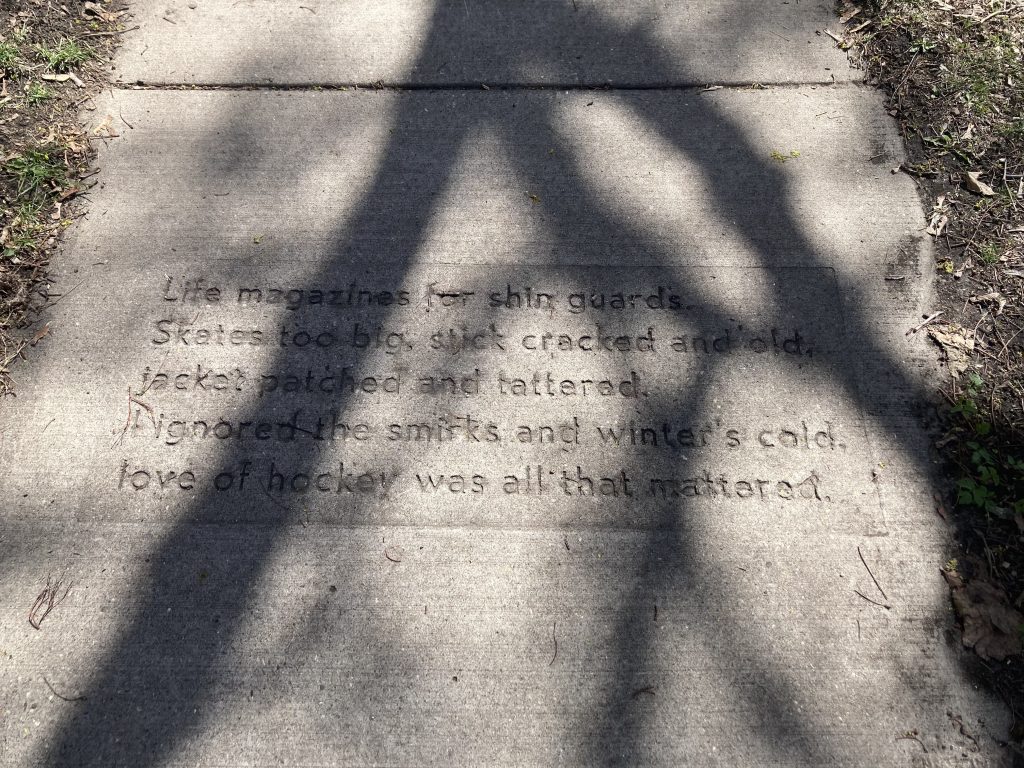
Sidewalk Poems — poem + my picture

1

SE corner of Juno Ave and Finn

Dementia/ Naomi Cohn (2008)

I reach for a name, a song, a tune
and memories scatter,


minnows fleeing


a toothy pike.

I catch a few


laggards.


But know these are nothing
to the hundred fish that fled.

2

S. side of Juno Ave, bet. Finn and Cleveland Ave

Untitled/Louis Disanto (2011)

Life magazines for shin guards.
Skates too big, stick cracked and old,
jacket patched and tattered.
I ignored the smirks and winter’s cold,
love of hockey was all that mattered.

A note about this second poem: This is not the poem that is supposed to be here, according to the map.

earlier today

While drinking my coffee, I read about different places along the river to view birds during the migration and found this line:

You can also see a whole hillside of the spring ephemeral bloodroot along the trails near 36th Street.

Must-see FMR spring birding sites along the river

Bloodroot? What’s that, and why is it called bloodroot? This was a useful site for answering my questions.

  • an herbaceous perennial native to eastern North America, from Florida up into Canada 
  • found in undisturbed woodlands, on flood plains and on slopes near streams or ponds
  • the reddish sap that exudes from all parts of the plant, but especially the root, when cut is what prompted the common name of bloodroot
  • used as a natural red or yellow-orange dye
  • the brilliant white – or rarely light pink – flowers up to 2 inches across open in early spring. The blooming period lasts about 2 weeks
  • each flower stalk produces a solitary flower with a number of delicate, elongate petals surrounding the numerous yellow stamens and central green pistil, with a pale yellow, two-lobed stigma at its apex. The flower usually has eight symmetrically arranged petals, with four large petals and four smaller ones

april 23/WALK

walk 1: 30 minutes with Delia, neighborhood
walk 2: 75 minutes to the library

I haven’t walked to the library in a long time. 5 or 6 or 7 years? Why has it been so long? Partly the pandemic and the library almost being burned down and then closed for a long time are to blame, but it’s also all the running and having a dog. If I have any time or energy left to walk, I need to take Delia the dog along, and the library is too far for her. Also, she’s not allowed inside.

It’s more than a mile, but less than 2 one way. It was great. I listened to Taylor Swift’s new album on the way there, and Beyoncé’s on the way back (Cowboy Carter). Wow! The Tortured Poets Department was good but Cowboy Carter was amazing.

10 Things

  1. a big white dog sitting quietly and calmly in a dirt back yard next to a chain link fence
  2. a cedar fence that looked almost new, with shiny wood, bulging out towards the sidewalk — what happened?
  3. red tulips in full bloom right up against the foundation of a house
  4. a big tree with a full set of yellowish-green leaves
  5. a terraced yard, all dirt, looking neat and ready to be filled with flowers
  6. a little free library packed with books, its glass door wide open
  7. music blasting from an open door at the Trinity Church, playing “Shake It Off”
  8. 2 squirrels winding up a tree, one chasing the other, their nails scratching the rough bark
  9. my favorite stone lions in front of a house wearing purple flower headbands in honor of spring
  10. a big moving truck backed into a driveway blocking all of the sidewalk and half the street

earlier today

This past Saturday, I took a class on public art and ekphrastic poetry with the new poet laureate of Minneapolis, Heid E. Erdrich. A great class. When I signed up for it, I was just interested in taking a class with Erdrich and learning more about ekphrastic poetry; I didn’t realize that public art would also be a part of it. Very cool. Anyway, the class inspired me to think more deeply about public poetry projects. I have several ideas for my own, with very little understanding of how to make them happen. Perhaps studying other examples will help educate and inspire me. Plus, studying them is another way to learn more about the place I live. First up: Sidewalk Poetry St. Paul

Sidewalk Poetry, St. Paul

Sidewalk Poetry is a systems-based work that allows city residents to claim the sidewalks as their book pages. This project re-imagines Saint Paul’s annual sidewalk maintenance program with Public Works, as the department repairs 10 miles of sidewalk each year. We have stamped more than 1,200 poems from a collection that now includes 73 individual pieces all written by Saint Paul residents. Today, everyone in Saint Paul now lives within a 10-minute walk of a Sidewalk Poem. 

This art project began with previous Public Art Saint Paul City Artist Marcus Young in 2008 under the name “Everyday Poems for City Sidewalks,” and continues today with evolved stamping approaches, as well as poetry submission and review processes. Our 2023 Sidewalk Poetry accepts poetry submissions in Dakota, Hmong, Somali, Spanish, and English. The poetry on our streets celebrates the remarkable cultures that make our City home and that makes our City strong. With this as a beginning, other languages may be added in years to come.

Sidewalk Poetry St Paul

I think the first step for me in getting to know this project is to visit some of the poems. I’d like to start running to them! Here’s a map to help me out: Public Art Sidewalks

I think I’ll start (tomorrow) with a favorite poet of mine, Naomi Cohn. She has one on the Southeast corner of Juno and Finn. Very close to it is one by Pat Owen, on the southside of Juno between Finn and Cleveland.

Almost forgot to post this: the first song on Beyoncé’s album, “American Requiem” sings about the wind!

Can we stand for something?
Now is the time to face the wind (Ow)
Coming in peace and love, y’all
Oh, a lot of takin’ up space
Salty tears beyond my gaze
Can you stand me?

Can we stand for something?
Now is the time to face the wind
Now ain’t the time to pretend
Now is the time to let love in

april 20/RUN

4.5 miles
marshall loop (cleveland)
35 degrees
wind: 12 mph

Woke up this morning to snow on the back deck. Only a dusting that melted before Scott got up a few hours later. Cold. Wore my running tights, winter vest, and gloves. It felt windier than 12 mph, especially on the bridge. I took my cap off so it wouldn’t blow away.

10 Things

  1. cold wind in my face, making my eyes water
  2. little ripples on the river, looking like scales
  3. running past street lamps on the st paul side, noticing the wires at the base pulled out
  4. an empty white kitchen trash bag draped over a bench
  5. 2 teen aged boys jumping the fence near the lake street bridge steps
  6. rowers on the river! how do they row in this wind?
  7. the clicking and clacking of roller ski poles
  8. the clicking and clacking of a woman’s running gait — she had a hitch and stepped down in a strange way that made a scraping noise — they way she contorted her body with each step made my hips hurt just watching!
  9. volunteers on earth day just above the floodplain forest, picking up trash — I was almost taken out by little Giovanni — Giovanni! Watch out! an adult called
  10. little birds — sparrows? — swooping, low to the ground, just in front of me

Before I went out for my run, I was reading about images and metaphors and literal and figurative language. As I was finishing up my run, I was thinking that my image of the day — the image I’d like to think about and write around — is the street lamp on the side of the paved trail, its door open and wires hanging out . . . or maybe the image is not just one of them, but lamp after lamp all the way down the hill above shadow falls, all of them gutted or disemboweled, their wire guts hanging out. The idea of them being gutted seems too easy as a metaphor — perhaps I need to think about who or what gutted them? Or something more specific about the guts as veins or tendons? Now I’m thinking about cut wires and losing the circuit and being disconnected.

This afternoon, I took a 3 hour zoom class on ekphrastic poetry. I wrote most of this entry before it; I’m finishing now, after it. A great class with Heid E. Erdrich. Lots of inspiration for public art and responding to art. Erdrich mentioned writing poems or finding poems that fit as labels for artwork in museums. This made me think of my interest in alt-text. I’d like to explore this connection more. Very cool.

april 13/RUN

10k
hidden falls and back
66 degrees
wind: 13 mph / gusts: 25 mph

Another run with Scott. Today, too hot! We ran around 11, which was too late. So much sun and no shade. It’s time to adjust to running much earlier.

Of course, I’m writing this right after the run, when I’m feeling wiped out, so my perspective on it is skewed.

We talked about the Beaufort scale and songs that might fit with the different levels of wind. Scott recounted the history of the man behind Chef Boyardee. That’s all I remember.

10 Things

  1. wind — strong enough that I took my hat off on the ford bridge and held it so it wouldn’t blow off my head
  2. ripples on the river — I mentioned to Scott that they were referred to as scales on the Beaufort scale
  3. wind chimes, all around the neighborhood chiming
  4. soft shadows
  5. after months of not being lit, the street lamps along the river road are finally lit again
  6. on your left! a biker passing us on the bridge
  7. the water fountains aren’t working yet — we kept stopping to check, but no water yet
  8. a few LOUD blue jays
  9. swarming gnats!
  10. bright yellow and orange and green running shirts on other runners

before the run

Reviewing a link I posted earlier this month — Historical and Contemporary Versions of the Beaufort Scale — I started thinking about different versions of the Beaufort Scale that I could do. On the run, I’d like to talk with Scott about a wind song Beaufort scale that describe/ranks the wind using song lyrics. I’m thinking that Summer Breeze might be on one end and The Wreck of the Edmund Fitzgerald on the other.

Other versions of the Beaufort Scale might include poetry lines — yes, a wind cento! — and things experienced while running.

Beaufort Scale

force / name / for use at sea / for use at land

  • 0 / calm, still / sea like a mirror / smoke rises vertically
  • 1 / light air / ripples on water / direction of wind shown by wind
  • 2 / light breeze / small wavelets / wind felt on face, leaves rustle
  • 3 / gentle breeze / crests begin to break, scattered white horses / leaves and small twigs whirl, wind extends small flags
  • 4 / moderate breeze / small waves, fairly frequent white horses / wind raises dust and loose paper, small branches move
  • 5 / fresh breeze / moderate waves, many white horses, some spray / small trees in leaf start to sway, crested waves on inland waters
  • 6 / strong breeze / large waves, white foam, spray / large branches in motion, whistling wires, umbrellas used with difficulty
  • 7 / near gale / breaking waves blow in streaks / whole trees in motion, inconveniant to walk against the wind
  • 8 / gale / moderately high waves / twigs break from trees, difficult to walk
  • 9 / strong gale / high waves / slight structural damage, roof slates removed
  • 10 / storm / very high waves / trees uprooted, considerable structural damage
  • 11 / violent storm / very high waves / widespread damage
  • 12 / hurricane / air filled with foam, spray / widespread damage

I’m struck by how mild the wind is here in Minneapolis by the river gorge. The roughest wind I’ve run (or swum) in is 6, which is about 31 mph. That’s only a strong breeze and when umbrellas are used with difficulty. And that’s only halfway up the scale! I’m a wimp, I guess.

Looking at this a different way, I think there’s a lot more levels between light breeze and strong breeze. maybe I should try to notice and describe the differences between leaves rustling and leaves in a whirlwind? Or wind felt on my face as a soft kiss versus wind whipping my hair?

during the run

Scott was excited about the idea of creating a Beaufort scale with songs/song lyrics. So far:

0 / In the Still of the Night / Dion
1 / In the Air Tonight / Phil Collins
2 / Summer Breeze / Seals & Croft
3 / Sailing / Christopher Cross
4 / Dust in the Wind / Kansas
5 / Breezin’ / George Benson
6 / Blowing in the Wind / Peter, Paul & Mary
7 / Windy / The Association
8 / They Call the Wind Maria / Paint Your Wagon
9 / Ride Like the Wind / Christopher Cross
10 / Tear the Roof Off the Sucker / Parliment
11 / The Wreck of the Edmund Fitzgerald / Gordon Lightfoot
12 / Rock You Like a Hurricane / Scorpion

This was fun and a great distraction as we ran!

april 11/RUN

3.1 miles
edmund, south/river road, north/edmund, south
56 degrees
wind: 12 mph/ gusts: 22 mph

Shorts and bare legs again today. Hooray! Was planning to do the 2 trails, but when I reached the entrance to the winchell trail I heard some very noisy rustling of leaves. Too big for a squirrel. A dog? A bear? A human? I tried to look ahead but all I saw was a black blob. I thought it was a person with a stroller so I moved a little closer. Nope — a male turkey with its tail spread like a peacock, a red wattle glowing, even for me with my bad color vision. Wow. I mentioned it to a man walking down the hill and he said, well, this is the way I’m going! and slowly and calmly walked toward the turkey. A showdown. After 30 seconds or so, the turkey relented and the man walked past. Not me, I climbed the hill and ran on the trail next to the road. This encounter will be my birding poem for the day!

10 Things Other Than Tom Turkey

  1. a woodpecker cry — pileated, I think
  2. another woodpecker cry a few minutes later — was this bird following me?
  3. loud kids at the playground, mostly having fun
  4. 2 bikers heading north — we can ride the wind now. I thought this meant that they would have the wind at their backs, so I would too, when I turned around. No. Wind was in my face heading north, later in the run
  5. admiring the view of the river from the overlook — the water on the other shore was sparkling
  6. mud and roots on the dirt trail between edmund and the river
  7. the clickity-clack of roller skiers poles behind me
  8. several of the benches had people on them — more than half?
  9. bird shadows
  10. a shrieking blue jay above me

After turning around because of the territorial turkey, I put in my “It’s Windy” playlist: They Call the Wind Maria/ the furies; Dust in the Wind/ insignificant or fleeting

The wind wasn’t overpowering but it was everywhere, coming from every direction. I remember noticing how it played with my hair, making my ponytail bob and my little loose strands fly around my face. Only once did I need to adjust my hat for fear that the wind might blow it off. I don’t remember hearing any skittering leaves or getting dust in my eyes, grit in my teeth. The wind didn’t sing or howl. It did push me forward and hold me back. And I think it made the whole run harder.

Earlier this morning, I checked out Mary Oliver’s West Wind and found this delightful part of a poem about wild turkeys. It seems fitting to include today after seeing several hens — being guarded by the male turkey on Winchell.

from Three Songs/ Mary Oliver

1

A band of wild turkeys is coming down the hill. They are coming
slowly—astheywalkalongthey look under the leaves for things to 
eat, and besides it must be a pleasure to step alternately through the
pale sunlight, then patches of slightly golden shade. they are all hens
and they lift their thick toes delicately. With such toes they could
march up one side of the state and down the others, or skate on water,
or dance the tango. But not this morning. As they get closer the sound
of their feet in the leaves is like the patter of rain, then rapid rain. My
dogs perk their ears, and bound from the path. Instead of opening their
dark wings the hens swirl and rush away under the trees, like little
ostriches.

Returning to my birding poem for the day. I’m having a little difficulty finding the focus, so I thought I’d write a little more around this little poem. What are the details that I remember, that I might want to write about?

  • First thing noticed: an unusually loud rustling sound that I thought was too big for a squirrel, too much for a human
  • the moment of seeing something but not knowing what it was — a bear? a dog? a stroller? Not feeling scared, but feeling like I should stay back until I figured it out, feeling that it was something unusual. This moment last a long time, which was fine because I had time, but wouldn’t have been if I had needed to make a quick decision, like if the turkey was running towards me
  • the turkey was so big! its tail was up and spread out like a peacock, making him look even bigger and framing his face
  • the face — fuzzy but clear enough to know that this turkey was telling me to back off! I couldn’t make out his eyes, but I could see — or, maybe I guessed a little — when he was facing me — yes, it was the contrast of light and dark — when he was turned away, he was just a dark, hulking shape, when he was turned toward me I saw a pale beak
  • the red wattle — was it bright? I can’t quite remember, but I know it was red and big
  • when I felt fairly certain it was a turkey, I still couldn’t see details — just a small, light head with red, framed by broad dark tail feathers — how much of his bigness was because of his tail, how much his body? the form — menacing and comical at the same time, with its big circle for a body and its tiny head
  • the approaching man — I said to him, there’s a big turkey down there! He said something like, well, THIS is the way I’m planning to go! His tone wasn’t too jerky, just matter-of-fact. When he approached the turkey he called out sternly but not too aggressively — hey hey move! At first, the turkey wouldn’t budge and the guy looked back at me, but after some time, the turkey moved

Reflecting on these details some more, I’m thinking that the guy, albeit interesting, is unnecessary for my purposes. I think adding him might take the poem in a different direction. . . although, I am struck by the encounter between me, him, and the turkey. The guy didn’t seem like a jerk, but he did give off some older white guy energy — this is the way I’m going turkey! Your puffed up feathers can’t stop me! I was happy to stand back and observe the turkeys from a (respectful?) distance, while he was ready to keep moving through the turkeys.

The uncertainty from not being able to see what the turkey was is what I’d like to focus on, although I want to weave in the strange mix of menacing and comical too. Here’s a long passage from Georgina Kleege that is helpful in explaining my own process of seeing things. She is able to see most things because she expects to see them; it’s the unexpected things that make it difficult. oh — I like this idea of bringing surprise in here!

Expectation plays a large role in what I perceive. I know what’s on my desk because I put it there. If someone leaves me a surprise gift, it may take a few seconds to identify it, but how often does that happen? . . . . I can recognize most things through quick process of elimination. And that process is only truly conscious on the rare occasions when the unexpected occurs, as when my cats carry objects out of context. A steel wool soap pad appears in the bath tub. I see it as a rusty, graying blob. Though touch would probably tell me something, it can be risky to touch something you cannot identify some other way. . . . I once encountered a rabid raccoon on a sidewalk near my house. I learned what it was from a neighbor watching it from his screened porch. What I saw was an indistinct, grayish mass, low to the ground and rather round. It was too big to be a cat and the wrong shape to be a dog. Its gait was not only unfamiliar but unsteady. It zigzagged up the pavement. I moved my gaze around it as my brain formed a picture of raccoon. The raccoon in my mind had the characteristic mask across its face, a sharply pointed nose, striped tail, brindled fur. Nothing in the hazy blob at my feet, no variations in color or refinements in form, corresponded with that image. Its position was wrong. The raccoon in my image was standing up on its haunches, holding something in its front paws. And what does a rabid raccoon look like?

Sight Unseen/ Georgina Kleege (105-106, print version)

Kleege grew up, from age 11, with a big blind spot in the center of her vision. That was roughly 50+ years ago, so she’s had time to learn how to guess and eliminate and handle identifying unexpected objects. I’m still learning. Mostly, it doesn’t bother me, although i occasionally worry about my safety. Anyway, I find Kleege’s description of her process helpful in enabling me to describe what I did. Kleege saw “an indistinct, grayish mass, low to the ground and rather round.” I saw an indistinct, dark mass, somewhat low to the ground and rather round. My dark mass moved slowly but not awkwardly and was accompanied by a loud racket. I might have guessed turkey earlier if he, and his hens, hadn’t been so loud, and if he hadn’t been so big and round.

How many times have I seen a male turkey with its feathers puffed up? Looking it up, I read that this puffing could be a courtship ritual or a sign of intimidation — in my encounter, was it both? The courtship version involves a strut and a gobble — oh, I wish I would have heard him gobble! The only noises my turkeys made were with their beaks or feet as they rooted around for food. And, maybe his low, un-awkward (graceful?) gait was a strut that I couldn’t quite see?

possible ideas, images, descriptions to add: gobble-less, unexpected and unusual for this regular route, rotund (or round or a puffed up dark dot/circle), rooting racket.

clues to choose from: a dark mass too big for a bird (or so I thought), too small for a bear, a slow strut.

Something to think about: was it just the puffed up feathers that made seeing turkeys strange? I think so.

I almost forgot. I took a picture! Look at me, at a safe distance!

turkey sighting / 11 april 2024

april 3/RUN

3.15 miles
2 trails
41 degrees
wind gusts: 35 mph

Windy! Overcast. Quiet. A good run. Slow and relaxed until I reached a runner ahead of me with a dog who stopped then started then stopped again. At this point, I passed them and picked up the pace, hoping to avoid any more encounters. It worked! I felt good enough to keep running faster and faster. Fun!

Listened to the wind and some yelling in the gorge running south and on the winchell trail. Put in my winter playlist for the last mile, heading north on the trail.

10+ Things

  1. wind 1: soft, gentle, haunting wind chimes
  2. wind 2: a small branch of a pine tree with some green needles on the sidewalk
  3. wind 3: a swishing ponytail
  4. an empty playground, or a quiet playground
  5. nearing the Cleveland overlook: the memory of the very LOUD knocking of a woodpecker
  6. an open view of the river — can’t remember what the river looked like, just that it was wide and open
  7. mud on the trail
  8. empty benches
  9. the strong smell of weed in the 36th street parking lot
  10. wind 4: leaves scratching the street
  11. wind 5: a white plastic bag rolling across the street, then stopping in the middle, once side being lifted up
  12. wind 6: a waving bush

before the run

The difference between a sunset and a sun set/ting.

or, the moment or the space that exists between a sun set/ting and a sunset. Ever since I read James Schuyler’s “Hymn to Life” and misread a sunset for a sun set, I’ve been thinking about the difference between them — one is a object (sunset), the others an action (sun set) or a process (sun setting). The difference between something fixed and something happening, moving, doing. Why does a sun set/ting appeal to me more? One obvious reason: understanding the sun as a subject, the natural world as an actor. Another reason: movement. A sunset is a fixed image, a sun set/ting moves. Poetry is about movement — associations between ideas, the flow of words and rhythms, the refusal to land (stand still) on one meaning or ending for too long or at all. My life is about movement — restlessness; the practice of running and writing; a difficulty in ever seeing objects as fixed, always slightly fuzzy, buzzing like static, not flickering but bouncing or shaking (or something like that). (quick thought: I’m drawn to light, but just as much to motion. How true is that for people with all of their cone cells?)

note: writing about this sparked new ideas, including a tentative focus for April, and some thoughts for a artist statement — more on that below.

Since last month, I’ve been playing around with a poem that attempts to describe the differences between a sunset and a sun set/ting. It’s slow-going. Here’s something to add to my already swirling, meandering thoughts: it’s a poem by Nikky Finney from Ross Gay’s discussion of her work in his talk, Be Camera, Black-Eyed Aperture. It’s not about a sun set/ting, but one rising. The italics are Gay’s; I’m keeping them because they’re helpful for seeing the connections to the movement of a sun set/ting:

The Squatting Sun/ Nikky Finney

6:38, flying east, I witness birth,
pushing out of the blushing vaginal rim

like some wide cherry-dropped child.
All the colors that make red have come

to the only straight line on the earth.
Ghostly, I blink, my eyes tweak her nipples,

she releases and the head does not wait
for my awe.

I thought I knew what red looked like.
Believed I had seen this daily drama before;

the earth in morning-mother motion,
the first bowl of earth-bread sipped,

but never had I been asked
inside the sun’s womb so deep.

What I see has so much to do
With the permission to look
.

My egg-white eyes labor to midwife
this moment out all the way.

The baby day pushes clean,
a quarter rim of cherry-spilled earth

lands in a head-back wail
inside my ladling pupils,

the first rising brightness, its long
equatorial head bursts, then crests;

new life passed on
to a pan of waiting salted water.

Some thoughts on the poem by Ross Gay:

. . .this poem witnesses the quiet interior horizon of experience, during which the unfathomably beautiful emerges, and is the contemplation of it. As Finney says, “I thought I knew what red looked like, / believed I had seen this daily drama.” Indeed, it’s the quiet looking that brings the sunrise, the day, wailing into the speaker’s eyes. 

Be Camera, Black-Eyed Aperture/ Ross Gay

Gay’s mention of quiet looking here is about black interiority and comes from Kevin Quashie’s The Sovereignty of Quiet. I’m thinking about the quiet looking as the labor it takes to see something — the process from light to cell to signal, from retina to optic nerve to brain, from being distracted to quieting to noticing. Usually, this labor is invisible; we believe we just see things, they are just there for our camera eye or eye-as-camera to see.

Whew — that’s a lot to think about and to try to make sense of. Anyway, back to what this sunset and sun set/ting thread inspired. An April challenge: wind! And, some thoughts for an artistic statement:

To describe the world (primarily in poetry) from the perspective of the peripheral and from where some central vision exists but is not/no longer centered. . . . new ways of writing about noticing the world that don’t center central vision or that rely on but don’t center peripheral vision (because peripheral vision, by virtue of how it works, can never be centered in the same way that central vision was/is). . . . a few images I’m currently obsessed with: birds, wind, the idea of the Form, not as Platonic but as vague, basic, lacking the specificity of focus — Tree Bird Cloud. 

after the run

After I finished the run, I took out my phone and recorded some thoughts, including:

Somewhat similar to sunset vs. sun set/ting: windblown vs. wind blowing
windblown = evidence that wind existed, witnessed, after the fact
wind blowing = moving through a seemingly invisible force that is happening right now

another example: the absence of birdsong — very quiet, which could have been caused by the birds not singing in the wind, but also by the wind carrying the sound elsewhere

birding: thought about the memory of the woodpecker’s knock near the overlook

i.

an echo
almost

memory
of dead

wood hit hard
somewhere

across the
ravine

ii.

Quiet. Not
absence

of singing
birds but

the presence
of wind

carrying
their notes OR their tune

somewhere else.

A good start. I don’t think I should use somewhere for both.

wind!

So many possibilities for this monthly challenge!

  1. Gathering all of the wind poems I’ve already collected.
  2. A wind playlist.
  3. Tagging related entries with “wind”.
  4. Reading The Wind in the Willows, which I was reminded of by Mary Ruefle when she described it as one of her favorite book on a podcast.
  5. Exploring the idea of wind as both a noun for a weather condition and a verb for wrapping something around something else — a scarf around a neck — or for traversing a curving course.
  6. Returning to the Beaufort Scale

april 2/RUN

5.2 miles
ford loop
38 degrees
snow flurries into rain drops

Woke up this morning to snow. What? A little stuck on the deck but nowhere else. Sometime during the run it turned into rain. Or, was that sweat? I think it was rain.

A good run. Right before I left the house, I had a little calf pain — a few flares of dull pain. Why? Not sure, but I decided it would be fine. In fact, it might help to go out and move. It was and it did. Whenever my calf grumbled, which it didn’t do very often, I sang the song, “Old Friends” from Merrily We Roll Along in my head. Hey old friend/ are you okay old friend? I’m trying to shift my perspective and remember to think about my body, pain, worry as old friends.

Before the run, I was adding some things to my “How to be” project on Undisciplined about not looking away:

An occasional poem by Danni Quintos:

Once I wrote a poem on a bridge
because you told me to find my ghosts.
I remembered you once said, Our job as poets
is to not look away. I looked & wrote
the scariest thing I could think & after
you read it, you gave me a book
(to borrow) which I hugged so hard
that the million synonyms inside
could hear my heart beating.

This looking, described above by Finney and Quintos, this black-eyed opening—this not looking away—is a poetics, yes, but as any poetics is, it is also an ethics. What we look at, what we see, and how, and if we say what we see, is an ethics.

Be Camera, Black-Eyed Aperture / Ross Gay

Unable to see faces, often staring into a void or a smudge or a darkness, it is hard to see, difficult to not look away. How do I reimagine this ethical beholding in ways that I can practice? What might not looking away mean without the looking? Not turning away? 

This is a problem of language, and more than a problem of language, I think. 

Behold is to eyes as ___ is to ears?
An ear-witness?

While I was running, I wanted to think about how I could reframe this not looking away. What does being present, noticing, witnessing mean for me? A thought popped into my head: be with the bird. To be with the bird — to notice them, not try to identify or know or classify them. Ever since I heard J Drew Lanham discuss this concept with Krista Tippett, I’ve loved it. Today I tried to be with the birds. Mostly I was, except for when my calf flared or when I smelled burnt toast —

The other day, I told my son that it smelled like coffee or burnt toast outside. He asked jokingly, are you having a stroke? Maybe I’ve heard this before and had forgotten, but the smell of burnt toast is, according to Scott and FWA, the sign of a stroke. . . . Just looked it up, and there’s no evidence to support that claim. Whew. Anyway, it is irritating and ridiculous and embarrassing to admit that I did contemplate whether or not I might be having a stroke as I smelled the burnt smell. Fairly quickly I concluded: no fucking way. It’s just smoke from somewhere.

Be with the Bird, 10 Things

  1. the soft, sharp knocking on wood somewhere
  2. a flicker from a tree branch, flight, then a shower on my head, then birdsong
  3. an eagle-less tree by the bridge
  4. tweet tweet tweet
  5. chirp chirp
  6. fee bee
  7. a thought: could it be what I’m hearing is not birdsong, but bird warning calls alerting others to my presence?
  8. birds singing in the far off trees
  9. birds calling in the bushes beside me
  10. another thought: do birds like the rain?

a few poetry inspirations

1 — my weather description: snow flurries into rain drops. This transformation of states reminded me of a poem I read in an entry of april 2, 2020:

Because You Asked about the Line Between Prose and Poetry/ Howard Nemerov – 1920-1991

Sparrows were feeding in a freezing drizzle
That while you watched turned to pieces of snow 
Riding a gradient invisible
From silver aslant to random, white, and slow.

There came a moment that you couldn’t tell.
And then they clearly flew instead of fell.

Of course today, the water went the opposite way, snow to rain. So poetry to prose?

2 — to rain, raining. As I ran beside the gorge, I frequently heard water falling below me. The snow/rain was creating waterfalls on the limestone and through the sewer pipes, making it sound like it was raining. Suddenly I thought: there’s no rain, but it’s raining, which reminded me of a poem I posted a few days ago:

an excerpt from Raining, Outlined/ Margarita Pintado Burgos

Translated from the Spanish by Alejandra Quintana Arocho

The forest. To say the forest. To suggest some music.
To carve the breeze.
To see a landscape. See it raining. Without rain but with raining.

march 30/RUN

4 miles
river road, north/south
36 degrees

Hello spring! Much of the snow has melted and the sun was out. There were rowers on the river — not seen, but heard. Passed so many happy runners — Hi! Good Morning! Heard lots of birds. Felt strong and happy and free, able to forgot about the bad mood I woke up with. No calf pain today, hooray!

Listened to the birds running north, my winter playlist running south.

10 Things

  1. the river, sparking and burning a bright white
  2. only a few clumps of snow on the trail
  3. a squirrel that I first thought was a dark tuft of grass — or maybe a ripped up bit of weed blocker, which makes no sense because this was above the gorge, not near someone’s lawn
  4. the coxswain’s voice, calling out instructions
  5. a group of women running, talking about tempos and repeats
  6. the floodplain forest — open, bare, a white floor
  7. voices on the old stone steps
  8. bright blue sky
  9. stopped at the trestle — someone moving just below
  10. at the very beginning, birds calling out — can’t remember how they sounded, just that I felt like they were telling me to have a good run

Walking back, heard more birds. Stopped to record them just as a plane roared above — a duet? Watched the silvery white plane, its nose up, cutting through the blue sky. Listened to the recording. Not a duet, more like layers of sound, disconnected, no noticing of each other. The birds kept on singing their song, the plane buzzing its buzz.

noisy trills
in trees

the buzzing
of a

plane — neither
seem to

notice the
other

I see a
silver

nose rising
but no

small throats . . . ?

Not quite finished with this little birding poem. I’ll try to come back to it later today.

Raining, Outlined/ Margarita Pintado Burgos

Translated from the Spanish by Alejandra Quintana Arocho

The forest. To say the forest. To suggest some music.
To carve the breeze.
To see a landscape. See it raining. Without rain but with raining.
With that raining that I always conjure when slowly, softly,
filled to the brim with tiny traces of an air that’s weightless,
I say to myself I’ll see it rain. I say it again, beside the window,
that it’s going to rain. That I’m going to see it rain.

To put forth the idea of rain before. The downpour plants
all its doubts.

To pour oneself on the raining. Allow oneself to rain.

To see raining. To say I see it’s raining.
Until the raining.
Until the rain.
Until then.
Until.

I love this poem and idea of rain/to rain versus raining.

I’m thinking about the connection between a rich green or heavy gray and the word, raining, appearing in my head — maybe, it’s about to be raining? I’m also thinking about my interest in the difference between the sun setting (raining) and a sunset (rain).

To see a landscape. See it raining. Without rain but with raining.
This line makes me think of looking off in the distance and seeing it raining, or have Scott tell me its raining — and not having rain where we are. Raining without rain.

march 23/RACE

10k
Hot Dash
18 degrees

Not a fast run, but I felt relaxed and strong, and I powered up the big hill. No difficulty at all. I picked it up a little at the end and enjoyed crossing the finish line. A victory! Maybe the hardest thing about the race was holding back — I kept wanting to go faster than Scott, but I kept it slow and relaxed. My goal is not a fast time, but to be able to run the marathon with Scott.

For most of the race I recounted stories — probably the same stories — about past races: having to run ahead to get water for FWA in our 5k, RJP being very disturbed by a runner who was dry heaving as he neared the finish line, a wheezing runner dying on a hill, running way too fast in the first 5k of a 10k then dying and having to stop and walk several times for the second 5k.

10 Things

  1. 2 women behind us lamenting how they were both such bad singers — I played an instrument, but I just can’t hear the notes. I turn the radio way up to drown out my own voice. I wanted to turn aroudn and say, Me too!
  2. the crappy pre-recorded version of the national anthem before the race
  3. cold, cold fingers and toes for the first mile
  4. Scott yelling, Banana!, when a guy in a banana costume ran by
  5. Overheard: Oh right — I get a beer when I’m done with this! note: our bibs had a ticket for one free beer at the end
  6. Overheard: runner with a 1/2 mile before she would reach the turn around: where is the turn around anyway? I wanted to say, a long way, but didn’t
  7. a few patches of snow and ice near the edges of the road
  8. snow on the grass
  9. the cobblestones at the end were in bad shape — lots of holes, rough, uneven
  10. on the cobbles, I heard someone behind sprinting and yelling but they never passed. What happened? did they think the race finished sooner? did they sprint too soon and run out of gas? I’ll probably never know

march 17/RUN

6.2 miles
minnehaha dog park and back
wind: 13 mph / gusts: 27 mph

Another weekend run with Scott. We talked about Ada Limón’s National Park project and I recited Scott’s favorite line from one of the poems featured in the project. The line — Surely you can’t imagine they just stand there loving every minute of it. The poem — Can You Imagine/ Mary Oliver. Scott likes the line because it’s also a line from the Loverboy song, “Loving Every Minute of it.” As we ran into the wind I mentioned the terrible wind (and rain and cold) in the 2018 Boston Marathon. Scott talked about a dream he had last night that he went to a friend’s gig and how, when he woke up, he realized that that friend did actually have a gig last night. He also talked about birds — wild turkeys and his favorite encounter with them when he saw two walking side-by-side down a busy sidewalk near lake street.

When we started running, it was snowing — small flurries. At some point it stopped, but it stayed cold and windy. Writing this now, a half an hour later, I’m still cold.

image of the day: a robin on the edge of path, hopping along then flying across the path. Having noticed the leaves skittering in the wind on the other side of the path, at first I thought the robin was a leaf. But then, when it landed on the fence, I could tell it was a bird. After mentioning it to Scott, I recited a line from ED’s “A bird came down the Walk –“. I think I’ll write a little birding poem about this Robin!

10 Things

  1. skittering leaves
  2. a robin — first on the ground as a dark form that could be anything and that I thought was a bird, then fluttering across the path, then landing on the top of the fence
  3. flurries in the air — steady, then swirling, then a clump of them dumped
  4. water falling at the falls, a few bits of ice near the edge
  5. the creek, mostly flowing, but still on the edge, and low
  6. a walker with an unleashed dog, wandering around the trail
  7. the view of the river obscured by a screen of thin, unleafed branches
  8. the fake bells of the light rail on the other side of Hiawatha
  9. the curve of the river below us as we ran south toward fort snelling
  10. a steady cadence — the lift lift lift of my feet, slightly slower than Scott’s

march 16/RUN

2.2 miles
neighborhood
39 degrees / feels like 30
wind: 16 mph / 30 mph gusts

Windy! Colder. Winter layers: black running tights, black shorts, black shirt, purple jacket, pink ear band, black gloves, hat. Thought about running more but remembered that Scott and I are doing a 10k tomorrow. So I ran 2 miles through the neighborhood. My restraint was partly due to the wind, which I ran almost straight into heading north.

10 Things

  1. some dull wind chimes — it wasn’t the clunk clank of wood chimes, but also not the tinkle-tingle-shimmer of metal ones — an unpleasant cacophony
  2. right before starting: a crying kid on the next block — by the time I reached then and their entourage (mom, dog, stroller) — they were laughing — oh to be a kid and to shake anger or disappointment or whatever bad feelings they were having off that quickly — my 8 year old self used to be that way
  3. the trail on edmund between 32nd and 33rd started muddy then turned into hard, packed dirt
  4. heavy gray sky — the type of light that makes it hard for me to see anything completely
  5. the sky was dark enough that a house had on their garage light — I felt a flash of light! as I ran by
  6. harder to see the dirt trail and the roots
  7. voices across the road and below, on the trail — next to me, then ahead of me, then gone
  8. smoke from a chimney on edmund — reminder that winter is still here
  9. a loud rush of noise — an approaching car? No, the wind moving through a pine tree
  10. the swishswishswish of my ponytail hitting the collar of my jacket

Thinking about the wind, I reread ED’s poem, “The Wind.” Here are some ways she describes the wind:

  • old measure in the boughs
  • phraseless melody
  • fleshless chant

Searched “wind” on poems.com and found this amazing poem by Brigit Pegeen Kelly, “All Wild Animals Were Once Called Deer“:

High up a plane droned, drone of the cold, and behind us the flag
In front of the Bank of Hope’s branch trailer snapped and popped in the wind.
It sounded like a boy whipping a wet towel against a thigh

Or like the stiff beating of a swan’s wings as it takes off
From the lake, a flat drumming sound, the sound of something
Being pounded until it softens, and then—as the wind lowered

And the flag ran out wide—there was a second sound, the sound of running fire.
And there was the scraping, too, the sad knife-against-skin scraping
Of the acres of field corn strung out in straggling rows

Around the branch trailer that had been, the winter before, our town’s claim to fame
When, in the space of two weeks, it was successfully robbed twice.
The same man did it both times, in the same manner.

This whole poem is amazing, but too long to post here. What a storyteller BPK is! I should read her collection, Song.

more Lorine Niedecker and “Lake Superior”

On Thursday and Friday I read more of “Lake Superior.” I came to these lines and stopped:

Ruby of corundum
lapis lazuli
from changing limestone
glow-apricot red-brown
carnelian sard

Greek named
Exodus-antique
kicked up in America’s
Northwest
you have been in my mind
between my toes
agate

Huh? I am not an agate expert, so I had to look up everything but the last three lines. Without explaining it all (if I even could), I noticed how fascinated she is with language and culture and the history of the agate as it traveled across cultures.

Of course I might have understood more of the references if I had read her journal first, LN opens her travel journal with this:

The agate was first found on the shores of a river in Sicily and named by the Greeks. In the Bible (Exodus) this semi-precious stone was seen on the priest’s breastplate.

A rock is made of minerals constantly on the move and changing from heat, cold, and pressure.

On the next page, she writes: So—here we go. Maybe as rocks and I pass each other I could say how-do-you-do to an agate.

Then, a few pages later:

The North is one vast, massive, glorious corruption of rock and language—granite is underlaid with limestone or sandstone, gneiss is made-over granite, shales, or sandstone and so forth and so on and Thompsonite (or Thomasonite_ is often mistaken for agate and agate is shipped in from Mexico and Uruguay and can even be artifically dyed in the bargain. And look what’s been done to language!–People of all nationalities and color have changed the language like weather and pressure have changed the rocks.

And then:

I didn’t miss the Agate Shop sign. Woman there knew rocks. whole store of all kinds of samples, labelled. Sold them cheaply too, i.e. agates mounted on adjustable rings cost $1.75. I bought one of these, not the most beautiful but a Lake Superior one, I was told. Also bought . . . a brilliant carnelian from Uruguay. There were corundum samples—also from Canada, the stone that is next to diamonds in hardness. (Deep red rubies, which are corundum minerals, are valued more than diamonds.)

and:

The pebble has traveled. Long ago it might have been a drop of magma, molten rock that oured out from deep inside the earth. Perhaps when the magma coooled it formed part of a mountain that was later worn down and carried away by a rushing stream. Of the pebble may have been carried thousands of miles by a slowly moving glacier that finally melted and left it to be washed up for someone to pick up.

I love how LN took all of her notes and ideas about rock and language and culture and commerce and turned them into this small chunk of the poem. So much said, with so little words! And then to end it with: you have been in my mind/between my toes/agate Wow!

The trails above and beside the gorge have not been between my toes but under my feet and in my mind — maybe I could add a variation of this line to the first section of my poem?

march 13/RUN

4 miles
minnehaha falls and back
55 degrees

A repeat of yesterday, except I wore another layer — black running tights. I thought it was supposed to be colder. I was wrong. Too warm! Other than overheated, I felt good. It wasn’t easy and I had to push myself to keep going near the end. My legs felt heavy. But I did it, and my calf feels okay.

Listened to birds and kids and water rushing as I ran south. Put in my Winter 2024 playlist as I ran back north.

10 Things

  1. the gentle yells of kids on the playground
  2. overheard, one kid: I had NO idea!
  3. uneven, halting rhythm of one or two people pounding nails on the roof of a house
  4. a loud knocking — bird or machine? I couldn’t tell. Then I guessed: a big bird. No — some construction on the other side of the river. I heard it later as I was running back
  5. lots of birdsong everywhere
  6. soft shadows
  7. smell: spring flowers somewhere — real or perfume?
  8. a dozen people together at the falls. I thought I heard one say the word, birding
  9. minnehaha creek, just before falling over the ledge: brown, low, studded with rocks
  10. dirt trail near edmund: lots of roots, some mud

notes from my plague notebook, vol 19

Read the first lines from Lorine Niedecker’s “Lake Superior”:

In every part of every living thing
is stuff that once was rock

Thought about how LN begins her poem by describing the essence of Lake Superior: rock. I started wondering about what I imagine the essence of the Mississippi River Gorge to be — or, at least, the essence (key element) for my Haunts poem.

restless water satisfied stone erosion movement

not 1 or 2 but 3 things: water and stone and their interactions
erosion, making something new — gorge

Then: Water as a poet / stubborn Stone yields, refuses, resists
water = poet / stone = words/language
erosion = absence, silence, making Nothing
me = eroding eyes / stone being shaped / a form of water shaping stone

I wear down the stone with my regular loops

Add a variation of this line, originally in my mood ring, Relentless, somewhere:

I am both limestone and water. As I dissolve my slow steady flow carves out a new geography.

march 10/RUN

5 miles
marshall loop (prior)
47 degrees

An afternoon run with Scott. We talked about a cool rpf (request for proposal) that Scott just completed and whether or not the wires sticking out of the street lamps on the bridge were live and how the clocktower at Disney Land was telling the wrong time for years without them realizing. For most of it, I felt fine. My calf was a little sore after we picked up the pace so we wouldn’t miss the light at Cleveland. A few minutes later, it felt okay again.

10+ Things

  1. the clear, straight, sturdy shadow of the bridge railing
  2. from the top of the summit hill near shadow falls: the river burning white through the trees — I got distracted looking at it and almost fell of the edge of the sidewalk
  3. from the lake street bridge heading west: a bright path of light on the surface of the river, spanning from the bridge to the west bank
  4. the pale brown of a sandbar just below the surface of the river
  5. the underside of the steps leading up to the lake street bridge: peeling paint
  6. a “Tacos” sign where the BBQ sign used to be at Marshall and Cretin
  7. a big, beautiful wrap around porch with white spindles near Summit
  8. overheard: Katie didn’t know
  9. wind chimes!
  10. a tabby cat running across the street, headed straight for us — it seemed to be saying, Keep moving! This is my block!
  11. added 11 march 2024: overheard — one woman to another: After the costume change, I’ll shine and fly

haunted by haunts

In the fall of 2021 I worked on a long poem based on my 3/2 breathing rhythms and centered on the gorge and my repeated runs around it. I revisited the poem this past fall in 2023 and wrote around it, leaving only a few traces of the original — a palimpsest? I stopped at the beginning of 2024 with a message to future Sara: good luck. Well, here I am and I can’t remember what prompted me to open my haunts documents again, but I did and I’m back. Reading through an older version titled, “Haunts late fall 2023.” It’s a mixture of the old poem and my new additions, and I’m wondering why I got rid of so many of the old lines. It might be because I submitted parts of the poem to about a dozen journals with no luck. All rejections. It made me doubt what I was writing. But maybe I should try to keep submitting it instead of losing all of it? Maybe submit different versions, too?

Reading through the poem, I wrote a list of themes in my Plague Notebook, Vol 19!:

  • girl
  • ghost
  • gorge
  • trails
  • loops
  • echoes
  • bells
  • traces
  • remains
  • stories
  • bodies
  • habits repetitions

Bells. In the newer version of my poem, from late 2023, I got rid of almost all of the mentions of bells. But, I keep coming back to them, like in ED’s “I felt a Funeral in my Brain”: As all the Heavens were a Bell, / And being, but an Ear

bells

  1. starting a ritual
  2. the keeping of time — YES! bells as time/clock*
  3. tolling = death, the dead
  4. signalling the final lap in a race
  5. “fake” simulated recorded bells
  6. light rail bells elementary and middle school bells college bells
  7. the gorge world echoing of past bells
  8. echo = repeating, but not exactly the same, reverberation, ripple, eroding of the original sound from the strike
  9. Annie Dillard and each of us walking around as as bells not yet struck
  10. vibrations movement sound

A curious, “fun” fact that I’d learn in my research about the St. Thomas bells and that supported in my own observations: the St. Thomas bells are not always accurate in their time-keeping; they can be off by a few seconds. Someone has to re-sync them periodically.

A bell poem in the latest issue of Poetry (March 2024):

A Bell Is a Bearer of Time/ ALISON C. ROLLINS

*To be performed with bells on. All “writing” is performance, some performance is “writing.”

I am
a product
of my time.
Time is a body
that resembles
a sound without a scale.
Forever foreclosed fortitude.
In heaven, the dinner bell rings
as elegy. The porch-light stars turn
on their mothering moths. Betrayal
takes at least two, and wherever two
or more are gathered, I am there in
their pulsating timbre. To hear is to hunger
for the gendered race of sound. In my midst,
loneliness listens. In confidence, I am secreted
away. I was today years old when I learned the truth,
a browbeat bell is an idiophone. The strike made
by an internal clapper or an external hammer, a uvula—
that small flesh, conical body projecting downward from
the soft palate’s middle. Vocal, vibrating vulva. I am less a writer
who reads than a reader who writes. Therein lies the trouble, the treble clef of
conviction. Come now to the feast of hearing, where Hortense J. Spillers
gives a sermon: We address here the requirements of  literacy as the ear takes
on the functions of “reading.” Call me bad news bear. Bestial. Becoming.
In “Venus in Two Acts,” Saidiya Hartman asks, Must the future of abolition be
first performed on the page? Must I write a run-on of runaways?
Must you make out my handwriting? Evidence that loss has limbs.
The clawed syntax. The muzzled grammar. Don’t be afraid.
Kill me with your language. Learn how to mark my
words.*

During today’s run, the only bells we heard were not bells but chimes, wind chimes. Strange how close we were to St. Thomas without hearing the bells.

march 9/RUN

4 miles
river road, north/south
25 degrees

Oh, I love running in weather like it was this morning! Sunny, calm, crisp air. So many shadows, some sharp some soft. Sparkling, shimmering, simmering river. Today my legs didn’t feel heavy and my calf was quiet, or maybe it was humming happily? My IT band didn’t hurt either! No compression sleeve while I ran, just after, for recovery.

I felt good. When I reached 2 miles I stopped, spoke a few notes into my phone, put on Beyoncé’s Renaissance and ran south.

10 Things

  1. shadows of the fence railing above the ravine, 1: 3 slightly crooked lines on the path, very solid and sturdy and thick
  2. fence railing, 2: the 3 lines became straight and crisp, seeming more real than the actual fence railing to my eyes
  3. shadow, 3: another solid sharp thick line from a tree’s branch
  4. shadow, 4: a soft, almost fluffy, form made from a cluster of small branches
  5. shadow, 5: a flash of dark overhead — a big bird in flight?
  6. shadow, 6: not a flash, but a flutter or flurry of movement — a few darting birds?
  7. a small white dot in the sky — was it a plane? the moon? I tried to find it in my peripheral vision but couldn’t
  8. something dark and plastic looking down below on the winchell trail — a sleeping person?
  9. young voices rising up from longfellow flats
  10. hopefully mis-overheard — one older woman to another: I farted and then the diaper filled with blood — what?

As I was admiring the fence railing shadows I thought about how clear and real they seemed to me. Much more there than the actual fence railing, which was staticky and vague.

At some point in the run, I had an idea for the triptych poem I was working on earlier this morning: intentionally do not mention the type of bird I’m writing about. It’s all about these different ways that I see birds through my peripheral — swishing wings, a call/cry/sound?, a sense of feathers and a shadow. Yes!

This weekend, I need to finish the wonderful book I’m listening to before it gets automatically returned to the library: The Ten Thousand Doors of January. I’m thinking about doors a lot lately. Wrote this before breakfast:

an open
door says

come in and
a shut

door says who
are you

but a door
opening

does not speak, 
it sings.

Does it work? Not sure. And here’s a wonderful poem by W.S. Merwin:

Door/ W.S. Merwin

This is a place where a door might be
here where I am standing
In the light outside all the walls

there would be a shadow here
all day long
and a door into it
where now there is me

and somebody would come and knock
on this air
long after I have gone
and there in front of me
a life would open

march 7/RUN

4 miles
minnehaha falls and back
45 degrees

Felt a little heavy and slow today, but happy to be outside, running.

10 Things

  1. wild turkeys! — 2: one on a narrow strip of grass between the paved trail and the road, the other deep in the small stretch of woods near the ford bridge, both quiet and unbothered by my presence
  2. the falls falling — a gush of white, more than a shimmer, less than a roar
  3. imagining the ancient swing of my arms, like a pair of scissors cutting the air — I listened for the sharp swish of blades and almost heard it
  4. running beside a squirrel, wary, wondering if it would dart out in front of me (no)
  5. a strange looking bike propped against the bench at folwell — had to stare to make sense of it — a bike with a makeshift trailer?
  6. black-capped chickadee fee bee
  7. the scratching noise of a leaf skittering against the curb repeatedly
  8. a runner in hot pink shoes and a kelly green vest — hello 80s!
  9. my breath, underneath the silence
  10. the roar of kids having fun on the playground at Dowling

Silence

Before the run, discovered Paul Goodman’s Nine types of Silence via Brain Pickings today.

Not speaking and speaking are both human ways of being in the world, and there are kinds and grades of each. There is the dumb silence of slumber or apathy; the sober silence that goes with a solemn animal face; the fertile silence of awareness, pasturing the soul, whence emerge new thoughts; the alive silence of alert perception, ready to say, “This… this…”; the musical silence that accompanies absorbed activity; the silence of listening to another speak, catching the drift and helping him be clear; the noisy silence of resentment and self-recrimination, loud and subvocal speech but sullen to say it; baffled silence; the silence of peaceful accord with other persons or communion with the cosmos.

9 Types of Silence (Goodman)

  1. the dumb silence of slumber or apathy
  2. the sober silence that goes with a solemn animal face
  3. the fertile silence of awareness, pasturing the soul, whence emerge new thoughts
  4. the alive silence of alert perception, ready to say, “This… this…”
  5. the musical silence that accompanies absorbed activity
  6. the silence of listening to another speak, catching the drift and helping him be clear
  7. the noisy silence of resentment and self-recrimination, loud and subvocal speech but sullen to say it
  8. baffled silence
  9. the silence of peaceful accord with other persons or communion with the cosmos.

Paul Goodman’s name sounded familiar, so I looked through my past blogs to see if I had written about him. I had: Paul Goodman, troublemaking role model? According to this post, I watched a documentary about him that I don’t remember watching. The link in this post no longer works, but I can watch it on Kanopy through my library if I want to — do I?

There’s the still silence of the Farm’s front 40 field; the cocooned silence of the Downtown Minneapolis Library’s parking garage; the fleeting silence of the river road, briefly emptied of cars or bikes or people.

from 29 march 2017: 3 ruminations on silence (with one of my first poems) — silence is easily broken, deafening, impossible, uncomfortable

a silence in which
another voice may speak (Praying/ Mary Oliver)

As all the Heavens were a Bell,
And Being, but an Ear,
And I, and Silence, some strange Race
Wrecked, solitary, here
(I felt a Funeral in my Brain”/ Emily Dickinson

Accept what comes from Silence.
Make the best you can of it.
Of the little words that come
out of the silence, like prayers
prayed back to the one who prays,
make a poem that does not disturb
the silence from which it came
(How to be a Poet/ Wendell Berry)

The world is filled with music, and in between the music, silence   
And varying the silence all sorts of sounds, natural and man made

(Hymn to Life/ James Schuyler)

I thought about silence while I ran, listened for silence, stayed silent the entire time — that is, if I take Goodman’s understanding that silence = not speaking. I smiled, I breathed, my feet struck the ground — not all of me was silent. I struggled to remember Berry’s little poem that mentions silence and thought about not wanting to disturb the silence from which it came. I imagined ripples and wondered how big they’d have to be to count as disturbing the surface. Then I thought about Audre Lorde and her essay, “The Transformation of Silence into Language” and when speaking is urgent and necessary.

question mark
the length of silence
after a loon’s call

(Birds Punctuate the Days/ Joyce Clement)

listen to the horrible keep-time of a man walking,
rustling and jingling his keys
at the centre of his own noise,
clomping the silence in pieces

(Dart/ Alice Oswald)

You probably think I’m nuts saying the mountains 
have no word for ocean, but if you live here 
you begin to believe they know everything. 
They maintain that huge silence we think of as divine, 
a silence that grows in autumn when snow falls 
slowly between the pines and the wind dies 
to less than a whisper and you can barely catch 
your breath because you’re thrilled and terrified.

(Our Valley/ Philip Levine)

added on 11 march 2024:

These be
Three silent things:
The falling snow. . the hour
Before the dawn. . the mouth of one
Just dead.
(Triad/ Adelaide Crapsey)

one final silence (for today’s entry): data silence

When I read through the entry that I posted about Goodman on my TROUBLE blog, I found a link to one of my favorite ed-tech troublemakers from when I was still angry about the academic industrial complex and still trying to figure out how to position myself in relation to it: Audrey Watters. I read her new about page and found out that she isn’t writing about tech-ed anymore and has instead become: a multi-sport athlete. Wow! Very cool. She also writes about “health technologies and Silicon Valley’s obsession with engineering bodies and minds” on Second Breakfast. I’m excited to read what she thinks about all of this. For more than a year, I’ve had passing thoughts about my Apple watch and whether or not I should keep wearing it. Earlier this week, after feeling uncomfortable anxiety over a resting heart rate that was a little higher than normal, and had been for several days, I wondered, why is this small change in my heart rate bothering me so much? And, should I really be tracking it this closely? No. So I decided to not wear my watch right after getting up, and not until I went out for a run. The next step is probably to ditch the watch altogether, but I’m not sure if I’m ready for that . . . yet. Anyway, I’m looking forward to reading AW’s takes on “wearables” and health-tech. Increasingly, I’m thinking I’d like to move towards data silence.

feb 27/RUN

4.5 miles
VA bridge and back
46 degrees
wind: 16 mph, 29 mph gusts

What a wonderful morning for a run! Okay, maybe the wind was a bit much, but the sun and the warm air and the clear paths made up for it. I felt good and strong and relaxed. A few times my right calf reminded me it was there — no pain, just a strange stretched feeling. I recited ED’s “I heard a Fly buzz — when I died –” several times, mostly in my head, but once, as I climbed out of minnehaha park, out loud! Should I be celebrating this? Do I want to be that person who doesn’t care if others hear her reciting poems as she runs? Yes, I do.

10 Things

  1. the hollow knocking of a woodpecker on dead wood, echoing across the gorge
  2. lots of black capped chickadees calling to each other
  3. oak tree shadows, sprawled everywhere
  4. the brown creek water lazily heading towards the limestone ledge
  5. rustling below me, on the winchell trail — someone walking over the leaves
  6. climbing up from the part of the path that dips below the road, seeing the shadow of trunk on the path that was so sharp and dark I thought it was a fallen tree
  7. sirens on Hiawatha, getting louder as they off the walls of the tunnel near 50th
  8. passing a runner — What a beautiful morning!Yes! Almost perfect!
  9. a biker in a bright yellow shirt, as bright as the one I was wearing
  10. the meandering curves of the sidewalks that wind through the part of minnehaha falls near John Stevens’ house

This morning, while drinking my coffee, I decided to write about the delightful noise of geese wings cutting through the air that I’d recalled hearing a few weeks ago on my back deck — I remembered it after reading a list of 10 things from a feb 27th from another year. I wrote a draft of a poem, then decided I’d like to start writing delight poems every morning. No pressure — just patch a few words together and don’t try to make them elaborate — this isn’t a competition but a doorway into thanks and a silence in which another voice may speak (Praying/ Mary Oliver) — just the opportunity to sit with one of the delights I’ve encountered while running beside the gorge. A few minutes later, I had a further idea about including Emily Dickinson:

The practice, elements:

  • write a poem each day
  • the poem should be about some delight noticed on the run — either from that day or a past entry
  • any form running/breathing form: couplets of 3 syllables/2 syllables
  • uses, in some way, a favorite line from an Emily Dickinson poem

Here’s the poem I wrote this morning:

Too Silver for a Seam / Sara Lynne Puotinen

Even more than the sight of them
it is the sounds they make
that move me.

Usually it is the mournful calls
from within a tight formation
then the lone honk of the last in line,

but today the geese were low enough
to hear the sharp swish of their wings
cutting the air.

In their wake only the echo
of scissors and sharpening knives
and movement too silver for a seam.

The ED line is too silver for a seam and it comes from “A Bird came down the Walk”:

And he unrolled his feathers
And rowed him softer Home—

Than Oars divide the Ocean,
Too silver for a seam—

I like it! It needs a little work, but it makes me happy and captures my delight in hearing this sound. Scott wondered about the scissors and sharpening knives — such violent imagery — so I explained — the scissors make me think of Scott’s mom and the old scissors I inherited from her that make a wonderfully sharp scissor-y sound when you use them — it also makes me think of my mom who was always using scissors for her fiber art. The sharpening knives make me think of Scott’s dad and the enthusiastic and dilligent way he would sharpen their knives with their knife sharpener. I think I might need to add a line or two that signals my affection for these sounds without making it too obvious.

During the last mile of the fun, I started reciting other ED poems, including:

To make a prairie it takes a clover and one bee,
One clover, and a bee.
And revery.
The revery alone will do,
If bees are few.

Note: This seems like an edited version from Mabel Todd, with all its punctuation and no capitalizing of clovers or bees.

As I recited this small poem, I suddenly thought about how I was a bee, wearing my bright yellow shirt with my black running shorts and tights. I kept running, feeling ready to stop, looking ahead and wondering how close I was to being done. Suddenly I saw it: the bright yellow crosswalk sign with black figures at 38th street! I’m almost done when I reach that sign! I watched it getting closer and thought, it takes one bee or, it takes a bee?

update, six hours later: I’m back. Decided that I might want to add one more rule to this ED delight daily practice: I want to use my running/breathing form of 3 syllable/2 syllable couplets. I tightened up the poem I wrote earlier using that form. Here’s the new version:

Today the
geese flew

low enough
to hear

the quick swish
of wings

slicing through
the air. (I could leave air for the unintentional rhyme or switch to sky)

In their wake —
echoes

of scissors
cutting

knives being
sharpened

their blades too
silver

for a seam.

feb 14/RUN

6.7 miles
franklin loop+*
37 degrees

*The + is because when I reached the lake street bridge, instead of taking the steps up to it, I kept running up the summit hill until I reached the top, then turned around.

When I started my run, the sky was blue and the sun was shining. I wondered how a winter storm could move in by this afternoon. But, by the time I was done running, it was overcast. We could get up to 4 inches. Finally, I’ll get some snow. That’s what Dave, the Daily Walker said when I saw him on the trail. My response: I know!

10 Things

  1. woodpecker, 1: loud drumming
  2. woodpecker, 2: a downy woodpecker call, sounding like a loon to me
  3. the lake street bridge, its arch reflecting a smile in the river
  4. the light reflecting off of the stream in the ravine near shadow falls — a bright white
  5. shadows — mine, of lamps, trees, railings
  6. a sandbar in the river the trestle
  7. the sun illuminating all of the patched-up cracks on the path just under the lake street bridge on the east side
  8. paw prints in mud
  9. the river, pale blue with one shiny circle in the middle
  10. smells: fried and savory (from longfellow grill?), weed

I took several pictures, but I’ll save them for posting after I experiment with them.

more experiments with alt-text

A close-up image of tree bark that is rough and brownish gray (or grayish brown). There are streaks of greenish-yellow lichen on the bark. While taking this picture, with my face close to trunk, I could see the lichen, and if I put my face close to the screen I can still see it. But at a normal (1 foot) distance, it almost blends in, not looking yellow or green but light brown.
12 october 2023

initial description of image from 12 oct: A close-up image of tree bark that is rough and brownish gray (or grayish brown). There are streaks of greenish-yellow lichen on the bark. While taking this picture, with my face close to trunk, I could see the lichen, and if I put my face close to the screen I can still see it. But at a normal (1 foot) distance, it almost blends in, not looking yellow or green but light brown.

The trunk of a tree with rough bark. A few more trees and a road behind it.

12 oct 2023

5+ nouns / 5 adjectives / verbs of first image of the trunk:

nouns: tree, bark, cracks, depressions, ridges, textures
adjectives: dark, rough, light, weathered, gray, bumpy, old
verbs: hiding, aging, enduring, exposed, weathered, entangled

one sentence about the most important thing in image: Close up, with my face almost on the bark (or the screen), I can see the green lichen near the bottom of the image, but from a foot back, the bark is only brownish-gray or light with dark depressions or rough.

a second sentence about the second most important thing: The rough texture on this bark, made visible by the constrasts between light and dark, offers an interesting pattern.

a third sentence about the third most important thing: Just off center (by less than an inch?) there’s a light spot with a dark hole in its middle that is where the bark has worn off but that looks almost like a belly button, making it impossible for me to see anything else but it, and hear only belly-button in my head instead of tree or bark.

Oh, I’m enjoying this experiment! Each of my sentences speaks to a different thing about my vision. Sentence one is about how I rarely see color beyond gray or brown. The yellowish-green, which I imagine is very obvious to people with all of their cone cells, is invisible until I look very close or to the side, through my peripheral vision.

Sentence two is about how I have replaced ROYGBIV colors (like green or yellow) with contrast; the 2 primary colors for me are light and dark. They are how meaning is made for me.

Sentence three is about how when I’m focused on one thing, like the light spot near the center, (most) others things are invisible. I only see the spot and not the rest of the tree, or even that it is a tree. I’m sure this is true to some extent for other people with working cone cells, but it is more extreme for me. An example: when I’m running on the trail and my attention is focused on a biker approaching from a distance, the runner much closer to me is completely invisible. I don’t see them at all until we’re fairly close. It’s happened several times over my years of running with low vision. I’ve never run into anyone because I always see them with enough time to adjust. But it’s unsettling and doesn’t feel normal, or at least like how I used to see before so many of my cone cells died.

feb 9/RUN

3 miles
trestle turn around
32 degrees

Colder today, windier too. Back to winter layers. A lot of the run was a blur — or was it quick flashes?

10 Flashes

  1. looking down at the bare branches of the floodplain forest
  2. wet pavement by the welcoming oaks
  3. waving water under the lake street bridge
  4. uneven limestone also under the lake street bridge
  5. a woman with 2 dogs, one on each side, sprawled out on the trail
  6. the light blue-gray river below as I neared the trestle
  7. wind rushing past my ears
  8. a muddy trail on the grassy boulevard
  9. flashing lights from a parks truck
  10. the tree that looks like a person, with a burl right at eye level that looks like a head

before the run

Before the run, I gathered some more resources for my “how I see” project:

Reviewing more descriptions of ekphrasis, I’m wondering how it fits with what I’m trying to do. I wrote in my notes that my project exists somewhere between alt-text and ekphrasis.

Here’s a condensed version of a helpful article (Conventions of Ekphrasis) I found out conventions within the ekphrasis:

  • Speaking out: giving a voice to the mute art object , artwork speaks to the artist or the poem will speak to the mute visual artifact , poet may implore the painting/sculpture to speak or to justify the artist or poet’s work — technical term for giving a voice to the mute art object is prosopopeia
  • Praise: poet/persona frequently praises the mastery of the visual artist and his work
  • Paragone Competition:competitive relationship between words and images, an implicit critique of the material, its stasis, and its immutability, Poet may seek to establish superiority of words over the painter/sculptor and his material limitations by suggestion they have: more immediate access to the real; more immediate access to the divine; that one art has a more direct relationship with Truth; that one exists in either time or space and therefore is more accurately representative through the accuracy of its resemblance; more education, learning and talent or that it is less crude 
  • Emotional response: deeply moving visual experience that triggers a latent or unresolved emotional vulnerability, “transfixing” the poet, speechlessness, ability to “trick” the poet into believing that the work is “real”, the painting “breathes” life while the poet remains “breathless” before it
  • Stasis of the art object: painting is mute poetry and poetry a speaking picture
  • Enargia: to make the object lively appear before the reader’s eye through detailed description, use of sensory information, imagery, etc… In other words, so ekphrasis will also attempt to visually reproduce the art object for the reader so that the reader can experience the same arresting effect as the poet
  • Actions of the painter: linger on the actions of the visual artist concentrating on the act of creation and often paralleling the act of artistic creation with divine creation
  • Artist’s studio: reference or be wholly concentrated upon the artist’s studio
  • Museum ekphrasis: poet is wandering through the museum looking at various pieces and each begins to bleed into the poet’s poem/thoughts

during the run

Right before the run, I reviewed the ekphrastic conventions and decided to think about the competition between image and word — which has more access to the real? to truth? the divine? I had many thoughts — so many of them still floating, not quite remembered. I’ve decided to not try; if the thoughts are important, I’ll remember them at some point.

after the run

I kept trying to make more happen here — to find words for some of my thoughts, but we’re driving down to St. Peter for FWA’s band concert and I’m feeling the pressure to pack and get ready. So, that’s it. Oh — and this. I stopped at 2 miles to take this photo of the lake street bridge from below. I was inspired to take it because of a story RJP told me on our walk a few days ago. She and her friends hopped over a fence and walked up the arch over the water. Apparently there’s a room with a door and couch somewhere up in the arch where kids like to hang out. I thought about trying to get close to see it, but that would have required descending the uneven bricks and possibly twisting my ankle.

Under the Lake Street bridge. The bottom third of the image is of uneven limestone rocks sloping down to 2 pilings, a chain link fence, then river. Beyond the river more bridge -- cream colored or pale yellow -- with graffiti.
Under the Lake Street bridge. The bottom third of the image is of uneven limestone rocks sloping down to 2 pilings, a chain link fence, then river. Beyond the river more bridge — cream colored or pale yellow — with graffiti. The graffiti at the lower left looks black to me until I put the computer screen right up to my nose. Then I can see that it’s blue or purple or some bright color. Overall, I can see the edges of the limestone in the foreground, but the rest of the image is fuzzy and hazy and looks more like a dream or an abstract painting than a photo of a real bridge.

feb 5/RUN

3.2 miles
locks and dam no. 1 and back
45 degrees

Ran in the afternoon. 45 degrees and no snow. Spotted one lone chunk of ice floating in the river. Very mild. I was overheated in my layers: black tights, black shorts, long-sleeved green shirt, orange sweatshirt. For a few minutes of the run I felt good, but for most of it I felt off. Some gastro thing, I think.

In my state of discomfort and distraction, did I happen to notice 10 things?

10 Things

  1. overheard, one woman walker to another: It’s been five years and a lot has changed
  2. kids yelling on the playground
  3. a flash of white car up ahead — were they driving the wrong way in the parking lot? No, the car I was seeing was on the road, on the other side of the ravine
  4. someone roller blading — not roller skiing
  5. the short dirt trail where folwell climbs up to the top of the bluff then back down again was all mud
  6. lots of bikers on the bike path
  7. lots of walkers down below on winchell
  8. (as mentioned above) the river was open except for one big chunk of ice
  9. playing chicken with a walker who was walking on my side until the last minute — were they playing chicken too or just oblivious?
  10. no grit on the path or shadows or honking geese or regulars

today’s peripheral: just a distraction

daydreams reveries distractions

When ideas float in our mind, without any reflection or regard of the understanding, it is that which the French call reverie; our langauge has scarce a name for it.

John Locke, cited in The Plentitude of Distraction

To make a prairie/ Emily Dickinson

To make a prairie it takes a clover and one bee,
One clover, and a bee.
And revery.
The revery alone will do,
If bees are few.

This short book takes a second look at distraction, extracting untold pleasures and insights from its alleged dangers, defending and celebrating the unfocused life for the small and great miracles it can deliver.

The Plentitude of Distraction/ Marina can Zuylen

Reverie in Open Air/ Rita Dove

I acknowledge my status as a stranger:
Inappropriate clothes, odd habits
Out of sync with wasp and wren.
I admit I don’t know how
To sit still or move without purpose.
I prefer books to moonlight, statuary to trees.

But this lawn has been leveled for looking,
So I kick off my sandals and walk its cool green.
Who claims we’re mere muscle and fluids?
My feet are the primitives here.
As for the rest—ah, the air now
Is a tonic of absence, bearing nothing
But news of a breeze.

feb 3/RUN

5 miles
ford loop
38 degrees

Ran with Scott on the ford loop. Today I talked about the US Olympic Marathon Trials, which I watched this morning. A runner from Minnesota, Dakotah Lindwurm, got third. Scott talked about the music project he worked on before the run — a little jam with his new keyboard and bass. We also mentioned slippery mud, tight shins (Scott), cramped toes (me), running up the Summit hill during the marathon, and mistaking a fire hydrant (Scott) and a black fence (me) for people. I was surprised that there weren’t more people out running — it’s not that cold and the paths are clear. Maybe it was the time of day — 12:30?

10 Things

  1. an empty bench on the bluff
  2. a wide (r than I remembered) expanse of grass between the path and the edge
  3. the crack trail
  4. some strange decorations on the fence in front of the church — yarn? paper chains?
  5. a car blasting music at an overlook parking lot — the only lyric I remember was senorita
  6. a wide open view of the river and the other side
  7. a double lamp post on the ford bridge — one light was on, the other was not
  8. the dead-leafed branch that’s been pushed up agains the other side of the double bridge for months — still there with all of its dead leaves
  9. no poem on the poetry window — have they stopped doing it? was it just for the pandemic?
  10. ice on river, near the east shore, one chunk almost the shape of a right triangle

Searching “peripheral” on the Poetry Foundation site, I found this interesting blurb:

Poet Tan Lin edited issue 6 of EOAGH, for which he invited contributors to submit a piece of “peripheral” writing – that is, a text that doesn’t directly supply the material or inspiration for the authors’ work, but is in some tangential, peripheral, or ambient way, related.

blurb

I would like to play around with this idea of the peripheral text in my own writing. What are the peripheral texts, ideas, practices that contribute to my poems, especially my Haunts poems?

jan 29/RUN

7.3 miles
lake nokomis and back
40 degrees

Sun! Sun! Finally some sun! After days of gloom, sun and warmer air. Birds. Snow all gone. Greenish grass. It feels like spring. An unpopular opinion, but as much as I like this weather, I want some snow. Big fluffy flakes to run through. The silence only a blanket of snow can create. Crisp, cold air. I’m sure we’ll get some in February.

Ran to the lake for a specific reason: I wanted to see if Painted Turtle, the restaurant, has made any progress on building a structure so they can serve beer this summer. Nope — at least, now that I could see.

The lake still has a thick layer of ice, but the surface is wet and blue. Such a beautiful, intense blue. I don’t think I saw anyone out in the middle on the ice — did I just forgot to look? Or is too wet or too thin?

10 Things

  1. Ran over the recently redone duck bridge, noticed it squeaking
  2. a sparkling river
  3. a truck making a racket as it went over a bump — the noisiest part were its rattling chains
  4. no ice on the creek, no water in the swampy area in my favorite part of the path
  5. what I thought was a teacher’s shrill whistle at the playground was a bird, calling repeatedly
  6. still working on nokomis avenue, had to cross over to the sidewalk
  7. lots of mud near the lake — again, no snow
  8. walking by my favorite bench at the big beach, imagining myself sitting there this summer and my suit, waiting for open swim to begin
  9. no poem on the window at the house that used to put up a poem on their front window
  10. many friendly, kind people on the sidewalk moving over for me to pass

Earlier this morning, reading the Longfellow Messenger, I found an article about Edmund Avenue — the one I’ve mentioned many times here. The Edmund is after Edmund Walton who was the first developer to do a racial covenant on the properties he was selling. He did this in 1910. Some people want to change the name. I’m with them. Racial covenants are terrible; we had one on our house that we didn’t realize was there and just filed paperwork to get it removed a few weeks ago. And, it’s not in the past; our neighborhood, and all of Minneapolis, is still shaped by who could and couldn’t buy a home here. The article mentioned a site: Reclaiming Edmund

Found this poem last week:

an excerpt from Poem/ Shin Yu Pai

for Wolfgang Laib

a life
of collecting pollen
from hazelnut bushes
a life of gathering word-grains
to find all you have wanted
all you have waited to say

five
mountains
we cannot climb
hills we cannot touch
perhaps we are only here
to say house, bridge, or gate

a passage
to somewhere else

House, bridge, or gate. Love this idea. I want to add it to my thoughts on windows and doors.

jan 27/RUN

4.15 miles
franklin loop
34 degrees / humidity: 82%

Another run with Scott. As we ran north we talked about jazz band and soloing and COVID and how some people are still isolating and how it’s never going away but we’re learning to be out in the world again. Then I talked about muddy trails and no snow and Scott imagined possibilities for his new projects, including an arrangement of Porkpie Hat.

10 Things

  1. slippery mud — almost fell!
  2. crossing the franklin bridge, the water looked like dark glass
  3. the shore was glowing white
  4. the edges of the water were gray and icy and looked cold
  5. crossing the lake street bridge, the water was dark gray with small waves
  6. also on the lake street bridge: a sandbar that stretched out from the bridge footing
  7. most of the lamps on the bridge were lit, only a few had been stripped of their wires
  8. no eagle on the dead tree limb near the bridge
  9. the sky was gray and gloomy, the tree line was a soft, pleasing brown
  10. spotted: a small white strip of something on the trail. Was it a ruler? I couldn’t quite tell

jan 26/RUN

2.1 miles
river road, north/dorman/loons coffee
37 degrees / humidity: 90%

Ran with Scott up the river road and over to a coffee place. The air was so thick with moisture, which made it harder to breathe. Otherwise a good run. We talked about The Muppet Movie, which we watched last night, and how it didn’t dumb down (or try to purify) the characters or their relationships. Then I rambled on for a few minutes about what a rich, messy character Miss Piggy was and how there was such a variety of representations of love within the movie.

10+ Things

  1. encountered and greeted a woman in a bright red jacket, almost the same color as Scott’s
  2. passed a woman in a blue jacket — she’s a Regular that I should name. I see her often. The thing I remember most is that she’s always wearing a long skirt or dress. In the winter, she also wears a ski jacket and tights, in the summer just the dress. I’m not sure what to call her — all dressed up?
  3. near the tunnel of trees the river is still white
  4. everyone else the river is open — a deep dark gray
  5. heard some cardinals, at least one black-capped chickadee
  6. the ghost bike — June’s bike — at the trestle was wreathed in dried flowers
  7. the ravine, between the 35th and 36th street parking lots had an open view and was only half covered in snow
  8. 4 stones stacked on the ancient boulder
  9. bright orange striped barrel blocking the way down the old stone steps
  10. a lone black glove, looking forlorn on the biking path
  11. a SUV honking unnecessarily and repeatedly at a pedestrian near Minnehaha Academy

Here’s a poem I don’t want to forget by Jane Hirshfield:

To Opinion: An Assay/ Jane Hirshfield

Many capacities have been thought to define the human— yet finches and wasps use tools; speech comes into this world in many forms. Perhaps it is you, Opinion.

Though I cannot know for certain,
I doubt the singing dolphins have opinions.

This thought of course, is you.

A mosquito’s estimation of her meal, however subtle,
is not an opinion. That’s my opinion, too.

To think about you is to step into
your arms? a thicket? pitfall?

When you come rising strongly in me, I feel myself grow separate
and more lonely.
Even when others share you, this is so.

Darwin said no fact or description that fails to support an argument can serve.

Myoe wrote: Bright, bright, bright, bright, the moon.

Last night there were whole minutes when you released me.
Ocean ocean ocean was the sound the sand made of the moonlit waves
breaking on it.

I felt no argument with any part of my life.

Not even with you, Opinion, who drifted in salt waters with the bullwhip kelp
and phosphorescent plankton,
nibbling my legs and ribcage to remind me where Others end and I begin.

Good joke, I agreed with you, companion Opinion.

jan 25/RUN

5.1 miles
bottom of franklin hill
37 degrees / humidity: 91%

Fog. Mist. And is that a very light drizzle or just the over-saturated air? Felt cold in the beginning — that damp, gets-in-your-bones cold — but warmed up by the end of the first mile. Waved at Mr. Morning!, said Hi! to Dave, the Daily Walker. Smiled at many other people I encountered. The fog made everything seem muffled, relaxed.

10 Things, Water

  1. beyond the flood plain forest, the river, glowing a silvery white, iced over
  2. small puddles on the path
  3. my forehead was damp for most of the run — not sweat, but drizzle or the damp
  4. in the flats, the river, almost completely open, only a few chunks of bright white ice floating on the surface
  5. the slick sound of water in car and bike wheels
  6. stepped in some squishy mud where snow had melted on the dirt trail
  7. some people down in longfellow flats, right by the river, laughing
  8. hardly any snow anywhere, almost all melted
  9. low visibility, enveloped in fog
  10. my pink headband at the end of the run: soaked with sweat

Before I ran, I started thinking about a hybrid chapbook idea: combining some of my water poems with the moments in my log where they started. I want to call it Waterlogged. Initially I thought I would just use poems about swimming in Lake Nokomis, but as I ran, I thought about all the different water-related things I’ve written, about the fog (yes, this idea was inspired by today’s weather), the crunching snow, the gorge and erosion, sweat/humidity/dew point. Maybe even a 10 Things list about water?

Running north, I listened to the water and my feet crunching on the sandy debris on the trail. Running south, I listened to Dear Evan Hansen.

jan 23/RUN

4.1 miles
minnhehaha falls
31 degrees / 50+% thin, slippery ice
wintery mix

Stepped outside and felt the sidewalk — at first, it seemed fine, but at the end of the block I realized a lot of it was covered in an invisible sheen of ice. Oh well, too late to turn back. It was never really a problem, although it was pretty slick on the cobblestones at the falls. But I didn’t fall; barely even slipped! Waved a greeting to Santa Claus, heard the kids at the playground, noticed 2 people hiking below under the falls. I watched them step over the rope blocking off the trail.

Stopped at my favorite spot to put in a playlist. Before I started running again on the ice, I took this short footage of the falls:

the falls falling between 2 columns of ice / 23 jan 2024

10 Things Not Seen

  1. the thin layer of ice on the sidewalk and the path
  2. the exact temperature, but I knew it was warm because of how energetic the kids on the playground were
  3. a runner, approaching. I thought I had seen a biker so I was looking for them, meanwhile a runner was approaching me and I had no idea. Saw him a couple seconds before I might have run into him
  4. open water — the river is iced over
  5. the light rail, but I heard its bell as I ran through the park
  6. my shadow — too gloomy and gray
  7. light rain falling — barely felt it either
  8. no fat tires or Daily Walkers or bright blue running tights
  9. the woodpecker knocking on dead wood in the gorge
  10. my breath — too warm today for that!

before the run

I was just about to write that I’ve moved on from windows — my January challenge — to assays and not seing but in midst of thinking it I conjured a new version of windows that I’d like to ruminate on for a moment: a window opening. I like the slight difference that exists between an open window and a window opening. An open window is already open, but a window opening captures the moment when the air first enters and new understandings arrive.

Side note: Suddenly while writing this, I remembered a mention of windows that is almost entirely unrelated to the last paragraph except for it involves windows and not knowing how to open them. I just finished the gothic horror novel. A House with Good Bones by T. Kingfisher. I don’t want to spoil it for anyone else reading this, but near the end some monstrous creatures are attempting to open a window but they don’t know how. If they did, it would be the end for the main character and her companions. I’ve already returned the book (bummer) or I’d post the actual description here of the strong creatures flailing and not understanding the concept of a window — it’s gross and disturbing and compelling and not recommended when you’re eating lunch (which I was).

I’m about to go out for a run. I’ll try to think about opening windows or windows opening.

during the run

I imagined I might have a few moments where something I noticed felt like a window opening. I didn’t. About a mile in, I decided to do triple beat chants with the word: op en ing/ op en ing — then, op en ing/wel com ing/ won der ing. Thought about the openness of opening versus the confinement of closed, or even closing. After chanting opening for a few minutes, I remember lifting out of my hips and leading with my chest — an opening of my body.

after the run

Walking back after I finished my run, I listened to The Woman in the Window. I heard this and it got me thinking:

“And what’s going with the rest of the block?”

I realize I have no idea. The Takedas, the Millers, even the Wassermen–they haven’t so much as pinged my radar this last week. A curtain has fallen on the street; the homes across the road are veiled, vanished; all that exists are my house and the Russells’ house and the park between us.

Not seeing: being so preoccupied/obsessed with something that everything else doesn’t exist.

Then the narrator continued and I thought some more:

I wonder what’s become of Rita’s contractor. I wonder which book Mrs. Gray has selected for her reading group. I used to log their every activity, my neighbors, used to chronicle each entrance and exit. I’ve got whole chapters of their lives stored on my memory card.

Before the run I had been thinking about what it means to not see. I’d also been thinking about what it means for me to see. I might turn both “Not Seeing” and “Seeing” into poems and submit them to Couplet Poetry for their submissions window next month. Anyway, listening to the first bit from The Woman in the Window, I suddenly thought about how an obsession, being preoccupied with something, like whether a neighbor has been murdered, makes one myopic. And then listening to the second bit, I thought about the new way I see by making note of everything, slowly, habitually noticing all the small, seemingly unimportant and peripheral moments. This is how I see now: moment on moment on moment.

Here’s a poem by Jane Hirshfield. It’s in her “assay” form, which I’ve been studying for the past few days. As I understand it, an assay explores, imagines, tries out different meanings of a word or a concept. Is this an assay about “moment” or am I’m misunderstanding the poem?

Assay Only Glimpsable for an Instant/ Jane Hirshfield

Moment. Moment. Moment.

–equal inside you, moment,
the velocitous mountains and cities rising and falling,
songs of children, iridescence even of beetles.

It is not you the locust can strip of all leaf.

Untouchable green at the center,
the wolf too lopes past you and through you as he eats.

Insult to mourn you, you who mourn no one, unable.

Without transformation,
yours the role of the chorus, to whom nothing happens.
The living step forward: choosing to enter, to lose.

I who am made of you only
speak these words against your unmasterable instruction–

A knife cannot cut itself open,
yet you ask me both to be you and know you.

jan 20/RUN

4.35 miles
minnehaha falls and back
5 degrees

Back outside! Cold, but much warmer than Tuesday. Low (ish) wind, plenty of sunshine, clear paths. I felt a little tired and sore, but still happy to be outside. Was planning to do my usual routine of running without music, then putting some in at my favorite spot by the falls, but I forgot my headphones. Oh well, if I had been listening to music I might not have heard a goose honking.

10 Things

  1. startled some birds in the brush on the path near the ramp that winds down to the falls bridge — some rustling noises, then a silver flash as the sun caught the feathers on one of the bird’s wings — it reminded me of Eamon Grennan’s line about a lark’s silver trail in Lark-luster or EDickinson’s silver seam in A Bird, came down the Walk
  2. the falls were hidden behind columns of ice
  3. a few people (3 or 4?) walking on the frozen creek, admiring the falls from up close
  4. falling water sound: tinkling, sprinkling, shimmering
  5. the creek was frozen over, with just a few open spots where the water flowed beneath it
  6. running past the stretch of woods near the ford bridge — all the leaves are gone, the small rise up to the bridge fully visible
  7. crunch crunch crunch as my feet struck the ground — not slippery or hard or too soft
  8. my shadow, sharp lines, solid, dark, lamp post shadow, softer, fuzzier
  9. the rhythm of a faster runner’s legs as they passed me — a steady lift lift lift — so graceful
  10. a lone geese honking — not seen, only heard

Somewhere near the Horace Cleveland overlook (near the double bridge), I thought about interiors and exteriors and how you can look in or out of windows and then outside as the abstract/thinking/theorizing/writing and inside as the body. I want to remove the barrier between these, to mix writing with being/doing/moving as a body. Then lines from Maggie Smith’s “Threshold” popped into my head: You want a door you can be on both sides of at once. You want to be on both sides of here and there now and then…Yes, I do.

added 21 jan 2024: Reading through a past entry this morning I suddenly remembered the black capped chickadee calling out their fee bee song so loudly as I ran up the hill between locks and dam no. 1 and the double bridge. Wow! I recall thinking they were in beast mode (a reference to Michael Brecker and how some people describe his playing).

Jane Hirshfield’s Ten Windows, Chapter 6 (Close Reading: Windows)

Many good poems have a kind of window-moment in them–they change their direction of gaze in a way that suddenly opens a broadened landscape of meaning and feeling. Encountering such a moment, the reader breathes in some new infusion, as steeply perceptible as any physical window’s increase of light, scent, sound, or air. The gesture is one of lifting, unlatching, releasing; mind and attention swing open to new-peeled vistas.

windows offer an opening, a broadened landscape, fresh air, a lifting, unlatching, releasing, expansion, an escape or a way into somewhere else

In this chapter, Hirshfield does a close reading of ED’s “We Grow Accustomed to the Dark” — yes!

I have called the third stanza (And so of larger — Darkness –/Those Evenings of the Brain –) the poem’s first window, but for me, the true window in Dickinson’s poem is contained in one word; its quick, penultimate, slipped-in “almost.” (And Life steps almost straight). The effect is so disguised it feels more truly trap-door than window: On this close-to-weightless “almost,” the poem’s assurance stumbles, catches. Its two syllables carry the knowledge that there are events in our lives from which no recovery is possible.

I love Emily Dickinson’s almost in this poem. The space it gives — the possibilities — for living your life otherwise. It seems that Hirshfield reads this almost as unfortunate — you almost made it back to your normal life after the darkness, but not quite. I don’t. There’s so much room (and a lot less pressure) in the almost! So much to write about this idea, so little time right now.

In the chapter, Hirshfield references a “popular” Dickinson poem that I’ve never encountered before:

The Brain — is wider than the Sky — (1863) J632/ Emily Dickinson

The Brain — is wider than the Sky —
For — put them side by side —
The one the other will contain
With ease — and You — beside —

The Brain is deeper than the sea —
For — hold them — Blue to Blue —
The one the other will absorb —
As Sponges — Buckets — do —

The Brain is just the weight of God —
For — Heft them — Pound for Pound —
And they will differ — if they do —
As Syllable from Sound —

I’d like to put this into conversation with my mid-run ideas about the body and the mind — maybe add Mary Oliver’s ideas about the difference between a poem and the world from The Leaf and the Cloud too.

jan 16/RUN

4.25 miles
minnehaha falls and back
0 degrees / feels like -20

Brr. I really bundled up for this one, even busted out the big guns: toe and finger warmers. They worked!

layers: 2 pairs of black running tights, a green base layer shirt, pink jacket with hood, purple jacket zipped up to my chin, black fleece cap with ear flaps, pink and orange buff covering my mouth, 2 pairs of socks — gray, white — with toe warmers in between them, 1 pair of black gloves, 1 pair of pink/red/green mittens, hand warmers, sunglasses

My forehead felt a little cold at the beginning, but mostly I felt warm enough. My legs started to get sore near the end, which I think was because of the cold: not enough blood to my calf/thigh because it was going to my vital organs — I read that somewhere a few years ago.

10+ Things

  1. a regular! the runner, Santa Claus
  2. the river, frozen — light brown mixed with white, flat
  3. the feebee call of the black-capped chickadee
  4. a few squirrels, scampering
  5. running straight into the sun: my sharp shadow, so sharp I could see the shadow of my breath
  6. one biker — brrr
  7. brittle leaves, scratching on the pavement
  8. a sharp squeak, almost like a little bunny crying out: trees creaking in the wind
  9. the falls, near the ledge: half frozen, sounding like the spray hose on a kitchen sink
  10. the falls, by the overlook: gushing, rushing past the ice, flushing out the bottom
  11. beep beep beep of a truck backing up, sounding flat and smaller than usual
  12. the light rail across Hiawatha rushing by — I wondered how cold the commuters were
  13. almost forgot this one: the wind moving fast through dead leaves on some trees sounded like sizzling heat. I heard it just as the wind was blowing in my face and I felt particularly cold. I imagined it was so cold that it was hot

before my run

I’m in the slow process of reviewing my entries from 2023, a month at a time. Right now, April. On April 18th, I wrote about some ideas from writers/poets that were inspiring my thoughts about an eighth colorblind plate poem on the glitter effect. Paige Lewis and A.R. Ammons and flares and flames and rust. And now I’m thinking about writing one more colorblind plate poem that describes how my own color system works using texture and movement and contrast. It replaces ROYGBIV. Maybe I’ll try and think about it more as I run — when I’m not thinking about how cold I am!

a process note: Rereading all of my entries for the year and summarizing them takes a long time, but it’s worth it. Not only does it offer useful summaries, but going back and reencountering words/ideas/experiences offers new inspiration or old, half-finished projects (like the colorblind plates). And the laborious process of doing this structured task sometimes opens me up to wandering and remembering and imagining that can lead to new words and new ways in.

task: on my run, try to think about motion and texture

during my run

As predicted, I focused mostly on noticing the cold and the wind — such a cold wind in my face! I do remember thinking that the river was flat and stuck, with no sparkle or motion. I thought about contrast with the shadows. Leaves shaking in the wind. Oh — and I thought about how the small things I notice — the little flashes of movement, sound, texture — accumulate into something bigger. This is part of the conversation I started yesterday about flares versus slow burns and whether or not to dazzle. None of the things I notice Dazzle! in a quick burst, but together they add up to something special. After thinking of this idea, I remember Hannah Emerson’s poem, “Peripheral” and the lines:

Direct looking just is too
much killing of the moment.

Looking oblique littles
the moment into many

helpful moments.
Moment moment moment

moment keep in the moment.

after the run

And now, remembering all of these ideas, I’m suddenly thinking of Emily Dickinson’s poem, “Tell all the truth but tell it slant –”

The truth must dazzle gradually
Or every man be blind —

Yes, dazzle means to be temporarily blinded by light, or overpowered with light. What does this have to do with what I’m working on right now? Not sure.

And now, back to windows. Here’s a small poem I found the other day that I like. It’s part of a larger series of poems titled, Still Life:

Window/ Phillip Murray

Through the dark
Glassly
It is light
Falling

jan 11/RUN

4 miles
almost to franklin and back
15 degrees / feels like 0

Okay winter! A good run even though my legs felt heavy and tired for the first mile. And I was cold — felt it in my lungs. Saw Dave, the Daily Walker, and when he asked, how are you doing?, I replied: I’m cold! To which he said, that’s Minnesota or something like that. The sun was out today and I think I remember admiring my shadow. Heard some strange, almost strangled, noises down in the gorge. Probably honking geese, or maybe a feral kid having fun? Encountered at least one fat tire, a few walkers, no roller skiers. The walking path was covered in slippery snow, but the bike path was almost completely clear. The sky was blue, the trees were empty, the river was? I know I looked at the river, but I don’t remember what color it was or if it had more ice on it.

layers I started in: 2 pairs of black running tights; a bright green tank top; a previously bright green base layer shirt with the sleeves over my thumbs; a purple jacket zipped up to my chin; a pink and orange buff covering my neck and ears; a black cap with fleece lining and ear flaps down; gray socks; raspberry red shoes; 2 pairs of gloves — inner ones were black, outer bright pink with white stripes.

layers I ended in: 2 pairs of black running tights; a bright green tank top; a previously bright green base layer shirt pushed up on my arms a little; a purple jacket unzipped a few inches; a pink and orange buff around my neck; a black cap with fleece lining and ear flaps up; gray socks; raspberry red shoes; 1 pair of black gloves — the bright pink ones were in my pocket.

Listened to my breathing, cars, geese as I ran north. Put in my new “Windows” playlist (see below) on the way back south.

Interruption: An Assay/ Jane Hirshfield

Sometimes you took the shape
of an unseen mosquito,
sometimes of illness.

Presumed most of the time to be passing,
yet importunate as a toddler
who demanded her own way,
as a phone that would not stop ringing long after it should.

Unignorable pavement slap of the gone-flat tire.

All afternoon the thunder was interrupted by sunshine.
All night the rain was interrupted by trees and roofs.

And still, as rusting steel is uninterrupted by dryness
and hunger uninterrupted by sleep,
interruption and non-interruption sat in the day’s container
as salt sits in milk, one whiteness disguised by another.

As a fish in a tank is interrupted by glass, and turns,
a person’s fate is to continue
despite,
until.

Death: an interruption not passing,
weighing
one hundred and fifty-eight pounds,
carried on cut plywood with yellow straps.

Birth: an interruption between
two windows,
trying to think of any joke, any tune, that is new.

Between them:

this navigation by echolocation and lidar,
the weathers of avalanche, earthquake, tsunami,
firestorm, drought;
a moment that sets down—gently, sleepily—its half-read novel
on a bedside table whose side turned toward the wall stays unpainted,
confident the story will be there again come morning.

definition of an assay

Assays began with a poem written after I’d reread Edgar Allan Poe’s stories while writing an essay on how hiddenness works in poems. Some of the qualities of essay exploration and prose step lingered in its music and mode of thinking. At the time, I was regularly seeing the journal Science. On the back would often be advertisements for half-million-dollar machines for performing assays. That word—close to essay and sharing its root in the idea of an attempt, a try—refers to discovering a thing’s nature by breaking it into its elemental parts. The poem became ‘Poe: An Assay.’ That approach to writing, of testing a subject for its discoverable parts, imaginative and factual, caught. I began writing others. ‘Judgment: An Assay.’ ‘Tears: An Assay.’ ‘And: An Assay.'”

Jane Hirshfield

assay (def): the testing of a metal or ore to determine its ingredients and quality

my own interruption

Sitting at my desk, in front of my window, half-listening to the latest Foo Fighter album, an interruption — lyrics: there is something between us/I see right through/waiting on the other side of the glass. A window interrupting me! It’s strange how interruptions work. I’ve written/taught/spoke about the learning to let the world interrupt you. Maybe it’s not about letting the world interrupt you — it will do that anyway — but being open to that interruption, letting it in — opening the window to it?

a few more random window references that recently interrupted me:

  • Maria in The Sound of Music: “When the Lord closes the door, somewhere he opens a window.”
  • She Came in Through the Bathroom Window/ The Beatles
  • My Own Worst Enemy/ Lit — came in through the window last night (thanks Scott)

With all three of these examples, I’m thinking about the window and how it’s not a door. And in The Beatles and Lit examples there’s something not-quite-right, not normal, unacceptable about entering through the window. Using the window instead of the door is another way of saying something about your life is fucked up.

  • unrelated to these other examples, the scene of the window in The Amityville Horror– 1979 (iykyk) — I still think about that window falling on the kid’s hand sometimes. I’m not sure I’ve seen the whole movie — maybe I watched this bit on HBO and was too freaked out to watch the rest?
window pain!

Okay, now I want to make a window playlist to listen to as I think more about windows! (after the run): I did, and I listened to the first

Window/Fiona Apple
Window/Genesis
Window/Mountain Man
Smokin Out the Window/Silk Sonic
Keep Passing the Open Windows/Queen
Lookin’ Through the Windows/Jackson 5

jan 10/RUN

4.85 miles
minnehaha falls and back
23 degrees / feels like 16

Yes! A much better run than yesterday. My legs were sore at the beginning, but the path was clear and I had enough layers to keep warm. As I ran south, I noticed the river was gray — pewter, I think — or was it steel?

Heading towards the falls, I listened to the kids laughing on the playground, the rushing water at the falls, and the ding ding dinging of the light rail bells leaving the station. Heading home, I listened to a playlist (10K 2018). First song: Vampire Weekend’s “Step.” Memorable line: they don’t know how to dress for the weather

10 Things

  1. smoke coming from the house on edmund that always smells like smoke in the winter
  2. a woodpecker’s laugh
  3. pewter river
  4. city workers across the road near becketwood — what were they doing?
  5. the big dip on the edge of the biking path, almost to Godfrey, has finally been patched
  6. a man — not driving an official truck or wearing an official uniform — emptying the cash out of parking meter kiosk near the old Minnehaha depot
  7. traffic rushing by on hiawatha
  8. the creek was dark and open, no ice, just a little foam
  9. 2 humans and a small dog, walking across the grass near the falls
  10. a fast running speeding by me as I stood at my favorite falls spot and put in my headphones

the windows I encounter while running outside:

  • familiar houses, on the route I take almost every day — does a neighbor notice me (like I notice the runners and walkers that pass by my window) and think, there goes that woman running again, or maybe they mark their day with my run: she ran past, time for another cup of coffee
  • car windows — I can’t ever see in these windows — I never visualize people, just imagine what they might be thinking: I wish I was out there running or Why would anyone run in this weather?
  • John Steven’s house windows — are they boarded up from the fires last year?
  • Minnehaha Depot windows
  • Light rail windows — could anyone on the train see me from that far away

question: Do windows have to have glass to be windows? Is an empty frame enough?
answer: Yes? one def: an opening especially in the wall of a building for admission of light and air that is usually closed by casements or sashes containing transparent material (such as glass) and capable of being opened and shut

The other day I wrote in my Plague Notebook, Vol 18: post-pandemic window poems? And here’s something great that’s not a poem. I found it on my reading list in the 21st spot.

The window as isolation, shelter, protection, connection to the outside world, hope, longing. So many wonderful things happening in this story (essay?)! Instead of just posting it, I want to comment on each window.

APRIL 2020, FROM MY WINDOWS/ Kleopatra Olympiou

Second floor window, across:
A man who plays the piano at all times of the day, his keyboard by the window. I see the staccato movement of his fingers but hear no sound. His expression is thoughtful and I can’t say if the notes are right, if he’s pleased, or what he’s feeling. Sometimes he plays in his underwear and I avert my gaze. He could see me if he looks up, but never does – it’s dusk and I have the lights on. When he turns his own light off and leaves the room, I catch a reflection of myself doing the dishes in the mirror at the back of his bedroom.

details that strike me: no sound — why not? too cold (or hot) to have the window open? he has headphones on? my choice: her apartment is sealed up tight — isolation; the piano player’s expression is unreadable or empty; the narrator averts her eyes; the narrator has her lights on, is on display, but he never looks; that reflection of herself in his mirror — wow

Window next door, a wall away from the pianist:
Sometimes, a woman looking bored on her laptop. Most of the time the curtain is drawn, and in the darkness all I can see is the yellow that leaks out. This window doesn’t want to be looked at, so I leave it alone.

the yellow that leaks out; the way the narrator respects the bored looking woman’s privacy; again, no sound

Next door, downstairs:
A living room I often catch in the cool half-light of the TV screen, watching the rippled colour move like the walls of an aquarium. Submerged and elsewhere. On the half-obscured sofa to the right I glimpse a hand slowly stroking a bare calf.

submerged and elsewhere; the stroking hand/stroked calf; limited vision: the cool half-light, half-obscured sofa, disembodied hand and calf

To the left, first floor:
A guy in his twenties, probably, laughing into a video call, or he’s taking a selfie, or updating his Instagram story, I can’t be sure since he quickly lowers his arm and loses the grin. For a long time he types on his phone.

no sound, no clear understanding of what’s happening

In the street in front:
The pavement is partly overgrown with weeds, and in the morning I watch a father and young son diligently clear them away. Through the glass I can’t hear what they’re saying. The boy gesticulates energetically from somewhere within the depths of a coat, hat, gloves, wellies. His dad laughs, and with thick gardening gloves brushes the rough shavings of soil out of the way. The boy is serious when he nods his approval – this is no game, but real community service.

an acknowledgment of the lack of sound: through the glass I can’t hear, people outside — only one window (narrator’s) between them

Further left, in a garden:
A middle-aged man waters some flowers while a woman refills a birdfeeder with seeds. Soon they go back indoors and I can see nothing but the glaze of the white sky on their window.

women outside (one window), visible, women go back inside (two windows — the women’s the narrator’s), hidden by the reflection of sky in a window

From my living room window:
Three veterinary nurses in green uniforms walking dogs on the grass by the graveyard. They play fetch and the dogs fire off into the trees – soon they all go, and will return tomorrow, and the day after.

even if the window tightly shut, can’t you hear the dogs barking? dogs are LOUD.

From the same window, later in the afternoon:
A woman and a little girl stand in front of a fresh grave, neat and lined with wood. Some days ago I watched a man from the church shovel grass and dirt away, and another day five figures gathered while a priest read mutely from an open book. The priest and his book went away to the church (chimney smoking) and, among the guests, I stood silent at my window, part of the ceremony. Today only the woman and the girl visit the grave, holding hands.

the narrator was part of the ceremony

It is dusk again at the living room window:
A magpie stops on one of the bony branches across, later a crow, a pigeon, a robin. In the distance I see the white bobbing of rabbits running among the tombstones.

Birds! a tree branch, a bobbing rabbit (nice work, resisting the impulse to write, bobbing bunnies

Then there is me, quarantined and at my nightly window, weaving my hair into a braid:
I listen to the creaks in the kitchen and Google my building, searching for estate agent photos of the other apartments, trying to piece together a virtual whole. I imagine a flat identical to mine next door, inverted – maybe the silent neighbours I’ve never spoken to are also at their windows, looking out. Maybe the pianist can see us, our kitchens a wall apart, divided. In my living room the curtains are never drawn. At night I sit illuminated and hope, for something.

sound — a creaking kitchen, silent neighbors

And, one more window thing. I’m slowly reading through Wendell Berry’s Window poems. Here’s 15. So good!

15. / Wendell Berry

The sycamore gathers
out of the sky, white
in the glance that looks up to it
through the black crisscross
of the window. But it is not a glance
that it offers itself to.
It is no lightning stroke
caught in the eye. It stays,
an old holding in place.
And its white is not so pure
as a glance would have it,
but emerges partially,
the tree’s renewal of itself,
among the mottled browns
and olives of the old bark.
Its dazzling comes into the sun
a little at a time
as though a god in it
is slowly revealing himself.
How often the man of the window
has studied its motley trunk,
the out-starting of its branches,
its smooth crotches,
its revelations of whiteness,
hoping to see beyond his glances,
the distorting geometry
of preconception and habit,
to know it beyond words.
All he has learned of it
does not add up to it.
There is a bird who nests in it
in the summer and seems to sing of it–
the quick light among its leaves
–better than he can.
It is not by his imagining
its whiteness comes.
The world is greater than its words.
To speak of it the mind must bend.

some thoughts:

WB’s glance can’t capture what the sycamore is

love this:
lightning stroke caught in the eye as description of seeing

the tree emerges at a different pace — not fast/immediate/NOW! that we expect with our glances
emerges partially — dazzle coming into the sun a little at a time

the man of the window

beyond his glances
the distorting geometry of preconception and habit?
beyond words
more than what he has learned/seen/understands
the bird here reminds me of A.R. Ammons and his discussion of language in garbage — see april 10, 2023

mind must bend? be at a slant (Emily Dickinson)?

jan 9/RUN

2 miles
river road, south/edmund, north
29 degrees
75% super-slick snow

This doesn’t happen often, but today was not a good day to go out for a run. Maybe I would have enjoyed it if I had worn my yaktrax, but I didn’t. So slippery and difficult to move. A cold wind. Even so, by the end of it I was wishing I would have stayed out there a little longer; I was just getting warmed up!

10 Things

  1. a gray sky
  2. gray paths — the dark pavement visible through the slushy snow
  3. a cold wind in my face
  4. some dark brownish red dirt sprinkled on one small stretch of the trail
  5. a runner approaching, taking very small steps
  6. the river road, snow and ice free
  7. the bench near folwell, empty
  8. a few headlights
  9. a lumbering, noisy truck
  10. still no poem on the windows of the house on edmund

windows

Yesterday I did the tedious work of searching for “window” in my log entries — 12 pages of entries. Then I tagged the relevant ones with “windows.” Last night and this morning, I’ve been looking through those tagged entries for lines of poetry that use the image of a window — 19 pages / 181 entries. It is time-consuming, but rewarding to be immersed in windows and to have the chance to think more about how the word/idea/image is used in poetry.

I hope to have more to write later, but for now, here are a few thoughts:

  • things viewed from the window most often: trees and birds and weather
  • often things press against the window, sometimes they rattle them — sometimes they press from the outside — the heat, the cold, the green, and sometimes from the inside — children’s faces against the glass
  • windows separate us from the world
  • a common cry: open the windows!
  • sometimes the window is one of many images, sometimes the whole poem is built around it
  • some poets write window, others like windowpane
  • a favorite part of the window: windowsill
  • sometimes included with window: blinds, curtains, shades
  • window as line/bar between inner and outer
  • window as distorted or makeshift mirror
  • whether the window is dark or lit matters, makes a difference in image meaning — we can see through dark windows, while lit windows reflect back
  • sometimes windows are openings, sometimes they’re barriers
  • enclosing and disclosing — concealing (or keep safe) or revealing
  • more poems want you to open the windows than shut them
  • window as access to the soul, the spark of life within
  • window as word, as language
  • the divide between the domestic space and the world — private/public
  • the window as opportunity to stop thinking and just be — look out the window with me
  • some birds notice the windows, others don’t — this noticing can be a mistaken belief that there’s another bird on the other side
  • some birds notice us on the other side of the window, others don’t and are just observed

Wow, this is fun!

Here’s a window poem for today:

11/ Lao-tzu 
Translated from the Chinese by Red Pine

Thirty spokes converge on a hub
but it’s the emptiness
that makes a wheel work
pots are fashioned from clay
but it’s the hollow
that makes a pot work
windows and doors are carved for a house
but it’s the spaces
that make a house work
existence makes a thing useful
but nonexistence makes it work  

SUNG CH’ANG-HSING says, “In this verse the Great Sage teaches us to understand the source by using what we find at hand. Doors refer to a persons mouth and nose. Windows refer to their ears and eyes.”

I love this idea of doors as breath and windows as attention!

one more thing about windows:

Sitting at my desk in front of my window just now, I suddenly felt something heavy lifting. Then I realized that the sun had finally, after several days of hiding behind clouds, appeared. Of course it’s gone again, but it was there in my window for a moment, I swear.

jan 8/RUN

5.3 miles
franklin loop
27 degrees
snow / 100% snow-covered

Before my run, looking out the window, I noticed it was snowing. Of course I went out; it’s fun to run in the snow! Wore my yaktrax for the first time. No problems. A great run. I felt strong and happy to be outside by the river, which was still open with only a few clumps of ice. I was able to run on the walking trail the entire time.

10 Things

  1. good morning Dave!
  2. Daddy Long Legs called out to me: good work!
  3. the shore’s edge across the river, where the snow was collecting, was glowing white. I think the blurry view due to the falling snow made it glow even more
  4. footprints in the snow, a few of them smeared — is there where someone slipped?
  5. intense smell of weed on the bridge
  6. park — or city? — workers parked on the bike path — flashing lights and one worker dropping a hose down somewhere
  7. a chain across the entrance to the old stone steps
  8. a few of lights were lit on the lake street bridge, most were still out, their wires stolen
  9. no eagle perched on the dead branch near the lake street bridge
  10. a soft, quick crunch as my feet struck the snowy path

Nearing the turn off for the Franklin bridge I deliberated: the franklin loop, or down the hill? I had this strange feeling that the choice mattered. Choosing wrong might mean slipping on an icy path, or worse. I guess I chose right, or my worries were unfounded.

the view from my windows (10:21 am)

2 pairs of windows — one set in front of me, 1 set to the right side. Today it is snowing — only flurries. The grass is half covered in yesterday’s dusting, the sidewalks are white. A few scraggly trees — almost off my front right edge: a pussy willow tree and beyond that a tall, wide trunk — too tall to see the top without moving forward in my chair. 20 or 30 minutes ago, someone walked by with a dog. Now, an empty sidewalk.

Wendell Berry’s Windows poems

Berry has 27 short-ish window poems. Before my run, I read 10 of them. Here are a few notes/thoughts/lines:

1

window as wind’s eye looking out through the black frame
eye as window (to the soul)
winter: white sky, snow squalls, corn blades

2

fall: foliage has dropped/below the window’s grave edge
bare sky, greenness gone, buds asleep in the air
the hard facts: the black grid of the window

3

40 panes, 40 clarities
window glass streaked with rain, smudged with dust
wild graph of its growth
the window is a form of consciousness
window mind wild consciousness river wind blown seed cobwebs

4

this is the wind’s eye,/Wendell’s window
In the low room/within the weathers,/sitting at the window,
the spark at his wrist/flickers and dies, flickers/and dies

5

Look in/and see him looking out.
hill (the native hill?) — wears a patched robe/of some history that he knows/and some that he/does not
the cattle watch him from the distant field

but there are mornings
when his soul emerges
from darkness
as out of a hollow in a tree
high on the crest
and takes flight
with savage joy and harsh
outcry down the long slope
of the leaves.

What he has understood
lies behind him
like a road in the woods. He is
a wilderness looking out
at the wild.

6

third person: as the man works
the window, alive: the window/staring into the valley/as though conscious
dreariness as comfort: As the man works/the weather moves/upon his mind, its dreariness/a kind of comfort

7

birds learn to trust him, then ignore him: That they ignore him/ he takes in tribute to himself.
birds as free — reckless with their eating, not concerned with the high cost of seeds

8

the river rises, nears the window
a storm, out of the corner of his eye, troubles the working Wendell

9

outside, birds: the air is a bridge/and they are free
Berry/writer is
set apart
by the black grid of the window
and, below it, the table
of the contents of his mind:
notes and remnants,
uncompleted work,
unanswered mail,
unread books
–the subjects of conscience,
his yoke-fellow,
whose whispered accounting
has stopped one ear, leaving him
half deaf to the world.
Some pads of paper,
eleven pencils,
a leaky pen,
a jar of ink
are his powers. He’ll
never
fly.

10

a rainstorm/flood — what a beautiful description here!

The window
looks out, like a word,
upon the wordless, fact
dissolving into mystery, darkness
overtaking light.

the water recedes:
Facts emerge from it:
drift it has hung in the trees,
stranded cans and bottles,
new carving in the banks

First, the line, facts emerge from it, reminds me of another poem about a time after the rain, After the Rain/Jared Carter:

After the rain, it’s time to walk the field
again, near where the river bends. Each year
I come to look for what this place will yield –
lost things still rising here.

Second, I’m struck by how Berry is using the window to talk about being a writer. I need to read and think about it some more before I say anything else, but it has to do with contrasts between wild and conscious/aware, interior and exterior, looking and being looked at, the word as constructed/fact and the wordless as mystery.

As I read Berry’s words, I keep thinking about Mary Oliver and her discussion in The Leaf and the Cloud about the tensions between writing a poem and being in and of the world.

jan 6/RUN

4.15 miles
bottom of franklin hill (short)
32 degrees

Another Saturday run with Scott. Last night, we got a light dusting of snow which made everything frosty and a little slick at the start. Scott talked about the latest mash-up he’s arranging with the theme from Taxi and Green Day’s Brain Stew, Chicago’s 25 or 6 to 4. Then I talked about my latest focus on doors and windows and how it is allowing me to engage with things (poems, essays, ideas) that I’ve collected previously but were buried in a file folder or a log entry.

As we ran down the hill I mentioned something I had read in an essay by George Orwell, Why I Write. He describes how when he was an undergrad at Berkeley* he wanted to be an intellectual, but when he was supposed to be reading Hegel he would always be looking out the window, admiring the flowers instead.

*Scott didn’t hear anything after I said Orwell went to Berkeley; he was confused, believing that Orwell never left England. I checked the essay when I got home and realized that there were two versions of “Why I Write” in the document, one by Orwell, one by Joan Didion. The reference to Berkeley was from Joan Didion. Sometimes I get frustrated with Scott’s attention to details, but he’s usually right and I’m grateful that he caught this mistake (which was my fault, but not totally; the essays were placed one after the other in a document that was not well marked. His almost always being right can be irritating, but that’s more my problem than his, I guess.

Here’s the quote:

During the years when I was an undergraduate at Berkeley I tried, with a kind of hopeless late-adolescent energy, to buy some temporary visa into the world of ideas, to forge for myself a mind that could deal with the abstract.

In short I tried to think. I failed. My attention veered inexorably back to the specific, to the tangible, to what was generally considered, by everyone I knew then and for that matter have known since, the peripheral.

Why I Write/ Joan Didion

I love her mention of the peripheral. That’s where I spend all of my time too — literally and figuratively.

10 Things

  1. stretches of the trail were slick and my feet slipped a few times
  2. the knocking of a woodpecker — the sound echoed through an empty field
  3. the ice chunks on the river yesterday had melted and were replaced with swirls of foam
  4. the quiet thuds of a faster runner approaching from behind
  5. after he passed us, he kicked a big branch off to the side (we were grateful and impressed that he was able to do it while running fast down the hill)
  6. there was a thin layer of snow on the top of the concrete wall next to the river
  7. the suspended path on the other side — in the east river flats — looked inviting — I’d like to run it before it’s closed for the winter — maybe it already is?
  8. passing by the ghost bike hanging from the trestle
  9. the curved fence above the big sewer pipe was easy to see below us — no more leaves blocking our view
  10. passing a guy walking a dog on the sidewalk, saying good morning — realizing it was not morning but afternoon — 12:30 — we went out for the run a little later than usual

At the bottom of the franklin hill, Scott used my phone to take some video of the foamy, fast-moving water. Here’s a short clip:

fast moving foam / 5 jan 2024

Here are two passages from Virginia Woolf’s Street Haunting that include windows and doors:

But when the door shuts on us, all that vanishes. The shell–like covering which our souls have excreted to house themselves, to make for themselves a shape distinct from others, is broken, and there is left of all these wrinkles and roughnesses a central oyster of perceptiveness, an enormous eye. How beautiful a street is in winter! It is at once revealed and obscured. Here vaguely one can trace symmetrical straight avenues of doors and windows; here under the lamps are floating islands of pale light through which pass quickly bright men and women, who, for all their poverty and shabbiness, wear a certain look of unreality, an air of triumph, as if they had given life the slip, so that life, deceived of her prey, blunders on without them. But, after all, we are only gliding smoothly on the surface. The eye is not a miner, not a diver, not a seeker after buried treasure. It floats us smoothly down a stream; resting, pausing, the brain sleeps perhaps as it looks. 

That is true: to escape is the greatest of pleasures; street haunting in winter the greatest of adventures. Still as we approach our own doorstep again, it is comfortingto feel the old possessions, the old prejudices, fold us round; and the self, which has been blown about at so many street corners, which has battered like a moth at the flame of so many inaccessible lanterns, sheltered and enclosed. Here again is the usual door 

dec 30/RUN

3.1 miles
43rd, north/32nd, east/river road trail, south/42nd, west/edmund, north
29 degrees

My first run since last Sunday, partly due to travel, partly feeling sore. A great winter run. Cold, with layers, but not too cold. And no ice or snow or bad trail conditions. Before we went out for our run, Scott put together his marathon plan for this year — we’ve decided to try again. My goal: to make it to the start line next October, healthy. Should I come up with some sort of a plan? If I did, I imagine it would combine running, walking, and poetry.

As we ran, we talked about how the river road stops being red at certain points where the county or city or state (I can’t remember what Scott said) takes over. In those spots the road is black asphalt. Then I mentioned that we had had a very similar conversation 2 or 3 years ago. Then we talked about time looping and repeating yourself and when it’s ritual, when it’s being stuck in a rut.

10 Things

  1. open, brown river (no ice or snow)
  2. a scratching noise — not roller skier poles but the drum beat on a rap song that 2 white women were blasting as they ran by — wow
  3. one or two patches of ice on the sidewalk by edmund
  4. a runner in a bright orange sweatshirt or jacket, glowing in the gloom
  5. a light grayish-blue sky, everything darker — not feeling like day or night, but some in-between time
  6. a few flurries
  7. pothole 1: what started as a small hole has gotten bigger and deeper every year. 2 years ago they tried to patch it, but it didn’t work. The orange spray paint they used to outline a few years before that has faded, near the oak savanna
  8. pothole 2: at the spot where the bike and walking paths separate, less a pothole, more a deep gash 3 or 4 feet long. Every year they circle it with white spray paint — the shape of paint resembles a tube sock
  9. passing a woman who swung her arm out awkwardly like Dave — wasn’t sure for a minute — could it be Dave? no
  10. looking down at the floodplain forest, pointing out the clear view of the forest floor to Scott. He said if he looked he might faint: vertigo

Winter Song/ Wilfred Owen

The browns, the olives, and the yellows died,
And were swept up to heaven; where they glowed
Each dawn and set of sun till Christmastide,
And when the land lay pale for them, pale-snowed,
Fell back, and down the snow-drifts flamed and flowed.

From off your face, into the winds of winter,
The sun-brown and the summer-gold are blowing;
But they shall gleam with spiritual glinter,
When paler beauty on your brows falls snowing,
And through those snows my looks shall be soft-going.

I like the focus on winter colors in this poem and the idea of snow as flamed and flowing and shift from sun-brown and summer-gold into spiritual glinter and how his looks are soft-going. I might need to use that expression for how I see: soft-going.

dec 22/RUN

5.15 miles
bottom of franklin hill and back
38 degrees / 93% humidity

Misty with drizzle this morning before the run, misty and damp during it. Everything fuzzy and dreamy, muffled by the wet air. Wonderful weather for a run (rereading this bit an hour later, I realize that it might sound sarcastic. It’s not. I love running in the rain and the mist. There was no wind and it wasn’t too cold.) I felt strong and relaxed and glad to be outside moving.

2 Regulars to greet: Daddy Long Legs and Dave, the Daily Walker. Actually, it might have been 3. I’m not positive but I think I exchanged waves with the women I talked to one day who tried to fix me up with another runner — I called her Mrs. Fixer-Upper, or something like that. Anyway, I exchanged good mornings with DDL for the first time. And then Dave wished me a Merry Christmas — you too! Merry Christmas!

Listened to the dripping and the hum of far off traffic as I ran north. Put in an old playlist for the last mile.

a ridiculous performance

Haven’t made note of one of these for some time — just checked and the last time was last December (14th) and I wrote almost the exact same first sentence! Before getting to the performance, here’s something I wrote on 23 june 2020 explaining my use of the phrase:

This idea of a “rather ridiculous performance” is a line from Mary Oliver’s “Invitation”: “I beg of you/do not walk by/without pausing/to attend to/this rather ridiculous performance.” Maybe I’ll try to make a list of the rather ridiculous performances I encounter/witness?

Today’s ridiculous performance was a guy running up the franklin hill backwards. He was part shuffling part skipping part running up it with a hood on. As I ran down, I could see him ahead of me, but I assumed he was running down the hill. I almost ran into him before I realized he didn’t know I was there. Wow — that would feel strange, I think, shuffling backwards up a hill, unable to see anything you were approaching. I’ve heard of people running backwards for training or coming back from an injury. Was that what this person was doing?

10 Things

  1. a thin mist/fog hovering in the air
  2. new graffiti all over one of the franklin bridge support posts
  3. a walker and their dog crossing the river road then taking the steps down to the muddy Winchell Trail
  4. no chain at the top of the old stone steps, blocking the way down to the river — I bet it’s slippery today!
  5. ice on the edges of the river, below, near longfellow flats
  6. no stones stacked on the boulder
  7. all of the benches were empty
  8. halfway down the hill, I noticed some stairs on the other side of the road I’ve never noticed before. Were they leading to the franklin terrace dog park?
  9. June’s white ghost bike was hanging from the trestle
  10. bright car headlights cutting through the foggy mist

seeps

Before the run, I was reading about seeps and springs. Decided to think about them and why I might want to be one as I was running. In particular I was interested in how being a seep is different than becoming a boulder, which I’ve already written about. I recorded my thoughts after running up the franklin hill.

As I ran down the hill, I thought about how gravity pulls water down. A line: no need to navigate. Spilling over, onto, into. Always exceeding. Relentless. Opening up, making room, creating space. Never encased, contained, fully controlled. Slow, steady, drip drip drip. Saturates, permeates, soaks.

The author of article from 1997 I was reading — Along the Great Wall: Mapping the Springs of the Twin Cities — didn’t think too highly of seeps: little, inconsequential, too abundant for mapping. He focused on springs. I like the small, quiet, unassuming nature of seeps. More to think about and push at with that idea.

From a few poems I found after searching for seeps — things that seep: blood, sun, gas, chill, a seeping back in sleep to glorious childhood memories of baseball, water, light, an hour….and this, which made me stop my search so I could post this poem:

Louisiana Line/ Betty Adcock

The wooden scent of wagons,
the sweat of animals—these places
keep everything—breath of the cotton gin,
black damp floors of the icehouse.

Shadows the color of a mirror’s back
break across faces. The luck
is always bad. This light is brittle,
old pale hair kept in a letter.
The wheeze of porch swings and lopped gates
seeps from new mortar.

Wind from an axe that struck wood
a hundred years ago
lifts the thin flags of the town.

I like this idea of the past seeping from/into the present — like the wheezy echo of an old porch swing seeping from a new building.

dec 19/RUN

4 miles
curved railing (north) and back*
30 degrees / feels like 22

Wow, what a beautiful morning for a run. Sunny and clear and cold, but not too cold. So many shadows to admire! My favorite was the first one I noticed — from a slender tree, so thin it looked more like a pencil line. I started noticing the trees by how thick their shadows were. Then, when I reached the river, I moved onto the shadows of fence posts. The split rail fence above the ravine made such crooked shadows — no straight lines where rails were leaning or bent. The street lamps shadows almost looked menacing — so sharp, stretched across the path. My shadow was sharp too — clear and confident. Saw squirrel shadows but no bird shadows.

10 Things (other than shadows)

  1. below in the ravine, the water was frozen
  2. a strange howling call from below at longfellow flats — an animal? or a person pretending to be an animal? I looked, but couldn’t see anyone
  3. in the sun the darting squirrels looked silver or white
  4. a stutter step when I squirrel jumped out at me, then turned back
  5. as I ran south, some white thing out of the corner of my eye kept calling out, notice me! So I did: it was an arch of the lake street bridge
  6. walking below on the winchell trail, I encountered (not for the first time) the trunk of a tree in the middle of the trail — wide and tall — 12 feet? jagged at the top
  7. the knock of a woodpecker somewhere below, closer to the river — not sharp, but soft faint, almost an echo
  8. good morning Dave! / morning Sara!
  9. looking down at the floodplain forest, I could see many fallen trees and branches
  10. nearing the bottom of the hill that rises up and out of the tunnel of trees, I saw the bright, burning light of the river far ahead — I knew it was the river, but imagined it might be sky

I listened to strange howls as I ran north, then put it in Merrily We Roll Along as I ran south to home.

Before turning around, I hiked down to the curved fence above the ravine on the Winchell trail and took a few pictures. Then I stood there, looked down at the river, and felt delighted and satisfied, so glad to have gone out for a run this morning and then stopped to take in this view.

A view of the mississippi river. The top third of the image is just BLUE!--a beautiful blue sky. Below the blue is mostly the light brown of the east bank, then the whiteish-tan of the sandy shore. On the edge between the blue sky and brown branches in the left corner is the tower at Prospect Park--the Witch's Hat, which is called that because it looks like a witch's hat. After the brown of the shoreline, more BLUE!--the river. And, in front of all this, closest to the camera, are a few bare branches. When I look at this picture, I mostly see and think, BLUE! then sandy white then witch's hat.
on the west bank, near franklin ave, mississippi river / 19 dec 2023

I discovered a prose poem this morning that reminds me of my February Feels Like Project. I think it could be inspiration for me as I clean up my draft and try to get it published:

Sunrise, All Day Long/ Kathleen McGookey

Today is wind that smells like mint blowing in from the lake. Today is a paper crane, just folded. Today is a bleached sheet pulled from the linen closet, trailing the delicate scent of green soap. Today is a small brown snail’s pearly trail across the ivy. An eggshell cracked open by raccoon or turtle or fox. Today is a sharpened pencil, a sealed love letter, the antique locket in my mother’s jewelry box. A rectangular pink eraser, straight out of the package. That one black and white bird perched on the sailboat’s mast, preening its glossy tuxedo and singing a boisterous, throaty song.

dec 18/RUN

4.65 miles
minnehaha falls and back
18 degrees / feels like 4
wind: 15 mph

Colder today. Bundled up: purple jacket, green long-sleeved shirt, 2 pairs of black running tights; 2 pairs of black gloves; black hat with ear flaps; gray buff. Sunny. Sharp shadows. At the beginning of the run I had the buff pulled over my mouth to warm my breath. Then, within a mile, I was hot.

Running south I listened to kids at the playground — are the Minnehaha Academy kids still in school this week? — and the voice in my head singing “Old Friends” from the new version of Merrily We Roll Along. Can’t get that song out of my head! On the way back, after stopping at my favorite spot, I put in the soundtrack and listened to Jonathan Groff, Daniel Radcliffe, and Lindsay Mendez sing it, and some of the other songs from the musical. I’d love to see this one on Broadway — just checked and it’s there through July 7th. Would it even be possible to get tickets?

10 Things

  1. cold wind in my face, from most directions
  2. hot sun on my face, once or twice
  3. the river burning such a bright white — no ice on it today
  4. a dry, clear, cold path
  5. the view just past the oak savanna, as the hills part and open to the river — wow! so clear and calm and beautiful
  6. the falls were louder this morning
  7. a kid, an adult, and a dog — walking around the falls
  8. the creek water was filled with bits of ice, foam, and orange leaves
  9. the asphalt on the shared path that travels under the ford bridge is in bad shape — it’s crumbling and has several deep, long holes
  10. there’s a path that cuts down from the 44th street parking lot, bypassing the overlook and the steps. For most of the year it’s hidden by leaves or snow, today I could see it clearly. I almost turned and took it — why didn’t I?

When I stopped at my favorite spot, I also took some video of the falls:

minnehaha falls / 18 dec / less ice, more falling water