55 minutes
minnehaha off leash dog park
49 degrees
Cooler today, but sunny with a soft breeze. Wonderful for moving. FWA and I agreed that there was energy in the air, a lifting — of impending storms, oppressive heat, humidity. The dog park vibe today: chill. Dogs moving quickly and quietly.
today’s dog name: Sunny (or Sonny?)
10 Things
- glittering water
- a small boat, fishing near the end of the trail
- the LOUD knocking from a pileated woodpecker
- a very big uprooted trunk, almost upright, leaning in the hollow of a living tree
- deep, soft sand
- the slapping sound of Delia’s water running through the water at the edge of the shore
- the soft, thundering thump of Delia’s running feet on the soft dirt
- 2 HUGE fluffy white dogs
- a small (smaller than delia) dog emerging from the woods — first, a flash, then right in front of of us — first they jumped up on me, then FWA, as if to say, hi! hi!
- even more green on the trees, on the ground
While we hiked, FWA and I discussed Ariadne (see below). It started with me asking FWA if he was familiar with Ariadne’s thread from his reading of The Odyssey in college, or Percy Jackson in elementary school. He said, sure, but I mostly know it from Tarkov (a Steam video game). Of course. I’m always fascinated by all the stories/history FWA knows from playing video games. A few minutes later, FWA said, I think I also know it from Kaos (a Netflix show about greek mythology starring Jeff Goldblum as Zeus.
holes and strings and words
This morning, I feeling a bit overwhelmed and disoriented by all of my ideas about holes and strings and threads. Instead of trying to think and theorize my way out of it, which is my inclination — I’ve decided to stop trying to figure it out and follow some more trails. These trails may offer some answers, or they may cause me to get even more entangled (ensnared, knotted).
1 — Ariadne’s Thread
In yesterday’s post, Ariadne came up in a quote from the intro to Her Read. I knew the name, but couldn’t remember why. Just as I began typing In yesterday’s post, I remembered! It was mentioned in a poem about Icarus that I posted here on 19 june 2025: Altitude/ Airea D. Matthews. This poem has a favorite line, which I think fits here:
Bliss is a body absconding
warp speed toward
a dwarf star whispering,
Unsee the beheld.
In that 19 june post, I kept thinking about unseeing:
Unsee as different than not-seeing (which I ‘ve thought/written about before). Not seeing is a static thing; you just don’t see it. To unsee is more active and also suggests a process of unravelling which is where my vision is at.
A few minutes later in the walk, I thought about flipping the phrase to, behold the unseen.
I like thinking about to unsee as a verb, an act, a process, a type of prayer? Just as seeing is not a static thing, where you simply see, but a process of light and signals and filtering and guessing by the brain, unseeing is a process of slow (or sporadic) unravelling then adapting — a brain doing mysterious and magical things with the scrambled and limited data it receives, a mind developing new ways to witness/behold without stable and dependable eyes.
Wow. All of this thinking about unseeing the beheld and unraveling vision, returns me to another thread in the book review about Helen Oyeyemi’s new book: swap the dead-eye liturgy of doomed vision for shadow acts wild and improbable. Is there something there to return to?
In my brief searching for Ariadne’s thread, I found a description of it as a method in logic for “solving a problem which has multiple apparent ways to proceed—such as a physical maze, a logic puzzle, or an ethical dilemma—through an exhaustive application of logic to all available routes” (wikipedia).
I found this bit about how Ariadne’s thread differs from “trial and error” interesting:
The terms “Ariadne’s thread” and “trial and error” are often used interchangeably, which is not necessarily correct. They have two distinctive differences:
“Trial and error” implies that each “trial” yields some particular value to be studied and improved upon, removing “errors” from each iteration to enhance the quality of future trials. Ariadne’s thread has no such mechanism, and hence all decisions made are arbitrary. For example, the scientific method is trial and error; puzzle-solving is Ariadne’s thread.
Trial-and-error approaches are rarely concerned with how many solutions may exist to a problem, and indeed often assume only one correct solution exists. Ariadne’s thread makes no such assumption, and is capable of locating all possible solutions to a purely logical problem.
In short, trial and error approaches a desired solution; Ariadne’s thread blindly exhausts the search space completely, finding any and all solutions.
The goal is not the solution/answer, but an exploration of possibilities. I also like the idea of using the thread approach in my erasing of text in a New Yorker article. The key: it’s arbitrary!
With a little more research, I also found this brief description:
The phrase “Ariadne’s Thread” refers to to the problem-solving technique of keeping a meticulous record of each step taken, so that you can always backtrack and try alternatives if your first efforts fail to yield results.
side note: this might be helpful in tracking my creative experiments so I don’t lose some of my initial ideas.
Before I left for the dog park with FWA, I had an exciting idea about how Ariadne’s thread seems to contrast with Alice’s rabbit hole. Here are some notes I jotted down so I wouldn’t forget:
tension = going down a rabbit hole (free fall, untethering, getting lost) versus ariadne’s thread (logic, finding, tethered to the world/meaning/language) — part of the feeling/process/practice of reading — what is the relationship to the word, how do I read? I answer with a mix of phenomenology (describing/showing my mechanics or reading words on a page) and an invitation to a new relationship with words, a new way for meaning and connecting and communicating not based on progression or logic or efficient understanding.
2 — a plastic bag
Some good ideas with the thread, but also too much thinking and theorizing and trying to fit ideas into a concept. I want to be led by the making and experimenting, not some concept. So, I returned to playing around, this time with my ziploc bag again. I like this material as the material for the hole or the effect the hole makes on words. I decided to deconstruct (that is, cut and spread open) the bag, the distress it with a pencil (drawing spirals and lines and zigzags on it). Then I realized it was almost the size of a single page: I can use it as a veil over the entire page!. I decided to create two bag sheets to make the text more difficult to read. Then I put them on 2 stacked pages of an essay — the same page. I found a word, eye, and cut it out of the one page so that you could still see it on the second (same) page. A hole in the page — I like this idea. Unfortunately, this version of it didn’t quite work; I’ll have to play with it more. Running out of time, I decided to write the word in bigger letters just to test out the effect. It needs some work, but it has potential.
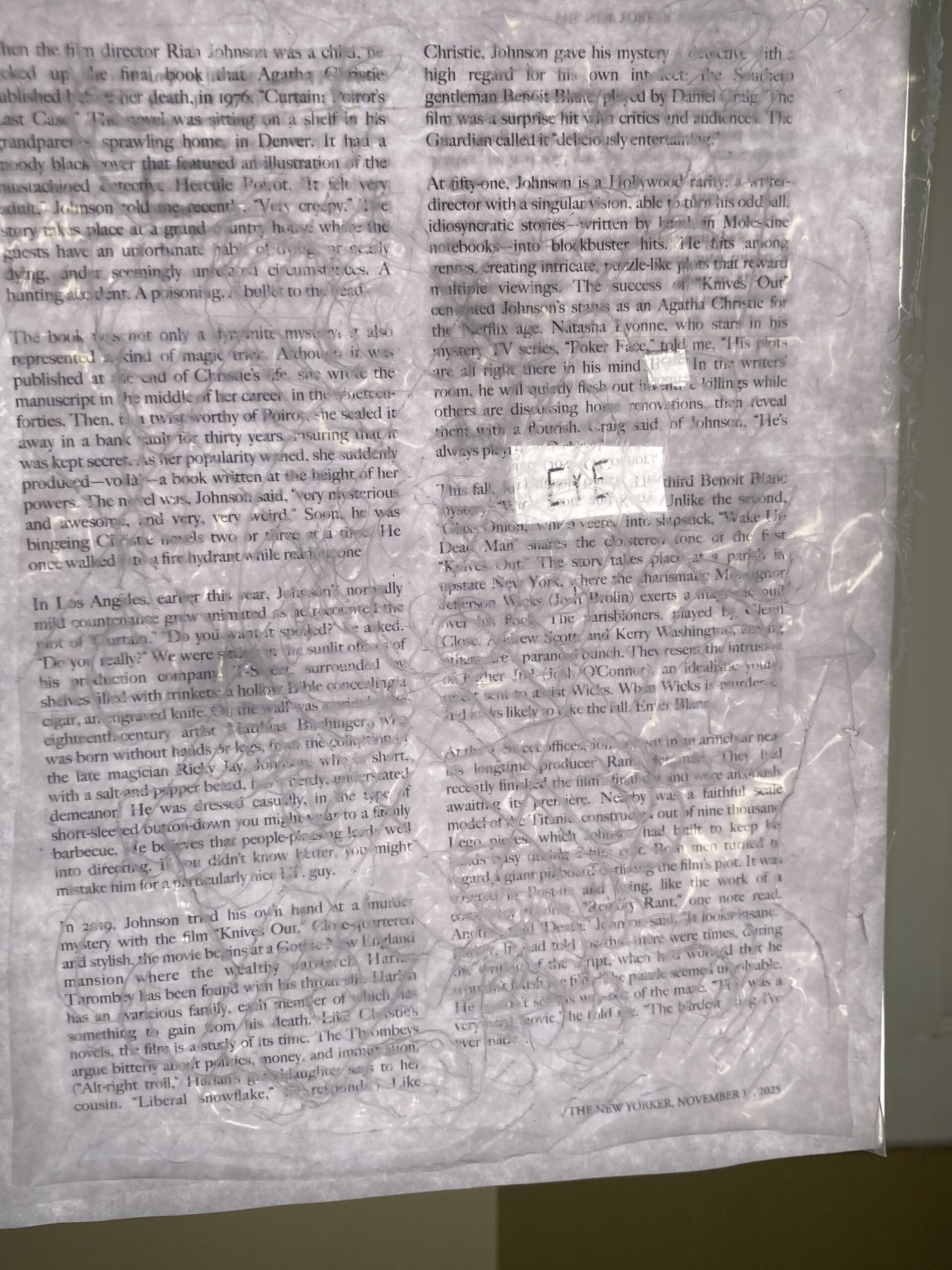
For this picture, I held the papers up in front of the window with sun streaming in. I need to distress the plastic more.
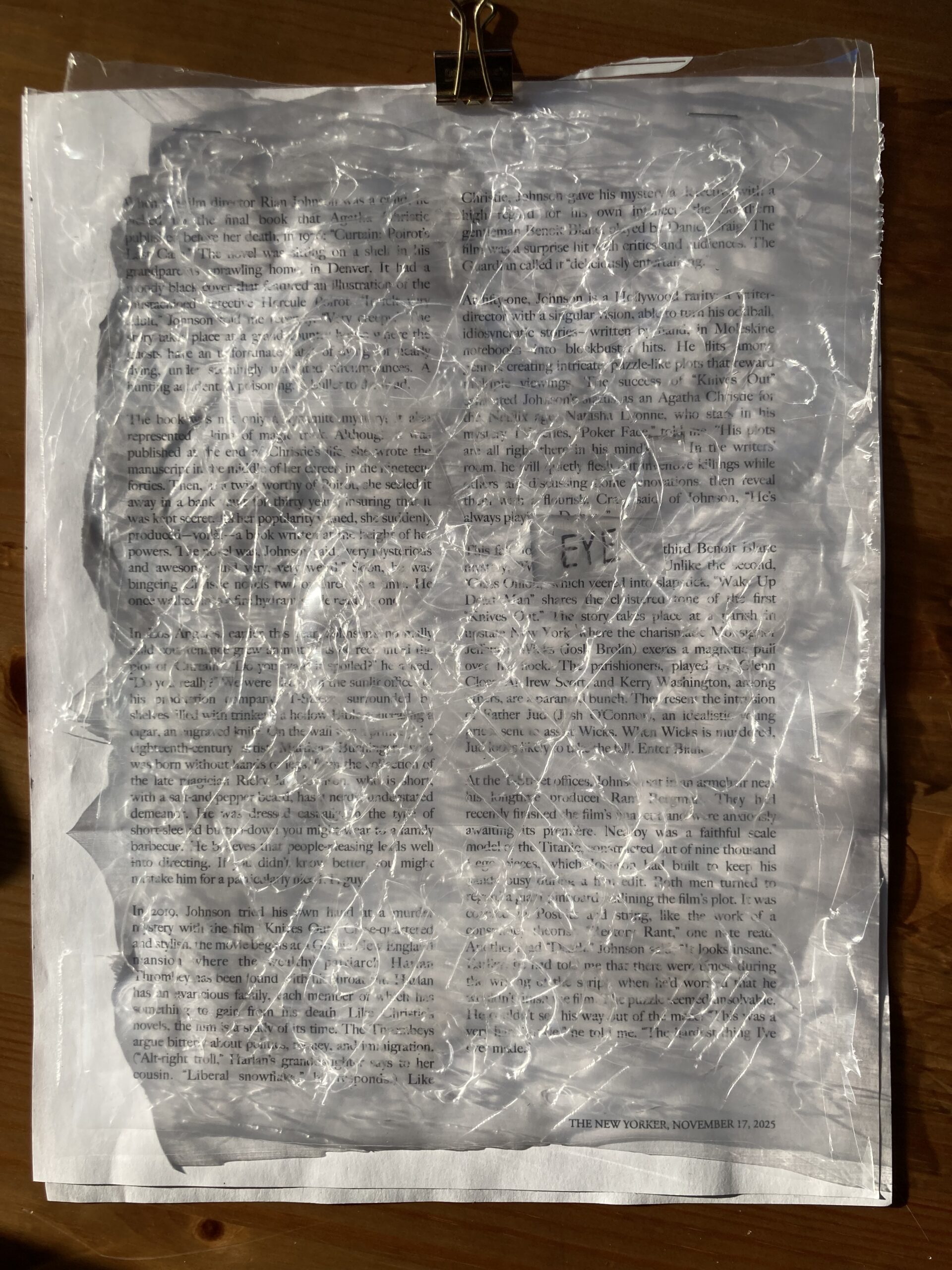
A thought: as I work on these poems about reading, consider the light source; it strongly impacts how and what I can see. How can I replicate different levels of light, from BRIGHT to dim.
Another thought: more frequently, I’ve been placing holes on the page to erase the text, like my blind spot made out of black netting. I like the idea of experimenting with ways to cover the text, like with this distressed ziploc. I could also use layers of netting and thread grids — ones that are straight and ordered, others that are tangled and slanted.
Her Read
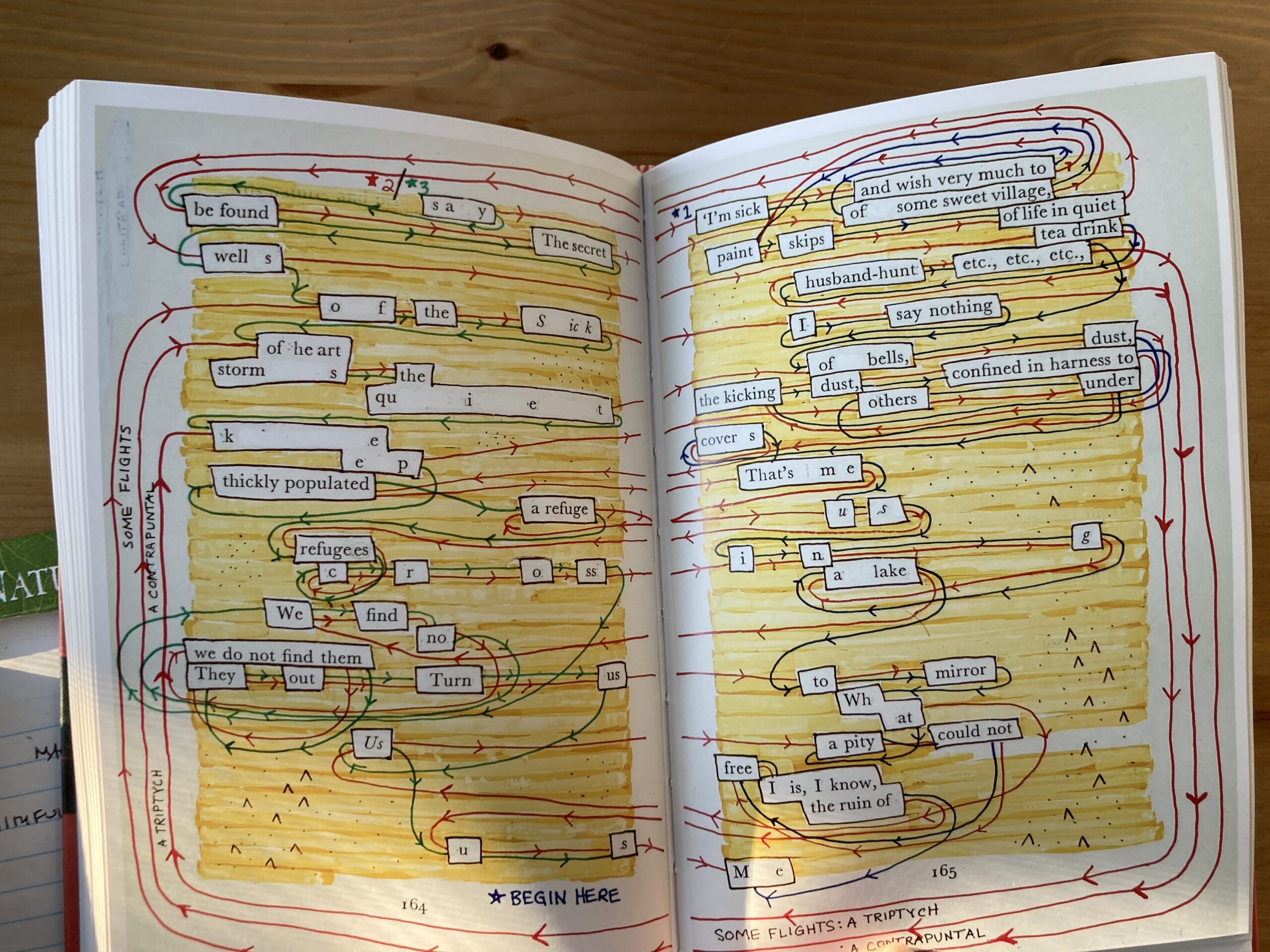
Wow, this is very cool! I’d like to use this as inspiration. I’ll have to spend some time with this to see if I can read it. I like the color and how the words for the poem are all over the place and the arrows/directions.