No run today. I’m taking it easy because Scott and I are running a 10k race this Saturday. Neither of us are ready and we will certainly be walking some of it, but it’s the official start of marathon training, which is exciting.
youtube
Yesterday at Arbeiter, Scott and I talked about YouTube and possibilities for vision-related videos. He talked about consistency, fine-tuning the process, and finding a small and regular way to create videos. I mentioned one idea: I could do brief videos — shorts? — in which I describe a moment of Sara-seeing, or Sara not-seeing. Strange examples happen every day — not seeing words that I’ve already written and writing over them; not being able to read text quickly or billboards at all; not seeing something that is bright red and obvious to everyone else — like a cardinal; not seeing a face and automatically looking through my peripheral to find it. Most of these I’ve mentioned aren’t that funny, but I have lots of instances of strange/absurd/funny ones too. The key for starting this project: keep it simple and short; I’m not interested in having this take over the other things I’m doing right now. The next step: figure out the process and start doing them.
holes
This morning, I’m re-working Holes 1. So far, I’ve drawn the Amsler Grid directly on the text for panels/pages 1 and 2. Then I printed and cut out the words of the poem and placed them on/over the grid. When I looked at the picture I had taken of it, I wasn’t satisfied. The words weren’t visible enough. Next I tried something I keep returning to but haven’t quite figured out: a 3D grid made from thread and pins above the grid + blind spot on the page. I like the effect of this, but now I need to figure out how to attach the words to the grid. Should I create a third layer with only the words? And should that layer be on top or in the middle –and, if in it’s in the middle, how do I do that?
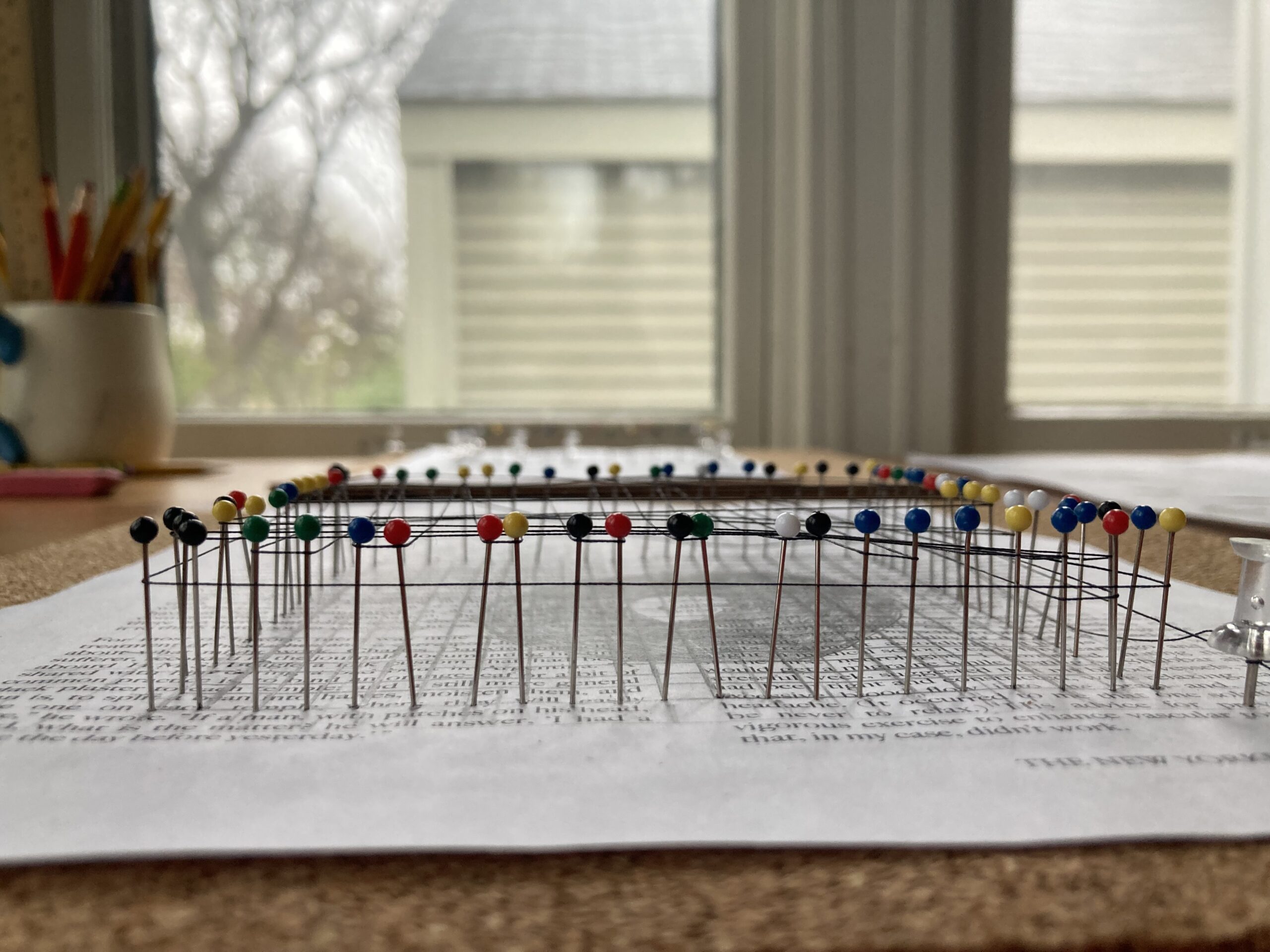
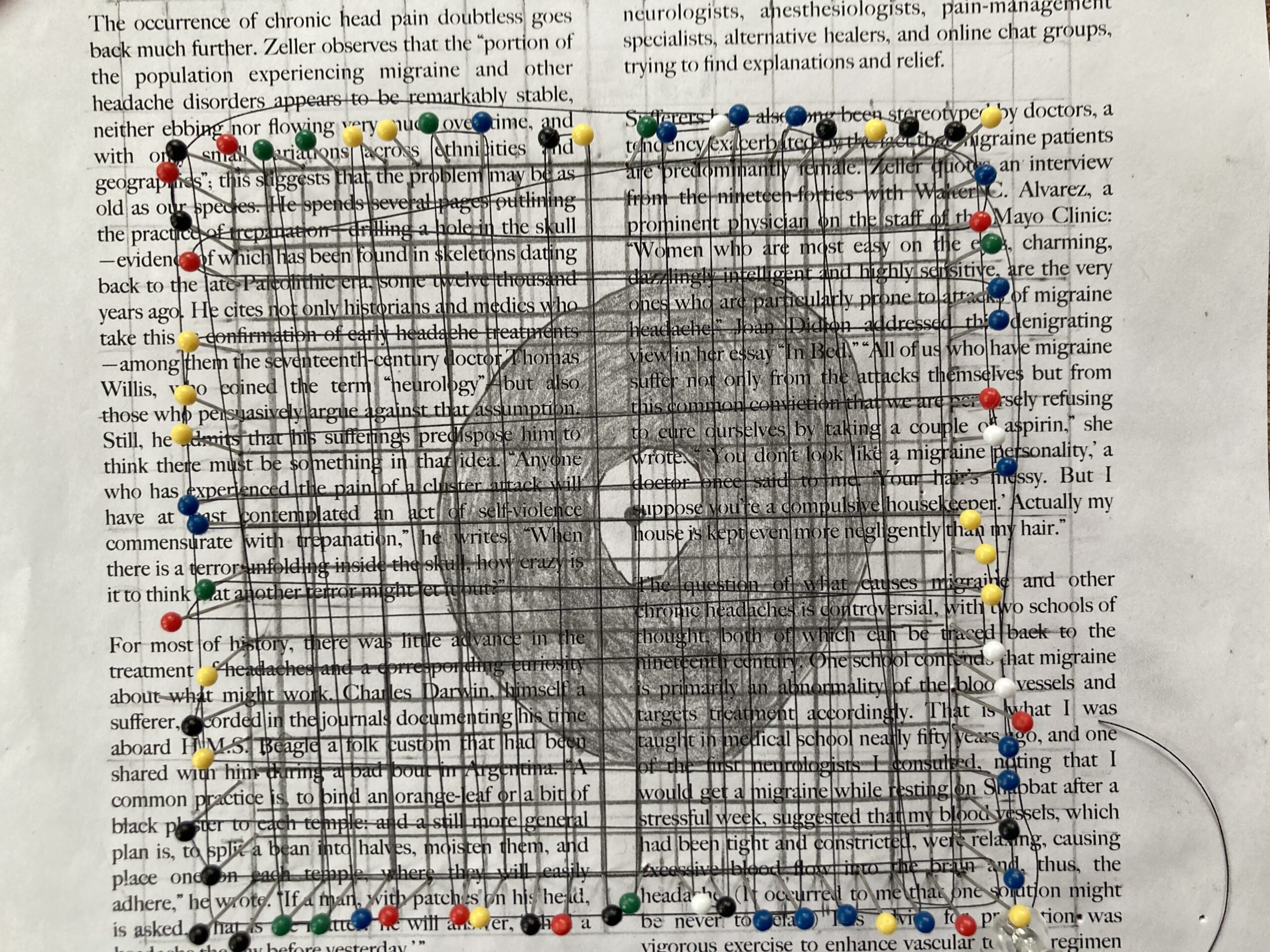
I discovered something interesting as I worked on this poem as 4 different panels/pages. Each of the pages, which include words from different parts of the longer poem, create their own poem. Some of those poems work better than others, but they can all be read individually. The smaller poem in this panel is:
a hole in
your
is
Okay, the other panels don’t work as well as poems, but I bet I can tweak them to make them work. Another challenge!
A recap for Holes 1: keep thinking about how/where the words fit on the grid (and how they make visible the idea of the poem, a hole making an uneasy fellowship with the word; ruminate: should there be a single or double grid on this one?; and how can I tweak the words to make 4 individual poems?
big picture thoughts: This series offers a progression towards more confusion, or a more peculiar relationship with the word as a reader. I want to demonstrate that progression visually through the changing configuration of the hole, the string/line/thread, and the word. So far, I’ve been experimenting with what material to use to represent the hole — pencil shading, black netting. Next up, the plastic bag! I also want to try making the “magic” blind spot decoder that I mentioned yesterday: when you place it over a certain spot, a new poem is revealed.
As for the string/line/thread, I’m using a double grid. I also want to try a crime board, where the thread becomes a string that connects all of the words. And, a hanging mobile with the words dangling from strings — does it need to spin? Other thoughts: broken or knotted strings AND strings coming out of the center hole and angling out to sections of words. I should write these up and match them to my poems!
Her Read/ Jennifer Sperry
This book! It’s an erasure of a history of art book by Herbert Read that only includes one woman sculpture, and only as an afterthought.
From the introduction to the erasure:
Thread, fabric, the Fates, the spin, life span — women in all the ages past made what was both essential and perishable: life, cloth, food.
When you look at the cover of this book, you find an identity inextricable from embroidery: the cover of Herbert Read’s book, its original title and author, are altered with stitching and patchwork — so we are first called to think of erasure by cross stitching, a crossing out that is, at the same time, a women’s traditional kind of making, and not unlike the fibrous threads that close a wound. Or, Ariadne’s thread, a clew that leads out of the labyrinth of Western iconography.
Some great thread thoughts! I’m mentioned this a few weeks ago: I want to use thread in my found poems/erasures as a way to connect with my fiber artist Mom who died in 2009, and my fiber artist daughter, RJP, who is currently majoring in fashion design in college. And, to my grandmothers — one, a sewer, knitter, and cross stitcher (Orliss), the other a weaver (Ines). And more broadly to women’s way of making. This mention of Ariadne is intriguing to me — I need to revist that story; I like the idea of the line of the grid as a thread that leads me out of a maze of some sort.
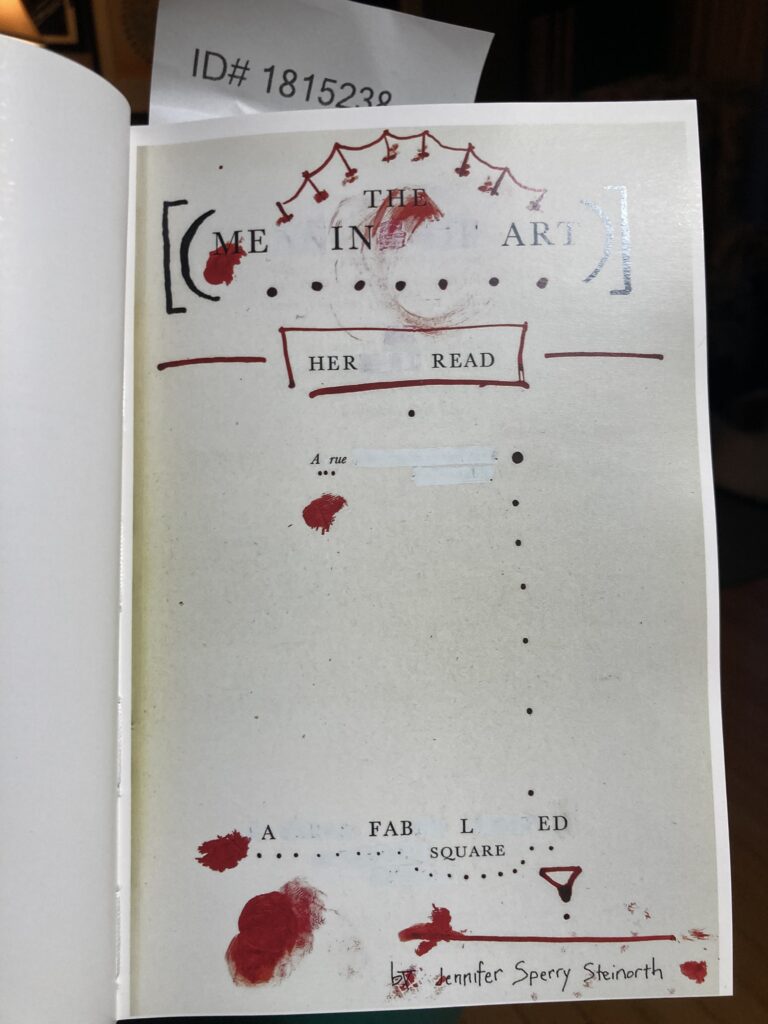
I think I read that the red splotches are Sperry’s blood, from a wound she received while using a knife to cut the spine of the book.