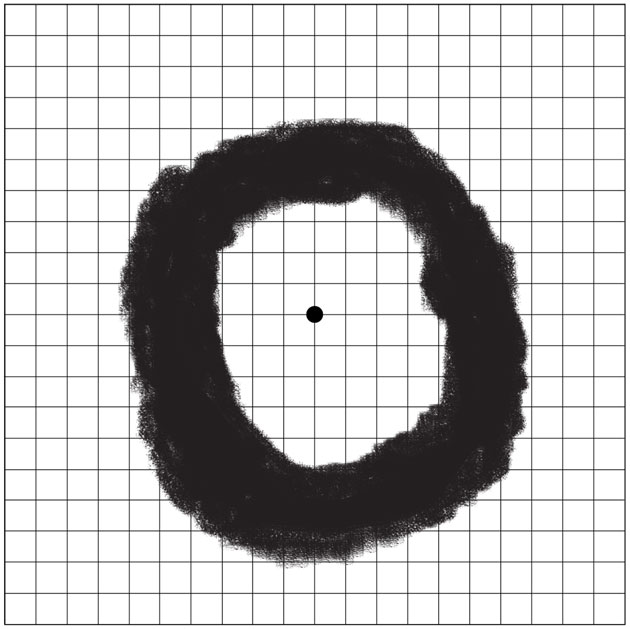
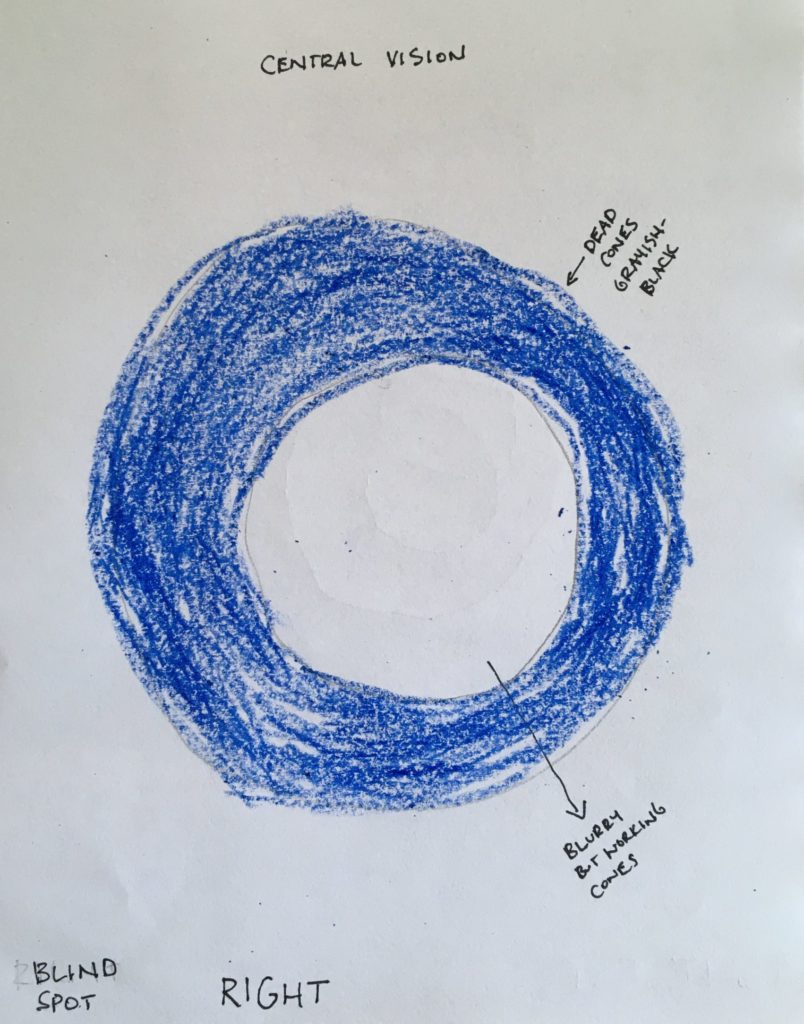
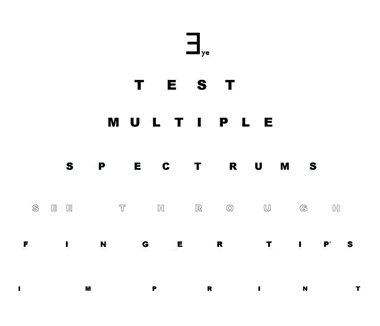
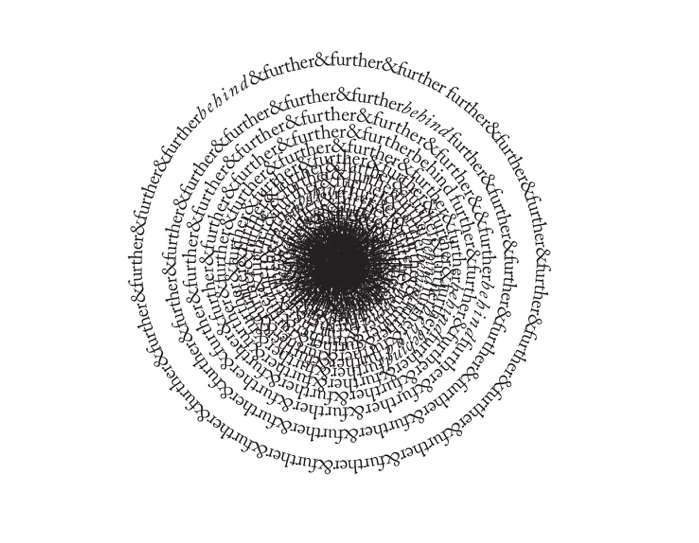
jan 28/BIKERUN

bike: 20 minutes
run: 3.25 miles
basement

Thought about running outside again this morning but decided that I should run inside where it felt warmer than 0 and so I could listen to my audio book which is due in 8 days. (As usual, all of my books became available from the library at the same time.) Watched a few random races while I biked, then listened to the audio book, The Guest List, while I ran. I’m not quite sure why I keep reading/listening to books in this Ruth Ware/Paula Hawkins type genre: British, murder, troubled past, terribly toxic friends, forced gatherings. Do I even enjoy them? I guess I do a little because I always finish them, but I hate most of the characters: lost, selfish, never having their shit together. Listening to it this morning did help the 32 minutes on the treadmill go by much faster. The first few minutes were difficult as I thought, how can I stay on here for another 28 minutes? But it got easier. It is still easier (and much more fun) to run outside. I think one of my goals for this winter will be to work on my aerobic base (the long, slow miles at a lower heart rate) so that when it gets warmer and the paths are clearer I will be fit enough to run for an hour. Yes! I miss running for longer distances, traveling farther away from my house beside the river. So much more to write about.

how we see: eyes and brain

For the past few days, I’ve been reviewing how vision works, from when light enters the eye and hits the retina and then travels through the optic nerve to the visual cortex and the occipital lobe. So much jargon–names for parts of the cells and the neurons and the areas of the brain, ways of discussing direction (dorsal, medial, ventral). How much do I need (or want) to know about this process? When does it become too much, a distraction? What I find fascinating, from my limited research, is how, even as scientists use their fancy language to name/classify the parts of the brain and what they do, there is so much they can’t name or understand. I am not dismissing the important work that is/has been done on how we see, but I’m drawn to the limits of that language and knowledge. The mysterious parts. It seems like there is a lot that scientists don’t know about how the brain processes images and visual information. I’m basing this last conclusion mainly off of the lack of recent articles (in the last 10 years) on how we see and the conclusion to this article (it’s from 1993 so it’s old, yet I haven’t found many more recent articles):

Let me try to give you a sense of where we are, says Margaret Livingstone, in an effort to assess the status of visual research today. Take form perception. Human beings are very good at it. We recognize contours, faces, words, a lot of really complicated things. What we understand is that in the retinas, the lateral geniculate bodies, and the first layer of the visual cortex, we code for changes in brightness or color. In the next stage, cells become selective for the orientation of the change–that is, they code for contours, or edges. In some places cells select for the length of the contour. Then, if you go up very high, you find cells selective for certain faces. Livingstone pauses. We know remarkably little about what happens in between. It’s frightening how big a gap there is.

The Vision Thing

Instead of understanding these gaps as failures to KNOW, I like to think of them as reminders that seeing/vision is so much more than we can or ever will understand. It is complex and can’t be reduced to the simple, naive idea that our eyes see what’s in the world and then our brain correctly communicates that exact image to us. I am not sure this makes sense, but I have been interrupted several times in writing this entry and I think I lost my train of thought. I’ll keep it in and work on it later.

a moment of sound

Listen to those birds! Right outside my front door. It’s 18 degrees, but sounds like spring.

jan 28, 2021

dec 19/BIKERUN

bike: 20 minutes
bike stand, basement
run: 1.55 miles
treadmill, basement

Another mini cross-training day. A little biking, a little running. Watched a YouTube video with runner Emma Abrahamson commenting on one of her kid races. Why do I find watching other people race so fascinating? Not sure. Did I watch anything else? I can’t remember. Listened to a playlist as I ran; it ended (again) with Miley Cyrus’s “Party in the USA.” That song–I really don’t like the lines, but the tempo is great for grinding on the treadmill.

Earlier today, Scott and I took Delia the dog for a walk near the gorge. No snow, just bare brown branches looking beautiful. I pointed out how I liked the contrast between the plain brown tree line and a runner’s bright yellow shirt. Scott thought it looked more green, which it probably did. A few minutes later he pointed out a biker’s bright shirt, remarking, “Now that’s YELLOW yellow.” To me it looked paler, dull. How much color do my cone cells still see? How much of what we all see is subjective, based on our preferences or interpretations? Maybe the runner’s shirt was both yellow and green?

dec 12/RUN

3.15 miles
2 school loop
29 degrees

Gloomy, light gray today. Wind coming from almost every direction. My lower back hurt when I started but was okay by the end. Less than 30 miles to go now, then a break. Nice to be outside, moving, and not thinking. Ran to the river and started on the trail, but there were too many people so I crossed over to the grass between edmund and the river road. No view of the river today. Encountered a few irritating squirrels, a big white dog. I don’t remember hearing any geese or seeing any big birds in the sky. No fat tires or roller skiers.

Running around Hiawatha School, I thought about when my kids went there. FWA started in pre-school in 2006, RJP finished 2nd grade in 2014. It seems so long ago and like it was a different Sara who took her kids to the playground, soccer practice, the wading pool, school concerts. I like the Sara I am now better than the Sara I was then.

This morning I reviewed part of Ed Bok Lee’s wonderful poem, “Halos,” and then recited it in my head as I ran. No recording today because I ran all the way to my front door without a cool-down walk. Here’s my favorite part of what I reviewed:

That visual impairment improves hearing,
taste, smell, touch is is mostly myth.
With it, however, I detect

fuzzy spirits exiting buildings;
halos around bikers’ helmets;
each streetlamp a pink-orange dawn.

So much in this bit that I love and that makes me think.

  1. Visual impairment, in and of itself, has not improved my other senses. Instead, it has made me want to work harder on them: to learn to listen, to notice and make note of what I smell, to find words to describe the textures I encounter.
  2. And, not being able to see normally most often doesn’t mean you can’t see anything. According to the Royal National Institute of Blind People (RNIB), 93% of blind and partially sighted people can see something. I like how Lee describes that something as beautiful and magical and not damaged or partial or less than: fuzzy spirits, halos, streetlights casting pink-orange dawns as light. Pretty cool. Quite often, I like the soft, fuzzy, gentle way I see the world these days. In an earlier part of the poem, Lee describes how he sees people: “any nearing face is surely smiling, gorgeous; each blurry body’s aura numinous.” Yes, I see this too and I like it. So much better than harsh lighting with sharp features and haggard faces.

As I was trying to write out the lines of this poems, I was thinking–and not for the first time–about how difficult it is for me to memorize line breaks and punctuation in poems. I googled “memorizing poems difficult punctuation” and found a discussion of how and why some contemporary poets write poems that deliberately resist memorization. Interesting. Here are some sources I’d like to check out:

The idea of writing poems that are hard to memorize–awkward phrasing and rhythms, for example–made me think about my poems about vision, the Snellen charts and mood rings. How hard are they to memorize? Are they too dependent on vision and reading to be understood? I think I want to do a poem/some poems about vision that are not so visual. I like the idea of experimenting with memorization and speaking/reciting in new ways. I’m also thinking about how I’ve been partly drawn to poetry because it’s easier to read as reading gets harder for me. Easier because there are usually less words to read and they are grouped differently, with lots of white space. Not easier in terms of understanding; I love how chewy and difficult they are in that respect. Yes, I want to think about this some more!

dec 11/BIKERUN

bike: 25 minutes
bike stand, basement
run: 1.9 miles
treadmill, basement

Not too cold or too covered in snow outside today, but I decided to stay inside to cross train and try out my new shoes on the treadmill. Can’t remember what I watched while I biked–some running race, I think. After about 20 minutes on the bike, when my heart rate was at 120 bpm, I recorded myself reciting the two poems I reviewed this morning: Emily Dickinson’s “Before I Got My Eye Put Out” and Vincente Huidobro’s “Natural Forces.”

Dickinson and Huidobro/ 11 December

I love fun challenges like this–trying to remember and recite a poem while working out. I did a good job. I like the juxtaposition of these two poems, with Dickinson cautioning against the hubris of “owning” objects–Mountains, Meadows, Dipping Birds, Amber Roads– by seeing them, and Huidobro celebrating the power of his glances to hold back a landscape or relight the stars or hold down a plummeting train. I memorized both of these poems as part of my Loving Eye/Arrogant Eye theme this summer. I like thinking about it in relation to Kelly’s scouring eye “that scrubs clean the sky and blossomed tree” in “Perhaps You Tire of Birds.” What if vision’s power was not in its penetrating gaze, but something else? I used this question as the start of my “Awed” mood ring poem:

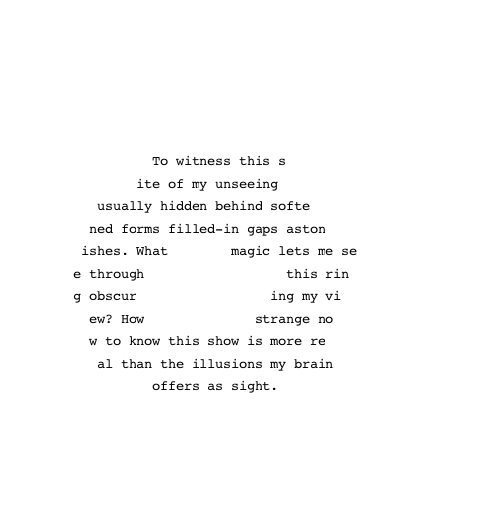
Behold the power of sight! Not found in one destructive glance but in the accumulation of looks. Against the odds and in spite of damaged cones misfiring signals and incomplete data these looks produce something resembling vision — an image feeling fuzzy form.

It’s cool to think about how the poems I memorized and recited this summer helped to inspire my work this fall.

After I finished reciting the poems, I hopped off the bike and ran almost 2 miles on the treadmill. Listened to my Bday 2018 playlist while I tried out my new shoes. Very nice! I wonder if I will run faster outside in these? Felt good to move and sweat and not think about much.

This morning I made it outside for a walk with Delia the dog. Cooler and windy, but clear, uncrowded, and seeming like October and not December. No snow or ice, just lots of brown leaves, bare branches, and yellowing grass. Passing a house on the corner of a street a few blocks away, I noticed the curtain slightly open and the face of an eager dog–a small poodle or Bichon?–watching us walk by. I had noticed the open curtain the day before and thought there might be a dog or cat in the window, but couldn’t look long enough to see. It takes a lot more time (than it used to, and than “normally” sighted people) to be able to determine what I’m looking at. Often I don’t bother; I dislike stopping and staring. It seems rude. One day I will get over this and take as much time as I want stopping to look at things until they make sense. I’m working on it!

From a twitter thread about poems that changed your life, I found this great one by Rumi. I’ve hardly read any Rumi, although I know Mary Oliver (one of my favorites), read them every day.

The Guest House/ Rumi

This being human is a guest house.
Every morning a new arrival.

A joy, a depression, a meanness,
some momentary awareness comes
as an unexpected visitor.

Welcome and entertain them all!
Even if they are a crowd of sorrows,
who violently sweep your house
empty of its furniture,
still, treat each guest honorably.
He may be clearing you out
for some new delight.

The dark thought, the shame, the malice,
meet them at the door laughing and
invite them in.

Be grateful for whatever comes,
because each has been sent
as a guide from beyond.

dec 4/RUN

2.5 miles
neighborhood
38 degrees

Feeling sore–not hurt, just sore–in my legs and lower back so I wasn’t sure I would run today but when Scott said it seemed like a great day to run outside, I had to do it. Sunny, mild, clear. A bit windy, but not too bad. A few more people since it is warmish and closer to noon, but I managed to keep distance from all of them. Listened to a playlist again so I didn’t hear any birds or leaves or far away traffic. I’m very close to my goal of 1000 miles for the year! I should take 3 or 4 days off from running once I reach that goal. My body needs it. 1000 miles has demanded a lot–I’ve run almost every day this year. Almost all of those runs have been short–4 or 5k–but frequent. Will I ever be able to run more than 1000 miles in a year? Would that be good for my body? I’m not sure.

Anything I remember from my run? My mind has gone blank. No views of the river, no remarkable trees, no roller skiers or fat tires or Daily Walker. I do remember running on the dirt trail between the river road and edmund. Uneven and windy (as in lots of meandering, not a stiff breeze). I remember wanting to stop at the top of the edmund hill to change my music but deciding to keep going. I remember seeing lots of cars on the river road and running in the grass at Howe field to avoid pedestrians. I remember stepping off the sidewalk and running in the street several times to avoid some more people, doing a loop around Cooper and Howe, smelling something overwhelmingly fruity coming from a van and guessing that someone inside of it was vaping. I remember feeling especially strong and smooth as I ran down the hill on 32nd and especially nostalgic as I ran by the main entrance at my kids’ old kindergarten. I don’t remember taking note of my breathing or making up any chants or noticing any connections between my striking feet and my inhales and exhales.

Richard Siken is the Best

I think it was last year that poets.org began including an “About this poem” author’s note with the poem-of-the-day. I find them helpful and interesting and always look at them after my initial reading of the poem. Richard Aiken’s “About this poem” note for today’s “Real Estate” is the best, most delightful one I’ve ever read. It offers an explanation that helped me to (start to) understand the poem, which is great, but it also offers itself up as another poem to place beside the first one. How cool to turn the note into a poem! I want to experiment with doing this, especially since I am so resistant to offering explanations for what I’m doing (even as I feel I should and/or long to).

Real Estate/ Richard Siken

My mother married a man who divorced her for money. Phyllis, he would say, If you don’t stop buying jewelry, I will have to divorce you to keep us out of the poorhouse. When he said this, she would stub out a cigarette, mutter something under her breath. Eventually, he was forced to divorce her. Then, he died. Then she did. The man was not my father. My father was buried down the road, in a box his other son selected, the ashes of his third wife in a brass urn that he will hold in the crook of his arm forever. At the reception, after his funeral, I got mean on four cups of Lime Sherbet Punch. When the man who was not my father divorced my mother, I stopped being related to him. These things are complicated, says the Talmud. When he died, I couldn’t prove it. I couldn’t get a death certificate. These things are complicated, says the Health Department. Their names remain on the deed to the house. It isn’t haunted, it’s owned by ghosts. When I die, I will come in fast and low. I will stick the landing. There will be no confusion. The dead will make room for me.

About this poem

“I had a stroke and forgot almost everything. My handwriting was big and crooked and I couldn’t walk. I slept a lot. I made lists, a working glossary. Meat. Blood. Floor. Thunder. I tried to understand what these things were and how I was related to them. Thermostat. Agriculture. Cherries Jubilee. Metamodernism. I understand North, but I struggle with left. Describing the world is easier than finding a place in it. Doorknob. Flashlight. Landmark. Yardstick.”
Richard Siken

I want to experiment with adding these notes to my mood ring poems–and maybe my earlier Snellen chart ones too. Is that too much?

nov 15/RUN

3.2 miles
river road trail, south/edmund, north
33 degrees/ feels like 20
wind: 17 mph (30 mph gusts)

Blustery this morning. Pale gray sky. Clear path. More people than I expected but not too many. Looking out for others, I forgot to check on the river. Was it blueish gray? Don’t remember hearing any birds or seeing any geese. No dogs or fat tires. I can’t remember thinking about anything except the wind and the random patches of ice on neighborhood sidewalks. Sitting here, writing this at my desk in the front room, I can hear the wind howling. Did I hear it while I was running? I’m not sure.

Thinking about the wind, decided to google “Emily Dickinson wind”. Here’s what I found:

Wind/ Emily Dickinson

Of all the sounds despatched abroad,
There’s not a charge to me
Like that old measure in the boughs,
That phraseless melody

The wind does, working like a hand
Whose fingers brush the sky,
Then quiver down, with tufts of tune
Permitted gods and me.

When winds go round and round in bands,
And thrum upon the door,
And birds take places overhead,
To bear them orchestra,

I crave him grace, of summer boughs,
If such an outcast be,
He never heard that fleshless chant
Rise solemn in the tree,

As if some caravan of sound
On deserts, in the sky,
Had broken rank,
Then knit, and passed
In seamless company.

I love her descriptions of the sound of wind as “old measure in the boughs,” “phraseless melody,” “tuftless tune,” and “fleshless chant.” I think fleshless chant is my favorite. Oh, and I really like the verb thrum. I need to use that in something.

mood: relentless

Working on my mood ring poem about the mood relentless, trying to figure out the last line for the inner ring/scotoma poem. Here’s what I have:

Ten thousand years ago water from melting glaciers began to wear down limestone to form a gorge. Thirty years ago cone cells in my macula began to malfunction to form a scotoma. I am both limestone and water. As I dissolve my slow steady flow carves out a new landscape.

Now I’m wondering if I should use “geography” instead of landscape? Landscape seems more visual than geography–and passive, with the land like a background. Yes, I think I like geography.

As I dissolve my slow steady flow carves out a new geography.

nov 12/RUN

3.2 miles
river road path, north/river road, path, south/32nd st, west/43rd ave, south
29 degrees
5% snow-covered

Winter running! I love the cold air, the snowy gorge. Encountered a few irritating runners who refused to move over to the other side of the trail. Had to run in the snow to avoid them. Are they really comfortable running that close to someone else, especially as we enter another, even scarier phase of the pandemic? I don’t get it. But, these two runners were such a small part of the run. The rest was wonderful. The sky was grayish-white which made everything seem other-worldly or at least at a distance from this world. Quiet and calm and empty, uncluttered.

Things I Remember

  • The overpowering and mostly unwelcome smell of pork–bacon? sausage?–wafting down from the Longfellow Grill as I ran under the lake street bridge
  • Voices down in the gorge, near the rowing club. Were they rowing in the water? On the shore? I couldn’t tell
  • The crunch-cracking of feet striking hard shards of super packed and icy snow. The same sounds even louder as tires drove over the icy snow
  • A wedge of geese–4 or 5–flying high in the gray sky
  • Some yellowish-brown leaves still on a few of the branches in the tunnel of trees
  • So many cars on the river road

As I ran, I thought about my latest mood ring poem. Relentless. Some lines popped in my head: “I am not the river but the limestone…” and “I am not the limestone but the river” and “I am both the limestone and the river.” Thinking about how the relentlessness comes both from me as I try to make sense of my vision loss and write about it and from the erosion of cone cells as they continue to destroy my central vision.

Encountered a poem this morning that I liked a little with one reading, then liked a lot after reading the poet’s explanation of it.

A Rogue Dream/ Melanie Figg

after Olivia Gatwood

I get ready for my first day as the new girl in high school
already knowing what not to wear. I dress perfectly
to stand out and disappear. I know how to put on
makeup, and I do it exactly right. My hair
looks awesome, of course! I step onto the bus,
pause by the driver, raise my arms like a superstar,
and meet the eyes of my adoring audience.
Three different beautiful girls punch
each other in the face to have me sit next to them.
I decline and the school’s most lovely, artsy boy
slides over to make room. He knows his feelings
and only goes too far
when he honestly misunderstands. He’s one of the safer ones.

I walk down the halls and no one makes fun of me.
I pass the section of lockers where her locker is, and
she is there, taking a book out of her backpack.
She’ll go running this weekend, as usual, and won’t
be followed. The man who won’t be following
her has already followed half a dozen women
to rape and kill and leave in the woods. But she won’t be
followed. She’ll survive her fate this time, and come back

to school on Monday, avoid the mean girls in the bathroom.
She’ll pick on the new girl, call her a virgin of all things.
She’ll limp her way through math, cheat a bit in science,
do pretty good in history and English. She’ll graduate,
and go to the state school on a track scholarship. She’ll
have two girls and keep them safe. She’ll almost forget

about this other ending: her in the woods near her house,
staring at the ground beneath her, wondering why.

This line! “Three different beautiful girls punch/each other in the face to have me sit next to them.” And the ending with the reimagining of the girl as not being followed. Wow.

nov 11/RUN

2.2 miles
river road trail, south/42nd st, west/43rd ave, north
32 degrees
50% snow-covered

We got about 5 inches of snow last night. Beautiful. As it fell, I opened the door and breathed in the cold, fresh air and absorbed the quiet calm. This morning, the trail by the river was cleared and bare, but there were people on the path who I couldn’t avoid unless I jumped in the snow banks. How much will I run outside this winter? Probably not as much as last year, unless I start running earlier in the morning.

A few things I remember

  • The river was not white but blue
  • The path was clear and so were many of the sidewalks. A few stretches were covered in powdery, soft, weightless white flakes, and a few others were studded with clumps of pressed down snow
  • Don’t remember hearing any crunching or compacting of snow
  • Ran under at least two snow-laden evergreen branches. Briefly wondered if they might decide to give me a shower (they didn’t)
  • Don’t remember hearing any birds. No geese or bluejays or cardinals or crows
  • Saw a fat tire biking in the snow-covered street
  • The streets were striped from where tires had pressed down the snow. No city plows yet. Not too bad to run on and it made a cool visual effect–strips of black pavement mixed with strips of white snow

mood ring: relentness

Working on another mood ring poem and thinking about repeated habits, the slow and gradual erosion of my central vision, the dissolving and/or reforming of the self in new ways, my persistence in finding better ways to make sense of and communicate my experiences, my unflagging desire to craft poetry out of how I try to be when I cannot see or when I see in new ways. I’ve decided the best word to describe this is relentless. I’m also thinking a compelling metaphor for it is the gorge and the slow (but not that slow, really) erosion of the limestone that created (and continues to create) it. Here’s some facts to remember and use:

carving of the gorge

12,000 years ago the falls were formed when glaciers melted. They were originally in St. Paul, but traveled upstream to downtown Minneapolis–traveling about 10 miles at a rate of 4 feet per year. 3,828 years ago the falls were near the railroad trestle. The falls stabilized/stopped moving in 1870.

Sources: NPS and FMR

I’d like to review my information on the current eroding of the gorge and think about that in relation to this mood too.

nov 10/RUN

3.2 miles
turkey hollow
31 degrees

Yes! Love this weather for running. Just around freezing, overcast, not too windy. Ran above the river on the trail. Why can’t I remember what the river looked like? Did I forgot to check? Not sure. I remember glancing at the oak savanna and the Winchell trail as it climbs just slightly up to 38th, changing from dirt to asphalt. I remember looking at the sky above the gorge and the other side as I ran by the inviting bench between Folwell and 42nd. I remember noticing how the steps down from 38th were already closed off and that the paved trail below was bare. But I don’t remember the river. It must have been grayish blue. Today we might get half a foot of snow. Will the river be covered in white tomorrow?

The turkeys were in the same yard that they had been in the last time I saw them, doing the same things: munching on something and performing a part run, part trot, part bob to get away from me as I neared. Nice. I love their awkward grace.

I don’t remember thinking about much, which is nice. The joy from last week’s election results has worn off as the refusal to concede continues. Social media doom scrolling returns and so does the need to be much more deliberate about managing anxiety and avoiding media. This week is all about distraction, I think. And shoveling and continuing to work on my mood ring poems and memorizing a few poems?

Speaking of my mood ring poems, I’ve noticed that I used certainty/uncertainty (too?) often. What are some other words I could use?

  • stable/destabilized
  • faith/doubt
  • convinced/unconvinced
  • known/unknown
  • indisputable/in doubt, questionable
  • assuredly/without assurance
  • clear/unclear
  • definite/indeterminate
  • sure/unsure

As I write this at my front desk, the snow has started. This snow seems like it might stick around. Will the grass stay gone? Here’s one of my favorite poems about eagerly anticipating winter. I’ve posted it several times on this log but I always like remembering it:

Fall, leaves, fall/ EMILY BRONTË

Fall, leaves, fall; die, flowers, away;
Lengthen night and shorten day;
Every leaf speaks bliss to me
Fluttering from the autumn tree.
I shall smile when wreaths of snow
Blossom where the rose should grow;
I shall sing when night’s decay
Ushers in a drearier day.

As I’ve said before, I don’t like misery and dreary days. Just leafless trees, bare branches, crunching snow, and cold clear air.

nov 9/RUN

3.2 miles
river road trail, south/edmund, north/32nd st, west
64 degrees

Very gray this morning, which didn’t bother me. Everything looked solemn, calm, expectant. Rain coming in a few hours then a big drop in the temperature. Maybe a few inches of snow tomorrow. Goodbye unusually mild fall weather, hello winter. Yes! Wore shorts and a short-sleeved shirt and was still warm. I could feel that my face was bright red. Heading south straight into the wind at the beginning of my run, I admired the river. Such a nice blueish gray. Saw something flying in the air–was it a small bird or a leaf? I couldn’t tell. Too many cars on the river road but not too many people.

[added in several hours later] I almost forgot. I saw a dead animal on the road, right on the edge. No blood, no mangled body. It looked like it was sleeping. Running, I noticed something unusual in the road. I turned to look back at it, almost veering into the fence on the edge of the gorge. I think it was raccoon.

[added in even later] Forgot this too: Scott and I watching all the seasons of Community (again). This morning I had this song in my head:

“Come on I’m Dean/and my hands are so clean/at this moment/I am stapling”

I chanted it several times as I ran until I forgot about it.

Thinking about bewilderment as I work on a mood ring poem. Really appreciate this passage from Fanny Howe:

There is a muslim prayer that says, “Lord, increase my bewilderment,” and this prayer is also mine and the strange Whoever who goes under the name of “I” in my poems–and under multiple names in my fiction–where error, errancy and bewilderment are the main forces that signal a story. 

error, errancy, and bewilderment

I also like this passage:

In the Dictionary, to bewilder is “to cause to lose one’s sense of where one is.”
The wilderness as metaphor is in this case not evocative enough because causing a complete failure in the magnet, the compass, the scale, the stars and the movement of the rivers is more than getting lost in the woods.  
Bewilderment is an enchantment that follows a complete collapse of reference and reconcilability.  
It cracks open the dialectic and sees myriads all at once.

nov 5/RUN

2 miles
cooper school loop
60 degrees

Still waiting for the results of the election. Stressful. Feeling the panic simmering just beneath the surface. Slight tightness in chest, deeper breaths needed. Feeling hopeful and scared and impatient.

A beautiful day for a run. Maybe a little warmer than I’d like but sunny and calm. I wore shorts. I don’t remember looking at my shadow as I ran–was she there?–north on Edmund up to 32nd. Lots of people out walking and running. Did a loop around Cooper School. Heard some kids playing on the playground.

geese!

I don’t remember any geese on my run today but I do remember first hearing then seeing 2 different groups of geese flying fast through the sky. So fast! And pretty low in the sky too. I wonder if they were offering a warning about next week’s colder weather?

look at that bird high in the sky!

Walking home after finishing my run I noticed a speck out of the corner of my eye. Something moving high in the sky. At first I couldn’t see it because it was in my central blind spot. I kept trying to spot it my periphery. Suddenly it appeared. I could even see the wings moving. How was I able to see it? Did my brain finally guess correctly or did the bird move into an undamaged part of my central vision? Vision is so strange and fascinating.

Mood Ring: Bewilderment

I’m working on another mood ring poem. After trying to find the best word to describe it I have decided on bewilderment. Here’s a line that I want to use somehow from Mary Ruefle:

The difference between myself and my student is that I am better at not knowing what I am doing.

Not knowing what I’m doing or seeing is a constant experience for me. Learning how to deal with that disorientation, discomfort, uncertainty is a big goal. It used to be central to my pedagogy in the classroom, now it’s central to my daily life.

nov 4/RUN

2 miles
43rd ave, north/32nd st, east/edmund, north/37th st, west
60 degrees

Added a little more distance to my run this late morning. Legs are feeling okay, although everything seems slightly harder. Is it sore legs or anxiety over the still undecided election? I have not checked any news or social media this morning; I’m relying on Scott to tell me good news or when it’s all over. Trying to stay hopeful and prepare for the worst. In situations like this, I retreat.

When I took Delia on a walk, it was very still. I remember hearing only a few intermittent bird calls. Later when I ran, especially on Edmund, I heard all sorts of birds calling and singing. Also heard several rakes scraping against the sidewalk, a few violins and cellos or violas practicing outside, some leaf blowers whining, joyful kids at the playground near Cooper Field laughing and yelling, a dog’s collar clanging.

As I noticed my shadow running in front of me, I thought about the first lines from Black Cat by Rilke that I memorized this morning:

A ghost, although invisible, still is like a place
your sight can knock on, echoing;

Thought about another mood ring poem. This one, about feeling like a ghost, a shadow. Fading, faded. Unmoored, floating in the world. Ephemeral. Unable to see concretely, or feel like anything around me is solid. It all shifts–or does it echo endlessly–the trace of something that once was there, but isn’t any longer? I feel this way a lot when I’m running but also when I’m walking. This floating, dreamy feeling can be cool to experience but it can also be disorienting, unsettling. Too difficult to find solid ground.

oct 29/RUN

3.2 miles
43rd ave, north/32nd st, east/edmund, south/river road trail, south/edmund, north
33 degrees

A nice run on a windy, gray morning. Still a few patches of snow on the grass. Most of the leaves off the trees. Everything brown and golden and rusty red and burnt orange. I love this time of year. Late fall. Everything almost bare but not yet covered in snow. Clear views of the river. Noticed my favorite late fall view, just past the oak savanna. Beautiful. I don’t remember seeing any bikers, just walkers and runners and one roller skier getting ready to start skiing up the hill on Edmund. No dogs or squirrels or coyotes.

Running past a modern house on Edmund–the house that was built last year on the extra lot next to a huge traditional 1980s-style house that was on the market for over a year but didn’t sell because it was too big and outdated and expensive (asking over a million)–I noticed some loud noises and white powder or smoke or something coming from the garage. Then I ran by a truck with the words “concrete specialists” on it and I guessed they were doing something with concrete. Maybe a poured concrete countertop? I hope so. I’d like one of those.

Listened to an audio book–The Alchemist’s Daughter–so I didn’t think about much or hear hardly anything except the narrator. Briefly I thought about how dreamy everything looks, all fuzzy and out of focus as I run. Partly because of the light, partly the motion, but mostly my vision. I want to write about this as a mood–dreamy? fuzzy? blurry? I was thinking I’d like to incorporate the line from a Diane Seuss poem, “the world italicized.”

Only a few days until Halloween and then election. Can it please be over? Can we please start trusting science and doctors and thinking again?

oct 27/RUN

3.2 miles
turkey hollow
17 degrees/ feels like 10

Coldest day of the season. Double tights + green shirt + orange sweatshirt + vest + buff + stocking cap. Sunny. I must have glanced at the river but I don’t remember what it looked like. Too busy trying to avoid other runners and walkers. A wonderful morning. I like (love?) this cold. Clears out the sinuses and keeps me from getting overheated. Running on Edmund, heading back home, I saw my shadow. It was nice to run with her. Thought about another mood ring poem: doubt. Had some ideas as I moved–something about how the doubt is related to the awe and the brain’s remarkable ability to enable me to keep seeing. It’s a relief but when I can still see I question whether my vision is really that bad. I doubt myself. I want to think more about doubt and what it means today. Here’s a poem to get me started.

My Doubt/ Jane Hirshfield – 1953-

I wake, doubt, beside you,
like a curtain half-open.

I dress doubting,
like a cup
undecided if it has been dropped.

I eat doubting,
work doubting,
go out to a dubious cafe with skeptical friends.

I go to sleep doubting myself,
as a herd of goats
sleep in a suddenly gone-quiet truck.

I dream you, doubt,
nightly—
for what is the meaning of dreaming
if not that all we are while inside it
is transient, amorphous, in question?

Left hand and right hand,
doubt, you are in me,
throwing a basketball, guiding my knife and my fork.
Left knee and right knee,
we run for a bus,
for a meeting that surely will end before we arrive.

I would like
to grow content in you, doubt,
as a double-hung window
settles obedient into its hidden pulleys and ropes.

I doubt I can do so:
your own counterweight governs my nights and my days.

As the knob of hung lead holds steady
the open mouth of a window,
you hold me,
my kneeling before you resistant, stubborn,
offering these furious praises
I can’t help but doubt you will ever be able to hear.

oct 24/RUN

3.15 miles
river road trail, south/edmund, north/32nd st, west/43rd ave, south
28 degrees/ feels like 24

This weather! My favorite. Not much wind. Clear sky, clear path. Just below freezing. So much easier to breathe. I felt tired this morning and wasn’t sure if I should run or not. So glad I did. Noticed the river today; clear but no sheets of ice yet. Smelled smoke from a fireplace and some hot chocolate. Saw a fat tire heading down to the Winchell Trail, a roller skier who didn’t move over far enough (or at all) on the upper trail. Most of the leaves are off of the trees in the boulevard. Heard some kids playing at the playground by Cooper School. Admired some bright yellow leaves as I ran over them in the street. Anything else? Didn’t hear any geese or crows. No near collisions with spazzy squirrels. No dogs or large groups of runners or loud talkers.

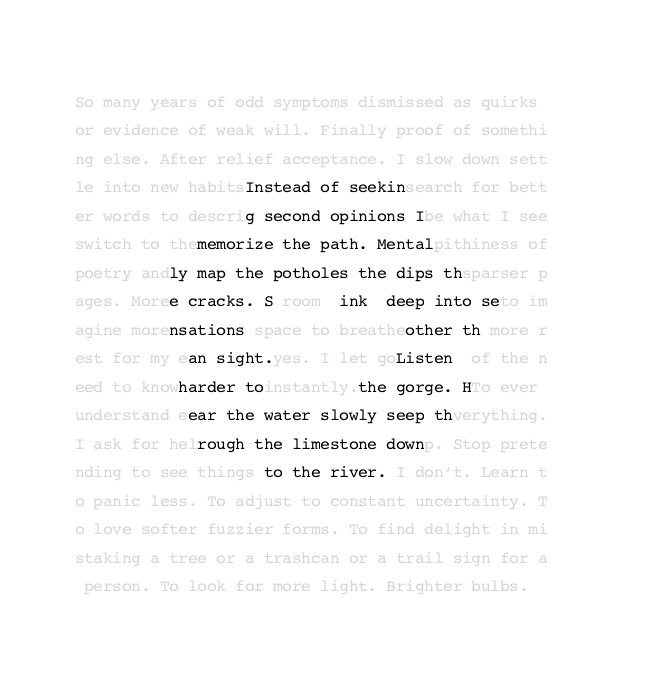
Thinking more about my latest mood ring poem and what name to give it. Initially it was acceptance, then persistence. I mentioned resilience to Scott and he liked it. I’m thinking about the last line of the inner poem: ” Hear the water slowly seep through the limestone down to the river.” I see myself as the water, not the limestone. Not slowly being worn away until I no longer exist but continuing to find a way to the river, no matter what obstacle is in my way. This seems more like persistence than resilience but I’m not sure. I looked it up in the online OED and found this helpful definition:

5. The quality or fact of being able to recover quickly or easily from, or resist being affected by, a misfortune, shock, illness, etc.; robustness; adaptability.

The image of the water eroding the limestone doesn’t seem to fit here. I think it would be better if I used another gorge image: the vegetation that perpetually finds a way to poke through fence slats or bust through asphalt. Yes, I like this better.

Returning to my discussion of limestone, I claimed that I see myself more like water than the limestone. Not always, and that’s not a bad thing. Sometimes I’d like to be the limestone. The eroding of limestone could be like the losing of the self (hubris, worries, being overly attached to status and material things, fear of death, false beliefs in control and invincibility). Not sure if that makes sense, but I think it’s the start for a different poem.

oct 23/RUN

3.2 miles
turkey hollow
33 degrees
wet snow

It was snowing, I think. Or was it raining? So wet it was hard to tell. Just on the edge. I didn’t mind. Another day with hardly anyone out on the trail. Wore a baseball cap today to shield my eyes. No sharp shards only soft, wet drops. I remember hearing at least one crow cawing but forgot to look down at the river. I wonder if there were any chunks of ice on it?

Ran past turkey hollow and searched for turkeys. Where do they go when it snows? Do they live under the branches of an evergreen tree? Under the bridge? I just looked it up and discovered that wild turkeys roost in trees at night. Which trees? Where? Now I’m imagining taking a walk at night and passing under a tree loaded with turkeys. What a strange sight that would be!

The sidewalk was wet but not slick or snow-covered. I thought about the inner part of a mood ring poem I’m doing about acceptance. Trying to build on my line: Sink deep into sensations other than sight. I though about feeling the river or smelling it? Tasting the air seasoned with mulching leaves? Striking the soft ground?

(a few hours later) Here’s a completed draft of my acceptance mood ring. I can’t decide if acceptance is the right word for describing this mood.

oct 19/RUN

4.1 miles
river road path, north/seabury and edmund, south
33 degrees

Saw a few flurries as I ran. More coming tomorrow. Up to 6 inches. What? A nice run above the gorge. I had a clear view of the river, but I don’t remember what it looked like. Too busy admiring the bare trees and thinking about how my chest hurt slightly. Not much, just a small, dull ache. Off and on for the past five days. Smelled the toast, always slightly over-toasted, at Longfellow Grill. Heard one dog barking below me on the Winchell Trail. Imagined it running gleefully through the leaves. Was it barking at a squirrel? A tree? A swirling leaf?

Right now I’m tracking this hardcore ultra marathon taking place in Belt Buckle, Tennessee called Big’s Backyard Ultra. The runners–they started with 14–run a loop of 4. 16 miles every hour for as long as they can. Once they can’t finish the loop in an hour, they’re out. Right now, there are 2 runners left and they have just completed 216.66 miles and 52 laps. I don’t usually pay attention to ultra marathons but last year I discovered Courtney Dauwalter and I started following her on Instagram. It’s fascinating to check every hour and see how she’s doing. I can’t imagine running for that long, but I can appreciate the strange other-worldly space it would put you in for the 48+ hours you’re moving or eating or trying to quickly rest before starting again. At what point do you start hallucinating? I think she’s talked about having strange visions before. I wonder how long they will be able to go? And when the second to last person drops out, will the last person standing stop or try to make it to 300 miles? Very hard core. At some point in the past, I might have judged something like this, but now I’m just fascinated–but not nearly enough to try something like this.

Just now I was scrolling through my various feeds, trying to find a poem to post. But then I remembered I already have so many poems posted on here that I love and haven’t spent enough time with. Here’s an excerpt from one of my favorite October poems:

October/ May Swenson

7

Now and then, a red leaf riding
the slow flow of gray water.
From the bridge, see far into
the woods, now that limbs are bare,
ground thick-littered. See,
along the scarcely gliding stream,
the blanched, diminished, ragged
swamp and woods the sun still
spills into. Stand still, stare
hard into bramble and tangle,
past leaning broken trunks,
sprawled roots exposed. Will
something move?—some vision
come to outline? Yes, there—
deep in—a dark bird hangs
in the thicket, stretches a wing.
Reversing his perch, he says one
“Chuck.” His shoulder-patch
that should be red looks gray.
This old redwing has decided to
stay, this year, not join the
strenuous migration. Better here,
in the familiar, to fade.
I want to memorize this excerpt today. Is there any way that I could use this bit as inspiration for my mood poem about acceptance, accommodation? I will try!

oct 17/RUN

3 miles
2 school loop
40 degrees

A little warmer. Sunnier. Too bright for me to see much. Had a few close encounters with people and while trying to avoid them ran out in front of a car. I didn’t hear any brakes squealing or drivers yelling so it must not have been too close. Need to be more careful next time. I don’t like running on the weekends as much anymore. Too crowded. Still, had some nice moments being outside, glancing over at the bare trees above the gorge. Running over leaves, feeling (but not hearing because I was listening to a playlist) them crunch.

This past summer I bought Richard Siken’s War of the Foxes which has one of my favorite poems in it, “Lovesong of the Square Root of Negative One.” Here’s another wonderful poem from that collection. Like Lovesong, it has the line about “the hammer as a hammer.” And, like Lovesong, there is much about it I don’t understand.

Logic/Richard Siken

A clock is a machine. A gear is a tool. There is rarely
any joy in a frictionless place, so find your inner viscosity.
The mind says viscosity is resistance to flow. The body
puts glue on a twig and catches a bird. Glue is a tool,
unless you are a bird. If you are a bird, then glue is
an inconvenience. A tool does work. A bird flies away
from danger and lands where it can. All thinking is
comparison. A bear is a weapon, a bear claw is a pastry.
A bear trap, if you are a bear, is an inconvenience.
Logic is boring because it works. Being unreasonable is
exciting. Machines have knobs you can turn if you
want to. A hammer is a hammer when it hits the nail.
A hammer is not a hammer when it is sleeping. I woke
up tired of being the hammer. There’s a dream in the
space between the hammer and the nail: the dream of
about-to-be-hit, which is a bad dream, but the nail will
take the hit if it gets to sleep inside the wood forever.
I taped a sword to my hand when I was younger. This
is an argument about goals.

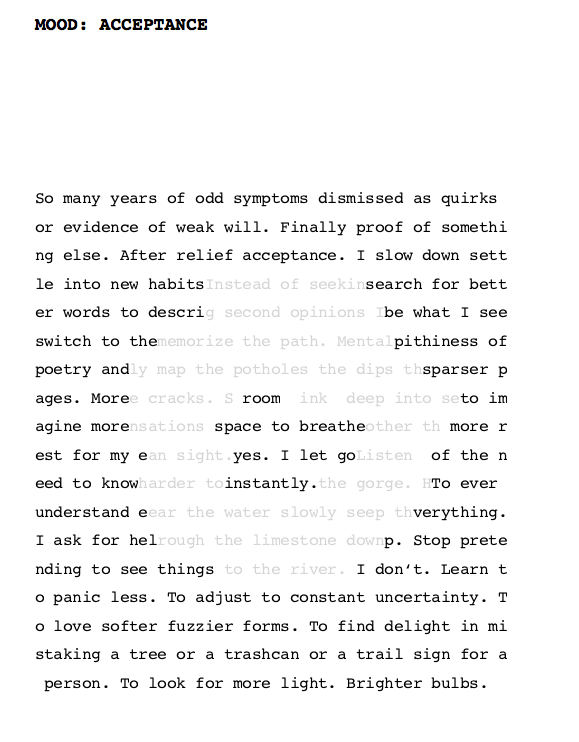
Started work on a new mood ring poem. This one is about the mood of acceptance. Here’s what I have so far:

Instead of getting angry or searching for experimental cures or finding second opinions I’m listening harder. Memorizing the path. Mentally mapping the potholes the dips the cracks where it twists to the right too close to the road where it narrows on the left. I’m searching for better words to describe what is happening. I’m switching to the pithiness of poetry with sparser pages. More room to ruminate. Less effort on the eyes. Slowing down.  Breathing and accepting not knowing instantly. Letting go of what I won’t ever see on my favorite tv show. Avoiding commericals and memes. I’m finding more light brighter lightbulbs. Asking for help. Not pretending to see things that I don’t. Relying on imagination. Learning to love softer, fuzzier forms. Learning to accept constant uncertanty. Learning how to be when I cannot see. 

I’m thinking that the seemingly positive aspects of acceptance will be in the main poem and then in the scotoma/blind spot part of the poem, I’ll focus on my doubts about accepting as giving up or giving in.

oct 15/RUN

5 miles
franklin loop
50 degrees

Felt colder than 50 degrees with the wind and the occasional brief downpour. A beautiful fall morning. Because of the wind and rain, there weren’t too many people out on the trail. Running above the river was wonderful–so much more of a view as the leaves leave. I love late fall. More of a view, winter and winter running are coming, less people will be on the trail which means less fear and distraction over keeping a safe distance.

Things I Remember

  • The sun just barely glowing through the clouds behind me, enough to enable my shadow to make a faint appearance in front of me. Hello friend!
  • So much wind on the Lake Street bridge that I was blown across the sidewalk and had to hold onto my hat for several minutes
  • The river! Every year I forgot how wonderful the view is, having not seen it since May. Open, airy, a chance to breathe, to stare at the water as it winds down the gorge!
  • Glancing down at the floodplain forest from the tunnel of trees and admiring the soft glow of yellow leaves
  • Noticing the dog park at Meeker Island is open
  • The curve of the black wrought iron fence at an overlook on the Winchell Trail not too far from Franklin
  • Being able to see the entire trestle, stretching to the other side, wondering when/if a train would cross it
  • Running at least 10-12 feet from some walkers and smelling the perfume of one of them, being reminded of how far someone’s presence/scent/air can travel, wondering if I should be wearing a mask when I run

Today’s October Surprise

Last night, walking through the neighborhood, Scott and I heard a dog barking–I think it was a french bulldog or a boxer?–whose bark sounded like they were yelling out the word bark. “Bark! Bark! Bark!” It made me giggle. Some day I would like to have a dog that I named Bob Barker.

Working on my fourth mood ring poem today. As I ran, I reflected on a line about what, in a face, indicates life–a glimmer in the eye? the raising of an eyebrow? a slight head nod? the curve of a mouth?

Speaking of head nods, I have been intending to post this poem for several months. It seems fitting today as I think about how people connect through gestures:

Ode to the Head Nod/ Elizabeth Acevedo

the slight angling up of the forehead
neck extension quick jut of chin

meeting the strangers’ eyes
a gilded curtsy to the sunfill in another

in yourself tithe of respect
in an early version the copy editor deleted

the word “head” from the title
the copy editor says it’s implied

the copy editor means well
the copy editor means

she is only fluent in one language of gestures
i do not explain i feel sad for her

limited understanding of greetings & maybe
this is why my acknowledgements are so long;

didn’t we learn this early?
to look at white spaces

thank god o thank god for

you

are here

oct 14/RUN

3.45 miles
extended hill, 3 times
54 degrees

Yesterday while walking Delia up above on Edmund, I noticed that all of the trucks at the construction site just above the tunnel of trees were gone. Oh no! They’re going to open up this stretch of the river road again–the last stretch still closed, the stretch where I had just started doing hill workouts. Bummer. Oh well, I’ll find somewhere else to run. As of this morning, it’s still closed but now, because the trucks are gone, I can run the entire stretch of it, from the top of the hill at 36th to another (slight) rise at 32nd. Nice. I almost had the road to myself; only a runner or two and the street sweeping truck. Very windy this morning. 28 mph gusts. Lots of leaves on the ground and in the air. The dominant leaf color: yellow. Such a gorgeous fall color season. I noticed the river glowing below me. As I ran on the river road–and when I walked on it yesterday afternoon–I couldn’t see the river or into the gorge because I was too far away from it, but I could tell it was there. I could feel the openness, the gap, the abundance of air.

Today’s October Surprise

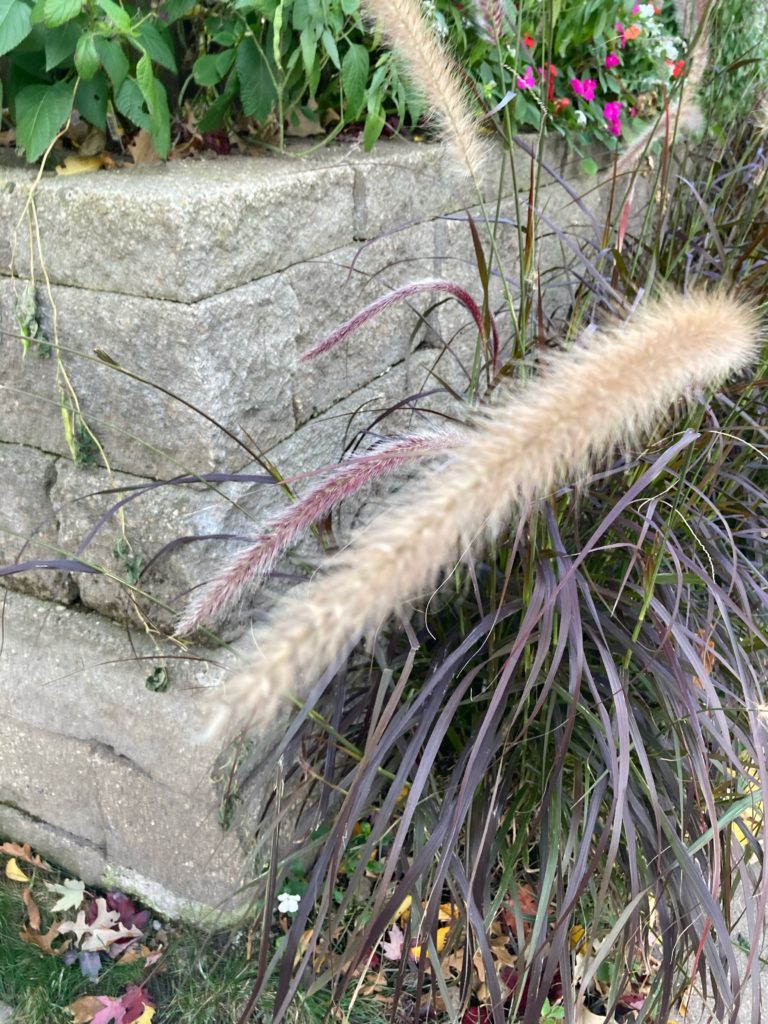
Wild grass of some sort, with a dark purple stalk and cream colored feathers–maybe Purple Fountain Grass?–in a neighbor’s yard. I love ornamental grasses, especially the ones with fluffy tops. Whenever I walk by them, I always want to run my fingers through the top. When is the best time to plant these grasses? I would love some for next year. I will try to remember to get a picture of this grass on our walk this afternoon.

Here’s the picture:

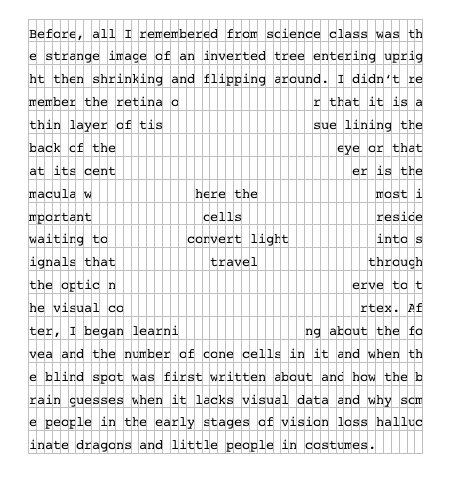
Still working on my mood ring poems. I have the first two done and I’m pleased with the results. Yesterday’s mood was curiosity. I started with a table in a pages document and laboriously filled in the letters for the main poem, making many mistakes and having to delete a lot of letters in individual boxes.

Main Poem

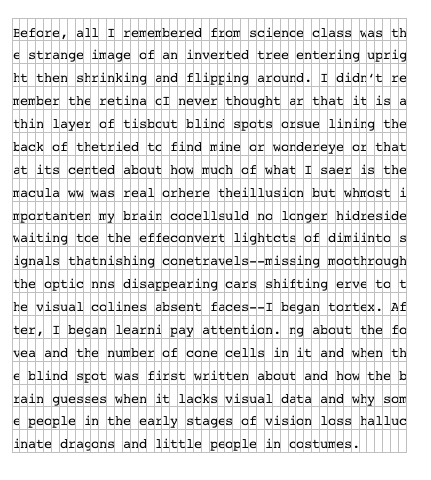
Then, I inserted the shorter, ring poem into the empty spaces. Lots of counting boxes and characters and rethinking words.

Inner, ring poem

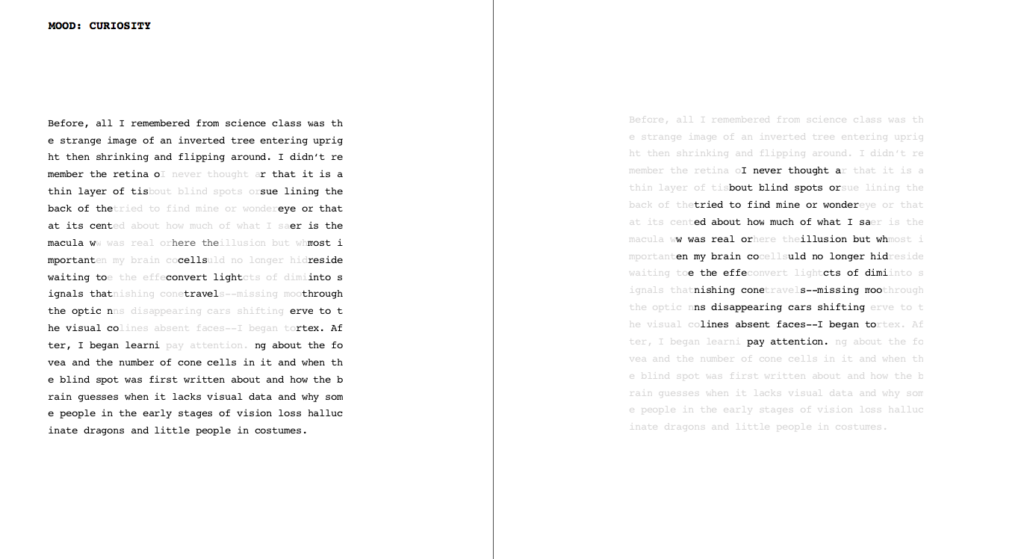
And here’s the completed poem, in 2 parts. The left highlights the main poem, the right the secondary, ring poem.

oct 11/RUN

2.5 miles
river road trail, south/edmund, north
49 degrees

Ran south on the river road trail to the 44th st parking lot, then down to the grassy overlook. Such a wonderful view of the river, shining in the morning sun! Windy today. How many leaves will be off of the trees by tomorrow? Tried to pay attention to my breath, to be grateful to be out on the trail this morning, and to think in triples (mostly dactyls):

  • full of grief
  • filled with joy
  • suffering
  • bountiful
  • troublesome
  • lacking life
  • falling leaves
  • swirling wind
  • river view
  • running path
  • moving feet
  • dripping nose
  • breathe in deep

Still working on my mood ring poems. I think I’ve finally figured out the form–so tedious! I had to create a table with separate boxes for each letter. I think it was worth the extra time and I’m pleased that I could do the entire thing on my own, without any help from Scott.

oct 4/RUN

5.25 miles
franklin hill
35 degrees

What a wonderful morning for a run! Sunny, no wind, cool. Saw my shadow a few times. Admired the river, the glowing thinning trees. Felt nice and strong and happy to be breathing deeply outside, especially since I am having another sinus/allergy thing–I haven’t had one since June. Such a drag being stuffed up and tired–and devoting considerable energy to convincing myself I’m fine and it’s not the virus and it will only last a few days or a week. So glad running (and the nasal washes I’ve started doing) help. Ran down the franklin hill and then by some geese, taking over the path closest to the water. The water was still and thick–that wasn’t little bits of ice I was seeing? Not cold enough yet, right? Ran up the hill until I reached the Franklin bridge. Walked for a minute or 2, then ran back on seabury.

some random things to remember from this weekend

This morning I watched the London Marathon and saw Sara (without an h!) Hall run an amazing race, sprinting the last 400, after running for 2 hours and 21 minutes, to catch the person ahead of her and take second place. So exciting and inspiring to watch someone run so well and try as hard as she absolutely could.

Yesterday we drove to Duluth to see Lake Superior. On the way up, we stopped at a rest area. This was my first time inside a building with other people since March 8. Wow. Everyone was wearing a mask. It wasn’t too bad. I was reminded of my bad vision as I struggled to figure out which bathroom was which and whether or not there was someone in a stall when I tried checking for feet. It takes a much longer time for my eyes to focus and see, so I can’t just quickly walk into a bathroom and know I’m in the right one. I hate being slow or having to slow down to figure something out.

On the ride home in the evening, we heard “Maniac” on the radio from Flashdance. Those lyrics! (mostly cheesy, but I liked a few lines.) Scott and I both struggled to understand the line, “on the wire between will and what will be.” We wondered, was he actually saying “will and what won’t be”? but then Scott realized the first will meant your own agency while the second one referred to fate–on the wire between what you can control and what has already been decided. Wow, deep.

Speaking of lyrics, the other day, during online school, FWA asked me to suggest two songs with similar themes that he could use for analyzing lyrics in his AP Comp and Lit class. After struggling for a minute, I suggested, Beck’s “Loser” and Courtney Barnett’s “Avant Gardner.” How did I come up with those? Not sure, but they worked well for him. Nice.

What a beautiful October poem:

October/ ROBERT FROST

O hushed October morning mild,
Thy leaves have ripened to the fall;
Tomorrow’s wind, if it be wild,
Should waste them all.
The crows above the forest call;
Tomorrow they may form and go.
O hushed October morning mild,
Begin the hours of this day slow.
Make the day seem to us less brief.
Hearts not averse to being beguiled,
Beguile us in the way you know.
Release one leaf at break of day;
At noon release another leaf;
One from our trees, one far away.
Retard the sun with gentle mist;
Enchant the land with amethyst.
Slow, slow!
For the grapes’ sake, if they were all,
Whose leaves already are burnt with frost,
Whose clustered fruit must else be lost—
For the grapes’ sake along the wall.

oct 1/RUN

3.35 miles
the hill, 4 times
48 degrees

Getting colder. Woke up this morning and turned on the heat, wore running tights under my shorts when I left the house. Did a slower first mile as a warm-up then decided to do the hill, the one where the road is closed and that is above the tunnel of trees, beside the Welcoming Oaks, four times. When I tried this last week, I attempted to sprint up the hill. This time, I just ran continuously, hoping to go a little faster with each hill. I didn’t closely check my watch, so I’m not sure if I did, but I enjoyed the run a lot more, and I didn’t have to stop. I think I’ll try this again next week, but do 5 loops instead of 4. During my warm-up mile, I listened to traffic rushing by a few blocks farther north on Lake Street. As I ran the hills, I listened to a playlist titled, “Sara 2020.” I saw the river, shining blueish-white, through the trees a few times. Beautiful. The second time I ran down the hill, I noticed a runner on the sidewalk over on Edmund. We seemed to be going the same pace. I tried to avoid looking at them instead of speeding up or slowing down. It worked. Saw a women ahead of me walking 2 dogs, talking on her phone or talking to her dogs? Not sure. A few people were wearing bright yellow shirts which glowed in the not quite overcast, not quite sunny light. Did I think about anything? I can’t remember.

MOOD: MISANTHROPIC

Continuing to work on my mood rings. Today I’m thinking about how irritating/frustrating some walkers or bikers or runners are on the trail–refusing to move over, getting in the way, speeding by too quickly. While this has always upset me, it is more dangerous now with my deteriorating vision. People’s carelessness can make it much scarier for me to run or bike. This behavior saddens me, then pisses me off, then causes me to see others as the enemy. I think I’m justified in my frustration, but I’m also bothered by own reactions. For this poem, I want to start by finding as many accounts of my irritation as I can in my running log entries. I’ll either use those as starting off point, to edit and shape, or I’ll combine them somehow into a poem–a cento? an erasure?

Here’s an account (from April 20, 2020) that doesn’t quite fit, because it’s not about me and my encounter with annoying bikers, but that I’d like to work in somehow:

read the FUCKING signs!

Yesterday, Scott, Delia the dog, our daughter, and I took a 4 mile walk around the neighborhood. Walking in the grass between the boulevard and the parkway, we witnessed a runner running in the road (on the part designated for pedestrians), getting increasingly upset as bikers (who are not supposed to bike on this part of the road) whizzed by her. When the first one passed her, she yelled “this is not the bike lane!” and then muttered to herself in anger. When the next one passed, she shrieked frantically “read the FUCKING signs!” (the city has signs posted all over the road/path identifying who should be in what lane). I could understand her anger–in other situations, I’ve been her, maybe not screaming “fuck!” but feeling that upset–but I could also see how difficult it was for the bikers, trying to find room to move when it was so crowded and when walkers were also ignoring the signs and taking over the bike paths. I’m not sure how to make this situation with crowded paths any easier, so I try to avoid it by running early, before it gets crowded.

In honor of the first day of October, I want to post part of one of my favorite October poems by May Swenson:

from October/ May Swenson

Now and then, a red leaf riding
the slow flow of gray water.
From the bridge, see far into
the woods, now that limbs are bare,
ground thick-littered. See,
along the scarcely gliding stream,
the blanched, diminished, ragged
swamp and woods the sun still
spills into. Stand still, stare
hard into bramble and tangle,
past leaning broken trunks,
sprawled roots exposed. Will
something move?—some vision
come to outline? Yes, there—
deep in—a dark bird hangs
in the thicket, stretches a wing.
Reversing his perch, he says one
“Chuck.” His shoulder-patch
that should be red looks gray.
This old redwing has decided to
stay, this year, not join the
strenuous migration. Better here,
in the familiar, to fade.
sept 30/RUN

2.5 miles
two trails
59 degrees

For some dumb reason, I thought that running a bit later (almost noon) when it was very windy (20+ mph) would result in less crowded paths. I even thought the lower trail would be empty. I was very wrong. I probably encountered the most people I ever have today. I got much closer than 6 feet several times and had to call out “excuse me.” Oh well. If I ever consider running on the Winchell trail again, I will have to make sure and wear a mask the entire time. The river road trail was crowded too. I did a lot of weaving. I’m pretty sure I had a few ridiculous performances, weaving out into the road to avoid people, then quickly stopping to tie my shoe, then starting up again, trying to avoid having to pass the walker I had just passed again.

It was beautiful down there on the Winchell Trail, below the road, with so many leaves swirling around and glowing and painting the trees in reds, yellows, oranges. And, o the river! Such a bright blue in the sun. And no thick leaves to block my view!

a moment to remember

Turning down at the 44th street parking lot to run on the Winchell Trail, two bikers were walking their bikes up the hill, framed by a few bright yellow trees and the wide, blue river. Suddenly a gust of wind caught them by surprise and one of the women yelled out, “Whoop!” –or “whoa” or something like that. I think I like “whoop” the best. One day, maybe I’ll manage to fit this moment into a poem.

Speaking of poems, I finished my fourth mood ring poem: Loneliness. It’s the first of my poems about my darker moods. These are harder for me to write because my inclination is not to dwell in the bad feelings. I am wondering if it is too dramatic in its darkness? The poem is inspired by Ada Limón’s “Instructions on Not Giving Up” and uses her first two sentences as a guide. (“More than the fuchsia funnels breaking out of the crabapple tree, more than the neighbor’s almost obscene display of cherry blossoms shoving their cotton-candy colored limbs to the slate sky of Spring rains, it is the greening of the trees that really gets to me. When the shock of white and taffy, the world’s baubles and trinkets, leaves the pavement strewn with the confetti of aftermath, the leaves come.”

MOOD: LONELINESS

More than the distorted letters that shift on the page, more than the bikes that appear without warning, it is the faded faces that really get to me. When the light is too bright, or not quite the right kind of light, or not bright enough, the features leave. Sometimes the outline of a nose, a mouth, ears, freckles remain, but the eyes, almost always, are dead. Lifeless. Lacking a spark. The pupils looking like black ballbearings. Othertimes, all that’s there is a dark blob, perched on the shoulders of my son, my daughter, my husband, a friend I have known for years. Aiming my eyes at a shoulder, I might catch a quick flash of an iris through my periphery. Mostly I rely on memory and recall the face I used to see. Imagine the flare of a nostril, the raising of an eyebrow. Wish for the reassurance that I am not alone, that someone else is here. Alien and alienating, an uncanny valley begins to form between me and and the rest of the world.

I’m still trying to figure out how to incorporate the rings–my ring scotoma–into or onto the poem. In theory, I’d love to do some poems within poems, but I’m not sure if it works. I’ll keep playing around with it. Now it’s time to work on some other dark moods: frustration, fatigue, feeling useless and old. I can’t remember if I wrote about this the other day, but I am struck by a mood I don’t have: anger (or rage). I am not angry about my failing vision. Is this because I had been living with it for so long, not knowing what it was, or even that anything was actually wrong with me–I blamed a weak will for any problems I seemed to have–and I was overwhelmingly relieved to finally know what it was?

Almost forgot to mention, but how could I?

Judith C. Puotinen: March 5th, 1942- September 30th, 2009

11 years ago today my mom died.

sept 27/RUN

5.25 miles
franklin loop
55 degrees

Decided to run the Franklin loop today. I’ve avoided it until now because I’ve been doing shorter runs more frequently and because of the pandemic and trying to avoid other people. The first half of it was fine, but by mile 3 I was doing a lot of weaving around to try and keep my 6ft of distance. There were only a few times when I got closer than that. What a beautiful morning for a run! Overcast and coolish, not too much wind. So many bright, intense colors.

Things I Remember

  • Honking geese! A ton of them under the lake street bridge. I couldn’t see them through all the green, but I could hear their honks
  • One goose honk sounded so forlorn or was it angry? Now I can’t remember the call but it was strange enough that I spent a few minutes wondering if it was a goose or some other bird. Decided it was a goose
  • A lone rower on the river with the water as smooth as glass
  • One of the dirt trails that leads down into the gorge, framed by yellow leaves looking mysterious and inviting and dangerous

At the start of my run, thought about more of my moods as I lose my central vision, particularly how I need to spend some time on my darker feelings. I remember having some thoughts about it, but now, writing this log entry, all I can remember is this: some of what makes me feel awe and wonderment–that the brain can mostly hide the worst effects of my failing vision–is what causes doubt and uncertainty–if i can still read some things and see color and notice birds in the sky, is my vision really that bad? Am I exaggerating it? I know I’ve written about this here a few times already.

Here’s a draft of my awe poem”

MOOD: AWE

[epitaph] Legend has it that before an execution, King Charles II of England closed one eye and aimed his blind spot on the head of the condemned man. This allowed Charles’ brain to decapitate the prisoner before the axe took its turn.

Behold, the awesome power of sight! Not found in one destructive glance but in an accumulation of looks. Against the odds and in spite of damaged cones, misfiring signals, and incomplete data, these looks produce something resembling vision — an image, a feeling, a fuzzy form.  So much could go wrong, and often does. Yet, light, cells, the optic nerve, the visual cortex find a way. Through guesswork and improvisation, imagination and processes scientists still don’t understand, they ensure I see more than seems possible. O faithful cones! Dilligently delivering data despite dwindling numbers. Allowing me to see some color — greens and golds and pinks and blues. Enabling me to read slightly distorted letters. O clever, industrious brain! Tirelessly trying to make sense of scrambled signals. Conjuring images, filling in broken lines, concealing gaping holes and black rings. Making it possible for me to still exclaim, “oh my god look at that wedge of geese, high in the clean blue air!”

Listening to the Current as I write this and the new Janelle Monáe song came on, Turntables. I especially liked these lyrics:

There’s a boomerang boomin’ back, yeah
You laid the egg, now it’s ’bout to hatch, yeah
You gaslightin’, ’bout to meet your match, uh
You fuck up the kitchen, then you should do the dishes

One of my introductions to poetry was through song lyrics. I used to love listening to a song for the first time and reading the lyrics on the record sleeve, watching how the lyrics and rhythms worked together, often in surprising ways. Some day, I want to write song lyrics and collaborate with Scott on a song. So far, I haven’t been inspired.

sept 25/RUN

3 miles
turkey hollow
66 degrees

Before starting my run, I listened to a recording of my latest mood poem: awe. I was hoping to think about it as I ran but I quickly became distracted by the leaves and the effort and irritating bikers on the trail. I decided to run south on the trail. It wasn’t too crowded, but I did encounter several bikers, always biking too close to the dividing line between pedestrians and bikers. 2 bikers biking side by side were especially bad–one of them was way over the line, forcing me onto the makeshift dirt trail on the other side. I yelled, of course, Part of my anger over this is me being a crank, but a lot of it has to do with safety–with my vision, my reflexes are much slower and I wouldn’t be able to move out of the way fast enough if they were about to hit me–and how I see–my depth perception is off and it’s difficult to judge how close people are to me; I can’t alway see their edges and often it looks like they are deliberately trying to run into me.

Despite this annoyance, I enjoyed my run. I saw the river and many red, orange, and yellow trees. Heard some black-capped chickadees. Anything else? No turkeys in turkey hollow. Instead, I saw a kid running around in circles, enjoying the freedom and the breeze and maybe also making the leaves crunch as he ran. I did that last night while Scott, Delia, and I were on our walk. I love that sound!

This weather is a little too warm for running, but great for sitting in the backyard in my red chair under the crab apple tree. I think I’ll do that after I finish writing this entry.

Working on my third mood ring poem: awe

MOOD // AWE

Behold, the awesome power of sight! Not found in a single controlling, destructive glance but in the accumulation of looks made every moment that, against the odds and in spite of damaged cones, misfiring signals, and incomplete data produce something resembling sight—an image, a feeling, a fuzzy form.  So much could go wrong, and often does, yet the light and the cells and the optic nerve and the visual cortex find a way through guesswork and improvisation and imagination and processes that scientists still don’t understand to ensure that almost all of us see more than seems possible. O clever, industious brain! 

That’s all I have so far. I envision adding a few more sentences.

sept 24/RUN

1.2 miles
river road, north/south
62 degrees

3.1 miles
over lake street bridge and back
64 degrees

I was just about to leave for a run when my son asked if I could run with him for his online gym class. Of course! I wish he could learn to love running; I would worry much less about all the time he spends in front of his computer. We did a combination of running and walking. A beautiful fall morning. As we were walking I said to FWA, “It’s really fall now!” On cue, a swirl of leaves fell between us. (I looked up “collective noun for leaves” and got: pile and Autumn–really? An Autumn of leaves? Ugh. Decided on my own: swirl.)

After walking back home with him, I headed out again for my own run. Decided to run across the lake street bridge to check out the trees on the banks of the Mississippi. Big, bright slashes of red, orange, yellow! Not quite peak, but getting there. When I reached the east side of the river, I ran up the hill just past the steps and stopped at my favorite spot where the path is right on the edge of the bluff, above the tree-line, and you can see the blue water and the glowing trees on the other side. I stopped for a few minutes and admired an orange tree on the west side.

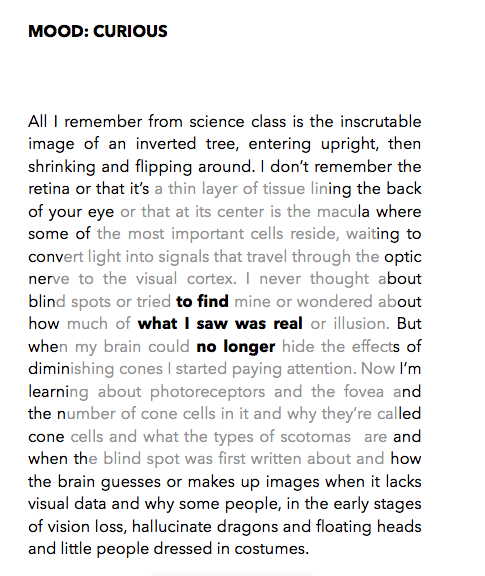
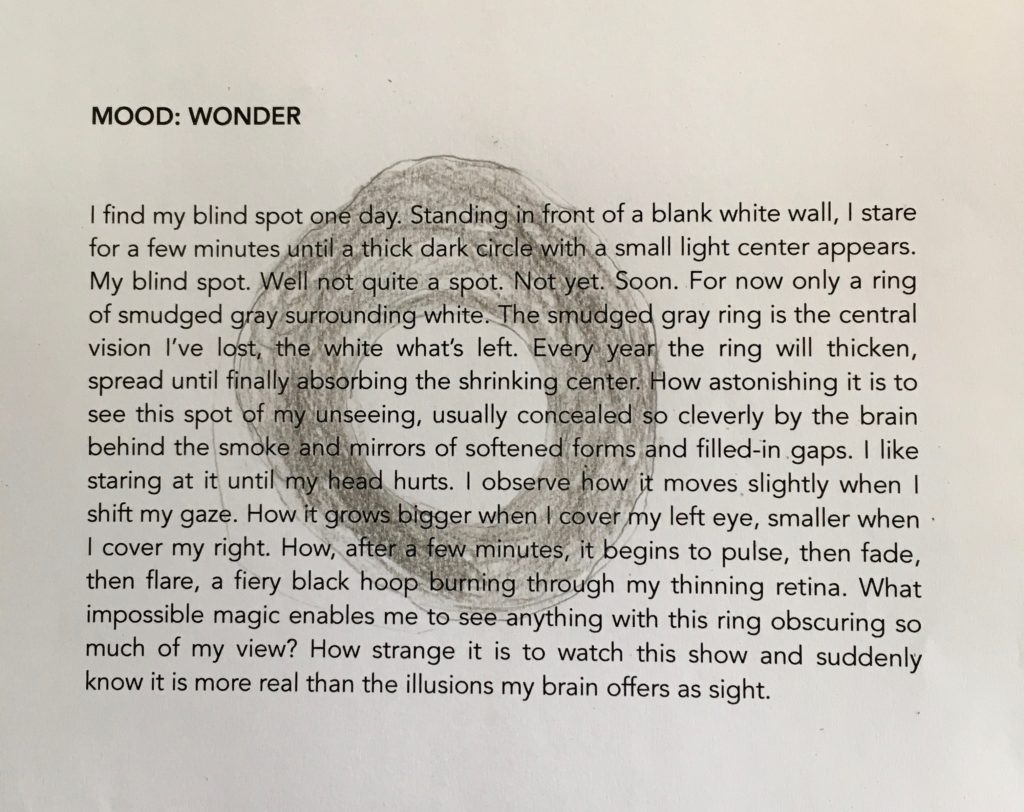
Yesterday I worked some more on my second mood ring poem. Happy to have figured out the story that I’m trying to tell: it wasn’t until my vision failed that I became very curious about how vision works and once I did, I learned all sorts of fascinating, delightful things. Here’s the text of the poem without the formatting:

MOOD // CURIOUS

All I remember from science class is the inscrutable image of an inverted tree, entering upright, then shrinking and flipping around. I don’t remember the retina or that it’s a thin layer of tissue lining the back of your eye or that at its center is the macula where some of the most important cells reside, waiting to convert light into signals that travel through the optic nerve to the visual cortex. I never thought about blind spots or tried to find mine or wondered about how much of what I saw was real or illusion. But when my brain could no longer hide the effects of diminishing cones I started paying attention. Now I’m learning about photoreceptors and the fovea and the number of cone cells in it and why they’re called cone cells and what the types of scotomas are and when the blind spot was first written about and how the brain guesses or makes up images when it lacks visual data and why some people, in the early stages of vision loss, hallucinate dragons and floating heads and little people dressed in costumes.

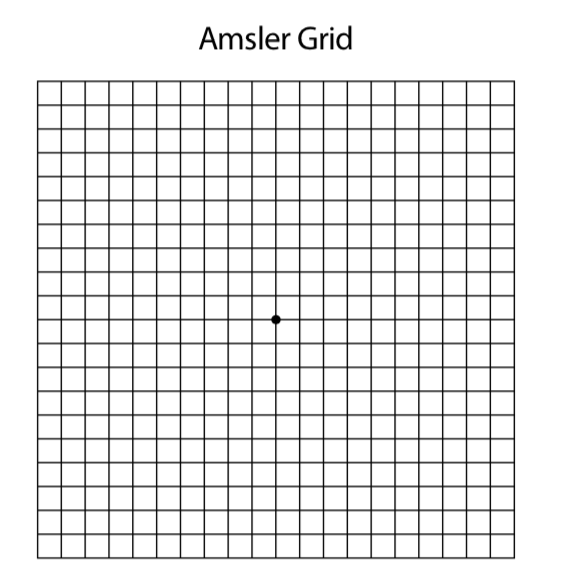
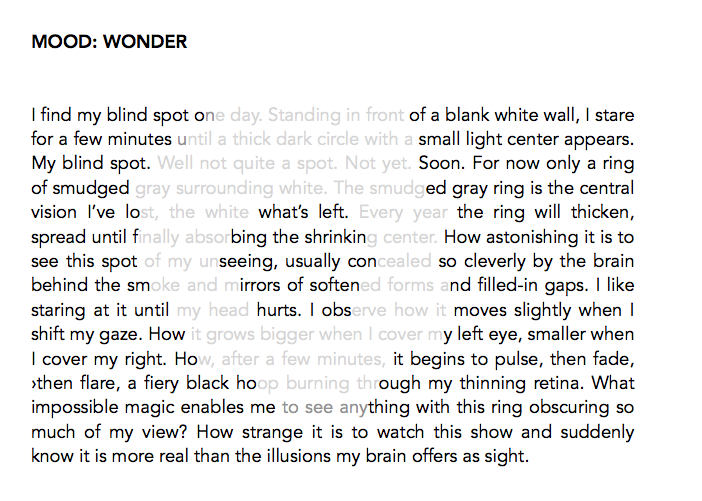
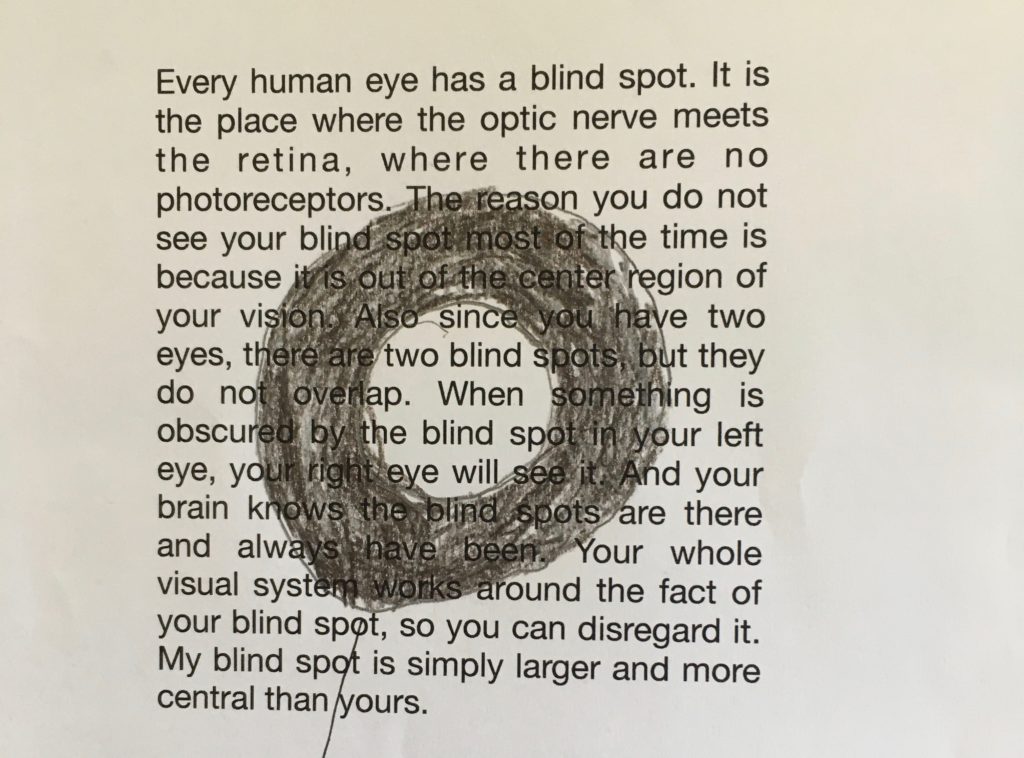
I have decided that each of these mood ring poems will be a block of text very similar in size and dimensions to the Amsler Grid, which is a grid you can use to check for macular degeneration. Each of the poems will have my blind ring on it in some way–lightly superimposed or darker, blocking the text, or maybe even creating an erasure poem. I’m still trying to figure it out. Here’s one possible version:

Originally, I made the “ring” text even lighter but I’ve been thinking I might want to make the ring become more difficult to see around as the poems continue–so the text would get lighter and lighter?

Here’s an amsler grid:

sept 22/RUN

3.25 miles
hill “sprints”*
67 degrees

* Warmed up by running north on 43rd ave, east on 32nd, south on Edmund. Jogged down the hill beside the Welcoming Oaks, then much faster, sometimes sprinting, up the hill 4 times.

Decided to try hill sprints for the first time today. I’ll call it a success because I set out to do 4, and I did 4. But it was difficult and I only ran hard all the way to the turn around on 2 out of the 4. I’m sure I’ll get better if I keep doing these. Listened to a playlist as I ran. Didn’t think about anything but getting to the top of the hill and then trying to slow my heart rate as I ran back down.

I ran through the neighborhood as a warm-up. So many beautiful leaves! Several bright red trees. One or two orange ones. A cluster of yellow. I could smell the dry mustiness of decay. Saw lots of acorns on the ground. Too many squirrels looked like they might dart out in front of me.

mood: curiosity

(I wrote this bit when I woke up this morning. It’s a very rough draft, but gives me some things to work with,\.) Before I was diagnosed with cone dystrophy, I never thought much about my vision. I never imagined that I would lose it. Even though I had been having problems for years seeing things—seeing the cursor on a computer or a ball being thrown at me or a bird in the sky—I never connected those problems with bad vision. I thought it was something else, maybe a weird quirk in my brain? Is this the wonder of the brain, its ability to work with limited resources, concealing how damaged our vision is?

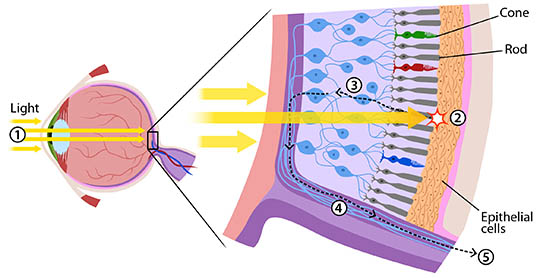
I was never curious about my vision or how it worked. The only thing I remember from learning about how we see was the image of the inverted tree, entering the eye upright, then shrinking and flipping around at the back of the eye. I knew the terms retina (I think), pupil, iris, but I didn’t know the retina was a thin layer of cells lining the back of your eye or that at its center was the macula and in a pit at its center was the fovea where some of the most important photoreceptor cells reside, waiting to convert light into nerve signals that travel through the optic nerve to the visual cortex. I don’t ever remember hearing about rods or cones until my eye doctor explained that my cones were scrambling. I didn’t think about blind spots or try to find mine or wonder too often about how much of what I saw was real or illusion. If I ever thought about the limits of my perception, it was in the abstract, after studying the empiricists in my Modern Philosophy course in college. And a blind spot was something you had in relation to your biased and limited world view.  

I suppose I should have been curious about these things, I should have wanted a basic understanding of vision, but it wasn’t until my brain was unable to hide the effects of my diminishing cones and I learned I was losing my central vision that I payed attention. Part of this is because I take my body for granted when it’s working. Why question or scrutinize it when its doing its job? Part of this is because I don’t want to know how it works because once I know, I might think too much about how easily it might not work. And part of this is because I struggle to remember or understand anything with scientific jargon. 

But now, I’m curious. And I’m finding joy in learning about ganglion cells and the optic chiasm and the fovea and how many cone cells are in it and why they’re called cone cells and how the brain handles a lack of visual data (recalling past images, making stuff up) and how optical illusions work and the different types of scotomas and how to use eccentric vision (EV) to compensate for a loss of central vision and when the blind spot was first written about (1668) and two different Charles’s: King Charles II who loved to execute people with his blind spot and Charles Bonnet who first described the trippy visual hallucinations some people experience as they’re losing their vision.

sept 21/RUN

3 miles
the loop that kept getting larger
67 degrees

Warmer this morning. 80s later this afternoon. Windy. Heard several crows–an especially loud one right after I started running, another when I reached Edmund, near the spot they’ve identified as containing poison ivy and that they’ve marked with big warning signs. Didn’t glance at the river even though I ran on the river road as part of each loop but I did see Dave the Daily Walker! We greeted each other and remarked on how long it had been since we’ve seen each other. Was raced by a young kid as I ran up a hill beside his house. So much energy and exuberance. Encountered some workers filling a pothole in the road–they were wearing masks. Ran past some beautifully yellow trees on 47th ave. Can’t remember if I saw any red ones.

moment of the morning

Before my run, I walked Delia the dog. Right by one of my favorite houses–the one with the cat that has deemed themselves queen of the block (note added 21 sept 2024: the cat is male, so king — why do I think his name is Matt?), sometimes escorting you down the sidewalk, and with the bright orange and pink and yellow zinnias, and with the big water bucket for dogs with a Bob Dylan quote on it, and with the “Any Functioning Adult, 2020” yard sign–I heard the gentle singing of the wind chimes and the wind through a pine tree and crows softly (yes, it sounded soft, not harsh) cawing, and a trickling fountain all at once. What a wonderful symphony of sounds!

wonder mood: curiosity

Also before my run, I read through some of my notes and did some free-writing about wonder and my vision. I have three types of wonder:

  1. delight (finding my blind spot)
  2. curiosity (questions, facts, information, anecdotes about scotomas and seeing/not seeing)
  3. awe (the magic/power of my sight, and sight/brain in general)

As I ran, I thought about curiosity. At first, I had the idea (after running down the hill on 33rd and turning left on the river road) of doing a series of questions that I wonder about–a mix of questions about the physical process of seeing and other questions, like the classic childhood hypothetical–“Would you rather lose your hearing or your vision?”. Then later (I can’t remember where I was running when this happened), I thought about a block of texts combining some of the most interesting/strange/unsettling/important facts about blind spots into a cento.

Here’s a strange anecdote I discovered: King Charles II of England liked to aim his blind spot at a prisoner’s head before they were decapitated. Googling this, all mentions of this story lead to the neuroscientist Vilayanur Ramachandran and his mention of it in his popular articles about blind spots. Is this story true? After some more digging, I discovered this line from an abstract on an article about Faraday and his eyesight:

in the second volume of the Philosophical Transactions it is recorded that Mariotte demonstrated the blind spot ‘to the Royal Society before King Charles II in 1668.

Then I found Mariotte’s article from 1668 here. Pretty cool. In my brief search, I couldn’t find much else–no instances of King Charles II actually doing this, but I did learn that he helped create the Royal Society from which this paper comes and also a bit more about him and his reign (which I’m sure I learned back in 11th grade when I took AP European History). He was called The Merry Monarch, partly for the hedonism of his court–apparently, he was obsessed with sex–and partly because of how relieved/happy people were to be done with Oliver Cromwell and the Puritans. I also learned that in the 1660s, there was a lot of anti-Catholic hysteria with many Catholics being executed. Are these the prisoners that Charles II decapitated in his mind?

sept 18/RUN

3.15 miles
neighborhood/lake street bridge/river road trail
46 degrees

Wonderful fall weather! Sun, crisp air, changing leaves, uncrowded sidewalks/roads/paths! I ran over the lake street bridge again. A bit windy; I could feel one chunk of my hair coming out of my pony tail and flopping around just above my visor. How funny did it look to the drivers passing me? The river was a beautiful blue. No rowers on the water. No canoes or motor boats either. I don’t remember seeing any leaves changing on the tree-line along the river’s edge. Still all green. Soon, red, orange, yellow. Then my view comes back. Coming off the lake street bridge and heading south on the trail, I overheard some bikers talking about today’s stage of the Tour de France. Nice! Heard some geese honking overhead–high in the clean blue air.

https://twitter.com/danalevinpoet/status/1304885340654702593?s=20

I love this idea of yielding to a poem or an idea…or the gorge. I think of it in relation to being open and generous and willing to listen (and to hear and to notice).

mood: wonder

Another day of working on my writing project on vision loss and mood. This morning, while watching the Tour de France, I noticed a sign with an exclamation mark on it quickly flash across the screen and pointed it out to Scott who hadn’t noticed it. I wondered, how is it that I could see this sign (and while Scott couldn’t) but miss so much else when I’m watching tv? How does my vision work and not work?

I bring this up in the current draft of my wonder poem in 2 ways.

To witness the spot of my unseeing usually concealed behind the smoke and mirrors of softened forms and filled-in gaps is astonishing. What impossible magic enables me to see anything with this ring obscuring my view? I like staring at it until my eyes ache, my head hurts. Observing how it moves slightly when I shift my gaze. How it grows bigger when I cover my left eye, smaller when I cover my right. How it begins to pulse, then fade, then flare, a fiery black hoop burning through my thinning retina. What a strange feeling to watch this show and suddenly know it is more real than the illusions my brain offers as sight.

1. impossible magic

How can I still see as well as I can with so many of my cone cells gone? How does my brain make sense of the limited information it’s receiving from the few remaining cells? Most of the time when I am curious about this, it is with awe and astonishment. What an amazing organ the brain is! It’s fascinating to learn about how the brain/mind compensates for lack of information, how it guesses, how it fills in the gaps.

Last week, I learned about Charles Bonnet Syndrome which is a phenomenon that can happen to around 15% of people with macular degeneration. It’s named after the man who first described it, having noticed it in his aging grandfather. When the brain doesn’t receive visual data from the eyes it provides its own images, either making them up or recalling stored ones. This causes visual hallucinations. People with CBS usually experience these hallucinations when they wake up and they don’t last long. The favorite hallucinations I read about in this article were

  • people dressed in costume from an earlier time
  • imaginary creatures, like dragons

What? Somewhere else I read about how the hallucinations are smaller, so you see tiny people dressed up in costumes. Nice! Thankfully, when you experience this, you know it’s a hallucination. I don’t have this syndrome. Instead, my brain likes to fill in the gap with a background that matches the area surrounding the missing image. So, while someone with CBS has hallucinations and sees something that isn’t there, I have a different problem: what is there is hidden behind a background (like a blank, blue sky or more green trees or endless waving water–all 3 of these have happened to me) with no indication of its presence or my inability to see it. Is there an antonym for hallucination? It is not that I see things that aren’t there; it is that I don’t see things that are there and I have no idea that I’m not seeing them–until suddenly, without warning, I do, like a bike that wasn’t there appearing beside me in my peripheral vision. I think this happened to me a lot more right after my vision declined in 2016. Has my brain figured out how to compensate for it?

2. optical illusions

Much of the time, even for me with my increasingly bad vision, the brain’s tricks for filling in gaps and working with incomplete visual data are hidden. I might see things a little fuzzier but I still see them. Unless I concentrate, I can’t see the ring scotoma in my central vision. There is no dark black ring on the page when I’m reading. But it’s there and when I found it by staring intently at a blank wall, I was astonished and fascinated. I was also relieved. Here, with this ring, was evidence that my vision is declining, that I’m not making this bad vision thing up. Because my brain is so good at compensating and performing magic tricks, it can be easy for me to think my eyes are better than they are, that I’m seeing more than I am.

sept 17/RUN

4 miles
river road trail, south/wabun park/through turkey hollow/edmund, north
52 degrees

Cooler this morning and not too crowded! I ran on the river road trail all the way to the edge of Minneahaha Falls, then up to Wabun park and down the steep hill right up above the river and the Locks and Dam #1. Ran through the uneven grass across turkey hollow and then up edmund. Lots of hills today. I got closer than 6 feet to 1 or 2 walkers, but only for a second. When was the last time I ran 4 miles? I checked my running data: I ran 5 miles on July 31st. I’ve been running a lot during this pandemic–almost every day–but only 2-3 miles at a time.

Fall is here. Lots of color. One of my favorite trees–the one right before the double bridge on 44th–is a lime-ish yellow. I just checked my log; last year it was orange and turned much later, in October (oct 10, 2019). The leaves are early this year, like the acorns which were dropping last month. A week ago I read about La Nina on the Updraft blog for MPR. Paul Huttner suggested that with a La Nina watch being issued, we might have a “rigorous winter ahead.” I’ll take the snow but not the arctic hellscape temperatures. A strange time. So much to fear about the future–a second wave of the pandemic, former presidents starting civil wars because they don’t want to leave office and go to jail, bitterly cold winters, kids finally losing it about having to stay home all the time and not see their friends. Maybe none of this will happen. This is what I choose to believe.

is my vision really that bad?

A few times during my run, I thought about my writing project and my different moods around my vision loss. Today’s idea: There are many things I can still do, I can still see. I can still read. I mostly see where I’m going when I run or walk. If I were to take a vision test with the Snellen Chart, I would probably still do reasonably well. But, even though I can read, I read much slower and mostly I don’t read by looking at the words on a page, but by listening to audio books. When I do look at words on the page, I get tired quickly. I sometimes skip lines or repeat lines. I can’t read book titles or big letters, especially when they’re spaced out.

How bad is my vision? Part of my struggle right now is that I see much worse than a “normally” sighted person but not as poorly as someone who is legally blind. I am not yet blind. Even as I want to express my feelings about this in-between stage, I sometimes feel like an imposter or someone who might be exaggerating their bad vision. Then I remember how I can’t see faces or follow anything that happens on commercials. How I can’t tell if a walker on the sidewalk is heading towards me or away. How I seem to be needing brighter and brighter light to see words or the lines on the page of a notebook.

I thought about all of this as I ran, but in brief flashes and fragments.

How we See: the Photoreceptor Cells (rods & cones)

I’m trying to understand more of the technical (medical/science jargon) stuff with my vision so I’ve been reading up on diagrams of the eye and rods and cones. Here’s a useful site and diagram:

The eye, close-up on macula

You need cone cells to see fine details, read, recognize faces, and see color. Many of my cones don’t work anymore. Currently, I still have some central vision left–the very center. The blind ring I’ve been writing about in my mood ring projects is officially called a ring scotoma. Here’s an image–which is pretty accurate to what I see when I see my blind ring:

ring scotoma

The above image is from a site about macular degeneration. For comparison, here is the ring that I saw when I stared at a white sheet of paper:

my blind ring

Pretty close. A few interesting things mentioned in the description. This ring will most likely close up and:

Smaller print size may help as the individual will be able to see more of a word within the functioning area. 

Yes! Large print is very difficult for me to read. I tried checking a large print book out of the library and it was impossible to read. I like small print much better, which seemed confusing to me, especially when all the advice (even from my eye doctor) was to magnify the print. Now, finally, it makes sense!

sept 13/RUN

2.5 miles
river road, south/42nd st, west/around Hiawatha Elementary/43rd ave, north
56 degrees

Another good morning for running. I don’t remember much. Too busy looking out for other people. Started on the trail but it was too crowded so I moved over to Edmund and then ran up 42nd. Didn’t see the river or hear any memorable birds. No dropping acorns or honking geese. No clickity-clacking roller skiers or bikes blasting Jimmy Buffet songs. Saw a runner I’ve seen at least once before on the trail who annoyingly takes over the entire path and doesn’t move over. He has a strange, bouncy stride. Heard some yipping, spazzy dogs at the Hiawatha playground. Smelled some cigarette smoke and wondered if it was coming from the walker ahead of me. Ran by the door that my kids used to come out when they were done with school. All the students would bunch around the teacher trying to point out their parents so they could leave. I remember waiting forever because my kids (like me) weren’t aggressive enough to get the teacher’s attention. I was very happy when they got older and I didn’t have to wait for them near that door anymore.

Blind (r) ing

I haven’t been memorizing poems for a few weeks now. I’ve moved into working on my mood ring project. Yesterday I did some more research and found out a few things I’d like to play around with:

A blind spot in the central vision is also called a scotoma. Here’s a longer definition from Enhanced Vision:

A central scotoma is a blind spot that occurs in the center of one’s vision.  It can appear in several different ways.  It may look like a black or gray spot for some and for others it may be a blurred smudge or a distorted view in one’s straight ahead vision.  Scotomas may start out as a small nuisance and then get larger or there may be several blind spots or scotomas that block one’s field of vision. 

Right now, I think my scotoma is somewhere between a blurred smudge and a distorted view. At the end of the brief article, they offer a few tips, including:

Find and use your preferred retinal locus.  A person looks slightly to the side so that the blind spot or scotoma is not in their central field of vision. One author describes it as “not looking at what you want to see.”

Not looking at what you want to see.

So much I want to do with this idea of not looking at what you want to see. Thinking about Dickinson and “tell all the truth but tell it slant” and the periphery and soft attention. I’m also thinking about how sometimes when I’m talking to Scott and I can’t see his face, I will look just a little to the side, over his shoulder. Then I can see his features. He says this looks strange. I bet.

Another useful term/idea is filling in: The manner in which the brain deals with inexplicable gaps in the retinal image. When an object enters your blind spot and disappears, instead of seeing a shadow or dark spot, the absence is filled in with the background color. So you can’t see that you’re not seeing. Because my blind spot is larger and in my central vision, I experience this a lot more than “normally” sighted people. Sometimes I wonder how often I’m not seeing without knowing.

At the end of an article about filling in and the various experiments you can do to see it, the authors conclude:

These experiments show how little information the brain actually takes in while you inspect the world and how much is supplied by your brain. The richness of our individual experience is largely illusory; we actually “see” very little and rely on educated guesswork to do the rest.

I love this idea of how limited everyone’s vision is and the incorrect assumptions many have when thinking about what it means to “see.” I’m not sure I would have spent much time thinking about any of this if I hadn’t lost my central vision. The last line about educated guesswork reminds me of Aldous Huxley’s book The Art of Seeing and his writing about Dr. W.H. Bates’ visual education method.

In the preface, Aldous writes:

Ever since ophthalmology became a science, its practitioners have been obsessively preoccupied with only one aspect of the total, complex process of seeing—the physiological. They have paid attention exclusively to eyes, not at all to the mind which makes use of the eyes to see with.

Bates’ method pays attention to the “mental side of seeing.”

And here’s another great definition of filling in from this helpful article:

What is filling-in? It is the phenomenon in which an empty region of visual space appears to be filled with the color, brightness or texture of its surround. The brain is capable of filling-in the blind spot, borders, surfaces and objects.

Okay, I’ll stop here for now.

sept 11/RUN

3.1 miles
neighborhood + river road + trails*
49 degrees

*43rd ave, north/31st st, east/44th ave, north/lake street/46th ave, south/32nd st, east/river road, south/river road trail, south/winchell trail, north/38th st, west/edmund, north/47th ave, north/35th st, west

Such great weather! Was able to wear shorts and a sweatshirt. Felt a little warm by the end, but mostly fine. Ran through the neighborhood, on lake street, by Minnehaha Academy and the aspen eyes, through the tunnel of trees, past the welcoming oaks. Smelled the stink above the ravine, glanced at the inviting, mysterious trail winding through the small wood near the oak savanna, admired the river, turned down near Folwell and ran back on the Winchell Trail. Encountered 3 runners and got closer than 6ft, but only for a second or two. Tried to start the run by thinking about my writing project, but quickly got distracted or lost in other thoughts or no thoughts. Noticed a few more trees starting to change color.

I am currently deep into my project about going blind, blind spots, mood rings. Thinking about faces and feeling isolated/disconnected today. I’m thinking I’d like to put two visual poems/diagrams about faces. One, a face blurred out. The other, a state fair mannequin with pupils as soulless black balls. I need to think about it some more. It’s hard to do any other poetry/writing when I am thinking so much about this project.

Here’s a wonderful quotation I found on twitter about what poetry does:

Also, discovered someone else’s Snellen Chart poem from 2006!

Sun Yu Pai, Optometrist

sept 7/RUN

3.15 miles
lake nokomis
55 degrees

Scott and I decided to drive over near Lake Nokomis and run (in opposite directions) around the lake. We parked on Nokomis Avenue and ran together on the creek trail, then under 28th ave on the part of the path they just built this year, over by Lake Hiawatha, up the hill to Lake Nokomis Community Center, and then down to Lake Nokomis where we split up. I turned left, he turned right. So wonderful to be running by water and around the lake. This is the first time I’ve run here since last November 14.

Ran by the little beach first. The buoys are still up. Will I try swimming once this season? I’m not sure. Had to run on the grass a lot to avoid people. Noticed how many changes they’ve made: plastic fences up to protect the shoreline, some trees missing. As I ran over the big bridge, I looked down at the water and the wide strip of shimmering light on the surface. Luckily Scott took a picture of it when he ran over the bridge.

https://www.instagram.com/p/CE1k5_ll11Z/?utm_source=ig_web_copy_link

Thought briefly about open swim as I ran by the big beach. I checked to see if anyone was swimming this morning. I don’t think so. Saw at least one kayak but no rowing shells or sailboats. I’m sure they’ll be there later today. I miss being by the water. I miss not being slightly terrified all of the time.

blind spots and mood rings

Still thinking about my latest writing project on blind spots and mood rings. I think I’ve finished the text for the mood 1: wonder. I haven’t quite figured out the visuals behind it. How to show the ring? How to show my vision loss? I’ve been researching concrete/visual poetry and found this cool eye poem by Lauren Holden:

further & further & further

I really like how this looks and its effect. And I like the repetition of the words/phrase. Maybe I want to do this too? As part of a ring chapbook? I’m thinking that each of my mood rings would involve 2 poems:

  1. A justified block of text with my blind ring superimposed on the text
  2. A visual poem similar to the one above made up of 2-4 words describing the mood repeated and making the shape/effect of my blind ring.

sept 4/RUN

2.25 miles
43rd ave, north/lake st, east/47th ave, south/32nd st, east/edmund, south/the hill
66 degrees

Feeling like fall these days. Ran north on 43rd to Lake Street then over to 47th through the parking lot at Minnehaha Academy. Completely packed with cars. In-person school. I can’t imagine being a teacher and having to teach in classroom during this pandemic. Ran down to Edmund. Too crowded, especially on the stretch between 34th and 36th. I had thought about doing the tunnel of trees; it was probably empty. Anything I noticed? Lake Street was empty, even the bridge. More acorns on the sidewalk. No squirrels. No more changing leaves…yet. Right as I started, I heard a chainsaw far off, felling a big tree–at least it sounded big. Lots of bikes heading down the hill near the tunnel of trees. One biker was going very fast, trying to pass the slower bikes in front of me before the path narrowed near the construction. I heard him call out, “On your left” and wondered if he would make it in time. At the very end of my run, right after I stopped, I saw a runner wearing the same race shirt I was (the 2020 1 mile). After he passed, I imagined what he might have done if I had called out, “nice shirt!”

I posted this poem last September (25 Sept 2019), but it’s worth posting again and spending some time with:

To the Light of September/ W. S. MERWIN

When you are already here 
you appear to be only 
a name that tells of you 
whether you are present or not 

and for now it seems as though 
you are still summer 
still the high familiar 
endless summer 
yet with a glint 
of bronze in the chill mornings 
and the late yellow petals 
of the mullein fluttering 
on the stalks that lean 
over their broken 
shadows across the cracked ground 

but they all know 
that you have come 
the seed heads of the sage 
the whispering birds 
with nowhere to hide you 
to keep you for later 

you 
who fly with them 

you who are neither 
before nor after 
you who arrive 
with blue plums 
that have fallen through the night 

perfect in the dew

I will memorize this poem, along with September First Again.

Continue to work on my mood ring poems. The first one is Wonder. Here’s a draft with a quick, crude sketching in of my blind spot/ring. I haven’t figured out how I want it to be yet: white space where the ring is? Dark space? A ring superimposed?

Version 1
Version 2

Do I want to try and rework it so that the center part is another poem? Is that too much? I like the challenge of it, but I don’t want it to be overly clever.

august 31/RUN

3.1 miles
river road trail, south/edmund, north/little loop on river road*/47th ave, south/34th ave, west/44th ave, south
60 degrees
humidity: 89%

*little loop on river road = river road at 33rd st up to 32nd st and back

It was raining until about 9 am. Cool and cloudy, then sunny. I had the river road trail to myself running south. Awesome. Glanced down at the river above the 38th st stairs. Too much green to see more than a sliver of blueish silver. Lots of dripping water, hardly any debris on the trail or road. A nice run.

8 Things I Noticed on my Run this Morning

  1. Water dripping off of a tree, shimmering in the sun
  2. The quiet roar of water gushing out of a sewer pipe
  3. Running through dark green on Edmund, above the river road, and then reaching the bright sunlight as I ran down the hill
  4. Several deep puddles on the road near the curb
  5. Running into the wind as I headed north
  6. The open trail, stretching in front of me
  7. The cooler air on my skin
  8. The gentle hum of the crickets in the quiet, empty neighborhood

It’s difficult to run more than a 5k these days. Will this change as the weather gets cooler or is it mostly because of my fear of encountering other people?

face blindness

Working on my latest project–blind spots, going blind, and mood rings. I know I thought about it while I was running–I think I was just above the oak savanna–but I can’t quite remember what I thought. Something about how not all of the mood ring poems have to be about finding my blind spot, others could be about my moods around their effects. Another mood: uncertain, unsettled, uncomfortable.

Since my big decline (and when I got my diagnosis) in 2016, I have been trying to adjust to all the changes. Sometimes successfully: Because reading is harder, I’ve shifted mostly to audio books; when I don’t know what’s happening on a television show, I ask Scott; I don’t pretend to see things that I can’t; I ask others to check if there’s mold on my food; because driving is terrifying, I’ve stopped doing it.

Sometimes unsuccessfully. One of the biggest struggles I’m having with my vision loss is how to interact with others. I can’t see faces clearly. Often I can see some features but I can’t see when someone is looking at me or talking to me and even if I can tell they’re talking to me, there’s a good chance I won’t recognize them. I haven’t figured out how to deal with how unsettling and upsetting this is yet, so I try to avoid it. It’s much easier during this pandemic. What a relief to not have to try and interact with others! How much easier it is to not have to wonder if someone was talking to me or what they said or who they are! I like talking with people and I sometimes miss interesting conversations with new people, but mostly I’m content not talking with others, being left alone.

This morning, I read someone’s account of their face blindness and I could really relate. Face blindness is not my primary diagnosis; it’s just a byproduct of my vision loss and the big blind spot (or, what I’m calling, blind ring) in the center of my vision. There’s a lot I could highlight from this article–dreading encountering other moms that I can’t recognize, not being able to identify my kids, not seeing my husband walk past me in a store, only being able to recognize people by their distinctive quirks. I think I’ll spend some more time rereading this article and others on face blindness that I’ve found in the past.

august 29/RUN

3.05 miles
43rd ave, north/lake st, east/46th ave, south/32nd st, east/edmund, south/river road, north/hill
61 degrees

What a beautiful morning! Sunny and cool. Quiet, calm. As I started the run, I could hear the gentle hum of traffic from a far off freeway. Thought about my latest writing project on blind spots; I’m working on a poem about my feelings of wonder over discovering a way to see my blind spot. As I ran, I asked myself, should I try to convey a tone of wonder by asking lots of questions? (Probably not.)

Things I Remember

  • the strong smell of cologne as I ran on Edmund
  • two women running below in the tunnel of trees talking loudly
  • a couple of crows calling out to each other
  • being blinded by the sun as I ran east
  • the tree that usually glows a glorious yellow in late september has already changed colors; today it looks a mix of dull orange/red/brown

on metaphor and mood

Right now I’m in the phase of my writing project where I have ideas that I’m really excited about but that don’t quite work yet. I’m immersed in the project, thinking about it most of the time, but I can’t figure out my way forward. So far, I have decided I’d like to do a series of poems about my mood related to my growing blind spot that somehow incorporate my actual blind spot (the one that I was able to trace by staring at a blank sheet of paper, taped to a wall at eye level, and tracing the dark ring that I saw). Because my spot is not yet a spot but a thickening ring, I’m calling this series, Mood Rings. Now I’m wondering how to write about my moods–a literal description? metaphor? something else? A few days I encountered a writing prompt for mood ring poems:

(from Laura Deutsch Writing the Senses via Market Street Writers)

Pick an emotion—joy, anger, frustration, sadness, etc.—and complete your own poem.

When I feel [name emotion] __________________

It is the color _____________________ – like _____________________

I hear ___________________ – like _____________________________

I taste _______________ – like _________________________________

I smell _____________ – like __________________________________

I see ____________________ – like _____________________________

I feel ___________________ – like ______________________________

I want to ___________________ and ___________________________

But ___________________________.

I’m not sure I like this prompt or want to try it–maybe I will?–but it got me thinking about metaphor and how I might try to express my mood of wonder. Will metaphor enable me to get closer to expressing what I actually feel or further away from the IS/THIS of it? In a blog post for poetry foundation, Sabrina Orah Mark argues that metaphor, which means transport in Greek, reduces distance, bringing us closer to the feeling of what is being expressed. But, this transport only happens when the metaphor is encased within a world that supports it and its meaning. Metaphors fail when they don’t have a world, or that world no longer exists (does this fit with the failure of “doing something at a glacial pace” to work anymore now that glaciers are melting faster?). Does this fit with my own struggles to think about metaphor in my poem about wonder? I’m not sure, but I really liked this post and wanted to mention it here, especially this part:

But what if we can no longer tell if the world we are writing from is inside out or outside in? Up above or down below? The future or the past? What if the rules, like clouds, are becoming a rabbit, no an ambulance, no a dragon, no an unraveling spool of thread. What happens to our imagination when the unimaginable has imagined us up first? Is there an emergency hotline for metaphors?

Regardless of how much sense this discussion is making, it is helping me to come up with some more ideas. Now I’m thinking about ring as metaphor:

RING

  • ring of fire, burning a hole through my retina
  • tree rings, expanding, thickening like my blind spot as time passes and my vision deteriorates
  • boxing rings, brass rings, a ring of truth?

august 28/RUN

3 miles
turkey hollow loop
67 degrees
90% humidity

Keeping this log entry short because I sliced my left hand on glass yesterday afternoon–not enough to need stitches, but almost–and I am trying not to use my left hand so as not to split the just healing wound open again. A nice run. Cooler after the early morning rain. Ran above the river for 10 minutes. The trail wasn’t too crowded.

things I remember

  • A group of runners parallel to me on the grass between the river road and edmund, running almost the same speed, talking very loudly
  • Squirrels shaking acorns from a tree, their teeth clicking, the acorns plinking on the ground
  • Water rushing from the sewer pipe
  • No turkeys
  • Running by some huge logs–I ran by the crew cutting them down a few weeks ago–between Becketwood and 42nd st

Running on edmund, heading north, an idea came to me about my latest blind spot project. When I finished running, I spoke it into my phone:

Idea: Mood Rings

august 27/RUN

2.05 miles
river road trail, south/grass between river road and edmund, south/edmund, north
73 degrees
humidity: 89%
dew point: 70

Another hot day, another short run. I started on the river road trail but it was too crowded to stay. Crossed over to the dirt trail in the grass between the river road and edmund. Rutted and difficult to run on. Didn’t have a chance to see the river, too busy looking out for bikers and walkers.

At some point during the run I thought about the great book I’m reading (one of the few books I’m reading instead of listening to), Bonnie Tsui’s Why We Swim, and her chapter on flow.

Flow: the state in which people are so involved in an activity that nothing else seems to matter” (Mihaly Csikszentmihalyi).

I was thinking, as I ran by Dowling Elementary, how difficult it is to experience flow during runs this spring and summer. It’s partly because there’s too much to worry about–hurricanes, pandemics, the refusal by leaders to do the difficult work of addressing racial injustice and dismantling institutions that create/perpetuate injustice, upcoming elections and the campaign to destroy “liberal cities”–and partly because the trails and sidewalks are too crowded to get lost. I know it still happens to me–running or writing, I can lose track of time–but I wish it could happen more.

Anything else I remember? Tons of acorn shells everywhere. The squirrels are busy. Does that mean we will have a tough winter? Don’t remember hearing cicadas or any birds, not too many cars, no roller skiers or rowers. No leaf blowers or horns honking. I did see an adult biking with a little kid. I love watching little kids biking, especially when they’re very little and very good at biking–so graceful and powerful.

state fair mannequins

In a non-pandemic world, the state fair would have started today. I miss many things about going to the fair. The food, the beer, the mutant vegetables and political crop art (there would have been some really good ones this year), but what I’m missing most today are the state fair mannequins. Every year I love seeing them looking so creepy and strange and almost human. Last year I started work on a project about eye contact and faces and the uncanny valley and state fair mannequins. Some day I will finish it. Here’s one of my favorite mannequins:

august 26/RUN

2 miles
43rd ave, north/32nd st, east/edmund, north/the hill
79 degrees
dew point: 66

Very hot today. 77 degrees at 7 in the morning. I decided to do a shorter run. Not too bad. Listened to a running playlist so didn’t notice any other sounds. No chirping birds or backing up beeps or roaring lawn mowers or plink-plonking acorns or zapping cicadas. Ran in a lot of shade, which was nice. Felt strong running up the hill on Edmund. Checked out my form a few times by looking at a shadow running beside me, then ahead. Encountered many more walkers than runners.

Didn’t get close enough to see the river. Forgot to check out the aspen eyes. I did notice how the tree on the corner of Edmund and 32nd, the one that usually glows a glorious yellow in the fall, was almost all goldish-brown. Is it dying? I hope not.

Had another pandemic dream last night–my second, I think, which isn’t too bad considering how long we’ve been in this mess. Same scenario, different setting. In a crowded place (first time it was a Justin Bieber?! concert, this time in a restaurant). Suddenly, I realize I’m around too many people, none of us socially distancing or wearing masks. What am I doing here? Why am I being so reckless? I freak out, then wake up. It’s unusual for me to have such literal dreams–of course, a bunch of other weird shit happened in the midst of this that I can’t remember now too, but the basic anxiety is my actual, literal anxiety. Usually, anxiety dreams are like the one I mentioned a week ago when I was late for a band concert and couldn’t find a black shirt. Or, it’s the last week of the semester and I haven’t shown up to class at all–either as the teacher or the student. Being late for a concert, forgetting to attend class are not things I have to worry about right now–and I’m not. What is it about this pandemic and my fears/worries about it that is making my dreams so boringly literal?

I think (I hope) I’ve discovered my new project. It’s a companion project to the Snellen charts. I’m tracing the blind spot in my central vision and then superimposing it on text about vision to create erasure poems. I’m still not sure how this will all work or how many of them I will do or whether or not I will only do erasures with found text or include my own text. Last night, while experimenting with this, I tried it out. This is not the actual erasure, just an experiment taking text about blind spots from Sight Unseen, staring at it until I can see my blind spot, then tracing that blind spot on top of the text.

Blind Spot Experiment

Not sure how to make this work yet. In the above experiment, I focused my eyes on the center of the page–the W I think–and then traced the blind spot I saw. I could try focusing on different spots. Should I create the blind spot tracing with every new experiment or create a template of my blind spot that I can easily place on different texts? Should the text be blacked out or just not there–an absence in white?

Scott suggested creating two poems out of it, one with the blind spot words removed–so a ring of white, and one with only the blind spot words. This makes me think of the amazing poems of Diana Khoi Nguyen in Of Ghost, especially Triptych.

august 25/RUN

3 miles
over the lake st bridge!
73 degrees
humidity: 87%
dew point: 69

Hot and humid this morning, but who cares? I ran over the lake street bridge and got my first satisfying view of the river in months, maybe since this whole pandemic started. What a view! What a beautiful river. No rowers or motor boats or paddle boats or canoes. Just smooth, shining blue water. I’ve been reluctant to run over the bridge for fear that it would be too crowded, but I didn’t encounter anyone–and even if I did, the path isn’t that narrow and it wouldn’t take me long to pass someone.

I ran east on 36th st, then north on 47th ave, past 7 oaks, through Minnehaha Academy parking lot, over to lake street, across the bridge, down the stairs to under the bridge, up the other side and over the bridge again, across the river road to the trail then over the edmund, and finishing by running down and back up the hill above the tunnel of trees. It’s nice to do a slightly different route. Maybe next time I’ll try crossing the bridge, then running up to Summit and back down again?

Things I Remember

  • Seeing the dock at the Minneapolis Rowing Club on the north side of the lake street bridge, empty
  • Not encountering any people on the bridge but passing by three scooters leaning against the railing
  • A lone roller skier preparing to ski up the hill
  • The bright yellow shirt of a runner exiting the stairs from the bridge
  • Checking to see if there was an eagle perched on the dead tree branch on the bridge (nope)
  • The socially distanced tables with umbrellas at Longfellow Grill, empty (I think?)
  • Passing a guy sitting on a boulder in the grass between edmund and the river road 3 times, first as I crossed over from edmund to the river road heading south, second as I ran down the hill on the river road, and third, as I ran back up the hill

blind spot

At the end of February, while reading Sight Unseen, I discovered how to see my blind spot. Everyone has a blind spot, but mine is in my central vision and it keeps getting bigger every year as more of my cones get scrambled. I stared at the center of a blank white wall for a few minutes and then suddenly a ring, white in the small center, grayish-black on the broader edges appeared. I drew it from memory in my notebook:

Plague Notebook, Vol 2

Yesterday afternoon, I decided to try finding my blind spot again. This time I took a sheet of white paper and taped it on the wall, at eye level. I closed my left eye and stared into it for a minute or two with my right eye until a grayish circle with a white center appeared. I quickly traced it, then colored it in, using blue for the grayish part:

Blind Spot, Right Eye

I wasn’t very precise with this method, but still, I think this gives a good sense of how much of my central vision might be left. I want to keep experimenting with this image–maybe make a concrete poem out of it or something? I haven’t figured it out yet, but this might be a second part to my Snellen Chart poems. I’m also thinking of using the Amsler grid with it and maybe the grid out of words instead of lines?

july 31/RUN

5 miles
franklin hill and back again
69 degrees

Since they’re opening up the road next week, I decided I better run on it all the way down the franklin hill before it’s too late. Another beautiful day, with less humidity! I ran for 3 miles then walked for 1/2 mile up the steep hill before running again.

At Annie Young Meadows, at the bottom of the hill, noticed a dozen tents set up–another encampment for people without homes. So awful. I hope Minneapolis figures out better housing for them before winter hits. Everyone should have a home and enough food–what a fucked up country this is.

Down at the bottom of the hill, in the bright sun, the river looked flat and hot and a dull brown.

To end the month and my series of memorized poems about vision, I decided to recite each of the 4 poems for a mile and then spend the last mile reflecting on common themes. What a nerd I am. Mile One: Before I got my eye put out; Mile Two: Natural Forces; Mile Three: I Look Up From My Book at the World Through Reading Glasses; and Mile Four: Halos. At the start of mile four, as I walked up the hill, I recited Halos into my phone and then, after I finished, I recited I Look Up.

Halos, July 31
I Look Up, July 31

During mile five, I thought about the soul and how it’s mentioned in both Dickinson (safer — guess — for just my soul/opon the window pane) and Lee (to believe the soul is/ ubiquitous like water/in our voices, our cells). Could the soul be the water within us? Not some ethereal spirit distinctive from the body but water, the very substance that makes up more than half of us (kids: 78%, men: 60%, women: 55%)? I like thinking about the soul as the most physical, substantial part of us. Of course, now as I write this, I’m thinking about Walt Whitman and “The Body Electric“:

O I say these are not the parts and poems of the body only, but of the soul, 
O I say now these are the soul!

july 30/RUN

2.5 miles
river road, south/north
68 degrees

Walking down to the end of the block before starting my run, I marveled at the slightly cool breeze and the soft sun. What a morning to be outside! Perfect for walking, slightly too warm for running. Ran south on the river road. Heard the birds–which birds? Not sure. Glanced at the river for the brief moment I was able to run on the trail. Saw my shadow. Tried to stay calm and block out the relentless worry, simmering under the surface, about pandemics and tyrants and upcoming elections. Was mostly successful.

Running past the steps at 38th street that lead to the lower trail, closer to the river, I longed for last summer when I regularly ran the 2 trails route. O, to be closer to the river, below the road on the undulating trail!

Recited the rest of Halos this morning. The rhythm of this poem doesn’t work well with running and I found it hard to keep reciting the lines in a steady flow. Lots of stopping and starting. Was this also because of the heat or the effort or my still shaky grasp of the words?

I like, whenever I wish, strolling past
the myopic me
in a window or a mirror or whatever

reflects back to believe the soul is
ubiquitous like water
in our voices, our cells.

How else, when blinded by life,
would I remember:
to the dead, we’re the ghosts?

I am not sure what he means here or what to do with souls as ubiquitous as water or the idea that we’re the ghosts to the dead. What does it mean to be a ghost?

Ghost (noun), definition (OED)

  1. The soul or spirit, as the principle of life (to give up the ghost)
  2. Philosophy.  the ghost in the machine: (Gilbert Ryle’s name for) the mind viewed as separate from the body 
  3. The soul of a deceased person, spoken of as appearing in a visible form, or otherwise manifesting its presence, to the living. (Now the prevailing sense.)
  4. A shadowy outline or semblance, an unsubstantial image (of something); hence, a slight trace or vestige, esp. in phrase  (not) the ghost of a chance.

Ghost (verb), definition (OED)

  1. to expire
  2. to haunt
  3. to scare with pretended apparitions
  4. To flit about, prowl as a ghost. Also  to ghost it.  to ghost away: to steal away like a ghost.

Ghost (Colloquial), definition (Wikipedia)

Ghosting is a colloquial term used to describe the practice of ceasing all communication and contact with a partner, friend, or similar individual without any apparent warning or justification and subsequently ignoring any attempts to reach out or communicate made by said partner, friend, or individual.

I would like to use the phrase, “to ghost it” somewhere. Also, having stared at the word “ghost” for too long, the letters seem strange, especially the g and h right beside each other.

Thinking about being “ubiquitous like water” I was reminded of Bruce Lee and his great poem? speech? about being like water. Then I was reminded of the poem by Ed Bok Lee that I discovered yesterday and just listened to right now, “Ode to Bruce Lee” from his collection Whorled. In the poem, he says:

Boxer and cha cha champion
style of no style
teacher, waiter, philosopher, dragon

Style of no style is also in Halos. I want to think some more about what this phrase means–to him, what it might mean to me. Fluid, not trapped any identity or label or “box”, flowing like water?

Here’s a recording of me reciting Lee’s “Halos” after I returned from my run. I still have a few extra/wrong words to fix:

Halos, July 30

july 29/RUN

3 miles
43rd ave, north/32nd st, east/river road, north/river road, south/edmund, south
68 degrees
humidity: 79%/ dew point: 63

Another sunny, beautiful day. I’d like it about 15-20 degrees cooler but I’ll still take today. Ran up 43rd avenue until reaching 32nd street, then ran by the field at Cooper Elementary School (named after James Fenimore Cooper) that’s been closed for as long as I’ve lived nearby (almost 6 years). Noticed a man that I’ve seen there 4 or 5 times before exercising by flipping a heavy sand bag* across the field–at least I think that’s what he does. I can’t really see in a quick glance and I don’t want to stare–both because I don’t want to be rude and don’t want to invite a conversation.

*In trying to determine what he was doing, I looked up sand bag exercises. Wow, it’s a thing. You really have to be a badass to do some of the exercises.

Ran past the aspen eyes on my way to the river road, turned left towards lake street and ran north until I reached the barricade at 29th (I think). Encountered runners, walkers, bikers. No roller skiers. Saw my shadow. Don’t remember hearing any birds–when will I start hearing the geese? I do remember hearing traffic above me on lake street and a lawn mower on the boulevard, the gravel crunching underfoot, a kid calling out to his friend. No music blasting from bike speakers or talk radio from smartphones.

Recited more from Ed Bok Lee’s “Halos” as I ran. Difficult to keep going without interruptions or to think much about the words. I definitely want to spend more time with this poem and his description of seeing strangely. Here’s the part I added this morning:

That visual impairment improves hearing,
taste, smell, touch, is mostly myth.
With it, however, I can detect

fuzzy spirits exiting buildings;
halos around bikers’ helmets;
each street lamp another pink-orange dawn.

You should see the full moon
spanning half the skyline.
I don’t mind opening a book

like a pewter Rorcshach test,
or waking up each morning
inside a fish tank of dream.

Is the idea of losing one sense enhances the others mostly a myth? For me, I’m not sure how much sharper my hearing is, but I’ve devoted a lot of time to building up my listening skills, paying attention aurally and not just visually. However, even though I’ve tried to work on my bird listening skills, I still can hardly identify any birdsongs.

I like how he moves away from good vision to interesting/ strange vision with his lines about fuzzy spirits and halos and street lamps as pink-orange dawns. I don’t see these things, but I do think I see bare branches more beautifully–their blurred edges softening the sky–than someone with “normal” sight. What else do I see strangely?

I recited the poem into my phone when I returned home:

Halos, July 29

july 24/RUN

2.5 miles
river road, south/north
72 degrees
humidity: 78%/ dew point: 67

Hot again this morning. So crowded on the river road! So many runners going so fast that I wondered if there was some event going on. Listened to a playlist and didn’t think about any poetry or pay attention to much around me except all the runners and bikers I needed to avoid. Ran faster than I wanted on the second mile because a runner who I was passing decided to speed up just as I approached. Finished the run by listening to Demi Lovato’s “Sorry, Not Sorry” as I ran up the hill near the Welcoming Oaks. Running back through the neighborhood, the next song that came on Spotify was Hailee Steinfeld’s “Hell nos and Headphones.” Wow.

Finished watching the 1981 “Clash of the Titans” with Scott. I remember seeing it in a theater in North Carolina when it first came out. I was 7. The special effects are very bad, but I was surprised at how much I enjoyed the movie this time–loved seeing Maggie Smith as a vengeful Thetis. I started thinking about Medusa and how her gaze turns anyone/thing that looks into her eyes to stone. And then I started thinking about how my gaze does that to people too–because my central vision is almost gone and I have an increasingly bigger blind spot in the middle of my field of vision, when I look at people’s faces or into their eyes they often look like unmoving objects–I can’t see facial gestures–no smiles or frowns or eyebrows raised, and I can’t make eye contact. In a way, they turn to stone. I’d like to explore the Medusa myth some more and see if I can do something with it.

Thinking about vision and eyes a lot this week. Here’s a poem from 1925 I first encountered on twitter, then found online at Poetry Foundation:

Eyes/ Laura Riding Jackson

Imagine two clouds shot together by the sunset,
One river-blue,
One like a white cloth passed through a purple wine,
Dripping and faintly dyed,
Whirling centrifugally away toward the night
And later halved and rounded by the moon;
Rolled like blue butter-balls
In the palms of the moon’s hands
And rimmed elliptically with almost-white moon-stuff,
The moon’s particular godmother gift.
Some nearly impossible vision like this
Is necessary for the mood of my eyes.

Formally announced by my eyebrows,
Sad squires of my eyes,
Preciously fitted into two fine skin purses—
Two rose petals might fashion them—
So firmly, gently guarded,
Yet so free to roll a little
In each socket,
In each pocket,
Attended by the drawn regiments of my lashes,
These my head’s hair’s farthest fallen,
Wayward strayed for the love of my eyes,
With only a runaway’s last inheritance of curl
Lifting the final rite of this ceremony of presentation:
Sight is there soul of charity.
when the feet are tired,
When joy is caught in the full throat,
Sight is the good Samaritan,
Wandering to the last horizon
Or staying at home to laugh in joy’s place.
Though the trouble be none of its won,
When grief comes like a beggar to my eyelids,
Sight throws it pennies,
Sight throws it tears,
Though for the minute it rob itself,
Though for the minute it blind itself.

Exegetes of the tongue—
Love’s best inquirers
And courteous heads of hate,
Yet meanwhile not deposing
The immediate service of seeing
Or the darling self-denial of sleep—
My eyes, my eyes,
Patrons of light and dark!

Busy, ever busy,
If I have no other errands for it,
Yet sight keeps turning the looking-machine,
Always sitting quietly aside—-
The self-appointed and voluntary philosophy of me,
My ironic interpreter of things,
Smiling behind the bodily ruse
Of my amused, amused eyes.
Or, if the eyes fail,
If the optical bodies of sight die,
Sight still lives while I live,
Sight is immortal in me,
Free of the bond of outward vision—-
The inner sense of life,
The living-looking.
Death is the only blindness.

july 23/RUN

3.1 miles
47th st loop
69 degrees

Ran almost two hours later because I wanted to work more in the morning and because the humidity was 100% at 8 am. Running at 10 was much better, I imagine. Sunny with lots of shade, calm. No turkeys but I did see my shadow briefly. Saw a biker and one graceful rollerblader moving so quickly and smoothly, swinging his arm like an Olympic speeed skater.

delight of the day

Nearing Edmund, past becketwood on the part near turkey hollow, I heard a truck approaching from behind with some squealing kids. As it passed me, driving very slowly, I noticed a few heads just poking out of the red truck’s bed. It turned up the next street. Nearing the end of my loop, almost back to becketwood, I encountered it again, parked in front of house, the kids yelling out delightedly, “We drove around the block in the back of the truck! We drove around the block in the back of the truck!” Such delight. Such cute, earnest, high-pitched voices! Oh, to be that free of cynicism and able to find joy in such a small but perfect moment!

Before heading out for the run, I memorized another poem, the third in my vision series: I Look Up From My Book and Out on the World Through Reading Glasses/ Diane Seuss.

I love this poem because it does a great job of capturing how I see the world sometimes–not through reading glasses, but through my diseased eyes. Sometimes the world looks italicized, slanted, not quite straight, off-kilter. And sometimes trees are nothing but the classic form of a tree — a brown trunk with leaves. Colors, when I can see them, are sometimes only smudges and smears and slashes. It’s all vague or just barely formed–the idea of the river instead of the actual view of an in-focus river. And it often feels like I’m in a haze or a daze or a fog. This is not upsetting to me; it’s more dreamy and calm and soft. Often the sharpness of the forms dependents on the quality of the light–gray days make everything look even fuzzier, bright sunny blue days make it all clearer, with more edges.

A few hours after returning home, I recorded myself reciting the poem. I just learned it this morning so I don’t know it by heart yet. Even as the pauses in this recording make me a little uncomfortable, I like how they demonstrate the moments of my forgetting and then remembering.

I Look Up From My Book, July 23

july 22/RUN

3.25 miles
under ford bridge turn around
61! degrees

Much cooler this morning! Was able to wear a short-sleeved shirt instead of a tank top and didn’t overheat. Ran south on the river road to under the ford bridge and then back. Managed a few quick glances at the river through the trees. Encountered some bikers, walkers, runners, a Minneapolis parks vehicle, a biker biking with a dog. Heard some “heavy metal” (but how heavy was it really?) music not quite blasting out of a bike’s radio. At first, I imagined that it was “Hot for Teacher” by Van Halen, but it wasn’t. I don’t know what it was, but it didn’t bother me. Much better than the patriotic country crap that some people blast. I am not opposed to all country music–the old school stuff, especially Dolly Parton or Loretta Lynn is great. What a delight it would be if I could hear someone blasting “Fist City” one day!

No roller skiers today or Daily Walker. No big groups of runners or walkers. No overheard fragments of conversation to be curious about. No black capped chickadees or geese or turkeys or annoying squirrels or swarming, sex-crazed gnats. No welcoming oaks or vining sumac or the smell of burnt toast near the lake street bridge. No rowers or coxswains or the 4 rollerbladers, swinging their arms as they speed by, perfectly in sync. No lower trails or mulching asphalt or steep short hills or dirt paths or unobstructed views of the river or the gorge.

Recited “Natural Forces” again. Still felt the lines were awkward for reciting as I ran. I noticed how I was unable to keep the flow going between each line. Instead, I had to stop for a few foot strikes, which might be the point–to give some space between each set of glances?

I really like the lines: “Five glances/to relight the stars/blown out by the hurricane,” “Eight glances/to turn the sea/into sky,” and “Nine glances/to make the trees in the wood/dance.” When I’m running through the tunnel of trees, and everything is green in late spring through early fall, sometimes the green sky becomes water to me–a sea–of green air with no surface. And when I’m running above the trees of the floodplain forest, they sway and dance, never just standing there. Some of this is due to the motion of my running, some of it is because of my bad vision. It can be a bit disorienting but it looks really cool, like I’m running in a dream. My vision makes me feel like I’m in a dream a lot of the time.

Thinking about “Natural Forces” and vision some more: what’s the difference between a glance and a glimpse? I looked it up: a glance is a brief and hurried look, a (bright) flash, a glimpse is a faint, intermittent view/ing. So a glance is a quick, sharp flash, a glimpse is a faint, glittering glimmer. And, then, the opposite of to glance is to gaze or stare, to study, scrutinize. I have almost completely lost my ability to do a quick glance and recognize what I’m seeing. If I want it to make sense, I have to stop and stare. It’s very frustrating and (I think) often socially unacceptable to stop and stare at things. So I don’t stop and stare, which also means I end up never seeing it (whatever it is/was).

Recited the poem into my phone a few minutes after I came home:

Natural Forces, July 22

july 21/RUN

3.1 miles
47th st loop
70 degrees
humidity: 85%/ dew point: 66

Ran a little later in the morning because of the rain. A steady, soft rain. Everything green and gray. Nice to sit in the front room at my desk in between two windows and think about poetry and running while memorizing Vincente Huidobro’s “Natural Forces.”

Finally made it outside right before 11 am. A few people out by the gorge, but not too crowded. Ran down to turkey hollow and saw 6! turkeys–I counted carefully. Briefly delighted in how one of the turkey’s small head bobbed in quick, awkward jerks. Ran through some puddles and on some muddy grass. Ended by running on loose gravel on Edmund Boulevard; they’re re-sealing the streets in my neighborhood this week. I can’t remember if they ever clear off this gravel or just wait for it to be worn down by car wheels. Didn’t mind running on the gravel but I’m not interested in doing it for the next couple of weeks. I liked how noisy it was, announcing my foot strikes to anyone/anything nearby. Crush! Crush! Crush!

As I ran, I recited “Natural Forces” over and over again. Not hard to remember but not easy to match with my foot strikes. I found myself rushing through it and then, when I tried to pronounce–in my head– every word, the lines sounded so slow and clumsy. I should try recording myself reciting this as I’m running. What would it sound like?

I originally found and posted this poem at the end of January. Here’s what I wrote:

Such power with these glances! I read a little something about Huidobro and his belief in creacionismo and man as god/godlike and “a space where the poet could assume a role as the divine”. Wow, oftentimes because of my vision I feel the opposite with my glances: I’m unmaking the world. Oh–I want to think about this some more! Here’s some info about this poet from a google doodle on his 127th birthday

Copied the poem into my notebook and wrote: The power of the poet! The power of one who notices, who pays attention! Love this idea of paying attention as a way to imagine/create a world. Is it possible to disentangle this making of a world from hubris and pride and power over?

Natural Forces/ Vincente Huidobro

One glance
to shoot down the albatross

Two glances
to hold back the landscape
at the river’s edge

Three glances
to turn the girl
into a kite

Four glances
to hold down the train
that falls into the abyss

Five glances
to relight the stars
blown out by the hurricane

Six glances
to prevent the birth
of the aquatic child

Seven glances
to prolong
the life of the bride

Eight glances
to turn the sea
into sky

Nine glances
to make the trees of the wood
dance

Ten glances
to see the beauty that shows up
between a dream and a catastrophe

Not too bad. I forgot the poet’s name and messed up a few lines, but got most of it right. I do think I want to spend another day on it, paying attention to the rhythm of it while I run. I’m not sure I get the line about the aquatic child. Favorite lines: turn the sea into sky; to make the trees of the wood dance; to see the beauty that shows up between a dream and a catastrophe.

Natural Forces, July 21

Can my glances make worlds? I don’t like the arrogance of that claim but I like the idea of my vision creating new ways to see/observe things.

july 5/RUN

3 miles
47th ave, north/32nd st, east/river road, north/river road, south/38th st, west/edmund, north
76% degrees
humidity: 86%/ dew point: 69

Another hot, still, sunny morning. I was able to run right above the river for a small stretch. I saw a few streaks of blue and heard the rowers! Well, just the coxswain speaking into the bullhorn in a deep, creaking voice. Not too long after that, I heard the clickity-clacks of some roller skiers. Very exciting–it almost felt like summer. (Any other summer, I’d be at open swim right now on this perfect-for-swimming day, but I’m trying not to think about that. Too sad.)

Recited “Before I got my eye put out” for another day and thought about this stanza:

So, safer — guess — with just my soul,
Opon the window pane
Where other creatures put their eyes
Incautious of the Sun —

Sometimes I am very sensitive to bright light, but much less lately, it seems. Does that mean my vision is getting worse? It’s hard to tell because I adjust to things gradually and without much effort. Like, reading. Now I mostly listen to audiobooks, with the occasional ebook. I started the one physical book I am reading, Love in the Time of Cholera, way back in March. So far, I have read about 200 pages of it in 3 1/2 months. The good thing about this gradual shift is that I don’t feel like I’ve lost something. When I can no longer see the words–when and if that happens–I won’t be reading books anymore anyway. Ah, the wonder of the body/self and their ability to accommodate!

I have more to say about this stanza involving too-muchness, safety, the need for caution, the dangers of being too cautious, what it might mean to have your soul (and why just your soul) on the window pane, but I couldn’t put all the ideas into words yet.

Came across this wonderful little poem the other day:

Ars Poetica/ Aracelis Girmay

May the poems be
the little snail’s trail.

Everywhere I go,
every inch: quiet record

of the foot’s silver prayer.
             I lived once.
             Thank you. 
             I was here.

I love this poem and its definition of poetry. The foot’s silver prayer — Wow! I’m thinking about Mary Oliver and her poems as little alleluia on the page, breathing and giving thanks.

july 4/RUN

3.25 miles
ford bridge and back
78 degrees
humidity: 80%/ dew point: 71

So hot! Humid! Thought I might have trouble breathing but it wasn’t too bad. Lots of shade and lots of people– running packs, bikers, walkers. Ran south on the river road towards the falls, turning around just past the ford bridge. Saw the river once or twice. Also saw a black nondescript bird flying high in the sky and 2 bikers in long pants–in this heat!? Recited “Before I got my eye put out” again. I was hoping to reflect on the meaning of some of the phrases but it was too hot for that.

Right after finishing my run, I did a recording:

Before I got my eye put out, July 4

My favorite stanza today:

The Meadows — mine —
The Mountains — mine —
The Forests — Stintless Stars —
And all of noon that I could take
Between my finite eyes

And my favorite parts about that stanza? The slant rhyme between Stars and eyes, the rhythm of “and all of noon that I could take” and the idea of taking in as much of noon as my eyes could allow–although I’m not sure I’d pick noon, too bright and severe, I’d take dawn instead. But, I like the sound of noon with its long os better than the shorter aw of dawn.

Last year I created a cento out of poems I memorized. I used most of this stanza in one of the sections:

I’m Not Asking for Much/ Sara Lynne Puotinen

xi.

I’m not asking for much
A white, indifferent morning sky
Unsentimental sleet
A lamentation of geese
Less hatred strutting the streets
To feel a little less, know a little more
Enough jam jars to can this summer sky at night
A way out, the one dappled way, back
Paradise, all glam-glow, all twinkle and gold

The Meadows – mine –
The Mountains – mine –
All Forests – Stintless stars –
As much of noon, as I could take
Gorged, engorging, and gorgeous.

The theme of this series of poems on vision that I’m memorizing is: Loving Eye/Arrogant Eye. The idea of owning the meadows or mountains, forests, stintless stars seems arrogant to me–to possess/own/have something through a glance. I like the idea of the soul upon the window pane, feeling/experiencing/taking in the view instead (loving perception). The idea of the power of the glance to own/control/possess reminds me of another poem I picked in this series. I was planning to recite it later, but I think I should do it next.

Natural Forces/ Vicente Huidobro

One glance
to shoot down the albatross

Two glances
to hold back the landscape
at the river´s edge

Three glances
to turn the girl
into a kite

Four glances
to hold down the train
that falls into the abyss

Five glances
to relight the stars
blown out by the hurricane

Six glances
to prevent the birth
of the aquatic child

Seven glances
to prolong the life
of the bride

Eight glances
to turn the sea
into sky

Nine glances
to make the trees of the wood
dance

Ten glances
to see the beauty that shows up
between a dream and a catastrophe