feb 28/RUNGETOUTICE

3.95 miles
wabun hill loop*
20 degrees

*wabun loop = river road, south/ go down locks and dam road / go up the steep hill that leads to wabun / through the park and back down to the river road / river road, north

future Sara might want to remember this, present Sara hopes it’s more like Venezuela, less like starting WW3: Trump, without approval from Congress, and Israel bombed the hell out of Iran last night or early this morning.

Colder today, but hardly any wind or sun. Last night the temperature dropped so quickly that there was a very wide ring around the moon. Showed it to Scott and he said it was a moon dog. I don’t recall ever seeing one of these before. Yesterday meteorologists were predicting snow today/tonight, but the forecast has shifted again. No snow, just cold.

My legs felt awkward for the first 5 minutes of the run, but then I warmed up and they felt better. By the third mile, they felt strong and efficient. It feels like I have more energy and power in my legs. Are the iron pills I’m taking to raise my ferritin working, or is it just a placebo effect?

When I got to the lock and dam no. 1, I decided — just seconds before I did it — to turn and run up the steep hill that leads to Wabun Park. It was mostly covered in ice, but also dead leaves, so it didn’t seem too slippery. As I neared the top, I walked for a stretch. At the top, I stopped to admire the view through the chainlink fence of the river and the island and the St. Paul side, then I walked until the ice had stopped. In the park, there were several small ice rinks where melted water had refroze.

10 Things

  1. someone was on the frisbee golf course at Wabun park — I couldn’t quite see, but I’m assuming they were playing
  2. at the top of the bluff, a big stretch of the paved path was covered in a thick sheet of ice
  3. also at the top of the bluff, on the other side neared to the park, there was a small clearing with a decomposing trunk and thick logs — do people come here to sit at night and watch the lights on the bridge?
  4. the hill leading up to wabun was mostly thin layers of ice mixed with thick, jagged layers of ice, butat least part of the trail was coated with dry leaves
  5. although there were walls of snow or thick chunks of ice at some of the entrances and exits, the walking paths were mostly clear
  6. empty benches, empty parking lots
  7. running, looking down at the winchell trail and seeing a person walking — they looked so far down, I felt so high up
  8. stopping to walk on the double bridge, hearing the loud shuffling of a runner’s feet approaching from behind
  9. do I remember any color, or was it all just pale gray and white today?
  10. the low rumble of a LOUD truck driving too fast on the river road

Like yesterday, I don’t remember what I listened to when I wasn’t listening to headphones and my “Bunnies and Rabbits” playlist. Traffic? The shuffling of my own feet? No birds or bells or fragments of conversation from other runners or walkers. A memorable song on my playlist: The Young Rabbits / the Jazz Crusaders

Rabbit Eyes: how they se, what they see

Rabbits have 3 eyelids, 3 tear glands, one tear duct. They rarely blink — only 12 times an hour — and can sleep with their eyes open which helps keep them safer. How? It

allows their light receptors to remain active. If a predator nears, their brain receives signals faster, enabling a quicker response than if their eyes were closed.

Rabbit Eye: a Complete Guide

To see without actively seeing. Two immediate thoughts: 1. I’m fascinated by passive seeing and how it works in the human brain (especially mine) and 2. how exhausting to sleep with your eyes open! I’d like to learn more about how this works.

How to tell when a rabbit is sleeping? Their nose stops twitching.

Here’s something I have in common with rabbits: they can’t see red and have a lot less cone cells than a normally sighted human. I can see red, but not that often. Also, they rely more on rod cells (and they have more of them than humans) and see better (best?) in low light. Peripheral vision!

rabbit eyes were built to excel in low light situations. Rabbits are usually the most active in the hours around dawn and dusk, when it’s not too bright out but also not pure darkness. This is a time of day when rabbits have the advantage over both predators that are nocturnal and see best in the dark, and predators that are diurnal and see best when there is bright light. 

7 fun facts about rabbit eyes / the bunny lady

Crepuscular!

360 degree view: “the rabbit visual system is designed–not for foraging and locomotion–but to quickly and effectively detect approaching predators from almost any direction. The eyes are placed high and to the sides of the skull, allowing the rabbit to see nearly 360 degrees, as well as far above her head” (What Do Rabbits See?)

Rabbits have a blind spot in front of their face.1 Like me! I wonder how the sizes of our blind spots compare? “The central blind spot in the rabbit’s field of view precludes a three-dimensional view of nearby objects. When your bunny cocks her head and seems to be looking at you “sideways,” she is actually looking as straight at you as is possible for a bunny” (What Do Rabbits See?). Sideways! Periphery! Me too. To really see something straight on, like where eyes are on a face, I need to look off to the side, at a shoulder. Sometimes when I watch tv, I look off to the edge of the screen to see what’s happening in the center.

And this!: “The image formed by the area centralis is relatively “grainy” compared to the one formed by your (normally sighted human with all cone cells intact) fovea, but it serves the rabbit well. Using this image, your voice, body movements and scent as cues, your rabbit can recognize you (his favorite human)–as long as you’re not carrying a scary box that completely changes your familiar shape!” (What Do Rabbits See?). Yes! Sometimes, like when I’m in a store and have separated from whoever I’m with, I use a combination of voice, body movement, overall silhouette, known distinctive features — like glasses or haircut or unusual dress — to identify them. My sense of smell is not good enough to identify by scent, though.

lack of depth perception and parallax motion: “rabbits have evolved in creative ways to overcome this limitation, enhancing their ability to spot predators and make a quick escape. Rabbits employ a method known as “parallaxing”, moving their heads back and forth to gauge the distance and size of distant objects” (Rabbit Eye: A Complete Guide). Sometimes I have trouble with depth perception. Could I use parallaxing to help me navigate better? I googled, “Can visually impaired humans use parallax motion to detect depth.” Yes! I should practice this parallaxing when I’m out running above the gorge! I found this answer on a Reddit thread that was started with this question, if we need both eyes in order to see depth (depth perception), why is it also possible to see said depth when you close one eye? What a useful thread about how our brains fill in gaps and determine depth based on patterns and a library of known depths. And even better than this thread, here’s an article about a scientific study that was designed to explore and answer the question, “Can people with different forms of low vision use motion parallax to improve depth judgments?” The answer? Yes! And many people with low vision use it without realizing. And it should be introduced to people with low vision as a tool early on in their vision loss. And not enough research has been done on it. This study is from 1997. Has more research been done since then? Has it been adapted by low vision educators?

Here’s something I found from Duke Health in 2013. It’s specifically about low vision as having vision only in one eye, but it’s still helpful:

Adults who lose vision in one eye also have more collisions when walking, especially on the side where they lost the vision. That’s where sessions with an orientation and mobility specialist can help.

“The emphasis is on helping people to judge distances by using monocular clues, such as something called motion parallax. If you’ve ever seen a cat moving its head or eyes side to side before it jumps, that’s motion parallax,” Dr. Whitaker said.

Duke Health

Returning to the parallaxing quote: “This behavior is less common in familiar environments (such as their home), as rabbits memorize their surroundings. However, introducing a rabbit to a new home or a new furniture layout often prompts this scanning technique during initial explorations.” Yes! I’ve memorized my surroundings, which has made it easier to navigate both my physical environment and my new reality of living with a lot less vision — inside my familiar world, I am far less aware of a loss. New environments can be scary, unsettling, upsetting. I need to be brave2 and build up skills and explore new environments.

This last sentence, and footnote 2 below, highlights something that I am doing with my poetry/attention/moving practice. Not only am I working on my craft (writing poetry) and increasing my capacity for care and attention and my commitment to where I live and the many creatures I live with, I’m also acquiring tools and learning how to see in new ways. For example, today I’m studying rabbits in a wide range of ways because it’s fascinating and delightful and because how they see shares some similarities with how I see. Like the bat (and echolocation), rabbits offer strategies for seeing with less (or without) central vision.3

hinged skulls/big feet: “When they do smell, see or hear a predator, rabbits have to be able to make quick escapes. To help with this bunnies have very large back feet, and hinged skulls to absorb shock. Their cranial hingeallows rabbits to run at speeds above which the impact of their feet would rattle their brain around” (Rabbits have hinged skulls).

family:  Leporidae / order: lagomorpha / backyard rabbits: eastern cottontail, sylvilagus floridanus

Looking through the wikipedia entry for eastern cottontails, I found this about habitat:

The eastern cottontail is a territorial species that relies on speed and agility to evade predators. When chased, it typically escapes in a zigzag pattern and can reach speeds of up to 18 mph (29 km/h). Cottontails favor habitats where they can feed in the open but quickly retreat to cover when threatened. Preferred environments include forest edges, swamps, brushy thickets, hedgerows, and open fields with nearby shelter. Instead of digging burrows, eastern cottontails rest in a form—a shallow, scratched-out depression in grass or beneath dense vegetation. . . .

The rabbit eye in A Young Hare

There was a moment in the year 1502, so the story goes, that the eye of a dead rabbit reflected the real window of Albrecht Dürer, who, with his watercolors and genius and passion for detail, painted that eye with the window in it. It then became art, and, then, art again: the painted eye with the painted window in Diane Seuss’s “Young Hare” that connects the artist to the poem’s speaker. “Why does the window feel so intimate in the hare’s unreadable eye?” the speaker asks, and the answer is that the window in the eye represents a straddling between worlds, between then and now, between artist and viewer, between life and art.

Diane Seuss

I’ve tried looking at the painting online and my eyes cannot offer enough detail to see the hare’s eye and the window in it. I have read Diane Seuss’ poem about it, The Young Hare, and believe I don’t need to see the eye myself to understand its significance or its beauty.

The Young Hare / Diane Seuss

Oh my love, Albrecht Dürer, your hare

is not a spectacle, it is not an exploding hare,

it is not a projection of the young hare

within you, the gentleness in you, or a disassembled hare,

nor a subliminal or concealed hare,

nor is it the imagination as hare

nor the soul as a long-eared, soft-eared hare,

Dürer, you painted this hare,

some say you killed a field hare

and brought it into your studio, or bagged a live hare

and caged it so you could look hard at a wild hare

without it running off into thorn bushes as hares

will do, and you sketched the hare

and laid down a watercolor wash over the hare

and then meticulously painted-in all the browns of hare,

toast brown, tawny, dim, pipe-tobacco brown of hare,

olive, fawn, topaz, bone brown until the hare

became dimensional under your hand, the thick hare

fur, the mottled shag, the nobility of the nose, the hare

toenails, black and sharp and curved, and the dense hare

ears, pod-shaped, articulated, substantial, erect, hare

whiskers and eyebrows, their wiry grace, the ruff of hare

neck fur, the multi-directional fur over the thick hare

haunches, and did I say the dark inside the hare

ears, how I want to follow the darkness of the hare

and stroke the dark within its ears, to feel the hare

ears with my fingers, and the white tuft, the hare

anomaly you painted on its side, and the fleshy hare

cheeks, how I want to squeeze them, and the hare

reticence, how I want to explore it, and the downturned hare

eye, it will not acknowledge or appease, the black-brown hare

eye in which you painted the reflection of a window in the hare

pupil, maybe your studio window, in the hare’s

eye, why does that window feel so intimate in the hare’s

unreadable eye, why do I press my face to the window to see the hare

as you see it, raising your chin to look and then back to the hare

on the page, the thin hair of your brush and your own hair

waving gold down your back, hair I see as you see the hare.

In the hare’s eye you see me there, my swaying black hair.

Oh, I love this poem and how it allows me to reflect on what it means to study/explore/be inspired by something and someone.4 And what wonderful work she does with her linking of hare with the hair of the paint brush, the hair of the artist, the hair of the person viewing the painting/writing and reading? the poem!5

  1. They also have a blind spot in the center of the back of their head, preventing full 360 degree vision. ↩︎
  2. I don’t usually like the use of the word brave to describe how I’m navigating new ways of seeing — as in, someone responding to hearing that I’ve lost vision with, you’re so brave! As if just continuing to exist with such a diagnosis, which they really imagine as a death sentence, is being brave. But seeking out unfamiliar situations that frighten/unsettle me in order to get better at navigating because I want a fuller life is me being brave. ↩︎
  3. Additionally, the language used to describe how low light animals see/navigate can be helpful in understanding and communicating to others the strange ways I see. Maybe I can borrow that language as I try to describe how I see? ↩︎
  4. Taking this discussion back to its origins a week ago, I’m returning to the muse. I don’t see the rabbit as my muse, but as both a gate — an opening — and a teacher. ↩︎
  5. Reading this poem is making me want to read Seuss’ “Two Dead Peacocks” collection again, and more closely, as part of my ekphrastic project. I just ordered it from Moon Palace Books! ↩︎

Get Out Ice

As a reminder of some of the ways Minnesotans have resisted ICE this winter, Racket offered this list:

Fifty-thousand people thronging the streets of downtown Minneapolis in subzero temperatures to protest ICE’s presence in the Twin Cities. Thousands more pedaling their bikes through south Minneapolis, many in “peaceful observer, don’t shoot” vests, to honor a cyclist killed by state violence. Massive papier-mâché puppets presiding over rallies and memorials as brass bands play songs of liberation, and luminaries on frozen lakes spelling out messages like “ABOLISH ICE” and “ICE OUT 4 GOOD.” 

Anti-ICE Ice Fishing, Subzero Marches, and Art Sled Activism: A Winter of Protest in the Twin Cities

The rest of the article describe the bike ride, sponsored by Angry Catfish, in honor/memory of Alex Pretti.
feb 27/RUNGETOUTICE

5 miles
river road, north/river road, south/lena smith
50 degrees
50% puddles / 5% mud, dead leaves
wind: 10 mph / 35 mph gusts

Sunny, warmer, windy! Had to tighten my cap so it wouldn’t fly off. It felt like spring, or like spring is coming soon, and I loved it. There was a moment, early on, when I ran past dead leaves on a lawn and the sun hit them just right so that they gave off a smell that I remember from childhood: late fall in Northern Virginia, walking through a small stretch of woods on the edge of suburbia. A good memory, even if I don’t like suburbs.

So many puddles and slow-moving streams on the sidewalk. I wondered how long it would take for at least one of my socks to get soacked. Not even a block! I didn’t see the puddle I stepped in, just suddenly felt cold in my left foot. Oh well. A soaked sock was always going to happen. I think it took a mile for the squish squish squish to begin.

This run was wonderful! I went farther than I thought I would — all the way to the Franklin bridge. And I felt stronger. I even did some strides at the end. I can’t remember what I heard besdie the gorge for the first half, but for the second half I put on my “Bunnies and Rabbits” playlist. The first song that came on, “Young Rabbits,” a jazz song by The Jazz Crusaders, was wonderful to run to. Later, “Mad as Rabbits” came on and I wondered the origins of that expression. Is it from Alice in Wonderland too? Yes and no. Probably the modern use of it comes from the character, the March Hare, who throws a mad tea party in AIW, but its earlier origins are this, according to wikipedia:

To be as “mad as a March hare” is an English idiomatic phrase derived from the observed antics said to occur[1] only in the March breeding season of the European hare (Lepus europaeus). The phrase is an allusion that can be used to refer to any other animal or human who behaves in the excitable and unpredictable manner of a March hare.

Mad as a March Hare

Near the very end of my run, a sudden thought about a rabbit that plays a pivotal role in a dystopia novel I read 2 or more years ago. I can’t remember the name of the novel. Thankfully I can look it up on my library checkout history! Found it: The Memory of Animals / Claire Fuller. I would check it out again, but for some reason, my library no longer makes it available as an e-book. Boo.

rabbit fur coat, part 2

My favorite reader just texted to remind me of a infamous rabbit fur coat reference in a song: Miss Thang’s “Thunder and Lightning”:

You’re walking around like you SO fly in that 37 Dollar Rabbit Coat! Honey, That coat had to be destroyed last week after it bit the neighbors child!

This line is from the album, The Answer: Rap vs. Rap (1987) and is in response to lyrics from Orange Juice Jones in his song (The Rain) about discovering that his girlfriend was cheating on him:

And my first impulse was to run up on you and do a Rambo Whip out the jammy and flat-blast both of you But I ain’t wanna mess up this 3700 dollar lynx coat

So good! A few days ago, at the end of my run, I had remembered Miss Thang’s line (which is superior to Jones’, imho), but then forgot it again before I returned home. I’m so grateful that my best friend reads this blog and remembered us listening to it in high school and texted me from Tokyo about it!

I wish I could add it to my actual playlist, but sadly it’s not on Apple music, so I’ll just have to include it in my written one and imagine Miss Thang singing back to Jones as I listen to “The Rain” on the apple music playlist (because of course, his song is streaming even those hers isn’t).

Miss Thang’s scathing reference to a rabbit, and not a lynx, fur coat, reinforces my sense of Jenny Lewis’ rabbit fur coat; it is low-end luxury and barely status, owned by those who want to appear wealthy but aren’t. In the case of Lewis’ mom, the coat represents a toxic fixation on status and wealth. In the case of Jones, the coat represents the illusion of status.

A bonus: not only did remembering this song give me another example of the rabbit fur coat, it solved a recent mystery. For the past few days, I’ve been trying to remember who references the Trix slogan in a song — silly rabbit, Trix are for kids. Now I know: it’s Orange Juice Jones in “The Rain”!

Here’s a video with the 2 songs mashed-up. Go to YouTube to see all of the lyrics:

that 37 Dollar Rabbit Coat? Honey, That coat had to be destroyed last week after it bit the neighbors child!

rabbit hole

In yesterday’s entry I mentioned that Heather Cox Richardson said, at least twice in her Politics Chat, that she wouldn’t go down the rabbit hole. But today, I will!

1 — Disney Animation

Last night after waking up from my first sleep1, I went downstairs and started watching Disney’s classic animated Alice in Wonderland (1951). I only got as far as the rabbit hole scene, which is delightfully trippy and brings back memories of my many visits to Disney World as a kid in the 80s (my grandparents lived in Deltona — not Daytona, as people used to try and correct — a small town outside of Orlando). Details I remember from my 1 am viewing: 1. she falls down a hole after entering a tunnel, her kitten does not — her POV: far down below, looking up at a small hole of light and kitten — she calls out excitedly, goodbyeeeee!!!; 2. the speed of her fall slows as the bottom of her blue dress billows like a parachute; 3. she passes armchairs and side table on her way down; 4. at one point she lands in a rocking chair and begins rocking, while still floating down; 5. there’s a brief shot of the exterior of this opening/vertical tunnel: it’s a queerly angled tall and narrow brick building; she calls out to the White Rabbit at some point — he’s falling through, too; just before she lands she catches her foot on something — a window frame? — and softly tumbles to the ground.

How much of that is correct? Can I find a clip to watch to check? Yes!

down the rabbit hole

Mostly I was right2, but I missed many delightful details: her bright eyes glowing in the otherwise darkness; she pulls a chain, and turns on a small lamp; she catches a passing book and begins reading it; she sees her reflection in the mirror, which is upside down. Oh, this animation — I love it!

2 — I’m late! I’m late! For a very important date!

In my visions of the white rabbit, I had forgotten his pocket watch and mutterings of being late, which are why Alice follows him. She wonders, what is he late for? It must be something important, like a party! How does time work in this animated film? In the original Lewis Carrol book? In terms of the rabbit hole in the popular imagination, time in the rabbit hole is twisted, slowed down, gets wasted. The rabbit hole is the enemy of time’s efficiency, productivity, precision. When explaining why she couldn’t dig into something, HCR says, I don’t have time for that right now.

3 — rabbit holes / burrows / warrens

In a preliminary search3, I discovered this interesting fact:

Rabbits live underground in warrens. Hares live in aboveground nests. (Cottontail rabbits are the exception: like hares, they live in aboveground nests.)

source

So, because the rabbits that live in my backyard are cottontails, there are no rabbit holes for me to fall through!

Also, here’s the difference between warrens and burrows: a burrow is one rabbit’s home, a warren is the neighborhood/network of tunnels for a colony of rabbits.

Looked on the Minnesota DNR site and found out this about cottontail habitat and range:

Throughout the year, cottontails are found in brushy areas such as woodlots, shelterbelts, and even around shrub and conifer plantings in suburban areas. During summer they feed on grasses and clovers, but in winter they eat twigs and bark, especially of fruit trees. Large tree and brush piles are popular shelters for rabbits. The range of one cottontail is no more than five acres (about the size of four football fields). They run along trails within thick brush to escape predators.

Eastern Cottontail / Minnesota DNR

A thing for “gardener” Sara to note: when winterizing the backyard, DON’T trim back the hydrangeas or hostas anymore! Leave them for the rabbits!

Also found these disturbing “fun facts” — they are listed under the heading, “Fun facts”,” but, are they fun? Not for the rabbits!

Cottontails are nervous animals that may die of shock if handled or caged. Cottontail meat is tasty favored by gourmet chefs who often cook it fried, in stews, or braised with herbs and vegetables.

Back to hole-less cottontails. A new metaphor is needed — not falling down and through to other worlds, but something about edges and shadows and the fringes — the periphery! Dwelling on the edges, in the corners, not traveling to new worlds, but noticing the other worlds that are already there, have always existed in the midst of my world.

  1. First sleep is a reference to historian A. Roger Ekirch’s book, At Days Close and a BBC article that I posted about on 17 jan 2025 about sleeping habits in the 17th and 18th centuries. Instead of 8 straight hours, a sleep, a waking, then another sleep. My sleeping doesn’t quite work that way lately and involves more than 2 sleeps: a sleep, getting out of bed to pace or bounce on an exercise ball, another sleep, watching 20 minutes of something, a sleep, a bounce, a sleep. ↩︎
  2. it’s the exterior of another building; she’s doesn’t get her foot caught but lands upside down hanging from the window ↩︎
  3. My searches are mostly just googling the terms and looking through AI and then, independently, several of the sources in the search results. I have never really used/relied on AI before, so this was a good opportunity to suss it out. It can be helpful, but its conclusions are uneven and information unreliable. AI can make broad claims based on singular sources, and those sources aren’t always primary, but sometimes a rando’s blog entry. In terms of search results, the links are often businesses selling a product; any information posted is ultimately in service of selling that product. Or, the links have information designed for an individual/consumer. For example, the rabbit/bunny information my searches yielded were often for pet owners (how to take care of your rabbit) or homeowners who need to manage/get rid of rabbits-as-pests. ↩︎

a few more rabbit related things

Here’s a list of 20 pop culture rabbits/bunnies. One I had forgotten: the boiled pet rabbit in Fatal Attraction.

Dust bunnies; the Energizer Bunny; Bunny from Season 2 of “Only Murders in the Building”; Watership Down (which I remember my sister reading, but I never have); Liam (here in the twin cities, taken by ICE) and his bunny ears / Louise from Bob’s Burgers and hers; Bugs Bunny and “Kill the Rabbit”; bunny ears as tv antennas; lucky rabbit’s foot; playboy bunnies and staying at the Playbook Hotel in Buffalo because it was the cheapest option when I was 8; calling my daughter honey-bunny

And here’s a wonderful poem that I found the other day. It fits with the theme of rabbit holes and underground dwellings:

[Rabbit] / by Amy Wolstenholme

In Portland we don’t use the word, we dance around it –  furry things, we’d say, the furry things are in backfield again. As a child I only knew I should never look directly at them, the same way I knew not to look at the sun. It was wrong. It would hurt later on. My grandfather called them underground mutton – the first time I heard the phrase I laughed, and he didn’t. I guess that means it’s okay to eat them. That it’s okay to roast and spit them but never see them. As an adult I learnt the fear behind the superstition – my home is always on the brink of slipping, because long ago we built mines where we shouldn’t. And, like always, nature far outshone the humans: the furry things would run before the rockfalls, the men would disappear beneath them. So when they skipped in fields en masse, bobtails flashing, we would know that somewhere below ground people were trapped, were crushed, were suffocating. We would know that when the underground mutton set to dancing, the Earth was eating the miners.

One more rabbit thing: Inspired by my talk of the periphery, I think I will give attention to rabbit vision and rabbit eyes tomorrow. 3 sources to start with: “rabbit vision” google search, Rabbit Eye, and this discussion of a famous painting with a rabbit eye that inspired Diane Seuss.

Get Out Ice

Part of what I’m trying to do in my “get out ice” effort is to document examples of resistance. I’d like to turn it into an archive of practices of care-as-resistance (love) Here’s one I found from Sean Snow, who provides great daily summaries on Facebook:

Dungeons & Dragons Mutual Aid: A Twin Cities gaming group with 2,500 members made headlines for pivoting from tabletop adventures to a sophisticated mutual aid network. They are now coordinating food deliveries, “Know Your Rights” workshops, and legal support for members affected by recent events. What began as a social club has evolved into a logistical hub that leverages existing trust to provide real-world refuge. This grassroots response demonstrates how established community bonds can be repurposed to protect neighbors during times of crisis.

Sean Snow

feb 26/RUNGETOUTICE

4.3 miles
minnehaha falls and back
35 degrees

A much better run today than yesterday. One difference: I had a big snack — yogurt, blue, pumpkin seed granola — before I went out. It was sunny and above freezing. Less layers! 1 pair of tights, shorts, 1 shirt, 1 pull-over, gloves, baseball cap. Listened to the snow melting, wheels whooshing, kids playing, a playground whistle blowing, grit scratching the asphalt as I ran sound, my “Bunnies and Rabbits” playlist on the way back. Listened to Jenny Lewis’ “Rabbit Fur Coat” again and want to look up rabbit fur coats — how do they compare to mink or fox in terms of status? who wears rabbit?

10 Things

  1. looked up — cerulean blue sky, no clouds, no birds, no planes
  2. drip drip drip drip — water falling down the gutter
  3. the strong smell of weed — like a skunk — in the 44th street parking lot, or was it the locks and dam no. 1 lot?
  4. the annual puddles have returned on certain neighbor’s sidewalks
  5. a thin sheet of ice on the river
  6. a few more cars in the falls parking lot, a few more people at the overlook
  7. an older man standing near my favorite spot, reading the old — how old? 1940s or 50s? — plaque about the falls, his partner just ahead, patiently waiting
  8. the cobblestones were clear! no ice, no snow, only 1 or 2 puddles
  9. running south, nearing the double bridge, my eyes fixed on a something shining BRIGHT — sun reflecting off of an object — the top of a trashcan?
  10. standing behind the Rachel Dow Memorial bench, stretching and looking down at the river, out and over to the other side, watching a car travel the east river road

updated in the evening, rabbit-related: I’m watching Heather Cox Richardson’s Politics Chat for today (she is amazing), and she said in her discussion of Hillary Clinton’s closed testimony on the Epstein files today, she was an interesting Secretary of State, I think, but that’s a rabbit hole I won’t go down. This isn’t the first time HCR has used that expression when discussion a topic she doesn’t have time for, it’s often a rabbit hole she won’t go down. Another update, a few minutes later: she referenced a rabbit hole again!

rabbit fur coat

My “research” didn’t yield that much, but enough to guess that the coat symbolizes Lewis’ mom’s obsession with attaining status, obtaining wealth.

Commercial fur trade of rabbit took off in the 20s. Less expensive than other animal furs, easily dyed and plucked to resemble other fur. A more accessible status symbol.

crepuscular

A few days ago, I used the word crepuscular (“Rabbits are crepuscular grazers” — 24 feb 2026) and suggested it would make a good title for a poem. This morning I’m exploring how other poets have used the word in their poems.

crepuscule: twilight (rare: noun)

crepuscular: of or relating/resembling1 twilight;
of an animal active in twilight (adjuective)

1 — from The Possessed / John Berryman

There was a time crepuscular was mild, 
The hour for tea, acquaintances, and fall 
Away of all day’s difficulties, all 
Discouragement. Weep, you are not a child. 

The equine hour rears, no further friend, 
Intolerant, foam-lathered, pregnant with 
Mysterious grave watchers in their wrath
Let into tired Troy. You are near the end. 

Midsummer Common loses its last gold, 
And grey is there. The sun slants down behind 
A certain cinema, and the world is blind
But more dangerous. It is growing cold. 

Light all the lights, heap wood upon the fire
To banish shadow. Draw the curtains tight. 
But sightless eyes will lean through and wide night 
Darken this room of yours. As you desire. 

2 — from Le crépuscule du soir / Charles Baudelaire / trans. Roy Campbell

But insalubrious demons of the airs,
Like business people, wake to their affairs
And, flying, knock, like bats, on walls and shutters.
Now Prostitution lights up in the gutters
Across the glimmering jets the wind torments.
Like a huge ant-hive it unseals its vents.
On every side it weaves its hidden tracks
Like enemies preparing night-attacks.

3 — from Crepuscle with Muriel / Marilyn Hacker

the void of an hour seeps out, infects
the slit of a cut I haven’t the wit to fix
with a surgeon’s needle threaded with fine-gauge silk
as a key would thread the cylinder of a lock.
But no key threads the cylinder of a lock.
Late afternoon light, transitory, licks
the place of the absent cup with its rough tongue, flicks
itself out beneath the wheel’s revolving spoke.
Taut thought’s gone, with a blink of attention, slack,
a vision of “death and distance in the mix”
(she lost her words and how did she get them back
when the corridor of a day was a lurching deck?
The dream-life logic encodes in nervous tics
she translated to a syntax which connects
intense and unfashionable politics
with morning coffee, Hudson sunsets, sex;
then the short-circuit of the final stroke,
the end toward which all lines looped out, then broke).

4 — twilight school / early 20th-century Italy / Britannica entry

crepuscolarismo, (Italian: “twilight school”), a group of early 20th-century Italian poets whose work was characterized by disillusion, nostalgia, a taste for simple things, and a direct, unadorned style. Like Futurism, a contemporaneous movement, crepuscolarismo reflected the influence of European Decadence and was a reaction to the florid ornamental rhetoric of the Italian author Gabriele D’Annunzio. It differed from the militant Futurist movement in its passivity, but both movements expressed the same spirit of desolation, and many crepuscolari later became futuristi.

crepuscular animals / wikipedia

Ten examples of crepuscular animals, active at dawn and dusk, include raccoons, deer, rabbits, skunks, bobcats, foxes, bats, house cats, coyotes, and moose, with many mammals, insects, and some birds fitting this activity pattern to avoid extreme heat and predators. 

Bats! I’ve been gathering poetic lines about bats for several years now! Not because I like bats (although, after all my thinking about them, I’m starting to!), but because the poetic language used to describe them is helpful in my own thinking about how I navigate the world in my less defined light.

  1. I’m interested in this idea of resembling, particularly in relation to light and my perception of it as I lose more cone cells. Does crepuscular describe me? Am I perpetually in the light of dawn and dusk? I’m also interested in it in terms of time, where twilight = that small/brief in-between time before day/light turns to night/darkness, the stage just before a final loss (in my case, all of my central vision) ↩︎

Get Out ICE

I’ve continued to tag my entries with “Get out ICE” because ICE is still here in Minnesota and is still awful. But that is about it; it’s time to return to posting examples of ice out. Here’s one small “ICE OUT” example that I heard about as I listened to a running podcast. As she was recounting her 100k 8-hour trail race, Molly Seidel wore “ICE OUT” on her vest. She said it was important for her to make this statement:

I haven’t been super vocal on social media just because I don’t feel like that’s where I can put my voice to best use sometimes. But I think being able to make a statement on what I wear through what I do and wear that for 62 miles mattered a lot to me.

Molly Seidel / Ali on the Run podcast

I can’t remember if I mentioned it here or just on Facebook, but I have posted about Olympic athletes speaking out against ICE, most notably Jessie Diggins. Local professional sports teams, like the Timberwolves and the Frost are too.

Somewhat related, but also very different, cycling communities in the twin cities have been very vocal in their opposition to ICE. A week after Alex Pretti was murdered, thousands of cyclists did a ride in honor of him. And Recovery Bike Shop on Central in NE Minneapolis has been very active, both in resistance and in caring for immigrant communities. Just today they posted a flyer about training people for bike patrols and wrote this:

This is a game changer for our communities. Patrollers on bikes can cover A LOT more ground and reach active incidents much faster.

And bikes are not trackable like cars.

We’re still walking Central Ave TONIGHT (and every Thursday) at 5:30.

And the Holland Neighborhood Association will be at Recovery Bike Shop at 7:00pm with Council Member Elliott Payne. Find out ways to engage in the community. This is where change happens.

facebook

feb 25/RUNGETOUTICE

2 miles
river road, north/lena smith, south
22 degrees

Sunny, cold, shadowed. Most distinctive shadow: the ball-like one, made by the light of the street light. It was nice weather for a run. Not too cold, or too warm, clear trails. Unfortunately, I struggled. Sore legs, unfinished business, and some fatigue. And now I’ll struggle not to worry about what caused the bad run — this worrying about my health is the way my anxiety is expressed. No fun.

Even with my not-so-great run, can I remember 10 things I liked (or loved)?

10 Things

  1. the feel of my feet sliding on the grit as I ran up the lake street hill
  2. the bright orange graffiti under the lake street bridge
  3. the surface of the river, covered in a thin skin of ice, a pale gray
  4. the bright blue and empty sky
  5. the deep footprints on the snow-covered walking path, descending just below the road
  6. feeling strong and relaxed as I ran up the hill from under the bridge
  7. the sheen of the thin glaze of ice on the shaded sidewalk
  8. some puddles on the sidewalk where snow from a yard had melted
  9. looking through a net of bare, slender trunks
  10. chirping birds, all around

For the first part of my run, I listened to the traffic and my feet striking the gritty ground. For the second part of the run and the walk, I put in my new “Bunnies and Rabbits” playlist — see below. I heard these songs today:

  1. Rabbot Ho / Thundercat
  2. Baile InoLVIDABLE / Bad Bunny
  3. Rabbit Fur Coat / Jenny Lewis
  4. Abracadabra / Steve Miller Band
  5. I’m Drivin’ My Life Away / Eddie Rabbit

I’d liked the speed/fast beat of the Bad Bunny song, the storytelling in “Rabbit Fur Coat,” the 80s kid nostalgia of Abracadabra, and the little North Carolina Sara nostalgia of Eddie Rabbit (from June 1980, when I was 6). Jenny Lewis’ story about her poor (both, no money and tragic figure) mom made me think of Diane Seuss and her use of a rabbit motif — see below and this diane seuss and rabbits.

Rabbits, Rabbits, Everywhere — written earlier today

As is usually the case when I give attention to something I haven’t given much attention to before, that something is suddenly everywhere, or not everywhere, but the instances of it seem to grow exponentially (you might say, they breed like rabbits). The rabbit/bunny/hare floodgate has been opened! This morning, I’m finding so many rabbit references!

And what’s the point of all of this? Following the rabbit down the rabbit hole is a wonderful distraction. It is also an excellent opportunity to learn. And to learn more about rabbits, which leads to caring about them as living things and as symbols. This caring might (is) enabling me to open up a closed part of myself (closed = strong dislike of rabbits). And it is helping me to think more broadly and specifically about the impacts of humans and human encroachment on environments and the consequences of that encroachment for humans and non-humans. Plus, all (or any) of it could inspire new poems.

Here are a few rabbit-related things:

1

The killer rabbit in Monty Python and the Holy Grail. I should rewatch this movie because I remember the rabbit in the cave (or is it a bunny) at the end, but not that clearly. Is the joke that rabbits/bunnies are soft and cute and frail and couldn’t possibly be vicious killers?

2

Bunny Lebowski in The Big Lebowski. It’s been long enough since I’ve seen this film that I all I can remember is that she is the young wife of the Big Lebowski, who is kidnapped and is a catalyst for much of the action. Is that right? I could look it up, but I’d rather use this lack of remembering as a reason to watch the movie again.

3

Rabbit in Red matchbox from Halloween. Near the beginning of the movie, the nurse who has accompanied Dr. Loomis to pick up Michael Myers from the mental hospital and bring him to his parole hearing lights a cigarette using a match from this matchbook just before Micheal Myers attacks them and escapes in their car. Later that same matchbook appears in the grass near the dead body of a mechanic. A clue! Michael Myers must have been here! And now he’s going home to finish what he started!

4

Harvey, a Jimmy Stewart movie from 1950 in which Stewart befriends a 6 foot tall invisible rabbit. I have never seen it, but when I was younger, after having watched Rear Window, I developed a bit of a crush on Jimmy Stewart. Maybe that’s why I thought of this? I looked to see if it was streaming anywhere or available from the library. Nope.

5

Max and Ruby, Ruby and Max. A cartoon with baby brother/big sister bunnies. My kids watched this when they were young, thanks to hand-me-down dvds from my sister whose kids watched it when they were young. When and where did it air? What I remember most about this show was that the adults were almost non-existent and Ruby was the suffering big sister who rarely got to have any fun because she had to mother clueless Max. The gendering in this one — wow!

6

The documentary from PBS, The Pill. When I taught a class about debated issues within feminism, we usually started with a section on Reproductive Justice. Instead of focusing on abortion, we looked more broadly at women’s reproductive health and their access to care and control over their own bodies. I often screened this documentary and I recall a section with rabbits in a lab that also included the story of how they experimented on women in Puerto Rico. I can’t easily stream this again, so I’m relying on my memory and the transcript. The section is called, “A Cage of Ovulating Females.” Here’s the mention of the rabbits:

Margaret Marsh, Historian: Gregory Pincus wasn’t a physician, he was a scientist. And so he could give the pill to as many rabbits as he wanted to. Rabbits everywhere could take this pill. But he couldn’t give the pill to women. He wasn’t a doctor. He couldn’t run a clinical trial on human beings.

The Pill

And here’s one bit about Puerto Rico:

Getting the pill to market would require approval from the Food & Drug Administration, and that would entail a large-scale human trial. In exasperation, Katharine McCormick, asked, “Where can we find a cage of ovulating females?”

Puerto Rico had a network of birth control clinics and no Comstock laws. Pincus called it “the perfect laboratory.”

The Pill

The experiments on Puerto Rican women were considered a success, but some of the women suffered terrible side effects: headaches, nausea, dizziness, vomiting.

7

Rabbit from Winnie-the-Pooh — Winnie-the-Pooh’s neighbor who sometimes wishes he wasn’t — there’s a real Dennis the Menace vibe happening here, with Pooh as Dennis, Rabbit as the menaced neighbor. Yesterday I read about how Lewis Carrol intended the White Rabbit to be a sharp contrast to Alice:

For her ‘youth’, ‘audacity’, ‘vigour’, and ‘swift directness of purpose’, read ‘elderly’, ‘timid’, ‘feeble’, and ‘nervously shilly-shallying’, and you will get something of what I meant him to be. I think the White Rabbit should wear spectacles. I’m sure his voice should quaver, and his knees quiver and his whole air suggest a total inability to say ‘Boo’ to a goose!”

The White Rabbit in Fandom

I see a similar contrast between Pooh (as Alice) and the Rabbit (as White Rabbit):

8

Cadbury Creme Egg Bunny. Growing up, I LOVED these eggs. Unlike now, in the 80s and 90s you could only get them around Easter. More than any other, these eggs are my favorite childhood candy. Do they hold up? Not really. I remember the commercial with the bunny that sounds like a chicken:

the 1983 commercial with copy read by the Smuckers guy!

9

9

Diane Seuss and rabbits. Yesterday I remembered a line from a favorite Diane Seuss poem, I Look Up at my Book and out at the World Through Reading Glasses:

The load of pinecones at the top,
a brown smudge which could be anything: a wreath
of moths, a rabbit strung up
like a flag.

She’s referencing some famous still life painting with the rabbit, I think — this is in her collection all about still life paintings, Still LIfe with Two Dead Peacocks and a Girl. I looked up “Diane Seuss and rabbits” and found two other poems by her with rabbits in them!1

excerpt from backyard song / Diane Seuss

Uncorked, I had a thought: I
want the want
I dreamed of wanting once, a
quarter cup of sneak-peek
at what prowls in the back, at
what sings in the
wet rag space behind the garage, back
where the rabbits nest

Her first poem had a rabbit/ Diane Seuss

in it. Life
story at age fourteen sifted
through a rabbit.

It had a tattoo on a hand
in it. And cherries, the kind
that come in a can.

She tended
toward rabbits back then.
Toward the theoretically mild

that are really
wild. Like ducks on a pond
that is really a moon

full of menacing weeds.
The duck gets ready for noon,
she wrote. Yes,

nonsense, I guess.
She embroidered a poem
on a foam

pillow with a felt pen.
Pinned an actual
cherry on it back then

life story sifted through a rabbit — drawing upon this poem and a few others, AI suggests that Seuss frequently uses the motif of rabbit to explore themes of wildness, vulnerability, and the grotesque. In the summary, it (AI) misnames the poem “Basket,” which is the name of the journal, not this poem.

theoretically mild, really wild

Ducks on a pond, right next to the rabbit? That has to be reference to the optical illusion — do you see a duck or a rabbit? — right?

11

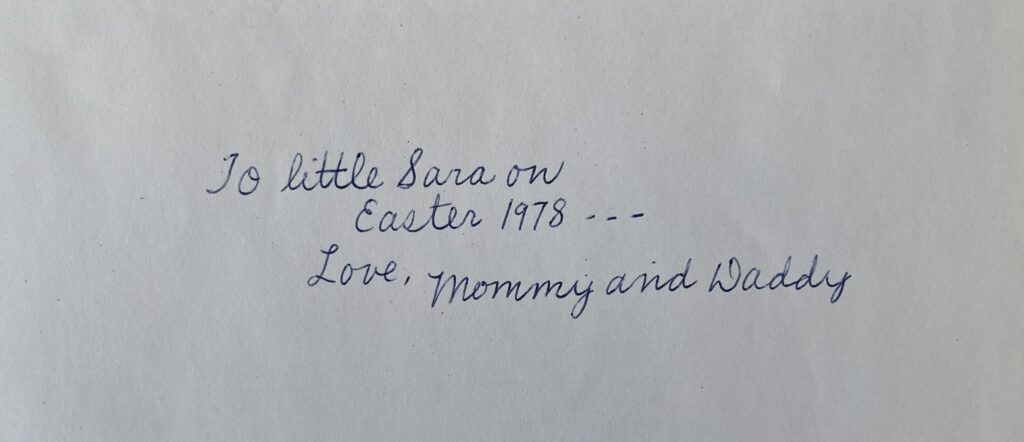
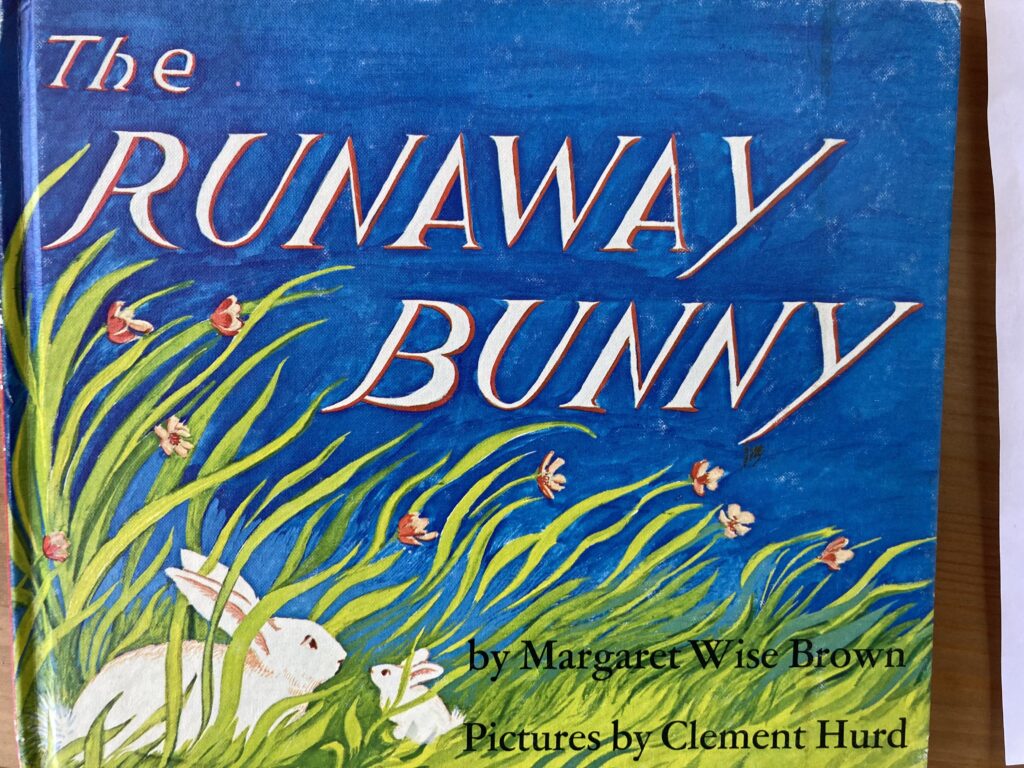
The Runaway Bunny — This was one of my favorite books as a kid. At first, I wondered why I thought that, then I found the book and opened it and saw why:

book inscription: To little Sara on Easter 1978 -- from Mommy and Daddy
my copy from 1978

added, 28 feb 2026: I was never a big Velveteen Rabbit fan, but there is another bunny book I loved as a kid, Pat the Bunny.

11

Looney Tunes: I want hasenpfeffer! I am almost certain that when I watched this cartoon as a kid, this was the first time I had heard of hasenpfeffer or imagined that rabbit was something you could eat. I still never have, but whenever I hear the word hasenpfeffer I think of this cartoon.

Hasenpfeffer

From a comment: “The King wants Hasenpfeffer which is traditional Dutch and German stew made from marinated rabbit or hare, cut into stewing-meat sized pieces and braised with onions and a marinade made from wine and vinegar.”

What to do with all of this rabbit-holing? I want to orbit around all, or at least many, of these ideas. Bring them into poems. Write a series of small poems about rabbits and bunnies and hares. As I was writing this last line, another bunny zapped into my head — The Runaway Bunny! I’ll add it above. What form should these rabbit poems take? Could this be an inspiration — Seven American Centuries? Whatever the form, I like the idea of returning repeatedly to century bunny/rabbit themes, and telling a story across the poems, not in one poem.

  1. Yesterday I realized I could easily do footnotes and I’m here for it! Googling “Diane Seuss and rabbits” the AI explanation seemed useful and it was, but also a bit suspect. When I clicked on the links offered at the end of the AI summary and read the source, it often wasn’t saying what AI claims it saying. AI takes some liberties, I think. ↩︎

a Rabbit/Bunny/Hare playlist

When Scott reminded me of Thundercat’s song “Rabbot Ho,” I knew I needed to make a playlist for this recent preoccupation!

  1. Rabbot Ho / Thundercat
  2. Baile InoLVIDABLE / Bad Bunny
  3. Rabbit Fur Coat / Jenny Lewis
  4. Abracadabra / Steve Miller Band
  5. I’m Drivin’ My Life Away / Eddie Rabbit
  6. The Young Rabbits / The Jazz Crusaders
  7. Let’s Pretend We’re Bunny Rabbits / Magnetic Fields
  8. Rabbit Heart (Raise It Up) / Florence + the Machine
  9. Rabbit Fighter / T. Rex
  10. Jack Rabbit / Elton John
  11. Here Comes Peter Cottontail / Gene Autry
  12. White Rabbit / Jefferson Airplane
  13. White Rabbit / George Benson
  14. Rabbit Will Run / Iron & Wine
  15. Breathe (in the Air) / Pink Floyd
  16. Pink Rabbits / The National
  17. Mycomatosis / Radiohead
  18. Alice / Peggy
  19. Mad as Rabbits / Panic at the Disco
  20. Bunny is a Rider / Caroline Polachek

feb 24/RUNGETOUTICE

4.3 miles
minnehaha falls
35 degrees
25% puddles

Sitting at my desk in the morning, I heard some noise — rustling, I think? — just outside the window. Freezing rain or snow — graupels. Then it started snowing, not too hard, but enough to cover everything. No! I wanted to run today. Luckily, it warmed up and by the time I was ready to run, everything had melted.

10 Things

  1. a police car parked parallel to the road in the first falls parking lot
  2. aside from the police car, the lots were empty
  3. a lime scooter leaning against a bench
  4. one guy standing at the bridge overlooking the falls, with an orange hat or an orange something else (I couldn’t see)
  5. voices below on the other side of the wall, down in the falls
  6. no one else in the park
  7. big puddles everywhere — my one foot was soaked only 5 minutes into the run
  8. kids yelling and laughing on the playground
  9. the river was covered with ice and snow with one sliver of open water
  10. a walker approaching me, walking 3 tiny dogs — this made me smile

The run was mostly great. At times, my legs felt heavy (or, at least, heavier than they usually do) and I stopped to talk a few extra times. Were they sore or my lack of ferritin or some other ailment? The second half felt easier.

bunnies — nudge? muse? pest? ghost?

note: I started writing this section yesterday and have spent over four hours this morning wandering through the spaces it created . There’s a lot of movement in it — traveling from thought to thought to thought, here to here to here. Future Sara, and anyone else reading this, you might get lost.

So far I’ve written two bunny poems without really trying to. I’m starting to believe they want me to write about them. This very idea suddenly appeared in my third poem. I started writing about the moment when I first noticed the bunnies in the backyard at night and realized they had probably always been there. Then I wrote in my Plague Notebook 27: I didn’t choose to notice them as much as they decided to be noticed. And I thought: muse! Could this poem be about bunnies in the backyard and about bunnies as the thing that has decided it’s time for me to write, and write about them? For years now, I’ve disliked bunnies, and never imagined writing about them. But now here I am, writing about them, and I fear that I might learn to like bunnies.

All of this has me wondering, what is a/my muse? I’m familiar with the term, but have never seriously studied it, either as a concept or through examples of it in the popular imagination. Do I want to now? Is it necessary for my poem? Maybe instead of devoting a month to it — although that could be fun! — I’ll give it a day or two?

Muse/ Linda Pastan

No angel speaks to me.
And though the wind
plucks the dry leaves
as if they were so many notes
of music, I can hear no words.

Still, I listen. I search
the feathery shapes of clouds
hoping to find the curve of a wing,
and sometimes, when the static
of the world clears just for a moment

a small voice commes through,
chastening. Music
is its own language, it says.
Along the indifferent corridors
of space, angels could be hiding.

If the bunnies are my muse, I didn’t seek them out. I looked out the window one winter night and saw them on the lawn, not knowing what they were. Did they seek me out, or are they indifferent to me? Did they reveal themselves, or did I just happen to notice them one day? I think I do less trying to find a muse, more trying to create the conditions where it could be possible. I noticed the bunnies because I was doing a month-long practice I called the purple hour. It involved using the time when I woke up in the middle of the night, unable to sleep, to notice purple and write about it. One night, I was studying the different purples in the backyard and there they were, the bunnies. And maybe it’s more than creating the conditions where it’s possible; it’s also about being open to what could be a muse, letting it in.

Muse — to be occupied by, possessed, taken over, haunted, held captive, in the thrall of?

This idea of captivity reminded me of the poem, Captivity/ Siddhartha Menon which I posted on this log on 15 may of this year. In an essay, Menon wrote this about the final line of the poem:

“You are paralyzed.” It suggests the fatal indecision of a rabbit caught in a hunter’s flashlight, and snaps the poem shut” (Siddhartha Menon on Epigraphs).

My rabbit/bunny is back! This sentence is the only mention of a rabbit in a 872 word essay about a poem that features a bird. Where will my bunnies appear next?

Returning to definitions of muse, I googled it, and just past the dictionary entry — the nine daughters of Zeus, a person/personified force who is the inspiration for an artist — in the “People also ask” section was this question: What makes a woman a muse? Here’s the AI generated answer:

A woman becomes a muse through qualities like enigmatic allure, deep connection, and embodying creative energy, acting as a profound source of inspiration for an artist, often sharing a unique bond that fuels artistic expression, though not always romantically. Muses can be captivating personalities, friends, lovers, or even strangers who embody traits like wisdom, charisma, or mystery, prompting the artist to create, often embodying a living, breathing work of art themselves, inspiring everything from specific works to an artist’s entire focus. 

Eww. The uneven power dynamics here, between the subject (isn’t it most often a male artist?) and the object (a woman who is not an artist, or is not considered an artist) that inspires them bother me. After images of male artists and their models flashed in my mind, a phrase appeared: Manic Pixie Dream Girl. I recalled encountering a critical feminist essay about this trope back in the day (around 2007 or 2008, when I was teaching pop culture and queer theory at the University of Minnesota). I searched for it. Not an essay, a video from Feminist Frequency. Yes! I remember them. This video holds up. Around 4 and a half minutes in, they link the trope directly with the Muse:

manic pixie dream girl

And now I’m thinking about birds in poetry and how they’re used to do a lot of the heavy lifting of a poem. She’s not the only poet to write about it, but here’s a good example of this idea from Ada Limón:

does this bird want to be in this poem today? Maybe it doesn’t. You know, we always want to turn the animal into something else, right. And sometimes I want to let the animal be. Of course animals are symbols, of course they turn into our metaphors. I mean, that happens. But I also think there are moments when you just think, okay, the birds aren’t going to save me.1

VS Podcast Interview with Ada Limón

All of this makes me wonder: what am I doing as I keep putting the two bunnies in my backyard into my poems? And why do I insistent on calling these wild and mature eastern cottonwood rabbits bunnies? I’m not sure these rabbits are indifferent to me, but I think they notice me in terms of whether or not I am a threat to their main activity: grazing in the grass.

Now I’m remembering an interesting fact I encountered the other day: much of the eastern cottonwood rabbit’s time is spent eating, 6-8 of the day, both during the day and at night!) Okay, I looked it up again and I was right about the 6-8 hours a day, but here’s a delightful detail: primarily during dawn and dusk. Rabbits are crepuscular grazers. Crepuscular (cre PUS cular)?! What a word, and a good title for a poem?!

But, back to if rabbits (I still want to call them bunnies) notice me or not. Is my assumption correct about noticing me in terms of my threat level? Another google:

Wild rabbits are acutely aware of humans, perceiving them primarily as potential predators due to their innate, high-alert survival instincts. They utilize exceptional hearing and a keen sense of smell to detect people, often fleeing immediately to safety. While they may learn to tolerate consistent, non-threatening human presence over time, they generally maintain a healthy fear of people.

Yes! So, here’s something interesting: in the poem I’m working on right now, tentatively titled, Bold as Brass, my backyard bunnies do not care that I’m passing by; they keep grazing. They’re seemingly so indifferent that I’ve started calling out a pre-boomer phrase (and unironically!) to anyone around me: those bunnies are bold as brass! Where’s their healthy fear of humans? Is it that they can tell I am no threat, or are they being impudent? Or, has something screwed up their “normal” behaviors, and could that something be human-caused (like the over-developing of land, the loss of “natural” habitats, the increased need to live in the midst of humans?) Could that be the true heart of this poem?

Possibly, but first, another plunge2 down that rabbit hole! What do “experts” say about my theory of encroaching landscapes? Looked up “rabbits encroaching landscape” and What to do about wild bunnies? appeared. Here’s the subtitle: “Timid wild rabbits may occasionally eat plants in the garden, but usually live unnoticed on the fringes of our yards.” Usually unnoticed and on the fringes? Two favorite themes in my poems! Also included in one of the first paragraphs: edges, in-betweens.3 Back to “usually unnoticed,” here’s another useful bit from the article:

Here today, gone tomorrow is one way to describe rabbits in suburbia. Given the many predators who make meals of rabbits, their populations can rise and fall dramatically over the course of a year.

Come on, now, the pun was set up for you: hare today, gone tomorrow! Anyway, does my recent (for the last year) notice of backyard rabbits, almost every day, count as part of this normal rise and fall of rabbit populations? Or does it indicate something else?

The line about the gardens make me think of two things. First, a memory. My mom loved gardening and was especially proud of her West Des Moines garden (I created a digital story about it a few years ago). I recall the rabbits liked her flowers, especially her roses. On the advice of a neighbor, she sprinkled bone meal around the bush, which didn’t work. Not wanting to kill the rabbit, she managed to catch it — I can’t remember how, maybe with the help of that same neighbor — and drove 10 or 15 miles out of town and into the prairie to release the rabbit.

Second, a few feelings I recall having decades ago when reading the section in Peter Rabbit when Peter Rabbit’s coat gets caught on Mr. McGregor’s fence and he’s trapped and then when he manages (barely, at least how I remember it) to make it home and has to recuperate in bed. The feelings: not fear or relief but an understanding that life was dangerous and serious and an ambiguity as to who was in the wrong — the bold, misbehaving Peter who disobeyed his mother’s orders and stole vegetables, or the hard-working farmer who was planning to kill Peter as punishment. I recall thinking I was supposed to think Peter was in the wrong, but I wasn’t buying it.

What to do with these rabbit wanderings? And where has my plunge down the rabbit hole led me? It seems fitting to conclude this ramble with the rabbit hole, which is a reference to Alice’s Adventures in Wonderland and her following of the white rabbit down into Wonderland. Of course, “down the rabbit hole” is also a term used for getting lost on the internet:

“Down the rabbit hole” is an English-language idiom or trope which refers to getting deep into something, or ending up somewhere strange. Lewis Carroll introduced the phrase as the title for chapter one of his 1865 novel Alice’s Adventures in Wonderland, after which the term slowly entered the English vernacular. The term is usually used as a metaphor for distraction.[1] In the 21st century, the term has come to describe a person who gets lost in research or loses track of time while using the internet.

wikipedia

Out-of-control curiosity. Distraction. Losing track of time. Getting lost in strange worlds. These are presented as bad things. Are they? Many of them are embraced within poetry. And they are great tools of refusal and resistance against late-capitalism and wannabe fascist governments — you’re not working for/perpetuating the system while you’re following the rabbit hole.

Does that work when the getting lost is online, where the rabbit hole is designed to be the way curiosity is monetized: the more levels of the rabbit hole you enter, the longer you stay lost in all of the information offered, the more attention you give to a site and its advertisers.

I started this ramble yesterday after realizing my third bunny poem might be about the muse. That realization was partly inspired by a recent rereading of an excerpt from Tommy Pico’s poem, “IRL.” Somehow I’ve made it back to that beginning. Here’s the last section of that excerpt:

All I need is my phone.
Subway, elevator, drifting off
in a convo—no one really seems
to notice, occupied by their own
gleaming pod of longing.
I am the captain of my shit,
possessed by the spirit
of Instagram I am omnipotent
on Twitter on Blurb on Vine
Soap boxes on the street corner
of my mind Clear, boosted, boundless
something come stop the shaking
A sun to fly towards iMean
something to do: mimicry
of purpose. The injury
of hunger is: death. The word
of the day is: Gloze.
To explain away.
Glowing gauze glozes the
etc. Weather.com says
Stay inside forever, or
drop dead. We’ve ads
for you to click. You n me?
It’s going to take soooo long
for us to know each other
ten years.

I don’t understand all that is happening in this excerpt, but the more I read it, the more doors it opens for me and my thinking about the internet, IRL, and the Muse.4

  1. “the birds aren’t going to save me” — I suppose my initial turn to the bunnies was with that expectation, where saving = giving me something else to think about other than ICE and Occupation Minneapolis and fascism and my high blood pressure and insomnia ↩︎
  2. My choice of plunge is deliberate; it’s a reference to Emily Dickinson’s “I felt a funeral in my Brain” — And then a Plank in Reason, broke,/And I dropped down, and down,/ And hit a World, with every plunge,/And Finished knowing – then↩︎
  3. Something else included: “rabbits will excrete, eat and re-digest their own droppings to obtain the maximum amount of nutrients.” I wonder if that’s part of what the rabbits in my yard are doing when they spend so much time stock-still in the snow. ↩︎
  4. One last thing about the Muse that I want to mention for a future discussion. What if the bunnies/rabbits are not a muse, or a catalyst for action (which was said of the white rabbit in Alice in Wonderland), but a gate? As in, Marie Howe opening in “The Gate”: I had no idea that the gate I would step through / to finally enter this world / would be the space my brother’s body made ↩︎

feb 20/BIKEGETOUTICE

32 minutes
basement

Watched the women’s cross-country relay for most of the bike, then Alysa Liu’s amazing Free Skate for the last 10 minutes. Scott and I watched Liu’s performance last night, and I watched it again this morning. Admittedly, I can’t really see that much of it — no details, not her beaming face, none of her lines, only the feel and speed of her movement, the energy of her joy. And I guess as I watch it I am a little sad not to be able to fully witness her artistry. But I still loved it. And I’ll be watching it again and again as an antidote to all the other shit happening right now.

Bunnies

Earlier today, I read in an old log entry about my discovery, last february, of two backyard bunnies. Then I read a post on Facebook from Minneapolis Parks about how some rabbits pee blue. It felt like a nudge, today you should write about bunnies!

Here are some sources for inspiration (or more) about rabbits/bunnies:

1

Have you seen weird blue spots in the snow lately? There’s a good chance it’s rabbit pee. Eastern cottontails (the most common rabbit in Minnesota, you’ve probably seen them running around yards at dusk) sometimes eat buckthorn branches and bark, especially toward the end of winter. Buckthorn contains a phytochemical that turns urine blue after being exposed to sunlight.
So, don’t be alarmed if you come across one of these spots, it probably means a well hydrated rabbit stopped by. (Minneapolis Parks)

2

Looking out the kitchen window, seeing 2 dark forms in the white snow — bare patches or something more? Staring for a few mnutes — am I imagining that slight shift? No, 2 animals, standing still for minutes. What are they doing? Quick movement, then bounding figures. Rabbit-like. But these animals look so dark — is it a trick of the dim light — bunny fir darkened in the lilac light? [there is no indigo in a backyard illuminated by neighbor’s security lights.] Or, could these creatures be raccoons?

update, 20 feb 2026: A definite answer: bunnies! All late fall and winter, 2 or more bunnies have been hanging out under our crab apple tree — at night, in the afternoon, at sunrise and sunset. They’re very bold, these bunnies, not running off when I walk by. When this happens, I’ve started saying, these bunnies are as bold as brass! Why? Not sure. And, I don’t want you to get the wrong idea: I like bunnies or rabbits about as much as I like squirrels, which is not at all.

3

The idiom bold as brass describes someone who exudes extreme confidence, someone who is brazen or very forward. The term bold as brass is ascribed to the Lord Mayor of London in the 1770s, Brass Crosby. Crosby defied the House of Parliament by supporting the printing of a pamphlet regarding the proceedings of Parliament. The phrase bold as brass was first recorded in Life’s Painter of Variegated Characters in Public and Private Life by George Parker published in 1789, some time after the incident involving Brass Crosby. Some say this disproves the link between Crosby and the idiom bold as brass, others say it reinforces the link. In fact, the word brass was used to mean boldness or brazenness for at least forty years before the appearance of Brass Crosby on the political scene. The idiom bold as brass reached the zenith of its popularity in the early 1900s.

4

an illusion: duck or bunny

5

A cup holds
sugar, flour, three large rabbit-breaths of air.
(My Weather / Jane Hirshfield)

6

But then the rabbits tire
And the fire catches up,
Stuck onto them like the needles of the cactus,
Which at first must be what they think they feel on their skins.
They’ve felt this before, every rabbit.
But this time the feeling keeps on.
And of course, they ignite the brush and dried weeds
All over again, making more fire, all around them.
I’m sorry for the rabbits.
And I’m sorry for us
To know this.
(Rabbits and Fire/ Alberto Rios)

7

The rock that is not a rabbit suns itself
in the field, its brown coat that isn’t fur
furred with light. The rock that isn’t a rabbit
would be warm to a palm but wouldn’t
quicken or strain from touch.
(The Rock that isn’t a Rabbit / Corey Marks)

8

it is the
sadness of the unperceived and therefore never felt and
seldom expressed, except on occasion by polka dancers
and little girls who, in imitation of their grandmothers,
decide who shall have their bunny when they die.
(Green Sadness / Mary Ruefle)

9

A white rabbit hopped beside me and for a moment I thought it was a blob of snow that had fallen out of the sky. The rabbit and I studied each other. Rabbits taste like chickens. My My mother and father had taught me how to hit rabbits over the head with wine jugs, then skin them cleanly for fur vests. “It’s a cold night to be an animal,” I said, “so you want some fire too, do you? Let me put on another branch, then.” I would not hit it with the branch. I had learned from rabbits to kick backward. Perhaps this one was sick because normally the animal did not like fire. The rabbit seemed alert enough, however, looking at me acutely, bounding up to the fire. But it did not stop when it got to the edge. It turned its face once towards me then jumped into the fire. The fire went down for a moment as if crouching in surprise, then the flames shot up taller than before. When the fire became calm again I saw that the rabbit had turned into meat, browned just right. I ate it, knowing the rabbit had sacrificed itself for me. It had made me a gift of meat.
(The Woman Warrior / Maxine Hong Kingston)

I ended up doing other things today and didn’t have much time to work on it. I found a title and some opening lines:

There is no Indigo

In a backyard illuminated
by a neighbor’s security lights
there is only lilac.

I think I’m going to also need to include the line about how I like bunnies as much as I like squirrels, which is not at all.

Get Out Ice

The only ice I am into today is the Olympic ice and Alysa Liu’s free skate!

jan 6/SHOVELSWIM

shovel: 20 minutes
slushy, icy, thick snow
33 degrees

Yuck! It’s an awful mess out there on the sidewalk, the roads. After he got back from his walk I asked FWA if it was, a. doable and b. worth it to go out and shovel. He said yes to both, so I did, but now I’m wiped out and sore and not sure if it was either of those things. Looking out my window right now at the street, I am disheartened. One big soupy, slushy mess. Will more of it melt and be cleared out before it freezes again? I hope so.

A quick note about my ankle: crisis averted! The RICEing (both resting icing compressing and elevating AND playing around with acronym) must have helped. My ankle feels fine today!

Sara from 4 jan 2026 asked me to let her know if anything big and terrible happened today. Not yet (as of 4:49 pm), but there’s a lot of talk about invading Greenland and I keep seeing the headline, The Danish PM says a US invasion of Greenland will mean the end of NATO.

In other shitty news: I noticed, while clearing trying to clear the deck that a wide stretch of snow under our crab apple tree has been turned into a port-a-potty by the two rabbits who visit every night to feast on fallen apples. Very gross! Some scat here, some scat there, scat scat everywhere. The snow is glowing brown — I’ll have to try and get a picture of it, because my words can’t quite convey the color or the grossness — a picture probably can’t either.

update: I pointed out the tree/rabbit/shit situation to Scott and we agreed it wasn’t all rabbit scat and it wasn’t glowing brown. A lot of it was discarded apple bits from birds or squirrels or the bunnies and the snow beneath the tree’s wide canopy was glowing a faint orange, not brown.

swim: 1.75 loops
123 laps / 55 minutes
ywca pool

Decided to swim without stopping until Scott showed up at the end of my lane. I was hoping to go longer — distance and time. Maybe that can be next week’s goal: to get to 140 laps, which is 2 miles. I’d like to do it in 1 hour. It felt great to be swimming again.

shadows: the afternoon light coming in the window created lots of shadows on the pool floor. Today I decided that it looked less like the floor was dancing and more like it was crawling. As I swam, I suddenly thought of the line from Raiders of the Lost Ark: why does the floor move? Other memorable shadows: the lane lines on the shallow floor, then the lane lines casting a shadow at the far end, all the way up the wall, from the deep bottom to the top. Such a cool image. I liked admiring it every time I neared the far wall.

10 Pool Friends

  1. the yellow! grout between the bright blue tiles on the pool floor in the middle of each lane — I never noticed it was yellow and not white — is it, or was it just dirty?
  2. the bright blue tiles marking a cross at the end of each lane — usually I read them as black or dark navy
  3. some crud on a tile beneath me
  4. a small red chunk of something that started on the pool floor a lane over, near the spot where it slopes down, then slowly shifted down each lap — tile after tile — until it made it to the bottom and then under me in my lane — I was fascinated by this red thing and enjoyed tracking it — I prefer not knowing what it is/was
  5. a guy in black swim trunks 2 lanes over that I raced (in my head) and beat
  6. someone in fins one lane over
  7. the silver trail of bubbles that the swimmers’ fins made as they kicked
  8. a lifeguard in a BRIGHT yellow jacket
  9. a swimmer in green swimming on their back, doing some sort of reverse breaststroke
  10. a swimmer in red doing freestyle then sidestroke then walking then kicking with a kickboard

Halfway through, I swam breathing every 5 strokes and tried to think one word each time I surfaced to breathe: 1 2 3 4 5 light 1 2 3 4 5 tile 1 2 3 4 5 window 1 2 3 4 5 door 1 2 3 4 5 tree — Nothing that interesting . . . yet . . . I’ll have to keep working at it, see if I can open myself up to more words. The bigger challenge: can I remember them? Nearing the end of the swim I was getting into a groove and thinking about how swimming for almost an hour without stopping is good practice for longer runs/marathon training. I was also thinking — okay, now the fun starts — as in, I’ve swum enough today to get into a flow state, what could happen if I kept going? What doors might open for me? What wonderfully strange ideas could I have? What delightfully tiny poems could I craft? I didn’t get to find out because Scott arrived and my swim was over, which was fine for today. I’d like to experiment with this longer swim this winter, see what I can do with it.

Little House Update

A few days ago, we made it to season 3 of Little House on the Prairie. We both knew something had shifted in the wrong direction when we heard the opening theme song: season 2’s funky 70s bass line had been replaced with a cheesy swing.

The first episode guest-starred Johnny Cash and June Carter Cash. It was enjoyable, but had lost some of the dark edge of realism that we enjoyed in seasons 1 and 2. Episode 2 was the beginning of evil Nellie, which is camp-tastically awesome, but lacks a grounding in a real time and place. It was exaggerated and over-dramatic, shifting the story away from the lives of people trying to not die in the unforgiving frontier of the 1870s, to an epic battle between the flawed and feisty goodness of Laura and the pure, irredeemable evil of Nellie Oleson. Nellie and her twisted, unhinged glare. Nellie silent and still, lurking at the window. Nellie and her old-fashioned temper tantrums, one on the bed, wailing and squealing and pounding her fists into her pillow; another pacing the room, shrieking and breaking porcelain dolls on the wall, smashing an expensive dollhouse with a hammer on the floor. I do find Nellie’s antics to be entertaining, and get some pleasure in loathing Mrs. Oleson, but I miss the quieter, darker depictions of the difficult frontier life that we witnessed in seasons 1 and 2.

After Little House we’ve been watching an episode of Love Boat from season 1. We’re enjoying it. Such a contrast to Little House. It makes me want to watch the whole line-up from a 70s evening.* I’ll have to ask Scott what that would be; as a kid he memorized the tv guide and probably remembers exactly what was on and when. That would be a fun and enlightening project, to revisit the 70s values/perspectives/preoccupations represented in prime-time tv that we were both raised on.

*perhaps the more accurate recreating of our early kid viewing experience of these shows would be to figure out the reruns that ran back-to-back on TBS.

Wow, this entry went on a ramble! Before ending it, I’ll just add that I have been shocked by how relevant the themes in Little House are right now. Yes, I have problems with the show — too much God-talk and not enough discussion of what it means to live on stolen land less than 2 decades after the civil war — but the hope and resistance and the desire for social justice of the 70s shapes these stories in ways that I had forgotten ever existed (because: Reagan). I am resisting the urge to devote an hour or more to offering specific examples of what I mean here. I don’t have time today.

dec 29/SHOVELBIKEWALK

shovel: 30 minutes
12 degrees / feels like 0
bright sun

The official word is that MSP (airport), which is only a couple of miles away, got 5.8 inches of snow. It wasn’t too hard to shovel; thankfully it got a lot colder yesterday and overnight. No longer heart attack snow. Under the powdery stuff, there was some crust, but it didn’t seem too slippery either. I would love to go out for a run by the gorge, but I don’t think that’s a good idea for my glute/hip/back. It’s tough to resist.

10 Things

  1. bright blue sky
  2. warm sun on my face
  3. fogged up sunglasses
  4. an unsettling creaking noise above me: some frozen branches on our big maple in the front which seems to be dying (evidence: big branches have already fallen this fall + several woodpeckers have been drumming on the wood)
  5. the whiny rumble of a snow blower in the distance
  6. a cold spray on my face when the wind blew some of the snow I’d just shoveled
  7. the recycling and trash can lids frozen shut
  8. rabbit prints along the side of the house, near the garage
  9. a sharp rumble nearby: another slow blower, closer and in the alley
  10. sprawled branches of the crab apple tree, weighed down with snow and ice

bike: 35 minutes
basement

Resisted the urge to go outside and run; biked in the basement instead. Almost finished the first episode of season 2 of Wednesday. Like in the first season, she attends a boarding school, Nevermore. Did I know that Edgar Allan Poe was the founder? Probably. Some outcasts are psychics or wolves, can control bugs or shoot electricity out of their fingertips. I can’t remember if there’s only one siren or more. This season has Steven Buscemi as the principal and a scar-faced crow. It was helpful to watch the episode with audio description on — such relief to actually see and understand and to not not know what is going on. Yes, that is a double negative, and yes, I meant to write it — the feeling of uncertainty is not knowing, so the relief is in not being in that state of not knowing: to not not know

walk: 20 minutes
neighborhood
13 degrees

Managed to convince Scott to go outside for a quick walk around the block. It was cold, especially walking into the wind, but I had hand warmers in my gloves, which helped a lot. Scott did not, so he was very cold, and didn’t want to walk for long.

What did I notice? One neighbor had put salt down on their sidewalk (boo). Most of the sidewalks were shoveled. The street 2 blocks over had lights strung up from one end of the street to the other. I never see these lit up, because I don’t walk this way at night. A friendly woman greeted us halfway down another block — hello! / hi!. She was giving treats to a cute dog. Anything else? I can’t remember.

Found a purple poem earlier this morning:

an excerpt from Language Lessons/ Judith Kiros

Translated from the Swedish by Kira Josefsson with Judith Kiros

is it only words. On and on. If you shook up the words. On a
particular shade of purple being extracted from spiraling shells.
If the repetition had less to do with the broken-apart sea, see my
skin and my arms rippling like a wave, on and on again, I’ve
dyed them navy. On receiving a gift in your childhood, a purple
doll with foaming skirts, beneath them nothing, between her
legs nothing, what a perfect wave of black nymph. On violet.
Or on lavender. On being lowered into an ocean of colors. On
your head being pushed beneath the surface, on and on again,
to the tune of seashells knotting their purple insides. Don’t give
yourself up for free; there is a point in talking back to the sea. On
a particular shade of vague purple. On the way a shadow struts,
violet, across the page.

a particular shade of purple: tyrian purple, made from snail shells
violet, lavender, being lowered into an ocean, pushed beneath the surface: this makes be think of Alice Oswald and Nobody and Odysseus and his purplish-blueish cloak

I like the idea of being lowered into an ocean of colors
shade of vague purple

My favorite: the way a shadow struts,/violet, across the page

I love the word strut, especially when it involves a shadow! Immediately, it reminds me of another favorite line from “My Invisible Horse and the Speed of Human Decency “/ Matthew Olzmann:

I’m not asking for much.  A more tender world 

with less hatred strutting the streets.

Also discovered this morning: Fragment Thirty-six / HD and the reading guide by Dan Beachy-Quick — I’d like to return to this some other day, when I have time.

one final note: I have posted a log entry, either running or biking, on this day every year that I’ve written in this log: 2017-2025. Tomorrow, I’d like to experiment with mashing up or combining or erasing or scrambling or cutting up the words in these entries to make a new piece of writing — most likely, a poem.

dec 25/WALK

30 minutes
neighborhood
34 degrees / mist-drizzle

An afternoon walk with Scott and Delia. Gray, mild, misting. Some ice on the sidewalk, few cars on the road. Walking on Lena Smith Boulevard, looking over the hill and down into the gorge, I said, that looks so pretty, then realized it probably didn’t to anyone else. The view was gray sky, brown trees, rusted leaves, and the feeling of a river beyond it — a flash of a car or a runner traveling through the tunnel of trees. Scott said, it’s peaceful, but I wouldn’t call it pretty. At first I agreed, but then I decided it did look pretty to me.

A low-expectations Christmas. RJP made gifts for all of us: for Scott, a dark gray hat with yellow trim; for me, a neck warmer in green with a purple stripe; for FWA, light gray mittens. Beautifully crafted. We had a nice dinner, then watched Die Hard for the first time since it came out in 1988. Loved it — even though I could only see about half of it. Scott and I agree: a new tradition.

in the morning

Another Christmas is here. I’m sitting at the dining room table while everyone else is still asleep or hiding out in their rooms. Looking for something, I decided to search through my Safari Reading list — it’s the main way I save links. Found Dorianne Laux’s “Ode to Gray” at the bottom. Very cool! I love this poem and the idea of creating a list of all of the things of a certain color that are meaningful to me.

Ode to Gray/ Dorianne Laux

Mourning dove. Goose. Catbird. Butcher bird. Heron.
A child’s plush stuffed rabbit. Buckets. Chains.

Silver. Slate. Steel. Thistle. Tin.
Old man. Old woman.
The new screen door.

A squadron of Mirage F-1’s dogfighting
above ground fog. Sprites. Smoke.
“Snapshot gray” circa 1952.

Foxes. Rats. Nails. Wolves. River stones. Whales.
Brains. Newspapers. The backs of dead hands.

The sky over the ocean just before the clouds
let down their rain.

Rain.

The seas just before the clouds
let down their nets of rain.

Angelfish. Hooks. Hummingbird nests.
Teak wood. Seal whiskers. Silos. Railroad ties.

Mushrooms. Dray horses. Sage. Clay. Driftwood.
Crayfish in a stainless steel bowl.

The eyes of a certain girl.

Grain.

Ode to Gray/ Dorianne Laux

Oh, and the absolute first thing I have saved on my reading list is a wonderful poem from Tomas Tranströmer (love his poetry!):

After Someone’s Death./ Tomas Tranströmer

Once there was a shock
that left behind a long, pale, shimmering comet’s tail.
It shelters us. It makes the TV images fuzzy.
It settles in cold droplets on the power lines.

You can still shuffle along on skis in the winter sun
through groves where last year’s leaves hang on.
Like pages torn from old telephone books—
all of the names swallowed up by the cold.

It’s still pleasant to feel the heart beating.
But the shadow often seems more real than the body.
The samurai looks insignificant
beside his armor of black dragon scales.

it makes the TV images fuzzy / you can still shuffle along on skis / last year’s leaves / the shadow often seems more real than the body — so many lines that speak to me!

may 21/RUN

5.5 miles
ford loop
44 degrees
drizzle

Wasn’t planning to run the ford loop, but I started it and then just kept going. It felt good, relaxed, not hard to keep my heart rate a little lower. My pace was slow, but it didn’t feel slow, or fast, or any speed really.

10 Things

  1. mist
  2. dripping
  3. spray
  4. mirrors
  5. puddles
  6. graffiti
  7. traffic
  8. bridge
  9. debris
  10. slick

It rained all day yesterday, and some early in the morning. Started again during my run. Everything dripping wet, including me, although I didn’t really feel it, or couldn’t distinguish it from my sweat. Before I started running, as I walked through the neighborhood, I looked into the puddles on the sidewalk and admired how they had become mirrors, reflecting the sky and the trees. Running over the river, I looked down at the east bank and saw colorful graffiti all over the rocks at the base of the lake street bridge. In spots, the trail was slick with mud or covered in debris — fallen leaves, broken branches, grit. Crossing the ford bridge, I looked north and was delighted by the mist, making everything seem fuzzy and unformed. The traffic on the bridge was thick — I couldn’t see or feel any spray coming off of their wheels, but I could hear it.

overheard: one runner to another — you can bank the time.
Another use of time as a commodity.

Listened to the water, in its various forms, for the first half of my run. Put in my “moment” playlist for the second half. The most memorable song today: One Moment in Time/ Whitney Houston

A line that stood out to me:

And in that one moment of time
I will feel
I will feel eternity

I thought about Mary Oliver’s definition of eternity and how Whitney Houston’s doesn’t fit with it. MO understands eternity as creative time that’s outside of the ordinary and beyond the self. Houston’s eternity seems more like eternal glory.

As I listened to all of the lyrics, I thought about Whitney Houston’s tragic life and terrible death — an overdose. I also thought about the idea of one moment and what happens after that moment is over. And this made me think about post-Olympic blues, or post-marathon blues, or post-publishing a poem blues.

To keep myself distracted and steady, I chanted in triple berries —– strawberry blueberry raspberry. Then I chanted my poem — I go to the gorge/to find the soft space/between beats.

more on the moment as between

Read a very brief interview with Marie Howe the other day. She mentioned a poem that inspired her and that she wished everyone would read: The Season of Phantasmal Peace/ Derek Walcott. Beautiful! Here’s a line to remember that describes the moment:

and this season lasted one moment, like the pause
between dusk and darkness, between fury and peace

Before my run, I began listening to a talk by Jennifer Chang, “Other Pastorals: Writing Race and Place“. She mentions one between in the presentation of her thesis statement: how poets of color use pastoral to grapple with the complex composition of place as a tension between lived and learned experience. She recites another between from Rick Barot’s “On Gardens”: somewhere between/what the eye sees and what the mind thinks/is the world, landscapes mangled/into sentences, one color read into rage.

Chang also mentions context: If you look at the word “garden” deep enough you see it blossoming in an enclosure meant to keep out history and disorder.

Chang’s lecture is part of the Bread Loaf conference in 2019. This page has many great links for future Sara to explore.

And here is a helpful essay with some ideas for thinking about the pastoral, and links to poems, like Rita Dove’s Reverie in Open Air, which I’ve already posted on this log. The second half of Dove’s poems fits with early May’s theme of grass:

But this lawn has been leveled for looking,   
So I kick off my sandals and walk its cool green.   
Who claims we’re mere muscle and fluids?   
My feet are the primitives here.   
As for the rest—ah, the air now   
Is a tonic of absence, bearing nothing   
But news of a breeze.

And a few more grass lines from Jennifer Chang:

Stalk of wither. Grass-
noise fighting weed-noise. Dirt
and chant. Something in the
field.
(Pastoral/ Jennifer Chang)

What sound does grass make? Wind through the grass, crunching over dry, brittle grass, feet on grass — bunny’s feet:

 I think my favorite sound was the soft footsteps of the bunny hurrying across the lawn. A silvery whisper only possible to hear on a calm summer morning like today. I love the sound of animal feet moving — running or hopping through the grass

log entry on 16 july 2024