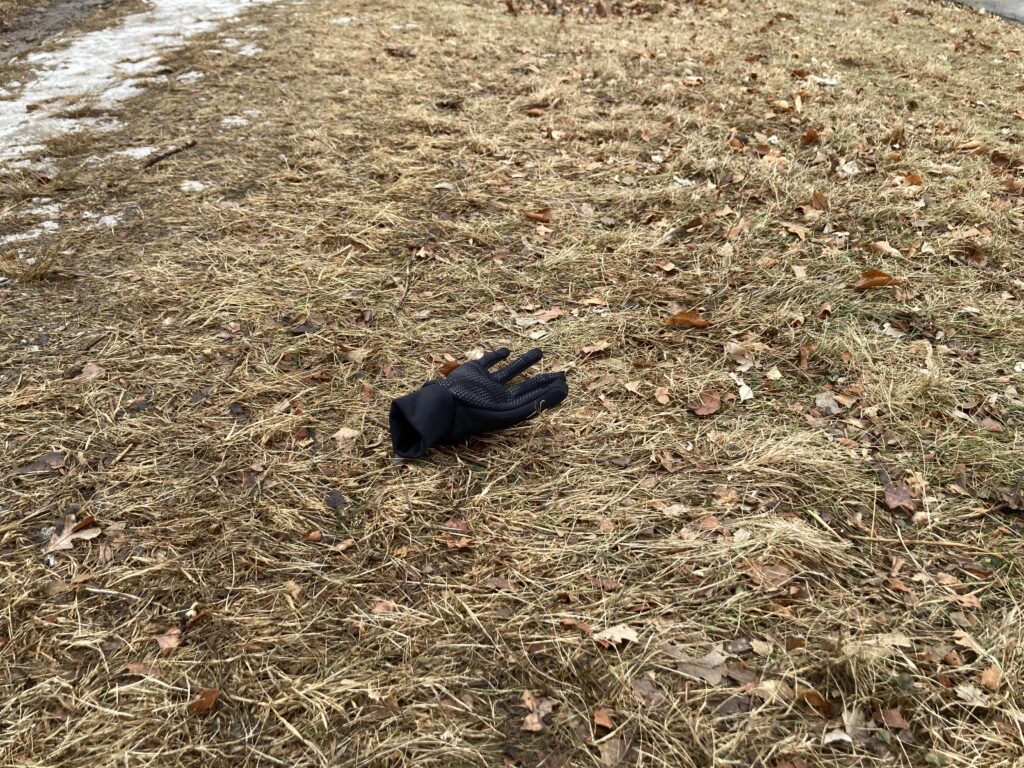
april 18/WALK

30 minutes
neighborhood
50 degrees

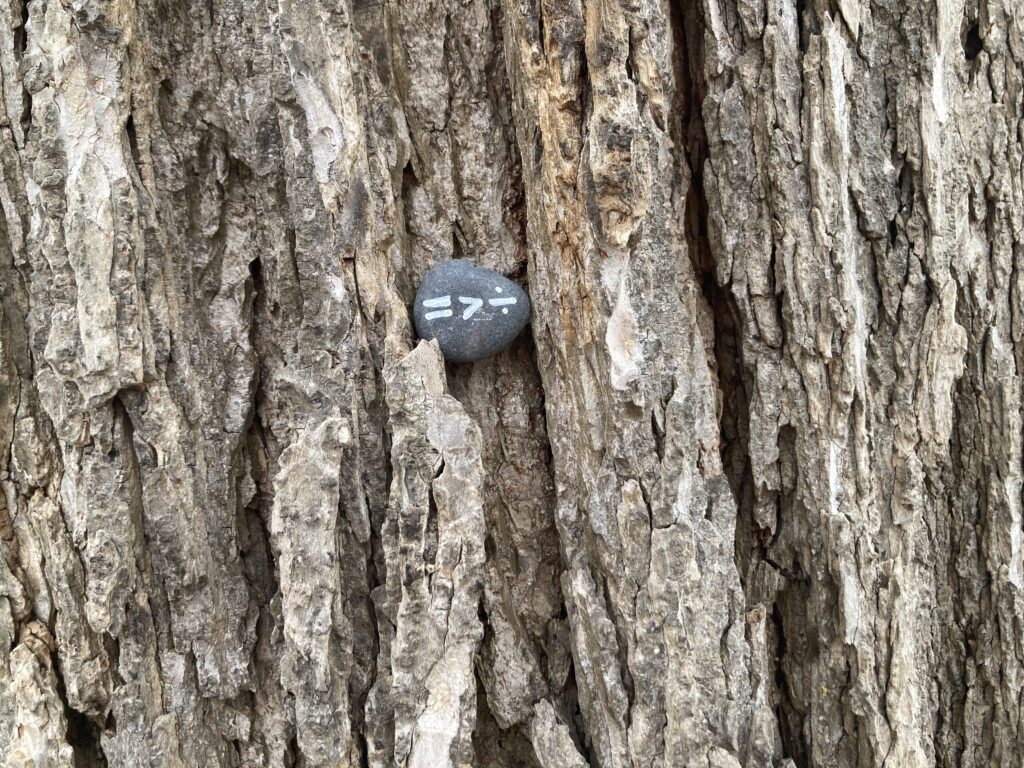
Went on a walk with Delia and FWA. He’s home for Easter weekend. We talked about the show Russian Doll and the 4th dimension and the limits of language and how it shifts meanings and experiences of the world. FWA wondered what it might feel like to experience the world outside of language and I talked about my work on this log and with poetry, particularly soft attention and my 10 things practice. I mentioned Mary Oliver’s poem “The Real Prayers Are Not the Words but the Attention that Comes First.” I pointed out the small stone embedded in a tree that reads, = > ÷.

Years ago, I remember feeling disconnected from FWA, not knowing how to talk with him, wondering why he was so distant. A deep sadness. I couldn’t have imagined (or hoped for) our wonderful, wandering conversation this afternoon. Not the same, but an echo of the ones I used to have with my mom.

It was not raining. Things felt open and possible, not closed and finished. Everything almost opposite of Bert Meyers’ poem, “Rainy Day.” Even so, I’ll post it here for later:

Rainy Day/ Bert Meyers

Outside, nothing moves: only the rain
nailing the house up like a coffin.

Remember, in childhood, when it rained?
Then, the whole world sailed down the alley:

leaves, paper, old shoes, the buildings,
everything like a circus going to sea.

Now, the rain, the iron rain, with its little keys
is closing all the doors . . .

and I think we’re all dead. See how the sky
sits like a tombstone on the roofs.

april 9/RUN

4.6 miles
ford overlook and back
45 degrees

Overcast, warm. I was overdressed in a short-sleeved shirt with a hooded pull-over. I tried a slightly new route today: south on the river road trail, up to Wabun park, over the ford bridge, along the river in st. paul, stopping at the ford overlook, then turning around. A harder run today. I felt tired and had to convince myself to keep running a few times. Recited the poem I re-memorized this morning as I ran — Still Life with Window and Fish/ Jorie Graham. Such an amazing poem!

10 Things

  1. a brown leaf whirling in the wind then startling me as it landed in front of me
  2. kids yelling on the playground, one voice sounded frantic at first, like the kid was hurt. As I listened longer, their voice sounded less pained and more playful
  3. a tall runner with long legs loping (with a long, bounding stride) — not graceful but awkward, gawky
  4. 2 (or was it 3?) big birds with wide wingspans riding the thermals near the overlook — almost floating, smooth, slow, silent
  5. reading the plaque describing the giant rusted paddle wheel on display at the overlook — from 1924, part of the hydroelectric power plant — the rust was deep red-brown and speckled with orange
  6. a skateboarder heading to the empty skate park
  7. crossing the ford bridge from west to east, noticing how steep and crumbling the slope at the edge of the bridge was — I wondered how soon this would need to be reinforced
  8. the river was a deep and dark blue with small waves and no shadows
  9. someone playing frisbee golf in wabun park — not seen, but heard: the clanging of the chain netting as it caught the frisbee
  10. running above on the paved trail, noticing a man walking a dog below, feeling tall and fast as I passed them

Here’s a poem I found the other day. I love the idea of writing a thank you poem to a poet. Maybe I’ll do one?

For Allen Ginsberg/ Dorothy Grossman

Among other things,
thanks for explaining
how the generous death
of old trees
forms
the red powdered floor
of the forest.

april 7/RUN

5.4 miles
franklin loop
30 degrees

Wore my new Brooks for the first time today. I need to adjust the laces at the top, but otherwise, they’re great. Hooray for past Sara for buying these shoes, and hooray for new shoes! Sunny and cooler today. Wind. I felt strong and relaxed, occasionally my back was tight.

10 Things

  1. a flash of silver in the sky — a plane
  2. a blue sky — cerulean — no clouds or birds
  3. the river, 1: from the trestle on the west side: blue
  4. the river, 2: from the franklin bridge: small waves, textured
  5. the river, 3: from the lake street bridge: sparks of light moving fast, making my head buzz in disorientation and delight
  6. the deep bellow of a train horn on the east side
  7. the soft knocking of a woodpecker
  8. a turkey on the trail — as I neared them, they flared their feathers then moved over
  9. another turkey in the brush on the edge of the trail
  10. the bridge railing casting a thick grid of shadows on the path

Listened to voices in the gorge below — high-pitched, a laughing kid or a startled animal? — and wind and water in the trees for most of the run. Put in my color playlist on the bridge. Went deep inside the beat as I listened to “Mr. Blue Sky.”

Tried to think about my orange poem — I’m a little stuck — but got distracted by my effort and the wind and the turkeys. Now, after the run, here’s some inspiration:

excerpt from Notes on Orange/ Jennifer Huang

In case you’re wondering, the fruit came first, the color
name second. They called it red-yellow for some time, and
for some time it was just that. Red brought nearer to
humanity by yellow
, as Kandinsky described it. I am just
that: a human who wants to be closer to god. What is the
true opposite of human? Maybe orange. A piece of sun, its
properties have been known to help us recall the feeling of
cool-blue grass under toes, the chime of a baby robin, the
holy scent of ripe mud. What is it that makes us want to get
close? To the gods, to summer, to sweetness, before we
retreat again . . .

One section — right now, it’s the beginning — of my orange poem is this:

Before word fruit and before fruit color
not as concept but movement, a certain
length of light finding its way to the back
of an eye, to a brain, through a body.
More than sight, sensation, the feeling
of heat* bursting out of the blue**

*or flame?
**blue as orange’s contrast color and blue as the lake water surface an orange buoy sits upon

hmm . . . I’ll play around with this some more. I need to connect this section with my experiences with seeing and not seeing orange buoys.

april 6/RUN

4.15 miles
minnehaha falls steps and back
45 degrees

Yes, spring! Bright sun and clear paths. Warmer air. Lots of runners and walkers and one roller skier in a bright yellow shirt. My lower back/glutes did not hurt when I was running — even though they had ached slightly (or softly?) yesterday and last night.

Did a slightly different route today: river road trail, south / godfrey / hiked down the steep trail then ran across the flat, grassy part below the falls where the creek pools and begins to bend / walked up the 100+ steps / climbed over the green gate / ran through the park / north river road, trail / boulevard grass

Running south I listened to the roller skiers poles striking the ground and happy voices, returning north, my color playlist. An orange song happened at the end, Shake it Well/ Koo Koo. Like most orange words, its about the fruit.

10 Things

  1. a loud rustling in the dry leaves below the double bridge
  2. a big turkey on the winchell trail, they moved off to the side to let me pass — no hissing or gobbling
  3. white foaming water falling beside slabs of ice
  4. the creek, moving past over the rocks, glittering in the sun
  5. a woodpecker somewhere in the trees, laughing
  6. the bench above the edge of the world, empty
  7. something big and bright and shining across the river
  8. something else big and white — at first I thought it might be the sky through a gap in the trees but later I decided it was a building
  9. my shadow in front of me — sharp, looming, distracting
  10. a lumpy shadow cast on the paved trail by a gnarled tree branch leaning over a crooked fence

This month, I’m slowly incorporating steps into my training, and my thinking about color, especially but not exclusively, orange. Here’s a color poem I discovered yesterday:

Black lake, black boat, / Emily Skaja

black fog I can’t find my way
through. Black trees, black
moon. I once knew the sky
from the water. This course
I remember, its narrowing.
How I crept my way down
the ladder like clutching
the gluey rungs of a throat.
I know you know how I’ve been.
Like you, like blood sucked
from a cut. A hot metal gash,
a beat of alarm, too late.
The water is listening.
That’s my name in its mouth.

april 3/RUN

5.4 miles
franklin loop
40 degrees

It snowed a few wet inches Tuesday night but you wouldn’t know it today. It’s all gone. The paths were clear and dry. I thought about orange things as I ran. I heard lots of dripping water, a few voices, birds. So many birds as I approached the marshall bridge! Oh — and the gobble of a turkey near the Minneapolis Rowing Club! I stopped to try and see it, but I couldn’t. Heading north, just past the trestle, I took the recently redone steps down to the winchell trail and admired the river. Calm, quiet, grayish blueish brown.

10 Orange Things

  1. orange lichen on the east side of the ancient boulder*
  2. an orange cone
  3. looking over the edge of the double bridge above longfellow flats, a white barricade with orange stripes had fallen halfway down the steep bluff
  4. orange netting on the fence
  5. an orange stocking cap on a walker
  6. orange bubble-letter graffiti
  7. my orange sweatshirt, worn under a dark blue hooded pull-over
  8. an orange road closed for race sign
  9. orange leaves on the ground
  10. orange rust on a metal plate

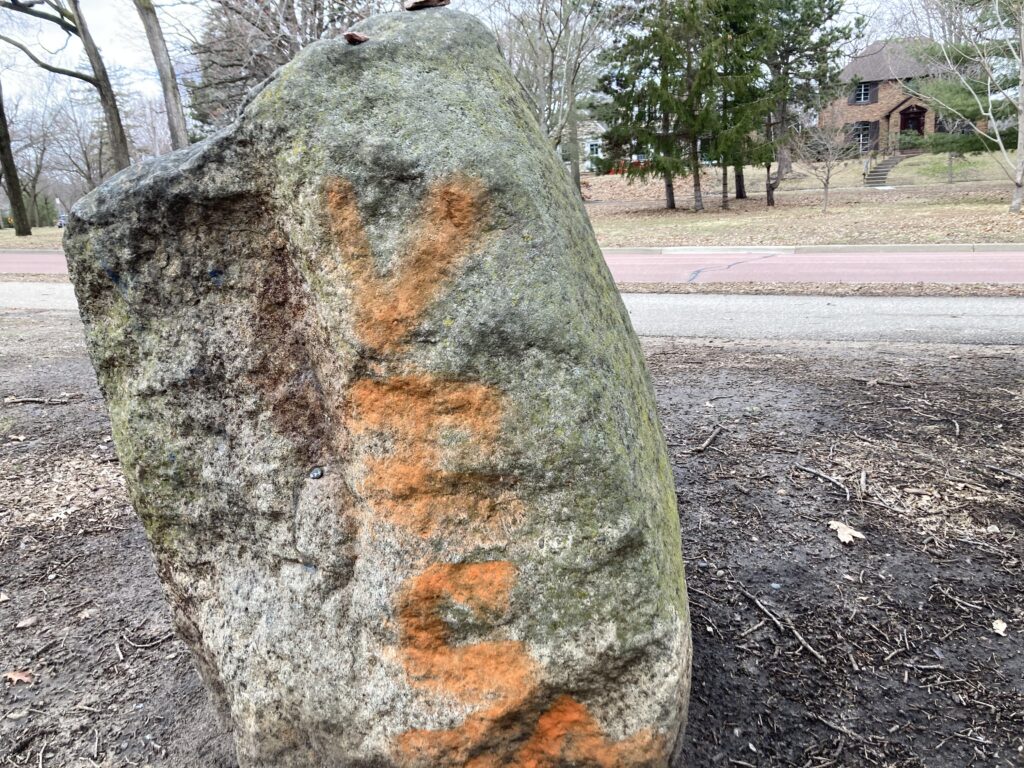
*I showed Scott the picture I had taken of the lichen and he said, that’s not lichen, that’s spray paint; it says VISA. I like seeing it as lichen better, but it is frustrating to have been so wrong with what I was seeing. I remember looking at the picture and thinking something else was there, that my idea of it as lichen wasn’t quite right, but this thought didn’t quite make it to the surface.

until Scott told me what I was actually on this rock, I thought it was lichen

I wanted to think about an orange effort as I ran, but I was distracted by my unfinished business. No port-a-potties anywhere. Thankfully I made it home without earning a poop story.

april’s monthly challenge

On April 1, I identified my monthly challenge as steps even as I wondered if it would stick. Yesterday I wasn’t so sure. I started working on a purple hour sonnet, then revising other color poems and converting them into sonnets. This morning I work up hell-bent on orange. I will study orange, steps be damned, I thought. But just now, while reading the chapter, “Orange is the New Brown,” in On Color, I encountered this sentence:

Through the late sixteenth century in England, “orange tawny” is commonly used to mark a particular shade of brown (even though chromatically brown is a low-­ intensity orange, though no one then would have known that). 

On Color, 45

Chromatically? Even though I’ve read/heard this word in relation to color for some time, today it made me pause and wonder about why the chromatic scale (a favorite scale to play) is called a chromatic scale.

The twelve notes of the octave—all the black and white keys in one octave on the piano—form the chromatic scale. The tones of the chromatic scale (unlike those of the major or minor scale) are all the same distance apart, one half step. The word chromatic comes from the Greek chromacolor; and the traditional function of the chromatic scale is to color or embellish the tones of the major and minor scales. It does not define a key, but it gives a sense of motion and tension. It has long been used to evoke grief, loss, or sorrow. In the twentieth century it has also become independent of major and minor scales and is used as the basis for entire compositions.

wikipedia

Searching for a definition, I also found a reference to James Sowerby’s Chromatic Scale:

Chromatic scale of colours arranged as a chart. Sowerby’s accompanying text provides a nomenclature for 63 colours divided into primaries of yellow, blue and red: with binary colours (blends of two primaries) and ternary colours (combinations of three primaries). Sowerby considered this might be useful to artists and considered that in primary colours “Gamboge is most perfect yellow, used in water colours…Carmine, most perfect when good…Prussian, or Berlin blue, most perfect.” Plate 5 from the monograph A new elucidation of colours, original prismatic, and material; showing their coincidence in three primitives, yellow, red and blue…, 

link

The chromatic scale as even steps up or down a musical scale. “The distance between 2 successive notes on a scale is called a scale step — half step or whole step.

Chromatic colors possess a hue (e.g. red, blue, green) while achromatic colors are variations of light and dark (shades of gray, black, white).

What is orange? Why, an orange, 
Just an orange!
(from Color/ Christina Rossetti)

Revisiting my month with Mary Ruefle, I wrote this about orange and Orange Theory:

. . . a red (all out effort) breath might involve being shocked, experiencing such intense awe or surprise that you lose your breath for a minute. Orange breaths involve intense feeling that can be sustained longer, but are still uncomfortable. Orange breaths are anxious breaths.

And now I’m thinking about how Mary Ruefle’s sad color poems — orange sadness, purple sadness, etc. — could be read as happiness poems too: “if you substitute the word sadness for the word happiness, nothing changes.” What is the more positive version of anxious? Excited? Maybe call my poems excitement poems? No, not excitement, attention. Of course, attention!

Earlier today I encountered an amazing poem that fits with the theme of attention:

from I’m Like If Mary Oliver Had Attention Deficit Hyperactivity Disorder/ Rose Azalea

attention is the beginning of devotion is something mary oliver said

. . .

my attention is both deficient & hyperactive i.e. i am touchingfeeling everything constant

devotion is the practice of belonging is something the earth cosplaying as me said

as a joytrans my special pokèmon moves are witness & surrender

.

march 31/RUN

4.3 miles
minnehaha falls and back
36 degrees

Yesterday afternoon we got 2 or 3 inches of snow. By the time I went out for my run in the late morning, much of it had melted, even on the grass. Excellent. It’s the warmer ground and the bright sun that did it. I was over-dressed in my purple jacket with a stocking cap. Halfway through the run, I took off the cap and held it in my hands.

As I ran south to the falls I chanted in triples. Lots of berries and sweet things (hot fudge sauce, fresh whipped cream), histories and mysteries and possibles, both muddy trail and mud on trail, and metronomes. On the way back, I put in my “doin’ time” playlist for the last day of my time month. I was planning to not stop to walk for the second half, but when a runner who was running the same speed or just a little slower than me joined the path in front of me, I decided to stop a few times to get some distance from them. One of the places I stopped was the bench above the edge of the world. I don’t remember what the river looked liked, all I remember was that looking at it made me feel calm and content and vast.

overheard while running by the falls: one person to a group of others, he should do it, his arms are the longest. Were they taking a group selfie?

10 Things

  1. water falling, 1: a steady gush out of a gutter
  2. water falling, 2: trickling from the sewer pipe at the ravine
  3. water falling, 3: gushing at the falls — mostly white foam
  4. shadow, 1: the small shadow of a bird crossing my path
  5. shadow, 2: the sprawled, gnarled, twisted, softened shadows of oak trees on the road
  6. shadow, 3: the sharp circle of the lamp part of the lamp post
  7. missing: the top railing of a wood fence on the edge of the trail
  8. several people in the falls parking lot, waiting to pay for parking
  9. empty benches
  10. a thin layer of snow on a leaning branch in the ravine

Found this poem the other day:

Color Keeps Time / Patrycja Humienik

or it rides us
like a torrent. Blurs
and fastens, flesh

to seconds. Just look
at your veins.
In vespertine woods,
I tried to read moss
by hand. There’s
something laconic
about green that I need.

Lover, let the morning slow
time through the branches.

vespertine: relating to, occurring, or active in the evening
laconic: using few words, concise to the point of seeming rude or mysterious

What kind of time are different colors? What sort of time is orange, for example? If purple is twilight, orange is late afternoon or early summer evenings.

I tried to read moss/by hand. This line reminds me of Robin Wall Kimmerer and her suggestion that “Mosses, I think, are like time made visible. They create a kind of botanical forgetting. Shoot by tiny shoot, the past is obscured in green. That’s why we have stories, so we can remember” (Ancient Green/RWK).

“Color Keeps Time” is from the collection, We Contain Landscapes.

march 30/BIKERUN

bike: 35 minutes
run: 1 mile
outside: 32 degrees / snow

I finally decided to start watching the Apple+ show, See. A plague has wiped out all but 2 million people. The survivors are blind. At the time of the series, centuries later, vision exists only as a myth. The first episode begins in a remote village. I wanted to watch it because I’m curious how blindness is represented in the show. I should add that I am watching the show with audio descriptions on; I don’t think I’d be able to watch without them. My first question: what do they mean by blind? They never specify. Is it pure darkness, or can they detect some light?

The blind villagers function normally; they navigate with long sticks and dogs and ropes that are strung up all around the village. Also: wind chimes and bells. Many of them have extremely good hearing.

If you’re lying, I will hear. Nothing escapes my ears. I hear doors closing in your voice.

Just as I was stopping my bike, the evil queen appeared. I’m not sure what her deal is yet — I just know that she’s evil and she wants to kill the two babies that have just been born in the village because she hates their father and has a bounty on his head.

Do I like this show? Not sure. I’ll keep watching. One thing that was difficult — the fight scene between the queen’s henchmen, the witch finders, and the village, led by Jason Momoa. It was long and very visual — so much audio description.

While I ran I listened to the mood playlist: energy. Not sure why this is the case, but running actually helps loosen up my back when it feels a little tight. I only ran a mile, but it was enough. Now I’m tired and hungry!

before the run

In his introduction of the poem-of-the-day for the slowdown poetry podcast, Major Jackson says,

Today’s marvelous poem reminds me we exist in liminal zones where the extraordinary renders the ordinary visible and uncanny, an assertion of the imagination that makes our world shimmer.

episode 1321

The ordinary as uncanny, shimmering. I love this description and Heather Christle’s work for this reason. My lack of functioning cone cells makes more of the world uncanny and shimmering. Often, things are not quite and almost. Everything seems to be vibrating and pulsing, soft and slow. And my reliance on peripheral vision means I am much more aware of movement. Before, when my central vision worked, I had an easier time blocking that movement out, but now I see all of it. While this is a problem, it is also offers the possibility of seeing the world differently, of accessing the magic and wonder of it.

The Running of Several Simulations at Once May Lead to Murky Data/ Heather Christle

How do you say ‘inopportune’
in a small forest of cell phone towers
disguised as bizarrely regular trees?
I am asking in case it happens,
because anything can and even does.
Sometimes I want to shrink
and move into a miniature model village
mostly because the particular green
of the imaginary grass corresponds
with how my body believes joy would feel
if joy were to happen here on Earth,
where my eyes receive light in this
certain way: limited, but not
without pleasure. As a child
I visited one model village
so extensively constructed I fell
into a state of complete wonder—
‘They thought of everything!’
even the person running late
for the train, and the window
left slightly open to the storm—
and I should like to request
the arrival of this sensation in response
to the world at its actual scale—
just imagine! Someone
has even gone to the trouble
of filling the egg cartons
individually with smooth brown
eggs and one—such detail!—
has broken, but not enough
to be noticed before the carton
has been paid for and brought home.
Sometimes artificially I will
induce this feeling in myself
by going silent at a large
restaurant gathering, pretending
—until it is real—that each person
is speaking from a highly naturalistic script,
having carefully rehearsed each
tiny gesture, the mid-sentence reach
for the salt, and I fall immediately
in love with my companions,
in awe of their remarkable talent
for portraying with such detailed conviction
the humans I know as my friends.

I can’t quite put it into words, but this poem speaks to a conversation Scott and I were having last night. He was pointing out all of these minute details about our environment, like how the pinball machine was set up and leveled, and how that process affects game play and your enjoyment of it. There was something about the attention to the details and learning more about all the (almost) invisible things required to make a thing work properly and then describing that work as “care” work that is echoed in this poem.

Future Sara, will this make sense to you? It connects to being oriented toward care and wonder and finding delight in the small details.

march 28/RUNWALK

5.3 miles
ford loop
53 degrees

Spring! High in the 70s today. Tomorrow, in the 40s. When I started, I felt very sluggish and I wondered if I would be able to do the entire loop. I suppose it got a little easier, but I think it was more that I just kept putting one foot in the front of the other. I stopped to walk when I thought I needed to and kept running when I knew I could. There was one moment when I was just about to stop and walk but then I didn’t. I want to do that more often.

“10 Things

  1. the waves on the water from the ford bridge, looking like little scales — the wind pushing the water upstream
  2. reaching the top of the summit hill, hearing several dogs non-stop barking in a fenced-in backyard. I looked over and saw one of them up on something, their head higher than the fence
  3. a man exiting a port-a-potty at the Monument parking lot, ready to begin running again
  4. the cross on top of the monument — big and made out of stone — have I ever noticed it before?
  5. the feel of the sandy dirt on the edge of the paved path on the st. paul side: soft, fast, gentle, singing
  6. the bells from St. Thomas ringing quietly
  7. empty benches everywhere
  8. the faint knocking of a woodpecker high up in a tree
  9. no eagle perched on the dead limb of the tree near the lake/marshall bridge
  10. something floating in the water — I couldn’t tell if it was a buoy or an ugly 80s purse

Waters of March (Águas de Março) / Antonio Carlos Jobim

This song, which I’ve heard many times but never really listened to, came up on a mood playlist yesterday. I looked up the lyrics, and here’s the first part:

A stick, a stone
It’s the end of the road
It’s the rest of a stump
It’s a little alone

It’s a sliver of glass
It is life, it’s the sun
It is night, it is death
It’s a trap, it’s a gun

The oak when it blooms
A fox in the brush
A knot in the wood
The song of a thrush

The wood of the wind
A cliff, a fall
A scratch, a lump
It is nothing at all

It’s the wind blowing free
It’s the end of the slope
It’s a beam, it’s a void
It’s a hunch, it’s a hope

And the river bank talks
Of the waters of March
It’s the end of the strain
The joy in your heart

The song is originally in Portuguese and from 1972; Jobim created an English version later. I like the list of images — a list poem!

As the story goes, Jobim wrote the song in his country house, close to Rio de Janeiro. He was growing impatient with all the rain and mud that kept delaying some work he wanted done on the property and started the song as a way to distract himself from the constant downpour, creating a simple tune to go with the lyrics. His intention was to rewrite the melody later, though he soon realized that the downward spiral progression he had accidentally created fit the song—and the weather—perfectly.

The lyrics of “Águas de Março” tell of the constant rain that falls in Rio during the month of March, at the close of the summer (in the Southern Hemisphere, the seasons are opposite to those in the Northern). It is a common occurrence for excessive rain to cause floods and landslides. It washes away houses and streets, taking everything it clashes with in its current.

The Waters of March

And here’s a delightful poem I discovered on Instagram last night:

Lately,/ Laure-Anne Bosselaar

when a branch pulls at my sleeve
like a child’s tug, or the fog, reticent & thick,
lifts, & strands of it still hang like spun sugar
between branches & twigs, or when a phoebe
trills from the hackberry,
I believe such luck
is meant only for me. Does this happen to you?
Do you believe at times that a moment chooses
you to remember it entirely & tell about it —
so that it may live again?

ritual / ceremony / chant / movement

Reading through past entries for this month, I came across an idea from Cole Swensen:

as you move
through a

place, it moves
through you

OR

move through a
place and

it moves through
you too

I like the second one. I can imagine chanting it as I run and thinking about what I’m moving through and what’s moving through me. What is moving through me?

Here’s one answer, in a poem — Running Sentences — from a poet I just discovered on 26 march:

a The chorus is making sentences now: look,

b A cloud of gnats through which the body like a hailstorm blew,

c Here in the pockets of the path, there a heaven I avoid,

b Runners move through gnats, whole bodies move, disrupting,
(Running Sentences/ Endi Bogue Hartigan)

walk: 35 minutes
edmund
67 degrees

It almost feels like summer — wow. Trees and birds and a steady stream of cars on the river road enjoying the nice weather. Bikes, kids, the smell of dead leaves baking in the sun. My favorite thing: 2 people ahead of me on the sidewalk, one of them was wearing cool, baggy pants with a tank top and I thought that I’d like to have something like that to wear. Later a car drove by, the people inside scream-singing along to “Like a Prayer.” The person in the baggy pants called out and they stopped to let them get in. Then laughing and gleeful shouting and more scream-singing. I almost wrote, oh, to be that young again, but I don’t want to that young again. Instead, I’d like to be that delighted and joyful again.

march 27/WALK

45 minutes x 2
walk 1: 50 degrees / longfellow flats
walk 2: 62 degrees / edmund

Walked with Delia the dog in the late morning. The good news: it’s beautiful today, my back feels so much better, the water was supposed to be off all day (for water main work down the street), but it’s already back on at noon. The bad news: I feel overwhelmed and have the strong urge (need?) to disengage. The saga of getting a girl to go to school continues; now it’s college classes. I am tired. One of my best friends is coming into town this weekend, and I want to see her (have plans to see her), but I’m not sure I can do it. In this scenario, which is the best way to be kind to myself: to be generous and encourage myself to cancel plans and rest, or to be stern and encourage myself to push through and keep the plans?

The walk helped me to feel better, but did not help me decide what to do.

update, after walk 2: I have decided to be generous to myself and cancel my plans. There have been many good things that have happened this year (with the year starting last fall), but also many very difficult things. Two mantras I’m trying to remember: be kind to yourself and whatever gets you thru the night is alright (John Lennon).

I was planning to make a list of 10 things, but when I tried my mind went blank. Too much pressure to produce? I think I’ll write about what I remember in this paragraph instead of in a list. I remember the river burning through the trees. Just a small spot, shimmering at the edge of my vision. I remember a man taking a break from running, breathing very heavily. He was struggling — wheezing and coughing. Had he done a hard/fast set, or was he just very out of shape? I remember the woman with the dog stopped at the wooden feence above the ravine who started up again just before Delia and I got to them. They went a few feet and then the dog plopped on the ground and wouldn’t move. It was impossible to get by them, so we explored the rim of the ravine. I remember taking the old stone steps down to the forest floor and walking past a big tree that had fallen and then been moved out of the way, presumably by park workers. So many tangled roots! I remember the feel of the soft sand and the blue of the blue water. I remember how the trail through the forest opened to the river and how the tall grasses framed the water. I remember the wonderful burning feeling of my glute muscles as I powered up the stone steps. I remember the soft geometry of the fence slat shadows. I remember hearing voices that were either deeper in the gorge or on the other side. I remember hearing the St. Thomas bells ringing, but I don’t remember how many times they rang. I remember witnessing 2 sewer workers doing something with the manhole. I think they were turning the water back on — they had a long pole that was in the center of the hole and they were leaning over and moving clockwise as they tightened (or loosened?) something. An unsual sight. It looked strange and uncomfortable.

It was very cool to witness these workers. Somehow I had imagined that a machine would turn the water off and on. The sewer pipe is too delicate, Scott thought. Of course. I like learning about these things, knowing how they happen, being reminded of the physical, and usually invisible, work that is required — and by people — to do them.

Delia and I did the second walk with Scott. Here are 3 delightful things that happened:

1

Below Edmund in the part of the boulevard dotted with trees I pointed out a huge tree that had lost its head — it didn’t have a top, just a jagged trunk — but still had two thick and long branches that stretched horizontally with clusters of smaller branches. They were gnarled and twisted and seemed to be reaching across the grass. They also cast a wonderful shadow.

2

Under another tree, Scott pointed out a woodpecker. Amazingly I was able to see it — it was tiny — because it had moved and my peripheral vision had caught the sense of movement. After a minute or two, it started knocking on the wood — a soft tap tap tap tap.

3

I was able to point out the rock wedged in the tree with = > ÷ painted on it that I wrote about yesterday. I asked Scott if he would have seen it while just walking by. Just as he was saying, no, only if I decided to stop and look at the tree, while looking at another tree, he noticed 2 more of the rocks wedged in the trunk! Later, another one in yet another tree. Wow! I love noticing new things, discovering something that you probably had walked by dozen of times without noticing. Moments of unexpected joy, hidden in plain sight, waiting for you to notice them and be delighted!

Reading a recent issue of The New Yorker, I found a beautiful poem. If you click on the link, you can listen to the poet read it — I love how they read: so natural and not affected or sing-song-y at all.

What Am I Afraid Of?/ Sasha Debevec-McKenney

The silence, the thoughts
that come with it, the sinking
suspicion that something more
is wrong with me than anyone
knows, including myself, including
the doctor who hooked me up
to the EKG machine and said
that though my heartbeat was irregular,
the irregularity was normal.
It was nothing to worry about.
The doctor told me there are two kinds
of people: unhealthy people who refuse
to get help, and healthy people
who always think they’re dying.
Nobody’s in between. But I’ve met
so many kinds of people:
people who stretch before
they get out of bed, people
who walk through life unstretched,
people who think their body
is a house and people who don’t
think of their body at all.
People who peel their carrots,
people who don’t. People who
stand on the roof and let the wind
make them cry. People who are afraid
to cry. People who step on all the leaves
on the sidewalk, people who look
straight ahead. There are people
who aren’t like me, they
don’t know the names
of all the different apples.
Once when I was cashiering
a woman said to me, “Wow,
you really know your kale.”
And once, at the butcher shop,
a man said to his dog, “That’s
the nice lady who smells like meat.”
I’m afraid I don’t know
what kind of person I am.
I thought I would get a chance
to do my life over in all the ways
anyone could think of: dying
would be like changing the channel.
I hate that you can’t hold on
to anything. I was washing an apple
and then I was coring it
and then it was cut—
and that was weeks ago now.
It was a Honeycrisp, and it lived up
to its name.

Of course a doctor, trained in dualism and either/ors and this or thats, would think this:

The doctor told me there are two kinds
of people: unhealthy people who refuse
to get help, and healthy people
who always think they’re dying.

I’ve been thinking about lists and list poems and reviewing a chapter from a craft book about them. I like the poet’s list of types of people.

march 26/RUNWALK

5.25 miles
bottom of franklin and back
46 degrees

More excellent running weather. Sunny and calm and warm(er). Birds singing and swooping and perching on tree branches right in front of me. I felt relaxed and strong and my back only hurt once, when I stood up after re-tying my shoe. I ran without stopping to walk to the bottom of the hill and right next to the river. It was swirling foam on the edges. Ran back up to under the franklin bridge then stopped to walk the rest of the hill. I noticed a sign — Trail closed starting March 31st — uh oh. Just looked it up; it’s only for 2 weeks:

Bike and walk trails along West River Parkway will close between the I-94 Bridge and Franklin Avenue for up to two weeks beginning Monday, March 31, 2025.

The closure is necessary for contractors hired by the Minnesota Department of Transportation to install a safe span system that will protect trail users during repairs to the bridge this year.

Trail users will be detoured to the upper West River Parkway roadway between the I-94 Bridge and Franklin Avenue. This same closure will be repeated in August so that workers can remove the safe span system after repairs are complete.

Listened to a mood playlist: energy for the rest of the run. The best (or worst?) song on the playlist was “Hocus Pocus” by Focus. I love the song, but it was too fast to try and run to!I had to increase my cadence to 200 bpm to match it! The song also does not have a steady rhythm; it just keeps getting faster and faster, probably because they were on cocaine while they recorded it.

10 Things

  1. the water was a brownish greenish blue
  2. in the flats I leaned over the ledge and watched the swirling foam slowly travel down stream
  3. workers on the road above the tunnel of trees, doing something to sewer which released a sour smell
  4. the workers were wearing bright yellow vests
  5. passed a walker who refused to move over — they were walking right next to the line. I suddenly wondered, are they neuro-divergent? then, maybe I should chill out about people needing to follow the accepted rules about where and how to walk on the trail
  6. stopped at the sliding bench, 1: heard a cardinal — it was somewhere nearby — looked up and saw that it was on a branch close to me. Was it red? I couldn’t tell, but I did noticed how its tail quivered slightly all the time — I’m assuming it was keeping its balance. Do birds have to constantly adjust while perched?
  7. stopped by the sliding bench, 2: looking down at the white sands beach, hoping for movement. Yes, there, deep in — a walker moving through the trees
  8. the small shadow of a bird crossing my path, flying fast!
  9. my sharp shadow in front of me, crossing over the softer shadows of tree branches
  10. the shadow of a tree with dead leaves on it — looking almost like a messed-up pom pom

At the end of the run, as I was walking home, I had a thought about CA Conrad’s and their idea of the “extreme present,” which I wrote about on here earlier this month on march 5th:

“extreme present” where the many facets of what is around me wherever I am can come together through a sharper lens.

intro to ecodeviance / CA Conrad

Conrad creates their soma(tic) rituals to make being anything but present is nearly impossible. Running by the gorge can put/force me into the extreme present. This sense of the extreme present doesn’t happen for the entire run, but I can achieve it in moments. In their lengthy, day-long rituals — wear a red wig, eat only red food — is Conrad able to achieve this extreme present for longer?

birdsong!

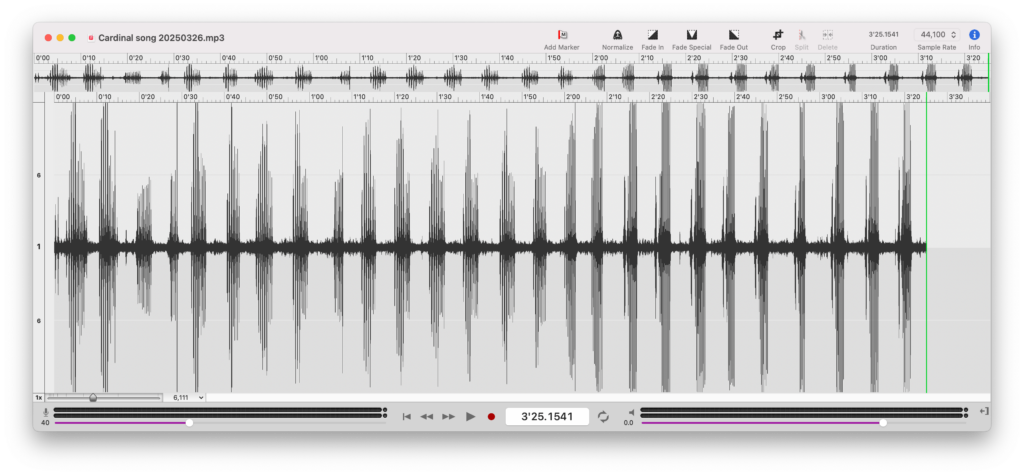
This morning Scott heard the cardinals outside his window and because he wanted to use some birdsong in his latest music project, he placed his phone on a chair on the deck and recorded some. I liked how he described it: I left the phone out on the deck then returned inside and went quietly about my business. When he told me about how similar each wave of sound looked, I asked if he could screen shot it and send me the sound file so I could post it here:

cardinal song, an image of sound waves
cardinal song / 26 march 2025

Wow! So uniform.

Happy 151st Birthday Robert Frost!

When the poem of the day on poetry foundation was a Robert Frost one, I figured it must be his birthday. Yep — 26 march 1874.

For Once, Then Something/ Robert Frost

Always wrong to the light, so never seeing
Deeper down in the well than where the water
Gives me back in a shining surface picture
Me myself in the summer heaven godlike
Looking out of a wreath of fern and cloud puffs.
Once, when trying with chin against a well-curb,
I discerned, as I thought, beyond the picture,
Through the picture, a something white, uncertain,
Something more of the depths—and then I lost it.
Water came to rebuke the too clear water.
One drop fell from a fern, and lo, a ripple
Shook whatever it was lay there at bottom,
Blurred it, blotted it out. What was that whiteness?
Truth? A pebble of quartz? For once, then, something.

A beautiful sonnet — 14 lines, 11 beats per line, almost iambic pentameter. Is that right? I always struggle to hear meter properly.

Love the description of a reflection: Me myself in the summer heaven godlike/Looking out of a wreath of fern and cloud puffs

And that something white, uncertain, seen briefly then lost to a ripple. Yesterday I posted some lyrics from “The Windmills of Your Mind” about the ripples from a pebble. Ripple is a great word.

Seeing this sonnet is making me think I should try that form for my color poems. I could study a few different ways of doing the sonnet — Diane Seuss, Terence Hayes, William Shakespeare. Any others?

oh orchid o’clock

A good morning on the poetry sites. Not only did I find Robert Frost’s poem, but I found a cool collection that fits in with my study of time: Oh Orchid O’Clock by Endi Bogue Hartigan. (note: I just emailed Moon Palace Books about ordering it! update: I ordered it!)

/it is the president’s turned up o’clock it is America’s deadliness and dailiness

o’clock / it is glued to the headline o’clock

it is lunchhour-beeline o’clock / it is it’s only Tuesday o’clock another

curbside memorial o’clock another caterpillar miracle o’clock another

people emptying from their lives o’clock or into

their lives o’clock the Nile floods the Nile floods every hotspell in this week

I discovered this book through poems.com, which had one of its poems posted today:

hour entry: I fall asleep with a rain sound/ Endi Bogue Hartigan

I fall asleep with the rain sound app of my cellphone, the app includes distant thunderclap sounds and there are people who recorded or simulated these sounds, and it is time to disagree and thank the dawn. I disagree with this rain, I feel absurd for thesimulation of it and yet my brain waves have come to depend on it, depend onsimulated porous points between the raindrops. Always the porous dream, always theneural authority, the reaction meme, always the authority of always, the puncture ofalways, time spent saying always, the spider legs of always, the sleep command, thewake spindles, the spider leg threatening to break from the spider.

So cool! Encountering Hartigan’s work, I was inspired to think about time in relation to my blind spot and the practice of running beside the gorge that has happened beside (and because of?) my vision loss. I wrote the following in my Plague Notebook:

my blind spot
breaks open seconds
pries apart the hard edges of
a beat invites me
to dwell inside

I am suspended between
beats as time slows
but never stops
with moves so slight it takes
a practiced eye to see
their soft shimmering
embrace what is not seen but felt —
wind
the rotation of the earth
a bench sliding into the gorge
rock crumbling
cone cells collapsing
a blind spot expanding

walk: 40 minutes
neighborhood / winchell trail / oak savanna
54 degrees

What a great afternoon walk with Delia the dog! No coat. No mud. Walked to the Winchell Trail then down beside the chain link fence. Drip Drip Drip — the sewer pipe in the ravine. Everything washed out — light brown, tan, yellowed. Up on the mesa in the savanna, a great view of the river. Was able to walk on the dirt path between the savanna and the 38th street stairs. They’ve put down some mulch, so it’s not as muddy. As I neared the entrance to the Winchell Trail, I passed the spot where I fell in the mud, straight on my tailbone. No mud now, only memories and a still-sore back.

On the way to the river, I noticed something interesting hidden on the tree trunk while Delia sniffed around. I took a picture of it:

= > ÷

When I was looking at it in person, I thought someone had carved the message in the tree, but studying it now, it looks like it’s a rock wedged in a crack. I probably should have taken another picture that wasn’t quite as close-up for scale. That is one tiny rock.

I had to look up how to type the division sign on a mac. Hold down option and /

march 10/WALKRUN

walk: 60 minutes
winchell trail
57 degrees

A slow walk with Delia the dog. Stopping and sniffing and pooping and peeing and listening nervously to rumbling trucks and roofers. On the Winchell Trail, a black capped chickadee just overhead feebeed and chickadeedeedeed at us. Only a few remnants of the snow remain. A mix of dry path with puddles and mud.

Near the end of the walk I decided that what I really needed to do with my back was loosen it up by walking faster. Maybe I’m tensing up too much? Also decided that I’d try a short run.

run: 2 miles
just north of lake street
59 degrees

Ran past the ancient boulder and down through the tunnel of trees. The floodplain forest looks barren — no snow or leaves on the trees, only brittle and brown on the ground. Felt pretty relaxed and a little awkward — not quite a hitch in my step, but not smooth either. That got better as I warmed up. Listened to the breeze passing through the trees, and voices running north. I put in my “Doin’ Time” playlist for my run south. Heard: Does Anybody Really Know What Time It Is; A Summer Wasting; Suspended in Time. All three offering visions of life outside the clock/capitalist time.

I almost forgot: I wore shorts today!

10 Things from my Walk and Run

  1. park workers in orange vests getting ready to do some work — trim trees? clear out brush? (walk)
  2. after weeks, they’re finally doing something about the gushing water on the corner of 46th! the barricades were gone, and so was the sound of water gone wild (run)
  3. chick a dee dee dee — a black capped chickadee in a tree just above my head — what I saw: a small dark flurry of movement on a branch (walk)
  4. the soft, energetic din of kids on the playground at Dowling Elementary (walk)
  5. a line of snow — a lump, not big enough to be a wall — stretched across the walking path (run)
  6. the river: open, shimmering, blue (walk)
  7. the tree line on the other side, a golden glow (run)
  8. a slight slip in mud on the boulevard between edmund and the river road (walk)
  9. the soft shadows of gnarled oak tree branches on the grass (run)
  10. 4 stones stacked on the ancient boulder (run)

circumambulation

Returning to circumambulation and the ceremony/ritual of looping around the gorge. A thought: when I swim at the lake I do multiple loops, but beside the gorge, I only do one loop. What’s the difference (mentally, spiritually, physically) between a loop vs. multiple loops. Also, where do my there and back runs — trestle turn around or the franklin hill and back or the falls and back — fit in? What sort of ritual are they?

Loosely, the structure of Gary Snyder’s “The Circumambulation of Mt. Tamalpais” is:

  • a brief description of place
  • a sacred chant/mantra
  • a further description — more details, directions, feelings/reflections/encounters

I’ll try this structure. I think I want to do the 8 loop that combines the ford and franklin loops. But, I’m taking it easy with the running right now, so maybe I should wait to do this until next month?

but now we really hear chanting
we can’t decode–Don’t
be so rational–a congregate speech
from the redtrembling sprigs, a
vascular language prior to our

breathed language, corporeal, chemical,
drawing our sound into its harmonic, tuning
us to what we’ve yet seen, the surround
calling us, theory-less, toward an inference
of horizontal connections there at

ground level
(Circumambulation of Mt. Tamalpais/Forrest Gander)

Some chants I might include:

I am the wind and the wind is invisible, all the leaves tremble but I am invisible

All trees are just trees

In every part of every living thing/is stuff that once was rock

Listen, I don’t think we’re going to rise/in gauze and halos./Maybe as grass, and slowly. Maybe as the long-leaved, beautiful grass (added the next day: these lines don’t fit with the others, not enough rhythm?)

Life is but Life, and Death is but Death. Joy is but Joy, and Breath is but Breath.

In the name of the Bee-
And of the Butterfly-
And of the Breeze–Amen!


march 6/WALKBIKE

walk: 25 minutes
neighborhood
27 degrees / patches of slippery ice

Where people shoveled yesterday, the path is mostly bare with a few streaks of slippery ice, but where they didn’t it is not. Slabs of thick, untouched snow. The slick spots were the most unwelcome, especially with my tight lower back. Aside from the ice, it was wonderful to be outside. Bright blue sky, chirping birds, warm sun. So warm that I took off my hat.

At one point Scott mentioned how the strip of grass between the sidewalk and road is not called a boulevard everywhere. It’s a regional thing. He couldn’t remember what else it was called and where he heard about it, but I did — at least where he heard about it; I couldn’t remember what else it was called. He heard about it from me, during one of our runs together. I couldn’t remember much else, so I had to look it up. Yep — here it is:

I described a New Yorker article I was reading before we left about forensic linguistics. My description included misplaced apostrophes, devil strips, and Sha Na Na. 

log entry on 8 april 2024

A linguist solved a crime in which someone left ransom notes that read, “Put it [the money] in the green trash kan on the devil strip at the corner 18th and Carlson.” Here’s the important part in the article:

And he knew from his research that the patch of grass between the sidewalk and the street—sometimes known as the “tree belt,” “tree lawn,” or “sidewalk buffer”—is called the “devil’s strip” only in Akron, Ohio.

Wow, I’ve amassed a lot of information on this blog. Some of it I always remember, and some of it comes back when my memory is triggered, like today.

bike: 30 minutes
basement

I wanted to move my legs and get my heart rate up today so I biked. Watched part of Fame — the end of freshman year and the beginning of sophmore year. Two scenes I especially recall: 1. when Mrs. Sherwood shames Leroy for not being able to read in class — terrible and 2. when the acting teacher instructs the students to pay attention to the details — chewing, talking — of their life:

I want you to observe yourself doing ordinary everyday things. You’ll be asked to duplicate those here in class. An actor must develop an acute sense memory so concentrate on how you deal with things in your world. How you wash your face or hold your fork or lift your cup or comb your hair. Observe and study your own mechanicalness. See if you can catch yourself in the very act of doing something or saying something. See if your actions and reactions fall into patterns and what those patterns are. And in particular, pay close attention to the physical world. Isolate and concentrate on the details.

from Fame –first year (1980)

I’ve been doing this with my vision for several years now, partly because I’m curious and partly because I think it’s necessary for me to function. To isolate and understand and work around the strange and unexpected ways my eyes work (or don’t work).

I could also imagine using this exercise while running or walking as a way to achieve “extreme presence” (from CAConrad). Focusing on breathing or the lifting of the foot or the swinging of the arms, etc.

It felt good to bike. My back didn’t hurt at all. Only my left knee, a little, which is normal. Maybe I’ll do a week of biking. Could I work my way up to an hour on the bike?

conjunction junction, what’s your function?

In late fall or early winter, I wrote a haunts poem about all that the gorge could hold. I named it And. This morning, I found another poem with that title:

And/ Nicole Sealey (click link for audio)

Withstand pandemonium

and scandalous

nightstands

commanding candlelight

         and

         quicksand

and zinfandel

clandestine landmines

candy handfuls

and contraband

         and

         handmade

commandments

and merchandise

secondhand husbands

philandering

         and

         landless

and vandal

bandwagons slandered

and branded

handwritten reprimands

         and

         meander

on an island

landscaped with chandeliers

abandon handcuffs

standstills

         and

         backhands

notwithstanding

thousands of oleanders

and dandelions

handpicked

         and

         sandalwood

and mandrake

and random demands

the bystander

wanders

         in

         wonderland.

Along with the poem, there was a link to a writing exercise inspired it: Conjunctions/Connections, After Nicole Sealey by Maggie Queeney

  1. Read the poem “And” and listen to it several times. Jot down some notes.
  2. Pick a conjunction other than and — or, but, for, nor, yet, so. Make a list of words that contain your chosen conjunction.
  3. Turn your list of words into a poem. “Keep the sound of the word in the air as long as possible through rhyme and repetition.”

I think I’ll choose “or.” When I was writing my and poem in November, I told Scott about it on one of our runs. He mentioned how “and” and “or” work in his coding of web databases:

A mile later, Scott described how you code and in css (where and means both this and that must exist to make a statement true) and how you code or(where or means either this or that can exist to make a statement true). I was fascinated by how and was restrictive and narrowing in the code while orwas expansive. In my poem, I’m understanding and as generous and open and allowing for more possibilities not less. I told Scott that I might need to write an or poem now. And is accumulation, more layers while or is a stripping down. 

And = all these things can be true, and moreOr = at any give time, any one of these things could be true

log entry on 24 nov 2024

There’s also a great “or” poem in this entry.

march 2/RUN

5 miles
bottom of franklin hill
26 degrees

Hooray for being outside and on the walking trail! Hooray for not much wind! Hooray for running up the Franklin hill! My back was a little tight, but not too bad. My legs felt fine.

The river was open; the only ice was on the edges. The sky was a mix of clouds and bright sun. Before the run I heard some geese — did I hear any during? I don’t think so. Also heard before the run: some kids having fun inside a house — laughing and yelling through the closed windows.

At some point, I had an idea for my monthly challenge: the run as ceremony. Inspired by Ellis’s Aster of Ceremonies, I want to return to Gary Snyder, Mount Tamalpais, and circumambulation. What sort of ceremonies can I make out of my run that brings together my blind spot and the gorge?

10 Things

  1. bright pink graffiti on a foot of the 1-94 bridge
  2. the top of one section of the wooden fence on the edge above Longfellow Flats is missing
  3. the chain across the old stone steps has been removed
  4. the path was almost completely clear — the only bit of snow I recall seeing was under the lake street bridge: a low and narrow ridge — just remembered one other bit of snow: just past the franklin bridge
  5. a full-length mirror left by the trashcan
  6. disembodied voices — coming from inside houses, below in the gorge, far behind me on the trail
  7. sh sh sh — my feet striking the grit on the asphalt
  8. my shadow briefly appeared – not sharp but soft, faint
  9. at least 2 trios of runners, some pairs, several runners on their own
  10. my friend, the limestone slabs propped up and looking like a person sitting against the underside of Franklin, is still there. I’d like to name them and add them to my list of regulars: Lenny the limestone?

lower back pain

My lower back has been sore lately. Sore enough that I took 5 days off of running. Not sure why I’ve waiting this long, but i decided today to look up lower back stretches for runners. I found this video and its 4 helpful stretches — the video claims to have 5 stretches, but they are only 4. I wonder what the missing one was?

correction, 2026: All five stretches are there, there just isn’t a marker for the third one, a 90-90 stretch. That one starts at about 4 minutes in.

The stretches: pretzel, thread the needle, plank to lunge, hip sweep

I’ll see how it feels in a few hours, but right now, having just stretched, it feels good!

a purple spill from march 1

I wrote this yesterday, but didn’t have a chance to post it.

It’s March and the purple hour is over, but in true purple fashion, the color can’t be contained to one month. Always it oversteps its boundaries. Reading the poem of the day, “Fog” by Emma Lazarus, purple appeared:

Swift, snowy-breasted sandbirds twittering glance 
Through crystal air. On the horizon’s marge, 
                Like a huge purple wraith, 
                The dusky fog retreats.

wraith

1
a: the exact likeness of a living person seen usually just before death as an apparition

b: GHOST, SPECTER

2

an insubstantial form or semblance SHADOW

3

a barely visible gaseous or vaporous column

f you see your own double, you’re in trouble, at least if you believe old superstitions. The belief that a ghostly twin’s appearance portends death is one common to many cultures. In German folklore, such an apparition is called a Doppelgänger (literally, “double goer”); in Scottish lore, they are wraiths. The exact origin of the word wraith is misty, however, and etymologists can only trace it back to the early 16th century—in particular to a 1513 translation of Virgil’s Aeneid by Gavin Douglas (the Scotsman used wraith to name apparitions of both the dead and the living). In current English, wraith has taken on additional, less spooky, meanings; it now often suggests a shadowy—but not necessarily scary—lack of substance.

Merriam-Webster entry

marge = margin = edge

Wraith — I like that word and what it conjures. And to make it purple? Good job, Emma! I’m not sure about the middle section where she imagines the “orient town,” but I like “Fog,” especially this:

for on the rim of the globed world 
I seem to stand and stare at nothingness. 
                But songs of unseen birds 
                And tranquil roll of waves

Bring sweet assurance of continuous life 
Beyond this silvery cloud. Fantastic dreams, 
                Of tissue subtler still 
                Than the wreathed fog, arise,

And cheat my brain with airy vanishings 
And mystic glories of the world beyond. 

Returning to the purple — I like how she imagines the lifting fog as purple. Back in November of 2022 (how has it been that long?!) when I studied gray, I devoted a day to fog and mist: 23 nov 2022. Last month, purple — especially lavender and lilac or eggplant and dark purple — replaced gray. Where I used to see gray everywhere, now I see purple, or imagine purple.

feb 28/WALKBIKERUN

am walk: 20 minutes
neighborhood
wind: 20 mph / 42 mph gusts

Sitting at my desk in the front room before heading out for a walk, I could hear the wind howling. I wrote in my Plague Notebook, Vol. 24, the wind purpled the sky. Later, walking with Scott and Delia, feeling and hearing and seeing the wind, I said it again and explained it to Scott: the blustery wind, like someone mad and full of bluster, their face turning purple with outrage. I had been planning to try running outside today, but after being pushed around by the wind, I decided I’d prefer to be in the basement.

My favorite things about the wind: the way it swirled the leaves on the sidewalk; turning the corner and feeling the wind on my back, seeing the leaves flying ahead of me.

bike: 30 minutes
run: 1.5 miles
basement

Watched part of S2: episode 1 of Sprint on Netflix while I biked. I’m so glad I put on the audio descriptions! I could never read the big block text they used for identifying people and locations. It’s pretty good, even though they’re using a worn storyline: rival sprinters, one is flashy and talks a lot, the other is quiet and avoids the spotlight.

Listened to a running podcast for the first 10 minutes, then an energy playlist for the rest. I didn’t want to do much in case my back or hips flared up. They both seem fine — not completely pain free, but not painful either. It felt good to get my heart rate up for the first time since Saturday.

Writing this part of the entry at 11:45 am, it’s even windier with 47 mph gusts! Very glad I didn’t go outside to run!

the purple hour

The final purple hour. I’ve enjoyed devoting time to this color. Today’s goal: to write some lines inspired by my exploration.*

2:06 am / dining room

  • thick, heavy stillness
  • the clicking keys echoing in the silence
  • a soft, high ringing in my ears
  • bouncing my legs vigorously
  • “lavender gray: a widow’s shroud” from The Nomenclature of Color/ Richard Jones
  • lavender is the new gray

rituals/ceremonies for each of my main colors? see CA Conrad on red

2 shadows, cast on the closed curtain, light source: a neighbor’s security light
shadow 1 = a thick smear of bird poop on the glass turned into a small form on the curtain
shadow 2 = the thin branches of the serviceberry bush, shimmering in the wind, thin shadows vibrate on the curtain

The wild/ing in this girl is purple, I think, A deep and dark purple.

Wilding/ Shara McCallum

Machetazo!, Bony Ramírez & Blonde Dreams, Alison Saar

you can take the girl out of the wilderness
you can strand her bewilder her for a time
you can even hang her upside down
in your rickety attempt to shake loose
the source of her power but you won’t ever
disentangle the wilding from her
the force of a thousand suns unfurling
and hurling her toward the ground
you won’t be able to erase the traces
of salt lacing her ravenous dreams
oh you can try unwebbing her feet
but the lizard in her will keep sunning
itself as the day is long and at nightfall
will crawl up your walls lurking
at the corners of your vision
goading you on while she thwarts
your every endeavor abandoning
her tail anything required of her
to keep eluding your capture

*Here’s a first draft of something about purple:

Purple Things

a wind-stirred sky / the space between your eye and the object you’re looking at / agitation / the light from a full moon filtered through the blinds / the square shadow it casts on the carpet / deep inside the beat a thought a dream / darkened doorways / a bruise / mold / mist / a sunset after a volcano / a fashion craze / a widow’s shroud / fibs / a house, settling / the beginning / the end / interiors / oxygen-starved extremities / ornamental grass / asters / tantrums / restlessness / the buzz beneath / impending thunderstorms / ink / iodine / inheritance: a mother’s jacket, a daughter’s despair / fake fruit flavor / static / the only color I see when I wake up in the middle of the night

feb 23/WALK

1.5 miles
neighborhood, with Delia-the-dog
38 degrees

Ahh! Sun, above freezing, no wind! Birds! Melting snow! The promise of spring! I’m taking a break from running today because I’ve run 5 days in a row and my lower back is tight and slightly sore. Also, I wanted to make sure that Delia got a proper walk today. It’s difficult to balance walking her and running. And, when it was so cold last week, she didn’t want to go out that often.

Lots of walkers and dogs out on the sidewalks. Overheard: 2 women walking in the street — one to the other, isn’t that cute! aww . . . poor thing. Poor thing? Were they talking about Delia in her cute orange letterman’s sweater? If so, why did they say, poor thing? Did I miss something when I put her harness on?

10 Things

  1. blue, cloudless sky, only a few birds and branches in it
  2. drip drip drip — one gutter
  3. gussssshhhhhh — another gutter
  4. a steady stream of cars on the river road
  5. a steady stream of runners on the trail
  6. one runner in shorts, their bare white legs glowing in the sun
  7. soft snow on the grassy boulevard, no sharp snaps from my striking feet as we walked, avoiding the voices and a clanging collar behind us on the sidewalk
  8. the faint knocking of a woodpecker
  9. a view of the river through the bare trees from above on edmund: all white, looking less like water and more like field
  10. that sun! stopping to let Delia sniff, feeling the warmth on my face — flashes of memory from other warm winter days

the purple hour

2:30 am / bedroom

light coming in through the ineffective blinds, casting purple — lavender carpet and walls, indigo couch and closet interior

8:45 am / dining room

Trying to determine which tint of purple the carpet was, I encountered periwinkle.

Periwinkle is a color. . .

A subset of violet, which is a subset of purple, periwinkle denotes a precise shade that appears somewhat brighter than lavender, bluer than lilac, clearer than mauve, and dimmer than amethyst. But it’s hard to say with precision, because the purples are strange ones, polarizing, and violets are even more so. Few hues are more beguiling and more reviled than this grouping, the last stop on the rainbow and the tacked-on v at the end of that schoolchild’s mnemonic, Roy G. Biv. According to the scholar David Scott Kastan, shades of violet exist within their own special category. Violet is, like glaucous, a color-word that denotes a certain quality of light. “Violet seems to differ from purple in whatever language—not so much as a different shade of color than as something more luminous: perhaps a purple lit from within,” Kastan writes in On Color, his 2018 book on the subject. “Violet is the shimmering, fugitive color of the sky at sunset, purple the assertive substantial color of imperial robes.”

Periwinkle: the color of poison, Modernism, and dusk

a window of time . . .

But lately, I’ve found myself waiting for the sun to go down, timing my walks so that I can be outside then, when the bats begin to swoop around the oaks and the mosquitoes hum around my face. It’s not the golden hour (which occurs about an hour before the sun touches the horizon), it’s the periwinkle window. It lasts only a few minutes in the summertime; dusk descends fast in the north. But for fifteen minutes, the sky is painted with various shades of violet, indigo, and mauve. At dawn and dusk, my tiny little dead-end road becomes another place, quieter than during the daylight hours, but visually much louder.

Periwinkle: the color of poison, Modernism, and dusk

…a flower (vinca minor)

The species is commonly grown as a groundcover in temperate gardens for its evergreen foliage, spring and summer flowers, ease of culture, and dense habit that smothers most weeds. It was once commonly planted in cemeteries in parts of the Southern U.S. and naturalized periwinkle may indicate the presence of graves whose other markers have disappeared.

source

from Hymn to Life/ James Schuyler

Everyday, in every room a shawl tossed untidily upon a chair or bed
Created no illusion of lived-in-ness. But the periwinkles do, in beds
That flatten and are starred blue-violet, a retiring flower loved,
It would seem, of the dead, so often found where they congregate. A
Quote from Aeschylus: I forget. All, all is forgotten gradually and
One wonders if these ideas that seem handed down are truly what they were?
An idea may mutate like a plant, and what was once held basic truth
Become an idle thought. like, “Shall we plant some periwinkles there
By that bush? They’re so to be depended on.”


…a snail/whelk

Littorina littorea is known as the Common Periwinkle. It is native to Europe from the White Sea, Russia to Gibraltar. It has been introduced to the West and East coasts of North America and the Mediterranean. Some introduced occurrences have failed to establish sustained populations, but others have persisted, especially on the East Coast from Newfoundland to Virginia. This snail is characteristic of intertidal rocky shores, wharves, and pilings, but also occurs in mudflats and marsh habitats. It is a common food item in Europe, but is rarely eaten in North America. It is highly abundant in parts of its introduced range and has had impacts on food webs, through competition with native species and increased grazing which reduces seaweed abundance. It is also host to a variety of parasite species.

source

I first encountered periwinkle-as-snail in a poem by James Merrill:

from Periwinkles/ James Merrill

You have seen at low tide on the rocky shore
How everything around you sparkles, or
Is made to when you think what went before.

Much of this blaze, that’s mental, seems to come
From a pool among the creviced rocks, a slum
For the archaic periwinkle.

feb 22/RUN

3.1 miles
ford bridge and back
23 degrees

Feels like spring today! Birds! Warm sun! Melting and dripping snow! It is supposed to warm up all next week. The path wasn’t that crowded, which is surprising because it’s so nice and it’s Saturday. I don’t remember much from my run, other than wondering if my back was hurting (occasionally, a little) or if I should stop to tie my shoelace (I did). Can I remember 10 things?

10 Things

  1. 3 or 4 fat bikes on the dirt trail that is on the other side of the river road and runs alongside Minnehaha Academy, lower campus and Becketwood
  2. a biker and a bike stopped at the bench across from Folwell
  3. the rounded shadow of the light part of a lamp post
  4. a thick layer of snow on the walking path between folwell and 42nd
  5. three runners ahead of me evenly spaced across the whole path
  6. my dark shadow ahead of me as I ran north
  7. the clanging of an unseen dog collar
  8. a walker talking loudly on her phone as she walked, her voice echoing through the neighborhood and then above the oak savanna
  9. a runner in a bright blue jacket turning onto the trail from 42nd
  10. the river, all white, all covered in snow

I listened to voices as I ran south, the mood: energy playlist on the way back north.

the purple hour

1:35 am / dining room

Listened to Monica Ong’s “Lavender Insomnia.

7:55 am / dining room

The poem of the day on Poetry Foundation is First Fig. Figs can be many different colors but are often associated with purple. Since I’ve posted this well-known poem about a candle burning at both ends before, I decided to find out if Millay had written any other fig poems.

Second Fig/ Edna St. Vincent Millay

SAFE upon the solid rock the ugly houses stand:
  Come and see my shining palace built upon the sand!

First Fig and Second Fig are from Millay’s 1922 collection, A Few Figs from Thistles. Is her use of figs and thistles a reference to Matthew in the Bible?

Ye shall know them by their fruits. Do men gather grapes of thorns, or figs of thistles? Even so every good tree bringeth forth good fruit; but a corrupt tree bringeth forth evil fruit.

Matthew 7:16-20 King James Version (KJV)

Speaking of thistles, my mom often had globe thistles in her garden. After she died, I recall wanting to grow them in her memory, but I can’t remember why. Is it because butterflies like their round purple flowers, or because I do?

feb 20/RUN

5.5 miles
bottom of franklin hill and back
9 degrees

Outside! Very bright today. A mix of moments of feeling great and feeling not so great — more feeling great. Foot prints in the snow, lamp post shadows, patches of brown ice. Black capped chickadees! A white river, a barren beach, a fat tire e-bike buzzing past me. A BLUE! sky — wow! Fogged up sunglasses. A delayed greeting: Hi Dave!

During mile 2, I chanted purples:

lavender / lavender / lavender
amethyst / amethyst / amethyst
indigo / indigo / indigo
grape
orchid / orchid / orchid
iris / iris / iris
wisteria

Thought about a blueberry looking more purple than blue, then the shade of purple: sucker. I like the word sucker — a candy, a fool, someone who sucks on something, a person on a straw, or something that sucks on something, a plunger on a toilet, an octopus on an arm.

Listened to the birds, the cars, and the gurgling sewer on the way north. Listened to an energy playlist — Don’t Stop Me Now, Work it, Sabotage — on the way back south.

the purple hour

12:45 am / dining room

restless, difficult to be still enough to type/think

(remembering, 7:05 am) looking out the kitchen window, seeing 2 dark forms in the white snow — bare patches or something more? Staring for a few mnutes — am I imagining that slight shift? No, 2 animals, standing still for minutes. What are they doing? Quick movement, then bounding figures. Rabbit-like. But these animals look so dark — is it a trick of the dim light — bunny fir darkened in the lilac light? [there is no indigo in a backyard illuminated by neighbor’s security lights.] Or, could these creatures be raccoons?

update, 20 feb 2026: A definite answer: bunnies! All late fall and winter, 2 or more bunnies have been hanging out under our crab apple tree — at night, in the afternoon, at sunrise and sunset. They’re very bold, these bunnies, not running off when I walk by. When this happens, I’ve started saying, these bunnies are as bold as brass! Why? Not sure. And, I don’t want you to get the wrong idea: I like bunnies or rabbits about as much as I like squirrels, which is not at all.

2:44 am

a word appears in my head: amethyst — February stone, quartz, ancient Greeks believed it would prevent intoxication

7:49 am / dining room

A journal: Amethyst Review

In a Robert Frost poem, October:

Release one leaf at break of day;
At noon release another leaf;
One from our trees, one far away.
Retard the sun with gentle mist;
Enchant the land with amethyst.
Slow, slow!
For the grapes’ sake, if they were all,
Whose leaves already are burnt with frost,
Whose clustered fruit must else be lost—
For the grapes’ sake along the wall.

A myth created in the 1500s about a nymph and Bacchus:

In his poem “L’Amethyste, ou les Amours de Bacchus et d’Amethyste” (Amethyst or the loves of Bacchus and Amethyste), the French poet Rémy Belleau (1528–1577) invented a myth in which Bacchus, the god of intoxication, of wine, and grapes was pursuing a maiden named Amethyste, who refused his affections. Amethyste prayed to the gods to remain chaste, a prayer which the chaste goddess Dianaanswered, transforming her into a white stone. Humbled by Amethyste’s desire to remain chaste, Bacchus poured wine over the stone as an offering, dyeing the crystals purple.

wikipedia

A cluster of grape gems to buy.

In a Dan Beachy-Quick poem:

Anniversary/ DAN BEACHY-QUICK

You are for me as you cannot be
For yourself, chaos without demand
To speak, the amethyst nothing
Hidden inside the trinket shop’s stone,
Dark eyes dark asterisks where light
Footnotes a margin left blank. You
Don’t look up to look up at the sky.
Your ears parenthesize nothing
That occurs, that I keep from occurring,
In the poem, on the page, as you are
For me, not a shadow, but a shade
Whose darkness drops from no object
But is itself yourself, a form of time
Spanning nothing, never is your name.

9:46 am / kitchen

Telling Scott about how the word amethyst popped into my head and that it was the birthstone for February, he said that he knew that because his grandmother was born in February and she often wore amethyst jewelry.

12:31 pm / front room — chair

Thinking more about Dan Beachy-Quick’s lines:

not a shadow, but a shade
Whose darkness drops from no object

Thinking about shade as a hue with black added to make it darker (as opposed to tint, where white is added to make something lighter). Also thinking about shade as relief on a hot day, a welcomed darkness.

added hours later: Rereading the poem, “Anniversary,” I looked it up: amethyst is given for the 6th wedding anniversay.

feb 16/RUN

note: I’m starting this post at 9:50 am. The temp is 4 degrees / fees like -11. The wind is 11 mph with gusts up to 20 mph. At this point, I’m thinking I will run inside on the treadmill. Will I, or will some part of me convince the rest to run outside?

3.5 miles
ford bridge and back
7 degrees / feels like -10
50% snow-covered

We did it. Good job legs and lungs and heart, you convinced brain that we really needed to be outside this late morning! Almost all of the layers were on: 2 pairs of black running tights; dark gray tank top; green long-sleeved shirt; orange pullover; dark purplish/blueish/grayish pullover with hood; purple jacket; orange striped buff; black fleece cap with ear flaps; black gloves; pink striped gloves; 2 pairs of socks — gray (long) / black (short). At times, I was too warm.

It was wonderful and sometimes hard, especially when I was running into the wind on the way back. It was also bright — glad I had my sunglasses. Encountered someone in orange with their hand up to shield their eyes as they walked south. Saw the round shadow of a street lamp and the jagged shadow of a small tree. Passed a group of four walkers, laughing and yelling and having fun on the double bridge.

Did I think about purple at all? I can’t remember now. The only color I recall noticing was orange.

the purple hour (15th and 16th of feb)

3:38 am / dining room / 15 feb

the heat turnning on, the house shifting settling, my legs restless
purple mountains — in Japan, looking out at the mountains, different shades of purple — fall, 1994
Emily Dickinson purple — sunsets and sunrises
someone shoveling at 4 am

[discussion below added at 10:30 am on 16 feb]

Where Ships of Purple—gently toss — / Emily Dickinson

Where Ships of Purple—gently toss —
On Seas of Daffodil—
Fantastic Sailors—mingle—
And then—the Wharf is still!
F296 (1862) 265

No one does sunsets better than Dickinson. I wonder if Amherst sunsets are still so colorful. Where I’ve lived sunsets are primarily red, pink, and gold, but the ones she describes often have purple. This one does, too. Here she sees great ships, large purple clouds, gently tossing in their moorings. The sea beneath them is tinted golden, “Daffodil,” from the setting sun. The mingling and fantastic sailors are no doubt smaller clouds that move among the larger ship-like ones, their shapes constantly changing. When the sun sets the sky turns dark and “the Wharf is still!”

the prowling bee

The prowling bee has been such a wonderful resource for me. Reading the comments for this poem, there was speculation about why the Amherst sunsets were so brilliant and purple:

Romantic era sunsets WERE particularly vivid, due to volcanic ash from several cataclysmic eruptions worldwide. The Hudson River School artists and their sunsets might not have been hyperbole, after all, nor were ED purple sunsets.

Another commenter doubted this suggestion, so I did a quick search and found a pop science article about a study on sunset paintings and volcanic ash: How Paintings of Sunset Immortalize Past Volcanic Eruptions

Volcanoes can cause some of the world’s most spectacular sunsets. An eruption spews small particles of gas, dust and ash, called aerosols, high into the atmosphere where they can spread around the world. The particles can’t be seen during the day, but about 15 minutes after sunset, when conditions are right, these aerosols can light up the sky in brilliant “afterglows” of pink, purple, red or orange.

The impact of climate/climate disruptions on how we see color? Fascinating. Earlier this morning, while doing my “on this day” practice, I reread my entry from 16 feb 2024. In it, I described a photo I took above the gorge.

The most important thing about this image is how the branches create a net which mimics how my vision often works — I can almost see what’s there, but not quite. Secondary, but connected, is the feeling of being disoriented, off, almost but not quite, untethered, which comes from swirling forms and the climate crisis — there’s almost always snow on tthe ground here in February. Where are my Minnesota winters?

This last bit about climate crisis and lack of snow returns me to the ash in the sky and its effect on how 19th century artists saw and depicted the world. Many places to go with this, for now I’m thinking about how my vision loss (or the making strange of my vision) has enabled me to be more open (than many people with “normal” vision) to understanding vision as complex and not as simple or straightforward as “what you see is what you get.” Does that make sense?

1:50 am / dining room / 16 feb

doorways/thresholds are definitely purple — a deep, dark purple
the air above the gorge: different versions (tints/shades) of purple
purple hums, a soft lavender static in my ears
lachrymose purple 
originally wrote violet static, but looked up the color again and thought it was too dark for the static I was hearing in my head

9:46 am / front room / 16 feb

Thought more about violet. Decided to search, “Alice Oswald violet.” Found this beautiful poem:

Violet/ Alice Oswald

Recently fallen, still with wings out,

she spoke her name to summon us to her darkness.

Not wanting to be seen, but not uncurious,

she spoke her name and let her purple deep eye-pupil

be peered into.

‘Violet,’ she said

and showed her heart under its leaf.

Then she leant a little frightened forwards

and picked a hand to pick her.

And her horrified mouseface, sniffed and lifted close,

let its gloom be taken and all the sugar licked off its strangeness

while we all stood there saying, ‘Violet! Violet!’

fingering her blue bruised skin.

Finally she mentioned

the name of her name

which was something so pin-sharp,

in such a last gasp of a previously unknown language,

it could only be spoken as a scent,

it could only be heard as our amazement.

“purple deep eye pupil”: so good!

“the name of her name” — I wrote in my notes: the flower is never one solid, consistent color — the color is an abstraction, a taking one part for the whole, a disconnection — to name a color is to reduce the experience and perception of that color to one thing — colors cannot be fully named

What is lost — in our perception, experience of the world — when we reduce what we see to a fixed color/fixed name?

This question reminds me of something I read in Turning to Stone on the importance of naming yesterday:

The names themselves are, of course, human constructs, but the act of naming requires making distinctions that sharpen the powers of observation.

*

Taxonomy is comforting because it creates a sense of control and finitude in a chaotic and open-ended world.

Turning to Stone / Marcia Bjornerud

Lists! I love lists. My lists aren’t taxonomies, but something else . . .

The proper name of God is a list.

Valentina Izmirlieva in Aster of Ceremonies

Once I get the audiobook of Aster of Ceremonies, I want to put name as taxonomy and control in conversation with JJJJJerome Ellis’ “Liturgy of the Name” and “Benediction.”

feb 12/RUN

5.5 miles
bottom of franklin hill
6 degrees
100% snow-covered

A fine mist of snow. A few patches of ice, some slight slips. Cold. Fresh air. Sun behind clouds. For the first mile I didn’t see anyone else on the trails. Then, a few runners and walkers. No bikers or skiers. Sometimes I felt strong, sometimes I felt sore, all the time I was happy to be out there by the gorge.

today’s small victories: wasn’t sure how far I’d run but made it to the bottom of the hill. Almost stopped to walk near the top for a minute, but didn’t, kept going until the bottom. Ran from the bottom to under franklin — 3/4 of the hill — instead of walking like I planned

10 Wintery Things

  1. patches of ice on sidewalk that wasn’t shoveled
  2. cold air on my face — not quite cold enough to give me a brain freeze or to freeze the snot in my nose
  3. small, soft flakes or freezing rain freezing on my eyelashes
  4. the sharp thrust, grinding noise combo of feet walking on snow
  5. the river: a mix of white ice and dark (purple?) open water
  6. white, heavy sky
  7. bird song: cheese burger cheese burger
  8. the bluff on the other side of the river: a mix of white with bare brown branches
  9. all of the walking trails were covered in a few inches of snow, some of it untouched, some marked by tracks — feet and skis
  10. leaned over the wall in the flats and listened — a soft, sharp tinkling of snow hitting the ice on the surface of the river

Discovered Lee Ann Roripaugh’s awesome collection #string of pearls yesterday through her poem, #meteorology on poems.com. I’m thinking of buying the collection. Here are a few bits of it — it’s all tankas — that I thought of during my winter run:

from #meteorology/ Lee Ann Roripaugh

yesterday’s snow sleeps :: late this morning in quiet :: white sheets / while rickety
trees comb out fog’s heavy shanks :: of tangled, unruly hair

*

as gusted leaves buzz :: and whorl over snow-sugared :: roofs / but oh! this blown
fluttering’s not a swirling :: of leaves, but winter sparrows

~

ugh! snotted hoody :: pinkened tinge faint litmus stain :: (yes or no / minus
or plus) watercoloring :: blown-through tissues / torn storm blooms

*

wet-dark tree beaded :: in pearled bits of wintry mix :: excited finch swoops
in manic parabolas :: to sip from the leaky eaves’

icicle /

the purple hour

2:40 am — dining room

too restless to notice or think about anything . . . purple mauve lavender orchid magenta is this restlessness a light or dark purple? whatever it is, it’s thick

3:15 am — bedroom floor

shadows slats moon carpet
the slats are soft, barely visible
the shadow of the lamp, its long neck, and something else. the cup? tin of nuts? nope the arm of the sofa
the moon — so bright! how many more days of this moon? this clear sky?

*

  • grape jelly
  • eggplant, japanese
  • eggplant, italian
  • plum
  • pansy
  • Daphne’s dress (Scooby Doo)
  • Violet’s turning violet!
  • purple banana
  • hubba bubba (grape)
  • grape juice
  • raisins
  • easter dress
  • FWA’s favorite color
  • purple toe
  • vikings
  • Barney
  • Dino (Flintstones)
  • Professor Plum

feb 7/RUN

5.3 miles
bottom franklin hill
16 degrees
10% snow and ice covered trail

Less wind today. Cold, but not as cold as yesterday and still. Ran north on the bike trail. My lower back was still a bit tight and sore, my neck too, at least for the first mile. Then things loosened up. Mostly I felt relaxed and strong and glad to be outside on a clear path. I tried running on the snow-covered walking trail for a minute, but it was too uneven. Greeted Dave the Daily Walker, although it took me a little too long to say Hi Dave because I didn’t quite recognize him. Has his arm swing become less pronounced, or has my vision become worse? Chanted triples, first berries, then the world around me: big old tree/big pine tree/red stop sign/motorbike/rumblin’ truck/passing car

10 Things

  1. a strong smell of weed when I stopped at a bench above franklin
  2. orange — or was it pink or red? — bubble lettered graffiti under the 1-94 bridge
  3. the river was mostly covered, but the surface ice was uneven — some thick, some thin, some white, some gray — I thought I saw a few footprints on it — is that what they were?
  4. chickadeedeedee
  5. empty benches
  6. the faint jangle of a dog collar somewhere below me
  7. for a few stretches, the trail had strips of snow or ice or both — none of it slick or wet or a problem
  8. thought about how long the hill was from the bottom of lake street to the top — is it as long as franklin? how much less steep is it?
  9. mostly solitary male runners, one trio of women
  10. the air was cold and crisp and felt clean as I inhaled it through my nose, exhaled it through my mouth

purple hour

Before writing about last night’s purple hour, a thought: At some point early in the run I realized I was wearing a purple jacket. Of course I know it’s purple and I’ve noted that on this log lots of times, but today it clicked that it was purple. I started imagining my time by the gorge in the winter as another purple hour. Then a George Sheehan passage echoed in my head:

I must listen and discover forgotten knowledge. Must respond to everything around me and inside me as well….The best most of us can do is to be a poet an hour a day. Take the hour when we run or tennis or golf or garden; take that hour away from being a serious adult and become serious beginners. 

Running / George Sheehan, 1978

There’s something cool about how I (unintentionally) wear purple during these purple hours — a purple jacket during winter running, a purple robe during winter nights. It’s also interesting to me that I didn’t choose this color, both of them were chosen by my mother-in-law. When she died, I inherited her purple jacket; the purple robe was a christmas present from her years ago.

I like this idea of multiple meanings of the purple hour and how I can call these purple hours just because they involve me wearing purple — my purple habit (get what I did there? habit = a regular practice and clothing worn, like a nun’s habit).

Later in my run, I thought about dark purple and how closely it resembles, at least to me, dark brown tree trunks or dark water. Purple as another name for dark.

And now onto last night’s purple hours: two of the times I woke up in the middle of the night (how many times did I wake up and get out of bed?), I wrote about purple. Once on the ball in my bedroom (1:49 am), one at the dining room table (3:06).

1:49 am

  • Dark purple door (open closet)
  • Rustling dog
  • Droning fan layers of noise

3:08 am

  • midnights (tswift) lavender haze
  • violet purple lilac lavender
  • tints/shades of purple = mauve, orchid, eggplant, heather, iris
  • purple noise inside my ear — when the heat turns off
  • the house settling, unsettling
  • the other room, not illuminated by the light of my computer screen: deep ,dark purple
  • rhw (note: what is rhw? what word was trying to write?) hum, buzz from inside me stirring up the air
  • purple robe/comfy

Reviewing this list this morning, a thought: does anything rhyme with purple? Looked it up: hirple, to walk with a limp. I can envision purple as the color of limping. Now I’m thinking of having a hitch in your step which reminds me of un-hitching and Mary Ruefle and Claude Lévi-Strauss.

unhitching: to crudely paraphrase Lévi-Strauss, unhitching happens in brief moments when we can step outside of or beside or just beyond — below the threshold of thought, over and above society — to contemplate/experience/behold the this, the what it is, the essence of everything, Mary Oliver’s eternity. In your run above the gorge, near the river, below the trees, can you unhitch? (from log entry on 31 may 2023)

unhitching

The possibility, vital for life, of unhitching, which consists … in grasping, during the brief intervals in which our species can bring itself to interrupt its hive-like activity, the essence of what it was and continues to be, below the threshold of thought and over and above society; in the contemplating of a mineral more beautiful than all our creations; in the scent that can be smelt at the heart of a lily and is more imbued with learning than all our books; or in the brief glance, heavy with patience, serenity and mutual forgiveness, that, through some involuntary understanding, one can sometimes exchange with a cat.

Lévi-Strauss quoted MRH page 52

Purple/ Margaret Steele Anderson

A pigeon walking dainty in the street;
The morning mist where backyard fences meet;
An old Victoria—and in it, proud,
An old, old woman, ready for her shroud:
These are the purple sights for me,
Not palaces nor pageantry.

purple prose

I just learned about purple prose: excessive, overly verbose, wordy, too many metaphors, similes, adverbs, adjectives, language that calls attention to itself and lacks substance, a drama bomb. Just realized that Lumpy Space Princess, who coined “drama bomb” is lavender. Also, remembering Lumpy Space Princess inspired me to find and order a Drama Bomb t-shirt.

According to wikipedia, purple prose originates with the Roman poet Horace in his “Ars Poetica”:

Weighty openings and grand declarations often
Have one or two purple patches tacked on, that gleam
Far and wide, when Diana’s grove and her altar,
The winding stream hastening through lovely fields,
Or the river Rhine, or the rainbow’s being described.
There’s no place for them here. Perhaps you know how
To draw a cypress tree: so what, if you’ve been given
Money to paint a sailor plunging from a shipwreck
In despair?

jan 24/RUN

4.5 miles
minnehaha falls
20 degrees / feels like 8

Above 0, but still felt cold. It was the wind, swirling softly in all directions, that did it. Ran south to the falls. Wasn’t sure if I’d make it all the way there — it felt difficult — but I did! The creek and the falls were almost all frozen, only a small stream buried under the ice. Looking at the falls from my favorite spot, across the way, it looked like a giant column of ice, which it was.

10 Things

  1. a strong smell of cigarette smoke near the parking lot
  2. thin patches of ice on the cobblestone at the park
  3. kids’ laughter coming from across the road, at the school playground
  4. my favorite bench, above the edge of the world, was not empty today
  5. near the bench, the snow where someone had written “DAVIDSON” had melted
  6. the mottled walking trail at the park — mostly white snow, with grayish asphalt splotching through
  7. a lone black glove, dropped on the trail
  8. a dark gray chunk of snow, upright, looking like a squirrel waiting to cross the road
  9. a few runners, a few walkers, no bikers
  10. glanced down at the big sledding hill at the park — not much snow and no one sledding down it

I had wanted to thinking about stillness (inspired by an entry from 21 aug 2024) or to chant triple berries but mostly I forgot. I put in a mood playlist: energy at the halfway point and focused on the music, including Britney Spears’ “Work Bitch.” Wow.

before the run

This month, I’ve been reviewing all my entries from 2024 and giving attention to remembering and forgetting and then getting in too deep with thinking and theorizing and organizing ideas around themes. Past Sara — Dr. Sara who is too enamored with theories and ideas and being clever — wants to return. Present Sara needs to figure out some ways to prevent that from happening! Yesterday I decided to take out my scrabble tiles and make anagrams out “remember forget” and “I remember to forget.”

remember forget
bee or germ fret [m]
more bereft germ
beet form merger
forge meter [brm]
frog meter berm
beef rot merger [m]

I Remember to Forget
Got more meter fiber
Orbit form tree gem
bee form griot meter

What anti-theorizing thing can I do today?

A line remembered during my “on this day” practice:

Tell me, how do I steady my gaze
when everything I want is motion?
(Saccadic Masking/ Paige Lewis)

Everything I see is motion or in motion or never not in motion.

Last night we watched a Voyager’s episode in which the crew was experiencing strange symptoms — Captain Janeway had terrible headaches and couldn’t sleep; Chakotay was aging way too fast; Nelix was transforming into another species; and another red shirt went into shock then died. After 7 of 9 shifts into a different phase, she is able to witness what is happening: there are tons of people (human looking) on the ship hovering around the crew members and injecting them with needles. They are experimenting on them in the name of “medical research.” Yikes. Janeway’s headaches are not due to working too hard and not getting enough sleep or exercise, but because they are injecting her with dopamine. They keep increasing the dose to see how much she can take. I said to Scott, can you imagine if our headaches were caused by imaginary creatures messing with us? Then I started to imagine that this was the case. I also started to think about all the things we can’t see that live with us, like mites and bacteria and more. Surprisingly this didn’t freak me out.

Here is a poem I discovered yesterday. I love that first line and what it does as it follows from the title! I found it before I watched the Star Trek Voyager episode, but it is interesting to put them together to think about who/what we live with that we don’t see, or refuse to see:

The Houseguest / Marci Calabretta Cancio-Bello

Forgiveness was sitting in your kitchen when you got home, and now rests elbows on the table to watch you reach for a knife. You scrape the papery skin from a ginger root and slice it into thin coins. You think too hard about which mugs to pull from your cupboard: you might reveal too much; should you offer the one with the uncomfortable handle? Water boils. You divide the ginger evenly into both cups and pour. Spoonful of honey. You stir slowly, eyes down as though you might be able to forget. You stir too long. Forgiveness coughs politely, so you turn, place both mugs on the table, sit. Forgiveness leans forward. You lean back. You have forgotten what it is like to live with someone who eats all your cut watermelon, picks clean the skeletal vine of red grapes, shakes water spots onto your bathroom mirror without wiping them away. What thresholds of welcome have you crossed and recrossed? Most mornings, you listen for the body to move through your house and out the door before leaving your bedroom. Most nights, you ghost around each other without speaking. But now, as the rain drizzles into gloaming, you settle into your chairs, inevitable, a cupful of hesitation finally beginning to loosen your tongues.

And here’s part of a poem I encountered this morning that seems to fit or could be interesting to put beside “The Houseguest” and the Voyager episode:

If/ Imtiaz Dharker

If we could pray. If
we could say we have come here
together, to grow into a tree,
if we could see our blue hands
holding up the moon, and hear
how small the sound is
when it slips through
our fingers into water,
when the meaning of words melts
away and sugarcane speaks
in fields more clearly
than our tongues

That small sound, those blue hands, when words melt away! To give attention, to pray!

Continuing to review past august entries, past Sara wrote this for me, January 2025 Sara:

In January and February, I’ll remember the first orange buoy looking like the moon in an afternoon sky or the glow of orange when the light hits the buoy just right or the gentle rocking of the waves or that satisfied feeling after 90 minutes in the water.

log entry 22 aug 2024

I remember the faintness of that buoy, like the moon in the afternoon visible mostly by my belief that it was there. I also remember swimming that stretch, trying to avoid other swimmers and the ghost vines growing up from the bottom of the lake, seeming extra tall this summer. I’ll remember finally reaching that buoy and rounding it for the start of another loop, unable to see the far shore of a lifeguard or the other 2 orange buoys.

I remember the way the water glowed orange from the reflection of the buoy, or the quick flash of the smallest whisper of an orange dot, or the orange appearing only as a feeling of some disruption in the shoreline scenery — not really seen with my eyes, but registered by my brain — the idea that something was looming ahead.

I don’t remember gentle rocking, but I remember the wild ride of rounding the far green buoy and being pushed around by the water, or how the water seemed so hard to stroke in sometimes.

jan 18/RUN

2.6 miles
river road, south/north
8 degrees / feels like -1
25% snow-covered

I didn’t feel exceptionally cold, but it felt hard, my legs thick. I stopped at the bench above the “edge of the world” and looked out at the covered river. Someone wrote the name “Davidson” in the snow earlier this week and it’s still there. As I ran, I started chanting in triples:

strawberry/raspberry/blueberry
winter cold/winter snow/winter ice
arctic air/sizzling leaves/crusty snow

10 Things

  1. BLUE! sky
  2. crunch crunch crunch
  3. the river was white and closed except for a few spots that were dark and open
  4. a (non-fat tire) bike
  5. a runner’s raspy, hello
  6. running into the wind, being exhausted by it, wondering how the runners at Boston 2017, when it was cold and windy and raining, managed to run the whole marathon
  7. bright, blinding sun heading south
  8. some of the ice on the path was smooth, more of it was jagged and rough
  9. empty benches
  10. a truck driving by, then the strong smell of weed

My Heart Has Known Its Winter/ Arna Bontemps

A little while spring will claim its own, 
In all the land around for mile on mile 
Tender grass will hide the rugged stone. 
My still heart will sing a little while. 

And men will never think this wilderness 
Was barren once when grass is over all, 
Hearing laughter they may never guess 
My heart has known its winter and carried gall.

gall? I looked this word up and dismissed the definition I knew — gall as bold, impudent, he had the gall (read: nerve) to — because it didn’t make sense to me. Instead, I decided the poet meant

abnormal growths that occur on leaves, twigs, roots, or flowers of many plants. Most galls are caused by irritation and/or stimulation of plant cells due to feeding or egg-laying by insects such as aphids, midges, wasps, or mites. Some galls are the result of infections by bacteria, fungi, or nematodes and are difficult to tell apart from insect-caused gall

Plant Galls

I wasn’t satisfied with Merriam-Webster’s online definitions, so I logged into my library and accessed the OED (very cool that I can do this!) for more definitions. This one sort of works:

Something galling or exasperating; a state of mental soreness or irritation.

this one, too:

A place rubbed bare; an unsound spot, fault or flaw; in early use also a breach. Now only technical.

and this:

A bare spot in a field or coppice (see gall v.1 3). In the southern U.S. a spot where the soil has been washed away or exhausted.

Erosion, exhaustion.

I love the way the word gall with its plant/ field meanings and its human meanings reinforces the association being made between human’s exposed than covered grief and the ground’s exposed winter stone covered in spring’s grass.

I wanted to remember this poem because of the grass and the stone and the forgetting of winter when spring arrives. I don’t totally agree with its use of winter as metaphor for misery.

I like winter. I like breathing in the cold, the sound of snow falling, smelling the air. The silence and the sharp sounds. The view of the river — vast and bare. The subdued colors — pale blues and grays and dark browns. The less crowded trails. The bare-branched silhouettes. Movement slowed, stilled, suspended. Layers. The bright, cold sun.

jan 10/RUN

4.5 miles
minnehaha falls and back
21 degrees
100% snow-covered

Today the winter I want: big flurries, everything covered in a thin layer of snow, not too much wind, warmer, not slick — especially with my with Yaktrax on. Nothing was quite easy, but everything wasn’t as hard as my last run on Wednesday.

10 Things

  1. a white sky
  2. the contrast between shoveled and un-shoveled sidewalks — both still white, but the shovelled ones had a tint of gray or brown peeking through
  3. the clacking jawbone of a bird’s beak — a blue jay?
  4. the river was all white — if you didn’t know better, you could believe it was a field or a meadow
  5. approaching from above, hearing the falls rushing over the limestone
  6. kids yelling and laughing at the playground, one loud, high-pitched sound — was it a kid screaming or a whistle?
  7. amongst the kid voices, a deeper, more knowing laugh — was that from a teacher?
  8. the contrast on the creek surface: white snow with blackish-gray water
  9. every so often, a flash of orange — not always sure what it was, just a voice whispering, orange — a snow fence? a construction cone? a sign?
  10. bright headlights cutting through the sky, which was both bright — everything white! — and heavy

Listened to my “Remember to Forget” playlist on the way back. The first song up, Do You Remember Walter? by The Kinks. Two different bits stuck with me:

one: Walter, you are just an echo of a world I knew so long ago.
two: Yes, people often change./ But memories of people can remain.

This second bit got me thinking about how I can’t always (can I ever?) see faces clearly. When the face is too dark and shadowed, I just ignore it altogether. But when there’s some light and I can sort of see them, I often re-construct the features I can’t see with memories of their face from before I lost most of my cone cells. I’m not remembering their face, but creating it. After thinking that the idea of remembering as re-memembering — putting a body back together — popped into my head. Yes! I take my image of face, only as fragments — the curve of a nose or a chin, a bit of eye — and turn it into something whole.

As I kept running, I thought more about remembering and memories and my vision and how I rely on past experience and habits to navigate. And now as I write this, I’m thinking about how everyone’s vision — not just mine — relies on a building up of past experiences (memories?) with things to be able to see them. Here I’m remembering something that I read in Robin Wall Kimmerer’s Gathering Moss:

the sensation of sudden visual awareness is produced in part by the formation of a “search image” in the brain. In a complex visual landscape, the brain initially registers all the incoming data, without critical evaluation. Five orange arms in a starlike pattern, smooth black rock, light and shadow. All this is input, but the brain does not immediately interpret the data and convey their meaning to the conscious mind. Not until the pattern is repeated, with feedback from the conscious mind, do we know what we are seeing.

Learning to See in Gathering Moss/ Robin Wall Kimmerer

I’m continuing to read JJJJJerome Ellis’ Aster of Ceremonies. Wow!

Prayer to My Stutter #2/ JJJJJerome Ellis

You restore
a living
shoreline
between word
and silence

This beautiful prayer moves right into the next offering, Octagon of Water, Movement 3, which was titled by its first line when it was published in Poetry:

excerpts from The name of that Silence is These Grasses in the Wind/ JJJJJerome Ellis

1

The name of that silence is these grasses in this wind, and the name of these grasses in this wind is that other place on the other side of this instant. This instant is divided by curtains of water and the sound of shuddering time. A sunflower reeling with sun, six hands stretched in offering. This unsearchable, uncancellable instant wraps the shoulders of the grasses like a shawl stilled by the stoppage. 

How is/isn’t the instant similar to Marie Howe’s moment? If you listen to the recording on Poetry, you can hear the stretched silence as Ellis’ voice stops before pronouncing certain words.

2

This morning come shyly or boldly into the fertile field, however you are, come, come and stay in the rearrangement, the pressure of thumb on fescue blade, a year wheeling within a day, two round moments of warm mouth, finally at peace. The psalm is a key if only we can find the door. Do not swallow your dysfluent voice. Let it erupt in its volcanic flowering. Stoppage thence passage, aporia, poppy bursting with fragrant seed. 

What a beautiful description and reclaiming of a stuttering voice on the other side of the stoppage! The erupting bursting flowering dysfluent voice.

I’m inspired by how Ellis takes his stutter and turns it into this beautiful instant between silence and word. For them, the stoppage is a/the key aspect of the stuttering. What are the most important elements of my strange vision?

jan 6/RUN

5.5 miles
bottom of franklin hill
11 degrees / feels like 5

Another sunny, snowless day. A little wind, some cold air. Wasn’t planning to run 5 miles, but I wanted to get to the bottom of the hill so I could see the surface up close. Iced over — not smooth, but with seams and cracks.

The Mississippi river at the bottom of the franklin hill. White ice, cracks, and shadows on its surface. Beyond it, the east bank with barre branches and blue sky.
ice on mississippi river / 6 jan 2025

I’m glad I took a picture because I did not remember it looking like this! I was visually a surface that was more gray and uniform with cracks creating big and flat sheets of ice. I didn’t remember the shadows or the blue or how uneven it all looked.

As I ran, I listened to my “Remember to Forget” playlist. It started with “I Remember it Well,” from Gigi. I heard the opening lines:

We met at 9
We met at 8
I was on time
No, you were late
Ah yes
I remember it well

I thought — wait, if he thought they were meeting at 9, he wouldn’t have thought he was late if he got there after 8 — yes, these are they thoughts I have as I run. I thought about how subjective memory can be and wondered how certain we could be that she remembered correctly. Then I heard these lyrics:

Ah yes
I remember it well
You wore a gown of gold
I was all in blue

I remembered that meme 4 or 5 years ago with the dress — is it gold or blue? — and thought again about how we can remember things differently. When is it lack of memory, and when did we always just remember it wrong, or unusually, or with a focus on different details, or in a different light?

10 Things

  1. the hollow knocking of a woodpecker
  2. the thumping of wheels over something on the road on the bridge above
  3. 4 stones tightly stacked on the ancient boulder
  4. a section of the fence above a steep part of the bluff, missing, marked off with an orange barricade
  5. the icy river through the trees — blue and white and lonely
  6. daddy long legs at his favorite bench
  7. shadows, 1: mine, off to the side, in the brush next to the trail
  8. shadows, 2: a tree trunk, tall, stretched, looking like a dinosaur
  9. stopping at the edge to put in my headphones, seeing a flare of movement below: someone walking on the winchell trail
  10. the limestones still stacked under the bridge, still looking like a person sitting up and leaning against the bridge

A poem about forgetting:

Said a Blade of Grass/ Kahlil Gibran

Said a blade of grass to an autumn leaf, “You make such a noise falling!  You scatter all my winter dreams.”
 
Said the leaf indignant, “Low-born and low-dwelling!  Songless, peevish thing!  You live not in the upper air and you cannot tell the sound of singing.”
 
Then the autumn leaf lay down upon the earth and slept.  And when spring came she waked again—and she was a blade of grass.
 
And when it was autumn and her winter sleep was upon her, and above her through all the air the leaves were falling, she muttered to herself, “O these autumn leaves!  They make such noise!  They scatter all my winter dreams.”

more forget lines

1

like the moment just before you forgot what it was you were about to say, it was like that, and after that, it was still like that, only all the time.
(Part of Eve’s Discussion/Marie Howe)

2

It’s almost romantic as we adjust the waxy blue
recycling bin until you say, Man, we should really learn
some new constellations.

And it’s true. We keep forgetting about Antlia, Centaurus,
Draco, Lacerta, Hydra, Lyra, Lynx.

But mostly we’re forgetting we’re dead stars too
(Dead Stars/Ada Limón)

3

See whatever you want
to see. Even
at the moment of death
forget the door

opening on darkness.
See instead the familiar faces
you thought were lost.
(Squint/Linda Pastan)

4

According to Howe, most (all?) of the critical studies of ED as a poet (up to 1985, when this book was written), read ED’s decision to stay isolated in her bedroom for the rest of her life as tragedy and a failure to celebrate herself as a poet (Whitman) or declare herself confidently as the Poet, the Sayer, the Namer (Emerson). Howe argues that she made another choice and writes the following:

She said something subtler. ‘Nature is a Haunted House–but Art–a House that tries to be haunted.’ (L459a)

Yes, gender difference does affect our use of language, and we constantly confront issues of difference, distance, and absence when we write. That doesn’t mean I can relegate women to what we ‘should’ or ‘must’ be doing. Orders suggest hierarchy and category. Categories and hierarchies suggest property. My voice formed from my life belongs to no one else. What I put into words is no longer my possession. Possibility has opened. The future will forget, erase, or recollect and deconstruct every poem. There is a mystic separation between poetic vision and ordinary living. The conditions for poetry rest outside each life at a miraculous reach indifferent to worldly chronology.

My Emily Dickinson/ Susan Howe

jan 5/RUN

5.3 miles
va bridge and back
9 degrees / feels like -3

A little colder today, so more layers: 2 pairs of running tights; one long-sleeved shirt, two sweatshirts, one with a hood; a jacket; gloves; mittens; buff; 2 pairs of socks; sunglasses; cap.

My IT band was sore again. Time to play around with i and t! — in too deep; into gorge; intonation; in today’s economy?; intoxicating; intolerable; in top form; into the woods

10 Things

  1. bright blue sky
  2. sharp, solid shadows, 1: mine, running right in front of me
  3. shadows, 2: slender, twisted branches on the asphalt
  4. birds!, 1: rooting around in the dry brush, making a loud noise
  5. birds!, 2: fluttering, flickering, flashing in and out of the bare branches on the edge of the trail
  6. the falls!, 1: nearing them from above I could hear that they were more frozen as water fell over ice columns and made a sharp, tinkling sound
  7. the falls!, 2: from my favorite spot, thick ice columns with water gushing through
  8. the river! — everywhere I looked, swaths of white placed over the surface — not everything was white, but what was looked extra white, almost like frosting
  9. the faint and fleeting scent of smoke
  10. the view from the bench above the edge of the world was enormous and open and bright desolation

After turning around at the entrance of the VA bridge, I thought about the veterans across the bridge and I wondered who lived there and for long and whether or not they get the resources they needed. With all of the other layers of life — past and present — here, I don’t often think of them, and I don’t know much about the history of this place. Not too far down the river is Fort Snelling and the big cemetery. My Uncle Tim who died in Vietnam before I was born is buried there, and my grandfather’s ashes, too. My mother was devastated by her brother’s death, and she rarely ever talked about him to me. Too painful for her to remember? Strange to think about how close I am in proximity to my family on my mom’s side and how little I know about them.

1

As I continue to tag past entries with “remember/forget,” I came across these lovely lines from Carl Phillips:

just the rings that form then disappear
around where some latest desire — lost, or abandoned —
dropped once, and disturbed the water. To forget —
then remember . . . What if, between this one and the one
we hoped for, there’s a third life, taking its own
slow, dreamlike hold, even now — blooming in spite of us?
(Sky Coming Forward/Carl Phillips)

2

And if my father says haunt

he doesn’t mean the way rooms forget him
once he’s gone; he’s saying his leather chair
now in his coworker’s office, his locker
in the back room newly purged
of its clutter, or his usual table
in the break room where he sits
at 10:30 each night eating
the same steak club and chips
(Haunt/Maya Phillips)

3

Crossing between gain and loss:
learning new words for the world and the things in it.
Forgetting old words for the heart and the things in it.
And collecting words in a different language
for those three primary colors:
staying, leaving, and returning.
(Big Clock/Li-Young Lee)

4

And here’s a quotation from Alice Oswald in an interview for Falling Awake:

It’s good to remember how to forget. I’m interested in the oral tradition: what keeps the poems alive is a little forgetting. In Homer you get the sense that anything could happen because the poet might not remember.

Re-reading this idea, I’m reminded of AO’s discussion of her method for her book-length poem, Dart:

I decided to take along a tape-recorder. At the moment, my method is to tape a conversation with someone who works on the Dart, then go home and write it down from memory. I then work with these two kinds of record – one precise, one distorted by the mind – to generate the poem’s language. It’s experimental and very against my grain, this mixture of journalism and imagination, but the results are exciting. Above all, it preserves the idea of the poem’s voice being everyone’s, not just the poet’s.source

I’d like to try doing this with the documenting of my runs: experimenting with combining recordings with my memory/imagination of what happened (from log entry 14 march 2022).

I’m not interested, at least at this point, in interviewing people by the river, but I wonder if I could play around with recordings and memory — how what I remember strays from what actually happened? Maybe not with words but images? Or, I could play around with recordings of sounds, using this Steve Healey poem which I reread this morning during my “on this day” practice:

2 Mississippi/ Steve Healey

a map?

The other day, as I mentioned the “edge of the world” in a post, I thought about how I’d like to add a map to this log. This map would include all of my landmarks, with the names I use for them in my entries: the old stone steps, the double bridge, the edge of the world, the tunnel of trees, the ancient boulder with the stacked stones, the sliding bench. Ideally, this map would be hand-drawn, but I don’t think that’s possible with my bad vision. Maybe Scott could help me and we could get it printed and framed for the wall?

dec 21/RUN

3.3 miles
trestle turn around
11 degrees
75% snow-covered

Okay winter! Enough layers to keep me warm, a path that wasn’t crowded or icy, Yak trax to help me stay upright. The run wasn’t the easiest, but it might be the slowest. I’m stopped to walk more than I used to. Partly to admire the view, but also because I’m tired after a 1000+ miles of running this year. Time for a break, I think.

10 Things

  1. fee bee fee bee — a black-capped chickadee!
  2. the tight crunch of my feet striking and lifting off of the ground
  3. in several places, big mounds of snow off to the side, pushed their by a parks’ plow
  4. open water
  5. where the path is plowed, only on the bike trail, the snow is packed down or gone. Narrow strips of almost bare pavement have appeared on the edges
  6. where the path is not plowed, on the walking trail. the snow is loose and high enough to be difficult to run through
  7. 2 city plows on the street, rumbling down edmund
  8. I stopped slightly short of the trestle because someone was there fiddling with a bike, standing just where I wanted to stop to admire the view
  9. the sky was a bright white, not from sun, but from snow
  10. stopped at my new favorite bench — the view below was all white with thin brown lines and looked cold and alone

I made some progress on my latest section of Haunts this morning! Slowly, it’s turning into something. As I ran, I wanted to think about feral forms and forms that resist complete domestication and nets as forms. Did I? I’m not sure. Now that I’m back home, I plan to read a chapter in Lydia Davis’ collection, Essays One, about the unusual forms she uses in her writing. I happened upon this chapter by accident. Taking a brief break to think through what I was writing, I looked over at my bookshelf and noticed its awesomely green cover. So I picked it up and found “Forms and Influences.” Nice!

The poem of the day at Poetry Foundation was from Jenny Xie’s Eye Level. I’m pretty sure I checked this collection out several years ago, but I don’t remember this poem. One short section from it helped open a door for me into my poem:

If there is a partition between
the outer and inner worlds,
how is it that some water in me churns
between the mountain ranges?

How is it we are absorbed so easily
by the ground—
(from Long Nights/Jenny Xie)

dec 18/RUN

4.25 miles
minnehaha falls and back
26 degrees

Ran in the afternoon. Sometimes sunny, sometimes cloudy, streaks of a brilliant blue mixed with fluffy clouds. The river was mostly open with a few stretches of ice. The shore glowed white. The gorge slopes were different versions of brown. The creek was flowing fast and the falls were rushing over the edge. When I looked at them from my favorite spot all I could see was movement — the fast falling water looked like wavy vertical lines on an old tv. For the first mile, I was the only one out on the trail, then I passed a walker. Far ahead I could see lights flickering — headlights passing by trees on the other side of the ravine. Just past the double bridge, I heard a hammer hitting some wood then some other construction noises — men talking, some song coming out of the radio, a saw buzzing.

Yesterday, one version of my Girl Ghost Gorge poem was published in Last Syllable Literary Journal!

Ah, this poem, featuring windows and shadows and birds!

Some Things Last/ Ahmad Almallah

These windows, these panes, at the beginning of light
looking where they look, eyeing the east and the rust
and here they are, protected by shade and shadows:
branches and birds strike them, fly into them and out.
You can see nothing through them, you can only see what
bounces off: back at the world and then you return,
to the lemon, that is the self, squeezing drop after drop—
there’s nothing left of you now, no juice! Can you go on
lubricating the mind, musing on you as disaster,
and the rest of you as the elements?
Here, they go one by one
into a flame set down, beneath all the steps, at the very
bottom of it all … and God! The eyes wish you didn’t!
They look away from the blank space remaining—oh these
birds in the mornings are funny and the little tricks they
repeat and repeat, like these sounds they make, in order:
they fly off together or one by one, puffing up their small
bodies, extending a peak that opens up a view, that finds
space in whatever looks shut and closed—a wall has
some hole, a tree trunk can manage a crack, and under
the ledge, a window knows something
of the hidden world.

dec 16/RUN

6 miles
bohemian flats and back
37 degrees

Warmer today! And clear, ice-free paths! Not looking like December at all. I decided to run to the flats so I could see if the water seeping out of the rock wall was still frozen now that it had warmed up. It looked like it was, at least to me, but I could hear some trickling water too. What will it look like this afternoon? I heard a few geese, admired the form of a few other runners after they passed me, noticed my shadow and a few streaks of blue sky when the sun came out from behind the clouds briefly. It wasn’t the easiest run, but it wasn’t the hardest either.

Heading north, I listened to a train — or was it a light rail? — horn honking repeatedly. Not sure what was happening; too many honks, and too insistent, for business as usual. Was there an accident? Returning south, I put in my “It’s Windy” playlist, but then switched to “Slappin’ Shadows.”

Here’s a wonderful poem I discovered this morning. That last line!

Sign/ Sahar Romani

After Rumi, After Terrance Hayes

What aren’t you willing to believe. A heart  
graffitied fuchsia on the street, a missive from another life.  
Remember the stem of lavender you found 
in a used copy of Bishop’s poemsa verse underlined:  
The world is a mist. And then the world is
minute and vast and clear. Suddenly, across the aisle  
a woman with your mother’s bracelets, her left wrist  
all shimmer and gold, you almost winced.  
Coincidence is the great mystery of the human mind 
but so is the trans-oceanic reach of Shah Rukh Khan’s  
slow blink. Each of us wants a hint, a song 
that dares us to look inside. True, it takes whimsy  
and ego to believe the universe will tap your shoulder  
in the middle of a random afternoon. That t-shirt  
on a stranger’s chest, a bumper sticker on the highway upstate.  
Truth isn’t going anywhere. It’s your eyes passing by.

Today I’m working on a section of Haunts about forms and shadows and seeing things slant, off to the side, in order to grasp (some of) their truth. I’m thinking I will mention how the mississippi is one of the more trained/shaped/managed rivers — with locks, dams, dredging.

a lone black glove

Almost always, when I see a discarded glove on the ground on my run it is black. Okay, today, I saw a gray one draped on a branch. As I walked home after my run, I encountered a lone black glove on the ground and decided to take a picture of it.

a black glove in the center of dirt and brown grass
a lone black glove

added, 17 dec 2024: As I was working on a section of Haunts about form, I remembered something else I witnessed yesterday during my run. Somewhere between the trestle and lake street bridge, I noticed a form on the ground, just through the trees. I think it was a sleeping bag with someone (possibly) in it. I’ve seen it here before, but only as a quick flash while I run by. Am I seeing it correctly, or is it like the stacked limestone under the franklin bridge that I always think is a person sitting up against one of the pilings?

dec 12/BIKERUN

25 minute bike ride
1.5 mile run
basement
outside: 2 degrees / feels like -8
dew point: -6

No running outside for me today. Earlier this morning, when I would have gone out for a run, it felt like -21. Brrrr. I did a short bike and a run in the basement. I don’t remember noticing or thinking about much. One thought: I wonder where the mouse who lives down here is right now? This morning, Scott discovered evidence that it had made its way upstairs: 3 pebbles of poop on the cutting board. Gross!

Watched a T 100 triathlon race while I biked and Taylor Swift’s “Reputation” as I ran.

Here’s a poem I found about Emily Dickinson yesterday:

Emily Dickinson at the Poetry Slam/ Dan Vera

I will tell you why she rarely ventured from her house.
It happened like this:

One day she took the train to Boston,
made her way to the darkened room,
put her name down in cursive script
and waited her turn.

When they read her name aloud
she made her way to the stage
straightened the papers in her hands —
pages and envelopes, the backs of grocery bills,
she closed her eyes for a minute,
took a breath,
and began.

From her mouth perfect words exploded,
intact formulas of light and darkness.
She dared to rhyme with words like cochineal
and described the skies like diadem.
Obscurely worded incantations filled the room
with an alchemy that made the very molecules quake.

The solitary words she handled
in her upstairs room with keen precision
came rumbling out to make the electric lights flicker.

40 members of the audience
were treated for hypertension.
20 year old dark haired beauties found their heads
had turned a Moses White.

Her second poem erased the memory of every cellphone
in the nightclub,
and by the fourth line of the sixth verse
the grandmother in the upstairs apartment
had been cured of her rheumatism.

The papers reported the power outages.
The area hospitals taxed their emergency generators
and sirens were heard to wail through the night.

Quietly she made her way to the exit,
walked to the terminal and rode back to Amherst.

She never left her room again
and never read such syllables aloud.

dec 8/RUN

6.1 miles
hidden falls loop
36 degrees

Wow, what a great morning for a run! All the snow has melted so the paths were clear and I don’t remember much wind. I felt strong and relaxed and grateful to be outside when everything is bare and brown and open. And that river! Half frozen with a thin layer of ice, half open with shiny, dark water. I stopped at the overlook on the ford bridge and stared down at it, admiring the variations of gray and the feeling of air and nothingness — barren, vast, other-worldly.

10 Things

  1. the sound of a kid either laughing when his voice bounced as he went over something bumpy or crying so hard that his voice was breaking — heard, not seen
  2. several runners in bright yellow shirts
  3. two runners in white jackets
  4. some kids laughing and yelling near the skate park just past the ford bridge, again heard, not seen
  5. the view of the valley between ford and hidden falls — bare tree branches, then endless air, then the other side
  6. a blue port-a-potty with the door ajar
  7. the sound of water rushing over concrete at the locks and dam no. 1
  8. a lone goose honking somewhere near the oak savanna
  9. the contrast of wispy, dark branches against the light gray sky
  10. the river — no color, some shiny, some dulled by ice

an attempt to track my train of thought

I’m working on another section of my Haunts poem (which might need a different name as I stray away from ghosts). Before my run, I was thinking about being tender and erosion and H.W.S Cleveland (Horace William Shaler) as envisioning the grand rounds and the gorge as art. Before I headed out, I gave myself a task for during the run: to think about and look for examples of erosion and how it fits in with my idea that art is about making us feel things deeply (feeling tender). This task was inspired by this section in my poem:

his pitch for parkways
was about making space
for beauty and for
feeling things deeply —
he wanted to turn
this place into art.
Grass and benches and
trees to frame open
sky and the stone that
holds a river and
all who seek it. But
up here exposed on
the bluff, it is not
only the view that
makes the girl tender.
Wind, sun, frigid air,
the effort it takes
to keep moving, a
slow wearing down of
cone cells, smooth out her
edges, peel away
her layers, create
cracks that start small then
spread.

During my run, I stopped to record three ideas into my phone:

One: I thought about the cracks and the idea of being split open and how this splitting open was not a wound that needed to be patched but something else.

Two: I can’t quite remember how I continued to think about this idea of the wound and breaking open but I do remember suddenly thinking about eroding shorelines and bluffs and how cracks and a wearing away can be harmful. At first I wanted to make a clear distinction between the erosion I was writing about, and the tenderness it allowed for, but then I realized, just before reaching the ford bridge on my way back from hidden falls, that tenderness and feeling things deeply and art as inspiring this is both wound and that something else I can’t quite name. I spoke into my phone:

Beauty as not always pretty, sometimes ugly. Art as wonder and amazement, terror and pain.

I think I was remembering some lines from a podcast episode for Off the Shelf with Dorothy Lasky, as I mentioned terror.

I don’t think beautiful things are innocent, I guess, sadly. I mean, I don’t know what “innocent” means also, but yeah, I think beautiful things are holy, and I think that those things can be awful. I guess it’s like the sublime, and those things which we have awe about is what beauty is. And I don’t think it’s always kind, sadly. You know, I wish it were. It can be, but I don’t think that’s what is really there. It overwhelms. So, it is terrifying by its nature. Like, real beauty should make you terrified.

Good for the World

Three: By the time I had crossed the ford bridge, I had another thought about erosion and my diseased eyes:

My cone cells eroding is this slow softening, but at some point, most likely, there’s going to be a break — an abrupt break [when the few remaining cone cells in my central vision die, when I won’t be able to read or rely on my central vision at all]. And that is how the gorge works. It’s the slow softening of sandstone until limestone breaks off.

Yes! This is a helpful way for me to connect the gorge with my vision. I’m not sure that this third thing fits into this section of the poem, but I will use it somewhere!

posted an hour later: I can’t believe it, but after searching through the archive of this log, I realized that I have never posted this beautiful, tender poem by Mary Oliver:

Lead/ Mary Oliver

Here is a story
to break your heart.
Are you willing?
This winter
the loons came to our harbor
and died, one by one,
of nothing we could see.
A friend told me
of one on the shore
that lifted its head and opened
the elegant beak and cried out
in the long, sweet savoring of its life
which, if you have heard it,
you know is a sacred thing.,
and for which, if you have not heard it,
you had better hurry to where
they still sing.
And, believe me, tell no one
just where that is.
The next morning
this loon, speckled
and iridescent and with a plan
to fly home
to some hidden lake,
was dead on the shore.
I tell you this
to break your heart,
by which I mean only
that it break open and never close again
to the rest of the world.

dec 1/RUN

5 miles
minnehaha falls and back
15 degrees / feels like 6
light snow

Brrr. I’m pretty sure that this is the coldest run of the season. I wore almost all of the layers: double tights, double gloves, double socks, a buff, a fleece cap, long-sleeved shirt, sweatshirt, jacket. No frozen toes or fingers, only a few frozen eyelashes.

It was snowing lightly. I barely felt the flakes but I could see them collecting in the cracks of the path and on the road. Not slippery. When I reached the park I noticed faint paw prints on the path.

Passing the parking lot, 2 adults were trying unsuccessfully to calm down a kid losing it — did the kid not want to be at the falls, or did they not want to leave it?

By the gorge, the ground is a rich brown carpet of dead leaves and dirt. A few bushes — buckthorn? — seem to have new, bright green leaves. A runner passed me in a bright yellow vest, almost as bright as the crosswalk sign at 38th.

I noticed dark forms moving below me, on the winchell trail. A coyote or turkey or . . . ? Looking longer I finally saw 2 runners.

The river! Mostly white with wide slashes of exposed, dark water. The falls! Still gushing but covered in thick columns of ice. Winter is here.

All the steps at the falls and on the trails are still open. Will they close them this week?

Running south, between 42nd and 44th, I noticed a bench with an open view of the river and the other side. Decided I would stop on my way back north. I did. Beautiful. And right above the edge of the world.

10 Things

  1. a distracted squirrel in the middle of the trail — gathering a nut?
  2. a smoke smell on edmund, probably from a chimney
  3. a gently sloping hill leading down to the river just past the double bridge, filled with tree trunks and dead leaves
  4. mostly the river was white — ice covered with a thin layer of snow, but there were random patches of dark water. Some of them were thick slashes, others looked like geometric shapes — trapezoids, rectangles, triangles, but not a circle in sight
  5. voices below me — who is there? some hikers, deep in and beyond the winchell trail
  6. the small wood between the 44th street parking lot and the winchell trail, usually hidden, was exposed to reveal a short dirt path
  7. birds! not seen, but heard — sweet tweets and chirps, sounding like spring
  8. a fat tire with a faint, flickering headlight
  9. the fake bells from the light rail train, followed by some quick horn taps
  10. a woman reaching the falls overlook and exclaiming in delight and wonder — wow!

the start of another haunts section?

Before I went out for my run, I did a little research on the bike/walking trails along the river. Deeper digging is required. Maybe a trip to the central library, or an email? Anyway, I learned that they created paved trails above the gorge and beside the river parkway in the fall of 1973. The main trail I use is only 6 months older than me! That seems like it would make a good line for a section that features the trails, either just the paved ones above, or the ones below too.

Mostly the girl stays
above on a trail
as old as she is.
Paved in seventy
three, when gas prices
and an interest in
conservation were
high.

Here’s a wonderful poem from Carl Phillips:

Speak Low/ Carl Phillips (from Speak Low)

The wind stirred–the water beneath it stirred accordingly …
The wind’s pattern was its own, and the water’s also. The
water in that sense was the wind’s reflection. The wind was,
to the water, what the water was to the light that fell there,
or appeared to fall, spilling as if the light were a liquid, or as
if the light and the water it spilled across

were now the same

It is true that the light, like the water, assumed the pattern of
what acted upon it. But the water assumed also the shape
of what contained it, while the light did not. The light seemed
fugitive, a restiveness, the less-than-clear distance between
everything we know we should do, and all the rest–all
the rest that we do stirring, as the wind stirred it, the water
was water–was a form of clarity itself, a window we’ve
no sooner looked through than we’ve abandoned it for what
lies past that: a view, and then what comes

into view, or might,

if we watch patiently enough, steadily–so we believe, wishing
for what, by now, even we can’t put a name to, but feel certain
we’ll recognize, having done so before. It olled, didn’t it,
just like harmlessness. A small wind. Some light on water.


nov 28/RUN

3.1 miles
locks and dam no. 1
23 degrees / snow flurries

A 5k run with Scott in the snow! Flurries collecting on the edge of path and in the cracks of the asphalt. Flurries in the air making my already pixelated view — due to dead cone cells — even more pixelated. Strange, dreamy, disconnected. It was cold, but not too cold. I was overdressed: double gloves, double tights, a buff, a hood, a cap. Before the end of the first mile I was losing layers: 1 pair of gloves, then a hood.

We talked about last year’s marathon, and doing it again next year, and how it wasn’t as cold as we thought it would be. I mentioned that one of my favorite views is blocked because of too many branches. Scott liked how I described it, thick with thin branches.

10 Things

  1. brown leaves on the edge of the path, mixing with the snow
  2. a white-gray sky
  3. the flurries with big and clumpy, one flew in Scott’s throat and he freaked out a little
  4. the ravine below the double bridge was open and brown and bare
  5. a steady stream of cars, distanced from each other, flowing south on the river road
  6. all the benches were empty
  7. as we ran on edmund, a car behind us gently revved to alert us to their presence
  8. bright green leaves on a tree near the savanna
  9. a biker biking by in bright yellow shoes
  10. after the run, FWA driving us, we counted 6 wild turkeys crossing the road

That was hard to come up with 10 things today!

1

In January of 2024, I devoted a month to windows. This morning, on poets.org, I found this beautiful window poem, Wooden Window Frames / Luci Tapahonso. Here are the opening lines:

The morning sun streams through the little kitchen’s  
wooden panes; its luminescence tempts me to forego coffee.  
But I don’t. The dark coffee scent melds with the birds’ 
chirping along the hidden acacia. Then, a small bird 
alights on the cross of the wooden clothesline.  
Its tiny head turns from side to side, then as if sensing me,  
it gazes at me through a window square.  
We ponder each other, then remember our manners,  
and it flies off into the clean, cold air. 

2

My Faith Unfolds Itself/ Alafia Nicole Sessions

after Faith Ringgold’s exhibit, “Black is beautiful,” at the Picasso Museum, Paris, 2023

like a ribbonless plait:            
the rain outside descends in strands:
percussive opera for the sheltered:            

petrichor of hominy and green:
grief everywhere, all at once : and then
            the sun : reminds me I’m not new:

they are my dowry : the gone ones
            and their light : refracted through
the body’s fluids : o rivers : how to

            marry threads of water with faith:
predates language : but the word was
            the beginning : have we come this far by fate:

roots fracture, forget, then return : curse
            the pattern of rupture then mend : not unlike
the making of a quilt, or muscle : broth born

            of fire and water : fists full of ephemerals:
blood-honey : water always finds her way:
            I plump and soften : like soaked grain.

nov 26/RUN

5.5 miles
franklin hill turn around
22 degrees

Colder. A double tights day. Sunny, not much wind, clear. I love running in this weather, even if it was harder during the first mile because of lingering congestion. I wasn’t sure how much I could manage, but once I warmed up, I was fine.

Greeted Dave, the Daily Walker — hi dave! — and looked down at the floodplain forest — almost all bare branches. Heard some geese. Noticed the pink graffiti under the I-94 bridge. Passed another lone black glove on the ground, and a black jacket draped over a tree, making the tree look like a person. Was tricked again by the stone slabs under franklin that look like someone sitting. Avoided the uneven asphalt halfway up and out of the tunnel of trees. Saw that there were stones stacked on the boulder, but forgot to count them. I know I looked down at the river many times, but the only thing I can remember about it was the thin line of icy foam at the edge of longfellow flats.

Thought about breathing and whether or not running in this cold was good for the crud in my throat. Tried to keep my shoulders relaxed and my left arm swinging forward more, my right swinging backward.

Found this quotation yesterday. So much of my writing centers on counting syllables and using syllables to guide my lines. And not just any syllables, but syllables that mimic my breathing pattern while swimming (5) or running (3/2).

The most important thing I find is to live by the syllable. When I’m writing, I don’t think about sentences, lines or words, I’m totally living by the syllable.

Rowan Rocard Phillips

The poem of the day on poems.com had a line that made me smile because it’s almost one of my favorites from Anne Sexton’s “The Nude Swim” — the real fish did not mind.

Returning to the Village/ Stephanie Niu

That gray hut is where I first learned to swim. They pushed us
through a gap in the floorboards. Dropped down a rope
to hold. It took us several panicked kicks to find

that we knew how to do it. Once under, our eyes adjusted
to the salt’s burn and gleam. The fish did not care. 
They turned their long bodies and became something’s dinner. 

At home, toweled off, we ate from plates of tasteless crackers
bought from the only supermarket with sides salt-faded
to white. The woman who owns it still lives inside. 

She has no sons; the fish she sells comes frozen
in boxes from the mainland. I once saw her crouch
on the jetty at dawn and place a basket into the water,

raise it again full of leathery fish flopping against her arms.
She gutted them. They were so small. I watched
her toss what was left of them back to the ocean.

nov 17/RUN

4 miles
minnehaha falls and back
43 degrees

Sun! Sharp shadows. Blue sky. The river burning white — wow! Rushing falls. A leaf-littered slope down to the river. A clear view across. Crowded trails, mostly walkers. At least one roller skier. People emerging from the oak savanna near the big rock shaped like an armchair. A little kid on a bike in the parking lot. The usual smell of smoke coming from some house on edmund or from the gorge; every fall/winter I can’t quite tell. My ponytail forcefully swinging in the wind. I don’t remember hearing any birds or dodging any squirrels. Where are the geese?

I also don’t remember what I thought about. I wanted to work through a part of my poem about progress and conservation of matter and the entanglement of decay/rusting/softening of the gorge and my shifting eyesight. But, if I did, I can’t remember.

This Kay Ryan poem was the poem of the day on Poetry Foundation:

Surfaces/ Kay Ryan

Surfaces serve
their own purposes,
strive to remain
constant (all lives
want that). There is
a skin, not just on
peaches but on oceans
(note the telltale
slough of foam on beaches).
Sometimes it’s loose,
as in the case
of cats: you feel how a
second life slides
under it. Sometimes it
fits. Take glass.
Sometimes it outlasts
its underside. Take reefs.

The private lives of surfaces
are innocent, not devious.
Take the one-dimensional
belief of enamel in itself,
the furious autonomy
of luster (crush a pearl—
it’s powder), the whole
curious seamlessness
of how we’re each surrounded
and what it doesn’t teach.

nov 14/RUN

4.1 miles
trestle turn around
45 degrees

Moist this morning. Wet sidewalk, wet leaves, wet air. Something was squeaking — my shoes on the leaves or the leaves on my shoes? Only one stone on the boulder, looking lonely and flat. The black stocking cap I mentioned yesterday was still there on the pole. Today I remembered that it was above the old stone steps. Greeted Dave, the Daily Walker with a good morning Dave!, greeted Daddy Long Legs with a wave. He was with his walking partner again. Smiled and gave a head nod to another walker who I think I’ve mentioned before. They always wear a long skirt with tights, and most of the year, a blue puffer jacket. They have gray hair in a long braid. I looked it up, and when I wrote about them before (26 jan 2024), I described them as wearing a dress and tentatively named them, All Dressed Up.

Anything else? I’m pretty sure I looked at the river, but I don’t remember what I saw. No fat tires or roller skiers or geese — where are all the geese? — or turkeys. More YELLOW leaves, falling fast. Some sour sewer smells, puddles, empty benches.

I listened to squeaking leaves and thudding feet as I ran north, then my Color playlist returning south: “Not Easy Bein’ Green,” “Roxanne,” “Mellow Yellow,” and “Let’s Go Crazy.” Speakig of color, I discovered this excellent color poem yesterday afternoon:

Night Comes and Passes Over Me/ Carl Phillips

There’s a rumor of light that
any dark starts off as. Plato speaks
here and there of colors, but only
once, I think, does he break them
down into black and white, red,
and a fourth color. By then they’d
reached for California high country
where, knowing none of the names for
all the things that grew there, they

began to make names up. But to have
trained an animal to come just a bit
closer because here, here’s blood,
doesn’t mean you’ve tamed it. Trans-
lations vary for what Plato calls his
fourth color: what comes closest
to a combination of (since they
aren’t the same) radiant and
bright–what shifting water does,

with light? Violence burnishes
the body, sometimes, though we
call it damage, not burnishing, more
its opposite, a kind of darkness, as if
to hide the body, so that what’s been

done to it might, too, stay hidden,
the way meaning can, for years, until
some pattern by which to trace it
at last emerges. There’s a rumor of light.

I need to give more time to this poem; there’s so much I don’t quite get. But I love the discussion of Plato and color and what shifting water does to light.

nov 13/RUN

5.85 miles
ford loop
42 degrees / humidity: 78%

November! A day for singing a song of gray. A pale, sunless sky, some wind, lots of bare branches. The tree outside my window and a few others by the gorge were YELLOW! Greeted Dave, the Daily Walker — hey Dave! Almost tripped on a few rocks on the dirt path next to the trail on the east side. Admired the waves from the bridges: from ford, little scales and from lake, a slight current down the center — from a sandbar? Heard a chickadee — chick a dee dee dee dee — and the constant grumbling of the city beneath everything.

Thought about different time scales and how time works for me while I’m running — encountering memories of past Saras, echoing their movements. Imagining the gorge before Cleveland created the Grand Rounds, before Longfellow was a neighborhood, before the gorge was a gorge. Having no idea how much time had passed — never hearing the bells of St. Thomas or looking at my watch. Having no memory of small stretches of the trail — being lost in a thought or the motion or my effort.

10 Things

  1. the fast slapping of a runner’s feet passing me from behind
  2. the clear open view from a bluff on the east side of the river, looking over to the west side
  3. 3 stacked stones on the boulder
  4. a black stocking cap placed on the top of a pole beside the trail
  5. the frantic bark of a dog, bothered by a nearby leaf blower
  6. the barricades blocking the sidewalk in front of Governor Walz’ house
  7. the ravine near Shadow Falls, mostly yellow from leaves on trees and the ground
  8. voices from below, near Longfellow flats beach
  9. a sour sewer smell near the Monument
  10. a man call out a command — drop it! — to his dog near the south entrance of the winchell trail

While looking for something else, I came across this beautiful poem by Minnesota’s first indigenous poet laureate, Dr. Gwen Westerman:

Breathe Deep and Sing/ Gwen Westerman

We sing for the mussels,

we, the otters and beavers, the frogs and dragonflies,

the waterbirds and songbirds, the coyotes too.

We breathe deep, and sing for the mussels

who are the lungs of the Mississippi River.

Our river—polluted by

sewage and wastewater,

dredged and dammed,

pockmarked by dead zones

of chemicals and dyes,

banked by the edge

of destruction.

Our river—

A global super-flyway,

it flows through the heart of us,

flowed through the heart of us

for centuries, beyond centuries,

beyond memory.

Through wetlands and backwaters,

communities and economies,

plagued by invasive species,

invasive humans—

environmental degradation

that flowed through the heart of us.

Our river—

It calls to us, it beckons us,

our dreams flow along with it.

So, we sing for the mussels,

we, the otters and beavers, the frogs and dragonflies,

the waterbirds and songbirds, the coyotes too.

We breathe deep and sing for the mussels

who are the silent sentinels of our river.

They hold the stories and the pain of

our river—40, 70, 200 years ago.

Like the trees above them

along the banks of

our river, the rings of the mussels’ shells

are a living record of our environment

and of our river.

They mark the resilience,

the struggles, the restoration

of floodplains and river bottoms,

the restoration of health and hearts.

How do we heal our river

without healing ourselves?

Our river—

It calls to us, it beckons us,

our dreams flow along with it.

Its water shapes us, embraces us,

and is our first medicine.

So, we sing for the mussels,

we, the otters and beavers, the frogs and dragonflies,

the waterbirds and songbirds, the coyotes too.

Breathe deep and sing with us for the mussels.

nov 7/RUN

3.1 miles
trestle turn around
48 degrees

Ran with Scott around 3:30. Love that late afternoon fall light! Soft, with long shadows. Do I remember anything else?

10 Things

  1. lots of leaves on the path
  2. a woman bundled up with a winter cap and scarf
  3. a cute dog — small and brown
  4. the pungent smell of poop as I walked by a woman picking up after her dog
  5. feeling cold as the wind pushed up under my sleeves
  6. no stones stacked on the boulder
  7. the long, lean shadow of a tall tree cast on the road
  8. a quick glance down the wooden steps just past the trestle: bare branches
  9. pale yellow leaves on a tree near the lake street bridge
  10. a big crack and deep hole on the edge of the river road — that’ll pop a tire! (Scott)

And here’s part of a November poem I found in some notes for Haunts. It’s by A.R. Ammons, one my favorite poets:

Configuration/ A.R. Ammons

1

when November stripped
the shrub,
what stood
out
in revealed space was
a nest
hung
in essential limbs

2

how harmless truth is in cold weather to an empty nest

3

dry
leaves
in
the
bowl,
like wings

4

summer turned light into darkness and inside the shadeful shrub the secret worked itself to life

icicles and waterpanes:
recognitions:

at the bottom, knowledges and desertions

5

speech comes out,
a bleached form,
nest-like:

after the events of silence the flying away of silence into speech—

6

    the nest is held
    off-earth

by sticks;

so, intelligence stays out of the ground

erect on a
brittle walk of bones:

otherwise the sea, empty of separations

7

leaves
like wings
in the Nov
ember nest:

wonder where the birds are now that were here:
wonder if the hawks missed them:
wonder if
dry wings
lie abandoned,
bodiless
this
November:

leaves— out of so many
a nestful missed the ground

nov 5/RUN

2 miles
edmund south/river road, north
45 degrees / drizzle

Election day. Read an accurate description of how today feels: like we all are waiting for the results from a biopsy. I’m hopeful.

Did a quick 2 miles with Scott before the rain started. Throughout we felt drizzle but it wasn’t until we reached our alley that it began to rain. Everything gray and heavy. Most of the leaves on the trees have fallen — except for the one in front of our house — full and green. We talked about a color video that Scott had just watched. Texture and wine dark seas and having no names for blue but many for green were discussed.

My favorite view: bare trees means more open air and the other side visible! I admired the tree line on the east side of the river. It gave off the feeling of being a straight line stretching across. Of course, nothing is completely straight for me; it’s all approximation.

10 Things

  1. a cluster of headlights — stuck behind a slow-moving street sweeper
  2. a thick trunk pushing through the bottom of the fence above the ravine
  3. running past Dowling, hearing faint laughter from kids somewhere
  4. the water was a blueish-gray, the sky almost all white with gray smudges
  5. stopping at the overlook, noticing how uneven and slanted the paving blocks have become
  6. a house on the corner, all black or dark green or dark something, no contrasting trim, difficult for me to see anything but a hulking shape or a dark void, absent of color
  7. running past a water fountain and wondering if it was still turned on
  8. the welcoming oaks have lost all of their leaves
  9. passing above the savanna, seeing something white below — was it a hiker in a white shirt or the information sign?
  10. something remembered from yesterday: the sound of chainsaws in the savanna

Working on a section of my haunts poem tentatively titled, And. It’s inspired by a line from the first section: a gap grew/between girl and world. I realized that the and here is the gorge, and it’s more than a gap; it’s the place that be/holds girl ghost here there now then water stone. It’s also the absence around which I orbit. It’s not empty but filled with open air and possibility. Anyway, I was reminded of a Community clip from Troy and Abed:

Here I’m reading Troy’s and as making more space for the story Abed is telling. I love how Donald Glover delivers the ands.

I’m also thinking about this bit from a wonderful Maggie Smith poem:

If I list everything I love

about the world, and if the list
is long and heavy enough,

I can lift it over and over—
repetitions, they’re called, reps—

to keep my heart on, to keep
the dirt off. Let’s begin

with bees, and the hum,
and the honey singing

on my tongue, and the child
sleeping at last, and, and, and—

nov 1/RUN

5.6 miles
ford loop
40 degrees

I overdressed this morning in a long-sleeved shirt, sweatshirt, tights and gloves. The sun was warmer than I thought. Most of the leaves are off the trees and on the ground. The ravine near Shadow Falls was a beautiful rusty red. The thin creek running through it shimmered in spots.

It helped to get outside and be beside the gorge. It’s an exhausting time. Both of my kids are supposed to be in college this semester, neither of them are. They are each working on their mental health. It’s hard to see them suffer. On top of that, the impending election is terrifying. While I ran, I forgot about all of this.

10 Things

  1. the bells of St. Thomas tolling twelve times as I crested the Summit hill
  2. 2 small bowls on a neighbor’s front steps, filled with full-sized reese’s peanut butter cups
  3. a man walking a dog listening to talk radio without headphones — I couldn’t tell if it was about politics or sports
  4. water falling softly from shadow falls
  5. the river from lake street bridge: gray, rippled, a shimmering line of light near the east shore
  6. a graffitied port-a-potty with the door very slightly ajar — was it open, or was the door unable to fully close?
  7. the trees on the west side of the river near locks and dam no. 1 were bare and a fuzzy brown
  8. the sudden start of sirens close by — a fire truck coming up the hill from the locks
  9. the stinky mulch that had been piled on the edge of the path was gone
  10. an opening on the bluff — what a view of the river and the other side!

Yes, That’s When/ Rosemerry Wahtola Trommer

I like my body when I’m in the woods
and I forget my body. I forget that arms,
that legs, that nose. I forget that waist,

that nerve, that skin. And I aspen. I mountain.
I river. I stone. I leaf. I path. I flower.
I like when I evergreen, current and berry.

I like when I mushroom, avalanche, cliff.
And everything is yes then, and everything
new: wild iris, duff, waterfall, dew.

oct 22/RUN

3.1 miles
2 trails
65 degrees

A quick run after getting my flu and COVID shot and before taking FWA to an eye exam. Another beautiful, warm morning. Everything yellow and crunchy. The Winchell trail was crowded with hikers admiring the leaves and the view. Heard kids on the playground. Smelled the sour sewer. Felt the soft sand. The theme of the morning: leaves. Brittle leaves covering the trail, making it harder to see roots or rocks. Fluttering leaves falling from the trees. Absent leaves giving me a better view of the other side. And that sound! Before starting my run, yellow locust leaves near the curb sizzled after a car drove by. A few blocks later, a cluster of leaves — or was it a plastic bag? — crackled and crunched in the slight wind.

Near Folwell, after climbing the short, steep hill, I stopped to record a few lines for the next section of my poem. The section is called Nobody and it’s about bells and mom-ghosts and dead cone cells.

In the gray morning
the few cone cells that
remain are starved for
light, everything lacks
form — no edges, no
bodies, just blurs

Here’s a beautiful poem I encountered this morning. I’m adding it to my collection of dirt/dust poems.

Housekeeping/ Natasha Trethewey

We mourn the broken things, chair legs
wrenched from their seats, chipped plates,
the threadbare clothes. We work the magic
of glue, drive the nails, mend the holes.
We save what we can, melt small pieces
of soap, gather fallen pecans, keep neck bones
for soup. Beating rugs against the house,
we watch dust, lit like stars, spreading
across the yard. Late afternoon, we draw
the blinds to cool the rooms, drive the bugs
out. My mother irons, singing, lost in reverie.
I mark the pages of a mail-order catalog,
listen for passing cars. All day we watch
for the mail, some news from a distant place.

It’s 14 lines. Is it a sonnet? Is there a volta? Is it the dust, lit like stars?

oct 12/RUN

5.7 miles
ford loop
52 degrees

Peak fall this morning. Orange! Yellow! Red! Made even more vibrant by the gray sky. Wow! I felt strong and relaxed and dreamy. No sharp lines, everything soft and fuzzy and dissolving into the gray. It was dark enough for street lamps and headlights. Heard the rowers and the clicking and clacking of a roller skier in a bright yellow shirt, a squirrel cracking a nut. Smelled the sewer. Felt a few raindrops at the very end. Crossing the ford bridge, the tree line was oranges, yellows, reds on the st. paul side, but still a lot of green on the minneapolis side.

At the End, There Is Always a House / Sara Eliza Johnson

These days I move from room to room looking for a thing to
haunt. The filaments inside my teeth glow in the dark,
thirty-two beacons no one will see, except the mirror I
return to again and again, hoping for it to swallow me, to
find anything there but my face. Mirror is another word for
hungerHunger is another word for dead. Anyone would be
tired of hearing from me, the kind of woman — this repulsive
word — who’ll never have a garden or greenhouse, only a
fridge crisper full of broccoli and kale and lettuce, all
rotting to sludge, bananas on the counter blackening like
frostbitten skin. I used to quarter an apple with such
perfection I could have been autopsying my own heart. The
thing is there’s no way out of this house. Memory circles
like flies. Even the dead need to eat. Even the dead dream. I
left a note in the memory: You deserve so much more than
desire.

Wow, this poem!

oct 3/RUN

5 miles
bottom franklin hill and back
50 degrees / humidity: 75%

In 4 days, I’ll be running the marathon! Today’s run was mostly fine; my left hip was a little tight, but I think it will be okay. Otherwise I was relaxed. It was cool, but humid, so I sweat a lot. For several of the miles I chanted in triple berries: strawberry / blueberry / raspberry. For the last mile, I put on my metronome, set to 175, and synched up my feet. So cool! When I lock in with the center of the beat, I know it. I become the beat, or my feet become the sound of the beat. I feel a soft buzz throughout my legs that spreads to the back of my head. I am running without effort — not floating, but bouncing off the ground. I wasn’t locked in the whole time. Sometimes I was ahead of it or behind because I got distracted by another runner, but when I locked in again, bzzzzzzz. I might try putting on the metronome during a later mile of the marathon, if I need some focusing and motivation to keep going.

10 Things

  1. rowers! running north, the coxswain’s voice seemed to be following me
  2. music coming from a bike — I think it was a song by Regina Spektor, but I’m not sure — I almost called out, hey! are you listening to Regina Spektor? I love Regina Spektor
  3. greeted Mr. Holiday — good morning!
  4. more red leaves, some yellow
  5. someone in running shorts standing beside the porta potty. Were they waiting — to use it, for a friend?
  6. a line-up cars — maybe 10 — behind a car turning left onto 32nd
  7. a biker zooming by — fast! — with a kid in a trailer
  8. under the franklin bridge, looking up at an opening above — not for the first time, I thought someone might be staying up there, but I can’t see well, so I could be wrong, and could anyone climb up to it — it’s 15-20 feet up?
  9. running through the dark tunnel of trees, looking ahead and seeing an opening: bright, white, glowing
  10. no sun or shadows or geese or goldenrod or acorns

Today’s Zombie poem:

To Live in the Zombie Apocalypse/ Burlee Vang

The moon will shine for God
knows how long.
As if it still matters. As if someone
is trying to recall a dream.
Believe the brain is a cage of light
& rage. When it shuts off,
something else switches on.
There’s no better reason than now
to lock the doors, the windows.
Turn off the sprinklers
& porch light. Save the books
for fire. In darkness,
we learn to read
what moves along the horizon,
across the periphery of a gun scope—
the flicker of shadows,
the rustling of trash in the body
of cities long emptied.
Not a soul lives
in this house &
this house & this
house. Go on, stiffen
the heart, quicken
the blood. To live
in a world of flesh
& teeth, you must
learn to kill
what you love,
& love what can die.

I want to think more about how darkness and light work in this poem, and the last line about killing what you love and loving what can die.

oct 1/RUN

3.1 miles
2 trails + extra
51 degrees

Finally, fall weather! Wore my bright orange sweatshirt today, which was too warm during the last mile. Ran above on the paved trail heading south, below on the Winchell trail heading north. Sunny, breezy, cool, dreamy. Tree shadows. My left hip was a little sore, but otherwise I felt strong and relaxed. I chanted Emily Dickinson for part of the run: life is but life/ and death but death/ bliss is but bliss/ and breath but breath then life is life/death is death/bliss is bliss/breath is breath then life life life life/death death death death/bliss bliss bliss bliss/breath breath breath breath.

Thought about the marathon and how long it’s been since I ran on the winchell trail and FWA and My Neighbor Totoro, which Scott and I watched last night. Also thought about zombies, which is my theme for October. Mostly I thought about bodies without minds and feeling like you’re trapped in a body and soul-less, indifferent, relentless bodies.

10 Things

  1. heading down to the Horace Cleveland Overlook, I was blinded by a circle of light on the river — so bright! impossible to see anything else
  2. the sharp crack of a squirrel opening an acorn
  3. kids on the playground — laughing, yelling
  4. water trickling out of the sewer pipe at 44th
  5. a few more slashes of red, a golden feeling*
  6. the surface of the winchell trail is in terrible condition — cracked, slanted, cratered
  7. bikers on a bench, taking a snack break
  8. a woman on the narrow winchell trail with a dog, off to the side and facing me, talking on a phone I couldn’t see, saying something about walking after 60
  9. someone sitting on the bench in a blue shirt near the overlook
  10. big trees on the ground, cut into sections and stacked beside the trail

*For the past few weeks, I’ve been seeing trees turning yellow everywhere, but when I mention it to Scott he says that they look perfectly green to him, not yellow at all. Since my color vision is questionable, I’ll take his word for it. I’ve decided to believe that I’m seeing the yellow that is coming, or the slightest idea — the inkling — of yellow that has arrived but only as a feeling or the whisper, yellow. This morning, as I stood at the kitchen counter, about to make my coffee, I noticed the reflection of my neighbor’s tree on the granite countertop. Yellow! Wow, I said to myself out loud, has that tree turned when I wasn’t looking? I looked out the window and checked the real tree: a golden feeling, but nothing more.

Another gold/en thing: Admiring the sun spilling through the treetops, feeling the crisper air, W.S. Merwin’s line from “To the Light of August” popped into my head: Still the high, familiar, endless summer, yet with a glint of bronze in chill mornings. I thought, not bronze, but gold.

some marathon experiments

During and after my run, I had 2 ideas for things to try while running 26.2 miles. First: pick 26 poems I’ve memorized to recite in my head as I run. One for each mile. The problem with this idea is not memorizing all the poems. I’ve already done that. The problem is remembering which poems I picked and for which mile! I imagined attempting to write a list on my arm, which seemed ridiculous and too unruly.

Second: for each mile, notice things that begin with one particular letter. Do this in alphabetical order. So, mile 1 = a, mile 2 = b, etc. I could also make a list of as many words that start with that letter as possible. This experiment might be fun, but it could also get tedious.

In addition to these experiments, I’ve been thinking that I need a mantra and/or a few lines from favorite poems to chant in difficult moments or when I want to be distracted. Yes! I’ll have to make a list today. Of course, ED’s life/death/bliss/breath is on this list!

zombies!

Today is the first day of Zombie month! I’m excited to explore this topic, which I don’t know that much about. Since the marathon is this Sunday and I’m also thinking a lot about that, I’ll ease into zombies this week.

When I think of zombies, I think: relentless, indifferent, hungry, mindless, brainless bodies. And this makes me think of Jaws as a relentless killing machine. Here’s a great poem I found on poetryfoundation:

Jaws/ Emma Hine

I don’t realize I’m starved
for the color until the blood

washes up on the beach.
I’m craving red but still

haven’t seen the creature,
just the quick whip and slither

of its tail in the wake
—and then there I am,

facing the skin side
of the animatronic shark.

The slick apertures of its eyes.
The mythic teeth.

The anvil nose beating
the deck, cracking windows.

The shark, like the moon, is
pockmarked, unstoppable,

never showing its hidden side.
Surely space is just another underwater,

the messages we send from satellites
a bleeding haze of infrared:

This is my blood type,
this is where I keep my body at night,

and I tell no one about the times
my body, taking over,

stands waist-deep in the surf,
some wild need inside me

ticking into place.

The slick apertures of its eyes. Yes — Jaws’ eyes are the worst: huge, empty, black. Is much made of zombies’ eyes? Anything distinctive, or do they just look dead and empty?

sept 30/MARATHON WEEK

The first day of marathon week. The 15th anniversary of my mom’s death. 11 years after witnessing the marathon near Lake Nokomis, feeling the magic of it, and knowing that one day I wanted to run this race. In 2013, I had been running for 2 years, not that long but long enough to believe that this distance was possible.

The horrible way my mom died in 2009 — slowly, painfully, her strong body prolonging her suffering for more than a year– forced me to confront a truth I hadn’t yet, even though I was 35: our bodies will fail us.

note, 1 oct, 2024: Instead of fail, I first wrote betray, our bodies will betray us. It seemed too strong, but fail doesn’t seem strong enough. Maybe: our bodies can betray us? Or, instead of “forced me to confront” I could say, The horrible way my mom died in 2009, transformed my understanding of my body; I began to fear it, to believe that one day it would betray me.

For me, training for and getting to the start line of this marathon, especially not being able to do so in 2017, is an acceptance of that failing and an expression of deep (and complicated) love for my body.

I love how athletes believe in the body and know it will fail them.

Love/ Alex Dimitrov

Inspired by a writing prompt, I just checked out Marianne Moore’s collection, Observations. Another color poem!

In the Days of Prismatic Color/ Marianne Moore

not in the days of Adam and Eve but when Adam
was alone; when there was no smoke and color was
fine, not with the fineness of
early civilization art but by virtue
of its originality; with nothing to modify it but the

mist that went up, obliqueness was a varia-
tion of the perpendicular, plain to see and
to account for: it is no
longer that; nor did the blue red yellow band
of incandescence that was color keep its stripe: it also is one of

those things into which much that is peculiar can be
read; complexity is not a crime but carry
it to the point of murki-
ness and nothing is plain. complexity
moreover, that has been committed to
darkness, instead of granting it-

self to be the pestilence that it is, moves all a-
bout as if to bewilder us with the dismal
fallacy that insistence
is the measure of achievement and that all
truth must be dark. Principally throat,
sophistication is as it al-

ways has been — at the antipodes from the init-
ial great truths. “Part of it was crawling, part of it
was about to crawl, the rest
was torpid in its lair.” In the short legged, fit-
ful advance, the gurgling and all the
minutiaæ — we have the classic

multitude of feet. To what purpose! Truth is no Apollo
Belvedere, no formal thing. The wave may
go over it if it likes.
Know that it will be there when it says:
“I shall be there when the wave has gone by.”

I do not understand this poem or get many of its references, but it’s about color and there’s something in her mist and murkiness and the dark that is inviting me to read it a few more times.

sept 26/RUN

10k
flats and back
59 degrees

Warmer than I thought this morning. Lots of sweat. Sun. Shadows. Sparkling water. Ran past the road closed on Oct 6 (that’s for the marathon!) and smiled. Not long now. I felt fine. My big toe on my right foot stung a little. My right foot is a bit of a mess: an in-grown big toenail, a blackish-purplish second toe, another possible in-grown toenail on the fourth toe. I think it will all be fine — nothing’s infected and it doesn’t hurt that much.

10 Things

  1. a coxswain’s voice, calling out instructions
  2. a motorboat’s wake, leaving soft ripples on the surface of the river, moving upstream and contrasting with the motion of the water heading downstream
  3. ahead of me, under the 1-94 bridge, the river sparking silver
  4. water seeping out of the limestone below the U of M’s west bank, wanting to be a waterfall
  5. my shadow, running ahead of me: sharp and solid
  6. several of the benches were occupied — one person at each
  7. a few more red leaves — a bright, fiery red
  8. the rhythmic snap of a fast runner’s striking feet
  9. cracks in the asphalt just north of the trestle — they just patched these in late spring and the entire stretch was redone 2 or 3 years ago — in 10 years will you even able to run on this section, or will it have slid into the gorge?
  10. someone left the lid of the trashcan below the lake street bridge open — wow, it stinks!

Here’s a poem I read yesterday that I liked to add to my collection of shadow poems — I might also add it to my growing group of moment poems too:

On a Walk/ Heather Christle

My child is upset that they cannot jump over their shadow.
They want me to help them. They want me to teach them
how it’s done. The best I can do is an invitation

to jump over each other’s shadows instead. This satisfies them
for a moment and then the moment is gone. In sunlight
my shadow loves to give me a little dose of sorrow,

the beams having traveled so far only for the lump of me
to get between them and the ground. They came so close.
If I were the earth I would resent me too. My child

has gone into the next moment. I have to catch up. They say
they are riding a horse. They point and it drags them away.

I read this wonderful quote from Hanif Abdurraqib the other day in one of my favorite former grad student’s newsletter. It’s about the ekphrasis form and is helpful for thinking about my “How to See” project:

Many of us live in an ekphrasis mindset. We are often executing ekphrasis storytelling…creating a story based off of that witnessing. I don’t ever want to move beyond that desire to say, I saw something and I know that you were not there to see it. But I can build the world wherein you felt like you have witnessed it alongside me.

via rachael anne jolie

I want to build a world about how I see with my dead-coned eyes in my poems, partly to feel less alone and isolated and partly to invite people to think more what it means to see (and to not see).

Last night, Scott and I were watching “Escape to the Country” and one of the escapees (Carol from Hertfordshire) was registered blind. She sometimes used a white cane and had some help from her husband in navigating, but she could make eye contact and see some of what was going on. When the host (Jules) asked her to explain her vision, she said she could see about 20% of what he could, enough to get a sense of the space, but not clearly. I appreciated that Jules had asked her to explain her vision (and impressed with the positive, non-tragic way they depicted her throughout the episode), but I wanted more. I wished she (and/or the show) had had an ekphrasis mindset and offered additional details about what seeing/not seeing is for her. The host, Jules, suggests, “Fundamentally, understanding how she sees the world is going to be crucial to finding properties that will absolutely deliver.” Even a sentence or two more might have helped in that understanding.

I wondered what someone who had never thought about the process of seeing or the spectrum of no-sight to full-sight made of her description and how she (fairly) easily/”naturally” moved through the world. After my run, I decided to google the episode and see if I could find more information about the woman, like what her condition was, etc. I was disappointed to discover headlines describing her blindness as “heartbreaking” or that she told of it, “with tears in her eyes.” That’s not how I perceived it. Admittedly, I can’t see faces clearly enough to grasp slight facial expressions, but this woman did not seem heartbroken and if she had any tears in her eyes, it was because she was looking into the sun. This was not a tragic episode; she and her husband were excited to move. These headlines seem to be typical examples of writers projecting their own fears and negative understandings of blindness onto blind people (or people with low vision, or people who see differently). Blind = tragic = heartbreaking = pity.

Scott and I watched the brief, 10 second clip that this “heartbreaking” description is based on, and he agreed that she wasn’t upset or crying. Her description was neutral and matter-of-fact. Sigh.

At the beginning of my run, I thought more about the ekphrastic mindset and asked myself, what is art? I didn’t come up with an answer — a task for another run!

one more thing to add: Talking with RJP about my various projects, she introduced me to a new phrase for describing the dirt trails that walkers/runners make in the grass: desire paths. That should be a title for one of my gorge poems, for sure!

sept 18/YARDWORK

30 minutes
cutting back moldy peonies
78 degrees

Every late spring, the peonies return. First shoots that look like asparagus to me, and which I try (and usually fail) to wrangle into wire hoops before they get too unruly. Then big bulbs. Then ants crawling on the big bulbs. Then red, pink, and white blooms that last only a few days — and less when it rains. Then ugly brown clumps that I eventually prune. Then white-ish, gray-ish mold on the leaves. When they get to the mold stage, I usually cut them down; the mold could be the reason Delia-the-dog itches in the summer. A few days ago I noticed mold, so this late morning I cut down the last of the peonies. Winter is coming.

7 Things

  1. some bug has been feasting on the hosta leaves, so many ragged holes!
  2. our crab apple tree seems to be dying — withered leaves, bare branches too soon — is it the ants?
  3. stepping around the yard, trying to find Delia’s poop, the ground was riddled with craters and divots and soft spots — is it the ants?
  4. often they hydrangea leaves are dropping and sprawled and tangled — this year at least two stalks are standing up straight and nearing the top of the fence — are they trying to avoid the ants?
  5. no matter how hard I try, I can’t ever see wasps flying in or out of the giant, papery nest they’ve built at the top of the crab apple tree — Scott does and it always stresses him out
  6. a greeting from a neighbor — hello! hi!
  7. there is a daycare next door and almost every day this spring and summer, 2 little kids have had recess, which involves shouting and non-stop running back and forth across the neighbor’s front yard and our side yard. It is strange and a bit haunting to see these short figures dart across my vision — sometimes I feel almost, but not quite, like I’m watching a horror movie

I was listening to a podcast (Nobody Asked Us), so 7 things was all I could remember.

Still Water/ Patricia Fargnoli

“What times are these when a poem about trees is almost a crime because it contains silence against so many outrages.” – Brecht

And why not silence?
Ahead of me, Goose Pond parts pale water
and my canoe slides through into June sun, cathedral quiet,

      soft plums of cloud.

A thin gauze of rain stalls over Mt. Monadnock.

This is the way I drift

from each skirmish with the world
to the diplomacy of light
as it flares off the water,

  flickers among the flute-notes

of birds hidden in the leaning birches.

Would you condemn me?

I’ve already held the old bodies of grief
long past morning; leave them
to the ministrations

  of the dirt-borers

who work what is finished back into the earth.

Some atrocities are beyond redemption–

you know them already–
the world will be the world no matter.
I want the blinding silver of this small pond

      to stun my eyes,

the palaver of leaves to stop my ears.

sept 6/RUN

10 miles
confluence loop*
57 degrees

*lake street bridge / east river road to confluence / highway 5 bridge / fort snelling / past minnehaha dog park / minnehaha falls / west river road

Ran with Scott on a loop I’ve wanted to do ever since we tried part of it last November. Because there are several isolated stretches, I’ve never wanted to do this run by myself. I’m glad Scott could come with me today. It’s a great loop.

Near the beginning of the run, I recited the poem I just memorized, “To the Light of September” and we talked about blue plums and whether we’ve ever eaten them (no). Scott wondered where Merwin was writing about — the landscape seemed familiar. I know Merwin ended up in Hawaii, but I thought he might have taught at Iowa or on the east coast. Looked it up and he was born in NYC and lived there — and in Spain and France too — in his early adult years. In the 70s, he moved to Hawaii.

10 Things

  1. the fee bee of a black capped chickadee
  2. bright red leaves in the low bushes
  3. all the yellow leaves on a the tree near Marshall last week are gone this week
  4. the shshshsh of the sandy dirt with every foot strike
  5. what a view of the mississippi from high above as it rounds the bend!
  6. crossing the highway 5 bridge, admiring my shadow down below, running over the treetops
  7. the disorienting effect of the sun coming through the railing slats as we ran
  8. a cloud of grasshoppers at fort snelling — jumping out of the way just before we reached them
  9. a man walking above the falls in BRIGHT yellowish-orange shorts
  10. a cloud of dust, which I thought was smoke at first, stirred up by construction work at the site of a new house

During mile 6, we ran up a long hill that wasn’t too steep but was in the sun and faced the wind and seemed to stretch on forever. At the start of it I thought I wouldn’t be able to keep going, but I put one foot in front of the other and didn’t stop, and I made it. At the top there was shade and I called out, Victory!

For the first 8 miles, Scott and I ran for 9 minutes, then walked for 1. Our pace was at least a minute faster than when I’m running on my own. Nice! I’ll have to do more 9/1 on my 18 mile run on Sunday.

added a few hours later: I almost forgot about the gnats! So many gnats swarming us as we ran from Fort Snelling to the falls. Scott was particularly bugged by them. Mostly I didn’t care, but at least one or two flew into my mouth. Thankfully, not down my throat!

I love anagrams and the spell they cast on words, and I love this poem, which was the poem of the day on the poetry foundation site:

Anagrammer/ Peter Pereria

If you believe in the magic of language,
then Elvis really Lives

and Princess Diana foretold I end as car spin.
If you believe the letters themselves

contain a power within them,
then you understand

what makes outside tedious,
how desperation becomes a rope ends it.

The circular logic that allows senator to become treason,
and treason to become atoners.

That eleven plus two is twelve plus one,
and an admirer is also married.

That if you could just rearrange things the right way
you’d find your true life,

the right path, the answer to your questions:
you’d understand how the Titanic

turns into that ice tin,
and debit card becomes bad credit.

How listen is the same as silent,
and not one letter separates stained from sainted.

sept 5/WALK

35 minutes
neighborhood, with Delia the dog
68 degrees

Today, I convinced an anxiety-ridden dog to go for a walk. What a beautiful, late summer/early fall morning! Wow. Our pace was slow, with Delia stopping to “read the news” at every tree, but I didn’t mind. I tried to stand straight and felt the calm in my core — a stillness so sweet it almost buzzed or hummed. Speaking of buzz, Delia stopped to smell some pink zinias and right next to her nose a bumble bee hovered. Only for a moment, then it flew off to the next blossom.

10 Things

  1. a city pick-up truck with a yellow arrow flashing on the bumper as it drove by
  2. a thick and long root sticking out of some boulevard dirt where the grass had been removed
  3. an shaded balcony on the second floor of a house across from 7 Oaks
  4. a chattering squirrel
  5. the steady, relaxed rhythm of a shirtless runner with a baseball cap on backwards
  6. big, bright pinkish-red blooms, emerging from a bush
  7. soft shadows cast across a big boulder
  8. a shaggy, scruffy tree, needing a shave, leaves covering the trunk and whole branches
  9. a steel planter on a boulevard filled with carrot greens, looking to my untrained eye like they were ready to be picked
  10. a neighbor across the alley dumping some cans in his recycling bin — hello! / hi!

Found this poem the other day, Painblank/ Daniel Borzutsky. So good! Instead of posting the entire poem, here’s the author’s helpful description:

About this Poem

I have said Emily Dickinson’s line ‘Pain has an element of blank’ in my head thousands of times…. I don’t know how many times I have tried to make sense of something only to conclude that the best poetic solution available is to say that it’s blank—the blank in the blank of my blank, the blankest of times, the blankness into which we all digress. Perhaps the thing about Dickinson’s poem is the way in which pain is enveloped so completely by, well, pain itself. But also, the problem of pain’s untranslatability, its blankness, resides in the sounds and symmetry of the words. What I’m suggesting in this translation of Dickinson’s Pain-Blank relationship is a reading and writing practice that believes in two things: that repetition is never repetition and that poetry, like pain and blankness, resides in the body. Perhaps poetry has the ability—definitely for the writer and perhaps for the reader—to assimilate into the body, to become inseparable from it, to become a language that is ingested through sonic relationships that have an effect beyond time, logic, and comprehension.

Daniel Borzutzky

And here’s the Emily Dickinson poem that inspired Borzutsky:

Pain–has an Element of Blank–/Emily Dickinson

Pain—has an Element of Blank— 
It cannot recollect 
When it begun—or if there were 
A time when it was not— 

It has no Future—but itself— 
Its Infinite Contain 
Its Past—enlightened to perceive 
New Periods—of Pain.

sept 3/YARDWORK

45 minutes
gathering twigs, mowing the lawn
75 degrees

Listened to a podcast (Nobody Asked Us) while I “mowed” the front yard with our reel mower, which does more pushing down grass than cutting it. Then gathered and broke down twigs on the side of the house. It’s the first day of public school today and the first year since 2008 that I don’t have a kid in public school. One is a senior in college, the other will start their first year in the spring. Mostly I’m glad to be out of this stage, but it’s still seems strange for it to be over.

Here’s something I’d like to remember from the wonderfully whimsical poet, Heather Christle. She’s responding to this line from an essay criticizing ChatGP

The point of writing an essay is to strengthen students’ critical thinking skills; in the same way that lifting weights is useful no matter what sport an athlete plays, writing essays develops skills necessary for whatever job a college student will eventually get.

First, she suggests alternatives to “whatever job a college student will eventually get”:

  1. delighting in the diction and syntax of your beloveds and strangers
  2. recognizing the nature of lies uttered by those who wish to wield power over you
  3. composing nonsensical songs while puttering about one’s day…

Yes! These are all things important for an education in how to live a life!

Second, she responds to the strength/lifting weights analogy:

“Rather than relying on an analogy focused on strength, what if we chose to think of freedom, flexibility, and foolishness?”

freedom, flexibility, and foolishness

I love these ideas, where all three encourage possibility and openness and generosity, which are fundamental skills needed in order to navigate the divisions and anxieties and crises of the 21st century.

And, here’s a poem I read yesterday that I love — that last line!

Fullness/ Edward Salem

Behind eternity isn’t
more eternity. Nothing
lies in wait. Maybe you

think of it as a vacuum,
a void at the center of
the universe, a dot

that went all ways
at once, an asterisk,
footnote to everything.

Nothing is the Godhead
that gobbles the world
in one fell swoop,

but has no anus.

aug 31/RUN

4 miles
marshall-loon loop*
70 degrees

*north through the neighborhood, over to lake street, up the marshall hill, turn right at prior, then right at Summit, down to the river, back over the bridge, stop at Loons for coffee

Ran with Scott this late morning. We talked mostly about our son and how to help him as he tries to figure out what he can do with his music major after he graduates next year. Scott pointed out the signs on the huge and fancy houses on Summit opposing the new hockey arena at St. Thomas. I pointed out the one streetlamp that is still lit on the St. Paul side.

10 Things

  1. pink and orange zinnias in a yard
  2. a shrieking (or hissing?) squirrel in a tree
  3. a blue river, emptied of boats
  4. a bright yellow chair outside of a salon
  5. a dead black-capped chickadee on the sidewalk
  6. a biker slowing then calling out, on your right, before passing us on our left
  7. people sitting outside, laughing and enjoying their coffee at Loons
  8. a friendly barista*
  9. the bathroom for the building, which has always been open now has a keypad on it**
  10. not seen, but described by Scott — being blinded by the sun reflecting off of the flat, metal surface of a stupid cybertruck***

*I’m realizing as I write this that I couldn’t see this barista very clearly and I’m wondering if my vision has gotten worse and I’m so used to it that I hardly notice.

**Customers at Loons and Longfellow Grill now have to punch in a code to use the bathroom. I think the bathrooms should be open. I was wondering if they were having too many people coming up from the river just to use the bathroom. Up until last fall, there has always been a porta potty under the lake street bridge for runners, walkers, rowers, and people living in the gorge. They should bring it back — everyone should have access to a bathroom!

***I’m not sure I’ve ever seen one of these abominations, but Scott HATES them. They sound terrible.

Mountains/ Alice Oswald

Something is in the line and air along edges,
Which is in woods when the leaf changes
And in the leaf-pattern’s gives and gauges,
The water’s tension upon ledges.
Something is taken up with entrances,
Which turns the issue under bridges.
The moon is between paces.
An outlet fills the space between two horses.
 
Look through a holey stone. Now put it down.
Something is twice as different. Something gone
Accumulates a queerness. Be alone.
Something is side by side with anyone.
 
And certain evenings, something in the balance
Falls to the dewpoint where our minds condense
And then inslides itself between moments
And spills the heart from its circumference;
And this is when the moon matchlessly opens
And you can feel by instinct in the distance
The bigger mountains hidden by the mountains,
Like intentions among suggestions.

I think this poem fits in with my study of the in-between moments. So many great lines in the last stanza: falls to the dewpoint where our minds condense; spills the heart from its circumference — I like this idea of a leaky heart that breaks open/out of its borders; intentions among suggestions.