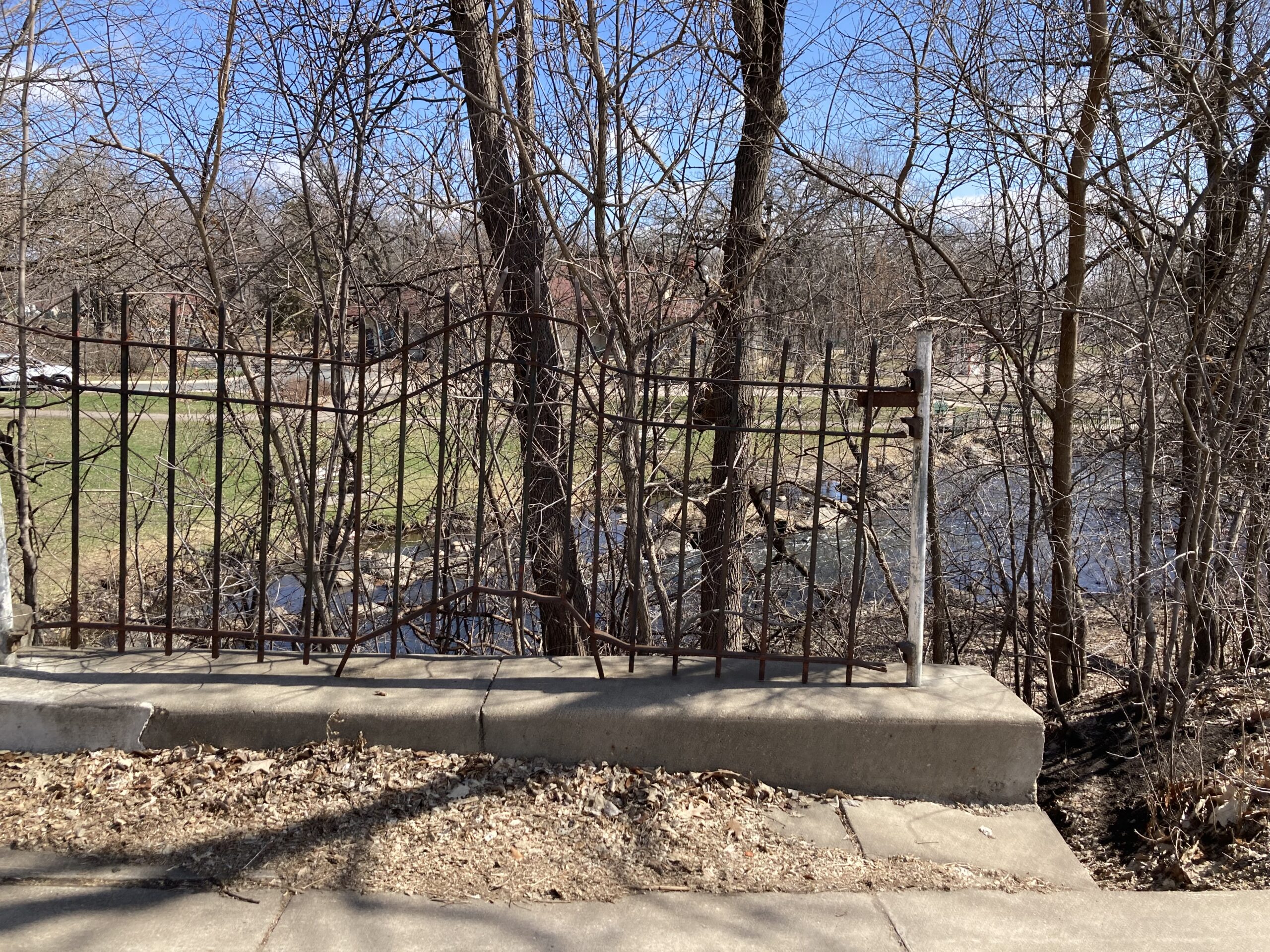
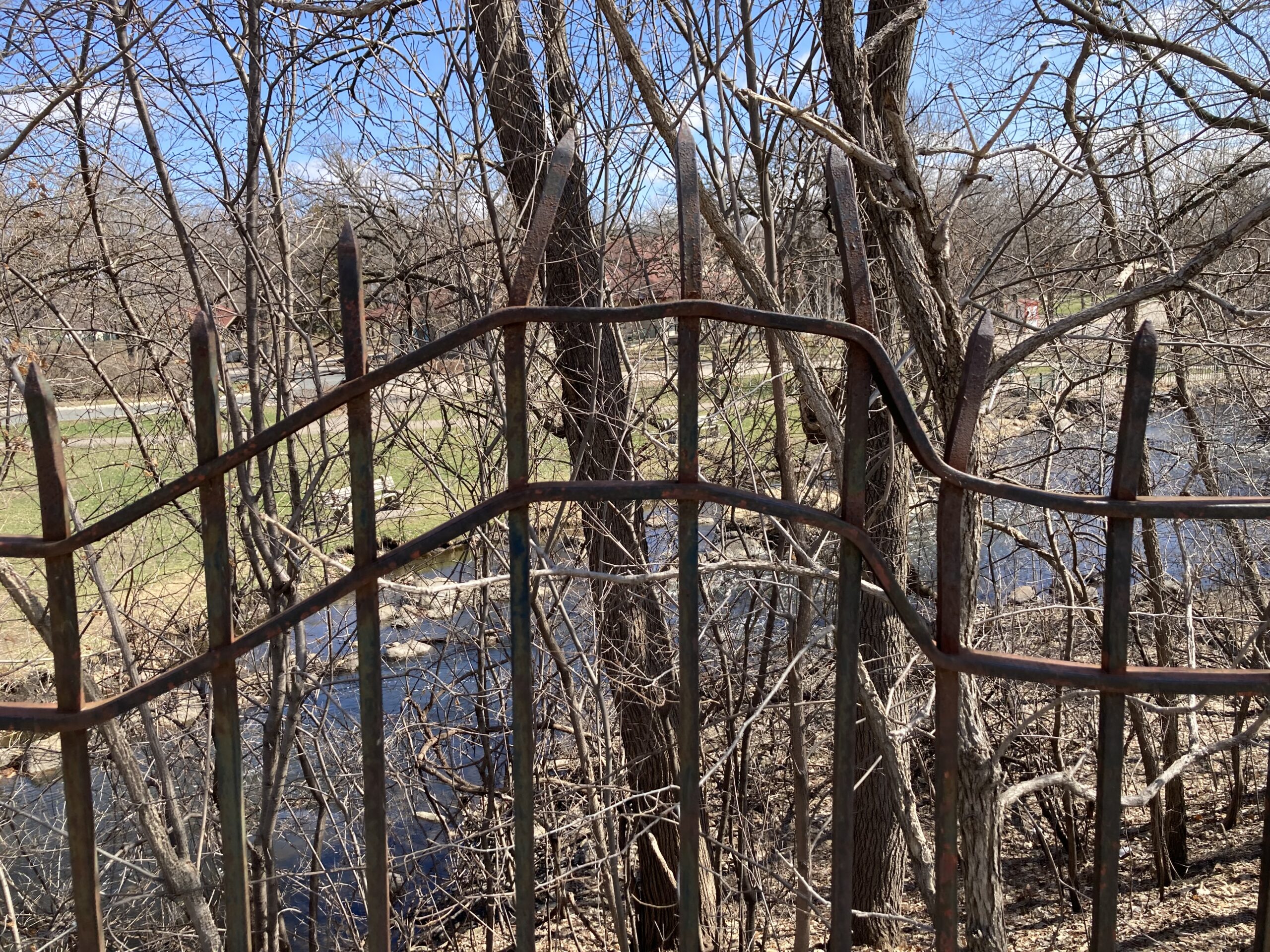
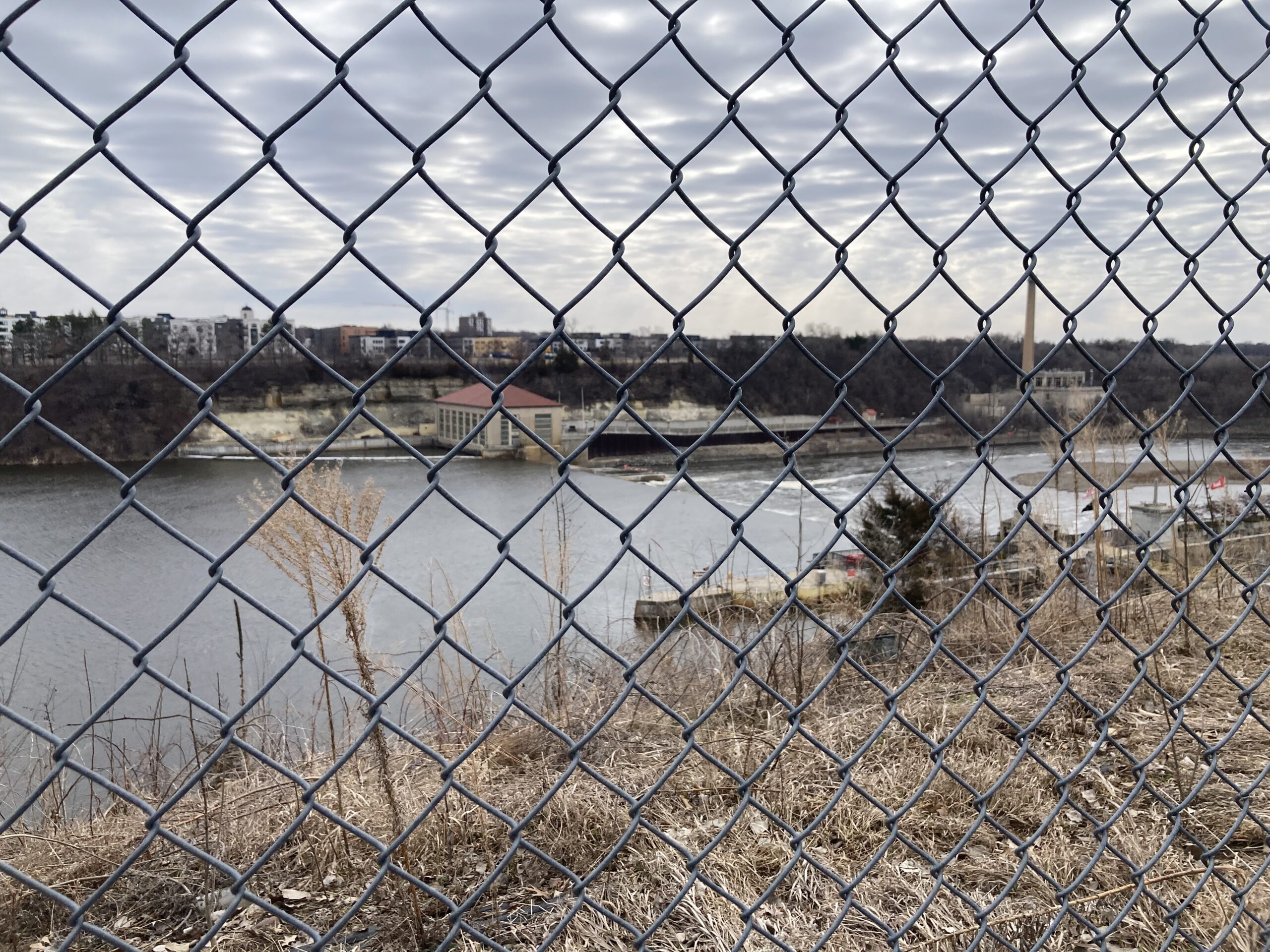
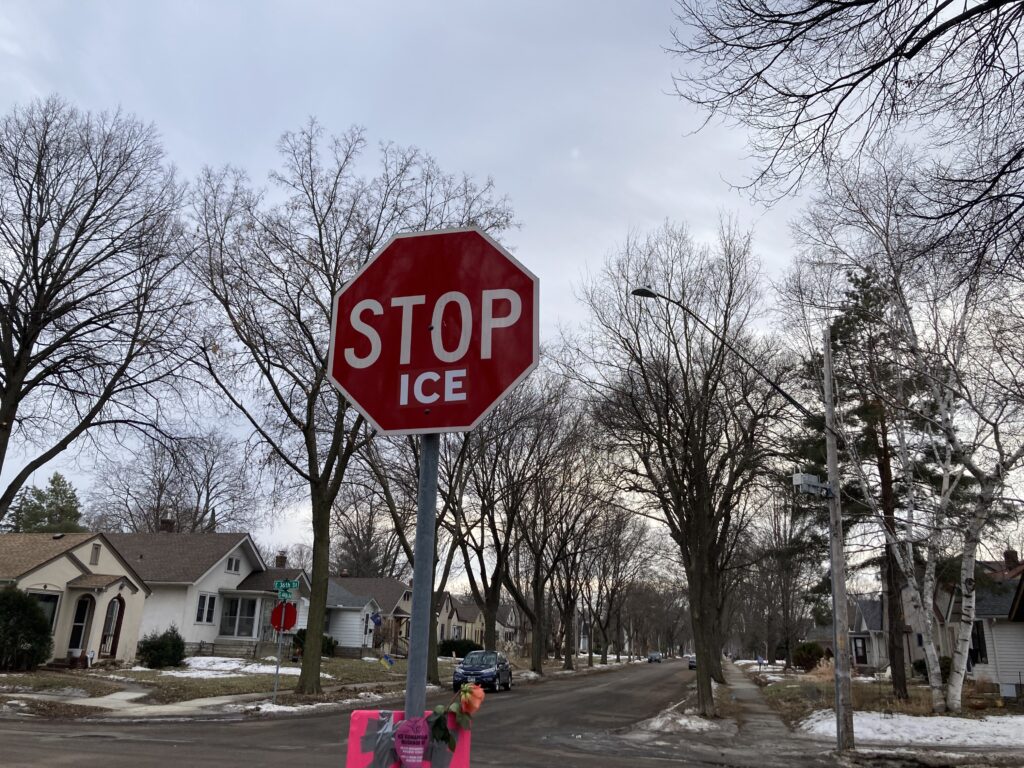
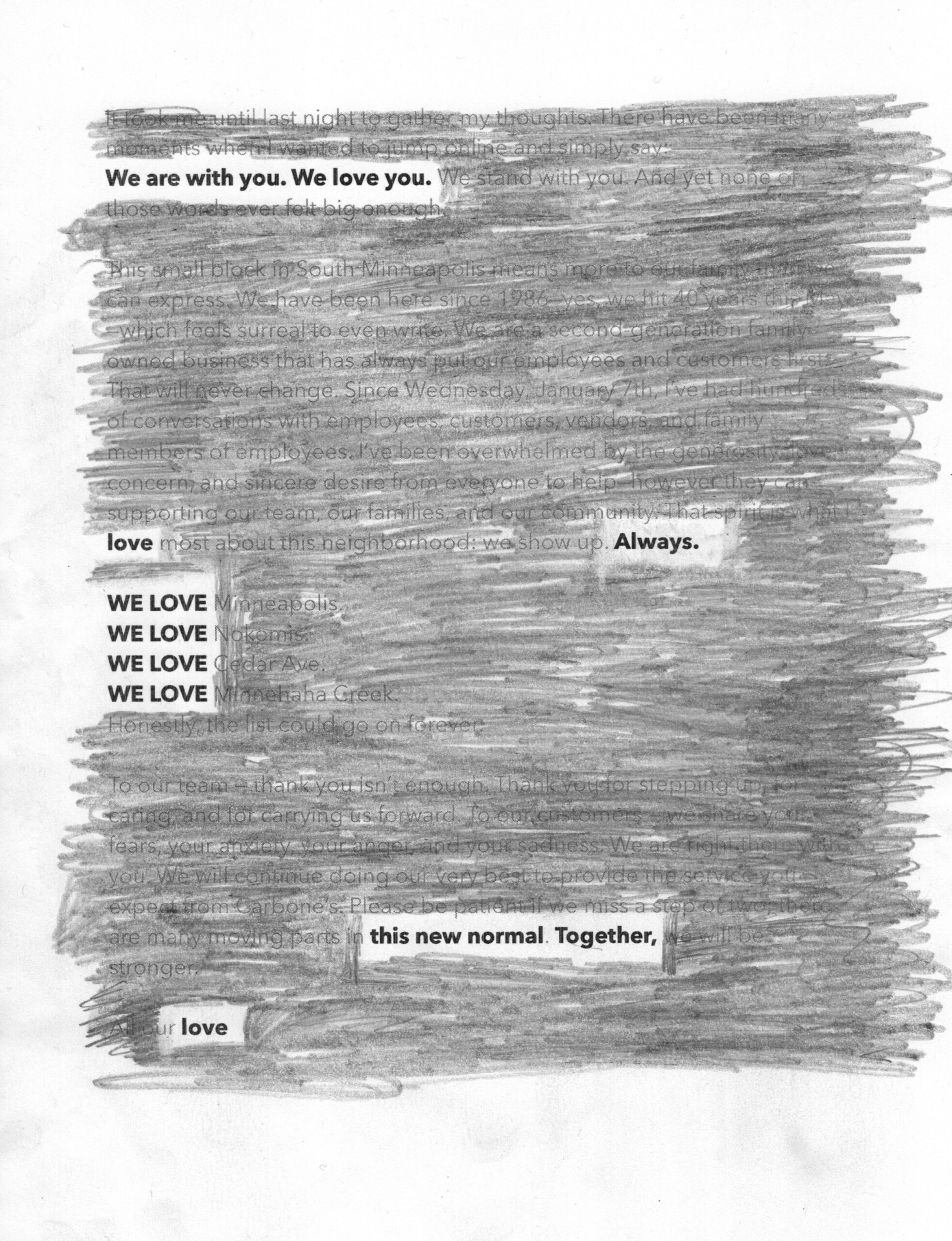
march 18/RUNGETOUTICE

4.3 miles
minnehaha park and back
43 degrees
25% puddles

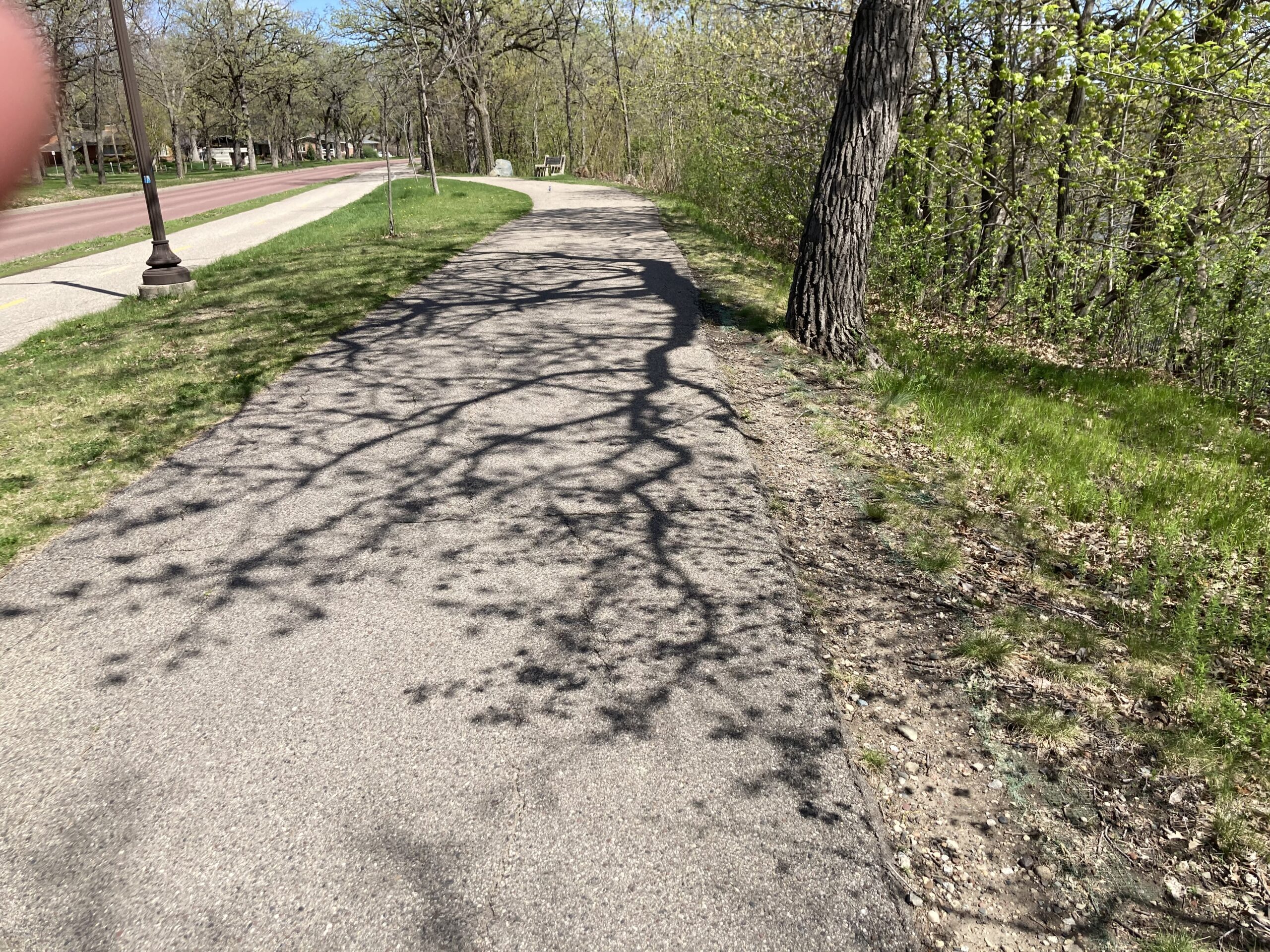
Yesterday it was very cold. Today it is warmer, the sun is out, and everything is melting! Drip drip drips everywhere, very LOUD whooshing car wheels, puddles. At the start of the run, I wondered how long it would take before at least one of my socks would get soaked. Not long! I only made it a quarter of a mile before stepping in a big puddle. Oh well, it dried out pretty fast.
overheard: one runner to another as they encountered each other on puddly double bridge — take it easy my brother

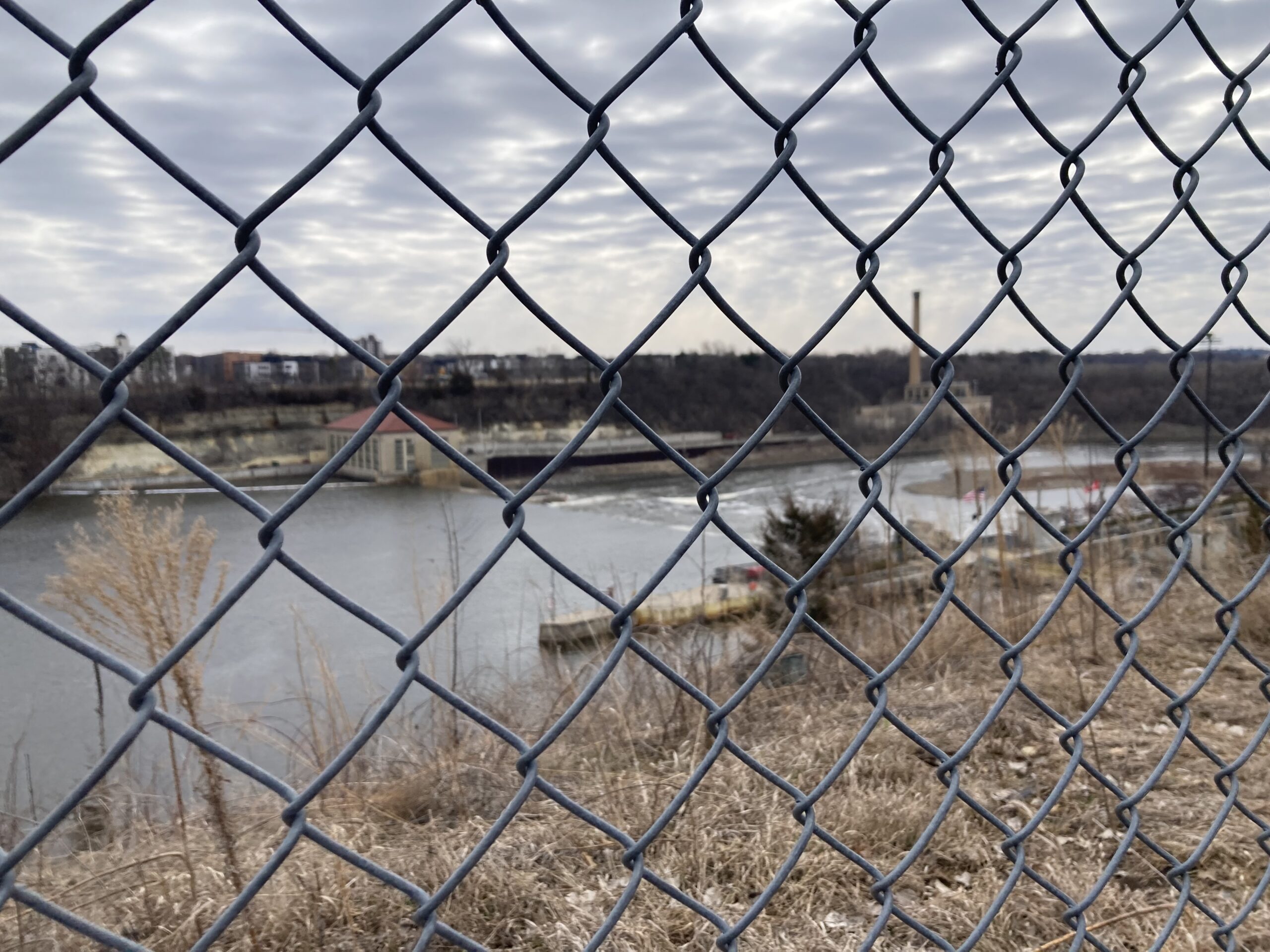
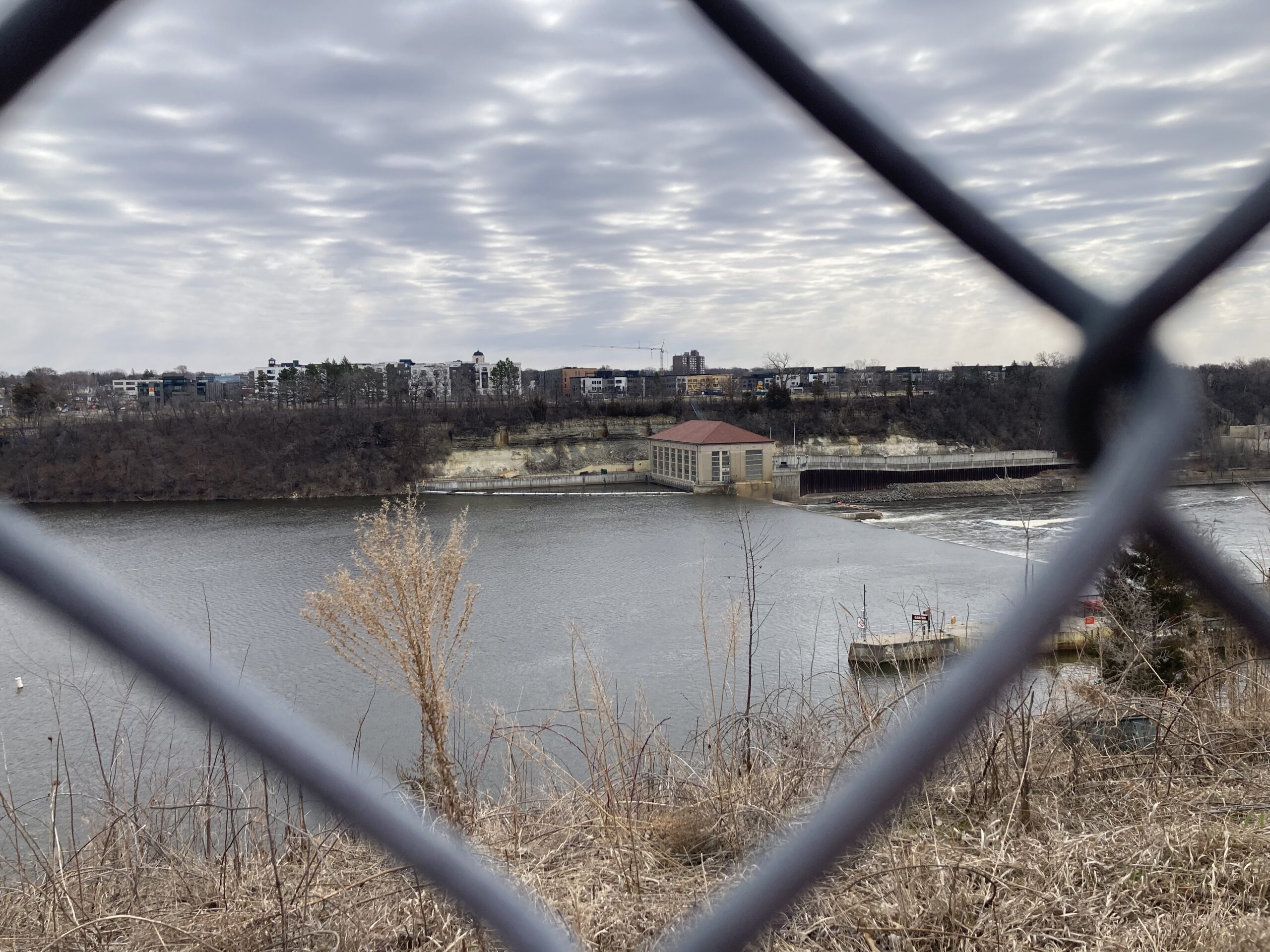
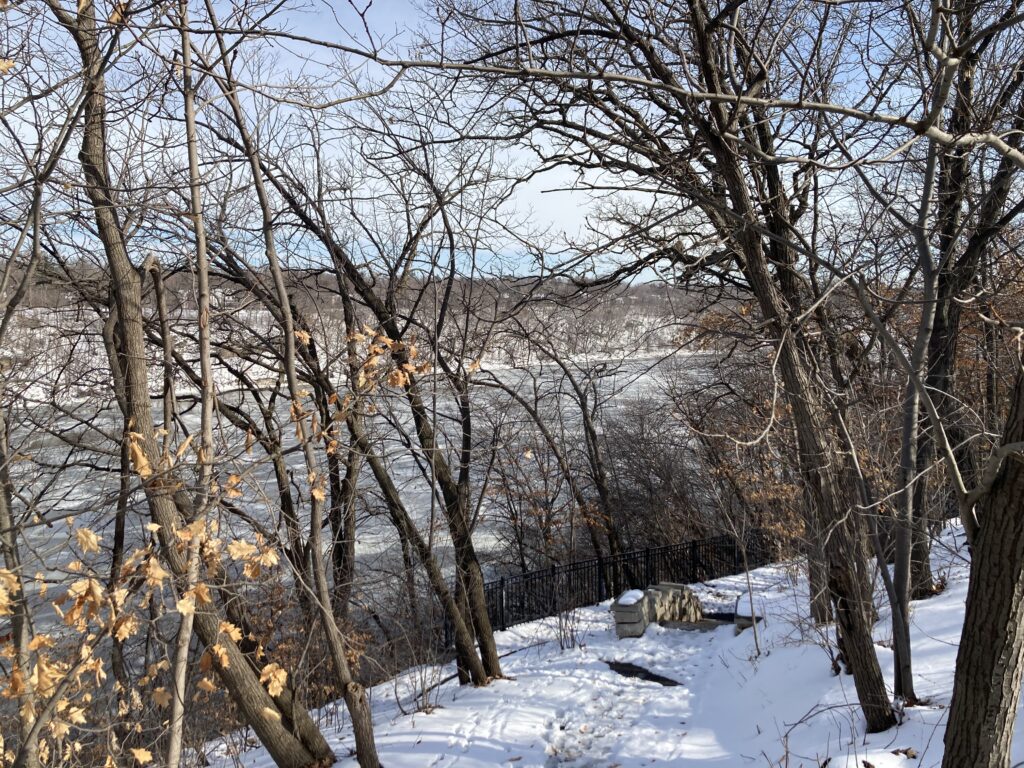
Kids laughing and yelling on the playground; a pack of runners; the falls, gushing, a few sirens; the river with a thin sheet of gray ice looking wide and barren. Can you see it through the trees?

river view from the 38th street steps / 18 march

On my walk back home, I stopped to take some video of water dripping out of gutter. Unfortunately because of the bright light I accidentally hit slow mo so you can’t hear the wonderful dripping sound. Here’s a brief clip of it anyway:

water dripping in accidental slow mo

HOLES

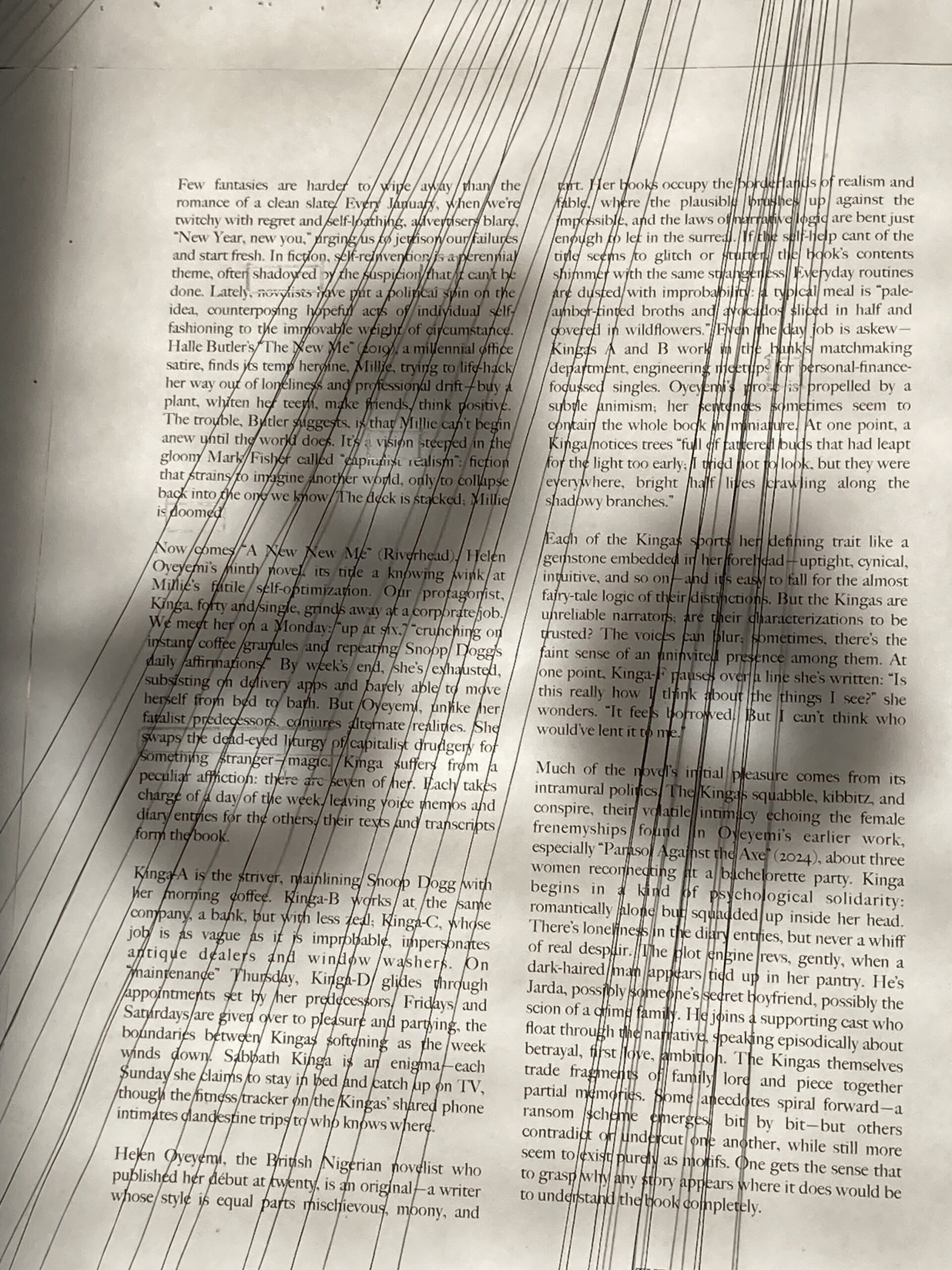
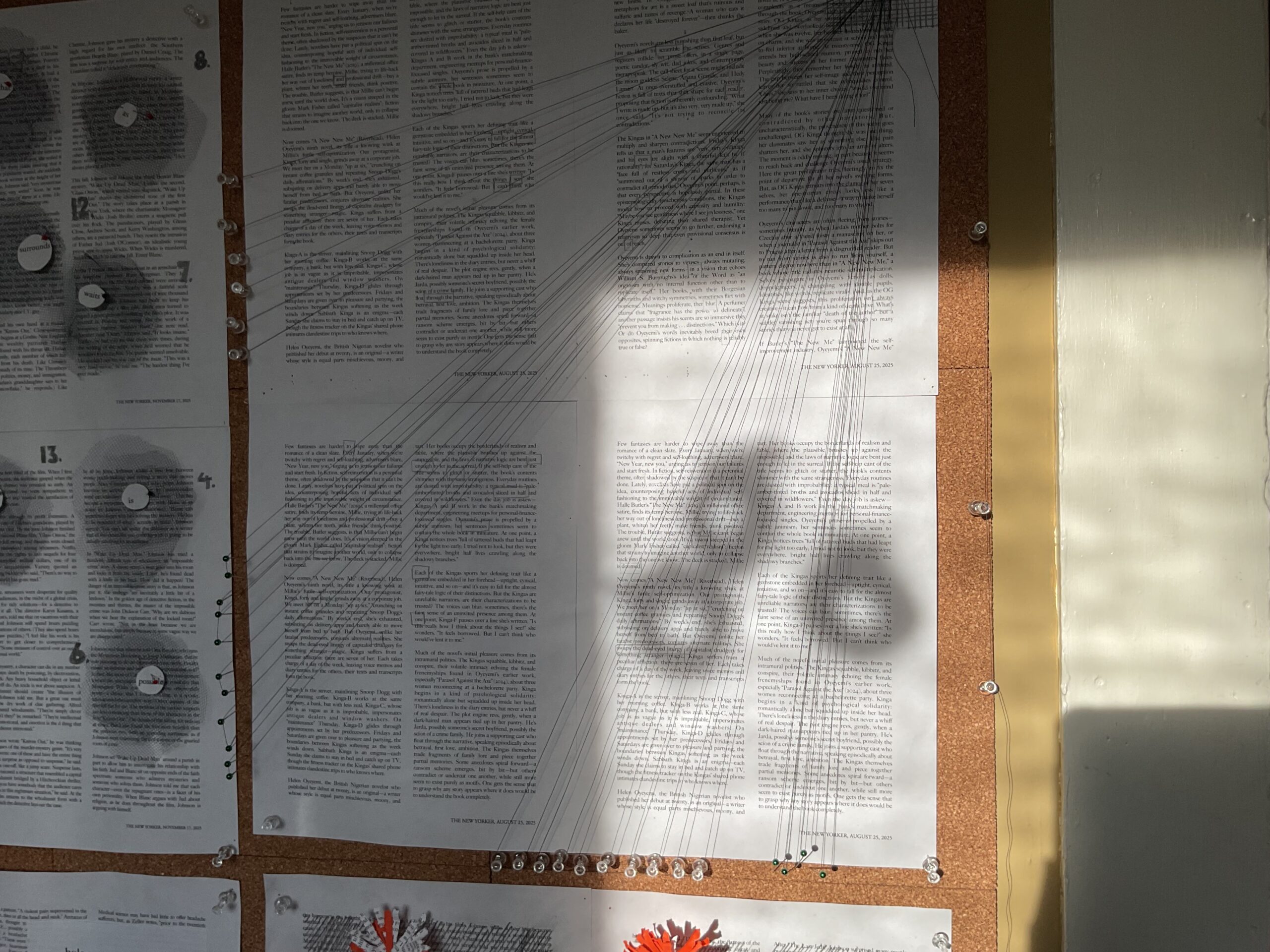
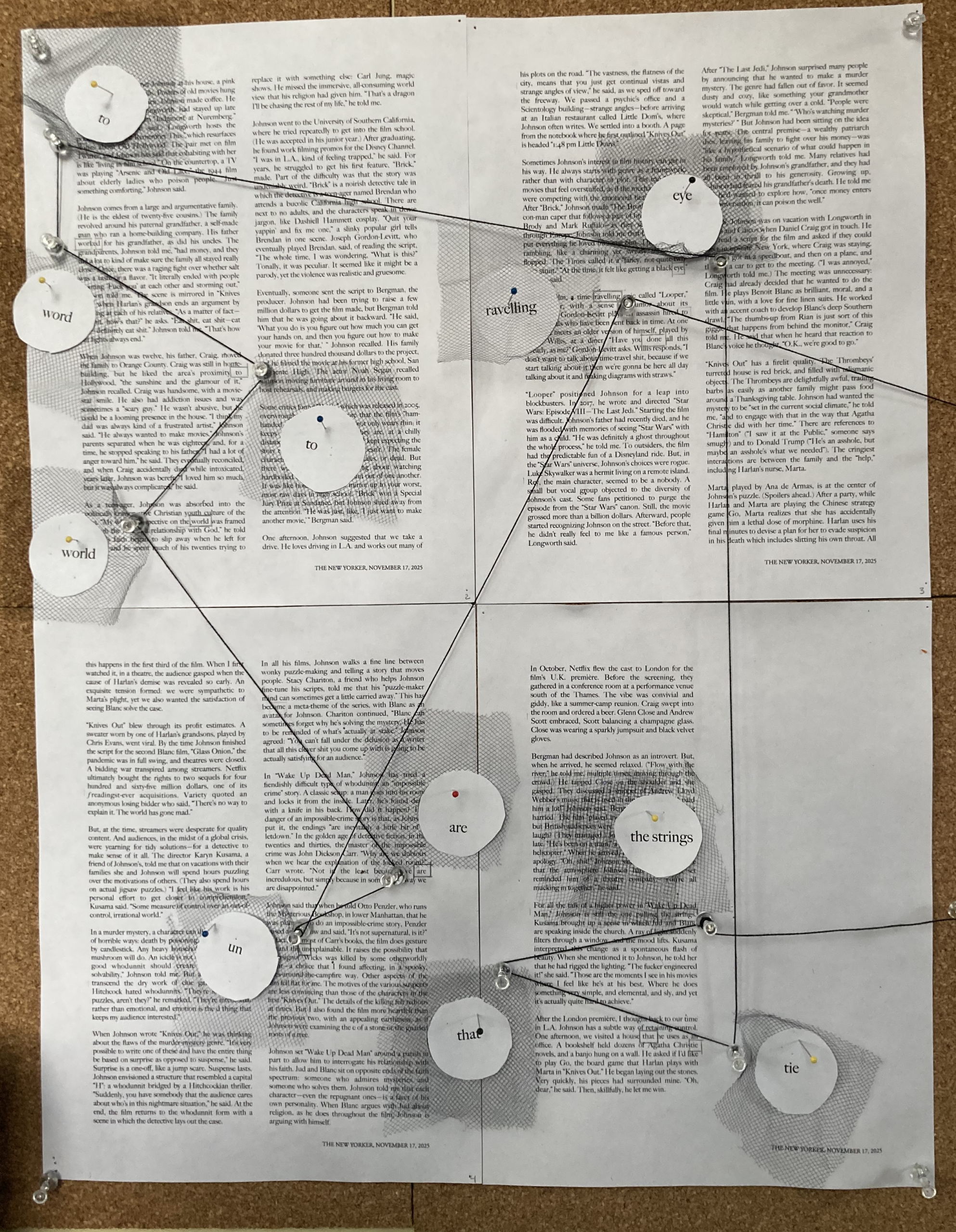
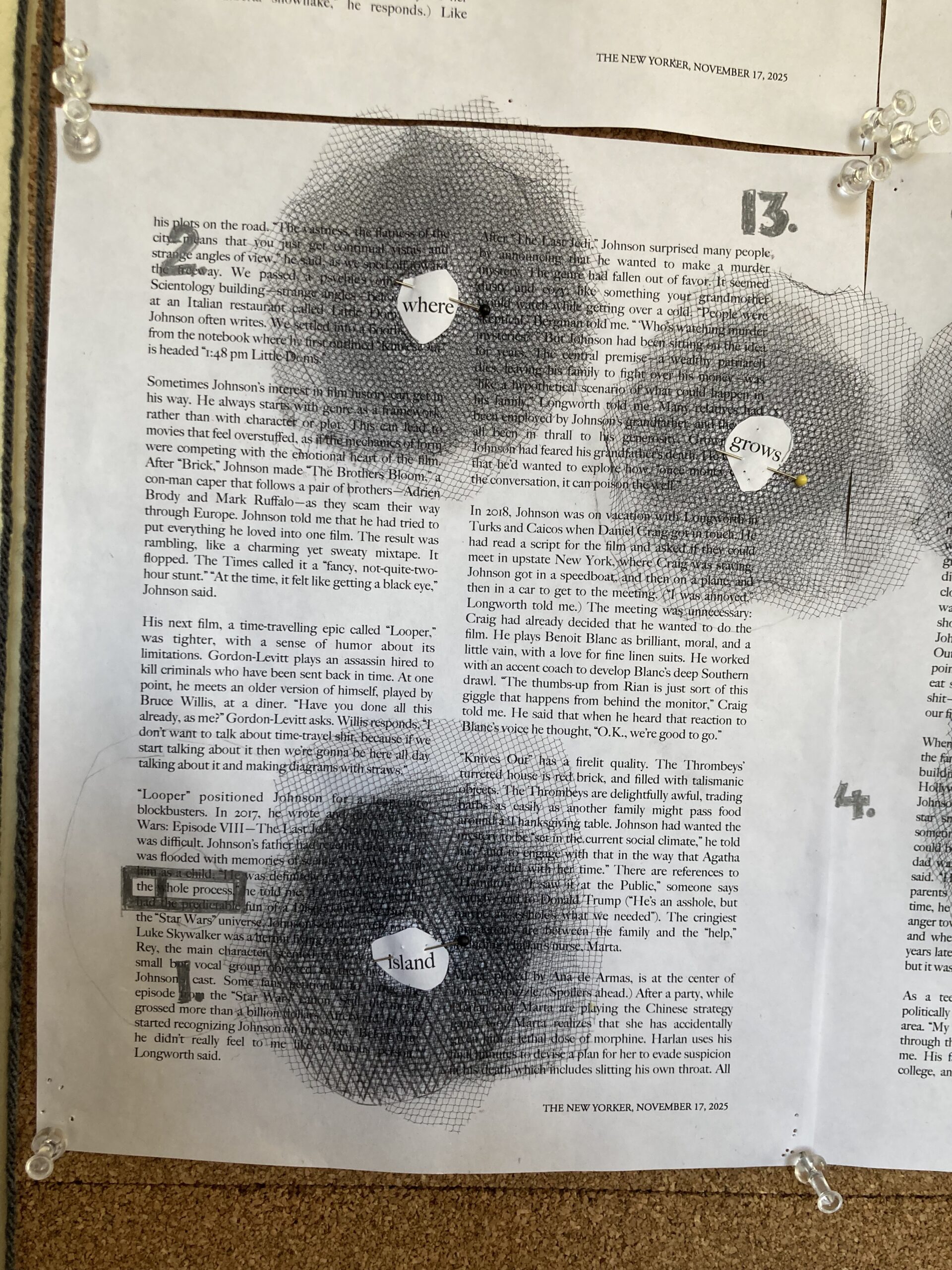
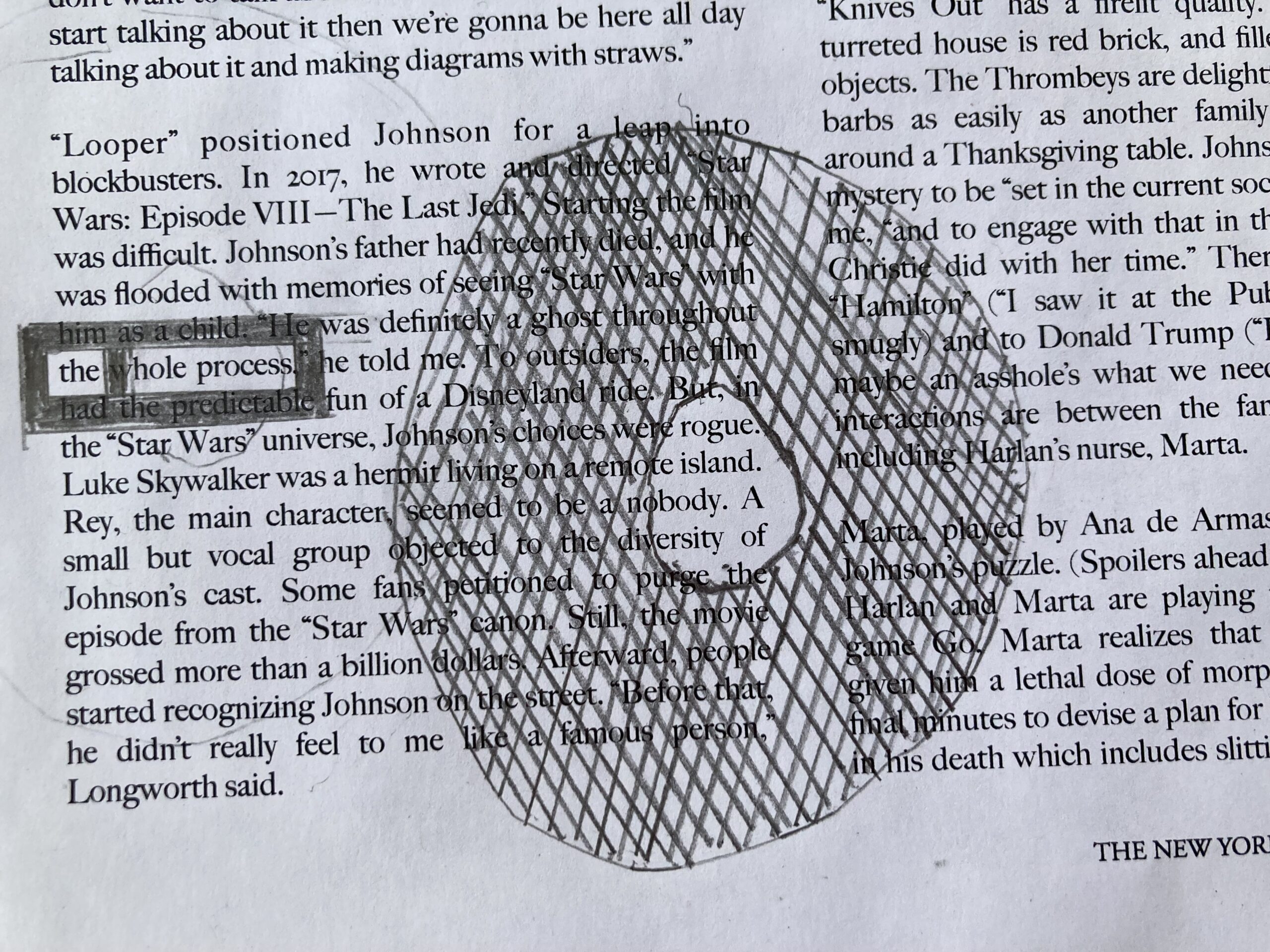
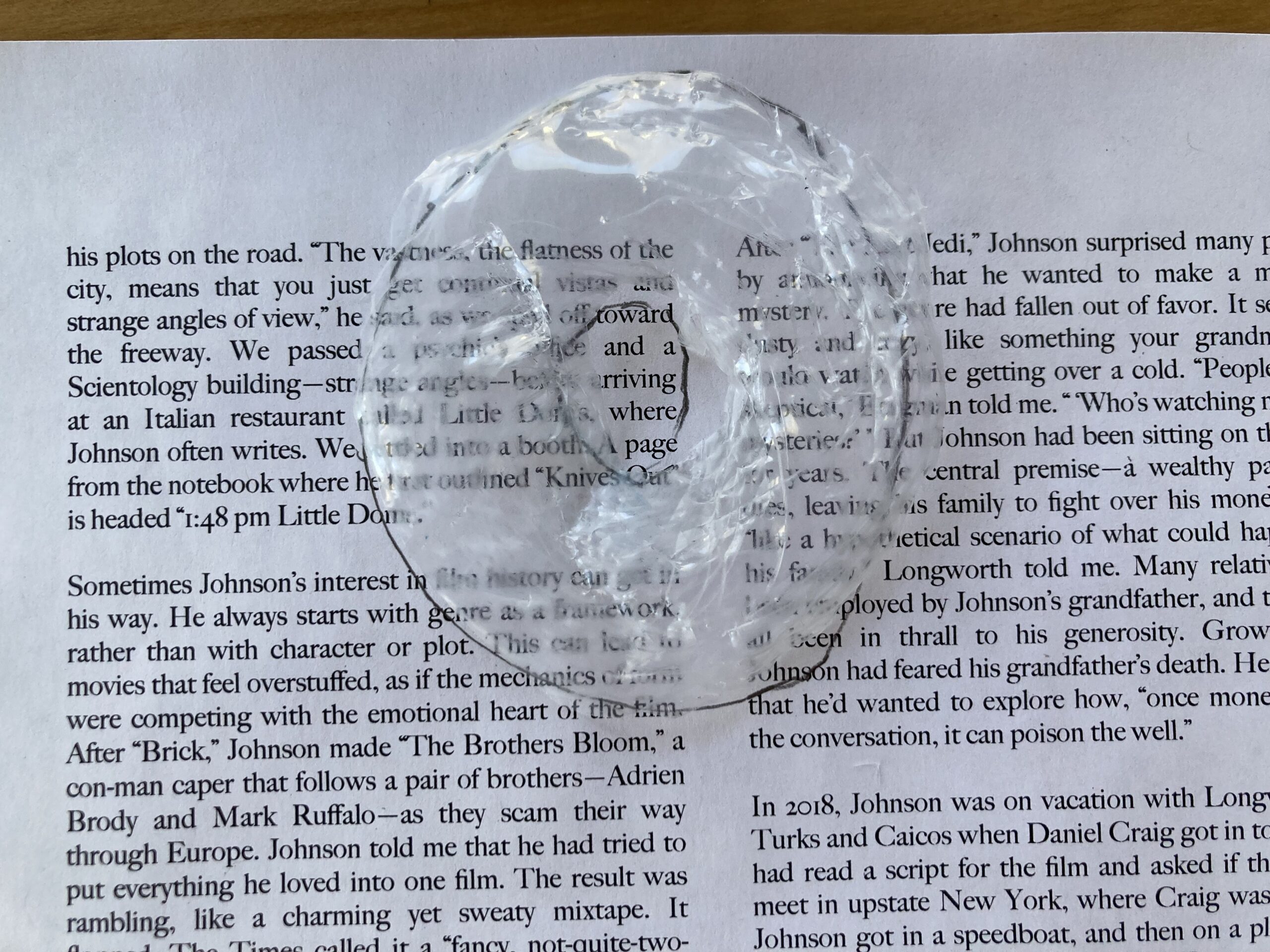
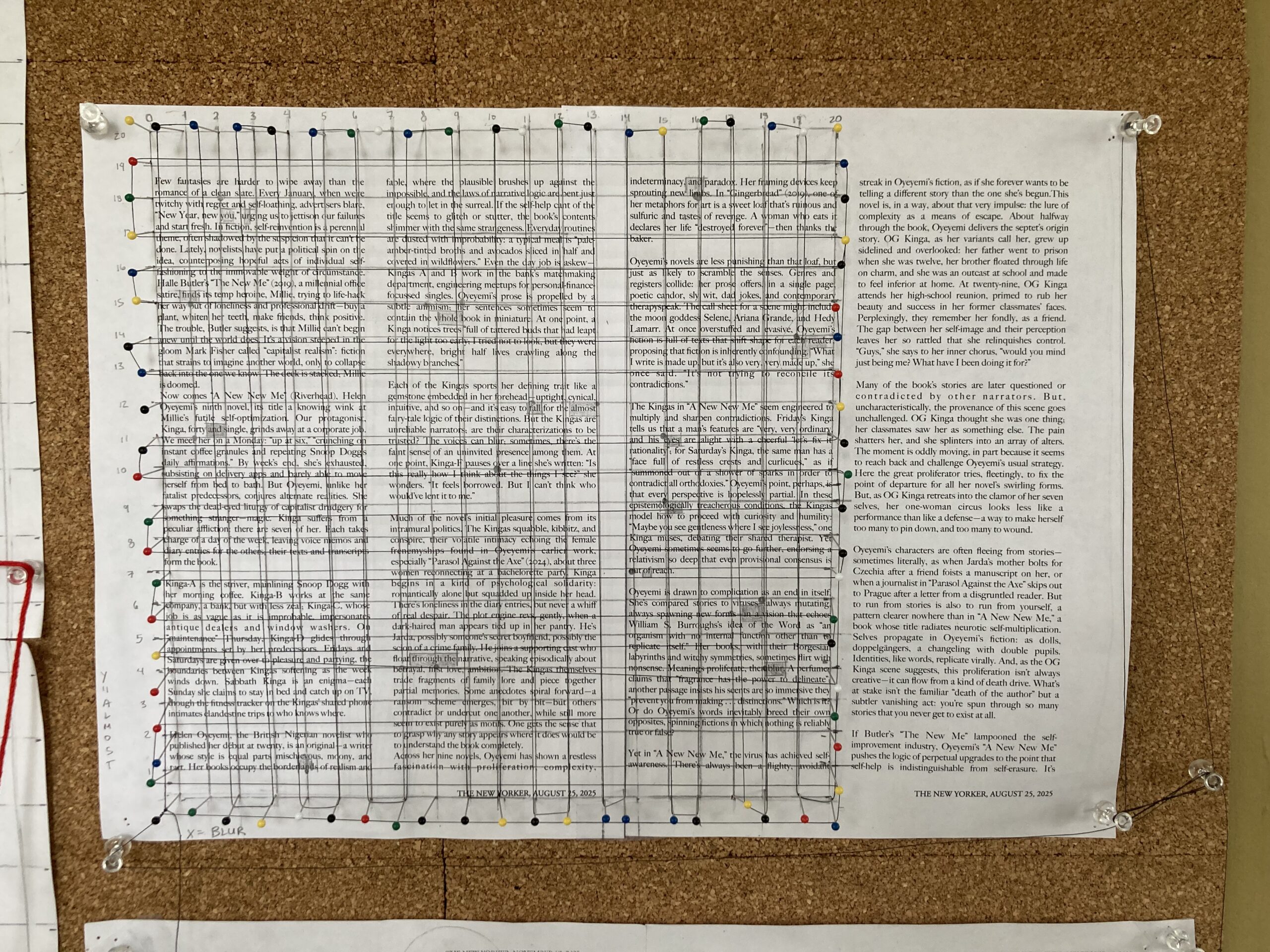
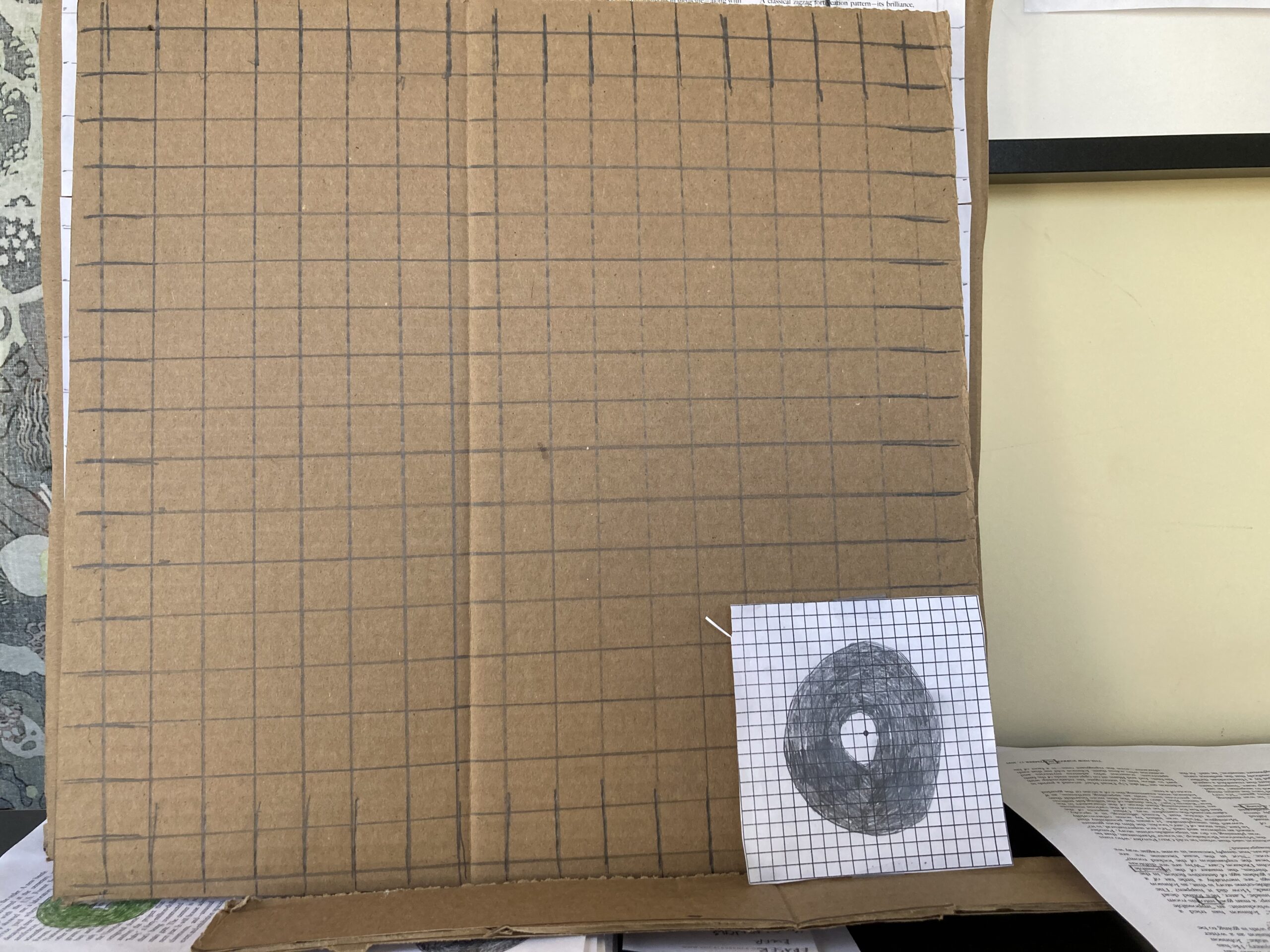
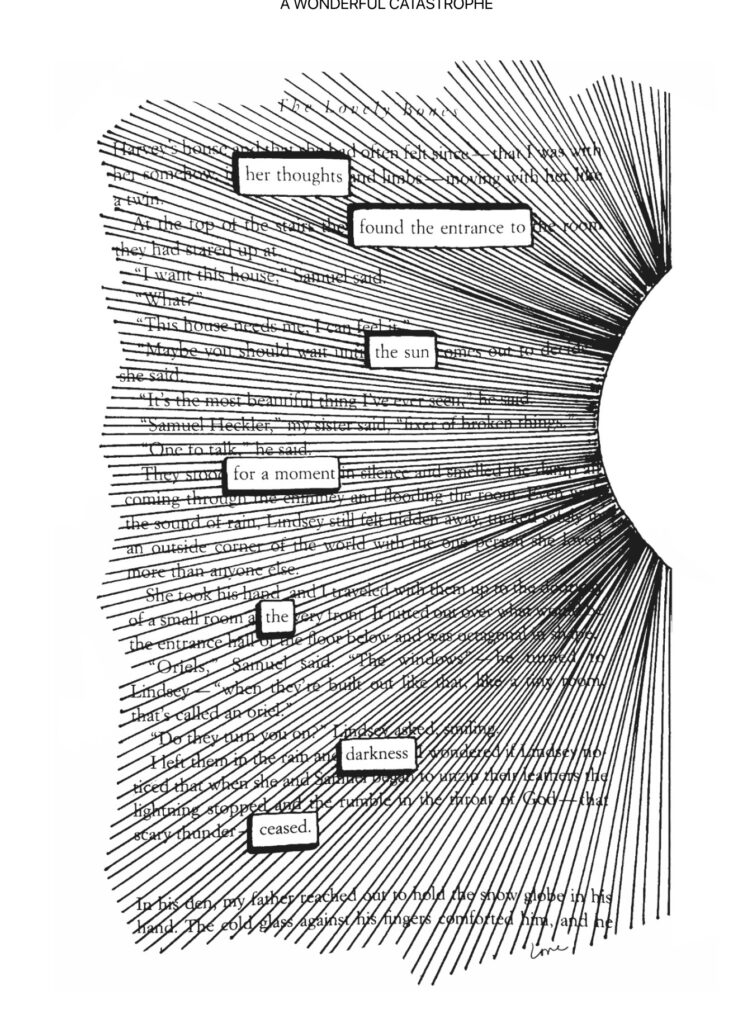
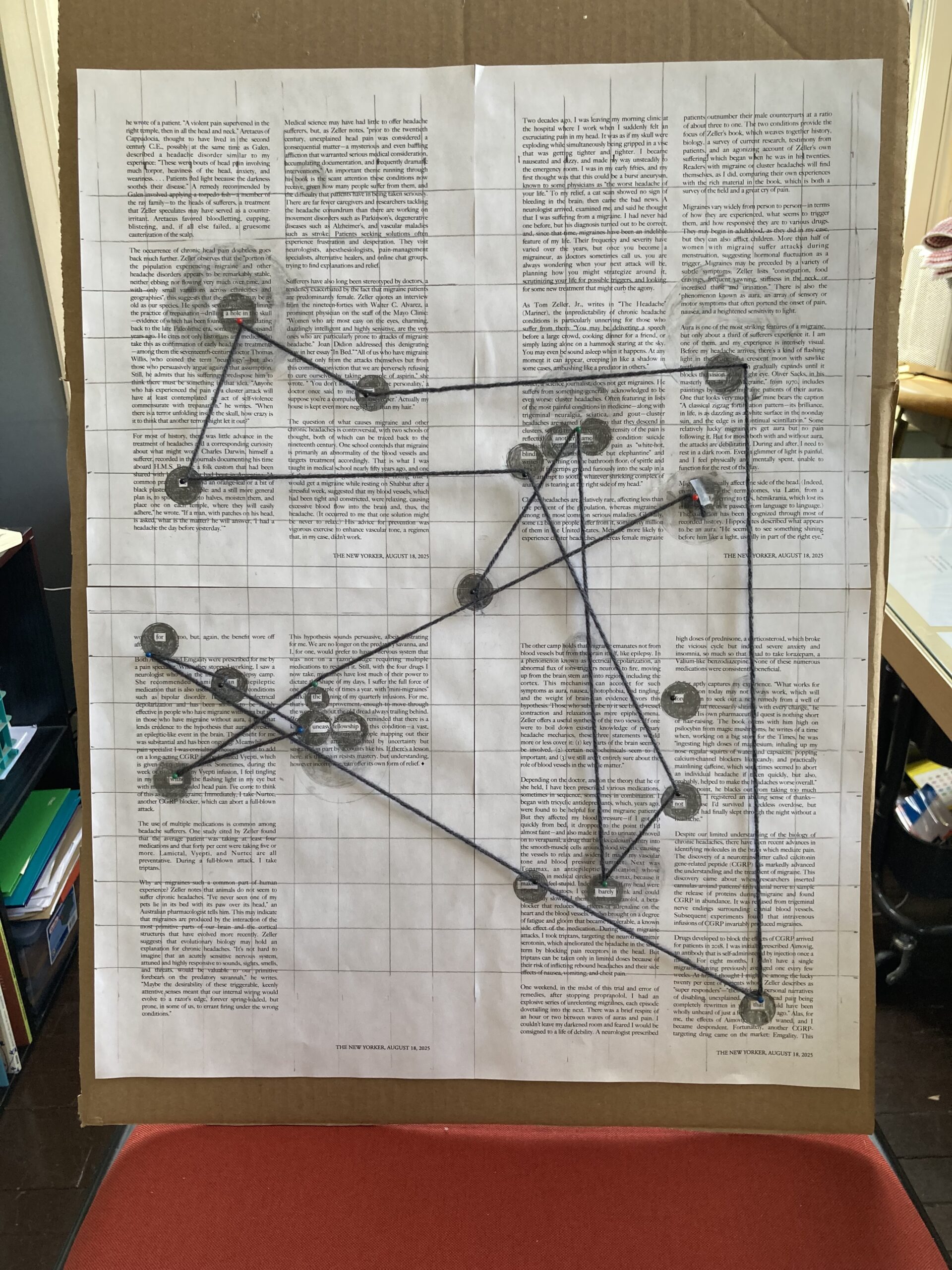
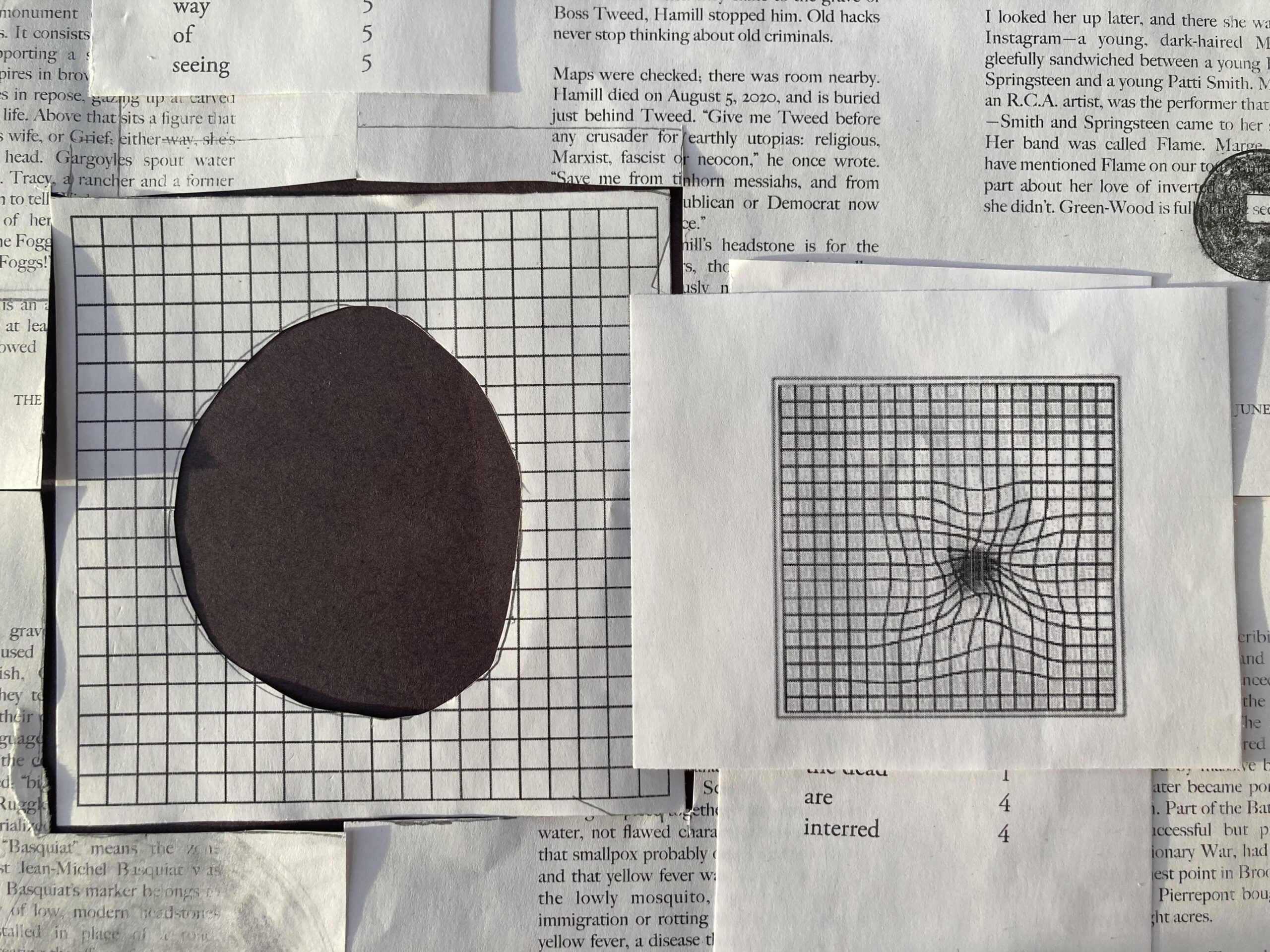
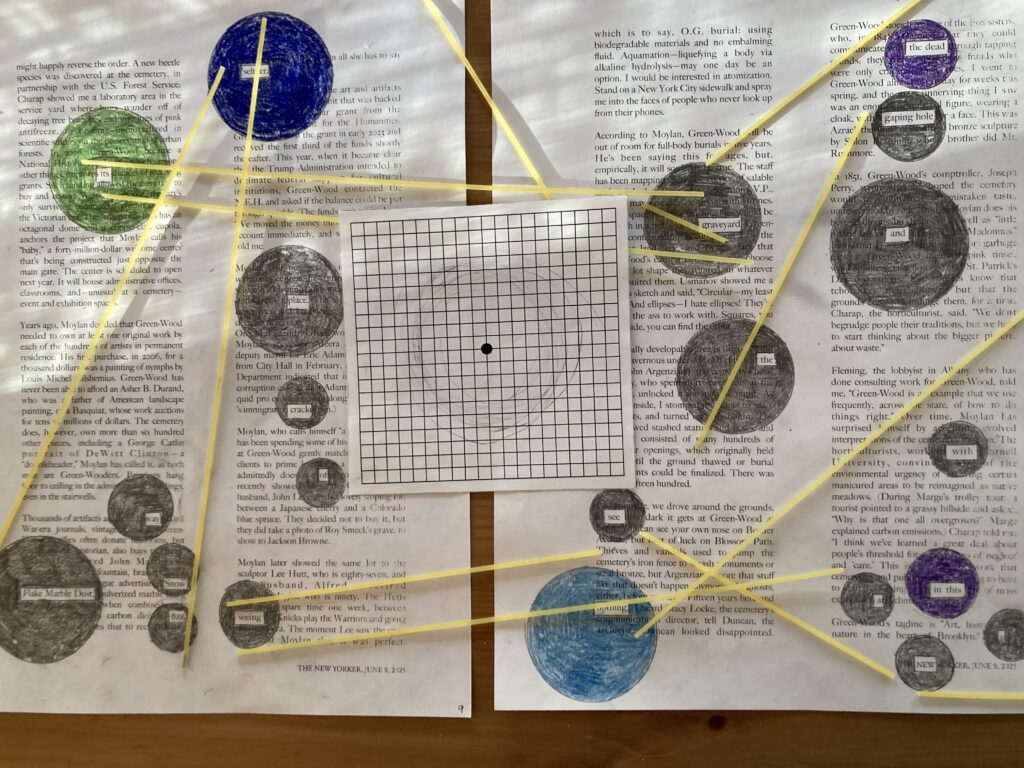
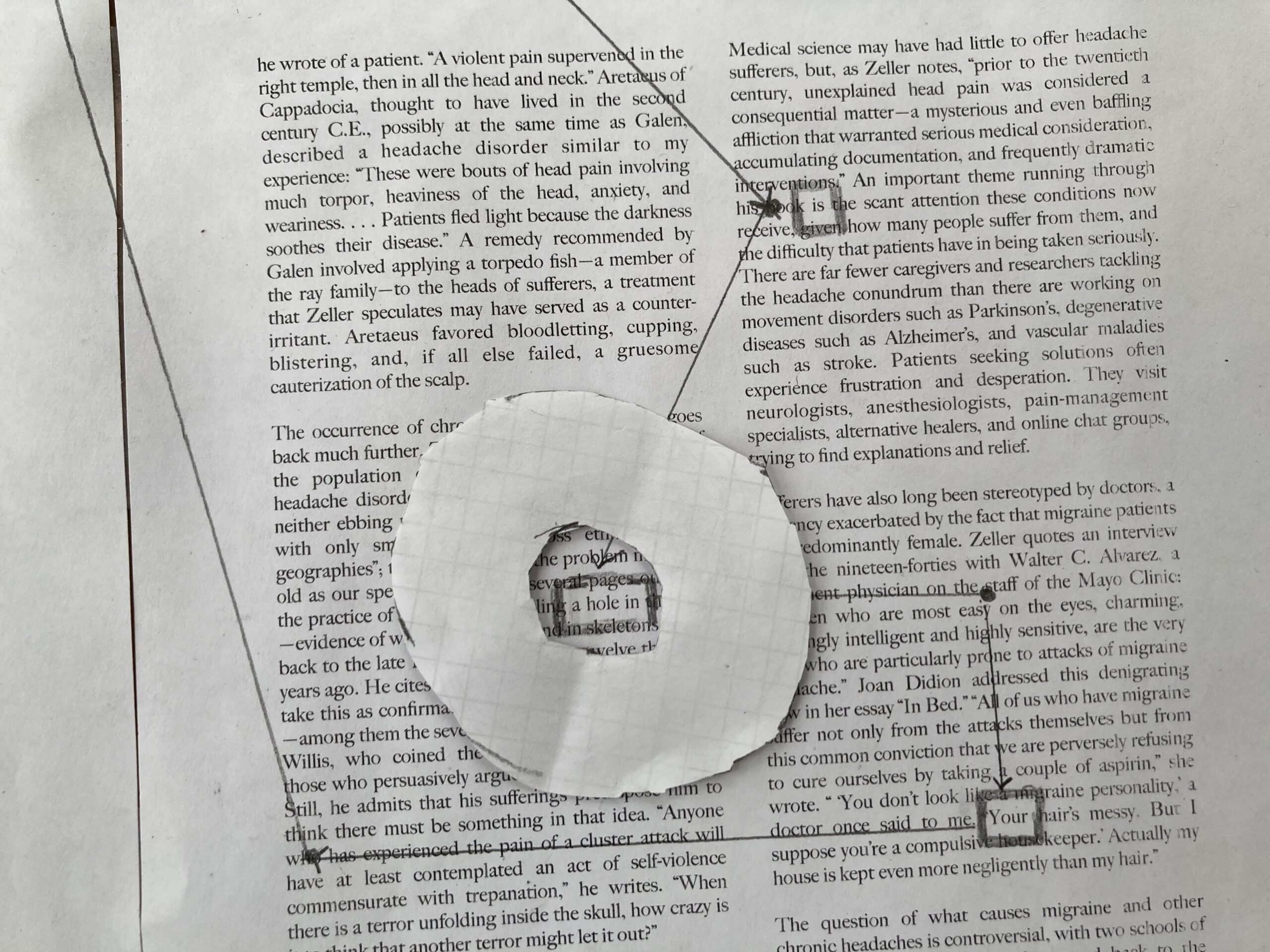
Yesterday afternoon, after finishing mapping all of my word (drawing boxes around them, encasing them in circles or the shape of my blind spot) and feeling like something was missing, I had an idea: I should place the Amsler grid somewhere on the pages. I didn’t want to simply cut out a printed version of the grid and completely cover the words. What about drawing the grid on top of the words? Too difficult with my terrible vision! Then, a new idea: cut out a hole the size/form of Amsler grid’s shape (4 x 4 in) and use string as the lines for the grid. After some playing around with it, another idea: not string, but thread or wire, and make the grid broken, distorted, emerging from the hole, looking somewhat like broken guitar strings. Three of the strings will extend out across the pages, offering the path of the three sentences of the poem. A variation: create three grids, with each one corresponding to a different sentence. This idea, which I hope I can execute because I really like it, led me to think about adding an Amsler grid to all of the holes. On Holes 1 it would be the “normal” grid with my blind spot on it. I have to think more about how it would look in Holes 2 and 3. By Holes 4, it’s broken.

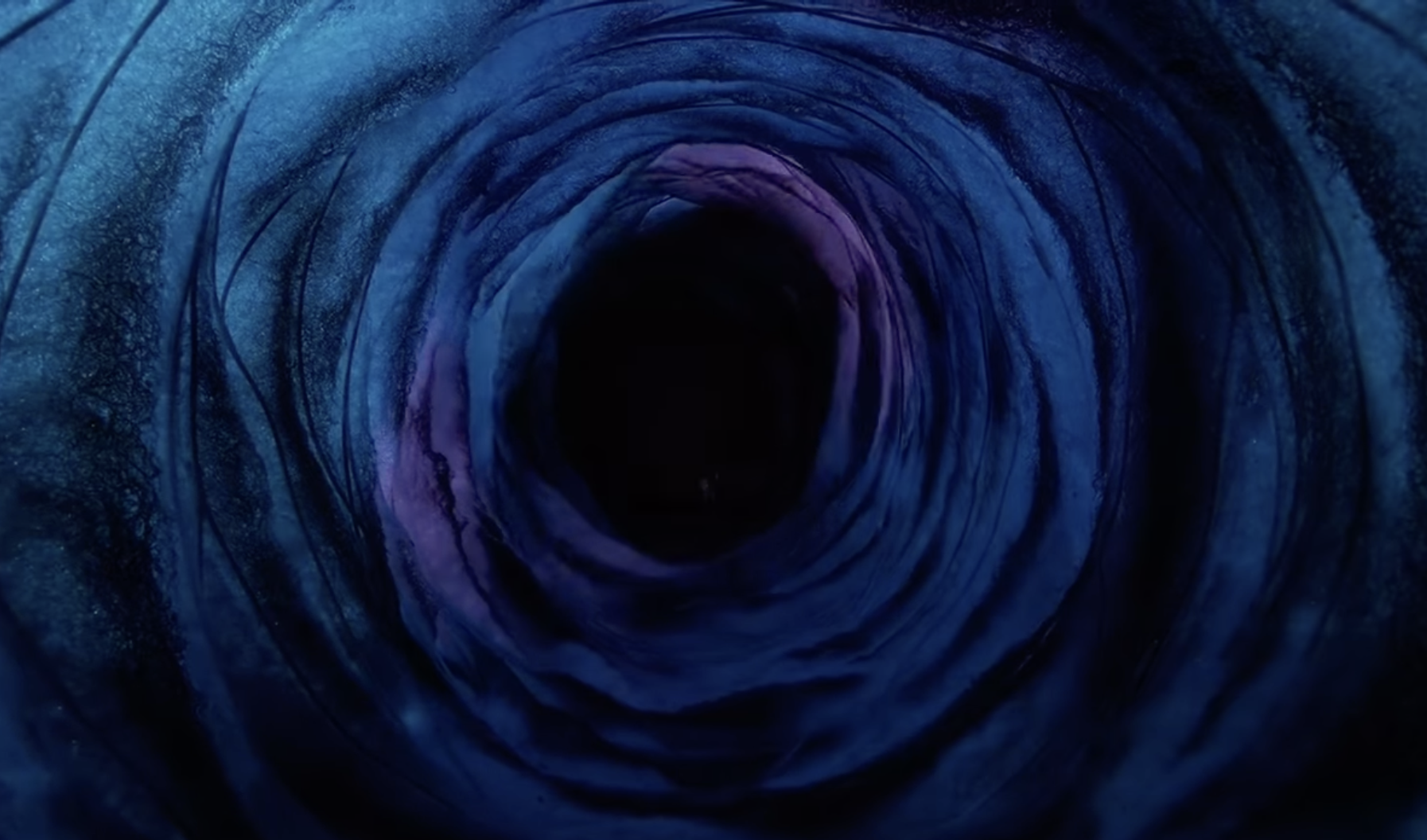
If you google “distorted Amsler grid” you can find some great images of warped lines and black holes caving in upon themselves. Due to risk of copyright infringement, I won’t post any, but here’s a link to one that I particularly like:

Amsler grid distorted image: the image is at the bottom of the page. It is of the grid with the outer lines appearing normal. Near the center the lines are wavy, collapsing into a big black spot in the very middle.

Some things to think about today (I’m writing this paragraph just before 10 am):

  1. how do I map the words in Holes 1, 2, and 3?
  2. where do I place the Amsler grids in Holes 2 and 3, and what will that look like?
  3. will there only be 4 Holes, or should there be more? If more, should I place them before or after Holes 4 in terms of the progression of the grid’s distortion?

Another thing that happened yesterday: I remembered that I had a large amount of oil pastels, leftovers from RJP’s obsession with them more than 10 years ago. Could I use them to color/fill in my holes? How do you use oil pastels?1

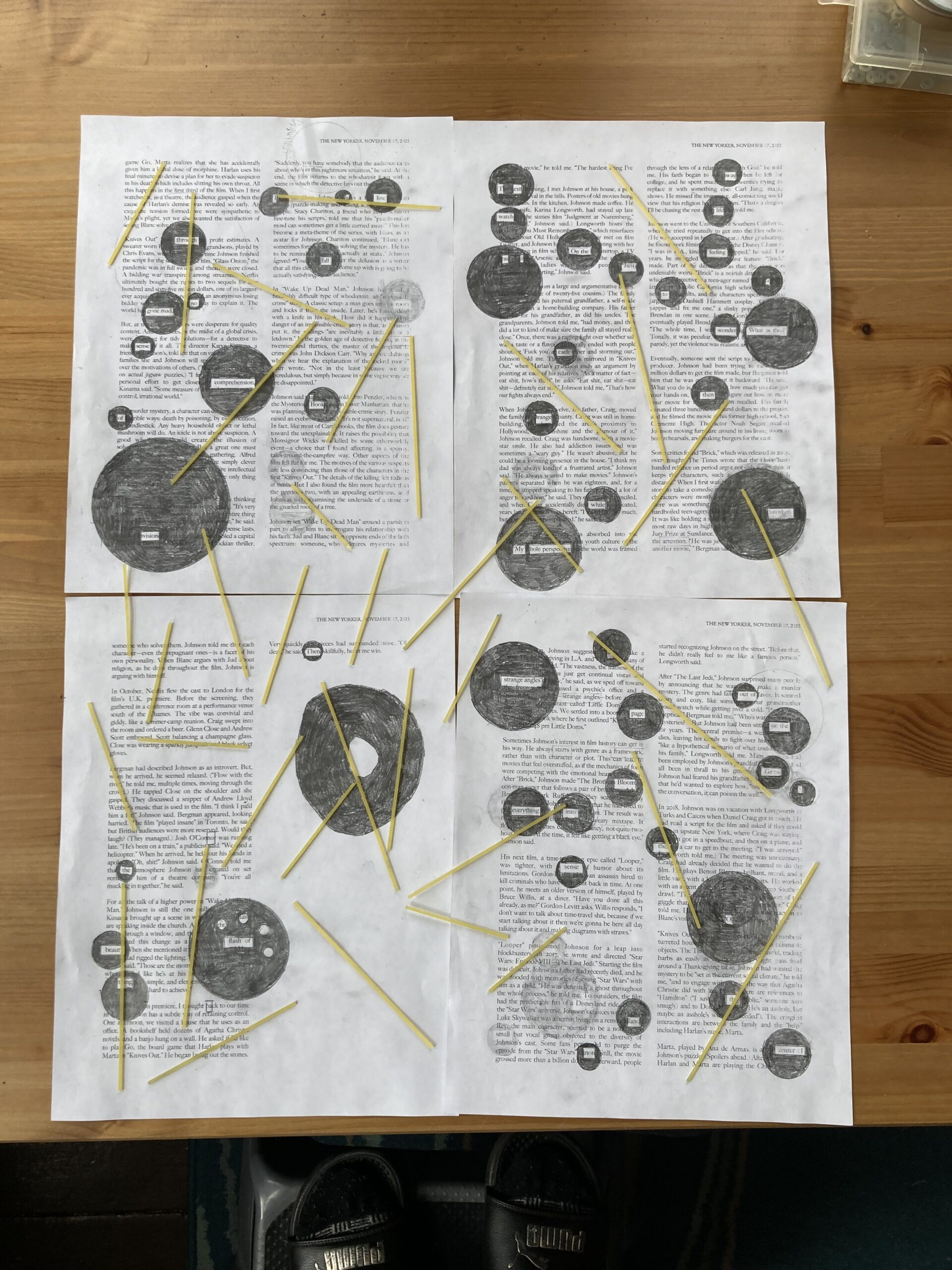
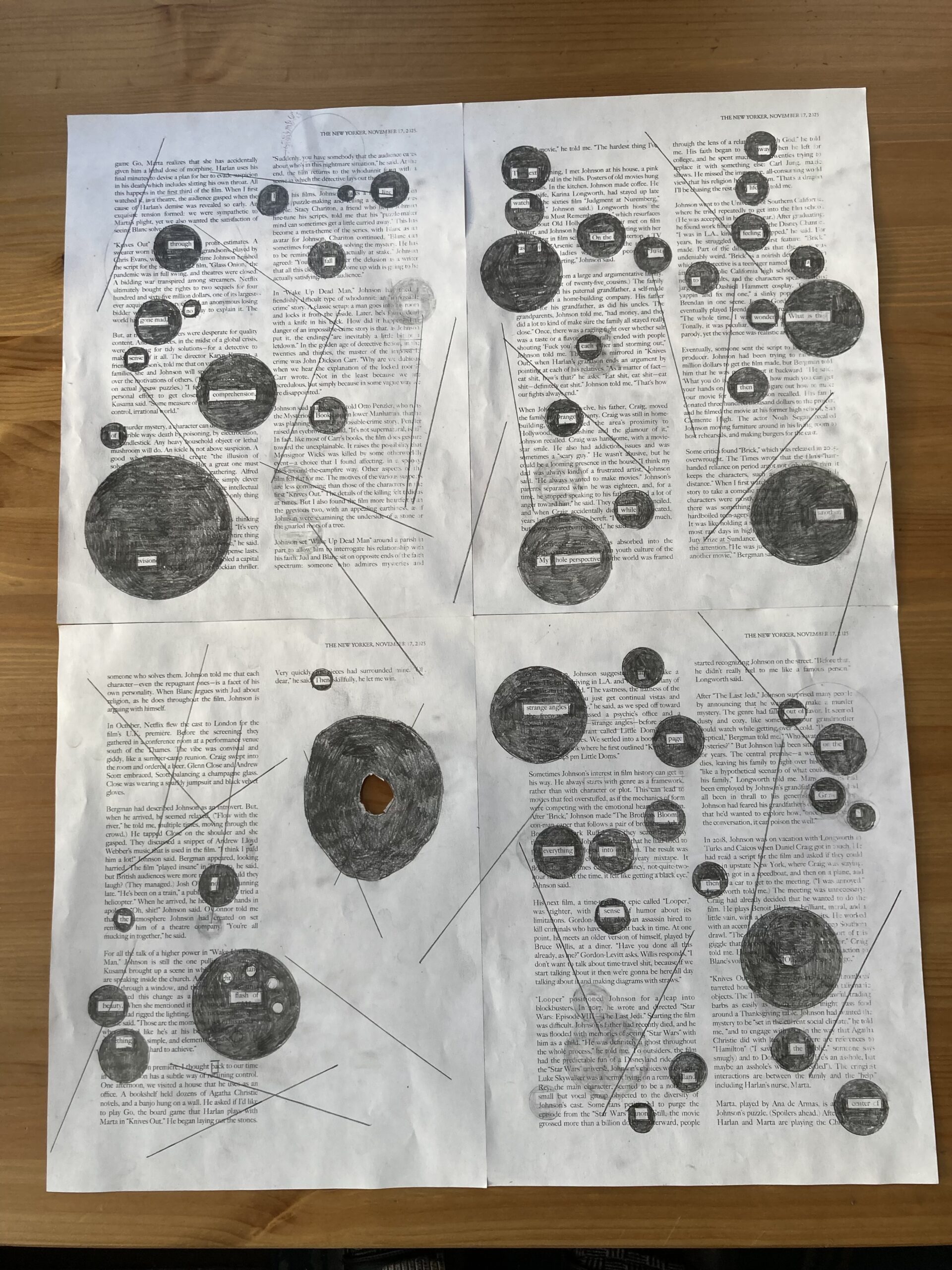
It is now 5:20 pm and I’ve spent part of the day trying something new with Holes 4. I’m using uncooked spaghetti to connect/map the words of the poem. It’s a complicated challenge, but the spaghetti is helping to visualize it more effectively.

more thoughts/questions:

  • should I split this poem into 4 instead of 3 segments?
  • should there be separate amsler grids for each section, or one grid from which different colored threads emerge and travel to the three or four different sections? if there is only one grid, should it be in the very center of the piece?
  • should the grid be just an open hole, with no evidence of a grid, just black netting and threads or wires or yarn emerging from the hole (I like wire, but is it too difficult to work with?) OR should part of the grid still remain — some white, some “normal” lines, then a hole?
  • a further thought with that last question: what if the holes (1, 2,3, and 4) documented the unraveling of the amsler grid, with it intact in Holes 1, then less intact in Holes 2 and 3, until it is gone and with broken wires in Holes 4? I love this idea; can I figure out a way to execute it?
  • returning to the thread/wire — will it work to have it stitched into the paper, where sometimes it is on the front, sometimes emerging from the back side through another hole? is this too messy and complicated? do I need to cut back on the poem, to reduce its number of words?2

A lot to think about!

holes 4 section
  1. I think I’ll start with this post: Oil Pastels for Beginners on the Faber Castell site. ↩︎
  2. I don’t want to cut any words, but it would make this easier — do I want it to be easier? Not really! ↩︎

Get Out ICE: It’s never too late to do the right thing. . . .

is something people were chanting and singing at hotels where ICE agents were staying this winter. I think it also fits as a way to describe this:

A reporter for NBC interviewed people at a gas station in a previously very pro-Trump county in Pennsylvania. Three people still support Trump, one does not. Responding to the reporter’s question, “If you could say something to President Trump and he could hear you right now, what would it be?”

“3 times! That was my bad, apparently I’m an idiot”

march 16/RUNGETOUTICE

2.3
river road, south / lena smith boulevard, north
15 degrees / feels like 0
50% snow-covered

Many of the sidewalks were completely bare and dry, almost all of the trail was covered in slick snow. In some stretches, the trail was covered with chunks of snow from the snow plows that had just passed by. Running south, with the sun and the wind at my back, and on the short strips of bare pavement, it felt good. Then I ran through a puddle. I didn’t notice that my foot was soaked for several minutes, but when I did I decided I should head home; it was cold enough that I was (mildly) concerned for my wet toes. Good call, past Sara! When I got home, one of my toes was burning.

10 Things

  1. bright BLUE sky
  2. the sounds of shoveling and scraping and snow-blowing all around
  3. at the end of each block, I encountered an almost knee-high wall of snow where the plow had come through
  4. the surface of the river looked eerie and strange, pale and spotted with chunks of ice
  5. no kids’ voices from the school playground: for preK – 5th graders, school was closed, for 6th – 12th graders e-learning — that would suck! give the big kids a snow day too, I say!
  6. the rumble of two plows approaching, first a small one, then BIG one — I moved to the far side to avoid the spray of snow
  7. I encountered a few other runners but no skiers or bikers
  8. head north, I ran into a wall of wind — ugh! howling and biting
  9. I bet it was pretty and looked very winter wonderland-y — I couldn’t tell you because I was too busy trying not to slip!
  10. if it hadn’t been for the terrible wind, my wet toes, and the slick and uneven path, it would have been a great run — even with the bad conditions, I had some wonderful moments outside

mind-body connection

On last week’s episode of the podcast Nobody Asked Us, Kara Goucher talked about how she started taking a low dose of some (unnamed) anti-anxiety medication and it’s helping with her dystonia (“a movement disorder that causes the muscles to contract. This can cause twisting motions or other movements that happen repeatedly and that aren’t under the person’s control” — Mayo Clinic). She has discussed many times on the podcast how dystonia has made it very difficult for her to run, especially on pavement.

mind body connection — watch until 15:58

This mind-body connection is fascinating to me. Does her anti-anxiety med just make her more relaxed, or does it do something more to the brain — and maybe the neural mapping of her movements?

HOLES 4

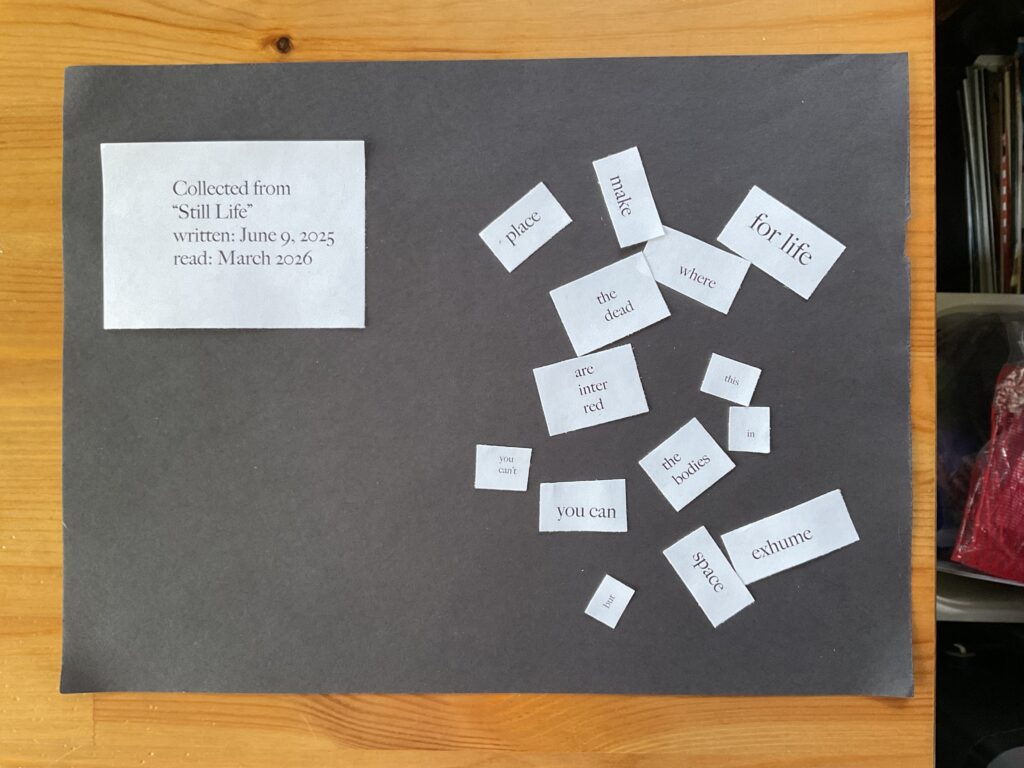
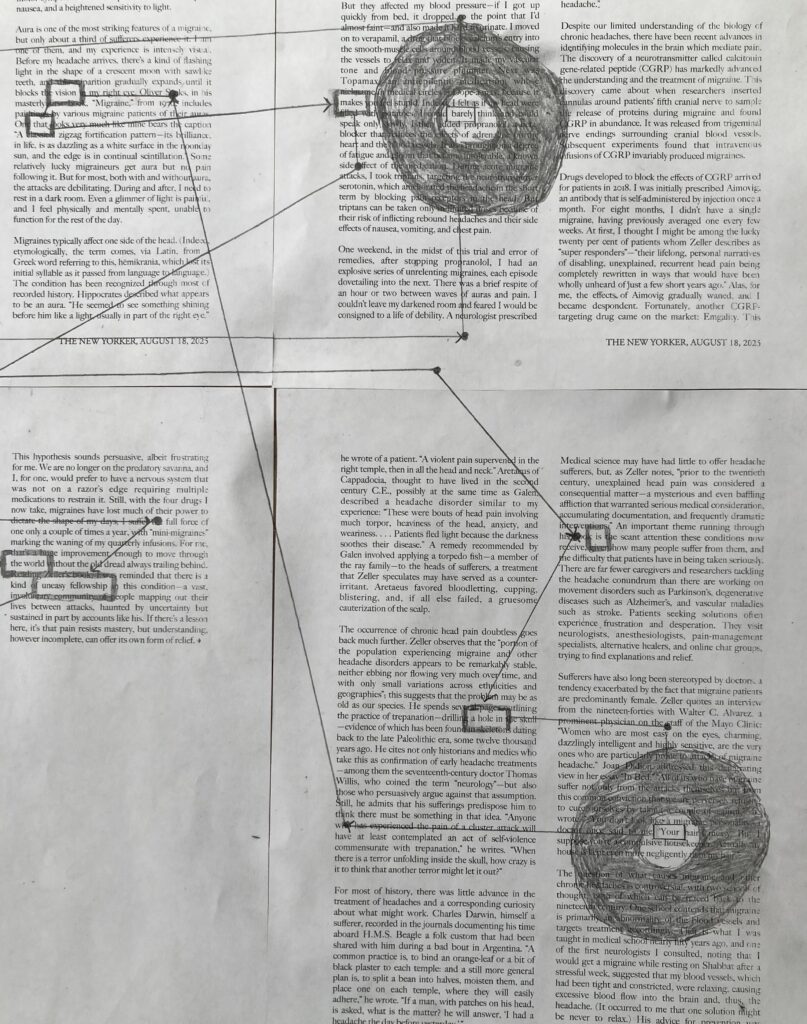
Today I’m mapping my words on a copy of the “Still Life” article. I”m trying something different. In Holes 1, 2, and 3, I taped the paper together first and then found the words and drew the holes over and around the words. Today, with such a long article, I’m finding the words and drawing holes around them first, before I tape the pieces together. Will that make a difference? Not sure, but I might switch around the order of the pages to shape how the holes look together.

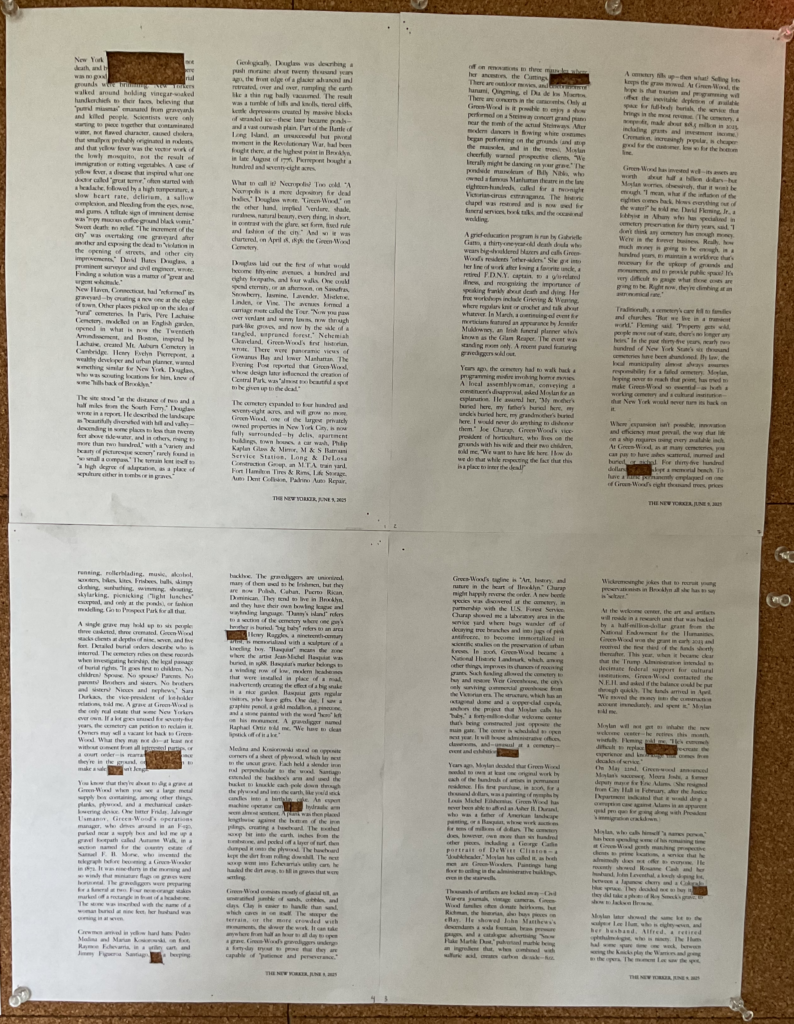
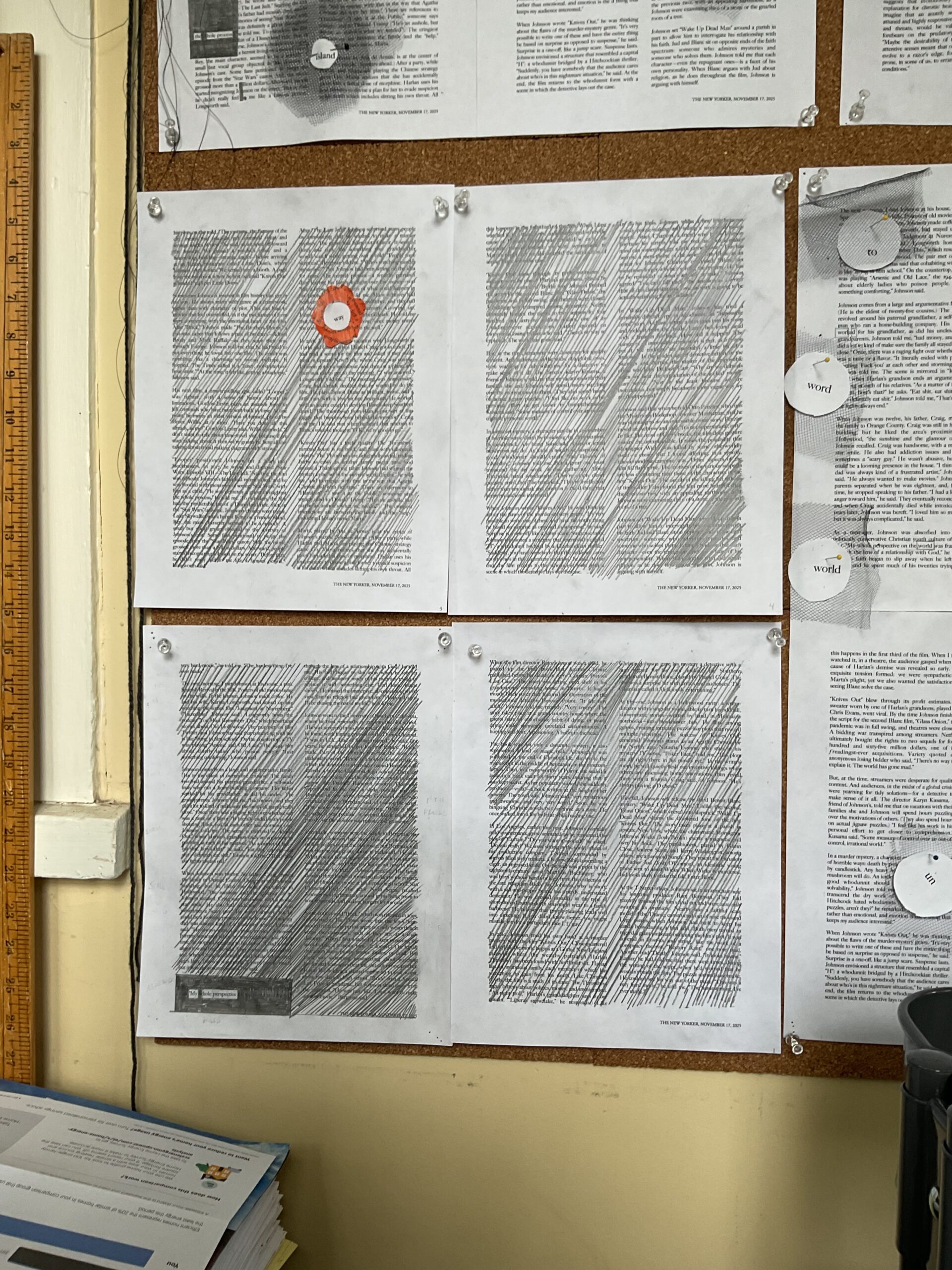
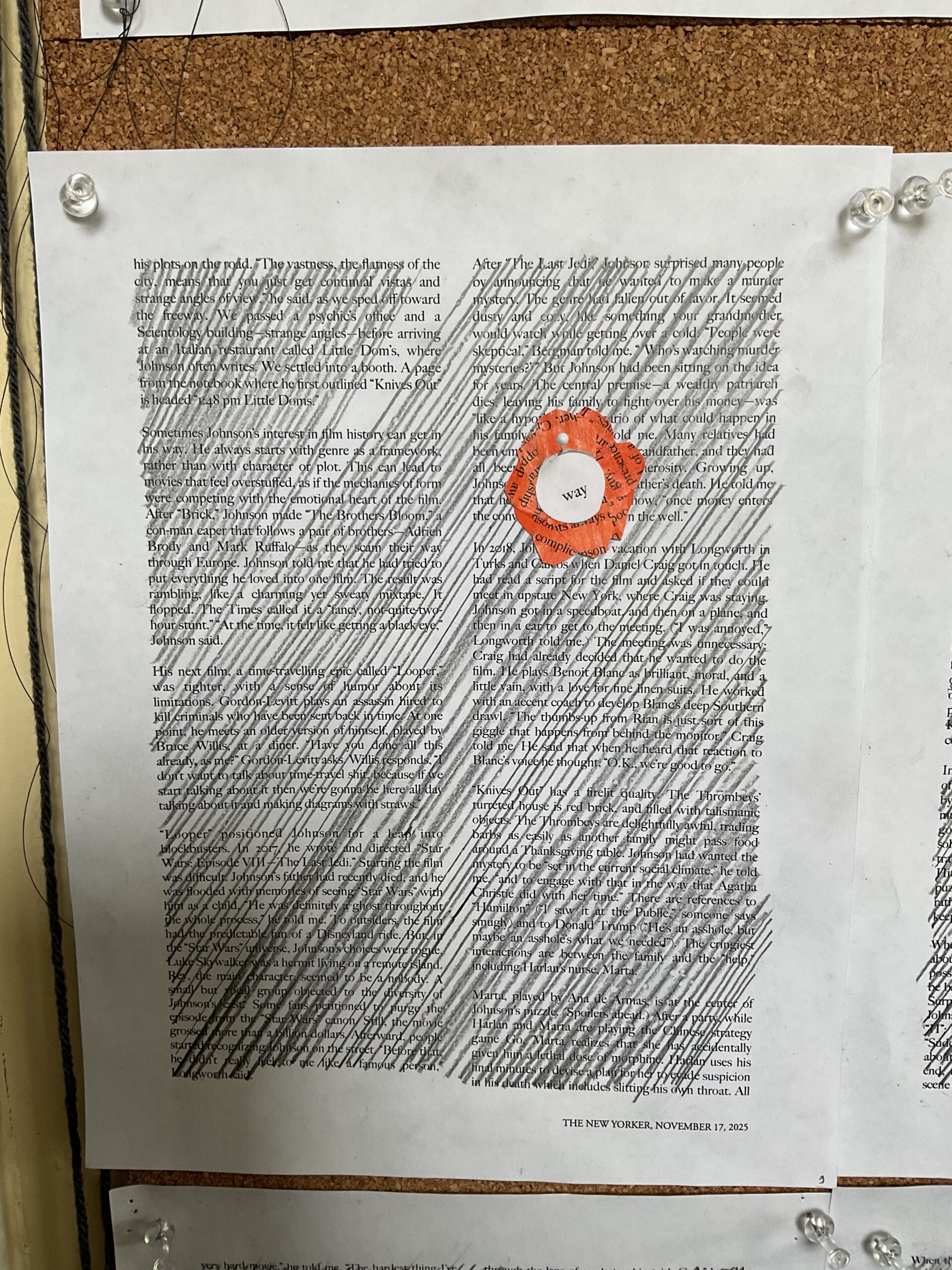
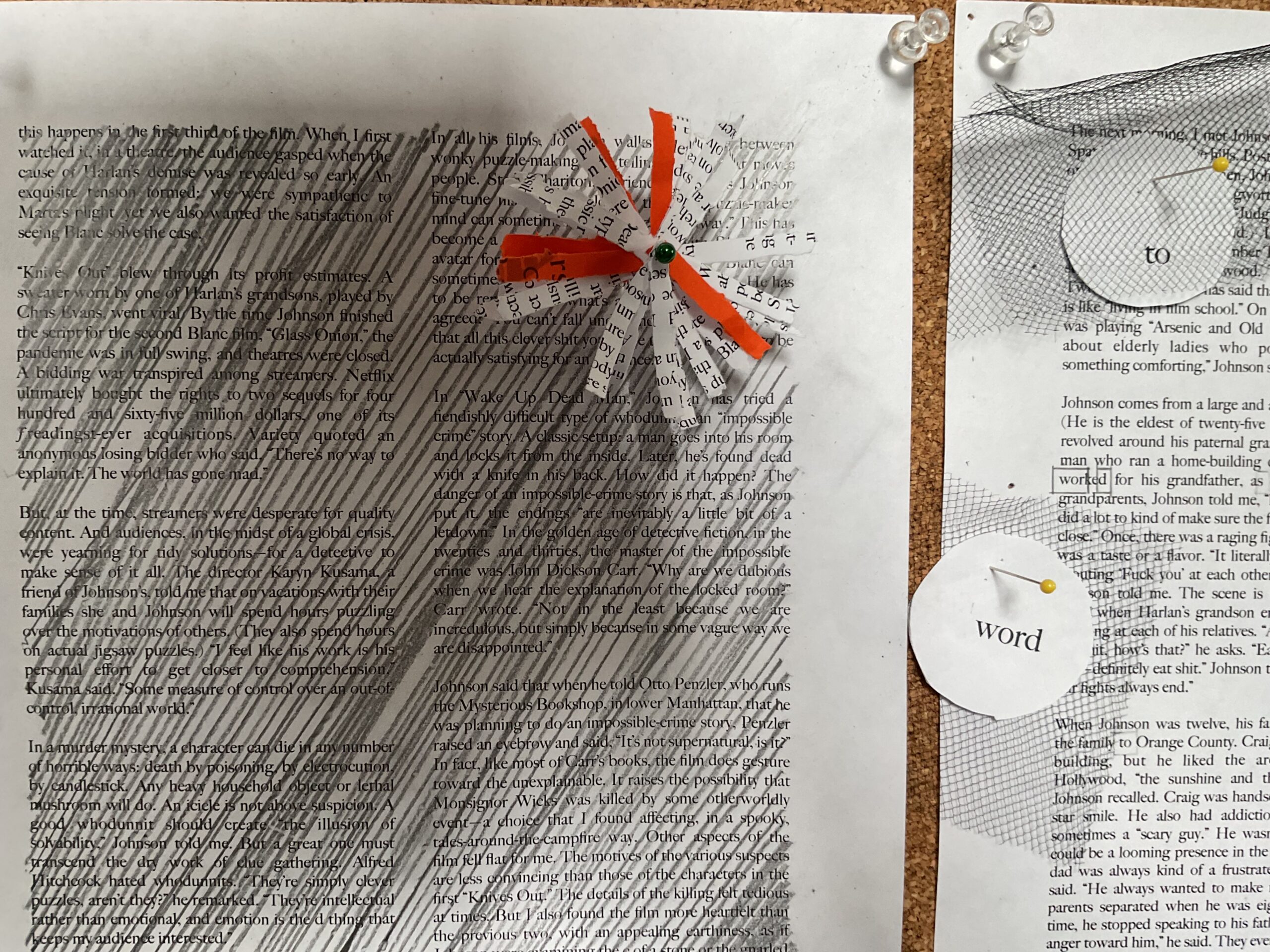
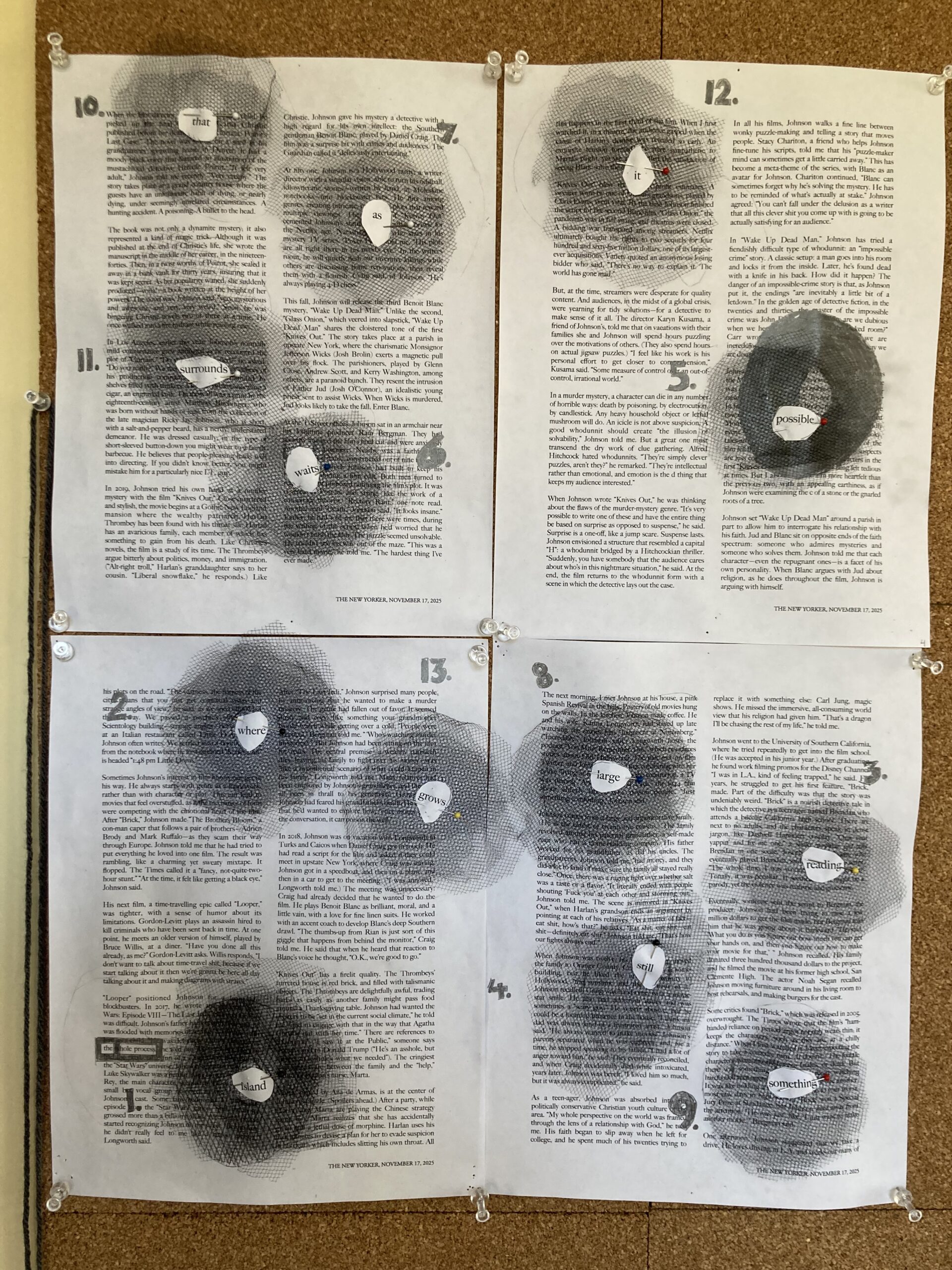
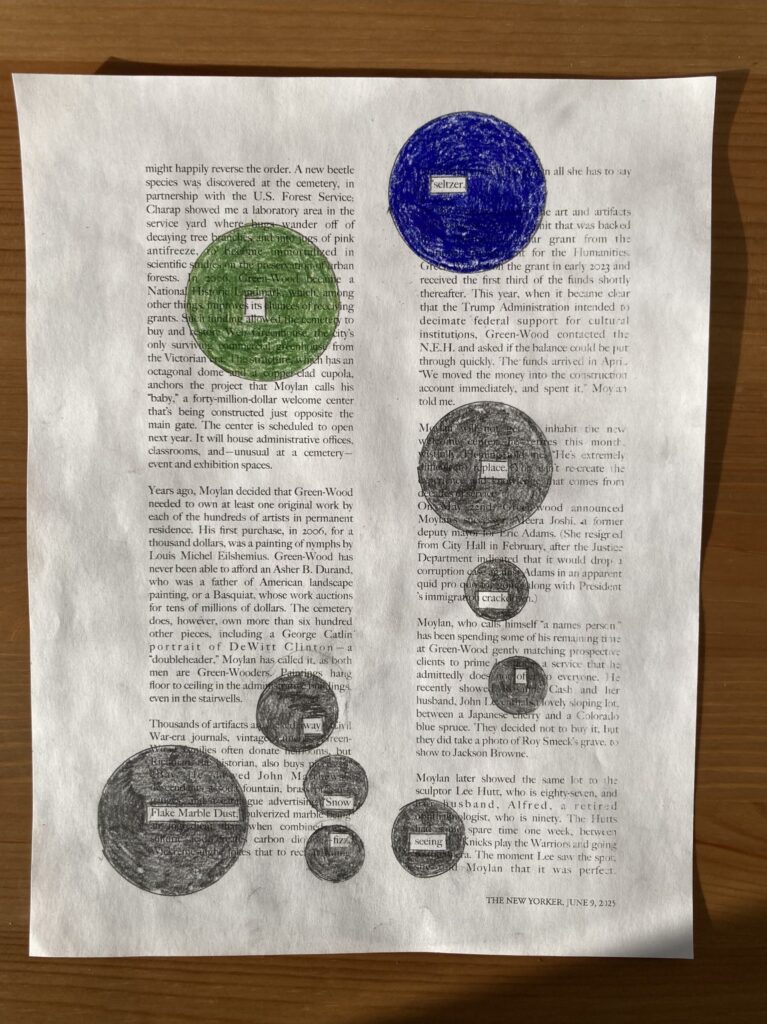
I drew and colored in holes on 3 out of the 8 pages, and tried adding some color to a few. I’m wondering if some of the holes should messier, with less defined borders or jagged, rough. I have limited ability in drawing; can I push myself some more? Here’s an image of one of the pages:

a page of holes 4 / “Still Life”

march 14/RUNGETOUTICE

3.7 miles
locks and dam no. 1
35 degrees

One last run on clear paths before it snows tonight. The forecast predicts more than a foot of snow tonight. It will probably melt fast, which will be as much as more of a nightmare than the actual snow. Walls of snow, then mush, then jagged ice, then little lakes and puddles. Oh well, I bet it will be pretty and I might get to see someone skiing down the street!

Today’s run was good. My left knee was a bit stiff and grumbly, but otherwise I felt good. In the last mile I started to feel relaxed, with my legs and arms and the space around me in sync. I was moving through the air, hardly noticing when my feet touched down — the space between beats! I love when I run like this!

10 Things

  1. honk honk honk honking geese all around the gorge, 1: down the hill, under the ford bridge, a lone geese floating in the middle of the river
  2. geese, 2: I heard their honks first, behind me, then beside me, then in front of me — finally saw them: 2 geese flying low
  3. overheard: one runner to another: it didn’t even taste like salmon!
  4. the bells of st. thomas
  5. someone in an bright orange jacket down below, on the stretch of the winchell trail that I call the edge of the world
  6. the river surface below the ford bridge was dotted with bright white slabs of ice — a strange sight; I wish I would have brought my phone today to take a picture!
  7. an empty parking lot at the locks and dam
  8. empty benches
  9. traces of snow in the grass
  10. a laughing pileated woodpecker

HOLES

Flipping through my past New Yorkers, I found an article from the 9 june 2025 issue that looks promising. It’s called “Still Life” in the print issue and “Greenwood Cemetery’s Living Dead” in the online version. The only test for whether I can use it or not: it must have at least one use of the word hole, or of a word that contains hole. This is a long article, so I’d hope there’s at least one hole, but is there? Yes, 4!

  1. Medina extended a tape measure into the hole and said, “Six-ten.” 
  2. Usmanov and I stared down into the gaping hole, its walls marbled with grass roots.
  3.  went to Green-Wood almost every day for weeks this spring, and the most unnerving thing I saw was an enormous hunched figure, wearing a cloak, with a gaping hole for a face.  
  4. Scientists were only starting to piece together that contaminated water, not flawed character, caused cholera; that smallpox probably originated in rodents; 

I’m surprised that an article about a cemetery only has 4 mentions of holes. Isn’t a cemetery more than half holes?!

some notes as I read through the article:

One, I am reading it backwards, section by section.
Two, one rule in the cemetery: no skylarking. I looked it up, skylarking is frolicking and playing jokes on others. It’s also the name of one of my favorite XTC albums.
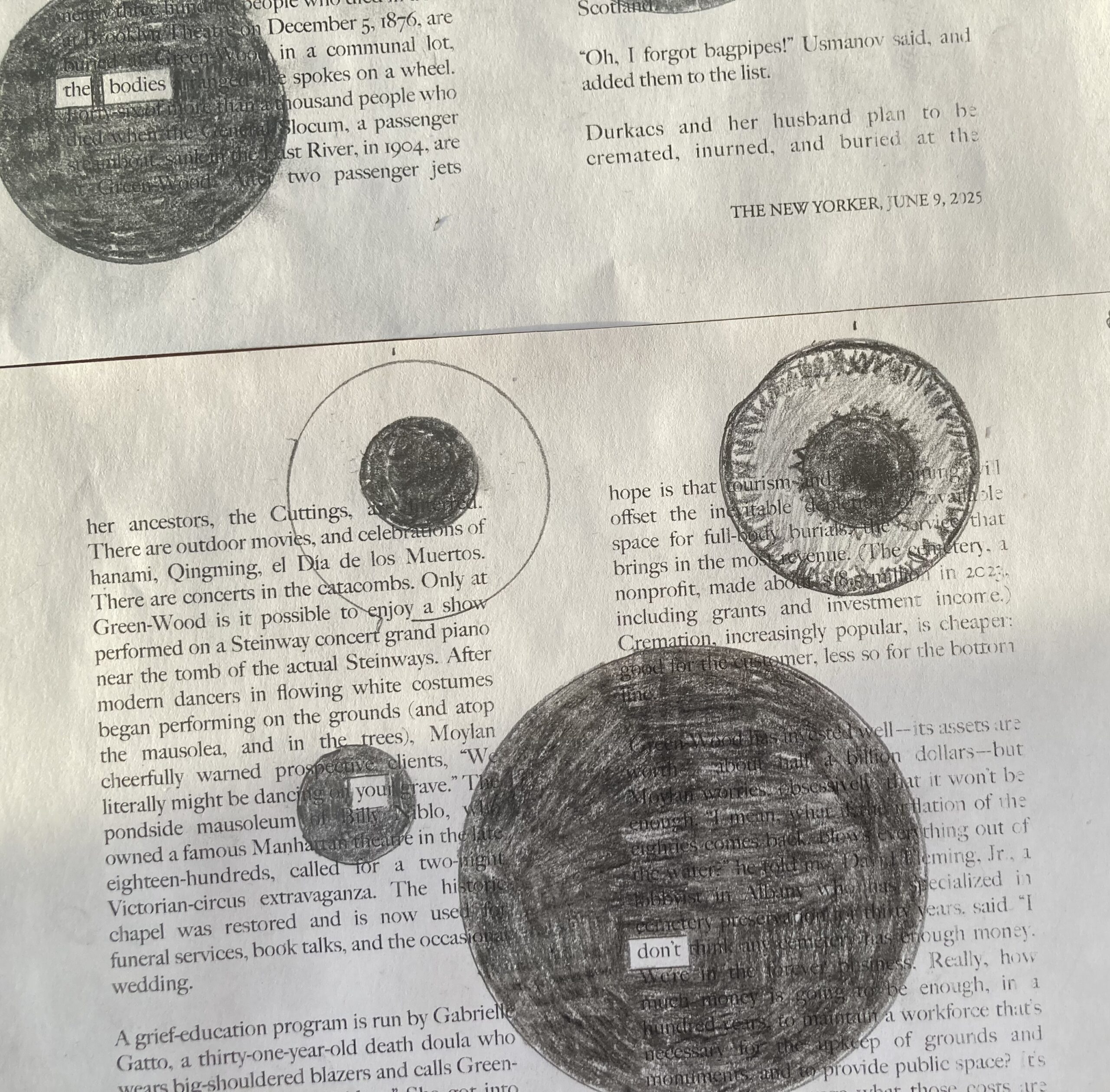
Three, reading the text, which I’ve put in a pages document, I’m noticing a few things about the text: the text surrounding the word or phrase that I can see sometimes looks like it is scribbled out. Sometimes it looks like it has sparkles around it that are moving — not quite flashing. The text always seems to be vibrating. How can I translate that into a texture on my blind spot
Four, as I read through the sections, I jotted down words or phrases that stood out to me:

entrance
flaming torch
welcoming
appears
mirror
ink
you’re never alone
you’re never disconnected
love
full of little secrets
inhabit
center
recreate
experience
remaining time
offer
everyone
gently
between
seeing
moment
you look at space, you look at background, you look at sky
hope
visit
already
thinking
I don’t know why
there was room
about to open up
turn and follow her gaze
staring
hands
waste
bigger picture
across
threshold
neglect and care
art
cone
cell

heart
needed
landscape
fizz
snow flake marble dust
seltzer
balance
fills up
keeps the grass
space
enough
out of the water
upkeep
grounds
public spaces
essentail
failed
possible
efficiency
requires
can
stand on a sidewalk
people who never look up
out of room
true
mapping
crevice
easy
circular
elipses
inside
walls
outside
dark
happen
here
nothing
pale-blue
cluttered
wasn’t a place
searched

certainunmarked
is now used
other-siders
skylarking
exhume
make
when you see
in place of a road
the word
down through the plywood
a plank
settling
glacial till
earth
inches from
a layer of turf
dirt
unstratified jumble of sands, cobbles, and clays
caves in on itself
all-weather
like a bird
bench
what do you want
stone slabs
a door
uncut grave
terrain
geologically
life
this is a place to inter the dead
no good place to put all the boies
walked around
faces believing
piece together
rotting
disease
inspired
crowded

By the way, as I write, the snow has started. We officially have a blizzard warning that begins around 10 pm and lasts until Monday morning.

One of the reasons I picked this article is because I wanted more land language, like grass and dirt and dust and terrain and stone slabs and sands, cobblestones, clays, caves and glacial till. I want to connect the hole in my vision with the gorge — as a landscape, and a very big hole. I think of it as a powerful metaphor for my vision loss and what comes during and after. Of course, the gorge is also the actual place I go to for my writing practice.

The word plank stood out to me because of ED’s “I felt a funeral in my Brain” — and then a plank in reason broke/and I dropped down and down — I think of ED also with the stone slabs and the dark.

And, I like crevice and opened up, inside, outside, this is a place to inter the dead, room — a gaping hole, a threshold between,

I also like fizz and snow flake marble dust, which is what the words (and what I) sometimes feel like — fly, like a bird, sky — the words, cluttered, crowded and between walls

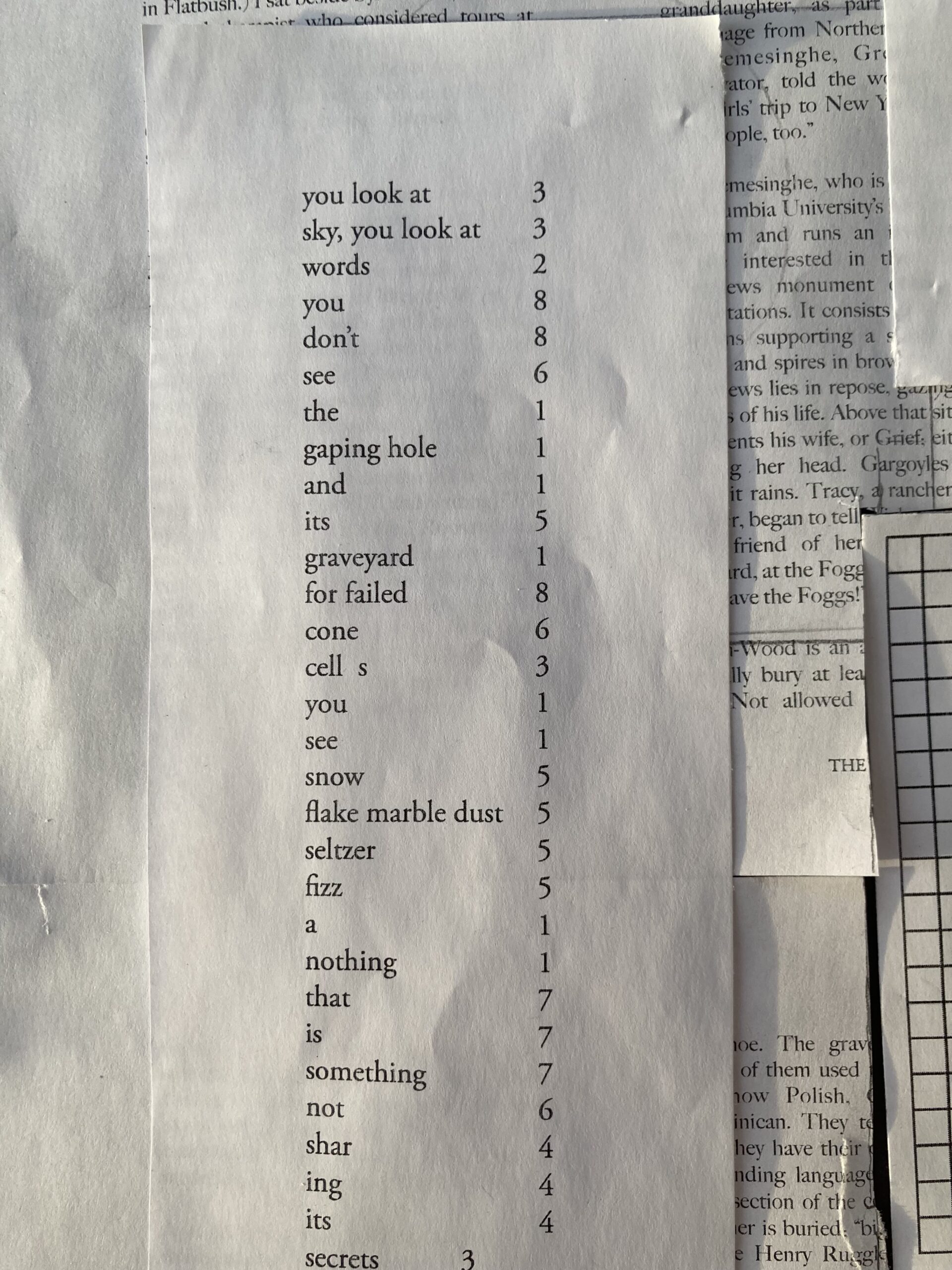
my eyes: a graveyard for dead cone cells

you look at space
you look at sky
you look at words
and don’t see the gaping hole
and its graveyard for dead cone cells
you see
snow flake marble dust
seltzer fizz
a nothing
that is something

I’d like to keep going, but it’s time to get ready for Scott’s birthday dinner!

march 12/RUNGETOUTICE

4.45 miles
the monument and back
35 degrees

Ran over the lake street bridge and to the monument today. When was the last time I ran this route? Just checked, it was 5 nov 2025. Wow! Of course, part of the reason why I haven’t run over there is because of the winter; they don’t plow the sidewalk on the bridge, and St. Paul, where the monument is, doesn’t plow their trails as well as Minneapolis. But another reason is definitely ICE; I’ve been staying closer to home with my runs because it feels safer.

Today’s run was good; I felt (mostly) strong, although my legs/feet are sore from wearing the shoes that make them hurt. It was windy and cold on the bridge, but it was beautiful. Steel gray water, open and high enough to hide the sandbars. Scattered stretches of the east and west banks were glowing with white snow. The sun was dulled by a thin layer of clouds.

10 Things

  1. drip drip drip drip — the steady drip of water falling off the bridge near the east steps
  2. graffiti — pink and orange and black block letters under the bridge
  3. I only encountered 1 or 2 people over the bridge, both walking
  4. the bells of st. thomas chiming at noon! 15 minutes later, at 12:15
  5. running above shadow falls I glimpsed a dark flash of something — a tree? no, a person
  6. with several more glances I realized the person was not hiking but running
  7. they were nearing the worn dirt trail that climbs up and out of the ravine
  8. St. Paul has replaced the port-a-potty at the edge of the monument parking lot — there is much less graffiti on this new one, and the door closes all the way — hooray!
  9. near the edge of an overlook on the east bank, staring out at the other bluff and down at the water — a hiker emerges
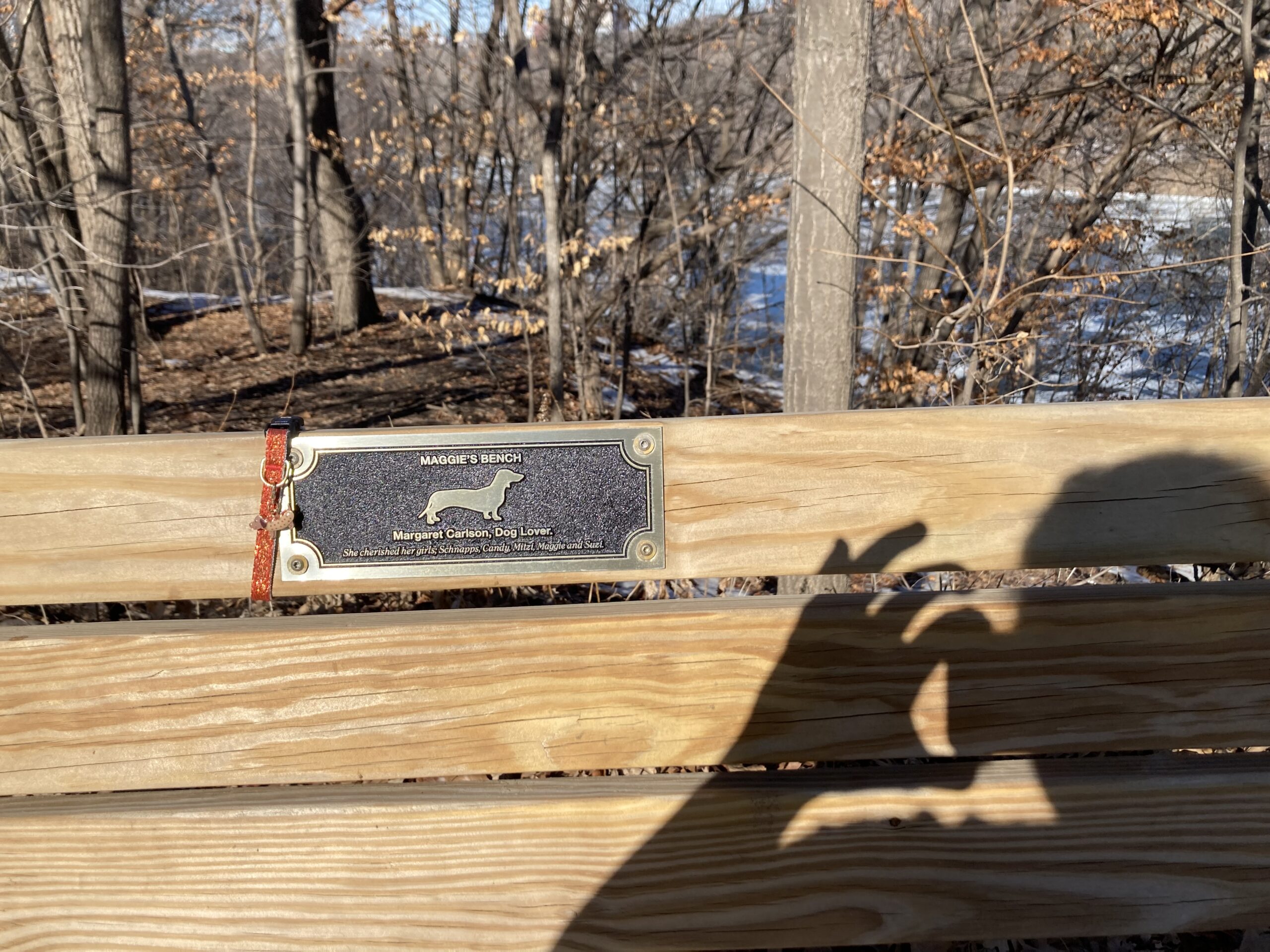
  10. a plaque on the bench for, “what a woman” Sharon. She was born 2 weeks after my dad was in 1941 and died in 2002 — so young!

Holes

Currently, I have 3 Holes erasure poems. Holes 1 is about my uneasy fellowship with the word. Holes 2 is about how the hole (my blind spot) makes it unprofitable to have faith in the visible. And Holes 3 is about falling through the hole into “who knows where”, on the border between the real and surreal. I need to do at least one more hole about the small holdout-of-a-hole in the very center of my vision that enables me to still read (even if that reading is slow and sometimes unreliable).

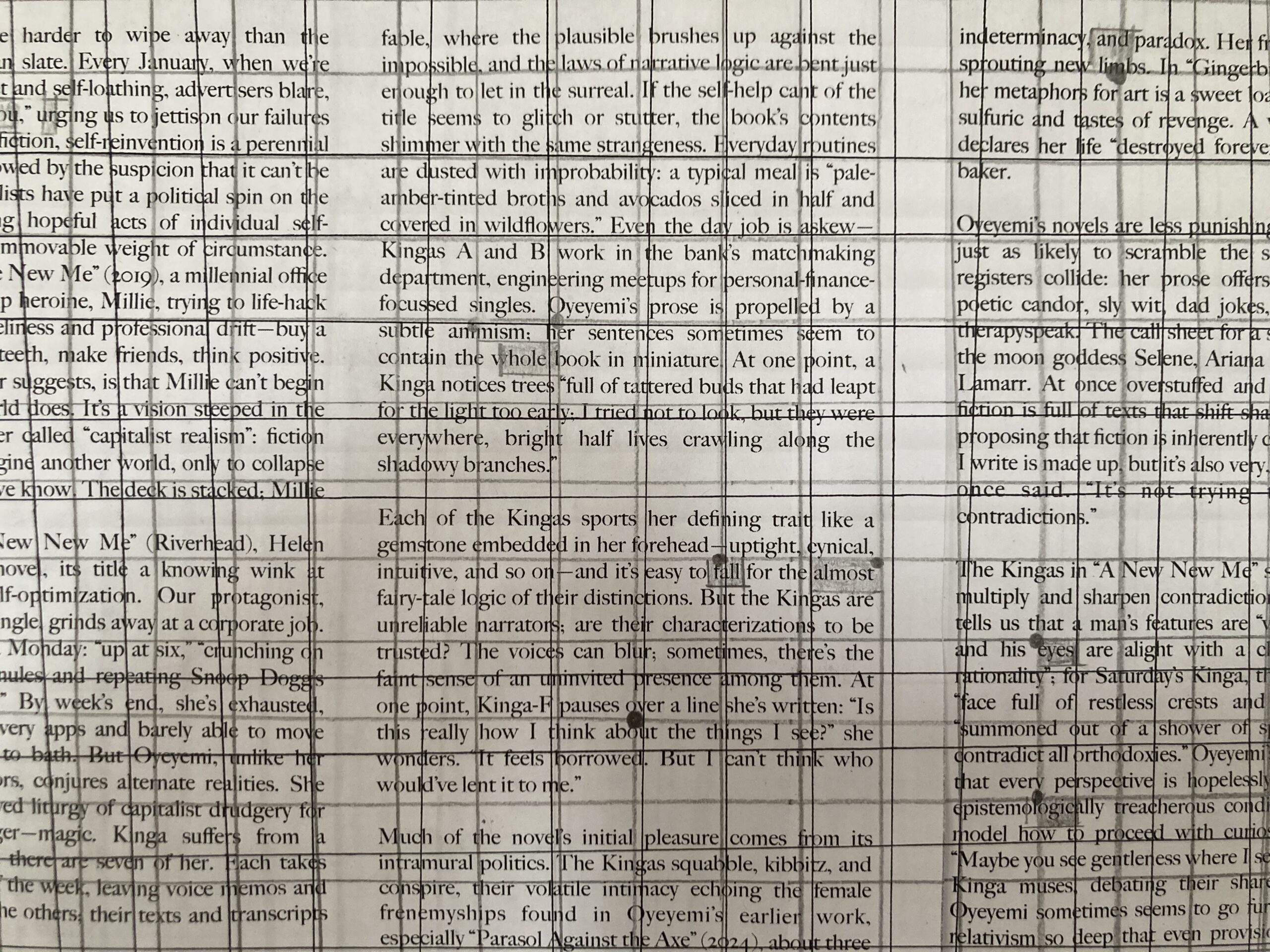
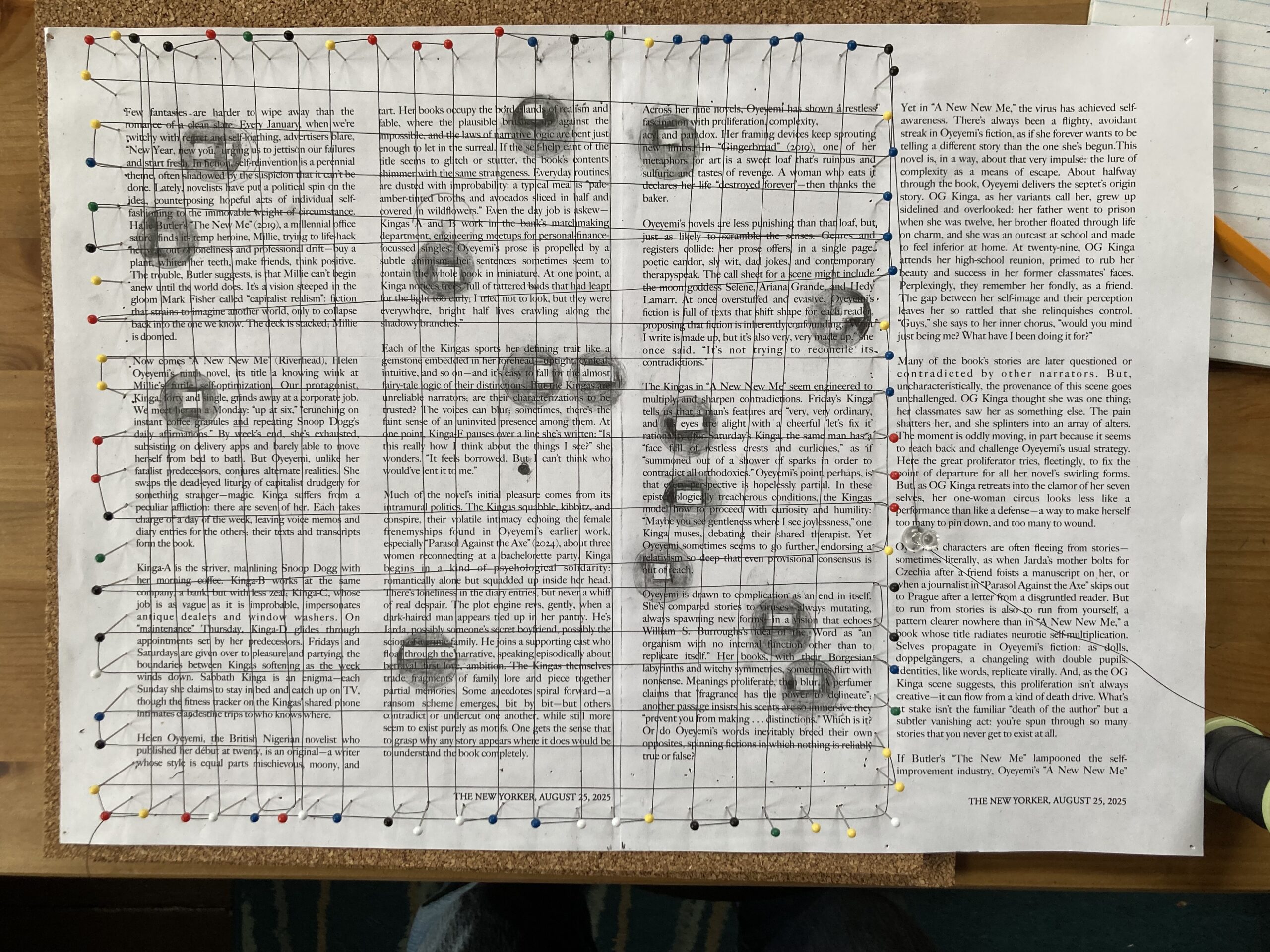
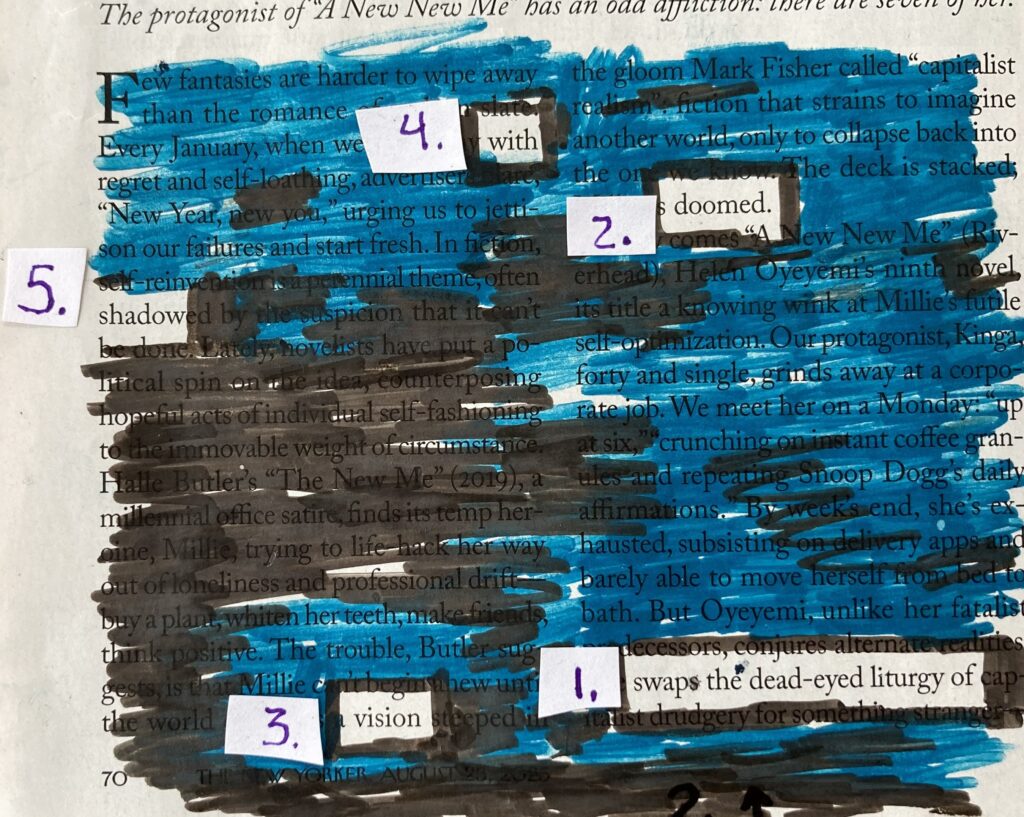
Tomorrow, RJP and I go shopping for textiles and textures at the Stashery, so today I’m working on mapping out Holes 3. I’m using “Me, Myself, and I: Helen Oyeyemi’s Novel of Cognitive Dissonance” from The New Yorker, August 25, 2025. Here is the version I just drafted:

swap the dead-eyed liturgy of
doomed vision
with shadowed acts
that leap for the light (OR flee from the light?)

read sentences
sliced in half
with strangeness
each one glitch ing
enough to let in
the improbable

fall through the hole
your reading eyes find / or your reading finds / or your eyes find
and land in a logic
of blur and almost

Is this too many words to easily/cleanly map out? Let’s find out! And if not, let’s shift the form to make it work! — several minutes pass — Okay, I mapped it, and it seems like too many words. I think I’ll save my “darling” — the line that started it all about swapping the dead-eyed liturgy for another project — a liturgy of shadowed acts and the periphery! Anyway, I’ll try to keep the rest of the poem, and figure out the rest of holes is a project tomorrow morning.

Get Out ICE and Ice

The other day I wondered when the ice would be gone from Lake Nokomis. This morning, Minneapolis Parks and Recreation Board offered a prediction!

Minneapolis Parks Water Quality staff have tracked “ice off” dates on city lakes for decades. Ice off is declared when a lake is substantially free of ice after being fully frozen.

We’re probably not setting any records like 2018 or 2024, which dominate the record books. Staff estimate we could see ice off on small lakes like Powderhorn and Loring as soon as this weekend. It will probably be a few more weeks for larger lakes.

MPRB post

Will the HUGE winter storm we’re expecting on Saturday night and all day Sunday impact the ice off date? BTW, I’m pretty sure that they used to refer to this as the ice out date; I think they’ve changed it because of the very negative association with ICE. I checked past entries on my log, and yes, that was what it was called. Negative association aside, I like ice out better than ice off.

march 9/RUNGETOUTICE

4.5 miles
veterans home and back
50 degrees

With the sun and the bare ground it felt warmer than 50 degrees, so I wore shorts! I started with long-sleeves, but by 2 miles, I shed that skin and ran the rest of the way with bare arms too. Ah, spring! Not the easiest run. It might have been because I didn’t wait long enough after my second breakfast/early lunch.

1

One of the best things about the run was heading south and admiring the river. Waves on the surface reflecting the light. A shimmer scene. Dazzling. I haven’t seen sun on open water like this for many months.

2

Since I’m thinking about holes and spots, which also means circles and loops, I thought about a playlist I made a year ago (25 march 2025), and decided to listen to it. Much of it is about seasons and cycles, but as I ran I thought about the hole inside the wheel and falling through it — into another dimension? another way of being? a space not consumed by the expected (normal) life? Then I thought about my growing blind spot and how it has cracked open “normal” life — this cracking can be painful and difficult, but it has offered new possibilities and an entrance to another way of being.

3

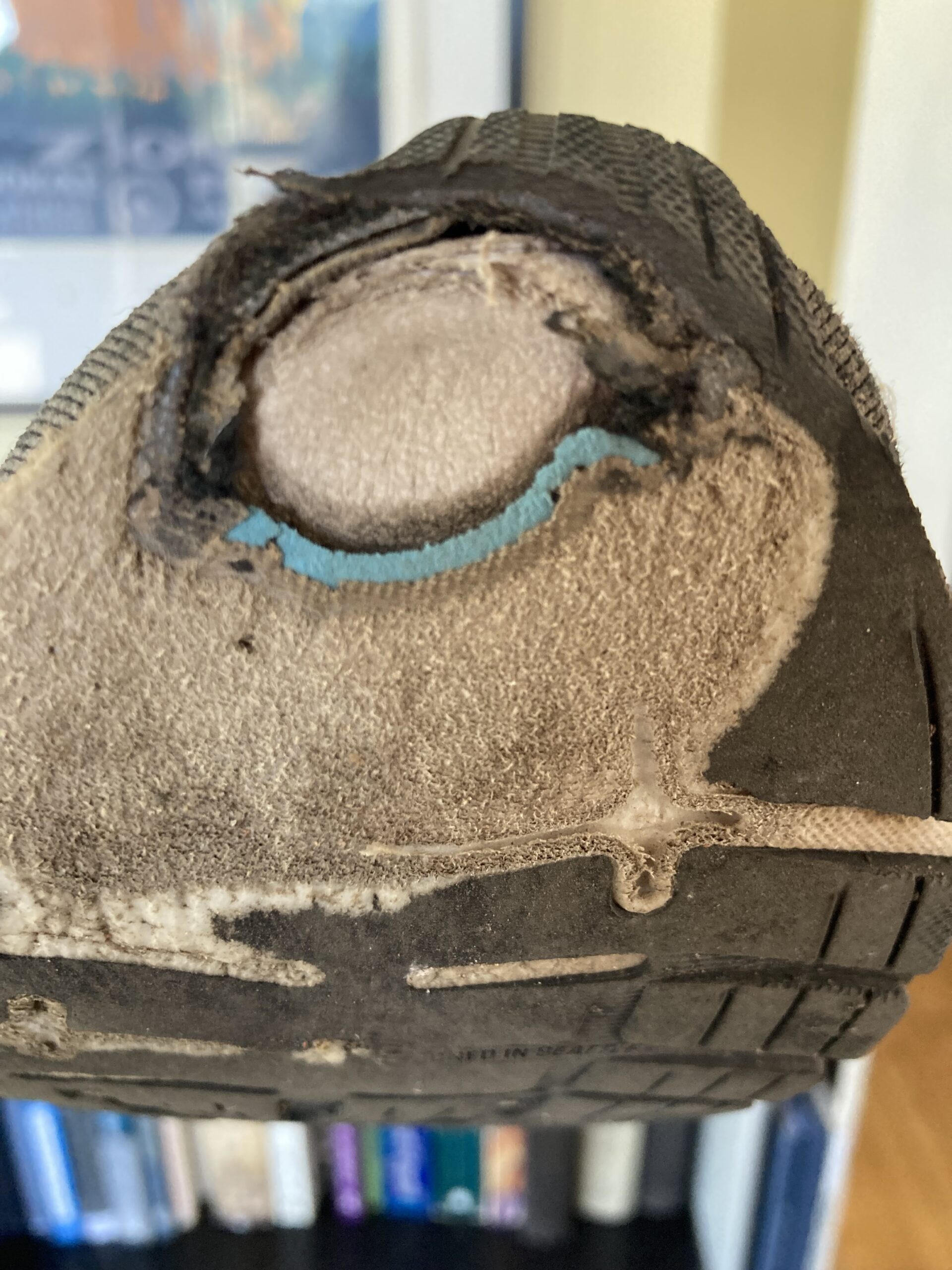
After stopping to put in my playlist, as I ran down the hill and away from the park, by right foot felt strange. Was there a rock in my tread? I finally stopped and looked. Not a rock, a hole in my shoe where my middle toes strikes down. I guess that proves it: I’m not a heel or mid-foot but a toe striker! Unlike the hole in my vision, I don’t really see an upside to this hole in my shoe — well, I guess it means I have get to buy new shoes, and, if any are still available, in a bright color!

minutes later: Done! My new Brooks Ghost 17s are dark blue, turquoise, and green!

a close-up of the bottom of my running shoe with a white circle which is a hole that goes all the way through
a hole in my running shoe

I have never had a hole in the bottom of my running shoe. I’ve had holes on the side where my bunion/wide foot has pushed through, but never a hole on the bottom. I think it’s funny that this hole happened just as I’m thinking and writing about holes. I feel like I need to incorporate this hole into my project!

A Return to my Rabbit Recap

11 continued — 20 march 2026

sources of bunny inspiration: 1. rabbits who eat buckthorn bark may pee smurf blue; 2. identifying the dark forms in the backyard as rabbits; 3. origins of “bold as brass”; 4. optical illusion — duck or bunny; 5. a cup full of 3 rabbit breaths (poem); 6. jackrabbit trapped in a wildfire (poem); 7. the rock that is not a rabbit (poem); 8. little girls deciding who will have their bunny when they die (poem); 9. a rabbit offering themselves to quell a woman warrior’s hunger (book)

12 — 24 march 2026

Bunny as muse? nudge? pest? ghost?

What am I doing as I keep putting the two bunnies in my backyard into my poems? And why do I insistent on calling these wild and mature eastern cottonwood rabbits bunnies? I’m not sure these rabbits are indifferent to me, but I think they notice me in terms of whether or not I am a threat to their main activity: grazing in the grass.

A title for a poem? Crepuscular. Why don’t rabbits flee when I approach? Do they see me as non-threatening? Has human encroachment screwed up their sense of friend and foe? My mom, a pesky bunny, and a drive out the country. Peter Rabbit: the horror movie.

the rabbit hole: 

“Down the rabbit hole” is an English-language idiom or trope which refers to getting deep into something, or ending up somewhere strange. Lewis Carroll introduced the phrase as the title for chapter one of his 1865 novel Alice’s Adventures in Wonderland, after which the term slowly entered the English vernacular. The term is usually used as a metaphor for distraction.[1] In the 21st century, the term has come to describe a person who gets lost in research or loses track of time while using the internet.wikipedia

Out-of-control curiosity. Distraction. Losing track of time. Getting lost in strange worlds. These are presented as bad things. Are they? Many of them are embraced within poetry. And they are great tools of refusal and resistance against late-capitalism and wannabe fascist governments — you’re not working for/perpetuating the system while you’re following the rabbit hole.

The rabbit hole online.

13 — 27 feb 2026

The rabbit hole. “Back to hole-less cottontails. A new metaphor is needed — not falling down and through to other worlds, but something about edges and shadows and the fringes — the periphery! Dwelling on the edges, in the corners, not traveling to new worlds, but noticing the other worlds that are already there, have always existed in the midst of my world.”

I want to think more about this shifting metaphor in my understanding and use of hole in my erasure poem (or poems?)

New Yorker Experiment #5

First, an update on Holes. There’s an empty space without text in the lower left corner. I’m thinking of putting a definition or a quote or a line there. Or, I could put my poem written out in a straightforward way in the space. Would that undercut of enhance the experience of reading the poem? The text could also be an explanation of my version of reading; peripheral — big picture / central — one word or small phrase at a time, often experienced in isolation.

I’ve started (just barely) working on experiment #5. I’m using an article from July 28, 2025 titled “The Whisker Wars.” All I’ve done so far is write down words that stood out to me on two out of the three pages. I want to try experimenting directly on the New Yorker pages so I have a decision to make: two of the pages are back to back, so I need to pick either the first or second page. I’ll read through both of them and see which one I like better.

Hmmm….there’s a cartoon on the second page with the caption, “That’s an area for creativity and unstructured play.” I might want to use a few of those words.

words/phrases the stand out, page 1:

  • portrait
  • a game of Now You See It, Now You Don’t
  • in the beginning, not a whisper
  • otherwise
  • drift like snow
  • wonder
  • notice
  • russet-and-gray
  • pewter-colored
  • abrupt shift
  • who left
  • entanglements
  • weirdness
  • yellow
  • bore a hole through the bottom (of my coffin)
  • still

page 2

  • traces
  • people saw it as separate (from the body)
  • replaced by a view
  • faith
  • framed
  • revealed
  • meanwhile
  • from
  • however
  • trends
  • norms
  • world all know / known
  • waves
  • an area for creativity and unstructured play
  • lies details
  • natural
  • rather
  • nothing
  • believe (rs)
  • teach you
  • visible
  • cut
  • choice

Get Out ICE

On 5 march 2026, NPR posted a story about how doctors and nurses in Minnesota have created an underground network of medical care for people who are too scared to leave their homes. “There are now about 150 doctors — a volunteer “rapid response” team that has made more than 135 home visits” (When ICE came, Minneapolis created underground health networks).

These members of the care network have helped women in labor, babies with the flu, “At the Faribault clinic where Carroll works, staff members deliver medicine, food and other necessities to patients. A staffer drives 12 middle and high school kids to and from school every day in a clinic van.”

For more on ICE’s impact on healthcare in Minnesota, listen to this podcast: How ICE’s presence is affecting health care in Minnesota

march 7/RUNGETOUTICE

2.5 miles
44th street parking lot and back
35 degrees

Ran in the afternoon. Colder today. I wore gloves and a headband to cover my ears. It felt harder, maybe I ran too soon after lunch?

It snowed last night. Not much — not even an inch, but enough to cover the grass and make everything glow white. By the time I went out for my run, the paths were clear.

omens of spring-to-come: someone was roller blading! Not roller skiing, but roller blading. And, a woman was running in shorts. It’s not unusual to see a man running in shorts during the winter, but it’s rare to see a woman. That usually doesn’t happen until it’s spring, or feels like spring, or is warm enough to be spring.

I was planning to finish my rabbit recap today, but then I started thinking about and experimenting with my holes poem. No time for the rabbits — well, except for several paragraphs below, when I realize that my naming of this poem, Holes (or hole?), is probably at least partly a reference to the rabbit hole!

New Yorker Experiment #4, continued

Today some part of me decided that we (the Saras) would offer a more detailed account of the process of thinking through my latest poem, so that’s what we’re doing.

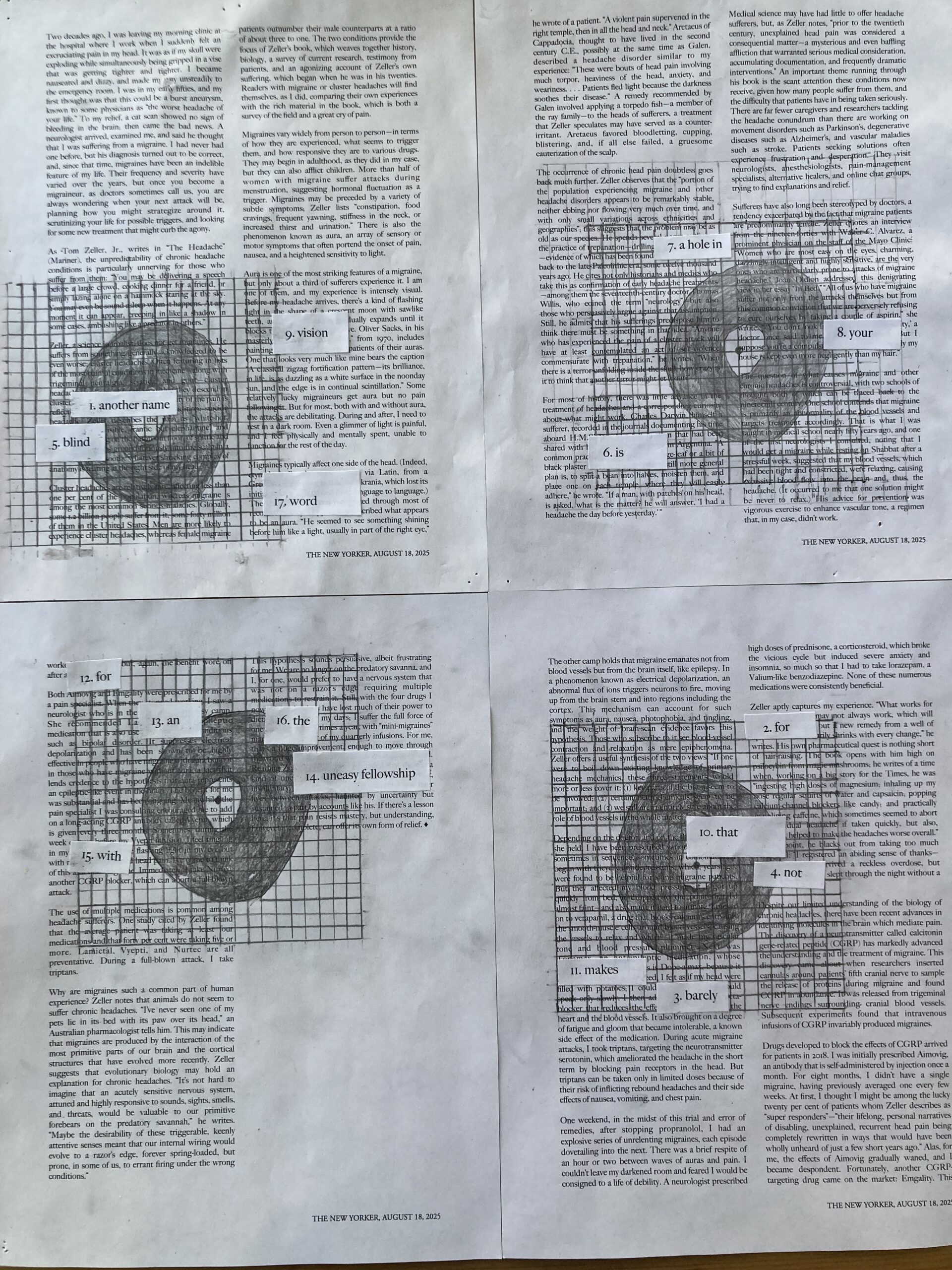
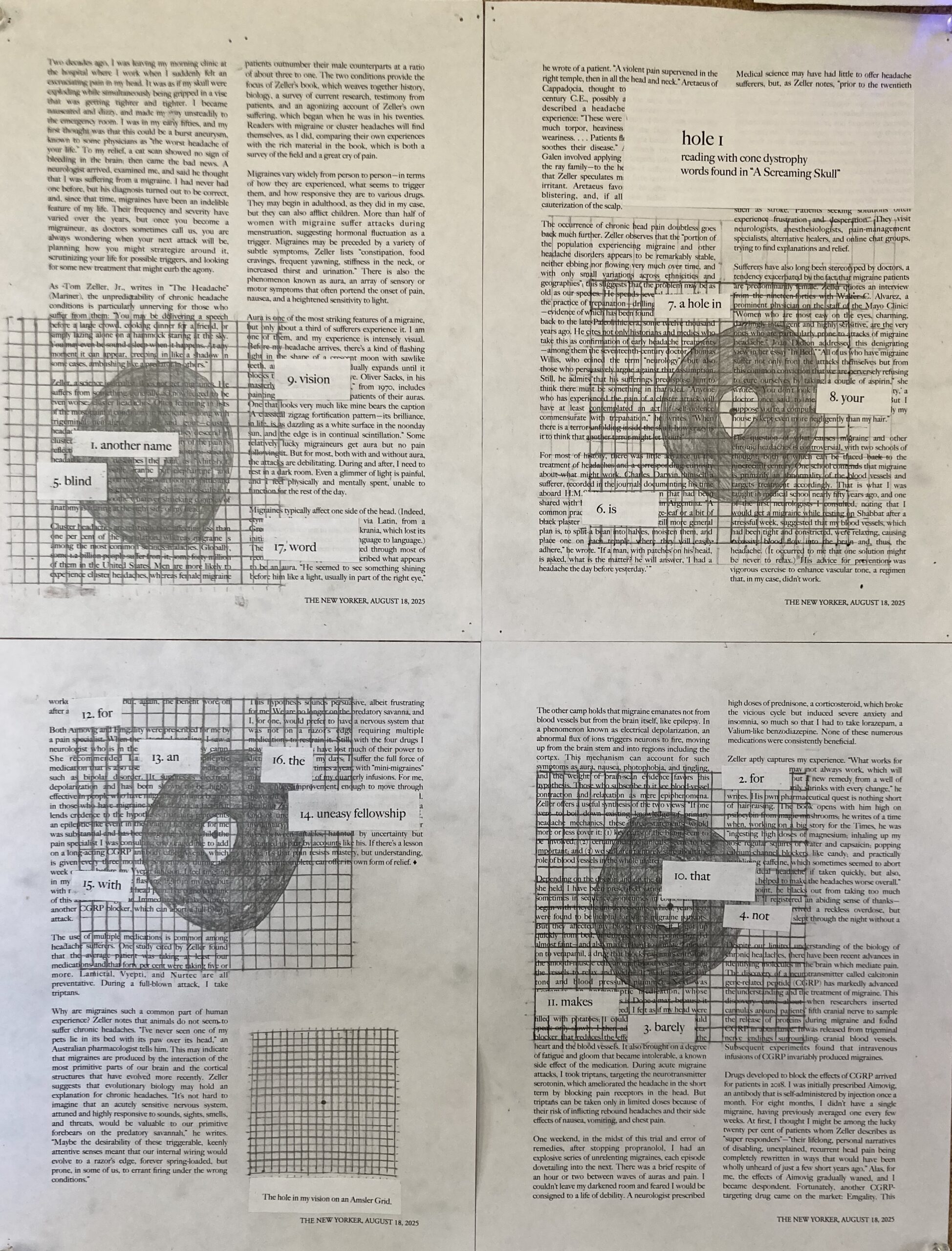
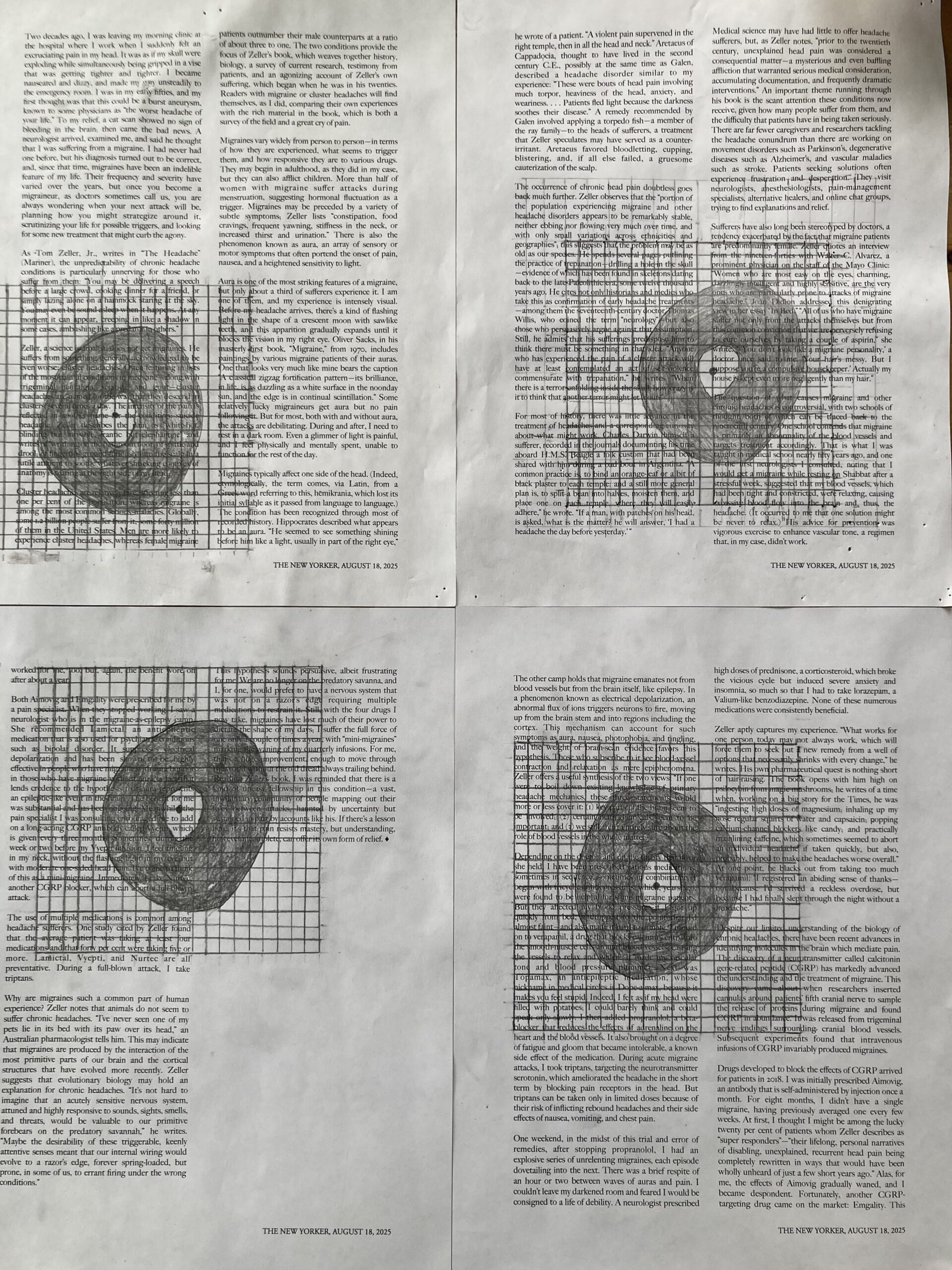
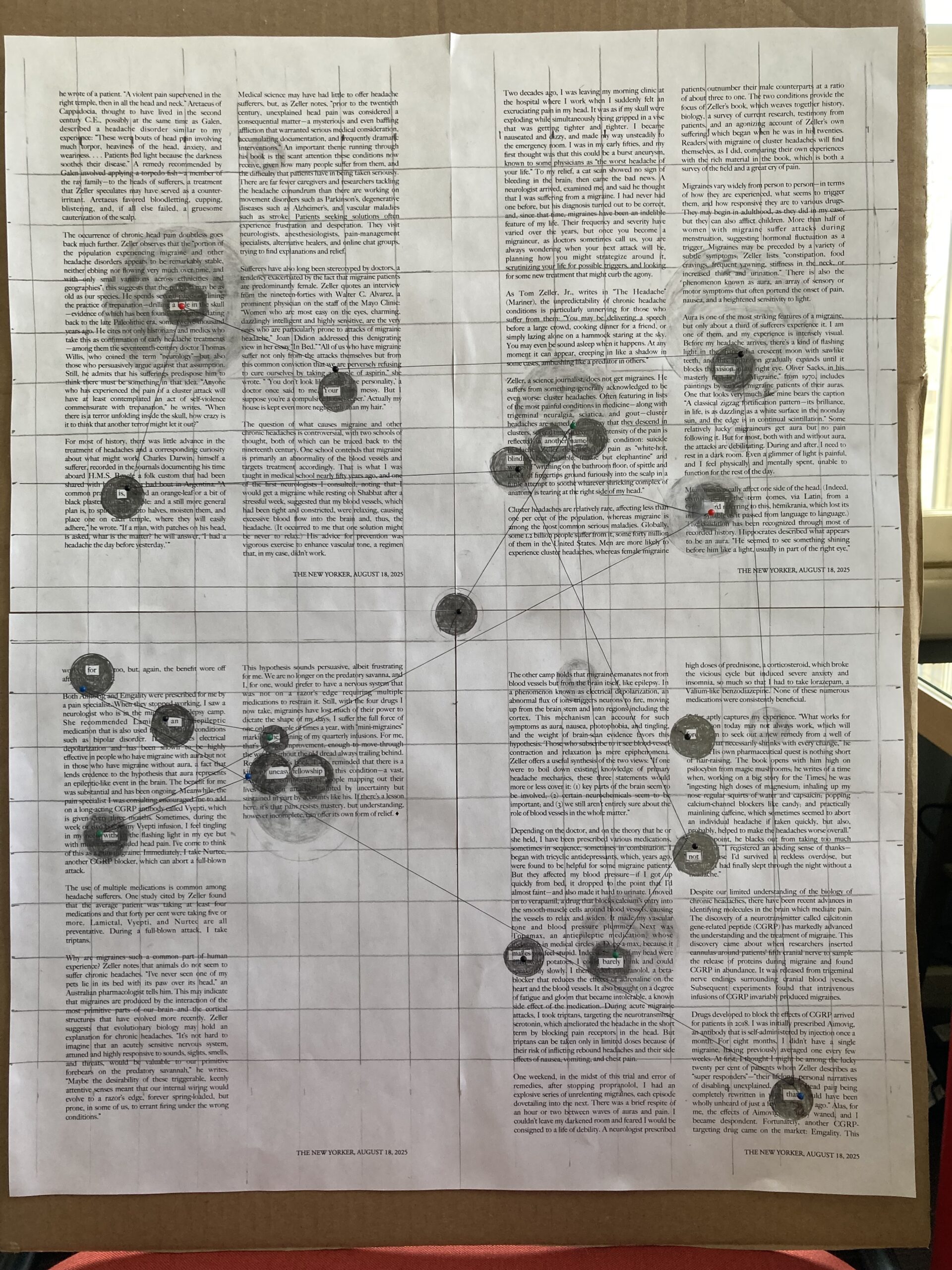
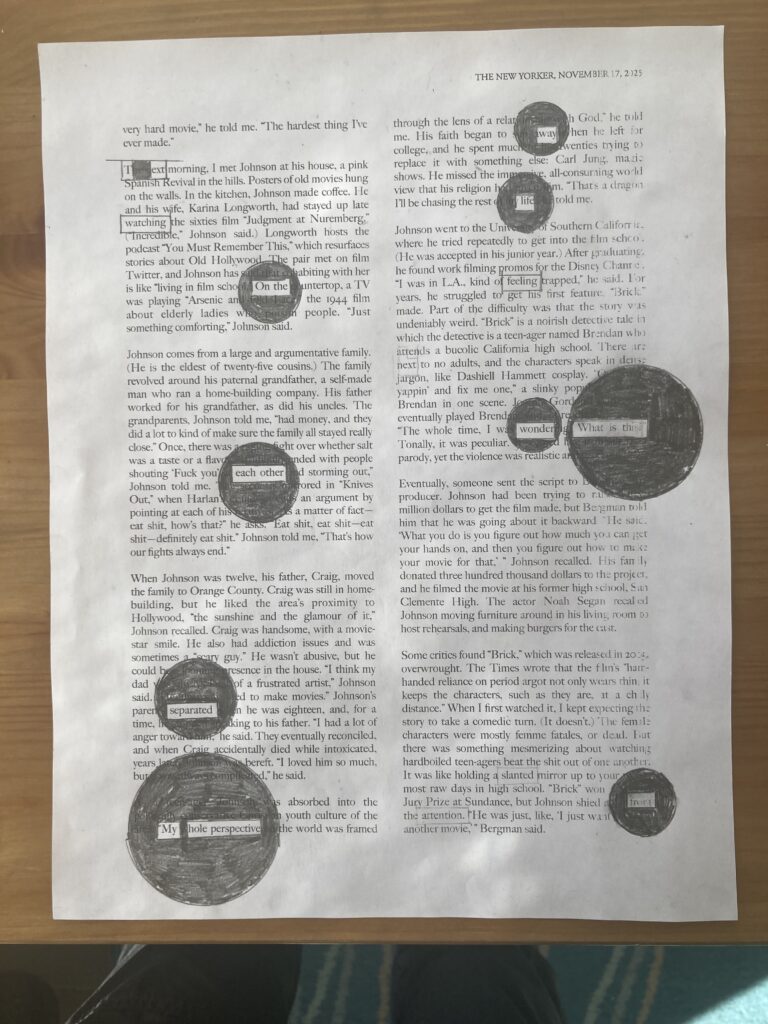
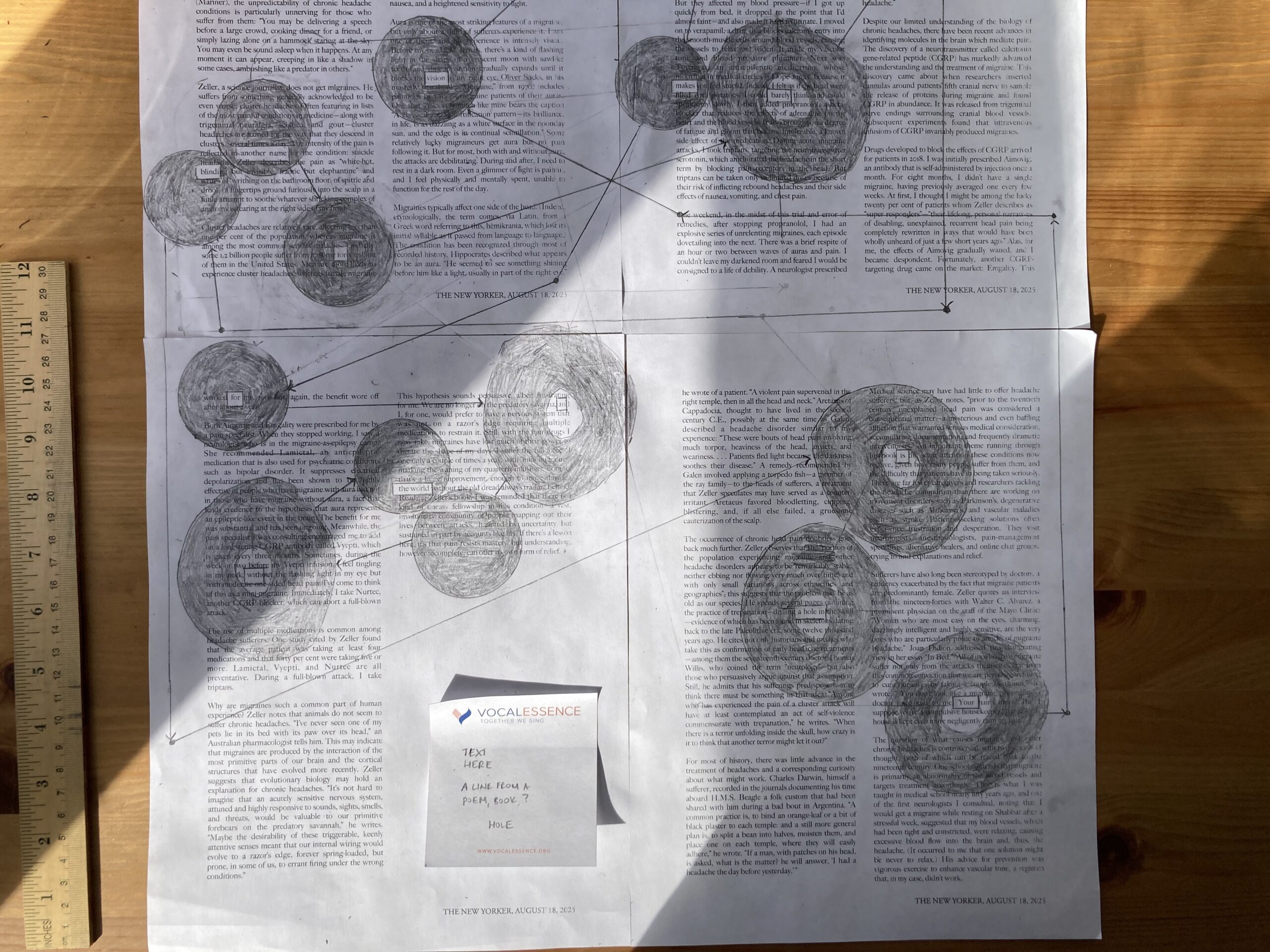
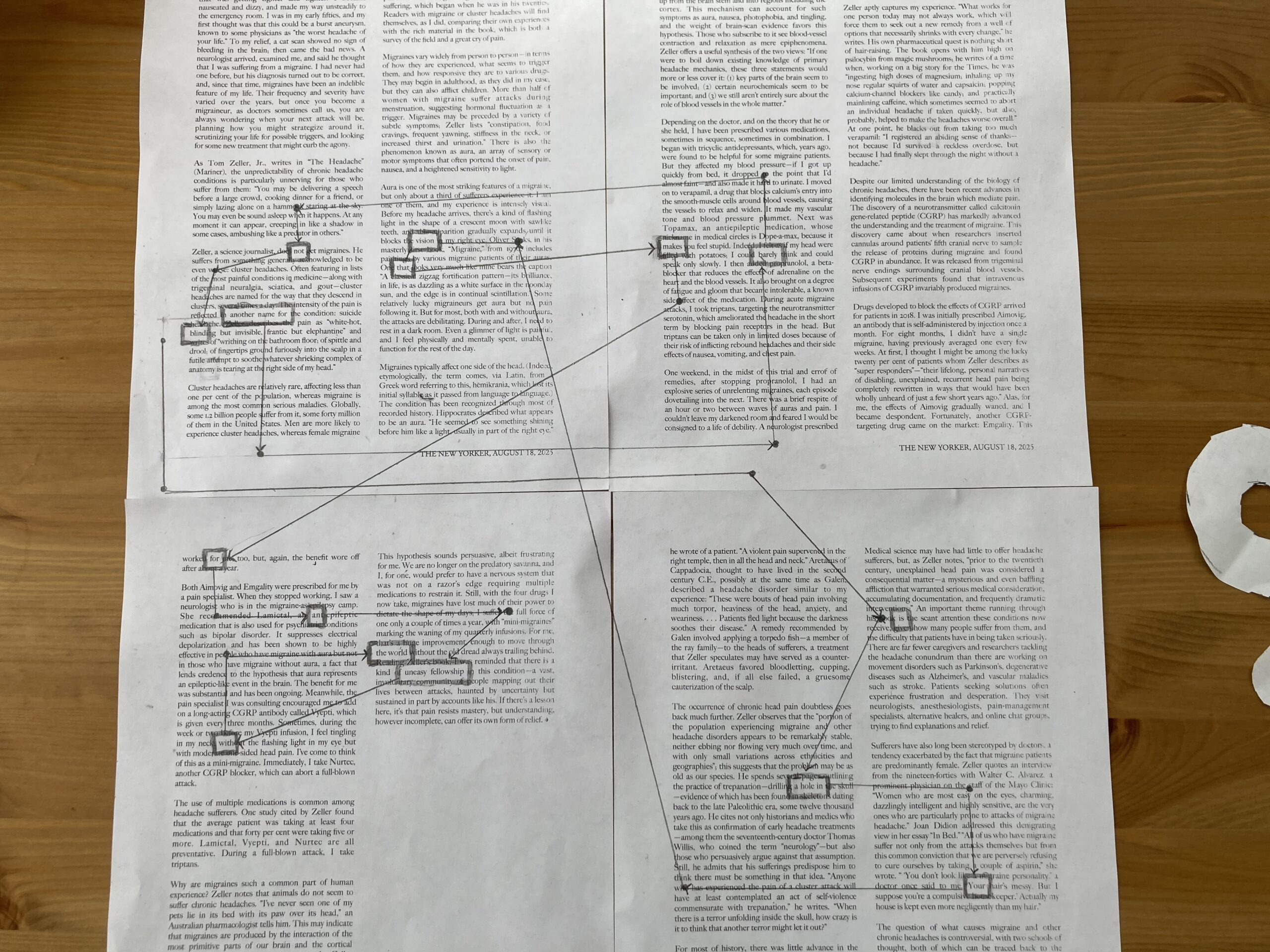
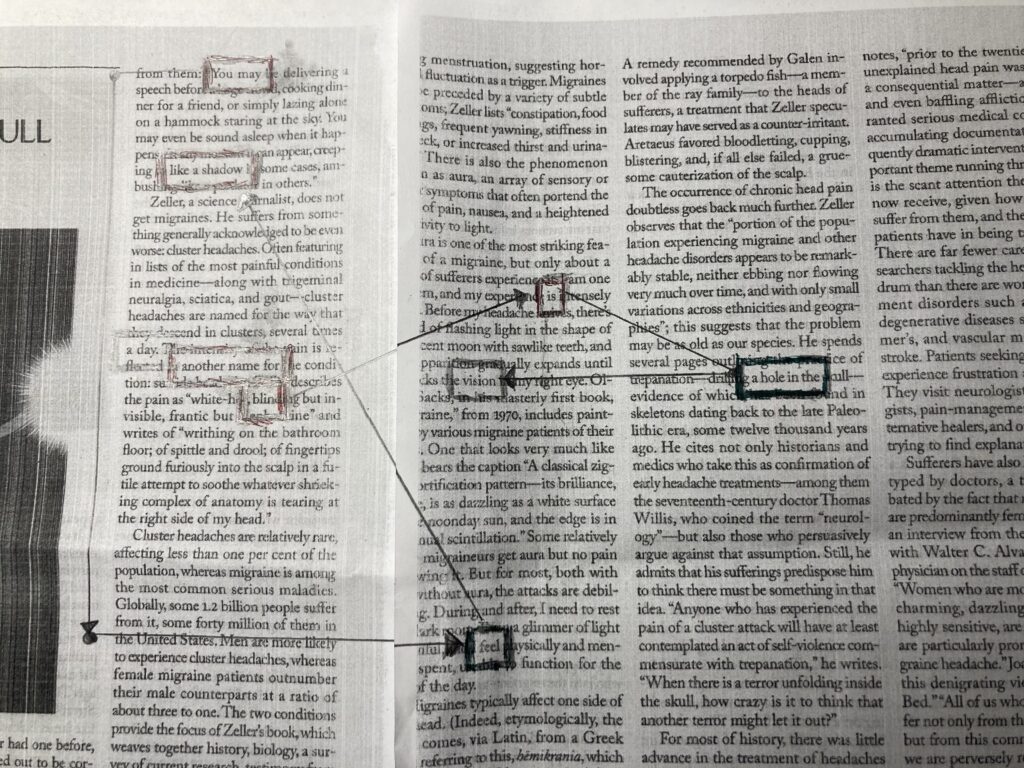
I want to keep working on my fourth experiment. Yesterday afternoon, I printed out the New Yorker article, “A Screaming Skull,” and found my poem on its four pages. Then I taped the pages together and mapped the poem out. The theme: holes. I imagine it as part of a larger project about my blind spot. Maybe this project won’t be all erasure/found poems; I might try to connect it to some other work on the blind spot — work I’ve been doing for several years now, but haven’t quite figured out how to turn it into something. Yes! Experiment #3 — swap the dead-eyed liturgy of doomed vision with shadow (or shadowed?) acts, wild and improbable could connect with my study of JJJJJerome Ellis, the stutter, and his liturgy of the name! Very cool!

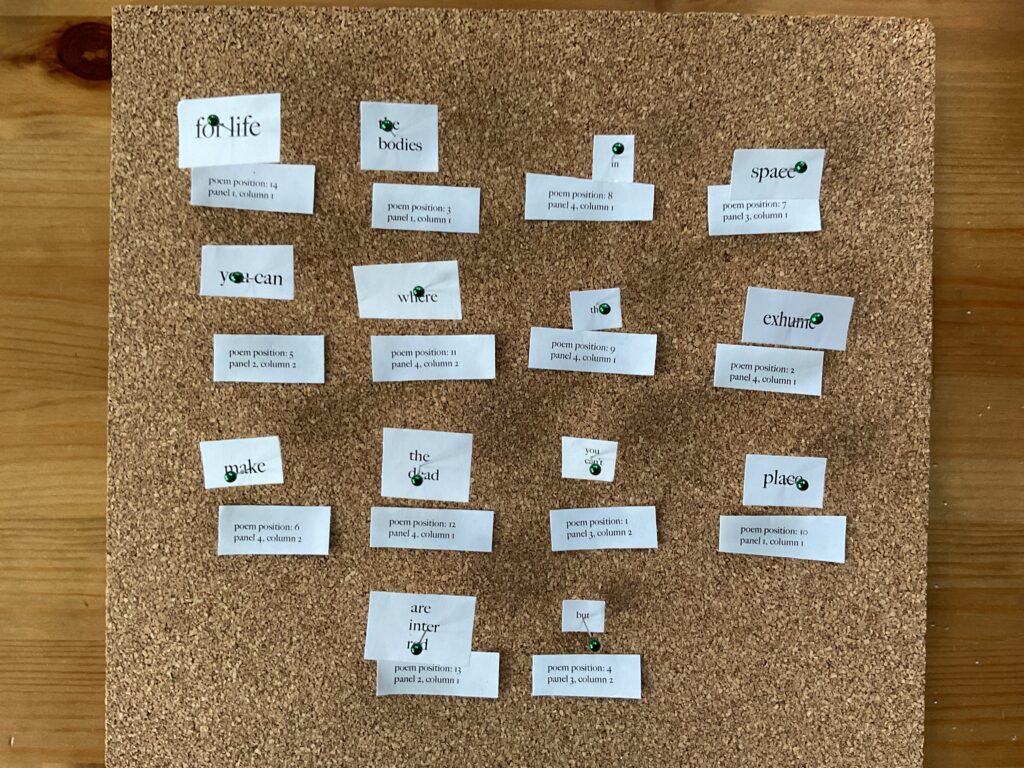
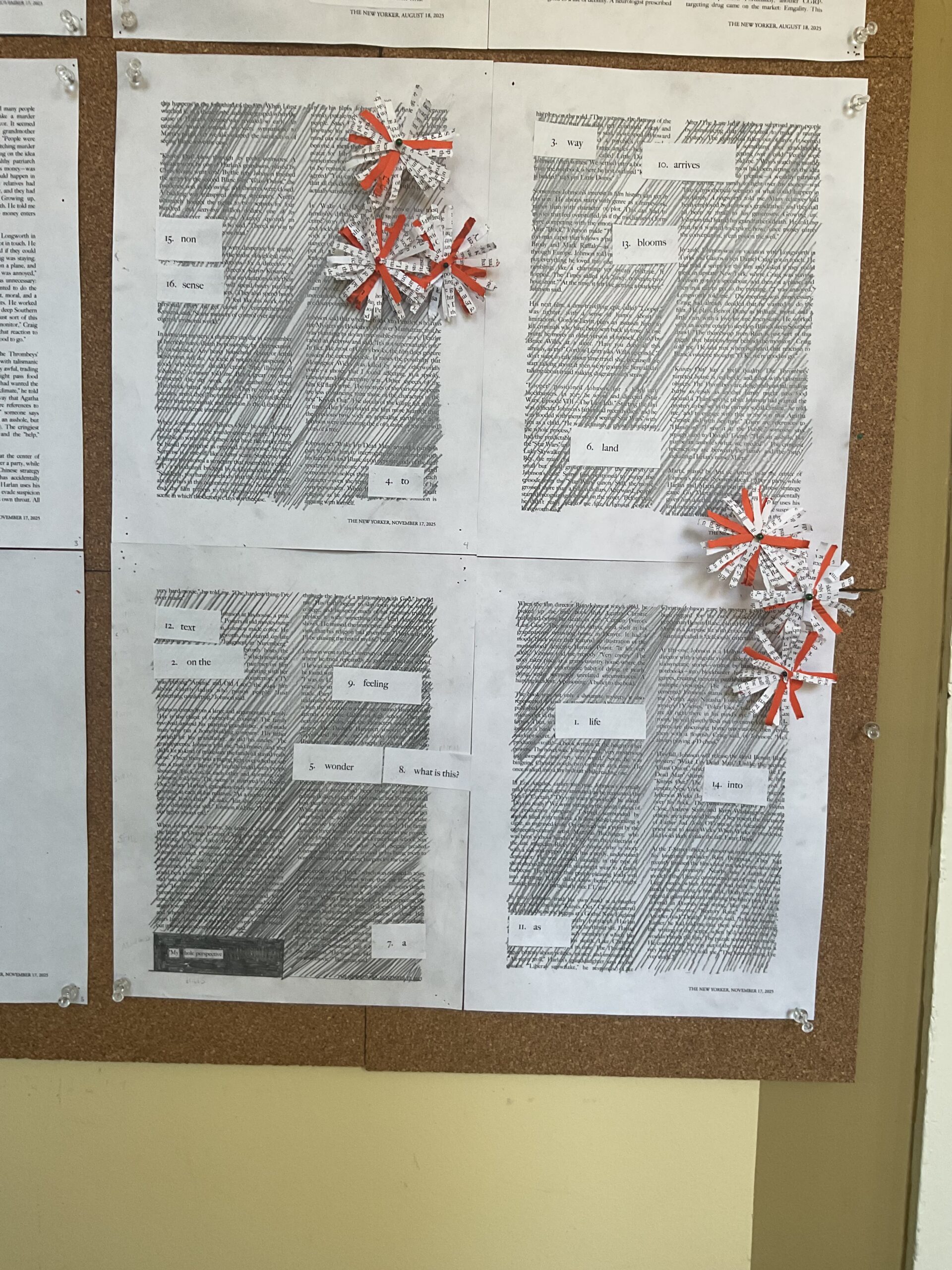
I took a picture of what I’ve done so far:

What to do next? The second image offers a possible approach: Applying my blind spot — the one I recently created by staring at a blank wall until it appeared, then tracing it — to each of the “found” words. I could sketch the blind spot directly on the page, around the word, OR I could place a cut-out version of the blind spot on top of the word. Maybe I’ll try a practice sketch. Another idea, which is probably definitely beyond my technical ability: create an animation of the process of reading this that starts with an overview of the poem, then zooms into the first word, encircled by the blind spot which appears as I read it. Then it moves to the next word/phrase, and the next, and the next until the poem is finished. I could also do it as a series of stills (instead of an animation). You could look at each one individually1, the image as a whole, and the series of images in a gallery.

I like this last idea! The focus on individual words — isolated from the other words and the meaning as a whole, which is how I read, because what’s left of my central vision is so small it can only fit a few words, and which is how I often (but not always) experience the world with my big blind spot — in isolation, and removed from others. A question: should I keep the larger poem as a square, stacked 2 x 2 pages? Or should I have it extend as 4 pages across? I can play around with it.

an hour or two later: Here’s something I tried with a paper cut-out of my blind spot as a template. I’m thinking I should ask Scott to make a sturdier, cardboard version of this template.

an image of words, 2 circles with a hole in the center, sketched in pencil, representing my blind spot
in progress / 1 PM / 7 march 2026

Something to think about: should I have the blind spots on the entire poem/map? I was going to write: no, because that’s not how I would see it; I would see a somewhat fuzzy version of the map of the poem. But this poem is not an accurate representation of how I see. I hardly ever see my blind spot as a gray blob. But the blind spot is there and it distorts how/what I see and I need to represent in some way that others can see too.

Another question: should I hand-sketch this poem, or figure out how to do it on the computer? I like the hand drawing — the material aspect of it + I can do it all myself — but drawing it by hand is messy and unreliable. I’m thinking that this series will be part of my vision art installation — along with my snellen charts and mood rings. It seems too messy if I don’t do it on a computer.

Also: how should the individual stills look? Should they be a close-up on that part of the poem, or just the word/phrase centered in an otherwise blank page? Should they include the blind ring? If I have more of the text, should it be too fuzzy/distorted to read, or should I have it surrounded by gray? Looking at the words on this screen, I see: 1 or 2, maybe 3 short words in focus, then other words too dim or fuzzy to read, and, after staring for a few seconds, a glowing dark ring around it. This ring is not solid or very dark, it’s almost gauzy, like a veil, or the feeling that there’s a ring there. Does that sound strange?

(rabbit) holes: Today I start a new volume of my Plague Notebook: vol. 28! I’m calling it, What about Epstein, Trump? As I was writing in it, describing my latest visual poem, Holes, a thought: Am I calling this holes (or hole?) partly because of my recent study of rabbit holes?! Maybe! And maybe I could bring rabbit holes into a poem about my blind spot!?

Get Out ICE

“Accountability in this case looks incredibly simple. Minnesota must investigate the violation of constitutional rights at the hands of Noem and her ICE agents and prosecute where appropriate. The best part about this process is that Trump can’t pardon state convictions.” Boom.
(from a Occupy Democracy post, citing a MSNOW interview with Tim Walz)

  1. While applying my blind spot to the phrase, “another word for,” I realized that that phrase was too big to fit inside the inner ring. So, that’s a new limit to how I can construct this, and other blind spot, poems: the phrases/lines must be able to fit within my blind spot. It wasn’t a big deal in this poem; I just took out the for from “another name for” and found it somewhere else in the article. ↩︎

march 6/RUNGETOUTICE

3.5 miles
locks and dam no. 1
48 degrees / drizzle

A few more warm days, then cold again. I didn’t mind the drizzle, everything was gray and soft and misty and wet. Dripping and whooshing and seeping. Of course, now that I’m home, the rain has stopped and the sun is almost out. I ran to the bottom of the locks and dam no. 1 hill and admired the ford bridge. It looked more like a painting than an actual bridge — although it sounded like a bridge, with trucks rumbling overhead!

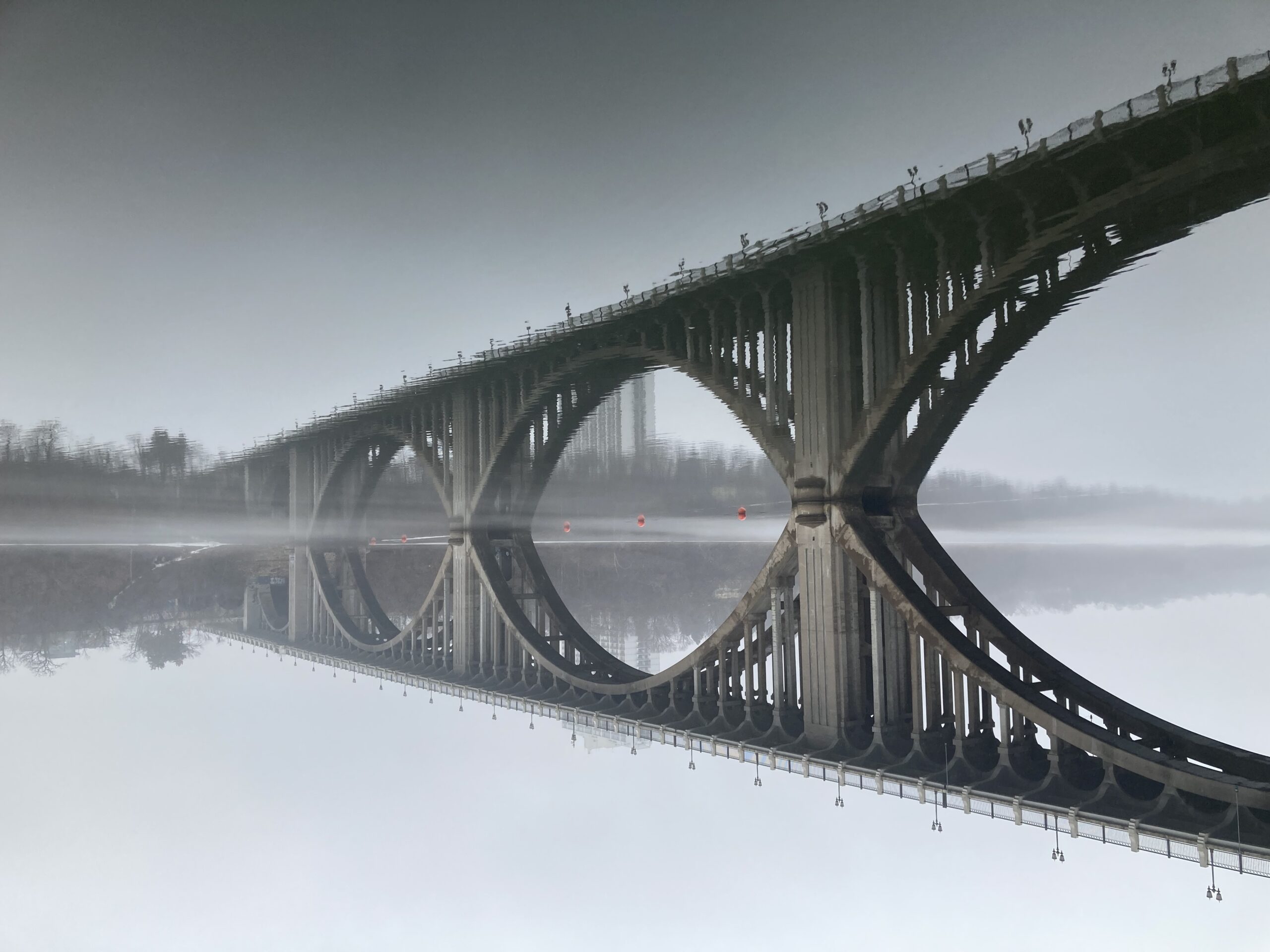
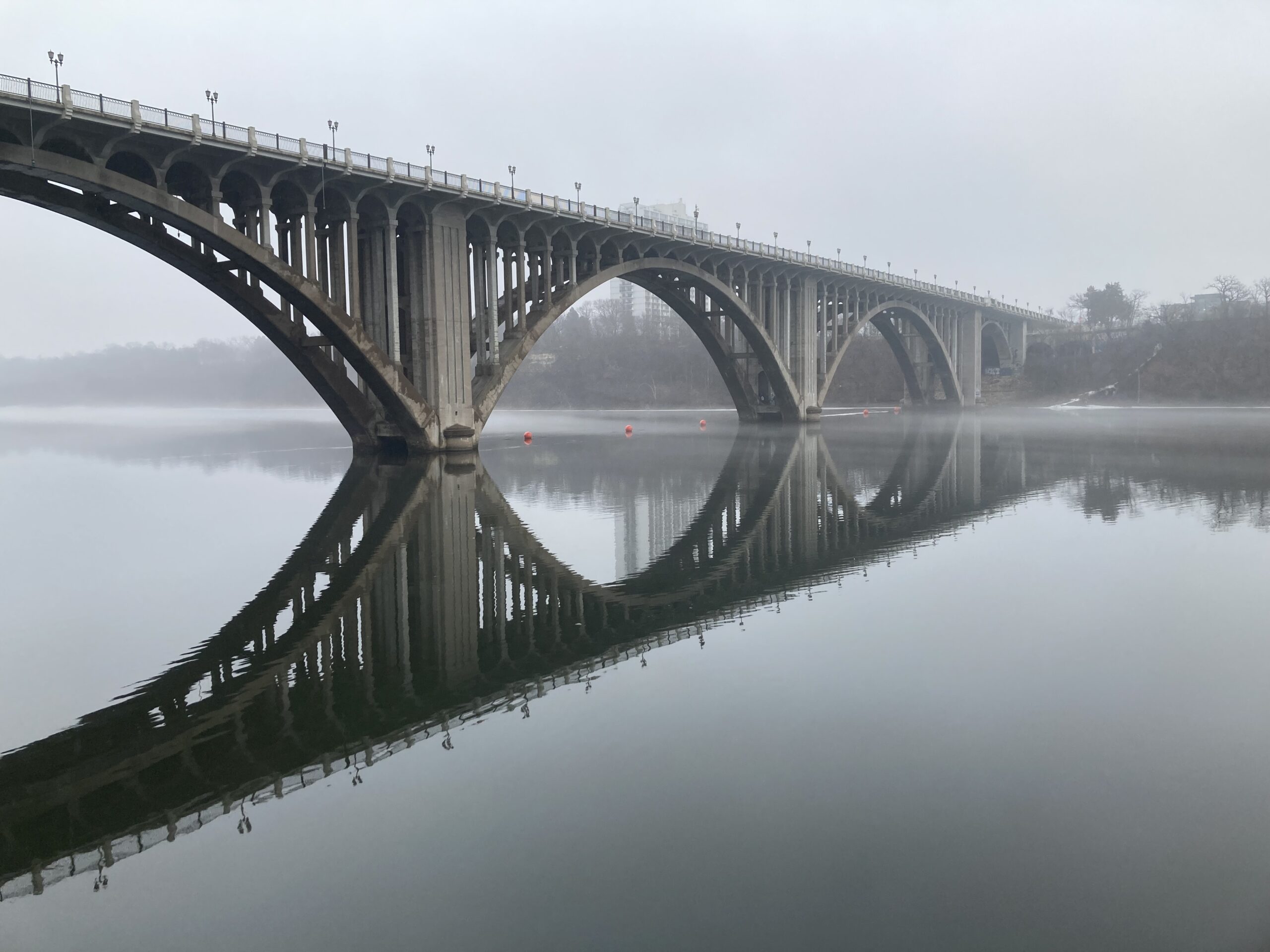
I love the reflections in this picture I took, especially the upside down street lamps and railings.

If the sky were a little darker, the river a little lighter, you might not be able to tell which bridge is up, which is down — at least, I wouldn’t be able to tell!1

Smiled at several runners and walkers and bikers. Made note of all the empty benches and parking lots. There were not too many people out there. For the last bit of the run I was able to get deeper into the mist by running on the Winchell trail. Very haunted and other-worldly!

I listened to water for the first half of the run, and “Bunnies and Rabbits” playlist for the second. A new song popped up: Rabbit // Hole by Siddhartha Khosla. It’s part of teh music for a one-season series called Rabbit // Hole with Kiefer Sutherland. It’s a great song to run to. Near the beginning, the music breaks up for a few seconds then plays again then breaks up. I imagined a fast moving rabbit passing by an object when the music broke up, then being in the clear (when the music resumed), then passing my another object when the music broke up again.

Rabbit Recap, part 3

Can I finish this rabbit recap today? Nope. I got distracted with other stuff.

11 — 20 feb 2026

All late fall and winter, 2 or more bunnies have been hanging out under our crab apple tree — at night, in the afternoon, at sunrise and sunset. They’re very bold, these bunnies, not running off when I walk by. When this happens, I’ve started saying, these bunnies are as bold as brass! Why? Not sure. And, I don’t want you to get the wrong idea: I like bunnies or rabbits about as much as I like squirrels, which is not at all.

Get Out ICE

Yesterday afternoon, Scott came to my desk n the front room and said, Do you want to hear some good news? I mean, some actual good news? Kristi Noem was fired!

from Needle & Skein (the red hat people)

As of March 5th, we have raised an incredible $705,000 to help our immigrant communities here in MN. This is just us. Other yarn shops in Minnesota and around the country have also raised money and generously donated both here and locally. ICE is still here. Our fight is not over. Join us. ❤️

If you are a business who has raised money, please send us a message. We would love to try and get a full picture of what the amazing fiber community worldwide has accomplished.

Facebook post

Read the comments for more on how the fiber arts community is showing up!

New Yorker experiment #5

These experiments are slow-going. I run out of time to work on them. I struggle to see what I’m doing. I’m messy and haven’t figured out how to work with glossy magazine paper. So why am I continuing these experiments? I asked that to Scott and FWA in the kitchen the other day and then answered it myself: For some reason, I2 want to do these erasures, so I’ll keep doing them until I don’t want to or can’t (because it is too hard with my bad vision).

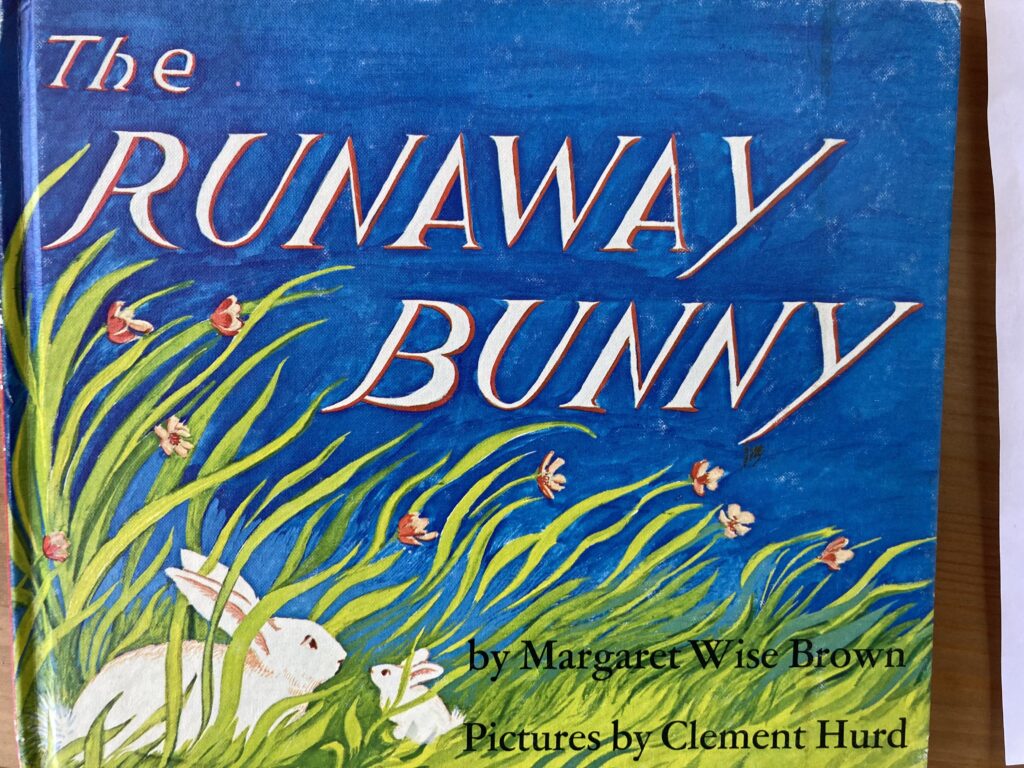
a flash of an idea: As I was writing that last paragraph, I was thinking about how visual poetry is increasingly inaccessible to me as my few remaining cone cells die (are the dying or just malfunctioning?) Then this popped into my head: yesterday’s erasure involved using marker to cover almost the entire text. When I had FWA and RJP read it, they both got marker on their hands — not in big streaks, but in tiny marks that almost looked like cuts or scratches. What if I made these erasures about touch too? My first thought was about doing the erasure in such a way that created a residue. Second thought: what if these erasures involved texture and touch — here, I’m reminded of the kids’ book Pat the Bunny and its different textures to touch: the soft bunny fur, the rough bunny . . . nose? I can’t remember what was the rough thing in the book. If you can touch these erasures and their textures, which would somehow speak to the words/ideas on the page, maybe you can hear them too? I’m thinking of scales, and thick layers of paper, maybe some holes where the paper has been ripped open, some extra rough sections, some smooth, like a thin film, crinkly, soft, sharp-ish. And — maybe in terms of the visual aspect, find ways to cover it that reflect or glow or shimmer or sparkle. I can see these textures in a way that I can’t see the typical flat, black expanse of an erasure. So things like glitter, little mirrors, metallic surfaces, ridges. What about covering it with things that offer colors only visible in the light — thinking of bird feathers here. So many ideas! Again, difficult to execute without it looking like a mess, but fun to try.

Before I had that last flash of inspiration, I was thinking about how I’ve decided (as of yesterday) that the overarching theme of these found poems is my vision and how I see. Then I thought, I should apply my blind spot to these pages. Create an amsler grid out of the text, and then place a cut-out of my blind spot (found while starting at a blank wall and then drawing what I see) on top of the words to find the poem.

Maybe some of these erasures could be all/only about texture, some all/only about my blind spots, and some both. And just now, another thought: What if these erasures were all about my blind spot and the idea of blind spots? Would this work: one of the erasures could be covered in spots or dots or holes in the paper?

So many fun ideas to try. I imagine that some of them will only ever be ideas that are good in theory but don’t work on the page.

Oh — I almost forgot, until I looked over at an open tab that reads, “tools to use for magazine erasure poems,” I started writing about this experiment because I wanted to mention my need for better materials. I love how writing in this log opens me up and helps me to see new things to try! Before writing about textures, the supplies I thought I needed were: sharpies, an exacto knife (can I see well enough to use this?) and possibly paint. Texture through thicker and thinner layers of paint is an interesting idea. Now I’m thinking I need scraps of fabric — next week, RJP and I should go to the fabric scrap store at the Textile Museum! — that are soft and rough and bumpy and gauzy. I need glitter and sparkles and little things that reflect and crinkle. Fun!

Here’s a new version of experiment #3. I decided to paste the text into a document so I could have an easier time drawing on the text. Is this a good solution? I’m not sure, but I do like how this version looks:

an erasure poem, spelling out: swap the dead-eyed liturgy of / doomed / vision / with / shadow / acts / wild / and / improbable
swap the dead-eyed liturgy

Bummer. I just realized that I erased the ed on doomed. It is supposed to read: of doomed vision (I guess doom vision could work?).

text:

swap the dead-eyed liturgy of
doom OR doomed3
vision
with
shadow
acts
wild
and
improbable

And now I’m redoing yesterday’s experiment:

text:

Another name for
barely

not
blind
is a hole in
your vision
that
makes
for
an
uneasy fellowship
with
the world.

  1. Both Scott and FWA could tell, but only after studying it for a minute. The giveaway: the waviness in the upside down version — in the streetlamps for FWA, the arch for Scott. I wouldn’t have been able to notice that because most lines/edges, if I can see them, look wavy! ↩︎
  2. Who/what is the “I” here? Not the fully conscious Sara-I. I am not entirely sure why I keep returning to these erasures — either in this particular experiment, or in previous experiments — when they are so difficult with my vision and I’m not very good at them. Is it shadow Sara, nudging me? ↩︎
  3. I prefer doomed vision; I think it works better. I really like this idea of challenging/getting rid of/swapping out a dead-eyed liturgy, where liturgy = “Liturgy is the customary public ritual of worship performed by a religious group. As a religious phenomenon, liturgy represents a communal response to and participation in the sacred through activities reflecting praise, thanksgiving, remembrance, supplication, or repentance” (wikipedia). ↩︎

march 5/RUNGETOUTICE

4.65 miles
veterans home and back
46 degrees

Still feeling like spring, another run with bare arms for the second half. Chirping birds, rushing falls, a knocking woodpecker. Kids on a field trip, walking on the river road trail. Only a few random clumps of snow remaining in the grass. I’m sure we will still get snow, either later this month, or in April, but it won’t stick around. Spring is coming!

I recited Alice Oswald’s “The Story of Falling” and Lisa Olstein’s “Dear One Absent This Long While.” I intended to think about my mom on her birthday, but I forgot to, or did I? I’m sure she was there when I recited — in my head — the last lines of Olstein’s poem: Your is the name the leaves chatter/at the edge of the unrabbited woods.

As I listened to the rushing falls, I recalled my discussion yesterday about the poster with the words, Believe Your Eyes. I thought more about why you should Believe Your Ears and Your Eyes, although less catchy, is more accurate. I recorded a thought into my phone:

5 march 2026

transcript: the sound of minnehaha falls and, occasionally, some wind. “I’m thinking about my poster and switching it from Believe Your Eyes, to Believe Your Ears and Your Eyes. And I’m thinking about, on their own, they’re both unreliable, but when they work together, and with the other senses, they offer a more accurate representation of what’s happening.”

Listened to the birds, my feet striking the grit on the path, someone say, I’m a classroom teacher near the overlook, the falls, sounding like a June rainstorm on the first half of my run. Listened to my “Bunnies and Rabbits” playlist on the second half. I started with “Rabbit Fur Coat,” and was struck by this verse:

She put a knife to her throat
“”Hand over that rabbit fur coat””
When my ma refused, the girl kicked dirt on her blouse
“”Stay away from my mansion house””

My mother really suffered for that
Spent her life in a gold plated body cast.

This last bit about the gold plated body cast — what a great way to describe someone who is obsessed with objects, like gold or fur coats, that bring status and luxury.

Happy Birthday Mom

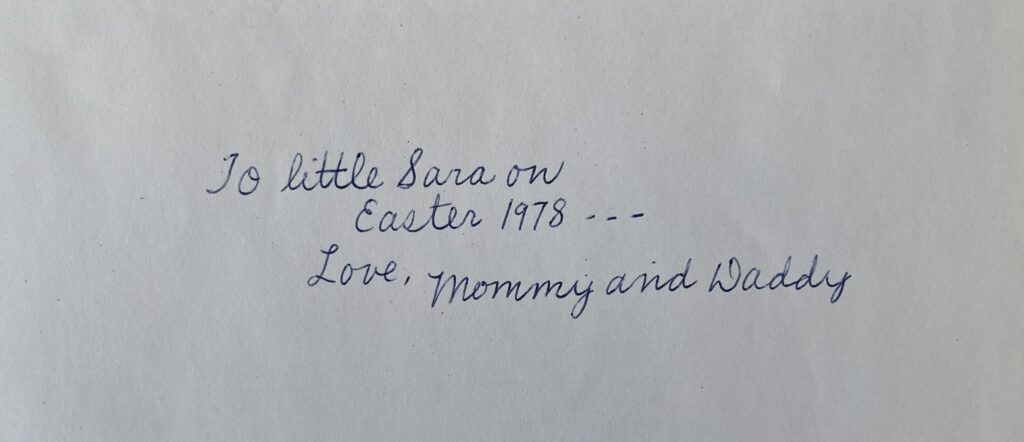
If she hadn’t died in 2009, my mom would be celebrating her 84th birthday today. 17 years gone. Some memories of her have softened, lost their edges, others have been condensed into a flash or a few words. I was reminded of some of those words the other day when I heard Heather Cox Richardson say, oopsie poopsies. As I remember it, Mom was driving me and my best friend (JO) home. When we pulled into the garage, she called out, Front door service, Missy Doodles! I can’t remember our reaction in that moment — did JO and I exchange looks? did we laugh at her? — but I do remember that it became something we repeated to each other later for a laugh and as a way to mock my mom (mostly good-naturedly, I think).

Why does this dumb sentence stick, when others don’t? Maybe it’s partly because my mom often had a strange way of saying things — happy as a clam bake is another one that comes to mind; also, the way she pronounced absurd — abzurd — and milk — melk (I do that one too). There must be many more that I’m not remembering now; I should ask my sisters. These strange ways of speaking were part of her charm. Front door service, Missy Doodles fits with these others. I googled it just now, thinking it might be a famous catch-phrase from before my time, or that Missy Doodles might have been a character on some show from the 50s or 60s. Nope.

Returning to HCR’s oopsie poopsies, I’m thinking about how she uses it instead of swearing.1 Another connection to my mom surfaces: not swearing, or rarely swearing, or swearing in French or German. And now I’m thinking about her shit rock, which is now my shit rock. I created a digital story about it 10 or so years ago. I also posted about it on my TROUBLE blog. I need to find the video and a transcript of the story somewhere on a hard drive. I’ll post it when I find it.

the Rabbit Recap continues

Yesterday, working backwards, I made it through page 5, page 4, and half of page 3 of entries tagged, rabbit.

6 — 15 nov 2022

The optical illusion: the rabbit or the duck

I surmise that my general visual experience is something like your experience of optical illusions. Open any college psychology textbook to the chapter on perception and look at the optical illusions there. You stare at the image and see it change before your eyes. In one image, you many see first a vase and then two faces in profile. In another, you see first a rabbit then a duck. These images deceive you because they give your brain inadequate or contradictory information. In the first case, your brain tries to determine which part of the image represents the background. In the second case, your brain tries to to group the lines of hte sketch together into a meaningful picture. In both cases there are two equally possible solutions to the visual riddle, so your brain switches from one to the other, and you have the uncanny sensation of “seeing” the image change. When there’s not much to go — no design on the vase, no features on the faces, no feathers, no fur — the brain makes an educated guess. 

When I stare at an object I can almost feel my brain making such guesses.

Sight Unseen / Georgina Kleege

7 — 27 sept 2022

Those who have it to give are
like cardinals in the snow. So easy
and beautifully lit. Some
are rabbits. Hard to see
except for those who would prey upon them:
all that softness and quaking and blood.
(I’ve Been Thinking about Love Again/ Vievee Francis)

rabbits — visible only to those who prey upon them — all that softness and quaking and blood.

8 — 1 dec 2021

You only spot the rabbit’s ears and tail:

when it moves, you locate it against speckled gravel,
but when it stops, it blends in again;
(First Snow / Arthur Sze)

So, does a bunny have two distinctive aspects to their form: ears and tail? Ears if it’s only the head, ears and tail if it’s the entire silhouette. Most things blend into the backyard if they’re still for me. I only see them by their movement and maybe the flash of a tail streaking away.

9 — 25 dec 2025

A child’s plush stuffed rabbit. 
(Ode to Gray / Dorianne Laux)

Why are stuffed animal toy bunnies usually gray when real rabbits are more often brown?

10 — 15 may 2025

“It suggests the fatal indecision of a rabbit caught in a hunter’s flashlight. . . .” Rabbits as prey, always needing a way to be escape, when cornered, they shut down. Survival strategy: run until you can’t then go stiff, play dead. The idea of always looking for an exit resonates for me. I would much rather avoid a bad/dangerous/uncomfortable situation than confront it. Wherever I go, I always look for the exits, or the entrances into other worlds.

And now I’m wondering about rabbits playing dead and how that works. According to a few different sites, it’s called tonic immobility or trancing and it is”

a behavioural response to a perceived threat, characterised by muscular rigidity, profound motor inhibition, and suppressed vocal behaviour. This behaviour occurs when freezing in response to a predator approach, fight, or flight are no longer perceived as options (Gallup 1974, Gallup 1977).
McBride et al. (2006) observed that rabbits held in a tonic immobility position had elevated respiratory rates, heart rates, and plasma corticosterone concentration. Additionally, they expressed fear behaviours such as widened eyes and flattened ears, and demonstrated more hiding behaviours and fewer grooming behaviours post-trancing.

Trancing / Tonic Immobility
  1. In yesterday’s Politics Chat, talking about her reaction to the news that Trump was bombing Iran, she said, “I said all the swear words you never think I say.” ↩︎

Get Out ICE

From Recovery Bike Shop in Northeast Minneapolis:

This is what community looks like. This is what “bustling” looks like. This is looking out for our neighbors. This is taking care of our own. This is supporting our city.

We feel safer when other people are around. We are those people. We are the ones we’ve been waiting for. And when we make our street a place that’s comfortable for walking, more people will feel comfortable walking. It’s a virtuous cycle. And it’s something we can do.

So come walk with us every Thursday evening at 5:30. Meet at Recovery Bike Shop. (And next week we’ll be walking in the sun!)

Note: any time you are out walking, you are making your community safer.

Recovery Bike Shop

Any time you are out walking, you are making your community safer. I love this idea!

New Yorker Experiment #4

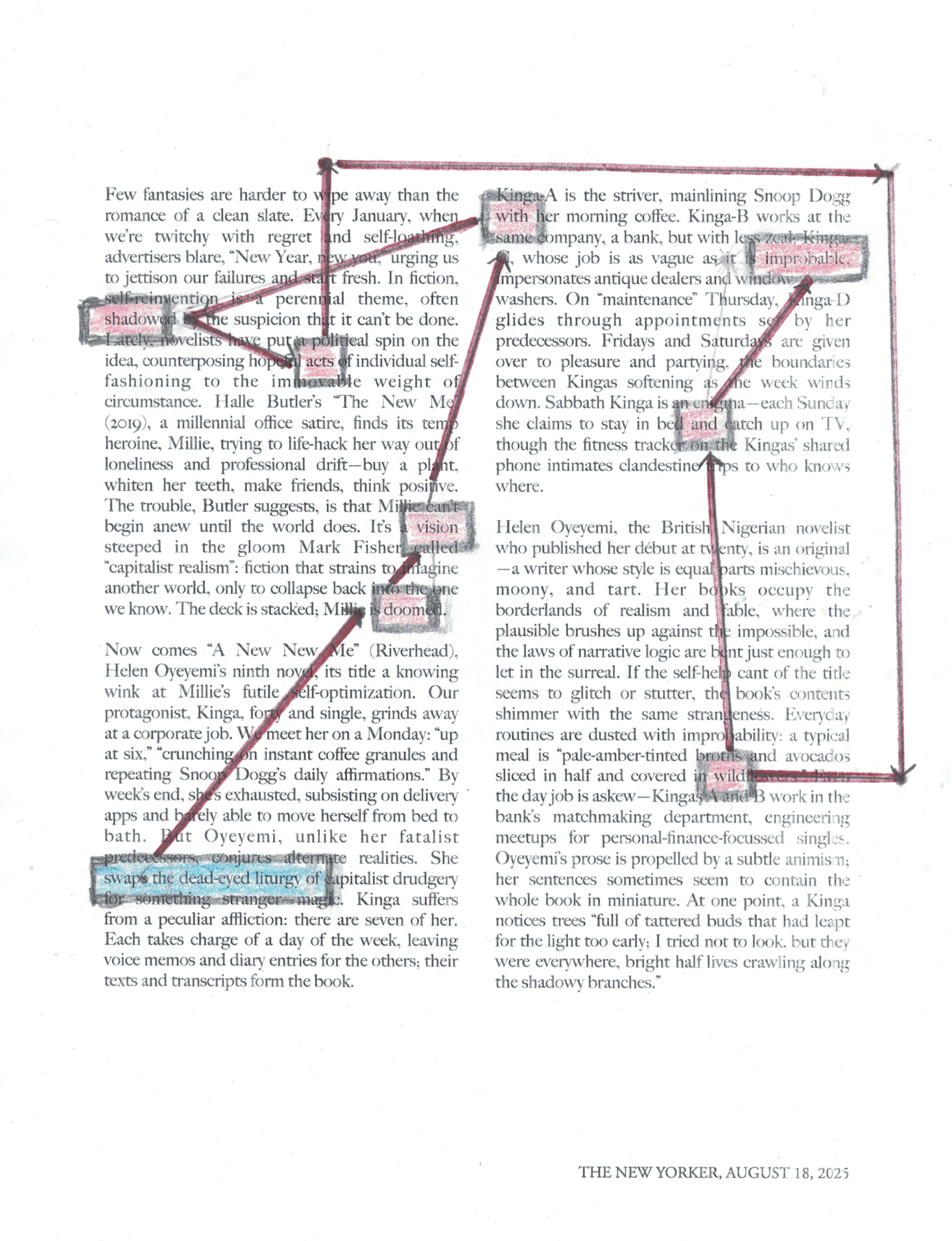
But before I move onto #4, I added some numbers to #3, so it was easier to follow the path of the poem:

text, moving from bottom  right to top right to bottom middle to top middle to mid left: 1. swap the dead-eyed liturgy of 2. doomed 3. vision 4. with 5. shadow

Experiment #4: A Screaming Skull / New Yorker 18 august 2025

text:

You may
feel
like a shadow.

Another name for
blind
is
a hole in the
vision

You may feel like a shadow.

I tried photocopying the pages from the New Yorker, but the quality is terrible. Also, I ran out of time. I like the idea of another name for blind is . . . but I could find the right words to fill that in. I’ll work on this one more tomorrow. I think that my theme for these is my vision.

march 3/RUNGETOUTICE

5.2 miles
bottom of franklin hill
44 degrees

Another SPRING day! It felt so warm that halfway through the run, I took off my pull-over and ran with bare arms. No gloves, nothing covering my ears. Even with less layers I was warm. The walking path was clear enough that I was able to run past the Welcoming Oaks and the tunnel of trees. There were a few puddles and chunks and sheets of ice and for one stretch near the lowest point, snow covered almost the entire path. A few times my foot slipped a little but never enough to make me worry I’d fall.

I felt good and my legs felt strong. I was able to run up 3/4 of the franklin hill before I stopped for a walk break. The only part of me that hurt was one of my toes on my right foot. I was wearing different shoes than I normally do — a Saucony Ride instead of a Brooks Ghost — and something about this version of the has never worked for me. I’ve had these shoes for more than a year — 2 years? — and they always cause something to hurt, like my toe or my calf.

10 Spring Things

  1. open river! down in the flats, when I could get very close to it, I watched the small spots of foam as they slowly floated downstream
  2. sh sh sh — the sound of my feet running over the grit on the edge of the trail
  3. good morning! hello friends! — greeting the Welcoming Oaks
  4. the loud and steady sound of water rushing down over the ledges in the ravine
  5. a woman running in shorts and a jog bra
  6. mud, on the edge of the path — once, as I turned a corner, I stepped in it and almost twisted something
  7. whoosh! car wheels speeding through a puddle, water flying up
  8. along with the mud, bare dirt, some grass
  9. last week, running under the franklin bridge when it was even wetter than today, I noticed a black jacket on the ground, soaked. Today that same jacket was hanging from a branch, dry
  10. like yesterday, where there was ice on the path, there were also dead leaves — suddenly realized: someone from Minneapolis Parks had most likely spread the leaves as a natural way to make the path less slippery (as opposed to ice-melt and all of its chemicals)

Rabbits in Art

1 — Rabbit by Jeff Koons

I’m fairly certain that I’ve seen and/or heard of Koons’s Rabbit, but I only thought of it for this “rabbits in art” exploration when it came up in my google search.

DETAILS

Jeff Koons (b. 1955)
Rabbit
stainless steel
41 x 19 x 12 in. (104.1 x 48.3 x 30.5 cm.)
Executed in 1986.D

You can find the image, both close-up and to scale, on Christies auction house site. I’m choosing not to post the image in this entry because of copyright concerns. Even though my use of the image should easily fall under fair use.1

In 2019, this controversial sculpture sold for $91 million. Christies’ page for this auction item has a lot of good information about the sculpture — it’s history, significance, probably all of the citations to articles about it that you might ever need.

Here’s the opening paragraph of Christies’ essay about it:

Since its creation in 1986, Jeff Koons’s Rabbit has become one of the most iconic works of 20th-century art. Standing at just over three feet tall, this shiny steel sculpture is at once inviting and imposing. Rabbit melds a Minimalist sheen with a naïve sense of play. It is crisp and cool in its appearance, yet taps into the visual language of childhood, of all that is pure and innocent. Its lack of facial features renders it wholly inscrutable, but the forms themselves evoke fun and frivolity, an effect heightened by the crimps and dimples that have been translated into the stainless steel from which it has been made. Few works of art of its generation can have the same instant recognizability: it has been on the cover of numerous books, exhibition catalogues and magazines; a monumental blow-up version even featured in the 2007 Macy’s Thanksgiving Day Parade. For an artist such as Koons, who is so focused on widening the sphere in which art operates and communicates, Rabbit is the ultimate case in point.

Christies

Childhood — all that is pure and innocent. Fun and frivolity.

And here’s what Jeff Koons says about it, cited in Kurt Varnadoe’s essay for Art Forum, 1986: Jeff Koons’s Rabbit:

This snarky little thumper has other stories to tell too. Koons said, “To me the Rabbit has many meanings. It is a symbol of the playboy, of fantasy and also of resurrection.” (The joining of those last two terms alone can provide food for long thought, or skepticism.) “But to me, the Rabbit is also a symbol of the orator making proclamations, like a politician. A masturbator, with a carrot to the mouth.” 

1986: Jeff Koons’s Rabbit

2 — Rabbit as Symbol

Drawing from “Going down the rabbit hole” and “Rabbit as Symbol: The Significance of Rabbits in Dreams, Literature, and Art,” here are some things that rabbits represent:

  • mortality (They are born, live and die within a short time, in line with the seasons)
  • fertility / abundance / sensuality (their rapid breeding rate)
  • innocence and vulnerability (a prey animal)
  • the Diaspora (introduced to the UK from Spain by the Romans)
  • a reliable source of food (The ability to keep rabbits would mean a fairly consistent source of meat for a struggling family)
  • treasured pet2
  • magic/mysticism/wonder/curiosity
  • gentle
  • agile
  • playful

3 — Medieval Killer Rabbits

I mentioned Monty Pythons killer rabbit last week. It comes up again in this article about drawings of bad bunnies in medieval art.

Rabbits can often be found innocently frolicking in the decorated borders or illuminations of medieval manuscripts, but sometimes, for reasons unknown, these adorable fluffy creatures turn into stone-cold killers. These darkly humorous images of medieval killer bunnies still strike a chord with modern viewers, always proving a hit on social media and popularised by Monty Python and the Holy Grail’s Beast of Caerbannog, ‘the most foul, cruel, and bad-tempered rodent you ever set eyes on!’.

Medieval Killer Rabbits

I like this explanation for why bunnies were depicted as killers:

In real life, rabbits and hares are docile prey animals. But in decorated initials and marginalia, medieval artists often depicted ‘the world turned upside down’, where roles are reversed and the impossible becomes the norm. So here, rabbits are violent hunters hellbent on punishing anyone who has committed crimes against rabbit-kind.

Medieval Killer Rabbits
the Beast of Caerbannog

Last week when I mentioned Monty Python, I didn’t know they were referencing a trend in medieval art/manuscripts of rabbits behaving badly, I thought they made it up as a joke!

I think it might be time to synthesize/summarize some of this bunny information. But, that’s a project for this afternoon! Now it’s time for day two of my New Yorker Found Poem experiment!

  1. “Fair use allows limited, unlicensed use of copyrighted images for purposes like criticism, commentary, news reporting, teaching, scholarship, or research. It is a legal defense based on four factors: purpose (e.g., non-profit, educational), nature of the work, amount used, and effect on the market” (source). I have been unfairly fined before, for using an image on an academic blog (over $700 in 2012).   ↩︎
  2. “It is rare for a domesticated animal to be both considered food and a treasured pet” (source). ↩︎

New Yorker Found Poem Experiment #2

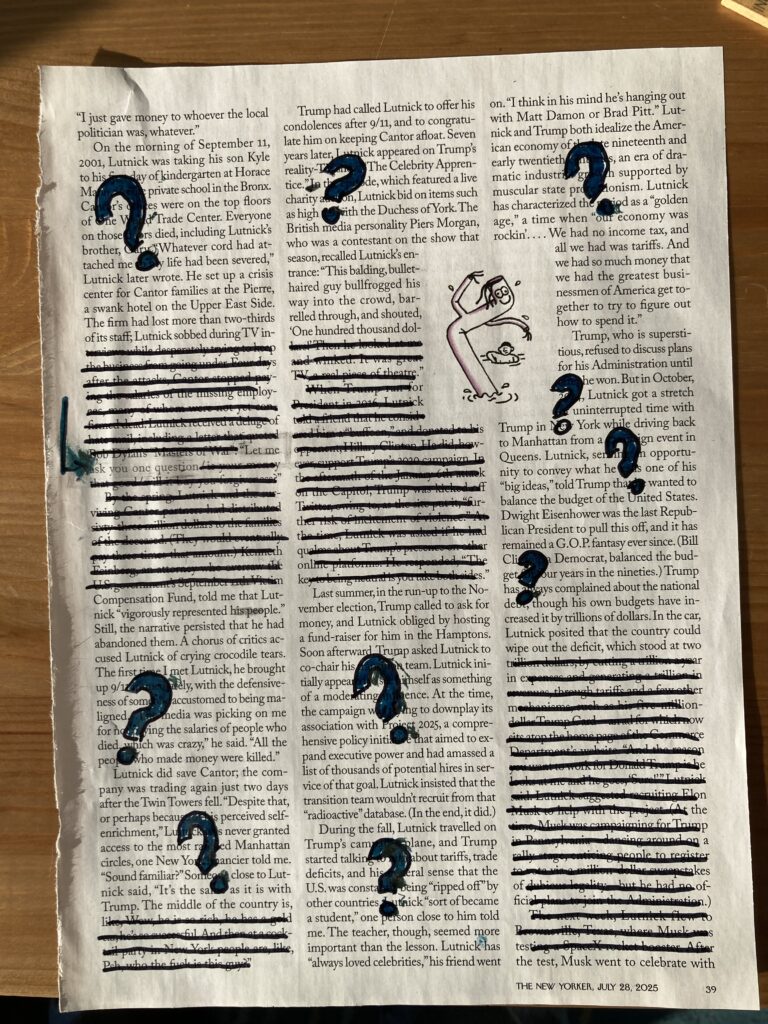
10:30 am — Before starting to work with an article, I decided to sort through RJP’s old markers and find ones that still work. At some point during the process, I realized that this looking through old markers was making me dizzy; something about it was too much for my brain and my cone-starved eyes. I stopped sorting. I should have taken a break, instead I did something else. A few minutes later, I felt woozy and needed to sit down. My hands were shaking and my legs felt tingly. My pulse was fine, but my blood pressure was elevated — 158. I think I was having a mild panic attack, triggered by the dizziness from my bad vision. Boo. It seems as if my anxiety is back. I had a nice stretch of a year+ without it. It also seems like I will need to be more careful with how I use my eyes. Too much trying to closely see something might trigger another one of these. Am I right in my assessment?

I am noticing that my vision has deteriorated more. It’s even harder to recognize the faces of actors on tv, harder to see my kids’ faces when they talk to me. Am I getting closer to the complete end of central vision?

Because of this incident, I did not start my second experiment this moring. Should I now, at 2:10 pm, or will it trigger more dizziness and anxiety?

Yes, I did it. I need to make sure I test out/find the right tools and be more deliberate in what I’m doing. I’m very messy — which is mainly because of my vision, but not completely. I’ve always been an almost and a that’s good-enough girl.

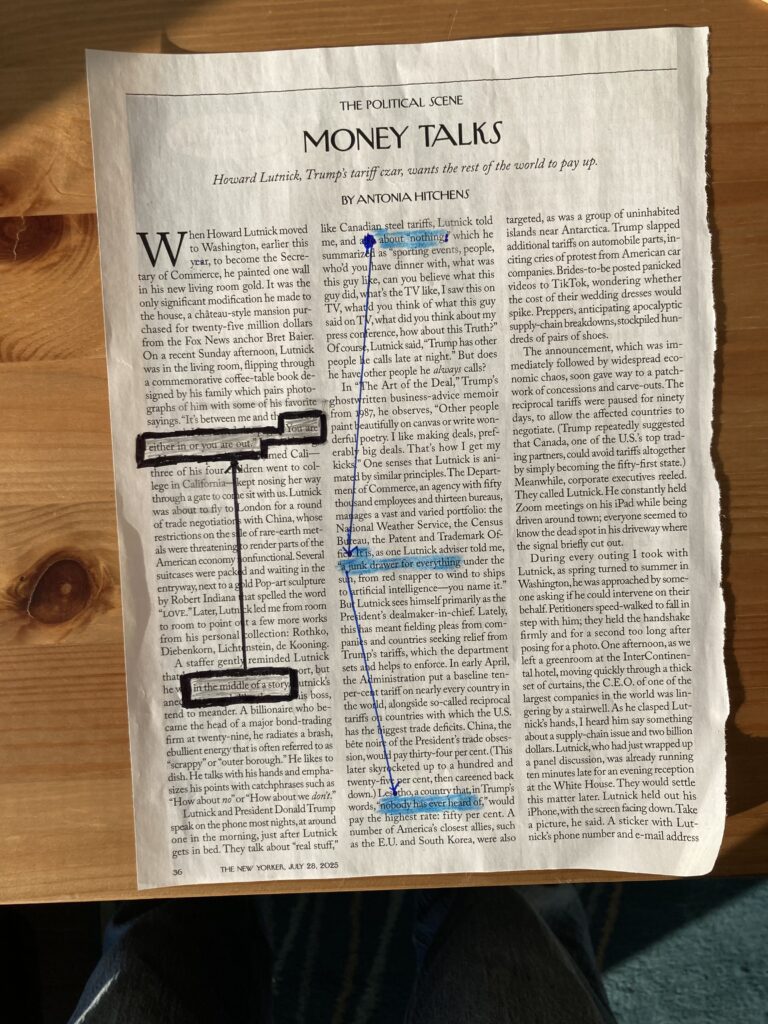
These poems are from a July 2025 article, Money Talks:

1 — Let me ask you a question

I like the idea of this, with all of the questions marks, but it is really sloppy and it doesn’t highlight the text that I’m using, “Let me ask you a question.” I would try this one again, but if I plan it more carefully and work on my question marks!

2 and 3

2: In the middle of a story, you are either in or you are out
3 — About nothing: it is a junk drawer for everything nobody ever heard of

Again, messy and poorly executed. I like that I used less words than the last one. I need to figure out a way to draw that I can do with my unreliable vision. It’s hard to see enough to color within the box or to draw straight lines, even with a ruler!

I like the idea of nothing as a junk drawer. It might make even more sense if I found a much, and could make nothing into nothing much.

I am listening to HCR’s politics chat for today and she said, as she often does, OOPSIE POOPSIE. I love when she says that!

march 2/RUNGETOUTICE

4.35 miles
minnehaha falls and back
39 degrees

Spring-y! Sun, above freezing, and a clear walking path! I was able to take the trail that dips below the road between the double bridge and locks and dam no. 1! Also: birds and grass and no gloves. A good run. I feel more power in my legs and able to run for longer without stopping. I heard kids on the playground, the call of a bird that sounded mechanical — similar to the strange, high-pitched siren I heard earlier today, and the doppler effect on the light rail bells as I ran south to the falls. I heard Panic at the Disco, Radiohead, Gene Autry, and The Jazz Crusaders on the way back home.

Speaking of hearing, as I write this at my desk, I can hear a woodpercker outside my window pecking on a tree in our front yard that I think is dead or dying. Every peck is saying, right right right right (you’re) right. Ugh! Is it time to call a tree service?

At some point during the run I thought about I wasn’t thinking about much of anything. Then I thought, the purpose of today’s run is not to work out a writing problem, or encounter some inspiration, but to move and breathe, feel the sun on my face, and be by the river.

10 Things

  1. a thin skin of ice on the river
  2. larger areas of the creek open with dark water, some snow stretching out from the banks
  3. an occupied bench! someone is sitting on the bench at the 44th street parking lot
  4. overheard: some guy talking to his two friends about something being only 2 loops — when I passed them a few minutes later, I noticed they had on shorts and running shoes on
  5. that same truck that seemed to be hiding under the bridge last week was back again today — why?
  6. a few parts of the trail that still had any ice or snow were also covered with dead leaves
  7. enough snow had melted so that I could cross the road and walk on a wide strip of grass instead of mud and snow
  8. vision mistake: up ahead of me, it looked like a truck was parked on the path, blocking the way. I crossed over to the parking lot then immediately realized the curve in the trail made it look like the truck was blocking it, but it wasn’t. Oops
  9. more people near the falls, more cars parked in the parking lot
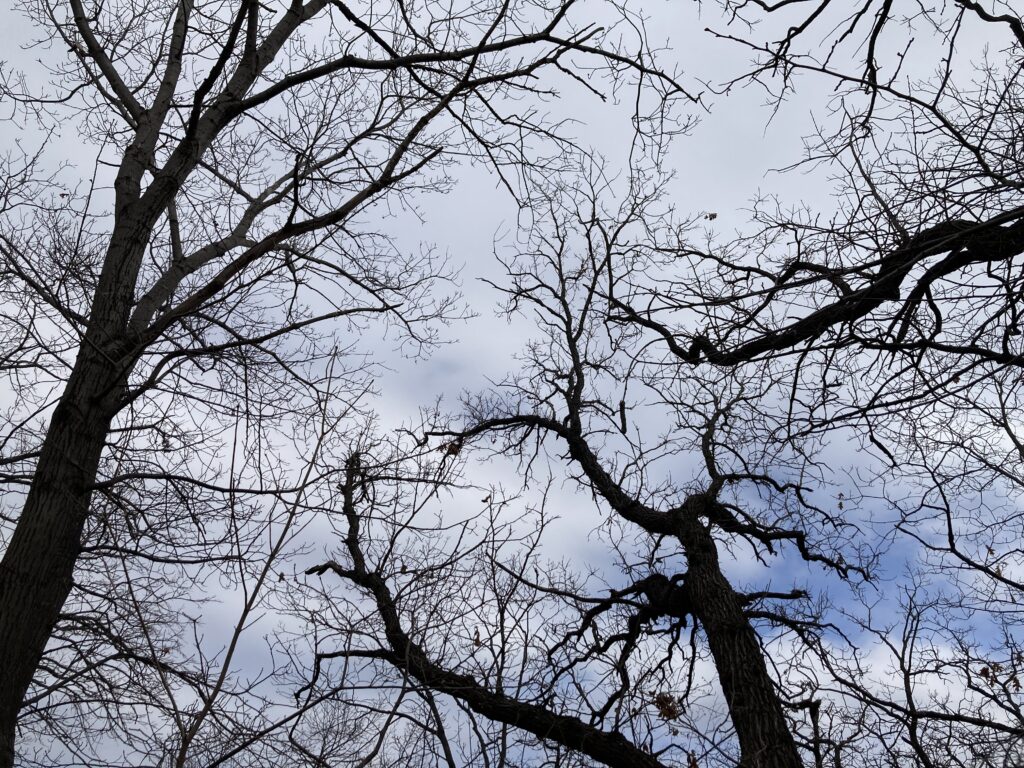
  10. stopped at Rachel Dow Memorial bench to admire the view through the slender tree trunks and to take a few pictures.
bare branches, some thick, some thin, against a gray sky with hints of blue
sitting beneath the bench looking up at the trees / 2 march 2026

more rabbits bunnies

It started on 20 feb, this occupation with bunnies.1 When will it end? Not today! Here are some more bunny things I’d like to archive:

1 — buuuuunnies

In footnote 1, I mention that bunny is fun to say. That might be partly because when I say it, I think of how Tom Haverford says it on Parks and Recreation2:

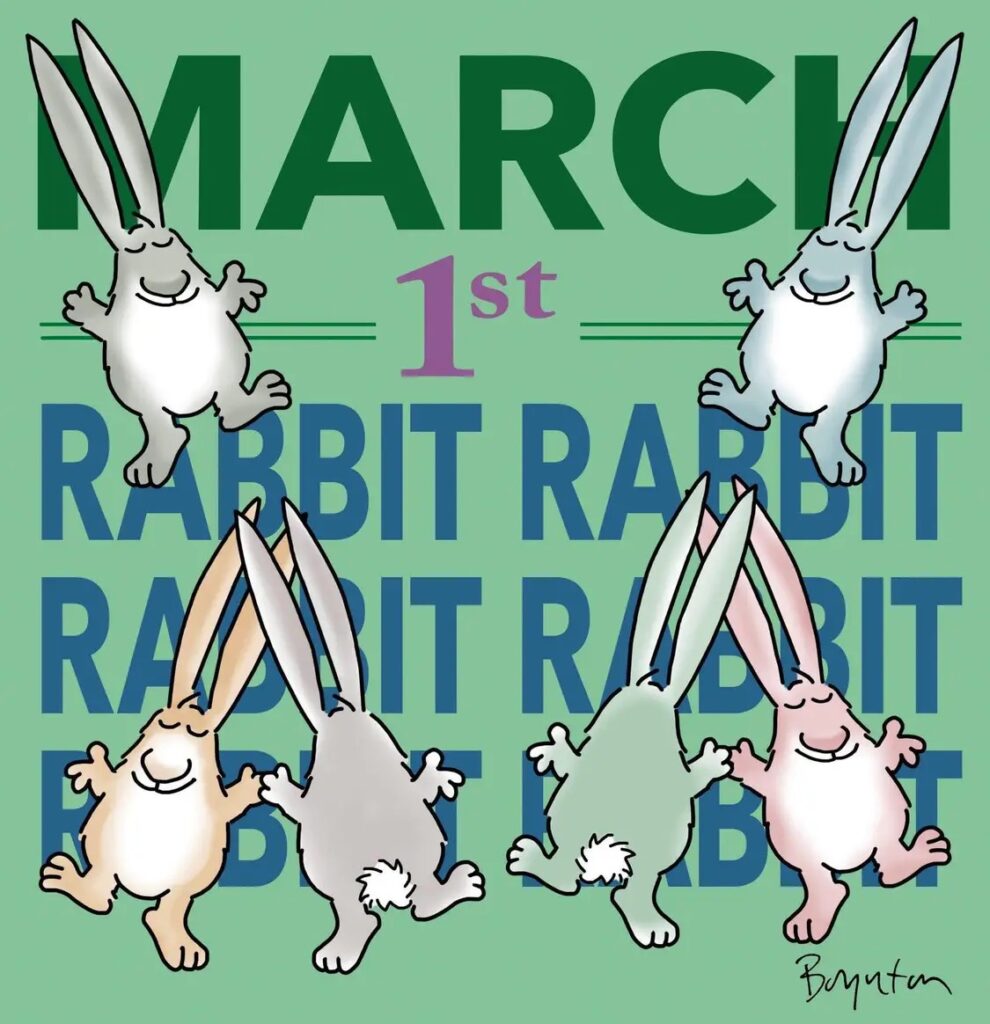
2 — Boynton Bunnies

At first he was skeptical, but I’ve managed to get Scott thinking about and noticing bunnies and bunny-related things everywhere! This morning he sent me an image someone posted on social media:

text: MARCH rabbit rabbit rabbit rabbit combined with cartoon rabbits, looking cute (and not remotely real)
you say rabbits, and I say bunnies / you say comics, and I say funnies

Actually, I don’t say funnies — who says funnies? — but it worked for the reference to “Let’s Call the Whole Thing Off.” Is Sandra Boynton still popular in 2026? I remember her greeting cards in the 80s and her kids books in the aughts. What was the one with the cd/songs that FWA and RJP loved? did they love it? I can’t remember; I think they at least liked it, or was that just me who did? I think the book/album was Philadelphia Chickens.

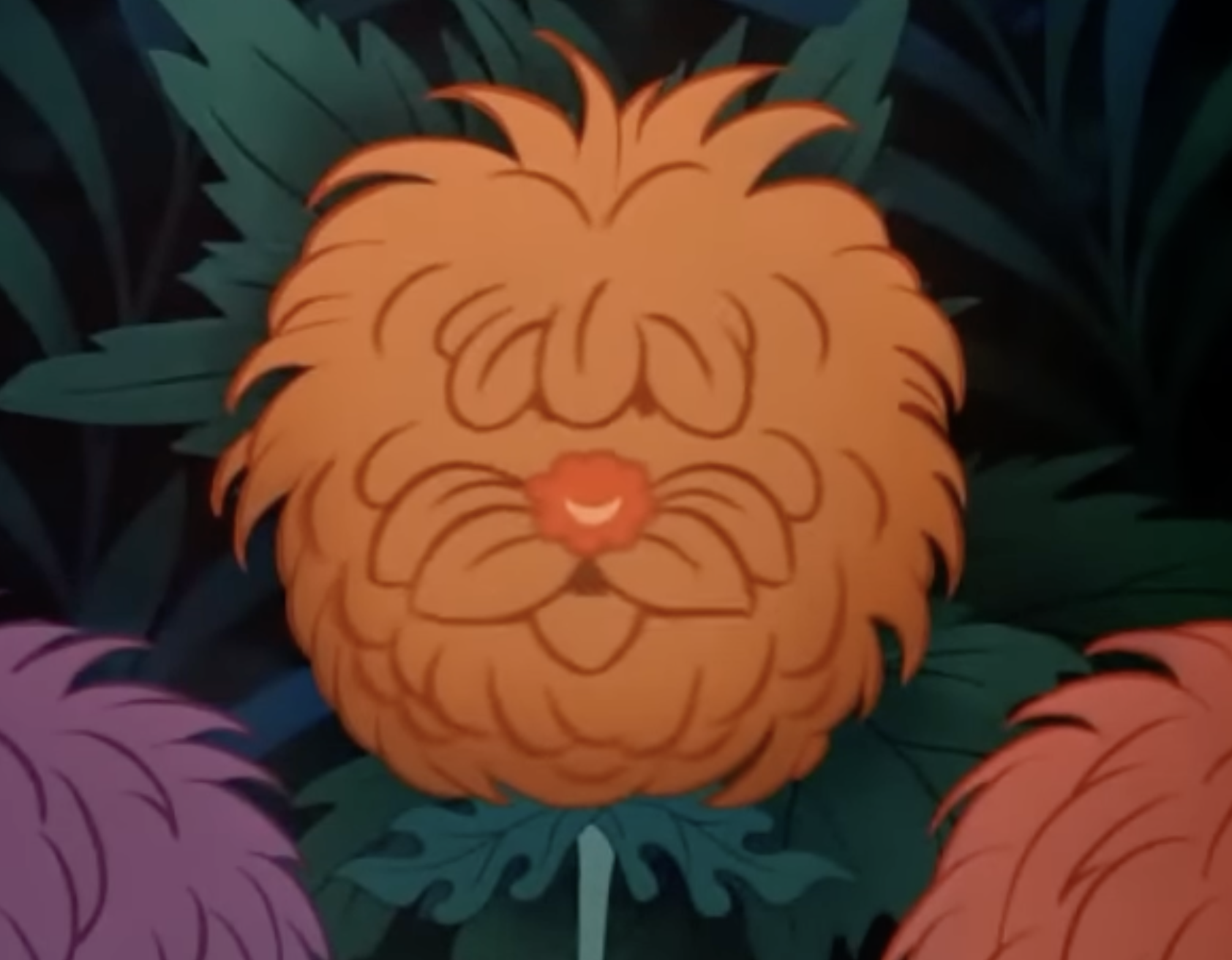
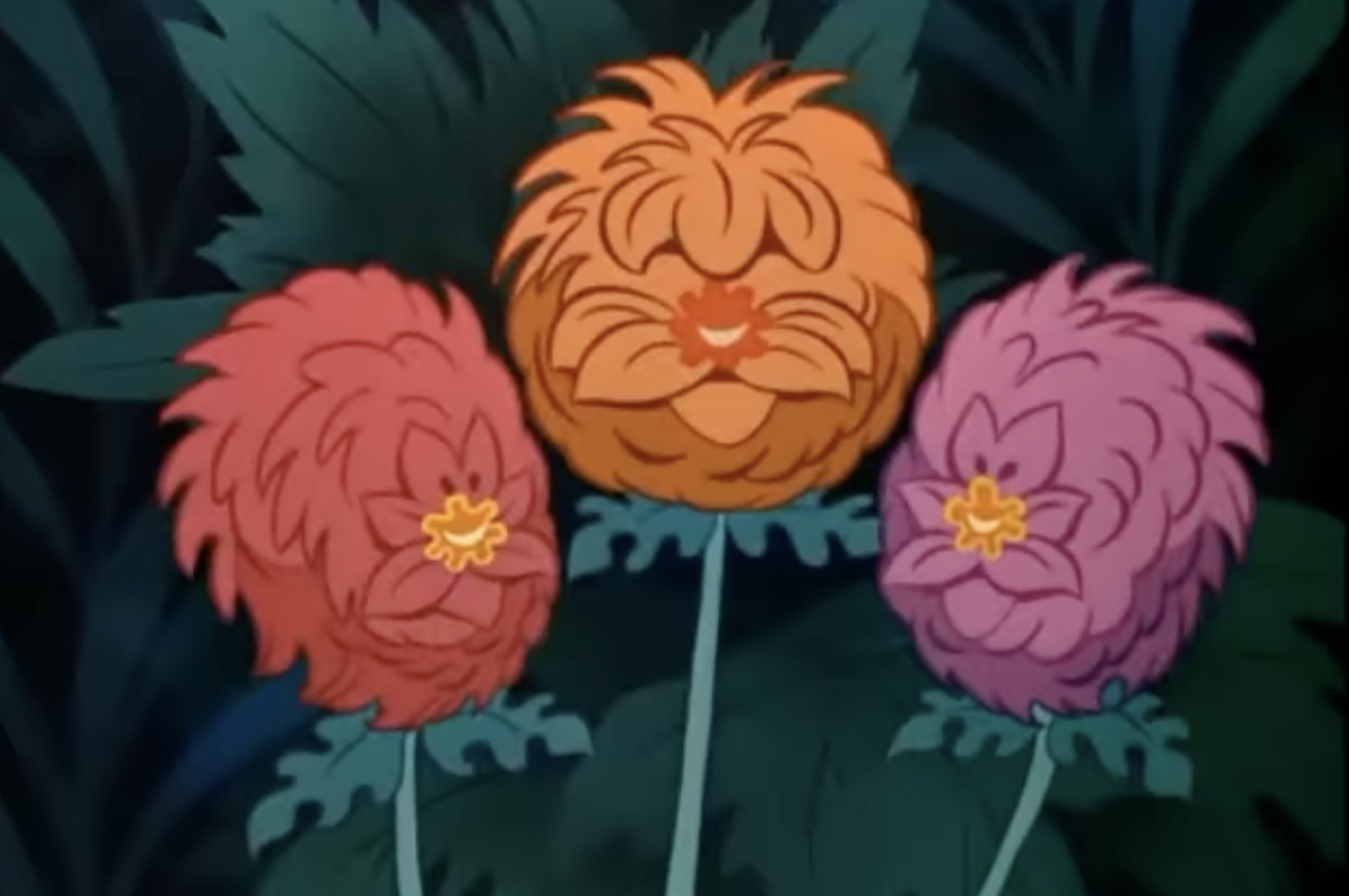
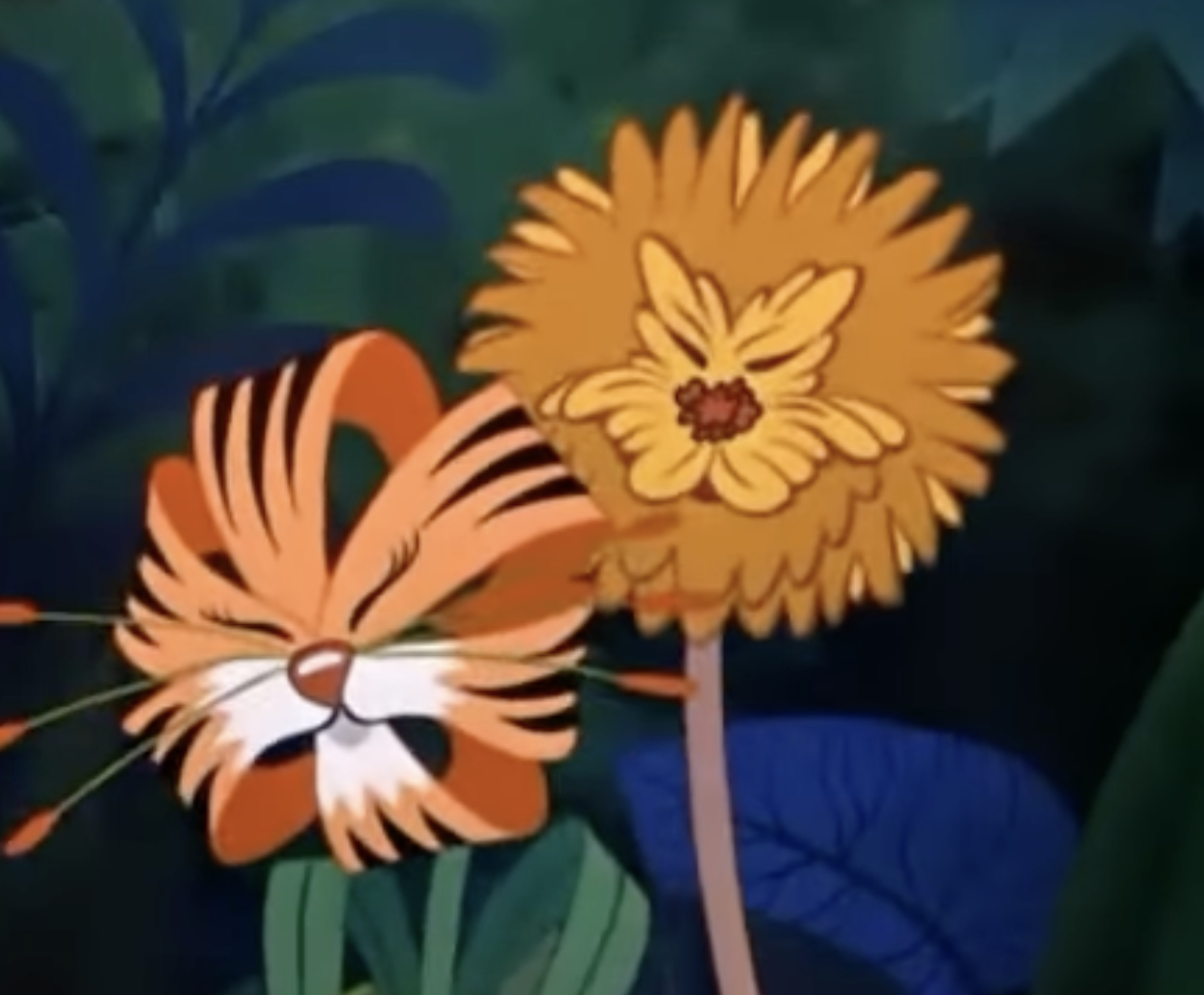
In addition to sending me random bunny images he finds, Scott was willing to watch the Disney Alice in Wonderland, which was awesomely weird, and sadly could never be made now, I think. Some of the nonsense in it, which was fabulous, reads not as kooky kid imagination but as being under the influence of psychedelics. There was also this menacing edge to the characters Alice encounters: they seemed fun or dangerous at any given moment. Two examples: the flowers in the garden — that head Rose! — and Tweedle-dee and Tweedle-dum — doing fun acrobatics but also stopping Alice from leaving.

3 — the Bronze Bunny

Their official name is “Cottontail on the Trail” because they are a bronze statue of a cottontail and they are right on the minnehaha bike trail, but I always call them the bronze bunny. Other people call them the Minnehaha Bunny.

The sculpture has garnered the nickname of the “Minnehaha Bunny” from residents.[4] Children often climb on the sculpture and people who live nearby have frequently costumed and decorated it based on seasonal occasions or topical events such as leaving eggs by the sculpture during Easter or cladding the mouth of the sculpture with a large cloth face mask during the COVID-19 pandemic.

Wikipedia entry

I’ve written about this bunny on here before. They’re 4.5 or so miles from my house so I only see them on bike rides and long runs when I am training for the marathon. Passing the bunny on a run is a big deal; it means that I’m fit enough to run for 10 miles or more.

This bunny was erected in 2002, but it seems like it’s been here much longer.

  1. I’ve tried to say rabbits, but I just like bunnies better. I think it’s partly because of how it sounds as I say it. ↩︎
  2. Finding and creating this clip took WAY longer than it should have. I kept at it because I was determined to get the clip, not because Tom saying “buuunnies” was worth it (I think I spelled buuuunnies with one n in my title, ugh), but because I wanted to figure this out. Before losing most of my cone cells it was so much easier to do stuff like this. ↩︎

Get Out Ice

Here’s an example of an existing group using their established community to provide mutual aid and support to people during the ICE occuption: How a Dungeons & Dragons meetup turned into mutual aid during ICE operations. Members have organized “know your rights” workshops, accompanied immigrants to appointments, coordinated food donations, and made barbecue for families in need.

This quotation fits with the erasure poem I’ve been working on this morning:

“In a story, you can be the underdog who defeats the big, bad, evil entity,” said D&D player Kat Hennan. “I think that having that kind of thought exercise and storytelling right now is extremely important.”

New Yorker Found Poetry Experiment, Day 1:

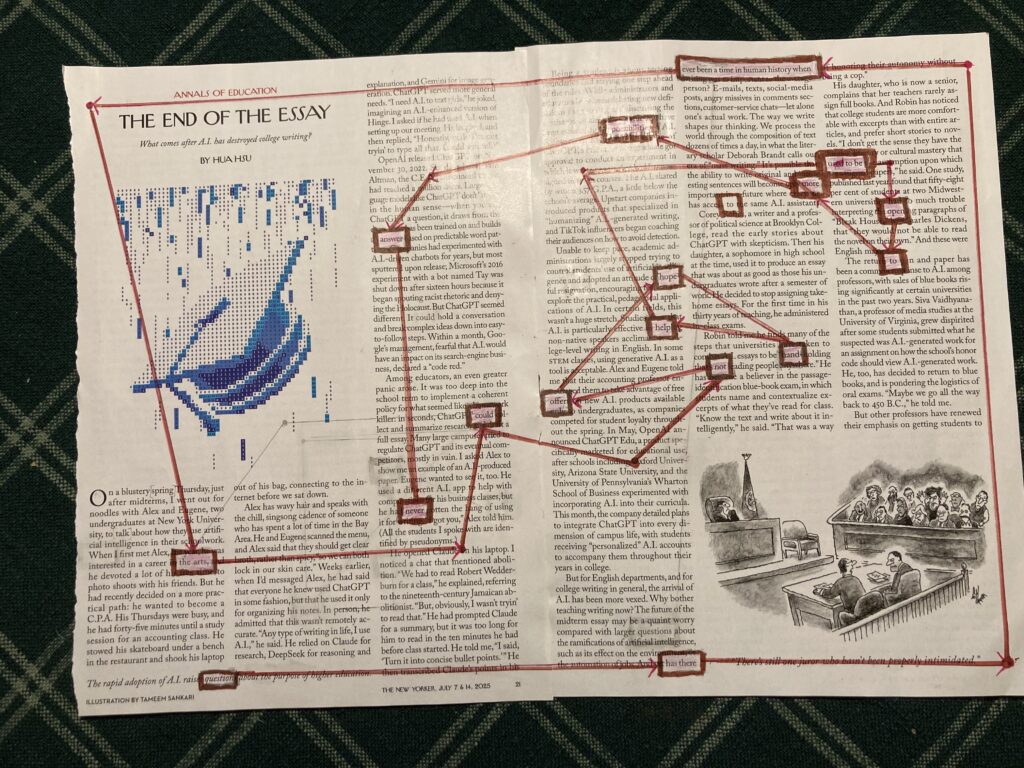
Picked a random old New Yorker. Found an interesting article, “The End of the Essay: What comes after A.I has destroyed college writing? / Hua Hsu. Put my watch timer on for 30 minutes.

Poem:

question: Has there ever been a time in human history when the arts could not offer hope and help us to be open to more possibilities?
answer: Never

A good first try. It’s funny that I want to do these visual poems when I struggle so much to see the words or how to make the boxes and lines that I need, but something in me keeps persisting, so I’ll keep trying. Hopefully it will get easier.

It’s messy — and with my vision, it will always be. and I added an extra to that’s just floating out there, disconnected. It’s too busy with too many lines. But it was fun and challenging and I like the poem I came up with a response to an article about AI ruining college writing.

When I showed it to Fletcher, he liked it and said there were ways to refine it. I agree, but not to this poem. I wrote on the original essay and I don’t have another copy. The question: next time should I scan the essay before drawing on it, or is the risky (you only get one shot) approach part of the challenge and the fun?

note: I also need to learn how to take better pictures of my work!