jan 14/RUN

4.75 miles
edmund, north/river road trail, north/seabury, south/river road trail, south
26 degrees
snow/ice-covered 75% (path) 25% (road)

For the first time since Monday, I was able to run outside. Hooray! What a difference it makes — for how the run feels, how I feel after the run — to run outside above the gorge. I ran on the road for part of it to avoid the worst stretches of the trail. Lots of loosely packed, slippery snow. I wasn’t as worried about falling as I was about having all my energy drained from the effort of running through the snow. Because of the bad conditions, I stopped to walk a few times.

Ran north to the Franklin bridge with no headphones. Turned around and put in a playlist.

10 Things I Noticed

  1. some of the roads were bare, others were still covered in soft, slippery snow
  2. a walker ahead of me on edmund was wearing a bright orange jacket
  3. running north, the wind was at my back. Returning south, in my face — cold and stubborn
  4. the river road was thick with cars, a steady stream
  5. a few bikers, more walkers, some runners
  6. a runner in a blue jacket, carefully making his way down the icy path near franklin
  7. an orange sign, a porta potty, a few barricades off to the side: there must have been a race earlier today
  8. a congress of crows cawing furiously, the sound echoing through the alley
  9. the scrape of a shovel on a sidewalk somewhere
  10. heading up from below the lake street bridge, hearing the wind shaking the dead leaves on the oak trees, sounding almost like water dripping — or was it water dripping?

Things I Forgot to Notice, or Didn’t Notice

  1. the river — don’t remember looking at it even once
  2. no regulars — no Dave the Daily Walker or Mr. Morning! or Daddy Long Legs or Mr. Holiday
  3. no geese
  4. no woodpeckers
  5. no black-capped chickadees
  6. no fat tires
  7. no kids laughing and sledding
  8. no overheard conversations
  9. no darting squirrels
  10. no music blasting from cars or smart phone speakers

Scrolling through twitter, I happened upon this poem:

Letter from the Catskills/ David Eye

Cousin–When a dozen robins blew into the yard yesterday–
I’d never seen so many–I watched them hop, cock their heads,
grab the thaw’s first worms. Such a pleasure, those yam-
colored breast feathers. Then snow las night, enough
for a fine white pelt, mostly gone by midday. (You’re better
off doing your play in the City, till it warms up for good.)
I wonder if the snow melted or–what’s that word?–
sublimed. To go from solid to gas, skipping liquid altogether.
The way I’d like to die. Grocery-shopping last night, I swear
I felt like such a loser. Not a fully set of teeth in the house,
yet I’m the freak: 45, alone at the Liberty Shop-Rite. And a snob:
can you believe it took four people to help me find capers?
So many breakups. My sister got the only keeper. God, I love
those kids. I dream of children almost every night. Awake,
I’m a eunuch. New vocal warmup, repeat before you go on
tonight: “unique New York eunuch unique New York
eunuch….” Give your boy a squeeze. The robins are back.

Lately I’ve been reading a lot about how poetry makes the familiar strange, but I think poetry can also make the strange familiar. Give us a door into the unfamiliar so we can get to know someone else and their experiences. The door in for me with this poem was all the robins. This past week, I saw so many fat robins on my crab apple tree, swaying and bobbing and getting drunk off the shriveled up apples.

a note about editing: I have a lot of typos in my writing. I didn’t used to. For years, that was a super power, being able to catch all the errors and to write a draft with hardly any mistakes. Now, I make lots of spelling errors (before I fixed it, I had spelled crab apple, CRAP apple), leave out articles and other secondary words, and for some reason, use an excessive amount of commas. I feel like I over-comma everything. Why? I think these errors and excessive commas are happening because I’m getting older, I’m writing more, the way spellcheck is set up with autocorrect is fucked up, and my declining vision. I think my declining vision is probably the biggest culprit. It’s frustrating and irritating and humbling to confront a decline like this, but I’m working on reframing it. Less of a decline, more of a shift to new practices and less worrying about stupid typos that don’t really matter. Maybe I’ll write a poem about it?


jan 13/BIKERUN

bike: 25 minutes
run: 2.4 miles
basement
outside: an ice rink

Ugh. Hopefully it will warm up enough in the next few days so that the ice on the sidewalks will finally melt. I can run in snow and in the cold, but when the sidewalks and most of the road are one sheet of bumpy, uneven, super slick ice, I have to stay inside. Before I went down to the basement, I took Delia the dog for a walk for some recon. Almost fell at least twice on the short 2 block walk. Something interesting: even though it was very slippery and I almost fell, I never had that anxious, I’m-going-to-fall-feeling. No tensing up of my legs or shoulders.

Watched a comedian my sister told me about, Rhys Niccholson, on Netflix while I biked. I laughed a lot. Listened to the book, An Elderly Lady Must Not Be Crossed, while I ran. I loved An Elderly Lady is Up to No Good, so I was excited for another book, more time to spend with Maud. Thought I might run a 5k, but I felt ready to stop a bit sooner. All I remember from my run, other than listening to Maud pretend to be senile and feeble in order to not be found out as a murderer, was thinking that treadmill runs feel longer and are much less fun than outdoor runs. Oh — I also remember noticing my stride and trying to focus on the rise and fall of my feet and relaxing my shoulders as I swung my arms.

A few days ago, I bookmarked a wonderful essay by the Diné poet Jake Skeets: My Name is Beauty. I just started reading it and found so many wonderful passages, including this one:

Viola Cordova defines the concept of cultural relativity in her essay “Language as Window” as the way Western constructs constrict worldview to one single thing and dismiss differing worldviews. However, Cordova, through an analysis of the work of linguist Benjamin Whorf, states that language is the key to interpreting the world in different ways. Using an egg paradigm, Cordova asks us to imagine the Earth not as a physical rock in space but as the yolk of an egg. She asks us to imagine ourselves swimming through air rather than walking, and to consider ourselves within something, not on something.6 Seen this way, the Earth becomes a womb, a nest, an embrace.

The swimming through air reminded me of studying fungi this past April. Here’s something I wrote on April 21, 2022:

Thought about nets and this passage from The Mushroom at the End of the World:

Mushrooms are the fruiting bodies of fungi. Fungi are diverse and often flexible, and they live in many places, ranging from ocean currents to toenails. But many fungi live in the soil, where their thread-like filaments, called hyphae, spread into fans and tangle into cords through the dirt. If you could make the soil liquid and transparent and walk into the ground, you would find yourself surrounded by nets of fungal hyphae (137).

Thought about imagining the soil was liquid and transparent and then entering it, surrounded by nets of fungal hyphae. What if I could swim in the soil? Swim through these nets of fungal hyphae?

I must return to this essay later and work through it slowly. So many amazing ideas! In the meantime, here is one of Skeets’ poems:

Soft Thunder/ Jake Skeets

narrowmouth toads dapple pink sandstone
knee-deep in a brown bowl of brown water

before the croon of limb and wind on weeds
puddles from the pour gather for a morning song

the sun rises from a flatbed load of open palms
                : each crease a ripple a leg a half smile

the sun knows best when it rises
                : each tide and oak and uplift sung the same

each killdeer and mare and desert bighorn
each I I gorge each I I ravine each I I—

and each part of me is hung out to dry marooned

and wrung of rain, wrung of every I until no I is left
                        :      soft thunder
                                        ponds in a clearing

jan 10/RUN

4.5 miles
minnehaha falls and back
28 degrees / humidity: 90% / mist
100% soft, slippery, snow-covered

Quiet, gray, dreamy. Disconnected from the world. Alone, but not lonely. Immersed in a slow, hard effort on a slippery trail. I’m ready for this soft snow to go away. I want a clear, solid path, please. My leg muscles are sore, but I don’t regret the run. How wonderful to be outside and moving beside the gorge in the winter!

No fresh, clean air. Instead, a poor air quality warning. I couldn’t feel it in my lungs, but I could see it in the sky. Everything was even fuzzier than usual.

10 Things I Noticed

  1. heard some harsh honks, then looked up in the sky. A vee of geese! I stopped to watch them flying low until they disappeared behind a tree
  2. the sky was a pleasing, soft gray
  3. running past a park kiosk, I heard some deep thumping. Could it be the knocking of a woodpecker?
  4. the falls were frozen, although as I ran by the bridge just above the falls, I noticed a dark open spot. I didn’t stop to listen for gurgling water. Would I have heard some?
  5. only one car and one person in the parking lot, standing near the machine where you pay for parking
  6. stopped to walk on the unplowed pedestrian side of the double bridge and heard nothing but a loud silence
  7. the path was covered in soft, slippery snow, with a few short stretches of packed snow
  8. the road (edmund) was slick and wet and had lots of streaks of brown, slushy, slippery snow
  9. kids’ voices drifting over from the school playground, mixing in with the geese honks
  10. felt a fine mist on my face — was it freezing rain? moisture in the air?

Found this poem on twitter the other day:

Lit/ Andrea Cohen

Everyone can’t
be a lamplighter.

Someone must
be the lamp,

and someone
must, in bereaved

rooms sit,
unfathoming what

it is to be lit.

jan 7/RUN

4.1 miles
river road path, north/river road path, south
10 degrees / feels like 10
100% snow and ice covered

I wasn’t planning to run outside today, but when I checked the weather and saw that the feels like temp was the same as the air temp and the wind was only 1 mph, I had to get outside. It was sunny and beautiful and not too cold once I got warmed up. But, it was hard, mostly on my legs, which are sore from yesterday’s run through snow. Still, I’m very glad to have been outside by the river. The dark shadows cast on the white path. The white river. The fresh air. Encountering dogs and fat tires and people walking and running. I heard the trestle beeping and wondered if a train was coming — nope. Also heard the faint song of a black-capped chickadee. Kids laughing as they played in the snow. A great morning.

layers

  • 2 pairs of socks
  • 2 pairs of black running tights
  • 1 bright yellow shirt
  • 1 pink thin jacket with hood
  • 1 gray thicker jacket
  • a buff
  • a black fleece-lined cap
  • 2 pairs of gloves
  • yaktrax

the sun, the moon, the snow yesterday

Driving south to St. Peter, the clouds covered the sun strangely, making it look like a giant white disc. I actually gasped, Oh!, and pointed at it.

Later, driving north back to Minneapolis, I marveled at the moon. It was darker and the moon looked almost the same as the sun had, just rounder and more real. It hung in the sky like a flashlight, illuminating the dark fields.

Even later, now at home, I looked out the back window at the deck. Little sparkles everywhere! The moon was shining on the snow. Magical. I called to my daughter and she came down to look. She always comes to look and shares in my joy over glittering snow and marvelous moons.

jan 6/RUN

4.5 miles
minnehaha falls and back
14 degrees / feels like 6
100% snow-covered

On Tuesday and Wednesday, we had a big snowstorm. 14.9 inches of snow in total. Schools went online — which is what they do now instead of snow days; students still have to show up, but just to their computers. Because it kept snowing, the city of Minneapolis didn’t declare a snow emergency and begin plowing side streets until it was over on Wednesday. The result: a mess. Today, they’re on day 3 of the snow emergency (plowing the odd side of the street) and walls of snow have appeared at the ends of sidewalks and where streets cross each other. These walls made for a slow start to my run as I climbed over them on my way to the river. The river road trail was plowed, but still covered with a hard pack of snow. I wore my yaktrax, which helped. I didn’t mind running on the snow and was able to sight and avoid all of the big, hard chunks of snow on the path. I didn’t slip, but once I almost rolled my ankle on some snow as I turned a corner at the falls.

10 Things I Noticed

  1. lots of soft ruts in the street — snow almost the color and texture of sand
  2. the river was completely white and still
  3. the dark, sharp shadows of bare tree branches sprawled across the white path
  4. kids having fun at the school playground — I couldn’t see them, but heard their exuberant voices
  5. a strange clanging, clunking, banging noise coming from the school –was it kids? — or Becketwood — a furnace?
  6. the falls weren’t falling, but frozen
  7. as they neared a tight curve by locks and dam #1, several cars slowed way down
  8. a smaller parks plow cleared off the walls of snow at the entrance to the trail near the falls
  9. the snow was so white, the sun so bright, that it all looked blue — the palest shade of blue
  10. a congress of crows calling out to each other. I remember thinking that they sounded much more pleasant than bluejays

overheard: Unfortunately, even though I tried to hang onto all of the words I heard as I ran by two walkers, I’ve forgotten some of them.

A woman to her walking companion: “Not all bosses are like that, Sheldon. My boss doesn’t do that…”

I wondered what her boss doesn’t do. Then, I thought about her frustrated tone and wondered if it was frustration over a boss who didn’t do things they way she wished, or Sheldon for assuming all bosses did things in the same way or for appreciating how his boss did things. The question became: for her, who is the asshole, the boss or Sheldon? All I had to go on were her words and her tone, which didn’t seem like enough. I imagined (but knew I’d never do) stopping to ask her: Excuse me, I’m not trying to be nosy, but what doesn’t your boss do? I thought about how not knowing was an opportunity to reflect on how we communicate and what clues we give with our inflections.

relying on my practice

A great run one day after my colonoscopy. A few days ago, I had mentioned that I was stressed out about the procedure. It went fine. In fact, there were parts of it I actually enjoyed — maybe “enjoyed” is too strong of a word? I’m glad it’s over, but it wasn’t that bad. Mostly because I’m healthy and they didn’t find anything wrong, but partly because I used the noticing skills I’ve developed from my practice of running and writing about it on this log to distract me. Is distract the right word? Maybe keep me focused on remaining present? Or occupied with something other than worry? As I waited in the crowded (but not too tightly packed) waiting room, I took notes of what I noticed. I kept paying attention (but without the notebook) when I headed back for preop and as they wheeled me into the operating room. Maybe I could turn it into a poem?

More than 10 Things I Noticed Before My Colonoscopy

  1. lime green chairs
  2. an older man, restless, tapping on the table like he was playing a keyboard or typing on a computer
  3. a nurse calling out, Sue
  4. the steady hum of the machine that circulates the air
  5. the sound of someone watching a video on a phone — the volume was low, so all I heard was a constant buzz of voices
  6. a woman with a mask below her nose walking by
  7. nurse: Sherry with Barb
  8. the hum of a copy machine or a printer
  9. Julia
  10. Tanika
  11. Isaiah (a little kid in pajamas walked by holding a woman’s hand)
  12. Mark
  13. Brandon
  14. the soft sound of someone folding a crease into a piece of stiff paper
  15. the rustling of a winter coat or nylon pants
  16. Scott’s keyboard keys clicking
  17. a deep rumbling voice
  18. a person walking by wearing bright red sneakers. I wasn’t sure if they were red or orange, so I asked Scott
  19. a cart with a blue cover being pushed by a nurse through the waiting room
  20. someone playing music — I could tell it was music, but not what kind or any of the words that were being sung
  21. a woman wearing a bright yellow stocking cap walked by
  22. Bridget
  23. Nancy
  24. the woman with her mask down coughing and sneezing and blowing her nose then making a call and saying something about 4%
  25. someone saying the phrase, Dad Bodies
  26. Wendy
  27. Travis
  28. feet shuffling, the low hum of murmuring voices

A few other things: 2 of my nurses were also named Sara/h — one was Sara, the other Sarah. My doctor’s sister is Zara. He told me the name means “flower.” When I was wheeled into the operating room, they were talking about how amazing air fryers are. As I drifted off to sleep I heard one of them saying, It’s the best appliance I have. Better than a microwave. I use it 6 or 7 times a week!

orange!

I’m continuing to work on my colorblind plate poem about orange. One key theme: I see orange everywhere. Here’s something to add to that: as the nurse (Sarah) was putting in my iv, she told me to look at the orange leaf (which was her way of saying look away so you don’t see me poking you and freak out). I turned and noticed a photograph of gray rocks with a bright orange leaf resting on them. Orange! Later, after I left the room I wondered if I had remembered correctly. Was it orange or red. But then I thought that it didn’t matter because I still thought of it as orange. This fits with my sighting of the red (which I though might be orange) sneakers (#18).

Found this poem on twitter this morning:

Blink/ Donna Vorreyer

A blur of movement where it does not belong,
a white floater in the window’s darkening eye.

A plastic bag, I think, caught in an updraft
or a bit of the dying yucca’s autumn fluff,

but I discover it is a hawk, all muscled breast
and feathered intent, settling to perch in the tree

outside my window, to survey the yard then
fly again, gone as quickly as it came, the same way

joy arrives. Without warning. Sometimes
unrecognizable. Never promising to stay.

Here’s what Vorreyer said about the poem: “If @MFiteJohnson hadn’t sent me the picture, I might have not believed it actually happened, but I have a poem keeping company with hers in the new issue of @pshares, something I thought I would never say. It’s a small poem about being in the moment, something I want to do more.

jan 2/RUN

5.25 miles
franklin hill turn around
22 degrees
35% ice

Winter storm coming this evening — ice and snow. I don’t mind the snow, but I could do without the ice. Will this be the last run I can do outside for a while?

Today the sky was a grayish-white, or mostly white with a hint of gray. Hardly any wind. The path was icy and slick and I felt my feet slide a few times, but I never worried about falling.

Greeted Mr. Morning and a walker with hiking poles. Daddy Long Legs asked me if I was doing hill repeats because he thought he had seen me climbing the hill already. Nope, I said. Oh, you must be wearing the same clothes, he said.

Heard the drumming of a woodpecker, the chirping of a bird — a robin, I’ve decided.

Smelled some breakfast at Longfellow Grill as I descended below the lake street bridge.

2 miles in, I felt my body warm up, especially my legs.

Looked over at the gorge and noticed orange — the dead leaves still lingering on the oaks. Looked down into the gorge and saw a white river, completely covered.

Ran north with no headphones. Stopped 3/4 of the way up the hill to put in a playlist, then ran south.

a summary in minisons

  • drumroll please
  • my doppelgänger
  • eggs bacon toast
  • the color orange
  • impending gloom

On twitter, I encountered an interview with a local poet that I haven’t read, Michael Kleber-Diggs. So I found his site, and read a few of his poems, including this one that does a wonderful job of capturing the messy, ugly, beautiful complexity of Minneapolis:

Here All Alone/ Michael Kleber-Diggs

Raptors ride the thermals above Dakota.
Beyond them, the sun appears closer,
colder. Everything warm escapes, returns.
One-hundred nations assemble in congress,
this time for water, where water is life.
And I know this isn’t my song to sing,

but I wonder what god saves grace for hunters.

Water cannons, fire hoses, nunc pro tunc.
this land, once yours, was flooded and dammed
the same day our Rondo was cleaved for a highway.
And I know I’ve seen those attack dogs before
with the same blue force undoing brown bodies.
Foul water in Flint, good water in Bismarck:
bullets, bulldozers, bad pipes, hollow promises –
what birds are these still circling, circling

while god denies grace for the hunted?

Warm air sent rising makes gliding
seem easy, while shale beneath us fractures,
relents. Why then must earth grow colder then
harden, and leave us to shiver here all alone,
singing sad songs of foremothers, forefathers
while above the raptors exhort us to prey?

To pray to a god who saves grace for hunters.

dec 31/RUN

4.5 miles
minnehaha falls and back
26 degrees / feels like 20
90% snow-covered

The last run of the year. A beautiful winter morning. Not much wind, not too cold, not too crowded. In the beginning, the sun was behind some clouds. The light was eerie and subdued. Everything soft gray. Almost reverent. I felt relaxed and happy and open to the world, moving with it and through it instead of against it. I tried to keep my back strong and straight, feeling the pressure release from my hips. Deep breath in through my nose, out through my mouth.

Lots of thinking about being open that I don’t quite remember now. Something about George Sheehan and a mixture of these quotes from his essay, “Running”:

…each day I take to the roads as a beginner, a child, a poet. Seeking the innocence of the beginner, the wonder of the child and the vision of the poet. Hoping for a new appreciation of the landscape, a new perspective of my inner world, some new insights on life, a new response to existence and myself.

I must listen and discover forgotten knowledge. Must respond to everything around me and inside me as well. 

Poets do this naturally. A really good poet, wrote James Dickey, is like an engine with the governor off….

The best most of us can do is to be a poet an hour a day. Take the hour when we run 0r tennis or golf or garden; take that hour away from being a serious adult and become serious beginners.

Running / George Sheehan, 1978

I like the idea of combining the wonder of the child with the vision of a poet, but not really the innocence of a beginner. Instead of innocence, I’d say the openness of a beginner, or maybe even the ignorance? — unknowingness might be better — the enthusiasm, lack of judgment or preconceived notions? Innocence seems too connected to purity and whiteness for me, in terms of how it gets imagined. Yes, I like openness.

I wasn’t thinking about innocence as I ran, just openness and being open to everything around me and inside of me. When I lifted from my hips, my shoulders relaxed and dropped, my chest opened. I smiled a lot, greeted almost all the other runners with a morning or a wave, didn’t worry about my upcoming colonoscopy. I didn’t try to hold onto everything I was seeing or hearing or smelling or feeling, but let it move through me.

Returning to Sheehan’s quotes, his emphasis on new — new appreciations, new perspectives, new insights, new response — made me think of an essay I read just before my run:

As we enter this December, we can hunker down to endure a dark winter, or we can head out and see familiar paths with new eyes. As we taste the crisp, fresh air and float through the white quiet we may feel a spark of long-forgotten magic, and maybe even hope; hope for a different spring, one we’ll be ready to embrace with the youthful strength of a winter well lived.

The Magic of Winter Running/ Jonathan Beverly

I ran without headphones or yaktrax and in lots of layers: 2 pairs of black running tights, a green shirt, a pink jacket with a hood, a black vest, 1 pair of black gloves, a black fleece-lined cap, a gray buff.

10 Things I Noticed

  1. a male runner in shorts with bare legs
  2. the sun came out by the time I reached the falls
  3. minnehaha creek just before the falls was completely covered in white
  4. a dry leaf skittering across the snow-covered path. no sound, only movement — sharp, brittle, frantic
  5. the smell of smoke in the usual spot
  6. kids’ voices, laughing and yelling as they sled down the hill between wabun and the falls
  7. my shadow running next to me
  8. a fat tire approaching the river road trail, then carefully crossing over the hard chunks of snow and ice as it entered the trail
  9. a black capped chickadee with a strange call — not the fee bee call and not chickadeedeedee. Do they have a different winter call?
  10. a pileated woodpecker calling out in response, and another bird that I can’t identify

Forgot to look at the river. Didn’t hear any geese. Decided not to stop at my favorite spot at the falls and put in a playlist.

Back to the black capped chickadee. I was running on edmund, thinking about something else, when suddenly I heard the chickadee. A welcomed interruption! I started thinking about a fun experiment to try with my students that’s about being more open to hearing sounds, like this call. It involves going outside and recording a moment of sound. Then later, listening back and giving attention to the sounds in the recording that you didn’t notice, or that you ignored (maybe always ignore). What sounds are around us that we tune out? Rumbling planes, crunching footsteps.

Speaking of sounds around us, I almost forgot to mention the constant presence of the hum of the city. Starting my run, I noticed how loud it was — not noisy traffic right around me, but buzzing off in the distance. So loud! But not unpleasant.

Tried out the minson form (14 letter sonnet). So fun! Not sure if I’m quite capturing the spirit of a sonnet — what is that exactly? does it require a volta? how do you do that in 14 letters? The following are based on my log entry above:

another gray day

more muted magic

bare leg bravery

nervous fat tire

all of it strange

emptied of geese

quiet leaf waltz

forgotten river

remembered bird

opened the doors

a kid a sled a hill

a being shadowed

the frozen falls

I like the double meaning of this last one, frozen falls. I didn’t slip on any ice, or see anyone else stumble as they moved over the occasional ice patch, but the frozen sidewalk probably did cause somebody to fall.

dec 29/RUN

5 miles
franklin hill turn around
34 degrees / humidity: 87%
60% snow and slush covered

A nice run, even if it was a little too slushy and slick. After I was done, walking on edmund, I took out my phone and recorded my thoughts and the sounds of this wintery Thursday morning. Very cool to listen back to the recording: the steady crunch crunch crunch of my feet, car wheels whooshing through the slushy puddles, the hum of the city, birds chirping, melted snow drip drip dripping through the metal gutter, the brief moments when my feet go silent as I cross over bare pavement.

Ran north with no headphones, south with a playlist (summer 2014).

post run winter morning sounds

10 Things I Noticed

  1. a congress of crows, cawing loudly (congress, council, and consideration are J. Drew Lanham’s collective name for crows instead of murder)
  2. greeting Dave the Daily Walker, good morning Dave!
  3. the river is white, completely covered
  4. in some spots, the trail was 1/2 slush, with a few spots of ice
  5. in other spots, bare pavement
  6. a woman in a yellow vest, running fast in the road. I marveled at the steady rhythm of her feet and before I knew it she was way over on the other side of 36th. I spotted her as a bright yellow dot in the distance
  7. the scraping of ski poles to the side of me — not quick thrusts, but the steady drag of poles down a hill
  8. some of the snow was white, some gray, some light brown
  9. several runners, many walkers, a few fat tires
  10. 2 women walking in the middle of the trail, in the barest spot, stopping every few seconds to stare at something — what?

Here are a few passages about the wonder of winter from Dallas Lore Sharp and his book Winter. I originally heard about him on The Marginalia.

I love the winter…its bare fields, empty woods, flattened meadows, its ranging landscapes, its stirless silences, its tumult of storms, its crystal nights with stars new cut in the glittering sky, its challenge, defiance, and mighty wrath. I love its wild life–its birds and animals; the shifts they make to conquer death. And then, out of this winter watching, I love the gentleness that comes, the sympathy, the understanding!

you must see how close you had passed to and for all summer to the vireo’s nest, hanging from the fork on a branch of some low bush or tree, so near to the path that it almost brushed your hat. Yet you never daw it! Go on and make a study of the empty nests….Study how the different birds build — materials, shapes, finish, supports; for winter is the better season in which to make such study, the summer being so crowded with interests of its own.

When the snow hardens, especially after a strong wind, go out to see what you can find in the wind furrows of the snow–in the holes, hollows, pockets, and in footprints in the snow. Nothing? Look again, closely — that dust — wind-sweepings — seeds!

winter, when the leaves are off, the ground bare, the birds and flowers gone, and all is reduced to singleness and simplicity — winter is the time to observe the shapes, colors, varieties, and growth of the lichens.

What a world of gray days, waste lands, bare woods, and frozen waters there is to see! And you should see them — gray and bare and waste and frozen. But what is a frozen pond for if not to be skated on? and waste white lands, but to go sleighing over? and cold gray days, but so many opportunities to stay indoors with your good books?

You will see the fishermen on the ponds catching pickerel through the ice — life swimming there under the frozen surface! You will see the bare empty woodland fresh budded to the tip of each tiny twig — life all over the trees thrust forward to catch the touch of spring! You will see the wide flinty fields thick sown with seeds — life, more life than the sun and the soil can feed, sleeping there under “the tender, sculturesque, immaculate, warming, fertilizing snow”!

The air was crisper; the snow began to crackle underfoot; the twigs creaked and rattled as I brushed along; a brown beech leaf wavered down and skated with a thin scratch over the crust…These were not the voices, colors, odors, and forms of summer. The very face of things had changed; all had been reduced, made plain, simple, single, pure! There was less for the senses, but how much keener now their joy! The wide landscape the frosty air, the tinkle of tiny icicles, and, out of the quiet of the falling twilight, the voice of the quail!

dec 27/RUN

3.3 miles
under ford bridge and back
18 degrees / feels like 8
95% snow-covered, a few slick spots

And, goal achieved! In the middle of my run, I reached 1000 miles. Probably as I ran over the double bridge on my way back, maybe as I encountered another person who was stopped on the bridge. We did that annoying thing where we both went the same way, then shifted and went the same way again, then finally went in opposite ways.

A good run. It felt hard at the beginning. Difficult to breathe through a stuffed-up nose. I’m not sick, it’s just living inside in the dry air for too much of the day. As I warmed up, it got a little easier. The sidewalks were covered in packed, uneven snow, slick in spots.

I think I saw my shadow. I can’t remember if I saw them today, but a few days ago, driving on the river road, I admired the long, dark, twisted shadows the trees were casting on the completely white, completely snow-covered river road.

I heard some chirping birds, sounding like spring. As I started the run on my block, I heard a howl or a bellow. A dog? A coyote? A dog. Whining at the back door of a neighbor’s house. And I heard my feet striking the packed snow on the path. No pleasing crunch, or delightfully annoying grind. Only muffled thuds. Thought I heard some wind chimes coming from a neighbor’s deck. No headphones heading south, my “swim meet motivation” playlist heading back north.

Smelled the fire at the house on edmund that always seems to have a fire in the winter.

Felt my feet slip a little as I ran over slick spots. Enjoyed feeling the dry pavement — solid, secure — on the very rare and brief spots where the path was dry. Felt my burning, flushed face — was I overdressed? Felt a strong, sharp wind blowing in my face.

At some point in the run, I was interrupted by the sound of the wind rushing through some dead, orange leaves on an oak tree. What was I interrupted from? Maybe thinking too much about my effort or whether or not I would encounter another person or concentrating on the words to the song I was listening to. This interruption reminded me that one key way I use moving outside to pay attention is through passive noticing, answering when the world calls to me. Making myself open and available to the world. Yes! Before I went out for a run, I was working on the schedule for the class I’m teaching in the winter. I was trying to figure out how to tighten it up, rein it in a little, so I didn’t have too much (too many ideas, activities, readings) that might overwhelm students. I think this idea of passive attention and letting the world in, being open, is key to that. Cool.

Speaking of my class, here are some passages from an essay (Thinking Like a Sidewalk) on sidewalks and running in the winter that I might want to use in my class:

gradations of gray

My hometown of Carbondale, Colorado is buried in enough snow each winter to force most of us to become connoisseurs of concrete. Having spent the spring inviting peaking greens, all summer squinting across a singed expanse, and the fall celebrating the leafy explosion, each winter I relearn how to appreciate the gradations between smoke, cool ash, slate, pewter and pearl.

treadmill window

I realized what made me feel part of the wild was not physical proximity, but emotional. The intimate connections I formed with my wintery tableau from the treadmill felt as real and important as any experience on the trail. I became more familiar with that patch of snowy creekbed than many people ever would, and even worried when my nuthatch friend failed to report for pine-branch duty (If you’re reading this, please reach out). 

The treadmill window allowed me to become what Ralph Waldo Emerson called the “transparent eyeball” in his essay, “Nature.”

I am nothing, I see all. 

a practice

Similar to a new strength routine, or a pre-race visualization, cultivating the habit of noticing the confident posture of a rook on its telephone pole perch takes focus, intent and repetition.

This demands turning attention toward the rustle of grass that says you aren’t running solo or the shallow pawprint that shows you aren’t the only critter perfecting their strides. Each run offers an opportunity to broaden our understanding of what wildness is, and connect with it in and around ourselves. 

Perhaps the sidewalk doldrums are due less to the monochrome concrete as the decline in our ability to appreciate the wilderness that exists between the cracks, and that exists in us.  It’s one thing to value a majestic vista worthy of posting on Instagram, something more subtle to celebrate the subtlety of snowy sidewalk. 

Thinking Like a Sidewalk

Wow! I’m definitely going to use bits of this essay for my class. Love it. note: the title, Thinking Like a Sidewalk, is a reference to Aldo Leopold and his essay, Thinking Like a Mountain.

Other things I want to read that are mentioned in the essay:

dec 20/RUN

3.6 miles
trestle turn-around
0 / feels like -16
100% snow-covered

Last year I decided that my limit for cold was a feels like temp of -20. Since it was only -16, I went out for a run by the gorge. It was cold, but not too cold. It felt good to be outside, breathing in fresh air, moving in sunlight, being beside frozen water and snow-covered trees.

10 Things I Noticed

  1. checked out the river at the trestle: all frozen, white and gray, solid, stiff
  2. the steady crunch crunch crunch of my yaktrax on the cold powder
  3. solid chunks of ice littering the path, not boulders, but big enough to hurt my foot or twist my ankle if I ran into or over them
  4. a skein of geese! first I heard their honks, then I stopped to watch them fly across the sky
  5. the roar of a plane
  6. the shadow of a big bird
  7. one other runner, one or two walkers, no dogs, no fat tires, no roller skiers
  8. two walkers below me, walking through the tunnel of trees
  9. a snow blower up above, near longfellow grill
  10. the path was slick and slippery with stripes of ice glowing in the sun

layers

2 pairs of black running tights; 2 pairs of socks –1 gray, 1 white; a green long-sleeved shirt; a pink jacket with hood; a running belt for holding my phone; a gray Hot Dash 10 mile 2017 jacket; a gray buff; a black fleece-lined cap; sunglasses; black gloves; reddish pinkish fleece-lined mittens

Enough layers. The mittens were especially warm. Did it help that I had warmed up on the bike in the basement before heading out for my run? Probably. Neither my fingers or toes were too cold. Hooray?

feels like

It felt cold, but not cold enough to give me a brain freeze. I wore a buff over my mouth to warm my breath. My snot froze a little but not too much. After I took my sunglasses off, because they had fogged up, my eyelashes acquired a few bits of ice. The tops of my thighs felt cold and tingly by the end. No itchy legs or feet that felt like blocks of concrete. Dripping with sweat by the end. My braid, which had wicked all the sweat, froze again into a hard, twisted mass–or mess?

It feels like winter is here for good. Maybe the snow on the trail, too?

Listened to a playlist with only one headphone in, so I could hear the crunching snow and the gorge too. Did I hear any other birds beside the geese? I can’t remember.

I’m very glad I made it outside. I love these winter runs!

ongoing projects, dec 2022

Thought it might be interesting and helpful (for present and future Sara) to make a list of what I’m working on right now:

  • Reading through my entries from 2022 and adding to summaries of my runs, ideas and quotes, and a huge list of things I noticed. Right now I’m halfway through April.
  • Thinking about, reading up on color, especially orange. Trying to write a colorblind plate about orange, particularly how shifty and unreliable it is, and my obsession with seeing/not seeing orange buoys at open swim. Checked out Maggie Nelson’s Bluets for inspiration on how to write about color.
  • Planning my winter writing/creative process class for The Loft. Right now, I’m gathering poems and essays and thinking about my weekly lectures. As part of this, I’m reading/listening to Adam Gopnik’s Winter: 5 Windows on the Season.

dec 17/RUN

4.5 miles
minnehaha falls and back
18 degrees / feels like 8
100% slick snow

Another dusting of snow last night. Just a slow, steady accumulation. Everything a bright, blinding white — the sky, the path, the trees, even the river, at least in one spot where the sun hit it just right and made it burn or glare or whatever word you might use to describe a blinding white light. Wow.

Layers: 2 pairs of black running tights, green shirt, pink jacket, gray jacket, buff, black fleece-lined cap with brim, 2 pairs of glovers (black, pink and white striped)

No headphones on the way to the falls; an old playlist titled “swim meet motivation” on the way back — David Bowie, Beck, Todd Rundgren, Ozzy Osbourne, Pat Benetar

10 Things I Noticed

  1. the creek was flowing and the falls were falling, making a delightful rushing sound
  2. when I stopped just before my favorite spot (because a couple and a kid were already at my spot), I could hear the falls as they fell. When I looked, all I could see was one white tree after the next
  3. the trail was not too slippery, but slippery enough to make my legs work harder
  4. I think it was between locks and dam #1 and the double bridge — as a car passed me , I smelled hot chocolate. did it come from the car, or was that just a coincidence?
  5. on the way back, stopped to walk on side of the double bridge that doesn’t get plowed in the winter. I looked down into the white ravine as I trudged through the snow
  6. glancing at the river through the trees, something about all the white in the trees, the light, and my vision made the river look like it was sepia-toned
  7. nearing the ford bridge, looking ahead, I noticed something that looked like an animal. I couldn’t see an owner and wondered if it was a coyote and not a dog. As I got a little closer I realized it was a person wearing a shirt so light — pale blue? gray? white? — that it blended into the sky. The dark I had seen was their pants. This is not the first time this has happened to me
  8. running by some steps saw the briefest flash of orange — must be a sign warning people not to enter, I guessed
  9. one car crawling along the river road, the line of cars growing behind it
  10. a runner in a bright orange stocking cap and bright yellow jacket

Discovered Wendell Berry’s window poems. I like collecting window poems. This morning, I was thinking about them in relation to winter and windows as frame for the world, and layer between you and the world, and a place to be delighted when it’s too cold to be outside. I think I want to add something about windows to the section in my winter wonder class about layers.

As I was writing this last sentence, I started thinking about Emily Dickinson and how she wrote so many of her poems sitting in front of her windows, so I googled, “Emily Dickinson window” and this post was one of the top results: Emily Dickinson and the Poetics of Glass. Very cool!

Aside from working in the garden and walking the grounds of the property, looking through windows was her primary mode of relating to the landscape around her.  Fortunately for Dickinson, she lived in a house abundantly punctuated by windows.

There were approximately seventy-five windows at the Dickinson Homestead.

Emily Dickinson and the Poetics of Glass/ Xiao Situ

Thinking about the literal windows in ED’s house, made me think of Berry’s Window Poem 3#:

from Windows/ Wendell Berry

The window has forty
panes, forty clarities
variously wrinkled, streaked
with dried rain, smudged,
dusted. The frame
is a black grid
beyond which the world
flings up the wild
graph of its growth,
tree branches, river,
slope of land,
the river passing
downward, the clouds blowing,
usually, from the west,
the opposite way.
The window is a form
of consciousness, pattern
of formed sense
through which to look
into the wild
that is a pattern too,
but dark and flowing,
bearing along the little
shapes of the mind
as the river bears
a sash of some blinded house.
This windy day
on one of the panes
a blown seed, caught
in cobweb, beats and beats.

To add to this wandering, I remembered listening to Fiona Apple’s Extraordinary Machine (the album that I had listened to over and over while writing my dissertation back in 2004/5) earlier this week and noticing her song about breaking the window. Had I ever thought about these lyrics in all those dissertation writing listenings?

Window/ Fiona Apple

I was staring out the window
The whole time he was talking to me
It was a filthy pane of glass
I couldn’t get a clear view
And as he went on and on
It wasn’t the outside world I could see
Just the filthy pane that I was looking through

So I had to break the window
It just had to be
Better that I break the window
Than him or her or me

I was never focused on just one thing
My eyes got fixed when my mind got soft
It may look like I’m concentrated on 
A very clear view
But I’m as good as asleep
I bet you didn’t know
It takes a lot of it away
If you do

I had to break the window
It just had to be
Better that I break the window
Than him or her or me

I had to break the window 
It just had to be
It was in my way
Better that I break the window
Than forget what I had to say
Or miss what I should see

Because the fact being that
Whatever’s in front of me
Is covering my view
So I can’t see what I’m seeing in fact
I only see what I’m looking through

So again I done the right thing
I was never worried about that
The answer’s always been in clear view
But even when the window was cleaned
I still can’t see for the fact
That it’s so clear I can’t tell what I’m looking through

So I had to break the window
It just had to be
It was in my way
Better that I break the window
Than him or her or me

I had to break the window
It just had to be
Better that I break the window
Than miss what I should see

I had to break the window
It just had to be
It was in my way
Better that I break the window
Than forget what I had to say
Or miss what I should see
Or break him her or me
Especially me

dec 15/RUN

3.35 miles
trestle turn around
33 degrees / snow
100% snow-covered

It started snowing in the early morning. By the time I was ready for a run, a few inches of sloppy snow had already covered the sidewalks, the road, the trail. A winter wonderland. Everything white, not yet gray.

Decided to wear my yaktrak and go for a short run. Wow! Beautiful. Not too slippery or cold or crowded. Greeted Dave, the Daily Walker. He called out, Not the best day (or something like that), and I responded, I think it’s great. I love the snow!

Did I notice the river? I don’t remember.

Near the end of the run, I decided to take the walking trail through the tunnel of trees. I ran for a bit of it, but when it became too uneven and slippery I stopped to walk. Very cool. All the trees below painted in white. I could hear the soft sizzle of the wet snow hitting more wet snow. Such a quiet, peaceful sound.

A White City/ James Schuyler

My thoughts turn south
a white city
we will wake in one another’s arms.
I wake
and hear the steampipe knock
like a metal heart
and find it has snowed.

dec 14/RUN

4.5 miles
minnehaha falls and back
35 degrees
5% ice / 25% big, sloppy puddles

No big snow storm here in Minneapolis, just lots of sloppy, wet trails. Wore an old pair of shoes and got them soaked in minutes. A little bit slippery, but not too bad. Lots of wind, but never in my face. It almost knocked me over, coming in from the side. The falls were rushing and gushing. When I stopped at my favorite spot to admire them, I could see the water pouring off the limestone ledge. Heard the kids on the playground at the school. Lots of laughter, one ear piercing scream. The river was a brownish-gray and open. I nervously eyed a squirrel on the path, wondering if it would double-back and trip me (it didn’t).

a ridiculous performance

Haven’t posted one of these in a while. Near the start of my run, as I ran above the oak savanna, a walker ahead of me started singing loudly (and not very well). Why? Not sure. What was she singing? I couldn’t tell.

Encountered this poem on poetsorg’s Instagram account yesterday:

Dead Stars/ Ada Limón

Out here, there’s a bowing even the trees are doing.
Winter’s icy hand at the back of all of us.
Black bark, slick yellow leaves, a kind of stillness that feels
so mute it’s almost in another year.

I am a hearth of spiders these days: a nest of trying.

We point out the stars that make Orion as we take out
the trash, the rolling containers a song of suburban thunder.

It’s almost romantic as we adjust the waxy blue
recycling bin until you say, Man, we should really learn
some new constellations.

And it’s true. We keep forgetting about Antlia, Centaurus,
Draco, Lacerta, Hydra, Lyra, Lynx.

But mostly we’re forgetting we’re dead stars too, my mouth is full
of dust and I wish to reclaim the rising—

to lean in the spotlight of streetlight with you, toward
what’s larger within us, toward how we were born.

Look, we are not unspectacular things.
We’ve come this far, survived this much. What

would happen if we decided to survive more? To love harder?

What if we stood up with our synapses and flesh and said, No.
No, to the rising tides.

Stood for the many mute mouths of the sea, of the land?

What would happen if we used our bodies to bargain

for the safety of others, for earth,
if we declared a clean night, if we stopped being terrified,

if we launched our demands into the sky, made ourselves so big
people could point to us with the arrows they make in their minds,

rolling their trash bins out, after all of this is over?

dec 13/RUN

5.65 miles
franklin loop
33 degrees
sleet/rain

Just as the sidewalks and path get completely cleared, another storm moves in. This afternoon rain then snow. Oh well. This morning it was great to run on a dry, almost ice-free path.

A gray day. Not dark gray, but heavy. Difficult to see clearly, everything out of focus. Reviewing my entries from the past year for my annual summary, I came across this description of trying to see on a gray day from March 2nd:

This light/color really messes with my vision and lack of cone cells. Looking up, the sky was almost pixelated, or maybe it was more like static? Not total static, like when tv stations would end programming for the night, but static sprinkled into the image, making everything dance or bounce or just barely move.

log entry from 2 march 2022

I was able to greet Dave, the Daily Walker and notice that the river was open and full of ripples from the wind. I don’t remember hearing any birds, but I did hear something rumbling or buzzing, some sort of equipment for repairing the street.

I ran most of the way with no headphones. For the last mile, I put in Taylor Swift’s 1989.

10 Things I Noticed

  1. on the west side, the river was a dark gray
  2. on the east side, the river looked more grayish-brown
  3. hardly any color, almost everything gray, a few dead leaves in orangish-brownish-gold
  4. one panel of the black steel fence on the east side of the river is slightly bent and bows in the center
  5. several times dark, hulking shapes out of the corner looked like people approaching. They were trees
  6. tried to sync up my steps with a car horn that was honking repeatedly
  7. the wind was swirling, sometimes in my face, sometimes my back, helping me to run faster
  8. heard some dripping under the lake street bridge on the east side
  9. saw a tarp or a blanket on the ground under the lake street bridge on the west side
  10. noticed lots of leaves skittering across the snow, being pushed around by the wind

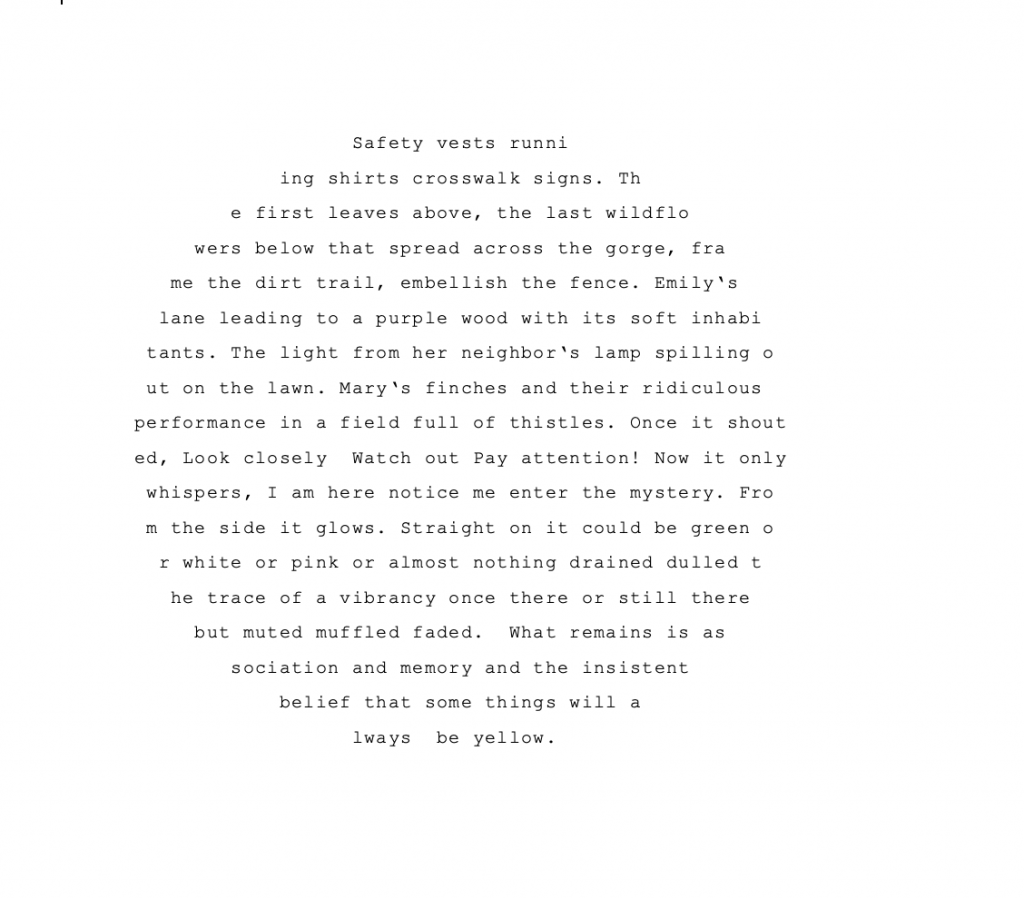
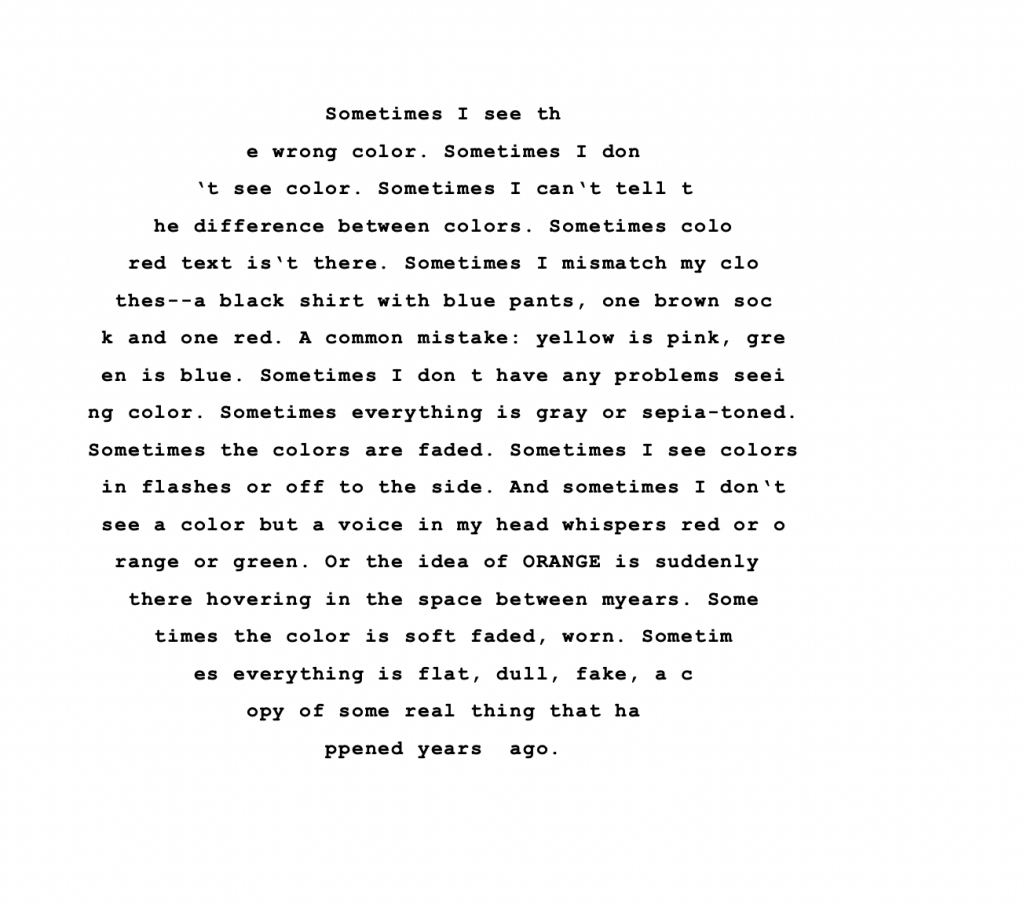
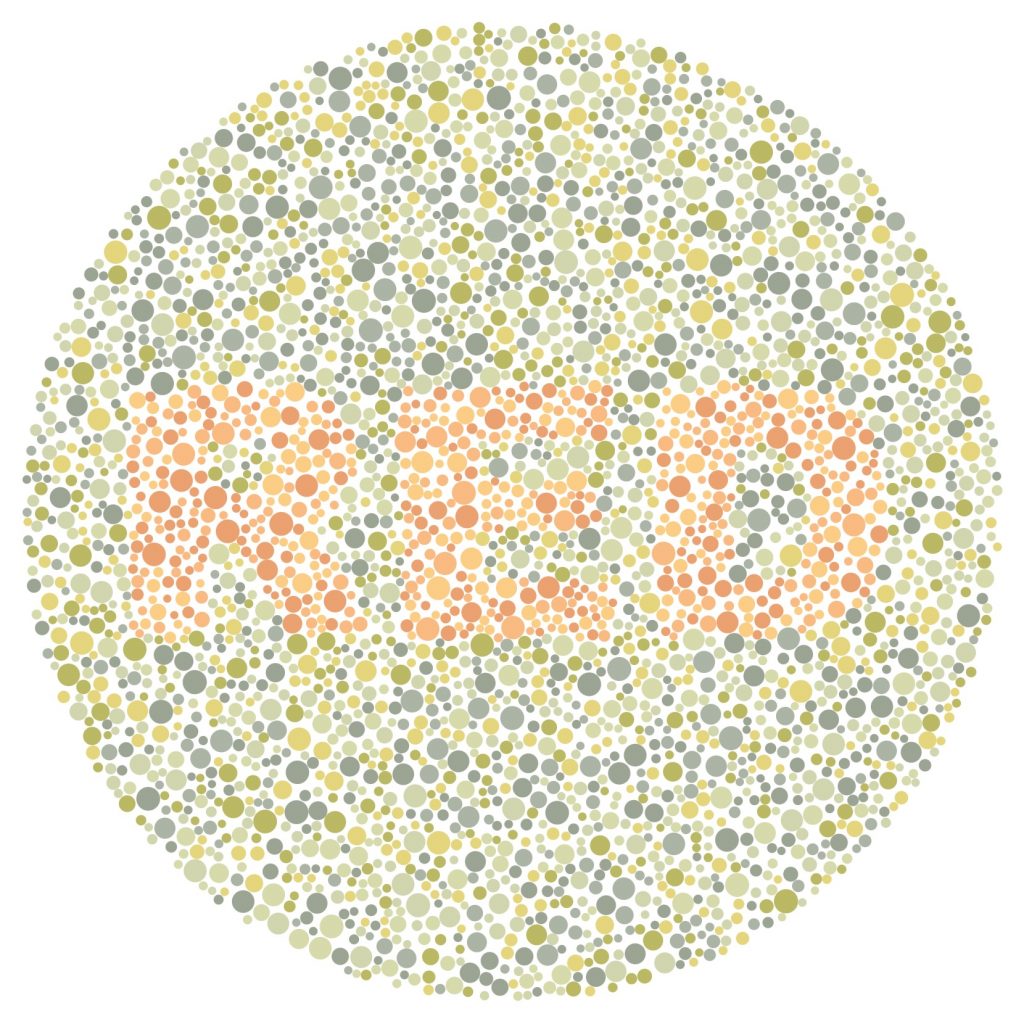
Completed a draft of another colorblind plate poem. I have 5 now. I’m pleased with all off the longer poems that fill the circle, but a little unsatisfied with the one word versions of the poems that are hidden in the colorblind test. It’s difficult to condense a poem into one 3-5 letter word!

dec 11/RUN

3.4 miles
trestle turn around
31 degrees
10% snow-covered

Getting closer to my running goal for the year: 1000 miles. With today’s run, I have just over 34 miles left! Sloppy today — not so much on the bike trail, which was mostly dry, but the sidewalks and the roads. Everything slushy, almost melting. My socks splattered with mud.

Another good run. Started slow, stuck behind a runner who was going about my speed. I kept my distance (40 or 50 feet?) but I wondered if they were irritated by my constant presence. Or is that just me? A mile in, as we climbed the hill out from under the lake street bridge, I sped up and passed her.

I listened to an old playlist titled, bday2018. Lizzo, Justin Bieber, Little River Band, Lorde.

Greeted Mr. Morning! and waved at a bunch of runners. Slipped on a few stray bits of ice. Noticed the river — white, covered in snow. Didn’t look at the sky. (Checking now, it’s gray). Saw walkers, dogs, fat tires. No birds or squirrels or coyotes.

I’m working on my fifth colorblind/Ishihara plate poem. This one is about the Ishihara plate and why it’s a significant test for me. I want to do something with the circles and loops and the idea of taking this test and not seeing the number as the first big moment of recognition that there was something wrong with me. I dismissed it, thinking only that it meant I was one of those rare, quirky people who saw color strangely. But it was the first moment of acknowledgement that whatever strange things I had been experiencing for years weren’t just in my head. Others — my husband and kids — could see that I saw differently too. I feel like I keep writing this in different ways on this log, over and over, trying to find the right way to express it. Maybe that’s part of the circles/circling too? There’s something about the idea of inside and outside here too — this test made what had only been inner (my unexpressed/not-yet-understood thoughts about seeing strangle) outer (visible to the word, acknowledgement as a problem, or as a real thing that I was experiencing).

dec 10/RUM

5 miles
minnehaha falls and back
32 degrees / sleet
20% snow-covered

A wonderful morning run. I was worried that it would be icy, but it was fine. Only a few slick patches. A gray day. The sky, mostly white with some gray. The ground, white and gray and almost brown. Didn’t really see the river; I was too focused on avoiding slick spots and approaching runners. Not too crowded, but more runners and walkers, 2 fat tires that I first encountered at the falls. Greeted lots of walkers with a good morning! and runners with a smile or a wave of my hand. I felt relaxed and strong as I ran above the gorge. On the way back, when I reached 42nd I crossed over to edmund to avoid the growing number of people on the path.

10 Things I Noticed

  1. smoke from a chimney as I ran by a house on edmund– in the same spot, all winter, every winter
  2. a strange whirring or dripping or buzzing sound coming from “Carly’s house” (or, as RJP pronounces it, Kerler’s house) — named after RJP’s classmate, Carly, who lives there
  3. a frozen falls
  4. 2 women hardly moving over at all on the path. I almost brushed elbows with one of the women, even as I tried to go as close to the edge I could, which prompted me to mutter, fuck, under my breath after I passed her
  5. the tinny recording of the bells of the light rail car leaving the 50th street station
  6. near the end I felt wetness on my face — sleet? rain? snow?
  7. 2 runners approaching from behind, one of them talking about planting seeds, I think?
  8. someone walking through turkey hollow, everything white and covered with snow
  9. heading back, running on edmund, I noticed a runner over on the river road running slightly faster than me. Suddenly I heard someone yell out to them — another runner who knew them was greeting them enthusiastically (I think?)
  10. finishing up my run, crossing 46th avenue, I heard some people greeting each other at the mailbox — Merry Christmas!

Found this poem the other day. How? I think I might have been searching for green? Anyway, a great poem to add to my bird poems and poems about naming and knowing:

Praise/ Michelle Poirier Brown

It is not yet time for singing.
Although I could allow this lake stroking the shore as song.

I feel a tenderness towards the small stones under my feet.
That’s a good sign.

And gratitude for the sun warming my neck.

I am learning the names of birds.
At the pond last week,
a soft-colored green bird with a white stripe down its head.
A widgeon.

And just now, a small shore bird, black with hints of red at the back of its neck,
hops across the wave foam, pert and legged like a gymnast.
It has a name.

For praise, one needs vocabulary,
to know the difference between a call and a song,
and that birds that sing are among the passerines.

passerine: A passerine is a perching bird in the formal scientific order Passeriformes. These are the most familiar, typical birds and the term can be applied to more than half the world’s unique bird species, including all the classic songbirds, sparrows, and finches (Guide to Passerine Birds).

dec 8/RUN

5.5 miles
bottom of franklin hill and back
19 degrees
80% snow-covered

Hooray for blue sky, not too much wind, staying upright on slippery paths! Another wonderful winter run. Ran north without headphones. Greeted Dave, the Daily Walker. Noticed how the river was almost completely white — the dusting of snow we got yesterday morning covered the thin ice. Heard some chirping birds. Saw a few runners in bright yellow shirts, one running fast with a dog. Right before turning around at the bottom of the hill, I noticed a few open spots on the river — dark water in contrast to the white ice. Ran back up the hill. When I reached the top, I stopped, fumbled with my headphones, and put in a playlist. I ran back south listening to Harry Styles, Elton John, Foo Fighters, and Queen.

Inciting Joy: Skateboarding, the Fifth Incitement

For December, I’m reading Ross Gay’s Inciting Joy. Here are some notes for the fifth incitement.

Skateboarding: skateboarding with a friend, beholding each other as you attempt to do tricks in a dark parking lot after hours — a feeling of groundless (the mysterious, unknown). Also: sharing extra parts with skateboarding buddies (practicing gift economy). Gay places this practice of possible joy/ethics of sharing in larger context of 80s excess/hoarding of wealth, especially in terms of property and the criminalizing of skateboarding in public spaces, or private spaces that weren’t yours.

a new word: USUFRUCT “the right to enjoy the use and advantages of another’s property short of the destruction or waste of its substance.” As in, “Gonz (famous skateboarder) is just one of a trillion apostles of the form, the genre–is because he usufructs the skateable world, which includes benches, picnic tables, walls, handrails, flights of steps, curbs, fire hydrants, ledges, parking lots, sidewalks, driveways, loading docks, loading ramps, bus stops…” (Gay, 60).

Wow. Gay’s ability to move between his particular lived experiences and a more general context is amazing. What a writer! And the idea of joy as not looking away from the larger, less joyful context, is so powerful and helpful.

I love the ethics and possibilities for joy around sharing your bucket of parts:

It was the just the case that whatever you had extra–and skateboarding, with its many components (decks, wheels, bearings, trucks, bushings, riser pads, rails, Rip Grip, bolts, etc. ) made for extra–you passed along. Most of us had a bucket of some sort where, when someone needed something, we dug around to find it. I never once heard anyone express it as an ethics (sharing, redistribution, commonwealthing), though if you tried to keep your extra to yourself, if you spoke to no one of your bucket, and then it got out you had one…the reaction would be an ethical one: Yo, that’s fucked up, man.

Sharing the bucket = sharing parts; sharing in the experience of skating into the unknown, over railings, across dark parking lots, over bumps; sharing space — public, private, off limits; and sharing “skateable” locations. I love the last line of the chapter:

join us at the new spot, this new stain , this wreckage, this abandonment, this ruin, this commons, this c’mon.

Found this poem on Instagram this morning, via The Slowdown. I love its compact lines and the idea of “the soft dislodging of eyes.”

sunrise through mount vernon, wa/ Jasmine Khaliq

after beauty I am
entranced by the soft
dislodging of eyes:

blurs of cows
necks sloping
lapped-rainbows

colors thinner
than water
and running

this is where
I most miss
the dead:

a highway pasture
bisected body
and always

I am on the other side

dec 6/RUN

5.6 miles
franklin loop
20 degrees / felt like 12
25% snow-covered

A wonderful run on a wonderful, wintery morning! Sunny, calm, cold but not too cold. I know I noticed many different things, had lots of interesting thoughts, but I’m distracted now, having read a beautiful, caring, generous post from a friend from grad school about sickness and death and recently being diagnosed with cancer. Ugh. I wanted to write a comment, to do more than “like” her Facebook post, but…too many thoughts. I’m thinking about Ross Gay and inciting joy and grief and how joy can show up when we’re willing to let others meet our sorrow and willing to take the time to meet theirs. About how much I appreciate my friend’s words and her story, how awful it is that she’s living in limbo for weeks, waiting to hear how bad her cancer is, how I felt every word and didn’t look away. About how cancer and death and grief are everywhere — Scott lost 2 aunts, a mother, and a beloved godmother in the second half of 2022, one after the other: August, September, October, November. And about the beautiful words I heard from the poet Kemi Alabi on the VS. podcast when she was asked what was moving her:

Grief is moving me. Like it’s literally running me, I feel so governed by grief. And not just personally or with my community, but collectively just seems like you can’t walk down the street without encountering, stumbling on this grief. So I’m thinking about Rebellious Mourning. That’s actually the name of an anthology, where a lot of poets thinkers and movement builders are considering what it means to mobilize around our grief, understanding that so many social movements are catalyzed by collective grief at the injustices that we’re experiencing. Grief can be a really powerful force to harness for transformation, if we’re allowed the space to be together with it, to honor it, and to actually move through it together, to let it move us, and to not run from it. 

Kemi Alabi vs. Divinity

Typing all of this out reminds me of one feeling I had throughout the run. I felt tender — not quite raw, but vulnerable, open to others, having experienced great loss recently. Apparently Scott hates the word tender; it ranks up there as one of the worst words with moist. I love it, devoted September to it. I don’t think I’d say I enjoy being tender, but I deeply appreciate the space it allows me to inhabit, the openness it offers.

10+ Things I Noticed

  1. the river: mostly frozen over with a thin skin of ice. Where the ice was thinner, it looked gray, thicker white
  2. a strange back-up on the franklin bridge. not sure what was happening. Cars were stopped, one was diagonal. No evidence of a collision. Heard some honking after I passed it
  3. a man walking 3, or was it 4?, dogs
  4. at least one bike
  5. saw my shadow off to the side, dark-ish gray
  6. colors: a lot of gray, pale blue sky, an orange cone, my pink jacket and gloves, red stop sign, sepia-toned ice, yellow dividing line on the bike path, yellow truck
  7. the air was cold as I breathed it in
  8. the biking path on the east side of the river, mostly clear
  9. some loud thuds — from the construction being done on a house across from the river?
  10. the sharp, whining whirr of a drill, or some other tool, being used by a road worker in a yellow vest in a hole in the street
  11. lifting my knees as I powered up the last hill

Near the end of my run, walking up the steps to the lake street bridge, I stopped and recorded the following thoughts. Then I put in a Taylor Swift playlist.

notes / dec 6

dec 5/RUN

4.5 miles
minnehaha falls and back
27 degrees / feels like 21
75% snow and ice covered

Icier than I expected so I went slower. A gray day. Fuzzy, unformed or unfixed or out of focus. The sky filled with static. I ran south, planning to check out my favorite winter spot — just past the oak savanna where the hills part and open to a view of the river — but I forgot, or I was distracted as I tried to avoid slippery spots and pedestrians.

About a mile in, was passed by another runner. I could hear their soft footsteps approaching. After they passed I watched them fly away. Their gait seemed a little erratic, like they were almost about to slip on the snow with each step. Speaking of slips, running up the hill between Locks and Dam #1 and the double-bridge, I witnessed a biker almost wipe out on some chunks of ice the plow had kicked up from the street. Yikes. I stopped to let him go by safely.

The falls were frozen. The river was too, but not completely.

10 (groups of) People I Encountered

  1. a group of walkers, paused by the sign for the bike surreys at the falls
  2. another group of walkers near locks and dam #1. Heard one of them say, “The farmer had to fish her out of the river.”
  3. a guy and an exuberant dog by the Longfellow poem at the park
  4. the speedy runner I mentioned above
  5. the biker who almost fell
  6. someone on a fat tire
  7. kids at the school playground across the street, more subdued than usual, but still laughing and yelling
  8. a guy blasting his phone or radio as he walked. I think he was listening to music, but I can’t remember what kind
  9. a runner in a bright blue jacket, over on the trail, when I was on edmund. we ran parallel for a few minutes then he inched ahead
  10. a runner carefully crossing over some ice as she talked on a bluetooth phone to someone

Running back from the falls, I crossed over to edmund to avoid the crowd, and the ice on the trail. Stopped at my favorite poetry house that puts a poem on their front window. Was there a new one? Yes! Here it is:

Maybe Alone On My Bike/ William Stafford

I listen, and the mountain lakes
hear snowflakes come on those winter wings
only the owls are awake to see,
their radar gaze and furred ears
alert. In that stillness a meaning shakes;

And I have thought (maybe alone
on my bike, quaintly on a cold
evening pedaling home), Think!–
the splendor of our life, its current unknown
as those mountains, the scene no one sees.

O citizens of our great amnesty:
we might have died. We live. Marvels
coast by, great veers and swoops of air
so bright the lamps waver in tears,
and I hear in the chain a chuckle I like to hear.

I’m glad to have found this poem. Think! and we might have died. We live. Marvels/coast by, great veers and swoops of air I love the title of the poem and where it sits at the start of the second stanza. Weather and light like today — the gray, overcast, wintery light, not dim, but not bright either — is conducive for thinking and reflecting and being grateful to be alive and to notice the veers and swoops of air, the chuckle of a bike chain.

Yes, gray is for thinking and wondering and for opening up to the world.

Inciting Joy: Through My Tears I Saw [Death: the Second Incitement]

Before heading out for a run, I read Gay’s second incitement about the death of his father. I don’t want to summarize it because it’s not meant to be summarized, but experienced, endured, read closely without looking away. Wow — Gay is an amazing writer. His descriptions of his dad’s diagnosis of cancer, his illness and decline, his death, are so powerful and vivid. I could feel the pain of my own grief — over my two moms, one dead for 13 years, the other for 2 months — in my body, especially in my sinuses and throat. My body tightening, tingling, wanting to close up.

At one point, as I read the 17 page chapter, I thought of Marie Howe and her entreaty to not look away, even when it’s painful. To face the sadness and grief, to let it in. In the poem I posted yesterday, Levine writes about how this letting in — dragging our grief out of the river and putting our mouth on it — can lead to a loosening, an opening up, a joy. Gay writes about this too, in the conclusion to the chapter, as he says goodbye to his dying father:

Can you hear me Dad, Can you hear me, and by now I was crying hard, and I was kissing my father’s face again and again, telling him I loved him again and again, it was the softest face in the world, my father’s face, so quiet like that, I never knew it, I had never touched it before, I was crying onto his eyelids and cheeks and kissing him and telling him again and again I loved him, I love you Dad, his brown face was lit with my tears. and with my forehead pressed into his, and my hands on his cheeks, I noticed that my father had freckles sprinkled around the bridge of his nose and his upper cheeks. It was like a gentle broadcast of carrot seeds blending into his skin, flickering visible from this distance. It was through my tears I saw my father was a garden. Or the two of us, or the all-of-us, not here long maybe it is. And from that what might grow.

dec 2/RUN

5.75 miles
bottom of franklin hill and back
34 degrees
50% snow-covered

Found out last night that RJP has COVID. She’s had a cold all week. So far, I feel okay, so does Scott. Will we get it? I’m a little worried, but only a little. A few years ago, I would have been freaking out. Thank you vaccines and better treatments and less severe variants! Unless I feel like total crap, I’m going out for a run when I can. Today I don’t feel like total crap, so I went out for a run. It felt good. Breathing in fresh air! Moving my legs! Admiring the half frozen river!

A great run. Just above freezing, not too slippery. Some wind, but mostly at my back. Ran north with no headphones, south with a playlist.

12 Things I Noticed

  1. a honking goose, its mournful cry amplified by the bridge
  2. a big bird flying above. I think it was a crane
  3. a runner in an orange shirt, running with a dog
  4. another runner — tall, wearing a white sweatshirt and shorts, moving fast, with long, bouncing strides
  5. passing Dave, the Daily Walker: Good Morning, Dave!
  6. a group of young people, high school or college students?, hanging out by the franklin bridge, blocking the path
  7. no sun, but not gloomy, a grayish-white sky. everything bright but with very little color
  8. the river! down at the start of the flats, the river was gray and half-frozen. Not flat or dull but interesting. Not gloomy either, but vast and quiet. Not desolate, but detached, otherworldly
  9. a car, I think it was a Prius, whooshing through a stretch of the road that was part snow, part bare pavement, then suddenly turning silent as it reached a part of the road that was all soft snow. So strange to watch it move without sound
  10. Climbing the franklin hill, encountering a line of cars with their headlights on, crawling down the hill
  11. the faint trace, in light gray, of my shadow ahead of me
  12. the knock knock knock of a woodpecker

Still figuring out my theme for December as I continue working on some color poems — currently, a gray one. Today, I’m posting something from Ross Gay about joy. Wow!

Yes, that’s how it seems to me, that we need practices, or we need to notice the practices we have, that help us be present with our sorrow. I’m not saying that help us drown in our sorrow—I’m saying be present with it, acknowledge it, befriend it even, lest we do some wretched or devastating shit trying to pretend it’s not there, or trying to hide it. And to do it in a mutual way—which, again, might be in some of our practices: dancing, gardening, mourning—but it might also be how we live, how we attend to one another, with the awareness that, yup, like me, your heart is broken. Probably not in exactly the same way, but probably, no, definitely, it’s broken. And it will go on being broken in various ways. It does not make us special, it seems to me. It makes us like each other. It un-others us from each other in fact. What happens if we live like that? My sense is that we’re more inclined to care for one another, we’re more inclined to love one another, which, yes, might be a kind of resistance to institutions who have little care for us, but it might also end up being a kind of offense to them. When we care for each other, and consequently are less reliant on the institutions or systems that, a lot of them anyway, do not care for us, we make those systems less necessary. We might be replacing those systems with something like love.

Cultivating Delight and Meaning with Ross Gay

Be present with our sorrow. Befriend it. It seems difficult sometimes to express sorrow, a brokenness, vulnerability, without it seeming weak or eliciting pity or the frustrating, You’re so brave! Or in ways that put it beside, in conversation with, delight or happiness. To me, gray holds both delight and grief, often in equal measures.

I like this idea that sorrow and broken hearts are something that connects all of us. I was thinking about that as I reread this poem by Didi Jackson, especially the last lines. The first song that is in all songs is that of sorrow/grief/mutual suffering.

Listen/ Didi Jackson

Like a hundred gray ears
the river stones are layered

in a pile near the shed where mourning
doves slow their peck and bobble to listen

to a chorus of listening.
Small buds on the lilac perk up.

A cardinal’s torpedoed call comes
in slow waves of four,

round after round. It’s a love call;
a call to make him known to himself.

The stones listen harder,
decipher the song; attempt

to offer back its echo.
But fail.

This is not a poem of coming Spring.
This is a poem well aware

that gray flesh is dead flesh.
All of the ripe listening

comes at a cost. The first
sky is in all skies.

The first song
is in all songs.

And just now, thinking even more about Jackson’s poem, I realized that the delightful gray ears that the stones become has another meaning. Gray = neutral. The gray ears listen without judgment, are open to witnessing, beholding, hearing what is said without rebuke. Another meaning of gray! Love it. Those gray ears are going in one of my gray poems, for sure!

nov 30/RUN

3.5 miles
trestle turn around
17 degrees / feels like 4
99% snow-covered

Is this the coldest day of the season? Just checked, and the next coldest was on November 20th when it was 19, feels like 9. I was worried it might be too cold, but it felt great! What a winter wonderland. White ground, pale blue sky, dark gray river. The trails were plowed — thanks Minneapolis Parks! — with only a few rough spots. I didn’t notice the ice because I was wearing yak trax. Just past the railroad trestle, I stopped to put in my headphones and a Taylor Swift playlist.

layers

  • 2 pairs of black running tights
  • green base layer shirt
  • pink jacket with hood
  • black vest
  • 2 pairs of gloves — 1 black, 1 pink and white striped
  • 1 pair of white socks with stripes, mismatched — 1 with green stripes, the other teal
  • fleece lined cap with ear flaps
  • buff
  • sunglasses
  • yak trax, a new pair

10 Things I Noticed

  1. a pale blue sky — not an intense BLUE! sky, more like the hint of blue, like if someone had taken a black and white photo of the gorge and painted in a blue sky
  2. lots of dry, brittle leaves swirling in the wind. Running by the double bridge to the north, I watched something dark fly through the fence then back again. A bug? A bird? No, a dead leaf
  3. Later on, I saw a few birds flying very fast across the path in front of me. They added to the chaos of the blustery wind and the swirling leaves
  4. 2 other runners, one near the trestle, the other further south
  5. a few walkers — any dogs? I don’t think so
  6. a group, some kids and adults, spread across the entire path, getting ready to go sledding down by the river
  7. remember to look at the river. A strange illusion. It was a dark, dark gray with a hint of brown and it looked like a wall. Instead of stretching flat on the gorge floor, it looked like it rose out of it, up towards the other bank. I’ve written about this wall of water in past winters
  8. the path was covered in mostly packed snow. The sun illuminated some of the slicker spots
  9. smelled a burnt something — I think I might have seen bits of rubber on the side of the road
  10. a truck with a plow, clearing the parking lot above the tunnel of trees

I don’t remember thinking about gray at all. Did I? Thought more about how I love running in the winter and whether or not my fingers were going numb or if my sunglasses would fog up or my foot would be sore again later today. Oh, and of course, I wondered what the drivers thought when they saw me running on this cold and windy day.

Today on the last day for singing a song of gray, I’m thinking about gravel. Here’s a bit from Mary Oliver’s “Gravel” in The Leaf and the Cloud. I’m struck by how she makes gray here with equal mentions of black and white: the black bog and white-circled eye, the white lilies and the black ant.

from “Gravel” in The Leaf and the Cloud/ Mary Oliver

Even the mosquito’s
 dark dart,
flashing and groaning;
 even the berries, softening back
into the black bog;
 even the wood duck’s
white-circled eye,

and the first white lilies
on the shaggy pond,

and the big owl, shaking herself
out of the pitchpines,

even the turtle scratching in the dust,
even the black ant, climbing the mile-high hill,

even the little chattering swift
diving down into the black chimney.

Everything is participate.
Everything is a part of the world
 we can see, taste, tickle, touch, hold onto,

and then it is dust.
Dust at last.
Dust and gravel.

In the distance, the rabbit-field.
Ben—his face in the grass, his chomping.
His sweet, wild eyes.

Thinking about gray as balanced, as both dark and light, black and white, grief and delight.

nov 28/RUN

4.4 miles
minnehaha falls and back
33 degrees

Overcast, a bit blustery. Everything muted: burnt orange, not yellow but yellowed, brown, gray. A few clumps of snow scattered on the grass. Kids laughing and yelling on the school playground. Water trickling at the falls. I remember looking down at the river, but I don’t remember what I saw. I know it was clear and probably steel blue. Did I see any ripples from the wind?

At the start of my run, the sky glowed a pale yellow — the sun trying to break through the clouds. A strange light, reminding more of a sunrise or sunset than late morning.

Noticed the faintest trace of my shadow running ahead of me. Because the sun was still behind the clouds, it was dim, almost more the idea of my shadow than an actual one.

Listened to the gorge running south, Beyoncé running north.

My kneecap shifted a little, but I didn’t panic or feel any pain during, or swelling afterwards.

No fat tires or roller skiers or Mr. Walker or Mr. Morning! or Dave, the Daily Walker. I did pass a very tall runner in a red jacket near the end of my run.

Anything else? The creek was mostly frozen, but I could hear some drips and dribbles dropping down from the limestone ledge.

Today for my gray, I’m thinking about gray or grey dreams:

Little Grey Dreams/ Angelina Weld Grimké – 1880-1958

Little grey dreams,
I sit at the ocean’s edge,
At the grey ocean’s edge,
With you in my lap.

I launch you, one by one,
And one by one,
Little grey dreams,
Under the grey, grey, clouds,
Out on the grey, grey, sea,
You go sailing away,
From my empty lap,
Little grey dreams.

Sailing! Sailing!
Into the black,
At the horizon’s edge.

nov 27/RUN

3.4 miles
trestle turn around
32 degrees

Another beautiful morning. Sunny and calm and not too cold. Clear trails, no big groups of runners. No fat tires or roller skiers either. Exchanged greetings with Mr. Morning! Remembered to look at the river. It was open and blue. At one spot, it shimmered. I listened to Taylor Swift’s 1989, then Reputation instead of the gorge.

Before my run, I fit the draft I did of my yellow poem into the colorblind plate form. I think it works pretty well.

yellow, plate 2

I haven’t come up with the single word hidden in the colorblind plate yet.

I’m nearing the end of my month of singing a song of gray. Here’s a gray poem about tombstones and spirits by Edgar Allen Poe:

Spirits of the Dead/ Edgar Allen Poe

I

Thy soul shall find itself alone
’Mid dark thoughts of the gray tombstone—
Not one, of all the crowd, to pry
Into thine hour of secrecy.

   II 

Be silent in that solitude,
Which is not loneliness—for then
The spirits of the dead who stood
In life before thee are again
In death around thee—and their will
Shall overshadow thee: be still.

   III 

The night, tho’ clear, shall frown—
And the stars shall look not down
From their high thrones in the heaven,
With light like Hope to mortals given—
But their red orbs, without beam,
To thy weariness shall seem
As a burning and a fever
Which would cling to thee for ever.

   IV 

Now are thoughts thou shalt not banish,
Now are visions ne’er to vanish;
From thy spirit shall they pass
No more—like dew-drop from the grass.

   V 

The breeze—the breath of God—is still—
And the mist upon the hill,
Shadowy—shadowy—yet unbroken,
Is a symbol and a token—
How it hangs upon the trees,
A mystery of mysteries!

Speaking of gray and Poe, I encountered this line from his short story Eleonora:

They who dream by day are cognizant of many things which escape those who dream only by night. In their gray visions they obtain glimpses of eternity, and thrill, in awakening, to find that they have been upon the verge of the great secret. 

Eleonora/ Edgar Allen Poe

nov 26/RUN

5.6 miles
fairview loop
42 degrees

A little warmer today so I wore the late fall, early winter layers: black tights, black sorts, long-sleeved green shirt, orange sweatshirt, black and white polka dot baseball cap. Sunny, quiet. Almost all of the trail and sidewalks were completely clear. Only a few spots of ice on the Marshall hill just before reaching Cretin. Managed to get greens at all of the stoplights climbing the marshall hill– no quick breaks for me. Had to stop at the two on Summit.

10 Things I Noticed

  1. heard the bells at St. Thomas at both 10 and 10:15
  2. was dazzled by the light burning bright off the river
  3. felt the wind pushing me from the side as I crossed the bridge
  4. the strong smell of bacon or ham as I neared longfellow grill
  5. a few stretches of ice on marshall, some patches of wet sidewalk that looked like ice but was only a trick of the light
  6. a bus stopped, a few passengers getting out
  7. statues at the end of the walk of fancy houses on Summit: pineapples, lions
  8. a kid’s voice somewhere below in the ravine leading to shadow falls
  9. a runner stopped on the bridge to take a picture of the river as it shimmered with a wide swath of bright light
  10. a woman and a dog carefully making their way under the chain closing off the old stone steps

Climbing the short hill that starts at the Monument and ends at an entrance to Shadow Falls, I suddenly had a thought about yellow that made me stop and pull out my phone to record it:

Thinking about colors and yellow and then I was thinking about how sometimes it used to be this warning, this shout, like watch out, be careful and now it’s become more of a whisper or a soft cry or more hushed and it’s increasingly getting that way so colors are more muted and muffled… [the other voices in the recording are 2 bikers and 2 then 2 runners].

yellow/ 26 nov 2022

Not sure what happened with the recording here, but I remember saying more about how distant yellow seems now. I never see it as bright, but faded, from the past, or through the gauzy veil of my damaged cones. Sometimes only the association with objects. I might not see that something is yellow but I know that it is because I know safety vests or crosswalk signs or the middle light on a stoplight are yellow. Orange works differently for me. It’s not faded, but it often only appears as a blip or flash or slash or flare in my peripheral vision. Again, yellow offers a soft, constant glow. I was also thinking about Van Gogh and his idea that every color is ultimately a variation of gray.

excerpt from Yellow Lullaby/ Leontia Flynn

A spill of sunlight and a yellow dress.
A yolk.
A yellow flower.                                                
A candle flame.
A moth-light, moon-like,
in the nursery’s darkness . . .

nov 24/RUN

3.3 miles
trestle turn around
35 degrees / humidity: 92%
haze/fog

The annual Thanksgiving 5k with a little extra. Was greeted by Mr. Morning! near the trestle: Good morning and Happy Thanksgiving! Everything was a light gray, shrouded in a fine mist or fog. The tall pine trees, dark gray green. The cars, light grays and dark grays and pale green grays. The only other color I remember was the burnt orange of the dead leaves still on the trees. Forgot to look at the river. Smelled some smoke from chimneys. Near the end of my run, the smoke was so intense I could taste it—hickory, mesquite.

nov 23/RUN

4.4 miles
minnehaha falls and back
30 degrees

Another sunny, warmer (than last week) day. The paths were clear, the sky was blue, the sun was out. Earlier today, driving over to my annual mammogram, there was a haze in the gorge, but by a few hours later, during my run, it was gone. No headphones on the way to the falls, Lizzo’s Special on the way back. The falls was half frozen, half dripping. All the steps down below are blocked off now for the winter. The steps down to Winchell are too. Heard the general chatter of birds, sounding like spring. Greeted Mr. Walker (I named him in an entry on sept 12 of this year) — Hello not Good morning.

11 Things I Noticed

  1. the strong smell of pot as I passed a car in the 36th st parking lot
  2. a guy walking, listening to music without headphones — can’t remember what kind of music it was. Passed him twice
  3. a woman and a kid walking above the falls, admiring it at my favorite spot
  4. bright orange below the double bridge — somebody must have spray painted it
  5. a lone walker below me on the Winchell Trail
  6. Later, 2 laughing women on the Winchell Trail
  7. the river was burning white again — shimmering in the sun through the trees
  8. running past the southern entrance to the Winchell Trail, I could see through the bare trees all the way to the stone wall that wrapped around the grassy overlook
  9. also had a clear view of the oak savanna and the mesa through the leafless trees
  10. a loud scraping noise from some part of a car, dragging on the road
  11. my shadow, running beside me — strong in form and definition, a very dark gray in color

Today’s gray: fog and mist

Fog/Giovanni Pascoli

Translated from the Italian by Geoffrey Brock

Hide what is far from my eyes,
pale fog, impalpable gray
vapor climbing the light
of the coming day,
after the storm-streaked night,
the rockfall skies…
Hide what has gone, and what goes,
hide what lies beyond me…
Let me see only that hedge
at my boundary,
and this wall, by whose crumbling edge
valerian grows.
Hide from my eyes what is dead:
the world is drunk on tears…
Show my two peach trees in bloom,
my two pears,
that spread their sugared balm
on my black bread.
Hide from my eyes lost things
whose need for my love is a goad…
Let me see only the white
of the stone road –
I too will ride it some night
as a tired bell rings.
Hide the far things – hide
them beyond the sweep of my heart…
Show only that cypress tree,
standing apart,
and here, lying sleepily,
this dog at my side.

In the Fog/ Giovanni Pascoli

TRANSLATED BY GEOFFREY BROCK

I stared into the valley: it was gone—
wholly submerged! A vast flat sea remained,
gray, with no waves, no beaches; all was one.

And here and there I noticed, when I strained,
the alien clamoring of small, wild voices:
birds that had lost their way in that vain land.

And high above, the skeletons of beeches,
as if suspended, and the reveries
of ruins and of the hermit’s hidden reaches.

And a dog yelped and yelped, as if in fear,
I knew not where nor why. Perhaps he heard
strange footsteps, neither far away nor near—

echoing footsteps, neither slow nor quick,
alternating, eternal. Down I stared,
but I saw nothing, no one, looking back.

The reveries of ruins asked: “Will no
one come?” The skeletons of trees inquired:
“And who are you, forever on the go?”

I may have seen a shadow then, an errant
shadow, bearing a bundle on its head.
I saw—and no more saw, in the same instant.

All I could hear were the uneasy screeches
of the lost birds, the yelping of the stray,
and, on that sea that lacked both waves and beaches,

the footsteps, neither near nor far away.

Mist/ Alice Oswald

It amazes me when mist
chloroforms the fields
and wipes out whatever world exists

and walkers wade through coma
shouting
and close to but curtained from each other

sometimes there’s a second river
lying asleep along the river
where the sun rises
sunk in thought

and my soul gets caught in it
hung by the heels
in water

it amazes me when mist
weeps as it lifts

             and a crow 

calls down to me in its treetop voice
that there are webs and drips
and actualities up there

and in my fog-self shocked and grey
it startles me to see the sky

nov 22/RUN

5.5 miles
franklin loop
27 degrees

Warmer this morning. Hardly any ice or snow on the path. My foot is only slightly sore at the end, but otherwise okay. Sunny and bright. A blue sky. As I reached the river at the beginning of my run I heard then saw a lone goose. Thought about color, especially yellow and gray. Listened to my breathing. Focused on taking deep breaths in through my nose, out through my mouth. Was good morninged by Mr. Morning! He called out from across the trail, Good morning! and I called back.

10 Colors I Noticed

  1. the yellow dotted lines on the bike trail
  2. the orange spray paint around the cracks that need to be replaced
  3. a pale blue sky
  4. a dark blue trash can
  5. the dark gray pavement that seemed to have a hint of blue
  6. the silver river — or was it white gold? through the trees, the river burned a bright white
  7. beige or sepia-toned ice on the river
  8. the grayish-dark brown of the bare trees
  9. the slab of white snow decorating one side of the ancient boulder
  10. the dark greenish-gray of a fir tree

In other color news: an essay I wrote 5 years ago popped into my head while I was running — “My Purple Toe” — and I thought about how the toe in it is not purple but lavender gray

Update on my foot: Scott and I had to go pick FWA up from Gustavus, so I’m writing the rest of this later in the day. A few hours in the car, not moving much, my foot felt stiff and sore again. I walked around a bit and it felt okay. I asked Scott if that’s what happens with his foot and he said yes. Does this mean I have plantar fasciitis? I hope not!

Today’s gray theme: more on the color gray

[Here on this edge I have had many diminutive visions.]/ Diane Seuss

Here on this edge I have had many diminutive visions. That all at its essence is dove-gray.
Wipe the lipstick off the mouth of anything and there you will find dove-gray. With my
thumb I have smudged away the sky’s blue and the water’s blue and found, when I kicked it
with my shoe, even the sand at its essence is pelican-gray. I am remembering Eden.
How everything swaggered with color. How the hollyhocks finished each other’s sentences.
How I missed predatory animals and worrying about being eaten. How I missed being eaten.
How the ocean and the continent are essentially love on a terrible mission to meet up with itself.
How even with the surface roiling, the depths are calmly nursing away at love. That look the late
nurser gets in its eyes as it sucks: a habitual, complacent peace. How to mother that peace, to wean
it, is a terrible career. And to smudge beauty is to discover ugliness. And to smudge ugliness is to be
knocked back by splendor. How every apple is the poison apple. How rosy the skin. How sweet
the flesh. How to suck the apple’s poison is the one true meal, the invocation and the Last
Supper. How stillness nests at the base of wind’s spine. How even gravestones buckle and swell
with the tides. And coffins are little wayward ships making their way toward love’s other shore.

nov 20/RUN

5.6 miles
franklin loop
19 degrees / feels like 9
5% ice and snow covered

Because it was sunny and because there wasn’t much wind and because I had the right number of layers on, today’s run was great. Not too cold. Maybe it helped that I did a 5 minute warm up on the bike in the basement? Very happy to be out there, beside the gorge, breathing in the cold air, and greeting Mr. Morning! and Dave, the Daily Walker.

The arch of left foot hurts a bit. I think I overdid it with the old shoes, the yak trax and the ice clumps on Thursday. I should not run tomorrow. Bummer.

Layers: 2 pairs of black running tights; pale green long sleeved shirt; pink jacket with hood; gray buff; black fleece lined baseball cap; 2 pairs of gloves — pink with white stripes on top, black underneath

Took the pink and white gloves off about 1 1/2 miles in. Pulled down the buff 5 minutes in, pulled off the pink hood at 1 mile. Unzipped and re-zipped my jackets throughout. At the end of the run I wasn’t cold, just soaked with sweat, my pony-tail dripping.

10 Things I Noticed

  1. the river, 1: running on franklin bridge the river was a clear blueish gray, no ice yet
  2. snow was covering the north face of an ancient boulder on the east side of the river
  3. random goose honks throughout the run, usually a lone goose flying low
  4. the sky was a pale blue, the gorge was giving off a blue-gray hue
  5. the only other colors: brown, white, a runner’s orange jacket, another runner’s pink one
  6. the river, 2: standing above the lake street bridge at my favorite spot on the east side I admired the open river, stretching wide, looking calm
  7. the river, 3: off in the distance the water glowed, burning a silver fire — not white, or any color, just shimmering light
  8. the river, 4: from the lake street bridge the river was studded with ice
  9. a voice on a hill on Edmund: a kid going sledding
  10. ending the run and crossing over to the boulevard the snow crunched in an unusual way. It sounded almost like the crinkle in a dog toy, or like I had some brittle paper stuck on my shoe

I made a recording of the crinkling snow:

crinkling snow / 20 november 2022

Scrolling through twitter, this piece — a prose poem? an essay fragment? — by Mary Ruefle from My Private Property. I might have to buy this book; I’ve posted at least one other essay/poem from it on here already:

from My Private Property/ Mary Ruefle

Gray sadness is the sadness of paper clips and rubber bands, of rain and squirrels and chewing gum, ointments and unguents and movie theaters. Gray sadness is the most common of all sadnesses, it is the sadness of sand in the desert and sand on the beach, the sadness of keys in a pocket, cans on a shelf, hair in a comb, dry-cleaning, and raisins. Gray sadness is beautiful, but not to be confused with the beauty of blue sadness, which is irreplaceable. Sad to say, gray sadness is replaceable, it can be replaced daily, it is the sadness of a melting snowman in a snowstorm.

The everydayness of gray sadness, its mundane, real, nothing special-ness, reminds me of a bit from the lyric essay I posted last week, Ode to Gray. Especially this bit:

Look at enough black-and-white photography and color comes to feel like an intrusion. Eggleston’s photos seem too vital to be real, as though depicting an alternate reality. Each image is delirious with hue, spectacular, delicious, but a little bit too much. The eye craves rest—and mystery, the kind of truth that can be searched only in subtlety. Dorothy may tumble, tornadic, into Technicolor, but still she always wishes to go home.

In addition to exploring gray this month, I’m also thinking about color in general, and colors that have been significant for me in this running log, like green. Here is a great green poem I found a few days ago. I haven’t thought of the coming of green as fire and flame before, but it works.

The Enkindled Spring/ D.H. Lawrence

This spring as it comes bursts up in bonfires green,
Wild puffing of emerald trees, and flame-filled bushes,
Thorn-blossom lifting in wreaths of smoke between
Where the wood fumes up and the watery, flickering rushes.

I am amazed at this spring, this conflagration
Of green fires lit on the soil of the earth, this blaze
Of growing, and sparks that puff in wild gyration,
Faces of people streaming across my gaze.

And I, what fountain of fire am I among
This leaping combustion of spring? My spirit is tossed
About like a shadow buffeted in the throng
Of flames, a shadow that’s gone astray, and is lost.

nov 18/BIKERUN

bike: 25 minutes
bike stand, basement
run: 2 miles
treadmill, basement
outside: 19 degrees / feels like 6

Stayed inside this morning because of the cold, the wind, the too bright white, and the icy paths. It’s very early in the winter season, and I doubt they’ve treated the trails. Watched a few races while I biked, listened to Taylor Swift’s Reputation while I ran. The thing I remember most about the run: trying to stop myself from looking at the time to see how long I’ve been running, how much I’ve got left. Also: stared at the reflection of the light in the back window, noticed again how it looks like an upside moon casting light on water above it.

Before deciding on watching some track races, I started “Servant” on Appletv. The opening credits had way too little contrast; I could barely tell there was text on the screen. Then the title appeared in red. I couldn’t read it all. Looking at it paused, when it wasn’t moving and I had more time to stare, I could mostly see it. Red letters on a black background are hard for me to see. I might try watching this show some other time, but it might be too dark. So many of the thriller or mystery or dramatic shows available now are dark or darker or dim, which makes it almost impossible for me to see what’s happening.

color project

I’m continuing to work on my color/colorblind project. I was telling Scott about my writing process the other day and how some poems insist on being written. I’ve tried to drop this color thing, especially with the colorblind plates several times, but it keeps coming back up again and again. I’ll be working on something else, and whatever that something is will end up at color and how I do or don’t see it. It’s wild.

I heard some birdsong just now from behind my shaded window. Sounding like spring. I looked — a bird is doing something near the foundation, just below me. Gathering twigs?

Back to my color project. Yesterday Scott helped me to figure out the template for the second plate that serves as the form for a longer poem that’s related to the color word hidden in Ishihara loops from the first plate. I put some text in it, using part of a free-write I did the other day. The text is rough, with some typos, but it still helps me to get a sense of how this will work. Very cool!

Each of these poems has 772 characters, including spacing and punctuation. Today I want to start gathering bits — descriptions, lines from other poets’ poems, stories, associations with colors, mishaps, etc. — to include in these poems. One early idea: separate poems about colors that are significant to me: orange, yellow, green, brown, and gray.

note: I returned to this entry to fix some typos I missed and I was struck by how off and excessive my commas are. What is that all about? I seem to hear commas and pauses all the time. Am I trying to slow down the words? Force some hesitation?

nov 17/RUN

5.5 miles
franklin hill turn around
26 degrees / feels like 20
light snow / wind: 15 mph gusts
100% snow-covered

Winter! Woke up to another dusting — maybe an inch? — on the ground. Wore my old yak trax, the ones I got 3 or 4 years ago that are worn down, but still work. Mostly I’m glad I did, but several times snow clumped up in the grooves. Was it because of the yak trax, the high water content of the snow, or something else?

My Favorite Things

  1. the feel of snow under my feet — more interesting than boring asphalt
  2. the creaks and crunches of that snow
  3. greeting Mr. Morning! and Dave, the Daily Walker
  4. 3 geese flying west — I heard their harsh honks first, echoing across the gorge, then they appeared, flying low near the trestle
  5. open water, brownish-gray
  6. in the second half of the run, the snow stopped and the sun was trying to pierce through the thick clouds. Everything looked slightly blue — the snow, the sky, the trees
  7. the graceful runner who passed me, their feet bouncing up and down, up and down
  8. in the first half, when it was much darker, the headlights cutting through the dim
  9. running up the Franklin hill — I felt strong and free, untethered
  10. ending at the ancient boulderS after (almost) sprinting up the hill — my winter running tradition

Ishihara colorblind plates as form

Still thinking about my next series of vision poems. A plan seems to be forming. Here’s what I wrote:

A series of colorblind (Ishihara) plates describing how I see and don’t see color and what that means for how I move through the world. 

The actual series of plates for the test are 38. I think that might be too many. Each poem will consist of 2 plates: the “actual” plate (designed by Scott) with the circles and the hidden message. In the original, it’s numbers. In mine, it’s a word that can stand alone as a poem, but also (might) connect with the other plate words and is the unifying theme for a prose poem that is on the second plate. This second-plate poem will (most likely, but maybe not?) take the form of the circle of the plate. Tentatively, I’m imagining it as a prose poem, but it might be its own thing, a series of words, descriptions related to seeing and not seeing color. 

The plates will be divided into different topics related to color: 

a story about why this test matters to me
what everything looks like, how it feels
struggles/quirks/strange
a focus on gray — contrast — light and dark, not in color

Scott found something on github that enables you to easily (or easily for Scott) design your own plates. Here’s a sample of what he did. He put the word red in it. I’ll take his word for it because I can’t see the letters at all.

Scott’s Ishihara plate, “Red”

today’s gray theme: duck duck gray duck

Still thinking about gray this month. Today, inspired by the wonderful geese I heard while running, I’m thinking of the passionate way Minnesotans defend their name for the childhood game, Duck Duck Gray Duck over what the rest of the country calls it, Duck Duck Goose. I am not one of those passionate Minnesotans because I grew up on the east coast in North Carolina and Virginia. We played Duck Duck Goose. I’m fine with calling it Duck Duck Gray Duck, but I don’t really care. Scott does. No matter how often we’ve discussed it, he gets fired up every time the topic is mentioned. It is fascinating to me that Minnesota is the only state that uses gray duck and not goose, especially thinking about how many kids who grew up in Minnesota probably have a moment when they realize that not everyone else calls it that.

Because I’m that person, I had to wonder, are gray ducks rare? Yes, especially in Sweden. According to my quick googling, the most common color for ducks in Sweden is blue.

I already have 2 wonderful poems about wild geese — Wild Geese/Mary Oliver and Something Told the Wild Geese/Rachel Field — but I can always use another!

The Geese/ Jane Mead

slicing this frozen sky know
where they are going—
and want to get there.

Their call, both strange
and familiar, calls
to the strange and familiar

heart, and the landscape
becomes the landscape
of being, which becomes

the bright silos and snowy
fields over which the nuanced
and muscular geese

are calling—while time
and the heart take measure.

nov 15/RUN

4.5 miles
minnehaha falls and back
30 degrees / steady light snow
walking path: 60% snow-covered / bike path: 10% snow-covered

The first winter run in the snow of the season! Wonderful. Slushy, a few slick spots, little snow flakes occasionally pelting my face. Loved it! Not too many people on the trails. Exchanged greetings with Mr. Morning! Morning! Good morning!

I forgot to look at the river or, if I looked, I don’t remember what I saw. It was probably blue gray. There’s no way it was white yet.

We already have a few inches on the ground, so it looks like a winter wonderland. Some of the snow has painted the trees white.

The falls were falling, but not gushing.

The sky is a very light gray. Almost everything some shade of gray. Somewhere on the trail — maybe near the falls — I saw some light green leaves decorating a tree. How is that possible?

Thought about Emily Dickinson and the idea I had earlier this morning, based on my current reflections on gray and my devotion to her poem, “We grow accustomed to the Dark –“: I grow accustomed to the Gray. For me, not everything is dark, really. It’s gray. Literally — as colors drain away in light that isn’t just right, many things often look gray. I don’t usually notice it until I think about how that dark car over there isn’t dark blue or dark red, it’s just dark gray. Or that fir tree outside of my writing studio window isn’t dark green but a very dark gray. It’s also metaphorical — I’m in this in-between state, where I can sometimes see, sometimes can’t. Or I can see well enough to get by, but not very well. I’m in transition, in the process of losing, not in the state of having lost.

today’s gray: gray area

definition from google: an ill-defined situation or field not readily conforming to a category or to an existing set of rules.

Not sure if this really fits, but the in-betweeness and ambiguity of a gray area, makes me think of optical illusions like the duck and the rabbit, or the old lady and the young woman, or the white and gold or blue and black dress, which makes me think of this passage from Georgina Kleege:

I surmise that my general visual experience is something like your experience of optical illusions. Open any college psychology textbook to the chapter on perception and look at the optical illusions there. You stare at the image and see it change before your eyes. In one image, you many see first a vase and then two faces in profile. In another, you see first a rabbit then a duck. These images deceive you because they give your brain inadequate or contradictory information. In the first case, your brain tries to determine which part of the image represents the background. In the second case, your brain tries to to group the lines of hte sketch together into a meaningful picture. In both cases there are two equally possible solutions to the visual riddle, so your brain switches from one to the other, and you have the uncanny sensation of “seeing” the image change. When there’s not much to go — no design on the vase, no features on the faces, no feathers, no fur — the brain makes an educated guess.

When I stare at an object I can almost feel my brain making such guesses.

Sight Unseen / Georgina Kleege

Sometimes, but not always, I can feel my brain making guesses. I usually notice this when it guesses wrong and then I realize what the thing I’m looking at actually is. Or, maybe it is more like this: I see something that seems strange to me, like a dead or sleeping squirrel on a big rock. That’s what it looks like, what the visual data is telling me (Sara’s brain) it is, but I can’t quite believe it. It seems off. I look closer. Finally, after staring for too long, I realize it is a stocking cap with a furry brim.

Ambiguous. It could mean this or that or this and that.

nov 13/RUN

5.6 miles
fairview loop
26 degrees

Yes! Love this weather: cold, but not too cold, hardly any wind, no snow or ice on the paths yet. Cold enough to keep the crowds away and for me to keep my gloves on for the whole run. Calm enough for the river to be a mirror reflecting an upside world — the arches of lake st bridge smiling instead of frowning.

Layers: black running tights (the thicker ones), green base shirt, pink jacket with hood, pink head/ear band, black and white polka dot twins cap (used to my daughter’s because, yes, my head is small enough to fit into a girl’s cap), black gloves

Heard a strange bird call in the gorge, which made me think “whip-poor-will,” but it’s most likely not that bird because they’re nocturnal and they’re listed as rare in my birds of the mississippi river guide.

Just as I neared the river road on the east side I heard a honking goose and the bells of St. Thomas.

Saw a few, and by a few I mean less than 10 total, snow flurries in the air.

This route is only 5.6 miles and takes only a little over 50 minutes, but it felt like I ran through a lot of places: cooper neighborhood, on lake street, over the lake street bridge, up marshall in st. paul, beside St. Thomas, on Summit, above the river on the east and west sides, past grand old houses, big brick apartment buildings, corner stores, salons, ice cream parlors, gas stations, cafes, a university, a WWI monument, falls hidden in ravines.

Today’s gray theme is: gray as (the absence of?) color

Thinking about color: Yesterday afternoon, in the chapel at Gustavus, which was not dim but not bright either, I started to notice that looking one direction, toward the far window on the other side, the only color I could see was an occasional red square embedded in the walls (I double-checked with Scott; there were also a bunch of blue squares too). The hymnals 15-20 feet away, which I know are red, looked dark but colorless. Staring out at the crowd of people, everyone looked like they were dressed in dark or light — not quite black or white, just dark clothes or light clothes. No variation, no purples or blues or oranges or anything but dark and light. It was strange, partly because it didn’t feel strange. It wasn’t like I thought, where is all the color? It felt more like when I wake up in the dark and, after my eyes adjust, I see the room and it looks like the room, but just darker, dimmer and without color. And, usually I don’t think there’s no color — sometimes I might even think I see color because I know my robe is purple or the pillow is yellow, or I don’t see yellow, but I recognize the pillow on the couch as that yellow pillow because I already know it’s yellow. Hope this description makes sense to anyone reading this, including future Sara.

Anyway, because my theme for today is gray as color (or colorless) and because I was still thinking about my experience in the chapel last night, I gave particular attention to noticing colors today. I wondered if I would struggle to see colors because it was a gray, darker day. I don’t think so. Would I be able to tell? Here’s the colors I noticed:

10 Colors I Noticed

  1. green grass, green stoplight
  2. red stop sign, red stop lights
  3. yellow stop light, yellow leaves
  4. rusty brownish red stain on the lake st bridge
  5. blueish water
  6. pinkish, purplish jacket on a walker
  7. orange traffic cone
  8. brown dirt
  9. white patches of snow in the corners of the sidewalk
  10. my black running tights

A few grays that come up a lot in poetry: gun metal gray, pewter

added a few hours later: Thinking about color more and how I see it or don’t see it. This afternoon I was wondering about how others describe their inability to see color in the dark/low light, like when you wake up in the middle of the night, look around, and nothing has color. It’s all dark or light or gray. Using the search, “seeing color in the dark,” I came across this article: Why We See Swirling Color When Our Eyes Are Closed. Among other interesting things, it mentions intrinsic gray or eigengrau:

The color black is often referred to as the absence of light, but when it comes to the human visual system, eigengrau is the color perceived in the absence of light. Eigengrau is a German term that roughly translates to ‘intrinsic gray’ or ‘own gray.’ When deprived of light — as in when our eyes are closed, or when we are in darkness with our eyes open — we are unable to perceive true blackness, and rather, perceive eigengrau. This is because light provides the contrast necessary to perceive darker-ness. For instance, the black ink of text might appear darker than eigengrau because the whiteness of the page provides the contrast the eyes need to understand black.

Here’s a little more info from another article:

Scientists believe that Eigengrau is the dark grey colour that human eyes see in perfect darkness and this is said to be the result of visual signals from optic nerves.

German philosopher and physicist Gustav Theodor Fechner is believed to have investigated and popularized the term Eigengrau. He is also known for his key role in the genesis of the measurement of human perception.

Eigengrau is the Dark Gray Colour That Most People See in the Absence of Light

The term eigengrau is not used that often now. Instead, it’s referred to as visual noise or the static in your retina. In the article, eigengrau was also called “brain gray.”

nov 11/BIKERUN

bike: 22 minutes
bike stand, basement
run: 2 miles
river road, north/32nd, west/edmund, south
28 degrees

Didn’t want to run as much today, just to be careful with my knees, so I tried something new: bike in the basement, then do a shorter run outside. I liked it. The bike was a nice warm up for going outsider in the cold, or colder than it has been. I don’t remember much from the run. There were several stones stacked on the ancient boulder, the sky was gray, no roller skiers or bikers, a few walkers, the roots on the dirt trails seemed extra treacherous and ready to trip me. I don’t remember if there were any runners out there or what color the river was. No smoke or sewer smells. No sweet scent from decomposing leaves.

Today’s gray theme: silver (yes, I know silver is not the same as gray, but in my close enough/approximate world, it works).

I haven’t worn jewelry for years, but when I did, I always preferred silver to gold.

One of my favorite video memories from my kids when they were young is a digital story I created called, “Silver and Gold…and Poop.” Every so often I still sing, Yeah, let’s doooo it.

Years ago, RJP sang this beautiful, sweet version of “Land of the Silver Birch” for her grandmother, who cherished it.

Land of the silver birch home of the beaver
Where the mighty moose, wanders at will
Blue lake and rocky shore, I will return once more
Boom de de boom boom, boom de de boom boom
Boom de de boom boom, boom.

Reading up about one of my favorite poets, Rita Dove, I found this quote from her:

Poetry became my passion after I fell in love with Walter de la Mare’s “Silver” in Mrs. Edna Pickett’s sophomore English class circa 1962.

Silver/ Walter de la Mare

Slowly, silently, now the moon
Walks the night in her silver shoon;
This way, and that, she peers, and sees
Silver fruit upon silver trees;
One by one the casements catch
Her beams beneath the silvery thatch;
Couched in his kennel, like a log,
With paws of silver sleeps the dog;
From their shadowy cote the white breasts peep
Of doves in a silver-feathered sleep;
A harvest mouse goes scampering by,
With silver claws and a silver eye;
And moveless fish in the water gleam,
By silver reeds in a silver stream.

And, one more favorite mention of silver in a poem by a favorite poet:

A Bird, came down the Walk (359)/ Emily Dickinson

A Bird, came down the Walk –
He did not know I saw –
He bit an Angle Worm in halves
And ate the fellow, raw,

And then, he drank a Dew
From a convenient Grass –
And then hopped sidewise to the Wall
To let a Beetle pass –

He glanced with rapid eyes,
That hurried all abroad –
They looked like frightened Beads, I thought,
He stirred his Velvet Head. – 

Like one in danger, Cautious,
I offered him a Crumb,
And he unrolled his feathers, 
And rowed him softer Home –

Than Oars divide the Ocean,
Too silver for a seam,
Or Butterflies, off Banks of Noon, 
Leap, plashless as they swim. 

Emily Dickinson’s Lexicon: silver

silver, n. [OE, obscure origin.]

  1. Eloquence; beautiful words; elegant language; [fig.] poetry; literary verse; creative writing.
  2. Argent color.
  3. Melody; musical transcription; [fig.] scripture; sacred written text; [metaphor] lyric poetry; metrical verse.
  4. Seawater; shining expanse of ocean; [fig.] sky; heaven; [metaphor] eternity; infinity.

nov 10/RUN

5 miles
bottom of franklin hill turn around
64 degrees

Warm, sticky, damp. Thunderstorms coming in a few hours. Blizzards possible up north. A gray morning. Right before I left for my run the sun came out, then left again. Hazy, gloomy. I like this weather, although I’d prefer it to be colder, less humid. The gray sky looked smudged and made the bare branches seem extra wispy and fragile. I felt good running, relaxed. Ran north with no headphones, south with a Lizzo playlist.

10 Things I Noticed

  1. A runner passing me wearing an orange shirt that lost its glow in the gloom of the gorge
  2. A walker wearing bright yellow (like me)
  3. A roller skier climbing the Franklin hill. I don’t remember hearing any poles clicking or clacking or scraping
  4. Unlike yesterday, the cars on the river road had their headlights on
  5. Passing under the bridge at the bottom of the hill, I noticed a big blue circle on the ground with the numbers “94” on it. Interstate 94. Maybe now I will always remember that this bridge is 94, and the bridge near downtown is 35?
  6. Running north above the gorge, from the left (closer to the road) the wind was blasting very warm air, from the right (near the gorge) the wind was blasting cold air. Overdressed in long sleeves, I preferred the cold
  7. A bird flying up above me. Every time I tried to see it straight on, it disappeared. I could only see it off to the side
  8. I don’t think I looked at the river once, even when I was right by it below Franklin
  9. The pavement is wet, the dirt trails soft and muddy
  10. a big truck with a chain track like a tank instead of wheels on the road near the Danish Center — why was it there?

I don’t have one big theme for gray today, just a few smaller thoughts:

  • gray as a mix of white and black and gray as the mix of 2 opposites — like the hot and cold air I experienced as I ran above the gorge
  • what the gray of the sky did to the bare branches of the trees, making the small branches at the tips look wispy or like they were fading or dissolving or just soft and fuzzy

Googled “poem the color gray” and found this wonderful lyric essay: Ode to Gray

the color of cubicles and winter camouflage, of sullage, of inscrutable complexity, of compromise. It is the perfect intermediate, an emissary for both black and white. 

It is the color of soldiers and battleships, despite its dullness. It is the color of the death of trees. The death of all life when consumed by fire. The color of industry and uniformity. It is both artless and unsettling, heralding both blandness and doom. It brings bad weather, augurs bleakness. It is the color other colors fade to once drained of themselves. It is the color of old age.

I’m drawn to gray, as to a dream, but not to any old gray. Not storm-cloud gray or corporate monolith. I prefer tranquil gray: the undyed wool of sheep in rain, the mood inside a Gerhard Richter painting, the mottle of an ancient cairn. I don’t mean any one gray either but the entire underrainbow of the world, the faded rose and sage and caesious. Liard, lovat, perse. The human eye perceives five hundred—not a mere fifty—shades of gray. Paul Klee called it the richest color, “the one that makes all the others speak.” 

Gray is the endless and. It can be cooled or warmed, made magic or mundane. It’s almost always tinged with color, but nothing quite so bold as to commit.

In the realism of the black-and-white, gray is every color—without the tartness. The understudies take the stage, and not one seems to miss the headliners. We see the world without distraction. Andre Gide called gray the color of the truth.

Gray in the wild opens and spills. Put two grays together and you’ll see the color each one hides within, the “endless variations” noted by Van Gogh. I think of the handful of river pebbles I once snuck into my pockets on a day trip to a waterfall: they were dusty gray when I got home, but underwater, each concealed a secret separate life as green or red or blue. So many things that seem gray on the surface have a treasure to unlock—myself, I hope, included. [note: this idea of seeming gray on the surface reminds me of something I read about gray matter yesterday. The brain tissue only looks gray when it’s outside of the body being observed, inside the brain it’s more pink — I wish I could find the source for that now]

It is the perfect neutral, balanced and dignified—and yet it is so effortlessly swayed; it is the pool that takes in other colors as they bleed. It complements; it brightens light and lightens dark. It isn’t flat. It’s deep, endlessly deep. Gray is the dark end of the light. The light end of the dark. Unsettling, perhaps, but full of possibility. Just think how beautiful we all look in the gloaming. It’s liminal, the color of our own potential to become.

nov 9/RUN

4.3 miles
minnehaha falls turn around
53 degrees / humidity: 96%

A great run this morning. I felt strong and relaxed and never like I wanted or needed to stop. A gray morning. At the start, the sky was almost white with a little gray and the idea of light blue. By the end, the sky was still white, but a little more gray and thick, heavy. Returning above the gorge, there was some haze over the water.

10 Things I Noticed

  1. gushing water from the sewer pipe at 42nd st
  2. trickling water at the falls
  3. most of the leaves are off the trees, the ones that remain are burnt orange
  4. other colors: blue-gray asphalt at minnehaha park, green grass, my bright orange sweatshirt
  5. a runner in a light colored shirt passed me going fast under the ford bridge. I enjoyed watching his bobbing shoulders bounce off into the distance for the next 5 minutes
  6. almost empty parking lots at the falls, a few groups of walkers
  7. the beep beep beep of a car alarm from a car being towed through the roundabout near the falls
  8. even though it was a little dark and gloomy, few cars had on their lights
  9. the river was half light, half dark
  10. a elementary school class visiting the ravine, a line of them stretching across the sidewalk. I found a big gap and tried to quickly pass through. Some kids sprinted, trying to catch me or run into me (they didn’t)

Little Gray Cells

Today’s gray theme is: the brain, the little gray cells, gray matter. When I think of gray matter, I first think of the “little gray cells” and Peter Ustinov as Hercule Poirot, especially in one my favorite movies, Death on the Nile:

“And to rest the little gray cells.”

Gray matter is tissue found in the brain. It contains a lot of neuronal cells. Reading about it, I could feel myself shutting down. Too much science-y jargon! Here’s a description of their function to remember for later:

Grey matter serves to process information in the brain. The structures within the grey matter process signals from the sensory organs or from other areas of the grey matter. This tissue directs sensory stimuli to the neurons in the central nervous system where synapses induce a response to the stimuli.

These signals reach the grey matter through the myelinated axons that make up the bulk of the white matter. The grey matter that surrounds the cerebrum, also given the name cerebral cortex is involved in several functions such as being involved in personality, intelligence, motor function, planning, organization, language processing, and processing sensory information.

Grey Matter in the Brain

Reading this description I’m wondering how they work with vision for both motor function and processing sensory information. As I walked through my alley at the end of my run I also wondered, How does exercise affect gray matter? Looked it up and found a pop description of a recent small study from an Australian site that suggests aerobic activity increases the gray matter, especially in terms of cognition. I found the word choice in this line interesting:

Recent research from Germany shows that aerobic exercise increases local and overall gray matter volume in the brain by an average 5.3 cubic centimetres.

This is a significant increase and more than the total brain volume of some American Presidents.

Well played, Australia.

I looked up “gray matter vision poem” and this one came up. I’d like to spend more time with it and Forrest Gander’s notes about his translation.

Echo/ Pura López-Colomé

translated by Forrest Gander

It would not sound so deep
Were it a Firmamental Product—
Airs no Oceans keep—

—Emily Dickinson

Afloat between your lens
and your gaze,
the last consideration to go
across my gray matter
and its salubrious
deliquescence
is
whether or not I’ll swim,
whether I’ll be able to breathe,
whether I’ll live like before.

I’m caught in the bubble
of your breath.
It locks me in.
Drives me mad.

Confined to speak alone,
I talk and listen,
ask questions and answer myself.
I hum, I think I sing,
I breathe in, breathe in and don’t explode.
I’m no one.

Behind the wall
of hydrogen and oxygen,
very clear, almost illuminated,
you allow me to think
that the Root of the Wind is Water
and the atmosphere
smells of salt and microbes and intimacy.

And in that instant comes
the low echo
of a beyond beyond,
a language archaic and soaked
in syllables and accents suited
for re-de-trans-forming,
giving light,
giving birth to
melanin
hidden within another skin:
the hollow echo of the voice
which speaks alone.

It would have taken me a lot longer to understand (some of) what’s happening with Emily Dickinson in this poem if I hadn’t listened to Forrest Gander’s introduction, or read his translator notes. First, he says in his introduction before reading the poem:

Her poem seems to take place at a time when she’s undergoing physical trauma, which is cancer, and in this poem she is sort of slipping under a narcotic before some kind of treatment or operation, and in the last moments of consciousness what’s going through her mind is a poem of Emily Dickinson’s

And then he writes, in his translator notes:

Written at a difficult time in the poet’s life, at a time when her life was emphatically at stake, this poem includes an echo of Emily Dickinson’s #1295:

I think that the Root of the Wind is Water—
It would not sound so deep
Were it a Firmamental Product—
Airs no Oceans keep—
Mediterranean intonations—
To a Current’s Ear—
There is a maritime conviction
In the Atmosphere—

In Pura López-Colomé’s “Echo,” it seems as though the poet, going under in both the sedative and the psychological sense—”the last consideration to go”—finds her mind looping a Dickinson poem concerned with going under, for if air is water, we drown in it. (There are allusions to other Dickinson poems as well.) But Dickinson’s re-de-transformational language brings her into the living poet’s present, even as that present may be slipping away. (I’m reminded of Shakespeare’s hope that “in black ink my love may still shine bright.”) Dickinson’s addictive syllables and rhythms bring her to life—her flesh takes on color (so the melanin). And López-Colomé, who has been speaking to herself alone, finds in herself a place where another poet is speaking to herself.

Translator’s notes/ Forrest Gander

Wow, it’s funny that I randomly came across this poem because lately I’ve been thinking a lot about how Emily Dickinson is shaping my experiences of understanding and coping with vision loss. I’ve wondered about how to gesture at this influence in some new poems about my current seeing status. Also, I’ve been quoting some Dickinson, especially, “Before I got my eye put out” and “We grow accustomed to the Dark” in my head as I drift off to sleep.

one thing thing, added on November 13: Last night, while out for dinner with my son after his fabulous fall band concert, I happened to mention that I did a day on gray matter. FWA, a Breaking Bad fan, said, Gray matter is the name of the company that Walter White co-founded and then was cheated (or did he say screwed?) out of. It’s why he had to become a chemistry teacher and why he started making meth. I’ve never watched the show, although FWA really wants us to check it out. Maybe I will…

update, 9 nov 2023: Not too long after writing this, Scott and I started watching Breaking Bad and loved it. It took most of the spring, but we watched (and enjoyed? appreciated?) it all. After an extended break from the Walt world, we started watching Better Call Saul last week.

nov 7/RUN

6.2 miles
Hidden Falls loop*
33 degrees

*south on river road trail/under ford bridge/up to Wabun/over ford bridge/continue south on the east river road trail/above Hidden Falls/cross over to the Highland Bridge (the old ford plant site)/north on trail/cross back over to east river trail/under Ford bridge/across Ford bridge/north on west river road

A 10k without stopping. Hooray! Completing a loop I’ve wanted to try for a few weeks. Double hooray!! Today it wasn’t bright blue, or gray, but sepia-toned. Subdued, weathered. Lots of light brown and brownish-orange leaves on the trees and the ground. Colder. I wore some of my winter layers: pink-hooded jacket, winter running tights, black winter vest, gloves. I felt good. My left kneecap shifted a bit about 5 minutes into the run. Maybe not as much? After the run, it’s a little stiff, but not too bad. A great run. I love this colder weather.

Before heading out for my run, I wrote the following:

The theme for November is gray, inspired by Gwendolyn Brooks’ poem “The Crazy Woman” and the line, And sing a song of gray. I came across a reference to gray hair and getting rid of it this morning and it immediately made me think of a commercial I remember watching as a kid. In 1980, I was six.

I’m pretty sure I heard this commercial way before the original song from the musical South Pacific, “I’m Gonna Wash that Man Right Out of My Hair.” Also, when looking up this commercial on YouTube, I found three versions, 1980 (above), 1983, and 1985. It’s fascinating to see the evolution to working girl/power woman.

For the record, I like my gray hair. I have a lot of it. And I don’t want to get rid of it. I don’t mind being old. Okay, not totally true. I mind the aches and pains, the witnessing of more loved ones dying, the gradual breaking down of my body. I’m not sure if I always embraced old age, but I know that a passage from Bernice Johnson Reagon’s “Coalition Politics: Turning the Century,” has had a huge impact on me. I love this essay. I devoted a whole chapter of my dissertation to her concepts of home and coalition, and I taught her words many times in my feminist theory classes. Here’s the passage that I’m thinking about in terms of old age and survival:

None of this matters at all very much is you die tomorrow—that wouldn’t even be cute. It only matters if you make a commitment to be around for another fifty more years. There are some grey haired women I see running around occasionally, and we have to talk to those folks about how come they didn’t commit suicide forty years ago. Don’t take everything they say because some of the stuff they gave up to stay around ain’t worth considering. But be sure you get on your agenda some old people and try to figure out what it will be like if you are raging radical fifty years from today.

Think about yourself that way. What would you be like if you had white hair and had not give up your principles?

Coalition Politics: Turning the Century” / Bernice Johnson Reagon, and here’s an easier-for-me-to-read pdf of the essay.

These words above, the whole essay actually, are important to read and digest as I anticipate tomorrow’s midterm elections. They could be bad.

I thought about grey hair (I like spelling it grey too, which is more common outside of the US. Why? Not sure. I also like writing European 7s) and getting older and being able to endure and survive. Suddenly I understood Brooks’ poem in a different way. I’ve always been drawn to it because I love November and gray, colder, barer days. I imagined this crazy woman as literally singing in November, which is what I like to do (and terribly too — as Brooks’ line continues in the next verse). But, Brooks is talking about an old woman who has gray hair, and her song of gray is the song of a woman who has managed to survive to old age. Duh. This interpretation seems obvious to me now, but I was hung up on the gray, early winter days of November and my love of them. Managing to still be around when you’re old is not easy. Both my mom and Scott’s mom weren’t able to do it — my mom dead at 67, Scott’s at 74. That’s too young. And to be able to sing about it? To me, that feels like a real accomplishment. To live to your 80s is a lot about luck and managing to avoid cancer or car accidents or any number of calamities. But some of it, I hope, is about how you take care of yourself and whether or not you embrace a longer view. When I think about what my goals are for running, this is a big one: I want to be running in my 70s. That’s my long view. I want to do what it takes to keep me healthy and able to run for several more decades. And, if I can’t run, at least walking along the gorge.

As I ran back across the Ford bridge, I was still thinking about old age and running and how completing a long run might serve as a metaphor for living a long life. In the past, I’ve thought about this in terms of enduring and pushing through pain and bad thoughts (I can’t do this, it’s too hard, I want to stop) by keeping moving, putting one foot in front of the other. Whatever bad thoughts/feelings I’m having almost always pass within a few minutes. Today, I thought about it in terms of a phrase I heard several times when I watched the Ironman World Championships a few weeks ago: burning a match. One woman was going out too fast and burning a match. Another woman looked like she was feeling good and had to decide if she wanted to burn a match now and probably pay for it later. And yet another woman — Daniela Ryf, maybe the GOAT of Ironman — was burning several matches to catch up to other racers. Not sure what to do with this phrase, but it popped into my head as I ran.

an aside: 2 other running phrases I often encounter: the wheels come off (when your race falls apart, when your body stops working) and go out there and rip it (run as fast as you can).

The idea of burning a match and endurance and old age makes me think of 2 poems: Dylan Thomas’ “Do Not Go Gentle Into the Dark Night” and Edna St. Vincent Millay’s “First Fig.”

Here’s the first verse from the Dylan Thomas:

Do not go gentle into that good night,
Old age should burn and rave at close of day;
Rage, rage against the dying of the light.

And here’s the entire Millay poem:

First Fig/ Edna St. Vincent Millay

My candle burns at both ends;
    It will not last the night;
But ah, my foes, and oh, my friends—
    It gives a lovely light!

I don’t like the Dylan Thomas poem, and I can’t relate to the Milay’s candle burning at both ends. I should say more about what I mean, but that would take more time than I have right now. Maybe in a vague way, my dislike of both of these poems has something to do with my love of gray?

one more thing: I just realized that Dylan Thomas’ poem is in villanelle form, which I was just writing about in my reconstructed post for November 1st. I need to spend some time reviewing poetic forms!

nov 5/RUN

5 miles
prior loop
35 degrees
fine mist

Another gray day. A fine mist I barely noticed. Sprinting through one green light, having to stop at two other red ones. Some less than generous feelings toward a few path hoggers. Reciting the poem, “The Crazy Woman in November.” Wondering what “a song of gray” is, after reciting the lines, I’ll wait until November/And sing a song of gray. Decided that the theme for November will be gray.

On November 6th, my original entries for this week were accidentally erased. Now, Monday (7th) morning, I’m trying to remember a few things from them. For a lengthier explanation, see my entry for november 1st.

november 4/RUN

5 miles
bottom of Franklin Hill
39 degrees

Greeting Dave, the Daily Walker. Encountering Daddy Long Legs. A gray, dreamy day. Looking extra fuzzy and unfocused heading down into the flats. No rowers or rollerbladers. A blue river. Hardly any leaves on the trees.

On November 6th, my original entries for this week were accidentally erased. Now, Monday (7th) morning, I’m trying to remember a few things from them. For a lengthier explanation, see my entry for november 1st.

nov 2/RUN

4 miles
minnehaha falls and back
60 degrees

Images recalled: the falls was barely dripping. The wind rushing through the dying leaves in the trees sounded more like water falling than the falls. 2 friends laughing while looking a sign, the third friend approaching and wondering why they’re laughing. The familiar but unidentifiable song of a bird that sounds like a laughing monkey. The blinding sun, flash flash flashing in my eyes through the gaps in the bushes.

On November 6th, my original entries for this week were accidentally erased. Now, Monday (7th) morning, I’m trying to remember a few things from them. For a lengthier explanation, see my entry for november 1st.

nov 1/RUN

3.1 miles
turkey hollow
67 degrees

A memory: wild turkeys near Beckettwood. One, flapping its wings as it moved away from me.

The art of losing isn’t hard to master

On Sunday, November 6th, Scott accidentally deleted everything I had written for the past six days. I lost this entry. I don’t want to try to remember everything/anything that happened on that day, but I do want to document the basic details of the run and to have it marked on my calendar so that later, when I glance at it, I can see when I worked out that month.

I didn’t just lose this entry, I lost all the entries for this week. I lost 2 new pages I created for my big (as in, spanning decades) project, How to Be. One called, “How to be…a Bell.” The other, “How to be…Enough.” I lost the various edits I did to my writing portfolio site, announcing the publishing of 2 of my mood ring poems at The Account. I lost the poem links I added to my “poems gathered” section. I lost an “On this Day” page I created for all the entries, from 2017-2021, that I posted on November 4th. And I lost little bits — quotations, interviews, video clips — that I posted on various pages on Undisciplined. At least, that’s what I remember losing.

It happened on Sunday morning around 9. I was sitting upstairs reading something. I heard Scott sigh loudly. Uh oh. What’s wrong, I asked. I think he might have started with, I have some bad news or I’m sorry, but…. Scott is like his dad when he tells a story. He likes to give a lengthy, dramatic explanation before getting to the point. As he rambled on with details, I tried to guess what the conclusion would be. I am like my mom when I hear a story; I worry and jump to conclusions and don’t care about the details. I want the ending first, then I can listen to the excrutiating minutia of what happened. As he talked, I thought he was going to tell me that he had deleted all of the customizations I had made to my wordpress themes for my 3 main sites. When he said that he had lost anything I had written/posted in the last six days, I was relieved. At least I don’t have to redo the themes, and try to remember all the css that Ive forgotten because I only use it every couple of years when I redesign my sites! But slowly it hit me. How much I had written this week. A lot. More than most weeks.

I’m a little sad about the words I’ve lost, but not angry. I’ll remember them, or I won’t. Maybe I’ll even remember better versions of them.

One Art/ Elizabeth Bishop (audio version)

The art of losing isn’t hard to master;
so many things seem filled with the intent
to be lost that their loss is no disaster.

Lose something every day. Accept the fluster
of lost door keys, the hour badly spent.
The art of losing isn’t hard to master.

Then practice losing farther, losing faster:
places, and names, and where it was you meant
to travel. None of these will bring disaster.

I lost my mother’s watch. And look! my last, or
next-to-last, of three loved houses went.
The art of losing isn’t hard to master.

I lost two cities, lovely ones. And, vaster,
some realms I owned, two rivers, a continent.
I miss them, but it wasn’t a disaster.

—Even losing you (the joking voice, a gesture
I love) I shan’t have lied. It’s evident
the art of losing’s not too hard to master
though it may look like (Write it!) like disaster.

I knew I knew, somewhere in the dim caverns of my mind, what form Bishop’s poem is in, but I forgot and had to look it up: a villanelle. Of course! I tried writing a few of these way back in year 2. I searched in my archive and found the entry, jan 18, 2018. Here’s what I wrote:

Yesterday, I experimented with the villanelle form and wrote a poem about running around the track. Here’s the form of a villanelle:

19 lines; 5 tercets + 1 quatrain; 1st and 3rd line of beginning tercet are alternately repeated in third line of remaining tercets, then last two lines of quatrain; rhyme scheme = aba/aba/aba/aba/aba/abaa

A RUN AROUND THE TRACK ISN’T HARD TO DO

A run around the track isn’t hard to do
with its road that never runs out
An endless loop, run until you’re through

Warm and dry with a clear avenue
no cars to avoid, no need to shout
A run around the track isn’t hard to do

A little tedious, a lack of view
but a chance to fly fast, to go all out
on this endless loop, run until you’re through

Your brain can go blank, your thoughts can be few
mechanically moving without doubt
A run around the track isn’t hard to do

It can be monotonous, that’s true
encountering the same people on this repetitive route
of endless loops, run until you’re through

So little to look at, so little to do
but keep track of the laps, not losing count
A run around the track isn’t hard to do
but it’s a boring, endless loop, run until you’re through

Wow. This is definitely a poems that’s about trying out a form. Should I try again? Maybe this month…

A poem I posted in one of the lost entries:

Wild Turkey/ Heid E. Erdrich

Not the bottle
Not the burn on the lips
lit throat glow
Not even wild     really
but a small-town bird
whose burgundy throat
shimmers like nothing ever
A huge bird    impressive
who lurches and stalks me
window to window in this
desert retreat
What does he want?
Clearly he is lonely
pecks his reflection
and speaks to it in a low gubble
(not gobble) gubbles so tenderly
Soon as I think of him     his eye hits on me
We have watched each other for days
His shifting colors fascinate me  his territorial strut
But it is his bald and blue-red head
his old man habits and gait that move me
If I even think of him        I taste whiskey
Drunk on solitude    I’d talk to anybody
I try his language on my lips
His keen response burns     like shame

october 31/RUN

5.2 miles
franklin loop
44 degrees

Whew! On the last day of the month I reached my goal. To stay on track for 1000 miles by the end of the year, I needed to run 840 miles by the end of October. I’m at 840.1. Now I have 2 months to run the remaining 160 miles. Five out of the six years of this log, my goal has been 1000 miles. I have achieved it once: year 4, 2020. Some sort of calf/hip/knee injury has forced me to cut back on my mileage the other years. I’ve never been off by that much.

Year 1 = 950 miles, couldn’t run almost all of August and September
Year 2 = 928.85 miles, IT band in November
Year 3 = 900.65 miles, can’t remember why it didn’t happen this year
Year 4 = 1003 miles
Year 5 = 850 miles, focused on a big swimming goal instead (100 miles during 10 week open swim season)

I think 1000 miles is about all that my body can take in a year. I know that bodies are built differently, and that some people have an easier time running lots of miles each week, but I am still amazed at other regular (non-pro) runners who can run 30 or 40 or more miles every week. 20 miles is an average of almost 3 miles every day of the year!

A perfect morning for a run! I thought it might feel colder so I wore one too many layers. I ran north on the river road, through the tunnel of trees, under the lake street bridge, above white sands beach. Then over the franklin bridge and south on the east river road until reaching lake street again. No rowers or roller skiers or fat tires. No geese, but at least one black capped chickadee doing the fee bee call. Never a response. Thought about the endless echo of this unanswered call.

My kneecap: mostly very good. At least one or two shifts, and a few grumbles, but that’s it.

10+ Things I Remember

  1. there was a slight haze in the air, everything dreamy and soft. I think the sun was burning off some early morning fog?
  2. a runner approaching me during the start of my run was listening to music without headphones. At first I thought it was some strange chant, but later, as I continued to hear it across the ravine, it sounded vaguely like some pop song I’ve heard before
  3. running over the franklin bridge, I marveled at the river. A shimmering arrow of light was pointing downstream on its surface. Other than the light, the river was empty. No rowers
  4. running back over the lake street bridge I could see the sun shining off some parked cars on the west river road, no longer hidden from view by leaves
  5. the Welcoming Oaks are bare
  6. all the construction is done over on the east side of the river near franklin
  7. the steady beat of approaching feet from behind, then passing me. I called out good morning and he replied, morning.
  8. encountering 2 walkers. The woman called out good morning! It always seems to be the women who add the good to their morning greetings
  9. on the edge of the gorge, near the meeker island dog park, I could hear a rushing sound. Was it wind in the trees or water dropping out of the sewer or from an underground creek? I decided it was water
  10. the green city sign near the franklin bridge that directs drivers up the hill to franklin avenue was spray painted with white words. I think it might have said Boo?
  11. My shadow joined me today, running just ahead as we headed north. No faint trace, but a dark and defined form

Throughout the run, I chanted triple berries. Lots of strawberry/blackberry/blueberry or strawberry/raspberry/blueberry. Also some, chocolate or chocolate sauce/ice cream cone/whipping cream. Once, cream that’s whipped, which made me think of Devo’s “Whip it.” Wondered about working on a poem/series of poems using this triple rhythm. Also wondered about the difference between chanting these 3, versus chanting 3 then 2. How often do I actually chant 3/2 when I’m running or do I chant more in triples?

Here’s something I’ve been intending to mention for a few days, but keep forgetting: Last week, Scott and I were watching a Halloween episode of Murder, She Wrote. In it, a jerky/mysterious guy living in an old mansion at the edge of town, usually only going outside at night, and wearing sunglasses when he does have to be out in the sun, is accused of being a vampire, then killed with a stake through his heart. I asked Scott how many people with photophobia (light sensitivity) were accused of being vampires. A lot, he thought. At the end of the episode, Jessica revealed that this guy was not a vampire, but had photophobia! I had been thinking of photophobia after encountering the site of a young woman with cone dystrophy. One of the main symptoms for her: photophobia and being completely blinded in the daylight. I do not have this problem. I can look directly at the light without any problems. A few years ago, it bothered me a little, but not anymore. Anyway, I mention this story because I would never have considered the connection between photophobia and being accused of being a vampire if I hadn’t started researching vision after my vision diagnosis. I didn’t even know what photophobia was before my diagnosis. I remembered during my run that I wanted to mention photophobia in my log — while I was running across a bridge — which made me think about how losing my central vision has opened doors into new worlds and helped me to wonder in new ways. This is not to say that my vision loss is a good thing, or some bullshit like it’s part of a larger plan, but it’s also not all a totally bad thing either.

One more thing I just remembered: Most of my triple chants were berries or desserts, but every so often I chanted other things too: history, mystery, intellect then I am girl/I am ghost/I am gorge.

Here’s a poem I discovered today that makes me want to write more about the relationship between the eye and the brain:

A Woman’s Glass Eye/ Richard Weaver (page 66 in journal)

troubled her one day, suddenly filtering light
into colors, depth, and shape. She was
unprepared for such visions from an eye
absent since birth, and interchangeable.
Still, it was, exciting. Enticing even.
She wondered if peripherality was next.
And then is was, with a literal flash.
So astonished was Brain that it considered
hibernation. Or a sleep-induced protective coma.
But Brain too was intrigued. Enchanted.
Beguiled. Hungry for a more powerful
field in which to shape and reshape the world. A
nd so the co-conspiracy began between Eye
and Brain. Never to end. Even in dark dream.
Or total eclipse. Dark become light. Ever after.

october 29/RUN

5.25 miles
fairview loop*
44 degrees

*another Marshall loop variation/expansion. This is my fall 2022 weekend routine. Today I added some more distance by staying on Marshall until I reached the next main street after Prior Avenue at Fairview. A few more blocks, a little more distance, some more of St. Paul to see.

A good run, even if my kneecap was not quite in place for the first mile. Mostly it’s okay, though I worry about it rubbing and creating another bone spur. The weather was close to perfect: mid 40s, sun, not much wind. I felt strong and relaxed and not wanting to stop for any lights. I like this loop, even if it feels longer than it actually is. The hill up Marshall is not bad, especially after Cretin, and the hill down Summit makes it feel easier. I wonder how much I can keep adding onto this loop?

10 Things I Noticed

  1. running across lake street bridge, looking over the railing, I saw an 8-person shell heading south. I stopped briefly to admire it
  2. the river was smooth and dark blue and beautiful
  3. graffiti below the bridge on the st paul side
  4. running by the former Izzy’s ice cream, where FWA and RJP shared a birthday party, I noticed a wooden shelf jutting out of a window — was this the takeout window?
  5. a big apartment building with huge windows near the door stretching multiple floors—I think I remember seeing a big gold chandelier
  6. a big fancy house on Summit with stone pineapples at the end of the driveway
  7. the hill on marshall: steepest at the beginning, then much more gradual until it kicks up a little between prior and fairview
  8. the bells at st. thomas were ringing
  9. reaching the river, running up the hill near Summit, hearing voices behind me — runners, I think. One of them encouraging another to go! go! go! Were they going faster than me? No. Either they turned off or were slower
  10. more shells on the river. I could hear a male coxswain instructing the rowers. Also heard people cheering for the 1/2 marathon races on the west side

This poem makes me think of the various poems I studied last October about bells. Maybe it’s time to revisit the bell for the end of October?

Let this darkness be a bell tower/ Rainer Maria Rilke

Quiet friend who has come so far,
feel how your breathing makes more space around you.
Let this darkness be a bell tower
and you the bell. As you ring,

what batters you becomes your strength.
Move back and forth into the change.
What is it like, such intensity of pain?
If the drink is bitter, turn yourself to wine.

In this uncontainable night,
be the mystery at the crossroads of your senses,
the meaning discovered there.

And if the world has ceased to hear you,
say to the silent earth: I flow.
To the rushing water, speak: I am

october 27/RUN

3.5 miles
trestle turn around
55 degrees

Black shorts, glowing yellow long-sleeved shirt, bright orange sweat shirt. An afternoon run with wind, some sun, lots of golden and orange leaves. First half of run = no headphones / second half = an old playlist (9 to 5, Misery Business, I’m Still Standing, Can’t Touch This).

Some slipping and sliding of my right kneecap. No lingering problems, but still worrisome. Ugh! Late fall and winter are my favorite times to run. Please behave, knee!

Currently, I’m thinking about my vision and trying to find a way into some poems about adjusting/becoming accustomed to my strange vision. I have some ideas, but nothing has quite stuck yet. I’ll keep working at it, at least for a while longer. Maybe I’m not ready to write about this stage yet? No. I think I just haven’t found the right form yet. Should I try more snellen charts or mood rings (with a different size of the ring?) The latest shift in my vision, involves a lot of difficulty in seeing colors properly. What to do with that? I’m also interested in the moment before a scene makes sense. Earlier in October, when I first started with Glück, I brought up the “moment” a few times. I’m also very interested in the idea of almost, not quite, approximate — Emily Dickinson’s ending line to “We grow accustomed to the Dark –“: Life steps almost straight. Almost.

almost

As I was walking with Delia the dog earlier today, I was trying to pay attention to how I was seeing everything. I kept thinking, almost. Almost real. I can see trees, cars, people, houses, the sidewalk, squirrels darting. But the license plates on the cars are blurry and I can’t see house numbers or people’s faces. The sidewalk moves — only slightly, but it seems not quite stable. The sky has some static. There is just enough strangeness in the scene to make me feel like I’m not quite there within this world. At some point I wondered, is this lack of realness the result of my attachment to sharp vision? Can I learn to feel connected through softer vision, or sounds and textures?

Here’s a poem I found on twitter the other day. I’m struck by the moments that the befores and afters in this poem create:

Transubstantiation/ Susan Firer

Before rain hits the ground,
it’s water. It has no smell.
After it hits the ground, it’s
memories: my mother,
on crutches, moving toward me,
in rain, that last dry summer with her,
or a man, who later became my
husband, in a tent with me, in the
petrichor air, our bodies becoming
changelings, becoming a new house-
hold, becoming new gods, with
their own new myths. I was taught
that before the priest raises the host
and wine and says, “This is my body;
this is my blood,” and before the altar
girl rings the bells, the host is bread,
the wine is wine. After the words,
the host is God’s body the wine is
God’s blood. Transubstantiation: me
after him, a baby sucking my nipple,
rain ribboning windows. Now
my six-year-old grandson, in the early
August rainy morning, piano-practices
“The Merry Widow Waltz.” Before
I was a widow, that song was
only a practice piece, a funny
opera. The rocks along my lake
are always most beautiful in rain.
In rain, their colors deepen and shine.
The smell after rain hits the ground
has a name: petrichor,
from the Greek words petra,
meaning stone, and ichor, which is
the fluid like blood in the veins of gods.

I looked Susan Firer up and she seems very cool. I’ll have to dig deeper into her work. Here’s part of documentary about her I found on her site:

october 26/RUN

5.5 miles
ford loop
40 degrees

This fall, it’s harder to make my way to the river: streets blocked everywhere, sidewalks torn up. I ran through the neighborhood and reached it at lake street, which had a lane and sidewalk partially blocked too. The sun on the water was too bright, even for my cone dead eyes.

Running up the east side, near shadow falls, I slowly passed another runner. He called out, A beautiful morning for a run! I called back, it sure is! Yes, I am a dork. After I passed him I could hear his footsteps behind me the entire way up the hill. I sped up and worried that I might end up going too fast. Near the top of the hill, I heard the bells at St. Thomas, noticed my shadow down in the ravine.

I ran without stopping until I reached the ford bridge. Stopped to admire the view and put in Beyoncé’s Renaissance.

10 Things I Noticed

  1. the boulevard on the other side of the east river road is extra wide, with an island of green grass on either side of the sidewalk
  2. a duet: chirping bird and whirring leaf blower
  3. at the entrance to shadow falls, at the top of the hill, they’ve put in 4 stone cubes — for sitting and blocking cars, I guess
  4. a white plane up above, flying straight and parallel to the ground
  5. the newly re-paved road, near the overlook just before the ford bridge, looked so smooth and perfect. It almost glowed
  6. very windy on the ford bridge
  7. looking down from the ford bridge, I noticed a white buoy bobbing in the water
  8. at the locks and dam no. 1, a runner passed me. She was short and fast
  9. running past Sunny Montessori, I heard a young child crying
  10. after I finished my run, walking back on a street that doesn’t quite line up from block to block, I looked ahead. In the center of my vision, I could see a bright white dot, then everything around it — the trees, sidewalk, houses — was in blur. I’m not sure, but I imagine people with better vision see this view the same way I do. The white dot at the end of 2 blocks is part of a fence

Halloween is next week, so time for another witch poem!

Song of the Witches: “Double, double, toil and trouble“/ William Shakespeare

(from Macbeth)
Double, double toil and trouble;
Fire burn and caldron bubble.
Fillet of a fenny snake,
In the caldron boil and bake;
Eye of newt and toe of frog,
Wool of bat and tongue of dog,
Adder’s fork and blind-worm’s sting,
Lizard’s leg and howlet’s wing,
For a charm of powerful trouble,
Like a hell-broth boil and bubble.

Double, double toil and trouble;
Fire burn and caldron bubble.
Cool it with a baboon’s blood,
Then the charm is firm and good.

I remember reciting this in 6th grade, then getting in trouble for something I did, probably being too loud.

oct 25/RUN

4.4 miles
minnehaha falls and back
43 degrees

Gray sky, golden trees. Past peak, I think. A clear view to the other side. Damp. It rained yesterday, just enough to get the falls dripping again. The creek was dry, but as I neared the bridge above the ledge, I heard some water falling. At first I thought it was wind in the trees, but then I heard a slow drip drip drip. As I ran above it, I glanced down. Yuck! An unnaturally green pool of stagnant water at the base of the falls.

I had planned to do one of my regular routines: run south to the falls, stop at the overlook near the “song of hiawatha” poem, put in a playlist, run back north with music. Halfway there, I remember that I had misplaced my headphones somewhere. I had found another pair, but not one with the dongle for plugging into my iPhone. I hate how Apple keeps changing their phones so you need new accessories. I don’t want airpods. I want my cheap lime green headphones with a long cord.

Had the memorial service for Scott’s mom yesterday. It definitely has not hit yet that she’s gone. Still in shock, I guess. Last month I felt tender, now just numb. A strange fall.

10 Things I Remember

  1. the very loud vehicle I mentioned a few entries ago is still on edmund. I have decided it is a cement mixture. Today I was over on the river road trail; it was still so loud!
  2. the pavement is wet with a few streaks of mud and lots of yellow leaves
  3. kids yelling joyfully on the playground at dowling elementary
  4. a runner coming fast down the hill from the ford bridge ran past me, quickly gaining ground, eventually disappearing around the bend
  5. the whiny whirr of the park vehicle’s wheels. I can’t remember now what I first thought the sound was — someone/something crying?
  6. a man in yellow jacket, exiting his car, waiting for me to pass before crossing the sidewalk
  7. Mr Morning! mornied me. For the first time, I said hello instead of good morning. Not sure why
  8. some bikers crossing in front of me near the minnehaha park playground
  9. a bright orange sign warning that the road would be closed this saturday for an event: it’s the 1/2 marathon for the halloween race. Scott and I are running the 10k
  10. no turkeys or geese or woodpeckers

Playing around with forms for a new set of vision poems about adjusting, becoming accustomed to my new vision. Today I thought about taking my favorite lines from a few poems — mostly E Dickinson’s vision poems — and embedding them in my own poems, or using the lines as the title for my poem? Still thinking about it. Right now, I’m thinking of a poem about my daughter’s hands as she tells me a story that I’m tentatively titling, The Motion of the Dipping Birds (from ED’s “Before I Got my Eye put out”).

oct 23/RUN

5 miles
marshall loop — up to prior avenue
62 degrees

Ran with Scott on a beautiful fall morning. Warm enough for shorts and short sleeves. Heard the bells at St. Thomas and the quick clicks of a roller skier’s poles. Crossing the bridge, we talked about the sandbars below that we thought were causing the streaks across the water above. Anything else? I remember hearing music blasting from a bike, and the doppler effect that happened after they passed. A bullhorn beeping over at St. Thomas just as we started running again. Wind rushing at us.

oct 21/RUN

3.35 miles
under the ford bridge and back
57 degrees!

What a morning! Sunny, low wind, only a little sliding in my knee. Noticed the river, but barely. Only a sliver of sparkle through the trees. Ran south and stopped just past the ford bridge. Took out my phone and recorded a note about a possible form for my latest set of vision poems. Listening back to the recording, I’m not sure if it makes sense. Poem 1: block text, bare/basic description of scene/situation; Poem 2: an erasure of that text that reveals more of how I adjust, navigate the situation — maybe by noticing a few key elements?; Poem 3: a haiku/tanka/cinquain that turns my adjustment into something more than almost: a new way of seeing/being? Not sure this makes sense. It’s almost there.

As I recorded, I stood at the edge of the trail, looking down on the marsh-y meadow between the small woods around the bridge and the road leading up to Wabun Park. 2 squirrels darted into the brush, making a racket from dry leaves and tall grass. At the end of summer, I remember running by this meadow and admiring the buzz and growl of the frogs and crickets and whatever else was living in it. Today, it’s pretty quiet. What’s living in there now? Raccoons? Turkeys? A fox?

After recording, I put in Lizzo’s Special, mainly to hear her sing, Hi, mother fucker, did you miss me? I’ve been home since 2020. I’ve been twerkin’ and making smoothies. It’s called healing… Then I started running. Switched to Beyoncé a couple of songs in.

9 Things I Noticed, 1 I Didn’t

  1. the smell of smoke near the one house that always smells like smoke in the winter — on Edmund, close to Dowling
  2. SO LOUD! passing by 2 trucks, about 50 feet from each other, running some sort of machine that was way too loud. I didn’t see, but I hope that the workers nearby were wearing headphones or ear plugs. Wow. I don’t think it was a cement mixer, but I’m not what else it could be — lots of rumbles and roars. Very unsettling
  3. freshly redone sidewalk squares, bright white, sticking out against the old, gray squares
  4. running on the dirt trail between edmund and the river road: a mix of roots and dead leaves and dry dirt
  5. a woman, a kid, a wagon — I think it was red? — heading down to the Winchell Trail at 44th
  6. passing a walker on the “gauntlet” — the dirt/grass patch between the lower campus of Minnehaha Academy and Becketwood that narrows near the road
  7. another loud noise: a rumbling motorcycle overhead, traveling across the ford bridge
  8. a man in a bright yellow shirt, sitting on a bench near a rock above the river
  9. a group of four walkers, one of them wearing a white shirt and black pants, not taking up the entire path
  10. what I didn’t notice: I don’t remember running down the small hill to the part of the trail that dips below the road then climbs back out. As I ran over it again, on my way back, I wondered, what was I doing when I was running on this before? how come I can’t remember anything about it? A moment lost. Love it when that happens

oct 19/RUN

3.75 miles
trestle turn around + extra
35 degrees

Hooray! I ran again today. I think my kneecap is doing better. It didn’t slide around, and my knee isn’t swollen after my run. It felt strange a few times, and I was apprehensive walking back, but I think it’s okay. I need to remember to take it easy for the next week, and not run too much.

It was a beautiful day for a run. Brisk, sunny, not too much wind. A clear trail, a clear view to the other side. Less leaves, more river. I ran north until I reached 2 miles, then I briefly stopped to put in my headphones and listen to Lizzo’s latest album, Special.

I didn’t notice that much; I was too busy thinking about my knee and wondering if it would start sliding again.

image of the day

A tall bike! Running near the trestle, I noticed that the bike approaching me from the north was extra tall. Because of my vision and because I was looking into the sun, I couldn’t see much detail. All I remember is: an extra tall bike, a male biker. Cool. I looked it up and wikipedia says that these bikes used to be called lamplighters because workers would ride them to reach the gas lamps on city streets. It also says that some people still refer to them as lamplighters. Is that true? I hope so.

I did a little more research — I googled “tall bikes Minneapolis” — and found this cool book (and cool writer/artist): Butterflies and Tall Bikes by Jamie Schumacher:

oin artist and author Jamie Schumacher on a tour of one of Minneapolis’s most unique neighborhoods: The West Bank.

In her second book, Butterflies and Tall Bikes, Schumacher combines personal narrative, compelling interviews, and neighborhood history in vignette-style chapters that paint a picture of the West Bank Business Association and West Bank/Cedar-Riverside neighborhood. Detailed, mandala-like illustrations by artist Corina Sagun are interwoven throughout the text, and the book features a cover and map by Minneapolis artist Kevin Cannon. Interviews highlight the stories of West Bank characters and Cedar-Riverside residents, past and present, as they reflect on the community’s changing landscape. 

Lamplighter makes me think of Emily Dickinson’s poem, “We Grow Accustomed to the Dark,” which I decided earlier today would be the focus of new series of vision poems. Lamplighter reminded me of this poem because of the 3rd and 4th lines: As when the Neighbor holds the Lamp/ to witness her Good Bye –. My poems will orbit around the idea of a moment after we enter a new phase/location/situation, and before we adjust to it.

ED’s moment:

We grow accustomed to the Dark —
When Light is put away —
As when the Neighbor holds the Lamp
To witness her Good bye —

A Moment — We Uncertain step
For newness of the night —
Then — fit our Vision to the Dark —
And meet the Road — erect —

My moment focuses on the uncertainty caused by my vision — how that uncertainty lasts much longer because of my lack of cone cells, how my brain compensates and adjusts to a lack of visual data, how it feels to (unlike full-sighted people) not have everything immediately make sense or be clear, various tips and tricks I used to grow accustomed, etc. There’s a lot I could do with this: visual illusions, accounts of my mishaps and failures, descriptions of what I see/don’t see, and more.

The last stanza of the poem serves as a big inspiration too:

Either the Darkness alters —
Or something in the sight
Adjusts itself to Midnight —
And Life steps almost straight.

Last year, I spent time thinking about the almost, the approximate. I want to return to that and push more at what it means to dwell longer than I’d like in that almost, not quite, nearly there, only just, space. I’d also like to think more about how vision works, or doesn’t work, or works strangely, for everyone to different degrees. How what we see is not purely objective or accurate, where our eye is a camera faithfully rendering the real. Here’s an article I found yesterday that might help with that: The painter who revealed how our eyes really see the world

Oh, this is exciting! I hope this idea sticks and leads somewhere. I hope I find a form that fits and can hold all of these ideas!

oct 16/RUN

3.25 miles
marshall loop
42 degrees / 16 mph

Overcast, a heavy white sky. No snow coming, just thick clouds. A nice contrast for the bright yellows and reds and oranges lining the gorge and neighborhood sidewalks. The best view: running back across the lake street bridge, from Minneapolis to St. Paul. Such vivid colors!

About 1/2 mile in, my kneecap seemed a little shifty. Do I need to turn back? I decided to walk for a minute and regroup. Started running again, still uncertain whether I would keep going or not. For the rest of the run, it sometimes felt strange. Or was it just that I was worried about it? I can’t decide if it — my knee, my leg, my calf — feels strange because I’m worried, or because it’s warning me? Should I take several days off to be safe? Probably.

image of the day

Running over the bridge, I noticed these foamy streaks on the east side of the river — not continuous lines, but dashes or slashes in the water. I wondered what caused them. Later, walking for a short stretch back across the bridge I decided it was the strong wind pushing the water, making little ripples. Now I’m wondering again: was it just wind, or wind and small sandbars below the surface?

Last night, I recall reading something about how low the Mississippi River is this year and about some rock formation near St. Louis (I think?) that you normally can only access by boat, but now you can walk to. Okay, I looked it up. It’s Tower Rock and it is near St. Louis and here’s an article about it.

Before I went out for my run, I re-memorized my favorite part of one of my favorite Halloween poems. It’s from “A Rhyme for Halloween” by Maurice Kilwein Guevara:

Our clock is blind, our clock is dumb.
Its hands are broken, its fingers numb.
No time for the martyr of our fair town
Who wasn’t a witch because she could drown.

Now the dogs of the cemetery are starting to bark
At the vision of her bobbing up in the dark.
When she opens her mouth to gasp for air,
A moth flies out and lands in her hair.

The apples are thumping, winter is coming.
The lips of the pumpkin soon will be humming.
By the caw of the crow on the first of the year,
Something will die, something appear.

Oh, the mood this poem creates! I love it. I intended to recite this in my head as I ran, but I forgot. I think I was too distracted by worries about my knee.

Found this poem on twitter yesterday. It’s from Marie Howe, one of my favorite poets:

Part of Eve’s Discussion/ Marie Howe

It was like the moment when a bird decides not to eat from your hand, and flies, just before it flies, the moment the rivers seem to still and stop because a storm is coming, but there is no storm, as when a hundred starlings lift and bank together before they wheel and drop, very much like the moment, driving on bad ice, when it occurs to you your car could spin, just before it slowly begins to spin, like the moment just before you forgot what it was you were about to say, it was like that, and after that, it was still like that, only all the time.

I want to return to this poem and think about this moment some more, and the last line. And I want to compare it to some of her ideas about moments, like in The Moment or The Meadow:

The Meadow/ Marie Howe

As we walk into words that have waited for us to enter them, so
the meadow, muddy with dreams, is gathering itself together

and trying, with difficulty, to remember how to make wildflowers.
Imperceptibly heaving with the old impatience, it knows

for certain that two horses walk upon it, weary of hay.
The horses, sway-backed and self important, cannot design

how the small white pony mysteriously escapes the fence every day.
This is the miracle just beyond their heavy-headed grasp,

and they turn from his nuzzling with irritation. Everything
is crying out. Two crows, rising from the hill, fight

and caw-cry in mid-flight, then fall and light on the meadow grass
bewildered by their weight. A dozen wasps drone, tiny prop planes,

sputtering into a field the farmer has not yet plowed,
and what I thought was a phone, turned down and ringing,

is the knock of a woodpecker for food or warning, I can’t say.
I want to add my cry to those who would speak for the sound alone.

But in this world, where something is always listening, even
murmuring has meaning, as in the next room you moan

in your sleep, turning into late morning. My love, this might be
all we know of forgiveness, this small time when you can forget

what you are. There will come a day when the meadow will think
suddenly, water, root, blossom, through no fault of its own,

and the horses will lie down in daisies and clover. Bedeviled,
human, your plight, in waking, is to choose from the words

that even now sleep on your tongue, and to know that tangled
among them and terribly new is the sentence that could change your life.

oct 15/RUN

3.3 miles
edmund, south/river road trail, north/edmund, south
35 degrees

It felt warmer than 35 degrees to me. Was it because I warmed up on my bike in the basement before I left? Maybe. Listened to Beyoncé and Renaissance as I ran. Favorite song today: “Plastic Off the Sofa.” My right kneecap, the one that’s been slipping out of the groove seems okay today. To be safe, I ran all the way home instead of walking the last bit. I’ve found that it’s mostly okay when I run, but starts to shift more when I’m walking after my run. Why? Bodies are strange and so hard to figure out.

My view to the other side is getting wider! More leaves leaving everyday. I don’t remember noticing the color of the river, just that it was bright and shiny and beckoning through the trees. Saw two roller skiers skiing side by side, the swinging of their poles in sync. I didn’t hear the poles clicking because I was listening to music. Also watched the graceful gait of a runner as they passed by me. Beautiful to watch their feet lift off — so high, so bouncy, so rhythmic!

Near the start of my run: one wild turkey in a neighbor’s front yard, looking a little frantic or wary of me running by. Did they hiss? If they did, I didn’t hear it.

As I neared the old oak tree that stands next to the ancient boulder at the top of the tunnel of trees, I noticed that it was golden — not a bright, vibrant yellow, which is sometimes what I call golden, but like gold leaf that’s slightly tarnished, past its prime, a glow that’s fading.

The Beginning of the Beginning/ Phuong T. Vuong

Who decides where a river starts? When are there enough
sources, strong currents and water wide enough for its name?

In Colorado, the Chama begins in smaller creeks and streams,
flows into New Mexico to form the Rio Grande, splitting Texas

and Mexico (who decided?) and moves deeper south. I think
a few of these thoughts by a creek on a beaming hot day,

as water rips by in rapids propelled, formed in mountains far above.
The water icy even in this summer heat. People grin

some false bravery. They sit in tubes and dip into the tide
and be carried away. I think of drowning. Of who sees water

as fun. Who gets to play in a heatwave. Who trusts
the flow. Migrants floating in the Rio Grande haunt me, so

I think of families tired of waiting, of mercy that never comes,
of taking back Destiny. The rivers must have claimed more

this year. Knows no metering but the rush of its mountain
source’s melt. A toddling child follows her father into water’s

pull. Think of gang’s demands, of where those come from. Trickles
of needs meeting form a flow of migrants. Think of where

it begins. Think of the current of history—long, windy, but
traceable and forceful in its early shapes.

This question of the first line, who decides when a river starts, makes me think about the origins of the mississippi and Lorine Niedecker’s discussion of Henry Schoolcraft’s naming of lake itasca in her poem “Lake Superior.” It also makes me think of Diane Setterfield’s discussion of rivers and springs and their origins in Once Upon a River.

I also like the lines:

Of who sees water

as fun. Who gets to play in a heatwave. Who trusts
the flow.

Not always, but often, when I’m swimming across lake nokomis in the summer, I think about the people who have drowned in this small, shallow lake. Water has always been something I love and trust and can move through easily. I try to remember how that’s not true for others.