3.75 miles wabun hill 60 degrees wind: 25 mph gusts
Windy and warm this afternoon. Shorts and a short-sleeved shirt. Hooray! My feet feel strange in my new shoes. Hopefully I’ll get used to them soon. Sometimes it felt easy, sometimes it didn’t. I stopped several times to admire the view. There is new, brightly colored graffiti under the ford bridge. I noticed it when I stopped to look at the hill of dirt (some of it looks like loose dirt to me — is it?) that the pilings for the bridge push up against.
The favorite thing I experienced this afternoon: At the bottom of the hill near the locks and dam no. 1, I stopped to admire the river. The surface was undulating in the wind. It was only slightly moving, creating a strange feeling — not of dizziness, but of everything shimmering or flickering.
holes 5b
Here’s a draft of another poem made from words in “Mystery Man”:
two holes one — the only place where reading is still possible a small island surround by the other and its not even firelit free fall into nothing
I’d like to make the New Yorker text for this poem white on a black background. Is that possible? Can I achieve the effect of being in the dark in some other way? Maybe I’ll try shading text with pencil first? I’m still not sure. I’ll need to look for some more inspiration.
an hour or so later: Here’s something I’d like to try tomorrow that I thought of earlier — for my 2 holes poem I want to trace my scotoma/blind spoi on the 4 panels. I want one that covers a substantial amount of the text/pages. I’m thinking a 16 x 16 inch grid, which I already have. I’m not thinking that I’ll use the grid on the poem, but I’ll use it to measure the proportions of the bigger scotoma. Fun! I’m sure there are much more efficient ways to do what I’m trying to do, but I like the DIY nature of this approach. I also like how it’s not overwhelming for me, with my very limited crafting/making skills. If I spend too much time on crafting something that is trying to look polished and fancy, I might lose all of my creative energy. I should find a class to take in which I can learn some of these skills!
4.1 miles river road, north/south 39 degrees wind: 10mph / gusts: 15 mph
Boo to the cold, although it only really felt cold during my walk warm-up. Maybe the boo should be reserved for the wind which was directly in my face running south. But, even with the wind and the cold, there was sun and clear paths and birds and open water. Spring! My legs and back felt strong, and my feet were locked into a steady rhythm. I encountered at least one large-ish group of runners, many groups of walkers, dogs. No roller skiers. Any bikers? I can’t remember. At least one stroller.
Running north, I listened to my feet striking the ground and birds chirping. Running south, I put in my “I’m Shadowing You” playlist. Song I remember most: “Shadow Stabbing” by Cake.
My anxiety has returned, which is a bummer, but not unexpected. There are so many reasons it could be back (I mean, looking at the news for today — Drump’s deadline for Iran is tonight — JFC). My latest theory: I am experiencing another vision shift (more cones lost?) that sometimes makes me feel dizzy. Dizziness triggers (mostly) mild physical panic. Combine that with hormonal changes, thanks to perimenopause. Nothing too overwhelming, but still draining and uncomfortable. I understand the anxiety better now than a few years ago, but that doesn’t mean I can anticipate it. Before my run, I felt a little dizzy. That dizziness (or imagined dizziness?) lingered a little during the run then returned right after. Sigh.
added later in the day: Finishing this entry up at my desk, I saw the shadow of a bird fly by which reminded me of the bird shadows this morning as I ran. It happened more than once, a dark something flying over my head as I ran: a bird’s shadow!
grids and holes and reading
My Holes series has several elements: the hole, the grid, reading. All of them are important in these visual poems. Also important: these are visual poems. The words in them matter as much (or more? or on the same level?) as the visuals.
What am I trying to express with this series? The strange and strained and magical way in which I can still read words even with most of my central vision gone. The progression of my declining ability to see words and its untethering effects.
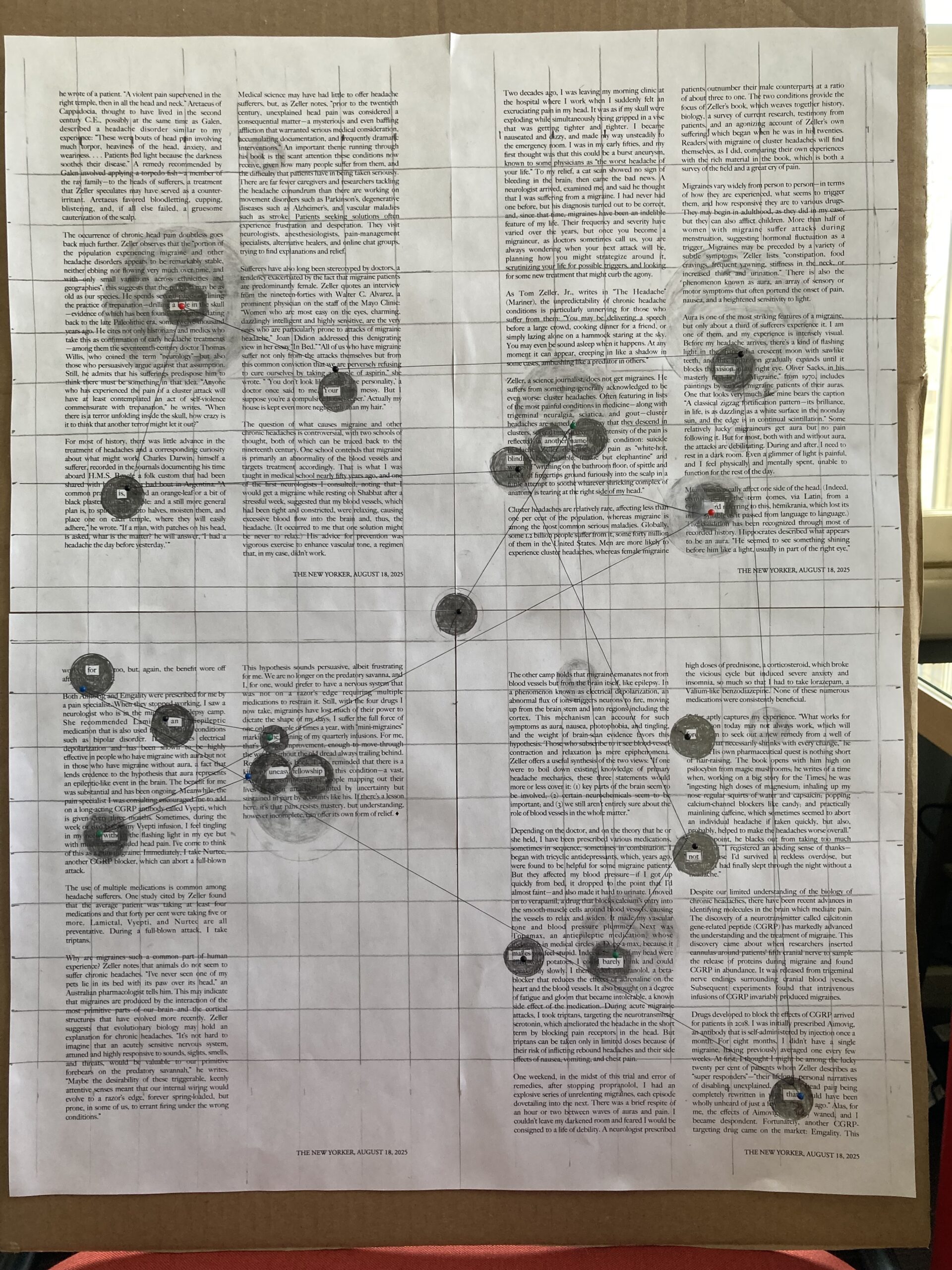
a couple hours later: Playing around with my first Holes, this morning, I focused on figuring out how to connect the sections of the poem, to map the path from word to word to word on the page. That process of reading is key to this series1. After ruminating, which frequently meant standing and staring at the poem on cardboard, trying to figure out how to make this rectangular 4-panel poem fit into the square of an Amsler Grid, I came up with something to try. Fasten the poem panels to cardboard by placing pins next to the words of the poem, then connect/map the words with black thread. When I tried that, the thread was more fiddly to work with than my eyes and hands liked, and it didn’t show up that well:
black thread map / Can you see the thread? Just barely, for me.
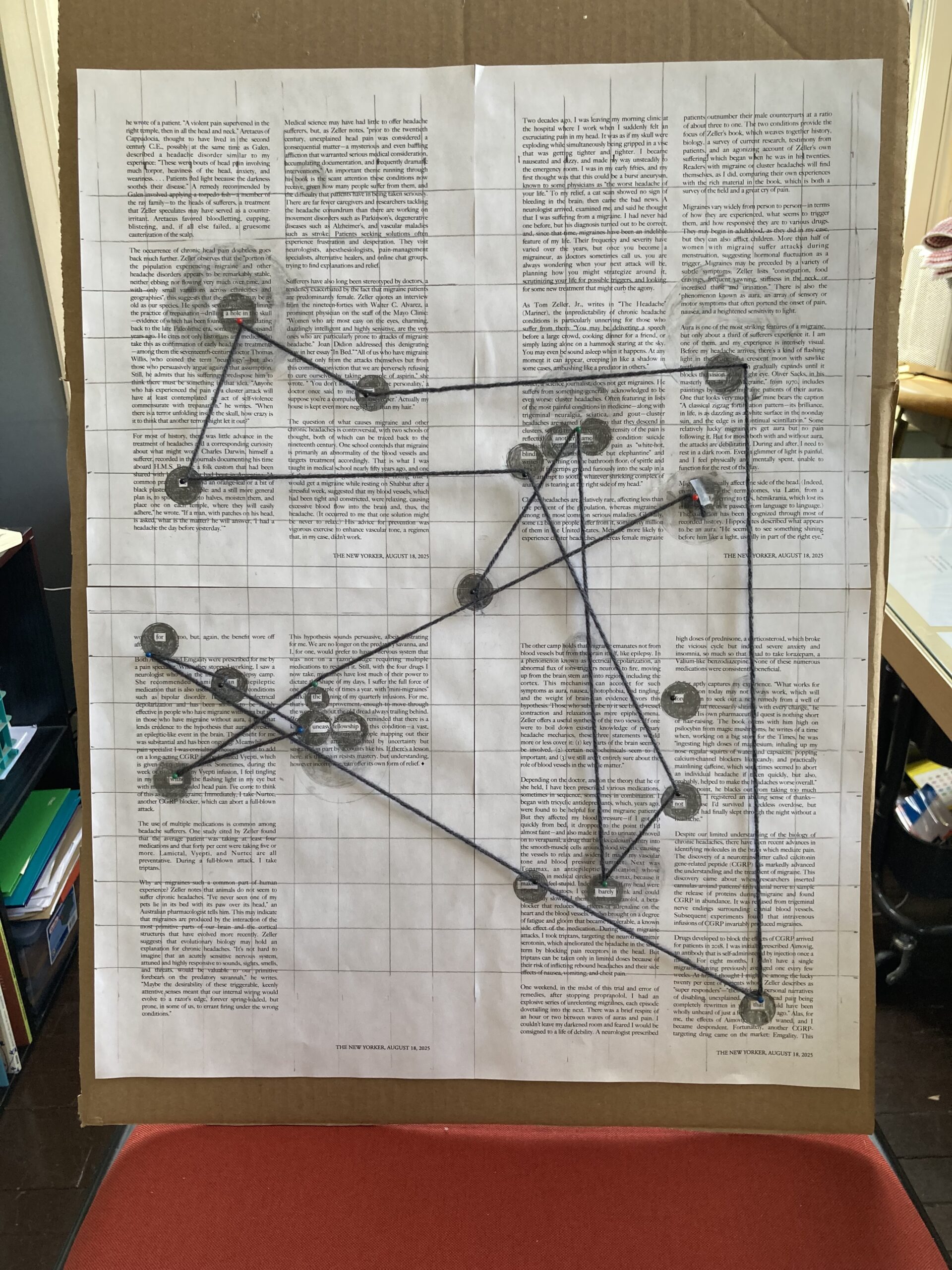
So I tried dark gray thread, which was easier to work with and showed up much better. Maybe as the series progresses and my tether to the world through words weakens, I’ll use thinner, less visible thread?
gray yarn
One thing to fix for a different version: adjust the pin so that the thread line between with and word doesn’t cross the center — to do this, possibly switch to another “the” lower on the panel.
I like the yarn better! I realized that one of the key elements of this poem is to show the process of reading, the act of jumping from word to word to word, how the connections between words are increasingly complicated and convoluted. As I was thinking about that mapping, I remembered some images that I’ve seen several times and that Scott mentioned the other day: a spider’s web after taking various drugs . Here, lines = grids = webs!
The next experiment = putting the 4 paneled poem on cork board, using gray yarn and push pins. Another thing to add: draw more holes (circles), color them in with pencil, then erase them to leave a ghost (afterimage-ish).
during the run: holes
During the run, I thought about printing the New Yorker article on graph paper and adding an x and y axis for plotting the words. I might do that for a few of the Holes — as my vision gets stranger, so do the names of x and y. Maybe Holes 1 is x = time and y = space. Another Holes could be x = real and y = imagined. I should look through the other poems and determine their x and y axis.
questions: Are the lines from the Amsler grid (that is, the lines that make up the grid) and the lines that connect the words and map them on the visual poem the same as the Amsler lines? Can they sometimes be the same in one poem, and different in another?
A thought as I wrote this sentence: part of the process of moving from word to word is running into words on a line that I didn’t see. In my Plague Notebook, I have countless examples of visual errors in which I write words on top of each other. This works differently in reading — in reading, I only see the word I am reading — but it connects. This not seeing + words on top of each other could be represented by the increasing jumbled way my lines from word to word are mapped. ↩︎
4.35 miles minnehaha falls and back 32 degrees / feels like 17
Cold again. Because of the low feels like temp, I overdressed: 2 pairs of tights, long-sleeved shirt, sweatshirt, pullover. Halfway through I ditched the pullover, which was awkward as I struggled to take it off without removing the outer layer.
Tried to stay steady and slow. Chanted in triple berries in my head. Took several walk breaks — not because I was tired, but to take pictures or to record my thoughts or to take off my second layer.
Thought about grids and nets (more on this below) as I ran. Recorded some thoughts on my phone:
recording 1: I’m thinking about grids and the lines and why it matters to me. And I’m thinking about the xy axis and a map and the visual field. And mapping and locating yourself within the known world and how reading is so important to that locating and figuring out how to navigate without that.
recording 2: Thinking more about why nets or grids or that particular way of being located is to be held, to be connected, to be located, to be seen or recognized or have others aware (of you). So not in this free fall. To orient yourself in some way. To not be entirely unmoored. Because as fun as it sounds in theory to be untethered and unlimited by these restrictions, physically it does not feel good. Dizzy, disoriented, nauseated (sometimes). A slow, growing anxiety.
This last bit about the ill effects of being unmoored was inspired by how I felt as I started my run. It wasn’t entirely unpleasant, but I did feel a little dizzy and disconnected from the path, unable to clearly see what was ahead of me. I wasn’t blind to the trail or anyone on it. I was disoriented and anything I saw was vague and barely formed. This way of seeing unsettled me; it also made everything feel dreamy and not real or unreal or surreal. By the end of the first mile, it had dissipated somewhat.
So, why the Amsler grid? First, the obvious: it’s a vision test and I am writing around (and through) vision tests in much of my vision/visual poetry. Another explanation: it represents a mapping, a locating, a connecting to the known world (where known partly = “normal”/medical understandings and models of seeing). Also, it is a reference point from and a starting point that readers can understand (a place of common ground, a concrete and easily expressed and understandable model and map for blind spots in central vision/visual field).
grids / nets
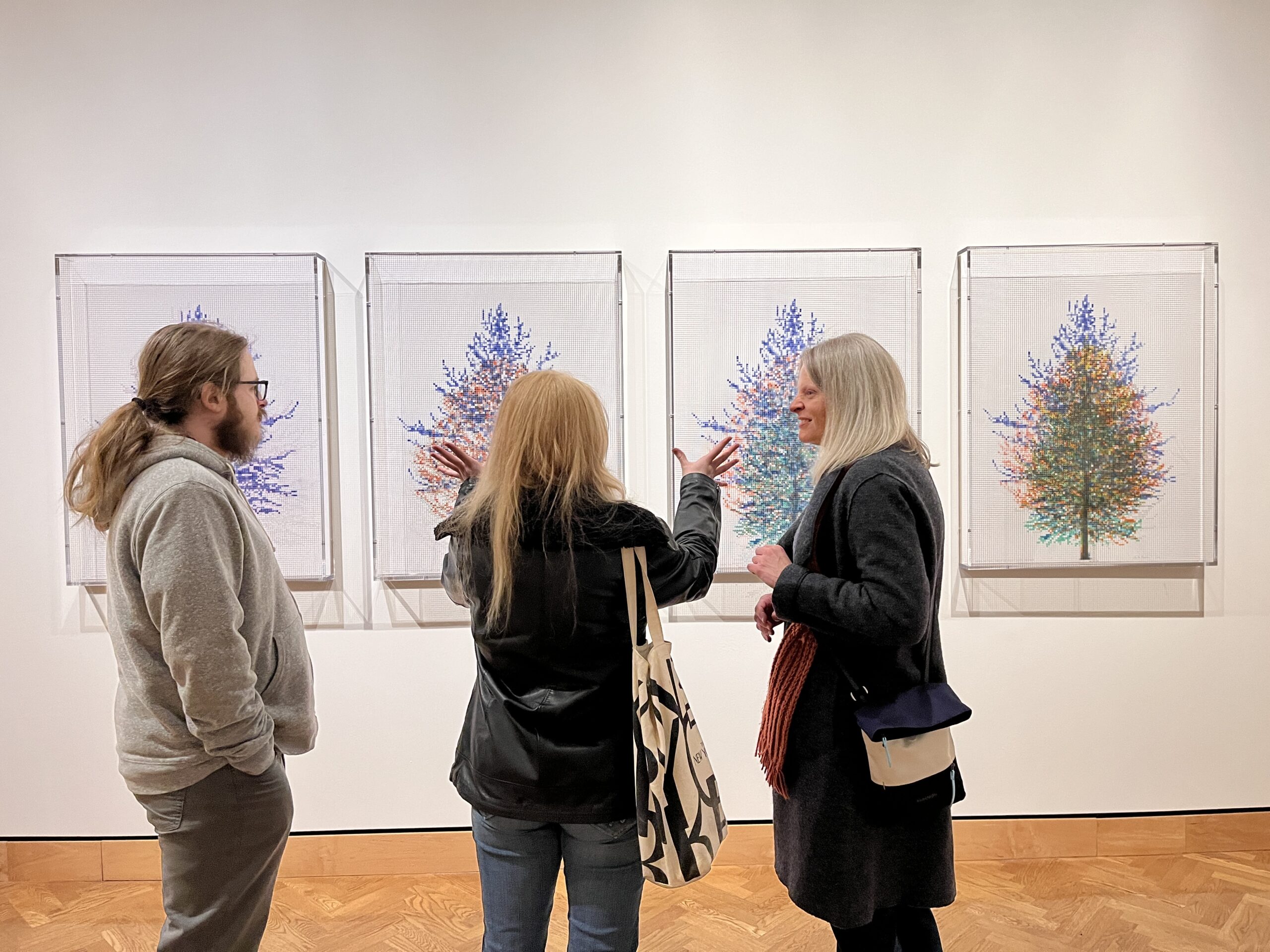
I was planning to study worms and bugs for my April challenge, but that will have to wait. This month is about grids and nets and matrices. I chose this topic because I want to dig deeper into the grid and what role it plays in my Holes series, and also because of a series of pieces that AMP pointed out to me at MIA (Minneapolis Institute of Arts):
Charles Gaines / Numbers and Trees
I found a book from one of his exhibits and requested it from the local library. When I get it, I’ll discuss the grids more. (I also plan to return to MIA soon to study the pieces more closely). Here’s one photo of them that I particularly like of me, FWA, and RJP, who is talking with her hands in a way that I love.
3 people looking at art, 2 of them talking about it, one with her hands
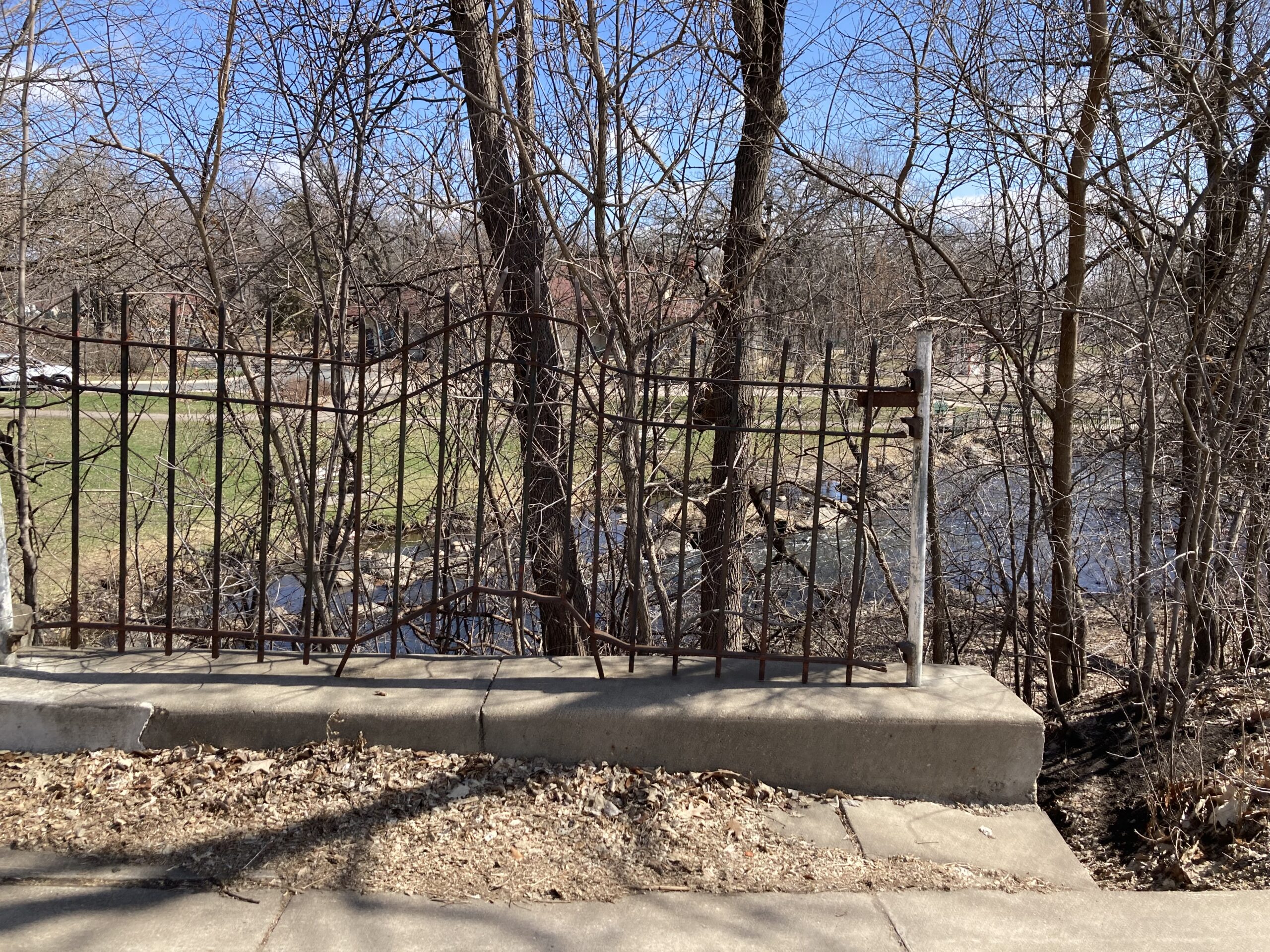
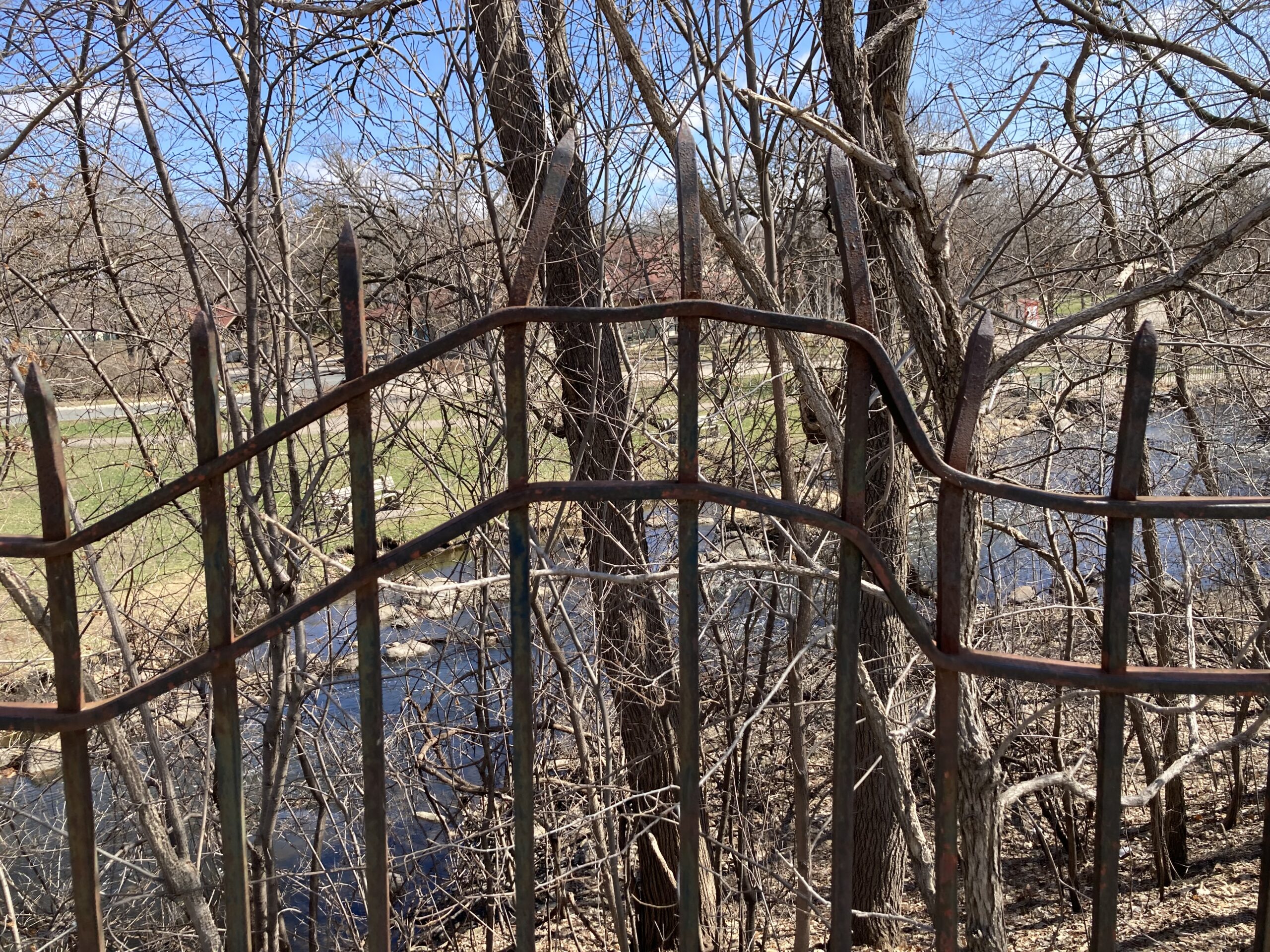
. Heading out for my run this morning, I wanted to notice grids. A few minutes later, all I could think about was the twisted/bent fence at the falls that I noticed last Thursday. I regretted not stopping to take a picture of it then, so I took several today. Here are 2:
1
Remembering this crooked fence and then taking pictures of it, inspired me to expand my grid/net/matrix month to fences too — this fence + chainlink fences. Things that contain, orient, map, frame.
To start this grid exploration, some research on the Amsler Grid. Have I done any research about it in past years? Not that I can find!
Amsler Grid
The Amsler grid, used since 1945, is a grid of horizontal and vertical lines used to monitor a person’s central visual field. The grid was developed by Marc Amsler, a Swiss ophthalmologist. It is a diagnostic tool that aids in the detection of visual disturbances caused by changes in the retina, particularly the macula (e.g. macular degeneration, Epiretinal membrane), as well as the optic nerve and the visual pathway to the brain. An Amsler grid can show defects in the central 20 degrees of the visual field.
In the test, the person looks with each eye separately at the small dot in the center of the grid. Patients with macular disease may see wavy lines or some lines may be missing. . . .
Although originally intended for use in clinical settings, the Amsler grid has proven highly adaptable for home monitoring. Its portability and ease of use enable patients to participate actively in the management of their ocular health, allowing earlier detection of disease progression and more timely medical intervention.
This idea of it being for use at home connects to my desire to use whatever materials and words I can find around me for this Holes series. There’s more there, I think.
I’d like to spend a few minutes (maybe later today or tomorrow morning) writing more about lines and grids and mapping and why it’s important to me, both in this series and in my understanding/description of my vision loss.
While looking for more on Amsler and the grid, I found out about Edward Munch and his vision loss at 60. As he was experiencing it, he drew a series of sketches/paintings, some with grid lines, some annotating the strange ways he saw. Very cool. Here’s more about it from a exhibit at the Tate. Is there a book for the exhibit and could it be at my local library? Yes! I just requested it.
60 minutes Minnehaha Off Leash Dog Park 40 degrees / sun
note: writing this entry on monday (6 april) morning because I was busy yesterday talking non-stop with my wonderful older sister who was visiting.
A wonderful hike through the dog park with FWA, AMP, and Delia. It was cool but felt much warmer with all the sun. More than once, I took a deep breath, sighed, and said, this feels so good — to be outside here, now! Delia was in her element, and so was I: hiking on a wide and open trail with people I love, having great conversations about storytelling and trees and other things I can’t remember.
overheard: a tween protesting to an older sister or mother or some adult — I really didn’t MEAN to reference 6 7! The older sister’s response — oh yes you did!
10 Things
a pileated woodpecker calling out several times and in several different spots
a few stretches of goopy mud with footprints
a dalmatian — long and lean with bright white fur and dark spots
a distant knocking of a woodpecker on some dead wood
a woman, frazzled, calling out for her dog — Tubby or Toby or Trouble? (I couldn’t quite hear the name, even though she called it at least a half a dozen times)
another dog’s name: Lola
a tree graveyard — barren: mud/dirt, a few tall trunks with no branches or bark, half-sheared
trying (and just barely succeeding) to locate Delia’s poop so I could pick it up
a contrast in textures: first firm mud then hard dirt studded with rocks then loose, soft sand
a full parking lot on Easter Sunday
Dalmatian: I mentioned to AMP that the concentration of melanin in a dalmatian’s spots can often cause hearing loss. I looked it up on a past log entry and discovered that I was approximately/almost right but also wrong:
Interesting fact from Scott and Mental Floss: 30% of all Dalmatians are deaf:
Around 30 percent of all Dalmatians are inflicted with deafness as a result of their spotted markings. Breeding dogs with this coat can lead to a lack of mature melanocytes (melanin producing cells) in the inner ear. Without these, dogs can become hard of hearing. Dogs with larger patches of black are less likely to be deaf.
It was a wonderful sister visit. I was able to show my Holes series to AMP, who is an amazing visual artist, and get some helpful and exciting feedback. So many new experiments to try with layers and different types of paper. We talked a lot about the Amsler Grid. She suggested trying out graph paper or making my own graph paper by copying and enlarging my handmade grid, made on a loom with thread. Also: plastic sheeting — I like plastic sheeting because I have often described feeling like I’m seeing/experiencing the world through a plastic bag or bubble. And: stencils for the circles, which would make the tracing part easier. Oh — and she mentioned using something other than canvas for the backing because pins would not be stable. Wood was one of her suggestions — I could learn to cut my own wood (I know I could do it even with my bad vision, but would I want to?) and drill into it.
A thought: there is something significant about my reliance on found materials for this project. I’m taking the words from old New Yorker articles. I’m using my kids’ old craft materials — markers, pencils, glue sticks, yarn — and various things around the house for circles — a penny, dime, nickel, quarter, candle cap, 2 pill bottle caps (including the cap from my lexapro). My grid is made from old cardboard (a shoebox from my running shoes). I like the idea of making these found materials as part of the form/limits.
Crayons! I just remembered another thing my sister said. Crayons are fun to work with. She said a lot of stuff that I wish I could remember; here’s one thing I did: you can create thick layers with crayons that you can scrap off with a knife or a sharp edge or something. I would love to find a use for the ridiculously big bin of crayons we have in the basement.
A reminder: AMP reminded me that not all of the ideas might work in this series, but I can save them for other projects. A refrain to apply to any new idea/experiment: does it serve the message I am trying to convey? What is that message? More on that in the next post and after my Monday run!
Happy first day of Spring! Many years it still feels like winter, but today it was SPRING! If I didn’t have to jump over a lumps of snow I wouldn’t have remembered it snowed almost a foot less than a week ago. Wonderful weather for a run — sun and not too much wind. I wore shorts, a short sleeved shirt and a lightweight pullover which I took off right before I turned around. For half the run, bare arms and bare legs!
a regular:Daddy Long Legs! As I ran back south, he greeted me, Hello again! Does he remember me from past years, or did he think he’d already seen me once today? (he’s done that before.) I’m choosing the believe he remembers me. I wonder if he has a name for me, like I do for him?
The ice on the surface of the river has melted. Down in the flats I was able to get close — only feet away — from the surface: some foam floating on the water moving slowly south.
holes
As I told RJP, I’ve hit the point in the process of these poems where I’m beginning to doubt myself and what I’m doing. Part of it, I explained to her, is because I dwell in the almost and struggle to find how to execute the final bit and/or give it the “polish” it needs. I’m not giving up. Instead, I’m trying a different approach: cut-outs. Would ths work better if the words were cut-out — a way to isolate them — instead of encased in holes? Can I do both? What if I had some of the words encased in the holes and some cut-out? Would that make it a little less complicated and less messy + easier to execute?
The question to return to again and again: what will serve the message/meaning/intentions of the poem?