april 18/RUN

2.7 miles
neighborhood + Howe loop
46 degrees

Sometimes 46 feels cold, but not today. Sunny and calm with a symphony of birds calling and trilling and chirping and drumming. Ran with STA through the neighborhood. I don’t remember much of what I saw or what we talked about. Just lots of birds….oh–and bikes. We saw at least 2, maybe 3, pelotons on the parkway or the trail. Yesterday during our morning walk with Delia, we saw a group of 15 or so bikers speeding down the road, their wheels whirring and buzzing. Also yesterday we saw some rowers racing on the river! Excellent. The rowers were so loud, yelling to each other as they tried to win.

Reading more Mary Oliver and thinking about the idea of the flare–a sudden burst of light, or understanding, or ecstasy, or illumination, or lifting out and free of yourself, or experiencing eternity “now, now, now, now.” Found this poem in Dream Work:

Sunrise

You can
die for it —
an idea,
or the world. People
have done so,
brilliantly,
letting
their small bodies be bound
to the stake,
creating
an unforgettable
fury of light. But
this morning,
climbing the familiar hills
in the familiar
fabric of dawn, I thought
of China,
and India
and Europe, and I thought
how the sun
blazes
for everyone just
so joyfully
as it rises
under the lashes
of my own eyes, and I thought
I am so many!
What is my name?
What is the name
of the deep breath I would take
over and over
for all of us? Call it
happiness, it is another one
of the ways to enter
fire.

Reading through more of MO’s The Leaf and the Cloud and noticing her reference to circles, which has me thinking about her love of Emerson (who wrote, Circles), and of how her use of circles does or doesn’t fit with ED and her idea of Circumference. More reading and thinking is needed.

april 16/RUN

2.8 miles
river road trail, south/turkey hollow/Winchell Trail, north
58 degrees

Ran with STA in the afternoon. Sunny and warm! We were able to run on both the upper and lower trails. Not too crowded. I remember the river looking pale blue–such a pretty complement to the light green limbs below us. Encountered a few annoying bikers and a roller skier who refused to move over. Boo–normally, I love roller skiers. I can tell that it is going to take some time for me to love the world again–especially the people in it who don’t seem to care about the amount of space they take up or about the effects of their actions on others. But, I believe I can get there. Maybe Mary Oliver can help?

Speaking of MO, here are some useful words for enabling me to think and reflect on what work is for her:

Everything/ Mary Oliver from New and Selected Poems, Vol 2

I want to make poems that say right out, plainly,
what I mean, that don’t go looking for the
laces of elaboration, puffed sleeves. I want to
keep close and use often words like
heavy, heart, joy, soon, and to cherish
the question mark and her bold sister
the dash. I want to write with quiet hands. I
want to write while crossing the fields that are
fresh with daisies and everlasting and the
ordinary grass. I want to make poems while thinking of
the bread of heaven and the
cup of astonishment; let them be
songs in which nothing is neglected,
not a hope, not a promise. I want to make poems
that look into the earth and the heavens
and see the unseeable. I want to honor
both the heart of faith, and the light of the world;
the gladness that says, without any words, everything

from Mysteries, Four of the Simple Ones

And what else can we do when the mysteries peresent themselves
but hope to pluck from the basket the brisk words
that will applaud them

What I Have Learned So Far

Meditation is old and honorable, so why sould I not sit, every
morning of my life, on the hillside, looking into the shining
world? Because, properly attended to, delight, as well as havoc, is
suggestion. Can one be passionate about the just, the ideal, the
sublime, and the holy and yet commit to no labor in its cause? I
don’t think so.
All summations have a beginning, all effect has a story, all kind-
ness begins with the sown seed. Thought buds toward radiance.
The gospel of light is the crossroads of–indolence, or action.
Be ignited, or be gone.

from Sometimes/ Red Bird

Instructions for living a life:
Pay Attention.
Be Astonished.
Tell About It.

from “Work” in The Leaf and the Cloud

3.

Would it be better to sit in silence?
To think everything, to feel everything, to say nothing?
This is the way of the orange gourd.
This is the habit of the rock in the river, over which
the water pours all night and all day.
But the nature of man is not the nature of silence.
Words are the thunders of the mind.
Words are the refinement of the flesh.
Words are the responses to the thousand curvaceous moments—
we just manage it—
sweet and electric, words flow from the brain
and out the gate of the mouth.

We make books of them, out of hesitations and grammar.
We are slow, and choosy.
This is the world.

7.

So I will write my poem, but I will leave room for the world.
I will write my poem tenderly and simply, but
I will leave room for the wind combing the grass,
for the feather falling out of the grouse’s fan-tail,
and fluttering down, like a song.

april 15/RUN

run: 3.1 miles
turkey hollow
44 degrees

I wish it was a little warmer, but it wasn’t too windy or crowded, so it was a good run. Ran on the trail right above the river. Very nice. I remember admiring the river, but I can’t recall what color it was or if any rowers were on it. I was planning to do the lower trail on the way back because no one was on it, but just before the turn around I noticed a dog and a walker entering the narrowest part of it. So, I stayed up above and ran past turkey hollow instead. No turkeys. Lots of woodpeckers and black-capped chickadees though.

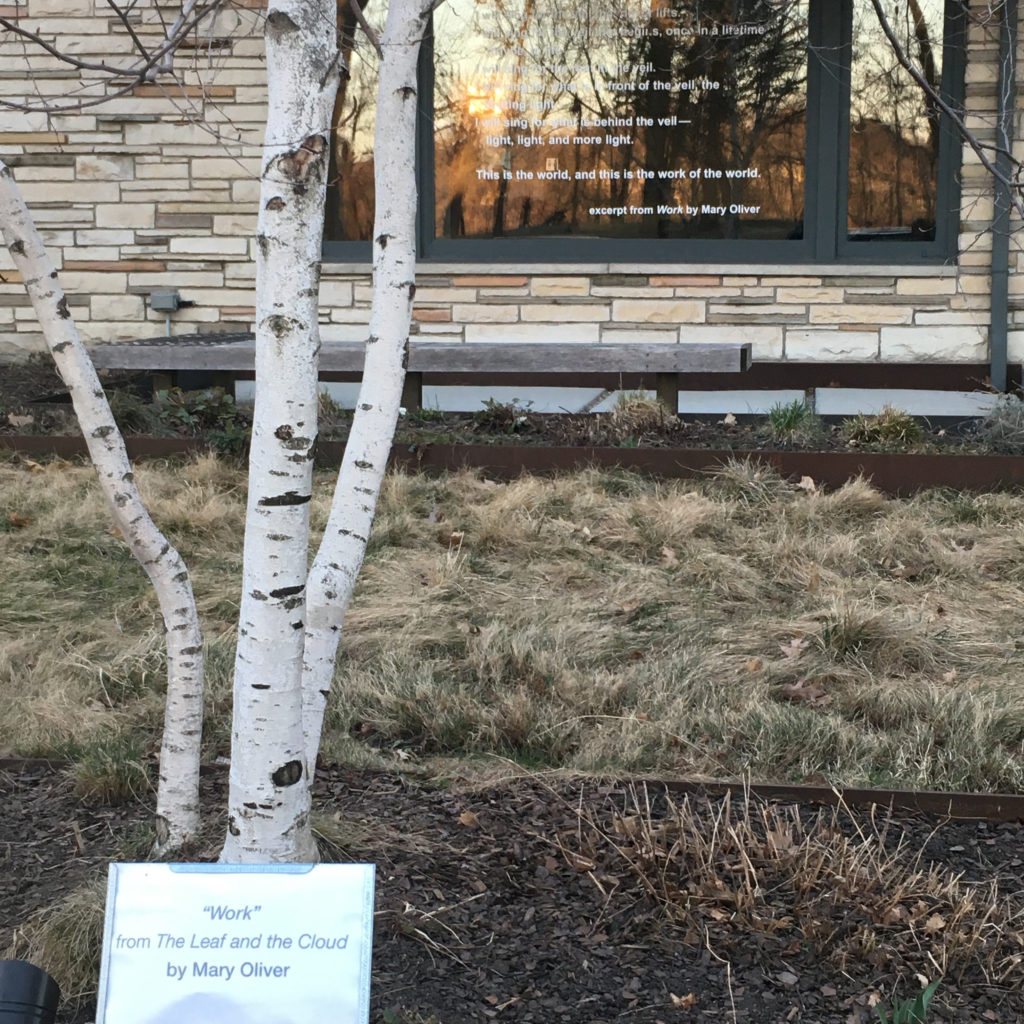
Still spending time with Mary Oliver this morning, reading through the second section of The Leaf and the Cloud called “Work.” incidentally, the ending stanza of “Work” is what was displayed on a neighbor’s window that inspired me to start this April with Mary (Oliver) project. I’m thinking about what work is–for me, for others, for Mary–and whether or not it includes saving ourselves (as Limón talks about it).

Rereading the early chapters of Upstream, I found the passage I had loved so much when I came across it the first time that I posted it as a description for my How to Be project:

And there is the thing that one does, the needle one plies, the work, and within that work a chance to take thoughts that are hot and formless and to place them slowly and with meticulous effort into some shapely heat-retaining form, even as the gods, or nature, or the soundless wheels of time have made forms all across the soft, curved universe–that is to say, having chosen to claim my life, I have made for myself, out of work and love, a handsome life. 

Upstream/ Mary Oliver

“I have made for myself out of work and love….” Sometimes, I think I combine these things, work and love–loving (as in caring, noticing, beholding) the world is the work–but I like the distinction she offers. Work is work, love love. Work as useful, ordered in “heat-retaining” efficient, proper forms. Love, as being “good-natured and untidy in your exuberance.” In “Work,” she writes about her beloved dog, Luke:

All day I have been pining for the past.
That’s when the big dog, Luke, breathed at my side.

One of the first Mary Oliver poems I memorized, back in 2017 when I got injured and memorized poems to feel better, was “Luke.”

Luke

I had a dog
who loved flowers.
Briskly she went
through the fields,

yet paused
for the honeysuckle
or the rose,
her dark head

and her wet nose
touching
the face
of every one

with its petals
of silk
with its fragrance
rising

into the air
where the bees,
their bodies
heavy with pollen

hovered—
and easily
she adored
every blossom

not in the serious
careful way
that we choose
this blossom or that blossom—

the way we praise or don’t praise—
the way we love
or don’t love—
but the way

we long to be—
that happy
in the heaven of earth—
that wild, that loving.

Love without judgment or anger or distinction. Happy, wild. I kept thinking about this distinction between work and love as I ran and, just after cresting the hill at 47th, I decided to stop and record my thoughts:

thoughts on work and love, april 15, 2021

What kind of work do we need to do on ourselves to be loving? To notice the world–to stop and stare and be open to beholding and praising the green pea as it “climbs the stake/on her sugary muscles” or how the “rosy comma of the radish/fattens in the soil”? Perhaps, having been raised in a family of “serious,” driven people who work a lot, and having spent decades of my life doing the work of thinking (too) seriously and critically, not working and just being–standing still, staring hard, loving everything with pure admiration–is harder for me than for other people? I have devoted the last few years to learning how to look, how to be simple in my joy, how to be satisfied with “tiny little things” and the slow, small moments of the birds and the trees and the gorge. To me, this has been important and necessary, and it has been work. A lot of work.

Continuing my run, I kept thinking about how messy and complicated the division between work and love is and then I wondered if that seam (here I’m thinking of ED and her idea of the seam, the Circumference) where they come together is a spot of creative possibility as you try to navigate your useful, “serious” work of managing and shaping words into forms that flare with your whimsical, overwhelmed with delight, untidy exuberance for the trees and the stones and the flowers and the bees and your beloved dog Luke that died years ago.

Of course, these ideas only flashed briefly as I ran. Now, I’m home and writing this log entry and as I read through the “Work” section again, I’m finding more help in my efforts to understand. But, as I try to form my thoughts into words, I’m struggling, so I’ll stop and think and hopefully write more about work and love tomorrow. Two more things:

One: different definitions of work

I’m thinking about the differences between work as a vocation/calling (to admire/behold/praise the world), work as set of practices (physical/mental labor of shaping words), and work as product (the forms, usually poems, made from that labor).

Two: the meaning of wild

At the end of “Luke,” MO writes, “that wild, that loving.” This got me thinking about MO’s use of “wild” and what she might mean by it. One of her most famous uses of the word (aside from in “Wild Geese”) is in:

The Summer Day

Who made the world?
Who made the swan, and the black bear?
Who made the grasshopper?
This grasshopper, I mean—
the one who has flung herself out of the grass,
the one who is eating sugar out of my hand,
who is moving her jaws back and forth instead of up and down—
who is gazing around with her enormous and complicated eyes.
Now she lifts her pale forearms and thoroughly washes her face.
Now she snaps her wings open, and floats away.
I don’t know exactly what a prayer is.
I do know how to pay attention, how to fall down
into the grass, how to kneel down in the grass,
how to be idle and blessed, how to stroll through the fields,
which is what I have been doing all day.
Tell me, what else should I have done?
Doesn’t everything die at last, and too soon?
Tell me, what is it you plan to do
with your one wild and precious life?

Here, I think of wild in relation to bewilderment and being lost and beyond the ordinary (civilized, responsible, measured by the clock and your tasks) world. And I think of the passages I just re-read in Upstream:

I walked, all one spring day, upstream, sometimes in the midst of the ripples, sometimes along the shore. My company were violets, Dutchman’s-breeches, spring beauties, trilliums, bloodroot, ferns rising so curled one could feel the upward push of the delicate hairs upon their bodies. My parents were downstream, not far away, then farther away because I was walking the wrong way, upstream instead of downstream. Finally I was advertised on the hotline of help, and yet there I was, slopping along happily in the stream’s coolness. So maybe it was the right way after all. If this was lost, let us all be lost always. The beech leaves were just slipping their copper coats: pale green and quivering they arrived into the year. My heart opened and opened again. The water pushed against my effort, then its glassy permission to step ahead touched my ankles. The sense of going toward the source.

…May I stay forever in the stream. May I look down upon the windflower and the bull thistle and the coreopsis with the greatest respect.

Upstream/ Mary Oliver

april 14/RUN

3.5 miles
trestle turn-around!
43 degrees

Woke up this morning to a dusting of snow on the deck. It melted in a few hours. Worked on Mary Oliver in the morning, then ran in the early afternoon. Started in the neighborhood then decided to keep going north on the trail all the way to the trestle. Hooray! Ran right above the river and the rowing club. What a view! No snow, hardly any other people, only a little wind. Lots of drumming woodpeckers and cardinals and a few black-capped chickadees. This spring, I need to add another bird sound to my collection. Felt relaxed and strong until the last mile when I still felt strong but also sore in my back and heavy in my legs. Can’t remember what I was thinking about. All thoughts gone, soundless words scattered over the tops of the trees. Scheduled second pfizer shot for April 30th. Almost there! Later today, I’ll sign up for open swim. This year, you can swim at Nokomis and Cedar. Awesome.

My Morning’s Work

Started by reading Dreamwork which is one of MO’s more painful (and personal?) books in which she addresses her childhood with an abusive father. The first poem is “Dogfish.” Intense. When I looked for it online, one of the first results that came up was Mary Oliver reading for a celebration of Emily Dickinson posted on the Dickinson Electronic Archive. Here’s the description of the event:

A marvelous centennial tribute in South Orange, New Jersey thate featured contemporary women poets reading hour after hour, from morning until night “to commemorate the centenary of the death of Emily Dickinson,” which occurred on May 15, 1886. Adrienne RichRuth Stone, Amy Clampitt, Katha Pollitt, Sharon Olds, Marilyn Hacker, Carolyn Kizer, Toi Derricotte, Maxine Kumin, Mary Oliver, Joyce Carol OatesSandra GilbertAlicia OstrikerGwendolyn Brooks, Denise Levertov were all there– “Poetry-in-the-Round” it was called, an apt descriptor not only because of the shape of the theater in which the readings took place, but because of the taking turns, the offerings making their way around a range of our contemporary poets who have at least two things in common with Emily Dickinson–they are each and all women, and poets. 

Dickinson Electronic Archives

For her part, MO read several of ED’s poems, then several of her own. The site has a transcript and a recording, with music strangely playing in the background?

ED poems read by MO:

  • What is Paradise
  • There came a mind like a Bugle
  • Under the light, yet under
  • Because I could not stop for Death

MO poems read by MO:

  • Morning Poem
  • Blossom
  • Dogfish
  • Acid
  • Stanley Kunitz
  • Blackwater Words
  • Humpbacks

Very cool to have found this, partly for the MO and ED connection, but also for the other poets. I might want to read Maxine Kumin in May or June–I love her swimming poems. Anyway, back to Dogfish. I’ve never heard of dogfish, so I looked them up. They’re little sharks that don’t eat humans but travel in big packs and are aggressive and relentless in hunting their prey–squid, herring, sea cucumber, shrimp, jellyfish. They are also known as spiny dogfish because they have a sharp spine: “Using sharp, venomous spines in the front of each dorsal fin, the spiny dogfish is a small but mighty predator that isn’t afraid to take a jab at passing fish.”

Dogfish/ Mary Oliver (from Dreams)

Some kind of relaxed and beautiful thing
kept flickering in with the tide
and looking around.
Black as a fisherman’s boot,
with a white belly.

If you asked for a picture I would have to draw a smile
under the perfectly round eyes and above the chin,
which was rough
as a thousand sharpened nails.

And you know
what a smile means,
don’t you?

*

I wanted
the past to go away, I wanted
to leave it, like another country; I wanted
my life to close and open
like a hinge, like a wing, like the part of a song where it falls
down over the rocks: an explosion, a discovery; I wanted
to hurry into the work of my life; I wanted to know,
whoever I was, I was

alive
for a little while.

*

It was evening, and no longer summer.
Three small fish, I don’t know what they were
huddled in the highest ripples
as it came swimming in again, effortless, the whole body
one gesture, one black sleeve
that could fit easily around
the bodies of three small fish.

*

Also I wanted
to be able to love. And we all know
how that one goes,
don’t we?

Slowly

*

the dogfish tore open the soft basins of water.

*

You don’t want to hear the story
of my life, and anyway
I don’t want to tell it, I want to listen

to the enormous waterfalls of the sun.
And anyway it’s the same old story-
a few people just trying,
one way or another,
to survive.

Mostly, I want to be kind.
And nobody, of course, is kind,
or mean,
for a simple reason.

And nobody gets out of it, having to
swim through the fires to stay in
this world.

*

And look! look! look! I think those little fish
better wake up and dash themselves away
from the hopeless future that is bulging toward them

*

And probably,
if they don’t waste time
looking for an easier world,

they can do it.

Wow. Favorite bit of this poem for today:

I wanted
my life to close, and open
like a hinge, like a wing, like the part of the song
where it falls
down over the rocks: an explosion, a discovery

I’m thinking of door hinges and poems as opening a thousand doors and the wings of the seven white butterflies and “how they bang the pages/or their wings as they fly/to the fields of mustard and yellow/and orange and plain/gold all eternity” (Seven White Butterflies/ from West Wind). And I’m thinking of the explosion, the discovery, as a flare, a burst of light, of intense emotion, which is the name of the first section of MO’s book-length poem, The Leaf and the Cloud. Last week, I decided that doing a close, sustained reading of this book would be part of my April with Mary (Oliver) exercise. But, before getting to that, here’s how my thoughts about Mary progressed as I read through “Dogfish” and then some of the other poems in Dreamwork:

A few poems later is Trilliums. I think it’s interesting to put these together, connecting them through the idea of an easy life, which is referenced and rejected in both poems–actually in Dogfish, Trilliums, and the one I just mentioned, Seven White Butterflies, which ends with the question: “who/would have thought it could be so easy?”

Trilliums

Every spring
among
the ambiguities
of childhood
the hillsides grew white
with the wild trilliums.
I believed in the world,
Oh, I wanted
to be easy
in the peopled kingdoms,
to take my place there,
but there was none
that I could find
shaped like me.
So I entered
through the tender buds,
I crossed the cold creek,
my backbone
and my thin white shoulders
unfolding and stretching.
From the time of snow-melt,
when the creek roared
and the mud slid
and the seeds cracked,
I listened to the earth-talk,
the root-wrangle,
the arguments of energy,
the dreams lying
just under the surface,
then rising,
becoming
at the last moment
flaring and luminous —
the patient parable
of every spring and hillside
year after difficult year.

Trilliums, along with Dogfish, really got me thinking about “Flare” in The Leaf and the Cloud, which I had already read through at least twice, and then I felt a bit overwhelmed, then stuck, about what to post (or what not to post because I wanted to add more and more of MO’s lines) for this entry. Having listened to an On Being Podcast with Mary Oliver and read Upstream, I knew about MO’s hard childhood. I wondered how much of this dogfish was her dad, and did she imagine herself as one of the three unnamed fish? So I read through “Flare” again and was blown away, both by how she writes about her parents, and by how it connects so much with “Dogfish” and “Trilliums.” So I decided to stop trying to add it all into this entry and to make notes in the margins of the book and to not worry about saying smart, complete things in this post. So, I did. And, I enjoyed writing in the margins of my book, something I did a lot of in grad school. And, I had lots of thoughts about lightness and darkness and flares and fathers and the color green and hinges as not just connected to doors but to edges and seams. And, I could keep writing about this for a long time, but I’ll conclude this post with 2 thoughts.

thought one: the real work is saving ourselves

Mary Oliver writes a lot, in her essays and poems, about the work she is meant to do, or that she wants to do. She often describes this work as the work of noticing. Could this work also be the work of saving the I in the poem–which she often identifies as herself but also suggests that it could be any readers who recognizes themselves in the poem? In her interview with Krista Tippet, MO says:

Many of the poems are “I did this. I did this. I saw this.” I wanted the “I” to be the possible reader, rather than about myself. It was about an experience that happened to be mine but could well have been anybody else’s. That was my feeling about the “I.”

And in one of her poems that I posted a few days ago, I Want to Write Something So Simple, she writes:

that it was all the while
yourself arranging the words, 
that it was all the time
words that you yourself,
out of your own heart
had been saying.

In discussing her own work as a poet, Ada Limón says that she writes her poems to save herself.

I believe that poetry can heal us and help us. But, I mean, if I’m very honest, I think they can only do that for the poet. (LAUGHS) And then they may, if we’re lucky, help someone else or move someone else or inspire someone else or get them out of a rut. But I think it begins with like, I write my own poems to save myself. You know, then if, in, you know, some series, lucky series of events, a poem becomes larger than me and reaches someone else, that’s, that’s beautiful. But I don’t always know that that’s gonna happen, right? I have to start by how is this poem recommitting me to the world?

Ada Limón VS. Epiphany

In the Krista Tippet interview, Mary Oliver says about leaving her childhood home, “I saved my own life by finding a place that was not in that house.” So, could the work of writing, of creating worlds through words, be how she does it? What if that, and not the act of noticing for noticing’s sake, is the primary work? Or, maybe the work is both.

thought two: the nourishing dark

The final 2 lines of “Flare” are:

This is the dark bread of the poem.
This is the dark and nourishing bread of the poem.

Thinking about the dark as nourishing, I’m reminded of ED and the value of the Dark in, “We grow accustomed to the Dark”:

 That unknown mental and spiritual domain is a “larger – Darkness.” That is where our great poets and philosophical explorers venture while the rest of us pursue our hobbies or just relax. Dickinson spends time in this darkness and most of her most evocative, ambiguous, and challenging poetry comes from there.

the Prowling Bee

And then, MO’s discussion of the edge in Upstream:

No one yet has made a list of places where the extraordinary may happen and where it may not. Still, there are indications. Among crowds, in drawing rooms, among easements and comforts and pleasures, it is seldom seen. It likes the out-of-doors. It likes the concentrating mind, It likes solitude. It is more likely to stick to the risk-taker than the ticket-taker. It isn’t that it would disparage comforts. or the set routines of the world, but that its concern is directed to another place. Its concern is the edge, and the making of a form out of the formlessness that is beyond the edge.

Upstream/ Mary Oliver

Whew! That was a lot of thinking today. Time to stop.

april 13/RUN

3.4 miles
edmund, heading north loop
35 degrees/ 15 mph wind
snow flurries

O, cruel April with your warm sun, blooming flowers, then snow flurries and mornings where it feels like 25 degrees. Even so, it was a good run. Bundled up, with the pink hood of my jacket up and my gloves on, I didn’t feel the wind. A benefit of colder, windier weather: no one on the trail! I ran through the tunnel of trees and was able to attend to its slow and gradual greening. The trees are coming into leaf/like something almost being said/the recent buds relax and spread/their greenness is a kind of grief (Phillip Larkin). I memorized that poem last year in May and it has stuck.

Ran past the ancient boulder with a few stones stacked on top, past the welcoming oaks, above the ravine and the oak savanna and the muddy trail that climbs up near the tree stump with chain link limbs. Looked down at the Winchell Trail and thought about taking it, but I didn’t. At 42nd, I heard a bird that almost sounded like a black-capped chickadee, but not quite. 3 notes instead of 2, and no rising up or down the scale. What was it? Also heard the drumming and calling of some woodpeckers.

Even though this is not a Mary Oliver poem, I had to post it–because I’d like it and because it gave me an opportunity to reflect more on my vision loss:

Pastoral/ Forrest Gander

Together,
you
standing
before me before
the picture
window, my arms
around you, our
eyes pitched
beyond our
reflections into—

(“into,” I’d
written, as
though there
swung at the end
of a tunnel,
a passage dotted
with endless
points of
arrival, as
though our gaze
started just outside
our faces and
corkscrewed its way
toward the horizon,
processual,
as if looking
took time to happen
and weren’t
instantaneous,
offered whole in
one gesture
before we
ask, before our
will, as if the far
Sonoma mountains
weren’t equally ready
to be beheld as
the dead
fly on the sill)—

the distance, a
broad hill of
bright mustard flowers
the morning light
coaxes open.

I really like this poem and Gander’s reading of it. I was struck by his explanation of it, especially the idea that we see all instantly, that seeing, as a process, happens without effort, is immediate, and whole/complete. Occasionally seeing is not like this for many people–they experience visual errors, their brains receive conflicting data from their photoreceptor cells and generates confusing, ambiguous images. More frequently, seeing is like this for me. It is work, and sometimes, I can almost feel my brain trying to make sense of an image or a landscape. I witness them changing shape until they settle into what my brain decides they are. But, unlike Gander suggests in his recorded explanation of the poem, I can’t just “look once and find the near and far equally accessible” and the world doesn’t just present itself to me.

I like how Naomi Cohn describes it in her essay, “In Light of a White Cane.”

What I remember of better eyesight is how the world assembled all at once, an effortless gestalt—the light, the distance, the dappled detail of shade, exact crinkles of a facial expression through a car windshield, the lift of a single finger from a steering wheel, sunlight bouncing off a waxed hood.

Naomi Cohn

more mary oliver

So far, I’ve read through Devotions and Swan. Now I’m reading Evidence and Dream Work and then New and Selected Poems, Volumes I and II. I’ve read her collection of essays, Upstream too. And, I’m planning an extended study of her book length poem, The Leaf and the Cloud. I’m reading through it several times, along with the article, “‘An Attitude of Noticing’: Mary Oliver’s Ecological Ethic” by Kirstin Hotelling Zona. It sounds like a lot, but I’m not doing a close reading of every poem in every book. Just reading through, letting the words wash over me, and picking out a few things I want to remember.

more Evidence

Deep Summer

The mockingbird
opens his throat
among the thorns
for his own reasons
but doesn’t mind
if we pause
to listen
and learn something
for ourselves;
he doesn’t stop,
he nods
his gray head
with the frightfully bright eyes,
he flirts
his supple tail,
he says:
listen, if you would listen.
There’s no end
to good talk,
to passion songs,
to the melodies
that say
this branch,
this tree is mine,
to the wholesome
happiness
of being alive
on a patch
of this green earth
in the deep
pleasures of summer.
What a bird!
Your clocks, he says plainly,
which are always ticking,
do not have to be listened to.
The spirit of his every word.

I Want to Write Something So Simple

“And this is good for us.”
I want to write something
so simply
about love
or about pain
that even
as you are reading
you feel it
and as you read
you keep feeling it
and though it be my story
it will be common,
though it be singular
it will be known to you
so that by the end
you will think—
no, you will realize—
that it was all the while
yourself arranging the words,
that it was all the time
words that you yourself,
out of your own heart
had been saying.

april 11/RUN

2.5 miles
neighborhood
47 degrees

Ran with Scott this almost afternoon. Windy and bright. I remember hearing some calling–not drumming–woodpeckers and a couple of cardinals, maybe a robin, a few warblers. Noticed some dogwood blossoms, a lot of green grass. Ran by turkey hollow. No turkeys. Didn’t see the river or many other runners. Did see a surrey over on the bike path as we ran up edmund just past turkey hollow. It must be spring. Anything else? Ran on the grass between Becketwood and 42nd in the soft, muddy dirt straight into the wind.

I’m really enjoying my time with Mary Oliver. Yesterday I checked out her collection West Wind from the libby app for my library. Such convenience!

Stars from West Wind/ Mary Oliver

Here in my head, language
keeps making its tiny noises.
How can I hope to be friends
with the hard white stars
whose flaring and hissing are not speech
but pure radiance?
How can I hope to be friends
with the yawning spaces between them
where nothing, ever is spoken?
Tonight, at the edge of the field,
I stood very still, and looked up,
and tried to be empty of words.
What joy was it, that almost found me?
What amiable peace?…
Once, deep in the woods,
I found the white skull of a bear
and it was utterly silent-
and once a river otter, in a steel trap,
and it too was utterly silent.
What can we do
but keep on breathing in and out,
modest and willing, and in our places?
Listen, listen, I’m forever saying.
Listen to the river, to the hawk, to the hoof,
to the mockingbird, to the jack-in-the-pulpit-

then I come up with a few words, like a gift.
Even as now
Even as the darkness has remained the pure, deep darkness.
Even as the stars have twirled a little, while I stood here,
looking up,
one hot sentence after another.

What can we do
but keep on breathing in and out,
modest and willing, and in our places?

I like this idea of the breathing in and out, and of the humility, the openness, the recognition of having our place (in the family of things?–Wild Geese).

an excerpt I like from The Osprey/ West Wind:

I came back
and stood on the shore, thinking—
and if you think
thinking is a mild exercise,
beware!
I mean, I was swimming for my life—

another, from Fox/ West Wind:

I was hot I was cold I was almost
dead of delight. Of course the mind keeps
cool in its hidden palace—yes, the mind takes
a long time, is otherwise occupied than by
happiness, and deep breathing. Still,
at last, it comes too, running
like a wild thing, to be taken
with its twin sister, breath. So I stood
on the pale, peach-colored sand, watching the fox
as it opened like a flower, and I began
softly, to pick among the vast assortment of words
that it should run again and again across the page
that you again and again should shiver with praise.

april 8/RUN

3.25 miles
43rd ave, north/seabury, north/seabury, south/41st ave, south
63 degrees

Rained in the morning, so STA and I ran in the afternoon. We thought the rain was done, but 2 or 3 times during the run it started up again. A soft, steady, colder than expected rain. A good distraction from the effort of our striking feet and swinging arms. Heard lots of black capped chickadees and cardinals. Avoided many sidewalk puddles. I don’t like how the puddles soak my socks but I do like how they reveal the dips and cracks and holes in the sidewalk that I normally can’t see.

As I dig deeper into the work of Mary Oliver, I’m conflicted. I find myself saying, “Yes!” then “yes?” then “Yes. But…” Her words are seductive and entrancing. Easy to read and understand and share–so many pleasing lines. And easy to consume quickly–to skim once and imagine you fully understand them. But, is that all they are? In reference to a tweet I posted about yesterday, are they candy instead of kale? (And, is that a bad thing?) Well, even as I find myself skimming through her poems quickly, or as quickly as I can with my bad vision, they are still making me think, suggesting associations, raising interesting open-ended questions, inviting me into deeper understandings of my own project and the idea of attention as an ethical/moral/political practice. This last bit is key to me: through her words, Mary Oliver is offering a “door–a thousand opening doors!” (Upstream) into new worlds.

Here are 2 poems from Swan that get me thinking more about the limits and possibilities of naming and language and knowing.

Wind in the Pines

It is true that the wind
streaming especially in fall
through the pines is saying nothing, nothing at all,
or is it just that I don’t know the language?

Bird in the Pepper Tree

Don’t mind my inexplicable delight
in knowing your name,
little Wilson’s Warbler
yellow as a lemon, with a smooth, black cap.

Just do what you do and don’t worry, dipping
branch by branch down to the fountain
to sip neatly, then flutter away.

A name
is not a leash.

I’d like to put these poems beside:

Sometimes, what I try to get people to do is to disconnect for a moment from that absolute need to list and name, and just see the bird. Just see that bird. And you begin to absorb it, in a way, in a part of your brain that I don’t know the name of, but I think it’s a part of your brain that’s also got some heart in it. And then, guess what? The name, when you do learn it, it sticks in a different way.

On Being episode with Drew Lanham

and

Goldenrod/ Maggie Smith

I’m no botanist. If you’re the color of sulfur
and growing at the roadside, you’re goldenrod. 

You don’t care what I call you, whatever
you were born as. You don’t know your own name. 

But driving near Peoria, the sky pink-orange,
the sun bobbing at the horizon, I see everything

is what it is, exactly, in spite of the words I use:
black cows, barns falling in on themselves, you.

Dear flowers born with a highway view, 
forgive me if I’ve mistaken you. Goldenrod, 

whatever your name is, you are with your own kind. 
Look–the meadow is a mirror, full of you,

your reflection repeating. Whatever you are,
I see you, wild yellow, and I would let you name me.

april 7/RUN

2.3 miles
43rd ave, north/32nd st, east/river road trail, south/edmund, north
67 degrees

Managed to make it out for a run right before the steady rain started. Was able to run through the tunnel of trees, above the river. Noticed the beginning of green on the brown branches. It’s coming—the leaves, the veil, the obscured view, the warmer mornings, the deck, falling asleep in the red chair in the backyard, spring, summer, vaccines. Saw a stack of stones on the taller boulder at the edge of the trail, near the oak with the long reach. Turned around at 38th and headed north on Edmund. There, it was sunny; where I had just been, near 34th, it was gloomy and darkish blue, ominous. Such a strange, cool sight.

Did a lot of thinking and reading this morning. Here’s a sampling of what I encountered this morning:

And, I’m thinking about words like: inefficient, clockwork, pace (as in, “keep up the” or running pace or the hectic pace of modern life), mechanization, industrialization, useless, instrumental, accessible, smooth, easy, fast, relevant, order, discipline, attention economy, rest, restlessness, sleep, internal clocks, spending time vs. passing it, paying or giving attention, eyeballs on the page, obscure, unnoticed, unnoticing.

Lots of words and thoughts swirling in my head about work, labor, productivity. And about why Mary Oliver’s poems are so popular–how/why does she speak to so many, especially those who don’t normally “like” poetry? As I skimmed through her collection, Devotions, I started thinking about how so many of the poems talk directly to the reader, inviting them to attend to the beauty of the world, to notice the long black branches, or to chastise them, nudging them to do and be better:

Have you ever tried to enter the long black branches/of other lives?
Listen, are you breathing just a little, and calling it a life?

Can you Imagine? Oh, do you have time? Come with me into the fields of sunflowers. What if a hundred rose-breasted grosbeaks flew in circles around your head? Surely you can’t imagine they just stand there looking the way they look when we’re looking?

Mary Oliver’s invitations, and even her admonishments, are seductive. Yes, I will notice! Yes, I will look and imagine and take the time! Her words inspire, making it seem attainable to be better, to change your life, to do more than merely breathe. Even as I have loved and admired her work since the first poem I read–was it “Invitation”?–I have also been wary of it. She makes it sound so simple–just change your life! Stop, take a break, notice those goldfinches!

I was bothered enough by this idea to write a poem about her poem “Invitation”, and then a chapbook about the phrase, “change your life” that features my poem which I titled, “You Must Change Your Life.” In my only workshop experience, for a great Advanced Poetry class at the Loft, the rest of my class didn’t seem to like “You Must Change Your Life”. Too wordy, too full of explanation, too much Oliver, not enough Rilke. So I put it away. But, reading it again now, I like it. It needs some cleaning up, but I’m proud of it and the questions I’m posing about will and attention, how we hear the call to notice things and change our lives, how we sustain that call.

Back then in 2018, I focused a lot on how change happens whether we want it or not and I explored different meanings and causes of change. Now, I’m interested in how we might choose to act on her invitation, how it becomes possible for us to “enter the long brown branches of other lives.” First, the easy answer: say yes, take up her invitation, decide to stop and smell the roses, watch those goldfinches and their musical battle, get up, put on your coat, leave your desk! But, don’t do this just once. Do it repeatedly–every month or week or morning. Make it a habit. Of course, making this into a habit isn’t necessarily easy; it requires effort and discipline and commitment, but it’s possible to believe, on any fresh day, that we can make this choice and change ourselves. This Yes! answer is the one that I imagine gets many readers excited about MO’s work and is why she’s so popular and important.

But, there’s another answer to the question of how we take up her invitation that is harder and more hidden, and that involves the difficult, messy work of saying no to many things in order to say Yes! to the goldfinches. And, this saying no is not simply choosing to not do this or that busy, important thing in order to notice the goldfinches. It is to refuse some of the fundamental (and toxic) values that shape who we are and what we should be doing in 21st century, late capitalism: work, always work, that is productive, useful, efficient, busy, fast, that makes lots of money for someone else, that yields status and success, that creates more things, that doesn’t waste time, that generates quantitative (not qualitative) results. Refusing these values is difficult and requires breaking habits we have been disciplined into following and practicing since elementary school. I describe this work of refusal as undisciplining yourself. And I’ve been working very hard at it for the last decade.

As far as I can tell, Mary Oliver rarely mentions this work, but it’s there, haunting every page. Each Yes! is tinged with the effort of the no that made it possible. (is this last sentence too much? maybe I’m getting carried away.) Anyway, I happened to remember one poem in which MO briefly describes her own undisciplining process:

Just as the Calendar Began to Say Summer/ Mary Oliver

I went out of the schoolhouse fast
and through the gardens and to the woods,
and spent all summer forgetting what I’d been taught—

two times two, and diligence, and so forth,
how to be modest and useful, and how to succeed and so forth,
machines and oil and plastic and money and so forth.

By fall I had healed somewhat, but was summoned back
to the chalky rooms and the desks, to sit and remember

the way the river kept rolling its pebbles,
the way the wild wrens sang though they hadn’t a penny in the
bank,
the way the flowers were dressed in nothing but light.

april 6/RUN

3.3 miles
turkey hollow
51 degrees

Wow! Another magnificent morning in Minneapolis. Thunderstorms last night, sunshine today, thunderstorms tonight. Ran on the trail, above the river. At one of my favorite spots, just past the oak savanna, I marveled at the burning white light of the sun reflecting on the water, through the bare branches. A mile later, I thought some more about this light and remembered ED’s phrase, “white heat”–it’s part of a poem—-“Dare you see a Soul at the “White Heat”?/Then crouch within the door”—, and the name of the Darmouth blog tracking ED’s most intensely creative year: 1862.

I was able to greet Dave, the Daily Walker! I’m so happy to see that this terrible year hasn’t stopped him from doing his regular walks. When I said “Good morning Dave!” he said” “Good morning Sara! So great to see you out here again!”

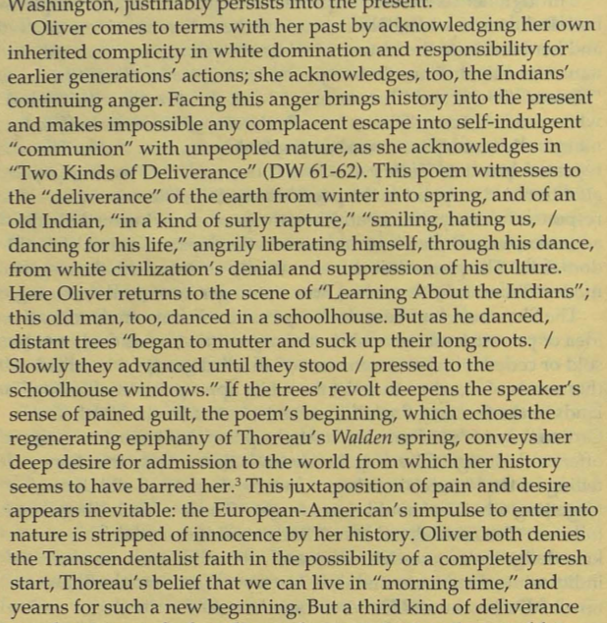
Heard woodpeckers and black-capped chickadees and—I almost forgot, geese, or was it a goose? Honking as they flew over the gorge. The geese have returned for spring! This reminded me of an MO poem I read yesterday titled “Two Kinds of Deliverance.” The geese are the first kind:

1.

Last night the geese came back,
slanting fast
from the blossom of the rising moon down
to the black pond. A muskrat
swimming in the twilight saw them and hurried

to the secret lodges to tell everyone
spring had come.

And so it had.
By morning when I went out
the last of the ice had disappeared, blackbirds
sang on the shores. Every year
the geese, returning,
do this, I don’t
know how.

2.

The curtains opened and there was 
an old man in a headdress of feathers,
leather leggings and a vest made
from the skin of some animal. He danced

in a kind of surly rapture, and the trees
in the fields far away
began to mutter and suck up their long roots.
Slowly they advanced until they stood
pressed to the schoolhouse windows.

3.

I don’t know
lots of things but I know this: next year
when spring
flows over the starting point I’ll think I’m going to
drown in the shimmering miles of it and then
one or two birds will fly me over
the threshold.
                           As for the pain
of others, of course it tries to be
abstract, but then

there flares up out of a vanished wilderness, like fire, 
still blistering: the wrinkled face
of an old Chippewa
smiling, hating us, 
dancing for his life.

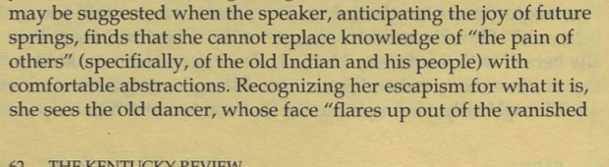
Reading through this a first time, I wasn’t quite sure what to make of her description of the “old Chippewa,” but then I googled it, and found a helpful article: The Native American Presence in Mary Oliver’s Poetry. Here’s what the author has to say about this poem:

This discussion of the third type of deliverance–the joy of future springs combined with memory of the pain of others–makes me think of another bit of a MO poem I just read. It’s from “One of Two Things” in Dream Work:

5.

One or two things are all you need
to travel over the blue pond, over the deep
roughage of the trees and the through the stiff
flowers of lightening—some deep
memory of pleasure, some cutting
knowledge of pain.

I often think about how the land I run on, when I’m running by the gorge, was once the sacred home of Dakota and Ojibwe people. But I don’t think about it enough, and I have barely started doing the important (ongoing) work of putting that pain (which is not in the past, but still present) beside my deep love for the gorge. Maybe MO’s poems can offer a way into this work?

april 5/WALK

After 5 days of running in a row, today a break. Amazing weather! STA and I took Delia on a long (3+ mile) walk. So calm and quiet and warm! We heard a bird that sounded like a robin to me–a tin-whistle type of call–but Scott said it had black feathers with white tips, which is not how a robin dresses. Spent some time trying to find what kind of bird it was, but couldn’t. Also saw some turkeys hiding in the tall grass between Becketwood and the lower campus of Minnehaha Academy. Ah, spring!

Continuing to read Mary Oliver’s Upstream. I read some of it several years ago, and it had a big impact on me, especially her line at the end of the first chapter, “Upstream”:

Attention is the beginning of devotion.

So much so, that I wrote a sonnet about it for a poetry and form class:

Attention/ Sara Lynne Puotinen

is the beginning of devotion
devotion the beginning of prayer
prayer undertaken while in motion
gliding in and through the outside air
air offered from trees entering lungs  
lungs releasing air and praying with feet
feet absorbing ground self coming undone
slowly shaking loose to a steady beat
beat river gorge rhythms almost in sync
sync stride breath oak wind sky path water time 
time slowing not stopping just on the brink
of not being noticed, closely aligned
with the sweat on the surface of my skin
see hear taste smell touch acts of attention

I didn’t make it much farther past that point in the book. Why not? I don’t think I was ready. Now, reading it again, I’m finding all sorts of wonderful inspiring exciting passages that I want to use, maybe in the same way that MO hears/reads some helpful words and “quickly slips the phrase from the air and puts it into [her] pocket.” This one is going straight into my pocket:

And there is the thing that one does, the needle one plies, the work, and within that work a chance to take thoughts that are hot and formless and to place them slowly and with meticulous effort into some shapely heat-retaining form, even as the gods, or nature, or the soundless wheels of time have made forms all across the soft, curved universe–that is to say, having chosen to claim my life, I have made for myself, out of work and love, a handsome life.

Upstream/ Mary Oliver

This quote seems like a great Walt Whitman-esque declaration: Having chosen to claim my life, I have made for myself, out of work and love, a handsome life. Yes! This claiming of a life and making out of it something wonderful–generous, beautiful, sturdy, useful–is a great way to describe what I’m trying to do over on my undisciplined site with my how to be project. Because I’m so young (only almost 47), I’d say I’m making not made this life.

Here’s my MO poem for April 5th:

Softest of Mornings from Long Life/ Mary Oliver

Softest of mornings, hello.
And what will you do today, I wonder,
to my heart?
And how much honey can the heart stand, I wonder,
before it must break?

This is trivial, or nothing: a snail
climbing a trellis of leaves
and the blue trumpets of flowers.

No doubt clocks are ticking loudly
all over the world.
I don’t hear them. The snail’s pale horns
extend and wave this way and that
as her fingers-body shuffles forward, leaving behind
the silvery path of her slime.

Oh, softest of mornings, how shall I break this?
How shall I move away from the snail, and the flowers?
How shall I go on, with my introspective and ambitious life?

I love the opening question; I think I might try asking it to the morning after I greet it on some spring and summer days: “Softest of mornings, hello./And what will you do today, I wonder,/to my heart?”

Reading about the snail in the second stanza immediately reminded me of the wonderful Ars Poetica by Aracelis Girmay:

May the poems be
the little snail’s trail.

Everywhere I go,
every inch: quiet record

of the foot’s silver prayer.
             I lived once.
             Thank you. 
             I was here.

I decided to look up “snail 19th century poetry” and found 2 more snail poems to ponder:

To a Snail/ Marianne Moore

If “compression is the first grace of style,”
you have it. Contractility is a virtue
as modesty is a virtue.
It is not the acquisition of any one thing
that is able to adorn,
or the incidental quality that occurs
as a concomitant of something well said,
that we value in style,
but the principle that is hid:
in the absence of feet, “a method of conclusions”;
“a knowledge of principles,”
in the curious phenomenon of your occipital horn.

Found this poem on the UK Guardian along with a helpful analysis (and I needed it!), including this fun bit about the ending:

The line ends with a colon, and the list begins with “the absence of feet”. Critics have read this as a witty allusion to free-verse structure. Such a reading may be complicated by the fact that the snail does, indeed, possess a single foot. This is a fundamental demonstration of compression!

I think Moore is saying that “in the absence of feet” there is “a method of conclusions” (walking a line?) and that “a knowledge of principles” is exhibited “in the curious phenomenon” of the snail’s “occipital horn”. Eye-tips on the ends of tentacles are as essential for stylish poets as for cannily evolved snails. The principles invoked are acuity of vision, keenness of all kinds of judgment.

This post also links to an interesting article about snails and the eyes on their tentacles. I’m trying to read it, but it makes my brain hurt–not the ideas but the size and compression of the font. Not very accessible.

This is a very different poem from Oliver’s. Was MO thinking about this poem at all when she mentions her small snail? I don’t know. I imagine she might have been thinking a little about this final poem, by the famous Japanese poet Issa:

O snail
Climb Mount Fuji,
but slowly, slowly

In addition to the snail, I’m thinking about the clocks and a passage I just read earlier today in Upstream about the ordinary world, the attentive, social self (as opposed to the child-self and the artist-self), and the clock!

The clock! That twelve-figured moon skull, that white spider belly! How serenely the hands move with their filigree pointers, and how steadily! Twelve hours, and twelve hours, and begin again! Eat, speak, sleep, cross a street, wash a dish! The clock is still ticking. All its vistas are just so broad–are regular. (Notice that word.) Every day, twelve little bins in which to order disorderly life, and even more disorderly thought. The town’s clock cries out, and the face on every wrist hums or shines; the world keeps pace with itself. Another day is passing, a regular and ordinary day. (Notice that word also.)

april 4/RUN

4.6 miles
franklin loop
64 degrees

Mostly ran, with a little bit of walking, the franklin loop with STA. Sunny and over-dressed in shorts and a long-sleeved shirt. Who cares when it feels this wonderful outside! Usually I lament the leaving of winter, but not this year. I’m ready for summer and vaccines and less time inside. We talked for almost the entire time, but I can’t remember what we discussed. Noticed the river, looking calm and blue, glittering in a few spots. No rowers today. Easter, I guess. Heard some pileated woodpeckers, black-capped chickadees, cardinals. Still no geese. Also heard one runner’s deep, booming voice cutting through everything else. So loud, creeping up behind us. We slowed way down, almost to a walk, so he could pass faster, but it still took forever. Someday I’ll be able to block out these irritations–or, will I?

Sitting on the deck an hour after the run, I thought about some differences between Mary Oliver and Emily Dickinson. Here’s one: MO focuses on the moment when we are able to find meaning or understanding or joy or delight or something worthwhile, despite the mess of the world. Yesterday I described it this way: “MO is interested in that moment, albeit fleeting, of clarity that opens you up, or opens to you, inviting you in.” So, MO wants to find a way in. Maybe Emily Dickinson does too, but, with her emphasis on Circumference–the edges, seams, periphery, the perimeter, she also urgently wants to find a way out, an exit.

Mary Oliver is a big fan of Walt Whitman (she has a brief essay in Upstream titled, “My Friend Walt Whitman”). Could this be point where her differences with ED are visible? Here’s what Joyce Carol Oates says about the differences between ED and WW in her introduction to Essential Emily Dickinson:

Between them, our great visionary poets of the American nineteenth centry, Emily Dickinson and Walt Whitman, have come to represent the extreme, idiosyncratic poles of the American psyche: the intensely inward, private, elliptical and “mystical (Dickinson); and the robustly outward-looking, public, rhapsodic and “mystical” (Whitman). One declared: “I’m Nobody! Who are you?” The other declared: “Walt Whitman, an American, one of the roughs, a kosmos…”

Here, ED’s understanding of in is being outside the world, and WW’s out is being fully inside it (at the center?). I think this in/out, private/public, introvert/extrovert is too reductive. Still, it is helpful as a way to start thinking about the differences. In her essay on her friend, Whitman, MO writes this about why she values him:

Whitman’s poems stood before me like a model of delivery when I began to write poems myself: I mean the oceanic power and rumble that travels through a Whitman poem–the incantatory syntax, the boldness affirmation. In those years, truth was elusive–as way my own faith that I could recognize and contain it. Whitman kept me from the swamps of a worse uncertainty, and I lived many hours within the lit circle of his certainty, and his bravado. “Unscrew the locks from the doors! Unscrew the doors themselves from their jambs!” And their was the passion which he invested in the poems. The metaphysical curiosity! The oracular tenderness with which he viewed the world–its roughness, its differences, the stars, the spider–nothing was outside the range of his interest. I reveled in the specificity of his words. And his faith–that kept my spirit buoyant surely, though his faith was without a name that I ever heard of. “Do you guess I have some intricate purpose? Well I have…for the April rain has, and the mica on the side of a rock has.”

Upstream/ Mary Oliver

Such bold, confident, excessive declarations! I wonder if Susan Howe has anything to say about this in My Emily Dickinson when she writes about ED’s new grammar grounded in humility and hesitation? Lots to digest here. Now I want to read more about ED’s faith and her understanding of Circumference and how it’s positioned in relation to inside and outside.

Here are 2 MO poems, originally from Swan, that I found in Devotions:

I Worried/ Mary Oliver

I worried a lot. Will the garden grow, will the rivers
flow in the right direction, will the earth turn
as it was taught, and if not how shall
I correct it?

Was I right, was I wrong, will I be forgiven,
can I do better?

Will I ever be able to sing, even the sparrows
can do it and I am, well,
hopeless.

Is my eyesight fading or am I just imagining it,
am I going to get rheumatism,
lockjaw, dementia?

Finally I saw that worrying had come to nothing.
And gave it up. And took my old body
and went out into the morning,
and sang.

Don’t Hesitate/ Mary Oliver

If you suddenly and unexpectedly feel joy,
don’t hesitate. Give in to it. There are plenty
of lives and whole towns destroyed or about
to be. We are not wise, and not very often
kind. And much can never be redeemed.
Still, life has some possibility left. Perhaps this
is its way of fighting back, that sometimes
something happens better than all the riches
or power in the world. It could be anything,
but very likely you notice it in the instant
when love begins. Anyway, that’s often the
case. Anyway, whatever it is, don’t be afraid
of its plenty. Joy is not made to be a crumb.

april 2/RUN

3.2 miles
neighborhood + Howe loop
42 degrees
wind: 15 mph with gusts 33 mph

The wind has returned, trying to slow me down for half of the run, speed me up for the other half. It didn’t bother me too much and, because of it, I got to hear lots of cool wind chimes. Ran on the sidewalk, the street, the trail, the grass. Past 2 elementary schools, one high school, a daycare at a church. Above the river, beside the boulevard, through the tunnel of trees. Saw the Daily Walker just leaving the trail, heading home. Thought about calling out, but decided that might be a little strange since I was behind him and not that close. I remember starting to think about my Emily Dickinson exercise for March. Did I come up with any ideas? I don’t think so. If I did, only the wind knows, I guess. Noticed the shadow of a bird moving very fast. Heard the “feebee” call of the black-capped chickadee. Don’t remember hearing any geese or pileated woodpeckers or cardinals or warblers or mourning doves. When I reached Howe school, I turned on a playlist for the last few minutes.

Gross runner moment: Watched as a drop of sweat below my nose suddenly flew off my face and far off into the air when the wind picked up. Even though I don’t have covid, I’m very glad no one was around. Gross and scary, witnessing how far sweat can fly.

It’s April 2nd, and I’m thinking about how to build off of my March with Emily Dickinson. Maybe focus on circumference? Not sure. After encountering this discussion of ED’s use of bees, and then randomly finding a bee poem by Mary Oliver, I’m thinking about bees. Yes, I like the idea of focusing on bees, flies, and beetles. I can think of many poems from ED, this one from Mary Oliver, at least one from Maggie Smith, and one about flies, When I come home they rush to me, the flies by Aracelis Girmay (and here).

Dickinson used the bee, a favorite symbol of Isaac Watts’s, as a defiant counter-emblem to his hymns. Her bees are irresponsible (138, 1343), enjoy la dolce vita (1627), and are pictured as seducers, traitors, buccaneers (81, 128, 134, 206, etc.).

Here’s the Mary Oliver bee poem I found:

hum/ mary oliver

What is this dark hum among the roses?
The bees have gone simple, sipping,
that’s all. What did you expect? Sophistication?
They’re small creatures and they are
filling their bodies with sweetness, how could they not
moan in happiness? The little
worker bee lives, I have read, about three weeks.
Is that long? Long enough, I suppose, to understand
that life is a blessing. I have found them-haven’t you?—
stopped in the very cups of the flowers, their wings
a little tattered-so much flying about, to the hive,
then out into the world, then back, and perhaps dancing,
should the task be to be a scout-sweet, dancing bee.
I think there isn’t anything in this world I don’t
admire. If there is, I don’t know what it is. I
haven’t met it yet. Nor expect to. The bee is small,
and since I wear glasses, so I can see the traffic and
read books, I have to
take them off and bend close to study and
understand what is happening. It’s not hard, it’s in fact
as instructive as anything I have ever studied. Plus, too,
it’s love almost too fierce to endure, the bee
nuzzling like that into the blouse
of the rose. And the fragrance, and the honey, and of course
the sun, the purely pure sun, shining, all the while, over
all of us.

I love the line: “the bees have gone simple, sipping.”

Mary Oliver has been criticized for being too simple or R/romantic, not poetic enough, too accessible. And, in the years before her death, she was often not taken seriously. I love Mary Oliver and when I read this poem I don’t think of it as an “easy” romantic poem just about how great bees are. This poem is the declaration of someone who has done and is still doing the very difficult work of learning how to notice and love the world–every bit of it, no matter how small or how broken (here I’m thinking of her line in “Invitation”–“believe us, they say,/ it is a serious thing/just to be alive/on this fresh morning/in this broken world”). She writes:

I think there isn’t anything in this world I don’t
admire. If there is, I don’t know what it is. I
haven’t met it yet. Nor expect to.

That’s impressive and something I aspire to. For several years now, I’ve been working to find delight in these small moments, to recognize them as enough, more than enough, to make life fulfilling, to ensure flourishing. I’m getting closer, but I’m not there yet. There are things I don’t admire and, too often lately, I’ve thought about them more than the things I do admire. Maybe I should spend a month with Mary Oliver instead of with insects? Or maybe I should save the insects for a month that’s filled with them–May or June? Yes, I have decided. April is for Mary (Oliver)! I think yesterday’s poetry sighting was the nudge I needed:

Seen in the neighborhood on a house that likes to put poetry on their front windows.

april 1/RUN

3.25 miles
turkey hollow
31 degrees

Much less wind today–5 mph instead of 12-15. So bright, cool, not too crowded. Encountered a few people on the trail but was able to keep at least 6 ft of distance. Is 6 ft still the recommended distance? I know it is probably very low risk to run past another person, only being close to them for a second, but I’m still uneasy when I encounter someone. During the run, I think it was near Becketwood, I imagined how relieved I’ll be when I finally get the vaccine. I will run on the trails with much less anxiety, still keeping a distance (I’ve always done that, even in the before times), but not worrying that every person I met is a loaded gun (loaded with a deadly virus). That day may be coming soon–vaccines are open to everyone as of March 30th. After I write the entry, I’m putting us on all the waiting lists.

Heard lots of birds as I ran, especially cardinals and black-capped chickadees. After reaching turkey hollow and heading up the hill on 47th, I was welcomed with a symphony of bird sounds. Not sure what all the chirps and trills and tweets were, but I loved having their motivating and distracting soundtrack as I climbed. Other things I remember hearing: the sharp, brittle crack of a branch as I ran on it, the shuffling of my feet on the gritty sand, and dog collars clanging below me on the Winchell trail and off to the right, in the grass between the river road and edmund.

I ran on the trail, above the oak savanna, the Winchell trail, and the river. It was sunny so the river was sparkling. Today I remember it looking brown. Is that right? Shouldn’t it be blue? Pretty sure I remember it as brown with a shimmer of light. Also noticed several of the benches, perched on the edge of the bluff, staring out through the bare branches to the other side. And, I took note of shadows, not mine, but the shadows of birds flying over my head. Quick flashes of dark moving past me. I can’t remember if they were big shadows or small shadows; they were just bird shadows.

I’m thinking of spending another month with Emily Dickinson, or at least partially with ED. I want to focus on the peripheral–peripheral vision, ED’s circumference, other ideas about slant/sideways/beside as they are used and expressed in poetry (and maybe lyric essays too?).

Here’s a poem not directly related to that topic, but that I found in The New Yorker and wanted to remember:

Privacy/ Ada Limón

On the black wet branches of the linden,
still clinging to umber leaves of late fall,
two crows land. They say, “Stop,” and still I want
to make them into something they are not.
Odin’s ravens, the bruja’s eyes. What news
are they bringing of our world to the world
of the gods? It can’t be good. More suffering
all around, more stinging nettles and toxic
blades shoved into the scarred parts of us,
the minor ones underneath the trees. Rain
comes while I’m still standing, a trickle of water
from whatever we believe is beyond the sky.
The crows seem enormous but only because
I am watching them too closely. They do not
care to be seen as symbols. A shake of a wing,
and both of them are gone. There was no message
given, no message I was asked to give, only
their great absence and my sad privacy
returning like the bracing, empty wind
on the black wet branches of the linden.

This reminds me of Ada Limón’s intereview on VS. podcast, where she talks about trying to let birds be birds, and that birds aren’t going to save her (or us) or serve as metaphors she thinks she needs. I love her use of the words still and stand/ing in proximity to each other. It reminds me of my favorite October poem (October/ May Swenson) when she writes: “Stand still, stare hard.” When Limón writes, “I’m still standing,” of course I first thought of Elton John’s song (ha ha), but then I read those words, maybe for the first time, not as “I’m continuing to stand” but as “I’m a still-stander or someone who is engaged in the practice of standing without moving, standing still.” Very cool. I like the idea of being a still-stander. Speaking of the word still, I like how she uses it three times. I imagine it as a hidden message: be still, as in calm, quiet, not expecting or worrying about anything, just being where you are, not moving or doing.

march 31/RUN

2.1 miles
neighborhood
33 degrees
wind: 13 mph with gusts, 21 mph

Quick run in the wind and the cold after returning home. A visit with 2 fully vaccinated grandparents! Hopefully soon, we will be too. First time away from Minneapolis since October. Not too far into my run, I heard a pileated woodpecker. Not drumming, but singing. Also heard a black-capped chickadee and their fee-bee song. Can’t remember any other bird calls. Guess the wind was singing louder. Speaking of the wind, heard lots of wind chimes, especially at the house at the corner of 43rd and 32nd. Such a cacophony! Ran down towards the river but stayed on edmund. When I crested the hill, I glanced down but couldn’t see any sparkling river through the trees.

note for me to remember: On the 29th, I memorized ED’s “I felt a cleaving in my Mind–.” That night, I got a headache that came in waves, not feeling like my brain had split but like I wished it would, so I could take the top of it off to relieve the pain and pressure. Ugh! I am a wimp with headaches because I rarely get them. And because I rarely get them, they make me worry more: I never get headaches? Why now? What’s the cause? Is this the start of something worse? I’ve had a few more since then, not quite as bad. I think (am hoping) that they’re caffeine headaches. The grandparents make much weaker coffee (1 scoop of coffee for 6 cups of water), while I make really strong coffee (I scoop of coffee for 1 cup of water).

Here are the final 2 poems in my March with Emily Dickinson. They’re connected to “I felt a cleaving in my Mind–” with the ball and the seam, which speak to ED’s interest in circumference.

I felt a Cleaving in my Mind–
As if my Brain had split–
I tried to match it–Seam for Seam–
But could not make them fit.

The thought behind I strove to bind
Unto the thought before–
But Sequence ravelled out of Sound–
Like Balls upon a floor.

Emily Dickinson Poems: March 30th and 31st

I saw no Way — The Heavens were stitched — (1863)

I saw no Way — The Heavens were stitched —
I felt the Columns close —
The Earth reversed her Hemispheres —
I touched the Universe —

And back it slid — and I alone —
A Speck upon a Ball —
Went out upon Circumference —
Beyond the Dip of Bell —

As I just discovered, the Balls in “I felt a Cleaving in my Mind–” could be balls of yarn. The ball in this poem is the Earth. Another connection: instead of seams, we have stitches. ED likes the word and idea of Circumference. Lots of entries in the Emily Dickinson lexicon, which is a super handy resource: periphery, circuit, edge, skull, perspective, view, vista.

I might have a lot of fun with this idea of circumference, especially in relation to a new vision project I’d like to start: on peripheral vision. Very cool.

I found another version of this poem on the amazing blog project, White Heat. It’s in their week of posts about Circumference. It follows ED’s original manuscript and its line breaks.

I saw no Way – The
Heavens were stitched – 
I felt the Columns close – 
The Earth reversed her
Hemispheres – 
I touched the Universe – 

And back it slid —
And I alone —
A Speck opon a Ball
Went out opon Cirum —
ference —
Beyond the Dip of Bell.

Without this — there is nought — (1862)

Without this — there is nought —
All other Riches be
As is the Twitter of a Bird —
Heard opposite the Sea —

I could not care — to gain
A lesser than the Whole —
For did not this include themself —
As Seams — include the Ball?

I wished a way might be
My Heart to subdivide —
‘Twould magnify — the Gratitude —
And not reduce — the Gold —

Here’s something interesting PB has to say about this poem and curcumference and seams and balls:

The second stanza advances our understanding a little, for we learn that the poet wants the “Whole” rather than some lesser quantity or quality that would be subsumed by the whole. Dickinson uses a ball as an example. Made by stitching leather or fabric together, the ball might be considered interior to the seams encompassing it. I am reminded of Dickinson’s poetic project of circumference. She announces this project in a letter to her chosen “Preceptor”, T.W.Higginson:

“Perhaps you smile at me. I could not stop for that – My Business is Circumference –…” (L268, July 1862).

In a later poem she calls “Circumference” the “Bride of Awe.” At least part of Dickinson’s poetic quest is to trace the seams, to see the whole.

the Prowling Bee

Here’s a source I’d like to track down and read about ED and circumference in “I Saw no way — The Heavens were Stitched–“:

Gribbin, Laura. “Emily Dickinson’s Circumference: Figuring a Blind Spot in the Romantic Tradition.” The Emily Dickinson Journal 2. 1 (Spring 1993): 1-21; 3-4.

March 29/RUN

2.65 miles
austin, mn
56 degrees
wind: 24 mph, 35 (gusts)

In Austin (mn) for the kids’ birthday—RJP is 15, FWA is 18! Ran with Scott through the neighborhood. So windy and warm. For the first mile, my legs felt like inflexible stumps. They didn’t hurt, just seemed stiff. Scott agreed. I wonder, is the pavement harder here in Austin? Do they use a different material than in Minneapolis? We talked as we ran but I can’t remember the conversation. Maybe something about the start of the Chauvin trial? I can’t wait until it’s over; I hope it ends with justice.

Nearing the end of my Emily Dickinson month. I am deeply grateful that I decided, almost on a whim, to spend a month with her words and her life. Today’s poem comes from “the Essential Emily Dickinson,” selected and with an introduction by Joyce Carol Oates:

I felt a Cleaving in my Mind—/ Emily Dickinson

I felt a Cleaving in my Mind—
As if my Brain had Split—
I tried to match it—Seam by Seam—
But could not make them fit.

The thought behind I strove to bind
Unto the thought before—
But Sequence ravelled out of Reach
Like Balls—upon a Floor.

Wow, this poem. Her descriptions of coming undone, physically and mentally, are incredibly powerful. I want to memorize this one.

note from march 31st: I found a brief analysis of this poem and they suggested that the balls in the last line are balls of yarn. Very helpful. Why didn’t I think of that? Not sure, but it totally works with the ravelled of the previous line. Ravelled can mean frayed or unraveled or pulled apart/undone.

march 24/RUN

2.7 miles
43rd ave, north/32nd st, east/edmund, south/river road trail, south/edmund, north
41 degrees
light rain

Sometimes dripping, sometimes drizzly, always windy. The rain wasn’t supposed to stop until 3 or 4, but when it looked like it was letting up a little, I decided to go for a run. A few other walkers, one runner with 2 dogs. Spent a lot of time dodging puddles on the sidewalk. Success. No wet socks. Ran through the tunnel of trees and, unlike yesterday when I felt as if I was buried in brown, today I noticed a slender slash of blue river. Why didn’t I see it yesterday? Must have been the light and the color of the river. Both yesterday and today I ran through the Welcoming Oaks; yesterday I remembered to greet them, today I forgot. I stopped at the split rail fence above the ravine and listened to the water rushing down the limestone and concrete ledges. I glanced down at the oak savanna as I ran above it, noticing the muddy trail at the bottom. Was planning to pay attention to one of my favorite spots, where the mesa slopes down to meet the Winchell trail and the river is revealed, but I was distracted by an approaching pedestrian. Stopped at the bench near Folwell–the one on the rutted dirt path that links two parts of the Winchell trail and that I wrote about in a haibun that didn’t make it into my Mississippi Gorge haibuns–and stared at the river, framed by a few bare branches. Crossed over the river road and the grassy boulevard and headed home, north on Edmund, running straight into the wind. As I neared the parking lot by the oak savanna, I saw some lights that looked like they were coming from somewhere on the bluff. I recalled how the road curves here, around a ravine, and that those lights were the headlights of cars on the river road. A strange, delightful sight.

I chanted a bit from the Emily Dickinson poem I’m reading today, ‘Tis so much joy! ‘Tis so much joy!:

Life is but Life! And Death, but Death!
Bliss is, but Bliss, and Breath but Breath!

‘Tis so much joy! ‘Tis so much joy!/ Emily Dickinson

‘Tis so much joy! ‘Tis so much joy!
If I should fail, what poverty!
And yet, as poor as I,
Have ventured all upon a throw!
Have gained! Yes! Hesitated so –
This side the Victory!

Life is but Life! And Death, but Death!
Bliss is, but Bliss, and Breath but Breath!
And if indeed I fail,
At least, to know the worst, is sweet!
Defeat means nothing but Defeat,
No drearier, can befall!

And if I gain! Oh Gun at Sea!
Oh Bells, that in the steeples be!
At first, repeat it slow!
For Heaven is a different thing,
Conjectured, and waked sudden in –
And might extinguish me!

I like the Prowling Bee’s introduction to her analysis of this poem:

Something big has happened and the reader is not given much of a clue as to the nature of the big thing. The poet has gambled everything – “ventured all upon a throw!” – and is in a state of ecstatic waiting. There are sixteen exclamation marks in eighteen lines and that is a lot of excitement.

Yes, that is a lot of excitement. For the rest of her analysis, the Prowling Bee (PB) speculates on what ED has done to cause such excitement. PB decides it has to do with love and cites the 3 mysterious letters ED wrote to “Master.” These letters come up in the book I’m listening to right now, Lives like Loaded Guns, and more obliquely in the show, Dickinson (I’m not sure because I haven’t watched these episodes yet, but I think that the show is suggesting that the newspaper editor Samuel Bowles is “Master”–will these letters be cited in any of the episodes? I’ll have to keep watching to find out.). Googling it, I found this great article from The Rumpus:

There is no evidence that the letters—written between 1858 and 1862 and discovered shortly after Dickinson’s death in 1886—were ever sent, although they may have been drafts of versions that were posted. No one knows to whom they were intended. Perhaps the Reverend Charles Wadsworth (they had a correspondence, none of which survives), or Samuel Bowles, the editor of a newspaper in Springfield and a family friend, or a professor named William Smith Clarke. Or perhaps they are not to a person at all, but to God. Or the Devil. For nearly twenty years I’ve taught Dickinson and the Master Letters in my early American literature course, always hoping to come closer to the source of the mystery. Instead, just the opposite has happened. The mystery has deepened. The more I study them, the more we hash them out in class, the longer the shadows grow and deepen over their meaning.

The Dark Mystery of Emily Dickinson’s “Master” Letters

I like that scholars, even after decades of scrutiny, can’t quite figure ED out. Nice work ED! While I can appreciate being curious about this “dark mystery,” right now I don’t really care what she’s talking about here. I like the little chant about life and death, bliss and breath, and I might try to lean on it when I’m struggling during a run, or attempting to block out worrisome thoughts so I can fall asleep, or feeling panic over yet another sinus infection.

march 23/RUN

3.2 miles
edmund loop, heading north
45 degrees

Both of my knees were feeling strange yesterday, not quite like the kneecap was slipping out but unstable and sore, so I didn’t run. I biked and watched another episode of Dickinson instead. Today, even though it was drizzling when I started, I ran. I started in the neighborhood but when I reached Edmund, about a mile in, I decided to cross over to the river. I was able to run on my favorite part, through the tunnel of trees, just above the floodplain forest. Wow! It was all a rich brown: bare branches and bare earth, hardly any sky, no river. In a few months, this same spot will be nothing but green. Both ways, it’s disorienting: now, with the brown, it almost feels like you’re buried in the earth; later, in the green, like you’re underwater in a green sea. I think I heard some birds, mostly cardinals. What I remember hearing most was the light rain hitting the brim of my baseball cap. For the last mile, I listened to my playlist.

Some keep the Sabbath going to Church – (236)/ EMILY DICKINSON

Some keep the Sabbath going to Church –
I keep it, staying at Home –
With a Bobolink for a Chorister –
And an Orchard, for a Dome –

Some keep the Sabbath in Surplice –
I, just wear my Wings –
And instead of tolling the Bell, for Church,
Our little Sexton – sings.

God preaches, a noted Clergyman –
And the sermon is never long,
So instead of getting to Heaven, at last –
I’m going, all along.

I appreciate ED’s connection between the sacred and nature here. My first chapbook was all about the sacred rituals of being upright and outside by the Mississippi River Gorge. (I’m not alone; many runners refer to their long runs on Sundays as the “church of the long run”). My exploration of this theme was as a non-church going ex-religion major with a master’s in theological ethics who finds tremendous value in the sacred, but not in organized religion and church services.

Right now, I just finished listening to a section in the ED biography, Lives as Loaded Guns, about the religious revival in Amherst in the mid 1800s and the pressure ED experienced to publicly declare her faith in Christ and become a full member of her church. She refused, even as all of her family and friends professed their faith. According to the author, Lyndall Gordon, ED’s friends, including Jane Humphrey (who plays a prominent, if slightly different, role in the show Dickinson), are enlisted as spies to “report back” on what ED was thinking and doing and to try to persuade her to change her mind. I thought of this religious revival in the town and what an impact it had on Amherst as I watched an episode of Dickinson today and noticed that there were a surprisingly large number of ministers at the party/salon everyone (or, anyone who is anyone) was attending at Sue and Austin’s house. Several of these clergy were the dates/suitors of the popular girls. I’m fascinated and delighted by how the show brings in details like this without explicitly addressing them.

ED’s faith and her expressions/practices of and struggles with it are more complicated than this charming poem might suggest. I think I should read one of the classic biographies on ED, Roger Lundin’s Emily Dickinson and the Art of Belief.

Speaking of ED’s complicated relationship to religion and God and the church, I’ve been thinking about her poetic form and how she often used hymn form. Here’s some information from Common Questions on Emily Dickinson:

What kind of meter did Dickinson write in, and why did she use it?

  • Common Meter or Hymn Meter
  1. Definition: A closed poetic quatrain, rhyming A B A B, in which iambic tetrameter alternate with iambic trimeter. Common meter is distinguished from ballad meter by its rhyme scheme: the rhyme scheme of ballad meter is X A X A.
  2. Derivation: This meter derives from English hymnology and uses predominantly iambic or trochaic feet (sometimes dactylic).
  3. Types
  • Common meter: alternately 8 and 6 syllables to the line: 8/6/8/6
  • Long meter: 8 syllables to the line 8/8/8/8 (this tends to get monotonous)
  • Short meter: two lines of 6 syllables, followed by one of 8, then one of 6: 6/6/8/6
  • Sevens and sixes: 7/6/7/6
  • Common particular meter: 8/8/6/8/8/6
  • Short particular meter: 6/6/8/6/6/8

Source: Isaac Watts’s Christian Psalmody, or, The Psalms. Watts always names the meter, and introductions set forth what effects may be achieved by each type.

Dickinson’s Use of Hymns

  1. According to Martha England, her hymns differed from Watts’s in these ways:
  • greater use of enjambment
  • greater metrical freedom
  • use of more images with no scriptural source
  1. Dickinson used the bee, a favorite symbol of Watts’s, as a defiant counter-emblem to his hymns. Her bees are irresponsible (138, 1343), enjoy la dolce vita (1627), and are pictured as seducers, traitors, buccaneers (81, 128, 134, 206, etc.).
  2. Every poem composed before 1861 is fashioned in one of the hymn meters above.
  • Largest proportion in common meter.
  • Second largest proportion in common particular meter.

Note: If I’m counting and reciting correctly, this poem doesn’t fit the hymn form. Is that because it’s from 1861 and not before? I always need help hearing the meter in poetry. Here’s another source I might want to check out: Listening to Dickinson

bobolinks and surplices

Bobolinks are small songbirds with large, somewhat flat heads, short necks, and short tails. They are related to blackbirds and orioles, and they have a similar shaped, sharply pointed bill.

All About Birds

They are present in Minnesota but have been in serious decline for some time now. Why? Loss of habitat, pesticides on food supply suppressing appetite and causing them to not eat enough, and too many people and buildings to run into. After listening to the call and the song, I’m not sure if I heard one before. I’d probably remember because they kind of sound like R2D2. They like hanging out in grasslands, meadows, and prairies, and traveling in big flocks.

A surplice is “a loose white linen vestment varying from hip-length to calf-length, worn over a cassock by clergy, acolytes, and choristers at Christian church services.” As a Lutheran pastor, did my dad wear this? Not quite, I think. Maybe I’m just confused by how he would always wear a stole too? I’ve seen lots of these surplices on the British murder mystery shows I watch.

Here’s another, non-ED poem that I discovered yesterday. I love Maggie Smith and I love this poem, especially how she plays with and challenges the importance of naming and classifying things.

Goldenrod/ Maggie Smith

I’m no botanist. If you’re the color of sulfur
and growing at the roadside, you’re goldenrod.

You don’t care what I call you, whatever
you were born as. You don’t know your own name.

But driving near Peoria, the sky pink-orange,
the sun bobbing at the horizon, I see everything

is what it is, exactly, in spite of the words I use:
black cows, barns falling in on themselves, you.

Dear flowers born with a highway view,
forgive me if I’ve mistaken you. Goldenrod,

whatever your name is, you are with your own kind.
Look–the meadow is a mirror, full of you,

your reflection repeating. Whatever you are,
I see you, wild yellow, and I would let you name me.

a moment of sound

So many birds! Spring is here!

march 22, 2021

march 21/RUN

4.7 miles
franklin loop
43 degrees

Scott and I ran the franklin loop this morning. First, we talked about The Dukes of Hazard and how Uncle Jessie was related to Beau and Luke, if at all, and how Daisy fit into it (Scott brought it up). Then we talked about realism and truth and postmodernism and academic street fights and the scientific method (my topic). A lot of fun. Not sure how much I remember about the run. Sometimes it’s nice to be completely distracted. I remember noticing the big lion sculptures on the front stoop of a big house by the river. A few trees leaning towards the road. The boat dock over at the rowing club. The row of gloves and one hat perched on the fence posts at the Town and Country club. Running through a lot of sandy grit and potholes on the edge of the river road. Smelling cigarette smoke. Feeling warm and overdressed. Hearing the bells at St. Thomas.

There is no Frigate like a Book (1286)/ EMILY DICKINSON

There is no Frigate like a Book
To take us Lands away
Nor any Coursers like a Page
Of prancing Poetry –
This Traverse may the poorest take
Without oppress of Toll –
How frugal is the Chariot
That bears the Human Soul –

I think this would be a fun poem to memorize and always have at the ready when thinking about why I love reading. I remember when I first encountered the word frigate. It was from one of my son’s friends. I think they were both 11 or 12 at the time. They mentioned how fascinated they were by old warships, including frigates. Then they gave me a lecture on the different types of frigates. Strange.

So, reading this, I knew frigate, but I was unfamiliar with courser. According to the OED, it’s a swift horse. Something interesting: a frigate is “a light and swift vessel, originally built for rowing, afterwards for sailing,” which is what I think ED intends here, but it is also a war vessel, which is what FWA’s friend meant. A courser is a swift racing horse, but it is also “a powerful horse, ridden in battle.” Was ED thinking at all about the frigate or courser as images of war? That wouldn’t seem to fit with the overall meaning of the poem, but I just found it interesting that both of these figures have that double meaning. Oh–and the chariot too–that’s a “vehicle used in ancient warfare.”

I agree with ED’s sentiment here: reading is wonderful in its ability to transport us to other worlds, to learn about other places and people, to be moved by others’ stories. Reading does has its limits too, however. Yesterday morning I read a twitter thread about the problems with suggesting that white supremacy can be solved by just reading more widely about non-white experiences, that is, through reading, we can gain empathy and understanding, or reading = empathy = no more racism. As Lisa Ko (the thread starter) suggests, empathy is not enough to counter or correct state violence. I’m not bringing this up to challenge ED’s championing of reading and books; I just wanted to place another idea about reading beside it.

Speaking of reading, I just started Braiding Sweetgrass. Wow! Love it. Only a few pages in, and I already found this great bit about the Original Instructions:

These are not “instructions” like commandments, though, or rules; rather, they are like a compass: they provide an orientation but not a map. The work of living is creating that map for yourself.

march 19/RUN

3.3 miles
edmund loop, starting north
42 degrees

Feeling more and more like spring. All the snow is gone, the sun is warm, the birds are singing even louder and longer. What I remember most about my run are the black-capped chickadees and their “fee-bee” song. Running on Edmund, between 32nd and 34th, I heard at least 2 of them calling out, not in a call and response, with one singing 2 ascending notes, the other 2 descending ones, but with both of them ascending, calling out to some other bird that wasn’t responding. Sometimes they were in sync, but sometimes they weren’t–a strange cacophony of fees and bees. About a mile later, I heard another chickadee calling out. No response.

When I reached 42nd st, I turned on my spotify playlist–“Ain’t Nobody,” “I feel for you,” and “Leave the Door Open”–and ran on the grass. It was tricky avoiding holes and not sinking into the soft, mushy grass. I love Bruno Mars and Anderson .Paak’s “Leave the Door Open”–how it sounds, their voices, the playful lyrics, the message of consent and hope, the invitation to be open. Wonderful.

Oh–I can’t believe I almost forgot–the river! Just past the top of the hill on Edmund between 33rd and 34th, you can glimpse the river through the trees. Today it was on fire, glowing with a bright white light. Wow. Definitely dazzling. Seeing this bright light, I thought about the Emily Dickinson poem I’m studying and that I memorized before running: “We grow accustomed to the Dark.” The poem is about how we adjust to the dark when “light is put away,” both literally and metaphorically. For many, I’m sure, this poem suggests that the loss of light and the coming of the darkness is always unwelcome and tragic. But not necessarily for ED, and not for me. I had to stop at the top of the hill and record a thought into my phone: “sometimes the problem with light is not its loss, but its abundance.” Too much light is too dazzling, making it too difficult to see or understand what you’re seeing. I have difficulty when there’s a lack of light, but often just as much when there’s too much light. So, sometimes a lack of light is welcome, wanted, offering some rest for tired and overwhelmed eyes.

We grow accustomed to the Dark

After spending so much time yesterday reading other people’s words about ED’s “We grow accustomed to the dark,” I decided I wanted to spend some time today with her words. I started by memorizing the poem. Memorizing a poem always helps me to listen better to the words. Now (I started this section before I ran and am continuing it after I’m done), I’m typing up each stanza (from memory) and typing up my thoughts, most of which don’t offer insight but a way for me to work through my efforts to understand her words. I’m noticing how this effort sometimes involves forcing myself to move past what I think the words should mean or how they should sound and listen to what she is actually writing and doing with her words.

We grow accustomed to the Dark –
When light is put away –
As when the Neighbor holds the Lamp –
To witness her Goodbye.

I like the word accustomed. From the OED:

  • Verb: “To make (a person or thing) familiar with or used to something; to familiarize, habituate.”
    Adjective: “In the habit of doing something; used to something.”

Yes! This reminds me of one of my preferred understandings of knowing–to become acquainted with. Not to Know or even to fully understand, but to adjust to, get used to. I like the connecting of this with habit and habitual practice.

I also like how she describes this: “When Light is put away.” Who is putting the light away? I don’t think she means God here. I like thinking about something/someone putting it away–a much different feel than if she had written: “when light has gone away.”

added later: Could she mean that she, ED, puts the light away? The Prowling Bee thinks so. Analyzing the stanza about the larger Darkness, she writes:

 That unknown mental and spiritual domain is a “larger – Darkness.” That is where our great poets and philosophical explorers venture while the rest of us pursue our hobbies or just relax. Dickinson spends time in this darkness and most of her most evocative, ambiguous, and challenging poetry comes from there.

the Prowling Bee

I keep wanting to make the final line, “To witness our Goodbye” instead of her goodbye, but I finally get that the Lamp is witnessing her goodbye to us, as we leave.

I love the idea of the Lamp/Light witnessing the Goodbye. A great image. And interesting to think about how in the second line the light is leaving us, but in the 4th line, we are leaving the light. Is that intended as an echo of the final stanza of the poem–either the darkness alters or something in the sight adjusts itself to midnight? Who is acting and who is acted upon? Yes (returning to this analysis later, after publishing this post), the idea of both the light leaving us and us leaving the light fits with my mention of the prowling bee and the idea of ED choosing to leave light and enter the darkness in order to explore deeper, more troubling, difficult and unknown ideas and themes.

A Moment – We uncertain step
For newness of the night –
Then – fit our Vision to the Dark –
And meet to Road – erect –

The idea of a moment is great–a moment of panic and uncertainty before we’re able to see. As my central vision declines, I have a lot more of these moments: when I enter an unfamiliar building (or sometimes even a familiar one) and not much makes sense. I can’t read the signs or tell where to go. Or when I’m looking at an object but I can’t tell what it is–is it a dead squirrel or a clump of leaves or furry mittens? Most of the time, my brain eventually adjusts and I can see what I’m trying to look at and continue on with more certainty. I’m trying to work on not fearing that uncertain step, letting the moment just be a moment that I will move past, knowing that I will adjust or figure it out (or ask someone for help). And it’s working. I am getting better.

I find “We uncertain step” to be awkward, but I like how its awkwardness seems to effectively create uncertainty and discomfort in the reader–at least this reader, me.

Love the alliteration of newness of night and her descriptions of adjusting as fitting our Vision to the Dark and becoming more certain as meeting the road erect.

As I work through this poem, I’m realizing something (or, being reminded of something I know, but keep forgetting or straying from): It is very interesting to learn about ED’s life and the historical context of her work, and it’s helpful to see patterns and themes across the poems. Yet, what matters most to me are the actual poems and how effectively her words describe vision loss and resonate with my own experiences of it. Her words are opening a door, offering a way into understanding (and expressing that understanding) how vision loss and living with less vision feels.

And so of larger – Darkness –
Those Evenings of the Brain –
When not a Moon disclose a sign –
Or Star – come out – within –

I like how she shifts to a metaphorical understanding of Darkness and then describes it as “those Evenings of the Brain.” I’m imagining she could mean depression (possibly hers, some suggest there’s evidence she was mildly bipolar or her mother’s) or hopelessness or sadness or turmoil or illness or uncertain/lack of understanding. She might even mean those times when she could not write, which fits well with the next lines about no signs being disclosed or stars coming out. And returning to the comments I’m just adding, this also means those darker, deeper, uncomfortable, troubling ideas/thoughts/themes that writers are willing to explore.

one more thing to add: I’m thinking about how most of my academic work and a big part of my current ethical project involves bewilderment and trouble and uncertainty and the value of dwelling in these uncomfortable spaces for us and learning how to be/to flourish. Because I’ve spent so much time thinking about these things, maybe it’s helped me to navigate my vision loss more effectively?

When I was reciting this poem from memory, I kept forgetting disclose. All I could think of was “display.” I knew it was wrong, but I just couldn’t remember disclose. Is it because “not a Moon disclose a sign” sounds awkward–“not a Moon disclosed a sign” sounds better to my ear, even if that changes the tense. Anyway, disclose is a much stronger, more precise, verb than display, so I’m hoping I can remember it now.

The bravest – grope a little –
And sometimes hit a Tree
Directly in the Forehead –
But as they learn to see –

I like grope even as I don’t. It fits well with the idea of struggling to find meaning in the dark, but it also conjures up creepy guys and their grabby hands.

Sometimes, when I’m running, I hit a tree. Not directly in my forehead, but with my elbow or hip. I like the funny image of people literally running into trees, especially hitting them directly in the Forehead, and I also like the metaphorical meaning of being stunned as they struggle to make sense of/adjust to (overcome?) the darkness.

I don’t like poems that try too hard to rhyme (which this doesn’t), and I like when lines rhyme or echo (which this does). Tree and see work well; it’s pleasing to the ear and helps keep the large idea/image of adjusting to darkness moving forward.

Either the Darkness alters –
Or something in the sight
Adjusts itself to Midnight –
And Life steps almost straight.

It often feels, when you can finally make out shapes in a dark room, that the darkness has changed, become less dim, but it’s really your vision adjusting, with the help of your rod photoreceptor cells, your pupils widening to take in more light, and your brain, to that darkness.

Love this ending line about life stepping almost straight, especially the almost part.

Whew. I’m ready for a break now. What a joy to spend so much time with ED’s words! Yesterday, I felt frustrated, reading so much about the poem (when it was written, what it was in response to, how it fit into a larger understanding of ED as a poet) without actually reading the poem or thinking about the meaning of the poem.

a moment of sound

Sat on the deck with my daughter and Delia the dog, soaking in the warm sun. Very quiet. I can hear my daughter briefly sniffing like a dog and some kid at the end of the street calling out and a crow. Of course, after I turned off the recording, a cardinal started trilling–at least 10 times–repeatedly.

march 19, 2021

march 18/RUN

5k
turkey hollow
38 degrees

Almost all of the snow is gone. A few small mounds scattered across the grass, none on the sidewalk or the street. Spring snows are never that bad; you always know it will melt quickly. Overdressed today. I stopped near turkey hollow and awkwardly took off my pink jacket and tried to figure out the best way to wrap it around my waist–under or outside of my vest? Tried both. Inside was best. As always, heard lots of birds. Also, a few conversations–not the words, but the sound of people talking. The best part of the run was the river glittering in the sun. Big and bold flashes of light, blindingly bright, almost throbbing or pulsing, not the short sparkles that dance and flicker. Was this pulsing the result of more intense light or the wind? Probably the wind, even though I didn’t notice it that much, but felt the hot sun all the time. Normally this intense light would be too much for my eyes, but today I enjoyed it. As I headed back north during my last mile, I ran on the grassy boulevard. A little muddy, soft, rutted. Harder to move. My legs felt heavy and stuck.

Getting close to 3 weeks into my Emily Dickinson March project and I’m enjoying all that I’m learning about her and her work. At first, I only spent a few minutes reading and rereading the poem for the day, but slowly I’ve been spending more time with her words and words about her work. I want to make sure that most of my time is with her words, but it’s helpful to learn how other people understand her. I seem to struggle with understanding and interpreting imagery and metaphors and I can use the help. Will it ever get easier? Maybe. Today’s poem got me thinking about a lot of things:

We grow accustomed to the Dark –/ Emily Dickinson

We grow accustomed to the Dark –
When light is put away –
As when the Neighbor holds the Lamp
To witness her Goodbye –

A Moment – We uncertain step
For newness of the night –
Then – fit our Vision to the Dark –
And meet the Road – erect –

And so of larger – Darkness –
Those Evenings of the Brain –
When not a Moon disclose a sign –
Or Star – come out – within –

The Bravest – grope a little –
And sometimes hit a Tree
Directly in the Forehead –
But as they learn to see –

Either the Darkness alters –
Or something in the sight
Adjusts itself to Midnight –
And Life steps almost straight.

I can’t help but read this in poem in relation to ED’s vision loss, and my own. The idea of growing accustomed to a loss of light, or a loss of sight, and then figuring out how to see/live again but differently, where “Life steps almost straight,” but not quite–slant for ED, sideways for me.

note: I’ve spent a lot of time thinking about this poem today, and I’m a bit stuck. Too much to say. In the process of struggling to find words and formulate ideas, I found this excellent site and post about ED’s temporary vision loss in 1862. Very cool:

may 28-june 3, 1862: Poems on Illness

In this post about illness and her sudden and temporary vision loss, they group and discuss the following poems:

  • My first well day since many ill
  • Before I got my eye put out
  • The Soul has Bandaged moments
  • The first day’s night had come
  • We grow accustomed to the dark
  • Renunciation is a piercing virtue

I want to return to their analysis and think more about ED and vision loss.

One more thing I found as I thought about ED and her complicated take on light and darkness–sometimes she praises/loves light, sometimes it’s dangerous and oppressive: Lunacy of Light: Emily Dickinson and the Experience of Metaphor

Barker argues that since light was a masculine tradition, it had come to represent male power, energy, sexuality–not only to Dickinson but to other women writing during the era. To these writers the inversion of the light/darkness metaphor became a countertradition used as a means to express their energies in a society that was hostile to their intelligence. Dickinson, who read avidly, could not have been insensitive to this usage of light as a masculine symbol of her Calvinist God, of her father, of all that was male?and of darkness as a feminine symbol….

Emily Dickinson thought in a richly symbolic manner. Her most frequently used metaphor is one of light in contrast to darkness, employing single-word references to light more than one thousand times in her 1,775 poems.

Wendy Barker’s Lunacy of Light: Emily Dickinson and the Experience of Metaphor

Here’s a wonderful animated reading of the poem:

Via Brain Pickings

a moment of sound

Sitting on my deck, enjoying the warm sun, I heard the bells chiming from across the river in St. Paul at St. Thomas University. I looked at my watch and it was only 10:59. They were a minute early.

march 18, 2021

march 17/RUN

3.4 miles
43rd ave, north/31st st, east/edmund, south/42nd st, east/river road trail, north
34 degrees

Woke up to several inches of snow on Tuesday. Decided to skip the running and shovel and bike instead. Woke up again this morning to another dusting but noticed the sidewalks and roads were bare so I went for a run. What a run! Not too cold, but not too warm. Not much wind. Not too bright. No one else out. Did I see any other runners or walkers? Only one or two. I wasn’t planning to run on the river road trail but I remembered that a few days ago I had wondered what the river would look like after the snow, and when I saw that no one was on the trail, I decided to check it out. When I reached the river, I stopped to record my moment of sound. I stood closer to the river and admired the grayish-blue water with the white banks.

march 17, 2021

Listen to those birds! I also like the sound of the cars as they rush by–you can hear the water on the wheels, everything damp, slick.

Before heading north for the last mile, I put in a Spotify playlist and listened to 2 songs I recently added, both by Chaka Khan: “Ain’t Nobody” and “I Feel for You” Yes! So much fun to run right above the river with no one else there to avoid, just me and Chaka Khan and Melle Mel (he raps at the beginning and end of the song–I had to look that up.) Discovered that he was part of Grandmaster Flash and had rapped on “White Lines” the year before. Very cool.

Yesterday I spent a lot of time with Emily Dickinson. First, I finished an episode of Dickinson–in this one, Emily has writer’s block and is trying to decide whether or not publishing her poems is a good idea. Then, I read my ED poem for the day: My Life had stood – a Loaded Gun. After finding a podcast discussing it, and then reading a few articles about it, I decided this poem, considered to be the most complicated and richly layered of her poems, deserved 2 days. Well, it deserves much more than 2 days, but that’s what I’m giving it for this month with Emily Dickinson. Here are my thoughts from yesterday and today:

My Life had stood – a Loaded Gun (764)/ EMILY DICKINSON

My Life had stood – a Loaded Gun –
In Corners – till a Day
The Owner passed – identified –
And carried Me away –

And now We roam in Sovreign Woods –
And now We hunt the Doe –
And every time I speak for Him
The Mountains straight reply –

And do I smile, such cordial light
Opon the Valley glow –
It is as a Vesuvian face
Had let it’s pleasure through –

And when at Night – Our good Day done –
I guard My Master’s Head –
’Tis better than the Eider Duck’s
Deep Pillow – to have shared –

To foe of His – I’m deadly foe –
None stir the second time –
On whom I lay a Yellow Eye –
Or an emphatic Thumb –

Though I than He – may longer live
He longer must – than I –
For I have but the power to kill,
Without – the power to die –

This poem has taken me down a rabbit hole of fascinating things about Emily Dickinson. The poem itself provides a lot to wonder about but I barely made it that far. I imagine I’ll want to reread this poem many times. My rabbit hole concerns ED’s process of gathering and preserving her poems and the importance of this poem for poet/scholar/historian Susan Howe. Here’s a few things I’ve discovered.

This poem is in a fascicle.

“Fascicle” is the name that Emily Dickinson’s early editor, Mabel Loomis Todd, gave to the homemade manuscript books into which Dickinson copied hundreds of poems, probably beginning in the late 1850s and continuing through the late 1860s. Dickinson constructed the fascicles by writing poems onto sheets of standard stationery already folded in two to create two leaves (four pages). She then stacked several such sheets on top of each other, stabbed two holes in the left margin through the stack, and threaded string through the holes and tied the sheets together. Occasionally she varied this basic pattern by binding half-sheets (cut along the fold) into the stack of folded sheets. “Set” is a term first used by editor R.W. Franklin to describe groups of unbound sheets of similar paper and size that were never bound by the poet. There are 40 fascicles, and 15 sets.

Dickinson herself did not number or label the fascicles. They were taken apart by the first editors of Dickinson’s poetry, and so have had to be reconstructed by various scholars. Within this site, we use the order established by R.W. Franklin, The Poems of Emily Dickinson (Cambridge: Belknap Press of the Harvard University Press, 1998). Not all Dickinson scholars agree with his reconstruction.

About Emily Dickinson Archive

It’s in fascicle 34. According to Susan Howe (in this speech that I was just listening to on the upenn site), there’s some discussion/debate over how ED gathered her poems into the fascicles. Were they chronological? Grouped by theme? And, if by theme, how closely connected were they? Howe seems to think that the connection is a loose one.

Howe makes this poem a primary focus of her book, My Emily Dickinson

I checked this book out from the library 3 or 4 years ago and tried to read it but it was too difficult for me then. I hadn’t read much of Dickinson’s poetry and had not yet studied poetry. Would it make more sense now? Here’s an excerpt I found online.

a new grammar grounded in humility and hesitation

Emily Dickinson took the scraps from the separate “higher” female education many bright women of her time were increasingly resenting, combined them with voracious and “unladylike” outside reading, and used the combination. She built a new poetic form from her fractured sense of being eternally on inteIlectual borders, where confident masculine voices buzzed an alluring and inaccessible discourse, backward through history into aboriginal anagogy. Pulling pieces of geometry, geology, alchemy, philosophy, politics, biography, biology, mythology, and philology from alien territory, a “sheltered” woman audaciously invented a new grammar grounded in humility and hesitation. HESITATE from the Latin, meaning to stick. Stammer. To hold back in doubt, have difficulty speaking. “He may pause but he must not hesitate”-Ruskin. Hesitation circled back and surrounded everyone in that confident age of aggressive industrial expansion and brutal Empire building. Hesitation and Separation. The Civil War had split American in two. He might pause, She hesitated. Sexual, racial, and geographical separation are at the heart of Definition.

My Emily Dickinson

I really like this idea of hesitation and humility and aboriginal anagogy as a sharp contrast to progress, aggression, confidence/hubris, and time as always moving forwards (teleology). I tried to find a source that could explain exactly what Howe means by aboriginal anagogy but I couldn’t. I discovered that anagogy means mystical or a deeper religious sense and so, when I connect it to aboriginal, I’m thinking that she means that ED imbues pre-Industrial times (pre Progress!, where progress means trains and machines and cities and Empires and factories and plantations and the enslavement of groups of people and the increased mechanization of time and bodies and meaning and, importantly, grammar) with the sacred. Is that right? Is it clear what I’m saying? I think I need to buy Howe’s book and attempt a close reading. Yes, it’s available as an ebook!

More to read: see Adrienne Rich’s wonderful essay Vesuvius at Home.

The Loaded Gun is not a gun but ED’s dog Carlo?!

In On ED’s 754/764, Susan Stewart discusses how difficult this poem (known in the Thomas Johnson edition of Dickin- son’s work as number 754, and in the Ralph Franklin edition as number 764) is for critics/readers to understand. She suggests that none of the readings are ever complete or fully hang together. Then she adds her own unusual interpretation: the loaded gun is a dog, ED’s dog, Carlo.

What kind of being waits in corners to be carried away to a field where, released, his/her/its power is enacted? One answer is: a domesticated hunting dog.

Now Dickinson had a dog, Carlo, named after the pointer owned by the character St. John Rivers in Charlotte Brontë’s Jane Eyre. Dickinson’s Carlo was also a hunting dog—an enormous Newfoundland hound.

Of course, Stewart’s argument is more involved than simply, it’s about her dog. You can read the article for a deeper discussion. I’m fascinated with this suggestion–Carlo was her walking buddy, he was a hunter, he had a yellow eye, he slept at the foot of her bed and protected her. Rereading the poem, it’s hard not to imagine a dog now.

I’ll leave my exploration of the poem at that, for now. I enjoyed wading into some deeper waters with ED scholarship, and I learned a lot that I didn’t know. I am not interested in going too deep, though. I could (and used to regularly as an academic) get lost in tracking down more articles, more interpretations, analyzing every word and it’s symbolic, political, historical significance. That is too much of a distraction, a derailment. Too connected to my discipline days. I like learning a little and letting that enhance my wonder. Having said that, I am planning to buy My Emily Dickinson and dig into Howe’s dense analysis of ED’s new grammar. The goal: to not seek answers, but more connections and questions and evidence of how poetry moves and bewilders and astonishes me.

As an aside: For some time, I have been very interested in the US in the mid to late 1800s, pre and post Civil War. No serious study, mostly through fiction, some through my investigation of my great grandparent coming to the UP from Finland in the 1880s. I like having the chance to read/learn more about this time.

yesterday’s moment of sound

Walking with Delia yesterday afternoon was wonderful. Everything melting and dripping, so many birds singing. In the middle of this recording, the bird I was trying to identifying a week or so ago called out–the one that I thought sounded like the loon call they play at twins’ games. What is this bird? Maybe if I play it for Scott, he can identify it.

march 16, 2021

march 15/RUN

3.3 miles
turkey hollow
30 degrees
drizzling rain/sleet/ice mix

As I left the house, I could tell it was starting to rain or sleet or something but because I was bundled up–a shirt + hooded jacket + vest–I couldn’t feel it, so I decided to go for a run anyway. A benefit of running in this weather: no one else is out there. I was able to run above the river on the trail all the way to the ford bridge. My first time in 3 or 4 months running on the narrow pedestrian bridge and the steep walking trail that dips below the road then quickly climbs up. It almost felt like normal. When I reached the ford bridge, I crossed the road and ran through the grass at turkey hollow. The ground was soft and a little squishy. No turkeys today.

I know I glanced down at the river but I don’t remember what it looked like. I remember seeing the oak savanna and the white information sign at the bottom. I remember seeing the bench perched on the gorge, providing a wide open view of the other side. I remember the part of the Winchell trail between 42nd and 44th, steeply winding down below me. But I do not remember what the river looked like. It was probably gray–or was it brown? We’re supposed to get up to 5 inches of snow today. Will the river be white tomorrow?

It was windy today. I recall hearing a chickadee chick-a-dee-dee-deeing but not much else other than the howling wind. Most of the cars had their headlights on. No bikers. Only one or two solitary walkers. Heard the kids at recess, laughing and yelling at the school playground. Also heard the shshsh as my feet struck some sandy grit. And the gentle tapping of icy pellets (graupels) on my black vest. I only rarely felt the sting of one on my face. For a small stretch, I pulled the brim of my hat as far down as I could to shield my face. The last time I ran in these conditions was in October or November. I didn’t have a brim to protect my face and the graupels felt like little knives stabbing my cheeks.

a moment of sound

march 15, 2021

Super windy today but I managed to shield the phone microphone with my hand for most of it. I recorded this at the end of my run as I walked home. I can hear my feet shuffling on the grit on the sidewalk and then some wind chimes. I decided to cross the street to get closer. I love wind chimes. These chimes are hanging close to a giant fir tree. I can hear them chiming as the wind rushes through the tree.

I heard a Fly buzz – when I died – (591)/ EMILY DICKINSON

I heard a Fly buzz – when I died –
The Stillness in the Room
Was like the Stillness in the Air –
Between the Heaves of Storm –

The Eyes around – had wrung them dry –
And Breaths were gathering firm
For that last Onset – when the King
Be witnessed – in the Room –

I willed my Keepsakes – Signed away
What portion of me be
Assignable – and then it was
There interposed a Fly –

With Blue – uncertain – stumbling Buzz –
Between the light – and me –
And then the Windows failed – and then
I could not see to see –

A few years ago, I found some articles discussing ED’s temporary vision loss in her 30s. I’m fascinated by how she references her temporary blindness in her poetry. In Emily Dickinson’s mystifying in-sight, the authors reflect on “I heard a fly buzz” and suggest that her words here, and in several other of her poems referencing the Eye and the dying Eye, provide remarkable insight into the physiological process of vision loss as one is dying.

Throughout her poetry chronicling the ophthalmic deterioration that occurs in death, Dickinson notes the changes that occur in the dying cornea and lens: glaze, dimness, fog, mists, film, cloudier. Her observations reflect what medical science currently understands as the alterations that occur within the eye during the process of death. We know that shortly after death the cornea and lens become edematous (swollen with fluid) and begin to lose their transparency.

As death approaches, gradually less oxygen-carrying blood is pumped by the failing heart, causing functional loss of the bodily organs.  Seeing while dying should be possible until the retina and/or the occipital cortex of the brain, the final mediator of vision, becomes deprived of oxygen and loses its capability.  The most metabolically active of all our tissues, the retina, for its operation, surpasses every other organ in relative blood flow and oxygen requirement. The loss of vision while dying should be sequential, greying occurring first as cones (the retinal mediators of color and probably more metabolically active than rods, the agents of black, white, and grey) lose function. Greys, therefore, persist through the retinal rods after loss of color perception occurs. Finally the rods, too, fail, and we are blind.

and

In the last cycle, eyesight fades to a blue, the retinal cones still working, but predominated by the buzz, uncertain, stumbling, as hearing also begins to fade.  But, still, the hum is loud enough to go beyond and between her light as vision fades away faster than hearing. And then, as the retinal rods fail, sight exhausts itself and so “light” must fail to appear; we are left instead with “the Windows failed – ” as the bright sunlight at the window is eclipsed, and finally, all of seeing ends, concluding with an absolute and total black, rendered powerfully in the last line by the three “eyes”:  “I…see…see.”

Vision disappears, as if one “I…see…see” is lost, then the other, and finally the last “I…see…see,” the very idea of sight is gone: “I could not see to see;” now the very understanding, the intellect of seeing on a cerebral level is gone; the cessation of blood flow to the brain has deprived it of oxygen. The brain can no longer function; it is dead, and the dying is over.

The Prowling Bee has nothing to say about ED’s vision loss or how her descriptions of dying accurately convey what happens to your vision as you die. I don’t what to reduce this poem to a discussion of vision and vision loss, but I find this idea that she is offering a medically accurate description of it to be very cool. I haven’t had much luck in finding many other articles about this, but I thought about it a lot. Last summer I memorized her “Before I got my eye put out” and spent some time reflecting on her vision as I ran.

Almost forgot to add this in: This morning I saw one of the more remarkable sunrises I’ve ever seen. The entire sky was lit up bright orange. It only lasted a minute or two. It made me wonder how many sunrises I’ve missed by getting up too late.

march 13/RUN

3 miles
Hiawatha and Howe loops
44 degrees

A wonderful morning. Sunny and mostly calm. Not too crowded. Started on the river road trail but as I encountered more people, I moved over to Edmund. I heard the black-capped chickadees singing their feebee song. Don’t remember much else. When I reached Hiawatha, I put in my headphones and listened to a spotify playlist. Experienced a slight runner’s high as I picked up the pace, the kind that makes me feel my smile all the way down to my toes. Sprinted the last block. I bet I looked strange.

Yesterday, I listened to a great podcast with the poet Paige Lewis. So much good stuff. I especially liked this:

And that’s what I kind of care about putting into poems. I want to learn things and I want to learn little snippets of facts and then I want to be able to share those facts with people. Or, if I see something, I want someone around so I can be like look at that thing that’s happening right now. It’s still happening, you have to look. Look what that fish is doing. Look what that flower is doing. I just want to be pointing. Like I just want to be, look at this thing. Look at this thing. Look at this thing. Which is why I’m really bad at writing essays because I’m just like look at what this guy is doing. And then look at this. And they’re like, why does it matter? I’m like, I don’t know, but look at it.

Just like look at these beautiful tiny things and what we can take from them is maybe sometimes just enjoyment and I don’t know that I have anything more intelligent to say about that thing and what it’s doing and what it reflects about anything about us as humans. But like just look at it.

Paige Lewis in Paige Lewis Vs. Tiny Things

I agree with Lewis that the enjoyment of noticing and sharing these beautiful tiny things is enough, but I also think that this practice, when repeated and turned into a habit, has an additional importance: it encourages us to care about and care for the world, to be invested in its continued flourishing and also our own. I was thinking about this earlier today as I worked on my “How to Be” project and gathered ideas for the knowledge section. What is knowing facts for? More than demonstrating how smart we are, knowing facts can connect us and astonish us and encourage us to care about more than ourselves and our individual survival.

random thought I remember: At some point during the run, I noticed the shadow of a bird on the sidewalk in front of me. I love seeing these shadows and knowing a bird is flying overhead without looking up to see it. This shadow is too vague and fuzzy to indicate what kind of bird it is; it’s just a bird. It reminded me of how sometimes when I’m sitting at my desk, which has a glass top (a top I recycled from an old IKEA coffee table), I see the reflection of a bird flying outside the window. It’s a quick flash of motion that I could miss if I wasn’t paying attention and if my peripheral vision had become heightened because of my central vision loss. Such a cool thing to see.

Have you got a Brook in your little heart/Emily Dickinson

Have you got a Brook in your little heart,
Where bashful flowers blow,
And blushing birds go down to drink,
And shadows tremble so—

And nobody knows, so still it flows,
That any brook is there,
And yet your little draught of life
Is daily drunken there—

Why – look out for the little brook in March,
When the rivers overflow,
And the snows come hurrying from the hills,
And the bridges often go—

And later, in August it may be,
When the meadows parching lie,
Beware, lest this little brook of life,
Some burning noon go dry!

The Prowling Bee doesn’t like this poem with it’s “lazy” rhymes (flipping the sentence order to create the rhyme, ex: “so still it flows”) and the idea of such a “little” brook, as opposed to some more robust form of water like a river. I’m not sure how I feel about it. I think I like the quiet brook that doesn’t announce itself to the world, it’s just there doing its thing–helping the flowers and the birds and the shadows. What if it were a stream instead? Decided to google it. Favorite answer was by a naturalist, responding to the question, what’s the difference between a stream, a creek, and a river?:

So, we enter into the somewhat nebulus topic of stream classification.

Consulting a few sources, the common term for all downhill flowing ribbons of water is stream.  They’re all streams. Streams are classified, not by width, depth or length, but by a system known as stream ordering.  The common terms are quite subjective depending on region and local history.

First order streams: the smallest streams that have no tributaries. We could call these brooks or rivulets.  Little streams that you can hop across and not get wet. (GPD example: Pebble Brook in The West Woods)

Second order streams: result from the merging of two first order streams. Often designated as creeks, these small streams require a bridge, stepping stones or wading to cross. (GPD examples: Big Creek, Swine Creek, Silver Creek)

Third order streams: larger streams formed from the merger of two second order streams or creeks if you will. Streams that would have to be bridged, waded or even swam across. Referred to as branches in the headwater regions of watersheds. (Geauga examples:  East Branch and Aurora Branches of the Chagrin River, East and West Branches of the Cuyahoga River)

Fourth order: streams formed by the merging of two third order streams. These streams would qualify as rivers, requiring big bridges, boats or swimming to cross.

Geauga Park District in Ohio, also see River, Streams, and Creeks

I find brooks interesting as a first order stream because they have no connection to other sources of water, no tributaries. They also don’t cause much of a fuss–you don’t need a bridge for them and you should be able to hop across them without getting wet. How do these first order streams come to be? Where does the water come from?

Another interesting thing about brooks: as a verb, the word means to use, tolerate, find agreeable. I don’t like the word tolerate or this understanding of a body of water disconnected from everything else, so I guess I don’t want to have a little brook in my heart. It doesn’t sound as pretty, but I think I’d prefer a creek–but not a crick!

a moment of sound

After my run, I sat on the deck and enjoyed the sun and the quiet. Here’s how that sounded:

march 13, 2021

march 12/RUN

4 miles
river road trail, north/sout*
32 degrees

*With a little bit of meandering. Before reaching the river road, I ran up 43rd ave then over to 31st st, then lake street, then the river road trail

Great weather for a run! Sunny, not too much wind, not too warm or too cold. I was able to run beside the river and above the rowing club. I don’t remember what the river looked like, but I remember it felt open and vast and wonderful. Heard lots of birds and a woman cheering a runner on as he made his way down the hill below the lake street bridge, the two of them laughing together. Did they know each other, or was she just friendly? Saw lots of lovely lonely benches with enticing views to the other side–I thought about stopping once, but didn’t. Noticed that the white bike hanging from the trestle, put there to remember the biker who has hit and killed at the intersection many years ago, was missing a front wheel. Has this always been the case? Heard a siren that sounded like the drumming of a woodpecker at first. Encountered a few groups of walkers, at least one group of runners, no bikers or roller skiers.

Surfaces I Ran on:

  • sidewalk
  • street
  • uneven grass
  • dead leaves
  • packed down dirt
  • gritty edges of the boulevard

As I ran, I recited my Emily Dickinson poem of the day: “Hope” is the thing with feathers” One of her most famous. Delightful and fun to recite as I ran.

“Hope” is the thing with feathers/ Emily Dickinson

“Hope” is the thing with feathers —
That perches in the soul —
And sings the tune without the words —
And never stops — at all –

And sweetest — in the gale — is heard —
And sore must be the storm —
That could abash the little Bird —
That kept so many warm —

I’ve heard it in the chillest land —
And on the strangest sea —
Yet, never in Extremity,
It asked a crumb — of Me.

Favorite word today: abash. When I was first memorizing it, I thought it was strongest not strangest sea. Can’t decide which I like better. When I finished running, I recited it into my phone. I got it mostly right, but missed several small words– so instead of and, but instead of yet.

“Hope” is a thing with feathers

a moment of sound

Forgot, for the first time, to record my moment of sound yesterday. I think it was because it was windy and I didn’t want to record more wind–I have lots of that. Anyway, I recorded this moment right after I finished my 4 mile run. As the birds chatter away, you can hear a few of my heavy breaths as I try to recover.

March 12, 2021

march 10/RUN

2.8 miles
river road trail, south/Winchell trail, south/edmund, north
44 degrees
drizzle

Decided to go out for a quick run before the rain started. I made it out the door when it was dry but by mile 2 it was raining. Starting in the rain can be miserable, but if you’re already running, it’s difficult to feel the rain. Because of the weather, I was able to run on the trail without encountering too many people. Oh, the river, looking beautifully pale blue in the gloom. When I reached 42nd st, I took the trail down to a spot right above the ravine and recorded the water rushing down the rocks as my moment of sound.

march 10, 2021

Very cool. Instead of heading back up to the road, I decided to keep running on the Winchell trail. At this point, close to the southern start of the trail, it’s steep and uneven and right on the edge. What an unanticipated delight to be this much closer to the river–nothing but air and the bluff between us. (Sitting here, writing this entry in the front room, I just heard a long, loud boom–thunder!)

Anything else I remember from the run? I noticed a lot of headlights, bright and cutting through the gray sky. Another runner also cutting through the gloom, wearing a bright yellow shirt. Saw some people walking their dogs–one guy called out a greeting to me. I think he said “Go Twins!” because I was wearing a Twins baseball cap, but I’m not sure. Heard a young kid and an adult below me in the oak savanna. Noticed all the snow collected on the trail at the foot of the mesa. Heard some kids on the playground at the lower campus of Minnehaha Academy. For the last mile of my run, I put in my headphones and listened to a playlist.

It was great to be out by the gorge in-between rain showers, hearing the rushing water and how it sometimes drips, sometimes gushes down the bluff to the river. I spent the morning working on my “How to Sink” poem and thinking about water and what it does as it travels through the soil and layers of sediment, powered by gravity. Writing this, I suddenly thought about gravity and weight and how it forces water through cracks and then I thought about the homonym for weight, wait, and patience, and how my preferred form of sinking is a slow, gradual sliding down that takes a long time. And also how the weight of gravity forces water down through the layers, but so does the persistence of time. Cool–I’d like to add that in somehow. Here’s a new draft of my poem. Still not there, but getting closer, I hope.

Try to recall when your son young
and upset turns to jelly
and oozes off
the sofa
in

surrender he’s not giving in
but giving up control a
puddle of parts
pooled at your
feet

learn to retreat like this let your
bones dissolve legs liquefy
gravity win
seep deep be-
neath

layers of loam sandstone limestone
shale drop lower and lower
and lower
fall

between cracks fit through fissures carve
out a door take it so far
in that out is
another
idea.*

Begin with 20 seconds from
a song that is not happy
birthday sing while
you scour
the

surface of your dread scrub off each
layer watch as they drip down
the drain on their
way to the
gorge.

*idea is one extra syllable, which is irritating to me, but so far, I can’t figure out a way around it.

Maybe I could add the weight/wait bit in after the line about falling? Also, I like having the washing your hands at the end of the poem, as the start of this need to sink/retreat/shelter inside (because of the pandemic), but I think I might need a little more transition to it. Is it too jarring, coming right after the bit about out being another idea?

Today’s Emily Dickinson poem:

Crumbling is not an instant’s Act (1010)/ EMILY DICKINSON

Crumbling is not an instant’s Act
A fundamental pause
Dilapidation’s processes
Are organized Decays —

‘Tis first a Cobweb on the Soul
A Cuticle of Dust
A Borer in the Axis
An Elemental Rust —

Ruin is formal — Devil’s work
Consecutive and slow —
Fail in an instant, no man did
Slipping — is Crashe’s law —

I really like this poem–it fits well with all of my thinking today about erosion and water dripping down. Gradual decay, a slow repeated slipping. I love the rhyme of a cuticle of Dust with an elemental Rust. A Borer in the Axis is strange to me. A mechanical (metal?) axis combined with a worm that bores into wood? I like bore as a verb–it might fit in my poem.

march 9/RUN

3.25 miles
turkey hollow!
54 degrees

Today I was able to run in shorts and above the gorge and on the snow-less walking trail and all the way down to turkey hollow. Hooray! It was windy and there were people all around, but I kept my distance and believed that if I was running directly into the wind on the way there, it would help me along on the way back. It did. Lots of birds singing. I recall hearing several robins but no black capped-chickadees. No woodpeckers. I know I glanced down at the river and I remember hoping I’d see some rowers, but I don’t remember what the river looked like. Was it blue or gray or brown? The river road was filled with a steady stream of cars.

I recited the first two stanzas of the Emily Dickinson poem I’m studying for today. I’m not memorizing every poem I read, but I decided these two stanzas would be fun to chant as I ran. They were.

A Bird, came down the Walk (359)/ Emily Dickinson

A Bird, came down the Walk –
He did not know I saw –
He bit an Angle Worm in halves
And ate the fellow, raw,

And then, he drank a Dew
From a convenient Grass –
And then hopped sidewise to the Wall
To let a Beetle pass –

He glanced with rapid eyes,
That hurried all abroad –
They looked like frightened Beads, I thought,
He stirred his Velvet Head. – 

Like one in danger, Cautious,
I offered him a Crumb,
And he unrolled his feathers, 
And rowed him softer Home –

Than Oars divide the Ocean,
Too silver for a seam,
Or Butterflies, off Banks of Noon, 
Leap, plashless as they swim. 

A delightful poem. I enjoyed reading the prowling Bee’s analysis and thinking about the imagery, especially the bird flying through the sky as water:

The watching poet then offers him a bit of bread but this is too much. The bird flies away. Except that this isn’t the end of the poem as Dickinson sees it. In one of those reversals of sky and sea (for example, “This—is the land—the sunset washes” – F297), the bird “unrolled his feathers” as if he were changing from an earthbound thing to a heavenly creature, and then “rowed” himself more softly “Home” than the act of rowing on the ocean. The oars’ action, like the bird’s wing, are so small and “silver” in the expanse of water and sky, that they don’t even leave a “seam” behind to show they once moved through that space.

I love the idea of sky as water and imagine it often as I look up at the sky by the river or the lake. As I was chanting this poem mid-run, and enjoying being with the little bird, the worm, and the beetle, I thought about how wonderful poetry is. You can enjoy it many different levels: how it sounds, the worlds it conjures up, the meanings behind its images. You can spend time closely scrutinizing what the beetle or the worm means, how ED might be inserting herself in the poem, and what she’s suggesting about her world, but you don’t have to to find meaning and delight. Much more accessible than other forms of writing. One more thing: I discovered that plashless is a word and that it basically means without a splash or splash-less. Maybe I’ll use it on Scott and when he tries to correct me I can smugly say, “No, I mean plashless. It’s word too.”

How to Sink

Earlier this morning, I worked some more on revising my poem. I’ve decided to use a modified cinquain form. In my “how to float” poem I used Adelaide Crapsey’s 2-4-6-8-2 pattern to evoke floating and lifting. In “how to sink,” I’ll use almost the same number of total syllables for each cinquain (23 instead of 22), but switch them around to mimic falling and narrowing, sinking: 8-7-4-3-1. Here’s what I have so far:

Begin with 20 seconds from
a song that is not happy
birthday sing while
you scour
the

surface of your dread scrub off each
layer watch as they drip down
the drain on their
way to the
gorge.

Recall when your son young upset
turned to jelly and oozed off
the sofa in
surrender
a

puddle of body parts pooled at
your feet learn to retreat like
this feel your bones
dissolve your
legs

liquefy gravity win reach
ground seep deep through layers of
loam sandstone shale
drop

lower and lower and lower
fall between cracks carve out ways
in follow them
so far in
out

is another idea

How to Float has 10 cinquains. I want to mirror that in this poem. So far, I am just starting the 7th. Lots of meaning of sink: 1. sink as a place to wash your hands and an early symbol of the pandemic, 2. as a place where water collects (puddle of body parts), 3. as drain, sewer pipe (the dread dripping down to the gorge), 4. being swallowed up, lost (seeping deep), 5. falling down. Time to look up more definitions.

a moment of sound

8 am from the deck: the persistent hum of the city and the birds chatter

march 9, 2021

march 8/RUN

3.25 miles
edmund loop, starting north
47 degrees
wind: 1 mph

Wow, what a morning! Sun, barely any wind, a chorus of birds, clear streets, uncrowded sidewalks. I could only identify a few of the bird calls–black-capped chickadees, cardinals, crows, robins, woodpeckers–but I didn’t care. I thought about how naming the birds didn’t matter, only being among them did. As I ran up Edmund, I heard a song that sounded like a metal whistle and I thought about stopping to record it. I didn’t and as I neared it, it stopped.

When I turned around at Edmund, I decided to run back in the grass between the river road and the boulevard. Only a few squishy spots. It was nice to run on the softer ground, closer to the gorge. I couldn’t see the river, but I admired the other side. What a view, with all the branches bare.

Yesterday it was 60 degrees. Today, at 11, it’s already 51. Spring! It definitely sounded like it in my moment of sound:

march 8, 2021

Today’s Emily Dickinson poem:

Because I could not stop for Death/ Emily Dickinson

Because I could not stop for Death –
He kindly stopped for me –
The Carriage held but just Ourselves –
And Immortality.

We slowly drove – He knew no haste
And I had put away
My labor and my leisure too,
For His Civility –

We passed the School, where Children strove
At Recess – in the Ring –
We passed the Fields of Gazing Grain –
We passed the Setting Sun –

Or rather – He passed Us –
The Dews drew quivering and Chill –
For only Gossamer, my Gown –
My Tippet – only Tulle –

We paused before a House that seemed
A Swelling of the Ground –
The Roof was scarcely visible –
The Cornice – in the Ground –

Since then – ’tis Centuries – and yet
Feels shorter than the Day
I first surmised the Horses’ Heads
Were toward Eternity –

As always, I enjoyed The Prowling Bee’s discussion of this poem. In particular, I liked her mention in the comments of ED’s 3 images of life: the children playing = life; the gazing grain = the seasons; setting sun = the day. Very powerful and inspiring. I want to keep working on finding images that conjure even a little of what ED’s do. Prowling Bee also discusses how wonderful the phrase, “the fields of gazing grains.” Yes–fun to say and to think about the different meanings it suggests. And, at the end of her analysis, she describes how some think this is a perfect poem. The version of this poem I read on Poetry Foundation (see link in title) has audio too. Very helpful for me as I try to hear the poem without making it too metered.

sink, more thoughts

I’m revisiting my poem, “How to Sink” and trying to strengthen it, especially the imagery. I want to make it a companion to “How to Float.” Just looked up sink in the online OED and found some great definitions of it as a noun:

  • place where waste collects
  • pool or pit in the ground
  • conduit, drain, pipe
  • a basin used for washing
  • an amount that a sink would hold–a sink full of dishes
  • a low-lying area where flowing water occurs
  • a place where things are swallowed up or lost (absorbed?)
  • a lead weight used in fishing
  • depression or hollow
  • loss of altitude, especially in gliding flight
  • phrase: the sink of the body: organs of digestion

This poem was written during the earliest stages of the pandemic and is, at least partly, about the need to shelter-in-place and retreat, to hole up, to hide and be safe. During that time, there was a lot of talk about washing hands as a primary way to stay safe–could I bring in sink in this way? I’d like to.

march 7/RUN

3.2 miles
2 school loop
39 degrees
wind: 12 mph/21 mph gusts

Ran a little earlier today, starting at 8:20. Still too crowded on the river road trail: bikes, dogs, people. I stayed on Edmund with the birds. I kept hearing a bird call that reminds me a little of the loon sound they play at twins games. What is this bird? (I’ve just been searching and listening to clips for the past few minutes; no luck yet.) Also heard some drumming woodpeckers, a metallic robin song, crows, geese, various warblers. The sun was out and I think I noticed my shadow a few times–or was that on my run 2 days ago? There was still some slick spots on the sidewalk; I watched as a walker slid across the concrete at the corner. I did that same thing yesterday on my long walk with Scott and Delia. We, me yesterday and this walker today, were both okay. Didn’t get to see the river this morning, but I admired it yesterday as we walked under the railroad trestle. There was a group of rowers out on the water! That’s a sure sign of spring. Maybe someday I’ll be one of those rowers? I’ve always wanted to try.

I’m revising a poem I wrote early on in the pandemic: How to Sink. Thinking about the idea of sinking down through the layers of the gorge, carving out a new way in, retreating. Not giving up but letting go, surrendering control. Is surrender too negative of a word? I don’t see sinking as bad or unwanted, but a welcome break, an opportunity to return to the source, regroup. I need to read up more on sinking and think about the different ways it works. Sinking is not falling, but something else. Settling? Seeping. Finding shelter. I remember now that I wrote some notes about sinking in my notebook and maybe in a log entry. I’ll have to find them (here’s a few: sink)

Today’s Dickinson Poem: After great pain, a formal feeling comes – (372)

After great pain, a formal feeling comes –
The Nerves sit ceremonious, like Tombs –
The stiff Heart questions ‘was it He, that bore,’
And ‘Yesterday, or Centuries before’?

The Feet, mechanical, go round –
A Wooden way
Of Ground, or Air, or Ought –
Regardless grown,
A Quartz contentment, like a stone –

This is the Hour of Lead –
Remembered, if outlived,
As Freezing persons, recollect the Snow –
First – Chill – then Stupor – then the letting go –

Wow. After reading this poem a few times, I read The Prowling Bee’s analysis of it, which was helpful. Such powerful descriptions of 3 phases of grief: the chill/shock where nerves are still; then the daze/stupor of heavy, shuffling aimless feet; and then the letting go. And great words: the Hour of Lead. Tombs. Stiff. Wooden. Quartz contentment. Stone. Freezing.

a moment of sound: dogs

march 7, 2021

When a dog walks by, through the alley, the neighborhood dogs get excited. I am not bothered by their barking, probably because it only comes in random bursts. In fact, I love frantic dog barking. I find it delightful; sometimes I even encourage it, making sure to walk with Delia by the houses with the biggest, wildest barkers. You can also hear the scare rod–the metal spinning flashing rod our neighbors have hung to scare off woodpeckers–spinning in the wind. Unlike barking dogs, this noise irritates me. I am trying to get over myself because it’s a minor irritation and it seems to be working and I don’t want woodpeckers pecking at our neighbor’s house. Also, near the end of the recording, Delia growls at someone walking through the alley and the wind howls, tossing the tall pine tree on the next block to and fro.

march 6 recap

I took my first break from running in a month yesterday, but I still did my moment of sound and my Dickinson poem.

a moment of sound

Taking a long walk parallel to the river, I heard lots of wonderful things, including these wind chimes in a yard across from the Birchwood Cafe.

march 6, 2021

I’m Nobody! Who are you? (260)/Emily Dickinson – 1830-1886

I’m Nobody! Who are you?
Are you – Nobody – too?
Then there’s a pair of us!
Don’t tell! they’d advertise – you know!

How dreary – to be – Somebody!
How public – like a Frog –
To tell one’s name – the livelong June –
To an admiring Bog!

This is the first poem of Dickinson’s that I ever remember encountering. I think it was in junior high, way back in 1986 or 1987. I didn’t get the poem, but I liked the strangeness of it all. For decades, I have found myself randomly saying in my head, “I’m Nobody! Who are you?” sometimes I add: “Are you — Nobody — too?” And then an image of frog pops into my head. I agree with this idea: “How dreary — to be — Somebody!”

march 5/RUN

3.25 miles
trestle turn around
40 degrees

A whiteish gray day. Hardly any wind. Great for running. After driving on the river road yesterday with Scott and the kids and seeing the clear trail, I decided to run on it today. I didn’t do all of it–I entered the trail at lake street so I missed the welcoming oaks and the tunnel of trees–but the parts I did run on were wonderful. I have missed this trail.

I was able to run above the rowing club. The river is clear and blueish gray. There were other people on the trail, but I kept a lot of distance from them. And, I greeted the Daily Walker! Encountered a few dogs, a stroller. No fat tires or irritating squirrels. Didn’t hear any woodpeckers–did I hear any birds? I must have, but I don’t remember any. Ran over some grit and heard my favorite shuffling scratching sounds. Smelled some smoke somewhere but no burnt toast or bacon from longfellow grill.

Before I went on my run, I recorded myself reciting my Emily Dickinson poem for today: I measure every Grief I meet (561) I chose it because today would have been my mom’s 79th birthday. I woke up and watched a few digital videos I made with old footage of her–both created 8 or 9 years ago using footage from the 1980s, 90s, and the early 2000s. I miss her terribly, but I am not feeling especially sad today. As I was running, I was thinking about how part of me is grateful that she is not living now during this terrible time of tyrants, and selfishness, and deadly viruses. It would been very hard on her. I suppose the idea of her not having to endure this, gives me a little comfort, whether or not it fits with what she would have actually felt if she were alive.

I measure every Grief I meet (561)/ Emily Dickinson – 1830-1886

I measure every Grief I meet
With narrow, probing, eyes –
I wonder if It weighs like Mine –
Or has an Easier size.

I wonder if They bore it long –
Or did it just begin –
I could not tell the Date of Mine –
It feels so old a pain –

I wonder if it hurts to live –
And if They have to try –
And whether – could They choose between –
It would not be – to die –

I note that Some – gone patient long –
At length, renew their smile –
An imitation of a Light
That has so little Oil –

I wonder if when Years have piled –
Some Thousands – on the Harm –
That hurt them early – such a lapse
Could give them any Balm –

Or would they go on aching still
Through Centuries of Nerve –
Enlightened to a larger Pain –
In Contrast with the Love –

The Grieved – are many – I am told –
There is the various Cause –
Death – is but one – and comes but once –
And only nails the eyes –

There’s Grief of Want – and grief of Cold –
A sort they call “Despair” –
There’s Banishment from native Eyes –
In sight of Native Air –

And though I may not guess the kind –
Correctly – yet to me
A piercing Comfort it affords
In passing Calvary –

To note the fashions – of the Cross –
And how they’re mostly worn –
Still fascinated to presume
That Some – are like my own –

I wanted to hear how others have recited the stanza that begins, “I wonder if when Years have piled—” because it seems very awkward in terms of cadence and rhyme and following the meaning of the sentence. I listened to 3. One delivered that stanza awkwardly, the other 2 recited a different version that omits the prior stanza and then changes the words of the stanza to make it work: “I wonder if when years have piled/thousands on the cause/of early hurt — if such a lapse/would give them any pause” (this 3rd one is fun to listen to). Even though it is less awkward, I don’t like this change. ED wants awkwardness and lines that are slant and that disrupt, so why change her words to fit the conventional standards of the day (which is what I read was the reason for this change). I checked out my favorite ED commentator, The Prowling Bee, but she doesn’t discuss the altered stanza or the other version. Even so, her discussion is great and helpful, and extends into the comments. There’s a discussion about whether ED is personifying grief–meeting the various griefs as people, or if she’s meeting grievers who experience those griefs. Fascinating. She also talks about how distant and abstract ED’s expressions of grief are: the repeated mentioning of eyes signals an analytical and distanced scrutiny.

a moment of sound

This sounds like spring to me. Kids outside, dripping eaves, calling birds. Near the end of the recording, there’s a boom. It sounded louder in person–not sure what it was.

march 3/RUN

3.2 miles
loop around hiawatha
44 degrees

Today it feels like spring is here even though there’s still some snow on the ground and ice on the sidewalk. So much sun and blue sky and birds! So little layers: one pair of running tights, a green long-sleeved shirt, a black vest. There were lots of people over on the river road trail. It seemed like a party–people calling out, laughing, joking. I would have liked to be on it, studying the ice breaking up on the river, but I was happy to be way over on Edmund, far from the crowd. I heard some black-capped chickadees and cardinals, some kids laughing on the playground at Dowling Elementary. For most of the run I succeeded in avoiding the deepest puddles, but near the end, I gave up. Now my shoes are drying in the sun on the back deck. I don’t remember thinking about much as I ran, except that the run felt difficult–I’ve been doing too much easy treadmill running, I guess. Anything else? Oh–on the road, in a spot that was dry, I was able to run over some grit. I love the sibilant scratching sounds–sh sh sh sh–and the feel of my foot striking the sliding, but not slipping, ground. A much better sound and feeling than sinking deep into a icy cold puddle!

I tie my Hat — I crease my Shawl —/ Emily Dickinson

I tie my Hat — I crease my Shawl —
Life’s little duties do — precisely —
As the very least
Were infinite — to me —

I put new Blossoms in the Glass —
And throw the old — away —
I push a petal from my Gown
That anchored there — I weigh
The time ’twill be till six o’clock
So much I have to do —
And yet — existence — some way back —
Stopped — struck — my ticking — through —

We cannot put Ourself away
As a completed Man
Or Woman — When the errand’s done
We came to Flesh — upon —
There may be — Miles on Miles of Nought —
Of Action — sicker far —
To simulate — is stinging work —
To cover what we are
From Science — and from Surgery —
Too Telescopic eyes
To bear on us unshaded —
For their — sake — Not for Ours —

Therefore — we do life’s labor —
Though life’s Reward — be done —
With scrupulous exactness —
To hold our Senses — on —
F522 (1863) J443

I picked this poem, which I have never read before, because I’ve been thinking about daily life and the role of small habits and practices (and rituals). While I’m focusing on the positive value these daily habits and practices can bring, this poem highlights their stifling and meaningless drudgery. Dickinson focuses a lot on the “duties,” those daily efforts we are forced to perform in order to fill our proper roles. It reminds me of J Butler and her ideas about gender performativity and the daily, repeated practices we must do to properly perform our gender and be considered a “real” woman (tying the hat properly, wearing an unwrinkled dress). The lines, “To simulate — is stinging work—/To cover what we are/From Science—and from Surgery—Too Telescopic eyes/To bear on us unshaded—For their—sake—Not for Ours—” So many connections with feminist and queer theory: the difficulty of performing/repeating proper roles to fit in + the violent/invasive gaze of Science (that dissects and classifies) and medical understandings of the body (that reduce sex to male = penis = subject and woman = no penis = non-subject) + the medical gaze on the female body. What a powerful, pithy way to put it: “too telescopic eyes” and “bear on us unshaded.” Wow. I’m also struck by, “with scrupulous exactness.” It makes me think of my study (through Butler and Luce Irigary) of parody and mimicry and the idea of miming the practices but repeating them back slightly wrong or with too much excess in order to disrupt them.

I hadn’t intended to invoke Butler here, but I think it’s telling: much of my interest in daily practices as repeated habits is inspired by my dedicated study (and teaching of) Butler when I was a grad student and a professor. I’m not drawing upon her work in the same ways that I did a decade ago, but it is surely influencing how I think about daily practices, making and breaking habits, and being disciplined and undisciplined.

There’s so much more in this poem to think and write about, but I’m stopping now (The prowling bee has some great thoughts). Dickinson says so much so beautifully with so few words. I will want to spend more time with it.

a moment of sound

Sitting on the deck, in bright sun, no wind, post run, with Delia the dog. The irritating noises are me stretching and breathing and a loud plane flying overhead.

march 3, 2021

march 2/RUN

3.15 miles
edmund loop, hearing north
39 degrees/ 26 mph gusts

Started the morning off with a COVID test and several firsts: first time in a public building (other than a rest area) since early March of 2020; first time spitting into a cup to fill it up to a black line; first time having a COVID test. It is highly unlikely that any of us have it, but because RJP had a slight fever and it was worrying her a lot, we decided to drive out to the airport to the testing site. It wasn’t difficult (well, maybe not for normal sighted people; I panicked a little when I couldn’t see signs or read the questions on my phone fast enough) and it felt safe. We might be back there in a month, if FWA decides he wants to go to in-person school for the end of his senior year.

It’s warmer and I wanted to run outside anyway, but I didn’t have a choice. The treadmill isn’t working. Scott thinks it might be the motor. Bummer. Very windy out there today, which made it hard. I also ran much faster than I do on the treadmill. Most of my run was spent feeling tired and wondering when I would be running with the wind at my back–not sure that ever happened. Heard at least one woodpecker. Dodged a bunch of puddles. Encountered runners and walkers. Didn’t see the river or any fat tires. Didn’t hear any geese or kids playing on the school playground. Didn’t smell any smoke. Felt overheated. Even so, I was happy to be out there and happy to be done with the test and happy to have RJP feeling better.

For the first 2 miles, I listened to the neighborhood, for the last mile, a playlist.

March is a month for Emily Dickinson

As I started typing this entry, I had a sudden thought: why not spend time with a different Emily Dickinson poem every day this month? Technically it’s the second so I’m starting this a day late, but I did spend some time with a Dickinson poem yesterday:

Dear March – Come in – (1320) / Emily Dickinson

Dear March – Come in –
How glad I am –
I hoped for you before –
Put down your Hat –
You must have walked –
How out of Breath you are –
Dear March, how are you, and the Rest –
Did you leave Nature well –
Oh March, Come right upstairs with me –
I have so much to tell –

I got your Letter, and the Birds –
The Maples never knew that you were coming –
I declare – how Red their Faces grew –
But March, forgive me –
And all those Hills you left for me to Hue –
There was no Purple suitable –
You took it all with you –

Who knocks? That April –
Lock the Door –
I will not be pursued –
He stayed away a Year to call
When I am occupied –
But trifles look so trivial
As soon as you have come

That blame is just as dear as Praise
And Praise as mere as Blame –

I posted this poem a few years ago. I like imagining March as a friend coming to call after having been gone a long time. I also like the second verse and the rhyming of knew, grew, hue, you and then the return of the rhyme in the next verse with pursued.

Today’s poem:

If recollecting were forgetting,/ Emily Dickinson

If recollecting were forgetting,
Then I remember not.
And if forgetting, recollecting,
How near I had forgot.
And if to miss, were merry,
And to mourn, were gay,
How very blithe the fingers
That gathered this, Today! 

I’m not sure I would have thought of this, but someone in the comments on the site where this was posted mentioned that the flowers that were gathered in the last line of the poem must be forget-me-nots. I picked this poem because I’ve been thinking about the slipperiness between forgetting and remembering and how, as you get older, you do a lot of both. I wonder: is this poem just a clever way of expressing that it’s opposite day?

a moment of sound

march 2, 2021

Hard to hear over the rushing wind and the low drone of the city, but birds are singing and, near the end, wind chimes chiming.

feb 25/RUN

5K
edmund loop, starting north
31 degrees
5% super-slick ice-patches

A great morning for a run! Sunny and not too windy. So many birds–I couldn’t see them; just heard them clicking and chirping and calling. The sidewalks and roads were almost completely clear except for a few patches of super slick ice. The ice is always slickest when the temperature is right on the edge of freezing and the ice has almost melted. I ran over at least one puddle that was water underneath with a thin layer of crispy ice on top. A few years ago, I recall describing this type of ice as creme brûlée. Very fun to step on, as long as you’re going fast enough to not get your foot wet in the water below, which I was.

A little over a mile into the run, I stopped at the river to record a moment of sound. It’s mostly cars driving by and some wind, but I can hear some birds and a person’s footsteps as they walk north on the trail. Oh–and the loud hum of the city, which almost sounds like static.

feb 25, 2021

Running on Edmund, I looked over at the river near 42nd and noticed a bright reflection on the other side, over in St. Paul. Was it a rooftop? A car? Someone holding up a mirror? Not sure, but it was mesmerizing. Heard some kids playing at Dowling Elementary. Elementary schools are in-person full time now. They’re planning to open up the high schools full time after spring break, in April. One kid, the freshman, wants to stay online; the other, a senior, wants to go back. I don’t see how it’s going to work. The high school is old and has very few windows. It’s crowded, with narrow halls. How can this be safe? They won’t be doing hybrid learning, but full, 5 days a week. Ugh.

When I reached 42nd, I stopped to put in my headphones and listen to a playlist as I ran north on edmund. Smelled the fire at the same spot on Edmund that I always do, the one which always makes me wonder whether it’s coming from the gorge below, or someone’s fireplace. A few weeks ago I decided that the smoke was coming from the gorge, but today I changed my mind. I think it’s coming from a house. Encountered a few runners and walkers, no bikers or cross-country skiers or sledders.

feb 22/RUN

3.2 miles
edmund, heading south/river road trail, heading north
34 degrees
sidewalks: 80% snow-covered/ roads: 10%

Today it feels like spring! It’s too bright, but I’ll take the warm sun. Lots of birds and puddles. Was able to run on the river road trail on the way back north. Encountered 3 or 4 groups of people, but we all kept as much distance as we could. Saw the river. No cracks in the surface yet. Noticed someone walking below on the Winchell Trail. The roads were full of big puddles wile the sidewalks were almost all covered in uneven mushy snow. I wonder how sore my legs will be later today? Smelled some smoke in the same spot I always smell it–on Edmund. Heard a woodpecker. I don’t remember thinking about anything, except, occasionally: this is not easy, running over this uneven snow. Anything else? No fat tires or cross country skiers or black capped chickadees or daily walkers or packs of runners or music blasting from someone’s radio or laughing kids on the playground or overheard conversations. No chainsaws or trucks backing up or honking geese. Oh–I did encounter a group of 4 walkers taking over the whole road, but I didn’t care, because I was on the sidewalk. For most of the run, I listened to the neighborhood. For the last 1/2 mile, a playlist.

a moment of sound

feb 22, 2021

Standing in the backyard right after shoveling the deck and the sidewalks in back and front. Birds, car horns, a steady drip of melting snow.

feb 21/RUN

2.65 miles
43rd ave, north/32nd st, east/edmund, north/1 loop around Howe
27 degrees
50% sloppy snow-covered

Even though I was concerned that there might be too many people outside, I decided to go for a run. The first mile wasn’t too bad but when I got to Edmund there were more people. Distracted, I forgot to look for the river when I reached the top of the Edmund hill. Noticed a family sledding and several dogs with their humans. When I reached 37th, I stopped to record my moment of sound.

a moment of sound

Listen to those birds! Sounds like spring to me. So glad I went outside.

feb 21, 2021

After that, I turned on a playlist and tried not to slip on the mushy, uneven snow. Yuck! Then I ran around Howe school. Student (3rd-5th graders) are returning tomorrow.

The other day, I found this print, which would be really cool to get for under the glass on my desk, but I’m not sure I want to spend $30 on it.

Found this poem in a wonderful twitter thread about “how to” poems:

Instructions for Opening a Door/ Adriana Cloud

To open a door, you must want to leave.
A here, a there. You must want.
Stuff pink hyacinths in the dictionary
between “lie” and “lightning,”
the wet stem of spring curling the pages
until it is not a flower
but just the word for it. We all die
but the hope is to die of living.
Slam it hard enough
to make the sidewalk hum
the way your blood hummed
the first time you walked into the sea.
A door is just a question you have to ask
even when you are scared of the answer.
In San Sebastián they pour the txakoli
from high up until it foams in the glass.
Sea, grapes, the word for longing.
Use both hands and don’t look back.

Love the lines: “To open a door, you must want to leave./ A here, a there, You must want.” and “A door is just a question you have to ask/ even when you are scared of the answer.”

feb 18/RUN

3 miles
43rd ave, north/32nd st, east/edmund, north/2 loops around Howe
12 degrees/ feels like 12
100% snow-covered

Now this weather is more like it! I don’t mind 12 degrees at all. No part of me felt cold. No frozen fingers; by the 1/2 mile mark, they were warm and I had to take off my second pair of gloves (the hot pink ones with white stripes). Heard lots of birds. Chickadees, robins, cardinals, crows. I think I heard at least one woodpecker.

The road and the sidewalks were covered with about an inch of snow. Where people had shoveled, the path was firm and easy. Where they had not, it was loose and uneven and slippery–not making me slip, but making my legs work harder to lift my feet off of the ground. I probably should have worn my yaktrax but if I had, I wouldn’t have been able to hear the delightful 2 part creak of my feet striking the snow then lifting off of it. I love those sounds. Still, those sounds could only do so much to counter the difficulty of trudging through uneven snow that slips and shifts, providing no purchase. Was planning to run all the way to 42nd but Edmund had too many slippery, slushy ruts. So I turned early and headed for Howe Elementary. Around the school, the sidewalk was shoveled and nice to run on. So nice, I ran around the school twice.

Heard some adults–teachers? staff?–talking outside of the main entrance to Howe. 3rd-5th graders head back on Monday. Governor Walz announced yesterday that middle and high schools will be opening soon too–probably (hopefully not until) after spring break in mid-April. So sudden. Is it safe? I doubt it; I think people are just too tired of it all and can’t isolate anymore. I worry about the next few months–with so many variants, are we opening too soon? Yes, I think.

a moment of sound

When I came downstairs this morning with Delia the dog for our daily routine–she wakes me up, I feed her, then she goes outside to poop, I heard a black-capped chickadee calling out. Then a faint answer. I decided to make this my moment of sound. At the end, you can hear Delia rush in, then make her favorite sound (the one that almost always unsettles me): a vigorous shaking of her head.

feb 18, 2021

Yesterday, when I told Scott that the Dickinson episode I watched was about the total eclipse, he asked, “Was there an eclipse they could see in Amherst in the 1800s?” After explaining to him that some of what happens in the show is imagined, but most of it is based on some evidence, even if they play fast and loose with when things happened, I looked it up. No eclipse at the time in which the show is set–the 1850s, but Brain Pickings, with the help of data from NASA(!), determined one total eclipse did happen while Emily was alive, on September 29, 1875. Emily would have been a few months shy of 45. This viewing may have prompted this eclipse poem, which she included in a letter to her mentor, Thomas Wentworth Higginson:

It sounded as if the streets were running —
And then — the streets stood still —
Eclipse was all we could see at the Window
And Awe — was all we could feel.

By and by — the boldest stole out of his Covert
To see if Time was there —
Nature was in her Opal Apron —
Mixing fresher Air.

Source

Another interesting thing this quick research unearthed: Emily Dickinson’s first posthumous editor, the one that removed all of Emily’s dashes–wrote a book about eclipses, The Total Eclipse of the Sun. And this book was published the same year as she published the first volume of Emily Dickinson’s poetry. And, she was the long-time lover of Emily’s older brother Austin. added, 18 feb 2025: And from what I read a few years ago in Lives Like Loaded Guns, Mabel Loomis Todd was terrible. Team Sue, all the way!

feb 15/RUN

2.75 miles
river road, south/edmund, north
-7 degrees/ feels like -10

Brr. Decided to go for it and run outside. Didn’t look too bad when I checked the forecast: low wind, bright sun. According to my watch, the wind is 2mph. I’m dubious. I felt a cold wind blowing in my face almost the entire run. It wasn’t a stiff wind, but it was more than a gentle breeze. Today felt uncomfortably cold, especially on my fingers. Still, it was nice to be out there. Was able to run right above the river. It’s all white, frozen, looking more like a snowy field than anything else.

Things I Remember Most

  • 2 different woodpeckers, with 2 different drumming sounds. 1. the sharp, rapid rat a tat tat on a hollow (or dead?) tree trunk and 2. a dull, slow thump thump thump on another tree.
  • The salt on the road kept tricking me–is it dried salt staining the road or tightly packed snow or slick ice? I don’t remember it ever being slippery but I do remember frequently mistaking salt for snow and snow for salt.
  • Only encountered 1 other runner the entire time, but saw a few walkers. I think every walker was with a dog.
  • I heard the trilling of a northern cardinal.
  • My eyes watered a lot, but didn’t freeze into icicles. Condensation froze on the inside of my sunglasses, making it hard to see my shadow ahead of me.
  • My toes weren’t froze but my fingers were; I had to ball up my hands inside of my gloves to warm them up. The empty fingers of my gloves flopped in the wind.

I wore many layers (from top to bottom):

  • a purplish-blueish-grayish hood*
  • an ugly black hat that fits/looks like a thick black swim cap*
  • a gray buff*
  • gray “sports dad” sunglasses
  • a olive-gray with lime green zippers outer jacket**
  • a purplish-blueish-grayish micro-fiber pullover (that has the hood) *
  • an orange thick running shirt
  • a lime sherbet green base layer shirt
  • 2 pairs of gloves: one black and designed for running, the other hot pink with white stripes, not designed for running or lasting–slowly one end is unraveling; I cut the loose thread every couple of runs
  • 2 pairs of black tights–one with pockets, one with zippers at the ankles and a drawstring**
  • a black running belt with a phone and my keys in it
  • 2 pairs of socks: one pair gray*, the other mis-matched–both white but one with a green logo and one with blue
  • gray (with a tinge of blue) running shoes

* running swag from a race
**inherited from Scott

Mostly, all of this kept me warm. The only parts of me that were really cold: my face (and my lungs?), and my fingers. My face stayed cold, but my fingers warmed up enough for me to take the hot pink gloves off.

a moment of sound

This very cold morning, while sitting in the front room at my desk, I could hear a low rumble. It rumbled and rumbled, rattling in the inside of my head, low and steady and unrelenting for at least 20 minutes. This sound was so low and quiet that I felt it more than I heard it. It was caused by a pick-up truck idling in front of a neighbor’s house two doors away and it was very irritating. I decided to open the front door and record the sound. My moment only lasted 16 seconds because it was too cold outside and because the truck was producing a lot of exhaust that was invading my lungs, making it hard to breathe.

Feb 15, 2021

Perhaps you don’t even notice the rumble? Maybe you just hear the birds, who don’t seem to be bothered. O, to be a bird who can ignore rumbling trucks and the bitter cold, and keep singing like it’s spring!

feb 9/RUN

3.15 miles
edmund loop, starting south
5 degrees/ feels like -9
90% snow-covered

Decided to go for it this morning and run outside. Yes! It didn’t feel like it was 9 below to me. My hands were slightly cold for a few minutes, but no frozen toes or legs that feel like concrete or brain freezes from cold air. I know I looked ridiculous with all of my layers. I asked Scott and his answer was not no but “who cares?” which means yes. I wore 2 pairs of running tights, 1 pair of socks, a green shirt, a thicker orange shirt, a lightweight pullover with a hood, a running jacket, a buff, a hat that almost looks like a swim cap, sunglasses, and yak trax on my shoes. The layers were good; I didn’t feel too warm or too cold.

Because it was so cold, I guessed that the river road trail would be empty. It was. Well, almost. I encountered 1 walker and a dog. Nice! I was able to run right above the gorge and check out how frozen the river was (very frozen). The only other thing I remember noticing was a few walkers (not together) walking below on the Winchell Trail. One of them was wearing a bright red jacket–or it might have been pink or orange. I wondered how deep the snow was down there. I crossed over to Edmund on the way back and heard lots of birds. When I heard a woodpecker drumming on a tree, I knew I needed to stop and record it for my moment of sound:

feb 9, 2021/ feels like -9

Love this sound! A few minutes later I heard at least one black-capped chickadee but I decided not to stop again. With the birds and the sun, it felt almost like spring, even in the cold. Maybe it felt more like the idea of spring. Actual spring hardly ever feels as great as the idea of it does. Here in Minnesota, spring is often wet and sloppy from melting snow–and smelly as the earth unthaws. Speaking of smelly, I smelled some fires at the same spot I usually do on Edmund. I’m still not sure but I think the smoke is coming from the gorge, not a house.

feb 3/RUN

3.2 miles
edmund loop, starting south
20 degrees/ feels like 14 degrees
95% clear sidewalks and streets

Hooray for wonderful winter runs! Today was an especially good one. Sunny, clear, lots of birds. Before I left, I couldn’t decided which way to run: turn right and do the north loop or turn left and do the south one. Asked my son to pick one, left or right. He said left. Excellent choice. Stepping outside of my house, this was what I heard:

Feb 3, 2021

The black-capped chickadees were really chatting this morning. Hard to believe it’s February and 20 degrees, with several inches of snow on the ground. These birds and the sun made it feel like spring.

I thought about sound a lot this morning as I ran. Right before I left, I had been rereading my January experiment, especially the poem by Steve Healey: 2 Mississippi. In it, he writes about recording the sound of the river “in an attempt to represent that sound more accurately” than his previous words could. Then the poem plays around with at least 5 different versions of the sound of the river: 1. the sound as described by his words, “shhh”, 2. the recording he makes of the sound as he stands next to the river, 3. the sound of the river as he hears it, while listening to it and his recording of the sound at the same time, 4. the recording of the sound of the river when he is home and at “a safe distance from the river” and 5. the sound of the river, independent of his hearing of it. Very cool to think about all of these different version of sound and layers of listening, which I did as I ran near the river, but not close enough to hear it. I want to spend some time with this poem, and more time thinking about my recordings and listening and the difference between sounds first heard, sounds never or not yet heard, and sounds heard later in a recording.

So many random thoughts occurred to me as I ran, most of which are lost. I recall thinking it might be cool to compare sounds for different seasons: (how) can you tell the difference between bird sounds in the winter versus the spring? Also thought about how often I’m trying to find the balance between knowing things and not needing to know things, and between attention and distraction–when is it good to be distracted? when is it good to give attention? In terms of the knowing/not knowing balance, I was just thinking: knowing just enough to make it (or keep it?) interesting. I also remember thinking, as I quickly looked down at the river through the trees from high up on the edmund hill, that when the river is completely iced over–and covered with snow–it does not shimmer or sparkle or reflect. It’s flat and matte. And, while it can still be blindingly white, it’s dull, not dazzling.

What else? So many cars at Minnehaha Academy; they were spilling out the parking lot and onto the side streets. Heard 2 runners on the river road talking as they ran, but couldn’t hear any of what they said. A work crew at a big house on edmund with one guy high up in a bucket, just about to trim (or cut down?) a tree. The wind in my face heading south, at my back returning north. Don’t remember seeing any dogs or fat tires or cross country skiers or big groups of walkers or runners. Didn’t hear the river—but I did hear a siren from the other side, the sound traveling across the gorge. Also heard a woodpecker drumming on some dead wood and a few robins, sounding like rusty tin whistles. Ran by Cooper Elementary but forgot to look out at the field–I was distracted because I was slowly passing a runner who was on the other side of the street. Heard a big nail gun clicking away as workers re-roofed a house.

feb 1/RUN

5k
edmund loop, starting north*
26 degrees
5% snow and ice covered

* I’ve been calling this route different things, but I’ll try to stick with this one: edmund loop. Heading north is: 43rd ave, north/32nd st, east/edmund, south/turn around at 42nd st/edmund, north. For the past few runs, I did the reverse; I’ll call that edmund loop, starting south

note from 1 feb 2026: Last October (2025), they renamed Edmund Boulevard to Lena Smith Boulevard. Edmund (I can’t remember his last name now and I don’t want to look it up) was a real estate developer who created red-lining in Minneapolis. People who lived along this boulevard worked to get it renamed. You could vote (Scott and I did) and Lena Smith, an African American woman lawyer who represent a black family challenging red-lining, won.

Only a few patches of ice on the sidewalks and roads. Not too cold, not too windy. A great morning for a run. Turning right onto 32nd st, I heard some wonderful wind chimes. I thought about stopping to record the sound, but I didn’t want to stop running and I thought the people who lived in the wind chime house might find it strange to see me holding my phone up and recording something right outside their house. My concern about what other people think too often seems to deter me from recording–whether it be a moment of sound or myself reciting a poem from memory. I’m working on getting over that.

Noticed several cars turning into Minnehaha Academy as I ran by it. Open for business, I guess. Next week, Minneapolis elementary school kids (preK-2nd) will be going back full time. 2 weeks after that: 3rd-5th. As I understand it, the teachers’ union is strongly opposed to this; the order comes from the governor (which is being pressured by the asshole Republicans in charge) and it completely upends the careful 5 phase plan Minneapolis Public Schools put in place this year. Many of the teachers have yet to receive a first dose of the vaccine. Ugh! How difficult for the teachers, especially now with new, more contagious variants! I thought more about elementary schools going back as I ran by Dowling Elementary on Edmund. How crowded will this road be next week? Also: how will they work out bussing for all of these kids?

At 42nd st, I crossed over to the river, trudged through some snow, and recorded a moment of sound. It’s a new month and I’m thinking about variations on the basic assignment of recording a moment outside. Should I only record moments during my outside runs for February? Maybe. I also thought about this: record a moment in the same spot every day. I’m not sure yet. Anyway, here’s the moment:

feb 1, 2021

I can hear my feet breaking through the crusty snow; cars rushing by on the river road; some wind; a cluster of dead leaves on a tree, rustling. It was windy at this spot, but I managed to shield the phone speaker with my hand for most of it.

The river was all whiteish gray and frozen. Cold. Desolate. Beautiful. I’m glad I stopped to look at it.

Running back on edmund, I put in my headphones and listened to an old playlist. I ran faster, which felt good. Nearing a t-intersection, I noticed a walker rapidly approaching, about to cross. I wondered if they would stop for me and I was irritated when it looked like they wouldn’t. I sped up. Right as I ran past them, but too late to say anything, I realized it was the Daily Walker! Bummer. I didn’t see that it was him. I’m still not totally sure it was him; I can’t recognize people’s faces, but I’m pretty sure I saw the tell-tale swing of his arm. I have a feeling that after so many years of encountering him, he might realize that I have vision problems and won’t think I was being rude.

Poetry twitter did not disappoint this morning! So many great sources and ideas and poems! Here’s one by Heather Christle that I especially like. Writing this, I was thinking about her last name, Christle, which my computer likes to auto-correct to Christie, and wondering if it’s pronounced like gristle. Right after that unfortunate thought, I looked at her twitter profile and saw this: “pronounced ‘Crystal'”. Much better. Anyway, I really like her writing.

Perfect Song/ Heather Christle

I remember walking through the morning
after a night of heavy snow and drink
with headphones on and they played
me the most perfect song: no one
was awake and I was hungover
young as clean as a piano
I thought and at any moment
someone might fall in love with me I was
that woven into the electric
cold bright air and for weeks
after I went through the album
in search of the song but could not
find it and later much later I saw
that what I had taken to be the song
was in fact the joyous concordance of
a moment that would not come again

favorite line today: I was/ that woven into the electric/ cold bright air

jan 29/RUN

3.25 miles
neighborhood in reverse
20 degrees/ feels like 8
15-25% snow and ice covered roads and sidewalks

Not too bad outside, although I had the wind in my face for most of it. A bright, gloomy white this morning. Humid, too–75%. The main road was mostly clear and not crowded. The occasional walker, one biker, a few dogs. The highlight: a cross country skier skiing in the big open stretch between the river road and edmund! I rarely see cross country skiers, so when I do, I’m delighted. Heard several crows cawing, a woodpecker drumming, a saw buzzing. Crossed the river road at 33rd and trudged a few steps through the snow to the split rail fence right above the river. The river! Almost all ice, with a few slashes of open water. The open water wasn’t black like it has been in past winters, but a pale, grayish blue. Tried recording a moment of sound, but the rushing wind and the whooshing cars were all I could hear when I listened back to it. Tried again, after I crossed the road:

Jan 29, 2021

I can hear a black-capped chickadee doing the feebee call and my feet crunching on the crusty snow and cars whizzing by and another bird that makes a two note call that I can’t identify–I looked it up, but I couldn’t find it. I’ll have to keep working on my bird calls.

jan 27/RUN

3.2 miles
neighborhood in reverse*
10 degrees/ feels like 0
25% snow and ice covered sidewalks and roads

*Normally I run north on 43rd ave, then right on 32nd st to the river, then south on edmund until I turn around at 42nd st, then north on edmund until I reach 35th. Today, I reversed it and added a stretch, running north on the river road trail between 42nd and 38th.

Another wonderful winter run! Felt colder today; was it the humidity? I could feel (and see) water turning to ice on my eyelashes. Not too much wind. There was a point, when I was running south on edmund that I thought, “I’m not feeling any wind. Uh oh. Does that mean it will be in my face when I turn around?” Yes, it does and it was, but never blustery, just persistently cold. Encountered a few more people out there today. Some walkers, some runners, a few dogs. Fairly certain I kept my 6+ feet distance the whole time. It was wonderful to run right above the river, all iced over, a grayish white. Still, stuck, silent. Except for the birds. Heard some black capped chickadees and some others chirping–finches, maybe? This year, I need to learn to identify a few of these birds which currently I only hear as chirps or trills.

Speaking of birds, as I was walking out of my house, I heard a black capped chickadee! Of course I had to make it my moment of sound. I knew it was a good omen for my run.

jan 27, 2021

Discovered this wonderful poem, and wonderful poet, the other day on Instagram:

Status Update/ Rebecca Lindenbery

Rebecca Lindenberg is drinking whisky. Feels guilty. Is caught in one of those feedback loops. Is a blankety-blank. Is a trollop, a floozy, a brazen hussy. Would like to add you as a friend. Would like to add you as an informant. Would like to add you as her dark marauder, as her Lord and Savior. Has trouble with boundaries. Rebecca Lindenberg is keeping lonesomeness at bay with frequent status updates designed to elicit a thumbs-up icon from you. Rebecca Lindenberg likes this, dismisses this with a backhanded wave. Rebecca Lindenberg wraps her legs around this. Has a ball of string you can follow out of her labyrinth. Has this labyrinth. Rebecca Lindenberg has high hopes. Has high blood sugars. Rebecca Lindenberg doesn’t want to upset you. Wants to say what you want to hear. Rebecca Lindenberg thinks of poetry as the practice of overhearing yourself. Rebecca Lindenberg thinks about love. About ribbons unspooling. Rebecca Lindenberg would like to add you as a profound influence. Would like to add you as a loyal assassin. Would like to add you as her date to the reckoning. Rebecca Lindenberg remembers a statue of a faceless girls with shapely feet. Rebecca Lindenberg remembers the Italian for “chicken breasts” is petti di pollo and the world for kilogram is kilo and that a kilo is way too much chicken breast for a family of three. Steals sage from strangers’ gardens. Runs for it. Misses Rome. Misses her family of three. Is lost in her own poem. Rebecca Lindenberg has dreams in which you come back. Rebecca Lindenberg lets it go. Rebecca Lindenberg crescendos and decrescendos. Rebecca Lindenberg is: Hey, you, c’mere. Rebecca Lindenberg is: You are not the boss of me. Rebecca Lindenberg is not the boss of you. Rebecca Lindenberg goes to movies. Needs a bigger boat. Gave you her heart and you gave her a pen. Can’t handle the truth. Rebecca Lindenberg loves the truth. Loves the smell of dirt gathered in water and the sleep-smell of your morning body. Loves her rumpled cat, her jimmied window. Loves long letters. Will write soon.

What a poem! I like the energy and her approach to describing herself. I’d like to put it beside my poem, A Bridge of Saras, which was a homage to Wayne Holloway-Smith’s Some Waynes.

jan 26/RUN

3 miles
43rd ave, north/32nd st, east/edmund, south/dowling, west/47th ave, nw/loop around Howe Elementary
11 degrees/feels like 0
sidewalks and main roads: clear
side streets: 100% snow-covered, 1/2 plowed

I love running outside in the winter! There was wind running north, but it didn’t bother me. And I wasn’t too cold. No frozen fingers or toes. I wore my yak trax, which was a bad idea. Most of the sidewalks were clear and dry. I ran in the street as much as I could so I wouldn’t damage the coils of my trax, but it would have been much safer on the sidewalk. Oh well.

a moment of sound

Running south on Edmund, when I reached 38th street, I crossed over the river road, walked down the steps to the Winchell Trail and admired the gorgeous river for a moment. Decided to record my moment of sound from that spot. It was so peaceful and icy and wonderful to watch, I had to turn the moment of sound into a video:

jan 26, 2021

Things I Remember

  1. The uneven tracks of snow on the road jarring my foot and ankle but not twisting them
  2. The sound of a kid laughing or talking or something to an adult on the river road
  3. Running in the middle of the road, listening carefully and looking back every so often to make sure no cars were coming
  4. Hearing a chain jangling near Minnehaha Academy, thinking it sounded like a dog collar then wondering why there would be a dog so close to the school entrance (I didn’t look to see what it actually was; I probably wouldn’t have been able to tell even if I had).
  5. Walking up the steps from the Winchell Trail and hearing the shuffling steps of a runner approaching. Watching them (from a safe distance) run by, then noticing a fat tire off to my left
  6. I don’t remember noticing if Minnehaha Academy’s parking lot was full or hearing any woodpeckers or black capped chickadees or seeing any cross country skiers or needing to avoid any irritating squirrels

One of the poetry people I follow on twitter really likes James Schuyler, which is fine with me, I really like him too. Here’s a poem they posted yesterday:

The Snow/ James Schuyler

that fell and iced
the walks and streets
is melted off: it’s
gone. I slipped a
little as I strode.
It’s early winter
yet though, more and
much is yet to come.
This gray day though
is much too warm
for snow. The window’s
up a crack and I shiver
only slightly. I
think of you and then
my thought slides
on, like slipping
on a lightly iced
walk. I have no more
poems for you, chum,
only for the ice and snow.

I love the ending of this poem: the idea of thoughts slipping on a lightly iced walk, which makes me think of Wittgenstein and his line about the need for rough, tractional ground, and referring to the reader as chum. Chum is such a strange, old-fashioned, wonderful word. For me, it conjures, simultaneously, a feeling of nostalgic affection for a friend and the image of bloody guts and Jaws–oh, and also Bart Simpson’s response to Milhouse in an early season of The Simpsons:

“Anytime chummmmmmmmmp”

This clip is from the 4th episode of the 7th season (1995) and is called, “Bart sells his soul.” Speaking of the soul, it came up on poetry people twitter this morning:

I write about “the eye” because you will not accept “faith” or “the soul.” 

G.C. Waldrep, The Earliest Witnesses  

Dana Levin (@danalevinpoet)

Interestingly, just as chum seems to be an old-fashioned word, so does soul. I don’t like the idea of the eternal, needs-to-be-saved-or-you’re-going-to-hell soul, but I do like Walt Whitman’s use of it in “The Body Electric”:

if the body were not the soul, what is the soul? 

O I say these are not the parts and poems of the body only, but of the soul, 
O I say now these are the soul!

Returning to the ice, patches of barely formed ice on slightly warmer days is often the most dangerous type of ice. It’s harder to see and is so slippery! The only time I like ice when it’s warmer is when it forms into a thin, fragile sheet on the surface of a puddle. Such fun to walk over it, hearing it crack.

What a delightfully rambling log entry!

jan 22/RUN

5K
45th ave, north/32nd st, east/edmund, south/edmund, north/36th st, west
7 degrees/ feels like -3

Last week I said I would much rather it be colder with clear sidewalks, than warmer with icy sidewalks. That was proven today. As I was saying to Scott, you can always add layers to be warm, but you can’t do much to make uneven icy paths safer–yak trax work, sort of, but not when the ice is jagged and filled with ruts. Hooray for sun and not too much wind and mostly empty streets and a soundtrack of birds and clear, cold air and new Presidents getting shit done!

Encountered only a few walkers, no runners (I think) and one biker. Heard lots of birds. Smelled some smoke as I ran on Edmund. Noticed a foot wide stripe of faded white on the edge of the street–what’s left of the salt used to treat the road. The stripe stretched for a quarter mile or more. Once I realized it was only salt stains and not a thin sheet of ice, I ran on it. Heard some park workers and their chainsaws, trimming trees above the gorge. Yes, a better view! I should remember to stop during my run and go check out the river. I miss it! If I can’t run right beside the river for long stretches, at least I can admire it for a moment.

a moment of sound

Earlier this morning, sitting at my desk in the front room, I heard a black capped chickadee calling outside. Quickly, I got my phone to record it. It wasn’t until after it stopped that I realized I had forgotten to push the record button. Bummer. Still, I recorded some other birds and a bird or a squirrel or something knocking on wood or an acorn. You can hear the tap tap tapping. Towards the end, you can also hear my 17 year old son, yelling out from his room (behind a closed door) to his friends online as they prepared to raid a base or something like that on whatever online game they were all playing. He was yelling the whole time I was recording, but this was the only bit of it that I can hear on the recording.

Jan 22, 2021

I am almost positive I have posted this poem before, but I would like to memorize it, so I posting it again.

Winter Trees/WILLIAM CARLOS WILLIAMS

All the complicated details 
of the attiring and 
the disattiring are completed! 
A liquid moon 
moves gently among 
the long branches. 
Thus having prepared their buds 
against a sure winter 
the wise trees 
stand sleeping in the cold. 

jan 18/RUN

5K
2 school loop
20 degrees/feels like 11
sidewalks: 80% slippery, uneven ice
road: 1 thin strip of pavement

Yes! I ran outside today. It was cold. It was too crowded. It was icy. But I managed to stay warm in my layers, almost always keep a safe distance, and not fall. A great run. Fresh air! Trees and birds to admire! The ability to alter my pace without worrying about falling off the treadmill!

Lots of birds out today. I wanted to stop and record a moment of sound under a tree with a calling (crying?) bird, but it was too crowded. I don’t remember seeing many runners, only lots of walkers. The two women who annoyingly take over the entire road, spread out in a way that it is impossible to not get too close to them, were at it again. Sigh. I know I’m lucky that I can still run outside and almost always avoid other people.

Anything else? Noticed a few people skating at the rink at Hiawatha–the same rink that someone was just making a few weeks ago and that I featured in my moment of sound earlier this month. I didn’t see the river, or the Daily Walker, or any turkeys. But I heard the wind rushing through some dead leaves on a tree, a delivery guy grumbling as he left a house, and my labored breathing as I ran directly into the wind.

Most of the time, when the sidewalk was too treacherous (or tretch, as I like to say), I could find a strip of clear pavement on the road–usually near the edge, but sometimes in the middle. A few times, there was no escape from the very slick, very rutted ice. I’d stutter step and try to slow myself down gradually before carefully walking until it was clear. I bet I looked funny or ridiculous or foolish to someone watching. I don’t care. I didn’t fall and I got to be outside without a coat, moving and breathing and occasionally flying for 30 minutes!

Today I am doing okay. The trick is to avoid thinking about insurrections or more violence to come. And to believe that the inauguration will be a success and we will be able to celebrate it and cry tears of joy and not terror. And to forget that the pandemic is getting much worse. The trick is to remember the river and vaccines and Major and Champ and fresh air and exciting creative projects and how great lemon water tastes and sun (which is shining right now) and the black-capped chickadee that greets me almost every day.

a moment of sound

Today’s sound is from the backyard. Right now, we have 2 or 3 inches of crusty, icy, packed snow, which makes for a delightful crunching sound as you walk through it. This is one of my favorite winter sounds.

jan 18, 2021

jan 13/RUN

5K
43rd ave, north/32nd ave, east/edmund, south/edmund, north
37 degrees
clear roads, slushy sidewalks

So warm! And not too much wind! Tomorrow, snow. Running down 32nd, at the top of a small rise, I could see the gorge ahead. I decided to cross the river road and stop at the edge of the bluff to record my moment of sound. I stood in the snow and looked through the bare branches at the open water. Brown and ice-free. Too warm, I guess. In this moment, you hear an occasional car, some birds down in the gorge, my feet crunching in the snow, the hum of far away freeway traffic. I remember there was a bark from somewhere as I stood there, but I can’t hear it on this recording.

jan 13, 2021

Things I Remember

  • A whole gaggle of kids playing on the snow banks at Cooper School, making lots of noise as I ran by
  • A stupid squirrel, running out in front of me, forcing me to stop
  • Hardly any cars in the parking lot at Minnehaha Academy–are they doing distance learning now?
  • Admiring the beautiful river, thankful that I decided to stop and stare at it for a minute
  • Someone way over on the river road trail, speeding by on an outdoor elliptical bike! At least I think it was–I turned my head to look but it was too hard for me to see. The whirring of the wheels sounded like one, and not a bike, but I’ve misheard things before. I’ll choose to believe it was an ElliptaGO and continue to wonder, how does it handle icy, slushy trails?

Earlier today, I did 30 minutes of Yoga. Right after finishing, when I felt the most relaxed and buzzed from the amazing stretching (it almost always feels so good!), I recorded Snow-flakes:

snow-flakes, jan 13, after yoga

I also recited it a little as I ran. While it was easy to match my feet up with the first line–“Out of the bosom of the air”–the second line was hard–“Out of the cloud-folds of her garments shaken.” I’ll have to try it again.

jan 11/RUN

5K
43rd ave, north/32nd st, east/edmund, south
29 degrees
sidewalks, some roads: 99% slushy snow-covered

A great day to be outside in the warm sun! Not as great a day for the ankles–so much soft, slightly slippery, slushy snow. I didn’t slip or twist my ankle, but my legs felt sore trudging through the half melted snow. It was worth it to be outside, breathing in the fresh air, noticing the river sparking on the water piercing through the floodplain forest. What a view from up on edmund! What a great opportunity to forget about all of the uncertainty and awfulness happening right now–at least for 30 minutes.

As I started running, I was reciting Longfellow’s “Snow-flakes.” Did I make it to the end? I can’t remember; I was focusing too much on avoiding icy patches and keeping my striking feet soft and my ankles loose.

For my moment of sound, I stopped less than 10 minutes into the run, at the edge of Cooper field, to record some chatting birds and one annoying blue jay (I think. Here are some blue jay calls for comparison–the blue jay call is the worst, overpowering everything else). I also managed to capture a few instances of this rubbing sound–first at 22 seconds in. Not sure what someone was doing to make that noise, but as I approached the corner, a minute earlier, I thought the noise was a dog barking by the church. I almost stopped to try and see what was happening and record it, but decided to keep going. But then the birds were so delightful (except the blue jay) a block later, that I stopped anyway.

jan 11, 2021

Speaking of birds, scrolling through my Safari Reading List, I found this lecture on YouTube that I’d like to watch/listen to sometime soon: Dickinson’s Birds

While I was running, House Democrats announced their intention to impeach Trump for a second time. Yes. Very necessary.

jan 8/RUN

3 miles
43rd ave, north/32nd st, east/edmund, south/edmund, north
20 degrees

This morning, right after I woke up just before 7 it began to snow. Only a dusting, but enough to coat all the sidewalks and the street. Time for my yaktrax! A nice and slow run. Bright white, but without any sun. Heard a black-capped chickadee doing their 2 note call near the gorge. Also smelled smoke at the same spot on Edmund. I think it’s coming from someone’s fireplace–or backyard? Saw a few walkers–no skiers or bikers. Lots of cars on the river road. Was able to keep a very safe distance from anyone else. No slipping, only lots of crunching. I bet my legs will be sore tonight and tomorrow.

Halfway through my run, I stopped to record a moment of sound–mostly because I wanted to take a brief break. Happened to stop about 1/2 block away from someone railing against Trump. It’s heard to hear, but if you listen over the roar of the wind or traffic or city buzz or whatever is making that loud hiss, you can hear him say “Trump” “get them all” and later, “Melania.” What a strange, terrible, exhausting yet hopeful, promising, revolutionary time we are living in.

jan 8, 2021

jan 6/RUN

5K
43rd ave, north/32nd st, east/edmund, south/edmund, north
29 degrees
50% snow-covered

Still lots of snow on the road and the sidewalk even though it’s been above freezing most afternoons this week. The uneven, sometimes sloppy, trail makes my legs more sore, but I don’t mind it too much. I slipped today on a patch of ice as I ran up from the road to the sidewalk. I didn’t fall–or even feel like I might–just felt that brief loss of control. I couldn’t get that close to the river but I was able to catch a very brief glimpse of it through the trees as I ran on the highest part of Edmund. It looked white and covered–is it, or are there still open spots? No sun to make it sparkle or dance. It looked flat and still. Listened to a black-capped chickadee–it was difficult to hear over the roar of the city. It has been so loud these last few days–is it the air quality? What does humidity (80%) do to sound? I looked it up, and yes, humid air makes sound travel farther. I think I heard some helicopters–does it have to do with any protests? Anything else? Noticed someone over on the river road trail wearing a bright orange shirt–or was it shorts? I can’t remember now. Heard someone (thankfully 20 or 30 feet away) vigorously coughing. Saw a few dogs–identified them more from the clanging of their collars than actually seeing them. Felt strong and fast and happy as I headed back north on Edmund.

a moment of sound

I like the idea of doing a moment of sound everyday, but I don’t always want to run everyday and I only want to post on days when I run (mostly for the calendar so I can quickly glance at it and see which days I ran in a month, and which days I didn’t). So I’m trying to figure out how to post the moments. For now, I’ll post the non-run day moments of sound on the next running day (how boring was that explanation, future Sara?):

For yesterday’s moment of sound, I was sitting on the deck, with only a sweatshirt on, feeling the warm sun on my face, listening to the snow melting off the eaves. Such a nice moment!

jan 5, 2021

For today’s moment of sound, I stopped right after I finished running (listen for my heavy breathing). For the first half, I stood on the sidewalk, holding my phone out, listening to the birds and the roar of a plane. For the second half, I started walking and sniffing and making the delightful sound of crunching snow. If you listen carefully, you can hear the crunch sound change a little as I move from mostly snow to a stretch of ice.

jan 6, 2021

Yesterday, while cleaning out my safari reading list, I found this great poem from last year–or the year before?

notes on winter holidays/ daniel biegelson

Even you are responsible
to more than you. My daughter likes visiting
the pet store. It’s like a zoo she says. She wants
a calico she can walk with a string. On the way
home she says do we sing poems before we light candles.
‘Not to see by but to look at.’ On one level,
the mind doesn’t impose order. The mind
doesn’t impose order. Order presumes
priority. Good credit score. A forwarding address.
My bills accumulate in empty spaces.
My subject position won’t stand still.
On one level, we are not casual acquaintances.
Imagine we are pressed upon one another.
For a while we lived on the second story
above The Leader Store just down the street
from The Woolworth, which still had a griddle
and a soda fountain and smelled of melted butter.
I am not nostalgic. No need. I can still remember
the photographs. I am a frame. Sometimes
a window enclosing and disclosing. We take
the subway to the museum exchanging yous
through the tunnel and into the terminal. Imagine
we are pressed against each other. ‘Mingled breath
and smell so close’ The silver doors. A cell membrane.
You are a witness only to what you admit. Some words
emit so many possibilities they threaten to burst.
What is light. What is rain. Now a metaphor.
Take two and answer in the morning. We look
and do more than look. My daughter says
you talk with your eyes off. Why should everything
we see interact with light. I am counting
clouds destined for Florida. I moved the store here.
This is inescapably common. Where is here. Will you pray
with me. Pray with your feet on the pavement.
When she was born we didn’t know if she would ever
walk. Now my daughter says my whole body is a winter
storm as she leaps across the couch cushions. No digging
out. The self is a reintegration of exponential
apologies—a crowd of people in multi-colored coats
holding handmade signs and choosing to sit or stand
in the same world. After you. No, I insist. After you.

Some favorite lines for today:

I am not nostalgic. No need. I can still remember
the photographs. I am a frame. Sometimes
a window enclosing and disclosing.

My daughter says
you talk with your eyes off. Why should everything
we see interact with light. I am counting
clouds destined for Florida.

Favorite parts of words: the ts in tunnel and terminal, the pleasing rhyme in admit and emit,

jan 4/RUN

5K
43rd ave, north/32nd st, east/edmund, south/edmund, north
28 degrees
75% slushy, soft, uneven snow/ 25% bare pavement

More wonderful winter running! Warmer today. The path wasn’t clear–sidewalks, roads, the trail–but I didn’t care. Had to run closer than 6 feet to 2 walkers while I was running on the trail, which bothered me, but I ran by so fast and it was outside so I didn’t care. It’s difficult in the winter because it’s hard to move off of the trail with all the snow piled up on the side. Guess I won’t get too many river views this winter–or at least until it gets colder and keeps more people inside.

Things I Remember

  1. Two people by Dowling Elementary, shoveling snow and breaking up the thick slabs of ice on the road, right in front of the school. I wondered, were they volunteers? Were they preparing for kids to come back to school? Are Minneapolis elementary school kids going to return for in-person school soon?
  2. Turning around at 42nd, I noticed a few snowflakes. I hadn’t expected it to snow so I thought I was imagining it or there was stuff coming off of a branch above me. Soon, it started to snow a lot, covering the ground with a thin, mushy blanket of wet sludge. Falling, the flakes were hard and small, like little bullets or missiles aimed at my mouth. I choked slightly at least twice when I swallowed them. A few years ago I did some research on snow so I used to know the different types of flakes. I’ll have to find my notes. As I type this entry now, it is sunny and clear and there is no more snow.
  3. Several times I heard some interesting sounds and I thought about stopping to record my moment of sound, but I didn’t want to stop. I wanted to keep running, so I waited until I was done and recorded the moment by my garage. 2 of the places: 1. on edmund, in a sheltered spot, in front of some fancy houses, near my favorite little stand of trees, the cottonwood three, I wanted to stop and record the chirping birds. 2. Again on edmund, close to 42nd, running past a van with its radio on, hearing some rock song mixing with a few power tools, a plane overhead, and the snow hitting the pavement.
  4. Caught a glimpse of the river through the trees before turning off the trail to avoid a pack of walkers. I think I saw more big chunks of ice on the surface.

a moment of sound

I recorded this moment of sound after I finished my run. I thought that it might be quieter and more shielded from the city noise and wind back by my garage, behind the house, in the alley. Not sure if it was. The hum of the city is so loud! My main focus for this sound was the little pellets of snow falling on my vest–that’s what the soft crunching noise is–but I also captured some kid losing her shit down the block and some awesomely wet footsteps in the snow at the end.

Jan 4, 2021

In honor of the surprise snow shower this morning, I’d like to memorize some snow poems for the next few days. Here are a few I might consider:

update, a few hours later: I looked back in my notes from February 2018 (also, my log posts from February 2018) and figured out what the little hard pellets are called: graupels.

jan 3/RUN

5K
2 school loop
18/feels like 8
95% snow covered

Winter running is the best! I’m not sure how to express the joy I feel during and after I finish a run when it’s cold–but not arctic hellscape cold–and snowy–but not too snowy or icy–and I get to be outside breathing in fresh air and moving with warm fingers and toes. I love running over the snow, hearing it crunch, feeling it propel me forward–a bit of slide but not a slip. I love the sense of accomplishment I feel for just getting out the door–there’s no pressure to be fast or run for a long time because it’s enough to be there, resisting the urge to stay inside and be warm and protected (from the elements, from too many people, from hidden ice that might make me slip).

Things I Remember

  1. As I was tying my laces, just about to go outside, I heard a black capped chickadee calling. I like imagining them singing to me: “Sara. Join us. Be brave, find joy.”
  2. Several cawing crows–not a murder of crows because they weren’t flocked together.
  3. Smelled smoke at the usual spot, on Edmund Boulevard. Still don’t know, does it come from a house or the gorge?
  4. Saw my shadow and felt the warm sun on my face.
  5. Running north on 43rd, I smelled the too flowery, too fake scent of dryer sheets. Must be laundry day on this block!
  6. Never got close enough to see the river or hear it.
  7. Heard a crow and a train having a conversation–first a caw, quickly followed by a “beep beep”–and I think an airplane joined in, roaring from high above.
  8. Ran under the bushy fir tree with the limb that arches over the sidewalk on 43rd and thought about how it was covered with snow way back in November.

a moment of sound

While running around Hiawatha School, I got trapped: another pedestrian approaching, a knee-high wall of snow on the curb preventing my quick escape onto the street. I decided to try running in the deeper snow in the baseball field. When that didn’t work, I stopped for a minute to record my moment of sound. The sun was too bright for me to tell when the recording had reached a minute, but that’ okay because this is moment of sound, which is less precise than a minute.

Jan 3, 2021

Listening back to this recording, I’m struck by how loud the planes are. I didn’t even notice that there were planes when I was standing in the field. The next thing: if you listen close and you know what you’re listening for, you can hear the sprinkling of water. That’s someone watering the ice rink at the park. Every year the field, that can fit at least one soccer field and 3 baseball fields, is turned into a huge ice rink, with a large open section from just skating and a closed-in section for hockey. I love this about Minnesota. When I was a kid, I adored ice skating, but living in the South, I rarely skated–only when we went to the big mall in Charlotte with the indoor ice rink. My 8 year old self wouldn’t have imagined that now, at age 46, I live within a mile of 2 big outdoor rinks and 1 indoor one. Last year, I didn’t skate even once. Will I this year?

Was reminded of a poetic form that I tried 4 years ago (yikes, here it is), when I first rediscovered poetry: the triolet. It’s 8 lines with line 1 being repeated as line 4 and line 7, and line 2 being repeated as line 8. Here’s the rhyme scheme (with the capitals representing the repeated lines): ABaAabAB

Here’s the poem that made me think of the form again:

Triolet on a Line Apocryphally Attributed to Martin Luther/ A.E. STALLINGS

Why should the Devil get all the good tunes,
The booze and the neon and Saturday night,
The swaying in darkness, the lovers like spoons?
Why should the Devil get all the good tunes?
Does he hum them to while away sad afternoons
And the long, lonesome Sundays? Or sing them for spite?
Why should the Devil get all the good tunes,
The booze and the neon and Saturday night?

I love this poem. Right now I especially love it because of its rhythm and how successful it is in inhabiting this form without making it cheesy or awkward or obvious–that is hard to do.

jan 1/RUN

5K
turkey hollow
14 degrees
95% snow covered

Happy New Year! Of course I had to get outside and run on the first day of the year. 14 degrees didn’t seem too cold to me with all of my layers: green shirt, blue hooded shirt, orange sweatshirt, black vest, 2 pairs of running tights, headband covering my ears, baseball cap, hood, 2 pairs of gloves, 1 pair of socks, yak trax. Not too much wind. Ran south on the river road trail. Encountered a few others runners or walkers but we stayed close to our opposite sides, which I think was about 6 or 7 feet apart. Yelled at the one biker I encountered who was biking in the middle of the trail–at least I thought he was. My depth perception is not the greatest. Saw 2 or 3 cross country skiers! One was crossing the river road, their skis scraping on the bare pavement.

birds!

No turkeys in turkey hollow, but as I ran on the river road trail, above the oak savanna, I heard the drumming of a woodpecker on a tree. The noise was deep and metallic. Was the tree dead inside? I read a poem or an essay that described how a tree can be dead and you can’t tell until you cut it down; it could be dying inside for years. Where did I read that? I almost stopped running for a minute to try and locate the woodpecker but I didn’t–I doubt I would have been able to see it anyway. I also heard some male black-capped chickadees and their feebee call. A three note call this time with a 2 note response. Nice! Such a good omen for the year, hearing my favorite bird, running close to the river!

the river!

Running south on the trail above the oak savanna, at first all I could see were trees, a hill, snow. Suddenly, the gorge sloped down near 38th and the river appeared. Wow! Shining in the soft spots that weren’t yet sharpened by cold . I love the visual effect of sparkling, glittering water–sometime soon I want to read this article about glittering patterns. Talking with Scott, I thought I remembered that the effect was called glint, but looking it up again, it’s glitter. Glint is a flash of light, not to be confused with glisk which is a gleam of light through a cloud. As I described the image to Scott, we also discussed whether the river had sheets of ice or, as I delightfully suggested, floes. Scott thought floes were only in the ocean. Looking it up, Wikipedia says that a floe is defined by it’s size–big!

“An ice floe is a large pack of floating ice often defined as a flat piece at least 20 m across at its widest point, and up to more than 10 km across.[1]Drift ice is a floating field of sea ice composed of several ice floes.”

Maybe I like using the term because it’s big and grand and makes the river–which is fairly big, but nothing compared to an ocean or a sea, at least where I see it–seem bigger and grander and my images more magical or fantastical or epic?

Another word encountered: brash ice. “Brash ice is an accumulation of floating ice made up of fragments not more than 2m across. It is the wreckage of other forms of ice.” Cool.

After I finished my run, I could hear so many birds. I decided to stop and record a minute of it–I might try to do this every day this month or this year.

jan 1, 2021

In addition to the feebee call, I hear the “chickadeedeedee” and some other chirping I can’t identify. Some dudes laughing, me still breathing hard after my run (and then adding in a gross sniff), and the delightfully irritating crunching snow! I love hearing the biomechanics of my feet walking–listen to the different types of crunches as one foot lifts off and the other sinks down.

Winter Poem/ Donika Kelly

We climb the stalk of early winter
into the sky. Below: the car, the road,
the gray branch. The sun, a mirage, multiplies
in the earth. The light beetles, makes of our
bodies a mirror. We are fallow
as the land beneath us. We climb, though our
arms tire and our legs burn, a gesture
of absolution–we forget,
are forgotten. We are fire or
the image of fire, the day, or
the breaking of it. We disappear, chaff
of myth, what held the story of a season’s end.

This poem! It’s from her collection, Bestiary. How did I miss it when I read that book this summer? I love beetles as a verb–the light beetles. Does she mean “to scurry” (like a beetle) or “project/jut”?

So many great words in this entry! brash, beetle, glint, glitter, glisk. I want to use some of them in a poem.