60 minutes
Minnehaha Falls Off Leash Dog Park
40 degrees
With the sun, it felt warmer down in the floodplain forest, although my hands are still cold many minutes later even though I wore gloves. I don’t like the cold hands, but I didn’t mind the cold air. So many wonderful deep breaths — in and out, in and out.
The trees are still bare, so FWA and I could see far in any direction. For the entire time, FWA was telling me the story of the latest video game he’s been playing, Clair Obscura. So good — both the game (at least as I understand it from FWA’s description) and FWA’s describing of it. His excellent way of describing the games to me reminds me of how I enjoy New Yorker book reviews as something about and entirely separate from the acutal book they are reviewing. Often the review is better than the book. I’m not saying that’s true of the video game, although I guess it is for me because I don’t play video games (partly because I miss a lot details that I can’t see).1
I love hearing FWA’s accounts; he’s so good at them. They require my full attention and engagement — which is a good thing, and a hard thing (hard because it is hard to stay focused and not get distracted for that long with so many interesting ideas, and because FWA gets frustrated and can tell when I’m not fully listening). Even as I listened to and engaged with FWA’s story, was I able to give attention to the river and the trees and the bluffs? Yes! Here are 10 things I noticed:
10 Dog Park Things
- at the top of a small rise: a HUGE tree with a girth wider than 2 of me could hug. Wow!
- tree tableau: one tree bent over in an arch across the path, another tree leaning in and onto its trunk, the next tree in the middle of the sandy path just on the other side of the arcj
- talking with some dog walkers, feeling one of the dog’s behind me, putting its snout under my coat and sniffing my butt
- bright blue sky with a few fluffy clouds
- a thin white foam near the shore
- the sharp, foul smell of Delia’s poop as I tied up a poop bag
- greeting another walker — good morning, what a beautiful day!
- a pileated woodpecker, laughing
- a thick wall of bare trees on the other side of the chainlink fence
- a guy with 2 dogs, talking — I think into a bluetooth, but maybe just to himself?
Returning to #2 and the tree tableau: I wanted to stop and take a picture of this beautiful image but I knew that would upset and derail FWA and I’ve learned the hard way to respect that and to recognize that it is part of his ADHD/(possibly) autistic brain. I was planning to write all of this in a footnote, but then a song came on, “People Take Pictures of Each Other” from The Kinks, and I had to put it on stage, here in the text. It opens with these lines:
People take pictures of the Summer
Just in case someone thought they had missed it
And to prove that it really existed
Was Ray Davies reaching through time to sing this to me? Improbable as that is, wouldn’t it be cool? I guess, from one perspective, he is!
grids — lines — strings — threads — yarn
note: I began writing this after coffee and a substantial breakfast of blueberries and yogurt and granola. Lots of thoughts from here to here to here that I think was influenced by that coffee and food!
There are many ways to think about grids, and many ways that I like them. Today I am thinking about the lines and how they connect and locate and tether us to worlds, to people, to logics, to meaning and language and words. I’m thinking about this metaphorically and literally. The Amsler Grid is made up of ink lines. Can I represent it in my visual poem as string and thread and yarn?
A few minutes ago, yarn as telling a story popped into my head and I wondered what the origins of that expression were. It’s nautical:
“story, tale,” often implying “marvelous, incredible, untrue,” colloquial, by 1812 in the figurative verbal phrase spinning a yarn (also yarning).
It is said (by 1823) to be originally nautical, a sailors’ expression, from the custom of telling stories while engaged in sedentary work such as yarn-twisting
yarn — etymology
So many directions I could go with these ideas. I love this idea of thinking about the grid and the material/meaning of its lines. In a New Yorker article that I’ve already used for at least 2 (maybe 3) sections of Holes 5, the phrase, pull the strings, appears. I noticed last week and put it aside. Now I’m thinking of shifting my poems from Holes to Threads (or strings or lines). Whereas the rule with Holes poems is that “hole” had to be in the text, I’m thinking of being more flexible with this new direction: maybe, for each new essay/article that I use, I find a different name/word for connecting lines. I already have strings (from “Mystery Man”) to work with. And, I found another article, about Arundhati Roy’s new memoir that has “hole” AND “thread.”
Another related thought: Lines, especially on a rigid grid, don’t always connect us in welcomed ways. They can tie and bind and trap us too. There’s a tension with lines and strings and threads: we want to be connected, and we want to break free from the connections that do harm to us. Entangle2 and unravel. Entangle and unravel.
Okay, I started this thought in footnote 1, but I’m bringing it back up here. I’m thinking about evidence boards (or murder boards or red string boards) and how they map out a crime. I don’t see my vision loss as a crime, but I do see it as a mystery — not to be solved, but to be mapped and located and witnessed — yes, witnessed!
And now, after hiking at the dog park and eating lunch and doing the dishes, I’m attempting to return to these ideas and dig deeper into them. But, it’s hard to get back i that flow.
Maybe creating a list of tasks?
- think/read/experiment more with murder boards: redo the second holes and put it on a (card)board back with yarn and pins
- begin a new playlist: grids, lines, strings, threads
- make a poem with strings in it out of the “Mystery Man” article
- give some time to Holes 6 and its hole and thread found in the New Yorker book review, “What to Make of the Mother Who Made You?”
- create the proportionately bigger scotoma template for Holes 5b, experiment with placing it or tracing it over the words of the article
- revisit the erasure collection, a splendid catastrophe for inspiration
Okay, lots of ideas. Let’s return to the one we started yesterday — 5b and the two holes and figuring out how to represent those 2 holes on the page (1 hole — the very small amount of central vision I still have left, 1 hole — the fuzzy, filmy, fading/faded central vision graveyard that surrounds/encircles what’s left — hole 1 = the word / hole 2 = the void or wall or circle that encases/entombs the word and is always waiting to consume it.
A visual inspiration for the dark/light contrast in this poem and in my experience of the holes as I read words on a page:
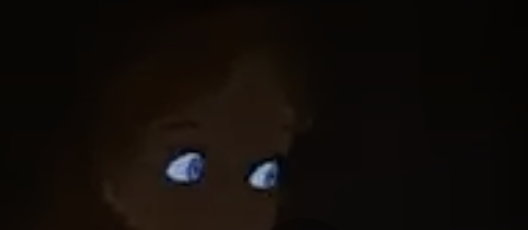
In my memory, Alice’s eyes were much brighter than I can see in this image. Something to think about: my version/vision of the dark due to my blind spot is never like this; I mean, it’s not all black. When looking at faces in can be a dark, smoky/smudged gray. When looking at words, I might see a faint dark ring. Sometimes it’s fuzzy or static — it’s not Nothing; it is something that is always moving. And here’s where I can get into Alice nonsense speak: It is not that I see Nothing; I don’t know that the something that is there is missing for me. I see no thing, without knowing that I’m seeing nothing. I think I need to work on that explanation.
But, back to the inspirational image. I like the contrast and the white eyes against the background. Do I want to make my word holes look more like eyes in this one? If I can do it without looking cheesy, yes!
I hope all of this makes sense to future Sara. Now, time to create my supersized scotoma!
update, a few minutes later: I started to think about how I might create the bigger version. There are probably many ways that are obvious to people who make things, but I have not been a maker and it’s all new to me. I like the idea of re-creating the grid, just bigger. Suddenly a thought: doesn’t the artist Chuck Close do (or, didn’t he do) something like this to create his portraits? Yes! He’s one of the most famous artist-users of a grid. Minneapolis Institute of Arts (MIA) has several of his works, but none can be viewed right now. The Walker has some too — I can’t readily see if they’re available for viewing. Some deeper digging is needed.
Here’s a video on how to use it:
And here is a great resource: Chuck Close at the Walker
Almost every decision I’ve made as an artist is an outcome
of my particular learning disorders. I’m overwhelmed by
the whole. How do you make a big head? How do you make
a nose? I’m not sure! But by breaking the image down into
small units, I make each decision into a bite-size decision.
I don’t have to reinvent the wheel every day. It’s an on-
going process. The system liberates and allows for intuition.
- file this with my Holes/Grid discussion: in thinking about all the ways I’m expressing something about myself through this series, I’ll add the significance of using the New Yorker and some book reviews. I love these book reviews and the access they give me to words/worlds that would otherwise be inaccessible (also thinking of the fun section on NY events and the restaurant reviews). Using New Yorker articles in these found poems is a way to reference that; it’s also a way to be able to still read them: slow, repeatedly, in strange order, and one word at a time. ↩︎
- I looked up, opposite of unravel, and found twist, knot, tangle, entangle. I love the idea of entanglement! Reading more of the Merriam-Webster entry, I read about unraveling a mystery/solving something, lessening the confusion. Yes! These ideas return to something else showing up in my visual poem: the image of a crime board — what is it called — where you put pictures of the suspects on a board and then use string or yarn to link them. I should read up on that concept some more, maybe watch some movies or shows that use it?! Is this linking used in other things that don’t involve solving a crime? How do I google that? ↩︎