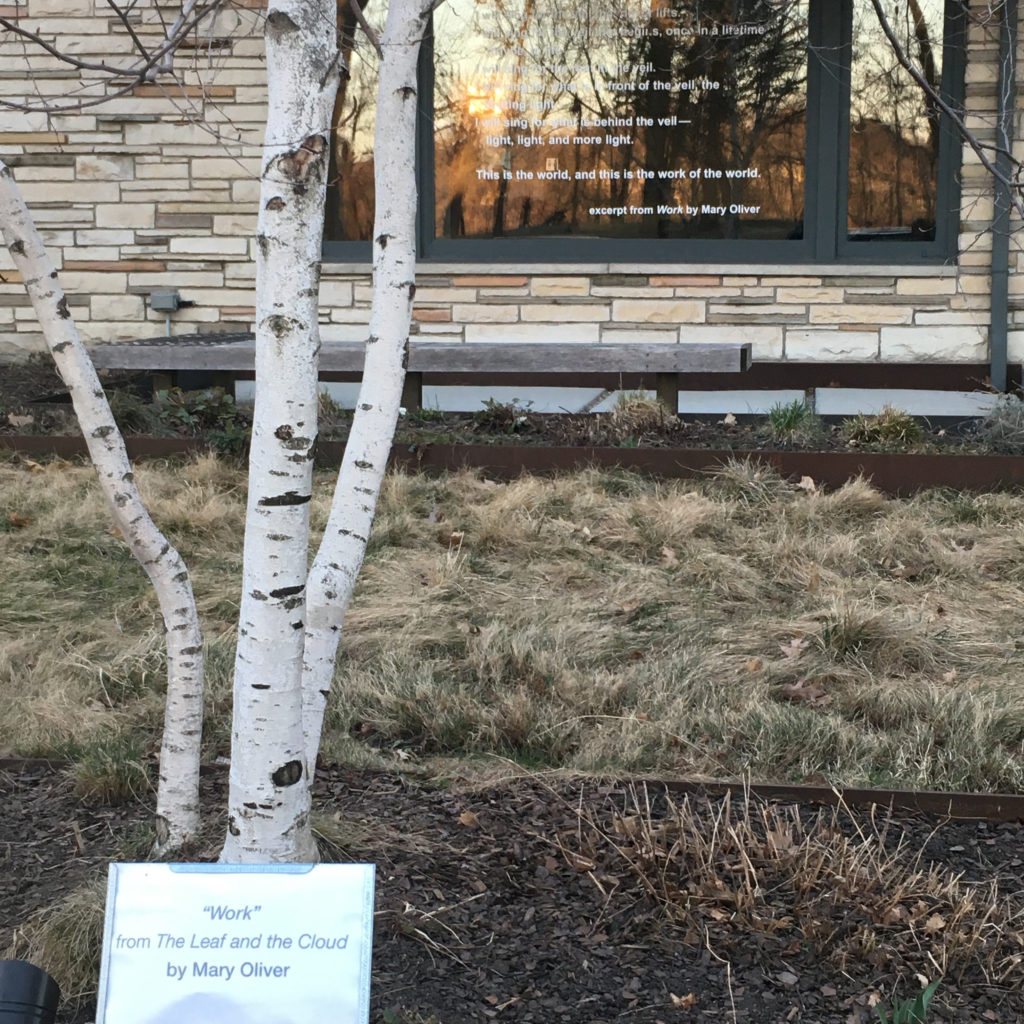
In Austin (mn) for the kids’ birthday—RJP is 15, FWA is 18! Ran with Scott through the neighborhood. So windy and warm. For the first mile, my legs felt like inflexible stumps. They didn’t hurt, just seemed stiff. Scott agreed. I wonder, is the pavement harder here in Austin? Do they use a different material than in Minneapolis? We talked as we ran but I can’t remember the conversation. Maybe something about the start of the Chauvin trial? I can’t wait until it’s over; I hope it ends with justice.
Nearing the end of my Emily Dickinson month. I am deeply grateful that I decided, almost on a whim, to spend a month with her words and her life. Today’s poem comes from “the Essential Emily Dickinson,” selected and with an introduction by Joyce Carol Oates:
I felt a Cleaving in my Mind—/ Emily Dickinson
I felt a Cleaving in my Mind— As if my Brain had Split— I tried to match it—Seam by Seam— But could not make them fit.
The thought behind I strove to bind Unto the thought before— But Sequence ravelled out of Reach Like Balls—upon a Floor.
Wow, this poem. Her descriptions of coming undone, physically and mentally, are incredibly powerful. I want to memorize this one.
note from march 31st: I found a brief analysis of this poem and they suggested that the balls in the last line are balls of yarn. Very helpful. Why didn’t I think of that? Not sure, but it totally works with the ravelled of the previous line. Ravelled can mean frayed or unraveled or pulled apart/undone.
A short run to test out the knees and the back. Not too bad. Inspired by a video of my niece singing “Dr. Horrible” this morning, I listened to it while I ran. It made me smile. I find listening to music often makes it easier to get a first or second layer runner’s high (as opposed to Jaime Quatro’s third layer of running as prayer). Listening to music, I didn’t hear anything else. No birds or conversations or beeping trucks or clicking bike wheels. No shshshushing of my feet on the sandy grit. No in and out of my breath.
The morns are meeker than they were— The nuts are getting brown— The berry’s cheek is plumper— The Rose is out of town.
The Maple wears a gayer scarf— The field a scarlet gown— Lest I should be old fashioned I’ll put a trinket on.
I think I’ll add this poem to my collection of fall poems to recite as I walk and run by the gorge in October. I love the line, “The Rose is out of town.” And I enjoy PB’s analysis of the poem:
…it’s a wonderfully female world. I like that for while Spring is usually linked to feminine procreation and blossoming, I tend to think of Autumn as male. It is a brooding time; harvest always leaves behind empty vines. It is “mankind” who harvests Mother Nature’s bounty, and this provides a rather masculine stance. But Dickinson goes all in for Autumn femaleness here. The only male presence are the brown nuts , and they are neatly paired with the plumping berries. Who knows – the Rose might have retired herself more out of propriety than dislike of the cold. Since she is gone the rest of the girls can have some fun. Maple and Field are getting dressed up and now so is the poet.
I wake up & it breaks my heart. I draw the blinds & the thrill of rain breaks my heart. I go outside. I ride the train, walk among the buildings, men in Monday suits. The flight of doves, the city of tents beneath the underpass, the huddled mass, old women hawking roses, & children all of them, break my heart. There’s a dream I have in which I love the world. I run from end to end like fingers through her hair. There are no borders, only wind. Like you, I was born. Like you, I was raised in the institution of dreaming. Hand on my heart. Hand on my stupid heart.
Love this. Thinking about this idea of “break my heart” like Mary Oliver’s use of it in her poem, Lead:
I tell you this to break your heart, by which I mean only that it break open and never close again to the rest of the world.
And, one more poem, or part of a poem. When I looked up “Meditations in an Emergency,” Frank O’Hara’s poem came up first. Here’s a part I especially liked:
However, I have never clogged myself with the praises of pastoral life, nor with nostalgia for an innocent past of perverted acts in pastures. No. One need never leave the confines of New York to get all the greenery one wishes—I can’t even enjoy a blade of grass unless I know there’s a subway handy, or a record store or some other sign that people do not totally regret life. It is more important to affirm the least sincere; the clouds get enough attention as it is and even they continue to pass. Do they know what they’re missing? Uh huh.
I wanted to run this morning, but my body and I decided that we should take another day off from it. For the last year, I’ve been running more frequently, almost every day. Mostly my body feels okay, but my back is a little sore and so are my knees. Instead of the run, I took Delia on a walk. For the first time this year, we left the paved path and descended the set of worn wooden steps that I wrote about in one of my haibuns:
6. Above the Ravine
Even now with the green glut gone, the bare bones of forest exposed, the ravine is hidden. Leave the paved path near the road and descend a set of worn wooden steps. Follow the remnants of a chainlink fence deeper to a grated walkway not quite above a seep of water slicking the metal slats. Stand still, listen up. Hear the water dribble out of the sewer pipe, over the limestone ledge, down to the river. Imagine that the painted keys, fastened with wire rings to the wrought iron fence in the summer of 2017, are still there, offering a way in.
Sometimes when you want to enter, all that’s needed is a key that fits.
Very cool. The steps were even more worn but the dirt was dry and so were the metal slats. I could hear the water trickling down to the forest floor. It was overcast, so no blue, only brown everywhere. As we ascended on the other side, I could hear the clickity-clacking of a roller skier! My first sighting this year. These skiers don’t waste any time switching from wood to wheels. I wonder, which they miss most: sliding on the snow when it’s summer, or rolling on the asphalt when it’s winter? I would imagine the snow, but who knows?
Emily Dickinson: Yellow
For as long as I can remember, green has been my favorite color and yellow my least. But lately–as in the last 3 or 4 years–I’ve grown to appreciate yellow. I keep intending to buy some yellow shoes or a yellow shirt or a yellow something. Maybe this spring I finally will? What does that have to do with Emily Dickinson and yellow? My poem for yesterday was “A lane of Yellow and the eye” and, after reading it and thinking about my new fondness for yellow, I decided to search for yellow poems over at the Prowling Bee. Here are 3 (“A lane…” and 2 more I found) that interested me:
A lane of Yellow led the eye Unto a Purple Wood Whose soft inhabitants to be Surpasses solitude If Bird the silence contradict Or flower presume to show In that low summer of the West Impossible to know –
I love this first line and how she describes the early evening (would you call this the gloaming or twilight?)–the purple woods, the quiet, the soft inhabitants, the sun setting as “the low summer of the West.” The “soft inhabitants” makes me think of how in dimmer light everything looks softer, fuzzier. I enjoy this in the winter, walking outside right before the sun sets, noticing how soft the tree branches look. Of course, because of my cone dystrophy, I have this dim view much more frequently than a normally sighted person. Often, all I see are soft inhabitants. Mostly, I don’t mind. I like this phrase–soft inhabitants. I think I’ll try to use it in my writing sometime instead of fuzzy forms.
I also like this image of someone at the edge of a wood (either standing at the edge, or peering into the wood from a window which is what I imagine ED might be doing) and wondering what’s in it, but not being able to tell. Here, the “impossible to know” is not a lament of someone on the outside, unable to enter, but an invitation to imagine what might be in there, a sense of delight in the mystery and possibility of it. I like running on the edge of the gorge, looking down into the thick trees, seeing a winding path, and wondering what/who could be in there that I can’t see. So many delightful, scary, interesting things!
ED writes frequently about circumference in her letters and poems. Is this an example of it?
Two: Yellow as excess (too bright, too cheerful, too much)
I dreaded that first Robin, so, But He is mastered, now, I’m accustomed to Him grown, He hurts a little, though—
I thought If I could only live Till that first Shout got by— Not all Pianos in the Woods Had power to mangle me—
I dared not meet the Daffodils— For fear their Yellow Gown Would pierce me with a fashion So foreign to my own—
I wished the Grass would hurry— So when ’twas time to see— He’d be too tall, the tallest one Could stretch to look at me—
I could not bear the Bees should come, I wished they’d stay away In those dim countries where they go, What word had they, for me?
They’re here, though; not a creature failed— No Blossom stayed away In gentle deference to me— The Queen of Calvary—
Each one salutes me, as he goes, And I, my childish Plumes, Lift, in bereaved acknowledgment Of their unthinking Drums –
In her discussion of it, the Prowling Bee understands the coming of spring as a metaphor for the passing of time and that ED is depressed by the inevitability of death, creeping closer with each new singing robin or bright daffodil or buzzing bee. This makes sense, especially with the last verse–the childish Plumes, bereaved acknowledgment, their unthinking Drums. What if we also thought of it literally? Maybe ED can’t bear the robin because their Shout hurts her head or the Yellow of the Daffodil is too bright for her eyes or the droning of the Bees is too relentless for her ears? Maybe she’s having a migraine or is overwhelmed by the too-muchness of spring? In the comments, someone wrote: “I think of this poem whenever my springtime allergies kick in. :)” Yes, I love how ED captures the feeling of being physically overwhelmed by the senses. As I work to find better words to describe my physical feelings, I appreciate ED’s ability to do it so well.
To interrupt His Yellow Plan The Sun does not allow Caprices of the Atmosphere — And even when the Snow
Heaves Balls of Specks, like Vicious Boy Directly in His Eye — Does not so much as turn His Head Busy with Majesty —
‘Tis His to stimulate the Earth — And magnetize the Sea — And bind Astronomy, in place, Yet Any passing by
Would deem Ourselves — the busier As the minutest Bee That rides — emits a Thunder — A Bomb — to justify —
I really appreciate PB’s (prowling bee) analysis here (and the comments by others too. Click on the poem to read all of it). Very helpful. I especially like her last bit about the Bee and her suggestion that ED is poking fun at Isaac Watt’s “Little Busy Bee”:
Now, as to Watts’ poem about the “Little Busy Bee”. The first two stanzas praise the bee who is industrious, skilful, and neat. Such attributes “Improve each shining hour”. The last two stanzas find the poet wanting to emulate the bee for two reasons: to lead a good life and to stay busy so that the Devil can’t make use of his ‘idle hands’. I imagine Dickinson reading this poem and finding it deeply ironic. Most of her countrymen were exposed to this poem. Many of them spent their childhoods “In books, or work, or healthful play” and later strove to be busy in ‘works of labor or of skill’. And yet rather than a society like the humming hive, they found no way out of their deep divisions except by busily building and employing the engines of war.
How doth the little busy bee Improve each shining hour, And gather honey all the day From every opening flower!
How skilfully she builds her cell! How neat she spreads the wax! And labors hard to store it well With the sweet food she makes.
In works of labor or of skill, I would be busy too; For Satan finds some mischief still For idle hands to do.
In books, or work, or healthful play, Let my first years be passed, That I may give for every day Some good account at last. Isaac Watts, 1715
Yes! Lately I’ve been thinking a lot about the bullshit of busy work, which seems to be a lot of what work is these days. While Watts champions the busy work of bees, constantly contributing to the health of the hive, I wonder about the value of work now (which has made busy-ness and distraction an end in itself and that often doesn’t contribute to the greater health of the community)? What, in the 21st century in the midst of a global climate crisis and a pandemic that necessitates we do less, is work for? What is our work doing–to the world? to us? And, what work are we valuing most? Least?
Thinking about work in relation to religion and as a counter to Watt’s “idle hands do the devil’s work,” I’m reminded of David Naimon’s “Between the Covers” interview with Ross Gay:
DN: “What parts of my day, in relationship to the Earth, aren’t extractive on a species level versus relational and giving back?” It feels 99 to 1….I wonder about spiritual technologies that we used to use, like in its best form, the Sabbath where you’re not supposed to do anything that moves you forward in the world, you don’t exchange money, you don’t get in a car, you spend time with people you love, you attend to the moment with no sense of the future. It’s supposed to be this recreation of the Garden of Eden once a week but also, along with that, in the Bible, you were supposed to let the land rest every seven years….
Do we offer any meaningful space for rest now? (I don’t think so.) Why not?
Not sure if that totally makes sense, but I’m thinking about the limits and dangers of our understandings of work–who benefits from it, who is exploited by it, what does it produce/cause/contribute/harm? And, as we (in the US) live through this terrible time–ecological devastation, over half a million deaths from COVID-19, a divided nation, an unchecked/barely checked white supremacist capitalist patriarchy (see bell hooks for definition), suffering, extreme poverty, no safety net or support for the most vulnerable citizens–what has all our work achieved? I think this might come across as a little preachier and darker than I am intending. I am not trying to preach. Instead, I am struggling to make sense of my relationship to work and to contend with my extreme disappointment over how much we have been taught/encouraged/required to believe work = success and achievement, and how little that has prepared us to respond to our current crises in ways that are meaningful, caring, and reparative.
2.7 miles 43rd ave, north/32nd st, east/edmund, south/river road trail, south/edmund, north 41 degrees light rain
Sometimes dripping, sometimes drizzly, always windy. The rain wasn’t supposed to stop until 3 or 4, but when it looked like it was letting up a little, I decided to go for a run. A few other walkers, one runner with 2 dogs. Spent a lot of time dodging puddles on the sidewalk. Success. No wet socks. Ran through the tunnel of trees and, unlike yesterday when I felt as if I was buried in brown, today I noticed a slender slash of blue river. Why didn’t I see it yesterday? Must have been the light and the color of the river. Both yesterday and today I ran through the Welcoming Oaks; yesterday I remembered to greet them, today I forgot. I stopped at the split rail fence above the ravine and listened to the water rushing down the limestone and concrete ledges. I glanced down at the oak savanna as I ran above it, noticing the muddy trail at the bottom. Was planning to pay attention to one of my favorite spots, where the mesa slopes down to meet the Winchell trail and the river is revealed, but I was distracted by an approaching pedestrian. Stopped at the bench near Folwell–the one on the rutted dirt path that links two parts of the Winchell trail and that I wrote about in a haibun that didn’t make it into my Mississippi Gorge haibuns–and stared at the river, framed by a few bare branches. Crossed over the river road and the grassy boulevard and headed home, north on Edmund, running straight into the wind. As I neared the parking lot by the oak savanna, I saw some lights that looked like they were coming from somewhere on the bluff. I recalled how the road curves here, around a ravine, and that those lights were the headlights of cars on the river road. A strange, delightful sight.
I chanted a bit from the Emily Dickinson poem I’m reading today, ‘Tis so much joy! ‘Tis so much joy!:
Life is but Life! And Death, but Death! Bliss is, but Bliss, and Breath but Breath!
‘Tis so much joy! ‘Tis so much joy! If I should fail, what poverty! And yet, as poor as I, Have ventured all upon a throw! Have gained! Yes! Hesitated so – This side the Victory!
Life is but Life! And Death, but Death! Bliss is, but Bliss, and Breath but Breath! And if indeed I fail, At least, to know the worst, is sweet! Defeat means nothing but Defeat, No drearier, can befall!
And if I gain! Oh Gun at Sea! Oh Bells, that in the steeples be! At first, repeat it slow! For Heaven is a different thing, Conjectured, and waked sudden in – And might extinguish me!
I like the Prowling Bee’s introduction to her analysis of this poem:
Something big has happened and the reader is not given much of a clue as to the nature of the big thing. The poet has gambled everything – “ventured all upon a throw!” – and is in a state of ecstatic waiting. There are sixteen exclamation marks in eighteen lines and that is a lot of excitement.
Yes, that is a lot of excitement. For the rest of her analysis, the Prowling Bee (PB) speculates on what ED has done to cause such excitement. PB decides it has to do with love and cites the 3 mysterious letters ED wrote to “Master.” These letters come up in the book I’m listening to right now, Lives like Loaded Guns, and more obliquely in the show, Dickinson (I’m not sure because I haven’t watched these episodes yet, but I think that the show is suggesting that the newspaper editor Samuel Bowles is “Master”–will these letters be cited in any of the episodes? I’ll have to keep watching to find out.). Googling it, I found this great article from The Rumpus:
There is no evidence that the letters—written between 1858 and 1862 and discovered shortly after Dickinson’s death in 1886—were ever sent, although they may have been drafts of versions that were posted. No one knows to whom they were intended. Perhaps the Reverend Charles Wadsworth (they had a correspondence, none of which survives), or Samuel Bowles, the editor of a newspaper in Springfield and a family friend, or a professor named William Smith Clarke. Or perhaps they are not to a person at all, but to God. Or the Devil. For nearly twenty years I’ve taught Dickinson and the Master Letters in my early American literature course, always hoping to come closer to the source of the mystery. Instead, just the opposite has happened. The mystery has deepened. The more I study them, the more we hash them out in class, the longer the shadows grow and deepen over their meaning.
I like that scholars, even after decades of scrutiny, can’t quite figure ED out. Nice work ED! While I can appreciate being curious about this “dark mystery,” right now I don’t really care what she’s talking about here. I like the little chant about life and death, bliss and breath, and I might try to lean on it when I’m struggling during a run, or attempting to block out worrisome thoughts so I can fall asleep, or feeling panic over yet another sinus infection.
Both of my knees were feeling strange yesterday, not quite like the kneecap was slipping out but unstable and sore, so I didn’t run. I biked and watched another episode of Dickinson instead. Today, even though it was drizzling when I started, I ran. I started in the neighborhood but when I reached Edmund, about a mile in, I decided to cross over to the river. I was able to run on my favorite part, through the tunnel of trees, just above the floodplain forest. Wow! It was all a rich brown: bare branches and bare earth, hardly any sky, no river. In a few months, this same spot will be nothing but green. Both ways, it’s disorienting: now, with the brown, it almost feels like you’re buried in the earth; later, in the green, like you’re underwater in a green sea. I think I heard some birds, mostly cardinals. What I remember hearing most was the light rain hitting the brim of my baseball cap. For the last mile, I listened to my playlist.
Some keep the Sabbath going to Church – I keep it, staying at Home – With a Bobolink for a Chorister – And an Orchard, for a Dome –
Some keep the Sabbath in Surplice – I, just wear my Wings – And instead of tolling the Bell, for Church, Our little Sexton – sings.
God preaches, a noted Clergyman – And the sermon is never long, So instead of getting to Heaven, at last – I’m going, all along.
I appreciate ED’s connection between the sacred and nature here. My first chapbook was all about the sacred rituals of being upright and outside by the Mississippi River Gorge. (I’m not alone; many runners refer to their long runs on Sundays as the “church of the long run”). My exploration of this theme was as a non-church going ex-religion major with a master’s in theological ethics who finds tremendous value in the sacred, but not in organized religion and church services.
Right now, I just finished listening to a section in the ED biography, Lives as Loaded Guns, about the religious revival in Amherst in the mid 1800s and the pressure ED experienced to publicly declare her faith in Christ and become a full member of her church. She refused, even as all of her family and friends professed their faith. According to the author, Lyndall Gordon, ED’s friends, including Jane Humphrey (who plays a prominent, if slightly different, role inthe show Dickinson), are enlisted as spies to “report back” on what ED was thinking and doing and to try to persuade her to change her mind. I thought of this religious revival in the town and what an impact it had on Amherst as I watched an episode of Dickinson today and noticed that there were a surprisingly large number of ministers at the party/salon everyone (or, anyone who is anyone) was attending at Sue and Austin’s house. Several of these clergy were the dates/suitors of the popular girls. I’m fascinated and delighted by how the show brings in details like this without explicitly addressing them.
ED’s faith and her expressions/practices of and struggles with it are more complicated than this charming poem might suggest. I think I should read one of the classic biographies on ED, Roger Lundin’s Emily Dickinson and the Art of Belief.
Speaking of ED’s complicated relationship to religion and God and the church, I’ve been thinking about her poetic form and how she often used hymn form. Here’s some information from Common Questions on Emily Dickinson:
What kind of meter did Dickinson write in, and why did she use it?
Common Meter or Hymn Meter
Definition: A closed poetic quatrain, rhyming A B A B, in which iambic tetrameter alternate with iambic trimeter. Common meter is distinguished from ballad meter by its rhyme scheme: the rhyme scheme of ballad meter is X A X A.
Derivation: This meter derives from English hymnology and uses predominantly iambic or trochaic feet (sometimes dactylic).
Types
Common meter: alternately 8 and 6 syllables to the line: 8/6/8/6
Long meter: 8 syllables to the line 8/8/8/8 (this tends to get monotonous)
Short meter: two lines of 6 syllables, followed by one of 8, then one of 6: 6/6/8/6
Sevens and sixes: 7/6/7/6
Common particular meter: 8/8/6/8/8/6
Short particular meter: 6/6/8/6/6/8
Source: Isaac Watts’s Christian Psalmody, or, The Psalms. Watts always names the meter, and introductions set forth what effects may be achieved by each type.
Dickinson’s Use of Hymns
According to Martha England, her hymns differed from Watts’s in these ways:
greater use of enjambment
greater metrical freedom
use of more images with no scriptural source
Dickinson used the bee, a favorite symbol of Watts’s, as a defiant counter-emblem to his hymns. Her bees are irresponsible (138, 1343), enjoy la dolce vita (1627), and are pictured as seducers, traitors, buccaneers (81, 128, 134, 206, etc.).
Every poem composed before 1861 is fashioned in one of the hymn meters above.
Largest proportion in common meter.
Second largest proportion in common particular meter.
Note: If I’m counting and reciting correctly, this poem doesn’t fit the hymn form. Is that because it’s from 1861 and not before? I always need help hearing the meter in poetry. Here’s another source I might want to check out: Listening to Dickinson
bobolinks and surplices
Bobolinks are small songbirds with large, somewhat flat heads, short necks, and short tails. They are related to blackbirds and orioles, and they have a similar shaped, sharply pointed bill.
All About Birds
They are present in Minnesota but have been in serious decline for some time now. Why? Loss of habitat, pesticides on food supply suppressing appetite and causing them to not eat enough, and too many people and buildings to run into. After listening to the call and the song, I’m not sure if I heard one before. I’d probably remember because they kind of sound like R2D2. They like hanging out in grasslands, meadows, and prairies, and traveling in big flocks.
A surplice is “a loose white linen vestment varying from hip-length to calf-length, worn over a cassock by clergy, acolytes, and choristers at Christian church services.” As a Lutheran pastor, did my dad wear this? Not quite, I think. Maybe I’m just confused by how he would always wear a stole too? I’ve seen lots of these surplices on the British murder mystery shows I watch.
Here’s another, non-ED poem that I discovered yesterday. I love Maggie Smith and I love this poem, especially how she plays with and challenges the importance of naming and classifying things.
Goldenrod/ Maggie Smith
I’m no botanist. If you’re the color of sulfur and growing at the roadside, you’re goldenrod.
You don’t care what I call you, whatever you were born as. You don’t know your own name.
But driving near Peoria, the sky pink-orange, the sun bobbing at the horizon, I see everything
is what it is, exactly, in spite of the words I use: black cows, barns falling in on themselves, you.
Dear flowers born with a highway view, forgive me if I’ve mistaken you. Goldenrod,
whatever your name is, you are with your own kind. Look–the meadow is a mirror, full of you,
your reflection repeating. Whatever you are, I see you, wild yellow, and I would let you name me.
Scott and I ran the franklin loop this morning. First, we talked about The Dukes of Hazard and how Uncle Jessie was related to Beau and Luke, if at all, and how Daisy fit into it (Scott brought it up). Then we talked about realism and truth and postmodernism and academic street fights and the scientific method (my topic). A lot of fun. Not sure how much I remember about the run. Sometimes it’s nice to be completely distracted. I remember noticing the big lion sculptures on the front stoop of a big house by the river. A few trees leaning towards the road. The boat dock over at the rowing club. The row of gloves and one hat perched on the fence posts at the Town and Country club. Running through a lot of sandy grit and potholes on the edge of the river road. Smelling cigarette smoke. Feeling warm and overdressed. Hearing the bells at St. Thomas.
There is no Frigate like a Book (1286)/ EMILY DICKINSON
There is no Frigate like a Book To take us Lands away Nor any Coursers like a Page Of prancing Poetry – This Traverse may the poorest take Without oppress of Toll – How frugal is the Chariot That bears the Human Soul –
I think this would be a fun poem to memorize and always have at the ready when thinking about why I love reading. I remember when I first encountered the word frigate. It was from one of my son’s friends. I think they were both 11 or 12 at the time. They mentioned how fascinated they were by old warships, including frigates. Then they gave me a lecture on the different types of frigates. Strange.
So, reading this, I knew frigate, but I was unfamiliar with courser. According to the OED, it’s a swift horse. Something interesting: a frigate is “a light and swift vessel, originally built for rowing, afterwards for sailing,” which is what I think ED intends here, but it is also a war vessel, which is what FWA’s friend meant. A courser is a swift racing horse, but it is also “a powerful horse, ridden in battle.” Was ED thinking at all about the frigate or courser as images of war? That wouldn’t seem to fit with the overall meaning of the poem, but I just found it interesting that both of these figures have that double meaning. Oh–and the chariot too–that’s a “vehicle used in ancient warfare.”
I agree with ED’s sentiment here: reading is wonderful in its ability to transport us to other worlds, to learn about other places and people, to be moved by others’ stories. Reading does has its limits too, however. Yesterday morning I read a twitter thread about the problems with suggesting that white supremacy can be solved by just reading more widely about non-white experiences, that is, through reading, we can gain empathy and understanding, or reading = empathy = no more racism. As Lisa Ko (the thread starter) suggests, empathy is not enough to counter or correct state violence. I’m not bringing this up to challenge ED’s championing of reading and books; I just wanted to place another idea about reading beside it.
Speaking of reading, I just started Braiding Sweetgrass. Wow! Love it. Only a few pages in, and I already found this great bit about the Original Instructions:
These are not “instructions” like commandments, though, or rules; rather, they are like a compass: they provide an orientation but not a map. The work of living is creating that map for yourself.
Feeling more and more like spring. All the snow is gone, the sun is warm, the birds are singing even louder and longer. What I remember most about my run are the black-capped chickadees and their “fee-bee” song. Running on Edmund, between 32nd and 34th, I heard at least 2 of them calling out, not in a call and response, with one singing 2 ascending notes, the other 2 descending ones, but with both of them ascending, calling out to some other bird that wasn’t responding. Sometimes they were in sync, but sometimes they weren’t–a strange cacophony of fees and bees. About a mile later, I heard another chickadee calling out. No response.
When I reached 42nd st, I turned on my spotify playlist–“Ain’t Nobody,” “I feel for you,” and “Leave the Door Open”–and ran on the grass. It was tricky avoiding holes and not sinking into the soft, mushy grass. I love Bruno Mars and Anderson .Paak’s “Leave the Door Open”–how it sounds, their voices, the playful lyrics, the message of consent and hope, the invitation to be open. Wonderful.
Oh–I can’t believe I almost forgot–the river! Just past the top of the hill on Edmund between 33rd and 34th, you can glimpse the river through the trees. Today it was on fire, glowing with a bright white light. Wow. Definitely dazzling. Seeing this bright light, I thought about the Emily Dickinson poem I’m studying and that I memorized before running: “We grow accustomed to the Dark.” The poem is about how we adjust to the dark when “light is put away,” both literally and metaphorically. For many, I’m sure, this poem suggests that the loss of light and the coming of the darkness is always unwelcome and tragic. But not necessarily for ED, and not for me. I had to stop at the top of the hill and record a thought into my phone: “sometimes the problem with light is not its loss, but its abundance.” Too much light is too dazzling, making it too difficult to see or understand what you’re seeing. I have difficulty when there’s a lack of light, but often just as much when there’s too much light. So, sometimes a lack of light is welcome, wanted, offering some rest for tired and overwhelmed eyes.
We grow accustomed to the Dark
After spending so much time yesterday reading other people’s words about ED’s “We grow accustomed to the dark,” I decided I wanted to spend some time today with her words. I started by memorizing the poem. Memorizing a poem always helps me to listen better to the words. Now (I started this section before I ran and am continuing it after I’m done), I’m typing up each stanza (from memory) and typing up my thoughts, most of which don’t offer insight but a way for me to work through my efforts to understand her words. I’m noticing how this effort sometimes involves forcing myself to move past what I think the words should mean or how they should sound and listen to what she is actually writing and doing with her words.
We grow accustomed to the Dark – When light is put away – As when the Neighbor holds the Lamp – To witness her Goodbye.
I like the word accustomed. From the OED:
Verb: “To make (a person or thing) familiar with or used to something; to familiarize, habituate.” Adjective: “In the habit of doing something; used to something.”
Yes! This reminds me of one of my preferred understandings of knowing–to become acquainted with. Not to Know or even to fully understand, but to adjust to, get used to. I like the connecting of this with habit and habitual practice.
I also like how she describes this: “When Light is put away.” Who is putting the light away? I don’t think she means God here. I like thinking about something/someone putting it away–a much different feel than if she had written: “when light has gone away.”
added later: Could she mean that she, ED, puts the light away? The Prowling Bee thinks so. Analyzing the stanza about the larger Darkness, she writes:
That unknown mental and spiritual domain is a “larger – Darkness.” That is where our great poets and philosophical explorers venture while the rest of us pursue our hobbies or just relax. Dickinson spends time in this darkness and most of her most evocative, ambiguous, and challenging poetry comes from there.
I keep wanting to make the final line, “To witness our Goodbye” instead of her goodbye, but I finally get that the Lamp is witnessing her goodbye to us, as we leave.
I love the idea of the Lamp/Light witnessing the Goodbye. A great image. And interesting to think about how in the second line the light is leaving us, but in the 4th line, we are leaving the light. Is that intended as an echo of the final stanza of the poem–either the darkness alters or something in the sight adjusts itself to midnight? Who is acting and who is acted upon? Yes (returning to this analysis later, after publishing this post), the idea of both the light leaving us and us leaving the light fits with my mention of the prowling bee and the idea of ED choosing to leave light and enter the darkness in order to explore deeper, more troubling, difficult and unknown ideas and themes.
A Moment – We uncertain step For newness of the night – Then – fit our Vision to the Dark – And meet to Road – erect –
The idea of a moment is great–a moment of panic and uncertainty before we’re able to see. As my central vision declines, I have a lot more of these moments: when I enter an unfamiliar building (or sometimes even a familiar one) and not much makes sense. I can’t read the signs or tell where to go. Or when I’m looking at an object but I can’t tell what it is–is it a dead squirrel or a clump of leaves or furry mittens? Most of the time, my brain eventually adjusts and I can see what I’m trying to look at and continue on with more certainty. I’m trying to work on not fearing that uncertain step, letting the moment just be a moment that I will move past, knowing that I will adjust or figure it out (or ask someone for help). And it’s working. I am getting better.
I find “We uncertain step” to be awkward, but I like how its awkwardness seems to effectively create uncertainty and discomfort in the reader–at least this reader, me.
Love the alliteration of newness of night and her descriptions of adjusting as fitting our Vision to the Dark and becoming more certain as meeting the road erect.
As I work through this poem, I’m realizing something (or, being reminded of something I know, but keep forgetting or straying from): It is very interesting to learn about ED’s life and the historical context of her work, and it’s helpful to see patterns and themes across the poems. Yet, what matters most to me are the actual poems and how effectively her words describe vision loss and resonate with my own experiences of it. Her words are opening a door, offering a way into understanding (and expressing that understanding) how vision loss and living with less vision feels.
And so of larger – Darkness – Those Evenings of the Brain – When not a Moon disclose a sign – Or Star – come out – within –
I like how she shifts to a metaphorical understanding of Darkness and then describes it as “those Evenings of the Brain.” I’m imagining she could mean depression (possibly hers, some suggest there’s evidence she was mildly bipolar or her mother’s) or hopelessness or sadness or turmoil or illness or uncertain/lack of understanding. She might even mean those times when she could not write, which fits well with the next lines about no signs being disclosed or stars coming out. And returning to the comments I’m just adding, this also means those darker, deeper, uncomfortable, troubling ideas/thoughts/themes that writers are willing to explore.
one more thing to add: I’m thinking about how most of my academic work and a big part of my current ethical project involves bewilderment and trouble and uncertainty and the value of dwelling in these uncomfortable spaces for us and learning how to be/to flourish. Because I’ve spent so much time thinking about these things, maybe it’s helped me to navigate my vision loss more effectively?
When I was reciting this poem from memory, I kept forgetting disclose. All I could think of was “display.” I knew it was wrong, but I just couldn’t remember disclose. Is it because “not a Moon disclose a sign” sounds awkward–“not a Moon disclosed a sign” sounds better to my ear, even if that changes the tense. Anyway, disclose is a much stronger, more precise, verb than display, so I’m hoping I can remember it now.
The bravest – grope a little – And sometimes hit a Tree Directly in the Forehead – But as they learn to see –
I like grope even as I don’t. It fits well with the idea of struggling to find meaning in the dark, but it also conjures up creepy guys and their grabby hands.
Sometimes, when I’m running, I hit a tree. Not directly in my forehead, but with my elbow or hip. I like the funny image of people literally running into trees, especially hitting them directly in the Forehead, and I also like the metaphorical meaning of being stunned as they struggle to make sense of/adjust to (overcome?) the darkness.
I don’t like poems that try too hard to rhyme (which this doesn’t), and I like when lines rhyme or echo (which this does). Tree and see work well; it’s pleasing to the ear and helps keep the large idea/image of adjusting to darkness moving forward.
Either the Darkness alters – Or something in the sight Adjusts itself to Midnight – And Life steps almost straight.
It often feels, when you can finally make out shapes in a dark room, that the darkness has changed, become less dim, but it’s really your vision adjusting, with the help of your rod photoreceptor cells, your pupils widening to take in more light, and your brain, to that darkness.
Love this ending line about life stepping almost straight, especially the almost part.
Whew. I’m ready for a break now. What a joy to spend so much time with ED’s words! Yesterday, I felt frustrated, reading so much about the poem (when it was written, what it was in response to, how it fit into a larger understanding of ED as a poet) without actually reading the poem or thinking about the meaning of the poem.
a moment of sound
Sat on the deck with my daughter and Delia the dog, soaking in the warm sun. Very quiet. I can hear my daughter briefly sniffing like a dog and some kid at the end of the street calling out and a crow. Of course, after I turned off the recording, a cardinal started trilling–at least 10 times–repeatedly.
Almost all of the snow is gone. A few small mounds scattered across the grass, none on the sidewalk or the street. Spring snows are never that bad; you always know it will melt quickly. Overdressed today. I stopped near turkey hollow and awkwardly took off my pink jacket and tried to figure out the best way to wrap it around my waist–under or outside of my vest? Tried both. Inside was best. As always, heard lots of birds. Also, a few conversations–not the words, but the sound of people talking. The best part of the run was the river glittering in the sun. Big and bold flashes of light, blindingly bright, almost throbbing or pulsing, not the short sparkles that dance and flicker. Was this pulsing the result of more intense light or the wind? Probably the wind, even though I didn’t notice it that much, but felt the hot sun all the time. Normally this intense light would be too much for my eyes, but today I enjoyed it. As I headed back north during my last mile, I ran on the grassy boulevard. A little muddy, soft, rutted. Harder to move. My legs felt heavy and stuck.
Getting close to 3 weeks into my Emily Dickinson March project and I’m enjoying all that I’m learning about her and her work. At first, I only spent a few minutes reading and rereading the poem for the day, but slowly I’ve been spending more time with her words and words about her work. I want to make sure that most of my time is with her words, but it’s helpful to learn how other people understand her. I seem to struggle with understanding and interpreting imagery and metaphors and I can use the help. Will it ever get easier? Maybe. Today’s poem got me thinking about a lot of things:
We grow accustomed to the Dark – When light is put away – As when the Neighbor holds the Lamp To witness her Goodbye –
A Moment – We uncertain step For newness of the night – Then – fit our Vision to the Dark – And meet the Road – erect –
And so of larger – Darkness – Those Evenings of the Brain – When not a Moon disclose a sign – Or Star – come out – within –
The Bravest – grope a little – And sometimes hit a Tree Directly in the Forehead – But as they learn to see –
Either the Darkness alters – Or something in the sight Adjusts itself to Midnight – And Life steps almost straight.
I can’t help but read this in poem in relation to ED’s vision loss, and my own. The idea of growing accustomed to a loss of light, or a loss of sight, and then figuring out how to see/live again but differently, where “Life steps almost straight,” but not quite–slant for ED, sideways for me.
note: I’ve spent a lot of time thinking about this poem today, and I’m a bit stuck. Too much to say. In the process of struggling to find words and formulate ideas, I found this excellent site and post about ED’s temporary vision loss in 1862. Very cool:
Barker argues that since light was a masculine tradition, ithad come to represent male power, energy, sexuality–not only to Dickinson but to other women writing during the era. To these writers the inversion of the light/darkness metaphor became a countertradition used as a means to express their energies in a society that was hostile to their intelligence. Dickinson, who read avidly, could not have been insensitive to this usage of light as a masculine symbol of her Calvinist God, of her father, of all that was male?and of darkness as a feminine symbol….
Emily Dickinson thought in a richly symbolic manner. Her most frequently used metaphor is one of light in contrast to darkness, employing single-word references to light more than one thousand times in her 1,775 poems.
Sitting on my deck, enjoying the warm sun, I heard the bells chiming from across the river in St. Paul at St. Thomas University. I looked at my watch and it was only 10:59. They were a minute early.
3.4 miles 43rd ave, north/31st st, east/edmund, south/42nd st, east/river road trail, north 34 degrees
Woke up to several inches of snow on Tuesday. Decided to skip the running and shovel and bike instead. Woke up again this morning to another dusting but noticed the sidewalks and roads were bare so I went for a run. What a run! Not too cold, but not too warm. Not much wind. Not too bright. No one else out. Did I see any other runners or walkers? Only one or two. I wasn’t planning to run on the river road trail but I remembered that a few days ago I had wondered what the river would look like after the snow, and when I saw that no one was on the trail, I decided to check it out. When I reached the river, I stopped to record my moment of sound. I stood closer to the river and admired the grayish-blue water with the white banks.
march 17, 2021
Listen to those birds! I also like the sound of the cars as they rush by–you can hear the water on the wheels, everything damp, slick.
Before heading north for the last mile, I put in a Spotify playlist and listened to 2 songs I recently added, both by Chaka Khan: “Ain’t Nobody” and “I Feel for You” Yes! So much fun to run right above the river with no one else there to avoid, just me and Chaka Khan and Melle Mel (he raps at the beginning and end of the song–I had to look that up.) Discovered that he was part of Grandmaster Flash and had rapped on “White Lines” the year before. Very cool.
Yesterday I spent a lot of time with Emily Dickinson. First, I finished an episode of Dickinson–in this one, Emily has writer’s block and is trying to decide whether or not publishing her poems is a good idea. Then, I read my ED poem for the day: My Life had stood – a Loaded Gun. After finding a podcast discussing it, and then reading a few articles about it, I decided this poem, considered to be the most complicated and richly layered of her poems, deserved 2 days. Well, it deserves much more than 2 days, but that’s what I’m giving it for this month with Emily Dickinson. Here are my thoughts from yesterday and today:
My Life had stood – a Loaded Gun (764)/ EMILY DICKINSON
My Life had stood – a Loaded Gun – In Corners – till a Day The Owner passed – identified – And carried Me away –
And now We roam in Sovreign Woods – And now We hunt the Doe – And every time I speak for Him The Mountains straight reply –
And do I smile, such cordial light Opon the Valley glow – It is as a Vesuvian face Had let it’s pleasure through –
And when at Night – Our good Day done – I guard My Master’s Head – ’Tis better than the Eider Duck’s Deep Pillow – to have shared –
To foe of His – I’m deadly foe – None stir the second time – On whom I lay a Yellow Eye – Or an emphatic Thumb –
Though I than He – may longer live He longer must – than I – For I have but the power to kill, Without – the power to die –
This poem has taken me down a rabbit hole of fascinating things about Emily Dickinson. The poem itself provides a lot to wonder about but I barely made it that far. I imagine I’ll want to reread this poem many times. My rabbit hole concerns ED’s process of gathering and preserving her poems and the importance of this poem for poet/scholar/historian Susan Howe. Here’s a few things I’ve discovered.
This poem is in a fascicle.
“Fascicle” is the name that Emily Dickinson’s early editor, Mabel Loomis Todd, gave to the homemade manuscript books into which Dickinson copied hundreds of poems, probably beginning in the late 1850s and continuing through the late 1860s. Dickinson constructed the fascicles by writing poems onto sheets of standard stationery already folded in two to create two leaves (four pages). She then stacked several such sheets on top of each other, stabbed two holes in the left margin through the stack, and threaded string through the holes and tied the sheets together. Occasionally she varied this basic pattern by binding half-sheets (cut along the fold) into the stack of folded sheets. “Set” is a term first used by editor R.W. Franklin to describe groups of unbound sheets of similar paper and size that were never bound by the poet. There are 40 fascicles, and 15 sets.
Dickinson herself did not number or label the fascicles. They were taken apart by the first editors of Dickinson’s poetry, and so have had to be reconstructed by various scholars. Within this site, we use the order established by R.W. Franklin, The Poems of Emily Dickinson (Cambridge: Belknap Press of the Harvard University Press, 1998). Not all Dickinson scholars agree with his reconstruction.
It’s in fascicle 34. According to Susan Howe (in this speech that I was just listening to on the upenn site), there’s some discussion/debate over how ED gathered her poems into the fascicles. Were they chronological? Grouped by theme? And, if by theme, how closely connected were they? Howe seems to think that the connection is a loose one.
Howe makes this poem a primary focus of her book, My Emily Dickinson
I checked this book out from the library 3 or 4 years ago and tried to read it but it was too difficult for me then. I hadn’t read much of Dickinson’s poetry and had not yet studied poetry. Would it make more sense now?Here’s an excerpt I found online.
a new grammar grounded in humility and hesitation
Emily Dickinson took the scraps from the separate “higher” female education many bright women of her time were increasingly resenting, combined them with voracious and “unladylike” outside reading, and used the combination. She built a new poetic form from her fractured sense of being eternally on inteIlectual borders, where confident masculine voices buzzed an alluring and inaccessible discourse, backward through history into aboriginal anagogy. Pulling pieces of geometry, geology, alchemy, philosophy, politics, biography, biology, mythology, and philology from alien territory, a “sheltered” woman audaciously invented a new grammar grounded in humility and hesitation. HESITATE from the Latin, meaning to stick. Stammer. To hold back in doubt, have difficulty speaking. “He may pause but he must not hesitate”-Ruskin. Hesitation circled back and surrounded everyone in that confident age of aggressive industrial expansion and brutal Empire building. Hesitation and Separation. The Civil War had split American in two. He might pause, She hesitated. Sexual, racial, and geographical separation are at the heart of Definition.
I really like this idea of hesitation and humility and aboriginal anagogy as a sharp contrast to progress, aggression, confidence/hubris, and time as always moving forwards (teleology). I tried to find a source that could explain exactly what Howe means by aboriginal anagogy but I couldn’t. I discovered that anagogy means mystical or a deeper religious sense and so, when I connect it to aboriginal, I’m thinking that she means that ED imbues pre-Industrial times (pre Progress!, where progress means trains and machines and cities and Empires and factories and plantations and the enslavement of groups of people and the increased mechanization of time and bodies and meaning and, importantly, grammar) with the sacred. Is that right? Is it clear what I’m saying? I think I need to buy Howe’s book and attempt a close reading. Yes, it’s available as an ebook!
More to read: see Adrienne Rich’s wonderful essay Vesuvius at Home.
The Loaded Gun is not a gun but ED’s dog Carlo?!
In On ED’s 754/764, Susan Stewart discusses how difficult this poem (known in the Thomas Johnson edition of Dickin- son’s work as number 754, and in the Ralph Franklin edition as number 764) is for critics/readers to understand. She suggests that none of the readings are ever complete or fully hang together. Then she adds her own unusual interpretation: the loaded gun is a dog, ED’s dog, Carlo.
What kind of being waits in corners to be carried away to a field where, released, his/her/its power is enacted? One answer is: a domesticated hunting dog.
Now Dickinson had a dog, Carlo, named after the pointer owned by the character St. John Rivers in Charlotte Brontë’s Jane Eyre. Dickinson’s Carlo was also a hunting dog—an enormous Newfoundland hound.
Of course, Stewart’s argument is more involved than simply, it’s about her dog. You can read the article for a deeper discussion. I’m fascinated with this suggestion–Carlo was her walking buddy, he was a hunter, he had a yellow eye, he slept at the foot of her bed and protected her. Rereading the poem, it’s hard not to imagine a dog now.
I’ll leave my exploration of the poem at that, for now. I enjoyed wading into some deeper waters with ED scholarship, and I learned a lot that I didn’t know. I am not interested in going too deep, though. I could (and used to regularly as an academic) get lost in tracking down more articles, more interpretations, analyzing every word and it’s symbolic, political, historical significance. That is too much of a distraction, a derailment. Too connected to my discipline days. I like learning a little and letting that enhance my wonder. Having said that, I am planning to buy My Emily Dickinson and dig into Howe’s dense analysis of ED’s new grammar. The goal: to not seek answers, but more connections and questions and evidence of how poetry moves and bewilders and astonishes me.
As an aside: For some time, I have been very interested in the US in the mid to late 1800s, pre and post Civil War. No serious study, mostly through fiction, some through my investigation of my great grandparent coming to the UP from Finland in the 1880s. I like having the chance to read/learn more about this time.
yesterday’s moment of sound
Walking with Delia yesterday afternoon was wonderful. Everything melting and dripping, so many birds singing. In the middle of this recording, the bird I was trying to identifying a week or so ago called out–the one that I thought sounded like the loon call they play at twins’ games. What is this bird? Maybe if I play it for Scott, he can identify it.
3.3 miles turkey hollow 30 degrees drizzling rain/sleet/ice mix
As I left the house, I could tell it was starting to rain or sleet or something but because I was bundled up–a shirt + hooded jacket + vest–I couldn’t feel it, so I decided to go for a run anyway. A benefit of running in this weather: no one else is out there. I was able to run above the river on the trail all the way to the ford bridge. My first time in 3 or 4 months running on the narrow pedestrian bridge and the steep walking trail that dips below the road then quickly climbs up. It almost felt like normal. When I reached the ford bridge, I crossed the road and ran through the grass at turkey hollow. The ground was soft and a little squishy. No turkeys today.
I know I glanced down at the river but I don’t remember what it looked like. I remember seeing the oak savanna and the white information sign at the bottom. I remember seeing the bench perched on the gorge, providing a wide open view of the other side. I remember the part of the Winchell trail between 42nd and 44th, steeply winding down below me. But I do not remember what the river looked like. It was probably gray–or was it brown? We’re supposed to get up to 5 inches of snow today. Will the river be white tomorrow?
It was windy today. I recall hearing a chickadee chick-a-dee-dee-deeing but not much else other than the howling wind. Most of the cars had their headlights on. No bikers. Only one or two solitary walkers. Heard the kids at recess, laughing and yelling at the school playground. Also heard the shshsh as my feet struck some sandy grit. And the gentle tapping of icy pellets (graupels) on my black vest. I only rarely felt the sting of one on my face. For a small stretch, I pulled the brim of my hat as far down as I could to shield my face. The last time I ran in these conditions was in October or November. I didn’t have a brim to protect my face and the graupels felt like little knives stabbing my cheeks.
a moment of sound
march 15, 2021
Super windy today but I managed to shield the phone microphone with my hand for most of it. I recorded this at the end of my run as I walked home. I can hear my feet shuffling on the grit on the sidewalk and then some wind chimes. I decided to cross the street to get closer. I love wind chimes. These chimes are hanging close to a giant fir tree. I can hear them chiming as the wind rushes through the tree.
I heard a Fly buzz – when I died – The Stillness in the Room Was like the Stillness in the Air – Between the Heaves of Storm –
The Eyes around – had wrung them dry – And Breaths were gathering firm For that last Onset – when the King Be witnessed – in the Room –
I willed my Keepsakes – Signed away What portion of me be Assignable – and then it was There interposed a Fly –
With Blue – uncertain – stumbling Buzz – Between the light – and me – And then the Windows failed – and then I could not see to see –
A few years ago, I found some articles discussing ED’s temporary vision loss in her 30s. I’m fascinated by how she references her temporary blindness in her poetry. In Emily Dickinson’s mystifying in-sight, the authors reflect on “I heard a fly buzz” and suggest that her words here, and in several other of her poems referencing the Eye and the dying Eye, provide remarkable insight into the physiological process of vision loss as one is dying.
Throughout her poetry chronicling the ophthalmic deterioration that occurs in death, Dickinson notes the changes that occur in the dying cornea and lens: glaze, dimness, fog, mists, film, cloudier. Her observations reflect what medical science currently understands as the alterations that occur within the eye during the process of death. We know that shortly after death the cornea and lens become edematous (swollen with fluid) and begin to lose their transparency.
As death approaches, gradually less oxygen-carrying blood is pumped by the failing heart, causing functional loss of the bodily organs. Seeing while dying should be possible until the retina and/or the occipital cortex of the brain, the final mediator of vision, becomes deprived of oxygen and loses its capability. The most metabolically active of all our tissues, the retina, for its operation, surpasses every other organ in relative blood flow and oxygen requirement.The loss of vision while dying should be sequential, greying occurring first as cones (the retinal mediators of color and probably more metabolically active than rods, the agents of black, white, and grey) lose function. Greys, therefore, persist through the retinal rods after loss of color perception occurs. Finally the rods, too, fail, and we are blind.
and
In the last cycle, eyesight fades to a blue, the retinal cones still working, but predominated by the buzz, uncertain, stumbling, as hearing also begins to fade. But, still, the hum is loud enough to go beyond and between her light as vision fades away faster than hearing. And then, as the retinal rods fail, sight exhausts itself and so “light” must fail to appear; we are left instead with “the Windows failed – ” as the bright sunlight at the window is eclipsed, and finally, all of seeing ends, concluding with an absolute and total black, rendered powerfully in the last line by the three “eyes”: “I…see…see.”
Vision disappears, as if one “I…see…see” is lost, then the other, and finally the last “I…see…see,” the very idea of sight is gone: “I could not see to see;” now the very understanding, the intellect of seeing on a cerebral level is gone; the cessation of blood flow to the brain has deprived it of oxygen. The brain can no longer function; it is dead, and the dying is over.
The Prowling Bee has nothing to say about ED’s vision loss or how her descriptions of dying accurately convey what happens to your vision as you die. I don’t what to reduce this poem to a discussion of vision and vision loss, but I find this idea that she is offering a medically accurate description of it to be very cool. I haven’t had much luck in finding many other articles about this, but I thought about it a lot. Last summer I memorized her “Before I got my eye put out” and spent some time reflecting on her vision as I ran.
Almost forgot to add this in: This morning I saw one of the more remarkable sunrises I’ve ever seen. The entire sky was lit up bright orange. It only lasted a minute or two. It made me wonder how many sunrises I’ve missed by getting up too late.
A quick run through the neighborhood on a windy afternoon. Ran around Cooper school and noticed the mounds of snow and wondered when they would melt away. Earlier in the week there was a chance we might get a few inches of snow tomorrow, but now it looks less likely. Good. I’m ready for spring this year and I’ve been enjoying the bare sidewalks and open grass. Listened to a playlist while I ran. First up was a song I’ve been randomly singing during this COVID year, not sure why: Freak-a-Zoid. Very nice. And long. It lasted for 3/4 of a mile at least. Anything else? Lots of people out, most of them walking dogs, a few kids biking.
a moment of sound
So windy! The neighbor’s scare rods are really spinning. I wonder how irritating they will be this summer?
I felt a Funeral, in my Brain, And Mourners to and fro Kept treading – treading – till it seemed That Sense was breaking through –
And when they all were seated, A Service, like a Drum – Kept beating – beating – till I thought My mind was going numb –
And then I heard them lift a Box And creak across my Soul With those same Boots of Lead, again, Then Space – began to toll,
As all the Heavens were a Bell, And Being, but an Ear, And I, and Silence, some strange Race, Wrecked, solitary, here –
And then a Plank in Reason, broke, And I dropped down, and down – And hit a World, at every plunge, And Finished knowing – then –
This is another one of ED’s most known poems. Some people think it’s an accurate description of a migraine, others a mental breakdown. A few people in the comments over at the prowling bee, suggested it was a transcendent, religious experience, another wondered if it had anything to do with the epilepsy that she might have had. I’m not sure. Whatever it is, it doesn’t seem pleasant but torturous. Rereading the comments, I’m fascinated by their discussion of the bell as a tool or practice within Buddhism to stop thinking and meditate on the sound of the bell. This focus enables one to pass through the planks/levels of reason and the rational Self. And, I love the lines about all the heavens as a Bell with being but an Ear. Very cool.
A wonderful morning. Sunny and mostly calm. Not too crowded. Started on the river road trail but as I encountered more people, I moved over to Edmund. I heard the black-capped chickadees singing their feebee song. Don’t remember much else. When I reached Hiawatha, I put in my headphones and listened to a spotify playlist. Experienced a slight runner’s high as I picked up the pace, the kind that makes me feel my smile all the way down to my toes. Sprinted the last block. I bet I looked strange.
Yesterday, I listened to a great podcast with the poet Paige Lewis. So much good stuff. I especially liked this:
And that’s what I kind of care about putting into poems. I want to learn things and I want to learn little snippets of facts and then I want to be able to share those facts with people. Or, if I see something, I want someone around so I can be like look at that thing that’s happening right now. It’s still happening, you have to look. Look what that fish is doing. Look what that flower is doing. I just want to be pointing. Like I just want to be, look at this thing. Look at this thing. Look at this thing. Which is why I’m really bad at writing essays because I’m just like look at what this guy is doing. And then look at this. And they’re like, why does it matter? I’m like, I don’t know, but look at it.
Just like look at these beautiful tiny things and what we can take from them is maybe sometimes just enjoyment and I don’t know that I have anything more intelligent to say about that thing and what it’s doing and what it reflects about anything about us as humans. But like just look at it.
I agree with Lewis that the enjoyment of noticing and sharing these beautiful tiny things is enough, but I also think that this practice, when repeated and turned into a habit, has an additional importance: it encourages us to care about and care for the world, to be invested in its continued flourishing and also our own. I was thinking about this earlier today as I worked on my “How to Be” project and gathered ideas for the knowledge section. What is knowing facts for? More than demonstrating how smart we are, knowing facts can connect us and astonish us and encourage us to care about more than ourselves and our individual survival.
random thought I remember: At some point during the run, I noticed the shadow of a bird on the sidewalk in front of me. I love seeing these shadows and knowing a bird is flying overhead without looking up to see it. This shadow is too vague and fuzzy to indicate what kind of bird it is; it’s just a bird. It reminded me of how sometimes when I’m sitting at my desk, which has a glass top (a top I recycled from an old IKEA coffee table), I see the reflection of a bird flying outside the window. It’s a quick flash of motion that I could miss if I wasn’t paying attention and if my peripheral vision had become heightened because of my central vision loss. Such a cool thing to see.
Have you got a Brook in your little heart, Where bashful flowers blow, And blushing birds go down to drink, And shadows tremble so—
And nobody knows, so still it flows, That any brook is there, And yet your little draught of life Is daily drunken there—
Why – look out for the little brook in March, When the rivers overflow, And the snows come hurrying from the hills, And the bridges often go—
And later, in August it may be, When the meadows parching lie, Beware, lest this little brook of life, Some burning noon go dry!
The Prowling Bee doesn’t like this poem with it’s “lazy” rhymes (flipping the sentence order to create the rhyme, ex: “so still it flows”) and the idea of such a “little” brook, as opposed to some more robust form of water like a river. I’m not sure how I feel about it. I think I like the quiet brook that doesn’t announce itself to the world, it’s just there doing its thing–helping the flowers and the birds and the shadows. What if it were a stream instead? Decided to google it. Favorite answer was by a naturalist, responding to the question, what’s the difference between a stream, a creek, and a river?:
So, we enter into the somewhat nebulus topic of stream classification.
Consulting a few sources, the common term for all downhill flowing ribbons of water is stream. They’re all streams. Streams are classified, not by width, depth or length, but by a system known as stream ordering. The common terms are quite subjective depending on region and local history.
First order streams: the smallest streams that have no tributaries. We could call these brooks or rivulets. Little streams that you can hop across and not get wet. (GPD example: Pebble Brook in The West Woods)
Second order streams: result from the merging of two first order streams. Often designated as creeks, these small streams require a bridge, stepping stones or wading to cross. (GPD examples: Big Creek, Swine Creek, Silver Creek)
Third order streams: larger streams formed from the merger of two second order streams or creeks if you will. Streams that would have to be bridged, waded or even swam across. Referred to as branches in the headwater regions of watersheds. (Geauga examples: East Branch and Aurora Branches of the Chagrin River, East and West Branches of the Cuyahoga River)
Fourth order: streams formed by the merging of two third order streams. These streams would qualify as rivers, requiring big bridges, boats or swimming to cross.
I find brooks interesting as a first order stream because they have no connection to other sources of water, no tributaries. They also don’t cause much of a fuss–you don’t need a bridge for them and you should be able to hop across them without getting wet. How do these first order streams come to be? Where does the water come from?
Another interesting thing about brooks: as a verb, the word means to use, tolerate, find agreeable. I don’t like the word tolerate or this understanding of a body of water disconnected from everything else, so I guess I don’t want to have a little brook in my heart. It doesn’t sound as pretty, but I think I’d prefer a creek–but not a crick!
a moment of sound
After my run, I sat on the deck and enjoyed the sun and the quiet. Here’s how that sounded:
*With a little bit of meandering. Before reaching the river road, I ran up 43rd ave then over to 31st st, then lake street, then the river road trail
Great weather for a run! Sunny, not too much wind, not too warm or too cold. I was able to run beside the river and above the rowing club. I don’t remember what the river looked like, but I remember it felt open and vast and wonderful. Heard lots of birds and a woman cheering a runner on as he made his way down the hill below the lake street bridge, the two of them laughing together. Did they know each other, or was she just friendly? Saw lots of lovely lonely benches with enticing views to the other side–I thought about stopping once, but didn’t. Noticed that the white bike hanging from the trestle, put there to remember the biker who has hit and killed at the intersection many years ago, was missing a front wheel. Has this always been the case? Heard a siren that sounded like the drumming of a woodpecker at first. Encountered a few groups of walkers, at least one group of runners, no bikers or roller skiers.
Surfaces I Ran on:
sidewalk
street
uneven grass
dead leaves
packed down dirt
gritty edges of the boulevard
As I ran, I recited my Emily Dickinson poem of the day: “Hope” is the thing with feathers” One of her most famous. Delightful and fun to recite as I ran.
“Hope” is the thing with feathers — That perches in the soul — And sings the tune without the words — And never stops — at all –
And sweetest — in the gale — is heard — And sore must be the storm — That could abash the little Bird — That kept so many warm —
I’ve heard it in the chillest land — And on the strangest sea — Yet, never in Extremity, It asked a crumb — of Me.
Favorite word today: abash. When I was first memorizing it, I thought it was strongest not strangest sea. Can’t decide which I like better. When I finished running, I recited it into my phone. I got it mostly right, but missed several small words– so instead of and, but instead of yet.
“Hope” is a thing with feathers
a moment of sound
Forgot, for the first time, to record my moment of sound yesterday. I think it was because it was windy and I didn’t want to record more wind–I have lots of that. Anyway, I recorded this moment right after I finished my 4 mile run. As the birds chatter away, you can hear a few of my heavy breaths as I try to recover.
2.8 miles river road trail, south/Winchell trail, south/edmund, north 44 degrees drizzle
Decided to go out for a quick run before the rain started. I made it out the door when it was dry but by mile 2 it was raining. Starting in the rain can be miserable, but if you’re already running, it’s difficult to feel the rain. Because of the weather, I was able to run on the trail without encountering too many people. Oh, the river, looking beautifully pale blue in the gloom. When I reached 42nd st, I took the trail down to a spot right above the ravine and recorded the water rushing down the rocks as my moment of sound.
march 10, 2021
Very cool. Instead of heading back up to the road, I decided to keep running on the Winchell trail. At this point, close to the southern start of the trail, it’s steep and uneven and right on the edge. What an unanticipated delight to be this much closer to the river–nothing but air and the bluff between us. (Sitting here, writing this entry in the front room, I just heard a long, loud boom–thunder!)
Anything else I remember from the run? I noticed a lot of headlights, bright and cutting through the gray sky. Another runner also cutting through the gloom, wearing a bright yellow shirt. Saw some people walking their dogs–one guy called out a greeting to me. I think he said “Go Twins!” because I was wearing a Twins baseball cap, but I’m not sure. Heard a young kid and an adult below me in the oak savanna. Noticed all the snow collected on the trail at the foot of the mesa. Heard some kids on the playground at the lower campus of Minnehaha Academy. For the last mile of my run, I put in my headphones and listened to a playlist.
It was great to be out by the gorge in-between rain showers, hearing the rushing water and how it sometimes drips, sometimes gushes down the bluff to the river. I spent the morning working on my “How to Sink” poem and thinking about water and what it does as it travels through the soil and layers of sediment, powered by gravity. Writing this, I suddenly thought about gravity and weight and how it forces water through cracks and then I thought about the homonym for weight, wait, and patience, and how my preferred form of sinking is a slow, gradual sliding down that takes a long time. And also how the weight of gravity forces water down through the layers, but so does the persistence of time. Cool–I’d like to add that in somehow. Here’s a new draft of my poem. Still not there, but getting closer, I hope.
Try to recall when your son young and upset turns to jelly and oozes off the sofa in
surrender he’s not giving in but giving up control a puddle of parts pooled at your feet
learn to retreat like this let your bones dissolve legs liquefy gravity win seep deep be- neath
layers of loam sandstone limestone shale drop lower and lower and lower fall
between cracks fit through fissures carve out a door take it so far in that out is another idea.*
Begin with 20 seconds from a song that is not happy birthday sing while you scour the
surface of your dread scrub off each layer watch as they drip down the drain on their way to the gorge.
*idea is one extra syllable, which is irritating to me, but so far, I can’t figure out a way around it.
Maybe I could add the weight/wait bit in after the line about falling? Also, I like having the washing your hands at the end of the poem, as the start of this need to sink/retreat/shelter inside (because of the pandemic), but I think I might need a little more transition to it. Is it too jarring, coming right after the bit about out being another idea?
Crumbling is not an instant’s Act A fundamental pause Dilapidation’s processes Are organized Decays —
‘Tis first a Cobweb on the Soul A Cuticle of Dust A Borer in the Axis An Elemental Rust —
Ruin is formal — Devil’s work Consecutive and slow — Fail in an instant, no man did Slipping — is Crashe’s law —
I really like this poem–it fits well with all of my thinking today about erosion and water dripping down. Gradual decay, a slow repeated slipping. I love the rhyme of a cuticle of Dust with an elemental Rust. A Borer in the Axis is strange to me. A mechanical (metal?) axis combined with a worm that bores into wood? I like bore as a verb–it might fit in my poem.
Today I was able to run in shorts and above the gorge and on the snow-less walking trail and all the way down to turkey hollow. Hooray! It was windy and there were people all around, but I kept my distance and believed that if I was running directly into the wind on the way there, it would help me along on the way back. It did. Lots of birds singing. I recall hearing several robins but no black capped-chickadees. No woodpeckers. I know I glanced down at the river and I remember hoping I’d see some rowers, but I don’t remember what the river looked like. Was it blue or gray or brown? The river road was filled with a steady stream of cars.
I recited the first two stanzas of the Emily Dickinson poem I’m studying for today. I’m not memorizing every poem I read, but I decided these two stanzas would be fun to chant as I ran. They were.
A Bird, came down the Walk – He did not know I saw – He bit an Angle Worm in halves And ate the fellow, raw,
And then, he drank a Dew From a convenient Grass – And then hopped sidewise to the Wall To let a Beetle pass –
He glanced with rapid eyes, That hurried all abroad – They looked like frightened Beads, I thought, He stirred his Velvet Head. –
Like one in danger, Cautious, I offered him a Crumb, And he unrolled his feathers, And rowed him softer Home –
Than Oars divide the Ocean, Too silver for a seam, Or Butterflies, off Banks of Noon, Leap, plashless as they swim.
A delightful poem. I enjoyed reading the prowling Bee’s analysis and thinking about the imagery, especially the bird flying through the sky as water:
The watching poet then offers him a bit of bread but this is too much. The bird flies away. Except that this isn’t the end of the poem as Dickinson sees it. In one of those reversals of sky and sea (for example, “This—is the land—the sunset washes” – F297), the bird “unrolled his feathers” as if he were changing from an earthbound thing to a heavenly creature, and then “rowed” himself more softly “Home” than the act of rowing on the ocean. The oars’ action, like the bird’s wing, are so small and “silver” in the expanse of water and sky, that they don’t even leave a “seam” behind to show they once moved through that space.
I love the idea of sky as water and imagine it often as I look up at the sky by the river or the lake. As I was chanting this poem mid-run, and enjoying being with the little bird, the worm, and the beetle, I thought about how wonderful poetry is. You can enjoy it many different levels: how it sounds, the worlds it conjures up, the meanings behind its images. You can spend time closely scrutinizing what the beetle or the worm means, how ED might be inserting herself in the poem, and what she’s suggesting about her world, but you don’t have to to find meaning and delight. Much more accessible than other forms of writing. One more thing: I discovered that plashless is a word and that it basically means without a splash or splash-less. Maybe I’ll use it on Scott and when he tries to correct me I can smugly say, “No, I mean plashless. It’s word too.”
How to Sink
Earlier this morning, I worked some more on revising my poem. I’ve decided to use a modified cinquain form. In my “how to float” poem I used Adelaide Crapsey’s 2-4-6-8-2 pattern to evoke floating and lifting. In “how to sink,” I’ll use almost the same number of total syllables for each cinquain (23 instead of 22), but switch them around to mimic falling and narrowing, sinking: 8-7-4-3-1. Here’s what I have so far:
Begin with 20 seconds from a song that is not happy birthday sing while you scour the
surface of your dread scrub off each layer watch as they drip down the drain on their way to the gorge.
Recall when your son young upset turned to jelly and oozed off the sofa in surrender a
puddle of body parts pooled at your feet learn to retreat like this feel your bones dissolve your legs
liquefy gravity win reach ground seep deep through layers of loam sandstone shale drop
lower and lower and lower fall between cracks carve out ways in follow them so far in out
is another idea
How to Float has 10 cinquains. I want to mirror that in this poem. So far, I am just starting the 7th. Lots of meaning of sink: 1. sink as a place to wash your hands and an early symbol of the pandemic, 2. as a place where water collects (puddle of body parts), 3. as drain, sewer pipe (the dread dripping down to the gorge), 4. being swallowed up, lost (seeping deep), 5. falling down. Time to look up more definitions.
a moment of sound
8 am from the deck: the persistent hum of the city and the birds chatter
3.25 miles edmund loop, starting north 47 degrees wind: 1 mph
Wow, what a morning! Sun, barely any wind, a chorus of birds, clear streets, uncrowded sidewalks. I could only identify a few of the bird calls–black-capped chickadees, cardinals, crows, robins, woodpeckers–but I didn’t care. I thought about how naming the birds didn’t matter, only being among them did. As I ran up Edmund, I heard a song that sounded like a metal whistle and I thought about stopping to record it. I didn’t and as I neared it, it stopped.
When I turned around at Edmund, I decided to run back in the grass between the river road and the boulevard. Only a few squishy spots. It was nice to run on the softer ground, closer to the gorge. I couldn’t see the river, but I admired the other side. What a view, with all the branches bare.
Yesterday it was 60 degrees. Today, at 11, it’s already 51. Spring! It definitely sounded like it in my moment of sound:
Because I could not stop for Death – He kindly stopped for me – The Carriage held but just Ourselves – And Immortality.
We slowly drove – He knew no haste And I had put away My labor and my leisure too, For His Civility –
We passed the School, where Children strove At Recess – in the Ring – We passed the Fields of Gazing Grain – We passed the Setting Sun –
Or rather – He passed Us – The Dews drew quivering and Chill – For only Gossamer, my Gown – My Tippet – only Tulle –
We paused before a House that seemed A Swelling of the Ground – The Roof was scarcely visible – The Cornice – in the Ground –
Since then – ’tis Centuries – and yet Feels shorter than the Day I first surmised the Horses’ Heads Were toward Eternity –
As always, I enjoyed The Prowling Bee’s discussion of this poem. In particular, I liked her mention in the comments of ED’s 3 images of life: the children playing = life; the gazing grain = the seasons; setting sun = the day. Very powerful and inspiring. I want to keep working on finding images that conjure even a little of what ED’s do. Prowling Bee also discusses how wonderful the phrase, “the fields of gazing grains.” Yes–fun to say and to think about the different meanings it suggests. And, at the end of her analysis, she describes how some think this is a perfect poem. The version of this poem I read on Poetry Foundation (see link in title) has audio too. Very helpful for me as I try to hear the poem without making it too metered.
sink, more thoughts
I’m revisiting my poem, “How to Sink” and trying to strengthen it, especially the imagery. I want to make it a companion to “How to Float.” Just looked up sink in the online OED and found some great definitions of it as a noun:
place where waste collects
pool or pit in the ground
conduit, drain, pipe
a basin used for washing
an amount that a sink would hold–a sink full of dishes
a low-lying area where flowing water occurs
a place where things are swallowed up or lost (absorbed?)
a lead weight used in fishing
depression or hollow
loss of altitude, especially in gliding flight
phrase: the sink of the body: organs of digestion
This poem was written during the earliest stages of the pandemic and is, at least partly, about the need to shelter-in-place and retreat, to hole up, to hide and be safe. During that time, there was a lot of talk about washing hands as a primary way to stay safe–could I bring in sink in this way? I’d like to.
3.2 miles 2 school loop 39 degrees wind: 12 mph/21 mph gusts
Ran a little earlier today, starting at 8:20. Still too crowded on the river road trail: bikes, dogs, people. I stayed on Edmund with the birds. I kept hearing a bird call that reminds me a little of the loon sound they play at twins games. What is this bird? (I’ve just been searching and listening to clips for the past few minutes; no luck yet.) Also heard some drumming woodpeckers, a metallic robin song, crows, geese, various warblers. The sun was out and I think I noticed my shadow a few times–or was that on my run 2 days ago? There was still some slick spots on the sidewalk; I watched as a walker slid across the concrete at the corner. I did that same thing yesterday on my long walk with Scott and Delia. We, me yesterday and this walker today, were both okay. Didn’t get to see the river this morning, but I admired it yesterday as we walked under the railroad trestle. There was a group of rowers out on the water! That’s a sure sign of spring. Maybe someday I’ll be one of those rowers? I’ve always wanted to try.
I’m revising a poem I wrote early on in the pandemic: How to Sink. Thinking about the idea of sinking down through the layers of the gorge, carving out a new way in, retreating. Not giving up but letting go, surrendering control. Is surrender too negative of a word? I don’t see sinking as bad or unwanted, but a welcome break, an opportunity to return to the source, regroup. I need to read up more on sinking and think about the different ways it works. Sinking is not falling, but something else. Settling? Seeping. Finding shelter. I remember now that I wrote some notes about sinking in my notebook and maybe in a log entry. I’ll have to find them (here’s a few: sink)
After great pain, a formal feeling comes – The Nerves sit ceremonious, like Tombs – The stiff Heart questions ‘was it He, that bore,’ And ‘Yesterday, or Centuries before’?
The Feet, mechanical, go round – A Wooden way Of Ground, or Air, or Ought – Regardless grown, A Quartz contentment, like a stone –
This is the Hour of Lead – Remembered, if outlived, As Freezing persons, recollect the Snow – First – Chill – then Stupor – then the letting go –
Wow. After reading this poem a few times, I read The Prowling Bee’s analysis of it, which was helpful. Such powerful descriptions of 3 phases of grief: the chill/shock where nerves are still; then the daze/stupor of heavy, shuffling aimless feet; and then the letting go. And great words: the Hour of Lead. Tombs. Stiff. Wooden. Quartz contentment. Stone. Freezing.
a moment of sound: dogs
march 7, 2021
When a dog walks by, through the alley, the neighborhood dogs get excited. I am not bothered by their barking, probably because it only comes in random bursts. In fact, I love frantic dog barking. I find it delightful; sometimes I even encourage it, making sure to walk with Delia by the houses with the biggest, wildest barkers. You can also hear the scare rod–the metal spinning flashing rod our neighbors have hung to scare off woodpeckers–spinning in the wind. Unlike barking dogs, this noise irritates me. I am trying to get over myself because it’s a minor irritation and it seems to be working and I don’t want woodpeckers pecking at our neighbor’s house. Also, near the end of the recording, Delia growls at someone walking through the alley and the wind howls, tossing the tall pine tree on the next block to and fro.
march 6 recap
I took my first break from running in a month yesterday, but I still did my moment of sound and my Dickinson poem.
a moment of sound
Taking a long walk parallel to the river, I heard lots of wonderful things, including these wind chimes in a yard across from the Birchwood Cafe.
march 6, 2021
I’m Nobody! Who are you? (260)/Emily Dickinson – 1830-1886
I’m Nobody! Who are you? Are you – Nobody – too? Then there’s a pair of us! Don’t tell! they’d advertise – you know!
How dreary – to be – Somebody! How public – like a Frog – To tell one’s name – the livelong June – To an admiring Bog!
This is the first poem of Dickinson’s that I ever remember encountering. I think it was in junior high, way back in 1986 or 1987. I didn’t get the poem, but I liked the strangeness of it all. For decades, I have found myself randomly saying in my head, “I’m Nobody! Who are you?” sometimes I add: “Are you — Nobody — too?” And then an image of frog pops into my head. I agree with this idea: “How dreary — to be — Somebody!”
A whiteish gray day. Hardly any wind. Great for running. After driving on the river road yesterday with Scott and the kids and seeing the clear trail, I decided to run on it today. I didn’t do all of it–I entered the trail at lake street so I missed the welcoming oaks and the tunnel of trees–but the parts I did run on were wonderful. I have missed this trail.
I was able to run above the rowing club. The river is clear and blueish gray. There were other people on the trail, but I kept a lot of distance from them. And, I greeted the Daily Walker! Encountered a few dogs, a stroller. No fat tires or irritating squirrels. Didn’t hear any woodpeckers–did I hear any birds? I must have, but I don’t remember any. Ran over some grit and heard my favorite shuffling scratching sounds. Smelled some smoke somewhere but no burnt toast or bacon from longfellow grill.
Before I went on my run, I recorded myself reciting my Emily Dickinson poem for today: I measure every Grief I meet (561) I chose it because today would have been my mom’s 79th birthday. I woke up and watched a few digital videos I made with old footage of her–both created 8 or 9 years ago using footage from the 1980s, 90s, and the early 2000s. I miss her terribly, but I am not feeling especially sad today. As I was running, I was thinking about how part of me is grateful that she is not living now during this terrible time of tyrants, and selfishness, and deadly viruses. It would been very hard on her. I suppose the idea of her not having to endure this, gives me a little comfort, whether or not it fits with what she would have actually felt if she were alive.
I measure every Grief I meet (561)/ Emily Dickinson – 1830-1886
I measure every Grief I meet With narrow, probing, eyes – I wonder if It weighs like Mine – Or has an Easier size.
I wonder if They bore it long – Or did it just begin – I could not tell the Date of Mine – It feels so old a pain –
I wonder if it hurts to live – And if They have to try – And whether – could They choose between – It would not be – to die –
I note that Some – gone patient long – At length, renew their smile – An imitation of a Light That has so little Oil –
I wonder if when Years have piled – Some Thousands – on the Harm – That hurt them early – such a lapse Could give them any Balm –
Or would they go on aching still Through Centuries of Nerve – Enlightened to a larger Pain – In Contrast with the Love –
The Grieved – are many – I am told – There is the various Cause – Death – is but one – and comes but once – And only nails the eyes –
There’s Grief of Want – and grief of Cold – A sort they call “Despair” – There’s Banishment from native Eyes – In sight of Native Air –
And though I may not guess the kind – Correctly – yet to me A piercing Comfort it affords In passing Calvary –
To note the fashions – of the Cross – And how they’re mostly worn – Still fascinated to presume That Some – are like my own –
I wanted to hear how others have recited the stanza that begins, “I wonder if when Years have piled—” because it seems very awkward in terms of cadence and rhyme and following the meaning of the sentence. I listened to 3. One delivered that stanza awkwardly, the other 2 recited a different version that omits the prior stanza and then changes the words of the stanza to make it work: “I wonder if when years have piled/thousands on the cause/of early hurt — if such a lapse/would give them any pause” (this 3rd one is fun to listen to). Even though it is less awkward, I don’t like this change. ED wants awkwardness and lines that are slant and that disrupt, so why change her words to fit the conventional standards of the day (which is what I read was the reason for this change). I checked out my favorite ED commentator, The Prowling Bee, but she doesn’t discuss the altered stanza or the other version. Even so, her discussion is great and helpful, and extends into the comments. There’s a discussion about whether ED is personifying grief–meeting the various griefs as people, or if she’s meeting grievers who experience those griefs. Fascinating. She also talks about how distant and abstract ED’s expressions of grief are: the repeated mentioning of eyes signals an analytical and distanced scrutiny.
a moment of sound
This sounds like spring to me. Kids outside, dripping eaves, calling birds. Near the end of the recording, there’s a boom. It sounded louder in person–not sure what it was.
1.65 miles 43rd ave, north/32nd st, east/edmund, south/35th st, west 46 degrees
A short run outside in the afternoon sun. Very wet, with a few slick spots still remaining on the sidewalk. Felt like spring again today. I don’t remember much about the run. I didn’t see the river or hear any woodpeckers or smell any smoke. Encountered a few runners and walkers. No kids walking home from school. I did run by a school bus, idling in front of Minneaha Academy. Noticed lots of cars driving on the river road, enjoying the spring-like weather.
a moment of sound
march 4, 2021
Before my run, I took Delia the dog out for a walk. Near 7 oaks, I heard a wonderful bird song that I couldn’t identify. I took out my phone to record it, but it stopped before I could start. In this recording, I mostly hear the rustling of my coat as I walk, which is annoying. I also hear my feet striking the gritty, crunchy sidewalk, which is delightful.
There’s a certain Slant of light, Winter Afternoons – That oppresses, like the Heft Of Cathedral Tunes –
Heavenly Hurt, it gives us – We can find no scar, But internal difference, Where the Meanings, are –
None may teach it – Any – ‘Tis the Seal Despair – An imperial affliction Sent us of the Air –
When it comes, the Landscape listens – Shadows – hold their breath – When it goes, ’tis like the Distance On the look of Death –
Winter’s slanted light is quickly leaving; during today’s run the sun was bright and overhead and warmed my face and back. Listened to 2 versions of this poem on youtube and both of them replaced heft with weight and Any with anything. Heft is much better, I think. My favorite line: the Landscape listens. I love the idea of a landscape listening.
Today it feels like spring is here even though there’s still some snow on the ground and ice on the sidewalk. So much sun and blue sky and birds! So little layers: one pair of running tights, a green long-sleeved shirt, a black vest. There were lots of people over on the river road trail. It seemed like a party–people calling out, laughing, joking. I would have liked to be on it, studying the ice breaking up on the river, but I was happy to be way over on Edmund, far from the crowd. I heard some black-capped chickadees and cardinals, some kids laughing on the playground at Dowling Elementary. For most of the run I succeeded in avoiding the deepest puddles, but near the end, I gave up. Now my shoes are drying in the sun on the back deck. I don’t remember thinking about much as I ran, except that the run felt difficult–I’ve been doing too much easy treadmill running, I guess. Anything else? Oh–on the road, in a spot that was dry, I was able to run over some grit. I love the sibilant scratching sounds–sh sh sh sh–and the feel of my foot striking the sliding, but not slipping, ground. A much better sound and feeling than sinking deep into a icy cold puddle!
I tie my Hat — I crease my Shawl — Life’s little duties do — precisely — As the very least Were infinite — to me —
I put new Blossoms in the Glass — And throw the old — away — I push a petal from my Gown That anchored there — I weigh The time ’twill be till six o’clock So much I have to do — And yet — existence — some way back — Stopped — struck — my ticking — through —
We cannot put Ourself away As a completed Man Or Woman — When the errand’s done We came to Flesh — upon — There may be — Miles on Miles of Nought — Of Action — sicker far — To simulate — is stinging work — To cover what we are From Science — and from Surgery — Too Telescopic eyes To bear on us unshaded — For their — sake — Not for Ours —
Therefore — we do life’s labor — Though life’s Reward — be done — With scrupulous exactness — To hold our Senses — on — F522 (1863) J443
I picked this poem, which I have never read before, because I’ve been thinking about daily life and the role of small habits and practices (and rituals). While I’m focusing on the positive value these daily habits and practices can bring, this poem highlights their stifling and meaningless drudgery. Dickinson focuses a lot on the “duties,” those daily efforts we are forced to perform in order to fill our proper roles. It reminds me of J Butler and her ideas about gender performativity and the daily, repeated practices we must do to properly perform our gender and be considered a “real” woman (tying the hat properly, wearing an unwrinkled dress). The lines, “To simulate — is stinging work—/To cover what we are/From Science—and from Surgery—Too Telescopic eyes/To bear on us unshaded—For their—sake—Not for Ours—” So many connections with feminist and queer theory: the difficulty of performing/repeating proper roles to fit in + the violent/invasive gaze of Science (that dissects and classifies) and medical understandings of the body (that reduce sex to male = penis = subject and woman = no penis = non-subject) + the medical gaze on the female body. What a powerful, pithy way to put it: “too telescopic eyes” and “bear on us unshaded.” Wow. I’m also struck by, “with scrupulous exactness.” It makes me think of my study (through Butler and Luce Irigary) of parody and mimicry and the idea of miming the practices but repeating them back slightly wrong or with too much excess in order to disrupt them.
I hadn’t intended to invoke Butler here, but I think it’s telling: much of my interest in daily practices as repeated habits is inspired by my dedicated study (and teaching of) Butler when I was a grad student and a professor. I’m not drawing upon her work in the same ways that I did a decade ago, but it is surely influencing how I think about daily practices, making and breaking habits, and being disciplined and undisciplined.
There’s so much more in this poem to think and write about, but I’m stopping now (The prowling bee has some great thoughts). Dickinson says so much so beautifully with so few words. I will want to spend more time with it.
a moment of sound
Sitting on the deck, in bright sun, no wind, post run, with Delia the dog. The irritating noises are me stretching and breathing and a loud plane flying overhead.
3.15 miles edmund loop, hearing north 39 degrees/ 26 mph gusts
Started the morning off with a COVID test and several firsts: first time in a public building (other than a rest area) since early March of 2020; first time spitting into a cup to fill it up to a black line; first time having a COVID test. It is highly unlikely that any of us have it, but because RJP had a slight fever and it was worrying her a lot, we decided to drive out to the airport to the testing site. It wasn’t difficult (well, maybe not for normal sighted people; I panicked a little when I couldn’t see signs or read the questions on my phone fast enough) and it felt safe. We might be back there in a month, if FWA decides he wants to go to in-person school for the end of his senior year.
It’s warmer and I wanted to run outside anyway, but I didn’t have a choice. The treadmill isn’t working. Scott thinks it might be the motor. Bummer. Very windy out there today, which made it hard. I also ran much faster than I do on the treadmill. Most of my run was spent feeling tired and wondering when I would be running with the wind at my back–not sure that ever happened. Heard at least one woodpecker. Dodged a bunch of puddles. Encountered runners and walkers. Didn’t see the river or any fat tires. Didn’t hear any geese or kids playing on the school playground. Didn’t smell any smoke. Felt overheated. Even so, I was happy to be out there and happy to be done with the test and happy to have RJP feeling better.
For the first 2 miles, I listened to the neighborhood, for the last mile, a playlist.
March is a month for Emily Dickinson
As I started typing this entry, I had a sudden thought: why not spend time with a different Emily Dickinson poem every day this month? Technically it’s the second so I’m starting this a day late, but I did spend some time with a Dickinson poem yesterday:
Dear March – Come in – How glad I am – I hoped for you before – Put down your Hat – You must have walked – How out of Breath you are – Dear March, how are you, and the Rest – Did you leave Nature well – Oh March, Come right upstairs with me – I have so much to tell –
I got your Letter, and the Birds – The Maples never knew that you were coming – I declare – how Red their Faces grew – But March, forgive me – And all those Hills you left for me to Hue – There was no Purple suitable – You took it all with you –
Who knocks? That April – Lock the Door – I will not be pursued – He stayed away a Year to call When I am occupied – But trifles look so trivial As soon as you have come
That blame is just as dear as Praise And Praise as mere as Blame –
I posted this poem a few years ago. I like imagining March as a friend coming to call after having been gone a long time. I also like the second verse and the rhyming of knew, grew, hue, you and then the return of the rhyme in the next verse with pursued.
If recollecting were forgetting, Then I remember not. And if forgetting, recollecting, How near I had forgot. And if to miss, were merry, And to mourn, were gay, How very blithe the fingers That gathered this, Today!
I’m not sure I would have thought of this, but someone in the comments on the site where this was posted mentioned that the flowers that were gathered in the last line of the poem must be forget-me-nots. I picked this poem because I’ve been thinking about the slipperiness between forgetting and remembering and how, as you get older, you do a lot of both. I wonder: is this poem just a clever way of expressing that it’s opposite day?
a moment of sound
march 2, 2021
Hard to hear over the rushing wind and the low drone of the city, but birds are singing and, near the end, wind chimes chiming.
Warmish but windy. I think I’ll stay inside. Trying to unclench my jaw this morning; too much stress over the abrupt total re-opening of the high school with very little plan or convincing argument for how this is safe and good for most of the teachers and students. It took about 20 minutes on the bike to relax. Watching a Dickinson episode helped. In this one, “Fame is a fickle food,” Emily is not a recluse, like she was in the last episode. (And, her vision is completely fine now. No more discussion of that traumatic event, I guess). She wants to win (and does) the baking contest at the county fair and has no problem leaving her room to attend the crowded fair, or to walk through town with a newspaper editor the next day. I especially enjoyed the goofy moments when Emily and her siblings got excited about going to the county fair.
After I finished biking, I started listening to another podcast with Ross Gay about his work. This one is with Parker Palmer (I recall reading one of his books for my pedagogy class) and Carrie Newcomer. I chose it because I thought they might talk more about Gay’s work in relation to religion/spirituality, something which was completely absent in other interviews I heard with him. So far, they haven’t, but I’m enjoying their discussion about the importance of practice. Gay mentions how he partly wrote The Book of Delights because he deeply needed practice in studying delight, and attending to what he loved. Yes! This made me think (and not for the first or second time) about how much of what I’ve been doing is practicing/developing practices around attending to what I love (and need). A few minutes later Parker Palmer mentioned how important being able to experience delight is for resisting those things (systems, structures, leaders) that strip away our delight in order to weaken/demoralize/depress us. This made me think of Aimee Nezhukumatathil and her suggestion, “Always let the wonder win,” which has become a constant goal for me–to strive for remembering and noticing the wonder, even in the midst of anxiety and anger and sadness and uncertainty over all of the terrible shit happening in the U.S.
My morning routine lately has been to get up, feed the dog, make some coffee, check Facebook, and then poets.org for the poem of the day. Today’s poem was especially wonderful.
The internal organs were growling According to them They did all of the work while Skin got all of the attention He’s an organ just like us They groused Even the heart, which, a Century ago, was the Queen Of metaphors, but now Was reduced to the greetings Cards section of CVS, Chimed in
They decided to call skin On the carpet. Skin arrived from Cannes Where he’d been the subject Of much fuss as actresses Fed him luxurious skin Food prepared by Max Factor Estée Lauder, L’Oreal, And Chanel They Caressed him daily Sometimes for hours before They made the red carpet Shine
He was petted And preened
Others Pleaded with him To erase wrinkles to Make them look younger To tighten their chins
Skin tried to appease the Critics, greeting them with His familiar “give me some skin” But his gesture went unheeded
Brain did all the talking Brain said, “Here’s the skinny Why do you get All of the press Your color Your texture discussed Endlessly Nicole Kidman never
Did an ad about us
Cole Porter never Wrote a song about us Nor were we mentioned In a Thornton Wilder novel You’ve given us no Skin in the game”
“What about the nasty Things they say about Me,” skin replied “What about skin deep For superficiality Or Skin trade To denote something Unsavory
How would you Like acne rashes Eczema
Boils Pellagra Leprosy And Conditions That astonish Even dermatologists
I wear my blemishes In public while you guys Hide yours”
“Without me and heart You’d be nothing,” the brain said “That’s not true,” protested The liver, “without me he’d Be nothing” “No,” the kidney said “It’s me who keeps the Body functioning” The bladder and The kidney began To quarrel with Gallbladder The lung twins spoke Up “Without us He couldn’t breathe” Even the esophagus And the thyroid And the pancreas Joined the outbreak “What about us?”
The eyes said “Without eyes you Can’t see”
Their squabble distracted Them When they looked Up from their dust up Skin’s Helicopter was up He was scheduled to Address a convention of Plastic surgeons at The Beverly Hills Hotel Escaping by the skin Of his teeth His opponents gave Chase But above the roar Of the chopper They heard him say “Don’t worry fellas I got you covered”
bike: 15 minutes run: 1.45 miles basement outside: 38 degrees
Very wet and sloppy outside. Went for a walk with Delia and my daughter and decided I’d rather run inside today. Finished the Dickinson episode I started yesterday, the one that briefly mentions her vision and features the poem, “Before I got my eye put out.” I recognize that it’s my own bias, but I wish there would have been more about her vision and how the loss of it affected her poetry. From what I’ve read–in a few articles and the book, These Fevered Days by Martha Ackmann, her vision loss was deeply disturbing, but in the show, she doesn’t care that much. I can’t remember the exact line, but when her father tells her not to write poetry because it will be bad for her eyes, her response is “I don’t need to see to write; I just need my soul!” I think this is the first episode of the second season and things are getting darker. War is coming and Emily is becoming much more of a recluse.
After I biked, I ran with a playlist. Didn’t think about much, but had fun running a little faster to Foo Fighter’s “Pretender.”
3 miles 43rd ave, north/32nd st, east/edmund, north/2 loops around Howe 12 degrees/ feels like 12 100% snow-covered
Now this weather is more like it! I don’t mind 12 degrees at all. No part of me felt cold. No frozen fingers; by the 1/2 mile mark, they were warm and I had to take off my second pair of gloves (the hot pink ones with white stripes). Heard lots of birds. Chickadees, robins, cardinals, crows. I think I heard at least one woodpecker.
The road and the sidewalks were covered with about an inch of snow. Where people had shoveled, the path was firm and easy. Where they had not, it was loose and uneven and slippery–not making me slip, but making my legs work harder to lift my feet off of the ground. I probably should have worn my yaktrax but if I had, I wouldn’t have been able to hear the delightful 2 part creak of my feet striking the snow then lifting off of it. I love those sounds. Still, those sounds could only do so much to counter the difficulty of trudging through uneven snow that slips and shifts, providing no purchase. Was planning to run all the way to 42nd but Edmund had too many slippery, slushy ruts. So I turned early and headed for Howe Elementary. Around the school, the sidewalk was shoveled and nice to run on. So nice, I ran around the school twice.
Heard some adults–teachers? staff?–talking outside of the main entrance to Howe. 3rd-5th graders head back on Monday. Governor Walz announced yesterday that middle and high schools will be opening soon too–probably (hopefully not until) after spring break in mid-April. So sudden. Is it safe? I doubt it; I think people are just too tired of it all and can’t isolate anymore. I worry about the next few months–with so many variants, are we opening too soon? Yes, I think.
a moment of sound
When I came downstairs this morning with Delia the dog for our daily routine–she wakes me up, I feed her, then she goes outside to poop, I heard a black-capped chickadee calling out. Then a faint answer. I decided to make this my moment of sound. At the end, you can hear Delia rush in, then make her favorite sound (the one that almost always unsettles me): a vigorous shaking of her head.
feb 18, 2021
Yesterday, when I told Scott that the Dickinson episode I watched was about the total eclipse, he asked, “Was there an eclipse they could see in Amherst in the 1800s?” After explaining to him that some of what happens in the show is imagined, but most of it is based on some evidence, even if they play fast and loose with when things happened, I looked it up. No eclipse at the time in which the show is set–the 1850s, but Brain Pickings, with the help of data from NASA(!), determined one total eclipse did happen while Emily was alive, on September 29, 1875. Emily would have been a few months shy of 45. This viewing may have prompted this eclipse poem, which she included in a letter to her mentor, Thomas Wentworth Higginson:
It sounded as if the streets were running — And then — the streets stood still — Eclipse was all we could see at the Window And Awe — was all we could feel.
By and by — the boldest stole out of his Covert To see if Time was there — Nature was in her Opal Apron — Mixing fresher Air.
Another interesting thing this quick research unearthed: Emily Dickinson’s first posthumous editor, the one that removed all of Emily’s dashes–wrote a book about eclipses, The Total Eclipse of the Sun. And this book was published the same year as she published the first volume of Emily Dickinson’s poetry. And, she was the long-time lover of Emily’s older brother Austin. added, 18 feb 2025: And from what I read a few years ago in Lives Like Loaded Guns, Mabel Loomis Todd was terrible. Team Sue, all the way!
bike: 20 minutes run: 2.25 miles outside: 9 degrees/ feels like -1
Started the next episode of Dickinson. It’s about death, the eclipse and Emily’s growing affection for her father’s law clerk who is definitely going to die (looked up ED on wikipedia and yep, he dies of tuberculosis). I know a bit of her biography, but I hadn’t remember this guy. According to wikipedia he was a mentor but not likely a love interest. Oh and almost forgot to mention: in the last episode Louisa May Alcott comes over for Christmas dinner; she’s visiting another family and they bring her along to the dinner. The show depicts her as a badass hustler whose primary motivation for writing seems to be money and independence. And, she’s a runner! When she finds out Emily’s a writer, she invites her out for a run before dinner. I wondered if this were true, so I googled it. Yes, Alcott was a runner! Nice. Lousia and Emily ran through the fields holding up their skirts.
About 15 minutes into the episode, I got an alert that I needed to log back into my account to keep watching. Decided to stop and move onto running. Before I ran, I listened to myself reciting my latest poem. Another mood ring: incurable. Then, as I ran, I listened to a little more of Wintering and a playlist.
My mood ring poem, Incurable, is about how my eye disease does not have a cure and how I’m okay with that and it’s a response to my frustration with the well-meaning suggestions by others to go to more doctors and keep searching for a cure. My frustration is mostly irritation and annoyance: Both doctors I have talked to and all of the research I have done clearly states that there is currently no cure for cone dystrophy. Subjecting myself to more tests is exhausting and expensive without decent insurance. And, even if there were a cure it would be experimental and prohibitively expensive. Knowing myself and what I need (and what I can afford), this is not a good idea. Yet, when people refuse to believe me when I say there isn’t a cure and encourage me to keep looking, it plants the smallest seed of doubt–am I giving up? Not trying hard enough? I am not and I didn’t ask for advice. Instead of getting angry, I am writing this poem. Here’s my current draft of the main poem:
No cure. That firm sentence brings relief not despair. No terrible trips to countless doctors. No invasive treatments. No experimental implants. No big needles injected into eye balls. No difficult discussions about how much “good” vision is worth. No energy squandered. Everything devoted to adapting experimenting exploring new forms of delight. Someday there may be a way to repopulate the vacant city of my macula. But not now. Acceptance is not weakness but strength. Strength is not a hardening but a softening. And diminished vision is not a death sentence but a door into other worlds. Put back that sugar and salt. Pack away the preservatives. I do not need to be cured.
A few days ago, after the latest encounter with well-intention nudges from people who love me very much, I decided to free-write about my mood. I wrote down: “No cure. Cured, curing. Cured like bacon.” Yes! I started thinking about the different meanings of cure–to heal + preserve meat, fruit, vegetables + embalming/preserving the body. The word incurable came to me. Then I started thinking of fitting phrases, like “incurable optimist” and “incurable romantic.” And definitions: stubborn, irredeemable, incorrigible. And a passage I read in Georgina Kleege’s Sight Unseen about sighted people’s fear of blindess/vision loss:
The belief that human experience, both physical and mental, is essentially visual, and that any other type of experience is necessarily second rate, leads to the conclusion that not to see is not to experience, not to live, not to be. At best, the sighted imagine blindness as a state between life and death, an existence encased in darkness, an invisible coffin (30).
Incurable is my current mood. While I ran, I came up with an additional line (I do not need to be cured) that really helps the poem. This delighted me and made me happy to be able to write and to run and to use these activities to work through difficult moods.
a moment of sound
Went out into the backyard for my moment of sound. It’s snowing light fluffy flakes. Our crabapple tree is loaded with apples and birds–at least a dozen, at one point. I guess they’re too busy eating to sing. Silently, they feast on the fruit. Looked it up and I’m pretty sure they are robins. Also read that cedar waxwings and cardinals like to feast on crabapples in the winter. Notable sounds: crunching snow, a barking dog, a clanging fence, softly falling snow.
bike: 15 minutes run: 3.25 miles basement outdoor temp: -5 degrees/feels like -19
Another arctic blast of a day. Looking at the dark sky weather app, it will be this cold for another week. Oh well. Finished the Dickinson episode I started yesterday. The poem she is trying to finish as she pretends to be sick is one of my favorites, and one of the first of hers that I memorized: “tell all the truth but tell it slant” Not sure how this poem fits with the episode. I enjoyed watching the second half today. After finding out she is going to die, both parents visit Emily’s room separately for confession. Her mom confesses that she never wanted to have children and Emily dying reinforces that belief: “no person should have to go through this, burying a child!” Then she collapses on the bed with such excess it made me laugh. Then her father confesses that he got drunk one night in college and slept with another women, even as he was engaged to her mom. I thought about how this version of Emily is the vision of the director and I wondered if she had lots of fantasies as a kid about how upset people would be if she died–“I’ll show you! You’ll be sorry when I’m gone!” I never had those fantasies but I know some others who have–I have a kid who does. I also thought about how, even as the director’s vision doesn’t resonate for me, I appreciate how fully and openly and unapologetically she embraces it. She’s not pretending it’s anything less than her highly particular vision.
While running, I listened to my latest audio book, which I’m really enjoying: Wintering by Katherine May. Here’s how she describes wintering:
There are gaps in the mesh of the everyday world and sometimes they open up and you fall through into somewhere else. Somewhere else runs at a different pace to the here and now where everyone else carries on. Somewhere else is where ghosts live, concealed from view and only glimpsed by people in the real world. Somewhere else exists at a delay so that you can’t quite keep pace. Perhaps I was already resting on the brink of somewhere else anyway, but now I fell through as simply and discretely as dust shifting through the floorboards. I was surprised to find I felt at home there. Winter had begun. Everybody winters at one time or another. Some winter over and over again. Wintering is a season in the cold. It is a fallow period in life when you’re cut off from the world, feeling rejected, side-lined, blocked from progress or cast into the role of an outsider.
About 3/4s of the way through my run, I had to stop listening (but kept running) to record some of my thoughts about the book so far. In sum: Even as she envisions wintering as something to embrace she understands winter as awful and unwelcome, a struggle with the miserable cold. But I love winter and the cold. I like the book but struggle to get past this point.
notes will running 13 feb/ heart rate: 160 bpm
I need to figure out an app to use that records the audio and transcribes it. I should do more of these.
a moment of sound
Sitting at my desk this morning, I started hearing an irritating sound. What was it? Where was it coming from? Realized it was someone’s car alarm in the alley. In the recording you can hear Scott talking–I didn’t warn him I was recording.
feb 13, 2021
After recording my notes, I turned on my Spotify playlist for the last few minutes. Heard “Teenage Dirtbag” again. Favorite line:
Man, I feel like mold It’s prom night and I am lonely Lo and behold She’s walkin’ over to me This must be fake My lip starts to shake How does she know who I am? And why does she give a damn about me? I’ve got two tickets to Iron Maiden, baby Come with me Friday, don’t say maybe I’m just a teenage dirtbag, baby, like you
bike: 15 minutes run: 3.25 miles basement outside temp: -5 degrees, feels like -21
Another cold day. I don’t mind the cold but I worry my sinuses might, so back to the basement. I don’t mind. I like watching Dickinson and I’m getting used to the treadmill. In today’s episode of Dickinson, which I’ve watched half of, Emily is pretending to be sick so that she can stay in her room and write. Her parents are extremely worried; yellow fever has been going around and many people are dying. In the last part I watched, the doctor, after examining Emily, tells her parents that she is dying. They are distraught. Emily is oblivious and just happy to jump on her bed, write at her desk, and sneak out of her room to steal more books. I do not like this storyline, or this version of Emily. Such selfish, bratty behavior. It’s difficult for me to believe that Emily, having witnessed so many of those close to her dying–friends, even–would be so flippant about illness and death. Yes, I realize that I am watching this from the perspective of an uptight parent.
One part of the episode I did like was her description, to her father’s law clerk, of poetry:
If I read a book and it makes my whole body so cold no fire can warm me I know that is poetry. If I feel physically as if the top of my head were taken off, I know that is poetry. These are the only ways I know it. Is there any other way?
Looking it up, Emily apparently does say this, but not to a law clerk and not when she was a teen. These lines are recounted by her long time friend/mentor, Thomas Higginson, to his wife in 1870 (2 sources: full quote + letter it came from).
Emily’s lines here remind me of Basho and his description of poetry:
Poetry is a fireplace in summer or a fan in winter.
But getting back to Emily and her bratty behavior as one reason I don’t like this version. Reading through an article about the historical accuracy of the show, I encountered this quote from the creator, Alena Smith: “Everyone’s free to invent their own Emily Dickinson, and this is mine. I don’t in any way say it’s the authoritative version.” Yes. It helped me to loosen up on my irritation with the show once I realized it was one person’s fantasy of her.
After I finished biking, I ran on the treadmill while I listened to a playlist. Very nice. Didn’t think about much. Used a lot of effort trying to not check the display on the treadmill; I was hoping to lose track of time. It worked.
a moment of sound
This morning I opened the door to our back deck and recorded the noisy bird conversation. Sure sounds like spring to me! Hard to believe it felt like 33 below.
feb 12, 2021
Is that a northern cardinal I am hearing? I think so. It was close, but I am rarely able to see red birds in trees because of my failing vision. Can you hear the other one calling back from far away?
bike: 30 minutes run: 3.25 miles basement outside temp: -3 degrees/ feels like -11
Thought about running outside but decided that this extra cold air is probably not good for my sinus problems. Plus, I wanted to watch more Dickinson and listen to my latest playlist while I ran. Watched the 5th episode of Dickinson. Discovered that an episode is only 30 minutes–for some reason, I thought they were longer–so I stayed on the bike to finish it. The episode was about white propertied males’ control over others’ (everyone else who is not a white propertied male) bodies. 3 examples: 1. the Dickinson’s black servant Henry is afraid to go into town for fear of being mistaken for a slave and then kidnapped; 2. orphaned Sue (Emily’s bff) is being sexually abused by her boss–the father she nannies for in Boston (it never shows it, but it strongly indicates the abuse); and 3. instead of asking Emily, Emily’s admirer George negotiates with Emily’s father for her hand in marriage. These different types of control are not equated. At the end of the episode, Emily apologizes to Henry for how he was being treated, saying, “I’m sorry Henry. Life shouldn’t be like this.” Henry responds: “What should it be like? You’re sitting here, eating cakes and reading Shakespeare, trying to say this isn’t what life should be like. But your life is easy Emily Dickinson. You’ll always have your father to keep you safe.” The episode ends with Emily composing one of her poems in her bedroom with a voice-over of her reading it and the words, in her distinctive cursive, flashing across the screen:
I am afraid to own a body/ Emily Dickinson
I am afraid to own a Body — I am afraid to own a Soul — Profound — precarious Property — Possession, not optional —
Double Estate — entailed at pleasure Upon an unsuspecting Heir — Duke in a moment of Deathlessness And God, for a Frontier.
I liked the complications and messiness of the episode even as I was irritated by Emily’s repeated displays of her naive privilege (which was finally addressed at the end with Henry’s words to her).
After biking, I ran to a playlist, which was great. After hearing it this morning on The Current’s coffee break, I added “Teenage Dirtbag” to my list. Really fun to run to! Midway through my run, I started thinking about my syllabi project. I decided that I’d like to add in Audre Lorde’s “The Uses of Erotic” with a unit on wonder and joy. Then I thought about using Simone Weil with a discussion of attention. I thought about some other related things that I can’t remember now–I should have pulled out my phone to make a note, but it seemed like too much of a hassle. Bummer.
a moment of sound
feb 11, 2021/ -2 and feels like -14
Noisy pants, crunching snow, plodding steps, at least one faint bird call, and wind chimes! Scott was miserably cold but I was totally fine as we walked Delia around the block in the late afternoon. I love the cold! My mask warmed my face. The only exposed part of me were my eyeballs and eyelashes. I noticed some of the falling flakes (it’s snowing a little) freezing on my lashes.
bike: 20 minutes run: 1.75 miles basement outdoor temp: 8 degrees/ feels like -7
Finished the Dickinson episode I had been watching on feb 7. In my log for that day I asked: “I wonder if either Emily’s opinion (about marriage as bad for women) or Thoreau’s douchiness will change in the next 10 minutes, which is what I have left in the episode. And, will she be able to stop the railroad from being built in her backyard woods?” Well, Thoreau becomes even more douchey; Emily ends up calling him a dick and then storms out, leaving her copy of Walden behind. And, distraught, she falls asleep on George’s shoulder as they ride home on the train, which suggests she might be softening on him, if not on marriage. Finally, while sitting under her beloved oak tree her dad joins her and agrees to reroute the train tracks around the tree in order to save it. Emily is happy. My question: if the train is still running near the tree, will she want to visit it for solitude anymore? Will it be the same tree once it’s the tree by some noisy, air-polluting tracks? I guess Emily’s willing to compromise.
During my run, I listened to a Spotify playlist I had quickly made the other day. Excellent. It was fun to run much faster (at least a minute per mile faster) and listen to Britney Spear’s “Toxic”, Demi Lovato’s “Sorry not Sorry,” AC/DC’s “Thunderstruck,” and Justin Bieber’s “Beauty and the Beat.” While I ran, I don’t remember thinking about anything.
For the past few days, I’ve been thinking about creating a syllabus, or a few syllabi, out of the experiments on my running log. Right now, I’m thinking about 3 syllabi: 1 intro course, 1 intermediate course, and 1 advanced course all about movement and creativity and exploring how moving bodies influence creative expression in language (written and spoken). Mainly, I want to focus on moving = running and creative expression = poetry, but I’m also interested in walking/hiking, swimming, biking, and lyric essays. These 3 classes all fit within an interdisciplinary study of ethics/moral selfhood and the exploration of how to be an ethical, political, poetical, embodied self. What do I want to do with these syllabi? Not sure, yet. Maybe teach them. But maybe I see them more as imaginary/fictional syllabi that tell my story of running while writing/writing while running for the past 4 years.
Speaking of imaginary classes, I found this poem via twitter this morning. I love it.
Mrs. Nelson explained how to stand still and listen to the wind, how to find meaning in pumping gas,
how peeling potatoes can be a form of prayer. She took questions on how not to feel lost in the dark
After lunch she distributed worksheets that covered ways to remember your grandfather’s
voice. Then the class discussed falling asleep without feeling you had forgotten to do something else—
something important—and how to believe the house you wake in is your home. This prompted
Mrs. Nelson to draw a chalkboard diagram detailing how to chant the Psalms during cigarette breaks,
and how not to squirm for sound when your own thoughts are all you hear; also, that you have enough.
The English lesson was that I am is a complete sentence.
And just before the afternoon bell, she made the math equation look easy. The one that proves that hundreds of questions,
and feeling cold, and all those nights spent looking for whatever it was you lost, and one person
add up to something.
What a class! The things listed here are impossible to teach, I suppose, but wouldn’t it be wonderful if our education gave more space for them to be considered? What if we took seriously the idea that the goal/purpose of education is to flourish and to learn how to be caring, responsible people in community with others instead of about individual success and competition and being better than anyone else?
a moment of sound
feb 10, 2021/ 3 degrees, feels like -9
I started this recording at the far end of my backyard. As I made my way to the back door up on the deck, I walked through 3 different versions of crusty snow: 1. about 3 inches of deeper, crusty snow, 2. 1 inch of partly shoveled, tamped down crusty snow, and 3. a thin layer of powdery, crusty snow on the surface of the deck. Each version makes a slightly different sound.
bike: 20 minutes run: 3.4 miles basement outside temp: -6 degrees/ feels like -19
Inside again today. I miss the gorge, but I’m not minding the basement. Hoping to build up endurance for longer runs/time outside in the spring. Not sure if my watch is completely accurate, but it said my average heart rate for the 33 minutes/ a little less than 10 min mile pace was 144 bpm! For someone who usually averages 170 bpm (but often gets up into the 180s), 144 is great–probably one of my lowest averages ever. Lower heart rate = more aerobic activity = less injuries (hopefully). I think it helped that I was listening to a good audio book (8 Perfect Murders) and that I covered the treadmill display with a towel so I couldn’t see the time. I only checked the time twice: first, when I got to the end of a chapter (almost 17 mins in) and then when I thought I might almost be done (33 mins in). Very nice to get lost in a book, and to listen to it instead of looking at it. Today is a bad eye day; it is more difficult to see as my eyes struggle to focus on letters. I think it’s hard because of how bright it is outside–so much blinding white!–and because I’ve been looking at a screen too much.
Before I ran, I biked. Watched most of the 4th episode of Dickinson. This one is about Emily and her efforts to protect her beloved oak tree from being cut down to make way for progress/a railroad. She travels with George (the student editor of the Amherst College paper who is in love with her) to Concord to enlist Thoreau’s help. She was in Thoreau’s cabin–having been escorted there by his mother who was collecting his laundry to wash–asking him for help when I finished my bike workout. This show’s take on Thoreau: he’s a douchey, over-privileged poser who is pampered by the women in his life: his mother does his laundry, his sister is always baking him his favorite cookies. Earlier in the episode, as Emily and George travel to Concord by train, they discuss marriage. Emily’s take: marriage sucks for women but is great for men. Their wives do all the work–taking care of the house, the kids, while they get to do “whatever their heart’s desire.” I wonder if either Emily’s opinion or Thoreau’s douchiness will change in the next 10 minutes, which is what I have left in the episode. And, will she be able to stop the railroad from being built in her backyard woods? I’ll see tomorrow.
At the beginning of the episode, Emily recites one of my favorite poems of hers:
In the name of the Bee – And of the Butterfly – And of the Breeze – Amen!
Then she reads Walden by Thoreau. I’ve read bits of it, but maybe I should read the entire book?
a moment of sound
This is what -4 degrees/ feels like -14 at 6:05 PM on my back deck sounds like:
feb 7, 2021
Aside from my coat rustling a few times, all I hear is cold. I’m glad I didn’t have to be out here too long, but for the 5 minutes I was–taking out the trash, then standing on the deck, recording–I enjoyed breathing in the cold, fresh air. So quiet and glowing blue in the twilight.
A windy arctic hellscape out there. You don’t even have to feel the air to know it’s cold, you can just look at how bright it is. In Minnesota in the winter: super bright = super cold. It is supposed to be this cold for the next 10 days. Maybe if/when it’s not so bright or windy, I will venture out there.
I did go outside briefly to record my moment of sound:
Feb 6, 2021
This is how crunching, cracking, creaking snow sounds when it -1, feels like -19.
Did a short bike ride while I finished the 3rd, “house party” episode of Dickinson. Slowly, I am appreciating it more and understanding my reactions to it. Here’s a scene that I like and don’t like at the same time:
After their parents leave for an overnight trip to Boston, Emily tells her younger sister Lavinia and older brother Austin: “We need to throw one of our classic Dickinson house parties!”
Austin: This is going to be a disaster. Emily: Parties are supposed to be disasters Austin. Parties are like shipwrecks. You should emerge from them soaking wet. Out of breath. And helplessly disoriented.
This scene made me laugh. After that, my reaction: no thanks to shipwrecks and getting soaked. I don’t mind the disorientation, but not when it’s the result of such tumult and destruction. Part of me worries I’m too much of a square (while another part of me doesn’t care if I am a square), but more of me is tired of this narrow definition of exuberant passion as reckless, destructive abandon–destructive to self and others. I want to see other ways of being exuberant that aren’t tragic. Not sure that makes sense, but it’s enough for now.
After the bike, I ran while listening to my latest audio book: 8 Perfect Murders by Peter Swanson. It’s good. At one point, the narrator (who may or may not be a murderer) reflects on his love for making lists, asking, “Why does everything need to be a list? What compels us to do that?” His answer: lists fill a void, give us meaning. This answer makes me think of Umberto Eco’s interview: We Like Lists Because We Don’t Want to Die. It’s funny that this list discussion came up in the book because right before heading downstairs to work out, I was thinking about lists and why I like them–why do I like them? Here are 3 reasons I quickly wrote in my plague notebook:
Why I Like Lists
Easier for me to see (with my fading central vision)
Open-ended, always room for another addition to the list
They led me back to poetry: I took my first ever poetry class in 2017, even though I was scared of poetry and didn’t think I was really into it, because the title of the class was: Please Add to this List. I loved the class and discovered I loved and needed poetry.
Today (and yesterday) have been fun, creative days. I’m starting to think about connections in my work and how to possibly return to a project I put away right as trimp (which is what I call him now) was beginning his efforts to destroy everything. I have some more ideas about the Undisciplined Dossier and my haunting question: Am I Still a Teacher. More thoughts soon…
feb 5 bike: 32 minutes
Since I didn’t run yesterday, I didn’t do a log entry. Still, I biked and watched Dickinson–the end of episode 2, beginning of episode 3. I also did my hip strengthning exercises, which I’m hoping will help with my weaker left hip. And I recorded my moment of sound.
feb 5, 2021
This is how it sounds when it feels like it is -6. Brr.
Stayed inside today. Not that cold (about 20 degrees) or snow-covered, just wanted to stay inside. Finally started watching Emily Dickinson on Apple+. So far, I don’t like it and I was planning to ramble on in this log about it as I tried to figure out what bothers me. But, I deleted what I wrote. I’m planning to give the show a few more chances and watch at least 2 more episodes. If, after that, I still don’t like it, I might write something more. I’m glad that, after wanting to watch it for over a year, I finally am. Thinking about this episode and trying to figure out what I didn’t like about it has taken up almost 2 hours of my time–with nothing to show for it.
After I biked, I ran on the treadmill for about 30 minutes as I listened to an audio book: Agatha Christie’s By the Pricking of My Thumbs. Nice. I didn’t think about anything but what I was listening to–this book features my favorite sleuths, Tommy and Tuppence.
Earlier today, someone tweeted about retinal detachments. I was curious so I looked it up. Signs: you see floaters (like spiders) or flashes of light. I’ve been seeing flashes of light for about 6 months now–not sure how many each day. I don’t think I have a retinal detachment. I think my thinning retina is thinning even more, and might be tearing. This is not unexpected. Luckily it’s not painful, just part of the process of losing my central vision. Every so often, it can feel strange–I’ve been known to call out, “woah, trippy”–but not scary. My first thought: I am so glad that I already know what is happening to me and that I have had 4+ years to adjust to my inevitable vision loss. If these flashes were the first things I noticed and then I looked up retinal detachment, I would be freaking out right now. Instead, it’s good to know what these flashes most likely indicate.
I want to give attention to this flash of light, so I can describe what it looks/feels like to me. Next time it happens, I’ll try to write down some thoughts.
a moment of sound
I recorded today’s moment of sound while out on a walk with Delia. I would have liked to stop so I could record the birds better, but Delia wouldn’t let me. As a result, you can hear Delia’s collar, my footsteps, and my noisy pants. It’s funny how when I was listening, as I was recording, all I could hear were the birds. My brain had completely tuned out the collar and my footsteps/pants. Finally, you can hear the chirping birds and some cawing crows. So many loud crows lately!
Unless I get out the door early, I don’t like running outside on the weekends. Too crowded on paths already narrowed by snow and ice. So I biked and ran in the basement. Watched the HOKA 100k challenge live online as Jim Walmsley tries to break the world record for 100K (currently held by Japan’s Nao Kazami 6:09:14/ 5:56.5 mile pace for 62.2 miles). Good god. Almost 5 hours in, he’s still holding on, running with blood on his shoulder–he clipped his shoulder on the edge of a fence early into the race. Hard core. Then I listened to my audio book as I ran. I decided to do a relaxed 5k. It’s getting easier to run longer on the treadmill. It will never be as fun or inspiring or invigorating as being outside, but it’s still the chance to move and not feel trapped in my restless body.
Before I starting working out, I memorized Emily Dickinson’s “Snow flakes,” partly because it’s supposed to snow later today. Such a fun little poem! I learned that this poem is only 1 of 3 (out of 1780) poems that Dickinson titled. Cool.
I counted til they danced so their slippers leaped the town — and then I took a pencil to note the rebels down — And then they grew so jolly I did resign the prig — And ten of my most stately toes are marshalled for a jig!
I love the energy and the surrender to the delight of falling snow and her word choices: jolly, resign the prig, stately toes, marshalled a jig.
a moment of sound
Playing with Delia in the backyard, walking up the deck steps, then opening the door to let her in the house. I hear a few birds as the snow begins to fly on this cold (20 degrees/feels like 10) afternoon.
5K 43rd ave, north/32nd st, east/edmund, south/edmund, north 28 degrees 75% slushy, soft, uneven snow/ 25% bare pavement
More wonderful winter running! Warmer today. The path wasn’t clear–sidewalks, roads, the trail–but I didn’t care. Had to run closer than 6 feet to 2 walkers while I was running on the trail, which bothered me, but I ran by so fast and it was outside so I didn’t care. It’s difficult in the winter because it’s hard to move off of the trail with all the snow piled up on the side. Guess I won’t get too many river views this winter–or at least until it gets colder and keeps more people inside.
Things I Remember
Two people by Dowling Elementary, shoveling snow and breaking up the thick slabs of ice on the road, right in front of the school. I wondered, were they volunteers? Were they preparing for kids to come back to school? Are Minneapolis elementary school kids going to return for in-person school soon?
Turning around at 42nd, I noticed a few snowflakes. I hadn’t expected it to snow so I thought I was imagining it or there was stuff coming off of a branch above me. Soon, it started to snow a lot, covering the ground with a thin, mushy blanket of wet sludge. Falling, the flakes were hard and small, like little bullets or missiles aimed at my mouth. I choked slightly at least twice when I swallowed them. A few years ago I did some research on snow so I used to know the different types of flakes. I’ll have to find my notes. As I type this entry now, it is sunny and clear and there is no more snow.
Several times I heard some interesting sounds and I thought about stopping to record my moment of sound, but I didn’t want to stop. I wanted to keep running, so I waited until I was done and recorded the moment by my garage. 2 of the places: 1. on edmund, in a sheltered spot, in front of some fancy houses, near my favorite little stand of trees, the cottonwood three, I wanted to stop and record the chirping birds. 2. Again on edmund, close to 42nd, running past a van with its radio on, hearing some rock song mixing with a few power tools, a plane overhead, and the snow hitting the pavement.
Caught a glimpse of the river through the trees before turning off the trail to avoid a pack of walkers. I think I saw more big chunks of ice on the surface.
a moment of sound
I recorded this moment of sound after I finished my run. I thought that it might be quieter and more shielded from the city noise and wind back by my garage, behind the house, in the alley. Not sure if it was. The hum of the city is so loud! My main focus for this sound was the little pellets of snow falling on my vest–that’s what the soft crunching noise is–but I also captured some kid losing her shit down the block and some awesomely wet footsteps in the snow at the end.
Jan 4, 2021
In honor of the surprise snow shower this morning, I’d like to memorize some snow poems for the next few days. Here are a few I might consider:
update, a few hours later: I looked back in my notes from February 2018 (also, my log posts from February 2018) and figured out what the little hard pellets are called: graupels.
bike: 25 minutes bike stand, basement run: 1.9 miles treadmill, basement
Not too cold or too covered in snow outside today, but I decided to stay inside to cross train and try out my new shoes on the treadmill. Can’t remember what I watched while I biked–some running race, I think. After about 20 minutes on the bike, when my heart rate was at 120 bpm, I recorded myself reciting the two poems I reviewed this morning: Emily Dickinson’s “Before I Got My Eye Put Out” and Vincente Huidobro’s “Natural Forces.”
Dickinson and Huidobro/ 11 December
I love fun challenges like this–trying to remember and recite a poem while working out. I did a good job. I like the juxtaposition of these two poems, with Dickinson cautioning against the hubris of “owning” objects–Mountains, Meadows, Dipping Birds, Amber Roads– by seeing them, and Huidobro celebrating the power of his glances to hold back a landscape or relight the stars or hold down a plummeting train. I memorized both of these poems as part of my Loving Eye/Arrogant Eye theme this summer. I like thinking about it in relation to Kelly’s scouring eye “that scrubs clean the sky and blossomed tree” in “Perhaps You Tire of Birds.” What if vision’s power was not in its penetrating gaze, but something else? I used this question as the start of my “Awed” mood ring poem:
Behold the power of sight! Not found in one destructive glance but in the accumulation of looks. Against the odds and in spite of damaged cones misfiring signals and incomplete data these looks produce something resembling vision — an image feeling fuzzy form.
It’s cool to think about how the poems I memorized and recited this summer helped to inspire my work this fall.
After I finished reciting the poems, I hopped off the bike and ran almost 2 miles on the treadmill. Listened to my Bday 2018 playlist while I tried out my new shoes. Very nice! I wonder if I will run faster outside in these? Felt good to move and sweat and not think about much.
This morning I made it outside for a walk with Delia the dog. Cooler and windy, but clear, uncrowded, and seeming like October and not December. No snow or ice, just lots of brown leaves, bare branches, and yellowing grass. Passing a house on the corner of a street a few blocks away, I noticed the curtain slightly open and the face of an eager dog–a small poodle or Bichon?–watching us walk by. I had noticed the open curtain the day before and thought there might be a dog or cat in the window, but couldn’t look long enough to see. It takes a lot more time (than it used to, and than “normally” sighted people) to be able to determine what I’m looking at. Often I don’t bother; I dislike stopping and staring. It seems rude. One day I will get over this and take as much time as I want stopping to look at things until they make sense. I’m working on it!
This being human is a guest house. Every morning a new arrival.
A joy, a depression, a meanness, some momentary awareness comes as an unexpected visitor.
Welcome and entertain them all! Even if they are a crowd of sorrows, who violently sweep your house empty of its furniture, still, treat each guest honorably. He may be clearing you out for some new delight.
The dark thought, the shame, the malice, meet them at the door laughing and invite them in.
Be grateful for whatever comes, because each has been sent as a guide from beyond.
walk: 45 minutes neighborhood, boulevard, beside the gorge bike: 30 minutes bike stand, basement
Almost there. I have 24 more days to run 44.2 miles. My body is getting tired and needs more breaks as I get closer to the end. I’m trying to be cautious and not over do it. I wanted to run outside this morning–the paths are clear and it’s not too windy, but my lower back and hip are a bit sore so I biked instead. Difficult to not run when I want to. Always more difficult than getting myself out the door on a day when my body’s healthy and I should be running.
Even without a run, was able to walk with Scott and Delia across from the gorge on the grassy boulevard. Beautiful! I love looking over to the gorge, with all the grayish-brown leafless branches offering a view to the other side. Not sure how many people agree, but I think it’s wonderful. We couldn’t see the river or the gorge, but I could tell it’s there, I can feel the openness, the uncrowded air, the possibility.
Last night, Scott and I took Delia out for a walk when it was dark. We didn’t know when we stepped outside but it was snowing. Quiet, soft, steady flakes falling, dusting the sidewalk. Looking at all the Christmas lights inside and outside of the houses, it felt like a winter wonderland. Not too cold, not too icy, not too crowded. Just right. I am ready for snow. I am starting to gather together some snow poems to memorize for the occasion.
Speaking of memorizing, I’m reviewing all of the poems that I memorized this spring and summer as part of my end of the year wrap-up. Today’s poems: It’s all I have to bring today, Threshold, and Dear One Absent this Long While. I recorded myself reciting them while I biked in the basement. Here’s the final one:
Reciting “Dear One Absent…” 6 December 2020
I had forgotten how much I enjoy memorizing and reciting poems. I’ve missed it while I’ve been working on my own writing project. It’s nice to take a break from my writing and return to the words of others. Reviewing these poems makes me want to memorize more Emily Dickinson. She is the best. So much fun to say her words and they stay with me much better than some of the poems by other poets. I also love Rita Dove. Her “Ode to my right knee,” that I reviewed yesterday is one of my favorites.
3.2 miles river road trail, south/edmund, north 33 degrees/ feels like 20 wind: 17 mph (30 mph gusts)
Blustery this morning. Pale gray sky. Clear path. More people than I expected but not too many. Looking out for others, I forgot to check on the river. Was it blueish gray? Don’t remember hearing any birds or seeing any geese. No dogs or fat tires. I can’t remember thinking about anything except the wind and the random patches of ice on neighborhood sidewalks. Sitting here, writing this at my desk in the front room, I can hear the wind howling. Did I hear it while I was running? I’m not sure.
Thinking about the wind, decided to google “Emily Dickinson wind”. Here’s what I found:
Of all the sounds despatched abroad, There’s not a charge to me Like that old measure in the boughs, That phraseless melody
The wind does, working like a hand Whose fingers brush the sky, Then quiver down, with tufts of tune Permitted gods and me.
When winds go round and round in bands, And thrum upon the door, And birds take places overhead, To bear them orchestra,
I crave him grace, of summer boughs, If such an outcast be, He never heard that fleshless chant Rise solemn in the tree,
As if some caravan of sound On deserts, in the sky, Had broken rank, Then knit, and passed In seamless company.
I love her descriptions of the sound of wind as “old measure in the boughs,” “phraseless melody,” “tuftless tune,” and “fleshless chant.” I think fleshless chant is my favorite. Oh, and I really like the verb thrum. I need to use that in something.
mood: relentless
Working on my mood ring poem about the mood relentless, trying to figure out the last line for the inner ring/scotoma poem. Here’s what I have:
Ten thousand years ago water from melting glaciers began to wear down limestone to form a gorge. Thirty years ago cone cells in my macula began to malfunction to form a scotoma. I am both limestone and water. As I dissolve my slow steady flow carves out a new landscape.
Now I’m wondering if I should use “geography” instead of landscape? Landscape seems more visual than geography–and passive, with the land like a background. Yes, I think I like geography.
As I dissolve my slow steady flow carves out a new geography.
One last run before the snow comes. We’re supposed to get 4-7 inches of snow today. Snow can come early here, but never this much this early. In fact, if we get 4 inches, it will be a new record. What will the trails/roads be like this winter? In the winter I always run on the trails because Minneapolis Parks does a great job of clearing them right away, usually much faster than the road or sidewalks. How crowded will the trails be this winter? I might have to start running with my mask.
Hardly anyone out on the trail this morning. I decided to go for it and head down to the Winchell Trail after turning around and heading north. I only encountered one other runner and no walkers. It was gorgeous, especially the stretch between the 44th street parking lot and 42nd street. Wow! There the leaf-covered trail hugs the side of the bluff. I had to focus on the uneven trail most of the time, but once or twice I quickly glanced down the steep, high bank to the river. Nearing 42nd, the trail curves up and out and at one point you feel like you could run straight off the edge. Amazing! I love this trail. I wish it were wider and longer.
I recited the first half of the October poem by May Swenson I posted yesterday as I ran. I struggled to remember the last line about the roots. I never could so, when I stopped running, I looked it up on my phone and then repeated it several times: “sprawled roots exposed. sprawled roots exposed. sprawled roots exposed.” I’m a little rusty with the memorizing since I haven’t done it in a few months.
Update on the ultra marathon I wrote about yesterday. It is a World Championship and the US runners were competing against other countries virtually. The 2 US runners made it to loop 67 (283 miles). Heading out for loop 68, Harvey Lewis was hallucinating so much that he turned around and came back. Courtney Dauwalter completed the loop and won. Sabbe Karel, a runner for Belgium, eventually won the race completing 75! loops, which is 312 miles or almost an entire marathon more that either US runner. Holy shit. How can a body run that much almost continuously?
In honor of the impending snow (which I am mostly okay with because I love snow and winter and cold, fresh air and watching fluffy flakes from my window and running through it and listening to it crunch under my feet), here’s an Emily Dickinson poem I found a few days ago:
I counted till they danced so Their slippers leaped the town – And then I took a pencil To note the rebels down – And then they grew so jolly I did resign the prig – And ten of my once stately toes Are marshalled for a jig!
I had to look it up. Prig is a fussy, self-righteous, stuffy person who is too proper to enjoy snow. Dickinson’s idea of snow as irresistibly delightful reminds me of one of my favorite Robert Frost poems:
3 miles river road trail, south/42nd st/edmund, north/33rd st, west/43rd ave, south 31 degrees
Below freezing this morning. Sunny. Clear, uncrowded paths. A delightful view of the gorge. The wind has done a wonderful job of taking down most of the leaves so I could see the sparkling river and the bluff on the other side. I don’t think I will ever tire of that view, especially when the sun is shining through the few remaining leaves, making everything glow yellowish-orange. Running on Edmund, I admired an amazing, almost fully leaved tree. At first glance, it looked light orange to me, but gradually it looked more yellow. What color was it actually? Since I don’t have many cone cells left–the photoreceptor cells in the macula that enable us to see color–my colors are sometimes strange. Duller, off. You might see yellow when I see pink, gold when I see green. Recited a few Emily Dickinson poems as I moved. I need to start reciting poems again. How many of the poems I memorized this summer do I still remember?
16 The precision of pain and the blurriness of joy. I’m thinking how precise people are when they describe their pain in a doctor’s office. Even those who haven’t learned to read and write are precise: “This one’s a throbbing pain, that one’s a wrenching pain, this one gnaws, that one burns, this is a sharp pain and that––a dull one. Right here. Precisely here, yes, yes.” Joy blurs everything, I’ve heard people say after night of love and feasting, “It was great, I was in seventh heaven.” Even the spaceman who floated in outer space, tethered to a spaceship, could say only, “Great, wonderful, I have no words.” The blurriness of joy and the precision of pain–– I want to describe, with a sharp pain’s precision, happiness and blurry joy. I learned to speak among the pains.
Oh, I love this poem and the idea of finding more precise ways to describe/catalog joy. Makes me think of how I want to describe, in more specific words, the joy I feel when looking out at the gorge (and why). It also makes me think of Ross Gay and his book of delights and Eula Biss and her essay on the pain scale.
Even as I like this poem and the idea of precision, particularly in terms of giving attention to joy in the same way we do pain, I’m also thinking about precision as cutting, sharp, violent. Blurriness as soft, less harsh, spreading wider, gentle.
(a few hours later)
Wow, the poetry people on twitter are really delivering today. Here’s another great poem that I don’t (yet) understand, but I love the topic of the other side of the river:
I watched you on the wrong side of the river, waving. You were trying to tell me something. You used both hands and sort of ran back and forth. as if to say look behind you, look out behind you. I wanted to wave back. But you began shouting and I didn’t want you to think I understood. So I did nothing but stand still, thinking that’s what to do on the wrong side of the river. After a while you did too. We stood like that for a long time. Then I raised a hand, as if to be called on, and you raised a hand, as if to the same question.
Getting a bit burned out with the usual running routes. It’s difficult adjusting to the road being open again. So much time spent thinking/worrying about keeping distance from other people. Harder, also, because I’m getting to the stage of being over summer and heat and humidity and biting, extra itchy bugs. Poor Delia the dog is suffering from her annual August allergies. School, albeit online, is starting soon for the kids–the first year of high school and the last. Anxiousness is in the air.
Still glad I got out there and ran. I’m sure I glanced at the river at some point, but I can’t remember anything about it. Noticed the amphitheater of green air and the ancient boulder with 4 stones stacked on top. Encountered one walker in the tunnel of trees, but we were almost 6 feet apart and I passed her quickly. Had to bypass the Welcoming Oaks to avoid some dogs with their humans.
Recited “Babel” for the first mile, then “Writing a Poem” for some of the second. Too distracted for any reciting of “Push the Button, Hear the Sound.”
Gross Noise of the Day: running south on 47th ave, approaching 34th st, I heard a man vigorously coughing and hacking and clearing his throat in a house nearby. First reaction was yuck!, then, is he okay?
Great Noise of the Day: running north on Edmund, almost to the river, I heard Yes’s “Owner of a Lonely Heart” blasting out of a bike’s speakers. Nice!
Anything else? More acorns, lots of Monarch butterflies, at least one roller skier, dogs. No little kids on bikes or circling turkey vultures or honking geese or frantic squirrels. I’m sure I heard a leaf blower, a lawn mower, a roaring plane. No fragments of conversation to wonder about. 2 plugged up ears, making hearing hard.
loaded gun
Running down the hill, 2.5 miles into my run, I started thinking about COVID-19 and had these strange thoughts about how someone who was infected could decide to deliberately cough on me and how breath becomes deadly, our bodies become weapons. Then the phrase “loaded gun” popped into my head–our bodies as loaded guns–and I remembered the poem by Emily Dickinson:
2.35 miles 47th ave, north/river road, north/river road, south/edmund, south 82 degrees dew point: 73
So hot and thick outside this morning. And it’s only 8:30. Decided to end the run with a sprint up the final hill–the same hill I was sprinting up at the end of my runs in the winter except this time I was on the road and not the trail. Felt pretty good at the end. I should try a workout where I warm up for a few miles and then do some sprints.
Encountered mostly walkers and bikers, a few runners, some roller skiers. Saw some people heading up the hill from the rowing club. Had they just been rowing? I’d like to try that sometime. Heard some music coming out of a bike speaker but it was too quiet and distorted from the doppler effect for me to identify what the song or genre was, just tinny noise. Don’t remember hearing or seeing any birds or dogs or squirrels. No river. Quietly called “Watch out!” at a clueless pedestrian slowly walking across the road right in front of me, not looking at all (except at her phone). Don’t think she heard me. Ran on the gravel several times. Mostly level but in mounds at the edges. Scott says they will come through and clear it all off when they’ve done all the roads. I hope they do it before they open the river road back up to cars next week. I’ll miss the crunchy sound but not the uneven ground.
Birds!
While I don’t remember hearing any birds this morning, I did come across a tweet about birdsong mnemonics that inspired me to think about birds and how they sound. Here are a few links I want to revisit:
4 miles river road, north/south 66 degrees humidity: 83%
Ah! Such nice weather this morning. Still humid, but cooler. Almost sunny. A thin layer of clouds covered most of the sky. So thin that the sun was still casting shadows on the road. A strange sight. Is there a word for that? I tried looking it up just now and I couldn’t find anything.
I was able to run above the river for a few minutes and saw some blue through the green. Heard several roller skiers, a few bikers, runners, walkers. No music coming out of bike radios or snippets of conversation that made me curious. No rushing water, hardly any birds. I’m sure I heard traffic but I don’t remember that either—actually, thinking about it for a few minutes, I do remember some traffic. As I ran down the hill and under the lake street bridge, I heard cars and trucks on the bridge and kept thinking they were on the river road, just behind me. Noticed many cars in the parking lot at Minnehaha Academy–are they planning to open the campus this fall? I hope not. Also saw soccer practice on the field. Ran past the railroad trestle almost to Franklin. Felt relaxed and strong.
As I ran, I tried thinking about the idea of the dream-like state and Howe’s line, “this might be all we know of forgiveness, this small time when you can forget what you are.” What is this small time? Is forgetting what we are a type of getting lost in a (day) dream (Emily Dickinson’s revery*?) or practicing pure attention (another line from Howe: “speaking for the sound alone”?). And, what is it that we are, that we must forget? Yesterday I suggested that we are creatures who struggle against their solitude, suffering, and the inevitability of death. Here’s another answer from Marilyn Nelson in “Crows”:
What if to taste and see, to notice things, to stand each is up against the emptiness for a moment of an eternity— images collected in consciousness, like a tree alone on the horizon— is the main reason we’re on the planet.
4.15 miles the falls and back 70 degrees humidity: 73%/ dew point: 60
Slightly cooler this morning with a lower dew point. Still felt hot. Sweat a lot. Ran south on the river road and around the falls. Heard them roaring as I rounded the corner. Managed to catch a few glimpses of the blue of the river. Otherwise, lots of green. It feels like mid-summer. Encountered many bikers and runners and walkers. One biker was playing Jimmy Buffet’s “Margaritaville,” which sounds distorted–thanks to the steel drums–even when you aren’t getting the doppler effect. Strange. I am sure I heard many birds, but I don’t remember. I do recall hearing one biker say to the other, “They should have told people that wearing a mask helps protect you not other people, then everyone would wear a mask. That’s sad.”
I have completely memorized Billy Collins’ poem about memorizing Donne’s The Sun Rising, but I’ve soured a bit on the poem after seeing a tweet about what a creep Collins is and reading his poem about undressing Emily Dickinson. So gross. Instead of reciting “Memorizing,” I tried to work my way through my list. I recited “Auto-lullaby,” then “It’s all I have to bring today” and “Swept All Visible Signs Away.” Couldn’t remember what was next on my list–I thought it was “Lovesong for the Square Root of Negative One,” which it was, but got side-tracked by the effort of running and avoiding others on the road.
What are Poems?
Lately, I’ve been thinking about what poems are to me. Here’s a list of a few things:
spells
chants
charms
balms
prayers
doors/windows
ways in/ways out
trails
alleluias/thanks/praise
wonders
bewilderments
breaths
tracks across the snow
a ripple in the river, troubling the too-calm water
an opportunity to slow down, ruminate
an invitation to attend something
Last week, I planned to memorize a series of poems about eyes and vision. Somehow, I’ve been side-tracked. I’m thinking of memorizing Wordsworth’s classic about the daffodils. Other poems I’m considering instead of or after that one:
I wandered lonely as a cloud That floats on high o’er vales and hills, When all at once I saw a crowd, A host, of golden daffodils; Beside the lake, beneath the trees, Fluttering and dancing in the breeze.
Continuous as the stars that shine And twinkle on the milky way, They stretched in never-ending line Along the margin of a bay: Ten thousand saw I at a glance, Tossing their heads in sprightly dance.
The waves beside them danced; but they Out-did the sparkling waves in glee: A poet could not but be gay, In such a jocund company: I gazed—and gazed—but little thought What wealth the show to me had brought:
For oft, when on my couch I lie In vacant or in pensive mood, They flash upon that inward eye Which is the bliss of solitude; And then my heart with pleasure fills, And dances with the daffodils.
3.25 miles ford bridge and back 78 degrees humidity: 80%/ dew point: 71
So hot! Humid! Thought I might have trouble breathing but it wasn’t too bad. Lots of shade and lots of people– running packs, bikers, walkers. Ran south on the river road towards the falls, turning around just past the ford bridge. Saw the river once or twice. Also saw a black nondescript bird flying high in the sky and 2 bikers in long pants–in this heat!? Recited “Before I got my eye put out” again. I was hoping to reflect on the meaning of some of the phrases but it was too hot for that.
Right after finishing my run, I did a recording:
Before I got my eye put out, July 4
My favorite stanza today:
The Meadows — mine — The Mountains — mine — The Forests — Stintless Stars — And all of noon that I could take Between my finite eyes
And my favorite parts about that stanza? The slant rhyme between Stars and eyes, the rhythm of “and all of noon that I could take” and the idea of taking in as much of noon as my eyes could allow–although I’m not sure I’d pick noon, too bright and severe, I’d take dawn instead. But, I like the sound of noon with its long os better than the shorter aw of dawn.
Last year I created a cento out of poems I memorized. I used most of this stanza in one of the sections:
I’m Not Asking for Much/ Sara Lynne Puotinen
xi.
I’m not asking for much A white, indifferent morning sky Unsentimental sleet A lamentation of geese Less hatred strutting the streets To feel a little less, know a little more Enough jam jars to can this summer sky at night A way out, the one dappled way, back Paradise, all glam-glow, all twinkle and gold
The Meadows – mine – The Mountains – mine – All Forests – Stintless stars – As much of noon, as I could take Gorged, engorging, and gorgeous.
The theme of this series of poems on vision that I’m memorizing is: Loving Eye/Arrogant Eye. The idea of owning the meadows or mountains, forests, stintless stars seems arrogant to me–to possess/own/have something through a glance. I like the idea of the soul upon the window pane, feeling/experiencing/taking in the view instead (loving perception). The idea of the power of the glance to own/control/possess reminds me of another poem I picked in this series. I was planning to recite it later, but I think I should do it next.
Natural Forces/ Vicente Huidobro
One glance to shoot down the albatross
Two glances to hold back the landscape at the river´s edge
Three glances to turn the girl into a kite
Four glances to hold down the train that falls into the abyss
Five glances to relight the stars blown out by the hurricane
Six glances to prevent the birth of the aquatic child
Seven glances to prolong the life of the bride
Eight glances to turn the sea into sky
Nine glances to make the trees of the wood dance
Ten glances to see the beauty that shows up between a dream and a catastrophe
2.5 miles a different loop 76 degrees humidity: 76%/ dew point: 70
More heat. More humidity. More sticky air. Still, I didn’t mind the run although I was glad to be done after 2.5 miles. Don’t remember hearing any birds or seeing the river. Saw a few big groups of runners, some roller skiers, lots of bikers, walkers, dogs. No woodpeckers or black-capped chickadees. Recited the new poem I memorized yesterday: Before I Got My Eye Put Out/Emily Dickinson
Before I got my eye put out I liked as well to see As other creatures that have eyes — And know no other way —
But were it told to me, Today, That I might have the Sky For mine–I tell you that my Heart Would split, for size of me —
The Meadows — mine — The Mountains — mine — All Forests — Stintless Stars — And as much of noon, as I could take — Between my finite eyes —
The Motions of the dipping Birds — The Morning’s Amber Road — For mine — to look at when I liked, The news would strike me dead —
So safer — guess — with just my soul Opon the window pane Where other creatures put their eyes Incautious of the Sun —
Reciting the poem I was struck by how rhythmic it is until the line “for size of me.” Almost as if to demonstrate the line just before, “my Heart would split.” The beat stops (or is split open) and it’s awkward and difficult to fit into the rhythm. I like Dickinson’s slant rhymes and her refusal to let the reader continue on in a happy flow. Reviewing the poem, double-checking capitalizations and punctuation, I just noticed how even though she capitalizes many things like, Heart, Today, Sky, she doesn’t capitalize soul or eye.
On my walk back, I recorded myself reciting. Needs more practice:
What a beautiful morning! Sunny, not too warm, not too windy. Managed to run mostly in the shade. Thought about running through the welcoming oaks on the trails but decided it might be too crowded. Greeted them silently from afar. Didn’t see my shadow or the river. Didn’t hear any rowers or roller skiers. No birds circling the sky. No cottonwood sticking to the sweat on my face. No annoying gnats or squirrels. Don’t remember thinking about anything. Ran near a sprinkler–the one that has been watering the grass, the sidewalk, the street, every morning this week. On Wednesday I was able to get a quick shower on my shins from the sprinkler. Not today.
Decided to stop at the bottom of edmund to recite the Emily Dickinson poem before running up the hill. I talked with more confidence into the phone, not carrying if any of the runners or walkers nearby heard me. I’m getting better.
I dwell, june 12
And here’s another alphabet poem. I love playing around with the alphabet!
Once there was an opening, an operation: out of which oared the ocean, then oyster and oystercatcher, opal and opal-crowned tanager. From ornateness came the ornate flycatcher and ornate fruit dove. From oil, the oilbird. O is for opus, the Orphean warbler’s octaves, the oratorio of orioles. O for the osprey’s ostentation, the owl and its collection of ossicles. In October’s ochre, the orchard is overgrown with orange and olive, oleander and oxlip. Ovals of dew on the oatgrass. O for obsidian, onyx, ore, for boreholes like inverted obelisks. O for the onion’s concentric O’s, observable only when cut, for the opium oozing from the poppy’s globe only when scored. O for our organs, for the os of the cervix, the double O’s of the ovaries plotted on the body’s plane to mark the origin. O is the orbit that cradles the eye. The oculus opens an O to the sky, where the starry outlines of men float like air bubbles between us and oblivion. Once there were oarfish, opaleyes, olive flounders. Once the oxbows were not overrun with nitrogen. O for the mussels opening in the ocean’s oven. O for the rising ozone, the dropping oxygen, for algae overblooming like an omen or an oracle. O Earth, out-gunned and out-manned. O who holds the void inside itself. O who has made orphans of our hands.
My love of alphabets reminds me of the collection of kids ABC books I inherited from my mom when she died. I should look at them, be inspired by them. Should I do an ABC book about the gorge (or the gorge in a pandemic, or running by the gorge, or running by the gorge in a pandemic?).
3.1 miles trestle turn around 72 degrees humidity: 56%/ dew point: 59
Warm, but low humidity. Sunny, green, calm, relaxed. Encountered many bikers and walkers but was able to keep a good distance from all of them. Couldn’t get close enough to the river to see it but did hear the coxswain calmly directing the rowers, her voice amplified by a bullhorn. I wish I could have seen the rowers and the sparkling water. How many rowers were in the shell? Can you properly social distance in those things?
note: was planning to write about how sad it is that open swim is starting today and I won’t be doing it and how frustrated and confused I am by how so many other people seem to think we don’t need to social distance or be careful anymore, but I decided to leave it out. Still, I wanted to make note of it and how it casts a shadow over this time and my log entry today.
Didn’t recite “voiceover” as I ran today…it’s probably time to move onto another poem. Because of the heat and humidity and how difficult that makes it to think about anything but how hot and humid it is, I’m wondering if I should adjust my poem list and memorize some that are short and rhythmic. Yes. I think I’ll memorize some more Emily Dickinson. When I didn’t feel motivated to recite “voiceover” today, I recited “It’s all I have to bring today” instead. I love Emily Dickinson. And I love this poem about possibility, especially after reading the prowling Bee’s analysis!
I dwell in Possibility – A fairer House than Prose – More numerous of Windows – Superior – for Doors –
Of Chambers as the Cedars – Impregnable of eye – And for an everlasting Roof The Gambrels of the Sky –
Of Visitors – the fairest – For Occupation – This – The spreading wide my narrow Hands To gather Paradise –
This poem fits with my theme of inner and outer–it, along with Smith’s “Threshold” and Dove’s “Voiceover” feature doors.
Smith: “passing through doorway after doorway after doorway” and “but any open space may be a threshold, an arch, of entering and leaving.” Dove: “We walk back and forth without a twitch…with only the occasional stubbed toe…The keyhole sees nothing”
Door as a way in, way out, to pass through, to close, to open, to protect, to retreat, to keep private, a barrier, a limit.
Tried a variation on the loop I did yesterday by making it a little longer. My loop yesterday from home to 36th to 42nd to 36th again was about 1.8 miles; the loop today from home to 32nd to 42nd to 34th was about 3 miles. Next time, I should try continuing on until 32nd and see how long a complete loop is. It’s fun to figure out different routes. I’m thinking this might be the summer of loops.
It’s overcast this morning. Rain coming soon. Everything was green and quiet and expectant. Up on edmund early in the run, I saw a roller skier down below. A few minutes later, I passed them on the hill. Can’t remember if I heard them clickity-clacking. Saw a few other runners, walkers, and bikers. Not too crowded except for the spot on the road right before the tunnel of trees. Trucks were blocking half the road, working on high speed internet lines. Couldn’t see the river because I was too far away from the bluff. At some point, when I was closest to the bluff, I heard some rustling in the bushes just beyond the trail. What was down there? A squirrel? A bird? A coyote?
bird sounds
Didn’t hear any black-capped chickadees this morning but as I was nearing 42nd, I hear a few other birds that sounded like laser beams or guns from 70s science-fiction movies. Pew pew pew. Looked it up and I’m pretty sure it was a few northern cardinals. As I was turning onto Edmund, I thought about how much more I’m paying attention to bird sounds this year and how my language/description is getting more specific. In the past, when I talked about birds, I might describe them as singing or chirping or trilling but I wasn’t really thinking about the specific sounds they were making. I was using those verbs generically. I should start making a big list of words for bird sounds that I find.
reciting while running
Recited The Trees again this morning. Over and over. Thought about the meter and how it was easy to lock into a cadence that sounded too rhythmic until I got to the line, “Yet still the unresting castles thresh.” Can’t remember that much else about the poem while I was running but later, while walking Delia the dog, I thought about the first line and the unique, musical and literal way he describes the leaves returning to the trees–“The trees are coming into leaf.” Then I thought about the second line–“Almost like something being said.” Later in the poem, Larkin tells us what they seem to say: “Last year is dead” and “Begin afresh afresh afresh” I wonder, what else might the leaves be saying? What do I hear them saying?
sidewalk poetry
Yesterday, during our evening walk, Scott and I noticed some writing on the sidewalk. If I had stopped and spent a few minutes staring at it, I could have read it, even with my bad vision. Luckily I didn’t have to; Scott could read it instantly. A haiku by the famous Japanese poet Issa about a snail climbing Mt. Fuji slowly. I am familiar with Issa but haven’t really studied them–I’ve read up a little more on one of the other notable Japanese poets, Basho. Very cool. I love how literary my neighborhood is–we live in the Cooper (as in James Fenimore Cooper) part of Longfellow (as in Henry Longfellow) neighborhood. Within a few blocks of me are 2 different poetrees (trees with poem prompts affixed to them). I’d like to chalk some Emily Dickinson on our sidewalk–maybe “In the name of the Bees—And the Butterflies—And the Breeze—Amen!”
Speaking of Issa, when I looked him up on the poetry foundation site, I found this delightful poem:
4.1 miles river road, north/seabury, south/river road, south/edmund, south 53 degrees Deaths from COVID-19: 286 (MN)/ 55,118 (US)
What a morning! Rained early, then Sun! Birds! A slight breeze! Trees barely budding, glowing a yellowy green!
In the name of the Trees— And the Woodpecker— And the Breeze—Amen! (variation on Emily Dickinson)
It’s easier to bury deep the panic and thoughts about getting very sick or someone I love getting very sick when the weather is like this and the trails aren’t too crowded and it’s not too hot or too cold and there aren’t swarming gnats yet.
My run felt good this morning. I remember looking down at the river, but I don’t remember what I saw—wait, how could I forget? It was gorgeous! Not sparkling or shining, but a mirror reflecting the fluffy clouds. I imagined that the water was another world, doubled and reversed, like in May Swenson’s great poem, “Water Picture“: “In the pond in the park/ all things are doubled:/ Long buildings hang and/ wriggle gently. Chimneys/ are bent legs bouncing/ on clouds below.” Love how “In the pond in the park” bounces on my tongue. I kept glancing over at the water and admiring its smooth beauty and how it looked like a mirror. I started thinking about the Greek myth (which I couldn’t really remember) about the hunter who looked at his reflection. I looked it up just now–of course it was Narcissus. Here’s an interesting article I found that discusses him and the idea of mirrors in water–it even has a picture of Salvadore Dali looking into the water.
At some point during my run, a biker biked by, their radio blasting “Everybody Talks.” (Had to look it up, it’s by Neon Trees.) I haven’t heard this song in a few years; it was on one of my running playlists for a while. Mostly I listened to it while I ran around the track at the YWCA. Just looked and couldn’t find any mention of it in this log.
Reciting While Running: Dear One, Absent This Long While
Started reciting my poem for the week, Lisa Olstein’s Dear One Absent This Long While. Not too difficult to memorize, fun to say. I don’t remember much about the rhythms with my feet, but I do remember thinking more about the words. As I recited the line, “so even if spring continues to disappoint” I wondered, is it “spring” or “the spring”? I couldn’t remember and I tried to think about which fit better and whether or not a “the” was necessary. Also paused at the line, “She had the quiet ribs/ of a salamander crossing the old pony post road.” At first, I kept saying “has” but then I realized it made more sense to say “had.” Also, why is there a “the” in front of pony post road here, but not a “the” in front of spring? I find it helpful to think more about the choices poets make with their words. It’s fascinating and I think it can help me make a better poet who uses better words and words better–which is always my goal in writing.
I decided it would be fun to record myself reciting the poem right after finishing my run and then listening to it while looking at the poem–which words did I screw up, leave out, add? This experiment was fun, although I am still way too self-conscious speaking into my phone. I want to stop caring if people see me doing it and what they think about it. Here’s the recording:
Dear One Absent This Long While, recorded 4/27
I’d like to try recording myself saying it again tomorrow after my run. Maybe by the end of the week I won’t feel weird doing it.
In addition to reciting this new poem, I also revisited Emily Dickinson’s “It’s all I have to bring today” and the second line. I tried running with the different rhythms that I figured out in yesterday’s log. “This, and my heart beside” I was struck by how the different rhythms also changed the emphasis. In the original, Dickinson is emphasizing, “This.” Some of my rhythms, like the triplet for “this and my”, put the emphasis on heart. It’s cool how much of a difference changing the rhythm can make on the meaning–not a deep insight, but it’s fun to find ways to actually understand poetry, especially those parts of it that seem so hard for me to get.
What else happened on my run?
Saw someone walking down the old stone steps
Later, saw a dog and its human crossing the path to also walk down the old stone steps
Greeted Dave, the Daily Walker with a “Hi Dave” and a wave and, “Beautiful morning!”
Greeted another biker on Seabury
Noticed the trestle as I ran by it
Inspected the progress of the leaves below the tunnel of trees in the floodplain forest. The green veil is coming–too soon!
A few rocks were stacked on the ancient boulder at the top of the path, near the sprawling oak and at the entrance to the tunnel of trees
Greeting the Welcoming Oaks
note: I’m adding this in later, but I had forgotten about it.
About 5 minutes into my run, as I passed near the overlook and through the Welcoming Oaks, I greeted every one of them. I didn’t count, but I’m guessing it was about 10 trees? “Good morning!” “Hello friend!” “Hello!” “Hi!”
3.75 miles 47th ave loop, shorter 50 degrees Deaths from COVID-19: 272 (MN)/ 54,001 (US)
I wore shorts this morning on my run. Shorts! Very exciting. Ran south on the trail, right above the river. It had a dull, un-sparkly surface but it was still beautiful. Soft, subdued. So many birds chattering away. A few runners and walkers and bikers. I had to weave around the path several times, from one end–on the edge of the bluff, above the water–to the other–across the walking and biking paths and the road, over to the grass between the parkway and the boulevard– but it didn’t bother me. As long as I can run and keep my distance, I’m fine.
Recited Emily Dickinson’s poem again, “it’s all I have to bring today.” Played around with the rhythm in the second line: “This, and my heart beside—” So awkward when running. (note: I can’t actually remember what beats I did with this line while running, so I’m experimenting after the fact. Now, I want to try running with each of these. Which works best?)
This and my heart beside/ 123 4 5 6/ ♪♪♪ ♩ ♩ ♩ This and my heart beside/ 123 4 56 7/ ♪♪♪ ♩ ♫ rest
This and my heart beside/ 12 34 5 6/ ♫ ♫ ♩ ♩
This and my heart/ 1 2 3 4/ ♩ ♩ ♩ ♩ beside/ 1 2 3 4/ ♩ ♩ rest rest
I’m really fascinated by these rhythms and what they do to the word beside, particularly what gets stressed. BEside or beSIDE or BESIDE. Trochee or Iamb or Spondee (I think that’s right. I’m trying to learn and then remember these terms. Maybe one day they will be second-nature to me?)
The other day, I read a beautiful thread about the poet Ted Kooser. I liked the poems that were mentioned in the thread, but decided to read some more of his work online. Because I find soaring turkey vultures to be beautiful, I was drawn to this poem: