This month, a rare example of starting the month with a challenge that I continued throughout the month. Sometimes I don’t yet have an idea, or I have one idea that doesn’t stick and turns into another idea that does. But this month, on 1 march, I came up with the idea that stuck (and not just in March; I’m still working on it in April (as I write this summary, it is 18 april)! Here’s what I wrote on that first day:
For several months, the idea of doing more erasures has been buzzing around. The recent fascination started with my discovery of Lisa Olstein’s latest collection, Distinguished Office of Echoes — I checked; I discovered it on 20 dec 2025. I should archive all of this (this = discussions, links, ideas, quotes) on one page soon, when I have time. Since that rediscovery, I’ve been thinking about found poems — centos, erasures, white-out, cut-outs, which led to do my series of found love poems about love in the time of (ICE) occupation. Yesterday I mentioned erasure poems again in my Plague Notebook, and this morning I happened upon (following a rabbit search — rabbit Marie Howe — down a rabbit hole) a found poem collection by Annie Dillard. I’ve already requested it from the library!
Last night, a problem: I’d like to do more erasures and try cut-ups, but almost all of the text I find/use is online. What can I do about that? My first solution before going to bed: I should go to thrift stores, used book stores and buy cheap and old used books. My second thought during the purple hour: go to the basement and find that box of old books that I haven’t had time to donate yet. My third thought while down in the basement when I couldn’t find the box: look through the kids’ old books, especially the crappy paperbacks. And my latest thought after gathering some books and as I walked up the stairs: use the ridiculously tall stack of old New Yorkers on the bookcase in the front room! So, that is what I hope to do. I’d like to make it a daily practice — as inspired by Mary Ruefle and her erasure practice. I think I’ll start with the New Yorkers because I have more of them, and once I’m more practiced, I might move onto the books. It’s the first day of March, so I’d like to make this my March challenge.
the preliminary rules for week one: pick (randomly?) 2 pages from the New Yorker, read them several times, then use them to write a sentence or a short poem — link them with dots, lines, and arrows.
1 march 2026
And here are the parts of my entries focused on the experiment. By the second week, the experiment had moved from being open-ended to more focused on Holes. I love how I’ve documented my process.
New Yorker Found Poetry Experiment, Day 1:
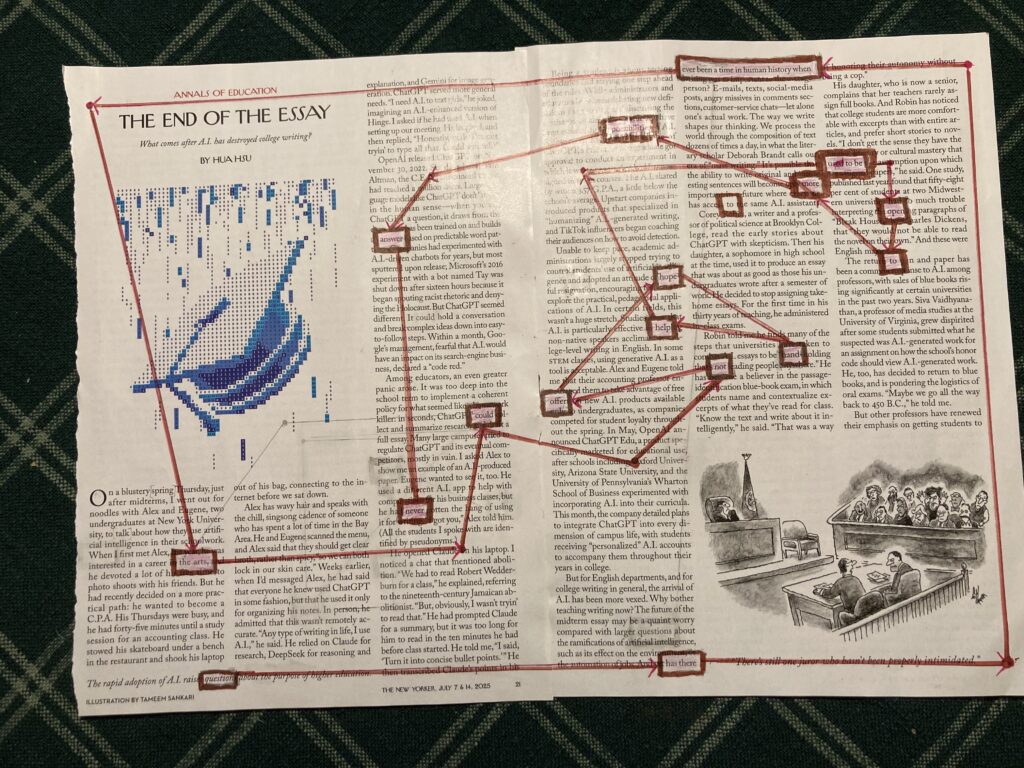
Picked a random old New Yorker. Found an interesting article, “The End of the Essay: What comes after A.I has destroyed college writing? / Hua Hsu. Put my watch timer on for 30 minutes.
Poem:
question: Has there ever been a time in human history when the arts could not offer hope and help us to be open to more possibilities?
answer: Never
A good first try. It’s funny that I want to do these visual poems when I struggle so much to see the words or how to make the boxes and lines that I need, but something in me keeps persisting, so I’ll keep trying. Hopefully it will get easier.
It’s messy — and with my vision, it will always be. and I added an extra to that’s just floating out there, disconnected. It’s too busy with too many lines. But it was fun and challenging and I like the poem I came up with a response to an article about AI ruining college writing.
When I showed it to Fletcher, he liked it and said there were ways to refine it. I agree, but not to this poem. I wrote on the original essay and I don’t have another copy. The question: next time should I scan the essay before drawing on it, or is the risky (you only get one shot) approach part of the challenge and the fun?
New Yorker Found Poem Experiment #2
10:30 am — Before starting to work with an article, I decided to sort through RJP’s old markers and find ones that still work. At some point during the process, I realized that this looking through old markers was making me dizzy; something about it was too much for my brain and my cone-starved eyes. I stopped sorting. I should have taken a break, instead I did something else. A few minutes later, I felt woozy and needed to sit down. My hands were shaking and my legs felt tingly. My pulse was fine, but my blood pressure was elevated — 158. I think I was having a mild panic attack, triggered by the dizziness from my bad vision. Boo. It seems as if my anxiety is back. I had a nice stretch of a year+ without it. It also seems like I will need to be more careful with how I use my eyes. Too much trying to closely see something might trigger another one of these. Am I right in my assessment?
I am noticing that my vision has deteriorated more. It’s even harder to recognize the faces of actors on tv, harder to see my kids’ faces when they talk to me. Am I getting closer to the complete end of central vision?
Because of this incident, I did not start my second experiment this moring. Should I now, at 2:10 pm, or will it trigger more dizziness and anxiety?
Yes, I did it. I need to make sure I test out/find the right tools and be more deliberate in what I’m doing. I’m very messy — which is mainly because of my vision, but not completely. I’ve always been an almost and a that’s good-enough girl.
These poems are from a July 2025 article, Money Talks:
1 — Let me ask you a question
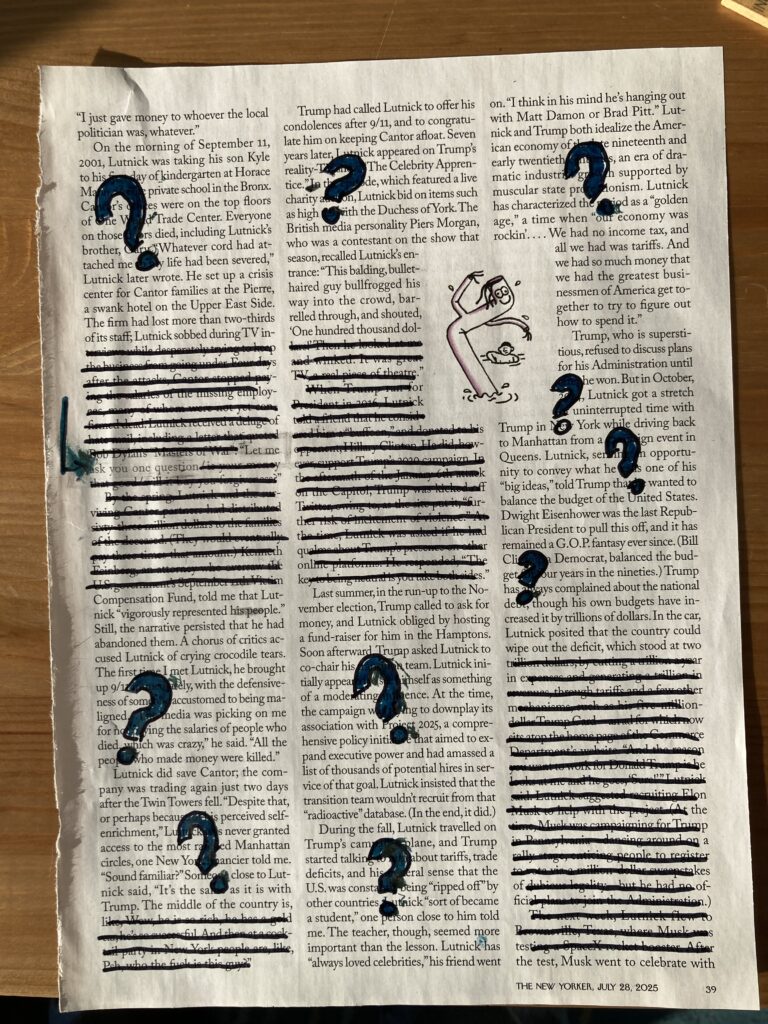
I like the idea of this, with all of the questions marks, but it is really sloppy and it doesn’t highlight the text that I’m using, “Let me ask you a question.” I would try this one again, but if I plan it more carefully and work on my question marks!
2 and 3
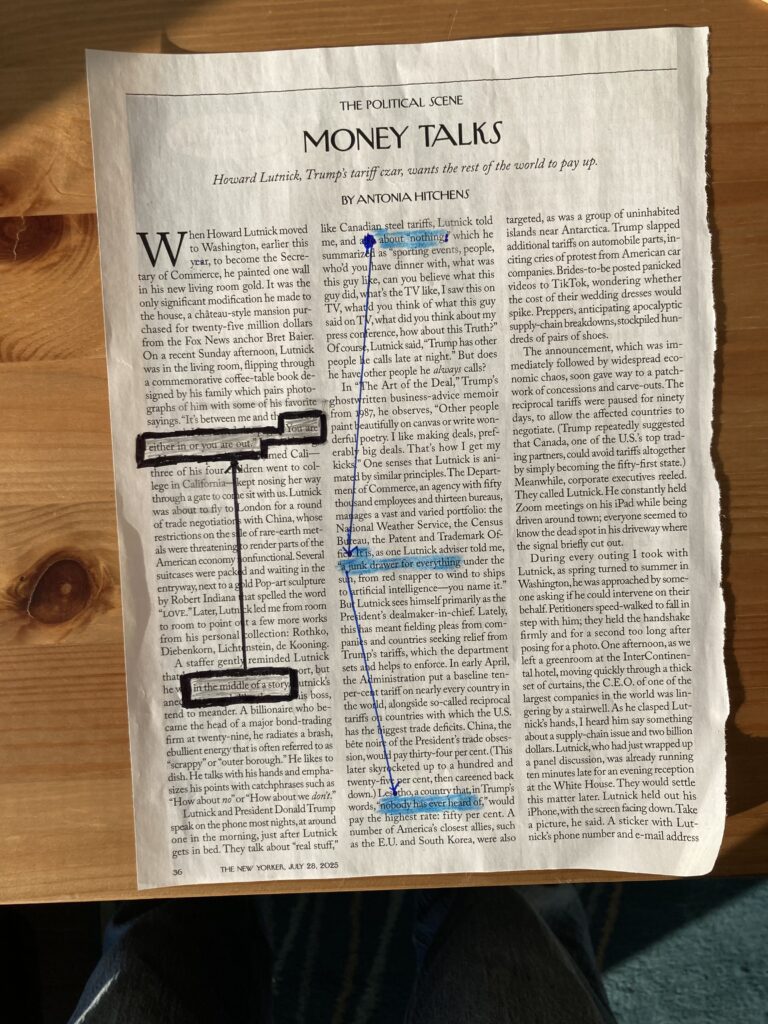
2: In the middle of a story, you are either in or you are out
3 — About nothing: it is a junk drawer for everything nobody ever heard of
Again, messy and poorly executed. I like that I used less words than the last one. I need to figure out a way to draw that I can do with my unreliable vision. It’s hard to see enough to color within the box or to draw straight lines, even with a ruler!
I like the idea of nothing as a junk drawer. It might make even more sense if I found a much, and could make nothing into nothing much.
New Yorker experiment #3
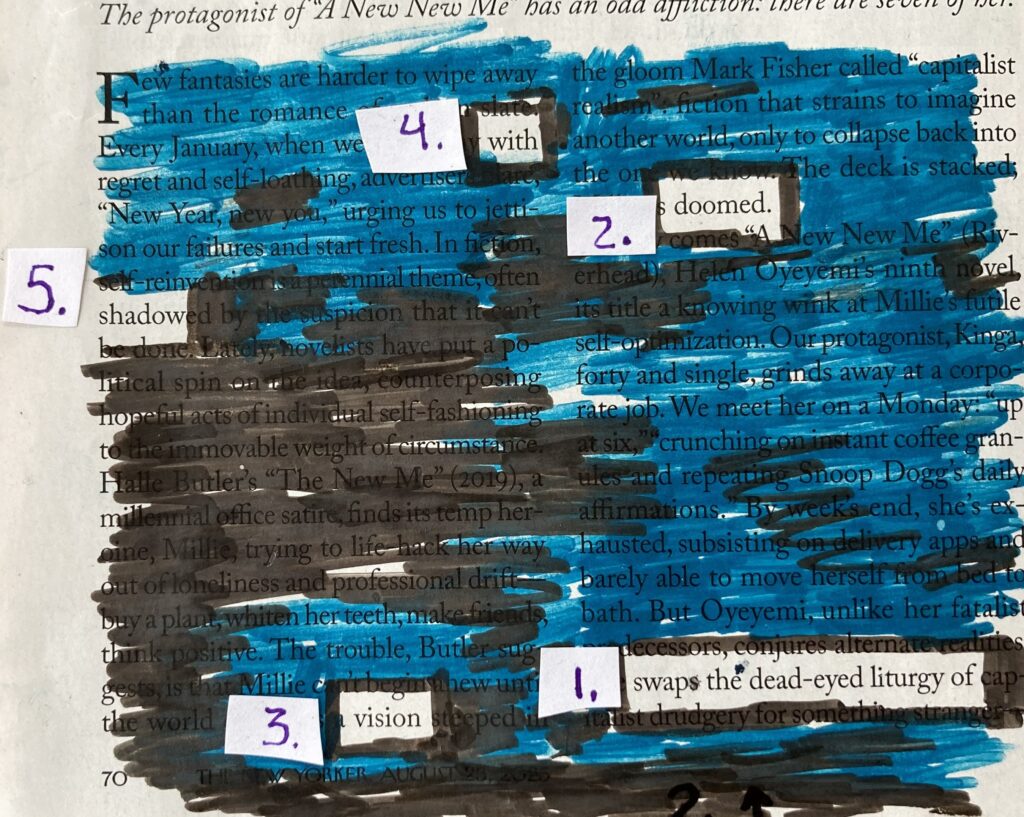
Today’s experiment comes from a book review in the 25 august 2025 issue titled “Me, Myself, and I.”
text:
1
point to
sentences
sliced in half
askew
with strangeness.
Stutter
just enough to let in the surreal.
Occupy who knows where
stay
vague improbable
2
swap the dead-eyed liturgy of
doomed
vision
with
shadow
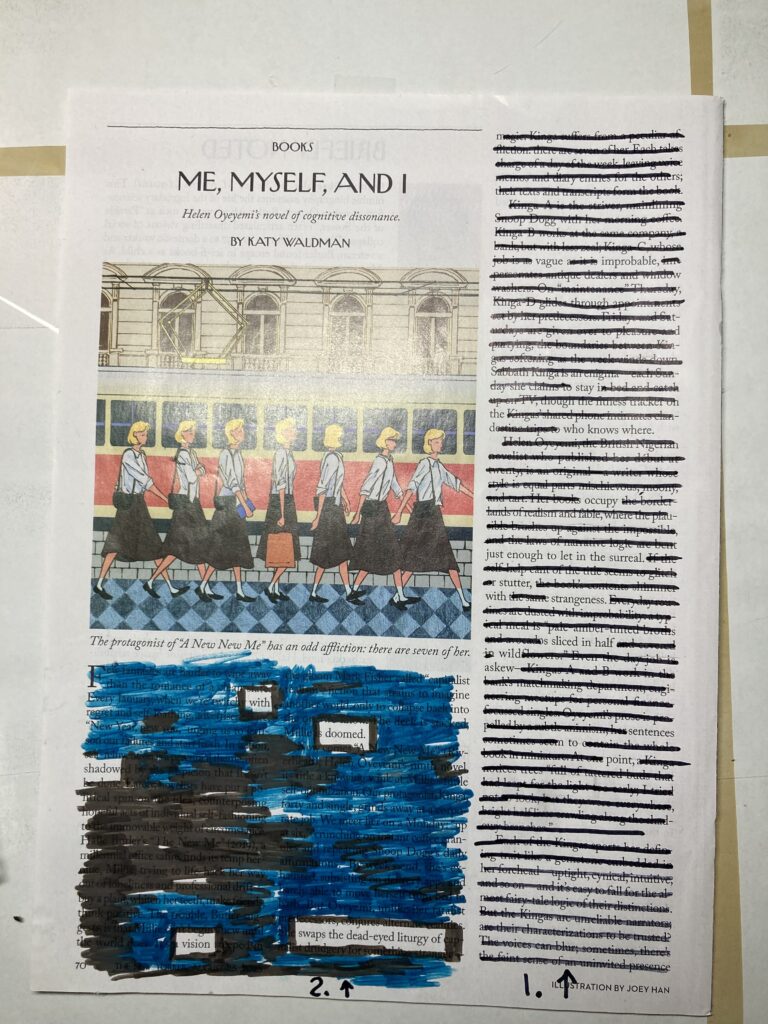
thoughts: Again, find markers that work before I start using them. Also, the second poem needs arrows but I didn’t know how to do that with the blackout. And, I wanted to add another word to shadow: reinvention, but I accidentally colored over it. Oops.
New Yorker Experiment #4
But before I move onto #4, I added some numbers to #3, so it was easier to follow the path of the poem:
Experiment #4: A Screaming Skull / New Yorker 18 august 2025
text:
You may
feel
like a shadow.
Another name for
blind
is
a hole in the
vision
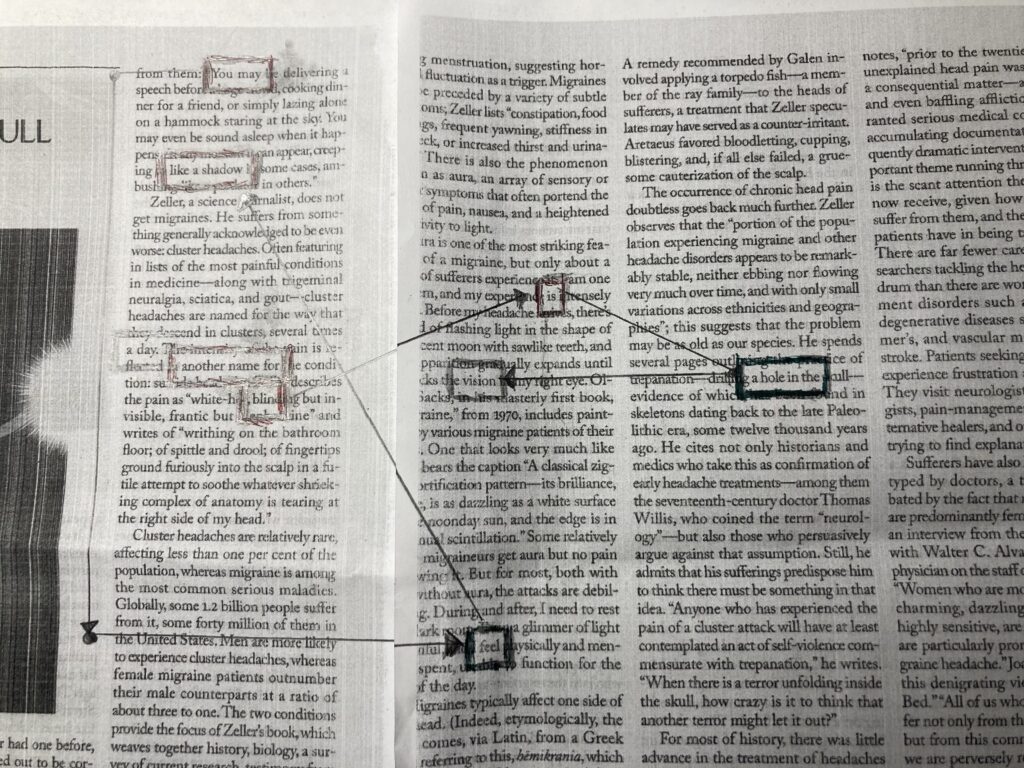
I tried photocopying the pages from the New Yorker, but the quality is terrible. Also, I ran out of time. I like the idea of another name for blind is . . . but I could find the right words to fill that in. I’ll work on this one more tomorrow. I think that my theme for these is my vision.
New Yorker experiment #5
These experiments are slow-going. I run out of time to work on them. I struggle to see what I’m doing. I’m messy and haven’t figured out how to work with glossy magazine paper. So why am I continuing these experiments? I asked that to Scott and FWA in the kitchen the other day and then answered it myself: For some reason, I2 want to do these erasures, so I’ll keep doing them until I don’t want to or can’t (because it is too hard with my bad vision).
a flash of an idea: As I was writing that last paragraph, I was thinking about how visual poetry is increasingly inaccessible to me as my few remaining cone cells die (are the dying or just malfunctioning?) Then this popped into my head: yesterday’s erasure involved using marker to cover almost the entire text. When I had FWA and RJP read it, they both got marker on their hands — not in big streaks, but in tiny marks that almost looked like cuts or scratches. What if I made these erasures about touch too? My first thought was about doing the erasure in such a way that created a residue. Second thought: what if these erasures involved texture and touch — here, I’m reminded of the kids’ book Pat the Bunny and its different textures to touch: the soft bunny fur, the rough bunny . . . nose? I can’t remember what was the rough thing in the book. If you can touch these erasures and their textures, which would somehow speak to the words/ideas on the page, maybe you can hear them too? I’m thinking of scales, and thick layers of paper, maybe some holes where the paper has been ripped open, some extra rough sections, some smooth, like a thin film, crinkly, soft, sharp-ish. And — maybe in terms of the visual aspect, find ways to cover it that reflect or glow or shimmer or sparkle. I can see these textures in a way that I can’t see the typical flat, black expanse of an erasure. So things like glitter, little mirrors, metallic surfaces, ridges. What about covering it with things that offer colors only visible in the light — thinking of bird feathers here. So many ideas! Again, difficult to execute without it looking like a mess, but fun to try.
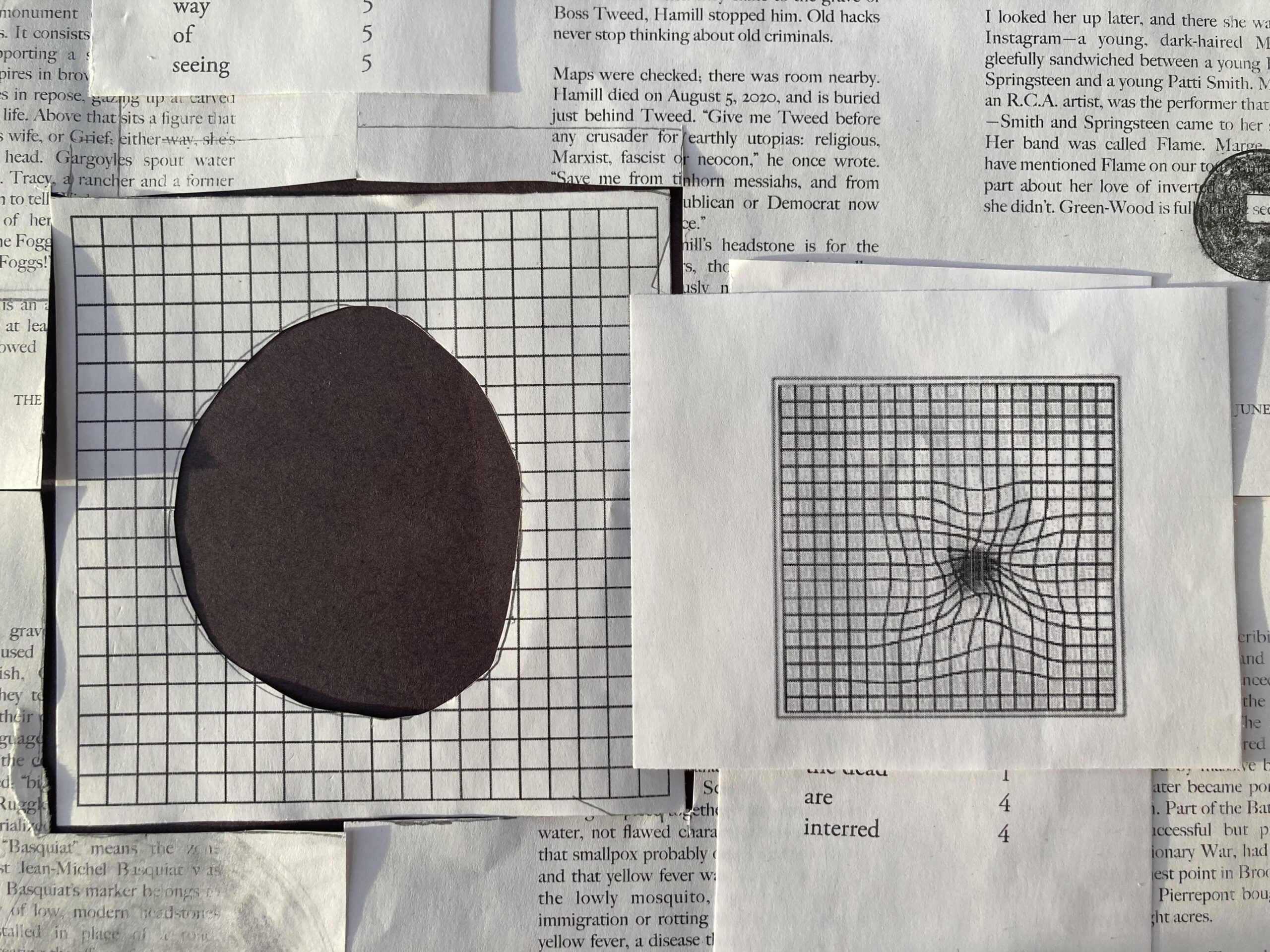
Before I had that last flash of inspiration, I was thinking about how I’ve decided (as of yesterday) that the overarching theme of these found poems is my vision and how I see. Then I thought, I should apply my blind spot to these pages. Create an amsler grid out of the text, and then place a cut-out of my blind spot (found while starting at a blank wall and then drawing what I see) on top of the words to find the poem.
Maybe some of these erasures could be all/only about texture, some all/only about my blind spots, and some both. And just now, another thought: What if these erasures were all about my blind spot and the idea of blind spots? Would this work: one of the erasures could be covered in spots or dots or holes in the paper?
So many fun ideas to try. I imagine that some of them will only ever be ideas that are good in theory but don’t work on the page.
Oh — I almost forgot, until I looked over at an open tab that reads, “tools to use for magazine erasure poems,” I started writing about this experiment because I wanted to mention my need for better materials. I love how writing in this log opens me up and helps me to see new things to try! Before writing about textures, the supplies I thought I needed were: sharpies, an exacto knife (can I see well enough to use this?) and possibly paint. Texture through thicker and thinner layers of paint is an interesting idea. Now I’m thinking I need scraps of fabric — next week, RJP and I should go to the fabric scrap store at the Textile Museum! — that are soft and rough and bumpy and gauzy. I need glitter and sparkles and little things that reflect and crinkle. Fun!
Here’s a new version of experiment #3. I decided to paste the text into a document so I could have an easier time drawing on the text. Is this a good solution? I’m not sure, but I do like how this version looks:
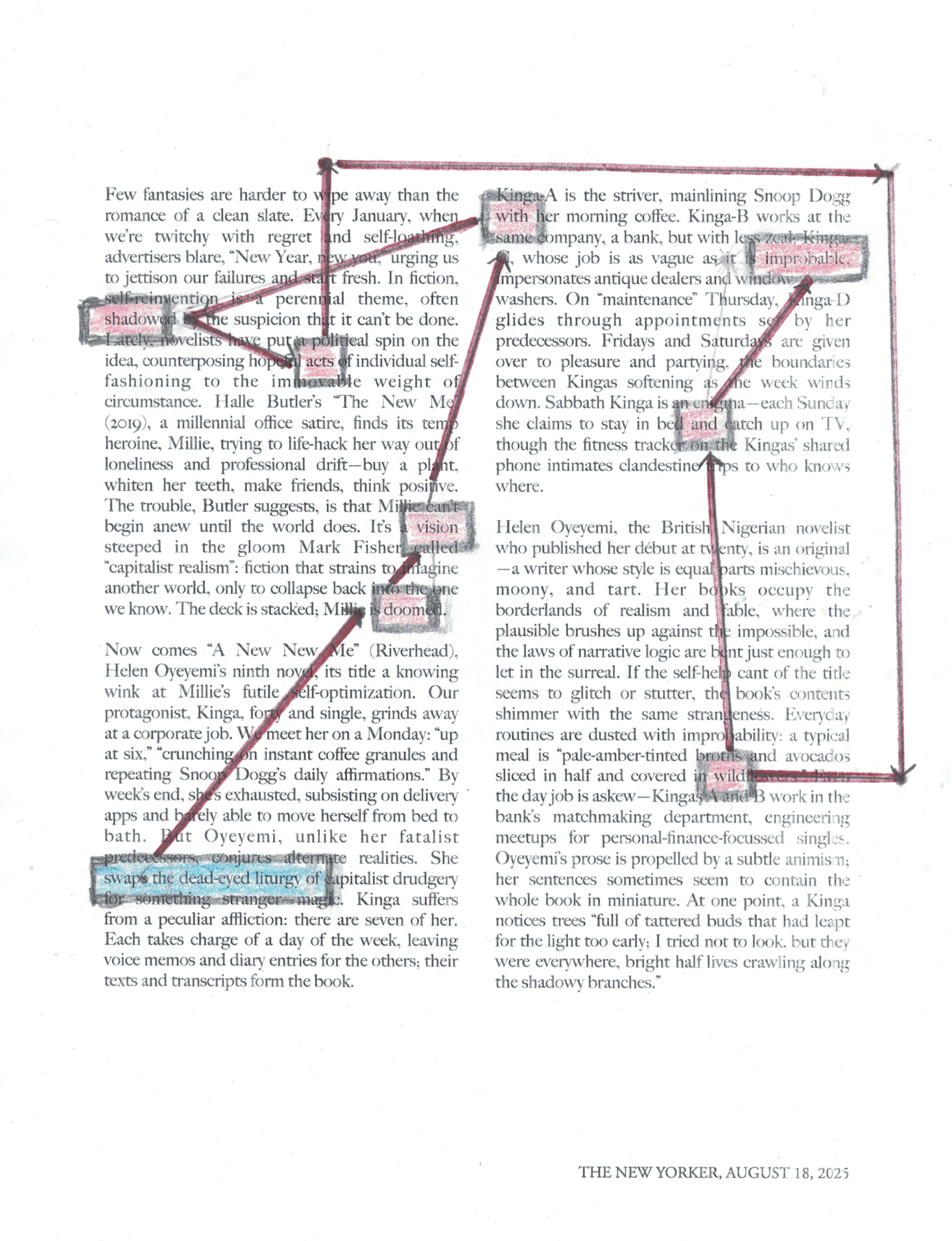
Bummer. I just realized that I erased the ed on doomed. It is supposed to read: of doomed vision (I guess doom vision could work?).
text:
swap the dead-eyed liturgy of
doom OR doomed3
vision
with
shadow
acts
wild
and
improbable
And now I’m redoing yesterday’s experiment:
text:
Another name for
barely
not
blind
is a hole in
your vision
that
makes
for
an
uneasy fellowship
with
the world.
New Yorker Experiment #4, continued
Today some part of me decided that we (the Saras) would offer a more detailed account of the process of thinking through my latest poem, so that’s what we’re doing.
I want to keep working on my fourth experiment. Yesterday afternoon, I printed out the New Yorker article, “A Screaming Skull,” and found my poem on its four pages. Then I taped the pages together and mapped the poem out. The theme: holes. I imagine it as part of a larger project about my blind spot. Maybe this project won’t be all erasure/found poems; I might try to connect it to some other work on the blind spot — work I’ve been doing for several years now, but haven’t quite figured out how to turn it into something. Yes! Experiment #3 — swap the dead-eyed liturgy of doomed vision with shadow (or shadowed?) acts, wild and improbable could connect with my study of JJJJJerome Ellis, the stutter, and his liturgy of the name! Very cool!
I took a picture of what I’ve done so far:
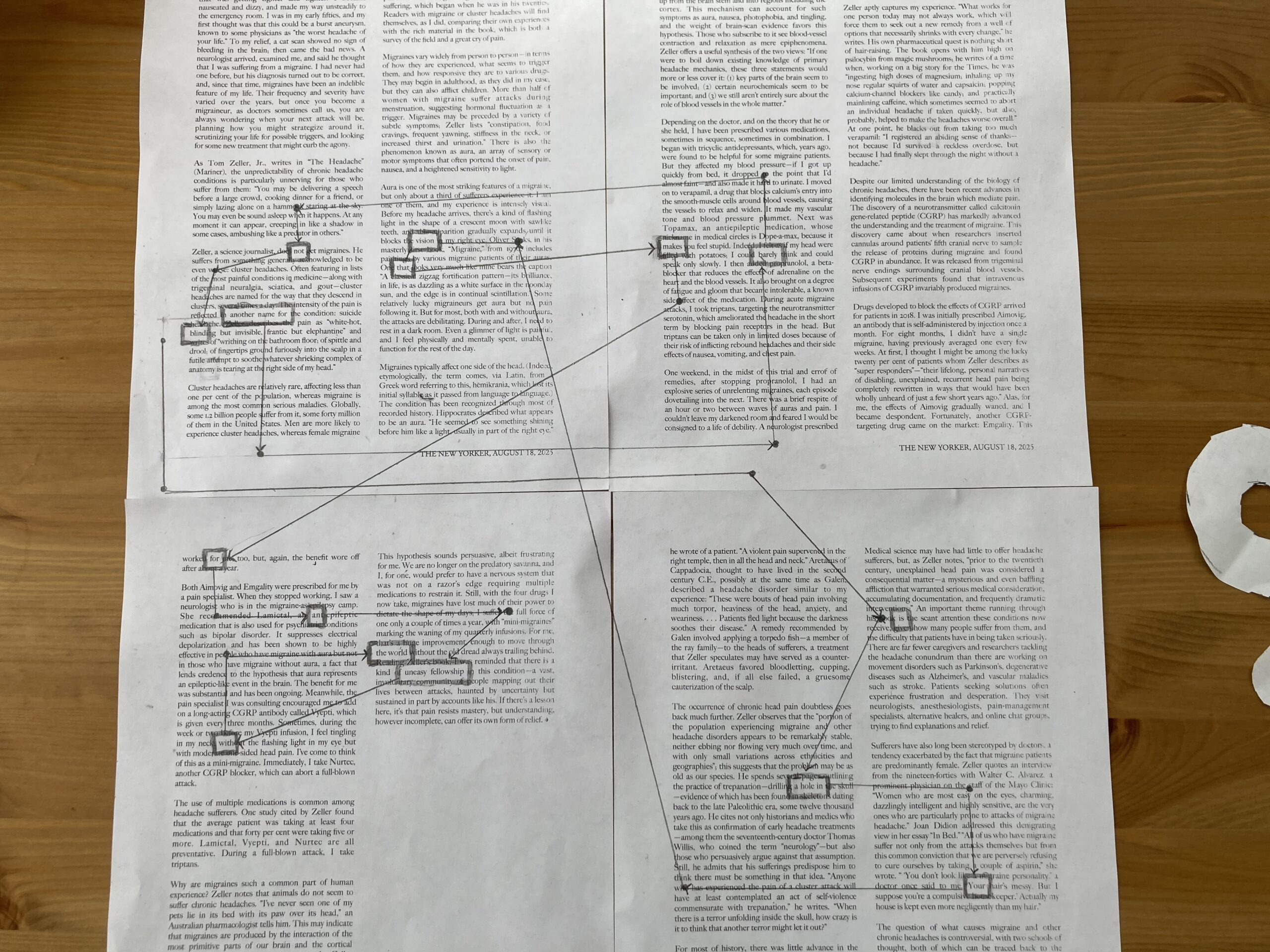
What to do next? The second image offers a possible approach: Applying my blind spot — the one I recently created by staring at a blank wall until it appeared, then tracing it — to each of the “found” words. I could sketch the blind spot directly on the page, around the word, OR I could place a cut-out version of the blind spot on top of the word. Maybe I’ll try a practice sketch. Another idea, which is probably definitely beyond my technical ability: create an animation of the process of reading this that starts with an overview of the poem, then zooms into the first word, encircled by the blind spot which appears as I read it. Then it moves to the next word/phrase, and the next, and the next until the poem is finished. I could also do it as a series of stills (instead of an animation). You could look at each one individually1, the image as a whole, and the series of images in a gallery.
I like this last idea! The focus on individual words — isolated from the other words and the meaning as a whole, which is how I read, because what’s left of my central vision is so small it can only fit a few words, and which is how I often (but not always) experience the world with my big blind spot — in isolation, and removed from others. A question: should I keep the larger poem as a square, stacked 2 x 2 pages? Or should I have it extend as 4 pages across? I can play around with it.
an hour or two later: Here’s something I tried with a paper cut-out of my blind spot as a template. I’m thinking I should ask Scott to make a sturdier, cardboard version of this template.
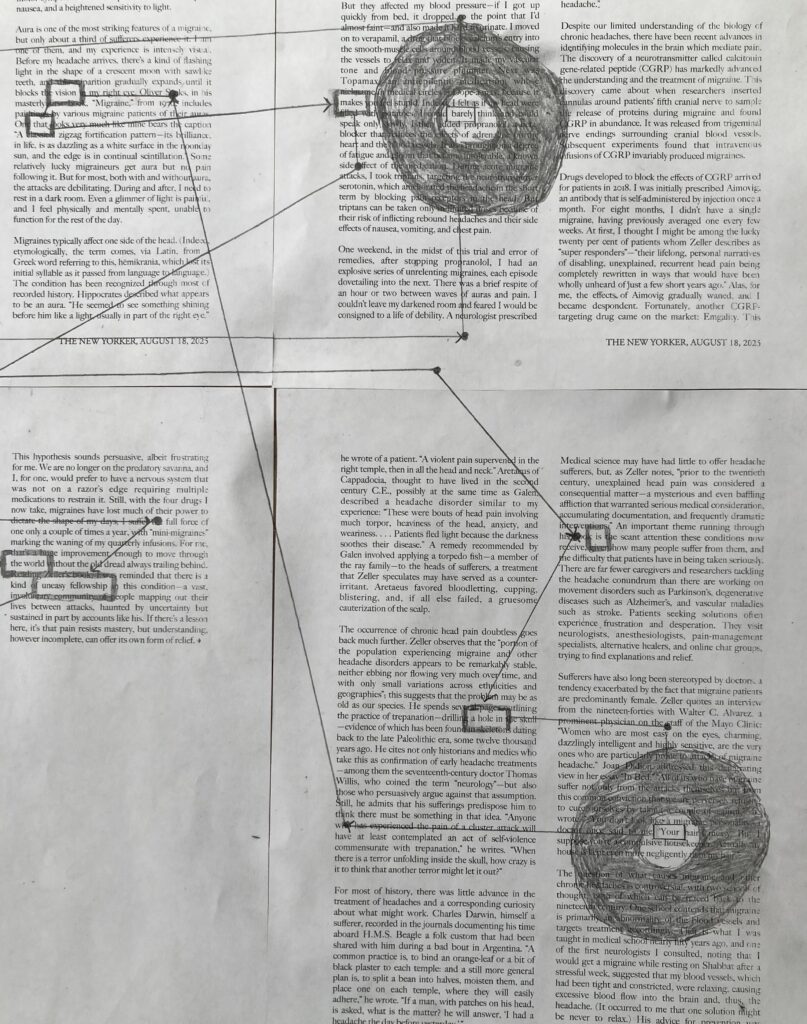
Something to think about: should I have the blind spots on the entire poem/map? I was going to write: no, because that’s not how I would see it; I would see a somewhat fuzzy version of the map of the poem. But this poem is not an accurate representation of how I see. I hardly ever see my blind spot as a gray blob. But the blind spot is there and it distorts how/what I see and I need to represent in some way that others can see too.
Another question: should I hand-sketch this poem, or figure out how to do it on the computer? I like the hand drawing — the material aspect of it + I can do it all myself — but drawing it by hand is messy and unreliable. I’m thinking that this series will be part of my vision art installation — along with my snellen charts and mood rings. It seems too messy if I don’t do it on a computer.
Also: how should the individual stills look? Should they be a close-up on that part of the poem, or just the word/phrase centered in an otherwise blank page? Should they include the blind ring? If I have more of the text, should it be too fuzzy/distorted to read, or should I have it surrounded by gray? Looking at the words on this screen, I see: 1 or 2, maybe 3 short words in focus, then other words too dim or fuzzy to read, and, after staring for a few seconds, a glowing dark ring around it. This ring is not solid or very dark, it’s almost gauzy, like a veil, or the feeling that there’s a ring there. Does that sound strange?
(rabbit) holes: Today I start a new volume of my Plague Notebook: vol. 28! I’m calling it, What about Epstein, Trump? As I was writing in it, describing my latest visual poem, Holes, a thought: Am I calling this holes (or hole?) partly because of my recent study of rabbit holes?! Maybe! And maybe I could bring rabbit holes into a poem about my blind spot!?
Holes (aka New Yorker experiment)
Should I try some new erasures, or continue to work on turning my “hole in your vision” into something? Maybe I’ll try both. I’d like to push at this idea of a hole in the vision, with the hole not being (just) empty or a void, but something — like a rabbit hole: an in-between space, a passageway, a liminal space, a threshold, but also a clearing (JJJJJerome Ellis), the Nothing around which something functions, the gorge.
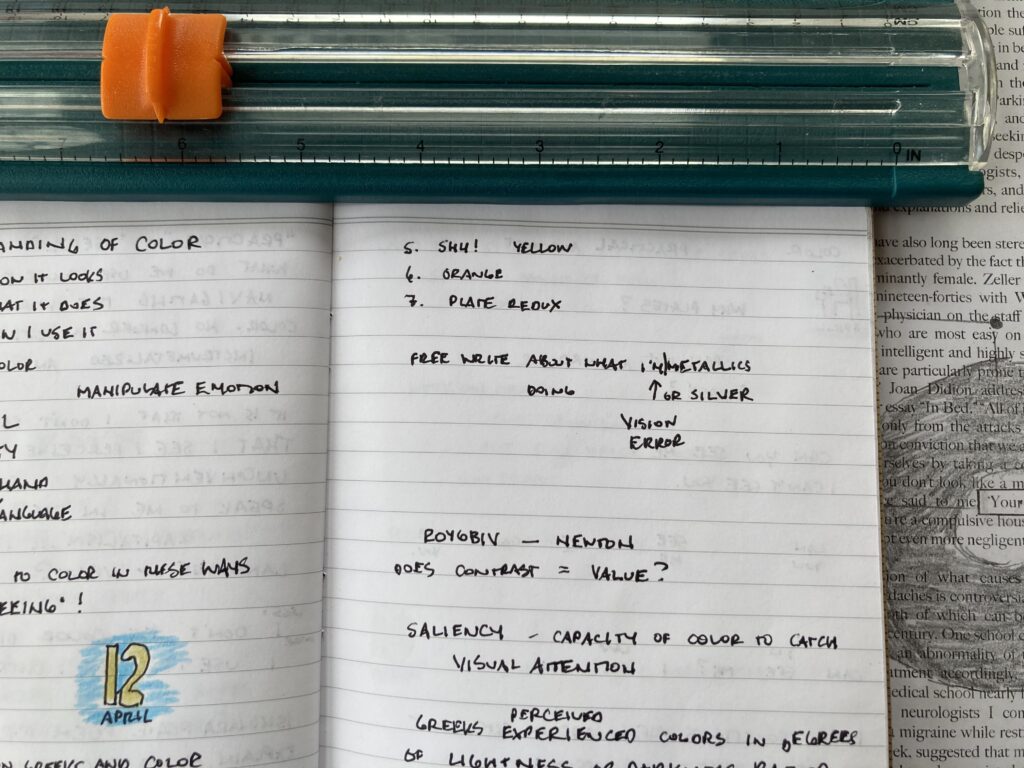
a note about reading and writing: I like using an erasure to show how I read words.2 Taken as a whole, words are too fuzzy or unintelligible to read. I can only read them as individual words. And when looking at one word, I often don’t see of the others around it, just one word then then next word then then next. I used to be able to grasp full phrases and sentences at once — at least I think I did. This not seeing the surrounding words is a problem when I write. My Plague Notebooks are full of examples of words running into each other, or one word being written over another. Whenever this has happened, I try to make note of it by writing Vision Error and drawing an arrow to it.
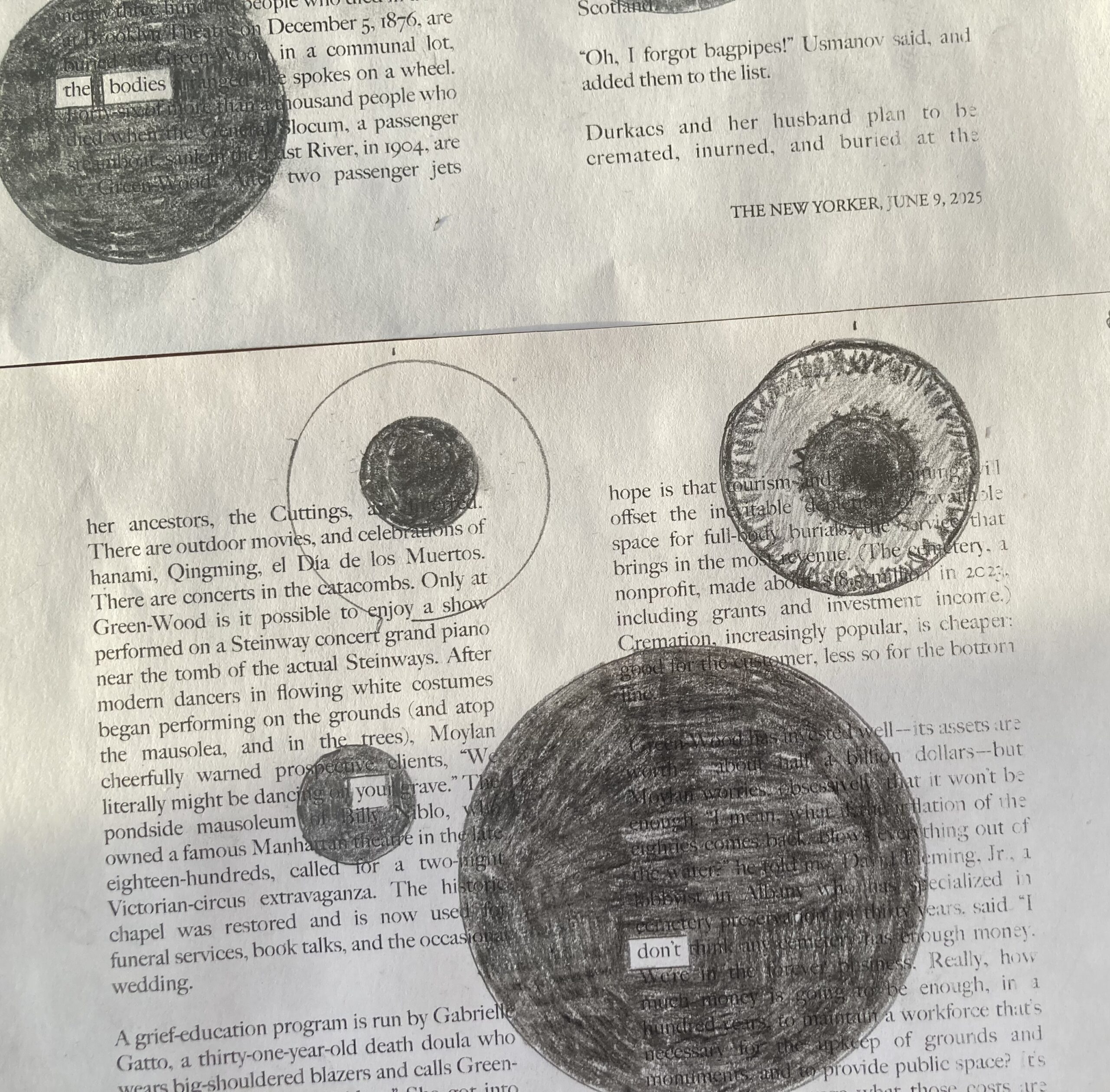
Throughout the day, I was adding blind spots and then, when those were too big for the space, I added smaller circles (made by tracing the bottle caps for my iron pills and my old lexipro pills). Here’s how it looks now:
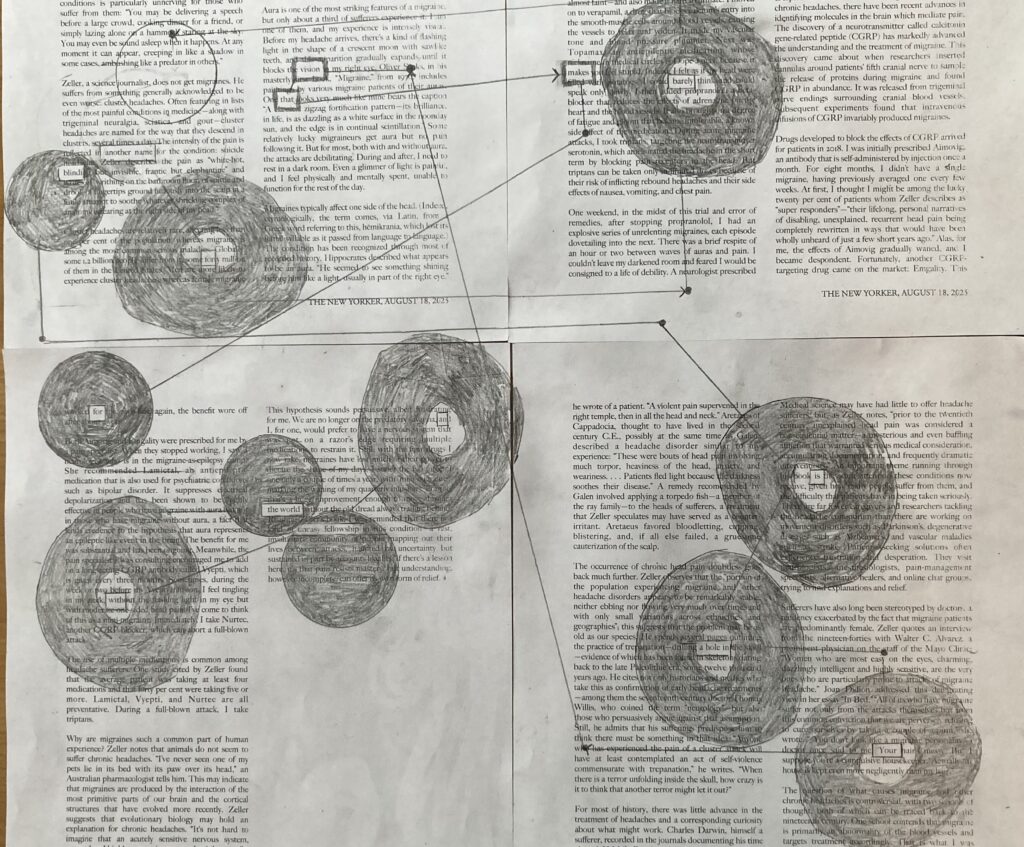
I’m pleased with how it is looking. As of now, I’m imagining this version as a template for another, more polished version. I might replace some of the pencil shading with material — like gauze or netting. Maybe other holes will be filled in with glitter or sparkling something, feathers, twigs?
New Yorker Experiment #5
First, an update on Holes. There’s an empty space without text in the lower left corner. I’m thinking of putting a definition or a quote or a line there. Or, I could put my poem written out in a straightforward way in the space. Would that undercut of enhance the experience of reading the poem? The text could also be an explanation of my version of reading; peripheral — big picture / central — one word or small phrase at a time, often experienced in isolation.
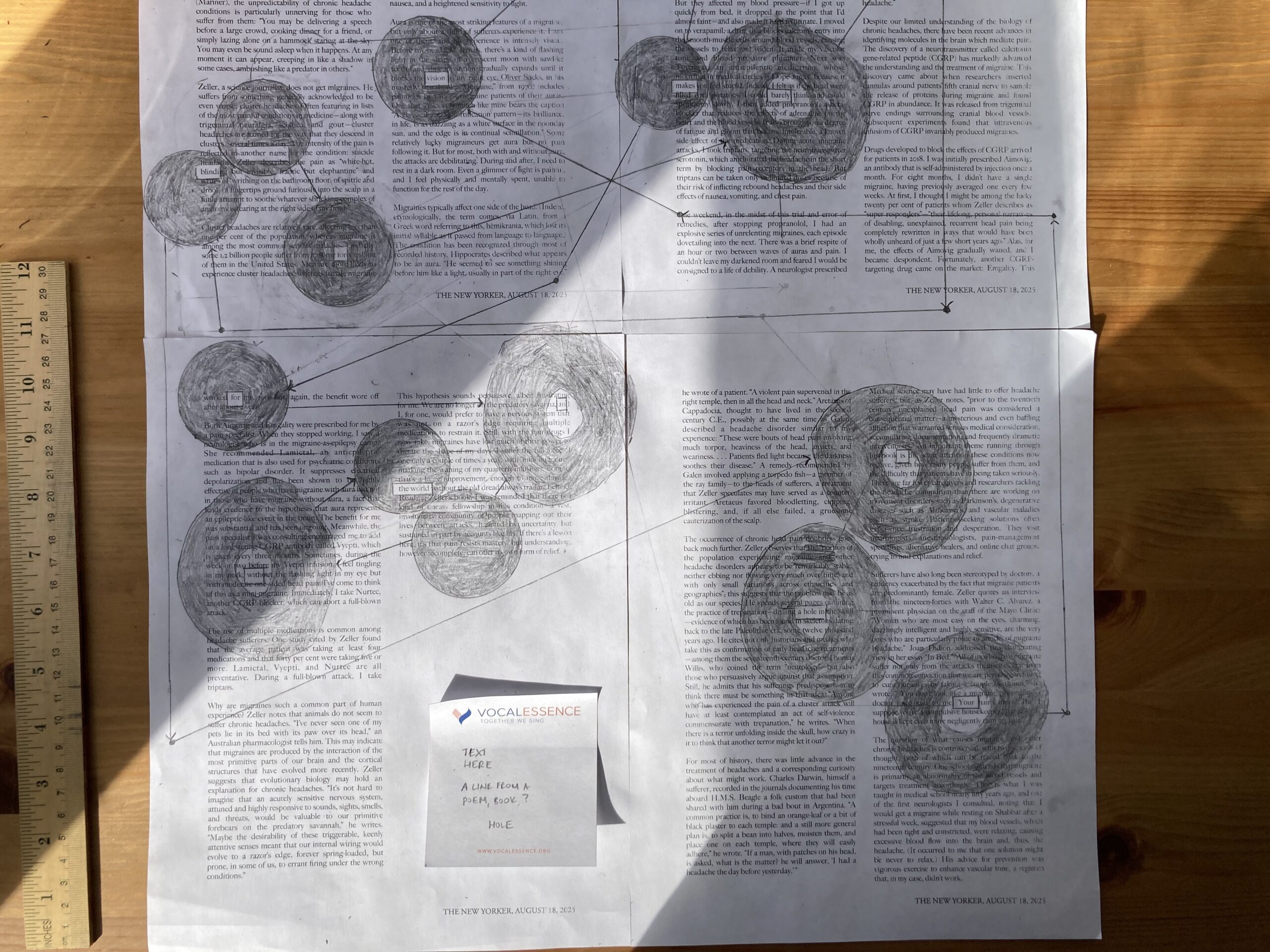
I’ve started (just barely) working on experiment #5. I’m using an article from July 28, 2025 titled “The Whisker Wars.” All I’ve done so far is write down words that stood out to me on two out of the three pages. I want to try experimenting directly on the New Yorker pages so I have a decision to make: two of the pages are back to back, so I need to pick either the first or second page. I’ll read through both of them and see which one I like better.
Hmmm….there’s a cartoon on the second page with the caption, “That’s an area for creativity and unstructured play.” I might want to use a few of those words.
New Yorker Experiment / Holes
A slight shift in my first hole poem. Instead of, another name for barely not blind is a hole in your vision that makes for an uneasy fellowship with the world, it is, another name for barely not blind is a hole in your vision that makes for an uneasy fellowship with the word. So, word not world. Since this poem is about how I read, word makes more sense to me. Part of me would like to keep both world and word, but most of me thinks I should keep it simple with word.
In my draft version, I’ve hastily shaded in the circles/my blind spot with pencil, so they are all gray blobs and dots. The only times I recall seeing gray blobs are: looking at a backlit face and staring at the wall for several seconds. When I look at text, like on this screen, I see a few words in the center and then . . . what? Difficult to put into words. Everything is buzzing, shifting, textured. I want to experiment with the blind spot blob in my poem by adding texture — I mentioned adding gauze or glitter on 8 march. RJP and I are planning to visit the Stashery at the Textile Center this week to see if I can find some cool materials.
While I let that simmer, I’ll return to the last page of experiment #5 (continued from 9 march):
words/phrases the stand out, page 1:
- portrait
- a game of Now You See It, Now You Don’t
- in the beginning, not a whisper
- otherwise
- drift like snow
- wonder
- notice
- russet-and-gray
- pewter-colored
- abrupt shift
- who left
- entanglements
- weirdness
- yellow
- bore a hole through the bottom (of my coffin)
- still
page 2
- traces
- people saw it as separate (from the body)
- replaced by a view
- faith
- framed
- revealed
- meanwhile
- from
- however
- trends
- norms
- world all know / known
- waves
- an area for creativity and unstructured play
- lies details
- natural
- rather
- nothing
- believe (rs)
- teach you
- visible
- cut
- choice
words that stand out from Whisker Wars, page 3
- face / faced
- self-mastery
- the Lord knows who
- hold outs persist ed
- who was as devoted as
- you might think
- emerged
- embraced
- writing
- float /ed
- only
- unprofitable
- propaganda
- a sideshow staple / enfreakment
- mishaps
- cannot fully explains
- died
- few of us see
- express rapture at seeing
- poem reads
- endures
Here’s what I have so far:
nothing still
details
drift like snow
cut off heads
with pewter-colored faces float
a hole through the bottom
of the known world.
here it is unprofitable
to have faith / to put faith / to believe
in the visible / what is visible
New Yorker Experiment: A hole through the bottom of the known world
Today I worked on the template for my hole poem that erases the “Whisker Wars.” It has some of my blind spot, some big circles (from a iron pill cap), some medium sized-circles (lexipro cap), small (a quarter), and extra small (a penny). I want to create texture for the blind spots but leave the circles alone as pencil/gray.
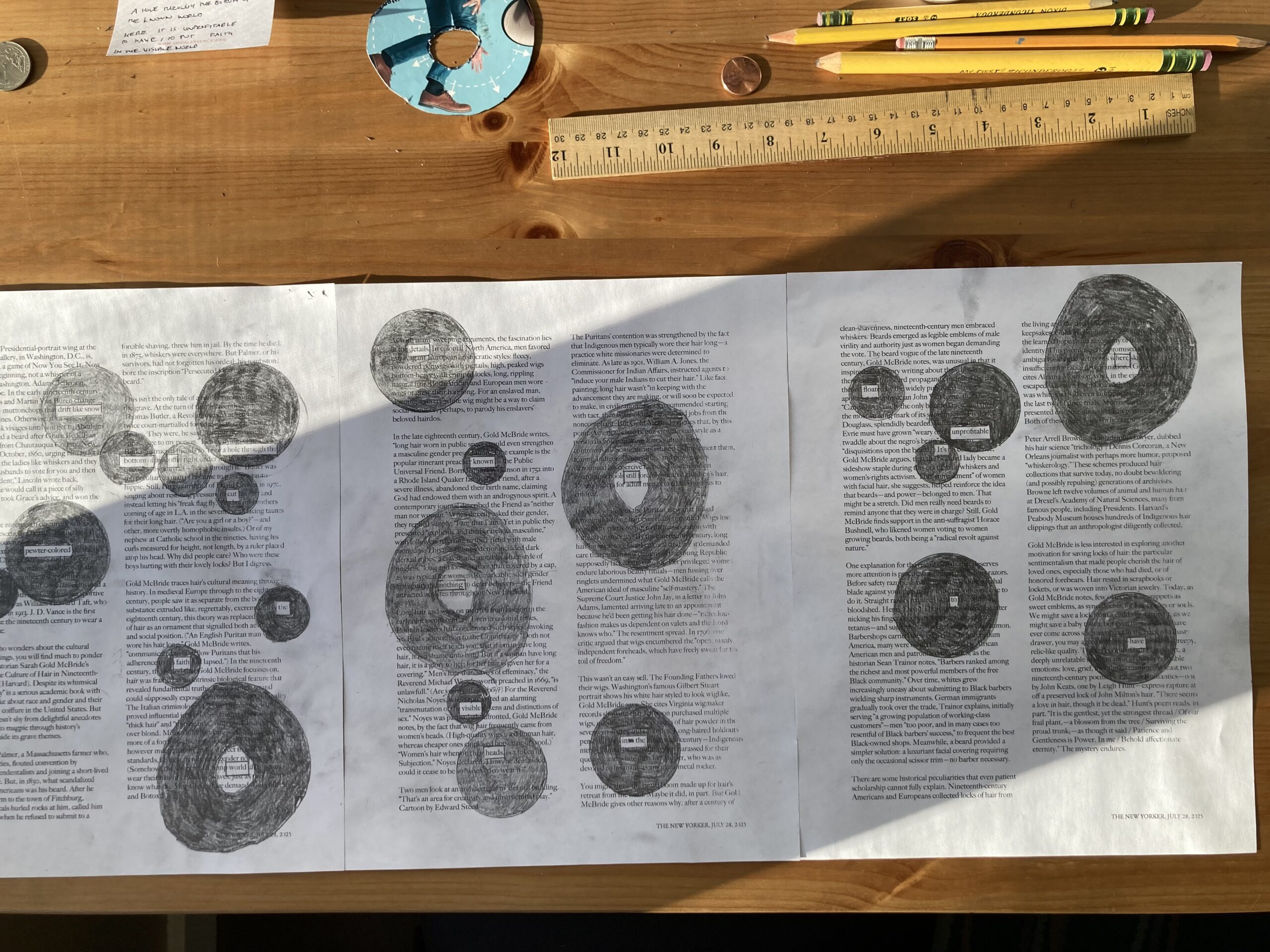
My choice of blind spots vs. circles, and the size of the circles, was mostly decided by what would fit where, but there might be some room to play around with some of it. I’ll think about it some more.
The words: nothing still / details drift like snow / cut off heads with pewter-colored faces float / a hole through the bottom of the known world / here it’s unprofitable to have faith in the visible — should it be what is visible?
added an hour later: I realized a further clarification on the idea of the hole and holes. The blind spot creates a hole in my vision, an absence that has created an uneasy fellowship with the world and made it unprofitable to have faith in the visible. But, there is also the small hole that remains in the otherwise dark blind spot that enables me to still read — it’s a small hole, and it’s getting smaller, but it’s still there. I’m noticing that my whisker wars poem offers many different sizes of holes depending on how many words I’m trying to fit in it. I need to have a poem that highlights that tiny hole holdout — ooo, holdout is a word in the whiskey wars article. Should I do a completely different poem using the same text?
HOLES
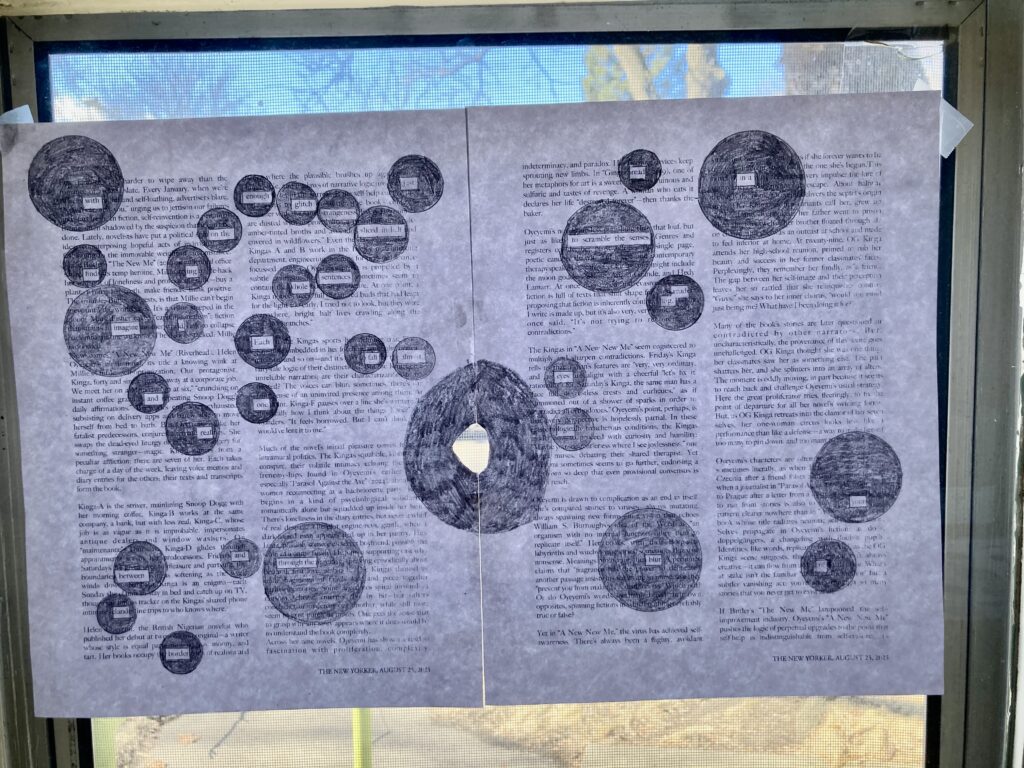
Reworking Holes 3 to allow for better spacing of the holes. Here’s the new version of the poem:
read sentences
sliced in half
with strangeness
each one glitch ing
just enough
to scramble the senses OR scramble the meaning
fall through the hole
your reading eyes find
and land in a logic
of blur and almost
on the border between
real and imagined
And here’s a photo of it:
RJP and I went to the Textile Center and it was fun and helpful to think about translating my ideas about holes into actual fabric and textures. I found some black netting that will be helpful and another wildly color thin fabric that might work. The question now is: how to use the fabric. I’m not sure it’s can be as simple as cutting the fabric in the shape of my blind spot — that just seems like bad decoration. What I want to do is use texture to convey how I see/read and what it feels like to do these things with my blind spot. My blind spot is rarely actually visible, and when it is, it’s not a black, opaque spot.
- A few new ideas: cover the words where the blind spot is in plastic that you can see through, but that makes words too fuzzy to read.
- A lattice of twigs, gathered at the gorge, covering the blind spot — when I see these twigs, it often reminds of my scrambled central vision.
- Some sort of fuzzy, fluffy texture that evokes softness, which is one thing that happens to my central vision with less working cones: everything is softer, less detailed, not sharp or harsh
The key, I think, is to use texture to communicate different aspects of my new ways of seeing with hardly any cone cells: it’s fuzzy and soft; it’s vague; it seems like there’s a film over it and that I can almost see it but not quite
HOLES
Flipping through my past New Yorkers, I found an article from the 9 june 2025 issue that looks promising. It’s called “Still Life” in the print issue and “Greenwood Cemetery’s Living Dead” in the online version. The only test for whether I can use it or not: it must have at least one use of the word hole, or of a word that contains hole. This is a long article, so I’d hope there’s at least one hole, but is there? Yes, 4!
- Medina extended a tape measure into the hole and said, “Six-ten.”
- Usmanov and I stared down into the gaping hole, its walls marbled with grass roots.
- went to Green-Wood almost every day for weeks this spring, and the most unnerving thing I saw was an enormous hunched figure, wearing a cloak, with a gaping hole for a face.
- Scientists were only starting to piece together that contaminated water, not flawed character, caused cholera; that smallpox probably originated in rodents;
I’m surprised that an article about a cemetery only has 4 mentions of holes. Isn’t a cemetery more than half holes?!
some notes as I read through the article:
One, I am reading it backwards, section by section.
Two, one rule in the cemetery: no skylarking. I looked it up, skylarking is frolicking and playing jokes on others. It’s also the name of one of my favorite XTC albums.
Three, reading the text, which I’ve put in a pages document, I’m noticing a few things about the text: the text surrounding the word or phrase that I can see sometimes looks like it is scribbled out. Sometimes it looks like it has sparkles around it that are moving — not quite flashing. The text always seems to be vibrating. How can I translate that into a texture on my blind spot
Four, as I read through the sections, I jotted down words or phrases that stood out to me:
entrance
flaming torch
welcoming
appears
mirror
ink
you’re never alone
you’re never disconnected
love
full of little secrets
inhabit
center
recreate
experience
remaining time
offer
everyone
gently
between
seeing
moment
you look at space, you look at background, you look at sky
hope
visit
already
thinking
I don’t know why
there was room
about to open up
turn and follow her gaze
staring
hands
waste
bigger picture
across
threshold
neglect and care
art
cone
cell
heart
needed
landscape
fizz
snow flake marble dust
seltzer
balance
fills up
keeps the grass
space
enough
out of the water
upkeep
grounds
public spaces
essentail
failed
possible
efficiency
requires
can
stand on a sidewalk
people who never look up
out of room
true
mapping
crevice
easy
circular
elipses
inside
walls
outside
dark
happen
here
nothing
pale-blue
cluttered
wasn’t a place
searched
certainunmarked
is now used
other-siders
skylarking
exhume
make
when you see
in place of a road
the word
down through the plywood
a plank
settling
glacial till
earth
inches from
a layer of turf
dirt
unstratified jumble of sands, cobbles, and clays
caves in on itself
all-weather
like a bird
bench
what do you want
stone slabs
a door
uncut grave
terrain
geologically
life
this is a place to inter the dead
no good place to put all the boies
walked around
faces believing
piece together
rotting
disease
inspired
crowded
By the way, as I write, the snow has started. We officially have a blizzard warning that begins around 10 pm and lasts until Monday morning.
One of the reasons I picked this article is because I wanted more land language, like grass and dirt and dust and terrain and stone slabs and sands, cobblestones, clays, caves and glacial till. I want to connect the hole in my vision with the gorge — as a landscape, and a very big hole. I think of it as a powerful metaphor for my vision loss and what comes during and after. Of course, the gorge is also the actual place I go to for my writing practice.
The word plank stood out to me because of ED’s “I felt a funeral in my Brain” — and then a plank in reason broke/and I dropped down and down — I think of ED also with the stone slabs and the dark.
And, I like crevice and opened up, inside, outside, this is a place to inter the dead, room — a gaping hole, a threshold between,
I also like fizz and snow flake marble dust, which is what the words (and what I) sometimes feel like — fly, like a bird, sky — the words, cluttered, crowded and between walls
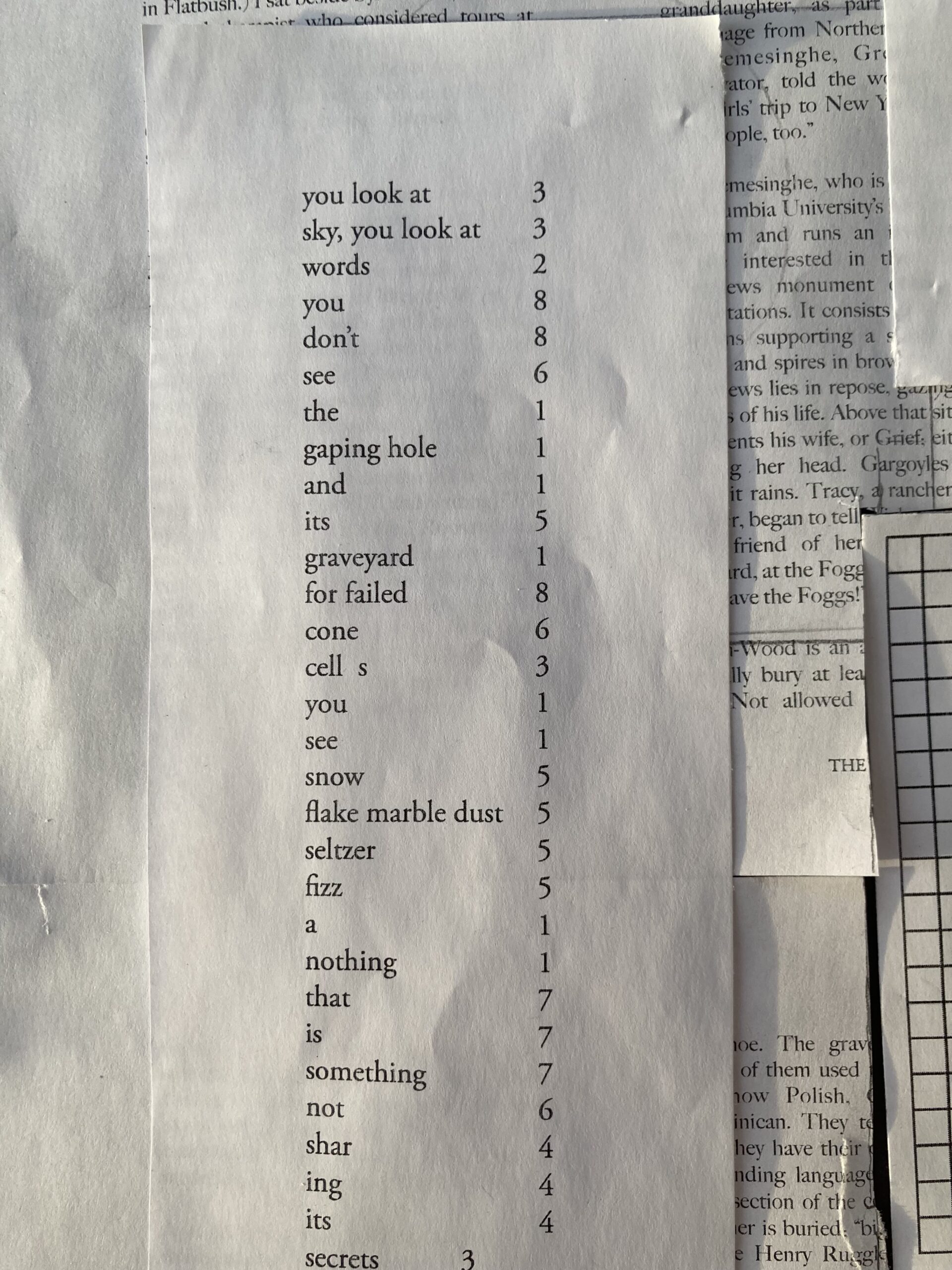
my eyes: a graveyard for dead cone cells
you look at space
you look at sky
you look at words
and don’t see the gaping hole
and its graveyard for dead cone cells
you see
snow flake marble dust
seltzer fizz
a nothing
that is something
HOLES 4
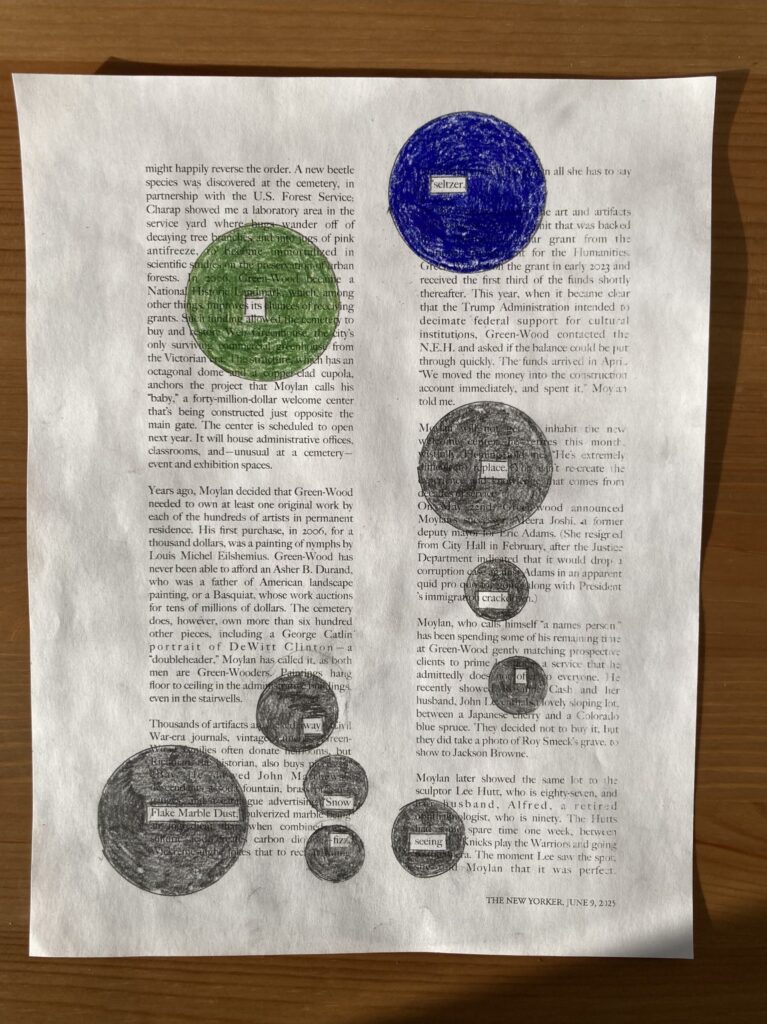
Today I’m mapping my words on a copy of the “Still Life” article. I”m trying something different. In Holes 1, 2, and 3, I taped the paper together first and then found the words and drew the holes over and around the words. Today, with such a long article, I’m finding the words and drawing holes around them first, before I tape the pieces together. Will that make a difference? Not sure, but I might switch around the order of the pages to shape how the holes look together.
I drew and colored in holes on 3 out of the 8 pages, and tried adding some color to a few. I’m wondering if some of the holes should messier, with less defined borders or jagged, rough. I have limited ability in drawing; can I push myself some more? Here’s an image of one of the pages:
HOLES
Yesterday afternoon, after finishing mapping all of my word (drawing boxes around them, encasing them in circles or the shape of my blind spot) and feeling like something was missing, I had an idea: I should place the Amsler grid somewhere on the pages. I didn’t want to simply cut out a printed version of the grid and completely cover the words. What about drawing the grid on top of the words? Too difficult with my terrible vision! Then, a new idea: cut out a hole the size/form of Amsler grid’s shape (4 x 4 in) and use string as the lines for the grid. After some playing around with it, another idea: not string, but thread or wire, and make the grid broken, distorted, emerging from the hole, looking somewhat like broken guitar strings. Three of the strings will extend out across the pages, offering the path of the three sentences of the poem. A variation: create three grids, with each one corresponding to a different sentence. This idea, which I hope I can execute because I really like it, led me to think about adding an Amsler grid to all of the holes. On Holes 1 it would be the “normal” grid with my blind spot on it. I have to think more about how it would look in Holes 2 and 3. By Holes 4, it’s broken.
If you google “distorted Amsler grid” you can find some great images of warped lines and black holes caving in upon themselves. Due to risk of copyright infringement, I won’t post any, but here’s a link to one that I particularly like:
Amsler grid distorted image: the image is at the bottom of the page. It is of the grid with the outer lines appearing normal. Near the center the lines are wavy, collapsing into a big black spot in the very middle.
Some things to think about today (I’m writing this paragraph just before 10 am):
- how do I map the words in Holes 1, 2, and 3?
- where do I place the Amsler grids in Holes 2 and 3, and what will that look like?
- will there only be 4 Holes, or should there be more? If more, should I place them before or after Holes 4 in terms of the progression of the grid’s distortion?
Another thing that happened yesterday: I remembered that I had a large amount of oil pastels, leftovers from RJP’s obsession with them more than 10 years ago. Could I use them to color/fill in my holes? How do you use oil pastels?1
It is now 5:20 pm and I’ve spent part of the day trying something new with Holes 4. I’m using uncooked spaghetti to connect/map the words of the poem. It’s a complicated challenge, but the spaghetti is helping to visualize it more effectively.
more thoughts/questions:
- should I split this poem into 4 instead of 3 segments?
- should there be separate amsler grids for each section, or one grid from which different colored threads emerge and travel to the three or four different sections? if there is only one grid, should it be in the very center of the piece?
- should the grid be just an open hole, with no evidence of a grid, just black netting and threads or wires or yarn emerging from the hole (I like wire, but is it too difficult to work with?) OR should part of the grid still remain — some white, some “normal” lines, then a hole?
- a further thought with that last question: what if the holes (1, 2,3, and 4) documented the unraveling of the amsler grid, with it intact in Holes 1, then less intact in Holes 2 and 3, until it is gone and with broken wires in Holes 4? I love this idea; can I figure out a way to execute it?
- returning to the thread/wire — will it work to have it stitched into the paper, where sometimes it is on the front, sometimes emerging from the back side through another hole? is this too messy and complicated? do I need to cut back on the poem, to reduce its number of words?2
A lot to think about!
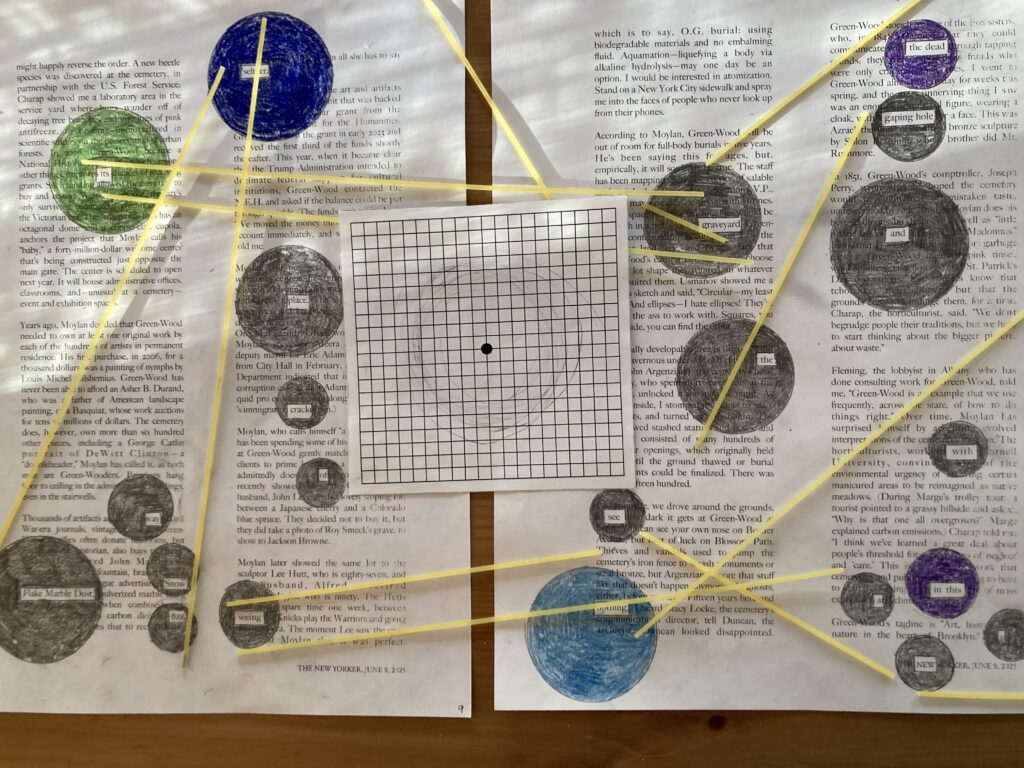
Holes
I’ve mapped some more of Holes 4 and . . . it’s a lot. Will this just look like an ugly, jumbled mess? Yesterday, talking through this with Scott, he said something like, do what serves the poem and the meaning you are trying to convey (or the effect you are trying to achieve). In terms of meaning, the words of the first section of the poem are about what I see instead of a gaping hole: shimmering, fizzy, ephemeral or elusive (hard to see, fleeting) things: snow flake marble dust, seltzer fizz, a nothing that is something not sharing its secrets. Perhaps these ephemeral things have come loose from what bound them to “normal” sight and its monitoring through tests like the amsler grid; it’s where you dwell when normal sight is not longer possible. So maybe the unraveling occurs prior to this hole? Yes, the unraveling (and vision of amsler grid as broken strings happens in 2 and 3, Does that mean that Holes 4 is all disconnected free-floating words/phrases? If so, how to make it possible for others to read it? I could place the poem near the center, around the gaping hole. I could also number the pages/sections and mark each word with a page number? Yes, I like this!
And hours later, I’m thinking more of using a distorted Amsler Grid at the center of Holes 4, and the black hole that the grid is collapsing into is the shape of blind spot.
Another mini project: can I learn how to draw decent-enough eyeballs — pupil and iris only?
holes
As I told RJP, I’ve hit the point in the process of these poems where I’m beginning to doubt myself and what I’m doing. Part of it, I explained to her, is because I dwell in the almost and struggle to find how to execute the final bit and/or give it the “polish” it needs. I’m not giving up. Instead, I’m trying a different approach: cut-outs. Would ths work better if the words were cut-out — a way to isolate them — instead of encased in holes? Can I do both? What if I had some of the words encased in the holes and some cut-out? Would that make it a little less complicated and less messy + easier to execute?
The question to return to again and again: what will serve the message/meaning/intentions of the poem?
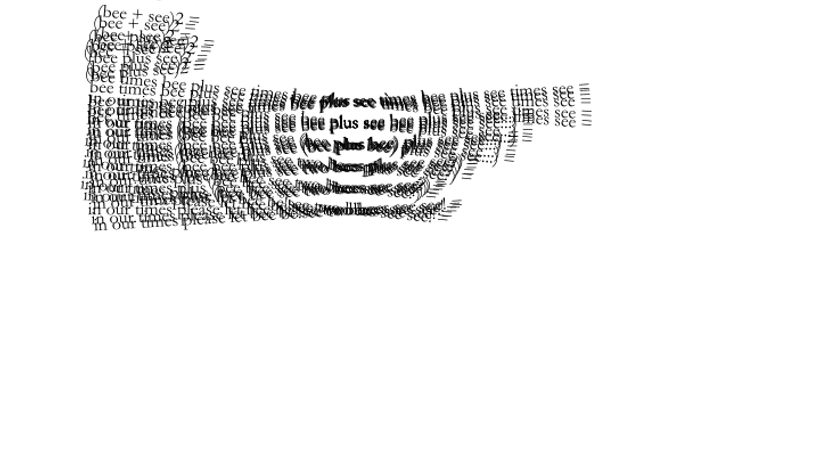
Searching for visual poetry, I found some good stuff, including this interview with Monica Ong, these great visual poems from Sarah J. Sloat, some answers to the question, what is visual poetry? and this anti-poem from SHRIRAM SIVARAMAKRISHNAN:
holes
I’m working on another holes poem — Holes 5. I’m using an essay about Rian Johnson, “Mystery Man” in the November 17, 2025 issue. My only requirement for an essay is that it contains the word hole, either as the word itself, or as part of/within another word. When I searched in “Mystery Man” for hole I found 4 instances of it including, “my wHOLE perspective,” “wHOLE time,” and “the wHOLE process.” I’m thinking these will be frame of my poem, especially Hole Time and Hole Perspective. What is my perspective (how do I see) with and from within my vision hole?
another part of my method: In addition to requiring a chosen essay has at least instance of “hole,” I read the essay from back to front. I started with the last paragraph, jotting down any words that stood out to me, then I read the second to last paragraph, then the third to last, and so on. It was a strange experience. I kept finding myself wondering, when I read a name I didn’t recognize, if I had missed the introduction/description of the name, then I remembered that I was reading back to front, from an assumption of familiarity to a not-knowingness (or not knowing yet-ness).
Here is a selection of words and phrases I jotted down:
- bookshelf
- stone
- let me
- still
- strings
- filters
- window
- flash
- beauty
- gathered
- convivial
- ends
- spectrum
- unexplainable
- gesture
- earthiness
- underside
- gnarled roots of a tree
- feel
- loop er
- limitations / limit s
- making diagrams with straws
- an older version
- flock
- singular
- (un) locked room
- mind / mind’s eye / eye
- tidy solution
- make sense of it all
- some measure of control over an uncontrollable world
- the world has gone mad
- center
- puzzle
- watch ed
- the satisfaction of seeing
- firelit
- delight
- smug
- cringe
- between
- it seemed dusty
- hypothetical
- enters
- throuhout
- leap
- a ghost
- nobody
- flock
- vision
- get in the way
- framework
- scam
- everything
- (r) ambling
- story
- distance
- slanted
- attention
- made
- backward
- moving around
- wonder
- read
- what is this?
- slip away
- lept
- feeling trapped
- peculiar
- sunshine
- looming
- house
- couldn’t see
- covered in string
- over
This essay is five pages long, so I’ll have to figure that out — all 5 pages, or 4 to make it fit more evenly? Or even less?
holes
As I continue to work on my holes poems, it has emerged that a few things are present in all of five of them: a hole, that hole’s impact on how I read, my blind spot, and the Amsler grid.
Why the Amsler Grid?
- it connects these hole poems with my last round of visual vision poems, mood rings, which take the shape of an amsler grid
- it ties in with the larger theme of all of my visual vision poems: vision tests — first, the snellen charts, then the amsler grid
- it gives a context for my vision loss and grounds it in within a scientific/medical model of seeing/not seeing
- it offers another way to visualize my untethering from that model/logic of test/diagnosis
This 4th one is especially interesting to me. I’m imagining fun ways to play with the implosion or destruction or destabilizing of the sharp, stable, rigid lines of a grid. The lines coming loose, or the lines a ladder without rungs — no way out of the hole, the lines collapsing and being sucked into the black hole, the lines forming a new path, a break in the lines — a gap, a dash, a slash, a breaking out of the lines — an opening, an exit, a room a door unlocked. What could that look like as part of my erasure poem? I mean, what, with my very limited skills in visual art, could I make possible?
I think I need to watch Alice in Wonderland again — should I read it, too? The hole in my vision as Alice’s rabbit hole. A passing through to wonderland. One difference: for Alice, Wonderland is the opposite of sense or nonsense.
https://www.youtube.com/embed/0QSggMtVLGs?feature=oembedeverything would be what it wasn’t
I’d like to take this idea of non-sense out of the binary, Sense/Nonsense, to imagine non-sense as being more than just not sense. What if non-sense was its own kind of sense, just like Nothing is not nothing but something outside of our logic or language or ability to name it. Or, like I say in Holes 4, “a nothing that is something not sharing its secrets.
a flash: as I was working on the above list, I suddenly thought about the debate over whether or not listening to an audio book was reading. Does reading only happen with eyes? I like to distinguish it this way: reading with my eyes and reading with my ears. After this thought, a further thought: what if I created a holes poem that wasn’t visual, but aural? I could pick one of the New Yorker stories/articles that you can listen to, and figure out a poem from that. How might that work?
holes
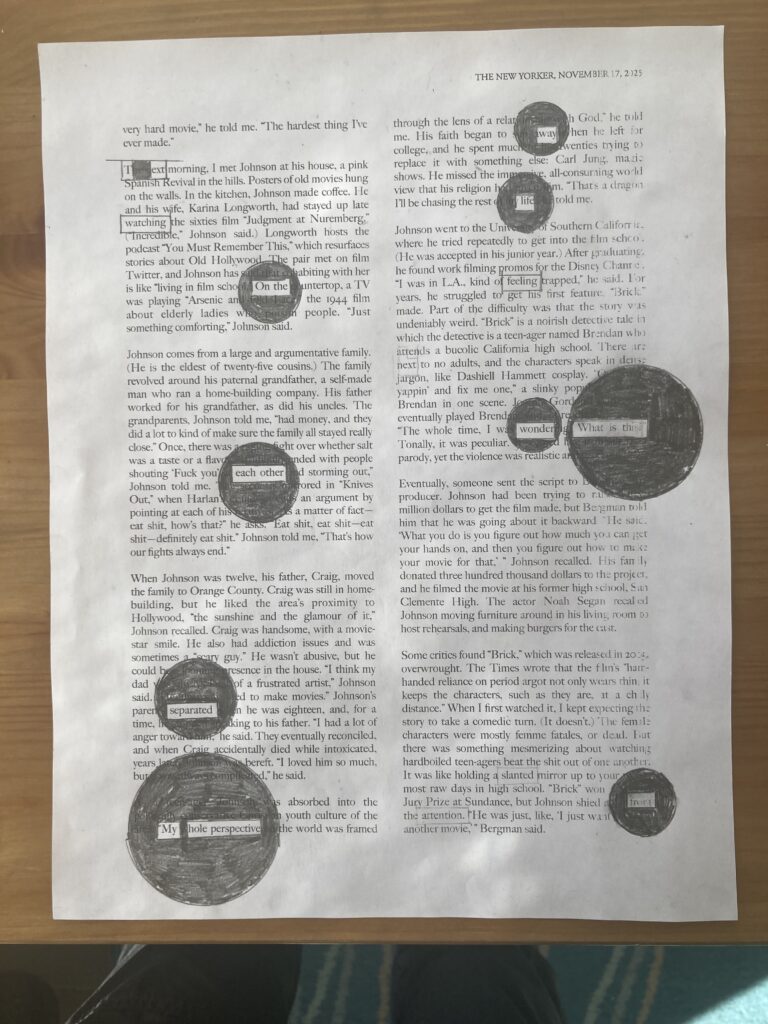
Worked on Holes 5 today, mostly mapping the words on the page. Here’s a draft of the text:
A hole perspective
life on the way to Disney’s wonder land
I fall through the center
of a book
everything on the page
at strange angles
separated from each other
in the firelit room*
a “what is this?” feeling starts
while watching
text bloom into nonsense
O the beauty of vision
gone mad.
*not sure about this line — I’m thinking of, like in a firelit room, but low light from a fire doesn’t separate words, it softens them, makes them dim so they almost become ghosts of the text they were
holes
Yesterday I watched the clip with the caterpillar from Disney’s Alice in Wonderland and I started thinking more about language and letters and our relationship with words and meaning through reading.
The scene begins with Alice peering through the leaves at a caterpillar smoking a pipe and singing the vowels. The vowels — the building blocks of language — is this cellular level of the english language? Taken on their own, apart from words and sentences and paragraphs, the vowels aren’t non-sense, but they offer very little sense. I found an old stencil of the alphabet that I inherited from my mom in a drawer yesterday. Could I stencil in the vowels in a way that didn’t look cheesy or ridiculous? I’m not sure.
A thought while I was running: I’m in the process of editing my poems, which involves erasing holes that contain words that I’m no longer using. What if those erased words, those ghosts, remained as traces, haunting the page? Almost like an after image? I’ve noticed that after staring at these dark holes on the page, they start to move around and appear in places they aren’t. (writing that last sentence, I’m reminded of Alice’s nonsense speech to her cat: nothing would be what it is because everything would be what it isn’t
A deconstructed amsler grid: an Amsler grid has 38 lines, not including the frame. I decided to use pieces of dried spaghetti and scatter 38 of them on top of 4 panel poem. I’m not sure what I will use in the final version. Sticks? Lines at strange angles drawn on the paper, over the holes and text? Here’s a picture of it.
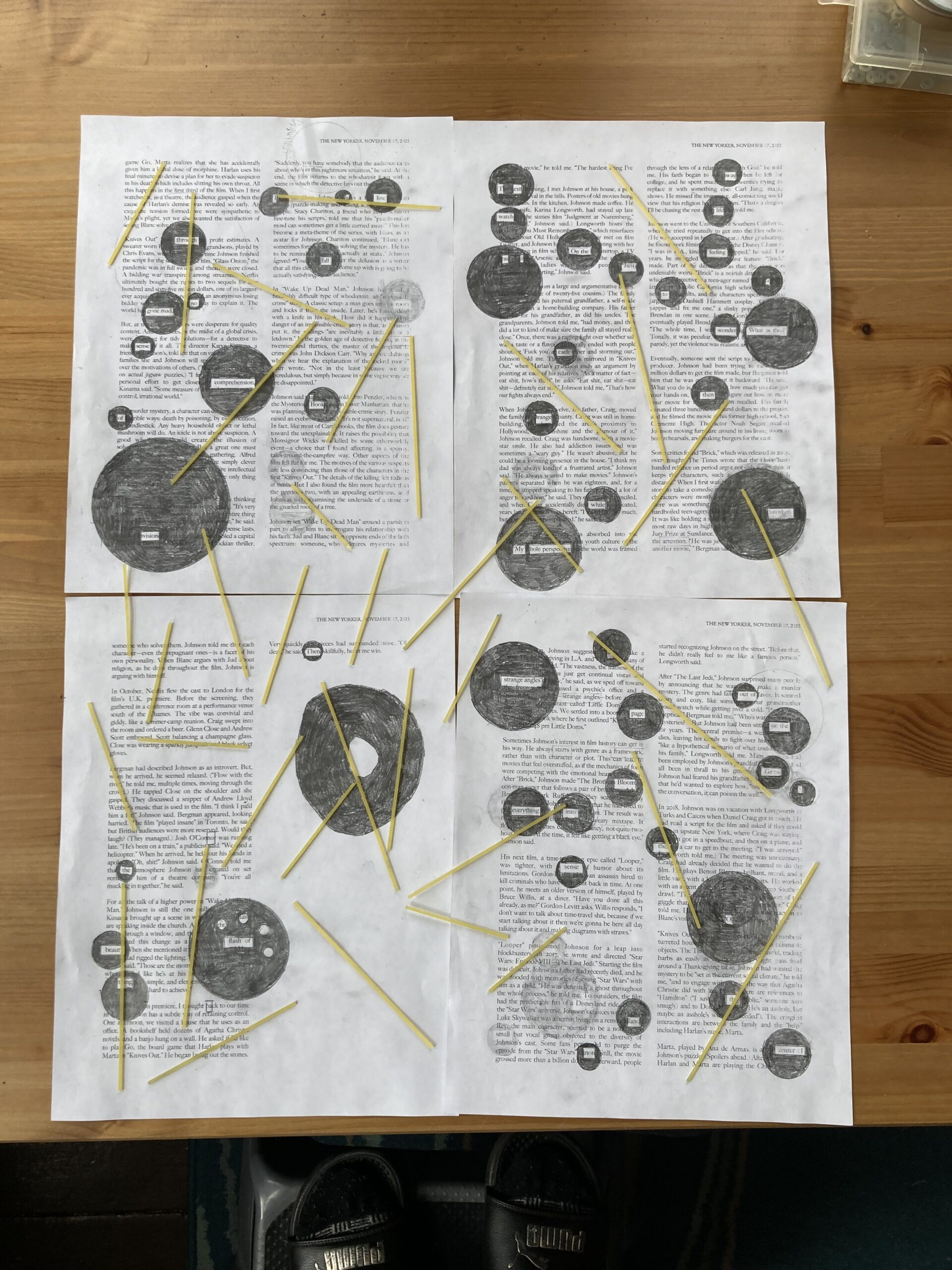
I had no plan for where the lines would go, I just dropped the spaghetti wherever — should there be a plan, or is haphazard better? Maybe I scatter the dried spaghetti haphazardly first, then replicate that with thick black lines on the actual poem? The only rules: 38 lines, all the same length.
Ok, I scattered the spaghetti and drew in the lines. Here’s what it looks like:
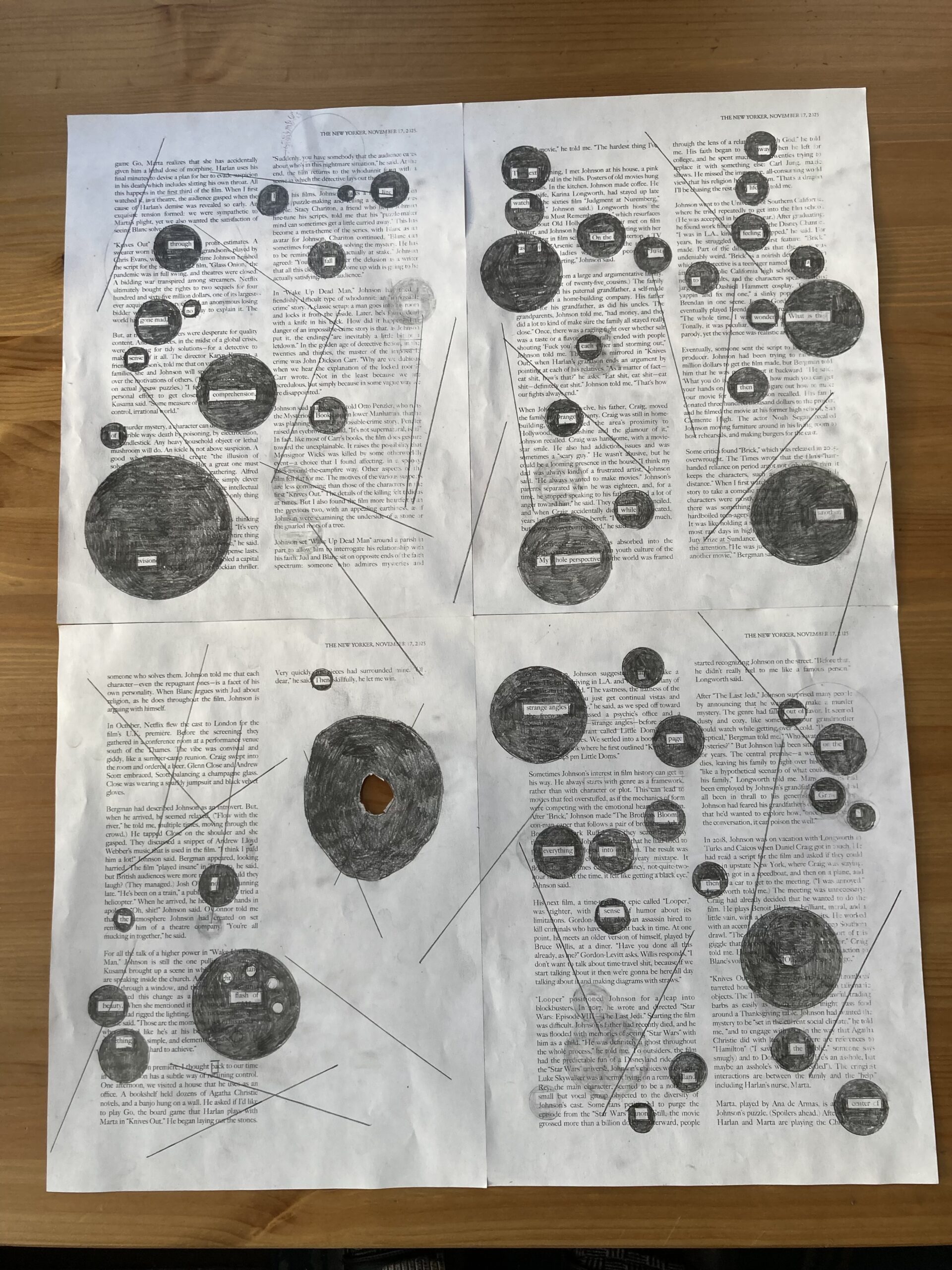
I just realized I only added 32 lines. I need to add 6 more. Are the lines dark enough? Does it make sense that they are a deconstructed amsler, or do I need to add in a more explicit reference to that somewhere on the poem?
holes/grid inspiration
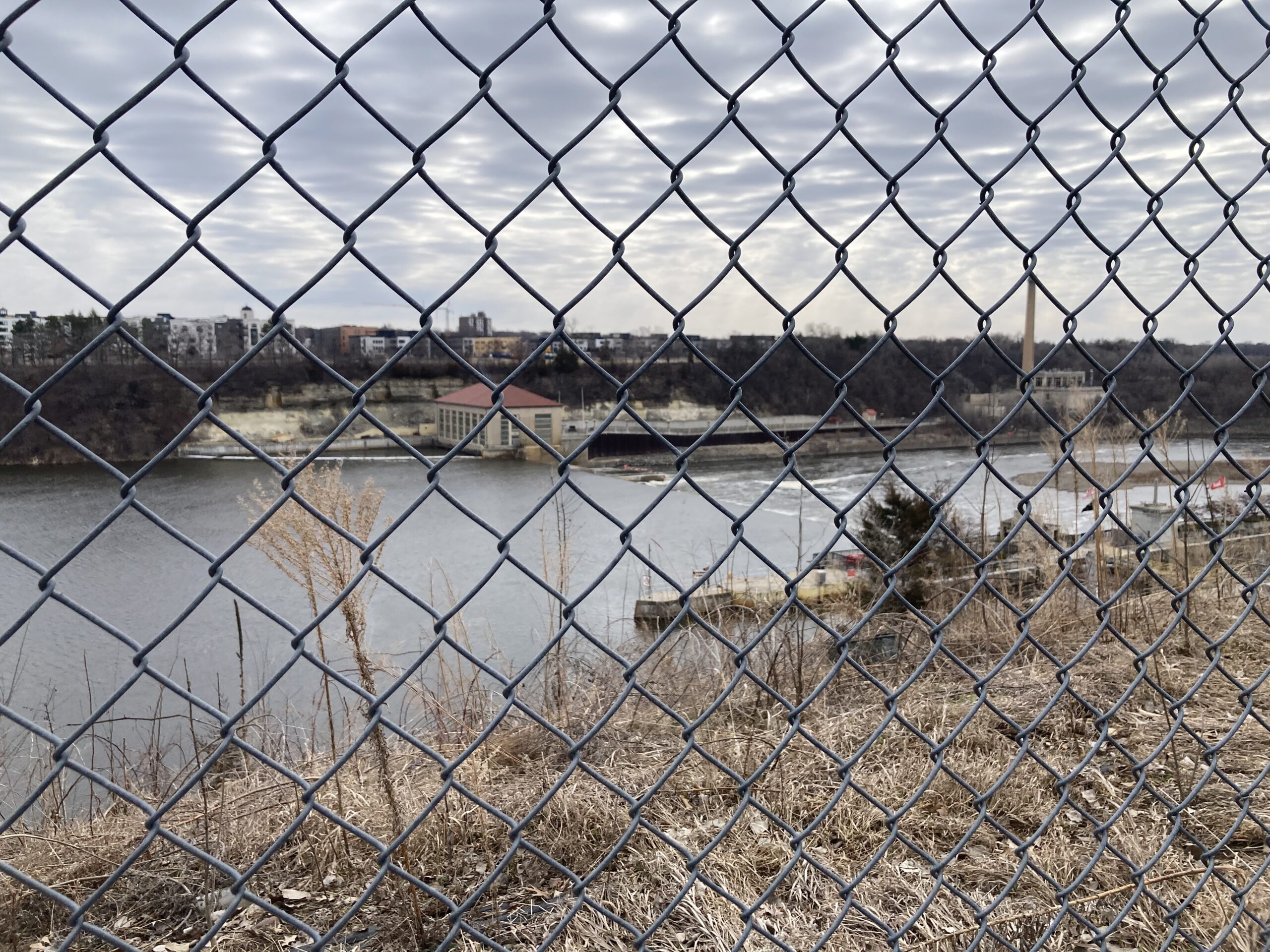
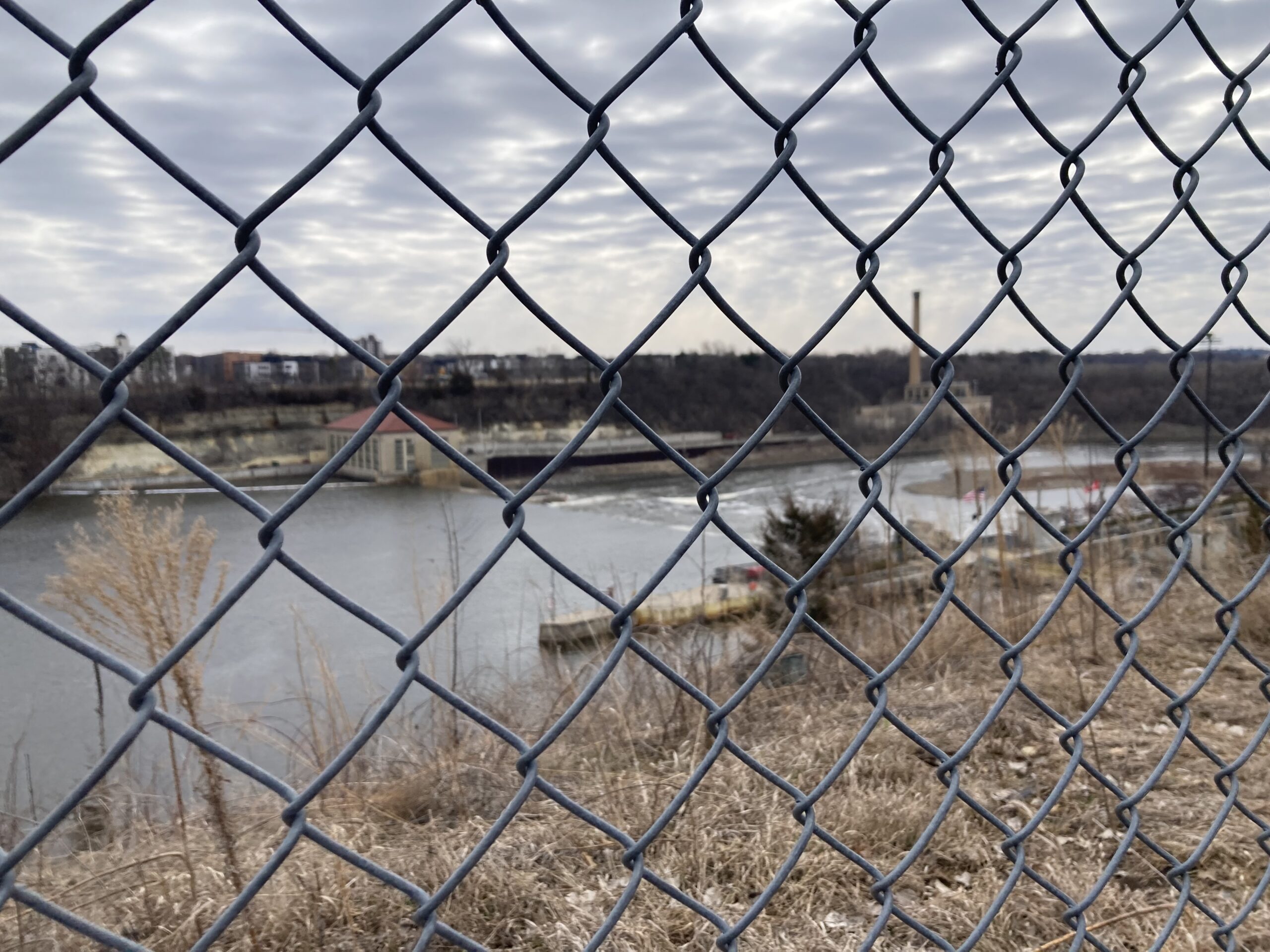
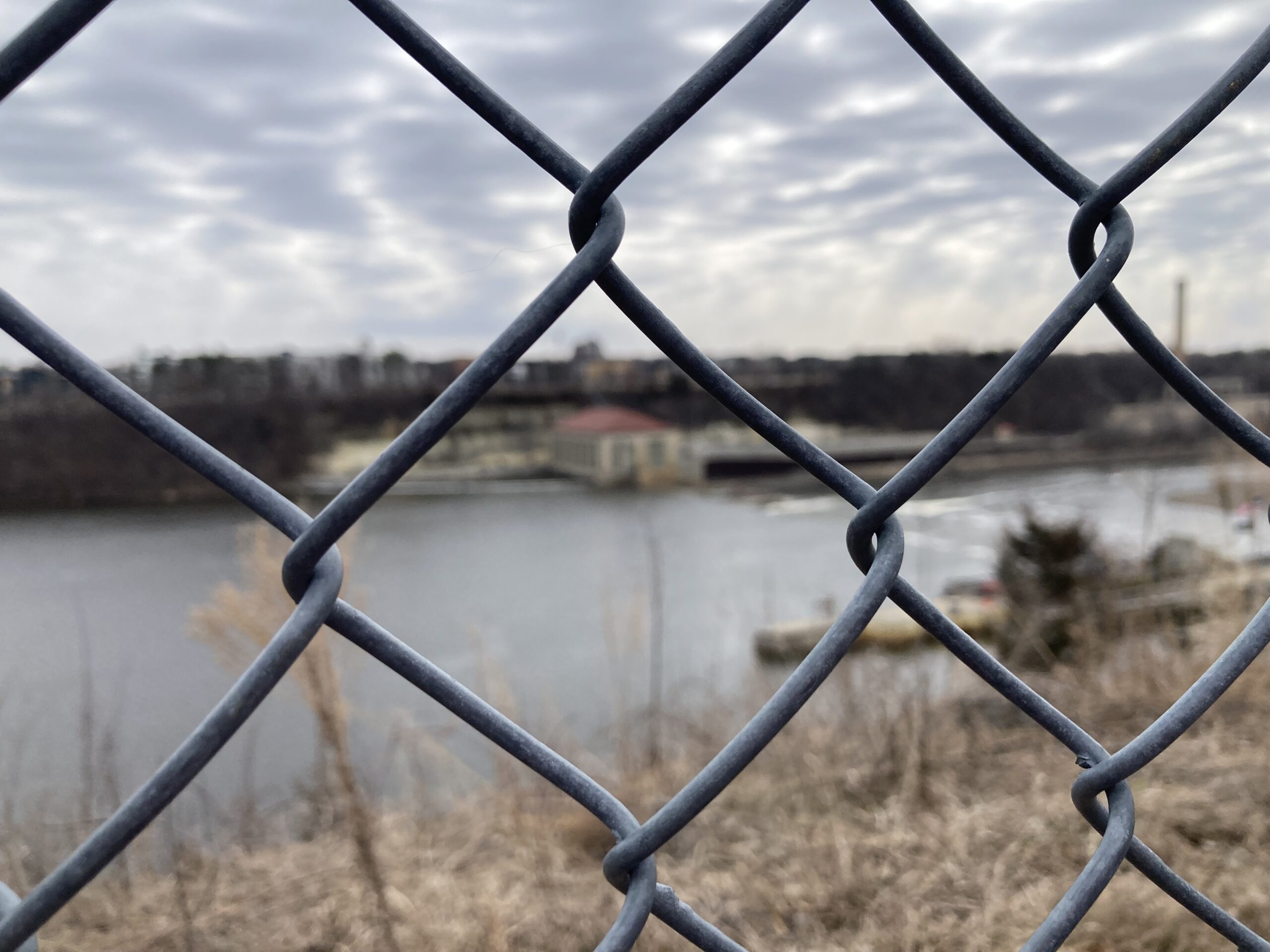
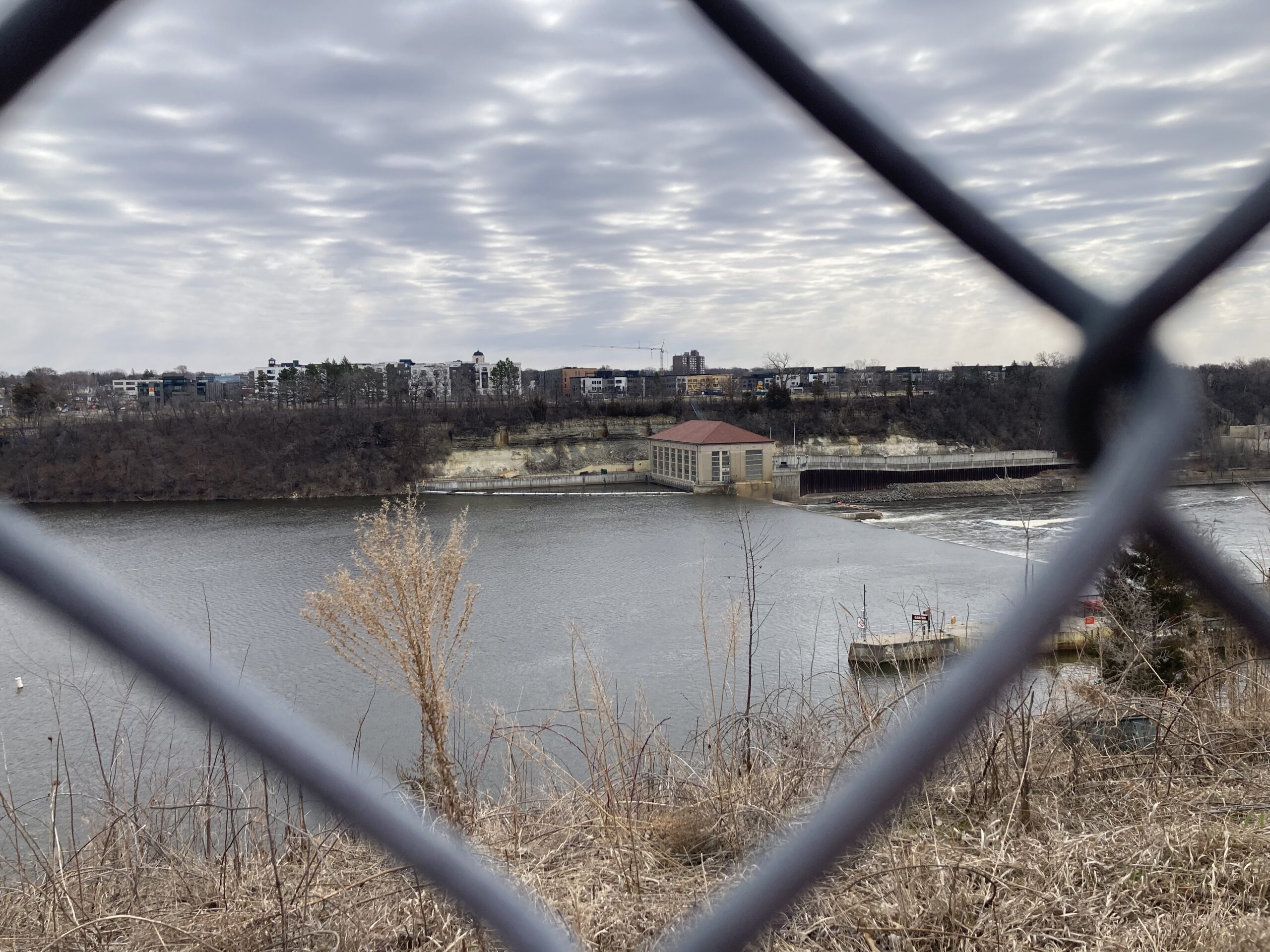
I like this series of pictures. It reminds me a little of how I see. I can see better through my peripheral vision than my central — even when and if I don’t want to. It’s distracting to focus on the edge details sometimes, and it makes what’s in the center look even fuzzier to me. In thinking about my Holes series, does this happen at all when I’m reading? Is there a way to connect this fence with the lines in an Amsler Grid? An idea: what if I drew a giant Amsler Grid over the top of the entire, 4 panel, Holes 1 poem?