20 minutes, with Scott
neighborhood
51 degrees / drizzle
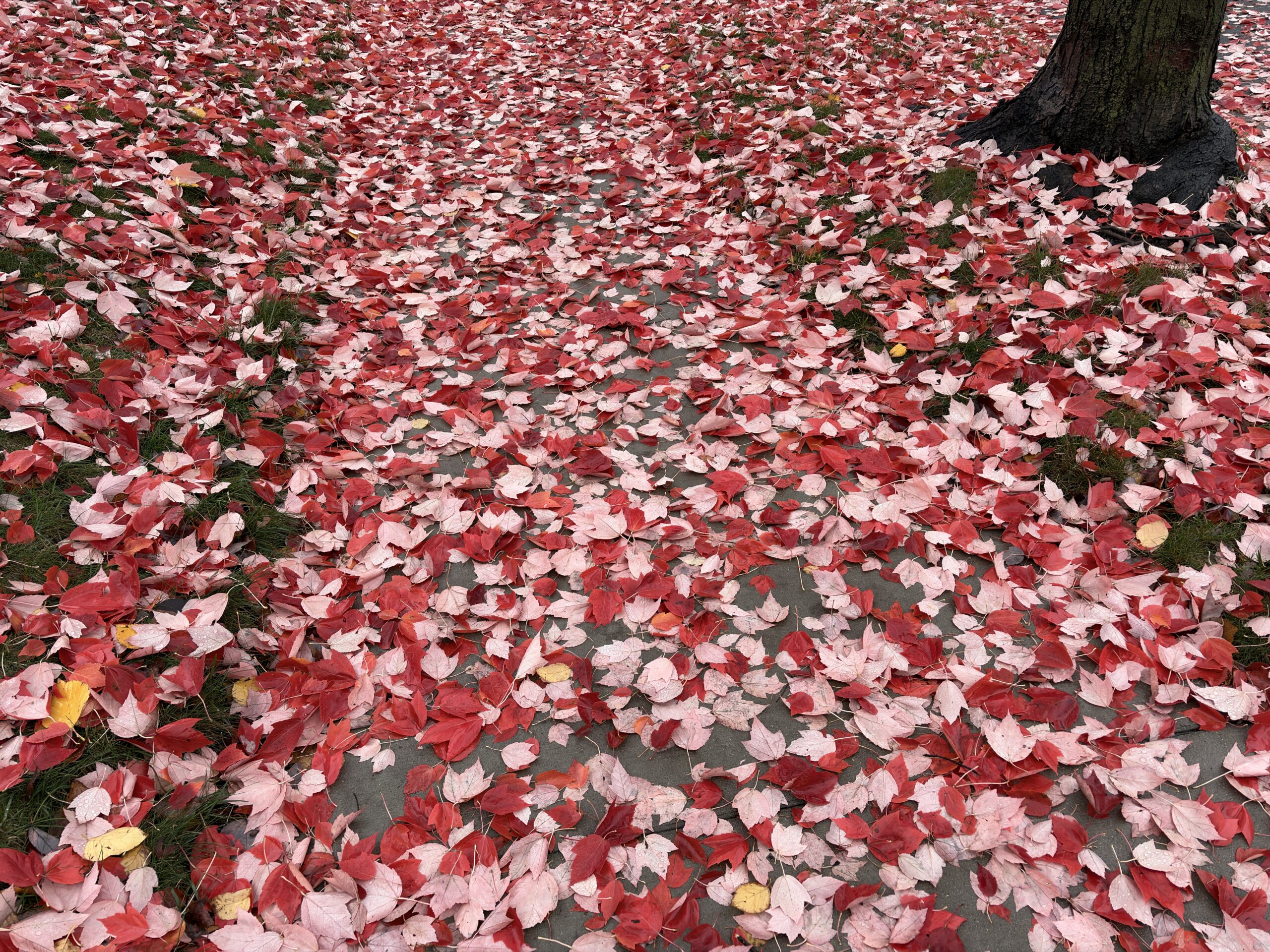
Scott and I dropped off FWA’s car for service at a local shop, got some coffee at Loons, then walked home through the neighborhood. There was some drizzle, and the sky was grayish-white, but it wasn’t too cold, and the leaves were vivid yellows and reds. One yard in particular had red leaves scattered over the green grass. Some of the leaves were turned up and BRIGHT red, some were turned down and almost pink. So cool. Scott took some pictures of it:
As we walked into Loons, a group of people, mostly women, were sitting at the biggest table in the space, talking. I imagined they were campaign workers debriefing and celebrating after election day. Election day! Such a statement. I’m sure there are nasty things to come, but for today. relief. Last night, after the results were in, I took a screen shot of the New York Times:

Vision Lost [echo]
This morning while reading past “on this day” entries, I came across these wonderful lines from Rainier Rilke in “Black Cat” from my 4 nov 2020 entry —
A ghost, although invisible, still is like a place
your sight can knock on, echoing;
and I thought suddenly, echoing!, that’s what I’ll write about this morning! Reading these lines more closely, I was struck by, still is like a place. I like how he writes, still is like, instead of, is still like. It reminds me of a line from Marie Howe in “The Meadow,” which I recently re-memorized: There will come a day when the meadow will think suddenly . . . . When I was reviewing this line, I remember thinking about how much I liked the small pause that think suddenly offered that suddenly think didn’t. When I reviewing the poem, Howe’s pause had reminded me of one I deliberated over in my poem, “Welcoming Oaks” that I was reworking a few weeks ago. The original line was, the grateful trees offered gifts but I was thinking of changing it to the trees, grateful, offer gifts. And, ultimately, I did change it, liking how the pause offered more room to breathe.
Returning to Rilke’s line, still is like a place. I also appreciate the extra meaning offered because of how he isolates it as its phrase, so still becomes a place or similar to a place. I can imagine still as a place. In fact, it has been a place I’ve run through briefly by the gorge, but only once or twice, in a rare stretch when no one else was around and no cars or bikes were rumbling or whirring past. And now, I’m thinking about some favorite lines from Emily Dickinson in “I felt a Funeral in my Brain”:
As all the Heavens were a Bell,
And Being, but an Ear,
And I, and Silence, some strange Race,
Wrecked, solitary, here –
I’ve long been interested in the multiple meanings of still on this log. Multiple meanings in its formal definition, and also in my experience of it in contrast to other people’s experiences. Very little is still for me, if by still, you mean not moving. For me and my limited cone cells, everything moves — shakes, shimmers, twitches, flashes, shimmies. And, when I’m at the gorge, I’m almost never still, but moving — running or walking or biking. I rarely stop to sit. Some of this is because I’m restless and have too much energy, and some of it is because I’m particularly interested in experimenting with the forms of attention you can practice while moving.
All of this rambling has led me to the start of a poem which I don’t want to name, Vision Lost [echo] but possibly, Vision Lost [still]. My vision lost has made stillness an illusion that I can no longer believe in. Is anything ever still? Even the rocks, which appear to be unmoved for thousands of years, sink and settle, shift and crack.
This last line made me recall Lauren Groff and her discussion of slow moving stones in the fabulous book, The Vaster Wilds, which I wrote about on this log on 10 sept 2024. When I searched for Groff’s lines, I also found some wonderful words from Carolina Ebeid:
—
the slow movement of stones
And the stones, with their lives so slow that to all impatient moving creatures of animated life they did appear unmoving, but even the stones she understood now did meet and mate, did erupt and splinter, did rub to powder stone upon stone and stone upon water and stone upon air, so that in the long scale of their lives the stones saw within themselves incredible vitality.The Vaster Wilds/ Lauren Groff
Back to stillness, especially as nothing. Yesterday the poem of the day on poets.org was by a friend and amazing poet, Carolina Ebeid. Here’s a fitting excerpt from it:
No, nothing, no thing, no where—
the o of no blinks openAssume the Role of Cassandra, Wearing a Mask, Speaking into the Camera/ Carolina Ebeid
The o of no blinks open. The openness of no — not a closing off but an opening into. Into what? This line was in my head at the end of my run and I thought, the gorge. No rock, just open air space a place filled with birds and bugs and possibilities and that shapes my stories of running outside and noticing.
Here’s another line that I love:
Can you hear the low pulse tree-growth consuming the fence?
Assume the Role of Cassandra, Wearing a Mask, Speaking into the Camera/ Carolina Ebeid
More than leaves or vines, I imagine this tree-growth as the trunk, rings thickening, growing through the chain-link fence on the Winchell Trail. I love the idea of becoming still enough to hear the pulse of this growth, to dwell in a time scale impossible for us restless humans. What is the rate of a tree’s heartbeat? Not in beats per minute, but beats per day or month or year?
—
Oh, so many great things to think about in Groff’s and Ebeid’s words!