2.8 miles
2 trails
50 degrees
Sun and shadows and spring air. Also: chirping birds, bare earth, buds. A beautiful afternoon for a run, after a morning having fun making a grid and reading an essay backwards and thinking about threads and strings and scotomas.
The river was a blueish-gray, the sky was empty of clouds. Now, sitting at my dining room table, I hear cardinals, but out near the gorge I think it was wrens, or could it have been sparrows? Oh — at least one pileated woodpecker and the feebee of a chickadee.
tmi note for marathon-training Sara: the run was made difficult by unfinished business. I need to do more work on figuring this problem out!
My favorite image: Walking and running back through the neighborhood, I noticed (and not for the first time) a delightful maple tree. A straight and solid trunk then 2 thick branches rising out of it. One of them slanted only slightly to the side, the other bent midway up, looking almost like a knee. Yes! This tree offers a classic example of the tree looking like an upside down person, their head, shoulders buried in the dirt, only their torso and crotch and legs sticking out of the ground. Oh, why didn’t I bring my phone today so I could take a picture of it?! I’ll have to go back. It’s on 35th street between 46th and 45th avenue. I wonder, will anyone else be able to see what I see in a picture of it? when standing beside the tree?
grids and lines and strings and threads
note: I’m starting this in the morning just after a big breakfast. I’m listening to early The Kinks, “Arthur or the Decline and Fall of the British Empire” from 1969 and “The Kinks Are teh Cillage Green Preservation Society” from 1968. I love early The Kinks!
Continuing a discussion I began yesterday but wasn’t able to continue:
I found this quote from Chuck Close about why he used the grid method:
Almost every decision I’ve made as an artist is an outcome
National Gallery of Art
of my particular learning disorders. I’m overwhelmed by
the whole. How do you make a big head? How do you make
a nose? I’m not sure! But by breaking the image down into
small units, I make each decision into a bite-size decision.
I don’t have to reinvent the wheel every day. It’s an on-
going process. The system liberates and allows for intuition.
Breaking the image down into small units. Working in small units and seeing fine detail — those are functions of central vision. Peripheral vision is the big picture, that big head, those whole noses. Most of what I see these days is big picture — whole, fuzzy forms. The central vision I have is very small and seems to be very near the center of my central vision. How big is the one grid — that tiny island surrounded by gray water — that allows me to see anything as more than an almost form? The only detail I can really see (I think?) is a word in small print.
Just gave about an hour to creating the grid for the bigger version of my scotoma. In the “normal” sized one, each grid is .25 x .25. In this grid, it’s .8 x .8. I’m listening to a 1970 album by The Kinks, “Lola Versus Poerman and the Moneygoround, Part One.”
The grid is fiddly and involves a lot of measuring. It is slow, repetitive work. As I measured and drew line after line, I thought about how this work might open me up to new ideas and that this process by me, Sara-barely-not-blind, is part of the work I am creating. It is not only the finished product of a visual poem, but all of the labor that went into it that makes the meaning. Much of that work is invisible (although I’m documenting it), but it colors and haunts and shapes what I am trying to communicate.
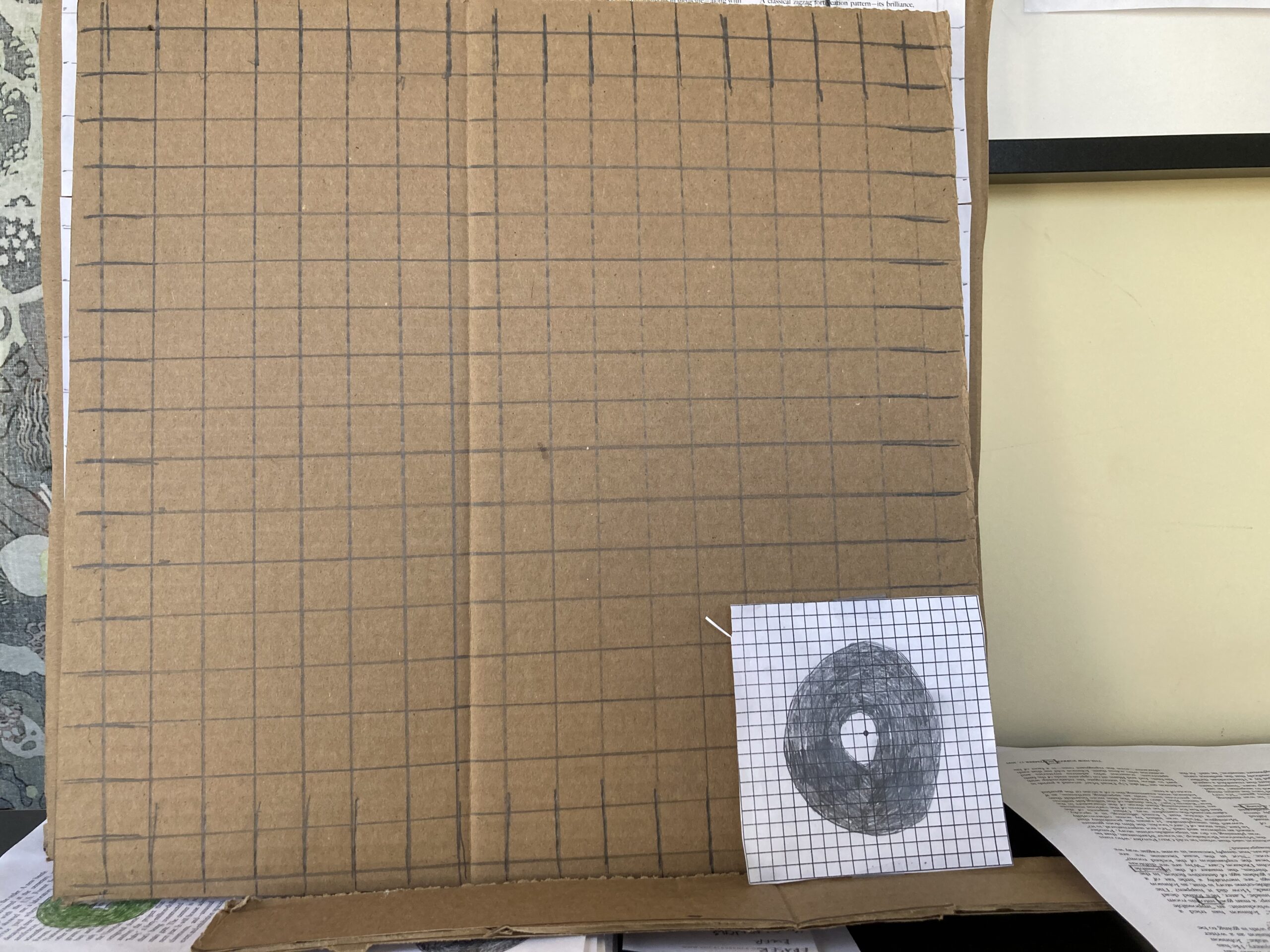
Now, it’s time to use the grid to create a super-sized scotoma, and then, to play around with different materials for laying the scotoma over the words of Holes 5b! Possible materials: trace the scotoma directly onto the paper and then color it in. Cut out different types of plastic — ziploc? a grocery bag? cling wrap? What about a very, very small grid made out of black thread? Fiddly, but fun!
Before I return to that, I need a break, so I’ll return to my close reading of a book review on memoirs by daughters about their fraught relationships with their mothers. I picked this selection from the NYer because: it’s a book review, and I love book reviews!; it uses a lot of language about connections and separations; and it uses hole, thread, and line.
My close reading = start with the last paragraph of the essay, then the second to last, then the third to last, etc. So, backwards. It’s a strange way of reading, being thrown into ideas that are presented as familiar, but haven’t been introduced yet. Slowly, the more I read, the more sense it makes.
Misfits / The Kinks (1978)
I started my close reading of the NYer book review, What to Make of the Mother Who Made You/Rebecca Mead, yesterday afternoon while drinking a surprisingly good NA beer at Arbeiter. Here’s a list of words/phrases I found during that reading, along with my additional words from today’s reading:
- when the facts are unbearable, it’s natural to escape into
- coordinates
- accomodate
- (to) make sense to myself
- disorientation
- knowledge
- ghost
- humbled
- should be
- to write one’s way out of
- shedding
- knotted
- threads
- familiar
- searching
- hunt it down like prey
- in the other room
- readers
- almost blind
- estranged
- against
- reframing
- obedience
- en chant ment
- elsewhere
- world made whole again
- inheritances
- family
- moves
- opens
- traces
- artificially formed
- origins
- sober
- square
- closed
- door
- discomfort
- feelings
- slither
- seize d
- character
- disembowel eat
- spotted
- rupture
- alone
- defiance
- entanglements
- kinship
- matriarch
- loom
- shadows and absences
- ordinariness tempo
- lens
- locating
- mess ily
- tending
- cancer
- seen
- naked
- con found ing
- pro CLAIM
- think about
- offspring
- runs through
- nothing, subdued
- account
- assumes command
- between
- emerge
- maintain ed distance
- light
- center
- entwined
- depend
- reckon
Again, these words speak to a strained relationship between daughter and mother. I’m thinking that my mother here is written language and the words on a page to be read with failing/failed eyes. A distant mother, a daughter uncertain as to how to reconnect (or to keep the connection), or even if she wants to stay connected.
In the midst of all of this, I’m also wanting to get more inspiration from a collection of erasure poems that I discovered last fall and have been hugely influenced by: a wonderful catastrophe / Colette Love Hilliard. Here’s one of her found poems that uses lines:
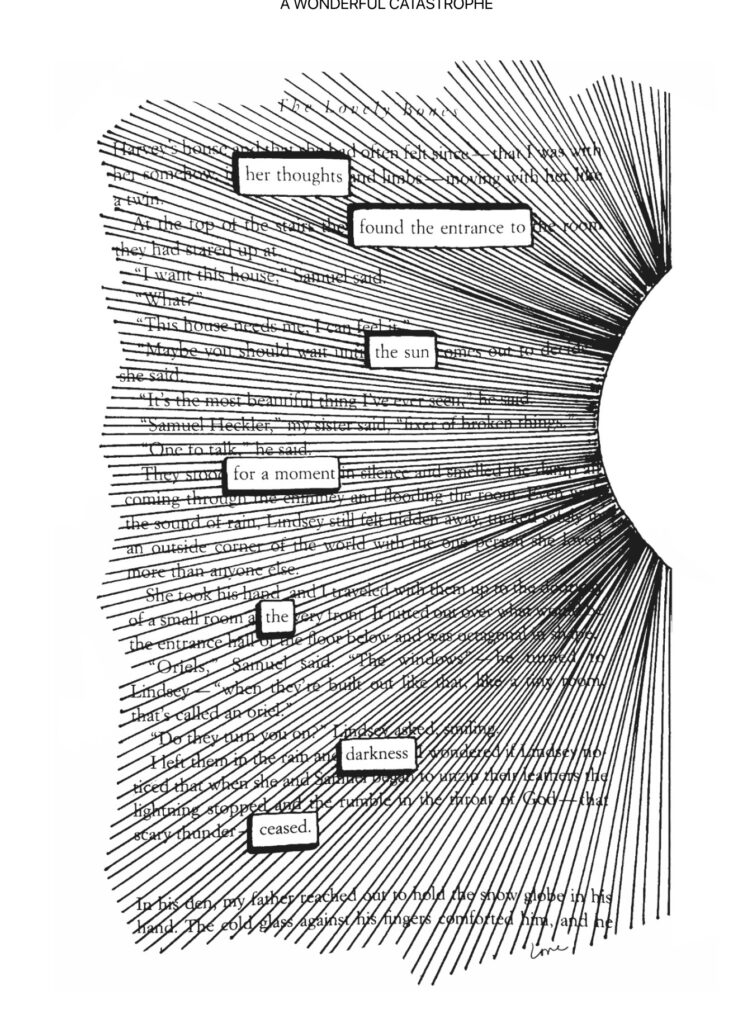
I like how the lines are slanted and all coming out of one source which resembles the sun. I might try having lines of black thread emerging from a center hole in a 4 panel poem. The threads just barely covering all of the words, the words of the poem printed on circles attached (pinned?, sewn?) on top of the strings. I want to try that now! Can I do that AND make my super-sized scotoma?
a few minutes later: I will do the scotoma tomorrow; the sun is too bright in the room for me to see the grid! And, before I can try out the black threads, I need to remap Holes 4. So, tomorrow for both of these.
RJP just stopped by and when I showed her what I was working on, she reminded me about Coraline and her other mother who lives on the other side of the door (here, instead of Alice’s hole, there is Coraline’s door). The other mother has buttons for eyes which reminded RJP of the holes I traced on my Holes 5. So cool! I could try adding buttons to my Holes 6, which is using a text about mothers and daughters!
summary of the day: A lot of great ideas, a few plans, a little making.
David Bowie Essentials — the last song heard, “Suffragette City”