4.35 miles
minnehaha falls and back
32 degrees / feels like 17
Cold again. Because of the low feels like temp, I overdressed: 2 pairs of tights, long-sleeved shirt, sweatshirt, pullover. Halfway through I ditched the pullover, which was awkward as I struggled to take it off without removing the outer layer.
Tried to stay steady and slow. Chanted in triple berries in my head. Took several walk breaks — not because I was tired, but to take pictures or to record my thoughts or to take off my second layer.
Thought about grids and nets (more on this below) as I ran. Recorded some thoughts on my phone:
recording 1: I’m thinking about grids and the lines and why it matters to me. And I’m thinking about the xy axis and a map and the visual field. And mapping and locating yourself within the known world and how reading is so important to that locating and figuring out how to navigate without that.
recording 2: Thinking more about why nets or grids or that particular way of being located is to be held, to be connected, to be located, to be seen or recognized or have others aware (of you). So not in this free fall. To orient yourself in some way. To not be entirely unmoored. Because as fun as it sounds in theory to be untethered and unlimited by these restrictions, physically it does not feel good. Dizzy, disoriented, nauseated (sometimes). A slow, growing anxiety.
This last bit about the ill effects of being unmoored was inspired by how I felt as I started my run. It wasn’t entirely unpleasant, but I did feel a little dizzy and disconnected from the path, unable to clearly see what was ahead of me. I wasn’t blind to the trail or anyone on it. I was disoriented and anything I saw was vague and barely formed. This way of seeing unsettled me; it also made everything feel dreamy and not real or unreal or surreal. By the end of the first mile, it had dissipated somewhat.
So, why the Amsler grid? First, the obvious: it’s a vision test and I am writing around (and through) vision tests in much of my vision/visual poetry. Another explanation: it represents a mapping, a locating, a connecting to the known world (where known partly = “normal”/medical understandings and models of seeing). Also, it is a reference point from and a starting point that readers can understand (a place of common ground, a concrete and easily expressed and understandable model and map for blind spots in central vision/visual field).
grids / nets
I was planning to study worms and bugs for my April challenge, but that will have to wait. This month is about grids and nets and matrices. I chose this topic because I want to dig deeper into the grid and what role it plays in my Holes series, and also because of a series of pieces that AMP pointed out to me at MIA (Minneapolis Institute of Arts):
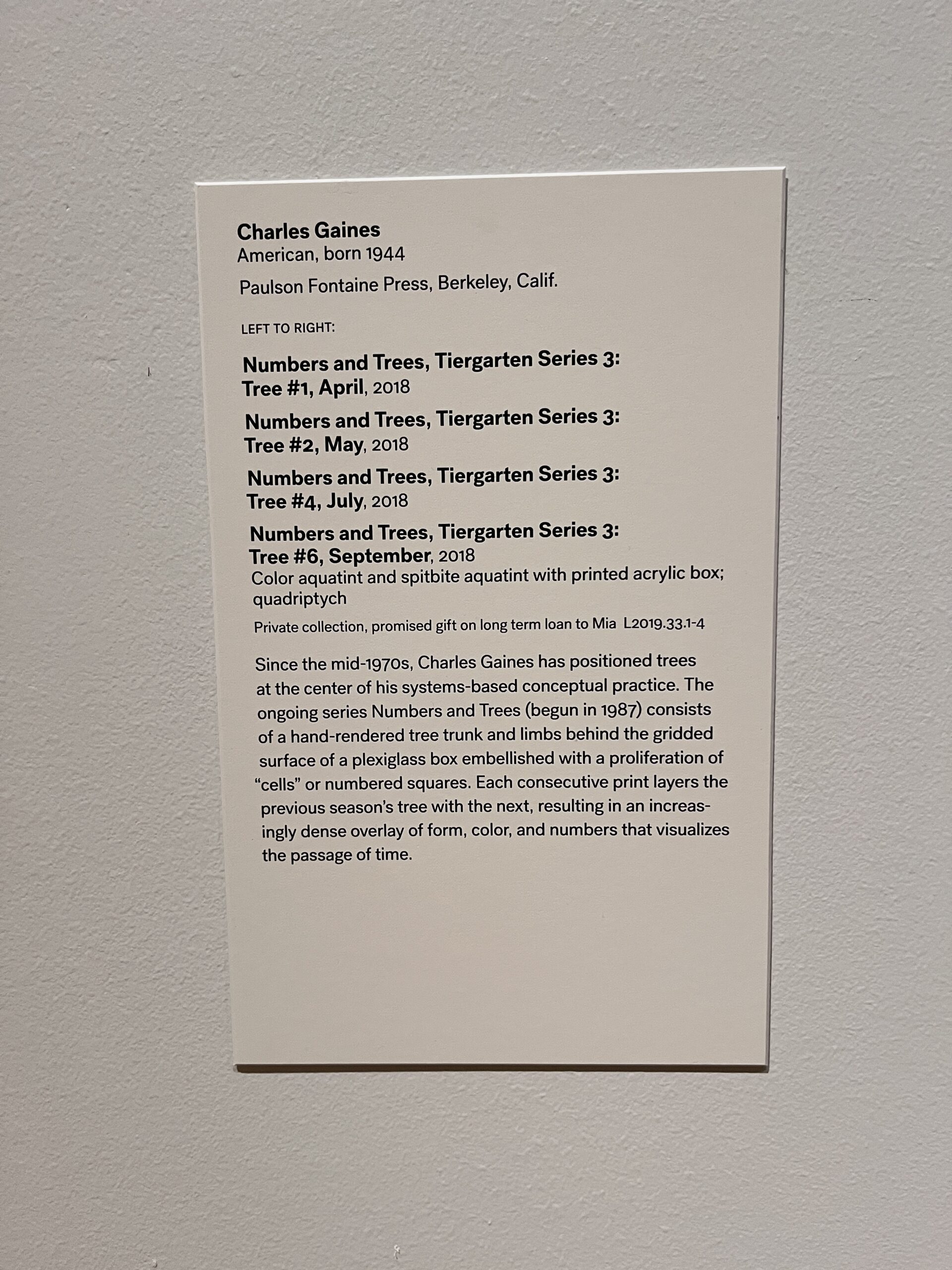
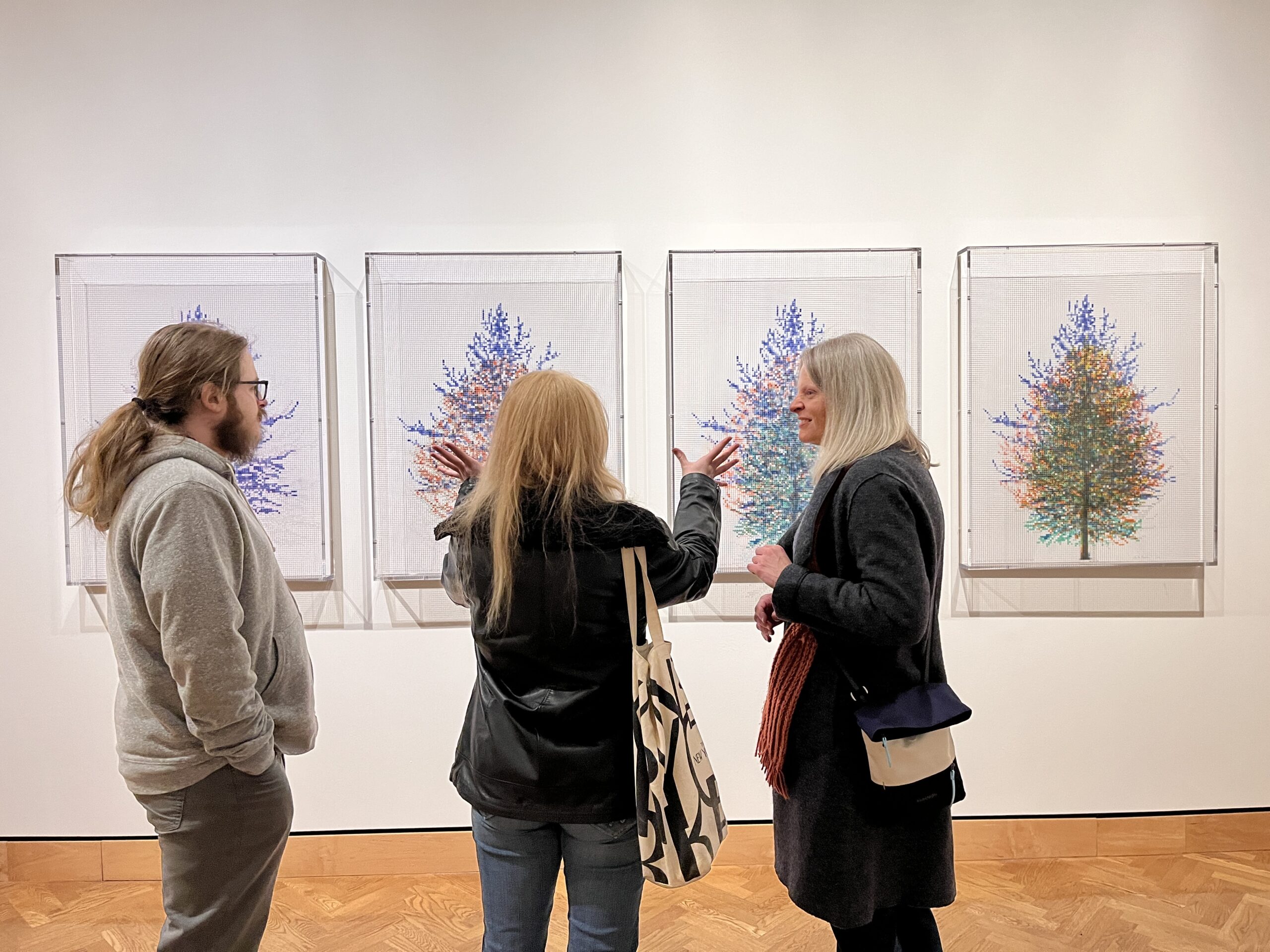
I found a book from one of his exhibits and requested it from the local library. When I get it, I’ll discuss the grids more. (I also plan to return to MIA soon to study the pieces more closely). Here’s one photo of them that I particularly like of me, FWA, and RJP, who is talking with her hands in a way that I love.
. Heading out for my run this morning, I wanted to notice grids. A few minutes later, all I could think about was the twisted/bent fence at the falls that I noticed last Thursday. I regretted not stopping to take a picture of it then, so I took several today. Here are 2:
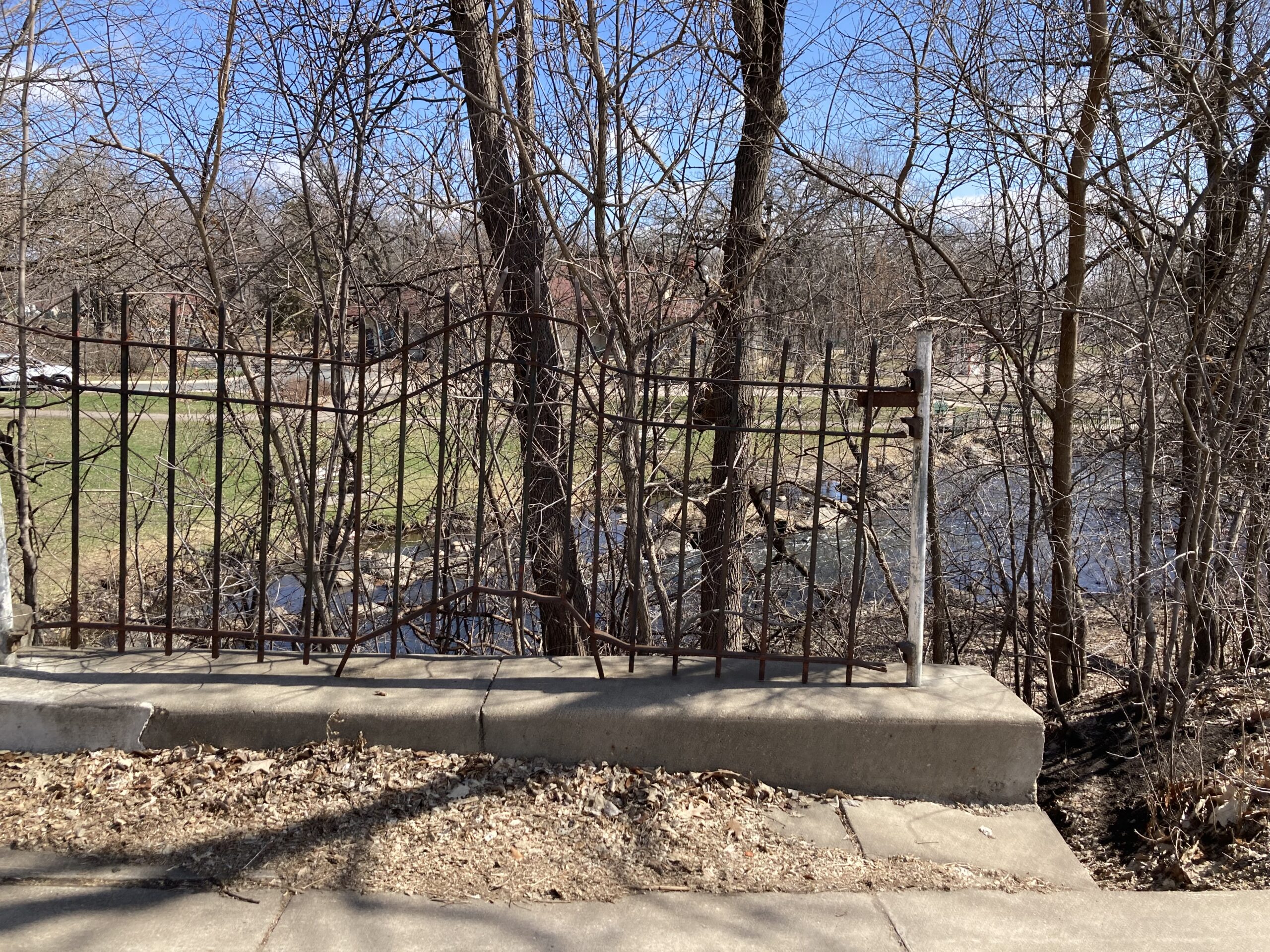

Remembering this crooked fence and then taking pictures of it, inspired me to expand my grid/net/matrix month to fences too — this fence + chainlink fences. Things that contain, orient, map, frame.
To start this grid exploration, some research on the Amsler Grid. Have I done any research about it in past years? Not that I can find!
Amsler Grid
The Amsler grid, used since 1945, is a grid of horizontal and vertical lines used to monitor a person’s central visual field. The grid was developed by Marc Amsler, a Swiss ophthalmologist. It is a diagnostic tool that aids in the detection of visual disturbances caused by changes in the retina, particularly the macula (e.g. macular degeneration, Epiretinal membrane), as well as the optic nerve and the visual pathway to the brain. An Amsler grid can show defects in the central 20 degrees of the visual field.
In the test, the person looks with each eye separately at the small dot in the center of the grid. Patients with macular disease may see wavy lines or some lines may be missing. . . .
Wikipedia Entry
and:
Although originally intended for use in clinical settings, the Amsler grid has proven highly adaptable for home monitoring. Its portability and ease of use enable patients to participate actively in the management of their ocular health, allowing earlier detection of disease progression and more timely medical intervention.
the Amsler Grid in Everyday Practice
This idea of it being for use at home connects to my desire to use whatever materials and words I can find around me for this Holes series. There’s more there, I think.
I’d like to spend a few minutes (maybe later today or tomorrow morning) writing more about lines and grids and mapping and why it’s important to me, both in this series and in my understanding/description of my vision loss.
While looking for more on Amsler and the grid, I found out about Edward Munch and his vision loss at 60. As he was experiencing it, he drew a series of sketches/paintings, some with grid lines, some annotating the strange ways he saw. Very cool. Here’s more about it from a exhibit at the Tate. Is there a book for the exhibit and could it be at my local library? Yes! I just requested it.