dec 12/SWIM

1.5 miles
ywca pool

After a week and a half off because of COVID quarantining (daughter RJP had it, not me), I was able to go back to the pool. Crowded. Did my usual swim — continuous 200s, breathing every 3/4/5/6 by 50s, not stopping until I saw Scott at the end of the lane. I felt strong and steady and happy to be using my muscles differently. My kneecap (or was it just above my knee?) felt weird once, but otherwise was fine.

10 Things I Noticed

  1. Miss Luna came about 20 minutes into my swim
  2. my nose plug kept shifting and I had to stop a few times to adjust it. I didn’t feel any water coming in my nose, but I could feel my air coming out
  3. after the first few flip turns, my nose burned from the chlorine
  4. looking straight ahead underwater, I watched as my hands made bubbles as they entered the water
  5. the woman one lane over was swimming breaststroke, her frog kick looked extra froggy
  6. a man in black swim trunks was walking the length of the pool by the far wall. Why?
  7. looking up, I noticed someone at the end of my lane. She asked to share a lane. Sure! I think I might have said yep too.
  8. the woman sharing my lane kicked a lot as she swam freestyle. I saw, but didn’t feel, the water churning as I swam past
  9. turning on the wall, pushing off, looking ahead and noticing the bubbles of my lane partner, and thinking about how I was gaining on her*
  10. orange: my orange bag, the orange sign saying No lifeguard on duty, Scott’s orange swimming trunks

*I’m not really that competitive (am I?), but I do get some pleasure in being faster and passing people. I don’t want to race them, just pass them. It makes me feel like I’m going faster.

In the middle of my swim I started thinking about the Ishihara plate I’m working on, the one about the test and why it, and the Ishihara plate as form, is important to me. I thought about how the draft I worked on this morning seems to offer a redemptive conclusion — I will choose to see my changing vision not as losing it, but it being made strange. Then I thought about how I don’t want to do that, to resolve it, to make it a moment of redemption. As I circled around the pool, I wondered how to make this Ishihara poem more messy and uncertain. Even as I do prefer to understand my vision as strange and not lost, I don’t want to conclude the poem with this idea. As I was thinking this — and in far less words than I’m writing now! — I thought of something else, how I find the Ishihara plate pleasing with its many circles and dots — I love polka dots! — and colors, but I also find it a little gross and upsetting. It looks like disease or cancer cells under a microscope. I’m thinking about cancer a lot right now. Scott’s mom just died of lung cancer, and we’re watching Walter White deal with lung cancer on Breaking Bad — FWA finally convinced us to watch it and wow, what a show! What to do with this idea in the poem? Not sure, but I’m also thinking about cancer cells as uncontrolled growth and the uncontrolled growth of the market as progress in capitalism, and then how the version of cone dystrophy I have is progressive — it gradually worsens, so here progress is not about getting better, but getting worse. Whew — that’s a lot! Not sure how, if it all, I’ll use this in the poem, but it was helpful to think about it in flashes as I moved through the water.

dec 11/RUN

3.4 miles
trestle turn around
31 degrees
10% snow-covered

Getting closer to my running goal for the year: 1000 miles. With today’s run, I have just over 34 miles left! Sloppy today — not so much on the bike trail, which was mostly dry, but the sidewalks and the roads. Everything slushy, almost melting. My socks splattered with mud.

Another good run. Started slow, stuck behind a runner who was going about my speed. I kept my distance (40 or 50 feet?) but I wondered if they were irritated by my constant presence. Or is that just me? A mile in, as we climbed the hill out from under the lake street bridge, I sped up and passed her.

I listened to an old playlist titled, bday2018. Lizzo, Justin Bieber, Little River Band, Lorde.

Greeted Mr. Morning! and waved at a bunch of runners. Slipped on a few stray bits of ice. Noticed the river — white, covered in snow. Didn’t look at the sky. (Checking now, it’s gray). Saw walkers, dogs, fat tires. No birds or squirrels or coyotes.

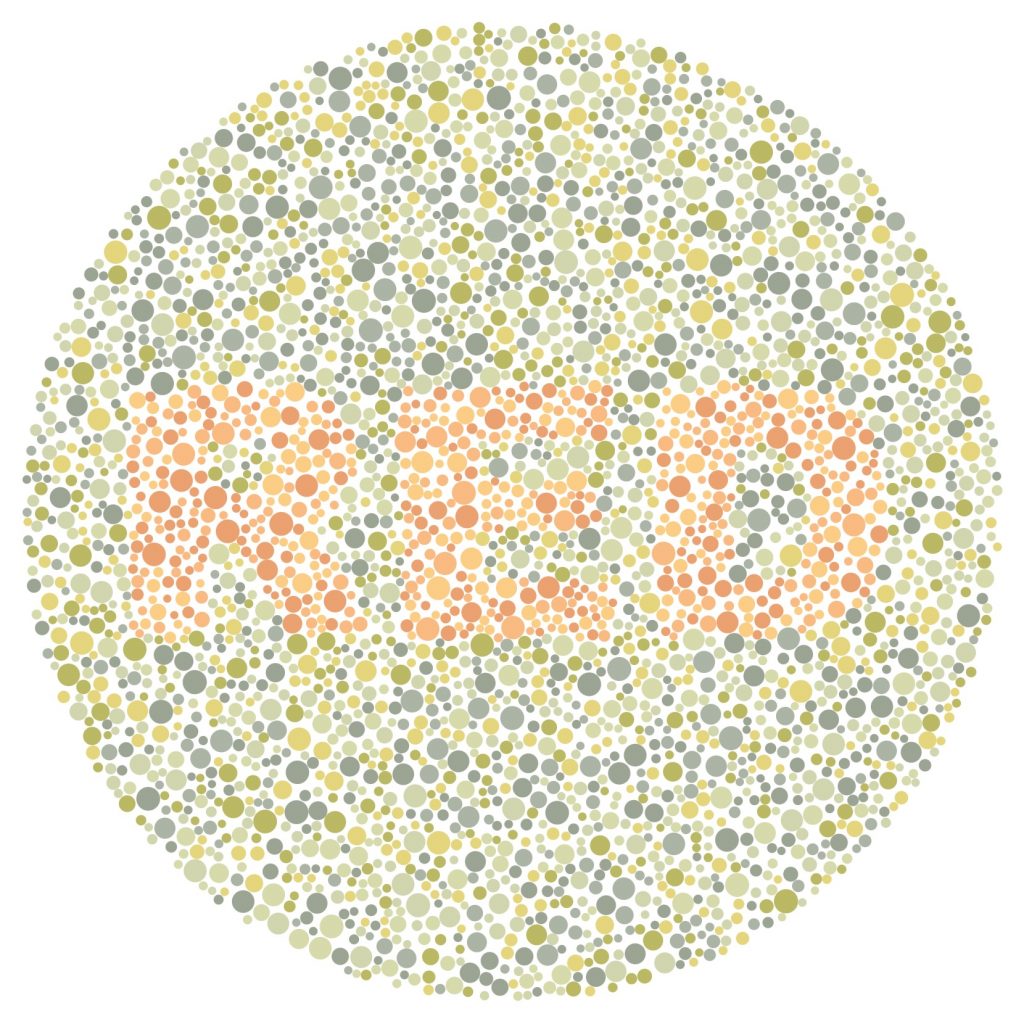
I’m working on my fifth colorblind/Ishihara plate poem. This one is about the Ishihara plate and why it’s a significant test for me. I want to do something with the circles and loops and the idea of taking this test and not seeing the number as the first big moment of recognition that there was something wrong with me. I dismissed it, thinking only that it meant I was one of those rare, quirky people who saw color strangely. But it was the first moment of acknowledgement that whatever strange things I had been experiencing for years weren’t just in my head. Others — my husband and kids — could see that I saw differently too. I feel like I keep writing this in different ways on this log, over and over, trying to find the right way to express it. Maybe that’s part of the circles/circling too? There’s something about the idea of inside and outside here too — this test made what had only been inner (my unexpressed/not-yet-understood thoughts about seeing strangle) outer (visible to the word, acknowledgement as a problem, or as a real thing that I was experiencing).

dec 9/BIKERUN

bike: 25 minutes
bike stand, basement
run: 1.25 miles
treadmill

Not too cold outside, but a bit icy, uneven. Today’s workout was all about adding another mile to my year total and getting a chance to move after sitting at my desk all morning while working on a poem. Watched a race while I biked, listened to Lizzo while I ran.

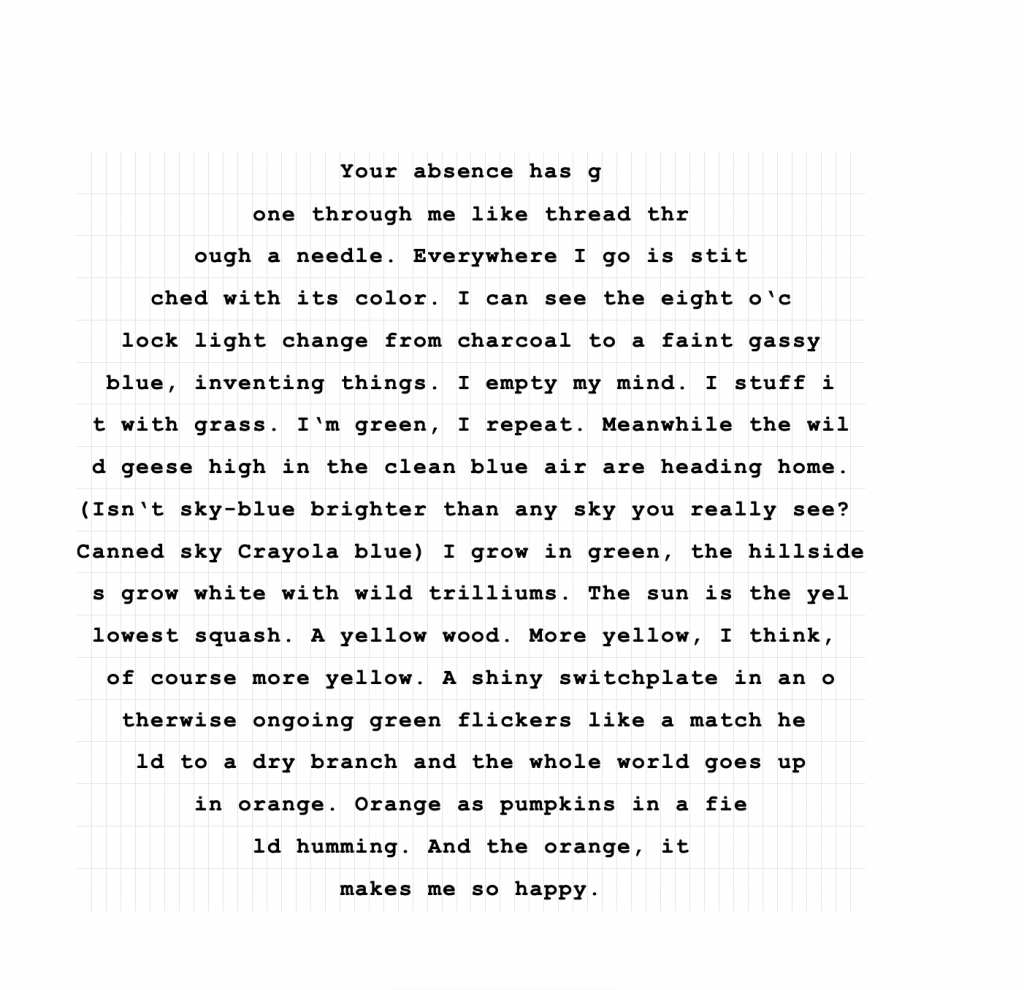
Worked all morning on a colorblind plate poem. This one is a cento and includes lines with colors from some of the almost 800 poems I’ve gathered on this RUN! log. Yesterday afternoon, I gathered them and discovered something: many — most? — of the poems I’ve gathered don’t mention color. Colors popped into my head as I pictured the images in the poems, but because of association and the colors I connect with certain things, not because color words were used. This was surprising to me.

The name of this poem is In (or inner if Scott can fit it in the colorblind plate), which refers to my inner color world, how I imagine color now that I can’t see it as well. Here it is:

draft of IN

Lines from the following poems:

Separation / W.S. Merwin
Ars Poetic / Aracelis Girmay
Cold Morning / Eamon Grennan
Becoming Moss / Ella Frears
Wild Geese / Mary Oliver
With A Song / Christina Pugh
Paean to Place / Lorine Niedecker
Trilliums / Mary Oliver
The Road Not Taken / Robert Frost
Forsythia / Ada Limón
Autumn / Linda Paston
Colors passing through us / Marge Piercy
A Rhyme for Halloween / Maurice Kilwein Guevara
Orange / Wendy Cope

Here’s one of the poems that I hadn’t posted yet. It’s a great one for winter; I might use it for my class!

With A Song/ Christina Pugh

There’s something about music: the wish to
be in the dark. Like I don’t know what person
this voice must belong to. At times I love
a secret, what sheers away from intellect.
Intrepid horn of birdsong when you won’t
see or know the bird. Or sometimes
I’m riding in the car on I-80, dipping
my eyes into the glamour of Ohio, its red
barns or white barns severally unpainted
by tactile fingers of winter weather.
White barns with green roofs. Sky-blue
with white roofs. Wait, isn’t sky-blue brighter
than any sky you really see? Canned sky,
you might reply, hyperbole of color. Platonist
Crayola blue. Would anyone trade a teal
feather for a trill? The highway will line
with mud and snow stripes along a fence,
then apple orchards spider in the ice.
A long stand of pines before the strip mall.
And still from the radio, an alto atremble:
I love not knowing who it belongs to.


dec 1/SWIM

1.5 miles
ywca pool

Back to the pool. Hooray! Swam a lot of loops — 99 laps — while breathing every 3, then 4, 5, then 6. Worked on breathing on my weaker side (left) when breathing every 4. Decided not to count, just swam until Scott entered the pool area and stood at the top of my lane. Not very crowded today. A guy in swim trunks to my right, swimming a lot of side stroke. It was fun to watch the wide sweep of his hands as he moved through the water on his side. Empty to my left, then Miss Luna arrived. Almost positive it was Miss Luna — the regular swimmer who swims with fins and paddles and does butterfly, and wears a pale green suit, with pale blue too, that makes me think vaguely of a luna moth. She wasn’t in pale green with blue today, but a similar suit. Same strong stroke, same fins.

They must have added chlorine since my last swim. Much clearer, sharper too. The blue of the tiles on the bottom that make the lines dividing the sides of the lane were a vivid blue instead of almost looking navy or black. Speaking of color, kept seeing yellow and orange when I lifted my head.

Felt strong and happy and buoyant, riding the surface, smoothly powering through the water. At some point, I started thinking about my color poems. I’ve written one about yellow, another about color in general. Before swimming, I started one about gray. Almost everything is gray or seems gray or leads to gray. Other colors are only pops, flashes, suggestions. I thought about making the poem mostly variations on the phrase, a gray day, or singing a song of gray, or gray area, or grayed out. Then I thought about having the poem visually mimic how I often see color. It’s frequently a flat or hazy gray until suddenly, to the side, a slash or pop of color appears, like orange or red. So, most of the words are gray, gray day, gray dreams, sing a song of gray, then off to the side, “orange” appears. Could this work? I’ll give it a try!

december challenge

I’m not sure what my challenge for this month will be. I’m in the thick of working on these color poems and prepping for my finding wonder in the winter writing class in late January (so excited to teach this one!). Should it be about orange? Or the poet that just wrote a collection partly about her degenerative eye disease — Julia B. Levine — titled, Ordinary Psalms? Or joy, inspired by recently purchasing Ross Gay’s Inciting Joy and my desire to explore what gray joy could be? I’ll give it another day, but I’m leaning towards Gay and joy. In the meantime, here’s one of Levine’s psalms from Ordinary Psalms:

Psalm with Near Blindness/ Julia B. Levine

i. 
The world mostly gone, I make it what I want: 
from the balcony, the morning a silver robe of mist.

I make a reckless blessing of it—the flaming, 
flowering spurge of the world, the wind 

the birds stir up as they flock and sing. 
Edges yes, the green lift and fall of live oaks,

something metal wheeling past, 
and yet for every detail alive and embodied— 

the horses with their tails switching back and forth, 
daylilies parting their lobes to heat— 

I cannot stop asking, Sparrow or wren? Oak
or elm? Because it matters 

if the gray fox curled in sleep 
is a patch of dark along the fence line,

or if the bush hung with fish kites 
is actually a wisteria in flower. Though 

even before my retinas bled and scarred 
and bled again, I wanted everything 

different, better. And then this afternoon, 
out walking the meadow together,

my husband bent to pick a bleeding heart.
Held it close as I needed 

to see its delicate lanterns, 
the shaken light. 

ii. 
Deer, he says, our car stopped in traffic. 
And since I can’t see them, I ask, Where?

Between the oaks, he answers,
and since I can’t see the between,
                                                                I ask, In the dappling?                        
He takes my hand and points 
to the darkest stutter in the branches 
                                                                and I see a shadow 

in the sight line of his hand, his arm, 
his blue shirt with its clean scent of laundry, 

my hand shading my eyes from glare. 
There! he says, and I can see 
                                                              the dark flash of them 
                                                              leaping over a fence (or is it reeds?), 

                                                              one a buck with his bony crown, 
                                                         and one a doe, and one smaller, a fawn,

but by then it seems they’ve disappeared 
and so I ask, Gone?
and he nods. 

We’re moving again,

                                                               and so I let the inner become outer 

                                                               become pasture and Douglas firs 
                                                               with large herds of deer, elk, even bison, 

                                                               and just beyond view, a mountain lion 

auburn red, like the one we saw years before, 
hidden behind a grove of live oaks, 

                                                                                        listening.

Oh, I am so excited to find this poem and the brilliant work of this poet! I can relate to so many of her words! The silver mist of the morning, the edges mostly gone, the emphasis on movement, her husband helping her to see, the inner becoming outer. Some differences too (probably partly because I imagine my vision isn’t quite as bad as hers): I don’t think the world is gone, more shifted, italicized, transformed. And I don’t need to know exactly what type of tree I’m seeing. I’d like to be able to tell the difference between a deer or a bush — sometimes I can’t — but the fine details matter less.

My thoughts on this last bit, about seeing exactly what’s there, are partly inspired by Levine’s response in an interview about the psalm. She says:

As I worked on it, this poem felt to me like a meditation on one particular dilemma of near blindness: that is, in the absence of a clear visual image, how the mind fills in, and what relationship this kind of seeing” has to spiritual notions of “vision” as opposed to a medical/anatomical definition of “sight.”

To explain further, there are some absences of visual perception that I actually like: I don’t see how dirty my house is, or whether or not my clothes are covered in blonde dog hair, and my friends and family all look very beautiful to me since I cannot see their wrinkles or whatever else might be considered “flaws.”

But I have loved the natural world since I was a small child and it is my inability to see it accurately that pains me. So, in the poem, I am interested in both how tounderstand what I do “see” as a amalgam of my own mind and memory, plus the relational construction that primarily my husband lends to me, and finally, what I can actually perceive. The result of this perceptual construction can sometimes feel like an important “truth” as opposed to visual fact.

I have loved the natural world since I was a small child and it is my inability to see it accurately that pains me.

Interview with Julia B. Levine

I love the natural world, but I’ve never needed to see it accurately in the ways that Levine seems to be invoking. I’m not interested in critiquing her perspective, but in positioning mine in relation to it. Also, I’d like to understand more of what she means by accurate. The more I (attempt to) study how vision and sight work, the more I’m fascinated by how much guesswork it involves for everyone, even “normally” sighted people. The brain filters, guesses, fills in. What does it mean to see nature accurately? Also, what about other senses? Can they enable us to access parts of nature that our limited/biased vision can’t? Losing some sight and the ability to easily, and more quickly, with much more detail, sucks, and I struggle with it. But I’m also interested in ways of knowing/understanding/recognizing/becoming familiar with beyond central vision and fine detail. I have a different project than Levine, but I deeply appreciate her words.

nov 29/WALKBIKERUNSHOVEL

a walk with Delia
longfellow neighborhood
27 degrees / snow
100% snow-covered

Took Delia the dog for a walk around 2 blocks. She needed the exercise, I wanted the fresh air and to see the conditions of the sidewalk. Too much snow. If I hadn’t tweaked by foot on uneven snow a few weeks ago, I’d be more willing to risk it and go for a run by the gorge, but not today. Everything white and gray. Walking north the snow felt like sharp shards. I breathed deeply. Oh, that cold air! Brittle, abrasive, cleaning me out. Taking these breaths in the cold air, walking in the soft silence, or almost silence, are some of my favorite things to do.

…a few hours and 6+ inches of snow later

bike: 20 minutes
bike stand basement
run: 2.2 miles
treadmill, basement

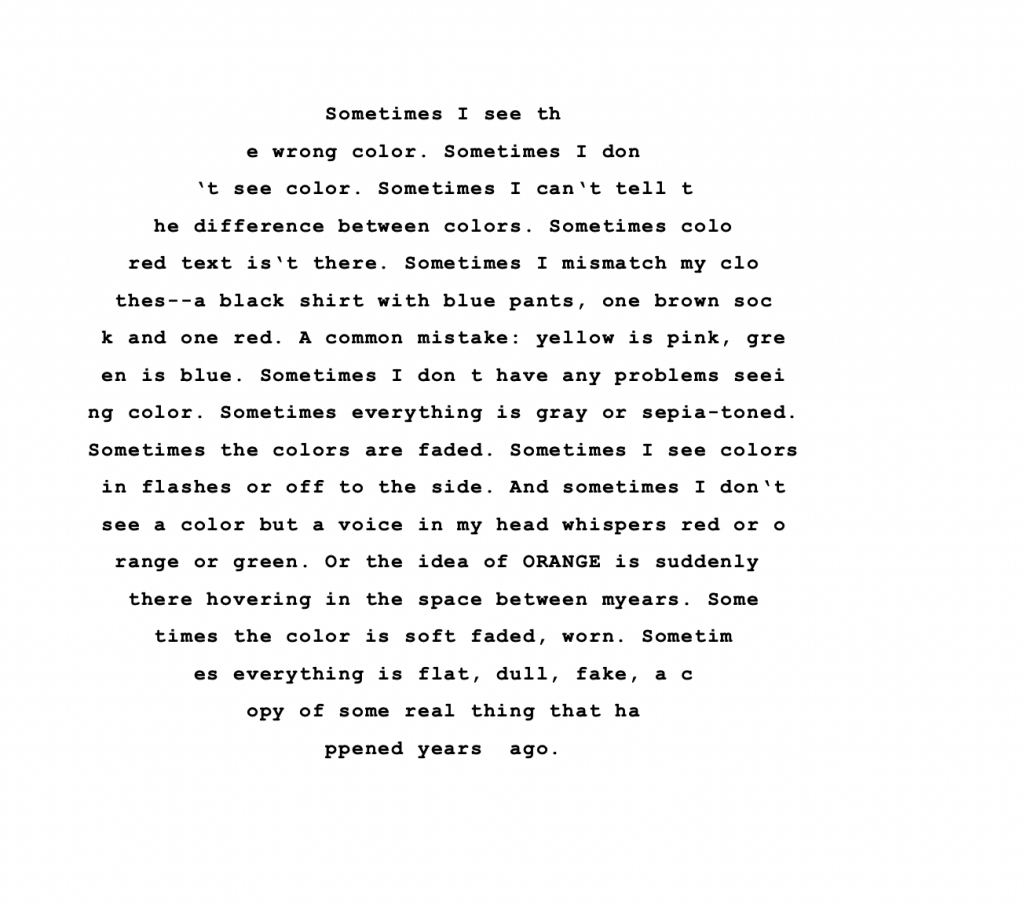
Lots of unshoveled/unplowed snow and uneven ground outside. Watched a running race while I biked, listened to a “Taylor Swift fitness” playlist while I ran. In between, I listened to 2 versions of another colorblind plate poem. This one is about the various strange ways I see color and how those shift depending on some things I can predict, some I can’t. I’m calling it, “Shifty.”

shovel: 32 minutes
deck, front sidewalk

The snow has stopped. I’m not the greatest at guessing, but I’d say there’s at least 6 inches. Okay, I had to do some digging (excuse the pun), but I found a snow total for St. Thomas, which is about a mile from my house. 7.5 inches. Yikes. That snow was no joke to shovel. Almost too much. Listened to Mexican Gothic and got to the part, almost 8 hours in, where the big secret of the evil house is revealed. Surprising and interesting and gross too — I won’t spoil it for anyone who might be reading this and hasn’t read the book.

Today’s song of gray

I can’t quite remember what it was now, but something made me think of gray air and breath. Searched for “gray breath” on Poetry Foundation and found this poem. This past summer, I watched a lecture from Aimee Nezhukumatathil in which she began with this poem:

First Grade/ Ron Koertge

Until then, every forest
had wolves in it, we thought
it would be fun to wear snowshoes
all the time, and we could talk to water.

So who is this woman with the gray
breath calling out names and pointing
to the little desks we will occupy
for the rest of our lives?

Earlier today, I had another poem I was thinking of posting as today’s song of gray — granite. I’ve decided to post it too because of the wolf and snow connection:

nunatak/ Jane Lovell

a stone ridge exposed by wind,
a lip of stone curled at the glaucous wind,
its harrying across blown snow;
a skyline ridge, blade-and-socket spine
of something fossilised, claws sunk
in the hidden world below;
a ridge of stone, a pebbled egg
abandoned in its cleft, the embryo
a shock of livid skin in frozen oils;
a granite ridge, its icebound edge
orbited by tracks of lupine shadow
swerving out across the void.

nov 27/RUN

3.4 miles
trestle turn around
32 degrees

Another beautiful morning. Sunny and calm and not too cold. Clear trails, no big groups of runners. No fat tires or roller skiers either. Exchanged greetings with Mr. Morning! Remembered to look at the river. It was open and blue. At one spot, it shimmered. I listened to Taylor Swift’s 1989, then Reputation instead of the gorge.

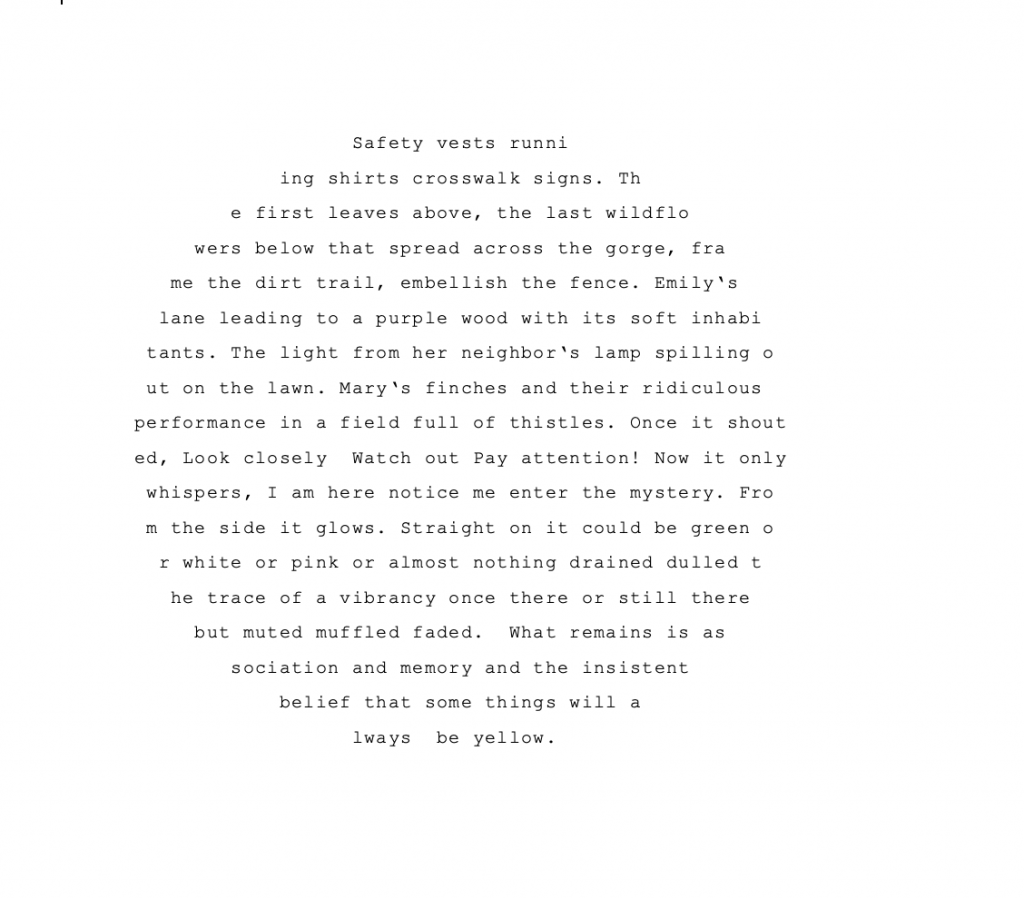
Before my run, I fit the draft I did of my yellow poem into the colorblind plate form. I think it works pretty well.

yellow, plate 2

I haven’t come up with the single word hidden in the colorblind plate yet.

I’m nearing the end of my month of singing a song of gray. Here’s a gray poem about tombstones and spirits by Edgar Allen Poe:

Spirits of the Dead/ Edgar Allen Poe

I

Thy soul shall find itself alone
’Mid dark thoughts of the gray tombstone—
Not one, of all the crowd, to pry
Into thine hour of secrecy.

   II 

Be silent in that solitude,
Which is not loneliness—for then
The spirits of the dead who stood
In life before thee are again
In death around thee—and their will
Shall overshadow thee: be still.

   III 

The night, tho’ clear, shall frown—
And the stars shall look not down
From their high thrones in the heaven,
With light like Hope to mortals given—
But their red orbs, without beam,
To thy weariness shall seem
As a burning and a fever
Which would cling to thee for ever.

   IV 

Now are thoughts thou shalt not banish,
Now are visions ne’er to vanish;
From thy spirit shall they pass
No more—like dew-drop from the grass.

   V 

The breeze—the breath of God—is still—
And the mist upon the hill,
Shadowy—shadowy—yet unbroken,
Is a symbol and a token—
How it hangs upon the trees,
A mystery of mysteries!

Speaking of gray and Poe, I encountered this line from his short story Eleonora:

They who dream by day are cognizant of many things which escape those who dream only by night. In their gray visions they obtain glimpses of eternity, and thrill, in awakening, to find that they have been upon the verge of the great secret. 

Eleonora/ Edgar Allen Poe

nov 26/RUN

5.6 miles
fairview loop
42 degrees

A little warmer today so I wore the late fall, early winter layers: black tights, black sorts, long-sleeved green shirt, orange sweatshirt, black and white polka dot baseball cap. Sunny, quiet. Almost all of the trail and sidewalks were completely clear. Only a few spots of ice on the Marshall hill just before reaching Cretin. Managed to get greens at all of the stoplights climbing the marshall hill– no quick breaks for me. Had to stop at the two on Summit.

10 Things I Noticed

  1. heard the bells at St. Thomas at both 10 and 10:15
  2. was dazzled by the light burning bright off the river
  3. felt the wind pushing me from the side as I crossed the bridge
  4. the strong smell of bacon or ham as I neared longfellow grill
  5. a few stretches of ice on marshall, some patches of wet sidewalk that looked like ice but was only a trick of the light
  6. a bus stopped, a few passengers getting out
  7. statues at the end of the walk of fancy houses on Summit: pineapples, lions
  8. a kid’s voice somewhere below in the ravine leading to shadow falls
  9. a runner stopped on the bridge to take a picture of the river as it shimmered with a wide swath of bright light
  10. a woman and a dog carefully making their way under the chain closing off the old stone steps

Climbing the short hill that starts at the Monument and ends at an entrance to Shadow Falls, I suddenly had a thought about yellow that made me stop and pull out my phone to record it:

Thinking about colors and yellow and then I was thinking about how sometimes it used to be this warning, this shout, like watch out, be careful and now it’s become more of a whisper or a soft cry or more hushed and it’s increasingly getting that way so colors are more muted and muffled… [the other voices in the recording are 2 bikers and 2 then 2 runners].

yellow/ 26 nov 2022

Not sure what happened with the recording here, but I remember saying more about how distant yellow seems now. I never see it as bright, but faded, from the past, or through the gauzy veil of my damaged cones. Sometimes only the association with objects. I might not see that something is yellow but I know that it is because I know safety vests or crosswalk signs or the middle light on a stoplight are yellow. Orange works differently for me. It’s not faded, but it often only appears as a blip or flash or slash or flare in my peripheral vision. Again, yellow offers a soft, constant glow. I was also thinking about Van Gogh and his idea that every color is ultimately a variation of gray.

excerpt from Yellow Lullaby/ Leontia Flynn

A spill of sunlight and a yellow dress.
A yolk.
A yellow flower.                                                
A candle flame.
A moth-light, moon-like,
in the nursery’s darkness . . .

nov 22/RUN

5.5 miles
franklin loop
27 degrees

Warmer this morning. Hardly any ice or snow on the path. My foot is only slightly sore at the end, but otherwise okay. Sunny and bright. A blue sky. As I reached the river at the beginning of my run I heard then saw a lone goose. Thought about color, especially yellow and gray. Listened to my breathing. Focused on taking deep breaths in through my nose, out through my mouth. Was good morninged by Mr. Morning! He called out from across the trail, Good morning! and I called back.

10 Colors I Noticed

  1. the yellow dotted lines on the bike trail
  2. the orange spray paint around the cracks that need to be replaced
  3. a pale blue sky
  4. a dark blue trash can
  5. the dark gray pavement that seemed to have a hint of blue
  6. the silver river — or was it white gold? through the trees, the river burned a bright white
  7. beige or sepia-toned ice on the river
  8. the grayish-dark brown of the bare trees
  9. the slab of white snow decorating one side of the ancient boulder
  10. the dark greenish-gray of a fir tree

In other color news: an essay I wrote 5 years ago popped into my head while I was running — “My Purple Toe” — and I thought about how the toe in it is not purple but lavender gray

Update on my foot: Scott and I had to go pick FWA up from Gustavus, so I’m writing the rest of this later in the day. A few hours in the car, not moving much, my foot felt stiff and sore again. I walked around a bit and it felt okay. I asked Scott if that’s what happens with his foot and he said yes. Does this mean I have plantar fasciitis? I hope not!

Today’s gray theme: more on the color gray

[Here on this edge I have had many diminutive visions.]/ Diane Seuss

Here on this edge I have had many diminutive visions. That all at its essence is dove-gray.
Wipe the lipstick off the mouth of anything and there you will find dove-gray. With my
thumb I have smudged away the sky’s blue and the water’s blue and found, when I kicked it
with my shoe, even the sand at its essence is pelican-gray. I am remembering Eden.
How everything swaggered with color. How the hollyhocks finished each other’s sentences.
How I missed predatory animals and worrying about being eaten. How I missed being eaten.
How the ocean and the continent are essentially love on a terrible mission to meet up with itself.
How even with the surface roiling, the depths are calmly nursing away at love. That look the late
nurser gets in its eyes as it sucks: a habitual, complacent peace. How to mother that peace, to wean
it, is a terrible career. And to smudge beauty is to discover ugliness. And to smudge ugliness is to be
knocked back by splendor. How every apple is the poison apple. How rosy the skin. How sweet
the flesh. How to suck the apple’s poison is the one true meal, the invocation and the Last
Supper. How stillness nests at the base of wind’s spine. How even gravestones buckle and swell
with the tides. And coffins are little wayward ships making their way toward love’s other shore.

nov 21/SWIM

1.5 miles (2700 yards / 108 laps)
ywca pool

Very glad to be able to swim this morning. My foot, which has been sore the past few days, feels much better today. Swimming instead of running will help even more. I swam my usual continuous 200s. Decided not to count the laps and just keep swimming until Scott came to the pool and stopped at the end of my lane. A few workouts ago, I asked him to stop at the end of my lane instead of going straight over to the hot tub to wait for me to be finished. I explained that it’s hard for me to recognize him — I might not be able to do it. Now I don’t have to worry. It’s not hard for me to see a person with bright orange shorts at the end of my lane. Just another strategy for dealing with not being able to see that well.

note: re-reading this entry on 21 nov 2025, I thought about how this statement, it’s not hard to see a person with bright orange shorts at the end of lane, is not always true these days. Just a few days ago, Scott stood at the end of my lane in his bright orange shorts for 3 full laps trying to get my attention, but I didn’t see him. Was it bad vision or a fluke? Just yesterday, he stood there again and I saw him without a problem.

10 Things I Noticed While Swimming

  1. a few more things on the ground, at least one stringy thing floating in the water — I was in a different lane, so that might it explain why there were more things. It could also be that it’s time for them to clean the pool again
  2. no chlorine stings
  3. crowded — most lanes had 2 people
  4. the woman sharing the lane with me was a great swimmer. I liked watching her freestyle as I approached her, and the way she shot off the wall
  5. 2 Regulars — Mr. Speedo, the older white man who is lanky and probably has been swimming for 1/2 a century, and who wears a dark speedo and the oldish white woman in the pale blue and green suit who sometimes wears fins or booties on her feet, mitts on her hands. Today, after about 30 minutes in the water, she started swimming butterfly. It might be a stretch, but I think I’ll call her Miss Luna after the luna moth which is pale green — this luna moth is not a butterfly, but people often mistake it for one
  6. predominant color I noticed again: orange. I think a lot of the orange I see are the small sandwich board signs that are orange and read, caution wet floor, or someting like that
  7. looking straight ahead through the cloudy water, I could just barely see my lane partner approaching. She was in a solid dark suit and was streamlined, making me think of a small shark — surprisingly, this didn’t make me nervous
  8. at one point, Miss Luna and the shark were swimming at the same speed, on either side of me. It was fun speeding through the two of them — like what, a rocket?
  9. one distinctive noise — the squeak of my nose because my nose plug was not on properly
  10. 2 older women in the locker room discussing the big snow storm in upstate New York. 2 things in particular I remember: first, that the football game had to be moved somewhere else and two, about how after a big storm there are always tons of pictures on social media of people who are stuck and can’t open their front doors

Today’s gray theme: gray variations

The Nomenclature of Color/ Richard Jones

Absinthe green: Laura’s eyes.
Bishop’s purple: Evening skies.
Cornflower blue: Dreams of the wise.
Dragon’s-blood red: My mother’s dark sighs.
Elephant’s breath: Imagination.
Forget-me-not blue: The dust of cremation.
Guinea green: Ruination.
Hessian brown: The dust of creation.
Iron gray: The paradox of clouds.
Jade green: The bride’s necklace.
Kingfisher blue: Justice and grace.
Lavender gray: A widow’s shroud.
Medici blue: The heart that is jealous.
Nile blue: The color of water.
Onionskin pink: A poem for my daughter.
Pearl gray: The wedding gift.
Quaker drab: The virtue of thrift.
Raw sienna: Dirt we sift.
Seafoam green: The rowboat adrift.
Tyrian rose: Love’s ardor.
Ultramarine blue: Heaven’s color.
Venetian pink: Hell below.
Wedgewood blue: The little we know.
Xanthine orange: The taste of life.
Yvette violet: The lips of my wife.
Zinc orange, zinc blue, zinc white: The colors of houses in paradise.

Iron gray
Lavender gray
Pearl gray

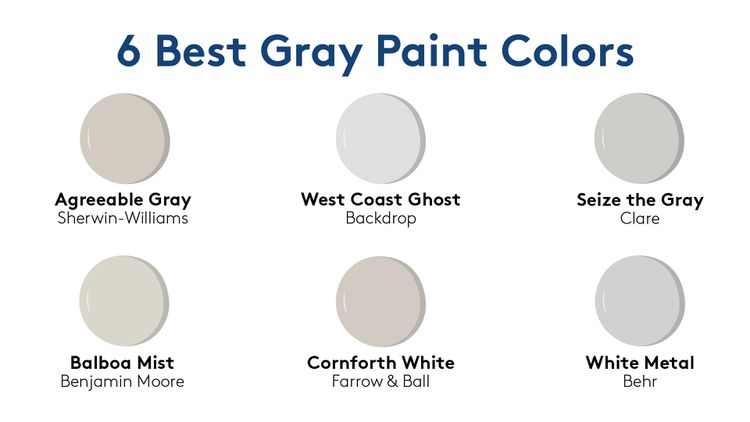
Doing a google search about gray, I found this article with 6 Popular Gray Paint Colors: Agreeable Gray, West Coast Ghost, Seize the Gray, Balboa Mist, Comfort White, and White Metal.

from “ode to gray”

Gray in the wild opens and spills. Put two grays together and you’ll see the color each one hides within, the “endless variations” noted by Van Gogh. I think of the handful of river pebbles I once snuck into my pockets on a day trip to a waterfall: they were dusty gray when I got home, but underwater, each concealed a secret separate life as green or red or blue. So many things that seem gray on the surface have a treasure to unlock—myself, I hope, included.

from To Theo van Gogh (a letter from Vincent Van Gogh to his son)

As regards black in nature, we are of course in complete agreement, as I understand it. Absolute black doesn’t in fact occur.2 Like white, however, it’s present in almost every colour and forms the endless variety of greys — distinct in tone and strength.3 So that in nature one in fact sees nothing but these tones or strengths. 

The 3 fundamental colours are red, yellow, blue. Composite: orange, green, purple.

From these are obtained the endless variations of grey by adding black and some white — red-grey, yellow-grey, blue-grey, green-grey, orange-grey, violet-grey. 

It’s impossible to say how many different green-greys there are for example — the variation is infinite.

But the whole chemistry of colours is no more complicated than those simple few fundamentals. And a good understanding of them is worth more than 70 different shades of paint — given that more than 70 tones and strengths can be made with the 3 primary colours and white and black.4 The colourist is he who on seeing a colour in nature is able to analyze it coolly and say, for example, that green-grey is yellow with black and almost no blue, &c. In short, knowing how to make up the greys of nature on the palette.  

nov 20/RUN

5.6 miles
franklin loop
19 degrees / feels like 9
5% ice and snow covered

Because it was sunny and because there wasn’t much wind and because I had the right number of layers on, today’s run was great. Not too cold. Maybe it helped that I did a 5 minute warm up on the bike in the basement? Very happy to be out there, beside the gorge, breathing in the cold air, and greeting Mr. Morning! and Dave, the Daily Walker.

The arch of left foot hurts a bit. I think I overdid it with the old shoes, the yak trax and the ice clumps on Thursday. I should not run tomorrow. Bummer.

Layers: 2 pairs of black running tights; pale green long sleeved shirt; pink jacket with hood; gray buff; black fleece lined baseball cap; 2 pairs of gloves — pink with white stripes on top, black underneath

Took the pink and white gloves off about 1 1/2 miles in. Pulled down the buff 5 minutes in, pulled off the pink hood at 1 mile. Unzipped and re-zipped my jackets throughout. At the end of the run I wasn’t cold, just soaked with sweat, my pony-tail dripping.

10 Things I Noticed

  1. the river, 1: running on franklin bridge the river was a clear blueish gray, no ice yet
  2. snow was covering the north face of an ancient boulder on the east side of the river
  3. random goose honks throughout the run, usually a lone goose flying low
  4. the sky was a pale blue, the gorge was giving off a blue-gray hue
  5. the only other colors: brown, white, a runner’s orange jacket, another runner’s pink one
  6. the river, 2: standing above the lake street bridge at my favorite spot on the east side I admired the open river, stretching wide, looking calm
  7. the river, 3: off in the distance the water glowed, burning a silver fire — not white, or any color, just shimmering light
  8. the river, 4: from the lake street bridge the river was studded with ice
  9. a voice on a hill on Edmund: a kid going sledding
  10. ending the run and crossing over to the boulevard the snow crunched in an unusual way. It sounded almost like the crinkle in a dog toy, or like I had some brittle paper stuck on my shoe

I made a recording of the crinkling snow:

crinkling snow / 20 november 2022

Scrolling through twitter, this piece — a prose poem? an essay fragment? — by Mary Ruefle from My Private Property. I might have to buy this book; I’ve posted at least one other essay/poem from it on here already:

from My Private Property/ Mary Ruefle

Gray sadness is the sadness of paper clips and rubber bands, of rain and squirrels and chewing gum, ointments and unguents and movie theaters. Gray sadness is the most common of all sadnesses, it is the sadness of sand in the desert and sand on the beach, the sadness of keys in a pocket, cans on a shelf, hair in a comb, dry-cleaning, and raisins. Gray sadness is beautiful, but not to be confused with the beauty of blue sadness, which is irreplaceable. Sad to say, gray sadness is replaceable, it can be replaced daily, it is the sadness of a melting snowman in a snowstorm.

The everydayness of gray sadness, its mundane, real, nothing special-ness, reminds me of a bit from the lyric essay I posted last week, Ode to Gray. Especially this bit:

Look at enough black-and-white photography and color comes to feel like an intrusion. Eggleston’s photos seem too vital to be real, as though depicting an alternate reality. Each image is delirious with hue, spectacular, delicious, but a little bit too much. The eye craves rest—and mystery, the kind of truth that can be searched only in subtlety. Dorothy may tumble, tornadic, into Technicolor, but still she always wishes to go home.

In addition to exploring gray this month, I’m also thinking about color in general, and colors that have been significant for me in this running log, like green. Here is a great green poem I found a few days ago. I haven’t thought of the coming of green as fire and flame before, but it works.

The Enkindled Spring/ D.H. Lawrence

This spring as it comes bursts up in bonfires green,
Wild puffing of emerald trees, and flame-filled bushes,
Thorn-blossom lifting in wreaths of smoke between
Where the wood fumes up and the watery, flickering rushes.

I am amazed at this spring, this conflagration
Of green fires lit on the soil of the earth, this blaze
Of growing, and sparks that puff in wild gyration,
Faces of people streaming across my gaze.

And I, what fountain of fire am I among
This leaping combustion of spring? My spirit is tossed
About like a shadow buffeted in the throng
Of flames, a shadow that’s gone astray, and is lost.

nov 18/BIKERUN

bike: 25 minutes
bike stand, basement
run: 2 miles
treadmill, basement
outside: 19 degrees / feels like 6

Stayed inside this morning because of the cold, the wind, the too bright white, and the icy paths. It’s very early in the winter season, and I doubt they’ve treated the trails. Watched a few races while I biked, listened to Taylor Swift’s Reputation while I ran. The thing I remember most about the run: trying to stop myself from looking at the time to see how long I’ve been running, how much I’ve got left. Also: stared at the reflection of the light in the back window, noticed again how it looks like an upside moon casting light on water above it.

Before deciding on watching some track races, I started “Servant” on Appletv. The opening credits had way too little contrast; I could barely tell there was text on the screen. Then the title appeared in red. I couldn’t read it all. Looking at it paused, when it wasn’t moving and I had more time to stare, I could mostly see it. Red letters on a black background are hard for me to see. I might try watching this show some other time, but it might be too dark. So many of the thriller or mystery or dramatic shows available now are dark or darker or dim, which makes it almost impossible for me to see what’s happening.

color project

I’m continuing to work on my color/colorblind project. I was telling Scott about my writing process the other day and how some poems insist on being written. I’ve tried to drop this color thing, especially with the colorblind plates several times, but it keeps coming back up again and again. I’ll be working on something else, and whatever that something is will end up at color and how I do or don’t see it. It’s wild.

I heard some birdsong just now from behind my shaded window. Sounding like spring. I looked — a bird is doing something near the foundation, just below me. Gathering twigs?

Back to my color project. Yesterday Scott helped me to figure out the template for the second plate that serves as the form for a longer poem that’s related to the color word hidden in Ishihara loops from the first plate. I put some text in it, using part of a free-write I did the other day. The text is rough, with some typos, but it still helps me to get a sense of how this will work. Very cool!

Each of these poems has 772 characters, including spacing and punctuation. Today I want to start gathering bits — descriptions, lines from other poets’ poems, stories, associations with colors, mishaps, etc. — to include in these poems. One early idea: separate poems about colors that are significant to me: orange, yellow, green, brown, and gray.

note: I returned to this entry to fix some typos I missed and I was struck by how off and excessive my commas are. What is that all about? I seem to hear commas and pauses all the time. Am I trying to slow down the words? Force some hesitation?

nov 17/RUN

5.5 miles
franklin hill turn around
26 degrees / feels like 20
light snow / wind: 15 mph gusts
100% snow-covered

Winter! Woke up to another dusting — maybe an inch? — on the ground. Wore my old yak trax, the ones I got 3 or 4 years ago that are worn down, but still work. Mostly I’m glad I did, but several times snow clumped up in the grooves. Was it because of the yak trax, the high water content of the snow, or something else?

My Favorite Things

  1. the feel of snow under my feet — more interesting than boring asphalt
  2. the creaks and crunches of that snow
  3. greeting Mr. Morning! and Dave, the Daily Walker
  4. 3 geese flying west — I heard their harsh honks first, echoing across the gorge, then they appeared, flying low near the trestle
  5. open water, brownish-gray
  6. in the second half of the run, the snow stopped and the sun was trying to pierce through the thick clouds. Everything looked slightly blue — the snow, the sky, the trees
  7. the graceful runner who passed me, their feet bouncing up and down, up and down
  8. in the first half, when it was much darker, the headlights cutting through the dim
  9. running up the Franklin hill — I felt strong and free, untethered
  10. ending at the ancient boulderS after (almost) sprinting up the hill — my winter running tradition

Ishihara colorblind plates as form

Still thinking about my next series of vision poems. A plan seems to be forming. Here’s what I wrote:

A series of colorblind (Ishihara) plates describing how I see and don’t see color and what that means for how I move through the world. 

The actual series of plates for the test are 38. I think that might be too many. Each poem will consist of 2 plates: the “actual” plate (designed by Scott) with the circles and the hidden message. In the original, it’s numbers. In mine, it’s a word that can stand alone as a poem, but also (might) connect with the other plate words and is the unifying theme for a prose poem that is on the second plate. This second-plate poem will (most likely, but maybe not?) take the form of the circle of the plate. Tentatively, I’m imagining it as a prose poem, but it might be its own thing, a series of words, descriptions related to seeing and not seeing color. 

The plates will be divided into different topics related to color: 

a story about why this test matters to me
what everything looks like, how it feels
struggles/quirks/strange
a focus on gray — contrast — light and dark, not in color

Scott found something on github that enables you to easily (or easily for Scott) design your own plates. Here’s a sample of what he did. He put the word red in it. I’ll take his word for it because I can’t see the letters at all.

Scott’s Ishihara plate, “Red”

today’s gray theme: duck duck gray duck

Still thinking about gray this month. Today, inspired by the wonderful geese I heard while running, I’m thinking of the passionate way Minnesotans defend their name for the childhood game, Duck Duck Gray Duck over what the rest of the country calls it, Duck Duck Goose. I am not one of those passionate Minnesotans because I grew up on the east coast in North Carolina and Virginia. We played Duck Duck Goose. I’m fine with calling it Duck Duck Gray Duck, but I don’t really care. Scott does. No matter how often we’ve discussed it, he gets fired up every time the topic is mentioned. It is fascinating to me that Minnesota is the only state that uses gray duck and not goose, especially thinking about how many kids who grew up in Minnesota probably have a moment when they realize that not everyone else calls it that.

Because I’m that person, I had to wonder, are gray ducks rare? Yes, especially in Sweden. According to my quick googling, the most common color for ducks in Sweden is blue.

I already have 2 wonderful poems about wild geese — Wild Geese/Mary Oliver and Something Told the Wild Geese/Rachel Field — but I can always use another!

The Geese/ Jane Mead

slicing this frozen sky know
where they are going—
and want to get there.

Their call, both strange
and familiar, calls
to the strange and familiar

heart, and the landscape
becomes the landscape
of being, which becomes

the bright silos and snowy
fields over which the nuanced
and muscular geese

are calling—while time
and the heart take measure.

nov 16/SWIM

1.5 miles
ywca pool

Another swim this week! Hooray for strong, sore shoulders and buoyancy. Googles and nose plugs and flip flops with a cartoon image of bloody, frankenstein-y toes (an awesome gift from my sister Marji from a few years ago). I’m not sure how far I swam. I stopped counting laps at a mile, wanting to be surprised by my watch when Scott would appear at the end of my lane and I’d end my workout. Looked at my watch. Oops. No workout on. I forgot to push the extra green button for lap distance. Oh well. Judging by my calories and time, I must have swum a little farther than Monday, but I’ll keep it at 1.5 miles.

10 Things I Noticed While Swimming in the Pool

  1. the slight burn of chlorine in my nose
  2. a few more bits of something on the bottom of the pool — was it more, or was it just because I was swimming in a different lane? were these bits moving, or was that a trick of the light or my eyes?
  3. the older woman to my right, swimming breaststroke — slow, steady, graceful frog kicks
  4. the older woman to my left, swimming sidestroke — more grace and the calm, slow sweep of arms through the water
  5. this sidestroking woman was wearing a wonderful bathing suit — all black in the back, in the front: black at the bottom with red or pink or orange horizontal panels up above
  6. “racing” a guy 2 lanes over, swimming freestyle at about the same speed as me, until he stopped and I kept going
  7. a regular — the older, trim woman in the pale blue and green suit whose stroke is strong and fast, and who sometimes wears fins or booties
  8. the feeling of orange everywhere up above, blue below
  9. my foot (the right one?) feeling a little strange near the end, not quite numb but like it might cramp up (it didn’t)
  10. arriving, a crowded pool, everyone sharing lanes. A few minutes later, it began to empty. By the time I was done, only 2 people left

Thought about Ishihara’s colorblind plates as form. I feel drawn to this form because taking this test, and failing it, was my first evidence that something was wrong with my vision. But, this form is difficult to recreate or embody. I decided, as I looped, that I should do a little more research on how the form was created and how it works. Maybe that will help me to figure out what I want to do with it, or whether I want to use it all.

Here’s a place to start: Eye Magazine / Feature / Ishihara

And this video: The Science Behind the Ishihara Test

I can’t remember which poetry craft book I read this poem in, but I like how Soto uses color here — as flashes, sparks, flares against the “gray of December”:

Oranges/ Gary Soto

The first time I walked
With a girl, I was twelve,
Cold, and weighted down
With two oranges in my jacket.
December. Frost cracking
Beneath my steps, my breath
Before me, then gone,
As I walked toward
Her house, the one whose
Porch light burned yellow
Night and day, in any weather.
A dog barked at me, until
She came out pulling
At her gloves, face bright
With rouge. I smiled,
Touched her shoulder, and led
Her down the street, across
A used car lot and a line
Of newly planted trees,
Until we were breathing
Before a drugstore. We
Entered, the tiny bell
Bringing a saleslady
Down a narrow aisle of goods.
I turned to the candies
Tiered like bleachers,
And asked what she wanted –
Light in her eyes, a smile
Starting at the corners
Of her mouth. I fingered
A nickel in my pocket,
And when she lifted a chocolate
That cost a dime,
I didn’t say anything.
I took the nickel from
My pocket, then an orange,
And set them quietly on
The counter. When I looked up,
The lady’s eyes met mine,
And held them, knowing
Very well what it was all
About.
Outside,
A few cars hissing past,
Fog hanging like old
Coats between the trees.
I took my girl’s hand
In mine for two blocks,
Then released it to let
Her unwrap the chocolate.
I peeled my orange
That was so bright against
The gray of December
That, from some distance,
Someone might have thought
I was making a fire in my hands.

nov 15/RUN

4.5 miles
minnehaha falls and back
30 degrees / steady light snow
walking path: 60% snow-covered / bike path: 10% snow-covered

The first winter run in the snow of the season! Wonderful. Slushy, a few slick spots, little snow flakes occasionally pelting my face. Loved it! Not too many people on the trails. Exchanged greetings with Mr. Morning! Morning! Good morning!

I forgot to look at the river or, if I looked, I don’t remember what I saw. It was probably blue gray. There’s no way it was white yet.

We already have a few inches on the ground, so it looks like a winter wonderland. Some of the snow has painted the trees white.

The falls were falling, but not gushing.

The sky is a very light gray. Almost everything some shade of gray. Somewhere on the trail — maybe near the falls — I saw some light green leaves decorating a tree. How is that possible?

Thought about Emily Dickinson and the idea I had earlier this morning, based on my current reflections on gray and my devotion to her poem, “We grow accustomed to the Dark –“: I grow accustomed to the Gray. For me, not everything is dark, really. It’s gray. Literally — as colors drain away in light that isn’t just right, many things often look gray. I don’t usually notice it until I think about how that dark car over there isn’t dark blue or dark red, it’s just dark gray. Or that fir tree outside of my writing studio window isn’t dark green but a very dark gray. It’s also metaphorical — I’m in this in-between state, where I can sometimes see, sometimes can’t. Or I can see well enough to get by, but not very well. I’m in transition, in the process of losing, not in the state of having lost.

today’s gray: gray area

definition from google: an ill-defined situation or field not readily conforming to a category or to an existing set of rules.

Not sure if this really fits, but the in-betweeness and ambiguity of a gray area, makes me think of optical illusions like the duck and the rabbit, or the old lady and the young woman, or the white and gold or blue and black dress, which makes me think of this passage from Georgina Kleege:

I surmise that my general visual experience is something like your experience of optical illusions. Open any college psychology textbook to the chapter on perception and look at the optical illusions there. You stare at the image and see it change before your eyes. In one image, you many see first a vase and then two faces in profile. In another, you see first a rabbit then a duck. These images deceive you because they give your brain inadequate or contradictory information. In the first case, your brain tries to determine which part of the image represents the background. In the second case, your brain tries to to group the lines of hte sketch together into a meaningful picture. In both cases there are two equally possible solutions to the visual riddle, so your brain switches from one to the other, and you have the uncanny sensation of “seeing” the image change. When there’s not much to go — no design on the vase, no features on the faces, no feathers, no fur — the brain makes an educated guess.

When I stare at an object I can almost feel my brain making such guesses.

Sight Unseen / Georgina Kleege

Sometimes, but not always, I can feel my brain making guesses. I usually notice this when it guesses wrong and then I realize what the thing I’m looking at actually is. Or, maybe it is more like this: I see something that seems strange to me, like a dead or sleeping squirrel on a big rock. That’s what it looks like, what the visual data is telling me (Sara’s brain) it is, but I can’t quite believe it. It seems off. I look closer. Finally, after staring for too long, I realize it is a stocking cap with a furry brim.

Ambiguous. It could mean this or that or this and that.

nov 14/SWIM

about 1.5 miles (2550 yards)
ywca pool

Woke up to flurries, then a steady snow. 2-4 inches possible. I would have run in it, but I had already run 5.6 mile yesterday and planned to go to the y to swim this morning. How wonderful it was to be in the water! Made me feel good, so much better than before! After my swim, Scott and I soaked in the hot tub. We both agreed, it’s nice returning to routines that we used to do 4 or 5 years ago. I also like being around happy, older woman in the locker room. I’m not usually talking to them, but I like hearing their chatter post-workout. Joyful, relaxed, pleased to have moved their bodies. I want to be one of those old women one day. I want it even more knowing that it’s not guaranteed. My mom didn’t make it. Scott’s mom didn’t make it, either.

Did my usual swim, broken up by 200s — breathe ever 3/4/5/6. Didn’t have my nose plug on quite right and with the first few flip turns, my nose and then my head burned. Ouch. The water was cloudier today than it had been last week. Saw at least one thing floating in the water, a few marks or spots or bits of something on the bottom. Shared a lane with an older woman for the first few minutes. She did sidestroke and breaststroke and backstroke. A guy in the next lane (was it the same guy as last week?) was running to the edge of the deeper end, then swimming freestyle or breaststroke. At one point, he sped along underwater, parallel to the bottom, kicking furiously.

Colors I Noticed:

  1. the red swim trunks of the guy swimming in the next lane
  2. lots of orange — an orange sign on the pool deck, my orange bay, some other orange things
  3. a swimmer in a pale blue and green suit
  4. deep blue tiles on the bottom of the pool
  5. someone in a black suit, walking along the pool deck

I tried to think about a form for my vision poems that I’d like to use, but I’m not sure how: the Ishihara colorblind plates. The ones that are a circle with colored dots and a number embedded in the center in a different color. Maybe a year before I was diagnosed, I looked at one of these and couldn’t see the number. It was my first clearcut indication that something was strange about my vision. I remember crying — not from sadness, but relief. I wasn’t making it up. There was something wrong with me! Of course, at that moment, I had no idea that what was wrong with me was that all my cone cells were dying. Anyway, I tried to think about the plate as form as I swam, but I keep getting distracted. I want to use this form, but I don’t know how or even if I could do it with my limited design skills. I’ll keep thinking about it and maybe I’ll figure it out.

Before I swam, early this morning, I thought about color and not being able to see it, or being able to see it sometimes, and usually strangely. I found a documentary by Oliver Sacks: Island of the Colorblind

Do I mind that my colors are strange or wrong or not always there? Not too much. Often, I don’t realize I’m not seeing color.

Here’s part of a gray poem I found last week. The entire thing is amazing, and better read on Poetry Foundation site with all the proper spacing. I’m posting a excerpt from it because I like the way color appears in it. Is it almost like slashes and flashes?

from Grayed In/ Martha Collins

2

Cloud on cloud, gray
on gray, snow fallen

on snow, tree on tree
on unleafed tree—

only a river silvered
with thin ice and a slash
of gold in the late gray sky.

3

Grayed snow slush trudge but

snow falling coating filling

in for absence Present!

child with stringed mittens

here to take her place

to take over on

snow showing up air

4

White sky, whiter sun brushing
trees with tints of red, then

in the distance streaking
mauve gold, filling in
between the now filagreed

trees, silhouettes against
the now red burning sky.

nov 13/RUN

5.6 miles
fairview loop
26 degrees

Yes! Love this weather: cold, but not too cold, hardly any wind, no snow or ice on the paths yet. Cold enough to keep the crowds away and for me to keep my gloves on for the whole run. Calm enough for the river to be a mirror reflecting an upside world — the arches of lake st bridge smiling instead of frowning.

Layers: black running tights (the thicker ones), green base shirt, pink jacket with hood, pink head/ear band, black and white polka dot twins cap (used to my daughter’s because, yes, my head is small enough to fit into a girl’s cap), black gloves

Heard a strange bird call in the gorge, which made me think “whip-poor-will,” but it’s most likely not that bird because they’re nocturnal and they’re listed as rare in my birds of the mississippi river guide.

Just as I neared the river road on the east side I heard a honking goose and the bells of St. Thomas.

Saw a few, and by a few I mean less than 10 total, snow flurries in the air.

This route is only 5.6 miles and takes only a little over 50 minutes, but it felt like I ran through a lot of places: cooper neighborhood, on lake street, over the lake street bridge, up marshall in st. paul, beside St. Thomas, on Summit, above the river on the east and west sides, past grand old houses, big brick apartment buildings, corner stores, salons, ice cream parlors, gas stations, cafes, a university, a WWI monument, falls hidden in ravines.

Today’s gray theme is: gray as (the absence of?) color

Thinking about color: Yesterday afternoon, in the chapel at Gustavus, which was not dim but not bright either, I started to notice that looking one direction, toward the far window on the other side, the only color I could see was an occasional red square embedded in the walls (I double-checked with Scott; there were also a bunch of blue squares too). The hymnals 15-20 feet away, which I know are red, looked dark but colorless. Staring out at the crowd of people, everyone looked like they were dressed in dark or light — not quite black or white, just dark clothes or light clothes. No variation, no purples or blues or oranges or anything but dark and light. It was strange, partly because it didn’t feel strange. It wasn’t like I thought, where is all the color? It felt more like when I wake up in the dark and, after my eyes adjust, I see the room and it looks like the room, but just darker, dimmer and without color. And, usually I don’t think there’s no color — sometimes I might even think I see color because I know my robe is purple or the pillow is yellow, or I don’t see yellow, but I recognize the pillow on the couch as that yellow pillow because I already know it’s yellow. Hope this description makes sense to anyone reading this, including future Sara.

Anyway, because my theme for today is gray as color (or colorless) and because I was still thinking about my experience in the chapel last night, I gave particular attention to noticing colors today. I wondered if I would struggle to see colors because it was a gray, darker day. I don’t think so. Would I be able to tell? Here’s the colors I noticed:

10 Colors I Noticed

  1. green grass, green stoplight
  2. red stop sign, red stop lights
  3. yellow stop light, yellow leaves
  4. rusty brownish red stain on the lake st bridge
  5. blueish water
  6. pinkish, purplish jacket on a walker
  7. orange traffic cone
  8. brown dirt
  9. white patches of snow in the corners of the sidewalk
  10. my black running tights

A few grays that come up a lot in poetry: gun metal gray, pewter

added a few hours later: Thinking about color more and how I see it or don’t see it. This afternoon I was wondering about how others describe their inability to see color in the dark/low light, like when you wake up in the middle of the night, look around, and nothing has color. It’s all dark or light or gray. Using the search, “seeing color in the dark,” I came across this article: Why We See Swirling Color When Our Eyes Are Closed. Among other interesting things, it mentions intrinsic gray or eigengrau:

The color black is often referred to as the absence of light, but when it comes to the human visual system, eigengrau is the color perceived in the absence of light. Eigengrau is a German term that roughly translates to ‘intrinsic gray’ or ‘own gray.’ When deprived of light — as in when our eyes are closed, or when we are in darkness with our eyes open — we are unable to perceive true blackness, and rather, perceive eigengrau. This is because light provides the contrast necessary to perceive darker-ness. For instance, the black ink of text might appear darker than eigengrau because the whiteness of the page provides the contrast the eyes need to understand black.

Here’s a little more info from another article:

Scientists believe that Eigengrau is the dark grey colour that human eyes see in perfect darkness and this is said to be the result of visual signals from optic nerves.

German philosopher and physicist Gustav Theodor Fechner is believed to have investigated and popularized the term Eigengrau. He is also known for his key role in the genesis of the measurement of human perception.

Eigengrau is the Dark Gray Colour That Most People See in the Absence of Light

The term eigengrau is not used that often now. Instead, it’s referred to as visual noise or the static in your retina. In the article, eigengrau was also called “brain gray.”

october 31/RUN

5.2 miles
franklin loop
44 degrees

Whew! On the last day of the month I reached my goal. To stay on track for 1000 miles by the end of the year, I needed to run 840 miles by the end of October. I’m at 840.1. Now I have 2 months to run the remaining 160 miles. Five out of the six years of this log, my goal has been 1000 miles. I have achieved it once: year 4, 2020. Some sort of calf/hip/knee injury has forced me to cut back on my mileage the other years. I’ve never been off by that much.

Year 1 = 950 miles, couldn’t run almost all of August and September
Year 2 = 928.85 miles, IT band in November
Year 3 = 900.65 miles, can’t remember why it didn’t happen this year
Year 4 = 1003 miles
Year 5 = 850 miles, focused on a big swimming goal instead (100 miles during 10 week open swim season)

I think 1000 miles is about all that my body can take in a year. I know that bodies are built differently, and that some people have an easier time running lots of miles each week, but I am still amazed at other regular (non-pro) runners who can run 30 or 40 or more miles every week. 20 miles is an average of almost 3 miles every day of the year!

A perfect morning for a run! I thought it might feel colder so I wore one too many layers. I ran north on the river road, through the tunnel of trees, under the lake street bridge, above white sands beach. Then over the franklin bridge and south on the east river road until reaching lake street again. No rowers or roller skiers or fat tires. No geese, but at least one black capped chickadee doing the fee bee call. Never a response. Thought about the endless echo of this unanswered call.

My kneecap: mostly very good. At least one or two shifts, and a few grumbles, but that’s it.

10+ Things I Remember

  1. there was a slight haze in the air, everything dreamy and soft. I think the sun was burning off some early morning fog?
  2. a runner approaching me during the start of my run was listening to music without headphones. At first I thought it was some strange chant, but later, as I continued to hear it across the ravine, it sounded vaguely like some pop song I’ve heard before
  3. running over the franklin bridge, I marveled at the river. A shimmering arrow of light was pointing downstream on its surface. Other than the light, the river was empty. No rowers
  4. running back over the lake street bridge I could see the sun shining off some parked cars on the west river road, no longer hidden from view by leaves
  5. the Welcoming Oaks are bare
  6. all the construction is done over on the east side of the river near franklin
  7. the steady beat of approaching feet from behind, then passing me. I called out good morning and he replied, morning.
  8. encountering 2 walkers. The woman called out good morning! It always seems to be the women who add the good to their morning greetings
  9. on the edge of the gorge, near the meeker island dog park, I could hear a rushing sound. Was it wind in the trees or water dropping out of the sewer or from an underground creek? I decided it was water
  10. the green city sign near the franklin bridge that directs drivers up the hill to franklin avenue was spray painted with white words. I think it might have said Boo?
  11. My shadow joined me today, running just ahead as we headed north. No faint trace, but a dark and defined form

Throughout the run, I chanted triple berries. Lots of strawberry/blackberry/blueberry or strawberry/raspberry/blueberry. Also some, chocolate or chocolate sauce/ice cream cone/whipping cream. Once, cream that’s whipped, which made me think of Devo’s “Whip it.” Wondered about working on a poem/series of poems using this triple rhythm. Also wondered about the difference between chanting these 3, versus chanting 3 then 2. How often do I actually chant 3/2 when I’m running or do I chant more in triples?

Here’s something I’ve been intending to mention for a few days, but keep forgetting: Last week, Scott and I were watching a Halloween episode of Murder, She Wrote. In it, a jerky/mysterious guy living in an old mansion at the edge of town, usually only going outside at night, and wearing sunglasses when he does have to be out in the sun, is accused of being a vampire, then killed with a stake through his heart. I asked Scott how many people with photophobia (light sensitivity) were accused of being vampires. A lot, he thought. At the end of the episode, Jessica revealed that this guy was not a vampire, but had photophobia! I had been thinking of photophobia after encountering the site of a young woman with cone dystrophy. One of the main symptoms for her: photophobia and being completely blinded in the daylight. I do not have this problem. I can look directly at the light without any problems. A few years ago, it bothered me a little, but not anymore. Anyway, I mention this story because I would never have considered the connection between photophobia and being accused of being a vampire if I hadn’t started researching vision after my vision diagnosis. I didn’t even know what photophobia was before my diagnosis. I remembered during my run that I wanted to mention photophobia in my log — while I was running across a bridge — which made me think about how losing my central vision has opened doors into new worlds and helped me to wonder in new ways. This is not to say that my vision loss is a good thing, or some bullshit like it’s part of a larger plan, but it’s also not all a totally bad thing either.

One more thing I just remembered: Most of my triple chants were berries or desserts, but every so often I chanted other things too: history, mystery, intellect then I am girl/I am ghost/I am gorge.

Here’s a poem I discovered today that makes me want to write more about the relationship between the eye and the brain:

A Woman’s Glass Eye/ Richard Weaver (page 66 in journal)

troubled her one day, suddenly filtering light
into colors, depth, and shape. She was
unprepared for such visions from an eye
absent since birth, and interchangeable.
Still, it was, exciting. Enticing even.
She wondered if peripherality was next.
And then is was, with a literal flash.
So astonished was Brain that it considered
hibernation. Or a sleep-induced protective coma.
But Brain too was intrigued. Enchanted.
Beguiled. Hungry for a more powerful
field in which to shape and reshape the world. A
nd so the co-conspiracy began between Eye
and Brain. Never to end. Even in dark dream.
Or total eclipse. Dark become light. Ever after.

oct 25/RUN

4.4 miles
minnehaha falls and back
43 degrees

Gray sky, golden trees. Past peak, I think. A clear view to the other side. Damp. It rained yesterday, just enough to get the falls dripping again. The creek was dry, but as I neared the bridge above the ledge, I heard some water falling. At first I thought it was wind in the trees, but then I heard a slow drip drip drip. As I ran above it, I glanced down. Yuck! An unnaturally green pool of stagnant water at the base of the falls.

I had planned to do one of my regular routines: run south to the falls, stop at the overlook near the “song of hiawatha” poem, put in a playlist, run back north with music. Halfway there, I remember that I had misplaced my headphones somewhere. I had found another pair, but not one with the dongle for plugging into my iPhone. I hate how Apple keeps changing their phones so you need new accessories. I don’t want airpods. I want my cheap lime green headphones with a long cord.

Had the memorial service for Scott’s mom yesterday. It definitely has not hit yet that she’s gone. Still in shock, I guess. Last month I felt tender, now just numb. A strange fall.

10 Things I Remember

  1. the very loud vehicle I mentioned a few entries ago is still on edmund. I have decided it is a cement mixture. Today I was over on the river road trail; it was still so loud!
  2. the pavement is wet with a few streaks of mud and lots of yellow leaves
  3. kids yelling joyfully on the playground at dowling elementary
  4. a runner coming fast down the hill from the ford bridge ran past me, quickly gaining ground, eventually disappearing around the bend
  5. the whiny whirr of the park vehicle’s wheels. I can’t remember now what I first thought the sound was — someone/something crying?
  6. a man in yellow jacket, exiting his car, waiting for me to pass before crossing the sidewalk
  7. Mr Morning! mornied me. For the first time, I said hello instead of good morning. Not sure why
  8. some bikers crossing in front of me near the minnehaha park playground
  9. a bright orange sign warning that the road would be closed this saturday for an event: it’s the 1/2 marathon for the halloween race. Scott and I are running the 10k
  10. no turkeys or geese or woodpeckers

Playing around with forms for a new set of vision poems about adjusting, becoming accustomed to my new vision. Today I thought about taking my favorite lines from a few poems — mostly E Dickinson’s vision poems — and embedding them in my own poems, or using the lines as the title for my poem? Still thinking about it. Right now, I’m thinking of a poem about my daughter’s hands as she tells me a story that I’m tentatively titling, The Motion of the Dipping Birds (from ED’s “Before I Got my Eye put out”).

oct 21/RUN

3.35 miles
under the ford bridge and back
57 degrees!

What a morning! Sunny, low wind, only a little sliding in my knee. Noticed the river, but barely. Only a sliver of sparkle through the trees. Ran south and stopped just past the ford bridge. Took out my phone and recorded a note about a possible form for my latest set of vision poems. Listening back to the recording, I’m not sure if it makes sense. Poem 1: block text, bare/basic description of scene/situation; Poem 2: an erasure of that text that reveals more of how I adjust, navigate the situation — maybe by noticing a few key elements?; Poem 3: a haiku/tanka/cinquain that turns my adjustment into something more than almost: a new way of seeing/being? Not sure this makes sense. It’s almost there.

As I recorded, I stood at the edge of the trail, looking down on the marsh-y meadow between the small woods around the bridge and the road leading up to Wabun Park. 2 squirrels darted into the brush, making a racket from dry leaves and tall grass. At the end of summer, I remember running by this meadow and admiring the buzz and growl of the frogs and crickets and whatever else was living in it. Today, it’s pretty quiet. What’s living in there now? Raccoons? Turkeys? A fox?

After recording, I put in Lizzo’s Special, mainly to hear her sing, Hi, mother fucker, did you miss me? I’ve been home since 2020. I’ve been twerkin’ and making smoothies. It’s called healing… Then I started running. Switched to Beyoncé a couple of songs in.

9 Things I Noticed, 1 I Didn’t

  1. the smell of smoke near the one house that always smells like smoke in the winter — on Edmund, close to Dowling
  2. SO LOUD! passing by 2 trucks, about 50 feet from each other, running some sort of machine that was way too loud. I didn’t see, but I hope that the workers nearby were wearing headphones or ear plugs. Wow. I don’t think it was a cement mixer, but I’m not what else it could be — lots of rumbles and roars. Very unsettling
  3. freshly redone sidewalk squares, bright white, sticking out against the old, gray squares
  4. running on the dirt trail between edmund and the river road: a mix of roots and dead leaves and dry dirt
  5. a woman, a kid, a wagon — I think it was red? — heading down to the Winchell Trail at 44th
  6. passing a walker on the “gauntlet” — the dirt/grass patch between the lower campus of Minnehaha Academy and Becketwood that narrows near the road
  7. another loud noise: a rumbling motorcycle overhead, traveling across the ford bridge
  8. a man in a bright yellow shirt, sitting on a bench near a rock above the river
  9. a group of four walkers, one of them wearing a white shirt and black pants, not taking up the entire path
  10. what I didn’t notice: I don’t remember running down the small hill to the part of the trail that dips below the road then climbs back out. As I ran over it again, on my way back, I wondered, what was I doing when I was running on this before? how come I can’t remember anything about it? A moment lost. Love it when that happens

oct 20/RUN

3.1 miles
marshall loop
61 degrees!

Ran with Scott in the late afternoon. Wore shorts and my bright yellow 10 mile race shirt that I’ve been looking for this whole month. Finally found it. Excellent. A nice, relaxed run. Well, mostly relaxed. I was worried about my knees throughout the run because they were complaining a little, but they weren’t sliding so no worries. The thing I remember most about the run is the river. Running across the lake street bridge, heading east, the water was blue and dark and calm, with only very small ripples. Running back, heading west, it looked much rougher, brighter, and the sun was spread across half of it. What a contrast! Same river, different angle, much different view.

Threshold Gods/ Jenny George

I saw a bat in a dream and then later that week
I saw a real bat, crawling on its elbows
across the porch like a goblin.
It was early evening. I want to ask about death.
But first I want to ask about flying.

The swimmers talk quietly, standing waist-deep in the dark lake.
It’s time to come in but they keep talking quietly.
Above them, early bats driving low over the water.
From here the voices are undifferentiated.
The dark is full of purring moths,

Think of it—to navigate by adjustment, by the beauty
of adjustment. All those shifts and echoes.
The bats veer and dive. Their eyes are tiny golden fruits.
They capture the moths in their teeth.

Summer is ending. The orchard is carved with the names of girls.
Wind fingers the leaves softly, like torn clothes.
Remember, desire was the first creature
that flew from the crevice
back when the earth and the sky were pinned together
like two rocks.

Now, I open the screen door and there it is-
a leather change purse
moving across the floorboards.

But in the dream you were large and you opened
the translucent hide of your body
and you folded me
in your long arms. And held me for a while.
As a bat might hold a small, dying bat. As
the lake
holds the night upside down in its mouth.

Found this poem on twitter the other day. I don’t totally understand it, but that’s okay. I might get there after a few more readings of it. I picked it for the threshold, the bats, the swimmers in the lake, and these lines, which fit with my current vision project on adjusting and growing accustomed to new ways of seeing/not seeing:

Think of it—to navigate by adjustment, by the beauty
of adjustment. All those shifts and echoes.
The bats veer and dive. Their eyes are tiny golden fruits.
They capture the moths in their teeth.

Adjustments. Shifts and echoes. Always moving — veering and diving. All of this fits so well with my thoughts on seeing and peripheral vision right now!

oct 19/RUN

3.75 miles
trestle turn around + extra
35 degrees

Hooray! I ran again today. I think my kneecap is doing better. It didn’t slide around, and my knee isn’t swollen after my run. It felt strange a few times, and I was apprehensive walking back, but I think it’s okay. I need to remember to take it easy for the next week, and not run too much.

It was a beautiful day for a run. Brisk, sunny, not too much wind. A clear trail, a clear view to the other side. Less leaves, more river. I ran north until I reached 2 miles, then I briefly stopped to put in my headphones and listen to Lizzo’s latest album, Special.

I didn’t notice that much; I was too busy thinking about my knee and wondering if it would start sliding again.

image of the day

A tall bike! Running near the trestle, I noticed that the bike approaching me from the north was extra tall. Because of my vision and because I was looking into the sun, I couldn’t see much detail. All I remember is: an extra tall bike, a male biker. Cool. I looked it up and wikipedia says that these bikes used to be called lamplighters because workers would ride them to reach the gas lamps on city streets. It also says that some people still refer to them as lamplighters. Is that true? I hope so.

I did a little more research — I googled “tall bikes Minneapolis” — and found this cool book (and cool writer/artist): Butterflies and Tall Bikes by Jamie Schumacher:

oin artist and author Jamie Schumacher on a tour of one of Minneapolis’s most unique neighborhoods: The West Bank.

In her second book, Butterflies and Tall Bikes, Schumacher combines personal narrative, compelling interviews, and neighborhood history in vignette-style chapters that paint a picture of the West Bank Business Association and West Bank/Cedar-Riverside neighborhood. Detailed, mandala-like illustrations by artist Corina Sagun are interwoven throughout the text, and the book features a cover and map by Minneapolis artist Kevin Cannon. Interviews highlight the stories of West Bank characters and Cedar-Riverside residents, past and present, as they reflect on the community’s changing landscape. 

Lamplighter makes me think of Emily Dickinson’s poem, “We Grow Accustomed to the Dark,” which I decided earlier today would be the focus of new series of vision poems. Lamplighter reminded me of this poem because of the 3rd and 4th lines: As when the Neighbor holds the Lamp/ to witness her Good Bye –. My poems will orbit around the idea of a moment after we enter a new phase/location/situation, and before we adjust to it.

ED’s moment:

We grow accustomed to the Dark —
When Light is put away —
As when the Neighbor holds the Lamp
To witness her Good bye —

A Moment — We Uncertain step
For newness of the night —
Then — fit our Vision to the Dark —
And meet the Road — erect —

My moment focuses on the uncertainty caused by my vision — how that uncertainty lasts much longer because of my lack of cone cells, how my brain compensates and adjusts to a lack of visual data, how it feels to (unlike full-sighted people) not have everything immediately make sense or be clear, various tips and tricks I used to grow accustomed, etc. There’s a lot I could do with this: visual illusions, accounts of my mishaps and failures, descriptions of what I see/don’t see, and more.

The last stanza of the poem serves as a big inspiration too:

Either the Darkness alters —
Or something in the sight
Adjusts itself to Midnight —
And Life steps almost straight.

Last year, I spent time thinking about the almost, the approximate. I want to return to that and push more at what it means to dwell longer than I’d like in that almost, not quite, nearly there, only just, space. I’d also like to think more about how vision works, or doesn’t work, or works strangely, for everyone to different degrees. How what we see is not purely objective or accurate, where our eye is a camera faithfully rendering the real. Here’s an article I found yesterday that might help with that: The painter who revealed how our eyes really see the world

Oh, this is exciting! I hope this idea sticks and leads somewhere. I hope I find a form that fits and can hold all of these ideas!

oct 4/RUN

2.5 miles
2 trails
60 degrees

Another colorful fall morning. Noisy, too. So much construction on our block and around the neighborhood. beep beep beep beep brrrrrr brrrrrr. Ran south on the river road and encountered lots of bikes. Noticed how the river was burning a bright white. Got lost in some thoughts about a new form for my vision poems. Forgot to notice the bridge above the ravine in the stretch between 44th and 42nd on the winchell trail. Stopped near the top of the hill at 42nd to speak some ideas into my phone. Ran some more, then stopped again. Do I have some good ideas that can become something? I hope so. I’m interested in experimenting with the peripheral as where I see and the center as a flat landscape/background. Maybe have a flat, lifeless description of the landscape with flashes of more meaningful words sprinkled along the peripheral? I like the idea of making the center a flat, lifeless landscape/background because that’s what my brain does; it fills in a background, like wallpaper. It’s mostly what’s there, but my view doesn’t include any objects that my few cones or my peripheral rods didn’t register. Listening to my notes, I also mention being inspired by the vision tests at the DMV, which have both a mini snellen chart and flashes you have to notice. For years before I was diagnosed, I would have this seemingly irrational fear of the vision test at the DMV. I always wondered why. Now I know. Not sure how to translate these tests into a poetic form.

10 Things I Noticed*

*while not really paying attention to my surroundings

  1. a peleton of younger bikers on the road
  2. a string of older bikers on the trail
  3. a biker swinging wide to mount their bike just as I ran by
  4. a dog barking at me as I swung wide to avoid them and their owner
  5. bright yellow vests
  6. a tree leaning over the dirt trail, which used to be asphalt, just past the 38th street steps
  7. two voices behind me, getting closer when I stopped to speak into my phone
  8. a woman with a dog passing by me X 2
  9. dripping water at the 42nd street sewer pipe
  10. Santa Claus running fast!

I noticed more than I thought. I haven’t seen Santa Claus (the Regular runner who has a bushy white beard like Santa Claus) in a while.

Here’s a poem I discovered yesterday while previewing May Swenson’s Nature (which I ordered!). It fits with my theme for September, and how I’m feeling these days: tender.

Living Tenderly/ May Swenson

My body a rounded stone
with a pattern of smooth seams.
My head a short snake,
retractive, projective.
My legs out out of their sleeves
or shrink within,
and so does my chin.
My eyelids are quick clamps.

My back is my roof.
I am always at home.
I travel where my house walks.
It is a smooth stone.
It floats within the lake,
or rests in the dust.
My flesh lives tenderly
inside its bone.

august 20/RUN

5.1 miles
ford loop
65 degrees / humidity: 85%
9:15 am

A good run. I stopped after 3.5 miles. Partly to check out the view at the overlook, and partly because I sped up too much between miles 2 and 3 (I went a minute faster than mile 2 on mile 3) and needed a break. A beautiful morning. No rowers or roller skiers or radios blasting. A few big packs of runners. Mostly cloudless sky, bright, blue river.

favorite view

Take the steps down from the lake st/marshall ave bridge and head up the hill on the east river road trail. Near the top, enjoy the view on your right side of the wide open river, stretching out below you. The best part of this view: the openness! nothing between you and the river, except for air.

overheard conversation fragment

Two women walkers. One said this to the other: “It’s time for them to go back to school!” Agreed. But, who is them? Their kids? Somebody else’s kids? Their grandkids? And, why do they need to be back in school? Are they bored? Annoying? Causing problems? Wanting to learn?

an interview I’m reading

Writing a Grove: A Conversation with Poet Laureate Ada Limón

Ada: Absolutely. I worked on it over several months while meeting with this wonderful writing group. We have to bring in something each time we meet, and I just kept writing about trees. Week after week, it kept happening and happening. I couldn’t stop. But they were so supportive and wonderful. They became a sort of an anchor for the project. And it just kept growing. I didn’t expect it to be so long, but I also felt like it could go on forever.

Camille: Some of the obsessions are never going to leave you, and to me, that was part of what I loved. With each page I thought, Oh, I’ve seen this before, but how is she going to manage it differently? It reminded me of the Miles Davis quote about John Coltrane that was a guiding force for me as I was writing my first book, when I was really worried that I was doing the same thing over and over and over again. And I read the liner notes where Davis wrote about Coltrane’s first solo album. He said, “I don’t understand why people don’t get John Coltrane’s music. All he is trying to do is play the same note as many ways as he possibly can.”

I love this quote from Miles Davis and this idea of doing something over and over again but in different ways and the idea of obsessions. Some of my obsessions: open views (running) and staying on course (open swimming). It’s interesting to notice how I return again and again to these two things in this online log. I’d like to play around with variations on this theme: Even though I can barely or hardly ever see the buoys, I manage to stay on course. This never stops astonishing me.

Scrolling through my reading list, I found another interview with Ada Limón (she’s very busy these days!) over at The Rumpus: Resurrection On A Daily Basis: Exploring The Hurting Kind with Ada Limón. Here’s a bit about deep looking:

The Rumpus: You write, “I am getting so good at watching.” What is the role of close observation in poetry, and how as poets can we better cultivate the skill?

Ada Limón: I think that’s a great place to start. Really watching, noticing, and deep looking—not the distracted looking, but really curious looking—that’s a way of loving and a way of valuing, and I don’t think I knew that before. I think that I thought watching was part of life, and I thought it was part of the creative work of being a poet. And I always thought observation was important, but I didn’t know it was also the thing that connected you to the world on a larger scale, not just in the way of making poems and making art, but in the way of making your life feel connected and whole and complete.

When I’m feeling blue, which I often do, just watching even for five minutes, the birds, or even just looking at my plant in the window, just the smallest thing, or looking at my dog, I’m reminded of what it is to be a living thing amidst this living world. In some ways it takes me out of myself. If I were to offer that to other people, what it is to look without the foregone conclusion, without the narrative, without the—What am I going to turn this into?—but instead to look with a real curiosity and to de-center themselves a little bit in that looking.

Resurrection On A Daily Basis: Exploring The Hurting Kind with Ada Limón.

Deep looking is without judgment or expectation or a pre-formed narrative. It involves de-centering ourselves. She describes it as watching or looking or staring? Does this looking always mean close scrutiny? Limón suggests that this watching connects us to the world.

Now I’m thinking about another passage on looking/observing/noticing that I recently encountered (via BrainPickings/the Marginalia) from the writer Nathaniel Hawthorne:

The best way to get a vivid impression and feeling of a landscape, is to sit down before it and read, or become otherwise absorbed in thought; for then, when your eyes happen to be attracted to the landscape, you seem to catch Nature unawares, and see her before she has time to change her aspect. The effect lasts but for a single instant, and passes away almost as soon as you are conscious of it; but it is real, for that moment. It is as if you could overhear and understand what the trees are whispering to one another; as if you caught a glimpse of a face unveiled, which veils itself from every willful glance. The mystery is revealed, and after a breath or two, becomes just as great a mystery as before.

Nathaniel Hawthorne

I like the idea of not focusing on (or closely watching) something, but letting it find you. As I read this again though, I don’t like the language he uses — “overhear, catch Nature unawares, catching a glimpse of a face unveiled.” I don’t like the idea of spying on nature (or being a peeping Tom!).

One more thing I found in my Safari Reading List that fits (loosely) with my discussion so far. In the first interview with Limón mentioned in this entry, Camille Dunghy names Ada Limón’s collection of small essays a grove. Here’s a wonderful poem I found on twitter a few days ago, with the same name:

The Grove/ Jay Hopler

Like unborn suns in bunches hung from branches bent by
years spent holding up such pulp-plump fruit,
Gorgeous and corpulent, their green rinds tight
And shining, sheened with rain, the season’s first blood
Oranges are on the trees.

How beautiful they would look against a blue
Sky! How weary they look against this black
One–––.

To be born tired and to live tired and to die tired.
To die of tiredness. Not as hard to imagine as it used to be.
Was ever there a sky this low?
No, and still there’s not.
It’s just a flock of black-

Birds shrouding out above the trees. The moon
Is up there…somewhere.
And the stars.

august 17/RUNSWIM

run: 5 miles
franklin loop
70 degrees
9:00 am

Such a nice morning for a run! Sunny, with lots of shade. No stiff wind, only a welcoming breeze. Heard the rowers on the river. Yesterday, as Scott and I were driving on the river road, we encountered a truck with a trailer filled with 4 (or more?) big, 8-person rowing boats — they’re called octuple sculls. So long. Wow!

Can I remember 10 things from my run? I’ll try…

10 Things I Noticed

  1. a revving chainsaw in the gorge, near the floodplain forest
  2. a coxswain’s distorted voice, counting off drills
  3. someone cutting across the trail, then disappearing through a hole in the treeline
  4. cracked open acorns underfoot
  5. 4 or 5 stones stacked on the cairn
  6. a slash of orange spray paint marking a tree’s trunk — will it be cut down soon?
  7. crossing the franklin bridge, a sign: roadwork ahead (RJP’s perpetual joke: Road work ahead? I sure hope so!). Then, a few trucks parked on the side of the road
  8. the ravine smelling like a porta potty or a poorly venitilated outhouse
  9. my toe — the one next to the big toe on my left foot. Ouch! After my swim on Monday, I thought I had completely washed the sand from between my toes before I went out for a run. Nope. A few miles in, I got a blister. That blister popped and become a raw sore that ached today, even through the bandaid
  10. no geese, no music, no roller skiers

Last night, Scott and I started watching the second season of Only Murders in the Building. So good! In the second episode, a character played by Shirley MacLaine describes her vision:

I have a bill of sale here somewhere that I… when I first bought it from the artist, and…

Oh God. Here! You find it! ( grunts )

I’ve got macular degeneration. I…

Nothing but a big bubble in my middle vision, and…

But I have very accurate peripheral vision, so you just…

Scott and I agreed that we had never heard vision/macular degeneration described in that way before on television. Very cool, and accurate. Such a great thing to include as a way to educate people on different ways of seeing.

I found a wonderful craft essay this morning by Amorak Huey: The Prose Poem & the Startling Image. I hope to write more about it soon. For now, here’s a prose poem he includes in his discussion of finding images that startle:

poem about water/ sam sax

i get it. your body is blah blah blah percent water. oceans levitate, clouds urinate on the ground that grows our food. this is considered a miracle – this is a problem of language. i could go on for days with facts about the ocean and it will always sound like i’m talking about love. i could say: no man has ever seen its deepest trenches, we know less about its floor than the stars, if you could go deep enough all your softest organs will be forced out of your mouth. you can be swallowed alive and no one will hear a sound. last summer three boys drowned in the sound and no one remembers their names, they came up white and soft as plastic grocery bags. i guess you could call that love. you’d be wrong.

Now I’ve started reading more of sam sax’s work. Water is a big theme in their collection, Bury it. And, how about this wonderful image in their poem, Prayer for the Mutilated World?

after phone lines do nothing
but cut the sky into sheet music
& our phones are just expensive
bricks of metal & glass

Or how water works in this poem:

swim: 1 small loop = .5 loop
cedar lake open swim
76 degrees
6:00 pm

Went to open swim with FWA. Just as we arrived, it started to rain. Then it rained harder. We almost turned back, but we didn’t. By the time we made it to the water, the rain had stopped and the sun was peeking through the clouds. The water wasn’t as clear as it has been, but still much clearer than Lake Nokomis. When we reached the far beach, we stopped for a few minutes. FWA picked up some rocks (with his feet, underwater), and started knocking them together. They made a sharp satisfying clicking noise that we could hear above water. I wonder if other swimmer could hear it below, and from how far away? Did it bother the fish?

march 8/RUN

5 miles
Veterans’ Home Loop
34 degrees

A bright beautiful morning for a run. Ran south to Minnehaha regional park, past John Steven’s House, over to the Veteran’s Home, through Wabun, then back north on the river road trail.

10 Things I Noticed

  1. the river was open, the water brown, the banks glowed with white snow
  2. there were big puddles on the sidewalk, but the trail was almost completely clear
  3. one huge puddle covered almost the entire trail between 42nd and 44th
  4. bird sounds heard: the song and drumming of a pileated woodpecker; a cardinal’s trill; the fee bee song from a black-capped chickadee; a goose’s honk
  5. kids were playing at minnehaha academy; I could hear their laughter. Also heard the teacher’s whistle for the end of recess
  6. some of the sidewalks around minnehaha regional park were covered in sharp, crusty snow that had frozen again overnight
  7. at Wabun Park, I had to stop and walk in the snow because the trail was covered in a thick, slick sheet of barely frozen ice. A fat tire slowed way down to bike over it. I liked the crunching sound of the fat tires as they crushed the ice
  8. a traffic jam at the 3 way stop near the entrance to wabun: 4 cars went by before I could cross
  9. just north of the 44th street parking lot, something orange near the WPA stone steps down to the Winchell Trail caught my eye as I ran by. A jacket? Graffiti on the stones? Not sure, but I think it was the sign on a chain stretched across the railings to block the entrance. I couldn’t see anything clearer, partly because of my vision and partly because I was in motion. It was almost as if my brain called out to me, “Orange!”, and that was it
  10. a wide open, brilliant view over to the other side

vision check

At least twice in the past week, when I’ve been running south on the river road trail, this has happened: I see a runner approaching from a distance. As I get closer, I check to see where they are, but they’ve disappeared. I can’t see them at all. I look again and they’re back. I must be losing more cone cells.

an experiment

It didn’t last for a long, but I tried chanting in triple berries (strawberry/blueberry/raspberry), then counted my rhythms: 123/45 and 12/345. I tried matching a few words to the rhythms, but now I can’t remember the words. I tried experimenting with these 123/45s and 12/345s a few years ago. I’d like to try again.

Found this wonderful poem on Two Sylvia’s Press in the chapbook, Shade of Blue Trees:

FIG TREE AT BIG SUR/ Kelly Cressio-Moeller

Each day leaning
into morning,
five-fingered leaves
wave in unison,
beckon jays
for branch-play.
 
The youngest leaves
arch green faces upward,
devour sun off the Pacific.
The golden elders
bow closer to earth–
the perfect shape
for water to run
 
as rain, as fog
down to the root line.
When afternoon rays
light them just right,
 
they become a ring
of open palms
giving the last
of what they have.

march 3/RUN

4.25 miles
minnehaha falls and back
19 degrees / feels like 10
5% ice-covered

Sunnier today. Remembered to notice the sky. High above me, a clear, soft blue; nearer, mostly wispy clouds. Not much wind, not too cold. The river continues to open, ripped seams everywhere. I felt good as I ran. Tried chanting in triples (strawberry/blueberry/raspberry), but it didn’t last long. Devoted some attention to feeling my feet strike the ground, my legs lift off.

Before my run, I felt weighed down. Is it because my mom’s 80th birthday would have been this Saturday if she hadn’t died in 2009? Or because winter doesn’t want to leave? Or Russia’s invasion of the Ukraine? Or the University of Wyoming voting to end funding for the Gender and Women’s Studies Department? The climate crisis deniers? Whatever it was (and will continue to be), it lifted as I ran.

10 Things I Noticed

  1. lots of crows
  2. on the way back from the falls, after I put my headphones in, a cardinal’s trill fit very nicely with Cee Lo Green’s singing in “Crazy”
  3. a few walkers done below on the Winchell Trail
  4. primary noise: cars’ whooshing wheels on the river road
  5. a crew was out, in front of Minnehaha Academy, sawing down some tree limbs. The chainsaw started as an irritating whine, then a bzzzz
  6. laughing and yelling kids out on the school playground
  7. the snow on the hill in the oak savanna is melting fast — I saw some bare patches
  8. the falls: still frozen, all the trails and the stairs are covered in crusty, icy snow
  9. conversation overhead: something like, “and that’s what your dad was doing…”
  10. all the puddles from yesterday were solid and slick ice today

Right now, I’m trying to put together a course proposal for a summer class on moving and being outside and noticing wonder. It’s fun and frustrating and very exciting. Just north of the 44th street parking lot, I began thinking about whether I should use the word habit or ritual. I like ritual, but writing rituals seem to have a specific meaning. When I think of rituals, I often think of things done to prepare you for writing/creating — sitting in this chair, drinking this tea, listening to this music, wearing this shawl, etc. While being outside and moving can do that, it does more too. The act of regularly being outside and moving not only prepares you to be more creative, but can be the repeated practice of being creative. Does that make any sense? When I have time, I think I’ll do some more thinking through the differences between habit and ritual, especially how it is understood within poetry.

Found this poem in the march issue of Poetry:

Peripheral/ Hannah Emmerson

Yes I prefer the peripheral
because it limits the vision.

It does focus my attention.
Direct looking just is too

much killing of the moment.
Looking oblique littles

the moment into many
helpful moments.

Moment moment moment
moment keep in the moment.

My first reaction to this poem is resistance: I don’t agree with the idea that the peripheral limits vision. It alters it, changes how we see, but doesn’t limit it. Instead, it expands and softens. Is this reaction fair? I’ll sit with it for a while, then return to this poem. When I finally begin work on my peripheral project, I’ll add it to my list of resources.

feb 20/RUN

2.6 miles
river road, south/north
36! degrees

Wow, it feels like spring this morning! Warmer air, bright sun, melting snow, chirping birds — cardinals and chickadees. Lots of walkers and runners and bikers on the trails, but no one was taking over the path. Saw someone running in shorts, someone walking with their winter coat draped over their arm. Heard some people hiking the winchell trail. The path was mostly clear, with a few narrow sheets of ice. The river was still covered with snow and ice.

Before I went out for my run, I was listening to Lulu Miller’s story, “The 11th Word,” on Radiolab. (It was originally published in 2020 in the Paris Review). In it, she considers language and how the ability to name might shape us in negative ways. She discusses how we use language to name things, and while that give us order, and some sort of control, it also strips us of our ability to live in and with uncertainty. I kept thinking, as I listened, about poetry and how it often attempts to make words and language uncertain again. There are ways to use/play with/invoke language that aren’t about Knowing or controlling or getting rid of the uncertainty. I wondered if I would think more about this as I ran, I didn’t. I don’t remember thinking about anything but how it felt like spring and I was over-dressed and wishing I’d worn a few less layers.

Also before I went out for a run, I listened to about 20 minutes of Tommy Pico reading his amazing book-length poem, IRL. Wow! Here’s an excerpt of an excerpt from it. I’m blown away by Pico’s voice (the writing, and his audio).

excerpt of an excerpt IRL/ Tommy Pico

Just what is so scary abt
the cave? I… I can hear
my heart beating in there
and I don’t like it.
In an effort to connect,
fingers will click open
more and more tabs.
People say there are three
Muses or nine sometimes
six or eight but
we’re friends now,
Imma crack open
the mythology for u—
Really there are four
states of Muse:
Solitude
Intimacy
Anonymity
Reserve
Solitude carries a deck
of cards. Intimacy brought
lube. Anonymity is here
I think. Reserve gives gift
certificates. Obviously.
The influence of Muse
is not unlike being under
the influence, the way a poem
is spontaneously drunk
on Robert Graves. The
implications of Muse pop
fizz in all directions: photography,
printing press,
telephone, flash fry, cave etc.
The temple of Muse
is all around you. Don’t patronize
me, tradition
is a cage Conflict constant The
argument to post will take
more on and more alluring
forms. Muse must be chased!
Vigilance is all that stands btwn
us and a police state Tell me
as I switch between lenses—
which is clearer: A… or B. One
more time? Okay, A… or B.
I can’t ever see
where I stand in the lineage
of art, but I find being alone
maxes out my HP really
makes me kinder: Gap
btwn talking to mom vs
talking to mom
Muse used to mean
purpose in being
alone—Muse is romanticized
by the idea of possession and lord
knows I can’t live unoccupied.

I want to do something with their mention of switching between lenses and whether it is better in A or B. Very cool. Yes, the idea of being better with A or B (or 1 or 2), makes me think about this in-between state I’m in with my vision right now, both how well I can and cannot see, but also which world is better or preferable or more true, whatever that means — the world I was in where I could see mostly normally, or the world I’m slowly entering now where my central vision is almost gone or totally gone. I always struggle with either/or choices and the binaries they create. I want to do some more research on this vision test — what it’s called, who developed it and for what reason, why it’s used and if there are alternatives test to measure the same thing.

feb 15/RUN

5.5 miles
bottom of franklin and back
21 degree / feels like 10

At first, I was planning to bike and run in the basement this morning, but I decided outside was better. And it was. The paths were slick in spots, but I was fine. Yesterday when I went running at around this time, late morning, I was hungry. I thought I’d be fine, but halfway through the run, I felt very tired. Again today, I was hungry, but I ate a cookie before I left and it made all the difference. (The cookie was a snickerdoodle from a batch I baked yesterday for Valentine’s Day.) I had energy for the whole run.

More cardinals today, no black-capped chickadees. The sun was out, then not, streaks of blue sky in the cracks of the clouds. I could see my shadow. She was not sharp, but soft, a little more than the idea of her there, a little less than her solid presence. The gorge was still white, and so was the river, except for some cracks in the ice, especially near the bridges — lake and franklin. On the way down to the flats, I cross under the I-94 bridge. Someone painted graffitied letters in lime green a few months ago and now, in the dreary dregs of winter, right above the dark gray water, they look sad and tired.

I don’t remembering noticing any critters, although I do recall hearing some rustling in the brush across the road as I entered the flats. I looked, but couldn’t see anyone or anything. Smelled a strong wave of pot. Encountered several runners and walkers. Near the end of my run, I passed a runner stopped by the side of the trail, waiting while her dog pooped in the snow.

Anything else? I think I devoted a lot of energy to watching the trail, and making sure I was avoiding ice, especially the big, concrete-like chunks that blend into the white background. At least, for me — do they for people with normal vision? One of the bigger chunks could do some serious damage to my foot.

Almost forgot: As I was finishing up, running on the sidewalks, trying to avoid the sheets of ice stretching across parts of the path, I thought about how I can usually see the ice. It’s because my peripheral vision is fine, and that’s where I spot the ice. And, to see ice — that is, “warning! ice ahead, watch out!” — doesn’t require a highly focused, precise image. Ice is often a blob or a discoloration on the path. I don’t need cone cells to see that. And, the way I, and probably a lot of other people, detect ice is by noticing how the light reflects off of it differently than the bare sidewalk. The sun on ice shimmers and sparkles more. Gray-ish light on ice is duller, flatter.

I think I finished my mannequins poem, I’m titling it, “Praise Improbable Things,” after lucille clifton’s poem, Praises, and its refrain, “Praise impossible things.” I’m barely halfway done with the month, so I have time to explore other meanings of WYSIWYG. I’m thinking of sticking with the mannequins, but exploring alt-text for them.

Here are some sources for alt-text that I want to use/refer back to:

feb 3/RUN

4.6 miles
minnehaha falls and back
0 degrees / feels like 0
0% snow-covered

It was cold today, but there was sun, and no wind, so I decided to run outside above the gorge. It felt colder than 0 to me, especially at the beginning. I started to get a slight headache from the cold air on the bridge of my nose. Once I warmed up, it went away. The other part of me that was cold for a few minutes: my feet.

layers (extra cold version)

  • one pair of socks
  • 2 pairs of gloves, 1 black, 1 hot pink with white stripes + hand warmers
  • 2 pairs black running tights
  • green base layer long-sleeved shirt
  • black 3/4 pull-over
  • pink jacket with hood
  • gray jacket
  • buff
  • black cap
  • sunglasses

Mostly, I was alone on the trail. When I did encounter people, it was almost always walkers alone, or in pairs, often in clusters — one walker, then a few seconds later, another walker, etc. At the falls, there were a few more people. At least 2 of them had big cameras. The falls were totally frozen, so was the creek up above. Almost everywhere, it was quiet and still.

This month, I’ve decided to read and write about a phrase that is also the theme for a call for poems from a journal that I’m submitting to: “what you see is what you get.” I’m hoping to approach this from as many angles as I can think of (and have time for). As I ran, I thought about in two ways:

what you see is what you get = whatever it is you can see (with your cone dystrophy), is all you get to work with for figuring out how to make sense of something. With the limited data I get from cone cells, that will involve some guessing, and relying on other senses + past experiences

what you see is what you get = what you see is not what you get, or what is real is not seen, but sensed in other ways, like air and wind. You can’t see wind or air, but you know it’s there. I think I was thinking about another example — maybe something to do with shadows? — but I’ve forgotten now.

10 Things I Noticed

  1. School kids on the playground — in 0 degrees. Minnesota kids are hearty
  2. The collar of my jacket rubbing against my hood
  3. My breath, labored as I ran up a hill
  4. Some sort of bird chirping, sounding like spring
  5. A car’s wheel whooshing on the river road
  6. A low, almost shrill and sharp, buzz just barely noticeable near the DQ
  7. The soft shuffle of my feet striking the grit on the path
  8. Someone on the walking side of the double-bridge holding a snowboard (I think?), then a thud, then that someone yelling something that sounded slightly distressed, but mostly not. What were they doing?
  9. Returning 20 minutes later to the bridge, hearing some scraping or pounding in the ravine below. I don’t know what the noise was, but I imagined snowboard dude, along with some other snowboard dudes, was chipping ice, or climbing an ice column, or doing something else to ice to make it possible for them to get back up to the bridge. Will I ever know what was going on?
  10. (not related to sound): a walker, or runner, I couldn’t tell, below me on the winchell trail. As I ran I wondered, was there even someone there, or was I imagining it?
  11. one more: my shadow, behind me as I ran south. Sharp, well-defined

Another thing I did in relation to “what you see is what you get” was to do some research on Groundhog Day. I’ll add the notes to my February page; I’ve spent too much time in front of my computer right now. Some interesting stuff. I wanted to think about Groundhog Day because it was yesterday, and also it fits the theme. In the U.S. if it’s sunny and the groundhog sees his shadow on Feb 2, there will be 6 more weeks of winter. If it’s cloudy, and he doesn’t, spring is coming. As Scott pointed out, this tradition is not an instance of, “what you see is what you get,” but the opposite: “what you see, is what you don’t get.” note: If the groundhog sees his shadow, most people across the country are bummed. Ugh, 6 more weeks of winter! But, here in Minnesota, it’s cause for celebration. Only 6 more weeks of winter? Hooray!

jan 24/BIKERUN

bike: 25 minutes
bike stand, basement
run: 2.2 miles
treadmill

More cold, more basement. Watched a Spartan race while I biked, listened to a podcast while I ran. Covered the display panel and didn’t look at my watch, so I (sort of) lost track of time, which was nice. Felt pretty good until the last few minutes, when my legs were sore — my left hip + knee. Did I think about anything? I don’t remember. Oh, I do remember thinking about stopping to set up a camera and do some video of my running. I want to see if I’m raising up my left hip enough. I didn’t stop. Then I thought about physical therapy and remembered the last time I was there, when the therapists recorded some of my running on an iPad. Anything else? Nope. All the thoughts, good or bad, gone. That’s cool.

I’m continuing to work on my Haunts poem. Not sure how I will weave these in, but I want to add a few more parts that deal explicitly with my story of vision loss. Here’s what I have so far. It’s still in the 3/2 form, but turned into 5 syllable lines:

Before there was ghost,
there was girl. Fiercely
physical, sturdy,
not certain but sure
footed, the ground firm
beneath her, able
to shake worlds with her
body, to make worlds
with one glance — meadows,
forests, stintless stars —-
all hers instantly.

Before there was girl,
there was ghost, carried
deep within unknown
ancestors, passed on
to the girl.* Scrambled
code in the back of
each eye, starting a
shift from sharp to soft
so slow it will go
unnoticed until
lines dissolve, letters
blur, ground unmoors, and
a gorge is carved out
between girl and world.

*initially, I wrote this line as:

there was ghost, carried
deep within the girl,
passed on from unknown
ancestors: scrambled…

I can’t decide which I like better.

Since I’m thinking more about vision, and how to express it in poetry, here’s a poem about saccadic masking from Paige Lewis. Like most poems I really like, I don’t quite get it yet.

Saccadic Masking/ Paige Lewis from Space Struck

a phenomenon where the brain blocks out blurred images created by movement of the eye

All constellations are organisms
and all organisms are divine
and unfixed. I am spending
my night in the kitchen. There
is blood in the batter—dark
strands stretch like vocal
cords telling me I am missing
so much with these blurred
visions: a syringe flick, the tremor
of my wrist—raised veins silked
green. I have seen the wings
of a purple finch wavering
around its body, stuck, burned
to the grill of my car, which means
I have failed to notice its flight—
a lesson on infinities, a lesson I
am trying to learn. I am trying.
Tell me, how do I steady my gaze
when everything I want is motion?

jan 23/RUN

3.4 miles
river road trail, south/north
2 degrees / feels like 2
100% snow-covered

Cold, but only 2 mph wind and sun, so the feels like temperature was the same as the actual temperature. Nice! A great morning for a run, even if it was too bright, with the sun reflecting off the new snow. For the last two runs, I was inside, and I could have decided it was too cold and too snow-covered again today and ran on the treadmill, but I remembered how much I love running outside in the winter and went for it. Very glad I did. Saw Santa Claus, several fat tires, half a dozen walkers, and a cross-country skier, skiing in the wide boulevard between edmund and the river road. It’s always a great run when I encounter a cross-country skier! The river was pure white and quiet. Two people were shoveling the WPA stone steps at the 44th street parking lot –were they “official” volunteers, or had they just decided to shovel the step because they needed to be cleared? Heard a black-capped chickadee, but not any geese, or cardinals, or crows.

My Glasses/ Jane Hirshfield

Glasses can be taken off.
The world instantly soften, blurs.
The pattern of carpet
or leaves out a window,
words on a page,
the face in a mirror.
Blurs,
even the war that is coming,
pushing its iron boat-shape
onto the sand of a beach not far
but not seen;
even the silences coming,
following the boat
as a swimming dog follows its master.
Lu Chi, poet and scholar,
born into a family of generals,
was executed
in the thirty-fifty year of the Xi Jin dynasty,
after his soldiers’ bodies
blocked the Great Yangtze.
The Yangtze went elsewhere,
blurring the nearby fields.
Merciful blurring, merciful forgetting.
Meeting Lu Chi’s name.
I think of his image of culture
as one axe handle shaping another,
I think of his thoughts about unpainted silk.
Each of the Yangtze dead
had a mother, a father, wife, children,
a well, some chickens.
No, the largesses of glasses is not seeing.

For more on Lu Chi, see Wen fu/Essay on Literature.

jan 17/RUN

5.5 miles
bottom of franklin hill and back
22 degrees / feels like 15
75% snow-covered

Looking forward to the day when the pavement is bare again. It’s supposed to be above freezing tomorrow, so maybe it will melt? Even with the soft, slippery snow, it was a good run. Felt really strong and relaxed all the way through the turn around. Running up the franklin hill was hard, but I forced myself to keep going until I reached the bridge. Then I walked for a few minutes and put in my headphones. Then I ran the rest of the way. Wore the right number of layers for the weather (2 tights, 1 pair of socks, tank top, green long sleeve shirt, pink cotton jacket, black vest, buff, 2 pairs of gloves, black hat), although the hat got a little warm. Taking the hat off, at the end of my run, my ponytail was soaked. Later, when I took the ponytail holder out, I sprayed water all over the floor. Gross, I guess. Scott asked: “Was that sweat?” Yep.

10 Things I Noticed

  1. right before starting my run, looking north on my street, the sidewalk was stretched out in a straight line for blocks, almost completely clear
  2. the tight crunch of salt or ice-melt on the sidewalk in front of the church as I ran over it
  3. the short stretch of sidewalk on the north side of lake street that leads over to trail was in rough shape: soft, sloppy, uneven
  4. chirping birds, sounding like spring
  5. everything looking like static, not quite staying still, except for the tree trunk which looked solid and very brown
  6. everything also looking sepia-toned. Is it because of all the brown trunks?
  7. a single crow cawing nearby
  8. the river, 1: mostly white, with small holes of open water
  9. the river, 2: under the bridge, open with gray water
  10. the river, 3: down in the flats, just past the franklin bridge, I was closer to the water and the many spots where the ice/snow had cracked, everything still, not calm but desolate or abandoned

Hearing the single crow cawing, reminded me of an Arthur Sze poem I read this morning:

Fauve/ Arthur Sze in Dazzled

Caw Caw, Caw Caw Caw.
To comprehend a crow
you must have a crow’s mind.
To be the night rain,
silver, on black leaves,
you must live in the
shine and wet. Some people
drift in their lives:
green-gold plankton,
phosphorescent, in the sea.
Others slash: a knife
at a yellow window shade
tears open the light.
But to live digging deep
is to feel the blood
in your rage as rivers,
is to feel love and hatred
as fibers of a rope,
is to catch the scent
of a wolf, and turn wild.

The word, fauve, sounded familiar, but I had to look it up. It means vivid colors, and refers to the movement of painters, including Matisse, and “their unconventional use of intensely vivid color, and free treatment of form” (Merriam-Webster).

fauves = wild beasts
vivid colors express intense emotions

I’m thinking about Fauvism (the little bit I understand of it), and its intense, vivid, sharp, striking colors. One blog post I read, contrasted Monet’s dreamy, subdued Houses of Parliament with Derain’s Charring Cross Bridge and his “lurid greens” and yellows. It is difficult for me to see intense colors. I was noticing earlier today that sometimes it helps to look off to the side. In general, I see the world, more like Monet’s dream. What does this have to do with Sze’s poem? Not sure, but it connects. I’ll need to think about it some more.

jan 15/RUN

4.4 miles
minnehaha falls and back
10 degrees / feels like 1
100% snow-covered

Cold, but not cold enough to freeze snot, sunny. Lots of birds singing: some chickadees, cardinals (I think?). The shadows were sharp, strong. I noticed them heading south: the shadows of a sign, then a fence post. Heading north, my shadow, beside me. The path was covered in snow, some parts of it tamped down, others loose and soft. Hard work. Happy to be outside, remembering how much I love the snow, how it connects me to my north woods roots.

10 Things I Noticed

  1. at least a dozen people walking around the falls, some of them up above, a few below, 2 walking across the frozen creek
  2. the river, heading south: such a bright white, glowing, shining, blinding
  3. lots of people on the Winchell Trail — the trees were so bare that I could see them clearly: someone with a dog, later someone in a bright orange or red jacket
  4. the Winchell Trail between 42nd and 44th was hidden by snow
  5. a sharp, loud bark from a dog somewhere below me, way down by the river?
  6. 1 or 2 fat tires
  7. a man talking on a bluetooth headset, just exiting the walking part of the double bridge
  8. A guy walking a dog, carrying a kid in a backpack
  9. the sky, bright blue, cloudless
  10. the river, heading north: flat, dull, looking more like a white field

Found these on Couplet Poetry:

Ekphrasis as Eye Test/ Jane Zwart

If you wake to a Rothko where the windows
should be, to the dark wearing an indistinct belt
between uneven sashes of glass, one oxblood
shoe-polish, one midnight blue, the problem
is refraction. The light–what little outruns
the dark–has turned its ankle on the retina,
bouncing false on a trampoline inside your eye.

Of course some afflictions also disappear in the dark,
which swallows the man whole. At night a Reinhardt,
in day the fellow’s fifty-year-old face is a Rembrandt,
an oval of flesh glaucoma vignettes; blindness
likes to lick the outskirts of likeness first.

Other losses begin in the middle of the field:
redacting the kiss at a picture’s center–
wrapping lovers’ heads in pillow slips; hovering doves
at eye level anywhere hatted men stand.
They could be anyone, the strangers Magritte painted
almost as their mothers, maculas wasted, would see them.

But usually the picture dims proportionally, cataracts
stirring gray into haystacks and ground and dust-ruffle
sky. Maybe you will finally understand Monet, his play
in thirty acts, his slow lowering of the lights in Giverny.
At last there is nothing left to squint against.

Ekphrasis as Eye-Test/ Amit Majmudar

Ecstasy is not to see a stranger’s vision but to say it,
Echolocating, in your own voice’s
Existential mirror,
Ecstasy.

Ecstasy means to stand outside the
Ecstatic moment itself. You have to
Ache toward the vision whose
Ekphrasis

Awakens phrases in you that dead
Reckon the unseen by way of the seen.
Echo-shaped, you take on the vision’s
Edges, take an

Axe to the lake that froze around your legs
Decades ago. The eye that
Examines is your self. The stranger’s vision you
Recreate through

Ekphrasis
Expresses through
Ecstasy
Ecstasy.

dec 26/RUN

4.25 miles
minnehaha falls and back
27 degrees
0% snow-covered

All of the snow — well, all of the snow on the road + trail + sidewalk — melted while I was gone for Christmas. Even though we got back in the afternoon, and I was hungry, I decided I couldn’t not got out and take advantage of bare trails, something that happens so infrequently in the winter. I ran to the falls and tried to notice them as I ran by. I can’t remember hearing them, but I saw the water flowing freely.

Running above, I studied the Winchell Trail below. Between 38th and 42nd, it was covered in ice and empty of walkers. From 42nd to the southern start, there were several groups of people on it. I couldn’t see if it was clear or covered. Near the double-bridge, I heard a kid laughing somewhere nearby.

For Christmas, I got several books: Lydia Davis’ ESSAYS One; Alice Oswald’s Dart; Maggie Smith’s Goldenrod; and Arthur Sze’s The Glass Constellation. I’m trying to not get as many physical books these days because of my declining vision, unless I know I’ll read and refer back to them a lot. I’m very excited about all of these! Here’s a poem from Arthur Sze:

Eye Exam/ Arthur Sze

  E D F C Z P
his eyesight is tethered to shore —

  no sign of zebras
but spotted towhees repair their nest;

  before the ditch is cleared,
plum trees are blossoming along a riparian bank —

  he pauses at the gaps between letters,
notices how his mind has an urge to wander,

how it resists being tethered to question and quick reply —  
yellow daffodils are rising in the yard;

    behind his eyelids,
a surge of aquamarine water is breaking to shore:

  they are stretching,
they are contorting into bliss —

  and as the opthamologist
rotates lenses, “Is it clearer with 1 or 2?”

he sees how this moment is lens, mirror, spring,    
and how, “1,”

D E F P O T E C
sharpens his vision to this O, the earth

I have thought of writing a poem about this “better with 1 or 2” exam. So many questions, so hard to determine which is better, which is worse. For now, glasses still help a little with my non-cone dystrophy problem: near-sightedness. But standard eye exams seem almost pointless for me. I can read small things when I’m given as much time as I need. If I have to read it quickly, I can’t. Which lens, 1 or 2, makes my ability to focus fast better?

I want to spend some more time with this poem to reflect on its meaning. Are the zebras and towhees referencing letters in a way that I’m missing? This idea of sharpened vision tethering one to earth makes me think of how untethered I often feel out in the world, with everything unfocused, fuzzy, soft. Are there other ways to be tethered that don’t require clear vision? Yes, but they aren’t often recognized, represented. Are they in this poem?


nov 4/RUN

4.75 miles
Veteran’s Home Loop*
35 degrees
humidity: 84%

*a new loop: south on the river road trail to Minnehaha Regional Park, up the steps and over the falls. Follow the trail along the fence, past the John Stevens House. Take the bridge to the grounds of the Veteran’s Home. Go through a parking lot, up some steps, to the trail near the edge that leads down to Locks and Dam Number One. Rejoin the river road trail heading north until you reach the parking lot with the entrance to the Winchell Trail. Take the Winchell trail north to the Oak Savanna.

A good run. Cold update: It lingers. Still stuffed up, but continuing to feel better. A little harder to run because of the crud in my throat + a few raggedy coughs. Another sunny day with not much wind. So humid. I want my cold, crisp air!

10 Things I Noticed

  1. A haze in the air from the sun illuminating the humidity. Running above the oak savanna, everything was even softer, out of focus than (my) usual, filtered through the damp air
  2. Still above the Oak Savanna: I can see more of the mesa now that more leaves have left
  3. The river was glowing white with sunlight
  4. Not too many people on the trails — hardly any walkers or runner or bikers. Just 2 roller skiers
  5. Stopped at the spot on the Winchell Trail where the man had been using a hacksaw last week to check what he had done. Nothing, as far as I could tell
  6. At its start, just after the slabbed steps, the Winchell Trail, which had been covered in leaves last week, was clear. Minneapolis Parks must have cleared out the leaves sometime this week
  7. The bridge over to the Veteran’s Home, high above the trail below — the trail that follows the creek after it has fallen all the way to the Mississippi River — has a chainlink fence that makes it difficult to see below, especially when the sun is shining directly on it
  8. Running on the edge of the bluff, I heard the roaring of the water as it rushed over the dam at Locks and Dam Number One, then I saw it: a wall of white water
  9. A turkey crossing! Near turkey hollow, I encountered at least 5 turkeys, almost all the way across the road
  10. At the end of my run in the Oak Savanna, I heard a bird crying out. I stopped to locate it: a white-ish bird in a small nest in a nearby tree. I can’t remember the sound it made and have no idea what kind of bird it is — was it the mother, protecting her young? Do any birds nest in the fall?

Just looked it up and yes, some birds do nest in the fall. I didn’t know that. I’m thinking it might have been a mourning dove. They nest in the spring, but can lay eggs as late as October. Wow.

Prints/Tracks/Traces

The poem of the day on poetry foundation reminded me of part of a poem I read last month and then wrote about in a document titled, “October’s Apparitions.” I like the multiple meanings of the title. Prints, as in photographs, but also fingerprints. I thought about prints as tracks too — not yet a trail, but evidence of someone or something else there before you.

Prints/ Joseph Bruchac

Seeing photos
of ancestors
a century past

is like looking
at your own
fingerprints—

circles 
and lines
you can’t 
recognize

until someone else
with a stranger’s eye
looks close and says
that’s you.

Here’s the part of the poem that I posted/wrote about in October:

from Seven Types of Shadow / U A Fanthorpe

We carry our human ghosts around with us.
As we grow we face the mirrors, and see
The specter of a great-aunt, a vague look
Known only from sepia snapshots. The hands we’re used to —
Yes, these — their contours came by way of a long retinue
Of dust. We are photofits of the past,
And the future eyes us sideways as we eye ourselves.
We are the ghosts of great-aunts and grand-nephews.
We are ghosts of what is dead and not yet born. 

And here is what I wrote on oct 15th:

Who, from my family, do I look like? What characteristics of others do I have? Whose nose? I don’t know/remember too many of my relatives, so it’s difficult to imagine who I might look like…[pause to look at pictures of relatives] I couldn’t find much resemblance. I’m not sure who from the past is like me, but my daughter is like me in her posture — she swims like me, she walks like me, she has my shoulders and non-existent eyebrows. I like the idea of the traces of others within us — what we pass on, the gestures and the expressions — there is love in the passing on, even if or when there’s not much connection or love in the relationships. We are ghosts of what is dead and not yet born. I like this idea of all these different times mingling together.

Interesting…reduced to body parts — ghosts as that which we inherited…makes me think of the cone dystrophy — whose bad vision did I inherit? How many others have had it? And which side of the family? My sister has mentioned a grandmother who was blind—did she have cone dystrophy, or was it something else? Thinking about first talking with the doctor and the idea of how it skips generations, jumping around in families so you don’t know where it came from — a ghost not attached to anyone, unknown. So much unknown…

The comfort of a known ghost. To look at someone and see yourself in them or them in you. To know they are the ghost you are passing on. What do you do with not knowing? Is it necessary to know? Do you want to find out? What do you do about you kids? 

pages document/ oct 15, 2021

Re-reading this, I’m thinking more about how invisible, or at least very difficult to see, cone dystrophy is. It’s rare and has such a wide range of symptoms, presenting differently even in the same families. And, it skips generations and moves around families: a great-aunt might have it, but not a grandparent or parent. I’m not sure when it was first discovered — even now in 2021, so much is not known about it and the diagnosis of it falls under the vague, blanket term, “cone dystrophy,” which stands in for all sorts of cone-related vision problems. If it existed in families a generation or two ago, it was very likely it was not discovered. No understanding or diagnosis. No treatment. No prints (no evidence revealed in photos or through a doctor’s diagnosis). Instead, only faint tracks or trails: a story about someone having bad vision when they got older, knitting even though they couldn’t see what they were doing. My dad’s family, poor and living in rural upper peninsula Michigan, and before that, rural Finland, most likely had very little or no access to an ophthalmologist that would look for or understand cone dystrophy.

Cone dystrophy is inherited, most likely an autosomal recessive inheritance (AR). If I understand it correctly, I have a 50% chance of passing it on to my kids, but they only carry it if both Scott and I have it, and they only have a 25% chance of being affected by it (and, even if they are affected by it, their symptoms might be very mild or hard to detect). [source: Cone/Cone-rod dystrophy for patients] My experience of it, with most of my cones in my central vision gone and a good chance of becoming legally blind, is rare. So, I’m not too worried about my kids. Instead, I am fascinated by where it came from and the strange, unlikely path it has taken to get to me. What ghosts have passed it on unknowingly? To this I’ll add: I’m not sure if I need to know who it is from, or get an accurate map of how it’s traveled; I am more interested in the idea that it’s hard to track and what it means to live with unknown/unnamed ghosts.

Taking this idea of what our ghosts pass on to us in a different direction, I’m reminded of something I read in Ann Patchett’s Commonwealth a few years ago about the diseases we carry in us unknowingly, maybe from birth, maybe not:

Franny’s father, Fix, says, “People are scared of the wrong things… We go around thinking that what’s going to get us is waiting on the other side of the door: it’s outside, it’s in the closet, but it isn’t like that. . . For the vast majority of the people on this planet, the thing that’s going to kill them is already on the inside.” 

Ann Patchett/ Commonwealth

Does this make sense? Will it be useful to future Sara?

I began working on the tracks/prints part of this entry before my run. The last thing I thought about before I left flowed from it: What are the connections between my vision loss and running by the gorge? Some of it is directly related; I’m gathering words, images, metaphors about my vision while I run. Some of it is more a matter of them happening at the same time.

oct 3/RUN

4 miles
minnehaha falls and back
58 degrees
dew point: 55

Ran with Scott to the falls before the marathoners raced on the river road. Not too warm, but humid. A mile in, I already felt like a damp sponge. A nice run with lots of fall color. Saw at least 2 turkeys chilling in the parking lot, the same spot they were at last week. Heard a bird calling out as we entered minnehaha park. Might have been a red-breasted nuthatch. The falls were rushing but not quite roaring, the creek was higher but not high. Listened to the leaves crunch as I ran over them. Saw at least one roller skier and lots of volunteers getting ready for the race — the twin cities marathon. Anything else? I’m sure I heard at least one goose, avoided more than one squirrel. I recall looking down at the river through the thinning leaves and hearing some rowers.

random thing for future Sara to remember: “Out of an abundance of caution” (as they like to say at RJP’s high school), we got covid tests last week. The spit test. I have a lot of trouble spitting and filling up the cup. That, combined with my inability to see signs or anything else well at the testing site, makes getting these tests incredibly difficult for me. Spitting into a cup seems like a basic thing that everyone can do without thinking. Not me. I’m actually going to have to practice before we take another test — whenever that will be. I’m trying to see this as funny, because it is, but it’s hard to laugh when it’s so upsetting. Not just because I can’t spit, but because I can’t see — it’s a reminder of how bad my vision is getting.

I love this October poem:

Neighbors in October/ DAVID BAKER

All afternoon his tractor pulls a flat wagon
with bales to the barn, then back to the waiting
chopped field. It trails a feather of smoke.
Down the block we bend with the season:
shoes to polish for a big game,
storm windows to batten or patch.
And how like a field is the whole sky now
that the maples have shed their leaves, too.
It makes us believers—stationed in groups,
leaning on rakes, looking into space. We rub blisters
over billows of leaf smoke. Or stand alone,
bagging gold for the cold days to come.

september 4/RUN

4.1 miles
marshall loop
63 degrees
humidity: 89%

Cooler, but I could feel the humidity. Felt strong. I think all of the swimming this summer strengthened my legs and core, which is very helpful. I’d like to figure out how to keep it up this fall and winter. Heard the rowers as I ran down the east river road, then saw them lined up in the water, receiving instruction from the coxswain. Heard lots of other voices in the gorge, near the Monument and Shadow Falls. People hiking? exploring? checking out the falls, which only appear after it rains (which it did the past few days)? Encountered lots of runners and walkers. No roller skiers. I’m sure there were birds but I don’t remembering hearing them. I do remember looking at the river as I crossed the bridge–mostly, the rowers, but also that the river was calm and a blue gray. Not quite sunny yet, so no sparkling water. Anything else? No deep thoughts stayed with me, no fragments from a poem. I’m sure I thought about my son who Scott and I dropped off at college yesterday. Very excited for him.

As I write this entry a few hours after the run, I’m remembering that I thought briefly about the idea of approximate and a passage I read last night from Blind Man’s Bluff, a memoir by James Tate Hill about becoming legally blind at 16, and trying to hide it.

I can still see out of the corners of my eyes, but here’s the thing about peripheral vision: The quality of what you see isn’t the same as you see head-on. Imagine a movie filmed with only extras, a meal cooked using nothing but herbs and a dash of salt, a sentence constructed only of metaphors. To see something in your peripheral vision with any acuity, it has to be quite large.

Blind Man’s Bluff/ James Tate Hill

I thought about this passage when I was running because I’m bothered by his negative depiction of peripheral vision. Is the quality of vision solely based on clarity and sharpness? What value/quality of vision might we get from our side views and from images that are something less than 100% clear?

I find it helpful to read others’ descriptions of how and what they see. Hill’s vision is much worse than mine–even though the cones in my central vision are almost completely gone, my acuity in both eyes is surprisingly good and nowhere near legally blind. It seems as if the last few cones are doing all the work. Yet, even with my not-too-bad-yet vision, I struggle to see things like faces and eyes, read signs. Here’s an example from yesterday at the buffet lunch at my son’s college orientation: The food was put out on platters–watermelon, deli meat, cheese, bread, pasta salad–and you helped yourself. With my vision, I couldn’t tell what some of the food was–I had to ask Scott. I just couldn’t see it well enough. This often happens now when I’m eating a meal. I can’t quite (almost, but not enough) see what’s on the plate. I used to write about how I can’t tell if there’s mold on food, but now I can’t tell what the food is–unless I’ve prepared it myself. Not that big of a deal, but still frustrating.

Here’s another passage from the memoir that I appreciated:

The most frequent compliment heard by people with a disability is I could never do what you do, but everyone knows how to adapt. When it’s cold outside, we put on a coat. When it rains, we grab an umbrella. A road ends, so we turn left, turn right, turn around. We adapt because it’s all we can do when we cannot change our situation.

The other thing that I’ve already started to hear a lot as I lose my vision is: “you’re so brave!” I am not brave; I am good at adapting and learning to live with uncertainty. I am proud of how I’m handling my vision loss, but not because I’m being brave.

Returning to the theme of approximate, I’ve been trying to collect words, phrases that describe it: roughly, vague, almost, not quite, rough estimation, about, nearly, in the right zip or area code, in the ballpark, and the one that Scott mentioned the other day:

close enough for jazz

Had I ever heard this before Scott used it? He picked up the phrase from his jazz director in college, Dr. Steve Wright. Such a great phrase, one that I don’t see as criticizing jazz as sloppy, but celebrating it for its generosity.

august 26/RUNSWIM

4.15 miles
minehaha falls and back
65 degrees

Cooler this morning. Fall running is coming soon! Running south, I noticed lots of cars on the river road. None of them were going too fast but I could tell they were in a hurry to get somewhere. Summer seems over. I’m less sad, more wistful or already nostalgic for the water.

When I reached the falls, they were roaring again. It rained this week. More coming this afternoon and tomorrow. Will it be enough to end the drought? Not sure.

It’s a grayish white morning, quiet, calm. I smelled smoke near the double bridge. A campfire down in the gorge? I glanced at the river a few times when I was on the Winchell Trail. Today it looks blue. Heard a roller skier at the beginning of my run. Greeted a few runners and walkers. Successfully avoided rolling on a walnut–encased in its green shell, looking like a small tennis ball. Don’t remember seeing any squirrels or hearing any rower. Too early for kids on the playground. No music blasting from a bike speaker. I remember making note of a fragment of conversation, but I can’t remember what was said.

A good run. The upper half of my right side felt sore at the beginning of the run, but when I warmed up it was fine. I started to recite Auto-lullaby, but never quite finished. I guess I got distracted. I’d like to get back into combining poetry and running in September.

love, connection, and strangers

Yesterday, I discovered a great article by Elisa Gabbert about missing strangers during the pandemic: A Complicated Energy. It made me think about connection and love and how I miss being around other people–like walking on a busy city street or sitting on a bench in a park–when we are all strangers to each other.

To people-watch, says Baudelaire, is “to see the world, to be at the center of the world, and yet to remain hidden from the world”—to become interchangeable, one of the strangers. For Virginia Woolf, a wander through the city at dusk was an escape from the trap of being “tethered to a single mind,” from the oppression of self: “The evening hour, too, gives us the irresponsibility which darkness and lamplight bestow. We are no longer quite ourselves.” “Let us dally a little longer,” she writes, “be content still with surfaces only.” Strangers are all surface, and if we accessed their depths, they’d cease to be strangers. We’re all surface to them, too—all face. Strangers allow us to be mysterious in a way we can’t when we’re at home, or when alone. With strangers we’re unknown.

I like this idea of surfaces and the unknown, I’m less interested in the idea of people watching and seeing others, probably because I can’t see people very clearly. I do like hearing people’s stories and connecting with them on deeper levels sometimes, but it drains me. More often, I just like being in the midst of them–not too close, no need for talking or touching, being beside each other is enough. This is a meaningful form of connection to me, a form of love. Sometimes more than this is too much.

Woolf’s desire to not be “tethered to a single mind” resonates for me. This tethering and the idea of surfaces makes me think of sinking and floating, with sinking = tethered to the self-as-anchor and floating = being on the surface, unmoored, free to be unknown and unknowing. And then that connection makes me think of some great lines from a Maxine Kumin poem:

Where have I come from? Where am I going?
What do I translate, gliding back and forth
erasing my own stitch marks in this lane?
Christ on the lake was not thinking
where the next heel-toe went. 
God did him a dangerous favor
whereas Peter, the thinker, sank. 
The secret is in the relenting, 
the partnership. I let my body work
accepting the dangerous favor
from the king-size pool of waters. 

To Swim, To Believe/ Maxine Kumin

Love as relenting and letting go of self and ideas. To be tethered to the known (and to knowing) is to sink.

In the next part of the essay, Gabbert laments not being able to see more faces. She misses seeing faces, and she misses seeing faces see her. She is so bothered by this lack of face time that she experiences anxiety, insomnia, and symptoms similar to withdrawal from an anti-depressant. I was struck by discussion here for 2 reasons. First, it gave me more words (and someone else’s words, not just mine) for understanding what I’ve been feeling since 2016 when I stopped being able to see people’s faces clearly. The feelings of loneliness and disconnection, the need to see someone and to see them seeing me. Often I’ve convinced myself that I’m being overly dramatic, that it’s not that big of deal that I can’t see people’s faces, their features, their pupils when they’re talking to me or smiling at me or gesturing to me. But it is. In this essay, Gabbert argues that seeing and being seen are profoundly important–to be seen by others is to become real (and recognized as worthy/worthwhile).

This claim leads me to the second reason I was struck by Gabbert’s words: Why is connection, love, realness so often only (or primarily) understand as an act of sight? This question is not purely academic to me–I post it out of frustration about how the primacy of vision is taken-for-granted–in our everyday thinking and in essays lamenting the loss of connection during the pandemic. With my increasingly limited, unfocused vision, these expressions of recognition and connection are lost on me. Gabbert continues her essay with a discussion of the importance of touch–with a fascinating story about professional cuddlers–so she does offer alternatives to sight for connection. And she offers a broader discussion on the damaging effects of loneliness on our bodies and our mental health. Yet, it still feels like sight and seeing faces are the most important ways of connecting with others. I’d like to find more words about loss of connection that don’t center on faces or seeing. Maybe I’ll have to write them?

One more thing about love. I found this poem by Dorothy Wordsworth while searching for “loving eye” on the poetry foundation site. Her distinction between loving and liking made me curious:

Loving and Liking: Irregular Verses Addressed to a Child/ Dorothy Wordsworth

There’s more in words than I can teach: 
Yet listen, Child! — I would not preach; 
But only give some plain directions 
To guide your speech and your affections. 
Say not you love a roasted fowl 
But you may love a screaming owl, 
And, if you can, the unwieldy toad 
That crawls from his secure abode 
Within the mossy garden wall 
When evening dews begin to fall, 
Oh! mark the beauty of his eye: 
What wonders in that circle lie! 
So clear, so bright, our fathers said 
He wears a jewel in his head! 
And when, upon some showery day, 
Into a path or public way 
A frog leaps out from bordering grass, 
Startling the timid as they pass, 
Do you observe him, and endeavour 
To take the intruder into favour: 
Learning from him to find a reason 
For a light heart in a dull season. 
And you may love him in the pool, 
That is for him a happy school, 
In which he swims as taught by nature, 
Fit pattern for a human creature, 
Glancing amid the water bright, 
And sending upward sparkling light. 

   Nor blush if o’er your heart be stealing 
A love for things that have no feeling: 
The spring’s first rose by you espied, 
May fill your breast with joyful pride; 
And you may love the strawberry-flower, 
And love the strawberry in its bower; 
But when the fruit, so often praised 
For beauty, to your lip is raised, 
Say not you love the delicate treat, 
But like it, enjoy it, and thankfully eat. 

   Long may you love your pensioner mouse, 
Though one of a tribe that torment the house: 
Nor dislike for her cruel sport the cat 
Deadly foe both of mouse and rat; 
Remember she follows the law of her kind, 
And Instinct is neither wayward nor blind. 
Then think of her beautiful gliding form, 
Her tread that would scarcely crush a worm, 
And her soothing song by the winter fire, 
Soft as the dying throb of the lyre. 

   I would not circumscribe your love: 
It may soar with the Eagle and brood with the dove, 
May pierce the earth with the patient mole, 
Or track the hedgehog to his hole. 
Loving and liking are the solace of life, 
Rock the cradle of joy, smooth the death-bed of strife. 
You love your father and your mother, 
Your grown-up and your baby brother; 
You love your sister and your friends, 
And countless blessings which God sends; 
And while these right affections play, 
You live each moment of your day; 
They lead you on to full content, 
And likings fresh and innocent, 
That store the mind, the memory feed, 
And prompt to many a gentle deed: 
But likings come, and pass away; 
’Tis love that remains till our latest day: 
Our heavenward guide is holy love, 
And will be our bliss with saints above. 

swim: 1 mile / 1 loop
lake nokomis open swim
70 degrees

The thunderstorms held off so I could do a final loop in the lake! Now, as I write this at 7:15, it’s dark and raining and a loud clap of thunder just hit somewhere nearby. What joy to get one last loop! Such a strange swim. No one at the lake besides us swimmers–and not too many swimmers. Overcast, eerily quiet, and smoke from wildfires at the Boundary Waters. Another apocalyptic night. Only orange buoys, no green ones. I swam to the white buoy off of the little beach, treaded water for a minute or two, then swam back. What a great season! So happy to have taken full advantage of a great summer. So grateful for the amazing Minneapolis Parks department. STA and I met at Sandcastle for a beer after I finished.

august 5/RUN

run: 3.1 miles
2 trails the no-stress way
69 degrees
dew point: 64

Decided to try a variation on the 2 trails that would hopefully not be as stressful as the way I’ve been going this summer. Instead of heading south on the river road trail, which involves battling cars at the 4 way stop at 35th, and then avoiding pairs or packs of runners and speeding, crowding bikers, I ran on the grassy boulevard between Edmund and the River Road. I crossed over to the trail at 42nd and only had to run up above, on the more crowded trail, for 2 or 3 minutes. Much better! Love (for other runners and bikers + running by the gorge) restored, irritation avoided. Nice.

Shortly before starting my run, it had rained briefly. Not even enough to dampen all of the ground, everywhere patches of dry, parched dirt. Enough to make it all feel wet though, and to hear sprinkling coming out of the sewer instead of just trickling or dribbling.

Ran by the house on Edmund that posts poems in their front windows. No new poems today. Still 3 poems by June Jordan.

As I ran north on the lower trail, I started thinking about my vision. I imagined that I might need a white cane sometime in my 50s and I thought that it won’t bother me. Well, some parts of it will bother me, I’m sure, but I won’t worry about what other people think.

Yesterday at the eye doctor, during one of the tests the doctor said, “Now, this is the worst part.” It wasn’t bad at all for me, so I asked, “Why is this the worst part? It didn’t bother me at all.” He responded, “That’s because you don’t have any cone cells left.” He was shining a super bright light directly into the center of my eyes. For anyone with “normal” vision, the light would have been painfully bright. I’m glad I learned to ask. It’s helpful to know–a little disturbing too to think about how few cones I have left, and how dead the central vision in my eyes is.

It’s Thursday, so usually I’d be doing open swim too but the threat of a severe thunderstorm forced them to cancel. No storm. Bummer.

This month I’m thinking about love. In particular, I’m trying to think about love in new ways, beyond the clichés of what it means to love and how we represent that love. Here are 2 poems that complicate the ultimate symbol of love, the heart. Before posting them I just want to add, in my most grumpiest voice: I really don’t like the heart gesture that so many athletes are making with their hands at the Olympics as a way to signal their love to friends and family back home. Bring back Carol Burnett’s tug of the ear, I say! Much more personal and meaningful than the trendy, empty gesture of the hand-heart, popularized by Taylor Swift in the 2010s. I read that she tested out several different gestures on her audience and stuck with this one when it got the biggest response. Expression of love focus-grouped. I mentioned my complaint to my daughter and she showed me the heart hand signal that her favorite band, BTS, does. A fist with 2 fingers crossed. To me it looked like an actual heart with the fingers representing the aorta. Probably not, but I thought it was cooler.

Heart/ Maggie Smith

A child of, say, six knows you’re not the shape
she’s learned to make by drawing half along a fold,
cutting, then opening. Where do you open?

Where do you carry your dead? There’s no locket
for that–hinged, hanging on a chain that greens
your throat. And the dead inside you, don’t you
hear them breathing? You must have a hole
they can press their gray lips to. If you open–
when you open–will we find them folded inside?
In what shape? I mean what cut shape is made
whole by opening? I mean beside the heart.

Heart to Heart/ Rita Dove –

It’s neither red
nor sweet.
It doesn’t melt
or turn over,
break or harden,
so it can’t feel
pain,
yearning,
regret.

It doesn’t have
a tip to spin on,
it isn’t even
shapely—
just a thick clutch
of muscle,
lopsided,
mute. Still,
I feel it inside
its cage sounding
a dull tattoo:
I want, I want—

but I can’t open it:
there’s no key.
I can’t wear it
on my sleeve,
or tell you from
the bottom of it
how I feel. Here,
it’s all yours, now—
but you’ll have
to take me,
too.

Rita Dove and Maggie Smith are two of my favorite poets.

july 16/BIKESWIMBIKE

bike: 8.6 miles
lake nokomis and back
77 degrees

A great morning for a bike ride! I love that there’s open swim at lake nokomis on friday mornings. It was an easy bike ride, mostly because I didn’t have to pass anyone and I didn’t encounter any unexpected obstacles. I noticed that I always look for traffic when I’m crossing, but more often I’m listening for it. This works for most cars, but not for bikes. I need to remember that and try to look and listen extra carefully for the whirr of wheels.

swim: 2 miles/2 loops
lake nokomis open swim
77 degrees

Such a great swim! It was bright and impossible to see the buoys on the way to the little beach, but I could see the little overturned rowboat, shining in the sun on the shore. Rounding the white buoy, I could see both of the green buoys on the way back. Not always, but enough to know where I was going. The water wasn’t too warm or too cold, although I recall swimming through pockets of both much warmer and much colder. The water was also smooth and easy and fast. I felt strong and steady, gliding through the water, pretending to be a fish. There were several dozen other swimmers, but mostly I felt like I was the only one in the water. No worries or expectations or responsibilities, just me and water–and a few strands of vegetation that kept wrapping themselves around my shoulder.

sighting a green buoy

If I stop at the white buoy near the little beach to look for the green buoys and I’m able to see them, I can usually see little triangles sitting on the surface. Once I start swimming, the most I can see is a green dot. As I get closer, the green dot often loses its color and begins to look like a hulking shape–a boat? a person? some strange thing floating in the water. Even when I’m not too far way, the buoy looks tiny. Only when I’m right next to it, can I see it fully–its green color, large size, triangular shape. Is this how normally sighted people see the green buoys? One day, I’ll ask someone else in open swim–maybe I’ll post a message on facebook and ask other swimmers if they’d be willing to talk to me about what they see? That might be cool.

june 24/SWIM

3 miles/ 3 loops
lake nokomis open swim
83 degrees

The third day in a row of open swim. It was overcast, which I thought would make it easier for me to see all the buoys, but the lack of light drained their color. Hardly any smudges of orange, and only when I twisted my neck so I could see the buoy through my peripheral. Strangely, I saw the green buoys more often, which was not a lot. Will it ever stop being amazing to me that I can swim across the lake without panicking when all I can see is endless water? Heading back from the little beach, where the path between buoys is wider and less direct, I had a moment of feeling like I was swimming off the edge of the earth. Alone, off course. Then I saw an elbow and knew I was fine, heading toward the big beach. As I swam, I remembered a poem I wrote for my chapbook on swimming about my feelings of love and annoyance for other swimmers as we swim in the lake. I tried to love the other swimmers more than be irritated by them as they unintentionally routed me. I really tried; sometimes it worked.

i feel 
a deep love
for these other half fish half humans
who seem to love deeply what i love
all of us sharing a lake a moment 
a joy for the generosity of water

and i feel
continued annoyance
at their cluelessness 
on how to swim straight 
and their inability to wrangle 
jutting elbows and flailing frog-like legs

i try to remember my love and forget my irritation
but when the lake water sloshes over my head gently
it washes away everything

I like the idea of this poem, and many of the lines, but I think I can make it much better. I’d like to work on it, and some others from the collection, and maybe try to get them published. What if I turned by various verses about the lake and swimming into one long poem? How would that work? How does a long poem work?

Other Things I Remember

  • Choppy water, none of it washing over my head, but tugging at the safety buoy I have tethered to my waist. Makes swimming more difficult–the buoy around my waist, acting like Coleridge’s albatross around the Ancient Mariner’s neck
  • Once I mistook a fish for a wave and when I stopped suddenly my buoy bumped into me, which felt like a fish, and for a flash, I freaked out
  • I noticed several swimmers stopping briefly to try and find the buoy. One guy stopped several times. He was slightly faster than me, but was working much harder, churning up water with his big kicks
  • I didn’t think a sailboat was the buoy tonight
  • I was swimming faster than 2 breaststrokers ahead of me, but as I approached they sped up–on purpose or without realizing it, I’m not sure–and wouldn’t let me pass
  • It is harder to see through my central vision, I think, and I feel even more cut off from the world when I swim than I used to. Mostly, this does not bother me; I like the dream world that lake swimming creates
  • Right before starting, a woman called out, “Wow, the number on your cap is over 1000!” And I said, “Is that how many swimmers there are in open swim club?” And, she said, “Well, my cap is 13!” If there are over 1000 swimmers signed up for open swim, they are not all in the water with me tonight. Maybe 100 are here

june 17/SWIM

2 miles/2 loops
lake nokomis open swim
82 degrees

Another great open swim. So far, I’m enjoying this new course. It’s longer and more forgiving, I think. Swimmers are spread out wider so you don’t have to worry about running into anyone going the opposite direction. It helps that more people are doing open swim too. More limbs to sight when I can’t see the buoys. I felt strong when I was swimming, and stronger when I was done. I love the feeling of my arm muscles after swimming. A warm glow, slightly sore, physical evidence of effort.

Not sure if or when I’ll get used to how strange and remarkable it is to be able to swim this course when I can hardly see the buoys–just a quick flash of orange green or the idea of it bobbing in front of me. Could it be that my brain “sees” the buoy even when I don’t consciously see it with my eyes? From the research I’ve done on vision, I think it’s possible. The body is remarkable. Swimming is remarkable. I love how confident I feel when I swim. Probably the most confident I ever feel doing anything. I never doubt or second-guess myself in the water. I just swim. I wish more things in life could feel this easy—well, not easy, but right or natural.

I did a lot of breathing every five strokes. Sometimes every six or every three or every three then four. Saw some ducks, was rocked by some waves, saw some flashes that might have been fish.

For much of the day, I was reading/reviewing the history of the Mississippi Gorge, starting with the occupation and renaming of Owámniyomni to St. Anthony Falls by Father Hennepin in 1680. Much of my focus today, without entirely intending it to be, was the tracing of commerce and capital, from furs to timber to flour to hydroelectric power. Learned about Franklin Steele and his tactics for grabbing land and making money. (Why Nobody Wants to Talk About Franklin Steele) What a terrible person, yet he did so much to make Minneapolis what it is today. Difficult to figure out how to reconcile the benefits of progress with the terrible damage it causes. Maybe they can’t be reconciled.

june 16/RUN

4.3 miles
the falls + winchell trail
65 degrees

A beautiful yet difficult run. Not sure why it was so hard. Maybe because I swam last night and didn’t eat enough breakfast before I ran this morning? Or maybe because of allergies from lake water? Still, it was great to be outside early (but not that early, already 7:20) in the morning. The sun was warm, the river was sparkling, the falls were flowing. I don’t remember hearing them gushing. Must be all the heat and the lack of rain. I wonder how full the creek is right now?

Heading back from the falls, I turned down by the overlook at 44th and entered the Winchell Trail. I walked for the first stretch, where the asphalt has surrendered to the dirt and the trail sits steeply above the river. Not even a dribble of water at the 44th street sewer pipe by the curved retaining wall. Encountered a few more people than I normally do on the trail, but I didn’t care or worry about how close I was to them. It’s fascinating (and a little unsettling) how quickly and easily you forget hyper-vigilance.

As I write this, someone is weed-whacking their lawn with an old, barely working weed-whacker. Sometimes its whine sounds like a person, weakened by age or pain or both, moaning. “Ooooooooooooooo.” Sometimes it sounds like a tiny mosquito buzzing around my ear, hovering too close. This is to say, it’s annoying!

Thought about stopping at the falls and checking out the different signs–with brief history blurbs or poems or names–but I didn’t. I think I’ll bike over there one day for a field trip. Maybe I can convince Scott and then we’ll get a beer at Sea Salt?! Speaking of signs, I just re-read this in Waterlog by Roger Deakin:

Most of us live in a world where more and more places and things are signposted, labelled, and officially ‘interpreted’. There is something about all this is that is turning the reality of things into virtual reality. It is the reason why walking, cycling and swimming [and running] will always be subversive activities. They allow us to regain a sense of what is old and wild in these islands, by getting off the beaten track and breaking free of the official version of things (4).

Waterlog: A Swimming Journey Through Britain/ Roger Deakin

As much as I agree with this idea of wandering away from official versions and ready-made interpretations, I also see the value of some of the historic signs that help us to get a deeper sense of the history of the land, how it has been shaped, and how we are connected to it. These signs need to be read critically and put in the larger context of who is telling the story and how. Sometimes these signs need to be updated or rewritten.

Found this poem via Maggie Smith (the poet, not the actor) on twitter. Like most great poems, after reading it a few times, there’s a lot I still don’t get.

edit, 16 june 2024: I’m not sure what happened here and what Maggie Smith poem I was intending to post here.

The Blind Leading The Blind/ Lisel Mueller

Take my hand. There are two of us in this cave.
The sound you hear is water; you will hear it forever.
The ground you walk on is rock. I have been here before.
People come here to be born, to discover, to kiss,
to dream, and to dig and to kill. Watch for the mud.
Summer blows in with scent of horses and roses;
fall with the sound of sound breaking; winter shoves
its empty sleeve down the dark of our throat.
You will learn toads from diamonds, the fist from the palm,
love from the sweat of love, falling from flying.
There are a thousand turnoffs. I have been here before.
once I fell off a precipice. Once I found gold.
Once I stumbled on murder, the thin parts of a girl.
Walk on, keep walking, there are axes above us.
Watch for occasional bits and bubbles of light—
birthdays for you, recognitions: yourself, another.
Watch for the mud. Listen for bells, for beggars.
Something with wings went crazy against my chest once.
There are two of us here. Touch me.

I love the lines about water and rock: “The sound you hear is water” and “The ground you walk on is rock.” I also like the double meaning of turnoffs, both things you don’t like, and alternate paths and ways to travel.

Thinking about the title, The Blind Leading The Blind. According to Merriam-Webster it is “used informally to describe a situation in which someone who is not sure about how to do something is helping another person who also is not sure about how to do it.” Often this is interpreted as a useless, pointless, clueless thing. But, in a dark cave, where seeing is impossible, a blind person would be better equipped to lead than a normally sighted person. Also, why should being unsure about something mean that you can’t do it, or that you’ll bad at it? How can we ever really be sure about anything? I imagine Mueller’s two “blind” people (you and I) as not helpless from lack of sight, but connected and hopeful through touch.

june 9/RUN

4 miles
marshall hill
74 degrees
dew point: 66

Delia the dog woke me up and forced me out of bed at 5:45, yesterday it was 5:55. I suppose I should be grateful; I like early mornings in the summer. If she wakes me up at 5:30 tomorrow, we’re taking a walk. Mornings are magical. Getting up so early, I was able to sit, drink my coffee, and still get out for my run before 7. Very nice.

I ran the marshall hill route for the first time since november 24, 2019, just near the end of the before times. Running north on the river road trail, I greeted the Welcoming Oaks. So wonderful to run by them on this sunny morning! And, to run by the sprawling oak that shades the ancient boulder with the stacked stones–2 today. Heading down into the thickening tunnel of trees, I heard the clickity-clack of a lone roller skier and then the coxswain’s bullhorn. Rowers! Later, running over the lake street bridge, I managed to spot the rowers on the smooth, glassy river. Running up marshall hill was tough, but I convinced myself not to stop for a break until I was at the top. Reaching the east river road and running down the hill right above Shadow Falls was fun. Near the end of the run, I could hear the buzz of the cicadas. I liked the noise even though it sounded like heat.

My focus on water and stone this month has led me to Lorine Niedecker and I am excited. Her work is opening many doors for me. I bought Niedecker’s Lake Superior a few years ago, but never really looked at it. Now, I am, and I’m amazed. The book begins with her poem “Lake Superior” and then an excerpt of her notes for the poem. She took 300 single-spaced, type-written notes for a poem that is less than 400 words. Wow! At the end of the notes, the editor of this book mentions that all 300 pages of Niedecker’s notes are available online through the University of Wisconsin Digital Collection. Nice!

side note: Reading an article about Niedecker, I discovered that her name is pronounced nee-decker, and that it had originally been spelled Neidecker but she changed it to make the pronunciation less confusing. Really? When I see Nie I think nye, and when I see Nei, I think neigh or nye, not nee. But maybe that’s just me?

Here’s a poem of hers that I imagine is one of her more well-known:

Poet’s work/ LORINE NIEDECKER

Grandfather   
   advised me:
         Learn a trade

I learned
   to sit at desk
         and condense

No layoff
   from this
         condensery

I love this poem–the idea of condensing as a trade, the valuing of condensing, the exemplification of it in the poem, “Lake Superior”–300 pages of notes condensed down to 300+ words!

Here are a few reasons I’m excited about Niedecker now, at the beginning of my encounters with her:

  • She writes about the lake I was born on, Lake Superior, and geology and geography that resonates with me
  • Her process: all the notes condensed down to a pithy, beautiful poem + the type of notes: history mixed with her travel stories, critical commentary on land and language and globalization
  • The forms of her poems and how the later ones might be influenced by her vision diagnosis when she was 46–she had nystagmic (your eyes constantly move, struggle to focus)
  • Her attention to and writing about rocks and water
  • The impact of her work through the WPA Writers program on the guide for Wisconsin + her work with Aldo Leopold
  • This brief essay, Switchboard Girl, in which she writes about her struggle to find work with her eye condition. I’m planning to read this closely; it might give me some useful language for understanding and communicating my own struggles with work after my diagnosis

It’s exciting to me how, slowly–4+ years of writing, reading, studying, listening to, memorizing poetry–I’m finding more ways into beautiful, useful, powerful, better words.

water and stone, another perspective

After posting this entry, I read some more of Tom Weber’s Minneapolis: An Urban Biography–specifically about the Dakota people, the settler colonizing of the area, and how Ramsey (gov. of Minnesota when it became a state + responsible for the Dakota Exclusion Act, making all Dakota people illegal in Mn + namesake of the county in which St. Paul resides) and Pike (responsible for the shady illegal treaties that led to Dakota people ceding all of their land to the US) were awful. Then I googled some more about St. Anthony Falls and found this interesting bit of information:

Owamni-yomni is ‘whirlpool’ in the Dakota language.
Gakaabika is ‘severed rock’ in the Ojibwe language. 

Water and rock. I want to read more about this naming and why the Dakota chose to emphasize water and the Ojibwe rock. Both viewed the place as sacred–I know a little more about the Dakota and how importance this water was for them, but not as much about Ojibwe and sandstone/limestone.

april 13/RUN

3.4 miles
edmund, heading north loop
35 degrees/ 15 mph wind
snow flurries

O, cruel April with your warm sun, blooming flowers, then snow flurries and mornings where it feels like 25 degrees. Even so, it was a good run. Bundled up, with the pink hood of my jacket up and my gloves on, I didn’t feel the wind. A benefit of colder, windier weather: no one on the trail! I ran through the tunnel of trees and was able to attend to its slow and gradual greening. The trees are coming into leaf/like something almost being said/the recent buds relax and spread/their greenness is a kind of grief (Phillip Larkin). I memorized that poem last year in May and it has stuck.

Ran past the ancient boulder with a few stones stacked on top, past the welcoming oaks, above the ravine and the oak savanna and the muddy trail that climbs up near the tree stump with chain link limbs. Looked down at the Winchell Trail and thought about taking it, but I didn’t. At 42nd, I heard a bird that almost sounded like a black-capped chickadee, but not quite. 3 notes instead of 2, and no rising up or down the scale. What was it? Also heard the drumming and calling of some woodpeckers.

Even though this is not a Mary Oliver poem, I had to post it–because I’d like it and because it gave me an opportunity to reflect more on my vision loss:

Pastoral/ Forrest Gander

Together,
you
standing
before me before
the picture
window, my arms
around you, our
eyes pitched
beyond our
reflections into—

(“into,” I’d
written, as
though there
swung at the end
of a tunnel,
a passage dotted
with endless
points of
arrival, as
though our gaze
started just outside
our faces and
corkscrewed its way
toward the horizon,
processual,
as if looking
took time to happen
and weren’t
instantaneous,
offered whole in
one gesture
before we
ask, before our
will, as if the far
Sonoma mountains
weren’t equally ready
to be beheld as
the dead
fly on the sill)—

the distance, a
broad hill of
bright mustard flowers
the morning light
coaxes open.

I really like this poem and Gander’s reading of it. I was struck by his explanation of it, especially the idea that we see all instantly, that seeing, as a process, happens without effort, is immediate, and whole/complete. Occasionally seeing is not like this for many people–they experience visual errors, their brains receive conflicting data from their photoreceptor cells and generates confusing, ambiguous images. More frequently, seeing is like this for me. It is work, and sometimes, I can almost feel my brain trying to make sense of an image or a landscape. I witness them changing shape until they settle into what my brain decides they are. But, unlike Gander suggests in his recorded explanation of the poem, I can’t just “look once and find the near and far equally accessible” and the world doesn’t just present itself to me.

I like how Naomi Cohn describes it in her essay, “In Light of a White Cane.”

What I remember of better eyesight is how the world assembled all at once, an effortless gestalt—the light, the distance, the dappled detail of shade, exact crinkles of a facial expression through a car windshield, the lift of a single finger from a steering wheel, sunlight bouncing off a waxed hood.

Naomi Cohn

more mary oliver

So far, I’ve read through Devotions and Swan. Now I’m reading Evidence and Dream Work and then New and Selected Poems, Volumes I and II. I’ve read her collection of essays, Upstream too. And, I’m planning an extended study of her book length poem, The Leaf and the Cloud. I’m reading through it several times, along with the article, “‘An Attitude of Noticing’: Mary Oliver’s Ecological Ethic” by Kirstin Hotelling Zona. It sounds like a lot, but I’m not doing a close reading of every poem in every book. Just reading through, letting the words wash over me, and picking out a few things I want to remember.

more Evidence

Deep Summer

The mockingbird
opens his throat
among the thorns
for his own reasons
but doesn’t mind
if we pause
to listen
and learn something
for ourselves;
he doesn’t stop,
he nods
his gray head
with the frightfully bright eyes,
he flirts
his supple tail,
he says:
listen, if you would listen.
There’s no end
to good talk,
to passion songs,
to the melodies
that say
this branch,
this tree is mine,
to the wholesome
happiness
of being alive
on a patch
of this green earth
in the deep
pleasures of summer.
What a bird!
Your clocks, he says plainly,
which are always ticking,
do not have to be listened to.
The spirit of his every word.

I Want to Write Something So Simple

“And this is good for us.”
I want to write something
so simply
about love
or about pain
that even
as you are reading
you feel it
and as you read
you keep feeling it
and though it be my story
it will be common,
though it be singular
it will be known to you
so that by the end
you will think—
no, you will realize—
that it was all the while
yourself arranging the words,
that it was all the time
words that you yourself,
out of your own heart
had been saying.

feb 20/BIKERUN

bike: 30 minutes
run: 3.25 miles
basement
outside: 19 degrees

Watched another episode of Dickinson while I biked. Then listened to a playlist while I ran. Decided today I would start to break my habit of having to pee between biking and running. I did it! I went straight from the bike to the treadmill. It was difficult for the first few minutes, then it was fine. Will I be able to not do it again? How many times do you have to not do something to break a habit? I’ll find out. While I was running I had the treadmill display covered. I decided that I would check the time after the 5th song. I waited until the 8th song. 29 minutes. I was surprised, thinking a lot less time had passed. It’s nice to learn how to get lost in time in the basement, and to not need the gorge to do it.

Before working out, I finished my incurable poem (well, I completed a polished draft at least). I’m pleased with it. I think it completes my mood ring collection. 3 sets of 3 moods: 1. Delighted, Curious, Awed; 2. Doubtful, Lonely, Bewildered; 3. Relentless, Resilient, Incurable.

I am very pleased with this poem. It was such a helpful way to work though my feelings about having an incurable eye disease–my acceptance of it and my frustration with others who can’t accept it or the idea that losing vision is not a tragedy.

After working out, Scott and I took Delia the dog on a walk. Today it is bright and beautiful and much warmer. At the end of the walk, I recorded a moment of sound in the backyard.

a moment of sound

Quiet. I can hear a few birds, the wind moving through the alley, some dripping. And a scratching sound that is Delia digging in the snow for crabapple trees the robins left behind.

feb 20, 2021

feb 19/BIKERUN

bike: 25 minutes
run: 2.25 miles
basement
outside: 15 degrees

I started my bike by listening to Dr. Michael Osterholm’s podcast on COVID-19–he’s the infectious diseases expert/director at the University of Minnesota. He often gives worst case scenarios but his latest assessment tracks with another expert I check in with on twitter: Bob Wachter, the chair of the department of medicine at UCSF, who is a little more optimistic generally. Today’s episode of his podcast is titled Hurricane Warning and it’s about the likely category five hurricane of covid destruction that the B.1.1.7 variant (also known as the UK variant) could bring in the next month if we open up and let down our guard. While I don’t like hearing this news, I appreciate the reminder that my concerns about things opening up, including schools, are not unfounded. I’ve heard Osterholm say this several times: “Americans like to pump the brakes after the car is wrapped around the tree.” Meaning, we’re reckless and then try to be cautious after it’s too late. Looks like that’s what’s happening now. Numbers are down, people are tired of sheltering, so it’s time to open back up. This attitude makes me sad and concerned about our (U.S., the world) ability to make hard choices for our survival–not just with COVID but with the climate crisis. Most of the time I am an optimist, able to see past the bad to the good (in people, in situations), but the selfish, short-sighted way that many (at least those with the most power) have responded to crisis is chipping away at that optimism. Slowly, I’m letting the pessimistic “people suck” attitude creep in. I need to focus more on delight and people who are delighted and delightful.

Speaking of which, after biking I listened to a podcast with Ross “Book of Delights” Gay and his new book-length poem, Be Holding. Well, first I tried listening to my audio book Wintering but it was an extra dark chapter about insomnia that was bumming me out too much so I turned it off. Ross Gay is wonderful and his ideas about beholding as attending and looking with love, which reminded me of Maria Lugones’ idea of loving (as opposed to arrogant) perception, are very inspiring and help me restore my optimism. I look forward to when the transcript of the interview comes out–hopefully soon. In the part I listened to today, they were talking about looking and vision. The phrase “eyes of poetry” was used. It made me think about my relationship to vision and what I’m trying to do with my work (and my practices, and my strategies for coping with vision loss). Two things I’m doing:

First, a critical intervention in the privileging of vision/sight—an exploration of other ways of attending and other language for that attention. Not just seeing but listening and feeling. What might be some aural-centric words to counter vision, insight, focus? Thinking about this reminded me of a poem I memorized this summer: And Swept All Visible Signs Swept Away/ Carl Phillips

Easy enough, to say it’s dark now.
But what is the willow doing in the darkness?
I say it wants less for company than for compassion,

which can come from afar and faceless. What’s a face, to a willow?
If a willow had a face, it would be a song. I think.
I am stirred, I’m stir-able, I’m a wind-stirred thing.

Here, I’m thinking about listening and the expression of self through song, as opposed to through face and vision. The “visible signs” have been swept away by the wind, yet compassion and recognition (to beholden) are still possible.

Second, an expansion of what vision/seeing is—how do we see, what does it mean to see? what are others ways of seeing are possible? what are the different ways I do/can use my vision (e.g. peripheral instead of central)? This second project is inspired by Georgina Kleege’s book Sight Unseen and the descriptions of her own ways of seeing–even though she is legally blind, she likes to go to movies and art museums. She can still watch the movies and see the paintings, just in different ways.

So, the other thing I’m doing today (besides worrying about variant strains and high schools opening too soon, or loving looks and Ross Gay) is collecting definitions, expressions, descriptions of cure/curing as a method for preserving food. In my mood ring poem, I want to introduce this language subtly throughout the poem in order to create more impact with the final lines–which I’m thinking might be part of the inner blind ring. So much fun!

  • canned
  • jarred
  • jammed, jam-packed
  • pickled
  • expired, expiration date
  • spoiled
  • shelf-life, stored
  • shelved, put on the shelf
  • decay
  • needed in times of scarcity
  • embalm
  • preserve body for medical experiments
  • dried out, old
  • hardened, tough exterior, leathered, weathered
  • drawing moisture out
  • airtight, removing oxygen, sealing out air
  • inside, packed, put away

2 Habits formed, one bad, one good

Currently I am very aware of the forming of two habits through repeated practices. The first habit, which I see as good, is my daily moment of sound. I have recorded enough of them that it is a routine practice for me to step outside, no matter how cold, and listen for a moment. The second habit, which I see as mostly bad, is my need to pee every time I am done with biking inside and before I start running. I can feel the practice become entrenched, something I have to do every time. I know I could have tried harder to stop it, but instead I’ve been observing how it has been happening. Is it too late now to stop? I hope not, but I’m not too concerned. It’s fascinating to witness it forming. I just remembered how I had this same habit in high school during swim practice–I always had to pee after warm-up and before the main set.

a moment of sound

Today’s moment of sound happened right after I took the recycling out–around 7:30 in the morning. Birds!

feb 19, 2021

feb 2/BIKERUN

bike: 22 minutes
run: 3.25 miles
basement

Stayed inside today. Not that cold (about 20 degrees) or snow-covered, just wanted to stay inside. Finally started watching Emily Dickinson on Apple+. So far, I don’t like it and I was planning to ramble on in this log about it as I tried to figure out what bothers me. But, I deleted what I wrote. I’m planning to give the show a few more chances and watch at least 2 more episodes. If, after that, I still don’t like it, I might write something more. I’m glad that, after wanting to watch it for over a year, I finally am. Thinking about this episode and trying to figure out what I didn’t like about it has taken up almost 2 hours of my time–with nothing to show for it.

After I biked, I ran on the treadmill for about 30 minutes as I listened to an audio book: Agatha Christie’s By the Pricking of My Thumbs. Nice. I didn’t think about anything but what I was listening to–this book features my favorite sleuths, Tommy and Tuppence.

Earlier today, someone tweeted about retinal detachments. I was curious so I looked it up. Signs: you see floaters (like spiders) or flashes of light. I’ve been seeing flashes of light for about 6 months now–not sure how many each day. I don’t think I have a retinal detachment. I think my thinning retina is thinning even more, and might be tearing. This is not unexpected. Luckily it’s not painful, just part of the process of losing my central vision. Every so often, it can feel strange–I’ve been known to call out, “woah, trippy”–but not scary. My first thought: I am so glad that I already know what is happening to me and that I have had 4+ years to adjust to my inevitable vision loss. If these flashes were the first things I noticed and then I looked up retinal detachment, I would be freaking out right now. Instead, it’s good to know what these flashes most likely indicate.

I want to give attention to this flash of light, so I can describe what it looks/feels like to me. Next time it happens, I’ll try to write down some thoughts.

a moment of sound

I recorded today’s moment of sound while out on a walk with Delia. I would have liked to stop so I could record the birds better, but Delia wouldn’t let me. As a result, you can hear Delia’s collar, my footsteps, and my noisy pants. It’s funny how when I was listening, as I was recording, all I could hear were the birds. My brain had completely tuned out the collar and my footsteps/pants. Finally, you can hear the chirping birds and some cawing crows. So many loud crows lately!

Feb 2, 2021

jan 31/BIKERUN

bike: 22 minutes
run: 1.8 miles
basement

Scott and I took Delia for a longer walk this morning, which was wonderful. Not too cold, hardly any wind, a few fluffy flakes falling from the sky. Lots of other people out too. So I decided to head to the basement again for my workout. While I biked, I continued watching Margaret Livingstone’s fascinating lecture about  vision and art. Then, after I finished biking, I listened to a playlist and tried to run faster, which I did but not necessarily because of the playlist. It’s time to make a new one, I think.

I’m enjoying Livingstone’s lecture. I’m not necessarily learning anything new, but it’s reinforcing thoughts I already had or ideas that I had encountered elsewhere. Maybe it’s the academic in me, but I like to have my ideas confirmed by others, especially by those who have devoted themselves to studying vision and the brain. After discussing how “your visual system has higher acuity in the center of gaze” (acuity = sharper, finer detail), she says:

But your peripheral vision isn’t bad, it’s just different. Your peripheral vision is designed to see big blurry things; your central vision is designed to see small detailed things and actually cannot see big blurry things as well as your peripheral vision. So there’s a trade-off.

It’s the forest from the trees again!

a moment of sound

jan 31, 2021

I stuck with it and recorded a moment of sound every day this month–31 moments. Nice. This final one is short and is from my walk with Scott and Delia. I can hear the chapel bells chiming from across the river at St. Thomas University in St. Paul; at least two birds–including a coo or trill or something at 15 seconds in; Delia huffing (at 22 seconds); traffic on the road; Scott and I discussing, mostly in whispers, what kind of bird we heard; snow crunching underfoot; Delia’s collar jangling; and the wind.

Slowly but surely, I am falling in love with birds. A few years ago I wrote a poem in response to Mary Oliver’s goldfinch poem “Invitation, in which I asked, “Anyway, who cares about the birds?” I do, now. I’m hoping to learn more of their calls in the upcoming months.

Speaking of birds, I found this video on Brain Pickings:

jan 30/BIKERUN

bike: 25 minutes
run: 3.25 miles
basement

While I biked in the basement, I watched this great video lecture by a neuroscientist from Harvard, Margaret Livingston about vision and art. Very fascinating–and something I’ll have to watch a few more times before I get it all. Near the beginning she says,

So if you take anything at all away from this talk tonight, please try to remember: Vision is information processing; it is not image transmission. Your visual system does not just transmit an image of the world up to your brain, because there’s nobody up there to look at an image. There’s nothing up there except nerve cells and all they do is either fire or not fire. So seeing is whether some neurons are firing and some neurons are not and what information those cells are extracting by the firing patterns from the pattern of light that lands on your retina.

Yes! Vision is not just using your eyes to see an image that gets transmitted to your brain. Vision is a complex series of processes involving light entering your eye through your cornea then landing on the retina, traveling through the optic nerve to the brain where it is processed not merely reproduced.

During my run I continued listening to the audio book, The Guest List. Wow, the men in this book are terrible; I was actually getting angry and sad about what assholes they are. Despite this, finally, three-quarters of the way through I am invested in listening to the entire thing and finding out how it ends. Whenever I make it to this point in a book where I’m finally hooked even though I had thought about giving up on it several times, I feel a sense of accomplishment.

a moment of sound

On the deck again. Listening to a crow and my neighbors’ scare rods spinning in the wind, sounding like the scratching noise that Voldemort’s soul makes in one of his horacruxes in the last movie. For the first 20 seconds or so, Delia joined me. You can hear her collar clanging, then the door open as she goes back inside. Too cold or boring for her, I guess.

Jan 30, 2021

Note: Working earlier today on some notes about vision, I think I figured out my new project: peripheral vision. So much to think about literally and metaphorically! I was inspired by a line I came up with:

If central vision represents the trees, peripheral vision is the forest. I will never lose the forest, even as the trees fade further away.