may 23/RUN

2.4 miles
1.5 mile loop + .75 loop + extra
62 degrees
94% humidity/ dew point: 61

Humid and thick and sticky. Hard to breathe. Yuck! I already miss the fresher, cooler air. Oh well. Decided to run a few miles this morning before the rain arrives. It’s supposed to rain here all weekend. Lots of other people–runners and walkers–had the same idea. I should start getting up much earlier, when it’s cooler and less crowded. Heard some woodpeckers and a bunch of other birds that I couldn’t readily recognize. Don’t remember much else from my run except that there were lots of puddles on the sidewalk, lots of dripping trees. At some point during the run, I got a nice little shower when the wind nudged some wet leaves and they misted me. Recited “What Would Root” a few times. When I finished my run I recited it into my phone.

What Would Root, may 23

Listening back to the recording, I’m pleased with how I remembered almost all of it and struck by how many birds I can hear in the background. As I listened to the line, “that they were a part of my body, I could not doubt; they were living and enervated and jutting out”, I thought about how I am not entirely sure what “enervated” means. Looked it up and was surprised: exhausted, fatigued, weary. I was thinking it would mean the opposite of that but as I think about the rest of the poem it makes sense. The next line is, “I sat down” and a few lines later the narrator says, “I lay down beneath my own branches.” So, does that mean rooting is akin too resting here? Stepping away from the world, “to nuzzle into the earth”? Or maybe it means being restored, revitalized–for me, that fits better with the color green. I love the world Farris creates here and I want to lay beneath my own branches and nuzzle into the earth–at least for a while, until this terrible pandemic is over and the assholes who are making it much worse are gone.

Speaking of the pandemic, we are entering a new phase. Things are opening back up and it seems like some people think this means things are getting better. Who thinks this and why? I can’t decide how much of this attitude is coming from “actual” people, and how much of it is propaganda designed to get us to risk our lives for the sake of spending money. I do not like this phase; I like it less than the last phase.

Found this poem after using the search word “green.” I want to think about it some more as it relates to my vision and how I see color and forms.

I Look Up from My Book and Out at the World through Reading Glasses/ Diane Seuss

The world, italicized.

Douglas fir blurs into archetype,
a black vertical with smeared green arms.
The load of pinecones at the top,
a brown smudge which could be anything: a wreath
of moths, a rabbit strung up
like a flag.

All trees are trees.
Death to modifiers.

A smear of blue, a smear of gold that could be a haystack,
a Cadillac, or a Medal of Honor without a neck to hang upon.

I know the dog killed something today, but it’s lost in fog.
A small red splotch in a band of monochromatic green.
And now, the mountain of bones is only a mountain capped in snow.
 
It’s a paradise of vagaries.
No heartache.
Just an eraser smudge,
smoke-gray.

All forms, the man wrote, tend toward blur.

added 6 april 2024: Here is the source of the “All forms tend toward blur” ending:

The specific reference is on page 243 – the quotation below gives a lot more context to what Bryson is talking about with that particular phrase:

Chardin’s solution to the problem of defamiliarisation is to cultivate a studied informality of attention, which looks at nothing in particular (figs. 13 and 14). He shows no signs of wanting to tighten up the loose world of the interiors he presents. On the contrary, his own intervention is unassuming, and seems so ordinary as to relax rather than heighten attention. This is clearest in his compositional technique. Usually com- position involves a staging of the scene before the viewer, a spectacular interval or proscenium frame between the subject and the scene. The placement of the wafers in Baugin’s Dessert with Wafers, for example, is calculated with immense and evident pains. But Chardin avoids composition of this self-conscious kind. He does not want to disturb the world or to reorganise it before the subject, as though to do so would be to keep the viewer at arm’s length and to push him or her out from the scene, when what is valued is exactly the way the scene welcomes the viewer in without ceremony, to take things as he or she finds them. For the same reason his compositions tend to avoid priorities: one thing is not intrinsically more important than another; to suggest otherwise would be to upset the evenness of regard as it moves with equal interest and equal engagement across the visual field. Chardin undoes the hierarchy between zones that composition normally aims for, by giving everything the same degree of attention, or inattention; so that the details, as they emerge, are striking only because of the gentle pressures bearing down on them from the rest of the painting.

For the same reason also, all the forms tend towards blur–perhaps Chardin’s greatest formal innovation–as though he were trying to paint peripheral as well as central vision, and in this way to suggest a familiarity with the objects in the visual field on such intimate and friendly terms that nothing any more needs to be vigilantly watched. The scene contains no surprises and harbours no shocks, and vision can relax its grip. The blurring of the forms marks a kind of homecoming of the subject into the ground of being: the sign that we really are at home in this world is that we no longer have to strain our eyes.

The balance between ‘Medusal’ vision and ‘anti-Medusal’ vision is a delicate matter, and Chardin’s preference for an informal blurring of forms can be thought of as a critique of still life’s tendency to dwell for too long on the face of familiarity, and thereby to produce visual unease. But the balance can be upset by another potent force, that of display. (pp. 241-244)

Chardin and the Text of Still Life by Norman Bryson. Critical Inquiry, Winter 1989, Vol. 15, No. 2. (jstor)
april 25/WALK

walk: 4.75 miles
extended 47th ave loop
65 degrees
Deaths from COVID-19: 244 (MN)/ 53,070 (US)

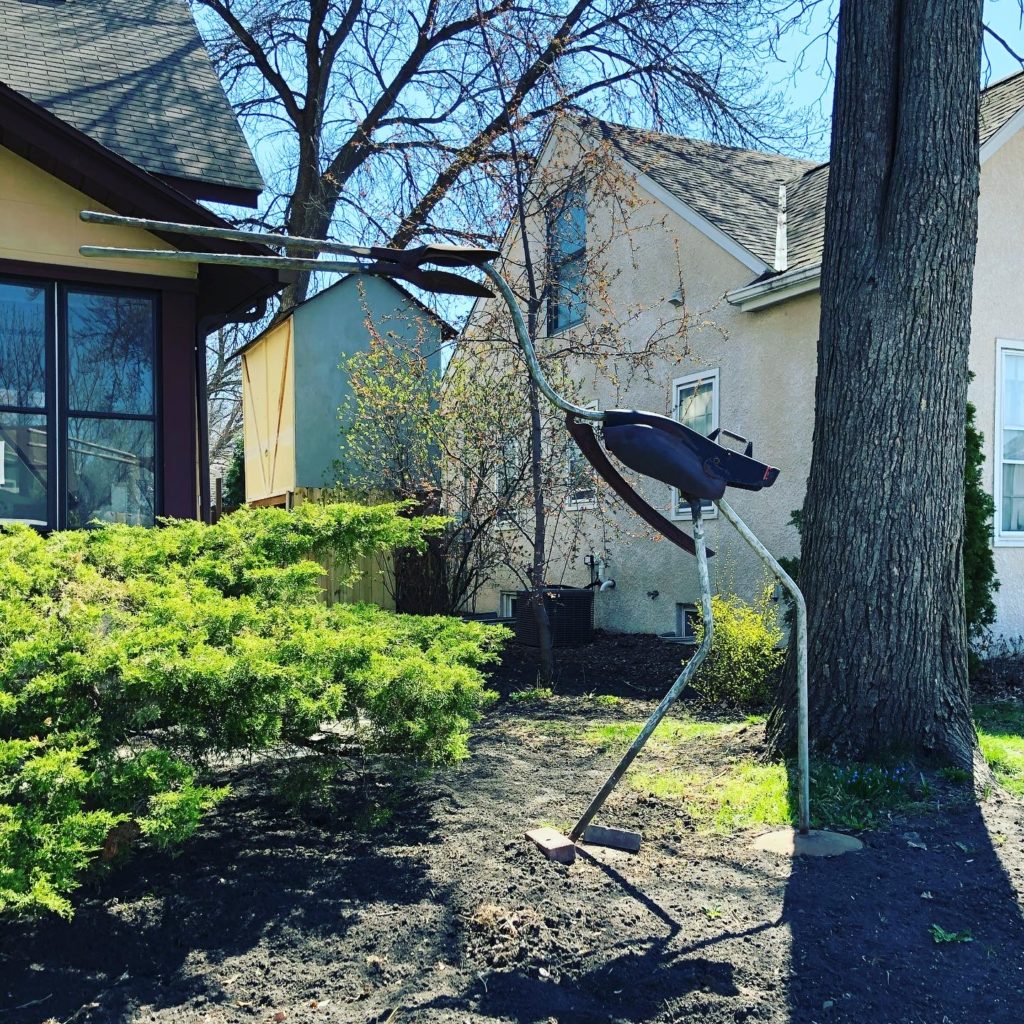
Woke up feeling sore all over. I think it’s from the hours I’ve spent trying to scrape the paint off the deck railing. Decided to take a long walk with Scott and Delia the dog instead of running. Amazing spring weather. Bright, warm sun. Hardly any wind. Calm, gentle air. Lots of people walking, biking, and running out by the gorge this morning. Didn’t see any wild turkeys but did see a tiny baby rabbit. I said to Scott, “that’s the only time I think rabbits are cute.” I really don’t like rabbits. Also saw this super cool sculpture in someone’s front yard:

photo by room34

I want a front yard like this! No grass and an awesome sculpture. It’s fun walking by the gorge and then winding through longfellow neighborhood. People are delightfully quirky around here. Anything else? We talked about if the virus will ebb some in the summer and how terrible it must be for some kids now that they are closing down all the playgrounds and skate parks and removing the nets from basketball hoops and tennis courts. How will some kids entertain themselves? So tough.

When we got home, I sat on our warm deck in full sun and felt nostalgic for past springs and summers as a kid, when I would soak in the sun, still able to enjoy feeling hot because it was novel. Then I composed another version of Emily Dickinson’s “It’s all I have to bring today”:

It’s all I have to bring today—
This, and my knee, beside—
This, my knee, and all the gorge
And all the river wide—
Be sure to count—should I forget
Some one the Sum could tell—
This, and my knee, and every Tree
Bare-branched without its Veil—

I think I like this version better than my last.

After composing this poem and reciting it to my wonderful daughter who was willing to listen, I sat in my chair and heard the birds. I didn’t actually have a choice, they were insistent that I eavesdrop on their conversation. Repeating it over and over and over again. Of course, when I finally decided to record them, they weren’t as chatty. Still, I did manage to record a few lines. 2 syllables each. One bird started low, then went higher. The other responded higher, then went lower*. I imagined them to be singing: “Up high/ Down low” What else could they be saying?

2 birds chatting

Subway/Eat fresh
Be nice/Fuck you
Hey there!/What’s up?
Mustard/Ketchup
Doughnut/Ice cream
Mad Men/Ozark
Mustache/Goatee
Pizza/Nachos
Dumb luck/Hard work
Winter/Summer

*correction, 2024: for years, I’ve been hearing the feebee song wrong. I’ve always heard it as the fee going up, the bee going down, but a few weeks ago, I finally heard it correctly — with some help from Scott. The first bird starts with a higher fee than the second bird, but both birds start high, then drop lower.

april 24/RUN

3.75 miles
47th ave loop
47 degrees
Deaths from COVID-19: 221 (MN)/ 50,031 (US)

Wow, what a glorious morning! Soft light, hardly any wind, singing birds, uncrowded paths. Everything felt calm, relaxed. I don’t remember looking at the river that often, but I do remember the sky over the gorge and the view on the bluff near Folwell. Beautiful.

Anything else I remember from my run? I’ve noticed–today and yesterday, at least–that the morning sun makes it hard for me to see people sometimes. It also makes it almost impossible for me to determine if people are coming towards me or are moving away from me–is that the cone dystrophy or my near-sightedness? Not sure.

I recited Emily Dickinson’s “It’s all I have to bring today” again and I’m liking it more. The second line with the anapest–“This, and my heart beside”–is still awkward, but I like running to “this, my heart, and all the fields/and all the meadows wide” and “this, and my heart, and all the bees, which in the clover dwell.”

When I got back from my run, I started thinking about changing the words of Dickinson’s poem to fit with my run:

It’s all I have to bring today—
This, and my knee beside—
This, my knee and all the trees—
And all the river wide
Be sure to count — should I forget
Some one the sum could tell —
This, and my knee, and all the Birds
whose songs can cast a Spell.

Not totally happy with my words, but I’ll work on it some more. I struggle to understand “some one the sum could tell.” It mostly makes sense, but it still trips me up.

more wild turkey sightings!

Yesterday on our walk, near the tree graveyard, we saw 2 more wild turkeys! Scott took some video and posted it on instagram:

https://www.instagram.com/p/B_WHkvilZON/?utm_source=ig_web_copy_link

Finally, looking back through my log posts from 2018, I found this beautiful poem. It will be the next one that I memorize. So many lines I am looking forward to learning and keeping.

Dear One Absent This Long While/ Lisa Olstein 

It has been so wet stones glaze in moss;
everything blooms coldly.

I expect you. I thought one night it was you
at the base of the drive, you at the foot of the stairs,

you in a shiver of light, but each time
leaves in wind revealed themselves,

the retreating shadow of a fox, daybreak.
We expect you, cat and I, bluebirds and I, the stove.

In May we dreamed of wreaths burning on bonfires
over which young men and women leapt.

June efforts quietly.
I’ve planted vegetables along each garden wall

so even if spring continues to disappoint
we can say at least the lettuce loved the rain.

I have new gloves and a new hoe.
I practice eulogies. He was a hawk

with white feathered legs. She had the quiet ribs
of a salamander crossing the old pony post road.

Yours is the name the leaves chatter
at the edge of the unrabbited woods.

feb 24/RUN

5.5 miles
franklin hill turn around
39 degrees
5% slick ice covered

Waited a little longer to go out running this morning. Needed to let the thin sheets of ice covering the puddles melt. A nice day for a run! Not too much wind, not too many people. Sun. Clear paths. I got my layers right today: 1 shirt, 1 vest, 1 pair of running tights, 1 headband, 1 pair of gloves, 1 pair of socks. It was warm enough today to smell the earth thawing–why does it smell like dog poop? I think I like the smell of death in the fall–the musty, mulching leaves–over the smell of life in the almost spring.

David Lee Roth is in town with KISS for a concert tonight. Scott read somewhere that he always brings his bike to Minneapolis and loves biking along the river. Today, I kept looking for him, hoping he’d bike by. No luck. Bummer.

Glanced down at the river a few times. Enjoyed hearing the sibilant sounds of my striking feet on the grit covered path. Ran hard up the hill, then stopped to a walk for a few minutes when I reached the bridge. Thought about the body that was found just north of this bridge early yesterday morning. Managed to mostly avoid the secret slippery spots where the water on the path was still frozen. Also managed to avoid getting soaked by cars rushing through big puddles on the road.

With less than a mile left, I had an idea about my current project and decided, even though I was running well, enjoying going faster, to stop and record my thoughts.

Uh oh.

Just tried to find and transcribe my voice memo, but it wasn’t there. I must have hit the wrong button when I was trying to record it. Here’s what I remember. For a few minutes before stopping, I was chanting. How to be/periphery, How to be/periphery. Then I realized: I need a (big) project to focus on, a project that involves structure and daily practice. A concrete project. This is the project I think I’m working on–and in many ways, it is what I’m working on–but, I’m also working on something else, off to the side, at the periphery, which is the real work I need/want to do. What a bummer. I feel like I can’t remember a key to my thought that helped it make sense. It connects with the article I read about how to be a procrastinator a few years ago, and with the idea of not approaching projects/thoughts/goals head on, but slant or sideways or sneakily (tricking your brain). Argh! I wish I hadn’t screwed up the recording.

My Weather/ Jane Hirshfield

Wakeful, sleepy, hungry, anxious,
restless, stunned, relieved.

Does a tree also?
A mountain?

A cup holds 
sugar, flour, three large rabbit-breaths of air.

I hold these.

What do I hold? Ever since I encountered the phrase, “inner and outer weather” (from a Frost poem about a tree at the window, via Edward Hirsch), I have been thinking about weather as metaphor for one’s mood/emotions/feelings. Love this poem and how it plays with this idea. And I love imagining how much air is 3 large rabbit-breaths worth. How big is this rabbit? And, in general, how big are rabbit breaths?

jan 4/ RUN

2.5 miles
river road, south/north
28 degrees
90% sharp, crusty snow and ice

Should have worn my yaktrax today. So slick and uneven. What a bummer. The river was open and beautiful, the sun glowing through the gray gloom, the air not too cold. But the path was terrible–too rough and uneven and dangerous.

Walking earlier this morning with the dog, my left kneecap couldn’t find its groove. It wasn’t completely sliding out, but it was rubbing. Not sure why, but running helps it get back into place. Oh, the body is such a strange thing.

Encountered lots of runners. A few bikers. Some walkers. No Daily Walker. Turned around at the double-bridge parking lot and put on a playlist. Started with my new favorite song: Black Wizard Wave by Nur-d. I would have been flying down the path if it hadn’t been so icy.

Still playing around with my favorite lines of poetry from all the poems I gathered in 2019. So much fun.

Cento/ Sara Lynne Puotinen

VI.

I’m sorry for the rabbits.
And I’m sorry for us
To know this.
Suffice it to say I am sorry all the time.

VII.

All that trees can ever learn they know now
clear cut and certain, they rise, telling me
Go forth to the forests and grow wise
and who among us could ignore such odd
and precise counsel?

VIII.

Meanwhile, even the birds sing
to-do lists and quietly
the doe does what does do.

VIX.

for no reason
the windowed ones in their windowed world
lock the door

oct 2/RUN

1.6 miles
river road, north/south
50 degrees

A short run in the afternoon. Pretty sure I listened to a playlist, but I can’t remember now, writing this days later. Ran up from under the lake street bridge, around the rim above the rowing club, then turned around and headed back. It’s getting cooler outside. Looking more like fall too. Yellows and oranges and reds.

Rabbits and Fire
BY ALBERTO RÍOS

Everything’s been said
But one last thing about the desert,
And it’s awful: During brush fires in the Sonoran desert,
Brush fires that happen before the monsoon and in the great,
Deep, wide, and smothering heat of the hottest months,
The longest months,
The hypnotic, immeasurable lulls of August and July—
During these summer fires, jackrabbits—
Jackrabbits and everything else
That lives in the brush of the rolling hills,
But jackrabbits especially—
Jackrabbits can get caught in the flames,
No matter how fast and big and strong and sleek they are.
And when they’re caught,
Cornered in and against the thick
Trunks and thin spines of the cactus,
When they can’t back up any more,
When they can’t move, the flame—
It touches them,
And their fur catches fire.
Of course, they run away from the flame,
Finding movement even when there is none to be found,
Jumping big and high over the wave of fire, or backing
Even harder through the impenetrable
Tangle of hardened saguaro
And prickly pear and cholla and barrel,
But whichever way they find,
What happens is what happens: They catch fire
And then bring the fire with them when they run.
They don’t know they’re on fire at first,
Running so fast as to make the fire
Shoot like rocket engines and smoke behind them,
But then the rabbits tire
And the fire catches up,
Stuck onto them like the needles of the cactus,
Which at first must be what they think they feel on their skins.
They’ve felt this before, every rabbit.
But this time the feeling keeps on.
And of course, they ignite the brush and dried weeds
All over again, making more fire, all around them.
I’m sorry for the rabbits.
And I’m sorry for us
To know this.

Such a sad and beautiful poem. What a storyteller Ríos is!

june 3/RUN

2.9 miles
north to railroad bridge/stairs to path below/white sands/rowing club/upper path
68 degrees

My legs are sore today. Partly because it’s my third day in a row running and partly because I decided to start runner’s world’s squat challenge this morning (since my lower back has been bugging me intermittently for the past 6 months, I’m always looking for ways to strengthen it). Decided to listen to my audio book and run past the part of the path above the floodplain forest and towards the railroad trestle. Noticed right away that it was hard to breathe–the cottonwood trees are snowing cotton. The edges of the path were a soft white and little bits of fuzz floated in the air in front of me.

Ran to the railroad trestle and felt wiped out. Took the steps down below and walked the Winchell trail, halfway up the gorge. Beautiful! I was a bit uneasy because after seeing no one but one man, I looked up at the sides of the limestone gorge and realized, in all the green, how hidden I was and how steep any path out would be. No steps leading up. No winding dirt trail. But my unease wasn’t too bad. I started running and caught quick glimpses of the river through the breaks in the tree line. Made it to the Minneapolis Rowing Club and walked up the steep driveway. Started running again and kept going until I returned to my favorite part of the run: where the walking path dips below the road and follows the edge of the bluff right above the floodplain forest.

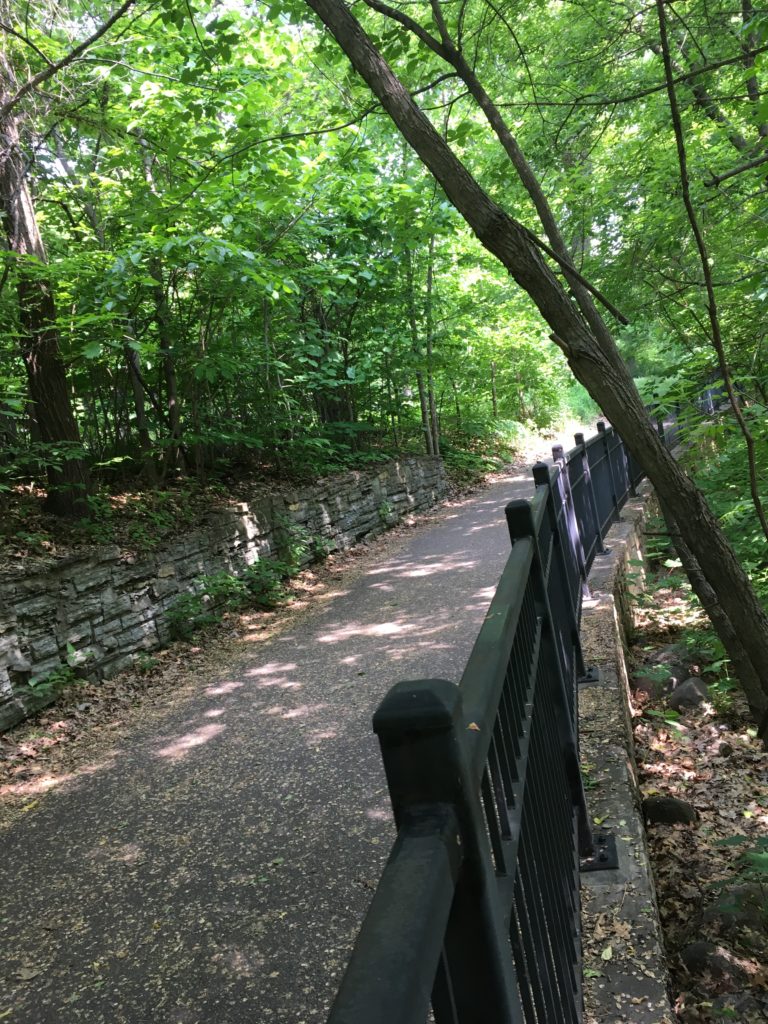
I stopped on the edge to look down at the forest and noticed that I was in the midst of three fences: a wrought iron fence on the edge of the hill, a stone retaining wall dividing the lower walking path from the upper biking path, and a split rail fence above the wall beside the biking path. So cool to have all 3 fences here, especially since I’ve been wanting to write about this section and about the different types of fences on this route.

The other thing I noticed as I walked up, along the edge, was how green everything was. Different shades (or tints?) of green covering the ground, blotting out the sky. No river, no sky, no forest floor. Only green with the occasional brown trunk or branch. Disorienting, but really cool. At this part, the footpath is flanked on both sides with green–a tunnel of trees, with a smallish circle of light up the hill (the opposite direction of this picture), leading out to 2 big boulders and a porta potty at the northern edge of the 35th street parking lot.

The Prose Poem
Campbell McGrath

On the map it is precise and rectilinear as a chessboard, though driving past you would hardly notice it, this boundary line or ragged margin, a shallow swale that cups a simple trickle of water, less rill than rivulet, more gully than dell, a tangled ditch grown up throughout with a fearsome assortment of wildflowers and bracken. There is no fence, though here and there a weathered post asserts a former claim, strands of fallen wire taken by the dust. To the left a cornfield carries into the distance, dips and rises to the blue sky, a rolling plain of green and healthy plants aligned in close order, row upon row upon row. To the right, a field of wheat, a field of hay, young grasses breaking the soil, filling their allotted land with the rich, slow-waving spectacle of their grain. As for the farmers, they are, for the most part, indistinguishable: here the tractor is red, there yellow; here a pair of dirty hands, there a pair of dirty hands. They are cultivators of the soil. They grow crops by pattern, by acre, by foresight, by habit. What corn is to one, wheat is to the other, and though to some eyes the similarities outweigh the differences it would be as unthinkable for the second to commence planting corn as for the first to switch over to wheat. What happens in the gully between them is no concern of theirs, they say, so long as the plough stays out, the weeds stay in the ditch where they belong, though anyone would notice the wind-sewn cornstalks poking up their shaggy ears like young lovers run off into the bushes, and the kinship of these wild grasses with those the farmer cultivates is too obvious to mention, sage and dun-colored stalks hanging their noble heads, hoarding exotic burrs and seeds, and yet it is neither corn nor wheat that truly flourishes there, nor some jackalopian hybrid of the two. What grows in that place is possessed of a beauty all its own, ramshackle and unexpected, even in winter, when the wind hangs icicles from the skeletons of briars and small tracks cross the snow in search of forgotten grain; in the spring the little trickle of water swells to welcome frogs and minnows, a muskrat, a family of turtles, nesting doves in the verdant grass; in summer it is a thoroughfare for raccoons and opossums, field mice, swallows and black birds, migrating egrets, a passing fox; in autumn the geese avoid its abundance, seeking out windrows of toppled stalks, fatter grain more quickly discerned, more easily digested. Of those that travel the local road, few pay that fertile hollow any mind, even those with an eye for what blossoms, vetch and timothy, early forsythia, the fatted calf in the fallow field, the rabbit running for cover, the hawk’s descent from the lightning-struck tree. You’ve passed this way yourself many times, and can tell me, if you would, do the formal fields end where the valley begins, or does everything that surrounds us emerge from its embrace?

june 2/RUN

3.1 miles
railroad bridge and back
62 degrees

Wow. Sunny. A slight breeze. Low humidity. What a wonderful way to celebrate 8 years of running. Saw the Man in Black and the quartet of in-sync rollerbladers (what should I call them? first thought: the 4 horsemen of the apocalypse, but that doesn’t quite fit–I need to think of another famous group of four–the Beatles?). Encountered a lot of runners, a large group of walkers and some bikers. Busy on the trail this morning. The run felt easy then hard then easy again. Let gravity do the work as I ran down the hill under lake street bridge. Then managed to outrun two bikers up the hill–I think one of them was around 10 so maybe it’s not that impressive? Listened to my audio book for most of the run then switched to Lizzo on my running playlist. The only time I looked at the river was when I briefly stopped to study the railroad bridge. Even then, I barely saw it. I was too busy studying the trestle. Turning around and running south, I noticed the black metal fence on the other side of the trestle and I started thinking about the different types of fences that line the trail: wooden split rail, abandoned chainlink (on the lower path), black wrought iron, stone. I want to add some of that detail into my haibun or write something else about these different types (or do both).

Mending Wall
BY ROBERT FROST

Something there is that doesn’t love a wall,
That sends the frozen-ground-swell under it,
And spills the upper boulders in the sun;
And makes gaps even two can pass abreast.
The work of hunters is another thing:
I have come after them and made repair
Where they have left not one stone on a stone,
But they would have the rabbit out of hiding,
To please the yelping dogs. The gaps I mean,
No one has seen them made or heard them made,
But at spring mending-time we find them there.
I let my neighbour know beyond the hill;
And on a day we meet to walk the line
And set the wall between us once again.
We keep the wall between us as we go.
To each the boulders that have fallen to each.
And some are loaves and some so nearly balls
We have to use a spell to make them balance:
“Stay where you are until our backs are turned!”
We wear our fingers rough with handling them.
Oh, just another kind of out-door game,
One on a side. It comes to little more:
There where it is we do not need the wall:
He is all pine and I am apple orchard.
My apple trees will never get across
And eat the cones under his pines, I tell him.
He only says, “Good fences make good neighbours.”
Spring is the mischief in me, and I wonder
If I could put a notion in his head:
“Why do they make good neighbours? Isn’t it
Where there are cows? But here there are no cows.
Before I built a wall I’d ask to know
What I was walling in or walling out,
And to whom I was like to give offence.
Something there is that doesn’t love a wall,
That wants it down.” I could say “Elves” to him,
But it’s not elves exactly, and I’d rather
He said it for himself. I see him there
Bringing a stone grasped firmly by the top
In each hand, like an old-stone savage armed.
He moves in darkness as it seems to me,
Not of woods only and the shade of trees.
He will not go behind his father’s saying,
And he likes having thought of it so well
He says again, “Good fences make good neighbours.”

dec 25/RUN

3.1 miles
austin, mn
35 degrees

Ran with Scott around Austin Christmas day. Hardly any snow and not too much wind. What do I remember? Wishing Merry Christmas to a man walking his dog that crossed our path. Noticing that the sky was almost all white with gray smudges. Checking to see if Bessie–the big plastic cow at the county fairgrounds–was wearing a scarf (she wasn’t). Watching a rabbit haul ass across the road–they can run fast! Listening to a dog’s bark echo across the open field. Cutting through the parking lot of the Japan Panda (Japanda) restaurant and noticing they were open and one car was in the parking lot. I don’t remember seeing that many holiday decorations. No Santa Claus. Didn’t hear any Christmas music. Or smell any good food.

august 3/REST

This should be an XT day, but open swim is rained out tonight. I’m okay with this because it’s only 56 degrees and supposed to be very windy this afternoon. Instead of swimming or running, I’m writing. For the past few days, I’ve been working on crafting a story about my latest running route to Lake Harriet. Here’s what I have so far:

The Run to Lake Harriet

The short version: taking the parkway for part of it and not the creek path.
Distance: 14-20 miles, depending on whether or not you run around Lake Harriet and/or Lake Nokomis.

The shortest version: mississippi river road path, south/minnehaha falls/minnehaha parkway/lake nokomis/minnehaha creek path/lake harriet/minnehaha creek path/lake nokomis/minnehaha parkway/minnehaha falls/mississippi river road path, north

The longest version: mississippi river road path, south/minnehaha falls/minnehaha parkway/lake nokomis/minnehaha creek path/around lake harriet/minnehaha creek path/around lake nokomis/minnehaha parkway/minnehaha falls/mississippi river road path, north

When you follow alongside water, you meander and, depending on the terrain and how the roads are laid out, cross over and under a lot of bridges and roads.

Cross over and under,
Move through and pass by,
Run near and alongside:
rivers, falling water, creeks, lakes,
rec centers, playgrounds, parking lots
waterways, pathways, parkways
streets, roads, avenues,
sidewalks, crosswalks, trails
bridges, arches, overpasses
and woods that wander beside water
that rushes, drips, 
falls, flows
and flushes 
out of Lake Harriet and Lake Nokomis and into Minnehaha Falls.

Number of times the running path crosses over Minnehaha Creek on the way to Lake Harriet: 6

Number of bridges you cross over or under: 16

Number of lights you must stop at: 5

Number of times the running path and biking path split and then come together again: 14?

Number of woods you run through: 5

Types of bridges: steel, wooden, concrete

Types of water: river, waterfall, creek, lake

Roads you run under: 46th street, Cedar Avenue, Chicago Avenue, 35W, Lyndale Avenue

Roads you run over: Hiawatha Avenue

Avenues you cross: 46th Avenue, Minnehaha Avenue, 39th-28th Avenues, 22nd Avenue, Bloomington Avenue, Portland Avenue

Roads you cross: Mississippi River Road

Streets you cross: 50th Street

Parkways you run by (or near): Minnehaha Parkway, Lake Nokomis Parkway, Lake Harriet Parkway

Number of giant bronze bunnies you run by: 1

Official name of bronze bunny: Cottontail on the trail

Number of old neighborhoods you run through: 1

Number of playgrounds you run by: 3

Places where you fill up your water bottle: Lynhurst Park, Lake Nokomis Rec Center

Number of hills you avoid because of the new path that goes under instead of over Lyndale Avenue: 1

Number of cats that have crossed your path while you’re running through the woods: 1

I’ll cross that bridge when I come to it.

When I’m on a long run, I try very hard not to think too much about how many miles I have to run, how many minutes I’ll be moving before I can stop, how many bridges I have left to cross. I pay attention to my surroundings: the crunchy grit on the path, the fragrant trees by the steel bridge, the rushing water of the creek below me, the sun as it filters through the forest. Or, I distract myself with a podcast. If I fail to pay attention to the moment or to distract myself from the enormity of my task, the run becomes much harder.

When our paths cross again.

The running path and biking path on this route separate and then come back together again 14 times. Early in the run, while still on the river road, these separations are slight, with just a small patch of grass or a parking lot between them. But from Lake Nokomis to Lake Harriet, the divide between the paths grows wider. While the bike path follows next to the road, remaining on one side of the creek for most of the route, the running path wanders nearer to the water and away from the road. Winding through woods. Curving under the arch of a bridge. Zigzagging from one side of the creek to the other. When the paths converge, it is the running path that (almost) always returns to the biking path, and not the other way around. The most dramatic moment when they meet is at a place when both paths have strayed from the road and into some woods. As they come out the woods and towards the road, the paths cross and those on the running path must watch carefully to avoid being hit by a speeding bike.

I’ve traveled this route for over 20 years. In the past, I biked. Now, I usually run, mostly because I like running and I’m training for a marathon, but partly because my macular degeneration makes biking difficult and sometimes dangerous, especially if I’m biking too fast. Maybe I should slow down.

Crossing over

When running for almost 3 hours, I enter into an almost dreamlike state, where I engage with the world differently. I am present, feeling the varied textures as I move from path to bridge to path again, noticing the change in temperature as I enter the small wood that blocks out the sun and warily eyeing the approaching dog, wondering if it will lunge as I pass by. But I am also absent. Not quite there. Passing through the moments in a daze, lulled into a trance by my steady footfalls and by my attempt to not think about how much it hurts, how much I want to be done, how much I have left to run.