Ran instead of swam today at the y. Not too crowded. The woman who walks with her head tilted to the side was there. Mostly walkers, 1 or 2 other runners, someone biking by the window, someone else doing battle ropes, and someone in a red sweatsuit doing squats and twists on the edge of the track. Below, kids were playing ball — was it soccer or basketball? I think it was soccer. Lots of squeaking shoes, one coach whose voice could cut through everything. Rounding the far corner — every time — I smelled something salty and meaty and over-spiced or over-seasoned. It did not smell appetizing. Taco meat?
found poetry
Thinking more about cut-outs and erasures, I remembered that Mary Ruefle likes to do them. Almost every day according to this article: Erasure Notebook by Mary Ruefle. And here’s another article with examples from the exhibit.
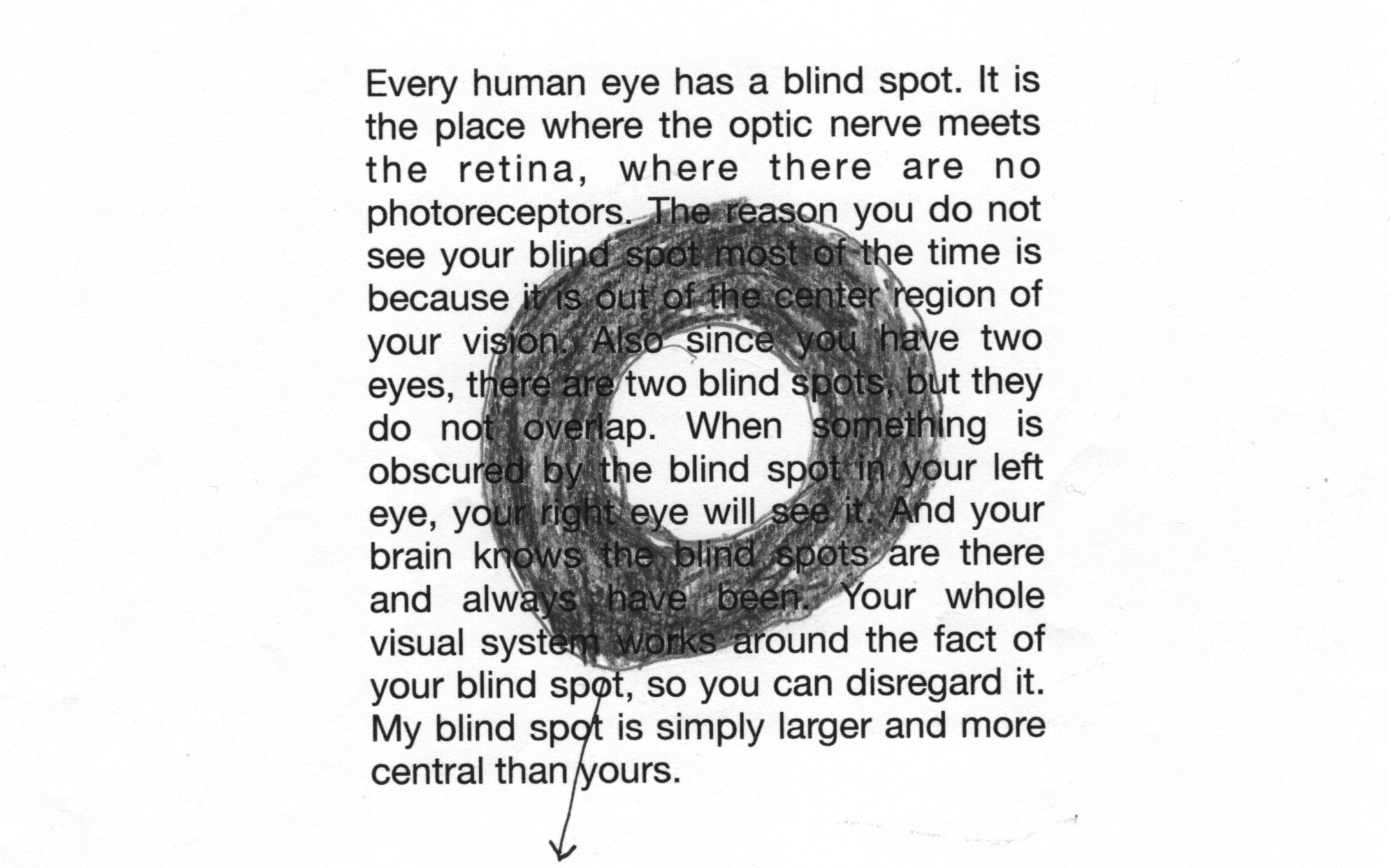
A sudden thought: what about applying my blind spot to a reading? I’ve tried this before, but didn’t stick with it; instead, creating my mood rings.
my blind spot over text from Georgina Kleege’s Sight Unseen
Yes! I’d like to try this again, but with text about the gorge! I need to go back to the wall and see if/how much my ring has grown. I could try it with old books I can no longer read anymore, or with typed-up text.
run: 4.05 miles minnehaha falls and back 71 degrees dew point: 66
It felt warmer than 71, the air thicker than a 66 dew point. Had to remind myself a few times that I could stick to my 9/1 plan. And I did — at least through the first 3 cycles. Had to do an extra minute of walking at 32 or 33 minutes in, but then I got right back on track. A victory!
overheard: Just starting my run, I overheard one woman say to the other: that was the first time I ever saw a spider biting me! As opposed to waking up with spider bites, not knowing when you got them, I suppose.
10 Things
one of the recently re-mulched trails that leads down into the oak savanna looked dark and deep and mysterious — partly due to a late June abundance of green leaves blocking out the light, partly the sun behind the clouds
a smattering of young runners in small groups — a high school cross-country team already in training?
empty benches
the steady hum of some construction equipment
a sour smell coming from a trash can
a packed shopping cart parked on the lowest part of the trail that dips below the road
the flash of a very small bird — a hummingbird? — flying past me
an over-the-shoulder sideways glance at the falls: all white foam
2 people waiting to pay for parking at the falls
mostly overcast with a few stretches of pale sun
A good run. A low average heart rate. A steady pace. A chance to be above the gorge and the river. And, interesting thoughts. Earlier this morning, I was reminded of some ideas about movement and death and the Homeric mind, and they fluttered like loose threads behind and beside me as I ran.
thread 1: entangled, murky, thick-layered
As I ran on the Winchell Trail through the thick green, I thought that when I’m running by the gorge, I think of it in broad, basic ways: tree, rock, bluff, bird, water. Then my mind wandered, and I wondered: (Why) do we need more specific, “technical” names in order to connect with the land? I thought about the importance of names and the violence of occupying and renaming, the value of knowing the history of a place, understanding how it works scientifically, and placing it in a larger context (space, time). Then, as I ran up the short, steep hill by Folwell, I thought about how important it is to learn to think on all of these levels at once, or at least be able to switch back and forth between them. I can experience the gorge as water, rock, tree, bird, wind, or as stolen land occupied and used, abused, restored, protected, ignored, exploited. As a geological wonder, slowly–but not really slowly in geological time, 4 feet per year–carved out by the river eroding the soft St. Peter sandstone. As both wild/natural and cultivated/managed–the site of erosion due to water, and erosion due to the introduction of invasive species, industry, too many hikers, bikers, houses nearby. There isn’t an easy way to reconcile these different understandings and their impacts.
from To chlorophyll, refineries, coal, furnaces beneath early skyscrapers, fossils/ Caroline Kenworthy
Life’s long inhale of nutrients, and longer, hotter exhalation in decay. Packed, still, silent.
Hard to remember that matter hums constantly. These cars and highways— how much of moving is death rearranged.
I kept thinking about this idea of death rearranged. At point, I thought, of course — recycling, decomposing, rebirth = rearranging. I like this word choice — rearranging.
thread 3: Homeric mind
this physical thing that moves. So, if you imagine a place over the sea, your mind actually has to get there. So, even though it may be as fast as the light, it is physical movement.
The mind as moving — not just through associations, but literally moving, traveling.
As I thought about movement and connection, and death rearranged on my walk back after the run, I passed by a painted rock at the edge of neighbor’s side garden that read, We are our ancestors with an arrow pointing to plants. Yes. No one is gone, just rearranged, reconfigured. And, we are connected deeply to the green.
walk: 3 miles east lake library and back 78 degrees
Walked to the library to pick up Anne Carson’s Float. I’ve checked it out once or twice before but I’m thinking this time I might be more interested in it. (2 hours and several naps later: nope. Still don’t understand it or why it’s called float, but I found a review of it and Mary Ruefle’s My Private Property that might help.) It was fun walking through the neighborhood, looking at how different neighbors deal with their slanting lawn. FWA is interested in re-doing ours for us. Wood, rock, stone, mulch, hostas, ornamental grass. My favorite flowers: the vines with the bright purple flowers — clematis, I think, and the dozens of cacti with beautiful yellow blooms. Saw a lime green door, like mine, on a bright blue garage. A perfect blue for the green, but maybe too much for a whole house. And, it clashed with the purple fence. Heard some loud christian rock blasting from a backyard and a 2 story tall skeleton wearing a green t-shirt in a front yard. Kids on scooters, yelling from inside houses, lounging by the pool at longfellow park.
Speaking of kids, we live next to a daycare. It’s never been a problem because the kids usually stay inside so I never hear them. A few months ago, Sheila (our neighbor and owner of the daycare) began letting 2 little girls play outside in their front yard and our side yard. They are very loud and like to scream a lot. And they are right outside of my windows so I hear them and see them flitting and darting out of the corner of my eye. Thankfully they haven’t opened our gate . . . yet. It doesn’t seem like they are being supervised. Today Scott noticed that one of them had picked up a giant branch — taller than them — and was waving it around — through the air, at the other little girl. No adults stopped them until about 15 minutes later when they were scolded. Yikes.
5
point could stick least first extra right track other green light cloud empty group cross smell front never being story
trash trail below heart above loose thick gorge think basic bluff water order value place short steep giant adult until
forth abuse carve house death early decay still there about after arrow plant check twice might later stone mulch hosta
empty group smell basic bluff order thick heart track cloud water light green house plant extra loose trash never think twice
swim: 5 cedar loops (2.5 lake nokomis) cedar lake open swim 80 degrees
First open swim of the season at Cedar Lake. Wonderful conditions. Warm-enough water and no chop. I felt strong and fast and smooth. I didn’t stray too far to the center. They have a new lifeguard who was actually telling people dogs weren’t allowed in the water and requiring people to have swim caps. Is Cedar Lake going to lose some of its chill vibes?
The water was olive green, but more yellow than the blue of lake nokomis. I didn’t see any fish or get wrapped in vines. No canoes crossed my path, either. Not too many clouds in the sky. No planes or birds.
A little cooler, but sunny. I wore shorts and my legs didn’t feel cold. The green continues to spread. I’m sure I still have a view of the river but I don’t remember looking at it, not even once. I saw some rowers heading down to the rowing club, but didn’t hear them on the water. Greeted Dave, the Daily Walker. Was passed by several groups of young and fast runners. High school or college teams? Not sure.
Mostly I felt good. My heart rate is still high. I guess I lost some fitness on my almost 2 week break. Monday, I’ll try some more deliberate walk-run segments.
Listened to other runners, cars, water gushing out of sewer pipes heading north, my “I’m Shadowing You” playlist heading back south.
Ran on the grass for a few stretches to avoid other runners and walkers. Thought about how several sites recommended running on more gentle surfaces, like grass, when dealing with a herniated disc or sciatica.
before the run
I’m thinking more about open fields, meadows, lawns, boulevards, village greens, grasslands both wild and manufactured. Grassy spaces I recall from childhood, living in sub-divisions in North Carolina and Virginia and Iowa: soccer fields, manicured lawns, pastures just beyond my backyard.
as if it were a scene made-up by the mind, that is not mine, but is a made place,
that is mine, it is so near to the heart, an eternal pasture folded in all thought so that there is a hall therein
that is a made place, created by light wherefrom the shadows that are forms fall.
An eternal pasture with a hall made by light and shadows. After the poem, I wrote about Duncan’s idea of projective verse
poetry shaped by rhythms of poet’s breath. So cool–I want to explore this more, thinking about breathing when I run vs. walk vs. sit.
“Olson argues that the breath should be a poet’s central concern, rather than rhyme, meter, and sense. To listen closely to the breath, Olson states, “is to engage speech where it is least careless—and least logical.” The syllable and the line are the two units led by, respectively, the ear and the breath:
“the HEAD, by way of the EAR, to the SYLLABLE the HEART, by way of the BREATH, to the LINE”
The heart, by way of the breath, to the line — This idea will be the start of a moving while writing experiment!
after the run
up to the wind-stripped branches shadow- signing the ground before you the way, lately, all the branches seem to, or you like to say they do, which is at least half of the way, isn’t it, toward belief — whatever, in the end, belief is… (My Meadow, My Twilight/ Carl Phillips)
My husband and I were arguing about a bench we wanted to buy and put in part of our backyard, a part which is actually a meadow of sorts, a half acre with tall grasses and weeds and the occasional wild flower because we do not mow it but leave it scrubby and unkempt. (The Bench/ Mary Ruefle)
And, back to the field:
Crossing a field, wading
through nothing
but timothy grass,
imagine yourself passing from and into. Passing through
doorway after doorway after doorway. (Threshold/ Maggie Smith)
After the rain, it’s time to walk the field
again, near where the river bends. Each year
I come to look for what this place will yield –
lost things still rising here. (After the Rain/ Jared Carter)
It snowed a few wet inches Tuesday night but you wouldn’t know it today. It’s all gone. The paths were clear and dry. I thought about orange things as I ran. I heard lots of dripping water, a few voices, birds. So many birds as I approached the marshall bridge! Oh — and the gobble of a turkey near the Minneapolis Rowing Club! I stopped to try and see it, but I couldn’t. Heading north, just past the trestle, I took the recently redone steps down to the winchell trail and admired the river. Calm, quiet, grayish blueish brown.
10 Orange Things
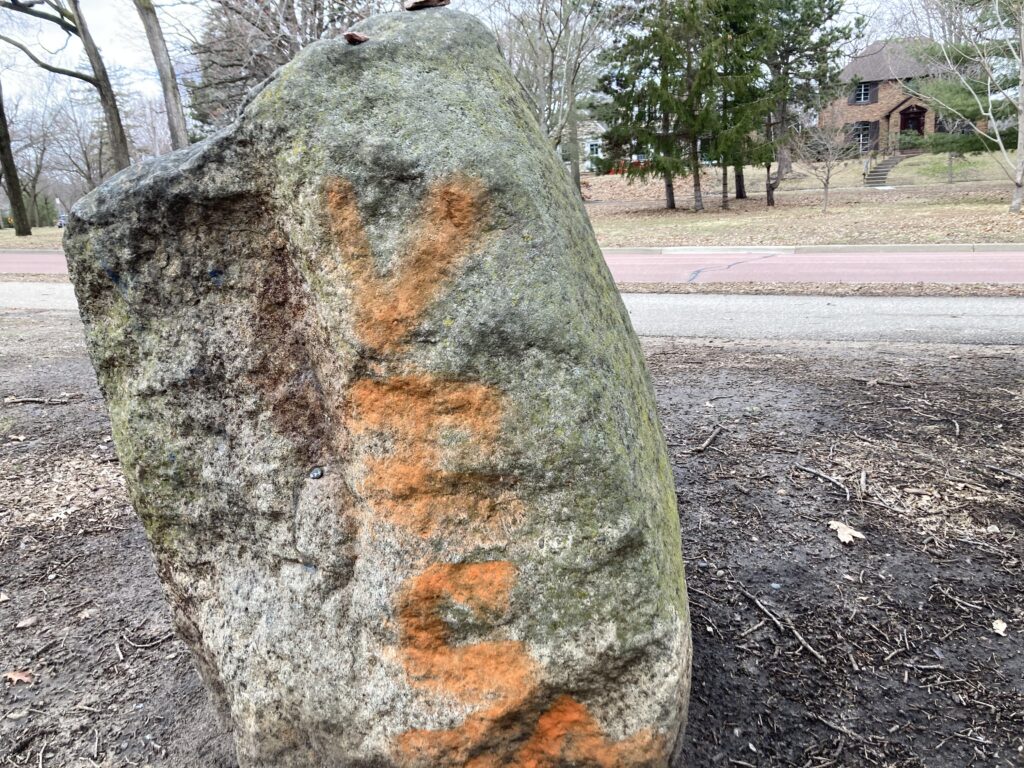
orange lichen on the east side of the ancient boulder*
an orange cone
looking over the edge of the double bridge above longfellow flats, a white barricade with orange stripes had fallen halfway down the steep bluff
orange netting on the fence
an orange stocking cap on a walker
orange bubble-letter graffiti
my orange sweatshirt, worn under a dark blue hooded pull-over
an orange road closed for race sign
orange leaves on the ground
orange rust on a metal plate
*I showed Scott the picture I had taken of the lichen and he said, that’s not lichen, that’s spray paint; it says VISA. I like seeing it as lichen better, but it is frustrating to have been so wrong with what I was seeing. I remember looking at the picture and thinking something else was there, that my idea of it as lichen wasn’t quite right, but this thought didn’t quite make it to the surface.
until Scott told me what I was actually on this rock, I thought it was lichen
I wanted to think about an orange effort as I ran, but I was distracted by my unfinished business. No port-a-potties anywhere. Thankfully I made it home without earning a poop story.
april’s monthly challenge
On April 1, I identified my monthly challenge as steps even as I wondered if it would stick. Yesterday I wasn’t so sure. I started working on a purple hour sonnet, then revising other color poems and converting them into sonnets. This morning I work up hell-bent on orange. I will study orange, steps be damned, I thought. But just now, while reading the chapter, “Orange is the New Brown,” in On Color, I encountered this sentence:
Through the late sixteenth century in England, “orange tawny” is commonly used to mark a particular shade of brown (even though chromatically brown is a low- intensity orange, though no one then would have known that).
On Color, 45
Chromatically? Even though I’ve read/heard this word in relation to color for some time, today it made me pause and wonder about why the chromatic scale (a favorite scale to play) is called a chromatic scale.
The twelve notes of the octave—all the black and white keys in one octave on the piano—form the chromatic scale. The tones of the chromatic scale (unlike those of the major or minor scale) are all the same distance apart, one half step. The word chromatic comes from the Greek chroma, color; and the traditional function of the chromatic scale is to color or embellish the tones of the major and minor scales. It does not define a key, but it gives a sense of motion and tension. It has long been used to evoke grief, loss, or sorrow. In the twentieth century it has also become independent of major and minor scales and is used as the basis for entire compositions.
Searching for a definition, I also found a reference to James Sowerby’s Chromatic Scale:
Chromatic scale of colours arranged as a chart. Sowerby’s accompanying text provides a nomenclature for 63 colours divided into primaries of yellow, blue and red: with binary colours (blends of two primaries) and ternary colours (combinations of three primaries). Sowerby considered this might be useful to artists and considered that in primary colours “Gamboge is most perfect yellow, used in water colours…Carmine, most perfect when good…Prussian, or Berlin blue, most perfect.” Plate 5 from the monograph A new elucidation of colours, original prismatic, and material; showing their coincidence in three primitives, yellow, red and blue…,
The chromatic scale as even steps up or down a musical scale. “The distance between 2 successive notes on a scale is called a scale step — half step or whole step.
Chromatic colors possess a hue (e.g. red, blue, green) while achromatic colors are variations of light and dark (shades of gray, black, white).
What is orange? Why, an orange, Just an orange! (from Color/ Christina Rossetti)
Revisiting my month with Mary Ruefle, I wrote this about orange and Orange Theory:
. . . a red (all out effort) breath might involve being shocked, experiencing such intense awe or surprise that you lose your breath for a minute. Orange breaths involve intense feeling that can be sustained longer, but are still uncomfortable. Orange breaths are anxious breaths.
And now I’m thinking about how Mary Ruefle’s sad color poems — orange sadness, purple sadness, etc. — could be read as happiness poems too: “if you substitute the word sadness for the word happiness, nothing changes.” What is the more positive version of anxious? Excited? Maybe call my poems excitement poems? No, not excitement, attention. Of course, attention!
Earlier today I encountered an amazing poem that fits with the theme of attention:
Warm this morning, but it didn’t feel miserably hot, probably because I was able to be in the shade for most of the run. So much wonderful shade, so many friendly shadows! Ran south above, north below, on the Winchell Trail. Didn’t look at the river much, even when I was closer to it. One glance: between the thickening trees near the southern entrance of the Winchell Trail, I saw a small patch of sparkling water.
today’s color: the blue of the blue jay (I think it was a blue joy) that flashed past me as I rounded the curve at 42nd. Normally I can’t see the color of birds, and I’m not sure if you’d call what I saw seeing, more like the idea of blue or a voice calling out, blue! What kind of blue was it? Not deep or dark but light and intense, almost glowing. But not pale blue — somewhere in-between dark and light.
10 Things I Noticed
the shadow of tree sprawled across the path
the steady flow of water coming out of the sewer pipe near 42
the clicking and clacking of roller skier’s poles up above me near folwell
passing 2 walkers and hearing one of them say walk or should be walking or something like that
the steady stream of cars driving by
a few kids’ voices at the playground
the flash of a white t-shirt up ahead on the trail, then disappearing around the bend
leaning trees creating archways to pass through in several spots on the winchell trail
cottonwood fuzz on the edges of the trail
the metal slats in the ravine were slick and slippery
Mary Ruefle on Eavesdropping, You, and Unhitching in “On Sentimentality”
before the run
Today’s the last day of May and my last day with Mary Ruefle. I just finished reading/skimming her lecture, “On Sentimentality.”
Eavesdropping: In response to a poet who criticizes and laments the too frequent use of a generic You in poetry as too passive, turning us into observers, mere eavesdroppers, Ruefle asks: What’s wrong with eavesdropping? I agree. Today during my run, eavesdrop. Listen in on conversations between birds, the river and the sky, walkers.
YOU: What kind of subject are you (or is You)? And, if you are You, then who is the I? The path, a shadow, that tree? Think about this as you run beside the river.
unhitching: to crudely paraphrase Lévi-Strauss, unhitching happens in brief moments when we can step outside of or beside or just beyond — below the threshold of thought, over and above society — to contemplate/experience/behold the this, the what it is, the essence of everything, Mary Oliver’s eternity. In your run above the gorge, near the river, below the trees, can you unhitch?
during the run
In spite of the warm conditions, I managed to wonder about/wander through or with all 3 of these! A little bit of eavesdropping, some unhitching or at least thinking about how/where unhitching is possible, and becoming a You.
All of these ideas were simmering in my mind the entire time I ran, but I had a breakthrough in the second mile as I passed a walker and a dog on the Winchell Trail. They noticed me before I reached them and moved to the side. I said thank you and the woman replied you’re welcome. As I continued running on the steep-ish trail with no railing I thought about how when I said thank you, I was the I, she was the you. But when she answered you’re welcome, I become the you and she the I. Each of us both. Then I started thinking about the space and time between when we each embodied the pronoun, before my I turned into a you or her you into and I. This is the space of possibility where unhitching can happen, when we can be both a you and an I or something else that doesn’t divide and separate or assign us a fixed role — as active I or passive you. A moment when we can experience or behold the is below the threshold of thought, over and above society and its constructs. Not long after thinking these things, I encountered the blue flash of the bird and it felt magical.
I wanted to hold onto these ideas so I eventually stopped in the ravine, just past the oak savanna, to record my thoughts.
we exchanged the You. First they were the you, then I was, but there was some time in-between before we switched from I to you or you to I that was undetermined or both or nothing and that it’s those moments where we have the opportunity to unhitch.
the immeasurable or barely measurable lag between what we do, what we feel, what we hear, what we see, and our brain and as it travels to the brain then travels back out in whatever form. That is where those moments occur. (I’m thinking about a Radiolab episode I listened to last year)
thoughts recording during my run
And, a few minutes later, after my run was done, I recorded a few more thoughts:
Instead of lamenting the loss of what we once were like in Marie Howe’s “Singularity,” what if we gave more attention to the possibilities that exist in those spaces between the You and the I? Those moments of unhitching …And I was thinking about Robin Wall Kimmerer and the moss again and this idea of enough-ness, being satisfied with the small moments. Not trying to get more, to be more, but to just be, or to not be, or to be passive.
Not an observer or eavesdropper as someone who is spying on, staring at, invading the space of others. Not a lurker, as in lurking troll. Is there another way to understand how to notice the world passively? An absorber? Not a lurker, but a dweller?
thoughts recorded after my run
After my run, I also recorded myself reciting a poem that memorized a few years ago and was trying to keep fresh as one of my 100 poems memorized: Natural Forces/Vincente Huidobro. I almost got every word correct.
after the run
Such a great run, with so many interesting ideas! Arriving home and then trying to put the feeling of the run and the feeling of my thoughts into words, dulled some of the shine. It’s hard to find the right best proper most profound complete words to translate the experience. I didn’t want to lose so many great ideas and the moments of clarity. Then, another thought: what if the goal was not to accurately or exhaustively remember and then record my thoughts and feelings, but to hold onto those feelings and allow them to shift my perspective. I’m not sure that makes sense, but it did to me when I first thought it.
I have enjoyed reading Ruefle all this month. I’ve gotten to know her a little bit better and been able to wander in many different directions. I’ve also experimented with a new way of engaging with ideas/authors/writings. As an academic, I used to spend hours trying to effectively (and comprehensively) summarize the argument of a piece of writing. This summary, what one of my profs called appreciation, was always the first step. With Ruefle, attempting to lay out her entire argument in a neat and logical way doesn’t work. Why try to pin down her wild and wandering thoughts in such a way? Why waste all of my energy trying to summarize something that shouldn’t be summarized? So instead, I’ve been trying to engage with the little bits and bobs (thanks British TV for reminding me of this wonderful phrase!) that resonate for me. For me the point is not to KNOW these poems and lectures and essays by Ruefle but to FEEL them in small and big ways.
Some other ideas in “On Sentimentality” that I want to store away for future Sara:
I You They are invented devices
The words I, and you, and they, are grammatical devices invented simply for arrangement and totally devoid of the intense and exclusive sense usually attributed to them.
“On Life”/ Percy Shelley, quoted in Ruefle’s MRH, page 32
on vague Yous and John Keats’ “This Living Hand”
The poem is nothing but a gigantic, disembodied hand pointing a finger at someone. That finger is a magnet and a conductor: it reaches out to the vague, ill-defined you like God reaching within an inch of Adam, and it charges the reader with all the responsibility in the world: go figure these things out for yourself, while you still have blood in your veins.
page 35
another definition of poetry
a good poem is seldom comfortable; either it vanquishes us with anguish or electrifies us with ecstasy or makes us pause and consider a new sense of the world or unravels us altogether, but never does it make us feel comfortable in the fashing of these ads [part of a discussion about an ad that used the phrase, the poetry of knits].
pages 46-47
unhitching
The possibility, vital for life, of unhitching, which consists … in grasping, during the brief intervals in which our species can bring itself to interrupt its hive-like activity, the essence of what it was and continues to be, below the threshold of thought and over and above society; in the conntemplating of a mineral more beautiful than all our creations; in the scent that can be smelt at the heart of a lily and is more imbued with learning than all our books; or in the brief glance, heavy with patience, serenity and mutual forgiveness, that, through some involuntary understanding, one can sometimes exchange with a cat.
Lévi-Strauss quoted MRH page 52
Returning again to the ideas of You and I and We and Us, I wonder if some of my thoughts were influenced by a poem I read while drinking my coffee:
5 miles franklin hill turn around 65 degrees humidity: 76%
When I woke up this morning, I could smell the rain. Waited until it stopped, around 8 am, to go out for my run. Already hotting up, humid, bright sun. But a cool breeze that felt like air conditioning when it hit my sweaty skin. Ran north through the Welcoming Oaks, past the ancient boulder — no stacked stones, instead a woman standing nearby dressed in the same color combo as me, black on bottom and orange on top. I remember running above the old stone steps, but have absolutely no memory of running on the double bridge. I spent a minute trying to remember anything but couldn’t. I do remember running below the lake street bridge and noticing someone sleeping behind a post. Caught a brief glance of the river, almost sparkling, between the trees but forgot to look at it when I had a clearer and closer view at the bottom of the hill. Heard a drumming woodpecker, saw the brightest, glowiest outfit I’ve seen in a while: pink pants and a red jacket. As I ran by, I could feel the pink yelling excitedly at me, PINK!!!!
Listened to the cars whooshing by as I ran north, then put in “Dear Evan Hansen” as I ran back south.
No bugs, no roller skiers, no chill beats booming out of a scooter’s stereo (heard that yesterday on my walk with Scott and Delia). I did see a scooter zoom by. I think they were on the road, pretending to be a car. No eagles, no squirrels, no big groups of walkers or runners. No rowers, no honking geese. And, hardly any yellow.
Before my run, I found a poem, “Butter,” that made me want to focus on yellow as I ran. I kept returning to the task — look for yellow — but all I could see was blue, green, gray. The only yellow I remember was: the dotted lines on the bike path and the neon crosswalk sign. No yellow shirts or yellow bikes or yellow shorts or yellow cars. No yellow thoughts or yellow voices or yellow light or yellow smells.
The butter poem is the poem of the day on Poetry Foundation. As I read it, I thought about my past love of butter and the story, often told about me, that I liked to melt butter in the microwave and eat it like soup. How many times did I actually do that? It also makes me think of my quote from Audre Lorde about the yellow pellet put in the white butter that spreads, adding the Yes! to our no lives. And it makes me think about Mary Ruefle and her yellow happiness.
Thinking about butter, here are a few images that immediately pop into my head from my childhood:
How uncomfortably scratchy and ticklish my throat felt after drinking the butter soup. Even now 40 years later when I eat butter, I sometimes feel a phantom scratch. Yuck!
Our old popcorn machine had a small metal tray that you put butter in then shoved in a slot so it could melt while the corn popped. I remember pouring the liquid butter over the popcorn, always drenching a few kernels until they were soggy. Even more than using it to melt butter, I remember using the little metal tray to try and catch snowflakes with my sister Marji on a rare snow day in North Carolina.
another butter story about me which I have the thinnest. vaguest memory of: at some restaurants, they would put scoops/balls of butter in a dish on the table. Apparently I ate it like ice cream, either because I thought it was ice cream, or because I liked butter that much.
Butter/ Elizabeth Alexander
My mother loves butter more than I do, more than anyone. She pulls chunks off the stick and eats it plain, explaining cream spun around into butter! Growing up we ate turkey cutlets sauteed in lemon and butter, butter and cheese on green noodles, butter melting in small pools in the hearts of Yorkshire puddings, butter better than gravy staining white rice yellow, butter glazing corn in slipping squares, butter the lava in white volcanoes of hominy grits, butter softening in a white bowl to be creamed with white sugar, butter disappearing into whipped sweet potatoes, with pineapple, butter melted and curdy to pour over pancakes, butter licked off the plate with warm Alaga syrup. When I picture the good old days I am grinning greasy with my brother, having watched the tiger chase his tail and turn to butter. We are Mumbo and Jumbo’s children despite historical revision, despite our parent’s efforts, glowing from the inside out, one hundred megawatts of butter.
Had to look up “tiger Mumbo Jumbo” to find the reference: the story of Little Black Sambo. When we lived in North Carolina, we would often eat at Sambos for breakfast.
Another wonderful morning! Maybe a little too warm and sunny for me. I started my run late — almost 10:00 am. Ran through the neighborhood to the lake street bridge. Rowers! 2 or 3 shells with 8 rowers each. I don’t remember what color the water was — probably blue? — but I noticed a few little waves. I hit the lights right and ran all the way up the Marshall hill to Cleveland without stopping. Didn’t stop until I reached the river road a mile later. Walked for a minute and recorded some thoughts about black and darkness into my phone.
Mostly felt strong, but my legs were sore and tired for the last mile. I think I should get my iron levels checked again. Anything else? Didn’t hear the bells at St. Thomas, but heard the roar of a bunch of motorcycles. Encountered 2 kids in a little motorized car on the sidewalk; they were good drivers, giving me lots of space to pass them. I don’t remember hearing birds — I must have? — or seeing roller skiers. Noticed my shadow, sharp and strong next to me at one point.
For the first 3 miles I listened to my breathing or my feet hitting the asphalt or motorcycles. For the last mile and a half, a playlist: “Back in Black,” “Upside Down,” and “I’ll Be There.”
Mary Ruefle and Black Sadness
from My Private Property/ Mary Ruefle
Black sadness is the ashling, its remains are scattered over several provinces, it is the sadness of takes and hypen- ated names, of clouds who think they are grapes, it is the sadness of brooches, which may be worn on the breast or at the neck but how sad none see the sadness of detail there, the woman playing a guitar without strings, the hare leaping from the fox in vain, it is sadness torn and sadness rent, it is the hold in sadness from which no words escape and no soul can spring, it is the calorific sadness of bombs. Many of us used to own a black velvet skirt. It is like Angie Moss on her way to the fair, it is there she will have first adventure.
before the run
Today I will do the Marshall loop which goes by Black, the coffee and waffle place, and I will think about black and the dark and things that don’t echo but absorb, swallow, consume. I’d like to think about the comfort of black/the dark — the shade — in face of too much white/light.
during the run
I did it! I ran past Black and thought about black and darkness a lot. Some of the thoughts are gone, but some managed to stay.
10 Black/Dark Thoughts or Ideas or Images
no Black smells — that is, I don’t recall smelling coffee or the wonderful smells-better-than-it-tastes waffle smell from the coffee and waffle bar
today, with the bright, warm sun, I wanted the cooling darkness of shadows. My run was always felt better out of the bright light. Half the run was in shadows, half in bright light
so many pleasing shadows! Mine, sprawling trees, lamp posts, buildings
I didn’t hear the St. Thomas bells and, as I was nearing campus, I wondered if it was because something — the wind? — was absorbing their sound. Black bells ringing with a black, echo-less sound?
the dark/black mystery of deep trails down into the gorge
I saw a few waves on the river, but no sparkles. Thought about Homer’s wine dark and the idea of water as deep and dark and endless
my running shorts are at least 10 years old and were, at one time, black. Now, faded by the sun, they’re still black but barely, almost a very dark gray
running down the summit hill to the river road trail, thought about light as knowledge, liberated from Plato’s dark cave of shadows, then the dark womb and women’s ways of knowing and how light (and scrutiny and classifying — dissecting) are masculine, patriarchal and privileged over other ways of knowing, which are often read as feminine and less than, or to be overcome
if light = certainty (but does it?) and knowing for sure, what happens when we are finally certain? What ends when the darkness is over?
thought about the idea of black hearts and then what a literal black heart might look like or why someone might have it and then wondered if a literal white heart might not be just as disturbing*
*looking up black heart, I found this interesting discussion of its recent usage:
In the late 20th century, many black scholars, writers, artists, activists, and everyday people began variously using black heart to express pride in and love of their black identity and experience, reclaiming the long, historical racism against blackness. On social media, they may use the black heart emoji, released in 2016, for emphasis.
Much of my thinking about black and darkness during the run was from the perspective of understanding black and dark as good, or not the bad/evil to white’s/light’s good. When I stopped to walk 2.5 miles in, I recorded some of my thoughts:
Thinking about black and dark and how important that (dark) is to poets and to mystery. There’s a difference between pure black that absorbs everything and a dark gray so I’m kind of conflating those, but it’s the idea of dark as essential and how light can be too bright. The idea of certainty, where you can see everything in its sharp lines and finally know it, is a conclusion, an ending to the mystery. To life. So, that’s not to say that light and certainty aren’t important but they are not the good to dark’s bad.
I think these ideas made more sense in my head. I should say that much of my thinking about black and dark was particularly inspired by a quote I encountered yesterday about hope being a language that dark voices cannot understand — it was the title of a student’s musical composition at FWA’s concert. When I first heard the quote, I was bothered by the idea of dark voices, which could (and has — I’ve taken entire grad classes on it) be connected to actual dark voices, that is, the voices of Black people, so it literally means we don’t need the dark voices of Black people. I also thought about how light gets connected with seeing, which then becomes the dominant way to access truth. So, if you can’t see well — you’re blind, or going blind like me — it’s understood that there’s something wrong with you.
note: I feel like I have too much to say about all of this, which is causing me to struggle to say anything coherent. Maybe I’m not ready to express it yet?
Anyway, all of that was happening in my head as I ran. None if it stayed too long, only flaring then flying away. One of the last thoughts I remember having was, dark voices absolutely understand the language of hope and they are my primary resources for finding and holding onto it! This thought is true for me literally and figuratively. In both my master’s thesis and dissertation, I studied the deeply rich and messy and complicated tragic hope of critical race theorists (especially Cornell West) and black feminists and womanists (Audre Lorde, Patricia Hill Collins, Alice Walker). And now, ever since 2016, I’ve been looking to poetry and poets, for their safeguarding of bewilderment and mystery and their understandings of hope that come from a sharing of joy that is both grief and delight.
after the run
At the end of the run, and now almost 2 hours after it, I’ve arrived here, thinking that not only is the belief that darkness is bad or that there’s no room for dark voices in the light of hope is problematic, it is ridiculous. How can you have hope without grappling with the dark thoughts of mystery, uncertainty, unknowingness? And how can you have a hope that’s strong enough to help us build better futures for everyone if dark voices aren’t at the center of it?
Wow, this topic really got me going! In the past, I might have taken all of this out, but I’ll keep it for future Sara.
One more random note about black. Ruefle’s idea of black sadness as the hold from which no words can spring, no soul can escape,” reminded me of a favorite line from Rainer Maria Rilke’s “Black Cat“:
A ghost, though invisible, still is like a place your sight can knock on, echoing; but here within this thick black pelt, your strongest gaze will be absorbed and utterly disappear:
45 minutes with Delia the dog neighborhood + 7 Oaks 78 degrees
Took a walk in the afternoon with Delia the dog through the neighborhood, almost to the river trail, then to 7 Oaks. Felt like summer. RJP told me the other day that the buoys are up at the lake. Next week — maybe on Tuesday? — I’ll test out the water!
10 Things I Noticed
a black capped chickadee
the neighbor on the next block who almost always sits on his front steps smoking was sitting on his front steps smoking
someone at cooper field was dribbling a soccer ball then shooting it into a net set up in the batting area — not sure how old he was, but his bike looked like it was for someone around 12
someone “mocking” in a blue hammock in the grassy area between edmund and the river road. When I walked by, I could hear soft music — not sure what it was
angled solar panels on the roof of a tall and big house — maybe a duplex?
a recently dug up dirt patch in one corner of an otherwise pristine yard — I wondered how upset the woman/gardener who lives there is about this blemish
crossing the street, taking a few steps through someone’s grass to reach the sideway — wow, such thick, soft grass. What did they have to do to have such lush grass?
Delia decided to poop on the edge of another yard in the thickest part of the grass. From a distance, this grass looked like it might be soft too. Nope. Spiky, stiff, sharp
lots of little wrens or sparrows — not sure I can tell the difference
no birdsong coming from the sink hole at 7 Oaks — all the birds were in neighborhood trees
Mary Ruefle and Yellow Sadness
Yellow sadness is the surprise sadness. It is the sadness of naps and eggs, swan’s down, sachet powder and moist tow- elettes. It is the citrus of sadness, and all things round and whole and dying like the sun possess this sadness, which is the sadness of the first place; it is the sadness of explo- sion and expansion, a blast furnace in Duluth that rises over the night skyline to fall reflected in the waters of Lake Superior, it is a superior joy and a superior sadness, that of revolving doors and turnstiles, it is the confusing sadness of the never-ending and the evanescent, it is the sadness of the jester in every pack of cards, the sadness of a poet pointing to a flower and saying what is that when what that it is a violet; yellow sadness is the ceiling fresco painted by Andrea Mantegna in the Castello di San Gio- gio in Mantove, Italy, in the fifteenth century, wherein we look up to see we’re being looked down upon, looked down upon in laughter and mirth, it is the sadness of that.
The citrus of sadness. I like that. I can also see yellow as the sadness of naps or of expansion and explosion. In “Uses of the Erotic: the Erotic as Power,” Audre Lorde writes about yellow:
During World War II, we bought sealed plastic packets of white, uncolored margarine, with a tiny, intense pellet of yellow coloring perched like a topaz just inside the clear skin of the bag. We would leave the margarine out for a while to soften, and then we would pinch the little pellet to break it inside the bag releasing the rich yellowness into the soft pale mass of margarine. Then taking it carefully between our fingers, we would knead it gently back and forth, over and over, until the color had spread throughout the whole pound bag of margarine, thoroughly coloring it. I find the erotc such a kernel within myself. When released from its intense and constrained pellet, it flows through and colors my life with a kind of energy that heightens and sensitizes and strengthens all my experiences.
“Uses of the Erotic: The Erotic as Power” / Audre Lorde
I remember reading this essay in grad school and liking it this image of the spreading joy that colors everything. Energy, intensity, strength. A warm yellow.
As I walked I looked for yellow — a very bright yellow shirt on a biker, dandelions dotting the grass at 7 oaks. I thought about the sun as leaving smears of yellow and yellow as piercing the eye. I also thought about the strange level at the Guthrie Theater where everything looks yellow. And now, writing this, I’m remembering how I discovered some research about Van Gogh and yellow. He only say yellow, or something like that. An image of mustard came into my head — ballpark mustard, not grainy or spicy mustard. Not sure why not spicy mustard — I like its color and taste much more than “regular” mustard.
Breezy and sunny. Felt a little tired during the run; maybe I should have had a snack right before I left? Encountered an adult and a cute little kid on the trail, then another cute kid sitting on the rock that looks like a chair. She called out hello! I waved back. I remember looking at the river but not what it looked like. I remember hearing voices below me, seeing lots of leaning trees, feeling the uneven path below my feet.
Mary Ruefle and Orange Sadness
Orange sadness is the sadness of anxiety and worry, it is the sadness of an orange balloon drifting over snow- capped mountains, the sadness of wild goats, the sadness of counting, as when one worries that another shipment of thoughts is about to enter the house, that a soufflé or Cessna will fall on the one day set aside to be unsad, it is the orange haze of a fox in the distance, it speaks the strange antlered language of phantoms and dead batter- ies, it is the sadness of all things left overnight in the oven and forgotten in the morning, and as such orange sadness becomes lost among us altogether, like its motive.
before the run
Today I’d like to think (even) more about orange. What is orange to me? What sounds orange? Tastes orange? Feels orange? Smells orange?
during the run
I tried to think about orange, testing out whether I thought something I encountered felt orange or not. Would I call those loud voices below me orange voices? No. Ran down the hill to the south entrance of the winchell trail and smelled the vaguest whiff of the past — the sweet, fresh smell at my family’s farm in the UP. Is that an orange smell? Nope. I’d call it a red smell because when I think of the farm, I think of the bright red of the farmhouse. I noticed lots of little orange things on the ground — orange leaves, a piece of orange string, an orange flash. As I neared the gravel hill at the ravine, I started thinking about orange theory and its main principle of working out in the orange heart rate/effort zone for at least 12 minutes of a 60 minute workout. Running up the gravel on my toes, I thought about orange breaths and orange effort and decided that when I got home, I looked up the orange theory and think more about it.
after the run
Here’s how Orange Theory defines the different zones:
Gray Zone (50-60% Maximum Heart Rate) – This is the least strenuous, most comfortable zone, consisting of very light activity.
Blue Zone (61-70% Maximum Heart Rate) – This zone is specifically geared for warm-up and cool-down exercises. You are preparing your body and mind for high-intensity interval training, but you haven’t unleashed the burn just yet.
Green Zone (71-83% Maximum Heart Rate) – In this zone, you have reached a challenging but doable pace. This is what Orangetheory categorizes as “Base Pace,” a pace you can maintain for 20-30 total minutes. Your body starts to burn fat and carbohydrates evenly.
Orange Zone (84-91% Maximum Heart Rate) – This is where the magic happens and where you achieve “EPOC” (Excess Post-Exercise Oxygen Consumption) – what we call the “Orange Effect / Afterburn.” The goal is to accumulate 12 minutes or more in this zone within a 60-minute period to achieve the maximum caloric burn for up to 36 hours AFTER your workout is completed.
Red Zone (92-100% Maximum Heart Rate) – This zone happens organically and may be achieved during ‘All Out’ efforts when you’re emptying the tank and using every ounce of energy left in your body. You don’t need to set an All Out pace for more than 1 minute at a time to experience maximum results.
I haven’t really worked with heart rate zones when I run, partly because I can’t seem to not stay in the upper range on all of my runs no matter how slow I go, but it seems fun to me to think about orange in terms of effort and heart rate and how that could apply to things outside of (or alongside?) fitness. The orange zone involves a hard effort, where you are doing things that elevate your heart rate a lot, but it’s not all out, not something that makes your heart almost jump out of your chest or pound uncontrollably. That’s red, and a red (all out effort) breath might involve being shocked, experiencing such intense awe or surprise that you lose your breath for a minute. Orange breaths involve intense feeling that can be sustained longer, but are still uncomfortable. Orange breaths are anxious breaths. This morning, as I waited to leave for a doctor appointment, I was breathing with orange breaths and orange lungs — wound up, nervous, not totally sure why. Every time, before an open swim, I breathe orange breaths — nervous about whether or not I will be able to see how to swim across, excited about getting to swim in the lake.
For today’s run, I decided to go past the falls to Longfellow Gardens. Since I was reading Mary Ruefle’s prose poem about purple sadness, my plan was to visit my favorite purple flowers. When I reached the gardens I discovered that they haven’t been planted yet. Thanks strange spring with your late snow storms and unending cold weather in April!
Another one of those wonderful spring days with sunshine and birdsong. A week ago I would have added “no bugs,” but they’ve arrived. All this week, mosquitoes have been feasting on my elbows, under my knees, my wrist. Today a gnat died on the side of my nose. I could see it through my peripheral vision. Another flew into my eye. Yuck!
My right big toe hurt again for a few minutes, then it was fine.
Heard the wind, water gushing out of the sewer pipes, the falls roaring, kids laughing at the playground, one little kid in a stroller that was over everything, a giant mower or weed whacker or some other noisy machine near the Longfellow House.
Smelled cigarette smoke as I passed a guy on the trail. Was he smoking or was it just his clothes?
surfaces: tightly packed dirt, half buried tree roots, grass, hay, asphalt, concrete, road, street, sidewalk, brick, dead leaves, crumbling asphalt — some mostly asphalt, some with big chunks of asphalt mixed with leaves and dirt, some rubble, limestone steps
Mary Ruefle, Immortal Cupboards, Windows, Offerings, and a Purple Wood
Today I’m reading Ruefle’s lecture, “My Emily Dickinson” and her purple sadness poem.
immortal cupboards
J. D. Salinger once remarked, “A writer, when he’s asked to discuss his craft, ought to get up and call out in a loud voice just the names of the writers he loves…”
“My Emily Dickinson” / Mary Ruefle, page 150
That lovely little book. I’ve had nothing affect me quite so much since I discovered haiku. But then you come from Japan! You now inhabit a corner of my immortal cupboard with LZ (especially the short poems), Emily Dickinson, Thoreau, Lucretius, Marcus Aurelius, John Muir, bits from Santayana, D.H. Lawrence, Dahlberg, William Carlos Williams, and haiku. These knew “when / to listen / what falls / glistens now / in the ear.”
Emily Dickinson is also in my immortal cupboard, along with Mary Oliver, Lorine Niedecker, Marie Howe, possibly Alice Oswald, definitely Rita Dove.
windows
Emily Dickinson often looked out of her bedroom window, and many of her poems, if not her worldview, seem framed by this fact; so much has been made of this there is little I can add; to argue whether a window is the emblem of complete objectivity (removal and distance) or complete subjectivity (framing and viewpoint) is an argument without end, for every window has two sides, and they are subsumed in the window, the way yearning, a subsidiary of the window, is subsumed in both the object yearned for, and the subject of its own activity.
“My Emily Dickinson”/ Mary Ruefle, page 151
offerings
But she has a common grave, and I like to go there and leave things, and when I did, I see that many other people have done the same.
“My Emily Dickinson” / Mary Ruefle, page 182
list of offerings left (real or imagined) throughout Ruefle’s lecture:
a stone, a penny, a small bronze alien
two plastic champagne glasses, pink and purple larkspur, an ear
a lemon, a dime, a diamond ring, a parachute
a white rose, a fortune-telling passionate fish, ice cream for astronauts
a sheaf of flowers from the florist with a thank-you note attached, a plastic fly, a nickel, an egg
A stick of gum wrapped in foil. A shard of glass.
a plastic watch, a feather, some Kleenex
Nothing.
lilacs, a spool of thread, a book of matches, a mood ring
an envelope, addressed but otherwise empty, a piece of gum in silver paper, a packet of nasturtium seeds, and a button
a thimble, an acorn, a quarter, and many, many daffodils
yellow snapdragons. A robin made of tin. A child’s block with the letter E. A pen. A pinecone. A tiny hat. An Austrailian coin.
a paratrooper, a cork
s piece of coal, a candle stub, a chrysanthemum
a small gargoyle, a rubber heart, an old key, a guitar pick a sequin, a sprig of heather, and a piece of hair
A doorknob.
a purple wood
A lane of yellow led the eye Unto a Purple Wood Whose soft inhabitants to be Surpasses solitude (Emily Dickinson)
from My Private Property/ Mary Ruefle
Purple sadness is the sadness of classical music and eggplant, the stroke of midnight, human organs, ports cut off for a part of every year, words with too many meanings, incense, insomnia, and the crescent moon. It is the sadness of play money, and icebergs seen from a canoe. It is possible to dance to purple sadness, though slowly, as slowly as it takes to dig a pit to hold a sleeping giant. Purple sadness is pervasive, and goes deeper into the interior than the world’s greatest nickel deposits, or any other sadness on earth. It is the sadness of depositories, and heels echoing down a long corridor, it it the sound of your mother closing the door at night, leaving you alone.
Just discovered how the ends of her lines create another poem:
Stroke words it is possible to dig a pit deeper into sadness a long leaving
The last words, leaving you alone, reminds me of Ruefle’s discussion of Emily Bronté, and Emily Dickinson in My Emily Dickinson:
Emily Dickinson never lived alone for a single day in her life. Emily Bronté never lived alone for a single day in her life.
before the run
Today on my run, I want to think about purple, and I plan to run the 2+ miles it takes to get to longfellow gardens where some of my favorite purple flowers dwell (or have dwelled in past springs). What are these flowers called? I have no idea.
other purples to think about: heels echoing, doors creaking closed, deep pits.
during the run
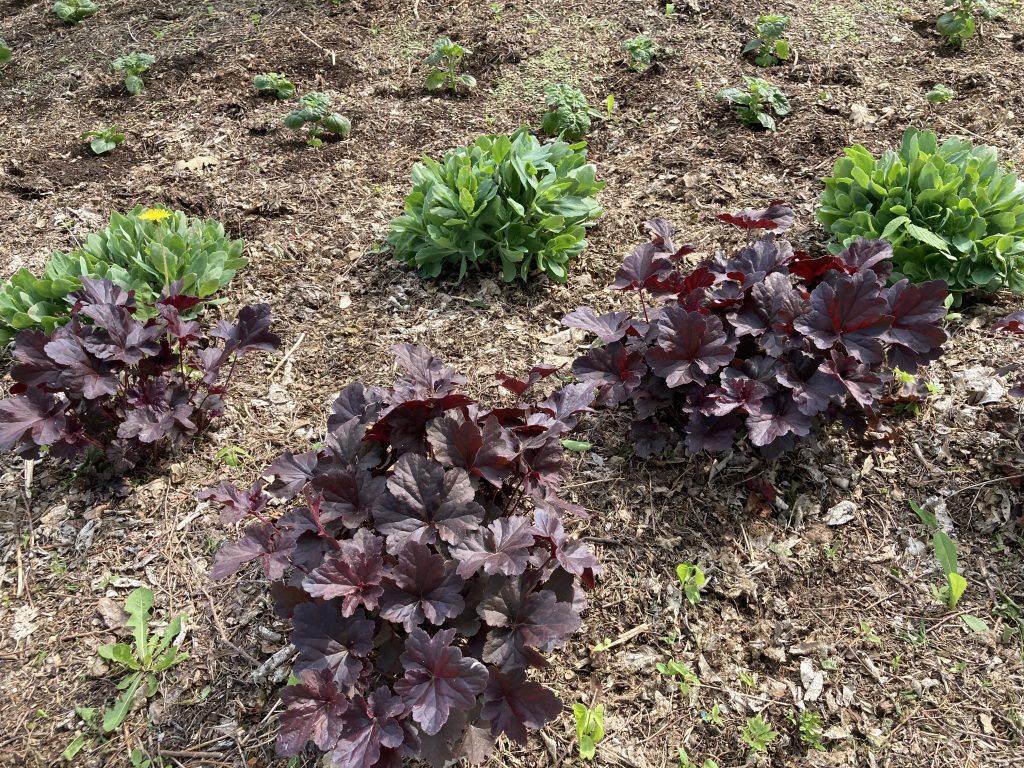
No flowers. well, I did find some flowers that were white, but looked like they could be or would be or should be turning purple. Also, a reddish-purple plant. I took some pictures:
tiny purple flowers (if you really believe)a reddish, purplish plant
I can’t really see any purple in these, or much of anything, but maybe you can?
Other purple things I remember encountering: the gentle, queer curve of a branch towering over the trail — as I ran under it I thought, that’s very purple. Then the face of a child in the midst of bellowing frustration — I didn’t see their face, but I imagined it could be a deep purple. Purple whispers in the trees.
No purple cars or shirts or shoes or bikes or signs or birds or left behind objects in the grass. Mostly just green and blue.
after the run
Apparently the leaving of strange offerings at Emily Dickinson’s grave is a thing. In her play on Susan Howe’s My Emily Dickinson and Ruefle’s My Emily Dickinson, Meg Shevenock writes, in My My Emily Dickinson:
Then, there’s this: after visiting Emily’s house, my friends and I made a small parade to visit her grave, and the objects I knew would be there, were there. Best of all, a white plastic pen with white cap from a hotel. Or best of all, a blue pencil cracked and dried, that had weathered so much snow. We all want her to say more, write more, about who she was; or, we want to say, I get it, I’m a writer too, and we also know it’s impossible, so we leave an object from the world, from a day long beyond her breathing, to get as close to touching as stone.