5 miles highland bridge (old ford plant) 58 degrees
58 degrees?! 58 degrees. Spring is back. Today I wore shorts, a short-sleeved shirt and a pullover that I took off before the end of the second mile. Ran south on the river road, down towards the locks and dam no. 1, up the wabun hill, over the ford bridge, to the edge of highland bridge park and across to the river where it is above the old hydroelectric power plant. As I neared it, I could hear the water rushing over the concrete apron at the locks and dam. The river is low; the sandy island in the middle was exposed.
The birds! Sounding like spring. The river! Sparkling in the sun. The shadows! Both sharp (distinct) and soft (the bare branches almost feathery on the path).
overheard: one biker to another — he’s between jobs right now. No contracts and no money coming in.
Is it because it’s warm, or because I started just a little too fast, but the second half of the run was hard(er). Took some breaks to admire the view. On the St. Paul side, I noticed a sticker on the fence that looked like the head of the “Hanker for a Hunka Cheese” guy:
“Time for Timer”
holes
Worked on Holes 5 today, mostly mapping the words on the page. Here’s a draft of the text:
A hole perspective life on the way to Disney’s wonder land
I fall through the center of a book
everything on the page at strange angles separated from each other in the firelit room*
a “what is this?” feeling starts while watching text bloom into nonsense
O the beauty of vision gone mad.
*not sure about this line — I’m thinking of, like in a firelit room, but low light from a fire doesn’t separate words, it softens them, makes them dim so they almost become ghosts of the text they were
Went to the dog park with FWA and Delia this morning. Chilly but sunny and still down in the floodplain. Beautiful. No snow, hardly any mud, lots of felled trees. Halfway in we encountered an awesome dog carrying a stick that was 3 times as wide as his head. His owner said, the governor is about 200 feet ahead. Last summer, I recalled watching a video of Gov. Walz being interviewed at the dog park, so I knew he came here. About 5 minutes later, there he was! Alone and friendly. Hello! Hi! Of course, I couldn’t see well enough to recognize him, but FWA could. I wish I could have seen that it was him. I would have told him thank you.
5 Dog Park Things / 5 Winchell Trail Things
a section of the river, sparkling in the sun
the bark of the giant felled tree that FWA and I have walked around all this year had been stripped recently — a huge section of the trunk was barkless and gleaming white
faint footprints through the small stretches of mud
a motorboat rumbling by, making waves that rushed onto the shore near Delia
a woodpecker knocking on some dead wood, another (or the same one?) laughing
shadows everywhere — trees, the fence, lamp posts
the winchell trail path was covered in dry leaves that made a delightful crunch as I ran over them
a steady stream of cars (at 3:30 pm)
empty benches
no snow, no puddles
2.8 miles river road / winchell / lena smith 46 degrees
A quick run — in time and distance and speed. I should have slowed it down; it would have been easier. It’s hard to slow down in my new shoes! I was tired and felt the beginnings of a side stitch a mile in — I ate a protein bar too soon.
Today has been an off day — not terrible, there were many good moments in the hike and the run. But I woke earlier than I should have and felt, for lack of better word, weird. Untethered, fuzzy, maybe a little woozy, tired.
holes
As I continue to work on my holes poems, it has emerged that a few things are present in all of five of them: a hole, that hole’s impact on how I read, my blind spot, and the Amsler grid.
Why the Amsler Grid?
it connects these hole poems with my last round of visual vision poems, mood rings, which take the shape of an amsler grid
it ties in with the larger theme of all of my visual vision poems: vision tests — first, the snellen charts, then the amsler grid
it gives a context for my vision loss and grounds it in within a scientific/medical model of seeing/not seeing
it offers another way to visualize my untethering from that model/logic of test/diagnosis
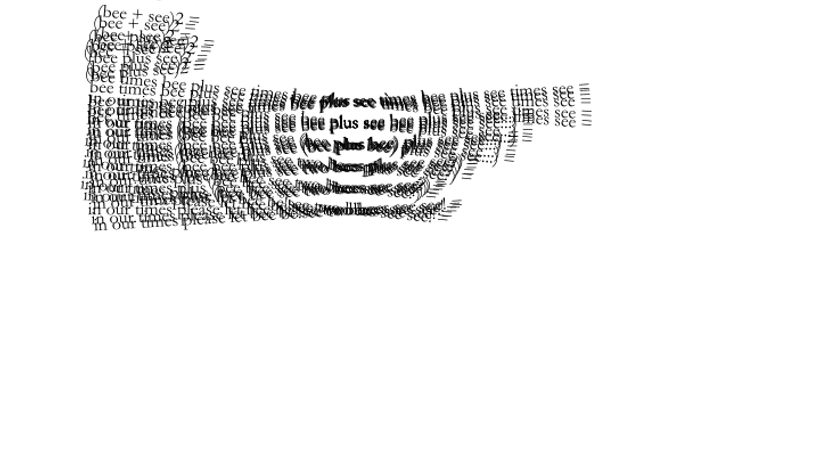
This 4th one is especially interesting to me. I’m imagining fun ways to play with the implosion or destruction or destabilizing of the sharp, stable, rigid lines of a grid. The lines coming loose, or the lines a ladder without rungs — no way out of the hole, the lines collapsing and being sucked into the black hole, the lines forming a new path, a break in the lines — a gap, a dash, a slash, a breaking out of the lines — an opening, an exit, a room a door unlocked. What could that look like as part of my erasure poem? I mean, what, with my very limited skills in visual art, could I make possible?
I think I need to watch Alice in Wonderland again — should I read it, too? The hole in my vision as Alice’s rabbit hole. A passing through to wonderland. One difference: for Alice, Wonderland is the opposite of sense or nonsense.
everything would be what it wasn’t
I’d like to take this idea of non-sense out of the binary, Sense/Nonsense, to imagine non-sense as being more than just not sense. What if non-sense was its own kind of sense, just like Nothing is not nothing but something outside of our logic or language or ability to name it. Or, like I say in Holes 4, “a nothing that is something not sharing its secrets.
a flash: as I was working on the above list, I suddenly thought about the debate over whether or not listening to an audio book was reading. Does reading only happen with eyes? I like to distinguish it this way: reading with my eyes and reading with my ears. After this thought, a further thought: what if I created a holes poem that wasn’t visual, but aural? I could pick one of the New Yorker stories/articles that you can listen to, and figure out a poem from that. How might that work?
I had intended to work on all of this today, but I was busy all day: a birthday week coffee run with RJP, the dog park with FWA, weekly shopping with Scott, a run + cooking and laundry and a nap.
sleep
I decided to use my Apple watch this week to monitor my sleep. I’m averaging 6 1/2 hours a night, which I think is good for me, but only “okay” for my sleep score. Maybe that’s because I’m waking up every 2 hours. I have to get out of bed and stretch or go to the bathroom or walk around for 10 or 20 or more minutes before falling back asleep again. A thought occurred to me: could my low vision be contributing to my sleep problems? I googled it and yes, it might:
Visual impairment can lead to disturbances in the circadian rhythm20 and exacerbate neuropsychiatric conditions such as anxiety and depression, ultimately impairing central nervous system functionality and contributing to the development of insomnia21. Existing research underscores the negative impact of visual impairment on sleep patterns. Studies conducted in Russia found that individuals with visual impairment had more than twice the odds of reporting insomnia symptoms compared to those without, with this association remaining significant even after adjusting for factors such as age and gender21. This finding further confirms the link between visual dysfunction and sleep disturbances. Community research in the U.S. suggested that older adults with visual impairment are more likely to experience various sleep issues, such as difficulty falling asleep, trouble staying asleep, early morning awakenings, and daytime sleepiness22. Additionally, such individuals often report increased disrupted sleep patterns and a higher prevalence of sleep/wake disturbances23.
But, this study studied different visual impairments than I have. What about cone dystrophy or macular degeneration, which has similar effects? I looked it up and found some articles that link it, but it’s mostly about anxiety over vision loss that cause the sleep disturbances. I know I have some anxiety about the final break, when none of my cone cells work and all of my central vision is gone, but I think the connection between sleeping and not seeing or seeing differently is more complicated for me. I’ll have to ask the ophthalmologist at my appointment next month.
Yesterday it was 76 degrees, today 36. I didn’t mind; everything was dry and clear and I was able to run on all the walking trails in my new blue shoes! Today it’s overcast and both bright — a white sky — and gloomy — everything dull and bare. Did I see any shadows? I don’t think so.
I felt strong, not quite like I could run for several hours without stopping, but at least believing that it is possible. I also felt untethered from the world, everything fuzzy and me, floating above it or outside of it.
10 Things
early on, another running passing me, their feet slap slap slaping the ground
several geese honking below the ford bridge
empty benches
two women stopped on the edge of the trail near the 42nd street parking lot, talking — I couldn’t hear what they were saying
heading up the wabun hill — no one else around, just me and the dirt and the dead leaves
running through wabun: several people playing frisbee golf, two little kids running around the course, giggling
lots of traffic on ford and the river road — cars moving fast, no sunday drivers today!
a man in a bright orange jacket, sitting on the edge, above a ravine, looking out at the river
the bright headlights of a car, giving off a purple glow
a sound across the river road and the grassy boulevard — a gobbling turkey or a yelling kid? Undetermined
holes
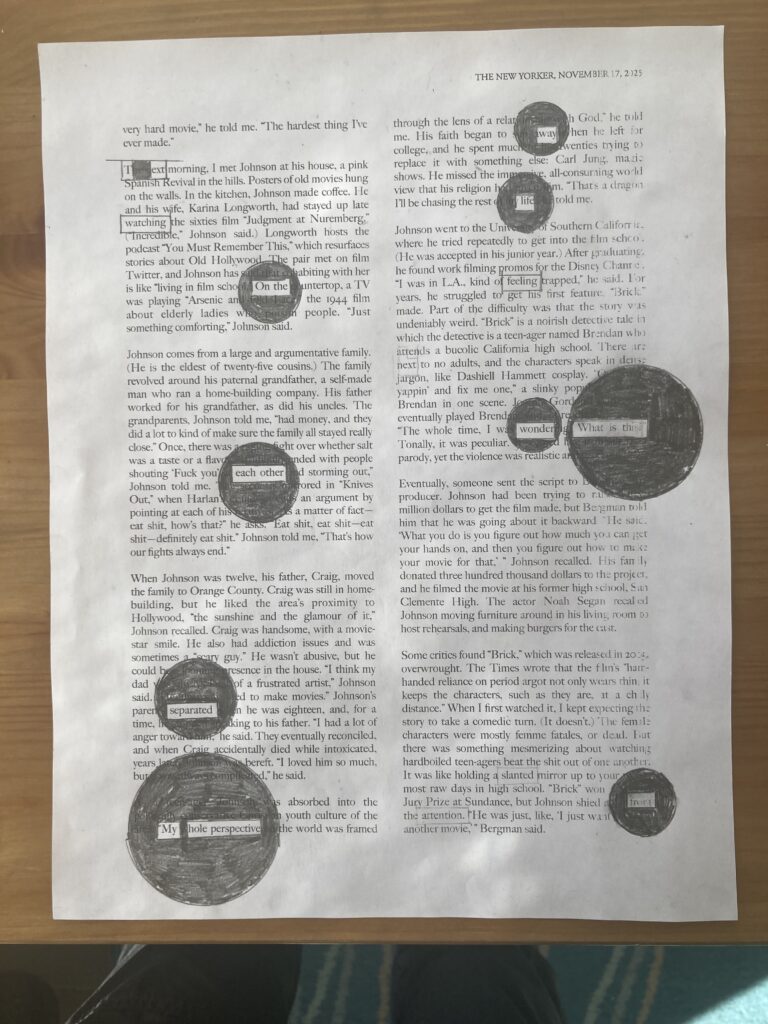
I’m working on another holes poem — Holes 5. I’m using an essay about Rian Johnson, “Mystery Man” in the November 17, 2025 issue. My only requirement for an essay is that it contains the word hole, either as the word itself, or as part of/within another word. When I searched in “Mystery Man” for hole I found 4 instances of it including, “my wHOLE perspective,” “wHOLE time,” and “the wHOLE process.” I’m thinking these will be frame of my poem, especially Hole Time and Hole Perspective. What is my perspective (how do I see) with and from within my vision hole?
another part of my method: In addition to requiring a chosen essay has at least instance of “hole,” I read the essay from back to front. I started with the last paragraph, jotting down any words that stood out to me, then I read the second to last paragraph, then the third to last, and so on. It was a strange experience. I kept finding myself wondering, when I read a name I didn’t recognize, if I had missed the introduction/description of the name, then I remembered that I was reading back to front, from an assumption of familiarity to a not-knowingness (or not knowing yet-ness).
Here is a selection of words and phrases I jotted down:
bookshelf
stone
let me
still
strings
filters
window
flash
beauty
gathered
convivial
ends
spectrum
unexplainable
gesture
earthiness
underside
gnarled roots of a tree
feel
loop er
limitations / limit s
making diagrams with straws
an older version
flock
singular
(un) locked room
mind / mind’s eye / eye
tidy solution
make sense of it all
some measure of control over an uncontrollable world
the world has gone mad
center
puzzle
watch ed
the satisfaction of seeing
firelit
delight
smug
cringe
between
it seemed dusty
hypothetical
enters
throuhout
leap
a ghost
nobody
flock
vision
get in the way
framework
scam
everything
(r) ambling
story
distance
slanted
attention
made
backward
moving around
wonder
read
what is this?
slip away
lept
feeling trapped
peculiar
sunshine
looming
house
couldn’t see
covered in string
over
This essay is five pages long, so I’ll have to figure that out — all 5 pages, or 4 to make it fit more evenly? Or even less?
walk: 120 minutes with Scott and Delia deep in the gorge + the winchell trail 76 degrees
I’m writing this the next morning because I took a break (mostly) from my computer and writing. So warm! I wore shorts and a short-sleeved shirt on our walk/hike! We walked through the neighborhood to the river and when we crossed the road to throw away Delia’s poop bag, we decided to take the old stone steps down to the river. The floodplain forest was filled with fallen trees and dead leaves: winter’s aftermath. The river was open and flowing. People everywhere — it wasn’t crowded, just a person walking a dog here, two people talking on a blanket there. Everyone enjoying the sun and the warm wind and the lack of ice.
I loudly misidentified a person as a wild turkey. Oh look, a wild TURKEY! Why is it that only when I am mis-seing something do I bother to say it out loud, and with such volume? It’s funny, and Scott and I laughed about it, but it is also frustrating. I sound like an idiot or mad. I said to Scott it’s funny as comedy and irony (the irony because I only declare these things when I’m very wrong).
holes
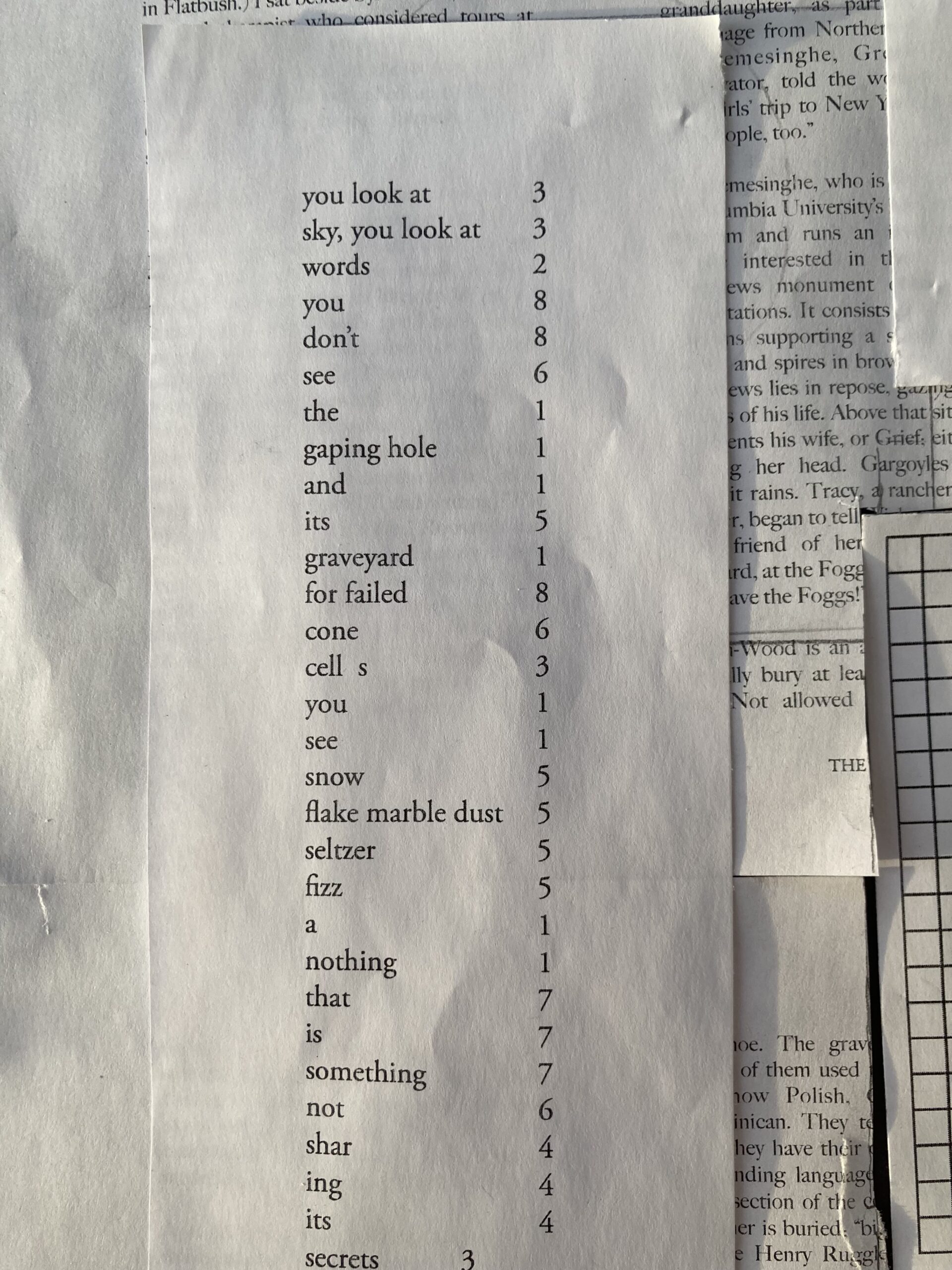
A return: the hole in Holes 1, which was the start of all of these holes — Another name for barely not blind is a hole in your vision that makes for an easy fellowship with the word. Now I’m thinking that I should tighten these poems up and make them only about reading. So, the hole in Holes 2 would be: a hole through the bottom of / the / wor / d / here / it is / unprofitable / to / have / faith / in / the / visible. And Holes 4 would be only: you look at sky, || you look at || words || you || don’t || see || the || gaping hole / and || its / graveyard / for / failed / cone / cell / s / you see / snow flake marble dust / seltzer / fizz|| a / nothing / that / is / something / not / shar/ ing / its / secrets
Get Out ICE
ICE agents are still here, but not at the levels they were a month ago. Two of the leaders that caused the most damage — Noem and Bovino — have been removed (Bovino announced his retirement the other day). Even so, the effects — psychological, physical, economic — still linger for many Minnesotas. Food is still being delivered to families afraid to leave their homes, organizations are still raising money to help people pay their rent. The stop signs around my house still declare, “STOP ICE.” The latest threat: Trump threatens to send ICE agents to airports to take over TSA jobs abandoned by workers not paid because of the partial government shutdown.
Since just after an ICE agent murdered Renee Good on 7 jan, I’ve been adding “Get Out ICE” to my log entries, both in the title and as a tag. I think it’s time to stop. A better thing to add now might be: What about the Epstein files? or Stop the war!
Mary Oliver Doc on PBS this summer!
I’m looking forward to this documentary!
“I was save by poetry. I was saved by the beauty of the world.”
I want to put MO’s idea of being saved by the beauty of the world beside the banner that Hanif Abdurraqib has above and between two door frames in this Instagram picture: “LIFE’S NOT OUT TO GET YOU” Yes! Always a good reminder.
Happy first day of Spring! Many years it still feels like winter, but today it was SPRING! If I didn’t have to jump over a lumps of snow I wouldn’t have remembered it snowed almost a foot less than a week ago. Wonderful weather for a run — sun and not too much wind. I wore shorts, a short sleeved shirt and a lightweight pullover which I took off right before I turned around. For half the run, bare arms and bare legs!
a regular:Daddy Long Legs! As I ran back south, he greeted me, Hello again! Does he remember me from past years, or did he think he’d already seen me once today? (he’s done that before.) I’m choosing the believe he remembers me. I wonder if he has a name for me, like I do for him?
The ice on the surface of the river has melted. Down in the flats I was able to get close — only feet away — from the surface: some foam floating on the water moving slowly south.
holes
As I told RJP, I’ve hit the point in the process of these poems where I’m beginning to doubt myself and what I’m doing. Part of it, I explained to her, is because I dwell in the almost and struggle to find how to execute the final bit and/or give it the “polish” it needs. I’m not giving up. Instead, I’m trying a different approach: cut-outs. Would ths work better if the words were cut-out — a way to isolate them — instead of encased in holes? Can I do both? What if I had some of the words encased in the holes and some cut-out? Would that make it a little less complicated and less messy + easier to execute?
The question to return to again and again: what will serve the message/meaning/intentions of the poem?
4.3 miles minnehaha falls and back 44 degrees 10% puddles
Spring! Sun! Sharp shadows! Clear paths with far less puddles! I felt strong and satisifed and at ease in my body. Well, mostly at ease. Because it’s messy out by the gorge, I wore an old pair of shoes — the ones that don’t quite work. Sometimes my gait felt awkward, my feet not hitting the ground in the right spot or in the right way.
Marveled at the river’s surface as I ran above it. So beautiful with its frozen surface. In the past, I’ve described the surface as vast or barren or eerie, surreal or otherworldly, but today other words came to mind: still, frozen, fixed, unmoving, deadened, paused, suspended. Yes! I think these words better describe its strange beauty for me. Looking at it is like looking at a film still. Looking at it feels like everything is paused, suspended in time.
10 Things
gushing falls — I could hear their loud descent and see their white foam
looking down at the oak savanna, tall, slender, bare branches mixed with their shadows to make a mess of lines on the snow — how much of it was actual trees, how much shadow? I couldn’t tell
water dripping fast and strong over the limestone edges in the ravine at 42nd street
empty benches
a guy walking with a small dog and looking at his phone
someone biking near the falls playing some mellow music out of speakers
taking off my sweatshirt, running with bare arms, seeing a walker with bare arms too
sirens in the distance, a loud, sustained whistle
the walking trails are still covered in snow
the gutter that was gushing water yesterday now only has trickles
Off and on throughout the run, I recited Alice Oswald’s “The Story of Falling,” sometimes reciting it in my head, sometimes out loud.
Holes
I’ve mapped some more of Holes 4 and . . . it’s a lot. Will this just look like an ugly, jumbled mess? Yesterday, talking through this with Scott, he said something like, do what serves the poem and the meaning you are trying to convey (or the effect you are trying to achieve). In terms of meaning, the words of the first section of the poem are about what I see instead of a gaping hole: shimmering, fizzy, ephemeral or elusive (hard to see, fleeting) things: snow flake marble dust, seltzer fizz, a nothing that is something not sharing its secrets. Perhaps these ephemeral things have come loose from what bound them to “normal” sight and its monitoring through tests like the amsler grid; it’s where you dwell when normal sight is not longer possible. So maybe the unraveling occurs prior to this hole? Yes, the unraveling (and vision of amsler grid as broken strings happens in 2 and 3, Does that mean that Holes 4 is all disconnected free-floating words/phrases? If so, how to make it possible for others to read it? I could place the poem near the center, around the gaping hole. I could also number the pages/sections and mark each word with a page number? Yes, I like this!
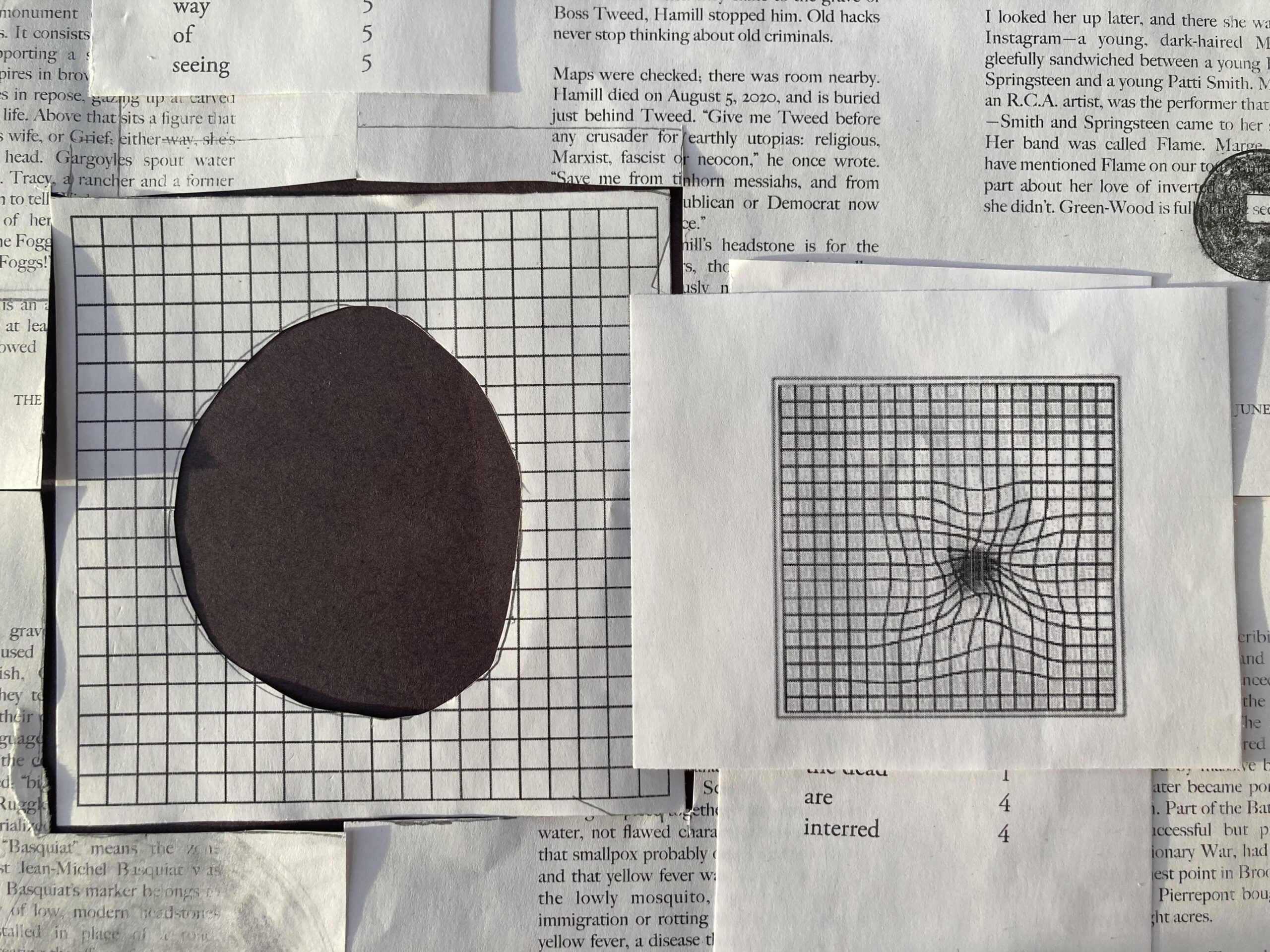
And hours later, I’m thinking more of using a distorted Amsler Grid at the center of Holes 4, and the black hole that the grid is collapsing into is the shape of blind spot.
Another mini project: can I learn how to draw decent-enough eyeballs — pupil and iris only?
amsler ideavery rough eyepoem text
Get Out ICE
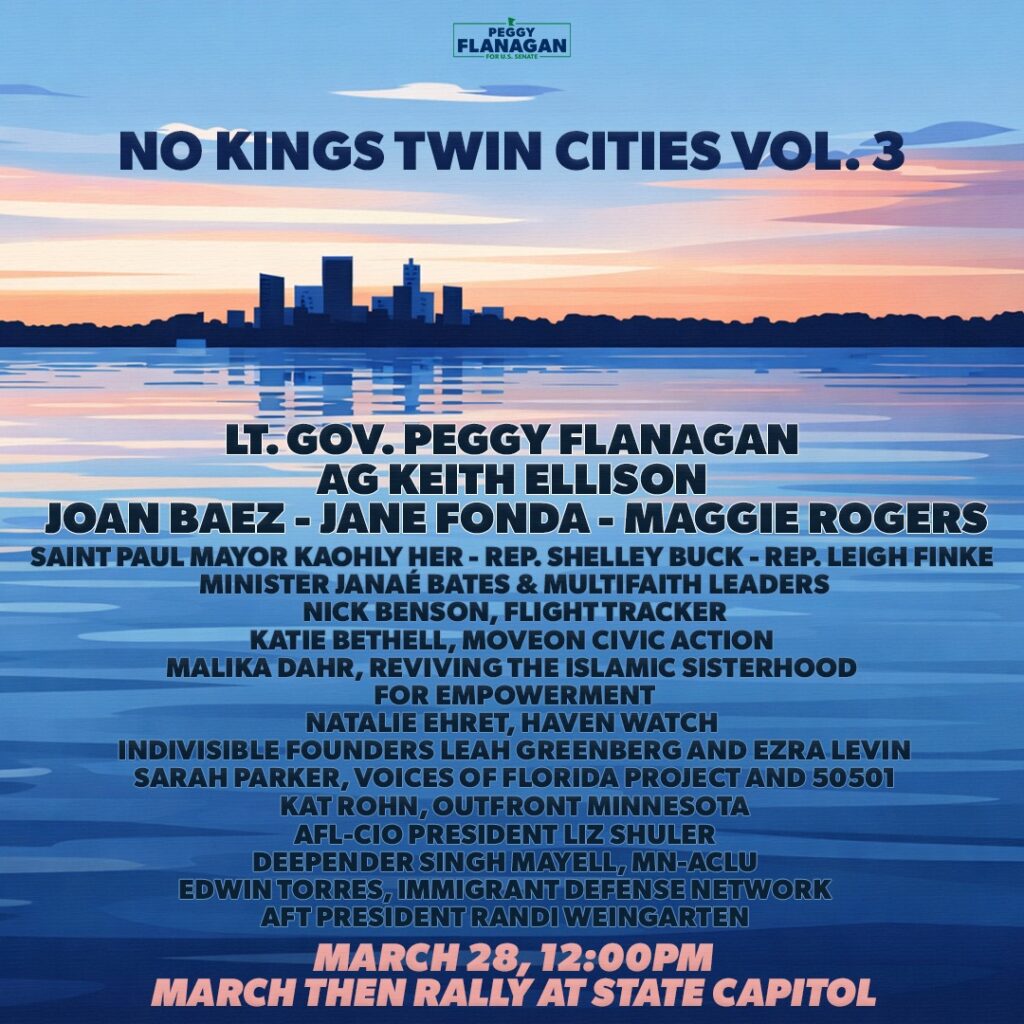
This flyer about the next No Kings march came up on Facebook from Minnesota’s Lt. Gov Peggy Flanagan (and hopefully our next governor?!):
“In Minnesota, we’ve seen the federal government at its worst — and showed the world how to fight back.
Now, I’m honored that the flagship No Kings protest will be held here in the Twin Cities. Together, we’ll show Donald Trump that we don’t do kings.”
NO KINGS TWIN CITIES VOL. 3. Joan Baex Jane Fonda Maggie Rogers. March 28, 12 pm. March then rally at the State Capital.
4.3 miles minnehaha park and back 43 degrees 25% puddles
Yesterday it was very cold. Today it is warmer, the sun is out, and everything is melting! Drip drip drips everywhere, very LOUD whooshing car wheels, puddles. At the start of the run, I wondered how long it would take before at least one of my socks would get soaked. Not long! I only made it a quarter of a mile before stepping in a big puddle. Oh well, it dried out pretty fast.
overheard: one runner to another as they encountered each other on puddly double bridge — take it easy my brother
Kids laughing and yelling on the playground; a pack of runners; the falls, gushing, a few sirens; the river with a thin sheet of gray ice looking wide and barren. Can you see it through the trees?
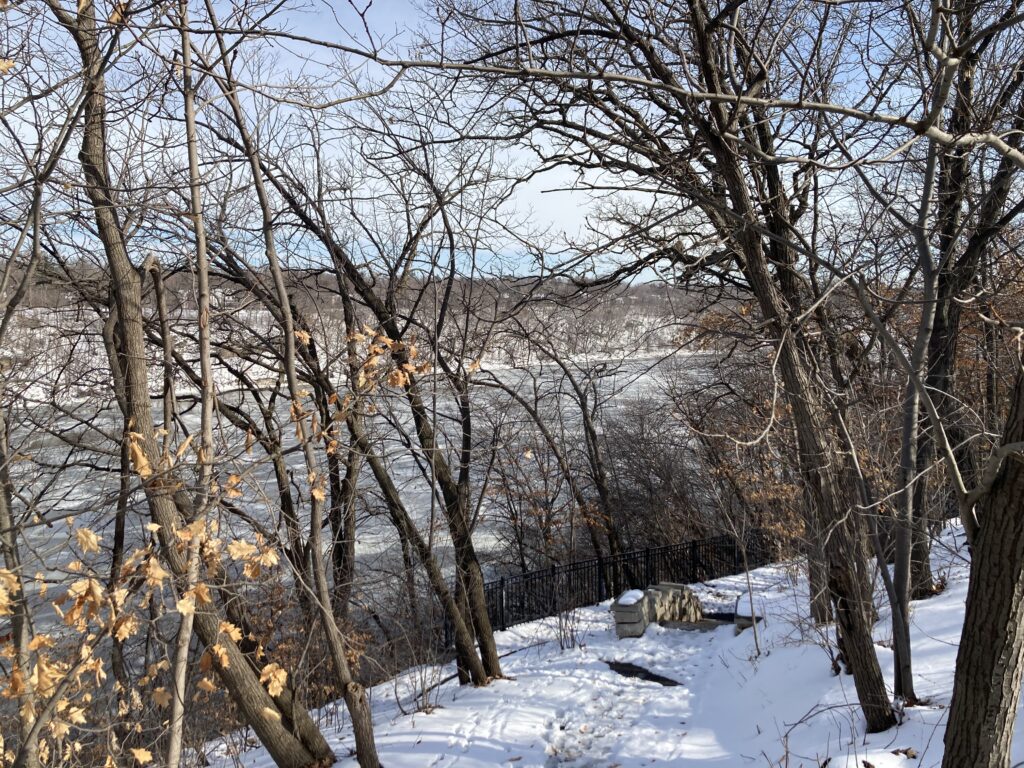
river view from the 38th street steps / 18 march
On my walk back home, I stopped to take some video of water dripping out of gutter. Unfortunately because of the bright light I accidentally hit slow mo so you can’t hear the wonderful dripping sound. Here’s a brief clip of it anyway:
water dripping in accidental slow mo
HOLES
Yesterday afternoon, after finishing mapping all of my word (drawing boxes around them, encasing them in circles or the shape of my blind spot) and feeling like something was missing, I had an idea: I should place the Amsler grid somewhere on the pages. I didn’t want to simply cut out a printed version of the grid and completely cover the words. What about drawing the grid on top of the words? Too difficult with my terrible vision! Then, a new idea: cut out a hole the size/form of Amsler grid’s shape (4 x 4 in) and use string as the lines for the grid. After some playing around with it, another idea: not string, but thread or wire, and make the grid broken, distorted, emerging from the hole, looking somewhat like broken guitar strings. Three of the strings will extend out across the pages, offering the path of the three sentences of the poem. A variation: create three grids, with each one corresponding to a different sentence. This idea, which I hope I can execute because I really like it, led me to think about adding an Amsler grid to all of the holes. On Holes 1 it would be the “normal” grid with my blind spot on it. I have to think more about how it would look in Holes 2 and 3. By Holes 4, it’s broken.
If you google “distorted Amsler grid” you can find some great images of warped lines and black holes caving in upon themselves. Due to risk of copyright infringement, I won’t post any, but here’s a link to one that I particularly like:
Amsler grid distorted image: the image is at the bottom of the page. It is of the grid with the outer lines appearing normal. Near the center the lines are wavy, collapsing into a big black spot in the very middle.
Some things to think about today (I’m writing this paragraph just before 10 am):
how do I map the words in Holes 1, 2, and 3?
where do I place the Amsler grids in Holes 2 and 3, and what will that look like?
will there only be 4 Holes, or should there be more? If more, should I place them before or after Holes 4 in terms of the progression of the grid’s distortion?
Another thing that happened yesterday: I remembered that I had a large amount of oil pastels, leftovers from RJP’s obsession with them more than 10 years ago. Could I use them to color/fill in my holes? How do you use oil pastels?1
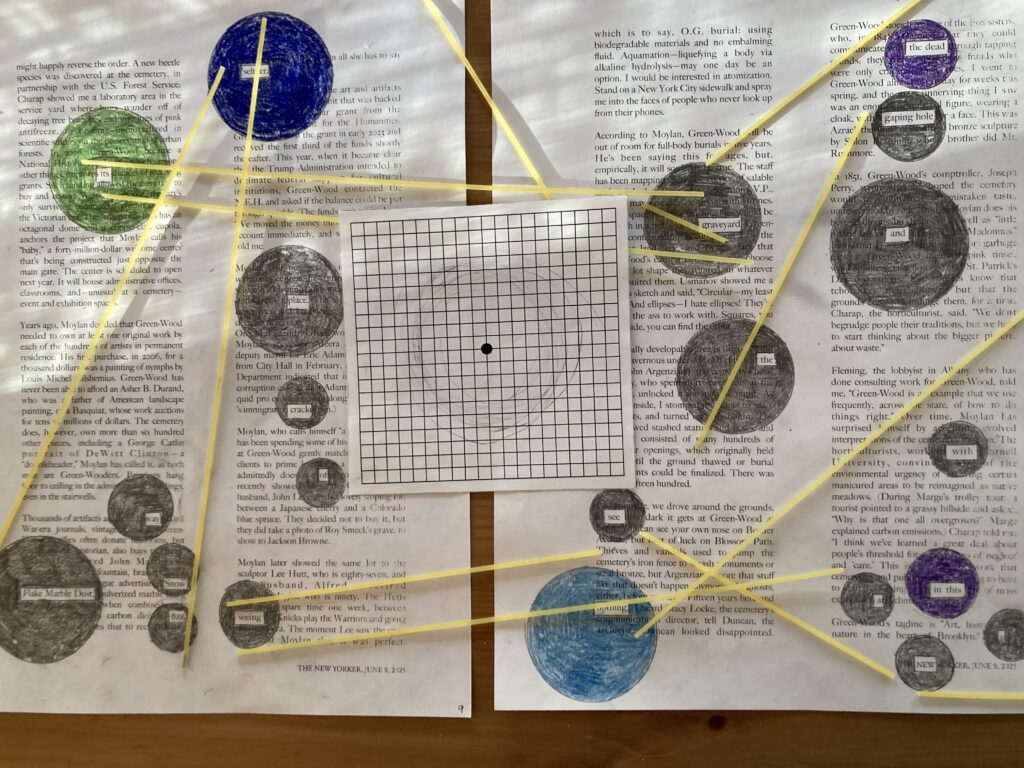
It is now 5:20 pm and I’ve spent part of the day trying something new with Holes 4. I’m using uncooked spaghetti to connect/map the words of the poem. It’s a complicated challenge, but the spaghetti is helping to visualize it more effectively.
more thoughts/questions:
should I split this poem into 4 instead of 3 segments?
should there be separate amsler grids for each section, or one grid from which different colored threads emerge and travel to the three or four different sections? if there is only one grid, should it be in the very center of the piece?
should the grid be just an open hole, with no evidence of a grid, just black netting and threads or wires or yarn emerging from the hole (I like wire, but is it too difficult to work with?) OR should part of the grid still remain — some white, some “normal” lines, then a hole?
a further thought with that last question: what if the holes (1, 2,3, and 4) documented the unraveling of the amsler grid, with it intact in Holes 1, then less intact in Holes 2 and 3, until it is gone and with broken wires in Holes 4? I love this idea; can I figure out a way to execute it?
returning to the thread/wire — will it work to have it stitched into the paper, where sometimes it is on the front, sometimes emerging from the back side through another hole? is this too messy and complicated? do I need to cut back on the poem, to reduce its number of words?2
I don’t want to cut any words, but it would make this easier — do I want it to be easier? Not really! ↩︎
Get Out ICE: It’s never too late to do the right thing. . . .
is something people were chanting and singing at hotels where ICE agents were staying this winter. I think it also fits as a way to describe this:
A reporter for NBC interviewed people at a gas station in a previously very pro-Trump county in Pennsylvania. Three people still support Trump, one does not. Responding to the reporter’s question, “If you could say something to President Trump and he could hear you right now, what would it be?”
“3 times! That was my bad, apparently I’m an idiot”
2.3 river road, south / lena smith boulevard, north 15 degrees / feels like 0 50% snow-covered
Many of the sidewalks were completely bare and dry, almost all of the trail was covered in slick snow. In some stretches, the trail was covered with chunks of snow from the snow plows that had just passed by. Running south, with the sun and the wind at my back, and on the short strips of bare pavement, it felt good. Then I ran through a puddle. I didn’t notice that my foot was soaked for several minutes, but when I did I decided I should head home; it was cold enough that I was (mildly) concerned for my wet toes. Good call, past Sara! When I got home, one of my toes was burning.
10 Things
bright BLUE sky
the sounds of shoveling and scraping and snow-blowing all around
at the end of each block, I encountered an almost knee-high wall of snow where the plow had come through
the surface of the river looked eerie and strange, pale and spotted with chunks of ice
no kids’ voices from the school playground: for preK – 5th graders, school was closed, for 6th – 12th graders e-learning — that would suck! give the big kids a snow day too, I say!
the rumble of two plows approaching, first a small one, then BIG one — I moved to the far side to avoid the spray of snow
I encountered a few other runners but no skiers or bikers
head north, I ran into a wall of wind — ugh! howling and biting
I bet it was pretty and looked very winter wonderland-y — I couldn’t tell you because I was too busy trying not to slip!
if it hadn’t been for the terrible wind, my wet toes, and the slick and uneven path, it would have been a great run — even with the bad conditions, I had some wonderful moments outside
mind-body connection
On last week’s episode of the podcast Nobody Asked Us, Kara Goucher talked about how she started taking a low dose of some (unnamed) anti-anxiety medication and it’s helping with her dystonia (“a movement disorder that causes the muscles to contract. This can cause twisting motions or other movements that happen repeatedly and that aren’t under the person’s control” — Mayo Clinic). She has discussed many times on the podcast how dystonia has made it very difficult for her to run, especially on pavement.
mind body connection — watch until 15:58
This mind-body connection is fascinating to me. Does her anti-anxiety med just make her more relaxed, or does it do something more to the brain — and maybe the neural mapping of her movements?
HOLES 4
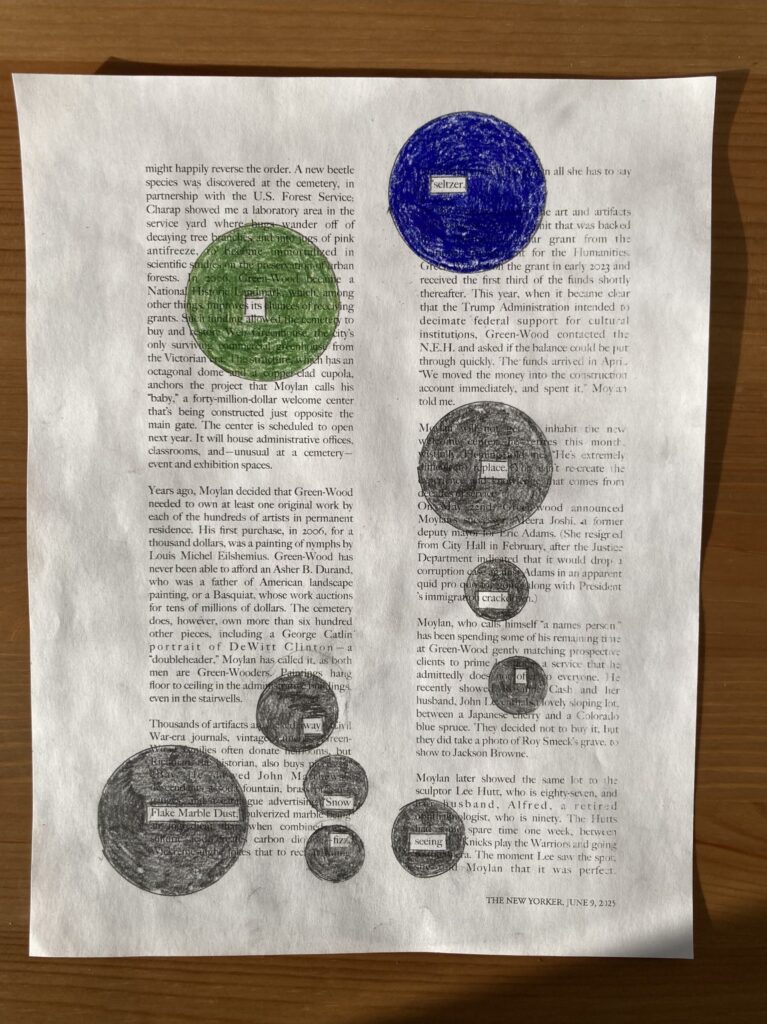
Today I’m mapping my words on a copy of the “Still Life” article. I”m trying something different. In Holes 1, 2, and 3, I taped the paper together first and then found the words and drew the holes over and around the words. Today, with such a long article, I’m finding the words and drawing holes around them first, before I tape the pieces together. Will that make a difference? Not sure, but I might switch around the order of the pages to shape how the holes look together.
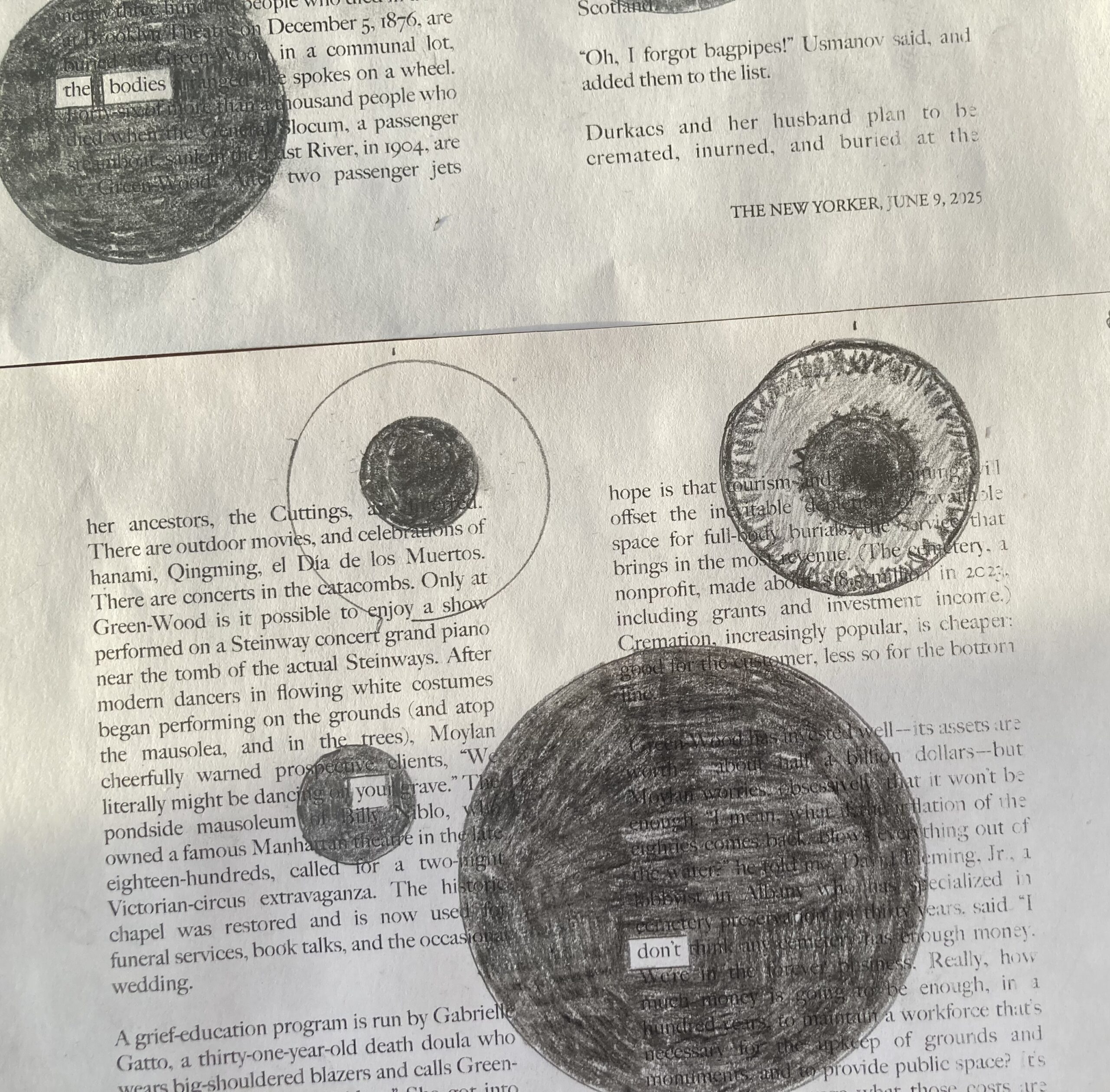
I drew and colored in holes on 3 out of the 8 pages, and tried adding some color to a few. I’m wondering if some of the holes should messier, with less defined borders or jagged, rough. I have limited ability in drawing; can I push myself some more? Here’s an image of one of the pages:
Bring Me the News is saying we got 8.5 inches, but that reading was from 10:30 this morning, and it has continued to snow all day, so I’m not sure how much is on the ground. I’m guessing a foot. It felt like a foot as I tried to shovel it. So heavy! I joked with a neighbor that it’s heart attack snow, which is funny until it’s not.
I wonder if it the paths will be clear enough to run above the river tomorrow? Future Sara, let us know!
holes 4
This one, which takes words from “Still Life” is my biggest one yet: 6 pages! Here’s a draft of the poem (the || represent when the words are taken from different places in the article)
you look at sky, || you look at || words || and || don’t || see || the || gaping hole || and || its || graveyard || for || failed || cone || cell || s || you see || snow flake marble dust || seltzer || fizz|| a || nothing|| that || is || something || not || shar|| ing|| its || secrets
you || can’t || exhume || the || bodies|| but || you can || make || room || for || life || in this place || where || the dead || are || interred
crack || open a grave|| with || a || new || way || of || seeing
One last run on clear paths before it snows tonight. The forecast predicts more than a foot of snow tonight. It will probably melt fast, which will be as much as more of a nightmare than the actual snow. Walls of snow, then mush, then jagged ice, then little lakes and puddles. Oh well, I bet it will be pretty and I might get to see someone skiing down the street!
Today’s run was good. My left knee was a bit stiff and grumbly, but otherwise I felt good. In the last mile I started to feel relaxed, with my legs and arms and the space around me in sync. I was moving through the air, hardly noticing when my feet touched down — the space between beats! I love when I run like this!
10 Things
honk honk honk honking geese all around the gorge, 1: down the hill, under the ford bridge, a lone geese floating in the middle of the river
geese, 2: I heard their honks first, behind me, then beside me, then in front of me — finally saw them: 2 geese flying low
overheard: one runner to another: it didn’t even taste like salmon!
the bells of st. thomas
someone in an bright orange jacket down below, on the stretch of the winchell trail that I call the edge of the world
the river surface below the ford bridge was dotted with bright white slabs of ice — a strange sight; I wish I would have brought my phone today to take a picture!
an empty parking lot at the locks and dam
empty benches
traces of snow in the grass
a laughing pileated woodpecker
HOLES
Flipping through my past New Yorkers, I found an article from the 9 june 2025 issue that looks promising. It’s called “Still Life” in the print issue and “Greenwood Cemetery’s Living Dead” in the online version. The only test for whether I can use it or not: it must have at least one use of the word hole, or of a word that contains hole. This is a long article, so I’d hope there’s at least one hole, but is there? Yes, 4!
Medina extended a tape measure into the hole and said, “Six-ten.”
Usmanov and I stared down into the gaping hole, its walls marbled with grass roots.
went to Green-Wood almost every day for weeks this spring, and the most unnerving thing I saw was an enormous hunched figure, wearing a cloak, with a gaping hole for a face.
Scientists were only starting to piece together that contaminated water, not flawed character, caused cholera; that smallpox probably originated in rodents;
I’m surprised that an article about a cemetery only has 4 mentions of holes. Isn’t a cemetery more than half holes?!
some notes as I read through the article:
One, I am reading it backwards, section by section. Two, one rule in the cemetery: no skylarking. I looked it up, skylarking is frolicking and playing jokes on others. It’s also the name of one of my favorite XTC albums. Three, reading the text, which I’ve put in a pages document, I’m noticing a few things about the text: the text surrounding the word or phrase that I can see sometimes looks like it is scribbled out. Sometimes it looks like it has sparkles around it that are moving — not quite flashing. The text always seems to be vibrating. How can I translate that into a texture on my blind spot Four, as I read through the sections, I jotted down words or phrases that stood out to me:
entrance flaming torch welcoming appears mirror ink you’re never alone you’re never disconnected love full of little secrets inhabit center recreate experience remaining time offer everyone gently between seeing moment you look at space, you look at background, you look at sky hope visit already thinking I don’t know why there was room about to open up turn and follow her gaze staring hands waste bigger picture across threshold neglect and care art cone cell
heart needed landscape fizz snow flake marble dust seltzer balance fills up keeps the grass space enough out of the water upkeep grounds public spaces essentail failed possible efficiency requires can stand on a sidewalk people who never look up out of room true mapping crevice easy circular elipses inside walls outside dark happen here nothing pale-blue cluttered wasn’t a place searched
certainunmarked is now used other-siders skylarking exhume make when you see in place of a road the word down through the plywood a plank settling glacial till earth inches from a layer of turf dirt unstratified jumble of sands, cobbles, and clays caves in on itself all-weather like a bird bench what do you want stone slabs a door uncut grave terrain geologically life this is a place to inter the dead no good place to put all the boies walked around faces believing piece together rotting disease inspired crowded
By the way, as I write, the snow has started. We officially have a blizzard warning that begins around 10 pm and lasts until Monday morning.
One of the reasons I picked this article is because I wanted more land language, like grass and dirt and dust and terrain and stone slabs and sands, cobblestones, clays, caves and glacial till. I want to connect the hole in my vision with the gorge — as a landscape, and a very big hole. I think of it as a powerful metaphor for my vision loss and what comes during and after. Of course, the gorge is also the actual place I go to for my writing practice.
The word plank stood out to me because of ED’s “I felt a funeral in my Brain” — and then a plank in reason broke/and I dropped down and down — I think of ED also with the stone slabs and the dark.
And, I like crevice and opened up, inside, outside, this is a place to inter the dead, room — a gaping hole, a threshold between,
I also like fizz and snow flake marble dust, which is what the words (and what I) sometimes feel like — fly, like a bird, sky — the words, cluttered, crowded and between walls
my eyes: a graveyard for dead cone cells
you look at space you look at sky you look at words and don’t see the gaping hole and its graveyard for dead cone cells you see snow flake marble dust seltzer fizz a nothing that is something
I’d like to keep going, but it’s time to get ready for Scott’s birthday dinner!