dec 23/SWIM

1.5 loops
100 laps
ywca pool

Swimming! For almost 10 years, I’ve been swimming with a nose plug, after picking up an allergy during open swim one year. Today, I wondered what would happen if I swam without it. I lasted 200 yards, then put it back on. My nose felt tingly and irritated from the chlorine. Hopefully it won’t close up tonight. My favorite pool friends were the bright patches of light with their prism of color streaming in from the windows. Other friends: a few fuzzy-somethings, some crud on a tile, the slightly shaking shadow of the lane line, a woman a few lanes down swimming fast and using hand paddles, another woman in the next lane using a kick board, a guy with a pool noodle, several people in dark full-body swim suits, hanging out in the far lane — standing, first evenly spaced down the length of the lane, then huddled together at one end. The recreation pool and the slide were open, so I noticed kids climbing up the slide steps for much of my swim.

locker room encounters

  • an older woman with a young kid. The woman had her suit pulled up, with the straps down. The kid asked why she didn’t pull her suit up all the way. The woman —because I have to go the bathroom and I’m lazy. (I do this too)
  • another older woman in a pale blue swim suit, muttering oh, then stopping in the middle of the room, fishing in a bag and pulling out flip flops

blind spot

For the second night in a row, I woke up, got out of bed, stretched, then had an idea for my blind spot experiment. It was inspired by reading the last text box I did before I stopped yesterday:

One glance to shoot down the albatross / Two glances to hold back the landscape at the river“s edge / Three glances to turn the girl into a kite / Four glances to hold down the train that falls into the abyss / Five glances to relight the stars blown out by the hurricane / Six glances to prevent the birth of the aquatic child / Seven glances to prolong the life of the bride / Eight glances to turn the sea into sky / Nine glances to make the trees of the wood dance / Ten glances to see the beauty that shows up between a dream and a catastrophe / What is the difference between a glance and a glimpse? To glance to glimpse to study to stare to look to see to ? The best way to get a vivid impression and feeling of a landscape, is to sit down before it and read, or become otherwise absorbed in thought; for then, when your eyes happen to be attracted to the landscape, you seem to catch Nature unawares, and see her before she has time to change her aspect. The effect lasts but for a single instant, and passes away almost as soon as you are conscious of it; but it is real, for that moment. It is as if you could overhear and understand what the trees are whispering to one another; as if you caught a glimpse of a face unveiled, which veils itself from every willful glance. The mystery is revealed, and after a breath or two, becomes just as great a mystery as before.

note: the second half of this passage is a quotation from Nathaniel Hawthorne, which I posted and discussed on 20 august 2022

I typed up some notes which don’t totally make sense this morning, but here’s the gist: the key: landscape. Playing around with/disrupting the idea of seeing land as capturing it, owning it with a glance. Add in pastoral poems, like the one by Forrest Gander. How we see a scene, where scene = the land. Also: glance versus glimpse

See 13 april 2021 for a discussion of Forrest Gander’s “Pastoral” — the idea of seeing/scene emerging fully formed versus the work of seeing and processing and making sense of half-formed images

See also, 10 october 2025 for a review of past entries/poems discussing the pastoral

Writing and reviewing all of this, I am again thinking about my blind spot in terms of the gorge — the gap, openness, a gash, a space like JJJJJerome Ellis’ clearing.
dec 22/RUN

4.25 miles
minnehaha falls and back
38 degrees
10% ice and 30% puddle-covered

Waited until the late afternoon to go out for a run; too icy this morning. This afternoon (at 3), there were lots of puddles and sun and not much ice. A good run. Even though I think I caught FWA’s cold, I had plenty of energy while I was running and felt great.

10 Things

  1. bright sun reflecting off the windows of a house
  2. the very strong smell of week near the 44th street parking lot
  3. the creek was moving, but the falls was not
  4. lots of walkers, a few runners, at least one fat tire
  5. a walker moving over to let me pass on the cleared bike path in the park — thank you! / you betcha!
  6. near the oak savanna, a little kid’s voice floating up from below
  7. at least one bright yellow jacket
  8. the river: covered with ice and snow
  9. a line of cars waiting at the stop sign on the road coming out of wabun park and the veterans home — did a shift just end?
  10. the clip clip clip of another runner’s ice cleats

blind spot

Yesterday I wrote about re-finding my blind spot and doing a series of erasure poems with it. Last night, I woke up with a vague idea about writing a hybrid piece (possibly to submit to a journal’s call for submission — Waxwing) that involves using and applying and reflecting on my blind spot. This morning, I’ve been spending more time thinking about it, wandering and wondering how and what to do with these ideas. Just now, a thought: even as I use a cut-out or an image of my blind spot and apply it to text, as if to demonstrate how I see, the resulting poem/prose piece/fragment can’t properly convey how it is that I do or don’t see. The difficulty with my failing/failed vision is that I can’t really see it. Well, sometimes I can see it, like when I’m talking to someone and their head is only a fuzzy, empty blur, but often I can’t. It’s more of a feeling, or sometimes it’s not anything; I don’t realize I’m seeing wrong or that I’m not seeing until it is pointed out to me. How do you convey that?

But, even if the dark outline of a blind spot doesn’t effectively represent my vision, it does do something. So I’d like to use it.

As I write this, I’m looking out my window, into the bright white and blue of the sun and snow and sky. The image is shaking or shuddering or unsettling constantly. I see pixels shifting. The entire image is not unstable — I see solid forms that aren’t moving — like a red car parked across the street, or the straight hulk of a tree trunk — but the feeling of all of it is movement and being unfinished, unsettled, or buzzing? Visual buzz?

Earlier today I was working on a movie musicals puzzle. I’m constantly amazed that I can still work on it, that I can see enough to fit pieces together, but I can. In fact, with the small bit of central vision I have left, right in the middle of the middle of my eye, I often see small details — a tiny face or eyes, a finger pointing — and can recognize where they go. Sometimes I can’t fit it in exactly, so I give it to Scott and he finds the exact spot. Vision is so strange.

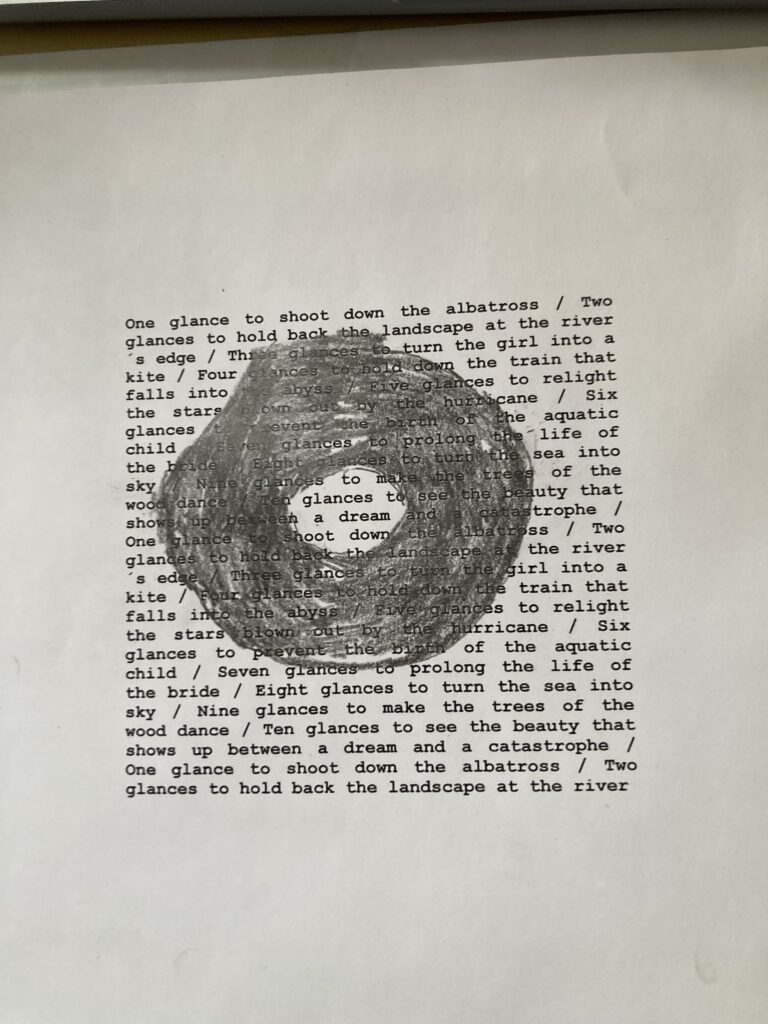
several hours later: Right now, I’m starting to look through the entries I tagged, vision. I have 20 pages of them. Already with the first one, I have an idea. On jan 30, 2020 I posted the poem, Natural Forces/ Vicente Huidobro. Since then, I’ve spent a lot of time with this poem — analyzed it, memorized it, recited it while I was running. To me, it’s a great example of the myth of the power of sight. Could I fit it in an amsler grid-sized box, and apply my blind spot to it?

I tried. Made a text box the size of grid. Fit the poem in the box as many times as would fit. Printed it out. Traced my blind spot on an Amsler grid, then cut it out and placed it over the poem. Not sure I like it, but it’s a start.

blind spot experiment #1

I wonder what it would look like if I only wrote the poem once, and made it a horizontal band across the box? Maybe make the font size smaller too? What if offered a few different versions, some with larger fonts, some with smaller so a reader could see what I can/and can’t read. I’ll have to try that next time.