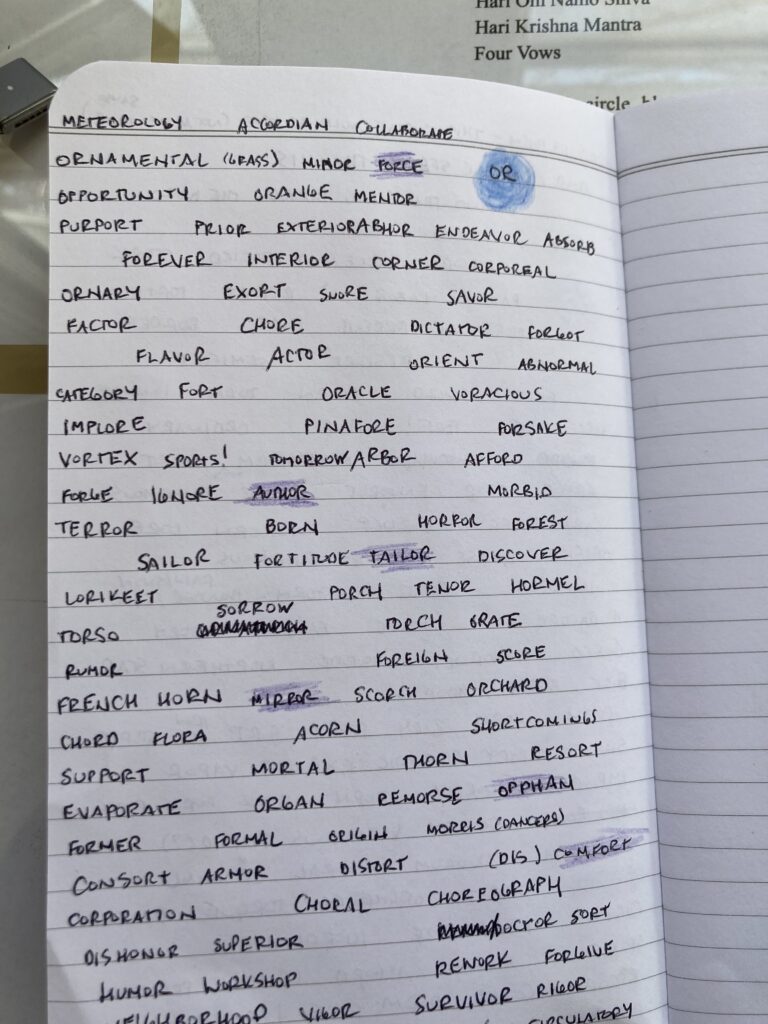
A little cooler, but sunny. I wore shorts and my legs didn’t feel cold. The green continues to spread. I’m sure I still have a view of the river but I don’t remember looking at it, not even once. I saw some rowers heading down to the rowing club, but didn’t hear them on the water. Greeted Dave, the Daily Walker. Was passed by several groups of young and fast runners. High school or college teams? Not sure.
Mostly I felt good. My heart rate is still high. I guess I lost some fitness on my almost 2 week break. Monday, I’ll try some more deliberate walk-run segments.
Listened to other runners, cars, water gushing out of sewer pipes heading north, my “I’m Shadowing You” playlist heading back south.
Ran on the grass for a few stretches to avoid other runners and walkers. Thought about how several sites recommended running on more gentle surfaces, like grass, when dealing with a herniated disc or sciatica.
before the run
I’m thinking more about open fields, meadows, lawns, boulevards, village greens, grasslands both wild and manufactured. Grassy spaces I recall from childhood, living in sub-divisions in North Carolina and Virginia and Iowa: soccer fields, manicured lawns, pastures just beyond my backyard.
as if it were a scene made-up by the mind, that is not mine, but is a made place,
that is mine, it is so near to the heart, an eternal pasture folded in all thought so that there is a hall therein
that is a made place, created by light wherefrom the shadows that are forms fall.
An eternal pasture with a hall made by light and shadows. After the poem, I wrote about Duncan’s idea of projective verse
poetry shaped by rhythms of poet’s breath. So cool–I want to explore this more, thinking about breathing when I run vs. walk vs. sit.
“Olson argues that the breath should be a poet’s central concern, rather than rhyme, meter, and sense. To listen closely to the breath, Olson states, “is to engage speech where it is least careless—and least logical.” The syllable and the line are the two units led by, respectively, the ear and the breath:
“the HEAD, by way of the EAR, to the SYLLABLE the HEART, by way of the BREATH, to the LINE”
The heart, by way of the breath, to the line — This idea will be the start of a moving while writing experiment!
after the run
up to the wind-stripped branches shadow- signing the ground before you the way, lately, all the branches seem to, or you like to say they do, which is at least half of the way, isn’t it, toward belief — whatever, in the end, belief is… (My Meadow, My Twilight/ Carl Phillips)
My husband and I were arguing about a bench we wanted to buy and put in part of our backyard, a part which is actually a meadow of sorts, a half acre with tall grasses and weeds and the occasional wild flower because we do not mow it but leave it scrubby and unkempt. (The Bench/ Mary Ruefle)
And, back to the field:
Crossing a field, wading
                   through nothing
        but timothy grass,
imagine yourself passing from and into. Passing through
doorway after doorway after doorway. (Threshold/ Maggie Smith)
After the rain, it’s time to walk the field
again, near where the river bends. Each year
I come to look for what this place will yield –
lost things still rising here. (After the Rain/ Jared Carter)
Brr. Colder today. Walked with Delia around the neighborhood. Purple, white, red, yellow flowers all around, even on the sidewalk. The ephemerals don’t last long! Even with the cold wind it felt like spring. My legs are a little sore from the run yesterday, but my back and glutes are fine. I think I’ve turned a corner with my injury.
before the walk
What’s the difference between a meadow and a field? Looked it up and found this:
A field is used more often to describe an area managed by people. The field before you was once an orchard and pasture belonging to a farmer. A meadow is used to describe a wild area.
Fields and meadows start when trees have been removed from an area. This can occur naturally with a forest fire or flood, or humans may cut down a forest. Seeds from grasses and weeds take root shortly after and a meadow is born.
Meadows can be large or small and can occur anywhere, including in the middle of a forest, alongside a pond or stream, or in the middle of a highway.
Both fields and meadows are open areas with few or no trees. Grasses, and wildflowers are usually the dominant species. Only a limited number of shrubs and trees are present. When allowed to grow larger shrubs will take over a meadow and after years become a thicket. Thickets become forests as tree species take root. This natural process is known as succession.
My family’s farm in the UP had a big field — the front 40. They once grew potatoes, and rocks. When no one mowed it, trees grew quickly. Not fast enough for me to see a forest, just thickets of scrubby trees that housed black snakes and foxes and mice. The back 40 field was a pasture for grazing cattle.
Abandoned orchards reminds me of a favorite essay by Wendell Berry, “A Native Hill.”
I’m inspired by these lines: “When allowed to grow larger shrubs will take over a meadow and after years become a thicket. Thickets become forests as tree species take root. This natural process is known as succession.
succession
A meadow becomes a thicket. A thicket becomes a forest. A forest returns to meadow. A meadow grows into a thicket. A thicket remembers its forest.
And what about an oak savanna?
An oak savanna is a community of scattered oak trees (Quercus spp.) above a layer of prairie grasses and forbs. The trees are spaced enough so that there is little to no closed canopy and the grasses and forbs receive plentiful amounts of sunlight. The savanna is often thought of as a transition system between the tallgrass prairie and woodland environments, but may contain species that are found only in it and not in either forest or prairie. As a result, it is an important and diverse system containing species from both woodland and prairie, but containing some species that is unique to only savanna.
Once common in Minnesota, the oak savanna is now a rare ecosystem. Before European settlement, oak savanna covered roughly 10% of the state, and now there is only a fraction of that left. What happened? Savannas rely on periodic disturbances such as fire, grazing, and drought to flourish. Such disturbances prevent most tree species from establishing themselves and turning the habitat into a forest community. Fire-adapted trees, such as bur oak trees with their thick, corky bark, and prairie grasses are resilient to fire and do well in environments where fire is a common occurence.
Without fire, tree saplings begin to grow in the savanna and are able to take over, shading out and eliminating the grass and forb species. Soon, where there used to be an oak savanna, there is now a woodland habitat. Oak savannas have become rare because settlers suppressed fires. Farming and development has also helped obliterate the oak savanna ecosystem.
Reading about oak savannas, and pastures too, I came across the word, “forbs.” What are forbs? “A forb or phorb is a herbaceous flowering plant that is not a graminoid (grass, sedge, or rush). The term is used in botany and in vegetation ecology especially in relation to grasslands and understory. Typically, these are eudicots without woody stems” (wikipedia).
after the walk
And now I’m thinking about prairies. According to this site, the difference between a savanna and a prairie is the number of trees — less in a prairie.
To make a prairie it takes a clover and one bee, One clover, and a bee. And revery. A prairie alone will do If bees are few. (To make a prairies/Emily Dickinson)
Meanwhile, the sun and the clear pebbles of the rain are moving across the landscapes, over the prairies and the deep trees (Wild Geese/Mary Oliver)
And the difference between a prairie and a meadow? For many, they’re interchangeable. For some, prairies have more warm season grasses and meadows have more cool season grasses.
As we walk into words that have waited for us to enter them, so the meadow, muddy with dreams, is gathering itself together
and trying, with difficulty, to remember how to make wildflowers. (The Meadow/Marie Howe)
Reading up about different grasslands on an Illinois site, I found this curious fact:
Virtually all of Illinois’ native prairies are gone today. Most of the remaining lots of undisturbed prairie are in railroad rights of way, pioneer cemeteries and other spots that were not conducive to farming
Warm! Green everywhere — tufts of grass on the bluff, leaves unfurling from the trees. Lots of bikers on the trail today. I ran to the falls without stopping, then took several walk breaks on the way back. My heart rate was high, my legs were sore. I think I should do a post-injury walk/run plan to ease back into moving.
As I write this on my deck, a black-capped chickadee is doing their feebee call. So loud! So constant. No answer yet.
10 Things
Sea Salt is open at the falls — I could smell it as I ran through the park — what was the smell? fried and salty?
a group of kids with adults — students/teacher? — below me on the winchell trail
the falls parking lot was full of cars
kids yelling/laughing on the playground
a park worker driving a big mower, cutting grass on the strip between the walking and biking path — the lawn mower had a bright orange triangle on the back
a biker in a bright yellow shirt with a matching bright yellow helmet
someone swinging at the falls playground
a biker biking in wide circles under the ford bridge
flashes of white though the (already) thick green on the trail below me and beside the creek — I think it was the heads of people taking the path that leads to the river
America’s optimistic to dye its money green. Leaves are green because of chlorophyll, which is the machine that turns sunlight, water, and carbon dioxide into leaf, stem, and root. All the little blades of grass left behind by the lawn mower like Civil War soldiers. Same as cash.
Grass! A whole month with grass? Maybe a whole month with green, one week with grass? Yes! And (at least) a week with Robin Wall Kimmerer’s gathering moss. Will this challenge idea go the way of last month’s steps? Forgotten after a few days? I hope not.
like Civil War soldiers — the line this is referencing in Walt Whitman’s Leaves of Grass was one of my first favorite lines from a poem:
And now it seems to me the beautiful uncut hair of graves.
I posted this section of Song of Myself on 18 may 2020. Here’s another part I want to remember:
They are alive and well somewhere, The smallest sprout shows there is really no death, And if ever there was it led forward life, and does not wait at the end to arrest it, And ceas’d the moment life appear’d.
All goes onward and outward, nothing collapses, And to die is different from what any one supposed, and luckier.
And now I’m thinking about Mary Oliver and her line about rising up again like grass, and realizing that she was referencing Whitman with it. She loved Walt Whitman. Uh oh — I’m feeling a shift in direction. Will I forgo grass for a study of Walt Whitman?
during the run
As I mentioned in my 10 things list, while I was running, I encountered a park worker mowing the strip of grass between the bike and walking paths. I decided that that would be my image of grass for today. I could smell the freshly cut grass as I ran by. I wonder what the parks’ department’s schedule for mowing grass is — how often? and how many acres of grass do they maintain across the city?
after the run
1
Read Mary Oliver’s chapter in Upstream, “My Friend, Walt Whitman.” I’m pretty sure I’ve posted this line before, but I’ll do it again because it fits:
I learned from Whitman that the poem is a temple–or a green field–a place to enter, and in which to feel.
2
I decided to look up information about minneapolis parks and mowing.
4,660 acres of grass/turf mowed
They divided grassy areas into 3 types: athletic fields, general park turf, reduced mowing areas.
general park turf: “We cut grass to a height of 3 inches on a regular basis as time and weather allows, but grass height may exceed 5 inches at times. This standard applies to most of the Park System including neighborhood parks, boulevards, parkways and active use areas within regional parks.”
reduced mowing areas: “We maintain some park lands through mowing on an infrequent basis. These areas include steep hillsides, erosion prone slopes, shorelines and park lands that are not intensively maintained.”
I love that the parks department posts this information!
Also wanted to add this video. It’s light on sources, especially the early history of grass, but I like the clips from commercials:
And here’s a useful resource to return to, and also to use to supplement the video:
Last week, RJP sent me a yoga video that’s been very helpful with tight hips/glutes/sciatica. I did it this morning and it was great. Was it why I felt so calm and relaxed on my walk?
walk: 50 minutes winchell trail south to folwell 58 degrees
Deep into spring — red tulips everywhere, light green leaves, grass. Birds, shadows, bikers.
Overheard — biker 1: I just love biking! biker 2: me too
Walked to the winchell trail, then to the back of the oak savanna, on the other side of the mesa, then to the paved part of the path. Warm and peaceful. Some wind.
10 Things
a biker listening to music — it probably wasn’t, but it reminded me of the Macarena
water dripping steadily and with an echo over the limestone ledge in the ravine
more green in the savanna
the chain link fence beyond the mesa was almost buried in the bluff — steep and slowly eroding — how many years before this fence is buried or falls in?
silver sparkles on the blue waves
a trail runner passing by — hello / hi! — I liked watching their heels lift and drop, lift and drop
the graffiti I noticed last week on the 38th street steps is still there
tree trunks and thick roots emerging from the hill, many intertwined, some gnarled and knobby and knotted
2 distinct and soft horizontal lines dividing bluff and tree line from sky
the soft shadows of trees stretching across the greenish grass on the boulevard
What a wonderful walk! What a beautiful day! No back or hip or leg pain. No anxiety. Lots of deep breaths and flashes of past spring hikes on the edges of suburban developments in the little bit of woods still left. Briefly, I thought about orange (which I had been thinking about before my walk). I pulled out my phone and made a note about Alice Oswald’s Dart and Nobody and how she sees orange underwater.
Here’s the AO reference, which I posted about on 28 july 2024.
excerpt from Dart/ Alice Oswald
He dives, he shuts himself in a deep, soft-bottomed silence, which underwater is all nectarine, nacreous. He lifts the lid and shuts and lifts the lid and shuts and the sky jumps in and out of the world he loafs in. Far off and orange in the glow of it he drifts
nacreous = iridescent/iridescence = “a lustrous rainbowlike play of color caused by differential refraction of light waves (as from an oil slick, soap bubble, or fish scales) that tends to change as the angle of view changes (Merriam-Webster Dictionary).
Last week, the water had streaks of red — or maybe tangerine? — in it. Today, blue-green. Not iridescent below, maybe above?
A different take on the far off orange glow: a buoy, or the idea of a buoy, or the certainty that a buoy, orange and glowing, is there.
Orange
It’s the last day of April. My theme was supposed to be steps but ended up being color. It seems fitting to end it with orange, the color that matters the most to me and that I can’t always see. I posted this poem a few days ago. This morning, I’m returning to it to explore its various references.
If I have a gender, let it be a history learned from orange Freak Sun Sucker Queer Orange Boy
Rumor of 6th grade sunrise, dressed in you I was a child of unspeakable obsession. Archaic language, Giolureade
rumor: not sure what this (if anything) a reference to, but it reminded me of the opening of Carl Phillips’ poem, “Night Comes and Passes Over Me”: There’s a rumor of light that/any dark starts off as. obsession: because I can’t see it, but seemingly, in order to swim across the lake, I need to, I have become obsessed with orange. giolureade: portmanteau, yellow-red
Until Margaret Tudor, Queen of Scots. Her lips unlocked your sarcenet line, my fingers knew taste before the orange
Margaret Tudor: The earliest known use of orange as a color name in English was in 1502, in a description of an item of Margaret Tudor’s clothing. sarcenet line: thin, soft lining often in bright colors and used in elaborate dresses
Dared on Norwood apartments, Dutch colonies hunted man straight into your family crests of orange
Dutch colonies: William and the House of Orange
Scraped from dust to crown our bruises, warriors we stared directly into the sun, Tainos dyed in orange
dust/bruises: arnica? Tainos: original inhabitants of Puerto Rico
As if we always knew we were history. Amber hardened into gold tricking mortals, mortals tricking gods asking Was it the fruit or the color?
amber tricking mortals: alchemy?
First, Tibbets’ grove, millions of fruits grafted instead of born, from two parent orange trees
Timmerts’ grove: “In 1873 Eliza Tibbets received two new grafted orange trees to grow and test, from the botanist William Saunders, the Director of the new U.S. Department of Agriculture in Washington, D.C.[4] He had ordered the original cuttings from Bahia, Brazil.”
The key to a philosopher’s stone: Colormen flirting with volcanos to retrieve your arsenic orpiment
philosopher’s stone/volcano/orpiment: “From antiquity to the end of the 19th Century, a volcanic mineral found in sulphurous fumaroles (great gashes in the Earth’s crust) was a significant source for the harvesting of orange pigment. The highly toxic orpiment, rich in lethal arsenic, ripens from mellow yellow into outrageous orange when subjected to the heat of a fire. Convinced that the luminous shimmer of orpiment (its name is a contraction of Latin aurum, meaning ‘gold’, and pigmentum meaning ‘colour’) must be a key ingredient in concocting the Philosopher’s Stone, alchemists for centuries risked exposure to the noxious substance” (source).
Forever in danger of sliding into another color, I ran after you, tracing rivers and creeks and streams of citrus
sliding into another color: “forever in danger of sliding into another color category” (The Secret Lives of Color)
The Washington Navel Orange, a second fruit protruding: not a twin, nor translation, but a new name every season.
not a twin, nor translation, new name: “For centuries, growers noticed that orange trees would occasionally, spontaneously produce individual fruit different from the that of rest of the tree, with fewer or more seeds, a thicker or thinner skin, a sweeter or sourer taste” (source).
Took a walk with Delia the dog through the neighborhood. The sky was very blue, with no clouds. Had the wind blown them all away?
A beautiful contrast: a silvery birch (or aspen?) with no leaves against the bright blue sky
Earlier today, I bent over too far and tweaked my back (see below). As I walked, I felt stiff and too cautious. Everything tight and anxious, like when I’m walking on a sidewalk covered with ice.
A favorite moment: turning a corner and walking under the bright green leaves of an enormous willow tree
before the walk
No tornadoes! No 85 mph wind! No golf ball sized hall or thunder or giant trees crashing down! No damaged roofs or freaked out dogs or power outages! Not even rain. Several tornadoes touched down in southern Minnesota, south of FWA, but by the time the line of storms reached the edge of the twin cities, it split in two, with one section angling north of us, and one angling south. Whew.
Whatever has been happening with my back/piriformis/glutes/? seems to have turned a corner. Not fully healed, but feeling much stronger. A new problem: a dull, restless ache in my left hamstring. It doesn’t hurt that much, just feels uncomfortable. If it’s a muscle, I think it’s my semitendinosus or maybe the satorius?
20 minutes later: Ever since I bent over and experienced a burst of sharp pain in my lower back 2 days ago, I’ve been trying to avoid bending over with my legs straight. Reaching down to put a baking sheet away, I forgot. Ouch! oh oh oh oh oh oh — that’s what I chanted after it happened. Damn, that’s some pain. Now, reverberations. Boo. Decided to call and make an appointment with a spine specialist — May 23rd. I hope everything is better before then!
Doing some more research about running and herniated discs (I think that’s what I might have), I read that low-impact running might help — something about the movement producing spinal fluid? So, with some trepidation, I decided to go out for a short run —
run: 2.4 miles 2 trails 54 degrees
I was very nervous to take the first few steps, but after a block, I started to feel good. My back and legs didn’t hurt at all and it was wonderful to be out moving beside the gorge. No pain at all during the run! (I walked some, too)
10 Things
a turkey on the edge of the path near the Horace Cleveland Overlook
a roller skier and a biker
several of the benches along the trail were occupied
the soft, sprawling shadows of tree branches
a runner moving fast, working hard with slapping feet and jagged breaths
kids laughing and yelling at the playground across the road
swarming gnats near the 42nd entrance to the winchell trail
someone in a big white hat, below me, on a path closer to the river
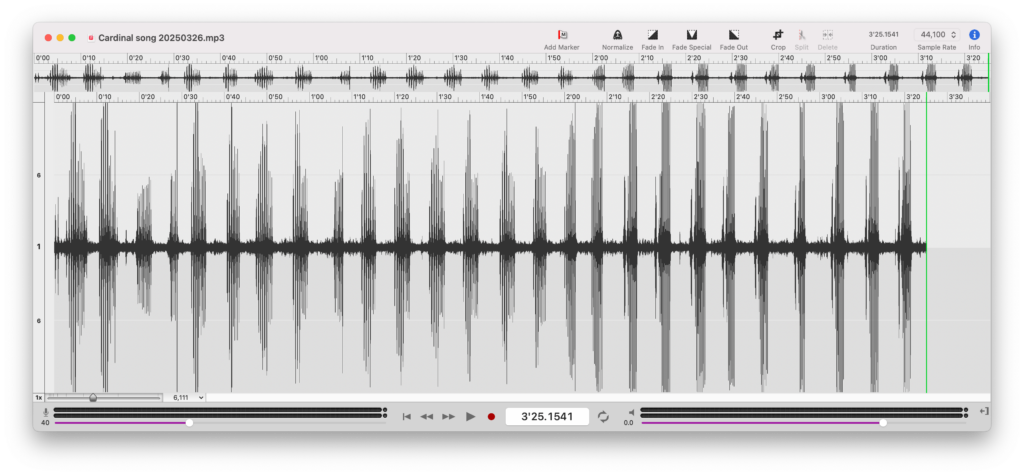
a bird — but not a cardinal — calling out the same note in quick succession, maybe 15 or so times
soft purple flowers on the edge of the trail — not Siberian squill
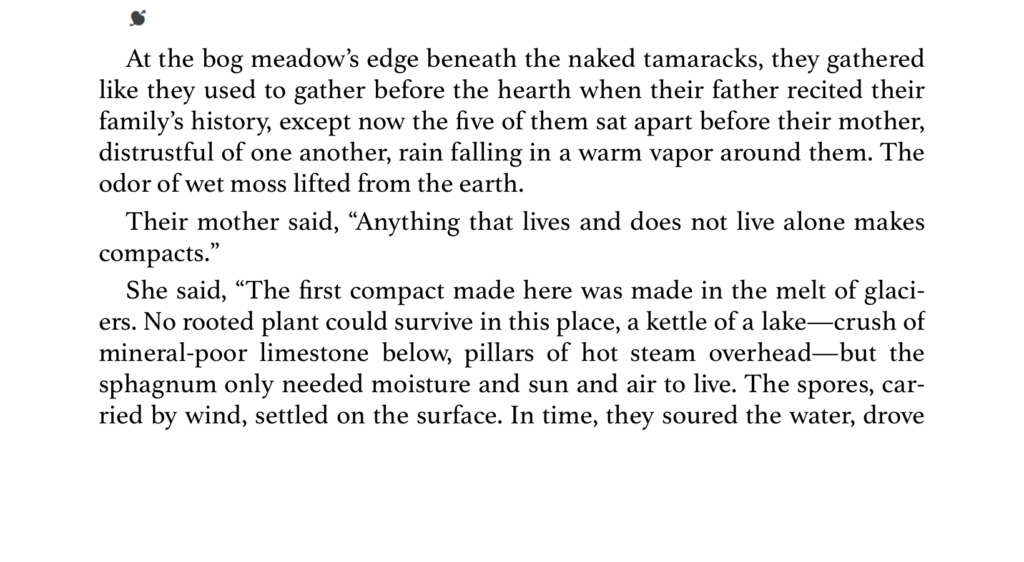
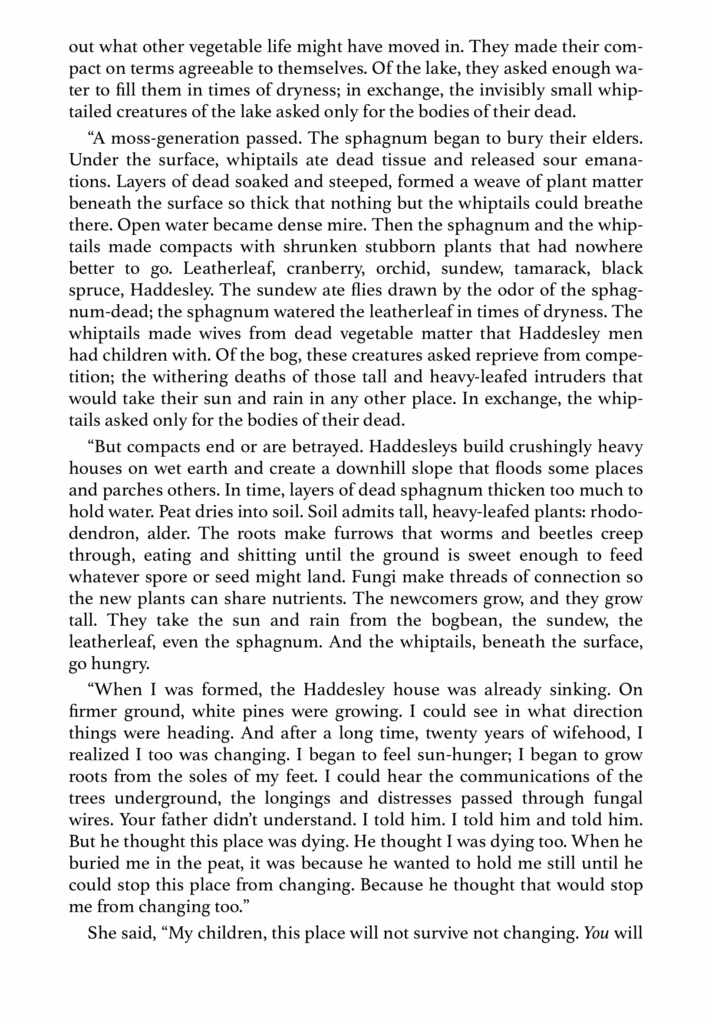
The Bog Wife
Down to the wire. I had to finish this wonderful book by the end of the day before it was automatically returned. I did it! What a wonderful ending, and so fitting for my thinking about entanglement. A beautiful story about a history of compacts with the land.
compact: an agreement or covenant, to knit or draw together
50 minutes neighborhood / edmund / river road trail 64 degrees
Took a walk in the late morning with Scott and Delia. A few hours ago it rained, so everything is wet and green and gray. Puddles, mud, dripping leaves. Scott talked about irritating AI generated images on facebook and how he hardly ever notices the trees. I talked about orange and my back and pointed out interesting looking oaks. When I pointed out a gnarled, leafless one, Scott said, now that tree is a hot mess! I also mentioned D.H. Lawrence’s poem, “The Enkindled Spring,” and the idea of green spreading like a fire all over the forest. We saw tulips and explosions of green and several trees growing closely beside each other — expressions of intimacy (Scott described them as intimate). Intimacy is a key topic in the conversation between Forrest Gander and Anne Pringle that I mention below.
We heard a woodpecker laughing in the gorge and some robins encouraging us to cheer up! cheer up! in the neighborhood. On the river road trail, Scott suggested that it smelled very porky. A fire perhaps? I sang, or tried to sing, the Woody Woodpecker Show and Friendship from Anything Goes, which irritated Scott. Don’t get those dumb songs in my head!
My back didn’t hurt, but it felt tight. I need to relax.
before the walk/bike
Orange! The poem of the day at poets.org is a fabulous poem about orange!
If I have a gender, let it be a history learned from orange Freak Sun Sucker Queer Orange Boy
Rumor of 6th grade sunrise, dressed in you I was a child of unspeakable obsession. Archaic language, Giolureade
Until Margaret Tudor, Queen of Scots. Her lips unlocked your sarcenet line, my fingers knew taste before the orange The earliest known use of orange as a colour name in English was in 1502, in a description of an item of Margaret Tudor’s clothing. By the 17th Century, the fruit and its colour were familiar enough for ‘orange-coloured’ become ‘orange’ as an adjective. Sarcenet line: thin, soft lining often in bright colors and used in elaborate dresses
Dared on Norwood apartments, Dutch colonies hunted man straight into your family crests of orange the color, Dutch Orange
Scraped from dust to crown our bruises, warriors we stared directly into the sun, Tainos dyed in orange
As if we always knew we were history. Amber hardened into gold tricking mortals, mortals tricking gods asking Was it the fruit or the color?
First, Tibbets’ grove, millions of fruits grafted instead of born, from two parent orange trees
The key to a philosopher’s stone: Colormen flirting with volcanos to retrieve your arsenic orpiment
Forever in danger of sliding into another color, I ran after you, tracing rivers and creeks and streams of citrus
The Washington Navel Orange, a second fruit protruding: not a twin, nor translation, but a new name every season.
Wow, this poem! I love how the poet weaves in interesting facts about orange. I started looking some of them up, but I don’t have time to finish right now.
The risk of severe weather in the late afternoon and early evening — tornadoes, strong thunderstorms, high winds. Hopefully nothing will happen.
Yesterday afternoon while leaning down to take off my compression sock, something suddenly hurt — OUCH! Was it a pop or a slide or a snap? I’m not sure. All I know is that after it happened, my leg/back hurt and it was difficult to find a position that wasn’t uncomfortable. I think the pain started in/near my piriformis. Within an hour, it was slightly better. I was worried that I would have trouble sleeping, but it was fine. Now today, everything is back to how it has been for the past 2 months — manageable and occasional pain and stiffness. I checked this log and the first time I mentioned back pain was on 25 feb. About 2 months. If it is my piriformis, which I think it is, it looks like (according to several sources online) that I can run as long as it isn’t painful. Thought about running today, but I think I should stick with my original plan to not run again until May.
motion/movement
Reading my 28 april post from 2021, I came across this:
Mary Oliver’s ethical poetics of noticing, being astonished, and telling others about it involves a lot of standing back and still, staring, stopping, taking notes, sitting at a desk and writing. Yes, becoming connected or immersed in what you are noticing does happen, but the emphasis is on observing/seeing/staring at the world at some sort of distance and when you have stopped moving or doing anything. You stop to notice, or notice then stop, observe or behold (this makes me want to revisit Ross Gay and the idea of beholding), then sit and write. What if you didn’t stop? What if you observed while moving (while running?) Took notes while moving? Wrote while moving? I wonder how far I can push at the limits of writing about the gorge while running at the gorge–not running and noticing then writing, but running while noticing while writing.
A sudden thought: for May as I read more of CA Conrad, I want to create rituals that involve writing while moving/moving while writing. I’d also like to play around with the word/idea/feeling of still — yet, motionless, still life paintings. And I want to explore different ways motion/movement matter: movement in poetry — associations, rhythms, movement in diagnosing injuries, motion = energy, restlessness, the color of motion — not green (like Carl Phillips suggests in a poem) but silver.
Speaking of silver, 2 lines came up in the 28 april 2021 entry: ED’s too silver for a seam and MO’s gathering up the loose silver.
Getting back to MO’s practice/ethics of noticing:
But nothing you ever understand will be sweeter, or more binding, than this deep affinity between your eyes and the world.
So I’m thinking about this in relation to my quote about the difference between looking and listening at the beginning of this post, and in terms of my own desire to feel with senses other than sight, or with sight not as Sight (as an objective, unfiltered way of being in and with the world). This idea of sight not as Sight, comes out of my thinking about how I see through my damaged eyes. I can see, but not with sharp focus or precision or mastery–I don’t look and See, as in, capture/own what I see with my eyes. My seeing is softer and involves more fluid waves and forms being felt. Returning to MO’s poem, I could definitely be delighted by the terns as I watched them moving—sweeping and plunging and thickening–because you detect motion in your peripheral vision and my peripheral vision is great. But I probably couldn’t see how many terns there are or how their thin beaks snapped. And I wouldn’t be able to see their hard eyes happy as little nails. But, seriously, can anyone see bird eyes in this way, other than MO?
28 april 2021
This discussion of sensing beyond vision, reminds me of something I heard yesterday while listening to an interview with the poet Forrest Gander and the mycologist Anne Pringle:
At 18:30, Pringle says:
I think a lot about humans being visual creatures. We study with our eyes almost as much as — almost more in a way — than with any other sense. But fungi, for example mushrooms, don’t see each other. I know that will be a shock and a revelation to your audience. So I’m constantly thinking about interpreting Visual Evidence and what it means to use your eyes to study something that doesn’t see.
What does it mean to use your eyes to study something that doesn’t see?
In my 28 april 2023 entry, I read about A.R. Ammons and his book garbage. And now I want to read it again and think about it in relation to motion. Here’s a recap I wrote using Ammons’ own words:
Energy and motion. The spindle of energy, motion as spirit, all forms translated into energy: value systems, physical systems, artistic systems, from the heavy (stone) to the light (wind) and back again. Loops, returns, the constant recycling of stone to wind to stone, waste into something new then returning to waste, using words to find a moment of the eternal, losing it again, the words becoming waste to break down and rebuild. Always motion, flow, decomposing, returning. Always behind it all, the relief of indifferent stars: twinkle, twinkle: just a wonder. And old people dying, bodies falling apart, individual existence ending. All of it happening, whether we believe in or not. All of us motion: a whirlwind becoming gross body, all navel and nipple and knee, then vaporized, refined, distilled into a place not meaning yet or never to mean.
Began watching a documentary about an upcoming 250 mile ultra running race. The doc = The Chase, the race = Cocodona in Arizona. Wow, that’s a lot of miles, and a lot of hallucinations!
The biking didn’t bother my legs or back.
I’m not watching The Residence while I bike anymore because Scott and I are watching it together. It’s helpful to watch it with Scott because he picks up on things I can’t see and/or the person doing the audio description doesn’t mention, like that Jane Curtain is playing the alcoholic mother-in-law (I couldn’t recognize her) and Bronson Pinchot is the pastry chef.
It’s beautiful out there today, but I think it’s too crowded on the trails for me to bike outside with my failing vision. Plus, I didn’t want to miss the live coverage of Ironman Texas, so I biked in the basement while I watched it. It felt good to move my legs, which were restless from less activity. No pain while I biked, only a slightly stiff left knee 20 minutes in.
Before I biked, some pain in my lower glutes/upper hamstrings — a dull ache? Not sharp, but constant, a little uncomfortable.
injury spells
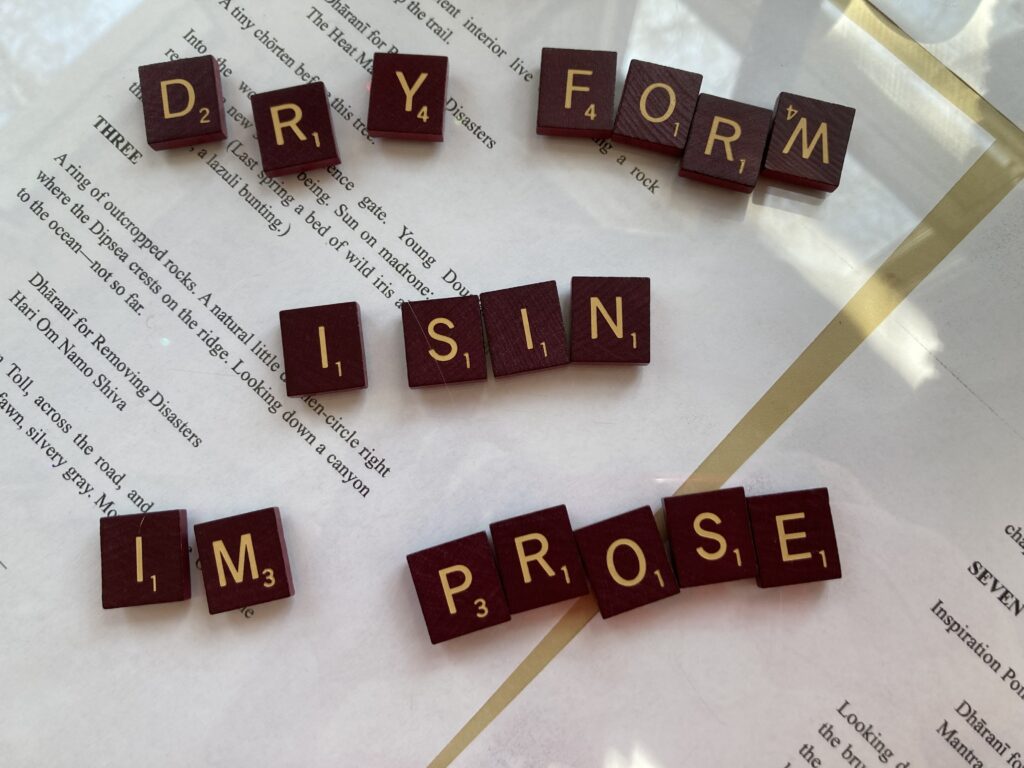
Yesterday I found the scrabble tiles for P I R I F O R M I S S Y N D R O M Eand put them on my table. This morning I worked on them some more, trying to find a way to use all the tiles to make a phrase. The idea is that once I do, I will have a spell to break open or through my latest injury. Here are some of attempts:
Do I personify? [MMIRRS]
Miss Fiery Moon Drip [R]
Or is my form inspired? — all tiles used!
O sir, my form inspired! — all tiles used!
I inform my spired rods — all tiles used!
Miss Merry Porfirio [DN] — porfirio = purple-clad person, surname in Spanish/Portuguese
Is my sniper mood fir? [R]
Sir, spin my fired room — all tiles used!
Rim mood: spiny fires [R]
I spy: red moon, fir rims — all tiles used!
I spy: fir moon, red rims OR I spy: fir’s moon, red rim
(dry form) I sin, I’m prose! — all tiles used!
I might like this last one the best.
yes, that is an upside down W. We’re missing an M.
On Thursday I FINALLY picked up CA Conrad’s Ecodeviance, which I requested on march 4 and was planning to use that month. In the book, Conrad is interested in making it impossible to not be present in place by performing rituals that access the “extreme present.” A quick, perhaps half-baked, thought about Conrad’s soma(tic) rituals: from the ones I’ve read so far, a key element seems to be making other people uncomfortable.
Example: (Conrad riding an elevator repeatedly) “At the top and bottom of each ride I would show photographs of myself to strangers and ask, “EXCUSE ME, have you seen this person?”
I laughed out loud when I read this, but I also wondered about other ways of accessing the extreme present were possible that didn’t involve confronting strangers.
Conrad performs these rituals for days/weeks and take notes. From the notes, they write poems. A line from one reminded me of a delightful image from Mary Oliver that I read yesterday:
Six/ CA Conrad
a golden needle stitches my head to my knee leaving me aching along the river
from The Book of Time/ Mary Oliver
those silver sheets, with the occasional golden staple,
A great afternoon walk with Delia the dog. Sometimes there was sun, but mostly it was cloudy and overcast. Some wind. Bright green everywhere, even on the felled trees in the floodplain forest. Heard lots of singing birds, people talking, a sharp clanging noise. When it was sunny, I admired the soft shadows of tree limbs and Delia’s stubby legs and long body.
10 Things
creeeaakkk — the tall trees in the floodplain forest were swaying in the wind and some branches were rubbing together to make a soft (and sinister) creaking noise
the top step of the stone steps had a big puddle of water — watch out!
stopping to wait for a trail runner to pass before heading back up the steps. They looked too warm and had a sweatshirt wrapped around their waist
the soft lapping of the water against a log on the edge of the shore
someone in a bright orange jacket following behind, talking to someone on a phone
the sky above the forest was more open than usual, the ground more cluttered with tree trunks
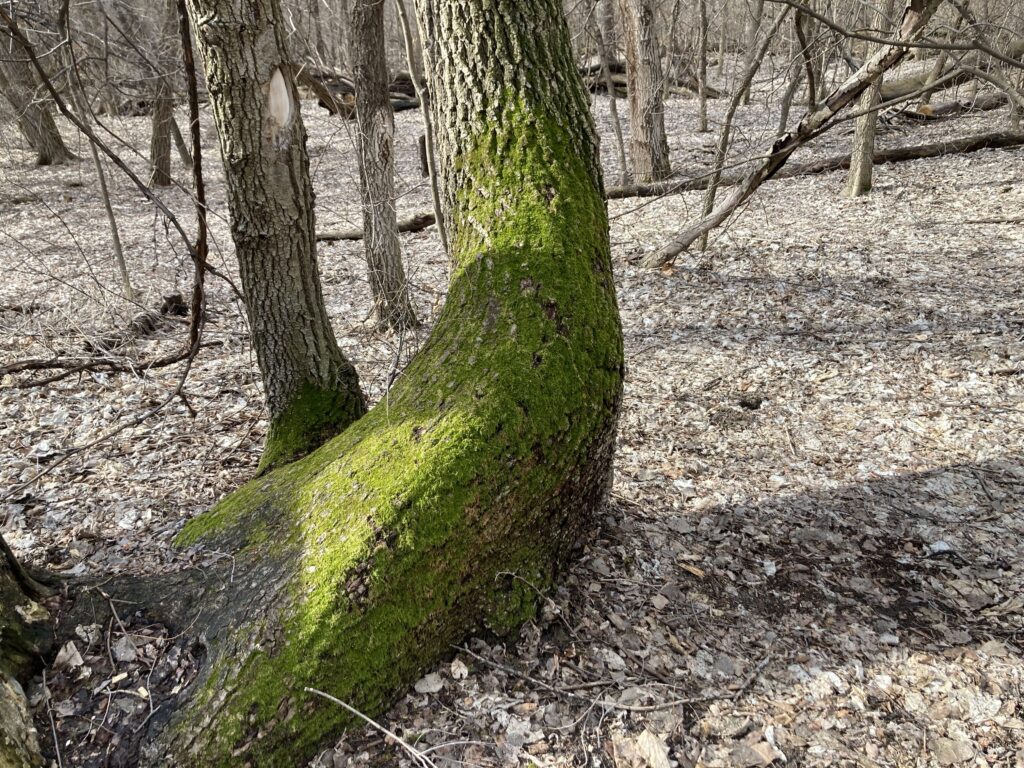
the gentle curve of a tree trunk, almost like an arched back
a loud splash in the water, then a flash of movement — a fish jumping out of the water?
a retaining wall in the oak savanna, across the ravine, was painted bright colors — blue, yellow, red
someone on a scooter, someone else on a bike, both masked and on the walking trail
before the walk
Woke up stiff and sore, which I’ve been doing for the past month. Most of me is okay, only my lower glutes and hips and hamstrings hurt, especially when I leaned down to throw something away in the organics. Ouch! After a few minutes, it should get better. Is it worse this morning because of yesterday’s biking? I don’t think so.
Other things I woke up to:
a thought: I have to wheel the recycling bin down before the truck comes!
a rejection: “After careful consideration, we decided this submission is not the right fit for us”
green green green grass from all the rain yesterday and early this morning
Rejections are not fun. Even though I know how difficult it is to get something published — less than 5% acceptance rate + your poem needs to fit with the others already selected — it still stings. But only for a few minutes. Now I’m thinking about grass and spring and noisy birds outside my window — the torpedoed call of a cardinal. I wish I would have counted their repeated chirps — 10 or 12 or more in a row!
A video came up on YouTube about piriformis syndrome, which I may or may not have, but probably don’t because it’s very rare — 6% chance: Piriformis Syndrome — STOP Stretching. I checked it out, and I’m willing to try the 2 exercises it suggests for contracting/strengthening my piriformis muscle instead of stretching/lengthening it. Will it work? I’m not sure, but I don’t think it will hurt to do them as I wait for my far off doctor appointment.
I’ve come a long way in my reactions to injury over the years. I’m not freaking out or in despair, even though I haven’t been able to run for 10 days. The pain isn’t making me anxious, like it did last year with my calf. I’m sure my more relaxed attitude is partly due to more experience with injury, less fear over tight glutes than knots in calves, and the lexapro. Whatever it is, I’m grateful to not be in constant panic mode.
So, is it piriformis syndrome? Who knows. What else could it be? Time to get out the scrabble tiles and make some anagrams!
P I R I F O R M I S S Y N D R O M Eis tough one —
In moss drip form (not used: I R E Y)
Permission from Id (not used: Y R)
Osprey mind forms (not used: R I I)
Spry of mind, I rise (M O R)
after the walk
I’m continuing to read Robin Wall Kimmerer’s The Serviceberry. I think I might need to buy it. The part I’m currently reading is about ecological economics.
We’ve created a system such that we self-identify as consumers first before understanding ourselves as ecosystem citizens. In ecological economics, the focus is on creating an economy that provides for a just and sustaianable future in which both human life and nonhuman life can flourish.
The Serviceberry/ RWK
competition is not the primary force regulating evolutionary success
competition only makes sense when we consider the unit of evolution to be the individual. When the focus shifts to the level of a group. cooperation is a better modle not only for surviving but for thriving.
since competition reduces the carrying capacity for all concerned, natural selection favors those who can avoid competition. Oftentimes this avoidance is achieved by shifting one’s needs away from whatever is in short supply, as though evolution were suggestion “If there’s not enough of what you want, then want something else.”
A little cooler today, but not cold. Overcast, with rain coming. I could have brought my bike up and gone for a ride outside, but I wanted to watch more of The Residence, and my hip was hurting a little so I thought it would be hard to carry my bike up the stairs. I had a good ride. Hardly any pain — only the regular kind for less than a minute in my left knee. I finished episode 2 and started episode 3. Realized halfway through that the titles of the episodes (I had hardly noticed them before) mean something. Episode 3 Knives Out. Does it go deeper than the fact that this episode is about the pastry chef and the bloody knife? I need to watch the rest of the episode. And I need to convince Scott to watch this show. He will like it.
I pushed a little harder on the bike and got my heart rate up in the 130s for at least some time. I worked hard enough to sweat. Hooray! This is my first time sweating from exercise in over a week — last Tuesday. I’ve missed it. If my body feels okay tonight, I’ll have to do more biking tomorrow. Maybe it would help me recover to get a little more exercise? Future Sara, let me know.
Before I biked, I archived some things I read this morning:
1
Entanglements, connections, understandings of self in relation to others — it keeps coming up. Today, I found it in the poem of the day on Poetry Foundation, Speakers/ Dimitri Reyes
About this Poem
This poem finds me in my early twenties, being mentored by an owner of a thrift store in Newark, New Jersey, who became a father figure to my wife and me. Pete was the first Puerto Rican elder I knew who showed me that you can be connected to Ricanness while shuffling setlists between Metallica, Ozomatli, John Coltrane, and Joe Bataan; who showed me that it was cool to enjoy art and philosophize for the sake of dreaming. He is no longer here with us, but I am still philosophizing and dreaming. Currently, I am intrigued by how character sketches teach us how to live, to survive, to love. If life and time are indeed our teachers, the interactions we have among one another are the ever-changing curriculum.
I have been playing around with the idea of creating a curriculum for my experiences with poetry. I guess that is what my How to Be project is. It might be fun to work on it a little more, to fit in the form of a curriculum with syllabi, learning outcomes, etc.
2
I’m in the process of memorizing Emily Dickinson’s wonderful poem, “The Mushroom is the Elf of the Plants.” I’m looking at it on Poetry Foundation. At the bottom of the page, I read this:
Dickinson technically misuses the apostrophe in the poem “A Route of Evanescence, (1489)” and makes similar errors in other poems. Some of these can be explained as unintentional errors and some scholars have made this case. Other scholars, however, contend that Dickinson often intentionally played with typos and other errors as a sort of linguistic mischief-making in her poems and in her considerable correspondence.
The error ED makes is using it’s when she should have used its. This is a huge pet peeve of Scott’s. Just as I was reading this passage, he came downstairs, so I explained the note and paraphrased the key part for him: she’s fucking with you! Ha Ha. I love Emily Dickinson.
3
I was disappointed to check and find that I hadn’t written about mushrooms and entanglement on april 24, 2022. But then I was grateful to find that I had posted a beautiful Mary Oliver poem on april 24, 2021. Thanks past Sara and Mary Oliver! That ending!
Listen, everyone has a chance. Is it spring, is it morning? Are there trees near you, and does your own soul need comforting? Quick, then—open the door and fly on your heavy feet; the song may already be drifting away.
And here’s a moment of connection and community:
first, I stood still and thought of nothing. Then I began to listen. Then I was filled with gladness— and that’s when it happened, when I seemed to float, to be myself, a wing or a tree— and I began to understand what the bird was saying, and the sands in the glass stopped for a pure white moment while gravity sprinkled upward like rain, rising, and in fact became difficult to tell just what it was that was singing— not a single thrush, but himself, and all his brothers, and also the trees around them, as well as the gliding, long-tailed clouds in the perfectly blue sky—all, all of them were singing. And, of course, so it seemed, so was I.
4
Yesterday I started reading Robin Wall Kimmerer’s The Serviceberry. Today I encountered her offering of a definition of economics outside of the scarcity model and within an understanding of gifts and abundance:
Economics is “the study of scarcity, the study of how people use resources and respond to incentives.” (the American Economic Association)
With scarcity as the main principle, the mindset that follows is based on commodification of goods and services.
Economics is “how we organize ourselves to sustain life and enhance its quality. It’s a way of considering how we provide for ourselves” (from the U.S. Society for ecological Economics).
The currency in a gift economy is relationship, which is expressed as gratitude, as interdependence and the ongoing cycles of reciprocity. A gift economy nurtures the community bonds that enhance mutual well-being; the economic unit is “we” rather than “I,” as all flourishing is mutual.
Even better than yesterday! What a wonderful late morning. Delia and I walked to the Winchell trail, then up to the mesa in the oak savanna. More winchell until the folwell bench, then across the road through the 1960s neighborhood and into the community garden. So many birds! Lots of green and white flowers too, blooming all over the hillside in the oak savanna. I found out what these white blossoms were called a few years ago, but I can’t remember — maybe it’s one of these?
10 Things
a steady dripping down in the ravine
2 dark holes — caves in the rock
more of the chainlink fence is ripped away from the posts
yesterday I noticed ugly red graffiti on the 38th street steps. Was it still there today? I forgot to check, but surely I would have noticed, right?
less mud, more dirt
sometimes sunny, sometimes overcast / sometimes blue, sometimes light brown
in a wood near the community garden: 2 (or more?) birds making a racket up in a tree, sounding like the drum at the beginning of Van Halen’s “Hot for Teacher” — nice!
the river: patches of smooth water, patches of rougher water — not from wind, but from sandbars?
calm, still, the water was barely moving — only after staring at it for a moment could I see a slight shimmer out of the corner of my eye
a woman in bright pink, sitting near the 38th street steps, silent except for the repeated clearing of her throat
before the run
Reading through my entries from april of 2022, I’m returning to thoughts of entanglement and mushrooms and precarity and ruins. Here is today’s inspiration from 23 april 2022:
a different sort of We, not a me or an I, but a we, an us
a different way of looking/sensing/becoming aware: not seeing straight on, but feeling, looking across and to the side, down, beneath and below
stop looking up to the heavens, start feeling/sensing what’s below
a hope that is not predicated on evidence, when evidence = seeing and Knowing and fully understanding (seeing things as parts or discrete categories or individual things)
entangled is not separate or pure but messy and enmeshed
this is why we are all here — from my haibun and what I heard coming out of the little old lady’s phone
this why we all here
why = curiosity, wonder
The why is not an explanation — this is why/this is THE reason — but an invitation to imagine differently, expansively, wildly.
we all = ecosystems, organisms, networks, asemblages
Organisms are ecosystems. I find myself surrounded by patchiness, that is, a mosaic of open-ended assemblages of entangled ways of life, with each further opening into a mosaic of temporal rhythms and spatial arcs (Tsing, 4) .
here = a place, located in history, a specific place, not transferable or easily translatable, can’t be scaled up or turned into assets
I picked up Mushrooms at the End of the World, and found this in the preface:
The time has come for new ways of telling stories beyond . . . Man and Nature . . , such stories might be simultaneously true and fabulous. How else can we account for the fact that anything is alive in the mess we have made?
The Mushrooms at the End of the World/ Anna Lowenhaupt Tsing (viii)
fabulous = resembling or suggesting a fable : of an incredible, astonishing, or exaggerated nature
invented and true
[about this book] what follows a riot of short chapters. I wanted them to be like the flashes of mushrooms that come up after a rain: an over-the-top bounty; a temptation to explore; an always too many.
explosion / too much, too many / after the rain eruptions of excess
This explosion bit reminded me of Arthur Sze in an interview with David Naiman:
I began to think I love this idea that the mycelium is below the surface. It’s like the subconscious, then when the mushroom fruits pops up above ground, maybe that’s like this spontaneous outpouring of a poem or whatever.
during the run
I thought about something else I read in the entry with this Sze passage. It’s a fragment of a poem I wrote in response to Sze and a few Mary Oliver lines:
Maybe like mushrooms, we rise or not rise, flare brief burst from below then return to swim in the dirt…
I was thinking about not wanting to swim in the dirt, but be out in the air, exposed, vulnerable to erosion and rust/ing.
after the run
In The Mushrooms at the End of the World, Tsing discusses how matsutake mushrooms develop their fungi networks in locations of ruin — edges of volcanos, forest destroyed by logging and lumber companies. So, there’s a relationship between the flare/the fruit (the mushroom) and decay/ruin/erosion. Now I’m thinking about my version of what the moment of ruin can produce, where the moment of ruin = ruined eyes. What poetry might burst forth as I reckon with my dying/dead cone cells?
Mushrooms came up in the fiction book I’m reading, too: The Bog Wife.
But when he returned to the bog, he found a row of trespassers sprouting where the swale met the hinged door to the Cranberry River. These trespassers retained their heads, and Percy knew as soon as he saw them that his suspicions were correct; they were mushrooms. His heart sank. He sometimes saw mushrooms in the sparse forest on the west end of the property, modest white-headed clumps strewn across the soil or fringed gray dishes sticking out like frills from the trunks of trees. But he had never seen any of their ilk here, where the soil was not mushroom soil because it was bog soil, a dense wet batter that supported only the shallow-rooted and perpetually thirsty.
They would never tolerate any of the mushrooms, Percy thought. The mushrooms had all been trespassers. He tore out the orange mushrooms and gathered up the torn stems for burning, but he knew it wouldn’t make a difference. Mushrooms could not be dug up. They could not be evicted.
The Bog Wife/ Kay Chronister
I’m reading Emily Dickinson’s “The Mushroom is the Elf of Plants” and refreshing my memorizing of Sylvia Plath’s “Mushrooms.” Nobody sees us, stops us — SP envisions mushrooms as trespassers.
And here are a few more passages from Mushrooms at the End of the World, that I want to archive:
a network of (mostly) invisible influences
Below the forest floor, fungal bodies extend themselves in nets and skein, binding roots and mineral soils, long before producing mushrooms. All books emerge from similarly hidden collaborations.
The Mushrooms at the End of the World/ ALT
a gift and a guide
The uncontrolled lives of mushrooms are a gift — and a guide — when the uncontrolled world we thought we had fails.
promise and ruin, promise and ruin
This is a story we need to know. Industrial transformation turned out to be a bubble of promise followed by lost livelihoods and damaged landscapes. And yet: such documents are not enough. If we end the story with decay, we abandon all hope—or turn our attention to other sites of promise and ruin, promise and ruin.
bike: 20 minutes basement
It was definitely nice enough to bike outside today, but I wanted to test out how riding a bike would feel on my back/hips/glutes for taking my bike off the stand and carrying upstairs. Plus I wanted to watch more of The Residence. Great show!
Almost 2 hours later, my back feels okay. We’ll see how it is when I want to go to sleep. If it’s okay, I might try biking outside tomorrow!
45 minutes winchell trail south / folwell bench 58 degrees
Wow wow wow! Spring. Little explosions of bright green everywhere — out of sidewalk cracks, under fences, on slender branches. I think explosion is the right word — not pops or flashes, well maybe flares. Almost overnight, green! Not yet annoying or oppressive; I still have my view of the gorge and the other side. I could see fuzzy details, branches, rippling water, houses, but what I felt was the horizons of gray (river), brown (shore/trees), and blue (sky). 3 distinct lines dividing my view into 3 colors.
Delia and I walked to the river then down the uneven wooden steps to the trail. We walked even slower than usual to let two walkers move past. One of them was talking about a friend (or a partner?): we’re both from the same town, and we went to the same school! I smiled and greeted a friendly runner, called out Hi Dave! to Dave. Delia jumped up and walked all of the walls on the trail. We ended at the folwell/the WWDD bench (see below) and sat for a moment, taking in the view.
10 Things
the air was hazed with humidity, making everything look even fuzzier, more distant
minneapolis park workers have cleared out old trees in the savanna, turned them into mulch that they put on the trail
the small rise up to the paved trail is more visible now — all dirt and dead leaves and stubs of tree trunks
the cave below the limestone ledge in the ravine seems to be expanding — how long is this process? how long before the ledge collapses?
mud on the part of winchell on the hill between the savanna and the 38th street steps
the repeated honk from a lone goose, below us. It always seemed the same distance from us. Was it following us, or taking a walk with us?
a loud, rhythmic clanging above us that I couldn’t quite place. A thought: was it someone banging on a fire hydrant to open it up? Near the end of my walk, I saw one open and gushing water
sitting at the folwell bench, overheard — an older walker to a younger one: we haven’t even gone 20 minutes yet
someone pushing a walker through the grass on the boulevard between edmund and the river road, stopping to check out each tree
the husk of some big trees leaning at awkward angles in the oak savanna
A wonderful walk! I felt relaxed and calm and grateful to be outside and moving (without pain) this morning.
before the run
Reading through my “on this day” entries from past april 22nd entries, I was inspired by Mary Oliver and a little old lady walking and listening to a radio and a bench dedicated to a woman who fell through the ice one winter and a fragment overheard on the little old lady’s radio — this is why we are all here — especially the this, which is echoed in Marie Howe’s poem, The Gate. Instead of trying to explain these connections–entanglements?– I’ll gather them here:
1 — the little old lady
For the third time, encountered the little old lady walking with her hiking poles listening to a radio show or an audio book or something. Today I heard, “which reminds us of why we are all here.” Decided that I should create a poem or some piece of writing around this phrase. This phrase could be the title or the ending line of the whole poem or a sentence or a refrain (5 aug 2019).
…the little old lady slowly shuffling by, swinging her hiking poles, a voice TED-talking out of her phone’s speaker reminding you that this is why we are all here. Do not bother the bench resting on the rim of the gorge to ask what this is (22 april 2022 — a draft of my poem).
note: reviewing these entries, I’m noticing how I changed what I heard from “reminds us why” to “this”. I’m almost prefer the original — the reminder, that doesn’t have to be the answer, just a pointing to it — a finger pointing! a definition of poetry!
2 — The Gate
from The Gate/ Marie Howe
This is what you have been waiting for, he used to say to me. And I’d say, What?
And he’d say, This—holding up my cheese and mustard sandwich.
And I’d say, What? And he’d say, This, sort of looking around.
3 — This is why we are all here
which reminds us why we are all here…
We are here. Me and joints and muscles and bones and ligaments and lungs. Us. me and blood and cells and electrolytes and sweat and saliva. we. me and hands and feet, a heart, two diseased eyes, a knee that displaces. we. me worn out running shoes, threadbare worries. we. me and those oak trees, that wrought iron fence, this rutted, dirt path, that short, steep hill. we. me river. that we are here with the old woman who slowly shuffles in her straw hat with her hiking poles and a voice that calls out from her radio speakers, “which reminds us why we are all here.” here. above the river and the gorge and the floodplain forest, below the bike path and the road, the cars and the boulevard. here. in this heat and humidity and haze. here. on a monday morning. here.
We are all here.
(from 22 april 2022)
4 — Mary Oliver
Reading MO, I’ve noticed, and have been trying to articulate, a tension in her poems between the I, the World, Nature, God, Eternity, Work. This tension seems to take many forms and MO imagines it to be endlessly intriguing and part of the process of living. Never to be resolved but to be puzzled over. One element of this tension involves the plight of the human—born to doubt and argue and question what it all means, to be both brought closer to and further away from the world by language and the power and beauty of words, which are never as powerful or beautiful as the world itself. To want a name and a useful place, to claim a life, but also to belong to the world, to be “less yourself than part of everything.”
(from 22 april 2021)
From The Book of Time in The Leaf and the Cloud
5. What is my name, o what is my name that I may offer it back to the beautiful world?
from “Gravel” in The Leaf and the Cloud
6. … It is our nature not only to see that the world is beautiful
but to stand in the dark, under the stars, or at noon, in the rainfall of light,
frenzied, wringing our hands,
half-mad, saying over and over:
what does it mean, that the world is beautiful— what does it mean?
5 — the words/reminder
from “Work” in The Leaf and the Cloud
3. Would it be better to sit in silence? To think everything, to feel everything, to say nothing?
This is the way of the orange gourd. This is the habit of the rock in the river, over which the water pours all night and all day. But the nature of man is not the nature of silence. Words are the thunders of the mind. Words are the refinement of the flesh. Words are the responses to the thousand curvaceous moments— we just manage it— sweet and electric, words flow from the brain and out the gate of the mouth.
We make books of them, out of hesitations and grammar. We are slow, and choosy. This is the world.
Words can help us to remember a beloved but long dead dog:
And now she’s nothing except for mornings when I take a handful of words and throw them into the air so that she dashes up again out of the darkness,
5 — the bench
I have run by this bench hundreds of times, stopped and sat once or twice, even wrote about it, but I’ve never noticed this small plaque on it. How did I see it today? I love these little surprises, just waiting to be found! I had no idea what this plaque meant — WWDD? I looked it up and found a facebook page for the Rachel Dow Memorial. Wow. She was loved by so many. I read a little about her life — a passionate, social justice minded, free-spirit — and her death — she fell through the ice at the river and died of hypothermia. Maybe I’ll write a poem about her and the others I’ve found through their plaques. All of them share with me a deep love for this river. And maybe one day, I’ll have a plaque there too (from 8 sept 2022).
So far the house still is standing. So far the hairline cracks wandering the plaster still debate, in Socratic unhurry, what constitutes a good life. An almost readable language. Like the radio heard while traveling in a foreign country— You know that something important has happened, but not what.
What to do with all of this? I’m not quite sure yet.
during the run
Occasionally, I thought about these ideas as I walked, and when I sat on the folwell bench. What did I think? I hardly remember. Once, I thought about how words were not the most important part, that being out there by the gorge, feeling everything was.
*43rd ave, north / 32nd street, east, past Minnehaha Academy / edmund, south / 34th street, west, past 7 oaks / home
Before taking a walk with Delia and Scott, I “watched” the Boston Marathon, where watching = tracking runners on the app, listening to the Citius Mag watching party, and watching the last 5 minutes of the women’s race on an unofficial YouTube feed. Wow, they were fast!
It looked warm and sunny, but it felt colder than 50. It was the wind, I think. For the first half we talked about kids and wanting to be empty-nesters and how to have hard conversations about the future and the series finale of The Americans — we finished it last night. In the second half, Scott pointed out a strange mash-up of a garage and I pointed out the Siberian Squill. I wondered if we were seeing it more now because we’ve named it, but we agreed that it has become more abundant in the past few years. There was a particularly impressive patch of it in the yard of the house on the south corner of edmund and 34th. Taking in the entire patch, it looked blue. Focusing on a flower, it looked purple.
10 Things
siberian squill, everywhere, including at the edge of our yard
a loud dog in a fenced-in backyard
an empty parking lot at minnehaha, no school for Easter
a metal sign at Cooper School, bent and leaning to the side
a security guard car parked in front of the gate to the field at minnehaha academy
the boulevard on the edge of the academy that used to have a small line of aspensmwith aspen eyes, now only has one aspen
a woman stapling a poster to a pole
mud on a boulevard — Delia, stay out of the mud! — a deep brown
the wind chimes chiming at the house with an Easter Island head on the front stoop
looking over at the river road and seeing/feeling the open space between the west and east banks
Back/hip/leg update: today it is a little uncomfortable to sit in the chair at my desk. Is that because I went down and up the old stone steps to the river?
Spring! Hello black capped chickadees! Hello drumming woodpeckers! Hello bikers and runners and walkers with dogs! Hello green shoots and damp earth and soft air! Water gently lapping the shore, echoing voices, ringing bells! Hips (hopefully) healing and backs growing stronger! A wonderful morning for a walk through the neighborhood and to the river.
I wasn’t willing to stop and stare, so I could be mistaken, but it looked like a woman was taking her dog on an easter egg hunt — with the dog searching for the eggs while the woman encouraged them. If that wasn’t what I saw, I will still believe it was. Is that a thing, people arranging egg hunts for their dogs? I hope so!
I’m continuing to work on crown of color sonnets. I’m on the final one, no. 7, blue. I want to link this sonnet back up with the first one, so I’m ending with green. I’m thinking of returning to the green poem I drew from a lot, Oread by H.D.. Something about the sky not being pure blue but a mix of blue and green, or sometimes just green — especially in the spring and summer when green takes over the gorge. I’m leaving these last few sentences in, but as I worked on it more, I decided to go in a different direction. I’m taking lines from a beautiful essay about a blue wall in Leadvilleand writing about my efforts to make blue meaningful even though I can’t always see it.
Walked with Scott and Delia the dog. My hips feel a little sore, but otherwise I’m okay. Not in pain, not stressed about taking a break from running. I know I need this break. Scott and I noticed more Siberian Squill, taking over. I admired the big turtle in someone’s front yard, Scott critiqued some out of place columns holding up a trellis-like porch at the front of a house. He asked, how have I never noticed these columns before? My response: Really? These columns are the defining characteristic of this block for me. Scott wondered if a robin, standing still in a yard, was dead. Nope, we saw it move its head. I pointed out a house that was very big. The wind was coming at us from almost every direction — not quite stiff, but irritating. Even with the chilled air, it felt like spring was here to stay. Hooray!
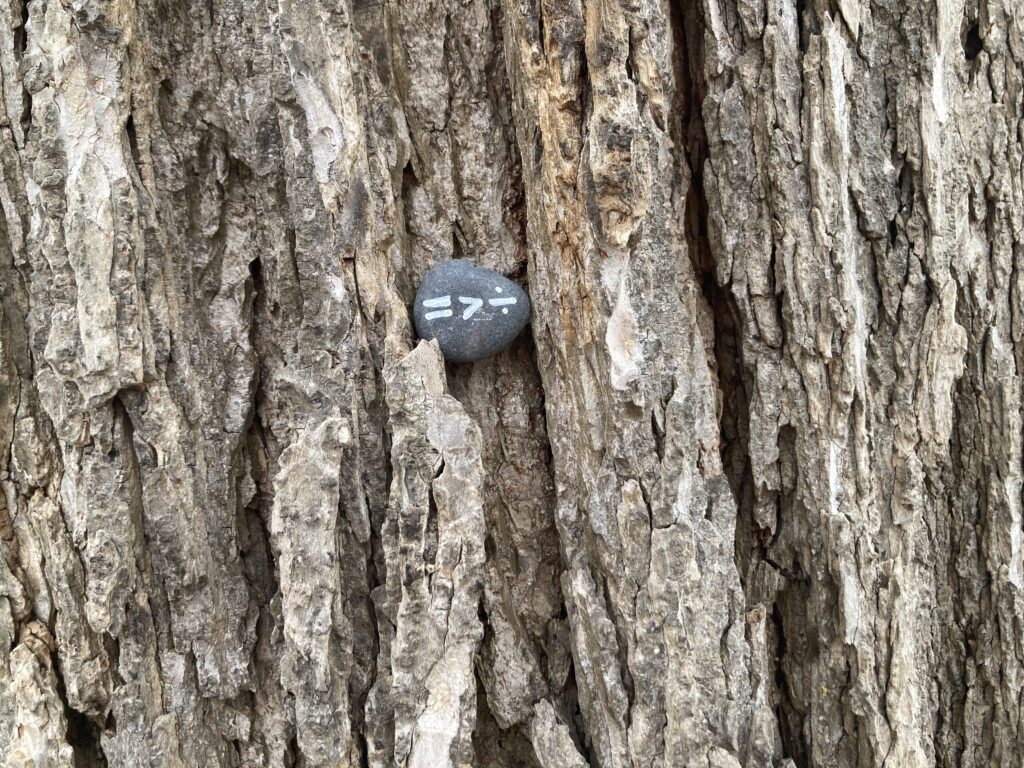
Went on a walk with Delia and FWA. He’s home for Easter weekend. We talked about the show Russian Doll and the 4th dimension and the limits of language and how it shifts meanings and experiences of the world. FWA wondered what it might feel like to experience the world outside of language and I talked about my work on this log and with poetry, particularly soft attention and my 10 things practice. I mentioned Mary Oliver’s poem “The Real Prayers Are Not the Words but the Attention that Comes First.” I pointed out the small stone embedded in a tree that reads, = > ÷.
Years ago, I remember feeling disconnected from FWA, not knowing how to talk with him, wondering why he was so distant. A deep sadness. I couldn’t have imagined (or hoped for) our wonderful, wandering conversation this afternoon. Not the same, but an echo of the ones I used to have with my mom.
It was not raining. Things felt open and possible, not closed and finished. Everything almost opposite of Bert Meyers’ poem, “Rainy Day.” Even so, I’ll post it here for later:
Walked with Delia through the neighborhood. Since I’m writing this a few days later, I don’t remember much, only the broad swatch of Siberian Squill in a front yard at the northwest corner of 46th avenue and 34th street. Bunches of little flowers peeking out from a big boulder, covering a small swell of grass, hiding behind a fir tree. When I glanced at one flower, it looked light purple, but when I took them all in at once, they were blue. A strange sight to see the color switch from purple to blue, purple to blue, as I shifted my gaze.
Woke up this morning unable to bend down to put on socks. I’ve been having a mild version of this problem for a few weeks, but today it was worse. Time to shut it down for a while. I scheduled an appointment with the doctor. First available: June 12th. Oh well, I’m on the wait list, and I feel like there’s a good chance this problem will get better on its own — iff (if and only if), I take a proper break. No running for at least a week. No biking either. The problem has been in my upper glutes/lower back, today I felt pain all down my leg to my calf. It’s worse in the morning, after not moving for most of the night. I can stand and walk but bending down in a certain way hurts too much. I am not bothered by this injury. Of course, I’d like to be running and biking, but it’s okay. The uncertainty is gone — am I injured or not? I know I am and that I need to take a break.
Thankfully, I can still walk! Went with Delia and Scott. Beautiful — blue sky, birds, and the feeling that spring is here. Oh — and little purple flowers. Scott looked them up: siberian squill. According to the Minnesota Wildflower site, they’re not purple, but blue, and invasive. Originally from Russia, these colorful flowers are hearty and take over gardens. Not even critters want to touch them. Unfortunately, some gardeners continue to plant them. At the bottom of the entry, in bold, is:
Please, all you gardeners out there: stop planting this.
The site recommends planting native species, like phlox or bluebells. Before Scott identified them with his app, I had guessed that they might be phlox.
Wow, I just read the comments and discovered a fight — on a wildflower site? I’m not sure I agree with Sandy, but I enjoyed her spirited comment.
Petyr: It is as bad if not worse than garlic mustard – you can’t even pull this crap.
Which gardeners are now willing to stand up and take responsibility, or is this just another “so sorry”? Gardeners, this is stupid… mindless… enough!
Sandy: Finally, after 40 years of living in the same house, I have identified the little blue flowers that blossom with the snow on the ground. Early Siberian Squill. They grow wild along the front of my house. I find them to be quite beautiful. I find nothing offensive about them. A whole lot prettier than dandilions, which I wish were gone, gone, gone. So all you gardeners out there, bite me. My Squill will be left in peace, while I continue to fight a war on the big ‘D’.
Windy this morning and warmer than I thought it would be. I was overdressed in a short-sleeved shirt, a hooded pull-over, and short running tights. I continue to feel sore, so I wondered if I should run. Luckily. my back and glutes didn’t hurt when I was running. In fact, they felt better, like the movement was loosening them up. There were lots of shadows on the trail — from me, trees, the fence. I’m thinking about indigo today so I briefly wondered if I’d call the darker shadows indigo. Nope, they weren’t dark enough. The sun made the river sparkle as I looked to the south. Wow!
Encounter: a woman with her dog on the narrow winchell trail. As I ran by she called out, Look out for his poop! I couldn’t see it, but I leaped and hoped for the best. Success!
Anything else? Someone was sitting on the bench at the Horace W.S. Cleveland overlook. A street cleaning truck was clearing out leaves and making a ruckus across the road. The wind has strong and in my face as I ran north, and even stronger as I ran west.
before the run
Today I’m thinking about indigo. In the entry for indigo in The Secret Lives of Color, I read about indigo dye and the plants that are used to create indigo (including woad) and the process of soaking it in alkaline and drying it and collecting the powdery residue and forming it into blocks to be sent off to market. I think some part of this line might make it into my poem:
changes color upon coming into contact with the air, turning from yellowish green to sea green before settling on a deep, stolid blue.
The Secret Lives of Color/ Kassia St. Clair (190)
stolid: calm, dependable, and showing little or not emotion
Later googling “indigo,” I encountered the indigo bunting. Of course!
“Like all other blue birds, Indigo Buntings lack blue pigment. Their jewel-like color comes instead from microscopic structures in the feathers that refract and reflect blue light, much like the airborne particles that cause the sky to look blue” (All About Birds).
“Indigo Buntings migrate at night, using the stars for guidance. Researchers demonstrated this process in the late 1960s by studying captive Indigo Buntings in a planetarium and then under the natural night sky. The birds possess an internal clock that enables them to continually adjust their angle of orientation to a star—even as that star moves through the night sky” (All About Birds).
Knowing names correctly is everything; it’s a key to connection and tenderness and a turn to kindness. When you get to learn about an animal or plant, get to know their names, when you learn that there are birds out there who read the stars to fly home at night (indigo buntings), and how wondrous and lovely that is — maybe it might become harder to want to use a product that clogs up the sky with smog so these birds can’t see the stars?
Found a PBS documentary on jeans, Riveted: The History of Jeans. I watched it online through my local library. Some things to remember:
“In Africa, the indigo cloth is considered the next layer to the skin. It holds a person’s soul, their spirit.”
many African captives who were enslaved in the new world brought with them the knowledge of making indigo dye and how to fix it to fabric. “Indigo is one of the ways in which slave holding became tied to the economic fortunes of the colonial experiment.”
indigo was the second biggest cash crop behind rice in South Carolina (1770s)
Now I’m reading the chapter on indigo in On Color. Before Isaac Newton decided it was a color in the 1670s, it was only a dye.
But if colors, at least for humans, are the particular visual experiences triggered by the detection of electromagnetic waves between about 390 and 700 nanometers, there are no new colors to be seen, only new colors to be named. Any new color is just a thinner segment than has previously been recognized of an infinitely divisible continuum. It isn’t new; it was always there. So why not indigo?
On Color
Finally, I found a blue poem with some useful lines that I might read as indigo:
Blue is the blue of distance, “the ink that I use is the blue blood of the swan” (Cocteau), of the sea, of the faraway, a discriminating blue, of your eyes, of memory, the blue of baby boys, of glaciers, of a last light, the great blue chord of a nocturnal symphony, of being cold, of shallow holes, of tender bruises, the gathered blue of my mother’s laughter, of once in a moon, of mountains, of blueprints, of the hottest fire, of silence, of nostalgia, of herons, of dreams, lakes, and skies, of reading The Holy Book, the blue-black of my grandfather’s hair and Hayden’s cold mornings, of the horizon, blue taste of summer, off-blue of concentric waves, of elsewhere, “this blue that opened the way to you” (Bennis), of feeling, of late nights, of blues notes, of edges, of memories of your eyes, of piercing, of the afterimages of Lorca’s words, of stones and storms, blue like thought, like time, the past and present blended together, blue tent of refugee camps, of veins, faded blue of childhood’s tongue, of cold lips, glacial blue of the Arctic nights, of God’s unfolding hand (C. D. Wright), of our pale dot, of the tepid pool water, of the elemental hue of the upper sky “that seems to retire from us” (Goethe), of the typical heavenly color (Kandinsky), blue turning deeper and deeper before going out.
Last night and this morning my glutes ached, so no running today. I did some more research and I think the exercises in this video might help. Future Sara will let us know!
a pain in the butt
Walked with Delia and Scott. Warmer today, windy too. My favorite sound: the wind rushing through a big pine tree. I noticed some dry leaves skittering in front of us as we walked east. Heard the St. Thomas bells and their extra long chimes at noon. Saw lots of runners and walkers and bikers. Scott talked about how farmers are getting screwed by the new tariffs, and I talked about Indigo. A few times my back ached — was it a spasm? Not sure.
indigo
For the past few days, I’ve been working on a crown of color sonnets, using the words of other writers (cento). The plan is to write 7 sonnets, with each one setting up the next with its color mentioned in the last line. I started with green, then went to orange, then yellow-red, then purple. I wasn’t sure what would come next — I thought it would probably be blue — but in the last line of the purple sonnet indigo appeared. I haven’t studied indigo that much, so before writing a sonnet about it, I’d like to spend some time with it.
Indigo began working its way into my sonnets a few days ago, when I attempted to list colors I’d seen on my run in using the ROYGBIV system. I couldn’t recall seeing anything indigo. Then yesterday, while looking for a passage by Oliver Sacks on yellow I encountered this description (which I read a few years ago, but had forgotten):
I had long wanted to see “true” indigo, and thought that drugs might be the way to do this. So one sunny Saturday in 1964, I developed a pharmacologic launchpad consisting of a base of amphetamine (for general arousal), LSD (for hallucinogenic intensity), and a touch of cannabis (for a little added delirium). About twenty minutes after taking this, I faced a white wall and exclaimed, “I want to see indigo now—now!” And then, as if thrown by a giant paintbrush, there appeared a huge, trembling, pear-shaped blob of the purest indigo. Luminous, numinous, it filled me with rapture: It was the color of heaven, the color, I thought, which Giotto had spent a lifetime trying to get but never achieved—never achieved, perhaps, because the color of heaven is not to be seen on earth. But it had existed once, I thought—it was the color of the Paleozoic sea, the color the ocean used to be. I leaned toward it in a sort of ecstasy. And then it suddenly disappeared, leaving me with an overwhelming sense of loss and sadness that it had been snatched away. But I consoled myself: Yes, indigo exists, and it can be conjured up in the brain. For months afterward, I searched for indigo. I turned over little stones and rocks near my house, looking for it. I examined specimens of azurite in the natural history museum—but even they were infinitely far from the color I had seen. And then, in 1965, when I had moved to New York, I went to a concert in the Egyptology gallery of the Metropolitan Museum of Art. In the first half, a Monteverdi piece was performed, and I was utterly transported. I had taken no drugs, but I felt a glorious river of music, four hundred years long, flowing from Monteverdi’s mind into my own. In this ecstatic mood, I wandered out during the intermission and looked at the ancient Egyptian objects on display—lapis lazuli amulets, jewelry, and so forth—and I was enchanted to see glints of indigo. I thought: Thank God, it really exists! During the second half of the concert, I got a bit bored and restless, but I consoled myself, knowing that I could go out and take a “sip” of indigo afterward. It would be there, waiting for me. But when I went out to look at the gallery after the concert was finished, I could see only blue and purple and mauve and puce—no indigo. That was nearly fifty years ago, and I have never seen indigo again.
His description of standing in front of blank wall reminded me of my mood rings experiment: facing a blank wall, staring at it, waiting for my blind spot to occur. I wonder, could I see indigo doing this (and without the drugs)?
I recall reading something about indigo and debates over whether or not it existed. I’ll have to look for that source.
At the time, because I was working on a yellow poem, I didn’t dwell on the indigo. But later that day, it returned in a Mary Oliver poem — I was looking for another orange poem:
Poppies/ Mary Oliver
The poppies send up their orange flares; swaying in the wind, their congregations are a levitation
of bright dust, of thin and lacy leaves. There isn’t a place in this world that doesn’t
sooner or later drown in the indigos of darkness, but now, for a while, the roughage
shines like a miracle as it floats above everything with its yellow hair. Of course nothing stops the cold,
black, curved blade from hooking forward— of course loss is the great lesson.
But also I say this: that light is an invitation to happiness, and that happiness
when it’s done right, is a kind of holiness, palpable and redemptive, Inside the bright fields,
touched by their rough and spongy gold, I am washed and washed in the river of earthly delight—
and what are you going to do— what can you do about it— deep, blue night?
A thought occurs to me in reading this — actually, a reminder: here in the city, on a street with street lights and security lights and light pollution of other kinds, a deep, blue night is impossible to see. And, ever since the family farm in the UP was sold in 2005, I rarely am in a place remote enough to lack light.
bike: 30 minutes basement
Finally had a chance to finish up the first episode of The Residence and start the second one. Wow, it’s good. One moment that I couldn’t quite figure out, even with the audio description: Cordelia Cup encounters the male chef sitting on the floor, against the wall and under a row of knives. He looks motionless and dead to me, but no one reacts and the audio description says his eyes followed Cordelia as she left the room. I watched again and still couldn’t tell. His eyes looked dead to me, but that happens a lot — that is, when I actually see someone’s eyes.
Took a late morning walk with Delia and Scott on an overcast day. The theme: critters! Birds and dogs and little kids. As Scott said, the stars of the show were the 2 very big eagles perched at the top of a tall tree on edmund. Some walkers across the road pointed them out to us. At first I couldn’t see them. Scott was describing where they were and I tried to spot them, but I couldn’t see anything, only the feeling that there was something there. Somewhere in my head an idea occurred to me as I scanned the branches — there’s a blob there — but it never turned into an actual thing I was seeing. And then, suddenly, it did. A dark form with a white head, perched on a branch. A few minutes later, I saw the other one too. Still, stoic, only shifting its wings once. Wow!
Other critters: the energetic voices of little kids on a preschool playground, a tiny giggle from a girl getting out of a car, the feebee of a black-capped chickadee, a dog I’ve encountered before that likes to plop down in the middle of the road and not move.
It was chilly — I wore my gloves — but it felt like spring. Spring! Scott talked about some problem he was having with his plug-in involving time codes and microsoft not recognizing standard ones and Helsinki and sisu. I talked about my latest experiment: a crown of sonnets compromised of other people’s words about color. They’re connected by the last line of the one poem mentioning the color of the next one. So far I’ve done green and orange and yellow-red. I’m set up to start purple. I’m thinking of doing blue and metallics or silver, and green-brown-gray. Not sure about that last one — maybe just brown, but ending with a green line to bring it full circle?
Today I wore shorts! I did a variation on the beat workout. Mile 1 = chanting triples / Mile 2 = metronome at 175 / Mile 3 = Playlist (Color). The variation was that I took a little longer between miles and I tried to get faster with each one. I felt faster and more locked into the beat, which was fun.
Right after I started the run, the tornado sirens went off. Hmm — it’s not Wednesday and it’s not the first week of the month, so what was happened? I asked a walker I encountered and she told me it was tornado prevention month. Of course!
10 Things
the river road was crowded with a steady stream of cars as I entered the path
a small tree beside the path, some of its tops were spray painted orange
a bike was hidden behind the feet of the lake street bridge
a man and a woman standing next to 2 overturned lime scooters — the man had his phone out, was he about to rent them?
a tree leaning heavily against the wooden fence above the ravine — how long until the tree falls or the fence breaks or the park workers fix it?
a runner ahead of me wearing white mid-calf socks, looking smooth and relaxed
the part of the road between the franklin and I-94 bridges is open again
I mistook the tree trunk with a burl at the height of a head for a person again
a heavy gray sky
road closed April 12th — what for? a race?
color
Today’s ROYGBIV:
Red — Taylor Swift’s song, “Red” Orange — my sweatshirt Yellow — another runner’s bright yellow shirt Green — the grass, a pale green Blue — a recycling trashcan along the route Indigo — ?, maybe the color of a car? Violet — the sky, the palest, slightest hint of violet
I’m reading more of the book, On Color. Here are some passages/ideas I’d like to archive from the introduction:
1
Color is an unavoidable part of our experience of the world, not least as it differentiates and organizes the physical space in which we live, allowing us to navigate it.
Often, this navigation is assumed, taken for granted, unspoken. It is not that I can’t see color; it is that I see it in unreliable ways. Sometimes it’s there, sometimes it isn’t. Sometimes green is brown, yellow pink. Red is gray. Orange makes an object invisible.
2
But for all color’s inescapability, we don’t know much about it. There is no comparably salient aspect of daily life that is so complicated and so poorly understood. We are not quite sure what it is. Or maybe it is better to say we are not quite sure where it is. It seems to be “there,” unmistakably a property of the things of the world that are colored. But no scientists believe this, even though they don’t always agree with one another about where (they think) it is.
Chemists tend to locate it in the microphysical properties of colored objects; physicists in the specific frequencies of electromagnetic energy that those objects reflect; physiologists in the photoreceptors of the eye that detect this energy; and neurobiologists in the neural processing of this information by the brain.
*
For artists, the precise scientific nature of color is more or less irrelevant. What matters is what color looks like (and also, and not to be underestimated, how much the paint costs).
3
Color vision must be universal. The human eye and brain work the same way for nearly all people as a property of their being human—determining that we all see blue. But the color lexicon, meaning not merely the particular words but also the specific chromatic spacethey are said to mark, clearly has been shaped by the particularities of culture. Since the spectrum of visible colors is a seamless continuum, where one color is thought to stop and another begin is arbitrary. The lexical discrimination of particular segments is conventional rather than natural. Physiology determines what we see; culture determines how we name, describe, and understand it. The sensation of color is physical; the perception of color is cultural.
4
Always with color, what we see is what we think is there.
A Crown of Sonnets?
A few days ago while working on my color sonnets I suddenly remembered that sonnet crowns existed. I wasn’t quite sure what one was, I just knew of them. Could this work for my color poems? I like the thought of it, but I’m not sure I can make it work — but I’ll try, at least!
7 sonnets linked through a structure: the last line of one poem is the first line of the next, and the last line of the final sonnet is the first line of the firsts sonnet. Tricky to not make it sound contrived. (see Learning the Sonnet)
Some variations — link with lines throughout but don’t make the last line of the last sonnet the first line of the first OR do the first/last line with 1 and 7, but not throughout.
Overcast, warm. I was overdressed in a short-sleeved shirt with a hooded pull-over. I tried a slightly new route today: south on the river road trail, up to Wabun park, over the ford bridge, along the river in st. paul, stopping at the ford overlook, then turning around. A harder run today. I felt tired and had to convince myself to keep running a few times. Recited the poem I re-memorized this morning as I ran — Still Life with Window and Fish/ Jorie Graham. Such an amazing poem!
10 Things
a brown leaf whirling in the wind then startling me as it landed in front of me
kids yelling on the playground, one voice sounded frantic at first, like the kid was hurt. As I listened longer, their voice sounded less pained and more playful
a tall runner with long legs loping (with a long, bounding stride) — not graceful but awkward, gawky
2 (or was it 3?) big birds with wide wingspans riding the thermals near the overlook — almost floating, smooth, slow, silent
reading the plaque describing the giant rusted paddle wheel on display at the overlook — from 1924, part of the hydroelectric power plant — the rust was deep red-brown and speckled with orange
a skateboarder heading to the empty skate park
crossing the ford bridge from west to east, noticing how steep and crumbling the slope at the edge of the bridge was — I wondered how soon this would need to be reinforced
the river was a deep and dark blue with small waves and no shadows
someone playing frisbee golf in wabun park — not seen, but heard: the clanging of the chain netting as it caught the frisbee
running above on the paved trail, noticing a man walking a dog below, feeling tall and fast as I passed them
Here’s a poem I found the other day. I love the idea of writing a thank you poem to a poet. Maybe I’ll do one?
After two days of running in a row, a break. Decided to bike in the basement and check out a show FWA recommended, The Residence. The detective is a birder, which is cool on its own, but she’s also black, which is even cooler because it raises the visibility of black birding (see J. Drew Lanham and “Birding While Black”). Thank goodness for the audio description — I like how it’s voiced by a black actor — because I would have missed so much of the show without it! I like the detective, Cordelia Cup. Her m.o. is attention and focus, filtering out distractions, but not shutting down possible evidence or suspects. Much of that attention is visible, but she also relies on hearing and touch and smell. I’m about 1/2 done with the episode. I like it, so I’ll keep watching.
walk: 45 minutes longfellow flats 44 degrees
A beautiful afternoon! Warm sun, low wind. Delia and I took the 15 worn wooden steps down to the winchell trail and walked along the chainlink fence. I noticed a few small slabs of asphalt and wondered how long ago this was paved. 10 years? Less, more? A flash of color in my peripheral: electric blue spray paint. Admired the soft oak tree shadows stretched across the paved trail. Heard, but couldn’t see, a woodpecker high in a tree. Passed 2 guys in bright orange shirts. Took the old stone steps down to the river. Looking across to the other side, I noticed a door carved into the bluff, only accessible by boat. On this side, I noticed the gentle lapping of the water over some big rocks.
The color of the day: brown. Everything, brown: dirt, tree trunks, branches, dead leaves, bluff, steps. I suppose I might consider some of it, especially the things lit my sunlight, as orange — deep orange.
Wore my new Brooks for the first time today. I need to adjust the laces at the top, but otherwise, they’re great. Hooray for past Sara for buying these shoes, and hooray for new shoes! Sunny and cooler today. Wind. I felt strong and relaxed, occasionally my back was tight.
10 Things
a flash of silver in the sky — a plane
a blue sky — cerulean — no clouds or birds
the river, 1: from the trestle on the west side: blue
the river, 2: from the franklin bridge: small waves, textured
the river, 3: from the lake street bridge: sparks of light moving fast, making my head buzz in disorientation and delight
the deep bellow of a train horn on the east side
the soft knocking of a woodpecker
a turkey on the trail — as I neared them, they flared their feathers then moved over
another turkey in the brush on the edge of the trail
the bridge railing casting a thick grid of shadows on the path
Listened to voices in the gorge below — high-pitched, a laughing kid or a startled animal? — and wind and water in the trees for most of the run. Put in my color playlist on the bridge. Went deep inside the beat as I listened to “Mr. Blue Sky.”
Tried to think about my orange poem — I’m a little stuck — but got distracted by my effort and the wind and the turkeys. Now, after the run, here’s some inspiration:
In case you’re wondering, the fruit came first, the color name second. They called it red-yellow for some time, and for some time it was just that. Red brought nearer to humanity by yellow, as Kandinsky described it. I am just that: a human who wants to be closer to god. What is the true opposite of human? Maybe orange. A piece of sun, its properties have been known to help us recall the feeling of cool-blue grass under toes, the chime of a baby robin, the holy scent of ripe mud. What is it that makes us want to get close? To the gods, to summer, to sweetness, before we retreat again . . .
One section — right now, it’s the beginning — of my orange poem is this:
Before word fruit and before fruit color not as concept but movement, a certain length of light finding its way to the back of an eye, to a brain, through a body. More than sight, sensation, the feeling of heat* bursting out of the blue**
*or flame? **blue as orange’s contrast color and blue as the lake water surface an orange buoy sits upon
hmm . . . I’ll play around with this some more. I need to connect this section with my experiences with seeing and not seeing orange buoys.
4.15 miles minnehaha falls steps and back 45 degrees
Yes, spring! Bright sun and clear paths. Warmer air. Lots of runners and walkers and one roller skier in a bright yellow shirt. My lower back/glutes did not hurt when I was running — even though they had ached slightly (or softly?) yesterday and last night.
Did a slightly different route today: river road trail, south / godfrey / hiked down the steep trail then ran across the flat, grassy part below the falls where the creek pools and begins to bend / walked up the 100+ steps / climbed over the green gate / ran through the park / north river road, trail / boulevard grass
Running south I listened to the roller skiers poles striking the ground and happy voices, returning north, my color playlist. An orange song happened at the end, Shake it Well/ Koo Koo. Like most orange words, its about the fruit.
10 Things
a loud rustling in the dry leaves below the double bridge
a big turkey on the winchell trail, they moved off to the side to let me pass — no hissing or gobbling
white foaming water falling beside slabs of ice
the creek, moving past over the rocks, glittering in the sun
a woodpecker somewhere in the trees, laughing
the bench above the edge of the world, empty
something big and bright and shining across the river
something else big and white — at first I thought it might be the sky through a gap in the trees but later I decided it was a building
my shadow in front of me — sharp, looming, distracting
a lumpy shadow cast on the paved trail by a gnarled tree branch leaning over a crooked fence
This month, I’m slowly incorporating steps into my training, and my thinking about color, especially but not exclusively, orange. Here’s a color poem I discovered yesterday:
black fog I can’t find my way through. Black trees, black moon. I once knew the sky from the water. This course I remember, its narrowing. How I crept my way down the ladder like clutching the gluey rungs of a throat. I know you know how I’ve been. Like you, like blood sucked from a cut. A hot metal gash, a beat of alarm, too late. The water is listening. That’s my name in its mouth.
Took Delia for a walk this morning. With the sun and the birds and the dry ground, it felt warmer than 34. Spring! What a wonderful morning! Walked down the wood steps to the winchell trail just above the ravine. Heard the steady, soothing drip of water falling out of the sewer pipe and onto the scattered rocks — riprap — then over the limestone ledge to the exposed pipe on the forest floor. No more ice or slick spots. The soft light made all the brown and rusted orange glow. I studied the husk of a tree on the edge of the gravel trail — still upright, but not much of a trunk left, and no leaves, one or two rotted branches. Climbed out and over to the Drs. Dorothy and Irving Bernstein Scenic Rest Area Overlook to check out the view. Then went down the steps to the abandoned dirt and leaf-littered trail that hugs the edge. Part of this trail only has the posts for a chainlink fence, part of it has the whole fence half-buried. Walked through the tunnel of trees, then down the old stone steps to Longfellow Flats. Walked past a huge tree on the ground, moved off to the side of the trail by park workers. The trunk was stripped clean and bare at the top, and thick with bark at the bottom — a very noticeable contrast in girth and texture. The river was beautiful and blue up close, all silvery sparkle from a distance. Powered back up the steps, which felt good on my glutes and calves, crossed the river road and made our way past 7 oaks to home.
Steps Taken
worn wooden steps at the edge of the 36th street parking lot
the makeshift steps closer to the ravine made from slabs of rock sticking out of the dirt
limestone steps at the Drs. Bernstein Overlook
the old stone steps to longfellow flats — 112 steps
10 Things
silvery river burning through a break in the trees
drip drip drip — water falling into the ravine
bright blue graffiti on a wall only seen when you’re deep in the ravine
the abandoned posts of a chainlink fence above the gorge
the way the thinned-out trees, the soft sand, and the small curve of the path frames the water and the air — wide open, vast, yet contained enough to take in all at once
at least 2 woodpeckers softly knocking on rotting wood, later one of the woodpeckers laughing
the st. thomas bells
voices behind, then two walkers passing past us
on the forest floor, looking up at the top of the bluff, watching as runners glided by, looking so high and small
in the floodplain forest, not too far from where the trees open to the river, a tree covered with bright green moss
tree with moss and shadow
orange
During the walk, I thought about orange, especially in terms of the history of the color that I had just read yesterday. The fruit came before the name of the color. It wasn’t that the color didn’t exist until it was given a name, it’s just that people didn’t recognize it as orange. It was yellow-red or brown. I also thought about what I had read about Van Gogh and his still life painting with oranges, how his focus was not the fruit, but the color. The color as its own thing. I pulled out my phone, and spoke this idea into it:
Orange existed before it was attached to a word, before it was attached to an object.
It snowed a few wet inches Tuesday night but you wouldn’t know it today. It’s all gone. The paths were clear and dry. I thought about orange things as I ran. I heard lots of dripping water, a few voices, birds. So many birds as I approached the marshall bridge! Oh — and the gobble of a turkey near the Minneapolis Rowing Club! I stopped to try and see it, but I couldn’t. Heading north, just past the trestle, I took the recently redone steps down to the winchell trail and admired the river. Calm, quiet, grayish blueish brown.
10 Orange Things
orange lichen on the east side of the ancient boulder*
an orange cone
looking over the edge of the double bridge above longfellow flats, a white barricade with orange stripes had fallen halfway down the steep bluff
orange netting on the fence
an orange stocking cap on a walker
orange bubble-letter graffiti
my orange sweatshirt, worn under a dark blue hooded pull-over
an orange road closed for race sign
orange leaves on the ground
orange rust on a metal plate
*I showed Scott the picture I had taken of the lichen and he said, that’s not lichen, that’s spray paint; it says VISA. I like seeing it as lichen better, but it is frustrating to have been so wrong with what I was seeing. I remember looking at the picture and thinking something else was there, that my idea of it as lichen wasn’t quite right, but this thought didn’t quite make it to the surface.
until Scott told me what I was actually on this rock, I thought it was lichen
I wanted to think about an orange effort as I ran, but I was distracted by my unfinished business. No port-a-potties anywhere. Thankfully I made it home without earning a poop story.
april’s monthly challenge
On April 1, I identified my monthly challenge as steps even as I wondered if it would stick. Yesterday I wasn’t so sure. I started working on a purple hour sonnet, then revising other color poems and converting them into sonnets. This morning I work up hell-bent on orange. I will study orange, steps be damned, I thought. But just now, while reading the chapter, “Orange is the New Brown,” in On Color, I encountered this sentence:
Through the late sixteenth century in England, “orange tawny” is commonly used to mark a particular shade of brown (even though chromatically brown is a low- intensity orange, though no one then would have known that).
On Color, 45
Chromatically? Even though I’ve read/heard this word in relation to color for some time, today it made me pause and wonder about why the chromatic scale (a favorite scale to play) is called a chromatic scale.
The twelve notes of the octave—all the black and white keys in one octave on the piano—form the chromatic scale. The tones of the chromatic scale (unlike those of the major or minor scale) are all the same distance apart, one half step. The word chromatic comes from the Greek chroma, color; and the traditional function of the chromatic scale is to color or embellish the tones of the major and minor scales. It does not define a key, but it gives a sense of motion and tension. It has long been used to evoke grief, loss, or sorrow. In the twentieth century it has also become independent of major and minor scales and is used as the basis for entire compositions.
Searching for a definition, I also found a reference to James Sowerby’s Chromatic Scale:
Chromatic scale of colours arranged as a chart. Sowerby’s accompanying text provides a nomenclature for 63 colours divided into primaries of yellow, blue and red: with binary colours (blends of two primaries) and ternary colours (combinations of three primaries). Sowerby considered this might be useful to artists and considered that in primary colours “Gamboge is most perfect yellow, used in water colours…Carmine, most perfect when good…Prussian, or Berlin blue, most perfect.” Plate 5 from the monograph A new elucidation of colours, original prismatic, and material; showing their coincidence in three primitives, yellow, red and blue…,
The chromatic scale as even steps up or down a musical scale. “The distance between 2 successive notes on a scale is called a scale step — half step or whole step.
Chromatic colors possess a hue (e.g. red, blue, green) while achromatic colors are variations of light and dark (shades of gray, black, white).
What is orange? Why, an orange, Just an orange! (from Color/ Christina Rossetti)
Revisiting my month with Mary Ruefle, I wrote this about orange and Orange Theory:
. . . a red (all out effort) breath might involve being shocked, experiencing such intense awe or surprise that you lose your breath for a minute. Orange breaths involve intense feeling that can be sustained longer, but are still uncomfortable. Orange breaths are anxious breaths.
And now I’m thinking about how Mary Ruefle’s sad color poems — orange sadness, purple sadness, etc. — could be read as happiness poems too: “if you substitute the word sadness for the word happiness, nothing changes.” What is the more positive version of anxious? Excited? Maybe call my poems excitement poems? No, not excitement, attention. Of course, attention!
Earlier today I encountered an amazing poem that fits with the theme of attention:
Windy and cold. Cold enough to bust out my black vest, but not cold enough for the purple jacket. Lots of swirling and floating leaves. Did I hear any birds? Not that I remember, but I did hear voices — kids on the playground and a squeal near longfellow flats that I think was an excited little kid but could have also been a hurt animal. Saw one roller skier twice, or 2 different roller skiers once.
My back was stiff this morning, but didn’t hurt at all while I was running. The run was relaxed — I stopped several times to look for rusty things – and felt good. The wind didn’t bother me while I was running, but now, sitting at my desk, my ears are burning.
Also, sitting at my desk, looking out my window, a runner that often see is running by. This is the first time I’ve seen her at home, the other times have been near the ravine at 36th. I suppose I should include her as one of the regulars. The distinctive thing about her, the thing that makes it possible for me notice and remember her even with my bad vision, is her strange gait. She runs with a hitch in her step. I marvel at it: how can she keep running with that hitch? how does she not get injured? does she feel the hitch, or is she unaware of it? Tentatively, I’ll call her, Miss Hirple Hip because I learned last month, while looking for a word that rhymes with purple, that hirple means limp and because her limp starts in her hip.
Before the run I wrote about my chosen challenge for the month: steps (see below). I made a list of things I want to explore. After that, I briefly wrote about 2 poems that I re-memorized this morning, which brought me to color and rust. I thought about the process (the steps) of rusting — oxidation — and decided to search for rusty things while I ran. Has my plan for the month already derailed? Instead of steps, will I fixate on rust? Future Sara will find out!
10 Rusty Things
the bolts on a bench at 42nd street
the metal plates at the entrance to the sidewalk on the next block
almost every chain link fence
the sound of the st. thomas bells ringing from across the river
wind chimes in a yard
the bottom of a lamp post on the edge of the trail
just above the wheel well of a car
a metal pole that used to hold a sign but no longer does
a cover for the wires stretching up from the ground to a power line pole
the sound of the dead leaves as they rustle in the wind
Some general thoughts I had about rust as I ran: rust is an edge dweller / while there are lots of edges around here, there isn’t that much rust, at least where I was looking
Steps
Last month, I came up with a challenge for this month. Steps. Will I stick with it? I can’t ever be sure, but it is a very promising theme. So many things I can do with it. Here are just a few:
identify and list all of the steps on the franklin/ford loop
incorporate stair climbing into marathon/strength training
explore the history of step as a concept — a measurement
how are steps designed — what regulations exist around steps, best practices, etc.
steps and low vision, steps and accessibility
step-by-step instructions + how to manuals
activities that require a certain sequence, activities that do not
ladders
memorable steps in literature and poetry
step counters and 10,000 steps
feet — it begin here: feet first, following
Refreshing My Memory
It’s been almost a year (I think?) since I checked that I can still recite the poems in my 100 list, so during April — for National Poetry Month! — I’m revisiting my poems and refreshing my memory. I’m working in reverse order:
Crumbling is not an instant’s Act — / Emily Dickinson — I decided to memorize this poem because of its description of erosion — all of it, but specifically the line, An Elemental Rust. Erosion — as evidenced by the gorge and in my dying cone cells, is a key theme for me right now. Also: rust as a process, a color. I want to add to my collection of color poems with one about rust.
Tattoo/ Wallace Stevens — I first read this poem in a dissertation about Lorine Niedecker and her nystagmus. Immediately I thought of Alice Oswald and Dante and insects that travel from your eye to the world and back again to deliver data so you can see. I love this idea and have been playing around with it in terms of color vision while I’m swimming — I imagine light as the fish in me escaping to determine the color of the water/waves, and then reporting back to me. Another mention of color — I think I should return to my color poems!
Yesterday afternoon we got 2 or 3 inches of snow. By the time I went out for my run in the late morning, much of it had melted, even on the grass. Excellent. It’s the warmer ground and the bright sun that did it. I was over-dressed in my purple jacket with a stocking cap. Halfway through the run, I took off the cap and held it in my hands.
As I ran south to the falls I chanted in triples. Lots of berries and sweet things (hot fudge sauce, fresh whipped cream), histories and mysteries and possibles, both muddy trail and mud on trail, and metronomes. On the way back, I put in my “doin’ time” playlist for the last day of my time month. I was planning to not stop to walk for the second half, but when a runner who was running the same speed or just a little slower than me joined the path in front of me, I decided to stop a few times to get some distance from them. One of the places I stopped was the bench above the edge of the world. I don’t remember what the river looked liked, all I remember was that looking at it made me feel calm and content and vast.
overheard while running by the falls: one person to a group of others, he should do it, his arms are the longest. Were they taking a group selfie?
10 Things
water falling, 1: a steady gush out of a gutter
water falling, 2: trickling from the sewer pipe at the ravine
water falling, 3: gushing at the falls — mostly white foam
shadow, 1: the small shadow of a bird crossing my path
shadow, 2: the sprawled, gnarled, twisted, softened shadows of oak trees on the road
shadow, 3: the sharp circle of the lamp part of the lamp post
missing: the top railing of a wood fence on the edge of the trail
several people in the falls parking lot, waiting to pay for parking
empty benches
a thin layer of snow on a leaning branch in the ravine
Found this poem the other day:
Color Keeps Time / Patrycja Humienik
or it rides us like a torrent. Blurs and fastens, flesh
to seconds. Just look at your veins. In vespertine woods, I tried to read moss by hand. There’s something laconic about green that I need.
Lover, let the morning slow time through the branches.
vespertine: relating to, occurring, or active in the evening laconic: using few words, concise to the point of seeming rude or mysterious
What kind of time are different colors? What sort of time is orange, for example? If purple is twilight, orange is late afternoon or early summer evenings.
I tried to read moss/by hand. This line reminds me of Robin Wall Kimmerer and her suggestion that “Mosses, I think, are like time made visible. They create a kind of botanical forgetting. Shoot by tiny shoot, the past is obscured in green. That’s why we have stories, so we can remember” (Ancient Green/RWK).
I finally decided to start watching the Apple+ show, See. A plague has wiped out all but 2 million people. The survivors are blind. At the time of the series, centuries later, vision exists only as a myth. The first episode begins in a remote village. I wanted to watch it because I’m curious how blindness is represented in the show. I should add that I am watching the show with audio descriptions on; I don’t think I’d be able to watch without them. My first question: what do they mean by blind? They never specify. Is it pure darkness, or can they detect some light?
The blind villagers function normally; they navigate with long sticks and dogs and ropes that are strung up all around the village. Also: wind chimes and bells. Many of them have extremely good hearing.
If you’re lying, I will hear. Nothing escapes my ears. I hear doors closing in your voice.
Just as I was stopping my bike, the evil queen appeared. I’m not sure what her deal is yet — I just know that she’s evil and she wants to kill the two babies that have just been born in the village because she hates their father and has a bounty on his head.
Do I like this show? Not sure. I’ll keep watching. One thing that was difficult — the fight scene between the queen’s henchmen, the witch finders, and the village, led by Jason Momoa. It was long and very visual — so much audio description.
While I ran I listened to the mood playlist: energy. Not sure why this is the case, but running actually helps loosen up my back when it feels a little tight. I only ran a mile, but it was enough. Now I’m tired and hungry!
before the run
In his introduction of the poem-of-the-day for the slowdown poetry podcast, Major Jackson says,
Today’s marvelous poem reminds me we exist in liminal zones where the extraordinary renders the ordinary visible and uncanny, an assertion of the imagination that makes our world shimmer.
The ordinary as uncanny, shimmering. I love this description and Heather Christle’s work for this reason. My lack of functioning cone cells makes more of the world uncanny and shimmering. Often, things are not quite and almost. Everything seems to be vibrating and pulsing, soft and slow. And my reliance on peripheral vision means I am much more aware of movement. Before, when my central vision worked, I had an easier time blocking that movement out, but now I see all of it. While this is a problem, it is also offers the possibility of seeing the world differently, of accessing the magic and wonder of it.
How do you say ‘inopportune’ in a small forest of cell phone towers disguised as bizarrely regular trees? I am asking in case it happens, because anything can and even does. Sometimes I want to shrink and move into a miniature model village mostly because the particular green of the imaginary grass corresponds with how my body believes joy would feel if joy were to happen here on Earth, where my eyes receive light in this certain way: limited, but not without pleasure. As a child I visited one model village so extensively constructed I fell into a state of complete wonder— ‘They thought of everything!’ even the person running late for the train, and the window left slightly open to the storm— and I should like to request the arrival of this sensation in response to the world at its actual scale— just imagine! Someone has even gone to the trouble of filling the egg cartons individually with smooth brown eggs and one—such detail!— has broken, but not enough to be noticed before the carton has been paid for and brought home. Sometimes artificially I will induce this feeling in myself by going silent at a large restaurant gathering, pretending —until it is real—that each person is speaking from a highly naturalistic script, having carefully rehearsed each tiny gesture, the mid-sentence reach for the salt, and I fall immediately in love with my companions, in awe of their remarkable talent for portraying with such detailed conviction the humans I know as my friends.
I can’t quite put it into words, but this poem speaks to a conversation Scott and I were having last night. He was pointing out all of these minute details about our environment, like how the pinball machine was set up and leveled, and how that process affects game play and your enjoyment of it. There was something about the attention to the details and learning more about all the (almost) invisible things required to make a thing work properly and then describing that work as “care” work that is echoed in this poem.
Future Sara, will this make sense to you? It connects to being oriented toward care and wonder and finding delight in the small details.
Spring! High in the 70s today. Tomorrow, in the 40s. When I started, I felt very sluggish and I wondered if I would be able to do the entire loop. I suppose it got a little easier, but I think it was more that I just kept putting one foot in the front of the other. I stopped to walk when I thought I needed to and kept running when I knew I could. There was one moment when I was just about to stop and walk but then I didn’t. I want to do that more often.
“10 Things
the waves on the water from the ford bridge, looking like little scales — the wind pushing the water upstream
reaching the top of the summit hill, hearing several dogs non-stop barking in a fenced-in backyard. I looked over and saw one of them up on something, their head higher than the fence
a man exiting a port-a-potty at the Monument parking lot, ready to begin running again
the cross on top of the monument — big and made out of stone — have I ever noticed it before?
the feel of the sandy dirt on the edge of the paved path on the st. paul side: soft, fast, gentle, singing
the bells from St. Thomas ringing quietly
empty benches everywhere
the faint knocking of a woodpecker high up in a tree
no eagle perched on the dead limb of the tree near the lake/marshall bridge
something floating in the water — I couldn’t tell if it was a buoy or an ugly 80s purse
This song, which I’ve heard many times but never really listened to, came up on a mood playlist yesterday. I looked up the lyrics, and here’s the first part:
A stick, a stone It’s the end of the road It’s the rest of a stump It’s a little alone
It’s a sliver of glass It is life, it’s the sun It is night, it is death It’s a trap, it’s a gun
The oak when it blooms A fox in the brush A knot in the wood The song of a thrush
The wood of the wind A cliff, a fall A scratch, a lump It is nothing at all
It’s the wind blowing free It’s the end of the slope It’s a beam, it’s a void It’s a hunch, it’s a hope
And the river bank talks Of the waters of March It’s the end of the strain The joy in your heart
The song is originally in Portuguese and from 1972; Jobim created an English version later. I like the list of images — a list poem!
As the story goes, Jobim wrote the song in his country house, close to Rio de Janeiro. He was growing impatient with all the rain and mud that kept delaying some work he wanted done on the property and started the song as a way to distract himself from the constant downpour, creating a simple tune to go with the lyrics. His intention was to rewrite the melody later, though he soon realized that the downward spiral progression he had accidentally created fit the song—and the weather—perfectly.
The lyrics of “Águas de Março” tell of the constant rain that falls in Rio during the month of March, at the close of the summer (in the Southern Hemisphere, the seasons are opposite to those in the Northern). It is a common occurrence for excessive rain to cause floods and landslides. It washes away houses and streets, taking everything it clashes with in its current.
when a branch pulls at my sleeve like a child’s tug, or the fog, reticent & thick, lifts, & strands of it still hang like spun sugar between branches & twigs, or when a phoebe trills from the hackberry, I believe such luck is meant only for me. Does this happen to you? Do you believe at times that a moment chooses you to remember it entirely & tell about it — so that it may live again?
ritual / ceremony / chant / movement
Reading through past entries for this month, I came across an idea from Cole Swensen:
as you move through a
place, it moves through you
OR
move through a place and
it moves through you too
I like the second one. I can imagine chanting it as I run and thinking about what I’m moving through and what’s moving through me. What is moving through me?
Here’s one answer, in a poem — Running Sentences — from a poet I just discovered on 26 march:
a The chorus is making sentences now: look,
b A cloud of gnats through which the body like a hailstorm blew,
c Here in the pockets of the path, there a heaven I avoid,
b Runners move through gnats, whole bodies move, disrupting, (Running Sentences/ Endi Bogue Hartigan)
walk: 35 minutes edmund 67 degrees
It almost feels like summer — wow. Trees and birds and a steady stream of cars on the river road enjoying the nice weather. Bikes, kids, the smell of dead leaves baking in the sun. My favorite thing: 2 people ahead of me on the sidewalk, one of them was wearing cool, baggy pants with a tank top and I thought that I’d like to have something like that to wear. Later a car drove by, the people inside scream-singing along to “Like a Prayer.” The person in the baggy pants called out and they stopped to let them get in. Then laughing and gleeful shouting and more scream-singing. I almost wrote, oh, to be that young again, but I don’t want to that young again. Instead, I’d like to be that delighted and joyful again.
45 minutes x 2 walk 1: 50 degrees / longfellow flats walk 2: 62 degrees / edmund
Walked with Delia the dog in the late morning. The good news: it’s beautiful today, my back feels so much better, the water was supposed to be off all day (for water main work down the street), but it’s already back on at noon. The bad news: I feel overwhelmed and have the strong urge (need?) to disengage. The saga of getting a girl to go to school continues; now it’s college classes. I am tired. One of my best friends is coming into town this weekend, and I want to see her (have plans to see her), but I’m not sure I can do it. In this scenario, which is the best way to be kind to myself: to be generous and encourage myself to cancel plans and rest, or to be stern and encourage myself to push through and keep the plans?
The walk helped me to feel better, but did not help me decide what to do.
update, after walk 2: I have decided to be generous to myself and cancel my plans. There have been many good things that have happened this year (with the year starting last fall), but also many very difficult things. Two mantras I’m trying to remember: be kind to yourself and whatever gets you thru the night is alright (John Lennon).
I was planning to make a list of 10 things, but when I tried my mind went blank. Too much pressure to produce? I think I’ll write about what I remember in this paragraph instead of in a list. I remember the river burning through the trees. Just a small spot, shimmering at the edge of my vision. I remember a man taking a break from running, breathing very heavily. He was struggling — wheezing and coughing. Had he done a hard/fast set, or was he just very out of shape? I remember the woman with the dog stopped at the wooden feence above the ravine who started up again just before Delia and I got to them. They went a few feet and then the dog plopped on the ground and wouldn’t move. It was impossible to get by them, so we explored the rim of the ravine. I remember taking the old stone steps down to the forest floor and walking past a big tree that had fallen and then been moved out of the way, presumably by park workers. So many tangled roots! I remember the feel of the soft sand and the blue of the blue water. I remember how the trail through the forest opened to the river and how the tall grasses framed the water. I remember the wonderful burning feeling of my glute muscles as I powered up the stone steps. I remember the soft geometry of the fence slat shadows. I remember hearing voices that were either deeper in the gorge or on the other side. I remember hearing the St. Thomas bells ringing, but I don’t remember how many times they rang. I remember witnessing 2 sewer workers doing something with the manhole. I think they were turning the water back on — they had a long pole that was in the center of the hole and they were leaning over and moving clockwise as they tightened (or loosened?) something. An unsual sight. It looked strange and uncomfortable.
It was very cool to witness these workers. Somehow I had imagined that a machine would turn the water off and on. The sewer pipe is too delicate, Scott thought. Of course. I like learning about these things, knowing how they happen, being reminded of the physical, and usually invisible, work that is required — and by people — to do them.
Delia and I did the second walk with Scott. Here are 3 delightful things that happened:
1
Below Edmund in the part of the boulevard dotted with trees I pointed out a huge tree that had lost its head — it didn’t have a top, just a jagged trunk — but still had two thick and long branches that stretched horizontally with clusters of smaller branches. They were gnarled and twisted and seemed to be reaching across the grass. They also cast a wonderful shadow.
2
Under another tree, Scott pointed out a woodpecker. Amazingly I was able to see it — it was tiny — because it had moved and my peripheral vision had caught the sense of movement. After a minute or two, it started knocking on the wood — a soft tap tap tap tap.
3
I was able to point out the rock wedged in the tree with = > ÷ painted on it that I wrote about yesterday. I asked Scott if he would have seen it while just walking by. Just as he was saying, no, only if I decided to stop and look at the tree, while looking at another tree, he noticed 2 more of the rocks wedged in the trunk! Later, another one in yet another tree. Wow! I love noticing new things, discovering something that you probably had walked by dozen of times without noticing. Moments of unexpected joy, hidden in plain sight, waiting for you to notice them and be delighted!
Reading a recent issue of The New Yorker, I found a beautiful poem. If you click on the link, you can listen to the poet read it — I love how they read: so natural and not affected or sing-song-y at all.
The silence, the thoughts that come with it, the sinking suspicion that something more is wrong with me than anyone knows, including myself, including the doctor who hooked me up to the EKG machine and said that though my heartbeat was irregular, the irregularity was normal. It was nothing to worry about. The doctor told me there are two kinds of people: unhealthy people who refuse to get help, and healthy people who always think they’re dying. Nobody’s in between. But I’ve met so many kinds of people: people who stretch before they get out of bed, people who walk through life unstretched, people who think their body is a house and people who don’t think of their body at all. People who peel their carrots, people who don’t. People who stand on the roof and let the wind make them cry. People who are afraid to cry. People who step on all the leaves on the sidewalk, people who look straight ahead. There are people who aren’t like me, they don’t know the names of all the different apples. Once when I was cashiering a woman said to me, “Wow, you really know your kale.” And once, at the butcher shop, a man said to his dog, “That’s the nice lady who smells like meat.” I’m afraid I don’t know what kind of person I am. I thought I would get a chance to do my life over in all the ways anyone could think of: dying would be like changing the channel. I hate that you can’t hold on to anything. I was washing an apple and then I was coring it and then it was cut— and that was weeks ago now. It was a Honeycrisp, and it lived up to its name.
Of course a doctor, trained in dualism and either/ors and this or thats, would think this:
The doctor told me there are two kinds of people: unhealthy people who refuse to get help, and healthy people who always think they’re dying.
I’ve been thinking about lists and list poems and reviewing a chapter from a craft book about them. I like the poet’s list of types of people.
More excellent running weather. Sunny and calm and warm(er). Birds singing and swooping and perching on tree branches right in front of me. I felt relaxed and strong and my back only hurt once, when I stood up after re-tying my shoe. I ran without stopping to walk to the bottom of the hill and right next to the river. It was swirling foam on the edges. Ran back up to under the franklin bridge then stopped to walk the rest of the hill. I noticed a sign — Trail closed starting March 31st — uh oh. Just looked it up; it’s only for 2 weeks:
Bike and walk trails along West River Parkway will close between the I-94 Bridge and Franklin Avenue for up to two weeks beginning Monday, March 31, 2025.
The closure is necessary for contractors hired by the Minnesota Department of Transportation to install a safe span system that will protect trail users during repairs to the bridge this year.
Trail users will be detoured to the upper West River Parkway roadway between the I-94 Bridge and Franklin Avenue. This same closure will be repeated in August so that workers can remove the safe span system after repairs are complete.
Listened to a mood playlist: energy for the rest of the run. The best (or worst?) song on the playlist was “Hocus Pocus” by Focus. I love the song, but it was too fast to try and run to!I had to increase my cadence to 200 bpm to match it! The song also does not have a steady rhythm; it just keeps getting faster and faster, probably because they were on cocaine while they recorded it.
10 Things
the water was a brownish greenish blue
in the flats I leaned over the ledge and watched the swirling foam slowly travel down stream
workers on the road above the tunnel of trees, doing something to sewer which released a sour smell
the workers were wearing bright yellow vests
passed a walker who refused to move over — they were walking right next to the line. I suddenly wondered, are they neuro-divergent? then, maybe I should chill out about people needing to follow the accepted rules about where and how to walk on the trail
stopped at the sliding bench, 1: heard a cardinal — it was somewhere nearby — looked up and saw that it was on a branch close to me. Was it red? I couldn’t tell, but I did noticed how its tail quivered slightly all the time — I’m assuming it was keeping its balance. Do birds have to constantly adjust while perched?
stopped by the sliding bench, 2: looking down at the white sands beach, hoping for movement. Yes, there, deep in — a walker moving through the trees
the small shadow of a bird crossing my path, flying fast!
my sharp shadow in front of me, crossing over the softer shadows of tree branches
the shadow of a tree with dead leaves on it — looking almost like a messed-up pom pom
At the end of the run, as I was walking home, I had a thought about CA Conrad’s and their idea of the “extreme present,” which I wrote about on here earlier this month on march 5th:
“extreme present” where the many facets of what is around me wherever I am can come together through a sharper lens.
Conrad creates their soma(tic) rituals to make being anything but present is nearly impossible. Running by the gorge can put/force me into the extreme present. This sense of the extreme present doesn’t happen for the entire run, but I can achieve it in moments. In their lengthy, day-long rituals — wear a red wig, eat only red food — is Conrad able to achieve this extreme present for longer?
birdsong!
This morning Scott heard the cardinals outside his window and because he wanted to use some birdsong in his latest music project, he placed his phone on a chair on the deck and recorded some. I liked how he described it: I left the phone out on the deck then returned inside and went quietly about my business. When he told me about how similar each wave of sound looked, I asked if he could screen shot it and send me the sound file so I could post it here:
cardinal song, an image of sound wavescardinal song / 26 march 2025
Wow! So uniform.
Happy 151st Birthday Robert Frost!
When the poem of the day on poetry foundation was a Robert Frost one, I figured it must be his birthday. Yep — 26 march 1874.
Always wrong to the light, so never seeing Deeper down in the well than where the water Gives me back in a shining surface picture Me myself in the summer heaven godlike Looking out of a wreath of fern and cloud puffs. Once, when trying with chin against a well-curb, I discerned, as I thought, beyond the picture, Through the picture, a something white, uncertain, Something more of the depths—and then I lost it. Water came to rebuke the too clear water. One drop fell from a fern, and lo, a ripple Shook whatever it was lay there at bottom, Blurred it, blotted it out. What was that whiteness? Truth? A pebble of quartz? For once, then, something.
A beautiful sonnet — 14 lines, 11 beats per line, almost iambic pentameter. Is that right? I always struggle to hear meter properly.
Love the description of a reflection: Me myself in the summer heaven godlike/Looking out of a wreath of fern and cloud puffs
And that something white, uncertain, seen briefly then lost to a ripple. Yesterday I posted some lyrics from “The Windmills of Your Mind” about the ripples from a pebble. Ripple is a great word.
Seeing this sonnet is making me think I should try that form for my color poems. I could study a few different ways of doing the sonnet — Diane Seuss, Terence Hayes, William Shakespeare. Any others?
oh orchid o’clock
A good morning on the poetry sites. Not only did I find Robert Frost’s poem, but I found a cool collection that fits in with my study of time: Oh Orchid O’Clock by Endi Bogue Hartigan. (note: I just emailed Moon Palace Books about ordering it! update: I ordered it!)
/it is the president’s turned up o’clock it is America’s deadliness and dailiness
o’clock / it is glued to the headline o’clock
it is lunchhour-beeline o’clock / it is it’s only Tuesday o’clock another
curbside memorial o’clock another caterpillar miracle o’clock another
people emptying from their lives o’clock or into
their lives o’clock the Nile floods the Nile floods every hotspell in this week
I discovered this book through poems.com, which had one of its poems posted today:
I fall asleep with the rain sound app of my cellphone, the app includes distant thunderclap sounds and there are people who recorded or simulated these sounds, and it is time to disagree and thank the dawn. I disagree with this rain, I feel absurd for thesimulation of it and yet my brain waves have come to depend on it, depend onsimulated porous points between the raindrops. Always the porous dream, always theneural authority, the reaction meme, always the authority of always, the puncture ofalways, time spent saying always, the spider legs of always, the sleep command, thewake spindles, the spider leg threatening to break from the spider.
So cool! Encountering Hartigan’s work, I was inspired to think about time in relation to my blind spot and the practice of running beside the gorge that has happened beside (and because of?) my vision loss. I wrote the following in my Plague Notebook:
my blind spot breaks open seconds pries apart the hard edges of a beat invites me to dwell inside
I am suspended between beats as time slows but never stops with moves so slight it takes a practiced eye to see their soft shimmering embrace what is not seen but felt — wind the rotation of the earth a bench sliding into the gorge rock crumbling cone cells collapsing a blind spot expanding
What a great afternoon walk with Delia the dog! No coat. No mud. Walked to the Winchell Trail then down beside the chain link fence. Drip Drip Drip — the sewer pipe in the ravine. Everything washed out — light brown, tan, yellowed. Up on the mesa in the savanna, a great view of the river. Was able to walk on the dirt path between the savanna and the 38th street stairs. They’ve put down some mulch, so it’s not as muddy. As I neared the entrance to the Winchell Trail, I passed the spot where I fell in the mud, straight on my tailbone. No mud now, only memories and a still-sore back.
On the way to the river, I noticed something interesting hidden on the tree trunk while Delia sniffed around. I took a picture of it:
= > ÷
When I was looking at it in person, I thought someone had carved the message in the tree, but studying it now, it looks like it’s a rock wedged in a crack. I probably should have taken another picture that wasn’t quite as close-up for scale. That is one tiny rock.
I had to look up how to type the division sign on a mac. Hold down option and /
It felt much warmer than 39. Another great late morning for a run. My back seems to be getting better. Still sore, but not when I’m running. Felt compelled to walk a few more times than usual, but otherwise a good run.
10 Things
a small bird’s shadow crossing the path
a glimpse of silver, then the outline of a metal cart, a fold-up canvas chai with someone sitting in it, facing the river, the radio
below the edge of the world: a steep trail tight against the bluff, going somewhere under the trail and over to the jagged ledges of a ravine
drip drip drip the sewer pipe near the curved retaining wall dripping water
empty benches
hollowed out trunks on the Winchell Trail — empty circles
a person climbing up the steep slope below the winchell trail on the other side of wrought iron fence
the falls: white foam
the edges of the river, slabs of ice/snow then sparkle
the crooked shadows on the paved path, near the edge, cast by sections of a leaning wooden fence
Created another time playlist, this one all about loops and seasons and time as a circle called “The Wheeling Life.” Favorite song to listen to today: “Windmills of Your Mind”/ Mel Torm´e, which is inspired by hearing it in the season finale of Severance.
Like a tunnel that you follow To a tunnel of it’s own Down a hollow to a cavern Where the sun has never shone Like a door that keeps revolving In a half-forgotten dream Or the ripples from a pebble Someone tosses in a stream
A beautiful morning for a run! Wind in my face as I ran north, at my back heading south. Bright sun, sharp shadows, deep blue almost purple river. Raced a wind whirled leaf and won. Greeted Dave, the Daily Walker. Heard voices down in the gorge. Noticed ice on the edges of white sands beach. Thanked a man for stopping to let me run past and he kindly replied, you’re welcome miss. He was listening to music without headphones and carrying a bag of something — groceries? More than one of the benches was occupied. Encountered runners and walkers, a biker and a roller skier. In the last mile, I zoomed past someone running down the hill and under the lake street bridge.
I did my beats experiment again today.
mile 1: triples — open door / open door/ go inside / go inside / go outside / go outside / hello friend / hello friend / old oak tree / strawberry / opening / up the hill / on my toes / forest floor
mile 2: started with the metronome set to 180 bpm, but that was too fast. Locked in with 175. By the end of the mile I barely felt my feet strike the ground, only heard the beat — I had made it inside of the beat!
mile 3-4: doin’ time playlist. The first song was “Time Stand Still“/ Rush. The first line: “I turn my back to the wind” I heard this as I was running with the wind at my back.
Freeze this moment A little bit longer Make each sensation A little bit stronger
I thought about freezing the moment and the difference between stopping time and suspending (or being suspend in) it.
a few hours later: I’m reading the book, American Spy, and I just came across this bit about looking people in the eyes:
At Quantico they’d taught us the so-called classic signals that some one was lying: if they glanced up to the right before they speak, or if they won’t look you in the eye.
My immediate reaction: that’s how I look at a person’s face. I try to find the approximate location of their eyes by looking off to the side, near their shoulder — this is me looking at them through my good, peripheral vision. Then I stare into the spot, which is usually fuzzy nothingness to me. Does that mean I’m always lying? Of course not.
I was pleased that this discussion continued:
None of what I’d learned worked as well as listening to my instincts. I’ve always been good at ferreting out decption. I’m not entirely sure what my ability to detect a liar is based on–subtle cues maybe, suconscious awarenss, an intuitive talent for reading microexpressions. I don’t know and I’ve found that the more I try to understand it the less effective I am.
Right. As Georgina Kleege suggests in Sight Unseen, looking someone in the eye doesn’t have this magic power that many (most?) people seem to think it does.
Wow, what a morning! Birds! Sun! Calm air! Everything quiet, relaxed. I felt fast and free. less tightness in my neck and hip. Greeted the Welcoming Oaks and Dave, the Daily Walker.
10 Things
a runner with BRIGHT orange shoes
a shining white form in the distance, through the trees: the river
the strong smell of weed somewhere below me
stopping at the sliding bench — movement below, in the trees just before white sands beach: a runner on the winchell trail — should I try that?
the soft knocking of a woodpecker in a nearby tree
stepping off onto the dirt trail for a brief stretch: soft and springy
someone sitting on a bench near the trestle
the river: open and blue
a big branch sticking out of the trashcan — a discarded walking stick?
3? stones stacked on the ancient boulder
I decided to try an experiment with beats.
First mile: chanting in triples Second mile: metronome at 170 bpm Third mile: “Doin’ Time” playlist
mile 1: strawberry/blueberry/raspberry — (to the welcoming oaks) Hello friend! Hello friend! Hello friend!/ old oak tree / stacking stones / stack the stones / intellect / mystery / (noticing a crack in the asphalt) breaking up / cracking up / bright yellow / woodpecker
I found that bright yellow was especially good for locking into a rhythm — BRIGHT yellow
mile 2: 170 was hard. I think it was too slow. I probably should have tried 175 or 180. I think I’ve done 175 before. I only locked into this beat a few times. Was my inability to lock in also because I started with triples?
mile 3: I put in my playlist. The first song was “About Damn Time” by Lizzo. It was great for getting into a groove. Next up, “9 to 5.” As I started to listen to it, I realized the metronome was still on and the beats of the song and it didn’t match up. I decided to leave it going and see what happens when I’m dealing with competing rhythms. I can’t quite remember, but I feel like I didn’t lock into either rhythm; I just created my own, and it didn’t bother/unsettle me.
Later I thought about how the “9 to 5” rhythm represents the relentless drudgery of working within capitalism. Resisting that rhythm, and what it does to you, is important. The final song I heard was “Too Much Time on My Hands” by Styx. I listened to the lyrics and was reminded that it was about a guy who wants a job, a way to feel useful, something to do, but he can’t get one. While he doesn’t mention in the lyrics why he can’t get a job, I thought of the larger context and the conditions (economic, political, social/cultural) that make it difficult for people/communities to find work.
Reading the lyrics — without hearing the music or singing — I was struck by this line:
And I don’t know what to do with myself
So dark. Heard with the music it just seems like a light lyric from a pop song.
This was a fun experiment that yielded some surprising results. I liked the accident of the competing rhythms and the juxtaposition of 9 to 5 with Too Much Time on My Hands. For future attempts, I’ll increase the metronome speed and mix up the order. Maybe I should try to write something, too, at the end of each segment? Speak a poem into my phone?
4.25 miles minnehaha falls and back 38 degrees wind: 18 mph / 37 mph gusts
Ran south and had the wind at my back for the first half, which was nice but it meant that I’d be running straight into it on the home. Not as difficult as I thought, but still draining. Wore the bright yellow shoes I bought last year and promised myself I’d never wear again because they make my feet hurt and calves cramp. They’ve been sitting in the rack all year, and looked so spring-y today that I couldn’t resist trying them again. Will I regret it? Probably. I should donate them instead of trying to make them happen.
10 Things
little kid voices somewhere down in the savanna
empty benches
something glittering through the trees, up ahead — car headlights through the trees at the bend in the road
a faster runner in a white shirt off to the side, heading down to the Winchell Trail — I followed above, watching as they slowly inched out of sight
I don’t remember hearing the falls, just seeing them at a distance, from my favorite spot — white foam, moving rapidly at the corner of my central vision
pale blue water, soft brown trees
dead leaves on the ground — feeling orange to me
the bluff on the other side was mostly brown with a few slashes of white — frozen seeps
branches rubbing and creaking in the wind, sounding less like rusty door hinges and more like whimpering kids: soft, insistent, whiny
running on the winchell trail, about to head up the 38th steps, I looked back and thought I saw someone approaching — nope, just the wrought iron fence
before the run: my blind spot
Yesterday, I read an interview with JJJJJerome Ellis and was inspired by their renaming of their Stutter as clearing:
Ellis’s glottal block stutter—which manifests as intervals of silence in his speech flow—is represented in this interview with the word clearing. Ellis offers this term as an alternative to words like stutter or stammer. Like a clearing in a forest, the stutter, for Ellis, can open a space of gathering between Ellis and the people he is communicating with.
After a little digging, I found out more about the clearing and how it works for Ellis in their work:
Stuttering (especially in the form I present with, the glottal block) creates unpredictable, silent gaps in speech. I call these gaps ‘clearings’. Slaves sang in the fields, and whites heard them; but they also sang (and danced) in the woods at night, out of earshot. Undergirding the clearing created by my stutter is that other clearing, in the woods, where my enslaved ancestors stole away to keep healing, resisting and liberating through music – work that I continue today.
Wow! What an amazing way to think about the stutter. In their follow-up book, the one that introduced me to Ellis, Aster of Ceremonies, they connect the Stutter explicitly with plants and place. I want to connect my blind spot — that growing lack of functioning cone cells in my macula — with water and stone and the gorge. As I try to explain this more, I have so many thoughts, too many words!
Just looked up blind spot and found these exciting definitions:
an area in which one fails to exercise judgment or discrimination
In this definition, a lack of judgment is a failure. And it is sometimes. But refusing to judge, keeping a space open for listening and beholding and bearing witness without judgment or the reduction of someone or something to a category (discrimination) is also essential.
Another helpful definition:
a portion of a field that cannot be seen or inspected with available equipment
I thought about my blind spot every so often as I ran, especially the idea of how it softens and fuzzes my vision. It’s difficult to see with precision, to scrutinize or make detailed observations that encourage me to identify and classify things. As a result, I devote less time to trying to name them, and more time to being with them. Here I’m thinking of Robin Wall Kimmerer and J. Drew Lanham.
I’m sure I had more thoughts, but I didn’t record them. If I had, would I even be able to hear them over the howling wind in any recording I would make today?
after the run: my blind spot
A space without judgment. Back when I was a scholar and teaching queer ethics, I was exploring what an ethics without judgement might look like, one that emphasized room to breathe and, as Judith Butler puts it, good air. I often invoked a quotation from Michel Foucault:
I can’t help but dream about a kind of criticism that would try not to judge but to bring an oeuvre, a book, a sentence, an idea to life; it would light fires, watch the grass grow, listen to the wind, and catch the sea foam in the breeze and scatter it. It would multiply not judgments but signs of existence; it would summon them, drag them from their sleep.
The Masked Philosopher/ Michel Foucault
A few days ago, I read something else about not judging from Cole Swensen:
. . . an instance of witness, with witness defined as the act of being present to something, whether it’s an event, a situation, a person, a view. To be present to is to present yourself, to offer yourself, to attend without judgment, opinion, intervention, appropriation or even evaluation, and yet to be present to is not to be passive; it is an act, the act of anchoring the witnessed in history, confirming it, acting as the “second” that fixes it . . . . It is the ear that turns the falling tree to sound.
Witnessing, being with, beholding. The gorge — a widening gap, a broad space where fires are lit, the grass grows, the wind howls, and river foam scatters. A generous place for holding all of the messy, entangled, conflicting, complicated stories of a place: of preserving and maintaining it, of stealing it, of losing it, of dead mothers who disowned it, of daughters who are attempting to reclaim it, of erosion and transformation and haunting, of a girl losing her central vision and searching for somewhere to be — to feel less alienation and more connection. There’s a lot here!
For the first half of the run, I listened to kids’ voices, for the second half, my “Doin’ Time” playlist. Speaking of time, here’s something great I read by Hanif Abdurraqib about nostalgia:
Another question I was asked about There’s Always This Year was about the use of nostalgia in my work, and the function of it, and I had this long answer I was going to give, but I look back on recent moments, and I realize that a major function of my relationship with nostalgia is actually tied to a committed and principled relationship with my present life. I am in pursuit, often, of a moment I will live and miss before it’s even gone. And the awareness of the longing to come offers me an opportunity to slow down time, to pay closer attention, to say I know something will end, but I would like a vivid catalog of its existence. My favorite Robert Hayden poem is “Double Feature,” which opens its final stanza with “Oh how we cheered to see the good we were / destroy the bad we’d never be.” I love that line. There’s a lot of bad to dismantle, and only some of it is housed within. The world houses the rest, and it is abundant. I require whatever good I can steal and then hoard. It fuels me to the fight(s,) which isn’t the same as a kind of whimsical nostalgia, but it is me saying that I remember there are things I love enough to fight for, even when it doesn’t feel like it. There are things I miss that I haven’t even experienced yet, and I want to get to them, eventually. And then get to what’s next.
added later: I want to add these thoughts from an Alice Oswald interview about erosion here, too:
DN: I wanted to switch to another topic that infuses your work, and that is the process of erosion—erosion by water, erosion by wind, erosion by light—the topic of your first Oxford lecture but also, something that feels very present to Nobody. You said in one interview that the anonymity you were striving after for this book was inspired by eroded Cycladic sculptures, sculptures where the features had been nearly washed away. I was hoping you could talk about erosion in relationship to this and to the text.
AO: I suppose that comes back to your question about thinking. The poem conveys a kind of eroded thinking. It’s as if the thoughts have had reality washing away at them; a sentence sets out then gets blown in another direction. Erosion is important to me in that I think poetry has a particular duty and relationship towards time. Poems are miniature human clots I think, they’re full of time keeping in the way that a piece of music is full of timekeeping. In some way, they set their own time but they need to be awake to actual time moving around them. A poem has to offer itself up to the erosion that’s going on in the world. Nobody, more than any of my poems, I think gives in completely to that force of erosion where I would normally try to maintain some human presence in the face of it. I think Nobody allows itself to get weathered to a Cycladic blankness.
This idea of a poem offering itself up to erosion and to being within time, reminds me of something I heard from Jenny Odell the other day in “Another Kind of Time.” She’s talking about how being part of time, having a past, present, and future — and not just being timeless — makes something/someone a subject/actor instead of thing to be commodified/exploited. To be timeless/without time is to lack a context and a life. I’m also thinking about how preventing erosion often requires a sealing up and away from oxygen, water, wind. Erosion and decay are a necessary part of life.
DN: This talk of erosion and time makes me think of that famous Marguerite Yourcenar essay, That Mighty Sculptor, Time. I’m just going to read a couple of lines from it, “On the day when a statue is finished, its life, in a certain sense, begins. The first phase, in which it has been brought, by means of the sculptor’s efforts, out of the block of stone into human shape, is over; a second phase, stretching across the course of centuries, through alternations of adoration, admiration, love, hatred, and indifference, and successive degrees of erosion and attrition, will bit by bit return it to the state of unformed mineral mass out of which its sculptor had taken it.” I was thinking of this when I encountered your interview with Claire Armitstead where you said you think of your poems less as poems than as sound carvings which made me think that the sound these poems were making is eating away at something which then by extension suggests that both the blank page and silence are not really absences in this framing at all but presences.
AO: Yeah, I like that. I’ve always felt that in some way, a poem is really a framing of its silences, that the musical art poetry is all about leading you to those silences in a way that you hear them where normally one doesn’t necessarily hear a silence or an absence, both the sound is eating away that silence but then also, the sounds are, in their own way, erosions made so I let my voice get blown around by the information it’s taken in if you like. The feeling of not quite holding your own. . . .
DN: Let me ask you something about Homer’s syntax that you’ve said in light of sound carvings being a description of your poems. You said about Homer’s syntax, “The tendency of his grammar is therefore cumulative, like a cairn. Each clause is a separable unit. It might be placed loosely on another and held there with a quick connective, but it never loses its essential singleness; which is why you often find that one end of his sentence turns away from the other.” On the one hand, this feels like a process of accretion rather than erosion, an accumulation, but the singleness and the separateness of each component, and that each is surrounded by silence of the white page made me wonder if perhaps, this accumulation is the product of erosion like I imagine the scree that builds at the at the bottom of a cliffside of all the piles of rocks that are single but also part of this erosive process.
I love erosion: I like the way that the death of one thing is the beginning of something else (source).
Sore hips this morning! Is it a running injury or just a terrible mattress? We flipped the mattress yesterday, and sleeping last night was worse than ever, so I’m thinking it’s the mattress. Ascending from the river, I powered up all 112 stone steps and my legs felt great. Would I be able to do that with an injured hip? I don’t think so. I’m definitely incorporating some step work this spring!
10 Things
a woodpecker knocking a few blocks away
the wind was coming from the north and the east
two iron (or wire?) cranes in a backyard — I spied them through a fence — I want a giant iron bird in my backyard!
low notes from a wind chime in the backyard of the house where a family from New Zealand lives — not only do they fly a New Zealand flag, but I heard one of them speaking with a New Zealand accent
on the pedestrian part of the double bridge north of the stone steps — open and blue and brown below
also on the double bridge: a temporary section of fence — looking over the edge of the (it’s high up here), I could see part of another temporary fence halfway down the steep slope — what happened?
the floodplain forest between the steps and the river was littered with felled trees and tangled branches and dirt and dead leaves
creeeaak — branches rubbing against each other in the wind
from below, looking up at the bluff — a brown slope, a wooden fence, voices
a roller skier slowly approaching the ancient boulder
Jenny Odell and Another Kind of Time
Yesterday I started listening to a podcast with Jenny Odell about her most recent book on time and I decided that when the book was ready (I requested it from the library), I would finally dedicate some time to clocks and time and other forms of time that don’t involve clocks.
It has taken me until today to return to this podcast. Why? I’m studying time and I got a notification that it was the featured podcast on Emergence. When I got the book, in February, I had already moved onto other projects — an ekphrastic project, then wind. So now, 15 months later, I’m taking up the task I assigned myself. Ha! That’s Sara/gorge time. I briefly returned to it this January, but dropped it again, which is another example of Sara/gorge time — scattered returns and departures, loops, taking it up again and again.
Today, I look several pages of notes in my Plague Notebook. Here are some highlights:
reframing language outside of the rigid belief that time is money and time as stuff that can be measured, counted, and should be hoarded
when did time become a commodity?
And then something happened, and it seems to have to do both with technology and sort of cultural needs: like on the one hand the escapement, which is like a part of a clock that can sort of keep the mechanism going as opposed to like a guy ringing a bell at a certain time, right?
This reminds me of my poem and the idea of person inside that bell tower tugging on the rope to make the bell ring!
That happened. And then also towns that were becoming very commercial started needing to be able to count up and measure labor hours that they were buying from people. And so some confluence of those things led to this notion of an hour: like an hour that can just exist, you know, in the imagination. And that an hour is an hour, and a labor hour is a labor hour, and it sort of doesn’t matter what season it’s happening in, what time of day. And for me, that is a really crucial separating point. That is when this idea of time as stuff started to peel away from all the things that it had been embedded in previously.
As planet-bound animals, we live inside shortening and lengthening days; inside the weather, where certain flowers and scents come back, at least for now, to visit a year-older self. Sometimes time is not money but these things instead.
Telling time through weather and seasons, and the leaving and returning of leaves, and the certain slant of light, and the sound of the water, and the feel of the path, and the amount of view, and the ease or difficulty in breathing.
chronos (ordinary, standardized time) and kairos (the interruption of things/ordinary time, extraordinary time)
horizontal (work + leisure used to restore energy for work = work + weekend) vertical (awe, wonder, interruption, not work, “true” leisure)
migratory time, animal time
what is time to a flower? water, temperature, sun
the 72 micro-seasons in Japanese almanac
how do I tell time when I’m by the gorge?
weather – exposing myself to the elements, running in them, noticing and feeling the effects of wind, air quality, rain, snow, ice, the cold or heat — a relationship to/conversation with the world
witnessing the nearly invisible labor — tree trimming, repaving, managing and maintaining trails, erosion, nest-building
alienation and learning to listen to the world
. . . there’s a part of Braiding Sweetgrass, where Robin Wall Kimmerer is describing—I think she’s talking about like what it would feel like to not know the names of the things that are living around you. And then she says, I imagine it must feel like showing up in a city and you can’t read any of the signs, right? Like, that’s a deeply frightening and lonely experience to have.
When I heard this bit, I raised my hand and said, “that’s me.” I can’t read signs on or inside building that often — even in Minneapolis, where I’ve lived for over 20 years. It is frightening and lonely and frustrating.
4.25 miles locks and dam no.1 hill and back 50 degrees wind: 13 mph/ 25 mph gusts
Warmer, windier. Ran straight into it heading south towards the falls. It didn’t howl or swirl the leaves but once it almost took off my hat. And it pushed against me, making it harder to run. I didn’t mind. At the start of the run, I felt a little stiff — especially my neck — but by the halfway point I had loosened up.
I noticed the river several times: Sometimes it was silver sparkle, other times tin or pewter, and it was ridged or scaled from the wind. I decided to run down the hill at the locks and dam no. 1 to get closer to the water. Inspired by AO’s Dart (see below), I wanted to hear the trails of scales and the bells just a level under listening. Did it sound like anything? If it did, the sounds were forgotten as I turned around and climbed the hill. A few steps in I stopped to take in the wide blue view of the river from this angle. It took up almost all of my sight: blue undulations
11 Things
the long shadow of a slender tree cast across the part of the path that dips below the road
an orange sweatshirt on a walker emerging from the winchell trail
squaring my shoulders and running into a stiff wind
2 people under the ford bridge near the locks and dam no. 1, about to climb up somewhere
the bright white base of the locks and dam no. 1 sign — they must use reflective paint
the benches above the edge of the world and near folwell were empty
the low hum of playing kids on the school playground
the flat top of a recently made stump: orange
a white patch in the river near the shore — was it a chunk of ice? a sandbar?
a tailwind as I returned north — not feeling the wind but its absence and that everything was easier
added a few hours later: a creaking above from one tree branch rubbing another in the wind
Listened to leaves shimmering in the trees as I ran south, my “Doin’ Time” playlist as I ran back north. Most memorable song, “Once in a Lifetime”:
Same as it ever was, same as it ever was Same as it ever was, same as it ever was Same as it ever was, same as it ever was Same as it ever was, same as it ever was
Water dissolving and water removing There is water at the bottom of the ocean Under the water, carry the water Remove the water from the bottom of the ocean Water dissolving and water removing
Letting the days go by, let the water hold me down Letting the days go by, water flowing underground Into the blue again, into the silent water Under the rocks and stones, there is water underground
I never realized before how much water is used in this song. Very cool! The same as it ever was is an interesting contrast to what I was reading earlier this morning: Heraclitus and his idea of never stepping into the same river twice — see 17 march 2023
possible lines to recite/chant
Rereading my 17 march 2022 entry, I encountered these wonderful lines from Dart about how the river sounds:
will you swim down and attend to this foundry for sounds
this jabber of pidgin-river drilling these rhythmic cells and trails of scales, will you translate for me blunt blink glint.
the way I talk in my many-headed turbulence among these modulations, this nimbus of words kept in motion sing-calling something definitely human,
will somebody sing this riffle perfectly as the invisible river sings it
can you hear them at all, muted and plucked, muttering something that can only be expressed as hitting a series of small bells just under the level of your listening?
The bells!
High Above on the Ford Bridge Looking Down at the River
O, can you hear them at all, these riffle- perfect rhythmic cells and trails of scales, plucked, muted, muttering below — a string of small bells just under the level of your listening?
on moving — Alice Oswald and Cole Swensen
More words rediscovered while reading past entries in my “On This Day” practice:
I found this great quote from Oswald in her introduction to the poetry anthology, The Thunder Mutters: 101 Poems for the Planet:
Raking, like any outdoor work, is a more mobile, more many-sided way of knowing a place than looking. When you rake leaves for a couple of hours, you can hear right into the non-human world, it’s as if you and the trees had found a meeting point in the sound of the rake. (ix)
Mobile and many-sided, more than looking from a distance.
From Cole Swensen:
Then sitting still, we occupy a place; when moving through it, we displace place, putting it into motion and creating a symbiotic kinetic event in which place moves through us as well.
Decided to bike in the basement and read an e-book (The Kind Worth Killing). Wasn’t sure I’d be able to do it with my bad vision, but I managed to read for 20 minutes. Then I watched some YouTube and tried to find something on Netflix, but couldn’t. Is that why I stopped at 35 minutes? Probably. Also, I remember feeling a twinge in my left knee.
Discovered a wonderful poem by one of my favorite poets, Rita Dove. Was able to listen to her read it. Wow — she’s good. I’d like to check out one of her audio books so I can listen to her read more. Unfortunately, my local library doesn’t have one. Bummer.
Then is it poetry if it’s confined? Trembling along its axis, a flagpole come alive in high wind, flapping its radiant sleeve for attention — Over here! It’s me! — while the white spaces (air, field, early morning silence before the school bell) shape themselves around that one bright seizure . . . and if that’s so what do we have here, a dream or three paragraphs? We have white space too; is this music? As for all the words left out, banging at the gates . . . we could let them in, but where would we go with our orders, our stuttering pride?
I like her “About this Poem” description. Especially this line:
What began as a continuation of our good-natured ripostes went from anti-ars poetica to lyric reverie to—surprise—a praise song to the prose poem!
Should I try writing a praise song to the gorge or to writing while running and running while writing or to my strange vision or to poetry?
That line about the one bright seizure made me think of poetry as an explosion of the extraordinary in the midst of the ordinary, or of the Stutter, or a pause, or an interruption.
4.1 miles river road north/south 38 degrees / humidity: 84%
Colder today. Back to winter layers: long-sleeved green shirt, orange sweatshirt, black vest, black tights, gray buff, black gloves, purple/pink baseball cap, bright pink headband
A gray sky and a slight drizzle. Bright headlights through the trees where the road curves. Grit. Wet leaves on the trail. Pairs of fast runners approaching.
Listened to other runners’ voices, the sandy grit under my feet, car wheels as I ran north, put in my “Doin’ Time” playlist heading south, including Good Times by Chic. My favorite lines:
I want to live the sporty life
and
Clams on the half shell, and roller skates, roller skates — here’s the full verse:
A rumor has it that it’s getting late Time marches on, just can’t wait The clock keeps turning, why hesitate? You silly fool; you can’t change your fate Let’s cut the rug, a little jive and jitterbug We want the best, we won’t settle for less Don’t be a drag; participate Clams on the half shell, and roller skates, roller skates
Good Times was released in June of 1979. The clam shells and roller skates line seems ridiculous (and it is, in a delightful way), but it also captures the vibe of 1979.
After seeing several orange things, I decided that would be my 10 things list. I could only remember 8.
8 Orange Things
a giant orange water jug set up on a table for runners
orange lichen (or moss?) on the north side of the ancient boulder
orange bubble letter graffiti on the underside of the bridge
my orange sweatshirt
the flesh of a tree where a branch used to be, newly trimmed and exposed to the elements (water, air): rusty orange
leaves on the ground: burnt orange
an orange effort: a higher heart rate (see 25 may 2023)
hot pink spray paint on the iron fence that I initially saw as orange
ceremony/ritual/circumambulation
A few things related to my planning of a loop run as ceremony:
first, something to chant, from James Schuyler’s Hymn to Life:
Press your face into the Wet April chill: a life mask. Attune yourself to what is happening Now, the little wet things
The whole thing, or maybe just the last bit, starting with “Attune yourself”? See also: 14 march 2024, 15 march 2024
Second, the bells! The bells of St. Thomas signaling the start of the ceremony, or the start of some part of the ceremony? Accompanied by:
Then Space – began to toll,
As all the Heavens are a Bell, And Being, but an Ear, And I, and silence, some strange Race, Wrecked, solitary, here –
or
I was still ringing. I had been my whole life a bell, and never knew it until at that moment I was lifted and struck.
Pigrim at Tinker Creek/ Annie Dillard
converted into my 3/2 form:
My whole life I’d been a bell but never knew until I was lifted and struck. Now I am still ringing.
Third, form inspirations? A psalm, like Julia B. Levine’s Ordinary Psalms?
Megan Feifer: Both of your poems share the words “Ordinary Psalm.” Why did you choose to name these poems as such? Does a psalm lose its reverence when it becomes ordinary? Is that the point?
Julia B. Levine: I am currently at work on a (hopefully) book-length collection of Ordinary Psalms. In these poems I am interested in the idea that the ordinary, if deeply lived and carefully attended to, are valid entryways into sacred or reverent experience. As a child I attended a Reform Jewish synagogue and always disliked the prayer books, though I loved the Torah. The difference, it seemed, had to do with the formal and vague language of prayer as contrasted with the heroic, vivid, and oftentimes earthy details of the weekly Torah readings. On reflection, this tonal difference in language may be the primary reason I don’t feel any sense of reverence toward an Old Testament God, but I do believe in the transcendent power of myth and stories. So, in contrast to psalms that rely on a formal address to an anthropomorphic God, I wanted to create a kind of personal prayer book that uses the living language of everyday details and experience to name and praise those aspects of this world that, for me, embody divinity.
JJJJJerome Ellis’ litany of names? Mary Oliver’s prayer as the attention before the words? lucille clifton’s praise of impossible things:
All Praises/ lucille clifton
Praise impossible things Praise to hot ice Praise flying fish Whole numbers Praise impossible things. Praise all creation Praise the presence among us of the unfenced is.
Oh, that unfenced is! That line gets me every time.
Last night, I read this on Instagram from a local weather blog: Thursday feels like spring, Friday like summer, and snow on Saturday. What? Reading more, the snow should be north of us. Instead, we’ll get thunderstorms. That’s March (and April, and sometimes May) in Minnesota. This morning does feel like summer: warm. I wore shorts and a short-sleeved shirt and a light-weight sweatshirt. Halfway, the sweatshirt came off. The falls were gushing. I think I overheard some woman exclaim, How can there still be ice?! I didn’t look closely, but I imagine the one ice column beside the falling water is lingering.
Mostly I felt fine while I ran. My back didn’t hurt. Both of my hips are a little sore, but not like they’re injured sore. Almost like I’ve been doing too many core/hip exercises sore.
Listened to the birds and bikers and kids on the playground as I ran south. Put in my “Doin’ Time” playlist at the falls and as I ran north.
Playing for Time/ Peter Gabriel What Time is It?/ Spin Doctors Time of the Season/ Zombies
10 Things
shadow 1: mine, beside me
shadow 2: fence slats on the trail
shadow 3: a flying bird
a kid at the falls wearing a bright blue jacket with a logo on it that reminded me of a jacket I got from a race a few years ago. Did he run the race too?
my favorite bench above the edge of the world was occupied by a person and a bike
matching bright yellow shirts on 2 bikers biking up the hill between the double bridge and locks and dam no. 1
running under the ford bridge, appreciating the cool, shaded air
the river sparkling silver through the trees as I ran south, below the road
the dirt trail on the boulevard, mostly mud
stopped at the folwell bench to admire the river — all I remember is that it was open and blue
After I finished, I recited the Emily Dickinson poem I memorized yesterday: Crumbing is not an Instant’s Act. I remembered almost all of it, only struggling with this verse:
Ruin if formal — Devil’s work ????? and slow — Failing in an instant, no man did Falling Slipping — is Crashe’s law —
I couldn’t think if the right word for the second line. Sequenced? Ordered? Organized? No. It’s “Consecutive.” Of course!
I’ve liked this poem for a few years now, especially the second verse and “An Elemental Rust.” I decided to memorize it as I study time and think about its relationship to erosion (and to my vision).
lunar eclipse
Woke up around 1:30 and realized that there was a lunar eclipse. Got RJP (who was still up, natch) and we sat outside and watched it slowly happen. Well. at least 15 minutes of it. We didn’t have the patience to wait until it was completely covered. RJP and I always check out sunsets and the moon together. It’s one of our things. I am reminds me of a story I read years ago. Can I find it? Yes, but it took a long time. I had a title — October — but not the author or the journal. Lots of searching online and in my files and through my books. Nothing. More than an hour later sitting on the deck, the name Jill popped into my head. How? Why? I searched for “Jill essay October” and found it, except that wasn’t the right essay. This one was about her ex-husband and Texas and leaves; the one I remember was about her daughter and Texas and rain — but it had leaves (or leavings) in the title! Searched, “Jill essay daughter” and bingo! It’s funny how memory works.
Late last night, a surprise rain. My seventeen-year-old daughter and I rushed out to the deluge in bare feet, our T-shirts darkening with each drop. We raised our arms, spinning on the walkway and laughing until lightning seared the sky. I pointed to the tree’s thick arms, thinking about the way they stretch as if waving. We huddled under the light on the porch while rivers swelled against the curbs of the parking lot. When I told her we’ve been running into the rain since she was little, she grinned and nodded, her long blonde hair matted on her shoulders and against her neck.
*
It was there in Utah, when Indie was two and three and four, that I started the tradition: as soon as we hear rain, we throw open the door. During those first rains, I carried her. She was too young to know my sorrow, the way I waited for word from her father, the way I worried about my bank account every month. But when the rain came, all want and worry washed away. And then in the later rains, she beat me to the middle of the yard or the sidewalk or the walkway.
Another spring-like day! Sun and so many birds. Cardinals and black capped chickadees and an irritating sparrow sounding almost like a squirrel just above us on a branch. Only the smallest lumps of snow from last week’s storm remain. Will I get more this month? Most likely. For now: bare grass and clear sidewalks!
Scott pointed out an orange cat across the street, strutting on the sidewalk, which led to a discussion of a difference between cats and dogs in terms of how they interact with you — dogs need you, cats don’t (or pretend they don’t). I’m a dog person, but I understand the appeal of the cat, especially when they strut down the sidewalk like they own it. I like that cats are fine leaving you alone and being left alone. Here was Scott’s summary of the difference: a dog is like your kid, a cat is like your roommate.
10 Non-Cat Things
bright, blue sky
a breeze only felt when walking in one direction — which? I think east
the trash can at Minnehaha Academy which had been almost covered in snow was clear today
nearing edmund and the river, I admired the soft golden tree line of the east bank
that irritating squirrel-like sparrow: a light — white? or light gray — body with a dark head. Scott said he could see its throat swelling as it sang (I couldn’t)
the saddest bark from a dog: a whine into a holler
accidentally snapping a twig with my foot and having a sharp part of it scratch my ankle — ouch!
a garland with lights wrapped around steps leading up to a fancy house on edmund
other christmas decorations — 2 fake fir trees with lights — on another house — this is the house that also has a round head stuck on a lamp post. During Halloween it’s a pumpkin, then at Christmas a snowman, after that Mickey Mouse
a colorful door — seeing it on other walks, I’m pretty sure it’s bright YELLOW!, but in the light and with my cone cells, it only looked, yellow?
notes from my Plague Notebook, Vol. 24
a blind spot = a gap/gash/silence in my vision = the Nothingness of the gorge
Crumbling is not an Instant’s Act/ ED
slow steady abrupt sudden the strangeness of deterioration
shifting slipping spreading closing in narrowing
(thinking about Ellis and the Stutter as vessel) what does this openness/gorge hold?
a gap, gash, crack, weathering
rod cells on either side (rock) holding in the nothingness
void absent center
generous/big enough to hold all
unseen unstable shifting
circle cycle loop orbit around circumference (ED) repeats, soft edges, curves, round
A song on my “Doin’ Time” playlist: Circle Game/ Joni Mitchell:
And the seasons they go round and round And the painted ponies go up and down We’re captive on the carousel of time We can’t return we can only look behind From where we came And go round and round and round In the circle game
orbiting
Right now, I thinking/writing about a lot of different reoccurring themes: color, time, vision, erosion, the gorge, rituals and ceremonies. It can be overwhelming and feel like I’m doing nothing even as I do too much. Instead of worrying about this, I’ve decided to understand it as orbiting around something that I can’t quite reach. Somewhere in all of my wandering and reflecting and writing is the way into a poem-as-ceremony-as-poem that celebrates (or praises or embraces) my vision. Can I find it? I’ll try!
What a beautiful spring-y day! Ran with Scott to the falls in the early afternoon. He talked about the bolt he had to replace on his guitar neck which isn’t a bolt but a bone — a synthetic bone, in his case. He needs to sand it down and he’s planning to use sandpaper that’s been in his clarinet case since college — about 30 years! I pointed out the pile of branches on the side of the trail and mentioned how I’d seen the workers pull up in the parking lot as I ran by a few days ago. I figured they were planning to trees; I was right.
The falls were falling fast and hard over the limestone and under the one ice column remaining. There were lots of people at the park, admiring them. A few bikers, but mostly walkers. A school bus, but no sign of the kids. Was there a field trip, or a bus driver taking a break?
I noticed angular shadows everywhere — small branches, a street lamp, fence slats. Soft shadows too: us.
Only a few random clumps of snow on parts of the grass that rarely get sun.
time
Many different thoughts about time this morning: metronomes (see entries from 10 june 2024 and 29 august 2024); erosion needing time and pressure; stuck in a moment unable to get out vs. suspended in time and not wanting to leave; Mary Ruefle’s pause, Emily Dickinson’s hesitation, JJJJJerome Ellis’ Stutter; a time slip, a shift; Mary Oliver’s ordinary and eternal time.
While reading a book, I encountered this purple description:
The light in the sky was fading, the clouds now purple and dark, the meadows and the surrounding wood losing their color, fading into grainy variations of gray.
Kind Worth Killing/ Peter Swanson
(fading twice?) I thought: purple represents the space between light and dark, between the last bit of color and gray, between not seeing well and not seeing at all (with my central vision), after the crumbling of cone cells and before the total collapse (the last cell gone). This is my purple hour. I want to use that in a poem playing with my literal and figurative meanings of purple.
Colder today, but beautiful. Sun, shadows, cold air! We — me and Delia — walked through the neighborhood then over to the trail then down the old stone steps to the river. A bare forest floor, no mud or ice or snow, only soft dirt. I unhitched Delia from her leash and she bolted off into the sand, always waiting at the edge of my vision for me. If I didn’t follow her, she loop back. If I did, she continued forward until she reached my edge, then look back and wait again. What a dog. The sand was mushy, the water was blue. It sparkled some, but was mostly still, or moving so slow I couldn’t detect it. When we left the river, I powered up the steps, all 112 of them — or a little less, when I took 2 at a time. That felt good! Not easy, but energizing. At the top I could tell my glutes had fired. I felt a nice warm burn. As I continued walking, my back felt looser and I thought to myself, yes, I will climb more steps this spring and summer. Maybe I’ll even devote a month to steps — poems about steps, a playlist, finally taking some of the cool steps in St. Paul!
10 Things
the short section of the stone wall in the tunnel of trees that curves in slightly — have I ever noticed this before? why does it curve here?
voices drifting
the bells of St. Thomas and their noonday song
chick a dee dee dee dee
the soft drumming of a woodpecker
a bright blue sky — cloudless, planeness, birdless, moonless
some dark think sticking out of the water — a log? rock? a piling for an abandoned dam?
breathing in cold air: sharp
a pile of rusty, bent pipes on the boulevard — were these pipes the reason why the sewer was leaking?
2 people and a dog, ahead, walking slower than us. As we neared the corner, I repeated in my head, please turn please turn, and they did!
The leaking sewer reminded me of something from last night as we watched pro cycling — the time trail for Tirreno Adriatico. Whenever a cyclist was slowing down their pace, the commentator would say they were leaking time. This bothered Scott: why would you say leaking? why not losing?
What does it mean to leak time? What does it look or feel or sound or smell like? Was the commentator thinking about air leaking out of a tire?
before the walk
Listening to my “Doin’ Time” playlist as I write. The Kinks’ “Time” is on:
Time lives our lives with us Walks side by side with us Time is so far from us But time is among us Time is ahead of us Above and below us Standing beside us And looking down on us
When we were young And our bodies were strong We thought we’d sail Into the sunsets When our time came along Now that we’re nearing The end of the line
Time has changed Time would heal Time will mend and conceal In the end everything will be fine And if we concentrate Time will heal all the hate All in good time
We go on Drifting on Dreaming dreams Telling lies Generally wasting our time Suddenly it’s too late Time has come and can’t wait There’s no more time
Encountered this shadow poem during my morning, poem-of-the-day practice:
There is less and less difference between your shadow
and the shadow inside you and all the shadows,
and the evening softly taking hold says It has always been evening
and now you know.
shadows: yours, the one inside of you, all the shadows
These lines made me think about my idea that the only things I feel as real — solid, fully formed — are the shadows. Other forms, with their details, are fuzzy and — not flickering but slowly vibrating or shaking or softly pulsing.
A slow walk with Delia the dog. Stopping and sniffing and pooping and peeing and listening nervously to rumbling trucks and roofers. On the Winchell Trail, a black capped chickadee just overhead feebeed and chickadeedeedeed at us. Only a few remnants of the snow remain. A mix of dry path with puddles and mud.
Near the end of the walk I decided that what I really needed to do with my back was loosen it up by walking faster. Maybe I’m tensing up too much? Also decided that I’d try a short run.
run: 2 miles just north of lake street 59 degrees
Ran past the ancient boulder and down through the tunnel of trees. The floodplain forest looks barren — no snow or leaves on the trees, only brittle and brown on the ground. Felt pretty relaxed and a little awkward — not quite a hitch in my step, but not smooth either. That got better as I warmed up. Listened to the breeze passing through the trees, and voices running north. I put in my “Doin’ Time” playlist for my run south. Heard: Does Anybody Really Know What Time It Is; A Summer Wasting; Suspended in Time. All three offering visions of life outside the clock/capitalist time.
I almost forgot: I wore shorts today!
10 Things from my Walk and Run
park workers in orange vests getting ready to do some work — trim trees? clear out brush? (walk)
after weeks, they’re finally doing something about the gushing water on the corner of 46th! the barricades were gone, and so was the sound of water gone wild (run)
chick a dee dee dee — a black capped chickadee in a tree just above my head — what I saw: a small dark flurry of movement on a branch (walk)
the soft, energetic din of kids on the playground at Dowling Elementary (walk)
a line of snow — a lump, not big enough to be a wall — stretched across the walking path (run)
the river: open, shimmering, blue (walk)
the tree line on the other side, a golden glow (run)
a slight slip in mud on the boulevard between edmund and the river road (walk)
the soft shadows of gnarled oak tree branches on the grass (run)
4 stones stacked on the ancient boulder (run)
circumambulation
Returning to circumambulation and the ceremony/ritual of looping around the gorge. A thought: when I swim at the lake I do multiple loops, but beside the gorge, I only do one loop. What’s the difference (mentally, spiritually, physically) between a loop vs. multiple loops. Also, where do my there and back runs — trestle turn around or the franklin hill and back or the falls and back — fit in? What sort of ritual are they?
Loosely, the structure of Gary Snyder’s “The Circumambulation of Mt. Tamalpais” is:
a brief description of place
a sacred chant/mantra
a further description — more details, directions, feelings/reflections/encounters
I’ll try this structure.I think I want to do the 8 loop that combines the ford and franklin loops. But, I’m taking it easy with the running right now, so maybe I should wait to do this until next month?
but now we really hear chanting we can’t decode–Don’t be so rational–a congregate speech from the redtrembling sprigs, a vascular language prior to our
breathed language, corporeal, chemical, drawing our sound into its harmonic, tuning us to what we’ve yet seen, the surround calling us, theory-less, toward an inference of horizontal connections there at
ground level (Circumambulation of Mt. Tamalpais/Forrest Gander)
Some chants I might include:
I am the wind and the wind is invisible, all the leaves tremble but I am invisible
All trees are just trees
In every part of every living thing/is stuff that once was rock
Listen, I don’t think we’re going to rise/in gauze and halos./Maybe as grass, and slowly. Maybe as the long-leaved, beautiful grass (added the next day: these lines don’t fit with the others, not enough rhythm?)
Life is but Life, and Death is but Death. Joy is but Joy, and Breath is but Breath.
In the name of the Bee-– And of the Butterfly-– And of the Breeze–Amen!
Wow! What a wonderful morning. Did a quick walk with Delia and Scott around 2 blocks. Heard several cardinals and their torpedoed call. Admired the bare and dry sidewalk and street. I talked about how I/we need to remember to let FWA figure out his own path. A mantra I should repeat in my head anytime I want to step in and “help”: let him be — maybe I’ll sing it to the tune of the Beatles’ song?
bike: 47 minutes basement
A beautiful day outside, but still not time to run. I’m being cautious — too cautious? — with my back. I didn’t mind being on the bike. For the first 40 minutes I watched a wonderful documentary, The Only Girl in the Orchestra, on Netflix. So good!
This is my theory of how to enjoy your life incredibly. You don’t mind playing second fiddle. The idea of being a public figure and having applause and being in the limelight, and then all of a sudden you’re deprived of that as you get older and then not being in the limelight. I think it’s better to love something so much you do it for its own sake and also for the wonderful people that you’re playing with. You’re creating something together, which is better than something alone.
Orin O’Brian
After the short doc was over, I listened to 3 songs on my latest playlist, Doin’ Time: Too Much Time on my Hands/Styx, No Time to Die/ Billie Eilish, Time Warp/ Rocky Horror. Thought about the meaning of no time to die — no time = too busy/not enough time on your hands and also not the right time. When Time Warp came on it sounded strange. I realized that I had put the Broadway version instead of the movie one. I’ll have to fix that. Noticed these lyrics today:
Drinking those moments when The blackness would hit me And the void would be calling
Here’s some time lines I’d like to remember:
The turning of the globe is not so real to us As the seasons turning and the days that rise out of early gray —The world is all cut-outs then—and slip or step steadily down The slopes of our lives where the emotions and needs sprout. (Hymn to Life/ James Schuyler)
Cut-outs, silhouettes, shadows. That is not all the world is for me, but it is what looks the clearest and most real.
Good job Sara! You wanted to run outside even though you should give it at least another day for your back to recover, and you didn’t. You biked instead. And you biked for 5 more minutes today, which was the plan. I felt stronger than yesterday. Could this be the spring/summer I bike more?
Watched more of Fame. Somehow I missed the screen that read, Junior Year. Did they have one? They didn’t have a great speech by the acting teacher, describing the focus of the year. Bummer.
I watched the rest of sophomore and all of junior year. Doris and Ralph get together, Irene Cara sings “Out Here On My Own,” Leroy hooks up with the waspy ballerina. The Rocky Horror Picture Show — a cool documenting of the history of it. As I listened to “Time Warp” I thought about creating a Time playlist — “Too Much Time On Hands,” “Time Warp,” “Summertime,” Hazy Shade of Winter,” “Seasons of Love,” “Time After Time.” I think this interest in time is always there, simmering beneath the surface, but today it’s here for two other reasons: 1. talking to my older sister recently and hearing about her latest work on time travel and 2. the lines/ideas I gathered about time in past entries and just reread — 6 march 2024, 8 march 2024.
Time. Moments. Minutes. Pace. Linear, circular, looping. Dragging. Flying. Seasons. Beats — foot strikes, heart rate. Inside Outside On the Edge of. Too much. Too little.
If nothing else, it’s time to gather together my discussions of time and post them on unDISCIPLINED.
more OR
Yesterday afternoon Scott and I went to Arbeiter Tap Room to write and drink beer. I picked out some favorites from my “or” list:
At Any Given Moment You Might Feel This or This or This, but Rarely at the Same Time
Ardor arbor or forest fortitude or sorrow’s origins or porphyrion interiors or befores or no mores or mortal organs or distorted mirrors’ evaporating forms or spores adored or dictators abhorred or terror ignored or
walk: 40 minutes neighborhood 45 degrees
A blue sky, empty, at the start. A blue sky, mixed with fluffy and streaky clouds, halfway through. Bright, warmer, breezy. The snow on the streets is almost all melted. Only a few streaks. The field at Cooper has a flat layer of snow but no mini-mountains this year. This is the field where the plows dump the snow. Usually by March it has transformed into the badlands, with lumps and hills and jagged craters of dirty snow. Not much snow to plow or dump in the winter of 2024-25.
added, 9 march 2025: This morning, as I read past 9 march entries, I remembered a few more things from the walk:
the wind passing through the brittle leaves on a tree, sounding like water falling — not like rain, but like a cataract
the wind passing through a giant cottonwood causes it to sing like a door creaking open — creeeaaak
a white plastic bag stuck high in the tree — the quick flash of white reminded me of the moon
peripheral vision
I’m reading Peter Swanson’s book The Kind Worth Killing and this reference to peripheral vision came up:
A few years earlier I’d gone out fishing with a colleague, a fellow dot-com speculator who was the best open water fisherman I’d ever known. He could stare out at the surface of the ocean and know exactly where the fish were. He told me that his trick was to unfocus his eyes, to take in everything in his visual range all at once, and by doing that he could catch flickers of movement, disturbances in the water. . . . I decided to use this same trick on my own house. I let everything sort of blur in front of my eyes, waiting for any motion to draw attention to itself, and after I’d been staring at the house for less than a minute I caught some movement through the high window. . . .
My eyes are always mostly out of focus and I often see flashes of movement. In fact, it can be very distracting and irritating how my eyes, without wanting to, are drawn to the movement. One particularly form of movement I can’t not see: someone’s twitching legs, especially out of the corner of my eye at a band concert.
It would be wonderful to be outside running, but my lower back is still a bit sore and I’m trying to be careful. Ugh — it’s hard to be disciplined, to not do something you want to because you know you shouldn’t. Oh well, the bike felt good. And I was able to watch more of Fame. And my back doesn’t hurt. And my legs feel good.
Anything in particular I remember from Fame? Mrs. Sherwood was being terrible to Leroy again — very old school in her efforts to be tough. Lisa, the dancer who never tries, was finally kicked out and almost jumped in front of a train in despair. At the last minute she stopped herself and said, Fuck it. If I can’t dance, I’ll change to the drama department. Another character’s response (Irene Cara): I tell you, you’re a fucking good actress. Bruno’s dad parked his cab and blasted Bruno’s music — the theme song. All the students poured out of the school and danced in the street, on the sidewalk, on the top of a cab. Bruno’s dad yelled out, This is my son’s music! Bruno Martelli!
A theme for their sophomore year: time to grow up and be honest with yourself and others. Dig deep, turn inward, expose your truths to others:
Last year we worked on simple observation. This year we’re going to turn that observation inward — work on recreating emotional states: fear, joy, sorrow, anger. And it will be more difficult, because you have to expose more of you, what’s on the inside of you.
Fame, sophomore year acting class (1980)
Yesterday I described the teacher’s description of freshman year acting class: to study your own mechanicalness. Then I thought about it in relation to running:
I could also imagine using this exercise while running or walking as a way to achieve “extreme presence” (from CAConrad). Focusing on breathing or the lifting of the foot or the swinging of the arms, etc.
While scrolling through instagram a few minutes ago, I found some running advice that fits with this. Focus on the elbow and think up up up as you run.
OR
Also yesterday I wrote about the poem “And” and an exercise inspired by it — pick another conjunction and turn it into a poem. I picked OR. Yesterday I wrote a list of words that had “or” in them. So much fun! This morning, I began picking out particular ones and trying to put them together. This is fun! I like it as an opportunity to open up more and become untethered from a particular outcome and idea of what I think my OR poem should be about. I wrote the list in my plague notebook. Note how I repeated some words. Also, if you look closely, you can see instances of words too crowded together or crossed out. Those are vision errors, when I didn’t see the words already written — they were in my blind spot.
from my Plague Notebook, Vol. 24
Here are some word combinations/fragments I’ve come up with so far:
author arbor ardor
orchard porphyrion interiors
enforce forest fortitude
orphan sorrow’s origins
distort mirrors
orchestrate forms for dishonored categories
forgive mortal organs
support porch organizing
reorganize ordinary colors
mentor porous discord
savor tomorrow’s flora encore
scorch rigor
torch dictators
foreswear ordinary pinafores
favor befores. adore no mores
record evaporated forms
flavor labor for transformation
endorse Morris choreography
reforest former ford factories
sponsor spores
border shores
orbit remorse
forge lorikeet collaborations
forgive french horns, former neighbors, candy corn for horrible flavor
forget hornet porn
humor minor opportunities
Almost all of these (or, is it all?) begin with a verb and seem to issue a command. Where are my nouns?
neighborhood semaphore
oracle oration
orange dictators
scored arrows
ornamental meteorology
adorable albacore
torrential labor
stork storms
born bored
enormous unicorn orchestra
pork-belly pallor
factory folklore
So much fun!
walk: 20 minutes neighborhood 41 degrees
An afternoon walk with Delia-the-dog. Everything melting in the warm sun. Drip drip drip! Gushing gutters, sloppy sewers. Bare pavement except where the plow or shovel missed. I’ll take it!
popped into my head: fORtune favORs fORgetful sailORs
Where people shoveled yesterday, the path is mostly bare with a few streaks of slippery ice, but where they didn’t it is not. Slabs of thick, untouched snow. The slick spots were the most unwelcome, especially with my tight lower back. Aside from the ice, it was wonderful to be outside. Bright blue sky, chirping birds, warm sun. So warm that I took off my hat.
At one point Scott mentioned how the strip of grass between the sidewalk and road is not called a boulevard everywhere. It’s a regional thing. He couldn’t remember what else it was called and where he heard about it, but I did — at least where he heard about it; I couldn’t remember what else it was called. He heard about it from me, during one of our runs together. I couldn’t remember much else, so I had to look it up. Yep — here it is:
I described a New Yorker article I was reading before we left about forensic linguistics. My description included misplaced apostrophes, devil strips, and Sha Na Na.
A linguist solved a crime in which someone left ransom notes that read, “Put it [the money] in the green trash kan on the devil strip at the corner 18th and Carlson.” Here’s the important part in the article:
And he knew from his research that the patch of grass between the sidewalk and the street—sometimes known as the “tree belt,” “tree lawn,” or “sidewalk buffer”—is called the “devil’s strip” only in Akron, Ohio.
Wow, I’ve amassed a lot of information on this blog. Some of it I always remember, and some of it comes back when my memory is triggered, like today.
bike: 30 minutes basement
I wanted to move my legs and get my heart rate up today so I biked. Watched part of Fame — the end of freshman year and the beginning of sophmore year. Two scenes I especially recall: 1. when Mrs. Sherwood shames Leroy for not being able to read in class — terrible and 2. when the acting teacher instructs the students to pay attention to the details — chewing, talking — of their life:
I want you to observe yourself doing ordinary everyday things. You’ll be asked to duplicate those here in class. An actor must develop an acute sense memory so concentrate on how you deal with things in your world. How you wash your face or hold your fork or lift your cup or comb your hair. Observe and study your own mechanicalness. See if you can catch yourself in the very act of doing something or saying something. See if your actions and reactions fall into patterns and what those patterns are. And in particular, pay close attention to the physical world. Isolate and concentrate on the details.
from Fame –first year (1980)
I’ve been doing this with my vision for several years now, partly because I’m curious and partly because I think it’s necessary for me to function. To isolate and understand and work around the strange and unexpected ways my eyes work (or don’t work).
I could also imagine using this exercise while running or walking as a way to achieve “extreme presence” (from CAConrad). Focusing on breathing or the lifting of the foot or the swinging of the arms, etc.
It felt good to bike. My back didn’t hurt at all. Only my left knee, a little, which is normal. Maybe I’ll do a week of biking. Could I work my way up to an hour on the bike?
conjunction junction, what’s your function?
In late fall or early winter, I wrote a haunts poem about all that the gorge could hold. I named it And. This morning, I found another poem with that title:
Read the poem “And” and listen to it several times. Jot down some notes.
Pick a conjunction other than and — or, but, for, nor, yet, so. Make a list of words that contain your chosen conjunction.
Turn your list of words into a poem. “Keep the sound of the word in the air as long as possible through rhyme and repetition.”
I think I’ll choose “or.” When I was writing my and poem in November, I told Scott about it on one of our runs. He mentioned how “and” and “or” work in his coding of web databases:
A mile later, Scott described how you code and in css (where and means both this and that must exist to make a statement true) and how you code or(where or means either this or that can exist to make a statement true). I was fascinated by how and was restrictive and narrowing in the code while orwas expansive. In my poem, I’m understanding and as generous and open and allowing for more possibilities not less. I told Scott that I might need to write an or poem now. And is accumulation, more layers while or is a stripping down.
And = all these things can be true, and moreOr = at any give time, any one of these things could be true