I am starting this year in review on January 4, 2026, a little later than usual. Future Sara will have to tell me how long it will take to get through all 12 months. Here’s a tldr version as a starting point (here, tldr means both too long; didn’t read AND too long; didn’t review — yet).
TLDR: No marathon, but lots of running. Lots of swimming, too, including 24 hours (cumulatively) in August. Wrote about color and water and vision and the gorge. Created a few new forms: inklings, ripraps, Sara-sonnets, breathing-withs, a word quarry. Had six poems published, one nominated for a Pushcart Prize. Received honorable mention in one chapbook contest. Have 2 other chapbooks forthcoming in 2026. Completed a full manuscript. Read some amazing poetry collections: JJJJJerome Ellis’ Aster of Ceremonies, Endi Bogue Hartigan’s oh orchid o’clock, Rob Macaisa Colgate’s Hardly Creatures. Started Richard Siken’s I Do Know Some Things and Chloe Garcia’s Fire Eaters. Took the train to Chicago for the first time in 30 years. Stopped taking lexipro. Endured the first year of a terrible president by living in geologic time. Felt more joyful than not. Kept writing and experimenting and feeling deeply grateful for this practice and poetry and the life I’ve crafted.
process description: I started with a thought — laying out lines on my table, then picking some up to make a new poem, is not working right now. Then, maybe I should put them in a bowl and pick out one or two which led to putting them in a bowl and feeling unsatisfied, then, why not a canister? first, an old coffee tin (too small), then inspiration: an empty Dunkin Donuts coffee container! Then more ideas: a container for favorite lines AND ideas/experiments to try culled from my review of 2025’s entries! Instead of typing them up into a long year-end entry, put them in a ’25 container, then pull one or two out periodically throughout the year?! I’ve made one for 2025 and 2026 — both of these coffee containers were purchased from Costco, one prior to the increase in coffee prices, one after. Can you tell which is which?
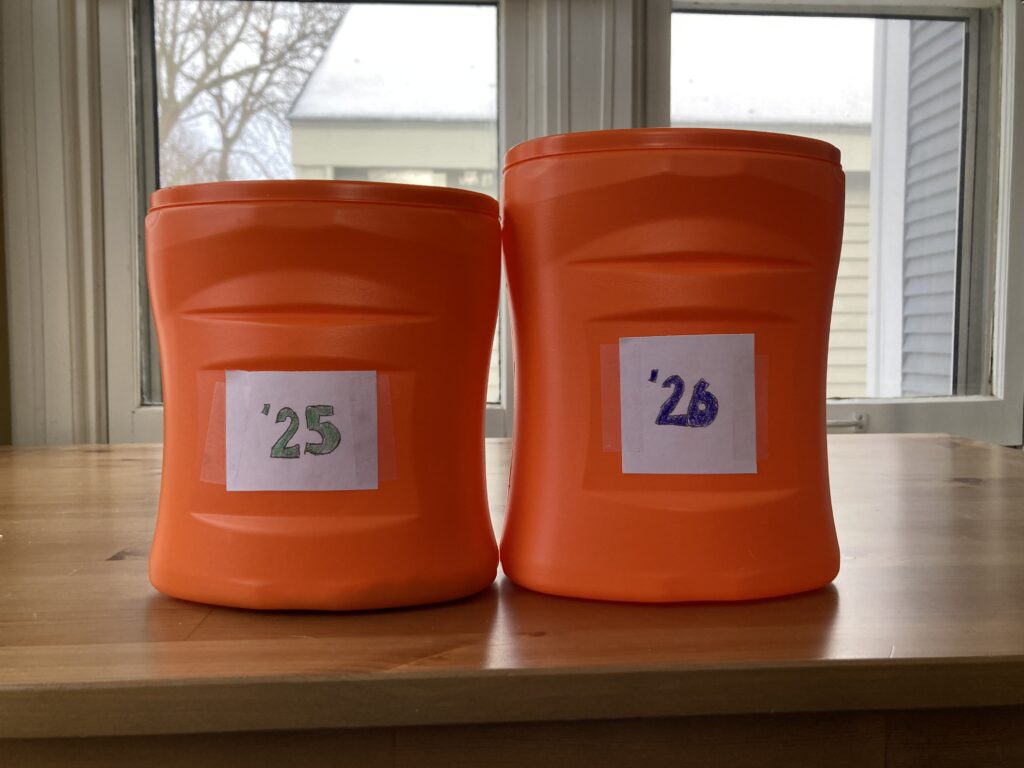
accessibility question (for myself and others): I’m trying to decide whether to handwrite or type up these ideas and lines. It is less fiddly to write them out by hand (or is it?), but I think I need to type them up so as my vision gets worse, I can use the speech feature on the computer to read them to me. I guess I’ve decided.
a final note from 27 jan: For all of January, I’ve been making my way through 2025’s months, finding bits to use for inspiration in 2026. In the midst of this reviewing, ICE occupied and terrorized Minneapolis. They still are. Alex Pretti was executed by ICE 3 miles from my house this past Saturday and I got a message that ICE has been spotted going door to door in my neighborhood today. Sitting at my desk, I’m looking out the window and trying to see (but with my vision, I can’t) if they’e on my block. And now I’ve finished the list. How long it will it take for ICE to get out?
The List (culled from 2025 entries):
- we are artists, crafting our own memories (9 jan)
- a Kinks lyric, walter, you’re just an echo of a world I knew long ago (10 jan)
- vision and faces (14 jan)
- memories aren’t linear / a mess of memories — mine, other peoples’ — filling up the gorge — I become entangled in them / memories as shadows (think The Shades) (15 and 16 jan)
- use writing to work on sleeplessness: 5 minutes before bed, make a list — a to-do list, or a completed list, or a things I love list, or . . . (17 jan)
- poem starters, mix-and-match, phrases that can be put together differently to create a poem, phrases act almost like prompts (17 jan)
- exs: Edgar Allan Poe, exercise enthusiast / Sara doing Sara things / A shadow crosses / The tree outside my window (19 jan)
- not a tunnel of tree, but a tunnel of threes (17 jan)
- the many meangins of gall, human and non-human (18 jan)
- images of emptiness — fish is us escaping, dandelion seeds scattering, bees leaving the hive (22 jan)
- turn these words into a poem?: dream memories photograph motion still light breath remember squint blue real love now (22 jan)
- GC Waldrep’s eyes and his mishearing in his collection. The Earliest Witnesses AND Codescru’s 10 Muses of Poetry, including mishearing / Squinting! mondegreen (26 jan)
- open — I can’t shut the doors; they stay open (28 jan)
- walls (28 jan)
- phrases that use blind — like, blind alley (28 jan)
- the importance of history and a context (28 jan)
- Pick five Emily Dickinson poems you have memorized, then stop after each mile to recite them — out loud, to your phone, in your head. Later, at home, quarry one or more of the poems for 1, 2, and 3 syllable words (29 jan)
- read The Braile Encyclopedia (29 jan)
- Find ways to be distracted: “Distraction is a time between times, a time in which we become momentarily subject to the non-thought inside thought. And this is the time — or one of the times — of poetry. Attention can be helpful later on as part of the process of revision, but for vision itself poets stand in need of distraction.” (1 feb)
- Is it, in fact, good to pay attention? Whose purposes does it serve?
- (3 feb)
- “Insomnia is the mark of an insubordinate imagination
- (3 feb)
- what color is the wind howling through the gaps in screen and front door? What color is the moan of the dishwasher? (6 feb)
- unhitching happens in brief moments when we can step outside of or beside or just beyond — below the threshold of thought, over and above society — to contemplate/experience/behold the this, the what it is, the essence of everything (7 feb)
- indulge in some purple prose — excessive, overly flowerly, too many metaphors, adjectives — langauge that calls attention to itself (7 feb)
- create a new form use it to write about the weather (12 feb)
- I think we’re all in conversation on the page with that which came before us, or even during us. We inherit whatever canon we’re in the midst of, a great collective influenza. / What I mean to say is that, in my own work, often, I may have been with Dickinson, but she was not with me (14 feb).
- Consider these two ideas: “Taxonomy is comforting because it creates a sense of control and finitude in a chaotic and open-ended world.” and “The proper name of God is a list.” (16 feb)
- perception exercises (18 feb)
- consider this: “from the standpoint of reason, genocide can be justified.” (18 feb)
- I want to follow the softness offered by the stutter (26 feb)
- persistence, not acceptance, an
- ongoingness and hope and routines becoming small rituals (19 feb)
- To be purpled is to lose one’s way or name, to be nothing, to grieve without surfacing, to suffer the effects of sea light, to be either sleepless or weightless and cut off by dreams (21 feb)
- “landscape became the characteristic genre of the impressionists, but their interest was not, as with earlier landscape painters, in recreating the particularities of its geological, agricultural, or architectural features. They wanted, it was said, to recreate the immediate visual impression of that landscape, produced by the light in the very instant before the brain fully organized the scene (24 feb)
- “What color are the haystacks really? What color is the cathedral at Rouen? Monet’s answer is that the haystacks and cathedral are the color (or colors) they seem to be at the moment of looking” (25 feb)
- Teach me to Aster You. Teach me to treat You as an Elder that has so much to teach me. I will surrender and attend to Your ensemble of blossoms. Your Dandelion Clock* will be my timekeeper. I will seek not to overcome You but to come with You; not to pray to be rid of You, but to pray for your continued presence in my life. To stay with the mystery You steward. (27 feb)
- write some lines with a wraith — is it purple or gray, or some other color? (2 march)
- devote a day or a week or a month to a color, use CAConrad’s red as an inspiration (5 march)
- Practice being in the “extreme present”: give careful attention to the mechanics of your movements. Can you catch yourself in the very act of doing something or saying something? (6 march)
- Pick a conjunction other than and — or, but, for, nor, yet, so. Make a list of words that contain your chosen conjunction.
- Turn your list of words into a poem. “Keep the sound of the word in the air as long as possible through rhyme and repetition.” (6 march)
- And = all these things can be true, and more / Or = at any give time, any one of these things could be true — find examples of AND and OR on your walk or run above the gorge (6 march)
- What’s the difference (mentally, spiritually, physically) between a loop vs. multiple loops. Also, where do my there and back runs — trestle turn around or the franklin hill and back or the falls and back — fit in? What sort of ritual are they? (10 march)
- pick a favorite/memorable place by the gorge. Describe it, select and modify favorite poetry lines into a chant. Describe it more. Turn the whole thing into a poem (10 march)
- list the different shadows you observe — yours, the inner, the outer, inside and outside (11 march)
- Ruefle’s pause, Dickinson’s hesitation, Ellis’ stutter (12 march) — connect with the gorge and my blind spot (13 march)
- Memorize/recite ED’s “Crumbling is an Instant’s Act,” think about erosion and time and elemental rust (14 march)
- ruminate: is poetry one bright seizure or an explosion, a pause, a stutter? (16 march)
- consider: what makes a prose poem a poem? (16 march)
- raking as a way of knowing and connecting with a place — AO. (17 march)
- some examples of Sara/gorge time: scattered returns and departures, loops, taking it up again and again (18 march)
- Telling time through weather and seasons, and the leaving and returning of leaves, and the certain slant of light, and the sound of the water, and the feel of the path, and the amount of view, and the ease or difficulty in breathing (18 march)
- one meaning of blind spot: a refusal to judge — the space my blind spot creates: free of judgment — link it with JJJJJerome Ellis’ clearing and Foucault’s scattering foam and Swensen’s witnessing (19 march)
- do this experiment: mile 1 — chant in tripes // mile 2: run with a metronome on 180 // mile 3: listen to music // mile 4: listen to the gorge (21 march)
- Study different versions of the sonnet: Shakespeare, T. Hayes, D. Seuss (26 march)
- notice the workers and the work being done around the neighborhood, on the trail, in the gorge (27 march)
- as you move through a place, a place moves through you — what moves through you? (17 march / 28 march)
- devote a month to steps — poems about steps, a playlist, finally taking some of the cool steps in St. Paul! (11 march + 1 april)
- make an orange effort today (3 april)
- Chemists tend to locate colot in the microphysical properties of colored objects; physicists in the specific frequencies of electromagnetic energy that those objects reflect; physiologists in the photoreceptors of the eye that detect this energy; and neurobiologists in the neural processing of this information by the brain. For artists, what matters is what color looks like. Think about color as a scientist and an artist (10 april).
- write a poem based on the fight in the comments over the little purple flower/invasive plant — first from Sandy’s perspective (16 April)
- try again to write the poem about the little old lady listening to a TED talk and someone saying, which reminds us, this is why we are all here (22, 23 april)
- “I wanted them to be like the flashes of mushrooms that come up after a rain: an over-the-top bounty; a temptation to explore; an always too many” (23 april).
- Memorize Sylvia Plath’s and ED’s mushroom poems, and recite them at the gorge. Think about networds (23 april).
- Identify first as an eco-citizen, and only later as a consumer (25 april)
- Get out those scrabble tiles and have fun with anagrams! (26 April)
- Think about the differences between fields and meadows and pastures and prairies and savannas and thickets — what is a poem? what is your blind spot? (2 and 3 may)
- think/write about succession (4 may)
- think of green as abundance and excess (5 may)
- what is the rhapsody of things as they are (5 may)
- write about the green I grew up in and with — the suburban green (6 may)
- think about middles — write a poem that starts in the middle, then write a poem and remove its beginning and end (7 may)
- whatever your writing/thinking, give it some context (7 may)
- play around with ground contact time and think about how much of your running time is spent off the flying. Turn this into something (7 may(
- Is the gorge wild? First, write a poem in which you answer yes, then write a poem in which you answer no (10 may)
- create a form shaped by place — the gorge, lake nokomis (12 may)
- challenge: develop a working defintion of stillness, then find it in movement (13 may)
- practice restraint, contain excess, condense (14 may)
- image: a tree as a person upside and nuzzled into the earth — a trunk with two thick branches looking like legs and a crotch —what would it be like to have your head/mind in the dirt, among the roots and nets of trees and fungi, and your body in the air? (15 may)
- the kind of creative suspension in which an either/or gives way to a neither. You are with the bird in the moment, seeking to neither see it more clearly nor shutter it into your camera, seeking indeed nothing at all that would interfere with the moment. This is less paralysis than a kind of shimmering equilibrium (15 may).
- everyone has a blind spot, mine is just bigger than yours / everyone has a moment between seeing and sight, mine is just longer than yours (15 may).
- among and between and other mousy words (16 may)
- Instead of finding meaning by describing what is not there, or what you don’t know (via negativa), you’re determining the meaning of the unknown/absent by what frames it, or surrounds it, or shows evidence of its absence, or its hidden presence (18 may)
- the importance of context (19 may)
- temporal saturation (19 may)
- poetry as a technology (20 may)
- divination with the dictionary (20 may)
- between as moment — a moment between lived and learned experience, between losing and lost (21 may)
- a favorite sound: early morning grass / bunny’s feet (21 may)
- air — not as unseen, passive background, but a leading character (22 may)
- Write a list of 10 words of images witnessed, then turn each word into a sentence, or a poem (23 may)
- the volta / turning (24 may)
- The difference between comprehension (knowing in language) and apprehension (knowing through senses) (23 may)
- Write a poem that is accessible to a reader like you (2 june)
- at the end of the run, take out your phone and record a list of 10 things you noticed, try to rattle them off quickly (4 june)
- 3 thoughts: “you; the “world we wanted to go out into, to come to ourselves into”; & the right form to bridge two subjects apart — think about these lines as you cross one of the bridges by the gorge (4 june)
- read Colgate’s Hardly Creatures and think about how access works in it / go to the gorge and think about what access is does/doesn’t offer (7 june)
- where does joy live in your body? (8 june)
- how does a lake form of water differ from its river form or rain form (it’s raining right now) or sweat form or puddle form or glass of water form or creek form (9 june)
- write down the steps that led from an intial thought to a new idea, or a poem, or a project (9 june)
- think about benches — what are your favorite benches by the gorge? What does a bench do? What sort of metphor is a bench (10 june)
- read a poem (or poems) about rust and write your own (11 june)
- recite Wallace Stevens’ “Tattoo” and think and write about light as spiders, light as an insect (13 june)
- write about this: “it keeps me amused, keeps me aware of language itself” (17 june)
- inspired by lucille clifton (17 june), find the draft of a poem and take out all the punctuation. If necessary, rewrite parts so the punctuation isn’t needed (17 june)
- notice the different types of fences and guardrails around the gorge (18 june)
- read Dorothy Wordsworth’s journal (18 june)
- think/read about research in poetry, take some of your research and put it or turn it into a poem (18 june)
- “I suggest walking around the hotel in a happy, glaucomal squint” — what are the benefits of seeing the world through softer eyes? (18 june)
- What could it mean to unsee the beheld (19 june)?
- the voices of the trees were the voice of the forest, and that when they spoke, they spoke with such indifference to time that it would take the girl several moons to hear one of their conversations, the better part of one just to hear a single word — what word/s to the trees speak to you (19 june)?
- for 5 minutes, make a list of five letter words, put them in a bowl, pick out 25 and turn them into a poem or 2. find all of the five letter words in a log entry, pick 25 of them, turn them into a poem (19 june)
- inspired by anne carsons’ response to how swimming fits into your writing, write an swimming-themed ars poetica (21 june)
- use all or part of this as the title or first verse of a new poem: “Hard to remember that matter hums constantly./These cars and highways— how much of moving is death rearranged.(23 june)
- thought as physical movement of a mind —oswald and homeric mind (23 june)
- Listen to the most immediate sounds in the building. Let the layers reveal themselves, shifting to what you hear further away, then further. When you feel you have heard everything, wait. Sit there a little longer, listening for the faintest of traffic in the sky or a faraway rumble (24 june)
- turn these into a poem, or 2 poems (25 june)
- make a list of electric words: “each single word is structure as “instant, simultaneous, and multiple” as electricity and/or the Present” (1 july)
- consider metaphors for you central vision: a barren field, a wasteland, the rewilding of a meadow, a gorge (2 july)
- think about your body at the gorge as a “coherence and articulation of the energy of a place (3 july)
- “Sometimes when something is missing, what you have left is making and believing” (4 july).
- play around with the word, rumor (4 july)
- write a poem with pairs of words like Grit & Determination, that are frequently together, in which they break up and then look for new partners—Salt & Pepper, Shiny & New, New & Improved, Footloose & Fancyfree, In & Out? (5 july)
- over time, lake nokomis began to function like a “natural” lake — What connection can/should/does one feel to the Earth when reading about the creation of a lake through dredging and planning and acquiring land for recreation and development? (12 july)
- I go to the lake to be held / beheld / unsee the beheld (13 july)
- write a poem that can be read in different directions: top to bottom, side to side, top-bottom-top (13 july)
- create a constraint for yourself — a time limit, a specific location? (14 july)
- play around with another poet’s words: translate them, fit them into your form, twist them, use only the five letter words (14 july)if we
- write around/on/through/with:
- opened people up, we’d find landscapes (15 july)
- Kumin, Thoreau, Oliver — read about poet’s favorite ponds (15 july)
- consider: “poetery is only there to frame the silence” (16 july)
- “to stand among the last trees listening down/to the releasing branches where I’ve been – the rain, thinking I’ve gone, crackles the air” Imagine what the rain does when you’re not listening
- (16 july)
- think about surfaces and many ways to understand it, including this: surface as where what is inside us travels outside (18 july)
- “The only way to know a song is to sing it./The only way to know an ocean is to swim it.” what does it mean to be immersed in a place? to be on the
- edge of it? (18 july)
- What might it look like to have water be the medium, the texture, the weight space motion emotion of my writing/thinking? (20 july)
- thoughts as escaping to the surface to move beyond the self (22 july)
- Can a landscape exist without vision (23 july)?
- visual fields, landscapes, meadows (24 july)
- Sight insists on separation; hearing, like touch or taste or smell insist on connection (25 july)
- Anne Carson, swimming and encountering someone else’s hair — pool friends (25 july)
- Rewild yourself! (31 july)
- keep a notebook: don’t start on the first page, just pick it up and start anywhere, write anywhere on any given page. Record moments or thoughts without context. Write ideas, feelings, not facts. (1 aug)
- inkling as an insect, a small creature that speaks sight to you — what does an inkling look like? (3 aug)
- geometry = relationship of points, lines, angles, surfaces. As you move outside/inside, what is the geometry of your life? (5 aug)
- “in poetry, it’s not all about meaning with words, but the movement and shifting they create. Thoughts, experiences, ideas flow freely until they bump into words. Words direct the movement (from encounter to revelation or understanding)” (13 aug)
- “All I wanted for the poem was openness, a merging of muscle-memory with the skittering of words down the page, to know as a process of motion.” What could a merging of muscle memory with the skittering or words look like? (15 aug)
- How do you measure time? How do/can you waste it, move through it, feel its flow (16 aug)
- a chapbook titled, Swimming One Day in August, that plays around with different understandings of a day and its relation to time? I could write about this goal, where 1 day = 24 hours. But I could also write about a day = a random day of swimming in august or a collage of days swimming in august from just 2025, or from all of the days I’ve written about since 2017? (16 aug)
- “I have an inclination to obsessively stream, to arise and move not through incremental measures of occasion but through water.” Turn this into a poem, combine with AO’s liquid looking (19 aug)
- metaphor or simile, pick a side (19 aug)
- write about the water-logged mind (19 aug)
- write around this: chart / shoulders / repetitions / measured minutes / devotion to minutes to repetitions to even gaits to uncertain ailments (20 aug)
- what does your watch watch? (20 aug)
- image: Today I noticed the spray from my arm as I lifted it out of the water. Dripping in an arc as my hand traveled from my hip to past my head and back into the water (20 aug)
- still/stillness: being satisfied and balanced and present in the moment, not needing to do more or feel guilt or regret for what was or wasn’t done (21 aug)
- condense your favorite lines, like this:now time said / quiet happens
- now / I quiets / flux happens (23 aug)
- write a series of poems about a day: 24 inklings (26 aug)
- “the task is recognizing the encounter that refuses containment that insists on experience outside narrative time the task is to not entomb memory in language to not reduce grief to a quotable thing the task is to feel the edge of a void and keep going inside the feeling (27 aug)
- not still: The uncontrolled motion I experience is not tremors, but images that constantly shift and shimmer and buzz, usually in ways too subtle to see clearly. I feel them — soft notes of disorientation, dizziness, restlessness. Maybe you could call them tremors? The ground never ceasing to unsettle (30 aug)
- write about the treadmill using this as inspiration: The treadmills black tongue / time and time and time intervals (intervals as verb?) / people cupped and kept in beeps and measures / 211 calories / (30 aug)
- pick a favorite poet: read and reread their work, read it out loud, memorize it, recite it while moving, read it against itself, delete words condense words conlfate words misremember words (1 sept)
- pick a poet: Using words from within their own work, write the narrative of their poetics or/and biography (1 sept)
- reflect on the merits on going deep within versus reaching far without (2 sept)
- write a poem titled, everyday (2 sept)
- write a poem titled every day (2 sept)
- intervals / frames per second / illusion: converting what’s still into motion, what’s motion into a still / duration station span / blurred imprecise approximate
- (3 sept)
- create another park map (unigrid) for the gorge (7 sept)
- center/ground/locate yourself in time and space by chanting. First in triple berries, then in lines of poetry, then in there or there abouts with 3 syllable descriptions (8 sept)
- locate yourself in time, space, on the page as there or thereabouts (9 sept)
- write about a gnat, gnats, a cloud of gnats. What do they feel sound smell like (16 sept)
- translate this for your life goals: to see thee more clearly, love thee more dearly, follow thee more nearly (17 sept)
- create a poem using the outline of the gorge as form (24 sept)
- write a poem about the darting squirrels that you thought were a shadow (28 sept)
- goals: being worn down, worn out, and worn in (2 oct)
- answer this question: How much information do we need to recognize/identify a form? Only a hoof? The curve of a back? A giant eye? (2 oct)
- list your canyons and floating passivity (3 oct)
- Find the ceremony in every instant (3 oct)
- exposure to air = rust = erosion — write more about the process (3 oct)
- breathing and lungs and canadian wildfires (6 oct)
- take some lines you’re working on to the gorge, recite as you run, asses how they move (7 oct)
- think about air in relation to smells (7 oct 2025, 8 oct 2025, and 20 jan 2020)
- think about how/why something becomes/is/stays open (8 oct)
- My solitude, or maybe my loneliness, involves a lack of seeing — not of being seen, but of not seeing when I’m being seen (9 oct)
- pastoral/anti-pastoral/landscape/ekphrastic (10 oct)
- finish this poem: as the trees/within my/macula/disappear/my forest/fields and/meadows (10 oct)
- think about views/ vistas/ avenues / boulevards and who they relate to your vision (14 oct)
- Give time to Richard Siken’s War of the Foxes and I Do Know Some Things (19 oct)
- using Poe’s “The Bells” as model, write a poem about cells (28 oct)
- read about the history of the cell (8 nov)
- give your attention to the shadows, on the bottom of the pool, in the corners of your poem (10 nov)
- Read Ed Sanders’ “The Cutting Prow,” then watch a performace of it. Use it as inspiration and create your own poem (17 nov)
- FInd a poem, or write a poem, that turns on the light in a dark room and invites a reader in, but doesn’t give them a tour (17 nov)
- Do some passive echolocation, then do some active echolocation — learn to hear doorways and walls and wide open space (19 nov)
- Watch Kaveh Akbar’s lecture on poetry and spirituality (20 nov)
- ears are the eyes on the side of your head / eyes are the ears on the front of your face (23 nov)
- chant in threes, look for words with three syllables, make a list of trios or trinities (25 nov)
- create a hybrid piece that combines excerpts from the log with poetry (13 dec)
- Do a Sara-word quarry on a favorite poem by Emily Dickinson, by Alice Oswald, by Lorine Niedecker (12 dec)
- How do the words of 1AO, LN, ED echo within you (15 dec)
- describe your morning routine/ritual/habit —change one thing: add something, take something else away (17 dec)
- find a line (of yours or someone else’s) that you really like. put it in the middle of a new poem — put it on its own line, as its own poem within a poem, or hide it in the midst of other lines (17 dec)
- To navigate by adjustment, shifts, echoes — do this by the gorge, write about it (18 dec)
- return to the Gorge Management document from the early 2000s — try cut-outs, erasures, apply your blind spot to it, pick a line you like and write around it, quarry a section of the text (20 dec)
- start reviewing all of the entries that you have tagged with “vision.” Keep going until you find something — an idea, a word, a phrase, a question — that stops you. Write around it. (22 dec)
- Give 15 minutes to cleaning up your safari reading list — (26 dec)
- Watch “polis is this” doc on Charles Olson (26 dec)
- The use of You — a bizarre self-help manual or how-to on mindfulness — use You to write your own bizarre version of mindfulness (26 dec)
- Reread Wonderful Catastroph. Experiment with black out poetry using your growing blind spot (26 dec)
- The environmental destruction we humans have enacted on this earth is obvious, but I didn’t take it in, I didn’t feel it, until I started walking. Think about this true for walking and for running (27 dec)
- Find two or three random paragraphs from two sources and “quarry” them. From this jumble of found text, draft a poem. (27 dec)
- When you cut into the present, the future leaks out (27 dec)
- openness as anti-control — the future coming at you instead of walking through future’s door (28 dec)