3.1 miles trestle turn around 54 degrees wind: 5 mph
What a day! Took Delia out for a walk this morning. An hour later, sat on the deck and was inspired by the birds to write a beautiful little poem conjuring my mom. Then, around 12:30, went for a run by the gorge. Okay spring! The run wasn’t easy, but wasn’t hard either. My legs are sore from running every day since Tuesday. Tomorrow I’ll take a break.
Listened to birds running north, my “It’s Windy” playlist on the way back south. Wind songs heard today: “Ride Like the Wind” — fast? frantic? under pressure? and “You’re Only Human (Second Wind); — forgiving and resilient and a reprieve
I’m sure I looked at the river, but I don’t remember doing it, or what it looked like. I do remember that the floodplain forest looked open and brown and full of trees that had been through a flood or two. No roller skiers or rowers. No radios or impatient cars. Did hear a few unpleasant goose honks near the lake street bridge.
Before the run I reviewed the Beaufort Scale and rediscovered a Beaufort Scale poem by Alice Oswald. Gave myself the task of trying to describe the wind today:
running north: make your own wind — or breeze? south: hair raising . . . leg hair raising . . . calf hair raising east: no need to shield the microphone; a welcomed air-conditioning after a hard effort; still leaves still; the branches moving so slightly my cone-dead eyes cannot detect their movement — no trees waving to me today . . . rude; flag flapping but no wind chiming
Alice Oswald on wind:
Everything you write about the wind really has to be about something else, because the wind itself is so non-existent. I like the way the Beaufort Scale [a system used to estimate wind speed based on observation of its effects] categorizes something so abstract and undefinable. That is partly what drew me to the project. I regard the words as secondary to the silences in my poetry, so I’m drawn to write about things that will exist without the words. The poems are full of gaps and silences through which something that isn’t linguistic can be heard.
As I speak (force 1) smoke rises vertically, Plumed seeds fall in less than ten seconds And gossamer, perhaps shaken from the soul’s hairbrush Is seen in the air.
Oh yes (force 2) it’s lovely here, One or two spiders take off And there are willow seeds in clouds
But I keep feeling (force 3) a scintillation, As if a southerly light breeze Was blowing the tips of my thoughts (force 4) and making my tongue taste strongly of italics
And when I pause it feels different As if something had entered (force 5) whose hand is lifting my page
(force 6) So I want to tell you how a whole tree sways to the left But even as I say so (force 7) a persistent howl is blowing my hair horizontal And even as I speak (force 8) this speaking becomes difficult
And now my voice (force 9) like an umbrella shaken inside out No longer shelters me from the fact (force 10) There is suddenly a winged thing in the house, Is it the wind?
3 or 4 inches for round 1 of winter. We might get more snow in last night’s snowfall, combined with expected snow on Sun/Mon/Tues, than in all of Jan and Feb. Of course, that’s not saying much because our total prior to today was 7.3 inches. I wonder if what we got today will be melted by Monday? Future Sara, let us know!
six hours later: The snow has already melted off of the deck, the sidewalks, the road. Will the snow on the grass be gone before Sunday? Still not sure.
the secret life of plants
sources:
Stevie Wonder’s album: Journey Through The Secret Life of Plants
Yesterday afternoon, driving back from picking FWA up for spring break, we were talking about trees and how they communicate and their underground networks and how much sentience they have, and I remembered, and tried (unsuccessfully) to explain, the 1970s talking-to-plants craze. I mentioned how Stevie Wonder did an album about it. Scott didn’t remember the album. This morning I looked it up and . . . jackpot! Stevie Wonder’s album: Journey Through The Secret Life of Plants. I’m listening to it right now — ah, 1979! It is the soundtrack for a documentary, The Secret Life of Plants, which may or may not be a reliable source of “accurate” information about plant science (botany?) discoveries in the 1970s — wikipedia doesn’t seem to think so. I dug a little deeper and found an article about the plant craze of the 1970s — The 1970s plant craze / Teresa Castro
In the early 1970s, a general plant craze caught on in visual and popular culture alike. Against the background of New Age spirituality and the flourishing of ecological thinking, the 1970s plant mania came as an eccentric blow to the belief that sentience and intelligence are a human prerogative. It also relied massively on the cybernetic paradigm: envisaged as self-regulating biological systems, plants were recognized as communication systems in themselves. In this essay, I sketch a brief portrait of this complex cultural moment, as visual culture, and in particular film, came to be permeated by references to plant communication, plant sentience and plant intelligence.
In her discussion of “The Secret Life of Plants,” Castro describes the author as a “botanist and science vulgarizer” and places the work in the context of a large anti-science and anti-intellectual moment; a hippy desire to heal the crisis in human/nature relationships; and significantly for this article, the mediation of visual and other technologies, like the lie detector. The book takes up the “experiments” of Cleve Backster in 1966 in which he hooked a plant up to a lie detector and noticed a surge in electrical activity similar to a human’s emotional response when he watered the plant. Then, an even greater one when he imagined setting fire to the plant and watching it burn. His conclusion: This plant could think! It “could perceive and respond telepathically to human thoughts and emotions.”
Her conclusion about the book/documentary and its impact:
The Secret Life of Plants badly impacted serious scientific research on plants’ sensory and perceptual capacities. Widespread press coverage of Backster’s pseudo-experiments contributed to this backlash. Work on plant communication and plant signaling “was somewhat stigmatized, and the limited availability of funding and other resources constrained further progress.”
In our present dire ecological crisis, to acknowledge the richness and complexity of plant-life is an invitation to withdraw from a centric reason that separated humans from “nature,” situating human life outside and above it. In what constituted a striking ecological critique of Enlightenment science and its holy dualisms, “hippy times” attempted to tell a different kind of story about “Man” and “Nature” and grappled with a fundamental epistemological shift. Most of all, they experimented widely with alternative modes of engagement with what poet Gary Snyder described as “the most ruthlessly exploited classes”: “animals, trees, water, air, grasses.” As we emerge shell-shocked from a global pandemic, what are we to do now? Maybe we can learn from the past: instead of imagining that “plants are like people”, as suggested by “America’s Master Gardener” in 1971,57 we can focus instead on what it means to be human on a shared planet.
This discussion of plants and communication reminded me of a study I read during my mushroom month: April, 2022. Looked it up and found the entry: 10 april 2022
After a discussion of study about fungi language, I posted this quotation from Alice
Oswald:
I exert incredible amounts of energy trying to see things from their own points of view rather than the human point of view.
It’s a day long effort to get your mind into the right position to live and speak well.
citing Zizek: we can’t connect, be one with nature. It’s extraordinary, alien. It’s this terrifying otherness of nature that we need to grasp hold of and be more courageous in our ways of living with it and seeing it.
Instead of “plants are just like us; they can think and feel!” of the 70s plant craze, Oswald is holding onto the strange otherness of plants. I wonder what Oswald, a former professional gardener, thinks about the sentience of plants?
I googled the question, but before I could find an answer, I found her amazing lecture on the tradition of rhapsody, the litae women in the Iliad, back doors, and Marianne Moore. Wow!
Sidelong Glances: Oblique Commentary on the Poetry of Marianne Moore / Alice Oswald
I listened to the lecture, going back again and again to try and transcribe some of her brilliant words. Her “obliquely, slightly, slowly” approach to Moore with a description of rhapsody and the “squinting, limping old women” of the Iliad (litae) and the need for coming through the back door and repeated image (and sound) of iron bell resounding like the voices of dead poets that came before us was amazing. I’ll have to listen to it again, I think.
a few passages to remember
The poet, especially the female poet, must labor not only to hear the voices of the literate dead, but my leaning and hushing and listening beyond listening to hear the illiterate, anonymous, marginal voices of rhapsody.
Literature has a front door and a back door, and the labor of moving through poems, opening the back doors to let in the fresh air of the unwritten, if you do it for long enough, finally compels you to leave the house altogether, since the tradition inherited by the oral tradition goes right back into birdsong, windsong, heartbeats, footsteps, rivers, and thickets. Not to mention all the oscillating sounds of tides and seasons and waves and why shouldn’t rhapsody include the stitch work of plants?
Go in through the back door?! Love this idea and what it mean for how I understand doors being opened through poetry! And connecting it to birdsong and wind song and all those amazing sounds heard while running above the gorge! And plants!
[not nature poetry but] natural pattern which includes and aligns the poem making habits of the mind with the metrical structures of physics. That is what I mean by rhapsody and that is what I want you to listen for when you put your ear to a written-down poem: backwards and beyond male literature, as far as the first repetition of a leaf on the first repetition of a morning.
Aligning the poem-making habits of the mind with the metrical structures of physics: the biomechanics of running, the drip drip dripping of water due to gravity, air being forced out of and welcomed into the lungs. And the repetitions — the first repetition of a leaf on the first repetition of a morning — very cool.
And, where to place Robin Wall Kimmerer within this conversation? I think I have an answer, but I decided to read another section of Gathering Moss about the Standing Stones. After writing about scientific names for mosses and reflecting on the power in self-naming, she writes:
I think the task given to me is to carry out the message that mosses have their own names. Their way of being in the world cannot be told by data alone. They remind me to remember that there are mysteries for which a measuring tape has no meeaning, questions and answers that have no place in the truth about rocks and mosses.
Gathering Moss
As I typed up the title of RWK’s book, I just realized something great about the title: gathering moss can refer to us (readers) gathering up stories and lessons from the moss, but it can also mean moss gathering — an image of a complex community of mosses and the agency of moss to gather themselves, independent of us. Nice.
random: Last night I discovered that a cartwheel is named after the wheel of a cart. When you are doing a cartwheel, you are acting like a wheel of a cart. Duh — I guess it seems obvious, but I associated the words so strongly with my memories of gymnastics as a kid that I never thought about it referred to outside of that.
Another 50 degree day! The right number of layers: black shorts, blue t-shirt, orange sweatshirt. Some wind, but not too much. Noticed (probably not for the first time) that they removed the porta potty by the 35th street parking lot. Why? There aren’t any porta potties — for runners or bikers or anyone who needs one — on the Minneapolis side between ford and franklin. Did they remove the one near Annie Young Meadow too? I’ll have to check next time I run down into the flats.
A good run. More soft shadows, other runners, one walker in a bright orange sweatshirt — just like me.
Near the beginning thought about the ringing of a bell as the signal of a ceremony starting. Then ED’s lines popped into my head: As all the Heavens were a Bell/And being, but an Ear — In the earlier versions of my Haunts poem, I begin with a bell. I could return to that, or maybe that is the start of another poem?
I ran north without headphones. I can’t remember what I heard. Running south I put in my Windows playlist.
After I finished my run, I listened to a podcast about perimenopause as I walked home. On this log over the past seven years, I’ve mentioned moments of increased anxiety and ongoing constipation. Present Sara (me) really appreciates that past Sara documented these. It’s helping me to understand my body better as I move into perimenopause. Last week, I discovered a great podcast about perimenopause, menopause, and beyond for active women (runners, ultra runners, cyclists, etc) called: Hit Play Not Pause. So far, I’m on my second episode — the first one was about anxiety, this one is about symptoms of perimenopause other than loss of a regular period. So helpful, especially since it seems there’s so little known about perimenopause!
Lorine Niedecker and Lake Superior
I’ve decided I’d like to do a line-by-line read through of Lorine Niedecker’s “Lake Superior.” Such a good poem, one that I appreciate more as I give more attention to poetry and the gorge.
Iron the common element of earth in rocks and freighters
Sault Sainte Marie—big boats coal-black and iron-ore-red topped with what white castlework
The waters working together internationally Gulls playing both sides
This is the second verse? section? fragment? of the poem, with some blank space and an asterisk dividing each short section. I’ll get back to the first section a little later.
coal-black and iron-ore-red — I’d like to put some more color, my versions of color, into my lines — topped with what white castlework — I think I’m being dense, but what does she mean here? Like, (oh) what white castlework!
the waters working together — between Lake Superior, Lake Michigan, and Lake Huron — internationally — Canada and the US
Gulls playing both sides — I love how she phrases this with such brevity, the idea of gulls not being subject to the lines/border humans have created. Reading through her notes for this poem, she writes about having to wait in Sault Ste. Marie, Canada until the banks opened in order to exchange money. Was she envious of the gulls who could freely travel between Canada and the US?
opening lines: Yesterday I posted the opening line of “Lake Superior.” Here’s the whole first section:
In every part of every living thing is stuff that once was rock
In blood the minerals of the rock
Two other sources of inspiration for my place-based poem are Alice Oswald’s Dart and Susan Tichy’s North | Rock| Edge. Here are their opening lines:
Dart/ Alice Oswald
Who’s this moving alive over the moor?
An old man seeking and finding a difficulty.
North | Rock | Edge/ Susan Tichy
If you can, haul-to within
the terms of anguish :
this rough coast a gate
not map, no compass rose
sketched in a notebook
with certain positions
of uncertain objects
marked—
Reviewing the three sets of lines, I’m noticing how they move differently. LN offers brief, ordered chunks — little rocks? — that you travel between, while AO’s words wander and run into each other. Sometimes she has sentences, sometimes fragments — it flows like a river? ST shares similarities with AO, in terms of wandering and not stopping, but each word almost seems to have equal weight — is that the right way to put it?
In terms of distance, LN is far away, abstract; MO is closer, as we observe a man near the Dart; and with ST, we are right there, on the edge of the rock, moving beside the sea.
Is this helpful to me? To read these three poems closely and together? I’m not sure. Perhaps I should return to LN first. For today, just one more “chunk”:
Radisson: “a laborinth of pleasure” this world of the Lake
Long hair, long gun
Fingernails pulled out by Mohawks
I like how LN weaves in some of the “facts” that she discovered in her research — almost like notes, but carefully selected for effect. I think the contrast between Radisson’s pleasure comment and his fingernails being pulled out says a lot. How can I weave in facts? Do I want to?
The poem “Lake Superior” is in two books that I own: Lorine Niedecker Collected Works and Lake Superior. Lake Superior includes a journal with LN’s notes and some critical essays by others. It’s fascinating to read how she transformed her journal notes into these brief lines.
So warm! Still glad I went out for a run, but it was hard. My knees are sore, my legs sluggish. Heard lots of birds, a roller skier’s clicking poles, talk radio blasting from someone’s car, faint voices from below, water trickling out of a sewer pipe. Encountered bugs — mosquitos? gnats? — near the ravine. Passed by a person on the folwell bench, reading. Was greeted by one walker: good morning! As I ran on the Winchell trail I thought about the importance of giving some gesture — a greeting, eye contact, a stepping over to make room — when nearing another person. Without it, you’re saying to them, to me you don’t exist.
When I finished my run, I pulled out my phone and recited Alice Oswald’s “A Short Story of Falling.” Only two mistakes: I gave it the wrong title and I said “in a seed head” instead of “on a seed head.”
“A Short Story of Falling” / 22 june 2023
wordle challenge
Bad luck with the wordle today. I almost had it in 3, but I had too many choices that could be correct. I had 4 tries but at least 5 options.
At the end of the swim another swimmer called out, these conditions are the best! (or something like that; I can’t quite remember). I agreed. Calm, pleasingly warm water, well-placed buoys. I could barely see the buoys, but I still swam to them without a problem. Lots of swans in the water, a few menacing sailboat — one with a bright orange and red sail.
I swam for a loop and a half then briefly stopped at the little beach for a quick rest. Swam another loop and a half and stopped at the big beach. Got out to go the bathroom, then one more loop. Taking a 5 or so minute break between loops 3 and 4 really helped. I should remember to do that more often.
I’m writing this swim summary the next morning. Can I remember 10 things?
10 Things
at least one plane
half a dozen swan boats lurking at the edges
one swan stuck in the dead zone between buoys
streaks below me — fish?
irritating swimmers: 2 fast women that kept swimming past me, then stopping to get their bearings, then swimming again. With my slower, steadier stroke, I kept getting passed by them, then passing them when they stopped, then getting passed by them again when they restarted their swim
both the orange and green buoys closest to the beaches (orange to the little beach, green to the big) were not that close to the shore
no waves
no ducks
breathed every 5 strokes, sometimes every three, once or twice every six
hardly ever saw one of my landmarks from the past few years: the overturned boat at the little beach
Ran earlier today, at 7:15. A little cooler, quieter. For the first few minutes, I recited Alice Oswald’s “A Short Story of Falling” which I memorized yesterday. Ran south on the grassy boulevard between edmund and the river road. Crossed over at Becketwood, then ran down to the southern entrance of the Winchell Trail.
Listened to the gentle whooshing of car wheels. the clicking and clacking of ski poles, and birds for most of the run. Put in a Bruno Mars playlist for the last mile.
After I finished my run, I recited Alice Oswald’s “A Short Story of Falling” into my phone. Only messed up one line (I think).
10 Things
click clack click clack
the rambling root spread across the dirt trail
the steady dripping — more than a trickle, less than a rush — of the water falling from the sewer pipe
the soft (not mushy) blanket of dead leaves on the winchell trail
the sharp sparkle of the light on the water
shhhhhh — the wind passing through the leaves on the trees
the soft roar of the city underneath everything
the leaning branches have been removed — thanks Minneapolis Parks People!
an almost exchange of the You and I — me: right behind you, excuse me an older woman with a dog: mmhmm
no bugs, no gnats, no geese
wordle challenge
3 tries: front / brine / crane
front runt stunt blunt hunt shunt grunt redundant brine sign fine line shine dine design unwind spine twine crane explain refrain detain rain insane
front
frontispiece:
1
a: the principal front of a building b: a decorated pediment over a portico or window
2
: an illustration preceding and usually facing the title page of a book or magazine
Its back and forth, ad nauseum, ought to make the sea a bore. But walks along the shore cure me. Salt wind’s the best solution for dissolving my ennui in, along with these protean sadnesses that sometimes swim invisibly as comb-jelly a glass or two of wine below my surface. Some regrets won’t untangle. Others loosen as I watch the waves spreading their torn nets of foam along the sand to dry. I walk and walk and walk and walk, letting their haul absorb me. One seal’s hull scuttled to bone staves gulls scream wheeling above. And here… small, diabolical, a skate’s egg case, its horned purse nested on pods of bladderwort that still squirt BRINE by the eyeful. Some oily slabs of whale skin, or —no, just an edge of tire flensed from a commoner leviathan. Everywhere, plastic nurdles gleam like pearls or caviar for the avian gourmand and bits of sponge dab the wounded wrack-line, dried to froths of air smelling of iodine. Hours blow off down the beach like spindrift, leaving me with an immense less-solipsistic sense of ruin, and, as if it’s a gift, assurance of ruin’s recurrence.
crane
“The Crane Wife” parts 1, 2, and 3 from the Decemberists
swim: 1 small loop (1/2 big loop) cedar lake open swim 88 degrees
First open swim with FWA at cedar lake! A great night for it: calm, clear, not too crowded. The buoys were up tonight. Hooray!
Yay for being able to bike without fear! The ride was hot but was fine. The key: don’t bike too fast. I noticed: no progress on the duck bridge that was removed a few months ago for repairs; hot pink tape or paint or something marking the cracks in the trail — the pink was very easy for me to see…nice! and a dude in an e-bike with a kid going way faster than the 10 mph speed limit.
swim: 3 loops (2.25 miles) 88 degrees choppy
3 slightly choppy loops today. Definitely more difficult with the choppy water — how choppy was it? Not really that bad (compared to real chop in the ocean or a big lake), but it still made it harder to breathe. Saw 2 or 3 planes, some random woman floating in an inner tube in the middle of the lake (almost ran into her). Raced a swan boat, dodged flailing kids at the beach and breaststrokers mid-lake. Again this year, breaststrokers are my nemesis. Couldn’t see the green buoys at all; I used the glowing rooftop at the big beach as my guide. I couldn’t even see the green buoys when I was 20 feet away from them because of the bright sun. Didn’t bother me at all. I just kept swimming, only stopping to adjust my goggles and make sure my stiff left knee was okay. For just a flash, I thought about Tony Hoagland’s poem (below) and the way water speaks. I thought about how, because I’m in the water and not standing on the shore, I can listen and understand (at least a little).
wordle challenge
3 tries:
water / inert / frost
a winter morning
water inert frosted glass slicked up streets endless and empty
water inert on morning window: frost
a description by Alice Oswald in her reading of “A Short Story of Falling” that I listened to this morning as I memorized her beautiful poem:
What I love about water is that it spends its whole time falling. It’s always, apparently, trying to find the lowest place possible, and when it finds the lowest place possible, it lies there wide awake.
Alice Oswald
Water is never inert always falling searching for somewhere else to be even in rest as frost on winter’s window it watches waits wants to find the floor
The Social Life of Water/ Tony Hoaglund
All water is a part of other water Cloud talks to lake; mist speaks quietly to creek.
Lake says something back to cloud, and cloud listens. No water is lonely water.
All water is a part of other water. River rushes to reunite with ocean; tree drinks rain and sweats out dew; dew takes elevator into cloud; cloud marries puddle;
puddle
has long conversation with lake about fjord; fog sneaks up and murmurs insinuations to swamp; swamp makes needs known to marshland.
Thunderstorm throws itself on estuary; waterspout laughs at joke of frog pond. All water understands.
All water understands. Reservervoir gathers information for database of watershed. Brook translates lake to waterfall. Tide wrinkles its green forehead and then breaks through. All water understands.
But you, you stand on the shore of blue Lake Kieve in the evening and listen, grieving as something stirs and turns within you.
Not knowing why you linger in the dark. Not able even to guess from what you are excluded.
6 miles bottom franklin hill and back 76 degrees / dew point: 64
Hot! I much prefer running in the cold to running in the heat. Still, today is my 12 year anniversary — my runniversary — and I had to get out there to celebrate it. 12 years ago today I went out for my first couch to 5K run.
Was able to say good morning to Mr. Morning! Noticed the river. Higher above, it burned white through the trees. Down below in the flats, it looked stagnant and brown and not refreshing at all. Heard some birds and a woman saying to her friend, during times of war they…, as I ran past. Smiled and waved at many walkers and runners. Thought I heard the rowers but I was wrong. Wondered if the roller skier I passed as I ran down the hill and she skated up it was using poles — I couldn’t tell because we were both moving too fast. Watched the red flash flash flash of a bike’s back light disappear into the distance. Felt the sweat dripping and trickling and seeping out of my skin.
Listened to the birds and the cars as I ran north. Recorded some thoughts into my phone as I walked up the hill. Put in a playlist — bday 2018 — as I ran back south.
Be Water My Friend
It’s the beginning of the month; time for a new challenge. For June 2023, more on water. I’d like to read Alice Oswald’s Nobody, but I need to read The Odyssey first. I started yesterday. I love Emily Wilson’s recent translation. Very fun. Anyway, I’ll finish The Odyssey, then read Oswald’s take on it in Nobody. At the same time, I’m thinking of reviewing some water poems I’ve already collected — maybe memorizing a few, then using them for inspiration. Maybe I’ll even do another cento? Today I started with Oswald’s Evaporations, partly because it came up as a poem I posted on june 2, 2021. I also watched a clip of Bruce Lee’s Be Water My Friend.
Empty your mind. Be formless shapeless like water now you put water into a cup it becomes the cup you put water into a bottle it becomes the bottle you put it into a tea pot it becomes the tea pot now water can flow or it can craaaaasshh be water my friend
before the run
As I ran I hoped to think about water subjectivities and what it is to be water . I think this was also inspired by a quote from Oswald that I re-read yesterday:
I sometimes wonder whether I’m a very keen swimmer, and whether for me, poetry is equivalent to swimming. I’ve often noticed when I swim, the strangeness of the way the body literally turns into a fish, but the head remains human and rather cold, and looking around at this strange flat reflective surface. I’m often very piercingly aware of the difference between my head and my body when I’m swimming because I’m not necessarily someone who goes underwater, I love swimming along the surface of rivers. Perhaps, my poems do feel a need to convey that continued separation of the head remaining human and the body becoming animal, or plant, or mineral, or whatever it can be. In some way, I suppose I’m trying to find rhythms that will heal that divide.
*
I think that’s exactly it, that we seem to exist as bodies and minds. That’s always slightly troubled me that I can’t quite make them be the same thing. I always have two narratives going on and it’s extraordinary the way the mind is floating around seemingly quite untethered and yet the body has all these laws like gravity, and limit, and size, and hunger, that it’s obeying. How those two interact and how they come to define what it is to be human is again—I’m wary of using the verb think because I don’t think poetry is necessarily about thinking—but it gets hold of questions, and reveals them as questions, and then reveals what’s underneath them, and then what’s underneath that. I suppose each book tries to peel away a layer of that problem and present it again.
Halfway through the run, I stopped to record my thoughts by speaking into my smart phone: Almost 3.5 miles in, just walking back up the franklin hill on a super hot, humid day. Before I started running, I was thinking about water and I read and then listened to Alice Oswald’s “Evaporations” and Bruce Lee’s “Be Water My Friend.” So I was thinking about how there’s a line in the Alice Oswald about how water prefers to be disorderly and slapdash —
I notice The Water doesn’t like it so orderly What Water admires Is the slapstick rush of things melting
I was thinking of this dog bark I heard across the road on Seabury and my thought was that this bark was slapdash. Then I was thinking of Bruce Lee’s “Be Water” and how I feel even more like water right now because I’m not just damp, I’m dripping sweat in this humidity. And I’m not sure why this happened but I started to think about — oh, I was thinking about how I had locked into this rhythm and I could really feel it in my glutes, which is great because I think that’s what you ideally want, and I was feeling that I was in a steady rhythm, not really thinking, more animal, and then I thought about how it feels more like a machine to me (than an animal). Then I was thinking about how when machines are being designed/engineered, they look to the bio-mechanics of various animals. Machines are really animals with a very strict routine. Animals and machines and Donna Haraway and cyborgs — the idea of us being both machines and animals. What part of us is the I, the animal, the machine, the — ?
[a few minutes later] I almost forgot, when I turned around at the 3 mile point and went on the lower trail right by the river, the river looked very still and un-refreshing. I looked at it, and because it was so still, the clouds were reflected in it, and I thought about Huidobro’s line, 8 glances to turn the sea into sky. I thought what I was doing was turning the river into sky….And now I’m thinking about these different subjectivities we inhabit — the I, the animal, the machine — when you recognize that you’re all of those things, that doesn’t mean you are free from subjectivity and your specific historical, material location; it just means that you’ve eliminated division, you’re immersed in the water where it’s all together. It all is entangled — a better word? [thinking of Ross Gay here]
after my run
A lot of thoughts on water and subjectivity and the I/animal/machine are reoccurring ideas that I’ve been writing about/wrestling with for years. I think it was last year that I started to imagine myself as less of a fish in the water, more of a boat. What does it look like, how might it feel to be all of these things — water, boat, fish, human/brain?
note: I added the second part of Evaporations to my list of poems to memorize.
A few days ago, I found some summer heat poems on the NYTimes Book Review. I thought I saved the link, but now I can’t find it. My favorite was this one:
Summer Studies/ Tony Hoagland
When Ellen told Mary about the secret lake she swore her to silence
but Mary invited Jerome who couldn’t even swim and Luanne
came with him and it was funny that summer the way that scarce resources
collided with the whole system of who was cool, or not
the old rule being that who was cool would get to stay that way
by jumping into the lake and who was not would have to stay
hot and dirty by simple omission of information.
But that dry summer the rumors spread: someone was giving out maps, someone
was giving tutorials in every twist and bobby-pin turn
you had to take in the red dirt road that got you there.
When you got near you could hear through the trees
splashes and cries of people who might not even be friends.
And the clear water, like the social milieu that summer was quite frankly stirred up, confused
thanks to the leaky lips, Ellen said, of certain persons
I recorded some notes by speaking into my phone after I finished the run. Warmer today. Ran mostly in the shade. Ran the 2 trails. Saw a firetruck — well, I heard its siren first — as I approached 42nd st. I wondered why rescue workers were here. Were they going down to the river to rescue someone? To recover a dead body? I never found out.
a thought about water: It’s nice to run beside or above or around water. It’s even nicer to be on water — in a boat, on a raft. But it’s nicest yet to be in water. Swimming, immersed. What a transformation it makes to be in water, the intensity of feeling about a space when you’re in it.
idea for a lecture for my podcast: I’d talk about these various ways that runners and writers try to hold onto thoughts while they are moving and the idea of thoughts and what happens to them while you’re moving. A lot of poems, possibly multiple lectures about this topic. At the end of the lecture, I could offer a few activities that I do to hold onto thoughts.
image: I had to stop and walk because a big tree had fallen over the lower trail. It was high enough that I could duck under it easily, but too low to do that quickly. It was forked with 2 branches, leaning from above, propped up by the fence. No leaves, just bark. It looked dead.
Returning to my idea for a lecture, or a series of lectures, on thoughts, I read some great lines from Alice Oswald in Nobody yesterday that involve thoughts and where they travel:
from Nobody/ Alice Oswald
As the mind flutters in a man who has travelled widely and his quick-winged eyes land everywhere I wish I was there or there he thinks and his mind
immediately
as if passing its beam through cables flashes through all that water and lands less than a second later on the horizon and someone with a telescope can see his tiny thought-form floating on the sea-surface wondering what next
swim: 3 loops lake nokomis open swim 85 degrees 5:30 pm
Warm and crowded tonight. Lots of people on the beach, lots of boats in the water. A paddleboard and a group of kayaks paddling right through the swimming area. A menancing swan boat. This barely bothered me. What do I remember about the water? Heard some loud sloshing noises. Saw a lot of planes flying above me. Something hard bumped into me — not a person, also probably not a fish. A stick? The sun was blinding and it was impossible to see anything on the way back — no sighting the buoy or the beach. I breathed every 5 or 3 or 4. Felt strong and fast (even though I went the same speed I always do, about 1:45-1:50 per 100 yds).
1.5 miles winchell trail, south/42nd st east/edmund, north 41 degrees
Headed to the gorge with Scott this morning — a quick run above the river. I know I looked at the river, but I can’t remember much about it. Most likely, with this gloomy sky, it was a brownish-gray or grayish-brown with no sparkle. We talked a lot about Lizzo and what a great job she did on SNL last night, both as the host and the musical guest. The only other thing I remember right now is running the opposite way on the Winchell Trail (usually I run north on it) and noticing how much longer the Folwell hill was this way. The other way it’s steep but short, this way it’s slightly less steep, but winding (or wind-y?) and long.
before the run
Yesterday I suggested that my next dirt topic should be gardens/gardening. Here are a few ideas:
1 — tune my body and my brain
My exploration of dirt began when I started thinking about the phrase from a kids’ song, or a song often sung to or by kids: “the worms crawl in, the worms crawl out.” Here’s another kids’ song that doesn’t have the word dirt in it, but is about dirt and death and life and gardens. Both my kids sang it in elementary school concerts:
Here are a few verses:
Inch by inch, row by row Gonna make this garden grow All it takes is a rake and a hoe And a piece of fertile ground
Inch by inch, row by row Someone bless these seeds I sow Someone warm them from below Till the rain comes tumblin’ down
Pullin’ weeds and pickin’ stones Man is made of dreams and bones Feel the need to grow my own ‘Cause the time is close at hand
Rainful rain, sun and rain Find my way in nature’s chain Tune my body and my brain To the music from the land
2 — Alice Oswald and “echo-poetics”
It is perhaps this blending of the ecological sensibilities learned through gardening with those of the poet that makes reading Oswald’s editorial and poetic work so compelling, and not only for the many pleasures it brings. It also offers an acoustically informed aesthetic, a way of re-tuning how we think about and make beauty and meaning in verbal forms, especially those inspired by the earth’s processes, things, places. Principled with the desire to bring living things unmediated into text, Oswald’s writings illustrate a heightened and recursive sensitivity to the acoustics of environment, with the ear, of course, in its critical role as converter of signals. They recognize sound as summons, access, and mode. They value gardening (and other physical work) for the ways it creates possibilities for encounter by situating the body in motion and out-of-doors. They invite and invent expressive forms that are organic to these encounters, or that modify existing forms so they are apt and up to the task. They reveal a rootedness in rhythm, syncopation, harmony, or some other musicality within the external world. They practice acute hearing and engage in humble, patient, and empathie listening. They gesture toward the sonic rounding out of envi-ronments and their many natural, social and cultural complexities. And they practice accretion as a writer’s technique inspired by a natural process. Thus Oswald begins to define what I might term an “echo-poetics.”
Voice(s) of the Poet-Gardener: Alice Oswald and the Poetry of Acoustic Encounter/ Mary Pinard
3 — digging work
It’s certainly true that when you’re digging you become bodily implicated in the ground’s world, thought and earth continually passing through each other. You smell it, you feel its strength under your boot, you move alongside it for maybe eight hours and your spade’s language (it speaks in short lines of trochees and dactyls: sscrunch turn slot slot, sscrunch turn slot slot) creeps and changes at the same pace as the soil. You can’t help being critical of any account of mud that is based on mere glimpsing.
“The Universe in time of rain makes the world alive with noise” / Alice Oswald
Between my finger and my thumb The squat pen rests; snug as a gun.
Under my window, a clean rasping sound When the spade sinks into gravelly ground: My father, digging. I look down
Till his straining rump among the flowerbeds Bends low, comes up twenty years away Stooping in rhythm through potato drills Where he was digging.
The coarse boot nestled on the lug, the shaft Against the inside knee was levered firmly. He rooted out tall tops, buried the bright edge deep To scatter new potatoes that we picked, Loving their cool hardness in our hands.
By God, the old man could handle a spade. Just like his old man.
My grandfather cut more turf in a day Than any other man on Toner’s bog. Once I carried him milk in a bottle Corked sloppily with paper. He straightened up To drink it, then fell to right away Nicking and slicing neatly, heaving sods Over his shoulder, going down and down For the good turf. Digging.
The cold smell of potato mould, the squelch and slap Of soggy peat, the curt cuts of an edge Through living roots awaken in my head. But I’ve no spade to follow men like them.
Between my finger and my thumb The squat pen rests. I’ll dig with it.
4 — listening work
People often ask me what I like best about gardening. . . . The truth is it’s the sound. I don’t know anything lovelier than those free shocks of sound happening against the backsound of your heartbeat. Machinery, spade-scrapes, birdsong, gravel, rain on polythene, macks moving, aeroplanes, seeds kept in paper, potatoes coming out of boxes, high small leaves or large head-height leaves being shaken, frost on grass, strimmers, hoses . . .
“The Universe in time of rain makes the world alive with noise”/ Alice Oswald
Poems are written in the sound house of a whole body, not just with the hands. So before writing, I always spend a certain amount of time pre- paring my listening. I might take a day or sometimes as much as a month picking up the rhythms I find, either in other poems or in the world around me. I map them into myself by tapping my feet or punch- ing the air and when my whole being feels like a musical score, I see what glimpses, noises, smells, I see if any creature or feeling comes to live there. Then, before putting pen to paper, I ask myself, “Am I lis- tening? Am I listening with a soft, slow listening that will not obliter- ate the speaker?” And if, for example, I want to write a poem about water, I try to listen so hard that my voice disappears and I speak water.
“Poetry for Beginners” for the BBC’s Get Writing/ Alice Oswald
5 — In Search of our Mother’s Gardens*
*a reference to the powerful essay by Alice Walker, “In Search of Our Mother’s Gardens,” that I often taught in my Fem Theory classes.
things to think about while running:
How can I “tune my body and brain to the music of the land”?
What is digging work? Where can/do we do digging work?
What are the sounds of my backyard garden?
What can I plant in my garden this year?
Why do I love doing physical, outdoor work? How is digging/gardening/weeding work different from listening/noticing/caring/writing work? How is it similar?
during the run
Ran with Scott, and we didn’t talk about gardens or digging until the end, when I mentioned gardening, digging, and the digital story about my mom. He suggested that I look up the lyrics for Peter Gabriel’s “Digging in the Dirt.”
after the run
Here are a few lyrics from Gabriel’s “Digging in the Dirt”:
Digging in the dirt Stay with me, I need support I’m digging in the dirt To find the places I got hurt Open up the places I got hurt
The more I look, the more I find As I close on in, I get so blind I feel it in my head, I feel it in my toes I feel it in my sex, that’s the place it goes
This time you’ve gone too far This time you’ve gone too far This time you’ve gone too far I told you, I told you, I told you, I told you This time you’ve gone too far This time you’ve gone too far This time you’ve gone too far I told you, I told you, I told you, I told you
And the refrain at the end, repeated several times:
Digging in the dirt To find the places we got hurt
And here’s the video, which I can’t embed). Wow, the imagery in this fits with so many things I’ve been discussing! Worms, digging as excavating deeper truths (I think I’ve mentioned this before), death, dust, grass, pebbles, sand, rocks, mushrooms speaking! (in the video they spell out “help”).
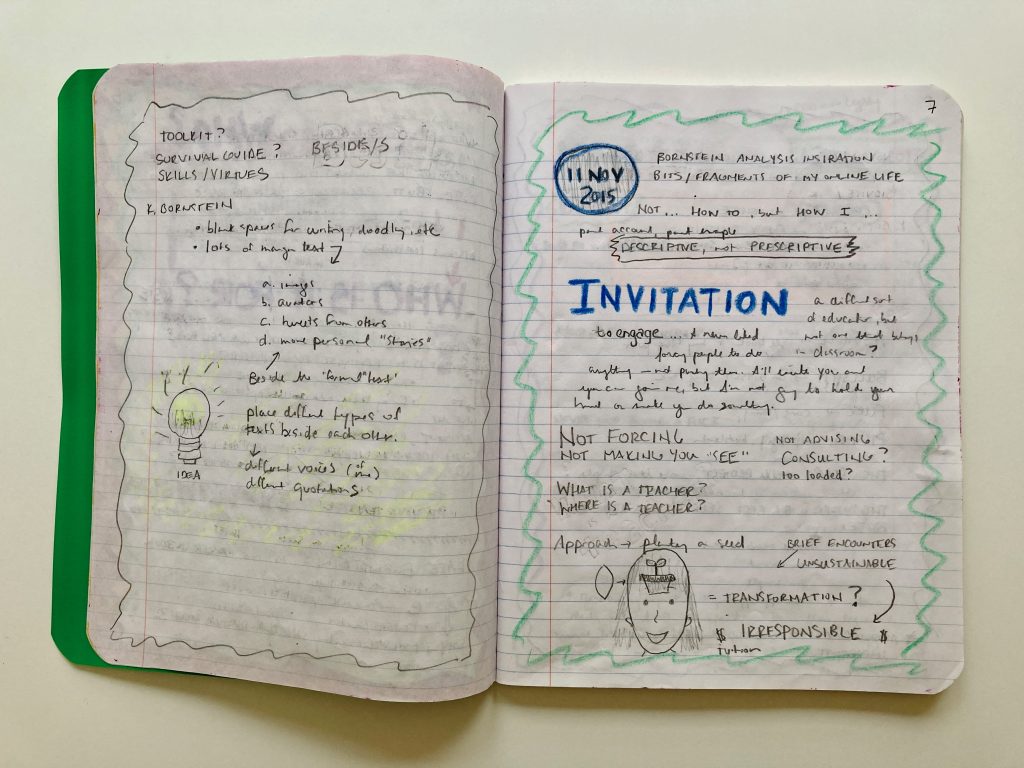
addendum, 18 april 2022: almost forgot to add this image from my notes for my memoir (still in progress) about my student and teaching life”
planting a seed, lower right
Instead of cropping out the key part — the picture of a plant growing inside a head in the lower right with the text, “planting a seed” — I decided to post the entire image. When I taught feminist and queer classes a decade ago, my aim was to plant seeds. Not to force ideas on students or to expect instant results — where they could immediately “get” something or be transformed, but to introduce ideas and offer up invitations that might, in the future, lead to transformation and deeper understandings.
A wonderful morning for a run. Sunny, warm, mostly calm, not too crowded. Saw Dave the Daily Walker at the start of my run. “Good morning Dave!” Ran south. Noticed the river a few times, sparkling in the sun. Heard lots of woodpeckers. The falls and creek were rolling along. I heard Minnehaha as I ran above it, over to the Veterans’ Home.
My favorite sound was the unexpected duet between a roller skier’s clicking and clacking poles and the sharp steady beak of a woodpecker. My second favorite sound was the way water gurgled and gushed in spurts out of the sewer pipe below the 44th street parking lot.
before the run
today’s theme for dirt: gravel, rubbled asphalt.
1 — definitions of gravel
Here are a few definitions from the online OED:
gravel (n): a material consisting of coarse sand and water-worn stones of various sizes, often with a slight intermixture of clay, much used for laying roads and paths.
gravel (v): 4. To set fast, confound, embarrass, non-plus, perplex, puzzle; and 5. of a question, difficulty, practice, subject of discussion, etc.: To prove embarrassing to; to confound, perplex, puzzle. Also U.S. To irritate, to ‘go against the grain with’.
2 — gravel in the gorge
Looked up gravel in the Gorge Management plan from an extensive study in 2002, and found out this about what I’m above near the start of my run:
Sandberg Loamy Coarse Sand is found within the savanna areas near the end of 36th Street and sloping areas to the north. Depth to bedrock is generally more than 60 inches and the soil is excessively drained. The soil has an available water capacity to a depth of 60 inches and an organic content in the upper 10 inches of 2%. A typical profile is as follows:A — 0 to11 inches; loamy coarse sand Bw —11 to 27 inches; coarse sand C — 27 to 80 inches; gravelly coarse sand.
3 — gritty gravel
I like the grit of gravel under my feet as I run. I’ve written about it a lot: the sibilant sound, the soft slippery slide when I run over it.
4 — dirt and gravel words
Had a vague recollection of posting a tweet that talked about words that were like gravel. It took me several minutes to find it, but I finally did! It’s from a log entry on august 21, 2020:
I’ve been thinking about how useful and wonderful it is to record myself reciting a poem and then listening back to the words, which are often correct but sometimes wrong in unexpected ways. I found a tweet yesterday, which doesn’t totally fit with this memorizing but connects:
“transcriptions rly show how much of our talk is dirt & gravel, how clear thoughts have to be panned for like gold
yet all the human pleasure is in the gravel, in the second-guessing & laughter & short sighs, the repetitions & amens, the silences where thoughts turn & settle
One bit of “gravel” I find in my recitation recordings is when I struggle to remember a word or phrase or line. Such delight in hearing the moment of remembering and the struggle to achieve it! What would it look like to transcribe that into a poem, I wonder?
Reading the bit about panning for gold, I’m reminded of Alice Oswald’s Dart and her lines about the Tin-extractor (pages 17-18):
you can go down with a wide bowl, where it eddies round bends or large boulders. A special not easy motion, you fill it with gravel and a fair amount of water, you shake it and settle it and tilt it forward. You get a bit of gold, enough over the years to make a wedding ring but mostly these dense black stones what are they?
he puts them in Hydrochloric acid, it makes his fingers yellow, but they came up shiny, little wobbly nuts of tin
and the stones’ hollows hooting back at them off-beat, as if luck should play the flute
can you hear them at all, muted and plucked, muttering something that only be expressed as hitting a series of small bells just under the level of your listening?
you rinse it through a shaking screen, you take out a ton of gravelly mud for say fifty pounds of tin…
Dart / Alice Oswald
6 — Mary Oliver and gravel as dust as death
One section of The Leaf and the Cloud is titled, “Gravel.”
from 3.
Everything is participate. Everything is a part of the world we can see, taste, touch, hold onto,
and then it is dust. Dust at last. Dust and gravel.
8.
Listen, I don’t think we’re going to rise in gauze and halos. Maybe as grass, and slowly. Maybe as the long leaved, beautiful grass
I have known, and you have known— or the pine trees— or the dark rocks of the zigzag creek hastening along—
or the silver rain—
or the hummingbird.
9.
I look up into the face of the stars, into their deep silence.
10.
This is the poem of goodbye. And this is the poem of don’t know.
My hands touch the lilies then withdraw,
my hands touch the blue iris then withdraw;
and I say, not easily but carefully— the words round in the moth, crisp on the tongue—
dirt, mud, stars, water— I know you as if you were myself.
during the run
Difficult to remember now that the run’s done, but I remember listening for the grit under my feet and thinking about how I like feeling something under me as I run. Also thought about Wittgenstein and the importance of rough ground, how smooth surfaces offer nothing to grab onto, to notice. And how uneven, gravelly ground offers a good distraction from the effort of a run.
Running past the Wabun playground, I suddenly remembered the time that Scott ran up the slide with the kids and into the metal bar at the top with his head. If he had hit it just right, or just wrong, he might have died — at least that’s what we thought when it happened. He was fine, but as I kept running, thinking about dust and death, I had a quick flash — how different life would have been for me and the kids if he had hit it wrong and would have been gone for more than a decade now. Thankfully the thought evaporated quickly, replaced by the rush of the river as it roared over the dam, and the ache in my legs as I ran down the steep hill below the Veterans’ Home.
I know I had more thoughts than that, but they’re all gone now.
addendum, 12 april: I almost forgot. I chanted about gravel to keep my pace steady and my mind focused (or distracted or shut off?):
gravel gravel pebble pebble rock / rock / stone / / /
Nothing that creative, but it worked as a chant and I liked the sharpness of rock and the way stone stopped the sound, making room for 3 beats of silence.
addendum, 23 april: Re-reading this entry, I think I like this chant slightly better:
gravel gravel pebble pebble rock rock stone /
after the run
Searched “walt whitman gravel” and this was the first result:
Walt Whitman
A high nutrient amendment comprised of compost, rice hulls and chicken manure. A little goes a long way. Blend with existing soil at 25-30% by volume and follow with a thorough irrigation immediately after planting. Walt Whitman when used at an appropriate rate will provide adequate fertility for plant establishment.
“Walt Whitman when used at an appropriate rate will provide adequate fertility…”. Yes, this sounds about right—with his excess of words and exclamation points and enthusiasm for everything, I always need to use moderation when reading Whitman!
Also, searched “gravel” on Poetry Foundation and found this haunting poem. Wow.
She is girl. She is gravel. She is grabbed. She is grabbed like handfuls of gravel. Gravel grated by water. Her village is full of gravel fields. It is 1950. She is girl. She is grabbed. She is not my grandmother, though my grandmother is girl. My grandmother’s father closes the gates. Against American soldiers, though they jump over stone walls. To a girl who is not my grandmother. The girl is gravel grabbed. Her language is gravel because it means nothing. Hands full of girl. Fields full of gravel. Korea is gravel and graves. Girl is girl and she will never be a grandmother. She will be girl, girl is gravel and history will skip her like stone over water. Oh girl, oh glory. Girl.