march 31/RUN

4.3 miles
minnehaha falls and back
36 degrees

Yesterday afternoon we got 2 or 3 inches of snow. By the time I went out for my run in the late morning, much of it had melted, even on the grass. Excellent. It’s the warmer ground and the bright sun that did it. I was over-dressed in my purple jacket with a stocking cap. Halfway through the run, I took off the cap and held it in my hands.

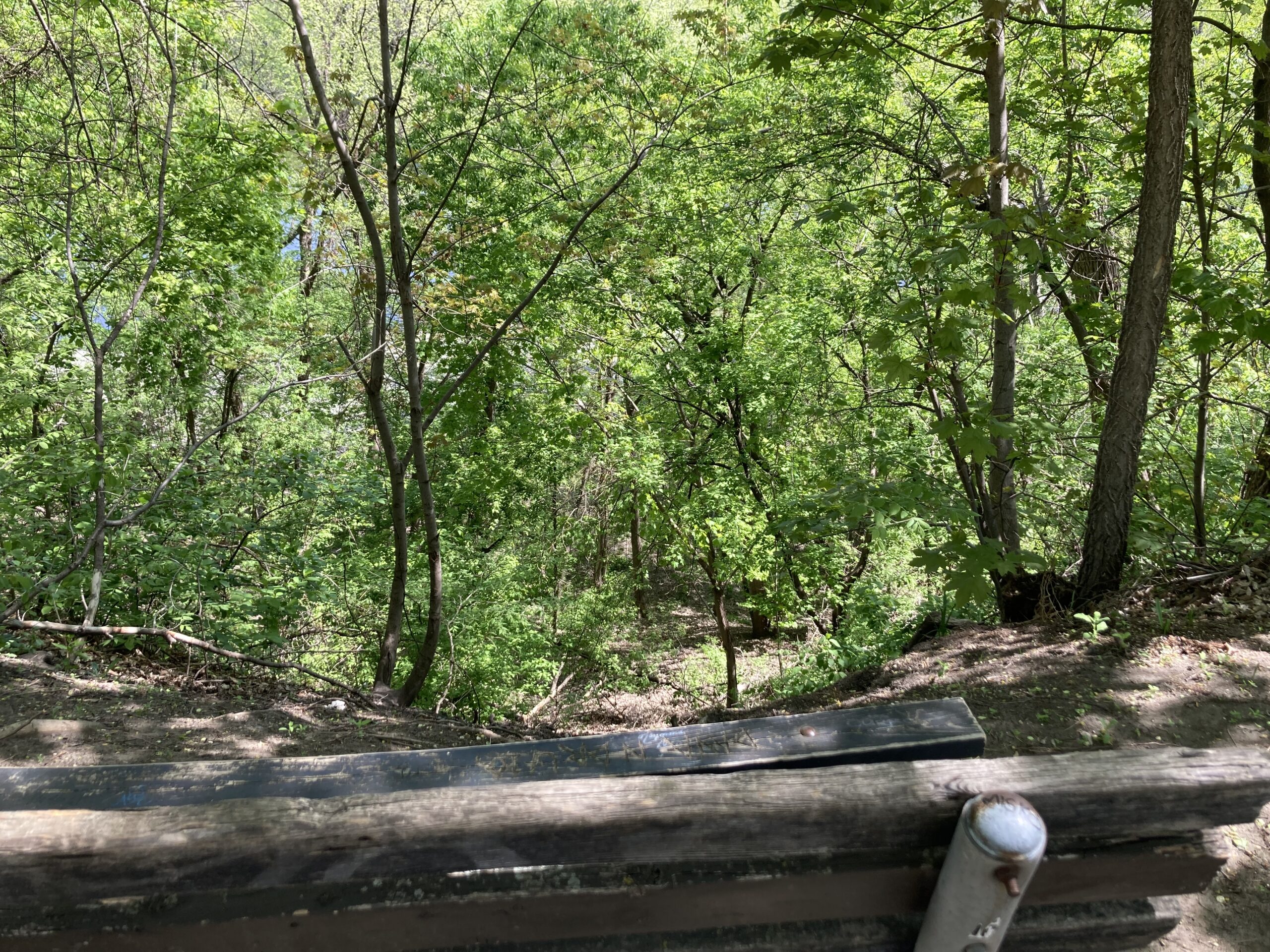
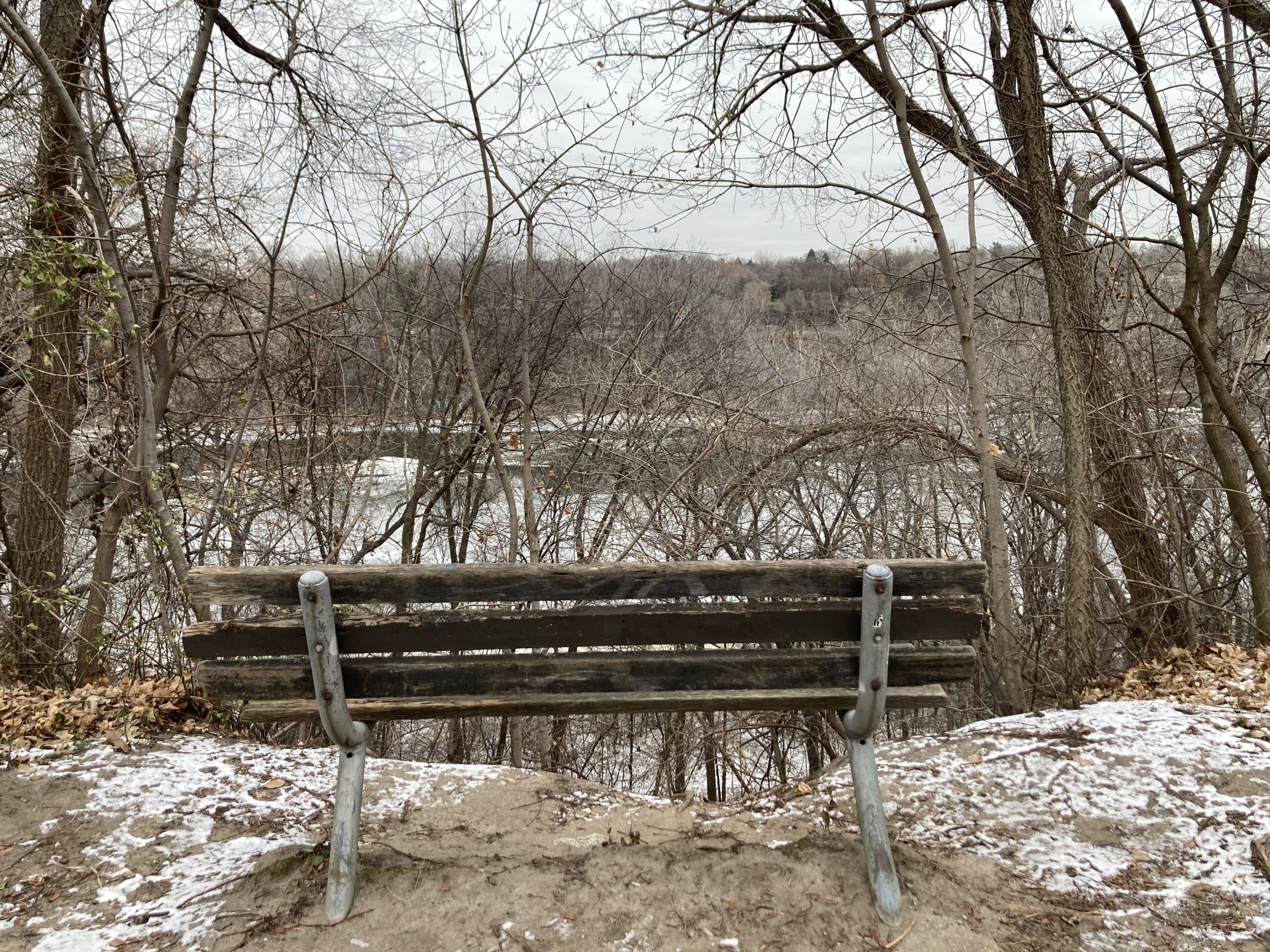
As I ran south to the falls I chanted in triples. Lots of berries and sweet things (hot fudge sauce, fresh whipped cream), histories and mysteries and possibles, both muddy trail and mud on trail, and metronomes. On the way back, I put in my “doin’ time” playlist for the last day of my time month. I was planning to not stop to walk for the second half, but when a runner who was running the same speed or just a little slower than me joined the path in front of me, I decided to stop a few times to get some distance from them. One of the places I stopped was the bench above the edge of the world. I don’t remember what the river looked liked, all I remember was that looking at it made me feel calm and content and vast.

overheard while running by the falls: one person to a group of others, he should do it, his arms are the longest. Were they taking a group selfie?

10 Things

  1. water falling, 1: a steady gush out of a gutter
  2. water falling, 2: trickling from the sewer pipe at the ravine
  3. water falling, 3: gushing at the falls — mostly white foam
  4. shadow, 1: the small shadow of a bird crossing my path
  5. shadow, 2: the sprawled, gnarled, twisted, softened shadows of oak trees on the road
  6. shadow, 3: the sharp circle of the lamp part of the lamp post
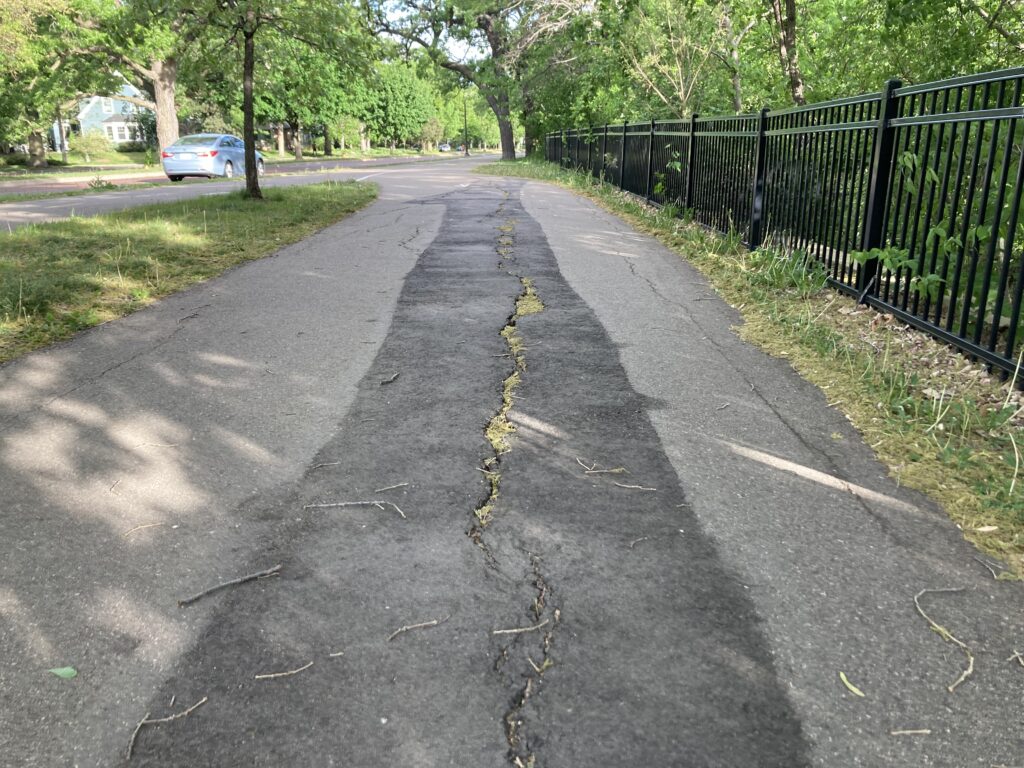
  7. missing: the top railing of a wood fence on the edge of the trail
  8. several people in the falls parking lot, waiting to pay for parking
  9. empty benches
  10. a thin layer of snow on a leaning branch in the ravine

Found this poem the other day:

Color Keeps Time / Patrycja Humienik

or it rides us
like a torrent. Blurs
and fastens, flesh

to seconds. Just look
at your veins.
In vespertine woods,
I tried to read moss
by hand. There’s
something laconic
about green that I need.

Lover, let the morning slow
time through the branches.

vespertine: relating to, occurring, or active in the evening
laconic: using few words, concise to the point of seeming rude or mysterious

What kind of time are different colors? What sort of time is orange, for example? If purple is twilight, orange is late afternoon or early summer evenings.

I tried to read moss/by hand. This line reminds me of Robin Wall Kimmerer and her suggestion that “Mosses, I think, are like time made visible. They create a kind of botanical forgetting. Shoot by tiny shoot, the past is obscured in green. That’s why we have stories, so we can remember” (Ancient Green/RWK).

“Color Keeps Time” is from the collection, We Contain Landscapes.

march 30/BIKERUN

bike: 35 minutes
run: 1 mile
outside: 32 degrees / snow

I finally decided to start watching the Apple+ show, See. A plague has wiped out all but 2 million people. The survivors are blind. At the time of the series, centuries later, vision exists only as a myth. The first episode begins in a remote village. I wanted to watch it because I’m curious how blindness is represented in the show. I should add that I am watching the show with audio descriptions on; I don’t think I’d be able to watch without them. My first question: what do they mean by blind? They never specify. Is it pure darkness, or can they detect some light?

The blind villagers function normally; they navigate with long sticks and dogs and ropes that are strung up all around the village. Also: wind chimes and bells. Many of them have extremely good hearing.

If you’re lying, I will hear. Nothing escapes my ears. I hear doors closing in your voice.

Just as I was stopping my bike, the evil queen appeared. I’m not sure what her deal is yet — I just know that she’s evil and she wants to kill the two babies that have just been born in the village because she hates their father and has a bounty on his head.

Do I like this show? Not sure. I’ll keep watching. One thing that was difficult — the fight scene between the queen’s henchmen, the witch finders, and the village, led by Jason Momoa. It was long and very visual — so much audio description.

While I ran I listened to the mood playlist: energy. Not sure why this is the case, but running actually helps loosen up my back when it feels a little tight. I only ran a mile, but it was enough. Now I’m tired and hungry!

before the run

In his introduction of the poem-of-the-day for the slowdown poetry podcast, Major Jackson says,

Today’s marvelous poem reminds me we exist in liminal zones where the extraordinary renders the ordinary visible and uncanny, an assertion of the imagination that makes our world shimmer.

episode 1321

The ordinary as uncanny, shimmering. I love this description and Heather Christle’s work for this reason. My lack of functioning cone cells makes more of the world uncanny and shimmering. Often, things are not quite and almost. Everything seems to be vibrating and pulsing, soft and slow. And my reliance on peripheral vision means I am much more aware of movement. Before, when my central vision worked, I had an easier time blocking that movement out, but now I see all of it. While this is a problem, it is also offers the possibility of seeing the world differently, of accessing the magic and wonder of it.

The Running of Several Simulations at Once May Lead to Murky Data/ Heather Christle

How do you say ‘inopportune’
in a small forest of cell phone towers
disguised as bizarrely regular trees?
I am asking in case it happens,
because anything can and even does.
Sometimes I want to shrink
and move into a miniature model village
mostly because the particular green
of the imaginary grass corresponds
with how my body believes joy would feel
if joy were to happen here on Earth,
where my eyes receive light in this
certain way: limited, but not
without pleasure. As a child
I visited one model village
so extensively constructed I fell
into a state of complete wonder—
‘They thought of everything!’
even the person running late
for the train, and the window
left slightly open to the storm—
and I should like to request
the arrival of this sensation in response
to the world at its actual scale—
just imagine! Someone
has even gone to the trouble
of filling the egg cartons
individually with smooth brown
eggs and one—such detail!—
has broken, but not enough
to be noticed before the carton
has been paid for and brought home.
Sometimes artificially I will
induce this feeling in myself
by going silent at a large
restaurant gathering, pretending
—until it is real—that each person
is speaking from a highly naturalistic script,
having carefully rehearsed each
tiny gesture, the mid-sentence reach
for the salt, and I fall immediately
in love with my companions,
in awe of their remarkable talent
for portraying with such detailed conviction
the humans I know as my friends.

I can’t quite put it into words, but this poem speaks to a conversation Scott and I were having last night. He was pointing out all of these minute details about our environment, like how the pinball machine was set up and leveled, and how that process affects game play and your enjoyment of it. There was something about the attention to the details and learning more about all the (almost) invisible things required to make a thing work properly and then describing that work as “care” work that is echoed in this poem.

Future Sara, will this make sense to you? It connects to being oriented toward care and wonder and finding delight in the small details.

march 28/RUNWALK

5.3 miles
ford loop
53 degrees

Spring! High in the 70s today. Tomorrow, in the 40s. When I started, I felt very sluggish and I wondered if I would be able to do the entire loop. I suppose it got a little easier, but I think it was more that I just kept putting one foot in the front of the other. I stopped to walk when I thought I needed to and kept running when I knew I could. There was one moment when I was just about to stop and walk but then I didn’t. I want to do that more often.

“10 Things

  1. the waves on the water from the ford bridge, looking like little scales — the wind pushing the water upstream
  2. reaching the top of the summit hill, hearing several dogs non-stop barking in a fenced-in backyard. I looked over and saw one of them up on something, their head higher than the fence
  3. a man exiting a port-a-potty at the Monument parking lot, ready to begin running again
  4. the cross on top of the monument — big and made out of stone — have I ever noticed it before?
  5. the feel of the sandy dirt on the edge of the paved path on the st. paul side: soft, fast, gentle, singing
  6. the bells from St. Thomas ringing quietly
  7. empty benches everywhere
  8. the faint knocking of a woodpecker high up in a tree
  9. no eagle perched on the dead limb of the tree near the lake/marshall bridge
  10. something floating in the water — I couldn’t tell if it was a buoy or an ugly 80s purse

Waters of March (Águas de Março) / Antonio Carlos Jobim

This song, which I’ve heard many times but never really listened to, came up on a mood playlist yesterday. I looked up the lyrics, and here’s the first part:

A stick, a stone
It’s the end of the road
It’s the rest of a stump
It’s a little alone

It’s a sliver of glass
It is life, it’s the sun
It is night, it is death
It’s a trap, it’s a gun

The oak when it blooms
A fox in the brush
A knot in the wood
The song of a thrush

The wood of the wind
A cliff, a fall
A scratch, a lump
It is nothing at all

It’s the wind blowing free
It’s the end of the slope
It’s a beam, it’s a void
It’s a hunch, it’s a hope

And the river bank talks
Of the waters of March
It’s the end of the strain
The joy in your heart

The song is originally in Portuguese and from 1972; Jobim created an English version later. I like the list of images — a list poem!

As the story goes, Jobim wrote the song in his country house, close to Rio de Janeiro. He was growing impatient with all the rain and mud that kept delaying some work he wanted done on the property and started the song as a way to distract himself from the constant downpour, creating a simple tune to go with the lyrics. His intention was to rewrite the melody later, though he soon realized that the downward spiral progression he had accidentally created fit the song—and the weather—perfectly.

The lyrics of “Águas de Março” tell of the constant rain that falls in Rio during the month of March, at the close of the summer (in the Southern Hemisphere, the seasons are opposite to those in the Northern). It is a common occurrence for excessive rain to cause floods and landslides. It washes away houses and streets, taking everything it clashes with in its current.

The Waters of March

And here’s a delightful poem I discovered on Instagram last night:

Lately,/ Laure-Anne Bosselaar

when a branch pulls at my sleeve
like a child’s tug, or the fog, reticent & thick,
lifts, & strands of it still hang like spun sugar
between branches & twigs, or when a phoebe
trills from the hackberry,
I believe such luck
is meant only for me. Does this happen to you?
Do you believe at times that a moment chooses
you to remember it entirely & tell about it —
so that it may live again?

ritual / ceremony / chant / movement

Reading through past entries for this month, I came across an idea from Cole Swensen:

as you move
through a

place, it moves
through you

OR

move through a
place and

it moves through
you too

I like the second one. I can imagine chanting it as I run and thinking about what I’m moving through and what’s moving through me. What is moving through me?

Here’s one answer, in a poem — Running Sentences — from a poet I just discovered on 26 march:

a The chorus is making sentences now: look,

b A cloud of gnats through which the body like a hailstorm blew,

c Here in the pockets of the path, there a heaven I avoid,

b Runners move through gnats, whole bodies move, disrupting,
(Running Sentences/ Endi Bogue Hartigan)

walk: 35 minutes
edmund
67 degrees

It almost feels like summer — wow. Trees and birds and a steady stream of cars on the river road enjoying the nice weather. Bikes, kids, the smell of dead leaves baking in the sun. My favorite thing: 2 people ahead of me on the sidewalk, one of them was wearing cool, baggy pants with a tank top and I thought that I’d like to have something like that to wear. Later a car drove by, the people inside scream-singing along to “Like a Prayer.” The person in the baggy pants called out and they stopped to let them get in. Then laughing and gleeful shouting and more scream-singing. I almost wrote, oh, to be that young again, but I don’t want to that young again. Instead, I’d like to be that delighted and joyful again.

march 27/WALK

45 minutes x 2
walk 1: 50 degrees / longfellow flats
walk 2: 62 degrees / edmund

Walked with Delia the dog in the late morning. The good news: it’s beautiful today, my back feels so much better, the water was supposed to be off all day (for water main work down the street), but it’s already back on at noon. The bad news: I feel overwhelmed and have the strong urge (need?) to disengage. The saga of getting a girl to go to school continues; now it’s college classes. I am tired. One of my best friends is coming into town this weekend, and I want to see her (have plans to see her), but I’m not sure I can do it. In this scenario, which is the best way to be kind to myself: to be generous and encourage myself to cancel plans and rest, or to be stern and encourage myself to push through and keep the plans?

The walk helped me to feel better, but did not help me decide what to do.

update, after walk 2: I have decided to be generous to myself and cancel my plans. There have been many good things that have happened this year (with the year starting last fall), but also many very difficult things. Two mantras I’m trying to remember: be kind to yourself and whatever gets you thru the night is alright (John Lennon).

I was planning to make a list of 10 things, but when I tried my mind went blank. Too much pressure to produce? I think I’ll write about what I remember in this paragraph instead of in a list. I remember the river burning through the trees. Just a small spot, shimmering at the edge of my vision. I remember a man taking a break from running, breathing very heavily. He was struggling — wheezing and coughing. Had he done a hard/fast set, or was he just very out of shape? I remember the woman with the dog stopped at the wooden feence above the ravine who started up again just before Delia and I got to them. They went a few feet and then the dog plopped on the ground and wouldn’t move. It was impossible to get by them, so we explored the rim of the ravine. I remember taking the old stone steps down to the forest floor and walking past a big tree that had fallen and then been moved out of the way, presumably by park workers. So many tangled roots! I remember the feel of the soft sand and the blue of the blue water. I remember how the trail through the forest opened to the river and how the tall grasses framed the water. I remember the wonderful burning feeling of my glute muscles as I powered up the stone steps. I remember the soft geometry of the fence slat shadows. I remember hearing voices that were either deeper in the gorge or on the other side. I remember hearing the St. Thomas bells ringing, but I don’t remember how many times they rang. I remember witnessing 2 sewer workers doing something with the manhole. I think they were turning the water back on — they had a long pole that was in the center of the hole and they were leaning over and moving clockwise as they tightened (or loosened?) something. An unsual sight. It looked strange and uncomfortable.

It was very cool to witness these workers. Somehow I had imagined that a machine would turn the water off and on. The sewer pipe is too delicate, Scott thought. Of course. I like learning about these things, knowing how they happen, being reminded of the physical, and usually invisible, work that is required — and by people — to do them.

Delia and I did the second walk with Scott. Here are 3 delightful things that happened:

1

Below Edmund in the part of the boulevard dotted with trees I pointed out a huge tree that had lost its head — it didn’t have a top, just a jagged trunk — but still had two thick and long branches that stretched horizontally with clusters of smaller branches. They were gnarled and twisted and seemed to be reaching across the grass. They also cast a wonderful shadow.

2

Under another tree, Scott pointed out a woodpecker. Amazingly I was able to see it — it was tiny — because it had moved and my peripheral vision had caught the sense of movement. After a minute or two, it started knocking on the wood — a soft tap tap tap tap.

3

I was able to point out the rock wedged in the tree with = > ÷ painted on it that I wrote about yesterday. I asked Scott if he would have seen it while just walking by. Just as he was saying, no, only if I decided to stop and look at the tree, while looking at another tree, he noticed 2 more of the rocks wedged in the trunk! Later, another one in yet another tree. Wow! I love noticing new things, discovering something that you probably had walked by dozen of times without noticing. Moments of unexpected joy, hidden in plain sight, waiting for you to notice them and be delighted!

Reading a recent issue of The New Yorker, I found a beautiful poem. If you click on the link, you can listen to the poet read it — I love how they read: so natural and not affected or sing-song-y at all.

What Am I Afraid Of?/ Sasha Debevec-McKenney

The silence, the thoughts
that come with it, the sinking
suspicion that something more
is wrong with me than anyone
knows, including myself, including
the doctor who hooked me up
to the EKG machine and said
that though my heartbeat was irregular,
the irregularity was normal.
It was nothing to worry about.
The doctor told me there are two kinds
of people: unhealthy people who refuse
to get help, and healthy people
who always think they’re dying.
Nobody’s in between. But I’ve met
so many kinds of people:
people who stretch before
they get out of bed, people
who walk through life unstretched,
people who think their body
is a house and people who don’t
think of their body at all.
People who peel their carrots,
people who don’t. People who
stand on the roof and let the wind
make them cry. People who are afraid
to cry. People who step on all the leaves
on the sidewalk, people who look
straight ahead. There are people
who aren’t like me, they
don’t know the names
of all the different apples.
Once when I was cashiering
a woman said to me, “Wow,
you really know your kale.”
And once, at the butcher shop,
a man said to his dog, “That’s
the nice lady who smells like meat.”
I’m afraid I don’t know
what kind of person I am.
I thought I would get a chance
to do my life over in all the ways
anyone could think of: dying
would be like changing the channel.
I hate that you can’t hold on
to anything. I was washing an apple
and then I was coring it
and then it was cut—
and that was weeks ago now.
It was a Honeycrisp, and it lived up
to its name.

Of course a doctor, trained in dualism and either/ors and this or thats, would think this:

The doctor told me there are two kinds
of people: unhealthy people who refuse
to get help, and healthy people
who always think they’re dying.

I’ve been thinking about lists and list poems and reviewing a chapter from a craft book about them. I like the poet’s list of types of people.

march 26/RUNWALK

5.25 miles
bottom of franklin and back
46 degrees

More excellent running weather. Sunny and calm and warm(er). Birds singing and swooping and perching on tree branches right in front of me. I felt relaxed and strong and my back only hurt once, when I stood up after re-tying my shoe. I ran without stopping to walk to the bottom of the hill and right next to the river. It was swirling foam on the edges. Ran back up to under the franklin bridge then stopped to walk the rest of the hill. I noticed a sign — Trail closed starting March 31st — uh oh. Just looked it up; it’s only for 2 weeks:

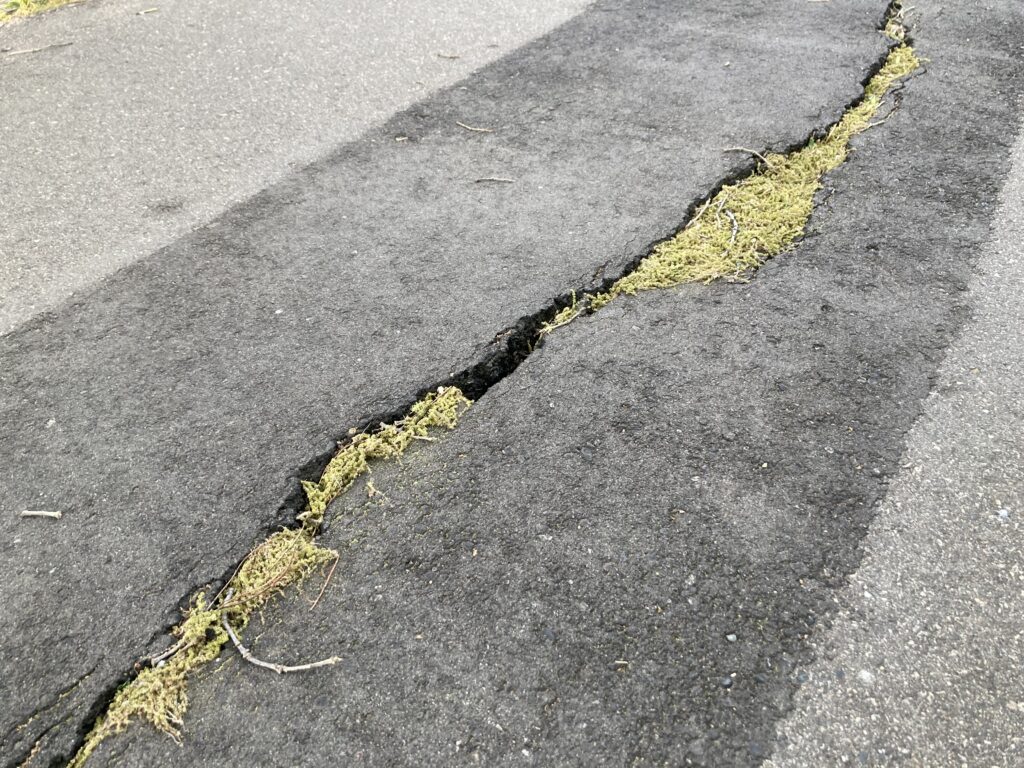
Bike and walk trails along West River Parkway will close between the I-94 Bridge and Franklin Avenue for up to two weeks beginning Monday, March 31, 2025.

The closure is necessary for contractors hired by the Minnesota Department of Transportation to install a safe span system that will protect trail users during repairs to the bridge this year.

Trail users will be detoured to the upper West River Parkway roadway between the I-94 Bridge and Franklin Avenue. This same closure will be repeated in August so that workers can remove the safe span system after repairs are complete.

Listened to a mood playlist: energy for the rest of the run. The best (or worst?) song on the playlist was “Hocus Pocus” by Focus. I love the song, but it was too fast to try and run to!I had to increase my cadence to 200 bpm to match it! The song also does not have a steady rhythm; it just keeps getting faster and faster, probably because they were on cocaine while they recorded it.

10 Things

  1. the water was a brownish greenish blue
  2. in the flats I leaned over the ledge and watched the swirling foam slowly travel down stream
  3. workers on the road above the tunnel of trees, doing something to sewer which released a sour smell
  4. the workers were wearing bright yellow vests
  5. passed a walker who refused to move over — they were walking right next to the line. I suddenly wondered, are they neuro-divergent? then, maybe I should chill out about people needing to follow the accepted rules about where and how to walk on the trail
  6. stopped at the sliding bench, 1: heard a cardinal — it was somewhere nearby — looked up and saw that it was on a branch close to me. Was it red? I couldn’t tell, but I did noticed how its tail quivered slightly all the time — I’m assuming it was keeping its balance. Do birds have to constantly adjust while perched?
  7. stopped by the sliding bench, 2: looking down at the white sands beach, hoping for movement. Yes, there, deep in — a walker moving through the trees
  8. the small shadow of a bird crossing my path, flying fast!
  9. my sharp shadow in front of me, crossing over the softer shadows of tree branches
  10. the shadow of a tree with dead leaves on it — looking almost like a messed-up pom pom

At the end of the run, as I was walking home, I had a thought about CA Conrad’s and their idea of the “extreme present,” which I wrote about on here earlier this month on march 5th:

“extreme present” where the many facets of what is around me wherever I am can come together through a sharper lens.

intro to ecodeviance / CA Conrad

Conrad creates their soma(tic) rituals to make being anything but present is nearly impossible. Running by the gorge can put/force me into the extreme present. This sense of the extreme present doesn’t happen for the entire run, but I can achieve it in moments. In their lengthy, day-long rituals — wear a red wig, eat only red food — is Conrad able to achieve this extreme present for longer?

birdsong!

This morning Scott heard the cardinals outside his window and because he wanted to use some birdsong in his latest music project, he placed his phone on a chair on the deck and recorded some. I liked how he described it: I left the phone out on the deck then returned inside and went quietly about my business. When he told me about how similar each wave of sound looked, I asked if he could screen shot it and send me the sound file so I could post it here:

cardinal song, an image of sound waves
cardinal song / 26 march 2025

Wow! So uniform.

Happy 151st Birthday Robert Frost!

When the poem of the day on poetry foundation was a Robert Frost one, I figured it must be his birthday. Yep — 26 march 1874.

For Once, Then Something/ Robert Frost

Always wrong to the light, so never seeing
Deeper down in the well than where the water
Gives me back in a shining surface picture
Me myself in the summer heaven godlike
Looking out of a wreath of fern and cloud puffs.
Once, when trying with chin against a well-curb,
I discerned, as I thought, beyond the picture,
Through the picture, a something white, uncertain,
Something more of the depths—and then I lost it.
Water came to rebuke the too clear water.
One drop fell from a fern, and lo, a ripple
Shook whatever it was lay there at bottom,
Blurred it, blotted it out. What was that whiteness?
Truth? A pebble of quartz? For once, then, something.

A beautiful sonnet — 14 lines, 11 beats per line, almost iambic pentameter. Is that right? I always struggle to hear meter properly.

Love the description of a reflection: Me myself in the summer heaven godlike/Looking out of a wreath of fern and cloud puffs

And that something white, uncertain, seen briefly then lost to a ripple. Yesterday I posted some lyrics from “The Windmills of Your Mind” about the ripples from a pebble. Ripple is a great word.

Seeing this sonnet is making me think I should try that form for my color poems. I could study a few different ways of doing the sonnet — Diane Seuss, Terence Hayes, William Shakespeare. Any others?

oh orchid o’clock

A good morning on the poetry sites. Not only did I find Robert Frost’s poem, but I found a cool collection that fits in with my study of time: Oh Orchid O’Clock by Endi Bogue Hartigan. (note: I just emailed Moon Palace Books about ordering it! update: I ordered it!)

/it is the president’s turned up o’clock it is America’s deadliness and dailiness

o’clock / it is glued to the headline o’clock

it is lunchhour-beeline o’clock / it is it’s only Tuesday o’clock another

curbside memorial o’clock another caterpillar miracle o’clock another

people emptying from their lives o’clock or into

their lives o’clock the Nile floods the Nile floods every hotspell in this week

I discovered this book through poems.com, which had one of its poems posted today:

hour entry: I fall asleep with a rain sound/ Endi Bogue Hartigan

I fall asleep with the rain sound app of my cellphone, the app includes distant thunderclap sounds and there are people who recorded or simulated these sounds, and it is time to disagree and thank the dawn. I disagree with this rain, I feel absurd for thesimulation of it and yet my brain waves have come to depend on it, depend onsimulated porous points between the raindrops. Always the porous dream, always theneural authority, the reaction meme, always the authority of always, the puncture ofalways, time spent saying always, the spider legs of always, the sleep command, thewake spindles, the spider leg threatening to break from the spider.

So cool! Encountering Hartigan’s work, I was inspired to think about time in relation to my blind spot and the practice of running beside the gorge that has happened beside (and because of?) my vision loss. I wrote the following in my Plague Notebook:

my blind spot
breaks open seconds
pries apart the hard edges of
a beat invites me
to dwell inside

I am suspended between
beats as time slows
but never stops
with moves so slight it takes
a practiced eye to see
their soft shimmering
embrace what is not seen but felt —
wind
the rotation of the earth
a bench sliding into the gorge
rock crumbling
cone cells collapsing
a blind spot expanding

walk: 40 minutes
neighborhood / winchell trail / oak savanna
54 degrees

What a great afternoon walk with Delia the dog! No coat. No mud. Walked to the Winchell Trail then down beside the chain link fence. Drip Drip Drip — the sewer pipe in the ravine. Everything washed out — light brown, tan, yellowed. Up on the mesa in the savanna, a great view of the river. Was able to walk on the dirt path between the savanna and the 38th street stairs. They’ve put down some mulch, so it’s not as muddy. As I neared the entrance to the Winchell Trail, I passed the spot where I fell in the mud, straight on my tailbone. No mud now, only memories and a still-sore back.

On the way to the river, I noticed something interesting hidden on the tree trunk while Delia sniffed around. I took a picture of it:

= > ÷

When I was looking at it in person, I thought someone had carved the message in the tree, but studying it now, it looks like it’s a rock wedged in a crack. I probably should have taken another picture that wasn’t quite as close-up for scale. That is one tiny rock.

I had to look up how to type the division sign on a mac. Hold down option and /

march 25/RUN

4.5 miles
minnehaha falls and back
39 degrees

It felt much warmer than 39. Another great late morning for a run. My back seems to be getting better. Still sore, but not when I’m running. Felt compelled to walk a few more times than usual, but otherwise a good run.

10 Things

  1. a small bird’s shadow crossing the path
  2. a glimpse of silver, then the outline of a metal cart, a fold-up canvas chai with someone sitting in it, facing the river, the radio
  3. below the edge of the world: a steep trail tight against the bluff, going somewhere under the trail and over to the jagged ledges of a ravine
  4. drip drip drip the sewer pipe near the curved retaining wall dripping water
  5. empty benches
  6. hollowed out trunks on the Winchell Trail — empty circles
  7. a person climbing up the steep slope below the winchell trail on the other side of wrought iron fence
  8. the falls: white foam
  9. the edges of the river, slabs of ice/snow then sparkle
  10. the crooked shadows on the paved path, near the edge, cast by sections of a leaning wooden fence

Created another time playlist, this one all about loops and seasons and time as a circle called “The Wheeling Life.” Favorite song to listen to today: “Windmills of Your Mind”/ Mel Torm´e, which is inspired by hearing it in the season finale of Severance.

Like a tunnel that you follow
To a tunnel of it’s own
Down a hollow to a cavern
Where the sun has never shone
Like a door that keeps revolving
In a half-forgotten dream
Or the ripples from a pebble
Someone tosses in a stream

march 24/RUN

4 miles
river road, north/south
32 degrees

A beautiful morning for a run! Wind in my face as I ran north, at my back heading south. Bright sun, sharp shadows, deep blue almost purple river. Raced a wind whirled leaf and won. Greeted Dave, the Daily Walker. Heard voices down in the gorge. Noticed ice on the edges of white sands beach. Thanked a man for stopping to let me run past and he kindly replied, you’re welcome miss. He was listening to music without headphones and carrying a bag of something — groceries? More than one of the benches was occupied. Encountered runners and walkers, a biker and a roller skier. In the last mile, I zoomed past someone running down the hill and under the lake street bridge.

I did my beats experiment again today.

mile 1: triples — open door / open door/ go inside / go inside / go outside / go outside / hello friend / hello friend / old oak tree / strawberry / opening / up the hill / on my toes / forest floor

mile 2: started with the metronome set to 180 bpm, but that was too fast. Locked in with 175. By the end of the mile I barely felt my feet strike the ground, only heard the beat — I had made it inside of the beat!

mile 3-4: doin’ time playlist. The first song was “Time Stand Still“/ Rush. The first line: “I turn my back to the wind” I heard this as I was running with the wind at my back.

Freeze this moment
A little bit longer
Make each sensation
A little bit stronger

I thought about freezing the moment and the difference between stopping time and suspending (or being suspend in) it.

a few hours later: I’m reading the book, American Spy, and I just came across this bit about looking people in the eyes:

At Quantico they’d taught us the so-called classic signals that some one was lying: if they glanced up to the right before they speak, or if they won’t look you in the eye.

American Spy/ Lauren Wilkinson

My immediate reaction: that’s how I look at a person’s face. I try to find the approximate location of their eyes by looking off to the side, near their shoulder — this is me looking at them through my good, peripheral vision. Then I stare into the spot, which is usually fuzzy nothingness to me. Does that mean I’m always lying? Of course not.

I was pleased that this discussion continued:

None of what I’d learned worked as well as listening to my instincts. I’ve always been good at ferreting out decption. I’m not entirely sure what my ability to detect a liar is based on–subtle cues maybe, suconscious awarenss, an intuitive talent for reading microexpressions. I don’t know and I’ve found that the more I try to understand it the less effective I am.

Right. As Georgina Kleege suggests in Sight Unseen, looking someone in the eye doesn’t have this magic power that many (most?) people seem to think it does.

march 21/RUN

3.35 miles
trestle turn around
43 degrees

Wow, what a morning! Birds! Sun! Calm air! Everything quiet, relaxed. I felt fast and free. less tightness in my neck and hip. Greeted the Welcoming Oaks and Dave, the Daily Walker.

10 Things

  1. a runner with BRIGHT orange shoes
  2. a shining white form in the distance, through the trees: the river
  3. the strong smell of weed somewhere below me
  4. stopping at the sliding bench — movement below, in the trees just before white sands beach: a runner on the winchell trail — should I try that?
  5. the soft knocking of a woodpecker in a nearby tree
  6. stepping off onto the dirt trail for a brief stretch: soft and springy
  7. someone sitting on a bench near the trestle
  8. the river: open and blue
  9. a big branch sticking out of the trashcan — a discarded walking stick?
  10. 3? stones stacked on the ancient boulder

I decided to try an experiment with beats.

First mile: chanting in triples
Second mile: metronome at 170 bpm
Third mile: “Doin’ Time” playlist

mile 1: strawberry/blueberry/raspberry — (to the welcoming oaks) Hello friend! Hello friend! Hello friend!/ old oak tree / stacking stones / stack the stones / intellect / mystery / (noticing a crack in the asphalt) breaking up / cracking up / bright yellow / woodpecker

I found that bright yellow was especially good for locking into a rhythm — BRIGHT yellow

mile 2: 170 was hard. I think it was too slow. I probably should have tried 175 or 180. I think I’ve done 175 before. I only locked into this beat a few times. Was my inability to lock in also because I started with triples?

mile 3: I put in my playlist. The first song was “About Damn Time” by Lizzo. It was great for getting into a groove. Next up, “9 to 5.” As I started to listen to it, I realized the metronome was still on and the beats of the song and it didn’t match up. I decided to leave it going and see what happens when I’m dealing with competing rhythms. I can’t quite remember, but I feel like I didn’t lock into either rhythm; I just created my own, and it didn’t bother/unsettle me.

Later I thought about how the “9 to 5” rhythm represents the relentless drudgery of working within capitalism. Resisting that rhythm, and what it does to you, is important. The final song I heard was “Too Much Time on My Hands” by Styx. I listened to the lyrics and was reminded that it was about a guy who wants a job, a way to feel useful, something to do, but he can’t get one. While he doesn’t mention in the lyrics why he can’t get a job, I thought of the larger context and the conditions (economic, political, social/cultural) that make it difficult for people/communities to find work.

Reading the lyrics — without hearing the music or singing — I was struck by this line:

And I don’t know what to do with myself

So dark. Heard with the music it just seems like a light lyric from a pop song.

This was a fun experiment that yielded some surprising results. I liked the accident of the competing rhythms and the juxtaposition of 9 to 5 with Too Much Time on My Hands. For future attempts, I’ll increase the metronome speed and mix up the order. Maybe I should try to write something, too, at the end of each segment? Speak a poem into my phone?

march 19/RUN

4.25 miles
minnehaha falls and back
38 degrees
wind: 18 mph / 37 mph gusts

Ran south and had the wind at my back for the first half, which was nice but it meant that I’d be running straight into it on the home. Not as difficult as I thought, but still draining. Wore the bright yellow shoes I bought last year and promised myself I’d never wear again because they make my feet hurt and calves cramp. They’ve been sitting in the rack all year, and looked so spring-y today that I couldn’t resist trying them again. Will I regret it? Probably. I should donate them instead of trying to make them happen.

10 Things

  1. little kid voices somewhere down in the savanna
  2. empty benches
  3. something glittering through the trees, up ahead — car headlights through the trees at the bend in the road
  4. a faster runner in a white shirt off to the side, heading down to the Winchell Trail — I followed above, watching as they slowly inched out of sight
  5. I don’t remember hearing the falls, just seeing them at a distance, from my favorite spot — white foam, moving rapidly at the corner of my central vision
  6. pale blue water, soft brown trees
  7. dead leaves on the ground — feeling orange to me
  8. the bluff on the other side was mostly brown with a few slashes of white — frozen seeps
  9. branches rubbing and creaking in the wind, sounding less like rusty door hinges and more like whimpering kids: soft, insistent, whiny
  10. running on the winchell trail, about to head up the 38th steps, I looked back and thought I saw someone approaching — nope, just the wrought iron fence

before the run: my blind spot

Yesterday, I read an interview with JJJJJerome Ellis and was inspired by their renaming of their Stutter as clearing:

Ellis’s glottal block stutter—which manifests as intervals of silence in his speech flow—is represented in this interview with the word clearing. Ellis offers this term as an alternative to words like stutter or stammer. Like a clearing in a forest, the stutter, for Ellis, can open a space of gathering between Ellis and the people he is communicating with.

Angel Bat Dawid and JJJJJerome Ellis

After a little digging, I found out more about the clearing and how it works for Ellis in their work:

Stuttering (especially in the form I present with, the glottal block) creates unpredictable, silent gaps in speech. I call these gaps ‘clearings’. Slaves sang in the fields, and whites heard them; but they also sang (and danced) in the woods at night, out of earshot. Undergirding the clearing created by my stutter is that other clearing, in the woods, where my enslaved ancestors stole away to keep healing, resisting and liberating through music – work that I continue today.

The Clearing/ JJJJJerome Ellis

Wow! What an amazing way to think about the stutter. In their follow-up book, the one that introduced me to Ellis, Aster of Ceremonies, they connect the Stutter explicitly with plants and place. I want to connect my blind spot — that growing lack of functioning cone cells in my macula — with water and stone and the gorge. As I try to explain this more, I have so many thoughts, too many words!

Just looked up blind spot and found these exciting definitions:

an area in which one fails to exercise judgment or discrimination

Merriam-Webster online

In this definition, a lack of judgment is a failure. And it is sometimes. But refusing to judge, keeping a space open for listening and beholding and bearing witness without judgment or the reduction of someone or something to a category (discrimination) is also essential.

Another helpful definition:

a portion of a field that cannot be seen or inspected with available equipment

Merriam-Webster online

during the run: my blind spot

I thought about my blind spot every so often as I ran, especially the idea of how it softens and fuzzes my vision. It’s difficult to see with precision, to scrutinize or make detailed observations that encourage me to identify and classify things. As a result, I devote less time to trying to name them, and more time to being with them. Here I’m thinking of Robin Wall Kimmerer and J. Drew Lanham.

I’m sure I had more thoughts, but I didn’t record them. If I had, would I even be able to hear them over the howling wind in any recording I would make today?

after the run: my blind spot

A space without judgment. Back when I was a scholar and teaching queer ethics, I was exploring what an ethics without judgement might look like, one that emphasized room to breathe and, as Judith Butler puts it, good air. I often invoked a quotation from Michel Foucault:

I can’t help but dream about a kind of criticism that would try not to judge but to bring an oeuvre, a book, a sentence, an idea to life; it would light fires, watch the grass grow, listen to the wind, and catch the sea foam in the breeze and scatter it. It would multiply not judgments but signs of existence; it would summon them, drag them from their sleep.

The Masked Philosopher/ Michel Foucault

A few days ago, I read something else about not judging from Cole Swensen:

. . . an instance of witness, with witness defined as the act of being present to something, whether it’s an event, a situation, a person, a view. To be present to is to present yourself, to offer yourself, to attend without judgment, opinion, intervention, appropriation or even evaluation, and yet to be present to is not to be passive; it is an act, the act of anchoring the witnessed in history, confirming it, acting as the “second” that fixes it . . . . It is the ear that turns the falling tree to sound.

Walk/ Cole Swensen

Witnessing, being with, beholding. The gorge — a widening gap, a broad space where fires are lit, the grass grows, the wind howls, and river foam scatters. A generous place for holding all of the messy, entangled, conflicting, complicated stories of a place: of preserving and maintaining it, of stealing it, of losing it, of dead mothers who disowned it, of daughters who are attempting to reclaim it, of erosion and transformation and haunting, of a girl losing her central vision and searching for somewhere to be — to feel less alienation and more connection. There’s a lot here!

For the first half of the run, I listened to kids’ voices, for the second half, my “Doin’ Time” playlist. Speaking of time, here’s something great I read by Hanif Abdurraqib about nostalgia:

Another question I was asked about There’s Always This Year was about the use of nostalgia in my work, and the function of it, and I had this long answer I was going to give, but I look back on recent moments, and I realize that a major function of my relationship with nostalgia is actually tied to a committed and principled relationship with my present life. I am in pursuit, often, of a moment I will live and miss before it’s even gone. And the awareness of the longing to come offers me an opportunity to slow down time, to pay closer attention, to say I know something will end, but I would like a vivid catalog of its existence. My favorite Robert Hayden poem is “Double Feature,” which opens its final stanza with “Oh how we cheered to see the good we were / destroy the bad we’d never be.” I love that line. There’s a lot of bad to dismantle, and only some of it is housed within. The world houses the rest, and it is abundant. I require whatever good I can steal and then hoard. It fuels me to the fight(s,) which isn’t the same as a kind of whimsical nostalgia, but it is me saying that I remember there are things I love enough to fight for, even when it doesn’t feel like it. There are things I miss that I haven’t even experienced yet, and I want to get to them, eventually. And then get to what’s next.

instagram post

added later: I want to add these thoughts from an Alice Oswald interview about erosion here, too:

DN: I wanted to switch to another topic that infuses your work, and that is the process of erosion—erosion by water, erosion by wind, erosion by light—the topic of your first Oxford lecture but also, something that feels very present to Nobody. You said in one interview that the anonymity you were striving after for this book was inspired by eroded Cycladic sculptures, sculptures where the features had been nearly washed away. I was hoping you could talk about erosion in relationship to this and to the text.

AO: I suppose that comes back to your question about thinking. The poem conveys a kind of eroded thinking. It’s as if the thoughts have had reality washing away at them; a sentence sets out then gets blown in another direction. Erosion is important to me in that I think poetry has a particular duty and relationship towards time. Poems are miniature human clots I think, they’re full of time keeping in the way that a piece of music is full of timekeeping. In some way, they set their own time but they need to be awake to actual time moving around them. A poem has to offer itself up to the erosion that’s going on in the world. Nobody, more than any of my poems, I think gives in completely to that force of erosion where I would normally try to maintain some human presence in the face of it. I think Nobody allows itself to get weathered to a Cycladic blankness.

This idea of a poem offering itself up to erosion and to being within time, reminds me of something I heard from Jenny Odell the other day in “Another Kind of Time.” She’s talking about how being part of time, having a past, present, and future — and not just being timeless — makes something/someone a subject/actor instead of thing to be commodified/exploited. To be timeless/without time is to lack a context and a life. I’m also thinking about how preventing erosion often requires a sealing up and away from oxygen, water, wind. Erosion and decay are a necessary part of life.

DN: This talk of erosion and time makes me think of that famous Marguerite Yourcenar essay, That Mighty Sculptor, Time. I’m just going to read a couple of lines from it, “On the day when a statue is finished, its life, in a certain sense, begins. The first phase, in which it has been brought, by means of the sculptor’s efforts, out of the block of stone into human shape, is over; a second phase, stretching across the course of centuries, through alternations of adoration, admiration, love, hatred, and indifference, and successive degrees of erosion and attrition, will bit by bit return it to the state of unformed mineral mass out of which its sculptor had taken it.” I was thinking of this when I encountered your interview with Claire Armitstead where you said you think of your poems less as poems than as sound carvings which made me think that the sound these poems were making is eating away at something which then by extension suggests that both the blank page and silence are not really absences in this framing at all but presences.

AO: Yeah, I like that. I’ve always felt that in some way, a poem is really a framing of its silences, that the musical art poetry is all about leading you to those silences in a way that you hear them where normally one doesn’t necessarily hear a silence or an absence, both the sound is eating away that silence but then also, the sounds are, in their own way, erosions made so I let my voice get blown around by the information it’s taken in if you like. The feeling of not quite holding your own. . . .

DN: Let me ask you something about Homer’s syntax that you’ve said in light of sound carvings being a description of your poems. You said about Homer’s syntax, “The tendency of his grammar is therefore cumulative, like a cairn. Each clause is a separable unit. It might be placed loosely on another and held there with a quick connective, but it never loses its essential singleness; which is why you often find that one end of his sentence turns away from the other.” On the one hand, this feels like a process of accretion rather than erosion, an accumulation, but the singleness and the separateness of each component, and that each is surrounded by silence of the white page made me wonder if perhaps, this accumulation is the product of erosion like I imagine the scree that builds at the at the bottom of a cliffside of all the piles of rocks that are single but also part of this erosive process.

I love erosion: I like the way that the death of one thing is the beginning of something else (source).

march 18/WALK

45 minutes
longfellow flats
50 degrees / feels like 39
wind: 20 mph gusts

Sore hips this morning! Is it a running injury or just a terrible mattress? We flipped the mattress yesterday, and sleeping last night was worse than ever, so I’m thinking it’s the mattress. Ascending from the river, I powered up all 112 stone steps and my legs felt great. Would I be able to do that with an injured hip? I don’t think so. I’m definitely incorporating some step work this spring!

10 Things

  1. a woodpecker knocking a few blocks away
  2. the wind was coming from the north and the east
  3. two iron (or wire?) cranes in a backyard — I spied them through a fence — I want a giant iron bird in my backyard!
  4. low notes from a wind chime in the backyard of the house where a family from New Zealand lives — not only do they fly a New Zealand flag, but I heard one of them speaking with a New Zealand accent
  5. on the pedestrian part of the double bridge north of the stone steps — open and blue and brown below
  6. also on the double bridge: a temporary section of fence — looking over the edge of the (it’s high up here), I could see part of another temporary fence halfway down the steep slope — what happened?
  7. the floodplain forest between the steps and the river was littered with felled trees and tangled branches and dirt and dead leaves
  8. creeeaak — branches rubbing against each other in the wind
  9. from below, looking up at the bluff — a brown slope, a wooden fence, voices
  10. a roller skier slowly approaching the ancient boulder

Jenny Odell and Another Kind of Time

Yesterday I started listening to a podcast with Jenny Odell about her most recent book on time and I decided that when the book was ready (I requested it from the library), I would finally dedicate some time to clocks and time and other forms of time that don’t involve clocks.

15 jan 2024

It has taken me until today to return to this podcast. Why? I’m studying time and I got a notification that it was the featured podcast on Emergence. When I got the book, in February, I had already moved onto other projects — an ekphrastic project, then wind. So now, 15 months later, I’m taking up the task I assigned myself. Ha! That’s Sara/gorge time. I briefly returned to it this January, but dropped it again, which is another example of Sara/gorge time — scattered returns and departures, loops, taking it up again and again.

Today, I look several pages of notes in my Plague Notebook. Here are some highlights:

reframing language outside of the rigid belief that time is money and time as stuff that can be measured, counted, and should be hoarded

when did time become a commodity?

And then something happened, and it seems to have to do both with technology and sort of cultural needs: like on the one hand the escapement, which is like a part of a clock that can sort of keep the mechanism going as opposed to like a guy ringing a bell at a certain time, right?

Another Kind of Time

This reminds me of my poem and the idea of person inside that bell tower tugging on the rope to make the bell ring!

That happened. And then also towns that were becoming very commercial started needing to be able to count up and measure labor hours that they were buying from people. And so some confluence of those things led to this notion of an hour: like an hour that can just exist, you know, in the imagination. And that an hour is an hour, and a labor hour is a labor hour, and it sort of doesn’t matter what season it’s happening in, what time of day. And for me, that is a really crucial separating point. That is when this idea of time as stuff started to peel away from all the things that it had been embedded in previously.

As planet-bound animals, we live inside shortening and lengthening days; inside the weather, where certain flowers and scents come back, at least for now, to visit a year-older self. Sometimes time is not money but these things instead.

Telling time through weather and seasons, and the leaving and returning of leaves, and the certain slant of light, and the sound of the water, and the feel of the path, and the amount of view, and the ease or difficulty in breathing.

chronos (ordinary, standardized time) and kairos (the interruption of things/ordinary time, extraordinary time)

horizontal (work + leisure used to restore energy for work = work + weekend)
vertical (awe, wonder, interruption, not work, “true” leisure)

migratory time, animal time

what is time to a flower? water, temperature, sun

the 72 micro-seasons in Japanese almanac

how do I tell time when I’m by the gorge?

weather – exposing myself to the elements, running in them, noticing and feeling the effects of wind, air quality, rain, snow, ice, the cold or heat — a relationship to/conversation with the world

witnessing the nearly invisible labor — tree trimming, repaving, managing and maintaining trails, erosion, nest-building

alienation and learning to listen to the world

. . . there’s a part of Braiding Sweetgrass, where Robin Wall Kimmerer is describing—I think she’s talking about like what it would feel like to not know the names of the things that are living around you. And then she says, I imagine it must feel like showing up in a city and you can’t read any of the signs, right? Like, that’s a deeply frightening and lonely experience to have. 

When I heard this bit, I raised my hand and said, “that’s me.” I can’t read signs on or inside building that often — even in Minneapolis, where I’ve lived for over 20 years. It is frightening and lonely and frustrating.

march 17/RUN

4.25 miles
locks and dam no.1 hill and back
50 degrees
wind: 13 mph/ 25 mph gusts

Warmer, windier. Ran straight into it heading south towards the falls. It didn’t howl or swirl the leaves but once it almost took off my hat. And it pushed against me, making it harder to run. I didn’t mind. At the start of the run, I felt a little stiff — especially my neck — but by the halfway point I had loosened up.

I noticed the river several times: Sometimes it was silver sparkle, other times tin or pewter, and it was ridged or scaled from the wind. I decided to run down the hill at the locks and dam no. 1 to get closer to the water. Inspired by AO’s Dart (see below), I wanted to hear the trails of scales and the bells just a level under listening. Did it sound like anything? If it did, the sounds were forgotten as I turned around and climbed the hill. A few steps in I stopped to take in the wide blue view of the river from this angle. It took up almost all of my sight: blue undulations

11 Things

  1. the long shadow of a slender tree cast across the part of the path that dips below the road
  2. an orange sweatshirt on a walker emerging from the winchell trail
  3. squaring my shoulders and running into a stiff wind
  4. 2 people under the ford bridge near the locks and dam no. 1, about to climb up somewhere
  5. the bright white base of the locks and dam no. 1 sign — they must use reflective paint
  6. the benches above the edge of the world and near folwell were empty
  7. the low hum of playing kids on the school playground
  8. the flat top of a recently made stump: orange
  9. a white patch in the river near the shore — was it a chunk of ice? a sandbar?
  10. a tailwind as I returned north — not feeling the wind but its absence and that everything was easier
  11. added a few hours later: a creaking above from one tree branch rubbing another in the wind

Listened to leaves shimmering in the trees as I ran south, my “Doin’ Time” playlist as I ran back north. Most memorable song, “Once in a Lifetime”:

Same as it ever was, same as it ever was

Water dissolving and water removing
There is water at the bottom of the ocean
Under the water, carry the water
Remove the water from the bottom of the ocean
Water dissolving and water removing

Letting the days go by, let the water hold me down
Letting the days go by, water flowing underground
Into the blue again, into the silent water
Under the rocks and stones, there is water underground

I never realized before how much water is used in this song. Very cool! The same as it ever was is an interesting contrast to what I was reading earlier this morning: Heraclitus and his idea of never stepping into the same river twice — see 17 march 2023

possible lines to recite/chant

Rereading my 17 march 2022 entry, I encountered these wonderful lines from Dart about how the river sounds:

will you swim down and attend to this foundry for
sounds

this jabber of pidgin-river
drilling these rhythmic cells and trails of scales,
will you translate for me blunt blink glint.

the way I talk in my many-headed turbulence
among these modulations, this nimbus of words kept in
motion
sing-calling something definitely human,

will somebody sing this riffle perfectly as the invisible
river
sings it

can you hear them at all,
muted and plucked,
muttering something that can only be expressed as
hitting a series of small bells just under the level of your
listening?

The bells!

High Above on the Ford Bridge Looking Down at the River

O, can you hear them
at all, these riffle-
perfect rhythmic cells
and trails of scales, plucked,
muted, muttering
below — a string of
small bells just under
the level of your
listening?

on moving — Alice Oswald and Cole Swensen

More words rediscovered while reading past entries in my “On This Day” practice:

I found this great quote from Oswald in her introduction to the poetry anthology, The Thunder Mutters: 101 Poems for the Planet:

Raking, like any outdoor work, is a more mobile, more many-sided way of knowing a place than looking. When you rake leaves for a couple of hours, you can hear right into the non-human world, it’s as if you and the trees had found a meeting point in the sound of the rake. (ix)

Mobile and many-sided, more than looking from a distance.

From Cole Swensen:

Then sitting still, we occupy a place; when moving through it, we displace place, putting it into motion and creating a symbiotic kinetic event in which place moves through us as well. 

Walk/ Cole Swensen

march 16/BIKE

35 minutes
basement
outside temp: 28 degrees

Decided to bike in the basement and read an e-book (The Kind Worth Killing). Wasn’t sure I’d be able to do it with my bad vision, but I managed to read for 20 minutes. Then I watched some YouTube and tried to find something on Netflix, but couldn’t. Is that why I stopped at 35 minutes? Probably. Also, I remember feeling a twinge in my left knee.

Discovered a wonderful poem by one of my favorite poets, Rita Dove. Was able to listen to her read it. Wow — she’s good. I’d like to check out one of her audio books so I can listen to her read more. Unfortunately, my local library doesn’t have one. Bummer.

Here’s the last part:

excerpt from Prose in a Small Space/ Rita Dove

Then is it poetry if it’s confined?  Trembling along its axis, a flagpole come alive in high wind, flapping its radiant sleeve for attention — Over here! It’s me!  while the white spaces (air, field, early morning silence before the school bell) shape themselves around that one bright seizure . . . and if that’s so what do we have here, a dream or three paragraphs?  We have white space too; is this music?  As for all the words left out, banging at the gates . . . we could let them in, but where would we go with our orders, our stuttering pride?

I like her “About this Poem” description. Especially this line:

What began as a continuation of our good-natured ripostes went from anti-ars poetica to lyric reverie to—surprise—a praise song to the prose poem! 

Should I try writing a praise song to the gorge or to writing while running and running while writing or to my strange vision or to poetry?

That line about the one bright seizure made me think of poetry as an explosion of the extraordinary in the midst of the ordinary, or of the Stutter, or a pause, or an interruption.

march 15/RUN

4.1 miles
river road north/south
38 degrees / humidity: 84%

Colder today. Back to winter layers: long-sleeved green shirt, orange sweatshirt, black vest, black tights, gray buff, black gloves, purple/pink baseball cap, bright pink headband

A gray sky and a slight drizzle. Bright headlights through the trees where the road curves. Grit. Wet leaves on the trail. Pairs of fast runners approaching.

Listened to other runners’ voices, the sandy grit under my feet, car wheels as I ran north, put in my “Doin’ Time” playlist heading south, including Good Times by Chic. My favorite lines:

I want to live the sporty life

and

Clams on the half shell, and roller skates, roller skates — here’s the full verse:

A rumor has it that it’s getting late
Time marches on, just can’t wait
The clock keeps turning, why hesitate?
You silly fool; you can’t change your fate
Let’s cut the rug, a little jive and jitterbug
We want the best, we won’t settle for less
Don’t be a drag; participate
Clams on the half shell, and roller skates, roller skates

Good Times was released in June of 1979. The clam shells and roller skates line seems ridiculous (and it is, in a delightful way), but it also captures the vibe of 1979.

After seeing several orange things, I decided that would be my 10 things list. I could only remember 8.

8 Orange Things

  1. a giant orange water jug set up on a table for runners
  2. orange lichen (or moss?) on the north side of the ancient boulder
  3. orange bubble letter graffiti on the underside of the bridge
  4. my orange sweatshirt
  5. the flesh of a tree where a branch used to be, newly trimmed and exposed to the elements (water, air): rusty orange
  6. leaves on the ground: burnt orange
  7. an orange effort: a higher heart rate (see 25 may 2023)
  8. hot pink spray paint on the iron fence that I initially saw as orange

ceremony/ritual/circumambulation

A few things related to my planning of a loop run as ceremony:

first, something to chant, from James Schuyler’s Hymn to Life:

Press your face into the
Wet April chill: a life mask. Attune yourself to what is happening
Now, the little wet things

The whole thing, or maybe just the last bit, starting with “Attune yourself”? See also: 14 march 2024, 15 march 2024

Second, the bells! The bells of St. Thomas signaling the start of the ceremony, or the start of some part of the ceremony? Accompanied by:

Then Space – began to toll,

As all the Heavens are a Bell,
And Being, but an Ear,
And I, and silence, some strange Race,
Wrecked, solitary, here –

or

I was still ringing. I had been my whole life a bell, and never knew it until at that moment I was lifted and struck.

Pigrim at Tinker Creek/ Annie Dillard

converted into my 3/2 form:

My whole life
I’d been 
a bell but
never
knew until
I was
lifted and
struck. Now
I am still
ringing.

Third, form inspirations? A psalm, like Julia B. Levine’s Ordinary Psalms?

Megan Feifer: Both of your poems share the words “Ordinary Psalm.” Why did you choose to name these poems as such? Does a psalm lose its reverence when it becomes ordinary? Is that the point? 

Julia B. Levine: I am currently at work on a (hopefully) book-length collection of Ordinary Psalms. In these poems I am interested in the idea that the ordinary, if deeply lived and carefully attended to, are valid entryways into sacred or reverent experience. As a child I attended a Reform Jewish synagogue and always disliked the prayer books, though I loved the Torah. The difference, it seemed, had to do with the formal and vague language of prayer as contrasted with the heroic, vivid, and oftentimes earthy details of the weekly Torah readings. On reflection, this tonal difference in language may be the primary reason I don’t feel any sense of reverence toward an Old Testament God, but I do believe in the transcendent power of myth and stories. So, in contrast to psalms that rely on a formal address to an anthropomorphic God, I wanted to create a kind of personal prayer book that uses the living language of everyday details and experience to name and praise those aspects of this world that, for me, embody divinity.

Writer’s Insight: Julia B. Levine

JJJJJerome Ellis’ litany of names? Mary Oliver’s prayer as the attention before the words? lucille clifton’s praise of impossible things:

All Praises/ lucille clifton

Praise impossible things
Praise to hot ice
Praise flying fish
Whole numbers
Praise impossible things. 
Praise all creation
Praise the presence among us
of the unfenced is.

Oh, that unfenced is! That line gets me every time.

march 14/RUN

4.2 miles
minnehaha falls and back
63! degrees

Last night, I read this on Instagram from a local weather blog: Thursday feels like spring, Friday like summer, and snow on Saturday. What? Reading more, the snow should be north of us. Instead, we’ll get thunderstorms. That’s March (and April, and sometimes May) in Minnesota. This morning does feel like summer: warm. I wore shorts and a short-sleeved shirt and a light-weight sweatshirt. Halfway, the sweatshirt came off. The falls were gushing. I think I overheard some woman exclaim, How can there still be ice?! I didn’t look closely, but I imagine the one ice column beside the falling water is lingering.

Mostly I felt fine while I ran. My back didn’t hurt. Both of my hips are a little sore, but not like they’re injured sore. Almost like I’ve been doing too many core/hip exercises sore.

Listened to the birds and bikers and kids on the playground as I ran south. Put in my “Doin’ Time” playlist at the falls and as I ran north.

Playing for Time/ Peter Gabriel
What Time is It?/ Spin Doctors
Time of the Season/ Zombies

10 Things

  1. shadow 1: mine, beside me
  2. shadow 2: fence slats on the trail
  3. shadow 3: a flying bird
  4. a kid at the falls wearing a bright blue jacket with a logo on it that reminded me of a jacket I got from a race a few years ago. Did he run the race too?
  5. my favorite bench above the edge of the world was occupied by a person and a bike
  6. matching bright yellow shirts on 2 bikers biking up the hill between the double bridge and locks and dam no. 1
  7. running under the ford bridge, appreciating the cool, shaded air
  8. the river sparkling silver through the trees as I ran south, below the road
  9. the dirt trail on the boulevard, mostly mud
  10. stopped at the folwell bench to admire the river — all I remember is that it was open and blue

After I finished, I recited the Emily Dickinson poem I memorized yesterday: Crumbing is not an Instant’s Act. I remembered almost all of it, only struggling with this verse:

Ruin if formal — Devil’s work
????? and slow —
Failing in an instant, no man did
Falling Slipping — is Crashe’s law —

I couldn’t think if the right word for the second line. Sequenced? Ordered? Organized? No. It’s “Consecutive.” Of course!

I’ve liked this poem for a few years now, especially the second verse and “An Elemental Rust.” I decided to memorize it as I study time and think about its relationship to erosion (and to my vision).

lunar eclipse

Woke up around 1:30 and realized that there was a lunar eclipse. Got RJP (who was still up, natch) and we sat outside and watched it slowly happen. Well. at least 15 minutes of it. We didn’t have the patience to wait until it was completely covered. RJP and I always check out sunsets and the moon together. It’s one of our things. I am reminds me of a story I read years ago. Can I find it? Yes, but it took a long time. I had a title — October — but not the author or the journal. Lots of searching online and in my files and through my books. Nothing. More than an hour later sitting on the deck, the name Jill popped into my head. How? Why? I searched for “Jill essay October” and found it, except that wasn’t the right essay. This one was about her ex-husband and Texas and leaves; the one I remember was about her daughter and Texas and rain — but it had leaves (or leavings) in the title! Searched, “Jill essay daughter” and bingo! It’s funny how memory works.

Late last night, a surprise rain. My seventeen-year-old daughter and I rushed out to the deluge in bare feet, our T-shirts darkening with each drop. We raised our arms, spinning on the walkway and laughing until lightning seared the sky. I pointed to the tree’s thick arms, thinking about the way they stretch as if waving. We huddled under the light on the porch while rivers swelled against the curbs of the parking lot. When I told her we’ve been running into the rain since she was little, she grinned and nodded, her long blonde hair matted on her shoulders and against her neck.

*

It was there in Utah, when Indie was two and three and four, that I started the tradition: as soon as we hear rain, we throw open the door. During those first rains, I carried her. She was too young to know my sorrow, the way I waited for word from her father, the way I worried about my bank account every month. But when the rain came, all want and worry washed away. And then in the later rains, she beat me to the middle of the yard or the sidewalk or the walkway.

All Our Leavings/ Jill Talbot

march 13/WALK

35 minutes
neighborhood
55 degrees

Another spring-like day! Sun and so many birds. Cardinals and black capped chickadees and an irritating sparrow sounding almost like a squirrel just above us on a branch. Only the smallest lumps of snow from last week’s storm remain. Will I get more this month? Most likely. For now: bare grass and clear sidewalks!

Scott pointed out an orange cat across the street, strutting on the sidewalk, which led to a discussion of a difference between cats and dogs in terms of how they interact with you — dogs need you, cats don’t (or pretend they don’t). I’m a dog person, but I understand the appeal of the cat, especially when they strut down the sidewalk like they own it. I like that cats are fine leaving you alone and being left alone. Here was Scott’s summary of the difference: a dog is like your kid, a cat is like your roommate.

10 Non-Cat Things

  1. bright, blue sky
  2. a breeze only felt when walking in one direction — which? I think east
  3. the trash can at Minnehaha Academy which had been almost covered in snow was clear today
  4. nearing edmund and the river, I admired the soft golden tree line of the east bank
  5. that irritating squirrel-like sparrow: a light — white? or light gray — body with a dark head. Scott said he could see its throat swelling as it sang (I couldn’t)
  6. the saddest bark from a dog: a whine into a holler
  7. accidentally snapping a twig with my foot and having a sharp part of it scratch my ankle — ouch!
  8. a garland with lights wrapped around steps leading up to a fancy house on edmund
  9. other christmas decorations — 2 fake fir trees with lights — on another house — this is the house that also has a round head stuck on a lamp post. During Halloween it’s a pumpkin, then at Christmas a snowman, after that Mickey Mouse
  10. a colorful door — seeing it on other walks, I’m pretty sure it’s bright YELLOW!, but in the light and with my cone cells, it only looked, yellow?

notes from my Plague Notebook, Vol. 24

a blind spot = a gap/gash/silence in my vision = the Nothingness of the gorge

Crumbling is not an Instant’s Act/ ED

slow steady abrupt sudden
the strangeness of deterioration

shifting slipping spreading closing in narrowing

(thinking about Ellis and the Stutter as vessel) what does this openness/gorge hold?

a gap, gash, crack, weathering

rod cells on either side (rock) holding in the nothingness

void absent center

generous/big enough to hold all

unseen unstable shifting

circle cycle loop orbit around circumference (ED)
repeats, soft edges, curves, round

A song on my “Doin’ Time” playlist: Circle Game/ Joni Mitchell:

And the seasons they go round and round
And the painted ponies go up and down
We’re captive on the carousel of time
We can’t return we can only look behind
From where we came
And go round and round and round
In the circle game

orbiting

Right now, I thinking/writing about a lot of different reoccurring themes: color, time, vision, erosion, the gorge, rituals and ceremonies. It can be overwhelming and feel like I’m doing nothing even as I do too much. Instead of worrying about this, I’ve decided to understand it as orbiting around something that I can’t quite reach. Somewhere in all of my wandering and reflecting and writing is the way into a poem-as-ceremony-as-poem that celebrates (or praises or embraces) my vision. Can I find it? I’ll try!

march 12/RUN

3 miles
minnehaha falls and back
50 degrees

What a beautiful spring-y day! Ran with Scott to the falls in the early afternoon. He talked about the bolt he had to replace on his guitar neck which isn’t a bolt but a bone — a synthetic bone, in his case. He needs to sand it down and he’s planning to use sandpaper that’s been in his clarinet case since college — about 30 years! I pointed out the pile of branches on the side of the trail and mentioned how I’d seen the workers pull up in the parking lot as I ran by a few days ago. I figured they were planning to trees; I was right.

The falls were falling fast and hard over the limestone and under the one ice column remaining. There were lots of people at the park, admiring them. A few bikers, but mostly walkers. A school bus, but no sign of the kids. Was there a field trip, or a bus driver taking a break?

I noticed angular shadows everywhere — small branches, a street lamp, fence slats. Soft shadows too: us.

Only a few random clumps of snow on parts of the grass that rarely get sun.

time

Many different thoughts about time this morning: metronomes (see entries from 10 june 2024 and 29 august 2024); erosion needing time and pressure; stuck in a moment unable to get out vs. suspended in time and not wanting to leave; Mary Ruefle’s pause, Emily Dickinson’s hesitation, JJJJJerome Ellis’ Stutter; a time slip, a shift; Mary Oliver’s ordinary and eternal time.

While reading a book, I encountered this purple description:

The light in the sky was fading, the clouds now purple and dark, the meadows and the surrounding wood losing their color, fading into grainy variations of gray.

Kind Worth Killing/ Peter Swanson

(fading twice?) I thought: purple represents the space between light and dark, between the last bit of color and gray, between not seeing well and not seeing at all (with my central vision), after the crumbling of cone cells and before the total collapse (the last cell gone). This is my purple hour. I want to use that in a poem playing with my literal and figurative meanings of purple.

march 11/WALK

45 minutes
longfellow flats
32 degrees

Colder today, but beautiful. Sun, shadows, cold air! We — me and Delia — walked through the neighborhood then over to the trail then down the old stone steps to the river. A bare forest floor, no mud or ice or snow, only soft dirt. I unhitched Delia from her leash and she bolted off into the sand, always waiting at the edge of my vision for me. If I didn’t follow her, she loop back. If I did, she continued forward until she reached my edge, then look back and wait again. What a dog. The sand was mushy, the water was blue. It sparkled some, but was mostly still, or moving so slow I couldn’t detect it. When we left the river, I powered up the steps, all 112 of them — or a little less, when I took 2 at a time. That felt good! Not easy, but energizing. At the top I could tell my glutes had fired. I felt a nice warm burn. As I continued walking, my back felt looser and I thought to myself, yes, I will climb more steps this spring and summer. Maybe I’ll even devote a month to steps — poems about steps, a playlist, finally taking some of the cool steps in St. Paul!

10 Things

  1. the short section of the stone wall in the tunnel of trees that curves in slightly — have I ever noticed this before? why does it curve here?
  2. voices drifting
  3. the bells of St. Thomas and their noonday song
  4. chick a dee dee dee dee
  5. the soft drumming of a woodpecker
  6. a bright blue sky — cloudless, planeness, birdless, moonless
  7. some dark think sticking out of the water — a log? rock? a piling for an abandoned dam?
  8. breathing in cold air: sharp
  9. a pile of rusty, bent pipes on the boulevard — were these pipes the reason why the sewer was leaking?
  10. 2 people and a dog, ahead, walking slower than us. As we neared the corner, I repeated in my head, please turn please turn, and they did!

The leaking sewer reminded me of something from last night as we watched pro cycling — the time trail for Tirreno Adriatico. Whenever a cyclist was slowing down their pace, the commentator would say they were leaking time. This bothered Scott: why would you say leaking? why not losing?

What does it mean to leak time? What does it look or feel or sound or smell like? Was the commentator thinking about air leaking out of a tire?

before the walk

Listening to my “Doin’ Time” playlist as I write. The Kinks’ “Time” is on:

Time lives our lives with us
Walks side by side with us
Time is so far from us
But time is among us
Time is ahead of us
Above and below us
Standing beside us
And looking down on us

When we were young
And our bodies were strong
We thought we’d sail
Into the sunsets
When our time came along
Now that we’re nearing
The end of the line

Time has changed
Time would heal
Time will mend and conceal
In the end everything will be fine
And if we concentrate
Time will heal all the hate
All in good time

We go on
Drifting on
Dreaming dreams
Telling lies
Generally wasting our time
Suddenly it’s too late
Time has come and can’t wait
There’s no more time

Encountered this shadow poem during my morning, poem-of-the-day practice:

Any Evening/ James Richardson

A far bird sings again, a little further.

There is less and less difference
between your shadow

and the shadow inside you
and all the shadows,

and the evening softly taking hold
says It has always been evening

and now you know.

shadows: yours, the one inside of you, all the shadows

These lines made me think about my idea that the only things I feel as real — solid, fully formed — are the shadows. Other forms, with their details, are fuzzy and — not flickering but slowly vibrating or shaking or softly pulsing.

march 10/WALKRUN

walk: 60 minutes
winchell trail
57 degrees

A slow walk with Delia the dog. Stopping and sniffing and pooping and peeing and listening nervously to rumbling trucks and roofers. On the Winchell Trail, a black capped chickadee just overhead feebeed and chickadeedeedeed at us. Only a few remnants of the snow remain. A mix of dry path with puddles and mud.

Near the end of the walk I decided that what I really needed to do with my back was loosen it up by walking faster. Maybe I’m tensing up too much? Also decided that I’d try a short run.

run: 2 miles
just north of lake street
59 degrees

Ran past the ancient boulder and down through the tunnel of trees. The floodplain forest looks barren — no snow or leaves on the trees, only brittle and brown on the ground. Felt pretty relaxed and a little awkward — not quite a hitch in my step, but not smooth either. That got better as I warmed up. Listened to the breeze passing through the trees, and voices running north. I put in my “Doin’ Time” playlist for my run south. Heard: Does Anybody Really Know What Time It Is; A Summer Wasting; Suspended in Time. All three offering visions of life outside the clock/capitalist time.

I almost forgot: I wore shorts today!

10 Things from my Walk and Run

  1. park workers in orange vests getting ready to do some work — trim trees? clear out brush? (walk)
  2. after weeks, they’re finally doing something about the gushing water on the corner of 46th! the barricades were gone, and so was the sound of water gone wild (run)
  3. chick a dee dee dee — a black capped chickadee in a tree just above my head — what I saw: a small dark flurry of movement on a branch (walk)
  4. the soft, energetic din of kids on the playground at Dowling Elementary (walk)
  5. a line of snow — a lump, not big enough to be a wall — stretched across the walking path (run)
  6. the river: open, shimmering, blue (walk)
  7. the tree line on the other side, a golden glow (run)
  8. a slight slip in mud on the boulevard between edmund and the river road (walk)
  9. the soft shadows of gnarled oak tree branches on the grass (run)
  10. 4 stones stacked on the ancient boulder (run)

circumambulation

Returning to circumambulation and the ceremony/ritual of looping around the gorge. A thought: when I swim at the lake I do multiple loops, but beside the gorge, I only do one loop. What’s the difference (mentally, spiritually, physically) between a loop vs. multiple loops. Also, where do my there and back runs — trestle turn around or the franklin hill and back or the falls and back — fit in? What sort of ritual are they?

Loosely, the structure of Gary Snyder’s “The Circumambulation of Mt. Tamalpais” is:

  • a brief description of place
  • a sacred chant/mantra
  • a further description — more details, directions, feelings/reflections/encounters

I’ll try this structure. I think I want to do the 8 loop that combines the ford and franklin loops. But, I’m taking it easy with the running right now, so maybe I should wait to do this until next month?

but now we really hear chanting
we can’t decode–Don’t
be so rational–a congregate speech
from the redtrembling sprigs, a
vascular language prior to our

breathed language, corporeal, chemical,
drawing our sound into its harmonic, tuning
us to what we’ve yet seen, the surround
calling us, theory-less, toward an inference
of horizontal connections there at

ground level
(Circumambulation of Mt. Tamalpais/Forrest Gander)

Some chants I might include:

I am the wind and the wind is invisible, all the leaves tremble but I am invisible

All trees are just trees

In every part of every living thing/is stuff that once was rock

Listen, I don’t think we’re going to rise/in gauze and halos./Maybe as grass, and slowly. Maybe as the long-leaved, beautiful grass (added the next day: these lines don’t fit with the others, not enough rhythm?)

Life is but Life, and Death is but Death. Joy is but Joy, and Breath is but Breath.

In the name of the Bee-
And of the Butterfly-
And of the Breeze–Amen!


march 9/WALKBIKE

walk: 15 minutes
neaighborhood
52 degrees

Wow! What a wonderful morning. Did a quick walk with Delia and Scott around 2 blocks. Heard several cardinals and their torpedoed call. Admired the bare and dry sidewalk and street. I talked about how I/we need to remember to let FWA figure out his own path. A mantra I should repeat in my head anytime I want to step in and “help”: let him be — maybe I’ll sing it to the tune of the Beatles’ song?

bike: 47 minutes
basement

A beautiful day outside, but still not time to run. I’m being cautious — too cautious? — with my back. I didn’t mind being on the bike. For the first 40 minutes I watched a wonderful documentary, The Only Girl in the Orchestra, on Netflix. So good!

This is my theory of how to enjoy your life incredibly. You don’t mind playing second fiddle. The idea of being a public figure and having applause and being in the limelight, and then all of a sudden you’re deprived of that as you get older and then not being in the limelight. I think it’s better to love something so much you do it for its own sake and also for the wonderful people that you’re playing with. You’re creating something together, which is better than something alone.

Orin O’Brian

After the short doc was over, I listened to 3 songs on my latest playlist, Doin’ Time: Too Much Time on my Hands/Styx, No Time to Die/ Billie Eilish, Time Warp/ Rocky Horror. Thought about the meaning of no time to die — no time = too busy/not enough time on your hands and also not the right time. When Time Warp came on it sounded strange. I realized that I had put the Broadway version instead of the movie one. I’ll have to fix that. Noticed these lyrics today:

Drinking those moments when
The blackness would hit me
And the void would be calling

Here’s some time lines I’d like to remember:

The turning of the globe is not so real to us   
As the seasons turning and the days that rise out of early gray   
—The world is all cut-outs then—and slip or step steadily down   
The slopes of our lives where the emotions and needs sprout.
(Hymn to Life/ James Schuyler)

Cut-outs, silhouettes, shadows. That is not all the world is for me, but it is what looks the clearest and most real.

march 8/BIKEWALK

40 minutes
basement

Good job Sara! You wanted to run outside even though you should give it at least another day for your back to recover, and you didn’t. You biked instead. And you biked for 5 more minutes today, which was the plan. I felt stronger than yesterday. Could this be the spring/summer I bike more?

Watched more of Fame. Somehow I missed the screen that read, Junior Year. Did they have one? They didn’t have a great speech by the acting teacher, describing the focus of the year. Bummer.

I watched the rest of sophomore and all of junior year. Doris and Ralph get together, Irene Cara sings “Out Here On My Own,” Leroy hooks up with the waspy ballerina. The Rocky Horror Picture Show — a cool documenting of the history of it. As I listened to “Time Warp” I thought about creating a Time playlist — “Too Much Time On Hands,” “Time Warp,” “Summertime,” Hazy Shade of Winter,” “Seasons of Love,” “Time After Time.” I think this interest in time is always there, simmering beneath the surface, but today it’s here for two other reasons: 1. talking to my older sister recently and hearing about her latest work on time travel and 2. the lines/ideas I gathered about time in past entries and just reread — 6 march 2024, 8 march 2024.

Time. Moments. Minutes. Pace. Linear, circular, looping. Dragging. Flying. Seasons. Beats — foot strikes, heart rate. Inside Outside On the Edge of. Too much. Too little.

If nothing else, it’s time to gather together my discussions of time and post them on unDISCIPLINED.

more OR

Yesterday afternoon Scott and I went to Arbeiter Tap Room to write and drink beer. I picked out some favorites from my “or” list:

At Any Given Moment You Might Feel This or This or This, but Rarely at the Same Time

Ardor arbor or
forest fortitude
or sorrow’s origins or
porphyrion interiors
or befores or
no mores or
mortal organs
or distorted mirrors’
evaporating forms
or spores adored or
dictators abhorred
or terror ignored
or

walk: 40 minutes
neighborhood
45 degrees

A blue sky, empty, at the start. A blue sky, mixed with fluffy and streaky clouds, halfway through. Bright, warmer, breezy. The snow on the streets is almost all melted. Only a few streaks. The field at Cooper has a flat layer of snow but no mini-mountains this year. This is the field where the plows dump the snow. Usually by March it has transformed into the badlands, with lumps and hills and jagged craters of dirty snow. Not much snow to plow or dump in the winter of 2024-25.

added, 9 march 2025: This morning, as I read past 9 march entries, I remembered a few more things from the walk:

  • the wind passing through the brittle leaves on a tree, sounding like water falling — not like rain, but like a cataract
  • the wind passing through a giant cottonwood causes it to sing like a door creaking open — creeeaaak
  • a white plastic bag stuck high in the tree — the quick flash of white reminded me of the moon

peripheral vision

I’m reading Peter Swanson’s book The Kind Worth Killing and this reference to peripheral vision came up:

A few years earlier I’d gone out fishing with a colleague, a fellow dot-com speculator who was the best open water fisherman I’d ever known. He could stare out at the surface of the ocean and know exactly where the fish were. He told me that his trick was to unfocus his eyes, to take in everything in his visual range all at once, and by doing that he could catch flickers of movement, disturbances in the water. . . . I decided to use this same trick on my own house. I let everything sort of blur in front of my eyes, waiting for any motion to draw attention to itself, and after I’d been staring at the house for less than a minute I caught some movement through the high window. . . .

My eyes are always mostly out of focus and I often see flashes of movement. In fact, it can be very distracting and irritating how my eyes, without wanting to, are drawn to the movement. One particularly form of movement I can’t not see: someone’s twitching legs, especially out of the corner of my eye at a band concert.

march 7/BIKEWALK

bike: 35 minutes
basement
outside temp: 34 degrees

It would be wonderful to be outside running, but my lower back is still a bit sore and I’m trying to be careful. Ugh — it’s hard to be disciplined, to not do something you want to because you know you shouldn’t. Oh well, the bike felt good. And I was able to watch more of Fame. And my back doesn’t hurt. And my legs feel good.

Anything in particular I remember from Fame? Mrs. Sherwood was being terrible to Leroy again — very old school in her efforts to be tough. Lisa, the dancer who never tries, was finally kicked out and almost jumped in front of a train in despair. At the last minute she stopped herself and said, Fuck it. If I can’t dance, I’ll change to the drama department. Another character’s response (Irene Cara): I tell you, you’re a fucking good actress. Bruno’s dad parked his cab and blasted Bruno’s music — the theme song. All the students poured out of the school and danced in the street, on the sidewalk, on the top of a cab. Bruno’s dad yelled out, This is my son’s music! Bruno Martelli!

A theme for their sophomore year: time to grow up and be honest with yourself and others. Dig deep, turn inward, expose your truths to others:

Last year we worked on simple observation. This year we’re going to turn that observation inward — work on recreating emotional states: fear, joy, sorrow, anger. And it will be more difficult, because you have to expose more of you, what’s on the inside of you.

Fame, sophomore year acting class (1980)

Yesterday I described the teacher’s description of freshman year acting class: to study your own mechanicalness. Then I thought about it in relation to running:

I could also imagine using this exercise while running or walking as a way to achieve “extreme presence” (from CAConrad). Focusing on breathing or the lifting of the foot or the swinging of the arms, etc.

While scrolling through instagram a few minutes ago, I found some running advice that fits with this. Focus on the elbow and think up up up as you run.

OR

Also yesterday I wrote about the poem “And” and an exercise inspired by it — pick another conjunction and turn it into a poem. I picked OR. Yesterday I wrote a list of words that had “or” in them. So much fun! This morning, I began picking out particular ones and trying to put them together. This is fun! I like it as an opportunity to open up more and become untethered from a particular outcome and idea of what I think my OR poem should be about. I wrote the list in my plague notebook. Note how I repeated some words. Also, if you look closely, you can see instances of words too crowded together or crossed out. Those are vision errors, when I didn’t see the words already written — they were in my blind spot.

from my Plague Notebook, Vol. 24

Here are some word combinations/fragments I’ve come up with so far:

  • author arbor ardor
  • orchard porphyrion interiors
  • enforce forest fortitude
  • orphan sorrow’s origins
  • distort mirrors
  • orchestrate forms for dishonored categories
  • forgive mortal organs
  • support porch organizing
  • reorganize ordinary colors
  • mentor porous discord
  • savor tomorrow’s flora encore
  • scorch rigor
  • torch dictators
  • foreswear ordinary pinafores
  • favor befores. adore no mores
  • record evaporated forms
  • flavor labor for transformation
  • endorse Morris choreography
  • reforest former ford factories
  • sponsor spores
  • border shores
  • orbit remorse
  • forge lorikeet collaborations
  • forgive french horns, former neighbors, candy corn for horrible flavor
  • forget hornet porn
  • humor minor opportunities

Almost all of these (or, is it all?) begin with a verb and seem to issue a command. Where are my nouns?

  • neighborhood semaphore
  • oracle oration
  • orange dictators
  • scored arrows
  • ornamental meteorology
  • adorable albacore
  • torrential labor
  • stork storms
  • born bored
  • enormous unicorn orchestra
  • pork-belly pallor
  • factory folklore

So much fun!

walk: 20 minutes
neighborhood
41 degrees

An afternoon walk with Delia-the-dog. Everything melting in the warm sun. Drip drip drip! Gushing gutters, sloppy sewers. Bare pavement except where the plow or shovel missed. I’ll take it!

popped into my head: fORtune favORs fORgetful sailORs

Fortune favors affordable tailors
Fortune savors forceful flavors

I read these to RJP and she wanted to join in the fun:

Dolores ordered hors d’oeuvres
Fortuna major

march 6/WALKBIKE

walk: 25 minutes
neighborhood
27 degrees / patches of slippery ice

Where people shoveled yesterday, the path is mostly bare with a few streaks of slippery ice, but where they didn’t it is not. Slabs of thick, untouched snow. The slick spots were the most unwelcome, especially with my tight lower back. Aside from the ice, it was wonderful to be outside. Bright blue sky, chirping birds, warm sun. So warm that I took off my hat.

At one point Scott mentioned how the strip of grass between the sidewalk and road is not called a boulevard everywhere. It’s a regional thing. He couldn’t remember what else it was called and where he heard about it, but I did — at least where he heard about it; I couldn’t remember what else it was called. He heard about it from me, during one of our runs together. I couldn’t remember much else, so I had to look it up. Yep — here it is:

I described a New Yorker article I was reading before we left about forensic linguistics. My description included misplaced apostrophes, devil strips, and Sha Na Na. 

log entry on 8 april 2024

A linguist solved a crime in which someone left ransom notes that read, “Put it [the money] in the green trash kan on the devil strip at the corner 18th and Carlson.” Here’s the important part in the article:

And he knew from his research that the patch of grass between the sidewalk and the street—sometimes known as the “tree belt,” “tree lawn,” or “sidewalk buffer”—is called the “devil’s strip” only in Akron, Ohio.

Wow, I’ve amassed a lot of information on this blog. Some of it I always remember, and some of it comes back when my memory is triggered, like today.

bike: 30 minutes
basement

I wanted to move my legs and get my heart rate up today so I biked. Watched part of Fame — the end of freshman year and the beginning of sophmore year. Two scenes I especially recall: 1. when Mrs. Sherwood shames Leroy for not being able to read in class — terrible and 2. when the acting teacher instructs the students to pay attention to the details — chewing, talking — of their life:

I want you to observe yourself doing ordinary everyday things. You’ll be asked to duplicate those here in class. An actor must develop an acute sense memory so concentrate on how you deal with things in your world. How you wash your face or hold your fork or lift your cup or comb your hair. Observe and study your own mechanicalness. See if you can catch yourself in the very act of doing something or saying something. See if your actions and reactions fall into patterns and what those patterns are. And in particular, pay close attention to the physical world. Isolate and concentrate on the details.

from Fame –first year (1980)

I’ve been doing this with my vision for several years now, partly because I’m curious and partly because I think it’s necessary for me to function. To isolate and understand and work around the strange and unexpected ways my eyes work (or don’t work).

I could also imagine using this exercise while running or walking as a way to achieve “extreme presence” (from CAConrad). Focusing on breathing or the lifting of the foot or the swinging of the arms, etc.

It felt good to bike. My back didn’t hurt at all. Only my left knee, a little, which is normal. Maybe I’ll do a week of biking. Could I work my way up to an hour on the bike?

conjunction junction, what’s your function?

In late fall or early winter, I wrote a haunts poem about all that the gorge could hold. I named it And. This morning, I found another poem with that title:

And/ Nicole Sealey (click link for audio)

Withstand pandemonium

and scandalous

nightstands

commanding candlelight

         and

         quicksand

and zinfandel

clandestine landmines

candy handfuls

and contraband

         and

         handmade

commandments

and merchandise

secondhand husbands

philandering

         and

         landless

and vandal

bandwagons slandered

and branded

handwritten reprimands

         and

         meander

on an island

landscaped with chandeliers

abandon handcuffs

standstills

         and

         backhands

notwithstanding

thousands of oleanders

and dandelions

handpicked

         and

         sandalwood

and mandrake

and random demands

the bystander

wanders

         in

         wonderland.

Along with the poem, there was a link to a writing exercise inspired it: Conjunctions/Connections, After Nicole Sealey by Maggie Queeney

  1. Read the poem “And” and listen to it several times. Jot down some notes.
  2. Pick a conjunction other than and — or, but, for, nor, yet, so. Make a list of words that contain your chosen conjunction.
  3. Turn your list of words into a poem. “Keep the sound of the word in the air as long as possible through rhyme and repetition.”

I think I’ll choose “or.” When I was writing my and poem in November, I told Scott about it on one of our runs. He mentioned how “and” and “or” work in his coding of web databases:

A mile later, Scott described how you code and in css (where and means both this and that must exist to make a statement true) and how you code or(where or means either this or that can exist to make a statement true). I was fascinated by how and was restrictive and narrowing in the code while orwas expansive. In my poem, I’m understanding and as generous and open and allowing for more possibilities not less. I told Scott that I might need to write an or poem now. And is accumulation, more layers while or is a stripping down. 

And = all these things can be true, and moreOr = at any give time, any one of these things could be true

log entry on 24 nov 2024

There’s also a great “or” poem in this entry.

march 5/SHOVEL

32 minutes
about 8 inches
26 degrees

The biggest snowfall of the season. Of course it happened on the day that FWA and his college friends were taking the train to Chicago. Last year, when FWA and RJP were flying to Chicago: a big snow storm all day.

The snow is the worst kind for shoveling — heavy, wet, deep. It will probably melt by the end of the week.

The view from my desk: a man walking his dog in the street wearing snowshoes — the man, not the dog! Will I get to see any skiers too? I hope so.

Today is my mom’s birthday. She would have been 83. She’s been dead for 15.5 years. Last night at community band rehearsal I laughed at something my friend Amanda said — I can’t remember what. And my laugh was my mother’s, at least it sounded like it to me. Sometimes I hear her in my laugh, and sometimes one of my older sisters. I can’t describe the laugh — it’s been too long since I heard it — but I felt it and her last night. That’s how my memories of her work now; they are faint and fleeting and difficult to put into words.

The president’s address to congress was last night. Neither of us talked about it until it was over, but then Scott and I admitted to each other that we had been a little worried he might do something extreme, like declaring the dissolving of congress or pronouncing himself king for life. Thankfully, no. What a world.

circumambulation

In the fall of 2023, when I first started thinking about Gary Snyder and circumambulation, I printed out the Mt. Tamalpais poem, along with a related one my Forrest Gander, and put them under the glass on my desk. They have been there, beneath my fingers, ever since. Today, I reread them and was inspired. I’m thinking about creating another National Park-like unigrid pamphlet for the Franklin-Ford loop. Like the Mt. Tamalpais poem, it would have particular spots on the loop (the poem has 10) where you stop and chant. In the poem, you chant Buddhist prayers, but in my pamphlet, I’m tentatively thinking you will chant some of my favorite poetry lines — or lines I write (inspired by JJJJJerome Ellis and their prayers to their Stutter in Aster of Ceremonies). My lines would be about my blind spot.

I’m also thinking about creating somatic rituals related to these spaces — I’m using CA Conrad as inspiration for them. Yesterday I requested their book, Ecodeviance: (soma) tics for the future wilderness from my local library.

In the introduction to Ecodeviance, also posted here, Conrad describes how their (soma) tics are designed to fight the factory approach to writing poetry they had been using by creating rituals “where being anything but present was next to impossible.” For Conrad, these rituals create an

“extreme present” where the many facets of what is around me wherever I am can come together through a sharper lens.

intro to ecodeviance / CA Conrad

While Conrad identifies the factory model as the source of their key problem of not being aware of place in the present, the model that I’m trying to fight in my writing/creating is the academic one, which shares some similarities with the factory.

Am I brave enough to try any of Conrad’s rituals? For one of them, they fully immersed themselves in the color red for the day —

When I say fully immerse myself in the colors I mean ONLY eating foods of the color of the day, as well as wearing something or keeping something of that color on or around me at all times.

The red experiment is part of a 7 poem sequence, (soma) tic MIDGE. For more on it, see: You write what you eat. This essay describes the poems and has links to audio recordings of Conrad reading them. Very cool.

In their introduction, Conrad describes purple in this way:

Purple being the natural transformative pivotal color which is born only when the starting color red (fire) and the last color blue (water) bleed together.

Introduction / CAConrad

And here is their poem inspired by a day immersed in purple: smells of summer crotch smells of new car’s purple MAjestY (2:05): MP3

More mentions of purple!

march 3/RUN

3.3 miles
2 trails+
51 degrees

51 degrees! Sun! Less layers — instead of 2 pairs of tights only 1 with shorts, no jacket or gloves or hat covering my ears. Before I started, as I walked towards the river, the birds were noisy. I imagined them calling out, spring spring spring. Since it was so nice, I decided to run on the winchell trail on the way back. The first part of the trail was all mud. Remembering how I fell last week, I carefully walked today. The rest of the path was dry.

I chanted in triple berries — strawberry/blueberry/raspberry

10 Things

  1. the soft knocking of at least 1 woodpecker
  2. 2 people on the edge of the trail, looking out at the river
  3. 2 big black forms coming out of the Winchell Trail — turkeys? No, 2 humans
  4. a brief glimpse of my shadow off to the side, looking strong, straight
  5. a view of the river — pale blue with silver, snowy edges
  6. thick, wet mud — brown, uneven
  7. a small black something on the side of the path — a hat? a bag? a bag.
  8. voices above me — one high, one low
  9. 2 people standing by the fence near the 38th street steps looking out at the river
  10. 2 walkers bundled up — winter coats zipped, stocking caps, gloves

This morning, I made an appointment to be evaluated for a vision study at the U of M. They’re developing virtual reading glasses that can move words out of a person’s blind spot. Will I qualify? Is my central vision too bad, my blind spot too big? Or, is it not big enough? Whatever happens, part of the evaluation is a vision assessment, which I’m hoping will give me more information about the status of my central vision. Talking with the scheduler, I recall her saying, there are no cures for many of the central vision diseases so we’re focusing on developing helpful tools instead. I like that approach.

My motivations for signing up for this study are (in order of importance):

free eye exam — free, as opposed to $500-$`1000 exam
connecting with people working on vision loss
curiosity about new technologies

It’s great that these selfish motivations could also lead to the development of a tool for enabling people to read with their eyes (as opposed to with their ears).

I’d like for reading to be easier, but I’m adjusting to and enjoying audio books, so I’m not devastated by this aspect of my vision loss.

I just came across this old Twilight Zone episode — I had saved it in my reading list. It seems fitting to add it to this conversation about reading and vision, as an example of how fully sighted people imagine vision loss as a nightmare.

march 2/RUN

5 miles
bottom of franklin hill
26 degrees

Hooray for being outside and on the walking trail! Hooray for not much wind! Hooray for running up the Franklin hill! My back was a little tight, but not too bad. My legs felt fine.

The river was open; the only ice was on the edges. The sky was a mix of clouds and bright sun. Before the run I heard some geese — did I hear any during? I don’t think so. Also heard before the run: some kids having fun inside a house — laughing and yelling through the closed windows.

At some point, I had an idea for my monthly challenge: the run as ceremony. Inspired by Ellis’s Aster of Ceremonies, I want to return to Gary Snyder, Mount Tamalpais, and circumambulation. What sort of ceremonies can I make out of my run that brings together my blind spot and the gorge?

10 Things

  1. bright pink graffiti on a foot of the 1-94 bridge
  2. the top of one section of the wooden fence on the edge above Longfellow Flats is missing
  3. the chain across the old stone steps has been removed
  4. the path was almost completely clear — the only bit of snow I recall seeing was under the lake street bridge: a low and narrow ridge — just remembered one other bit of snow: just past the franklin bridge
  5. a full-length mirror left by the trashcan
  6. disembodied voices — coming from inside houses, below in the gorge, far behind me on the trail
  7. sh sh sh — my feet striking the grit on the asphalt
  8. my shadow briefly appeared – not sharp but soft, faint
  9. at least 2 trios of runners, some pairs, several runners on their own
  10. my friend, the limestone slabs propped up and looking like a person sitting against the underside of Franklin, is still there. I’d like to name them and add them to my list of regulars: Lenny the limestone?

lower back pain

My lower back has been sore lately. Sore enough that I took 5 days off of running. Not sure why I’ve waiting this long, but i decided today to look up lower back stretches for runners. I found this video and its 4 helpful stretches — the video claims to have 5 stretches, but they are only 4. I wonder what the missing one was?

correction, 2026: All five stretches are there, there just isn’t a marker for the third one, a 90-90 stretch. That one starts at about 4 minutes in.

The stretches: pretzel, thread the needle, plank to lunge, hip sweep

I’ll see how it feels in a few hours, but right now, having just stretched, it feels good!

a purple spill from march 1

I wrote this yesterday, but didn’t have a chance to post it.

It’s March and the purple hour is over, but in true purple fashion, the color can’t be contained to one month. Always it oversteps its boundaries. Reading the poem of the day, “Fog” by Emma Lazarus, purple appeared:

Swift, snowy-breasted sandbirds twittering glance 
Through crystal air. On the horizon’s marge, 
                Like a huge purple wraith, 
                The dusky fog retreats.

wraith

1
a: the exact likeness of a living person seen usually just before death as an apparition

b: GHOST, SPECTER

2

an insubstantial form or semblance SHADOW

3

a barely visible gaseous or vaporous column

f you see your own double, you’re in trouble, at least if you believe old superstitions. The belief that a ghostly twin’s appearance portends death is one common to many cultures. In German folklore, such an apparition is called a Doppelgänger (literally, “double goer”); in Scottish lore, they are wraiths. The exact origin of the word wraith is misty, however, and etymologists can only trace it back to the early 16th century—in particular to a 1513 translation of Virgil’s Aeneid by Gavin Douglas (the Scotsman used wraith to name apparitions of both the dead and the living). In current English, wraith has taken on additional, less spooky, meanings; it now often suggests a shadowy—but not necessarily scary—lack of substance.

Merriam-Webster entry

marge = margin = edge

Wraith — I like that word and what it conjures. And to make it purple? Good job, Emma! I’m not sure about the middle section where she imagines the “orient town,” but I like “Fog,” especially this:

for on the rim of the globed world 
I seem to stand and stare at nothingness. 
                But songs of unseen birds 
                And tranquil roll of waves

Bring sweet assurance of continuous life 
Beyond this silvery cloud. Fantastic dreams, 
                Of tissue subtler still 
                Than the wreathed fog, arise,

And cheat my brain with airy vanishings 
And mystic glories of the world beyond. 

Returning to the purple — I like how she imagines the lifting fog as purple. Back in November of 2022 (how has it been that long?!) when I studied gray, I devoted a day to fog and mist: 23 nov 2022. Last month, purple — especially lavender and lilac or eggplant and dark purple — replaced gray. Where I used to see gray everywhere, now I see purple, or imagine purple.

feb 28/WALKBIKERUN

am walk: 20 minutes
neighborhood
wind: 20 mph / 42 mph gusts

Sitting at my desk in the front room before heading out for a walk, I could hear the wind howling. I wrote in my Plague Notebook, Vol. 24, the wind purpled the sky. Later, walking with Scott and Delia, feeling and hearing and seeing the wind, I said it again and explained it to Scott: the blustery wind, like someone mad and full of bluster, their face turning purple with outrage. I had been planning to try running outside today, but after being pushed around by the wind, I decided I’d prefer to be in the basement.

My favorite things about the wind: the way it swirled the leaves on the sidewalk; turning the corner and feeling the wind on my back, seeing the leaves flying ahead of me.

bike: 30 minutes
run: 1.5 miles
basement

Watched part of S2: episode 1 of Sprint on Netflix while I biked. I’m so glad I put on the audio descriptions! I could never read the big block text they used for identifying people and locations. It’s pretty good, even though they’re using a worn storyline: rival sprinters, one is flashy and talks a lot, the other is quiet and avoids the spotlight.

Listened to a running podcast for the first 10 minutes, then an energy playlist for the rest. I didn’t want to do much in case my back or hips flared up. They both seem fine — not completely pain free, but not painful either. It felt good to get my heart rate up for the first time since Saturday.

Writing this part of the entry at 11:45 am, it’s even windier with 47 mph gusts! Very glad I didn’t go outside to run!

the purple hour

The final purple hour. I’ve enjoyed devoting time to this color. Today’s goal: to write some lines inspired by my exploration.*

2:06 am / dining room

  • thick, heavy stillness
  • the clicking keys echoing in the silence
  • a soft, high ringing in my ears
  • bouncing my legs vigorously
  • “lavender gray: a widow’s shroud” from The Nomenclature of Color/ Richard Jones
  • lavender is the new gray

rituals/ceremonies for each of my main colors? see CA Conrad on red

2 shadows, cast on the closed curtain, light source: a neighbor’s security light
shadow 1 = a thick smear of bird poop on the glass turned into a small form on the curtain
shadow 2 = the thin branches of the serviceberry bush, shimmering in the wind, thin shadows vibrate on the curtain

The wild/ing in this girl is purple, I think, A deep and dark purple.

Wilding/ Shara McCallum

Machetazo!, Bony Ramírez & Blonde Dreams, Alison Saar

you can take the girl out of the wilderness
you can strand her bewilder her for a time
you can even hang her upside down
in your rickety attempt to shake loose
the source of her power but you won’t ever
disentangle the wilding from her
the force of a thousand suns unfurling
and hurling her toward the ground
you won’t be able to erase the traces
of salt lacing her ravenous dreams
oh you can try unwebbing her feet
but the lizard in her will keep sunning
itself as the day is long and at nightfall
will crawl up your walls lurking
at the corners of your vision
goading you on while she thwarts
your every endeavor abandoning
her tail anything required of her
to keep eluding your capture

*Here’s a first draft of something about purple:

Purple Things

a wind-stirred sky / the space between your eye and the object you’re looking at / agitation / the light from a full moon filtered through the blinds / the square shadow it casts on the carpet / deep inside the beat a thought a dream / darkened doorways / a bruise / mold / mist / a sunset after a volcano / a fashion craze / a widow’s shroud / fibs / a house, settling / the beginning / the end / interiors / oxygen-starved extremities / ornamental grass / asters / tantrums / restlessness / the buzz beneath / impending thunderstorms / ink / iodine / inheritance: a mother’s jacket, a daughter’s despair / fake fruit flavor / static / the only color I see when I wake up in the middle of the night

feb 27/WALK

am: 25 minutes
neighborhood
40 degrees

One more day to rest my back. It only feels a little sore, so I think it’s okay, but I’m trying to be cautious. This is the longest break (5 days) I’ve taken in a year? I’m not sure. Another morning walk with Scott and Delia. Sunny and spring-like. All the snow has melted, almost all of the puddles have evaporated.

Picked up a new pair of Brooks’ Ghosts in the early afternoon. I’ll save them for after late April/early May, once sloppy season is done . Black with white and gray. On my walk I wore my bright yellow Saucony’s — the ones that hurt my feet last year. I’m going to give them another chance. Maybe they’ll work this time?! Forgive me, future Sara.

the purple hour

No purple hour last night. I slept straight through, only waking up briefly at 5:30 when Delia jumped on the bed. This sleeping straight through only happens a couple times a month.

In non-purple hour purple thoughts, yesterday afternoon I finished listening to/reading along with JJJJJerome Ellis’ Aster of Ceremonies. So good! The connection to purple is: purple asters, a big chunk of the book is printed in purple ink, I envision the Stutter/pause as purple. Here are some passages I want to remember:

Dr. Bejoian, a speech therapist I worked with from 2012-2013, taught me a technique called soft contact. “If you’re struggling to say a word that starts with p, b, or m, try starting the word as softly as possible.,” she said. Sometimes this made the syllable hard to hear. “Pause” could sound like “awes”; “brain” like “rain”; “master” like “Aster.” I want to follow this softness offered by the Stutter. Thank you, Dr. Bejoian.

For most of my life, my relationship to my stutter was rooted in shame, anger, and despair. I responded to these emotions by trying, and failing, to master my stutter through various means: undergoing hypnosis; making a fist while I stuttered, opening the first to release the work; talking in singsong; expanding my diaphragm while speaking; saying my name is “John”(my middle name) or “Shawn.” Failure has led me to a grove of unknowing. If I can’t master the Stutter, what can I do? What might it mean to try to Aster my stutter?

Aster of Ceremonies (123) / JJJJJerome Ellis

Follow the softness. I love this idea and generosity (to Self and Stutter) it offers. My vision gives softness too, not in sound, but in image. Things that are never in sharp focus are never harsh or exact, but fuzzy and gentle.

Teach me to Aster You. Teach me to treat You as an Elder that has so much to teach me. I will surrender and attend to Your ensemble of blossoms. Your Dandelion Clock* will be my timekeeper. I will seek not to overcome You but to come with You; not to pray to be rid of You, but to pray for your continued presence in my life. To stay with the mystery You steward.

What might it mean to Aster You? To pray that You Aster me? Instead of “I speak with a stutter,” what if I “advertised” to someone by saying: “I speak with an Aster. My speech is home to a hundred blooms. These silences you may hear hold more than I could ever know. Thank you for your patience as I pause to admire their beauty.”

Aster of Ceremonies (124) / JJJJJerome Ellis

I was incredibly lucky to find, a few years into my diagnosis, Georgina Kleege’s book, Sight Unseen. Her generous approach to her own central vision loss — including not understanding it to be a death sentence and giving attention to how her seeing works and to challenging assumptions about the infallibility of vision — helped me to be curious about how seeing works and to develop my own relationship with both being without seeing and seeing in new ways. Even as I struggle with not being able to see that well, I also welcome the new knowledge my strange seeing/ not-seeing is giving me. I imagine Ellis’s “astering the Stutter” to share some similarities.

Ellis connects their Stutter to the Aster and to the many plants (he names them Elders) that their ancestors relied on. They feel a strong connection to these Elders. Such a powerful idea to bring all of this things — ancestors, plants, a glottal Stutter — together. Wow! Inspired by this approach, I’m thinking about how I experience my central vision loss in relation/beside the gorge and the eroding rocks and relentless, remembering river. What ceremonies could I create to honor the different layers of rock? The seeps and springs and floodplains? How does the wearing away of stone, the persistence of water, and my eroding cone cells open a door to a new space in which to dwell to explore to learn from? ooo — I like this idea. I want to give a little more time to thinking through how Ellis makes their connections, and how I can make mine.

feb 26/WALK (x2)

am: 20 minutes
neighborhood
45 degrees

Sun! Birds! Puddles and earthy smells.

pm: 45 minutes
cooper school / 7 oaks / edmund
51 degrees

More sun and birds and warm air. Lots of people and dogs also walking, runners too. A woman running in bright pink shorts. A woodpecker softly knocking, or knocking loudly but at a distance. A biker whizzing by then turning into an alley in front of us. A man coughing thickly. We talked about our kids and their futures, a possible spring break trip, Scott’s plug-in, the Brooks Ghost 16s I’m thinking of buying with our REI refund.

My back is feeling better, but is still sore. I probably won’t run again tomorrow. Maybe I’ll bike on the bike stand?

excerpts from Indigo Insomnia/ Monica Ong

Indigo insomnia is the great waking, this birthing of the world anew. From the indigo, an even deeper blue, is it said.

This line reminds me of a Maggie Smith poem, How Dark the Beginning:

We talk so much of light, please
let me speak on behalf 
of the good dark. Let us
talk more of how dark 
the beginning of a day is.

. . .The mouth holds many things except the language of the new, still forming between the lungs. The spoken vow we breathe, but don’t yet know how to defend.

. . .Wondering if your voice is in the wrong chord, the wrong song, the wrong language, or just a painting of the ocean, its roar muted by a gilded gaze that see but doesn’t listen.

Indigo insomnia is diving into the deepest waters of memory to uncover the bodies hidden by our bad inheritance.

Thinking about traumas we inherit, despite others’ best intentions. I was pregnant with RJP when I learned my mom was dying. What impact did my overwhelming grief have on RJP and her mental health?

Reading about indigo in On Color, here’s something I’d like to remember about the difference between dyes and pigments:

Technically, a dye is a coloring agent that bonds with the molecules of the material to be colored. Pigments are also coloring agents, but they differ from dyes in that they don’t bond with the material; they are small particles of color held in some suspension, forming a film that attaches itself to the surface of the substance to be colored. Pigments, one might say, are applied to materials; dyes are absorbed by them.

On Color / David Kastan

Another important thing to remember:

. . . the slaves who worked on the indigo plantations in the Americas really were dying. A soldier who had served under George Washington in the Revolution afterward wrote about the “effects of the indigo upon the lungs of laborers, that they never live over seven years.”

Nonetheless, the worldwide desire for the remarkable blue dye allowed indigo plantations to thrive anywhere the conditions of climate and soil permitted indigo-­bearing plants to grow. In the seventeenth and eighteenthcenturies the plantations of the New World satisfied most of the world’s desire for natural indigo.

feb 25/WALK (x2)

25 minutes
neighborhood
37 degrees
morning

Sun and no wind and barely any snow + chirping birds + barely iced puddles + mud and grit = the feeling of spring. I’m excited for warmer weather, although I’m also disappointed we didn’t get more snow. I suppose we still have March and April for that.

Walked with Scott and Delia. Scott and I talked a little about the U.S. and politics and how getting outside makes it a little (just enough) easier to endure all of this terribleness.

10 Things

  1. a black standard poodle stopped in the road, its human patiently waiting for it to move
  2. boulevards that are more mud than grass
  3. a thin, almost invisible sheen of ice on the shaded side of the sidewalk
  4. noticed for the first time, even though we’ve walked past them dozens of times: a kid’s footprints embedded in a stretch of old sidewalk
  5. chirp chirp
  6. the warm sun on my face
  7. near the end of the block: someone repairing or adding to a front porch
  8. heading south: a cool breeze
  9. blue sky
  10. the alley: mud, grit, puddles, ice

70 minutes
to the library and back
45 degrees
afternoon

Another chance to be outside! A wonderful afternoon for a walk. Sun, no wind, clear paths. Books to pick up at the library: Bright Earth: Art and the Invention of Color and Dickinson: Selected Poems and Commentaries. Noticed a dark bluish purple fence that clashed with a dark blue house and a house painted plum.

the purple hour

I did wake up a few times last night, but I didn’t take any notes about it. This morning, I’m finishing the violet chapter in On Color.

What color are the haystacks really? What color is the cathedral at Rouen? Monet’s answer is that the haystacks and cathedral are the color (or colors) they seem to be at the moment of looking (147).

“ocular realism” = a commitment to the illusionistic rendering, not of the world, but of visual experience (147).

1:30 pm / neighborhood walk

As I walked to the library and then back from it, I tried to think about violet and purple and images the evoke my feelings of restlessness and uncertainty and not-quite-formed. A hummingbird, mid-air — moving too fast to see the motion, or a spinning top, constantly whirring but looking solid and still. Carbonated water, something fizzy and bubbling — small little bouncing balls or shimmering bubbles. An insistent, soft whisper. Soft, unstable.

feb 24/WALK

25 minutes with Delia
to the Winchell Trail
53! degrees

No running today; I’m being careful with my sore/stiff lower back. Thought I’d be taking a longer walk in the warm weather with Delia, but I made the bad decision to go to the Winchell Trail. Even though I tried to be very careful on the thawing hill, I slipped and SPLAT! fell flat on my butt into gooey mud. The butt of my jeans, the back of my coat, and my hands were caked in mud. I’m lucky I didn’t hurt myself. Whew! The worst part of it was the 10 minute walk of shame through the neighborhood back to my house with my muddy butt.

the purple hour

3 am / bedroom

A quick look at my iPad. When I turned it off and put it down, an afterimage: a bright rectangle, then all darkness. It took more than a minute for the lavender light to return. As I waited, I recited “We Grow Accustomed to the Dark.” The light gray blanket on the couch glowed a pale violet which I mistook for a square of light until I touched it and felt the blanket. If dark cast on the light is a shadow, what is the word for light cast on the dark?

Reminded of a poem I gathered and its description of light cast on the dark:

Good-Night/ Seamus Heaney

A latch lifting, an edged den of light
Opens across the yard. Out of the low door
They stoop in the honeyed corridor,
Then walk straight through the wall of the dark.

A puddle, cobble-stones, jambs and doorstep
Are set steady in a block of brightness.
Till she strides in again beyond her shadows
And cancels everything behind her.

Now I’m thinking of ED’s a long, long yellow on the lawn
The light in my bedroom had a pale and cold ghostly glow, not a warm one — no color. 


a pool of light? a stream of light? what are some other words to describe light in a dark room?

4:34 pm / front room

violet — On Color/David Scott Kastan

Yesterday, reading an essay about periwinkle, I discovered On Color by David Scott Kastan. My local library doesn’t have it, but RJP’s college does. Hooray! I was able to download the entire book! Currently I’m reading the chapter on violet. Here are a few passages I’d like to remember:

An exasperated French novelist, Joris-­ Karl Huysmans, complained that “earth, sky, water, flesh” were inevitably now the color of “lilacs and eggplants” (141).

Lilacs and eggplants. That’s what light and dark look like to me in the bedroom in the middle of the night. That also seems like a great name for a poem.

Landscape became the characteristic genre of the impressionists, but their interest was not, as with earlier landscape painters, in recreating the particularities of its geological, agricultural, or architectural features. They wanted, it was said, to recreate the immediate visual impression of that landscape, produced by the light in the very instant before the brain fully organized the scene (144-145).

Can my brain every fully organize the scene? Sometimes it/I get stuck and a landscape doesn’t make sense.

It isn’t that they painted objects as we see them. They painted the luminous air and light that exists in between the eye and those objects (145).

I’m fascinated by this in-between space and all that happens in it. Here I’m thinking about Alice Oswald and her invoking of Dante and the spiriti visivi — light as insects traveling to object to collect the color like pollen and then deliver them to us.

I’m roughly halfway done with the chapter, but I’ll stop here for now.

back pain

Looking up lower back pain I’m happy to report that it’s most likely only a weak core/overuse issue. Time to do some “gentle moving” — walking, stretching — for a few days. I’m cool with that. This article recommends dead bugs, planks, side planks, glute bridges, and child poses. Also: a heating pad.

feb 23/WALK

1.5 miles
neighborhood, with Delia-the-dog
38 degrees

Ahh! Sun, above freezing, no wind! Birds! Melting snow! The promise of spring! I’m taking a break from running today because I’ve run 5 days in a row and my lower back is tight and slightly sore. Also, I wanted to make sure that Delia got a proper walk today. It’s difficult to balance walking her and running. And, when it was so cold last week, she didn’t want to go out that often.

Lots of walkers and dogs out on the sidewalks. Overheard: 2 women walking in the street — one to the other, isn’t that cute! aww . . . poor thing. Poor thing? Were they talking about Delia in her cute orange letterman’s sweater? If so, why did they say, poor thing? Did I miss something when I put her harness on?

10 Things

  1. blue, cloudless sky, only a few birds and branches in it
  2. drip drip drip — one gutter
  3. gussssshhhhhh — another gutter
  4. a steady stream of cars on the river road
  5. a steady stream of runners on the trail
  6. one runner in shorts, their bare white legs glowing in the sun
  7. soft snow on the grassy boulevard, no sharp snaps from my striking feet as we walked, avoiding the voices and a clanging collar behind us on the sidewalk
  8. the faint knocking of a woodpecker
  9. a view of the river through the bare trees from above on edmund: all white, looking less like water and more like field
  10. that sun! stopping to let Delia sniff, feeling the warmth on my face — flashes of memory from other warm winter days

the purple hour

2:30 am / bedroom

light coming in through the ineffective blinds, casting purple — lavender carpet and walls, indigo couch and closet interior

8:45 am / dining room

Trying to determine which tint of purple the carpet was, I encountered periwinkle.

Periwinkle is a color. . .

A subset of violet, which is a subset of purple, periwinkle denotes a precise shade that appears somewhat brighter than lavender, bluer than lilac, clearer than mauve, and dimmer than amethyst. But it’s hard to say with precision, because the purples are strange ones, polarizing, and violets are even more so. Few hues are more beguiling and more reviled than this grouping, the last stop on the rainbow and the tacked-on v at the end of that schoolchild’s mnemonic, Roy G. Biv. According to the scholar David Scott Kastan, shades of violet exist within their own special category. Violet is, like glaucous, a color-word that denotes a certain quality of light. “Violet seems to differ from purple in whatever language—not so much as a different shade of color than as something more luminous: perhaps a purple lit from within,” Kastan writes in On Color, his 2018 book on the subject. “Violet is the shimmering, fugitive color of the sky at sunset, purple the assertive substantial color of imperial robes.”

Periwinkle: the color of poison, Modernism, and dusk

a window of time . . .

But lately, I’ve found myself waiting for the sun to go down, timing my walks so that I can be outside then, when the bats begin to swoop around the oaks and the mosquitoes hum around my face. It’s not the golden hour (which occurs about an hour before the sun touches the horizon), it’s the periwinkle window. It lasts only a few minutes in the summertime; dusk descends fast in the north. But for fifteen minutes, the sky is painted with various shades of violet, indigo, and mauve. At dawn and dusk, my tiny little dead-end road becomes another place, quieter than during the daylight hours, but visually much louder.

Periwinkle: the color of poison, Modernism, and dusk

…a flower (vinca minor)

The species is commonly grown as a groundcover in temperate gardens for its evergreen foliage, spring and summer flowers, ease of culture, and dense habit that smothers most weeds. It was once commonly planted in cemeteries in parts of the Southern U.S. and naturalized periwinkle may indicate the presence of graves whose other markers have disappeared.

source

from Hymn to Life/ James Schuyler

Everyday, in every room a shawl tossed untidily upon a chair or bed
Created no illusion of lived-in-ness. But the periwinkles do, in beds
That flatten and are starred blue-violet, a retiring flower loved,
It would seem, of the dead, so often found where they congregate. A
Quote from Aeschylus: I forget. All, all is forgotten gradually and
One wonders if these ideas that seem handed down are truly what they were?
An idea may mutate like a plant, and what was once held basic truth
Become an idle thought. like, “Shall we plant some periwinkles there
By that bush? They’re so to be depended on.”


…a snail/whelk

Littorina littorea is known as the Common Periwinkle. It is native to Europe from the White Sea, Russia to Gibraltar. It has been introduced to the West and East coasts of North America and the Mediterranean. Some introduced occurrences have failed to establish sustained populations, but others have persisted, especially on the East Coast from Newfoundland to Virginia. This snail is characteristic of intertidal rocky shores, wharves, and pilings, but also occurs in mudflats and marsh habitats. It is a common food item in Europe, but is rarely eaten in North America. It is highly abundant in parts of its introduced range and has had impacts on food webs, through competition with native species and increased grazing which reduces seaweed abundance. It is also host to a variety of parasite species.

source

I first encountered periwinkle-as-snail in a poem by James Merrill:

from Periwinkles/ James Merrill

You have seen at low tide on the rocky shore
How everything around you sparkles, or
Is made to when you think what went before.

Much of this blaze, that’s mental, seems to come
From a pool among the creviced rocks, a slum
For the archaic periwinkle.

feb 22/RUN

3.1 miles
ford bridge and back
23 degrees

Feels like spring today! Birds! Warm sun! Melting and dripping snow! It is supposed to warm up all next week. The path wasn’t that crowded, which is surprising because it’s so nice and it’s Saturday. I don’t remember much from my run, other than wondering if my back was hurting (occasionally, a little) or if I should stop to tie my shoelace (I did). Can I remember 10 things?

10 Things

  1. 3 or 4 fat bikes on the dirt trail that is on the other side of the river road and runs alongside Minnehaha Academy, lower campus and Becketwood
  2. a biker and a bike stopped at the bench across from Folwell
  3. the rounded shadow of the light part of a lamp post
  4. a thick layer of snow on the walking path between folwell and 42nd
  5. three runners ahead of me evenly spaced across the whole path
  6. my dark shadow ahead of me as I ran north
  7. the clanging of an unseen dog collar
  8. a walker talking loudly on her phone as she walked, her voice echoing through the neighborhood and then above the oak savanna
  9. a runner in a bright blue jacket turning onto the trail from 42nd
  10. the river, all white, all covered in snow

I listened to voices as I ran south, the mood: energy playlist on the way back north.

the purple hour

1:35 am / dining room

Listened to Monica Ong’s “Lavender Insomnia.

7:55 am / dining room

The poem of the day on Poetry Foundation is First Fig. Figs can be many different colors but are often associated with purple. Since I’ve posted this well-known poem about a candle burning at both ends before, I decided to find out if Millay had written any other fig poems.

Second Fig/ Edna St. Vincent Millay

SAFE upon the solid rock the ugly houses stand:
  Come and see my shining palace built upon the sand!

First Fig and Second Fig are from Millay’s 1922 collection, A Few Figs from Thistles. Is her use of figs and thistles a reference to Matthew in the Bible?

Ye shall know them by their fruits. Do men gather grapes of thorns, or figs of thistles? Even so every good tree bringeth forth good fruit; but a corrupt tree bringeth forth evil fruit.

Matthew 7:16-20 King James Version (KJV)

Speaking of thistles, my mom often had globe thistles in her garden. After she died, I recall wanting to grow them in her memory, but I can’t remember why. Is it because butterflies like their round purple flowers, or because I do?

feb 21/RUN

3.2 miles
trestle turn around
20 degrees

Another bright day. And warmer. And windier. Ran with the wind at my back first. Encountered other runners, walkers. Heard kids at Howe Elementary laughing and screaming and, at least one of them, squealing. The river was white and covered in snow, so was the walking trail. Smelled weed from open car windows. Thought I saw the moon but it might have been a plane. Nothing felt purple today — too bright. The bike path was stained a faint white from salt.

Did a few strides at the end of my run (for me, strides = speeding up considerably for 15-20 seconds). Nice! I’ll have to add more of them in. Small victory: I wanted to stop and walk at a mile, but I kept going for another 1/2 to 3/4 mile.

the purple hour

3:55 am / dining room

purple pansies pray peacefully
pitiless preyers: purple panthers
lavender locks look lovely
lilac lamps leave low light
heather has heavy hands, hollow head, hazardous heart
violet views vast volumes
indigo is inching inward
mauve might murder me
our orchids outlast others
patty picks plum pudding
as amethyst arrives alice asks about alan’s art
even edger eats eggplant eagerly
iris is indifferent
mulbery maude makes many mistakes
forgive fuchsia for farting
when working wednesdays wisteria wants white wine

8:50 am — dining room

after asters, ash arrives
plaintive prayers: purple pallbearers
gooseberries grieve grandmothers
orchids outlast outrage

I asked RJP if she wanted to try. She did!

patricia pats purple potatoes (RJP)
magnificent magenta makes musical moments (RJP)
purple proclaims, Period poo! (RJP)
purple pringles produce particularly pronounced poops (RJP)
orchids open only on occasion (RJP)

2:21 pm — front room (desk)

professor plum pontificates pedantically

After waiting a little over a week, the audio version of JJJJJerome Ellis’ Aster of Ceremonies has arrived! I’d like to devote the final week of February to reading (with my ears and eyes following along) this wonderful book.

Revisiting Alice Oswald’s discussion of purple and porfurium in “Interview with Water,” I started thinking about her description of being purpled:

To be purpled is to lose one’s way or name, to be nothing, to grieve without surfacing, to suffer the effects of sea light, to be either sleepless or weightless and cut off by dreams

To lose one’s name — this will come up in Aster of Ceremonies. To be sleepless and weightless and cut off my dreams — I feel this often while running above the gorge.

The Gorge

I finished watching The Gorge last night. I (mostly) enjoyed it. I liked the actors and the movie got me thinking more about “The Hollow Men” and T.S. Eliot and it had the cool visuals of yellow and purple together. But, the writing wasn’t the greatest and there was something off about the romance — their chemistry together — and Sigourney Weaver was seriously underutilized as a villain. And they didn’t bring T.S. Eliot back at the end. Well, at least not explicitly. I discussed this last point with Scott yesterday, and as I described the ending — how they blew stuff up (including the bad guys) then ended the movie with the world seemingly unchanged and Levi and Drassa kissing — I suggested that the writer seemed to run out of steam or time or money to offer a meaningful conclusion. Then I realized that this flat ending was the world ending, not with a bang but a whimper! Was this intentional? If so, well played Zach Dean.

feb 20/RUN

5.5 miles
bottom of franklin hill and back
9 degrees

Outside! Very bright today. A mix of moments of feeling great and feeling not so great — more feeling great. Foot prints in the snow, lamp post shadows, patches of brown ice. Black capped chickadees! A white river, a barren beach, a fat tire e-bike buzzing past me. A BLUE! sky — wow! Fogged up sunglasses. A delayed greeting: Hi Dave!

During mile 2, I chanted purples:

lavender / lavender / lavender
amethyst / amethyst / amethyst
indigo / indigo / indigo
grape
orchid / orchid / orchid
iris / iris / iris
wisteria

Thought about a blueberry looking more purple than blue, then the shade of purple: sucker. I like the word sucker — a candy, a fool, someone who sucks on something, a person on a straw, or something that sucks on something, a plunger on a toilet, an octopus on an arm.

Listened to the birds, the cars, and the gurgling sewer on the way north. Listened to an energy playlist — Don’t Stop Me Now, Work it, Sabotage — on the way back south.

the purple hour

12:45 am / dining room

restless, difficult to be still enough to type/think

(remembering, 7:05 am) looking out the kitchen window, seeing 2 dark forms in the white snow — bare patches or something more? Staring for a few mnutes — am I imagining that slight shift? No, 2 animals, standing still for minutes. What are they doing? Quick movement, then bounding figures. Rabbit-like. But these animals look so dark — is it a trick of the dim light — bunny fir darkened in the lilac light? [there is no indigo in a backyard illuminated by neighbor’s security lights.] Or, could these creatures be raccoons?

update, 20 feb 2026: A definite answer: bunnies! All late fall and winter, 2 or more bunnies have been hanging out under our crab apple tree — at night, in the afternoon, at sunrise and sunset. They’re very bold, these bunnies, not running off when I walk by. When this happens, I’ve started saying, these bunnies are as bold as brass! Why? Not sure. And, I don’t want you to get the wrong idea: I like bunnies or rabbits about as much as I like squirrels, which is not at all.

2:44 am

a word appears in my head: amethyst — February stone, quartz, ancient Greeks believed it would prevent intoxication

7:49 am / dining room

A journal: Amethyst Review

In a Robert Frost poem, October:

Release one leaf at break of day;
At noon release another leaf;
One from our trees, one far away.
Retard the sun with gentle mist;
Enchant the land with amethyst.
Slow, slow!
For the grapes’ sake, if they were all,
Whose leaves already are burnt with frost,
Whose clustered fruit must else be lost—
For the grapes’ sake along the wall.

A myth created in the 1500s about a nymph and Bacchus:

In his poem “L’Amethyste, ou les Amours de Bacchus et d’Amethyste” (Amethyst or the loves of Bacchus and Amethyste), the French poet Rémy Belleau (1528–1577) invented a myth in which Bacchus, the god of intoxication, of wine, and grapes was pursuing a maiden named Amethyste, who refused his affections. Amethyste prayed to the gods to remain chaste, a prayer which the chaste goddess Dianaanswered, transforming her into a white stone. Humbled by Amethyste’s desire to remain chaste, Bacchus poured wine over the stone as an offering, dyeing the crystals purple.

wikipedia

A cluster of grape gems to buy.

In a Dan Beachy-Quick poem:

Anniversary/ DAN BEACHY-QUICK

You are for me as you cannot be
For yourself, chaos without demand
To speak, the amethyst nothing
Hidden inside the trinket shop’s stone,
Dark eyes dark asterisks where light
Footnotes a margin left blank. You
Don’t look up to look up at the sky.
Your ears parenthesize nothing
That occurs, that I keep from occurring,
In the poem, on the page, as you are
For me, not a shadow, but a shade
Whose darkness drops from no object
But is itself yourself, a form of time
Spanning nothing, never is your name.

9:46 am / kitchen

Telling Scott about how the word amethyst popped into my head and that it was the birthstone for February, he said that he knew that because his grandmother was born in February and she often wore amethyst jewelry.

12:31 pm / front room — chair

Thinking more about Dan Beachy-Quick’s lines:

not a shadow, but a shade
Whose darkness drops from no object

Thinking about shade as a hue with black added to make it darker (as opposed to tint, where white is added to make something lighter). Also thinking about shade as relief on a hot day, a welcomed darkness.

added hours later: Rereading the poem, “Anniversary,” I looked it up: amethyst is given for the 6th wedding anniversay.

feb 19/BIKERUN

bike: 30 minutes
run: 3 miles
outside temp: feels like -13

Thought briefly about going outside for a run then remembered if I stayed inside I could bike and watch more of The Gorge, which I did. I have 30 minutes left. Lots of action and jump scares and secret military operations and old film reels that reveal science experiments gone wrong and evil private corporations forming unbeatable mutant armies and chemical leaks and spiders with human skulls and more spent ammo than seems possible and . . . . I’m not sure how I feel about it all yet. One thing: earlier, when they first entered the gorge, the poet-sniper-main character (Levi) quoted T.S. Eliot and “This is how the world ends. Not with a bang but a whimper.” This sure sounds like a bang. Two possibilities: 1. he nods to the line and has some witty quip about it, like if we’re going to end, let’s do it with a bang, not a whimper (ugh!) or 2. a much quieter conclusion, where they are not destroyed and the gorge is not destroyed evil is only slightly contained and will continue to slowly simmer and spread. Will Levi finally read Drassa his poem about her? Will he quote some other poetry? Will the movie end in poetry instead of war?

While I ran, I listened to an amazing podcast with a poet I just happened to write about yesterday: Rebecca Lindenberg. Wow! What an amazing conversation.

about how acceptance and resistance co-exist for her as she lives with chronic illness (type 1 diabetes)

I mean, what I feel is not acceptance. I did use that word earlier, but I don’t think that that is what I feel. I think what I feel is persistence more than anything.

And I feel ongoingness and I feel hope. . . . I don’t experience hope as a passive feeling, like hope is a thing with feathers that perches in the soul, I’m like, maybe, but you have to feed it and change the food in its cage and take it out and let it fly. . . . I understand hope as a series of acts of meaningful devotion. And I feel that because so much of the maintenace of a diabetic body is routines that you do every single day, if I think of them as small rituals instead of routines, then it doesn’t feel like I’m obeying my disease.

Poetry off the Shelf with Rebecca Lindenberg

Persistence, ongoingness, the practice of hope, a series of (small) acts of meaningful devotion. I feel these things in me as I navigate diminished vision and potential blindness.

the purple hour

4:05 am / dining room

Tried to sit down and think about Monica Ong’s “Lavender Insomnia” but was too restless, agitated — not from thoughts, but a buzzing left leg.

11:10 am / front room

the violet hour (twilight)

T.S. Eliot’s violet hour in Waste Land:
At the violet hour, the evening hour that strives
Homeward, and brings the sailor home from sea,
The typist home at teatime, clears her breakfast, lights
Her stove, and lays out food in tins.

3 types of Twilight: (defined by how far the sun is below the horizon)

  1. civil twilight
  2. nautical twilight
  3. astronomical twilight
3 types of twilight

Civil twilight = dim but artificial light is not needed, bright stars are visible = violet

Nautical twilight = dimmer, sailors can use stars to navigate horizon, you need artificial light to do things = plum?

Astronomical twilight = almost full darkness, dark enough to see galaxies, nebulas = eggplant

I’m still thinking about T.S. Eliot and “The Hollow Men.” Hollow is such a great word. I didn’t realize T.S. Eliot lived until 1865 (edited on 19 feb 2026 — that’s quite a typo! not 1865 but 1965), and long enough for there to be a recording of him reading it. Those last lines!

added 19 feb 2026: Listened to this poem again. Wow! I can’t believe I didn’t tag this with shadows. So much shadow!

excerpt from The Hollow Men/ T. S. Eliot

Between the idea  
And the reality  
Between the motion  
And the act  
Falls the Shadow 

                                  For Thine is the Kingdom

Between the conception  
And the creation 
Between the emotion  
And the response  
Falls the Shadow 

                                  Life is very long

Between the desire  
And the spasm  
Between the potency  
And the existence  
Between the essence  
And the descent  
Falls the Shadow 

                                  For T

feb 18/BIKERUN

bike: 30 minutes
run: 3.05 miles
outside temp: -1 degree / feels like -18

Public schools were canceled today because of the cold. I don’t have a kid in public school anymore (hooray!) but I do rehearse at a high school on Tuesday nights for community band. When schools are closed band is canceled. Bummer.

I have run when it felt like 20 below, but 18 below was too cold for me today. Also, I figured out something I wanted to watch while I was biking: The Gorge. There is very little talking in it; it’s almost all visual. Luckily, I had the audio description on. I think I would have missed most of the movie without it. What a relief, for my eyes and brain, to hear the descriptions. About 20 or 30 minutes in, the movie was dragging and I wondered if I could keep watching it. Then bam, a suprise! I was done with my bike so I stopped, but I’m looking forward to watching more of it now. The lead actor is a poet and writes every day. Will he ever mention one of his favorite poets, or quote a line from them? In one of the last scenes I watched before I stopped, he told the other main character that he was writing a poem about her. He would only give her the tentative title: She collapsed the night (I think it was collapsed, but it could have been collapses?). added, 20 feb 2025: Finished the movie and Levi’s poem is mentioned, but Eliot’s line is not — an unsatisfying ending.

I started the run with a podcast, but moved to my energy playlist again. Listened to a few rock songs with electric guitar and thought: electric purple. Then, purple sparking on the surface or on the underside of the surface shimmering shaking distorting and dis or mis or strangely coloring my perception of the world. Purple as energetic electric chemical reactions with ganglion cells. Then I heard another song — why can’t I remember which song? — with a great beat that I was able to get inside of: feet, the beat of the song, the speed of the treadmill, a chorus in tight unison. Could this be the purple part of the beat?

During my morning poem-a-day practice, I read this:

The title is from [Immanuel] Kant’s description of reason, and I want to pry what’s moving and plaintive about it apart from what’s world-ending. Not because I care about Kant but because, from the standpoint of reason, genocide can be justified.

the author’s note about their poem, “What can I know what should I do what may I hope/ Benjamin Krusling

This explanation brings me back to my first year of grad school — fall 1996, Claremont, CA — in a class on Horkheimer and Adorno and critical theory. I remember learning about the limits of reason and the violence of modernity and the hypocrisy of claims for freedom and democracy by those in power.

the purple hour — feb 17th and 18th

2:10 am / dining room / 17 feb

  • raisins
  • plums
  • prunes
  • figs
  • dates
  • beets

Plums!

This Is Just To Say/ William Carlos Williams

I have eaten
the plums
that were in
the icebox

and which
you were probably
saving
for breakfast

Forgive me
they were delicious
so sweet
and so cold

8:42 am / dining room / 17 feb

plum plumb plump (source)

plum = part of the rose family, prunes when dried, something sweet — a plum job, a plum deal, plummy (adj)

plumb = pipes/plumbing, plumbum (Latin/lead), lead weight attached to line — used to indicate vertical direction, vertically (adj), absolutely — plumb wrong / exactly — plumb in the middle (adv), plumb the depths (v)

plump = having a full rounded form (adj), dropping placing or sinking suddenly and heavily — they plumped down (v), making or becoming plump — plumping a pillow (v)

a plum assignment
plumb out of luck
plump up an ego

Thinking more about William Carlos Williams:

Love Song/ William Carlos Williams

I lie here thinking of you:—

the stain of love
is upon the world!
Yellow, yellow, yellow
it eats into the leaves,
smears with saffron
the horned branches that lean
heavily
against a smooth purple sky!
There is no light
only a honey-thick stain
that drips from leaf to leaf
and limb to limb
spoiling the colors
of the whole world—

you far off there under
the wine-red selvage of the west!

Yellow and purple. Reminds me, again, of Robin Wall Kimmerer and asters and goldenrods!

If a fountain could jet bouquets of chrome yellow in dazzling arches of chrysanthemum fireworks, that would be Canada Goldenrod. Each three-foot stem is a geyser of tiny gold daisies, ladylike in miniature, exuberant en masse. Where the soil is damp enough, they stand side by side with their perfect counterpart, New England Asters. Not the pale domesticates of the perennial border, the weak sauce of lavender or sky blue, but full-on royal purple that would make a violet shrink. The daisylike fringe of purple petals surrounds a disc as bright as the sun at high noon, a golden-orange pool, just a tantalizing shade darker than the surrounding goldenrod. Alone, each is a botanical superlative. Together, the visual effect is stunning.

Why do they sand beside each other when they could grow alone? Why this particular pair?

Color perception in humans relies on banks of specialized receptor cells, the rods and cones in the retina. The job of the cone cells is to absorb light of different wave lengths and pass it on to the brain’s visual cortex, where it can be interpreted. The visible light spectrum, the rainbow of colors, is broad, so the most effective means of discerning color is not one generalized jack-of-all-trades cone cell, but rather an array of specialists, each perfectly tuned to absorb certain wavelengths. The human eye has three kinds. One type excels at detecting red and associated wavelengths. One is tuned to blue. The other optimally perceives light of two colors: purple and yellow.

The human eye is superbly equipped to detect these colors and send a signal pulsing to the brain. This doesn’t explain why I perceive them as beautiful, but it does explain why that combination gets my undivided attention. I asked my artist buddies about the power of purple and gold, and they sent me right to the color wheel: these two are complementary colors, as different in nature as could be. In composing a palette, putting them together makes each more vivid: In an 1890 treatise on color perception, Goethe, who was both a scientist and a poet, wrote that “the colors diametrically opposed to each other . . . are those which reciprocally evoke each other in the eye.” Purple and yellow are a reciprocal pair. Our eyes are so sensitive to these wavelengths that the cones can get oversaturated and the stimulus pours over onto the other cells.

Goldenrod and asters appear very similarly to bee eyes and human eyes. We both think they’re beautiful. Their striking contrast when they grow together makes them the most attractive target in the whol emeadow, a beacon for bee.s Growing together, both receive more pollinator visits than they would if they were growing alone.

Braiding Sweetgrass / Robin Wall Kimmerer

3:06 / dining room / 18 feb

  • the rattle of the vent as the warm air is forced through it 
  • my dark reflection on the stainless steel dishwasher door, caused by the dim string of lights in the front room cast on me as I stood on the rug in the dining room — silvery purple
  • a creaking house, settling after the heat stopped
  • a hiss in my head
  • what are the origins of magenta? why were the vikings purple and gold?
  • purplish blue = indigo
  • reddish purple = magenta, purplish red = fuchsia
  • the crab apple trees and their fuchsia funnels (Ada Limón)
  • Magenta is named after a town in Italy (Magenta) and a bloody battle for independence in 1859

10:00 am / front room

Searching for magenta on poetryfoundation.org, I found some very cool looking exercises from Rebecca Lindenberg about perception, including one using Ezra Pound’s ideogram. Lindenberg offers this example:

CHERRY FLAMINGO
ROSE IRON RUST

Say the students choose, for example, yellow. It is likely they will start by suggesting, again, the usual concrete items we associate with that color—lemons, bananas, the sun, corn on the cob, sunflowers. After they’ve exhausted those, it’s important to keep asking—what else is yellow? Taxis, rubber duckies, corn tortillas, rain slickers, caution tape, butter. Then, onion skins, sticky notes, school buses, yield signs, egg yolks, urine, grapefruit rinds, fog—and now we’re getting somewhere. Now we’re not talking so much about what we think of as yellow, we’re talking about what we actually see as yellow.

Once the board or screen is full of things we see as yellow, it’s worth pausing to remind students that we aren’t just making a picture of yellow. What the class chooses will suggest something about yellow—but it doesn’t have to be everything there is to say about yellow. It doesn’t have to be comprehensive, just visceral, evoking “yellow-ness” (or “teal-ness” or “tan-ness”). Then, another vote. Or rather, a few rounds, in which each student gets two votes, until you narrow it down to the final four. And ka-pow! You’ve made an ideogram.

A Poetry of Perception

Lindenberg suggests a homework assignment: pick a color, brainstorm at least 25 things related to the color, narrow it down to four, write a paragraph of explanation. I think I’ll try this with purple — just one, or a series of purple moods?!

note: I’m resisting the inclination to dig deep into articles/essays/posts about Pound and imagism. I might (will) get lost in theories and concepts and schools and jargon and devote all my time to understanding and knowing instead of making and feeling. That’s Dr. Sara’s style, not mine!

updated a few hours later: Watched about 20 more minutes of The Gorge. In one scene they’re walking through a yellow fog and into a purple wood. I used my phone to take a picture. Don’t think it quite captures the intense colors.

yellow into purple

In this scene, yellow and purple are used to evoke a hellscape. The half-dead skeletons with trees growing out of them are referred to as hollow men, which is a reference to T.S. Eliot’s poem. The poem keeps coming up; I think I should read it. Wow — just read it. Here’s a bit from the middle and the last lines, which Levi, one of the main characters, recites as they walk in purple (violet) air.

excerpts from The Hollow Men/ T.S. Eliot

Shape without form, shade without colour.  
Paralysed force, gesture without motion; 

Those who have crossed 
With direct eyes, to death’s other Kingdom 
Remember us—if at all—not as lost  
Violent souls, but only  
As the hollow men  

                              II 

Eyes I dare not meet in dreams  
In death’s dream kingdom  
These do not appear: 
There, the eyes are  
Sunlight on a broken column  
There, is a tree swinging 
And voices are  
In the wind’s singing  
More distant and more solemn  
Than a fading star.

This is the way the world ends 
Not with a bang but a whimper.

feb 16/RUN

note: I’m starting this post at 9:50 am. The temp is 4 degrees / fees like -11. The wind is 11 mph with gusts up to 20 mph. At this point, I’m thinking I will run inside on the treadmill. Will I, or will some part of me convince the rest to run outside?

3.5 miles
ford bridge and back
7 degrees / feels like -10
50% snow-covered

We did it. Good job legs and lungs and heart, you convinced brain that we really needed to be outside this late morning! Almost all of the layers were on: 2 pairs of black running tights; dark gray tank top; green long-sleeved shirt; orange pullover; dark purplish/blueish/grayish pullover with hood; purple jacket; orange striped buff; black fleece cap with ear flaps; black gloves; pink striped gloves; 2 pairs of socks — gray (long) / black (short). At times, I was too warm.

It was wonderful and sometimes hard, especially when I was running into the wind on the way back. It was also bright — glad I had my sunglasses. Encountered someone in orange with their hand up to shield their eyes as they walked south. Saw the round shadow of a street lamp and the jagged shadow of a small tree. Passed a group of four walkers, laughing and yelling and having fun on the double bridge.

Did I think about purple at all? I can’t remember now. The only color I recall noticing was orange.

the purple hour (15th and 16th of feb)

3:38 am / dining room / 15 feb

the heat turnning on, the house shifting settling, my legs restless
purple mountains — in Japan, looking out at the mountains, different shades of purple — fall, 1994
Emily Dickinson purple — sunsets and sunrises
someone shoveling at 4 am

[discussion below added at 10:30 am on 16 feb]

Where Ships of Purple—gently toss — / Emily Dickinson

Where Ships of Purple—gently toss —
On Seas of Daffodil—
Fantastic Sailors—mingle—
And then—the Wharf is still!
F296 (1862) 265

No one does sunsets better than Dickinson. I wonder if Amherst sunsets are still so colorful. Where I’ve lived sunsets are primarily red, pink, and gold, but the ones she describes often have purple. This one does, too. Here she sees great ships, large purple clouds, gently tossing in their moorings. The sea beneath them is tinted golden, “Daffodil,” from the setting sun. The mingling and fantastic sailors are no doubt smaller clouds that move among the larger ship-like ones, their shapes constantly changing. When the sun sets the sky turns dark and “the Wharf is still!”

the prowling bee

The prowling bee has been such a wonderful resource for me. Reading the comments for this poem, there was speculation about why the Amherst sunsets were so brilliant and purple:

Romantic era sunsets WERE particularly vivid, due to volcanic ash from several cataclysmic eruptions worldwide. The Hudson River School artists and their sunsets might not have been hyperbole, after all, nor were ED purple sunsets.

Another commenter doubted this suggestion, so I did a quick search and found a pop science article about a study on sunset paintings and volcanic ash: How Paintings of Sunset Immortalize Past Volcanic Eruptions

Volcanoes can cause some of the world’s most spectacular sunsets. An eruption spews small particles of gas, dust and ash, called aerosols, high into the atmosphere where they can spread around the world. The particles can’t be seen during the day, but about 15 minutes after sunset, when conditions are right, these aerosols can light up the sky in brilliant “afterglows” of pink, purple, red or orange.

The impact of climate/climate disruptions on how we see color? Fascinating. Earlier this morning, while doing my “on this day” practice, I reread my entry from 16 feb 2024. In it, I described a photo I took above the gorge.

The most important thing about this image is how the branches create a net which mimics how my vision often works — I can almost see what’s there, but not quite. Secondary, but connected, is the feeling of being disoriented, off, almost but not quite, untethered, which comes from swirling forms and the climate crisis — there’s almost always snow on tthe ground here in February. Where are my Minnesota winters?

This last bit about climate crisis and lack of snow returns me to the ash in the sky and its effect on how 19th century artists saw and depicted the world. Many places to go with this, for now I’m thinking about how my vision loss (or the making strange of my vision) has enabled me to be more open (than many people with “normal” vision) to understanding vision as complex and not as simple or straightforward as “what you see is what you get.” Does that make sense?

1:50 am / dining room / 16 feb

doorways/thresholds are definitely purple — a deep, dark purple
the air above the gorge: different versions (tints/shades) of purple
purple hums, a soft lavender static in my ears
lachrymose purple 
originally wrote violet static, but looked up the color again and thought it was too dark for the static I was hearing in my head

9:46 am / front room / 16 feb

Thought more about violet. Decided to search, “Alice Oswald violet.” Found this beautiful poem:

Violet/ Alice Oswald

Recently fallen, still with wings out,

she spoke her name to summon us to her darkness.

Not wanting to be seen, but not uncurious,

she spoke her name and let her purple deep eye-pupil

be peered into.

‘Violet,’ she said

and showed her heart under its leaf.

Then she leant a little frightened forwards

and picked a hand to pick her.

And her horrified mouseface, sniffed and lifted close,

let its gloom be taken and all the sugar licked off its strangeness

while we all stood there saying, ‘Violet! Violet!’

fingering her blue bruised skin.

Finally she mentioned

the name of her name

which was something so pin-sharp,

in such a last gasp of a previously unknown language,

it could only be spoken as a scent,

it could only be heard as our amazement.

“purple deep eye pupil”: so good!

“the name of her name” — I wrote in my notes: the flower is never one solid, consistent color — the color is an abstraction, a taking one part for the whole, a disconnection — to name a color is to reduce the experience and perception of that color to one thing — colors cannot be fully named

What is lost — in our perception, experience of the world — when we reduce what we see to a fixed color/fixed name?

This question reminds me of something I read in Turning to Stone on the importance of naming yesterday:

The names themselves are, of course, human constructs, but the act of naming requires making distinctions that sharpen the powers of observation.

*

Taxonomy is comforting because it creates a sense of control and finitude in a chaotic and open-ended world.

Turning to Stone / Marcia Bjornerud

Lists! I love lists. My lists aren’t taxonomies, but something else . . .

The proper name of God is a list.

Valentina Izmirlieva in Aster of Ceremonies

Once I get the audiobook of Aster of Ceremonies, I want to put name as taxonomy and control in conversation with JJJJJerome Ellis’ “Liturgy of the Name” and “Benediction.”

feb 14/RUN

4.5 miles
minnehaha falls and back
18 degrees / feels like 6

The bike path was clear and not crowded. The air was cold. I heard a few birds, kids on the playground, dry leaves still on the trees imitating the waterfall. My legs felt heavy, my lower back a little sore. Waved a greeting to almost everyone I encountered. Thought maybe I heard some kids on the sledding hill at minnehaha park but couldn’t see anyone.

About a mile in, I started thinking about how purple represents both very hot temperatures and very cold ones. Purple = extreme. Then I thought about Basho’s line about poetry as “a fireplace in summer, a fan in winter.”

small victories: thought about stopping to walk under the ford bridge but kept going until I reached my favorite observation spot, stopped to put in a playlist, then kept running until I reached the double bridge. also: have mostly reached my winter goal of lowering my average heart run to under 160 — today it was 157.

10 Things

  1. cloud-covered sun
  2. yellowed leaves on an otherwise bare tree — a compliment to the violet air
  3. the river was covered in white and looked wider and colder than usual
  4. at least 10 people were standing near my favorite observation spot by the falls
  5. through the slats of the double bridge on the walking side I noticed bright blue graffiti
  6. one car was parked in the far parking lot at the top of the sledding hill
  7. the bright pink plastic bag I mentioned last week was further in the woods today — was it filled with snow?
  8. the falls were frozen and not falling
  9. stopped at the bench above the edge of the world: open, empty, a few tracks in the snow
  10. a small part of the fence near 38th is missing a panel

the purple hour — 2 days

3:18 am (bedroom floor) / 13 jan 2025

Still life painting
Heavy shadows and light

Sitting in the dark, wanting to keep the quiet and how I’ve adjusted to the dark, I’m reluctant to take out my iPad and write or to speak into my phone. Now, later (10:00 am) in the morning, I remember the moon (a full moon!) coming through the slats — not as dramatically as the past few nights — and the window-sized square of light with its soft slat shadows and the deep, solid shadow of the couch and the dark almost emptiness of the closet — almost empty because I could see the hint (inkling?) of the exercise ball with the slightest outline of light. The image of the ball just barely emerging from the shadow reminded me of a still life painting — the one that Diane Seuss writes about in Quince, Cabbage, Melon, and Cucumber/ Diane Seuss (see 3 may 2024).

At night, when others are asleep and it’s more dark than light, the world stills for my restless eyes. The static stops. Finally objects freeze. Mostly I do too. A chance to look for longer, to stare and study.

I like “seeing” the darkness in the closet — its accordion doors wide open — as a deep purple. It’s not pure black; there’s color there but it’s dark and deep.

Writing this last sentence prompted me to search for Monet and purple. Why? I can’t remember now, a few minutes later. Jackpot. First, a quotation wrongly attributed to Claude Monet on the search, but actually spoken by Manet — poor Manet. How often is he overshadowed by Monet? Anyway, here’s the quotation:

I have finally discovered the true colour of the atmosphere. It’s violet. Fresh air is violet. I found it! Three years from now everyone will do violet!

found in The Secret Lives of Color, which sites Bright Earth: The Invention of Color, 208.

Bright Earth? This books looks great. Just requested it from my local library!

The impressionists were enamored with violet. Critics claimed they were afflicted with violettomania. Some theories on why:

  • a belief that shadows were never merely black or gray but colored — this sounds familiar!
  • complementary colors: bright yellow and soft purple. Robin Wall Kimmerer and Goldenrods and Asters!
  • vision problems — Monet and cataracts

*

Talking with my sister on the phone in the afternoon about my purple hour, she mentioned a paint color made from human remains. I think she meant this one:

Caput mortuum, Latin for “dead head,” is a dark brown paint that looks violet in some lights, maroon in others. It is earthy and intense, and like many browns, it can run in opposite chromatic directions when diluted. Some versions of caput mortuum paint tend toward the yellow end of the spectrum, while others wash into a light, yet slightly murky lavender. Despite its foreboding name and strange history, it is a rather simple, homey color. The substance reached the height of its popularity in the 18th and 19th centuries. It gets its hue from pulverized, mummified bodies (both human and feline) and its name from alchemy.

source

2:06 am / dining room / 14 feb

That moon! noticed a thin line of light on the kitchen floor then went over to the side (south facing) window and noticed the moon through the thick wooden slats. wow!
sitting at the dining room table, the heat kicked in — creaking everywhere through the vents. I have a short, repeated passage from one of our community band pieces running through my head. looking off to the side I caught a glimpse of myself in a mirror, my face-blob glowing from the computer screen — wistful wisteria — all parts of wisteria are toxic to humans — small purple flowers

I’m not sure why the phrase “wistful wisteria” popped into my head. Where do I know wisteria from? Searched for poetry wisteria and found a poem by Lucie Brock-Broido, Extreme Wisteria

Wisteria is, first: a hardy, deciduous, capable-of-earnest-grasping shrub which bears small flowers. After that, it can be pressed (violently if you will) into an attar of its former self. In this poem, wisteria is also a state (of mind), the place one heads toward when feeling wistful.”

QA with Lucie Brock-Broido

7:53 am / dining room / 14 feb

  • aubergine, agitated, almost/approximate
  • bathos, bruised
  • cancer: pancreatic, cough medication
  • Dino or Daphne, deep
  • eggplant, emperor, Easter dress
  • fibs faint falsehoods, fake fruit flavor, FWA’s favorite color
  • Grape Ape, grief, (ornamental) grass
  • heliotrope, haze, heaviness, hair color?!
  • iris, ink, iffy, iodine
  • jealousy, jazz, jackets
  • kingly, Kristen’s post-college car
  • lilac, lavender, Lumpy Space Princess
  • mauve, magenta, mold, mystery, magic
  • non (binary/entity/sense)
  • orchid, outrage(ous)
  • pansy, petunia, plum (fruit and Professor)
  • queer, question
  • restless, rusty/rusted
  • shadows, slant, snail-snot, scar
  • Tyranian, tantrums, teletubby, toe
  • unfenced, undulating, underwater, unique, uncertain, undecided
  • violet, violence, vapor
  • wisteria, wispy, whelk, wood with soft inhabitants, wet, wild
  • eXcessive, exasperated, extremities — oxygen-starved, excess
  • yellow’s compliment, yelling
  • zeal

10:30 / front room, my desk / 14 feb

Wandering with purple: Part of this purple hour project, part of any of my projects really, is to find reasons to wander and wonder about new, unexpected things that I might not otherwise encounter or care about. Mission accomplished! It started last night with a random phrase that whispered to me, wistful wisteria. This led to reading about the purple-flowered vine, wisteria, then Lucie Brock-Broido’s poem, then her Q&A about the poem in which they discuss Emily Dickinson, especially her poem, “Essential Oils — are wrung –“. Then the idea of ED as a hard nut to crack. Then this line from some commentary on ED:

When I read Walt Whitman, we jauntily walk side by side down the road within his multitudinous world of wonder. When I read Dickinson, I don’t know if I am inside her mind or if she is inside mine. But I am always in a mysterious, perplexing, deeply thought-provoking, sometimes scary but always beautiful place.

source

Which led me back to the Q&A:

I think we’re all in conversation on the page with that which came before us, or even during us. We inherit whatever canon we’re in the midst of, a great collective influenza.

*

What I mean to say is that, in my own work, often, I may have been with Dickinson, but she was not with me.

feb 12/RUN

5.5 miles
bottom of franklin hill
6 degrees
100% snow-covered

A fine mist of snow. A few patches of ice, some slight slips. Cold. Fresh air. Sun behind clouds. For the first mile I didn’t see anyone else on the trails. Then, a few runners and walkers. No bikers or skiers. Sometimes I felt strong, sometimes I felt sore, all the time I was happy to be out there by the gorge.

today’s small victories: wasn’t sure how far I’d run but made it to the bottom of the hill. Almost stopped to walk near the top for a minute, but didn’t, kept going until the bottom. Ran from the bottom to under franklin — 3/4 of the hill — instead of walking like I planned

10 Wintery Things

  1. patches of ice on sidewalk that wasn’t shoveled
  2. cold air on my face — not quite cold enough to give me a brain freeze or to freeze the snot in my nose
  3. small, soft flakes or freezing rain freezing on my eyelashes
  4. the sharp thrust, grinding noise combo of feet walking on snow
  5. the river: a mix of white ice and dark (purple?) open water
  6. white, heavy sky
  7. bird song: cheese burger cheese burger
  8. the bluff on the other side of the river: a mix of white with bare brown branches
  9. all of the walking trails were covered in a few inches of snow, some of it untouched, some marked by tracks — feet and skis
  10. leaned over the wall in the flats and listened — a soft, sharp tinkling of snow hitting the ice on the surface of the river

Discovered Lee Ann Roripaugh’s awesome collection #string of pearls yesterday through her poem, #meteorology on poems.com. I’m thinking of buying the collection. Here are a few bits of it — it’s all tankas — that I thought of during my winter run:

from #meteorology/ Lee Ann Roripaugh

yesterday’s snow sleeps :: late this morning in quiet :: white sheets / while rickety
trees comb out fog’s heavy shanks :: of tangled, unruly hair

*

as gusted leaves buzz :: and whorl over snow-sugared :: roofs / but oh! this blown
fluttering’s not a swirling :: of leaves, but winter sparrows

~

ugh! snotted hoody :: pinkened tinge faint litmus stain :: (yes or no / minus
or plus) watercoloring :: blown-through tissues / torn storm blooms

*

wet-dark tree beaded :: in pearled bits of wintry mix :: excited finch swoops
in manic parabolas :: to sip from the leaky eaves’

icicle /

the purple hour

2:40 am — dining room

too restless to notice or think about anything . . . purple mauve lavender orchid magenta is this restlessness a light or dark purple? whatever it is, it’s thick

3:15 am — bedroom floor

shadows slats moon carpet
the slats are soft, barely visible
the shadow of the lamp, its long neck, and something else. the cup? tin of nuts? nope the arm of the sofa
the moon — so bright! how many more days of this moon? this clear sky?

*

  • grape jelly
  • eggplant, japanese
  • eggplant, italian
  • plum
  • pansy
  • Daphne’s dress (Scooby Doo)
  • Violet’s turning violet!
  • purple banana
  • hubba bubba (grape)
  • grape juice
  • raisins
  • easter dress
  • FWA’s favorite color
  • purple toe
  • vikings
  • Barney
  • Dino (Flintstones)
  • Professor Plum

feb 11/BIKERUN

bike: 25 minutes
run: 3 miles
outside temp: 1 degree/ feels like -7

Too cold for me today. Watched some races while I biked — I need to find a good movie or show!, listened to “Energy” while I ran. I stopped at 15 minutes for a few seconds, but when a good song came on — I can’t remember what — I decided to start running again. Then I kept going until I hit 30 minutes. Nice! My small victory for the day.

During the first half of the run I couldn’t quite lock into a rhythm. My feet seemed slightly off with the belt; I was on the edge of the beat. When I made the treadmill just a little faster, I entered the beat. I could barely hear my feet striking and I couldn’t feel the belt moving. Very cool. It felt similar to when I’ve locked in with the metronome. The other thing I remember is looking up at the dark window with the reflection of the light — the one that I’ve written about several times before, describing it as looking like an inverted moon on lake superior — and thinking it didn’t look like the moon anymore. I remembered why: Scott changed the light bulb from a round one to a rectangle one. It’s brighter too. My moon is gone. Bummer.

the purple hour

3:10 am / bedroom
Full moon bright, spied through the dark slats of the blinds
Slanted square of window with blinds cast in the carpet

Shadow of the blinds cast on McPherson* forearm: stripes
Only seen in dim light; the light of this iPad erases it

*a typo — I decided to keep it in here. I don’t remember what I was trying to write that would have been autocorrected to McPherson. Was it just a slip of my fingers as I typed my?

(written 11 feb, 9:30 am) I remember the moon early this morning. Wow! So bright through the blinds. I wanted to walk over to the window and peek through the slats but I was afraid that it would wake Delia the dog, asleep on the couch. It was so bright that even from the floor with the blinds closed all the way, I could see it if I tilted my head just right.

I turned down the brightness of the iPad as much as I could, but it still made the room too bright. Right after I put my iPad away, the shadows were gone. I wondered if clouds were covering the moon. But once my eyes adjusted, the shadows were back.

We inherited these blinds from the old owner of this house. They let light in even when fully closed. How dark would it be in this room if we had different (better?) blinds? How much longer would it take my eyes to adjust to (grow accustomed to?) the dark?

I think these blinds, with their gaps, create a dark that has some light: purple light.

purple thoughts/stories

violet: the very shortest spectral wavelength humans can see
to re-create the color purple requires excess: shellfish, lichen

Reading about mauve in The Secret Lives of Colors, I was reminded of the connection between old woman and purple. (I recall thinking about the connection as I ran the other day when the Red Hat Ladies with their purple clothes popped into my head.)

Soon enough, however, mauve went into that most Victorian of things: a decline. Overconsumption, as well as the continuing loyalty of an older generation, meant that the color soon became shorthand for a particular kind o faging lady.

The Secret Lives of Colors / Kassia St. Clair (170)

Then I thought about the final stanza of a poem (this whole poem is amazing, btw). I gathered for this blog a few years ago:

It’s a small deposit,
but I’m putting my faith in reincarnation. I need to believe
in the sweetness of one righteous image,
in Bill Parcells trapped in the body of a teacup poodle,
as any despised thing,
forced to yap away his next life staked to
a clothesline pole or doing hard time on a rich old matron’s lap,
dyed lilac to match her outfit.
I want to live there someday, across that street,
and listen to him. Yap, yap, yap.
(I Heart Your Dog’s Heart/ Erin Belieu)

Which led to another random thought about a recent (2019?) hair trend: lavender gray. Looking at some of the pictures I wonder if I could pull this look off — I already have the gray.

The Color Purple

Inspired by my study of purple, I decided to reread Alice Walker’s The Color Purple which I read and wrote about in my masters’ coursework. I was really into Walker and Morrison and the link between women’s spirituality and sexual pleasure. I haven’t read it since then — 25 years ago. So far — 40 pages in — I’m enjoying it. Why is it called The Color Purple? I had to look it up, because I’ve forgotten. There are plenty of answers, here’s one:

I think it pisses God off if you walk by the color purple in a field somewhere and don’t notice it.

Shug Avery in The Color Purple/ Alice Walker

A helpful source: Unearth the Root of Alice Walker’s The Color Purple. It describes the importance of nature and flowers to Walker’s vision of spirituality. This reminds me of Walker’s wonderful essay, “In Search of Our Mother’s Gardens.” Of course, I can’t find my copy of it right now. I’ll have to keep searching. The article also discusses the importance of horticulture for Black Americans and their African ancestors. I’m reminded of JJJJJerome Ellis’ Aster of Ceremony and their project of researching, naming, invoking the Plants that grew in the area where their enslaved ancestors “ran away”. A big chunk of the book is a Benediction, including the names of these plants, printed in purple. I’ve been reluctant to read it because it looked overwhelming with my bad eyes, but now I want to try. I think it will be another version of “The Purple Hour.”

update, a few minutes later: I started to read this section with my eyes, but it was difficult. I looked it up and discovered that my local library has the audio book. I requested it! A 2 week wait, but hopefully sooner. I’ll start on this whenl I can read the audiobook along with the paper book.

feb 10/RUN

4.5 miles
minnehaha falls and back
7 degrees
75% snow-covered

Sun, not much wind, cold. Wore by yaktrax today. Even though there were big stretches of bare pavement I still think it was a good idea; lots of icy patches. At least once, I felt the yaktrax help me stay upright. Encountered walkers, runners, one bike, dogs. One dog was with a runner and tried to lunge at me. Luckily the runner had a tight hold on their leash.

10 Things

  1. sharp street lamp shadows
  2. strong smell of tobacco from a passing car
  3. tinted snow — usually I’d say it was a bit blue, but I thought purple today
  4. kids laughing and yelling on the playground
  5. tracks through the snow at the park, skipping the sidewalk and taking a shortcut
  6. tracks on the walking path — skis and human feet
  7. minnehaha creek at the falls was slow, thick, frozen, only one dark and open spot
  8. couldn’t see the falls falling, but heard their quiet dripping muffled behind the thick columns of ice
  9. empty benches
  10. empty falls — I don’t think I saw a single person by the falls today

About halfway to the falls, while thinking about purple I suddenly remembered mimeograph machines and the purple ink on the handouts we get copies of in elementary school. Later, on a walk break, I tried to think of as many purple things as I could. I had a list of at least a dozen, but all I can remember is purple Kool-aid. At the end of my run I thought about the Vikings and how purple is strongly associated with Minneapolis because of them and Prince. Prince made me think of a local radio station, the Current, and how they pull the “purple lever” for the first snow of winter: purple lever = a marathon of Prince music.

the purple hour

12:46 am — dining room
to leave a mark, to be marked, bruised, purpled

silence, then a hollow knock, but not silence, buzzing or ringing in my ear, like static
cold air (hear turned down at night)

periwinkle, heather, thistle, lilac, lavender, mauve, grape

purple purple purple purple violet violent violence silence silvery lilac plum plumb — the depths — plump — soft plums of cloud — plume of purpleish smoke

three white lights illuminating the outlet — not night lights plugged into the outlet, but lights embedded in the outlet — they are white and bright at the top, then fading out at the bottom, giving off gray light that reads as pale purple to me — got up to look closely at the lights and realized I was never looking directly at the light, the white and purplish gray shadow were all reflections on the wall, the lightbulbs were at the bottom of the outlet — what is the real light? where it originates, or where it casts?

3:00 am (remembered later) — bedroom
closed blinds, bright moon beaming through in the form of a strange double circle on my hand in light and dark purple

a thin line of light near the closet door

*

My description of the moon light made me think, purple moon, so I looked it up. A video game developer, a type of cheese, a modern furniture company, the name of a dispensary in Oklahoma, a variety of gourmet kale, the cycle when you start your period during a waning moon, the second full moon in April, a Chardonnay, a preschool, an arrangement of flowers with “lavender roses, purple carnations, and cheerful daisies”, a band, a branding company, a color evoking mystery.

Left my desk briefly to tell Scott about the purple moon and he asked, Have you mentioned “The Purple Rose of Cairo” yet? Wow, no! I haven’t seen that movie in almost 30 years. I think it was my favorite in my early 20s — this was before I knew what a creep Woody Allen was. Anyway, I want to watch it today.

This note, “to leave a mark, to be marked, bruised, purpled,” makes me think of two things:

1

This is the light of autumn, not the light of spring.
The light of autumn: you will not be spared.

You will not be spared, now will what you love be spared.
(from October/ Louise Glück)

2

According to the second, Prometheus, goaded by the pain of the tearing beaks, pressed himself deeper and deeper into the rock until he became one with it.

Kafka on Prometheus

Not becoming one with the gorge, but striving to press deeper and deeper into it, to leave a trace/mark on it, and be marked by it (from log entry on 29 dec 2024).

Another purple thing I just remembered: on a weather map, purple represents very cold temperatures.

a screenshot from local weather forecast for this week

feb 9/RUN

3.
under ford bridge and back
9 degrees / feels like 0
100% snow-covered trail

Winter running! Sun, low wind, shadows, snow. I wouldn’t say it was an easy run, but it felt great to be outside and above the river. I don’t remember breathing in the cold air, but I do remember hearing the strange crunch of my foot as it struck the ground. Maybe not a crunch. Some noise that sounded like my foot was slipping or sliding on the snow. A thrust then a momentary stuck-ness before lifting off.

10 Things

  1. the sharp shadow of the street lamp with its pointy top
  2. my shadow crossing over and through another street light shadow
  3. the smell of weed down below in the oak savanna
  4. the thin, crooked shadow of a small tree cast on the snow
  5. an equal mix of solitary and paired runners
  6. the river was mostly covered in still white snow with a few patches of darker ice
  7. a few walkers below on the winchell trail
  8. a bird, singing
  9. a bird, laughing
  10. the sky, a very bright blue

I chanted triple berries — strawberry/raspberry/blueberry — then: purple grape/grieving loss.

today’s small victory: Instead of stopping at the turn around — which is what I usually do — I ran through it and back north, past locks and dam no. 1, past the part of the trail that dips below the road, and up the hill.

With the bright blue sky and the fresh white snow, I would have described the light as blue, but today I saw it as a faint purple. Another purple thought: purple grief is grief tinged with and/or beside joy. Dark, difficult, but more than that, too.

the purple hour

Up twice last night/this morning for the purple hour. Here are my notes:

12:04 am dining room

  • too many naps today? rich dinner? restless legs
  • uncomfortable purple
  • purple gas, purple ache, purple discomfort
  • the purple buzz of the refrigerator
  • the purple clicking of the coputer keys
  • everything chilled, a heavy stillness — not still, as in resting, calm, quiet, but still as in trapped — a purple pause
  • a memory from a run by the gorge: l.e.d. car headlights — not white but bright and purple, or the suggestion of purple

2:01 bedroom

  • Womanist is to feminist as purple is to lavender (Alice Walker)
  • The color purple — should I read it again?
  • The lavender menace — Betty Friedan’s homophobia
  • 2 sets of snores: dog, Scott
  • purple light — the air in the room almost gray, but not, soft, dull, patches of very deep purple, and in-between shadows that are lighter than deep purple, but darker than the purple air

morning reflections: Sitting at my desk, bright from the cold sun, I look around and see blue and green and red and yellow and cream. Purple demands a different sort of light, or lack of light. I thought, suddenly, purple is peripheral. Then I remembered standing in front of a mirror this morning, looking directly into it, not seeing my face, but a purplish gray glob. So, purple is my central vision. Maybe it’s both, but in different ways?

Looked up “purple peripheral” and the first page of search results were all about cyanosis and a lack of oxygen to the extremities (hands, feet).

Somewhere in this search I remember something else about purple: it’s the color associated with pancreatic cancer. You wear a purple ribbon to support pancreatic cancer research. My mom died from pancreatic cancer. Looked it up and it’s a purple ribbon in honor of the founder’s mother whose favorite color was purple and who was diagnosed with and died from pancreatic cancer in 1996.

feb 8/SHOVELBIKERUN

shovel: 4? inches
bike: 15 minutes
run: 1.5 miles

Woke up this morning to snow! Big flakes floating down. I watched them through the kitchen door. Beautiful. Within a few minutes, more flakes, faster, smaller. I sat in the arm chair inherited from Scott’s mom and watched the snow fall as I drank my coffee. A great way to start the day. Several hours later, when the snow had almost stopped, I layered up and went outside to shovel. Soft, fluffy snow, very easy to shovel. I listened to Season 2, Episode 3 of the Severance podcast. There was some wind, but it wasn’t too cold.

an image: shoveling in the back, I watched as a small, dark form swirled and skittered. It moved like a little bird. Was it? No, a leaf. Such a strange sight, watching a leaf that looked alive and not just animated by wind.

After sitting around all day — reading, napping, tracking the runners in the Black Canyon 100k Ultra, doing a FaceTime with FWA — I decided I needed to move. Went to the basement and biked. Then moved over to the treadmill and ran. Watched a few indoor track races during the bike, listened to the rest of the Severance podcast while I ran. That third episode of Severance — woah! The final minutes really freaked me out and triggered a memory from when I passed out last Christmas. Intense.

the purple hour

Woke up with very restless legs at 2:38 am. Too restless to sit and write anything. All I have in my notes is: more restlessness — shaking my legs

feb 7/RUN

5.3 miles
bottom franklin hill
16 degrees
10% snow and ice covered trail

Less wind today. Cold, but not as cold as yesterday and still. Ran north on the bike trail. My lower back was still a bit tight and sore, my neck too, at least for the first mile. Then things loosened up. Mostly I felt relaxed and strong and glad to be outside on a clear path. I tried running on the snow-covered walking trail for a minute, but it was too uneven. Greeted Dave the Daily Walker, although it took me a little too long to say Hi Dave because I didn’t quite recognize him. Has his arm swing become less pronounced, or has my vision become worse? Chanted triples, first berries, then the world around me: big old tree/big pine tree/red stop sign/motorbike/rumblin’ truck/passing car

10 Things

  1. a strong smell of weed when I stopped at a bench above franklin
  2. orange — or was it pink or red? — bubble lettered graffiti under the 1-94 bridge
  3. the river was mostly covered, but the surface ice was uneven — some thick, some thin, some white, some gray — I thought I saw a few footprints on it — is that what they were?
  4. chickadeedeedee
  5. empty benches
  6. the faint jangle of a dog collar somewhere below me
  7. for a few stretches, the trail had strips of snow or ice or both — none of it slick or wet or a problem
  8. thought about how long the hill was from the bottom of lake street to the top — is it as long as franklin? how much less steep is it?
  9. mostly solitary male runners, one trio of women
  10. the air was cold and crisp and felt clean as I inhaled it through my nose, exhaled it through my mouth

purple hour

Before writing about last night’s purple hour, a thought: At some point early in the run I realized I was wearing a purple jacket. Of course I know it’s purple and I’ve noted that on this log lots of times, but today it clicked that it was purple. I started imagining my time by the gorge in the winter as another purple hour. Then a George Sheehan passage echoed in my head:

I must listen and discover forgotten knowledge. Must respond to everything around me and inside me as well….The best most of us can do is to be a poet an hour a day. Take the hour when we run or tennis or golf or garden; take that hour away from being a serious adult and become serious beginners. 

Running / George Sheehan, 1978

There’s something cool about how I (unintentionally) wear purple during these purple hours — a purple jacket during winter running, a purple robe during winter nights. It’s also interesting to me that I didn’t choose this color, both of them were chosen by my mother-in-law. When she died, I inherited her purple jacket; the purple robe was a christmas present from her years ago.

I like this idea of multiple meanings of the purple hour and how I can call these purple hours just because they involve me wearing purple — my purple habit (get what I did there? habit = a regular practice and clothing worn, like a nun’s habit).

Later in my run, I thought about dark purple and how closely it resembles, at least to me, dark brown tree trunks or dark water. Purple as another name for dark.

And now onto last night’s purple hours: two of the times I woke up in the middle of the night (how many times did I wake up and get out of bed?), I wrote about purple. Once on the ball in my bedroom (1:49 am), one at the dining room table (3:06).

1:49 am

  • Dark purple door (open closet)
  • Rustling dog
  • Droning fan layers of noise

3:08 am

  • midnights (tswift) lavender haze
  • violet purple lilac lavender
  • tints/shades of purple = mauve, orchid, eggplant, heather, iris
  • purple noise inside my ear — when the heat turns off
  • the house settling, unsettling
  • the other room, not illuminated by the light of my computer screen: deep ,dark purple
  • rhw (note: what is rhw? what word was trying to write?) hum, buzz from inside me stirring up the air
  • purple robe/comfy

Reviewing this list this morning, a thought: does anything rhyme with purple? Looked it up: hirple, to walk with a limp. I can envision purple as the color of limping. Now I’m thinking of having a hitch in your step which reminds me of un-hitching and Mary Ruefle and Claude Lévi-Strauss.

unhitching: to crudely paraphrase Lévi-Strauss, unhitching happens in brief moments when we can step outside of or beside or just beyond — below the threshold of thought, over and above society — to contemplate/experience/behold the this, the what it is, the essence of everything, Mary Oliver’s eternity. In your run above the gorge, near the river, below the trees, can you unhitch? (from log entry on 31 may 2023)

unhitching

The possibility, vital for life, of unhitching, which consists … in grasping, during the brief intervals in which our species can bring itself to interrupt its hive-like activity, the essence of what it was and continues to be, below the threshold of thought and over and above society; in the contemplating of a mineral more beautiful than all our creations; in the scent that can be smelt at the heart of a lily and is more imbued with learning than all our books; or in the brief glance, heavy with patience, serenity and mutual forgiveness, that, through some involuntary understanding, one can sometimes exchange with a cat.

Lévi-Strauss quoted MRH page 52

Purple/ Margaret Steele Anderson

A pigeon walking dainty in the street;
The morning mist where backyard fences meet;
An old Victoria—and in it, proud,
An old, old woman, ready for her shroud:
These are the purple sights for me,
Not palaces nor pageantry.

purple prose

I just learned about purple prose: excessive, overly verbose, wordy, too many metaphors, similes, adverbs, adjectives, language that calls attention to itself and lacks substance, a drama bomb. Just realized that Lumpy Space Princess, who coined “drama bomb” is lavender. Also, remembering Lumpy Space Princess inspired me to find and order a Drama Bomb t-shirt.

According to wikipedia, purple prose originates with the Roman poet Horace in his “Ars Poetica”:

Weighty openings and grand declarations often
Have one or two purple patches tacked on, that gleam
Far and wide, when Diana’s grove and her altar,
The winding stream hastening through lovely fields,
Or the river Rhine, or the rainbow’s being described.
There’s no place for them here. Perhaps you know how
To draw a cypress tree: so what, if you’ve been given
Money to paint a sailor plunging from a shipwreck
In despair?

feb 6/YOGABIKERUN

yoga: 30 minutes
bike: 20 minutes (basement)
run: 1.5 miles (basement)
outside temp: 11 degrees (-3) / wind: 30 mph gusts

Low vision yoga in the morning. Biking and running in the evening: 8 pm. This has to be one of the latest runs I’ve ever done. Will it help my sleep and restlessness? Make them worse? Do nothing? I’ll report back tomorrow.

While I biked I watched an old 70.3 triathlon race. While I ran, I listened to the Energy playlist: Pump Up the Jam, Ballroom Blitz, Hip to be Square. During the bike, my left knee occasionally hurt, which sometimes happens. After the run, my lower back was a bit sore. Should I do something about my back, like take a break or get it checked out?

Anything else I remember? The shadows my swinging arms made. How warm I felt after just a few minutes on the bike. A parched throat. Feeling relaxed and happy to be moving inside.

purple hour

Woke up at 2 am last night. Unlike the night before, when my legs were so restless that I had to shake them for a few minutes, I felt calm and chill and unbothered by being up. Instead of going downstairs to sit at the dining room table, I bounced gently on my exercise ball in the bedroom. Here’s what I wrote:

  • Bedroom in low light — a quiet still purple, light and dark
  • Quiet? Silent heavy and light soft and thick
  • A fan — not white noise but purple noise the agitation of stirring air
  • A steady hum to cover other noises and to counter the stiff stuck frozen nature of sleep when we slow to almost a stop unable to move in sleep
  • A world not lacking color but possessing an abundance of purple
  • purpled pulsing heart pumping purple blood
  • steady relaxed rocking on my feels (a type: heels, but I like feels, so I’ll keep it!)
  • cracking spine small purple sparks

I typed up my notes on my iPad. I love the typo: rocking on my feels.

Just now, reading through these notes I thought, is purple noise a thing? Looked it up and, yes it is! It’s used in sound engineering and sound/color therapy and for help with sleep. Here’s a helpful video highlighting sound colors:

I appreciate the descriptions and examples in this video, even if I can’t quite understand all of it. I wonder — what color of noise was I hearing in my bedroom? The sound was produced by a fan. Maybe I’ll ask Scott to analyze it — he loves sound production/engineering. I don’t think it’s purple noise; purple noise seems too high. Listening to a purple noise album on Apple Music, I’m a little agitated.

Speaking of color noise — I wonder what color the wind howling through the gaps in screen and front door is?

feb 4/RUN

4.1 miles
minnehaha falls and back
7 degrees / feels like 2

Lots of layers today. Too many. Under the jacket and pull-over and sweatshirt and shirt I was sweating. Like yesterday, the first mile was hard. I had several small victories as I pushed through moments of wanting to cut the run short.

10 Things

  1. happy, wild kids on the playground — I thought I heard one kid call out, thank you thank you thank you then Sara Sara Sara
  2. a bird singing — couldn’t quite hear the tune, just understood it was a bird
  3. the few times I ran on snow it crunched — crisp, compact
  4. the falls were dribbling over the ledge
  5. 2 vehicles in the parking lot, one of them was a pick-up truck
  6. a car honking far behind me in the parking lot — were they honking at me?
  7. a pink plastic bag in the small wood near the ford bridge — full of something
  8. a few walkers, one woman bundled up, wearing a white mask over her mouth and nose
  9. several fast runners, speeding by me
  10. the river was almost all white

Chanted some triple berries, then triple birds, partly inspired by hearing Kacey Musgraves’ song, Cardinal, last night:

cardinal
chickadee
woodpecker
woodpecker
cardinal
attention
ATTENtion
aTTENtion
attenTION

the purple hour

I have eliminated Facebook from my morning routine and I’m not missing it at all. No gnus is good gnus with Gary Gnu*. Maybe I’ll check the news once a week? So, instead of Facebook, I went straight into poets.org then Poetry Foundation then poems.com. On Poetry Foundation, I found a wonderfully titled essay, The Joy of Attention by Jasmine Dreame Wagner. The whole essay is great and I’d like to return to it. When she mentioned Carolyn Forché’s Blue Hour (which I’ve requested from my local library), an idea slowly, or not so slowly, crept into my consciousness: doing a variation of Wagner’s experiment — going to the same place at the same time every day, giving attention, then listing what you notice (without metaphor) — that involves my restlessness/insomnia at night and calling it Purple Hour. At 1 A.M. last night, sitting at the dining room table, up because of restless legs, I wrote, What color is restlessness? Then I wrote: purple / grayish purple. My answer, I’m sure, was inspired by Alice Oswald, her lecture Interview with Water and her mention of purple in Nobody. In the exercise, Wagner suggests writing in a notebook. Should I do that, or type it up in a document?

To go back to that bucket of water — to wave a blue gown above it and ask, What is that color which Homer calls porphyrion? It is not blue exactly; it gets translated as purple but purple is a settled color whereas Homer’s word is agitated. It derives from the sea verb porphyrion which means to roll without breaking, so it is already a fluid word, a heaped up word, a word with underswell, not a pigment but an emanation from the nature of water. To get a true sense of porphyrion you need to see the sea in it and for Homer the sea is unhuman full of strange creatures missed colored unplowable and this is my favorite word it is a peritone meaning unfenced. If you want to imagine the colour of Odysseus’ gown you will have to swim out into the unfenced place, the place not of definitions but of affirmations. Yes I’m afraid you will have to find your way to the p volume of Johnson’s unwritten dictionary. There you will discover a dark light word an adjective for edgelessness — a sea word used also of death smoke cloth mist blood between bluish purple and cobalt mauve. It appears mid-ocean when the wind perhaps makes a network of backblowing glitters that the underswell moves sideways as when a big sea swells with noiseless waves. It is used of the heart meaning his heart was a heaving not quite broken wave. It indicates a surface but suggests a depth a mutation of flatness or noiseless sheen, a sea creature, a quality of caves, any inlet or iodine or shaded stone, a type of algae or rockfish, anything excessive or out of focus or subliminal — for example: a swimmer seen from underneath, a rotting smell, a list of low sounds, an evening shadow or sea god, a whole catalogue of simmering grudges storms waves and solitudes or deep water including everyone who has drowned in it. To be purpled is to lose one’s way or name, to be nothing, to grieve without surfacing, to suffer the effects of sea light. to be either sleepless or weightless and cut off by dreams — find yourself in the silence underneath an overhanging way that or thereabouts is the color of a bluish violet ultramarine gown so the great poet sang.

Interview with Water

from Paean to Place/Lorine Niedecker

How much less am I
in the dark than they?

Effort lay in us
before religons
at pond bottom
all things move toward
the light

Except those
that freely work down
to ocean’s black depths
in us an impulse tests
the unknown

from Nobody/ Alice Oswald

The sea she said and who could ever drain it dry
has so much purple in its caves the wind at dusk
incriminates the waves
and certain fish conceal it in their shells
at ear-pressure depth
where the shimmer of headache dwells
and the brain goes

dark

purple

purples to think about: heels echoing, doors creaking closed, deep pits. The gentle, queer curve of a branch towering over the trail — as I ran under it I thought, that’s very purple. Then the face of a child in the midst of bellowing frustration — I didn’t see their face, but I imagined it could be a deep purple. Purple whispers in the trees.

Mary Ruefle’s Purple Sadness

some guidelines on the experiment

[from Wagner, things to observe]

  • Record what you see, hear, smell, feel, and taste during each visit.
  • Aim to record at least six new observations each time.
  • On days when you’re pressed for time, allow yourself to simply record: “ailanthus, roof moss, fireplace wood smoke, fence squirrel, birdbath.” Phrases can be just as powerful as full sentences.
  • Note the small observations as much as the significant ones: “eclipse.”
  • When you notice that something in the visual field has changed, be sure to reflect on this change.
  • Observe movement in addition to stasis.
  • Pay attention to the appearance of new items and the absences of others.
  • Familiarize yourself with the specifics of your environment.
  • Resist the urge to create metaphor or simile; instead, log what you see. Recognize the world for what it is.

After recording your observations for a few days or weeks or years, Wagner suggests reflecting on the process of this experience by writing in reverse — starting at the back of the notebook and writing until you reach the first entry. Write in the margins and any empty spaces; “write until your reflections on your process become entangled with your observations; let the notebook become a gnarled and ecstatic poem.”

While Wagner writes everything by hand in a notebook, I might try typing up and/or dictating my observations, printing them out and then writing all over the printed paper. I’m thinking my approach will be be better for my weak eyes.

Will I stick to pure observation? I’m not sure; I might experiment with different ways of understanding my restlessness, and the purple of it all.

*After double-checking how to spell Gary Gnu, I decided to look up the theme song for The Great Space Coaster. Yes! You’re welcome future Sara!

Sara, 8 jan 2026: Thank you! I really needed this today — a quick escape from the terrifying awfulness of ICE and their efforts to escalate (instead of de-escalate) one day after murdering a woman in South Minneapolis.

It’s the great space coaster, get on board

feb 3/RUN

4.4 miles
minnehaha falls and back
22 degrees
50% snow-covered

It snowed last night. 1 or 2 inches. By the time I went out for a run after noon, the sidewalks and bike path were cleared. I didn’t need to wear my yaktrax, but I did, so I was able to run on the snow-covered walking path. Fun! The snow was soft and slick but not slippery.

The first mile felt tough — my lower back was a bit sore — and I wasn’t sure I could make it all the way to the falls, but I stopped at the bench above the edge of the world to admire the view, then kept moving forward until I reached the falls. There was a moment in the 44th street parking lot where I thought about turning off and descending to the Winchell Trail to walk back but at the last minute I just kept going on the double bridge towards the falls. It felt less like deciding to keep going, and more like deciding not to not keep going, or not deciding anything, just continuing to do what I was already doing. I often think about and remember the moment before/ the moment of deciding to stop or give up or turn around or not. Once it’s decided, it’s over. Sometimes I have to stop, but other times I could have pushed through and kept going. One of the my goals: push through those moments.

There were at least 2 other people walking by the falls and one park plow. Anyone else? I don’t think so. It was quiet; no water falling, or creek rushing. Were there any cars in the parking lot? I don’t remember noticing.

The river was white and so was the sky and the sun. I stopped at Godfrey to let a car cross and noticed a BIG bird soaring above me. What a wing span! An eagle, maybe?

10 more things

  1. Kids laughing on the playground
  2. a few stretches of deep snow where the walking and biking trail split
  3. the smell of cigarettes as a car drove by
  4. bare pavement then a thin strip of snow on the edge of the bike path
  5. thin, short poles, placed on the edge of the sidewalk to alert plows and people of where the path is
  6. the rumble of a plow approaching in the park
  7. the green gate above the falls — closed and locked
  8. briefly running parallel to someone with a dog on the snow-covered boulevard between the river road and edmund
  9. the falls, frozen, almost all white with one dark spot off to the side
  10. the sledding hill near godfrey was empty but covered in snow, ready to be used by someone — maybe after school?

Read on a message/poetry board in someone’s yard: What are you doing to protect democracy? I initially wrote this in response: A great question, and one to ask, and try to answer, every day. But now, thinking about it some more, I don’t like the use of “protection.”

What are you doing today to support democratic communities? What are you doing to help and prevent harm? Or maybe: What can you do today to resist totalitarianism? What could you do today to make space for more stories?

sleep dreams attention distraction

I haven’t figured out my monthly theme yet, but I am orbiting around some things: dreams, sleep, insomnia, restlessness, distraction, non-thought, reverie, stillness, Anne Carson, JJJJJerome Ellis and stuttering, the space between beats or fully inside the beat. Swirling, looping, circling — not coming or going in any one direction, but surrounding.

Today’s cluster is inspired by recent encounters with:

1

Distraction is a time between times, a time in which we become momentarily subject to the non-thought inside thought.

In Search of Distraction

2

Is it, in fact, good to pay attention? Whose purposes does it serve?

*

The loudest calls to attention have been directed toward subordinates, schoolchildren, and women. “Atten-TION!” military commanders shout at their men to get them to stand straight. The arts of attention are a form of self-discipline, but they’re also ways to discipline others.

*

Successful attention capitalists don’t hold our attention with compelling material, but, instead, snatch it over and over with slot-machine gimmicks. They treat us as eyeballs rather than individuals.

*

Is the ostensible crisis of attention, at bottom, a crisis of authority? Is “people aren’t paying attention” just a dressed-up version of “people aren’t paing attention to me?

*

Ours is an era of obsession as much as distraction, of long forms as much as short ones, of zeal as much as indifference.

Check This Out/ Daniel Limmerwahr

3

The best remedy for insomnia, as with most things in life, is learning to live with it. In time, we come to understand that the psychological cost of stressing over sleeplessness is greater than the physical cost of not having slept, and so we adjust.
*
Insomnia is a mark of the insubordinate imagination.
*
To be awake is to be alive. Mind racing at 3 A.M., we are in tune with what may be the truly unique, only-once-in-the-universe gift of consciousness. That’s some comfort. We’ll sleep long enough soon enough.

Chasing a Dream/ Adam Gopnik

feb 1/RUN

5.1 miles
bottom franklin hill and back
28 degrees / feels like 11
wind: 31 mph gusts

Windy and colder today. For mental strength required when I was running up the hill and into the wind. Did my reciting a poem per mile experiment: We grow accustomed; A Murmur; A lane of yellow led the eye; Tell all the truth; and It’s all I have to bring today. I struggled with the last one and the line, Be sure you count –should I forget/Some one the sum could tell. Not as easy today. I think it was the wind that made it hard.

10 Things

  1. Hi Dave!
  2. birds flying out of the trees, almost like leaves being scattered by the wind
  3. a leaf swirling near the ground, looking like a darting bird
  4. loud rustling on the edge of the trail — a squirrel? a bird? the wind?
  5. beep beep beep the alarm on the trestle going off — not a train but some other moving thing — people walking or biking?
  6. the stacked limestones under the franklin bridge are looking even more like a person — I bet someone has stacked them to look this way
  7. 2 e-bikes zooming past me, I watched the red lights on their saddles flashing as they disappeared
  8. a panel of the fence is missing on the double bridge near 33rd. I’ve seen it before but only today did I wonder what happened. Did a car hit it? On the other side of the fence there’s only air and river far below
  9. the river is just barely iced over and looking cold
  10. overheard: I don’t know Gene’s kid

Like a lot of people, I’m trying to avoid much of the news about executive orders and project 2025. It’s a delicate balance: stay informed enough but not too much. Today the balanced was tipped to too much when I read an article about stripping women of their rights in the name of “personhood” someone shared on Facebook. It might be time to eliminate Facebook from my morning practice.

It’s a new month and time for a new challenge. After revisiting an article this morning — In Search of Distraction — I’m thinking that might be it, distraction. Or wandering or dreaming or reverie.

Here’s a line from the essay, to get me started:

Distraction is a time between times, a time in which we become momentarily subject to the non-thought inside thought. And this is the time — or one of the times — of poetry. Attention can be helpful later on as part of the process of revision, but for vision itself poets stand in need of distraction.

jan 31/RUN

3.2 miles
locks and dam no. 1 loop
34 degrees

Breezy. Wind coming from the north. Sunny, too. Lots of shadows. Today’s run wasn’t effortless but it wasn’t hard either. Somewhere in-between. Listened to my “Remember to Forget” playlist for the last day of the month. Even with my headphones in, I could hear kids on the playground across the road, some hikers talking on the trail below.

Listening to the songs, I thought about the tenderness of remembering and the satisfaction of forgetting. Also thought about how we all remember things differently, and most of us inaccurately.

10 Things

  1. the river was a patchwork of white and gray
  2. only a few lumps of snow scattered on the grass and the trail
  3. slick puddles
  4. a sagging fence, casting a crooked and forlorn shadow
  5. BLUE! sky
  6. a few of the benches were occupied — at least 2
  7. my favorite bench, above the “edge of the world” was empty, so was the one near folwell
  8. ran on all of the walking paths — clear!
  9. the sparkle of broken glass in a pile of leaves on the street in front of a neighbor’s house
  10. a chain link fence below on the winchell trail, illuminated by the sun, on the edge, at the part of the trail that is slowly sliding into the gorge (the rubbled asphalt stretch just past 38th street)

before the run

These evenings of long light
Must be high festival to them. It’s the time
When the light seems tender in the needles
Of the pine, the shimmer of the aspen leaves
Seems kindly on the cliff face, gleams
On the patches and gullies of snow summer
Hasn’t touched yet. 
(from The Creek at Shirley Canyon/ Robert Haas)

Reading this description of light in this beautiful poem, I’m reminded of Wednesday’s afternoon light. Stepping out on the deck around 4, I gasped as I noticed the light on the bare trees, glowing a soft green. An olive green, Scott thought. It seemed to be offering a glimpse of the future when winter was over. How should I describe that light? Not tender — dazzling? a show-stopper? But maybe tender, too. The light was soft on the trees — bathing them in light? — coaxing out them of their dreamed of leaves in the forms of the green glow.

And the creek is flush
With life, streams of snow melt cascading down
The glacial spills of granite in a turbulence
The ouzel, picking off insects in the spray,
Seems thrilled by, water on water funneling,
Foam on foam, existence pouring out
Its one meaning, which is flow. 
(from The Creek at Shirley Canyon/ Robert Haas)

The glacial spills of granite? Water on water funneling? Existence’s one meaning: flow? Wow! I love this description of water.

Read, We Could Just Gaga Our Grammar, this morning and it got me thinking that I need to do some more strange, fun, playful experiments on here. Return to the erasures? Sentence scrambling? Pick something off of Meyer’s Please Add to this List list?

Encountered, Lullaby of Jazz Land: A Found Poem Composed of Titles from the American Songbook, and am thinking of doing something with the titles or lyrics from my Remember to Forget playlist.

Turned randomly to a page in The Braille Encyclopedia and read “Body”.

The rest of the body works to compensate for what the eye can no longer do.

The Braille Encyclopedia/ Naomi Cohn

Cohn discusses a sore neck and back, muscle spasms, headaches. Do I feel any of these things? The occasional headache. Starting these sentences, I had forgotten about the dizziness, then I remembered when I felt it — the world suddenly swimming for a moment as I tried to read and write in this entry.

Then she mentions feeling very tired —

A kind of tired that feels like most of my trillions of mitochondria have decided they’ve cooked their last energy-meal, turned off the stove, hung up their aprons, kicked off their pinching shoes, and gone to lie down somewhere. For a very long time.

The Braille Encyclopedia/ Naomi Cohn

I feel tired often — maybe not as tired as Cohn. I take naps, or fall asleep mid-sentence. I have the luxury of measuring my efforts, (and lowering my expectations), not doing things that are too draining too often. Shopping is draining, especially grocery shopping. A few weeks ago, I had to stop at the end of the aisle, hang onto the cart, and close my eyes for a minute. Too many things I couldn’t quite see, lights that were too bright. Deep breaths. This used to make me anxious, but now, with the help of lexapro and the understanding that this dizziness is caused by an uncertain and overworked brain, I don’t worry as much.

after the run

After discovering James Longenbach’s poem, “In the Village,” earlier this month, I requested his collection Seafarer from the library. Here’s part 4:

from In the Village/ James Longenbach

Of ghosts pursued, forgotten, sought new—
Everywhere I go
The trees are full of them.

From trees come books, that, when they open,
Lead you to expect a person
On the other side:

One hand having pulled

The doorknob
Toward him, the other

Held out, open,
Beckoning
You forward

jan 30/RUN

5.25 miles
ford loop
38 degrees

38 degrees! Sun and hardly any wind and less layers. The snow is almost all melted and all the paths were clear. I repeated yesterday’s experiment: run a mile; stop to walk, pull out my phone, and recite an ED poem into it; start running again (repeat, 5 times total). Today I recited: We Grow Accustomed to the Dark; A Murmur in the Trees — to note; I Felt a Funeral in my Brain; I heard a Fly buzz when I died; and A lane of yellow led the Eye. Like yesterday, it helped me to stay steady with my pace. The lines that stuck with me the most are at the end of A Murmur in the Trees — to note:

But then I promised n’ere to tell
How could I break my word
So go your way and I’ll go mine
No fear you’ll miss the road

I thought about this road in relation to the road in We Grow Accustomed:

A Moment — We uncertain step
For newness of the Night
Then fit our vision to the Dark
And meet the road erect

You adjust and get back on the road, where life steps almost straight (the ending line of “We Grow”), and I’ll stay here in the Dark with the little men in their little houses and the robins in their trundle bed and this whimsical, strange world (images from A Murmur).

10 Things

  1. my shadow, far below in the ravine near Shadow Falls
  2. the view from the top of the hill after climbing from under the lake/marshall bridge — wide, open, iced surface
  3. the bells of St. Thomas ringing
  4. running on the east side, across the river from one of the schools, I could hear the kids on the playground all the way over here
  5. my shadow, on the railing of the ford bridge — I kept looking down to the iced river, searching for more of my shadow on the shadow of the bridge’s railing
  6. the river, near the ford bridge was all white, but further north, it was gray with white splotches
  7. the port a potty at the Monument was covered in black graffiti and the door didn’t look like it could fully shut
  8. close to where I heard the kids across the gorge, I noticed how steep the slope was — don’t get too close to this edge!
  9. a man below on the Winchell trail talking to little kid (or a dog?) — momma’s coming — as a woman approached them
  10. a kid on the playground: it’s soooo warm!

memory

Memory can edit reality in some such way and then the edited version is too good to let go. Memory makes what it needs to make.

A Lecture on Corners/ Anne Carson

I picked up Naomi Cohn’s The Braille Encyclopedia at Moon Palace last night!

Now, in my sixties, the Velcro of memory has lost its grip, glutted with lint. This makes learning braille–all its letters, punctuation, symbols, contractions, and their rules for use–puzzling. The mind’s memory fail. What takes over? Muscle memory, body memory, skin memory. My fingertip remembers more braille than my hippocampus.

The Braille Encyclopedia/ Naomi Cohn

So many different types of memory to think about!

An alternative to vision.

The Braille Encyclopedia/ Naomi Cohn

I rely on memory a lot to help me see.