note 1: starting this summary on May 19th because I went far and fas down the rabbit hole these past few months, having so much fun trying new things.
note 2: got distracted and am finally returning to this summary on June 16th. My goal is to use it to archive my process so that when I return to these poems, I’ll remember what I was doing.
On April 1st, I wrote that this month would be about worms and bugs and “creepy crawly things.” I was inspired by hearing worms crawling through the leaves we left on our lawn one night. This theme only lasted a few days. I was too obsessed with my hole project to do anything else.
5 april
My sister, an amazing painter, came to visit and gave me some great feedback:
So many new experiments to try with layers and different types of paper. We talked a lot about the Amsler Grid. She suggested trying out graph paper or making my own graph paper by copying and enlarging my handmade grid, made on a loom with thread. Also: plastic sheeting — I like plastic sheeting because I have often described feeling like I’m seeing/experiencing the world through a plastic bag or bubble. And: stencils for the circles, which would make the tracing part easier. Oh — and she mentioned using something other than canvas for the backing because pins would not be stable. Wood was one of her suggestions — I could learn to cut my own wood (I know I coulddo it even with my bad vision, but would I want to?) and drill into it.
A thought: there is something significant about my reliance on found materials for this project. I’m taking the words from old New Yorker articles. I’m using my kids’ old craft materials — markers, pencils, glue sticks, yarn — and various things around the house for circles — a penny, dime, nickel, quarter, candle cap, 2 pill bottle caps (including the cap from my lexapro). My grid is made from old cardboard (a shoebox from my running shoes). I like the idea of making these found materials as part of the form/limits.
Crayons! I just remembered another thing my sister said. Crayons are fun to work with. She said a lot of stuff that I wish I could remember; here’s one thing I did: you can create thick layers with crayons that you can scrap off with a knife or a sharp edge or something. I would love to find a use for the ridiculously big bin of crayons we have in the basement.
5 april
A reminder: AMP reminded me that not all of the ideas might work in this series, but I can save them for other projects. A refrain to apply to any new idea/experiment: does it serve the message I am trying to convey? What is that message?
Instead of a day-by-day detailed account of what I did this month, I’ve decided to organize it by theme. Will that help future Sara to access the ideas more easily? We (Sara-this-second and Sara-sometime-soon) hope so!
Big Picture Project
When I started my New Yorker experiment in March, I didn’t know where it would go or how long it might last. At first, I was skeptical about trying to do anything visual with my lack of skill/experience and my bad vision. But at some point, I cared less about how bad/amateur what I was doing was and began just enjoying it. How fun to make things on my own, not relying on anyone else to help, not caring how often I failed. During this month, I drew blind spots and grids and colored in hundreds of holes.
My Holes series has several elements: the hole, the grid/lines, reading
What am I trying to express with this series?
- The strange and strained and magical way in which I can still read words even with most of my central vision gone.
- The progression of my declining ability to see words and its untethering effects
- the xy axis
- the visual field
- mapping and locating yourself within the known wor(l)d and how reading is so important for that mapping and locating
- nets or grids or that particular way of being located is to be held, connected, seen or recognized, not in this free fall (a reference to some found words)
- to orient yourself in some way, to not be entirely unmoored
- as fun as it sounds to be untethered and unlimited by these restrictions, physically it does not feel good. Dizzy, disoriented, nauseated (sometimes). A slow, growing anxiety
This series offers a progression towards more confusion, or a more peculiar relationship with the word as a reader. I want to demonstrate that progression visually through the changing configuration of the hole, the string/line/thread, and the word. So far, I’ve been experimenting with what material to use to represent the hole — pencil shading, black netting. Next up, the plastic bag! I also want to try making the “magic” blind spot decoder that I mentioned yesterday: when you place it over a certain spot, a new poem is revealed.
All of this thinking about unseeing the beheld and unraveling vision, returns me to another thread in the book review about Helen Oyeyemi’s new book: swap the dead-eye liturgy of doomed vision for shadow acts wild and improbable. Is there something there to return to?
I had an exciting idea about how Ariadne’s thread seems to contrast with Alice’s rabbit hole. Here are some notes I jotted down so I wouldn’t forget:
tension = going down a rabbit hole (free fall, untethering, getting lost) versus ariadne’s thread (logic, finding, tethered to the world/meaning/language) — part of the feeling/process/practice of reading — what is the relationship to the word, how do I read? I answer with a mix of phenomenology (describing/showing my mechanics or reading words on a page) and an invitation to a new relationship with words, a new way for meaning and connecting and communicating not based on progression or logic or efficient understanding.
grids/lines/nets/threads
Why the Amsler grid? It’s a vision test and I am writing around (and through) vision tests; it represents a mapping, a locating, a connecting to the known world (where known partly = “normal”/medical understandings and models of seeing; it is a reference and a starting point that readers can understand; can be used at home (use whatever materials and words I can find around me).
Webs: Figuring out how to connect the sections of the poem, to map the path from word to word to word on the page, is important for making the visible the process of reading: one of the key elements of this poem is to show the process of reading, the act of jumping from word to word to word, how the connections between words are increasingly complicated and convoluted. As I was thinking about that mapping, I remembered some images that I’ve seen several times and that Scott mentioned the other day: a spider’s web after taking various drugs . Here, lines = grids = webs!
This morning, a return to thinking through the bigger picture of this series. A reminder from my thoughts from 7 april: the jacked-up spider web experiment in which NASA scientists gave spiders several different substances than studied the webs they created on those substances. A visual inspiration for this series! I’m printing out some images to put at the top of my cork board.
lIn a New Yorker article that I’ve already used for at least 2 (maybe 3) sections of Holes 5, the phrase, pull the strings, appears. I noticed last week and put it aside. Now I’m thinking of shifting my poems from Holes to Threads (or strings or lines). Whereas the rule with Holes poems is that “hole” had to be in the text, I’m thinking of being more flexible with this new direction: maybe, for each new essay/article that I use, I find a different name/word for connecting lines. I already have strings (from “Mystery Man”) to work with. And, I found another article, about Arundhati Roy’s new memoir that has “hole” AND “thread.”
Another related thought: Lines, especially on a rigid grid, don’t always connect us in welcomed ways. They can tie and bind and trap us too. There’s a tension with lines and strings and threads: we want to be connected, and we want to break free from the connections that do harm to us. Entangle2 and unravel. Entangle and unravel.
Evidence boards (or murder boards or red string boards) and how they map out a crime. I don’t see my vision loss as a crime, but I do see it as a mystery — not to be solved, but to be mapped and located and witnessed — yes, witnessed!
begin a new playlist: grids, lines, strings, threads
Charles Gaines and Gridwork
Decided to google, “artists who use grids” and found this awesome exhibit that was at the High: Off the Grid (https://high.org/exhibition/off-the-grid/). Very cool! I lived in Atlanta for almost 4 years and I never once went to this museum. Why not?
What if I turned Holes 3 into a “straight” grid, where the x-axis is blur, and the y-axis is almost. I could number the grid boxes with x and y coordinates and then have those coordinates next to the corresponding words in a poem key? I could either print out graph paper OR create a grid on the paper with string and a loom?
The new experiment to try: the two pages from the New Yorker essay on a cardboard loom/grid, under a grid made out of black embroidery thread. I might add the shadow (a faint trace) of my blind spot drawn on the essay. The grid is also a graph with x-axis and y-axis named, blur (x) and almost (y). Each of the grid boxes has numbered x and y coordinates. Next to the graph/grid is a key/map with the xy coordinates. You look up the xy coordinates to find the words of the poem. Will this work? Consulting with Scott, he had some additional ideas: put the words in alphabetical order + put a pin and a number (signaling the order of words) next to the word — Scott compared it to dots on a map).
t’s 5:38 and the sun is streaming in my front room studio. I’m waiting for it to hit my grid poem, and hoping it leads to cool grid shadows! At first I didn’t notice the pin shadows, I just thought the pins had become twisted out of shape. But no — the pins are fine; it’s their shadows that are all askew. Nice!
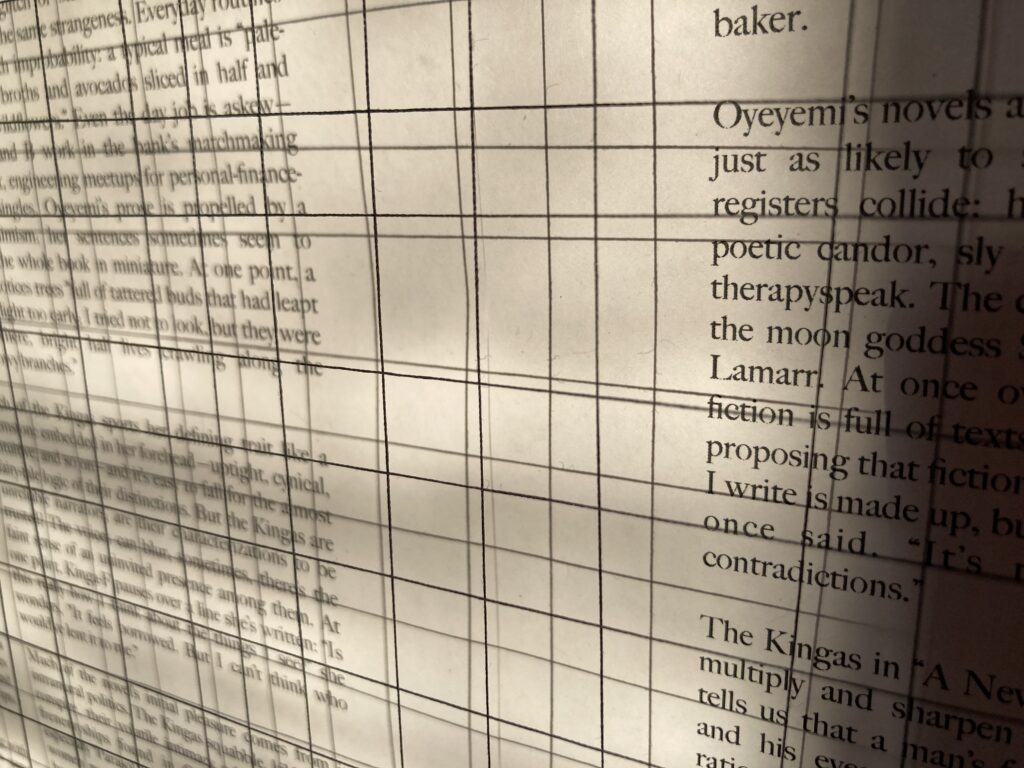
I decided to listen to my “Window” playlist. When I got to “Waving Through a Window” I started thinking about the window as a barrier between me and the world, which made me think of the grid on my visual poems as not only being about mapping and locating and connecting (as thread or string or line), but as net or a veil or a thing that blocks my immediate access to the word and the world. Yes! The grid as both offering connection and preventing it, or obscuring it, or weakening it.
As for the string/line/thread, I’m using a double grid. I also want to try a crime board, where the thread becomes a string that connects all of the words. And, a hanging mobile with the words dangling from strings — does it need to spin? Other thoughts: broken or knotted strings AND strings coming out of the center hole and angling out to sections of words. I should write these up and match them to my poems!
From the introduction to the erasure:
“Thread, fabric, the Fates, the spin, life span — women in all the ages past made what was both essential and perishable: life, cloth, food.
When you look at the cover of this book, you find an identity inextricable from embroidery: the cover of Herbert Read’s book, its original title and author, are altered with stitching and patchwork — so we are first called to think of erasure by cross stitching, a crossing out that is, at the same time, a women’s traditional kind of making, and not unlike the fibrous threads that close a wound. Or, Ariadne’s thread, a clew that leads out of the labyrinth of Western iconography.”
Some great thread thoughts! I’m mentioned this a few weeks ago: I want to use thread in my found poems/erasures as a way to connect with my fiber artist Mom who died in 2009, and my fiber artist daughter, RJP, who is currently majoring in fashion design in college. And, to my grandmothers — one, a sewer, knitter, and cross stitcher (Orliss), the other a weaver (Ines). And more broadly to women’s way of making. This mention of Ariadne is intriguing to me — I need to revist that story; I like the idea of the line of the grid as a thread that leads me out of a maze of some sort.
1 — Ariadne’s Thread
In yesterday’s post, Ariadne came up in a quote from the intro to Her Read. I knew the name, but couldn’t remember why. Just as I began typing In yesterday’s post, I remembered! It was mentioned in a poem about Icarus that I posted here on 19 june 2025: Altitude/ Airea D. Matthews. This poem has a favorite line, which I think fits here:
Bliss is a body absconding
warp speed toward
a dwarf star whispering,
Unsee the beheld.
In that 19 june post, I kept thinking about unseeing:
Unsee as different than not-seeing (which I’ve thought/written about before). Not seeing is a static thing; you just don’t see it. To unsee is more active and also suggests a process of unravelling which is where my vision is at.
A few minutes later in the walk, I thought about flipping the phrase to, behold the unseen.
I like thinking about to unsee as a verb, an act, a process, a type of prayer? Just as seeing is not a static thing, where you simply see, but a process of light and signals and filtering and guessing by the brain, unseeing is a process of slow (or sporadic) unravelling then adapting — a brain doing mysterious and magical things with the scrambled and limited data it receives, a mind developing new ways to witness/behold without stable and dependable eyes.
see: crochet and unraveling (https://kottke.org/26/04/crocheted-technology)
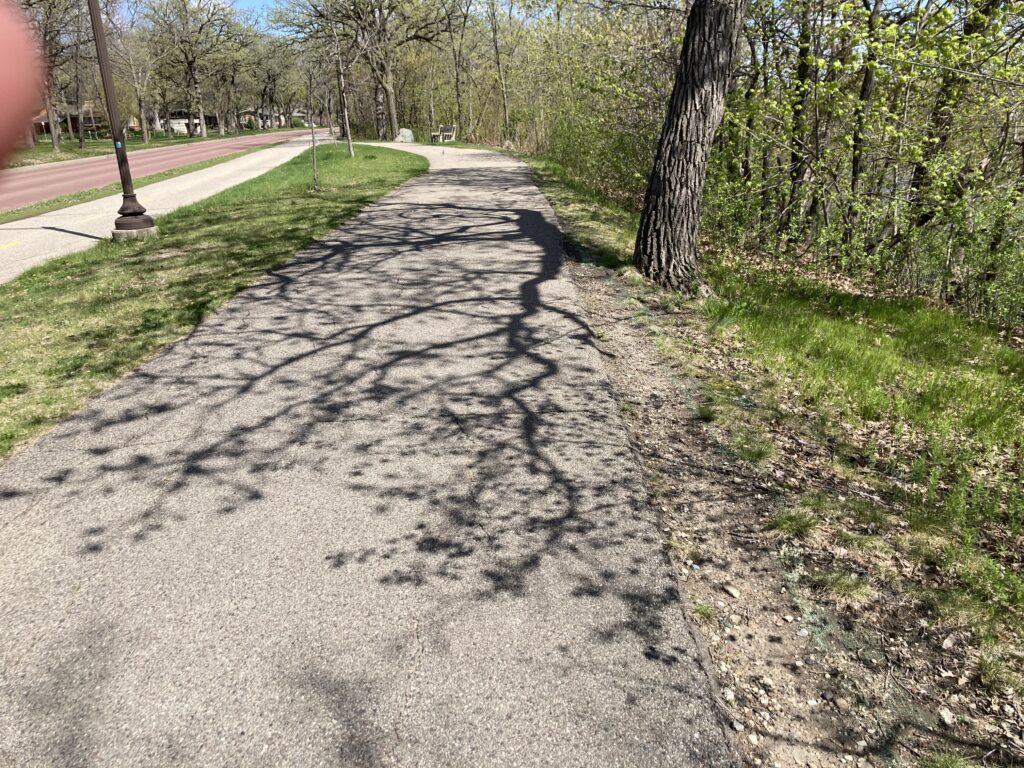
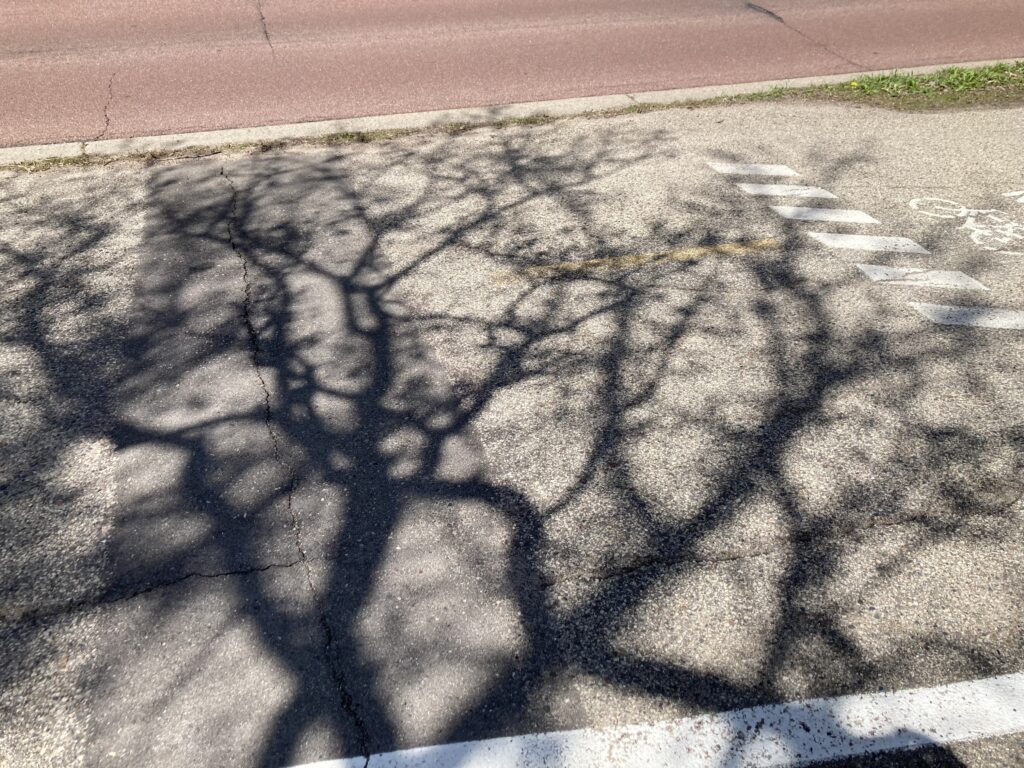
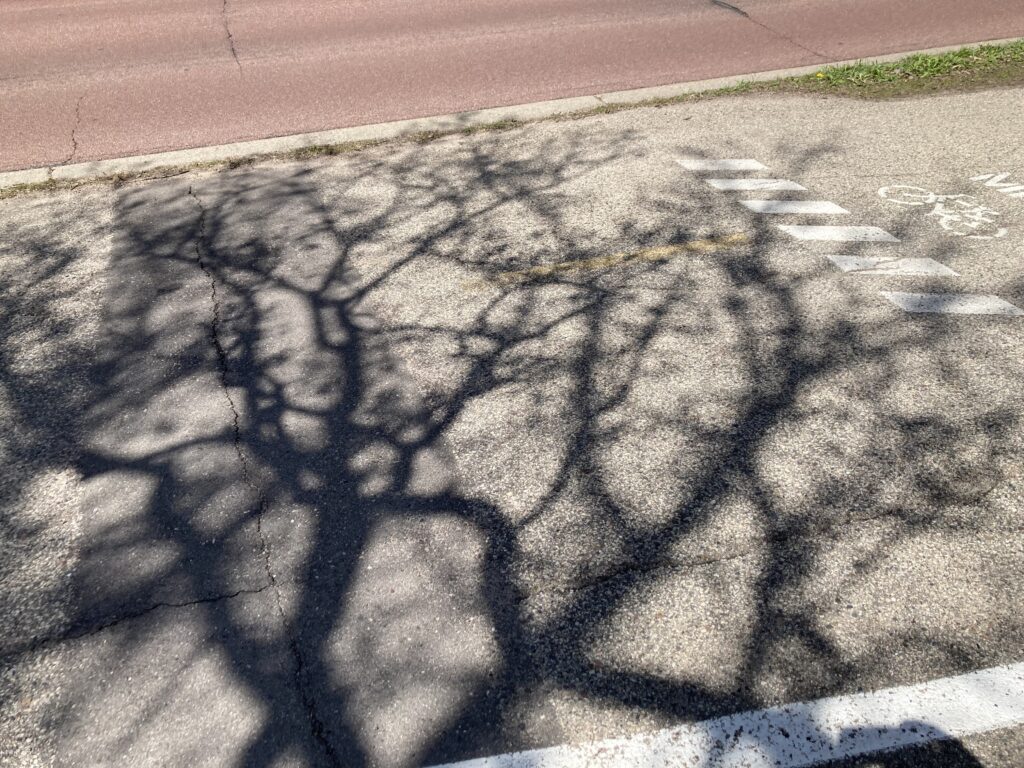
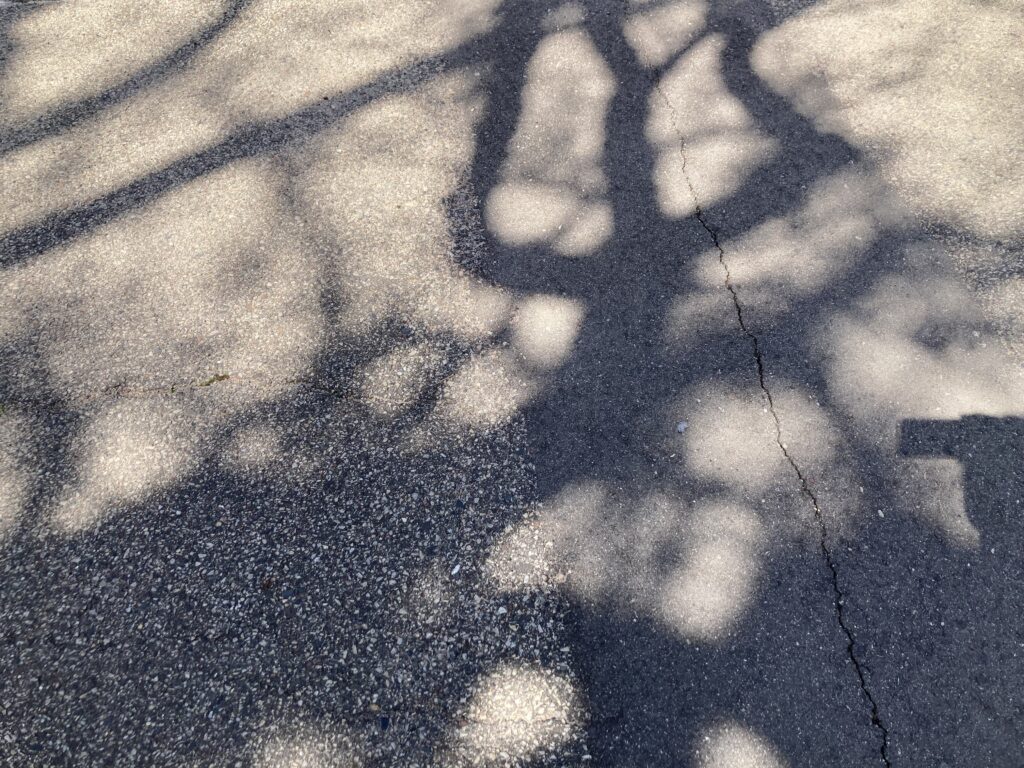
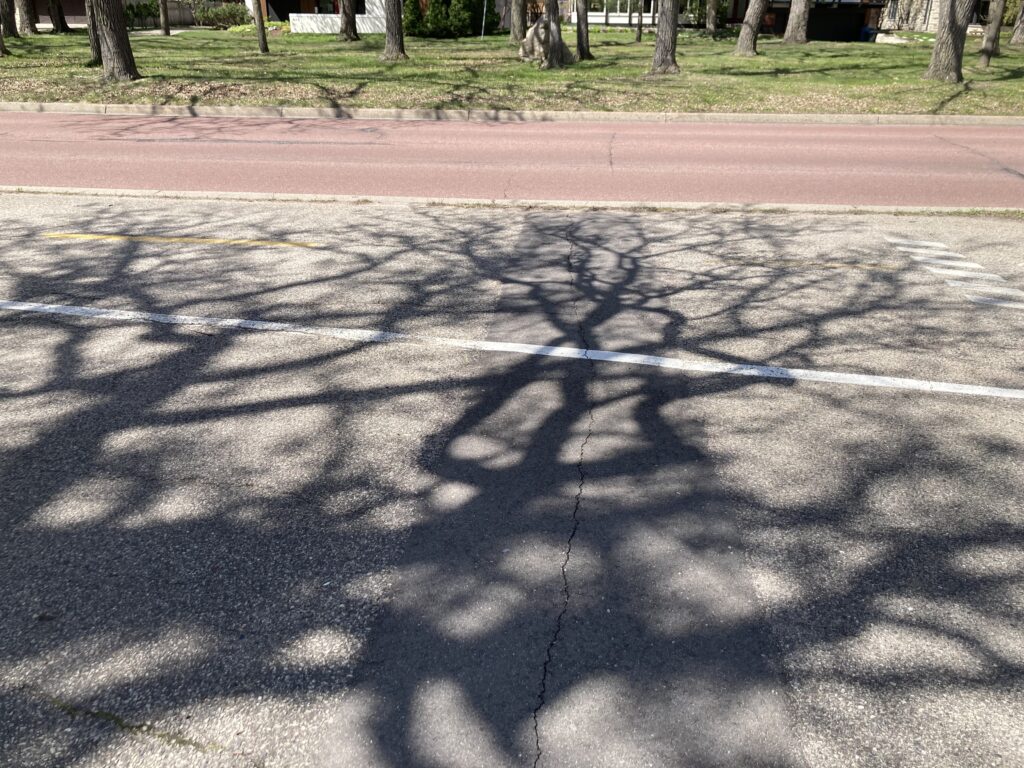
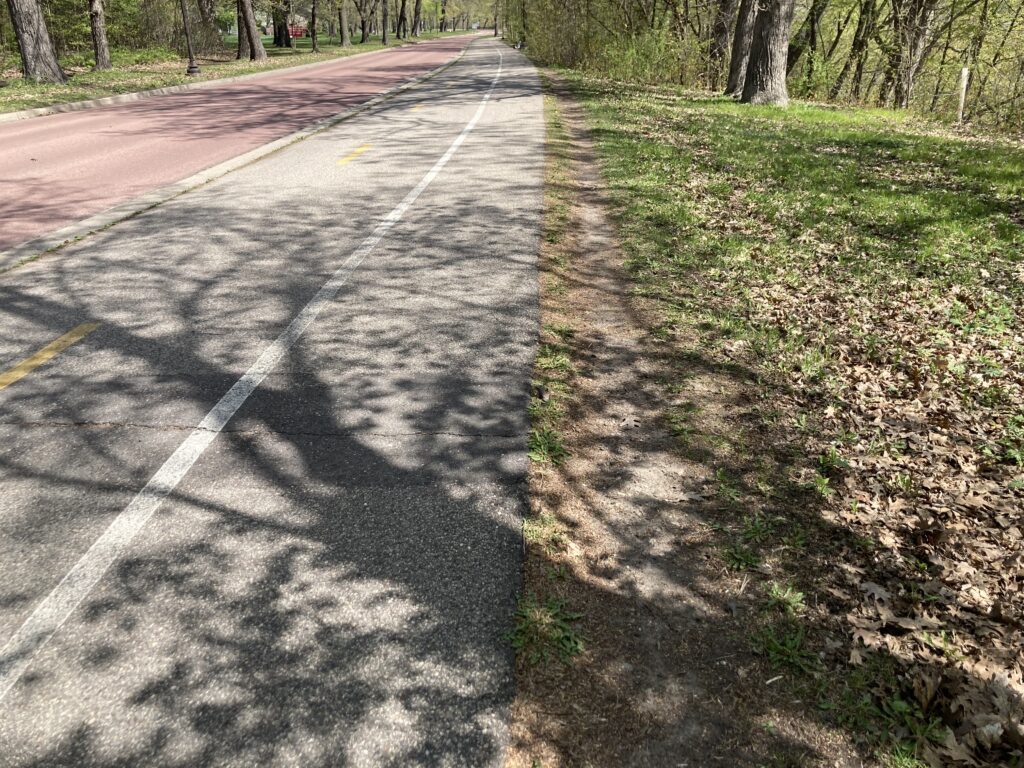
A thought: this net of shadows would be the grid/net obscuring the text of a NYer essay. I’ll have to play around with it. As I kept running, I thought about shadowboxes and silhouettes and playing around with them in a visual poem. I stopped twice more to take shadowed pictures.
strings 2 (also known as hole 6)
RJP just stopped by and when I showed her what I was working on, she reminded me about Coraline and her other mother who lives on the other side of the door (here, instead of Alice’s hole, there is Coraline’s door). The other mother has buttons for eyes which reminded RJP of the holes I traced on my Holes 5. So cool! I could try adding buttons to my Holes 6, which is using a text about mothers and daughters!
Holes / Blind Spot (Scotoma)
down the rabbit hole, Alice: In my memory, Alice’s eyes were much brighter than I can see in this image:
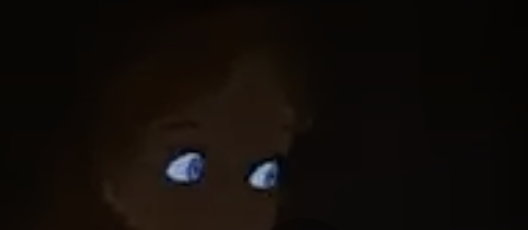
Something to think about: my version/vision of the dark due to my blind spot is never like this; I mean, it’s not all black. When looking at faces in can be a dark, smoky/smudged gray. When looking at words, I might see a faint dark ring. Sometimes it’s fuzzy or static — it’s not Nothing; it is something that is always moving. And here’s where I can get into Alice nonsense speak: It is not that I see Nothing; I don’t know that the something that is there is missing for me. I see no thing, without knowing that I’m seeing nothing. But, back to the inspirational image. I like the contrast and the white eyes against the background.
I hope all of this makes sense to future Sara. Now, time to create my supersized scotoma! Create a bigger version of my scotoma: I like the idea of re-creating the grid, just bigger, a la Chuck Close
I’d like to find a New Yorker article about a gorge or a river or a field and make a hole poem out of it. I found an article: The Landscape in Winter
Experimenting with the texture of the hole: cross-hatch / plastic / pocked plastic / grocery bag / black netting
want to be led by the making and experimenting, not some concept. So, I returned to playing around, this time with my ziploc bag again. I like this material as the material for the hole or the effect the hole makes on words. I decided to deconstruct (that is, cut and spread open) the bag, the distress it with a pencil (drawing spirals and lines and zigzags on it). Then I realized it was almost the size of a single page: I can use it as a veil over the entire page!. I decided to create two bag sheets to make the text more difficult to read. Then I put them on 2 stacked pages of an essay — the same page. I found a word, eye, and cut it out of the one page so that you could still see it on the second (same) page. A hole in the page — I like this idea. Unfortunately, this version of it didn’t quite work; I’ll have to play with it more. Running out of time, I decided to write the word in bigger letters just to test out the effect. It needs some work, but it has potential.
a test: 2 sheets of distressed ziploc bag over text with a hole cut out to reveal a poem
For this picture, I held the papers up in front of the window with sun streaming in. I need to distress the plastic more.
same pages/poem, light source on, not through
A thought: as I work on these poems about reading, consider the light source; it strongly impacts how and what I can see. How can I replicate different levels of light, from BRIGHT to dim.
Another thought: more frequently, I’ve been placing holes on the page to erase the text, like my blind spot made out of black netting. I like the idea of experimenting with ways to cover the text, like with this distressed ziploc. I could also use layers of netting and thread grids — ones that are straight and ordered, others that are tangled and slanted.
Hole 1
I’d like to push at this idea of a hole in the vision, with the hole not being (just) empty or a void, but something — like a rabbit hole: an in-between space, a passageway, a liminal space, a threshold, but also a clearing (JJJJJerome Ellis), the Nothing around which something functions, the gorge.
I’d like to return to my original version of Holes 1, with my blind spot around each of the words. I want to experiment with different ways to “make” that blind spot — color it in with dark pencil; erase that pencil, leaving only a trace; a plastic bag; a net of thread; sparkles or something that resembles static — how do you realize that?; the black netting I bought with RJP. Instead of Holes 1, I’m using Holes 5c about the two holes.
This morning, I’m re-working Holes 1. So far, I’ve drawn the Amsler Grid directly on the text for panels/pages 1 and 2. Then I printed and cut out the words of the poem and placed them on/over the grid. When I looked at the picture I had taken of it, I wasn’t satisfied.

The words weren’t visible enough. Next I tried something I keep returning to but haven’t quite figured out: a 3D grid made from thread and pins above the grid + blind spot on the page. I like the effect of this, but now I need to figure out how to attach the words to the grid. Should I create a third layer with only the words? And should that layer be on top or in the middle –and, if in it’s in the middle, how do I do that?
I discovered something interesting as I worked on this poem as 4 different panels/pages. Each of the pages, which include words from different parts of the longer poem, create their own poem. Some of those poems work better than others, but they can all be read individually. The smaller poem in this panel is:
a hole in
your
is
A recap for Holes 1: keep thinking about how/where the words fit on the grid (and how they make visible the idea of the poem, a hole making an uneasy fellowship with the word; ruminate: should there be a single or double grid on this one?; and how can I tweak the words to make 4 individual poems?
Hole 3
I tried a new thing with Holes 3: drew a graph directly on the words, mapped the words on the xy axis, lightly shaded in the words, repinned the grid over that, and then used thread to finish it. I like the doubling, almost out of focus feeling that the pencil grid and the string grid create. I don’t think the words are clear enough yet. I’ll have to keep working on that.
Hole 4
Today I’m experimenting with different ways to visualize my Holes 4 poem:
you look at words. you don’t see the gaping hole. you see seltzer fizz and a nothing that is something not sharing its secrets.
First, I cut up a ziploc bag and made dots in it with a pencil. This looks like fizz or static or snow, which is cool. A problem: you can feel it, but you can’t really see it. How to make those marks show up? Then I cut the static ziploc into the shape of my blind spot — actually, I cut out 20 of them. It’s still not visible, but I like the texture and the idea of making the visual less visible. I think I’ll use these somewhere.
After spending some time with distressed ziploc bag and not getting anywhere, I tried a different approach. First, streamline the poem, get rid of the fizz, and get over the idea of trying to represent fizz or static. Here’s the new version of the poem:
you look at words, you don’t see the gaping hole, you see a nothing that is something not sharing its secrets.
When I shortened the poem, I was able to “find” it on four instead of six of the pages of the new yorker essay.
Next, instead of trying to make fizz, I decided to distress a new sheet of ziploc plastic with a criss-cross pattern. I really like it!
I really like this way of distressing the plastic. And, it’s easy to do and to replicate! When I put it directly over the text of the essay, it didn’t obscure the text enough. Soon I realized that it needs to be at a slight distance. I keep coming back to the idea that these poems need to be 3-D. How should I do that?
First, more fun with distressing plastic. I “drew” an Amsler Grid on a ziploc bag. Then I draw another one with my blind spot in the center. Then I cut the center of the spot out. I like this technique, and it’s very easy to do, and to replicate!
The perpetual problem with this plastic: it looks cool when I hold it up, but it doesn’t quite work when placed on the page: you can’t see the distressed grid and it doesn’t obscure enough of the words.
At some point, another thought: create a frame out of strips of cardboard. First I tried strips that were 2 inches thick. I slotted the strips to make the frame, then put the distressed plastic with the amsler grid/blind spot over it. I placed this frame over one panel of Holes 4. I liked it, but it was messy. And difficult to read. I wondered, would making a thinner frame help? I made one with 1 inch strips and added a different distressed Amsler grid. Still messy, still not quite right.
assessment: I like the idea of the frame, but I need to work on the execution — learn to cut the cardboard more neatly. Also: I need to make the words just a little more legible — if not, the actual words, the shadow of their presence.
Hole 5
5b and the two holes and figuring out how to represent those 2 holes on the page (1 hole — the very small amount of central vision I still have left, 1 hole — the fuzzy, filmy, fading/faded central vision graveyard that surrounds/encircles what’s left — hole 1 = the word / hole 2 = the void or wall or circle that encases/entombs the word and is always waiting to consume it.
I discussed it with RJP, which was fun, and we both decided that this black thread/red line effect was didn’t fit with the words of Holes 4. They were better suited to Holes 5 — maybe 5b? I want to print out the poems for each of these holes and post them on my board; this might help me keep track of all of them. The text from Holes 4 describes not seeing the hole or any lines, but everything as seltzer fizz and nothing that is something not sharing its secrets. That poem should have lots of little circles (seltzer bubbles/fizz) and create an optical illusion — you stare at the dark dots and then you see them everywhere else, almost like an after image. This poem might also have the words as enlarged?
Reading
In my memory, Alice’s eyes were much brighter than I can see in this image. Something to think about: my version/vision of the dark due to my blind spot is never like this; I mean, it’s not all black. When looking at faces in can be a dark, smoky/smudged gray. When looking at words, I might see a faint dark ring. Sometimes it’s fuzzy or static — it’s not Nothing; it is something that is always moving. And here’s where I can get into Alice nonsense speak: It is not that I see Nothing; I don’t know that the something that is there is missing for me. I see no thing, without knowing that I’m seeing nothing. But, back to the inspirational image. I like the contrast and the white eyes against the background.
I like this idea and how it forces the reader to slow down and read the poem one word at a time. This isn’t quite how I read, but it gives a sense of how much slower I read, how many less words I can read. I also like the idea of a map, because part of why I am drawn to the grid is because of the way it enables me to locate and visualize my blind spot and vision loss.