4 miles
wabun hill and back
34 degrees
Wasn’t planning to run this late afternoon, but snow is coming and Scott was going out for a run and I got my new pair of shoes, so I decided to go for it (or get after it as Carrie Tollefson would say). Scott and I didn’t run together, just at the same time (5:45 pm) and in the same place (near the gorge). What a great run! Was it the sun and the crisp, early spring cold? The healthy food I ate for breakfast and lunch? The new shoes? I’m not sure, but I felt strong and fast and free. On my way back, I encountered a HUGE group of runners running north, all much faster than me. At some point, I heard someone call out, good job Mill City Runners! Of course, Mill City. That’s one of the biggest running groups in the twin cities. Wow, I knew they were big, but I had no idea they were that big!
I liked running in the early evening. Other than the huge group of runners, there weren’t that many people out on the trails. I noticed the light was lower, but it was too early to see any evidence of a sun about to set. The favorite thing I noticed: wild turkeys! Half a dozen grazing in the grass just north of turkey hollow, another one of them grazing in the grass between the trail and the road.
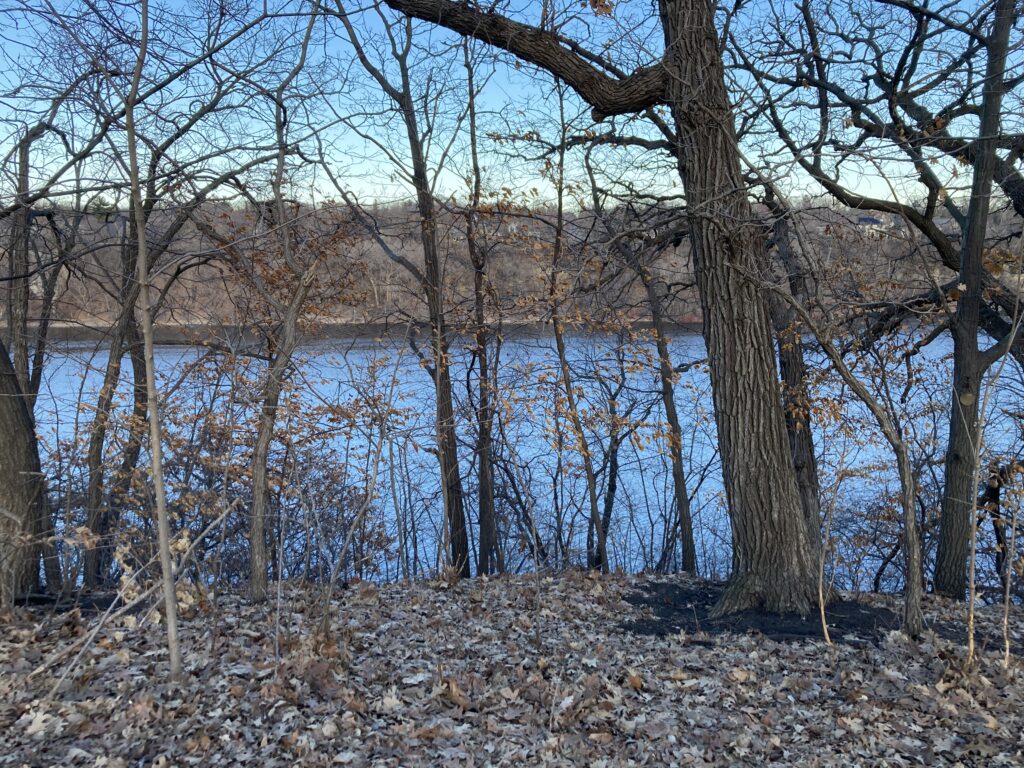
I stopped briefly at Rachel Dow Memorial Bench and took a picture of the blue water and the thin branches softening my view:
Friday the 13th! Tonight Scott and I will do our annual tradition of watching Friday the 13th. It’s not as good as Halloween, but it has its moments.
update, 14 saturday 2026: We watched it and Scott figured noticed something neither of us had in our previous viewings of the movie (5 or 6 or more?): each of the deaths is foreshadowed by something that happened earlier in the movie: the character who is murdered on the archery field is almost hit with an arrow a few hours earlier; another character recounts a dream she had where the rain turns into a river of blood which she calls her shower dream, only a few scenes before an axe splits her skull in a shower stall; Alice (the final girl) is surprised by the town weirdo or town prophet, depending on your perspective, when she opens the door to the pantry and he emerges, calling out, you’re doomed. you’re all DOOMED!, and then hides in that same pantry later that nightonly to be found by the killer
Later, Scott also realized that there were connections with the murder weapon. For example: the arrow through Jack’s throat ends up at the archery range where Brenda is killed; the axe that splits Marcy’s skull is later found, bloodied, of course, by Alice in Brenda’s bed
a few memorable lines:
Jack (Kevin Bacon), about a coming storm: the wind just shifted a good 180 degrees and it’s going to tear down the valley like a son of a gun
Brenda (can’t remember the actor’s name, but Scott looked her up and she died at the age of 49 in 2007 from pancreatic cancer — my mom died at 67 from pancreatic cancer in 2009), reacting to Bill fixing the generator: what hath God wrought
HOLES
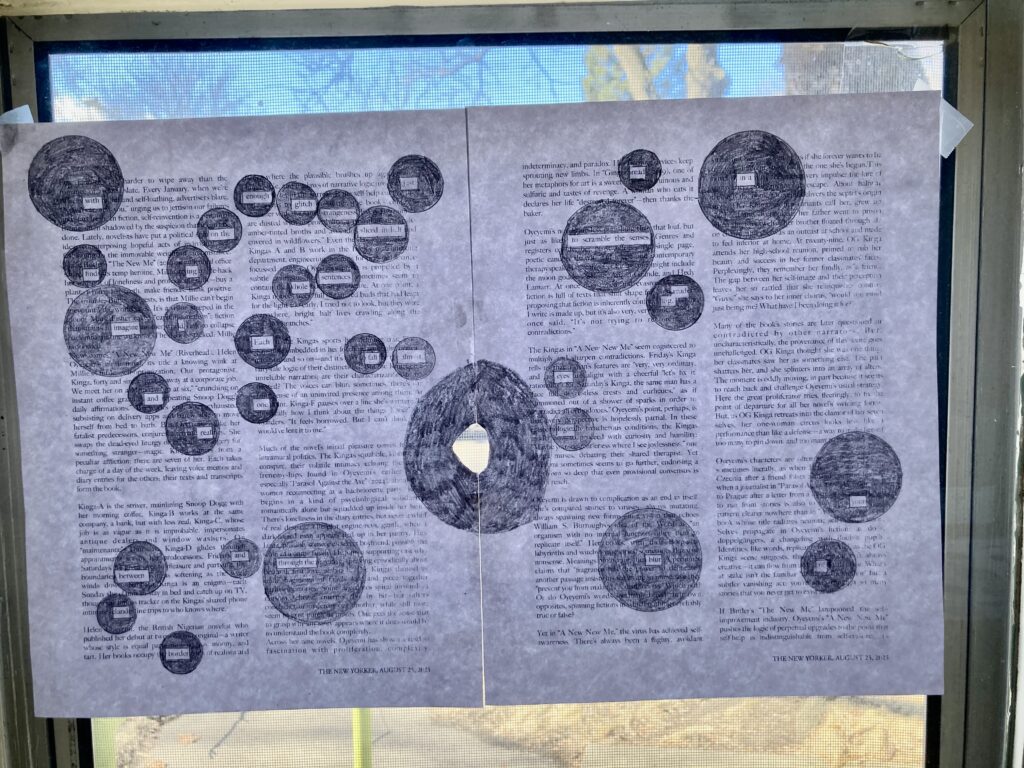
Reworking Holes 3 to allow for better spacing of the holes. Here’s the new version of the poem:
read sentences
sliced in half
with strangeness
each one glitch ing
just enough
to scramble the senses OR scramble the meaning
fall through the hole
your reading eyes find
and land in a logic
of blur and almost
on the border between
real and imagined
And here’s a photo of it:
RJP and I went to the Textile Center and it was fun and helpful to think about translating my ideas about holes into actual fabric and textures. I found some black netting that will be helpful and another wildly color thin fabric that might work. The question now is: how to use the fabric. I’m not sure it’s can be as simple as cutting the fabric in the shape of my blind spot — that just seems like bad decoration. What I want to do is use texture to convey how I see/read and what it feels like to do these things with my blind spot. My blind spot is rarely actually visible, and when it is, it’s not a black, opaque spot.
- A few new ideas: cover the words where the blind spot is in plastic that you can see through, but that makes words too fuzzy to read.
- A lattice of twigs, gathered at the gorge, covering the blind spot — when I see these twigs, it often reminds of my scrambled central vision.
- Some sort of fuzzy, fluffy texture that evokes softness, which is one thing that happens to my central vision with less working cones: everything is softer, less detailed, not sharp or harsh
The key, I think, is to use texture to communicate different aspects of my new ways of seeing with hardly any cone cells: it’s fuzzy and soft; it’s vague; it seems like there’s a film over it and that I can almost see it but not quite
Get out ICE
Read about Minnesota lawyers quietly organizing to help immigrant families:
Lawyers Built a Network: MPR also reported Thursday that hundreds of Minnesota attorneys volunteered during the surge to challenge immigration detentions in federal court, creating a rapid pro bono legal network across the state. Lawyers from a wide range of practice areas stepped in, and the article describes a system that turned scattered cases into coordinated courtroom action. It is one more reminder that some of the most important resistance in this story has happened quietly, inside petitions, filings, and courtrooms.
Sean Snow on Facebook / 13 march 2026
and from the article Sean Snow is referencing:
Since the beginning of so-called “Operation Metro Surge” in December, attorneys in Minnesota have filed more than 1,000 cases challenging the legality of immigration arrests and detentions.
Many of those filings came from lawyers who don’t normally practice immigration law.
Hundreds of attorneys volunteered to help free people detained by ICE