2.5 miles
44th street parking lot and back
35 degrees
Ran in the afternoon. Colder today. I wore gloves and a headband to cover my ears. It felt harder, maybe I ran too soon after lunch?
It snowed last night. Not much — not even an inch, but enough to cover the grass and make everything glow white. By the time I went out for my run, the paths were clear.
omens of spring-to-come: someone was roller blading! Not roller skiing, but roller blading. And, a woman was running in shorts. It’s not unusual to see a man running in shorts during the winter, but it’s rare to see a woman. That usually doesn’t happen until it’s spring, or feels like spring, or is warm enough to be spring.
I was planning to finish my rabbit recap today, but then I started thinking about and experimenting with my holes poem. No time for the rabbits — well, except for several paragraphs below, when I realize that my naming of this poem, Holes (or hole?), is probably at least partly a reference to the rabbit hole!
New Yorker Experiment #4, continued
Today some part of me decided that we (the Saras) would offer a more detailed account of the process of thinking through my latest poem, so that’s what we’re doing.
I want to keep working on my fourth experiment. Yesterday afternoon, I printed out the New Yorker article, “A Screaming Skull,” and found my poem on its four pages. Then I taped the pages together and mapped the poem out. The theme: holes. I imagine it as part of a larger project about my blind spot. Maybe this project won’t be all erasure/found poems; I might try to connect it to some other work on the blind spot — work I’ve been doing for several years now, but haven’t quite figured out how to turn it into something. Yes! Experiment #3 — swap the dead-eyed liturgy of doomed vision with shadow (or shadowed?) acts, wild and improbable could connect with my study of JJJJJerome Ellis, the stutter, and his liturgy of the name! Very cool!
I took a picture of what I’ve done so far:
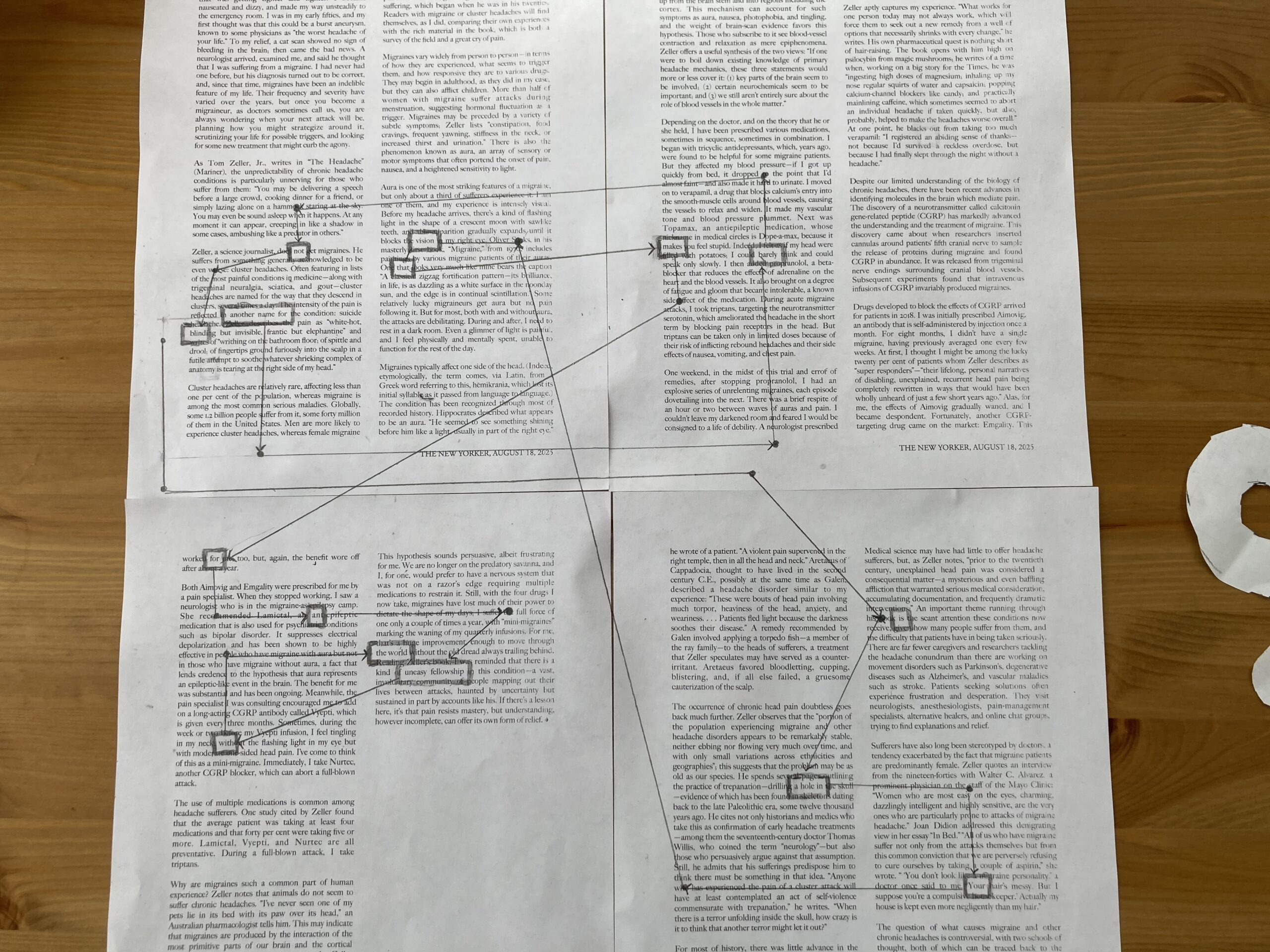
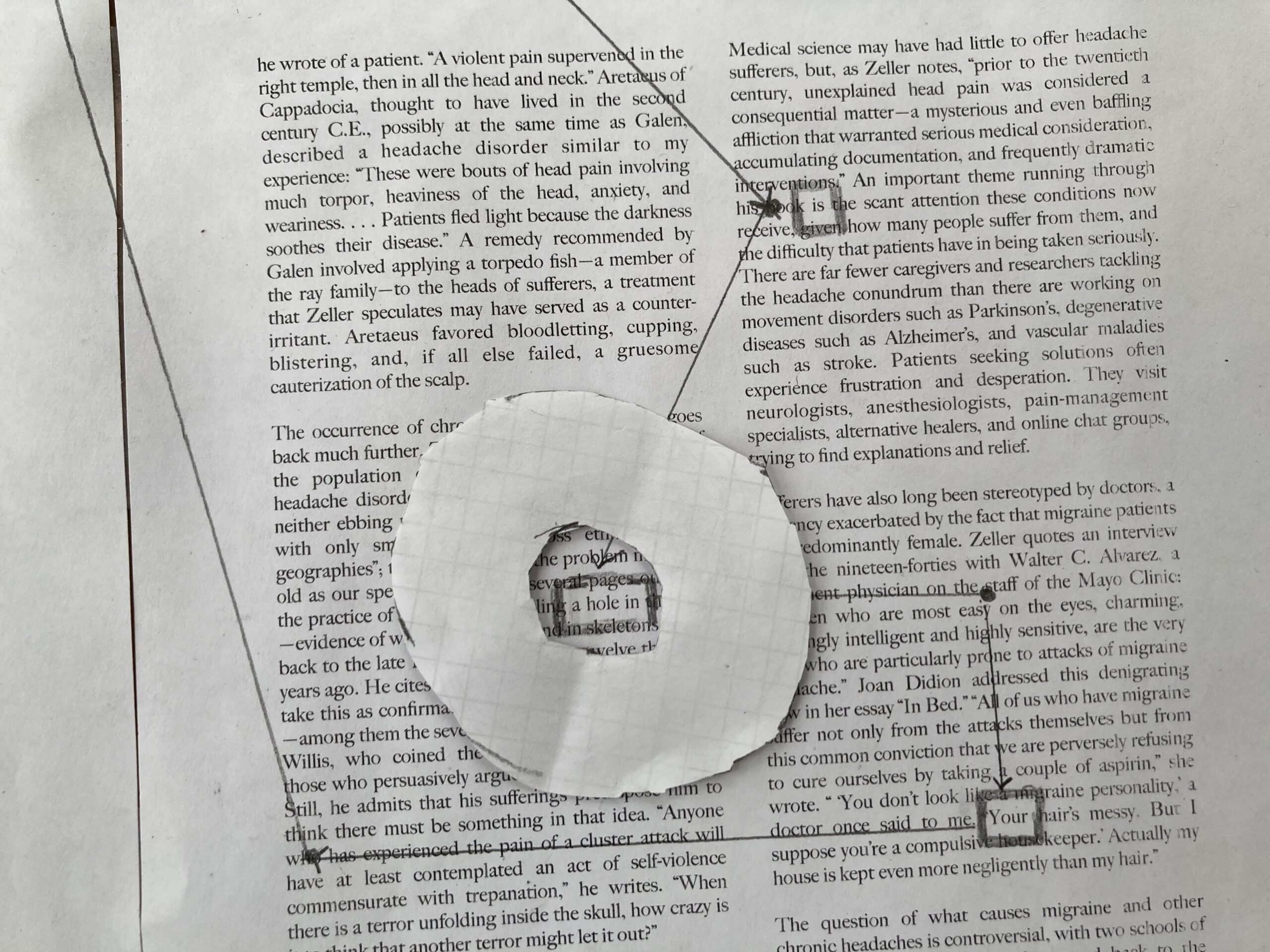
What to do next? The second image offers a possible approach: Applying my blind spot — the one I recently created by staring at a blank wall until it appeared, then tracing it — to each of the “found” words. I could sketch the blind spot directly on the page, around the word, OR I could place a cut-out version of the blind spot on top of the word. Maybe I’ll try a practice sketch. Another idea, which is probably definitely beyond my technical ability: create an animation of the process of reading this that starts with an overview of the poem, then zooms into the first word, encircled by the blind spot which appears as I read it. Then it moves to the next word/phrase, and the next, and the next until the poem is finished. I could also do it as a series of stills (instead of an animation). You could look at each one individually1, the image as a whole, and the series of images in a gallery.
I like this last idea! The focus on individual words — isolated from the other words and the meaning as a whole, which is how I read, because what’s left of my central vision is so small it can only fit a few words, and which is how I often (but not always) experience the world with my big blind spot — in isolation, and removed from others. A question: should I keep the larger poem as a square, stacked 2 x 2 pages? Or should I have it extend as 4 pages across? I can play around with it.
an hour or two later: Here’s something I tried with a paper cut-out of my blind spot as a template. I’m thinking I should ask Scott to make a sturdier, cardboard version of this template.
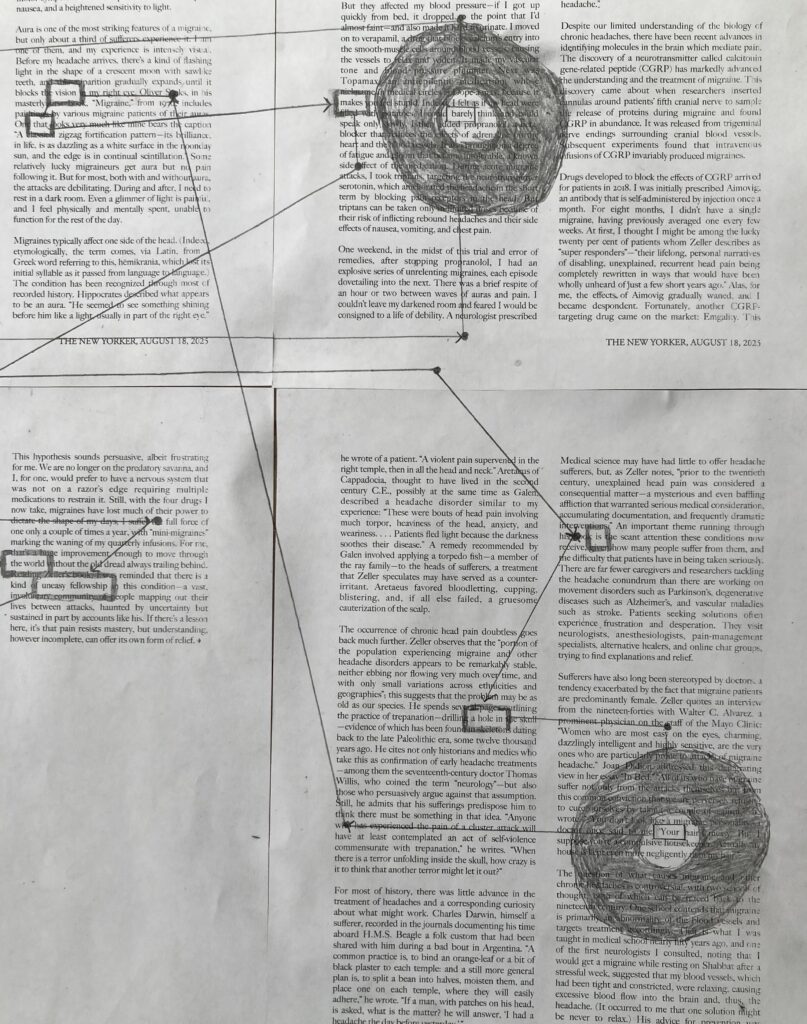
Something to think about: should I have the blind spots on the entire poem/map? I was going to write: no, because that’s not how I would see it; I would see a somewhat fuzzy version of the map of the poem. But this poem is not an accurate representation of how I see. I hardly ever see my blind spot as a gray blob. But the blind spot is there and it distorts how/what I see and I need to represent in some way that others can see too.
Another question: should I hand-sketch this poem, or figure out how to do it on the computer? I like the hand drawing — the material aspect of it + I can do it all myself — but drawing it by hand is messy and unreliable. I’m thinking that this series will be part of my vision art installation — along with my snellen charts and mood rings. It seems too messy if I don’t do it on a computer.
Also: how should the individual stills look? Should they be a close-up on that part of the poem, or just the word/phrase centered in an otherwise blank page? Should they include the blind ring? If I have more of the text, should it be too fuzzy/distorted to read, or should I have it surrounded by gray? Looking at the words on this screen, I see: 1 or 2, maybe 3 short words in focus, then other words too dim or fuzzy to read, and, after staring for a few seconds, a glowing dark ring around it. This ring is not solid or very dark, it’s almost gauzy, like a veil, or the feeling that there’s a ring there. Does that sound strange?
(rabbit) holes: Today I start a new volume of my Plague Notebook: vol. 28! I’m calling it, What about Epstein, Trump? As I was writing in it, describing my latest visual poem, Holes, a thought: Am I calling this holes (or hole?) partly because of my recent study of rabbit holes?! Maybe! And maybe I could bring rabbit holes into a poem about my blind spot!?
Get Out ICE
“Accountability in this case looks incredibly simple. Minnesota must investigate the violation of constitutional rights at the hands of Noem and her ICE agents and prosecute where appropriate. The best part about this process is that Trump can’t pardon state convictions.” Boom.
(from a Occupy Democracy post, citing a MSNOW interview with Tim Walz)
- While applying my blind spot to the phrase, “another word for,” I realized that that phrase was too big to fit inside the inner ring. So, that’s a new limit to how I can construct this, and other blind spot, poems: the phrases/lines must be able to fit within my blind spot. It wasn’t a big deal in this poem; I just took out the for from “another name for” and found it somewhere else in the article. ↩︎