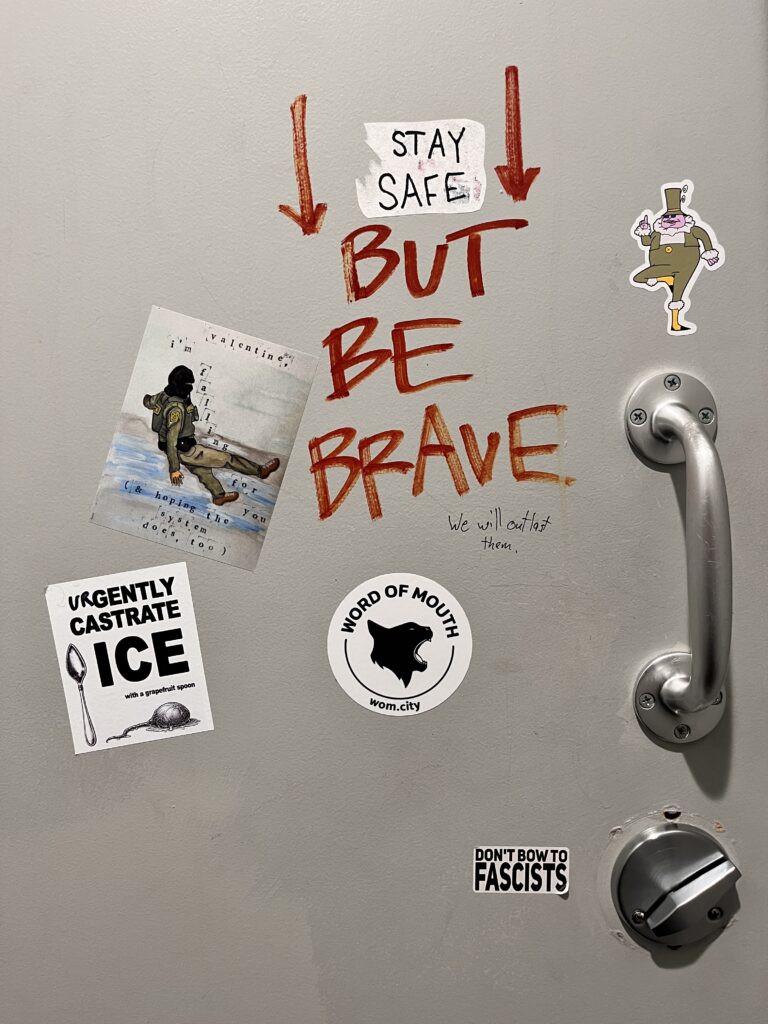
It is 1:30 pm. It is sometimes raining, sometimes snowing, and is all-the-time windy. It is also 32 degrees. But the pavement is bare and it might not be this clear for a few days because we are supposed to get some more snow. Should I go out for a short run when I have the chance? Or, are the conditions too crappy, my left knee too sore? Future Sara will let us know! Sara from 2:47: I did it! I went out for a run in this blustery weather!
3.3 miles
river road, south/north/neighborhood, south
31 degrees / feels like 17 / snow
wind: 25 mph gusts
Not the best conditions, but I’m glad I went outside. I started by running south on the river road trail, but it was tough. I was running straight into the wind and stabbing snowflakes. I turned around at the Rachel Dow Memorial Bench, then turned off the river road and onto Lena Smith Boulevard at 32nd. I was plannng to do some hills but the road was blocked off. Instead, I meandered through the neighborhood.
I encountered one other runner, at least one fat tire. Any walkers? I can’t remember. It was difficult to see what was ahead of me. Snow was thick in the air and I pulled the visor of my cap down low to block it. If I saw the river, I don’t remember what it looked like. When I turned around to head north again, it was much easier and more fun. The snow was swirling in front of my face, looking like white confetti or bits of styrofoam. It wasn’t as cool, but it reminded me of the scene at the men’s Free Ski Big Air final that Scott and I watched last night. The sky was black, the heavy snow was illuminated by the bright lights of the venue. I remember admiring it and wishing it would snow here again so I could run through it. Well, the snow today wasn’t nearly as heavy as what I saw on the tv, but it was still delightful. It will probably be a slippery nightmare tomorrow, but today it was fun!
Lisel Mueller!
I’ve posted several poems by Lisel Mueller over the years: When I Am Asked/ Lisel Mueller, The Blind Leading The Blind/ Lisel Mueller, Sometimes, When the Light/ Lisel Mueller, Things/ Lisel Mueller, and Monet Refuses the Operation/ Lisel Mueller. But, I’ve never checked out any of her collections until now. Yesterday I picked up Alive Together: New and Selected Poems / Lisel Mueller. I started at the beginning, and stopped when I found this poem:
Losing My Sight / Lisel Mueller
I never knew that by August
the birds are practically silent,
only a twitter here and there.
Now I notice. Last spring
their noisiness taught me the difference
between screamers and whistlers and cooers
and O, the coloraturas.
I have already mastered the subtlest pitches in our cat’s
elegant Chinese. As the river
turns muddier before my eyes,
its sighs and little smacks
grow louder. Like a spy,
I pick up things indiscriminately:
the long approach of a truck,
car doors slammed in the dark,
the night life of animals—shrieks and hisses,
sex and plunder in the garage.
Tonight the crickets spread static
across the air, a continuous rope
of sound extended to me,
the perfect listener.
coloratura = elaborate ornamentation of a vocal melody, especially in operatic singing by a soprano.
I imagined that Mueller knew something about vision loss when I read her, “Monet Refuses the Operation” a few years ago, but I didn’t know that for the last 20 years of her life (she died in 2020), she was losing her vision and couldn’t read. I found out about that while reading this interview, “Slightly Larger Than Life Size“:
Mueller speaks always in a steady, gentle tone—even when describing the death of her beloved husband, Paul Mueller, in 2001 or the partial loss of vision she has suffered over the last 20 years. “I’m blind for reading, really,” she explains plainly, almost as if she were describing someone else. “I use an enlarging machine. And I have two friends who come read to me.”
Mueller also no longer writes, in part because of her diminishing vision. She treats this circumstance with the same tough realism—compellingly at odds with the ethereal nature of her poetry—as the other hardships in her life. “I do miss writing,” she replies when asked the obvious question. “But I simply don’t have the images coming to me anymore that would start a poem. The language no longer flows. I would have to force it and come up with some artificial things, and that’s not my way. I’m someone who has learned to put up with things as they are. Because of the blindness, because of what happened to my husband, because of leaving the country that I was born in and coming here—I accommodate myself.”
Slightly Larger Than Life Size
I accommodate myself. Love that line! A title for a poem, I think. I wouldn’t say I put up with things; rather, I adapt and find new ways to be, to see. I like the line about not forcing it and coming up with artificial things. I agree.
In my imagined poem titled, “I accommodate myself,” I might start it with a line from Mueller’s “Losing My Sight”: I never knew . . . . / Now I notice. Maybe I should make a list of all of things I’ve noticed since my vision began declining?
The perfect listener. Reading this line, I immediately thought of Ed Bok Lee’s line in “Halos“:
That visual impairment improves hearing,
taste, smell, touch is mostly myth.
I do notice things much more than I did before my vision loss; I’ve made it a big part of writing/attention practice. I’ve devoted many runs to listening or smelling or feeling the various textures. So, being a good listener didn’t just happen because my vision declined; I worked for it. Yet, even as I’m noticing more with my ears, I do also seem to struggle to hear what people are saying to me. So much so that I asked for my hearing to be checked at my last appointment. It was fine. So, what’s happening? Why do I need more time to process what people are saying, or need to ask them to repeat it? FWA thinks I might have an audio processing disorder — something one of his favorite Youtubers has. Possibly. I think it has more to do with how people use visual cues — gestures, their surroundings — to convey the meaning of their speech. People with normal sight don’t realize how much they are relying on vision when they speak and they don’t recognize how that impacts people who cannot see the things that they are referencing. I find this frustrating and also fascinating to think about how we our senses work together.
One more thing about Mueller’s poem. I’d like to memorize it. There are too many wonderful lines that I don’t want to forget.
Sharing the Love
I have not given much any attention to building an audience here or on social media and, as a result, no one is seeing/responding/sharing my love poems. It is probably also because of the algorithm. Scott suggested that I put the link in the first comment and post a picture of a dog. It’s time for me to think again about if I want a bigger audience. Actually, the better question is: how can I reach people with my work? For me, it’s less about a big audience, more about finding ways to share what I’m doing and connect with others. Experiment time! The goal for me is not a bigger audience, but finding ways to contribute and connect. Hmm . . . I’ll have to think about it some more.
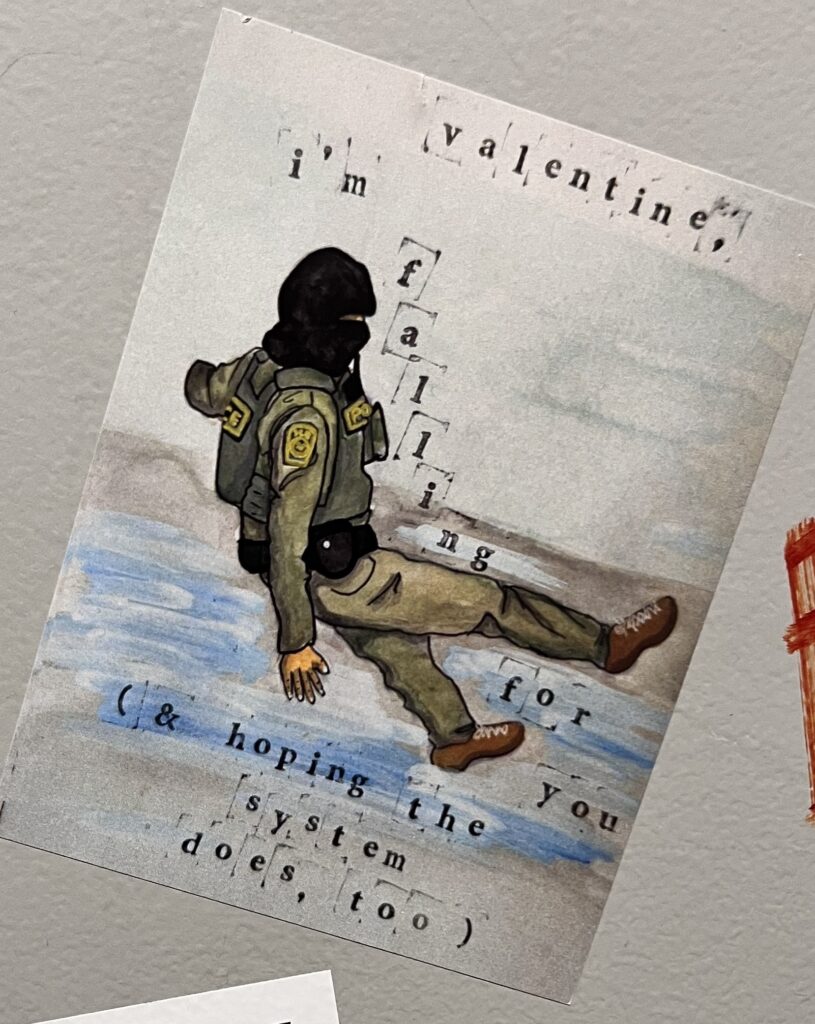
a few minutes later: As a first step, I’ve decided to try sharing my love poems again on Facebook. I put the link in the first comment and posted a photo, not of a dog, but of this Valentine that Scott noticed in the bathroom at Arbeiter Brewing:
Also, I posted the STOP ICE photo that I posted here yesterday on my Instagram.
Maybe one of the biggest reasons I’m not sharing on social media is because it’s hard for me to do it with my bad vision. Everything takes so much longer and I can’t always see when I’ve made a mistake. And, I’ve been self-conscious about posting photos that I imagine are poorly cropped or framed strangely. Time to get over that.
Get Out Ice
Seen on a bathroom door at Arbeiter Brewing: