4.25 miles
minnehaha falls and back
38 degrees
10% ice and 30% puddle-covered
Waited until the late afternoon to go out for a run; too icy this morning. This afternoon (at 3), there were lots of puddles and sun and not much ice. A good run. Even though I think I caught FWA’s cold, I had plenty of energy while I was running and felt great.
10 Things
- bright sun reflecting off the windows of a house
- the very strong smell of week near the 44th street parking lot
- the creek was moving, but the falls was not
- lots of walkers, a few runners, at least one fat tire
- a walker moving over to let me pass on the cleared bike path in the park — thank you! / you betcha!
- near the oak savanna, a little kid’s voice floating up from below
- at least one bright yellow jacket
- the river: covered with ice and snow
- a line of cars waiting at the stop sign on the road coming out of wabun park and the veterans home — did a shift just end?
- the clip clip clip of another runner’s ice cleats
blind spot
Yesterday I wrote about re-finding my blind spot and doing a series of erasure poems with it. Last night, I woke up with a vague idea about writing a hybrid piece (possibly to submit to a journal’s call for submission — Waxwing) that involves using and applying and reflecting on my blind spot. This morning, I’ve been spending more time thinking about it, wandering and wondering how and what to do with these ideas. Just now, a thought: even as I use a cut-out or an image of my blind spot and apply it to text, as if to demonstrate how I see, the resulting poem/prose piece/fragment can’t properly convey how it is that I do or don’t see. The difficulty with my failing/failed vision is that I can’t really see it. Well, sometimes I can see it, like when I’m talking to someone and their head is only a fuzzy, empty blur, but often I can’t. It’s more of a feeling, or sometimes it’s not anything; I don’t realize I’m seeing wrong or that I’m not seeing until it is pointed out to me. How do you convey that?
But, even if the dark outline of a blind spot doesn’t effectively represent my vision, it does do something. So I’d like to use it.
As I write this, I’m looking out my window, into the bright white and blue of the sun and snow and sky. The image is shaking or shuddering or unsettling constantly. I see pixels shifting. The entire image is not unstable — I see solid forms that aren’t moving — like a red car parked across the street, or the straight hulk of a tree trunk — but the feeling of all of it is movement and being unfinished, unsettled, or buzzing? Visual buzz?
Earlier today I was working on a movie musicals puzzle. I’m constantly amazed that I can still work on it, that I can see enough to fit pieces together, but I can. In fact, with the small bit of central vision I have left, right in the middle of the middle of my eye, I often see small details — a tiny face or eyes, a finger pointing — and can recognize where they go. Sometimes I can’t fit it in exactly, so I give it to Scott and he finds the exact spot. Vision is so strange.
several hours later: Right now, I’m starting to look through the entries I tagged, vision. I have 20 pages of them. Already with the first one, I have an idea. On jan 30, 2020 I posted the poem, Natural Forces/ Vicente Huidobro. Since then, I’ve spent a lot of time with this poem — analyzed it, memorized it, recited it while I was running. To me, it’s a great example of the myth of the power of sight. Could I fit it in an amsler grid-sized box, and apply my blind spot to it?
I tried. Made a text box the size of grid. Fit the poem in the box as many times as would fit. Printed it out. Traced my blind spot on an Amsler grid, then cut it out and placed it over the poem. Not sure I like it, but it’s a start.
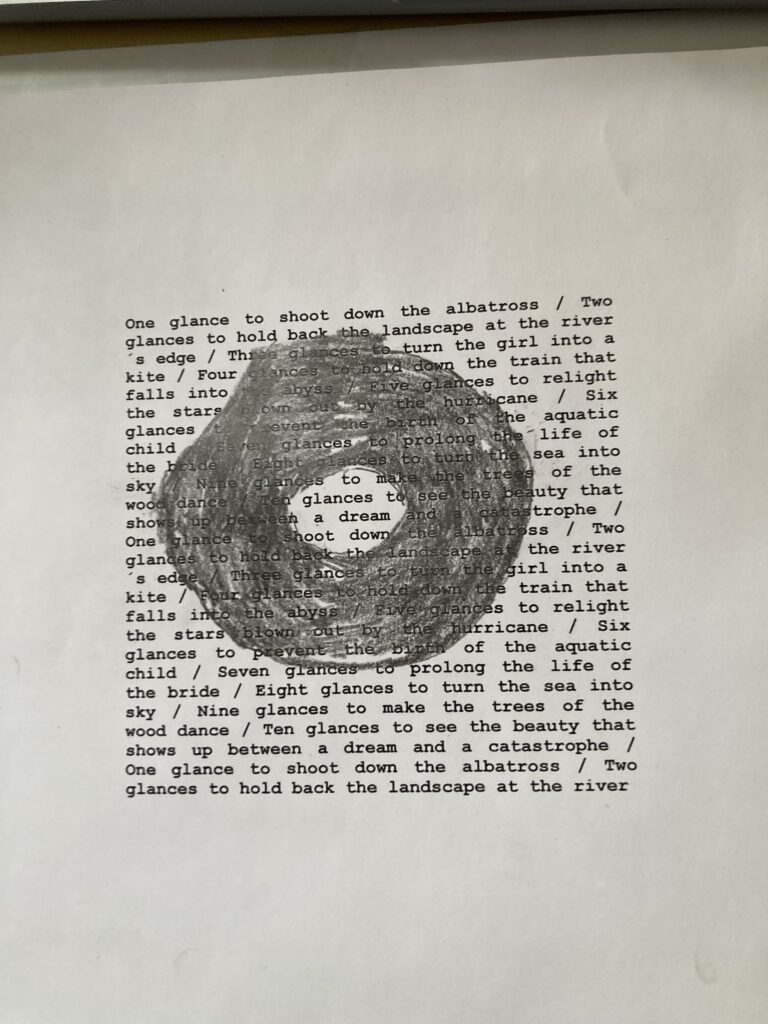
I wonder what it would look like if I only wrote the poem once, and made it a horizontal band across the box? Maybe make the font size smaller too? What if offered a few different versions, some with larger fonts, some with smaller so a reader could see what I can/and can’t read. I’ll have to try that next time.