feb 29/RUN

5.15 miles
bottom of franklin and back
33 degrees

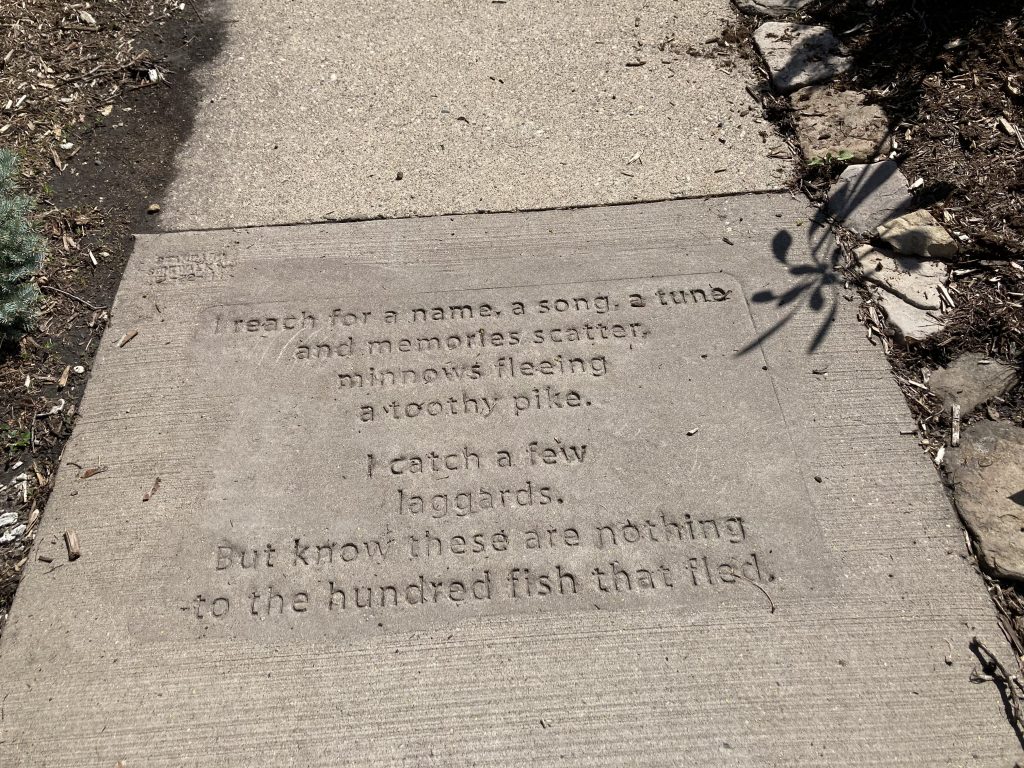
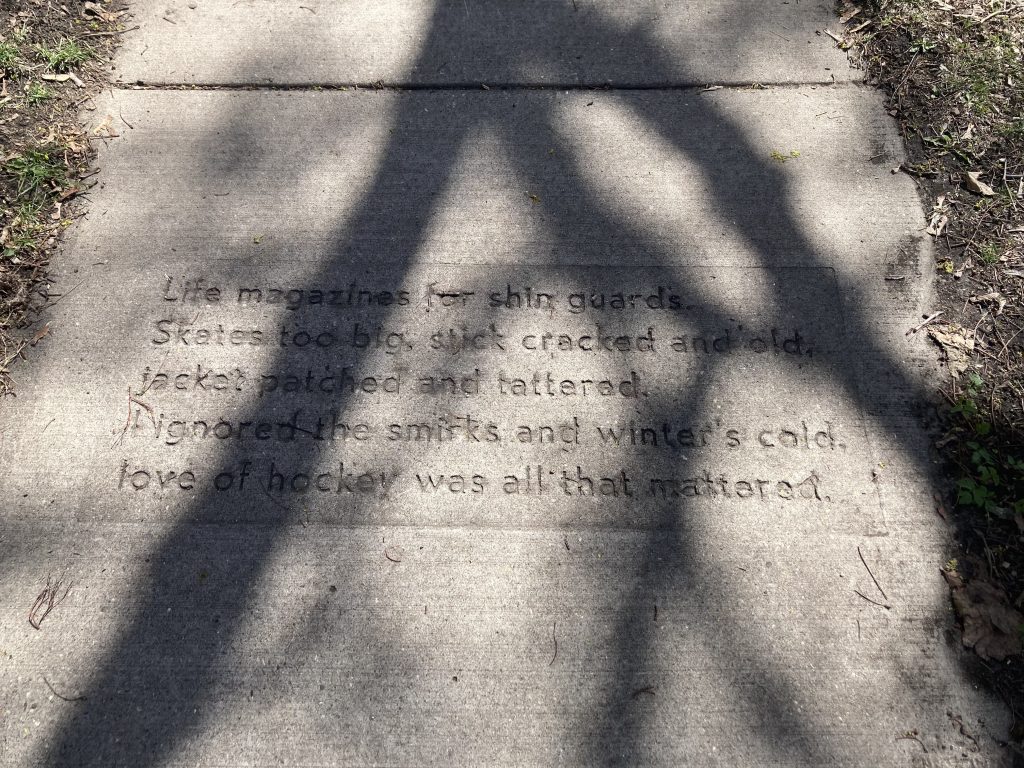
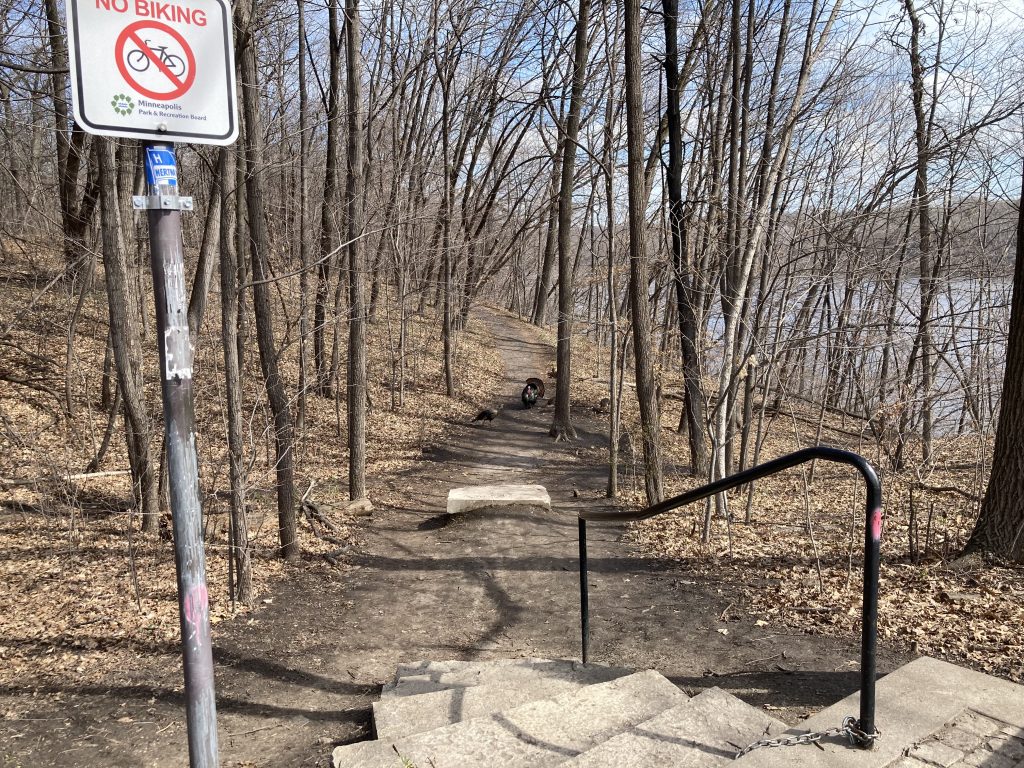
Some wind, lots of sun and shadows and spring feelings. Heard some black-capped chickadees, was dazzled by the sun shining off a parked car, saw some new graffiti on a sign at the bottom of the hill.

Often my legs felt heavy. But my calves were quiet.

Heard a woodpecker knocking on wood somewhere near the rowing club and thought: a door!

Anybody
home? The
woodpecker
knocks on
the tree like
it was
dinner’s door.

Recited ED’s “I felt a Funeral, in my Brain” throughout the run and got most of the lines.

Had some great thoughts while I ran about ED’s funeral poem and how it fits with running and the feeling of moving past (beside) your Self to a space beyond thinking and seeing, where you’re feeling and hearing. Thought about the gradual process ED describes — her repeated use of and and then — for how we break through to a different world where Space — began to toll/As all the Heavens were a Bell/And being, but an Ear. I had many other thoughts, but I’d like to think through them and post tomorrow.

ED’s Daily Delight (feb 28)

the line: Superior — for doors — (from “I dwell in Possibility”)

In November and December, while I was working on the revision of my Haunts poem, I started writing a series of door poems, inspired by a Mary Oliver line from Upstream:

I did not think of language as the means to self-description. I thought of it as the door–a thousand opening doors!–past myself.

Upstream/ Mary Oliver

Looking for
ways out,
hoping for 
ways in,
finding doors
open
everywhere

Then I wrote a series of brief 3/2 poems describing the “doors” I’ve found by the gorge. I’d like to keep adding to them, using my 10 Things lists for inspiration.

Before I do that, I found this reference to doors while rereading a Feb 28, 2022 entry:

The sound of boots tamping snow are the hinges 
of many doors being opened. 
(from Statement of Teaching Philosophy/ Keith Leonard

I like the idea of doors opening or being opened. Opening/being opened suggests that something — language or poetry or the sound of boots triggering memories — is doing that opening. But I also like the idea of doors already open that you have to notice.

from December 2023 “10 Things” Lists:

dec 1: most of the steps down to the Winchell Trail are closed off with a chain, but not the old stone steps — why not?

Just one set
of stairs

without a
chain stretched

across the
top step.

Just one door
calling

out to you,
Come in!

dec 1: there are certain stretches I don’t remember running through — like the part of the walking trail that separates from the bike path right before the trestle. Why can’t I picture it?

stretches of
the path

forgotten
moments

I enter
a space

outside of
myself.

dec 3: running by a house I walk by often, seeing the door looking different — a new color? orange? have they painted their house or is the light just weird for me today?

today the
color

of this door
has changed —

a new paint
job or

a trick of
the light?

dec 5: a path winding through the savanna revealed by settled snow

a path winds
through the

savanna
often

invisible
today

revealed by
new snow

dec 6: wet path, shimmering — is it just water, or is it super slick ice?

Here, two doors,
both

possible.
One’s safe

the other
more fun.

note: As I write these, I’m thinking that part of their point is to open up and to get into the habit of converting things noticed into my form. Many of them aren’t great, but they are good practice and could help to loosen me up. For the first time in a few years, ran to Lake Nokomis and back.

dec 15: kids laughing on a playground* (*as I listened to the kids, I thought about how this sound doesn’t really change. Over the years, it comes from different kids, but the sound is the same. Season after season, year after year.)

no matter
the year

recess sounds
the same

the difference
is you

and how you
hear it

dec 18: hot sun on my face, once or twice

hot sun on
my face

I pretend
spring’s door

has opened

dec 19: as I ran south, some white thing out of the corner of my eye kept calling out, notice me! So I did: it was an arch of the lake street bridge

Sometimes doors
don’t speak

and sometimes
they scream

Open me,
enter!

dec 22: halfway down the hill, I noticed some stairs on the other side of the road I’ve never noticed before. Were they leading to the franklin terrace dog park?

halfway down
the hill

surprise stairs
noticed

just today.
Where do

they lead? What
doors do

they open?

feb 27/RUN

4.5 miles
VA bridge and back
46 degrees
wind: 16 mph, 29 mph gusts

What a wonderful morning for a run! Okay, maybe the wind was a bit much, but the sun and the warm air and the clear paths made up for it. I felt good and strong and relaxed. A few times my right calf reminded me it was there — no pain, just a strange stretched feeling. I recited ED’s “I heard a Fly buzz — when I died –” several times, mostly in my head, but once, as I climbed out of minnehaha park, out loud! Should I be celebrating this? Do I want to be that person who doesn’t care if others hear her reciting poems as she runs? Yes, I do.

10 Things

  1. the hollow knocking of a woodpecker on dead wood, echoing across the gorge
  2. lots of black capped chickadees calling to each other
  3. oak tree shadows, sprawled everywhere
  4. the brown creek water lazily heading towards the limestone ledge
  5. rustling below me, on the winchell trail — someone walking over the leaves
  6. climbing up from the part of the path that dips below the road, seeing the shadow of trunk on the path that was so sharp and dark I thought it was a fallen tree
  7. sirens on Hiawatha, getting louder as they off the walls of the tunnel near 50th
  8. passing a runner — What a beautiful morning!Yes! Almost perfect!
  9. a biker in a bright yellow shirt, as bright as the one I was wearing
  10. the meandering curves of the sidewalks that wind through the part of minnehaha falls near John Stevens’ house

This morning, while drinking my coffee, I decided to write about the delightful noise of geese wings cutting through the air that I’d recalled hearing a few weeks ago on my back deck — I remembered it after reading a list of 10 things from a feb 27th from another year. I wrote a draft of a poem, then decided I’d like to start writing delight poems every morning. No pressure — just patch a few words together and don’t try to make them elaborate — this isn’t a competition but a doorway into thanks and a silence in which another voice may speak (Praying/ Mary Oliver) — just the opportunity to sit with one of the delights I’ve encountered while running beside the gorge. A few minutes later, I had a further idea about including Emily Dickinson:

The practice, elements:

  • write a poem each day
  • the poem should be about some delight noticed on the run — either from that day or a past entry
  • any form running/breathing form: couplets of 3 syllables/2 syllables
  • uses, in some way, a favorite line from an Emily Dickinson poem

Here’s the poem I wrote this morning:

Too Silver for a Seam / Sara Lynne Puotinen

Even more than the sight of them
it is the sounds they make
that move me.

Usually it is the mournful calls
from within a tight formation
then the lone honk of the last in line,

but today the geese were low enough
to hear the sharp swish of their wings
cutting the air.

In their wake only the echo
of scissors and sharpening knives
and movement too silver for a seam.

The ED line is too silver for a seam and it comes from “A Bird came down the Walk”:

And he unrolled his feathers
And rowed him softer Home—

Than Oars divide the Ocean,
Too silver for a seam—

I like it! It needs a little work, but it makes me happy and captures my delight in hearing this sound. Scott wondered about the scissors and sharpening knives — such violent imagery — so I explained — the scissors make me think of Scott’s mom and the old scissors I inherited from her that make a wonderfully sharp scissor-y sound when you use them — it also makes me think of my mom who was always using scissors for her fiber art. The sharpening knives make me think of Scott’s dad and the enthusiastic and dilligent way he would sharpen their knives with their knife sharpener. I think I might need to add a line or two that signals my affection for these sounds without making it too obvious.

During the last mile of the fun, I started reciting other ED poems, including:

To make a prairie it takes a clover and one bee,
One clover, and a bee.
And revery.
The revery alone will do,
If bees are few.

Note: This seems like an edited version from Mabel Todd, with all its punctuation and no capitalizing of clovers or bees.

As I recited this small poem, I suddenly thought about how I was a bee, wearing my bright yellow shirt with my black running shorts and tights. I kept running, feeling ready to stop, looking ahead and wondering how close I was to being done. Suddenly I saw it: the bright yellow crosswalk sign with black figures at 38th street! I’m almost done when I reach that sign! I watched it getting closer and thought, it takes one bee or, it takes a bee?

update, six hours later: I’m back. Decided that I might want to add one more rule to this ED delight daily practice: I want to use my running/breathing form of 3 syllable/2 syllable couplets. I tightened up the poem I wrote earlier using that form. Here’s the new version:

Today the
geese flew

low enough
to hear

the quick swish
of wings

slicing through
the air. (I could leave air for the unintentional rhyme or switch to sky)

In their wake —
echoes

of scissors
cutting

knives being
sharpened

their blades too
silver

for a seam.

feb 24/RUN

1.25 miles
neighborhood
27 degrees

A short run to see how my calf was doing. I think it’s okay. No pain. My heel felt a little strange by the end, but that could be from the cold — I didn’t run long enough to warm it up. (a cautious) Hooray!

My favorite parts of today’s run: cresting the hill on edmund and seeing the river burning a bright silvery white in the distance; the comforting smell of a fire burning in someone’s fireplace; and the wind chimes echoing through the alley as I walked home.

before the run

While searching for calf stretches I came across this delightful fact: the calf is often referred to as the peripheral heart!

Throughout the calf muscles is a network of veins, arteries and nerves. The calf muscles and the deep veins have a network of valves and pumps. This system is called your “peripheral heart.” This is because, when you’re in an upright position, the calf muscles work against gravity to close the valves – contracting and driving blood from your legs towards your heart.

Sore Calves: A Full Guide

Very helpful. I remember reading about calf heart attacks and I wondered why they were called that. Now it makes sense! Also good to remember: the calf is made up of 2 muscles: gastrocnemius (bulging one) and soleus (flat, underneath).

Before heading out for my run, I tried out these stretches. I liked them:

after the run: fun with medical terms!

I haven’t done one of these for some time. I want to turn gastrocnemius and soleus into something else. Inspired by Mia Farrow in Rosemary’s Baby, I’ve pulled out my scrabble letters and I’m making new words or phrases.

  • gout ocular messiness
  • regulate moss cousins
  • smile across us tongue
  • oust uncola’s regimes! this has an extra s that I couldn’t fit, but it was too good not to mention

That’s all I have right now. I think I’ll keep working on it later today. It’s fun, but the tiles are harder to see than I thought.

feb 19/RUN

5 miles
john stevens’ house
34 degrees

So bright out by the gorge today. Sharp shadows. Clear path. Black-capped chickadees, downy woodpeckers, construction workers, little kids all chattering. Before I saw the creek, I heard it gushing below me near the falls. Oh — and wild turkeys! A dozen of them pecking the snow just north of locks and dam no. 1.

My favorite part of the run was in minnehaha park near John Stevens’ house, where the serpentine sidewalk — completely cleared and dry — snaked through the grass covered in several inches of untouched snow. O, the sun and the shadows and the curves and the warmer air and the dry paths and the open lungs and humming legs!

an illusion

Glance one: running south on the stretch near 38th street, I noticed something dark and solid up ahead on the trail. A loose dog or wild animal? No.
Glance two: Still staring, the black thing turned into a dark, deep puddle on the road.
Glance three: How could I have mistook this puddle for an animal?
Glance four: Wait — it’s not a puddle, it’s someone’s disembodied legs in dark pants walking on the edge of the path.
Glance five: And their legs are attached to a torso in a light colored (gray? tan? pale blue?) jacket which blended into the sky.
Glance six: Getting closer, I can see a head, some shoes

This illusion is not unusual for me. Mostly, it doesn’t bother me because I am used to it and I have time to figure out what it is I’m seeing. Sometimes, when I don’t have time to look and think and guess, it’s scary and unsettling and dangerous.

Found an interview with Andrew Leland from Joeita Gupta and The Pulse this morning and wanted to remember this helpful definition of blindness:

The Pulse

What is blindness? Blindness isn’t merely an absence of sight. Blindness is a central identity for some, a neutral or marginal characteristic for others. Not all blind people are the same. There are blind vegetarians, athletes, academics, you name it. Some people have been blind from birth, others lose their vision as adults. Blindness can come on suddenly or gradually. Blindness is then more than a physical experience. It has its own culture, language, and politics. Blindness is not the same for any two blind people anymore than sight is experienced the same way by two sighted individuals.

note: This podcast has some other great episodes, including one about birding while blind, which I added to my May is for the Birds page.

How I See

I’m continuing to work on my alt-text/ekphrastic image project. Still trying to figure out the best way into the actual poems. Not quite writer’s block, but a grasping, grappling with, wrangling ideas. Anyway, maybe detouring will help a little. I’d like to gather lines from vision poems that describe how I see. I’ll begin with one of the most well-known blind poets, Jorge Luis Borges:

 In Praise of Darkness / Jorge Luis Borges

Old age (the name that others give it)
can be the time of our greatest bliss.
The animal has died or almost died.
The man and his spirit remain.
I live among vague, luminous shapes
that are not darkness yet.
Buenos Aires,
whose edges disintegrated
into the endless plain, has gone back to being the Recoleta, the Retiro,
the nondescript streets of the Once,
and the rickety old houses
we still call the South.
In my life there were always too many things.
Democritus of Abdera plucked out his eyes in order to think:
Time has been my Democritus.
This penumbra is slow and does not pain me;
it flows down a gentle slope,
resembling eternity.
My friends have no faces,
women are what they were so many years ago,
these corners could be other corners,
there are no letters on the pages of books.
All this should frighten me,
but it is a sweetness, a return.
Of the generations of texts on earth
I will have read only a few–
the ones that I keep reading in my memory,
reading and transforming.
From South, East, West, and North
the paths converge that have led me
to my secret center.
Those paths were echoes and footsteps,
women, men, death-throes, resurrections,
days and nights,
dreams and half-wakeful dreams,
every inmost moment of yesterday
and all the yesterdays of the world,
the Dane’s staunch sword and the Persian’s moon,
the acts of the dead,
shared love, and words,
Emerson and snow, so many things.
Now I can forget them. I reach my center,
my algebra and my key,
my mirror.
Soon I will know who I am.

penumbra: shroud, fringe, a shaded region surrounding the dark portion of a sunspot, in an eclipse the partially illuminated space between full shadow and light

Here are a few lines that I think describe how I see:

This penumbra is slow and does not pain me;
it flows down a gentle slope,
resembling eternity.
My friends have no faces,
women are what they were so many years ago,
these corners could be other corners

A slow, gentle deterioration. No dramatic or sudden shifts. / When I look at people directly, I usually can’t see their faces. / I either see a smudge or darkness or the face I remember from before, when I could see. / sharp edges or corners are difficult to see and streets once familiar are strange. Traveling to a new street corner, I struggle to read signs, to recognize where I am, everything there but not, everything the same forms: Building, Sign, Door

feb 18/RUN

5.8 miles
down the franklin and back
31 degrees

A little icy, a little windy, a little crowded. Difficult to run together in these conditions, so Scott and I split up. The sun was bright and I saw some wonderful shadows of trees — gnarled and sprawling across the sky. Heard some geese, smelled some bacon.

When we ran together, Scott and I talked about the half frozen river and how it looked like a gray slushy. What flavor is gray slushy, I wondered. Scott suggested, all the flavors then added, I bet that would taste good. I wondered if this “everything” slushy would include blueberry. No, Scott said, blue raspberry. I mentioned how there is no consensus on the origins of the rasp in raspberry, which I had come across while reading a past entry a few days ago.

How I See

As I continue to work on this project, I want to return to ekphrastic poems. In an article for Lithub — Back to School for Everyone: Ekphrastic Poetry with Victoria Chang — Chang offers some helpful thoughts about the form:

how poets engage with visual art:

  • write about the scene or subject being depicted in the artwork
  • write in the voice of the person or object represented
  • write about their personal experiences
  • fictionalizing a scene within the art
  • write about the work in the context of its socio-political history

In essence, ekphrastic poems are a way to interact with the world and a way to respond to the world. The process of writing ekphrastic poetry also brings into question aspects of viewing, the culture of viewing, and the gaze, always asking the questions of who is looking at what, when, and why?

3 thoughts about Ekphrasis

1: I’m as interested in how someone is looking as who, what, when, or why they are looking.

2: Maybe part of the ekphrasis angle is the idea that sometimes the world looks like a painting to me — pointillism or abstract expressionism or?

3: the contrast between how a photo captures/stills the image in a way that my eyes never can

A view from the ford bridge, poorly framed. Not sure what color other people might see here, but to me it's all gray: light gray sky and river, broken up by chunks of dark gray trees. I like how the sky and the river look almost the same color to me.
8 nov 2023

original description: A view from the ford bridge, poorly framed. Not sure what color other people might see here, but to me it’s all gray: light gray sky and river, broken up by chunks of dark gray trees. I like how the sky and the river look almost the same color to me.

5 nouns/ 5 adjectives/ 5 verbs

nouns: river, water, shore, trees, sky, branches, a bend, surface
adjectives: winding, scraggly, soft, fuzzy, drab, dark, light, gray, wide, flat, contrast, wide
verb: stretching, reaching, standing, stilled, separated, cutting through,\

one sentence about the most important thing in image: The sky and the river are the same color; only the disruption of trees enables me to distinguish between them.

a second sentence about the second most important thing: Everything gray: light gray sky and river, broken up by chunks of dark gray trees.

a third sentence about the third most important thing: In this soft, wide open view, when everything is stilled, silent, nothing is happening.

The nothing that’s happening in this image is full of meaning. Here nothing = no things are doing anything/ nothing to see; nothing = a void, absence, unknowingness; nothing = a rest for my eyes, no movement, everything still, satisfied, stable.

The idea of no separation, no edges or divisions between forms, reminds me of a wonderful poem that I thought I’d posted already, but hadn’t. I think when I first encountered it a few years ago, it didn’t resonate for me. Now, I want to call out, yes!, with almost every line.

Monet Refuses the Operation/ Lisel Muller

Doctor, you say there are no haloes
around the streetlights in Paris
and what I see is an aberration
caused by old age, an affliction.
I tell you it has taken me all my life
to arrive at the vision of gas lamps as angels,
to soften and blur and finally banish
the edges you regret I don’t see,
to learn that the line I called the horizon
does not exist and sky and water,
so long apart, are the same state of being.
Fifty-four years before I could see
Rouen cathedral is built
of parallel shafts of sun,
and now you want to restore
my youthful errors: fixed
notions of top and bottom,
the illusion of three-dimensional space,
wisteria separate
from the bridge it covers.
What can I say to convince you
the Houses of Parliament dissolve
night after night to become
the fluid dream of the Thames?
I will not return to a universe
of objects that don’t know each other,
as if islands were not the lost children
of one great continent. The world
is flux, and light becomes what it touches,
becomes water, lilies on water,
above and below water,
becomes lilac and mauve and yellow
and white and cerulean lamps,
small fists passing sunlight
so quickly to one another
that it would take long, streaming hair
inside my brush to catch it.
To paint the speed of light!
Our weighted shapes, these verticals,
burn to mix with air
and change our bones, skin, clothes
to gases. Doctor,
if only you could see
how heaven pulls earth into its arms
and how infinitely the heart expands
to claim this world, blue vapor without end.

feb 14/RUN

6.7 miles
franklin loop+*
37 degrees

*The + is because when I reached the lake street bridge, instead of taking the steps up to it, I kept running up the summit hill until I reached the top, then turned around.

When I started my run, the sky was blue and the sun was shining. I wondered how a winter storm could move in by this afternoon. But, by the time I was done running, it was overcast. We could get up to 4 inches. Finally, I’ll get some snow. That’s what Dave, the Daily Walker said when I saw him on the trail. My response: I know!

10 Things

  1. woodpecker, 1: loud drumming
  2. woodpecker, 2: a downy woodpecker call, sounding like a loon to me
  3. the lake street bridge, its arch reflecting a smile in the river
  4. the light reflecting off of the stream in the ravine near shadow falls — a bright white
  5. shadows — mine, of lamps, trees, railings
  6. a sandbar in the river the trestle
  7. the sun illuminating all of the patched-up cracks on the path just under the lake street bridge on the east side
  8. paw prints in mud
  9. the river, pale blue with one shiny circle in the middle
  10. smells: fried and savory (from longfellow grill?), weed

I took several pictures, but I’ll save them for posting after I experiment with them.

more experiments with alt-text

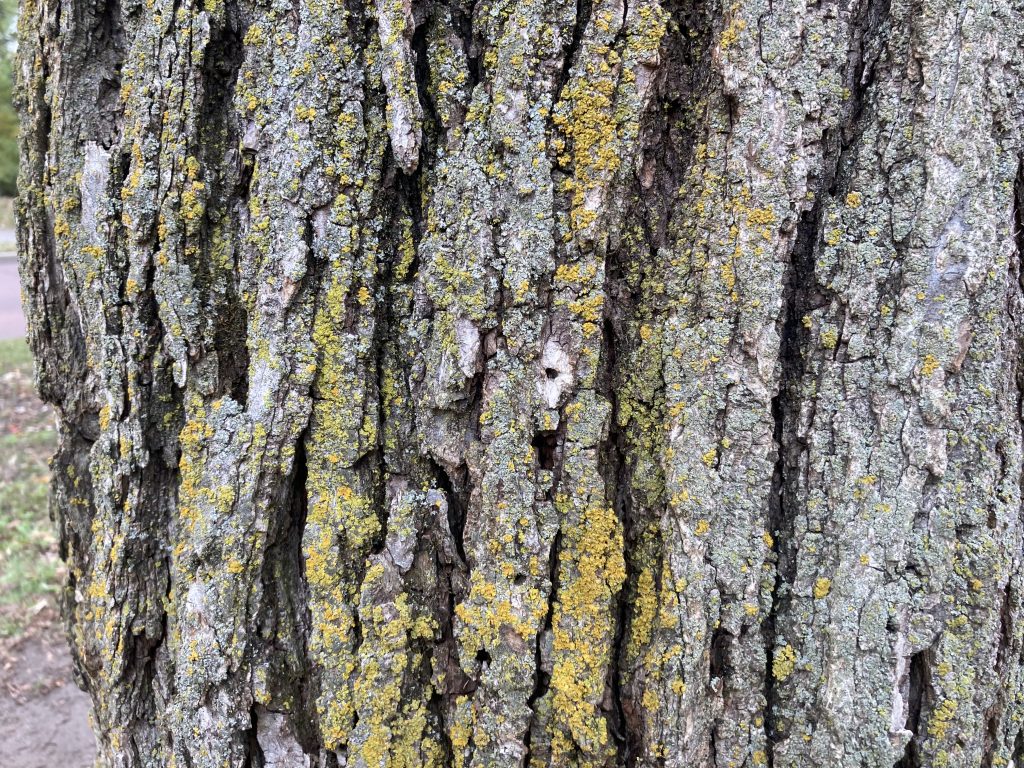
A close-up image of tree bark that is rough and brownish gray (or grayish brown). There are streaks of greenish-yellow lichen on the bark. While taking this picture, with my face close to trunk, I could see the lichen, and if I put my face close to the screen I can still see it. But at a normal (1 foot) distance, it almost blends in, not looking yellow or green but light brown.
12 october 2023

initial description of image from 12 oct: A close-up image of tree bark that is rough and brownish gray (or grayish brown). There are streaks of greenish-yellow lichen on the bark. While taking this picture, with my face close to trunk, I could see the lichen, and if I put my face close to the screen I can still see it. But at a normal (1 foot) distance, it almost blends in, not looking yellow or green but light brown.

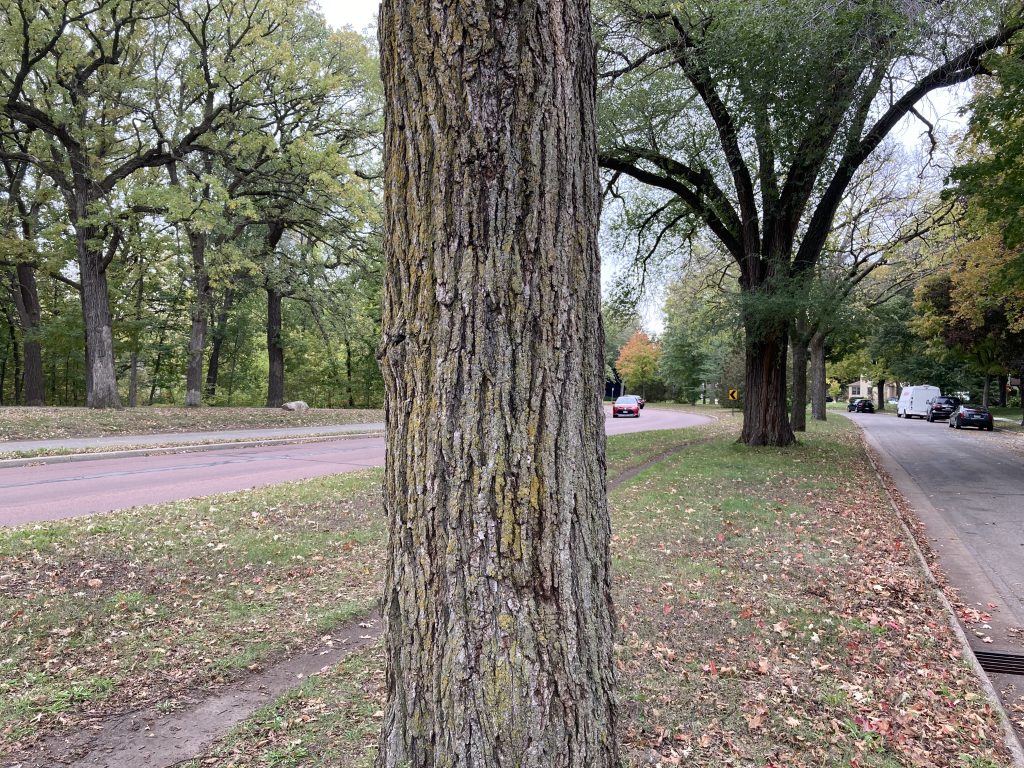
The trunk of a tree with rough bark. A few more trees and a road behind it.

12 oct 2023

5+ nouns / 5 adjectives / verbs of first image of the trunk:

nouns: tree, bark, cracks, depressions, ridges, textures
adjectives: dark, rough, light, weathered, gray, bumpy, old
verbs: hiding, aging, enduring, exposed, weathered, entangled

one sentence about the most important thing in image: Close up, with my face almost on the bark (or the screen), I can see the green lichen near the bottom of the image, but from a foot back, the bark is only brownish-gray or light with dark depressions or rough.

a second sentence about the second most important thing: The rough texture on this bark, made visible by the constrasts between light and dark, offers an interesting pattern.

a third sentence about the third most important thing: Just off center (by less than an inch?) there’s a light spot with a dark hole in its middle that is where the bark has worn off but that looks almost like a belly button, making it impossible for me to see anything else but it, and hear only belly-button in my head instead of tree or bark.

Oh, I’m enjoying this experiment! Each of my sentences speaks to a different thing about my vision. Sentence one is about how I rarely see color beyond gray or brown. The yellowish-green, which I imagine is very obvious to people with all of their cone cells, is invisible until I look very close or to the side, through my peripheral vision.

Sentence two is about how I have replaced ROYGBIV colors (like green or yellow) with contrast; the 2 primary colors for me are light and dark. They are how meaning is made for me.

Sentence three is about how when I’m focused on one thing, like the light spot near the center, (most) others things are invisible. I only see the spot and not the rest of the tree, or even that it is a tree. I’m sure this is true to some extent for other people with working cone cells, but it is more extreme for me. An example: when I’m running on the trail and my attention is focused on a biker approaching from a distance, the runner much closer to me is completely invisible. I don’t see them at all until we’re fairly close. It’s happened several times over my years of running with low vision. I’ve never run into anyone because I always see them with enough time to adjust. But it’s unsettling and doesn’t feel normal, or at least like how I used to see before so many of my cone cells died.

feb 12/RUN

3.1 miles
trestle turn around
35 degrees

Feels like spring. When I got back, I told Scott: In a normal winter, this would have been one of those days that makes you believe spring is coming. But it’s not a normal winter — no snow, only a short stretch of below freezing temps in January.

So many wonderful birds! As I listened to them chirp and tweet, I imagined the sounds as dots on a scatter plot — but what are the variables on this chart? I’ll have to think about that one. I don’t remember using scatter plots very often. All I can think of is the scatter plot on my kids’ yearly wellness checks for charting growth (variables: height and weight). The idea of scatter plot does sound intriguing as a form. I wonder what fun I could have with it?

An okay run. The conditions were wonderful, my left IT was not. It was sore — time for more fun with the IT band:

  • incandescent tripe
  • imbibing Taylors (apparently Taylor Swift impressively chugged a beer after KC won the super bowl yesterday)
  • implacable termites
  • impending trauma
  • instant triumph (in the last seconds of the first quarter of overtime, Kansas City scored a touchdown and won the game — and just like that, it was over)

As I ran, I thought about how my vision seems to be getting worse. There are some signs that I can’t see things as well, but it’s more that my eyes are straining more to read and I’m getting tired/having headaches from it. Time to put more energy to finding new, less wordy, ways to be. Part of me wishes I didn’t have to, but more of me is up for the challenge and curious about what interesting doors it might open.

I also thought about my ekphrasis project and where it might lead. I stopped and took a few pictures to use for my “how to see” project. Here’s one:

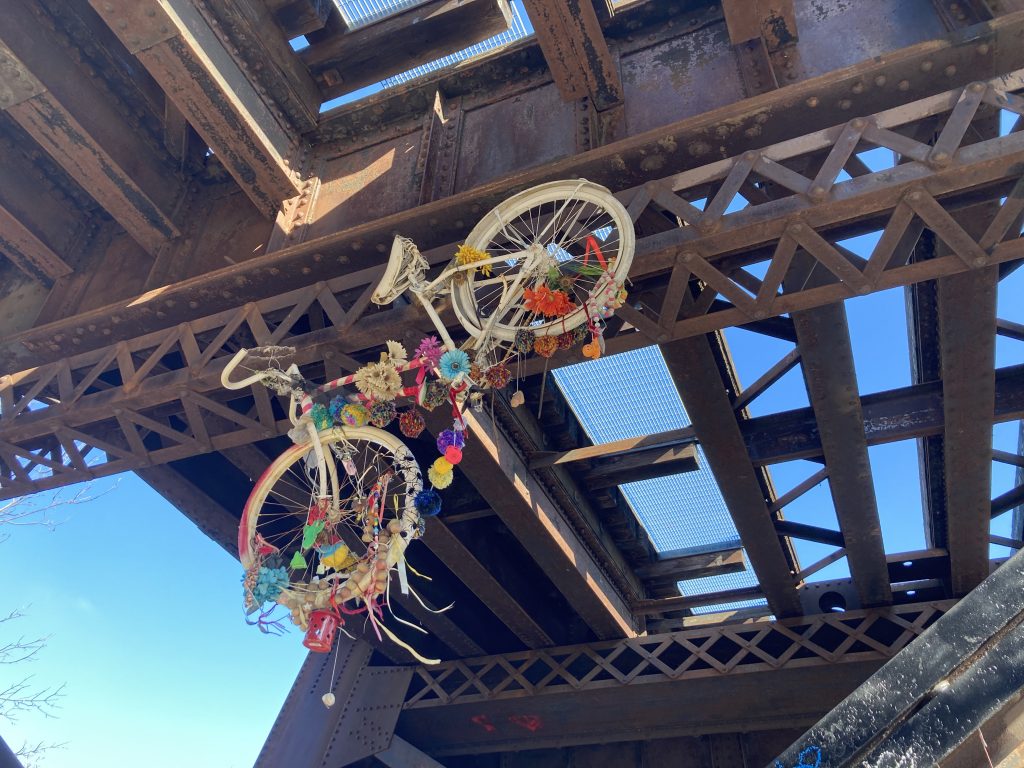
A white bike suspended from a brace on the underside of the railroad trestle.
A white bike suspended from a brace on the underside of the railroad trestle. I can barely see it in the photo, so my description comes more from my memory of when I was looking up at it to take the photo. I think it has flowers and vines wrapped around it. From a “normal” distance, I see some color — blue sky, red and yellow flowers — but they’re muted. When I put my nose right on the screen, the colors are much more vivid, but scattered. My eye is drawn to the lighter sky in the lower left hand corner, which makes everything else even more of a blur. I think I was able to “see” this bike because I know it’s there — I’ve studied it and looked up why it’s there. I even wrote a poem about it. I often rely on memory for seeing.

Looking, or trying to look, at this photo, I’m struck by how different of an experience it is than being below the bike on the trail. (How) is that true for everyone? How much do my vision issues shape these differences? I think it has something to do with the static nature of the image and the absence of other sensory data: no smells, no hearing the wind, no feeling of blue or bike or flower that I usually get when seeing beyond the narrow frame of a photo.

The poem I wrote about this ghost bike — that’s what these white bikes that are left on the trail to honor someone who died are called — as part of my larger Haunts project.

Ghost bike:
under the
trestle
for June
hit and killed
while fix
ing her bike
in a
parking lot.

Flowers:
next to
June’s ghost bike
plastic
placed in the
remains 
of a post
once part
of metal
railing
now only
open
cylinder 

Note: In the winter, someone hangs the bike up higher. Usually, for the rest of the year, it’s lower to the ground, with flowers placed nearby.

Found this poem the other day. I love the listing, then the pow at the end with the final line.

Medical History/ Nicole Sealey

I’ve been pregnant. I’ve had sex with a man
who’s had sex with men. I can’t sleep.
My mother has, my mother’s mother had,
asthma. My father had a stroke. My father’s
mother has high blood pressure.
Both grandfathers died from diabetes.
I drink. I don’t smoke. Xanax for flying.
Propranolol for anxiety. My eyes are bad.
I’m spooked by wind. Cousin Lilly died
from an aneurysm. Aunt Hilda, a heart attack.
Uncle Ken, wise as he was, was hit
by a car as if to disprove whatever theory
toward which I write. And, I understand,
the stars in the sky are already dead.

feb 11/RUN

5 miles
Veterans’ Home and back
32 degrees

Another weekend run with Scott. Usually we run on Saturdays, but yesterday we were in St. Peter, so we ran today instead. Colder, windier, sunny. Sharp shadows. My favorite shadow: running under the ford bridge, a big shadow crossed over my head. A bird? No, a bike up on the bridge.

We talked about ones and zeroes and the differences between null, zero, and false in coding. I mentioned how when it gets to the brain, seeing is about signals firing and not firing. Then we talked about a recent controversy with Margaret Livingstone’s research on animals, which led us to a discussion about scientific experiments as material practices, the ethical dilemma of using knowledge gained from unethical experiments, and then a mention of Newton’s experiments on himself — shoving something in his eye to learn about color. Some fun discussions!

I forgot to notice the falls or look down the river, I recall seeing someone in yellow running on the Winchell Trail. I smelled the smoke near the house that always smells like smoke. I heard a dog’s collar clanging behind us. Felt the cold wind almost taking my breath away.

before the run

Started rewatching Margaret Livingstone’s lecture about artists and vision. Also found her book, Vision and Art — the “read sample” is helpful here.

Near the beginning of the video, Livingstone emphasizes this idea: “Visual information processing is not image transmission.” She adds: you don’t transmit information up to your brain because there’s nobody up there to look. In her book, she elaborates on this idea, giving it a name: the homunculas fallacy — homunculas means “little man.” The fallacy: some little man is up in your brain “looking” at the image. I love this name and the idea of a little man; I’d like to put it in a poem!

feb 9/RUN

3 miles
trestle turn around
32 degrees

Colder today, windier too. Back to winter layers. A lot of the run was a blur — or was it quick flashes?

10 Flashes

  1. looking down at the bare branches of the floodplain forest
  2. wet pavement by the welcoming oaks
  3. waving water under the lake street bridge
  4. uneven limestone also under the lake street bridge
  5. a woman with 2 dogs, one on each side, sprawled out on the trail
  6. the light blue-gray river below as I neared the trestle
  7. wind rushing past my ears
  8. a muddy trail on the grassy boulevard
  9. flashing lights from a parks truck
  10. the tree that looks like a person, with a burl right at eye level that looks like a head

before the run

Before the run, I gathered some more resources for my “how I see” project:

Reviewing more descriptions of ekphrasis, I’m wondering how it fits with what I’m trying to do. I wrote in my notes that my project exists somewhere between alt-text and ekphrasis.

Here’s a condensed version of a helpful article (Conventions of Ekphrasis) I found out conventions within the ekphrasis:

  • Speaking out: giving a voice to the mute art object , artwork speaks to the artist or the poem will speak to the mute visual artifact , poet may implore the painting/sculpture to speak or to justify the artist or poet’s work — technical term for giving a voice to the mute art object is prosopopeia
  • Praise: poet/persona frequently praises the mastery of the visual artist and his work
  • Paragone Competition:competitive relationship between words and images, an implicit critique of the material, its stasis, and its immutability, Poet may seek to establish superiority of words over the painter/sculptor and his material limitations by suggestion they have: more immediate access to the real; more immediate access to the divine; that one art has a more direct relationship with Truth; that one exists in either time or space and therefore is more accurately representative through the accuracy of its resemblance; more education, learning and talent or that it is less crude 
  • Emotional response: deeply moving visual experience that triggers a latent or unresolved emotional vulnerability, “transfixing” the poet, speechlessness, ability to “trick” the poet into believing that the work is “real”, the painting “breathes” life while the poet remains “breathless” before it
  • Stasis of the art object: painting is mute poetry and poetry a speaking picture
  • Enargia: to make the object lively appear before the reader’s eye through detailed description, use of sensory information, imagery, etc… In other words, so ekphrasis will also attempt to visually reproduce the art object for the reader so that the reader can experience the same arresting effect as the poet
  • Actions of the painter: linger on the actions of the visual artist concentrating on the act of creation and often paralleling the act of artistic creation with divine creation
  • Artist’s studio: reference or be wholly concentrated upon the artist’s studio
  • Museum ekphrasis: poet is wandering through the museum looking at various pieces and each begins to bleed into the poet’s poem/thoughts

during the run

Right before the run, I reviewed the ekphrastic conventions and decided to think about the competition between image and word — which has more access to the real? to truth? the divine? I had many thoughts — so many of them still floating, not quite remembered. I’ve decided to not try; if the thoughts are important, I’ll remember them at some point.

after the run

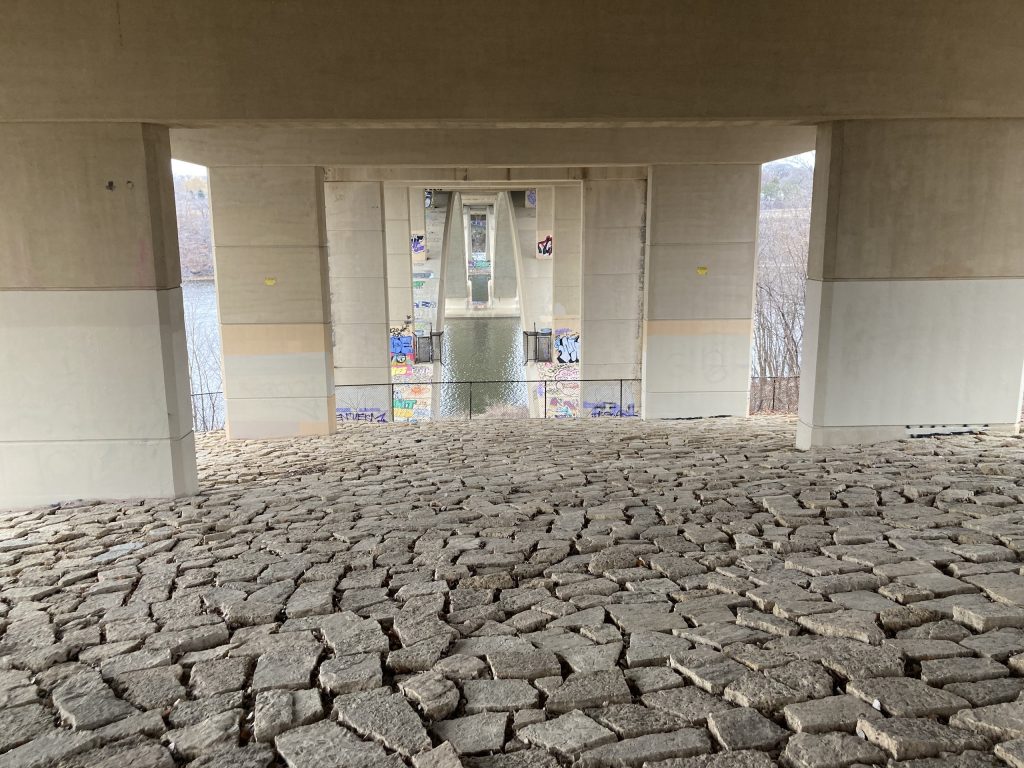
I kept trying to make more happen here — to find words for some of my thoughts, but we’re driving down to St. Peter for FWA’s band concert and I’m feeling the pressure to pack and get ready. So, that’s it. Oh — and this. I stopped at 2 miles to take this photo of the lake street bridge from below. I was inspired to take it because of a story RJP told me on our walk a few days ago. She and her friends hopped over a fence and walked up the arch over the water. Apparently there’s a room with a door and couch somewhere up in the arch where kids like to hang out. I thought about trying to get close to see it, but that would have required descending the uneven bricks and possibly twisting my ankle.

Under the Lake Street bridge. The bottom third of the image is of uneven limestone rocks sloping down to 2 pilings, a chain link fence, then river. Beyond the river more bridge -- cream colored or pale yellow -- with graffiti.
Under the Lake Street bridge. The bottom third of the image is of uneven limestone rocks sloping down to 2 pilings, a chain link fence, then river. Beyond the river more bridge — cream colored or pale yellow — with graffiti. The graffiti at the lower left looks black to me until I put the computer screen right up to my nose. Then I can see that it’s blue or purple or some bright color. Overall, I can see the edges of the limestone in the foreground, but the rest of the image is fuzzy and hazy and looks more like a dream or an abstract painting than a photo of a real bridge.

feb 8/RUN

5.3 miles
ford loop
47 degrees

Hooray for feeling strong and happy and unbothered by the wind! A good run, even though it feels strange with no snow. Scott told me it’s 5 degrees warmer here in Minneapolis than it is where we used to live in Upland, California. Wow.

Starting last night and lingering through the morning: rain. Not snow, but rain. Everything was wet and muddy and slippery. At the end of my run I noticed that I had specks of mud on my shirt — how did that happen?

Around mile 3, as I ran straight into the wind, a biker approached from behind. I heard her call out Fast! I wasn’t sure what to say, so I said, there’s a lot of wind! She agreed. Later I encountered the biker on the ford bridge — she was walking her bike while I was still running — There’s goes that fast runner! I waved and smiled. I did a lot of smiling at every person I encountered.

a strange winter sight: roller skiers, one of them wearing shorts!

Talked with Dave, the Daily Walker about how I’m missing the snow. He agreed, but only when it’s windy and there’s lots of snow and no one else out on the trail. Then it’s fun, he said. His version of fun is one reason why I like Dave so much.

Took 2 pictures of my view. Both are just south of the double bridge and the Horace W.S. Cleveland Overlook. Here’s one of them:

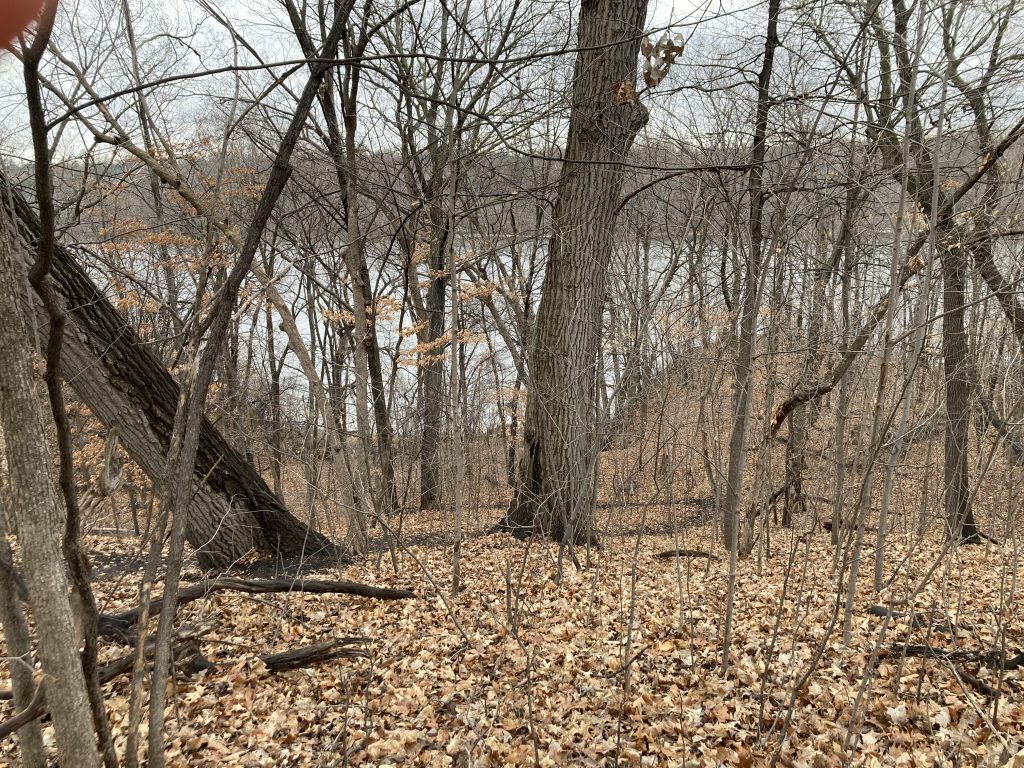
My view from above the gorge: bare limbed trees, all trunk and thin branches. A few trunks are thick -- like the one near the center of the image or the one leaning on the left side -- but most are thin, creating a transparent screen between runner (me) and river. The ground, in the bottom third of the picture, is mostly dead, curled-up brown leaves.
My view from above the gorge: bare limbed trees, all trunk and thin branches. A few trunks are thick — like the one near the center of the image or the one leaning on the left side — but most are thin, creating a transparent screen between runner (me) and river. The ground, in the bottom third of the picture, is mostly dead, curled-up brown leaves. Sometimes, this is what I see even when there aren’t thin, bare branches everywhere — my view slightly obscured by something in the way — dead cone cells, I think — creating fuzz or static or a slight pulsing or wavering of lines. Also, if this picture were in black and white I wouldn’t be able to tell the difference. Often I have to ask Scott: is this in color or black and white?

peripheral: how I see

before the run

Before my run, while I was reviewing my Oct 2023 log entries and encountering several of my “how I see” photos, it came to me: this should be the new version of my vision poems. I want to study the ekphrasis form (An ekphrastic poem is a vivid description of a scene or, more commonly, a work of art. Through the imaginative act of narrating and reflecting on the “action” of a painting or sculpture, the poet may amplify and expand its meaning — def). Then I want to write a series of “how I see” poem/descriptions. These will be about experimenting with the form and exploring ways to describe how I see. I wrote in my notes: not about what I can’t see, but what I can. I’m also interested in experimenting with the idea of alt-text as form — I have a few sources for this. I’ll read some Georgina Kleege and her latest book, More Than Meets the Eye. These poems will be practical — describing the literal way I see — but also poetic — strange, unsettling, more than a report.

I’m thinking that these poems would involve describing what I see in the photo and what I saw when I was taking the photo. Also, they’re as much about HOW I see (the mechanics/process) as WHAT I see. I love this idea; I hope it sticks!

some sources:

during the run

While I ran lots of different thoughts flashed. First I thought about Marie Howe and the idea of observing and not looking away. Describing what you see with details not metaphors. Then I thought about how “looking” works for me, how it’s harder because of what I can and can’t see. How much can any of us (no matter where we are on the spectrum of seeing/blind) actually see? Then I started thinking about Huidobro’s poem, “Natural Forces” and all of the different glances he describes — One glance to shoot down the albatross. What do my different glances see?

right after the run

During my walk back home, I thought more about how I see (and spoke those thoughts into my phone). I was reminded of Robin Wall Kimmerer and her chapter, “Learning to See” in Becoming Moss. It’s about how we can learn to see the small things — like moss — that were invisible to us before.

I also thought about how I’m interested in the process we use to see and how that shapes what we see and how it enhances or detracts from our ability to behold/witness. Yes! This connects back to Ross Gay and beholding, which I discussed on here a few years ago.

I’m interested in how we sense without seeing, or how we see with our other senses (like sound). And I’m interested in thinking about how vision isn’t the primary mode in which we understand and make sense of things. It is only one of many ways, not THE way.

Ekphrasis

The verbal representation of visual representation.

Basically, an ekphrasis is a literary description of art. Like other kinds of imagery, ekphrasis paints a picture with words. What makes it different from something like pictorialism is that the picture it paints is itself a picture: ekphrasis stages an encounter between representations in two mediums, one visual and one verbal.

What is Ekphrasis?

key feature of an exphrasis poem: it engages with an artistic representation — does this fit for my project? I think so, especially if I make the taking of the photo as part of the description.

Another helpful definition of Ekphrasis from Poets.org:

Ekphrasis is the use of vivid language to describe or respond to a work of visual art.

Ekphrasis

The purpose of ekphrasis was to describe a thing with such detail that the reader could envision it as if it were present. 

I’m interested in using language to help others experience how/what I see.

feb 6/RUN/WALK

6.2 miles
dog park and back
44 degrees

Another warm, spring-like day. More mud, no snow. Overcast. The wonderful sounds of birds. For 2/3 of the run, I listened to cars and my feet striking and voices and water gushing. For the last 1/3, I put in a playlist — Winter 2024.

I felt good — so much better than yesterday. Most of the time, I was zoned out, listening but not looking more than I needed to. I know that I glanced down at the river, but all I remember is that it was open. Somewhere near the shore little strips of snow still remained.

I felt strong and sore and not amazing, but certain that I’d be able to keep running.

A few hours later, RJP and I took Delia on a walk. I often ask and RJP rarely says yes, so today was a nice surprise. We ended up taking the old stone steps down to the river at Longfellow flats — a fitting destination because I just found out today that my poem about these steps and the spot by the river will be published in Scrawl Place. Wonderful news! The poem is titled `112 steps — the number of steps you take to get to the bottom. I counted 111 today, but I think I forgot to count the top step.

added the next morning: I almost forgot about the turkeys! Running south, somewhere near locks and dam no. 1, I saw them: 6 or 7 turkeys crossing the path. One of them sped up to pass before I got to them — a half walk half run that was more efficient than the human version but just as awkward. Hooray for wild turkeys!

peripheral

some notes from The Plentitude of Distraction

William James: (in his Laws of Habit lecture) the ability to experience subtle degrees of emotion depends on practice, on a regular encounter with non-teleological ways of apprehending the world. Once the brain stops cultivating gratuitous pursuits–music, poetry, painting–and limits its range to the recording of facts, to the single-minded quest for information, then its emotional and aesthetic elasticity deteriorates.

Work, unlike leisure, usually follows one direction and points toward a clear goal. This endows it with a reassuring automaticity. Art and play, on the other hand, tap into untried areas of the brain, calling for greater effort and elasticity not readily available to the untrained mind.

He believes in mental, not just physical aerobics, pushing for a veritable gymnastics of the spirit.

what might a poetics and spiritual gymnastics — that involves the body too — look like?

a problem: when attention is more about busyness than wonder

disengaged engagement

a heightened yet singularly unfocused relationship to phenomena

slow, not fast-paced result-oriented engagement, requires a particular sort of endurance — boredom as a necessary step to lasting absorption

endurance exercises to practice — I love this idea of thinking about disengaged engagement as an exercise, one to be added to my exercise plan: runs, core, stretching, building up ways to be distracted

being human means to inhabit a presence-absence mood — detached attentiveness, letting the minor and major coexist, active and passive

listening to furniture music from Erik Satie

Montaigne: no linear thinking, float along with the light, winged flights of fancy…nothing worthwhile can be harvested immediately — important: this type of wandering/distraction is not the same as our current culture of distraction (finger swipes and taps on screens)

Walter Benjamin: delicious idleness

Focus is useless without distraction, and distraction, without motivation and a pinch of single-mindedness, rapidly dwindles into listless lethargy.

Virginia Woolf, from A Room of One’s Own: “It is in our idleness, in our dreams, that the submerged truth sometimes comes to the top.”

If you set your goals of efficiency and productivity aside, if you stop measuring your days by what you can report to your boss or to your conscience, you might be ready to call your symptoms of distraction by another name—reverie, daydreaming, ruminating.

Now listening to the score for Better Call Saul.

Roland Barthes and emptiness training — stepping away, slowing down, slowly gaining access to a world that will eventually demand focus

inventiveness can only be culled from the outer margins of consumerism

All this talk of slowness and gradual focus and learning how to not understand the plot right away or to make sense of everything instantly is a key part of my seeing through peripheral vision. Or, is it? Could it be more about not seeing, as opposed to seeing differently? I’ll think about that.

key themes for distraction: slow, gradual, idle, non-linear, reverie/daydreaming, a practice/skill

Aerial View/ Jericho Brown

People who romanticize an Africa
They’ve never seen
Like to identify themselves
With lions. It’s all roar and hunt,
Quick fucks and blond manes.
People love the word pride.
Haven’t you seen the parades?
Everybody adores a lion
But me. I want to be a giraffe.
I’m already tall and long-necked.
In the real Sahara, a giraffe beats
A lion’s ass every day
On Instagram. I’ve seen
A giraffe shake the leaping cat
Off its back and toss it like litter.
I’ve seen a giraffe stomp hooves
Down hard on the lion’s face
Before it got the chance
To meow. I want to be a giraffe
And eat greens of every variety
Straight out the tree. I already
Like to get high. Lions need
Animals like us. We need no prey.
I already won’t chase anybody
For my food. But maybe
I can still be romantic. Maybe
I can still be romantic in spite
Of my pride. Someone will notice.
Up the sky, not down the street.
You can watch me while I watch you
And the rest of the savanna
From my aerial view. Lord,
Let me get higher. Just one of me
Is a parade.

What a beautiful poem! I love Jericho Brown’s work and his interviews and the brief podcast he did about Dickinson. I wish I would have been at Emory when he was there — would I have been brave enough to take one of his classes?

feb 2/RUN

4.7 miles
river road trail, north/south
35 degrees

Another beautiful and disturbingly mild late morning. No snow or ice. Glancing over at the gorge, it looked like April not January. Noticed my shadow — first she was in front of me, then behind and off to the side. Heard a pileated woodpecker laughing somewhere above me. Smelled something sour just below me, near the rowing club. Almost slipped on some mud.

I thought about, and tried emphasizing, my peripheral vision as I ran. What did I see? I can’t remember.

Listened to birds and traffic and my striking feet as I ran north. Put in Jesus Christ Superstar running south.

Peripheral

This month’s challenge: peripheral. The first thing I did was to search through my old entries and tag any mention of the peripheral.

The next thing I wanted to do was to create a playlist of peripheral songs, like I did with windows last month, but not much was coming up — except poet-singer Fiona Apple’s excellent Periphery. So, I’m taking a different approach: peripheral music = incidental music or ambient or background music. Maybe even a movie or tv score? Erik Satie’s furniture music (I discovered this term on apple music last year when I was searching for “chill” music). Here’s something about Satie that I found:

the idea of “music to be ignored” was first articulated by Erik Satie, who wrote what he called “furniture music” (musique d’ameublement).   This was music which had no set form and sections could be re-arranged as a performer or conductor wished, much like furniture in a room, and to act as part of the ambiance or furnishings.

Antecedents of Ambient Music

As I write this, I’m listening to one of the most well-known of the background/ambient genre: Ambient 1: Music for Airports by Brian Eno. In an article about ambient music, Open Culture offers these words from Eno in an interview:

“For me, the central idea was about music as a place you go to,” he said in an interview about his recent ambient album Reflection. “Not a narrative, not a sequence that has some sort of teleological direction to it — verse, chorus, this, that, and the other. It’s really based on abstract expressionism: Instead of the picture being a structured perspective, where your eye is expected to go in certain directions, it’s a field, and you wander sonically over the field.”

Hear the Very First Piences of Ambient, Erik Satie’s Furniture Music

Yes! I love things that aren’t driven by a narrow story or purpose — no teleology — but create a place to inhabit. Poems are often described as places — a house or an open field. The idea of the eye (or the ear) wandering through a field immediately makes me think of peripheral vision — it doesn’t offer focused, detailed images, but a broader sense of the whole picture — less the trees, more the forest.

All this writing about ambient music makes me think of one of Eno’s longtime collaborators, Robert Fripp. In 2020, he released an ambient track, culled from his decades of recording, every Friday. I’m listening to a playlist of them on Apple Music right now: Music for Quiet Moments 1: Pastorale (Mendoza 3rd June 2007). I love what Fripp writes about these moments on his blog (I like the design of his blog too!)

Music For Quiet Moments…

I

A Quiet Moment is how we experience a moment: the moment which is here, now and available.

Quiet moments are when we put time aside to be quiet;
and also where we find them.
Sometimes quiet moments find us.

Some places have an indwelling spirit, where quiet is a feature of the space:
perhaps natural features in the landscape;
perhaps intentionally created, as in a garden;
perhaps where a spirit of place has come into being over time, as in an English country churchyard.

Quiet may be experienced with sound, and also through sound;
in a place we hold to be sacred, maybe on a crowded subway train hurtling towards Piccadilly or Times Square.

A Quiet Moment is more to do with how we experience time than how we experience sound.

A Quiet Moment prepares the space where Silence may enter.

Silence is timeless.

II

My own quiet moments, over fifty-one years of being a touring player, have been mostly in public places where, increasingly, a layer of noise has intentionally overlaid and saturated the sonic environment.

III

Quiet Moments of my musical life, expressed in Soundscapes, are deeply personal; yet utterly impersonal: they address the concerns we share within our common humanity.   

Paradoxically, they have mostly taken place in public contexts inimical and unsupportive of quiet.

Some of these Soundscapes are inward-looking, reflective.
Some move outwards, with affirmation.
Some go nowhere, simply being where they are.

Robert Fripp’s blog post

The peripheral as the space/time where these quiet moments are possible.

jan 31/RUN

4 miles
minnehaha falls and back
43 degrees

Feels like spring today. Sun, warm air, less layers. Today: black tights, black shorts, long-sleeved green shirt, orange sweatshirt, hat, buff, headband.

No gloves. No winter jacket. No snow on the path. Lots of birds and darting squirrels and shimmering water.

I felt sore from the 30 minute workout I did yesterday, but not too sore. Maybe I’ll try it a few more times.

Thought about how strange it was to be running in January with no snow and such warm air. It’s not just that it’s warm today — we’ve had warm days in past Januarys, but that it’s been warm like this for 4 or 5 days and will continue to be this warm for the next week. And, there’s no snow. Bad for the trees; they’re starting to bud. RJP came home the other day from school and told me how one of her friends was very scared about the warm weather — we’re all going to be dead by the time we’re 30, he said. How terrible to be coming of age in this time, when statements like this are felt so intensely by so many people.

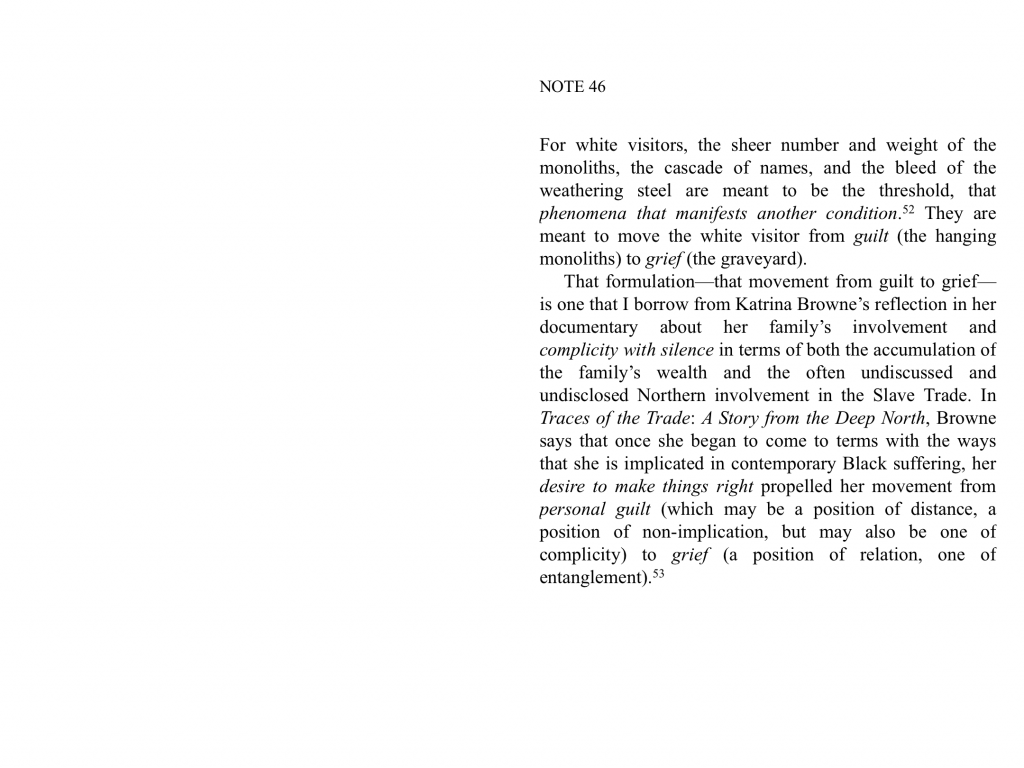
Yesterday, while rereading my July entries from 2023, I was reminded of Christina Sharpe’s amazing book, Ordinary Notes. I read it while quarantining for COVID. I posted a note from it on July 4th:

a screen shot of Christina Sharpe's Note 46

I was particularly struck by her discussion of the shift from guilt to grief because Scott and I just watched (on Monday night) a beautiful story on PBS about Rita Davern and her efforts to reckon with her family’s buying of Pike Island, a sacred space for the Dakota people known as Bdote which was illegally “purchased” by Zebulon Pike in 1805. I’m not sure if Rita utters that exact phrase, but the idea of moving from guilt to grief was a big focus. After reading Sharpe’s note again, I decided to find and watch the documentary she mentions, Traces of the Trade. Found it online from my local library — public libraries for the win! — and watched it yesterday afternoon. It was amazing. One thing I kept thinking as I watched it was Marie Howe’s entreaty: don’t look away. Guilt gives us distance and prevents us from witnessing/beholding. Grief enables us to feel — not just the pain of others, but our own pain — the pain of silence, complicity, denial of connection, fear, helplessness.

I’m not a big fan of guilt; it’s not helpful as a foundation for ethics or politics. As I thought this, I suddenly remembered a feminist ethicist I read/liked, back in the day: Elizabeth Spelman. She wrote a chapter titled “Good Grief” and it was about ways of grappling with racism. She was critical of guilt as a response — what did she like instead? I’m sure I have the article somewhere. Oh well.

Speaking of rereading old entries, I’ve been encountering the idea of the peripheral a lot lately. It’s giving me the itch to work seriously on some peripheral poems. Maybe this could be the February challenge? Maybe this poem could get me started?

In Praise of Being Peripheral/ Jane Hirshfield

Without philosophy,
tragedy,
history,

a gray squirrel
looks
very busy.

Light as a soul
released
from a painting by Bosch,
its greens
and vermilions stripped off it.

He climbs a tree
that is equally ahistoric.

His heart works harder.

This last line about his heart working harder reminds me of something else I’m reading: The Plenitude of Distraction. In it, Marina Can Zuylen argues for the value of distraction. In a bit I read last night she praises how the slowness that distraction demands — wandering through the peripheral and away from one’s central task. Maybe I should read this too — I’ll try; it has a lot of words for my weak eyes.

jan 29/RUN

7.3 miles
lake nokomis and back
40 degrees

Sun! Sun! Finally some sun! After days of gloom, sun and warmer air. Birds. Snow all gone. Greenish grass. It feels like spring. An unpopular opinion, but as much as I like this weather, I want some snow. Big fluffy flakes to run through. The silence only a blanket of snow can create. Crisp, cold air. I’m sure we’ll get some in February.

Ran to the lake for a specific reason: I wanted to see if Painted Turtle, the restaurant, has made any progress on building a structure so they can serve beer this summer. Nope — at least, now that I could see.

The lake still has a thick layer of ice, but the surface is wet and blue. Such a beautiful, intense blue. I don’t think I saw anyone out in the middle on the ice — did I just forgot to look? Or is too wet or too thin?

10 Things

  1. Ran over the recently redone duck bridge, noticed it squeaking
  2. a sparkling river
  3. a truck making a racket as it went over a bump — the noisiest part were its rattling chains
  4. no ice on the creek, no water in the swampy area in my favorite part of the path
  5. what I thought was a teacher’s shrill whistle at the playground was a bird, calling repeatedly
  6. still working on nokomis avenue, had to cross over to the sidewalk
  7. lots of mud near the lake — again, no snow
  8. walking by my favorite bench at the big beach, imagining myself sitting there this summer and my suit, waiting for open swim to begin
  9. no poem on the window at the house that used to put up a poem on their front window
  10. many friendly, kind people on the sidewalk moving over for me to pass

Earlier this morning, reading the Longfellow Messenger, I found an article about Edmund Avenue — the one I’ve mentioned many times here. The Edmund is after Edmund Walton who was the first developer to do a racial covenant on the properties he was selling. He did this in 1910. Some people want to change the name. I’m with them. Racial covenants are terrible; we had one on our house that we didn’t realize was there and just filed paperwork to get it removed a few weeks ago. And, it’s not in the past; our neighborhood, and all of Minneapolis, is still shaped by who could and couldn’t buy a home here. The article mentioned a site: Reclaiming Edmund

Found this poem last week:

an excerpt from Poem/ Shin Yu Pai

for Wolfgang Laib

a life
of collecting pollen
from hazelnut bushes
a life of gathering word-grains
to find all you have wanted
all you have waited to say

five
mountains
we cannot climb
hills we cannot touch
perhaps we are only here
to say house, bridge, or gate

a passage
to somewhere else

House, bridge, or gate. Love this idea. I want to add it to my thoughts on windows and doors.

jan 26/RUN

2.1 miles
river road, north/dorman/loons coffee
37 degrees / humidity: 90%

Ran with Scott up the river road and over to a coffee place. The air was so thick with moisture, which made it harder to breathe. Otherwise a good run. We talked about The Muppet Movie, which we watched last night, and how it didn’t dumb down (or try to purify) the characters or their relationships. Then I rambled on for a few minutes about what a rich, messy character Miss Piggy was and how there was such a variety of representations of love within the movie.

10+ Things

  1. encountered and greeted a woman in a bright red jacket, almost the same color as Scott’s
  2. passed a woman in a blue jacket — she’s a Regular that I should name. I see her often. The thing I remember most is that she’s always wearing a long skirt or dress. In the winter, she also wears a ski jacket and tights, in the summer just the dress. I’m not sure what to call her — all dressed up?
  3. near the tunnel of trees the river is still white
  4. everyone else the river is open — a deep dark gray
  5. heard some cardinals, at least one black-capped chickadee
  6. the ghost bike — June’s bike — at the trestle was wreathed in dried flowers
  7. the ravine, between the 35th and 36th street parking lots had an open view and was only half covered in snow
  8. 4 stones stacked on the ancient boulder
  9. bright orange striped barrel blocking the way down the old stone steps
  10. a lone black glove, looking forlorn on the biking path
  11. a SUV honking unnecessarily and repeatedly at a pedestrian near Minnehaha Academy

Here’s a poem I don’t want to forget by Jane Hirshfield:

To Opinion: An Assay/ Jane Hirshfield

Many capacities have been thought to define the human— yet finches and wasps use tools; speech comes into this world in many forms. Perhaps it is you, Opinion.

Though I cannot know for certain,
I doubt the singing dolphins have opinions.

This thought of course, is you.

A mosquito’s estimation of her meal, however subtle,
is not an opinion. That’s my opinion, too.

To think about you is to step into
your arms? a thicket? pitfall?

When you come rising strongly in me, I feel myself grow separate
and more lonely.
Even when others share you, this is so.

Darwin said no fact or description that fails to support an argument can serve.

Myoe wrote: Bright, bright, bright, bright, the moon.

Last night there were whole minutes when you released me.
Ocean ocean ocean was the sound the sand made of the moonlit waves
breaking on it.

I felt no argument with any part of my life.

Not even with you, Opinion, who drifted in salt waters with the bullwhip kelp
and phosphorescent plankton,
nibbling my legs and ribcage to remind me where Others end and I begin.

Good joke, I agreed with you, companion Opinion.

jan 25/RUN

5.1 miles
bottom of franklin hill
37 degrees / humidity: 91%

Fog. Mist. And is that a very light drizzle or just the over-saturated air? Felt cold in the beginning — that damp, gets-in-your-bones cold — but warmed up by the end of the first mile. Waved at Mr. Morning!, said Hi! to Dave, the Daily Walker. Smiled at many other people I encountered. The fog made everything seem muffled, relaxed.

10 Things, Water

  1. beyond the flood plain forest, the river, glowing a silvery white, iced over
  2. small puddles on the path
  3. my forehead was damp for most of the run — not sweat, but drizzle or the damp
  4. in the flats, the river, almost completely open, only a few chunks of bright white ice floating on the surface
  5. the slick sound of water in car and bike wheels
  6. stepped in some squishy mud where snow had melted on the dirt trail
  7. some people down in longfellow flats, right by the river, laughing
  8. hardly any snow anywhere, almost all melted
  9. low visibility, enveloped in fog
  10. my pink headband at the end of the run: soaked with sweat

Before I ran, I started thinking about a hybrid chapbook idea: combining some of my water poems with the moments in my log where they started. I want to call it Waterlogged. Initially I thought I would just use poems about swimming in Lake Nokomis, but as I ran, I thought about all the different water-related things I’ve written, about the fog (yes, this idea was inspired by today’s weather), the crunching snow, the gorge and erosion, sweat/humidity/dew point. Maybe even a 10 Things list about water?

Running north, I listened to the water and my feet crunching on the sandy debris on the trail. Running south, I listened to Dear Evan Hansen.

jan 23/RUN

4.1 miles
minnhehaha falls
31 degrees / 50+% thin, slippery ice
wintery mix

Stepped outside and felt the sidewalk — at first, it seemed fine, but at the end of the block I realized a lot of it was covered in an invisible sheen of ice. Oh well, too late to turn back. It was never really a problem, although it was pretty slick on the cobblestones at the falls. But I didn’t fall; barely even slipped! Waved a greeting to Santa Claus, heard the kids at the playground, noticed 2 people hiking below under the falls. I watched them step over the rope blocking off the trail.

Stopped at my favorite spot to put in a playlist. Before I started running again on the ice, I took this short footage of the falls:

the falls falling between 2 columns of ice / 23 jan 2024

10 Things Not Seen

  1. the thin layer of ice on the sidewalk and the path
  2. the exact temperature, but I knew it was warm because of how energetic the kids on the playground were
  3. a runner, approaching. I thought I had seen a biker so I was looking for them, meanwhile a runner was approaching me and I had no idea. Saw him a couple seconds before I might have run into him
  4. open water — the river is iced over
  5. the light rail, but I heard its bell as I ran through the park
  6. my shadow — too gloomy and gray
  7. light rain falling — barely felt it either
  8. no fat tires or Daily Walkers or bright blue running tights
  9. the woodpecker knocking on dead wood in the gorge
  10. my breath — too warm today for that!

before the run

I was just about to write that I’ve moved on from windows — my January challenge — to assays and not seing but in midst of thinking it I conjured a new version of windows that I’d like to ruminate on for a moment: a window opening. I like the slight difference that exists between an open window and a window opening. An open window is already open, but a window opening captures the moment when the air first enters and new understandings arrive.

Side note: Suddenly while writing this, I remembered a mention of windows that is almost entirely unrelated to the last paragraph except for it involves windows and not knowing how to open them. I just finished the gothic horror novel. A House with Good Bones by T. Kingfisher. I don’t want to spoil it for anyone else reading this, but near the end some monstrous creatures are attempting to open a window but they don’t know how. If they did, it would be the end for the main character and her companions. I’ve already returned the book (bummer) or I’d post the actual description here of the strong creatures flailing and not understanding the concept of a window — it’s gross and disturbing and compelling and not recommended when you’re eating lunch (which I was).

I’m about to go out for a run. I’ll try to think about opening windows or windows opening.

during the run

I imagined I might have a few moments where something I noticed felt like a window opening. I didn’t. About a mile in, I decided to do triple beat chants with the word: op en ing/ op en ing — then, op en ing/wel com ing/ won der ing. Thought about the openness of opening versus the confinement of closed, or even closing. After chanting opening for a few minutes, I remember lifting out of my hips and leading with my chest — an opening of my body.

after the run

Walking back after I finished my run, I listened to The Woman in the Window. I heard this and it got me thinking:

“And what’s going with the rest of the block?”

I realize I have no idea. The Takedas, the Millers, even the Wassermen–they haven’t so much as pinged my radar this last week. A curtain has fallen on the street; the homes across the road are veiled, vanished; all that exists are my house and the Russells’ house and the park between us.

Not seeing: being so preoccupied/obsessed with something that everything else doesn’t exist.

Then the narrator continued and I thought some more:

I wonder what’s become of Rita’s contractor. I wonder which book Mrs. Gray has selected for her reading group. I used to log their every activity, my neighbors, used to chronicle each entrance and exit. I’ve got whole chapters of their lives stored on my memory card.

Before the run I had been thinking about what it means to not see. I’d also been thinking about what it means for me to see. I might turn both “Not Seeing” and “Seeing” into poems and submit them to Couplet Poetry for their submissions window next month. Anyway, listening to the first bit from The Woman in the Window, I suddenly thought about how an obsession, being preoccupied with something, like whether a neighbor has been murdered, makes one myopic. And then listening to the second bit, I thought about the new way I see by making note of everything, slowly, habitually noticing all the small, seemingly unimportant and peripheral moments. This is how I see now: moment on moment on moment.

Here’s a poem by Jane Hirshfield. It’s in her “assay” form, which I’ve been studying for the past few days. As I understand it, an assay explores, imagines, tries out different meanings of a word or a concept. Is this an assay about “moment” or am I’m misunderstanding the poem?

Assay Only Glimpsable for an Instant/ Jane Hirshfield

Moment. Moment. Moment.

–equal inside you, moment,
the velocitous mountains and cities rising and falling,
songs of children, iridescence even of beetles.

It is not you the locust can strip of all leaf.

Untouchable green at the center,
the wolf too lopes past you and through you as he eats.

Insult to mourn you, you who mourn no one, unable.

Without transformation,
yours the role of the chorus, to whom nothing happens.
The living step forward: choosing to enter, to lose.

I who am made of you only
speak these words against your unmasterable instruction–

A knife cannot cut itself open,
yet you ask me both to be you and know you.

jan 22/RUN

5.8 miles
the flats and back
26 degrees

(added a few hours later): I almost forgot to mention that this entry is my 2000th post. Not every single one of these entries is about a run, but most of them are. Wow. When I started this project to document marathon training in 2017, I had no idea where it might lead! So happy I’m still here writing and running and noticing!

Hooray for warm (but not too warm) mornings and clear paths and flying geese and frozen rivers and runners in electric blue running tights and frozen seeps and weeping springs and brief visits from shadows and squirrels that don’t dart and not slipping on the few spots where there was snow and chirping birds and laughing woodpeckers and clicking blue jay jaws and running down hills then walking back up them and winter playlists and legs and lungs and hearts that work!

A good run. Before the run, I had a brief wave of anxiety — not for any reason. It just came on all of a sudden — feeling strange, tingly, finding it a littler harder to breathe. Peri-menopause and messed-up hormones, I’ve decided. Running helped, partly because moving always helps and partly because I told myself that I wouldn’t be able to run at a 9:30 pace for so long if something was really wrong with me.

I wasn’t sure how far I’d run this morning, but when I got to the bottom of the franklin hill I had an idea: run until you reach a frozen seep. So I did, which made my run a little longer than usual. What a seep! And falling water from a spring. I thought about crossing the road to get closer to the seep, but there’s no curb and the road isn’t that wide and cars drive faster here then they should, so I didn’t. Instead I took some video from the edge of the trail and then I stood still and marveled at the falling and frozen water, and then the height of the bluff.


frozen seep / weeping spring / 22 jan 2024

After the seep, I ran again until I reached the bottom of the franklin hill, then walked up while I recited ideas for a new poem about the idea of not-seeing. One connection to windows: not seeing a window (or glass) and bumping into it. I’ve read several poems that feature birds who run right into the glass and are dazed. Are there any poems about people? I suppose people mostly (always?) run into glass doors not windows. I’ve done it at least once, while I was studying abroad in Japan. The worst thing about running into glass is the grease smudge your face leaves on the glass. It just stays there, staring at you, embarrassing you — not just because it’s evidence that you ran into the glass, but that your face is greasy.

I’m wondering now: what are the most embarrassing things to not see?

Here’s a poem I found from poem-of-the-day that I’d like to remember.

Arequipa/ Ben Okri

Leaves that fall.
Ought to breed
Fire from stone.
The world counts
On our fall.
Our solitude interests
The butterflies
And the lost gold
Of the afternoons.

Ochre and blue walls
And the fading peaks
Of volcanoes
And the sunlight
Plummeting beyond
The hills waken
Leaves to their
Lost trees.

To discover
You still have
A world
To make
At sunset
Sobers
The stones.

Love the brevity of this poem and the double-meaning of the first line: leaves from that fall and leaves that fall down. Arequipa is the second largest city in Peru (south of Lima, slightly inland — 100km from the coast).

jan 20/RUN

4.35 miles
minnehaha falls and back
5 degrees

Back outside! Cold, but much warmer than Tuesday. Low (ish) wind, plenty of sunshine, clear paths. I felt a little tired and sore, but still happy to be outside. Was planning to do my usual routine of running without music, then putting some in at my favorite spot by the falls, but I forgot my headphones. Oh well, if I had been listening to music I might not have heard a goose honking.

10 Things

  1. startled some birds in the brush on the path near the ramp that winds down to the falls bridge — some rustling noises, then a silver flash as the sun caught the feathers on one of the bird’s wings — it reminded me of Eamon Grennan’s line about a lark’s silver trail in Lark-luster or EDickinson’s silver seam in A Bird, came down the Walk
  2. the falls were hidden behind columns of ice
  3. a few people (3 or 4?) walking on the frozen creek, admiring the falls from up close
  4. falling water sound: tinkling, sprinkling, shimmering
  5. the creek was frozen over, with just a few open spots where the water flowed beneath it
  6. running past the stretch of woods near the ford bridge — all the leaves are gone, the small rise up to the bridge fully visible
  7. crunch crunch crunch as my feet struck the ground — not slippery or hard or too soft
  8. my shadow, sharp lines, solid, dark, lamp post shadow, softer, fuzzier
  9. the rhythm of a faster runner’s legs as they passed me — a steady lift lift lift — so graceful
  10. a lone geese honking — not seen, only heard

Somewhere near the Horace Cleveland overlook (near the double bridge), I thought about interiors and exteriors and how you can look in or out of windows and then outside as the abstract/thinking/theorizing/writing and inside as the body. I want to remove the barrier between these, to mix writing with being/doing/moving as a body. Then lines from Maggie Smith’s “Threshold” popped into my head: You want a door you can be on both sides of at once. You want to be on both sides of here and there now and then…Yes, I do.

added 21 jan 2024: Reading through a past entry this morning I suddenly remembered the black capped chickadee calling out their fee bee song so loudly as I ran up the hill between locks and dam no. 1 and the double bridge. Wow! I recall thinking they were in beast mode (a reference to Michael Brecker and how some people describe his playing).

Jane Hirshfield’s Ten Windows, Chapter 6 (Close Reading: Windows)

Many good poems have a kind of window-moment in them–they change their direction of gaze in a way that suddenly opens a broadened landscape of meaning and feeling. Encountering such a moment, the reader breathes in some new infusion, as steeply perceptible as any physical window’s increase of light, scent, sound, or air. The gesture is one of lifting, unlatching, releasing; mind and attention swing open to new-peeled vistas.

windows offer an opening, a broadened landscape, fresh air, a lifting, unlatching, releasing, expansion, an escape or a way into somewhere else

In this chapter, Hirshfield does a close reading of ED’s “We Grow Accustomed to the Dark” — yes!

I have called the third stanza (And so of larger — Darkness –/Those Evenings of the Brain –) the poem’s first window, but for me, the true window in Dickinson’s poem is contained in one word; its quick, penultimate, slipped-in “almost.” (And Life steps almost straight). The effect is so disguised it feels more truly trap-door than window: On this close-to-weightless “almost,” the poem’s assurance stumbles, catches. Its two syllables carry the knowledge that there are events in our lives from which no recovery is possible.

I love Emily Dickinson’s almost in this poem. The space it gives — the possibilities — for living your life otherwise. It seems that Hirshfield reads this almost as unfortunate — you almost made it back to your normal life after the darkness, but not quite. I don’t. There’s so much room (and a lot less pressure) in the almost! So much to write about this idea, so little time right now.

In the chapter, Hirshfield references a “popular” Dickinson poem that I’ve never encountered before:

The Brain — is wider than the Sky — (1863) J632/ Emily Dickinson

The Brain — is wider than the Sky —
For — put them side by side —
The one the other will contain
With ease — and You — beside —

The Brain is deeper than the sea —
For — hold them — Blue to Blue —
The one the other will absorb —
As Sponges — Buckets — do —

The Brain is just the weight of God —
For — Heft them — Pound for Pound —
And they will differ — if they do —
As Syllable from Sound —

I’d like to put this into conversation with my mid-run ideas about the body and the mind — maybe add Mary Oliver’s ideas about the difference between a poem and the world from The Leaf and the Cloud too.

jan 16/RUN

4.25 miles
minnehaha falls and back
0 degrees / feels like -20

Brr. I really bundled up for this one, even busted out the big guns: toe and finger warmers. They worked!

layers: 2 pairs of black running tights, a green base layer shirt, pink jacket with hood, purple jacket zipped up to my chin, black fleece cap with ear flaps, pink and orange buff covering my mouth, 2 pairs of socks — gray, white — with toe warmers in between them, 1 pair of black gloves, 1 pair of pink/red/green mittens, hand warmers, sunglasses

My forehead felt a little cold at the beginning, but mostly I felt warm enough. My legs started to get sore near the end, which I think was because of the cold: not enough blood to my calf/thigh because it was going to my vital organs — I read that somewhere a few years ago.

10+ Things

  1. a regular! the runner, Santa Claus
  2. the river, frozen — light brown mixed with white, flat
  3. the feebee call of the black-capped chickadee
  4. a few squirrels, scampering
  5. running straight into the sun: my sharp shadow, so sharp I could see the shadow of my breath
  6. one biker — brrr
  7. brittle leaves, scratching on the pavement
  8. a sharp squeak, almost like a little bunny crying out: trees creaking in the wind
  9. the falls, near the ledge: half frozen, sounding like the spray hose on a kitchen sink
  10. the falls, by the overlook: gushing, rushing past the ice, flushing out the bottom
  11. beep beep beep of a truck backing up, sounding flat and smaller than usual
  12. the light rail across Hiawatha rushing by — I wondered how cold the commuters were
  13. almost forgot this one: the wind moving fast through dead leaves on some trees sounded like sizzling heat. I heard it just as the wind was blowing in my face and I felt particularly cold. I imagined it was so cold that it was hot

before my run

I’m in the slow process of reviewing my entries from 2023, a month at a time. Right now, April. On April 18th, I wrote about some ideas from writers/poets that were inspiring my thoughts about an eighth colorblind plate poem on the glitter effect. Paige Lewis and A.R. Ammons and flares and flames and rust. And now I’m thinking about writing one more colorblind plate poem that describes how my own color system works using texture and movement and contrast. It replaces ROYGBIV. Maybe I’ll try and think about it more as I run — when I’m not thinking about how cold I am!

a process note: Rereading all of my entries for the year and summarizing them takes a long time, but it’s worth it. Not only does it offer useful summaries, but going back and reencountering words/ideas/experiences offers new inspiration or old, half-finished projects (like the colorblind plates). And the laborious process of doing this structured task sometimes opens me up to wandering and remembering and imagining that can lead to new words and new ways in.

task: on my run, try to think about motion and texture

during my run

As predicted, I focused mostly on noticing the cold and the wind — such a cold wind in my face! I do remember thinking that the river was flat and stuck, with no sparkle or motion. I thought about contrast with the shadows. Leaves shaking in the wind. Oh — and I thought about how the small things I notice — the little flashes of movement, sound, texture — accumulate into something bigger. This is part of the conversation I started yesterday about flares versus slow burns and whether or not to dazzle. None of the things I notice Dazzle! in a quick burst, but together they add up to something special. After thinking of this idea, I remember Hannah Emerson’s poem, “Peripheral” and the lines:

Direct looking just is too
much killing of the moment.

Looking oblique littles
the moment into many

helpful moments.
Moment moment moment

moment keep in the moment.

after the run

And now, remembering all of these ideas, I’m suddenly thinking of Emily Dickinson’s poem, “Tell all the truth but tell it slant –”

The truth must dazzle gradually
Or every man be blind —

Yes, dazzle means to be temporarily blinded by light, or overpowered with light. What does this have to do with what I’m working on right now? Not sure.

And now, back to windows. Here’s a small poem I found the other day that I like. It’s part of a larger series of poems titled, Still Life:

Window/ Phillip Murray

Through the dark
Glassly
It is light
Falling

jan 13/BIKERUN

bike: 30 minutes
basement
run: 1.15 miles
outside: 7 degrees / feels like -10

A short run today because I’ve run every day this week so far, and because it’s windy and snowy and cold outside. Watched the first 20 minutes of Jennifer Lawrence’s comedy, No Hard Feelings, while I biked. I like her and I’m finding this movie funny so far. I listened to Taylor Swift’s Reputation while I ran. Tried out my new bright yellow shoes for the first time. I like how they feel and how they look. Quite possibly they will be the shoes I wear when I run the marathon next October. I don’t remember thinking about much as I ran — I focused on my arm swing and staying relaxed and lifting my hips. We turned the treadmill the other way a few months ago so now I won’t see my inverted moon on the dark window anymore. What strange image will replace it? I don’t remember any today. But I’ll have to look for one the next time I run on the treadmill, which will probably be on Monday; it might be arctic hellscape cold then.

Emily Dickinson’s Windows

Here are some useful ideas from an article — Emily Dickinson’s Windows — I found yesterday, which seems to be an extended version of an article I read a few days ago:

  • creative freedom
  • architectural prop: By my Window, The Angle of a Landscape
  • her envelope poems resembled a window with curtains
  • a magic lens — the warped quality of 19th century windows: the world let loose, nature liquefied — her practice of looking/writing — up and out the window/down at the paper — descriptions as incremental fragments (A Slash of Blue! A Sweep of Gray!)
  • the window grid creates a pattern — 12 panes — reflected in the formal structure of her poems (degrees, steps, notches, plunges) — each word, line, or stanza is well-defined slot/pane that spotlights an image/emotional state/quality of experience — ’Tis this – invites – appalls – endows – Flits – glimmers – proves – dissolves – Returns – suggests – convicts – enchants Then – flings in Paradise – (Fr 285)
  • an act of undoing in each pane — nature loosening up (a neat frame in a formless center)
  • each pane a diagram of rapture
  • looking through/touching the glass, she connected with the artisans who made it, who left evidence of their labor –warps and striations that were once the artisan’s breath (windows made through glass blowing? wow)
  • glass blowing and imagery of fiery furnaces, metal flames, boiling, white heat
  • mid 19th century — glass consciousness
  • ED’s poems as her own form of glass blowing — creative process of transforming words into poems = making sand into glass into windows

the window grid creates a pattern — 12 panes — reflected in the formal structure of her poems (degrees, steps, notches, plunges) — ’Tis this – invites – appalls – endows – Flits – glimmers – proves – dissolves – Returns – suggests – convicts – enchants Then – flings in Paradise – (Fr 285)

I love this idea of how the windows influenced the form of her writing. Also, the combination of the orderliness/structure of the frame and the unruliness/undoing-ness of her words. It might be fun to use my windows — 2 sets with 2 panes each, a bar in-between the windows, one set in front, one to my right side — as the structure for a few experiments. As I write this, I’m thinking about Victoria Chang’s truck moving across each window frame and Wendell Berry’s black criss-crossed frame.

Here’s a wonderful ED poem that is mentioned in the article:

By my Window have I for Scenery (797) / Emily Dickinson

By my Window have I for Scenery
Just a Sea—with a Stem—
If the Bird and the Farmer—deem it a “Pine”—
The Opinion will serve—for them—

It has no Port, nor a “Line”—but the Jays—
That split their route to the Sky—
Or a Squirrel, whose giddy Peninsula
May be easier reached—this way—

For Inlands—the Earth is the under side—
And the upper side—is the Sun—
And its Commerce—if Commerce it have—
Of Spice—I infer from the Odors borne—

Of its Voice—to affirm—when the Wind is within—
Can the Dumb—define the Divine?
The Definition of Melody—is—
That Definition is none—

It—suggests to our Faith—
They—suggest to our Sight—
When the latter—is put away
I shall meet with Conviction I somewhere met
That Immortality—

Was the Pine at my Window a “Fellow
Of the Royal” Infinity?
Apprehensions—are God’s introductions—
To be hallowed—accordingly—

The pine tree as a sea with a stem? I love this idea!

jan 12/BIKERUN

bike: 10 minute warm-up
basement
run: 3.5 miles
river road, south/north
9 degrees / feels like -5
wind: 13 mph/ 24 mph gusts

Sometimes running when it’s this cold isn’t that difficult, especially when there’s sun and no wind. Today there was no sun* and plenty of wind and it was hard. Not all of the time, but often.

But who cares when the river looks like it does today?! Half covered in ice, mostly gray and brown, open and vast.

And who wouldn’t want to be out here when the geese are flying overhead, their honks swirling around all of us below, sounding mournful and harsh and wild?

And who isn’t grateful to have an almost empty trail — no thoughts or distractions, only a few other people, and most of them below on the lower path?

*I guess there was some sun, but it was hidden behind the clouds. The only time I noticed it was when I was running north up a hill straight into the wind — I saw the faintest trace of my shadow. Hello friend! If I wasn’t paying attention or if I hadn’t trusted what I saw, I might not have noticed her.

Listened to the cold as I ran south — what does the cold sound like? jagged breaths, sharp sounds suspended, silence. Listened to my Window playlist running back north.

Windows can certainly change lives in all sorts of ways. “Faith goes out through the window when beauty comes in at the door,” quips the English philosopher George Edward Moore. “Well,” says Julie Andrews, not yet breaking into song, but you never know, as she gazes out onto those hills alive with something, “when one door closes, another window opens.” She’s opened us onto the window of film, so how best to set the scene? “An actor entering through the door, you’ve got nothing. But if he enters through the window, you’ve got a situation.” says Billy Wilder.

Pleasure and Pane: songs about windows

This article offered a lot of great suggestions for window songs to add to my playlist, which is now over an hour.

window playlist

  1. Window/Fiona Apple
  2. Window/Genesis
  3. Smokin’ Out the Window/Silk Sonic
  4. Keep Passing the Open Window/Queen
  5. Lookin’ Through the Windows/Jackson 5
  6. I Threw a Brick Through a Window/U2
  7. When I’m Cleaning Windows/George Formby
  8. Skyscraper/Demi Lovato
  9. At My Window Say and Lonely/Billy Bragg & Wilco
  10. My Own Worst Enemy/Lit
  11. Junk/Paul McCartney
  12. In a Glass House/Gentle Giant
  13. Belly Button Window/Jimmy Hendrix
  14. Look Through Any Window/The Hollies
  15. The Rain (Supa Dupa Fly)/Missy Elliott
  16. One Way Out/Sonny Boy Williams
  17. Silhouettes/The Rays
  18. The Glass/Foo Fighters
  19. Tip Toe Thru’ the Tulips/Annette Hanshaw
  20. Waving Through a Window/Dear Evan Hanson
  21. Open a New Window/Mame
  22. Open Your Window/Ella Fitzgerald
  23. Fly Through My Window/Pete Seeger

Today I put the playlist on shuffle and heard: 3, 5, 10, 16, 2, 9

an hour later: Not for the first time, I’m starting to read an article about Emily Dickinson’s windows. It’s really good, but dense, so I’ve always put it off. Will I get through it today? Maybe. Anyway, I started reading it, and encountered a map of Amherst with a note: The Dickinson house is circled in red.

an old black and white image (lithograph?) of Amherst, with Emily Dickinson's house circled in red. The only way I'm able to see the circle is if I put the computer screen up to my face and look at it through my peripheral vision.
Amherst, 1886

Can you easily see the red circle? I can’t. The only way I am able to see it is if I put my face up right against the screen and look at it through the side of my eye. Only then do I see a trace of red — the idea of red. Once I see (or feel?) the red, I can see a faint circle and I can tell that it’s red, but it’s not RED! but red?

The other day, Scott, FWA, and I were discussing the scenes in Better Call Saul that are set in the present day and are in black and white. Scott and FWA both agreed that those were harder to watch — they had to pay more careful attention — because they lacked color, which is harder because visual stories often rely heavily on color to communicate ideas/details. I said I didn’t realize that they were in black and white; they didn’t look any different to me than the other scenes, which are in vivid color (at least that’s what they tell me). I realized something: it’s not that I don’t see color, it just doesn’t communicate anything to me, or if it communicates it’s so quiet that I don’t notice what it’s saying.

Back to the image with the red circle. The main point of the image is to enable you to quickly and easily see where the Dickinson home is located in the town. If I hadn’t read the text below it, I never would have known there was a circle, and the main point of the image would be lost on me. This happens a lot. Things that are obvious to most people, aren’t to me. More than that, they don’t exist. Of course it’s very frustrating and difficult, but it’s also fascinating to recognize this, and helpful to understand it.

jan 11/RUN

4 miles
almost to franklin and back
15 degrees / feels like 0

Okay winter! A good run even though my legs felt heavy and tired for the first mile. And I was cold — felt it in my lungs. Saw Dave, the Daily Walker, and when he asked, how are you doing?, I replied: I’m cold! To which he said, that’s Minnesota or something like that. The sun was out today and I think I remember admiring my shadow. Heard some strange, almost strangled, noises down in the gorge. Probably honking geese, or maybe a feral kid having fun? Encountered at least one fat tire, a few walkers, no roller skiers. The walking path was covered in slippery snow, but the bike path was almost completely clear. The sky was blue, the trees were empty, the river was? I know I looked at the river, but I don’t remember what color it was or if it had more ice on it.

layers I started in: 2 pairs of black running tights; a bright green tank top; a previously bright green base layer shirt with the sleeves over my thumbs; a purple jacket zipped up to my chin; a pink and orange buff covering my neck and ears; a black cap with fleece lining and ear flaps down; gray socks; raspberry red shoes; 2 pairs of gloves — inner ones were black, outer bright pink with white stripes.

layers I ended in: 2 pairs of black running tights; a bright green tank top; a previously bright green base layer shirt pushed up on my arms a little; a purple jacket unzipped a few inches; a pink and orange buff around my neck; a black cap with fleece lining and ear flaps up; gray socks; raspberry red shoes; 1 pair of black gloves — the bright pink ones were in my pocket.

Listened to my breathing, cars, geese as I ran north. Put in my new “Windows” playlist (see below) on the way back south.

Interruption: An Assay/ Jane Hirshfield

Sometimes you took the shape
of an unseen mosquito,
sometimes of illness.

Presumed most of the time to be passing,
yet importunate as a toddler
who demanded her own way,
as a phone that would not stop ringing long after it should.

Unignorable pavement slap of the gone-flat tire.

All afternoon the thunder was interrupted by sunshine.
All night the rain was interrupted by trees and roofs.

And still, as rusting steel is uninterrupted by dryness
and hunger uninterrupted by sleep,
interruption and non-interruption sat in the day’s container
as salt sits in milk, one whiteness disguised by another.

As a fish in a tank is interrupted by glass, and turns,
a person’s fate is to continue
despite,
until.

Death: an interruption not passing,
weighing
one hundred and fifty-eight pounds,
carried on cut plywood with yellow straps.

Birth: an interruption between
two windows,
trying to think of any joke, any tune, that is new.

Between them:

this navigation by echolocation and lidar,
the weathers of avalanche, earthquake, tsunami,
firestorm, drought;
a moment that sets down—gently, sleepily—its half-read novel
on a bedside table whose side turned toward the wall stays unpainted,
confident the story will be there again come morning.

definition of an assay

Assays began with a poem written after I’d reread Edgar Allan Poe’s stories while writing an essay on how hiddenness works in poems. Some of the qualities of essay exploration and prose step lingered in its music and mode of thinking. At the time, I was regularly seeing the journal Science. On the back would often be advertisements for half-million-dollar machines for performing assays. That word—close to essay and sharing its root in the idea of an attempt, a try—refers to discovering a thing’s nature by breaking it into its elemental parts. The poem became ‘Poe: An Assay.’ That approach to writing, of testing a subject for its discoverable parts, imaginative and factual, caught. I began writing others. ‘Judgment: An Assay.’ ‘Tears: An Assay.’ ‘And: An Assay.'”

Jane Hirshfield

assay (def): the testing of a metal or ore to determine its ingredients and quality

my own interruption

Sitting at my desk, in front of my window, half-listening to the latest Foo Fighter album, an interruption — lyrics: there is something between us/I see right through/waiting on the other side of the glass. A window interrupting me! It’s strange how interruptions work. I’ve written/taught/spoke about the learning to let the world interrupt you. Maybe it’s not about letting the world interrupt you — it will do that anyway — but being open to that interruption, letting it in — opening the window to it?

a few more random window references that recently interrupted me:

  • Maria in The Sound of Music: “When the Lord closes the door, somewhere he opens a window.”
  • She Came in Through the Bathroom Window/ The Beatles
  • My Own Worst Enemy/ Lit — came in through the window last night (thanks Scott)

With all three of these examples, I’m thinking about the window and how it’s not a door. And in The Beatles and Lit examples there’s something not-quite-right, not normal, unacceptable about entering through the window. Using the window instead of the door is another way of saying something about your life is fucked up.

  • unrelated to these other examples, the scene of the window in The Amityville Horror– 1979 (iykyk) — I still think about that window falling on the kid’s hand sometimes. I’m not sure I’ve seen the whole movie — maybe I watched this bit on HBO and was too freaked out to watch the rest?
window pain!

Okay, now I want to make a window playlist to listen to as I think more about windows! (after the run): I did, and I listened to the first

Window/Fiona Apple
Window/Genesis
Window/Mountain Man
Smokin Out the Window/Silk Sonic
Keep Passing the Open Windows/Queen
Lookin’ Through the Windows/Jackson 5

jan 10/RUN

4.85 miles
minnehaha falls and back
23 degrees / feels like 16

Yes! A much better run than yesterday. My legs were sore at the beginning, but the path was clear and I had enough layers to keep warm. As I ran south, I noticed the river was gray — pewter, I think — or was it steel?

Heading towards the falls, I listened to the kids laughing on the playground, the rushing water at the falls, and the ding ding dinging of the light rail bells leaving the station. Heading home, I listened to a playlist (10K 2018). First song: Vampire Weekend’s “Step.” Memorable line: they don’t know how to dress for the weather

10 Things

  1. smoke coming from the house on edmund that always smells like smoke in the winter
  2. a woodpecker’s laugh
  3. pewter river
  4. city workers across the road near becketwood — what were they doing?
  5. the big dip on the edge of the biking path, almost to Godfrey, has finally been patched
  6. a man — not driving an official truck or wearing an official uniform — emptying the cash out of parking meter kiosk near the old Minnehaha depot
  7. traffic rushing by on hiawatha
  8. the creek was dark and open, no ice, just a little foam
  9. 2 humans and a small dog, walking across the grass near the falls
  10. a fast running speeding by me as I stood at my favorite falls spot and put in my headphones

the windows I encounter while running outside:

  • familiar houses, on the route I take almost every day — does a neighbor notice me (like I notice the runners and walkers that pass by my window) and think, there goes that woman running again, or maybe they mark their day with my run: she ran past, time for another cup of coffee
  • car windows — I can’t ever see in these windows — I never visualize people, just imagine what they might be thinking: I wish I was out there running or Why would anyone run in this weather?
  • John Steven’s house windows — are they boarded up from the fires last year?
  • Minnehaha Depot windows
  • Light rail windows — could anyone on the train see me from that far away

question: Do windows have to have glass to be windows? Is an empty frame enough?
answer: Yes? one def: an opening especially in the wall of a building for admission of light and air that is usually closed by casements or sashes containing transparent material (such as glass) and capable of being opened and shut

The other day I wrote in my Plague Notebook, Vol 18: post-pandemic window poems? And here’s something great that’s not a poem. I found it on my reading list in the 21st spot.

The window as isolation, shelter, protection, connection to the outside world, hope, longing. So many wonderful things happening in this story (essay?)! Instead of just posting it, I want to comment on each window.

APRIL 2020, FROM MY WINDOWS/ Kleopatra Olympiou

Second floor window, across:
A man who plays the piano at all times of the day, his keyboard by the window. I see the staccato movement of his fingers but hear no sound. His expression is thoughtful and I can’t say if the notes are right, if he’s pleased, or what he’s feeling. Sometimes he plays in his underwear and I avert my gaze. He could see me if he looks up, but never does – it’s dusk and I have the lights on. When he turns his own light off and leaves the room, I catch a reflection of myself doing the dishes in the mirror at the back of his bedroom.

details that strike me: no sound — why not? too cold (or hot) to have the window open? he has headphones on? my choice: her apartment is sealed up tight — isolation; the piano player’s expression is unreadable or empty; the narrator averts her eyes; the narrator has her lights on, is on display, but he never looks; that reflection of herself in his mirror — wow

Window next door, a wall away from the pianist:
Sometimes, a woman looking bored on her laptop. Most of the time the curtain is drawn, and in the darkness all I can see is the yellow that leaks out. This window doesn’t want to be looked at, so I leave it alone.

the yellow that leaks out; the way the narrator respects the bored looking woman’s privacy; again, no sound

Next door, downstairs:
A living room I often catch in the cool half-light of the TV screen, watching the rippled colour move like the walls of an aquarium. Submerged and elsewhere. On the half-obscured sofa to the right I glimpse a hand slowly stroking a bare calf.

submerged and elsewhere; the stroking hand/stroked calf; limited vision: the cool half-light, half-obscured sofa, disembodied hand and calf

To the left, first floor:
A guy in his twenties, probably, laughing into a video call, or he’s taking a selfie, or updating his Instagram story, I can’t be sure since he quickly lowers his arm and loses the grin. For a long time he types on his phone.

no sound, no clear understanding of what’s happening

In the street in front:
The pavement is partly overgrown with weeds, and in the morning I watch a father and young son diligently clear them away. Through the glass I can’t hear what they’re saying. The boy gesticulates energetically from somewhere within the depths of a coat, hat, gloves, wellies. His dad laughs, and with thick gardening gloves brushes the rough shavings of soil out of the way. The boy is serious when he nods his approval – this is no game, but real community service.

an acknowledgment of the lack of sound: through the glass I can’t hear, people outside — only one window (narrator’s) between them

Further left, in a garden:
A middle-aged man waters some flowers while a woman refills a birdfeeder with seeds. Soon they go back indoors and I can see nothing but the glaze of the white sky on their window.

women outside (one window), visible, women go back inside (two windows — the women’s the narrator’s), hidden by the reflection of sky in a window

From my living room window:
Three veterinary nurses in green uniforms walking dogs on the grass by the graveyard. They play fetch and the dogs fire off into the trees – soon they all go, and will return tomorrow, and the day after.

even if the window tightly shut, can’t you hear the dogs barking? dogs are LOUD.

From the same window, later in the afternoon:
A woman and a little girl stand in front of a fresh grave, neat and lined with wood. Some days ago I watched a man from the church shovel grass and dirt away, and another day five figures gathered while a priest read mutely from an open book. The priest and his book went away to the church (chimney smoking) and, among the guests, I stood silent at my window, part of the ceremony. Today only the woman and the girl visit the grave, holding hands.

the narrator was part of the ceremony

It is dusk again at the living room window:
A magpie stops on one of the bony branches across, later a crow, a pigeon, a robin. In the distance I see the white bobbing of rabbits running among the tombstones.

Birds! a tree branch, a bobbing rabbit (nice work, resisting the impulse to write, bobbing bunnies

Then there is me, quarantined and at my nightly window, weaving my hair into a braid:
I listen to the creaks in the kitchen and Google my building, searching for estate agent photos of the other apartments, trying to piece together a virtual whole. I imagine a flat identical to mine next door, inverted – maybe the silent neighbours I’ve never spoken to are also at their windows, looking out. Maybe the pianist can see us, our kitchens a wall apart, divided. In my living room the curtains are never drawn. At night I sit illuminated and hope, for something.

sound — a creaking kitchen, silent neighbors

And, one more window thing. I’m slowly reading through Wendell Berry’s Window poems. Here’s 15. So good!

15. / Wendell Berry

The sycamore gathers
out of the sky, white
in the glance that looks up to it
through the black crisscross
of the window. But it is not a glance
that it offers itself to.
It is no lightning stroke
caught in the eye. It stays,
an old holding in place.
And its white is not so pure
as a glance would have it,
but emerges partially,
the tree’s renewal of itself,
among the mottled browns
and olives of the old bark.
Its dazzling comes into the sun
a little at a time
as though a god in it
is slowly revealing himself.
How often the man of the window
has studied its motley trunk,
the out-starting of its branches,
its smooth crotches,
its revelations of whiteness,
hoping to see beyond his glances,
the distorting geometry
of preconception and habit,
to know it beyond words.
All he has learned of it
does not add up to it.
There is a bird who nests in it
in the summer and seems to sing of it–
the quick light among its leaves
–better than he can.
It is not by his imagining
its whiteness comes.
The world is greater than its words.
To speak of it the mind must bend.

some thoughts:

WB’s glance can’t capture what the sycamore is

love this:
lightning stroke caught in the eye as description of seeing

the tree emerges at a different pace — not fast/immediate/NOW! that we expect with our glances
emerges partially — dazzle coming into the sun a little at a time

the man of the window

beyond his glances
the distorting geometry of preconception and habit?
beyond words
more than what he has learned/seen/understands
the bird here reminds me of A.R. Ammons and his discussion of language in garbage — see april 10, 2023

mind must bend? be at a slant (Emily Dickinson)?

jan 9/RUN

2 miles
river road, south/edmund, north
29 degrees
75% super-slick snow

This doesn’t happen often, but today was not a good day to go out for a run. Maybe I would have enjoyed it if I had worn my yaktrax, but I didn’t. So slippery and difficult to move. A cold wind. Even so, by the end of it I was wishing I would have stayed out there a little longer; I was just getting warmed up!

10 Things

  1. a gray sky
  2. gray paths — the dark pavement visible through the slushy snow
  3. a cold wind in my face
  4. some dark brownish red dirt sprinkled on one small stretch of the trail
  5. a runner approaching, taking very small steps
  6. the river road, snow and ice free
  7. the bench near folwell, empty
  8. a few headlights
  9. a lumbering, noisy truck
  10. still no poem on the windows of the house on edmund

windows

Yesterday I did the tedious work of searching for “window” in my log entries — 12 pages of entries. Then I tagged the relevant ones with “windows.” Last night and this morning, I’ve been looking through those tagged entries for lines of poetry that use the image of a window — 19 pages / 181 entries. It is time-consuming, but rewarding to be immersed in windows and to have the chance to think more about how the word/idea/image is used in poetry.

I hope to have more to write later, but for now, here are a few thoughts:

  • things viewed from the window most often: trees and birds and weather
  • often things press against the window, sometimes they rattle them — sometimes they press from the outside — the heat, the cold, the green, and sometimes from the inside — children’s faces against the glass
  • windows separate us from the world
  • a common cry: open the windows!
  • sometimes the window is one of many images, sometimes the whole poem is built around it
  • some poets write window, others like windowpane
  • a favorite part of the window: windowsill
  • sometimes included with window: blinds, curtains, shades
  • window as line/bar between inner and outer
  • window as distorted or makeshift mirror
  • whether the window is dark or lit matters, makes a difference in image meaning — we can see through dark windows, while lit windows reflect back
  • sometimes windows are openings, sometimes they’re barriers
  • enclosing and disclosing — concealing (or keep safe) or revealing
  • more poems want you to open the windows than shut them
  • window as access to the soul, the spark of life within
  • window as word, as language
  • the divide between the domestic space and the world — private/public
  • the window as opportunity to stop thinking and just be — look out the window with me
  • some birds notice the windows, others don’t — this noticing can be a mistaken belief that there’s another bird on the other side
  • some birds notice us on the other side of the window, others don’t and are just observed

Wow, this is fun!

Here’s a window poem for today:

11/ Lao-tzu 
Translated from the Chinese by Red Pine

Thirty spokes converge on a hub
but it’s the emptiness
that makes a wheel work
pots are fashioned from clay
but it’s the hollow
that makes a pot work
windows and doors are carved for a house
but it’s the spaces
that make a house work
existence makes a thing useful
but nonexistence makes it work  

SUNG CH’ANG-HSING says, “In this verse the Great Sage teaches us to understand the source by using what we find at hand. Doors refer to a persons mouth and nose. Windows refer to their ears and eyes.”

I love this idea of doors as breath and windows as attention!

one more thing about windows:

Sitting at my desk in front of my window just now, I suddenly felt something heavy lifting. Then I realized that the sun had finally, after several days of hiding behind clouds, appeared. Of course it’s gone again, but it was there in my window for a moment, I swear.

jan 8/RUN

5.3 miles
franklin loop
27 degrees
snow / 100% snow-covered

Before my run, looking out the window, I noticed it was snowing. Of course I went out; it’s fun to run in the snow! Wore my yaktrax for the first time. No problems. A great run. I felt strong and happy to be outside by the river, which was still open with only a few clumps of ice. I was able to run on the walking trail the entire time.

10 Things

  1. good morning Dave!
  2. Daddy Long Legs called out to me: good work!
  3. the shore’s edge across the river, where the snow was collecting, was glowing white. I think the blurry view due to the falling snow made it glow even more
  4. footprints in the snow, a few of them smeared — is there where someone slipped?
  5. intense smell of weed on the bridge
  6. park — or city? — workers parked on the bike path — flashing lights and one worker dropping a hose down somewhere
  7. a chain across the entrance to the old stone steps
  8. a few of lights were lit on the lake street bridge, most were still out, their wires stolen
  9. no eagle perched on the dead branch near the lake street bridge
  10. a soft, quick crunch as my feet struck the snowy path

Nearing the turn off for the Franklin bridge I deliberated: the franklin loop, or down the hill? I had this strange feeling that the choice mattered. Choosing wrong might mean slipping on an icy path, or worse. I guess I chose right, or my worries were unfounded.

the view from my windows (10:21 am)

2 pairs of windows — one set in front of me, 1 set to the right side. Today it is snowing — only flurries. The grass is half covered in yesterday’s dusting, the sidewalks are white. A few scraggly trees — almost off my front right edge: a pussy willow tree and beyond that a tall, wide trunk — too tall to see the top without moving forward in my chair. 20 or 30 minutes ago, someone walked by with a dog. Now, an empty sidewalk.

Wendell Berry’s Windows poems

Berry has 27 short-ish window poems. Before my run, I read 10 of them. Here are a few notes/thoughts/lines:

1

window as wind’s eye looking out through the black frame
eye as window (to the soul)
winter: white sky, snow squalls, corn blades

2

fall: foliage has dropped/below the window’s grave edge
bare sky, greenness gone, buds asleep in the air
the hard facts: the black grid of the window

3

40 panes, 40 clarities
window glass streaked with rain, smudged with dust
wild graph of its growth
the window is a form of consciousness
window mind wild consciousness river wind blown seed cobwebs

4

this is the wind’s eye,/Wendell’s window
In the low room/within the weathers,/sitting at the window,
the spark at his wrist/flickers and dies, flickers/and dies

5

Look in/and see him looking out.
hill (the native hill?) — wears a patched robe/of some history that he knows/and some that he/does not
the cattle watch him from the distant field

but there are mornings
when his soul emerges
from darkness
as out of a hollow in a tree
high on the crest
and takes flight
with savage joy and harsh
outcry down the long slope
of the leaves.

What he has understood
lies behind him
like a road in the woods. He is
a wilderness looking out
at the wild.

6

third person: as the man works
the window, alive: the window/staring into the valley/as though conscious
dreariness as comfort: As the man works/the weather moves/upon his mind, its dreariness/a kind of comfort

7

birds learn to trust him, then ignore him: That they ignore him/ he takes in tribute to himself.
birds as free — reckless with their eating, not concerned with the high cost of seeds

8

the river rises, nears the window
a storm, out of the corner of his eye, troubles the working Wendell

9

outside, birds: the air is a bridge/and they are free
Berry/writer is
set apart
by the black grid of the window
and, below it, the table
of the contents of his mind:
notes and remnants,
uncompleted work,
unanswered mail,
unread books
–the subjects of conscience,
his yoke-fellow,
whose whispered accounting
has stopped one ear, leaving him
half deaf to the world.
Some pads of paper,
eleven pencils,
a leaky pen,
a jar of ink
are his powers. He’ll
never
fly.

10

a rainstorm/flood — what a beautiful description here!

The window
looks out, like a word,
upon the wordless, fact
dissolving into mystery, darkness
overtaking light.

the water recedes:
Facts emerge from it:
drift it has hung in the trees,
stranded cans and bottles,
new carving in the banks

First, the line, facts emerge from it, reminds me of another poem about a time after the rain, After the Rain/Jared Carter:

After the rain, it’s time to walk the field
again, near where the river bends. Each year
I come to look for what this place will yield –
lost things still rising here.

Second, I’m struck by how Berry is using the window to talk about being a writer. I need to read and think about it some more before I say anything else, but it has to do with contrasts between wild and conscious/aware, interior and exterior, looking and being looked at, the word as constructed/fact and the wordless as mystery.

As I read Berry’s words, I keep thinking about Mary Oliver and her discussion in The Leaf and the Cloud about the tensions between writing a poem and being in and of the world.

jan 5/RUN

5.15 miles
bottom of franklin hill turn around
30 degrees

Yes! A great run. A brief runner’s high around mile 4. At the beginning it felt cold, but almost early spring-like: chirping birds, soft shadows, humid air, clear paths. In certain spots the path was dotted with ice.

Passed a group of 4 or 5 runners twice. Smelled cigarette smoke. Watched a car driving over the I-94 bridge. Listened to the group of women laughing, cars passing, ice sizzling heading north. Put it Billie Eilish essentials on the way back — maybe I’m, maybe I’m, maybe I’m the problem.

Something to try today, from Richard Siken: one image

The heart of lyric poetry is music and image. Music is hard to talk about but image is easy. It’s not too late to start an exercise. Write down one image every day that was striking. It’s good as a resource to pull from for writing or just for remembering. Date them. >

Today’s image: sizzling ice on the river chunks? sheets? just starting to form, floating on the surface. I took a video:

ice on the mississippi / 5 jan 2024

Standing there, holding my phone, the ice was moving slowly downstream and sizzling. In the video, I can’t see it moving and all I can hear is the traffic from the I-94 bridge just above. I wish I just kept the phone still; it’s moving around too much. The sizzle sounded like the sizzle I heard in my head after I fainted last week. A sizzle or crackle or static-y sound. The movement of the ice was slow and gentle and persistent (or insistent?).

windows and doors

Yesterday, it came to me: windows and doors. That’s what the theme for January should be. Will it stick? Not sure, but today I begin by thinking about windows and doors as I ran. I held onto a few thoughts and recorded them into my phone right after I finished my run:

Windows as in the frame and how often I see what’s just outside of the frame because I feel it off to the far edge (mainly because of my heightened peripheral vision).

A door as being open — focus on what’s through the other door, the room on the other side, as opposed to the door as framing what you see. Whereas the window is about the frame and about this thing in between you and the is/real. The frame is language, our access to the real. The framing of something as a useful limitation, helping to focus a form. The window is a form where the energy goes, where it’s held in, so the poem still has heat.

I’ve collected door and window poems before on this log, so this isn’t a new idea, I’m just adding to it. Here’s a door and window poem for today — actually, an excerpt from an amazing poem by Victoria Chang:

excerpt from Today/ Victoria Chang

Feb.10.2022
Today the river is in crisis, no
horizon dares to go near it. Today
my father is in a small jar. At dusk,
I went into a painter’s studio,
saw his stretched canvas on the table, white,
empty. What are we without those who made
us? May his memory be your blessing,
people emailed me all week. The artist
was painting a series of doors, which were
so real that I walked through the one that was
slightly open. Inside the room was my
breath that I had held since January
13, an eyelid, a loose eyeball, the
knob the eye fell on, the girl’s hands that tried
to catch him, which were charred and still waving.

Feb.11.2022
The white truck went from one frame to the next
and I thought of the time when someone lied
about me. How day and night I cared so
much about the lie that it split into
two, one part went out the left window frame,
the other out the right. Like the blue car
that disappears at the same time as the
white one, yet I can see both at once. When
they burned my father’s body, I wondered
if the eyeballs spread so far on each side
that they could see Wyoming, these two panes,
me on a small brown chair, looking out the
windows, waiting for oblivion to
travel through with its eighteen wheels and truth.

Feb.12.2022
At the beginning of our family tree
was hope. Or maybe it was just an owl.

Feb.13.2022
The same wind was blowing here eighty years
ago, always snapping families in half.

Feb.14.2022
If I keep the window closed, I am stuck
inside with language as it buzzes back
and forth, trying to get out and start wars.

First, so much of what she writes here (and in the rest of the poem) is echoed in other things I read earlier today and yesterday by Viola Cordova and Jake Skeets. Wow.

Second, at the beginning of the poem, Chang writes: On Kawara’s “Today” Series. Looked it up and found: Paintings: Today Series / Date Paintings

On January 4, 1966, On Kawara began his Today series, or Date Paintings. He worked on the series for nearly five decades. A Date Painting is a monochromatic canvas of red, blue, or gray with the date on which it was made inscribed in white. Date Paintings range in size from 8 x 10 inches to 61 x 89 inches. The date is composed in the language and convention of the place where Kawara made the painting. When he was in a country with a non-Roman alphabet, he used Esperanto. He did not create a painting every day, but some days he made two, even three. The paintings were produced meticulously over the course of many hours according to a series of steps that never varied. If a painting was not finished by midnight, he destroyed it. The quasi-mechanical element of his routine makes the production of each painting an exercise in meditation.1 Kawara fabricated a cardboard storage box for each Date Painting. Many boxes are lined with a cutting from a local newspaper. Works were often given subtitles, many of which he drew from the daily press.

Paintings: Today Series / Date Paintings

In the article, I also found this classroom activity suggestion:

Subtitle Your Days

Many of the Date Paintings have subtitles. Some of these titles record personal anecdotes, such as “I played ‘Monopoly’ with Joseph, Christine and Hiroko this afternoon. We ate a lot of spaghetti” (January 1, 1968). Others record current events, some of them momentous, such as the Apollo 11 moon landing in 1969. Still other subtitles refer to the Date Paintings themselves; one reads, “I am afraid of my ‘Today’ paintings” (May 29, 1966). For this activity, challenge students to record a subtitle for each day of the week for two weeks. These subtitles can be personal, historical, or even arbitrary. What is it like to capture a day with a subtitle?

I like the idea of combining Siken’s suggestion of an image a day with Kawara’s date poems and Chang’s reading of the date as a door into somewhere else. A date as door, an image as door.

jan 1/RUN

4.5 miles
minnehaha falls and back
24 degrees
95% snow-covered

Today Scott and I are signing up to run the marathon on October 6, 2024. I believe that the third time will be the charm; I will finally show up to the start line.

Today’s run was a good way to start the new year. Last year had its terrible lows (Scott’s dad dying) and some wonderful highs (being nominated for a pushcart prize). What will 2024 bring? I’ve decided not to be scared or to spend too much time dreading next year’s election. This year is about running and poetry and finding new ways to connect with the world, words, people, a place.

The path was almost completely covered with a thin layer of soft, dry snow. Not slick, but a little difficult in the spots where the snow had covered the potholes. The trick was to notice where the snow was thicker, whiter: that’s where it had accumulated in the potholes.

Greeted a lot of other runners and walkers, noticed the steel blue river — open, no ice, listened to soft crunch of the snow, cars passing by, random voices, the collar of my jacket rubbing against the ear flaps of my cap.

Heard a runner say the number 27. Also heard a noise under the ford bridge that I couldn’t quite identify: brittle clacking which could have been ice or frozen leaves being moved by the wind. Heard the falls rushing over the limestone ledge and at least one kid being obnoxious.

Earlier today I was remembering words related to glitter, like glint and glisk, which is a gleam of light through a cloud. As I ran south, nearing Locks and Dam no. 1, I felt a glisk above me.

I don’t remember any bikes or birds or skiers. No squirrels or music. A few dogs.

Oh–right above the falls I noticed a person with a walker in a bright red coat. I almost called out, I love your red coat!, but I thought better of it. It’s quite possible that the coat wasn’t red but some other color. A strange side effect of my vision: the more wrong I am about something, the more likely I am to announce it to others. Why? I’m not sure.

random thing for future Sara to remember: Over the holiday, there’s been a series of cycle-cross races in Europe, which is biking on a looped course that involves mud and hopping over bumps and carrying bikes up stairs and ruts and steep hills and extremely tight turns. They keep coming up on youtube, and I keep watching them. Very fun to watch. I can’t imagine ever being able to do one of these races. So scary and technical and demanding!

one more thing: I had to return a few hours later to this log to add something I forgot. Geese! In my last mile, running on Edmund, I heard some honking so I stopped running and looked up. A few seconds later, a vee of geese high in the gray sky. A car passed as I stood there, on the edge of the road. Did they wonder what I was doing?

dec 30/RUN

3.1 miles
43rd, north/32nd, east/river road trail, south/42nd, west/edmund, north
29 degrees

My first run since last Sunday, partly due to travel, partly feeling sore. A great winter run. Cold, with layers, but not too cold. And no ice or snow or bad trail conditions. Before we went out for our run, Scott put together his marathon plan for this year — we’ve decided to try again. My goal: to make it to the start line next October, healthy. Should I come up with some sort of a plan? If I did, I imagine it would combine running, walking, and poetry.

As we ran, we talked about how the river road stops being red at certain points where the county or city or state (I can’t remember what Scott said) takes over. In those spots the road is black asphalt. Then I mentioned that we had had a very similar conversation 2 or 3 years ago. Then we talked about time looping and repeating yourself and when it’s ritual, when it’s being stuck in a rut.

10 Things

  1. open, brown river (no ice or snow)
  2. a scratching noise — not roller skier poles but the drum beat on a rap song that 2 white women were blasting as they ran by — wow
  3. one or two patches of ice on the sidewalk by edmund
  4. a runner in a bright orange sweatshirt or jacket, glowing in the gloom
  5. a light grayish-blue sky, everything darker — not feeling like day or night, but some in-between time
  6. a few flurries
  7. pothole 1: what started as a small hole has gotten bigger and deeper every year. 2 years ago they tried to patch it, but it didn’t work. The orange spray paint they used to outline a few years before that has faded, near the oak savanna
  8. pothole 2: at the spot where the bike and walking paths separate, less a pothole, more a deep gash 3 or 4 feet long. Every year they circle it with white spray paint — the shape of paint resembles a tube sock
  9. passing a woman who swung her arm out awkwardly like Dave — wasn’t sure for a minute — could it be Dave? no
  10. looking down at the floodplain forest, pointing out the clear view of the forest floor to Scott. He said if he looked he might faint: vertigo

Winter Song/ Wilfred Owen

The browns, the olives, and the yellows died,
And were swept up to heaven; where they glowed
Each dawn and set of sun till Christmastide,
And when the land lay pale for them, pale-snowed,
Fell back, and down the snow-drifts flamed and flowed.

From off your face, into the winds of winter,
The sun-brown and the summer-gold are blowing;
But they shall gleam with spiritual glinter,
When paler beauty on your brows falls snowing,
And through those snows my looks shall be soft-going.

I like the focus on winter colors in this poem and the idea of snow as flamed and flowing and shift from sun-brown and summer-gold into spiritual glinter and how his looks are soft-going. I might need to use that expression for how I see: soft-going.

dec 24/RUN

3.1 miles
edmund, south/river road trail, north/32nd, east/44th, south
52 degrees

52 degrees! Shorts and one bright yellow long-sleeved shirt! Wow. Scott and I couldn’t pass up the chance to run in shorts in December, so we went out for a 5k. It really doesn’t feel like Christmas.

We talked about the terrible meal we had last night when we went out dinner (Scott’s fish was completely raw) and the double half marathon (a 1/2 in minneapolis one day, in eu claire the next) that Twin Cities in Motion is advertising for April and the time I was running up the hill and a barefoot kid raced me for a few seconds.

Other things I remember: the river was blue and open, the sidewalk on 32nd was in bad shape, the floodplain forest didn’t have any ice, there were a few stones stacked on the big boulder, the colors — rusty green — on the wet boulder near the bench.

Here’s poem I encountered this morning. I love the brevity and the title and the magical moment of hope that it captures.

IN MY DREAMS I BAKE A CROQUEMBOUCHE FOR CHRISTMAS / Megan Williams

& the caramel sticks to my hands & my hands stick to my cheeks & everyone marvels at my choux pastry magic & no one asks what I am going to do with my sad, sorry life

dec 23/RUN

4.3 miles
franklin loop
43 degrees / 95% humidity

Another Saturday run with Scott. We talked about visiting my dad and seeps and the distance from Minneapolis to Seattle versus Seattle to Alaska and Alert, the northernmost town of 2000 people in Northern Canada and different National Park designations. The sky was a heavy white. At the beginning of the run, it was misty and damp. Looking out at the river from the bridge, everything looked soft and fuzzy and barely formed. We encountered a roller skier, lots of walkers, a few runners. Heard some water gushing out of the rock or sewer pipes.

2 happy people with hats on the franklin bridge with the misty and foggy water of the mississippi river in the background
during the run / 23 dec 2023

dec 22/RUN

5.15 miles
bottom of franklin hill and back
38 degrees / 93% humidity

Misty with drizzle this morning before the run, misty and damp during it. Everything fuzzy and dreamy, muffled by the wet air. Wonderful weather for a run (rereading this bit an hour later, I realize that it might sound sarcastic. It’s not. I love running in the rain and the mist. There was no wind and it wasn’t too cold.) I felt strong and relaxed and glad to be outside moving.

2 Regulars to greet: Daddy Long Legs and Dave, the Daily Walker. Actually, it might have been 3. I’m not positive but I think I exchanged waves with the women I talked to one day who tried to fix me up with another runner — I called her Mrs. Fixer-Upper, or something like that. Anyway, I exchanged good mornings with DDL for the first time. And then Dave wished me a Merry Christmas — you too! Merry Christmas!

Listened to the dripping and the hum of far off traffic as I ran north. Put in an old playlist for the last mile.

a ridiculous performance

Haven’t made note of one of these for some time — just checked and the last time was last December (14th) and I wrote almost the exact same first sentence! Before getting to the performance, here’s something I wrote on 23 june 2020 explaining my use of the phrase:

This idea of a “rather ridiculous performance” is a line from Mary Oliver’s “Invitation”: “I beg of you/do not walk by/without pausing/to attend to/this rather ridiculous performance.” Maybe I’ll try to make a list of the rather ridiculous performances I encounter/witness?

Today’s ridiculous performance was a guy running up the franklin hill backwards. He was part shuffling part skipping part running up it with a hood on. As I ran down, I could see him ahead of me, but I assumed he was running down the hill. I almost ran into him before I realized he didn’t know I was there. Wow — that would feel strange, I think, shuffling backwards up a hill, unable to see anything you were approaching. I’ve heard of people running backwards for training or coming back from an injury. Was that what this person was doing?

10 Things

  1. a thin mist/fog hovering in the air
  2. new graffiti all over one of the franklin bridge support posts
  3. a walker and their dog crossing the river road then taking the steps down to the muddy Winchell Trail
  4. no chain at the top of the old stone steps, blocking the way down to the river — I bet it’s slippery today!
  5. ice on the edges of the river, below, near longfellow flats
  6. no stones stacked on the boulder
  7. all of the benches were empty
  8. halfway down the hill, I noticed some stairs on the other side of the road I’ve never noticed before. Were they leading to the franklin terrace dog park?
  9. June’s white ghost bike was hanging from the trestle
  10. bright car headlights cutting through the foggy mist

seeps

Before the run, I was reading about seeps and springs. Decided to think about them and why I might want to be one as I was running. In particular I was interested in how being a seep is different than becoming a boulder, which I’ve already written about. I recorded my thoughts after running up the franklin hill.

As I ran down the hill, I thought about how gravity pulls water down. A line: no need to navigate. Spilling over, onto, into. Always exceeding. Relentless. Opening up, making room, creating space. Never encased, contained, fully controlled. Slow, steady, drip drip drip. Saturates, permeates, soaks.

The author of article from 1997 I was reading — Along the Great Wall: Mapping the Springs of the Twin Cities — didn’t think too highly of seeps: little, inconsequential, too abundant for mapping. He focused on springs. I like the small, quiet, unassuming nature of seeps. More to think about and push at with that idea.

From a few poems I found after searching for seeps — things that seep: blood, sun, gas, chill, a seeping back in sleep to glorious childhood memories of baseball, water, light, an hour….and this, which made me stop my search so I could post this poem:

Louisiana Line/ Betty Adcock

The wooden scent of wagons,
the sweat of animals—these places
keep everything—breath of the cotton gin,
black damp floors of the icehouse.

Shadows the color of a mirror’s back
break across faces. The luck
is always bad. This light is brittle,
old pale hair kept in a letter.
The wheeze of porch swings and lopped gates
seeps from new mortar.

Wind from an axe that struck wood
a hundred years ago
lifts the thin flags of the town.

I like this idea of the past seeping from/into the present — like the wheezy echo of an old porch swing seeping from a new building.

dec 20/RUN

5.25 miles
ford loop
34 degrees

Yes! Loved my run today — the light! the shadows! It started when I saw some strange patches of white on the sidewalk — what were they? Suddenly I realized: light, coming through the cracks in a fence and landing on the dark, shadowed sidewalk. Very cool.

10 Things: 4 Lights and 6 Shadows

  1. the light coming through the fence
  2. the shadowed sidewalk it landed on
  3. my shadow down in the ravine, running beside the water leading to shadow falls
  4. on the lake street bridge: the sun on the river — sparkling, stretching down river towards the ford bridge
  5. on the ford bridge: the sun illuminating a buoy below me
  6. the shadows of trees on the river
  7. the pointed shadows of the lamps — fuzzy
  8. my shadow running in front of me –sharp
  9. standing on the grass between edmund and the river road, looking across to the east bank, noticing a very white house shining in the sun
  10. the pattern of the railing shadows on the lake street bridge — criss-crossed, sprawled

I felt strong and happy and steady. For the first few miles, I chanted strawberry/raspberry/blueberry over and over. Occasionally I mixed in mystery or history or intellect. At one point, I chanted: a question/is asked and mystery/is solved

I noticed the empty benches, the darting squirrels. Smelled some burnt toast and weed (wow! must have been from a passing car). Heard some voices in the ravine. Didn’t see any Regulars or hear the bells at St. Thomas. Don’t remember birds or bikes. No roller skiers. No overheard conversations.

added over a day later: I forgot that I took some pictures when I stopped briefly on the ford bridge to put in my headphones:

My view from the ford bridge, looking north and down at the Mississippi river. On the right (almost) half of the image is the brownish-greenish shore. On the left, the blue river with dark shadows from the bridge covering it's surface. The shadows are of the columns and are both thick and thin. If I squint hard I can almost see my shadow at the top taking the picture. Is it there, is it just in my imagination?
ford bridge shadows / 20 dec 2023

For the first four miles I listened to kids playing at the church playground, cars driving by, my feet striking the ground. Then I put in Merrily We Roll Along for the last mile.

Letter to Walt Whitman,
Who Painted Butterflies/ Kelli Agodon Russell

In 1942, Whitman’s handmade cardboard butterfly disappeared from the Library of Congress.
It was found in a New York attic in 1995.

Perhaps, you made them as a child—
cardboard butterflies lining your shelves,
hiding in the pockets of the wool pants
you wore only to church.
Maybe you would wake early
to cut cardboard into small waves
forming wings, and antennae appearing
like exclamation points.
Words fluttered from your pen,
cardboard wings dipped in red paint,
holding patterns of words,
the quiet swirl of wind.
Maybe there are thousands
of your butterflies still lingering in attics,
your secret world of paper insects
still hanging by threads.

I wanted to post this poem because I like how it’s set up, with the brief description, then the wondering/imagining about it. A fun exercise to try: when I find an interesting fact (here I’m thinking about the monarch butterflies that avoid a mountain in lake superior that’s been gone for more than a century), write a poem that speculates/imagines/creates a story around it.

dec 19/RUN

4 miles
curved railing (north) and back*
30 degrees / feels like 22

Wow, what a beautiful morning for a run. Sunny and clear and cold, but not too cold. So many shadows to admire! My favorite was the first one I noticed — from a slender tree, so thin it looked more like a pencil line. I started noticing the trees by how thick their shadows were. Then, when I reached the river, I moved onto the shadows of fence posts. The split rail fence above the ravine made such crooked shadows — no straight lines where rails were leaning or bent. The street lamps shadows almost looked menacing — so sharp, stretched across the path. My shadow was sharp too — clear and confident. Saw squirrel shadows but no bird shadows.

10 Things (other than shadows)

  1. below in the ravine, the water was frozen
  2. a strange howling call from below at longfellow flats — an animal? or a person pretending to be an animal? I looked, but couldn’t see anyone
  3. in the sun the darting squirrels looked silver or white
  4. a stutter step when I squirrel jumped out at me, then turned back
  5. as I ran south, some white thing out of the corner of my eye kept calling out, notice me! So I did: it was an arch of the lake street bridge
  6. walking below on the winchell trail, I encountered (not for the first time) the trunk of a tree in the middle of the trail — wide and tall — 12 feet? jagged at the top
  7. the knock of a woodpecker somewhere below, closer to the river — not sharp, but soft faint, almost an echo
  8. good morning Dave! / morning Sara!
  9. looking down at the floodplain forest, I could see many fallen trees and branches
  10. nearing the bottom of the hill that rises up and out of the tunnel of trees, I saw the bright, burning light of the river far ahead — I knew it was the river, but imagined it might be sky

I listened to strange howls as I ran north, then put it in Merrily We Roll Along as I ran south to home.

Before turning around, I hiked down to the curved fence above the ravine on the Winchell trail and took a few pictures. Then I stood there, looked down at the river, and felt delighted and satisfied, so glad to have gone out for a run this morning and then stopped to take in this view.

A view of the mississippi river. The top third of the image is just BLUE!--a beautiful blue sky. Below the blue is mostly the light brown of the east bank, then the whiteish-tan of the sandy shore. On the edge between the blue sky and brown branches in the left corner is the tower at Prospect Park--the Witch's Hat, which is called that because it looks like a witch's hat. After the brown of the shoreline, more BLUE!--the river. And, in front of all this, closest to the camera, are a few bare branches. When I look at this picture, I mostly see and think, BLUE! then sandy white then witch's hat.
on the west bank, near franklin ave, mississippi river / 19 dec 2023

I discovered a prose poem this morning that reminds me of my February Feels Like Project. I think it could be inspiration for me as I clean up my draft and try to get it published:

Sunrise, All Day Long/ Kathleen McGookey

Today is wind that smells like mint blowing in from the lake. Today is a paper crane, just folded. Today is a bleached sheet pulled from the linen closet, trailing the delicate scent of green soap. Today is a small brown snail’s pearly trail across the ivy. An eggshell cracked open by raccoon or turtle or fox. Today is a sharpened pencil, a sealed love letter, the antique locket in my mother’s jewelry box. A rectangular pink eraser, straight out of the package. That one black and white bird perched on the sailboat’s mast, preening its glossy tuxedo and singing a boisterous, throaty song.

dec 18/RUN

4.65 miles
minnehaha falls and back
18 degrees / feels like 4
wind: 15 mph

Colder today. Bundled up: purple jacket, green long-sleeved shirt, 2 pairs of black running tights; 2 pairs of black gloves; black hat with ear flaps; gray buff. Sunny. Sharp shadows. At the beginning of the run I had the buff pulled over my mouth to warm my breath. Then, within a mile, I was hot.

Running south I listened to kids at the playground — are the Minnehaha Academy kids still in school this week? — and the voice in my head singing “Old Friends” from the new version of Merrily We Roll Along. Can’t get that song out of my head! On the way back, after stopping at my favorite spot, I put in the soundtrack and listened to Jonathan Groff, Daniel Radcliffe, and Lindsay Mendez sing it, and some of the other songs from the musical. I’d love to see this one on Broadway — just checked and it’s there through July 7th. Would it even be possible to get tickets?

10 Things

  1. cold wind in my face, from most directions
  2. hot sun on my face, once or twice
  3. the river burning such a bright white — no ice on it today
  4. a dry, clear, cold path
  5. the view just past the oak savanna, as the hills part and open to the river — wow! so clear and calm and beautiful
  6. the falls were louder this morning
  7. a kid, an adult, and a dog — walking around the falls
  8. the creek water was filled with bits of ice, foam, and orange leaves
  9. the asphalt on the shared path that travels under the ford bridge is in bad shape — it’s crumbling and has several deep, long holes
  10. there’s a path that cuts down from the 44th street parking lot, bypassing the overlook and the steps. For most of the year it’s hidden by leaves or snow, today I could see it clearly. I almost turned and took it — why didn’t I?

When I stopped at my favorite spot, I also took some video of the falls:

minnehaha falls / 18 dec / less ice, more falling water

dec 16/RUN

3.1 miles
marshall loop (cretin)
39 degrees / 90% humidity

The saturday morning tradition: running with Scott. Damp and overcast. Everything quiet and strange. Scott’s bright red jacket looked even brighter and RED! In the distance, a soft mist hovered on the river’s surface. The sidewalk was wet and slick, with some puddles to leap over. We talked about snowboarding and half-pipes and how Ailing Gu is a full-time student (at Stanford), a full-time model, and full-time athlete. Wow.

Entering the bridge, I heard some geese flying by, then a bald eagle soaring low in the sky. At the end of our run we encountered a grumpy goose. Scott warned that they might be ready for a rumble. Not quite, but almost. The goose honked and flapped its wings, then flew up and over a fence to join the rest of the geese.

A gross thing I remember: running over some squishy, slippery mud. Didn’t see it, but felt it — told Scott it felt like stepping in poopy diarrhea. Yuck!

I loved the weather and the quiet, almost reverent, feeling of being out in the world on a gloomy, empty Saturday (late) morning.

Discovered a beautiful poem, and helpful discussion of it by Wendy Pratt:

Good-Night/ Seamus Heaney

A latch lifting, an edged den of light
Opens across the yard.
Out of the low door
They stoop in the honeyed corridor,
Then walk straight through the wall of the dark.

A puddle, cobble-stones, jambs and doorstep
Are set steady in a block of brightness.
Till she strides in again beyond her shadows
And cancels everything behind her.

dec 15/RUN

7.25 miles
lake nokomis and back
41 degrees

Ran to Lake Nokomis and back — a December goal achieved! A few weeks ago, I told Scott that I wanted to do that at least once before the end of 2023. Today was a great day to do it. Overcast, mild, hardly any wind. Everything brown and orange and calm. I felt relaxed and strong and only a little sore in my left hip.

Ran above the river, past the falls, over the mustache and duck bridges, by Minnehaha creek and Lake Hiawatha, then to the big beach at Lake Nokomis. I ran down the sidewalk that leads to the lifeguard stand and the water — the sidewalk I often take in the summer just before starting open swim. I thought about summer and swimming, then took this video:

Lake Nokomis / 15 dec 2023 / above the frame, a bird was flying

Ran on Minnehaha Parkway on the way back.

10 Things

  1. several spots in the split rail fence where the railing was bent or leaning or broken
  2. headlights cutting through the pale gray sky
  3. people walking below me on the Winchell Trail
  4. kids laughing on a playground*
  5. the parking lot at the falls had a few more cars in it then earlier in the week
  6. the creek was half frozen — thin sheets of ice everywhere
  7. a woman called out to a dog — liam or sam, I think? — or was she calling out to me, ma’am?
  8. a young girl testing out the thin ice on the edge of the lake — her name was Aubrey — I know this because a woman kept calling out Aubrey! Aubrey! No, don’t! and then, Let’s go Aubrey. I need to eat!
  9. the sidewalk was wet — in some spots, slick
  10. running north on the river road trail, in the groove, an older man on a bike called out, You’re a running machine! I was so surprised I snorted in response

*as I listened to the kids, I thought about how this sound doesn’t really change. Over the years, it comes from different kids, but the sound is the same. Season after season, year after year.

before the run

I’m trying to stop working on my poem about haunting the gorge, but I keep returning to it and just as I believe I have found the way in, another door opens, leading me in a different direction. When do you follow those doors and when do you stop? I worry that I’ll just keep wandering and never settle on/into anything. As I write this, I’m realizing that the question of when to keep moving and when to stop are a central theme of the poem. Here’s a bit of the poem that I wrote the other day that sums it up:

Stone is
satisfied
water
wants to be
somewhere
else. Sometimes
I am
water when
I want
to be stone
sometimes
I am stone
when I
need to be
water.

What to do with all of this? Maybe a run will help…

during the run

I kept returning to these questions of staying and leaving, moving and standing still. At one point, I started thinking about how nothing really stands still, the movement just happens at different speeds/paces/directions, in different scales of time. I’m interested in slow time, directionless time, time that seems to repeat, drip.

Then I thought about the value of solid (or stable or slow moving) forms in which to put my words. These forms aren’t forever fixed, but are solid enough to hold those words, to shape them into something meaningful.

after the run

Not sure what to do with all of this, but forms I’m thinking about: running form — the running body, breaths, feet; boulders; dripping, seeping, sloping water

Water! Now I thinking about Bruce Lee’s poem, be water my friend:

Empty your mind. Be
formless shapeless
like water 
now you put 
water into a cup
it becomes the cup you put
water into a bottle
it becomes the bottle you put 
it into a tea pot
it becomes the tea pot
now water can flow or it can
craaaaasshh
be water my friend

And all the different types of water I encountered on my run: river, dripping ravine, falls, creek, weir, lake, puddle, ice. Different forms with different properties — some flow, some stay

And also Marie Howe’s lines about learning from the lake in “From Nowhere”:

 think the sea is a useless teacher, pitching and falling
no matter the weather, when our lives are rather lakes

unlocking in a constant and bewildering spring.

And now I’m remembering some lines from a draft of my poem, “Afterglow”:

No longer
wanting to be water —
formless fluid — but 
the land that contains 
it. Solid defined
giving shape to the flow.

And finally, it’s time to post a poem I read from Gary Snyder in his collection, Riprap:

Thin Ice/ Gary Snyder

Walking in February
A warm day after a long freeze
On an old logging road
Below Sumas Mountain
Cut a walking stick of alder,
Looked down through clouds
On wet fields of the Nooksack—
And stepped on the ice
Of a frozen pool across the road.
It creaked
The white air under
Sprang away, long cracks
Shot out in the black,
My cleated mountain boots
Slipped on the hard slick
—like thin ice—the sudden
Feel of an old phrase made real—
Instant of frozen leaf,
Icewater, and staff in hand.
“Like walking on thin ice—”
I yelled back to a friend,
It broke and I dropped
Eight inches in

note: I just checked and I might have missed something, but I think the last time I ran over 7 miles was on September 21, 2021. I ran 7.2 miles to the bohemian flats. And here’s something interesting: I posted a draft, just finished, of “Afterglow,” with the lines mentioned above included for the first time. Strange how that works.

dec 12/RUN

3.4 miles
trestle turn around
24 degrees / feels like 18

Sunny this morning and colder. I overdressed in my purple jacket, which works best when the temperature is in the teens or below 0. Greeted Dave, the Daily walker, admired the river, only slipped on the ice once. Smiled at several other runners. Took off my second pair of gloves and unzipped the very top my jacket around a mile in.

Writing this back at my desk, I can’t remember what I listened to as I ran north. Running back south, I put in a Billie Eilish playlist.

Before putting in the playlist, I stopped and looked out at the river. Not focusing on details, like color or whether or not it was icing over, but breathing in the feeling of being above a river on a cold day, grateful to be out in the world and not inside at my desk trying to figure out what to write about haunting the gorge (I think I’m burned out for now).

Yes, I need a break from all the writing and thinking about haunts. Too much planning and trying to be clever, not enough just sitting down (or running) and finding words.

dec 11/RUN

4.5 miles
minnehaha falls and back
25 degrees
50% snow and ice covered

Cold air! So wonderful to breathe in, to make me feel a little dazed and disconnected. More gloomy white sky. Flurries on my face. Listened to a few birds, the kids on the playground, and the rushing water at the falls on the way there, then Olivia Rodrigo on the way back.

10 Things

  1. the strong smell of weed from behind me — no one in sight, then an old white van with a ladder on the back drove by
  2. much of the walking path was covered in a thin layer of snow/ice — so thin that the dark pavement was still visible, making the snow look light gray
  3. a leaning split rail fence, bent in the middle — not quite broken but almost
  4. a walker with two dogs walking down the steepish trail just past the double bridge — was it icy?
  5. someone in a bright yellow puffer jacket walking with a dog on the winchell trail — they had just crested the short, steep hill right before folwell
  6. the tinny recording of the train bell echoing from across Hiawatha to the falls
  7. the heavy thud of my feet on the cold cobblestones in the park
  8. a walker with a dog emerging from the steps that lead down to the bottom of the falls. As I watched they crossed the bridge
  9. running up the hill at the edge of the park near the sledding hill, remembering my run here a month ago when I imagined it being covered in snow
  10. missing: a view of the river, turkeys, fat tires, orange, red

Stopped at my favorite falls viewing spot and recorded the bridge and the water falling:

minnehaha falls, still falling / 11 dec 2023

At one point on my run back, I suddenly felt a beautiful ache of emotion and thought: tender. Yes, I need to include a few lines in my haunts poem about feeling tender as I run — maybe in contrast with tough and the callouses I mentioned last week (6 dec 2023)?

update, 11 dec 2024: Yesterday, I wrote a section about being tender for my Haunts poem. In the final (so far) draft, I didn’t mention callouses or tough skin, but it was in an earlier draft. I did not remember that I had had these same thoughts a year ago! It took me an entire year to take up this task, which often happens with my writing — it moves slow, or at least slower than I’m used to (or usually seems acceptable in this fast-paced world). Last night, during Scott’s jazz band rehearsal, I mentioned in my plague notebook, geological time. Yes! I want to write a section about how time passes!

dec 9/RUN

4 miles
minnehaha falls and back
35 degrees

Snow flurries this morning. Everything dark and gloomy and rusty orange. No snow on the ground. Damp. Scott and I ran together to the falls. Talked about cats and Emma Stone’s charisma (I just watched La La Land last night and enjoyed it) and the quarry at Minnehaha Falls. I remember hearing at least one chickadee and a strange call that could have been a bird or a squirrel. We debated whether the river had some ice on it or the switch in color from pale icy blue to brown was a reflection of the sky (I was on team ice). Encountered a few small groups of runners. Morning! / Good morning! The falls were falling, the creek was flowing. I stopped to study the creek for a moment and wondered if I was seeing small chunks of ice or foam (again, I’m team ice).

The trail was wet but not slippery. The sky smudged white. The wind was often at our backs. We were both a little overdressed. We ended the run by a house near Dowling Elementary that always has an eclectic mix of inflatable decorations — sometimes Darth Vader mixed with snoopy and santa claus. This year they’re more traditional — a giant Rudolph, a sideways snowman, and only one skeleton zombie.

dec 8/RUN

3.5 miles
trestle turn around
42 degrees

It didn’t feel as warm as it was because of the wind and the clouds. The sky, smudged white. Gloomy. Clear paths with a few chunks of ice still sticking around. How did they not melt yesterday when it was 49 degrees and sunny? A good run, even if my left IT band was sore.

IT doesn’t stand for iliotibial, it stands for:

  • Itchy Teeth
  • Irksome Toes
  • Incandescent Tonsils
  • Infatuated Trapezoids
  • Indigo Toenails (from Scott)
  • Inconceivable Tracheas (from RJP)

10 Things

  1. a noisy car speeding down the river road — don’t remember the color of the type of car or who was driving it, just remember that it was LOUD and FAST
  2. chick a dee dee dee dee
  3. the floodplain forest was roomy and deep brown and open to the river
  4. click click clack — roller skiers hitting their poles on the path
  5. bright headlights cutting through the tree trunks on the other side of the ravine
  6. can’t remember the color of the river — probably pale brown or gray or brown — just that it was soothing (looked at my video: blueish white)
  7. at the start of the run, the pavement was wet — why? melted snow?
  8. a regular — Santa Claus! we raised our hands in greeting
  9. overdressed — took off my orange sweatshirt at the turn around
  10. a mom on roller skis to her kids, also on roller skis — we’re almost there! I’m assuming she meant the big franklin hill

Listened to my breath, my striking feet, the cars driving by as I ran north. Put in a Billie Eilish playlist running back south.

Before turning around, I took some video at a favorite spot: the curved fence on the Winchell Trail before Franklin:

Not yet winter by the gorge. Listen to the sirens on the other side sing with the chickadees and the cars.

After I finished running, I recalled a line I had composed while running for a poem I’m working on about the bells of St. Thomas:

Have others
outside
forgotten
those bells? 
Or do they
hear them 
ringing still?

I like the double meaning of still here — both: continuing to ring and ringing until they become still/stop. I have to sit with it longer, but I think I’d like ring instead of ringing, but it doesn’t fit the 3/2 form.

As I write this I’m remembering another thought I had: getting rid of all of the longer poems that begin with I — I go to the gorge, I sync up my steps, I want connection, I orbit the gorge, etc. Those are the ghosts that haunt this Haunts poem — they are the traces/residue/palimpsest that is still there, but not fully. I think this makes sense to me, but I’m not sure if I can remove all of those words that I love and have spent so much time with…yet.

dec 6/RUN

4 miles
minnehaha falls and back
37 degrees

Warmer today. Almost all of the snow has melted. Sunny, bright, shadows. Chirping birds, sparkling water, shimmering sidewalks — melted snow illuminated by sun. I went out feeling a bit overwhelmed, needing a run. It worked. By the end of the run I felt so much better.

I listened to the world around me as I ran to the falls: the birds, kids on the playground, cars whooshing by, the gushing falls. When I turned around, I put in a Billie Eilish playlist on the way back.

At the falls, I stopped at the overlook right beside the falls:

minnehaha falls / 6 dec 2023

10 Things

  1. wet path, shimmering — is it just water, or is it super slick ice?
  2. most of the snow gone, only little ridges on the edges of the trail
  3. empty, open, iceless river
  4. more darting squirrels
  5. encountering a woman in pink running shoes twice
  6. the bells from the light rail ringing and dinging from across the road
  7. my shadow — sharp — running beside me
  8. a runner in a bright blue jacket
  9. an empty parking lot at the falls
  10. the potholes on the path were easier to see because they were filled in with snow while the rest of the path was bare

Thinking about the gorge and WPA walls and riprap and Gary Snyder:

Riprap/ Gary Snyder

Lay down these words
Before your mind like rocks.
placed solid, by hands
In choice of place, set
Before the body of the mind
in space and time:
Solidity of bark, leaf, or wall
riprap of things:
Cobble of milky way,
straying planets,
These poems, people,
lost ponies with
Dragging saddles—
and rocky sure-foot trails.
The worlds like an endless
four-dimensional
Game of Go.
ants and pebbles
In the thin loam, each rock a word
a creek-washed stone
Granite: ingrained
with torment of fire and weight
Crystal and sediment linked hot
all change, in thoughts,
As well as things.

I mention the limestone walls made by the WPA in the 30s and 40s in my poem. I’d like to expand on them just a little more. Each rock a word — something there to build on, I think.

riprap: loose stones used to form a foundation

dec 5/RUN

4.5 miles
minnehaha falls and back
32 degrees
10% snow-covered

It snowed last night. Less than an inch? Enough to cover everything, making it look like winter, but not enough to cause any problems running on the path. Wonderful! I love winter running. I started out a little cold, with my hood up against the wind, but ended over-heated: lots of sweat and a flushed face. My right IT band hurt a little, but not enough to end the run. I did stop at the halfway point — my favorite spot near “The Song of Hiatwatha,” admiring the falls from a distance. I took some video:

minnehaha falls / 5 dec 2023

video: Minnehaha Creek rushing over the limestone ledge, frozen water on either side of the rushing water, a bridge above, a bridge below.

10 Things

  1. the river: brownish-gray, flat, empty
  2. caw caw caw
  3. the snow is soft and not slick or clumpy, easy to run over
  4. a path winding through the savanna revealed by settled snow
  5. a leaning tree branch, dusted with snow. The snow making visible the trunks texture
  6. rustling in the brush — a squirrel
  7. the voices of kids laughing on the playground
  8. running near the overlook of the falls, not stopping to see the water, just hearing it rushing over the limestone
  9. beep beep beep beep beep beep then a few beats of silence on repeat — a service truck near the roundabout
  10. rabbit footprints all over my driveway — such big footprints!

before the run

This morning, while doing the dishes, I began listening to Chris Dombrowski’s The River You Touch. Here are a few passages I’d like to remember:

What does a mindful, sustainable inhabitance on this small planet look like in the Anthropocene? is no longer an academic question but rather a necessary qualifier to each step we take. For answers, we who have proven ourselves such untrustworthy stewards of our home might look to what Barry Lope called “myriad enduring relationships of the landscape,” to our predecessors, in other words, whose voices are the bells that must sound before any gritty ceremony of community can truly being.

The River We Touch/ Chris Dombrowski

bells — I like this idea of bells as signaling the start of a ceremony. Each loop around the gorge, or run beside the gorge is the start of a ritual, a ceremony, both sacred and mundane. What else do bells signal? I want to review my notes and weave other meanings into my poem.

“listening,” refers to direct contact, engagement, what the forager Jenna Rozelle calls the “primacy of immediate experience.” Callouses on palms formed by friction between human skin and oar handle. Shoulder muscles straining to pull oar blade through current, the oar stroke negotiating with the wave train’s brute liquid force.

The River We Touch/ Chris Dombrowski

The mention of callouses reminds me of Thoreau and his essay on walking:

Living much out of doors, in the sun and wind, will no doubt produce a certain roughness of character—will cause a thicker cuticle to grow over some of the finer qualities of our nature, as on the face and hands, or as severe manual labor robs the hands of some of their delicacy of touch. So staying in the house, on the other hand, may produce a softness and smoothness, not to say thinness of skin, accompanied by an increased sensibility to certain impressions. Perhaps we should be more susceptible to some influences important to our intellectual and moral growth, if the sun had shone and the wind blown on us a little less; and no doubt it is a nice matter to proportion rightly the thick and thin skin. But methinks that is a scurf that will fall off fast enough—that the natural remedy is to be found in the proportion which the night bears to the day, the winter to the summer, thought to experience. There will be so much the more air and sunshine in our thoughts. The callous palms of the laborer are conversant with finer tissues of self-respect and heroism, whose touch thrills the heart, than the languid fingers of idleness. That is mere sentimentality that lies abed by day and thinks itself white, far from the tan and callus of experience.

physical dialogue (contact…encounter between feet and land)…sensorial empathy

The faculty of wonder—which, in this context, is simply the unsentimental ability to identify with astonishment the earth and its inhabitants as relational—is diminishing as quickly as any endangered species. If it vanishes as an inevitable byproduct of decreased direct encounters with the physical world, so, too, may go the instinct to protect the very places that sustain us.

Concluding a story about kayaking with his son, encountering a sea otter, attempting to capture the moment with his phone and then dropping the phone in the ocean, Dombrowski writes:

I scanned our ambit for further sign of the otter, weighing the value of what I’d beamed in on 4G versus the salt drying on the hand Luca had dragged through the water. I sensed the latter would form a more lasting kind of knowing.

The River We Touch/ Chris Dombrowski

Before heading out for my run, I wanted to think about some of these ideas, especially: touch, physical dialogue, and sensorial empathy.

during the run

I recall thinking about my feet and rough ground and how much I enjoy feeling the ground as I move. The snow today was fun to run over/through. It wasn’t hard or crusty or sharp or too soft or thick or soggy or slick. It felt almost like running over a carpet of grass. A nice break from the hard asphalt. I also thought about breath and air and how much they are a part of touching/experiencing the gorge.

Near the end of my run, a song came up on my playlist: Breathe (2 AM)/ Anna Nalick. I’ve had it on a running playlist for over a decade now. As she sang, breathe, just breathe, I breathed. Maybe more than feet, lungs and breathing and breath have been central to my writing on this log.

I also thought about the gorge as an emptiness, a void, mystery, the ineffable/inaccessible, that I return to when I run because I want to encounter this void. I want to face the mystery.

after the run

Sitting at my desk now, I’m hungry. After I eat, I’d like to think more about the Thoreau quote and feet and callouses and the physical impact of running around the gorge as part of this haunting experience.

dec 3/RUN

4 miles
marshall loop (to cleveland)
34 degrees

Humid, hazy. Smells like snow even though no snow is in the forecast. The light strange. Another good run. I felt strong and comfortable and relaxed. Ran through the neighborhood to lake street then over the bridge and up marshall to cleveland. I haven’t done a marshall loop since October?

After I finished, as I walked home, I pulled out my phone and recorded 10 things I noticed:

10 Things

  1. a person walking out to their car. I could see in my peripheral vision that their jacket was blue, but when I looked at them through my central vision, the jacket looked grayish-white. Looked again through my peripheral, blue. Then straight: white
  2. running up the marshall hill: a strange green thing in the grass — a sculpture? no a gardening tool
  3. across the street as I walk home: one dog is pooping and the other dog’s name is Rosie
  4. running across the lake street bridge, the water was perfectly still and flat and brown and empty
  5. sprinting on summit to make the light — I made it
  6. after sprinting, my legs felt great and relaxed
  7. hearing the bells of St. Thomas near the beginning of my run
  8. running by a house I walk by often, seeing the door looking different — a new color? orange? have they painted their house or is the light just weird for me today?
  9. no bells heard when I was running by St. Thomas
  10. running down a hill to below the marshall/lake street bridge, looking at how the bridge was reflected in the still water, the arch smiling

Here’s a wonderful poem I discovered the other day. I love Larkin’s reading of it — such gentle, beautiful rhymes.

An Arundel Tomb/ Philip Larkin

Side by side, their faces blurred,
The earl and countess lie in stone,
Their proper habits vaguely shown
As jointed armour, stiffened pleat,
And that faint hint of the absurd—
The little dogs under their feet.

Such plainness of the pre-baroque
Hardly involves the eye, until
It meets his left-hand gauntlet, still
Clasped empty in the other; and
One sees, with a sharp tender shock,
His hand withdrawn, holding her hand.

They would not think to lie so long.
Such faithfulness in effigy
Was just a detail friends would see:
A sculptor’s sweet commissioned grace
Thrown off in helping to prolong
The Latin names around the base.

They would not guess how early in
Their supine stationary voyage
The air would change to soundless damage,
Turn the old tenantry away;
How soon succeeding eyes begin
To look, not read. Rigidly they

Persisted, linked, through lengths and breadths
Of time. Snow fell, undated. Light
Each summer thronged the glass. A bright
Litter of birdcalls strewed the same
Bone-riddled ground. And up the paths
The endless altered people came,

Washing at their identity.
Now, helpless in the hollow of
An unarmorial age, a trough
Of smoke in slow suspended skeins
Above their scrap of history,
Only an attitude remains:

Time has transfigured them into
Untruth. The stone fidelity
They hardly meant has come to be
Their final blazon, and to prove
Our almost-instinct almost true:
What will survive of us is love.

dec 2/RUN

4 miles
minnehaha falls and back
30 degrees

Another Saturday run with Scott. Another sunny, mild morning. Sharp shadows, sparkling water, a clear path. Before the run, I was feeling out of sorts, sad, but after I feel much better. Running, and being outside, breathing in fresh air, is the best!

The falls were gushing and framed by ice columns. Making our way through the park, we walked past Sea Salt and I had flash of memory: being here in the hot summer, sitting with a pitcher of beer and shrimp tacos. Then it was thick with people, today the restaurant is closed and only a few people are walking around.

dec 1/RUN

3.6 miles
trestle turn around
27 degrees

What a wonderful way to start December! Love this cold air and the bright sun. And the shadows — mine was able to run below in the floodplain forest. Later, it went down on the Winchell Trail. I greeted Dave, the Daily Walker — Good morning Dave! What a beautiful morning! For the first mile I chanted in threes: girl girl girl/ ghost ghost ghost/ gorge gorge gorge.

I listened to the birds — I think I heard the clicking beak of a jay — and scattered voices on the way to the trestle. Tried out a few different playlists on the way back.

10 Things

  1. running above the floodplain forest: brown and open and bottomless, brown leaves blending in with brown trunks
  2. most of the steps down to the Winchell Trail are closed off with a chain, but not the old stone steps — why not?
  3. the stretch of river just north of longfellow flats was half frozen
  4. 2 people walking below on the winchell trail with a dog — a LOUD conversation. One of them was wearing a bright orange — or was it red? — jacket
  5. steady streams of cars at different spots on the river road
  6. a fast runner passed me with their arms down at their sides, swinging them low. Were they running like this the whole time, or did they just do it when they passed me?
  7. more darting squirrels
  8. there are certain stretches I don’t remember running through — like the part of the walking trail that separates from the bike path right before the trestle. Why can’t I picture it?
  9. after I finished the run, walking back on the grass between Edmund and the river road, heard the knocking of a woodpecker high up in a tree. I craned my neck and arched my back to see it, but no luck
  10. In number 1 I said the floodplain forest was empty, but I just remembered that there was a thin line of orange leafed trees on the southern edge of it

Just ordered A. R. Ammons’ Tape for the Turn of the Year. Reading it might be my December project — will see, when it arrives on Monday. I think it might be a good inspiration for my Haunts poem as I continue to work on it.

One more note: At the halfway point, before heading back, I hiked down on the Winchell Trail to the curved railing. I took a picture. I decided to only take one, but I wondered if I should have taken more. Yes, I should have. When I looked at the picture after the run, there was the shadow of my thumb in the corner. Oops.

nov 30/RUN

5 miles
veterans’ home loop
32 degrees

Warmer today. Sunny, bright, clear. The river sparkled and burned. Shadows everywhere. Big columns of ice next to the falls, a thin sheen of ice on the steps and the bridge over the creek. Saw my shadow far below me while I was above on the bridge over to the veterans’ home. Encountered at least half a dozen darting squirrels, one was heading straight towards me but did a sharp turn away at the last minute. Near the end of my run, I saw and heard a vee of geese flying low in the sky — maybe 12 of them? Something about the blue sky and the brilliant light made their wingtips look silver. I didn’t stop running, but I craned my neck as I moved to keep watching them.

10 Sounds

  1. kids at recess, playing on the playground at minnehaha academy: scattered voices laughing, yelling
  2. some sort of chirping bird — not a cardinal, a robin? finch?
  3. the caw caw of a crow, down in the gorge
  4. the gushing falls — steadily falling creek water
  5. rustling in the leaves, 1: a squirrel
  6. rustling in the leaves, 2: a chipmunk or a bird
  7. rustling in the leaves, 3: a person walking below me on the Winchell Trail
  8. honking geese
  9. a chain link fence rattling — someone playing disc golf near Waban
  10. missing sounds: didn’t hear any roller skiers or music from a bike or a car, no bikes whizzing by or horns honking, and no fake train bell at the 50th street station as I ran near the John Stevens house

Stopped at the Folwell bench to admire the view and to check on my watch which had turned off. Bummer — out of charge, so no data from today’s run. Took a picture of the gorge:

A view from above of the Mississippi gorge and river. Just to the right of center in the image a thick brown tree trunk stands -- well, not that thick, but much thicker than the other trunks surrounding it. To me, this trunk looks like a tall person, with a long neck and a head that's just off the edge of the top of the frame. They have one arm (which is actually a bare branch) that extends up and across and then off the top of the frame. This arm is bent which creates the illusion of an elbow, an armpit, and a torso. Below the tree are dead leaves, light brown, and beyond the tree is a blue river and then a brown bank.
a tree with river gorge / 30 nov 2023

nov 28/RUN

5.5 miles
franklin hill turn around
15 degrees / feels like 2

The coldest day of the season. Brrr. Extra layers: 2 black tights, yellow shirt, pink jacket, purple jacket, 2 pairs of gloves — black and pink/white, buff, hat with ear flaps, hood. Difficult to breathe for the first mile. Sunny, lots of shadows. Greeted Dave, the Daily Walker. He was in his warmest attire, even had a stocking cap. There was ice near the shore of the river and sheets of ice on the surface of the water.

The surface of the mississippi river, up close. Thin slabs of ice, cracked with strips of cold water visible, cover the surface. Near the bottom of the frame, the ice looks dark gray and blue. At the top, it's white with a hint of brown.
Brr. River surface starting to ice over / 28 nov 2023

For the first 4 miles, I listened to my feet striking the ground, cars driving by, the wind. For the last 1.5 miles, I put in Olivia Rodrigo.

before the run

Still working on my haunts poems, adding more to the ones I wrote 2 years ago. Yesterday I spent a lot of time working on the first section, trails, and thinking about paths and feet and my interest in following, connecting, learning new stories. As part of that work, I started rereading Wendell Berry’s excellent essay, “A Native Hill.” This morning, before my run, I’m still reading and thinking about it. While I run, I’d like to think about this passage:

Looking out over the country, one gets a sense of the whole of it: the ridges and hollows, the clustered buildings of the farms, the open fields, the woods, the stock ponds set like coins into the slopes. But this is a surface sense, such as you get from looking down on the roof of a house. The height is a threshold from which to step down into the wooded folds of the land, the interior, under the trees and along the branching streams.

“A Native Hill” / Wendell Berry

As I run, I’d like to think about these ideas of threshold and surface, and what it means to be above, always, looping around the gorge, rarely entering it. Is this only surface level? What is at the surface, and is the surface always superficial? What does it mean when the gorge is not a thing to enter, but an absence, an emptiness/void that is still present and shaping the land but is inaccessible?

during the run

Did I think about these things at all? Maybe a little as I looked down at the floodplain forest or the water. At one point, I thought about how I’m not completely inside of this place, but I’m still much more in it than if I were riding in a car.

In a related but different direction of thought, I remembered the lines I had just written this morning:

It begins
here: from
the ground up
feet first,
following.
I want
to go where
others
already
have gone.

I thought about this following and how the others include past versions of me, the Saras that have already, day after day, year after year, travelled these same trails.

after the run

Sitting at my desk after my run, looking out at a mysterious pile of dirt left right in front of my sidewalk by workers for some unknown reason, feeling wiped out from the run, I’m not sure what to do with Berry’s passage. Maybe I’ll read some more of the essay?

Beyond the gate the land leans always more steeply towards the branch. I follow it down and then bear left along the crease at the bottom of the slope. I have entered the downflow of the land. The way I am going is the way the water goes. There is something comfortable and fit-feeling in this, something free in this yielding to gravity and taking the shortest way down.

“A Native Hill” / Wendell Berry

I love this line: The way I am going is the way the water goes.

Berry talks next about human-made erosion and how he laments the loss of land “before the white people drove their plows into it.”

It is not possible to know what was the shape of the land here in this hollow when it was first cleared. Too much of it is gone, loosened by the plows and washed away by the rain….The thought of what was here once and is gone forever will not leave me as long as I live. It is as though I walk knee-deep in its absence.

“A Native Hill” / Wendell Berry

The slopes along the hollow steepen still more, and I go in under the trees. I pass beneath the surface. I am enclosed, and my sense, my interior sense, of the country becomes intricate. There is no longer the possibility of seeing very far. The distances are closed off by the trees and the steepening walls of the hollow. One cannot grow familiar here by sitting and looking as one can up in the open on the ridge. Here the eyes become dependent on the feet. To see the woods from the inside one must look and move and look again. It is inexhaustible in its standpoint. A lifetime will not be enough to experience it all.

“A Native Hill” / Wendell Berry

Love it: Here the eyes become dependent on the feet. I’m finding a place for this line in my poem! Even when I am on the edge of the bluff looking down at the gorge, my vision isn’t very good. Everywhere I run, above or below, I’m dependent on my feet, and not just to get me to new places to see; sometimes I see with my feet.

Berry’s last lines about it being inexhaustible and how a lifetime will not be enough to experience it all brings me to another definition of going beyond the surface: to do more than briefly visit, to stay somewhere (to haunt it), to return to it again and again, each time learning something new, or encountering something slightly altered. This returning to the gorge day after day and giving attention is my way of connecting with it and attempting to experience as much of it as I can.

nov 25/RUN

4.85 miles
top of franklin to stone arch and back
27 degrees

Another Saturday run with Scott. We drove to the top of the franklin hill and started our run: down the hill, through the flats, up the 35W hill, past the Guthrie, to the Stone Arch bridge, then back. We ran up the whole hill and it felt great to me. So great that I, annoyingly I’m sure, sang “Eye of the Tiger” as we neared the top.

11 Things

  1. ice on the seeps, 1: big columns of ice streaking the limestone
  2. ice on the seeps, 2: so many streaks of ice; some of them stretched to the street and had melted and refroze on the road. A strange sight. It looked like someone had used “fake snow” spray paint to make it look like winter
  3. a few scattered chunks of ice on the river
  4. more bright green leaves still on some trees
  5. a new apartment building that looked like it was made out of limestone, but was probably mostly concrete with a thin veneer of limestone
  6. ducks! in the river, bobbing up, showing their butts
  7. geese! in the river, too far away for me to see, loud honks
  8. roller skiers, pt 1 — a whole crew of a dozen of more, heading south on the trail
  9. roller skiers, pt 2 — bright pink jackets on 2, yellow on another, one in black and white
  10. roller skiers, pt 3 — click clack scrape echoing off of the bridge
  11. a runner sprinting up the hill — when I saw her I sang the Kate Bush song to Scott, Running up that hill

Here is a vision poem that I’d like to remember and return to:

punctum/ Teja Sudhakar

A punctum is the little, unexpected extra in a photo. It is the face or the hand or the expression or the animal that you did not notice as you took the picture. It is simultaneously never the subject and entirely the subject. – Diana Weir

my earliest memory is of learning disappearance / on my father’s lap smudging an eraser across the page / even then i knew what i could lose if not careful / how whiteness operated to disappear you / have you ever been the first to leave a room / have you ever made your place behind the camera / my children might know me only out the corners of their eyes / when birds slam against rainbacked windows they leave their outlines the water continues as if there was not dying all around it /
are you seeing this / i ask someone here are you seeing this / how many buildings have i passed through without a sound / how many years only remember me by my imprint / when we speak

a word we are naming each of its previous utterances / i fear i am only the language i have kept alive / i fear i am only my name being poured down a hallway / are you seeing this / the light we look through took years to get here / to see the disaster you must first see its veil / our pupils not made to hold all this bright / our eyes call their blood to the photograph / to take an image you must first take all the light out of the room / please hold as i steady / please keep your eyes soft / as i click /

nov 23/RUN

4.5 miles
franklin loop
25 degrees

Ran with Scott. Cold, windy but sunny. Lots of wonderful shadows — ours, trees, lamp posts. Running across the lake street bridge at the end, the railing shadows made a cool pattern on the sidewalk. Combined with the breath-taking (at least for Scott) wind, it created a strange, untethered effect. Felt like I was floating or hovering or moving without touching ground. I asked Scott how he experienced it, and he said he was too focused on avoiding all of the groups of people approaching us on the bridge. Also seen on the bridge: a flyer posted on several of the posts that read “Killed by Israel.” I suggested to Scott that it should read, “Killed by the Israeli government.”

Found this poem the other day and it makes me think of how often I mistake one thing for something else as I run around the gorge:

Mistake/ Heather Christle

For years I have seen
dead animals on the highway

and grieved for them
only to realize they are

not dead animals
they are t shirts

or bits of blown tire
and I have found

myself with this
excess of grief

I have made with
no object to let

it spill over and
I have not known

where to put it or
keep it and then today

I thought I know
I can give it to you

I have to think about the ending some more — what does it mean to me? — but for now, what I like about this poem are the opening lines and the idea that other people also think they’re seeing dead animals when they’re actually seeing something else. I often think I’m seeing dead squirrels, when it’s actually a furry hat or a glove. These mistakes don’t make so sad or produce excess grief, just confusion and uncertainty and a little bit of morbid fascination.

I just realized what it means to me — the you is us, her readers. And she’s right, she is giving it to us, not as a burden to bear, but as an experienced shared. I love that about poetry, how you can write or read a poem and feel less alone, (a little) more understood.