3.3 miles trestle turn around + 65 degrees / humidity: 70% wind: 18 mph / gusts: 30 mph
So much wind! As I neared the river, a surprise gust swept through and ripped my visor off my head. Luckily, that was the worst thing the wind did. No knocking down thick branches onto my shoulders. No pushing me off the edge of the gorge. Just a few big gusts, and a wall to run into after I turned around at the trestle.
The wind and the humidity distracted me from noticing much else. Did I even look at the river? One thing I do remember noticing: the green in the floodplain forest is thickening. Already the view through to the river is gone in that spot. I also noticed the welcoming oaks. They’re still bare and gnarled.
Near the end of my run, when I had one hill left and wanted to be done, I chanted some of my favorite lines from Emily Dickinson again: “Life is but life/Death but death/Bliss is but bliss/Breath but breath.” It helped!
10 Things I Noticed While Running*
*4 thoughts that distracted me from noticing + 6 things I still noticed despite the distractions
my left hip is a little tight
it is very humid
I hate my sinuses and allergies; I wish I could breathe fully through my nose
I wish I had worn a tank top. I’m so glad I didn’t wear that sweatshirt I almost put on because I was cold in the house!
an intense floral scent — lilac, maybe?
only a few big branches down near the trail
a woman walking and pushing a stroller, a dog leash in one hand, a dog stretched across the trail
several walkers dressed for winter in coats and caps
an inviting bench perched at the edge of the gorge, taking in the last of the clear view before the green veil conceals it
the creak of some branches in the wind: another rusty door opening!
This final thing I mentioned noticing, the door, made me want to find another door poem, so I did:
5k double bridge + tunnel of trees 53 degrees / light rain
It’s raining most of the day, but I managed to get out to the gorge and run without getting too wet. For the first time in 2 months (I checked my log entries), I listened to music: Beck, Nur-d, Harry Styles, ACDC, Billie Eilish. An excellent distraction.
10 Things I Noticed
someone in shorts (like me), running fast and effortlessly
2 women running slow and steady and spreading across the walking path
a runner with a dog
a walker with a dog
an older man, half running, half walking
the big cracks in the asphalt from the savanna to 44th street, have rings of white spray paint around them that have recently been redone. The crack with the ring that looks like a tube sock seems to have shifted a bit farther from the walking path, closer to the bike path
1 stone stacked on another, a 3rd stone beside them on the ancient boulder
more light green leaves on the trees in the floodplain forest
no headlings on the cars driving on the river road
an older man, slowly jogging on edmund. As I approached him, I waved. He said something but I couldn’t hear it with my headphones on
It’s Mother’s Day, and ever since my mom died in 2009, I haven’t liked this holiday. But yesterday, Scott and I went to Gustavus to take our son out for lunch (hooray for warm weather and patios!) and to pick up some of his stuff before he moves out of his dorm and returns home in two weeks, and he was so happy and kind and smart and excited about life that I’m not sad today but grateful and hopeful. What a wonderful human he is! His energy is infectious and inspiring and makes me want to be my better, happier, hopeful self, even in the midst of so much terribleness in the world. Such a great gift for Mother’s Day!
Speaking of energy I need, I want to be the believing bird in this poem:
5.2 miles bottom of franklin hill and back 60! degrees
60 degrees this morning with lots of sun and birds and budding trees! As Scott laments (or jokes, or both), this is our one week of spring. Next week summer begins. Greeted Dave the Daily Walker. Counted 3 stones stacked on the big boulder. Noticed the green creeping in below, in the floodplain forest. Running north, the river was blue, south brown. I think I heard some rowers, but never saw them. Greeted the river at the bottom of the franklin hill. It was moving swiftly. Ran, then walked, then ran again back up the hill. Decided to try something different by heading down to the Winchell Trail. This stretch, between franklin and the white sands beach is steep and slanted. I stopped running and walked carefully, as far from the edge as I could.
10 Things I Noticed
running in the neighborhood, nearing the entrance to the river road trail at 36th, I watched as a truck sped through the 3 way stop without even a pause. Glad I wasn’t a few feet closer!
lots of black-capped chickadees calling out, “Fee bee/fee Bee”
I think Mr. Morning! mornied me
the water near the franklin bridge had streaks of foam
a mix of sounds: a dog barking, my feet striking the ground, my breathing — not completely relaxed, but not labored either, a saw buzzing, car wheels whooshing, quiet thoughts in my head echoing
a person on a hoverboard (is that what they’re called?) whizzed past me near the lake street bridge
people sitting on the benches dotting the rim of the gorge
one of the oak trees near the old stone steps was shrugging its limbs at me
a bug — a bee? a fly? — bounced off of my baseball cap
running above the gorge, I noticed some people below me slowly making their way up the steep slope — what did I notice? Not whole people, just a head or a hat or a flash of something that made me think, “people are down there on the steep slope”
I’m working on a blog post about this log to promote my summer class at the Loft. As I ran, I thought about how much the gorge and this habit/practice of running + noticing + writing about it has transformed my life. Almost all of my writing, and much of my joy, has been because of it. It has opened so many doors into other worls, or back into worlds I once inhabited but left, or which I was forced out of. I’ve found poetry and birds and layers of rock and water and a way back to teaching. All of these thoughts came in a quick flash, along with a deep sense of gratitude.
I like in my day to have those boundaries and boundlessness. Like, okay, if I just have five minutes before I go mail a letter down the block, like, what can I squeeze into that time, or if I’m about to meet with a student, and I have 15 minutes, let me go edit a poem, because I’m going to be urgent as hell, while I edit that poem in that boundary, you know?
Then, today as I waited, as I always do, for my teenager to finish getting ready, come downstairs, go out the door, and off to high school, I had the idea of applying Erlichman’s limited minutes to my situation. My minutes — these excruciating minutes, sometimes 5 or 10 or 15 or more — are terrible. Reminding my daughter of the time, threatening her with punishment, attempting to reason never work. Her ability to resist time is impressive and often feels like it’s slowly destroying me. What if I used those minutes to try and write some lines of poetry? This fits with Erlichman’s idea and also with Bernadette Mayer’s suggestion in Please Add to this List to “attempt writing in a state of mind that seems less congenial”.
And here’s a great poem by Maya C. Popa:
Love: “Never the yellow, hula hooped in black, little engine left running late into the darkness.”
6.2 miles hidden falls scenic overlook loop 42 degrees
It looks like spring is finally coming (for good?) this week. Not yet, but by Wednesday. I was in Austin, MN for the weekend, and it felt like 34 degrees yesterday morning. 34? Boo. Anyway, today’s run was nice. It felt a little difficult, but I kept going and enjoyed it.
Another Monday, another run to above hidden falls. Maybe this is a new tradition? Today I ran past the overlook to some steps that lead down to the falls. They’ve repaired the road and the bridge. As I ran back, I thought that they should rename the falls the “No Longer Hidden Falls” or the “Falls Formerly Known as Hidden” or something like that because they used to be hidden, but now they’re not at all.
Heard some geese freaking out, a few crows, a black capped chickadee or two. Also, some chainsaws and leaf blowers and kids yelling and laughing at the Minnhaha Academy playground. Water trickling, then flowing down the gorge on the st. paul side. Some wet, crudded-up bike wheels slowly approaching from behind. The thud of my feet striking the ground. A woman talking to someone through her phone as she ran.
Noticed the river as I crossed the ford bridge. Blue, framed with brown branches. A few streaks of foam. A white buoy. A construction worker in a bright yellow vest with a shovel near the bridge above hidden falls. The very steep and open rim of the gorge just before hidden falls, a dirt trail leading off of it into nowhere.
Before I went out for my run, I re-visited “The Trees” by Philip Larkin. I recited it in my head throughout the run: “The trees are coming into leaf/Like something almost being said.” This is a great poem to recite while running. Only one line tripped me up rhythmically: “Yet still the unresting castles thresh”
I don’t remember my thoughts as I ran, other than: how am I going to run for 6 miles?, Am I almost done?, This feels amazing!, Wow, that bluff is steep!
their greenness is a kind of grief
The 4th line of Larkin’s poem is: “Their greenness is a kind of grief.” Before my run, I started reading a book I bought earlier in the year and that I’ve been waiting to read until spring: Green Green Green. It’s not green here in Minneapolis yet, but I’m hoping that if I think hard enough about green — and say green green green over and over– it will appear faster. I started the first chapter, “The Eccho in Green.” She describes how green represents both life, newness, hope, health, vitality almost too an intoxicating level AND death, where to look green is to be pale or ill, out of sorts, nearer to death. Then she discusses William Blake’s poem, “The Ecchoing Green” and how the green in it is not the pastoral but the communal/village green, “where people mix with one another, young and old, playing and slowly fading, ecchoing . Green, as it echoes on the green, is the color of human community” (6).
This idea of the public, in-community land, made me think of a passage I encountered this morning that I’d like to return to many times:
These days, it seems like the highest praise a poem can get is someone tweeting in all caps, “This destroyed me!” I have often wondered why someone would want to be destroyed. Rather than immolating the reader, Keene’s poems keep opening up, rippling dynamically outward, playing back and forth between self and other, scene and setting, softly encouraging you in each line to be more generous with your intimacy. What is most startling about reading Punks is that, perceiving the world through Keene’s eyes, you begin imperceptibly relaxing your own spiritual narrowness and start to notice yourself doing the unthinkable. You start loving others beyond the usual perimeter of your affection.
The author of this paragraph is writing about a new poetry collection by John Keene, Punks. I like this idea of being openned up and how it enables connections — and expressions of love with/for others. Not sure if this makes sense yet, but I wanted to make note of it so I can reflect on these ideas of green space and openness and expansion instead of narrowing.
Here’s the poem by Blake — and recording of someone reciting it:
The sun does arise, And make happy the skies. The merry bells ring To welcome the Spring. The sky-lark and thrush, The birds of the bush, Sing louder around, To the bells’ cheerful sound. While our sports shall be seen On the Ecchoing Green.
Old John, with white hair Does laugh away care, Sitting under the oak, Among the old folk, They laugh at our play, And soon they all say. ‘Such, such were the joys. When we all girls & boys, In our youth-time were seen, On the Ecchoing Green.’
Till the little ones weary No more can be merry The sun does descend, And our sports have an end: Round the laps of their mothers, Many sisters and brothers, Like birds in their nest, Are ready for rest; And sport no more seen, On the darkening Green.
3.5 miles 2 trails + extra 53 degrees wind: 13 mph with 23 mph gusts
Windy. Sometimes sunny, sometimes not. Ran south up above, north below. Just after turning down onto the Winchell Trail, spotted a runner heading even deeper into the gorge. Wow, I’ve hiked that bit, right down by the water, with Scott. There’s not much of a trail and it’s steep and rocky. As I ran above, I looked for them again. Nothing. Had I imagined it? I don’t think so.
Ran over some mud; it rained last night. Past the 38th street steps, nearing the oak savanna, I noticed even more mud and spots where it looked like the trail was eroding. I wondered, how soon before this bit of the trail is impassable?
Almost finished, running on Edmund above the trail, I heard a man on a bike call out, “good job guys!” At first I thought he was a coach, calling out to his athletes, but then I realized he was talking to some young kids (his kids?) biking with him. I also heard him say something like, “you need to push down harder on the pedals to go fast!”
As I passed by the short hill near 42nd, I heard some black capped chickadees singing to each other. Usually it’s a fee bee song, with the first bird singing 2 ascending descending notes of equal length, and the second bird singing 2 descending notes back*. Today I heard one bird follow the formula of “fee bee.” The other responded with one flat note. Was this second bird a different type of bird? Do they ever respond with one note? Was it a juvenile just learning how to sing? Not sure, but it was strange and delightful to hear this new song.
*sometime in April of 2024, I finally realized that the first set of fee bees were not ascending but descending from a higher note than the second set. Now, whenever I’m reading through an old entry that describes them incorrectly, I’m fixing it.
before the run
One final before/during/after for the month. Yesterday I took a break from running, but not from thinking about entanglement and mycelium and hyphae and dirt. Here are some of the things I thought about:
1 — fungi at the mississippi gorge
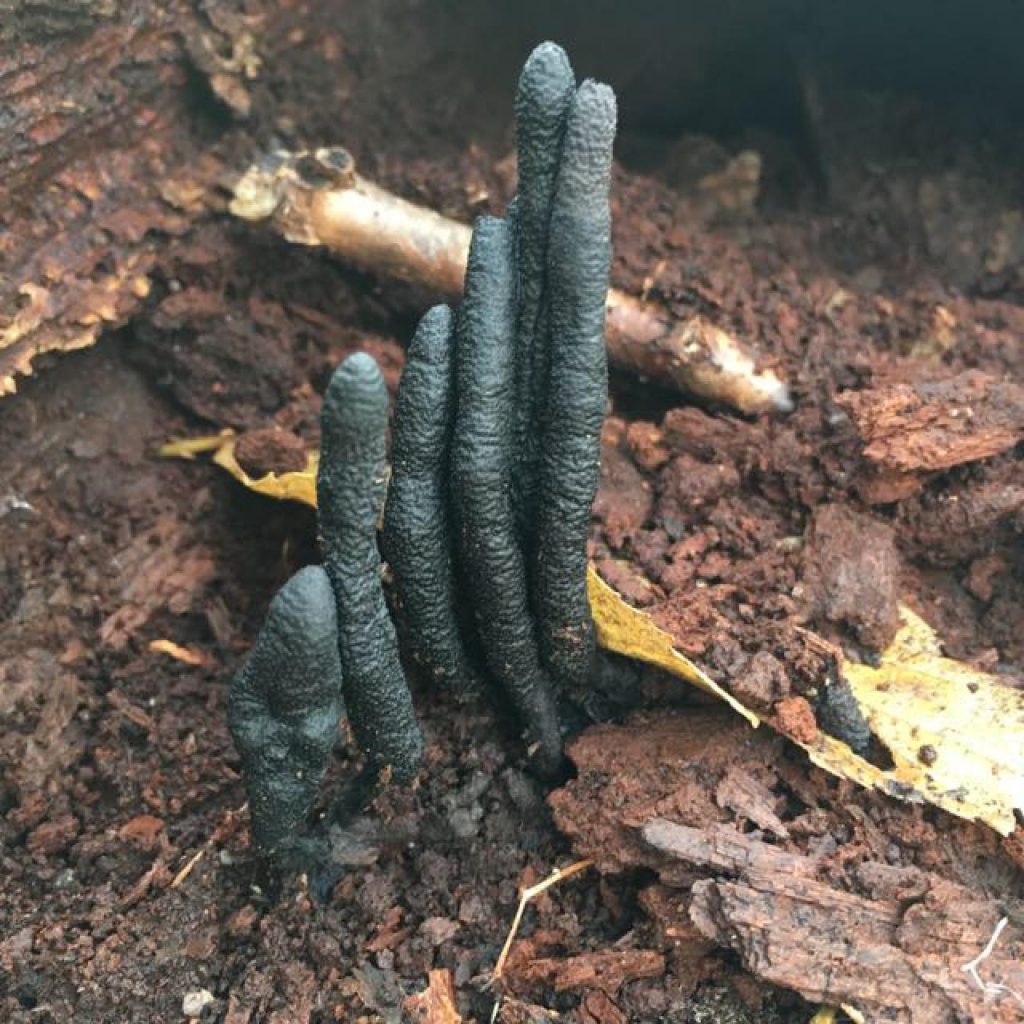
Earlier in the month I wrote about the mushroom caves in St. Paul, but I was curious what other fungi is around here so I googled it and found an amazing picture of “Dead Man’s Fingers,” or Xylaria polymorpha (“Xylaria” means it grows on wood, “poly-” means “many,” and “morpha” means “shapes”).
Dead man’s fingers is found in deciduous forests throughout North America and Europe where it grows at the base of rotting tree stumps. The FMR conservation team found this spooky looking fungus deep in the oak forest ravines at Pine Bend Bluffs Scientific and Natural Area in Inver Grove Heights. Maple trees seem to be their preferred host in our area, but they also favor oak, locust, elm and apple.
While most fungi either consume the cellulose of wood or the lignins, dead man’s fingers is somewhat unusual in that it digests the glucans or “glues” that bind the cells together. As they feed, they literally help break down dead or dying trees in the forest.
9/13/2012: Harriet Island/Lilydale Regional Park Hike (St. Paul)
Join the hiking group for a hike along the south bank of the Mississippi River west from St. Paul’s historic Harriet Island through the former Lilydale town site. The hike passes a three-kilometer reach of the Mississippi River gorge that is known locally as “Mushroom Valley” because of the abundance of man-made mushroom caves carved into the sandstone bluffs. Mushroom growing lasted a century, from its introduction by Parisian immigrants in the 1880’s until the last cave ceased production in the 1980’s, during the creation of the Lilydale Regional Park. Some of the approximately 50 caves originated as sand mines, but other common uses were the aging of cheese (Land O’ Lakes,) the lagering of beer (Yoerg’s Brewery,) and storage (Villaume Box & Lumber.) The Lilydale Regional Park area was settled early in Minnesota’s history, but because of repeated flooding, the original town was moved up on top of the bluff. In the Lilydale Regional Park, a mesic prairie has been recreated along the Mississippi River floodplain. Shale beds in the Lilydale Regional Park also are a good place to find fossils.
Directions: From I-94 on the east side of downtown St. Paul, take the Highway 52/Lafayette freeway exit south and cross the Mississippi River on the Lafayette bridge to the Plato Boulevard exit. Go west on Plato Boulevard about 2/3rds mile to Wabasha Street and turn north (right). Proceed a short distance to Water Street and turn east (right) and then turn left onto Levee Road. Proceed on Levee Road under the Wabasha Street bridge. The parking lot is on the left.
This is another place I need to hike around this summer! Here’s one more link from Greg Brick, the Subterranean Twin Cities guy, with information: Lilydale Caves / Mushroom Valley
2 — mushrooms are strong!
They can burst through asphalt!
The rapid growth of mushrooms is well known, how they can come up overnight, but how they exert such force is not so obvious. The hollow stalk of the mushroom is made up of vertically arranged hyphae that grow at their tips, much like those balloon used to make balloon animals. The wall of a hypha is composed of fibres of chitin that are arranged helically and limits the ability of the hypha to expand in width. All the pressure of growth is through elongation and growth at the tip (Isaac 1999). It is this concerted pressure applied by each expanding hypha that can create the pressure to lift the pavement.
In Entangled Life, Merlin Sheldrake discusses polyphony (Anna Tsing does too). He mention this recording:
and discusses how each woman sings a different melody, each voice tells a different musical story. Many melodies intertwine without ceasing to be many. Voices flow around other voices, twisting into and beside one another. There is no central planning, nevertheless a form emerges….attention becomes less focused, more distributed — mycelium is polyphony in bodily form, when streams of embodiment come together and commingle.
I wrote this in my notes:
I’m thinking about this in relation to peripheral vision and movement and distribution, less focused and singular, involving a bigger picture, encompassing many voices, images, organisms, happenings (?) — the idea of learning how to hold these different voices together into a form — what would it look like to try and grasp/notice/attend to a world this way? How does that change what we notice, and how we notice it? How we experience delight? wonder? awe? how we understand the relationships between a self and other selves/communities? Less interested in the details, the focus on one person, more interested in the form we create together — the bigger picture…
I imagine this as part of my larger project on shifting away from central vision (which barely works for me anymore) and toward peripheral vision. How does peripheral vision enable me to see things in a new, potentially highly beneficial, way?
4 — more whimsy, please!
I found this poem that other day that delighted me, and reminded me that I’d like to write more stuff that taps into my strange and wonderful whimsy. Often, the things I write are too serious (I think). I’d like to write something about fungi and mushrooms that tapped into my delight of how strange and alien and gross they are.)
The small blue Nissan ahead of Me at the stoplight has a plastic License plate holder that says I’D RATHER BE AT A RICK SPRINGFIELD CONCERT, and buddy, wouldn’t we All rather be catching a tan In the summertime lawn seats at Some amphitheater off the
Highway, wearing sunglasses to Protect our eyes form the sun and The gleam of Rick’s professional Teeth, watching his wavy dyed brown
Septuagenarian goatee Frame his mouth as it sings “Jessie’s Girl” with his mind on autopilot, Wondering what he’ll have for dinner
Later as he croons Where can I Find a woman like that? for the 100,000th time as we Dream of this life we’re in for the
100,000th time instead Of cubicles and gray, teh beige Hallways we walk for decades before Demise? We dream, relaxed in the
Warm air we ignore for another Decade as some gulls try to steal Fries from a couple who are busy Groping their fifty something bodies,
Their bodies here still, soft & alive, Sagging in the lawn but fifteen Again and lost in their friend’s basement Again making out on the bean bag
In the corner, frantic in hazy Afterschool limbo before The friend’s parents get home from work. They know over what’s left of a
Margarita in a can. It Trickles green through the grass as Rick’s Band cuts straight to the opening Riff for “Love Somebody.” The drummer
Pounds the toms, the thuds summoning 1984 as the guitar Chimes and harmonies swoop in and Swallow the heating air. You better
Love somebody / it’s late, the frogs Evaporating in the wetlands By the offramp.
during the run
I thought about melodies and voices and sounds I was hearing simultaneously, sometimes difficult to distinguish, blending into each other. At the beginning of the run: birds, a car, my breathing, my feet striking the ground, the wind through the trees. I’m not sure if that was all of the sounds. Now I wish I had stopped and recorded some of my thoughts.
I also thought about dirt and what, under my feet and deeper in the ground, I might be disturbing/disrupting/destroying as I ran.
I probably thought about more, but I’ve forgotten it now. It scattered in the wind, I guess.
after the run
Now, after the run and after writing this log up to this point, I’m thinking about lichen and Forrest Gander and telling everyone in the house about how lichen can be killed, but if it has what it needs, it might never die (which I heard him say on a podcast I listened to this morning while doing the dishes). I wouldn’t want to live forever, but I like imagining a world in which inevitable death didn’t overshadow almost everything else. I’m not consumed by it, but it’s in all of our stories, our understandings, our philosophies, how we frame and experience joy and delight. How would we orient ourselves without that endpoint, without that guaranteed conclusion?
I’m also thinking about something I read about the biggest fungi in the world — at least the biggest that has been found and documented by scientists, the “Oregon Humongous Fungus.” Everything else I’ve heard about this fungus, and the one in Crystal Falls, MI, involves awe and fascination and wonder. In contrast, this report describes the fungus “as the baddest fungus on the block.” It’s killing tons of trees in the forest and, even after diligently trying for 40 years, they can’t get rid of it. The perspective here seems to be from timber companies who are losing all their trees/assets/profit. Interesting…
Still wearing running tights and winter vest, but it’s getting warmer and sunnier and spring feels almost here. I warmed up quickly and had a good run.
10 Things I Noticed
a new neighbor has repositioned a drain pipe so that water from their basement dumps out on the sidewalk I take for almost every run, soaking it. A few weeks ago, when it was colder, this water quickly turned to ice, now it’s only an irritating puddle
running west over the lake street bridge, the river was broad and blue and rippling
running east, the river was brown and flat
no smells from Black Coffee, at the top of the marshall hill
the branches of the trees reaching up from below the trail on the east side looked silver and dead or dormant or nowhere close to sprouting leaves
wind rustling through some dead leaves, but no sound of water above shadow falls
don’t remember hearing any birds or seeing any squirrels
they are doing some sewer work near 7 oaks — I heard the beep beep beep of a truck backing up, then saw a huge concrete cylinder waiting to be buried below the street — how long will all of this take?
encountered at least 3 pairs of walkers — I think I heard some of their conversations, but I can’t remember any words now
my zipper pull was banging against my shirt at the beginning of my run, making a dull thud that I couldn’t not hear. Did it stop, or was I able to tune it out?
Things I Didn’t Notice, either because I forgot or they weren’t there: geese, black-capped chickadees, crows, dogs, anything green, other runners, purple flowers, roller skiers, sewer smells, planes, the sky, clouds, my own breathing
Writing this list of things I didn’t notice, I suddenly remember something I almost forgot: bird shadows! At least twice, I noticed the shadows of incredibly fast moving birds, passing below me. Very cool and very fast! I wondered, were these birds being helped by the wind, or were they just that fast?
Yesterday I checked out Merlin Sheldrake’s Entangled Life from the library. I’ve read the introduction so far and I’m really enjoying it. A few things to remember:
Our bodies (we) are ecosystems, composed of — and decomposed by — an ecology of microbes.
Biology — the study of living organisms — has been transformed into ecology — the study of relationships between living organisms.
I came across many complicated relationships between field biologists and the organisms they studied. I joked with the bat scientists that in staying up all night and sleeping all day they were learning bat habits. They asked how the fungi were imprinting themselves on me. I’m still not sure. But I continue to wonder how, in our total dependence on fungi — as regenerators, recyclers, and networkers that stitch worlds together — we might dance to their tune more often than we realize.
Scientists are — and have always been — emotional, creative, intuitive, whole human beings, asking questions about a world that was never made to be catalogued and systematized.
4.25 miles top of franklin hill and back 32 degrees
Full winter running clothes: black running tights, green base layer shirt, pink hooded jacket, black running vest, “black” baseball cap (well, it was black, but now has faded to a brown-ish gray. I imagine, although can’t really see with my vision, that it looks gross and I should be embarrassed to wear it — mostly, I don’t care, but I am looking for a new hat), pink headband, black gloves, dark gray buff. Brr. I am over winter-in-April. Normally, I’m not too bothered by the weather, but this never-ending cold is wearing me out. I want to sit on the deck in my new chair without a coat on! I want to run in shorts!
I was cold for the first 15 minutes, but once I warmed up, it was fine. I felt strong and relaxed and grateful to be outside breathing in fresh air, being with the birds. They don’t seem to be bothered by the cold. Thought about rot and noticed all the trees down just below me. How long does it take fungi to move in and begin breaking down the wood to digest the needed nutrients? Looked it up and found an article, How Fungi Make Nutrients Available to the World, which is helpful for understanding how fungi break down trees, but not how long it takes.
Running under the lake street bridge, I saw a few Minneapolis Parks vehicles, heard chainsaws down by the river, then noticed one of the trucks was filled with twigs and branches. I thought about the fungi and all the food they weren’t getting with the removal of the dead/dying limbs. I also thought about important it is to remove those branches so they don’t fall on my head while I’m running under them.
On the stretch between the trestle and Franklin, I thought about what it might mean to shift my values away from progress and toward the fungi, including thinking about motion/moving as not always producing something “useful” for capitalism, or aimed at progress (like running to be faster or better). How do we understand and value movement — making, doing, moving — outside of the goal of improving or mastery or being used by others?
I also thought about an article someone posted on twitter this morning about tapping into spinach’s ability to sense a compound that is often found in landmines by attaching censors to them that, when triggered, send an email back to a lab. The article was terribly titled, Scientists have taught spinach to send emails, and as I read it I thought about how often these pop science articles view plants (or fungi or “nature”) only as resources/assets for maintaining or improving the lives of humans. Fungi is only valuable because of what it does for us, how it might save us from the terrible mess we’ve made of the planet, not because it’s just amazing. How dreary to think of spinach having to send emails! And, this is not teaching spinach to send emails but hacking into their communication networks to receive the data they’re sending elsewhere.
I’ve written a lot about mushrooms and fungi, here’s a poem about lichen. Lichen is another big deal for poets.
Back then, what did I know? The names of subway lines, busses. How long it took to walk 20 blocks.
Uptown and downtown. Not north, not south, not you.
When I saw you, later, seaweed reefed in the air, you were grey-green, incomprehensible, old. What you clung to, hung from: old. Trees looking half-dead, stones.
Marriage of fungi and algae, chemists of air, changers of nitrogen-unusable into nitrogen-usable.
Like those nameless ones who kept painting, shaping, engraving, unseen, unread, unremembered. Not caring if they were no good, if they were past it.
Rock wools, water fans, earth scale, mouse ears, dust, ash-of-the-woods. Transformers unvalued, uncounted. Cell by cell, word by word, making a world they could live in.
6.1 miles hidden falls scenic overlook loop* 32 degrees / feels like 25 degrees wind: 12 mph
*a new route! river road, south/up to wabun/over ford bridge (south side)/mississippi boulevard, north/hidden falls scenic overlook/mississippi boulevard, south/ford bridge (north side)/river road, north
Ran a new route today. It’s nice to check out a different part of the mississippi river. I’ve walked on this trail at least once, and biked it several times, but never done this exact loop. Up above, it’s steep and without many fences or railings. Very cool. Noticed a few squirrels, a darting chipmunk. Heard: a robin, crows, some cardinals, the teacher’s whistle at the Minnehaha Academy playground, trickling water. Ran straight into the wind crossing back over the ford bridge.
Before my run, I began gathering notes and quotes and poems about entanglement to put under the glass on my desk. Hopefully it will help me write this poem by the end of the week. While I ran, I wanted to try and think about fungi as hidden, always in motion/doing (a verb, not a noun), and below. Had flashes of thought about what’s beneath us, and how I’m often looking down through my peripheral, even as I look ahead with my central vision. At some point, I decided I didn’t want to try and think about entanglement, but to stop thinking and see what happened. No brilliant thoughts, but now that I’m done, I feel more relaxed and happy and motivated to keep working.
I almost forgot, but then remembered when I was reviewing my notes: several times, I heard the creaking, squeaking branches and thought about old, rusty, long hidden/forgotten doors being opening — a trap door in the forest floor. I didn’t imagine past the open door or the idea that it led to the river basement (using basement here like ED in “I started Early — Took my Dog”). Still, I enjoyed thinking that I could access this door and something in my moving outside was opening a long shut door.
The idea I have right now for a poem involves playing off of these lines from Mary Oliver:
Listen, I don’t think we’re going to rise in gauze and halos. Maybe as grass, and slowly. Maybe as the long leaved, beautiful grass
And this bit from Arthur Sze in an interview with David Naiman:
I began to think I love this idea that the mycelium is below the surface. It’s like the subconscious, then when the mushroom fruits pops up above ground, maybe that’s like this spontaneous outpouring of a poem or whatever.
Something like this?
Maybe like mushrooms, we rise or not rise, flare brief burst from below then a return to swim in the dirt…
I want to think more about what fungi do and how mushrooms grow, and how to think about that in relation to human subjectivity/agency and a self that is connected/joined but not subsumed by this connection.
The other thing I’d like to think about more is this line from Tsing:
In this time of diminished expectations, I look for disturbance-based ecologies in which many species live together without either harmony or conquest (5).
These disturbance-based ecologies involves ecosystems that develop in the wake of a disturbance, like matsutake mushrooms that grow on pine in forests that have been clearcut. They aren’t part of what Tsing calls the cycle of promise and ruin, or deplete then move on, but something else, the something that comes in after a place has been abandoned by Progress.
Mushrooms/ Sylvia Plath
Overnight, very Whitely, discreetly, Very quietly
Our toes, our noses Take hold on the loam, Acquire the air.
Nobody sees us, Stops us, betrays us; The small grains make room.
Soft fists insist on Heaving the needles, The leafy bedding,
Even the paving. Our hammers, our rams, Earless and eyeless,
Perfectly voiceless, Widen the crannies, Shoulder through holes. We
Diet on water, On crumbs of shadow, Bland-mannered, asking
Little or nothing. So many of us! So many of us!
We are shelves, we are Tables, we are meek, We are edible,
Nudgers and shovers In spite of ourselves. Our kind multiplies:
We shall by morning Inherit the earth. Our foot’s in the door.
3.5 miles 2 trails + tunnel of trees 43 degrees light rain / wind: 15 mph
Raining today. When it stopped, I headed out to the gorge. Within a few minutes: more rain. I could barely feel it. I was more bothered by the wind. Even that didn’t bother me that much. Everything was wet and dripping. I looked at the river, but I can’t remember what color it was or how the surface looked as the rain fell. I probably couldn’t have seen that anyway because I was too far away.
Heard lots of water rushing through the sewers in the street, then water falling from the sewer pipes in the ravines at 36th, 44th, and 42nd. Just after I turned around at the 44th street parking lot, I stopped at a bench overlooking the river. It was at a slight angle above the Winchell Trail and faced St. Paul, on the other side. Next month the view from this bench will only be green leaves, but today I could see the river (even if I don’t remember what it looked like), and the trail below, and the other side.
Didn’t see Dave the Daily Walker this morning, but I did say “good morning” to one walker, and then laughed in recognition when another walker said, “What is it? Hot or cold?”
Thinking about revising a haibun I wrote a few years ago and submitting it. Could I shape it into something that speaks to ideas of entanglement and nets and mutuality?
On the Dirt Path Near Folwell Avenue
Even if you try to time it just right, when you climb the steep, short hill up to the dirt packed path you cannot avoid the swarming swath of sex-crazed gnats or the little old lady slowly shuffling by, swinging her hiking poles, a voice TED-talking out of her phone’s speaker reminding you that this is why we are all here. Do not bother the bench resting on the rim of the gorge to ask what this is. If looking through the thickly thatched oak leaves to gather glimpses of the silvery river sparkling in the morning sun doesn’t already answer everything, the bench certainly won’t be able to help.
Bugs and old ladies wake early in July but so does the river.
I think I especially need to rework the last sentence and the idea of what this is. Maybe also the haiku at the end? Looking through my pages documents, I found some notes I took while trying to figure out how to write about this encounter with the little old lady. The second paragraph reminds me of a great sentence I read in an article describing entanglement. Every organism is an ecosystem.
which reminds us why we are all here…
We are here. Me and joints and muscles and bones and ligaments and lungs. Us. me and blood and cells and electrolytes and sweat and saliva. we. me and hands and feet, a heart, two diseased eyes, a knee that displaces. we. me worn out running shoes, threadbare worries. we. me and those oak trees, that wrought iron fence, this rutted, dirt path, that short, steep hill. we. me river. that we are here with the old woman who slowly shuffles in her straw hat with her hiking poles and a voice that calls out from her radio speakers, “which reminds us why we are all here.” here. above the river and the gorge and the floodplain forest, below the bike path and the road, the cars and the boulevard. here. in this heat and humidity and haze. here. on a monday morning. here.
We are all here.
Me bones joints muscles ligaments blood, sweat, saliva inhaling exhaling lungs lungs and heart and hands diseased eyes, easily displaced kneecaps feet, worn out running shoes, threadbare worries Us. All. Here. oak trees wrought iron fence rutted, rooted, packed dirt path short, steep hill an old woman slowly shuffling in a straw hat with hiking poles Us. All. Here. The river gorge
The mention of the phone TED-talking is a central aspect of my poem and its critique (of what? something about sound bites and the monstrous mixing of self-help and spirituality and capitalism and the idea of blasting these words on an early morning walk outside by the gorge) seems central to what I’m trying to say in this poem and how it fits with entanglement, especially as Anna Tsing describes it. Decided to do a search on the Poetry Foundation site for “ted talk.” Found this excellent poem:
money will build anywhere there’s a view or a coastline all those tangled shrubs and thorny bushes your ancestors cut through centuries ago to claim in the name of a queen and a king with foul smelling hair these days even the ecotone between the living and the dying has to be privatized & sold at auction all the steps between next year and the first human year ever recorded melted so flagrantly it became stylish to be poetic for the end of the world everyone’s collecting coins on every interface a thousand identical posts about 2019 being the year of paper straws and reusable cups indigo dyeing from Kyoto is the new 36 hours in Tbilisi all the people with phones don’t think twice about buying onboard wifi on their way to the latest Caribbean island still recovering from last year’s hurricanes would it be so wrong to wish everyone with global entry be grounded until extinction is off the table I don’t think I can date another digital nomad or a normie with a dog who doesn’t know what it’s like to be too poor to buy their way out of disaster why do the rich treat blame like it’s obscenity or a fossil is it because they hate seeing blood think they are noble for taking quick little showers and using silicone at the farmer’s market I have never seen someone forgive themselves as elaborately as the wealthy everyone who paid for their wellness is infecting the rest of us yes I am sick sick sick and want to sterilize all the ruinous overseers though it is not like me to dream so much I have managed to hoard something that cannot be replicated it will die when I die let no one say we didn’t try to let a different kind of life bloom and let no one say we didn’t touch what was there from the beginning
Okay, I can’t resist. Searching through other results for TED talk, I found this excellent poem by the wonderful Ted Kooser. Most of the search results where poems by poets named Ted; I guess there aren’t a lot of poems about TED talks, or at least ones that made it into Poetry magazine. That’s a Ted talk I’d attend!
In musty light, in the thin brown air of damp carpet, doll heads and rust, beneath long rows of sharp footfalls like nails in a lid, an old man stands trying on glasses, lifting each pair from the box like a glittering fish and holding it up to the light of a dirty bulb. Near him, a heap of enameled pans as white as skulls looms in the catacomb shadows, and old toilets with dry red throats cough up bouquets of curtain rods.
You’ve seen him somewhere before. He’s wearing the green leisure suit you threw out with the garbage, and the Christmas tie you hated, and the ventilated wingtip shoes you found in your father’s closet and wore as a joke. And the glasses which finally fit him, through which he looks to see you looking back— two mirrors which flash and glance— are those through which one day you too will look down over the years, when you have grown old and thin and no longer particular, and the things you once thought you were rid of forever have taken you back in their arms.
Oh, I love this poem. I’ve posted several others poems by Kooser. I think he recently died, which is a great loss. I read a thread on twitter last year — or the year before? — discussing what a generous mentor and person he was to so many.
Sun! Warmth! Spring! Felt much warmer than 45 degrees, at least once I warmed up. I remembering now, as I write this, that I was chilly for the first 10 minutes.
15 Things I Noticed:
there were 3 stones stacked on top of each other on the big boulder heading down into the tunnel of trees
water was dripping or streaming out of the limestone on the st. paul side — I didn’t see it, but heard it
my feet were shshshshshshing as I ran over grit on the edge of the path on the franklin bridge
one laminated notecard was still attached to the railing on the lake street bridge. It was the one I stopped to read last week: “your story doesn’t have to end.” What happened to the others? Why was this the only kept?
at least one runner was wearing shorts
the wind was in my face as I headed north on the west side, at my back heading south on the east side
there were no rowers on the river and no roller skiers on the path
the edge of the paved path was white. I decided it was stained from salt, not covered in lingering ice or snow — too warm
the walking path under the lake street bridge on the east side is still closed off — I think Scott said the path had crumbled there. Can they (will they) fix it?
there was a tree trunk down on the winchell trail that looked like a sitting person, at least to me
the shadow of a bird crossed over me. I looked up but couldn’t see it in the sky
lots of honking geese, sometimes the sound of their honks became indistinguishable from a yelling kid or a moving car
a peloton of 6 or 7 bikes passed me. Their spinning wheels were so loud! Spinning, whirring, rumbling. My sudden thought: how loud the 200+ bikes I see at the bike races I watch must be!
a deep voice off the side, carrying clearly across the road, cutting through everything, almost rattling my skull
the top of a split rail fence at a steep part of the path is missing — how did that happen?
I was planning to do a list of 10, but I kept remembering more things that I noticed. I like this exercise as a way to remember things from my run.
before the run
For every other “before the run” I’ve done, I write it in a saved post before I go out for my run. Today, I was busy reading Anna Tsing’s The Mushroom at the End of the World, and didn’t have time. It takes some time to read and post all of the stuff I’m thinking about before the run. Maybe too much time? Now, after the run, I don’t have much time either, so I’ll keep this brief. Just listing a few things that I read/did before the run:
Finished re-memorizing Katie Farris’s “What Would Root”
What used to be a rope descending my vertebrae to the basement of my spine grows thin.
In solidarity with my chemotherapy, our cat leaves her whiskers on the hardwood floor, and I gather them, each pure white parenthesis and plant them in the throat of the earth.
In quarantine, I learned to trim your barbarian hair. Now it stands always on end: a salute to my superior barbary skills. In the event of my death, promise you will find my heavy braid and bury it–
I will need a rope to let me down into the earth. I’ve hidden others strategically around the globe, a net to catch my body in the wearing.
Thought about nets and this passage from The Mushroom at the End of the World:
Mushrooms are the fruiting bodies of fungi. Fungi are diverse and often flexible, and they live in many places, ranging from ocean currents to toenails. But many fungi live in the soil, where their thread-like filaments, called hyphae, spread into fans and tangle into cords through the dirt. If you could make the soil liquid and transparent and walk into the ground, you would find yourself surrounded by nets of fungal hyphae (137).
Thought about imagining the soil was liquid and transparent and then entering it, surrounded by nets of fungal hyphae. What if I could swim in the soil? Swim through these nets of fungal hyphae?
Wondered about networks and the comparisons Tsing describes between fungi networks and the internet (the wood wide web) and the infrastructure of highway systems. What are some key differences between how the internet and highways work?
during the run
Thought about nets and what they do, what they’re for, as I ran. Nets can trap and confine things, like fish, but they can also hold things — carry, hold together, be a container for, not sealed or airtight but open with many holes, ways to breathe. I thought about these nets as loosely holding organisms/selves together without sealing them into a self-contained, separate Subject.
after the run
There’s a lot to ruminate over with entanglement and fungi and mutuality as a starting point instead of competition. I need to sit with all some more, and maybe do some writing around/with a few lines from the book. I’m hoping to turn my thoughts into a poem for an call for work on entanglement.
In my notes in Plague Notebook, Vol 11 I made a list of words related to nets: