dec 26/RUN

4.45 miles
minnehaha falls and back
36 degrees
humidity: 90%

Moist, thick, big puddles everywhere. I tried to avoid them, but I couldn’t avoid all of them and by my last mile I could hear my one shoe squish squish squishing. Since it was warm, it didn’t bother me. Oh — just remembered — my shoe/sock got wet at the falls — the cobblestones near the falls were full of puddles. There were a few slick spots, but mostly it was just wet.

For 3 miles, I listened to the wet wheels, whooshing, crows cawing, and people calling out to each other as I ran. For the last mile: TSwift’s Life of a Showgirl

10 Things

  1. the small patches of snow on the trail or the road, seeping murky gray-green-dirty white liquid
  2. the rusty orange leaves, dead, still clinging to the trees
  3. calmly letting a walker know I was approaching from behind — right behind you/thank you! I meant to say, you’re welcome, but didn’t, then lamented my failure to exchange the you until I realized I had with my right behind YOU –if I had said, the you would have been traveled 3 times: from the-walker-as-you when I said, right behind you, to me-as-you when she said, thank you, to the walker-as-you again with, you’re welcome
  4. overheard: a man leaving a group of people at the falls, calling out, I’m going back to pay the meter!
  5. clusters of people — 6-8 at the overlook just above the falls, and at the overlook close to “The Song of Hiawatha”
  6. a clump of something not moving ahead of me on the trail — dead leaves? A darting squirrel. I studied it closely to make sure it didn’t run in front of me
  7. a distant thumping, heard when stopped to put it my headphones — nearing, another running plodding along
  8. seen with peripheral vision: some frozen crystals on my cheek
  9. the trail on the bike side of the double bridge was mostly wet ice with 2 narrow strips of bare pavement that narrowed even more until not even my toe could fit in their groove
  10. crows! just before starting my run, they were gather in the trees above me. when I stopped to start my workout on my watch, they cawed furiously, as if to say, keep moving!

Just before the run, I got an email about one of the chapbook contests I entered — back in July. I didn’t win, but I got, along with 4 other poets, an honorable mention. I’ll happily take that! The chapbook I submitted included earlier versions of several of the poems that I revised for my manuscript. I think the poems are even better now.

In the last mile of my run, a sudden thought: I should submit something for tiny wren lit’s tiny zine series. It says they’ll open again in early 2026: submit a tiny zine

safari reading list, review:

1 — contentment

Found a poem about contentment while reviewing my Safari Reading List. I’m partial to the words satisfied or enough or still, but contentment works too.

from A Beautiful House with a Hot Tub and Pool/ Jason Schneiderman

Yes, I can be content anywhere,
but alas sadly: No. It’s not true. I can’t be content here
in my uncomfortable present, in my uncomfortable chair,
on the uncomfortable subway, at this uncomfortable desk,
in this uncomfortable classroom. But oddly, I am content 
to visit the past, to say Hello everything I’ve lost, 
to say I wish you could come here to the present, 
my lost companion trees. I wish you could meet 
everything I’ve found.

about this poem: “Making peace with the past has been a common theme in my work, so I decided to try to write about making peace with the present.”

2 — a no-one rose

from Psalm/ Paul Celan (trans. John Felstiner )

Blessèd art thou, No One.
In thy sight would
we bloom.
In thy
spite.

A Nothing
we were, are now, and ever
shall be, blooming:
the Nothing-, the
No-One’s-Rose.

I love this bit of Celan’s poem and the No-one’s-Rose! No One — a someone who is No One: what type of sight do they have? We were, are, shall be nothing, blooming. I want to use this — maybe as a breathing with poem — in a collection* about the gorge/gap/bling spot.

*maybe not a collection, but a series of attempts, orbiting around the idea or feeling or experience of the Nothing in the gorge and in my vision.

Speaking of orbiting: Last night, I was trying to name/remember something, but I couldn’t, quite. I kept almost getting the right name, but I was off, approximate. As I talked, I moved my hands around in a circle, as if to indicate I was circling around the name. I called out, I’m orbiting it! I do this a lot. I wish I could remember the exact example, to make this story more understandable, but I can’t.

3 — CAConrad’s Queer Bubbles

There are some great bits in this article about Conrad and their rituals in The Paris Review:

“I love being inside the ritual,” he says. “It’s like speaking in tongues. It’s not just automatic writing … Every nuance, every adjustment to the ritual, alters the language that comes out of me.”

Exercises like these are nothing new in poetry—Conrad cites Bernadette Mayer and Charles Olson as two practitioners of similar methods—but he insists that his rituals are chiefly inspired by his childhood, specifically the Pennsylvania Dutch Country where his grandmother taught him to meditate and where he took an interest in the occult, from local water diviners to the hex signs painted on barns. But as much as his work owes a debt to Boyertown, it is a deliberate rebuke to the bigotry, violence, and oppression he found there.

Queer Bubbles

I’m familiar with B Mayer’s work — a class on her list is what led me to poetry! — but I don’t know that much about Charles Olson. I should look into him more, like his archeology of morning (on a site that offers footprints not blueprints, which reminds me of my old academic slogan for my ethical/pedagogical approach: an invitation to engage, not a how-to manual) and the polis / Polis is This:

Polis is This

In his two books of (Soma)tic rituals and poems, A Beautiful Marsupial Afternoon and ECODEVIANCE—a third collection, While Standing in Line for Deathwill be published this September—the rituals and resulting poems appear opposite one another. Because the rituals are written in the second person, at times the books read like the world’s most bizarre and inventive self-help guides, manuals for what you might call acute mindfulness. One ritual starts like this: “Eat a little dark chocolate before getting on the subway. Sit in the middle of the car … Then close your eyes, and as the car rolls on its tracks make a low hum from deep inside you … As soon as the car stops write 9 words as fast as you can before the train moves again … Repeat this humming and writing for 9 stops.” He credits his rituals with lifting him out of depression and grief.

Queer Bubbles

The use of You — a bizarre self-help manual or how-to on mindfulness!

the blind ring project returns to haunt this log

Doing some reading about lit journals that accept visual poetry, I was introduced to the amazing erasures of Colette LH. So beautiful and wonderful. Here’s the first one I experienced:
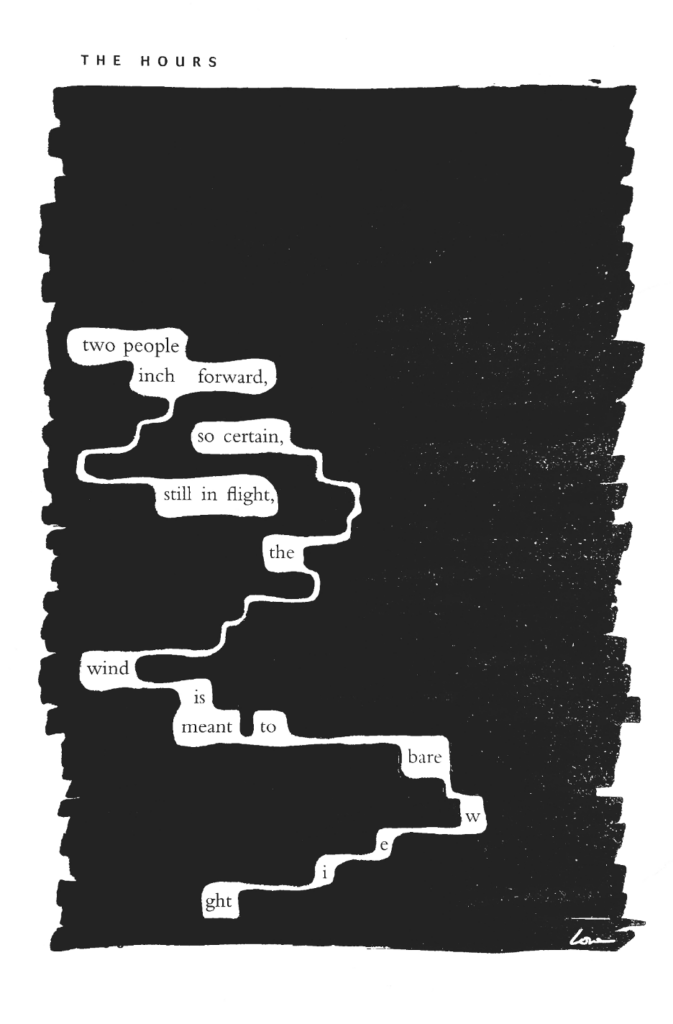
(un)certainty

Then I saw this one, Brain, and I started thinking about what I could do with my blind spot black-out ideas, and now I’m wondering about doing something with my peripheral. These white trails above, in (un)certainty are making me think about movement and direction and motion as it relates to my peripheral vision. Hmmm….

I want to buy their 2018 chapbook: a wonderful catastrophe and this, Celestial Timpani from Yavanika Press

june 24/RUNSWIM

4.75
veterans home
64 degrees

The heat broke. Yes! Still overheated by the end, but much easier to run in the 60s than the 80s. Did my 9/1 again. About 2 minutes into the third segment of running, nearing a steep hill, I briefly contemplated taking another walk break. Then I remembered that I took an extra walk break around the same time yesterday. This might become a habit, I thought, so I decided to keep going. Make it to the top of the hill. Make it to the parking lot. Make it to the bench above the edge of the world. Then I was at 9 minutes. Victory!

Before I went out for my run, I revisited CAConrad’s TL;DR and their advice for listening:

listen to the most immediate sounds in the building. Let the layers reveal themselves, shifting to what you hear further away, then further.

When you feel you have heard everything, wait. Sit there a little longer, listening for the faintest of traffic in the sky or a faraway rumble.

As I ran, I listened for the the layers. Running above the falls, on the other side of the creek, I tried to listen to what was beyond the soft rushing of the water over limestone. Cars, a train horn, birds, my foot steps. I tried to listen for voices at the overlook. Did I hear any? I don’t think so.

10 Sounds

  1. a car, whooshing by me on the street
  2. a few pebbles crunching under the wheel
  3. the soft knocking of a woodpecker
  4. kids laughing on the playground
  5. the creek, tumbling over rocks
  6. the soft rush of the falls
  7. scraping — someone working on the new trail below me
  8. the clicking of a roller skier’s poles across the road
  9. the sharp clanging of a dog collar
  10. the shifting of a bike gear

what is a tree?

Yesterday, walking on the gravel road that leads to the cedar lake beach, I noticed the husk of a tree — a sad-looking trunk with no top and no branches. When I pointed it out to Scott he said, that’s not a tree. Trees have branches. Even little trees have branches. Running today, I suddenly wondered about a tree’s root system and what was underground. Can that define a tree? Looked it up, and according to several sources, there is no universal or official scientific definition of a tree. The generally accepted idea is that it has a single, thick trunk, branches, a root system.

run 5

broke
still
again
about
third
steep
world
cedar

below
heard
water
think
wheel
creek
trail
beach

skier
break
might
extra
habit
bench
sharp
thick

I have a third wheel habit.
again, water, my break below.
a beach bench thick with habit
trail-think, creek-think, beach-think: one is still, one sharp, one thick
world — break what broke again
steep bench habit
beyond the linear layer, a wheel world could be heard

floating again

I returned to Anne Carson’s Float today and found many delightful things in her pair of lectures, “Uncle Falling,” including this:

Uncle Falling / Anne Carson

I like to write lectures. My favorite part is connect-
ing the ideas. The best connections are the ones
that draw attention to their own frailty so that at
first you think: what a poor lecture this is–the
ideas go all over the place and then later you think
but still, what a terrifically perilous activity it is,
this activity of linking together all the threads of
human sin that go into making what we call sense,
what we call reasoning, an argument, a conversa-
tion. how light, how loose, how unprepared and
unpreparable is the web of connections between
any thought and any thought.

CHORUS 1:
Here’s a thought

CHORUS 2, 3:
Here’s another

CHORUS 1, 2, 3, 4:
How about getting from here to there

CHORUS 4:How about spending some time in mid-air

CHORUS 3:
Much depends upon the fact

CHORUS 2:
that one falls

CHORUS 1:
or one does not fall

swim: 3 loops
open swim lake nokomis
80 degrees

A wonderful night for a swim! Warm water, hardly any chop, no glaring sun. So many sparkle friends and bubbles and muscles being worked. And, a ferret on the loose? The lifeguards caught a ferret and kept asking if anyone was missing a ferret. I felt strong and fast and free — no worries about getting off course. Who cares? A great swim.

march 5/SHOVEL

32 minutes
about 8 inches
26 degrees

The biggest snowfall of the season. Of course it happened on the day that FWA and his college friends were taking the train to Chicago. Last year, when FWA and RJP were flying to Chicago: a big snow storm all day.

The snow is the worst kind for shoveling — heavy, wet, deep. It will probably melt by the end of the week.

The view from my desk: a man walking his dog in the street wearing snowshoes — the man, not the dog! Will I get to see any skiers too? I hope so.

Today is my mom’s birthday. She would have been 83. She’s been dead for 15.5 years. Last night at community band rehearsal I laughed at something my friend Amanda said — I can’t remember what. And my laugh was my mother’s, at least it sounded like it to me. Sometimes I hear her in my laugh, and sometimes one of my older sisters. I can’t describe the laugh — it’s been too long since I heard it — but I felt it and her last night. That’s how my memories of her work now; they are faint and fleeting and difficult to put into words.

The president’s address to congress was last night. Neither of us talked about it until it was over, but then Scott and I admitted to each other that we had been a little worried he might do something extreme, like declaring the dissolving of congress or pronouncing himself king for life. Thankfully, no. What a world.

circumambulation

In the fall of 2023, when I first started thinking about Gary Snyder and circumambulation, I printed out the Mt. Tamalpais poem, along with a related one my Forrest Gander, and put them under the glass on my desk. They have been there, beneath my fingers, ever since. Today, I reread them and was inspired. I’m thinking about creating another National Park-like unigrid pamphlet for the Franklin-Ford loop. Like the Mt. Tamalpais poem, it would have particular spots on the loop (the poem has 10) where you stop and chant. In the poem, you chant Buddhist prayers, but in my pamphlet, I’m tentatively thinking you will chant some of my favorite poetry lines — or lines I write (inspired by JJJJJerome Ellis and their prayers to their Stutter in Aster of Ceremonies). My lines would be about my blind spot.

I’m also thinking about creating somatic rituals related to these spaces — I’m using CA Conrad as inspiration for them. Yesterday I requested their book, Ecodeviance: (soma) tics for the future wilderness from my local library.

In the introduction to Ecodeviance, also posted here, Conrad describes how their (soma) tics are designed to fight the factory approach to writing poetry they had been using by creating rituals “where being anything but present was next to impossible.” For Conrad, these rituals create an

“extreme present” where the many facets of what is around me wherever I am can come together through a sharper lens.

intro to ecodeviance / CA Conrad

While Conrad identifies the factory model as the source of their key problem of not being aware of place in the present, the model that I’m trying to fight in my writing/creating is the academic one, which shares some similarities with the factory.

Am I brave enough to try any of Conrad’s rituals? For one of them, they fully immersed themselves in the color red for the day —

When I say fully immerse myself in the colors I mean ONLY eating foods of the color of the day, as well as wearing something or keeping something of that color on or around me at all times.

The red experiment is part of a 7 poem sequence, (soma) tic MIDGE. For more on it, see: You write what you eat. This essay describes the poems and has links to audio recordings of Conrad reading them. Very cool.

In their introduction, Conrad describes purple in this way:

Purple being the natural transformative pivotal color which is born only when the starting color red (fire) and the last color blue (water) bleed together.

Introduction / CAConrad

And here is their poem inspired by a day immersed in purple: smells of summer crotch smells of new car’s purple MAjestY (2:05): MP3

More mentions of purple!