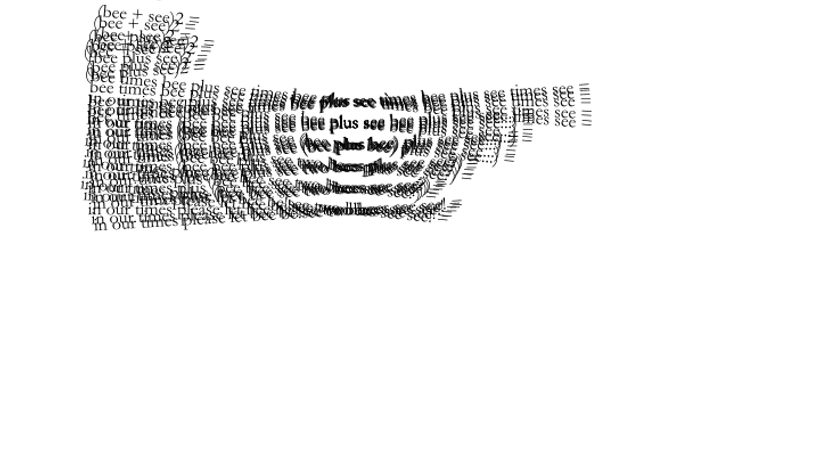
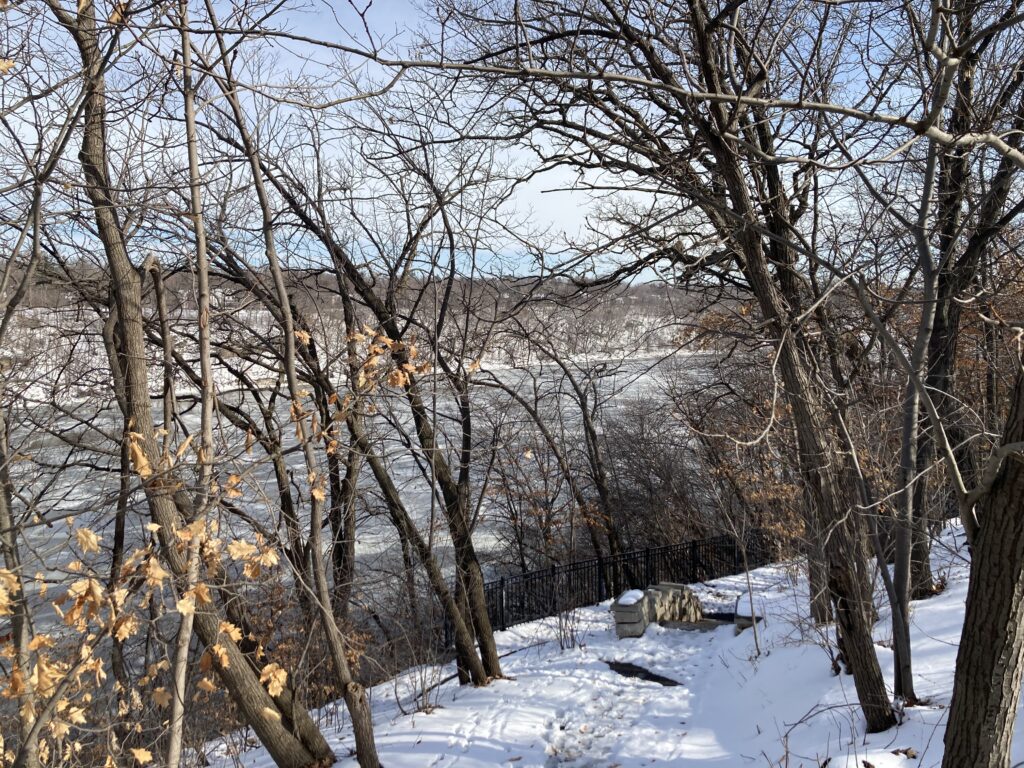
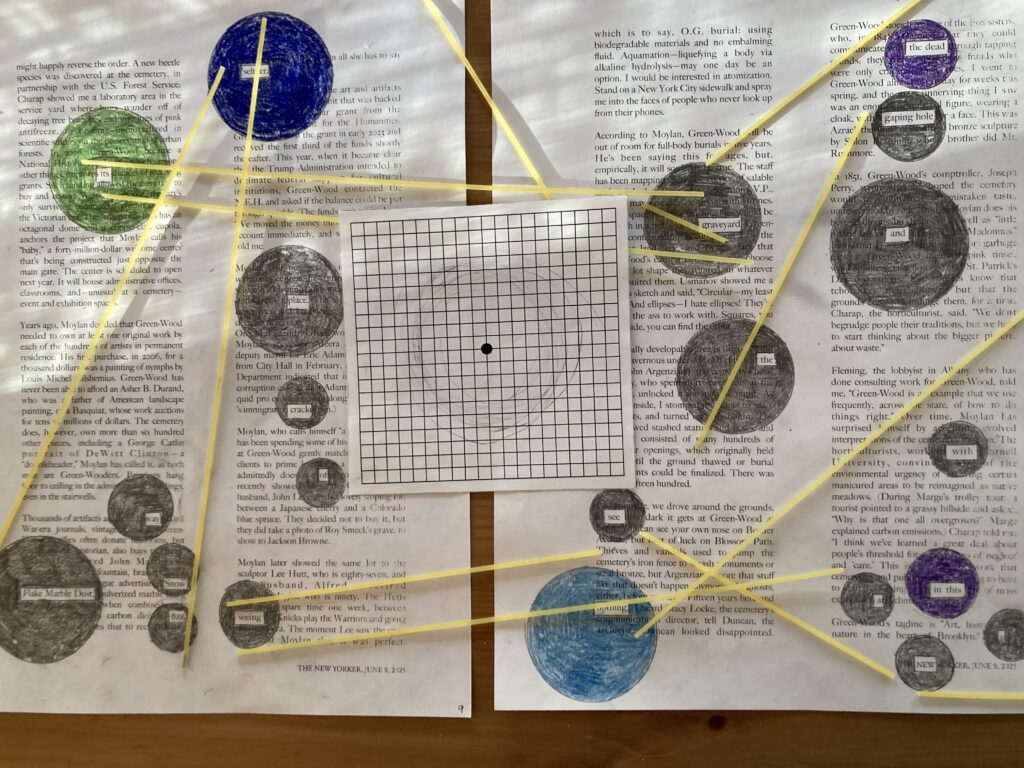
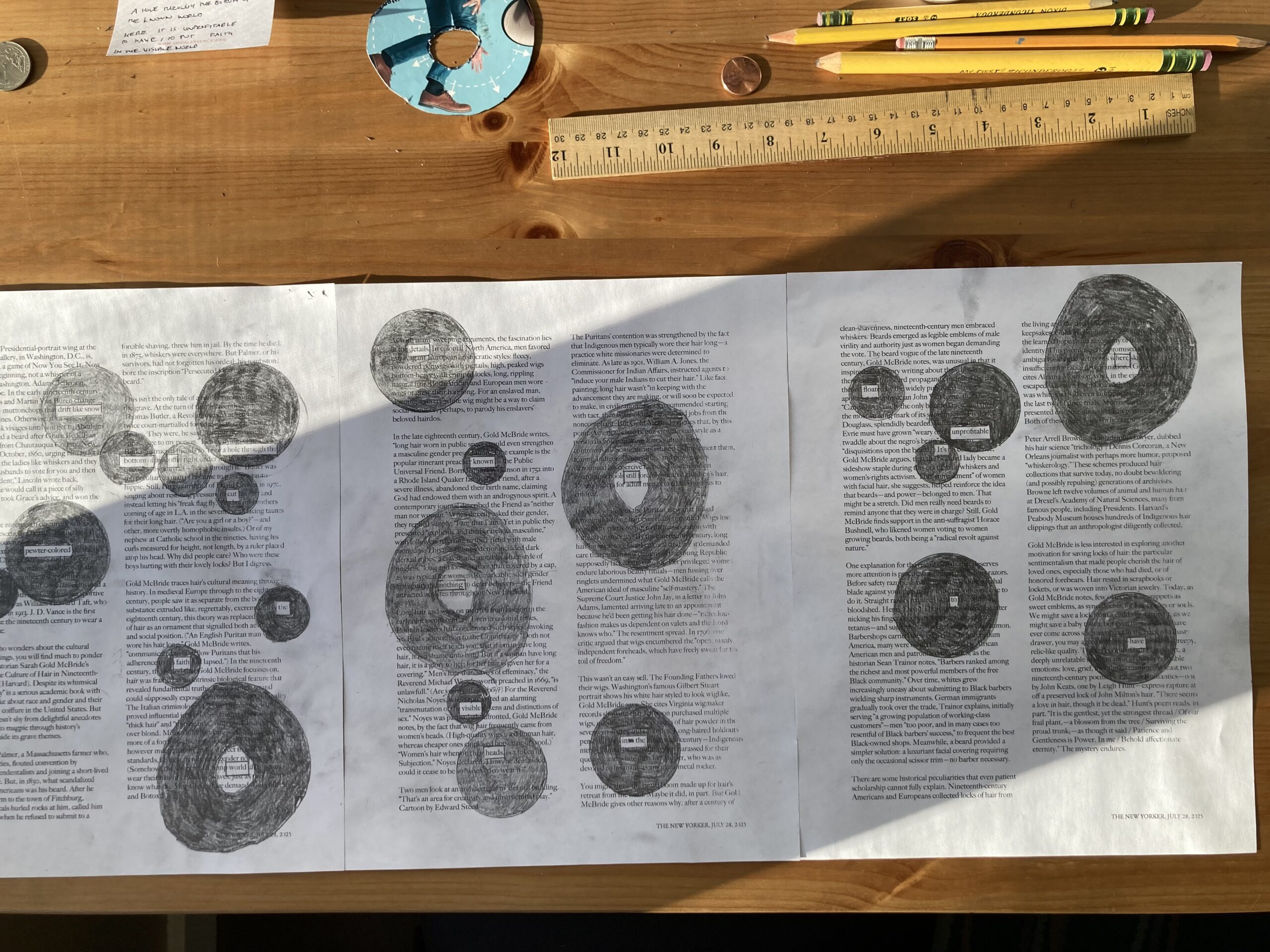
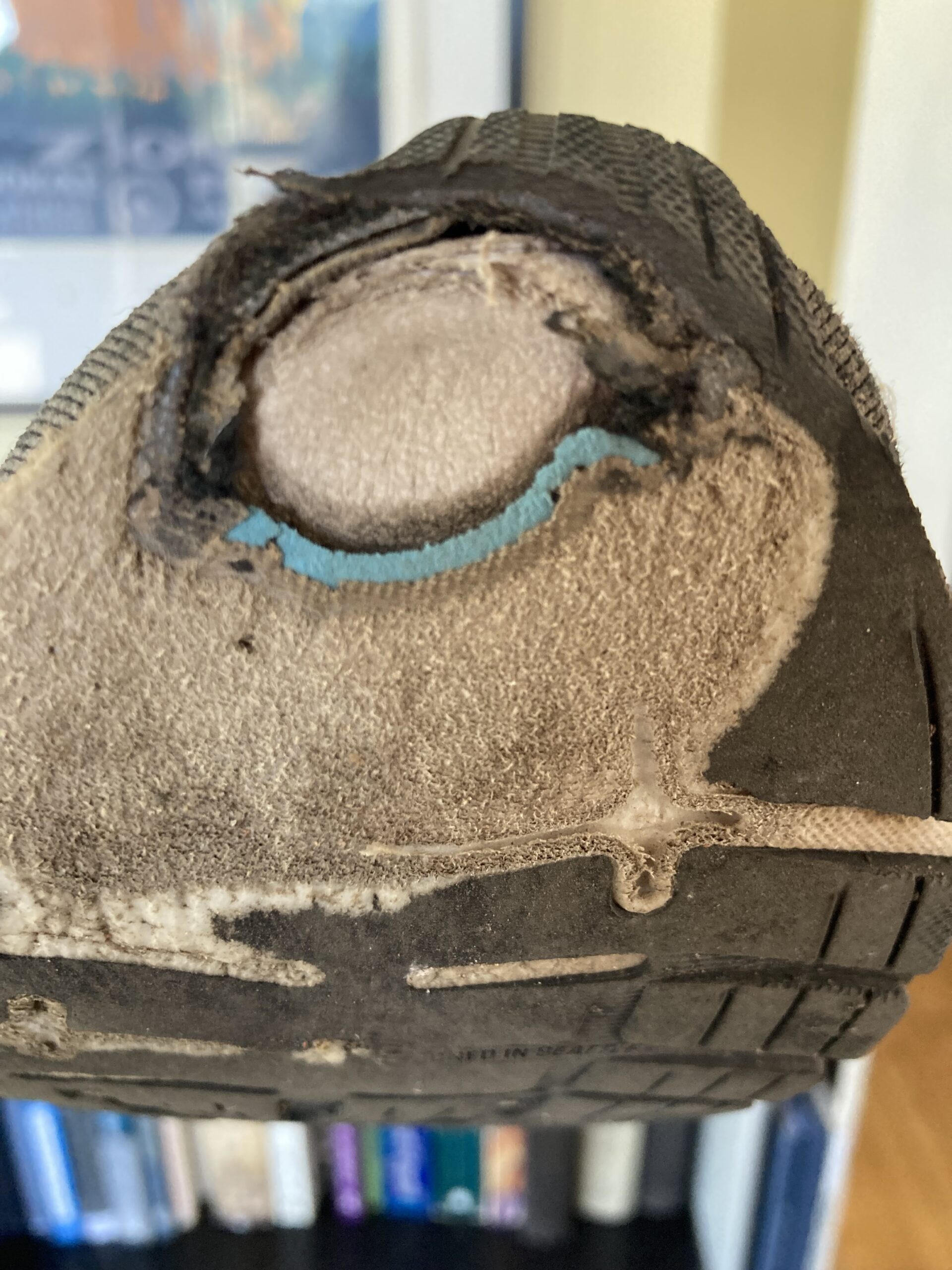
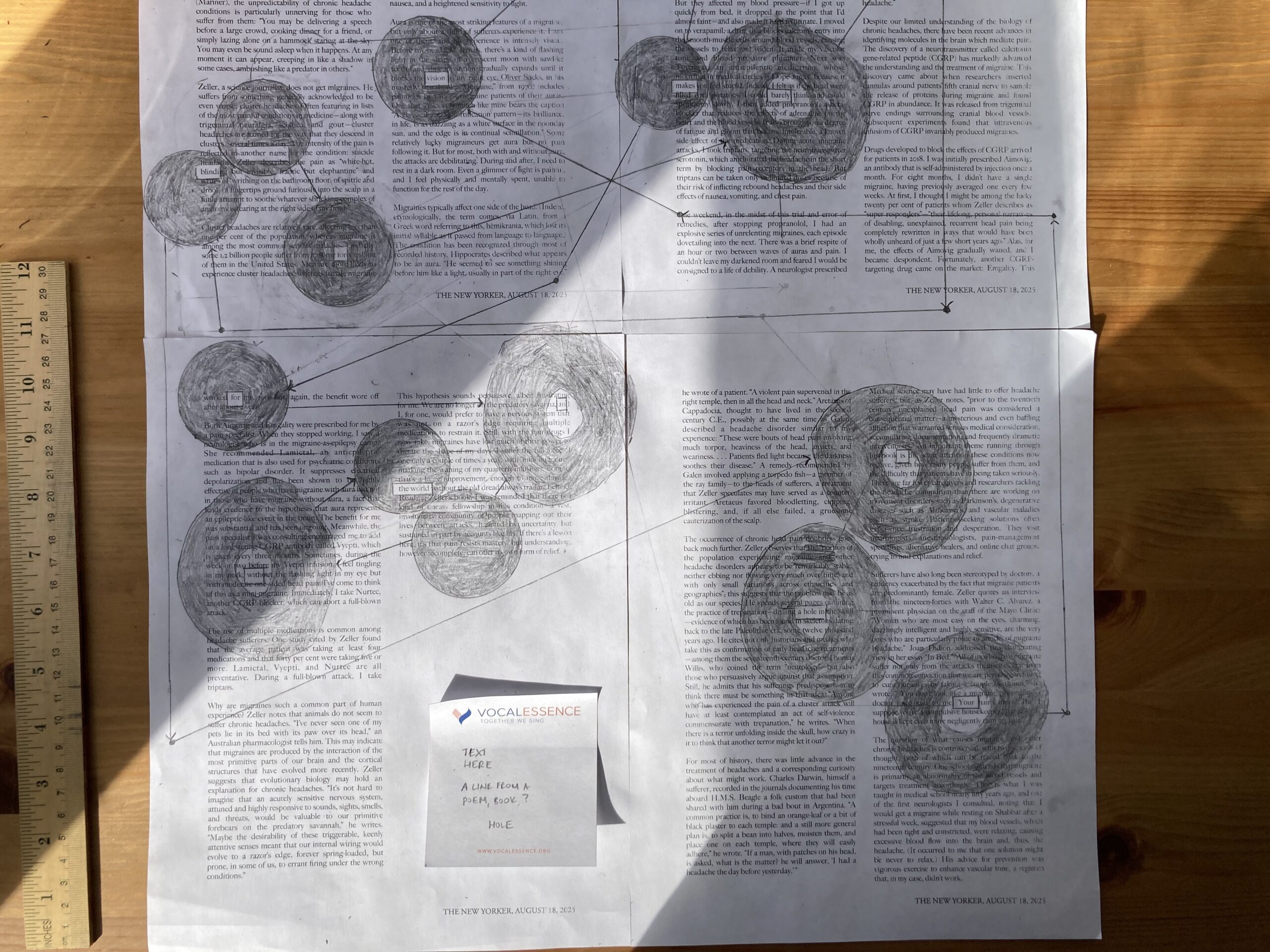
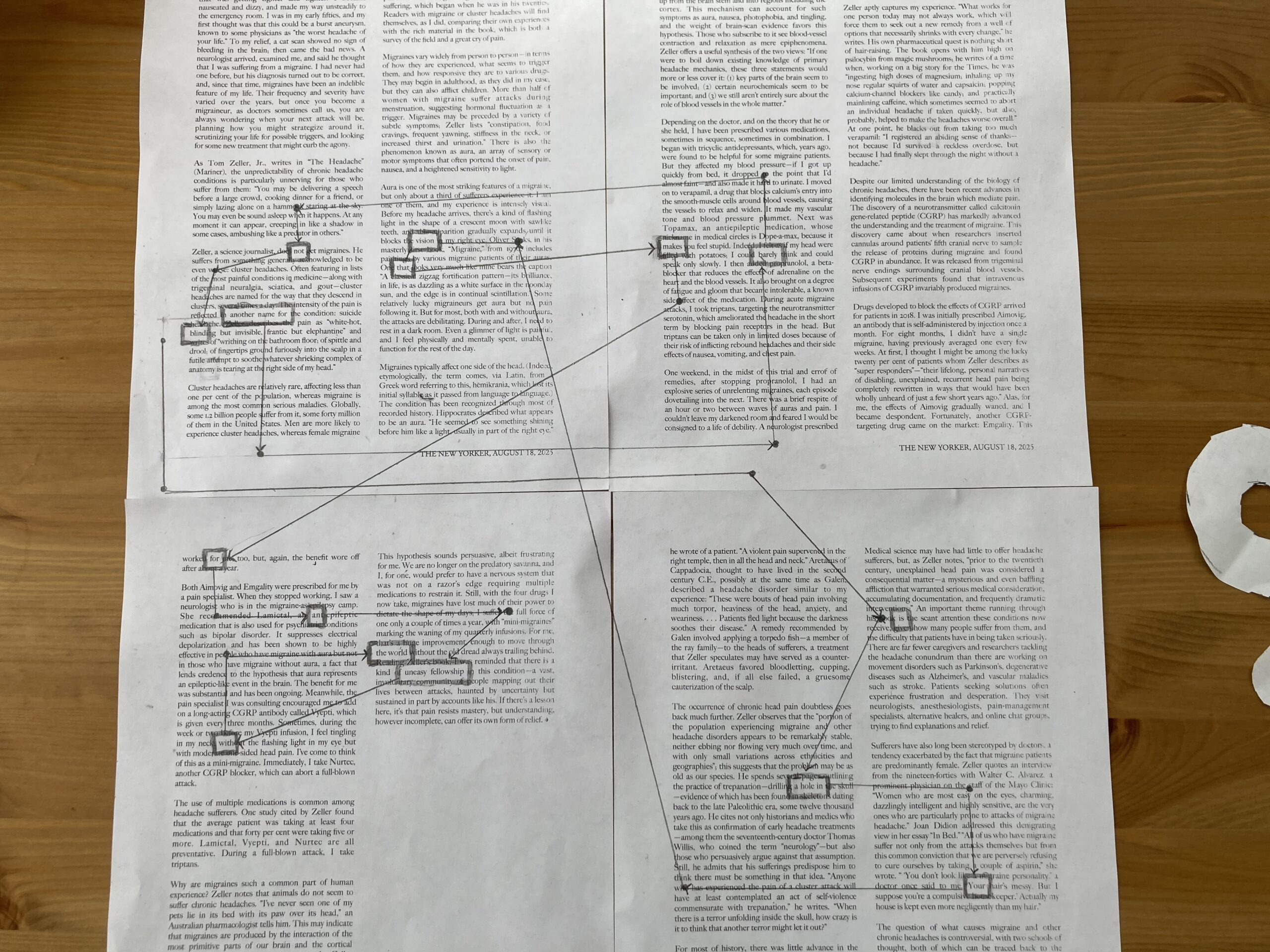
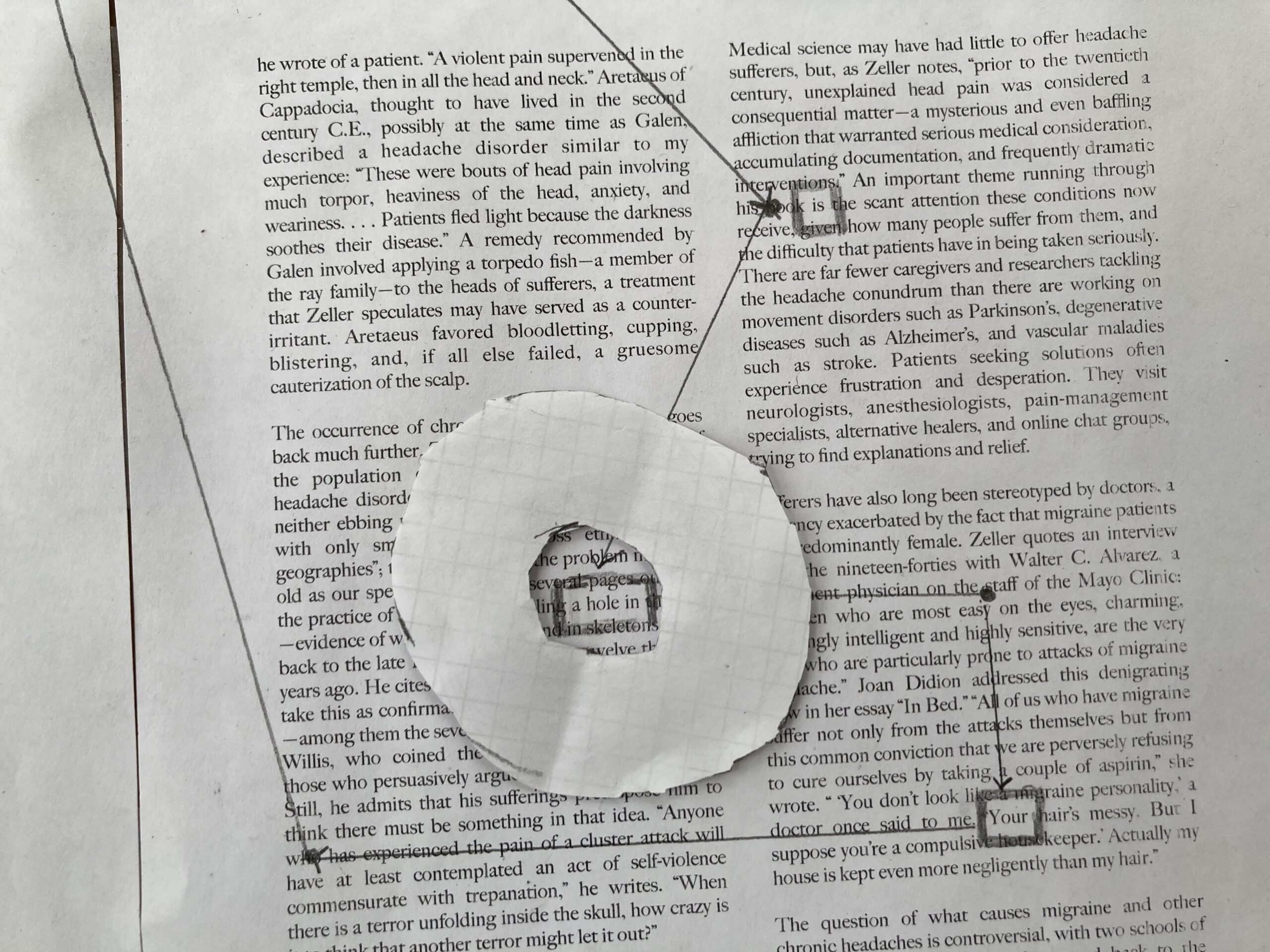
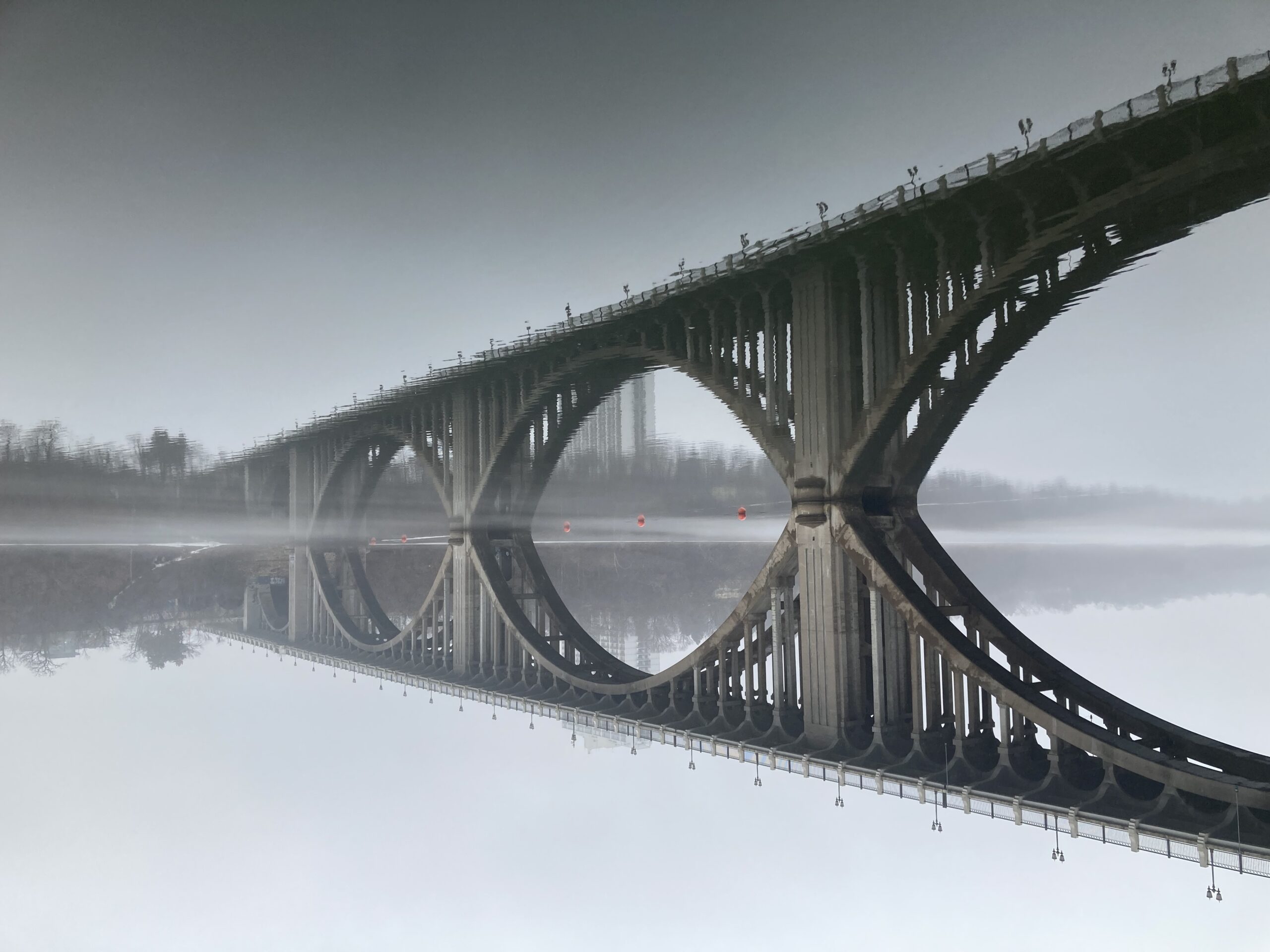
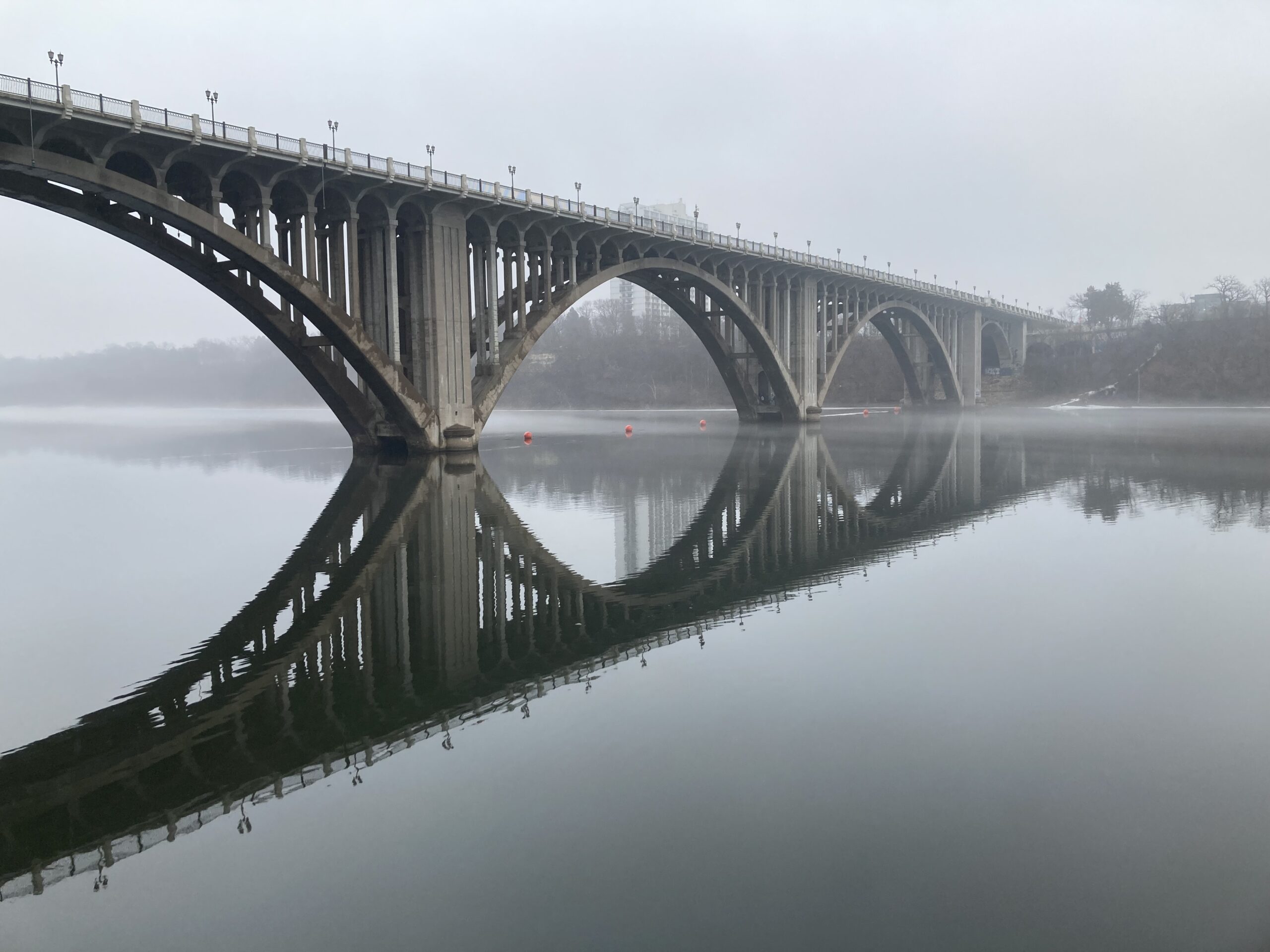
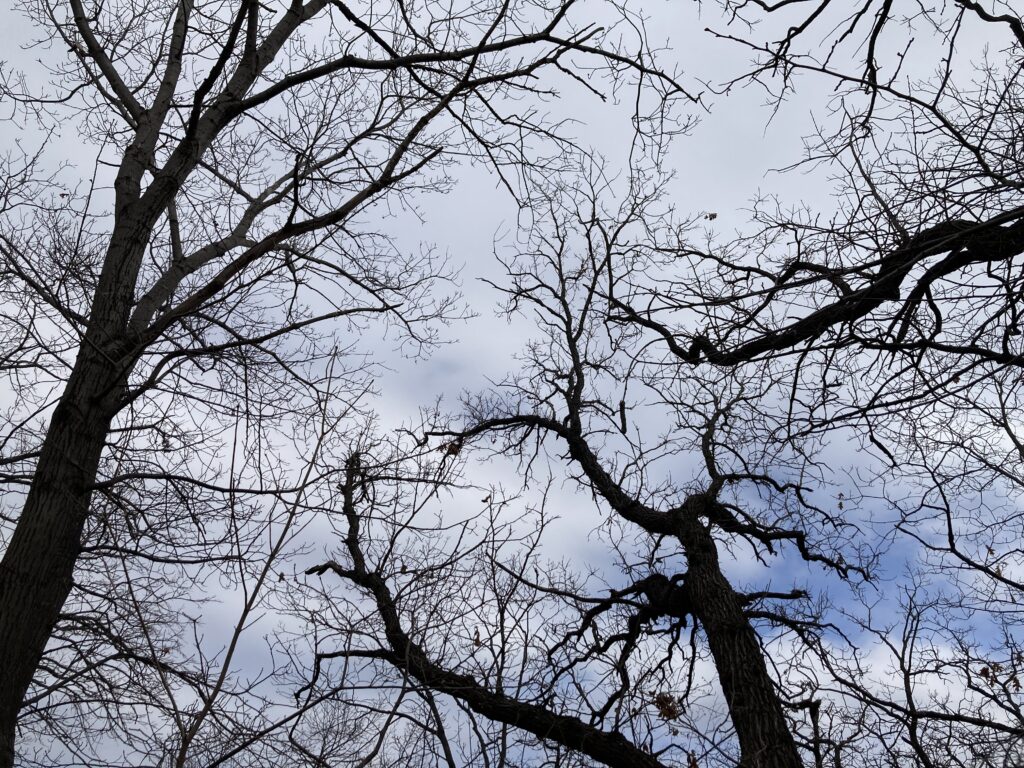
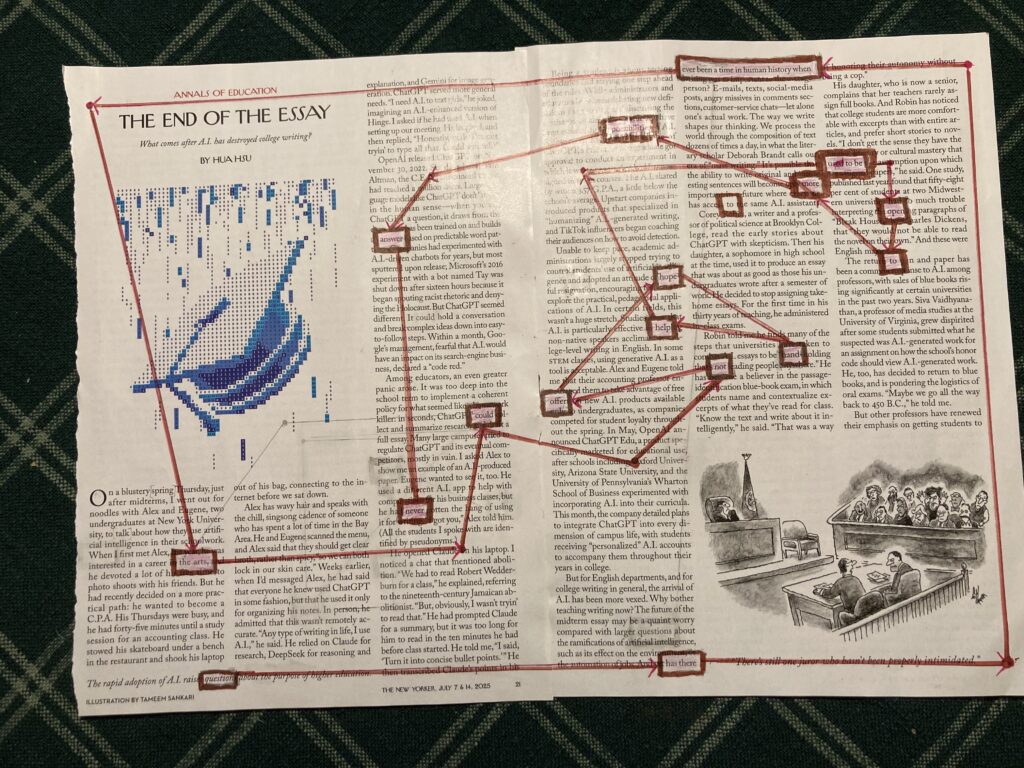
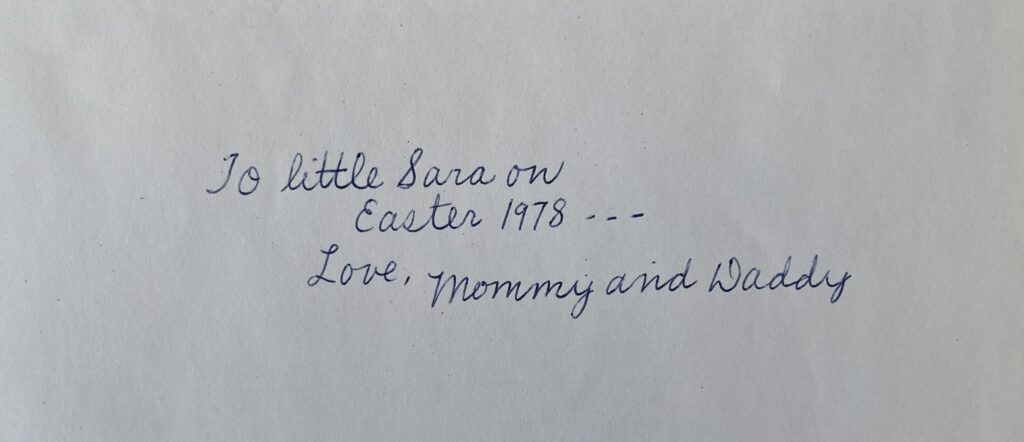
Afternoon run, in bright sun. Too hot. I’m ready for fall and cooler air! My legs felt a bit strange and tired — how much of it was the effects of the 18 mile run on Sunday and how much was the hot sun? On the way to the trestle, I noticed someone sitting on the sliding bench. By the time I returned, they had left. I heard voices below the trestle, then a flash of movement off to the side. No view of the river. Still too much green. I don’t remember thinking about anything except that I was hot and this run was difficult.
image of the day: a butterfly and their shadow
Even though it was hot and the run was hard, I’m still glad I got outside and ran above the gorge. If I hadn’t gone, I would have missed beholding the monarch butterfly that fluttered beside me. At first, I only saw the actual butterfly rising and falling and bouncing all around. Then, I noticed their shadow. A ball of dark gray on the sunlit trail. It almost looked like a little ball and it felt more solid — in its dark circular form — than the actual butterfly and its slight feather form. So cool!
Looking through my notes from an oct 2025 Girl Ghost Gorge document, and I found these lines:
her concern was the edge and the making of a form out of the edgelessness that dwells be- yond that edge
These lines, written by me, reminded me of some lines from AR Ammons in garbage that I found in another GGG document:
one thinks, slapping down the lines, making time with eternity, one will thrive beyond the brink but
beyond the brink is no recollection but a wide giving way into silver that filters farther away
into nothing
I took these lines and put them into my breathing
beyond the brink, a wide giving way in to silver filtered farther a way into nothing
The edge I am referring to is not the edge of life (death), but the edge of the bluff. And, beyond that edge is not a silvery nothing, but a river, floodplain forests, another edge: a gorge. And, the gorge, I thought as I read the lines, is not a formless nothing, but a container, a bowl. I remembered that Jane Hirshfield wrote a poem about a bowl.
a ramble for future Sara on the discomfort of not breathing well
The smoke is mostly gone from the air — but, for how long? — but not my lungs or sinuses. Mostly, I feel uncomfortable. I can breathe but it feels heavier, harder. Last night started terribly with lots of talking my self down: just one breath at a time, breathe, breathe, in 2 3 4 5 out 2 3 4 5. And lots of pacing. When I feel trapped (this time, in my body), it helps to move. At some point I fell asleep, then woke up, then fell asleep again. Woke up in the morning with crud on my chest and the inability to sit for more than a minute. Not being able to breathe is one of my big fears.
After we tested for Covid (and 2 strains of the flu + RSV) and it was negative, I accepted that my sore throat, closed-up nose, heavy chest, wooziness, was not anything other than inhaling too much bad air. It seems to have affected me much worse than Scott or FWA. Suddenly I realized why. I have a deviated septum. Lake and pool water has been bothering me for a decade; I don’t swim without a nose plug. And I often wear breathe right strips at night. I guess I will need to be more vigilant — more neti pots, masks, avoiding being outside when the AQI is high (how high?).
run: 2.5 miles 2 trails 74 degrees AQI: 41
I started feeling a little better in the afternoon and thought that running and the deep breathing it requires might help break up some congestion, or at least make me feel better as I moved. I think it might have helped a little with congestion; it definitely made me feel better.
Steady flow of commuting cars. The far off pounding of construction work. Birds — so many birds chirping and tweeting in the trees. Drip drip drip drip: water dropping from the sewer pipe down the ravine at 42nd. Voices. A small something on my chest and throat — cough cough. A woman in white shorts, or was it a skirt? on the Winchell trail. A man holding a dog off the trail so I could run by — thank you!/ you’re welcome.
A sunny afternoon. Warmer than I thought it would be. Not an easy run, but I did it, and I got to travel on the winchell trail, which was shaded. Mostly the trail was in complete shade, but occasionally some sun came through. In a few spots it glowed so much that I wondered if it was white paint. Nope — I double-checked, just sun. I heard some kids above, then a person sitting on the 38th street steps having a disturbing conversation about someone being shot in the head. I hope they were talking about a movie or a tv show.
5 Run and 5 Swim Things
the path was thick with bikers
the road was crowded with cars
the two benches that I recall noticing were occupied
puddles on the trail from last night’s rain
2 kids on the dirt part of the winchell trail — the younger kid to the older one: do it! the older kid’s response: that’s mean!s
several military jets flying above the lake
water color: a pale blue-green
little spirits at my feet! (minnows near the shore)
a few friends: sediment and bubbles
the water was so low — near the shore, it was far from the lifeguard stands and there was a little drop-off near the water
swim: 3 loops lake nokomis open swim 70 degrees
A great swim! Again, I swam straight to the buoys without seeing them. And when I couldn’t see anything but water and trees and sky, I didn’t panic at all.
A few silver flashes below. 1 2 3 4 5 breathe right 1 2 3 4 5 breathe left. Sometimes, 1 2 3 4 breathe right 1 2 3 4 breathe right. Steady strokes. Sometimes I was sore, sometimes I was worried about my heart rate1, and all of time I was deeply grateful to be swimming in this lake with my strong shoulders and back.
Some dog updates
First, on Saturday, Delia the dog started limping and not putting any weight on her back left leg. On Monday the vet delivered the bad news: a torn ACL. Major bummer! Delia is in good spirits. In fact, she’s managed to figure out how to hop on that leg pretty effectively. It’s hard having to stop her. Currently we’re trying to decide between surgery or not. If she were a bigger dog, there would be no question: surgery. But, with smaller dogs, taking it easy and rehabbing might be enough. Surgery is expensive and traumatic, but so is not being able to run and jump and do much of anything for many months.
Second, it is seeming more likely that the off leash dog park will be closing by the end of 2026. It is on sacred Dakota land, I support the returning of this land (see this article for more info). At first, I was sad about losing it, but then Delia tore her ACL and we think it might have been at least partly due to an aggressive and unsupervised dog at the park. Many dog owners are great with their dogs at the park, but some use it as daycare, ignoring the rules of keeping your dog within sight. Even if the dog park stayed open, I don’t think we would taking Delia back there.
last night at cedar lake, my average heart rate for the swim was 160, which was alarming. Usually it’s under 130. Combine that with my anxiety over any anomaly in my watch data, and I was a little worried. Checked my heart rate after I was done: 126. Phew. Back to normal. ↩︎
hike: 55 minutes minnehaha off-leash dog park 60 degrees
note: I’m writing this the next morning. I was so busy working on pasting words for Hole 3 that I forgot to work on it.
Cool, overcast, humid. Some birds, but not as many as on Monday. An unfortunate encounter with a dog and their human who was not giving any attention to the dog and how they were being too aggressive with Delia the dog. At one point, FWA and I had to surround Delia and I called out to the dog, in my don’t-fuck-with-me-mom-voice: good-bye! go away! Finally the human noticed, (sort of) apologized and called to their dog, who ran off. But, as soon as we started moving again, the dog was back. FWA called out, would you please control your dog? And, finally, she did.
Wow, that made us mad. I’m glad that the human didn’t try to engage with us anymore because it might have escalated. A few minutes later, as we kept walking, I thought about the incident with the woman who had felt threatened by a guy she had confronted a few weeks ago in a new way.
FWA and I stewed about the encounter for a few more minutes until we encountered a sweet and HUGE black dog and their human. What breed is your dog? / A Great Russian Terrier. / What’s their name? / George. George! As George approached me, his head at my hip (he is that tall), she warned, George has a wet face. What a sweet face and disposition! FWA agreed, adding that George had the energy of an old soul. Walking away, I wondered about the origins of the Great Russian Terrier, imagining them in Peter the Great’s entourage.
a few minutes later: I was wrong. They were bred by the Soviet Army and served as guard dogs at the Siberian Steppes. Yikes!
Watching this video, I was reminded of George. What a sweet dog, and a sweet human who has cared for him so well!
water level watch: for the past month or so, I’ve been taking note of the rising and falling water level at the beach at the tip of the park. One time, the water had consumed most of the beach, another time it was so low that we could walk far enough to reach a biggish log. Today that log was underwater by about 40 feet (in distance, not depth).
run: 4.5 miles reverse veterans home 64 degrees
Since my blue running shoes seem to be bothering me, I decided to try out my bright yellow shoes again. It felt so strange to run in them for the first 5 minutes, like everything was discombobulated. Awkward, wrong. Slowly I got used to them, but they didn’t feel okay until mile 4. And they never felt great. Sigh. Am I going to need to invest in different shoes?
10 Things
so many cars on the road, zooming past, fast!
the falls were gushing white foam
a line of surreys waiting to take over the paths and annoy Scott
2 people sitting on a bench, another next to them in a wheelchair, all of them laughing about something, having fun
passing a couple, overhearing the guy saying something cliched — I wish I could remember the expression — I think he was being ironic
2 dozen middle-schoolers (I think?) running along the trail — spread out, some fast, some much slower — a track team?
stopping at the huge boulder that looks like a chair, a person emerged out of the oak savanna
a biker’s bright headlight cutting through the trees
big groups of people all around the falls
the faint chiming of the light rail’s recorded bells
A good run — not the best, but definitely not the worst. Other than my feet burning near the end of mile 3 (thanks, warts), I felt strong and fit. For the entire run, I listened to an audiobook that is due in 3 days: The Buffalo Hunter Hunter / Stephen Graham Jones. Such a great book, and difficult/painful to read as it forces me to confront the violence against indigenous peoples that is the inheritance of all settler colonists. The violence in the book (it is a horror book about a vampire) is not gratuitous but reflective of the horrific violence done to American Indians in order to take their land.
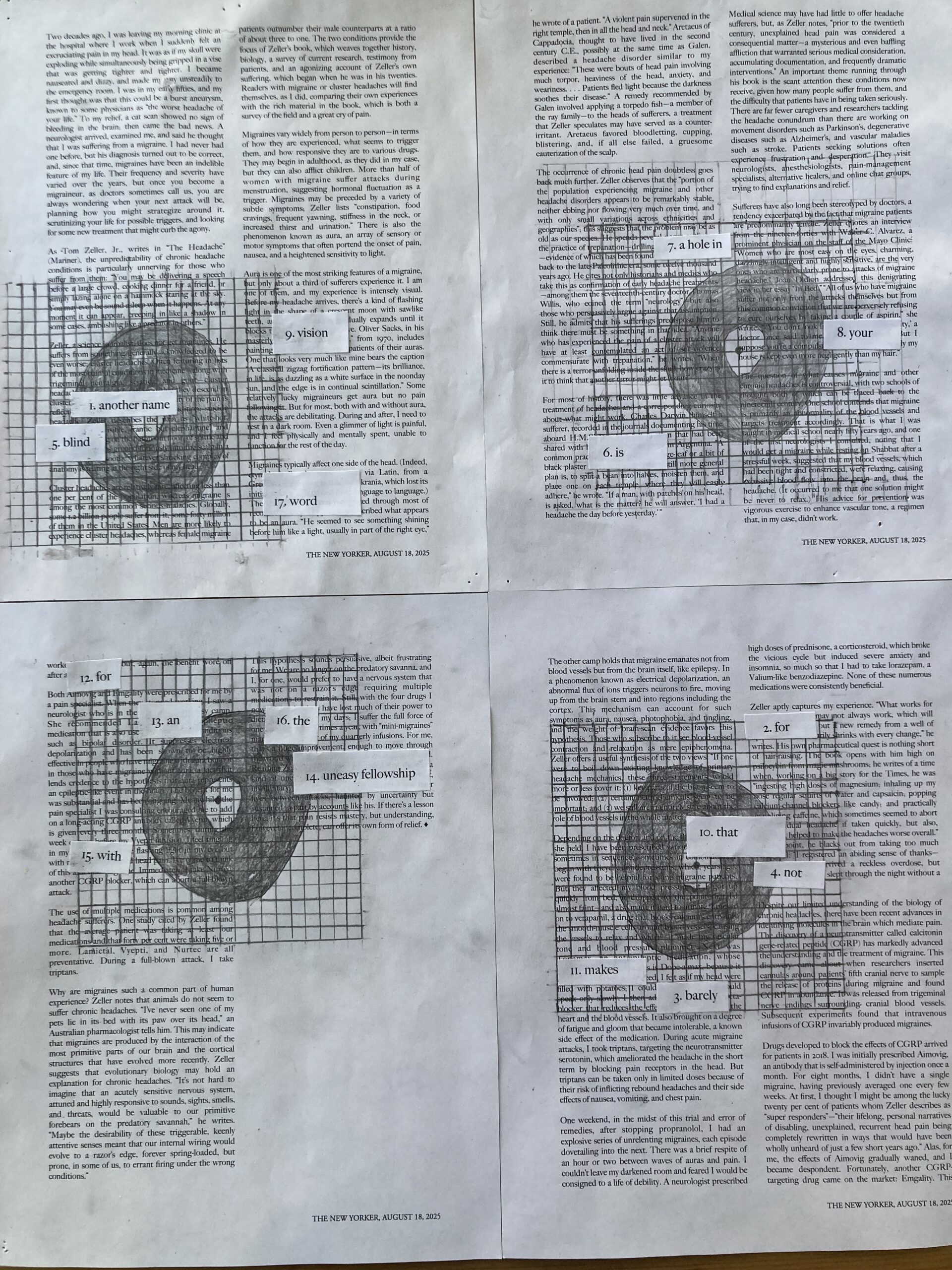
holes 3
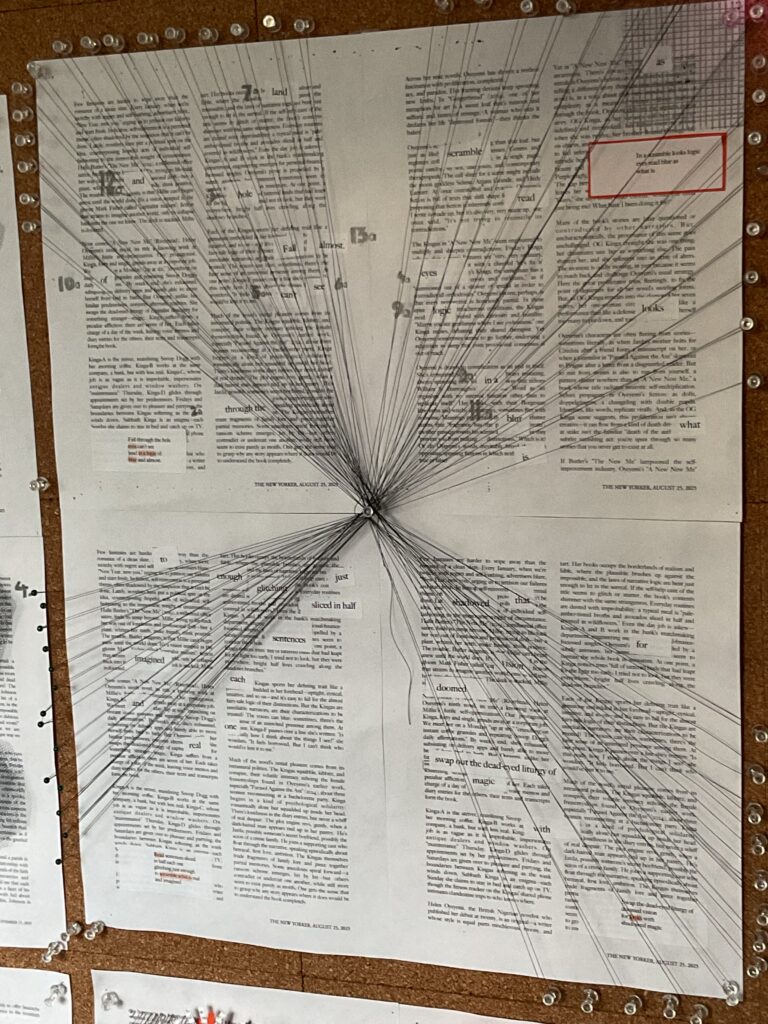
Today I cut out the words of the poem and pasted them on the essay. Realized after I did it that I should have numbered them — one of my main ways of guiding the reader in what direction to go when reading the words. Oh well, this is only a preliminary version. I played around with how to thread it — from the upper right hand corner to mimic my blooms poem, or in the center and all around. I like the center better. I told RJP that I liked to try using a bigger needle for the center — the eye — and have the thread go through that. RJP told me I need a tapestry needle. Time to go shopping again!
threads over essay
Next up: play around with light to create shadows. As I worked on this thread technique, I wondered if it might not work better for another of my poems about the strings unravelling? Instead of thread for this one, maybe I should focus on playing around with shadows a lot more? Fun!
52 in the afternoon is not warm enough for spring, but it was fine for my run. Sunny, still, beautiful shadows. All over the sidewalk: little explosions of shadow buds on the tips of branches. While on the upper trail I listened to my “Sight Songs” playlist, when I went below I listened to voices floating above, rustling below, and the warning cries of black-capped chickadees.
I took the lower trail through the oak savanna, past the ravine, up the gravel trail to the ancient boulder, down to the tunnel of trees, then down the old stone steps to the river.
10 Things
rustling below — an animal, maybe a turkey? No, a human in a bright red jacket
ruts and cracks all over the few parts of the lower trail that are paved
green exploding everywhere, new leafs on a tree, pushing through the slats of the wrought iron fence
voices of kids, playing at the school playground
blue water
tree shadows, some sprawling, some exploding
a new layer of gravel
ran through a small cloud of gnats and trapped at least two in my eye juice — yuck!
very soft and deep sand on the small trail winding through the floodplain forest
loose gravel on the hill out of the ravine, making it more challenging to run
more holes
Still playing around with how to visualize the different hole poems and how to introduce/present the different elements: word, line/string/thread, hole. A wild idea last night that I can barely imagine executing. For a poem in which I have a double grid — one grid drawn directly over the poem, another created out of thread elevated above it — I would use needles instead of pins for stringing the thread. Yes, this is ridiculous — if I’m doing the math right, that would be 84 needles to thread, which I will never have enough spoons for. But wait — what if I put 2 needles on the center dot and used pins for the perimeter? How would this look? I’ve been thinking of the needle as eye ever since I used the phrase, threading the eye of a needle. Hmm, that idea needs to simmer some more.
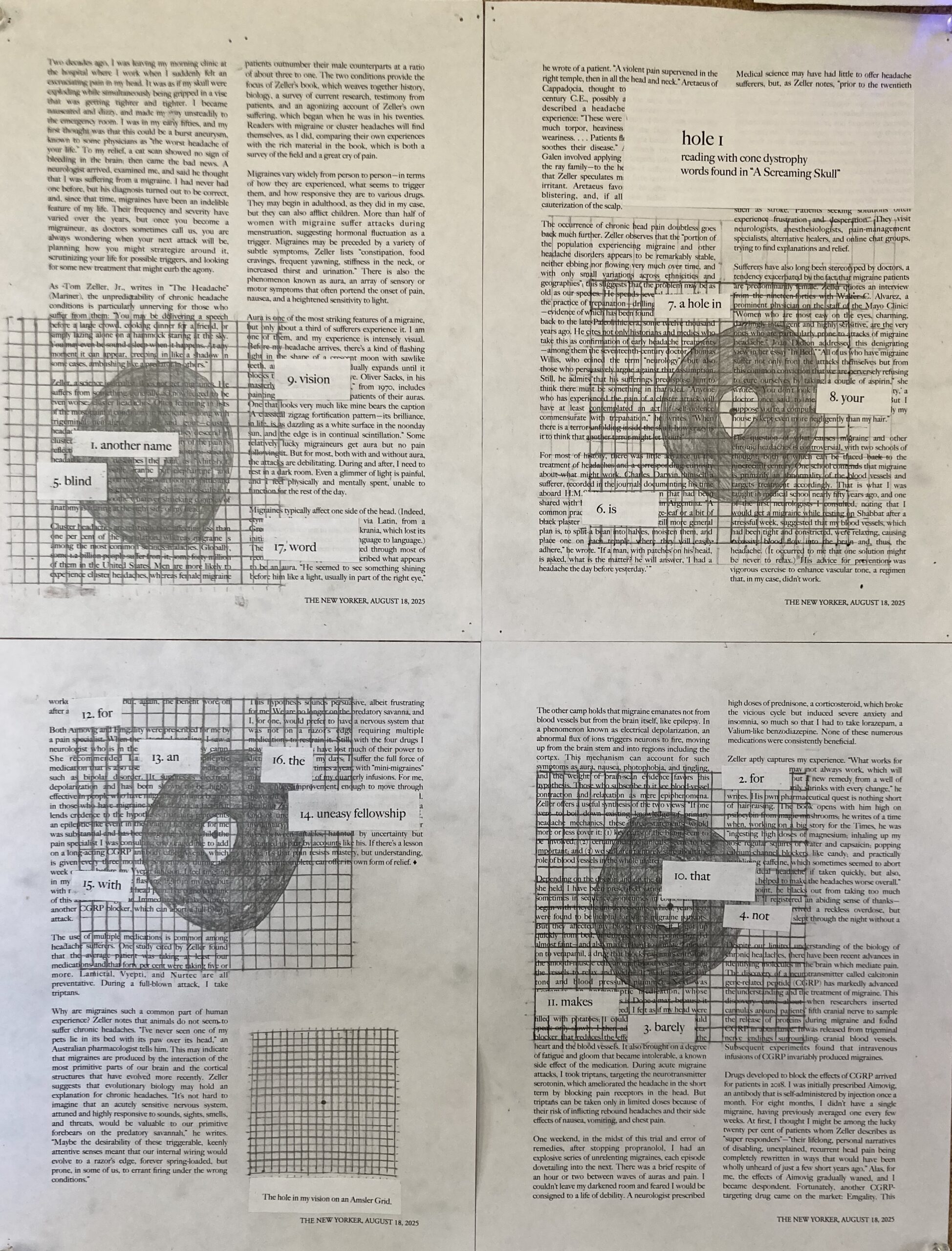
This morning, I returned to Holes 1 and thought about how to find the words on the pages of the New Yorker essay. This poem was the start of this w/hole journey, so I imagine it as an introduction to the series and to the key elements — in particular: hole = blind spot and line/string = lines of amsler grid. Sara this second has decided on this plan: a grid with my blind spot on it for each panel, drawn over the words of the poem / the words printed out on other paper, then cut out and pasted on top of the grid, each numbered / an additional grid with blindspot/hole drawn at bottom as key/for explanation. Here’s the first stage:
Holes 1 / phase 1 (7 may)
an hour or two later . . . Next, I drew on an Amsler Grid then glued on a caption and the title of the poem. I still need to draw the hole in my vision directly on the grid. This will require scaling the hole down. I’m thinking of trying out the Chuck Close grid method on another amsler then cutting it out and tracing it on the “real” one. That’s post-run Sara’s job.
holes 2 : phase 2, 7 may
I like it! I was able to (very) roughly approximate my hole to fit in the smaller grid, but I won’t post it here until it has been published somewhere.
Brr. Was glad I wore my winter tights this early afternoon. I almost wish I had had gloves near the beginning. Saw the parks crew out near the savanna, looking like they were getting ready for another controlled burn. Overcast, windy.
10 Things
the smell of freshly cut grass somewhere — was it near Wabun, or was that at my last run through Wabun
the top of a wooden fence, missing
another fence top, broken and slanted
gushing water below, 1: on the bridge connecting the veterans home and the river road
gushing water below, 2: above the falls, the creek below
gushing water below, 3: the sewer pipe in the 42nd street ravine
shshshsh of the soft suface on the dirt trail next to the paved path
the very LOUD monthly severe weather siren that blasts the first Wednesday of every month
a few school buses in the falls parking lot, at least one group of people clustered above the falls
empty benches
grids and holes 1
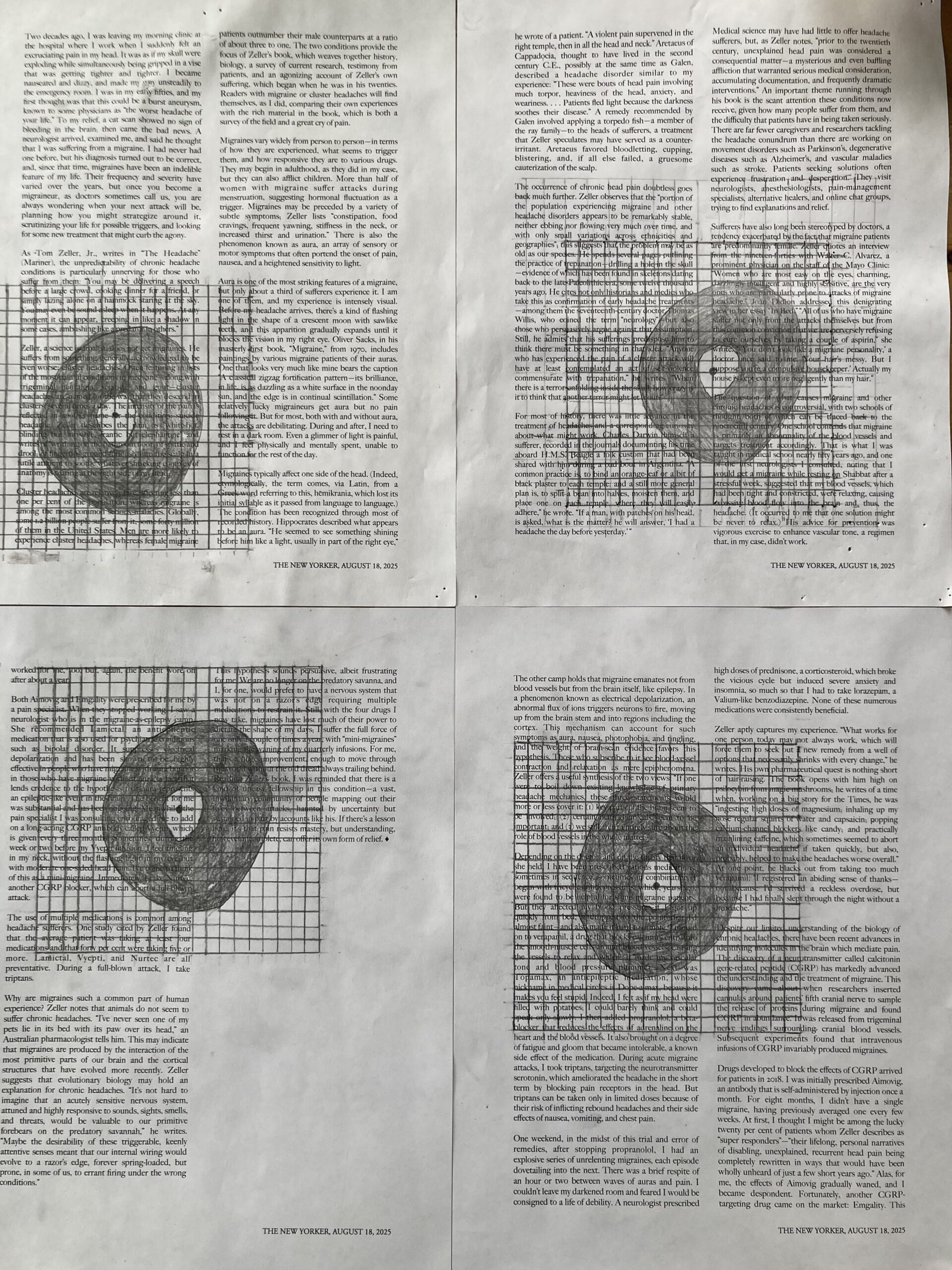
A favorite journal, Unlost, is open for submissions. They feature found and visual poems. I’d like to submit a few of my found poems, so today I started fine-tuning holes 1. First I finished drawing grids and my blind spot/hole on the panels of the essay:
holes 1 / 5 grids
I could keep all the pages intact, then place some plastic over all them OR I could cut out the grids, put plastic over each, then place them beside each other to create the poem. I also like the idea of the double grid with pins and thread. Maybe I’ll try the pins tomorrow (and maybe I’ll leave the plastic for non-hole poems?).
hike: 53 minutes minnehaha off leash dog park 40 degrees
At the beginning it was chilly this morning, even with gloves, but by the time we were heading back to the parking lot, it had warned up. More green. Another very LOUD woodpecker. Fun encounters with other dogs. One of them was just a little smaller than Delia and covered in chocolate fur. Something about how they darted around made me think they weren’t dog but some other creature — Thing 1 or Thing 2 popped into my head. More good and difficult conversations with FWA. I’m trying to respect his need to figure things out on his own timeline, but it’s very hard to watch and not say anything.
When we got back to the house, Scott told me that he read an article in the Star Tribune this morning about how they might have to shut the dog park down. It’s sacred Dakota land and some (many? all? — I haven’t read the article; it’s behind a paywall) tribal leaders want it returned to the Dakota people. I would be very sad if this wonderful park closed, but I support the Dakota people and their claims to the sacred land. I hope some sort of compromise can be reached.
run: 4 miles river road, north/south 49 degrees
An afternoon run. A little warmer and much sunnier. So crowded on the river road! Car after car after car. Near the trestle, the cars were backed up — at least 10 cars stopped in a line, extending both ways. The floodplain forest below the tunnel of trees was thick with green — no more river view here.
After climbing out of the tunnel of trees, I heard voices below me in the gorge. Rowers! The rowers are back! A few minutes later, I saw a roller skier. Two wonderful signs of spring. Now it just needs to stay warmer!
strings
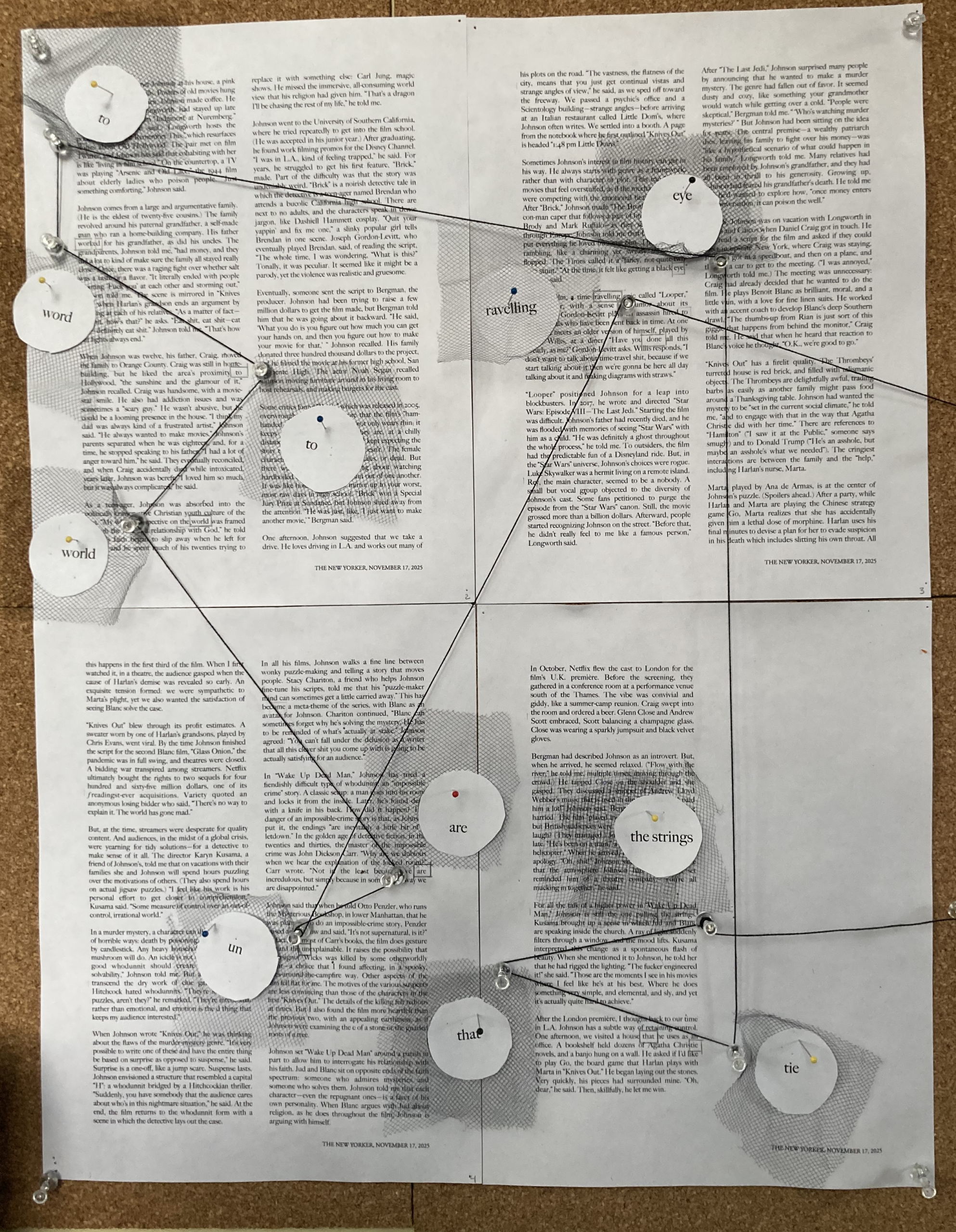
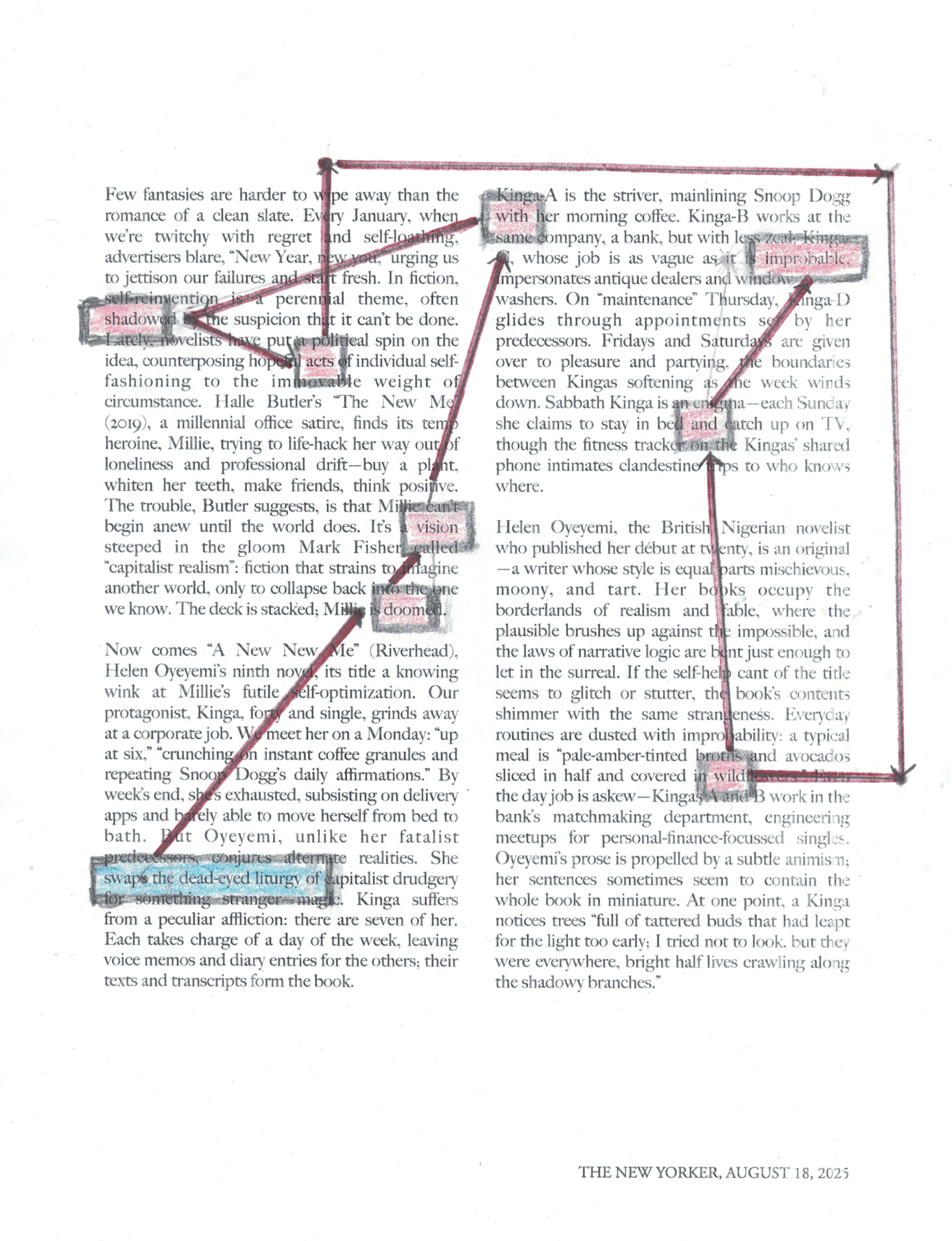
This morning, I decided to work on a new poem. Instead of holes, and my blind spot, it’s about strings and threads and the lines that connect/tether me to words and meaning. I created this poem out of words from a favorite NYer essay: “Mystery Man.” I mapped it out, then printed out the words in bigger text, then pinned it up on my cork board, then connected the words with black embroidery thread, making it look like a murder board. Here’s the poem. Each stanza is from a different page.
the strings that tie
eye
to word to world
are un
ravelling.
the strings that tie / eye / to word to world / are un/ ravelling
Is the string/thread dark and thick enough to see clearly, or should I go for thin black yarn?
I like the idea of this resembling a murder board, particularly in relation to my use of the word “unravelling.” Unravelling has two, almost opposing, meanings: 1. to fall part, to undo and 2. to solve a mystery, to make clear, to unknot or disentangle. So, the ties between eye, word, and world, are both coming undone AND are becoming more clear.
4 miles up wabun / down locks and dam 59 degrees overcast
It is supposed to rain all day tomorrow, so I ran today. Warm — shorts and a short-sleeved shirt. Spring! I ran south on the trail. Lots of bikers but no reckless biking. I almost wrote that I forgot to look at the river, or that I don’t remember what I saw when I looked at the river, but then I remembered that I noticed it at the bottom of the locks and dam hill. Blue-gray and choppy,
sight of the day:a little kid (2 or 3?) hanging over the edge of a part of the wooden fence on the edge of the hill leading down to the oak savanna, an adult holding onto them tightly. What can you tell from a scene while running of a little kid with their back to you? Not much, I guess, but it felt like the kid had a wonderful curiosity, and the adult with them was supporting/encouraging/safeguarding it.
running thoughts: I felt strong and more confident, having run the 10k race yesterday. I ran too fast — I need to slow down! After the run was finished my achilles felt a little strained or strange or both. One of my funning YouTubers has achilles problems and they keep them in check by doing calf raised after every run. Maybe I should try that?
10 Things
smell: cannabis somewhere nearby
a cardinal’s pew pew pew call
a bike peloton (15-20 bikes) on the paved path
someone on e-bike zooming by on the road
more green buds
some empty benches, some occupied
someone on a bike biking alongside a runner — marathon training, maybe for Grandma’s Marathon?
a white car speeding down the locks and dam hill, turning around, then speeding back up it
gnats! one landing on my check near the edge of my eye — I could see a black spot in my peripheral vision
the boot hanging off a stalk in a neighbor’s yard is still there, a month later
holes
Today I’m experimenting with different ways to visualize my Holes 4 poem:
you look at words. you don’t see the gaping hole. you see seltzer fizz and a nothing that is something not sharing its secrets.
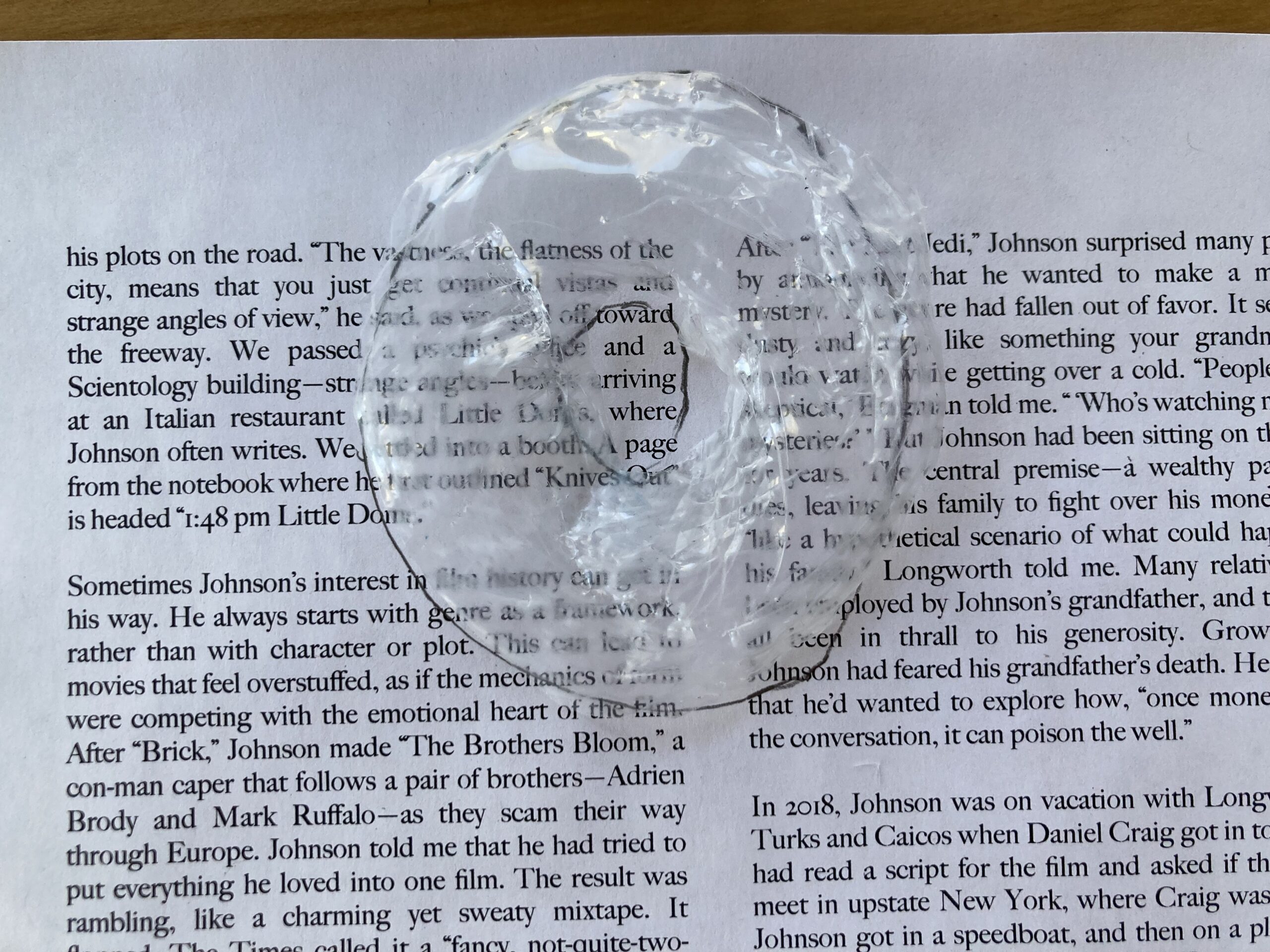
First, I cut up a ziploc bag and made dots in it with a pencil. This looks like fizz or static or snow, which is cool. A problem: you can feel it, but you can’t really see it. How to make those marks show up? Then I cut the static ziploc into the shape of my blind spot — actually, I cut out 20 of them. It’s still not visible, but I like the texture and the idea of making the visual less visible. I think I’ll use these somewhere.
After spending some time with distressed ziploc bag and not getting anywhere, I tried a different approach. First, streamline the poem, get rid of the fizz, and get over the idea of trying to represent fizz or static. Here’s the new version of the poem:
you look at words, you don’t see the gaping hole, you see a nothing that is something not sharing its secrets.
When I shortened the poem, I was able to “find” it on four instead of six of the pages of the new yorker essay.
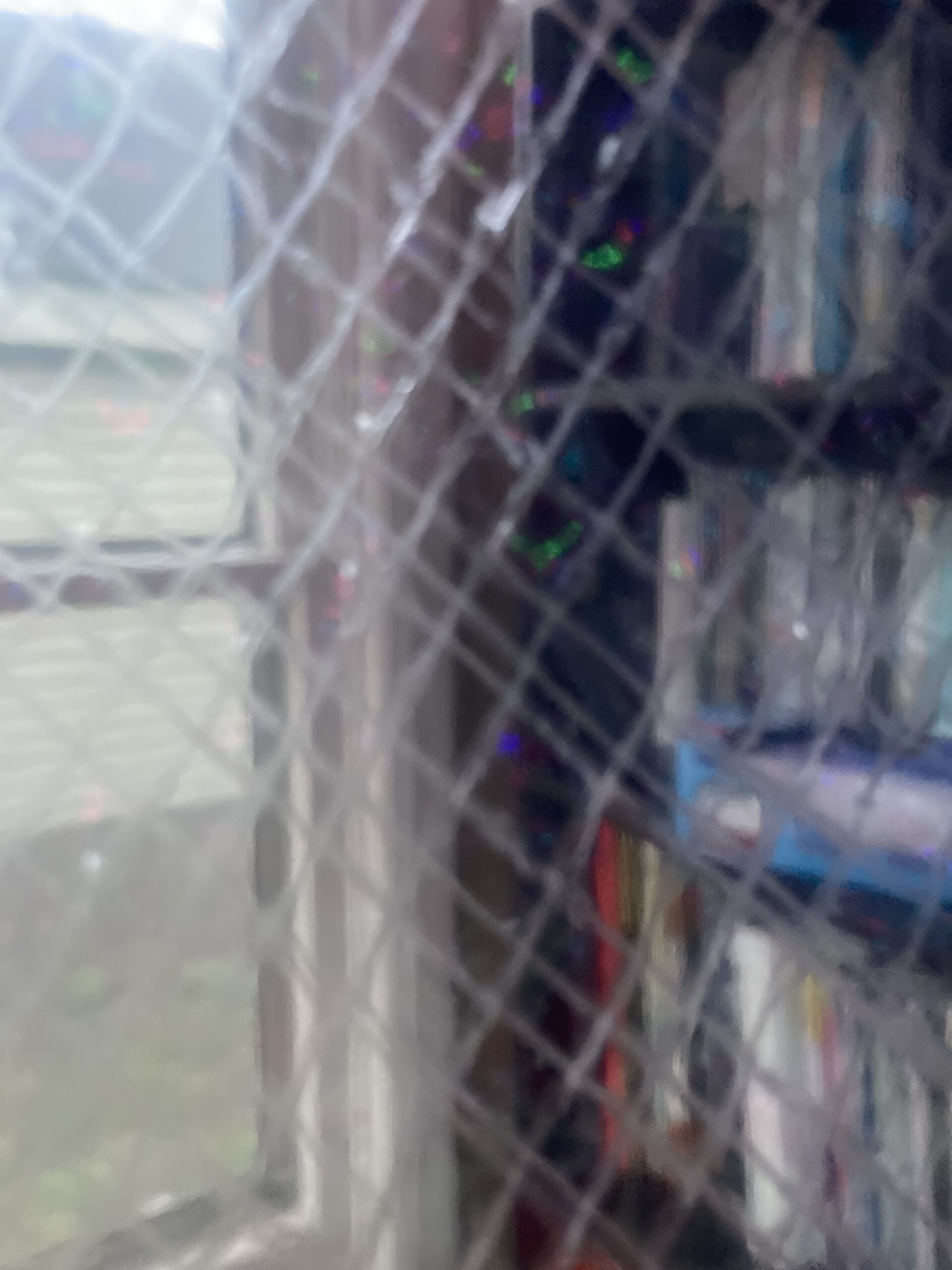
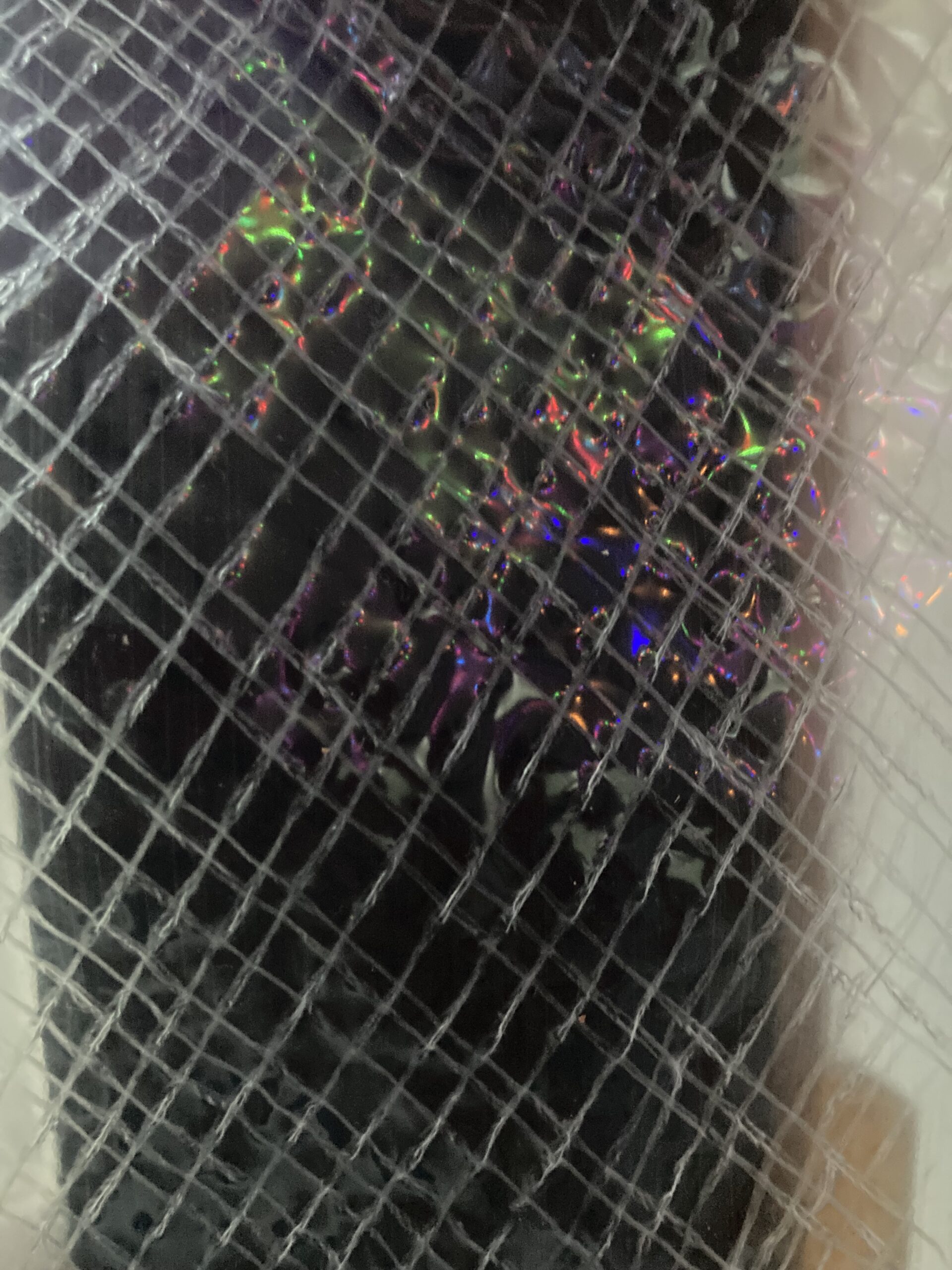
Next, instead of trying to make fizz, I decided to distress a new sheet of ziploc plastic with a criss-cross pattern. I really like it!
view 1view 2
I really like this way of distressing the plastic. And, it’s easy to do and to replicate! When I put it directly over the text of the essay, it didn’t obscure the text enough. Soon I realized that it needs to be at a slight distance. I keep coming back to the idea that these poems need to be 3-D. How should I do that?
3.75 miles top of wabun, bottom of locks and dam no. 1 43 degrees
It felt warmer than 43 today. Today’s sign of spring: the shadows of budding leaves on the tree, looking like sparkler explosions on the sidewalk. I’ve written about these in past springs — was it last April or the April before? The sky was bright blue, the water was scaled with waves. Encountered bikers and runners and walkers. No surreys yet or roller skiers. No songs blasting from radios. No soaring birds or bird shadows or birdsong. Some flashes of green, several occupied benches. I started to recite Philip Larkin’s “The Trees” — The trees are coming into leaf/Like something almost being said/Their recent buds relax and spread/Their greenness is a kind of griefi.
For the first half I listened to everything around me, for the second half: my “Windows” playlist. Demi Lovato’s anthem, “Skyscraper” came on and even though it is cheesy and overwrought, I started running faster to it and felt something deep opening. Cathartic. If it hadn’t been so crowded I might have started crying, which would have been a great release. Even without the tears, it felt good to run fast and feel free/d.
Right before my run, RJP cameo ver to tell us all about her success with the fashion show at St. Kate’s. She didn’t have any garments in it, but she served on a committee for it and helped set it up. It’s hard to put into words how big of a victory this was/is for RJP.
a quick note about Robert Macfarlane and the river:As I washed the incredible amount of dishes that had accumulated — almost ALL of them! — I finished listening to the Between the Covers episode from last year with Robert Macfarlane.side note: when did Between the Covers switch from Tinhouse to Milkweed?And does that mean I need to go through and fix my past links to episodes? Probably. Future Sara (does Sara sent somewhere work as a name?) get on that! What a gift! I’m currently waiting for the audiobook of What is a River? I checked it (or the ebook version) on 10 august but didn’t listen to it. I must have been busy doing my swimming one day in august challenge. Or maybe I wasn’t ready to hear the words. I am now. Currently the waiting time is “several months” and I am 54th in line. I hope it comes in time for summer. This is a perfect water book for my water season! Maybe if it doesn’t come in time, I’ll buy it as an early bday present? I just checked on Moon Palace and the paperback is coming out on June 9th! I’ll have to preorder it. I could spend the rest of the afternoon writing about the interview, but I’ll leave that for when I start reading — either with my eyes or ears — the book in June,
holes
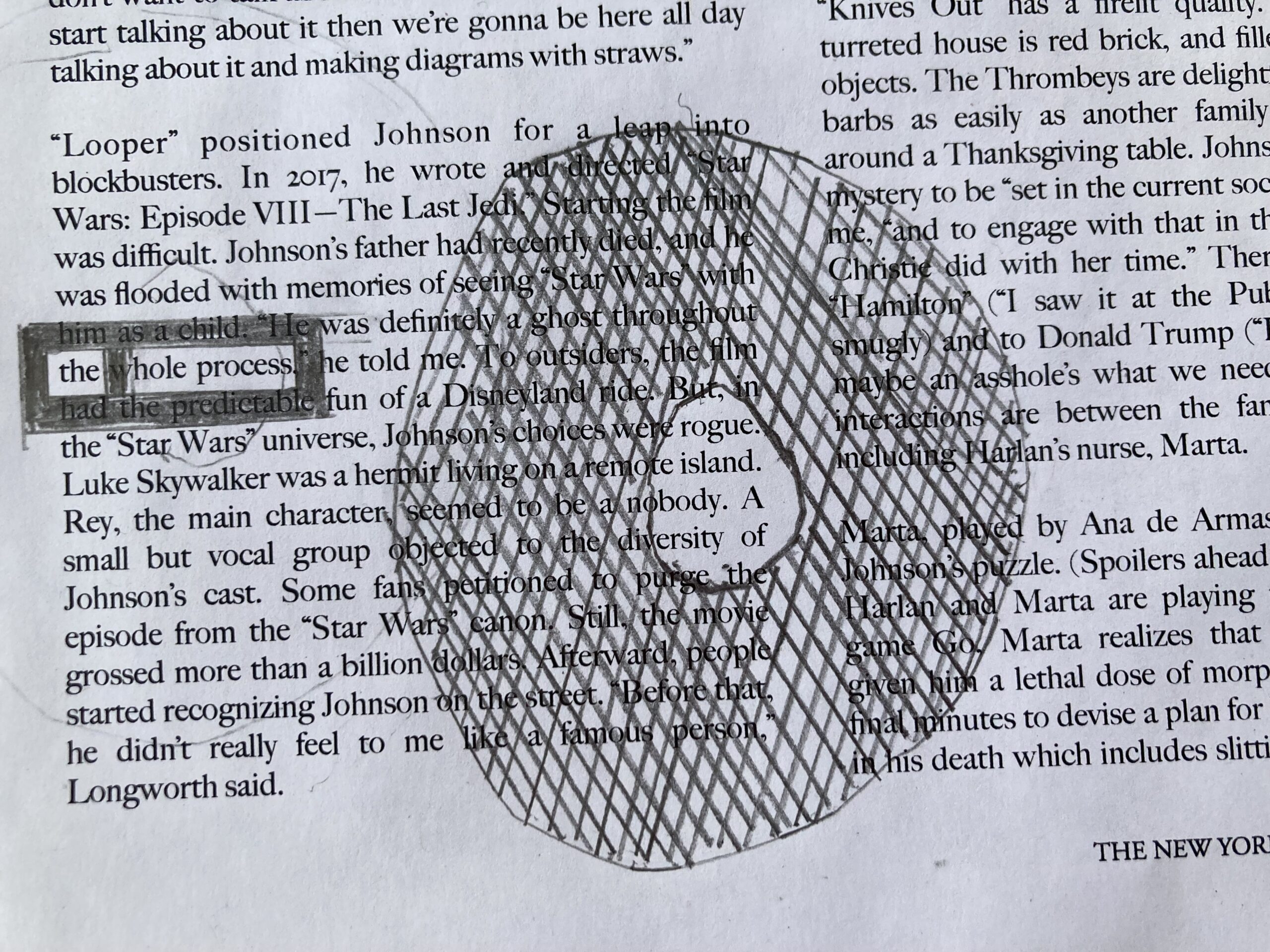
I didn’t have much time this afternoon, but I started experimenting with 2 ways to cover my blind spot template on the page. First, I created a cross-hatch pattern on one of them with a ruler and pencil. Second, I used a ziploc plastic bag. Because the bag was clear, I distressed it by drawing a spiral repeatedly using a pencil. I like the effect.
1 — cross-hatched hole2 — ziploc bag
Experiments to try tomorrow: a plastic bag (grocery store), black netting, static dots, dark pencil erased.
3.25 miles locks and dam no. 1 and back 41 degrees / feels like 24 wind: 16 mph / gusts: 27 mph
That wind! I seemed to be running into in every direction. Had to wear my winter layers: tights, 2 shirts and a pullover, hood, gloves. One too many layers and unnecessary gloves. The sun and sharp shadows, combined with the green grass and new flowers made it look warmer and springier than it was. By Wednesday it’s supposed to be 79 degrees. Then, by the end of next week, 50s. That’s a Minnesota-spring for you.
grids and holes
To distract me from the run, I decided to listen to my “Window” playlist. When I got to “Waving Through a Window” I started thinking about the window as a barrier between me and the world, which made me think of the grid on my visual poems as not only being about mapping and locating and connecting (as thread or string or line), but as net or a veil or a thing that blocks my immediate access to the word and the world. Yes! The grid as both offering connection and preventing it, or obscuring it, or weakening it.
Here’s another version of the double grid that I did last night. I noticed that I am feeling much more confident with my graph making. I worried less about it not being straight and just drew lines and most of them are straight, or as straight as I want!
double grid, version 2
I wonder what this would like if it was twice as far away and made out of some of my thicker thread? I’d like to see, but using what? Should I find some wood and nail long nails into the wood? Yes! Should that be tomorrow’s project? I’m sure we have a scrap piece of wood and some long nails in the basement!
Lately, I’ve been thinking a lot about the grid/thread/string aspect of this project and how to make it, but I don’t want to forget the hole. Reading through my entries from March, I found this:
I’d like to push at this idea of a hole in the vision, with the hole not being (just) empty or a void, but something — like a rabbit hole: an in-between space, a passageway, a liminal space, a threshold, but also a clearing (JJJJJerome Ellis), the Nothing around which something functions, the gorge.
A few thoughts:
First, I’d like to return to my original version of Holes 1, with my blind spot around each of the words. I want to experiment with different ways to “make” that blind spot — color it in with dark pencil; erase that pencil, leaving only a trace; a plastic bag; a net of thread; sparkles or something that resembles static — how do you realize that?; the black netting I bought with RJP. Instead of Holes 1, I’m using Holes 5c about the two holes.
Second, I’d like to find a New Yorker article about a gorge or a river or a field and make a hole poem out of it. I found an article: The Landscape in Winter
5.25 miles franklin loop 63 degrees / drizzle humidty: 85%
I beat the storm! Yes, there was drizzle, but no strong wind or thunder, so I’ll take the victory. Today I felt strong and relaxed and capable. Not anxious or overwhelmed. Today I also feel vulnerable and open to the world, ready to embrace any slight shifts in perspective.
Image of the Day: Running north on the east bank, looking down at the river: a sea of bright, fresh green. On this side of the gorge, between lake and franklin, there used to be a park down below, so there’s wide stretches of cleared land and open grass. Even knowing that, the green looked like water not grass to me, high up on the bluff.
Realization of the day: Returning to the west bank, running south, admiring the straight-ish ridge line across the gorge and wondering how it could be almost uniform, I realized something: this ridge line was made by humans — leveled after logging and road and residence building. What did it look like before settler colonists arrived?
on training for the marathon: Today I ran 9, walked 1. After crossing over Franklin, I did a 5 minute walk to get my heart rate below 170. Then another 9/1. After this last one I checked how long it took to get my heart rate down to 135: 2 minutes. A goal for future Sara: cut that time in half, or even more.
10 Things
flashes of white flowers on the edge of the bluff: the spring ephemerals!
little kid voices, laughing, somewhere deep in the gorge
a guy yelling near a car parked across the parkwy on seabury — was it “fun” yelling as he played with a kid, or “unhinged” yelling at someone?
chickadeedeedee
a verbal greeting with a walker: good moring! / good morring!
honking geese, a honking car horm
a grayish-brownish-blue river, empty
bright LED headlights, cutting through the thick gray air
slashes of bright green are beginning to appear in the floodplain forest!
several stones stacked on the ancient boulder
grids and strings and threads (oh my)
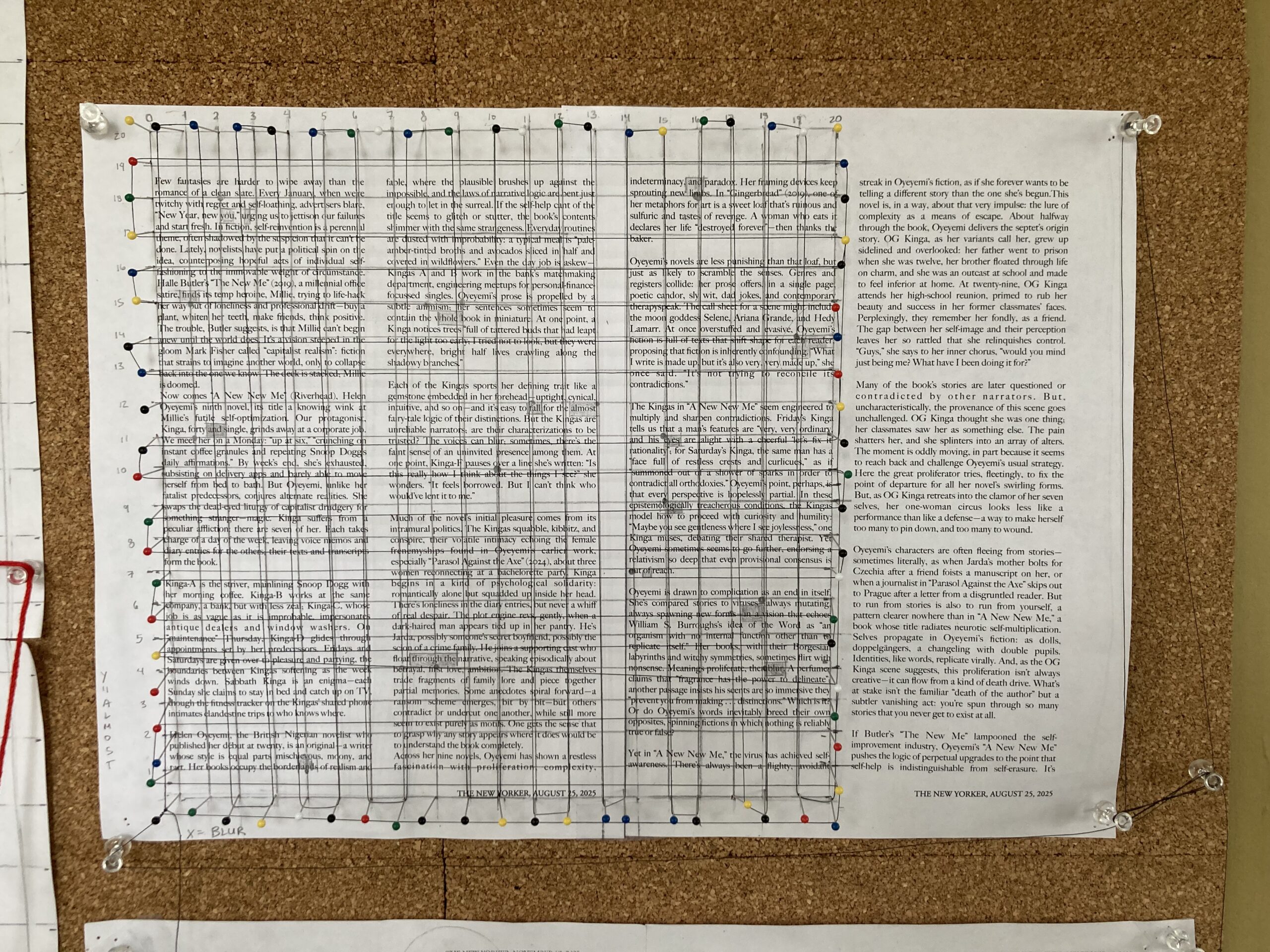
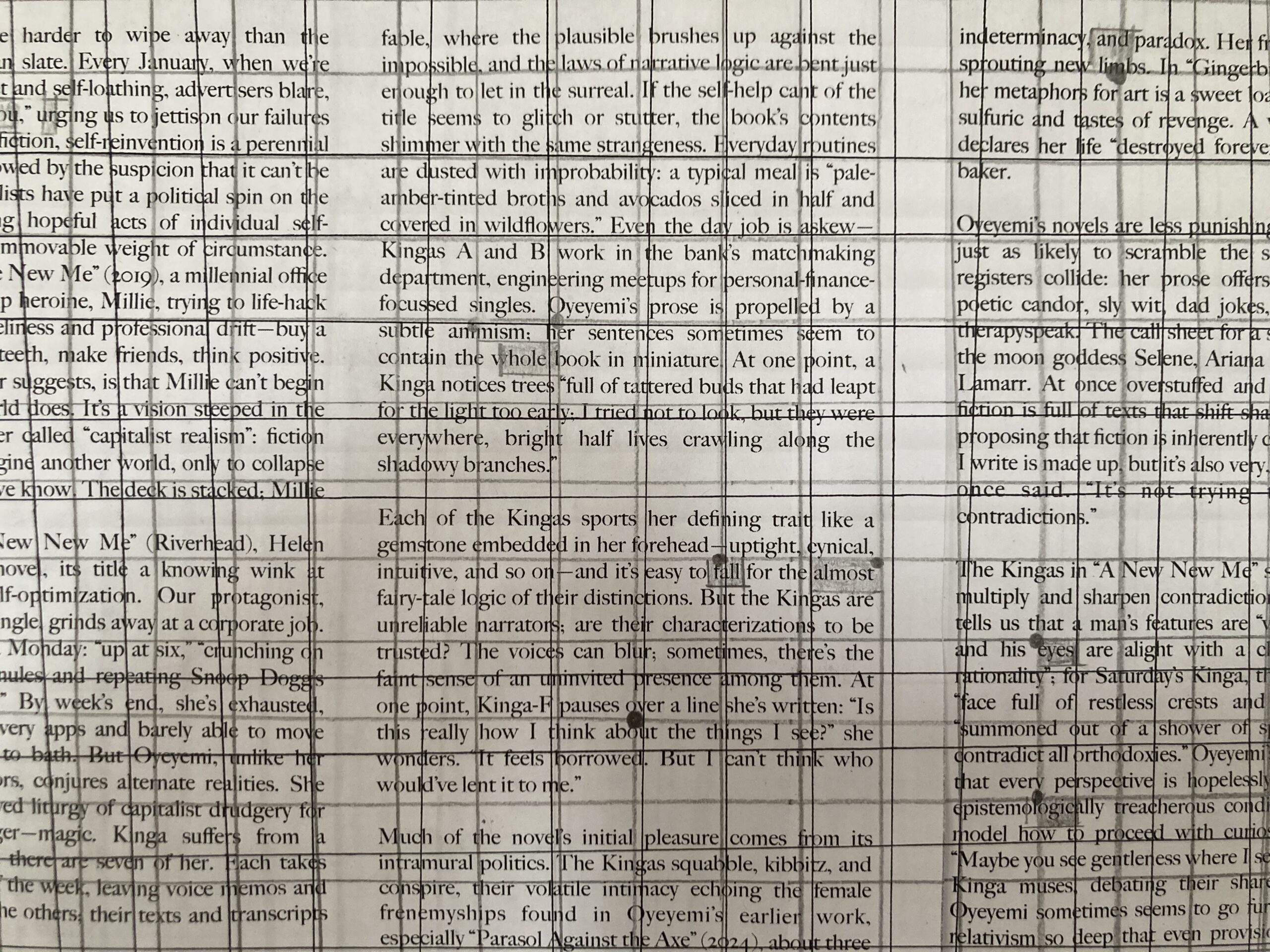
It’s a few hours after I returned from my run and it’s hailed twice and thundered and dropped 15 degrees since then. Boo. I tried a new thing with Holes 3: drew a graph directly on the words, mapped the words on the xy axis, lightly shaded in the words, repinned the grid over that, and then used thread to finish it. I like the doubling, almost out of focus feeling that the pencil grid and the string grid create. I don’t think the words are clear enough yet. I’ll have to keep working on that.
double griddouble grid, a slightly closer look (find fall and almost)
Here’s something else I tried: encasing the words in circles (using a penny) then roughly erasing the circles:
ghost hole effect
Another thought: map the words on a grid, then color in the rest of the grid box around the word or phrase from the poem. How would that look?Maybe I’ll try it on a smaller scale?
Hot! Time to start running much earlier in the day! Yes, a return to morning running could be the next step in my efforts to regain some healthy discipline.
Earlier today I found another song to add to my “Remember to Forget” playlist — Forget Me Nots / Patrice Rushen, so I decided to listen to it while I ran for 9 minutes, then walked one. Midway through the playlist, “Forget Me Nots” came on and as I listened to it, I thought about Emily Dickinson’s “If recollecting were forgetting”. Listening to Elvis Costello’s “Veronica” about a woman with dementia, I thought about how the new name Scott came up with for present Sara, Sara this second, has a much different meaning when applied to someone who has no memory beyond the now.
10 Things
flashes of bright green in my periphery as I ran by trees with new buds
hot sun
music coming from the grassy boulevard: people sitting in chairs, listening to music
squirrels squawking at each other
a loud thumping noise at the skate park
someone in white sitting on the ledge looking over the river
a biker in an orange shirt, biking very slowly over the ford bridge
the voices of kids laughing and yelling on the playground
a biker in a winter coat with a stocking cap and gloves on
the desire path on the grassy boulevard is a mix of packed dirt, mud, roots, and greening grass
holes and grids and threads
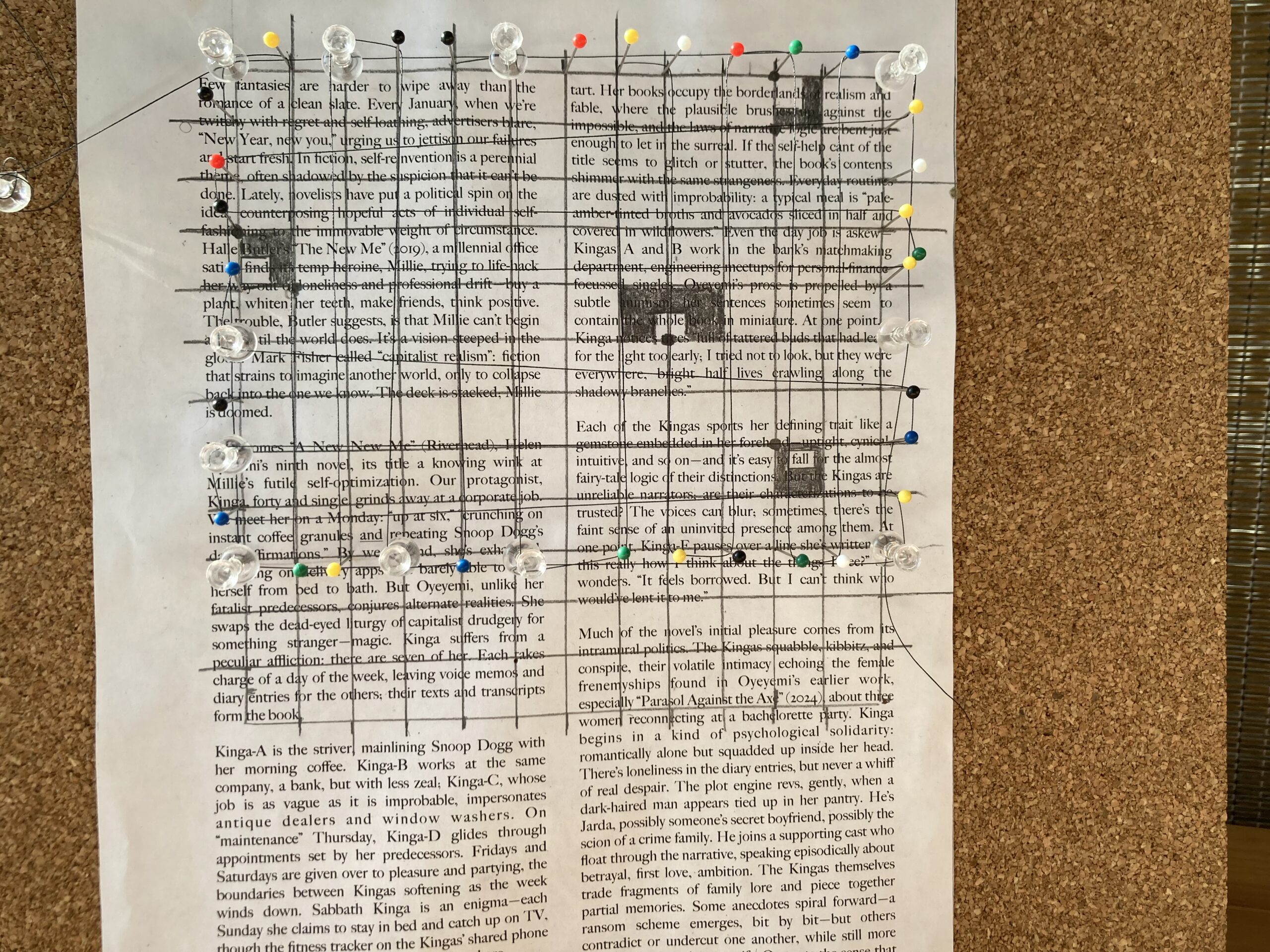
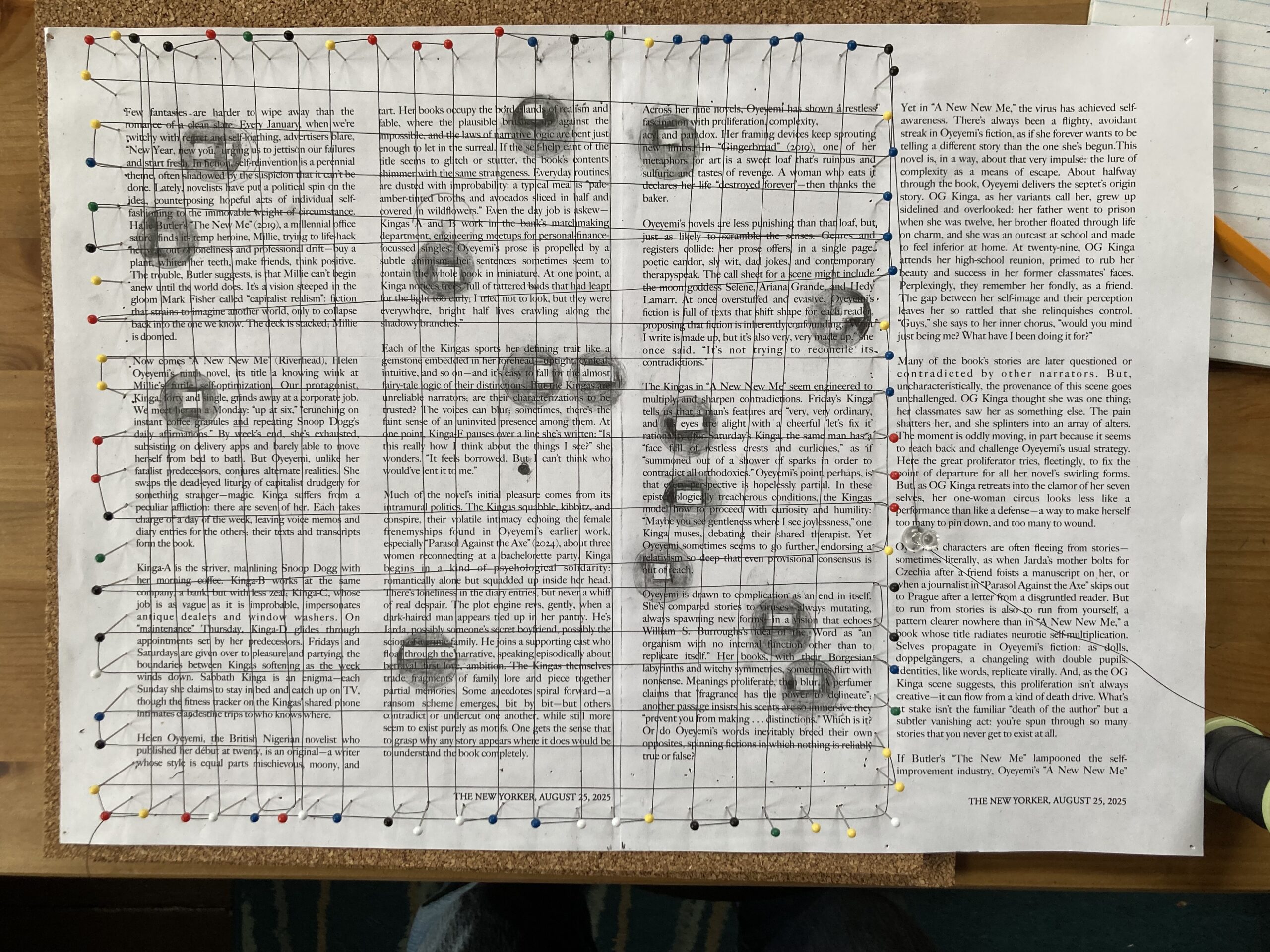
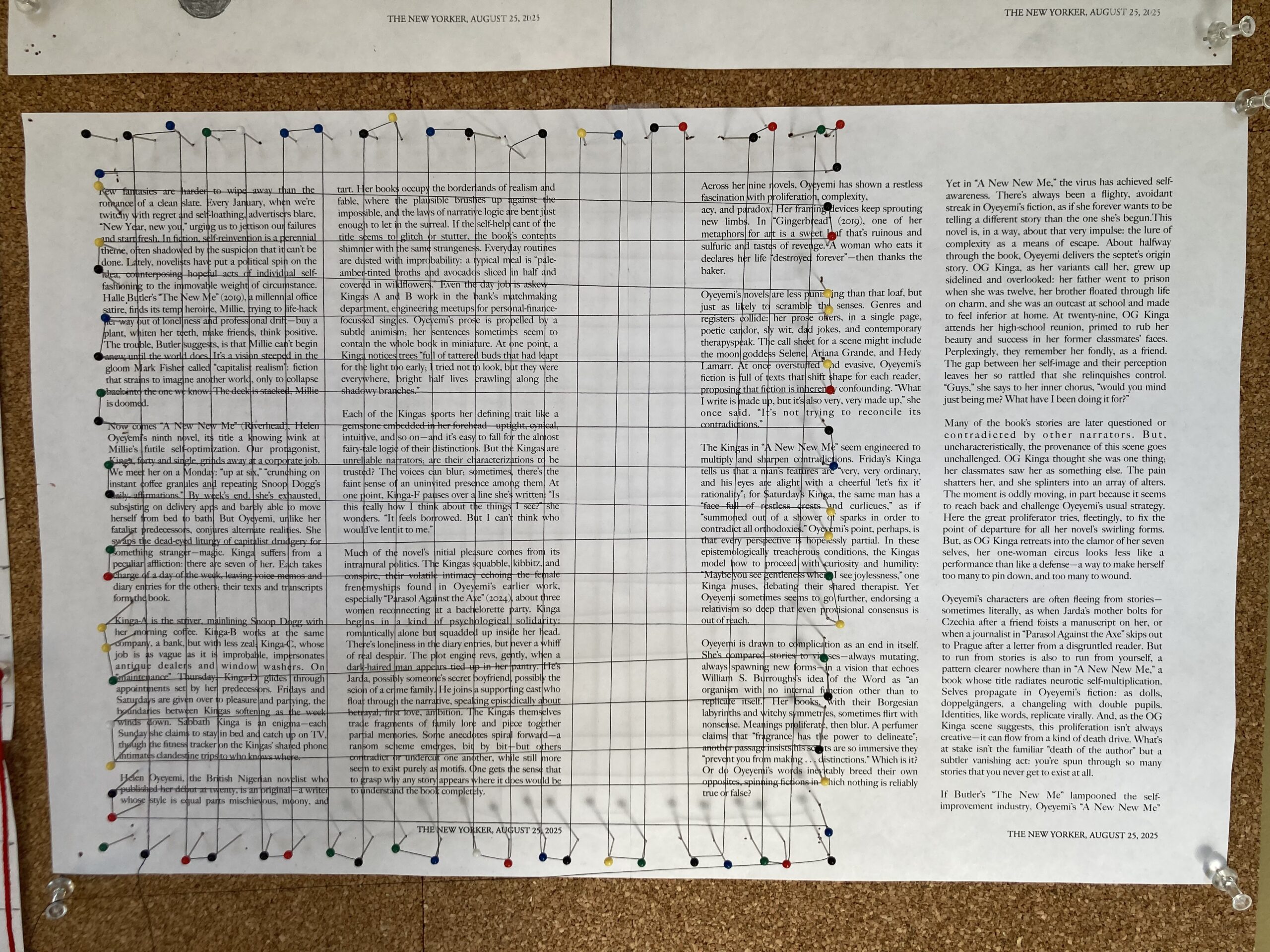
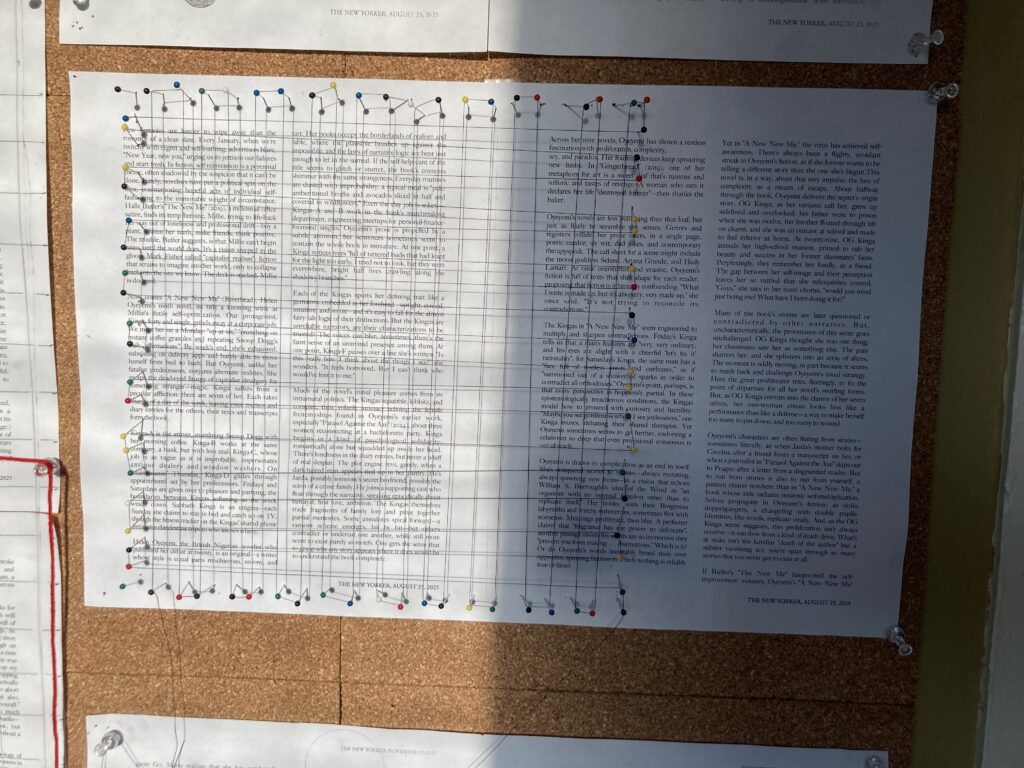
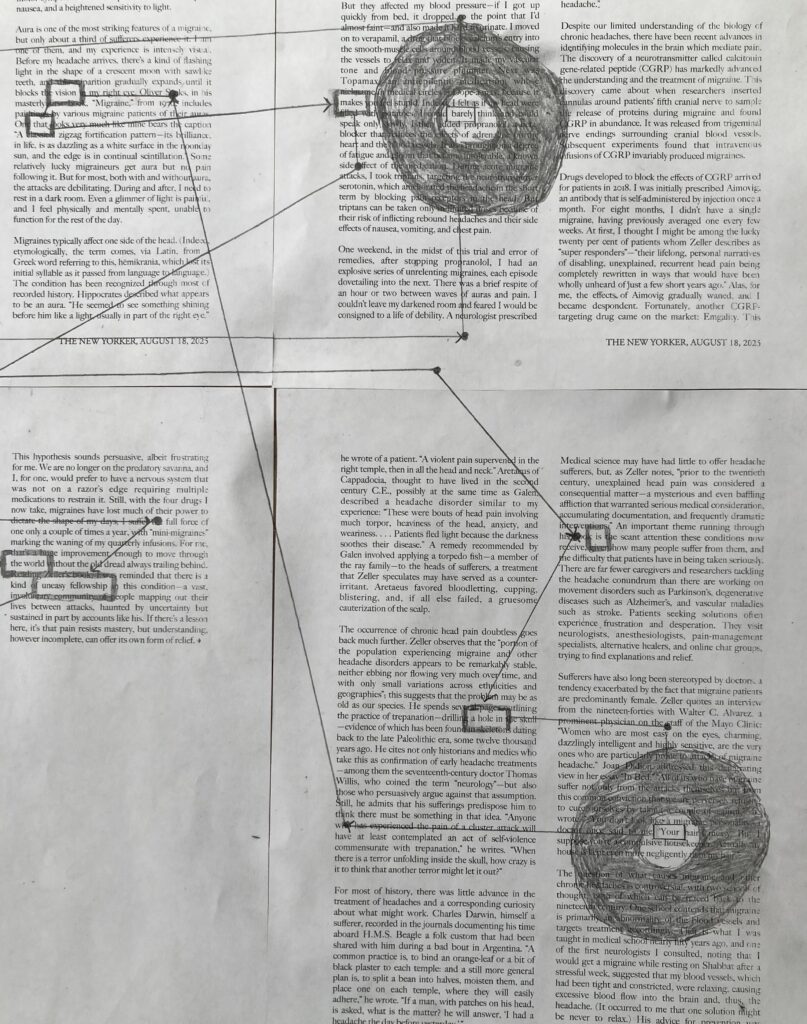
The saga continues. I said to Scott earlier, after pushing my eyes to the limit with measuring 9/16th of an inch and attempting to cut straight slits and placing 84 pins 1/2 inch apart to create a grid, why I am so stubbornly committed to this project when it is to fiddly and challenging for my limited vision? I am not sure, but something in me won’t quit. I want to make a series of visual poems that use grids made out of thread and string and yarn and that require skills far beyond my ability (at least my ability right now) and that are exhausting and frustrating and take a lot of time. And, I WILL make it, dammit! I could use graph paper for the grid, but I want to use thread/string and have the lines be 3-dimensional. The thread/yard is partly as a connection to my fiber artist mom and my fiber artist daughter. The 3D is for the shadows and for what the floatinggrid boxes do to how we see/don’t see the words within them. I just finished my first attempt on placing the grid over Holes 3. I measured a 10×10 square over the words and then placed 21 pins on each of the 4 sides. Then I wound the thread around the pins to create the grid.
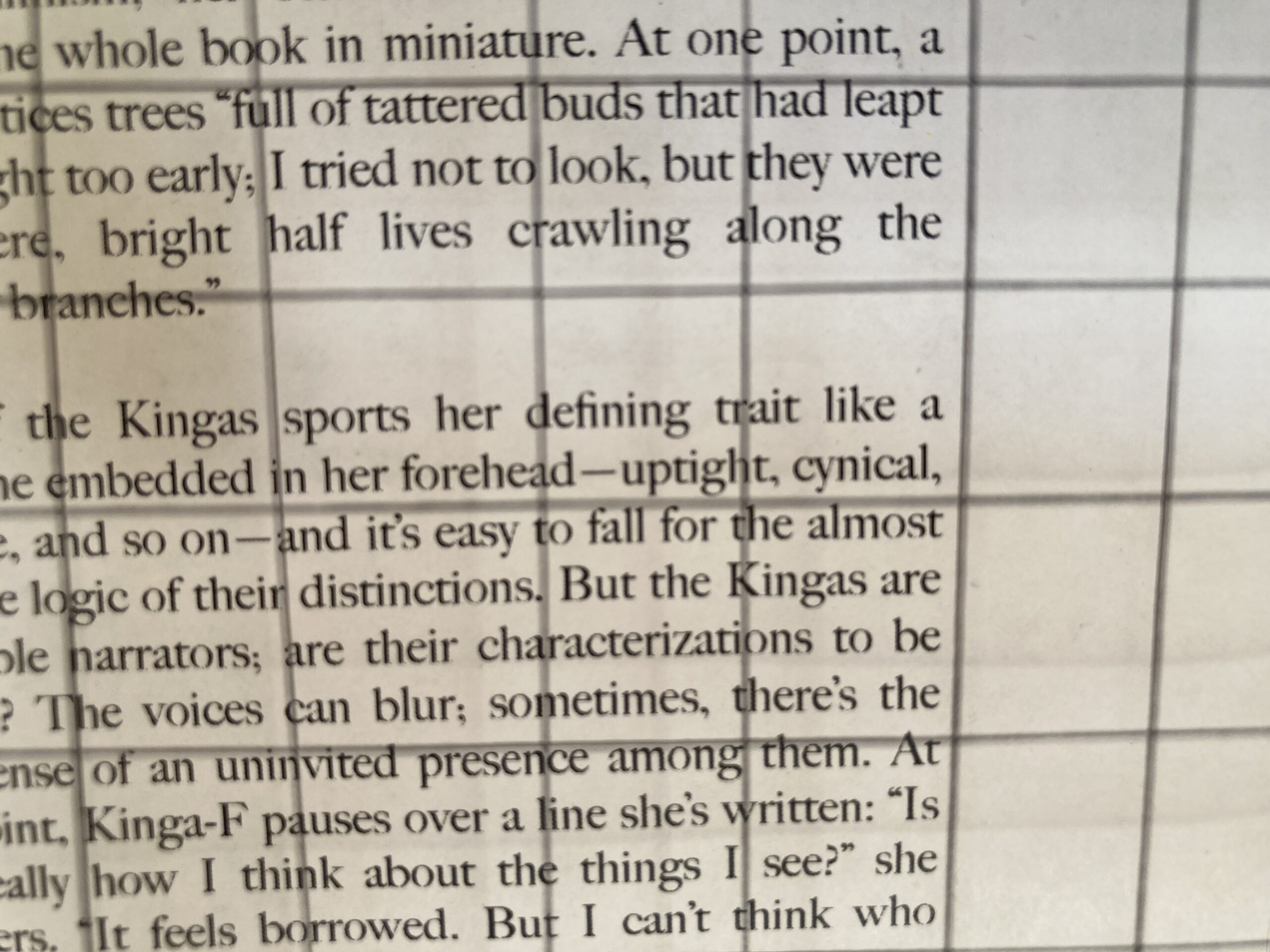
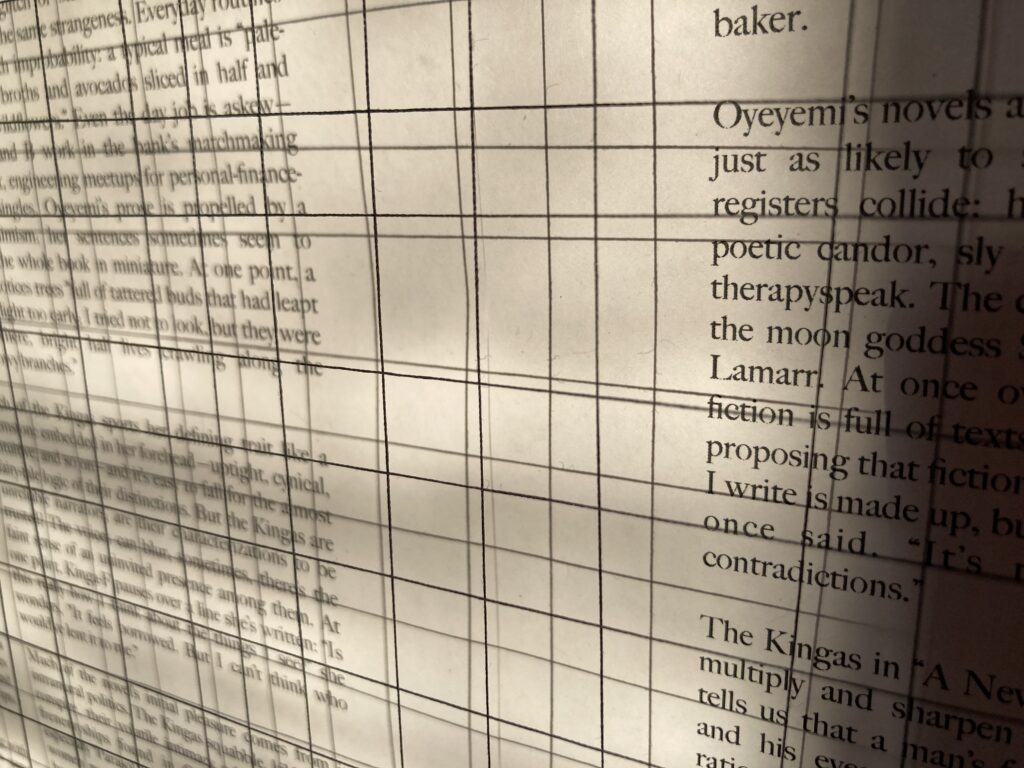
a 10×10 grid made of black thread and pins, placed over a NYer book review of Helen Oyeyemi’s new booka closer look at the grid and the first word of the poem, fall
I really like this grid overlay, even as I recognize that I need to do more to it to make it make sense to a reader/viewer. The pins are difficult to work with on the thin cork board. They twist and bend out of place. What will I use for a different/the final version of this poem? I showed it to Scott and he suggested a frosted plexiglass layer with only the words of the poem visible. At least, I think that’s how he described it; I’m not quite understanding what he means. I’m wondering if encasing the words in a small dot (both a reference to the center dot of an Amsler grid AND xy coordinates on a graph) might work. One problem: I don’t want to remove the pins and draw the dot in, then have to re-string/pin the grid. I need a better solution for that!
I do like the elevated grid and the way you have to look through and around it to find the right word. I also like the thin thread that you almost can’t see. That’s how my vision often works: it’s not a solid wall of black, but the faint trace of something, sometimes feeling like a net or a screen that makes it harder to focus on anything. One more thing: when I ‘m reading, it does feel like each word or phrase is encase in a grid, with nothing outside of the grid in focus.
note: I’m warming to Scott’s plexiglass idea, even as I’m still not totally understanding what Scott means. What does the plexiglass do to the effect of the grid-thread? The focus on this poem is the graph-grid and the x = blur, y = almost coordinates.
It’s 5:38 and the sun is streaming in my front room studio. I’m waiting for it to hit my grid poem, and hoping it leads to cool grid shadows!
It’s 6:38 pm and some shadows have finally arrived! I asked Scott to take the picture because I wasn’t sure I could capture it effectively.
pin shadows
At first I didn’t notice the pin shadows, I just thought the pins had become twisted out of shape. But no — the pins are fine; it’s their shadows that are all askew. Nice!
Delighted by the result, I decided to take my own picture:
Only 56 degrees? It felt much warmer than that! My hair is soaked with sweat, my face feels flushed still, minutes after finishing. Spring is here! I listened to a piece we’re playing for community band concert in a week, Bookmarks as I ran south, and my “Doin’ Time” playlist running north.
I waved and smiled at as many people I encountered as I could. Did I ever speak? I think I did, once. Even with my music playing, I could hear the kids having fun on the playground and the roar of the falls at the park. At least a dozen people were walking around the park, 4 of them were standing at my usual spot. As I stopped to take off my sweatshirt, I heard a thump thump thump behind me: a young kid running over to the steps. They were fast! A few minutes later, I heard several people calling out, woooooo or weeeeee, close to those steps. It sounded like someone was being swung in the air, or lifted up and down.
Anything else? Several of the benches were occupied, but not the one above the edge of the world. I stopped there to admire the river. I don’t remember what it looked like, just that it was open and wide and peaceful.
at the clinic (earlier this morning)
Today I had to go to the clinic to get two cervical polyps removed. No big deal — an easy procedure with only a 1% chance that the polyps would be cancerous. I was hardly anxious at all, even when they took my blood pressure, which is huge improvement from my last visit in early February. Hooray!
A few observations: Passing by a door, hearing a kid on the other side losing their shit. Hearing them a minute later while in the bathroom at the lab. This was never verified, but I think they were also at the lab, getting blood drawn. Yikes for the drawer of that blood and for the one getting it drawn!
Heading towards the lobby, passing an older woman (with all gray hair) about to be weighed, taking off her shoes and jacket, saying, hold on, I want to take off as much as possible to weigh as little asI can! I’m kidding. Was she, though? Hearing this, I though about my mom and how, when she was on chemo for stage 4 pancreatic cancer, she desperately didn’t want to lose weight because she was already too thin, and I thought about the doctor on a Facebook post who specializes in peri/menopausal discussing how being strong is so much more important than being skinny, especially for older women. With these thoughts, I wasn’t giving shade to the woman getting weighed; I was reflecting on the discord with older women’s bodies and the impact of oppressive beauty standards on their bodies.
Anything else? Oh — on my back on the table, feet in the stirrups, I looked up at the ceiling and noticed a dot. I stared at it, trying to imagine the Amsler Grid and to see my blind spot. Did I? I can’t remember now.
Driving home, I struggled to find a fun/pleasing/alliterative way to describe Sara in the present moment. I mentioned to Scott how well it worked with our daughter’s name: RJP right now. Scott suggested two awesome versions for me:
Sara this second Sara since Saturday
I love both of these so much. How much? Enough to try and write a poem about them! I’ll try to think about them on my run1. One reason I like Sara this second is because I love the idea that I have so many present Saras that they can’t be contained in minutes; I need seconds! And Sara since Saturday? I said to Scott, this is an example of alliteration helping you to find more meaning. Sara last Saturday isn’t nearly as awesome as Sara since Saturday!
grids holes thread
I was planning to work on the grid for Holes 3 this afternoon — current options: drawing a grid directly on the text OR creating a loom frame and making a grid out of thread to place over the text — but I’m not sure I have enough energy or vision for it. Maybe I need some more food?! The snack has happened, some water too. A recharge! I want to start with a loom frame for my 2 panel poem. I’ve cut out the frame and figured out the measurements for the grid, but now I’ve run out of time!
Well, I tried to think about them, but I forgot before I reached the river. I recall a flash of Sara since Saturday and then wondering why he chose Saturday, with 3 syllables, instead of Sunday, with two. Is it because Sunday doesn’t sound quite right? ↩︎
Sun and shadows and spring air. Also: chirping birds, bare earth, buds. A beautiful afternoon for a run, after a morning having fun making a grid and reading an essay backwards and thinking about threads and strings and scotomas.
The river was a blueish-gray, the sky was empty of clouds. Now, sitting at my dining room table, I hear cardinals, but out near the gorge I think it was wrens, or could it have been sparrows? Oh — at least one pileated woodpecker and the feebee of a chickadee.
tmi note for marathon-training Sara: the run was made difficult by unfinished business. I need to do more work on figuring this problem out!
My favorite image: Walking and running back through the neighborhood, I noticed (and not for the first time) a delightful maple tree. A straight and solid trunk then 2 thick branches rising out of it. One of them slanted only slightly to the side, the other bent midway up, looking almost like a knee. Yes! This tree offers a classic example of the tree looking like an upside down person, their head, shoulders buried in the dirt, only their torso and crotch and legs sticking out of the ground. Oh, why didn’t I bring my phone today so I could take a picture of it?! I’ll have to go back. It’s on 35th street between 46th and 45th avenue. I wonder, will anyone else be able to see what I see in a picture of it? when standing beside the tree?
grids and lines and strings and threads
note: I’m starting this in the morning just after a big breakfast. I’m listening to early The Kinks, “Arthur or the Decline and Fall of the British Empire” from 1969 and “The Kinks Are the Village Green Preservation Society” from 1968. I love early The Kinks!
Continuing a discussion I began yesterday but wasn’t able to continue:
I found this quote from Chuck Close about why he used the grid method:
Almost every decision I’ve made as an artist is an outcome of my particular learning disorders. I’m overwhelmed by the whole. How do you make a big head? How do you make a nose? I’m not sure! But by breaking the image down into small units, I make each decision into a bite-size decision. I don’t have to reinvent the wheel every day. It’s an on- going process. The system liberates and allows for intuition.
Breaking the image down into small units. Working in small units and seeing fine detail — those are functions of central vision. Peripheral vision is the big picture, that big head, those whole noses. Most of what I see these days is big picture — whole, fuzzy forms. The central vision I have is very small and seems to be very near the center of my central vision. How big is the one grid — that tiny island surrounded by gray water — that allows me to see anything as more than an almost form? The only detail I can really see (I think?) is a word in small print.
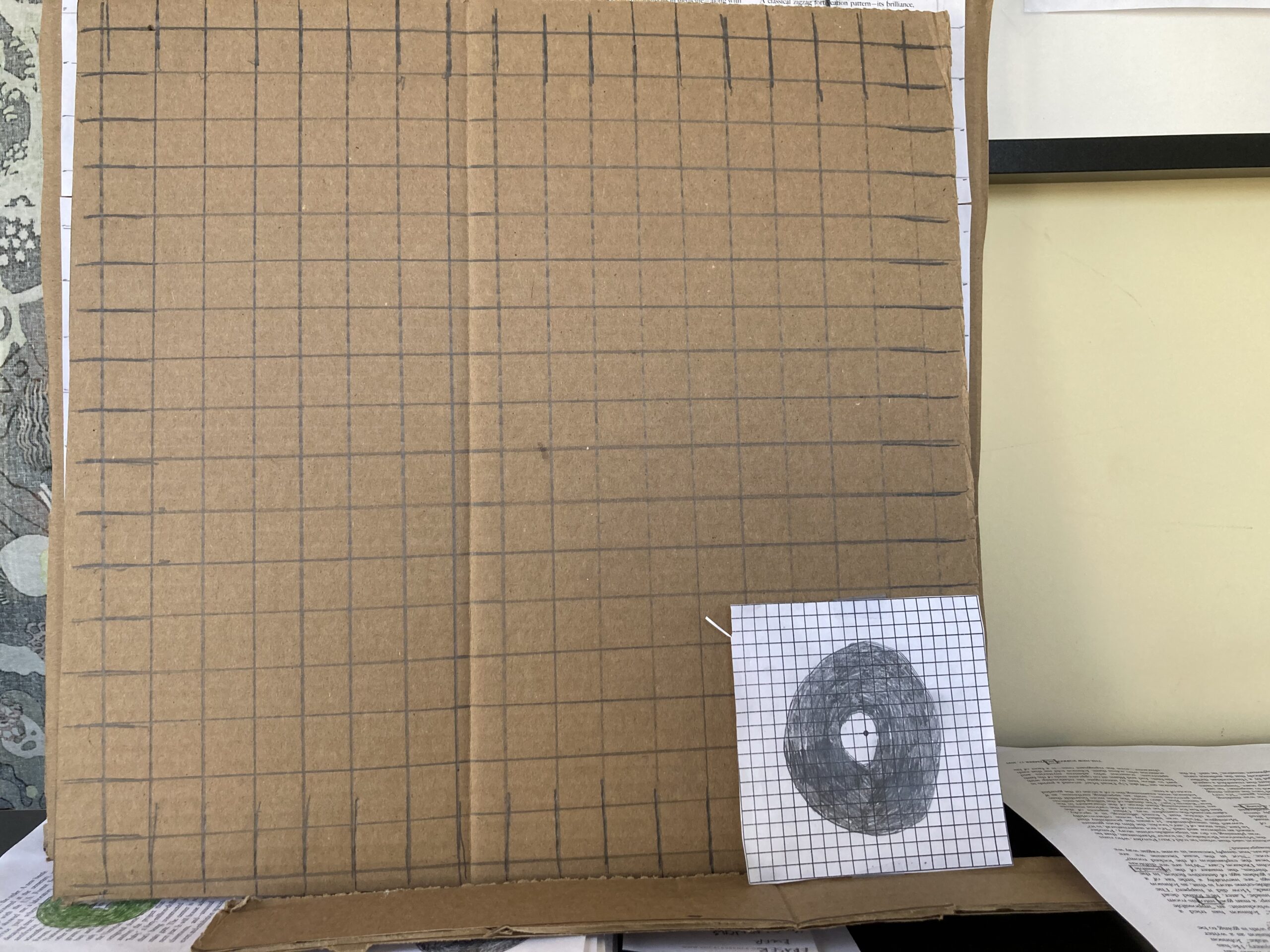
Just gave about an hour to creating the grid for the bigger version of my scotoma. In the “normal” sized one, each grid is .25 x .25. In this grid, it’s .8 x .8. I’m listening to a 1970 album by The Kinks, “Lola Versus Powerman and the Moneygoround, Part One.”
The grid is fiddly and involves a lot of measuring. It is slow, repetitive work. As I measured and drew line after line, I thought about how this work might open me up to new ideas and that this process by me, Sara-barely-not-blind, is part of the work I am creating. It is not only the finished product of a visual poem, but all of the labor that went into it that makes the meaning. Much of that work is invisible (although I’m documenting it), but it colors and haunts and shapes what I am trying to communicate.
2 grids and a blind spot
Now, it’s time to use the grid to create a super-sized scotoma, and then, to play around with different materials for laying the scotoma over the words of Holes 5b! Possible materials: trace the scotoma directly onto the paper and then color it in. Cut out different types of plastic — ziploc? a grocery bag? cling wrap? What about a very, very small grid made out of black thread? Fiddly, but fun!
Before I return to that, I need a break, so I’ll return to my close reading of a book review on memoirs by daughters about their fraught relationships with their mothers. I picked this selection from the NYer because: it’s a book review, and I love book reviews!; it uses a lot of language about connections and separations; and it uses hole, thread, and line.
My close reading = start with the last paragraph of the essay, then the second to last, then the third to last, etc. So, backwards. It’s a strange way of reading, being thrown into ideas that are presented as familiar, but haven’t been introduced yet. Slowly, the more I read, the more sense it makes.
Misfits / The Kinks (1978)
I started my close reading of the NYer book review, What to Make of the Mother Who Made You/Rebecca Mead, yesterday afternoon while drinking a surprisingly good NA beer at Arbeiter. Here’s a list of words/phrases I found during that reading, along with my additional words from today’s reading:
when the facts are unbearable, it’s natural to escape into
coordinates
accomodate
(to) make sense to myself
disorientation
knowledge
ghost
humbled
should be
to write one’s way out of
shedding
knotted
threads
familiar
searching
hunt it down like prey
in the other room
readers
almost blind
estranged
against
reframing
obedience
en chant ment
elsewhere
world made whole again
inheritances
family
moves
opens
traces
artificially formed
origins
sober
square
closed
door
discomfort
feelings
slither
seize d
character
disembowel eat
spotted
rupture
alone
defiance
entanglements
kinship
matriarch
loom
shadows and absences
ordinariness tempo
lens
locating
mess ily
tending
cancer
seen
naked
con found ing
pro CLAIM
think about
offspring
runs through
nothing, subdued
account
assumes command
between
emerge
maintain ed distance
light
center
entwined
depend
reckon
Again, these words speak to a strained relationship between daughter and mother. I’m thinking that my mother here is written language and the words on a page to be read with failing/failed eyes. A distant mother, a daughter uncertain as to how to reconnect (or to keep the connection), or even if she wants to stay connected.
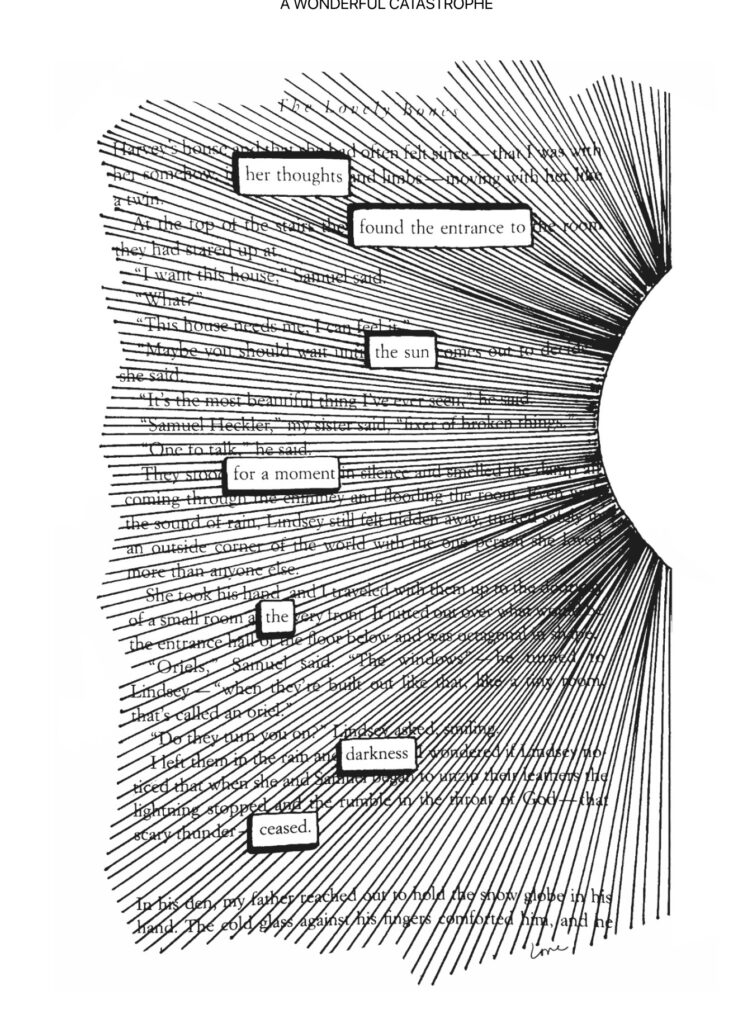
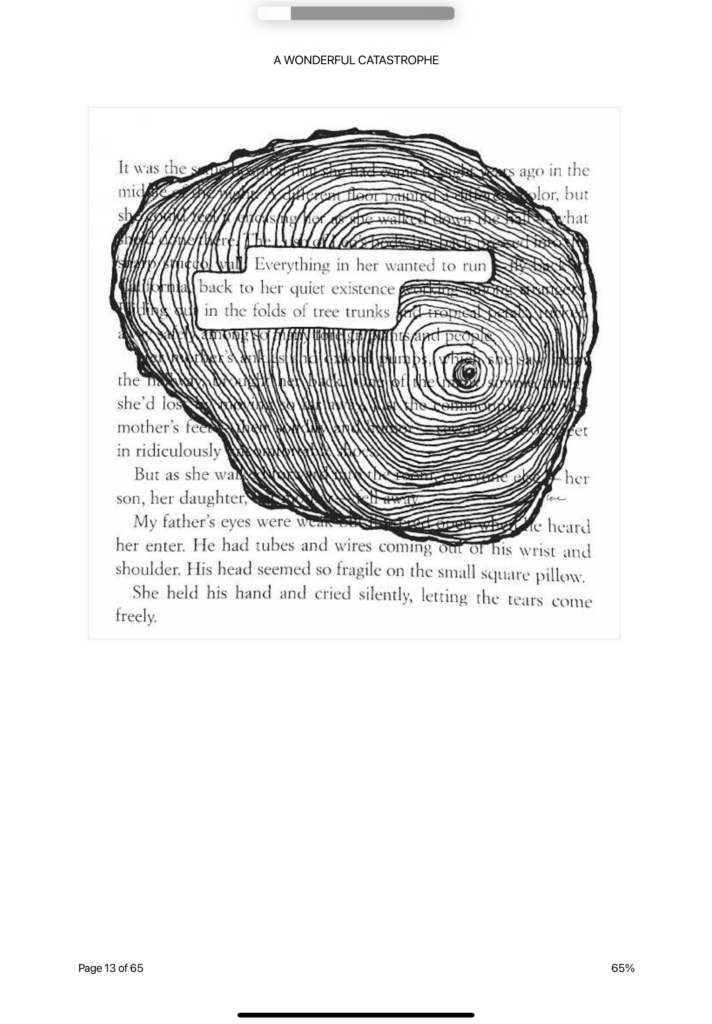
In the midst of all of this, I’m also wanting to get more inspiration from a collection of erasure poems that I discovered last fall and have been hugely influenced by: a wonderful catastrophe / Colette Love Hilliard. Here’s one of her found poems that uses lines:
a poem from a wonderful catastrophe/ colette love hilliard
I like how the lines are slanted and all coming out of one source which resembles the sun. I might try having lines of black thread emerging from a center hole in a 4 panel poem. The threads just barely covering all of the words, the words of the poem printed on circles attached (pinned?, sewn?) on top of the strings. I want to try that now! Can I do that AND make my super-sized scotoma?
a few minutes later: I will do the scotoma tomorrow; the sun is too bright in the room for me to see the grid! And, before I can try out the black threads, I need to remap Holes 4. So, tomorrow for both of these.
RJP just stopped by and when I showed her what I was working on, she reminded me about Coraline and her other mother who lives on the other side of the door (here, instead of Alice’s hole, there is Coraline’s door). The other mother has buttons for eyes which reminded RJP of the holes I traced on my Holes 5. So cool! I could try adding buttons to my Holes 6, which is using a text about mothers and daughters!
summary of the day: A lot of great ideas, a few plans, a little making.
David Bowie Essentials — the last song heard, “Suffragette City”
3.75 miles wabun hill 60 degrees wind: 25 mph gusts
Windy and warm this afternoon. Shorts and a short-sleeved shirt. Hooray! My feet feel strange in my new shoes. Hopefully I’ll get used to them soon. Sometimes it felt easy, sometimes it didn’t. I stopped several times to admire the view. There is new, brightly colored graffiti under the ford bridge. I noticed it when I stopped to look at the hill of dirt (some of it looks like loose dirt to me — is it?) that the pilings for the bridge push up against.
The favorite thing I experienced this afternoon: At the bottom of the hill near the locks and dam no. 1, I stopped to admire the river. The surface was undulating in the wind. It was only slightly moving, creating a strange feeling — not of dizziness, but of everything shimmering or flickering.
holes 5b
Here’s a draft of another poem made from words in “Mystery Man”:
two holes one — the only place where reading is still possible a small island surround by the other and its not even firelit free fall into nothing
I’d like to make the New Yorker text for this poem white on a black background. Is that possible? Can I achieve the effect of being in the dark in some other way? Maybe I’ll try shading text with pencil first? I’m still not sure. I’ll need to look for some more inspiration.
an hour or so later: Here’s something I’d like to try tomorrow that I thought of earlier — for my 2 holes poem I want to trace my scotoma/blind spoi on the 4 panels. I want one that covers a substantial amount of the text/pages. I’m thinking a 16 x 16 inch grid, which I already have. I’m not thinking that I’ll use the grid on the poem, but I’ll use it to measure the proportions of the bigger scotoma. Fun! I’m sure there are much more efficient ways to do what I’m trying to do, but I like the DIY nature of this approach. I also like how it’s not overwhelming for me, with my very limited crafting/making skills. If I spend too much time on crafting something that is trying to look polished and fancy, I might lose all of my creative energy. I should find a class to take in which I can learn some of these skills!
4.1 miles river road, north/south 39 degrees wind: 10mph / gusts: 15 mph
Boo to the cold, although it only really felt cold during my walk warm-up. Maybe the boo should be reserved for the wind which was directly in my face running south. But, even with the wind and the cold, there was sun and clear paths and birds and open water. Spring! My legs and back felt strong, and my feet were locked into a steady rhythm. I encountered at least one large-ish group of runners, many groups of walkers, dogs. No roller skiers. Any bikers? I can’t remember. At least one stroller.
Running north, I listened to my feet striking the ground and birds chirping. Running south, I put in my “I’m Shadowing You” playlist. Song I remember most: “Shadow Stabbing” by Cake.
My anxiety has returned, which is a bummer, but not unexpected. There are so many reasons it could be back (I mean, looking at the news for today — Drump’s deadline for Iran is tonight — JFC). My latest theory: I am experiencing another vision shift (more cones lost?) that sometimes makes me feel dizzy. Dizziness triggers (mostly) mild physical panic. Combine that with hormonal changes, thanks to perimenopause. Nothing too overwhelming, but still draining and uncomfortable. I understand the anxiety better now than a few years ago, but that doesn’t mean I can anticipate it. Before my run, I felt a little dizzy. That dizziness (or imagined dizziness?) lingered a little during the run then returned right after. Sigh.
added later in the day: Finishing this entry up at my desk, I saw the shadow of a bird fly by which reminded me of the bird shadows this morning as I ran. It happened more than once, a dark something flying over my head as I ran: a bird’s shadow!
grids and holes and reading
My Holes series has several elements: the hole, the grid, reading. All of them are important in these visual poems. Also important: these are visual poems. The words in them matter as much (or more? or on the same level?) as the visuals.
What am I trying to express with this series? The strange and strained and magical way in which I can still read words even with most of my central vision gone. The progression of my declining ability to see words and its untethering effects.
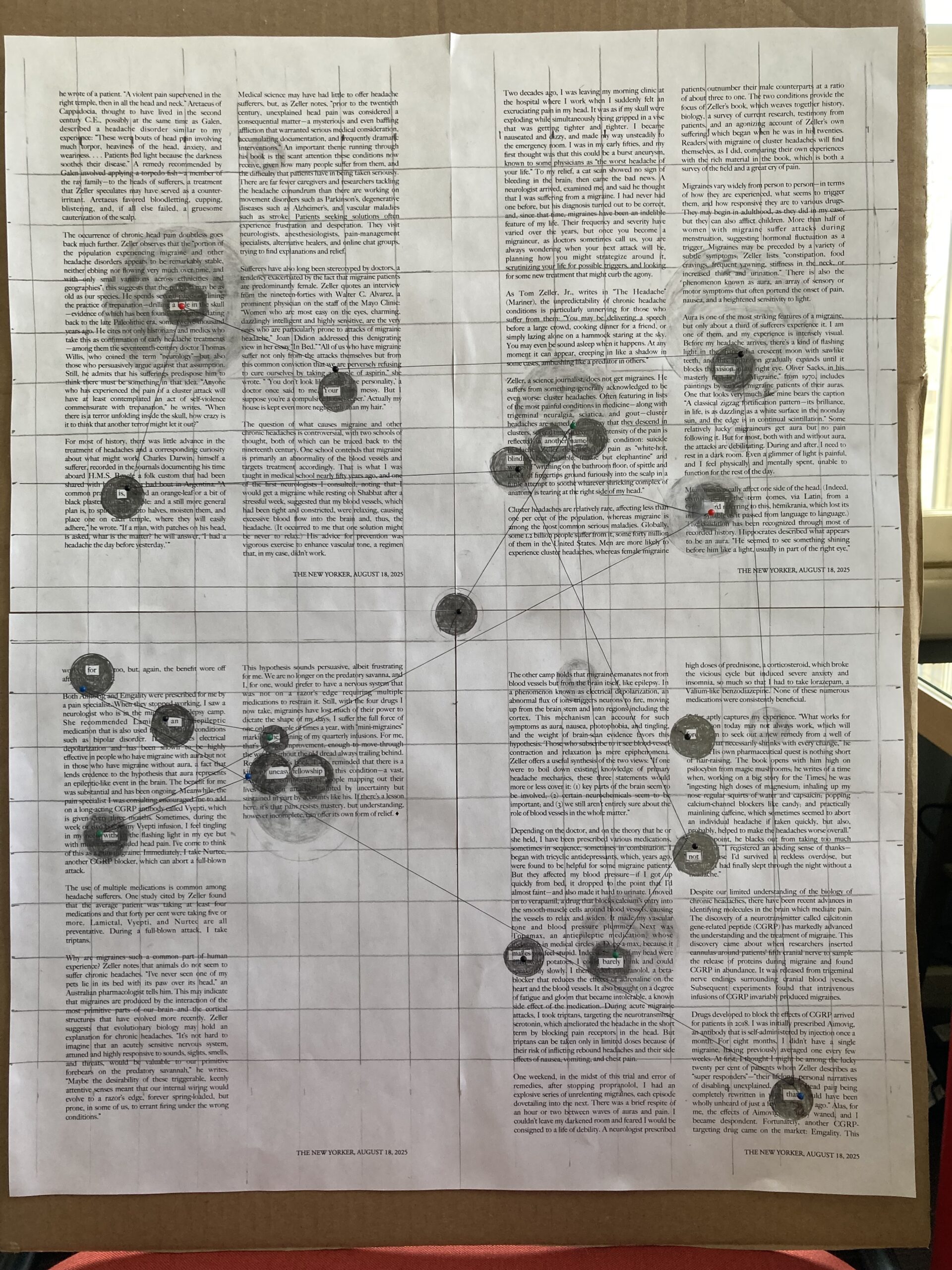
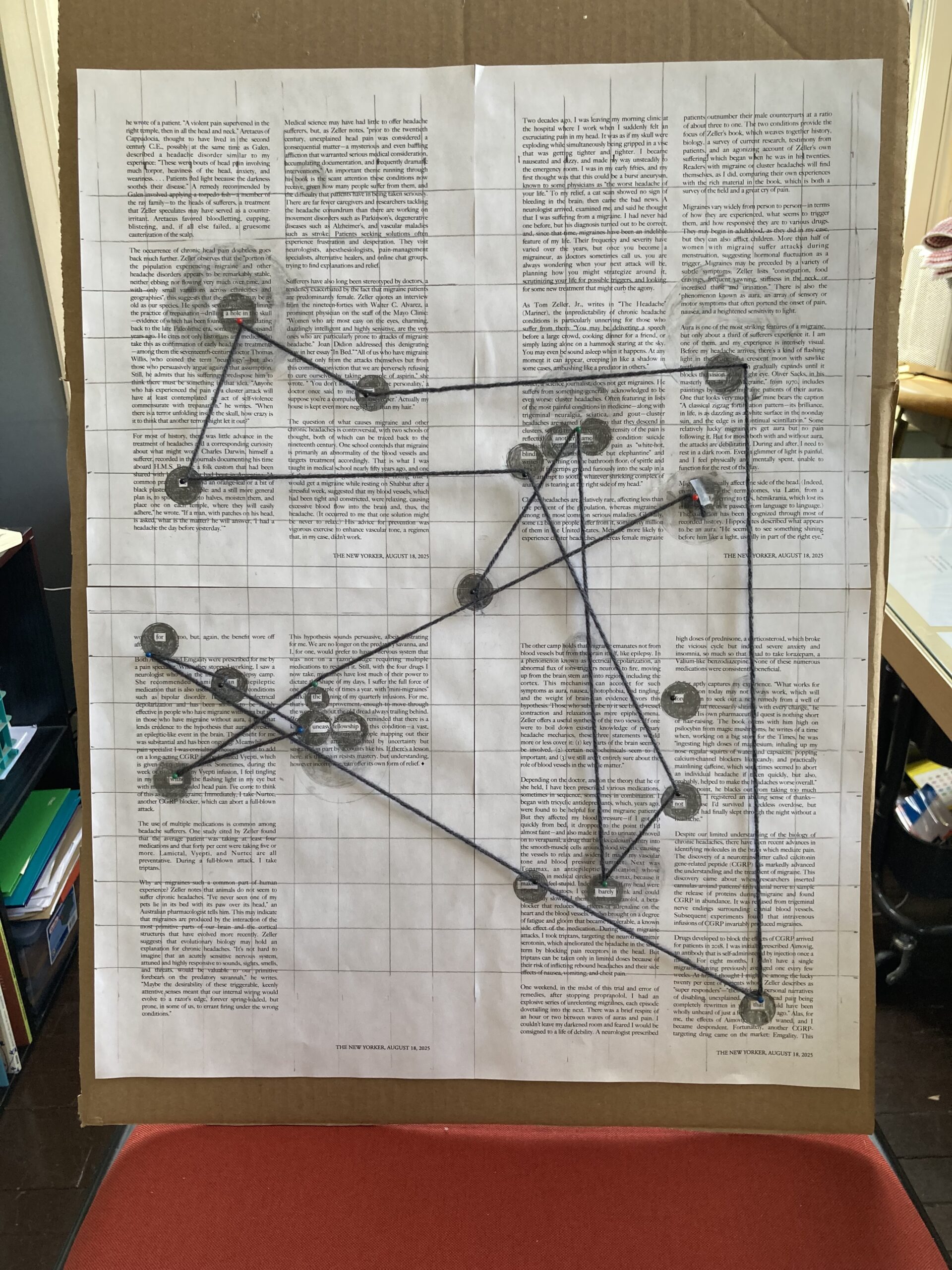
a couple hours later: Playing around with my first Holes, this morning, I focused on figuring out how to connect the sections of the poem, to map the path from word to word to word on the page. That process of reading is key to this series1. After ruminating, which frequently meant standing and staring at the poem on cardboard, trying to figure out how to make this rectangular 4-panel poem fit into the square of an Amsler Grid, I came up with something to try. Fasten the poem panels to cardboard by placing pins next to the words of the poem, then connect/map the words with black thread. When I tried that, the thread was more fiddly to work with than my eyes and hands liked, and it didn’t show up that well:
black thread map / Can you see the thread? Just barely, for me.
So I tried dark gray thread, which was easier to work with and showed up much better. Maybe as the series progresses and my tether to the world through words weakens, I’ll use thinner, less visible thread?
gray yarn
One thing to fix for a different version: adjust the pin so that the thread line between with and word doesn’t cross the center — to do this, possibly switch to another “the” lower on the panel.
I like the yarn better! I realized that one of the key elements of this poem is to show the process of reading, the act of jumping from word to word to word, how the connections between words are increasingly complicated and convoluted. As I was thinking about that mapping, I remembered some images that I’ve seen several times and that Scott mentioned the other day: a spider’s web after taking various drugs . Here, lines = grids = webs!
The next experiment = putting the 4 paneled poem on cork board, using gray yarn and push pins. Another thing to add: draw more holes (circles), color them in with pencil, then erase them to leave a ghost (afterimage-ish).
during the run: holes
During the run, I thought about printing the New Yorker article on graph paper and adding an x and y axis for plotting the words. I might do that for a few of the Holes — as my vision gets stranger, so do the names of x and y. Maybe Holes 1 is x = time and y = space. Another Holes could be x = real and y = imagined. I should look through the other poems and determine their x and y axis.
questions: Are the lines from the Amsler grid (that is, the lines that make up the grid) and the lines that connect the words and map them on the visual poem the same? Can they sometimes be the same in one poem, and different in another? (note from 16 april: I’m not sure what I mean here with the same and different lines.)
A thought as I wrote this sentence: part of the process of moving from word to word is running into words on a line that I didn’t see. In my Plague Notebook, I have countless examples of visual errors in which I write words on top of each other. This works differently in reading — in reading, I only see the word I am reading — but it connects. This not seeing + words on top of each other could be represented by the increasing jumbled way my lines from word to word are mapped. ↩︎
Overdressed. When I checked the temp, it read 45 but feels like 34 so I added a layer, which was a mistake. Lots of dripping sweat and a flushed face. My goal today was to try and take it easy with a steady 10 minute pace. I was mostly steady, but ran faster than that. I need to figure out how to slow down again; my new shoes make me want to run faster than I can sustain for long runs.
I chanted in triple berries to keep steady and to lose track of words and ideas: strawberry/blueberry/raspberry. It worked. I don’t remember what I thought about.
For some of the run, it felt hard to keep going and for some of it, it was easy. I think it’s time to experiment more with ways to distract myself — or to lead my mind in directions other than, this is hard, I can’t keep going, when can I stop?
overheard: I think I heard something at the beginning of the run that I wanted to remember but I lost it when I started chanting in triples. I do remember hearing something at the end: Two women walking, one to the other — it feels so good to have the sun on my face!
10 Things
a speedy runner in white down below, on the winchell trail — beside me, then ahead of me, then gone
soft, shimmering shadows
a LOUD siren coming from behind, then an ambulance speeding by on the river road
empty benches
the view from the sliding bench: uncluttered, the sands gleaming so white that it looked like snow
soft, dry dirt — no more mud
one car then another then another passing by on the river road
dried flowers hanging from the pink sign reading, Someone was taken by ICE here
a slower biker riding on the grass between the river road and seabury
the chain is still strung across the top step of the old stone steps, blocking the way down to the river
holes
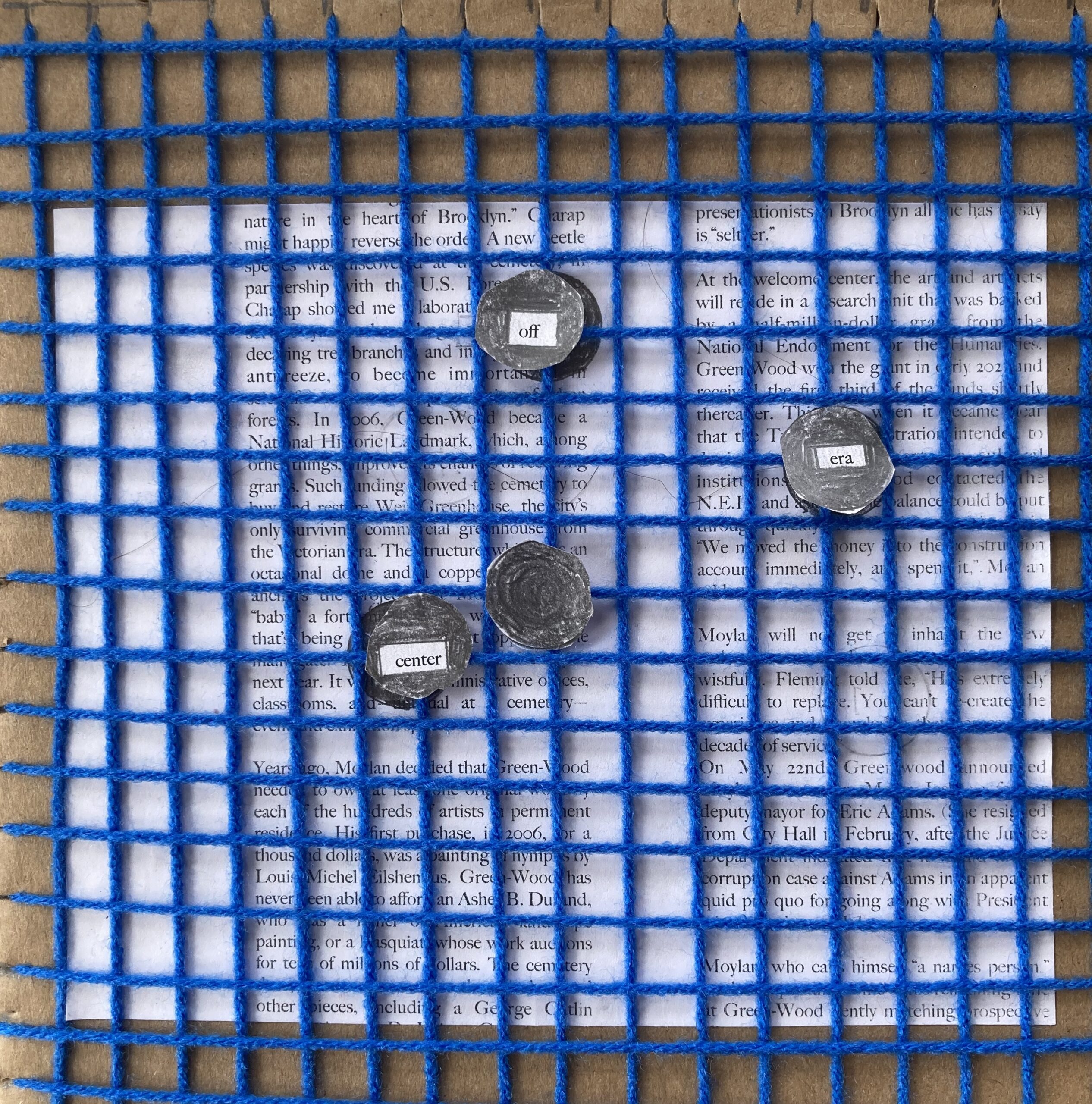
Arts and crafts fun. This morning I did a test run of a yarn grid for Holes 1. A 9 x 9 square of cardboard with 1/2 inch slits all around. A long piece of blue yarn1 which I wound through the slits. A poem under the yarn grid: circles/dark holes encasing the words: off center era.
Assessment:
I need an exact-o knife for more precise cuts
the blue yarn is too thick and makes it impossible to read; try dark thread instead
make sure that the thread is long enough before starting to wrap it around the notches
follow this order: cut notches, place/attach (glue?) poem to cardboard, make sure the thread is long enough then wind it around
question: if I’m using thread, can I use a thinner frame, like cardstock instead of cardboard?
Here’s a picture of my test poem — should I call it, “(i’m in my)”?
(in my) off center era
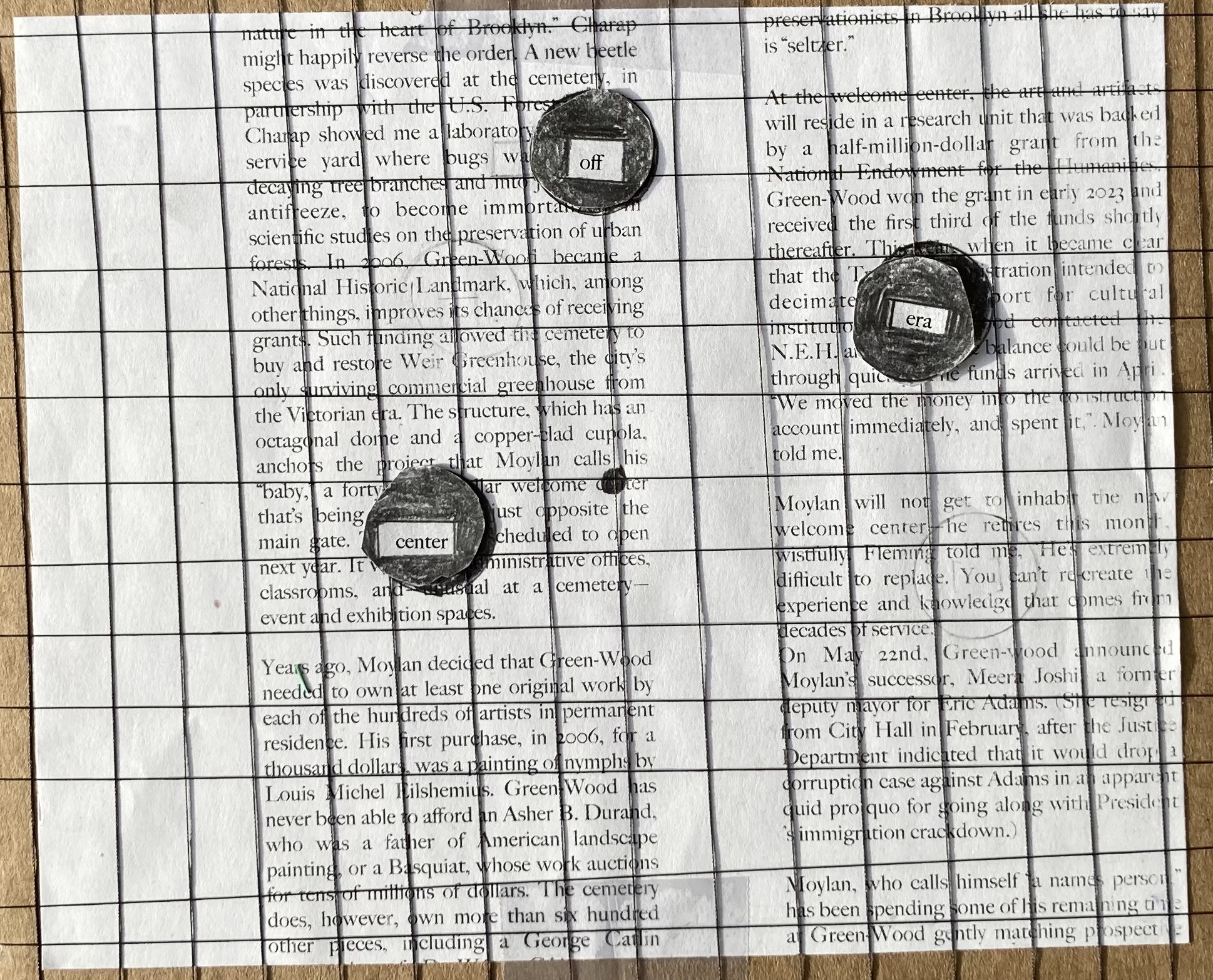
Okay, I tried it with thread and it works better, I think, but I need to be neater with it. Although, I do like the color of the blue. . . . For the larger Holes series, I need the black thread. In Holes 1, the Amsler Grid is straight, but by Holes 3, the lines will be much more crooked and warped. Black thread is much more effective for this warping.
(in my) off center era
A few more thoughts: It looks like I’ll need to take the circle-encased words and place them over the grid to be legible — the easiest way to do that is with the words as cut-outs, although I could also try weaving the thread under them (but that sounds difficult and beyond my limited skill and ability as “barely not blind.” Also, more thread is needed for back-up. And, should I create a frame around the holes poem that covers the ends? It could be a basic frame, either purchased or made, but I like the idea of creating some texture and/or a collage — maybe the black mesh fabric I bought, or ___? It needs to be something related to the holes poems and the act of reading? I’ll keep thinking about it. Would it work to have the words of the found poem on the frame?
update from yesterday’s post
First, yesterday I mentioned a discussion of three types of freedom that I was having with FWA at the dog park: I was looking for my PhD advisor’s book that discusses it. I can’t find my copy yet, but I found it online:
Second, yesterday I also mentioned that I was picking up 2 books from the library: Sea of Grass: the Conquest, Ruin, and Redemption of the American Prairie and a found poem collection by Annie Dillard, Morning Like This. More on both of these tomorrow.
Finding a long enough strand of yarn took at least 3 tries. I thought I had a long enough strand then it would run out half way through and I would have to unravel what I had already done. Something important to remember for the official grid: make sure the yarn/string/thread is long enough before you begin! ↩︎
4 miles river road, south/wabun/bottom of locks/river road, north 38 degrees / feels like 22 wind: 15 mph / gusts: 32 mph
Another windy run. Cold-ish, too. Wore running tights, shorts, 2 long-sleeved shirts, a pull-over, a hat, a hood, gloves. I didn’t feel overheated until the end. Lots of cars on the road, not that many people on the trail. Are they all going to the No Kings March at the capitol? I (kind of) wanted to go, but big crowds are not the easiest for me and Scott, RJP, and FWA struggle in them too, so I’m skipping it.
According to my watch, I slept for 7 hours and 21 minutes last night. That is a lot for me! And, my sleep score1 was 77. I think it helped me to feel stronger on the run.
10 Things
reaching the top of the wabun hill, I heard the clanging of the bell — is there a bell up here? no — it was a kid banging on something at the playground
wild turkeys — 4 or 5 of them, under the ford bridge! I passed close by them as I ran up the wabun hill. By the time I return back down the hill, they were gone
goose honks near the bottom of the locks and dam no. 1
swirling leaves
the round shadow of the light on the street lamp
more scales on the gray water
chanting in triple berries to keep a steady pace
running on the rim of the bluff, looking down at the winchell trail which was empty and farther down than I usually remember
at the top of the wabun hill, stopping to look through the chain link fence at the river
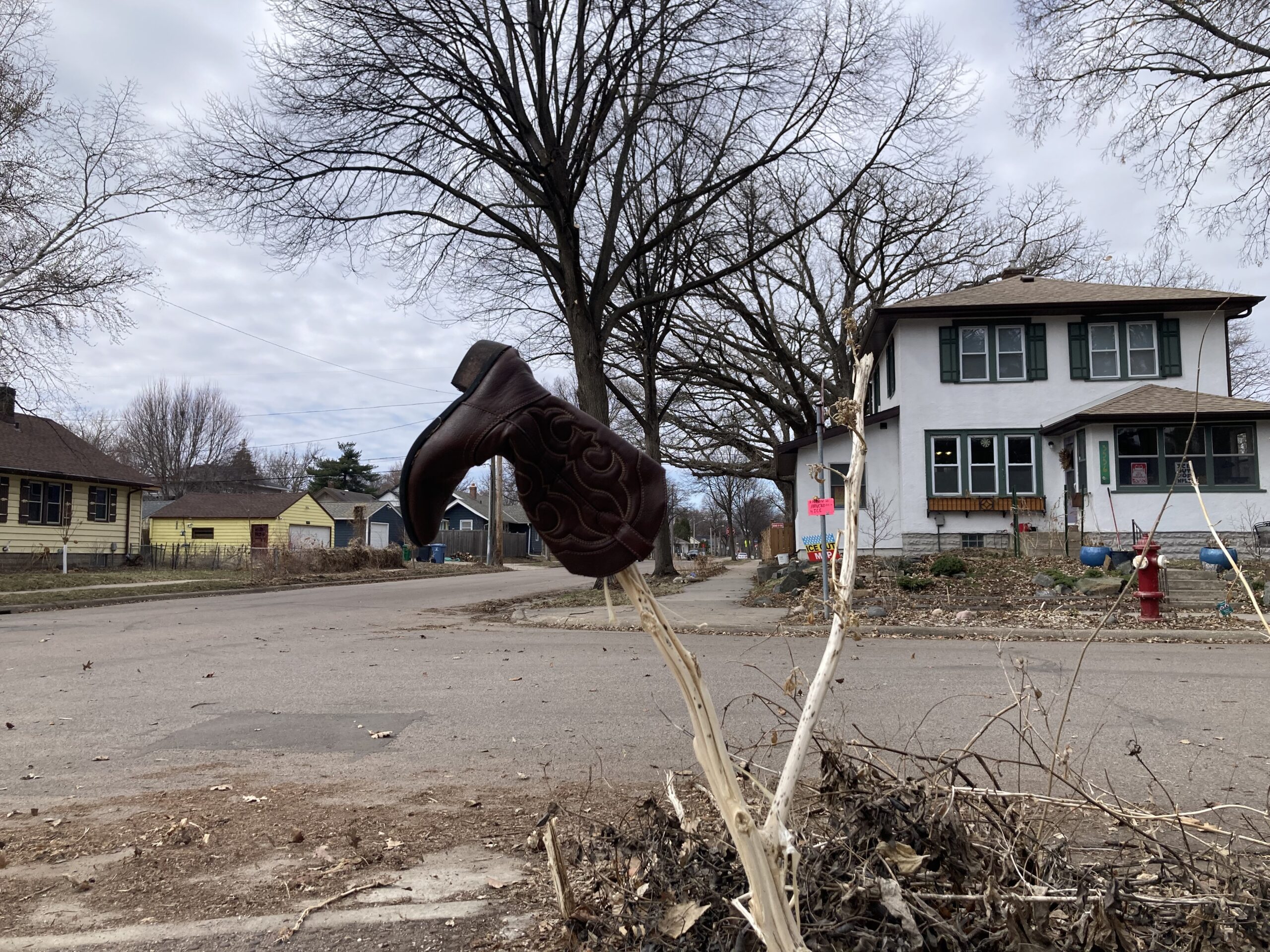
a boot, stuck on a stalk on the boulevard of matt the cat’s house
serve and a boot / the pink sign near the far house says, “someone was abducted by ICE here.”
The abduction by ICE happened early on, between the murders of Renee Good and Alex Pretti. Two people were pulled from their car and taken; the car was left by the side of the road.
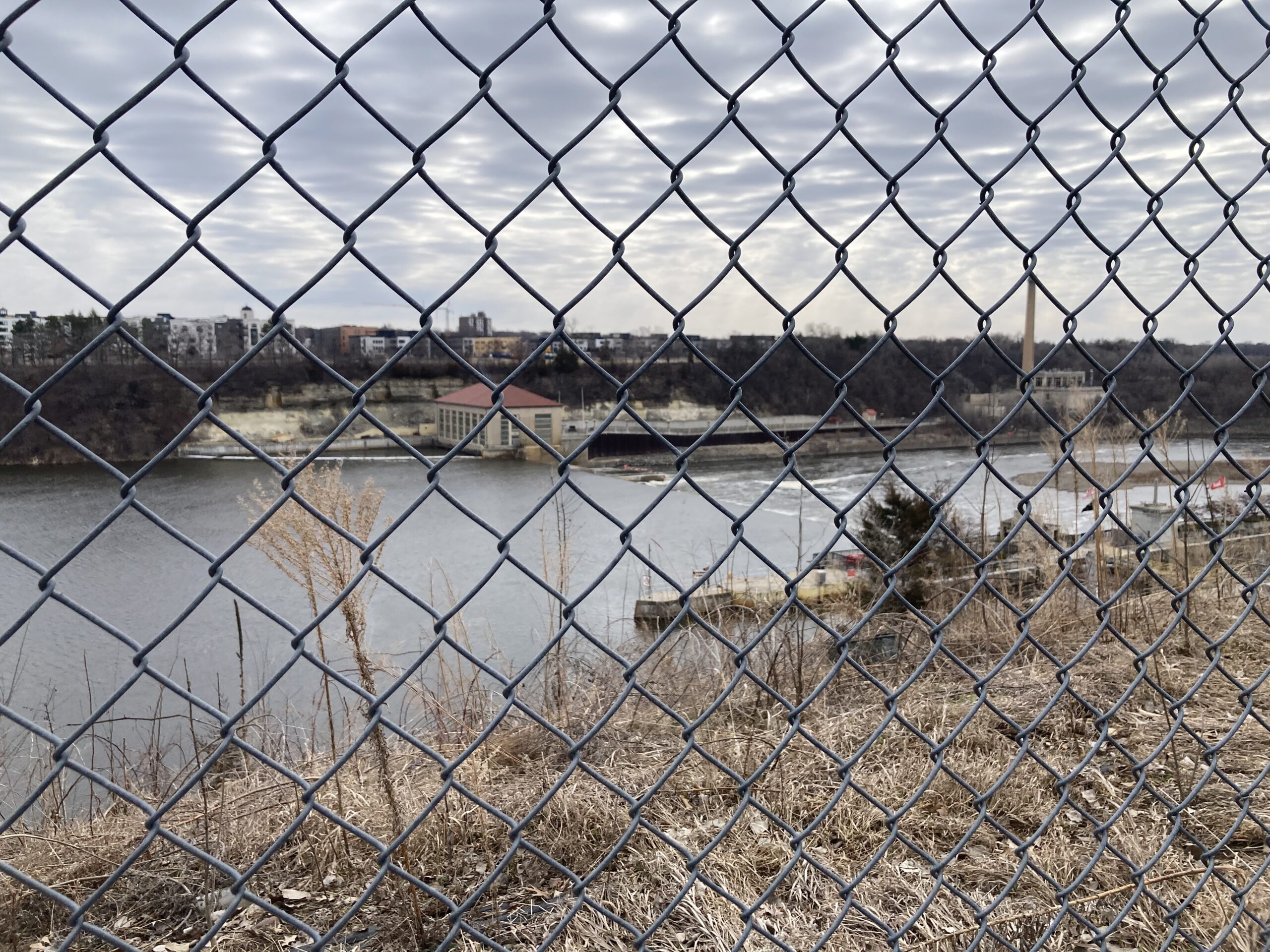
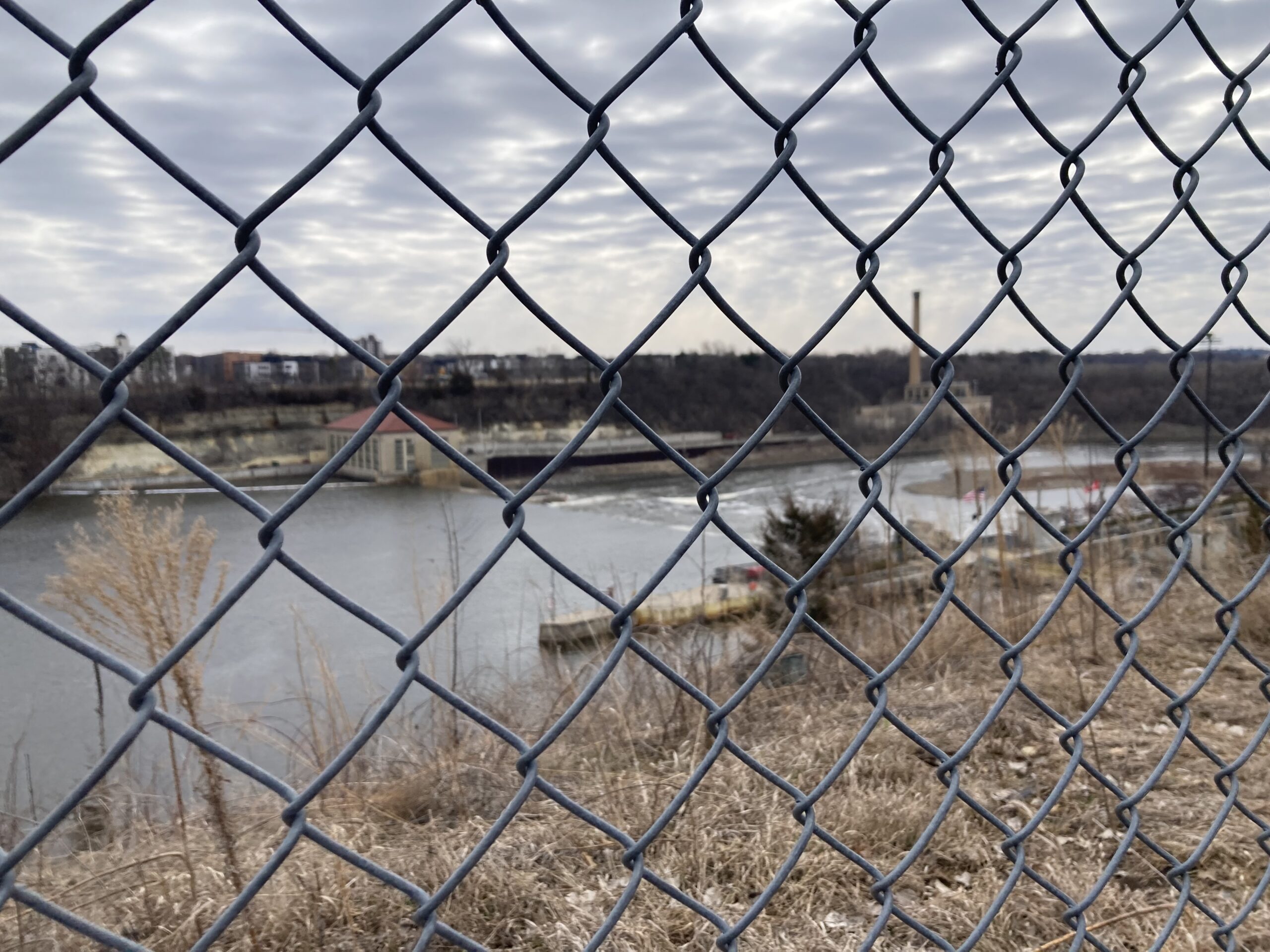
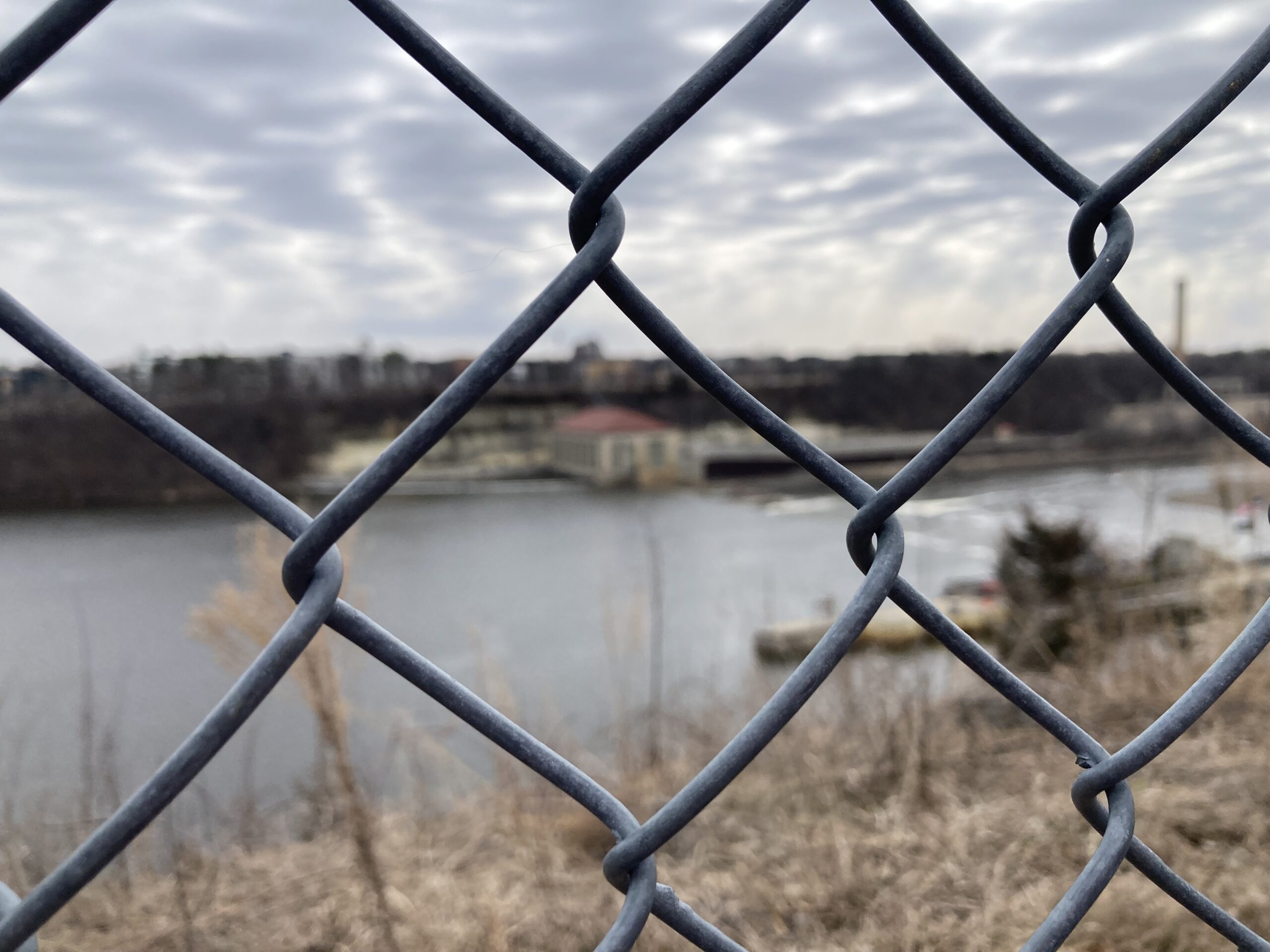
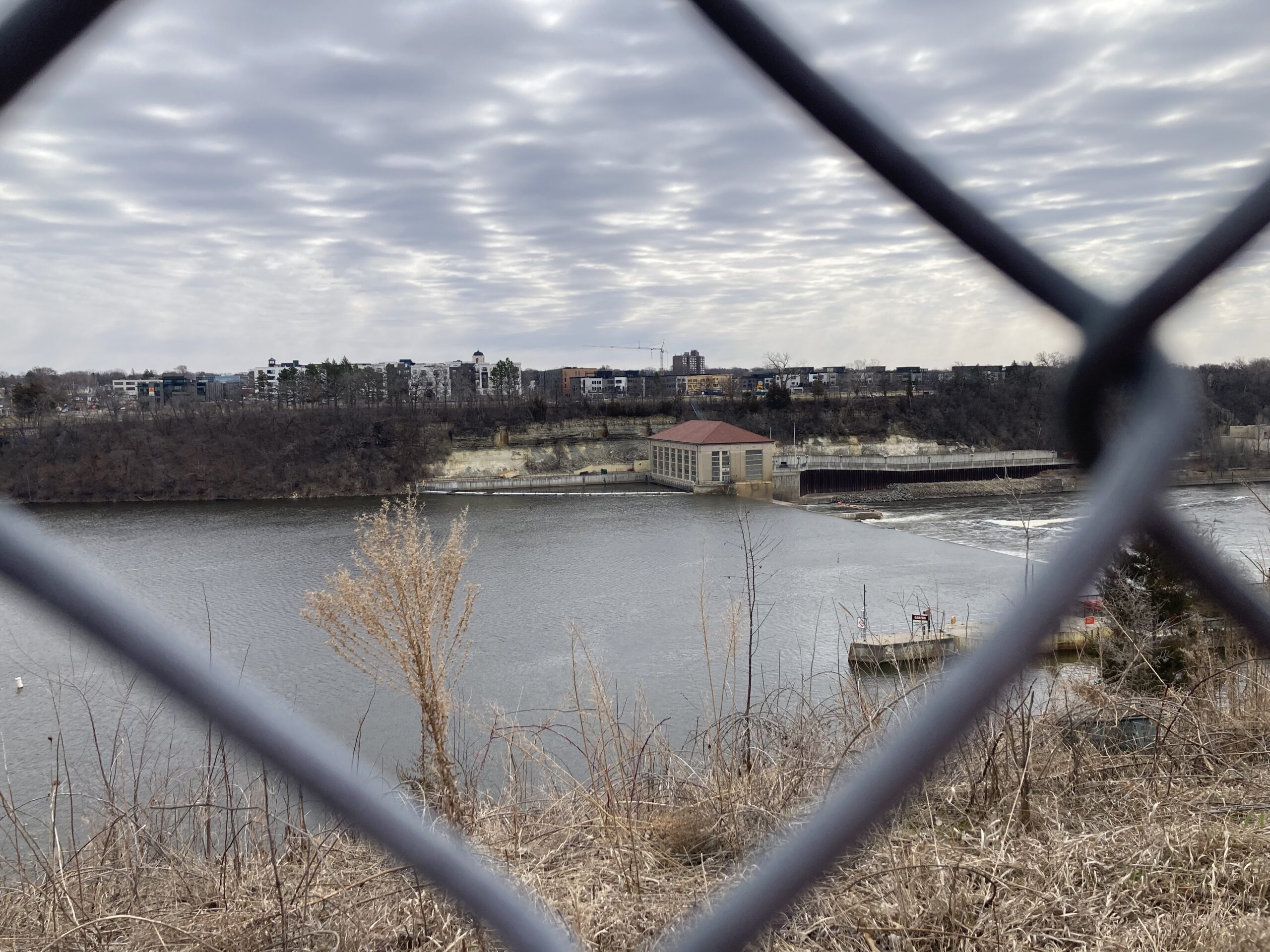
In addition to this boot picture, I also took some pictures of the view through the chainlink fence.
1234
I like this series of pictures. It reminds me a little of how I see. I can see better through my peripheral vision than my central — even when and if I don’t want to. It’s distracting to focus on the edge details sometimes, and it makes what’s in the center look even fuzzier to me. In thinking about my Holes series, does this happen at all when I’m reading? Is there a way to connect this fence with the lines in an Amsler Grid? An idea: what if I drew a giant Amsler Grid over the top of the entire, 4 panel, Holes 1 poem?
What does the sleep score mean? I’m less interested in the specifics of it at this point, and more interested in tracking which direction that number is headed. 77, which is only “OK” according to Apple health info, is the highest number I’ve had in the past almost 2 weeks. A goal by May: a number in the 80s. ↩︎
Went to the dog park with FWA and Delia this morning. Chilly but sunny and still down in the floodplain. Beautiful. No snow, hardly any mud, lots of felled trees. Halfway in we encountered an awesome dog carrying a stick that was 3 times as wide as his head. His owner said, the governor is about 200 feet ahead. Last summer, I recalled watching a video of Gov. Walz being interviewed at the dog park, so I knew he came here. About 5 minutes later, there he was! Alone and friendly. Hello! Hi! Of course, I couldn’t see well enough to recognize him, but FWA could. I wish I could have seen that it was him. I would have told him thank you.
5 Dog Park Things / 5 Winchell Trail Things
a section of the river, sparkling in the sun
the bark of the giant felled tree that FWA and I have walked around all this year had been stripped recently — a huge section of the trunk was barkless and gleaming white
faint footprints through the small stretches of mud
a motorboat rumbling by, making waves that rushed onto the shore near Delia
a woodpecker knocking on some dead wood, another (or the same one?) laughing
shadows everywhere — trees, the fence, lamp posts
the winchell trail path was covered in dry leaves that made a delightful crunch as I ran over them
a steady stream of cars (at 3:30 pm)
empty benches
no snow, no puddles
2.8 miles river road / winchell / lena smith 46 degrees
A quick run — in time and distance and speed. I should have slowed it down; it would have been easier. It’s hard to slow down in my new shoes! I was tired and felt the beginnings of a side stitch a mile in — I ate a protein bar too soon.
Today has been an off day — not terrible, there were many good moments in the hike and the run. But I woke earlier than I should have and felt, for lack of better word, weird. Untethered, fuzzy, maybe a little woozy, tired.
holes
As I continue to work on my holes poems, it has emerged that a few things are present in all of five of them: a hole, that hole’s impact on how I read, my blind spot, and the Amsler grid.
Why the Amsler Grid?
it connects these hole poems with my last round of visual vision poems, mood rings, which take the shape of an amsler grid
it ties in with the larger theme of all of my visual vision poems: vision tests — first, the snellen charts, then the amsler grid
it gives a context for my vision loss and grounds it in within a scientific/medical model of seeing/not seeing
it offers another way to visualize my untethering from that model/logic of test/diagnosis
This 4th one is especially interesting to me. I’m imagining fun ways to play with the implosion or destruction or destabilizing of the sharp, stable, rigid lines of a grid. The lines coming loose, or the lines a ladder without rungs — no way out of the hole, the lines collapsing and being sucked into the black hole, the lines forming a new path, a break in the lines — a gap, a dash, a slash, a breaking out of the lines — an opening, an exit, a room a door unlocked. What could that look like as part of my erasure poem? I mean, what, with my very limited skills in visual art, could I make possible?
I think I need to watch Alice in Wonderland again — should I read it, too? The hole in my vision as Alice’s rabbit hole. A passing through to wonderland. One difference: for Alice, Wonderland is the opposite of sense or nonsense.
everything would be what it wasn’t
I’d like to take this idea of non-sense out of the binary, Sense/Nonsense, to imagine non-sense as being more than just not sense. What if non-sense was its own kind of sense, just like Nothing is not nothing but something outside of our logic or language or ability to name it. Or, like I say in Holes 4, “a nothing that is something not sharing its secrets.
a flash: as I was working on the above list, I suddenly thought about the debate over whether or not listening to an audio book was reading. Does reading only happen with eyes? I like to distinguish it this way: reading with my eyes and reading with my ears. After this thought, a further thought: what if I created a holes poem that wasn’t visual, but aural? I could pick one of the New Yorker stories/articles that you can listen to, and figure out a poem from that. How might that work?
I had intended to work on all of this today, but I was busy all day: a birthday week coffee run with RJP, the dog park with FWA, weekly shopping with Scott, a run + cooking and laundry and a nap.
sleep
I decided to use my Apple watch this week to monitor my sleep. I’m averaging 6 1/2 hours a night, which I think is good for me, but only “okay” for my sleep score. Maybe that’s because I’m waking up every 2 hours. I have to get out of bed and stretch or go to the bathroom or walk around for 10 or 20 or more minutes before falling back asleep again. A thought occurred to me: could my low vision be contributing to my sleep problems? I googled it and yes, it might:
Visual impairment can lead to disturbances in the circadian rhythm20 and exacerbate neuropsychiatric conditions such as anxiety and depression, ultimately impairing central nervous system functionality and contributing to the development of insomnia21. Existing research underscores the negative impact of visual impairment on sleep patterns. Studies conducted in Russia found that individuals with visual impairment had more than twice the odds of reporting insomnia symptoms compared to those without, with this association remaining significant even after adjusting for factors such as age and gender21. This finding further confirms the link between visual dysfunction and sleep disturbances. Community research in the U.S. suggested that older adults with visual impairment are more likely to experience various sleep issues, such as difficulty falling asleep, trouble staying asleep, early morning awakenings, and daytime sleepiness22. Additionally, such individuals often report increased disrupted sleep patterns and a higher prevalence of sleep/wake disturbances23.
But, this study studied different visual impairments than I have. What about cone dystrophy or macular degeneration, which has similar effects? I looked it up and found some articles that link it, but it’s mostly about anxiety over vision loss that cause the sleep disturbances. I know I have some anxiety about the final break, when none of my cone cells work and all of my central vision is gone, but I think the connection between sleeping and not seeing or seeing differently is more complicated for me. I’ll have to ask the ophthalmologist at my appointment next month.
Happy first day of Spring! Many years it still feels like winter, but today it was SPRING! If I didn’t have to jump over a lumps of snow I wouldn’t have remembered it snowed almost a foot less than a week ago. Wonderful weather for a run — sun and not too much wind. I wore shorts, a short sleeved shirt and a lightweight pullover which I took off right before I turned around. For half the run, bare arms and bare legs!
a regular:Daddy Long Legs! As I ran back south, he greeted me, Hello again! Does he remember me from past years, or did he think he’d already seen me once today? (he’s done that before.) I’m choosing the believe he remembers me. I wonder if he has a name for me, like I do for him?
The ice on the surface of the river has melted. Down in the flats I was able to get close — only feet away — from the surface: some foam floating on the water moving slowly south.
holes
As I told RJP, I’ve hit the point in the process of these poems where I’m beginning to doubt myself and what I’m doing. Part of it, I explained to her, is because I dwell in the almost and struggle to find how to execute the final bit and/or give it the “polish” it needs. I’m not giving up. Instead, I’m trying a different approach: cut-outs. Would ths work better if the words were cut-out — a way to isolate them — instead of encased in holes? Can I do both? What if I had some of the words encased in the holes and some cut-out? Would that make it a little less complicated and less messy + easier to execute?
The question to return to again and again: what will serve the message/meaning/intentions of the poem?
4.3 miles minnehaha park and back 43 degrees 25% puddles
Yesterday it was very cold. Today it is warmer, the sun is out, and everything is melting! Drip drip drips everywhere, very LOUD whooshing car wheels, puddles. At the start of the run, I wondered how long it would take before at least one of my socks would get soaked. Not long! I only made it a quarter of a mile before stepping in a big puddle. Oh well, it dried out pretty fast.
overheard: one runner to another as they encountered each other on puddly double bridge — take it easy my brother
Kids laughing and yelling on the playground; a pack of runners; the falls, gushing, a few sirens; the river with a thin sheet of gray ice looking wide and barren. Can you see it through the trees?
river view from the 38th street steps / 18 march
On my walk back home, I stopped to take some video of water dripping out of gutter. Unfortunately because of the bright light I accidentally hit slow mo so you can’t hear the wonderful dripping sound. Here’s a brief clip of it anyway:
water dripping in accidental slow mo
HOLES
Yesterday afternoon, after finishing mapping all of my word (drawing boxes around them, encasing them in circles or the shape of my blind spot) and feeling like something was missing, I had an idea: I should place the Amsler grid somewhere on the pages. I didn’t want to simply cut out a printed version of the grid and completely cover the words. What about drawing the grid on top of the words? Too difficult with my terrible vision! Then, a new idea: cut out a hole the size/form of Amsler grid’s shape (4 x 4 in) and use string as the lines for the grid. After some playing around with it, another idea: not string, but thread or wire, and make the grid broken, distorted, emerging from the hole, looking somewhat like broken guitar strings. Three of the strings will extend out across the pages, offering the path of the three sentences of the poem. A variation: create three grids, with each one corresponding to a different sentence. This idea, which I hope I can execute because I really like it, led me to think about adding an Amsler grid to all of the holes. On Holes 1 it would be the “normal” grid with my blind spot on it. I have to think more about how it would look in Holes 2 and 3. By Holes 4, it’s broken.
If you google “distorted Amsler grid” you can find some great images of warped lines and black holes caving in upon themselves. Due to risk of copyright infringement, I won’t post any, but here’s a link to one that I particularly like:
Amsler grid distorted image: the image is at the bottom of the page. It is of the grid with the outer lines appearing normal. Near the center the lines are wavy, collapsing into a big black spot in the very middle.
Some things to think about today (I’m writing this paragraph just before 10 am):
how do I map the words in Holes 1, 2, and 3?
where do I place the Amsler grids in Holes 2 and 3, and what will that look like?
will there only be 4 Holes, or should there be more? If more, should I place them before or after Holes 4 in terms of the progression of the grid’s distortion?
Another thing that happened yesterday: I remembered that I had a large amount of oil pastels, leftovers from RJP’s obsession with them more than 10 years ago. Could I use them to color/fill in my holes? How do you use oil pastels?1
It is now 5:20 pm and I’ve spent part of the day trying something new with Holes 4. I’m using uncooked spaghetti to connect/map the words of the poem. It’s a complicated challenge, but the spaghetti is helping to visualize it more effectively.
more thoughts/questions:
should I split this poem into 4 instead of 3 segments?
should there be separate amsler grids for each section, or one grid from which different colored threads emerge and travel to the three or four different sections? if there is only one grid, should it be in the very center of the piece?
should the grid be just an open hole, with no evidence of a grid, just black netting and threads or wires or yarn emerging from the hole (I like wire, but is it too difficult to work with?) OR should part of the grid still remain — some white, some “normal” lines, then a hole?
a further thought with that last question: what if the holes (1, 2,3, and 4) documented the unraveling of the amsler grid, with it intact in Holes 1, then less intact in Holes 2 and 3, until it is gone and with broken wires in Holes 4? I love this idea; can I figure out a way to execute it?
returning to the thread/wire — will it work to have it stitched into the paper, where sometimes it is on the front, sometimes emerging from the back side through another hole? is this too messy and complicated? do I need to cut back on the poem, to reduce its number of words?2
I don’t want to cut any words, but it would make this easier — do I want it to be easier? Not really! ↩︎
Get Out ICE: It’s never too late to do the right thing. . . .
is something people were chanting and singing at hotels where ICE agents were staying this winter. I think it also fits as a way to describe this:
A reporter for NBC interviewed people at a gas station in a previously very pro-Trump county in Pennsylvania. Three people still support Trump, one does not. Responding to the reporter’s question, “If you could say something to President Trump and he could hear you right now, what would it be?”
“3 times! That was my bad, apparently I’m an idiot”
One last run on clear paths before it snows tonight. The forecast predicts more than a foot of snow tonight. It will probably melt fast, which will be as much as more of a nightmare than the actual snow. Walls of snow, then mush, then jagged ice, then little lakes and puddles. Oh well, I bet it will be pretty and I might get to see someone skiing down the street!
Today’s run was good. My left knee was a bit stiff and grumbly, but otherwise I felt good. In the last mile I started to feel relaxed, with my legs and arms and the space around me in sync. I was moving through the air, hardly noticing when my feet touched down — the space between beats! I love when I run like this!
10 Things
honk honk honk honking geese all around the gorge, 1: down the hill, under the ford bridge, a lone geese floating in the middle of the river
geese, 2: I heard their honks first, behind me, then beside me, then in front of me — finally saw them: 2 geese flying low
overheard: one runner to another: it didn’t even taste like salmon!
the bells of st. thomas
someone in an bright orange jacket down below, on the stretch of the winchell trail that I call the edge of the world
the river surface below the ford bridge was dotted with bright white slabs of ice — a strange sight; I wish I would have brought my phone today to take a picture!
an empty parking lot at the locks and dam
empty benches
traces of snow in the grass
a laughing pileated woodpecker
HOLES
Flipping through my past New Yorkers, I found an article from the 9 june 2025 issue that looks promising. It’s called “Still Life” in the print issue and “Greenwood Cemetery’s Living Dead” in the online version. The only test for whether I can use it or not: it must have at least one use of the word hole, or of a word that contains hole. This is a long article, so I’d hope there’s at least one hole, but is there? Yes, 4!
Medina extended a tape measure into the hole and said, “Six-ten.”
Usmanov and I stared down into the gaping hole, its walls marbled with grass roots.
went to Green-Wood almost every day for weeks this spring, and the most unnerving thing I saw was an enormous hunched figure, wearing a cloak, with a gaping hole for a face.
Scientists were only starting to piece together that contaminated water, not flawed character, caused cholera; that smallpox probably originated in rodents;
I’m surprised that an article about a cemetery only has 4 mentions of holes. Isn’t a cemetery more than half holes?!
some notes as I read through the article:
One, I am reading it backwards, section by section. Two, one rule in the cemetery: no skylarking. I looked it up, skylarking is frolicking and playing jokes on others. It’s also the name of one of my favorite XTC albums. Three, reading the text, which I’ve put in a pages document, I’m noticing a few things about the text: the text surrounding the word or phrase that I can see sometimes looks like it is scribbled out. Sometimes it looks like it has sparkles around it that are moving — not quite flashing. The text always seems to be vibrating. How can I translate that into a texture on my blind spot Four, as I read through the sections, I jotted down words or phrases that stood out to me:
entrance flaming torch welcoming appears mirror ink you’re never alone you’re never disconnected love full of little secrets inhabit center recreate experience remaining time offer everyone gently between seeing moment you look at space, you look at background, you look at sky hope visit already thinking I don’t know why there was room about to open up turn and follow her gaze staring hands waste bigger picture across threshold neglect and care art cone cell
heart needed landscape fizz snow flake marble dust seltzer balance fills up keeps the grass space enough out of the water upkeep grounds public spaces essentail failed possible efficiency requires can stand on a sidewalk people who never look up out of room true mapping crevice easy circular elipses inside walls outside dark happen here nothing pale-blue cluttered wasn’t a place searched
certainunmarked is now used other-siders skylarking exhume make when you see in place of a road the word down through the plywood a plank settling glacial till earth inches from a layer of turf dirt unstratified jumble of sands, cobbles, and clays caves in on itself all-weather like a bird bench what do you want stone slabs a door uncut grave terrain geologically life this is a place to inter the dead no good place to put all the boies walked around faces believing piece together rotting disease inspired crowded
By the way, as I write, the snow has started. We officially have a blizzard warning that begins around 10 pm and lasts until Monday morning.
One of the reasons I picked this article is because I wanted more land language, like grass and dirt and dust and terrain and stone slabs and sands, cobblestones, clays, caves and glacial till. I want to connect the hole in my vision with the gorge — as a landscape, and a very big hole. I think of it as a powerful metaphor for my vision loss and what comes during and after. Of course, the gorge is also the actual place I go to for my writing practice.
The word plank stood out to me because of ED’s “I felt a funeral in my Brain” — and then a plank in reason broke/and I dropped down and down — I think of ED also with the stone slabs and the dark.
And, I like crevice and opened up, inside, outside, this is a place to inter the dead, room — a gaping hole, a threshold between,
I also like fizz and snow flake marble dust, which is what the words (and what I) sometimes feel like — fly, like a bird, sky — the words, cluttered, crowded and between walls
my eyes: a graveyard for dead cone cells
you look at space you look at sky you look at words and don’t see the gaping hole and its graveyard for dead cone cells you see snow flake marble dust seltzer fizz a nothing that is something
I’d like to keep going, but it’s time to get ready for Scott’s birthday dinner!
Ran over the lake street bridge and to the monument today. When was the last time I ran this route? Just checked, it was 5 nov 2025. Wow! Of course, part of the reason why I haven’t run over there is because of the winter; they don’t plow the sidewalk on the bridge, and St. Paul, where the monument is, doesn’t plow their trails as well as Minneapolis. But another reason is definitely ICE; I’ve been staying closer to home with my runs because it feels safer.
Today’s run was good; I felt (mostly) strong, although my legs/feet are sore from wearing the shoes that make them hurt. It was windy and cold on the bridge, but it was beautiful. Steel gray water, open and high enough to hide the sandbars. Scattered stretches of the east and west banks were glowing with white snow. The sun was dulled by a thin layer of clouds.
10 Things
drip drip drip drip — the steady drip of water falling off the bridge near the east steps
graffiti — pink and orange and black block letters under the bridge
I only encountered 1 or 2 people over the bridge, both walking
the bells of st. thomas chiming at noon! 15 minutes later, at 12:15
running above shadow falls I glimpsed a dark flash of something — a tree? no, a person
with several more glances I realized the person was not hiking but running
they were nearing the worn dirt trail that climbs up and out of the ravine
St. Paul has replaced the port-a-potty at the edge of the monument parking lot — there is much less graffiti on this new one, and the door closes all the way — hooray!
near the edge of an overlook on the east bank, staring out at the other bluff and down at the water — a hiker emerges
a plaque on the bench for, “what a woman” Sharon. She was born 2 weeks after my dad was in 1941 and died in 2002 — so young!
Holes
Currently, I have 3 Holes erasure poems. Holes 1 is about my uneasy fellowship with the word. Holes 2 is about how the hole (my blind spot) makes it unprofitable to have faith in the visible. And Holes 3 is about falling through the hole into “who knows where”, on the border between the real and surreal. I need to do at least one more hole about the small holdout-of-a-hole in the very center of my vision that enables me to still read (even if that reading is slow and sometimes unreliable).
Tomorrow, RJP and I go shopping for textiles and textures at the Stashery, so today I’m working on mapping out Holes 3. I’m using “Me, Myself, and I: Helen Oyeyemi’s Novel of Cognitive Dissonance” from The New Yorker, August 25, 2025. Here is the version I just drafted:
swap the dead-eyed liturgy of doomed vision with shadowed acts that leap for the light (OR flee from the light?)
read sentences sliced in half with strangeness each one glitch ing enough to let in the improbable
fall through the hole your reading eyes find / or your reading finds / or your eyes find and land in a logic of blur and almost
Is this too many words to easily/cleanly map out? Let’s find out! And if not, let’s shift the form to make it work! — several minutes pass — Okay, I mapped it, and it seems like too many words. I think I’ll save my “darling” — the line that started it all about swapping the dead-eyed liturgy for another project — a liturgy of shadowed acts and the periphery! Anyway, I’ll try to keep the rest of the poem, and figure out the rest of holes is a project tomorrow morning.
Get Out ICE and Ice
The other day I wondered when the ice would be gone from Lake Nokomis. This morning, Minneapolis Parks and Recreation Board offered a prediction!
Minneapolis Parks Water Quality staff have tracked “ice off” dates on city lakes for decades. Ice off is declared when a lake is substantially free of ice after being fully frozen.
We’re probably not setting any records like 2018 or 2024, which dominate the record books. Staff estimate we could see ice off on small lakes like Powderhorn and Loring as soon as this weekend. It will probably be a few more weeks for larger lakes.
Will the HUGE winter storm we’re expecting on Saturday night and all day Sunday impact the ice off date? BTW, I’m pretty sure that they used to refer to this as the ice out date; I think they’ve changed it because of the very negative association with ICE. I checked past entries on my log, and yes, that was what it was called. Negative association aside, I like ice out better than ice off.
Snow. A dusting last night, then a little more in the morning. An inch? Enough to make everything white. I was happy to be done with winter, but I don’t mind the snow. Since past snow has already melted and the ground has already warmed up, the snow didn’t stick around. By the time I went out for my run in the afternoon, almost everything was clear. The run didn’t feel easy, but I pushed through several difficult moments and kept going. Hooray for mental victories!
I listened to the dripping and gushing and the wheel whooshing as I ran south, 2 playlists — “Bunnies and Rabbits” and “the Wheelin’ Life” — as I ran back north.
10 Things
sh sh sh — the shifting grit under my feet
the wet pavement was shining and sparkling in the sun — so bright sometimes that I thought it was slick ice
entering minnehaha park, the parking lot was empty
exiting the park 10 or more minutes later, there was one car at the far end of the parking lot
the creek was rushing
the sidewalk on the bridge just above the falls was wet and clear — last week someone had chalked a long message on it, which I couldn’t read because of my bad vision
on the walk just before I started, I noticed a small black bird skittering along the grass — it had a small circle of white feathers below its eye
a runner in a bright red jacket stopped at the Rachel Dow Memorial Bench, a minute later they ran down a hill on the winchell trail
only 1 or 2 small patches of ice, a few puddles
I almost didn’t remember this one! — three people on the bridge over the falls, looking over the creek side. One, to the others, pointing down at the creek: look, there’s 75 cents! One of the others, joked (I hope): better go down there and get it!
Rabbit Recap
Slowly but surely, I’m getting to the end of my rabbit recap, but not today! See past rabbit recaps here: 9 march, 6 march, 5 march, and 4 march.
14 — 25 march 2026
Here’s a useful explanation of some reasons why I do monthly challenges about new topics, like rabbits (or wind or dirt, etc.):
And what’s the point of all of this? Following the rabbit down the rabbit hole is a wonderful distraction. It is also an excellent opportunity to learn. And to learn more about rabbits, which leads to caring about them as living things and as symbols. This caring might (is) enabling me to open up a closed part of myself (closed = strong dislike of rabbits). And it is helping me to think more broadly and specifically about the impacts of humans and human encroachment on environments and the consequences of that encroachment for humans and non-humans. Plus, all (or any) of it could inspire new poems.
A quick summary of some rabbits references and reveries: the killer bunny in Monty Python; Bunny Lebowski; Rabbit in Red matchbook from Halloween; Jimmy Stewart’s invisible bunny in Harvey; Max and Ruby; the PBS doc The Pill; Rabbit in Winnie-the-Pooh; the Cadbury Creme Egg Bunny; The Runaway Bunny; fix me hausenpffefer right away!
Rabbits in Diane Seuss:
excerpt from backyard song / Diane Seuss — I LOVE this whole poem. I’d like to use it as inspiration for a hole poem and a bunny poem!
Uncorked, I had a thought: I want the want I dreamed of wanting once, a quarter cup of sneak-peek at what prowls in the back, at what sings in the wet rag space behind the garage, back where the rabbits nest
excerpt from Her first poem had a rabbit / Diane Seuss — I want to bring in the optical illusion of the bunny and duck + the idea of what seems mild but is really wild
She tended toward rabbits back then. Toward the theoretically mild
that are really wild. Like ducks on a pond that is really a moon
New Yorker Experiment: A hole through the bottom of the known world
Today I worked on the template for my hole poem that erases the “Whisker Wars.” It has some of my blind spot, some big circles (from a iron pill cap), some medium sized-circles (lexipro cap), small (a quarter), and extra small (a penny). I want to create texture for the blind spots but leave the circles alone as pencil/gray.
a hole through the bottom of the known world
My choice of blind spots vs. circles, and the size of the circles, was mostly decided by what would fit where, but there might be some room to play around with some of it. I’ll think about it some more.
The words: nothing still / details drift like snow / cut off heads with pewter-colored faces float / a hole through the bottom of the known world / here it’s unprofitable to have faith in the visible — should it be what is visible?
added an hour later: I realized a further clarification on the idea of the hole and holes. The blind spot creates a hole in my vision, an absence that has created an uneasy fellowship with the world and made it unprofitable to have faith in the visible. But, there is also the small hole that remains in the otherwise dark blind spot that enables me to still read — it’s a small hole, and it’s getting smaller, but it’s still there. I’m noticing that my whisker wars poem offers many different sizes of holes depending on how many words I’m trying to fit in it. I need to have a poem that highlights that tiny hole holdout — ooo, holdout is a word in the whiskey wars article. Should I do a completely different poem using the same text?
Get out ICE
Each morning a local journalist, Sean Snow, offers updates on what’s happening in Minnesota, both what ICE and those in state and federal government that support ICE are doing, and how people and their communities are fighting back. I read them on Facebook, but he also posts them on Threads, Instagram, Tiktok, and YouTube. Today one of his examples
— sitting at the dining room table, drinking my coffee while I write this, I just heard a long goose fly by — honk honk —
was about “a real act of public memory” n St. Paul:
Testimony Builds The Record: Minnesota residents, advocates, and families testified Tuesday in St. Paul before the chair of the U.S. Commission on Civil Rights about what they experienced during Operation Metro Surge. Star Tribune reported that people described racial discrimination, abusive detention conditions, treatment of protesters, and the deaths of two citizens, all in hopes of pushing the commission toward a formal investigation. This was not a final ruling or a courtroom win. But it was a real act of public memory and accountability on a day when it would have been easy for the country to start looking away.
With the sun and the bare ground it felt warmer than 50 degrees, so I wore shorts! I started with long-sleeves, but by 2 miles, I shed that skin and ran the rest of the way with bare arms too. Ah, spring! Not the easiest run. It might have been because I didn’t wait long enough after my second breakfast/early lunch.
1
One of the best things about the run was heading south and admiring the river. Waves on the surface reflecting the light. A shimmer scene. Dazzling. I haven’t seen sun on open water like this for many months.
2
Since I’m thinking about holes and spots, which also means circles and loops, I thought about a playlist I made a year ago (25 march 2025), and decided to listen to it. Much of it is about seasons and cycles, but as I ran I thought about the hole inside the wheel and falling through it — into another dimension? another way of being? a space not consumed by the expected (normal) life? Then I thought about my growing blind spot and how it has cracked open “normal” life — this cracking can be painful and difficult, but it has offered new possibilities and an entrance to another way of being.
3
After stopping to put in my playlist, as I ran down the hill and away from the park, by right foot felt strange. Was there a rock in my tread? I finally stopped and looked. Not a rock, a hole in my shoe where my middle toes strikes down. I guess that proves it: I’m not a heel or mid-foot but a toe striker! Unlike the hole in my vision, I don’t really see an upside to this hole in my shoe — well, I guess it means I have get to buy new shoes, and, if any are still available, in a bright color!
minutes later: Done! My new Brooks Ghost 17s are dark blue, turquoise, and green!
a hole in my running shoe
I have never had a hole in the bottom of my running shoe. I’ve had holes on the side where my bunion/wide foot has pushed through, but never a hole on the bottom. I think it’s funny that this hole happened just as I’m thinking and writing about holes. I feel like I need to incorporate this hole into my project!
A Return to my Rabbit Recap
11 continued — 20 march 2026
sources of bunny inspiration: 1. rabbits who eat buckthorn bark may pee smurf blue; 2. identifying the dark forms in the backyard as rabbits; 3. origins of “bold as brass”; 4. optical illusion — duck or bunny; 5. a cup full of 3 rabbit breaths (poem); 6. jackrabbit trapped in a wildfire (poem); 7. the rock that is not a rabbit (poem); 8. little girls deciding who will have their bunny when they die (poem); 9. a rabbit offering themselves to quell a woman warrior’s hunger (book)
12 — 24 march 2026
Bunny as muse? nudge? pest? ghost?
What am I doing as I keep putting the two bunnies in my backyard into my poems? And why do I insistent on calling these wild and mature eastern cottonwood rabbits bunnies? I’m not sure these rabbits are indifferent to me, but I think they notice me in terms of whether or not I am a threat to their main activity: grazing in the grass.
A title for a poem? Crepuscular. Why don’t rabbits flee when I approach? Do they see me as non-threatening? Has human encroachment screwed up their sense of friend and foe? My mom, a pesky bunny, and a drive out the country. Peter Rabbit: the horror movie.
the rabbit hole:
“Down the rabbit hole” is an English-language idiom or trope which refers to getting deep into something, or ending up somewhere strange. Lewis Carroll introduced the phrase as the title for chapter one of his 1865 novel Alice’s Adventures in Wonderland, after which the term slowly entered the English vernacular. The term is usually used as a metaphor for distraction.[1] In the 21st century, the term has come to describe a person who gets lost in research or loses track of time while using the internet.wikipedia
Out-of-control curiosity. Distraction. Losing track of time. Getting lost in strange worlds. These are presented as bad things. Are they? Many of them are embraced within poetry. And they are great tools of refusal and resistance against late-capitalism and wannabe fascist governments — you’re not working for/perpetuating the system while you’re following the rabbit hole.
The rabbit hole online.
13 — 27 feb 2026
The rabbit hole. “Back to hole-less cottontails. A new metaphor is needed — not falling down and through to other worlds, but something about edges and shadows and the fringes — the periphery! Dwelling on the edges, in the corners, not traveling to new worlds, but noticing the other worlds that are already there, have always existed in the midst of my world.”
I want to think more about this shifting metaphor in my understanding and use of hole in my erasure poem (or poems?)
New Yorker Experiment #5
First, an update on Holes. There’s an empty space without text in the lower left corner. I’m thinking of putting a definition or a quote or a line there. Or, I could put my poem written out in a straightforward way in the space. Would that undercut of enhance the experience of reading the poem? The text could also be an explanation of my version of reading; peripheral — big picture / central — one word or small phrase at a time, often experienced in isolation.
I’ve started (just barely) working on experiment #5. I’m using an article from July 28, 2025 titled “The Whisker Wars.” All I’ve done so far is write down words that stood out to me on two out of the three pages. I want to try experimenting directly on the New Yorker pages so I have a decision to make: two of the pages are back to back, so I need to pick either the first or second page. I’ll read through both of them and see which one I like better.
Hmmm….there’s a cartoon on the second page with the caption, “That’s an area for creativity and unstructured play.” I might want to use a few of those words.
words/phrases the stand out, page 1:
portrait
a game of Now You See It, Now You Don’t
in the beginning, not a whisper
otherwise
drift like snow
wonder
notice
russet-and-gray
pewter-colored
abrupt shift
who left
entanglements
weirdness
yellow
bore a hole through the bottom (of my coffin)
still
page 2
traces
people saw it as separate (from the body)
replaced by a view
faith
framed
revealed
meanwhile
from
however
trends
norms
world all know / known
waves
an area for creativity and unstructured play
lies details
natural
rather
nothing
believe (rs)
teach you
visible
cut
choice
Get Out ICE
On 5 march 2026, NPR posted a story about how doctors and nurses in Minnesota have created an underground network of medical care for people who are too scared to leave their homes. “There are now about 150 doctors — a volunteer “rapid response” team that has made more than 135 home visits” (When ICE came, Minneapolis created underground health networks).
These members of the care network have helped women in labor, babies with the flu, “At the Faribault clinic where Carroll works, staff members deliver medicine, food and other necessities to patients. A staffer drives 12 middle and high school kids to and from school every day in a clinic van.”
2.5 miles 44th street parking lot and back 35 degrees
Ran in the afternoon. Colder today. I wore gloves and a headband to cover my ears. It felt harder, maybe I ran too soon after lunch?
It snowed last night. Not much — not even an inch, but enough to cover the grass and make everything glow white. By the time I went out for my run, the paths were clear.
omens of spring-to-come: someone was roller blading! Not roller skiing, but roller blading. And, a woman was running in shorts. It’s not unusual to see a man running in shorts during the winter, but it’s rare to see a woman. That usually doesn’t happen until it’s spring, or feels like spring, or is warm enough to be spring.
I was planning to finish my rabbit recap today, but then I started thinking about and experimenting with my holes poem. No time for the rabbits — well, except for several paragraphs below, when I realize that my naming of this poem, Holes (or hole?), is probably at least partly a reference to the rabbit hole!
New Yorker Experiment #4, continued
Today some part of me decided that we (the Saras) would offer a more detailed account of the process of thinking through my latest poem, so that’s what we’re doing.
I want to keep working on my fourth experiment. Yesterday afternoon, I printed out the New Yorker article, “A Screaming Skull,” and found my poem on its four pages. Then I taped the pages together and mapped the poem out. The theme: holes. I imagine it as part of a larger project about my blind spot. Maybe this project won’t be all erasure/found poems; I might try to connect it to some other work on the blind spot — work I’ve been doing for several years now, but haven’t quite figured out how to turn it into something. Yes! Experiment #3 — swap the dead-eyed liturgy of doomed vision with shadow (or shadowed?) acts, wild and improbable could connect with my study of JJJJJerome Ellis, the stutter, and his liturgy of the name! Very cool!
I took a picture of what I’ve done so far:
12
What to do next? The second image offers a possible approach: Applying my blind spot — the one I recently created by staring at a blank wall until it appeared, then tracing it — to each of the “found” words. I could sketch the blind spot directly on the page, around the word, OR I could place a cut-out version of the blind spot on top of the word. Maybe I’ll try a practice sketch. Another idea, which is probably definitely beyond my technical ability: create an animation of the process of reading this that starts with an overview of the poem, then zooms into the first word, encircled by the blind spot which appears as I read it. Then it moves to the next word/phrase, and the next, and the next until the poem is finished. I could also do it as a series of stills (instead of an animation). You could look at each one individually1, the image as a whole, and the series of images in a gallery.
I like this last idea! The focus on individual words — isolated from the other words and the meaning as a whole, which is how I read, because what’s left of my central vision is so small it can only fit a few words, and which is how I often (but not always) experience the world with my big blind spot — in isolation, and removed from others. A question: should I keep the larger poem as a square, stacked 2 x 2 pages? Or should I have it extend as 4 pages across? I can play around with it.
an hour or two later: Here’s something I tried with a paper cut-out of my blind spot as a template. I’m thinking I should ask Scott to make a sturdier, cardboard version of this template.
in progress / 1 PM / 7 march 2026
Something to think about: should I have the blind spots on the entire poem/map? I was going to write: no, because that’s not how I would see it; I would see a somewhat fuzzy version of the map of the poem. But this poem is not an accurate representation of how I see. I hardly ever see my blind spot as a gray blob. But the blind spot is there and it distorts how/what I see and I need to represent in some way that others can see too.
Another question: should I hand-sketch this poem, or figure out how to do it on the computer? I like the hand drawing — the material aspect of it + I can do it all myself — but drawing it by hand is messy and unreliable. I’m thinking that this series will be part of my vision art installation — along with my snellen charts and mood rings. It seems too messy if I don’t do it on a computer.
Also: how should the individual stills look? Should they be a close-up on that part of the poem, or just the word/phrase centered in an otherwise blank page? Should they include the blind ring? If I have more of the text, should it be too fuzzy/distorted to read, or should I have it surrounded by gray? Looking at the words on this screen, I see: 1 or 2, maybe 3 short words in focus, then other words too dim or fuzzy to read, and, after staring for a few seconds, a glowing dark ring around it. This ring is not solid or very dark, it’s almost gauzy, like a veil, or the feeling that there’s a ring there. Does that sound strange?
(rabbit) holes: Today I start a new volume of my Plague Notebook: vol. 28! I’m calling it, What about Epstein, Trump? As I was writing in it, describing my latest visual poem, Holes, a thought: Am I calling this holes (or hole?) partly because of my recent study of rabbit holes?! Maybe! And maybe I could bring rabbit holes into a poem about my blind spot!?
Get Out ICE
“Accountability in this case looks incredibly simple. Minnesota must investigate the violation of constitutional rights at the hands of Noem and her ICE agents and prosecute where appropriate. The best part about this process is that Trump can’t pardon state convictions.” Boom. (from a Occupy Democracy post, citing a MSNOW interview with Tim Walz)
While applying my blind spot to the phrase, “another word for,” I realized that that phrase was too big to fit inside the inner ring. So, that’s a new limit to how I can construct this, and other blind spot, poems: the phrases/lines must be able to fit within my blind spot. It wasn’t a big deal in this poem; I just took out the for from “another name for” and found it somewhere else in the article. ↩︎
3.5 miles locks and dam no. 1 48 degrees / drizzle
A few more warm days, then cold again. I didn’t mind the drizzle, everything was gray and soft and misty and wet. Dripping and whooshing and seeping. Of course, now that I’m home, the rain has stopped and the sun is almost out. I ran to the bottom of the locks and dam no. 1 hill and admired the ford bridge. It looked more like a painting than an actual bridge — although it sounded like a bridge, with trucks rumbling overhead!
I love the reflections in this picture I took, especially the upside down street lamps and railings.
If the sky were a little darker, the river a little lighter, you might not be able to tell which bridge is up, which is down — at least, I wouldn’t be able to tell!1
Smiled at several runners and walkers and bikers. Made note of all the empty benches and parking lots. There were not too many people out there. For the last bit of the run I was able to get deeper into the mist by running on the Winchell trail. Very haunted and other-worldly!
I listened to water for the first half of the run, and “Bunnies and Rabbits” playlist for the second. A new song popped up: Rabbit // Hole by Siddhartha Khosla. It’s part of teh music for a one-season series called Rabbit // Hole with Kiefer Sutherland. It’s a great song to run to. Near the beginning, the music breaks up for a few seconds then plays again then breaks up. I imagined a fast moving rabbit passing by an object when the music broke up, then being in the clear (when the music resumed), then passing my another object when the music broke up again.
Rabbit Recap, part 3
Can I finish this rabbit recap today? Nope. I got distracted with other stuff.
11 —20 feb 2026
All late fall and winter, 2 or more bunnies have been hanging out under our crab apple tree — at night, in the afternoon, at sunrise and sunset. They’re very bold, these bunnies, not running off when I walk by. When this happens, I’ve started saying, these bunnies are as bold as brass! Why? Not sure. And, I don’t want you to get the wrong idea: I like bunnies or rabbits about as much as I like squirrels, which is not at all.
Get Out ICE
Yesterday afternoon, Scott came to my desk n the front room and said, Do you want to hear some good news? I mean, some actual good news?Kristi Noem was fired!
from Needle & Skein (the red hat people)
As of March 5th, we have raised an incredible $705,000 to help our immigrant communities here in MN. This is just us. Other yarn shops in Minnesota and around the country have also raised money and generously donated both here and locally. ICE is still here. Our fight is not over. Join us.
If you are a business who has raised money, please send us a message. We would love to try and get a full picture of what the amazing fiber community worldwide has accomplished.
Read the comments for more on how the fiber arts community is showing up!
New Yorker experiment #5
These experiments are slow-going. I run out of time to work on them. I struggle to see what I’m doing. I’m messy and haven’t figured out how to work with glossy magazine paper. So why am I continuing these experiments? I asked that to Scott and FWA in the kitchen the other day and then answered it myself: For some reason, I2 want to do these erasures, so I’ll keep doing them until I don’t want to or can’t (because it is too hard with my bad vision).
a flash of an idea: As I was writing that last paragraph, I was thinking about how visual poetry is increasingly inaccessible to me as my few remaining cone cells die (are the dying or just malfunctioning?) Then this popped into my head: yesterday’s erasure involved using marker to cover almost the entire text. When I had FWA and RJP read it, they both got marker on their hands — not in big streaks, but in tiny marks that almost looked like cuts or scratches. What if I made these erasures about touch too? My first thought was about doing the erasure in such a way that created a residue. Second thought: what if these erasures involved texture and touch — here, I’m reminded of the kids’ book Pat the Bunny and its different textures to touch: the soft bunny fur, the rough bunny . . . nose? I can’t remember what was the rough thing in the book. If you can touch these erasures and their textures, which would somehow speak to the words/ideas on the page, maybe you can hear them too? I’m thinking of scales, and thick layers of paper, maybe some holes where the paper has been ripped open, some extra rough sections, some smooth, like a thin film, crinkly, soft, sharp-ish. And — maybe in terms of the visual aspect, find ways to cover it that reflect or glow or shimmer or sparkle. I can see these textures in a way that I can’t see the typical flat, black expanse of an erasure. So things like glitter, little mirrors, metallic surfaces, ridges. What about covering it with things that offer colors only visible in the light — thinking of bird feathers here. So many ideas! Again, difficult to execute without it looking like a mess, but fun to try.
Before I had that last flash of inspiration, I was thinking about how I’ve decided (as of yesterday) that the overarching theme of these found poems is my vision and how I see. Then I thought, I should apply my blind spot to these pages. Create an amsler grid out of the text, and then place a cut-out of my blind spot (found while starting at a blank wall and then drawing what I see) on top of the words to find the poem.
Maybe some of these erasures could be all/only about texture, some all/only about my blind spots, and some both. And just now, another thought: What if these erasures were all about my blind spot and the idea of blind spots? Would this work: one of the erasures could be covered in spots or dots or holes in the paper?
So many fun ideas to try. I imagine that some of them will only ever be ideas that are good in theory but don’t work on the page.
Oh — I almost forgot, until I looked over at an open tab that reads, “tools to use for magazine erasure poems,” I started writing about this experiment because I wanted to mention my need for better materials. I love how writing in this log opens me up and helps me to see new things to try! Before writing about textures, the supplies I thought I needed were: sharpies, an exacto knife (can I see well enough to use this?) and possibly paint. Texture through thicker and thinner layers of paint is an interesting idea. Now I’m thinking I need scraps of fabric — next week, RJP and I should go to the fabric scrap store at the Textile Museum! — that are soft and rough and bumpy and gauzy. I need glitter and sparkles and little things that reflect and crinkle. Fun!
Here’s a new version of experiment #3. I decided to paste the text into a document so I could have an easier time drawing on the text. Is this a good solution? I’m not sure, but I do like how this version looks:
swap the dead-eyed liturgy
Bummer. I just realized that I erased the ed on doomed. It is supposed to read: of doomed vision (I guess doom vision could work?).
text:
swap the dead-eyed liturgy of doom OR doomed3 vision with shadow acts wild and improbable
And now I’m redoing yesterday’s experiment:
text:
Another name for barely
not blind is a hole in your vision that makes for an uneasy fellowship with the world.
Spring-y! Sun, above freezing, and a clear walking path! I was able to take the trail that dips below the road between the double bridge and locks and dam no. 1! Also: birds and grass and no gloves. A good run. I feel more power in my legs and able to run for longer without stopping. I heard kids on the playground, the call of a bird that sounded mechanical — similar to the strange, high-pitched siren I heard earlier today, and the doppler effect on the light rail bells as I ran south to the falls. I heard Panic at the Disco, Radiohead, Gene Autry, and The Jazz Crusaders on the way back home.
Speaking of hearing, as I write this at my desk, I can hear a woodpercker outside my window pecking on a tree in our front yard that I think is dead or dying. Every peck is saying, right right right right (you’re) right. Ugh! Is it time to call a tree service?
At some point during the run I thought about I wasn’t thinking about much of anything. Then I thought, the purpose of today’s run is not to work out a writing problem, or encounter some inspiration, but to move and breathe, feel the sun on my face, and be by the river.
10 Things
a thin skin of ice on the river
larger areas of the creek open with dark water, some snow stretching out from the banks
an occupied bench! someone is sitting on the bench at the 44th street parking lot
overheard: some guy talking to his two friends about something being only 2 loops — when I passed them a few minutes later, I noticed they had on shorts and running shoes on
that same truck that seemed to be hiding under the bridge last week was back again today — why?
a few parts of the trail that still had any ice or snow were also covered with dead leaves
enough snow had melted so that I could cross the road and walk on a wide strip of grass instead of mud and snow
vision mistake: up ahead of me, it looked like a truck was parked on the path, blocking the way. I crossed over to the parking lot then immediately realized the curve in the trail made it look like the truck was blocking it, but it wasn’t. Oops
more people near the falls, more cars parked in the parking lot
stopped at Rachel Dow Memorial bench to admire the view through the slender tree trunks and to take a few pictures.
sitting beneath the bench looking up at the trees / 2 march 2026
more rabbits bunnies
It started on 20 feb, this occupation with bunnies.1 When will it end? Not today! Here are some more bunny things I’d like to archive:
1— buuuuunnies
In footnote 1, I mention that bunny is fun to say. That might be partly because when I say it, I think of how Tom Haverford says it on Parks and Recreation2:
2 — Boynton Bunnies
At first he was skeptical, but I’ve managed to get Scott thinking about and noticing bunnies and bunny-related things everywhere! This morning he sent me an image someone posted on social media:
you say rabbits, and I say bunnies / you say comics, and I say funnies
Actually, I don’t say funnies — who says funnies? — but it worked for the reference to “Let’s Call the Whole Thing Off.” Is Sandra Boynton still popular in 2026? I remember her greeting cards in the 80s and her kids books in the aughts. What was the one with the cd/songs that FWA and RJP loved? did they love it? I can’t remember; I think they at least liked it, or was that just me who did? I think the book/album was Philadelphia Chickens.
In addition to sending me random bunny images he finds, Scott was willing to watch the Disney Alice in Wonderland, which was awesomely weird, and sadly could never be made now, I think. Some of the nonsense in it, which was fabulous, reads not as kooky kid imagination but as being under the influence of psychedelics. There was also this menacing edge to the characters Alice encounters: they seemed fun or dangerous at any given moment. Two examples: the flowers in the garden — that head Rose! — and Tweedle-dee and Tweedle-dum — doing fun acrobatics but also stopping Alice from leaving.
3 — the Bronze Bunny
Their official name is “Cottontail on the Trail” because they are a bronze statue of a cottontail and they are right on the minnehaha bike trail, but I always call them the bronze bunny. Other people call them the Minnehaha Bunny.
The sculpture has garnered the nickname of the “Minnehaha Bunny” from residents.[4] Children often climb on the sculpture and people who live nearby have frequently costumed and decorated it based on seasonal occasions or topical events such as leaving eggs by the sculpture during Easter or cladding the mouth of the sculpture with a large cloth face mask during the COVID-19 pandemic.
I’ve written about this bunny on here before. They’re 4.5 or so miles from my house so I only see them on bike rides and long runs when I am training for the marathon. Passing the bunny on a run is a big deal; it means that I’m fit enough to run for 10 miles or more.
This bunny was erected in 2002, but it seems like it’s been here much longer.
I’ve tried to say rabbits, but I just like bunnies better. I think it’s partly because of how it sounds as I say it. ↩︎
Finding and creating this clip took WAY longer than it should have. I kept at it because I was determined to get the clip, not because Tom saying “buuunnies” was worth it (I think I spelled buuuunnies with one n in my title, ugh), but because I wanted to figure this out. Before losing most of my cone cells it was so much easier to do stuff like this. ↩︎
Get Out Ice
Here’s an example of an existing group using their established community to provide mutual aid and support to people during the ICE occuption: How a Dungeons & Dragons meetup turned into mutual aid during ICE operations. Members have organized “know your rights” workshops, accompanied immigrants to appointments, coordinated food donations, and made barbecue for families in need.
This quotation fits with the erasure poem I’ve been working on this morning:
“In a story, you can be the underdog who defeats the big, bad, evil entity,” said D&D player Kat Hennan. “I think that having that kind of thought exercise and storytelling right now is extremely important.”
New Yorker Found Poetry Experiment, Day 1:
Picked a random old New Yorker. Found an interesting article, “The End of the Essay: What comes after A.I has destroyed college writing? / Hua Hsu. Put my watch timer on for 30 minutes.
Poem:
question: Has there ever been a time in human history when the arts could not offer hope and help us to be open to more possibilities? answer: Never
A good first try. It’s funny that I want to do these visual poems when I struggle so much to see the words or how to make the boxes and lines that I need, but something in me keeps persisting, so I’ll keep trying. Hopefully it will get easier.
It’s messy — and with my vision, it will always be. and I added an extra to that’s just floating out there, disconnected. It’s too busy with too many lines. But it was fun and challenging and I like the poem I came up with a response to an article about AI ruining college writing.
When I showed it to Fletcher, he liked it and said there were ways to refine it. I agree, but not to this poem. I wrote on the original essay and I don’t have another copy. The question: next time should I scan the essay before drawing on it, or is the risky (you only get one shot) approach part of the challenge and the fun?
experiment #1 / 2 march 2026
note: I also need to learn how to take better pictures of my work!
5 miles river road, north/river road, south/lena smith 50 degrees 50% puddles / 5% mud, dead leaves wind: 10 mph / 35 mph gusts
Sunny, warmer, windy! Had to tighten my cap so it wouldn’t fly off. It felt like spring, or like spring is coming soon, and I loved it. There was a moment, early on, when I ran past dead leaves on a lawn and the sun hit them just right so that they gave off a smell that I remember from childhood: late fall in Northern Virginia, walking through a small stretch of woods on the edge of suburbia. A good memory, even if I don’t like suburbs.
So many puddles and slow-moving streams on the sidewalk. I wondered how long it would take for at least one of my socks to get soacked. Not even a block! I didn’t see the puddle I stepped in, just suddenly felt cold in my left foot. Oh well. A soaked sock was always going to happen. I think it took a mile for the squish squish squish to begin.
This run was wonderful! I went farther than I thought I would — all the way to the Franklin bridge. And I felt stronger. I even did some strides at the end. I can’t remember what I heard besdie the gorge for the first half, but for the second half I put on my “Bunnies and Rabbits” playlist. The first song that came on, “Young Rabbits,” a jazz song by The Jazz Crusaders, was wonderful to run to. Later, “Mad as Rabbits” came on and I wondered the origins of that expression. Is it from Alice in Wonderland too? Yes and no. Probably the modern use of it comes from the character, the March Hare, who throws a mad tea party in AIW, but its earlier origins are this, according to wikipedia:
To be as “mad as a March hare” is an English idiomatic phrase derived from the observed antics said to occur[1] only in the March breeding season of the European hare (Lepus europaeus). The phrase is an allusion that can be used to refer to any other animal or human who behaves in the excitable and unpredictable manner of a March hare.
Near the very end of my run, a sudden thought about a rabbit that plays a pivotal role in a dystopia novel I read 2 or more years ago. I can’t remember the name of the novel. Thankfully I can look it up on my library checkout history! Found it: The Memory of Animals / Claire Fuller. I would check it out again, but for some reason, my library no longer makes it available as an e-book. Boo.
rabbit fur coat, part 2
My favorite reader just texted to remind me of a infamous rabbit fur coat reference in a song: Miss Thang’s “Thunder and Lightning”:
You’re walking around like you SO fly in that 37 Dollar Rabbit Coat! Honey, That coat had to be destroyed last week after it bit the neighbors child!
This line is from the album, The Answer: Rap vs. Rap (1987) and is in response to lyrics from Orange Juice Jones in his song (The Rain) about discovering that his girlfriend was cheating on him:
And my first impulse was to run up on you and do a Rambo Whip out the jammy and flat-blast both of you But I ain’t wanna mess up this 3700 dollar lynx coat
So good! A few days ago, at the end of my run, I had remembered Miss Thang’s line (which is superior to Jones’, imho), but then forgot it again before I returned home. I’m so grateful that my best friend reads this blog and remembered us listening to it in high school and texted me from Tokyo about it!
I wish I could add it to my actual playlist, but sadly it’s not on Apple music, so I’ll just have to include it in my written one and imagine Miss Thang singing back to Jones as I listen to “The Rain” on the apple music playlist (because of course, his song is streaming even those hers isn’t).
Miss Thang’s scathing reference to a rabbit, and not a lynx, fur coat, reinforces my sense of Jenny Lewis’ rabbit fur coat; it is low-end luxury and barely status, owned by those who want to appear wealthy but aren’t. In the case of Lewis’ mom, the coat represents a toxic fixation on status and wealth. In the case of Jones, the coat represents the illusion of status.
A bonus: not only did remembering this song give me another example of the rabbit fur coat, it solved a recent mystery. For the past few days, I’ve been trying to remember who references the Trix slogan in a song — silly rabbit, Trix are for kids. Now I know: it’s Orange Juice Jones in “The Rain”!
Here’s a video with the 2 songs mashed-up. Go to YouTube to see all of the lyrics:
that 37 Dollar Rabbit Coat? Honey, That coat had to be destroyed last week after it bit the neighbors child!
rabbit hole
In yesterday’s entry I mentioned that Heather Cox Richardson said, at least twice in her Politics Chat, that she wouldn’t go down the rabbit hole. But today, I will!
1 —Disney Animation
Last night after waking up from my first sleep1, I went downstairs and started watching Disney’s classic animated Alice in Wonderland (1951). I only got as far as the rabbit hole scene, which is delightfully trippy and brings back memories of my many visits to Disney World as a kid in the 80s (my grandparents lived in Deltona — not Daytona, as people used to try and correct — a small town outside of Orlando). Details I remember from my 1 am viewing: 1. she falls down a hole after entering a tunnel, her kitten does not — her POV: far down below, looking up at a small hole of light and kitten — she calls out excitedly, goodbyeeeee!!!; 2. the speed of her fall slows as the bottom of her blue dress billows like a parachute; 3. she passes armchairs and side table on her way down; 4. at one point she lands in a rocking chair and begins rocking, while still floating down; 5. there’s a brief shot of the exterior of this opening/vertical tunnel: it’s a queerly angled tall and narrow brick building; she calls out to the White Rabbit at some point — he’s falling through, too; just before she lands she catches her foot on something — a window frame? — and softly tumbles to the ground.
How much of that is correct? Can I find a clip to watch to check? Yes!
down the rabbit hole
Mostly I was right2, but I missed many delightful details: her bright eyes glowing in the otherwise darkness; she pulls a chain, and turns on a small lamp; she catches a passing book and begins reading it; she sees her reflection in the mirror, which is upside down. Oh, this animation — I love it!
2 — I’m late! I’m late! For a very important date!
In my visions of the white rabbit, I had forgotten his pocket watch and mutterings of being late, which are why Alice follows him. She wonders, what is he late for? It must be something important, like a party! How does time work in this animated film? In the original Lewis Carrol book? In terms of the rabbit hole in the popular imagination, time in the rabbit hole is twisted, slowed down, gets wasted. The rabbit hole is the enemy of time’s efficiency, productivity, precision. When explaining why she couldn’t dig into something, HCR says, I don’t have time for that right now.
3 — rabbit holes / burrows / warrens
In a preliminary search3, I discovered this interesting fact:
Rabbits live underground in warrens. Hares live in aboveground nests. (Cottontail rabbits are the exception: like hares, they live in aboveground nests.)
So, because the rabbits that live in my backyard are cottontails, there are no rabbit holes for me to fall through!
Also, here’s the difference between warrens and burrows: a burrow is one rabbit’s home, a warren is the neighborhood/network of tunnels for a colony of rabbits.
Looked on the Minnesota DNR site and found out this about cottontail habitat and range:
Throughout the year, cottontails are found in brushy areas such as woodlots, shelterbelts, and even around shrub and conifer plantings in suburban areas. During summer they feed on grasses and clovers, but in winter they eat twigs and bark, especially of fruit trees. Large tree and brush piles are popular shelters for rabbits. The range of one cottontail is no more than five acres (about the size of four football fields). They run along trails within thick brush to escape predators.
A thing for “gardener” Sara to note: when winterizing the backyard, DON’T trim back the hydrangeas or hostas anymore! Leave them for the rabbits!
Also found these disturbing “fun facts” — they are listed under the heading, “Fun facts”,” but, are they fun? Not for the rabbits!
Cottontails are nervous animals that may die of shock if handled or caged. Cottontail meat is tasty favored by gourmet chefs who often cook it fried, in stews, or braised with herbs and vegetables.
Back to hole-less cottontails. A new metaphor is needed — not falling down and through to other worlds, but something about edges and shadows and the fringes — the periphery! Dwelling on the edges, in the corners, not traveling to new worlds, but noticing the other worlds that are already there, have always existed in the midst of my world.
First sleep is a reference to historian A. Roger Ekirch’s book, At Days Close and a BBC article that I posted about on 17 jan 2025 about sleeping habits in the 17th and 18th centuries. Instead of 8 straight hours, a sleep, a waking, then another sleep. My sleeping doesn’t quite work that way lately and involves more than 2 sleeps: a sleep, getting out of bed to pace or bounce on an exercise ball, another sleep, watching 20 minutes of something, a sleep, a bounce, a sleep. ↩︎
it’s the exterior of another building; she’s doesn’t get her foot caught but lands upside down hanging from the window ↩︎
My searches are mostly just googling the terms and looking through AI and then, independently, several of the sources in the search results. I have never really used/relied on AI before, so this was a good opportunity to suss it out. It can be helpful, but its conclusions are uneven and information unreliable. AI can make broad claims based on singular sources, and those sources aren’t always primary, but sometimes a rando’s blog entry. In terms of search results, the links are often businesses selling a product; any information posted is ultimately in service of selling that product. Or, the links have information designed for an individual/consumer. For example, the rabbit/bunny information my searches yielded were often for pet owners (how to take care of your rabbit) or homeowners who need to manage/get rid of rabbits-as-pests. ↩︎
Dust bunnies; the Energizer Bunny; Bunny from Season 2 of “Only Murders in the Building”; Watership Down (which I remember my sister reading, but I never have); Liam (here in the twin cities, taken by ICE) and his bunny ears / Louise from Bob’s Burgers and hers; Bugs Bunny and “Kill the Rabbit”; bunny ears as tv antennas; lucky rabbit’s foot; playboy bunnies and staying at the Playbook Hotel in Buffalo because it was the cheapest option when I was 8; calling my daughter honey-bunny
And here’s a wonderful poem that I found the other day. It fits with the theme of rabbit holes and underground dwellings:
In Portland we don’t use the word, we dance around it – furry things, we’d say, the furry things are in backfield again. As a child I only knew I should never look directly at them, the same way I knew not to look at the sun. It was wrong. It would hurt later on. My grandfather called them underground mutton – the first time I heard the phrase I laughed, and he didn’t. I guess that means it’s okay to eat them. That it’s okay to roast and spit them but never see them. As an adult I learnt the fear behind the superstition – my home is always on the brink of slipping, because long ago we built mines where we shouldn’t. And, like always, nature far outshone the humans: the furry things would run before the rockfalls, the men would disappear beneath them. So when they skipped in fields en masse, bobtails flashing, we would know that somewhere below ground people were trapped, were crushed, were suffocating. We would know that when the underground mutton set to dancing, the Earth was eating the miners.
One more rabbit thing: Inspired by my talk of the periphery, I think I will give attention to rabbit vision and rabbit eyes tomorrow. 3 sources to start with: “rabbit vision” google search, Rabbit Eye, and this discussion of a famous painting with a rabbit eye that inspired Diane Seuss.
Get Out Ice
Part of what I’m trying to do in my “get out ice” effort is to document examples of resistance. I’d like to turn it into an archive of practices of care-as-resistance (love) Here’s one I found from Sean Snow, who provides great daily summaries on Facebook:
Dungeons & Dragons Mutual Aid: A Twin Cities gaming group with 2,500 members made headlines for pivoting from tabletop adventures to a sophisticated mutual aid network. They are now coordinating food deliveries, “Know Your Rights” workshops, and legal support for members affected by recent events. What began as a social club has evolved into a logistical hub that leverages existing trust to provide real-world refuge. This grassroots response demonstrates how established community bonds can be repurposed to protect neighbors during times of crisis.
2 miles river road, north/lena smith, south 22 degrees
Sunny, cold, shadowed. Most distinctive shadow: the ball-like one, made by the light of the street light. It was nice weather for a run. Not too cold, or too warm, clear trails. Unfortunately, I struggled. Sore legs, unfinished business, and some fatigue. And now I’ll struggle not to worry about what caused the bad run — this worrying about my health is the way my anxiety is expressed. No fun.
Even with my not-so-great run, can I remember 10 things I liked (or loved)?
10 Things
the feel of my feet sliding on the grit as I ran up the lake street hill
the bright orange graffiti under the lake street bridge
the surface of the river, covered in a thin skin of ice, a pale gray
the bright blue and empty sky
the deep footprints on the snow-covered walking path, descending just below the road
feeling strong and relaxed as I ran up the hill from under the bridge
the sheen of the thin glaze of ice on the shaded sidewalk
some puddles on the sidewalk where snow from a yard had melted
looking through a net of bare, slender trunks
chirping birds, all around
For the first part of my run, I listened to the traffic and my feet striking the gritty ground. For the second part of the run and the walk, I put in my new “Bunnies and Rabbits” playlist — see below. I heard these songs today:
Rabbot Ho / Thundercat
Baile InoLVIDABLE / Bad Bunny
Rabbit Fur Coat / Jenny Lewis
Abracadabra / Steve Miller Band
I’m Drivin’ My Life Away / Eddie Rabbit
I’d liked the speed/fast beat of the Bad Bunny song, the storytelling in “Rabbit Fur Coat,” the 80s kid nostalgia of Abracadabra, and the little North Carolina Sara nostalgia of Eddie Rabbit (from June 1980, when I was 6). Jenny Lewis’ story about her poor (both, no money and tragic figure) mom made me think of Diane Seuss and her use of a rabbit motif — see below and this diane seuss and rabbits.
Rabbits, Rabbits, Everywhere — written earlier today
As is usually the case when I give attention to something I haven’t given much attention to before, that something is suddenly everywhere, or not everywhere, but the instances of it seem to grow exponentially (you might say, they breed like rabbits). The rabbit/bunny/hare floodgate has been opened! This morning, I’m finding so many rabbit references!
And what’s the point of all of this? Following the rabbit down the rabbit hole is a wonderful distraction. It is also an excellent opportunity to learn. And to learn more about rabbits, which leads to caring about them as living things and as symbols. This caring might (is) enabling me to open up a closed part of myself (closed = strong dislike of rabbits). And it is helping me to think more broadly and specifically about the impacts of humans and human encroachment on environments and the consequences of that encroachment for humans and non-humans. Plus, all (or any) of it could inspire new poems.
Here are a few rabbit-related things:
1
The killer rabbit in Monty Python and the Holy Grail. I should rewatch this movie because I remember the rabbit in the cave (or is it a bunny) at the end, but not that clearly. Is the joke that rabbits/bunnies are soft and cute and frail and couldn’t possibly be vicious killers?
2
Bunny Lebowski in The Big Lebowski. It’s been long enough since I’ve seen this film that I all I can remember is that she is the young wife of the Big Lebowski, who is kidnapped and is a catalyst for much of the action. Is that right? I could look it up, but I’d rather use this lack of remembering as a reason to watch the movie again.
3
Rabbit in Red matchbox from Halloween. Near the beginning of the movie, the nurse who has accompanied Dr. Loomis to pick up Michael Myers from the mental hospital and bring him to his parole hearing lights a cigarette using a match from this matchbook just before Micheal Myers attacks them and escapes in their car. Later that same matchbook appears in the grass near the dead body of a mechanic. A clue! Michael Myers must have been here! And now he’s going home to finish what he started!
4
Harvey, a Jimmy Stewart movie from 1950 in which Stewart befriends a 6 foot tall invisible rabbit. I have never seen it, but when I was younger, after having watched Rear Window, I developed a bit of a crush on Jimmy Stewart. Maybe that’s why I thought of this? I looked to see if it was streaming anywhere or available from the library. Nope.
5
Max and Ruby, Ruby and Max. A cartoon with baby brother/big sister bunnies. My kids watched this when they were young, thanks to hand-me-down dvds from my sister whose kids watched it when they were young. When and where did it air? What I remember most about this show was that the adults were almost non-existent and Ruby was the suffering big sister who rarely got to have any fun because she had to mother clueless Max. The gendering in this one — wow!
6
The documentary from PBS, The Pill. When I taught a class about debated issues within feminism, we usually started with a section on Reproductive Justice. Instead of focusing on abortion, we looked more broadly at women’s reproductive health and their access to care and control over their own bodies. I often screened this documentary and I recall a section with rabbits in a lab that also included the story of how they experimented on women in Puerto Rico. I can’t easily stream this again, so I’m relying on my memory and the transcript. The section is called, “A Cage of Ovulating Females.” Here’s the mention of the rabbits:
Margaret Marsh, Historian: Gregory Pincus wasn’t a physician, he was a scientist. And so he could give the pill to as many rabbits as he wanted to. Rabbits everywhere could take this pill. But he couldn’t give the pill to women. He wasn’t a doctor. He couldn’t run a clinical trial on human beings.
Getting the pill to market would require approval from the Food & Drug Administration, and that would entail a large-scale human trial. In exasperation, Katharine McCormick, asked, “Where can we find a cage of ovulating females?”
Puerto Rico had a network of birth control clinics and no Comstock laws. Pincus called it “the perfect laboratory.”
The experiments on Puerto Rican women were considered a success, but some of the women suffered terrible side effects: headaches, nausea, dizziness, vomiting.
7
Rabbit from Winnie-the-Pooh — Winnie-the-Pooh’s neighbor who sometimes wishes he wasn’t — there’s a real Dennis the Menace vibe happening here, with Pooh as Dennis, Rabbit as the menaced neighbor. Yesterday I read about how Lewis Carrol intended the White Rabbit to be a sharp contrast to Alice:
For her ‘youth’, ‘audacity’, ‘vigour’, and ‘swift directness of purpose’, read ‘elderly’, ‘timid’, ‘feeble’, and ‘nervously shilly-shallying’, and you will get something of what I meant him to be. I think the White Rabbit should wear spectacles. I’m sure his voice should quaver, and his knees quiver and his whole air suggest a total inability to say ‘Boo’ to a goose!”
I see a similar contrast between Pooh (as Alice) and the Rabbit (as White Rabbit):
8
Cadbury Creme Egg Bunny. Growing up, I LOVED these eggs. Unlike now, in the 80s and 90s you could only get them around Easter. More than any other, these eggs are my favorite childhood candy. Do they hold up? Not really. I remember the commercial with the bunny that sounds like a chicken:
the 1983 commercial with copy read by the Smuckers guy!
9
9
Diane Seuss and rabbits. Yesterday I remembered a line from a favorite Diane Seuss poem, I Look Up at my Book and out at the World Through Reading Glasses:
The load of pinecones at the top, a brown smudge which could be anything: a wreath of moths, a rabbit strung up like a flag.
She’s referencing some famous still life painting with the rabbit, I think — this is in her collection all about still life paintings, Still LIfe with Two Dead Peacocks and a Girl. I looked up “Diane Seuss and rabbits” and found two other poems by her with rabbits in them!1
Uncorked, I had a thought: I want the want I dreamed of wanting once, a quarter cup of sneak-peek at what prowls in the back, at what sings in the wet rag space behind the garage, back where the rabbits nest
in it. Life story at age fourteen sifted through a rabbit.
It had a tattoo on a hand in it. And cherries, the kind that come in a can.
She tended toward rabbits back then. Toward the theoretically mild
that are really wild. Like ducks on a pond that is really a moon
full of menacing weeds. The duck gets ready for noon, she wrote. Yes,
nonsense, I guess. She embroidered a poem on a foam
pillow with a felt pen. Pinned an actual cherry on it back then
life story sifted through a rabbit — drawing upon this poem and a few others, AI suggests that Seuss frequently uses the motif of rabbit to explore themes of wildness, vulnerability, and the grotesque. In the summary, it (AI) misnames the poem “Basket,” which is the name of the journal, not this poem.
theoretically mild, really wild
Ducks on a pond, right next to the rabbit? That has to be reference to the optical illusion — do you see a duck or a rabbit? — right?
11
The Runaway Bunny — This was one of my favorite books as a kid. At first, I wondered why I thought that, then I found the book and opened it and saw why:
my copy from 1978
added, 28 feb 2026: I was never a big Velveteen Rabbit fan, but there is another bunny book I loved as a kid, Pat the Bunny.
11
Looney Tunes: I want hasenpfeffer! I am almost certain that when I watched this cartoon as a kid, this was the first time I had heard of hasenpfeffer or imagined that rabbit was something you could eat. I still never have, but whenever I hear the word hasenpfeffer I think of this cartoon.
Hasenpfeffer
From a comment: “The King wants Hasenpfeffer which is traditional Dutch and German stew made from marinated rabbit or hare, cut into stewing-meat sized pieces and braised with onions and a marinade made from wine and vinegar.”
What to do with all of this rabbit-holing? I want to orbit around all, or at least many, of these ideas. Bring them into poems. Write a series of small poems about rabbits and bunnies and hares. As I was writing this last line, another bunny zapped into my head — The Runaway Bunny! I’ll add it above. What form should these rabbit poems take? Could this be an inspiration — Seven American Centuries? Whatever the form, I like the idea of returning repeatedly to century bunny/rabbit themes, and telling a story across the poems, not in one poem.
Yesterday I realized I could easily do footnotes and I’m here for it! Googling “Diane Seuss and rabbits” the AI explanation seemed useful and it was, but also a bit suspect. When I clicked on the links offered at the end of the AI summary and read the source, it often wasn’t saying what AI claims it saying. AI takes some liberties, I think. ↩︎
a Rabbit/Bunny/Hare playlist
When Scott reminded me of Thundercat’s song “Rabbot Ho,” I knew I needed to make a playlist for this recent preoccupation!
Rabbot Ho / Thundercat
Baile InoLVIDABLE / Bad Bunny
Rabbit Fur Coat / Jenny Lewis
Abracadabra / Steve Miller Band
I’m Drivin’ My Life Away / Eddie Rabbit
The Young Rabbits / The Jazz Crusaders
Let’s Pretend We’re Bunny Rabbits / Magnetic Fields
Rabbit Heart (Raise It Up) / Florence + the Machine
Sitting at my desk in the morning, I heard some noise — rustling, I think? — just outside the window. Freezing rain or snow — graupels. Then it started snowing, not too hard, but enough to cover everything. No! I wanted to run today. Luckily, it warmed up and by the time I was ready to run, everything had melted.
10 Things
a police car parked parallel to the road in the first falls parking lot
aside from the police car, the lots were empty
a lime scooter leaning against a bench
one guy standing at the bridge overlooking the falls, with an orange hat or an orange something else (I couldn’t see)
voices below on the other side of the wall, down in the falls
no one else in the park
big puddles everywhere — my one foot was soaked only 5 minutes into the run
kids yelling and laughing on the playground
the river was covered with ice and snow with one sliver of open water
a walker approaching me, walking 3 tiny dogs — this made me smile
The run was mostly great. At times, my legs felt heavy (or, at least, heavier than they usually do) and I stopped to talk a few extra times. Were they sore or my lack of ferritin or some other ailment? The second half felt easier.
bunnies — nudge? muse? pest? ghost?
note: I started writing this section yesterday and have spent over four hours this morning wandering through the spaces it created . There’s a lot of movement in it — traveling from thought to thought to thought, here to here to here. Future Sara, and anyone else reading this, you might get lost.
So far I’ve written two bunny poems without really trying to. I’m starting to believe they want me to write about them. This very idea suddenly appeared in my third poem. I started writing about the moment when I first noticed the bunnies in the backyard at night and realized they had probably always been there. Then I wrote in my Plague Notebook 27: I didn’t choose to notice them as much as they decided to be noticed. And I thought: muse! Could this poem be about bunnies in the backyard and about bunnies as the thing that has decided it’s time for me to write, and write about them? For years now, I’ve disliked bunnies, and never imagined writing about them. But now here I am, writing about them, and I fear that I might learn to like bunnies.
All of this has me wondering, what is a/my muse? I’m familiar with the term, but have never seriously studied it, either as a concept or through examples of it in the popular imagination. Do I want to now? Is it necessary for my poem? Maybe instead of devoting a month to it — although that could be fun! — I’ll give it a day or two?
No angel speaks to me. And though the wind plucks the dry leaves as if they were so many notes of music, I can hear no words.
Still, I listen. I search the feathery shapes of clouds hoping to find the curve of a wing, and sometimes, when the static of the world clears just for a moment
a small voice commes through, chastening. Music is its own language, it says. Along the indifferent corridors of space, angels could be hiding.
If the bunnies are my muse, I didn’t seek them out. I looked out the window one winter night and saw them on the lawn, not knowing what they were. Did they seek me out, or are they indifferent to me? Did they reveal themselves, or did I just happen to notice them one day? I think I do less trying to find a muse, more trying to create the conditions where it could be possible. I noticed the bunnies because I was doing a month-long practice I called the purple hour. It involved using the time when I woke up in the middle of the night, unable to sleep, to notice purple and write about it. One night, I was studying the different purples in the backyard and there they were, the bunnies. And maybe it’s more than creating the conditions where it’s possible; it’s also about being open to what could be a muse, letting it in.
Muse — to be occupied by, possessed, taken over, haunted, held captive, in the thrall of?
This idea of captivity reminded me of the poem, Captivity/ Siddhartha Menon which I posted on this log on 15 may of this year. In an essay, Menon wrote this about the final line of the poem:
“You are paralyzed.” It suggests the fatal indecision of a rabbit caught in a hunter’s flashlight, and snaps the poem shut” (Siddhartha Menon on Epigraphs).
My rabbit/bunny is back! This sentence is the only mention of a rabbit in a 872 word essay about a poem that features a bird. Where will my bunnies appear next?
Returning to definitions of muse, I googled it, and just past the dictionary entry — the nine daughters of Zeus, a person/personified force who is the inspiration for an artist — in the “People also ask” section was this question: What makes a woman a muse? Here’s the AI generated answer:
A woman becomes a muse through qualities like enigmatic allure, deep connection, and embodying creative energy, acting as a profound source of inspiration for an artist, often sharing a unique bond that fuels artistic expression, though not always romantically. Muses can be captivating personalities, friends, lovers, or even strangers who embody traits like wisdom, charisma, or mystery, prompting the artist to create, often embodying a living, breathing work of art themselves, inspiring everything from specific works to an artist’s entire focus.
Eww. The uneven power dynamics here, between the subject (isn’t it most often a male artist?) and the object (a woman who is not an artist, or is not considered an artist) that inspires them bother me. After images of male artists and their models flashed in my mind, a phrase appeared: Manic Pixie Dream Girl. I recalled encountering a critical feminist essay about this trope back in the day (around 2007 or 2008, when I was teaching pop culture and queer theory at the University of Minnesota). I searched for it. Not an essay, a video from Feminist Frequency. Yes! I remember them. This video holds up. Around 4 and a half minutes in, they link the trope directly with the Muse:
manic pixie dream girl
And now I’m thinking about birds in poetry and how they’re used to do a lot of the heavy lifting of a poem. She’s not the only poet to write about it, but here’s a good example of this idea from Ada Limón:
does this bird want to be in this poem today? Maybe it doesn’t. You know, we always want to turn the animal into something else, right. And sometimes I want to let the animal be. Of course animals are symbols, of course they turn into our metaphors. I mean, that happens. But I also think there are moments when you just think, okay, the birds aren’t going to save me.1
All of this makes me wonder: what am I doing as I keep putting the two bunnies in my backyard into my poems? And why do I insistent on calling these wild and mature eastern cottonwood rabbits bunnies? I’m not sure these rabbits are indifferent to me, but I think they notice me in terms of whether or not I am a threat to their main activity: grazing in the grass.
Now I’m remembering an interesting fact I encountered the other day: much of the eastern cottonwood rabbit’s time is spent eating, 6-8 of the day, both during the day and at night!) Okay, I looked it up again and I was right about the 6-8 hours a day, but here’s a delightful detail: primarily during dawn and dusk. Rabbits are crepuscular grazers. Crepuscular (cre PUS cular)?! What a word, and a good title for a poem?!
But, back to if rabbits (I still want to call them bunnies) notice me or not. Is my assumption correct about noticing me in terms of my threat level? Another google:
Wild rabbits are acutely aware of humans, perceiving them primarily as potential predators due to their innate, high-alert survival instincts. They utilize exceptional hearing and a keen sense of smell to detect people, often fleeing immediately to safety. While they may learn to tolerate consistent, non-threatening human presence over time, they generally maintain a healthy fear of people.
Yes! So, here’s something interesting: in the poem I’m working on right now, tentatively titled, Bold as Brass, my backyard bunnies do not care that I’m passing by; they keep grazing. They’re seemingly so indifferent that I’ve started calling out a pre-boomer phrase (and unironically!) to anyone around me: those bunnies are bold as brass! Where’s their healthy fear of humans? Is it that they can tell I am no threat, or are they being impudent? Or, has something screwed up their “normal” behaviors, and could that something be human-caused (like the over-developing of land, the loss of “natural” habitats, the increased need to live in the midst of humans?) Could that be the true heart of this poem?
Possibly, but first, another plunge2 down that rabbit hole! What do “experts” say about my theory of encroaching landscapes? Looked up “rabbits encroaching landscape” and What to do about wild bunnies? appeared. Here’s the subtitle: “Timid wild rabbits may occasionally eat plants in the garden, but usually live unnoticed on the fringes of our yards.” Usually unnoticed and on the fringes? Two favorite themes in my poems! Also included in one of the first paragraphs: edges, in-betweens.3 Back to “usually unnoticed,” here’s another useful bit from the article:
Here today, gone tomorrow is one way to describe rabbits in suburbia. Given the many predators who make meals of rabbits, their populations can rise and fall dramatically over the course of a year.
Come on, now, the pun was set up for you: hare today, gone tomorrow! Anyway, does my recent (for the last year) notice of backyard rabbits, almost every day, count as part of this normal rise and fall of rabbit populations? Or does it indicate something else?
The line about the gardens make me think of two things. First, a memory. My mom loved gardening and was especially proud of her West Des Moines garden (I created a digital story about it a few years ago). I recall the rabbits liked her flowers, especially her roses. On the advice of a neighbor, she sprinkled bone meal around the bush, which didn’t work. Not wanting to kill the rabbit, she managed to catch it — I can’t remember how, maybe with the help of that same neighbor — and drove 10 or 15 miles out of town and into the prairie to release the rabbit.
Second, a few feelings I recall having decades ago when reading the section in Peter Rabbit when Peter Rabbit’s coat gets caught on Mr. McGregor’s fence and he’s trapped and then when he manages (barely, at least how I remember it) to make it home and has to recuperate in bed. The feelings: not fear or relief but an understanding that life was dangerous and serious and an ambiguity as to who was in the wrong — the bold, misbehaving Peter who disobeyed his mother’s orders and stole vegetables, or the hard-working farmer who was planning to kill Peter as punishment. I recall thinking I was supposed to think Peter was in the wrong, but I wasn’t buying it.
What to do with these rabbit wanderings? And where has my plunge down the rabbit hole led me? It seems fitting to conclude this ramble with the rabbit hole, which is a reference to Alice’s Adventures in Wonderland and her following of the white rabbit down into Wonderland. Of course, “down the rabbit hole” is also a term used for getting lost on the internet:
“Down the rabbit hole” is an English-language idiom or trope which refers to getting deep into something, or ending up somewhere strange. Lewis Carroll introduced the phrase as the title for chapter one of his 1865 novel Alice’s Adventures in Wonderland, after which the term slowly entered the English vernacular. The term is usually used as a metaphor for distraction.[1] In the 21st century, the term has come to describe a person who gets lost in research or loses track of time while using the internet.
Out-of-control curiosity. Distraction. Losing track of time. Getting lost in strange worlds. These are presented as bad things. Are they? Many of them are embraced within poetry. And they are great tools of refusal and resistance against late-capitalism and wannabe fascist governments — you’re not working for/perpetuating the system while you’re following the rabbit hole.
Does that work when the getting lost is online, where the rabbit hole is designed to be the way curiosity is monetized: the more levels of the rabbit hole you enter, the longer you stay lost in all of the information offered, the more attention you give to a site and its advertisers.
I started this ramble yesterday after realizing my third bunny poem might be about the muse. That realization was partly inspired by a recent rereading of an excerpt from Tommy Pico’s poem, “IRL.” Somehow I’ve made it back to that beginning.Here’s the last section of that excerpt:
All I need is my phone. Subway, elevator, drifting off in a convo—no one really seems to notice, occupied by their own gleaming pod of longing. I am the captain of my shit, possessed by the spirit of Instagram I am omnipotent on Twitter on Blurb on Vine Soap boxes on the street corner of my mind Clear, boosted, boundless something come stop the shaking A sun to fly towards iMean something to do: mimicry of purpose. The injury of hunger is: death. The word of the day is: Gloze. To explain away. Glowing gauze glozes the etc. Weather.com says Stay inside forever, or drop dead. We’ve ads for you to click. You n me? It’s going to take soooo long for us to know each other ten years.
I don’t understand all that is happening in this excerpt, but the more I read it, the more doors it opens for me and my thinking about the internet, IRL, and the Muse.4
“the birds aren’t going to save me” — I suppose my initial turn to the bunnies was with that expectation, where saving = giving me something else to think about other than ICE and Occupation Minneapolis and fascism and my high blood pressure and insomnia ↩︎
My choice of plunge is deliberate; it’s a reference to Emily Dickinson’s “I felt a funeral in my Brain” — And then a Plank in Reason, broke,/And I dropped down, and down,/ And hit a World, with every plunge,/And Finished knowing – then – ↩︎
Something else included: “rabbits will excrete, eat and re-digest their own droppings to obtain the maximum amount of nutrients.” I wonder if that’s part of what the rabbits in my yard are doing when they spend so much time stock-still in the snow. ↩︎
One last thing about the Muse that I want to mention for a future discussion. What if the bunnies/rabbits are not a muse, or a catalyst for action (which was said of the white rabbit in Alice in Wonderland), but a gate? As in, Marie Howe opening in “The Gate”: I had no idea that the gate I would step through / to finally enter this world / would be the space my brother’s body made↩︎
3 miles river road, north/lena smith hill x 3 15 degrees / feels like -2 wind: 24 mph gusts 100% clear path
A late afternoon run. It was cold but I had on (almost) all of the layers — 2 pairs of running tights, 2 base layer shirts, 1 hooded pull-over, a jacket, a buff, a cap with ear flaps, 2 pairs of gloves — so I was very warm. Only now, back inside at my desk, can I feel how the cold burned my face. I saw a few walkers, but I think I was the only runner. The river was open, the paths were clear, the sky was a grayish white.
overheard: 2 men walking a dog, heading north — when can we get out of this wind?!
Yes, the wind was rough. I don’t recall it stirring up anything, just howling, and feeling cold. 3 miles was enough for me today.
thank you past Sara!
Performing my morning ritual — my “On This Day” practice in which I read past entries from this day — I reread 22 feb 2024 and my lengthy discussion of pain. Such a gift today when I seem to be having an almost 2 month long argument with my body. I hesitate to call it pain, although I am in some discomfort. It started with a mild but persistent “cold” (never tested it, so I’m not sure what it was) that lasted more than 2 weeks. Then the discovery of high blood pressure at an annual check-up, which I’m monitoring for the next month (doctor’s orders), and that is sometimes normal, sometimes not, and is leaving me unsettled by its refusal to be one or the other. Combine that with the return of anxiety, a stretch of particularly bad restless legs and insomnia, and the acceleration of fascism in the US. Fascism aside, none of these are that big of a deal, and maybe that’s part of the problem. If they were actually a big deal, I would learn how to accept and accommodate them. Instead they linger as uncertainties, specters of worry, causing a rift between me (who is the me here?) and my body. (This litany of minor complaints is offered as gift to future Sara who most likely won’t read them as complaints, but as the documenting and archiving of what it felt like to be living in this strange and terrible and hopeful time.)
I’m not sure when I created the hashtag, body in pain, but I should do more with it — maybe create a page? And maybe I can do a little more with the 2024 entry and this — 18 august 2017.
Get Out Ice
Fight Unlawful Conduct Keep Individuals and Communities Empowered Act
Democratic lawmakers in New Jersey have sent a blunt message to Immigration and Customs Enforcement with the introduction of a new bill.
The “Fight Unlawful Conduct and Keep Individuals and Communities Empowered Act” – or F*** ICE Act – was introduced Thursday in the State Assembly. It aims to extend residents’ rights under state law to sue federal immigration officials for unconstitutional conduct.
“There have to be real consequences if ICE breaks the law,” said Katie Brennan, an Assembly Democrat who is co-sponsoring the bill alongside former Hoboken mayor Ravi Bhalla, also a Democrat, according to The New York Times.
Many of the articles about this FUCKICE Act described it as vulgar in the headline, which reminds me of a great quote from an article in MPR recently about mocking ICE and the Dildo Distribution Delegation:
“When people come out and say, ‘Well that was really vile or vulgar or distasteful,’ it sets up the question: isn’t it more distasteful and violent and vulgar to shoot people in the back of the head when they’re at a protest or to kill the citizens of Minneapolis?” Winchester said.
misheard
Read a poem last night, or was it early this morning?, by Kelli Russell Agodon that connects with my interest yesterday in sense misperceptions, and reminds me of something I wrote about on a log entry from 26 jan 2025: the 10 muses of poetry, including: Mishearing, Misunderstanding, Mistranslating, Mismanaging, Mislaying, and Misreading. The poem: “Coming Up Next: How Killer Blue Irises Spread —Misheard health report on NPR” And here’s something else from that 26 jan 2025 entry to put with all of this:
A second key might be “eavesdropping.” As it happens I have deficient eyesight and hearing, not enough to impair my regular function but enough that I can, as my colleague Karla Kelsey puts it, “squint,” either with the eye or the ear, without difficulty. Some of my best lines—especially the generative lines, the bits of poetic grist from which poems develop—come from phrases I’ve misheard in conversation or (at least initially) misread as text. I guess you could say I “own” such material—I make a lyric and creative claim to it—by mishearing or misreading it.
4.25 miles minnehaha falls and back 18 degrees / feels like 6
After a week of warmth, winter is back and this time the paths are clear! Hooray! It is (almost) never the cold but the uneven trails that bother me in January and February (and March and often April). I felt good as I ran south and even better as I ran back north. As I ran, I thought about how I was wearing my dead mother-in-law’s purple jacket and my dead mother’s teal cap with the tassels. I liked feeling as if they were both there with me. I also thought about #2 (see below) and what it means to be good at something. I imagined it not as something you are, I am good at x or y or z, but as a moment you experience or as a means to a deeper end: to feel free or satisfied or joyful — because I can run well, I am able to float on the trail anddevote more attention to this place or to travel farther on this trail or enter the flow stateand feel closer to the earth, the air, the water.
10 Things
a flash or a slash or a blur of bright red below me — with a second glance I saw that it was a person with a red coat walking on the winchell trail
a BRIGHT dot and a thought whispered in my head — yellow — an instant later recognition, a crosswalk sign
thump thump thump the deep bass of a song exploding out of a car
another car, more music — a song that I could almost but not quite hear — I strained my ears to identify any lyrics or a melody, but couldn’t
the faint echo of the train bells near the falls
the falls were still gushing from behind the ice columns, the dark water of the creek was rushing
a group of people standing at the wall, looking down at the falls — they were laughing and cheering as they threw something below — I think they were snowballs
the river was completely open and was mostly a deep brownish blueish dark gray — it stretched wide and far and looked more like a wall than water
my feet slid (but didn’t slip) on the grit on the trail
the paths held a range of people — single walkers, walkers with dogs, running pairs, running trios, adults and kids walking single-file — but the benches held nothing — they were empty
some things to remember
1
For almost a year now, I’ve been jumping from project to project. In the spring, it was color, then in the summer it was water and inklings, in the fall my book manuscript on echolocation and the gorge, and this winter it has been love. So many projects! And I have more big ideas that have been simmering for years and waiting for the light of my attention. But, I also like wandering without a clear purpose or goal. I like devoting a month to a random topic, like shadows or windows or wind, making a playlist for it, exploring new things that I haven’t encountered before. It’s difficult to balance a desire to wander and experiment with the need to turn it into something.
And right now, the need to turn it into something is winning. Even as I write this, I’m thinking of another project which would be part of a larger manuscript on how I see. So far, I have written about how I am seeing color (inner and outer color), how I navigate, looking at the world as if through water (inklings), now it’s time for another section/chapbook of this — thoughts? Optical illusions or hallucinations or mistaken identities? I’m imagining this might include examples from my log of seeing something in a very WRONG way — like disembodied legs walking toward me on the trail.
My starting point could be to gather: examples from past entries; lines from poems that speak to/of the beauty and the danger of these illusions; some research on illusions by scientists and psychologists; excerpts from essays by G. Kleege and Naomi Cohn; examples in art — like Monet and Magritte. Along the way, I want to turn this work of gathering into a resource page for others.
2
In my post from 21 feb 2017, I posed the question, what does it mean to be good at running? What does it mean to be good at something? And now I’m wondering, what does it TAKE to be good at something? The word excellence echoes in my head as I think about my studying of Aristotle and the figure skating in the 2026 winter Olympics. Two different models: Ilia Malinin (the quad god) and Alysa Liu. And I’m also thinking about the idea of needing to suffer for your art and where joy fits into your practice. And, another question — is the goal always to be good, to excel, to master?
a storm drain mural for water quality, designed and painted by local artist Precious, shows a sunset over a cityscape in vibrant colors. You can see it at the Mississippi River Gorge scenic overlook along Mississippi River Boulevard in Highland Park.
a Buddhist monk taught me to sit silently be the moon floating over my back field a buttercup cradled in a clump of spring grass sit hushed as the broad shoulders of granite mountains in their shawl of clouds— sit despite an unquiet morning that buzzes and twitters and zips sit to be a dewdrop in the garden a perfect pearl of daybreak— a Buddha sitting.
We want ICE OUT!!! Of our city, our state, our community, and for one night only, out of our margaritas.
Celebrate National Margarita Day this Sunday 2/22 at Hai Hai with NO ICE margaritas to support our restaurant community. ICE doesn’t belong here anymore and we are pulling frozen water out of our favorite cocktail to prove it. A portion of each No Ice Marg sold will be donated to @thesaltcurefund for restaurants in need. If and when ICE leaves, restaurants will have a long way to go to recover from the impact their occupation has had on our community, join us for a drink and some laughter and help us take one step forward towards recovery.
It is 1:30 pm. It is sometimes raining, sometimes snowing, and is all-the-time windy. It is also 32 degrees. But the pavement is bare and it might not be this clear for a few days because we are supposed to get some more snow. Should I go out for a short run when I have the chance? Or, are the conditions too crappy, my left knee too sore? Future Sara will let us know! Sara from 2:47: I did it! I went out for a run in this blustery weather!
3.3 miles river road, south/north/neighborhood, south 31 degrees / feels like 17 / snow wind: 25 mph gusts
Not the best conditions, but I’m glad I went outside. I started by running south on the river road trail, but it was tough. I was running straight into the wind and stabbing snowflakes. I turned around at the Rachel Dow Memorial Bench, then turned off the river road and onto Lena Smith Boulevard at 32nd. I was plannng to do some hills but the road was blocked off. Instead, I meandered through the neighborhood.
I encountered one other runner, at least one fat tire. Any walkers? I can’t remember. It was difficult to see what was ahead of me. Snow was thick in the air and I pulled the visor of my cap down low to block it. If I saw the river, I don’t remember what it looked like. When I turned around to head north again, it was much easier and more fun. The snow was swirling in front of my face, looking like white confetti or bits of styrofoam. It wasn’t as cool, but it reminded me of the scene at the men’s Free Ski Big Air final that Scott and I watched last night. The sky was black, the heavy snow was illuminated by the bright lights of the venue. I remember admiring it and wishing it would snow here again so I could run through it. Well, the snow today wasn’t nearly as heavy as what I saw on the tv, but it was still delightful. It will probably be a slippery nightmare tomorrow, but today it was fun!
I never knew that by August the birds are practically silent, only a twitter here and there. Now I notice. Last spring their noisiness taught me the difference between screamers and whistlers and cooers and O, the coloraturas. I have already mastered the subtlest pitches in our cat’s elegant Chinese. As the river turns muddier before my eyes, its sighs and little smacks grow louder. Like a spy, I pick up things indiscriminately: the long approach of a truck, car doors slammed in the dark, the night life of animals—shrieks and hisses, sex and plunder in the garage. Tonight the crickets spread static across the air, a continuous rope of sound extended to me, the perfect listener.
coloratura = elaborate ornamentation of a vocal melody, especially in operatic singing by a soprano.
I imagined that Mueller knew something about vision loss when I read her, “Monet Refuses the Operation” a few years ago, but I didn’t know that for the last 20 years of her life (she died in 2020), she was losing her vision and couldn’t read. I found out about that while reading this interview, “Slightly Larger Than Life Size“:
Mueller speaks always in a steady, gentle tone—even when describing the death of her beloved husband, Paul Mueller, in 2001 or the partial loss of vision she has suffered over the last 20 years. “I’m blind for reading, really,” she explains plainly, almost as if she were describing someone else. “I use an enlarging machine. And I have two friends who come read to me.”
Mueller also no longer writes, in part because of her diminishing vision. She treats this circumstance with the same tough realism—compellingly at odds with the ethereal nature of her poetry—as the other hardships in her life. “I do miss writing,” she replies when asked the obvious question. “But I simply don’t have the images coming to me anymore that would start a poem. The language no longer flows. I would have to force it and come up with some artificial things, and that’s not my way. I’m someone who has learned to put up with things as they are. Because of the blindness, because of what happened to my husband, because of leaving the country that I was born in and coming here—I accommodate myself.”
I accommodate myself. Love that line! A title for a poem, I think. I wouldn’t say I put up with things; rather, I adapt and find new ways to be, to see. I like the line about not forcing it and coming up with artificial things. I agree.
In my imagined poem titled, “I accommodate myself,” I might start it with a line from Mueller’s “Losing My Sight”: I never knew . . . . / Now I notice. Maybe I should make a list of all of things I’ve noticed since my vision began declining?
The perfect listener. Reading this line, I immediately thought of Ed Bok Lee’s line in “Halos“:
That visual impairment improves hearing, taste, smell, touch is mostly myth.
I do notice things much more than I did before my vision loss; I’ve made it a big part of writing/attention practice. I’ve devoted many runs to listening or smelling or feeling the various textures. So, being a good listener didn’t just happen because my vision declined; I worked for it. Yet, even as I’m noticing more with my ears, I do also seem to struggle to hear what people are saying to me. So much so that I asked for my hearing to be checked at my last appointment. It was fine. So, what’s happening? Why do I need more time to process what people are saying, or need to ask them to repeat it? FWA thinks I might have an audio processing disorder — something one of his favorite Youtubers has. Possibly. I think it has more to do with how people use visual cues — gestures, their surroundings — to convey the meaning of their speech. People with normal sight don’t realize how much they are relying on vision when they speak and they don’t recognize how that impacts people who cannot see the things that they are referencing. I find this frustrating and also fascinating to think about how we our senses work together.
One more thing about Mueller’s poem. I’d like to memorize it. There are too many wonderful lines that I don’t want to forget.
Sharing the Love
I have not given much any attention to building an audience here or on social media and, as a result, no one is seeing/responding/sharing my love poems. It is probably also because of the algorithm. Scott suggested that I put the link in the first comment and post a picture of a dog. It’s time for me to think again about if I want a bigger audience. Actually, the better question is: how can I reach people with my work? For me, it’s less about a big audience, more about finding ways to share what I’m doing and connect with others. Experiment time! The goal for me is not a bigger audience, but finding ways to contribute and connect. Hmm . . . I’ll have to think about it some more.
a few minutes later: As a first step, I’ve decided to try sharing my love poems again on Facebook. I put the link in the first comment and posted a photo, not of a dog, but of this Valentine that Scott noticed in the bathroom at Arbeiter Brewing:
Valentine, I’m falling for you & hoping the system does, too.
Also, I posted the STOP ICE photo that I posted here yesterday on my Instagram.
Maybe one of the biggest reasons I’m not sharing on social media is because it’s hard for me to do it with my bad vision. Everything takes so much longer and I can’t always see when I’ve made a mistake. And, I’ve been self-conscious about posting photos that I imagine are poorly cropped or framed strangely. Time to get over that.
4.05 miles river road, north/south 51 degrees 50% sloppy
51 degrees! Another run with bare arms. Lots of puddles, but also lots of dry path. I was able to run on the walking path for long stretches. The surface of the river has cracked — no open water yet, but patches of thinner ice in light gray were scattered all over. A bike passed by blasting music: “Losing my Religion” by REM. I heard some kids’ voices at a playground before I reached the river. Saw/heard an ambulance rumble by on the river road, its LOUD siren freaking out all the nearby dogs. Near the end, recited Alice Oswald’s “A Story of Falling” as I ran — in my head, not out loud. Also near the end, heard the bells of St. Thomas chime twice — it’s 2:00 already? Wow.
I stopped to walk several times, often because I had become trapped on a part of the path that was suddenly blocked by a short wall of snow or a deep puddle. One of the stops was at a bench nearing Franklin that I have delighted in noticing before. It is dedicated to “Margaret Carlson, Dog Lover.” Today I remembered to take a picture of it!
“She cherished her girls; Schnapps, Candy, Maggie, Mitzi and Suzi*”
*yes, it should be a colon, not a semi-colon, but who cares; I’d rather give my attention to the fact that one of her “girls” is named Schnapps, and another, Candy!
I’m not sure if I’ve written this yet, but I’d like to remember: when I go out running now, I carry a whistle and my passport ID card. And I don’t listen to any music, so I can be better aware of what’s happening around me.
Get Out Ice
I am almost finished with my collection of love poems. Here’s the final poem, which is an erasure of a Facebook statement by Carbone’s Pizzeria on Cedar near Lake Nokomis:
This New Normal / 15 February 2026
This New Normal
We are with you. We love you. love Always. We Love We Love We Love We Love this new normal together, love
It felt warmer than 45, warm enough to take off my pull-over and run the second half in short sleeves. I know winter is coming back next week and that I will enjoy running in the snow some more, but today I liked spring. I ran south on the river road trail, which had more people and more puddles than 2 days ago. Everything was bright — the sky, the silvery reflection on the water’s surface. In fact, writing this 10 minutes later, I’m having trouble seeing the screen because my eyes are still adjusting from how bright it was outside.
I heard the torpedoed call of a cardinal, the dripping of melting snow down the eaves, the whoosh of car wheels on the road. I felt the grit on the path, the warm air on my face, the cold, damp sponge of my sock. Squish squish squish!
Turkeys! As I ran south, I noticed a group of women gathered at the edge of the path, near an entrance to the Winchell Trail. I looked below and saw — or did I hear them first?! — 3 wild turkeys grazing in the grass and making some noise. Excellent!
The water under the ford bridge was still a thick white. Sometimes geese gather down here, but not today. Above, voices drifted down. Was it a bridge brigade: neighbors gathering together with signs and horns to protest ICE?
Get Out Ice
Here’s the beginning section of something Robert Reich posted that’s spreading around Facebook:
This, from one cabinet secretary to another. I could not say this any better:
”The New York Times reports that Department of Homeland Security has sent Google (owner of YouTube), Meta (Facebook and Instagram), and other media corporations subpoenas for the names on accounts that criticize ICE enforcement. The Department wants to identify Americans who oppose what it’s doing.
I’ll save them time.
***
Hello? Kristi Noem?
I hear you’re trying to find the names of people who are making negative comments on social media about ICE enforcement.
Look no further. I’ve done it frequently. I’m still doing it. This note to you, which I’m posting on Substack, is another example… You will find what I’ve said, and you’ll find it’s very critical. I’ve done some videos that are very critical of you and ICE, too.
Let me not mince words: I really truly believe you’re doing a sh*tty job.
3 miles locks and dam #1 and back 46 degrees! 75% sloppy
Okay first false spring! So many less layers today: running tights, shorts, short-sleeved shirt, pull-over, cap. No gloves or long sleeved base layers or coats or buffs. And, by the end of the run, I took off my outer layer and was walking back with bare arms. Nice! I’ve told the kids for years, whenever they wonder how they can make it through the long winter, once you get through January, it always warms up for a few days around Valentine’s Day. And, like it usually does, it warmed up right around Valentine’s Day!
I felt good during my run. Happy, strong, able to run through moments of wanting to stop. I wasn’t able to avoid puddles though. Squish squish squish. Soaked socks.
10 Things
patch-work surface below: white and pale blue — will the ice split before it gets cold again?
birds! sounding excited for spring
deep puddles everywhere — they were particularly bad on the double bridge, I had to grab onto the wooden railing and climb around them
a car passed me twice blasting some music that sounded like enya
encountered lots of runners — were any wearing shorts? I can’t remember
drip drip drip
the sun was reflecting off of the water on the path, everything was shiny and bright
at least one or two fat tires
a few walkers in bright yellow vests
the grassy boulevard was a combination of mushy snow, very slick snow, and grass, and mud
When I reached the locks and dam #1, I ran halfway down the hill and stopped to record a thought, and some false spring sounds:
False spring / 23 feb 2026
restless / still
At my annual check-up a week ago, I told my cnp that my legs were restless and I was waking up several times a night (which has been the case for a decade now, I think). She ordered a blood test for my ferritin. Yep — very low: 16; she wants it to be at least 40. So, iron pills for a month, another test, then maybe iron transfusions. This description is for future Sara who likes to remember these things, and present Sara who imagines a future Sara that will. This description is also prompted by two references to stillness in my “on this day posts” from past years. In 2021 I posted a passage from an audiobook I was listening to, Wintering:
There are gaps in the mesh of the everyday world and sometimes they open up and you fall through into somewhere else. Somewhere else runs at a different pace to the here and now where everyone else carries on. Somewhere else is where ghosts live, concealed from view and only glimpsed by people in the real world. Somewhere else exists at a delay so that you can’t quite keep pace. Perhaps I was already resting on the brink of somewhere else anyway, but now I fell through as simply and discretely as dust shifting through the floorboards. I was surprised to find I felt at home there. Winter had begun. Everybody winters at one time or another. Some winter over and over again. Wintering is a season in the cold. It is a fallow period in life when you’re cut off from the world, feeling rejected, side-lined, blocked from progress or cast into the role of an outsider.
Wintering / Katherine May
Here stillness = a lack of movement, frozen in the cold, removed from the action. Reading this passage again, I’m not so sure that I think of stillness, but when I read it a few minutes ago, and then read a line from Elizabeth Bishop, I thought, still. Here’s the line from Elizabeth Bishop’s poem, “Five Flights Up”:
Still dark.
When I read this brief line, I thought about how much I like that still can mean more than one thing at a time. Still dark = it is still dark, the dark continues, it is too early for light, we continue to be in the time/place of not-yet-day. And, still dark = it is quiet, there is a lack of movement, everything is still and dark, nothing moves and nothing can be seen.
Maybe I should spend some time studying Bishop? I have read several of her poems, even studying one more closely — The End of March on 30 march 2023. And now I’m thinking of Jorie Graham and studying her, or finally writing a poem about being still and restless? And all of this makes me think, again, of a film still, a photograph, an image frozen — my “how I see” project!
Get Out Ice
Thinking again about today’s false spring weather. FWA asked how many false springs I thought we’d have before it was warm for good and I said, I wasn’t sure but that I knew it would get very cold again. The earliest spring has stayed is the end of March. I added, no one believes that this warm-up will stay, that we’ve made it through winter. What this warm up does it reminds us that a world beyond winter is possible, which is easy to forget when we’re in the deep of it. This feels like a metaphor for ICE’s leaving of Minnesota. It’s not over, they’re not really leaving. No one here believes that. But this withdrawal of troops does signal a victory and demonstrates that a world beyond ICE beyond Trump is possible.
Love
I’m working on the introduction to my love, minnesota-style chapbook. Since I’m a little stuck, I tried to think about it as I ran. A sentence popped into my head, and I recorded in the middle of the run: “Words don’t merely describe something, they do something.” And I added, and I’m particularly interested in what these words did/do to me, to others here in Minneapolis and St. Paul.
5.4 miles bottom for franklin and back 41 degrees 40% puddles
Puddles everywhere. After about a mile, I could hear the squish sound of my wet sock with every foot strike. Who cares? Not me. I’m happy for warmer weather and clearer paths. I wasn’t sure how far I’d run, but I just kept going and made it to the bottom of the franklin hill. First I was going to stop at the trestle, then I wanted to make it a little closer to Franklin. When I reached Franklin, I looked down at the uneven, cracking ice on the river’s surface and decided I needed to run to the flats to get a closer inspection. Very cool — cold (temp) and aesthetic (strange and interesting and other-worldly).
I heard birds, felt warm sun on my face, smelled sewer gas (below, near the rowing club), saw a woman biking in a tank top.
Get Out Ice!?!
The official word, announced this morning by Homan, is that ICE is leaving Minnesota and Operation Metro Surge is over. But, is it over, or just taking more hidden forms? And was this move made primarily to get the budget passed and/or ease the pressure being applied in D.C.? Whatever the case, it does seem to be a failure for the Trump administration and it also seems to be bullshit. They are staying and will continue doing bad (as in unconstitutional, terrible) things here and all around the country.
love
While all that I wrote in the last paragraph seems to be true — and scary and difficult to imagine and endure — something else is true: people are speaking out, resisting, caring for each other, paying attention, reclaiming democracy, organizing together, refusing to be intimidated or overwhelmed by the administration’s tactics. Will this stop ICE or Trump? Maybe not, but whatever happens, the love that has been expressed/practiced in Minneapolis for the past 2 months isn’t going away and too many of us have witnessed what it has cracked open that can’t be fully fixed by the administration. There is another world possible.
4.5 miles minnehaha falls and back 35 degrees 15% sloppy
Sun! Above freezing! Melting and melted snow! And I think I remember hearing chirping birds somewhere. Plus, the falls were faintly falling! Today’s run felt much better than yesterday’s. I felt stronger and calmer and more capable of handling everything — running included.
10 Things
two benches at the park were occupied, one near Sea Salt and one just across the road from the Longfellow House
a low, dull whine coming from the indoor ice rink at Minneahaha Academy
the gentle curve of the retaining wall wrapped around the ravine between 42nd and 44th, covered in white
much of the snow near the bench above the edge of the world was melted — the bench was empty, the river was white
a few cars in the parking lots at the falls
two people standing on the path at the edge of the falls looking up at something — but what?
2 fat tires
a man and a dog emerging from a snow-covered trail, climbing a snow bank and then crossing the road
a long honk from a car across turkey hollow
the soft sound and the slide-y feel of my feet striking the grit on the path
As I ran, I thought about my low ferritin and wondered what impact it has made on my running. Is it why I struggle to run more than 4 or 5 miles at a time? Then I imagined how much better my running might be after a few months of taking the iron pills my np (nurse practitioner) prescribed for me.
Here in Minnesota, we have a few months (if we’re lucky!) before it’s spring, but it sure feels like it today. In honor of that feeling, here’s a Mary Oliver poem I just discovered in my recently purchased Little Alleluias:
A Settlement / Mary Oliver
Look, it’s spring. And last year’s loose dust has turned into this soft willingness. The wind-flowers have come up trembling, slowly the brackens are up-lifting their curvaceous and pale bodies. The thrushes have come home, none less than filled with mystery, sorrow, happiness, music, ambition.
And I am walking out into all of this with nowhere to go and no task undertaken but to turn the pages of this beautiful world over and over, in the world of my mind.
***
Therefore, dark past, I’m about to do it. I’m about to forgive you
for everything.
I love this poem! To turn the pages of this beautiful world, to forgive the dark past, to declare, I’m about to do it in a poem. I want to borrow that line.
Get Out Ice
An IRL friend shared a post on Facebook with some wise words about care and love. The whole post is great, but here’s an excerpt that explicitly discusses care and another form of love: relational humility and the de-centering of needs/desires
So beloved white women kin, please let us watch each other. If you see this happening, please turn towards our kin and ask them to hold a contradiction with you: we need the efforts and care that are being brought forth, this strategy that uses our privileges to build things that are needed but, at the same time, and with the greatest of humility, we have to recognize that we carry within us deeply rooted survival needs that are about our own comfort and centering; our desire to feel and be seen as valuable and worthy. And because those needs are deeply rooted, we often don’t see them when they crop up, although others do. Which is why practicing relational humility rather than defensiveness is key to this moment.
Link arms with each other and say, hey, while we are doing this work, let’s check each other on what we are bringing to it. Who else are we in relationship with? How are we checking our actions against something other than the minds of other white women? Is there anyone else doing the same thing or something similar and can we help them rather than start something new? Is there a part of us doing this thing because we have an image of ourselves as brave and selfless, a kind of inner hero narrative? Come on, loves, tell the truth. Where are we holding on to control rather than care, feeling a sense of ownership to our work that we are attached to, expressing false humility when we actually want the attention, and believing that we know what is best for whatever moment we are in? Are we trying to build an empire or just a moment for the people nearest to us, people we want to create safe? Loves, beloveds, there are a number of white women engaging in empire building right now, even though it is called care.
there are a number of white woman engaging in empire building right now, even though it is called care.
love
I have written 14 love poems using words/lines/phrases from the social media statements of local businesses. For Valentine’s Day, I want to gather them in a small chapbook to be shared and spread. I’d like to include a brief introduction that would explain what, why, and how I put these together, and might offer a more straight-forward description of how love is being imagined and practiced here in Minnesota. This afternoon and tomorrow, I need to write this introduction.
Windier today. Colder too. The run wasn’t as easy. As always, there were moments that felt great, when I was strong and joyful. And there were moments that felt not so great, when I was tired and overheated. I did the hill on the river road once and the hill on lena smith 4 times. The road and the trails were mostly clear. It was only when crossing an alley or a block or running up the river road hill that it was icy and uneven. And somewhere — where was it? — there were several deep puddles covering the sidewalk. Oh, I remember: near Minnehaha Academy. 3 deep puddles, at least.
Someone was walking with a dog and holding up a sign. I couldn’t read what the sign said, but people were honking in support, which didn’t sound like support to me. All honks sound threatening or aggressive or seem to signal a warning, especially now when people are using them to alert neighbors of ICE.
Get Out Ice
Read this great story about reclaiming ice on Facebook from Sean Snow:
In an incredible display of solidarity on the East Side of St. Paul, thousands of neighbors gathered at Lake Phalen this weekend for the “Shine Light Over ICE” vigil. Organizers transformed the frozen lake into a massive canvas of resistance, placing thousands of LED luminaries and candles on the ice to spell out messages of welcome and protection for immigrant neighbors. The event was organized by local interfaith and community groups, and was designed to reclaim the word “ICE” from a source of fear back to a source of shared Minnesotan joy.
Freezing weather makes our hearts warm
In Minnesota, we know something the rest of the country doesn’t… the cold has a way of clarifying things. It strips away the unnecessary and forces us to huddle together for survival. We don’t hide from the winter… we drive right out onto the frozen water and light a fire. By turning a frozen lake into a source of warmth and light, our communities proved that no matter how cold the political climate gets, the hearts of Minnesotans burn hot enough to melt the fear. We are winter people, and we know how to keep each other warm.
We are a winter people and we know how to keep each other warm. Also, the line about the clarity of the cold.
Love #14
In today’s love cento, I took words from 3 different posts by a pub near my house, Merlins Rest. I was unsure what to make out of them until I read this line,
“Community. Connection. Conversation. The Three C’s that Merlins Rest Pub was founded on.”
The Three C’s of Love
Cannot close, Committed Calling attention, aCcountability: Caught. Community Connection Conversation Celebrations Challenges Change Continue Continue Continue Cold City Compassion
Does this work? I almost wonder if any of these “3 Cs” could be the title of a poem? I like the idea of creating another poem, using Merlins Rest Pub’s words, with this title, Cold City Compassion.
Cold City Compassion
In the bone-deep Minnesota cold we invite you to join us.
Together, we will continue to keep each other warm.
Maybe I could use the quote about being a winter people as an epigraph for this poem?
4.5 miles minnehaha falls and back 39 degrees 40% sloppy (snow/ice/puddles)
Ran in the afternoon, which is when I run most days this winter. It felt much better than yesterday. I think the effects of the second shingles shot are lessening. And I was less worried about blood pressure and heart rate too; both have gone down — not quite to normal numbers, but much closer than a few days ago.
It was sloppy out there! The snow and ice weren’t slippery — thanks Minneapolis Parks Department for sprinkling dirt on the trail! — but they were wet, and there were deep puddles in several spots. I managed to avoid completely soaking my shoes or socks.
Today it is gray and a dingy white — writing that, I’m thinking of a line from a Diane Seuss poem; I’ll find it after I finish this recounting of my run*. Gloomy, humid, wet. I didn’t mind. It felt more like early spring than deep into winter. Right after going outside, I even smelled thawing earth! There were some runners and walkers and bikers on the trail, but no cross country skiers or eliptigos or hoverboards. (Earlier today, when Scott and I were heading back from a meeting, we saw someone speed by on a hoverboard!)
The falls and the creek were frozen and everything was still. No one else around, which was a little unsettling. A few minutes later, heading out of the park, I heard some kids at the playground. Earlier, as I passed the parking lot, I heard the train bells and horn blaring. Was it a normal alert that the train was crossing an intersection, or a different warning?
I don’t recall hearing any birds or seeing any squirrels. No wild turkeys or yipping dogs. No bad music blasting out of a car window. Passing a trash can at 42nd, my nose crinkled as it got a faint smell of poop. My first thought: a diaper, but more likely dog poop. Yuck!
Near the end of my run, I decided to recite — again, out loud! — Alice Oswald’s “The Story of Falling.” It helped distract me, or focus me, or moved my mind somewhere other than how much more I had to run. I think it’s time to return to reciting poems on the trail! Maybe I’ll start with my Emily Dickinson experiment: pick a different ED poem to recite for each mile run.
*Here’s the Diane Seuss poem. It’s so good, and not too long, so I’ll post the whole thing again. I first posted it on 1 june 2024, when I was reading Seuss’ Pultizer Prize winning, Frank.
Legacy/ Diane Seuss
I think of the old pipes, how everything white in my house is rust-stained, and the gray-snouted raccoon who insists on using my attic as his pee pad, and certain sadnesses losing their edges, their sheen, their fur chalk-colored, look at that mound of laundry, that pile of pelts peeled away from the animal, and poems, skinned free of poets, like the favorite shoes of that dead girl now wandering the streets with someone else’s feet in them.
white as rust-stained, certain sadnesses as dull, soft, and chalk-colored
Get Out Ice
This morning, I watched Bad Bunny’s Super Bowl performance. Wow! So much love. Such a powerfully layered f–k you to hate! So many beautiful stories of a culture!
Here’s what was written about it on Facebook:
I watched Bad Bunny deliver the most American halftime show I have ever seen. Then I came home and watched it again. And I am not okay. In the best possible way.
He sang every single word in Spanish. Every. Single. Word. He danced through sugarcane fields built on a football field in California while the President of the United States sat somewhere calling it “disgusting.” Lady Gaga came out and did the salsa. Ricky Martin lit up the night. A couple got married on the field. He handed his Grammy, the one he won eight days ago for Album of the Year, to a little boy who looked up at him the way every child looks up when they dare to believe the world has a place for them.
And then this man, this son of a truck driver and a schoolteacher from Vega Baja, Puerto Rico, stood on the biggest stage on the planet and said “God bless America.”And then he started naming them.
Chile. Argentina. Uruguay. Paraguay. Bolivia. Peru. Ecuador. Brazil. Colombia. Venezuela. Panama. Costa Rica. Nicaragua. Honduras. El Salvador. Guatemala. Mexico. Cuba. Dominican Republic. Jamaica. The United States. Canada. And then, his voice breaking with everything he carries, “Mi patria, Puerto Rico. Seguimos aquí.” My homeland, Puerto Rico. We are still here.
The flags came. Every single one of them. Carried across that field by dancers and musicians while the jumbotron lit up with the only words that mattered: “THE ONLY THING MORE POWERFUL THAN HATE IS LOVE.”
I teared up. I’m not ashamed to say it. I sat on my couch and I wept because THAT is the America I believe in. That is the American story, not the sanitized, gated, English-only version that small and frightened people try to sell us. The REAL one. The messy, beautiful, multilingual, multicolored, courageous one. The one that has always been built by hands that speak every language and pray in every tongue and come from every corner of this hemisphere.
That is the America I want Jack and Charlotte to know. That when the moment came, when the whole world was watching, a Puerto Rican kid who grew up to become the most-streamed artist on Earth stood in front of 100 million people, sang in his mother’s language, blessed every nation in the Americas, and spiked a football that read “Together, we are America” into the ground. Not with anger. With joy. With love so big it made hate look exactly as small as it is.
And what did the President do? He called it “absolutely terrible.” He said “nobody understands a word this guy is saying.” He called it “a slap in the face to our Country.” The leader of the free world watched a celebration of love, culture, and everything this hemisphere has given to the world, and all he could see was something foreign. Something threatening. Something disgusting.
Let that sink into your bones.
The man who is supposed to represent all of us looked at the flags of our neighbors, heard the language of 500 million Americans across this hemisphere, and felt attacked. That’s not strength. That’s not patriotism. That is poverty of the soul.
. . .
Bad Bunny didn’t say “ICE out” tonight. He didn’t need to. He just showed the whole world what America looks like when we are not afraid of each other. When culture is shared, not policed. When language is music, not a threat. When a flag from every nation in this hemisphere can walk across a football field together and the only words you need are the ones he gave us:
4.45 miles minnehaha falls 33 degrees 60% sloppy and wet
A run outside! Above freezing! Less layers! And I made it all the way to the falls! It was sloppy, but I’ve run through worse. No lakes covering the entire path, only small ponds. I felt stronger running up all the small hills; it must be the hill workouts I’ve started doing. Maybe I should run to the falls and do some loops around the park — I could do the hills there multiple times? It’s strange, but I like running up hills now.
10 Things
birds singing and sounding more like spring
the dull, quiet whine of a power tool off in the distance — a drill on a construction site?
the falls are completely frozen, so is the creek
voices rising up from somewhere down below at the base of the falls
faint traces of brown dirt discoloring the snow, making it less winter wonderland, but also less slick
kids yelling and laughing on a playground — a teacher’s whistle blowing (not a warning about ICE)
empty benches everywhere
a few cars in the park parking lot
another runner behind me, beside me, then in front of me. I delighted in hearing the sibilant sounds of their feet striking the slushy snow
a few seconds of honking above on the ford bridge — someone honking at ICE or another car’s driving or in solidarity with a bridge brigade?
Get Out Ice
Today’s Get Out Ice moment is in honor of my mom, who was a fiber artist until she died in 2009, and my daughter, who is a fiber artist now.
AS OF FEBRUARY 5TH. WE HAVE REACHED A TOTAL OF $650,000 IN DONATIONS Funds last week were donated to STEP St. Louis Park emergency assistance for rent and other aid and the Immigrant Rapid Response Fund. We are working on donations to other local organizations – stayed tuned for more info. We are speechless. We are overwhelmed with the generosity of the fiber community and beyond. This outpouring of love and support is felt around the state. Because of you, we can help so many people who need it. Thank you thank you thank you. Keep knitting. Keep resisting. Keep showing up for your neighbors. Melt. The. Ice.
The $650,000 came from people purchasing a $5 pattern for the Melt the Ice Hat:
In the nine years that Gilah Mashaal has owned Needle & Skein, a yarn store in the suburbs of Minneapolis, she has tried to maintain a rule that “nobody talks politics” in the shop. But amid the weeks-long occupation of the Twin Cities by federal immigration paramilitaries, Mashaal and one of her employees decided to turn one of their weekly knit-alongs into a “protest stitch-along”.
They didn’t want to return to the “pussy hats” that symbolized women’s resistance to Donald Trump in 2016, so Paul, their employee, did some research and came back with a proposal: a red knit hat inspired by the topplue or nisselue (woolen caps), worn by Norwegians during the second world war to signify their resistance to the Nazi occupation.
This morning, I was trying out all different ways to create a poem out of text from a few local businesses. Nothing was quite working; partly because I am fixated on erasures and blackouts and can’t see (literally and figuratively) how to execute this effectively. One way out: Mary Oliver. My whole poem centers on a phrase from a MO poem, “Lead”:
I tell you this to break your heart, by which I mean only that it break open and never close again to the rest of the world.
Here’s my version of those lines, using words from Social media posts:
Here, now, on this day, my heart breaks, and tomorrow it will stay open to everything.
Or this variation:
My heart breaks here, now, and tomorrow, it will stay open to everything.
4.1 miles river road, south / lena smith, north / hills 13 degrees
13 degrees sounds cold (I guess), but with the sun and all of my layers, I was too warm. Lots of sweat dripping down my forehead. On the way to the river, the sidewalks were bare, but on the trail, they were covered in slick ice and uneven snow. Bummer. Decided to turn off the trail at 42nd and run north on the Lena Smith Boulevard, and then do some hill repeats. It was wet with wide strips of icy snow. If it hadn’t snowed 2 days ago, the path would have been dry and it would have been a wonderful day for a run to the falls or the flats or the lake.
After a fun day yesterday, getting lost in baking m-n-m cookies for Scott and crafting erasure poems out of local business statements, today felt draining and a bit overwhelming. I’m not anxious, just tired and uncreative, which is not surprising. It’s an exhausting, unrelenting time here in Minneapolis.
One bright spot: I discovered this morning that there’s a new Mary Oliver book out: Little Alleluias! It’s 3 books in one: The Leaf and the Cloud, which I own and have taken notes all over the margins, so a fresh copy will be nice; Long Life, which I have checked out of the library enough to wish I owned it; and What Do We Know, which I haven’t read; plus, a foreword by Natalie Diaz. I bought it online from Moon Palace, and will pick it up in a few hours!
Alice Oswald
Still making my way through the Alice Oswald interview for the Paris Review. Here are today’s lines to remember:
Interviewer: Is swimming important to you?
Alice Oswald: It was probably when I took up gardening that I discovered that being was better than thinking–that actually you don’t have to think things through, you can garden all day and your mind will have been moved by the gardening. And it’s the same when you’re in water. You’re thought through by the water rather than having to think.
I like the distinction between thinking and being, and the idea that doing something physical, like gardening or swimming, will move your mind. What does it mean to be thought through by the water? I’d like to pose this question before/during/after a swim at the Y — which I hope to do this week — and a swim at the lake — which I won’t get to do for 4 months.
But behind the violence in Minneapolis—captured in so many chilling photographs in recent weeks—is a different reality: a meticulous urban choreography of civic protest. You could see traces of it in the identical whistles the protesters used, in their chants, in their tactics, in the way they followed ICE agents but never actually blocked them from detaining people. Thousands of Minnesotans have been trained over the past year as legal observers and have taken part in lengthy role-playing exercises where they rehearse scenes exactly like the one I witnessed. They patrol neighborhoods day and night on foot and stay connected on encrypted apps such as Signal, in networks that were first formed after the 2020 killing of George Floyd.
2 miles river road, south/ lena smith, north 25 degrees 100% uneven snow-covered
We got about 2 inches of soft, slippery snow this morning. Very pretty and very difficult to run over (through? on?). The trail on the river road hadn’t been cleared yet, and it was uneven. I feel very lucky that I didn’t twist my ankle or roll over my foot. I would have liked to run farther, but decided I should head back after a mile on the road. Lena Smith Boulevard was better, but slippery ~ I could feel and hear my the spikes on my yak trax catching. Even with my not-so-great conditions, I’m still glad I was able to get out to run above the gorge. It looked like a winter wonderland! Everything white and soft gray, sometimes snowing, sometimes not.
I heard some horns in the distance, at least one siren, maybe a whistle. Encountered SUVs and wondered who was driving them. A big part of the resistance and caring for the community is bearing witness and observing ICE. I can’t easily or safely do that with my low vision. I’m trying to find my own ways to show up. One way: I’m writing and giving a lot of attention to the powerful and loving words of small business owners. Another way today: I shoveled the sidewalks of my neighbors on either side when I went out to shovel mine. It’s not much today, but it’s something.
Get Out Ice
Here’s is a recent statement from one of Scott’s oldest clients. They asked him to post it on the main page of all of their restaurants.
Dear Guests and Staff,
Minneapolis and the state of Minnesota have had a very challenging month. Everyone within our communities has been affected by the actions of our federal government these past few weeks. Their original promise, purpose and intent was to ensure safety and to administrate with decent behavior and professionalism. However, it has evolved into a climate and behavior that is unfair according to the principles of our Constitution and individual-civil rights.
Day and night, our owners and staff have been assembling aid in many forms for our immigrant community. During these unprecedented times, we have kept our restaurants open to continue serving our guests and to ensure our workers can remain employed. Any past, current, or future closure of our restaurants in support of a protest was and will be the decision of the majority of the team at each location.
The generosity and care our staff has shown for each other is unselfish and truly inspiring. Many have sacrificed their money, time and efforts in the interest of helping other human beings without asking for anything in return. That is the American way!
We are seeing neighbors and communities come together all around us, and we hope this can be a time for all Americans to unite behind our collective shared values: life, liberty, and happiness.
We believe in civil rights for all and equal justice under the law. Our immigrant-friends and neighbors are one of the many things that make our country great.
In the name peace, calm and law and order for all, Nova Restaurant Group
4.7 miles river road, north/south 17 degrees 20% snow-covered
More sun, warmer temperatures. Heard lots of honking and chanting on the lake street bridge — people protesting the occupation, I’m guessing. The river looked like a patchwork quilt with squares of white and gray and brown. Heard more birds, wondered if they were singing or calling out a frantic warning. Saw another “Make Good Trouble” snowman by the trestle. Encountered at least a dozen different walkers or runners or bikers. Tried to wave to everyone.
It is such a strange time — so sad and scary and beautiful. The government is actively trying to destroy democracy and the president is more ghoulish and vile than the villain in an sci-fi movie, and yet, all around Minneapolis people are creating the world they want to live in. Practicing love, believing in dignity and rights and the law, caring for their neighbors.
Get Out Ice
The pubic statements against what is happening here continue to grow. Here’s one from Jessie Diggins, the Olympic gold medalist in cross-country skiing from Afton, Minnesota. She posted it on Facebook this morning:
I want to make sure you know who I’m racing for when I get to the start line at the Olympics. I’m racing for an American people who stand for love, for acceptance, for compassion, honesty and respect for others. I do not stand for hate or violence or discrimination.
I get to decide who I’m racing for every single day, and how I want to live up to my values. For everyone out there caring for others, protecting their neighbors and meeting people with love – every single step is for you. YOU are the ones who make me proud.
3.5 miles trestle turn around 7 degrees 40% snow-covered
Another run outside! Yesterday, I ran south, today I ran north. RJP had told me that someone had made a snowman then put a sign on that read, “Make Good Trouble” next to the trestle. Of course I needed to go see and document it!
Make Good TroubleShadows and Snowman / Make Good Trouble
I love the shadows of the tree and the snowman and the message of making good trouble. 15 years ago, I would have posted this in my TROUBLE blog. Now, I’ll post it here. Could Sara from 2011 have even imagined we’d be living through the occupation of a fascist government?
It was a nice run. Slow and relaxed. At first, I was alone out there, but soon I encountered some other walkers, 2 runners. The river surface was cracked white, the sky was blue. I started by running through the neighborhood. Running by a house that was being worked on: empty outside. Had they stopped because of the cold, or was it ICE? Then I heard a drill from inside.
A favorite moment: as I neared the trestle, I heard a loud whooshing sound. Difficult for me to see, but I think it was a train traveling across the trestle! That doesn’t happen very often.
Get Out Ice
Lithub is featuring several Minnesota writers in the series, “Letter from Minnesota”. Here are some bits in a letter from the Minneapolis poet Michael Kleber-Diggs:
1
I am aware of a neighbor who will come to your house, take your trash and recycling to the curb, then, after they’re emptied, return and bring them right up to your door or put them back in your garage.
In times like these I write so I won’t forget. So I’ll keep hold of details that might otherwise slip away. I want to keep hold of exactly what it was like back in 2026.
I was not aware of this until I read this letter, but I’m not surprised. On my local Signal group, some neighbors reported an ICE vehicle in our alley one day. When I bring out the trash, I make sure my ID/passport is in my pocket. I tell the kids that even though they hate wearing their coats, they must whenever they go out right now because it is possible that they could encounter ICE and be forced out in the cold for a long time. I read about the internal memo giving ICE permission to violate the 4th amendment and break down doors without a warrant; I see the picture of Hmong elder wrongly dragged out of his home in the 20 degree weather in his underwear. I’ve stopped wearing my pajamas in the morning while I drink my coffee; I put on warm clothes right away.
2
History is rhyming, not repeating; 2026 isn’t exactly like 2020. The violence is more specifically designed to advance authoritarianism. It’s conspicuously race-based. It’s more xenophobic; our Somali siblings are really going through it. The government’s violence and hate is intentional. It’s a feature not a bug, and all of it is out in the open.
Within the broader terror campaign, the administration is focused on the most vulnerable. They’re harming the elderly; they’re going after children. They grab up kids in front of other kids at the end of the school day on purpose: theft plus trauma, violence amplified.
Talking with neighbors during the candlelight vigil, one of them mentioned how someone was taken at their church. He explained: ICE waits for people to come for food donations, then they grab them before they can make it inside.
Love #10 / 29 january 2026
Our message to all: Violence & Intimidation have no place here. 100% of this space is reserved for love.
Words taken from the social media statements by the following local businesses: Parkway Pizza / Norseman Distillery / Olio Vintage / Red Balloon Bookstore / Reverie Cafe + Bar
3.5 miles under ford bridge and back 7 degrees 50% snow-covered
A run outside! Cold, but not even close to some of my coldest runs in past years (I’ve run in a feels like temp of -20). I haven’t run outside much this month, so I forgot how to dress for it. Today, too many layer. Hand warmers and foot warmers and 3 shirts under my jacket.
Hardly anyone else on the river road path. A few walkers, a few bikers, any other runners? I can’t remember, but I don’t think so. Heard some cars honking in the distance. ICE must be nearby.
The river was white and looked cold. The parts of the path that weren’t covered in snow were stained white from salt — was it salt or something else? I know Minneapolis Parks is committed to not putting down salt because it ends up in the river. Most of the walking trail was buried in snow. Only one stretch, just north of 38th had some bare asphalt. I walked on it, then got stuck when it was covered in snow again. The snow looked brittle and made a sharp crack as I stepped on it. Mostly it wasn’t deep, but when it was, it was uneven and awkward to walk through. Empty benches, sharp shadows, blue sky. A strange feeling all around: unsettled.
Alice Oswald Interview, part 3
[on the idea of a Homeric formula] That seemed entirely wrong to me, this habit of draining the meaning out of the poems, of seeing orality as a machinelike way of composing. I was enraged by being given statistics about how many times a certain word or simile is used. To me, it felt clear that it was a more entranced way of composing, thta the poets would get into a kind of intoxicated state where they could incredibly, almost magically, find exactly the right adjective, the right meaning for the right place in the right melody.
We are still here. We are still loving our neighbors, still supporting our community, still caring about the constitution.
We are staying warm, staying strong, staying impossible to ignore.
Read this poem this morning and remembered when my mom died, how a colleague took me out for coffee and told me that grief is a continued connection to the person you lost. I’ve often thought about her words, and I use them to embrace my grief.
4.5 miles minnehaha falls and back 22 degrees / light snow 100% snow-covered
Today I ran outside. I decided that even though it is true I can’t always effectively assess the situation because of my vision, it is also true that it is unlikely I will encounter any incidents beside the river. And it was true, and I was fine. That doesn’t mean ICE isn’t around. Just before I went out running, a black SUV drove down the cross street with 7 or 8 cars following and HONKING their horns.
I also went out because I’m finally, after a week of a low-grade cold, starting to feel better. Hooray! The river was so beautiful — open and covered in snow — and it felt so good to be moving outside. It’s much easier to be running outside by the river, than downstairs in a dark basement.
There were a few people on the trail, mostly walkers, a biker, at least one other runner.
10 Things Heard
kids playing on the Dowling Elementary and Minnehaha Academy playgrounds — screaming, laughing, having fun
the falls barely falling over the ledge because the creek was frozen
sirens
the train bells as the light rail train passed through the station
hammering and pounding coming from the construction site at a house on Lena Smith Boulevard
honking geese
from my favorite viewing spot at the falls: voices below or across the gap
more voices below, somewhere on the winchell trail — some adults and kids
the soft sizzle of snow flakes hitting my jacket
an electric singing as it slowly travelled past on the road
Not too long after I got back from my run, Scott and I went to Costco to stock up on stuff before Friday’s strike of no work / no shop / no school. It was surprisingly normal in the store. Later, on the freeway, driving home, we passed by the Whipple Building and thought about all the people suffering in there right now. From the outside, just a tall building with lots of windows, a place that I have never noticed before, only seeing it as another generic office building. And inside, it’s filled with terror and hate and injustice and a bunch of under-trained goons.
Get Out Ice
This morning, hours before my run, I gathered together statements from local businesses, announcing their intent to be closed on Friday in solidarity with the no work / no shop / no class strike. I pulled out some words and phrases which are starting to take shape. Then I went running and talked with RJP and had to go shopping. so I haven’t returned to them yet.
While I continue to work on this poem, here’s a bit from one of the restaurants, Nicos Tacos:
On this day we are choosing to stand with our community, to stand for dignity and for humanity. No one should live in fear for simply seeking a better life. Strong communities are built when immigrants feel safe, seen, and supported. Let Nico’s be a home to all, and a reminder that we all belong here.
4.5 miles minnehaha falls 20 degrees 100% snow-covered
Not a single bare spot on the trail or the road. Hard on the ankles, calves, and the eyes — so bright and white and endlessly nothing. Difficult to see where the snow was loose and where it wasn’t. It didn’t bother me; I’m just happy to be outside moving, connected to this place. Tried to greet everyone I saw — runners, walkers, at least one biker — with a wave or a hello.
10 Things
the smell of chimney smoke lingering near a neighbor’s house
soft ridges of sand-colored* snow covering the street — tricky to run over and through
empty benches
(almost) empty parking lots
a hybrid/electric car singing as it slowly rounded a curve near locks and dam no. 1
the sound of the falls falling over the ledge: almost gushing
scattered voices echoing around the park — at least one of them was from an excited kid
stopping to tighten my laces, a woman in a long coat nearby, standing and admiring the falls
splashes of yellow on the snow
bird song then a burst of birds briefly filling the sky
*sand-colored: using these words, I immediately thought of a favorite poem that I’ve memorized, I Remember/ Anne Sexton: the grass was as tough as hemp and was no color — no more than sand was a color
I listened to the quiet — barely any wind — for the first half of the run, then put in my “Sight Songs” playlist on the way back. Memorable songs: Sheena Easton’s nasally high notes in “For Your Eyes Only,” and the lyrics in the refrain —
The passions that collide in me The wild abandoned side of me Only for you, for your eyes only
Yikes. Also, these lines from The Who’s “Behind Blue Eyes”:
And if I swallow anything evil Put your finger down my throat
And if I shiver please give me a blanket Keep me warm, let me wear your coat
And these, from Bonnie Tyler’s “Total Eclipse of the Heart,” which I don’t recall ever hearing:
Every now and then I know you’ll never be the boy you always wanted to be. . .
. . .Every now and then I know there’s no one in the universe as magical and wondrous as you
(Almost) 9 Years!
Typically each year, I mark the anniversary of this log as the first of January, with a new year beginning on that day. But, that’s not the real anniversary of this log. It’s January 12th, 2017. Why the 12th and not the 1st? I’m not quite sure; I’ll have to look through my journal from that year. It seems fitting, with my affinity (see D. Seuss below) for the approximate, the almost, to not start on the first day of the year!
On This Day: January 3, 2022
Reading this past entry today, I re-discovered this beautiful poem by a favorite poet, Diane Seuss, Love Letter. Rereading it, so many words, phrases, ideas tapped me on the shoulder, invited me it! Here’s the second half of the poem:
I’m much too sturdy now to invest in the ephemeral. No, I do not own lace curtains. It’s clear we die a hundred times before we die. The selves that were gauzy, soft, sweet, capable of throwing themselves away on love, died young. They sacrificed themselves to the long haul. Picture girls in white nighties jumping off a cliff into the sea. I want to say don’t mistake this for cynicism but of course, it is cynicism. Cynicism is a go-to I no longer have the energy to resist. It’s like living with a vampire. Finally, just get it over with, bite me. I find it almost offensive to use the word love in relation to people I actually love. The word has jumped off so many cliffs into so many seas. What can it now signify? Shall I use the word affinity like J.D. Salinger, not a good man, put into the mouths of his child genius characters? I have an affinity for my parents. An affinity for you. I will make sure you are fed and clothed. I will listen to you endlessly. I will protect your privacy even if it means removing myself from the equation. Do those sound like wedding vows? Are they indiscriminate? Well then, I am indiscriminate. I am married to the world. I have worked it all out in front of you. Isn’t that a kind of nakedness? You have called for a love letter. This is a love letter.
sturdy! I love this word — the sound and the feeling of it: I like being sturdy. My Girl (in my Girl Ghost Gorge poem, the preferred version of me — Sara, age 8).
the “gauzy, soft, sweet selves” — these gothic girls, jumping off cliffs into the sea — a very different version/vision of a girl than mine
Linking these lines to others from Seuss, I imagine one version of her girl to be the one that died when her father did — she writes about him in Still Life with Two Dead Peacocks and a Girl. That girl’s father became sick when she was 2 and died when she was 7.
Of course, this is only one version of her girl. How many different versions of girls do I have? Do I write about?
Affinity?! Yes, I need to put that beside my list of “love?” words, accustomed, familiar, acquainted, known. Affinity = kinship, attraction, liking/affection, causal relationship, attractive force, “a relation between biological groups involving resemblance in structural plan and indicating a common origin”
Right now, I’m reading “You” as the poem and poetry.
Indiscriminate = not marked by careful distinction — ambiguous, sloppy? a (too) rough approximation?
love letter world . . . suddenly, I’m thinking of Emily Dickinson: This is my letter to the world that never wrote to me
That was fun, giving some time to these words! I am drawn — do I have an affinity? — to Diane Seuss’s words. Is it because my introduction to her was her fabulous poem about vision that begins with the line, the world, italicized? Or her ekphrastic poems, in Still Life with Two Dead Peacocks and a Girl?
a return to the ekphrastic!I am reminded of my past reading and writing about still life, especially with Diane Seuss. I’m imagining my “how to see” series of ekphrastic poems with a section on still life paintings and one on pastoral poems! Also, a section on artists with vision conditions or that particularly resonate for my vision: Magritte, Monet, Vincent Van Gogh. Ideally, a series of poems. But first, taking the time to gather all of the resources together, then to stay open to what could happen! I’m also imagining a section on cut-outs/silhouettes, which I studied during my shadow month.
Colette Love Hilliard and the erasure poem
Last night I bought CLH’s a wonderful catastrophe. Wow! I love it. This one reminded me of my blind spot/mood ring visual poetry:
from A Wonderful Catastrophe / Colette Love Hilliard
4.6 miles minnehaha falls and back 11 degrees 100% snow-covered
A wonderful way to start the new year: a run outside, in the snow, above the gorge! There were moments when it felt easy, but mostly it was hard because of the uneven, loose slow. I think my calves are going to be sore all day from the effort! Not injured, just tired from being used to push through and keep balance in the snow. Ever since we got the 5.8 inches of snow last weekend, it has been snowing a inch of two every night. It’s beautiful, but not fun to drive in — I’ve heard; I haven’t driven in at least 5 years because of my vision. It’s not always fun to run in (and on), either. But I’m not complaining, I loved being out there today.
I encountered runners, walkers, at least one fat tire. No cross country skiers or regulars. I heard some people sledding at the park, and the light rail leaving the station — oh, and a woman saying to someone she was walking with, I just need to get the shoes and I’ll be fine. What shoes? Fine for what?
10 Things
a bright while, almost blinding — I’m glad I had some dark tree trunks to look at
snow on the side of a tree making a pleasing pattern on the textured trunk
the falls were falling and making noise — more trickle than gush
the dark gray water of the creek was moving through shelves of ice and snow
the sounds of my yak trax in the snow: crunching and clopping and clicking
the smell of a chimney smoke hovering in the air
a small dome of snow on top of a wooden fence post
empty benches
a crunching noise behind me: crusty ice in my braid hitting the collar of my jacket
overheard: an adult to a kid playing in the backyard, are you having fun?
Running up and out of the park, I had a moment of freedom and happiness — ah, to be outside moving in this fresh air and all of this snow! I thought about my wonderful, low-key New Year’s Eve with Scott and our kids, both of whom are doing so much better at the end of the year than they were at the beginning, both excited and hopeful about the next year.
Today I’m submitting my book manuscript to another press, Yes Yes Books. Before I went out for my run, I drafted a pithy description of my collection, Echolocate | | Echolocated:
“Echolocate, echolocated: to locate using echoes instead of sight, to be located by the echoes you offer. In this collection, a girl and her ghosts visit a gorge daily to locate and be located by the rocks, a river, and the open air and all who are held by it.”
Here’s a beautiful poem I discovered the other day about (not) naming.