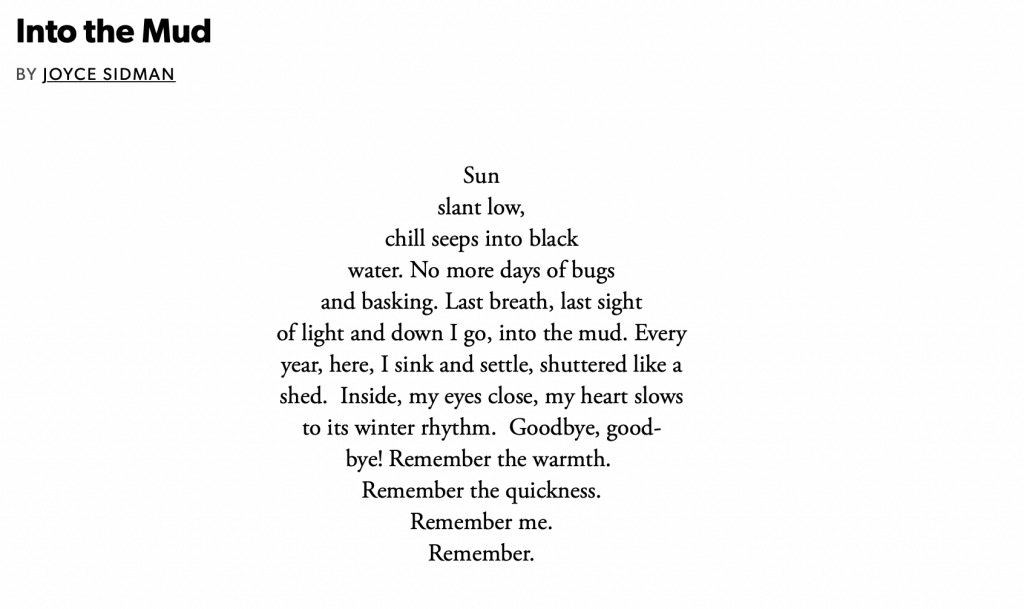
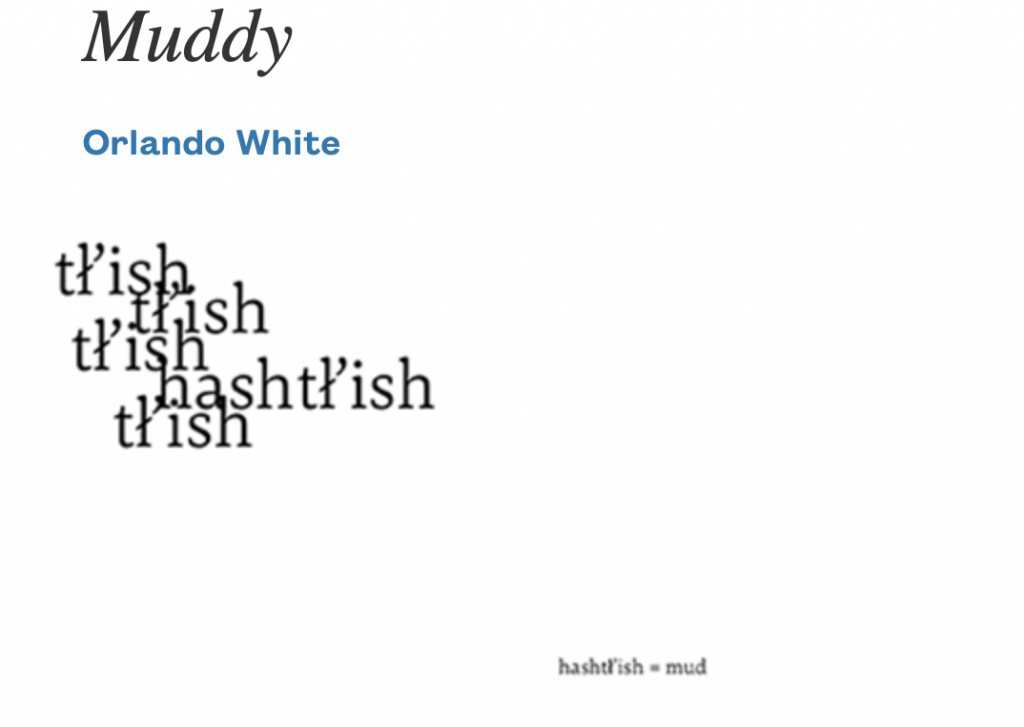
march 23/BIKERUN

bike: 30 minutes
run: 1 mile
basement
outside: rain, snow, wind, 32 degrees

Watched the second to last episode of Dickinson while I biked, then ran a mile while listening to Beyoncé’s “Crazy in Love” (which I heard on The Current yesterday and thought it would be fun to run to. Mostly, it was). The Dickinson episode was titled, “Grief is a Mouse,” and, among other things, was about Emily (mother) imaging that a mouse in her bedroom was her dead sister Lavinia. She tells a story about how Lavinia loved mice, keeping them as pets — feeding them cheese and naming them after her favorite fairy tale characters. Then she talks to the mouse-as-Lavinia and says goodbye to her. I liked this sweet explanation for why Emily (poet) might have written a poem titled, “Grief is a Mouse,” although I might also like not having an explanation for why she chose a mouse to describe grief. It reminds me of an essay I read about Emily Dickinson last year:

Whenever I introduce Dickinson’s poems into my classes, I always begin by doing a version of an exercise that I learned from one of my great mentors, Carolyn Williams, and that has long circulated through a community of people who work on 19th-century poetics. Over the years it has come to be called “Dickinson Mad-Libs.” The way it works is this: I choose a line, a stanza, or a whole poem, and I take out some of its words (usually nouns and adjectives, but sometimes verbs as well), and I simply leave blanks where those words were. Then I ask the students to fill in the blanks. I tend to switch up which poems I use, even though I know several that work particularly well. I’ll never forget the time I used “Grief is a ________.” 

Students go ahead and put in the blanks what is expected: Grief is a pain, Grief is a bitch. The ones who want to take imaginative leaps deliver up: Grief is a thunderstorm, Grief is a tidal wave. But I can pretty much guarantee that no matter how many budding poets you have in a class, nobody who hasn’t already read Dickinson’s poem would ever write the phrase the way she wrote it.

There are lots of fascinating conversations to have about what, exactly, Dickinson might have meant when she wrote “Grief is a mouse,” but the more interesting point, to me at least, is simply that Dickinson was a master of unexpected, yet absolutely perfect, word choice.

The Poets (We Think) We Know: Emily Dickinson

Before I went downstairs to exercise, I worked on my second read-through of Dart. I’m making note of all the voices that appear. It’s helpful as a way of tracing how these voices flow from one to the next, sometimes easily, more often as interruptions. In focusing on these voices, I’m starting to see the tensions over the language used to describe how the river works, especially in terms of order and control. I’ll have to write more later, when I have time.

Here is one of the poems read in Dickinson (season 3, ep 9):

These are the days when Birds come back— / Emily Dickinson

These are the days when Birds come back—
A very few—a Bird or two—
To take a backward look.

These are the days when skies resume
The old—old sophistries of June—
A blue and gold mistake.

Oh fraud that cannot cheat the Bee—
Almost thy plausibility
Induces my belief.

Till ranks of seeds their witness bear—
And softly thro’ the altered air
Hurries a timid leaf.

Oh sacrament of summer days,
Oh Last Communion in the Haze—
Permit a child to join.

Thy sacred emblems to partake—
Thy consecrated bread to take
And thine immortal wine!

march 21/RUN

6 miles
franklin loop
52 degrees

A very spring day today. Tomorrow, colder again. Rain and 40s. I overdressed — I didn’t need to the running tights. It was mostly overcast, but every so often I saw my shadow. Faint, but leading me. Ran the Franklin loop. My watch crashed less than 3 miles in. Either I get a new watch soon, or stop wearing a watch. I’m leaning towards not wearing a watch.

I got a “morning!” from Mr. Morning! and Dave the Daily Walker. An excellent start to my run. Encountered a few other runners, some walkers. Any bikes? I can’t remember. No roller skiers yet. The birds were LOUD! Heard some honking geese, then saw them flying low in a line. Heard at least one woodpecker, drumming.

note: re-reading the entry and the part about the LOUD birds, I’m struck by how quiet everything is now, at 1 pm. Where is all the birdsong that was here just minutes ago? Strange.

workers of the day

Nearing the marshall/lake street bridge from the northeast, I started to smell tar. Then I heard some deep voices on the hill at St. Thomas: “Go go go go!” then “woah” or “wow” or “alright” but not “stop” or “that’s enough.” I imagined someone was pouring the tar and someone else was telling them when to stop. Was that what was happening? It was too far away and hidden behind trees for me to see. What was the tar for? What exactly were they doing? Tarring a roof? Repaving a road? Were the workers wearing masks to protect them from the fumes?

Right before I started my run, I typed this here: A few lines from the poem to remember as I run:

have you forgotten the force that orders the world’s
fields
and sets all cities in their sites, this nomad
pulling the sun and moon, placeless in all places,
born with her stones, with her circular bird-voice,
carrying everywhere her quarters?

I decided to try and keep remembering (and noticing and studying) the river as I ran. Often, even as I know it’s there, I forget to notice it. Today, it was pale blue and mostly calm. I saw a reflection of the lake street bridge as I ran on the east side, but it wasn’t completely smooth — not the perfect, inverted bridge from another world I sometimes see. The banks were mostly brown, although there were a few white spots. Just past Meeker Island Dam, I heard a small waterfall. No boats or rowers. No ducks. Running above the river, I never got close enough to hear it. All I could hear were the cars driving by — on the river road, a bridge, the distant freeway. To me, it seemed as if they were trying to sound like a rushing river. I thought about how important the river is to Minneapolis and St. Paul, how roads, buildings, neighborhoods, industry are arranged around it and because of it (ordering the world, setting cities in its sites). I love how Oswald offered this wonderful description of the organizing/ordering force of the river, wedged between these two passages from the dairy worker.

Before:

I’m in a rationalised set-up, a Superplant. Everything’s stainless
and risk can be spun off by centrifugal motion: blood, excre-
ment, faecal matter from the farms

and after:

I’m in milk, 600,000,000 gallons a week.

On March 17th, I wrote a little about Oswald and work/working. I posted two passages by her that discuss the value of labor as a way to know the land: raking and gardening. She writes: “Instead of looking at landscape in a baffled, longing way, it was a release when I worked outside to feel that I was using it, part of it. I became critical of any account that was not a working account.”

This idea of not looking at the landscape in a baffled, longing way fits with some more of her words, in an interview: Landscape and Literature Podcast: Alice Oswald on the Dart River. In this podcast she discusses her resistance to the romanticizing of landscapes:

I’m just continually smashing down the nostalgia in my head. And trying to inquire of the landscape itself what it feels about itself. Rather than bringing my advertising skills — getting rid of words like picturesque…there’s a whole range of words that people like to use about landscape, like pastoral, idyll. I quite like taking the names away from things and seeing what they are behind their names. I exert incredible amounts of energy trying to see things from their own points of view rather than the human point of view.

…more interested in the democratic stories…the hardship of laboring, looking for food…the struggle of a tree trying to grow out of stone…always looking for that struggle. I’m allergic to peace. I like this restless landscape. I like that it won’t let you sit back and say, “what a beautiful place I’ve arrived to.” You’ve never arrived. It’s moving past you all the time.

It’s a day long effort to get your mind into the right position to live and speak well.

Landscape and Literature Podcast: Alice Oswald on the Dart River

I’m thinking about this effort as a form of labor, done in tandem with other forms of labor, like using the land, walking through the land, working on the land. Oswald doesn’t foreground this type of work — the smashing of nostalgia and trying to find better, less romantic, words — in Dart. Is that because that’s her work, as a poet, and she’s trying to keep herself out of the poem? In contrast to Oswald, Mary Oliver frequently discusses her labor of noticing and telling about it. I appreciate Oliver’s emphasis on that difficult labor, but as I read Oswald, I also like the idea of trying to move outside of, or beside, ourselves to imagine things from the point of view of the flower and its struggles, instead of from our point of view as we admire/praise that flower. She gives the example of the flower in this interview, ending with, “It’s a fascinating, hard world for a weed.

I wonder, is there room in Oswald’s democratic stories for her own efforts at smashing nostalgia and noticing from different perspectives? How would that alter the poem to include the voice of the observer-participant or participant-observer? How might it look if the author’s voice wasn’t absent, but made only one among many, all having value?

my whole style’s a stone wall

In a section on the stonewaller, Oswald offers this great line:

…which is how everything goes
with me, because you see I’m a gatherer, an amateur, a
scavenger, a comber, my whole style’s a stone wall, just
wedging together what happens to be lying about at the time.

page 33

There are so many great lines in this poem!

march 20/RUN

3.85 miles
marshall loop
36 degrees

This year, the first day of spring feels like spring, which doesn’t always happen. What a wonderful morning. Felt much warmer than 36 degrees. I was overdressed. Sunny, low wind, calm. Clear paths — not crowded, and no snow (except for some slick spots on the sidewalk climbing up Marshall). I was able to run on all of the walking trails. I know I looked at the river, I remember doing it, but I can’t remember what it looked like. Was it brown or blue? No clue.

“staring at routine things”

Before my run, I read a short section from Dart. This one was in the voice of the dairy worker (page 29):

to the milk factory, staring at routine things

Dart / Alice Oswald

In the poem, these routine things include

bottles on belts going round bends.
Watching out for breakages, working nights. Building up
prestige. Me with my hands under the tap, with my brain
coated in a thin film of milk. In the fridge, in the warehouse,
wearing ear-protectors.

Dart / Alice Oswald

I decided to start my run with this prompt: focus on/stare at the routine things on my run. Here are some of my thoughts:

  • the route: Marshall Loop. Not as routine as other routes, but one I do often. North on 43rd ave; right on 31st st; left on 46th ave; right on lake street, then over the bridge until it turns into marshall; up the marshall hill; right on Cretin ave; right on east river road; down past shadow falls; up the lake street bridge steps and over the bridge; down the hill then over to west river road heading south
  • ran past the lutheran church on 32nd and 43rd. Heard the congregation singing inside for the sunday church service
  • encountered another pedestrian, stayed on the right side as we passed
  • wore my usual outfit for an early spring run: black running tights, black shorts, green long-sleeved shirt, orange sweatshirt, hat, headband, gloves
  • like it always does after a rain, or when the snow melts, shadow falls was gushing
  • reaching the top of the marshall hill, I watched the crosswalk timer countdown and the light turn from green to yellow to red

At some point in the run, I started thinking about all the different forms of work happening out by the gorge — like squirrels thumping nuts, birds calling to other birds, a woodpecker drumming on a hollow tree. Maybe I will try to notice forms of work on some run this week?

Then I wondered about how stare might mean more than looking closely (and for a long time) at something. Maybe it also is a general way of describing giving careful, focused attention to something. I think I’ve said it before on this log: I don’t like staring at things, especially people. It feels rude (which is maybe a problem I should try to get over?). Also, it doesn’t always help me, with my bad vision, see something any better. I have more luck with having an awareness of something and absorbing details instead of forcibly collecting them.

march 18/RUN

3.1 miles
marshall loop (short)
44 degrees

After picking up FWA from college for spring break, drove back to Minneapolis and ran the Marshall Loop with STA. It feels like spring. Most of the snow has melted. The river was open and rippling in the wind. As we crossed the lake street bridge, I looked for the eagle that used to perch on the dead tree many years ago. I’m not sure I’ve seen eagles anywhere for some time now. Are they gone, or am just not seeing them?

Read some more of Dart, including this great part voiced by “the swimmer”. I love so much about this, but right now, I’ll just point out the third line as a stand alone poem: “into the fish dimension. Everybody swims here”

from Dart / Alice Oswald

(the swimmer)

Menyahari — we scream in mid-air.
We jump from a tree into a pool, we change ourselves
into the fish dimension. Everybody swims here
under Still Pool Copse, on a saturday,
slapping the water with bare hands, it’s fine once you’re
in.

Is it cold? Is it sharp?

I stood looking down through beech trees.
When I threw a stone I could count five before the
splash.

Then I jumped in a rush of gold to the head,
thought black and cold, red and cold, brown and warm,
giving water the weight and size of myself in order to
imagine it,
water with my bones, water with my mouth and my
understanding

when my body was in some way a wave to swim in,
one continuous fin from head to tail
I steered through rapids like a cone,
digging my hands in, keeping just ahead of the pace of
the river,
thinking God I’m going fast enough already, what am I,
spelling the shapes of the letters with legs and arms?

S SSS

    Slooshing the Water open and


MMM

for it Meeting shut behind me

He dives, he shuts himself in a deep soft-bottomed
silence
which underwater is all nectarine, nacreous. He lifts
the lid and shuts and lifts the lid and shuts and the sky
jumps in and out of the world he loafs in.
Far off and orange in the glow of it he drifts
all down the Deer Park, into the dished and dangerous
stones of old walls
before the weirs were built, when the sea
came wallowing wide right over these flooded
buttercups.

march 17/RUN

4.1 miles
minnehaha falls and back
38 degrees

Surprised to see that the temperature was only 38. It seemed warmer than that. Wore less layers: black tights + black shorts + one bright yellow shirt + one bright orange sweatshirt + buff around neck + very faded black baseball cap. No gloves or hood.

Everything dripping or gushing. Heard lots of woodpeckers (not drumming, but calling), black capped chickadees, cardinals. I need to work on recognizing the sounds of other birds. Stopped at the falls after I heard them roaring and saw them spraying a fine mist into the air.

Also heard: water gushing from the 42nd st sewer pipe that I thought was wind rushing through some brittle leaves; kids playing on the playground, one of them — or was it the teacher? — calling out, “Stop! Come back! Don’t go there!” (I think “there” had two syllables).

Tried running on the walking path near the falls, but had to stop and walk: too much snow and ice. Maybe next week it will be all clear?

As I ran, I thought about the Mississippi River and how I’m always running above it, around it, beside it, but never swimming or rowing in it. On my wish list: taking a class at the rowing club and rowing down the river. I also thought about how the river is there, but I hardly ever hear it. And, in the summer, with the thick leaves, I don’t often see it. Yet, I know it’s there. Its absence has a strong presence; I feel it. I wondered as I left Minnehaha Regional Park, am I partly feeling its ghost? The ghost of the roaring, gushing, rushing, powerful river that carved out the gorge, 4 feet a year, before it was temporarily tamed starting in the mid to late 1800s?

Continuing to read Dart and about Dart. Trying to keep a delicate balance: getting some insight and understanding from secondary sources without getting too lost in them or the jargon-filled knots they create. I want some help in understanding Oswald and her methods in Dart, but I don’t want to get stuck there, unable to hold onto how her words feel sound create meaning for me. Difficult.

I love Oswald’s words about the canoeists/rowers/kayakers on page 14:

On Tuesdays we come out of the river at twilight, wet, shouting,
with canoes on our heads.

the river at ease, the river at night.

We can’t hear except the booming of our thinking in the cockpit
hollow and the river’s been so beautiful we can’t concentrate.

they walk strong in wetsuits,
their faces shine,
their well-being wants to burst out

In the water it’s another matter, we’re just shells and arms,
keeping ourselves in a fluid relation with the danger.

pond-skaters, water-beetles,
neoprene spray-decks,
many-colored helmets,

And, all of this discussion of how the river sounds:

will you swim down and attend to this foundry for
sounds

this jabber of pidgin-river
drilling these rhythmic cells and trails of scales,
will you translate for me blunt blink glint.

the way I talk in my many-headed turbulence
among these modulations, this nimbus of words kept in
motion
sing-calling something definitely human,

will somebody sing this riffle perfectly as the invisible
river
sings it

can you hear them at all,
muted and plucked,
muttering something that can only be expressed as
hitting a series of small bells just under the level of your
listening?

work/working

I found this great quote from Oswald in her introduction to the poetry anthology, The Thunder Mutters: 101 Poems for the Planet:

Raking, like any outdoor work, is a more mobile, more many-sided way of knowing a place than looking. When you rake leaves for a couple of hours, you can hear right into the non-human world, it’s as if you and the trees had found a meeting point in the sound of the rake. (ix)

And this:

I think about those years of gardening every single day. It was the foundation of a different way of perceiving things. Instead of looking at landscape in a baffled, longing way, it was a release when I worked outside to feel that I was using it, part of it. I became critical of any account that was not a working account. 

source

Last April, when I was reading Mary Oliver, I spent some time thinking about work and labor. I’d like to think about it again, now with Oswald. For Oliver, the desire with work is to be useful to the world. For Oswald, it is to be part of it, in the midst of it, not looking at it, but using it. This work, for Oswald, is labor: gardening, fishing, trimming trees, panning for tin, etc.

Yesterday, I was talking with Scott about reading Oswald and getting inspired for my own project of documenting the Mississippi River Gorge. I said: I’m not sure what this will turn into, but I’m just happy to have become the sort of person who finds delight in Oswald’s words and in reading poetry about the river that combines myth and history and thinking critically and reverently about land and water and how and where humans and industry fit in. How wonderful it is to discover these new forms of care and curiosity!

march 15/RUN

5.75 miles
bottom of franklin hill and back
35 degrees
almost invisible streaks of ice

Almost spring! Birds, sun, the smell of fresh earth! The beginning of the run was not as fun; too many invisible slick spots from the barely melted puddles. By the end of the run, the ice was gone. Greeted Dave the Daily Walker twice. Ran down the Franklin hill then back up it, stopping for a few minutes when I encountered some ice. Settled into an easy pace that felt almost effortless. It didn’t feel a little harder until I had to climb up the Franklin hill.

10 Things I Noticed

  1. the drumming of woodpeckers on different types of wood — trees, a utility pole
  2. geese, part 1: one goose, with a painful (extra mournful?) honk, flying with at least one other goose, pretty low in the sky
  3. geese, part 2: 3 geese on the path in the flats. Even though I was looking carefully, and noticed the orange cones that they were standing beside, I didn’t see the geese until I was almost next to them
  4. geese, part 3: running past these 3 geese again, I kept my distance, crossing to other end of the trail. Two of the geese were too busy rooting through the snow to notice, but the third one faced me, as if to say, “back off!”
  5. geese, part 4: as I neared lake street, there was a cacophony of honks trapped below the bridge
  6. in the flats: the fee bee call of a black-capped chickadee, both parts: the call, and the response!
  7. Daddy Long Legs sitting on his favorite bench, above the Winchell Trail, on the stretch after the White Sands Beach and before the Franklin Bridge
  8. the wind of many car wheels, then a whoosh when one passed over a puddle
  9. open water
  10. watching the traffic moving fast over the 1-35 bridge near Franklin as I ran under

Before my run, I spent the morning with Alice Oswald, gathering materials, skimming interviews, reading a few more pages of Dart. So cool to make the time to learn more about Oswald’s work and to read and think about poetry and how it might speak as/with the river. I found a wonderful article in a special issue on Alice Oswald in Interim, When Poetry “Rivers”: Reflections on Cole Swensen’s Gave and Alice Oswald’s Dart / Mary Newell. Newell says this about Oswald’s Dart:

Marginal glosses introduce workers for whom the river is a resource, interspersed with local tales, as of Jan Coo, a swimmer who drowned and “haunts the Dart,” local sayings (“Dart Dart / Every year thou / Claimest a heart”), and ancient legends from times when the local oaks participated in sacred rituals. While each voice is distinct, Oswald writes that the marginal glosses “do not refer to real people or even fixed fictions. All voices should be read as the river’s mutterings.”

I had never heard of Cole Swensen before this article. In the bibliography at the end of the essay, I discovered that she’s written a chapbook about walking and poetry! Very exciting. Here’s something she says in the introduction about walking and place:

Then sitting still, we occupy a place; when moving through it, we displace place, putting it into motion and creating a symbiotic kinetic event in which place moves through us as well.

I’m excited to read the rest of this chapbook. As I was reflecting on the value of walking, my mind wandered, and I started to think about why I prefer running to walking in my practicing of attention. Walking opens me up, enabling me to notice new connections, access new doors, but because it involves wandering, and is fairly slow, it doesn’t offer any limits to that wondering. I get too many ideas, wander too much. With running, the effort it requires forces me to rein in some of my wanderings. I can’t think in long, meandering sentences; I need pithy statements, condensed into a few words I can remember. These limits help keep me from becoming overwhelmed with ideas. Does this make sense? I’ll think about it more when I have a chance to read Swenson’s chapbook and some of her other work.

Back to Oswald. I’m planning to read Dart several times through. This first time I don’t want to stop and think through every word or rhythm or image. Instead, I’m reading through it and noting any passage that I want to remember — that I like or surprise me or make me wonder, etc.

if you can keep your foothold, snooping down
then suddenly two eels let go get thrown
tumbling away downstream looping and linking
another time we scooped a net through sinking
silt and gold and caught one strong as bike-chain

I never pass that place and not make time
to see if there’s an eel come up the stream
I let time go as slow as moss, I stand
and try to get the dragonflies to land
their gypsy-coloured engines on my hand)

Dartmeet — a mob of waters
where East Dart smashes into West Dart

two wills gnarling and recoiling
and finally knuckling into balance

in that brawl of mudwaves
the East Dart speaks Whiteslade and Babeny

the West Dart speaks a wonderful dark fall
from Cut Hill through Whystman’s Wood

put your ear to it, you can hear water

march 12/RUN

5.25 miles
bottom of franklin hill and back
7 degrees / feels like 0

It’s supposed to be getting warmer, starting today and into next week, but it was cold this morning. Sunny, not too much wind, but cold. No frozen fingers or toes, but I felt the burn of cold air, especially after I was done. A harder run. As I’ve heard some runners say, the wheels came off in the second half. I wondered why and then I remembered I didn’t have any water this morning, just coffee. That might have been a big part of the problem. I stopped to walk at least twice, on the walking path, closer to the river but also covered in uneven snow. I noticed the river had a thin sheet of ice on it again. That should melt this afternoon or tomorrow.

Heard some black capped chickadees and the fee bee song, some cardinals too. Encountered two large (10+ runners) groups on the trails — the first one, just as I entered the river road trail, the second, not too long after the lake street bridge. The first group was all men, the second all women with 2 dogs. Right before I reached them, the women stopped to walk. After I passed them, I could hear cackling and an occasional sharp ruff. For some time, they seemed close, then they disappeared. Near the end, I saw some sledders about to go down the Edmund hill. I wonder how crusty and hard that snow is?

Practiced reciting (almost always in my head) some lines from Emily Dickinson and Richard Siken. First, from Siken, the opening words of his great poem, “Love Song of the Square Root of Negative One”:

I am the wind
and the wind is
invisible

All the leaves trem
ble but I am
invisible

(in the actual poem, the line is broken like this: “I am the wind and the wind is invisible, all the leaves/tremble but I am invisible”)

I like reciting this when I’m running into the wind. Then, I returned to ED’s “Life is but life/and breath but breath/Bliss is but bliss/and breath, but breath.” Yesterday I had chanted it with slightly wrong words: “Life is but life/death is but death…” It was difficult to train my brain out of reciting it that way. I played around with different ways of saying it, including:

Life but life
Death but death
Bliss but bliss
Breath but breath

Death is but death
and Bliss but bliss
Breath is but breath
and Life but life

Just thought about this as I was writing this entry:

Life is but death
and breath but bliss
Death is but life
and bliss but breath

Here’s a recording I made after I finished my run and was walking back. You can really hear the wind!

Dickinson chant after run / 12 march

Speaking of the wind, here’s a poem I found yesterday from Alice Oswald that I love (like all her poetry):

PLEA TO THE WIND/ Alice Oswald

Describe the Wind,
                                Wind!
Say something marked by discomfort
That wanders many cities and harbours,
Not knowing the language.
Be much travelled.
Start with nothing but the hair blown sideways
And say:
                Gentle
                                South-easterly
                                             Drift
                                With Rain.
Say: Downdraught.

Unglue the fog from the woods from the waist up
And speak disparagingly of leaves.
Be an old man blowing a shell.
Blow over the glumness of a girl
Looking up at the air in her red hood
And say:
                                Suddenly
                                                Violent
                                                      Short-lived
                                                Gust.
Then come down glittering
With a pair of ducks to rooftop.


Go on. Be North-easterly.
Be enough chill to ripple a pool.
Be a rumour of  winter.
Whip the green cloth off the hills
And keep on quietly
Lifting the skirts of women not wanting to be startled
And pushing the clouds like towers of clean linen
Till you get to the
                                Thin
                                      Cry
                                That
                                      Suffers
                      On seas.


Ignore it.

Say Snow.

Say Ditto.


Wait for five days
In which everything fades except aging.

Then try to describe being followed by heavy rain.
Describe voices and silverings,
Say:
                Strong
                  Wet
          Southwester
From December to March.

Describe everything leaning.
Bring a tray of cool air to the back door.
Speak increasingly rustlingly.
Say something winged
On the branch of the heart.
Say:
                Song.
Because you know these things.
You are both Breath
                And Breath
And your mouth mentions me
Just at the point where I end. 

So much in this poem to discuss, but what jumped out at me right away was: “Describe everything leaning”. For the past few days, but especially yesterday, I’ve been noticing the bare trees and how some of them lean in one direction, both their trunks and their branches. Usually leaning towards, sometimes away. These leanings can look menacing or graceful, threatening or like surrender. I love straight trees, but i think I love leaning ones more. It would be a fun exercise to go out for a run with the task, “describe everything leaning.” I think I’ll do that tomorrow!

march 10/RUN

5 miles
franklin bridge and back
17 degrees / feels like 7

What a gift this winter-almost-spring run is this morning! A reminder of why I love winter runner with its cold, crisp air and quiet calm. It was a little difficult to breathe, with my nose closing up on me (hooray for sinuses), and it didn’t always feel effortless. Still, I was happy to be outside with the world — the birds (pileated woodpeckers, geese, cardinals), the Regulars (Dave, the Daily Walker and Daddy Long Legs), and the river, sometimes brown, sometimes blue.

Before I went out for my run, I read a lot of different poems and essays about poetry and breath. Decided I would think about rhythmic breathing, running rhythms, and chants. I started by counting my foot strikes, them matching it up with my breathing of In 2 3/ Out 2 or Out 2/ In 2 3: 123/45, 123/45 then 54/321, 54/321. A few miles later, I thought about a verse from Emily Dickinson’s poem, ‘Tis so much joy! Tis so much joy!” that I imagine to be a prayer or a spell or reminder-as-chant. I started repeating it in my head:

Life is but Life! And Death, but Death!
Bliss is, but Bliss, and Breath but Breath!

With this prayer/chant, I matched the words up to my foot strikes in several different ways, none of which were 123/45 or 54/321.

Equal stress on each syllable/word, and the altering of the poem slightly:

Life Is But Life
Death Is But Death
Bliss Is But Bliss
Breath Is But Breath

Then in ballad form (I think?), with alternating lines of: stressed un un stressed / 3 stressed but silent beats (or not silent, but voiced by my feet, striking the ground):

Life is but Life
x x x
Death is but Death
x x x
Bliss is but Bliss
x x x
Breath is but Breath
x x x

Then in 6, with 2 feet of stressed, unstressed, unstressed (a dactyl):

Life is but Life is but
Death is but Death is but
Bliss is but Bliss is but
Breath is but Breath is but

Then in 4 again, one spoken beat, three silent:

Life xxx
Life xxx
Life xxx
Life xxx

Or, like “The Safety Dance”:

Life life life life
Death death death death
Bliss bliss bliss bliss
Breath breath breath breath

These were so much fun to do, and helpful in keeping me going as I grew tired. When I chanted them, my pace was about 8:40 and my heart rate was in the upper 170s (pretty standard for me). At one point, I pulled out my phone and recorded myself mid-run. Later, when I stopped running and was walking back, I recorded myself again.

Dickinson chant during run
Dickinson chant after run

It’s interesting to check back with the poem now and see that I had added words to make the rhythm more steady and even. Seeing how Dickinson wrote it, I want to try these chants on another run with the right words. How will I fit “And Death, but Death!” with my feet? Is this part of Dickinson’s disruption of rhythm?

I like the repetition of these chants and how, if you repeat them enough, they lose their meaning, or change meaning, or change the space you’re running through, or change you. It reminds me of some lines from a poem I recently wrote about running by the gorge and rhythmic breathing. It’s in 3/2, In 2 3/Out 2:

I

settle in-
to a

rhythm: 3
then 2.

First counting
foot strikes,

then chanting
small prayers.

I beat out
meaning

until what’s
left are

syllables,
then sounds,

then something
new, or

old, returned.

Wow, this is so much fun for me, thinking through how my running, and breath, and poetry, and body, and the words work (and sometimes don’t work) together. Very cool.

And, here’s a poem that doesn’t fit neatly with my running rhythm/chants, but fits with the idea of getting outside to move by the river:

How to Begin/ Catherine Abbey Hodges

Wipe the crumbs off the counter.
Find the foxtail in the ear of the old cat.
Work it free. Step into your ribcage.

Feel the draft of your heart’s doors
as they open and close. Hidden latches
cool in your hand.

Hear your marrow keep silence,
your blood sing. Finch-talk
in the bush outside the window.

You’re a small feather, winged seed, wisp
of cotton. Thread yourself
through a hole in the button on the sill.

You’re a strand of dark thread
stitching a word to a river. Then another.

march 9/BIKERUN

bike: 25 minutes
run: 1.55 miles
basement
outdoor temp: 17 degrees / feels like 5

It wasn’t the cold that kept me inside today, but the water from yesterday that turned to ice overnight. So many slick spots on the sidewalk and the road! I read my entry from last year on this day, and it was 54 degrees outside. And I wore shorts. Shorts?! As much as I like winter running, I’m ready for spring. Less layers, open walking paths. I’m tried off dodging big ice chunks and running on the bike trail.

Biking and running inside wasn’t so bad. Finished watching the Dickinson episode I started on Feb 23. In this one, Emily and Lavinia take a wild ride on a gazebo and end up in the 1950s where they meet Sylvia Plath. Emily’s parents find some hemp growing in Emily’s conservatory and decide to smoke it. I’m not sure how many episodes I have left, but it’s not many.

While I ran, I listened to an old playlist: Lizzo, Justin Timberlake, Ke$ha. Felt good. I don’t remember thinking about anything, or noticing anything. No strange smells or shadows or hairballs that look like spiders wanting to jump on me. Running on the treadmill is helpful for enabling me to move when I can’t outside, but it’s not very exciting or inspiring — especially when the treadmill is in the cold, unfinished basement of a 100+ year-old house.

Found this poem by Aracelis Girmay on twitter yesterday. Wonderful!

Second Estrangement/ Aracelis Girmay

Please raise your hand,
whomever else of you
has been a child,
lost, in a market
or a mall, without
knowing it at first, following
a stranger, accidentally
thinking he is yours,
your family or parent, even
grabbing for his hands,
even calling the word
you said then for “Father,”
only to see the face
look strangely down, utterly
foreign, utterly not the one
who loves you, you
who are a bird suddenly
stunned by the glass partitions
of rooms.
How far
the world you knew, & tall,
& filled, finally, with strangers.

One of my favorite poetry people pointed out the line, “who loves you, you” and I’m so grateful. Maybe I would have noticed this hidden message/one line poem on my own, but not as soon. I love imagining this as the center/heart of this poem, as the poem within a poem. It makes me want to try to do this too, to put in a line that offers something extra.

I don’t remember accidentally taking a stranger’s hand in a crowded store when I was a kid, but I do still remember the absolute terror of realizing I was lost, and alone, in a store. I remember pacing around, trying to calm myself down as I looked for my mom. Such an awful feeling: flushed face, tingling scalp, queasy stomach.

march 8/RUN

5 miles
Veterans’ Home Loop
34 degrees

A bright beautiful morning for a run. Ran south to Minnehaha regional park, past John Steven’s House, over to the Veteran’s Home, through Wabun, then back north on the river road trail.

10 Things I Noticed

  1. the river was open, the water brown, the banks glowed with white snow
  2. there were big puddles on the sidewalk, but the trail was almost completely clear
  3. one huge puddle covered almost the entire trail between 42nd and 44th
  4. bird sounds heard: the song and drumming of a pileated woodpecker; a cardinal’s trill; the fee bee song from a black-capped chickadee; a goose’s honk
  5. kids were playing at minnehaha academy; I could hear their laughter. Also heard the teacher’s whistle for the end of recess
  6. some of the sidewalks around minnehaha regional park were covered in sharp, crusty snow that had frozen again overnight
  7. at Wabun Park, I had to stop and walk in the snow because the trail was covered in a thick, slick sheet of barely frozen ice. A fat tire slowed way down to bike over it. I liked the crunching sound of the fat tires as they crushed the ice
  8. a traffic jam at the 3 way stop near the entrance to wabun: 4 cars went by before I could cross
  9. just north of the 44th street parking lot, something orange near the WPA stone steps down to the Winchell Trail caught my eye as I ran by. A jacket? Graffiti on the stones? Not sure, but I think it was the sign on a chain stretched across the railings to block the entrance. I couldn’t see anything clearer, partly because of my vision and partly because I was in motion. It was almost as if my brain called out to me, “Orange!”, and that was it
  10. a wide open, brilliant view over to the other side

vision check

At least twice in the past week, when I’ve been running south on the river road trail, this has happened: I see a runner approaching from a distance. As I get closer, I check to see where they are, but they’ve disappeared. I can’t see them at all. I look again and they’re back. I must be losing more cone cells.

an experiment

It didn’t last for a long, but I tried chanting in triple berries (strawberry/blueberry/raspberry), then counted my rhythms: 123/45 and 12/345. I tried matching a few words to the rhythms, but now I can’t remember the words. I tried experimenting with these 123/45s and 12/345s a few years ago. I’d like to try again.

Found this wonderful poem on Two Sylvia’s Press in the chapbook, Shade of Blue Trees:

FIG TREE AT BIG SUR/ Kelly Cressio-Moeller

Each day leaning
into morning,
five-fingered leaves
wave in unison,
beckon jays
for branch-play.
 
The youngest leaves
arch green faces upward,
devour sun off the Pacific.
The golden elders
bow closer to earth–
the perfect shape
for water to run
 
as rain, as fog
down to the root line.
When afternoon rays
light them just right,
 
they become a ring
of open palms
giving the last
of what they have.

march 7/RUN

3.1 miles
trestle turn around
28 degrees
trail: clear / roads: slushy, wet snow

Yesterday, we woke up to 4 or 5 inches of wet, heavy snow. Most of it melted during the day, refroze at night, then melted again this afternoon. The sidewalk and trails were okay, but the road was a sloppy mess. I ran in the afternoon and it felt harder. I prefer to run in the morning. Heard lots of chickadees, warning each other: “chick a dee dee dee dee” I don’t remember looking down at the river even once. Why not? I think I was distracted by my effort and all the groups of people and the puddles. Ran into the wind at the beginning of my run, at my back at the end. Even though it’s below freezing and there’s lots of snow, with the bright sun, and all of the dripping water, it felt like spring.

Here’s a poem I found on twitter (it’s in the latest Copper Nickel) that I love:

The River/ HUMBERTO AK’ABAL

Kneeling
on a mat,
bent over a stone,
my mother washes
and washes
and washes.

My little sister
sleeps in a basket
covered in willow leaves.

Me? I am sitting
on piled straw,
watching how the water leaves
and how the river stays.

march 4/RUN

4.1 miles
marshall loop
31 degrees / feels like 22

First Marshall loop of the year. Last time I ran over the lake street bridge, up Marshall, over to Cretin, down to the East River Road, then back over the bridge was on November 13th. There were a few slick spots where the ice covered the sidewalk, but mostly it was fine. I enjoyed having a different route to run. Felt relaxed and happy, as always, to be outside and moving.

10 Things I Noticed

  1. running above the tunnel of trees and the floodplain forest, I could see the river. Brown, open water
  2. later on the bridge, looking down at the river, near the banks, it was all white, with a thin line of dark brown parallel to the shore
  3. on the east side of the river, looking at the lake street bridge, the distance between bridge and water didn’t seem that great, but on the bridge, looking down at the river, it seemed tremendous
  4. running past Black Coffee, noticed a person sitting in the window with a newspaper — were they reading about the war? drinking black coffee or coffee with milk?
  5. cretin, which runs past St. Thomas University, was thick with cars
  6. early in the run, on the west side of the river not far from home, thought I heard the bells at St. Thomas. Later, running down the hill above shadow falls, close to St. Thomas, I heard them again — the clock cycled through all four parts of the song — the parts that chime at 1/4 past, 1/2 past, 1/4 to, and on the hour. I couldn’t quite remember when I started running, so I counted the chimes at the end of the song cycle: 11. 11 am
  7. running back over lake street bridge, I looked down and saw 2 somethings in the water. Could they be ducks? I stopped, stood on my tiptoes, and looked through the railing. Yes, 2 ducks!
  8. at the start of my run, a block from my house, noticed a HUGE crow on someone’s lawn. I had to check again to make sure it wasn’t a turkey
  9. looking down at the steep slopes of the gorge, noticed veins of white snow in the cracks
  10. some new graffiti in vivid blues and greens on a lower wall of the lake street bridge, in a spot where’s no trail or stairs

Tried to chant in triples, but became distracted. Thought about some other things that I can’t remember now, except this random thing: when thinking about the value of moving for paying attention, and what experiments I might try with attention and movement, stopping and standing still can be a part of it too — like running or walking from spot to spot.

This was the poem of the day on poets.org. I like the different look at something that, at first, seems miserable.

Drift/ Alicia Mountain

The gold March dawn
and below my window
a man carves his car
from the snow heap
plowed up around it.
So easy not to envy
the cold muscled task

but then imagine—
feeling your heartbeat
alive like a chipmunk
at work in your chest,
imagine the whole day
arm-sore and good
with accomplishment,

the day you begin
with heavy breath
and see it linger
outside your body
like a negative of
the dark air cavity
in you like the spirit
in you like the ghost.

And here’s Mountain’s description of the poem:

This poem is an exercise in re-encountering the familiar. Lately, I’ve been trying to take another look—at poem drafts, at circumstances, at assumption, chores, beliefs. More and more, I have come to understand myself as a draft of a person to which I return and try to see again, anew. Even in the line and intentions struck through, negation is a presence, too. This poem is about externalizing something internal so it can be witnessed. It’s also about allowing the grace and strength of others, along with the mysterious gift of breath, to change me daily.

march 3/RUN

4.25 miles
minnehaha falls and back
19 degrees / feels like 10
5% ice-covered

Sunnier today. Remembered to notice the sky. High above me, a clear, soft blue; nearer, mostly wispy clouds. Not much wind, not too cold. The river continues to open, ripped seams everywhere. I felt good as I ran. Tried chanting in triples (strawberry/blueberry/raspberry), but it didn’t last long. Devoted some attention to feeling my feet strike the ground, my legs lift off.

Before my run, I felt weighed down. Is it because my mom’s 80th birthday would have been this Saturday if she hadn’t died in 2009? Or because winter doesn’t want to leave? Or Russia’s invasion of the Ukraine? Or the University of Wyoming voting to end funding for the Gender and Women’s Studies Department? The climate crisis deniers? Whatever it was (and will continue to be), it lifted as I ran.

10 Things I Noticed

  1. lots of crows
  2. on the way back from the falls, after I put my headphones in, a cardinal’s trill fit very nicely with Cee Lo Green’s singing in “Crazy”
  3. a few walkers done below on the Winchell Trail
  4. primary noise: cars’ whooshing wheels on the river road
  5. a crew was out, in front of Minnehaha Academy, sawing down some tree limbs. The chainsaw started as an irritating whine, then a bzzzz
  6. laughing and yelling kids out on the school playground
  7. the snow on the hill in the oak savanna is melting fast — I saw some bare patches
  8. the falls: still frozen, all the trails and the stairs are covered in crusty, icy snow
  9. conversation overhead: something like, “and that’s what your dad was doing…”
  10. all the puddles from yesterday were solid and slick ice today

Right now, I’m trying to put together a course proposal for a summer class on moving and being outside and noticing wonder. It’s fun and frustrating and very exciting. Just north of the 44th street parking lot, I began thinking about whether I should use the word habit or ritual. I like ritual, but writing rituals seem to have a specific meaning. When I think of rituals, I often think of things done to prepare you for writing/creating — sitting in this chair, drinking this tea, listening to this music, wearing this shawl, etc. While being outside and moving can do that, it does more too. The act of regularly being outside and moving not only prepares you to be more creative, but can be the repeated practice of being creative. Does that make any sense? When I have time, I think I’ll do some more thinking through the differences between habit and ritual, especially how it is understood within poetry.

Found this poem in the march issue of Poetry:

Peripheral/ Hannah Emmerson

Yes I prefer the peripheral
because it limits the vision.

It does focus my attention.
Direct looking just is too

much killing of the moment.
Looking oblique littles

the moment into many
helpful moments.

Moment moment moment
moment keep in the moment.

My first reaction to this poem is resistance: I don’t agree with the idea that the peripheral limits vision. It alters it, changes how we see, but doesn’t limit it. Instead, it expands and softens. Is this reaction fair? I’ll sit with it for a while, then return to this poem. When I finally begin work on my peripheral project, I’ll add it to my list of resources.

march 2/RUN

5.5 miles
franklin loop
29 degrees
puddles + a few icy spots

Early this morning, or late last night, it snowed/sleeted. Only a little, but enough to make me wonder if I should run in the basement instead of outside by the gorge. Decided it would be fine, and went outside. Excellent decision. It was wet, occasionally slick, and great conditions for a run — at least for my run. Overcast, not too cold, uncrowded.

The river is no longer white but a few different shades of gray. I thought it was completely open/iced out, but running across the franklin bridge, I noticed a thin skin of gray ice. In a few spots, where the skin had split, it was dark. Later, as I approached the lake street bridge from the east side, the water opened up. As I ran across the lake street bridge, I noticed little ripples in the water from the wind.

The sky was mostly white-ish gray with a hint of blue. This light/color really messes with my vision and lack of cone cells. Looking up, the sky was almost pixelated, or maybe it was more like static? Not total static, like when tv stations would end programming for the night, but static sprinkled into the image, making everything dance or bounce or just barely move. All of this movement is so slight that I wonder if I’m imagining it, or making too big of a deal out of it, or if this isn’t just the “normal” way that most people see.

the delight of the day

Running on the east side of the river, lost in thought, or the absence of thought, I suddenly heard a loud noise. It sounded like a turkey gobble. I stopped and looked behind me. On the other side of the road, maybe 25 yards back, there was a small group of very big turkeys chilling out on someone’s lawn. I stood still and watched them for a minute, delighted and grateful that the turkeys reminded me to notice them. I imagined what the gobbling turkey had been thinking as I passed by, oblivious to its awesomeness: “Oh hell no, girl! Notice me now!” And I did, and now my day has been made. So often, it’s the wild turkeys that get me through the tough times.

Wild turkeys are probably my favorite. I also like woodpeckers, black-capped chickadees, and geese. Crows are okay, so are cardinals. Today I heard all of these birds by the gorge — and more that I couldn’t identify. Because of my vision, and the fact that I’m in motion, I rarely see these birds. Instead, I hear them.

Some poetry people posted about a new tool that removes everything but the questions from a text. Here’s an article by the creator of the tool. Very cool. Hooray for questions!

Randomly opened up Arthur Sze’s collection, The Glass Constellation, to this beautiful, bewildering poem:

Unfolding Center/ Arthur Sze

1

Tea leaves in a black bowl:
green snail spring waiting to unfurl.
Nostrils flared, I inhale:

expectancy’s a seed—
we planted two rows
of sunflowers then drove to Colorado—

no one could alter the arrival
of the ambulance,
the bulged artery; I had never

seen one hundred crows
gathered at the river,
vultures circling overhead;

I saw no carcass, smelled no rot;
the angers radiating from him
like knives in sunlight; I sit

at a river branching off a river:
three vultures on cottonwood branches
track my movement;

surrounded by weeds, I cut
two large large sunflower heads off
six-footed stalks, Apache plume

blossoms near the gate; we wake
and embrace, embace and wake,
my fingers meshed

with your fingers. Nostrils flared,
I inhale: time, time
courses through the bowl of my hands.

feb 28/RUN

4.25 miles
minnehaha falls and back
35 degrees
30% puddle-covered

Another wonderful, spring-like day, if you consider 35 degrees and white ground everywhere spring-like, which I do. When the sun is this warm, the sky this blue, the birds this chatty, how can you not think of spring? Everywhere, wet: drips, drops, wide puddles stretched across the trail soaking my socks.

10 Things I Noticed

  1. that same bird call that I’ve been hearing and wondering about happened again, right before I reached the river. I heard it, then hoped it would be followed by some drumming. It was! I’m calling it; this sound is a pileated woodpecker
  2. a distant goose, or geese?
  3. cawing crows
  4. cardinals, doing at least 3 or 4 of their 16 (is it 16?) songs
  5. black-capped chickadees
  6. my shadow: off to the side, then behind, then finally in front of me
  7. the shadow of the old-fashioned lamp posts on the trail. So big, they almost looked ,\like giant potholes to me
  8. the river slowly opening. Still white, but darkening and thinning
  9. a kid yelling at the playground. At first, I thought they were a siren — so high-pitched and insistent!
  10. a mixing of sounds: an airplane, a bobcat, a crow, a kid, all crying out

As I left for my run, I remembered something I didn’t want to forget. I’m pleased that I still remember what it was after my run. Scott and I watched the first episode of After Party last night. Very good. Anyway, this episode focused on Aniq. For much of the episode he looked ridiculous: someone/s had drawn cat whiskers and ears on his face, along with the word “nerd” in big letters. It’s very obvious and a crucial element in understanding who he is as a character. Because of my vision problems — my lack of cone cells, limited central vision — I did not see any of this on his face until someone, the detective, finally referenced it. Up to that point, about 40 minutes, it was all invisible to me. I could see his face (well, roughly, I guess) and mostly follow what was going on, but I had no idea anyone had drawn on him. He looked “normal” to me. I wanted to remember this as an example of how my vision works, or doesn’t work, how much I miss that I’m not aware of. It doesn’t seem like that big of a deal, but you miss out on a lot of what’s happening and how it’s being communicated when you can’t see certain things and don’t even realize you’re not seeing them (and no one else realizes you’re not seeing them either; they just think you’re not paying attention or being stupid, or that you don’t care).

Here are two poems featuring birds that I encountered today. Both wonderful, both about much more than birds.

Egrets/ Kevin Young

Some say beauty
may be the egret
in the field

who follows after
the cows
sensing slaughter—

but I believe
the soul is neither
air nor water, not

this winged thing
nor the cattle
who moan

to make themselves
known.
Instead, the horses

standing almost fifteen
hands high—
like regret they come

most the time
when called.
Hungry, the greys eat

from your palm,
tender-toothed—
their surprising

plum-dark tongues
flashing quick
& rough as a match—

striking your hand,
your arm, startled
into flame.

In her discussion of the poem for The Slowdown Show, Ada Limón discusses the soul:

The Portuguese writer José Saramago wrote: “Inside us there is something that has no name, that something is what we are.” This seems clear enough. The soul is the part of you that you cannot name. One of the reasons I love the obsession that writers have with the soul is that their interest is not confined to what happens to the soul after you die. Rather, writers seem to be interested in what the soul is doing right now. Can the soul have likes or dislikes, coffee or tea, can one soul connect to another in what is called a soul mate? Is our soul only alive in relation to others, in community with nature, with something larger?

And here’s the other poem. It’s about cardinals. I heard, but never saw, many cardinals this morning on my run.

Statement of Teaching Philosophy/ Keith Leonard

In February’s stillness, under fresh snow,
two bright red cardinals leaping 
inside a honeysuckle bush.
All day I’ve thought that would make
for a good image in a poem. 
Washing the dishes, I thought of cardinals.
Folding the laundry, cardinals.
Bright red cardinals while I drank hot cocoa.
But the poem would want something else.
Something unfortunate to balance it,
to make it honest. A recognition of death
maybe. Or hunger. Poems are hungry things.
It can’t just be dessert, says the adult in me.
It can’t just be joy. But the schools are closed
and despite the cold, the children are sledding.
The sound of boots tamping snow are the hinges 
of many doors being opened. The small flames 
of cardinals and their good talk in the honeysuckle.

Wow, do I love this line: “The sound of boots tamping snow are the hinges/of many doors being opened.”

One more thing. After my run was done, and I was home, I went outside on my back deck and sat in the sun. Then I recorded this moment of sound. I’m calling it, Spring coming, drip by drip. As I listen back to it, I’m disappointed that trucks are so much louder than the drips.

spring coming, drip by drip / 28 feb 2022

feb 27/RUN

5.85 miles
bottom of franklin hill and back
21 degrees
5% snow and ice covered

Today, 21 degrees felt like spring. So many birds! Such warm sun! It’s not here yet, but you know it’s coming. I will miss winter running, but I’m ready for less layers, warmer temperatures. The sidewalks and trail had some slick spots, but I didn’t fall. Greeted Dave, the Daily Walker at the beginning of the run. Stopped halfway back up the franklin hill, under the bridge, to slow my heart rate down and to put in my headphones.

I thought about wonder and how it can be a creative and critical tool. When we wonder, we can experience awe and delight, we can also be curious about the world — how it works, the different ways we inhabit it, the varied histories of the land — and we can think critically and deeply about how power works in these spaces. We can wonder about who has access to these spaces, who feels safe in them, and who doesn’t. Wonder as curiosity as attention can enable us to become connected to and invested in the things we start to notice, like birds or trees. We begin to care about them; we want them to continue to exist, continue to inspire wonder, continue to flourish.

10 Things I Noticed

  1. at the start of my run: the drumming of a woodpecker! The clear, crisp staccato sound of knocking on hollow wood
  2. right before the drumming, I heard the call I often hear that sounds sort of like a loon, at least to me. It seemed to be calling out, “you think I am a woodpecker? You’re right!”
  3. the path was mostly clear, dry in sometime parts, wet in others. The chunks of snow that I noticed two days ago were almost all gone, melted or kicked out of the way
  4. blue sky, with the quick flash of a white airplane moving through it
  5. at least 2 or 3 groups of runners — small groups, 3-5 runners
  6. a lone goose honking. This time, I looked up and tried to locate it. Almost. I could sense them in the sky, way up high, felt the idea of them, but never actually saw them
  7. the ice of the river is beginning to crack open near the bridges, big streaks of dark water
  8. a few people were hiking through the tunnel of trees on the part of walking trail that never gets plowed. How deep is the snow there?
  9. after I finished my run, walking back home, a squirrel dangling in a branch high above my head
  10. on my block I stopped to listen to spring slowly approaching: so many trilling cardinals, a few black-capped chickadees, dripping eaves!

At the bottom of the hill, under the lake street bridge, it was crowded with approaching pedestrians and an icy path. I glanced over my shoulder quickly just before crossing over to other side of the trail: a bike, right next to me. Good thing I checked! I wondered how long they had been there and if I had obliviously cut in front of them a minute before as I crossed over to avoid the pedestrians. When I saw that they were there, my body didn’t panic — no heart in my stomach or rush of blood to my head. Was this because my body knew there wasn’t a real risk of being hit by the bike, or because I was too absorbed in my effort and music to recognize the danger? I guess I should avoid listening to music on the weekends when the trails are crowded.

This was the poem-of-the-day. So wonderful:

The Sun, Mad Envious, Just Want the Moon/ Patricia Smith

out of the way. It knows that I tend to cling
to potential in the dark, that I am myself only
as I am beguiled by the moon’s lunatic luster,
when the streets are so bare they grow voices.
The sun has lost patience with my craving
for the night’s mass-produced romance, that
dog-eared story where every angle is exquisite,
and ghostly suitors, their sleek smells exploding,
queue up to ravish my waning. Bursting with
bluster, the sun backslaps the moon to reveal
me, splintered, kissing the boulevard face first,
clutching change for a jukebox that long ago
lost its hunger for quarters. It wounds the sun
to know how utterly I have slipped its gilded
clutch to become its most mapless lost cause.
Her eye bulging, she besieges me with bright.
So I remind her that everything dies. All the
brilliant bitch can do for me then is spit light
on the path while I search for a place to sleep.

feb 25/RUN

3.5 miles
trestle turn around
17 degrees / feels like 9
100% snow-covered

I was planning to do a short run on the treadmill today, but when I went out to shovel the 2 or 3 inches we got yesterday afternoon and felt the warm sun on my face, I knew I needed to run outside by the gorge. What a beautiful day! Clear sky, bright sun, chatty birds. No wind or frozen fingers. I ran north towards the trestle today, first listening to the gorge, then to an old playlist (songs I remember hearing: “Eye of the Tiger”, “I Knew You Were Trouble”).

10 Things I Noticed

  1. running above the tunnel of trees, on the plowed biking trail instead of unplowed walking path, there were big chunks, almost balls, of snow on the edge of the path. Some were bright white, others with a tinge of gray. I made sure to avoid them but wondered, are these chunks of snow soft or hard? If I hit one with my foot, would it crumble or would my toe?
  2. lots of birds singing, sounding like spring, mostly cardinals, I think. At least one black-capped chickadee doing their fee bee song
  3. ran by the porta-potty below the lake street bridge. The door was closed so I steered clear of it, imagining someone might quickly open it on me, if I was too close. Last week, I ran by it and it was wide open. Why?
  4. the path was completely covered in snow. Some of it was soft, like sand, and difficult to run on. Some of it, was packed down or scraped away by a plow. Will most of this melt in the sun?
  5. the smell of the sewer, near 28th street as I passed a crosswalk. Stinky and fishy and foul
  6. a car doing a 3 point road turn at the top of hill, just past lake street, near longfellow grill
  7. a man and his dog, hanging out near the trestle, just above the steps down to the winchell trail, which are closed for the winter
  8. 2 runners, one of them wearing a red coat, shuffling her feet
  9. looking back to check if a biker was coming, see my shadow following me
  10. running down the hill to under the bridge, feeling like I was flying, my arms and feet in sync, my breathing easy

No geese or woodpeckers or kids laughing or crying. No overheard conversations about war or winter. No smells of burnt toast or breakfast sausages. No good mornings to anyone. No run-ins with squirrels or lunging dogs. A great run in which I forgot about a lot of things, and synced up with time in such a way that we both seemed to get lost or disappear or dissolve into the clean, blue air.

While doing some research for a course proposal I’m working on, I found a great article, “Running, Thinking, and Writing.” Here’s a question that was asked to some writers who run, and their answers:

Do you have trouble remembering your creative ideas after you have finished your workout? If so, any strategies?

Aschwanden: “I don’t use a special trick to remember. If the ideas are any good, I’ll remember them. At times I’ll repeat the thing to myself a few times as I run to make sure I’ve instilled it.”

Epstein: “I have a ton of trouble remembering the ideas I come up with while running. Sometimes I’ll tell myself, ‘I must remember this,’ and then five minutes later it’s totally gone. So I’ve taken to doing my own modified version of a memory palace where I make a little story that contains the cues that will remind me. Occasionally I’ve made notes in my phone’s memo app.”

Magness: “Yes, I forget them. This is the biggest problem I have with running as a path to insight. I don’t carry a phone or pen with me, and I don’t have a perfect solution. I often forget my big ‘breakthrough’ and spend hours trying to remember the insight. I try to retain thoughts by repeating them over and over in my head, and tying them to a landmark on the run. For example, if I get an idea while crossing a bridge at mile 4, I’ll incorporate that fact into what I’m trying to remember.”

McDougall: “I don’t want to screw things up by stopping to write notes. I just let it flow and try to visualize the big ideas as movie scenes in my mind. It’s not the words or phrases that matter. You just need to retain the Big Picture, and that’s easier to retain as an image rather than some syntactical word sequence.”

Miller: “Sometimes, I’ll forget. I try to remember by repeating the thought over and over in my head. Or I’ll type a note into my phone.”

Pappas: “I will stop and type in my phone if I have an idea that needs to be actually remembered.” 

Switzer: “They are absolutely very difficult to remember. I choose three of the most important ideas, and repeat them like a mantra. I’ll forget others, but can generally hold onto three. I do have to write them down as soon as I get home. If I shower or even stretch first, they’re gone.”

Thompson: “Yes! I do forget. But if I remember something genuinely useful, I will jot it down in Evernote at my desk after the run.”

Here’s a poem I bookmarked last spring. It seems fitting as I think about how running (or just being) by the gorge and noticing more things, then making note of those things, and turning some of them into poems, helped me to endure the 2 years of the pandemic.

Every day as a wide field, every page/ NAOMI SHIHAB NYE

1

Standing outside
staring at a tree
gentles our eyes

We cheer
to see fireflies
winking again

Where have our friends been
all the long hours?
Minds stretching

beyond the field
become
their own skies

Windows   doors
grow more
important

Look through a word
swing that sentence
wide open

Kneeling outside
to find
sturdy green

glistening blossoms
under the breeze
that carries us silently

2

And there were so many more poems to read!
Countless friends to listen to.
We didn’t have to be in the same room—
the great modern magic.
Everywhere together now.
Even scared together now
from all points of the globe
which lessened it somehow.
Hopeful together too, exchanging
winks in the dark, the little lights blinking.
When your hope shrinks
you might feel the hope of
someone far away lifting you up.
Hope is the thing …
Hope was always the thing!
What else did we give each other
from such distances?
Breath of syllables,
sing to me from your balcony
please! Befriend me
in the deep space.
When you paused for a poem
it could reshape the day
you had just been living.

feb 23/BIKERUN

bike: 25 minutes
run: 2.4 miles
basement
3 degrees / feels like -10
about 5 inches of snow

Brr. I thought about running outside (I almost always do), but the feels like temperature is -10 and the paths are covered in snow, which is probably hiding ice, so I went to the basement. Tomorrow it will be as cold as today, but I’ll go anyway.

Finished the rest of the Dickinson episode I was watching where Emily and her family take a “daycation” (Lavinia’s words) to an insane asylum. Emily’s dad does not commit her in order to become a trustee. Emily’s mom wants to stay, but isn’t allowed, so when they return home, she announces that she will be going upstairs to sleep. Confused and concerned, Lavinia asks, “For a short nap?” The elder Emily answers, “No. Wake me up when the war is over.” Meanwhile, Henry (a free Black man who used to work for the Dickinsons, abolitionist, married to Betty, who traveled South to fight for the Union) is teaching a group of free Black soldiers, or almost soldiers if the white men in charge would give them the rank and better uniforms and weapons and the pay they deserve, to read. Emily’s mentor, Higginson, is the main white man in charge and, although his intentions seem good, he patronizes and bullshits them. It’s an interesting juxtaposition: Higginson as both Emily’s mentor and a well-meaning but clueless white savior/liberal.

As the Dickinsons are leaving the asylum, Emily recites this poem (in her usual way on this show: voice-over, with the cursive words scrolling fleetingly across the screen):

A little Madness in the Spring (1356) / Emily Dickinson

A little Madness in the Spring
Is wholesome even for the King,
But God be with the Clown – 
Who ponders this tremendous scene – 
This whole Experiment of Green – 
As if it were his own!

As I ran, I listened to Taylor Swift’s Reputation again. I tried to avoid looking at my watch, so the time would pass faster, or without notice. It mostly worked; it is still much harder to run for more than 20 minutes on the treadmill. Much easier outside. I didn’t think about anything as I ran — did I? I don’t plan to run on the treadmill much beyond February. I should try to experiment with ways to find delight, or be curious, or to track how words move as I do before March happens.

And here’s another poem that isn’t really about anything else I’ve mentioned here yet, but I wanted to remember it, especially the lines about the bird:

The Husband’s Answers/ Rebecca Hazelton


The images don’t explain a story. They are a counterpoint. 

It’s understandable to mistake them for metaphor, but still, a mistake. 

The trouble comes from thinking. I could stop there. The trouble comes from thinking an image is a story. 

This is how painting began. Little glimpses into little worlds. Little glimpses into the faces of the divine. 

But we know that the gods don’t really look like us. 

Yes, all Western art. 

I can’t speak to that. 

Berger says the image, disconnected from a fixed location, proliferates, and changes through new context, strange juxtapositions, reframing. 

What they do to us, yes. The stories they tell us, and how we accept those stories. 

He is less interested in the stories we bring. 

If I show you an image of a bird flying, you might think freedom, or graceful, or wings. You might remember your mother pointing to the sky, naming the bird starlingheroncrow. But all of that is yours. 

The bird is just the bird, flying, following the magnetic fields of the earth home. 

I did not say the trouble was a bad thing. I only said that it was trouble. 

feb 22/BIKERUN

bike: 22 minutes
run: 1.3 miles
6 degrees / feels like -9
snow (about 4 inches so far)

The snow and cold are here. And some wind too. Today, I’m inside. Started another Dickinson episode. In this one, the “girls” (the Emilys + Lavinia) accompany Edward to an insane asylum for women. The younger Emily is too curious and poetic for the warden; he deems her a lunatic and is trying to pressure Edward into committing her. Will he do it? I’ll have to find out in the next episode. The other Emily (mom), decides she wants to be committed so she can have some rest, while Lavinia starts crying uncontrollably with an inmate who is distraught over the death of her boyfriend/fiance in the war.

Listened to Taylor Swift’s Reputation while I ran on the treadmill. This album isn’t very original, but the beats in it match my foot strikes well. It helped me to feel like I was flying or floating or slightly untethered for a few minutes.

Nothing interesting to notice in the basement today. No spiders or sara-shadows or unpleasant smells wafting down from the kitchen.

Found this poem while scrolling through a journal I’m submitting some poems to:

Hum/ Yvonne Zipter

For longer than memory, we thought giraffes
silent, their thirteen-foot windpipes too great
a climb for the air pushed from the bellows
of their lungs to quiver the cords of their voice boxes.

The truth is, they hum under cover of night,
and given the long tube of their tracheas,
I imagined they sound like didgeridoos,
and it seems that’s so—low and throbbing,

a lullaby for a gangly baby—though in fact
we don’t yet know why they hum. Perhaps
it’s merely for the pleasure of it, like my wife
who can barely breathe without also singing.

Did she always sing like this? I queried
my mother-in-law. Yes, she said. She hummed
constantly. It drove me crazy!
But I like the way
song waves move through her, use her,

as if she were the soundtrack to her own life,
a movie made for joy. Of course, it’s possible
giraffes simply convey giraffish data with their
rumbling vibrations. But I prefer to believe

they’re humming from a sense of safety,
knowing they can let their guard down,
that they’re among their own kind, humming
through the dark hours on a swell of happiness.

feb 20/RUN

2.6 miles
river road, south/north
36! degrees

Wow, it feels like spring this morning! Warmer air, bright sun, melting snow, chirping birds — cardinals and chickadees. Lots of walkers and runners and bikers on the trails, but no one was taking over the path. Saw someone running in shorts, someone walking with their winter coat draped over their arm. Heard some people hiking the winchell trail. The path was mostly clear, with a few narrow sheets of ice. The river was still covered with snow and ice.

Before I went out for my run, I was listening to Lulu Miller’s story, “The 11th Word,” on Radiolab. (It was originally published in 2020 in the Paris Review). In it, she considers language and how the ability to name might shape us in negative ways. She discusses how we use language to name things, and while that give us order, and some sort of control, it also strips us of our ability to live in and with uncertainty. I kept thinking, as I listened, about poetry and how it often attempts to make words and language uncertain again. There are ways to use/play with/invoke language that aren’t about Knowing or controlling or getting rid of the uncertainty. I wondered if I would think more about this as I ran, I didn’t. I don’t remember thinking about anything but how it felt like spring and I was over-dressed and wishing I’d worn a few less layers.

Also before I went out for a run, I listened to about 20 minutes of Tommy Pico reading his amazing book-length poem, IRL. Wow! Here’s an excerpt of an excerpt from it. I’m blown away by Pico’s voice (the writing, and his audio).

excerpt of an excerpt IRL/ Tommy Pico

Just what is so scary abt
the cave? I… I can hear
my heart beating in there
and I don’t like it.
In an effort to connect,
fingers will click open
more and more tabs.
People say there are three
Muses or nine sometimes
six or eight but
we’re friends now,
Imma crack open
the mythology for u—
Really there are four
states of Muse:
Solitude
Intimacy
Anonymity
Reserve
Solitude carries a deck
of cards. Intimacy brought
lube. Anonymity is here
I think. Reserve gives gift
certificates. Obviously.
The influence of Muse
is not unlike being under
the influence, the way a poem
is spontaneously drunk
on Robert Graves. The
implications of Muse pop
fizz in all directions: photography,
printing press,
telephone, flash fry, cave etc.
The temple of Muse
is all around you. Don’t patronize
me, tradition
is a cage Conflict constant The
argument to post will take
more on and more alluring
forms. Muse must be chased!
Vigilance is all that stands btwn
us and a police state Tell me
as I switch between lenses—
which is clearer: A… or B. One
more time? Okay, A… or B.
I can’t ever see
where I stand in the lineage
of art, but I find being alone
maxes out my HP really
makes me kinder: Gap
btwn talking to mom vs
talking to mom
Muse used to mean
purpose in being
alone—Muse is romanticized
by the idea of possession and lord
knows I can’t live unoccupied.

I want to do something with their mention of switching between lenses and whether it is better in A or B. Very cool. Yes, the idea of being better with A or B (or 1 or 2), makes me think about this in-between state I’m in with my vision right now, both how well I can and cannot see, but also which world is better or preferable or more true, whatever that means — the world I was in where I could see mostly normally, or the world I’m slowly entering now where my central vision is almost gone or totally gone. I always struggle with either/or choices and the binaries they create. I want to do some more research on this vision test — what it’s called, who developed it and for what reason, why it’s used and if there are alternatives test to measure the same thing.

feb 19/RUN

4 miles
to lake nokomis
8 degrees / feels like -5
5% snow-covered

The first time in a long time: a one-way run! Scott picked me up at Lake Nokomis. I was able to run past the falls, on the parkway, to the creek path, almost to Lake Hiawatha, and then end at Lake Nokomis. It was cold, but the wind was mostly at my back, and there was the shining Sun. The path was clear of ice and people. Excellent. I woke up feeling stuffed up — another sinus infection or something worse? I’m assuming that it’s a sinus thing since I was able to run without a problem.

I don’t remember looking at the river even once. In fact, I don’t remember looking at much, or hearing or smelling many things. I guess I got lost. Let me try to list 10 things I noticed.

10 Things I Noticed

  1. 2 runners spread out on the path ahead of me, staying a constant distance away. We must have been running at about the same speed
  2. Thin sheets of ice lining the sides of the path, near the creek, by the river
  3. My shadow, somewhere
  4. the 2 runners turning off by Becketwood, taking the paved path that turns back into the neighborhood
  5. the annoying, insistent, whining buzz or ringing near the DQ of some sort of construction equipment
  6. no clear trail on the walking path (or, what some older woman called it as we tried to carefully pass her on our bikes about 7 or 8 years ago: “the people path”) that passes by the golden grove of trees and the duck bridge
  7. sprinting across the street as the light turned yellow (and making it safely, with plenty of time). Hearing a horn honk at the pickup truck first in line at the light — had they not noticed the light had turned because they were distracted by me running by a few seconds before?
  8. the lake was completely covered in snow, no open spots
  9. mostly the wind was at my back, but sometimes it pushed me from the side
  10. being passed by 2 runners near the falls, one of them called out “morning” as they passed. I called out, as usual, “good morning” — not sure why I always add the good to my morning when everyone else always says, “morning”?

Okay, I managed to think of 10 things. No bikes, no birds, no laughing kids, or big groups of runners, no sound of water, no shimmery light reflecting off the river, no music blasting from a car or a bike, no smell of pot or burnt toast, no overheard conversations.

Here’s a poem I found through twitter last week. The title is a form of poetry that I’ve never heard of before.

epithalamion: a poem written specifically for the bride on the way to her marital chamber.

Epitalamion/ Rebecca Lehmann

When I was a girl in Wisconsin, I dreamed I ’d marry
a man from Michigan. Then I did. When I was a man
from Michigan, I dreamed I ’d marry a begonia,
flowers choked with pollen. When I was a flower
from Michigan, I dreamed I ’d marry a comet
swooping around Jupiter, warming as it
hurtled toward Mars, growing a slick ice tail.
Remember Roethke’s boyhood in Michigan,
all the bogs and swamps and German ladies
pruning roses in hothouses while Midwestern
snows settled on dormant backyards?
When I was the snows of Michigan,
I dreamed I married a hothouse.
Remember the snap of the branch
in the dark fecund hothouse.
I used to smoke so many cigarettes.
When I was a cigarette in Michigan, I dreamed
I  ’d marry the sidewalk. When I was the sidewalk,
I dreamed I ’d marry Milwaukee. When I was Milwaukee,
I dreamed I ’d marry Lake Michigan.
All around me, photos document my heteronormativity.
When I was Lake Michigan, I dreamed I  ’d marry
a sea lamprey. When I was a sea lamprey,
I dreamed I ’d marry the side of a trout
darting through algae. When I was an algal bloom,
I dreamed I ’d marry a farmer. Quit listening.
Say no to who I am. When I was a farmer,
I dreamed I married the government.
When I was the government, I dreamed I married
every gnarly bluff east of the Mississippi.
There’s the Mississippi, Old Man River,
the Big Muddy, etc., etc. When I was a muddy
old river, I dreamed I married a pumpkin patch.
When I was a girl in Wisconsin, I arranged pumpkins
in my front yard to sell to tourists from Chicago.
When I was a tourist from Chicago,
I dreamed I married a pastoral fantasy.
I cracked open a rock and it was loaded
with crystals. When I was a crystal, I dreamed
I ’d marry the sky. When I was the sky, I dreamed
I ’d marry a girl from Wisconsin. When I was pregnant,
I dreamed I married my fetus. A muddy river
separated us. I woke up hungry, narrating
an epic poem. The Odyssey did not foretell my marriage.
When I was Odysseus, I dreamed I married
all of Penelope’s hanged maids, even though
I hanged them. Their dangling feet twitched
across our wedding night. When I was
a hanged maid, I dreamed I married the law.
But there was no law. When I was
lawlessness, I dreamed I married a chorus.
Their song split open Lake Michigan.
At its bottom, a baby gulped the new air.

feb 18/BIKERUN

bike: 24 minutes
run: 2.2 miles
basement
28 degrees
light snow

As usual, I thought about running outside, but when I took Delia the dog for a walk, I noticed how much ice was on the sidewalk — smooth, flat, slick ice. It was on the road too. So, even though it wasn’t that cold, and the birds were chirping like it was spring, I decided being inside was safer. I suppose it helped that I knew I could watch more of the episode of Dickinson that I started yesterday while I biked. I checked and I have 5 more episodes after this one in the entire series. Bummer. I’d like to finish it this winter, before I start always running outside.

After I biked, I listened to a playlist titled, Summer 2014, while I ran. This title was not accurate; I’m pretty sure I hadn’t heard Lizzo’s “Good as Hell” in 2014 (it didn’t exist yet, right?), but it was on this playlist. I have a habit of deleting and adding songs whenever I want. I suppose my playlists are ships of Theseus. I wonder, do I have any playlists that don’t have any of the original songs on them? Possibly.

Totally unrelated to my run or bike, but I’d like to remember this: Last night, or early this morning, my mom appeared in my dream, and she was not sick but healthy and happy. Still now, 11.5 years after she died, if she appears in my dreams, it’s often the sick and dying version of her. What a gift to get this healthy version of her today!

Decided to look up ship of Theseus on poetry foundation to find my poem of the day:

The Ships of Theseus/ STEVE GEHRKE

The ship wherein Theseus and the youth of Athens returned had thirty oars, and was preserved by the Athenians    …    for they took away the old planks as they decayed, putting in new and stronger timber in their place, insomuch that this ship became a standing example among the philosophers, for the logical question of things that grow; one side holding that the ship remained the same, and the other contending that it was not the same.
— Plutarch, Vita Thesel

The answer of course is that the ship
doesn’t exist, that “ship”
is an abstraction, a conception,
an imaginary tarp thrown
across the garden of the real.
The answer is that the cheap
peasantry of things toils all day
in the kingdom of  language,
every ship like a casket
of words: bulkhead, transom,
mast steps
. The answer
is to wake again to the banality
of things, to wade toward
the light inside the plasma
of ideas. But each plank
is woven from your mother’s
hair. The blade of each oar
contains the shadow of
a horse. The answer
is that the self is the glue between
the boards, the cartilage
that holds a world together,
that self is the wax in
the stenographer’s ears,
that there is nothing the mind
won’t sacrifice, each item
another goat tossed into
the lava of our needs.
The answer is that this is just
another poem about divorce,
about untombing the mattress
from the sofa, your body
laid out on the bones of the
double-jointed frame, about
separation, rebuilding, about
your daughter’s missing
teeth. Each time you visit
now you find her partially
replaced, more sturdily
jointed, the weathered joists
of   her childhood being stripped 
away. New voice. New hair.
The answer is to stand there
redrawing the constellation
of   the word daughter in
your brain while she tries
to understand exactly who
you are, and breathes out
girl after girl into the entry-
way, a fog of   strangers that
almost evaporates when
you say each other’s
names. Almost, but not quite.
Let it be enough. Already,
a third ship moves
quietly toward you in the night.

I love this line: “and breathes out/girl after girl into the entry-/
way, a fog of strangers that/almost evaporates when/you say each other’s/names.”

feb 17/BIKERUN

bike: 22 minutes
run: 3.1 miles
basement
2 degrees / feels like -10

Very cold and icy outside. It looks warm, with the bright sun, but it’s not. Finished another episode of Dickinson. On the advice of Higginson, Emily reads Walt Whitman’s Leaves of Grass and has some wild fantasy about meeting him in New York City at a hospital, where he’s a nurse. Louisa May Alcott’s there too. As she pretends to be a dying soldier’s sister, and then gets drunk at a bar with Whitman, Emily reflects on the need for connecting with the world in order to write about it. These experiences are seductive but also excessive (and reckless?), suggesting that living life fully (feeling all its pain, all of its pleasure — Billy Eichner as Walt Whitman says) has its problems too. When I finished that episode, I started the next. So far, this one includes: Lavinia taking a vow of silence in solidarity with all the dead soldiers; the whole family, except for Austin, attending a local quilt show (with “Quilted” by Shiloh Rafe playing in the background), with Emily’s mom donating then demanding back her mother’s (or grandmother’s?) quilt; Emily receiving an affirming letter from Higginson reassuring her that her poetry was not dead, but alive; and the beginnings of a plan for celebrating Edward’s birthday: an old-fashioned family sing-a-long. I wonder what will happen next?

Listened to a playlist (Lizzo, Harry Styles, Ke$ha, Justin Timberlake) a I ran on the treadmill. I can’t remember exactly what I thought about, just that I was happy. About 10 or so minutes in, I glanced down to my right, and noticed something hanging off the bar of the treadmill. A spider? It looked like a spider to me but, with my vision, and the low light, and the fact that I was moving, I couldn’t tell. I didn’t stop to check. Instead, I tried keep an eye on it and stick closer to the other side of the treadmill. I had some irrational fear that it might jump on me. I tried to convince myself that this was a friendly spider that was joining me on my run. And I thought I should find a spider poem to post on here once I finished my run. When I stopped, I checked. No spider; a small bit of fuzz and a hairball dangling down from the bar. Of course.

When I thought about posting a spider poem, I thought about 2 things: first, a Virginia Woolf (very) short story I had read for a class a few years ago that I thought was about a spider — it wasn’t; it’s about a moth, The Death of the Moth. And, second, a poem by Robert Frost. I’m almost positive that this was the first poem I ever memorized and recited in an english class (actually, one of the only that I ever recited in a class). I can’t remember if it was in elementary or middle school.

Design/ Robert Frost

I found a dimpled spider, fat and white,
On a white heal-all, holding up a moth
Like a white piece of rigid satin cloth–
Assorted characters of death and blight
Mixed ready to begin the morning right,
Like the ingredients of a witches’ broth–
A snow-drop spider, a flower like a froth,
And dead wings carried like a paper kite.

What had that flower to do with being white,
The wayside blue and innocent heal-all?
What brought the kindred spider to that height,
Then steered the white moth thither in the night?
What but design of darkness to appall?–
If design govern in a thing so small.

The line that made me certain that this was the poem I had memorized was the one with the heal-all in it. I remember the awkwardness of that word and not knowing what a heal-all was. Pretty sure I didn’t look it up. I did today: (from wikipedia) “Prunella vulgaris, the common self-healheal-all, woundwort, heart-of-the-earthcarpenter’s herbbrownwort or blue curls, is a herbaceous plant in the mint family Lamiaceae.” It’s invasive, and very hard to get out of your backyard once it takes root. Of course, “looking it up” back in 1986 or so wouldn’t have involved google or wikipedia but the library and a librarian.

I can’t imagine I understood this poem at all as I memorized and then recited it. I have a vague memory that I picked it because it was the shortest option. Did my teacher tell me anything about the poem? Now I can tell it’s a sonnet with a classic sonnet rhyme scheme in the first 8 lines (ABBAABBA), then a variation in the last 6 (ACAACC). Supposedly it’s in iambic pentameter — I say supposedly because I always struggle to hear meter. Here’s a recording of the poem.

feb 13/BIKERUN

bike: 25 minutes
run: 1.3 miles
basement
4 degrees / feels like -5

Finished one episode, started another of Dickinson while I biked. Some celebrity appearances: Sojourner Truth and Walt Whitman (played by Billie Eichner!), plus the introduction of one of Dickinson’s key mentors: Thomas Wentworth Higginson, when he reads the letter Emily sends to him about her poetry. After I finished biking, I listened to a playlist while I did a short run to reach my weekly goal of 20 miles. Excellent.

Last night, Scott, RJP, and I went to Gustavus for FWA’s home concert. Amazing. I never would have guessed how much it would mean to me to have FWA attend Gustavus — to see him thriving, and to reconnect with the place where my life began.

I continue to work on my mannequin poem. It’s getting closer, now just down to picking a few new words to make it better. This part is a lot of fun, much less stressful than the part with the blank page. I listened to a recording of myself reading my latest draft as I cooled down on the treadmill. Thought about changing some words to fit better with my new name for the mannequins, not Queens but Crones. When they were queens, I described them as surveying the kingdom, as Crones, should they survey the forest? Also, queens are adorned in hats, what is the best word for how Crones are dressed?

Thinking about Crones and old women and wondering what poems have been written about them. Here’s one I especially liked:

Old Woman in a Housecoat/ GEORGIANA COHEN

An old woman in
a floor-length housecoat
had become sunset
to me, west-facing.
Turquoise, sage, or rose,
she leans out of her
second floor window,
chin slumped in her palm,
and gazes at the
fenced property line
between us, the cars
beached in the driveway,
the creeping slide of
light across shingles.
When the window shuts,
dusk becomes blush and
bruises, projected
on vinyl siding.
Housecoats breathe across
the sky like frail clouds.

feb 11/BIKERUN

bike: 25 minutes
run: 1.3 miles
21 degrees
wind + ice + snow

Watched most of the next episode of Dickinson. Emily is trying to help everyone, yet is failing to help anyone. She’s torn between Sue and her mother and sister, Austin and her father. She wants to lock herself in her room and write, believing that her poems are the only/best way to help others — her family and the nation, both divided, and the dying soldiers. A key question comes up a few times: what can poetry do? (and, is poetry ever more than just words?) I haven’t quite finished the episode, but this answer seems to be the most compelling, offered by the local seamstress, an African American woman named Betty:

Emily: So what if I can’t fix all the messy relationships in my family? The best thing I can do for the world, is to lock myself in my room and write my poetry.

Betty: But what good are your poems going to be if you do that? If you can’t handle the mess of the world, why should anyone need to hear what you have to say? Writing that shuts real life out is as good as dead.

Right before I started running, I listened to a recording of myself reading my mannequin poem. I have too many details, but I like the direction it’s going. Lots of editing needed. Here’s the beginning:

At the far edge of the fair
behind Merchandise Mart
in a red brick building
squeezed into an enormous glass case
are the mannequins.
Surrounded by
a glorious mess
of mismatched
textures textiles techniques
and adorned in handmade
hats and sweaters and coats
these legless armless women
preside over
a celebration
of an art form
both timeless and timed out.

Listening to the recording before I ran didn’t help me solve any of my poetry problems. Instead, I focused on my playlist as I ran.

It’s windy and white, with ice and snow covering the sidewalks. A blah day. February in its dreariest. Speaking of which, a poetry person posted this awesome news segment about February:

The idea about the trees revealing the truth, telling it like it is, seems like another version of, “What you see is what you get.” It’s funny because I have the opposite reaction to bare branches; I love the view they offer, and the gnarled truths they reveal. This could be another “WYSIWYG” poem.

feb 10/RUN

4.4 miles
minnehaha falls and back
18 degrees / feels like 8
less than 5% snow-covered!

Over the past couple of years, I’ve listened to several running podcasts. On one of them, the host ends the show by asking the guest to give listeners one reason to go out for a run today. More than half of the time, the answer they give is: because you’ll feel better and never regret it. For me, this is true. I’m better after every run and I’m glad I made it outside (or to the basement). Today included. It was colder than I expected, and I felt more sluggish than I’d like, but running for 40 minutes above the gorge and around the falls was an excellent way to occupy the late morning.

10 Things I Noticed

  1. the drumming of a woodpecker on a tree just above the oak savanna
  2. the river, white and flat and quiet
  3. 2 or 3 park vehicles in turkey hollow — are they trimming some trees, or what?
  4. the falls, frozen and still
  5. clearest view of the river: between folwell and 38th, beside a split rail fence
  6. best view of the falls: on the opposite end, near Longfellow’s “Song of Hiawatha” etched on top of a low stone wall. I stopped and stood on some packed down snow — a clear, straight shot of the falls, the creek, and the bluffs around it
  7. the paths were almost completely clear except for a few spots where ice spread across one side (the result of snow that melted in the warm temps on Monday refroze)
  8. kids yelling and laughing at the playground at Minnehaha Academy
  9. a car pulling into one of the parking lots at the falls, then looping around quickly and leaving
  10. About 10 people at the falls, walking above, admiring the view

I’m still working on thinking about “what you see is what you get” and the state fair mannequins, but I’m struggling. Is it possible for me to write about them in a meaningful way? Not sure. This morning, I was thinking more about form. I thought about how I imagine my poem as one of praise for the mannequins, and the improbability that they continue to exist. Then I thought about hymns and how Emily Dickinson wrote in common meter/hymn form. Quatrains: 8/6/8/6, mostly iambic tetrameter/iambic trimeter ABAB rhyme scheme (with lots of slant rhymes) (Common Questions on Emily Dickinson). This sounds exciting and promising, but do I have words to fit this form? Unsure. I also thought about one structure Mary Oliver uses in her poems of praise: First, a detailed description of the delightful thing; then a display of wonder/astonishment, possibly the posing of a question; and, finally, a revelation. I want to try these different approaches with some sort of praise poems, but I’m not sure they work for the mannequins.

One approach to the poem could be to provide more detail and development of the “as-is” mannequins’ location in the creative activities building at the Minnesota State Fair: encased in glass, jammed with sweaters and ponchos, dresses, hats, mittens, aprons. Close to the quilts, the rugs, the weavings. Across from the jars of jellies and jams and pickled beans, pickled peppers, pickled cucumbers. Cookies, breads, cakes, honey. And, for a few years, melted crayon art. The domestic arts. The enemy of convenience, the ready-made, the instant, the quick. Homemade, not store-bought, requiring slow, patient effort, “traditional” techniques. The point of this effort is not to sell (or buy) more of anything, but to pass on these practices, different forms of knowledge (and to win a ribbon). Things in this building are not typically recognized as artistic or possessing Beauty (as a form), but as functional, useful, necessary for survival. Women’s work. How much of this to put in this poem? And, how do I connect that with another important aspect of the mannequins: my kinship with them as strange not quite human aliens who almost look real — almost — but lack that extra something, like the spark in the eye, the direct eye contact. Not sure how (or if) I’ll do this yet.

Here are 2 praise poem that offer some good inspiration as I continue to push through how to write my poem:

Praise the Rain/ JOY HARJO

Praise the rain; the seagull dive
The curl of plant, the raven talk—
Praise the hurt, the house slack
The stand of trees, the dignity—
Praise the dark, the moon cradle
The sky fall, the bear sleep—
Praise the mist, the warrior name
The earth eclipse, the fired leap—
Praise the backwards, upward sky
The baby cry, the spirit food—
Praise canoe, the fish rush
The hole for frog, the upside-down—
Praise the day, the cloud cup
The mind flat, forget it all—

Praise crazy. Praise sad.
Praise the path on which we’re led.
Praise the roads on earth and water.
Praise the eater and the eaten.
Praise beginnings; praise the end.
Praise the song and praise the singer.

Praise the rain; it brings more rain.

I especially like the repetition and the detail of this poem.

This next one, offers a much pithier approach:

All Praises / Lucille Clifton

Praise impossible things
Praise to hot ice
Praise flying fish
Whole numbers
Praise impossible things. 
Praise all creation
Praise the presence among us
of the unfenced is.

Wow. Talk about effective condensing! I love the repetition in this one as well. And, that unfenced is? the best!

feb 8/RUN

5.75 miles
franklin loop
24! degrees
5% snow-covered

Warmer today. Today’s high is 42. Sunny, not too much wind. Greeted Dave the Daily Walker and he called out, “a great day to be outside!” Yes. Not too crowded on the trail. Not too slushy either. Felt relaxed and motivated to run for a little less than an hour. For most of the run (the first 4.25 miles, until I reached the lake street bridge), I didn’t have headphones in, but for the last mile and a half, I put in my jan/feb playlist.

10 Things I Noticed

  1. the floodplain forest was white and open and empty
  2. the river was also white, with a few small cracks beginning to appear
  3. for the first mile, there was a strong smell of gasoline. Was it the quality of the air, moisture holding in the fumes?
  4. no one was sledding down the hill between edmund and the river road
  5. running under the railroad trestle, I heard a chirp or a beep. I wondered if it was some strange bird then realized it was a warning beep. Was there a train coming? I looked and listened but couldn’t sense any sign of one
  6. the huge boulder on the east side of the river was half covered with snow
  7. thought I noticed someone running below, on the walking path, through the tunnel of trees — a flash of a gold shirt — but it was just some dead leaves on a tree
  8. running west on the lake street bridge, the trees were a blur, whizzing past through the slats in the bridge railing
  9. ran above the part of the Winchell Trail that steeply descends to the gorge, noticed how it was buried under snow, and thought about hiking it in the fall, which feels so long ago, and encountering a family as we climbed up and they climbed down: a father, a toddler in pajamas, and a mother with a baby strapped to her front
  10. a few other speedy runners, 1 or 2 bikes, 2 or 3 dozen dogs, lots of walkers

This morning, I’m continuing to think about “as is” as a meaning for “what you see is what you get.” I suddenly remembered the island of misfit toys.

The misfit, mistake toys — a pistol that shoots jelly instead of water, a bird that swims instead of flies, a cowboy that rides an ostrich instead of a horse — all want to be accepted and loved by some “girl or a boy.” They lament their banishment to the island. At the end, they are “saved” by Rudolph and Santa and become presents. I didn’t watch the entire show; are they “fixed” or delivered “as is” to the kids? Will the kids (or their parents) be happy with broken/misfit/flawed toys? I mentioned this to Scott and he said, “I would LOVE a cowboy riding on an ostrich!” Much of my love for the State Fair Mannequins is because they continue to exist outside of the acceptable in an old, out-dated creative arts building. I don’t want them to fit in, or to have what “fits” be expanded to include them. I like that there is a space that seems to exist outside of progress and the newest, slickest model. But, there’s a tension for me, too: I appreciate (and identify with) these mannequins as strange, queer misfit resistors, but I also feel haunted by the pressure (and sometimes the desire) to fit in, where fit in = connect, be recognized as acceptable and human, not have to always work against the “normal.” I want to think about how I can express that unresolved/unresolvable tension.

Before I went out running, I watched the misfit toys clip and wrote some of the previous paragraph. As I ran, I thought about them and the mannequins and some words came to me. I held onto them until I could record them into a voice memo while I walked up the lake street bridge steps: “not improved, accommodated, fixed, cured. Just left alone.” I’d add now: left alone to be, away from the new, the novel, the latest model.

I found this poem when I searched, “mannequin” in the poetryfoundation.org database:

To the Mannequins/ HOWARD NEMEROV

Adorable images, 
Plaster of Paris 
Lilies of the field, 
You are not alive, therefore 
Pathos will be out of place. 

But I have learned 
A strange fact about your fate, 
And it is this: 

After you go out of fashion 
Beneath your many fashions, 
Or when your elbows and knees 
Have been bruised powdery white, 
So that you are no good to anybody— 

They will take away your gowns, 
Your sables and bathing suits, 
Leaving exposed before all men 
Your inaccessible bellies 
And pointless nubilities. 

Movers will come by night 
And load you all into trucks
And take you away to the Camps, 
Where soldiers, or the State Police, 
Will use you as targets 
For small-arms practice, 

Leading me to inquire, 
Since pathos is out of place, 
What it is that they are practicing.

feb 7/BIKERUN

bike: 20 minutes
run: 2.6 miles
7 degrees / feels like 0

Thought about running outside, but decided that it would be warmer tomorrow, and that I wanted to watch some more of Dickinson. Finished the first episode of season 3, which was all about death — Aunt Lavinia’s death, too many young men in the community dying due to the Civil War, Edward (Dad) having chest pains and then almost dying from a heart attack, the barely alive relationship of Austin and Sue. Some of the parallels between the never-ending, nation dividing war and the pandemic seemed a bit heavy-handed, but it was funny to hear Lavinia (sister) lamenting her lost 20s because of the war: “It’s soooo boring and taking sooo long. This is our 20s, we’re supposed to be having fun!”

Started my run by listening to Erik Larson’s No One Goes Alone, but then decided I wanted to listen to music and think more about my latest version of “what you see is what you get”: as is…In praise of the “as is,” the outdated, bargain basement dwelling forgotten ones. I’m thinking about the State Fair mannequins and how I’ve wanted to write about them for years now. Maybe I finally will? I hope so.

A few minutes into the run, I had some ideas, so I stopped my music, pulled out my phone, and recorded them while running. A bit awkward, but I didn’t drop the phone or fall off the treadmill. Listening back to the recording, it’s hard to hear my voice over my striking feet, so I won’t post the recording. I talked about the “as is” as the old, out-dated, bargain basement, and progressive lenses versus bifocals and how the type of cone dystrophy I have is progressive cone dystrophy because my vision has not stabilized and is continuing to grow worse — it’s progressively deteriorating, as opposed to stationary cone dystrophy where your vision stays at the same level; it’s already lost what it’s going to lose. The progress I’m experiencing is progress as getting worse not better, which is a type of progress that rarely gets mentioned in all the appeals to it. This reminds me of Jenny Odell’s How to Do Nothing and a line she has about capitalism wanting uncontrolled/unlimited growth and how that’s what cancer is. I found it on goodreads:

But beyond self-care and the ability to (really) listen, the practice of doing nothing has something broader to offer us: an antidote to the rhetoric of growth. In the context of health and ecology, things that grow unchecked are often considered parasitic or cancerous. Yet we inhabit a culture that privileges novelty and growth over the cyclical and the regenerative. Our very idea of productivity is premised on the idea of producing something new, whereas we do not tend to see maintenance and are as productive in the same way.

How to Do Nothing/ Jenny Odell

I also found a similar, and much earlier quotation by the park ranger/ troublemaker/ writer/ environmental activist Edward Abbey:

growth for the sake of growth is the ideology of the cancer cell.

Edward Abbey

About a mile later, my thoughts went in a different direction with the as is. Here is some of the notes I recorded into my phone mid-run:

  • “as is” in terms of metaphor — I think I was thinking about the “as” or “as in this or that…” — and how what you see is what you get is the opposite of metaphor, the what that you see is what it is and nothing else, not almost or approximate.
  • what you see = your perspective, how you perceive/interpret/understand the world is how it is (or, more precisely how it seems/appears) to you. I was thinking particularly about my struggles to see/recognize other people’s faces and how I imagine others see me as rude or distant or unfriendly because of it. But, do they, or is that how I see myself? I feel like I’m not quite explaining this as I’d like to, but I’ll leave it for now

Of course, when I think about “as is,” I also think about IKEA and their as-is department:

The As-Is section is where you can view the selection of floor samples, discontinued pieces, and customer returns at a reduced price. IKEA has a certain amount of merchandise throughout the year that we retire, which ensures that we keep our selection of products up-to-date. That merchandise can end up in As-Is along with seasonal products that are left over after summer or after the winter holidays.

source

priced to sell, reduced, retired, discontinued, out-of-date, used, floor sample, damaged, banged up, unwanted or not wanted enough, last chance, remainders, hidden in plain sight (you know it’s there, but you ignore it), minor flaws (descriptions from the IKEA interview).

As Is/ Nicholas Friedman

Just north of town, a quaint Sargasso Sea*
for bric-a-brac: the barn, itself antique,
spills over with a grab-bag panoply
of outworn stock revalued as “unique.”
Typewriters tall as headstones fill the loft
where they’ve been ricked away like sacks of grain;
a coffer yawns the must of oak—gone soft—
when one man, squinting, lifts the lid to feign
intrigue. Nearby, his wife surveys the smalls:
art deco bangles bright as harpsichords,
a glut of iron trivets, Christmas balls,
Depression glass and warping Ouija boards.
One man’s junk is another’s all the same.
They don’t buy much, but that’s not why they came.

*I am familiar with Jean Rhys’s book, but wasn’t sure how Sargasso Sea worked here. Looked it up: “a vast area of the northern Atlantic Ocean which is home to sargassum, a kind of seaweed. The Sargasso Sea is legendary for being an oceanic black hole, where ships get ensnared by huge forests of floating seaweed, or drift helplessly when the wind ceases to blow.” Also found out: It’s the only sea not bounded by land.

feb 6/RUN

3.45 miles
river road, south/north
21 degrees / feels like 13
100% snow-covered

White and gray and a little gloomy this morning. Warmer. Not too cold. I was able to wear less layers: 1 pair of gloves instead of 2, one less shirt, no hood only my winter cap. Sometime last night, it snowed — a dusting. Enough to cover the trail, but not enough to make it more difficult to run. Looked down at the river: all white. Looked up at the sky: all white, too. It might have been snowing a little, but it was hard to tell. Mr. Morning! greeted me with an extra enthusiastic “morning!” and a wave. Like I often do, I imagined stopping to say hi and telling him that I call him Mr. Morning! because he always greets me with such delightful enthusiasm. I didn’t. The color of the day: bright, glowing orange. I was wearing it, and several other runners I encountered were too. Saw at least 2 fat tires, one with their bike light on. Overheard 2 walkers talking. One said: “Oh no, I don’t walk to Franklin. I used to run it, but it’s too far to walk. It’s 8 miles.” I wondered why she stopped running, and if she misses it. For 3/4 of the run, I listened to the gorge and my own breathing. For the very last bit, I put in a playlist — “Love is a Battlefield” and “Pressure” — and powered up the hill.

A great run. Always happy and grateful to spend time outside, moving my body by the river.

I’m thinking a lot about “what you see is what you get” and I’m starting to have too many ideas. Getting overwhelmed by possibilities. Maybe I should just watch the Olympics today? Yes, but before that, here are some meanings for whizz from the online OED (for the whizzy in whizzywig/WYSIWYG):

  1. An act, or the action, of whizzing; a sibilant sound somewhat less shrill than a hiss, and having a trace of musical tone like a buzz; a swift movement producing such a sound.
  2. The practice of picking pockets (chiefly in  on the whizz); a pickpocket. slang
  3. intransitive. To make a sound as of a body rushing through the air (see whizz n.1); (of trees) to rustle; (of a burning or hot object) to hiss, sizzle.
  4. To move swiftly with or as with such a sound.
  5.   intransitive. To urinate. slang. (as in, the whizz palace)

Looked up “whizz” in poets.org and found this poem with whizzing hummingbirds:

A Nearly Perfect Morning/ Jessica Greenbaum

It was a nearly perfect morning—bucolic, pastoral—
so I found myself cataloguing my past humiliations.
Really, there was no reason for it! I might as well have
looked for an ant hill to lie down on in a meadow
of goldenrod. I can’t explain it but perhaps I thought
that with the rising sun as my witness, with the catbirds
crows, and whizzing hummingbirds my soundtrack
that I could ameliorate them, neutralize their charges
against me by holding them up to the woods now in wait
for the light to balance on their individual leaves, on
the absorbing vastness of my fortune. The concentric rings
of the spider web have the wiry shine of guitar strings
there’s been so little wind it seems the trees have not
yet shook themselves awake, but we are moving around
this light at such a pace that by now the sun is nested
in the crook of two thin branches that could not hold
anything else. I was barely up to the third count
against my integrity when the whole lake turned white
but I decided it was not aghast, just trying to erase.

Looked up “whizz” on poetryfoundation.org and found this delightfully excessive poem about how water falls at Lodore. To save some space, I’m only including an excerpt:

from The Cataract of Lodore/ Robert Southey

Collecting, projecting,
 Receding and speeding,
 And shocking and rocking,
 And darting and parting,
 And threading and spreading,
 And whizzing and hissing,
 And dripping and skipping,
 And hitting and splitting,
 And shining and twining,
 And rattling and battling,
 And shaking and quaking,
 And pouring and roaring,
 And waving and raving,
 And tossing and crossing,
 And flowing and going,
 And running and stunning,
 And foaming and roaming,
 And dinning and spinning,
 And dropping and hopping,
 And working and jerking,
 And guggling and struggling,
 And heaving and cleaving,
 And moaning and groaning;

And so never ending, but always descending,
 Sounds and motions for ever and ever are blending
 All at once and all o’er, with a mighty uproar, –
 And this way the water comes down at Lodore.

I really like that cataract is another word for waterfall. So many poetic possibilities! Okay, I’m stopping now. Really.

feb 5/BIKERUN

bike: 10 minutes
bike stand
run: 3.25 miles
treadmill
10 degrees / feels like -6

Watched a few more minutes of Dickinson. Austin is drunk all the time, Sue is expecting his baby, Sue and Emily have declared their love for each other, Edward (Emily’s Dad) is having chest pains, and the mean girls are back. Oh, and the Civil War is raging and all the men in the town are dying. Should be an interesting season. Began listening to Erik Larson’s new book about William James and his expedition to a haunted house while I ran. Excellent! It’s called, No One Goes Alone. Listening to a book on the treadmill might help me to run longer. 30 minutes went by pretty quickly.

While I ran, I had some ideas of what and how to write about what you see is what you get: a lyric essay that juxtaposes many different ideas about it. I pulled out my phone and recording myself as I ran:

notes while running

Later, after I finished my run, while I was doing a cool down walk on the treadmill, I thought of another idea about what you see is what you get and Medusa and spoke it into my phone:

notes while walking

And, thinking about WYSIWYG as whizzywig, here’s a delightful poem I discovered about wigs:

Wigs Everywhere/ Justin Jannise

The brown squirrel, coiled & clinging
to the guardrail of my balcony,
is a wig.

I stepped out of the shower to dry my feet
on a damp wig.

You can fold a wig in a certain way
that it becomes a cup from which you can swig

water or juice or wigskey,
which is whiskey distilled
from fermented wigs.

I met Dolly Parton & she was all wig.

Kristen Wiig is a wig.
So was Ludwig van Beethoven.

In Britain, there used to be two political parties
—the Whigs & the Wigs.

There are wigs that are mops
& wigs that seduce cops.

In some countries, it is illegal for wigs
to marry other wigs.

Have you ever slept in a wig? It’s itchy.

The best wigs in life are free,
but the second-best cost
extraordinary amounts of money.

Somewhere in Detroit, you can trade
20 small wigs for one giant wig

& the award for Best Wig Ever goes to
Medusa. I love how she’d rather lose her head
than part with it

& how, even without a heart,
the head maintains its awful power.

feb 4/BIKERUN

bike: 25 minutes
bike stand
run: 2.2 miles
treadmill
7 degrees / feels like -8

Finished the final episode of season 2 of Dickinson and started the first episode of season 3 while I biked. This first episode of season 3 is titled, “Hope is the thing with feathers.” I memorized that poem last March. Didn’t think about it that much while I was finishing up my bike, but it, particularly the idea of hope, returned to me on my run.

I started my run feeling out of sorts, thinking about the possibility of a job I could apply for that sounds like a good/fun opportunity, but might require more vision than I have. As often is the case, I wondered: am I not pushing myself enough, using my vision loss as an excuse, or is this job just something too far beyond my abilities — too demanding, too much, too impractical for someone who can’t see fast enough? It took listening to several songs before I forgot these worries.

As I ran, I stared ahead at the blank tv screen, noticing how that empty black screen filled most of my central vision, while all around it, on the edge and outside of the frame were images — the light above, the wall to the side, parts of the treadmill and the floor below. All the things I can see in my periphery. Even when my central vision is all gone, if/when that happens, I don’t think I will see the world like this, with a black space surrounded by slightly fuzzy, but identifiable shapes. Everything in the center will be more like a smudge, or a fogged up window.

Thinking about my periphery and what I can see with it, I’m reminded of watching ice skating on the olympics last night. I can tell my vision is worse; it is very difficult to follow, or to see the skater — well, I could see the skater, but mostly just flashes of their movement, not as a whole, complete object. To actually see the skater, I tried looking off to my right so I could see them through my periphery. Much better. Not completely clear, but they became a discrete, stable object on the ice.

So, I was thinking all morning about my theme for the month, what you see is what you get. I discovered that it was the catch phrase of Flip Wilson, used by his character, Geraldine. One source I found suggested it meant: this is me, accept me for who (and what and how) I am. I also was reminded that this phrase turns into a computer acronym: WYSIWIG. I mostly use the WYSIWIG editor on wordpress. I forgot it was called that because now they refer to it as the visual editor (as opposed to the code editor). I kept thinking about how this idea that what you see on the screen is what appears on the printed page is an illusion, concealing all the code that is required to make it appear as you want it. About a decade ago, I started learning some of that code (html, css). I don’t know much, just enough to understand that everything about how words or images look online involves a ton of behind-the-scenes brackets and semi-colons and classes and ids (and more). I find a lot of value in understanding, or at least being familiar with, how this works. And, I find a lot of danger in believing that all of what appears on a screen just is the way it is, almost by magic. I’m not suggesting that everyone should learn to code — wasn’t that a trendy slogan a few years ago? — but that they should be aware of how it works, and that it exists.

This ignoring of the process, and the naive belief that “things just happen,” reminds me of how many (most?) people believe vision works: you see what’s there with your eyes. They don’t think about the complex processes of vision, from cornea to retina to visual cortex, and how the brain, to make things easier and/or efficient, or because it has limited data, distorts or alters or guesses. When we see, we are not seeing the world as it is, but how our brains have figured it out.

Human perception is patently imperfect, so even a normal brain must fabricate a fair amount of data to provide a complete sense of our surroundings. We humans are lucky that we have these fancy brains to chew up the fibrous chunks of reality and regurgitate it into a nice, mushy paste which our conscious minds can digest. But whenever one of us notices something that doesn’t exist, or fails to notice something that does exist, our personal version of the world is nudged a little bit further from reality. It makes one wonder how much of reality we all have in common, and how much is all in our minds.

Chuck Bonnet and the Hallucinations/ Alan Bellows

As I was running, I thought again about E Dickinson and her feathered hope, and then the idea of hope and faith, and why we need it, how we envision it. Then, I pulled out my phone and recorded myself, mid-run:

What you see is what you get is an illusion, a type of empty hope, false faith, that some need to survive.

Is this fair? I’m not sure, but it’s something to think about some more, the idea that people invest an uncritical faith (I’m resisting the impulse to write “blind faith” here) and superficial hope in the belief that what we see is what is there, and that what we see is what is real. This belief provides comfort, makes it easier, enables them to not have to question or challenge, just accept.

Also on my run, as I listened to the excellent-for-running song, TNT by AC/DC, I thought about alt-text, and alt-text poetry, and how I might use it for a poem that pushes against the idea that what you see is what you get. Maybe vivid text descriptions of some things I see in my strange, slightly off ways, paired with straight, clear/basic description of those same things? I really like this idea; I’ll keep going with it to see if it could work.

To remember:

“Hope” is the thing with feathers/ Emily Dickinson

“Hope” is the thing with feathers —
That perches in the soul —
And sings the tune without the words —
And never stops — at all –

And sweetest — in the gale — is heard —
And sore must be the storm —
That could abash the little Bird —
That kept so many warm —

I’ve heard it in the chillest land —
And on the strangest sea —
Yet, never in Extremity,
It asked a crumb — of Me.

“Faith” is a fine invention / Emily Dickinson

“Faith” is a fine invention
For Gentlemen who see!
But Microscopes are prudent
In an Emergency!

jan 28/BIKERUN

bike: 15 minutes
bike stand
run: 2.2 miles
treadmill

Watched the rest of the Dickinson episode about fame, which includes ED in a carriage with Death (Wiz Khalifa) and recently deceased, Edgar Allen Poe (Nick Kroll), who tells her how unsatisfying fame is, to which she utters: “Fame is a bee.” Nice. I wish they would have had the bee in the carriage too.

Fame is a bee./ Emily Dickinson

Fame is a bee.
It has a song—
It has a sting—
Ah, too, it has a wing.

Ran to my new playlist. Again, didn’t think about much, or if I did think about anything, I don’t remember what it was. Returning to Dickinson, here’s a poem that includes doors (I mentioned a twitter thread a few days ago about doors in poetry) and ghosts!

One need not be a Chamber — to be Haunted —/ Emily Dickinson

One need not be a Chamber — to be Haunted —
One need not be a House —
The Brain has Corridors — surpassing
Material Place —

Far safer, of a Midnight Meeting
External Ghost
Than its interior Confronting —
That Cooler Host.

Far safer, through an Abbey gallop,
The Stones a’chase —
Than Unarmed, one’s a’self encounter —
In lonesome Place —

Ourself behind ourself, concealed —
Should startle most —
Assassin hid in our Apartment
Be Horror’s least.

The Body — borrows a Revolver —
He bolts the Door —
O’erlooking a superior spectre —
Or More —

And, here’s another poem that includes both doors and ghosts that I’ve posted before:

Doors/ Carl Sandburg

An open door says, “Come in.” 
A shut door says, “Who are you?” 
Shadows and ghosts go through shut doors. 
If a door is shut and you want it shut,
why open it? 
If a door is open and you want it open,
why shut it? 
Doors forget but only doors know what it is
doors forget.

jan 27/RUN

4.45 miles
minnehaha falls and back
29! degrees
90% snow-covered

Hooray for outside runs! Windy, but much warmer. The trail was covered with a thin layer of snow, mostly very compact, occasionally loose and soft and slick. Now, as I write this, the sun is very bright, but before, when I was running, it was muted by clouds, everything white. I felt like I was suspended in white, not motionless but disconnected, separated. Very cool and dreamy. I can’t remember why, but I started thinking about layers and the poem I posted yesterday, with the repeated line, & under. What are my layers, and are layers so distinct and easily discarded? Now I’m thinking about sediment and certain types of rock formations, where rock from different times in history get all mixed up when they settle, so you can’t easily distinguish eras (or is it periods, or what?). What’s that called again? I’ll have to look itup.

10 Things I Noticed

  1. the sizzle of dead leaves on the trees in the wind
  2. what I thought was a goose, honking, turned out to be a woman laughing
  3. the teacher’s whistle, loud and bright, signaling that recess was over at Minnehaha Academy
  4. a kid yelling on the playground (before recess was over), or was he growling? I could tell he was playing a game, but what game was he playing to sound like that?
  5. a loud scraping rush of noise, like a snowplow plowing a street crusty with snow, but not, because there was no plow
  6. an orange sign signaling a curve in the road that I always mistake for someone’s jacket — or, maybe I should say, it gives me the feeling of a person standing there. I don’t see it as a person, I just feel it as one, if that makes any sense
  7. the falls, fully iced over
  8. about 1/2 a dozen people checking out the falls, one person walking over to read the sign about when a president (which one? I can’t remember) visited the falls
  9. stopping to slowly walk on the walking side of the double bridge and looking down at the ravine. It seems much closer with all of the snow
  10. mistaking the retaining wall near the start of the winchell trail, which was a thin dark brown line cutting through the white, for a thin slash of the river

Here’s one more poem from Paige Lewis and their collection, Star Struck:

On the Train, A Man
Snatches My Book/ Paige Lewis

On the train, a man snatches my book, reads
the last line, and says I completely get you,
you’re not that complex. He could be right–lately
all my what ifs are about breath: what if
a glass-blower inhales at the wrong
moment? What if I’m drifting on a sailboat
and the wind stops? If he’d ask me how I’m
feeling, I’d give him the long version–I feel
as if I’m on the moon listening to the air hiss
out of my spacesuit, and I can’t find the rip. I’m
the vice president of panic and the president is
missing. Most nights, I calm myself by listing
animals still on the least concern end of the
extinction spectrum: aardvarks and blackbirds
are fine. Minnows thrive–though this brings
me no relief–they can swim through sludge
if they have to. I don’t think I’ve ever written
the word doom, but nothing else fits.
Every experience seems both urgent and
unnatural–like right now, this train
is approaching the station where my lover
is waiting to take me to the orchard so we can
pay for the memory of having once, at dusk,
​plucked real apples from real trees.

I feel this poem today, after briefly glancing at the news, and reading about a supreme court justice retiring and a new variant of concern. Do I think of doom as both urgent and unnatural? I’m always struck by how natural, “normal”, everyday, doom feels lately.

jan 26/BIKERUN

bike: 16 minutes
bike stand
run: 3.25 miles
treadmill
0 / feels like -8

Cold. Reviewing the temp now, maybe I could have run outside. Hopefully, tomorrow. Watched more of the Dickinson episode that I started yesterday while I biked. On the same day that her poem is published in the paper, Emily wakes up invisible and is confronted with the limits of fame, and the freedom that not being noticed can bring. Fame is a common theme in ED’s work. From what I’ve read, scholars/lovers of ED don’t always agree (surprise surprise) on how much fame did or didn’t matter to her. Did she crave fame? Did she keep her poems private because she was happy to be anonymous? Was she shunned? I need to revisit my notes, to remember more of the thoughts. In the beginning of this episode, fame is presented as empty and fickle. According to the “Nobody” ghost that haunts her in this episode (it’s been too long since I watched this show, but I know this dude appeared in earlier episode. I’ll have to check if I mentioned him before), being invisible is better, while being noticed is overrated. I agree. More on this soon, I think.

Listened to a new playlist while I ran, with some good songs for my pace: Wannabe/ Spice Girls, Work It/ Missy Elliot, Poker Face/ Lady Gaga. One song that didn’t work as well, but that I really like anyway: Get Ur Freak On/ Missy Elliot. A little too fast. Didn’t think about much while I ran. One thought: it’s harder to run longer in the basement. Very little to distract you, or maybe engage/delight you. More time to think about how many miles/minutes are left.

In between biking and running, I listened to a draft of my 3 new haunt poems: 1. Before there was girl, there was ghost; 2. Before there was ghost, there was girl; and 3. Before there was ghost or girl, there was gorge. I’m happy with them. I can’t decide whether to put them altogether, as one poem — they’re about 13 5 syllable lines each — or, to sprinkle them between my other haunts poems. Which will work better?

Here’s the poem-a-day from poets.org for Jan 26th:

Inspiration Point/ Jennifer Jean

We’d stare at horses at Will Rogers Park, then hike
the Loop Trail to Inspiration Point, &
I’d lag back 
to be a kid. Alone. & under that aloofness—hid
vengeance. A rusty burr or two 
in my left sneaker. & under that—anxiety. The salt 
dripping through chaparral 
brows, into my brown lashes. &
under that—rage. A perfectly purple 
shell some kid favored & lost.
& under that—hope. The pounded 
ground. & under that—a vast
clearing on the cosmos, also called Inspiration
Point. A gorgeous, inner hilltop

with a curious figure 
taking in the Pacific view. 
Breathing chicory & chamise. Naming 
every wind-boarder near Catalina 
Island. That high-noon, far-sighted figure—seemed
a bit burnt, but warm. A bit divine. 
But—sometimes—I didn’t find that figure 
wow-ing at a thing 
no one had ever seen—at a new bird 
better than a phoenix. (There’s something better than 
a phoenix!) Sometimes, my hand 
stretched towards some nether new
creation & I was the figure 
who named it.

I like the repetition of, & under, and how the poets uses it to peel back layers of her emotions as a kid. I also like the description of rage as a perfectly purple shell. I don’t remember experiencing rage as a kid. Is it because my memory’s bad? or, maybe because my intense emotions would usually manifest themselves in overflowing exuberance (or obnoxiousness)? From what I do remember, I always had trouble hanging onto anger; by the time, I would yell, the anger was gone.

more awesome poetry people

Here’s a thread about meter in poetry that I’d like to spend more time with. I struggle with meter; it’s hard for me to hear. But, I know it’s important, and I’d like to become more familiar with it (in a way that sticks).

jan 25/BIKERUN

bike: 20 minutes
bike stand, basement
run: 1.5 miles
treadmill

Started watching Dickinson again while I biked. Finished the episode where they’re at the “spa,” and started the one in which her poem is published and she’s invisible. Listened to a new running playlist while I ran. Stopped to record myself running to check my gait, but it didn’t quite work. I’ll have to try again. My left thigh/hip was sore by the end.

I checked out Paige Lewis’s Space Struck from the library — on the libby app — and I marked a few to remember, including yesterday’s Saccadic Masking. Here’s another for today. I think I wanted to keep it for the question about being the sound or the stillness.

Chapel of the Green Lord/ Paige Lewis

This spring, the smog is so thick
I can’t see the stars, which means
there aren’t any stars left. It’s pointless
to argue against this, to say,
no they’re on vacation, no
they’ll come back with new summer
hats and an answer
to my question: If this world
is a plucked violin string, am I part
of its sound or its stillness?
Once, I woke and believed myself full
of the old heaven. I wanted to trap it,
make it stay. I swallowed
a hive’s worth of honey, and—
and still, no stars. This smog
is thick enough to turn my lungs gummy.
I stay inside, line my bed
with spider plants and succulents,
christen it Chapel of the Green Lord,
and go to sleep with the sheets pulled up
over my sticky mouth.

poetry people for the win!

A great thread on twitter this morning. I’m always looking for poems about exits, entrances, openings, closings: doors!

jan 24/BIKERUN

bike: 25 minutes
bike stand, basement
run: 2.2 miles
treadmill

More cold, more basement. Watched a Spartan race while I biked, listened to a podcast while I ran. Covered the display panel and didn’t look at my watch, so I (sort of) lost track of time, which was nice. Felt pretty good until the last few minutes, when my legs were sore — my left hip + knee. Did I think about anything? I don’t remember. Oh, I do remember thinking about stopping to set up a camera and do some video of my running. I want to see if I’m raising up my left hip enough. I didn’t stop. Then I thought about physical therapy and remembered the last time I was there, when the therapists recorded some of my running on an iPad. Anything else? Nope. All the thoughts, good or bad, gone. That’s cool.

I’m continuing to work on my Haunts poem. Not sure how I will weave these in, but I want to add a few more parts that deal explicitly with my story of vision loss. Here’s what I have so far. It’s still in the 3/2 form, but turned into 5 syllable lines:

Before there was ghost,
there was girl. Fiercely
physical, sturdy,
not certain but sure
footed, the ground firm
beneath her, able
to shake worlds with her
body, to make worlds
with one glance — meadows,
forests, stintless stars —-
all hers instantly.

Before there was girl,
there was ghost, carried
deep within unknown
ancestors, passed on
to the girl.* Scrambled
code in the back of
each eye, starting a
shift from sharp to soft
so slow it will go
unnoticed until
lines dissolve, letters
blur, ground unmoors, and
a gorge is carved out
between girl and world.

*initially, I wrote this line as:

there was ghost, carried
deep within the girl,
passed on from unknown
ancestors: scrambled…

I can’t decide which I like better.

Since I’m thinking more about vision, and how to express it in poetry, here’s a poem about saccadic masking from Paige Lewis. Like most poems I really like, I don’t quite get it yet.

Saccadic Masking/ Paige Lewis from Space Struck

a phenomenon where the brain blocks out blurred images created by movement of the eye

All constellations are organisms
and all organisms are divine
and unfixed. I am spending
my night in the kitchen. There
is blood in the batter—dark
strands stretch like vocal
cords telling me I am missing
so much with these blurred
visions: a syringe flick, the tremor
of my wrist—raised veins silked
green. I have seen the wings
of a purple finch wavering
around its body, stuck, burned
to the grill of my car, which means
I have failed to notice its flight—
a lesson on infinities, a lesson I
am trying to learn. I am trying.
Tell me, how do I steady my gaze
when everything I want is motion?

jan 23/RUN

3.4 miles
river road trail, south/north
2 degrees / feels like 2
100% snow-covered

Cold, but only 2 mph wind and sun, so the feels like temperature was the same as the actual temperature. Nice! A great morning for a run, even if it was too bright, with the sun reflecting off the new snow. For the last two runs, I was inside, and I could have decided it was too cold and too snow-covered again today and ran on the treadmill, but I remembered how much I love running outside in the winter and went for it. Very glad I did. Saw Santa Claus, several fat tires, half a dozen walkers, and a cross-country skier, skiing in the wide boulevard between edmund and the river road. It’s always a great run when I encounter a cross-country skier! The river was pure white and quiet. Two people were shoveling the WPA stone steps at the 44th street parking lot –were they “official” volunteers, or had they just decided to shovel the step because they needed to be cleared? Heard a black-capped chickadee, but not any geese, or cardinals, or crows.

My Glasses/ Jane Hirshfield

Glasses can be taken off.
The world instantly soften, blurs.
The pattern of carpet
or leaves out a window,
words on a page,
the face in a mirror.
Blurs,
even the war that is coming,
pushing its iron boat-shape
onto the sand of a beach not far
but not seen;
even the silences coming,
following the boat
as a swimming dog follows its master.
Lu Chi, poet and scholar,
born into a family of generals,
was executed
in the thirty-fifty year of the Xi Jin dynasty,
after his soldiers’ bodies
blocked the Great Yangtze.
The Yangtze went elsewhere,
blurring the nearby fields.
Merciful blurring, merciful forgetting.
Meeting Lu Chi’s name.
I think of his image of culture
as one axe handle shaping another,
I think of his thoughts about unpainted silk.
Each of the Yangtze dead
had a mother, a father, wife, children,
a well, some chickens.
No, the largesses of glasses is not seeing.

For more on Lu Chi, see Wen fu/Essay on Literature.

jan 22/BIKERUN

bike: 23 minutes
bike stand
run: 3.25 miles
treadmill

Still cold, still inside. Earlier, while I was sitting at my desk, I saw someone run past with their dog. I thought about running outside, but the feels like temp is -6, the wind speed is 15 mph, and the sidewalk is 100% snow and ice covered. Yes, I wimped out, and I’m okay with that. Watched a replay of the Men’s Triathlon at the Tokyo Olympics while I biked, listened to a playlist while I ran.

In between the bike and run, I listened to a recording of 2 new parts of my haunts poem. I’m playing around with adding in more of my story about losing my vision, and the ghosts that surround it. The two parts begin: 1. Before there/was ghost/there was girl and 2. Before there/was girl/there was ghost

before there was / 22 jan 2022

I was hoping to think about these lines as I ran, but I was mostly distracted by my effort and the beat. Then, in the last 3 minutes of my run, Salt n Pepa’s “My Mic Sounds Nice” came on and I had a flash of an idea. It happened when I heard the lines, “cuz every curve on my body has a story to tell.” I started thinking about the stories our bodies tell, then my damaged retina/macula, and then how to express that in my poem: scrambled macula, abandoned retina, sleeping retina? It’s not much of an idea…yet.

Anyway, Salt n Pepa are awesome, and their rhymes made me laugh, and remember how much I was into hip hop in high school, especially 89-92.

Here’s a poem I found the other day from Rebecca Lindenberg, who is wonderful.

Letter to a Friend, Unsent/ Rebecca Lindenberg

I haven’t written        in a while
because I don’t want to talk
                          about anything
I’ve been unable to stop
thinking about: the knotted thread
             of bad capillaries on my retinae,
money, or that my morning was ruined
by the unusual tightness
              of jeans around my thighs,
                                         like the obligations
of having a body
so ill-fitting, oppressively snug
             around an obstinate will.
And while       I don’t want
             to be distracted
from this Duchamp thing
I’ve been working on—     I am
itched out of reverie
                        over and over again
              by this feeling I don’t deserve
my raptures anymore.
So I’m sorry. I don’t want to
             bring you down. It’s unfair
to have to hear about needles
and envelopes and flies
                  when you might just have been
enjoying an iced tea outside
             and when I would prefer to tell you,
                          really,
there’s a family of pheasant living
              in the massive cottonwood
we call the Tree of Life.
The male’s red, green, gold plumage
                          makes him look
            like a Christmas present
I would want to give you.
So except “I hope you’re well,”
                                                   that’s all.

jan 19/BIKERUN

bike: 20 minutes
bike stand, basement
run: 2.1 miles
treadmill

Watched the Spartan Women’s World Championships in Abu Dhabi while I biked. I just discovered these races the other day, and I’m hooked. I don’t think I’d ever want to do one, but they’re fun to watch. This one took place in the desert, on the “world’s largest sand dune” (according to the announcer). They ran up soft sand so steep that they weren’t running, but crawling on their hands and knees. They climbed 8 ft walls, swung on monkey bars, lept over fire (right before the finish), carried heavy sandbags, and threw a spear at a target. The penalty for missing? 30 burpies. Some of the footage came from drones, and some of it came from some dude running behind or beside them, holding a small camera. Pretty sweet. Sometimes, I could see his shadow, and sometimes I could hear him breathing heavily. The women in these races are such badasses. They made it almost look easy.

Right before I started running, I listened to another haunt poem I wrote yesterday and today. I wanted to think about it while I ran. It worked; I had a few good ideas while on the treadmill, including one about pairing the poem I just wrote that begins

Before I
was ghost

I was girl

with

Before I
was girl

I was ghost

Poem one is about my badass, soccer-loving, fearless 8 year old self. Poem two will be about inheriting cone dystrophy from a past relative (the scramble in the DNA is the ghost).

Just discovered Brigit Pegeen Kelly this morning while reading through twitter. In a twitter thread about poets who create their own fables, the poet BPK was mentioned. I wondered who that was, and decided to look it up. Awesome. Here’s one of her poems:

Song/ Brigit Pegeen Kelly

Listen: there was a goat’s head hanging by ropes in a tree.
All night it hung there and sang. And those who heard it
Felt a hurt in their hearts and thought they were hearing
The song of a night bird. They sat up in their beds, and then
They lay back down again. In the night wind, the goat’s head
Swayed back and forth, and from far off it shone faintly
The way the moonlight shone on the train track miles away
Beside which the goat’s headless body lay. Some boys
Had hacked its head off. It was harder work than they had imagined.
The goat cried like a man and struggled hard. But they
Finished the job. They hung the bleeding head by the school
And then ran off into the darkness that seems to hide everything.
The head hung in the tree. The body lay by the tracks.
The head called to the body. The body to the head.
They missed each other. The missing grew large between them,
Until it pulled the heart right out of the body, until
The drawn heart flew toward the head, flew as a bird flies
Back to its cage and the familiar perch from which it trills.
Then the heart sang in the head, softly at first and then louder,
Sang long and low until the morning light came up over
The school and over the tree, and then the singing stopped….
The goat had belonged to a small girl. She named
The goat Broken Thorn Sweet Blackberry, named it after
The night’s bush of stars, because the goat’s silky hair
Was dark as well water, because it had eyes like wild fruit.
The girl lived near a high railroad track. At night
She heard the trains passing, the sweet sound of the train’s horn
Pouring softly over her bed, and each morning she woke
To give the bleating goat his pail of warm milk. She sang
Him songs about girls with ropes and cooks in boats.
She brushed him with a stiff brush. She dreamed daily
That he grew bigger, and he did. She thought her dreaming
Made it so. But one night the girl didn’t hear the train’s horn,
And the next morning she woke to an empty yard. The goat
Was gone. Everything looked strange. It was as if a storm
Had passed through while she slept, wind and stones, rain
Stripping the branches of fruit. She knew that someone
Had stolen the goat and that he had come to harm. She called
To him. All morning and into the afternoon, she called
And called. She walked and walked. In her chest a bad feeling
Like the feeling of the stones gouging the soft undersides
Of her bare feet. Then somebody found the goat’s body
By the high tracks, the flies already filling their soft bottles
At the goat’s torn neck. Then somebody found the head
Hanging in a tree by the school. They hurried to take
These things away so that the girl would not see them.
They hurried to raise money to buy the girl another goat.
They hurried to find the boys who had done this, to hear
Them say it was a joke, a joke, it was nothing but a joke….
But listen: here is the point. The boys thought to have
Their fun and be done with it. It was harder work than they
Had imagined, this silly sacrifice, but they finished the job,
Whistling as they washed their large hands in the dark.
What they didn’t know was that the goat’s head was already
Singing behind them in the tree. What they didn’t know
Was that the goat’s head would go on singing, just for them,
Long after the ropes were down, and that they would learn to listen,
Pail after pail, stroke after patient stroke. They would
Wake in the night thinking they heard the wind in the trees
Or a night bird, but their hearts beating harder. There
Would be a whistle, a hum, a high murmur, and, at last, a song,
The low song a lost boy sings remembering his mother’s call.
Not a cruel song, no, no, not cruel at all. This song
Is sweet. It is sweet. The heart dies of this sweetness.

jan 17/RUN

5.5 miles
bottom of franklin hill and back
22 degrees / feels like 15
75% snow-covered

Looking forward to the day when the pavement is bare again. It’s supposed to be above freezing tomorrow, so maybe it will melt? Even with the soft, slippery snow, it was a good run. Felt really strong and relaxed all the way through the turn around. Running up the franklin hill was hard, but I forced myself to keep going until I reached the bridge. Then I walked for a few minutes and put in my headphones. Then I ran the rest of the way. Wore the right number of layers for the weather (2 tights, 1 pair of socks, tank top, green long sleeve shirt, pink cotton jacket, black vest, buff, 2 pairs of gloves, black hat), although the hat got a little warm. Taking the hat off, at the end of my run, my ponytail was soaked. Later, when I took the ponytail holder out, I sprayed water all over the floor. Gross, I guess. Scott asked: “Was that sweat?” Yep.

10 Things I Noticed

  1. right before starting my run, looking north on my street, the sidewalk was stretched out in a straight line for blocks, almost completely clear
  2. the tight crunch of salt or ice-melt on the sidewalk in front of the church as I ran over it
  3. the short stretch of sidewalk on the north side of lake street that leads over to trail was in rough shape: soft, sloppy, uneven
  4. chirping birds, sounding like spring
  5. everything looking like static, not quite staying still, except for the tree trunk which looked solid and very brown
  6. everything also looking sepia-toned. Is it because of all the brown trunks?
  7. a single crow cawing nearby
  8. the river, 1: mostly white, with small holes of open water
  9. the river, 2: under the bridge, open with gray water
  10. the river, 3: down in the flats, just past the franklin bridge, I was closer to the water and the many spots where the ice/snow had cracked, everything still, not calm but desolate or abandoned

Hearing the single crow cawing, reminded me of an Arthur Sze poem I read this morning:

Fauve/ Arthur Sze in Dazzled

Caw Caw, Caw Caw Caw.
To comprehend a crow
you must have a crow’s mind.
To be the night rain,
silver, on black leaves,
you must live in the
shine and wet. Some people
drift in their lives:
green-gold plankton,
phosphorescent, in the sea.
Others slash: a knife
at a yellow window shade
tears open the light.
But to live digging deep
is to feel the blood
in your rage as rivers,
is to feel love and hatred
as fibers of a rope,
is to catch the scent
of a wolf, and turn wild.

The word, fauve, sounded familiar, but I had to look it up. It means vivid colors, and refers to the movement of painters, including Matisse, and “their unconventional use of intensely vivid color, and free treatment of form” (Merriam-Webster).

fauves = wild beasts
vivid colors express intense emotions

I’m thinking about Fauvism (the little bit I understand of it), and its intense, vivid, sharp, striking colors. One blog post I read, contrasted Monet’s dreamy, subdued Houses of Parliament with Derain’s Charring Cross Bridge and his “lurid greens” and yellows. It is difficult for me to see intense colors. I was noticing earlier today that sometimes it helps to look off to the side. In general, I see the world, more like Monet’s dream. What does this have to do with Sze’s poem? Not sure, but it connects. I’ll need to think about it some more.

jan 15/RUN

4.4 miles
minnehaha falls and back
10 degrees / feels like 1
100% snow-covered

Cold, but not cold enough to freeze snot, sunny. Lots of birds singing: some chickadees, cardinals (I think?). The shadows were sharp, strong. I noticed them heading south: the shadows of a sign, then a fence post. Heading north, my shadow, beside me. The path was covered in snow, some parts of it tamped down, others loose and soft. Hard work. Happy to be outside, remembering how much I love the snow, how it connects me to my north woods roots.

10 Things I Noticed

  1. at least a dozen people walking around the falls, some of them up above, a few below, 2 walking across the frozen creek
  2. the river, heading south: such a bright white, glowing, shining, blinding
  3. lots of people on the Winchell Trail — the trees were so bare that I could see them clearly: someone with a dog, later someone in a bright orange or red jacket
  4. the Winchell Trail between 42nd and 44th was hidden by snow
  5. a sharp, loud bark from a dog somewhere below me, way down by the river?
  6. 1 or 2 fat tires
  7. a man talking on a bluetooth headset, just exiting the walking part of the double bridge
  8. A guy walking a dog, carrying a kid in a backpack
  9. the sky, bright blue, cloudless
  10. the river, heading north: flat, dull, looking more like a white field

Found these on Couplet Poetry:

Ekphrasis as Eye Test/ Jane Zwart

If you wake to a Rothko where the windows
should be, to the dark wearing an indistinct belt
between uneven sashes of glass, one oxblood
shoe-polish, one midnight blue, the problem
is refraction. The light–what little outruns
the dark–has turned its ankle on the retina,
bouncing false on a trampoline inside your eye.

Of course some afflictions also disappear in the dark,
which swallows the man whole. At night a Reinhardt,
in day the fellow’s fifty-year-old face is a Rembrandt,
an oval of flesh glaucoma vignettes; blindness
likes to lick the outskirts of likeness first.

Other losses begin in the middle of the field:
redacting the kiss at a picture’s center–
wrapping lovers’ heads in pillow slips; hovering doves
at eye level anywhere hatted men stand.
They could be anyone, the strangers Magritte painted
almost as their mothers, maculas wasted, would see them.

But usually the picture dims proportionally, cataracts
stirring gray into haystacks and ground and dust-ruffle
sky. Maybe you will finally understand Monet, his play
in thirty acts, his slow lowering of the lights in Giverny.
At last there is nothing left to squint against.

Ekphrasis as Eye-Test/ Amit Majmudar

Ecstasy is not to see a stranger’s vision but to say it,
Echolocating, in your own voice’s
Existential mirror,
Ecstasy.

Ecstasy means to stand outside the
Ecstatic moment itself. You have to
Ache toward the vision whose
Ekphrasis

Awakens phrases in you that dead
Reckon the unseen by way of the seen.
Echo-shaped, you take on the vision’s
Edges, take an

Axe to the lake that froze around your legs
Decades ago. The eye that
Examines is your self. The stranger’s vision you
Recreate through

Ekphrasis
Expresses through
Ecstasy
Ecstasy.

jan 14/RUN

3.5 miles
trestle turnaround
16 degrees / feels like 4
snowing
100% snow-covered, at least an inch of loose snow

Snowing all day today. Usually, I wait until it stops and the trails have been plowed before I go out for a run, but not today. Decided to dig out my oldest yak trak and run through the snow. Loved it! A few parts weren’t fun: the wind blowing sharp shards of snow on my face, into my eyes, how slick and soft and difficult it was to run through. The rest of it was great. Quiet, calm, dreamy.

10 Things I Noticed

  1. the regular, Santa Claus, bundled up in a bright orange jacket, with black running tights
  2. a fat tire, their light cutting through the grayish white
  3. almost everything looked soft, blanketed in snow; many things felt hard, sharp pellets of icy snow stinging my face
  4. a car disappearing into the falling snow, near the trestle
  5. a runner in glowing yellow
  6. geese overhead, honking
  7. impatient chickadees, their fee bee calls overlapping
  8. the river: a lot of white, with streaks of dark, open water
  9. 4 people emerging from the forest below, crossing the river road
  10. running on the road, at the end, mesmerized by the endless, blank white beneath me, feeling like I was running in place, or running through nothing, or not moving, just suspended in white

Time for another Chang/Merwin combo. I love this chance to reflect on Victoria Chang’s short poems, and be introduced to more of W.S. Merwin’s work. Today’s pairing starts with Chang’s “Daylight.” I couldn’t find a poem by Merwin with that exact title, so I settled for “The Wings of Daylight.” Is it the poem Chang is referencing? Not sure.

Daylight/ Victoria Chang

One by one, days died,
even they weren’t protected.
They have no symptoms
but keep dying. They want to
fix melancholy,
to keep coming back to no
answers, to take the
depositions of orchards.

The Wings of Daylight/ W. S. Merwin

Brightness appears showing us everything
it reveals the splendors it calls everything
but shows it to each of us alone
and only once and only to look at
not to touch or hold in our shadows
what we see is never what we touch
what we take turns out to be something else
what we see that one time departs untouched
while other shadows gather around us
the world’s shadows mingle with our own
we had forgotten them but they know us
they remember us as we always were
they were at home here before the first came
everything will leave us except the shadows
but the shadows carry the whole story
at first daybreak they open their long wings

jan 12/RUN

4.45 miles
minneahaha falls and back
34 degrees
35% snow-covered

Even warmer today! Less layers, sun. Ran to the falls and back. Running south, no headphones; running, north, a playlist. My left hip/knee/back (the usual suspect) felt sore, but not too bad.

10 Things I Noticed

  1. The clicking and clacking of ski poles, the scratching and scuffing of skis on bare pavement: a cross-country skier crossing the road! I think this is the first one I’ve seen this season
  2. Kids laughing and yelling and having fun at the playground across the road
  3. A walker and an unleashed dog on the Winchell Trail below me. For a moment, I thought the dog might be trying to keep up with me
  4. The falls is fully frozen, at least it looks and sounds like it to me. All I saw was a hulking column of ice; all I heard was silence, no gushing or trickling water
  5. Heard the call (not the peck) of a pileated woodpecker, the fee bee of a black-capped chickadee
  6. The path had less snow on it. Some stretches were completely bare, others had wide strips that were clear. Under the ford bridge it was a soft, slushy mess
  7. As I entered the river road trail, I passed someone who had been running, but just stopped. At first I thought she was muttering something under her breath, but then I realized she was breathing heavily, then I heard a voice coming out of her phone, giving her instructions that I couldn’t quite hear. Was she doing a couch to 5k program?
  8. Noticed my shadow ahead of me as I ran south — clear and sharp in the bright sun
  9. Heard the raucous laugh of a walker on the other side of edmund, her voice echoing
  10. one thing I didn’t notice: the river. Again, I forgot to look at it

I think I’ll post more Chang/Merwin poems this month. Here’s another one from Chang that resonated for me:

Separation/ Victoria Chang

Each day, landscape splits
from the beauty it emits.
When nature is free
from sight, it is most
like itself. I erase each
word right after I write it.

Separation/ W. S. Merwin

Your absence has gone through me
Like thread through a needle.
Everything I do is stitched with its color.

jan 11/RUN

5.6 miles
franklin loop
17 degrees / feels like 0
50% snow-covered

Warm air, warm sun. Another good run. Headed north and decided, at the last minute, to do the Franklin loop. Heard some geese, their honks congregating under the lake street bridge. Maybe some crows too? I know I heard another bird, but I can’t remember now. A black-capped chickadee? Definitely no woodpeckers. Running over the franklin bridge, I studied the river: all white, mostly flat, the edges a silvery shimmer. Later, nearing the trestle, I saw a few bits of black: open water. Encountered some other runners, walkers, at least one fat tire. As I reached the lake street bridge, I came up with a line for a swimming poem that I’m revisiting. I stopped on the bridge to record it into my phone.

Anything else? Most of what happened, what I thought about, got left somewhere out on the trail.

This morning, just as I was leaving for my run, the mail came, bringing the chapbook by Victoria Chang I ordered last week. I think they only made 200+ of them. It’s a small square book, bound with thin red twine. Very cool. I’d like to try making something like this. Titled, Another Lost Year, it is made up of short poems, all with W.S. Merwin titles. So many great ones. Here’s one I especially like. It happens to fall in the very middle of the book, where the red twine is exposed and tied in a knot.

Left Open / Victoria Chang

We can’t see beyond
the crest of the wooden gate.
We are carriers
of grass yet to be grown. We
aren’t made of cells, but of fields.

I like this idea of being a carrier of grass yet to be grown. My first thought was of grass on graves — Whitman’s “uncut hair of graves” or Dickinson’s “The color of the grave is green”. Then I thought of Gwendolyn Brooks’ “To the Young Who Want to Die”:

Graves grow no green that you can use.
Remember, green’s your color. You are Spring.

I like the idea of being made of fields, not cells. Here’s the original Merwin poem:

Left Open / W.S. Merwin

The shutters are rusted open on the north
kitchen window ivy has grown over
the fastenings the casements are hooked open
in the stone frame high above the river
looking out across the tops of plum trees
tangled on their steep slope branches furred
with green moss gray lichens the plums falling
through them and beyond them the ancient
walnut trees standing each alone on its
own shadow in the plowed red field full
of amber September light after so
long unattended dead boughs still hold
places of old seasons high out of the leaves
under which in the still day the first walnuts
from this last summer are starting to fall
beyond the bare limbs the river looks
motionless like the far clouds that were not
there before and will not be there again

jan 9/BIKERUN

bike: 15 minutes
bike stand, basement
run: 2.4 miles
treadmill
2 degrees / feels like -11

For most of the day, the feels like temp was hovering around -20. I have decided that that is too cold for me. So, I stayed inside. Watched a race while I biked, listened to a playlist and part of the Aack Cast by Jamie Loftus while I ran. It’s about the comic strip Cathy and it’s really good.

Some Things I Noticed*

  1. my shadow, flashing, off to my left side, as I ran
  2. in addition to my shadow, some sort of silvery something flashing or streaking or appearing in my left peripheral
  3. the loud whir of the treadmill when I stepped off it to change my playlist (maybe it’s because of my vision, but I cannot pick new music on spotify when I’m in motion). The whirr almost sounded like a plane revving its engine before take off
  4. my fine hair, falling out of my ponytail, felt like a spider web
  5. before I warmed up, it was very cold in the basement
  6. the soft space between beats felt continuous
  7. sometimes my foot strikes were quiet, sometimes they were loud

*It’s difficult to notice things in a boring, dark, unfinished basement, especially when I’m listening to music. Maybe I should try to use my treadmill time for remembering thoughts or ideas?

Found this poem yesterday. Paige Lewis is wonderful, especially how they find delight in small things, and do such strange things with words!

THE MOMENT I SAW A PELICAN DEVOUR/ PAIGE LEWIS

a seagull—wings swallowing wings—I learned
that a miracle is anything that God forgot
to forbid. So when you tell me that saints

are splintered into bone bits smaller than
the freckles on your wrist and that each speck
is sold to the rich, I know to marvel at this

and not the fact that these same saints are still
wholly intact and fresh-faced in their Plexiglas
tomb displays. We holy our own fragments

when we can—trepanation patients wear their
skull spirals as amulets, mothers frame the dried
foreskin of their firstborn, and I’ve seen you

swirl my name on your tongue like a thirst pebble.
Still, I try to hold on to nothing for fear of being
crushed by what can be taken because sometimes

not even our mouths belong to us. Listen, in
the early 1920s, women were paid to paint radium
onto watch dials so that men wouldn’t have to ask

the time in dark alleys. They were told it was safe,
told to lick their brushes into sharp points. These
women painted their nails, their faces, and judged

whose skin shined brightest. They coated their
teeth so their boyfriends could see their bites
with the lights turned down. The miracle here

is not that these women swallowed light. It’s that,
when their skin dissolved and their jaws fell off,
the Radium Corporation claimed they all died

from syphilis. It’s that you’re telling me about
the dull slivers of dead saints, while these
women are glowing beneath our feet.

jan 4/RUN

4.5 miles
minhehaha falls and back
28 degrees
75% snow-covered

Even warmer today (than yesterday or Sunday). Everything gray and white, even the sky. Almost forgot to look at the river, but then I remembered. It would have been nice to have my Yak trax with the slushy, soft, sluggish snow. Listened to the gorge on the way to the falls, a playlist on the way back. Felt good and strong. Only occasionally thought about my daughter and how she’s home sick with a headache and runny nose. COVID? Doubtful, but possible. Getting tested is very hard these days: no rapid tests, long lines at testing sites. Hopefully this will be over soon.

10 Things I Noticed

  1. the river: almost all white with a few off-white (gray? light brown?) spots
  2. the path: a slightly wider strip of almost bare pavement than yesterday
  3. 2 walkers ahead of me on the path, waiting to cross at a spot just 15 feet from the crosswalk, then crossing over to Becketwood
  4. kids playing at the minnehaha academy playground
  5. graffiti on the biking part of the double bridge, the empty outline of orange and purple and blue letters
  6. the falls: almost, but not quite, fully frozen. I could hear the softest rushing of water from behind the ice
  7. about a dozen people at the falls
  8. 2 people walking up the hill in the park, one of them in a bright orange jacket
  9. the view down to the spot where the creek collects and kids like to wade in the summer was grand and beautiful and white
  10. running in the road on the spots between sidewalks, about half of the surface was bare, the rest was light brown snowy slush, looking like coffee ice cream

To fit in with my continued thinking about ghosts, and haunting, and remembering, and naming and the things it can signify other than power or claiming or owning, and yellow:

Forsythia/ Ada Limón

At the cabin in Snug Hollow near McSwain Branch creek, just spring, all the animals are out, and my beloved and I are lying in bed in a soft silence. We are talking about how we carry so many people with us wherever we go, how even simple living, these unearned moments, are a tribute to the dead. We are both expecting to hear an owl as the night deepens. All afternoon, from the porch, we watched an eastern towhee furiously build her nest in the wild forsythia with its yellow spilling out into the horizon. I told him that the way I remember the name forsythia is that when my stepmother, Cynthia, was dying, that last week, she said lucidly but mysteriously, More yellow. And I thought yes, more yellow, and nodded because I agreed. Of course, more yellow. And so now in my head, when I see that yellow tangle, I say, For Cynthia, for Cynthia, forsythia, forsythia, more yellow. It is night now. And the owl never comes, only more of night and what repeats in the night.

jan 3/RUN

5 miles
franklin bridge turn around
16 degrees / feels like 9
100% snow-covered

Cold, but much warmer than the last time I ran. 21 degrees warmer. Was planning to wear my Yak trax, which make the soft, slippery snow much easier to run on, but one of them was broken — some of the rubber had ripped. Bummer. Technically, my Yak trax are only for walking, so maybe running is too much for them. Should I find some intended for running? Is it worth the investment? Probably.

Greeted Dave the Daily Walker. He wished me a happy new year. My dorky, overly formal, response: “happy new year to you too.”

It was a little more difficult than usual, running in soft snow. Less traction, more effort from the leg muscles. I was so focused on watching the path, and making sure I didn’t run over a mound of snow, or on ice, that I forgot to look at the river. Well, maybe I glanced at it, but I have no memory of what it looked like. Was it all covered with snow (probably)? Were there any splits in the ice (probably not)? It always amazes me when I forget to look at the river. It’s so big, it’s so there, just below me, how can I forget to look at it?

10 Things I Noticed

  1. 4 or 5 geese, flying in a loose formation, honking. Just above the lake street bridge
  2. Daddy Long Legs, walking, in a bright orange vest, with black pants
  3. Graffiti on a piling under the franklin bridge — just the outline of letters, no color. I wasn’t able to read the letters or the word they might have been spelling
  4. The closed gate with an orange sign attached to it, blocking off the entrance to the minneapolis rowing club
  5. voices below the lake street bridge
  6. a man standing in the middle of the walking path, talking to someone sitting on a bench overlooking the white sands beach
  7. the trail covered in loosely packed snow, except for a few narrow trails where feet or bike wheels or both had worn it down almost, but not quite, to bare asphalt
  8. passing a runner, both of us raising our hands in greeting
  9. no stones stacked on the ancient boulder
  10. breakfast smells from longfellow grill — no burnt toast this time, just a subtle, gentle, general/generic smell of savory breakfast

Love Letter/ Diane Seuss

But what can it be if love is a past
tense event? And what
was love then
according to my brain
and what
is love now and how do I direct it
like a beam with the power
to excise all that is not love? For a time
I believed getting and keeping
love required lace. Procuring lace
and arranging it
on my body in a certain way.
Isn’t that funny and/or strange?
I modulated my voice to the northern
region of its register. Reddened
my lips. This was love’s drapery
and music and face.
If you’ve read Madame Bovary, if you’ve read
gothic romance, you know
the denouement of that arc.
When I first read the word denouement
out loud my ex-husband laughed
at my mispronunciation.
I include it here as an illustration
of the fact that love does not conquer
all. Now when I think
of love it’s like focusing too hard
on the mechanisms of blinking or breathing.
You can be blinded or suffocated
by that degree of self-consciousness.
Like a love letter, love seems to me to exist
on a thin plane, a disintegrating page
covered in words scratched
onto the surface with purple disappearing ink
cooked up in a chemistry lab.
I’m sure I’ve written a love letter here
and there. Something gauche,
a performance designed toward
the specific outcome of eternity.
I read of a feral dog who could only be captured
by putting the soiled blankets of her puppies
in a live trap. This is my metaphor for a love letter.
I own a letter my father wrote my mother
when they were newly in love.
The stationery is smallish and decorated
with a garish deep red rose in aching
bloom. He spends most
of his language’s currency bemoaning
his bad spelling. No wonder
she found him charming. For my people
it is the flaw that counts, but not for all
people. Our narrative is an object
lesson in the fact that flawed people
deserve to be loved, at least for a while.
That’s the ephemeral part.
I’m much too sturdy now to invest
in the ephemeral. No, I do not own lace
curtains. It’s clear we die a hundred times
before we die. The selves
that were gauzy, soft, sweet, capable
of throwing themselves away
on love, died young. They sacrificed
themselves to the long haul.
Picture girls in white nighties jumping
off a cliff into the sea. I want to say
don’t mistake this for cynicism
but of course, it is cynicism.
Cynicism is a go-to I no longer have
the energy to resist. It’s like living
with a vampire. Finally, just get it
over with, bite me. I find it almost
offensive to use the word love
in relation to people I actually love.
The word has jumped off
so many cliffs into so many seas.
What can it now signify?
Shall I use the word affinity
like J.D. Salinger, not a good
man, put into the mouths
of his child genius characters? I have
an affinity for my parents. An affinity
for you. I will make sure you are fed
and clothed. I will listen to you
endlessly. I will protect your privacy
even if it means removing myself
from the equation. Do those sound
like wedding vows? Are they indiscriminate?
Well then, I am indiscriminate.
I am married to the world.
I have worked it all out in front of you.
Isn’t that a kind of nakedness?
You have called for a love letter.
This is a love letter.

Wow. Things I love about this: affinity instead of love, sturdy instead of ephemeral, “its like living/with a vampire. Finally, just get it/over with, bite me.”, being married to the world, flawed people as charming, and the final line and how the poem leads you to it.

jan 1/RUN

4.5 miles
minnehaha falls and back
-5 degrees / feels like -20
100% snow-covered

I’m not sure it felt as cold as -20, whatever that feels like, but it felt cold. I thought I had enough layers on, and didn’t notice that my legs were cold, but when I got home and stripped off my two pairs of running tights, my legs were bright red. Guess I should have worn tights and some fleece leggings instead. In addition to 2 shirts, a pink jacket, 2 pairs of tights, 2 pairs of socks, 2 pairs of gloves, a gray jacket, a buff, my new favorite hat, and a hood, I used hand warmers in my gloves and toe warmers in my shoes — the disposable ones that stay warm for several hours. They helped. Not sure if I will run when it’s this cold again, but I’m glad I did it. My status as crazy winter runner is affirmed.

Surprisingly, I wasn’t alone out there.

10 Groups of People I Noticed

  1. someone on a fat tire
  2. a human, bundled up, with a dog, not bundled up
  3. a walker covered from head to toe, only their eyes peeking out from under a furry hood
  4. a male runner in black tights, moving fast
  5. a female runner, in a blue stocking cap, moving less fast
  6. 2 taller humans, one in a BRIGHT orange jacket, the other pulling a much smaller human in a sled
  7. a group of people at the falls contemplating whether or not to jump the chain on the steps leading down to the falls, one of them said something about getting arrested — maybe, “we could get arrested” because they didn’t want to do it, or “we’re not going to get arrested” because they wanted to do it
  8. 2 people, near the locks and dam no 1, standing near the bike path, then crossing the river road to turkey hollow
  9. a woman in a long winter coat with a dog on the bike path, turning up the walking path near the parking lot, entering minnehaha regional park
  10. 2 people, near the falls, turning away from the falls and heading past the summer seafood restaurant (Sea Salt) and heading back to a parking lot or the pavilion or the playground

Listening to The Current before running, I heard this song by Jack White. I wanted to include it with my poems on haunting:

Alone in My Home/ Jack White

This light that shines on me tonight
Turns on when you wander through my door
And your friends won’t see you to the end, I’m sure
But you love them anyhow
Lost feelings of love
That hover above me
Lost feelings of love
That hover above me
The ghost that visit me the most, drop by
Cause they know they can find me here
And they claim to be held from me in chains, but come on
They’re guilty as sin my dear
I’m becoming a ghost
Becoming a ghost
So nobody can know me
I’m becoming a ghost
Becoming a ghost
So nobody can know me
These stones that are thrown against my bones, break through
But they hurt less as times goes on
And though alone, I build my own home, to be sure
That nobody can touch me now
Yeah
All alone in my home
Alone in my home
Nobody can touch me
All alone in my home
Alone in my home
Nobody can touch me

I listened to this song on Spotify and watched lyrics as he sang them. Very cool. I really enjoy hearing a song for the first time, seeing what rhythms the lyrics have. Thinking about this gave me an idea: I want to try some song-writing. I could collaborate with Scott on a song. Yes, this is a goal for 2022. Not sure if I’ll be any good at this or why I want to do it so much, but I do, so I will. So many new, interesting things to learn!

dec 28/RUN

5 miles
franklin bridge turn around
14 degrees / feels like 3
85% snow-covered / snowing

Even though a lot of the sidewalks were bare on our block, I decided to wear my yak trax. Very good call. The trail was almost completely covered with snow from yesterday, and the quickly accumulating snow that was falling now. Having spikes helped a lot.

Lots of layers. I felt like a stuffed sausage: gray tank top for extra coverage on my stomach which is often red at the end of a cold run; green shirt, black 3/4 zip-up; pink jacket; black vest; 2 pairs of tights; 2 pairs of socks; 2 pairs of gloves; buff; hood; black cap. Once I got moving the layers didn’t bother me — not too cumbersome, not too hot.

10 Things I Noticed

  1. The river was mostly white, with a few black streaks
  2. At least 2 tall people were sledding down the steep slope between edmund and the river road
  3. The walking path was mostly okay but had a few slick spots, hidden under the snow
  4. At least one fat tire
  5. Greeted Dave the Daily Walker, saw Daddy Long Legs
  6. Heard some hammering or nail-gunning or some sort of scraping at a fancy house on the other side of the river road
  7. Below the Franklin Bridge, the flats had disappeared in the falling snow
  8. After stopping to put in my headphones for the second half of the run, I felt like I was floating or flying, barely touching ground, finding that soft space between foot strikes
  9. Lots of walkers with dogs
  10. Snow flakes were flying into my eyes, some of them freezing on my eyelashes. At one point in the run, looking off to my left side, I saw something that looked almost like my faint shadow. Was it, or was I seeing some of my crusty eyelash, or my nose? I couldn’t decide.

Omicron update: read some twitter feeds this morning about it, which was probably a mistake? — not sure. Also following a facebook friend who is fully vaxed (2 doses + booster) but got it anyway. It’s a “mild” case, but sounds completely miserable — exhausting, painful. I don’t feel nearly as anxious about this as a did in 2020, but I’m still ready for this to be over (like everyone else). I wonder what will happen next week when RJP is back in high school.

Here’s a wonderful poem from Maggie Smith’s Goldenrod. I love her writing.

In the Grand Scheme of Things/ Maggie Smith

It sounds like someone wound up the wrens
and let them go, let them chatter across your lawn

like cheap toys, and from here an airplane
seems to fly only from one tree to another, barely

chalking a line between then. We say the naked eye
as if the eye could be clothed, as if it isn’t the world

that refuses to undress unless we turn our backs.
It shows us what it chooses, nothing more,

and it’s not waxing pastoral. There is too much
now at stake. The skeletal rattle you hear

at the window could be only the hellion roses
in the wind, their thorns etching the glass,

but it could be bones. The country we call ours
isn’t, and it’s full of them. Every year you dig

that goddamn rose bush from the bed, spoon it
from soil like a tumor, and every year it grows back

thick and wild. We say in the grand scheme of things
as if there were one. We say that’s not how

the world works as if the world works.

I had a rose bush at my old house that I tried to dig out every year. Like in this poem, it never worked. It always came back. It’s easy to read its reoccurrence as an annoying problem, but it could also be read as resilience, persistence, refusal to give into a world that doesn’t (seem to?) work. It feels like Smith allows for both of these readings.

dec 26/RUN

4.25 miles
minnehaha falls and back
27 degrees
0% snow-covered

All of the snow — well, all of the snow on the road + trail + sidewalk — melted while I was gone for Christmas. Even though we got back in the afternoon, and I was hungry, I decided I couldn’t not got out and take advantage of bare trails, something that happens so infrequently in the winter. I ran to the falls and tried to notice them as I ran by. I can’t remember hearing them, but I saw the water flowing freely.

Running above, I studied the Winchell Trail below. Between 38th and 42nd, it was covered in ice and empty of walkers. From 42nd to the southern start, there were several groups of people on it. I couldn’t see if it was clear or covered. Near the double-bridge, I heard a kid laughing somewhere nearby.

For Christmas, I got several books: Lydia Davis’ ESSAYS One; Alice Oswald’s Dart; Maggie Smith’s Goldenrod; and Arthur Sze’s The Glass Constellation. I’m trying to not get as many physical books these days because of my declining vision, unless I know I’ll read and refer back to them a lot. I’m very excited about all of these! Here’s a poem from Arthur Sze:

Eye Exam/ Arthur Sze

  E D F C Z P
his eyesight is tethered to shore —

  no sign of zebras
but spotted towhees repair their nest;

  before the ditch is cleared,
plum trees are blossoming along a riparian bank —

  he pauses at the gaps between letters,
notices how his mind has an urge to wander,

how it resists being tethered to question and quick reply —  
yellow daffodils are rising in the yard;

    behind his eyelids,
a surge of aquamarine water is breaking to shore:

  they are stretching,
they are contorting into bliss —

  and as the opthamologist
rotates lenses, “Is it clearer with 1 or 2?”

he sees how this moment is lens, mirror, spring,    
and how, “1,”

D E F P O T E C
sharpens his vision to this O, the earth

I have thought of writing a poem about this “better with 1 or 2” exam. So many questions, so hard to determine which is better, which is worse. For now, glasses still help a little with my non-cone dystrophy problem: near-sightedness. But standard eye exams seem almost pointless for me. I can read small things when I’m given as much time as I need. If I have to read it quickly, I can’t. Which lens, 1 or 2, makes my ability to focus fast better?

I want to spend some more time with this poem to reflect on its meaning. Are the zebras and towhees referencing letters in a way that I’m missing? This idea of sharpened vision tethering one to earth makes me think of how untethered I often feel out in the world, with everything unfocused, fuzzy, soft. Are there other ways to be tethered that don’t require clear vision? Yes, but they aren’t often recognized, represented. Are they in this poem?